6.SP.8 probability models for simple events
Question 1 of 26
2026 Practice Test B Math, question 13Question
A basket contains 3 apples, 4 oranges, 5 bananas, and 8 pears.
If one piece of fruit is randomly pulled from the basket, what is the probability that it will be a pear?
Select the place on the number line to plot the point.
On the test you click a point on the number line; here, choose it from the menu.
Show the answer
Correct answer: the point 0.4
The total number of fruits is:
The probability of picking a pear is:
Question analysis
A basket holds apples, oranges, bananas and pears, and students find the probability that a piece of fruit pulled at random is a pear, then plot it as a point on a number line from 0 to 1. It tests simple probability as a part of a whole. With no choices to pick from, the fraction has to be turned into tenths to find its place.
- Grade level
- Grade 6 content, by NYS standard
- Compared with grade 7
- Below grade 7 Finding the probability of a simple event from counts is grade 6 work in New York. This one adds four whole numbers, forms one fraction and plots it among marked tenths, a shorter and more routine task than grade 7 probability.
- Estimated difficulty
- Routine: one familiar step, little to misread.
- Thinking it demands
- Depth of knowledge 1, recall and reproduction · mainly apply
- What makes it hard
- Solution
- 3 steps
- Reading level
- Question and choices: about grade 6, 40 words.
- Students, last 30 days
- Not enough answers yet to show (it takes 10).
Why it is hard, traps and wrong answers (shows the answer)
Why it is hard
Adding the four counts to 20 and writing 8 over 20 is routine, so most students succeed. The losses come from the number line: its decimal labels make it easy to read the 8 pears as 0.8, and a part-to-part fraction such as 8/12 falls between marks and has to be rounded, which should prompt a second look. Simplifying 8/20 to 2/5 and then to 4/10 makes the mark plain.
Something you must already know minor Working it out
The question does not say that a probability is the favorable count over the whole count, here the 8 pears over all 20 pieces of fruit rather than over the other 12. (Anderson & Krathwohl, 2001)
An answer in an unexpected form minor Choosing the answer
The number line is labeled only in tenths from 0 to 1, so 8/20 has to be rewritten as a decimal before the right mark can be chosen. (Enright, Morley & Sheehan, 2002)
Strategy: Add up all the fruit for the total, write the number of pears over that total, rewrite the fraction in tenths, and select that mark on the line.
Traps
- Answers a different question: A choice is right for another quantity: the other unknown, the rest instead of the part, the part instead of the whole.
- Misunderstands the concept: A wrong belief about a concept: that percents can be added, that area grows like length, that averages can be averaged, that a bigger denominator means a bigger fraction.
The wrong answers, classified
0.8 Numbers taken from the question (Hegarty, Mayer & Monk, 1995)
Takes the 8 pears straight to the mark labeled 0.8, never dividing by the 20 pieces of fruit in the basket.
0.7 Misunderstands the concept (Smith, diSessa & Roschelle, 1993; De Bock et al., 1998; Ni & Zhou, 2005)
Compares the 8 pears with the 12 other pieces of fruit, 8/12 or about 0.67, a part-to-part ratio, and plots the nearest tenth.
0.6 Answers a different question (King et al., 2004; Hegarty, Mayer & Monk, 1995)
Puts the 12 apples, oranges and bananas over the 20 pieces of fruit, plotting the chance of not getting a pear instead of getting one.
Worked solution, step by step
Formulas used
- Probability of an event
- P is the probability, the chance that something happens. It goes from 0 (never) to 1 (always). The top counts the results you want, here pears. The bottom counts every possible result, here every piece of fruit. It works when each result is equally likely, like grabbing fruit without looking.
- Equal fractions
- a is the top of a fraction, and b is the bottom. n is any number except 0. Dividing the top and the bottom by the same number gives an equal fraction. Use it to get 10 on the bottom, which is easy to write as a decimal.
Sort out the question
The basket has 3 apples, 4 oranges, 5 bananas and 8 pears. You pull out one piece without looking. You need the probability that it is a pear. Then you plot that number as a point. The number line runs from 0 to 1, with a mark at every tenth.
Count all the fruit
The bottom of the fraction is every piece of fruit you could pull out. Add all four kinds:
There are 20 pieces of fruit in all.
Write the probability as a fraction
Use the probability formula. There are 8 pears out of 20 pieces of fruit:
Watch out: the bottom is all the fruit, not just the other fruit. compares the pears with the 12 fruits that are not pears. It is about 0.67, and it leads you to the mark at 0.7. And 12 over 20 is the chance of not getting a pear.
Change it to tenths
The number line is marked in tenths. So rewrite the fraction with 10 on the bottom. Divide the top and the bottom by 2:
Four tenths is written 0.4.
Watch out: the 8 pears do not make 0.8. That skips dividing by the 20 pieces of fruit.
Plot the point
Start at 0 and count four marks to the right: 0.1, 0.2, 0.3, 0.4. On the test, you click the mark labeled 0.4. On this site, you choose 0.4 from the menu.
So the answer is the point at 0.4.
Check your answer
The chance of not getting a pear is . A pear and not a pear cover every result, so the two must add to 1: . Also, pears are less than half of the fruit, so the point should be left of 0.5. It is.
More questions like this
The original DOE question

Question 2 of 26
2026 Practice Test C Math, question 36Question
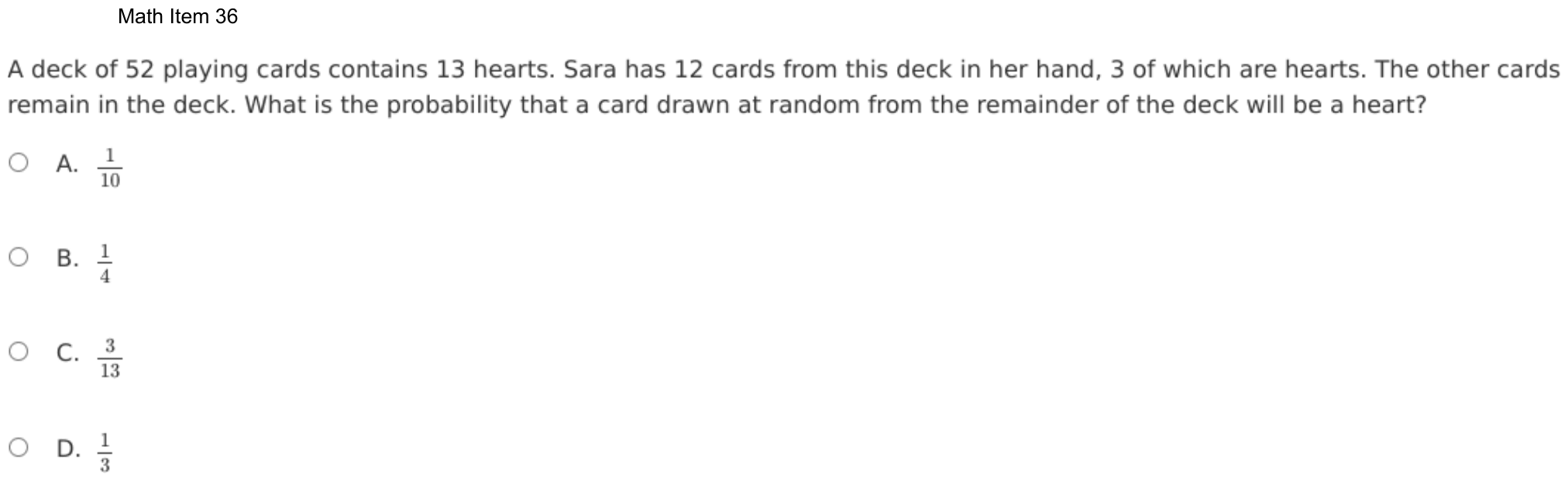
A deck of 52 playing cards contains 13 hearts. Sara has 12 cards from this deck in her hand, 3 of which are hearts. The other cards remain in the deck. What is the probability that a card drawn at random from the remainder of the deck will be a heart?
- A
- B
- C
- D
Show the answer
Correct answer: B
First, determine the number of cards in the remaining deck:
Next, determine the number of hearts left in the remaining deck:
Last, determine the probability of drawing a heart from the remaining deck:
Question analysis
A standard deck of 52 playing cards has 13 hearts, and Sara holds 12 cards, 3 of them hearts. Students find the probability that a card drawn at random from the rest of the deck is a heart. Her hand changes both the number of hearts and the number of cards left, so both counts must be updated.
- NYS standards
- 6.SP.8a uniform probability models
- Grade level
- Grade 6 content, by NYS standard
- Compared with grade 7
- At grade 7 Finding a simple probability is grade 6 content. This one adds a step many grade 7 problems skip: the cards in Sara's hand must be taken out of both the hearts and the whole deck first.
- Estimated difficulty
- Straightforward: two steps or one careful reading.
- Thinking it demands
- Depth of knowledge 2, skills and concepts · mainly apply
- What makes it hard
- Much to keep track of minor
- Turning words into math minor
- Solution
- 3 steps
- Reading level
- Question and choices: about grade 3, 51 words.
- Students, last 30 days
- Not enough answers yet to show (it takes 10).
Why it is hard, traps and wrong answers (shows the answer)
Why it is hard
The careful route takes two subtractions and a fraction: 10 hearts among 40 cards. The numbers are kind, because Sara’s hand is a quarter hearts, just like the full deck, so a student who ignores her hand and divides 13 by 52 also reaches 1/4. The wrong choices come from describing her hand instead of the deck, or from comparing hearts with the cards that are not hearts.
Much to keep track of minor Working it out
Four counts are in play, 52 cards, 13 hearts, Sara’s 12 cards and her 3 hearts, and both the hearts and the total must be reduced before the fraction is formed. (Sweller, 1988; Carpenter, Just & Shell, 1990)
Turning words into math minor Understanding the question
“The other cards remain in the deck” and “the remainder of the deck” point to the 40 cards Sara is not holding, not to the full 52 or to her hand. (Hegarty, Mayer & Monk, 1995; Koedinger & Nathan, 2004)
Strategy: Work out how many cards are left in the deck and how many of them are hearts, then write the hearts left over the cards left and simplify.
Traps
- Answers a different question: A choice is right for another quantity: the other unknown, the rest instead of the part, the part instead of the whole.
- Misunderstands the concept: A wrong belief about a concept: that percents can be added, that area grows like length, that averages can be averaged, that a bigger denominator means a bigger fraction.
- Numbers taken from the question: Combines the numbers in the question without a model of the situation, or is simply a number that appears in the question.
The wrong answers, classified
A Numbers taken from the question (Hegarty, Mayer & Monk, 1995)
Matches the 10 hearts left in the deck to the 10 in 1/10, never dividing them by the 40 cards that remain.
C Answers a different question (King et al., 2004; Hegarty, Mayer & Monk, 1995)
Puts Sara’s 3 hearts over the deck’s 13, or her 12 cards over 52, both 3/13, which describes her hand rather than the cards left.
D Misunderstands the concept (Smith, diSessa & Roschelle, 1993; De Bock et al., 1998; Ni & Zhou, 2005)
Compares the 10 hearts left with the 30 other cards left, a part-to-part ratio of 1 to 3, instead of with all 40 cards.
Worked solution, step by step
Formulas used
- Probability
- P is the probability, the chance something happens. The top counts the cards that are hearts. The bottom counts every card you could draw. Each card is equally likely to be drawn, so the fraction gives the chance.
Sort out the question
A full deck has 52 cards, and 13 of them are hearts. Sara holds 12 cards, and 3 of those are hearts. The rest of the cards stay in the deck.
You need the chance that a card drawn from the rest of the deck is a heart. Her hand changes both counts.
Count the cards left
Take Sara’s 12 cards out of the deck:
So 40 cards are left in the deck.
Count the hearts left
Sara holds 3 of the 13 hearts. Take those out:
So 10 hearts are left in the deck.
Find the probability
Use the probability formula. Put the hearts left over all the cards left, then simplify:
Watch out: comparing the 10 hearts with the 30 cards that are not hearts gives , choice D. The bottom must be all 40 cards. Choice C, , describes Sara’s hand, not the deck. Choice A, , uses the 10 hearts but forgets the 40 cards.
Give the answer
The chance of drawing a heart from the rest of the deck is 1 in 4.
So the answer is B, .
Check your answer
10 is one quarter of 40, because . Here is another check. Sara’s hand is 3 hearts out of 12, which is also one quarter. Taking a hand that is one quarter hearts out of a deck that is one quarter hearts leaves one quarter hearts.
More questions like this
The original DOE question
Question 3 of 26
2026 Practice Test D Math, question 5Question
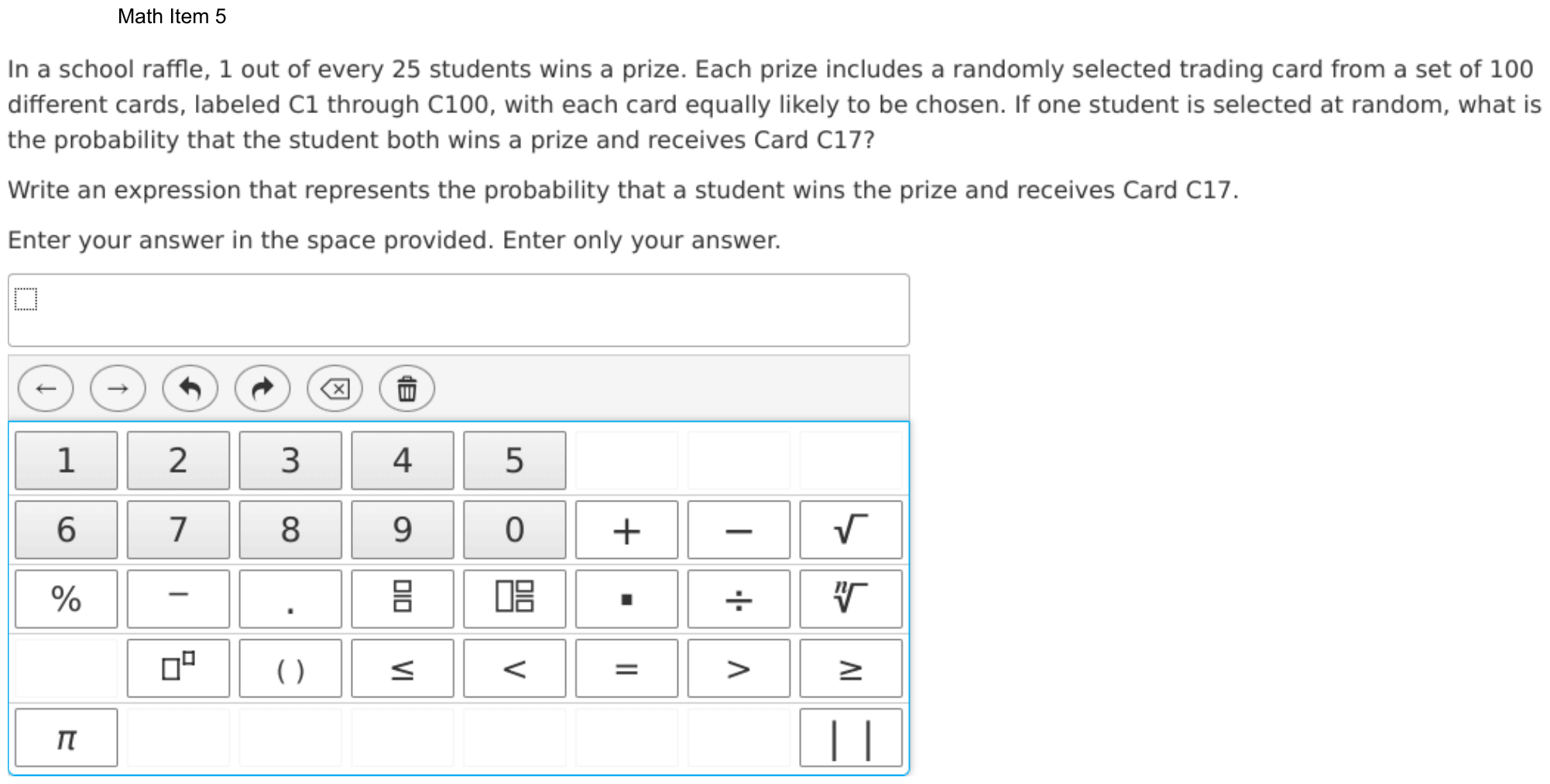
In a school raffle, 1 out of every 25 students wins a prize. Each prize includes a randomly selected trading card from a set of 100 different cards, labeled C1 through C100, with each card equally likely to be chosen. If one student is selected at random, what is the probability that the student both wins a prize and receives Card C17?
Write an expression that represents the probability that a student wins the prize and receives Card C17.
Enter your answer in the space provided. Enter only your answer.
On the test you build the answer on an on-screen keypad; here, type it. Use ^ for a power, sqrt( ) or √ for a root, pi for π, and <= or >= for ≤ and ≥.
Show the answer
Correct answer: 1/25 · 1/100
To calculate the joint probability, first determine the probability of each independent event.
The probability that a randomly selected student wins the prize is .
The probability that the card in a prize is Card C17 is , because Card C17 is 1 card out of 100 labeled cards.
The probability that a student wins the prize and receives Card C17 is the product of those two probabilities, .
Question analysis
In a school raffle, 1 out of every 25 students wins a prize, and each prize includes one of 100 equally likely trading cards. Students type an expression for the probability that a randomly chosen student both wins and gets one particular card. It tests the probability of two independent events, and combining the two chances correctly is the main hurdle.
- Grade level
- Grade 7 content, by NYS standard
- Compared with grade 7
- At grade 7 Grade 7 students find compound probabilities, usually by listing outcomes for coins or number cubes. These two stages have 25 and 100 outcomes, far too many pairs to list, so a rule must be used, and the answer is typed as an expression.
- Estimated difficulty
- Straightforward: two steps or one careful reading.
- Thinking it demands
- Depth of knowledge 2, skills and concepts · mainly apply
- What makes it hard
- Solution
- 2 steps
- Reading level
- Question and choices: about grade 8, 87 words.
- Corrected from the DOE handbook
- The explanation gave the wrong event the chance 1/100; one sentence was corrected.
- Students, last 30 days
- Not enough answers yet to show (it takes 10).
Why it is hard, traps and wrong answers (shows the answer)
Why it is hard
Each chance is stated almost directly, 1 out of 25 and 1 out of 100, so the question tests one rule: both events must happen, and the chances multiply. The word “and” pulls students toward adding, which gives a result larger than either chance, a sign that something is wrong. Others write only the card's chance and forget that the student must first win a prize.
Something you must already know moderate Working it out
The question never says that the chance of two independent events both happening is the product of their chances, so students must bring that rule to the 1/25 and the 1/100 themselves. (Anderson & Krathwohl, 2001)
An answer in an unexpected form minor Choosing the answer
The answer is typed as an expression with no choices to compare, so a sum of the two chances, which looks just as finished, gets no warning on screen. (Enright, Morley & Sheehan, 2002)
Strategy: Write each event's chance as a fraction, then apply the rule for two independent events that must both happen, and check that the result is smaller than either chance alone.
Traps
- Follows a key word: Picks the operation from a single word rather than the situation: "removed" so subtract, "of" so multiply, "more" so add, when the situation needs something else.
- Stops one step early: A choice is a number from partway through the solution.
- A faulty procedure: A systematic but wrong procedure: adding fractions straight across, applying an exponent to each term of a sum, dropping a sign when moving a term.
The wrong answers, classified
1/25 + 1/100 Follows a key word (Hegarty, Mayer & Monk, 1995)
Reads “both wins a prize and receives Card C17” as a cue to add, so sums the chances, though needing both events must be less likely than either.
1/100 Stops one step early (King et al., 2004; Gierl et al., 2017)
Writes only the chance of receiving Card C17 and leaves out that the student must first be one of the 1 in 25 who win a prize.
1/125 A faulty procedure (Brown & Burton, 1978; Tatsuoka, 1983)
Combines “1 out of 25” and “1 out of 100” by adding the totals, 25 + 100, a faulty rule that gives neither the sum nor the product.
What was corrected from the DOE handbook, and why
- Explanation: The DOE’s explanation says “The probability that a randomly selected student will receive Card C17 is 1/100.” Only students who win a prize receive a card, so a randomly selected student’s chance of receiving Card C17 is the question’s own answer, 1/25 × 1/100. The 1/100 is the chance that the card in a prize is Card C17, and the site now says so. The answer is unchanged.
Worked solution, step by step
Formulas used
- Probability of one outcome
- P is the probability, the chance that something happens, from 0 to 1. The top counts the outcomes you want. The bottom counts all the outcomes that could happen. Use it when every outcome is equally likely, like one card picked from 100.
- Probability that two independent events both happen
- A and B are two events. Independent means one does not change the chance of the other. P(A) is the chance of A, and P(B) is the chance of B. Multiply them to get the chance that both happen. The result is smaller than either chance, since both things must happen.
Sort out the question
Two things must both happen. First, the student wins a prize. Second, the card in that prize is Card C17. You need an expression for that chance. An expression is a math phrase made of numbers and signs, with no equal sign. You do not have to work it out to one number.
Find the chance of winning
The question says “1 out of every 25 students wins a prize.” One student is the part that wins, and 25 is the whole group. So:
Find the chance of Card C17
Each prize has one card, picked at random from 100 cards. Every card is equally likely. Card C17 is 1 of those 100 cards:
Multiply the two chances
Winning a prize does not change which card is inside it. So the two events are independent. To find the chance that both happen, multiply:
The dot · means times. Worked out, this is 1/2500.
Watch out: the word and does not mean add here. 1/25 + 1/100 is bigger than either chance, but needing both things must be less likely. Writing only 1/100 forgets that the student must win a prize first.
Enter the expression
On the test, press the fraction key, a small box over a small box. Type 1 on top and 25 on the bottom. Move the cursor out of the fraction with the → key. Press the dot key for times. Then use the fraction key again for 1 over 100. On this site, type 1/25 * 1/100 or 1/25 · 1/100. The value 1/2500 also counts.
So you would enter 1/25 · 1/100.
Check your answer
Picture 2,500 students. 1 in 25 wins, so about 100 students win a prize. Of those 100, about 1 gets Card C17. That is 1 student out of 2,500, which matches 1/25 · 1/100 = 1/2500. It is smaller than 1/25 and 1/100, as it should be.
More questions like this
The original DOE question
Question 4 of 26
2026 Practice Test D Math, question 7Question
A middle school library has a shelf with 40 books, each labeled with a different number from 201 to 240. One book is selected at random. What is the probability, as a percentage, of selecting book number 223?
Enter your answer in the space provided.
Fill-in question: work out the answer and type it as a number.
Show the answer
Correct answer: 2.5%
The probability that book number 223 will be selected at random from 40 books is 1 out of 40. To find the probability as a percentage, convert the fraction to a decimal.
The chance of selecting one specific book is .
Convert the decimal to a percentage:
Question analysis
A library shelf holds 40 books numbered 201 to 240, and one is picked at random. Students find the probability of picking one particular book and type it as a percentage. It tests simple probability and converting a fraction to a percent; the book numbers play no part, and the decimal point needs care.
- Grade level
- Grade 6 content, by NYS standard
- Compared with grade 7
- Below grade 7 Finding the probability of one equally likely outcome is grade 6 content. The only further step is rewriting the fraction as a percent, which needs care with place value, so it is lighter than grade 7 compound probability.
- Estimated difficulty
- Straightforward: two steps or one careful reading.
- Thinking it demands
- Depth of knowledge 1, recall and reproduction · mainly apply
- What makes it hard
- An answer in an unexpected form moderate
- Error-prone arithmetic minor
- Solution
- 2 steps
- Reading level
- Question and choices: about grade 6, 41 words.
- Students, last 30 days
- Not enough answers yet to show (it takes 10).
Why it is hard, traps and wrong answers (shows the answer)
Why it is hard
The book numbers, 201 to 240, and the chosen number 223 play no part, since every book is equally likely and the shelf holds 40. The chance is 1 in 40, and the real demand is the form: changing it to a percent means a decimal with a zero in the tenths place, then a shift of two places. Students who know that 1/4 is 25% can check that 1/40 must be a tenth of that.
An answer in an unexpected form moderate Choosing the answer
Only the bold word percentage sets the form, since the empty box shows no % sign, so the probability 1/40 must be turned into 2.5, not entered as the fraction or as 0.025. (Enright, Morley & Sheehan, 2002)
Error-prone arithmetic minor Working it out
Dividing 1 by 40 gives 0.025, with a zero right after the decimal point, and losing that zero turns the percent into 25. (Brown & Burton, 1978; Junker & Sijtsma, 2001)
Strategy: Count the books, write the chance of picking one particular book as a fraction, then turn the fraction into a decimal and multiply by 100 to get the percent.
Traps
- Stops one step early: A choice is a number from partway through the solution.
- Misreads the question: Misses or misreads a condition or a word in the question: "at least", "each", "remaining", "not".
- Information you don't need: The question gives numbers or facts that play no part in the answer.
The wrong answers, classified
0.025 Stops one step early (King et al., 2004; Gierl et al., 2017)
Finds the probability as a decimal, 1 ÷ 40 = 0.025, and enters it without multiplying by 100, though the box asks for a percentage.
25 An arithmetic slip (Junker & Sijtsma, 2001)
Loses the zero after the decimal point when dividing, taking 1 ÷ 40 as 0.25, as 1 ÷ 4 would be, and so enters 25.
1/40 Misreads the question (Hegarty, Mayer & Monk, 1995)
Enters the probability as the fraction 1/40, the form it was found in, overlooking the bold word percentage in the question.
Worked solution, step by step
Formulas used
- Probability of one outcome
- P is the probability, the chance of an event. The top counts the outcomes you want. The bottom counts all the equally likely outcomes. Use it when each outcome has the same chance, like picking one book at random.
- Changing a fraction to a percent
- a/b is the fraction. Percent means out of 100. Multiplying by 100 tells you how many out of 100 the fraction is. For example, 1/2 × 100 = 50, so 1/2 is 50%.
Sort out the question
The shelf has 40 books, numbered 201 to 240. One book is picked at random, so every book has the same chance. You need the chance of picking book 223, written as a percentage. Book 223 is on the shelf, since 223 is between 201 and 240.
Write the probability as a fraction
Only 1 book is number 223, and there are 40 books in all:
The numbers on the labels do not matter beyond this. They just give each book its own name.
Change the fraction to a decimal
Divide 1 by 40. It helps to start from 1/4 = 0.25. Since 40 is ten times 4, 1/40 is one tenth of 1/4:
Watch out: there is a 0 right after the decimal point. Losing it gives 0.25 and then 25, which is wrong.
Change the decimal to a percent
Multiply by 100 to get a percent. That moves the decimal point two places to the right:
So the chance is 2.5%.
Watch out: 0.025 is the probability as a decimal, and 1/40 is the same chance as a fraction. The question asks for a percentage, so neither one is the answer here.
Enter the number
The box shows no % sign. Type 2.5. Adding the sign, as 2.5%, also counts.
So you would enter 2.5.
Check your answer
2.5% means 2.5 out of every 100. Out of 40 books, that is 40 × 0.025 = 1 book, the one numbered 223. Also, one book out of 40 should be a small chance, and 2.5% is small.
More questions like this
The original DOE question

Question 5 of 26
2026 Practice Test D Math, question 34Question
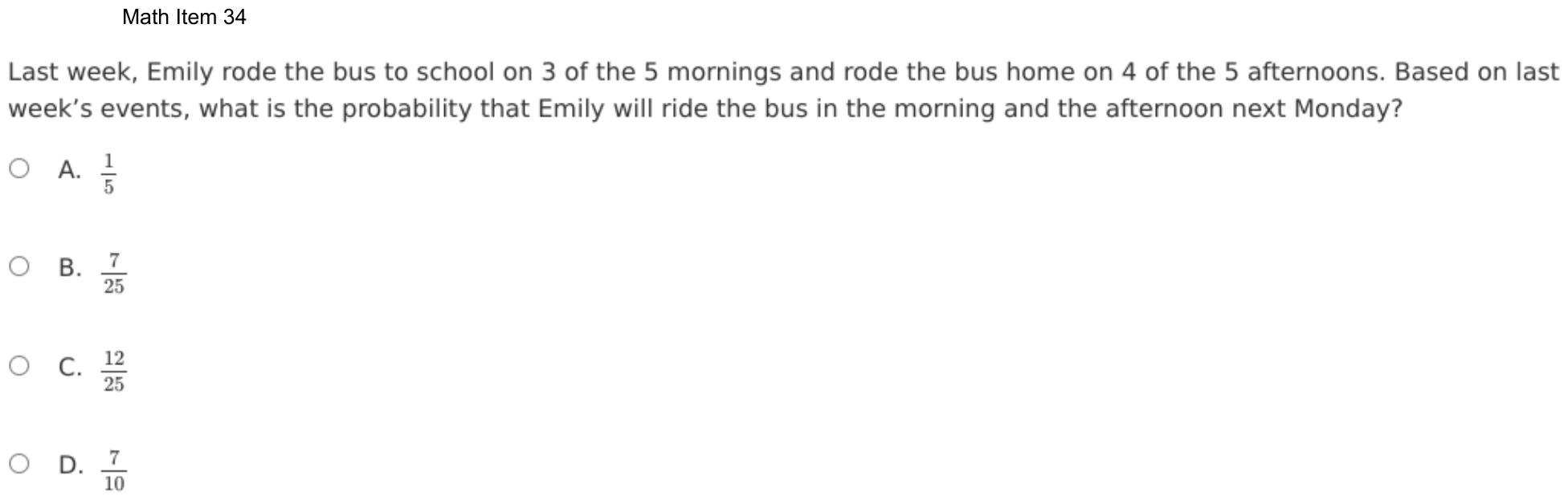
Last week, Emily rode the bus to school on 3 of the 5 mornings and rode the bus home on 4 of the 5 afternoons. Based on last week’s events, what is the probability that Emily will ride the bus in the morning and the afternoon next Monday?
- A
- B
- C
- D
Show the answer
Correct answer: C
Using the joint probability formula, find the product of the two independent events. The probability that Emily will ride the bus to school on any given morning is . The probability that Emily will ride the bus home on any given afternoon is . Therefore, the probability that Emily will ride the bus in the morning and the afternoon is .
Question analysis
Last week Emily rode the bus to school on 3 of 5 mornings and home on 4 of 5 afternoons. This probability question asks how likely she is to ride the bus both ways next Monday, based on those frequencies. Students turn each count into a probability and combine the two, deciding how chances join when both events must happen.
- NYS standards
- Grade level
- Grade 7 content, by NYS standard
- Compared with grade 7
- At grade 7 Compound probability is grade 7 work, often done with a table of outcomes. Each chance here comes from one week's frequencies, and joining the morning and afternoon events in one step is about the usual grade 7 demand.
- Estimated difficulty
- Moderate: several steps, or a close reading with one strong distractor.
- Thinking it demands
- Depth of knowledge 2, skills and concepts · mainly apply
- What makes it hard
- Something you must already know moderate
- Turning words into math minor
- Solution
- 3 steps
- Reading level
- Question and choices: about grade 5, 48 words.
- Corrected from the DOE handbook
- An inaccurate detail in the explanation was corrected.
- Students, last 30 days
- Not enough answers yet to show (it takes 10).
Why it is hard, traps and wrong answers (shows the answer)
Why it is hard
Once the two chances are written, the question is how they combine. Pooling the week into 7 bus rides out of 10 trips, or adding fractions in some way, gives listed choices that look reasonable, since each lies between 0 and 1. Picturing the 25 pairings of a morning with an afternoon, 3 × 4 = 12 of which have both rides, shows why the chances multiply.
Something you must already know moderate Working it out
The rule that two independent events both happen with the product of their chances, 3/5 times 4/5, is not given, and “the morning and the afternoon” is the only signal for it. (Anderson & Krathwohl, 2001)
Turning words into math minor Understanding the question
The counts “3 of the 5 mornings” and “4 of the 5 afternoons” have to become two separate probabilities based on last week, not one pool of 10 trips. (Hegarty, Mayer & Monk, 1995; Koedinger & Nathan, 2004)
Strategy: Turn each count into a probability, then multiply them, since both rides must happen; picturing a table of 5 mornings by 5 afternoons shows why multiplying works.
Traps
- Misunderstands the concept: A wrong belief about a concept: that percents can be added, that area grows like length, that averages can be averaged, that a bigger denominator means a bigger fraction.
- A faulty procedure: A systematic but wrong procedure: adding fractions straight across, applying an exponent to each term of a sum, dropping a sign when moving a term.
- Wrong operation: Adds instead of multiplying, divides the wrong way round, turns a ratio or rate upside down, or undoes a step in the wrong direction (subtracts what should be added back).
The wrong answers, classified
A Wrong operation (Hegarty, Mayer & Monk, 1995; King et al., 2004)
Subtracts the morning chance from the afternoon chance, 4/5 − 3/5 = 1/5, an operation with no meaning for two rides that must both happen.
B A faulty procedure (Brown & Burton, 1978; Tatsuoka, 1983)
Adds the numerators, 3 + 4, but multiplies the denominators, 5 × 5, mixing the rule for adding fractions with the rule for multiplying them.
D Misunderstands the concept (Smith, diSessa & Roschelle, 1993; De Bock et al., 1998; Ni & Zhou, 2005)
Pools the week’s trips into 7 bus rides out of 10, a rate for a single trip, as if riding both ways next Monday were just as likely.
What was corrected from the DOE handbook, and why
- Explanation: The DOE’s explanation says “The probability that Emily will ride the bus to school on any given afternoon is 4/5.” The question says she rode the bus home on 4 of the 5 afternoons; her rides to school are the morning ones. The site now says “ride the bus home on any given afternoon”.
Worked solution, step by step
Formulas used
- Probability from past results
- P is the probability, the chance something happens. You use what happened before to predict the chance it happens again. Emily rode in 3 of 5 mornings, so the chance for one morning is 3/5.
- Both of two independent events
- A and B are two events. Independent means one does not change the chance of the other. To find the chance that both happen, multiply their chances. The result is smaller than either one, since both must happen.
Sort out the question
Last week Emily:
- rode the bus to school on 3 of the 5 mornings;
- rode the bus home on 4 of the 5 afternoons.
You need the chance that she rides the bus in the morning and in the afternoon next Monday. The word and means both rides must happen.
Write each chance
Use last week to find each chance:
- Bus to school on a morning:
- Bus home on an afternoon:
Keep them apart. The morning rides go to school, and the afternoon rides go home.
Multiply the two chances
Both rides must happen, so multiply:
Why multiply? Pair each of the 5 mornings with each of the 5 afternoons. That makes 25 pairs. In of them, she rides both times. So the chance is 12 out of 25.
Avoid the tempting wrong choices
Watch out: pooling the week gives 7 rides out of 10 trips, or 7/10, choice D. That is the chance for one trip, not for two trips on one day.
Adding the tops but multiplying the bottoms gives 7/25, choice B. Subtracting the chances gives 1/5, choice A.
So the answer is C, .
Check your answer
The chance of both rides must be less than the chance of each ride alone. As decimals, 12/25 = 0.48. That is less than 3/5 = 0.6 and 4/5 = 0.8. Choice D, 7/10 = 0.7, is more than 3/5, so it cannot be right.
More questions like this
The original DOE question
Question 6 of 26
2026 Practice Test D Math, question 39Question
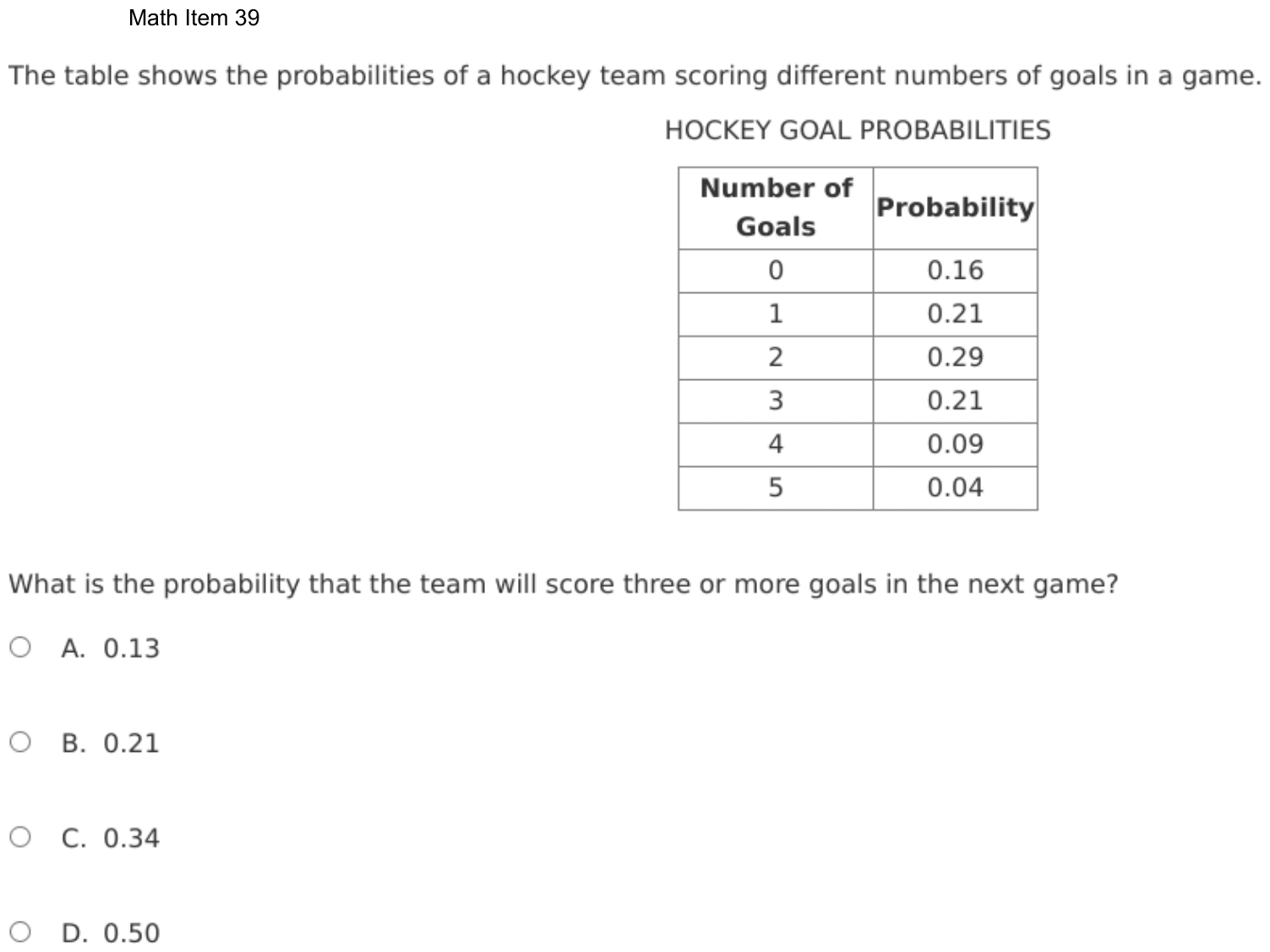
The table shows the probabilities of a hockey team scoring different numbers of goals in a game.
HOCKEY GOAL PROBABILITIES
| Number of Goals | Probability |
|---|---|
| 0 | 0.16 |
| 1 | 0.21 |
| 2 | 0.29 |
| 3 | 0.21 |
| 4 | 0.09 |
| 5 | 0.04 |
What is the probability that the team will score three or more goals in the next game?
- A0.13
- B0.21
- C0.34
- D0.50
Show the answer
Correct answer: C
To find the probability that any one of several mutually exclusive events occurs, use the addition rule, and add the probabilities of each event:
Using the data in the table, the probability that the team will score 3 or more goals in the next game is represented by
Question analysis
A table gives the probabilities of a hockey team scoring 0 to 5 goals in a game, and students find the chance that it scores three or more goals in the next one. This probability question tests adding the probabilities of separate outcomes. Reading exactly which rows the phrase covers is the main point of care.
- Grade level
- Grade 6 content, by NYS standard
- Compared with grade 7
- Below grade 7 Finding the probability of an event from a given probability model is grade 6 work in New York. Here the model is a table, and the task is choosing the right rows and adding decimals, shorter than typical grade 7 work.
- Estimated difficulty
- Routine: one familiar step, little to misread.
- Thinking it demands
- Depth of knowledge 1, recall and reproduction · mainly apply
- What makes it hard
- Solution
- 2 steps
- Reading level
- Question and choices: about grade 8, 40 words.
- Students, last 30 days
- Not enough answers yet to show (it takes 10).
Why it is hard, traps and wrong answers (shows the answer)
Why it is hard
Adding three decimals is easy, so the question turns on which rows the words cover. Including the 3-goal row, and not stopping at it, are the two decisions, and each misreading gives a listed choice. Checking the complement, 1 − (0.16 + 0.21 + 0.29), confirms both the sum and the choice of rows.
Turning words into math minor Understanding the question
The phrase “three or more goals” has to become the three rows for 3, 4 and 5 goals, starting at the 3-goal row itself. (Hegarty, Mayer & Monk, 1995; Koedinger & Nathan, 2004)
Reading a figure, table or graph minor Understanding the question
The table lists six probabilities, two of them both 0.21, so the rows for 3, 4 and 5 goals must be picked out by their goal counts, not by their values. (Lesh, Post & Behr, 1987; Kirsch & Mosenthal, 1990)
Strategy: Decide which rows the words "three or more" cover, add their probabilities, and check by subtracting the total of the other rows from 1.
Traps
- Counting the ends: Inclusive or exclusive ends, fence posts, consecutive numbers: an answer that is one too many or too few, or an endpoint drawn open where it belongs closed (or the reverse).
- Misreads the question: Misses or misreads a condition or a word in the question: "at least", "each", "remaining", "not".
- Misunderstands the concept: A wrong belief about a concept: that percents can be added, that area grows like length, that averages can be averaged, that a bigger denominator means a bigger fraction.
The wrong answers, classified
A Counting the ends (Brown & Burton, 1978)
Adds only the rows for 4 and 5 goals, 0.09 + 0.04 = 0.13, reading three or more as more than three and leaving out the end row.
B Misreads the question (Hegarty, Mayer & Monk, 1995)
Reads only the row for exactly 3 goals, 0.21, overlooking the words “or more” and the two rows below it.
D Misunderstands the concept (Smith, diSessa & Roschelle, 1993; De Bock et al., 1998; Ni & Zhou, 2005)
Counts 3 of the 6 rows, for 3, 4 and 5 goals, as half the outcomes, ignoring that the table gives them different probabilities.
Worked solution, step by step
Formulas used
- Adding probabilities
- A and B are two events that cannot both happen at once, like scoring exactly 3 goals and exactly 4 goals. The chance that one or the other happens is the sum of their chances.
- The chance it does not happen
- The chances of all possible outcomes add up to 1. So the chance an event does not happen is 1 minus the chance it does. Use it to check an answer from the other side.
Sort out the question
The table gives the chance of each number of goals, from 0 to 5. You need the chance the team scores three or more goals in the next game.
Pick the right rows
Three or more means 3 goals, 4 goals or 5 goals. The row for 3 counts too. Read those three rows:
- 3 goals: 0.21
- 4 goals: 0.09
- 5 goals: 0.04
Watch out: leaving out the 3-goal row gives 0.09 + 0.04 = 0.13, choice A. Using only the 3-goal row gives 0.21, choice B.
Add the chances
A game can end with only one number of goals. So add the three chances:
Watch out: three of the six rows is half the rows, but that does not make the chance 0.50, choice D. The rows have different chances.
So the answer is C, 0.34.
Check your answer
Find the chance of fewer than 3 goals, the other rows: . Then the chance of 3 or more is . Both ways give 0.34.
More questions like this
The original DOE question
Question 7 of 26
2024 Test A Math, question 15Question
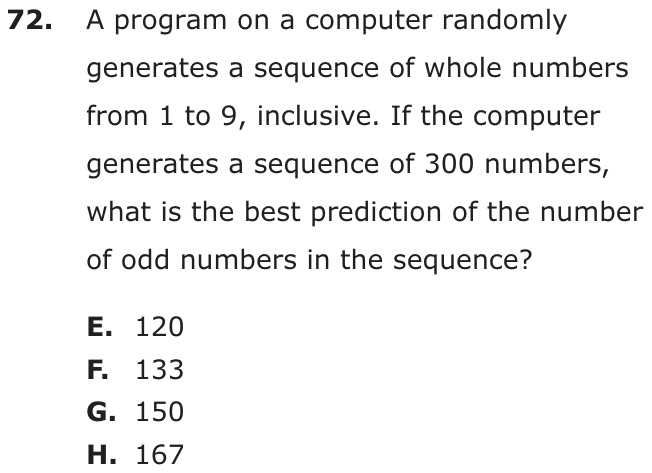
A program on a computer randomly generates a sequence of whole numbers from 1 to 9, inclusive. If the computer generates a sequence of 300 numbers, what is the best prediction of the number of odd numbers in the sequence?
- A120
- B133
- C150
- D167
Show the answer
Correct answer: D
There are five odd numbers in the range 1 through 9: 1, 3, 5, 7, and 9.
So the proportion of odd numbers in the range 1 through 9 is .
The expected number of odd values in the sequence from the computer program is
So the best prediction for the number of odd numbers in the sequence is 167.
Question analysis
A probability question: a computer randomly generates 300 whole numbers from 1 to 9, and students predict how many will be odd. It asks students to find the probability of an odd number and use it to predict a count. Counting carefully which of the nine numbers are odd, and rounding the prediction sensibly, are the points to watch.
- Grade level
- Grade 6 content, by NYS standard
- Compared with grade 7
- At grade 7 Using a probability to predict how often an event happens is grade 6 and 7 work. This takes two short steps plus a rounding decision, about the demand of a typical grade 7 probability task.
- Estimated difficulty
- Straightforward: two steps or one careful reading.
- Thinking it demands
- Depth of knowledge 2, skills and concepts · mainly apply
- What makes it hard
- Solution
- 3 steps
- Reading level
- Question and choices: about grade 11, 37 words.
- Students, last 30 days
- Not enough answers yet to show (it takes 10).
Why it is hard, traps and wrong answers (shows the answer)
Why it is hard
The method is short, a probability times 300, so the question is decided by the probability. Odd and even feel like an even split, and half of 300 is a listed choice, but the numbers 1 to 9 hold five odd and four even. Listing the nine numbers before computing removes the trap, and the result, about 167, then needs only rounding.
Turning words into math minor Understanding the question
The phrase "whole numbers from 1 to 9, inclusive" means nine equally likely values, five of them odd, so the chance of odd is 5/9, not the one half that odd and even suggest. (Hegarty, Mayer & Monk, 1995; Koedinger & Nathan, 2004)
Something you must already know minor Working it out
The stem never says that an expected count is the probability times the number of trials, here 5/9 of the 300 numbers generated. (Anderson & Krathwohl, 2001)
Error-prone arithmetic minor Working it out
The product 300 × 5/9 is 166.67, not a whole number, so the prediction has to be rounded to the nearest whole number. (Brown & Burton, 1978; Junker & Sijtsma, 2001)
Strategy: Count the odd numbers from 1 to 9, write the probability as that count over 9, and multiply by 300, rounding to the nearest whole number.
Traps
- Misunderstands the concept: A wrong belief about a concept: that percents can be added, that area grows like length, that averages can be averaged, that a bigger denominator means a bigger fraction.
- Answers a different question: A choice is right for another quantity: the other unknown, the rest instead of the part, the part instead of the whole.
The wrong answers, classified
A Little reason to choose it (Haladyna & Downing, 1993; Rodriguez, 2005)
No count of the nine numbers gives 120, which is 40% of 300; reaching it takes two errors at once, so it mostly attracts guesses.
B Answers a different question (King et al., 2004; Hegarty, Mayer & Monk, 1995)
Counts the four even numbers instead of the five odd ones and predicts 4/9 of 300, about 133.
C Misunderstands the concept (Smith, diSessa & Roschelle, 1993; De Bock et al., 1998; Ni & Zhou, 2005)
Assumes odd and even numbers are equally likely and takes half of 300, ignoring that 1 to 9 holds one more odd number than even.
Worked solution, step by step
Formulas used
- Probability
- P is the probability, the chance that something happens. Possible results are all the results that are equally likely. Wanted results are the ones you are looking for. The chance is the fraction of the results that you want.
- Expected count
- E is the expected count, your best guess of how many times something will happen. P is its probability, and n is the number of tries. If something happens 5 times out of 9, it should happen about 5 ninths of the time in many tries.
Sort out the question
The computer picks whole numbers from 1 to 9. Inclusive means 1 and 9 count too. Randomly means each number has the same chance. It picks 300 numbers. You need the best guess of how many of them are odd.
Count the odd numbers
An odd number does not split evenly by 2. From 1 to 9, the odd numbers are 1, 3, 5, 7 and 9. That is 5 of the 9 numbers. The even ones, 2, 4, 6 and 8, are only 4. Watch out: odd and even are not equally likely here, since there is one more odd number. Taking half of 300 gives 150, choice C.
Find the chance of odd
Each number the computer picks has a 5 in 9 chance of being odd. Watch out: do not use the 4 even numbers. That gives about 133, choice B.
Multiply by the 300 numbers
The sign ≈ means about. You can’t have part of a number, so round to the nearest whole number. 166.7 is closer to 167 than to 166. So the answer is D, 167.
Check your answer
The odd numbers are a bit more than half of the nine. So the answer should be a bit more than half of 300, which is 150. Only 167 is a bit more than 150. Also, 167 odd plus about 133 even makes 300.
More questions like this
The original DOE question
Question 8 of 26
2024 Test A Math, question 17Question
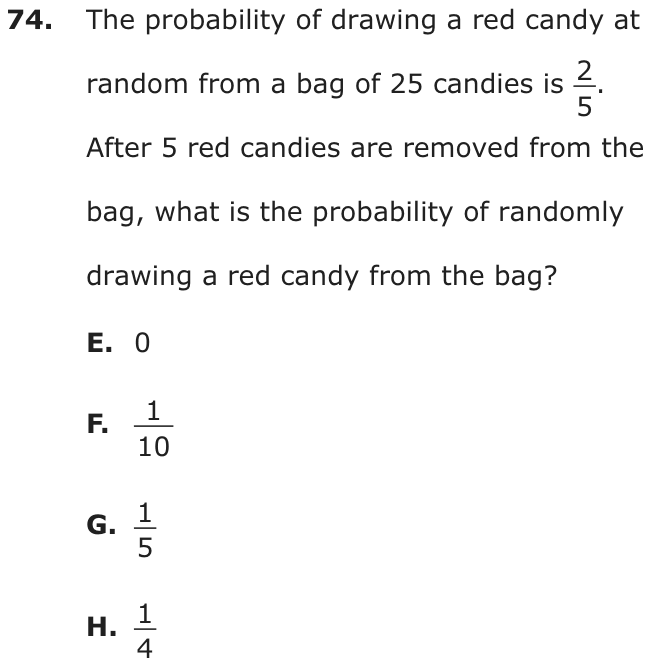
The probability of drawing a red candy at random from a bag of 25 candies is . After 5 red candies are removed from the bag, what is the probability of randomly drawing a red candy from the bag?
- A0
- B
- C
- D
Show the answer
Correct answer: D
Start with a proportion to determine the total number of red candies in the bag:
There are currently 10 red candies out of 25 candies in the bag. After 5 red candies are removed, there would be 5 red candies left in the bag and 20 total candies.
The probability of randomly drawing a red candy would then be .
Question analysis
A probability question about a bag of 25 candies in which the chance of drawing red is 2/5; then 5 red candies are taken out. Students find the new probability of drawing a red candy. They must work out how many red candies there were, then rebuild the fraction from the counts left in the bag.
- Grade level
- Grade 6 content, by NYS standard
- Compared with grade 7
- At grade 7 Simple probability as a fraction of outcomes is grade 6 and 7 content. This adds a step back from the probability to a count and an update after removal, which is typical grade 7 multi-step work.
- Estimated difficulty
- Moderate: several steps, or a close reading with one strong distractor.
- Thinking it demands
- Depth of knowledge 2, skills and concepts · mainly apply
- What makes it hard
- Turning words into math moderate
- Many steps minor
- Solution
- 3 steps
- Reading level
- Question and choices: about grade 7, 40 words.
- Students, last 30 days
- Not enough answers yet to show (it takes 10).
Why it is hard, traps and wrong answers (shows the answer)
Why it is hard
The question gives a probability, not a count, so the first job is to rebuild the bag: 10 red candies among 25. Removing candies changes two numbers at once, and the strongest wrong choice comes from updating the red count while leaving the total at 25. A student who writes both new counts before forming the fraction avoids it.
Turning words into math moderate Understanding the question
The probability 2/5 has to be turned into a count, 10 red of 25, and "after 5 red candies are removed" lowers both the red count and the bag's total. (Hegarty, Mayer & Monk, 1995; Koedinger & Nathan, 2004)
Many steps minor Working it out
Three steps follow in order: 2/5 of 25 = 10, then 5 red among 20 candies left, then 5/20 reduced to lowest terms. (Daniel & Embretson, 2010; Enright, Morley & Sheehan, 2002)
Strategy: Use 2/5 of 25 to find the number of red candies, subtract 5 from both the red count and the total, and write the new fraction in lowest terms.
Traps
- Misreads the question: Misses or misreads a condition or a word in the question: "at least", "each", "remaining", "not".
The wrong answers, classified
A An arithmetic slip (Junker & Sijtsma, 2001)
Takes 2/5 of 25 as 25 ÷ 5 = 5, forgetting to multiply by 2, so removing 5 red candies seems to leave none.
B Little reason to choose it (Haladyna & Downing, 1993; Rodriguez, 2005)
No working gives 1/10, which would need 2 red candies among the 20 left; it mostly draws students who are guessing.
C Misreads the question (Hegarty, Mayer & Monk, 1995)
Subtracts the 5 removed candies from the 10 red ones but keeps 25 as the total, finding 5/25 = 1/5, though the bag now holds 20.
Worked solution, step by step
Formulas used
- Probability
- P is the probability, the chance of drawing a red candy. Red candies is how many red ones are in the bag. All candies is how many candies are in the bag in all. Each candy is equally likely, so the chance is the fraction of the bag that is red.
Sort out the question
The bag has 25 candies. The chance of drawing red is . Then 5 red candies are taken out. You need the new chance of drawing red. Taking out candies changes both the red count and the total.
Find the number of red candies
A chance of means 2 out of every 5 candies are red. Call the red count r.
There are 10 red candies. Watch out: do not stop at . You must also multiply by 2. Thinking there are 5 red candies leads to 0, choice A.
Take out the 5 red candies
Now 5 of the 20 candies are red. Watch out: the total goes down too. Keeping 25 gives , choice C.
Find the new probability
To simplify, divide the top and bottom by 5. So the answer is D, .
Check your answer
At first, is 40% of the bag. Taking out only red candies should lower the chance. is 25%, which is lower but not zero. That makes sense, because 5 red candies are still in the bag.
More questions like this
The original DOE question
Question 9 of 26
2024 Test B Math, question 17Question
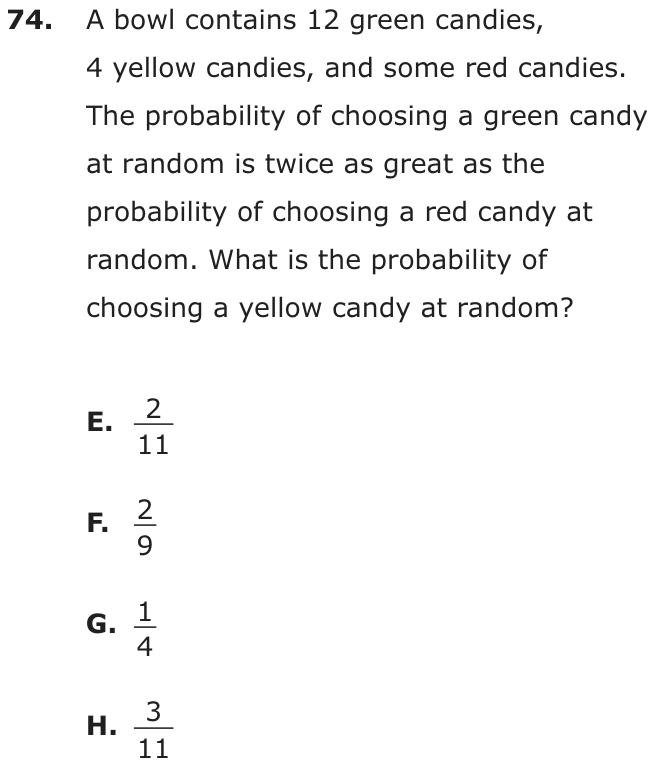
A bowl contains 12 green candies, 4 yellow candies, and some red candies. The probability of choosing a green candy at random is twice as great as the probability of choosing a red candy at random. What is the probability of choosing a yellow candy at random?
- A
- B
- C
- D
Show the answer
Correct answer: A
The probability of choosing a green candy is twice as great as the probability of choosing a red candy. There are 12 green candies. Let r = the number of red candies.
So there are 6 red candies. 12 green candies + 4 yellow candies + 6 red candies = 22 total candies.
There are 4 yellow candies out of a total of 22 candies. So the probability of choosing a yellow candy is
.
Question analysis
A probability question about a bowl of 12 green candies, 4 yellow candies and an unknown number of red ones. A green candy is twice as likely to be picked as a red one, and students find the chance of picking a yellow candy. The missing red count has to be worked out before any probability can be found.
- Grade level
- Grade 6 content, by NYS standard
- Compared with grade 7
- Above grade 7 Simple probability is grade 6 content in New York, and grade 7 problems usually give every count. Working backward from a comparison of two probabilities to a missing count, then forward to a third probability, is more than typical grade 7 work.
- Estimated difficulty
- Hard: combines ideas, needs a plan, and has more than one tempting wrong answer.
- Thinking it demands
- Depth of knowledge 2, skills and concepts · mainly apply
- What makes it hard
- Turning words into math moderate
- Combines ideas moderate
- Solution
- 3 steps
- Reading level
- Question and choices: about grade 7, 49 words.
- Students, last 30 days
- Not enough answers yet to show (it takes 10).
Why it is hard, traps and wrong answers (shows the answer)
Why it is hard
The question withholds the red count, and everything depends on recovering it from the comparison of probabilities. Students who cannot make that step tend to leave red out altogether, while those who find 6 red candies can still slip at the end by using the wrong total or the wrong color. Writing all three counts and the total of 22 before forming any fraction prevents both endings.
Turning words into math moderate Understanding the question
“Twice as great as the probability of choosing a red candy” must become 12 = 2 × the red count, which works only because both probabilities share one total. (Hegarty, Mayer & Monk, 1995; Koedinger & Nathan, 2004)
Combines ideas moderate Working it out
An unknown count has to be found from a ratio before any probability can be written, joining proportional reasoning with probability as a part over the total. (Embretson, 1998; Daniel & Embretson, 2010)
Strategy: Turn twice as likely into a statement about numbers of candies to find the red count, add all three colors for the total, then put the yellow count over that total and simplify.
Traps
- Answers a different question: A choice is right for another quantity: the other unknown, the rest instead of the part, the part instead of the whole.
- Numbers taken from the question: Combines the numbers in the question without a model of the situation, or is simply a number that appears in the question.
The wrong answers, classified
B Misunderstands the concept (Smith, diSessa & Roschelle, 1993; De Bock et al., 1998; Ni & Zhou, 2005)
Finds the 6 red candies but compares the 4 yellow with the 18 green and red ones, 4/18, a part-to-part ratio instead of part to whole.
C Numbers taken from the question (Hegarty, Mayer & Monk, 1995)
Leaves out the red candies, whose number is not given, and divides the 4 yellow by the 16 green and yellow candies.
D Answers a different question (King et al., 2004; Hegarty, Mayer & Monk, 1995)
Finds the 6 red candies and the total of 22 correctly but gives the chance of red, 6/22 = 3/11, instead of yellow.
Worked solution, step by step
Formulas used
- Probability
- P is the probability, the chance that something happens. The top is how many candies are the kind you want. The bottom is how many candies there are in all. Each candy is just as likely to be picked, so this fraction gives the chance.
Sort out what you know
The bowl has 12 green candies, 4 yellow candies and some red candies. You are not told how many are red. Let r be the number of red candies.
The chance of picking green is twice the chance of picking red. You need the probability (the chance) of picking yellow.
Compare green and red
Write each chance with the probability formula.
Green and red have the same bottom number, the total number of candies. So if the chance of green is twice the chance of red, there are twice as many green candies as red ones.
Find the red candies and the total
There are 6 red candies. Now add up all the candies.
There are 22 candies in all. Watch out: do not leave out the red candies just because their number was not given. Using 16 as the total gives 1/4, choice C.
Find the chance of yellow
There are 4 yellow candies out of 22.
Divide the top and the bottom by 2 to simplify. Watch out: the question asks for yellow, not red. 6/22 = 3/11 is the chance of red, choice D. The bottom must be all 22 candies. Using 18 gives 2/9, choice B.
So the answer is A, .
Check your answer
Check the clue. The chance of green is , and the chance of red is . Twelve is twice 6, so green is twice as likely. Also, the three chances add up to 1: .
More questions like this
The original DOE question
Question 10 of 26
2024 Test B Math, question 29Question
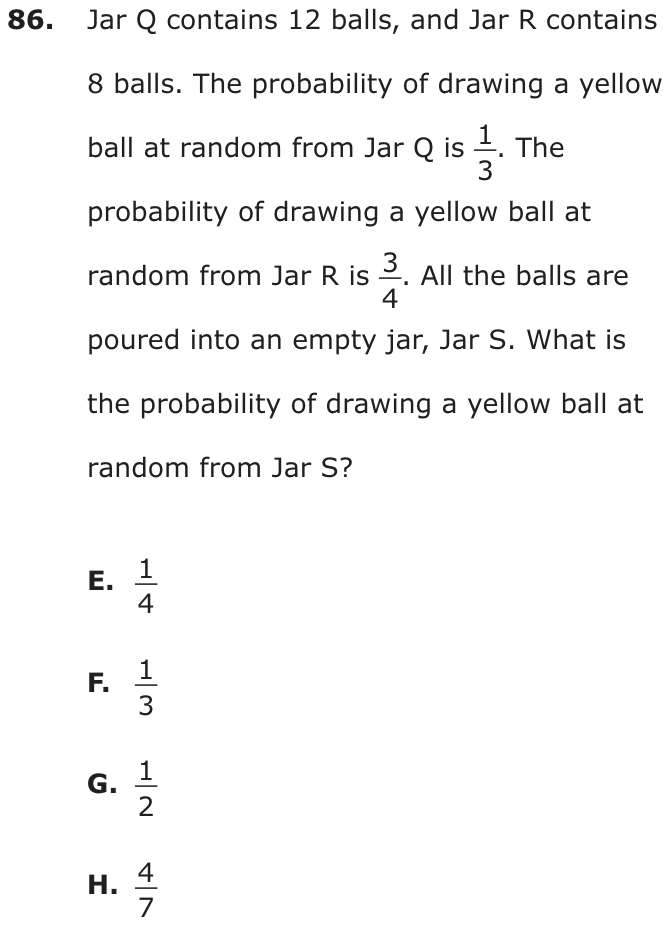
Jar Q contains 12 balls, and Jar R contains 8 balls. The probability of drawing a yellow ball at random from Jar Q is . The probability of drawing a yellow ball at random from Jar R is . All the balls are poured into an empty jar, Jar S. What is the probability of drawing a yellow ball at random from Jar S?
- A
- B
- C
- D
Show the answer
Correct answer: C
Jar Q contains 12 balls, and the probability of drawing a yellow ball at random is .
There are 4 yellow balls in Jar Q.
Jar R contains 8 balls, and the probability of drawing a yellow ball at random is .
There are 6 yellow balls in Jar R.
Jar S contains all the balls from Jar Q and Jar R.
There are 20 balls in Jar S.
There are 10 yellow balls in Jar S.
The probability of drawing a yellow ball at random from Jar S is .
Question analysis
Two jars hold different numbers of balls and give different chances of drawing a yellow ball, and then everything is poured into a third jar. Students find the probability of drawing yellow from the combined jar. The tricky part is that the jars are different sizes, so their probabilities cannot be merged without first counting the yellow balls.
- Grade level
- Grade 6 content, by NYS standard
- Compared with grade 7
- At grade 7 Grade 7 probability tasks usually give the counts and ask for a fraction. Here each jar's probability must be turned back into a count of yellow balls before the jars are pooled, a reverse step that typical classwork rarely asks for.
- Estimated difficulty
- Moderate: several steps, or a close reading with one strong distractor.
- Thinking it demands
- Depth of knowledge 2, skills and concepts · mainly apply
- What makes it hard
- Turning words into math moderate
- A very close wrong answer minor
- Solution
- 4 steps
- Reading level
- Question and choices: about grade 6, 66 words.
- Students, last 30 days
- Not enough answers yet to show (it takes 10).
Why it is hard, traps and wrong answers (shows the answer)
Why it is hard
The arithmetic is light; the hurdle is seeing that chances from jars of different sizes cannot be combined as fractions. Every wrong choice works on 1/3 and 3/4 directly, by multiplying them, by keeping one, or by adding tops and bottoms, while the right path runs through counts of balls. Asking how many yellow balls each jar holds before anything is poured avoids all three.
Turning words into math moderate Understanding the question
Each jar's probability, 1/3 of 12 balls and 3/4 of 8 balls, has to be turned back into a count of yellow balls, 4 and 6, before the two jars can be combined. (Hegarty, Mayer & Monk, 1995; Koedinger & Nathan, 2004)
A very close wrong answer minor Choosing the answer
The straight-across 4/7, about 0.57, sits just above the right 1/2, and both lie between the jars' chances of 1/3 and 3/4, so a rough estimate does not rule it out. (Embretson & Wetzel, 1987; Gorin & Embretson, 2006; Ascalon et al., 2007)
Strategy: Turn each jar's probability into a number of yellow balls by multiplying it by that jar's total, then divide all the yellow balls by all the balls.
Traps
- Misunderstands the concept: A wrong belief about a concept: that percents can be added, that area grows like length, that averages can be averaged, that a bigger denominator means a bigger fraction.
- A faulty procedure: A systematic but wrong procedure: adding fractions straight across, applying an exponent to each term of a sum, dropping a sign when moving a term.
The wrong answers, classified
A Misunderstands the concept (Smith, diSessa & Roschelle, 1993; De Bock et al., 1998; Ni & Zhou, 2005)
Multiplies the jars' chances, 1/3 × 3/4 = 1/4, the rule for two draws that must both be yellow, though only one ball is drawn from the mixture.
B Numbers taken from the question (Hegarty, Mayer & Monk, 1995)
Repeats Jar Q's 1/3 from the stem, as if the bigger jar's chance carried over to the mixture unchanged.
D A faulty procedure (Brown & Burton, 1978; Tatsuoka, 1983)
Adds the fractions straight across, (1 + 3)/(3 + 4) = 4/7, treating 1/3 and 3/4 as if they were counts of balls rather than chances.
Worked solution, step by step
Formulas used
- Probability
- P(yellow) is the probability, or chance, of drawing a yellow ball. It is a number from 0 to 1. The top counts the yellow balls. The bottom counts all the balls. It works because every ball is equally likely to be drawn.
Sort out what you know
Jar Q holds 12 balls. The probability, or chance, of drawing yellow from it is .
Jar R holds 8 balls. The chance of drawing yellow from it is .
All the balls are poured into Jar S. You need the chance of drawing yellow from Jar S.
Count the yellow balls in Jar Q
The jars are different sizes, so you can’t mix their chances directly. Count the yellow balls instead. The chance tells what fraction of the balls are yellow. So multiply it by the number of balls.
Jar Q has 4 yellow balls.
Count the yellow balls in Jar R
Do the same for Jar R. Three fourths of its 8 balls are yellow.
Jar R has 6 yellow balls.
Count the balls in Jar S
Jar S gets every ball from both jars. Add all the balls. Then add the yellow balls.
Jar S has 20 balls, and 10 of them are yellow.
Find the chance for Jar S
Use the probability formula with the Jar S counts.
Watch out: Adding the tops and the bottoms, 1 + 3 over 3 + 4, gives , choice D. Those numbers are parts of fractions, not balls. Multiplying gives , choice A. That is the chance of two yellow draws, one from each jar.
So the answer is C, .
Check your answer
Half of the 20 balls is 10, and 4 + 6 = 10 yellow balls. That matches. Also, the mixed jar’s chance should land between the two jars’ chances, and . One half does.
More questions like this
The original DOE question
Question 11 of 26
2024 Test B Math, question 45Question
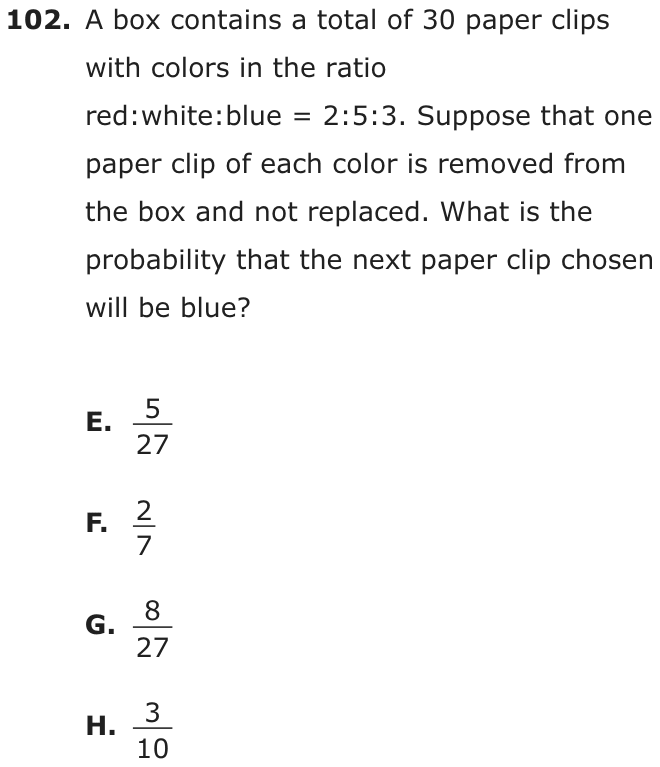
A box contains a total of 30 paper clips with colors in the ratio . Suppose that one paper clip of each color is removed from the box and not replaced. What is the probability that the next paper clip chosen will be blue?
- A
- B
- C
- D
Show the answer
Correct answer: C
The ratio is . Find the number of each color in a box of 30 paper clips.
If one paper clip of each color is removed (3 total), there will be 8 blue paper clips out of 27 in the box. The probability that the next paper clip chosen will be blue is .
Question analysis
A box of 30 paper clips has red, white and blue clips in the ratio 2 to 5 to 3, and one clip of each color is taken out. Students find the probability that the next clip drawn is blue. It tests ratios and simple probability; the ratio gives shares rather than counts, and the removals change both the blue count and the total.
- Grade level
- Grade 6 content, by NYS standard
- Compared with grade 7
- At grade 7 Splitting a total by a three-part ratio and finding a simple probability are both familiar skills. Combining them, then adjusting the counts after the removals, adds steps but stays within typical grade 7 multi-step work.
- Estimated difficulty
- Moderate: several steps, or a close reading with one strong distractor.
- Thinking it demands
- Depth of knowledge 2, skills and concepts · mainly apply
- What makes it hard
- Many steps moderate
- A very close wrong answer moderate
- Turning words into math minor
- Solution
- 4 steps
- Reading level
- Question and choices: about grade 5, 47 words.
- Students, last 30 days
- Not enough answers yet to show (it takes 10).
Why it is hard, traps and wrong answers (shows the answer)
Why it is hard
The question chains a ratio problem into a probability problem, with a small change in between. Students who skip the removal get 3/10, a choice that is almost the right value and looks natural because it matches the ratio. The cleanest route lists the actual counts, 6, 15 and 9, takes one from each, and writes blue's 8 over the remaining 27.
Many steps moderate Working it out
The ratio 2:5:3 must become counts of 6, 15 and 9 clips, one clip of each color must come out, and only then can blue's 8 be put over 27. (Daniel & Embretson, 2010; Enright, Morley & Sheehan, 2002)
A very close wrong answer moderate Choosing the answer
3/10 = 0.3 and 8/27, about 0.296, are almost equal, so an estimate cannot separate them; only subtracting the three removed clips does. (Embretson & Wetzel, 1987; Gorin & Embretson, 2006; Ascalon et al., 2007)
Turning words into math minor Understanding the question
The removal of one clip of each color, not replaced, happens before the draw, so it changes both the blue count and the total in the box. (Hegarty, Mayer & Monk, 1995; Koedinger & Nathan, 2004)
Strategy: Divide 30 by the sum of the ratio parts to find each color's count, take one clip away from each color, then put the blue count over the new total.
Traps
- Without replacement: In a second pick there is one fewer item, which changes the probability.
- Misunderstands the concept: A wrong belief about a concept: that percents can be added, that area grows like length, that averages can be averaged, that a bigger denominator means a bigger fraction.
- Answers a different question: A choice is right for another quantity: the other unknown, the rest instead of the part, the part instead of the whole.
The wrong answers, classified
A Answers a different question (King et al., 2004; Hegarty, Mayer & Monk, 1995)
Works out the counts correctly but puts red's remaining 5 clips over the 27 left, answering for the wrong color.
B Misunderstands the concept (Smith, diSessa & Roschelle, 1993; De Bock et al., 1998; Ni & Zhou, 2005)
Treats the ratio terms as actual counts and removes one from each, so blue is 3 − 1 = 2 of 10 − 3 = 7 clips.
D Without replacement (Fischbein & Schnarch, 1997)
Gives blue's share of the full box, 9 of 30 or 3 of 10 ratio parts, ignoring the three clips removed before the draw.
Worked solution, step by step
Formulas used
- Size of one ratio part
- The ratio numbers tell how many parts each color gets. Their sum is the number of parts in all. total is the number of clips. Dividing gives the size of one part. Each color is then its ratio number times one part.
- Probability
- P(blue) is the chance of picking a blue clip. The top counts the blue clips in the box. The bottom counts all the clips in the box. It works because each clip is equally likely to be picked.
Sort out the question
The box has 30 clips. The ratio red : white : blue = 2 : 5 : 3 means that for every 2 red clips, there are 5 white clips and 3 blue clips.
Then one clip of each color is taken out and not put back. You need the chance that the next clip picked is blue.
Find the size of one part
The ratio has parts in all. The 30 clips are shared among those 10 parts.
Each part is 3 clips.
Count the clips of each color
Multiply each ratio number by the size of one part.
Check: 6 + 15 + 9 = 30 clips. That matches the total.
Take out one of each color
One red, one white and one blue clip come out. Each color drops by 1, and the total drops by 3.
Color Before After Red 6 5 White 15 14 Blue 9 8 All 30 27 Find the chance of blue
Watch out: , choice D, ignores the 3 clips taken out. , choice A, is the chance of red. Taking 1 from each ratio number, as if the box held only 10 clips, gives , choice B.
So the answer is C, .
Check your answer
Add the clips left: 5 + 14 + 8 = 27. That matches. Also, is about 0.296, a bit less than blue’s share of the full box, 0.3. That makes sense, since one blue clip came out.
More questions like this
The original DOE question
Question 12 of 26
2023 Test A Math, question 23Question
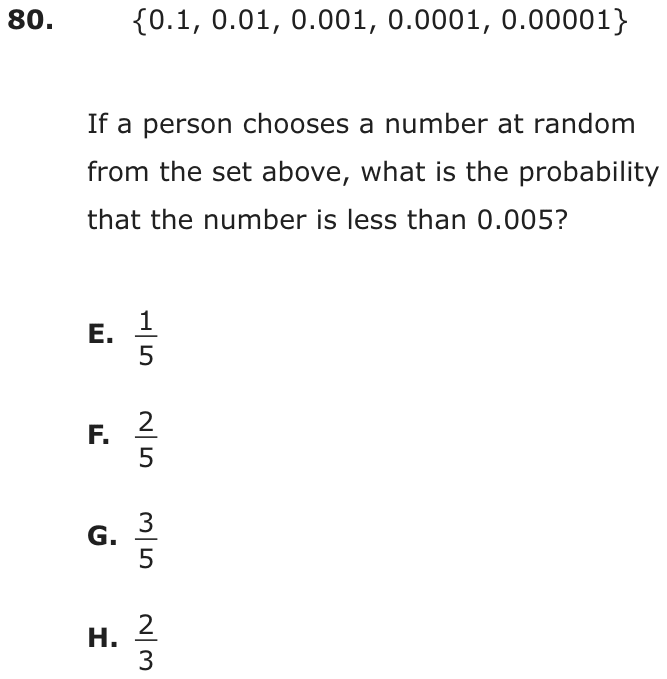
If a person chooses a number at random from the set above, what is the probability that the number is less than 0.005?
- A
- B
- C
- D
Show the answer
Correct answer: C
Three of the five numbers listed (0.001, 0.0001, and 0.00001) are less than 0.005. So, the probability of a person selecting a number less than 0.005 is .
Question analysis
A set holds five decimals, from one tenth down to one hundred-thousandth, and one number is chosen at random. Students find the probability that the number is less than 0.005. Comparing decimals with many zeros is the real task here, along with putting the count over the right total.
- Grade level
- Grade 6 content, by NYS standard
- Compared with grade 7
- Below grade 7 Probability with equally likely outcomes is grade 6 content in New York, and this needs one comparison per number and one fraction. The only real demand is comparing decimals with many zeros correctly.
- Estimated difficulty
- Straightforward: two steps or one careful reading.
- Thinking it demands
- Depth of knowledge 2, skills and concepts · mainly apply
- What makes it hard
- Error-prone arithmetic moderate
- Something you must already know minor
- Solution
- 2 steps
- Reading level
- Question and choices: about grade 6, 27 words.
- Students, last 30 days
- Not enough answers yet to show (it takes 10).
Why it is hard, traps and wrong answers (shows the answer)
Why it is hard
Each number in the set is a tenth of the one before, so only the three smallest fall below 0.005, which lies between 0.01 and 0.001. Students lose the point either by counting the numbers above 0.005 instead of below it or by writing the count over the wrong total. Lining the decimals up with the same number of places makes every comparison easy.
Error-prone arithmetic moderate Working it out
0.005 has to be compared with decimals from 0.1 down to 0.00001; written to five places, 0.00500 against 0.01000 and 0.00100, the order becomes a comparison of whole numbers. (Brown & Burton, 1978; Junker & Sijtsma, 2001)
Something you must already know minor Working it out
The probability is the count of numbers below 0.005 over all 5 numbers in the set; the stem leaves that part-to-whole rule to the student. (Anderson & Krathwohl, 2001)
Strategy: Write each number with five decimal places, compare it with 0.00500, count those that are smaller, and divide by the five numbers in the set.
Traps
- Answers a different question: A choice is right for another quantity: the other unknown, the rest instead of the part, the part instead of the whole.
- Misunderstands the concept: A wrong belief about a concept: that percents can be added, that area grows like length, that averages can be averaged, that a bigger denominator means a bigger fraction.
The wrong answers, classified
A Answers a different question (King et al., 2004; Hegarty, Mayer & Monk, 1995)
Gives 1/5, the chance of picking any one particular number from the set, without counting how many of the five are below 0.005.
B Answers a different question (King et al., 2004; Hegarty, Mayer & Monk, 1995)
Counts the 2 numbers greater than 0.005, 0.1 and 0.01, instead of those less than it, finding the chance of the opposite event.
D Misunderstands the concept (Smith, diSessa & Roschelle, 1993; De Bock et al., 1998; Ni & Zhou, 2005)
Writes a part-to-part ratio, the 2 numbers above 0.005 over the 3 below it, instead of dividing by all 5 numbers in the set.
Worked solution, step by step
Formulas used
- Probability
- P is the probability, the chance that something happens. Possible results are all the results that are equally likely. Wanted results are the ones you are looking for. The chance is the fraction of all the results that you want.
- Adding zeros to a decimal
- Zeros added to the right end of a decimal don’t change its value. One tenth is the same as ten hundredths. Giving every number the same number of decimal places lets you compare them like whole numbers.
Sort out the question
The set has five numbers. A person picks one at random, so each number has the same chance. You need the probability, or chance, that the number picked is less than 0.005.
Give every number five decimal places
Decimals are easier to compare with the same number of places. Add zeros to the end of each.
Number With five places 0.1 0.10000 0.01 0.01000 0.001 0.00100 0.0001 0.00010 0.00001 0.00001 0.005 0.00500 Count the numbers below 0.005
Compare each number with 0.00500 like whole numbers: 10000, 1000, 100, 10 and 1 against 500. Two numbers are bigger: 0.1 and 0.01. Three are smaller: 0.001, 0.0001 and 0.00001. Watch out: 0.01 has fewer digits than 0.005, but it is bigger. Counting the 2 bigger numbers gives , choice B.
Write the probability
Watch out: divide by all 5 numbers in the set. Comparing the 2 bigger numbers with the 3 smaller ones gives , choice D. So the answer is C, .
Check your answer
The numbers below 0.005 and the numbers above it make up the whole set: 3 + 2 = 5. So the two chances, and , add up to 1, as they should.
More questions like this
The original DOE question
Question 13 of 26
2023 Test A Math, question 27Question
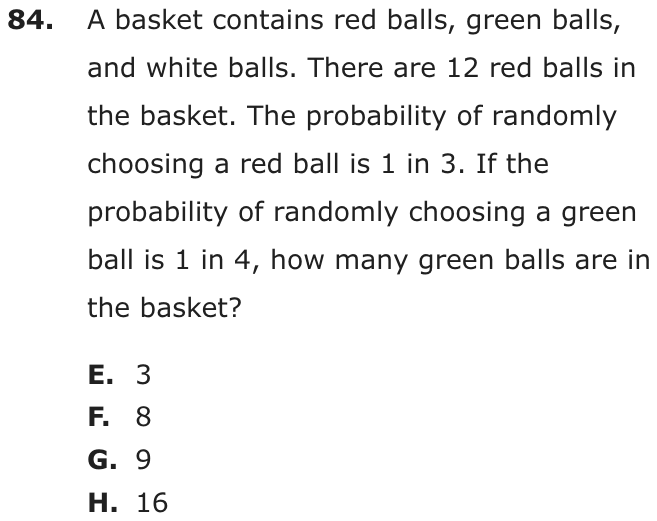
A basket contains red balls, green balls, and white balls. There are 12 red balls in the basket. The probability of randomly choosing a red ball is 1 in 3. If the probability of randomly choosing a green ball is 1 in 4, how many green balls are in the basket?
- A3
- B8
- C9
- D16
Show the answer
Correct answer: C
First, use the information about the red balls to calculate the total number of balls in the basket:
| Cross multiply. | |
There are a total of 36 balls in the basket. The probability of selecting a green ball is 1 in 4. Use that information to calculate how many green balls are in the basket:
| Cross multiply. | |
| Apply the multiplicative inverse property; divide both sides of the equation by 4. | |
There are 9 green balls in the basket.
Question analysis
A basket holds red, green and white balls, including 12 red ones, and the chances of drawing red and green are 1 in 3 and 1 in 4. Students find how many green balls are in the basket. Getting the total from the red count is the step students skip when they apply a probability to the wrong number.
- Grade level
- Grade 6 content, by NYS standard
- Compared with grade 7
- At grade 7 Simple probability is grade 6 content, but here it runs backward: a count and a probability give the total, which then gives another count. Two linked steps like this are typical of grade 7 work.
- Estimated difficulty
- Straightforward: two steps or one careful reading.
- Thinking it demands
- Depth of knowledge 2, skills and concepts · mainly apply
- What makes it hard
- Turning words into math minor
- Many steps minor
- Solution
- 2 steps
- Reading level
- Question and choices: about grade 6, 46 words.
- Students, last 30 days
- Not enough answers yet to show (it takes 10).
Why it is hard, traps and wrong answers (shows the answer)
Why it is hard
The basket's total is never stated, and that missing number is the whole problem: it has to be recovered from the red balls before the green probability means anything. Applying the green chance straight to the 12 red balls is the quick wrong move. Checking that 12 red and 9 green fit in 36 balls with 15 white left over confirms the setup.
Turning words into math minor Understanding the question
The sentence "The probability of randomly choosing a red ball is 1 in 3" has to become 12 = one third of the total, which makes the basket hold 36 balls. (Hegarty, Mayer & Monk, 1995; Koedinger & Nathan, 2004)
Many steps minor Working it out
Two linked steps: the red balls give the total, 12 × 3 = 36, and only then does the green probability give a count, 36 ÷ 4 = 9. (Daniel & Embretson, 2010; Enright, Morley & Sheehan, 2002)
Strategy: Use the red balls to find the total, since 12 is one third of it, then take one fourth of that total for the green balls.
Traps
- Numbers taken from the question: Combines the numbers in the question without a model of the situation, or is simply a number that appears in the question.
- Wrong operation: Adds instead of multiplying, divides the wrong way round, turns a ratio or rate upside down, or undoes a step in the wrong direction (subtracts what should be added back).
The wrong answers, classified
A Numbers taken from the question (Hegarty, Mayer & Monk, 1995)
Takes one fourth of the 12 red balls, 12 ÷ 4 = 3, applying the green probability to the only count the stem gives instead of to the total.
B Little reason to choose it (Haladyna & Downing, 1993; Rodriguez, 2005)
No use of the two probabilities gives 8, which is one third of the 24 balls that are not red, so it mostly catches guesses.
D Wrong operation (Hegarty, Mayer & Monk, 1995; King et al., 2004)
Scales the 12 red balls by 4/3 instead of 3/4, taking the 1-in-4 chance to mean more balls than the 1-in-3 chance: 12 × 4/3 = 16.
Worked solution, step by step
Formulas used
- Probability
- P is the probability, the chance of picking that color. Each ball is equally likely to be picked. So the chance is the fraction of all the balls that have that color. A chance of 1 in 3 means one third of the balls.
Sort out the question
The basket has red, green and white balls. There are 12 red balls. The chance of picking red is 1 in 3. The chance of picking green is 1 in 4. You need the number of green balls. You don’t know the total number of balls yet, so find it first.
Find the total number of balls
1 in 3 means one third of all the balls are red. So 12 is one third of the total. Call the total number of balls b.
There are 36 balls in all.
Find the number of green balls
1 in 4 means one fourth of all 36 balls are green. Call the number of green balls g.
Watch out: take one fourth of all 36 balls, not of the 12 red ones. gives choice A. Multiplying 12 by gives 16, choice D. So the answer is C, 9.
Check your answer
A 1 in 4 chance is smaller than a 1 in 3 chance. So there should be fewer green balls than red ones, and 9 is less than 12. Check: . The rest, , are white.
More questions like this
The original DOE question
Question 14 of 26
2023 Test A Math, question 30Question
Lamel has a jar containing 6 red chips, 10 blue chips, and 4 yellow chips. If he removes one chip at random, what is the probability that it will not be red?
- A
- B
- C
- D
Show the answer
Correct answer: B
There are currently 20 chips in the jar (). Of those chips, 14 are not red. So the probability of choosing a chip that is not red is .
Question analysis
In this probability word problem, Lamel's jar holds red, blue and yellow chips, and students find the chance that one chip drawn at random is not red. It tests counting the favorable outcomes against the total and writing the probability as a fraction. Missing the bold word not, or counting the wrong colors, leads to tempting wrong fractions.
- NYS standards
- 6.SP.8a uniform probability models
- Grade level
- Grade 6 content, by NYS standard
- Compared with grade 7
- Below grade 7 Probability of a single event with equally likely outcomes is grade 6 content in New York. Students add three counts and form one fraction, and the only extra care is the bold word not, so it sits below grade 7.
- Estimated difficulty
- Straightforward: two steps or one careful reading.
- Thinking it demands
- Depth of knowledge 2, skills and concepts · mainly apply
- What makes it hard
- Solution
- 2 steps
- Reading level
- Question and choices: about grade 5, 33 words.
- Students, last 30 days
- Not enough answers yet to show (it takes 10).
Why it is hard, traps and wrong answers (shows the answer)
Why it is hard
This is a one-event probability with small whole numbers, so the bold not carries the question. A student who skims past it computes the chance of red, a tidy fraction that is waiting among the choices. The other wrong fractions come from removing the wrong color or keeping only one of the two colors that are not red. Adding blue and yellow first, then dividing by all 20 chips, avoids each of them.
Turning words into math minor Understanding the question
The bold not turns the question around: the chips that count are the 10 blue and 4 yellow ones, 14 in all, or equivalently 1 minus the red share of 6/20. (Hegarty, Mayer & Monk, 1995; Koedinger & Nathan, 2004)
An answer in an unexpected form minor Choosing the answer
The count of 14 out of 20 matches no choice until it is reduced to 7/10, so a correct fraction left unsimplified can look missing from the list. (Enright, Morley & Sheehan, 2002)
Strategy: Add all the chips for the total, then count the chips that are blue or yellow, or subtract the chance of red from 1, and simplify the fraction.
Traps
- Misreads the question: Misses or misreads a condition or a word in the question: "at least", "each", "remaining", "not".
- Answers a different question: A choice is right for another quantity: the other unknown, the rest instead of the part, the part instead of the whole.
The wrong answers, classified
A Answers a different question (King et al., 2004; Hegarty, Mayer & Monk, 1995)
Leaves out the 4 yellow chips instead of the 6 red ones, finding the chance of not yellow, 16/20 = 4/5.
C Misreads the question (Hegarty, Mayer & Monk, 1995)
Overlooks the bold not and gives the chance that the chip is red, 6 out of 20, which reduces to 3/10.
D Answers a different question (King et al., 2004; Hegarty, Mayer & Monk, 1995)
Counts only the 4 yellow chips as not red and forgets the 10 blue ones, so it finds 4/20 = 1/5, the chance of yellow alone.
Worked solution, step by step
Formulas used
- Probability
- P is the probability, the chance that something happens. The top counts the outcomes you want. The bottom counts every outcome that could happen. It works when each outcome is equally likely, like pulling one chip without looking.
Sort out the question
Lamel’s jar holds 6 red chips, 10 blue chips and 4 yellow chips. He takes one chip without looking. You need the probability that it is not red. That means the chip is blue or yellow.
Count all the chips
There are 20 chips in all. That is the bottom of the fraction, because any of the 20 could come out.
Count the chips that are not red
The blue and yellow chips are the ones that are not red.
So 14 chips are not red. Watch out: the question asks for not red. Counting the 6 red chips gives , choice C. Counting only the 4 yellow chips gives , choice D.
Find and simplify the probability
Dividing the top and bottom by 2 puts the fraction in lowest terms. So the answer is B, .
Check your answer
A chip is either red or not red, so the two chances must add up to 1. The chance of red is . Then . It works.
More questions like this
The original DOE question
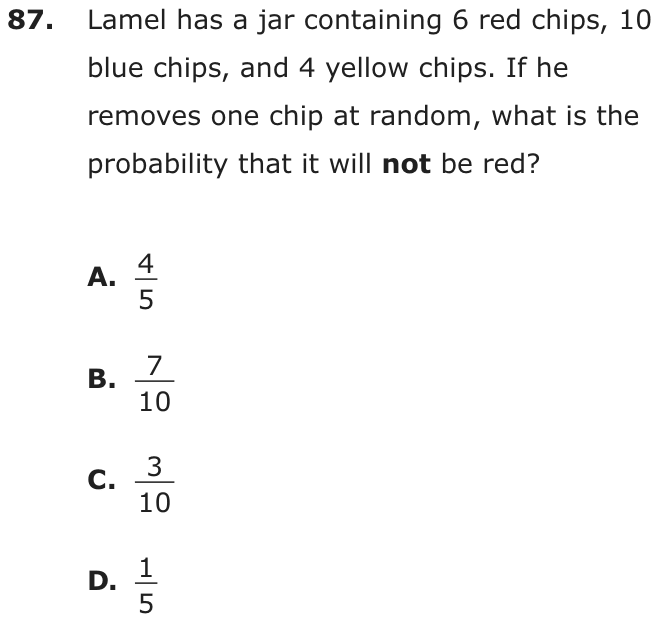
Question 15 of 26
2023 Test B Math, question 13Question
Shiow-Chen has a box that contains 4 green cards, 7 yellow cards, and 6 red cards. She randomly draws one card at a time from the box and does not return the cards to the box after they have been drawn. The first card she draws is yellow. The second card she draws is green. What is the probability that the third card she draws will also be green?
- A
- B
- C
- D
Show the answer
Correct answer: A
After Shiow-Chen draws a yellow card and a green card, the remaining cards are 3 green, 6 yellow, and 6 red. The probability of drawing a green card from that group is:
Question analysis
Shiow-Chen's box holds 4 green, 7 yellow and 6 red cards, and she draws cards one at a time without putting them back. Her first card is yellow and her second is green. Students find the probability that the third card is also green, which means updating both the green count and the total first.
- NYS standards
- 6.SP.8a uniform probability models
- Grade level
- Grade 6 content, by NYS standard
- Compared with grade 7
- At grade 7 Simple probability is grade 6 content. The extra demand is tracking two earlier draws that were not put back, which changes the counts for the third draw, a step typical grade 7 problems often leave out.
- Estimated difficulty
- Moderate: several steps, or a close reading with one strong distractor.
- Thinking it demands
- Depth of knowledge 2, skills and concepts · mainly apply
- What makes it hard
- Much to keep track of moderate
- Turning words into math minor
- Solution
- 3 steps
- Reading level
- Question and choices: about grade 3, 70 words.
- Students, last 30 days
- Not enough answers yet to show (it takes 10).
Why it is hard, traps and wrong answers (shows the answer)
Why it is hard
The probability itself is one fraction, but it has to be built from a box that two draws have already changed. Students who use the original 17 cards, or who compare green with the other colors instead of with all the cards, reach listed choices that look reasonable. Listing the counts after each draw, then putting the green cards over all the cards left, avoids both.
Much to keep track of moderate Working it out
Three color counts and the total must each be updated after two draws, 4 green, 7 yellow and 6 red becoming 3, 6 and 6 out of 15, before the third draw is considered. (Sweller, 1988; Carpenter, Just & Shell, 1990)
Turning words into math minor Understanding the question
“Does not return the cards” and the two named draws are the conditions that change the box, and the stem states them in passing before asking about the third card. (Hegarty, Mayer & Monk, 1995; Koedinger & Nathan, 2004)
Strategy: Take the two drawn cards out of the box: lower the yellow and green counts by one each, recount the total, then put the green cards left over the cards left.
Traps
- Without replacement: In a second pick there is one fewer item, which changes the probability.
- Misunderstands the concept: A wrong belief about a concept: that percents can be added, that area grows like length, that averages can be averaged, that a bigger denominator means a bigger fraction.
The wrong answers, classified
B Without replacement (Fischbein & Schnarch, 1997)
Uses the full box, 4 green cards out of 17, as if neither of the first two cards had been taken out.
C Misunderstands the concept (Smith, diSessa & Roschelle, 1993; De Bock et al., 1998; Ni & Zhou, 2005)
Updates the counts correctly but compares the 3 green cards with the 12 cards of other colors, 3/12 = 1/4, a part-to-part ratio.
D Misunderstands the concept (Smith, diSessa & Roschelle, 1993; De Bock et al., 1998; Ni & Zhou, 2005)
Treats the three colors as equally likely, giving green a 1-in-3 chance whatever the number of cards of each color.
Worked solution, step by step
Formulas used
- Probability
- P is the probability, how likely something is, from 0 (never) to 1 (always). The top counts the results you want, here green cards. The bottom counts every possible result, here every card in the box. It works when each result is equally likely, as in a random draw.
Sort out the question
The box starts with 4 green, 7 yellow and 6 red cards. Shiow-Chen draws cards one at a time, and she does not put them back. The first card is yellow, and the second is green. You need the probability that the third card is green.
Take out the two cards
The cards are not put back, so the box changes. Lower the yellow count by 1 and the green count by 1.
Color At the start After two draws Green 4 3 Yellow 7 6 Red 6 6 Total 17 15 Use the probability formula
For the third draw, the results you want are the 3 green cards left. The total is the 15 cards left.
Watch out: using the full box gives , choice B. But two cards are gone.
Simplify and answer
Divide the top and bottom by 3.
Watch out: compare the green cards with all 15 cards, not with the 12 cards of other colors. That gives , choice C. And the three colors are not equally likely, so is wrong too. So the answer is A, .
Check your answer
17 cards minus the 2 drawn leaves 15. One fifth of 15 is 3, the number of green cards left. Also, the chance went down from . That makes sense, because a green card was taken out.
More questions like this
The original DOE question
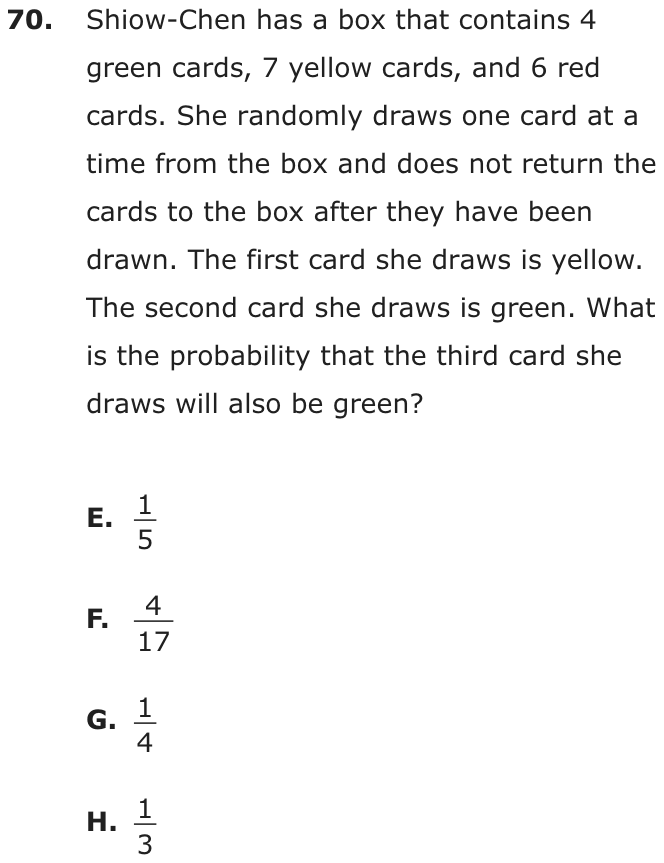
Question 16 of 26
2023 Test B Math, question 57Question
A box contains 14 red marbles, 10 black marbles, and 16 white marbles. How many more white marbles need to be added to the box so that the probability of randomly drawing a white marble is ?
- A8
- B10
- C14
- D20
Show the answer
Correct answer: D
Let w represent the number of additional white marbles.
Set the probability of drawing a white marble equal to and solve the equation for w:
Question analysis
A box holds 14 red, 10 black and 16 white marbles, and students find how many white marbles must be added so that the chance of drawing a white one is 3/5. Working backward from a target probability to a number of marbles is the unusual step.
- Grade level
- Grade 7 content, by NYS standard
- Compared with grade 7
- Above grade 7 Grade 7 probability questions usually give the counts and ask for a probability. This runs the other way: the target probability is given, and the number to add changes both the white count and the total.
- Estimated difficulty
- Hard: combines ideas, needs a plan, and has more than one tempting wrong answer.
- Thinking it demands
- Depth of knowledge 2, skills and concepts · mainly apply
- What makes it hard
- Turning words into math moderate
- Variables instead of numbers minor
- Many steps minor
- Solution
- 3 steps
- Reading level
- Question and choices: about grade 8, 34 words.
- Students, last 30 days
- Not enough answers yet to show (it takes 10).
Why it is hard, traps and wrong answers (shows the answer)
Why it is hard
The tempting shortcut is to take 3/5 of the 40 marbles already in the box, which forgets that the new white marbles join the total. Students who set up the probability with the unknown in both the top and the bottom solve it in a few lines, and testing choices works too: adding 20 gives 36 white of 60, exactly 3/5. The other two choices are counts copied from the stem.
Turning words into math moderate Understanding the question
“How many more white marbles need to be added” puts the unknown in two places, (16 + w)/(40 + w), because each white marble added also raises the total. (Hegarty, Mayer & Monk, 1995; Koedinger & Nathan, 2004)
Variables instead of numbers minor Understanding the question
The unknown number of added marbles has to be carried as a letter through a proportion, 5(16 + w) = 3(40 + w), before it can be found. (Koedinger & Nathan, 2004; Enright, Morley & Sheehan, 2002)
Many steps minor Working it out
Totaling the marbles, setting up the proportion, cross-multiplying and solving 80 + 5w = 120 + 3w make four steps, unless the choices are tested one by one. (Daniel & Embretson, 2010; Enright, Morley & Sheehan, 2002)
Strategy: Let w be the number of white marbles added, write the new probability with w in both the top and the bottom, set it equal to 3/5 and solve; or test each choice.
Traps
- Percent of the wrong amount: Finding the whole from a part, or a percent change measured from the wrong starting amount.
- Numbers taken from the question: Combines the numbers in the question without a model of the situation, or is simply a number that appears in the question.
The wrong answers, classified
A Percent of the wrong amount (Parker & Leinhardt, 1995)
Takes 3/5 of the 40 marbles now in the box, 24, and subtracts the 16 white ones, forgetting that added marbles raise the total.
B Numbers taken from the question (Hegarty, Mayer & Monk, 1995)
Picks 10, the number of black marbles in the stem, without setting up the new probability or testing it.
C Numbers taken from the question (Hegarty, Mayer & Monk, 1995)
Picks 14, the number of red marbles in the stem, without checking that adding 14 white marbles gives 30 of 54, not 3/5.
Worked solution, step by step
Formulas used
- Probability
- P(white) is the probability, or chance, of drawing a white marble. The top counts the white marbles. The bottom counts every marble in the box. It works because each marble is equally likely to be drawn.
- Cross multiplication
- a and c are the tops. b and d are the bottoms. When two fractions are equal, each top times the other bottom gives the same product. It works because you multiply both sides by both bottoms. Use it to clear fractions from an equation.
Sort out the box
The box has 14 red, 10 black and 16 white marbles.
That is 40 marbles. You will add some white marbles. Call that number w. You need w so that the chance of drawing white is .
Write the new probability
Adding w white marbles changes both counts. There will be 16 + w white marbles and 40 + w marbles in all. Use the probability formula.
Watch out: Taking of 40 gives 24, and 24 − 16 = 8, choice A. That forgets that the new marbles also make the box bigger.
Cross multiply
Fractions are hard to solve with. Clear them with cross multiplication.
Then multiply each outside number by both terms inside the parentheses.
Solve for w
Subtract 3w from both sides. Then subtract 80 from both sides.
Divide both sides by 2.
You need to add 20 white marbles.
So the answer is D, 20.
Check your answer
Add 20 white marbles. Then there are 16 + 20 = 36 white marbles and 40 + 20 = 60 marbles in all. Divide the top and bottom by 12: . It works.
More questions like this
The original DOE question
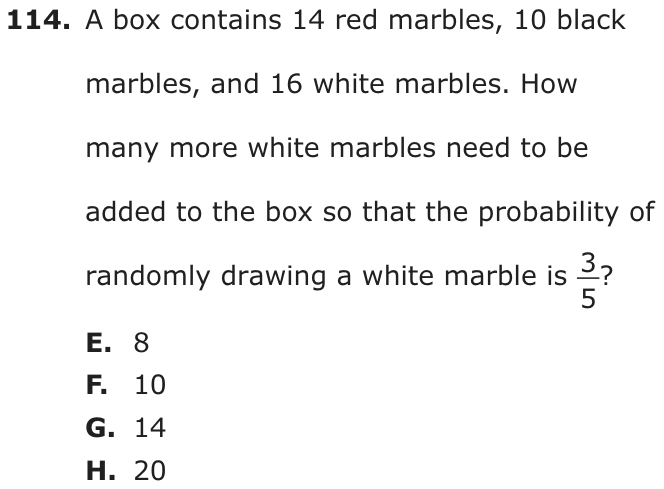
Question 17 of 26
2022 Test A Math, question 43Question
A bag contains 15 marbles: 11 blue marbles and 4 red marbles. Sarah picks one marble randomly, returns it to the bag, and then randomly picks one marble again. What is the probability that she picks a red marble both times?
- A
- B
- C
- D
Show the answer
Correct answer: A
The probability of drawing a red marble at random from a bag of 15 marbles (11 blue and 4 red) is shown:
When the red marble is replaced in the bag, the probability of picking a red marble is unchanged, .
The two events are independent, so the multiplication rule of probability applies.
Question analysis
A bag holds 11 blue and 4 red marbles. Sarah picks one at random, puts it back, and picks again, and students find the probability that she picks red both times. It tests the probability of a compound event made of two independent picks; the bold word both and the replacement shape the calculation.
- Grade level
- Grade 7 content, by NYS standard
- Compared with grade 7
- At grade 7 Finding the probability of two independent picks is grade 7 compound-event work. Because the marble is put back, the two picks are alike, and the numbers are small, which makes this a typical grade 7 probability task.
- Estimated difficulty
- Straightforward: two steps or one careful reading.
- Thinking it demands
- Depth of knowledge 2, skills and concepts · mainly apply
- What makes it hard
- Something you must already know moderate
- Turning words into math minor
- Solution
- 2 steps
- Reading level
- Question and choices: about grade 6, 42 words.
- Students, last 30 days
- Not enough answers yet to show (it takes 10).
Why it is hard, traps and wrong answers (shows the answer)
Why it is hard
The arithmetic is two small fractions multiplied, so the question rests on knowing which rule applies. Adding the two chances gives more than either chance alone, which cannot be right for two reds in a row, and comparing red with blue instead of with all 15 marbles changes every denominator. A sense check helps: two reds in a row must be less likely than a single red, 4/15.
Something you must already know moderate Working it out
The multiplication rule for independent events is not given: because the marble goes back, each pick is 4 out of 15, and red both times means 4/15 × 4/15. (Anderson & Krathwohl, 2001)
Turning words into math minor Understanding the question
Two phrases carry the method: “returns it to the bag” keeps the second pick at 4 out of 15, and “red marble both times” asks for both events, not either. (Hegarty, Mayer & Monk, 1995; Koedinger & Nathan, 2004)
Strategy: Find the chance of red on a single pick out of all the marbles. Since the marble goes back, the second pick has the same chance; then use the rule for two independent events both happening.
Traps
- Wrong operation: Adds instead of multiplying, divides the wrong way round, turns a ratio or rate upside down, or undoes a step in the wrong direction (subtracts what should be added back).
- Misunderstands the concept: A wrong belief about a concept: that percents can be added, that area grows like length, that averages can be averaged, that a bigger denominator means a bigger fraction.
- Answers a different question: A choice is right for another quantity: the other unknown, the rest instead of the part, the part instead of the whole.
The wrong answers, classified
B Misunderstands the concept (Smith, diSessa & Roschelle, 1993; De Bock et al., 1998; Ni & Zhou, 2005)
Uses red to blue, 4 to 11, as the chance of red instead of 4 out of all 15 marbles, then squares it, a part-to-part ratio.
C Wrong operation (Hegarty, Mayer & Monk, 1995; King et al., 2004)
Adds the two chances, 4/15 + 4/15 = 8/15, instead of multiplying, as if a red marble on either pick were enough.
D Answers a different question (King et al., 2004; Hegarty, Mayer & Monk, 1995)
Finds the chance of blue both times, (11/15)² = 121/225, answering for the wrong color with the right method.
Worked solution, step by step
Formulas used
- Probability of an event
- P is the probability, the chance that something happens, from 0 (never) to 1 (always). An outcome is one possible result, here one marble. Divide the number of results you want by the number of all results.
- Two independent events both happening
- A and B are two events. Independent means one does not change the chance of the other. P(A) is the chance of A, and P(B) is the chance of B. Multiply them to get the chance that both happen.
Sort out the question
The bag has 15 marbles: 11 blue and 4 red. Sarah picks one, puts it back, then picks again. You need the probability, or chance, that both picks are red. Putting the marble back matters. The bag is the same for the second pick.
Find the chance of red on one pick
There are 4 red marbles out of 15 in all. Watch out: compare red with all 15 marbles, not with the 11 blue ones. Using 4 out of 11 leads to , choice B.
See that the picks are independent
Sarah puts the marble back. So the bag again has 4 red marbles out of 15. The second pick has the same chance, 4/15. The first pick does not change the second one. That makes the two picks independent.
Multiply the two chances
To multiply fractions, multiply the tops and multiply the bottoms. Watch out: don’t add. , choice C, is a bigger chance than one red. And , choice D, is the chance of blue both times. So the answer is A, .
Check your answer
Two reds in a row should be less likely than one red. One red is , about 0.27. is about 0.07, much smaller. That makes sense. Adding gave , about 0.53, which is too big.
More questions like this
The original DOE question
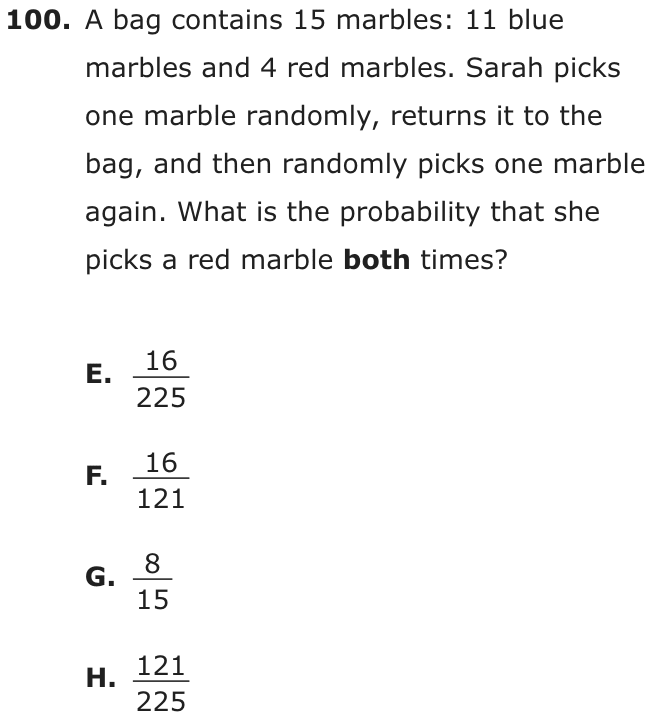
Question 18 of 26
2022 Test B Math, question 5Question
A row of seats in a theater contains 20 seats numbered from 101 to 120. The probability that a randomly chosen seat in this row will be numbered 104 is x%. What is the value of x?
Grid-in question: work out the answer and enter it as a number.
Show the answer
Correct answer: 5
The probability that any 1 seat will be selected at random from 20 seats is 1 out of 20. To find the probability as a percentage, convert the fraction to a decimal.
Then convert the decimal to a percentage by multiplying by 100.
The probability is 5%.
Question analysis
A theater row has 20 seats numbered 101 to 120, and one seat is chosen at random. Students find the probability that it is one particular seat, written as x%, and type the value of x. It tests simple probability and changing a fraction to a percent; the seat numbers themselves play no part in the answer.
- Grade level
- Grade 6 content, by NYS standard
- Compared with grade 7
- Below grade 7 The probability of one equally likely outcome is grade 6 content, and turning it into a percent is a short grade 6 step. Grade 7 probability usually involves compound events, which this question does not.
- Estimated difficulty
- Straightforward: two steps or one careful reading.
- Thinking it demands
- Depth of knowledge 2, skills and concepts · mainly apply
- What makes it hard
- An answer in an unexpected form moderate
- Error-prone arithmetic minor
- Solution
- 2 steps
- Reading level
- Question and choices: about grade 5, 33 words.
- Students, last 30 days
- Not enough answers yet to show (it takes 10).
Why it is hard, traps and wrong answers (shows the answer)
Why it is hard
The seat numbers, 101 to 120, and the chosen seat 104 play no part: the row holds 20 equally likely seats, so the chance is 1 in 20. What the item tests is the change of form, from a fraction to the number in front of a percent sign. Knowing that 1/20 is half of 1/10, which is 10%, gives the value at once and rules out both 0.05 and 50.
An answer in an unexpected form moderate Choosing the answer
The probability is asked for as the x in x%, so 1 out of 20 must become the number 5, not the fraction 1/20 or the decimal 0.05 it is first found as. (Enright, Morley & Sheehan, 2002)
Error-prone arithmetic minor Working it out
Dividing 1 by 20 gives 0.05, with a zero in the tenths place, and losing that zero makes the percent ten times too large. (Brown & Burton, 1978; Junker & Sijtsma, 2001)
Strategy: Count the seats, write the chance of one particular seat as a fraction, then change it to a percent and enter only the number in front of the percent sign.
Traps
- Stops one step early: A choice is a number from partway through the solution.
- Information you don't need: The question gives numbers or facts that play no part in the answer.
- Misunderstands the concept: A wrong belief about a concept: that percents can be added, that area grows like length, that averages can be averaged, that a bigger denominator means a bigger fraction.
The wrong answers, classified
0.05 Stops one step early (King et al., 2004; Gierl et al., 2017)
Finds the probability, 1 ÷ 20 = 0.05, and enters the decimal without multiplying by 100 to give x as a number of percent.
50 An arithmetic slip (Junker & Sijtsma, 2001)
Loses the zero after the decimal point when dividing, taking 1 ÷ 20 as 0.5, as 1 ÷ 2 would be, and so enters 50.
20 Misunderstands the concept (Smith, diSessa & Roschelle, 1993; De Bock et al., 1998; Ni & Zhou, 2005)
Reads 1 chance in 20 as 20 percent, putting the number of seats in place of the percent instead of dividing 1 by 20.
Worked solution, step by step
Formulas used
- Probability of one outcome
- P is the probability, the chance that something happens, from 0 to 1. The top counts the outcomes you want. The bottom counts all the outcomes that could happen. Use it when every outcome is equally likely, like one seat picked from a row.
- Fraction to percent
- A percent is a number out of 100. Multiplying a fraction or decimal by 100 tells how many out of 100 it is. So 1/2 times 100 is 50, which means 50%.
Sort out the question
The row has 20 seats, numbered 101 to 120. One seat is picked at random. At random means every seat has the same chance. You need the chance that it is seat 104, written as x%. Then you grid x.
The seat numbers don’t change the math. Only the number of seats matters.
Write the chance as a fraction
Seat 104 is 1 seat. There are 20 seats in all.
So the chance is 1 out of 20.
Change the fraction to a percent
Use the formula: multiply the fraction by 100.
So the chance is 5%. As a decimal, it is 0.05.
Give the answer
The question asks for x, the number in front of the % sign. That is 5.
Watch out: 0.05 is the decimal, not the percent. Writing 1 ÷ 20 as 0.5 gives 50. And 20 is the number of seats, not the percent. So you would grid 5.
Check your answer
All 20 seats share 100% equally. Each seat gets percent. That includes seat 104. Also, 1/20 is half of 1/10, and 1/10 is 10%. Half of 10% is 5%.
More questions like this
The original DOE question
Question 19 of 26
2022 Test B Math, question 42Question
At any given time, one person out of every 20 people has the common cold. Assume that the common cold can be caused by any one of 200 different viruses, each of which is equally likely to cause the cold. One of these 200 viruses is cold virus V144. What is the probability that a randomly selected person is suffering from a cold caused by virus V144?
- A
- B
- C
- D
Show the answer
Correct answer: D
To calculate the joint probability, you must first determine the probability of each independent event. The probability that a randomly selected person has a common cold is . The probability that a cold is caused by V144 is . The probability that a person has a cold and the cold is caused by the V144 virus is the product of those two probabilities, .
Question analysis
One person in 20 has a common cold at any given time, and each cold comes from one of 200 equally likely viruses. Students find the probability that a randomly selected person has a cold caused by one particular virus, V144. It tests the probability of a compound event, which is hidden here inside a single phrase.
- Grade level
- Grade 7 content, by NYS standard
- Compared with grade 7
- At grade 7 Grade 7 students find compound probabilities, usually from organized lists or tree diagrams. Here the two stages are hidden in one phrase, a cold caused by one particular virus, and there are far too many outcomes to list.
- Estimated difficulty
- Moderate: several steps, or a close reading with one strong distractor.
- Thinking it demands
- Depth of knowledge 2, skills and concepts · mainly apply
- What makes it hard
- Turning words into math moderate
- Something you must already know moderate
- Solution
- 2 steps
- Reading level
- Question and choices: about grade 6, 68 words.
- Corrected from the DOE handbook
- A probability in the explanation that was stated for the wrong event was corrected.
- Students, last 30 days
- Not enough answers yet to show (it takes 10).
Why it is hard, traps and wrong answers (shows the answer)
Why it is hard
The arithmetic is one multiplication; the difficulty is seeing that the event has two stages. Each stated chance, 1 in 20 for a cold and 1 in 200 for the virus behind it, is listed as a choice on its own, and each answers only half the question. A chance that both stages happen must be smaller than either one alone, which leaves a single choice.
Turning words into math moderate Understanding the question
The single phrase “a cold caused by virus V144” holds two events, having a cold at all and that cold coming from V144, and they must be separated before any rule applies. (Hegarty, Mayer & Monk, 1995; Koedinger & Nathan, 2004)
Something you must already know moderate Working it out
The stem never says that the chance of both stages is the product of their chances, so students must bring that rule to the 1 in 20 and the 1 in 200 themselves. (Anderson & Krathwohl, 2001)
Strategy: Split the event into two stages, having a cold and that cold coming from V144, write each stage's chance as a fraction, and combine them with the rule for events that must both happen.
Traps
- Stops one step early: A choice is a number from partway through the solution.
- Wrong operation: Adds instead of multiplying, divides the wrong way round, turns a ratio or rate upside down, or undoes a step in the wrong direction (subtracts what should be added back).
The wrong answers, classified
A Wrong operation (Hegarty, Mayer & Monk, 1995; King et al., 2004)
Divides one chance by the other, 1/200 ÷ 1/20 = 20/200 = 1/10, instead of multiplying them, giving a chance larger than either stage.
B Stops one step early (King et al., 2004; Gierl et al., 2017)
Gives the chance that a person has a cold of any kind, 1 in 20, and stops before multiplying by the 1/200 chance that V144 caused it.
C Stops one step early (King et al., 2004; Gierl et al., 2017)
Gives the chance that a cold is caused by V144, one virus out of 200, forgetting that only 1 person in 20 has a cold at all.
What was corrected from the DOE handbook, and why
- Explanation: The handbook says “The probability that a person has a cold caused by V144 is 1/200.” A person having a cold caused by V144 is exactly what the question asks about, and the same paragraph goes on to give its probability as 1/4,000; as printed, the sentence gives that event the value of choice C. The 1/200 is the probability that a cold is caused by V144 (one of 200 equally likely viruses), so the site reads “The probability that a cold is caused by V144 is 1/200.” The working and the answer are unchanged: 1/20 × 1/200 = 1/4,000.
Worked solution, step by step
Formulas used
- Probability of one outcome
- P is the probability, the chance that something happens, from 0 to 1. The top counts the outcomes you want. The bottom counts all the outcomes that could happen. Use it when every outcome is equally likely, like one virus out of 200.
- Chance that two events both happen
- A is the first event and B is the second. P(A) is the chance of A. P(B given A) is the chance of B among the times A has happened. Multiply them to get the chance that both happen. The result is smaller than either chance, since both things must happen.
Sort out the question
One person in 20 has a cold. Every cold comes from one of 200 viruses, all equally likely. V144 is one of them. You need the chance that a random person has a cold caused by V144.
That phrase holds two events. First, the person has a cold. Second, that cold comes from V144.
Find the chance of a cold
The question says “one person out of every 20 people has the common cold.” So 1 person is the part with a cold, and 20 is the whole group.
Find the chance it is V144
Now think only about people who have a cold. Each cold comes from one of 200 viruses, all equally likely. V144 is 1 of the 200.
This chance is only about people who already have a cold. So the second event depends on the first.
Multiply the two chances
Use the rule for two events that must both happen. Event A is a cold, and event B is V144 as its cause.
Multiply the tops: 1 × 1 = 1. Multiply the bottoms: 20 × 200 = 4,000.
Give the answer
Watch out: 1/20 is the chance of any cold, choice B. And 1/200 is the chance that a cold comes from V144, choice C. Each one answers only half the question. Dividing one by the other gives 1/10, choice A. So the answer is D, .
Check your answer
Picture 4,000 people. One in 20 has a cold, so people have colds. Of those 200 colds, 1 in 200 comes from V144. That is 1 person out of 4,000. It is also smaller than both 1/20 and 1/200, as it should be.
More questions like this
The original DOE question
Question 20 of 26
2018 Test A Math, question 16Question
A box of colored pencils contains exactly 6 red pencils. The probability of choosing a red pencil from the box is . How many of the pencils in the box are not red?
- A5
- B15
- C21
- D30
Show the answer
Correct answer: B
Let be the total number of colored pencils in the box. Set up a proportion to find :
If there are 6 red pencils, then the number of pencils that are not red is
21 − 6 = 15.
Question analysis
A probability word problem: a box holds exactly 6 red pencils, and the chance of drawing a red one is 2/7. Students work backward from the probability to the number of pencils in the box, then answer the question actually asked, which is about the pencils that are not red.
- Grade level
- Grade 6 content, by NYS standard
- Compared with grade 7
- At grade 7 Simple probability is grade 6 content in New York. Reversing it to find a total is a step beyond plugging counts into a fraction, which puts this at about the level of typical grade 7 work.
- Estimated difficulty
- Straightforward: two steps or one careful reading.
- Thinking it demands
- Depth of knowledge 2, skills and concepts · mainly apply
- What makes it hard
- Turning words into math moderate
- Something you must already know minor
- Solution
- 2 steps
- Reading level
- Question and choices: about grade 6, 32 words.
- Corrected from the DOE handbook
- A spelling mistake in the explanation was corrected.
- Students, last 30 days
- Not enough answers yet to show (it takes 10).
Why it is hard, traps and wrong answers (shows the answer)
Why it is hard
Students have to treat a probability as a ratio and scale it up: 6 red pencils is three times the 2 in 2/7. The common loss is choosing the total number of pencils, which appears naturally halfway through the work and is a listed choice. Reading the 7 as a pencil count, or scaling by 6 instead of 3, leads to the other wrong answers.
Turning words into math moderate Understanding the question
"The probability of choosing a red pencil from the box is 2/7" has to become a part-to-whole ratio: 2 of every 7 pencils are red, so the 6 red pencils are 2 parts. (Hegarty, Mayer & Monk, 1995; Koedinger & Nathan, 2004)
Something you must already know minor Working it out
The question assumes students know that a probability is favorable outcomes over all outcomes, here used in reverse to find the total from the red count. (Anderson & Krathwohl, 2001)
Strategy: Since 2 parts out of 7 are red, find how many pencils one part stands for, then count the parts that are not red.
Traps
- Stops one step early: A choice is a number from partway through the solution.
The wrong answers, classified
A Numbers taken from the question (Hegarty, Mayer & Monk, 1995)
Reads 2/7 as 2 red pencils among exactly 7 and takes 7 − 2 = 5, ignoring the stated 6 red pencils.
C Stops one step early (King et al., 2004; Gierl et al., 2017)
Solves 2/7 = 6/x to get 21 pencils in all and stops before subtracting the 6 red ones that the bold not excludes.
D A faulty procedure (Brown & Burton, 1978; Tatsuoka, 1983)
Treats the 6 red pencils as one share of the 7 instead of two, so each share is 6 and the 5 non-red shares make 30.
What was corrected from the DOE handbook, and why
- Explanation: The handbook says “the number of pencils that are not read is 21 − 6 = 15”. “read” now reads “red”.
Worked solution, step by step
Formulas used
- Probability
- P is the probability, the chance that something happens. Favorable is the number of ways to get what you want, here a red pencil. Total is the number of all possible picks, here every pencil in the box. It works when every pick is equally likely.
Sort out the question
A probability is a number that tells how likely something is. The box has exactly 6 red pencils. The chance of picking a red one is . You need the number of pencils that are not red.
Read the probability as parts
means 2 out of every 7 pencils are red. Picture the box split into 7 equal parts. Red pencils fill 2 of the parts. The other 5 parts are not red. Watch out: the box does not hold just 7 pencils. It has 6 red ones alone. Taking is choice A.
Find the size of one part
The 6 red pencils fill 2 parts. Divide to find one part.
Each part is 3 pencils. So the whole box has pencils.
Check with the probability formula
Put the counts into the formula to make sure.
Divide the top and bottom of 6/21 by 3 to get 2/7. It matches.
Count the pencils that are not red
That is the same as 5 parts of 3 pencils each. Watch out: 21 is all the pencils, choice C. The question asks only for the ones that are not red. So the answer is B, 15.
Check your answer
Red and not red should make the whole box: . Red is less likely than not red, since 2/7 is less than half. 6 red against 15 not red fits that.
More questions like this
The original DOE question
Question 21 of 26
2018 Test A Math, question 51Question
A sports store has a container of handballs: 4 blue, 5 red, 8 yellow, 9 white, and 11 green. If one ball is picked from the container at random, what is the probability that it will be yellow?
- A
- B
- C
- D
Show the answer
Correct answer: C
The total number of handballs in the container is
Since there are 8 yellow handballs, the probability of selecting a yellow handball is
Question analysis
This probability question describes a container of handballs in five colors and asks the chance that one ball picked at random is yellow. Students must add all the balls to get the total and compare the yellow count to it. Using the wrong total, such as only the balls that are not yellow, is the easy mistake.
- NYS standards
- 6.SP.8a uniform probability models
- Grade level
- Grade 6 content, by NYS standard
- Compared with grade 7
- Below grade 7 Finding the probability of a single event as favorable outcomes over total outcomes is grade 6 content. This item takes one addition and one fraction, so it is easier than typical grade 7 compound probability work.
- Estimated difficulty
- Routine: one familiar step, little to misread.
- Thinking it demands
- Depth of knowledge 2, skills and concepts · mainly apply
- What makes it hard
- Solution
- 2 steps
- Reading level
- Question and choices: about grade 5, 37 words.
- Students, last 30 days
- Not enough answers yet to show (it takes 10).
Why it is hard, traps and wrong answers (shows the answer)
Why it is hard
This is a one-event probability: add the five colors to get 37 balls and put the 8 yellow ones over that total. The only real decision is the denominator, and the wrong choices offer the non-yellow count, the yellow count, and a numerator of 1. Students who say "favorable over total" to themselves avoid all three.
A very close wrong answer minor Choosing the answer
The choices 8/37 and 8/29 share the numerator 8 and differ only in the denominator, all 37 balls against the 29 that are not yellow. (Embretson & Wetzel, 1987; Gorin & Embretson, 2006; Ascalon et al., 2007)
Strategy: Add up every ball in the container to get the total number of outcomes, then put the number of yellow balls over that total.
Traps
- Misunderstands the concept: A wrong belief about a concept: that percents can be added, that area grows like length, that averages can be averaged, that a bigger denominator means a bigger fraction.
- Answers a different question: A choice is right for another quantity: the other unknown, the rest instead of the part, the part instead of the whole.
The wrong answers, classified
A Answers a different question (King et al., 2004; Hegarty, Mayer & Monk, 1995)
Finds the 37 balls correctly but puts 1 on top, giving the chance of picking one particular ball rather than any yellow one.
B Numbers taken from the question (Hegarty, Mayer & Monk, 1995)
Puts 1 over the 8 yellow balls, a fraction built from the yellow count alone that ignores the other 29 balls.
D Misunderstands the concept (Smith, diSessa & Roschelle, 1993; De Bock et al., 1998; Ni & Zhou, 2005)
Compares the 8 yellow balls with the 29 that are not yellow, a part-to-part ratio, instead of with all 37 balls.
Worked solution, step by step
Formulas used
- Probability
- P is the probability, the chance that something happens. f is the number of favorable outcomes, the ones you want. t is the total number of outcomes. It works when every outcome is equally likely, like picking one item at random.
Sort out what you know
The container has 4 blue, 5 red, 8 yellow, 9 white and 11 green balls. One ball is picked at random, so every ball has the same chance. You need the chance it is yellow.
Count all the balls
Add up every color, because any ball could be picked:
There are 37 balls in all. That is the total number of outcomes.
Put yellow over the total
8 of the balls are yellow. Those are the favorable outcomes:
Watch out: compares yellow with the 29 balls that are not yellow. Probability compares the part with all the balls, so choice D is wrong. So the answer is C, .
Check your answer
8 out of 37 is about 0.22, a little more than 1 in 5. That makes sense, since yellow is a fair share of the balls. Choice A, 1/37, is the chance of picking one certain ball, not any yellow one.
More questions like this
The original DOE question
Question 22 of 26
2018 Test B Math, question 13Question
DESSERT CHOICES
| Dessert | Number of Times Ordered |
| Cookies | 42 |
| Pie | 23 |
| Cake | 47 |
| Ice Cream | 48 |
The table above shows the number of times that different desserts were ordered at a restaurant. Based on this information, what is the probability of a customer ordering ice cream as a dessert?
- A25%
- B30%
- C40%
- D48%
Show the answer
Correct answer: B
The total number of desserts ordered is
42 + 23 + 47 + 48 = 160
The probability that ice cream was chosen is
.
Question analysis
This probability question gives a table of how many times four desserts were ordered at a restaurant and asks how likely a customer is to order ice cream, as a percent. Students total the orders and divide. The trap is using a raw count, or the wrong total, in place of the full number of desserts ordered.
- Grade level
- Grade 6 content, by NYS standard
- Compared with grade 7
- Below grade 7 Finding a probability from observed frequencies is grade 6 content in New York. Here it takes one sum, one division and a conversion to a percent with friendly numbers, lighter than typical grade 7 work.
- Estimated difficulty
- Routine: one familiar step, little to misread.
- Thinking it demands
- Depth of knowledge 1, recall and reproduction · mainly apply
- What makes it hard
- Solution
- 3 steps
- Reading level
- Question and choices: about grade 5, 45 words.
- Students, last 30 days
- Not enough answers yet to show (it takes 10).
Why it is hard, traps and wrong answers (shows the answer)
Why it is hard
This is a direct relative-frequency question with friendly numbers, and most students finish it quickly. The risk is using a number from the table as if it were already a percent, or treating the four desserts as equally likely. Remembering that a probability compares one count with the total of all counts prevents both mistakes.
Reading a figure, table or graph minor Understanding the question
The four counts sit in a table, and the probability needs all of them: the ice cream row gives the numerator and the sum of the column gives the denominator. (Lesh, Post & Behr, 1987; Kirsch & Mosenthal, 1990)
Error-prone arithmetic minor Working it out
Adding 42 + 23 + 47 + 48 by hand and then simplifying 48/160 to 3/10 are small steps where a careless total spoils the percent. (Brown & Burton, 1978; Junker & Sijtsma, 2001)
Strategy: Add the four counts in the table to get all the orders, divide the ice cream count by that total, and convert the fraction to a percent.
Traps
- Answers a different question: A choice is right for another quantity: the other unknown, the rest instead of the part, the part instead of the whole.
The wrong answers, classified
A Misunderstands the concept (Smith, diSessa & Roschelle, 1993; De Bock et al., 1998; Ni & Zhou, 2005)
Treats the four desserts as equally likely, one chance in four, ignoring how often each was actually ordered.
C Answers a different question (King et al., 2004; Hegarty, Mayer & Monk, 1995)
Divides 48 by the 112 orders of the other desserts instead of all 160, getting about 43%, and takes the nearest choice.
D Numbers taken from the question (Hegarty, Mayer & Monk, 1995)
Reads the 48 ice cream orders as 48 percent without dividing by the total number of desserts ordered.
Worked solution, step by step
Formulas used
- Probability
- P is the probability, the chance that something happens. The top counts the outcomes you want, here ice cream orders. The bottom counts every outcome, here all dessert orders. It works because each order counts the same.
- Fraction to percent
- Percent means out of 100. Multiply a fraction or a decimal by 100 to write it as a percent. For example, 3/10 times 100 is 30, so 3/10 is 30%.
Sort out the table
The table shows how many times each dessert was ordered. Ice cream was ordered 48 times.
You need the chance that a customer orders ice cream. The orders in the table show how often each dessert is picked.
Find the total orders
Add all four rows of the table.
There were 160 dessert orders in all. This is the bottom of the fraction, because it counts every order.
Write the probability
Put the counts into the probability formula. The top is the 48 ice cream orders. The bottom is all 160 orders.
Simplify the fraction. Both numbers can be divided by 16.
Change to a percent
The probability is 30%.
Watch out: 48 orders is not 48%, choice D. You must divide by the total. Also, the four desserts are not equally popular. So the chance is not 1 out of 4, or 25%, choice A.
So the answer is B, 30%.
Check your answer
Work backward: . That matches the ice cream row. Also, 48 is a bit less than a third of 160, and 30% is a bit less than a third.
More questions like this
The original DOE question
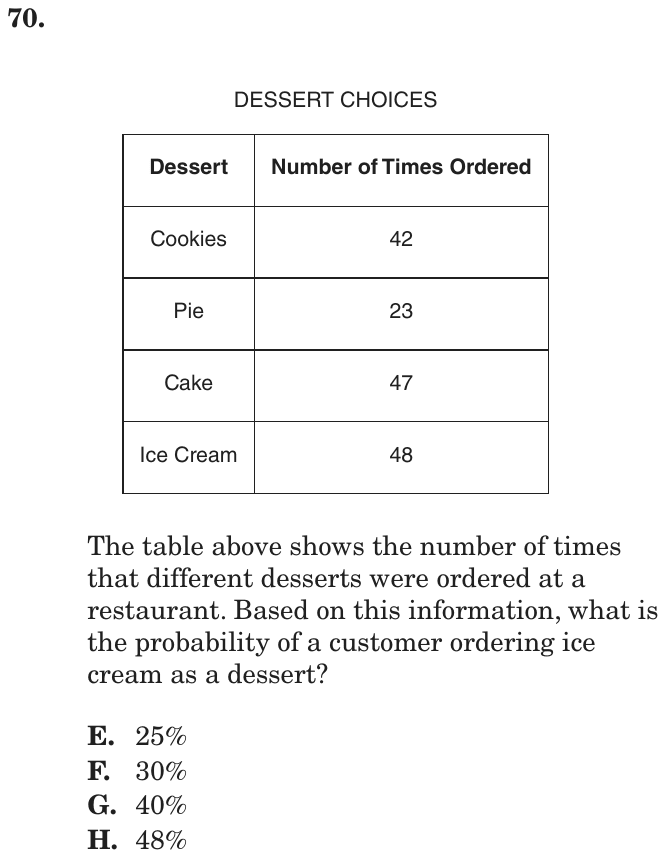
Question 23 of 26
2018 Test B Math, question 16Question
A cooler contains three types of beverages: 5 bottles of apple juice, 3 bottles of grape juice, and 6 bottles of orange juice. What is the probability that a bottle chosen at random from this cooler is not apple juice?
- A
- B
- C
- D
Show the answer
Correct answer: C
The total number of bottles of juice in the cooler is
5 + 3 + 6 = 14
The number of bottles of juice that are not apple juice (grape juice and orange juice) is
3 + 6 = 9
So the probability is .
Question analysis
This probability question describes a cooler holding apple, grape and orange juice bottles in different numbers and asks for the chance that a randomly chosen bottle is not apple juice. Students count favorable bottles over all bottles. The word not is the trap, along with counting kinds of drink instead of bottles.
- NYS standards
- 6.SP.8a uniform probability models
- Grade level
- Grade 6 content, by NYS standard
- Compared with grade 7
- Below grade 7 Simple probability with equally likely outcomes is grade 6 content in New York. This needs one count and one fraction, and the only extra demand is reading the word not, so it sits below grade 7.
- Estimated difficulty
- Straightforward: two steps or one careful reading.
- Thinking it demands
- Depth of knowledge 1, recall and reproduction · mainly apply
- What makes it hard
- Turning words into math minor
- Solution
- 2 steps
- Reading level
- Question and choices: about grade 6, 41 words.
- Students, last 30 days
- Not enough answers yet to show (it takes 10).
Why it is hard, traps and wrong answers (shows the answer)
Why it is hard
The counting is easy, 14 bottles in all, so the question mainly tests careful reading. The word “not” turns the event around, and the probability of the opposite event is waiting among the choices. The other wrong choices catch students who count kinds of juice instead of bottles, or who build a fraction with the wrong total.
Turning words into math minor Understanding the question
The event “not apple juice” must be turned into grape plus orange, 3 + 6 bottles over all 14, so the word “not” decides which counts go in the numerator. (Hegarty, Mayer & Monk, 1995; Koedinger & Nathan, 2004)
Strategy: Add all the bottles for the denominator, then count only the grape and orange bottles for the numerator, or subtract the chance of apple juice from 1.
Traps
- Misreads the question: Misses or misreads a condition or a word in the question: "at least", "each", "remaining", "not".
The wrong answers, classified
A Numbers taken from the question (Hegarty, Mayer & Monk, 1995)
Puts 1 over the 9 bottles that are not apple juice, as if one particular bottle had to be picked.
B Misreads the question (Hegarty, Mayer & Monk, 1995)
Finds the probability of choosing apple juice, 5 out of 14, missing the word “not” in the question.
D Misunderstands the concept (Smith, diSessa & Roschelle, 1993; De Bock et al., 1998; Ni & Zhou, 2005)
Counts two of the three kinds of juice as not apple and treats the kinds as equally likely, ignoring how many bottles each has.
Worked solution, step by step
Formulas used
- Probability
- P is the probability, the chance that something happens. The top counts the outcomes you want, here bottles that are not apple. The bottom counts all outcomes, here every bottle. It works when every bottle has the same chance.
- Probability of “not”
- A is an event, such as picking apple juice. P(A) is its chance. Every bottle either is apple or is not, so the two chances add to 1. Subtract from 1 to get the chance that A does not happen.
Sort out the question
The cooler has 5 apple, 3 grape and 6 orange bottles. One bottle is picked at random. That means every bottle has the same chance.
You need the chance that it is not apple juice.
Count all the bottles
There are 14 bottles. This is the bottom of the probability fraction, since any of them could be picked.
Count the bottles that are not apple
The bottles that are not apple are the grape and orange ones.
There are 9 such bottles. This is the top of the fraction.
Write the probability
This fraction cannot be simplified. 9 and 14 share no factor except 1.
Watch out: is the chance of picking apple juice. That is choice B. Read the word “not” carefully.
So the answer is C, .
Check your answer
Use the “not” rule. The chance of apple is . So the chance of not apple is . Both ways give the same answer.
More questions like this
The original DOE question
Question 24 of 26
2018 Test B Math, question 32Question
PET SURVEY
| Number of Pets | Number of Students |
| 0 | 12 |
| 1 | 16 |
| 2 | 7 |
| 3 or more | 5 |
Amy surveyed students at her school about the number of pets they have. What is the probability that a student who participated in the survey has at least 2 pets?
- A
- B
- C
- D
Show the answer
Correct answer: D
First, add the number of students for each category to find out how many total students were in the survey:
12 + 16 + 7 + 5 = 40
The number of students who had at least 2 pets are the ones who have 2 pets (7) plus the ones who have 3 or more (5). The total number of students with at least 2 pets is
7 + 5 = 12
The probability of a student in the survey having at least two pets is:
Question analysis
Amy's pet survey table shows how many pets each student has, and the question asks for the probability that a randomly chosen student has at least 2 pets. It tests finding a probability from survey data. The tricky part is reading "at least 2" correctly and using the right total as the denominator.
- Grade level
- Grade 6 content, by NYS standard
- Compared with grade 7
- Below grade 7 Simple probability from a frequency table is grade 6 work in New York. The only extra demand is interpreting "at least" and adding a column, two short steps a grade 7 student should handle easily.
- Estimated difficulty
- Straightforward: two steps or one careful reading.
- Thinking it demands
- Depth of knowledge 2, skills and concepts · mainly apply
- What makes it hard
- Solution
- 3 steps
- Reading level
- Question and choices: about grade 5, 43 words.
- Students, last 30 days
- Not enough answers yet to show (it takes 10).
Why it is hard, traps and wrong answers (shows the answer)
Why it is hard
The arithmetic is light, so the question is decided by the phrase "at least 2" and by remembering that the denominator is everyone surveyed. Students who include only one of the two qualifying rows reach an answer with the right denominator, which makes the mistake hard to notice. Rereading the condition before choosing is the main safeguard.
Turning words into math minor Understanding the question
"At least 2 pets" has to be turned into two rows of the table, the 2-pet row and the 3-or-more row, not one. (Hegarty, Mayer & Monk, 1995; Koedinger & Nathan, 2004)
Reading a figure, table or graph minor Understanding the question
The denominator is not printed anywhere; it has to be built by adding all four rows of the table, 12 + 16 + 7 + 5 = 40. (Lesh, Post & Behr, 1987; Kirsch & Mosenthal, 1990)
Strategy: Total the students in every row to get the denominator, then add the counts for each row that satisfies "at least 2" and simplify the fraction.
Traps
- Misreads the question: Misses or misreads a condition or a word in the question: "at least", "each", "remaining", "not".
The wrong answers, classified
A Misreads the question (Hegarty, Mayer & Monk, 1995)
Reads "at least 2 pets" as exactly 2, counting only the 7 students in that row and leaving out the 5 with 3 or more.
B Numbers taken from the question (Hegarty, Mayer & Monk, 1995)
Writes 1 over 12, apparently from the 12 qualifying students or the 12 in the 0-pet row, with no total in the denominator.
C Misreads the question (Hegarty, Mayer & Monk, 1995)
Reads "at least 2" as more than 2, counting only the 5 students with 3 or more pets: 5/40 = 1/8.
Worked solution, step by step
Formulas used
- Probability
- P is the probability, the chance that something happens. The top counts the results you want. The bottom counts every possible result. Use it when each result is equally likely, like picking one at random.
Sort out the question
The table shows how many students have each number of pets. You pick one student who took the survey. You need the chance that the student has “at least 2 pets”.
At least 2 means 2 or more. So two rows count: the 2 pets row and the 3 or more row.
Find the total number of students
The bottom of the fraction is everyone in the survey. Add all four rows.
There are 40 students in all.
Count the students you want
Add the 2 pets row and the 3 or more row.
So 12 students have at least 2 pets.
Watch out: using only the 7 students with exactly 2 pets gives , choice A. Using only the 5 with 3 or more gives , choice C.
Write and simplify the probability
Use the probability formula.
Divide the top and bottom by 4, since 4 goes into both.
So the answer is D, .
Check your answer
The students with fewer than 2 pets are . Then , so every student is counted once. Also, 12 out of 40 is a bit less than a third. So is .
More questions like this
The original DOE question
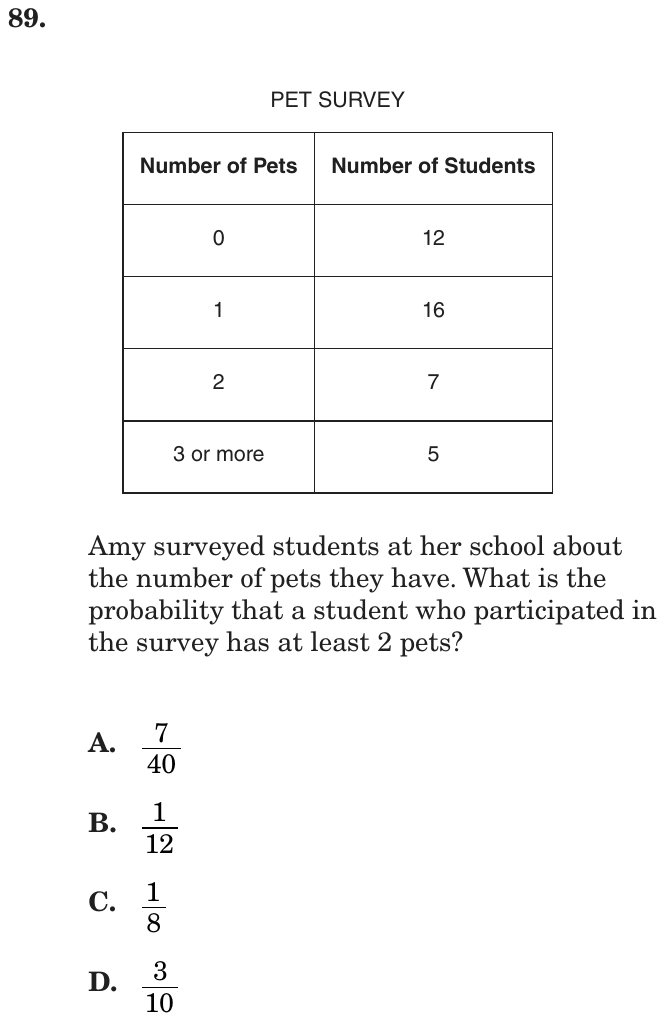
Question 25 of 26
2018 Test B Math, question 49Question
ANIMAL CARDS
| Number of Cards | Picture on Card |
| 8 | cat |
| 6 | dog |
| 5 | bird |
| 4 | fish |
| 1 | horse |
The cards in the table above are mixed in a box. Which animal pictured on a card has exactly a 1 in 4 chance of being picked at random from the box?
- Acat
- Bdog
- Cfish
- Dhorse
Show the answer
Correct answer: B
The total number of cards in the box is
8 + 6 + 5 + 4 + 1 = 24
Set up a proportion to figure out which card has exactly a 1 in 4 chance of being picked at random.
The dog card has a 1 in 4 chance of being randomly selected.
Question analysis
A table lists picture cards for five animals, from 8 cat cards down to 1 horse card, all mixed in one box. Students decide which animal has exactly a 1 in 4 chance of being drawn at random. It tests simple probability as a fraction of the total, and the numbers in the table invite matching the wrong count.
- NYS standards
- 6.SP.8a uniform probability models
- Grade level
- Grade 6 content, by NYS standard
- Compared with grade 7
- Below grade 7 Simple probability from a list of counts is grade 6 work. This takes one sum and one division with small whole numbers, a shorter and more routine task than typical grade 7 probability problems.
- Estimated difficulty
- Routine: one familiar step, little to misread.
- Thinking it demands
- Depth of knowledge 1, recall and reproduction · mainly apply
- What makes it hard
- Solution
- 2 steps
- Reading level
- Question and choices: about grade 1, 47 words.
- Students, last 30 days
- Not enough answers yet to show (it takes 10).
Why it is hard, traps and wrong answers (shows the answer)
Why it is hard
Once the 24 cards are totaled, one fourth of them is 6 and the answer is a lookup. The wrong choices mostly attract students who match the numbers 1 and 4 in the phrase to the horse and fish rows, or who assume the most common card is the one asked about. Little time is needed, so the main risk is skipping the total.
Turning words into math minor Understanding the question
"Exactly a 1 in 4 chance" has to be turned into a count, one fourth of the 24 cards, rather than matched to a 1 or a 4 in the table. (Hegarty, Mayer & Monk, 1995; Koedinger & Nathan, 2004)
Reading a figure, table or graph minor Understanding the question
The counts sit in the table's first column with the animals in the second, and the total of 24 has to be added up from all five rows. (Lesh, Post & Behr, 1987; Kirsch & Mosenthal, 1990)
Strategy: Add the cards to find the total in the box, find one-fourth of that total, and look for the animal with exactly that many cards.
Traps
- Numbers taken from the question: Combines the numbers in the question without a model of the situation, or is simply a number that appears in the question.
The wrong answers, classified
A Little reason to choose it (Haladyna & Downing, 1993; Rodriguez, 2005)
Picks the most common card, but cats are 8 of 24 cards, a 1 in 3 chance, and no reading of the table gives them 1 in 4.
C Numbers taken from the question (Hegarty, Mayer & Monk, 1995)
Matches the 4 in "1 in 4" to the 4 fish cards, confusing a number of cards with a probability.
D Numbers taken from the question (Hegarty, Mayer & Monk, 1995)
Matches the 1 in "1 in 4" to the single horse card instead of comparing each count with the total of 24.
Worked solution, step by step
Formulas used
- Probability
- P is the probability, the chance that something happens. The top counts the results you want. The bottom counts every possible result. Use it when each result is equally likely, like picking one at random.
Sort out the question
The table shows 8 cat cards, 6 dog, 5 bird, 4 fish and 1 horse. All the cards are mixed in a box. You need the animal with “exactly a 1 in 4 chance” of being picked. A 1 in 4 chance means a probability of .
Find the total number of cards
Add every row of the table. This total is the bottom of the probability fraction.
There are 24 cards in the box.
Find one fourth of the cards
The animal you want must have one fourth of all the cards.
So you need the animal with exactly 6 cards. The dog has 6 cards.
Rule out the other choices
Watch out: do not match the numbers 1 and 4 to the table. Fish has 4 cards, but its chance is . So C is wrong. Horse has 1 card, a chance of , so D is wrong. Cat has , so A is wrong.
Give the answer
Only the dog has exactly one fourth of the cards. So the answer is B, dog.
Check your answer
Four groups of 6 cards make 24, the whole box. So 6 cards is one of four equal shares. That is a 1 in 4 chance. The dog cards are exactly one of those shares.
More questions like this
The original DOE question
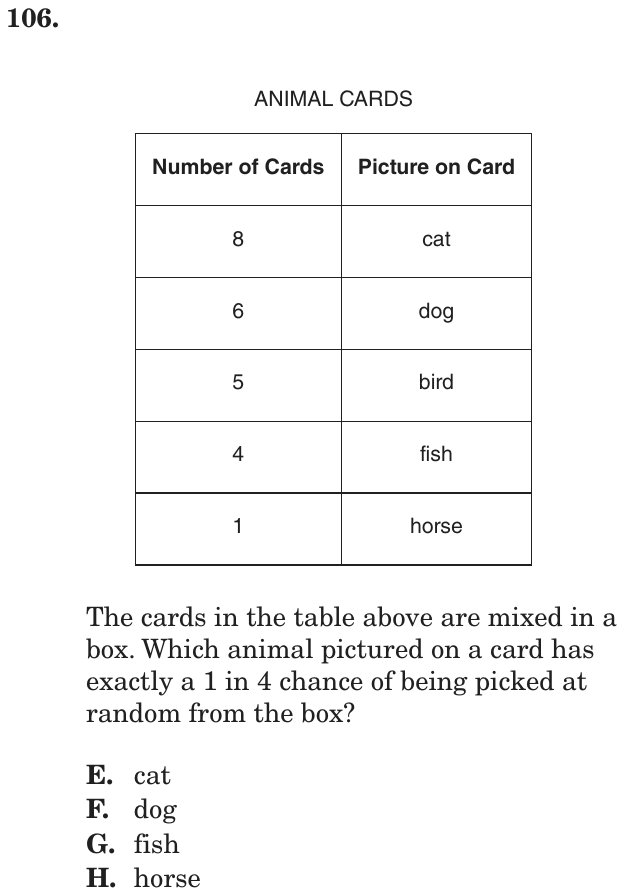
Question 26 of 26
2018 Test B Math, question 52Question
A ball is selected at random from a box that contains 7 black balls, 14 green balls, and 21 red balls. What is the probability that the ball selected is black?
- A
- B
- C
- D
Show the answer
Correct answer: A
The total number of balls in the box is
The probability that the ball is black is
Question analysis
Students find the probability of drawing a black ball at random from a box with 7 black, 14 green and 21 red balls. It tests simple probability as a part of a whole. It is a short question, but the denominator must be chosen with care.
- NYS standards
- 6.SP.8a uniform probability models
- Grade level
- Grade 6 content, by NYS standard
- Compared with grade 7
- Below grade 7 Finding a simple probability from given counts is grade 6 work in New York. This one is a single fraction to simplify, a routine task well below the compound-event problems of grade 7.
- Estimated difficulty
- Routine: one familiar step, little to misread.
- Thinking it demands
- Depth of knowledge 1, recall and reproduction · mainly apply
- What makes it hard
- Solution
- 2 steps
- Reading level
- Question and choices: about grade 4, 32 words.
- Students, last 30 days
- Not enough answers yet to show (it takes 10).
Why it is hard, traps and wrong answers (shows the answer)
Why it is hard
This is a one-formula probability question with friendly numbers, since 7 divides 42 evenly. The wrong answers come from comparing black balls with the other balls only, from treating the three colors as equally likely, or from finding the chance of not drawing black. Students who write the total first rarely miss it.
Something you must already know minor Working it out
The probability of an outcome, favorable balls over all balls, is assumed; nothing in the stem says to add 7 + 14 + 21 for the denominator. (Anderson & Krathwohl, 2001)
A very close wrong answer minor Choosing the answer
1/5 and the right 1/6 are neighboring unit fractions; only counting the 7 black balls in the denominator, 7/42 rather than 7/35, separates them. (Embretson & Wetzel, 1987; Gorin & Embretson, 2006; Ascalon et al., 2007)
Strategy: Add all the balls to get the total, put the number of black balls over that total, and simplify the fraction.
Traps
- Answers a different question: A choice is right for another quantity: the other unknown, the rest instead of the part, the part instead of the whole.
The wrong answers, classified
B Misunderstands the concept (Smith, diSessa & Roschelle, 1993; De Bock et al., 1998; Ni & Zhou, 2005)
Compares the 7 black balls with the 35 others, 7/35 = 1/5, a part-to-part ratio instead of part to whole.
C Misunderstands the concept (Smith, diSessa & Roschelle, 1993; De Bock et al., 1998; Ni & Zhou, 2005)
Treats the three colors as equally likely outcomes, so black gets a 1 in 3 chance however many balls each color has.
D Answers a different question (King et al., 2004; Hegarty, Mayer & Monk, 1995)
Finds the probability that the ball is not black, 35/42 = 5/6, the complement of the event asked about.
Worked solution, step by step
Formulas used
- Probability
- P is the probability, the chance that something happens. The top counts the results you want. The bottom counts every possible result. Use it when each result is equally likely, like picking one at random.
Sort out what you know
The box has 7 black balls, 14 green balls and 21 red balls. One ball is picked at random. That means every ball has the same chance. You need the probability, or chance, that it is black.
Find the total number of balls
The bottom of the fraction is every ball in the box.
There are 42 balls in all.
Write and simplify the probability
Use the probability formula. There are 7 black balls out of 42.
Watch out: comparing black with the other 35 balls gives , choice B. Saying 1 of 3 colors gives , choice C. But the colors have different numbers of balls.
Give the answer
The chance of picking a black ball is 1 out of 6. So the answer is A, .
Check your answer
Notice that 14 is 2 sevens and 21 is 3 sevens. So for every 1 black ball there are 2 green and 3 red. That is 1 black out of every 6 balls. Choice D, , is the chance of not black.
More questions like this
The original DOE question