Question
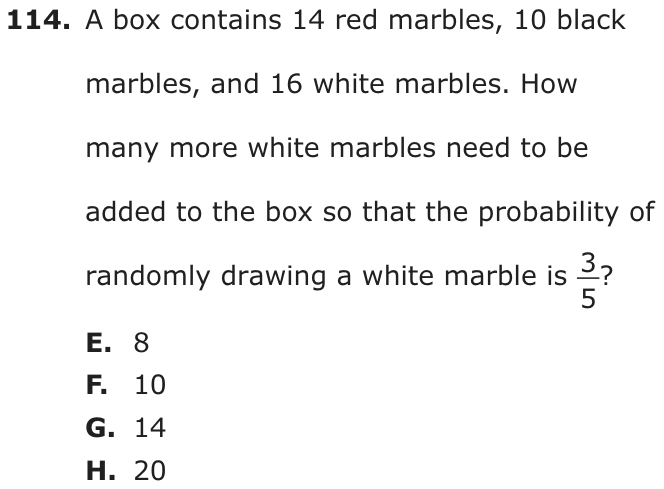
A box contains 14 red marbles, 10 black marbles, and 16 white marbles. How many more white marbles need to be added to the box so that the probability of randomly drawing a white marble is ?
- A8
- B10
- C14
- D20
Show the answer
Correct answer: D
Let w represent the number of additional white marbles.
Set the probability of drawing a white marble equal to and solve the equation for w:
Question analysis
A box holds 14 red, 10 black and 16 white marbles, and students find how many white marbles must be added so that the chance of drawing a white one is 3/5. Working backward from a target probability to a number of marbles is the unusual step.
- Grade level
- Grade 7 content, by NYS standard
- Compared with grade 7
- Above grade 7 Grade 7 probability questions usually give the counts and ask for a probability. This runs the other way: the target probability is given, and the number to add changes both the white count and the total.
- Estimated difficulty
- Hard: combines ideas, needs a plan, and has more than one tempting wrong answer.
- Thinking it demands
- Depth of knowledge 2, skills and concepts · mainly apply
- What makes it hard
- Turning words into math moderate
- Variables instead of numbers minor
- Many steps minor
- Solution
- 3 steps
- Reading level
- Question and choices: about grade 8, 34 words.
- Students, last 30 days
- Not enough answers yet to show (it takes 10).
Why it is hard, traps and wrong answers (shows the answer)
Why it is hard
The tempting shortcut is to take 3/5 of the 40 marbles already in the box, which forgets that the new white marbles join the total. Students who set up the probability with the unknown in both the top and the bottom solve it in a few lines, and testing choices works too: adding 20 gives 36 white of 60, exactly 3/5. The other two choices are counts copied from the stem.
Turning words into math moderate Understanding the question
“How many more white marbles need to be added” puts the unknown in two places, (16 + w)/(40 + w), because each white marble added also raises the total. (Hegarty, Mayer & Monk, 1995; Koedinger & Nathan, 2004)
Variables instead of numbers minor Understanding the question
The unknown number of added marbles has to be carried as a letter through a proportion, 5(16 + w) = 3(40 + w), before it can be found. (Koedinger & Nathan, 2004; Enright, Morley & Sheehan, 2002)
Many steps minor Working it out
Totaling the marbles, setting up the proportion, cross-multiplying and solving 80 + 5w = 120 + 3w make four steps, unless the choices are tested one by one. (Daniel & Embretson, 2010; Enright, Morley & Sheehan, 2002)
Strategy: Let w be the number of white marbles added, write the new probability with w in both the top and the bottom, set it equal to 3/5 and solve; or test each choice.
Traps
- Percent of the wrong amount: Finding the whole from a part, or a percent change measured from the wrong starting amount.
- Numbers taken from the question: Combines the numbers in the question without a model of the situation, or is simply a number that appears in the question.
The wrong answers, classified
A Percent of the wrong amount (Parker & Leinhardt, 1995)
Takes 3/5 of the 40 marbles now in the box, 24, and subtracts the 16 white ones, forgetting that added marbles raise the total.
B Numbers taken from the question (Hegarty, Mayer & Monk, 1995)
Picks 10, the number of black marbles in the stem, without setting up the new probability or testing it.
C Numbers taken from the question (Hegarty, Mayer & Monk, 1995)
Picks 14, the number of red marbles in the stem, without checking that adding 14 white marbles gives 30 of 54, not 3/5.
Worked solution, step by step
Formulas used
- Probability
- P(white) is the probability, or chance, of drawing a white marble. The top counts the white marbles. The bottom counts every marble in the box. It works because each marble is equally likely to be drawn.
- Cross multiplication
- a and c are the tops. b and d are the bottoms. When two fractions are equal, each top times the other bottom gives the same product. It works because you multiply both sides by both bottoms. Use it to clear fractions from an equation.
Sort out the box
The box has 14 red, 10 black and 16 white marbles.
That is 40 marbles. You will add some white marbles. Call that number w. You need w so that the chance of drawing white is .
Write the new probability
Adding w white marbles changes both counts. There will be 16 + w white marbles and 40 + w marbles in all. Use the probability formula.
Watch out: Taking of 40 gives 24, and 24 − 16 = 8, choice A. That forgets that the new marbles also make the box bigger.
Cross multiply
Fractions are hard to solve with. Clear them with cross multiplication.
Then multiply each outside number by both terms inside the parentheses.
Solve for w
Subtract 3w from both sides. Then subtract 80 from both sides.
Divide both sides by 2.
You need to add 20 white marbles.
So the answer is D, 20.
Check your answer
Add 20 white marbles. Then there are 16 + 20 = 36 white marbles and 40 + 20 = 60 marbles in all. Divide the top and bottom by 12: . It works.
More questions like this
The original DOE question