Question
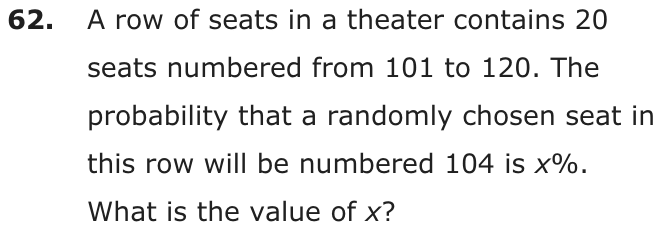
A row of seats in a theater contains 20 seats numbered from 101 to 120. The probability that a randomly chosen seat in this row will be numbered 104 is x%. What is the value of x?
Grid-in question: work out the answer and enter it as a number.
Show the answer
Correct answer: 5
The probability that any 1 seat will be selected at random from 20 seats is 1 out of 20. To find the probability as a percentage, convert the fraction to a decimal.
Then convert the decimal to a percentage by multiplying by 100.
The probability is 5%.
Question analysis
A theater row has 20 seats numbered 101 to 120, and one seat is chosen at random. Students find the probability that it is one particular seat, written as x%, and type the value of x. It tests simple probability and changing a fraction to a percent; the seat numbers themselves play no part in the answer.
- Grade level
- Grade 6 content, by NYS standard
- Compared with grade 7
- Below grade 7 The probability of one equally likely outcome is grade 6 content, and turning it into a percent is a short grade 6 step. Grade 7 probability usually involves compound events, which this question does not.
- Estimated difficulty
- Straightforward: two steps or one careful reading.
- Thinking it demands
- Depth of knowledge 2, skills and concepts · mainly apply
- What makes it hard
- An answer in an unexpected form moderate
- Error-prone arithmetic minor
- Solution
- 2 steps
- Reading level
- Question and choices: about grade 5, 33 words.
- Students, last 30 days
- Not enough answers yet to show (it takes 10).
Why it is hard, traps and wrong answers (shows the answer)
Why it is hard
The seat numbers, 101 to 120, and the chosen seat 104 play no part: the row holds 20 equally likely seats, so the chance is 1 in 20. What the item tests is the change of form, from a fraction to the number in front of a percent sign. Knowing that 1/20 is half of 1/10, which is 10%, gives the value at once and rules out both 0.05 and 50.
An answer in an unexpected form moderate Choosing the answer
The probability is asked for as the x in x%, so 1 out of 20 must become the number 5, not the fraction 1/20 or the decimal 0.05 it is first found as. (Enright, Morley & Sheehan, 2002)
Error-prone arithmetic minor Working it out
Dividing 1 by 20 gives 0.05, with a zero in the tenths place, and losing that zero makes the percent ten times too large. (Brown & Burton, 1978; Junker & Sijtsma, 2001)
Strategy: Count the seats, write the chance of one particular seat as a fraction, then change it to a percent and enter only the number in front of the percent sign.
Traps
- Stops one step early: A choice is a number from partway through the solution.
- Information you don't need: The question gives numbers or facts that play no part in the answer.
- Misunderstands the concept: A wrong belief about a concept: that percents can be added, that area grows like length, that averages can be averaged, that a bigger denominator means a bigger fraction.
The wrong answers, classified
0.05 Stops one step early (King et al., 2004; Gierl et al., 2017)
Finds the probability, 1 ÷ 20 = 0.05, and enters the decimal without multiplying by 100 to give x as a number of percent.
50 An arithmetic slip (Junker & Sijtsma, 2001)
Loses the zero after the decimal point when dividing, taking 1 ÷ 20 as 0.5, as 1 ÷ 2 would be, and so enters 50.
20 Misunderstands the concept (Smith, diSessa & Roschelle, 1993; De Bock et al., 1998; Ni & Zhou, 2005)
Reads 1 chance in 20 as 20 percent, putting the number of seats in place of the percent instead of dividing 1 by 20.
Worked solution, step by step
Formulas used
- Probability of one outcome
- P is the probability, the chance that something happens, from 0 to 1. The top counts the outcomes you want. The bottom counts all the outcomes that could happen. Use it when every outcome is equally likely, like one seat picked from a row.
- Fraction to percent
- A percent is a number out of 100. Multiplying a fraction or decimal by 100 tells how many out of 100 it is. So 1/2 times 100 is 50, which means 50%.
Sort out the question
The row has 20 seats, numbered 101 to 120. One seat is picked at random. At random means every seat has the same chance. You need the chance that it is seat 104, written as x%. Then you grid x.
The seat numbers don’t change the math. Only the number of seats matters.
Write the chance as a fraction
Seat 104 is 1 seat. There are 20 seats in all.
So the chance is 1 out of 20.
Change the fraction to a percent
Use the formula: multiply the fraction by 100.
So the chance is 5%. As a decimal, it is 0.05.
Give the answer
The question asks for x, the number in front of the % sign. That is 5.
Watch out: 0.05 is the decimal, not the percent. Writing 1 ÷ 20 as 0.5 gives 50. And 20 is the number of seats, not the percent. So you would grid 5.
Check your answer
All 20 seats share 100% equally. Each seat gets percent. That includes seat 104. Also, 1/20 is half of 1/10, and 1/10 is 10%. Half of 10% is 5%.
More questions like this
The original DOE question