Question
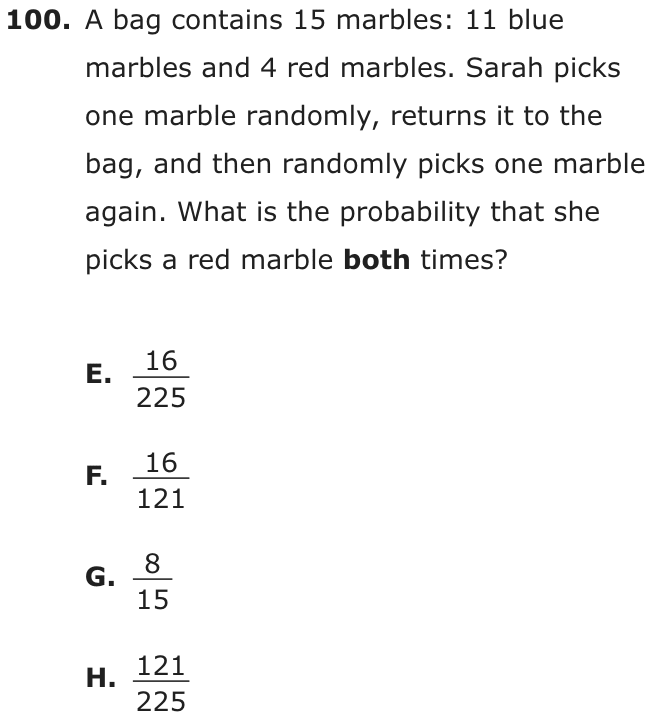
A bag contains 15 marbles: 11 blue marbles and 4 red marbles. Sarah picks one marble randomly, returns it to the bag, and then randomly picks one marble again. What is the probability that she picks a red marble both times?
- A
- B
- C
- D
Show the answer
Correct answer: A
The probability of drawing a red marble at random from a bag of 15 marbles (11 blue and 4 red) is shown:
When the red marble is replaced in the bag, the probability of picking a red marble is unchanged, .
The two events are independent, so the multiplication rule of probability applies.
Question analysis
A bag holds 11 blue and 4 red marbles. Sarah picks one at random, puts it back, and picks again, and students find the probability that she picks red both times. It tests the probability of a compound event made of two independent picks; the bold word both and the replacement shape the calculation.
- Grade level
- Grade 7 content, by NYS standard
- Compared with grade 7
- At grade 7 Finding the probability of two independent picks is grade 7 compound-event work. Because the marble is put back, the two picks are alike, and the numbers are small, which makes this a typical grade 7 probability task.
- Estimated difficulty
- Straightforward: two steps or one careful reading.
- Thinking it demands
- Depth of knowledge 2, skills and concepts · mainly apply
- What makes it hard
- Something you must already know moderate
- Turning words into math minor
- Solution
- 2 steps
- Reading level
- Question and choices: about grade 6, 42 words.
- Students, last 30 days
- Not enough answers yet to show (it takes 10).
Why it is hard, traps and wrong answers (shows the answer)
Why it is hard
The arithmetic is two small fractions multiplied, so the question rests on knowing which rule applies. Adding the two chances gives more than either chance alone, which cannot be right for two reds in a row, and comparing red with blue instead of with all 15 marbles changes every denominator. A sense check helps: two reds in a row must be less likely than a single red, 4/15.
Something you must already know moderate Working it out
The multiplication rule for independent events is not given: because the marble goes back, each pick is 4 out of 15, and red both times means 4/15 × 4/15. (Anderson & Krathwohl, 2001)
Turning words into math minor Understanding the question
Two phrases carry the method: “returns it to the bag” keeps the second pick at 4 out of 15, and “red marble both times” asks for both events, not either. (Hegarty, Mayer & Monk, 1995; Koedinger & Nathan, 2004)
Strategy: Find the chance of red on a single pick out of all the marbles. Since the marble goes back, the second pick has the same chance; then use the rule for two independent events both happening.
Traps
- Wrong operation: Adds instead of multiplying, divides the wrong way round, turns a ratio or rate upside down, or undoes a step in the wrong direction (subtracts what should be added back).
- Misunderstands the concept: A wrong belief about a concept: that percents can be added, that area grows like length, that averages can be averaged, that a bigger denominator means a bigger fraction.
- Answers a different question: A choice is right for another quantity: the other unknown, the rest instead of the part, the part instead of the whole.
The wrong answers, classified
B Misunderstands the concept (Smith, diSessa & Roschelle, 1993; De Bock et al., 1998; Ni & Zhou, 2005)
Uses red to blue, 4 to 11, as the chance of red instead of 4 out of all 15 marbles, then squares it, a part-to-part ratio.
C Wrong operation (Hegarty, Mayer & Monk, 1995; King et al., 2004)
Adds the two chances, 4/15 + 4/15 = 8/15, instead of multiplying, as if a red marble on either pick were enough.
D Answers a different question (King et al., 2004; Hegarty, Mayer & Monk, 1995)
Finds the chance of blue both times, (11/15)² = 121/225, answering for the wrong color with the right method.
Worked solution, step by step
Formulas used
- Probability of an event
- P is the probability, the chance that something happens, from 0 (never) to 1 (always). An outcome is one possible result, here one marble. Divide the number of results you want by the number of all results.
- Two independent events both happening
- A and B are two events. Independent means one does not change the chance of the other. P(A) is the chance of A, and P(B) is the chance of B. Multiply them to get the chance that both happen.
Sort out the question
The bag has 15 marbles: 11 blue and 4 red. Sarah picks one, puts it back, then picks again. You need the probability, or chance, that both picks are red. Putting the marble back matters. The bag is the same for the second pick.
Find the chance of red on one pick
There are 4 red marbles out of 15 in all. Watch out: compare red with all 15 marbles, not with the 11 blue ones. Using 4 out of 11 leads to , choice B.
See that the picks are independent
Sarah puts the marble back. So the bag again has 4 red marbles out of 15. The second pick has the same chance, 4/15. The first pick does not change the second one. That makes the two picks independent.
Multiply the two chances
To multiply fractions, multiply the tops and multiply the bottoms. Watch out: don’t add. , choice C, is a bigger chance than one red. And , choice D, is the chance of blue both times. So the answer is A, .
Check your answer
Two reds in a row should be less likely than one red. One red is , about 0.27. is about 0.07, much smaller. That makes sense. Adding gave , about 0.53, which is too big.
More questions like this
The original DOE question