Question
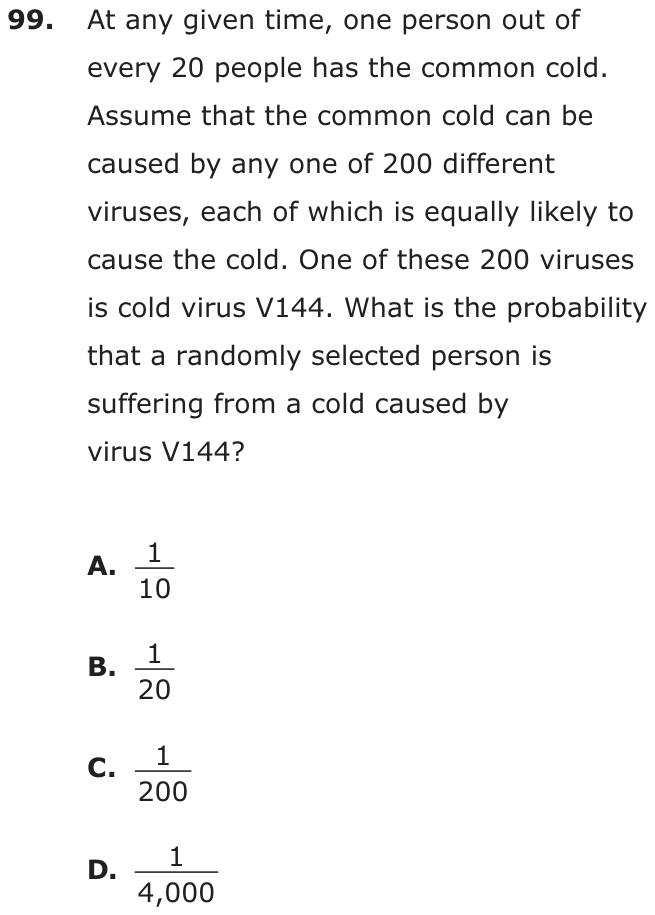
At any given time, one person out of every 20 people has the common cold. Assume that the common cold can be caused by any one of 200 different viruses, each of which is equally likely to cause the cold. One of these 200 viruses is cold virus V144. What is the probability that a randomly selected person is suffering from a cold caused by virus V144?
- A
- B
- C
- D
Show the answer
Correct answer: D
To calculate the joint probability, you must first determine the probability of each independent event. The probability that a randomly selected person has a common cold is . The probability that a cold is caused by V144 is . The probability that a person has a cold and the cold is caused by the V144 virus is the product of those two probabilities, .
Question analysis
One person in 20 has a common cold at any given time, and each cold comes from one of 200 equally likely viruses. Students find the probability that a randomly selected person has a cold caused by one particular virus, V144. It tests the probability of a compound event, which is hidden here inside a single phrase.
- Grade level
- Grade 7 content, by NYS standard
- Compared with grade 7
- At grade 7 Grade 7 students find compound probabilities, usually from organized lists or tree diagrams. Here the two stages are hidden in one phrase, a cold caused by one particular virus, and there are far too many outcomes to list.
- Estimated difficulty
- Moderate: several steps, or a close reading with one strong distractor.
- Thinking it demands
- Depth of knowledge 2, skills and concepts · mainly apply
- What makes it hard
- Turning words into math moderate
- Something you must already know moderate
- Solution
- 2 steps
- Reading level
- Question and choices: about grade 6, 68 words.
- Corrected from the DOE handbook
- A probability in the explanation that was stated for the wrong event was corrected.
- Students, last 30 days
- Not enough answers yet to show (it takes 10).
Why it is hard, traps and wrong answers (shows the answer)
Why it is hard
The arithmetic is one multiplication; the difficulty is seeing that the event has two stages. Each stated chance, 1 in 20 for a cold and 1 in 200 for the virus behind it, is listed as a choice on its own, and each answers only half the question. A chance that both stages happen must be smaller than either one alone, which leaves a single choice.
Turning words into math moderate Understanding the question
The single phrase “a cold caused by virus V144” holds two events, having a cold at all and that cold coming from V144, and they must be separated before any rule applies. (Hegarty, Mayer & Monk, 1995; Koedinger & Nathan, 2004)
Something you must already know moderate Working it out
The stem never says that the chance of both stages is the product of their chances, so students must bring that rule to the 1 in 20 and the 1 in 200 themselves. (Anderson & Krathwohl, 2001)
Strategy: Split the event into two stages, having a cold and that cold coming from V144, write each stage's chance as a fraction, and combine them with the rule for events that must both happen.
Traps
- Stops one step early: A choice is a number from partway through the solution.
- Wrong operation: Adds instead of multiplying, divides the wrong way round, turns a ratio or rate upside down, or undoes a step in the wrong direction (subtracts what should be added back).
The wrong answers, classified
A Wrong operation (Hegarty, Mayer & Monk, 1995; King et al., 2004)
Divides one chance by the other, 1/200 ÷ 1/20 = 20/200 = 1/10, instead of multiplying them, giving a chance larger than either stage.
B Stops one step early (King et al., 2004; Gierl et al., 2017)
Gives the chance that a person has a cold of any kind, 1 in 20, and stops before multiplying by the 1/200 chance that V144 caused it.
C Stops one step early (King et al., 2004; Gierl et al., 2017)
Gives the chance that a cold is caused by V144, one virus out of 200, forgetting that only 1 person in 20 has a cold at all.
What was corrected from the DOE handbook, and why
- Explanation: The handbook says “The probability that a person has a cold caused by V144 is 1/200.” A person having a cold caused by V144 is exactly what the question asks about, and the same paragraph goes on to give its probability as 1/4,000; as printed, the sentence gives that event the value of choice C. The 1/200 is the probability that a cold is caused by V144 (one of 200 equally likely viruses), so the site reads “The probability that a cold is caused by V144 is 1/200.” The working and the answer are unchanged: 1/20 × 1/200 = 1/4,000.
Worked solution, step by step
Formulas used
- Probability of one outcome
- P is the probability, the chance that something happens, from 0 to 1. The top counts the outcomes you want. The bottom counts all the outcomes that could happen. Use it when every outcome is equally likely, like one virus out of 200.
- Chance that two events both happen
- A is the first event and B is the second. P(A) is the chance of A. P(B given A) is the chance of B among the times A has happened. Multiply them to get the chance that both happen. The result is smaller than either chance, since both things must happen.
Sort out the question
One person in 20 has a cold. Every cold comes from one of 200 viruses, all equally likely. V144 is one of them. You need the chance that a random person has a cold caused by V144.
That phrase holds two events. First, the person has a cold. Second, that cold comes from V144.
Find the chance of a cold
The question says “one person out of every 20 people has the common cold.” So 1 person is the part with a cold, and 20 is the whole group.
Find the chance it is V144
Now think only about people who have a cold. Each cold comes from one of 200 viruses, all equally likely. V144 is 1 of the 200.
This chance is only about people who already have a cold. So the second event depends on the first.
Multiply the two chances
Use the rule for two events that must both happen. Event A is a cold, and event B is V144 as its cause.
Multiply the tops: 1 × 1 = 1. Multiply the bottoms: 20 × 200 = 4,000.
Give the answer
Watch out: 1/20 is the chance of any cold, choice B. And 1/200 is the chance that a cold comes from V144, choice C. Each one answers only half the question. Dividing one by the other gives 1/10, choice A. So the answer is D, .
Check your answer
Picture 4,000 people. One in 20 has a cold, so people have colds. Of those 200 colds, 1 in 200 comes from V144. That is 1 person out of 4,000. It is also smaller than both 1/20 and 1/200, as it should be.
More questions like this
The original DOE question