Question
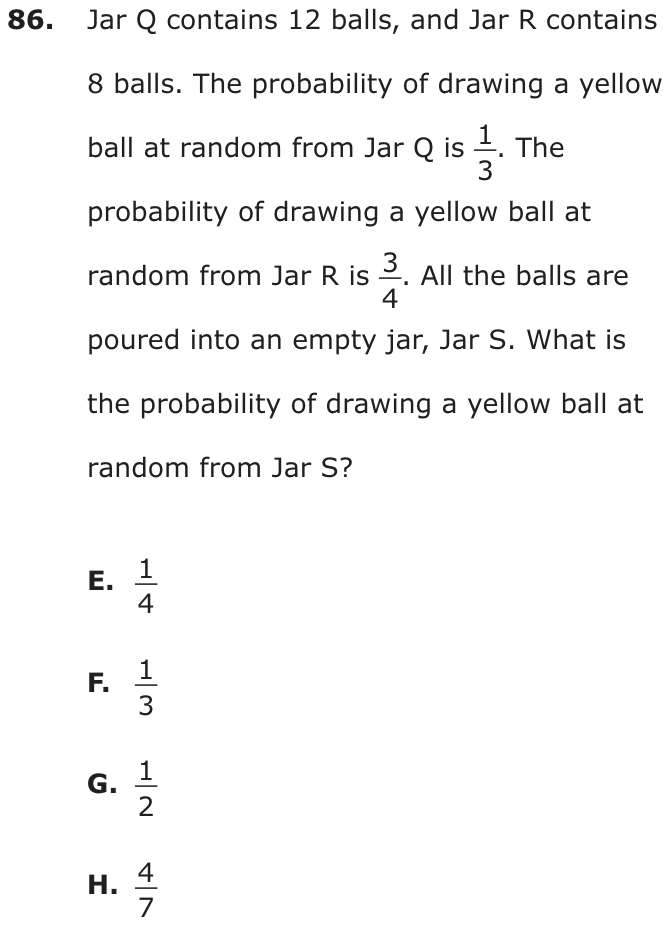
Jar Q contains 12 balls, and Jar R contains 8 balls. The probability of drawing a yellow ball at random from Jar Q is . The probability of drawing a yellow ball at random from Jar R is . All the balls are poured into an empty jar, Jar S. What is the probability of drawing a yellow ball at random from Jar S?
- A
- B
- C
- D
Show the answer
Correct answer: C
Jar Q contains 12 balls, and the probability of drawing a yellow ball at random is .
There are 4 yellow balls in Jar Q.
Jar R contains 8 balls, and the probability of drawing a yellow ball at random is .
There are 6 yellow balls in Jar R.
Jar S contains all the balls from Jar Q and Jar R.
There are 20 balls in Jar S.
There are 10 yellow balls in Jar S.
The probability of drawing a yellow ball at random from Jar S is .
Question analysis
Two jars hold different numbers of balls and give different chances of drawing a yellow ball, and then everything is poured into a third jar. Students find the probability of drawing yellow from the combined jar. The tricky part is that the jars are different sizes, so their probabilities cannot be merged without first counting the yellow balls.
- Grade level
- Grade 6 content, by NYS standard
- Compared with grade 7
- At grade 7 Grade 7 probability tasks usually give the counts and ask for a fraction. Here each jar's probability must be turned back into a count of yellow balls before the jars are pooled, a reverse step that typical classwork rarely asks for.
- Estimated difficulty
- Moderate: several steps, or a close reading with one strong distractor.
- Thinking it demands
- Depth of knowledge 2, skills and concepts · mainly apply
- What makes it hard
- Turning words into math moderate
- A very close wrong answer minor
- Solution
- 4 steps
- Reading level
- Question and choices: about grade 6, 66 words.
- Students, last 30 days
- Not enough answers yet to show (it takes 10).
Why it is hard, traps and wrong answers (shows the answer)
Why it is hard
The arithmetic is light; the hurdle is seeing that chances from jars of different sizes cannot be combined as fractions. Every wrong choice works on 1/3 and 3/4 directly, by multiplying them, by keeping one, or by adding tops and bottoms, while the right path runs through counts of balls. Asking how many yellow balls each jar holds before anything is poured avoids all three.
Turning words into math moderate Understanding the question
Each jar's probability, 1/3 of 12 balls and 3/4 of 8 balls, has to be turned back into a count of yellow balls, 4 and 6, before the two jars can be combined. (Hegarty, Mayer & Monk, 1995; Koedinger & Nathan, 2004)
A very close wrong answer minor Choosing the answer
The straight-across 4/7, about 0.57, sits just above the right 1/2, and both lie between the jars' chances of 1/3 and 3/4, so a rough estimate does not rule it out. (Embretson & Wetzel, 1987; Gorin & Embretson, 2006; Ascalon et al., 2007)
Strategy: Turn each jar's probability into a number of yellow balls by multiplying it by that jar's total, then divide all the yellow balls by all the balls.
Traps
- Misunderstands the concept: A wrong belief about a concept: that percents can be added, that area grows like length, that averages can be averaged, that a bigger denominator means a bigger fraction.
- A faulty procedure: A systematic but wrong procedure: adding fractions straight across, applying an exponent to each term of a sum, dropping a sign when moving a term.
The wrong answers, classified
A Misunderstands the concept (Smith, diSessa & Roschelle, 1993; De Bock et al., 1998; Ni & Zhou, 2005)
Multiplies the jars' chances, 1/3 × 3/4 = 1/4, the rule for two draws that must both be yellow, though only one ball is drawn from the mixture.
B Numbers taken from the question (Hegarty, Mayer & Monk, 1995)
Repeats Jar Q's 1/3 from the stem, as if the bigger jar's chance carried over to the mixture unchanged.
D A faulty procedure (Brown & Burton, 1978; Tatsuoka, 1983)
Adds the fractions straight across, (1 + 3)/(3 + 4) = 4/7, treating 1/3 and 3/4 as if they were counts of balls rather than chances.
Worked solution, step by step
Formulas used
- Probability
- P(yellow) is the probability, or chance, of drawing a yellow ball. It is a number from 0 to 1. The top counts the yellow balls. The bottom counts all the balls. It works because every ball is equally likely to be drawn.
Sort out what you know
Jar Q holds 12 balls. The probability, or chance, of drawing yellow from it is .
Jar R holds 8 balls. The chance of drawing yellow from it is .
All the balls are poured into Jar S. You need the chance of drawing yellow from Jar S.
Count the yellow balls in Jar Q
The jars are different sizes, so you can’t mix their chances directly. Count the yellow balls instead. The chance tells what fraction of the balls are yellow. So multiply it by the number of balls.
Jar Q has 4 yellow balls.
Count the yellow balls in Jar R
Do the same for Jar R. Three fourths of its 8 balls are yellow.
Jar R has 6 yellow balls.
Count the balls in Jar S
Jar S gets every ball from both jars. Add all the balls. Then add the yellow balls.
Jar S has 20 balls, and 10 of them are yellow.
Find the chance for Jar S
Use the probability formula with the Jar S counts.
Watch out: Adding the tops and the bottoms, 1 + 3 over 3 + 4, gives , choice D. Those numbers are parts of fractions, not balls. Multiplying gives , choice A. That is the chance of two yellow draws, one from each jar.
So the answer is C, .
Check your answer
Half of the 20 balls is 10, and 4 + 6 = 10 yellow balls. That matches. Also, the mixed jar’s chance should land between the two jars’ chances, and . One half does.
More questions like this
The original DOE question