Taking figurative language literally
Question 1 of 18
2026 Practice Test A English, question 7Passage Snowy Mountains
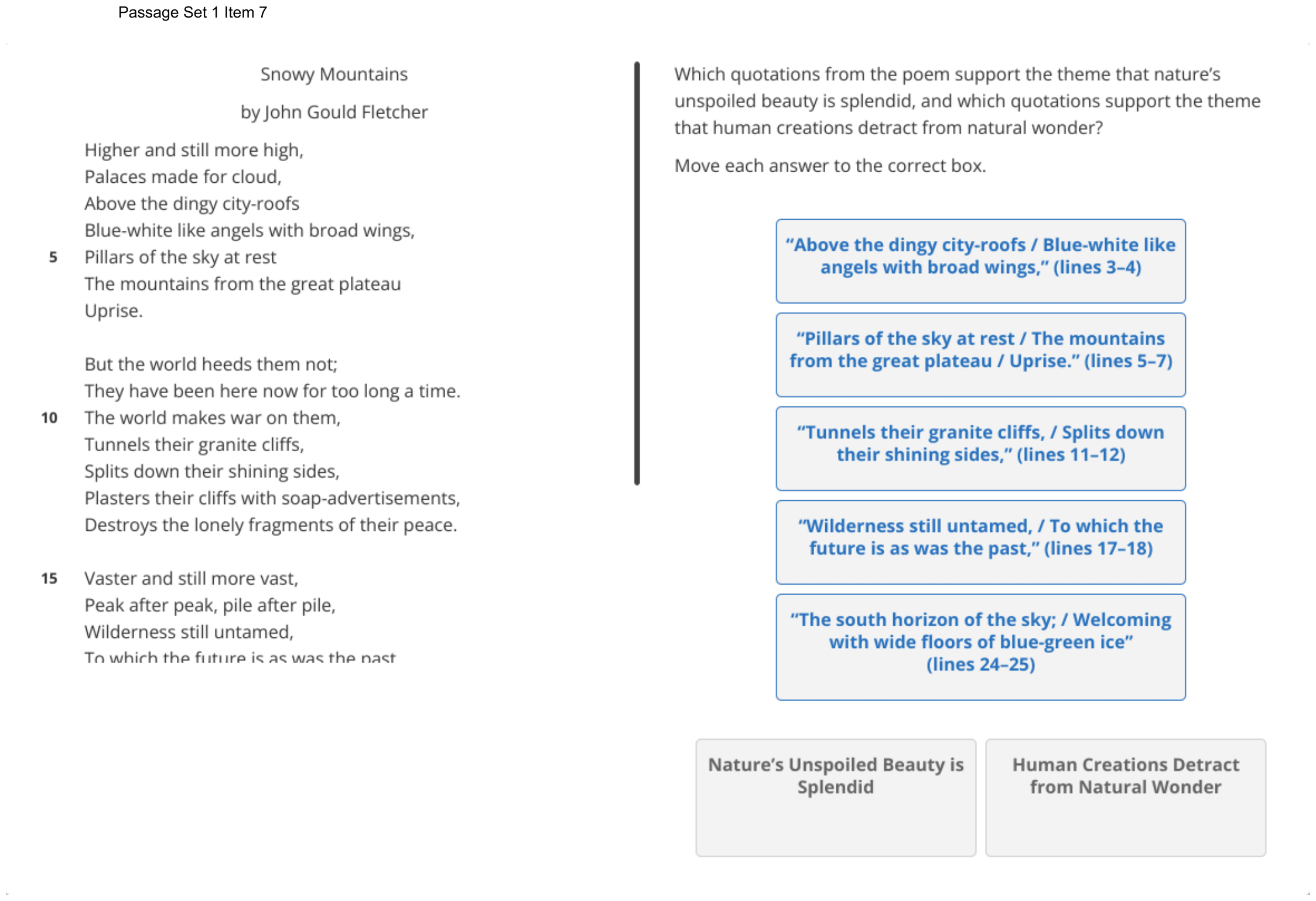
Snowy Mountains
by John Gould Fletcher
Higher and still more high,
Palaces made for cloud,
Above the dingy city-roofs
Blue-white like angels with broad wings,
Pillars of the sky at rest
The mountains from the great plateau
Uprise.
But the world heeds them not;
They have been here now for too long a time.
The world makes war on them,
Tunnels their granite cliffs,
Splits down their shining sides,
Plasters their cliffs with soap-advertisements,
Destroys the lonely fragments of their peace.
Vaster and still more vast,
Peak after peak, pile after pile,
Wilderness still untamed,
To which the future is as was the past,
Barrier spread by Gods,
Sunning their shining foreheads,
Barrier broken down by those who do not need
The joy of time-resisting storm-worn stone,
The mountains swing along
The south horizon of the sky;
Welcoming with wide floors of blue-green ice
The mists that dance and drive before the sun.
“Snowy Mountains” by John Gould Fletcher—Public Domain
Question
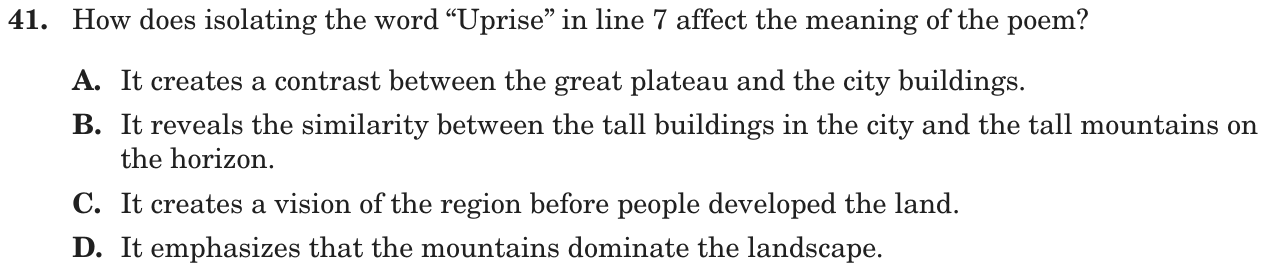
Which quotations from the poem support the theme that nature’s unspoiled beauty is splendid, and which quotations support the theme that human creations detract from natural wonder?
Move each answer to the correct box.
Choose one answer in each row, then check. The DOE has not published how answers with several parts are scored; this site counts one right only when every part is right.
| Nature’s Unspoiled Beauty is Splendid | Human Creations Detract from Natural Wonder | |
|---|---|---|
| “Above the dingy city-roofs / Blue-white like angels with broad wings,” (lines 3–4) | ||
| “Pillars of the sky at rest / The mountains from the great plateau / Uprise.” (lines 5–7) | ||
| “Tunnels their granite cliffs, / Splits down their shining sides,” (lines 11–12) | ||
| “Wilderness still untamed, / To which the future is as was the past,” (lines 17–18) | ||
| “The south horizon of the sky; / Welcoming with wide floors of blue-green ice” (lines 24–25) |
Show the answer
Correct answer: “Above the dingy city-roofs / Blue-white like angels with broad wings,” (lines 3–4): Human Creations Detract from Natural Wonder; “Pillars of the sky at rest / The mountains from the great plateau / Uprise.” (lines 5–7): Nature’s Unspoiled Beauty is Splendid; “Tunnels their granite cliffs, / Splits down their shining sides,” (lines 11–12): Human Creations Detract from Natural Wonder; “Wilderness still untamed, / To which the future is as was the past,” (lines 17–18): Nature’s Unspoiled Beauty is Splendid; “The south horizon of the sky; / Welcoming with wide floors of blue-green ice” (lines 24–25): Nature’s Unspoiled Beauty is Splendid
The question identifies two themes and asks which quotations from the poem support each theme. Each quotation should be moved to one of the two boxes: “Nature’s Unspoiled Beauty is Splendid” or “Human Creations Detract from Natural Wonder.”
“Above the dingy city-roofs / Blue-white like angels with broad wings,” (lines 3–4)
This quotation supports the theme that human creations detract from natural wonder. The lines describe the city-roofs as “dingy,” suggesting that they mar the lovely background of the blue-white mountains, which are compared to angels, a simile that vividly conveys the wonder of nature. The description in the lines primarily serves to create a contrast between the city’s unsightly appearance and the beauty of the mountains, thereby providing support for the theme that human creations (i.e. the city) detract from natural wonder.
“Pillars of the sky at rest / The mountains from the great plateau / Uprise.” (lines 5–7)
This quotation supports the theme that nature’s unspoiled beauty is splendid. By describing the mountains as “pillars of the sky” that “uprise” dramatically from a large plateau, the lines primarily convey a sense of the mountains’ dramatic and impressive size. The description suggests that the mountains are holding up the sky, a powerful image of an unspoiled, natural landscape.
“Tunnels their granite cliffs, / Splits down their shining sides,” (lines 11–12)
The quotation supports the theme that human creations detract from natural wonder. The words “tunnels” and “splits” emphasize that human intervention in nature is destructive, breaking apart the “shining sides” of the mountain. These lines suggest that human creations—such as building a tunnel through a mountain—detract from natural wonder, diminishing its beauty and serenity.
“Wilderness still untamed, / To which the future is as was the past,” (lines 17–18)
The quotation supports the theme that nature’s unspoiled beauty is splendid by indicating that the natural mountainous landscape is both splendid and unspoiled (“wilderness still untamed”). The phrase “to which the future is as was the past” suggests that nature in its unspoiled state is timeless or eternal, further supporting the theme.
“The south horizon of the sky; / Welcoming with wide floors of blue-green ice” (lines 24–25)
The quotation supports the theme that nature’s unspoiled beauty is splendid. The reference to the “wide floors of blue-green ice” emphasizes that the landscape is beautiful, and the description in the lines conveys the grandiose splendor of nature, conveying an image of the “south horizon of the sky” majestically “welcoming” one’s eye, inviting appreciation of its unspoiled beauty.
Question analysis
This sorting question on the poem “Snowy Mountains” gives two themes, the splendor of unspoiled nature and the way human creations detract from natural wonder, and asks students to place five quotations under them. The quotations come from all three stanzas. Students make five separate judgments, and a line’s most vivid image is not always the best guide to where it belongs.
- Grade level
- Grade 7 reading and task
- Compared with grade 7
- At grade 7 Matching quotations to a stated theme is routine grade 7 evidence work, and both themes are given. The added demand is volume: five separate judgments on lines from all three stanzas of old-fashioned verse, each of which must land in the right box.
- Estimated difficulty
- Moderate: several steps, or a close reading with one strong distractor.
- Thinking it demands
- Depth of knowledge 2, skills and concepts · mainly analyze
- What makes it hard
- Much to keep track of moderate
- Reading between the lines moderate
- Figurative or literary language minor
- Evidence
- Answered from several paragraphs or stanzas
- Reading level
- Passage: 161 words (a poem; reading level not measured); question and choices: about grade 9, 34 words.
- Students, last 30 days
- Not enough answers yet to show (it takes 10).
Why it is hard, traps and wrong answers (shows the answer)
Why it is hard
Most tiles sort quickly once a student asks whether people appear in the lines. The first tile is the hard one: its angel simile is pure splendor, yet the “dingy city-roofs” beneath it set the city against the peaks, and only that contrast fits the second theme. The tunneling lines hide their human actor outside the tile. With five placements that must all be right, one hasty tile loses the question.
Much to keep track of moderate Working it out
Five tiles from all three stanzas go into two boxes and every placement must be right, so a student holds both themes in mind while judging each quotation on its own. (Sweller, 1988; Carpenter, Just & Shell, 1990)
Reading between the lines moderate Working it out
Two tiles name no person: in lines 3–4 the human presence is only the “dingy city-roofs,” and in lines 11–12 the subject, “The world,” sits back in line 10, outside the tile. (Graesser, Singer & Trabasso, 1994; Kintsch, 1998)
Figurative or literary language minor Understanding the question
The splendor is carried by images rather than statements, the mountains as “angels,” “Pillars of the sky” and “wide floors of blue-green ice,” which students must read as praise of untouched nature. (Graesser, Singer & Trabasso, 1994; Kintsch, 1998)
Strategy: Read each quotation to the end and ask whether it shows something people have made or done; then sort it by what the lines as a whole are about, not by one word.
Traps
- Supports only part of the claim: In a question about evidence: a line that backs one half of the claim but not the other, or a related point rather than the claim itself.
- Taking figurative language literally: A choice reads a figure of speech or image at face value.
- Word match: Repeats striking words or phrases from the text, so it looks supported, but its meaning does not fit the question.
The wrong answers, classified
1:A Supports only part of the claim (King et al., 2004; Thissen, Steinberg & Fitzpatrick, 1989)
Files the lines under splendor for the angel simile, which shows beauty but not beauty unspoiled; the “dingy city-roofs” put a human creation right beneath it.
2:B Taking figurative language literally (Graesser, Singer & Trabasso, 1994)
Takes “Pillars” as something people build, a human structure, when the metaphor makes the mountains themselves the columns that hold up the sky.
3:A Word match (Freedle & Kostin, 1993)
Is drawn by “granite cliffs” and “shining sides,” words of admiration, and misses that “Tunnels” and “Splits” are what “The world” of line 10 does to the mountains.
4:B Reads too much in (Graesser, Singer & Trabasso, 1994)
Reads “still untamed” as a sign that people are trying to tame the land, though the lines praise a wilderness that people have not changed and that time leaves as it was.
5:B Wrong part of the text (Kirsch & Mosenthal, 1990)
Remembers that the last stanza blames those who broke down the “Barrier” in lines 21–22 and carries that charge to lines 24–25, which only picture ice and sky.
Working it out, step by step
Figure out what the question asks
This is a sorting question. You get two themes. A theme is a big idea a poem keeps coming back to. The first theme says nature that people have not spoiled is splendid, which means grand and beautiful. The second says things people make detract from nature, which means they take away from its wonder. For each quotation, ask: does it show something people made or did?
Sort the lines about the city
Lines 3 and 4 say “Above the dingy city-roofs / Blue-white like angels with broad wings.” The angel picture is beautiful. But right under the mountains are “dingy city-roofs.” Dingy means dirty and dull. City roofs are something people built. The lines set the dirty city against the shining mountains. So this quotation shows a human creation taking away from nature’s wonder.
Sort the lines about the pillars
Lines 5 to 7 say “Pillars of the sky at rest / The mountains from the great plateau / Uprise.” Pillars are tall posts that hold something up. A plateau is a high, flat stretch of land. The mountains rise up like giant posts holding up the sky. No people appear here. This quotation shows how splendid untouched nature is.
Sort the lines about tunnels
Lines 11 and 12 say “Tunnels their granite cliffs, / Splits down their shining sides.” These lines do not say who does this. Look back at line 10: “The world makes war on them.” So “the world,” meaning people, cuts tunnels and splits the mountains. The cliffs shine, but people are breaking them. This quotation shows human creations hurting nature.
Sort the last two quotations
Lines 17 and 18 say “Wilderness still untamed, / To which the future is as was the past.” Untamed means not controlled or changed by people. The second line means the mountains will stay as they always were. Lines 24 and 25 say “The south horizon of the sky; / Welcoming with wide floors of blue-green ice.” That is a picture of sky and ice, with no people in it. Both praise unspoiled nature.
Place each quotation in its box
- Lines 3–4 (the city roofs): Human Creations Detract from Natural Wonder
- Lines 5–7 (the pillars): Nature’s Unspoiled Beauty is Splendid
- Lines 11–12 (the tunnels): Human Creations Detract from Natural Wonder
- Lines 17–18 (the wilderness): Nature’s Unspoiled Beauty is Splendid
- Lines 24–25 (the ice): Nature’s Unspoiled Beauty is Splendid
Drag each tile into its box. All five must be right to get the point.
Why this answer and not the closest wrong one
Lines 3 and 4 are the hardest tile. The angel image alone would fit the first box. But that box is about beauty that is unspoiled. These lines put the dingy city right under the shining peaks. The dirty roofs spoil the view, so the tile belongs in the second box.
More questions like this
The original DOE question
The passage “Snowy Mountains” as printed (page 142)
Question 2 of 18
2026 Practice Test B English, question 24Passage Looking for the Smallest Spark of Everything
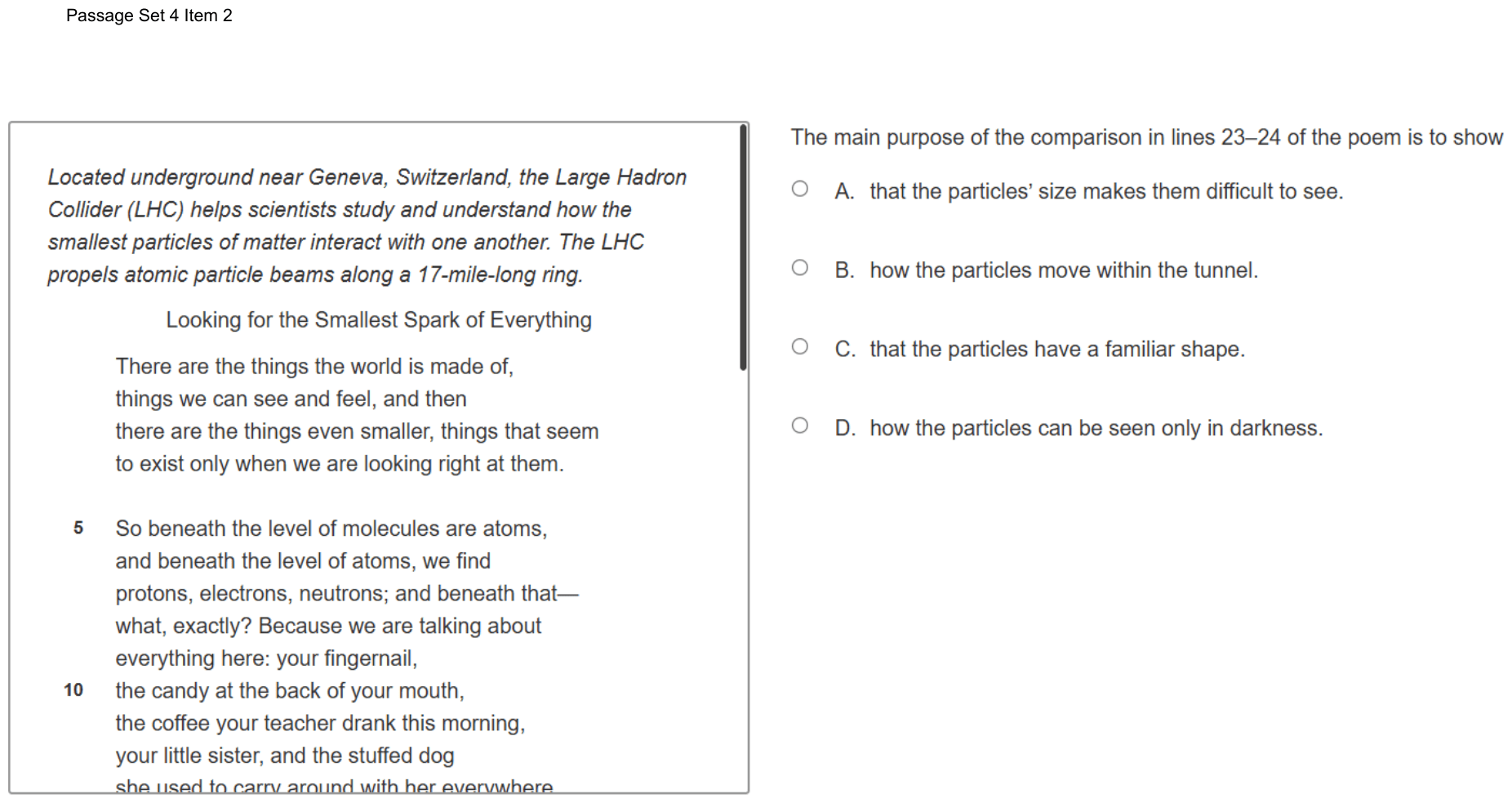
Looking for the Smallest Spark of Everything
Located underground near Geneva, Switzerland, the Large Hadron Collider (LHC) helps scientists study and understand how the smallest particles of matter interact with one another. The LHC propels atomic particle beams along a 17-mile-long ring.
There are the things the world is made of,
things we can see and feel, and then
there are the things even smaller, things that seem
to exist only when we are looking right at them.
So beneath the level of molecules are atoms,
and beneath the level of atoms, we find
protons, electrons, neutrons; and beneath that—
what, exactly? Because we are talking about
everything here: your fingernail,
the candy at the back of your mouth,
the coffee your teacher drank this morning,
your little sister, and the stuffed dog
she used to carry around with her everywhere.
And everywhere.
Everything and everywhere
are made up of the same stuff, whatever
it is. How do we find it? We can listen for it
in the wavelengths from deep space,
talking back to us from unimaginable
distances. Or we can build long,
deep circular tunnels beneath the surface
of this Earth and race particles
(like racing cars, only very tiny cars
flashing along at close to the speed of light)
until everything we think we know
bangs against everything else we know.
And there, in the explosion, in the darkness,
briefly incandescent, they appear:
the quarks, the leptons, and the bosons;
the baryons and the mesons. Their names
sound like dinosaurs or maybe bands
playing terrible music in someone’s garage.
The one thing we know for sure
is that they spin. This is how gravity
enters our world, how our world is held
both together and apart, what keeps
together the pencil in your hand right now
as well as separate from, say,
Jupiter. They spin, and it is only down there
in the darkness—in the vast garage
where physicists jot down
what they can, whatever seems most real—
that they let us perceive their wild dancing,
combusting to the music they make.
Question
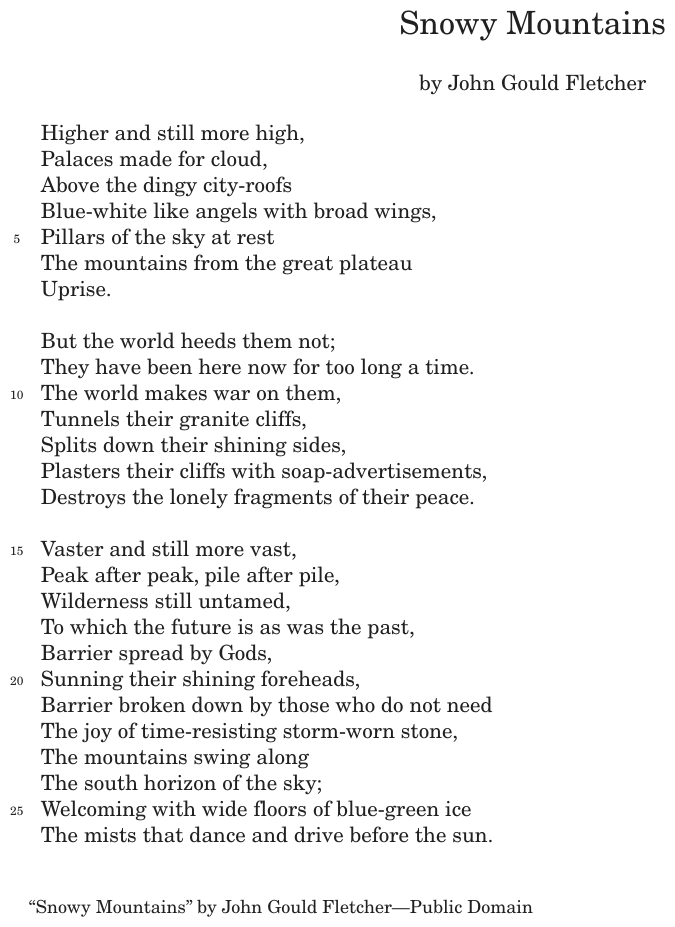
The main purpose of the comparison in lines 23–24 of the poem is to show
- Athat the particles’ size makes them difficult to see.
- Bhow the particles move within the tunnel.
- Cthat the particles have a familiar shape.
- Dhow the particles can be seen only in darkness.
Show the answer
Correct answer: B
The question asks what the comparison in lines 23–24 of the poem is mainly meant to show.
A. Incorrect. While the particles are moving “close to the speed of light” (line 24), which would make them difficult to see, the comparison in lines 23–24 focuses on the movement of the particles, not how visible they are.
B. CORRECT. Lines 23–24 describe “tiny cars / flashing along at close to the speed of light,” which describes how the particles move.
C. Incorrect. Lines 23–24 do not describe the shape of the particles but rather their movement, which is “flashing along at close to the speed of light” (line 24).
D. Incorrect. The word “flashing” in line 24 does not refer to light in darkness but rather to speed, and the word “light” is used to reference a measurement of speed, not brightness in darkness.
Question analysis
This figurative language question asks for the main purpose of a comparison in lines 23–24 of the poem “Looking for the Smallest Spark of Everything,” where particles in an underground tunnel are likened to tiny racing cars. Students must work out what the image is mainly meant to show about the particles, judging the comparison as a whole rather than word by word.
- Grade level
- Grade 6 reading and task
- Compared with grade 7
- Below grade 7 Explaining what a simple comparison shows is grade 6 work, and this one likens particles to racing cars in two short lines of familiar words, so a single step of interpretation is enough.
- Estimated difficulty
- Routine: one familiar step, little to misread.
- Thinking it demands
- Depth of knowledge 2, skills and concepts · mainly understand
- What makes it hard
- Evidence
- Answered from one sentence or line
- Reading level
- Passage: 346 words (a poem; reading level not measured); question and choices: about grade 5, 46 words.
- Students, last 30 days
- Not enough answers yet to show (it takes 10).
Why it is hard, traps and wrong answers (shows the answer)
Why it is hard
The image is built from words about motion, racing cars “flashing along at close to the speed of light,” so most students see its purpose quickly. Each wrong choice seizes one piece of the picture, the cars’ tininess, their shape or the word “light,” and makes it the point. Students who ask what the whole comparison makes them picture, rather than what one word suggests, avoid all three.
Figurative or literary language minor Understanding the question
The comparison sits in parentheses, “like racing cars, only very tiny cars / flashing along at close to the speed of light,” and students must see that racing cars stand for speed. (Graesser, Singer & Trabasso, 1994; Kintsch, 1998)
Strategy: Name the two things being compared in lines 23–24 and ask what a reader is meant to picture, then choose the purpose that the comparison’s own words support.
Traps
- Taking figurative language literally: A choice reads a figure of speech or image at face value.
- Word match: Repeats striking words or phrases from the text, so it looks supported, but its meaning does not fit the question.
- Dictionary meaning, not meaning here: A common meaning of the word that does not fit its use in this text.
The wrong answers, classified
A Word match (Freedle & Kostin, 1993)
Fixes on “very tiny cars” and decides the point is that the particles are too small to see, though racing cars are chosen for their speed, not their size.
C Taking figurative language literally (Graesser, Singer & Trabasso, 1994)
Takes the comparison at face value, as if particles looked like little cars, when the speaker uses racing to picture how they move, not what shape they have.
D Dictionary meaning, not meaning here (Perfetti, 2007)
Reads “flashing” and “light” as a glow, like the one in the darkness of lines 27–28, but “the speed of light” measures how fast the particles travel.
Working it out, step by step
Figure out what the question asks
This asks why the poet makes a comparison in lines 23–24. A comparison shows how two different things are alike. First find the two things. Then ask what the reader is meant to picture.
Read the lines around it
Lines 20–22 describe building “deep circular tunnels beneath the surface / of this Earth” to race particles. Then lines 23–24 add “(like racing cars, only very tiny cars / flashing along at close to the speed of light)”. The speed of light is the fastest speed there is.
Work out the comparison
The particles are compared to racing cars. Racing cars zoom around a track, lap after lap, very fast. The particles zoom around the round tunnel the same way. “Flashing along” means moving so fast they are a blur. So the comparison helps you picture how the particles move.
Check each choice
- A does not fit. The cars are “very tiny,” but the point is racing, not being hard to see.
- B fits. Like racing cars, the particles speed around the tunnel.
- C does not fit. The particles do not look like cars. The comparison is about motion, not shape.
- D does not fit. “Light” here measures speed. It is not about glowing in the dark.
Watch out: A is tempting because of the word “tiny.” But a poet picks racing cars to show speed, not size.
Choose the answer
The racing cars help you picture particles speeding around the tunnel. So the answer is B, “how the particles move within the tunnel.”
Why this answer and not the closest wrong one
A is the closest wrong choice, since the poem does call them “very tiny cars.” But the comparison is to racing cars “flashing along at close to the speed of light.” Every word there is about speed and motion. So B, how the particles move, fits better.
More questions like this
The original DOE question
The passage “Looking for the Smallest Spark of Everything” as printed (pages 32–33)
Question 3 of 18
2026 Practice Test B English, question 25Uses the passage above: “Looking for the Smallest Spark of Everything”.
Question
Read lines 27–28 from the poem.
And there, in the explosion, in the darkness,
briefly incandescent, they appear:
The imagery in the lines reveals that the speaker
- Aenvies the physicists who research colliding particles.
- Bhas personally observed colliding particles.
- Cadmires the powerful reactions that occur when particles collide.
- Dhas a simplistic understanding of how particles collide.
Show the answer
Correct answer: C
The question asks what the imagery in lines 27–28 reveals about the speaker.
A. Incorrect. The physicists mentioned in the fifth stanza (lines 33–44) are described as mere observers: they “jot down / what they can” (lines 41–42). In lines 27–28, the speaker is focused on the reaction between the colliding particles, not on the physicists who study them.
B. Incorrect. The speaker describes the particle collision in detail, but the text does not imply that the speaker has personally witnessed a collision. The speaker implies that his or her understanding of the collision is based on the experiences of the physicists observing the phenomenon (“They spin, and it is only down there / in the darkness—in the vast garage / where physicists jot down / what they can, whatever seems most real— / that they let us perceive their wild dancing” [lines 39–43]).
C. CORRECT. The word “explosion” and the phrase “briefly incandescent” create a picture of rapid changes and short bursts of bright light, revealing how powerful the new particles are. The language the speaker uses is positive, revealing that the speaker admires the power of the reaction and stands in awe of the new particles.
D. Incorrect. The poem reveals the speaker’s deep knowledge about subatomic particles. For example, the speaker is able to name the new particles discovered—“the quarks, the leptons, and the bosons; / the baryons and the mesons” (lines 29–30)—and is able to use imagery to create a powerful picture that reveals the complexity of a scientific process that humans have never been able to see.
Question analysis
This imagery question asks what lines 27–28 of “Looking for the Smallest Spark of Everything” reveal about the poem’s speaker, as particles appear “briefly incandescent” in an explosion inside a particle collider. Students must infer what a vivid image says about the person describing it. The word “incandescent” may be unfamiliar, and the choices are about very different things.
- Grade level
- Grade 8 reading and task
- Compared with grade 7
- Above grade 7 Grade 7 students infer a speaker’s attitude from imagery, but these two lines turn on the uncommon word “incandescent,” state nothing about the speaker outright, and the choices range over the speaker’s knowledge, experience and feelings, which is harder than typical grade 7 work.
- Estimated difficulty
- Hard: combines ideas, needs a plan, and has more than one tempting wrong answer.
- Thinking it demands
- Depth of knowledge 2, skills and concepts · mainly analyze
- What makes it hard
- Reading between the lines major
- Hard words moderate
- Figurative or literary language minor
- Evidence
- Answered from one paragraph or stanza
- Reading level
- Passage: 346 words (a poem; reading level not measured); question and choices: about grade 9, 55 words.
- Students, last 30 days
- Not enough answers yet to show (it takes 10).
Why it is hard, traps and wrong answers (shows the answer)
Why it is hard
Nothing in the two lines names a feeling, so students must judge the speaker’s attitude from the image alone, and its key word is uncommon. The vividness is itself a trap: a scene described this sharply can seem to be one the speaker watched, though the poem says the particles are perceived only through the physicists’ work. The choices range over envy, experience, admiration and understanding, so each must be tested against the lines rather than against an overall impression.
Reading between the lines major Working it out
The lines describe particles, not the speaker, and contain no word of feeling; admiration has to be inferred from the drama of “the explosion” and the glow of “briefly incandescent.” (Graesser, Singer & Trabasso, 1994; Kintsch, 1998)
Hard words moderate Understanding the question
“Incandescent,” glowing with heat and light, is the word that makes the image dazzling, and a student who does not know it sees only an explosion in the dark. (Perfetti, 2007; Freedle & Kostin, 1993)
Figurative or literary language minor Understanding the question
The two lines are pure imagery, a burst of light in darkness as the particles “appear,” and the question asks what that picture reveals about the person painting it. (Graesser, Singer & Trabasso, 1994; Kintsch, 1998)
Strategy: Picture the scene in lines 27–28, including what “incandescent” means, decide what the description suggests about the speaker, and test each choice against these two lines.
Traps
- Taking figurative language literally: A choice reads a figure of speech or image at face value.
- Reads too much in: A reasonable-sounding conclusion that goes further than the text allows.
The wrong answers, classified
A Reads too much in (Graesser, Singer & Trabasso, 1994)
Reasons that someone so drawn to the scene must envy the physicists who study it, though the physicists appear only in lines 39–44 and nothing in the poem hints at envy.
B Taking figurative language literally (Graesser, Singer & Trabasso, 1994)
Takes the vivid scene of particles that “appear” in a glow as something the speaker witnessed, though lines 39–43 place that sight “down there,” where physicists record what they can.
D Reads too much in (Graesser, Singer & Trabasso, 1994)
Treats the poem’s playful comparisons, racing cars and garage bands, as a sign of shallow knowledge, though the next lines have the speaker naming quarks, leptons, bosons, baryons and mesons.
Working it out, step by step
Figure out what the question asks
This asks what the imagery in lines 27–28 shows about the speaker. Imagery is language that helps you see, hear or feel a scene. The lines describe particles, not the speaker. So you must infer, or figure out from clues, how the speaker feels.
Read lines 27–28
The lines say “And there, in the explosion, in the darkness, / briefly incandescent, they appear:” Briefly means for a short time. Incandescent means glowing with heat and light. So picture a burst of bright light flashing in the dark. The particles have just crashed into each other, or collided. In that flash, the tiny particles appear.
Decide how the speaker feels
The words are bold and bright: “explosion,” “incandescent,” “appear.” The speaker makes the moment sound dramatic and amazing. People describe something this way when they are in awe of it. So the speaker admires, or looks up to, the power of the crash.
Check each choice
- A does not fit. Physicists come up only later, in line 41. Nothing shows envy, or wanting what they have.
- B does not fit. Nothing says the speaker was there. Lines 39–42 place the sight “down there,” where “physicists jot down / what they can.”
- C fits. The glowing burst in the dark shows the speaker’s wonder.
- D does not fit. Right after, the speaker names quarks, leptons, bosons, baryons and mesons. That is not a simple understanding.
Watch out: B is tempting because the scene is so vivid. But a writer can picture something without seeing it in person.
Choose the answer
The bright, explosive picture shows a speaker who is amazed by the crash. So the answer is C, “admires the powerful reactions that occur when particles collide.”
Why this answer and not the closest wrong one
B is the closest wrong choice, because the scene feels like an eyewitness report. But the lines never say the speaker was in the tunnel. What they do show is a feeling. Words like “explosion” and “briefly incandescent” make the moment thrilling. That is admiration, so C fits.
More questions like this
The original DOE question
Question 4 of 18
2026 Practice Test B English, question 40Passage Letter from Brooklyn
Letter from Brooklyn
by Jacob Scheier
I can already see how this will end.
How I will grow tired of the bridge’s
steep incline, and the absent-minded tourists
wandering into the bicycle path.
The weather will turn cold.
But that all happens later.
For now it is the early edge of fall,
leaves green still while the air narrows,
is slightly crisp, almost grazing
the hair of my arm like a passing stranger,
as though the air has been forced into intimacy
by the brevity of daylight.
But when it starts darkening at 4,
this closeness, I know, will be a felt distance,
like someone drawing your attention
to their lack of intimacy.
These days I am still walking at a cathedral pace
beneath the branches bending across avenues,
brownstones like rows of lived-in chapels,
like a pop-up picture book I could have had as a child,
but didn’t. How Brooklyn makes me nostalgic
for the moment I am walking inside of.
These late afternoons filled
with a loneliness that makes me feel
distinctly myself, and an awareness
of how rare that is.
“Letter from Brooklyn” from LETTER FROM BROOKLYN: POEMS by Jacob Scheier, published by ECW Press. Copyright © 2013 by Jacob Scheier All rights reserved.
brevity: briefness
cathedral: meditative
chapels: private places of prayer or worship
nostalgic: yearning for the past
Question
Which idea does the comparison of the brownstone houses to “a pop-up picture book I could have had as a child, / but didn’t” in lines 20–21 convey?
- AIt reveals that some people are still influenced by powerful images from childhood.
- BIt indicates that the neighborhood the speaker is walking through is charming and appealing.
- CIt suggests that the speaker has wanted to live in the neighborhood since childhood.
- DIt suggests that people often experience lingering regret from their past.
Show the answer
Correct answer: B
The question asks what the comparison of the brownstone houses to “a pop-up picture book I could have had as a child, / but didn’t” (lines 20–21) conveys.
A. Incorrect. While the lines explain that the neighborhood reminds the speaker of images from childhood pop-up books, those images are not described as very powerful or influential.
B. CORRECT. Pop-up picture books are likely to delight a child with their unique, often beautiful representations of buildings that pop up out of the page. The comparison in these lines helps explain how the speaker views these brownstones with a childlike wonder and appreciation.
C. Incorrect. Though in these lines the speaker compares this neighborhood to scenes in children’s pop-up picture books, there is no clear evidence that the speaker wants to live there, only that the speaker appreciates its appeal.
D. Incorrect. The lines state that the speaker did not have a “pop-up picture book” of the neighborhood’s brownstones as a child, but not in a way that emphasizes regret. Rather, the speaker compares the neighborhood to images from pop-up books in general to suggest that the neighborhood looks beautiful and delightful.
Question analysis
This figurative-language question asks what idea the poem conveys by comparing Brooklyn's brownstone houses to “a pop-up picture book I could have had as a child, / but didn't.” Students must interpret a simile in context, deciding how the closing words “but didn't” fit with the rest of the comparison and with the speaker's mood during the walk.
- Grade level
- Grade 7 reading and task
- Compared with grade 7
- At grade 7 Interpreting a simile in a poem is routine grade 7 work. This comparison uses a familiar childhood object, and the only complication is the added “but didn't,” which invites a reading that the rest of the lines must confirm or rule out.
- Estimated difficulty
- Straightforward: two steps or one careful reading.
- Thinking it demands
- Depth of knowledge 2, skills and concepts · mainly understand
- What makes it hard
- Figurative or literary language moderate
- Reading between the lines minor
- Evidence
- Answered from one sentence or line
- Reading level
- Passage: 217 words (a poem; reading level not measured); question and choices: about grade 8, 78 words.
- Students, last 30 days
- Not enough answers yet to show (it takes 10).
Why it is hard, traps and wrong answers (shows the answer)
Why it is hard
The core of the simile is easy: a row of brownstones looks like a pop-up picture book, something charming. The difficulty is the closing “but didn’t,” which tempts students toward regret or toward a story about the speaker’s childhood. Students who ask what the comparison says about the houses, rather than about the speaker’s past, see that the lines praise the neighborhood.
Figurative or literary language moderate Understanding the question
The simile likens brownstones to a pop-up picture book, and its point, that the street looks as delightful as a child’s book, has to be drawn from what such books are like. (Graesser, Singer & Trabasso, 1994; Kintsch, 1998)
Reading between the lines minor Working it out
The tag “but didn’t” invites a reading of regret, so students must decide from the walk at a “cathedral pace” around it that the comparison is about delight, not loss. (Graesser, Singer & Trabasso, 1994; Kintsch, 1998)
Strategy: Work out what the brownstones and a pop-up picture book have in common, decide what part “but didn't” plays in the comparison, and test each choice against what the lines actually say.
Traps
- Wrong tone or attitude: Misjudges the tone, attitude or point of view, such as reading admiration as criticism, or taking a character's or subject's feelings for the author's.
- Taking figurative language literally: A choice reads a figure of speech or image at face value.
- Too broad or too strong: A choice overstates, generalizes, or uses absolute words the text does not support.
The wrong answers, classified
A Too broad or too strong (King et al., 2004)
Generalizes from one speaker’s comparison to what “some people” feel and calls the images “powerful,” though the lines describe how the brownstones look, not lasting childhood influences.
C Taking figurative language literally (Graesser, Singer & Trabasso, 1994)
Reads “could have had as a child” as a fact about the speaker’s childhood wishes, though the simile only compares the houses to pages in a book.
D Wrong tone or attitude (Graesser, Singer & Trabasso, 1994)
Hears regret in “but didn’t” and widens it to people in general, though the speaker mentions the missing book only in passing while enjoying the walk.
Working it out, step by step
Figure out what the question asks
This question asks about a simile. A simile compares two things using like or as. Here the speaker compares brownstones to a pop-up picture book. Brownstones are old row houses built of reddish-brown stone. You need the idea this comparison gives.
Read the comparison
Lines 19–21 say “brownstones like rows of lived-in chapels, / like a pop-up picture book I could have had as a child, / but didn’t.” A pop-up book has pictures that stand up off the page when you open it. These books often show houses and streets. Children love them.
Put it in your own words
So the street looks charming and magical, like a page in a child’s favorite book. The words “but didn’t” just mean the speaker never owned such a book. Around these lines the speaker walks at a “cathedral pace.” The glossary says cathedral means “meditative,” or calm and thoughtful. The mood is peaceful and happy, not sad.
Check each choice
- A is wrong. The lines describe how the houses look. They don’t claim childhood pictures stay powerful for people.
- B is right. Comparing the houses to a pop-up book shows they look charming, or delightful.
- C is wrong. The speaker never says they wanted to live there as a child.
- D is wrong. “But didn’t” is said in passing. The speaker is enjoying the walk, not full of regret, or sorrow over the past.
Watch out: “But didn’t” can sound sad, so D is tempting. Ask what the comparison says about the houses, not about the speaker’s past.
Choose the answer
The comparison praises how the houses look. So the answer is B: “It indicates that the neighborhood the speaker is walking through is charming and appealing.”
Why this answer and not the closest wrong one
D is the closest wrong answer, because “but didn’t” hints at something missed. But the speaker is enjoying a slow walk under the branches. The simile’s job is to show how lovely the brownstones look. That points to B, not to regret.
More questions like this
The original DOE question
The passage “Letter from Brooklyn” as printed (page 50)
Question 5 of 18
2026 Practice Test D English, question 21Passage Ode to Fireworks
Ode to Fireworks
In autumn my mother drove us to the edge of the field
where the fair was set up year after year:
the carousel, the bumper cars, the long, low sheds
filled with prizewinning animals.
We—my sister, my cousin, and I—were ready for bed,
already in our pajamas. This was a treat we waited
all year for. We waited in the darkness
for the first low, dull thwumps, like someone
beating an old, filthy rug hung on a wash line.
Then we counted the seconds between the lightning
and thunder, as we also used to do, until the sky
lit up: red, blue, green, gold. In my mind’s eye
I can still see the straggly, ancient oak whose branches
reached up past the exhibition halls, silhouetted
against the spectrum of stars that cascaded behind it.
It was one thing to look up into the sky
and imagine yourself in it or to make out pictures
among the clouds, which my sister liked to do.
No, I would tell her, that cloud
does not look like an elephant, a hat, an umbrella.
But it was another thing to see
the sky at night written upon
with those jewels. (We lived in the country:
night was night.) All around us, crickets
stridulated in the stubble of what had been
somebody’s cornfield, their song rising and falling.
You could smell winter on the air’s edge.
Now, in the city, when the sky dips into shadow
at New Year’s or on the Fourth of July, I find myself
craning my neck upward at odd moments.
The city sky is always lit up. This is where we live now,
and it is how we live now, awash in light
of every hue. Everything is a constant celebration:
picking up washing at the cleaner’s or stopping by
the corner market for a loaf of heavy bread.
And the music around me is the music of people,
their voices rising and falling in a hundred languages.
But beneath the yellowish glow deep in the sky
of all our city lights pelting out into the universe,
I remember the feel of the pickup truck bumping
across the ridged field, as I kept waiting for those
childhood bursts, watching as they escorted us home.
Question
The comparison in lines 8–9 of the poem is used to convey
- Athe muffled pounding of explosions in the distance.
- Bthe way lightning streaks through the clouds.
- Cthe echoes of thunder on an autumn night.
- Dthe glow of sparks falling from the sky.
Show the answer
Correct answer: A
The question asks what the comparison in lines 8–9 of the poem is used to convey.
A. CORRECT. In lines 8–9 the speaker compares the deep thumping noises at the start of a fireworks show to the muffled thumping sound made when beating a rug to clean it. The imagery of “low, dull thwumps” (line 8) (onomatopoeia) describes a sound that is not clear or powerful. To the speaker, these low, distant explosions are the signal that the fireworks display is starting and that the loud, cracking sound of fireworks will be heard soon (“Then we counted the seconds between the lightning / and thunder” [lines 10–11]).
B. Incorrect. The comparison in lines 8–9 deals with the low sound of the first fireworks shooting off rather than the streaks of light they emit. To the speaker, the low thwumps (onomatopoeia) are the signal that fireworks are about to explode overhead, much like the way a streak of lightning during a storm indicates that a crash of thunder will follow in a few seconds.
C. Incorrect. The thwump (onomatopoeia) sounds are the start of the fireworks show, not thunder. As a comparison, the speaker says the initial thwumps of the fireworks signal anticipation for the full explosion that will come, much like the way the speaker would watch for lightning and count the seconds before an impending thunderclap (lines 10–11).
D. Incorrect. The muffled thwump (onomatopoeia) sounds occur before the dazzling explosion of lights and before sparks start to fall from the sky. The comparison focuses on the sounds of the experience, not the sight of the experience.
Question analysis
This figurative language question asks what the comparison in lines 8–9 of “Ode to Fireworks” conveys. In the poem an adult speaker remembers waiting with family, already in pajamas, for the fireworks at a country fair. Students must interpret an old-fashioned household image and decide what part of the show it describes, since the nearby lines mention sights as well as sounds.
- Grade level
- Grade 6 reading and task
- Compared with grade 7
- Below grade 7 Interpreting a simile is taught from grade 6, and this one takes up two lines of concrete words. The household chore it pictures may be unfamiliar, but the task is a single step, lighter than typical grade 7 poetry work.
- Estimated difficulty
- Straightforward: two steps or one careful reading.
- Thinking it demands
- Depth of knowledge 2, skills and concepts · mainly understand
- What makes it hard
- Evidence
- Answered from one sentence or line
- Reading level
- Passage: 379 words (a poem; reading level not measured); question and choices: about grade 3, 42 words.
- Students, last 30 days
- Not enough answers yet to show (it takes 10).
Why it is hard, traps and wrong answers (shows the answer)
Why it is hard
The comparison is about sound, and once students notice that, the sight-based choices about lightning and sparks fall away. The pull comes from the next lines, where the children count “the seconds between the lightning / and thunder,” a storm game that makes thunder seem like the thing being described. The question rewards staying inside lines 8–9, where “low, dull” and the beaten rug describe the first faint booms of the show.
Figurative or literary language moderate Understanding the question
Lines 8–9 pair the made-up sound word “thwumps” with a simile, someone beating an old rug on a wash line, so students must hear a dull, distant thud in an image about housework. (Graesser, Singer & Trabasso, 1994; Kintsch, 1998)
Something you must already know minor Working it out
The simile works only for readers who can imagine the flat whack of a rug being beaten clean on a line, a chore many students have never seen or heard. (Anderson & Krathwohl, 2001)
Strategy: Reread lines 8–9 slowly and ask which sense the comparison appeals to, sight, sound or touch, then pick the choice that describes that same experience.
Traps
- Taking figurative language literally: A choice reads a figure of speech or image at face value.
- Wrong part of the text: A choice is true of another paragraph, stanza or speaker than the one asked about.
The wrong answers, classified
B Wrong part of the text (Kirsch & Mosenthal, 1990)
Jumps to the “lightning” of line 10, but lines 8–9 come before the sky lights up and describe something heard in the darkness, not a streak of light.
C Taking figurative language literally (Graesser, Singer & Trabasso, 1994)
Takes the “lightning / and thunder” of lines 10–11 as a real storm and hears the thwumps as thunder, though the counting game only likens the fireworks to one.
D Wrong part of the text (Kirsch & Mosenthal, 1990)
Pictures the colors of lines 12–15, “red, blue, green, gold,” but the rug-beating image describes a dull sound heard before any sparks appear in the sky.
Working it out, step by step
Figure out what the question asks
This asks what a comparison helps you picture. Lines 8–9 compare one thing to another using “like.” That kind of comparison is called a simile. First ask which sense it describes: sight, sound or touch.
Find the comparison
The family waits in the dark. Lines 8–9 say they wait “for the first low, dull thwumps, like someone / beating an old, filthy rug hung on a wash line.” Thwumps is a made-up word that sounds like the noise it names. So the comparison is about a sound. It comes before the sky lights up.
Picture the rug
People used to hang a dusty rug on a line and hit it with a stick. Each hit makes a flat, soft thud, not a sharp bang. The words “low” and “dull” say the same thing. So the first fireworks sound like soft booms far away. Muffled means soft, as if wrapped in cloth.
Check each choice
- A is right. Dull thuds heard in the dark are the muffled pounding of explosions far off.
- B is wrong. Lightning is something you see. Lines 8–9 describe a sound heard before anything lights up.
- C is wrong. The thunder in lines 10–11 is part of a counting game. It compares the show to a storm. The rug image is about the fireworks.
- D is wrong. Sparks are something you see. The colors don’t come until line 12.
Watch out: Lines 10–11 mention “lightning” and “thunder.” That can make C look right. But the rug comparison comes first and is about the fireworks.
Choose the answer
The rug-beating simile makes the first fireworks sound like soft, faraway thuds. So the answer is A, “the muffled pounding of explosions in the distance.”
Why this answer and not the closest wrong one
C is the closest wrong answer, because thunder is a low boom too. But lines 10–11 only compare the show to a storm in a counting game. The rug image in lines 8–9 describes the fireworks themselves: dull, muffled thuds from far away. That is A.
More questions like this
The original DOE question
The passage “Ode to Fireworks” as printed (page 32)
Question 6 of 18
2026 Practice Test D English, question 22Uses the passage above: “Ode to Fireworks”.
Question
Read lines 22–23 from the poem.
the sky at night written upon
with those jewels.
What does the word choice in these lines convey about the speaker?
- AThe speaker values material possessions.
- BThe speaker imagines that the fireworks are magical.
- CThe speaker believes that the country setting is distinctive.
- DThe speaker cherishes the memory of seeing fireworks as a child.
Show the answer
Correct answer: D
The question asks what the word choice in lines 22–23 of the poem conveys about the speaker.
A. Incorrect. The word “jewels” is used figuratively to indicate the sentimental value that the experience of watching the fireworks holds for the speaker. There is no indication in the poem that the speaker values material possessions.
B. Incorrect. The use of the word “jewels” highlights the importance of the memory in the speaker’s mind. The imagery in the words “written upon” expresses the way the bright streaks of light curve and fly across the night sky, not that the speaker views the fireworks display as magical.
C. Incorrect. The speaker describes the elements of the fireworks display that stand out most clearly. The view of the bright, colorful fireworks streaking across the sky is distinct, but it is not unique to the country setting.
D. CORRECT. The word “jewels” creates a picture of watching shining and sparkling explosions in the night sky and suggests that this experience holds sentimental and emotional value for the speaker. The speaker cherishes the memory of the experience.
Question analysis
This question quotes lines 22–23 of “Ode to Fireworks,” in which the night sky is “written upon / with those jewels,” and asks what this word choice conveys about the speaker. Students must move from a striking metaphor for fireworks to what it reveals about the person describing them, and every choice names a different value or belief.
- Grade level
- Grade 7 reading and task
- Compared with grade 7
- At grade 7 Reading a speaker’s feelings through connotation is standard grade 7 work. The two lines are short and quoted, but the metaphor is compressed and the choices name abstract attitudes, so one careful inference is needed, as in typical grade 7 poetry.
- Estimated difficulty
- Moderate: several steps, or a close reading with one strong distractor.
- Thinking it demands
- Depth of knowledge 2, skills and concepts · mainly analyze
- What makes it hard
- Figurative or literary language moderate
- Reading between the lines moderate
- Evidence
- Answered from several paragraphs or stanzas
- Reading level
- Passage: 379 words (a poem; reading level not measured); question and choices: about grade 6, 59 words.
- Students, last 30 days
- Not enough answers yet to show (it takes 10).
Why it is hard, traps and wrong answers (shows the answer)
Why it is hard
The quoted lines are short, but the answer depends on what “jewels” suggests about the speaker, so students must move from an image to an attitude. The strongest pull comes from the words right after, where the speaker stresses that night in the country was truly dark, a real point but one about the setting, not about the jewel image. Students who take the gems literally or as magic stop at the surface of the metaphor instead of asking why someone would call a memory precious.
Figurative or literary language moderate Understanding the question
Lines 22–23 turn fireworks into “jewels” and the sky into a page “written upon,” a metaphor whose meaning lies in what jewels are worth to a person, not in what they are. (Graesser, Singer & Trabasso, 1994; Kintsch, 1998)
Reading between the lines moderate Working it out
The lines name no feeling; that the speaker cherishes the memory must be inferred from calling the fireworks “jewels” and from the speaker still craning upward for them years later in the city. (Graesser, Singer & Trabasso, 1994; Kintsch, 1998)
Strategy: Ask what “jewels” suggests beyond its literal meaning, picture the sky “written upon,” and then pick the attitude that fits both these lines and the poem as a whole.
Traps
- Wrong part of the text: A choice is true of another paragraph, stanza or speaker than the one asked about.
- Reads too much in: A reasonable-sounding conclusion that goes further than the text allows.
- Taking figurative language literally: A choice reads a figure of speech or image at face value.
The wrong answers, classified
A Taking figurative language literally (Graesser, Singer & Trabasso, 1994)
Takes “jewels” at face value, as valuable possessions, though the word describes fireworks in the sky and nothing in the poem is about owning things.
B Reads too much in (Graesser, Singer & Trabasso, 1994)
Sees the sky being “written upon” with gems as a fantasy and calls it magic, though the speaker describes real fireworks watched from a field with family.
C Wrong part of the text (Kirsch & Mosenthal, 1990)
Is drawn by the parenthesis that follows, “We lived in the country,” which does stress the setting, but the jewel image itself says nothing about the country.
Working it out, step by step
Figure out what the question asks
This asks what a word choice shows about the speaker. The speaker is the “I” who tells the poem. Look past what the words say. Ask what feeling they show.
Find the lines
In stanza 2, the speaker says “it was another thing to see / the sky at night written upon / with those jewels.” A stanza is a group of lines in a poem, like a paragraph. The jewels are the fireworks. The sky is like a page they write on.
Think about what jewels mean
Calling fireworks jewels is a metaphor: a comparison without “like” or “as.” Jewels are rare, bright and precious. People keep them safe and treasure them. So the word shows how much the sight meant to the speaker. Even now, in the city, the speaker says “I find myself / craning my neck upward at odd moments.” Craning means stretching your neck to look.
Check each choice
- A is wrong. The jewels are fireworks, not things the speaker owns.
- B is wrong. The speaker watched real fireworks from a field with family. Nothing calls them magic.
- C is wrong. The next words, “We lived in the country,” do stress the setting. But the jewel image itself is about how precious the sight was.
- D is right. To cherish is to treasure and hold dear. Jewels are treasures.
Watch out: C is tempting because the country comes up right after the jewels. Keep your eyes on lines 22–23 themselves.
Choose the answer
Calling the fireworks jewels shows a treasured childhood memory. So the answer is D, “The speaker cherishes the memory of seeing fireworks as a child.”
Why this answer and not the closest wrong one
C is the closest wrong answer. The poem does say they lived in the country, where night was truly dark. But that is the next thought, not the jewel image. Jewels are treasures. They show how much the speaker valued the sight. D says just that: the speaker treasures the memory.
More questions like this
The original DOE question
Question 7 of 18
2025 Practice Test B English, question 3Passage Excerpt from “It’s Time to Stop Thinking That All Non-Native Species Are Evil”
Excerpt from “It’s Time to Stop Thinking That All Non-Native Species Are Evil”
by Emma Marris
The author of this opinion article attended a symposium, or conference, in Missoula, Montana, at which biologists and other scientists discussed species of plants and animals that are not native to the areas in which they live.
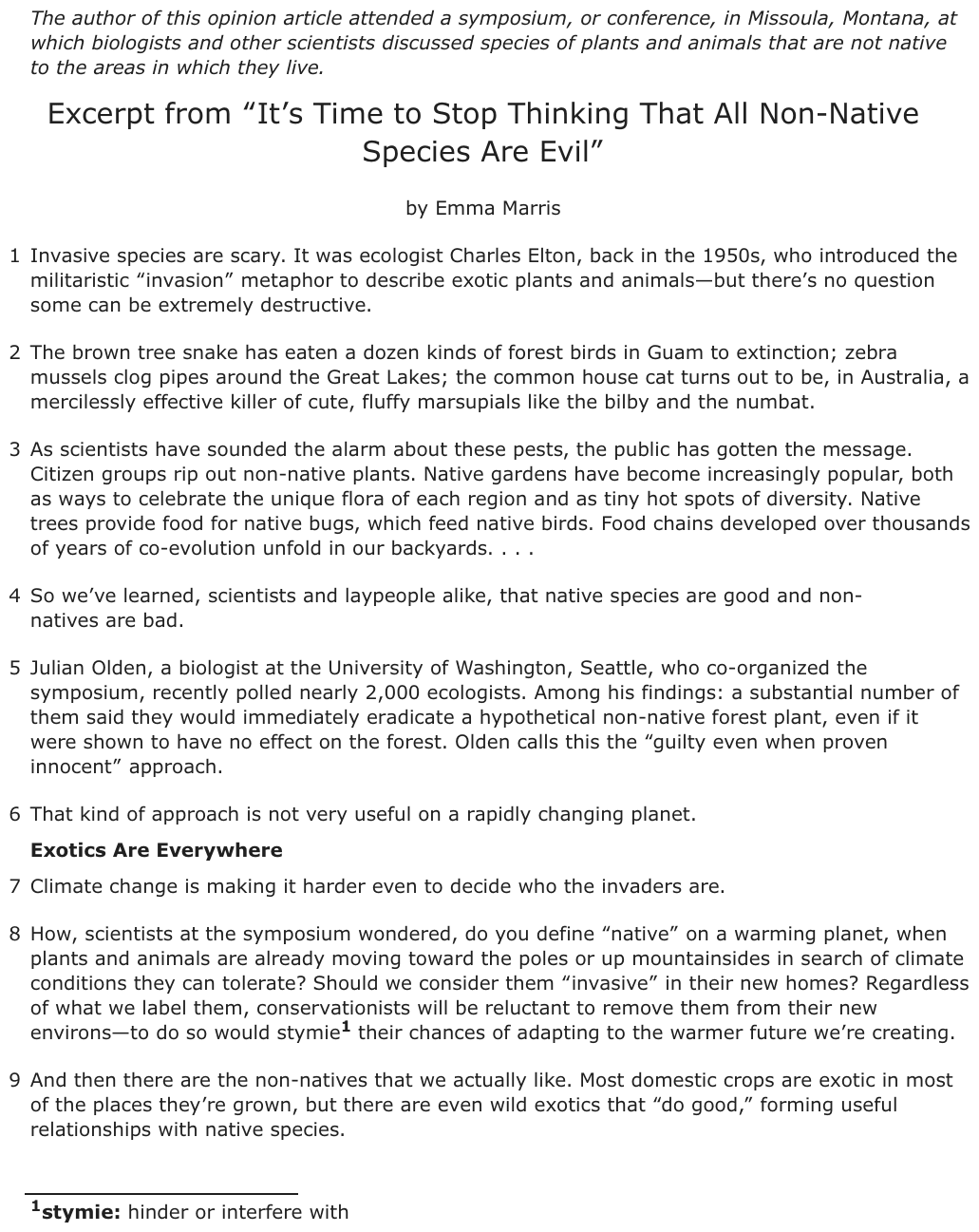
Invasive species are scary. It was ecologist Charles Elton, back in the 1950s, who introduced the militaristic “invasion” metaphor to describe exotic plants and animals—but there’s no question some can be extremely destructive.
The brown tree snake has eaten a dozen kinds of forest birds in Guam to extinction; zebra mussels clog pipes around the Great Lakes; the common house cat turns out to be, in Australia, a mercilessly effective killer of cute, fluffy marsupials like the bilby and the numbat.
As scientists have sounded the alarm about these pests, the public has gotten the message. Citizen groups rip out non-native plants. Native gardens have become increasingly popular, both as ways to celebrate the unique flora of each region and as tiny hot spots of diversity. Native trees provide food for native bugs, which feed native birds. Food chains developed over thousands of years of co-evolution unfold in our backyards. . . .
So we’ve learned, scientists and laypeople alike, that native species are good and non-natives are bad.
Julian Olden, a biologist at the University of Washington, Seattle, who co-organized the symposium, recently polled nearly 2,000 ecologists. Among his findings: a substantial number of them said they would immediately eradicate a hypothetical non-native forest plant, even if it were shown to have no effect on the forest. Olden calls this the “guilty even when proven innocent” approach.
That kind of approach is not very useful on a rapidly changing planet.
Exotics Are Everywhere
Climate change is making it harder even to decide who the invaders are.
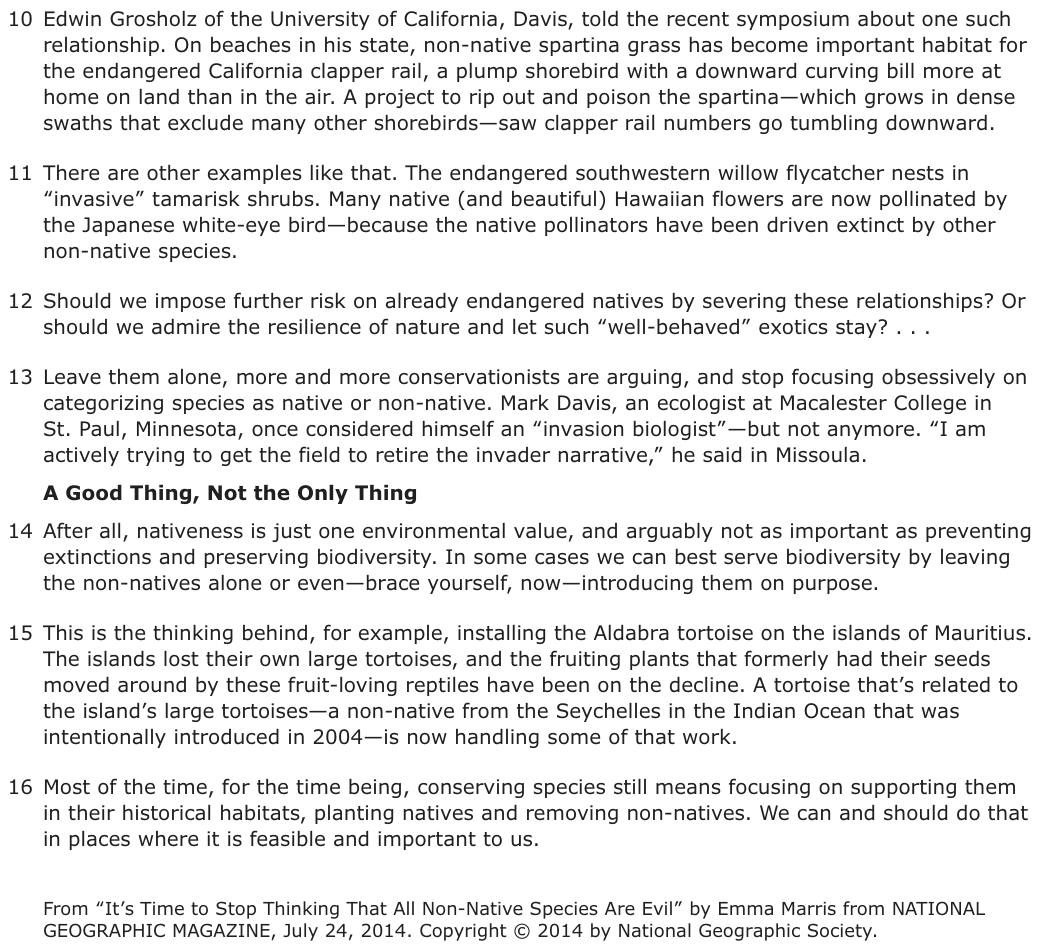
How, scientists at the symposium wondered, do you define “native” on a warming planet, when plants and animals are already moving toward the poles or up mountainsides in search of climate conditions they can tolerate? Should we consider them “invasive” in their new homes? Regardless of what we label them, conservationists will be reluctant to remove them from their new environs—to do so would stymie1 their chances of adapting to the warmer future we’re creating.
And then there are the non-natives that we actually like. Most domestic crops are exotic in most of the places they’re grown, but there are even wild exotics that “do good,” forming useful relationships with native species.
Edwin Grosholz of the University of California, Davis, told the recent symposium about one such relationship. On beaches in his state, non-native spartina grass has become important habitat for the endangered California clapper rail, a plump shorebird with a downward curving bill more at home on land than in the air. A project to rip out and poison the spartina—which grows in dense swaths that exclude many other shorebirds—saw clapper rail numbers go tumbling downward.
There are other examples like that. The endangered southwestern willow flycatcher nests in “invasive” tamarisk shrubs. Many native (and beautiful) Hawaiian flowers are now pollinated by the Japanese white-eye bird—because the native pollinators have been driven extinct by other non-native species.
Should we impose further risk on already endangered natives by severing these relationships? Or should we admire the resilience of nature and let such “well-behaved” exotics stay? . . .
Leave them alone, more and more conservationists are arguing, and stop focusing obsessively on categorizing species as native or non-native. Mark Davis, an ecologist at Macalester College in St. Paul, Minnesota, once considered himself an “invasion biologist”—but not anymore. “I am actively trying to get the field to retire the invader narrative,” he said in Missoula.
A Good Thing, Not the Only Thing
After all, nativeness is just one environmental value, and arguably not as important as preventing extinctions and preserving biodiversity. In some cases we can best serve biodiversity by leaving the non-natives alone or even—brace yourself, now—introducing them on purpose.
This is the thinking behind, for example, installing the Aldabra tortoise on the islands of Mauritius. The islands lost their own large tortoises, and the fruiting plants that formerly had their seeds moved around by these fruit-loving reptiles have been on the decline. A tortoise that’s related to the island’s large tortoises—a non-native from the Seychelles in the Indian Ocean that was intentionally introduced in 2004—is now handling some of that work.
Most of the time, for the time being, conserving species still means focusing on supporting them in their historical habitats, planting natives and removing non-natives. We can and should do that in places where it is feasible and important to us.
From “It’s Time to Stop Thinking That All Non-Native Species Are Evil” by Emma Marris from NATIONAL GEOGRAPHIC MAGAZINE, July 24, 2014. Copyright © 2014 by National Geographic Society.
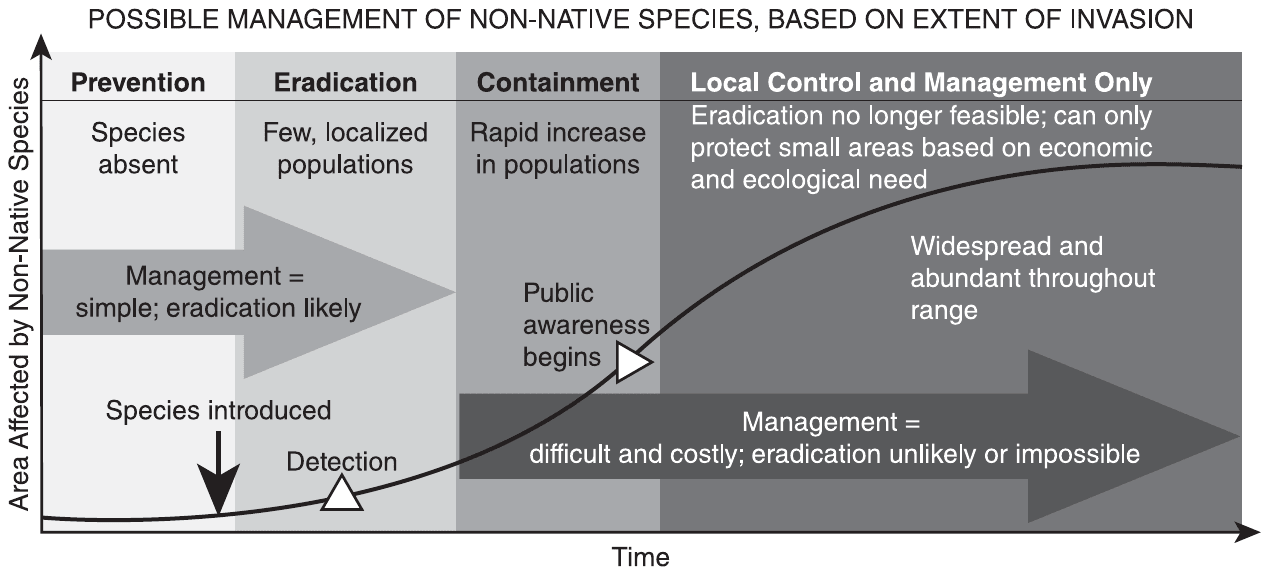
1stymie: hinder or interfere with
Question
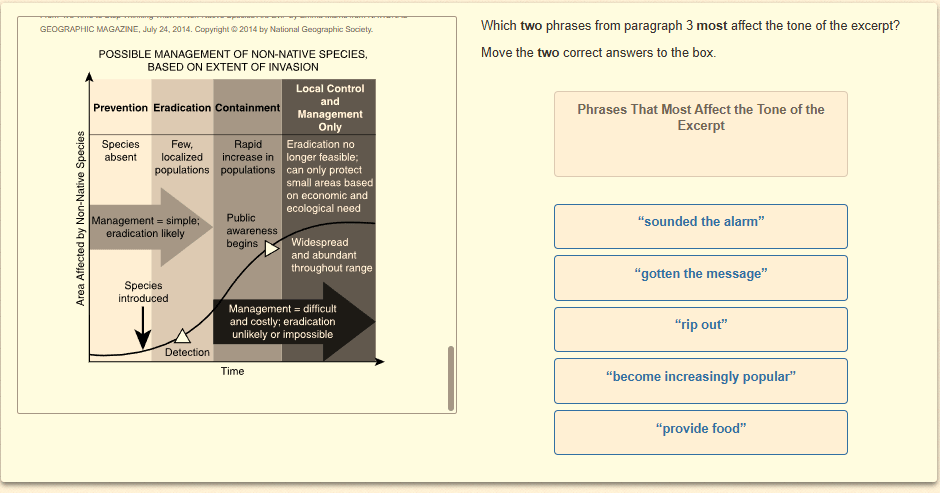
Which two phrases from paragraph 3 most affect the tone of the excerpt?
Move the two correct answers to the box.
Phrases That Most Affect the Tone of the Excerpt
On the test you drag tiles into the box; here, choose them below. The DOE has not published how answers with several parts are scored; this site counts one right only when every part is right.
- A“sounded the alarm”
- B“gotten the message”
- C“rip out”
- D“become increasingly popular”
- E“provide food”
Show the answer
Correct answer: A and C
The question asks for the two phrases from paragraph 3 that most affect the tone of the excerpt.
A. “sounded the alarm”: CORRECT. This phrase affects the tone of the excerpt by conveying the stark sense of urgency surrounding the debate over the ecological impact of non-native species. The reference to an alarm sounding evokes the feeling of being on high alert.
B. “gotten the message”: Incorrect. This phrase does not most affect the tone of the excerpt.
C. “rip out”: CORRECT. This phrase affects the tone of the excerpt by vividly depicting the effect of widespread misunderstanding of non-native species.
D. “become increasingly popular”: Incorrect. This phrase does not most affect the tone of the excerpt.
E. “provide food”: Incorrect. This phrase does not most affect the tone of the excerpt.
Question analysis
This select-two tone question on Emma Marris’s opinion article about non-native species lists five short phrases from paragraph 3 and asks which two most affect the tone of the excerpt. On the test students move two tiles into a box, and both must be right. All five are common, everyday expressions, so students must weigh how strongly each one colors the excerpt.
- Grade level
- Grade 7 reading and task
- Compared with grade 7
- At grade 7 Typical grade 7 tone questions quote the words and ask what effect they have. Here students pick the two phrases themselves from five in one short paragraph and compare how much feeling each carries, which keeps the demand at grade level.
- Estimated difficulty
- Moderate: several steps, or a close reading with one strong distractor.
- Thinking it demands
- Depth of knowledge 2, skills and concepts · mainly analyze
- What makes it hard
- A very close wrong answer moderate
- Figurative or literary language moderate
- Much to keep track of minor
- Evidence
- Answered from one paragraph or stanza
- Reading level
- Passage: about grade 11, 815 words; question and choices: about grade 3, 42 words.
- Students, last 30 days
- Not enough answers yet to show (it takes 10).
Why it is hard, traps and wrong answers (shows the answer)
Why it is hard
Most students hear the urgency of “sounded the alarm” at once, and the point is lost on the second pick. The idiom that ends the same sentence sounds just as colorful, while “rip out” is a short, everyday verb whose force is easy to read past as plain weeding. Swapping each phrase for a neutral word and asking how much feeling is lost separates them, and credit comes only when both tiles are right.
A very close wrong answer moderate Choosing the answer
“Sounded the alarm” and “gotten the message” are paired idioms in the first sentence of paragraph 3, both about the warning passing from scientists to the public, and only the first carries urgency. (Embretson & Wetzel, 1987; Gorin & Embretson, 2006; Ascalon et al., 2007)
Figurative or literary language moderate Understanding the question
The tone lives in connotation: “sounded the alarm” borrows the picture of a siren or bell, and “rip out” shows plants torn up by force where “remove” would sound flat. (Graesser, Singer & Trabasso, 1994; Kintsch, 1998)
Much to keep track of minor Working it out
Five tiles compete for one box and both picks must be right, so each phrase’s charge has to be weighed against the other four, since the stem asks which affect the tone “most.” (Sweller, 1988; Carpenter, Just & Shell, 1990)
Strategy: Swap each phrase for a plain word with the same meaning, reread its sentence, and keep the two whose replacement changes the feeling of the passage the most.
Traps
- Wrong tone or attitude: Misjudges the tone, attitude or point of view, such as reading admiration as criticism, or taking a character's or subject's feelings for the author's.
- Taking figurative language literally: A choice reads a figure of speech or image at face value.
The wrong answers, classified
B Wrong tone or attitude (Graesser, Singer & Trabasso, 1994)
Hears an idiom as colorful as “sounded the alarm” in the same sentence and takes it as equally charged, though “gotten the message” only says the public accepted the warning.
D Wrong tone or attitude (Graesser, Singer & Trabasso, 1994)
Hears approval in the word “popular” and takes it as setting the tone, though “become increasingly popular” is a neutral report of a trend in gardening.
E Wrong tone or attitude (Graesser, Singer & Trabasso, 1994)
Is drawn by the pleasant picture of native trees feeding bugs that feed birds, though “provide food” is plain, factual wording that any science textbook might use.
C Taking figurative language literally (Graesser, Singer & Trabasso, 1994)
Left out by students who read “rip out” as a plain account of weeding, missing that the verb pictures citizen groups tearing up plants by force, where “remove” would be neutral.
Working it out, step by step
Figure out what the question asks
This is a tone question. Tone is the feeling or attitude that a writer’s words give a passage. You need the two phrases from paragraph 3 that carry the most feeling. Words can carry feeling beyond their plain meaning. On the test you drag two tiles into the box. On this site, you choose two of the five. Both must be right.
Read paragraph 3 in its place
The excerpt opens with “Invasive species are scary.” Paragraph 2 lists the harm some invaders do. Then paragraph 3 says “As scientists have sounded the alarm about these pests, the public has gotten the message. Citizen groups rip out non-native plants.” The rest of the paragraph is calm. It says native gardens are popular, and native trees feed bugs that feed birds.
Swap each phrase for plain words
A good test is to swap each phrase for plain words with the same meaning. Then ask how much feeling is lost.
- “sounded the alarm” becomes warned. An alarm is a loud bell for danger, like a fire alarm. The sense of danger is lost.
- “gotten the message” becomes understood. Little changes.
- “rip out” becomes remove. To rip is to tear roughly and fast. The force is lost.
- “become increasingly popular” becomes grown more common. Little changes.
- “provide food” becomes feed. Nothing changes.
See what the two phrases do
Urgency is the feeling that something must be done right now. “Sounded the alarm” makes non-native species sound like an emergency. “Rip out” shows people tearing up plants with force. Together they make the fight against non-natives sound urgent and harsh. That matches paragraph 1, which calls the word “invasion” militaristic, or warlike. The author goes on to question treating every non-native as bad.
Check each of the five tiles
- A fits. It adds urgency.
- B does not fit. It is an idiom, a saying whose meaning differs from its words. It only means the public understood.
- C fits. It adds force.
- D does not fit. It calmly reports a trend in gardening.
- E does not fit. It is plain, factual wording.
Watch out: B sits in the same sentence as A, and it sounds just as colorful. But it adds no danger and no force.
Choose both answers
So the answers are A and C. On the test, move the tiles “sounded the alarm” and “rip out” into the box Phrases That Most Affect the Tone of the Excerpt. You need both to get the point.
Why this answer and not the closest wrong one
B is the closest wrong choice. It is an idiom in the same sentence as A, so it seems just as strong. But swap in understood, and the feeling barely changes. C is easier to miss because it is short. Swap in remove, and the force is gone.
More questions like this
The original DOE question
The passage “Excerpt from “It’s Time to Stop Thinking That All Non-Native Species Are Evil”” as printed (pages 68–70)
Question 8 of 18
2024 Test A English, question 35Passage 5 Reasons Physical Books Might Be Better Than E-Books
5 Reasons Physical Books Might Be Better Than E-Books
by Shaunacy Ferro
Though e-book1 readers have become a more common sight around town, traditional books still have their evangelists.2 According to The New York Times, e-book sales have been falling in 2015. Print definitely isn’t dead. In fact, according to some research, it may actually be a better choice for some readers. While scientists are still trying to tease out exactly how digital reading affects us differently, here are five ways e-books might be inferior to their dead-tree cousins.
E-books can reduce reading comprehension.
In a study of middle schoolers, West Chester University researchers found that students who read on iPads3 had lower reading comprehension than when they read traditional printed books. They discovered that the kids sometimes skipped text in favor of interactive features in the e-books, suggesting that certain multimedia in children’s e-books can be detrimental to the practice of reading itself. However, the researchers noted that some interactive features in e-books are designed to enhance comprehension, and that those might be more helpful than game-type interactive graphics.
Young kids can get distracted by e-books.
Similar results were found by a small study by the Joan Ganz Cooney Center that consisted of 32 kids reading e-books and print books with their parents. It found that “enhanced” e-books might be distracting. Kids who read enhanced e-books—ones with interactive, multimedia experiences—were more engaged with them physically, but in the end they remembered fewer narrative details than those who read print books or basic e-books.
You remember less about a book’s timeline.
Another study of adults also found that e-books can be hard to absorb. The researchers asked 25 people to read a 28-page story on a Kindle4 and 25 to read the story in paperback, then asked the readers to put 14 events from the story in chronological order. Those who read the story on a Kindle performed worse on the chronology test than the book readers, though they performed about the same as print readers in other tests. Earlier research by the same scholars, from Stavanger University in Norway, found that Norwegian 10th graders also remembered more about texts if they read them in print rather than on a computer screen.
They’re not great as textbooks.
While e-book textbooks are often cheaper (and easier to carry) than traditional door-stop5 textbooks, college students often don’t prefer them. In some surveys of college kids, the majority of students have reported preferring print books. However, a 2012 study from the UK’s National Literacy Trust of kids ages 8 to 16 found that more than 50 percent of children reported preferring screen reading.
They’re tiring.
Staring at a lit screen can be tiring for the eyes and the brain. A 2005 study from Sweden found that reading digitally required a higher cognitive workload than reading on paper. Furthermore, staring at LED6 screens at night can disrupt sleep patterns. A 2014 Harvard study found that people who used e-readers with LED screens at night slept worse and were more tired the next day. So, if you’re going to go for an e-book, go for one without the backlight.
The take-away message? If you’re really trying to absorb material, you might want to go for a physical book. And if you’re going to be up all night studying, turn off the backlight.
However, all this may not mean that reading on a Kindle is really going to melt your brain. For instance, reading an e-book on a computer is a much different experience than reading on a Kindle, which is specifically designed for consuming books. So, too, is playing with an interactive e-book on an iPad, compared to using a simpler e-book device that only presents the text, with no opportunities to click away into digital distractions.
And some studies have found that part of the difference between the way people absorb information from e-books versus paper might be due to approaching e-books differently—in one test, participants didn’t regulate their study time with digital books like they did with paper texts, leading to worse performances. It’s possible that our expectations of e-book reading—as well as the different designs of the digital reading experience on a computer or iPad or Kindle—might affect how we approach the text and how much effort we put into studying them. As generations of e-book readers evolve, and people become more accustomed to the idea of sitting down with a digital textbook, these factors could change—for better or for worse.
“5 Reasons Physical Books Might Be Better Than E-Books” by Shaunacy Ferro from MENTAL FLOSS, October 2, 2015. Copyright © 2015 Mental Floss, Inc.
1e-book: an electronic book, a publication made available digitally for reading on a computer or other device
2evangelists: advocates or supporters
3iPads: tablet computers
4Kindle: device for reading e-books
5door-stop: a reference to the idea that some textbooks are large and heavy enough to hold a door open
6LED: Light-emitting diode; LEDs are often used as a backlight for electronic devices such as smart phones and tablets.
Question
The details in paragraph 1 convey a central idea of the passage by noting that
- Afewer people are buying e-books than printed books.
- Bprinted books have some advantages over e-books.
- Cprinted books rely on natural materials more than e-books.
- Dsome people recommend buying printed books over e-books.
Show the answer
Correct answer: B
The question asks how the details in paragraph 1 convey a central idea of the passage. A specific central idea that needs to be identified in order to correctly answer this question is that reading a digital book “might be inferior” (paragraph 1) to reading a traditional book.
A. Incorrect. In paragraph 1, the author notes that despite the popularity of e-books, their sales fell in 2015, leading to the author’s statement that “print definitely isn’t dead.” While these statements suggest that readers still purchase and enjoy printed books, sales information between print and e-books is not compared. Therefore, these details do not convey a central idea of the passage.
B. CORRECT. The author states in paragraph 1 that “according to some research,” reading a traditional book “may actually be a better choice for some readers” because “digital reading affects us differently.” The author then supports this statement throughout the passage, detailing five advantages that printed books have over e-books. This detail helps convey a central idea of the passage.
C. Incorrect. In paragraph 1, the author refers to printed books as “traditional books” and the “dead-tree cousins” of e-books. Although these references suggest that printed books rely on natural materials more than e-books do, the author does not provide additional details in the passage to convey this idea. Therefore, this detail does not help convey a central idea of the passage.
D. Incorrect. Although the author states in paragraph 1 that “traditional books still have their evangelists,” the author does not provide additional statistics or details in the passage to convey the idea that some people recommend buying printed books over e-books. Therefore, this detail does not help convey a central idea of the passage.
Question analysis
This central-idea question asks how the details in the opening paragraph of a magazine article comparing printed books and e-books convey one of the passage's central ideas. Students must connect the introduction to what the rest of the article goes on to develop, while each choice seizes on something the first paragraph mentions.
- Grade level
- Grade 6 reading and task
- Compared with grade 7
- Below grade 7 Connecting an opening paragraph to a central idea is a grade 6 and 7 skill. This article is plainly organized, with a short introduction and bold headings, so the task is lighter than typical grade 7 central-idea work.
- Estimated difficulty
- Straightforward: two steps or one careful reading.
- Thinking it demands
- Depth of knowledge 2, skills and concepts · mainly understand
- What makes it hard
- Evidence
- Answered from one paragraph or stanza
- Reading level
- Passage: about grade 10, 829 words; question and choices: about grade 7, 46 words.
- Students, last 30 days
- Not enough answers yet to show (it takes 10).
Why it is hard, traps and wrong answers (shows the answer)
Why it is hard
Paragraph 1 packs four separate details into five sentences, and three of them become wrong choices: the falling e-book sales, print's “evangelists” and the joke about dead trees. The question rewards checking which detail the rest of the article develops, and the five bold headings that follow each name a way print beats the screen. Students who judge each choice against paragraph 1 alone can find support for all four.
The right answer is reworded minor Choosing the answer
The right choice recasts “may actually be a better choice” and “e-books might be inferior” in new words, while the wrong choices echo “sales”, “evangelists” and “dead-tree cousins”. (Freedle & Kostin, 1993; Kirsch & Mosenthal, 1990)
Figurative or literary language minor Understanding the question
Paragraph 1 is playful, calling print's supporters “evangelists” and paper books “dead-tree cousins”, and both phrases must be read as jokes rather than as claims. (Graesser, Singer & Trabasso, 1994; Kintsch, 1998)
Strategy: Read paragraph 1, then skim the bold headings to see which of its statements the rest of the article develops; a central idea is one the passage keeps returning to.
Traps
- Too narrow: A single detail offered as the central idea or a summary, or a summary that keeps minor details and leaves out an essential part.
- Twists what the text says: Uses the text's topic and ideas but changes what it says: who did it, how much, when, or why.
- Taking figurative language literally: A choice reads a figure of speech or image at face value.
The wrong answers, classified
A Twists what the text says (King et al., 2004)
Reads “e-book sales have been falling” as print outselling e-books, a comparison of sales the paragraph never makes and the rest of the article never mentions.
C Taking figurative language literally (Graesser, Singer & Trabasso, 1994)
Takes “dead-tree cousins” as a point about what books are made of, when it is a joking name for paper books and the article never discusses materials.
D Too narrow (King et al., 2004)
Rests on the opening remark that print still has its “evangelists”, a single detail about supporters that the article drops in favor of research findings.
Working it out, step by step
Know what a central idea is
A central idea is a main point that the whole passage keeps coming back to. So you need a detail in paragraph 1 that the rest of the article develops. A detail that shows up once and is then dropped doesn’t count.
Read paragraph 1 closely
Paragraph 1 makes several points. It says e-book “sales have been falling.” It says print still has its “evangelists,” which the footnote explains means supporters. Then comes the key line: print “may actually be a better choice for some readers.” The paragraph ends by promising “five ways e-books might be inferior,” or worse, compared with paper books.
Use the headings as a map
The bold headings show what the rest of the article is about. Two of them are “E-books can reduce reading comprehension” and “They’re tiring.” Each heading names one way paper books may beat e-books. So the point the article develops is that print has some advantages.
Check each choice
- B fits: the five sections that follow each give one advantage of printed books.
- A is wrong because the paragraph says e-book sales fell, not that fewer e-books than print books are sold.
- C is wrong because “dead-tree cousins” is a joke name for paper books, and the article never discusses materials.
- D is wrong because the supporters are mentioned once, and the article reports research instead of advice.
Watch out: A starts from a real detail but adds a comparison the paragraph never makes.
Choose the answer
The article keeps returning to the ways print may be better than e-books. So the answer is B.
Why this answer and not the closest wrong one
D comes close, because paragraph 1 does say print has supporters. But the article never returns to them. Instead, every section after paragraph 1 gives research showing one way print may beat e-books. That is why B, “printed books have some advantages over e-books,” is the central idea.
More questions like this
The original DOE question
The passage “5 Reasons Physical Books Might Be Better Than E-Books” as printed (pages 58–59)
Question 9 of 18
2024 Test B English, question 50Passage Excerpt from “The Past and the Future of the Earth’s Oldest Trees”
Excerpt from “The Past and the Future of the Earth’s Oldest Trees”
by Alex Ross
About forty-five hundred years ago, not long after the completion of the Great Pyramid at Giza, a seed of Pinus longaeva, the Great Basin bristlecone pine, landed on a steep slope in what are now known as the White Mountains, in eastern California. The seed may have travelled there on a gust of wind, its flight aided by a winglike attachment to the nut. Or it could have been planted by a bird known as the Clark’s nutcracker, which likes to hide pine seeds in caches; nutcrackers have phenomenal spatial1 memory and can recall thousands of such caches. This seed, however, lay undisturbed. On a moist day in fall, or in the wake of melting snows in spring, a seedling appeared above ground—a stubby one-inch stem with a tuft of bright-green shoots.
Most seedlings die within a year; the mortality rate is more than ninety-nine percent. The survivors are sometimes seen growing in the shadow of a fallen tree. The landscape of the Ancient Bristlecone Pine Forest, as this area of the White Mountains is called, is littered with fragments of dead trees—trunks, limbs, roots, and smaller chunks. Pinus longaeva grows exclusively in subalpine regions of the Great Basin, which stretches from the eastern slopes of the Sierra Nevada to the Wasatch Range, in Utah. Conditions are generally too arid for the dead wood to rot; instead, it erodes, sanded down like rock. The remnants may harbor nutrients and fungi that help new trees grow. Bristlecones rise from the bones of their ancestors—a city within a cemetery.
Coast redwoods and giant sequoias, California’s gargantuan world-record-holding trees, can grow fifty feet or more in their first twenty years. Bristlecones rise agonizingly slowly. After four or five years, the seedling on the steep slope would have been just a few inches higher, sprouting needles in place of the embryonic shoots. The needles are a deep green, tough, resinous, and closely bunched in groups of five. On a mature tree, they live for fifty years or more. Decades may have passed before the tree was human height, and decades more before it resembled a conventional pine. Bristlecone saplings grow straight up, with relatively sparse foliage, looking like undernourished Christmas trees. After a few hundred years—by which time the Old Kingdom of Egypt had fallen—it was probably forty or fifty feet in height.
Many tree species live for hundreds of years. A smaller but not inconsiderable number, including the sequoias and certain yews, oaks, cypresses, and junipers, survive for thousands. Once a bristlecone has established itself in the unforgiving conditions of the White Mountains, it can last almost indefinitely. The trees tend to grow some distance from one another, so fires almost never destroy an entire stand. Because only a few other plant species can handle the dry, cold climate, the bristlecones face little competition. Unlike most plants, they tolerate dolomite soil, which is composed of a chalky type of limestone that is heavily alkaline and low in nutrients. As for insect threats, bristlecone wood is so dense that mountain-pine beetles and other pests can rarely burrow their way into it.
Empires rose and fell; wars raged; . . . and the tree from 2500 B.C. continued its implacable slow-motion existence, adding about two-hundredths of an inch to the diameter of its trunk each year. Minute changes in the tree-ring record make bristlecones an exceptionally useful source of data about changing conditions on Earth. When rains are heavier than normal, the rings widen. When volcanic eruptions cause global cooling, frost rings make the anomaly2 visible. . . .
As the millennia go by, bristlecones become contorted and wraithlike.3 The main stem, or leader, dies back. Entire branches, even the trunk itself, become fossils. At first glance, the tree may look dead. Such is the case of the forty-five-hundred-year-old tree that clings to life near the tourist path that now runs through the Ancient Bristlecone Pine Forest. Spears of dead wood jut into the air. The trunk is a marbled hulk stripped of bark, like driftwood thrown from a vanished ocean. A ribbon of live bark runs up one side, funneling water and nutrients to clumps of green needles high above. All told, the tree is an unprepossessing specimen; most people march past it without giving it a second glance. . . .
. . . No two super-elderly trees look alike, to the point where they have acquired the characteristics of individuals. Trees are prone to anthropomorphism; we project our dreams and our anxieties onto them. Bristlecones have been called elders, sentinels, sages. The possibility that climate change will cause their extinction has inspired a spate4 of alarmed news stories, although tree scientists tend to discount the idea that the bristlecones are in immediate danger. They have survived any number of catastrophes in the past; they may survive humanity.
From “The Past and the Future of the Earth’s Oldest Trees” by Alex Ross from THE NEW YORKER, January 20, 2020. Copyright © 2020 by Condé Nast. All rights reserved.
1spatial: relating to physical space
2anomaly: oddity
3wraithlike: ghostly
4spate: sudden abundance
Question
What is the effect of comparing groups of bristlecone pines to “a city within a cemetery” (paragraph 2)?
- AIt illustrates that the new tree’s appearance is markedly different from that of mature bristlecone pines.
- BIt emphasizes the new tree’s ability to use resources left by prior generations of bristlecone pines.
- CIt highlights the tree’s capacity for a long life if it is able to survive to maturity.
- DIt reveals that the tree’s dense growth patterns are unusual in arid conditions.
Show the answer
Correct answer: B
The question asks what the effect is of comparing groups of bristlecone pines to “a city within a cemetery” (paragraph 2).
A. Incorrect. The reference to “a city within a cemetery” describes how new trees use the remnants of their “ancestors” (paragraph 2) and makes no comment on the appearance of young versus mature trees.
B. CORRECT. The “cemetery” contains “the bones of their ancestors” (paragraph 2)—“ancestors” being earlier generations of bristlecone pines—which provide some of the nutrients that the new trees need.
C. Incorrect. The reference to “a cemetery” is not a comment on how long bristlecone pines can live; rather, it illustrates that the new pines are using remnants of their “ancestors” (paragraph 2) to grow.
D. Incorrect. Although the climate is mentioned in paragraph 2, it is not the reason for the comparison to “a city within a cemetery.” The comment is intended to illustrate how the new trees use nutrients left behind by the old ones.
Question analysis
This figurative language question on Alex Ross’s article about the bristlecone pine, one of the Earth’s oldest trees, asks what effect the author creates by comparing groups of these trees to “a city within a cemetery.” Students must interpret a metaphor in context, and the choices raise ideas the excerpt discusses elsewhere, so they must stay with what this comparison itself conveys.
- Grade level
- Grade 7 reading and task
- Compared with grade 7
- At grade 7 Interpreting a metaphor from nearby context is standard grade 7 work. The phrase closes a paragraph whose earlier sentences give the needed context, so the demand is typical, though the excerpt’s rich vocabulary adds some reading load.
- Estimated difficulty
- Straightforward: two steps or one careful reading.
- Thinking it demands
- Depth of knowledge 2, skills and concepts · mainly analyze
- What makes it hard
- Figurative or literary language moderate
- Hard words minor
- Evidence
- Answered from one paragraph or stanza
- Reading level
- Passage: about grade 8, 851 words; question and choices: about grade 10, 79 words.
- Students, last 30 days
- Not enough answers yet to show (it takes 10).
Why it is hard, traps and wrong answers (shows the answer)
Why it is hard
The comparison closes paragraph 2, and the sentence just before it explains it: the dead wood may hold nutrients and fungi that help seedlings grow. Students who read the image on its own reach for ideas from elsewhere in the excerpt, such as the trees’ great age, the look of young and old trees, or the dry climate. The question rewards reading the metaphor against its neighbors, which makes it fairly quick.
Figurative or literary language moderate Understanding the question
Both halves of the metaphor need decoding: the “city” is the living bristlecones, and the “cemetery” is the dead trunks, limbs and roots littering the slope, “the bones of their ancestors.” (Graesser, Singer & Trabasso, 1994; Kintsch, 1998)
Hard words minor Understanding the question
The sentence that explains the image, “The remnants may harbor nutrients and fungi that help new trees grow,” depends on “remnants” and on “harbor” in its less familiar sense of hold. (Perfetti, 2007; Freedle & Kostin, 1993)
Strategy: Work out what the “city” and the “cemetery” each stand for by rereading the sentences just before the phrase, then choose the effect that both halves of the comparison support.
Traps
- True but not the answer: A choice says something accurate about the text that does not answer this question.
- Taking figurative language literally: A choice reads a figure of speech or image at face value.
- Wrong part of the text: A choice is true of another paragraph, stanza or speaker than the one asked about.
The wrong answers, classified
A Wrong part of the text (Kirsch & Mosenthal, 1990)
Reads the city and the cemetery as young and old trees that look different, a contrast drawn between paragraphs 3 and 6, though here the cemetery is dead wood.
C True but not the answer (King et al., 2004; Embretson & Wetzel, 1987)
Applies the excerpt’s main idea, the trees’ great age, to this phrase, but a city in a cemetery shows living trees rising from dead ones, not how long they last.
D Taking figurative language literally (Graesser, Singer & Trabasso, 1994)
Takes “city” at face value as crowded growth and pairs it with the paragraph’s “arid” conditions, though paragraph 4 says bristlecones grow some distance apart.
Working it out, step by step
Figure out what the question asks
This asks about a comparison. In paragraph 2, the author calls groups of bristlecones “a city within a cemetery.” You need to figure out what this picture helps the reader understand about the trees.
Read the sentences around it
Paragraph 2 says the forest floor is “littered with fragments of dead trees—trunks, limbs, roots, and smaller chunks.” Next it says, “The remnants may harbor nutrients and fungi that help new trees grow.” Then comes the comparison: “Bristlecones rise from the bones of their ancestors—a city within a cemetery.”
Decode the two halves of the picture
Remnants are leftover pieces. To harbor something here means to hold it. Fungi are living things such as mushrooms and molds. A cemetery is a place for the dead, so it stands for the dead wood. A city is full of life, so it stands for the living trees. Their ancestors are the trees that lived and died before them. So new trees grow out of the old ones’ remains and use what those remains hold.
Check each choice
- A does not fit. The image is about living trees and dead wood. It says nothing about how young and old trees look.
- B fits. New trees use the nutrients and fungi left behind by earlier generations.
- C does not fit. The excerpt does show that bristlecones live long, but this image is about growing from dead wood.
- D does not fit. A city may sound crowded, but paragraph 4 says the trees “grow some distance from one another.”
Choose the answer
The comparison shows living trees rising from, and feeding on, the remains of their ancestors. So the answer is B.
Why this answer and not the closest wrong one
C is tempting, because long life is what the whole excerpt is about. But the sentence just before the comparison explains it: the dead wood may hold nutrients that help new trees grow. The picture is about the living drawing on the dead, which is what B says.
More questions like this
The original DOE question
The passage “Excerpt from “The Past and the Future of the Earth’s Oldest Trees”” as printed (pages 193–194)
Question 10 of 18
2023 Test B English, question 38Passage Cross-Purposes
Cross-Purposes
What I am is built: concrete and steel.
I defy gravity. I am what every athlete
wants: to remain at the apex of the leap,
up in the air. And yet I am useful, too:
cars, trucks, people, even trains
make their way across my broad back.
Swallows and ospreys nest in my trusses.
What I am is motion. I am water, and I am older
than anything else you know. No human
built me. I am gravity’s best friend; I pool
and flow wherever gravity takes me.
I am the blood flowing in the runner’s chest,
and I catch everything: from the hills,
the mountains. It all washes down through me.
What you are is an accident,
what happens to rain when rain gives in
to Earth’s gravitational pull.
You are some tears dribbling from a mountain’s
eye, running down the pavements
of small towns, into the cities, to the sea.
You are the path of least resistance.
What I am is power. You, of course,
have none: you are a static lump, an artifact
slowly decaying. But my regal flow
nourishes grasses, permits empires to rise.
Those who made you will break you,
in time, replacing you with yet another
clumsy structure. I have seen. I know.
“Clumsy”? Being rebuilt makes me
a friend of time, does it not? And it means
that I have siblings—those “clumsy” structures,
my sisters and brothers.
We stitch across the rip you make.
We are steel thread to the human needle.
We bind you up. We sew you.
And I sow into you; in every cranny
of your superstructure my vapors cling.
They bring out your softness, your rust.
Boast your best, and boast better yet.
I am listening to the bright hum
of the wind in your wires. Because I am,
above all else, patient. I will wait for you.
ospreys: large birds
Question
The use of the words “siblings” and “my sisters and brothers” in lines 31–32 conveys the idea that the
- Aforms water can take are less diverse than the types of structures that exist.
- Bnumber of human-made structures is rapidly increasing.
- Cwater passes under many similar-looking structures as it flows.
- Dstructure is powerful because it is one of many.
Show the answer
Correct answer: D
The question asks which idea the use of the words “siblings” and “my sisters and brothers” in lines 31–32 conveys in the poem.
A. Incorrect. Although in line 29 the structure refers to itself as “being rebuilt” or taking on new forms, this idea is expressed to reinforce the idea that the structure’s presence is eternal (“a friend of time,” line 30). The use of the words “siblings” and “my sisters and brothers” in lines 31–32 does suggest that a variety of structures exist, but no comparison is drawn to suggest that the varieties of structures are more diverse than the forms of water.
B. Incorrect. While the use of the words “siblings” and “my sisters and brothers” in lines 31–32 conveys the idea that structures can be replicated by being built, it does not convey the idea that the number of human-made structures is rapidly increasing.
C. Incorrect. Although in line 33 the structure states, “We stitch across the rip you make,” suggesting that water passes under structures, the use of the words “siblings” and “my sisters and brothers” in lines 31–32 does not convey the idea that the structures that the water passes under are similar-looking.
D. CORRECT. The use of the words “siblings” and “my sisters and brothers” in lines 31–32 conveys the idea that the structure is powerful because it is one of many and because these structures “stitch across the rip” (line 33) that water makes.
Question analysis
This figurative-language question asks what idea the structure in “Cross-Purposes” conveys when it calls other structures its “siblings” and “my sisters and brothers” in lines 31–32. The words come in the fifth stanza, where the structure takes up the water’s word “clumsy,” so students must decide what this family language adds to the structure’s side of the exchange.
- Grade level
- Grade 7 reading and task
- Compared with grade 7
- At grade 7 Interpreting a metaphor in a poem is standard grade 7 work, and the family words themselves are simple. Students must still decide what the comparison means coming from a personified structure in the middle of an argument, a typical grade 7 step.
- Estimated difficulty
- Moderate: several steps, or a close reading with one strong distractor.
- Thinking it demands
- Depth of knowledge 2, skills and concepts · mainly analyze
- What makes it hard
- Figurative or literary language moderate
- Reading between the lines moderate
- A very close wrong answer minor
- Evidence
- Answered from one paragraph or stanza
- Reading level
- Passage: 316 words (a poem; reading level not measured); question and choices: about grade 7, 57 words.
- Students, last 30 days
- Not enough answers yet to show (it takes 10).
Why it is hard, traps and wrong answers (shows the answer)
Why it is hard
The family words answer the water’s taunt in the stanza before, that the structure’s makers will replace it with “yet another clumsy structure,” and the structure turns replacement into kinship. Students who read lines 31–32 alone may stop at the picture of a family, and the strongest wrong choice reads that family as look-alikes. The point arrives only in the next lines, where the structures act as one to bind the water, which makes their number a source of strength.
Figurative or literary language moderate Understanding the question
The structure calls other structures “siblings” and “my sisters and brothers,” a family metaphor followed at once by a sewing one, “We stitch across the rip you make,” so two figures must be read together. (Graesser, Singer & Trabasso, 1994; Kintsch, 1998)
Reading between the lines moderate Working it out
Nothing in lines 31–32 says the structure is powerful; students must infer it from the switch to “We” in the lines that follow, where the many structures together “bind” and “sew” the water. (Graesser, Singer & Trabasso, 1994; Kintsch, 1998)
A very close wrong answer minor Choosing the answer
The choice about similar-looking structures shares the right one’s idea of many structures; it differs in what their number means, a matter of looks rather than strength. (Embretson & Wetzel, 1987; Gorin & Embretson, 2006; Ascalon et al., 2007)
Strategy: Reread the whole fifth stanza, not just lines 31–32, and say what the structure is arguing there; then choose the idea that the family words add to that argument.
Traps
- Taking figurative language literally: A choice reads a figure of speech or image at face value.
- Reads too much in: A reasonable-sounding conclusion that goes further than the text allows.
- Twists what the text says: Uses the text's topic and ideas but changes what it says: who did it, how much, when, or why.
The wrong answers, classified
A Reads too much in (Graesser, Singer & Trabasso, 1994)
Notes that rebuilding and siblings imply many kinds of structures but adds a comparison with the forms water takes, which the fifth stanza never draws.
B Twists what the text says (King et al., 2004)
Takes rebuilding and a whole family of siblings as a sign that structures are multiplying fast, though rebuilding replaces one structure with another over time and adds none.
C Taking figurative language literally (Graesser, Singer & Trabasso, 1994)
Reads “siblings” as structures that resemble one another, as real siblings might, and adds the water flowing under them from line 33, but the family words stress kinship and number, not looks.
Working it out, step by step
Figure out what the question asks
This asks about figurative language, words that mean more than their plain meaning. In lines 31–32 the structure calls other structures “siblings” and “my sisters and brothers.” You need to decide what idea those family words give.
Read what the water said first
The family words answer an insult. In lines 26–28 the water says, “Those who made you will break you, / in time, replacing you with yet another / clumsy structure.” Clumsy means awkward and poorly made. The water means the structure won’t last.
Read the structure’s reply
In lines 29–32, the structure turns the insult around. Being rebuilt makes it “a friend of time.” It has “siblings,” other structures, which it calls “my sisters and brothers.” Then, in lines 33–35, it switches from “I” to “We.” It says, “We stitch across the rip you make.” It adds, “We bind you up. We sew you.” To stitch is to sew. The rip is the gap water cuts through the land.
Work out the idea
A family is a group that sticks together. Working as one, the many structures “bind” the water, like thread holding cloth. One bridge may be replaced, but the family goes on. So being one of many is what makes the structure strong.
Check each choice
- A is wrong. The lines never compare kinds of structures with forms of water.
- B is wrong. Being rebuilt swaps one structure for another. It doesn’t mean their number is growing fast.
- C is wrong. Real siblings may look alike, but that isn’t the point here. The family words show the structures are many and connected.
- D is right. The “We” lines show the many structures acting together, which gives them power.
Watch out: C is tempting if you picture siblings who look alike. Read on to line 35 to see what the family does.
Choose the answer
The family words show the structure gets its strength from being one of many. So the answer is D.
Why this answer and not the closest wrong one
C is the closest wrong answer. It also sees many structures, and in line 33 they do cross the water. But C makes the family words about looks. Lines 33–35 make them about strength: “We bind you up.” That is why D fits better.
More questions like this
The original DOE question
The passage “Cross-Purposes” as printed (pages 72–73)
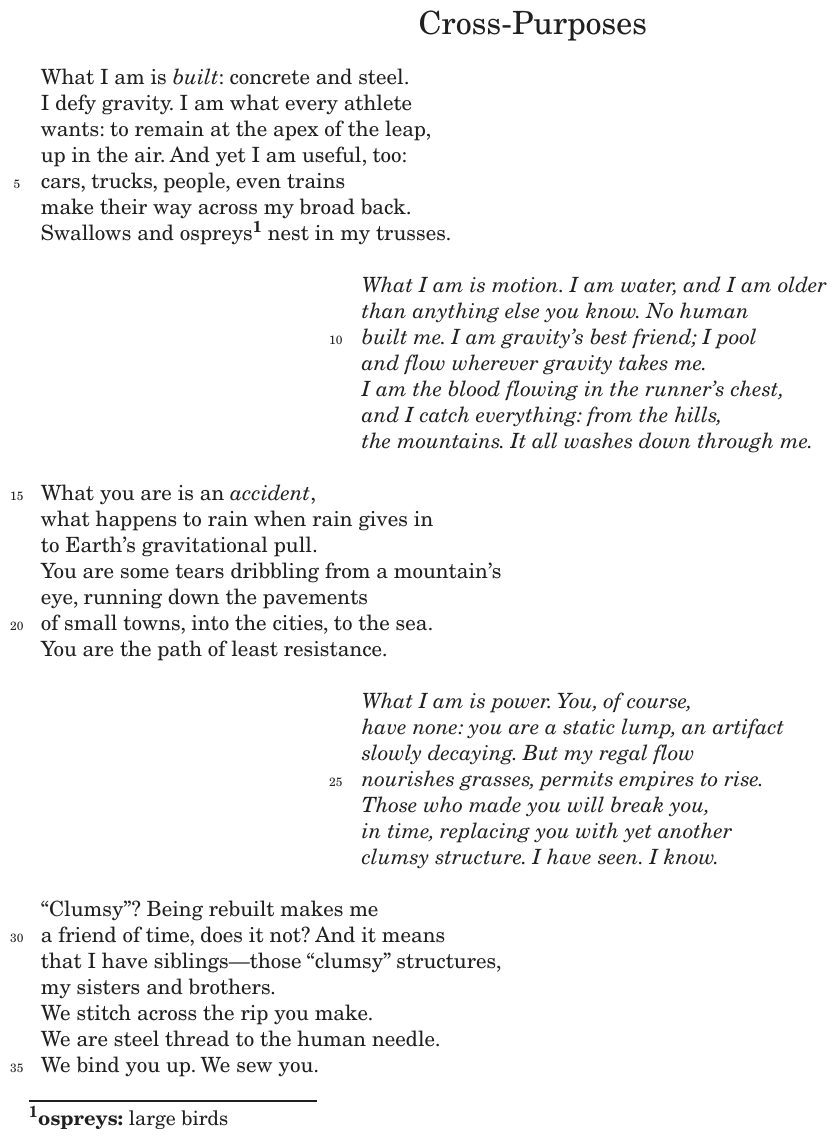
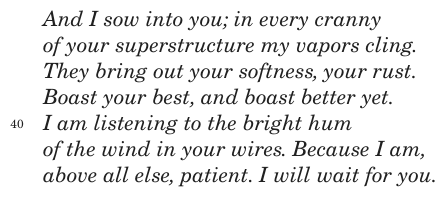
Question 11 of 18
2018 Test A English, question 26Passage Excerpt from A Tramp Abroad
Excerpt from A Tramp Abroad
by Mark Twain
Now and then, while we rested, we watched the laborious ant at his work. I found nothing new in him—certainly nothing to change my opinion of him. It seems to me that in the matter of intellect the ant must be a strangely overrated bird. During many summers now I have watched him, when I ought to have been in better business, and I have not yet come across a living ant that seemed to have any more sense than a dead one. I refer to the ordinary ant, of course; I have had no experience of those wonderful Swiss and African ones which vote, keep drilled armies, . . . and dispute about religion. Those particular ants may be all that the naturalist paints them, but I am persuaded that the average ant is a sham.
I admit his industry, of course; he is the hardest working creature in the world—when anybody is looking—but his leather-headedness is the point I make against him. He goes out foraging, he makes a capture, and then what does he do? Go home? No; he goes anywhere but home. He doesn’t know where home is. His home may be only three feet away; no matter, he can’t find it. He makes his capture, as I have said; it is generally something which can be of no sort of use to himself or anybody else; it is usually seven times bigger than it ought to be; he hunts out the awkwardest place to take hold of it; he lifts it bodily up in the air by main force, and starts—not toward home, but in the opposite direction; not calmly and wisely, but with a frantic haste which is wasteful of his strength; he fetches up against a pebble, and, instead of going around it, he climbs over it backwards, dragging his booty after him, tumbles down on the other side, jumps up in a passion, kicks the dust off his clothes, moistens his hands, grabs his property viciously, yanks it this way, then that, shoves it ahead of him a moment, turns tail and lugs it after him another moment, gets madder and madder, then presently hoists it into the air and goes tearing away in an entirely new direction; comes to a weed; it never occurs to him to go around it. No; he must climb it, and he does climb it, dragging his worthless property to the top—which is as bright a thing to do as it would be for me to carry a sack of flour from Heidelberg to Paris by way of Strasburg steeple; when he gets up there he finds that that is not the place; takes a cursory glance at the scenery, and either climbs down again or tumbles down, and starts off once more—as usual, in a new direction. At the end of half an hour he fetches up within six inches of the place he started from, and lays his burden down. Meantime, he has been over all the ground for two yards around, and climbed all the weeds and pebbles he came across. Now he wipes the sweat from his brow, strokes his limbs, and then marches aimlessly off, in as violent a hurry as ever. He traverses a good deal of zig-zag country, and by and by stumbles on his same booty again. He does not remember to have ever seen it before; he looks around to see which is not the way home, grabs his bundle, and starts. He goes through the same adventures he had before; finally stops to rest, and a friend comes along.
Evidently the friend remarks that a last year’s grasshopper leg is a very noble acquisition, and inquires where he got it. Evidently the proprietor does not remember exactly where he did get it, but thinks he got it “around here somewhere.” Evidently the friend contracts to help him freight it home. Then, with a judgment peculiarly antic (pun not intentional), they take hold of opposite ends of that grasshopper leg and begin to tug with all their might in opposite directions. Presently they take a rest, and confer together. They decide that something is wrong, they can’t make out what. Then they go at it again, just as before. Same result. Mutual recriminations follow. Evidently each accuses the other of being an obstructionist. They warm up, and the dispute ends in a fight. They lock themselves together and chew each other’s jaws for a while; then they roll and tumble on the ground till one loses a horn or a leg and has to haul off for repairs. They make up and go to work again in the same old insane way, but the crippled ant is at a disadvantage; tug as he may, the other one drags off the booty and him at the end of it. Instead of giving up, he hangs on, and gets his shins bruised against every obstruction that comes in the way. By and by, when that grasshopper leg has been dragged all over the same old ground once more, it is finally dumped at about the spot where it originally lay. The two perspiring ants inspect it thoughtfully and decide that dried grasshopper legs are a poor sort of property after all, and then each starts off in a different direction to see if he can’t find an old nail or something else that is heavy enough to afford entertainment and at the same time valueless enough to make an ant want to own it. . . .
Science has recently discovered that the ant does not lay up anything for winter use. . . . He does not work, except when people are looking, and only then when the observer has a green, naturalistic look, and seems to be taking notes. This amounts to deception, and will injure him for the Sunday schools. He has not judgment enough to know what is good to eat from what isn’t. This amounts to ignorance, and will impair the world’s respect for him. . . . He cannot stroll around a stump and find his way home again. This amounts to idiocy, and once the damaging fact is established, thoughtful people will cease to look up to him. It is strange beyond comprehension that so manifest a humbug as the ant has been able to fool so many nations and keep it up so many ages without being found out.
we: the author and his fictional travel companion
From A TRAMP ABROAD by Mark Twain—Public Domain
Question
The phrase “those wonderful Swiss and African ones which vote, keep drilled armies, . . . and dispute about religion” in paragraph 1 shows that the author
- Abelieves that the behavior of the ants is reflected in other living creatures.
- Backnowledges that his observations of a few do not necessarily apply to all.
- Cknows that disproving a commonly held belief is challenging.
- Daccepts that there are flaws in his interpretation of the behavior of the ants.
Show the answer
Correct answer: B
The answer is (B)
The question asks about the phrase, which highlights the behavior of ants from different parts of the world, and about what the inclusion of the phrase shows about the author.
Option B is correct because the phrase is meant to communicate a caution that while the author believes most ants are foolish, his observations in the excerpt do not apply to all types of ants.
Option A is incorrect because, in the excerpt, the author is comparing species of ants to one another and not to other living creatures.
Option C is incorrect because the author never comments in the excerpt that challenging common or strongly held beliefs is, in general, difficult.
Option D is incorrect because the author never expresses in the excerpt the idea that the conclusions drawn about the ants’ behavior are flawed; the reference to Swiss and African ants is meant to show that those ants are an exception.
Question analysis
In this Mark Twain excerpt about ants, students must decide what a mocking aside about Swiss and African ants that “vote” and “keep drilled armies” reveals about the author's point of view. The tricky part is reading past the sarcasm to see what the aside does for his larger case against ants.
- Grade level
- Grade 8 reading and task
- Compared with grade 7
- Above grade 7 Grade 7 readers usually judge a narrator's stance from direct statements. Here the stance sits inside a sarcastic aside in long nineteenth-century sentences, so students must separate what Twain means from what he mocks, which goes beyond typical grade 7 work.
- Estimated difficulty
- Hard: combines ideas, needs a plan, and has more than one tempting wrong answer.
- Thinking it demands
- Depth of knowledge 2, skills and concepts · mainly analyze
- What makes it hard
- Figurative or literary language major
- A very close wrong answer moderate
- Reading between the lines moderate
- Evidence
- Answered from one sentence or line
- Reading level
- Passage: about grade 9, 1099 words; question and choices: about grade 8, 72 words.
- Students, last 30 days
- Not enough answers yet to show (it takes 10).
Why it is hard, traps and wrong answers (shows the answer)
Why it is hard
Most misses come from reading the aside as a sincere comparison or as a confession. Twain mocks the naturalists' stories of voting, warring ants while making clear that his verdict covers only the ordinary ant he has watched, so the phrase narrows his claim without weakening it. The key's wording, “observations of a few,” is abstract and does not echo the text, and students who catch the concession but not its limits drift to the choice about flaws in his interpretation.
Figurative or literary language major Understanding the question
The aside is mock praise: “wonderful” ants that “vote” and “dispute about religion” poke fun at the naturalists, so students must see that the joke also fences off which ants his verdict covers. (Graesser, Singer & Trabasso, 1994; Kintsch, 1998)
A very close wrong answer moderate Choosing the answer
B and D both read the aside as a concession about his conclusions; they part only on its kind, since B narrows which ants his verdict covers while D admits the verdict itself is flawed. (Embretson & Wetzel, 1987; Gorin & Embretson, 2006; Ascalon et al., 2007)
Reading between the lines moderate Working it out
The phrase says nothing about the author directly; his stance comes from its frame, “I refer to the ordinary ant, of course” before it and “the average ant is a sham” after. (Graesser, Singer & Trabasso, 1994; Kintsch, 1998)
Strategy: Reread the whole sentence the quoted phrase sits in, not just the quoted words, and decide what job the aside does there; then drop any choice describing an idea the paragraph never expresses.
Traps
- Twists what the text says: Uses the text's topic and ideas but changes what it says: who did it, how much, when, or why.
- Taking figurative language literally: A choice reads a figure of speech or image at face value.
The wrong answers, classified
A Taking figurative language literally (Graesser, Singer & Trabasso, 1994)
Takes the voting, army-keeping ants at face value as a likeness between ants and people, though the aside mocks those claims and compares only kinds of ants.
C Reads too much in (Graesser, Singer & Trabasso, 1994)
Carries the closing complaint that the ant has fooled “so many nations” into this sentence and decides the author finds disproving the belief hard, which he never says.
D Twists what the text says (King et al., 2004)
Rightly hears a concession in “I have had no experience,” but turns a limit on which ants he means into an admission that his reading of ants is wrong.
Working it out, step by step
Figure out what the question asks
This question is about the author’s point of view. In paragraph 1, Twain mentions some very special ants. You need to decide what that mention shows about Twain himself.
Read the whole sentence
Don’t read only the quoted words. Read the whole sentence in paragraph 1: “I refer to the ordinary ant, of course; I have had no experience of those wonderful Swiss and African ones which vote, keep drilled armies, . . . and dispute about religion.”
Then read the next sentence: “Those particular ants may be all that the naturalist paints them, but I am persuaded that the average ant is a sham.”
Work out what the phrase means
Twain is joking. No ant really votes or argues about religion. He is poking fun at wild stories told by naturalists (people who study nature).
But the joke also does a job. Twain says his opinion is about the “ordinary ant,” the kind he has watched. He has never seen those other ants. So he limits his claim to the ants he knows. He does not say his claim is wrong.
Check each choice
- A says ant behavior shows up in other creatures. No. Twain compares kinds of ants, not ants and other animals.
- B fits. He has watched only some ants, so his verdict may not fit every ant.
- C says he finds it hard to disprove a common belief. He never says that.
- D says he admits his view of ants is flawed. He doesn’t. He stays sure the ant is a sham.
Choose the answer
The phrase shows that Twain knows what he saw in the ants he watched may not be true of all ants. So the answer is B.
Why this answer and not the closest wrong one
D is the closest trap. Both B and D hear Twain admitting something. But D says he admits he is wrong. B says only that he limits which ants he means. Right after the phrase he writes, “I am persuaded that the average ant is a sham.” He is not backing down.
More questions like this
The original DOE question

The passage “Excerpt from A Tramp Abroad” as printed (pages 62–63)
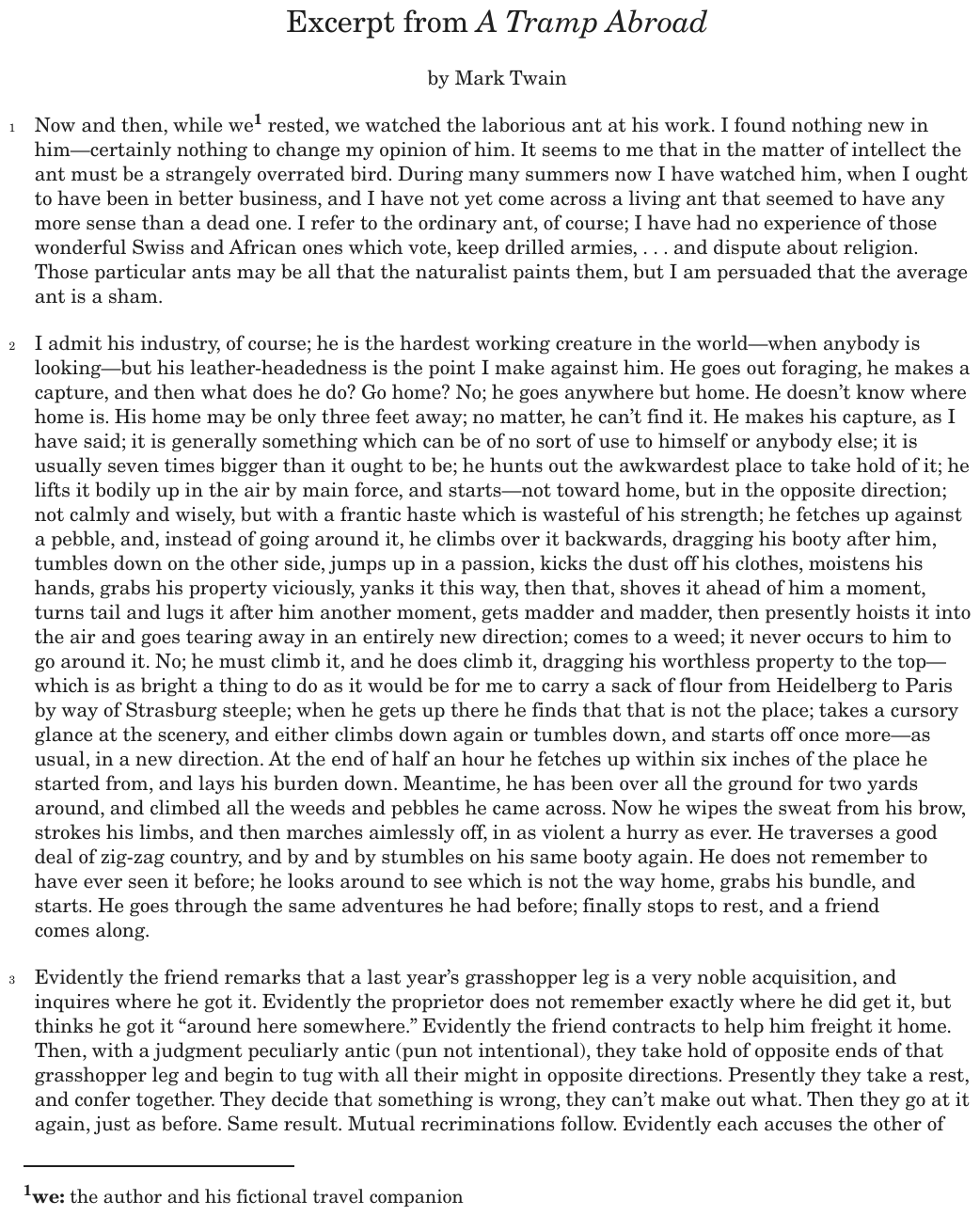
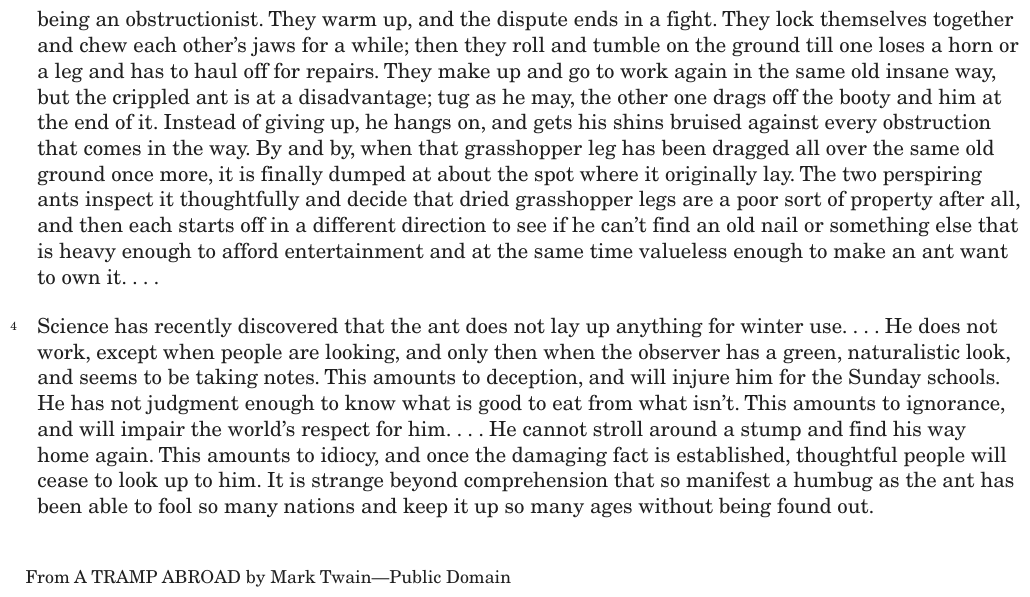
Question 12 of 18
2018 Test A English, question 45Passage Cross-Purposes
Cross-Purposes
What I am is built: concrete and steel.
I defy gravity. I am what every athlete
wants: to remain at the apex of the leap,
up in the air. And yet I am useful, too:
cars, trucks, people, even trains
make their way across my broad back.
Swallows and ospreys nest in my trusses.
What I am is motion. I am water, and I am older
than anything else you know. No human
built me. I am gravity’s best friend; I pool
and flow wherever gravity takes me.
I am the blood flowing in the runner’s chest,
and I catch everything: from the hills,
the mountains. It all washes down through me.
What you are is an accident,
what happens to rain when rain gives in
to Earth’s gravitational pull.
You are some tears dribbling from a mountain’s
eye, running down the pavements
of small towns, into the cities, to the sea.
You are the path of least resistance.
What I am is power. You, of course,
have none: you are a static lump, an artifact
slowly decaying. But my regal flow
nourishes grasses, permits empires to rise.
Those who made you will break you,
in time, replacing you with yet another
clumsy structure. I have seen. I know.
“Clumsy”? Being rebuilt makes me
a friend of time, does it not? And it means
that I have siblings—those “clumsy” structures,
my sisters and brothers.
We stitch across the rip you make.
We are steel thread to the human needle.
We bind you up. We sew you.
And I sow into you; in every cranny
of your superstructure my vapors cling.
They bring out your softness, your rust.
Boast your best, and boast better yet.
I am listening to the bright hum
of the wind in your wires. Because I am,
above all else, patient. I will wait for you.
ospreys: large birds
Question
Read lines 18–20 from the poem.
You are some tears dribbling from a mountain’s
eye, running down the pavements
of small towns, into the cities, to the sea.
What impact do the phrases “some tears dribbling” and “running down” have on the meaning of the poem?
- AThey suggest that naturally flowing water is a problem in populated areas.
- BThey highlight the different types of naturally flowing water.
- CThey imply that the flow of water is weak and influenced by the landscape.
- DThey highlight that the flow of water from the mountains is minimal compared with that of the seas.
Show the answer
Correct answer: C
The answer is (C)
The question asks for the impact that the phrases have on the meaning of the poem. The phrases “some tears dribbling” and “running down” (lines 18–19) imply weakness in form and being influenced by the landscape, making Option C correct.
Option A is incorrect because, while the lines do describe the water in populated areas, they do not describe the water as a problem for the people living there.
Option B is incorrect because the lines do more than bring attention to different types of water; the lines make a judgment about the strength and importance of the water.
Option D is incorrect because a comparison is not made based on the volume of water streaming from the mountains and the volume of water in the seas.
Question analysis
In this question about figurative language in “Cross-Purposes,” students explain the impact of the phrases “some tears dribbling” and “running down,” used to describe the water. They must first work out which of the poem's two speakers is talking, then judge the connotations of the words rather than only the picture they paint.
- Grade level
- Grade 7 reading and task
- Compared with grade 7
- At grade 7 Judging the connotation of a few words is standard grade 7 work. The two-voice format adds one step, since the speakers are never named, but the lines are quoted and short, so the demand stays typical.
- Estimated difficulty
- Moderate: several steps, or a close reading with one strong distractor.
- Thinking it demands
- Depth of knowledge 2, skills and concepts · mainly analyze
- What makes it hard
- Figurative or literary language moderate
- A very close wrong answer moderate
- Reading between the lines minor
- Evidence
- Answered from one paragraph or stanza
- Reading level
- Passage: 316 words (a poem; reading level not measured); question and choices: about grade 6, 98 words.
- Students, last 30 days
- Not enough answers yet to show (it takes 10).
Why it is hard, traps and wrong answers (shows the answer)
Why it is hard
The lines can be read as a simple picture of water running from mountains to the sea, and that reading leads to choices about kinds of water, flooding or volume. The phrases matter for what they say about the water's strength: it dribbles, it runs downhill, it goes where the land sends it. Students who ask how the speaker feels about the water, and remember the stanza's “path of least resistance,” arrive at the key.
Figurative or literary language moderate Understanding the question
“Some tears dribbling from a mountain's eye” turns a river into a weak trickle of tears, so the judgment lies in the connotation of “some” and “dribbling,” not in the picture. (Graesser, Singer & Trabasso, 1994; Kintsch, 1998)
A very close wrong answer moderate Choosing the answer
C and D both say the water's flow is weak, D's “minimal” matching “dribbling”; they differ in the second part, where D adds a comparison with the seas that the lines never make. (Embretson & Wetzel, 1987; Gorin & Embretson, 2006; Ascalon et al., 2007)
Reading between the lines minor Working it out
The stanza is unlabeled, so students must work out from its roman type and its “you” that the structure is speaking and belittling the water. (Graesser, Singer & Trabasso, 1994; Kintsch, 1998)
Strategy: Compare “dribbling” with a neutral word such as “flowing,” and ask what the difference suggests about how this stanza's speaker regards the water.
Traps
- Reads too much in: A reasonable-sounding conclusion that goes further than the text allows.
- Taking figurative language literally: A choice reads a figure of speech or image at face value.
The wrong answers, classified
A Taking figurative language literally (Graesser, Singer & Trabasso, 1994)
Reads water “running down the pavements” of towns and cities as literal flooding, a problem for people, though the speaker is belittling the water, not warning of harm.
B Wrong purpose or structure (Anderson & Krathwohl, 2001)
Lists what the lines show, tears, streets and sea, as kinds of water, describing the content instead of the judgment the phrases make.
D Reads too much in (Graesser, Singer & Trabasso, 1994)
Catches the weakness in “dribbling,” but the lines never set the mountain trickle against the sea's volume; the sea is simply where the water ends up.
Working it out, step by step
Figure out what the question asks
This is a word-choice question. It asks what two phrases suggest about the water. Notice how the words make the water seem.
Work out who is speaking
Lines 15–21 are spoken by the structure. It talks to the water as “you.” It starts: “What you are is an accident.” It ends: “You are the path of least resistance.” The path of least resistance is the easiest way, the one that takes no effort.
Look closely at the phrases
Lines 18–19 say the water is “some tears dribbling from a mountain’s eye, running down the pavements.”
To dribble is to drip a little at a time. “Some tears” sounds small and weak. “Running down” means the water just goes downhill, wherever the land sends it. So the structure is putting the water down. It calls the water weak and pushed around by the land.
Check each choice
- A The lines mention towns, but they never call the water a problem for people.
- B The lines do more than list kinds of water. They judge the water.
- C fits. The water is weak and goes where the landscape sends it.
- D The lines never compare how much water is in mountains and in seas.
Choose the answer
The phrases make the water seem weak and controlled by the land. So the answer is C.
Why this answer and not the closest wrong one
D is the closest trap, since “dribbling” does sound small, like “minimal.” But D adds a comparison with the seas. The sea is just where the water ends up. C keeps the weakness and adds the land, which matches “running down” and “the path of least resistance.”
More questions like this
The original DOE question
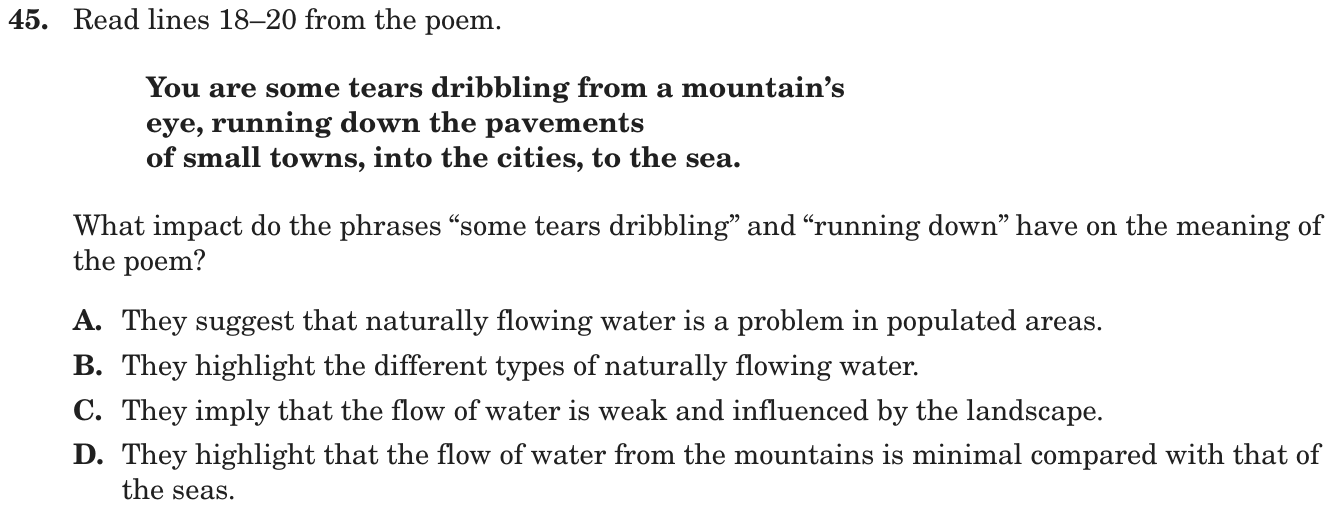
The passage “Cross-Purposes” as printed (pages 72–73)
Question 13 of 18
2018 Test A English, question 47Uses the passage above: “Cross-Purposes”.
Question
The last stanza (lines 36–42) conveys a central idea of the poem by
- Ademonstrating that both the structure and the water depend on each other to fulfill their functions.
- Bimplying that a stronger structure would be able to resist the degradation caused by the water.
- Crevealing that the passage of time will render both the structure and the water obsolete.
- Dsuggesting that the water will eventually weaken the structure and will continue to exist after the structure is gone.
Show the answer
Correct answer: D
The answer is (D)
The question asks how the last stanza conveys a central idea of the poem. In lines 36–38, the speaker (the water) describes how its “vapors cling” to the structure, bringing out the structure’s “softness” and “rust,” thus destroying the structure over time. Also, in line 42, the speaker says it is “patient” and “will wait for you,” suggesting that the speaker will be around after the structure is gone. These phrases in the last stanza indicate that Option D is correct.
Option A is incorrect because the last stanza includes no indication that the structure and the water depend on each other.
Option B is incorrect because the last stanza refers to the opposing speaker (the structure) and not to any other structure.
Option C is incorrect because the last stanza addresses only the idea that the structure will grow weak and obsolete over time.
Question analysis
Students must explain how the final stanza of “Cross-Purposes,” spoken by the water, conveys a central idea of the poem. The stanza mixes a pun on sewing and sowing, images of vapor and rust, and a taunt about boasting, so students must read past the wordplay to the stanza's main claim.
- Grade level
- Grade 7 reading and task
- Compared with grade 7
- At grade 7 Linking a stanza to a poem's central idea is standard grade 7 work. The stanza's wordplay takes some decoding, but each choice can be checked against the stanza itself, so the overall demand is typical.
- Estimated difficulty
- Moderate: several steps, or a close reading with one strong distractor.
- Thinking it demands
- Depth of knowledge 2, skills and concepts · mainly analyze
- What makes it hard
- Figurative or literary language major
- A very close wrong answer moderate
- Hard words minor
- Evidence
- Answered from one paragraph or stanza
- Reading level
- Passage: 316 words (a poem; reading level not measured); question and choices: about grade 9, 78 words.
- Students, last 30 days
- Not enough answers yet to show (it takes 10).
Why it is hard, traps and wrong answers (shows the answer)
Why it is hard
The stanza's meaning is a quiet threat: moisture works into the structure, rusts it, and the water simply waits. Students who decode the rust and the waiting usually reach the key, but one wrong choice gets the decay right and then sweeps the water into it too. The taunt to “boast better yet” is the other snare, since read straight it sounds like an invitation to build a stronger structure.
Figurative or literary language major Understanding the question
The stanza works through wordplay and images: “I sow into you” puns on the structure's “We sew you,” vapors cling to bring out “your rust,” and “I will wait for you” is a threat. (Graesser, Singer & Trabasso, 1994; Kintsch, 1998)
A very close wrong answer moderate Choosing the answer
C and D agree that time will wear the structure down; they differ only in the water's fate, which D says outlasts the structure and C says becomes obsolete too, against “above all else, patient.” (Embretson & Wetzel, 1987; Gorin & Embretson, 2006; Ascalon et al., 2007)
Hard words minor Understanding the question
“Cranny” and “superstructure” in the stanza, and “degradation” and “obsolete” in the choices, are words a seventh grader may not know. (Perfetti, 2007; Freedle & Kostin, 1993)
Strategy: Paraphrase each sentence of the last stanza in plain words, then check both halves of every choice, since a choice can fit one speaker and not the other.
Traps
- Half right: One half of a two-part choice is right and the other is not.
- Taking figurative language literally: A choice reads a figure of speech or image at face value.
The wrong answers, classified
A Reads too much in (Graesser, Singer & Trabasso, 1994)
Reads the sew-and-sow echo as mutual need, but the last stanza shows the water acting on the structure, with no dependence either way.
B Taking figurative language literally (Graesser, Singer & Trabasso, 1994)
Takes the taunt “boast better yet” at face value, as if a stronger structure could resist, though the water's answer to any boast is that it will wait.
C Half right (King et al., 2004; Thissen, Steinberg & Fitzpatrick, 1989)
Gets the structure's decline right but makes the water obsolete as well, though it is “patient” and plans to outlast the structure.
Working it out, step by step
Figure out what the question asks
This asks how the last stanza shows a central idea. The water is speaking. You need to work out what it is really saying to the structure.
Read the last stanza
Lines 36–38 say: “And I sow into you; in every cranny / of your superstructure my vapors cling. / They bring out your softness, your rust.”
Lines 41–42 end the poem: “Because I am, / above all else, patient. I will wait for you.”
Work out the hidden threat
A cranny is a small crack. Vapors are tiny drops of water in the air, like mist. The superstructure is the main body of the structure. So the water’s mist creeps into every crack and makes the steel rust and weaken.
“Sow” sounds like “sew,” but it means to plant seeds. The water plants rust. Then it says it will wait. It expects to still be here after the structure is gone.
Check each choice
- A The stanza shows the water harming the structure, not needing it.
- B No stronger structure is mentioned. “Boast better yet” is a dare, not advice.
- C The structure will wear down, but the water won’t. It is patient and waiting.
- D fits. The water will rust the structure and outlast it.
Choose the answer
The water will slowly weaken the structure and still be around after it is gone. So the answer is D.
Why this answer and not the closest wrong one
C is the closest trap. C and D agree that time will wear down the structure. But C says the water will become obsolete, or useless, too. The water says the opposite: “I will wait for you.” Only D gets both speakers right.
More questions like this
The original DOE question
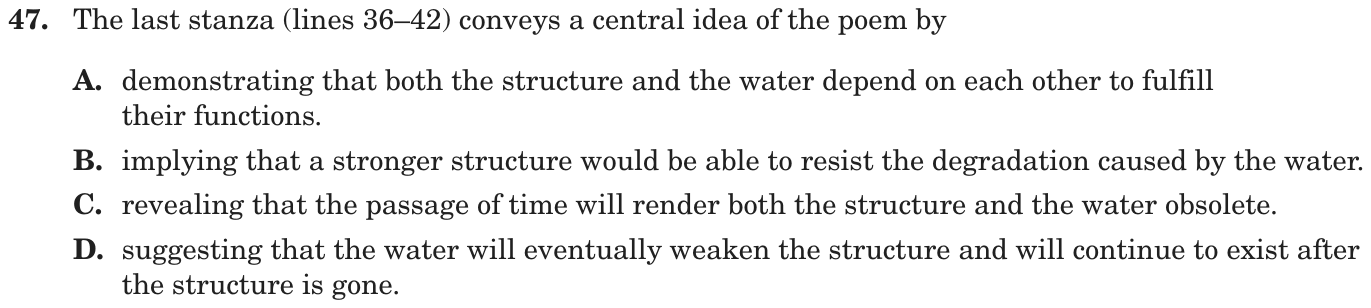
Question 14 of 18
2018 Test B English, question 19Passage Excerpt from A Voice in the Wilderness
Excerpt from A Voice in the Wilderness
by Grace Livingston Hill
With a lurch the train came to a dead stop and Margaret Earle, hastily gathering up her belongings, hurried down the aisle and got out into the night.
It occurred to her, as she swung her heavy suit-case down the rather long step to the ground, and then carefully swung herself after it, that it was strange that neither conductor, brakeman, nor porter had come to help her off the train, when all three had taken the trouble to tell her that hers was the next station; but she could hear voices up ahead. Perhaps something was the matter with the engine that detained them and they had forgotten her for the moment.
The ground was rough where she stood, and there seemed no sign of a platform. Did they not have platforms in this wild Western land, or was the train so long that her car had stopped before reaching it?
She strained her eyes into the darkness, and tried to make out things from the two or three specks of light that danced about like fireflies in the distance. She could dimly see moving figures away up near the engine, and each one evidently carried a lantern. The train was tremendously long. A sudden feeling of isolation took possession of her. Perhaps she ought not to have got out until some one came to help her. Perhaps the train had not pulled into the station yet and she ought to get back on it and wait. Yet if the train started before she found the conductor she might be carried on somewhere and he justly blame her for a fool.
There did not seem to be any building on that side of the track. It was probably on the other, but she was standing too near the cars to see over. She tried to move back to look, but the ground sloped and she slipped and fell in the cinders, bruising her knee and cutting her wrist.
In sudden panic she arose. She would get back into the train, no matter what the consequences. They had no right to put her out here, away off from the station, at night, in a strange country. If the train started before she could find the conductor she would tell him that he must back it up again and let her off. He certainly could not expect her to get out like this.
She lifted the heavy suit-case up the high step that was even farther from the ground than it had been when she came down, because her fall had loosened some of the earth and caused it to slide away from the track. Then, reaching to the rail of the step, she tried to pull herself up, but as she did so the engine gave a long snort and the whole train, as if it were in league against her, lurched forward crazily, shaking off her hold. She slipped to her knees again, the suit-case, toppled from the lower step, descending upon her, and together they slid and rolled down the short bank, while the train . . . ran giddily off into the night.
The horror of being deserted helped the girl to rise in spite of bruises and shock. She lifted imploring hands to the unresponsive cars as they hurried by her—one, two, three, with bright windows, each showing a passenger, comfortable and safe inside, unconscious of her need.
A moment of useless screaming, running, trying to attract some one’s attention, a sickening sense of terror and failure, and the last car slatted itself past with a mocking clatter, as if it enjoyed her discomfort.
Margaret stood dazed, reaching out helpless hands, then dropped them at her sides and gazed after the fast-retreating train, the light on its last car swinging tauntingly, blinking now and then with a leer in its eye, rapidly vanishing from her sight into the depth of the night.
She gasped and looked about her for the station that but a short moment before had been so real to her mind; and, lo! on this side and on that there was none!
The night was wide like a great floor shut in by a low, vast dome of curving blue set with the largest, most wonderful stars she had ever seen. Heavy shadows of purple-green, smoke-like, hovered over earth darker and more intense than the unfathomable blue of the night sky. It seemed like the secret nesting-place of mysteries wherein no human foot might dare intrude. It was incredible that such could be but common sage-brush, sand, and greasewood wrapped about with the beauty of the lonely night.
No building broke the inky outlines of the plain, nor friendly light streamed out to cheer her heart. Not even a tree was in sight, except on the far horizon, where a heavy line of deeper darkness might mean a forest. Nothing, absolutely nothing, in the blue, deep, starry dome above and the bluer darkness of the earth below save one sharp shaft ahead like a black mast throwing out a dark arm across the track.
As soon as she sighted it she picked up her baggage and made her painful way toward it, for her knees and wrist were bruised and her baggage was heavy.
A soft drip, drip greeted her as she drew nearer; something plashing down among the cinders by the track. Then she saw the tall column with its arm outstretched, and looming darker among the sage-brush the outlines of a water-tank. It was so she recognized the engine’s drinking-tank, and knew that she had mistaken a pause to water the engine for a regular stop at a station.
cinders: track bed made from the residue of burnt coal
From A VOICE IN THE WILDERNESS by Grace Livingston Hill—Public Domain
Question
Read this sentence from paragraph 4.
She strained her eyes into the darkness, and tried to make out things from the two or three specks of light that danced about like fireflies in the distance.
The simile used in the sentence affects the tone of the paragraph by emphasizing a
- Afeeling of comfort as Margaret connects her unfamiliar surroundings with familiar images.
- Bsense of lonesomeness as Margaret realizes that she is on her own in the wilderness.
- Csense of tranquility as Margaret is distracted from the urgency of her situation by the beauty of the night.
- Dfeeling of dread as Margaret regards the desolation of the land that surrounds her.
Show the answer
Correct answer: B
The question asks how the simile in the sentence from paragraph 4 reflects the tone of the paragraph. The image of two or three fireflies creating small specks of light in the darkness creates a sense of isolation or loneliness in Margaret, as shown in the sentence, “A sudden feeling of isolation took possession of her” (paragraph 4). Therefore, Option B is correct.
Option A is incorrect because Margaret is confused and indecisive, showing her discomfort with her situation.
Option C is incorrect because Margaret expresses distress in her situation, questions her decision, and worries about being labeled a “fool” (paragraph 4).
Option D is incorrect because the simile is meant to show how far away things are from Margaret, not create a feeling of dread, which develops later in paragraph 9.
Question analysis
This figurative-language question asks how a simile comparing distant lights to fireflies affects the tone of paragraph 4 in A Voice in the Wilderness. Students connect the image to Margaret’s state of mind as she stands beside the stopped train in the dark. The choices range from calm to fear, so the answer must rest on what Margaret is thinking.
- Grade level
- Grade 7 reading and task
- Compared with grade 7
- At grade 7 Explaining how a simile shapes tone is regular grade 7 work with figurative language, and this one is typical. Students must read the comparison in the light of the paragraph around it, since the image alone could suggest several moods.
- Estimated difficulty
- Moderate: several steps, or a close reading with one strong distractor.
- Thinking it demands
- Depth of knowledge 2, skills and concepts · mainly analyze
- What makes it hard
- A very close wrong answer moderate
- Figurative or literary language moderate
- Hard words minor
- Evidence
- Answered from one paragraph or stanza
- Reading level
- Passage: about grade 8, 981 words; question and choices: about grade 9, 109 words.
- Students, last 30 days
- Not enough answers yet to show (it takes 10).
Why it is hard, traps and wrong answers (shows the answer)
Why it is hard
The simile itself is gentle, which is why the comforting reading tempts some students, but the paragraph around it is not: two sentences later, “A sudden feeling of isolation took possession of her.” That sentence decides the question. The harder choice is between loneliness now and the dread and desolation that come after the train has gone, so the question rewards keeping to paragraph 4.
A very close wrong answer moderate Choosing the answer
The dread choice is built like the lonesomeness choice, a feeling plus Margaret alone in empty country, “the desolation of the land” beside “on her own in the wilderness”; only the feeling named, dread rather than loneliness, separates them. (Embretson & Wetzel, 1987; Gorin & Embretson, 2006; Ascalon et al., 2007)
Figurative or literary language moderate Understanding the question
Fireflies are usually a cheerful, homey image, so students must read the simile through its setting, “two or three specks of light” far off in the dark, to see that it stresses distance. (Graesser, Singer & Trabasso, 1994; Kintsch, 1998)
Hard words minor Understanding the question
The choices hinge on near-synonyms for feelings, “lonesomeness,” “tranquility,” “dread” and “desolation,” whose shades of meaning have to be weighed against one paragraph. (Perfetti, 2007; Freedle & Kostin, 1993)
Strategy: Picture the scene the comparison creates, then reread paragraph 4 around it and choose the feeling that the paragraph itself supports.
Traps
- Wrong part of the text: A choice is true of another paragraph, stanza or speaker than the one asked about.
- Taking figurative language literally: A choice reads a figure of speech or image at face value.
The wrong answers, classified
A Taking figurative language literally (Graesser, Singer & Trabasso, 1994)
Takes fireflies at face value as a cozy, familiar image, but Margaret is straining to see and wondering whether she should have left the train, hardly comforted.
C Wrong part of the text (Kirsch & Mosenthal, 1990)
Brings in the beauty of the night, which belongs to paragraph 12’s stars and sky after the train has gone, not to this anxious moment beside it.
D Wrong part of the text (Kirsch & Mosenthal, 1990)
Moves ahead to the dread and desolate land of paragraphs 9 to 13, after the train leaves; here the faraway lights stress distance and a first feeling of isolation.
Working it out, step by step
Figure out what the question asks
This asks about a simile: a comparison that uses “like” or “as.” How does this simile shape the tone, or feeling, of paragraph 4?
Find the simile
Margaret looks into the dark and sees “two or three specks of light that danced about like fireflies in the distance.” The far-off lights are compared to fireflies.
Picture what it shows
Fireflies are tiny lights. Here there are only two or three, and they are far away. Everything else is dark. The picture makes Margaret seem small and far from other people. A few lines later, the paragraph says it: “A sudden feeling of isolation took possession of her.” Isolation means being alone and cut off.
Check each choice
- A is wrong. Fireflies can seem cozy, but Margaret is straining to see. She feels alone, not comforted.
- B is right. The tiny, faraway lights stress that she is on her own.
- C is wrong. The beauty of the night comes later, in paragraph 12. Here she is worried.
- D is wrong. Dread and the empty land come later, after the train leaves.
Watch out: D jumps ahead. Her terror starts in paragraph 9, and the empty land appears in paragraphs 12 and 13. Both come after the train is gone.
Choose the answer
The few faraway specks of light in the dark make Margaret feel small and alone. So the answer is B.
Why this answer and not the closest wrong one
D is the closest wrong answer, because Margaret does feel dread later in the story. But in paragraph 4 the train is still there, and the land has not been described yet. The paragraph names the feeling itself: “a sudden feeling of isolation.” Lonesomeness matches that.
More questions like this
The original DOE question
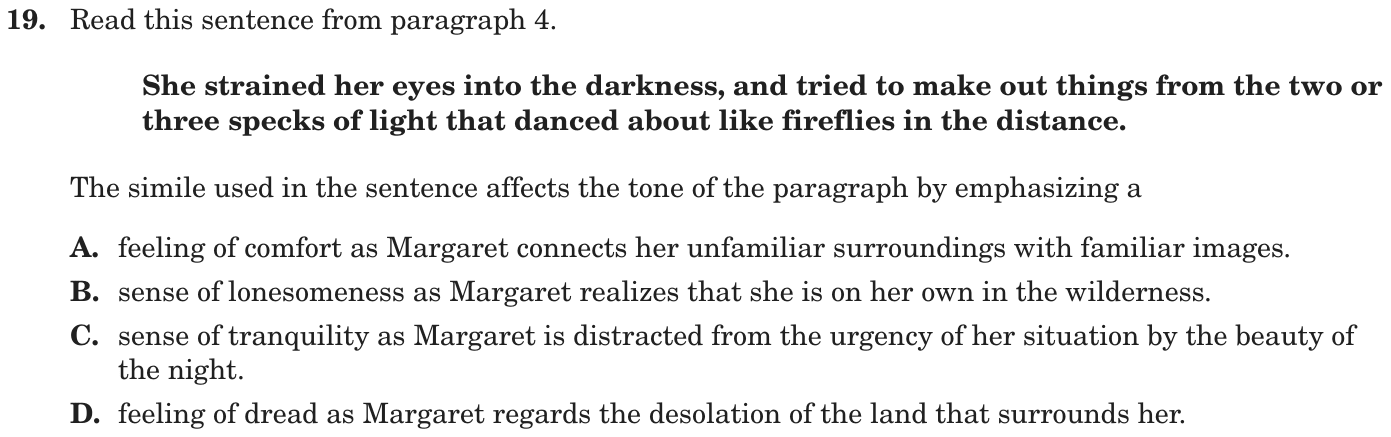
The passage “Excerpt from A Voice in the Wilderness” as printed (pages 128–129)
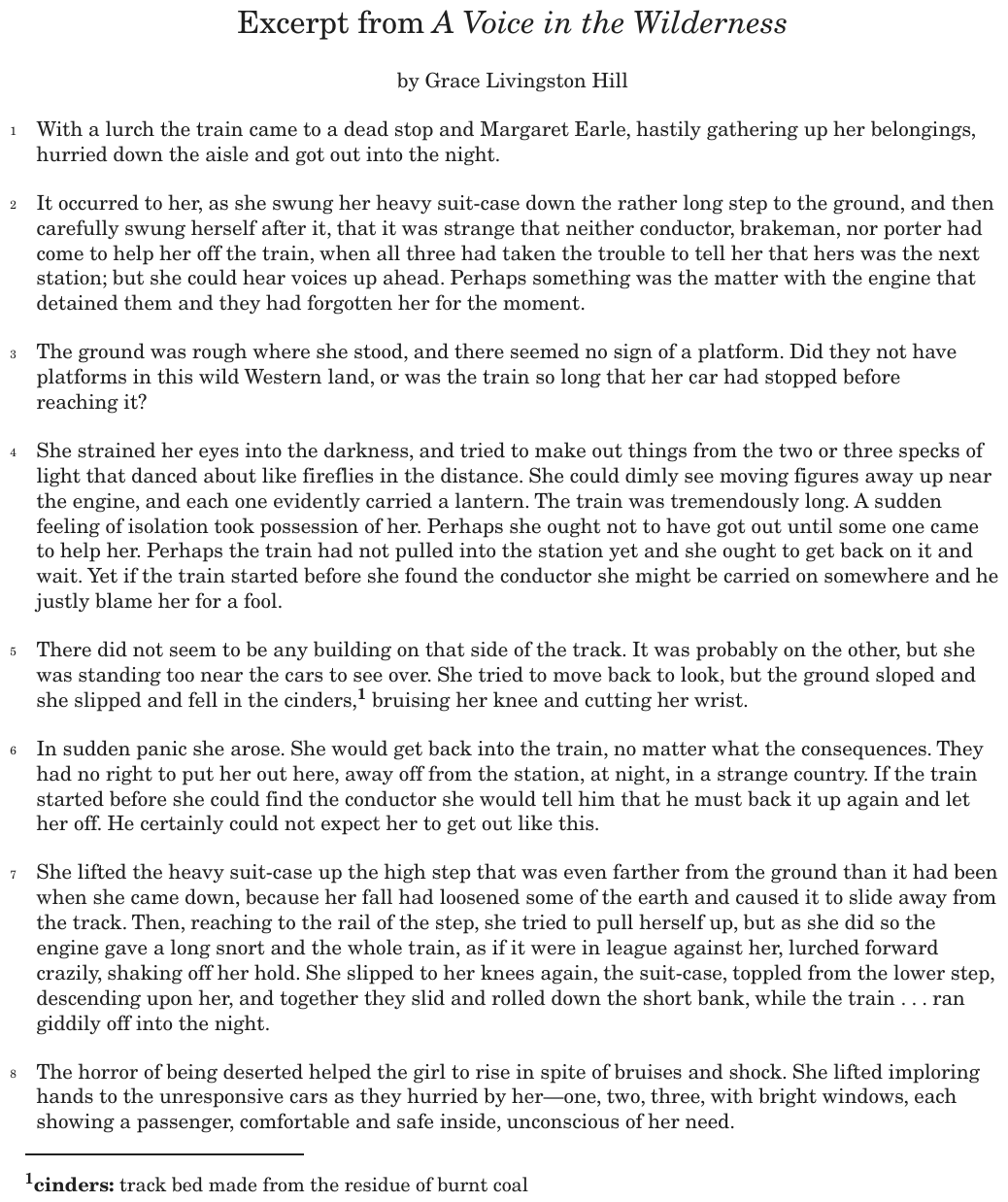
Question 15 of 18
2018 Test B English, question 25Passage Excerpt from “Niagara Falls”
Excerpt from “Niagara Falls”
by Rupert Brooke
The real secret of the beauty and terror of the Falls is not their height or width, but the feeling of colossal power and of unintelligible disaster caused by the plunge of that vast body of water. If that were taken away, there would be little visible change, but the heart would be gone.
The American Falls do not inspire this feeling in the same way as the Canadian. It is because they are less in volume, and because the water does not fall so much into one place. By comparison their beauty is almost delicate and fragile. They are extraordinarily level, one long curtain of lacework and woven foam. Seen from opposite, when the sun is on them, they are blindingly white, and the clouds of spray show dark against them. With both Falls the colour of the water is the ever-altering wonder. Greens and blues, purples and whites, melt into one another, fade, and come again, and change with the changing sun. Sometimes they are as richly diaphanous as a precious stone, and glow from within with a deep, inexplicable light. Sometimes the white intricacies of dropping foam become opaque and creamy. And always there are the rainbows. If you come suddenly upon the Falls from above, a great double rainbow, very vivid, spanning the extent of spray from top to bottom, is the first thing you see. If you wander along the cliff opposite, a bow springs into being in the American Falls, accompanies you courteously on your walk, dwindles and dies as the mist ends, and awakens again as you reach the Canadian tumult. And the bold traveller who attempts the trip under the American Falls sees, when he dare open his eyes to anything, tiny baby rainbows, some four or five yards in span, leaping from rock to rock among the foam, and gambolling beside him, barely out of hand’s reach, as he goes. One I saw in that place was a complete circle, such as I have never seen before, and so near that I could put my foot on it. It is a terrifying journey, beneath and behind the Falls. The senses are battered and bewildered by the thunder of the water and the assault of wind and spray; or rather, the sound is not of falling water, but merely of falling; a noise of unspecified ruin. So, if you are close behind the endless clamour, the sight cannot recognise liquid in the masses that hurl past. You are dimly and pitifully aware that sheets of light and darkness are falling in great curves in front of you. Dull omnipresent foam washes the face. Farther away, in the roar and hissing, clouds of spray seem literally to slide down some invisible plane of air.
Beyond the foot of the Falls the river is like a slipping floor of marble, green with veins of dirty white, made by the scum that was foam. It slides very quietly and slowly down for a mile or two, sullenly exhausted. Then it turns to a dull sage green, and hurries more swiftly, smooth and ominous. As the walls of the ravine close in, trouble stirs, and the waters boil and eddy. These are the lower rapids, a sight more terrifying than the Falls, because less intelligible. Close in its bands of rock the river surges tumultuously forward, writhing and leaping as if inspired by a demon. It is pressed by the straits into a visibly convex form. Great planes of water slide past. Sometimes it is thrown up into a pinnacle of foam higher than a house, or leaps with incredible speed from the crest of one vast wave to another, along the shining curve between, like the spring of a wild beast. Its motion continually suggests muscular action. The power manifest in these rapids moves one with a different sense of awe and terror from that of the Falls. Here the inhuman life and strength are spontaneous, active, almost resolute. . . . A place of fear.
One is drawn back, strangely, to a contemplation of the Falls, at every hour, and especially by night, when the cloud of spray becomes an immense visible ghost, straining and wavering high above the river, white and pathetic and translucent. The Victorian lies very close below the surface in every man. There one can sit and let great cloudy thoughts of destiny and the passage of empires drift through the mind; for such dreams are at home by Niagara. I could not get out of my mind the thought of a friend, who said that the rainbows over the Falls were like the arts and beauty and goodness, with regard to the stream of life—caused by it, thrown upon its spray, but unable to stay or direct or affect it, and ceasing when it ceased. In all comparisons that rise in the heart, the river, with its multitudinous waves and its single current, likens itself to a life, whether of an individual or of a community. A man’s life is of many flashing moments, and yet one stream; a nation’s flows through all its citizens, and yet is more than they. In such places, one is aware, with an almost insupportable and yet comforting certitude, that both men and nations are hurried onwards to their ruin or ending as inevitably as this dark flood. Some go down to it unreluctant, and meet it, like the river, not without nobility. And as incessant, as inevitable, and as unavailing as the spray that hangs over the Falls, is the white cloud of human crying. . . . With some such thoughts does the platitudinous heart win from the confusion and thunder of a Niagara peace that the quietest plains or most stable hills can never give.
From LETTERS FROM AMERICA by Rupert Brooke—Public Domain
diaphanous: sheer, translucent
platitudinous: clichéd, common
Question
The central idea that the Falls communicate a feeling of “unintelligible disaster” (paragraph 1) is conveyed in paragraph 2 through a description of
- Athe glow of the precious stones visible within the water.
- Bthe dynamic flow of the colors that are visible in the water.
- Cthe sudden appearance and disappearance of rainbows.
- Dthe sounds associated with a sense of falling.
Show the answer
Correct answer: D
The question asks for a specific detail from paragraph 2 that conveys the central idea that the Falls communicates a feeling of “unintelligible disaster” (paragraph 1). The sound of falling is described in paragraph 2 as “a noise of unspecified ruin,” so Option D is correct because it best connects with the idea of “unintelligible disaster” mentioned in paragraph 1.
Option A is incorrect because, although the water is described as “diaphanous as a precious stone” in paragraph 2 because of the “glow” coming from the interaction of the light, there are no stones within the water.
Option B is incorrect because the details in paragraph 2 about the flow of colors in the water are described as an “ever-altering wonder,” which conveys a sense of beauty and not a sense of disaster.
Option C is incorrect because the rainbows in paragraph 2 are described as “vivid” and accompanying someone “courteously” while he or she walks, which contributes to the idea that the appearance and disappearance of the rainbows are a pleasant experience and not disastrous.
Question analysis
This question on Rupert Brooke’s essay “Niagara Falls” asks which descriptive detail in paragraph 2 conveys the central idea that the Falls feel like an “unintelligible disaster.” Students must connect an idea from the opening paragraph to supporting evidence in a very long paragraph packed with vivid images, and judge the feeling each image creates.
- Grade level
- Grade 8 reading and task
- Compared with grade 7
- At grade 7 Linking a detail to a central idea is standard grade 7 work, but the evidence sits inside a paragraph of several hundred words of century-old prose, with words like “diaphanous” and “gambolling,” and must be matched by meaning rather than wording.
- Estimated difficulty
- Moderate: several steps, or a close reading with one strong distractor.
- Thinking it demands
- Depth of knowledge 2, skills and concepts · mainly analyze
- What makes it hard
- A lot to read moderate
- Figurative or literary language moderate
- Hard words minor
- Evidence
- Answered from one paragraph or stanza
- Reading level
- Passage: about grade 9, 987 words; question and choices: about grade 9, 58 words.
- Students, last 30 days
- Not enough answers yet to show (it takes 10).
Why it is hard, traps and wrong answers (shows the answer)
Why it is hard
The challenge is to find, in the essay’s longest paragraph, the one image that feels like disaster rather than beauty. Most of the paragraph is lovely, colors and rainbows that change and return, and the wrong choices draw on those passages. Students who keep the feeling of “unintelligible disaster” in mind, rather than just looking for things that appear and disappear, will find it in the sound of the water near the end.
A lot to read moderate Understanding the question
Paragraph 2 runs 407 words through colors, rainbows and a trip behind the water, and the sentence that matters, ending “a noise of unspecified ruin,” comes near its end. (Kintsch, 1998; Gorin & Embretson, 2006; Freedle & Kostin, 1993)
Figurative or literary language moderate Understanding the question
Students must judge the feeling each image creates, and only the sound “not of falling water, but merely of falling” carries a sense of disaster; the colors and rainbows are wonders. (Graesser, Singer & Trabasso, 1994; Kintsch, 1998)
Hard words minor Understanding the question
The key phrase “unintelligible disaster” must be matched to “unspecified ruin,” and words such as “diaphanous” and “intricacies” crowd the images around it. (Perfetti, 2007; Freedle & Kostin, 1993)
Strategy: Keep the words “unintelligible disaster” in mind, find each choice’s detail in paragraph 2, and ask what feeling the author’s words give that detail.
Traps
- Supports only part of the claim: In a question about evidence: a line that backs one half of the claim but not the other, or a related point rather than the claim itself.
- Taking figurative language literally: A choice reads a figure of speech or image at face value.
The wrong answers, classified
A Taking figurative language literally (Graesser, Singer & Trabasso, 1994)
Takes the simile “as richly diaphanous as a precious stone” to mean stones in the water, and links its “inexplicable light” to “unintelligible,” though the image is lovely.
B Supports only part of the claim (King et al., 2004; Thissen, Steinberg & Fitzpatrick, 1989)
Picks the shifting greens, blues and purples, hard to pin down like something unintelligible, but the author calls the color “the ever-altering wonder,” delight rather than disaster.
C Supports only part of the claim (King et al., 2004; Thissen, Steinberg & Fitzpatrick, 1989)
Notices that a rainbow “dwindles and dies” and “awakens again,” which sounds unsettling, but the bows are vivid and keep the walker company “courteously,” so nothing suggests disaster.
Working it out, step by step
Figure out what the question asks
Paragraph 1 says the Falls give a feeling of “unintelligible disaster.” “Unintelligible” means impossible to understand. You need the detail in paragraph 2 that feels like a disaster you can’t understand.
Find the matching words
Near the end of paragraph 2, the author goes behind the Falls. He says “the sound is not of falling water, but merely of falling; a noise of unspecified ruin.”
Work out what the words mean
“Merely” means just. The noise is not of water but of falling itself, as if everything were crashing down. “Ruin” means destruction, much like disaster. “Unspecified” means not named or not clear. So the sound is a crash of destruction you can’t explain. That matches “unintelligible disaster.”
Check each choice
- A is wrong. The water is only compared to a precious stone. There are no stones, and the image is lovely, not scary.
- B is wrong. The colors are called “the ever-altering wonder.” That is beauty, not disaster.
- C is wrong. The rainbows are “very vivid” and walk beside you “courteously,” which means politely. They are pleasant.
- D is right. The sound of falling is the “noise of unspecified ruin.”
Watch out: A rainbow that “dwindles and dies” sounds sad. But it “awakens again,” and the rainbows are a delight.
Choose the answer
Only the sound of falling carries the sense of a disaster. So the answer is D.
Why this answer and not the closest wrong one
C is the closest wrong answer, because a rainbow that “dwindles and dies” might seem gloomy. But the author makes the rainbows friendly and beautiful. “A noise of unspecified ruin” almost repeats the words “unintelligible disaster,” so D is the best match.
More questions like this
The original DOE question
The passage “Excerpt from “Niagara Falls”” as printed (pages 134–135)
Question 16 of 18
2018 Test B English, question 35Passage Uncovering the Past
Uncovering the Past
Archaeology as a distinct branch of science is only about two centuries old. The first archaeological activities focused largely on the search for clues about earlier human societies. In the nineteenth century, most archaeologists were amateurs trained in ancient languages and history. Many were art historians whose interest lay in the artwork and monuments of ancient civilizations. For the most part, their excavations were aimed at uncovering and removing priceless artwork and other valuable artifacts for museum display. Collectively, these early archaeologists are now considered traditional archaeologists.
Today, however, there is a different approach to archaeology, one that tries to reconstruct the everyday life of people in ancient times by applying the scientific methods of a range of specialized fields. Modern archaeologists take full advantage of available technology. Laptop computers enable digging teams to record their finds at each level of an excavation. With sketchpad computer software, archaeologists can draw their finds in the field. Three-dimensional computer modeling enables researchers to create floor plans and elevations for the structures they uncover. Archaeologists can also use remote sensing technologies such as radar and lidar, which is similar to radar but it uses laser light instead of radio waves. These technologies enable scientists to detect traces of early settlements that are not visible to the human eye.
The excavations at Kourion, a Roman port city on the island of Cyprus in the Mediterranean Sea, serve as an example of the modern approach. Portions of Kourion had been unexpectedly buried by a massive earthquake in the fourth century A.D. Traditional archaeologists were interested primarily in the remains of Kourion’s theater, temple, and classical monuments. They also collected precious objects, such as jewelry, found in nearby tombs. Modern archaeologists, however, have focused their studies and excavations on the settlement itself. This preserved seaport has proved to be a gold mine of important information about everyday life sixteen centuries ago.
During one excavation of a house at Kourion, for example, forensic anthropologists were able to reconstruct the skeleton of a young girl, whom they called Camelia. On the basis of her teeth, they determined her age to be about thirteen, although measurement of her skeleton showed that she was only the size of a modern eleven-year-old. The study of the teeth also confirmed her sex and pointed to her excellent health; Camelia had no cavities. Even after centuries, the forensic scientists could study the physical evidence in ways similar to those used in criminal investigations to determine the circumstances of Camelia’s death.
Other specialists on this excavation included a zooarchaeologist, who identified animal remains, including the skeleton of a mule found near Camelia. Another specialist, a paleobotanist, studied the contents of a bake oven at the site and identified four domesticated grains among the charred crumbs—evidence of a kind of ancient multigrain bread.
Although the archaeologists at this site unearthed a few beautiful items, the excavation did not uncover any priceless artwork for museums. Nonetheless, the archaeological processes used in Kourion have given us a valuable insight into everyday life in a Roman city.
Question
Which conclusion is best supported by the information in paragraph 4?
- AForensic anthropologists specialize in the excavation of ancient theaters and temples.
- BForensic anthropologists can obtain a variety of information by examining teeth.
- CForensic anthropologists believe that people in the past were smaller than people are today.
- DForensic anthropologists primarily investigate ancient crimes.
Show the answer
Correct answer: B
The question asks for the concluding sentence that best summarizes the information from paragraph 4. Paragraph 4 explains that Camelia’s age was determined through an examination of her teeth, which makes the conclusion in Option B the correct answer.
Option A is incorrect because the excavation discussed in the paragraph is at a house, not a theater or temple.
Option C is incorrect because, although Camelia’s body was smaller than a thirteen-year-old’s would be expected to be, the passage does not go into enough detail to suggest that all people from the past were smaller than people are today.
Option D is also incorrect because there is no evidence in the passage of Camelia’s death being the result of a crime.
Question analysis
This question asks which conclusion is best supported by paragraph 4 of “Uncovering the Past,” where forensic anthropologists study the skeleton of a girl they named Camelia. Students must draw a reasonable conclusion from several specific details and avoid reading more into the paragraph than it says.
- NYS standards
- 7R1 textual evidence and inferences
- Grade level
- Grade 7 reading and task
- Compared with grade 7
- At grade 7 A standard grade 7 inference task: draw a conclusion from one short, concrete paragraph. The scientific terms are explained by context, and the main demand is checking each conclusion against what the paragraph actually says.
- Estimated difficulty
- Straightforward: two steps or one careful reading.
- Thinking it demands
- Depth of knowledge 2, skills and concepts · mainly understand
- What makes it hard
- The right answer is reworded moderate
- Reading between the lines minor
- Evidence
- Answered from one paragraph or stanza
- Reading level
- Passage: about grade 13, 514 words; question and choices: about grade 14, 52 words.
- Students, last 30 days
- Not enough answers yet to show (it takes 10).
Why it is hard, traps and wrong answers (shows the answer)
Why it is hard
The right conclusion is a generalization the paragraph never states, while two wrong ones grow out of its most striking phrases. Camelia’s small size and the comparison with criminal investigations each invite a conclusion that sounds scientific but rests on one detail or misreads a comparison. Students who list what the scientists learned from the teeth before reading the choices avoid both.
The right answer is reworded moderate Choosing the answer
The key folds three findings from the teeth, Camelia’s age, her sex and her health, into “a variety of information,” while the wrong choices reuse “modern eleven-year-old,” “criminal investigations” and paragraph 3’s theater and temple. (Freedle & Kostin, 1993; Kirsch & Mosenthal, 1990)
Reading between the lines minor Working it out
No sentence states the conclusion; it has to be built by noticing that the teeth gave the age, the sex and “excellent health,” and then generalizing about what teeth can reveal. (Graesser, Singer & Trabasso, 1994; Kintsch, 1998)
Strategy: List what the scientists learned in paragraph 4, then test each choice by asking whether the paragraph gives direct evidence for it.
Traps
- Too broad or too strong: A choice overstates, generalizes, or uses absolute words the text does not support.
- Taking figurative language literally: A choice reads a figure of speech or image at face value.
- Wrong part of the text: A choice is true of another paragraph, stanza or speaker than the one asked about.
The wrong answers, classified
A Wrong part of the text (Kirsch & Mosenthal, 1990)
Borrows the theater and temple from paragraph 3, where they interested traditional archaeologists, though paragraph 4 describes forensic work on a girl found in a house.
C Too broad or too strong (King et al., 2004)
Generalizes from one skeleton: Camelia was “only the size of a modern eleven-year-old,” but one girl cannot show that ancient people in general were smaller, and the paragraph reports no such belief.
D Taking figurative language literally (Graesser, Singer & Trabasso, 1994)
Turns the comparison “in ways similar to those used in criminal investigations” into the scientists’ purpose, though it describes only their methods and nothing suggests a crime.
Working it out, step by step
Figure out what the question asks
This asks for a conclusion, an idea you can figure out from facts. The facts must come from paragraph 4, the paragraph about the girl called Camelia. The right choice needs direct support there. A choice that sounds smart but goes past the facts is wrong.
List what the scientists learned
Paragraph 4 says, “On the basis of her teeth, they determined her age to be about thirteen.” Then it says, “The study of the teeth also confirmed her sex and pointed to her excellent health; Camelia had no cavities.” Her skeleton also showed she was “only the size of a modern eleven-year-old.”
Find the pattern in those facts
Forensic anthropologists are scientists who study human bones, a bit like crime-lab experts. Look at how much came from the teeth alone. The teeth told them her age. They told them she was a girl. They showed she was healthy. That is three kinds of facts from one source. So you can conclude that teeth give many kinds of information.
Check each choice
- A is wrong. The theater and temple are in paragraph 3. Camelia was found in a house.
- B fits. Age, sex and health add up to “a variety of information” from teeth.
- C is wrong. One small girl does not prove that all people long ago were smaller. The paragraph never says the scientists believe that.
- D is wrong. The scientists worked “in ways similar to those used in criminal investigations.” That means their methods were like crime-lab methods. It does not mean they study crimes.
Choose the answer
Paragraph 4 shows teeth revealing age, sex and health. So the answer is B, “Forensic anthropologists can obtain a variety of information by examining teeth.”
Why this answer and not the closest wrong one
C is the closest trap, because Camelia really was small for her age. But a conclusion about all ancient people needs facts about many people. Paragraph 4 gives facts about one girl. B needs only what the paragraph shows: many facts from one set of teeth.
More questions like this
The original DOE question

The passage “Uncovering the Past” as printed (page 138)
Question 17 of 18
2018 Test B English, question 39Passage Snowy Mountains
Snowy Mountains
by John Gould Fletcher
Higher and still more high,
Palaces made for cloud,
Above the dingy city-roofs
Blue-white like angels with broad wings,
Pillars of the sky at rest
The mountains from the great plateau
Uprise.
But the world heeds them not;
They have been here now for too long a time.
The world makes war on them,
Tunnels their granite cliffs,
Splits down their shining sides,
Plasters their cliffs with soap-advertisements,
Destroys the lonely fragments of their peace.
Vaster and still more vast,
Peak after peak, pile after pile,
Wilderness still untamed,
To which the future is as was the past,
Barrier spread by Gods,
Sunning their shining foreheads,
Barrier broken down by those who do not need
The joy of time-resisting storm-worn stone,
The mountains swing along
The south horizon of the sky;
Welcoming with wide floors of blue-green ice
The mists that dance and drive before the sun.
“Snowy Mountains” by John Gould Fletcher—Public Domain
Question
Read line 1 and line 15 from the poem.
Higher and still more high,
Vaster and still more vast,
The parallel structure of the two lines
- Aemphasizes how the sense of wonder the speaker has at the beginning of the poem changes to a fear of the mountains.
- Breinforces the sense of awe the speaker experiences when considering the magnificence of the expansive mountains.
- Creveals that the mountains are continually expanding both in height and land mass.
- Dstresses a contrast between the height of the mountains and the area of land the mountains cover.
Show the answer
Correct answer: B
The question asks how the parallel structure of lines 1 and 15 affects the poem. Lines 1 and 15 communicate the feeling that the mountains are even higher and vaster than can be comprehended upon first view. This observation reflects the awe that the speaker feels, which is reinforced by the parallel structure of the lines, as stated in Option B.
Option A is incorrect because the speaker never hints at fear when describing the mountains.
Option C is incorrect because it reflects a literal interpretation of the figurative language in the two parallel lines: the mountains do not actually grow larger but are simply larger than can be understood at first.
Option D is incorrect because the parallel structure of lines 1 and 15 is not meant to stress any sort of contrast between height and area but to reinforce the speaker’s feeling by complementing each other.
Question analysis
Students analyze the effect of parallel structure in the poem “Snowy Mountains,” where line 1, “Higher and still more high,” and line 15, “Vaster and still more vast,” echo each other. The question asks what that repeated pattern adds to the poem, so noticing the echo is only the first step.
- Grade level
- Grade 8 reading and task
- Compared with grade 7
- At grade 7 Analyzing how a poetic device such as parallelism shapes meaning is solid grade 7 work. The lines are short and quoted, but students must move from a structural pattern to what it contributes to the poem.
- Estimated difficulty
- Moderate: several steps, or a close reading with one strong distractor.
- Thinking it demands
- Depth of knowledge 2, skills and concepts · mainly analyze
- What makes it hard
- How, not what moderate
- Figurative or literary language minor
- Evidence
- Answered from several paragraphs or stanzas
- Reading level
- Passage: 161 words (a poem; reading level not measured); question and choices: about grade 6, 92 words.
- Corrected from the DOE handbook
- A grammar slip in the explanation was corrected.
- Students, last 30 days
- Not enough answers yet to show (it takes 10).
Why it is hard, traps and wrong answers (shows the answer)
Why it is hard
Seeing the parallel lines is easy because the stem quotes them; deciding what the echo achieves is the real task. The strongest wrong answer rests on a true difference between height and breadth, and another takes the comparative phrases literally. Students who ask how the speaker feels in both stanzas, rather than what each line measures, arrive at awe.
How, not what moderate Working it out
The stem asks what the shared pattern of lines 1 and 15 does, so students must move from noticing “still more” twice to naming the feeling the echo strengthens. (Anderson & Krathwohl, 2001)
Figurative or literary language minor Understanding the question
“Still more high” and “still more vast” express how the mountains seem to an awed viewer, not a measurement, and a literal reading makes them sound like mountains that keep growing. (Graesser, Singer & Trabasso, 1994; Kintsch, 1998)
Strategy: Say what each line describes and what it suggests, then ask what using the same pattern twice adds, and check every part of each choice against the poem.
Traps
- Taking figurative language literally: A choice reads a figure of speech or image at face value.
- Half right: One half of a two-part choice is right and the other is not.
The wrong answers, classified
A Wrong tone or attitude (Graesser, Singer & Trabasso, 1994)
Senses that the mood shifts after the first stanza, but the shift is to criticism of people in stanza 2, and the echo in line 15 returns to admiration, not fear.
C Taking figurative language literally (Graesser, Singer & Trabasso, 1994)
Reads “still more high” and “still more vast” as physical growth, when the comparatives express how the mountains’ size keeps impressing the speaker.
D Half right (King et al., 2004; Thissen, Steinberg & Fitzpatrick, 1989)
Correctly notes that line 1 is about height and line 15 about breadth, but the parallel wording joins the two dimensions in one feeling rather than setting them against each other.
What was corrected from the DOE handbook, and why
- Explanation: The handbook writes “how the parallel structure of lines 1 and 15 affect the poem.” The subject “structure” takes “affects,” as the site now reads.
Working it out, step by step
Figure out what the question asks
This asks about parallel structure. That means using the same pattern of words twice. Here, line 1 says “Higher and still more high,” and line 15 says “Vaster and still more vast.” You need to say what repeating this pattern does.
Look at where the lines sit
Line 1 opens the first stanza. Line 15 opens the third stanza. In between, stanza 2 shows people harming the mountains. Line 1 is about height. Line 15 is about vastness, which means huge size that spreads far. “Still more” means even more. Each line seems to say the mountains are bigger than you can take in.
Name the feeling the pattern shows
Both lines sound like a person staring up in amazement. That feeling is awe: wonder mixed with deep respect. Repeating the pattern brings the feeling back after the angry second stanza. So the echo reinforces, or makes stronger, the speaker’s awe. It is not a measurement. The mountains are not really growing.
Check each choice
- A is wrong. The speaker never shows fear. Line 15 brings back the same wonder as line 1.
- B fits. The repeated pattern stresses the speaker’s awe at the huge mountains.
- C is wrong. It reads the lines literally, as if the mountains keep growing. The words express a feeling, not a fact.
- D is wrong. Height and spread are different. But the matching pattern joins them in one feeling. It does not set them against each other.
Choose the answer
The same pattern, used twice, repeats the speaker’s sense of wonder. So the answer is B, “reinforces the sense of awe the speaker experiences when considering the magnificence of the expansive mountains.”
Why this answer and not the closest wrong one
D is tempting because it is half true: one line is about height and one is about spread. But parallel structure makes two things sound alike, not opposite. Matching words link ideas. That is why B, which names one shared feeling, fits better than a contrast.
More questions like this
The original DOE question
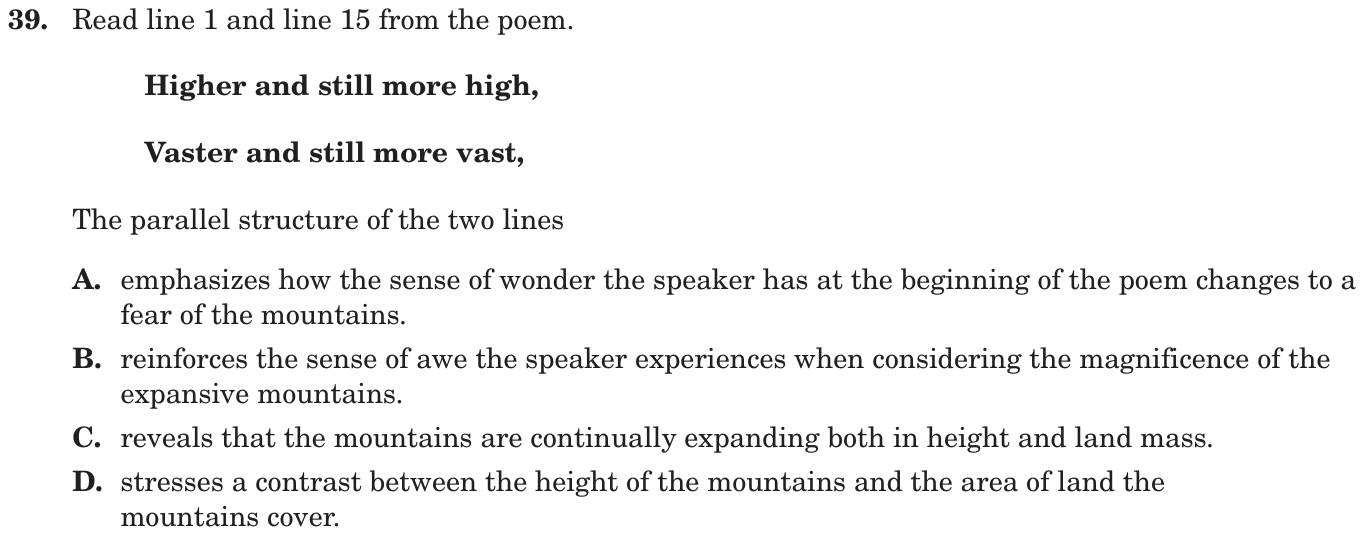
The passage “Snowy Mountains” as printed (page 142)
Question 18 of 18
2018 Test B English, question 41Uses the passage above: “Snowy Mountains”.
Question
How does isolating the word “Uprise” in line 7 affect the meaning of the poem?
- AIt creates a contrast between the great plateau and the city buildings.
- BIt reveals the similarity between the tall buildings in the city and the tall mountains on the horizon.
- CIt creates a vision of the region before people developed the land.
- DIt emphasizes that the mountains dominate the landscape.
Show the answer
Correct answer: D
The question asks how the isolation of the word affects the meaning of the poem. The isolation of the word “Uprise” powerfully emphasizes the first stanza’s description of the magnificent mountains standing tall above the land below, as expressed in Option D.
Option A is incorrect because the word describes the mountains and, therefore, does not create a contrast between the plateau and the city buildings, but rather between the mountains and the plateau.
Option B is incorrect because the word contrasts the mountains with the plateau; it does not compare the mountains to the buildings in the city.
Option C is incorrect because the first stanza describes the already developed land over which the mountains rise.
Question analysis
In “Snowy Mountains,” the opening stanza builds a long sentence about the mountains and saves its verb, “Uprise,” for a line of its own. This poetry structure question asks how isolating that single word affects the poem’s meaning, so students need to think about how a line break shapes what the reader notices, as well as about what the stanza describes.
- Grade level
- Grade 8 reading and task
- Compared with grade 7
- At grade 7 Grade 7 poetry questions often ask about word choice; this one asks about a structural choice, a one-word line, which is less familiar, though the stanza’s images make the intended effect fairly easy to sense.
- Estimated difficulty
- Moderate: several steps, or a close reading with one strong distractor.
- Thinking it demands
- Depth of knowledge 2, skills and concepts · mainly analyze
- What makes it hard
- Complex sentences moderate
- How, not what moderate
- Evidence
- Answered from one paragraph or stanza
- Reading level
- Passage: 161 words (a poem; reading level not measured); question and choices: about grade 8, 64 words.
- Students, last 30 days
- Not enough answers yet to show (it takes 10).
Why it is hard, traps and wrong answers (shows the answer)
Why it is hard
Students who see that “Uprise” is the verb the whole stanza has been building toward recognize the effect quickly: the mountains rise over everything else in the picture. Those who treat the word as one more image look for a comparison instead and find several, because the stanza is full of buildings, roofs and a plateau. The real test is sorting which contrast belongs to the mountains.
Complex sentences moderate Understanding the question
The stanza is one long sentence that withholds its subject until line 6 and its verb until line 7, so “Uprise” lands as the payoff of five lines of images. (Abedi & Lord, 2001; Freedle & Kostin, 1993; Messick, 1989)
How, not what moderate Working it out
The question asks about a line break, a structural choice, rather than a word’s meaning, and students must judge what setting one verb on its own line makes the reader notice. (Anderson & Krathwohl, 2001)
Strategy: Read the stanza aloud and notice where the long sentence finally reaches its verb, then ask what ending on that single word makes the reader see.
Traps
- Taking figurative language literally: A choice reads a figure of speech or image at face value.
- Half right: One half of a two-part choice is right and the other is not.
The wrong answers, classified
A Half right (King et al., 2004; Thissen, Steinberg & Fitzpatrick, 1989)
Rightly senses a contrast in the stanza but pairs the wrong things: “Uprise” sets the mountains against the land below them, not the plateau against the city’s buildings.
B Twists what the text says (King et al., 2004)
Notices that the mountains are compared to “Palaces” and “Pillars,” but those grand buildings are set against the “dingy city-roofs,” so the stanza contrasts mountains and city rather than likening them.
C Taking figurative language literally (Graesser, Singer & Trabasso, 1994)
Takes “Uprise” at face value, as mountains pushing up out of the plateau long ago, but line 3’s “dingy city-roofs” place the scene in a land already built on.
Working it out, step by step
Figure out what the question asks
This asks about a choice the poet made in how the poem looks. Line 7 is only one word: “Uprise.” You need to say what setting that word alone on its line does to the meaning.
Find the sentence the word ends
The whole first stanza is one long sentence. Lines 1 to 5 are a string of pictures: palaces, angels, pillars. The subject, “The mountains from the great plateau,” does not come until line 6. Line 7 then gives the verb, or action word, which is “Uprise.” A plateau is a wide area of high, flat land.
Think about the effect
“Uprise” means rise up. The reader waits six lines for this action. Then it stands by itself, like the mountains standing alone over the land. The short line makes you stop and picture them rising above everything, even “the dingy city-roofs.” So the mountains dominate the scene. To dominate is to tower over and be the main thing you notice.
Check each choice
- A is wrong. “Uprise” is about the mountains rising. It does not set the plateau against the city buildings.
- B is wrong. The stanza does not show the city and the mountains as alike. The city roofs are “dingy,” while the mountains are like palaces.
- C is wrong. Line 3 already shows a city, so this is not the land before people.
- D fits. The lone word makes the mountains tower over the whole picture.
Choose the answer
Ending the long sentence on one lone word makes the mountains stand out over everything. So the answer is D, “It emphasizes that the mountains dominate the landscape.”
Why this answer and not the closest wrong one
A is the closest trap, because the stanza does contain a contrast. But it is between the mountains and everything below them. “Uprise” is the mountains’ own action, so its effect must be about the mountains. Only D keeps the focus there.
More questions like this
The original DOE question