Area and perimeter
Question 1 of 21
2026 Practice Test C Math, question 23Question
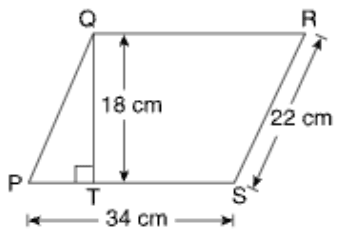
On parallelogram PQRS above, the length of is 18 centimeters. What is the area of the parallelogram?
- A112 sq cm
- B396 sq cm
- C612 sq cm
- D748 sq cm
Show the answer
Correct answer: C
PQRS is a parallelogram in which PS is a base and QT is an altitude. The base is 34 cm in length, and the height is the length of the altitude, so the height is 18 cm.
To determine the area of a parallelogram, multiply the base × the height:
Question analysis
Parallelogram PQRS is drawn with a 34 cm base PS, a 22 cm slanted side and an 18 cm segment QT at a right angle to the base, and students find its area. It tests the area formula for a parallelogram. One labeled length is not needed, so the base and height that go together have to be chosen.
- NYS standards
- 6.G.1 area of polygons
- Grade level
- Grade 6 content, by NYS standard
- Compared with grade 7
- Below grade 7 The area of a parallelogram is grade 6 content, used here once with the height already drawn and labeled. Grade 7 area tasks usually involve circles, composite shapes or scale drawings, so this is easier.
- Estimated difficulty
- Routine: one familiar step, little to misread.
- Thinking it demands
- Depth of knowledge 1, recall and reproduction · mainly apply
- What makes it hard
- Solution
- 1 step
- Reading level
- Question and choices: about grade 5, 25 words.
- Students, last 30 days
- Not enough answers yet to show (it takes 10).
Why it is hard, traps and wrong answers (shows the answer)
Why it is hard
One multiplication answers the question once the right pair of lengths is chosen. Each wrong choice pairs or combines the labeled lengths in another way: the two sides as for a rectangle, the height with the slanted side, or all four sides as a perimeter. Following the right-angle mark at T from QT down to PS identifies the base and height that belong together.
Reading a figure, table or graph minor Understanding the question
Three lengths are labeled, 34 cm, 18 cm and 22 cm, but only the base PS and the height QT meet at the right-angle mark; the slanted side RS is not needed. (Lesh, Post & Behr, 1987; Kirsch & Mosenthal, 1990)
Something you must already know minor Working it out
The formula, base times height, is not given, and the height must be the perpendicular distance between two sides, not the length of a slanted side. (Anderson & Krathwohl, 2001)
Strategy: Multiply the base by the height measured at a right angle to it, and check that the length you use as the height meets that base at a right-angle mark.
Traps
- Wrong formula: Uses a related but wrong formula: perimeter for area, diameter for radius, area for volume, or a misremembered one.
- Information you don't need: The question gives numbers or facts that play no part in the answer.
The wrong answers, classified
A Wrong formula (King et al., 2004)
Adds all four sides, 2 × (34 + 22) = 112, finding the perimeter of the parallelogram instead of its area.
B Misreads the figure (Lesh, Post & Behr, 1987; Kirsch & Mosenthal, 1990)
Multiplies the 18 cm height by the 22 cm slanted side, a pair that does not meet at a right angle, getting 396.
D Wrong formula (King et al., 2004)
Multiplies the two side lengths, 34 × 22 = 748, as if a parallelogram's area were side times side like a rectangle's.
Worked solution, step by step
Formulas used
- Area of a parallelogram
- A is the area. b is the base, the side the shape sits on. h is the height, the straight-up distance from the base to the opposite side, at a right angle to the base. It works because you can cut a triangle off one end, move it to the other end, and make a rectangle.
Sort out the question
PQRS is a parallelogram, a four-sided shape whose opposite sides are parallel. The figure shows three lengths. Side PS, the bottom, is 34 cm. Segment QT goes straight down from Q to PS and is 18 cm. Side RS is slanted and is 22 cm. You need the area, in square centimeters.
Pick the base and the height
The base is PS, 34 cm. The height must meet the base at a right angle. The small square at T shows that QT does. So the height is QT, 18 cm.
Watch out: the 22 cm side is slanted, so it is not the height. Multiplying 22 × 18 gives 396, choice B.
Multiply the base by the height
Use the area formula:
Break it up to multiply:
The area is 612 square centimeters.
Choose the answer
Watch out: 34 × 22 = 748, choice D, treats the shape like a rectangle. Adding all four sides gives 112, choice A. That is the perimeter, the distance around.
So the answer is C, 612 sq cm.
Check your answer
Estimate: 34 is about 30 and 18 is about 20, and . 612 is close. Also, the area must be less than , because the height is shorter than the slanted side.
More questions like this
The original DOE question
Question 2 of 21
2026 Practice Test D Math, question 8Question
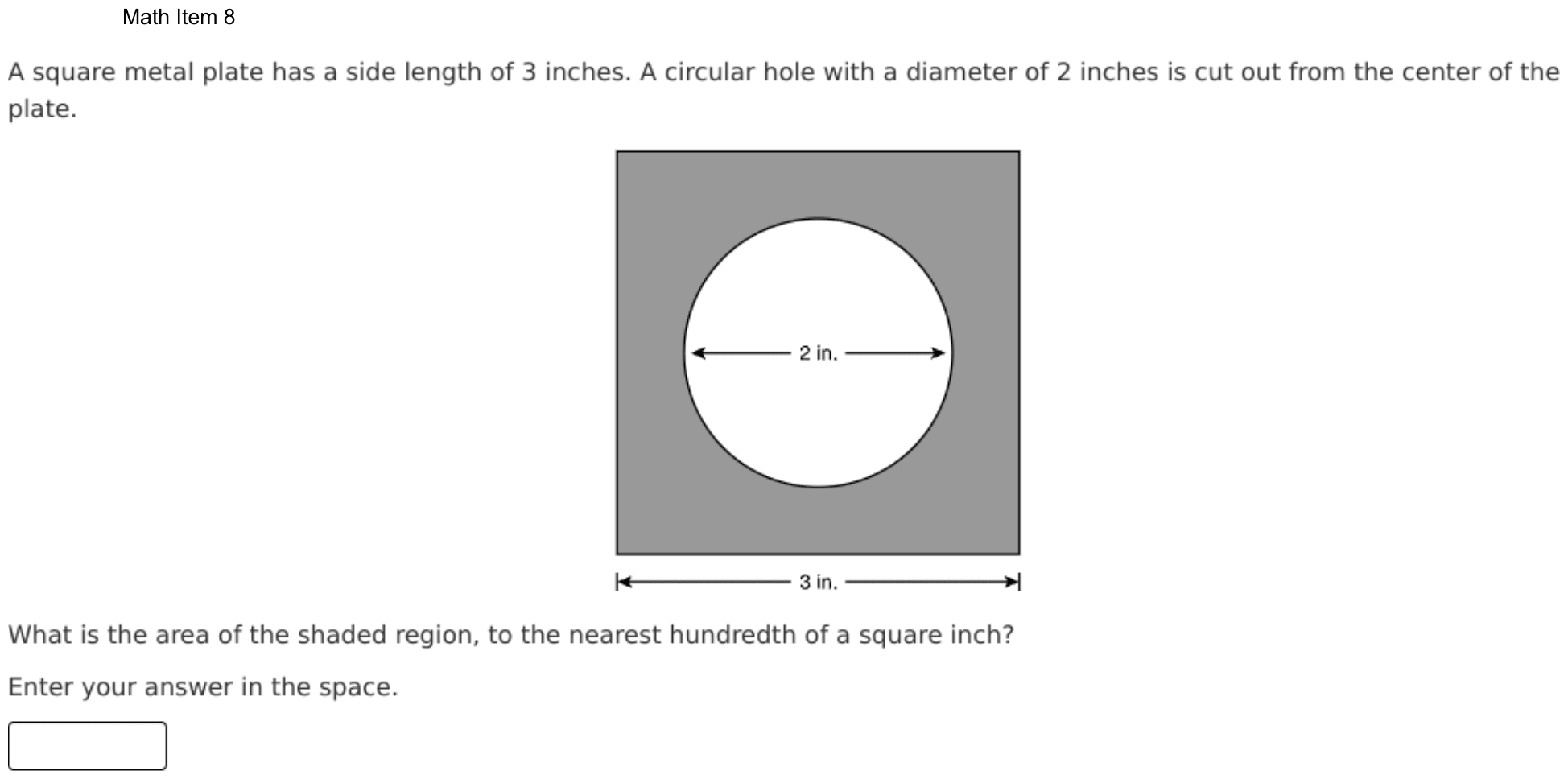
A square metal plate has a side length of 3 inches. A circular hole with a diameter of 2 inches is cut out from the center of the plate.
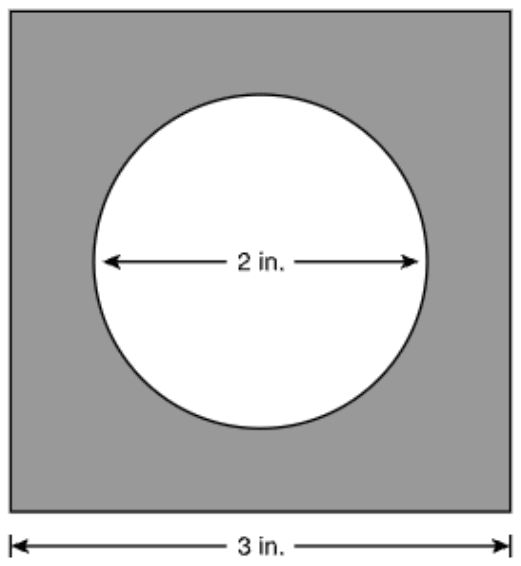
What is the area of the shaded region, to the nearest hundredth of a square inch?
Enter your answer in the space.
Fill-in question: work out the answer and type it as a number.
Show the answer
Correct answer: 5.86
To determine the area of a square, use .
Begin by finding the length of the side of the square, which is 3 inches. The area of the square is .
To determine the area of the circle, use .
The radius of the circle (the hole) is one-half the diameter or , so the area of the entire circle is
To determine the area of the shaded region, subtract the area of the hole in the square from the area of the square:
The shaded area to the nearest hundredth of a square inch sq in.
Question analysis
A 3-inch square metal plate has a circular hole 2 inches across cut from its center, and students find the area of the metal that is left, to the nearest hundredth of a square inch. It tests the areas of a circle and a square. Using the radius, not the diameter, and subtracting the right areas are the keys.
- NYS standards
- 7.G.4 circle area and circumference
- Grade level
- Grade 7 content, by NYS standard
- Compared with grade 7
- At grade 7 Finding a circle's area is a grade 7 standard, and subtracting a hole from a shape is common grade 7 practice. The radius must come from the diameter and the result must be rounded, but the steps are routine.
- Estimated difficulty
- Straightforward: two steps or one careful reading.
- Thinking it demands
- Depth of knowledge 2, skills and concepts · mainly apply
- What makes it hard
- Something you must already know moderate
- Combines ideas minor
- An answer in an unexpected form minor
- Solution
- 3 steps
- Reading level
- Question and choices: about grade 4, 49 words.
- Corrected from the DOE handbook
- A wrong symbol in the explanation was corrected.
- Students, last 30 days
- Not enough answers yet to show (it takes 10).
Why it is hard, traps and wrong answers (shows the answer)
Why it is hard
Every number is small, so the work is choosing the right pieces: the area of the square, the area of the hole, and the difference. A radius of 1 makes the circle's area simply π, which is easy to confuse with the circumference, 2π, when the formulas are half remembered. The region asked for is the gray metal, not the hole, and the final rounding goes up, since the third decimal place is 8.
Something you must already know moderate Working it out
Neither area formula is given, and the hole is labeled by its 2-inch diameter, so students must recall A = πr² and halve the diameter to get the radius 1 first. (Anderson & Krathwohl, 2001)
Combines ideas minor Working it out
The shaded metal is a square with a circle removed, so two area formulas are combined by subtraction rather than either one used alone. (Embretson, 1998; Daniel & Embretson, 2010)
An answer in an unexpected form minor Choosing the answer
The result is typed to the nearest hundredth with no choices to compare, so the long decimal 5.858… must be rounded up, not cut off after two places. (Enright, Morley & Sheehan, 2002)
Strategy: Halve the diameter to get the radius, find the area of the square and of the circle, subtract the circle from the square, and round only at the end.
Traps
- Answers a different question: A choice is right for another quantity: the other unknown, the rest instead of the part, the part instead of the whole.
- Wrong formula: Uses a related but wrong formula: perimeter for area, diameter for radius, area for volume, or a misremembered one.
- A formula you must know: Needs a formula the test does not give: area, circumference, volume, probability rules.
The wrong answers, classified
2.72 Wrong formula (King et al., 2004)
Uses the circumference, 2π × 1 ≈ 6.28, in place of the circle's area and subtracts it from the square's 9 square inches, getting about 2.72.
3.14 Answers a different question (King et al., 2004; Hegarty, Mayer & Monk, 1995)
Finds the area of the circular hole, π × 1² ≈ 3.14 square inches, and enters it instead of the area of the shaded metal left around it.
5.85 Rounds too early (King et al., 2004)
Works the area out correctly as about 5.858 but cuts off the extra digits instead of rounding up to the nearest hundredth.
What was corrected from the DOE handbook, and why
- Explanation: The DOE’s explanation gives the area of the hole as “π(1 in.)² ≅ 3.14 sq in.” The symbol ≅ means “is congruent to”, which an area and a number cannot be; the line means “is approximately equal to”, written ≈. The site now says “π(1 in.)² ≈ 3.14 sq in.”
Worked solution, step by step
Formulas used
- Area of a square
- A is the area, the amount of flat space inside. s is the length of one side. s² means s × s. It works because a square with side s holds s rows of s little unit squares.
- Area of a circle
- A is the area. r is the radius, the distance from the center to the edge. It is half the diameter, the distance straight across through the center. π (pi) is a number a little more than 3, about 3.14. r² means r × r.
Sort out the question
The plate is a square with 3-inch sides. A circle with a 2-inch diameter is cut out of the middle. The diameter is the distance straight across the circle through its center. The shaded region is the metal that is left. You need its area to the nearest hundredth of a square inch.
Find the area of the square
Use the formula for the area of a square, with s = 3 inches:
The whole plate, before the hole is cut, is 9 square inches.
Find the radius of the hole
The circle formula needs the radius, not the diameter. The figure labels the 2 in. distance across the hole. The radius is half of it:
The radius is 1 inch.
Find the area of the hole
Use the formula for the area of a circle, with r = 1 inch:
The sign ≈ means is about equal to. The hole is about 3.14 square inches.
Watch out: 2πr is the circumference, the distance around the circle, not its area. Using it gives 9 − 6.28 = 2.72. And 3.14 is the hole, not the metal, so do not stop there.
Subtract the hole from the square
The shaded metal is the square with the circle taken away:
The shaded region is about 5.86 square inches.
Round and enter the answer
With more digits of π, 3.1416, you get 9 − 3.1416 = 5.8584. The digit after the hundredths place is 8, which is 5 or more, so round up to 5.86. Chopping it to 5.85 is wrong. Type only the number, with no units.
So you would enter 5.86.
Check your answer
The hole is a bit more than a third of the plate, since 3.14 is a bit more than 9 ÷ 3 = 3. So the metal left should be a bit less than two thirds of 9, which is 6. The answer 5.86 is just under 6, so it makes sense.
More questions like this
The original DOE question
Question 3 of 21
2026 Practice Test D Math, question 11Question
In a scale drawing of a triangular park, the sides measure 5 inches, 7 inches, and 8 inches. The perimeter of the actual park is 25 miles. What is the actual length of the shortest side of the park?
- A6.25 mi
- B8.75 mi
- C10 mi
- D15.625 mi
Show the answer
Correct answer: A
To find the perimeter of a triangle, add the measures of the three sides. The perimeter of the scale drawing is inches.
Now, use the perimeters to find the scale factor for the scale drawing to the actual perimeter.
The scale factor is 20 inches to 25 miles, which reduces to a scale factor of 4 inches to 5 miles. Note that the scale for the perimeter is the same as the scale for the side lengths.
Since the smallest side on the scale drawing is 5 inches, use the scale factor to find the actual side length of the smallest side:
Question analysis
A scale drawing of a triangular park has sides of 5, 7 and 8 inches, and the real park's perimeter is 25 miles. Students find the actual length of the park's shortest side. It tests scale drawings and proportional reasoning; the scale is not given directly, so it must be worked out from the two perimeters first.
- Grade level
- Grade 7 content, by NYS standard
- Compared with grade 7
- At grade 7 Scale drawings are a grade 7 topic, and this is a standard scale problem. The one twist is that the scale is not stated: it must come from comparing the two perimeters before any side can be converted.
- Estimated difficulty
- Straightforward: two steps or one careful reading.
- Thinking it demands
- Depth of knowledge 2, skills and concepts · mainly apply
- What makes it hard
- Turning words into math minor
- Many steps minor
- Solution
- 3 steps
- Reading level
- Question and choices: about grade 2, 39 words.
- Students, last 30 days
- Not enough answers yet to show (it takes 10).
Why it is hard, traps and wrong answers (shows the answer)
Why it is hard
A scale drawing multiplies every length by one factor, and the perimeter shares that factor, so the work is short once the two perimeters are paired. The common loss is reasoning with differences: the perimeter grows by 5, so a side seems to grow by 5 as well. Converting to miles per inch first, then checking that the three real sides add back to 25 miles, guards against that error and against scaling the wrong side.
Turning words into math minor Understanding the question
The 25 miles is the park's perimeter, not a side, so it must be matched with the drawing's perimeter, 5 + 7 + 8 = 20 inches, before any side can be scaled. (Hegarty, Mayer & Monk, 1995; Koedinger & Nathan, 2004)
Many steps minor Working it out
Three operations in a row, adding the sides, dividing 25 by 20 for 1.25 miles per inch, and multiplying the 5-inch side, each produce a number the next step needs. (Daniel & Embretson, 2010; Enright, Morley & Sheehan, 2002)
Strategy: Add the three drawn sides to get the drawing's perimeter, divide the real perimeter by it to find the miles per inch, then multiply the shortest drawn side by that scale.
Traps
- Answers a different question: A choice is right for another quantity: the other unknown, the rest instead of the part, the part instead of the whole.
- Misreads the question: Misses or misreads a condition or a word in the question: "at least", "each", "remaining", "not".
The wrong answers, classified
B Answers a different question (King et al., 2004; Hegarty, Mayer & Monk, 1995)
Finds the scale of 1.25 miles per inch but applies it to the 7-inch side, the middle one, giving 8.75 miles instead of the shortest side.
C Misunderstands the concept (Smith, diSessa & Roschelle, 1993; De Bock et al., 1998; Ni & Zhou, 2005)
Keeps a constant difference instead of a constant ratio: the perimeter grows by 5, from 20 to 25, so it adds 5 to the 5-inch side.
D Misreads the question (Hegarty, Mayer & Monk, 1995)
Pairs the 25 miles with the longest side, 8 inches, instead of the 20-inch perimeter, so each inch seems to be 3.125 miles and 5 inches 15.625.
Worked solution, step by step
Formulas used
- Perimeter of a triangle
- P is the perimeter, the distance all the way around. a, b and c are the lengths of the three sides. You add them because going once around the triangle covers each side once.
- Using a scale
- The drawing length is measured on the drawing, in inches. Miles per inch is how many real miles each inch stands for. In a scale drawing, every length is multiplied by the same number, so the perimeter and each side use the same scale.
Sort out the question
A scale drawing is a smaller copy, with every length shrunk by the same amount. The drawing’s sides are 5, 7 and 8 inches. The real park’s perimeter, the distance all the way around, is 25 miles. You need the real length of the shortest side.
Find the drawing’s perimeter
Add the three sides of the drawing:
The drawing’s perimeter is 20 inches. It stands for the real perimeter of 25 miles.
Watch out: 25 miles is the whole way around, not one side. Matching it with the 8-inch side gives 15.625 miles, choice D.
Find the scale
20 inches stand for 25 miles. Divide to find how many miles 1 inch stands for:
So each inch on the drawing is 1.25 miles in the park.
Scale the shortest side
The shortest side on the drawing is 5 inches. Multiply it by the scale:
The real shortest side is 6.25 miles.
Watch out: the perimeter grew by 5, from 20 to 25, but you cannot just add 5 to a side. That gives 10 miles, choice C. Scaling multiplies. Also use the 5-inch side, not the 7-inch side, which gives 8.75 miles, choice B.
So the answer is A, 6.25 mi.
Check your answer
Scale all three sides: 5 × 1.25 = 6.25, 7 × 1.25 = 8.75 and 8 × 1.25 = 10. Add them: 6.25 + 8.75 + 10 = 25 miles. That is the park’s perimeter, so the scale is right.
More questions like this
The original DOE question
Question 4 of 21
2026 Practice Test D Math, question 48Question
The perimeter of square W is twice the perimeter of equilateral triangle X. What is the ratio of the length of one side of square W to the length of one side of equilateral triangle X?
- A3:8
- B2:3
- C3:2
- D2:1
Show the answer
Correct answer: C
First, set up the ratio of the perimeter of the square to the triangle as 2:1 because the question states that the perimeter of the square is twice the perimeter of the triangle.
Recognizing that the square has 4 equal sides and that an equilateral triangle has 3 sides, use division to find the ratio of the sides.
Perimeter:
Sides:
Question analysis
The perimeter of square W is twice the perimeter of equilateral triangle X, and students find the ratio of a side of the square to a side of the triangle. This ratio question uses perimeters of regular shapes with no lengths given. Turning a comparison of perimeters into one of sides, and keeping the ratio in the order asked, are the tricky parts.
- NYS standards
- Grade level
- Grade 7 content, by NYS standard
- Compared with grade 7
- Above grade 7 Grade 7 ratio problems usually supply numbers to work with. This one gives only a relationship between two perimeters, so students must bring in the number of sides of each shape themselves and keep the ratio in the order asked.
- Estimated difficulty
- Hard: combines ideas, needs a plan, and has more than one tempting wrong answer.
- Thinking it demands
- Depth of knowledge 2, skills and concepts · mainly apply
- What makes it hard
- Turning words into math moderate
- Variables instead of numbers moderate
- A very close wrong answer minor
- Solution
- 3 steps
- Reading level
- Question and choices: about grade 9, 36 words.
- Students, last 30 days
- Not enough answers yet to show (it takes 10).
Why it is hard, traps and wrong answers (shows the answer)
Why it is hard
The question turns a statement about perimeters into a ratio of sides, and the natural guess, that the sides keep the perimeters’ 2 to 1, ignores that the square shares its perimeter among 4 sides and the triangle among 3. Choosing a triangle perimeter such as 12 makes the comparison concrete. The order of the ratio still has to be checked at the end, because its reverse is listed too.
Turning words into math moderate Understanding the question
“The perimeter of square W is twice the perimeter of equilateral triangle X” must become 4s = 2 × 3t, with the 2 on the triangle’s side; written backward, it gives the triangle the larger perimeter. (Hegarty, Mayer & Monk, 1995; Koedinger & Nathan, 2004)
Variables instead of numbers moderate Understanding the question
No side length is given, so students must either work with letters for the two sides or choose a convenient perimeter themselves, such as 12 for the triangle. (Koedinger & Nathan, 2004; Enright, Morley & Sheehan, 2002)
A very close wrong answer minor Choosing the answer
The ratios 3:2 and 2:3 use the same two numbers, so only keeping the square’s side first, as the question orders it, separates the answer from its reverse. (Embretson & Wetzel, 1987; Gorin & Embretson, 2006; Ascalon et al., 2007)
Strategy: Pick an easy side length for the triangle, find its perimeter, double that for the square, divide by the square's number of sides, and write square to triangle.
Traps
- Misunderstands the concept: A wrong belief about a concept: that percents can be added, that area grows like length, that averages can be averaged, that a bigger denominator means a bigger fraction.
- Wrong operation: Adds instead of multiplying, divides the wrong way round, turns a ratio or rate upside down, or undoes a step in the wrong direction (subtracts what should be added back).
- Equation written backwards: Writes a comparison the wrong way round, word for word: "six times as many students as professors" as 6S = P. The bigger quantity gets the bigger number.
The wrong answers, classified
A Equation written backwards (Clement, Lochhead & Monk, 1981)
Writes the comparison backward, 2 × 4s = 3t, giving the triangle the larger perimeter, so the ratio of the sides comes out 3:8.
B Wrong operation (Hegarty, Mayer & Monk, 1995; King et al., 2004)
Finds the right relationship but turns the ratio upside down, giving the triangle’s side to the square’s instead of the square’s side first.
D Misunderstands the concept (Smith, diSessa & Roschelle, 1993; De Bock et al., 1998; Ni & Zhou, 2005)
Assumes the sides are in the same ratio as the perimeters, 2:1, ignoring that the square has 4 sides and the triangle only 3.
Worked solution, step by step
Formulas used
- Perimeter of a square
- P is the perimeter, the distance around the shape. s is the length of one side. A square has 4 equal sides, so its perimeter is 4 times one side.
- Perimeter of an equilateral triangle
- An equilateral triangle has 3 equal sides. t is the length of one side. So its perimeter is 3 times one side.
- Ratio
- A ratio compares two amounts in order. a : b means a compared with b. The order matters, so write the amounts in the order the question names them.
Sort out the question
Square W has a perimeter twice as long as the perimeter of triangle X. Equilateral means all 3 sides of X are equal.
You need the ratio of one side of the square to one side of the triangle, in that order. No lengths are given, so you can pick a size to try.
Pick a size for the triangle
Choose an easy side length for the triangle, such as 2 units. All 3 sides are 2, so its perimeter is:
Find the square’s side
The square’s perimeter is twice the triangle’s:
The square has 4 equal sides, so divide by 4:
Each side of the square is 3 units.
Write the ratio in order
The square comes first, then the triangle. Their sides are 3 and 2, so the ratio is 3 : 2.
Watch out: 2 : 1, choice D, compares the perimeters, not the sides. The square splits its perimeter into 4 sides, the triangle into only 3. Choice B, 2 : 3, puts the triangle first. Choice A, 3 : 8, comes from giving the triangle the bigger perimeter.
So the answer is C, 3:2.
Check your answer
Try a different size. Give the triangle sides of 4. Its perimeter is 12, so the square’s is 24. Each side of the square is . The ratio 6 : 4 simplifies to 3 : 2. The size does not change the ratio.
More questions like this
The original DOE question
Question 5 of 21
2024 Test A Math, question 14Question
A museum has a room in the shape of a rectangle. The area of the floor is 960 square feet. In a scale drawing of the museum, 1 inch = 20 feet. If the length of the room is 2 inches in the scale drawing, what is the width of this room in the scale drawing?
- A in.
- B in.
- C24 in.
- D40 in.
Show the answer
Correct answer: A
The scale is 1 inch = 20 feet, and the length in the scale drawing is 2 inches, so the actual length is 40 feet.
The actual width is 24 feet.
Let x equal the width of the scale drawing, in inches.
Question analysis
A scale drawing problem: a museum room has a floor area of 960 square feet, the drawing's scale is 1 inch to 20 feet, and the room is 2 inches long in the drawing. Students find the room's width in the drawing. They must move between drawing inches and real feet, and back again, without mixing them.
- Grade level
- Grade 7 content, by NYS standard
- Compared with grade 7
- At grade 7 Scale drawings are grade 7 content, and grade 7 tasks usually convert one length. This one converts to real size, uses the area to find a second side, and converts back: three steps with a units trap.
- Estimated difficulty
- Moderate: several steps, or a close reading with one strong distractor.
- Thinking it demands
- Depth of knowledge 2, skills and concepts · mainly apply
- What makes it hard
- Combines ideas moderate
- Much to keep track of minor
- Solution
- 3 steps
- Reading level
- Question and choices: about grade 2, 57 words.
- Students, last 30 days
- Not enough answers yet to show (it takes 10).
Why it is hard, traps and wrong answers (shows the answer)
Why it is hard
Scale questions usually convert one length; this one needs a round trip, from the drawing to the real room and back. The real width of 24 feet appears partway through and is a choice, so students who lose track of units stop there. The last conversion, 24/20, then has to be written as a mixed number, and its fraction part is where a hurried student slips.
Combines ideas moderate Working it out
The 960 square feet is a real-world area, so the scale cannot be applied to it directly; the length must go to feet, the width come from the area, and then return to inches. (Embretson, 1998; Daniel & Embretson, 2010)
Much to keep track of minor Working it out
Four lengths in two units are in play, 2 inches, 40 feet, 24 feet and the width on the drawing, and each must stay labeled with its unit. (Sweller, 1988; Carpenter, Just & Shell, 1990)
Strategy: Convert the 2-inch length to real feet, divide the area by it to get the real width, then use the scale to change that width back to inches.
Traps
- Units or scale: The answer is wanted in other units, or a rate or scale must be converted first.
- Answers a different question: A choice is right for another quantity: the other unknown, the rest instead of the part, the part instead of the whole.
The wrong answers, classified
B An arithmetic slip (Junker & Sijtsma, 2001)
Gets the real width of 24 feet and divides by 20 correctly, but writes the remainder 4/20 as 1/4 instead of 1/5.
C Units or scale (King et al., 2004)
Finds the room's real width, 960 ÷ 40 = 24 feet, and gives it as the drawing's width without converting back at 1 inch per 20 feet.
D Answers a different question (King et al., 2004; Hegarty, Mayer & Monk, 1995)
Converts the 2-inch length to the real 40 feet and gives that number, answering for the length instead of the width and in the wrong units.
Worked solution, step by step
Formulas used
- Area of a rectangle
- A is the area, the space the floor covers. l is the length and w is the width. The floor is like rows of 1-foot squares, with w rows and l squares in each row. So you multiply.
- Using the scale
- The scale says 1 inch on the drawing stands for 20 feet in the real room. The drawing length is in inches, and the real length is in feet. To go back from feet to inches, divide by 20.
Sort out the question
The real room is a rectangle with a floor area of 960 square feet. On the drawing, 1 inch stands for 20 feet. The room is 2 inches long on the drawing. You need its width on the drawing, in inches. The area is in real feet, so you must switch between the drawing and the room.
Find the real length
The real room is 40 feet long. Watch out: 40 is the real length, not the width on the drawing. Choosing 40 in., choice D, is wrong.
Find the real width
Use the area of the rectangle. You know the area and the length.
The real room is 24 feet wide. Watch out: this width is in real feet. Choosing 24 in., choice C, skips changing it back to the drawing.
Change the width to the drawing
Every 20 feet is 1 inch on the drawing. So undo the scale: divide the real width by 20.
To simplify , divide the top and bottom by 4. Watch out: it is , not , so choice B is wrong. So the answer is A, in.
Check your answer
Go the other way. On the drawing, the room is 2 inches by inches. In real feet that is 40 by 24, since . And square feet, the real area.
More questions like this
The original DOE question
Question 6 of 21
2024 Test A Math, question 21Question
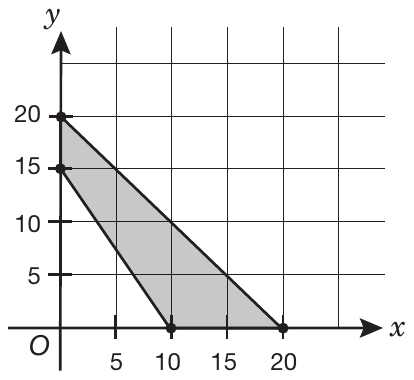
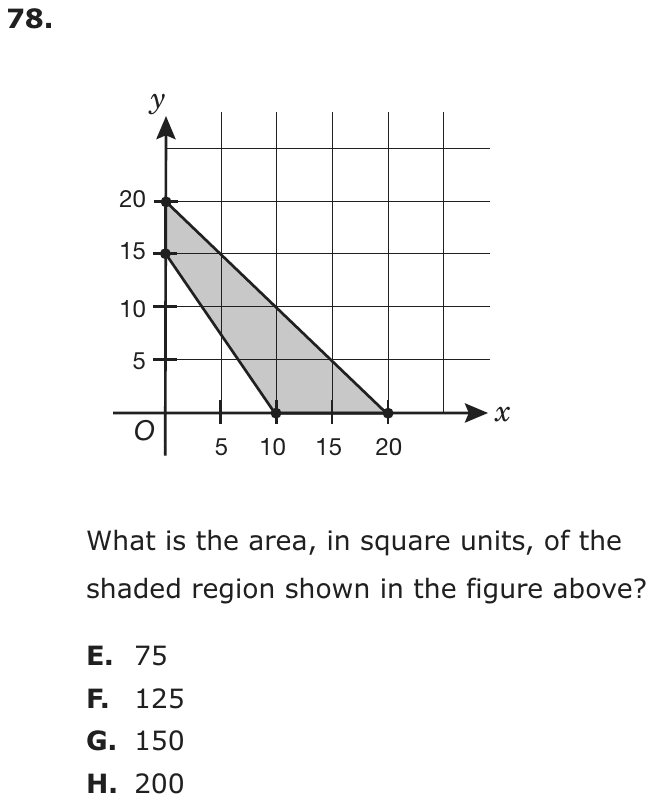
What is the area, in square units, of the shaded region shown in the figure above?
- A75
- B125
- C150
- D200
Show the answer
Correct answer: B
The area of the shaded region, in square units, is the area of the triangle created by the shaded and unshaded regions minus the area of the triangle created by the unshaded region.
The area of the triangle created by the shaded and unshaded regions is 200 square units.
The area of the triangle created by the unshaded region is 75 square units.
Subtract to find the area of the shaded region.
Question analysis
A coordinate geometry question: two line segments cross a grid, one from (0, 20) to (20, 0) and one from (0, 15) to (10, 0), and the region between them is shaded. Students find the shaded area. The shape is not a standard figure, so they need to see it as one triangle with another removed.
- Grade level
- Grade 6 content, by NYS standard
- Compared with grade 7
- At grade 7 Area of triangles is grade 6 content; finding a composite area by subtraction is the kind of task grade 7 students meet regularly. Points on the axes make every length easy to read.
- Estimated difficulty
- Straightforward: two steps or one careful reading.
- Thinking it demands
- Depth of knowledge 2, skills and concepts · mainly apply
- What makes it hard
- Reading a figure, table or graph moderate
- No obvious method minor
- Something you must already know minor
- Solution
- 3 steps
- Reading level
- Question and choices: about grade 6, 16 words.
- Students, last 30 days
- Not enough answers yet to show (it takes 10).
Why it is hard, traps and wrong answers (shows the answer)
Why it is hard
The shaded shape has no name, so the question is about seeing it as a difference of two right triangles whose legs lie on the axes. Once that is seen, both areas are one-line calculations. The wrong choices come from stopping after either triangle or from pairing a base from one segment with a height from the other.
Reading a figure, table or graph moderate Understanding the question
All four lengths come from where the two segments meet the axes, at 20 and 15 on the y-axis and at 10 and 20 on the x-axis, read against grid lines 5 units apart. (Lesh, Post & Behr, 1987; Kirsch & Mosenthal, 1990)
No obvious method minor Working it out
The shaded region is a four-sided shape with no formula of its own; it has to be seen as the large triangle with the small one removed. (Schoenfeld, 1985)
Something you must already know minor Working it out
The area of a triangle, one half of base times height, is assumed and not given. (Anderson & Krathwohl, 2001)
Strategy: Find the area of the large right triangle under the outer segment and subtract the area of the smaller triangle under the inner segment, reading the legs from the axes.
Traps
- Stops one step early: A choice is a number from partway through the solution.
- Answers a different question: A choice is right for another quantity: the other unknown, the rest instead of the part, the part instead of the whole.
- Misreads the figure: Reads a value, label or tick spacing in a figure, table or graph wrongly.
The wrong answers, classified
A Answers a different question (King et al., 2004; Hegarty, Mayer & Monk, 1995)
Finds the area of the small unshaded triangle, 1/2 × 10 × 15 = 75, and gives that region instead of the shaded one.
C Misreads the figure (Lesh, Post & Behr, 1987; Kirsch & Mosenthal, 1990)
Pairs the outer segment's x-intercept, 20, with the inner segment's y-intercept, 15, as if they bounded one triangle: 1/2 × 20 × 15 = 150.
D Stops one step early (King et al., 2004; Gierl et al., 2017)
Finds the area of the large triangle, 1/2 × 20 × 20 = 200, and stops before subtracting the unshaded triangle inside it.
Worked solution, step by step
Formulas used
- Area of a triangle
- A is the area. b is the base, the side the triangle sits on. h is the height: the straight-up distance from the base to the top corner, at a right angle to the base. You take half because a triangle is half of a rectangle with the same base and height.
Sort out the figure
The grid lines are 5 units apart. Two slanted segments run from the y-axis down to the x-axis. The outer one goes from 20 on the y-axis to 20 on the x-axis. The inner one goes from 15 on the y-axis to 10 on the x-axis. The shaded region is the strip between them. You need its area, in square units.
See the shape as two triangles
The shaded region has four sides, and it has no simple formula. But look at the big triangle under the outer segment, with its corner at O. It is the shaded strip plus the small white triangle. So the shaded area is the big triangle minus the small one.
Find the area of the big triangle
The big triangle has a right angle at O. Its base runs along the x-axis from 0 to 20, so it is 20 units. Its height runs up the y-axis from 0 to 20, so it is 20 units.
Watch out: this is the whole big triangle. Stopping here gives 200, choice D.
Find the area of the small triangle
The small triangle also has its right angle at O. Its base is 10 units, from 0 to 10 on the x-axis. Its height is 15 units, from 0 to 15 on the y-axis.
Watch out: 75 is the white triangle, choice A, not the shaded part. Also, pair the base and height of the same triangle. Mixing 20 and 15 gives 150, choice C.
Subtract to find the shaded area
Take the small white triangle away from the big triangle.
The shaded area is 125 square units. So the answer is B, 125.
Check your answer
In the figure, the shaded strip looks bigger than the white triangle. So the shaded area should be more than half of the big triangle, which is . 125 is more than 100. And , the whole big triangle.
More questions like this
The original DOE question
Question 7 of 21
2024 Test A Math, question 26Question
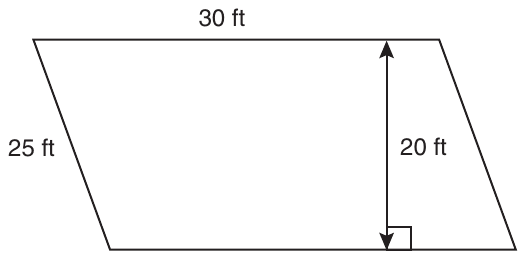
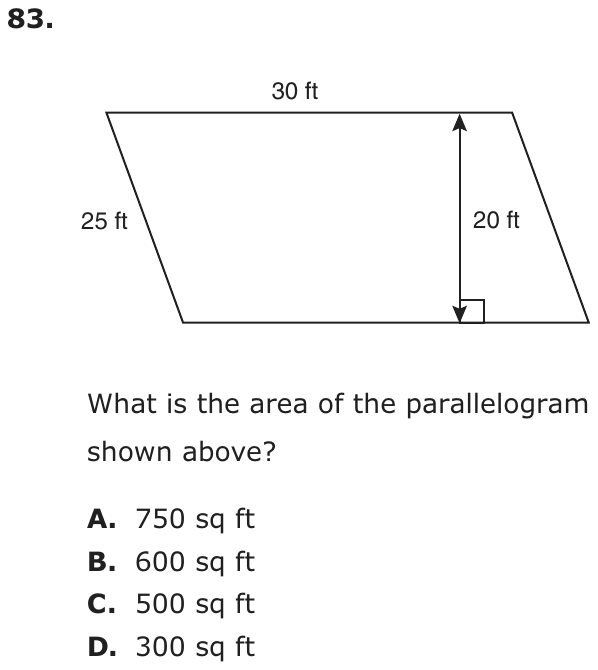
What is the area of the parallelogram shown above?
- A750 sq ft
- B600 sq ft
- C500 sq ft
- D300 sq ft
Show the answer
Correct answer: B
To find the area of a parallelogram, multiply the length of a side by the altitude for that side.
One property of parallelograms is that opposite sides are the same length.
So the bottom side of the parallelogram is 30 feet long and has an altitude of 20 feet.
Therefore, the area of the parallelogram, in square feet, is .
Question analysis
A geometry question with a figure: a parallelogram is labeled with a 30-foot top side, a 25-foot slanted side and a 20-foot height drawn at a right angle. Students find its area. The figure gives one length that is not needed, so students must pick the base and height that belong together.
- NYS standards
- 6.G.1 area of polygons
- Grade level
- Grade 6 content, by NYS standard
- Compared with grade 7
- Below grade 7 Area of a parallelogram is grade 6 content, and this is a one-step use of the formula. It is easier than typical grade 7 area work, which involves composite figures, circles or scale drawings.
- Estimated difficulty
- Routine: one familiar step, little to misread.
- Thinking it demands
- Depth of knowledge 1, recall and reproduction · mainly apply
- What makes it hard
- Solution
- 1 step
- Reading level
- Question and choices: about grade 2, 17 words.
- Students, last 30 days
- Not enough answers yet to show (it takes 10).
Why it is hard, traps and wrong answers (shows the answer)
Why it is hard
This is a one-step formula question with whole numbers, made slightly harder by one length too many. A student who multiplies the two side lengths, as for a rectangle, or brings in a triangle's one half, finds a listed choice. Matching the base to the height marked with a right angle is all it takes.
Reading a figure, table or graph minor Understanding the question
The figure labels three lengths, but only the 30-foot side and the 20-foot height drawn at a right angle to it belong together; the slanted 25-foot side is extra. (Lesh, Post & Behr, 1987; Kirsch & Mosenthal, 1990)
Something you must already know minor Working it out
The parallelogram area formula, base times height, is not given, and its height must be the perpendicular distance, not the slanted side. (Anderson & Krathwohl, 2001)
Strategy: Use base times height, where the height is the perpendicular distance between the two parallel sides chosen as bases.
Traps
- Wrong formula: Uses a related but wrong formula: perimeter for area, diameter for radius, area for volume, or a misremembered one.
- Information you don't need: The question gives numbers or facts that play no part in the answer.
The wrong answers, classified
A Wrong formula (King et al., 2004)
Multiplies the two side lengths, 30 × 25 = 750, as if a parallelogram's area were side times side like a rectangle's.
C Misreads the figure (Lesh, Post & Behr, 1987; Kirsch & Mosenthal, 1990)
Pairs the 20-foot height with the slanted 25-foot side, 25 × 20 = 500, though the height is drawn at a right angle to the 30-foot sides.
D Wrong formula (King et al., 2004)
Uses the triangle formula, 1/2 × 30 × 20 = 300, halving the base times the height.
Worked solution, step by step
Formulas used
- Area of a parallelogram
- A is the area. b is the base, one of the two parallel sides. h is the height: the straight distance between the two parallel sides, at a right angle to the base. It works because you can cut a triangle off one end, move it to the other end and make a rectangle.
Sort out the figure
A parallelogram is a four-sided shape whose opposite sides are parallel. Parallel means they never meet. The figure shows three lengths. The top side is 30 ft. The slanted left side is 25 ft. The arrow from top to bottom is 20 ft, and the small square shows a right angle. You need the area, in square feet.
Choose the base and height
The height must make a right angle with the base. The 20 ft arrow meets the bottom side at a right angle. Opposite sides of a parallelogram are equal, so the bottom side is 30 ft too. So the base is 30 ft and the height is 20 ft. Watch out: the slanted 25 ft side is not needed. Using gives choice C.
Find the area
The area is 600 sq ft. Watch out: do not multiply the two sides, . That is choice A. Do not take half either, which is for triangles and gives 300, choice D. So the answer is B, 600 sq ft.
Check your answer
Picture cutting the triangle off the left end and sliding it to the right end. The shape becomes a rectangle 30 ft long and 20 ft tall, with an area of 600 sq ft. 750 is too big, because the shape is only 20 ft tall, not 25 ft.
More questions like this
The original DOE question
Question 8 of 21
2024 Test A Math, question 31Question
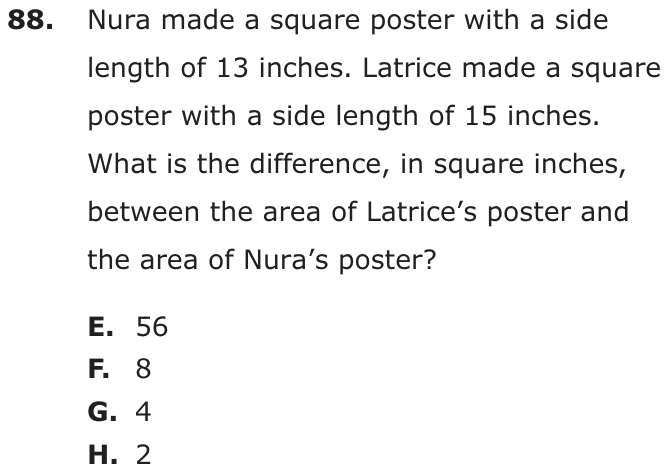
Nura made a square poster with a side length of 13 inches. Latrice made a square poster with a side length of 15 inches. What is the difference, in square inches, between the area of Latrice’s poster and the area of Nura’s poster?
- A56
- B8
- C4
- D2
Show the answer
Correct answer: A
Nura’s poster is square, so all the side lengths are 13 inches. The area, in square inches, is
Latrice’s poster is square, so all the side lengths are 15 inches.
Subtract to determine the difference between the areas.
The difference, in square inches, is 56.
Question analysis
This area word problem compares two square posters, one 13 inches on a side and one 15 inches on a side, and asks for the difference between their areas in square inches. Students square each side length and subtract. Working with the difference in the sides, or with perimeters, instead of the areas is the easy mistake.
- Grade level
- Grade 6 content, by NYS standard
- Compared with grade 7
- Below grade 7 Area of a square is elementary content, and squaring 13 and 15 is grade 6 exponent work. Typical grade 7 area problems involve circles, composite shapes or scale drawings; this one has two familiar areas and a subtraction.
- Estimated difficulty
- Straightforward: two steps or one careful reading.
- Thinking it demands
- Depth of knowledge 2, skills and concepts · mainly apply
- What makes it hard
- Solution
- 3 steps
- Reading level
- Question and choices: about grade 5, 41 words.
- Students, last 30 days
- Not enough answers yet to show (it takes 10).
Why it is hard, traps and wrong answers (shows the answer)
Why it is hard
The method is short, but the question invites a shortcut: the sides differ by 2, so it feels as if the areas should differ by 2 squared. Two choices reward working with the side lengths and one rewards perimeters. Squaring each side before subtracting avoids all three, and a sketch of the 13-inch square inside the 15-inch one shows the gap is an L-shaped strip, far more than 4 square inches.
Something you must already know minor Working it out
The area of a square, side times side, is not given; students must square 13 and 15 themselves rather than work with the side lengths. (Anderson & Krathwohl, 2001)
Error-prone arithmetic minor Working it out
Squaring 13 and 15 by hand gives 169 and 225, and the subtraction 225 − 169 needs a borrow, where an arithmetic slip creeps in. (Brown & Burton, 1978; Junker & Sijtsma, 2001)
Strategy: Find each poster's area by squaring its side length, then subtract the smaller area from the larger; work with the areas, not the side lengths.
Traps
- Wrong formula: Uses a related but wrong formula: perimeter for area, diameter for radius, area for volume, or a misremembered one.
- A faulty procedure: A systematic but wrong procedure: adding fractions straight across, applying an exponent to each term of a sum, dropping a sign when moving a term.
- Answers a different question: A choice is right for another quantity: the other unknown, the rest instead of the part, the part instead of the whole.
The wrong answers, classified
B Wrong formula (King et al., 2004)
Compares perimeters instead of areas, 4 × 15 − 4 × 13 = 60 − 52 = 8, a difference in inches, not square inches.
C A faulty procedure (Brown & Burton, 1978; Tatsuoka, 1983)
Subtracts the sides first and squares the difference, (15 − 13)² = 4, as if 15² − 13² equaled (15 − 13)².
D Answers a different question (King et al., 2004; Hegarty, Mayer & Monk, 1995)
Gives the difference in side lengths, 15 − 13 = 2, a length rather than a difference in area.
Worked solution, step by step
Formulas used
- Area of a square
- A is the area, the flat space inside the shape. s is the length of one side. All four sides of a square are equal, so the area is side times side. The small 2 means squared, or times itself. Area is measured in square units, here square inches.
Write down what you know
Nura’s poster is a square with sides of 13 inches. Latrice’s poster is a square with sides of 15 inches. You need the difference between their areas, in square inches. The difference is how much bigger one area is than the other. So find each area, then subtract.
Find the area of Nura’s poster
Use the area formula with the side of 13 inches.
Nura’s poster has an area of 169 square inches.
Find the area of Latrice’s poster
Use the same formula with the side of 15 inches.
Latrice’s poster has an area of 225 square inches.
Subtract the two areas
Take the smaller area away from the larger one.
The difference is 56 square inches.
Watch out: don’t subtract the sides first and then square. , choice C, is not the same as . The side difference, 2 inches, is choice D, a length. Comparing perimeters, the distance around, gives 8, choice B.So the answer is A, 56 square inches.
Check your answer
Picture Nura’s poster laid in a corner of Latrice’s. The extra part is an L-shaped strip 2 inches wide. One arm is 15 by 2 and the other is 13 by 2. , so the strip is 56 square inches. That matches.
More questions like this
The original DOE question
Question 9 of 21
2024 Test B Math, question 3Question
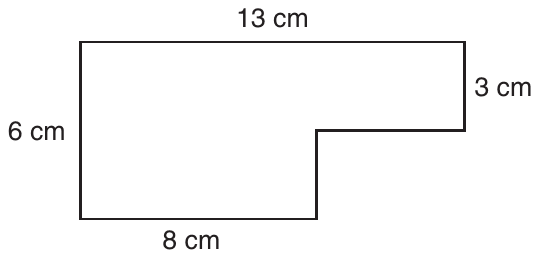
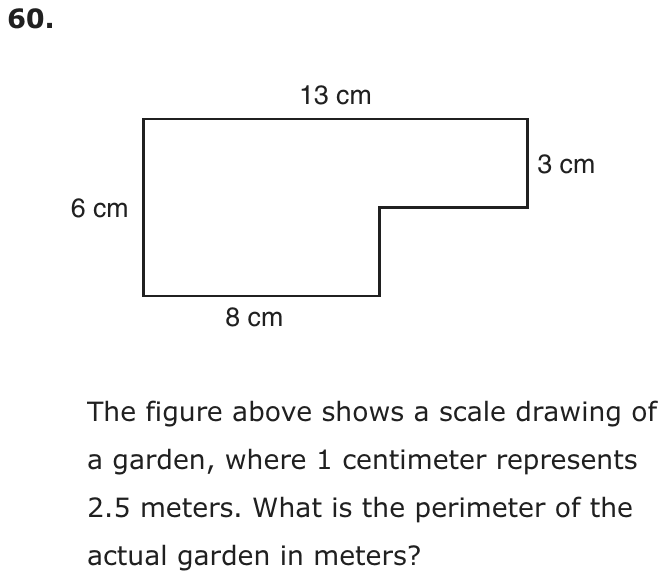
The figure above shows a scale drawing of a garden, where 1 centimeter represents 2.5 meters. What is the perimeter of the actual garden in meters?
Grid-in question: work out the answer and enter it as a number.
Show the answer
Correct answer: 95
First, find the perimeter of the figure.
Two sides do not have labels. The top of the figure measures 13 cm and the bottom shows a length measuring 8 cm, so the horizontal side without a label measures 5 cm .
The left side of the figure measures 6 cm and the right side shows a length measuring 3 cm, so the vertical side without a label measures 3 cm .
So the total perimeter of the scale drawing is
Use the scale to find the perimeter of the actual garden:
Question analysis
A grid-in on a scale drawing of an L-shaped garden, where each centimeter stands for 2.5 meters and two sides carry no labels. Students find the perimeter of the drawing, then convert it to the real garden's perimeter in meters. The unlabeled sides are easy to leave out.
- Grade level
- Grade 7 content, by NYS standard
- Compared with grade 7
- At grade 7 Scale drawings are grade 7 content, and a typical task converts one or two given lengths. Here two missing sides must be worked out and the perimeter assembled before the scale applies, more steps but nothing beyond grade 7.
- Estimated difficulty
- Moderate: several steps, or a close reading with one strong distractor.
- Thinking it demands
- Depth of knowledge 2, skills and concepts · mainly apply
- What makes it hard
- Reading a figure, table or graph moderate
- Combines ideas minor
- An answer in an unexpected form minor
- Solution
- 4 steps
- Reading level
- Question and choices: about grade 9, 24 words.
- Students, last 30 days
- Not enough answers yet to show (it takes 10).
Why it is hard, traps and wrong answers (shows the answer)
Why it is hard
The figure hides the work: it labels four of the six sides, and the missing two are short pieces of the notch that are easy to overlook. Once all six are found, the scale step is a single multiplication, but it must go the right way, since the real garden is larger than the drawing. Tracing the outline and counting six sides guards against the most common loss.
Reading a figure, table or graph moderate Understanding the question
Two sides of the notch carry no labels, so students must find them from the opposite sides: 13 − 8 = 5 cm across and 6 − 3 = 3 cm down. (Lesh, Post & Behr, 1987; Kirsch & Mosenthal, 1990)
Combines ideas minor Working it out
The perimeter of an L-shaped drawing has to be joined to a scale of 2.5 meters per centimeter, two separate skills in one answer. (Embretson, 1998; Daniel & Embretson, 2010)
An answer in an unexpected form minor Choosing the answer
With no choices, nothing flags a perimeter that is missing two sides or still in centimeters; the student must check the six-sided total alone. (Enright, Morley & Sheehan, 2002)
Strategy: Use the opposite sides to work out the two unlabeled lengths, add all six sides of the drawing, then multiply the total in centimeters by 2.5 meters per centimeter.
Traps
- Misreads the figure: Reads a value, label or tick spacing in a figure, table or graph wrongly.
- Stops one step early: A choice is a number from partway through the solution.
- Wrong operation: Adds instead of multiplying, divides the wrong way round, turns a ratio or rate upside down, or undoes a step in the wrong direction (subtracts what should be added back).
The wrong answers, classified
75 Misreads the figure (Lesh, Post & Behr, 1987; Kirsch & Mosenthal, 1990)
Adds only the four labeled sides, 13 + 3 + 8 + 6 = 30 cm, and scales that to 75 m, missing the two unlabeled sides of the notch.
38 Stops one step early (King et al., 2004; Gierl et al., 2017)
Finds the drawing's perimeter, 38 cm, correctly and grids it without applying the scale of 2.5 meters per centimeter.
15.2 Wrong operation (Hegarty, Mayer & Monk, 1995; King et al., 2004)
Divides the 38 cm perimeter by 2.5 instead of multiplying, shrinking the garden though each centimeter of the drawing stands for 2.5 meters.
Worked solution, step by step
Formulas used
- Perimeter
- P is the perimeter, the distance all the way around a shape. Add the length of every side, once each. It works for any shape with straight sides, even one with a corner cut out.
- Using a scale
- s is the scale, the number of meters that 1 centimeter on the drawing stands for. Here s is 2.5. Each centimeter on the drawing is 2.5 meters in real life, so you multiply.
Sort out what you know
The figure is a scale drawing, a small copy of the real garden. Each 1 cm on the drawing stands for 2.5 m in the real garden. You need the perimeter of the real garden in meters. The perimeter is the distance all the way around.
The shape has 6 sides. Four are labeled: 13 cm, 3 cm, 8 cm and 6 cm. The two sides around the cut-out corner have no labels.
Find the missing side across
Look at the top side, 13 cm. Below it, the bottom side (8 cm) and the short unlabeled side across the notch together reach just as far. So the missing side is the difference.
The missing side across is 5 cm.
Find the missing side going down
Now look at the left side, 6 cm. On the right, the 3 cm side and the unlabeled side going down together make the same height.
The missing side going down is 3 cm.
Add all six sides
The perimeter of the drawing is 38 cm. Watch out: adding only the four labeled sides gives 30 cm. That leads to the wrong answer 75.
Change to real meters
Each centimeter stands for 2.5 meters, so multiply by 2.5.
Here and . The real perimeter is 95 meters. Watch out: 38 is still in centimeters, so do not grid it. Dividing by 2.5 gives 15.2, which makes the garden smaller than its drawing.
So you would grid 95.
Check your answer
Slide the two notch sides out to the corner. The distance around stays the same, so it equals a 13 cm by 6 cm rectangle: . Also, 95 meters is more than 38, which fits, because each centimeter stands for more than 1 meter.
More questions like this
The original DOE question
Question 10 of 21
2024 Test B Math, question 54Question
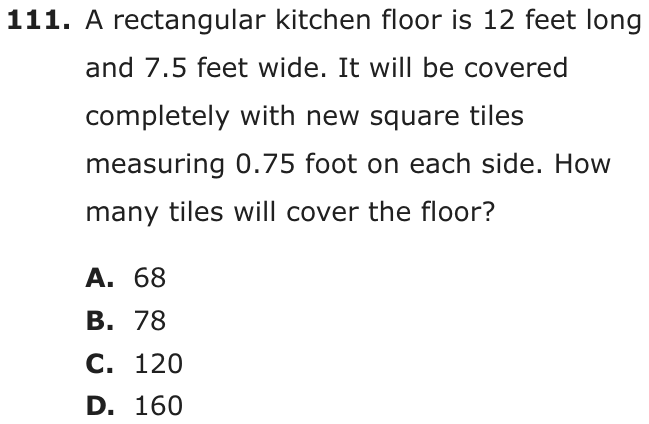
A rectangular kitchen floor is 12 feet long and 7.5 feet wide. It will be covered completely with new square tiles measuring 0.75 foot on each side. How many tiles will cover the floor?
- A68
- B78
- C120
- D160
Show the answer
Correct answer: D
First, determine the area of the kitchen floor in square feet by multiplying the length and width:
Next, determine the area of each square tile:
The number of tiles needed is found by dividing the area of the floor by the area of the tiles:
Question analysis
A rectangular kitchen floor measuring 12 feet by 7.5 feet will be covered with square tiles 0.75 foot on a side. Students find how many tiles are needed. It tests area and division with decimals, and working with a decimal side length while keeping lengths and areas apart is what makes it tricky.
- NYS standards
- Grade level
- Grade 6 content, by NYS standard
- Compared with grade 7
- At grade 7 Area of a rectangle is grade 6 content, but here it combines with dividing by a decimal tile area, or by the tile's side along each wall. Three decimal steps and a tempting shortcut make it typical grade 7 demand.
- Estimated difficulty
- Moderate: several steps, or a close reading with one strong distractor.
- Thinking it demands
- Depth of knowledge 2, skills and concepts · mainly apply
- What makes it hard
- Error-prone arithmetic moderate
- Turning words into math minor
- Solution
- 3 steps
- Reading level
- Question and choices: about grade 6, 31 words.
- Students, last 30 days
- Not enough answers yet to show (it takes 10).
Why it is hard, traps and wrong answers (shows the answer)
Why it is hard
The floor's 90 square feet comes quickly; the trap is what to divide it by. A tile is described by its side, and dividing by 0.75 instead of 0.5625 gives a listed answer that looks reasonable. Counting tiles along each wall, 16 along the length and 10 along the width, avoids both the decimal division and the side-versus-area mistake.
Error-prone arithmetic moderate Working it out
The tile's area, 0.75 × 0.75 = 0.5625 square foot, must divide 90, a decimal division that is easier as 90 × 16/9 or as 16 tiles by 10 tiles. (Brown & Burton, 1978; Junker & Sijtsma, 2001)
Turning words into math minor Understanding the question
The tiles are "square tiles measuring 0.75 foot on each side", a side length, which has to be squared before it can be compared with the floor's area in square feet. (Hegarty, Mayer & Monk, 1995; Koedinger & Nathan, 2004)
Strategy: Find how many tiles fit along the length and how many along the width by dividing each by 0.75, then multiply the two counts.
Traps
- Wrong formula: Uses a related but wrong formula: perimeter for area, diameter for radius, area for volume, or a misremembered one.
- Wrong operation: Adds instead of multiplying, divides the wrong way round, turns a ratio or rate upside down, or undoes a step in the wrong direction (subtracts what should be added back).
The wrong answers, classified
A Wrong operation (Hegarty, Mayer & Monk, 1995; King et al., 2004)
Multiplies the 90-square-foot area by the tile's 0.75-foot side instead of dividing, getting 67.5 and rounding to 68.
B Little reason to choose it (Haladyna & Downing, 1993; Rodriguez, 2005)
No standard working gives 78, which is twice the floor's 39-foot perimeter, 4 × (12 + 7.5), so it mostly draws guesses.
C Wrong formula (King et al., 2004)
Divides the 90 square feet by the tile's side, 0.75 foot, instead of its area, 0.5625 square foot, getting 120 tiles.
Worked solution, step by step
Formulas used
- Area of a rectangle
- A is the area, the flat space inside. l is the length and w is the width. Multiplying counts how many unit squares fit, row by row.
- Area of a square
- A is the area. s is the length of one side. s² means s × s. A square is a rectangle whose length and width are both s.
Sort out the question
The floor is a rectangle 12 feet long and 7.5 feet wide. Each tile is a square, 0.75 foot on each side. You need the number of tiles that cover the whole floor.
Find the floor’s area
Area tells how much flat space the tiles must cover. Use the rectangle formula.
The floor is 90 square feet.
Find one tile’s area
The tile’s side is a length. You need its area to compare it with the floor’s area. Use the square formula.
As a fraction, , so the area is square foot.
Divide the floor by one tile
The number of tiles is the floor’s area divided by one tile’s area. To divide by a fraction, multiply by its reciprocal, the fraction flipped upside down.
Watch out: Dividing 90 by 0.75, the side, gives 120, choice C. You must divide by the tile’s area. Multiplying 90 by 0.75 gives about 68, choice A.
So the answer is D, 160.
Check your answer
Count the tiles in rows. Along the 12-foot length, tiles fit. Along the 7.5-foot width, tiles fit. That makes tiles.
More questions like this
The original DOE question
Question 11 of 21
2024 Test B Math, question 56Question
A rectangular field had a length of 80 meters and a width of 50 meters. The field was recently enlarged, with the length increased by 15% and the width increased by 10 meters. By what percentage was the area of the field increased?
- A26.5%
- B35%
- C38%
- D42.5%
Show the answer
Correct answer: C
The original area of the field was 4,000 square meters.
When the field was enlarged, the length increased by 15%, so the new length is 92 meters.
The width increased by 10 meters, so the new width is 60 meters.
The new area of the field is 5,520 square meters.
The percent increase is found by finding the difference between the two areas and dividing the increase by the original area.
Question analysis
A rectangular field 80 meters long and 50 meters wide has its length increased by 15 percent and its width by 10 meters. Students find the percent by which the field's area grew. It tests percent increase with rectangle area, and the tricky part is that one side changes by a percent and the other by a fixed length.
- Grade level
- Grade 7 content, by NYS standard
- Compared with grade 7
- Above grade 7 Grade 7 percent problems usually apply one percent change to one quantity. This changes a length by a percent and a width by a fixed amount, then asks for the percent change in area, a five-step chain with two kinds of change.
- Estimated difficulty
- Hard: combines ideas, needs a plan, and has more than one tempting wrong answer.
- Thinking it demands
- Depth of knowledge 2, skills and concepts · mainly apply
- What makes it hard
- Combines ideas moderate
- Many steps moderate
- A very close wrong answer minor
- Solution
- 5 steps
- Reading level
- Question and choices: about grade 6, 39 words.
- Students, last 30 days
- Not enough answers yet to show (it takes 10).
Why it is hard, traps and wrong answers (shows the answer)
Why it is hard
Each step is ordinary, but the two changes are stated in different units, one a percent and one in meters, which tempts students to force them into the same form. Adding the two percents is the most natural shortcut and lands close to the right value, because it misses only the small extra area where both changes overlap. Computing the old and new areas directly is slower but leaves nothing to chance.
Combines ideas moderate Working it out
Percent change has to be combined with area: the length grows by a percent and the width by meters, and the question asks for the percent change of their product. (Embretson, 1998; Daniel & Embretson, 2010)
Many steps moderate Working it out
Five computations are chained: the new length 92, the new width 60, the areas 4,000 and 5,520, and the increase 1,520 as a share of 4,000. (Daniel & Embretson, 2010; Enright, Morley & Sheehan, 2002)
A very close wrong answer minor Choosing the answer
The 35% from adding 15% and 20% sits only 3 points below 38%, so a rough estimate of the new area cannot rule it out. (Embretson & Wetzel, 1987; Gorin & Embretson, 2006; Ascalon et al., 2007)
Strategy: Compute the new length and the new width, find the old and new areas, and divide the increase in area by the original area.
Traps
- Misunderstands the concept: A wrong belief about a concept: that percents can be added, that area grows like length, that averages can be averaged, that a bigger denominator means a bigger fraction.
- Units or scale: The answer is wanted in other units, or a rate or scale must be converted first.
The wrong answers, classified
A Units or scale (King et al., 2004)
Treats the 10-meter widening as a 10% increase, so multiplies 1.15 × 1.10 = 1.265 and reports a 26.5% rise.
B Misunderstands the concept (Smith, diSessa & Roschelle, 1993; De Bock et al., 1998; Ni & Zhou, 2005)
Adds the length's 15% to the width's 20% increase, as if percent increases in two dimensions simply add, missing the 3% where they overlap.
D Units or scale (King et al., 2004)
Treats the 15% as 15 meters, making the field 95 by 60 meters, an area of 5,700 square meters and a 42.5% increase.
Worked solution, step by step
Formulas used
- Area of a rectangle
- A is the area, the flat space inside. l is the length and w is the width. Multiplying counts how many unit squares fit, row by row.
- Percent increase
- old is the starting amount, and new is the amount after. new − old is how much it grew. Dividing by old compares the growth with the start. Multiplying by 100 turns that into a percent.
Sort out the question
The field was 80 meters long and 50 meters wide. The length grew by 15%, a percent. The width grew by 10 meters, a number of meters. These are two different kinds of increase.
You need the percent by which the area grew.
Find the old area
You need the old area to compare with the new one.
The old field covered 4,000 square meters.
Find the new length and width
15% of 80 is . So the new length is meters.
The new width is meters.
Watch out: 10 meters is not 10%. Treating it as 10% leads to 26.5%, choice A. Treating 15% as 15 meters leads to 42.5%, choice D.
Find the new area
Multiply the new length by the new width.
The new field covers 5,520 square meters. That is square meters more.
Find the percent increase
The area grew by 38%. Watch out: The width grew by 20%, since 10 is 20% of 50. Adding 15% + 20% = 35% gives choice B. That misses the extra corner piece where both new strips meet.
So the answer is C, 38%.
Check your answer
Use growth factors. The length is multiplied by 1.15. The width goes from 50 to 60, so it is multiplied by 1.2. The area is multiplied by , which is 38% more.
More questions like this
The original DOE question
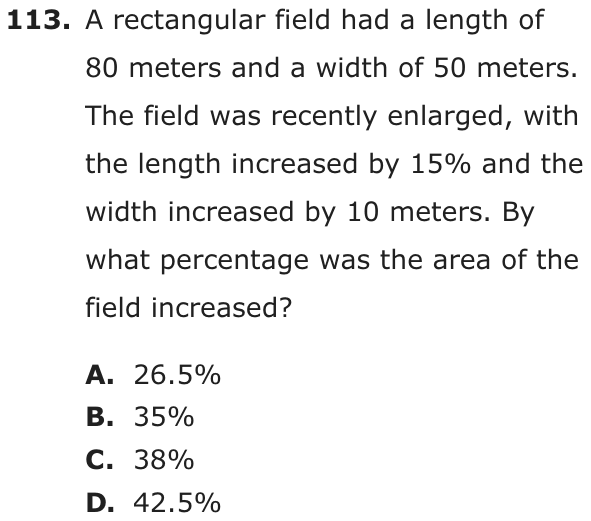
Question 12 of 21
2023 Test A Math, question 49Question
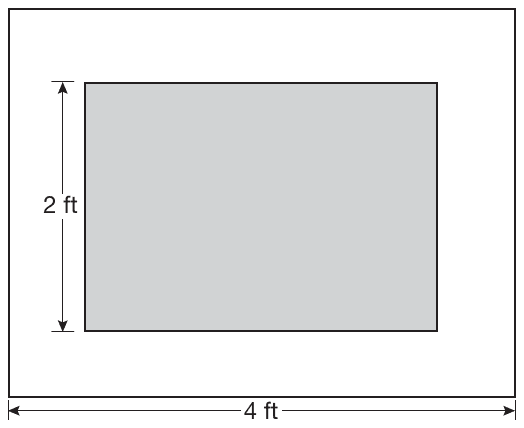
In the figure above, the shaded rectangle is similar to the outer rectangle. The length of the outer rectangle is 4 feet, and the perimeter of the outer rectangle is 14 feet. If the width of the shaded rectangle is 2 feet, what is the area of the shaded rectangle?
- A sq ft
- B6 sq ft
- C sq ft
- D12 sq ft
Show the answer
Correct answer: A
For the outer rectangle, the length is 4 feet and the perimeter is 14 feet. Write and solve an equation to find the width:
| Apply the additive inverse property; subtract 8 from both sides of the equation. | |
| Apply the multiplicative inverse property; divide both sides of the equation by 2. | |
Use that information in a proportion to find the length of the shaded rectangle:
| Cross multiply. | |
| Apply the multiplicative inverse property; divide both sides of the equation by 3. | |
Now find the area of the shaded rectangle:
Question analysis
This geometry question shows a shaded rectangle similar to an outer rectangle that is 4 feet long with a perimeter of 14 feet; the shaded rectangle is 2 feet wide. Students find the shaded area. They must find a missing side, match corresponding sides, and scale by a factor rather than a fixed amount, which makes it a multistep similar-figures problem.
- Grade level
- Grade 8 content, by NYS standard
- Compared with grade 7
- Above grade 7 Similar figures are grade 8 geometry, though grade 7 scale drawings use the same proportions. Students must first find a missing side from the perimeter, match corresponding sides, solve a proportion with a fractional result, and then find an area.
- Estimated difficulty
- Hard: combines ideas, needs a plan, and has more than one tempting wrong answer.
- Thinking it demands
- Depth of knowledge 2, skills and concepts · mainly apply
- What makes it hard
- Combines ideas moderate
- Reading a figure, table or graph minor
- Error-prone arithmetic minor
- Solution
- 4 steps
- Reading level
- Question and choices: about grade 5, 57 words.
- Students, last 30 days
- Not enough answers yet to show (it takes 10).
Why it is hard, traps and wrong answers (shows the answer)
Why it is hard
Each step is familiar, but the three together, perimeter to width, width to scale factor, and sides to area, demand a plan. The strongest pull is scaling by subtraction, shrinking each side by 1 foot because the width drops from 3 to 2, which gives a neat whole-number area. Others stop at the outer rectangle or add the sides instead of multiplying. Checking that 8/3 to 2 matches 4 to 3 confirms the shape is similar.
Combines ideas moderate Working it out
Perimeter, similarity and area are chained: 14 feet gives the outer width of 3 feet, the 2-foot side sets a scale factor of 2/3, and only then can the area be found. (Embretson, 1998; Daniel & Embretson, 2010)
Reading a figure, table or graph minor Understanding the question
The figure marks the shaded rectangle's 2-foot side running up and down and the outer 4-foot length along the bottom, so the 2 feet must be paired with the outer 3-foot side, which is not labeled. (Lesh, Post & Behr, 1987; Kirsch & Mosenthal, 1990)
Error-prone arithmetic minor Working it out
The scale factor 2/3 makes the shaded length 8/3 feet, and the area 2 × 8/3 = 16/3 has to be written as the mixed number 5 1/3. (Brown & Burton, 1978; Junker & Sijtsma, 2001)
Strategy: Use the perimeter to find the outer rectangle's width, match the shaded width of 2 feet to it, scale the 4-foot length by the same factor, then multiply length by width.
Traps
- Misunderstands the concept: A wrong belief about a concept: that percents can be added, that area grows like length, that averages can be averaged, that a bigger denominator means a bigger fraction.
- Wrong formula: Uses a related but wrong formula: perimeter for area, diameter for radius, area for volume, or a misremembered one.
- Answers a different question: A choice is right for another quantity: the other unknown, the rest instead of the part, the part instead of the whole.
The wrong answers, classified
B Misunderstands the concept (Smith, diSessa & Roschelle, 1993; De Bock et al., 1998; Ni & Zhou, 2005)
Shrinks each side by the same amount instead of the same factor: the width drops by 1 foot, from 3 to 2, so the length drops from 4 to 3, giving 6.
C Wrong formula (King et al., 2004)
Finds the shaded sides, 2 and 8/3 feet, correctly but computes the perimeter, 2 × (2 + 8/3) = 28/3 = 9 1/3, instead of the area.
D Answers a different question (King et al., 2004; Hegarty, Mayer & Monk, 1995)
Finds the outer width of 3 feet and gives the outer rectangle's area, 4 × 3 = 12, instead of the smaller shaded one.
Worked solution, step by step
Formulas used
- Perimeter of a rectangle
- P is the perimeter, the distance all the way around. l is the length and w is the width. A rectangle has two lengths and two widths, so you add each one twice.
- Scale factor of similar shapes
- Similar shapes have the same shape but different sizes. Each side of the small shape equals its matching side on the large shape times one number, the scale factor. So one pair of matching sides tells you the scale factor.
- Area of a rectangle
- A is the area, the space inside. l is the length and w is the width. You multiply because the rectangle is made of rows of unit squares: w rows with l squares in each.
Sort out the question
The outer rectangle is 4 feet long, and its perimeter is 14 feet. The shaded rectangle is similar to it, so it has the same shape. The shaded rectangle’s width, its left side, is 2 feet. You need the shaded area, so you also need the shaded length.
Find the outer rectangle’s width
The outer rectangle is 3 feet wide. That is its up-and-down side.
Find the scale factor
The shaded width, 2 feet, matches the outer width, 3 feet.
Every shaded side is of the matching outer side. Watch out: similar shapes shrink by the same factor, not by the same number of feet. Taking 1 foot off each side gives 2 by 3, an area of 6, choice B.
Find the shaded length
Multiply the outer length, 4 feet, by the scale factor.
The shaded rectangle is feet long.
Find the shaded area
Watch out: 4 × 3 = 12 is the outer area, choice D. So the answer is A, sq ft.
Check your answer
Check the shape. For the outer rectangle, length ÷ width is . For the shaded one, it is . They match, so the shapes are similar. Also, square feet is less than the outer 12, as it should be.
More questions like this
The original DOE question
Question 13 of 21
2023 Test B Math, question 12Question
The perimeter of a 12-sided polygon is 100 centimeters. The length of one side is 25 centimeters. The length of another side is 35 centimeters. The remaining sides are equal in length to one another. What is the length of each of the remaining sides, in centimeters?
- A4
- B5
- C20
- D40
Show the answer
Correct answer: A
Let x represent the length of one of the 10 remaining sides:
Question analysis
A 12-sided polygon has a perimeter of 100 centimeters: one side is 25 cm long, another is 35 cm, and the rest are all equal to one another. Students find the length of each remaining side. This perimeter problem turns into a two-step equation, and the tricky part is counting the sides that are left.
- NYS standards
- 7.EE.4a two-step equations
- Grade level
- Grade 7 content, by NYS standard
- Compared with grade 7
- At grade 7 Writing and solving a two-step equation from a short description is standard grade 7 work. The perimeter setting is simple; the only extra care is counting the sides that remain after the two given ones.
- Estimated difficulty
- Straightforward: two steps or one careful reading.
- Thinking it demands
- Depth of knowledge 2, skills and concepts · mainly apply
- What makes it hard
- Turning words into math minor
- Many steps minor
- Solution
- 3 steps
- Reading level
- Question and choices: about grade 7, 44 words.
- Students, last 30 days
- Not enough answers yet to show (it takes 10).
Why it is hard, traps and wrong answers (shows the answer)
Why it is hard
The perimeter and the two named sides make the subtraction obvious, so the real decision comes after it: what to divide the leftover 40 centimeters by. Students who stop at the leftover length, or who lose track of how many sides remain, reach a listed choice. Writing 25 + 35 + 10x = 100 keeps the count of 10 in view.
Turning words into math minor Understanding the question
“The remaining sides are equal in length to one another” hides the count: 12 sides minus the two given ones leaves 10 equal sides to share the rest of the perimeter. (Hegarty, Mayer & Monk, 1995; Koedinger & Nathan, 2004)
Many steps minor Working it out
Subtracting 25 and 35 from 100, counting the sides left, and dividing are three steps, and the first result, 40, is itself a listed choice. (Daniel & Embretson, 2010; Enright, Morley & Sheehan, 2002)
Strategy: Subtract the two known sides from the perimeter, count how many sides are left, and share the remaining length equally among them.
Traps
- Stops one step early: A choice is a number from partway through the solution.
- Misreads the question: Misses or misreads a condition or a word in the question: "at least", "each", "remaining", "not".
The wrong answers, classified
B Little reason to choose it (Haladyna & Downing, 1993; Rodriguez, 2005)
No common working gives 5; sharing the 40 centimeters among 8 sides would, but nothing in the question suggests 8, so it mostly draws guesses.
C Misreads the question (Hegarty, Mayer & Monk, 1995)
Shares the leftover 40 centimeters between two sides, as if the figure were four-sided, overlooking that it has 12 sides.
D Stops one step early (King et al., 2004; Gierl et al., 2017)
Finds the total of the remaining sides, 100 − 25 − 35 = 40, and stops before sharing it among the 10 equal sides.
Worked solution, step by step
Formulas used
- Perimeter of a polygon
- P is the perimeter, the total distance around a shape. A polygon is a flat shape with straight sides. A sum is the answer to an addition. So add the lengths of every side to get P.
Sort out the question
The shape is a polygon with 12 sides. Its perimeter is 100 centimeters. One side is 25 centimeters, and another is 35 centimeters. The other sides all have the same length. You need that length.
Count the equal sides
Two of the 12 sides are already known. The rest are the equal sides.
So there are 10 equal sides. Call the length of each one x.
Write an equation for the perimeter
Use the perimeter formula. All 12 sides add up to 100. Ten sides of length x add up to 10x, which means 10 times x.
Solve for x
The 10 equal sides add up to 40 centimeters. Watch out: 40 is all ten sides together, not one side. Stopping here gives choice D. Now share the 40 among the 10 sides.
Give the answer
Each remaining side is 4 centimeters long. Watch out: sharing the 40 centimeters between only 2 sides gives 20, choice C. That treats the shape as if it had 4 sides, but it has 12. So the answer is A, 4.
Check your answer
Add all 12 sides: . That is the perimeter the question gives, so 4 centimeters is right.
More questions like this
The original DOE question
Question 14 of 21
2023 Test B Math, question 18Question
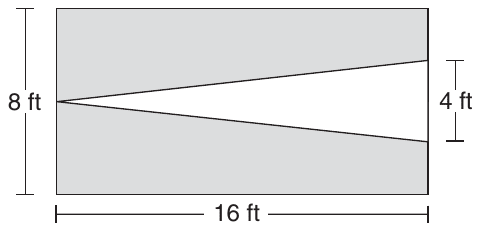
The diagram above shows a rectangle with an inscribed triangle. The triangle’s vertex and base touch the sides of the rectangle as shown. What is the total area of the shaded portion?
- A32 sq ft
- B64 sq ft
- C96 sq ft
- D128 sq ft
Show the answer
Correct answer: C
First, find the area of the rectangle, in square feet:
Then, find the area of the triangle:
To find the area of the shaded region, subtract the area of the triangle from the area of the rectangle:
Question analysis
A 16-foot by 8-foot rectangle has a white triangle inside it, with one vertex at the middle of the left side and a 4-foot base along the right side. Students find the total area of the shaded part. They subtract the triangle's area, whose height is not labeled and must be read from the figure.
- NYS standards
- 6.G.1 area of polygons
- Grade level
- Grade 6 content, by NYS standard
- Compared with grade 7
- At grade 7 Composite areas built from rectangles and triangles appear in grades 6 and 7. This one is typical, but the triangle lies on its side, so students must see which length is its height rather than read it from a label.
- Estimated difficulty
- Moderate: several steps, or a close reading with one strong distractor.
- Thinking it demands
- Depth of knowledge 2, skills and concepts · mainly apply
- What makes it hard
- Reading a figure, table or graph moderate
- Many steps minor
- Solution
- 3 steps
- Reading level
- Question and choices: about grade 2, 40 words.
- Students, last 30 days
- Not enough answers yet to show (it takes 10).
Why it is hard, traps and wrong answers (shows the answer)
Why it is hard
The shaded region is a rectangle with a triangle cut out, so the plan is standard, but the triangle is turned so that its height runs across the figure. Students who see that the height is the 16-foot side have two short areas to find and one subtraction. The listed wrong answers stop at either area or leave out the one half.
Reading a figure, table or graph moderate Understanding the question
The triangle lies on its side: its 4-foot base runs along the right edge, so its height is the rectangle’s full 16-foot length, which the figure labels only as the bottom side. (Lesh, Post & Behr, 1987; Kirsch & Mosenthal, 1990)
Many steps minor Working it out
The rectangle’s area, the triangle’s area and their difference are three separate results, and the first two, 128 and 32, are themselves listed choices. (Daniel & Embretson, 2010; Enright, Morley & Sheehan, 2002)
Strategy: Find the rectangle's area, find the triangle's area from its base on the right side and its height across the rectangle, then subtract.
Traps
- Stops one step early: A choice is a number from partway through the solution.
- Answers a different question: A choice is right for another quantity: the other unknown, the rest instead of the part, the part instead of the whole.
- Wrong formula: Uses a related but wrong formula: perimeter for area, diameter for radius, area for volume, or a misremembered one.
The wrong answers, classified
A Answers a different question (King et al., 2004; Hegarty, Mayer & Monk, 1995)
Finds the triangle’s area, ½ × 4 × 16 = 32, and gives the white region instead of the shaded part around it.
B Wrong formula (King et al., 2004)
Leaves out the ½ in the triangle’s area, 4 × 16 = 64, and subtracts that from 128, which leaves 64.
D Stops one step early (King et al., 2004; Gierl et al., 2017)
Finds the rectangle’s area, 16 × 8 = 128, and stops without subtracting the white triangle.
Worked solution, step by step
Formulas used
- Area of a rectangle
- A is the area, the space inside a flat shape, in square units. l is the length and w is the width. It works because the rectangle is filled by w rows of unit squares, with l squares in each row.
- Area of a triangle
- A is the area. b is the base, the side you measure from. h is the height, the distance from the base to the opposite corner, at a right angle to the base. You take half, because a triangle is half of a rectangle with the same base and height.
Sort out the figure
The figure is a rectangle 16 feet long and 8 feet tall. Inside it is a white triangle. Its tip touches the middle of the left side. Its base lies along the right side and is 4 feet long. The shaded part is the gray area around the triangle. You need its area.
Plan: find the rectangle’s area, then take away the triangle’s area.
Find the area of the rectangle
The rectangle’s area is 128 square feet. Watch out: this includes the white triangle. Stopping here gives choice D.
Find the triangle’s height
The triangle lies on its side. Its base is the 4-foot piece on the right side, which runs up and down. The height must meet the base at a right angle, a square corner. So the height runs straight across, from the base to the tip on the left side. That is the full length of the rectangle, 16 feet.
Find the area of the triangle
The triangle’s area is 32 square feet. Watch out: don’t forget the . Using leaves 64 for the shaded part, choice B.
Subtract to find the shaded area
The shaded part is 96 square feet. Watch out: 32 is the white triangle, not the shaded part, so choice A is wrong. So the answer is C, 96 sq ft.
Check your answer
The triangle’s base, 4 feet, is half the rectangle’s height of 8 feet. Its height is the full 16 feet. So the triangle is half of half the rectangle, or one fourth of it. One fourth of 128 is 32, and .
More questions like this
The original DOE question
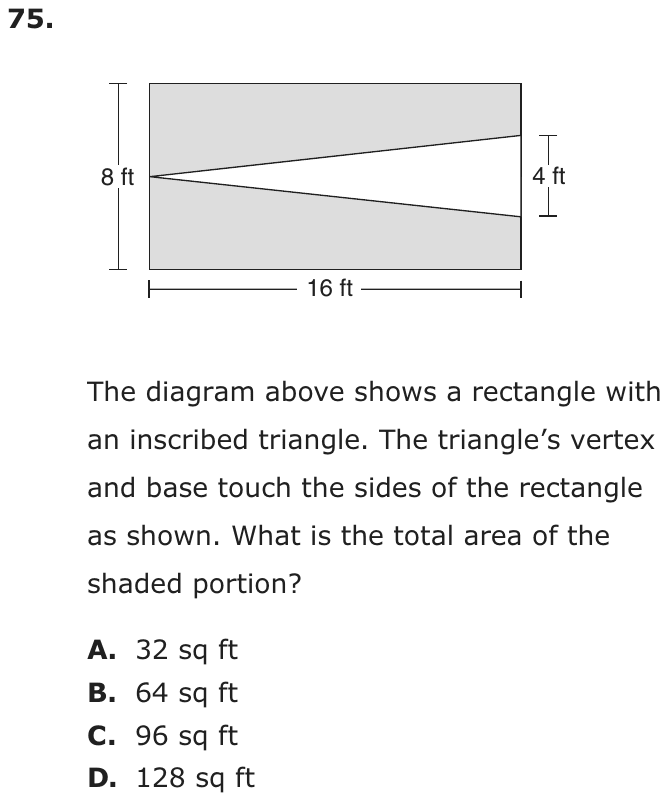
Question 15 of 21
2023 Test B Math, question 36Question
The side length of square S is shorter than the side length of square T by 1 centimeter. The area of square S is 9 square centimeters. What is the difference, in square centimeters, between the area of square T and the area of square S?
- A3
- B7
- C8
- D10
Show the answer
Correct answer: B
Let x represent the side length of square T, in centimeters. Then the side length of square S is .
The area of square S is:
So the side length of square T is 4 cm, and the area of square T is 16 sq cm.
The difference between the areas, in square centimeters, is .
Question analysis
Two squares differ in side length by 1 centimeter, and the smaller one has an area of 9 square centimeters. Students find how much greater the larger square's area is. It tests the link between a square's side and its area, and the extra area is easy to miscount when picturing the border that the longer sides add.
- Grade level
- Grade 6 content, by NYS standard
- Compared with grade 7
- Below grade 7 The area of a square and recognizing 9 as a perfect square are grade 6 ideas. This takes three short steps with small whole numbers, lighter than grade 7 work on composite figures, though the first step runs backward from area to side.
- Estimated difficulty
- Straightforward: two steps or one careful reading.
- Thinking it demands
- Depth of knowledge 2, skills and concepts · mainly apply
- What makes it hard
- Many steps minor
- Turning words into math minor
- Solution
- 3 steps
- Reading level
- Question and choices: about grade 6, 44 words.
- Students, last 30 days
- Not enough answers yet to show (it takes 10).
Why it is hard, traps and wrong answers (shows the answer)
Why it is hard
Every number is small, so the work is keeping track of which quantity the question wants: a difference of areas, not a side or a single area. The added area forms an L-shaped strip around square S, and students who picture it as two strips 4 centimeters long count the corner square twice. Finding both areas, 9 and 16, and subtracting avoids reasoning about the strip at all.
Many steps minor Working it out
The work runs from area to side and back: the square root of 9 gives S’s side, adding 1 gives T’s, squaring gives 16, and subtracting gives the difference. (Daniel & Embretson, 2010; Enright, Morley & Sheehan, 2002)
Turning words into math minor Understanding the question
The phrase “shorter than the side length of square T by 1 centimeter” describes S from T’s point of view, so T’s side is S’s side plus 1, not minus 1. (Hegarty, Mayer & Monk, 1995; Koedinger & Nathan, 2004)
Strategy: Find the side of square S from its area, add 1 centimeter to get the side of square T, find that square's area, and subtract the smaller area from the larger.
Traps
- Overlapping groups: Things in two groups at once are counted twice, or not subtracted.
- Answers a different question: A choice is right for another quantity: the other unknown, the rest instead of the part, the part instead of the whole.
- Numbers taken from the question: Combines the numbers in the question without a model of the situation, or is simply a number that appears in the question.
The wrong answers, classified
A Answers a different question (King et al., 2004; Hegarty, Mayer & Monk, 1995)
Finds the side of square S, 3 centimeters, from its area of 9 and gives that length instead of a difference between two areas.
C Overlapping groups (King et al., 2004)
Pictures the added area as two 4-by-1 strips along two sides of square S, 8 in all, counting the 1-by-1 corner where they overlap twice.
D Numbers taken from the question (Hegarty, Mayer & Monk, 1995)
Adds the stem’s two numbers, 9 + 1 = 10, as if a side 1 centimeter longer made the area 1 square centimeter larger, and gives that area.
Worked solution, step by step
Formulas used
- Area of a square
- A is the area, the space inside the square, in square units. s is the length of one side. All four sides of a square are equal, so the area is the side times itself. To go backward from an area, find the number that times itself gives the area.
Sort out the two squares
Square S has an area of 9 square centimeters. Its side is 1 centimeter shorter than the side of square T. You need the area of square T minus the area of square S, in square centimeters.
Find the side of square S
Use the area formula backward. Which number times itself makes 9?
So each side of square S is 3 centimeters. This number is called the square root of 9.
Find the side of square T
Square T’s side is 1 centimeter longer than square S’s side.
Each side of square T is 4 centimeters.
Find the area of square T
Use the area formula with a side of 4 centimeters.
The area of square T is 16 square centimeters.
Subtract the areas
Take the smaller area away from the larger one.
The difference is 7 square centimeters.
Watch out: Picturing the new area as two strips, each 4 by 1, gives 8, choice C. But those strips share a 1-by-1 corner, so it gets counted twice. Also, 3 is a side length, not a difference of areas. That is choice A.
So the answer is B, 7 square centimeters.
Check your answer
Draw square T and mark square S in one corner. The extra space is an L shape. It is a 3-by-1 strip, another 3-by-1 strip and a 1-by-1 corner. That is 3 + 3 + 1 = 7 square centimeters. It matches.
More questions like this
The original DOE question
Question 16 of 21
2023 Test B Math, question 56Question
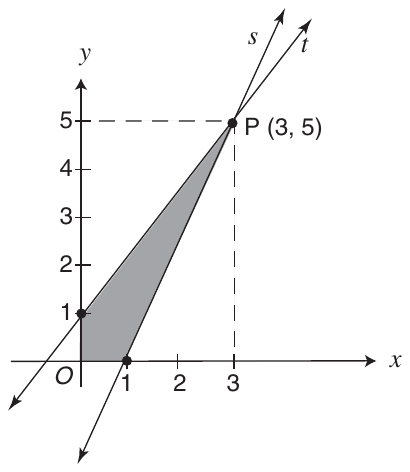
Lines s and t intersect at point P (3, 5). What is the area, in square units, of the shaded region in the graph above?
- A2
- B3
- C4
- D7
Show the answer
Correct answer: C
First, find the area of the rectangle in the graph:
Then, find the areas of the two right triangles that are not shaded:
Upper triangle:
Lower triangle:
The area of the shaded region, in square units, is calculated by subtracting the total area of the two right triangles from the area of the rectangle:
Question analysis
Two lines meet at the point (3, 5) on a coordinate grid, and the shaded region between them and the axes is a four-sided shape. Students find its area in square units. The shape is not a standard figure, so no single area formula applies to it directly.
- Grade level
- Grade 6 content, by NYS standard
- Compared with grade 7
- At grade 7 Areas of triangles and rectangles are grade 6 content, and grade 7 students often find composite areas. This region is an irregular four-sided shape with two slanted sides, so students need a plan, and the lengths come from coordinates rather than labels.
- Estimated difficulty
- Moderate: several steps, or a close reading with one strong distractor.
- Thinking it demands
- Depth of knowledge 2, skills and concepts · mainly apply
- What makes it hard
- No obvious method moderate
- Reading a figure, table or graph moderate
- Many steps minor
- Solution
- 4 steps
- Reading level
- Question and choices: about grade 4, 23 words.
- Students, last 30 days
- Not enough answers yet to show (it takes 10).
Why it is hard, traps and wrong answers (shows the answer)
Why it is hard
The question rewards a plan more than computation: the region has no name, so students must see it inside the dashed rectangle from O to P, with two right triangles cut away. Reading each triangle’s legs from the axes is the second hurdle, since the 1-unit intercepts shorten one leg of each, to 4 instead of 5 and to 2 instead of 3. Only one wrong choice, from using one coordinate as both heights, has a clear working behind it, so most errors here are guesses after a failed plan.
No obvious method moderate Working it out
The shaded shape has four sides, two of them slanted, and no formula of its own; it must be boxed in the 3-by-5 rectangle with two triangles removed, or cut along OP. (Schoenfeld, 1985)
Reading a figure, table or graph moderate Understanding the question
No lengths are labeled; every one comes from the coordinates of P (3, 5), the y-intercept 1 of line s and the x-intercept 1 of line t. (Lesh, Post & Behr, 1987; Kirsch & Mosenthal, 1990)
Many steps minor Working it out
The rectangle, two triangle areas and a subtraction make four computations, 15, 6 and 5, then 15 − 11, each built from different coordinates. (Daniel & Embretson, 2010; Enright, Morley & Sheehan, 2002)
Strategy: Draw the rectangle from O to P, find the areas of the two unshaded right triangles inside it from the coordinates, and subtract both from the rectangle's area.
Traps
- Misreads the figure: Reads a value, label or tick spacing in a figure, table or graph wrongly.
The wrong answers, classified
A Little reason to choose it (Haladyna & Downing, 1993; Rodriguez, 2005)
No common working gives 2; no rectangle or triangle built from the coordinates leaves that area, so it mostly draws students who judge the narrow region by eye.
B Misreads the figure (Lesh, Post & Behr, 1987; Kirsch & Mosenthal, 1990)
Cuts the region along OP into two triangles with bases of 1 but uses 3, the x-coordinate of P, as the height of both: 1.5 + 1.5 = 3.
D Little reason to choose it (Haladyna & Downing, 1993; Rodriguez, 2005)
No common working gives 7; half of the 3-by-5 rectangle, 7.5, comes closest, so it mostly draws students who guess the region fills about half.
Worked solution, step by step
Formulas used
- Area of a rectangle
- A is the area, in square units. l is the length and w is the width. Multiplying them counts the unit squares that fill the rectangle.
- Area of a triangle
- A is the area. b is the base, one side. h is the height: the distance from the base straight up to the far corner. A right triangle has a square corner, and the two sides that meet there are the base and height. A triangle is half of a rectangle with the same base and height.
Sort out the shaded region
The shaded region has four corners: O at (0, 0), (0, 1) on the y-axis, P at (3, 5), and (1, 0) on the x-axis. Line t meets the y-axis at (0, 1), and line s meets the x-axis at (1, 0). There is no easy formula for this shape. But the dashed lines make a rectangle around it. So find the rectangle’s area and take away the white parts.
Find the rectangle’s area
The rectangle has corners O, (3, 0), P and (0, 5). It is 3 units wide and 5 units tall.
The rectangle’s area is 15 square units.
Find the upper triangle’s area
The white triangle at the top left has corners (0, 1), (0, 5) and P. Its square corner, or right angle, is at (0, 5). One side runs up the y-axis from 1 to 5, so it is 4 units. The other runs across from 0 to 3, so it is 3 units.
Its area is 6 square units.
Find the lower triangle’s area
The white triangle at the bottom right has corners (1, 0), (3, 0) and P. Its square corner is at (3, 0). One side runs along the x-axis from 1 to 3, so it is 2 units. The other goes up from 0 to 5, so it is 5 units.
Its area is 5 square units.
Watch out: The lines cross the axes at 1, not at O. So these sides are 4 and 2, not 5 and 3.
Subtract the white triangles
Take both triangles away from the rectangle.
The shaded area is 4 square units.
So the answer is C, 4.
Check your answer
Cut the shaded region along a line from O to P. One piece has a base of 1 on the x-axis and a height of 5, since P is 5 units up. Its area is 2.5. The other has a base of 1 on the y-axis and a height of 3, since P is 3 units across. Its area is 1.5. Then 2.5 + 1.5 = 4. Using 3 for both heights gives 3, choice B.
More questions like this
The original DOE question
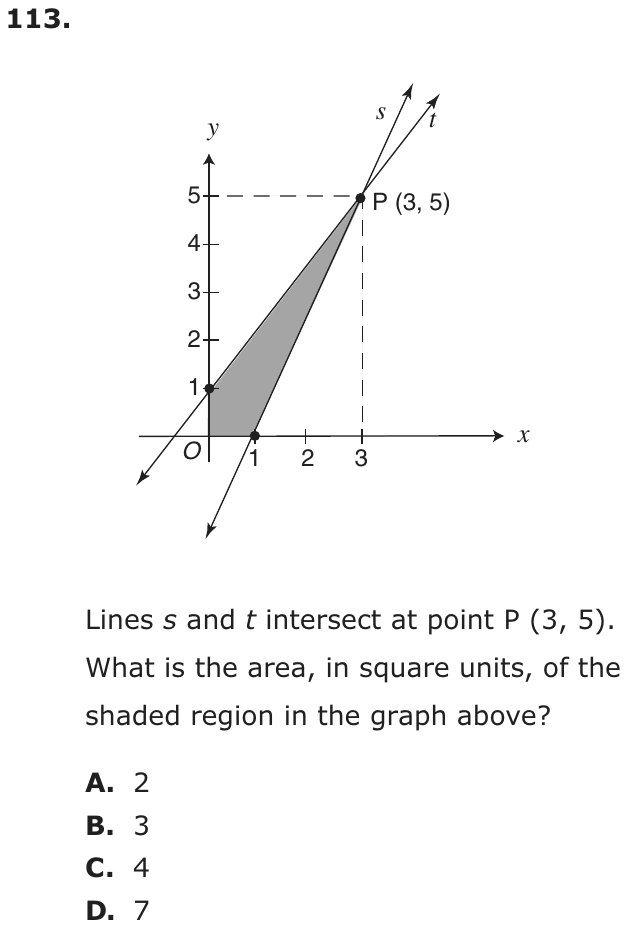
Question 17 of 21
2022 Test A Math, question 16Question
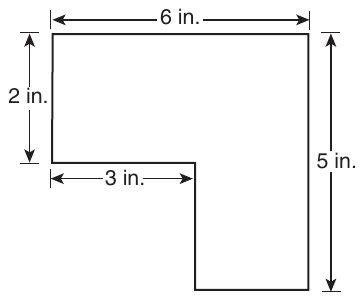
Scale:
A scale drawing of a new pool is shown above. All the corners are right angles. What is the perimeter of the actual pool?
- A550 ft
- B800 ft
- C1,100 ft
- D1,500 ft
Show the answer
Correct answer: C
Determine the two missing side lengths on the scale drawing:
All corners are right angles, so the figure can be divided into rectangles with opposite sides that are congruent in length. This means the sum of the shorter vertical sides on the left and in the center of the figure () must equal the length of the longer vertical side on the right side of the figure (5 in.):
So, the missing vertical side length of the figure is 3 in.
Again, because opposite sides of a rectangular figure are congruent in length, the sum of the shorter horizontal sides in the middle and bottom of the figure () must equal the length of the longer horizontal side on the top of the figure (6 in.):
So, the missing horizontal side length of the figure is 3 in.
Determine the perimeter by adding all the side lengths of the figure:
This is a scale drawing in which . Write a proportion to determine the value of x, the unknown number of feet that is represented by 22 in.:
Cross multiply and solve the equation for x:
Question analysis
A scale drawing shows an L-shaped pool with all right angles, four labeled sides and two unlabeled ones, and a scale of 1/2 inch to 25 feet. Students find the perimeter of the actual pool. It combines the perimeter of a composite figure with a scale given for half an inch, so the missing sides and the fractional scale are both easy to mishandle.
- Grade level
- Grade 7 content, by NYS standard
- Compared with grade 7
- At grade 7 Scale drawings are grade 7 content, and a typical task converts one given length. Here two sides are unlabeled and must be worked out, all six added, and a scale given for half an inch turned into feet per inch.
- Estimated difficulty
- Hard: combines ideas, needs a plan, and has more than one tempting wrong answer.
- Thinking it demands
- Depth of knowledge 2, skills and concepts · mainly apply
- What makes it hard
- Reading a figure, table or graph moderate
- Combines ideas moderate
- Many steps minor
- Solution
- 4 steps
- Reading level
- Question and choices: about grade 2, 30 words.
- Students, last 30 days
- Not enough answers yet to show (it takes 10).
Why it is hard, traps and wrong answers (shows the answer)
Why it is hard
The figure gives four of the six sides and the scale gives feet per half inch, so two conversions hide behind a simple-looking perimeter question. Students who add only the labeled sides, or who read the scale as 25 feet per inch, reach totals that look reasonable for a pool and are listed. Tracing the outline to count six sides, and doubling 25 before multiplying, avoids both.
Reading a figure, table or graph moderate Understanding the question
Two sides of the notch carry no labels, and the 5 in. arrow spans the full right side, so the missing lengths come from 5 − 2 = 3 and 6 − 3 = 3. (Lesh, Post & Behr, 1987; Kirsch & Mosenthal, 1990)
Combines ideas moderate Working it out
The perimeter of an L-shaped drawing has to be joined to a scale in which half an inch, not a whole inch, stands for 25 feet. (Embretson, 1998; Daniel & Embretson, 2010)
Many steps minor Working it out
Four stages follow in order, the two missing sides, the 22-inch perimeter, the feet per inch and the product, and a slip at most of them reaches a listed choice. (Daniel & Embretson, 2010; Enright, Morley & Sheehan, 2002)
Strategy: Use opposite sides to fill in the two missing lengths, add all six sides of the drawing, then double the 25 feet to get the feet one inch stands for, and multiply.
Traps
- Misreads the figure: Reads a value, label or tick spacing in a figure, table or graph wrongly.
- Units or scale: The answer is wanted in other units, or a rate or scale must be converted first.
- Wrong formula: Uses a related but wrong formula: perimeter for area, diameter for radius, area for volume, or a misremembered one.
The wrong answers, classified
A Units or scale (King et al., 2004)
Finds the drawing's 22-inch perimeter but multiplies by 25, using the scale as if 1 inch, not 1/2 inch, stood for 25 feet.
B Misreads the figure (Lesh, Post & Behr, 1987; Kirsch & Mosenthal, 1990)
Adds only the four labeled sides, 6 + 2 + 3 + 5 = 16 inches, and scales that to 800 feet, missing the two unlabeled sides of the notch.
D Wrong formula (King et al., 2004)
Multiplies the 6-inch and 5-inch sides to get 30, the outer rectangle's area, and scales that by 50 feet per inch as if it were a length.
Worked solution, step by step
Formulas used
- Perimeter
- P is the perimeter, the distance all the way around a shape. Add the length of every side, even sides with no label. It is like walking around the edge of the pool and adding up each part of the walk.
- Using a scale
- The drawing length is measured on the drawing, in inches. Feet per inch is how many real feet one inch of the drawing stands for. Multiplying turns a length on the drawing into a real length.
Sort out the question
The drawing is an L shape with six sides. Four sides have labels. The top is 6 in. long, and the right side is 5 in. long. The left side is 2 in. long, and a middle flat side is 3 in. long. Two sides have no label. The scale says 1/2 inch on the drawing stands for 25 feet. You need the perimeter of the real pool, in feet.
Find the missing up-and-down side
Call it s. It runs down from the right end of the 3 in. side to the bottom. The side labeled 2 in. and side s together go from the top to the bottom. All corners are right angles, so they match the full height on the right, 5 in.
Side s is 3 inches.
Find the bottom side
Call the bottom side b. The middle flat side, 3 in., and side b together are as wide as the top, labeled 6 in.
The bottom side is 3 inches.
Add all six sides
Go around the shape: top, right side, bottom, side s, the 3 in. side, then the 2 in. side.
The perimeter on the drawing is 22 inches. Watch out: count the two unlabeled sides. Adding only the four labeled sides gives 16 inches. That leads to 800 feet, choice B.
Find the feet per inch
The scale says 1/2 inch stands for 25 feet. A whole inch is two halves, so 1 inch stands for twice as much.
Each inch of the drawing is 50 real feet. Watch out: don’t use 25 feet per inch. That gives feet, choice A.
Change the perimeter to feet
Call the real perimeter F, for feet. Use the scale formula with 22 inches and 50 feet per inch.
The real pool’s perimeter is 1,100 feet. So the answer is C, 1,100 ft.
Check your answer
Change each side to feet first. At 50 feet per inch, the sides are 300, 250, 150, 150, 150 and 100 feet. . That matches. Choice D, 1,500, comes from . But 6 × 5 is an area, not a distance around.
More questions like this
The original DOE question
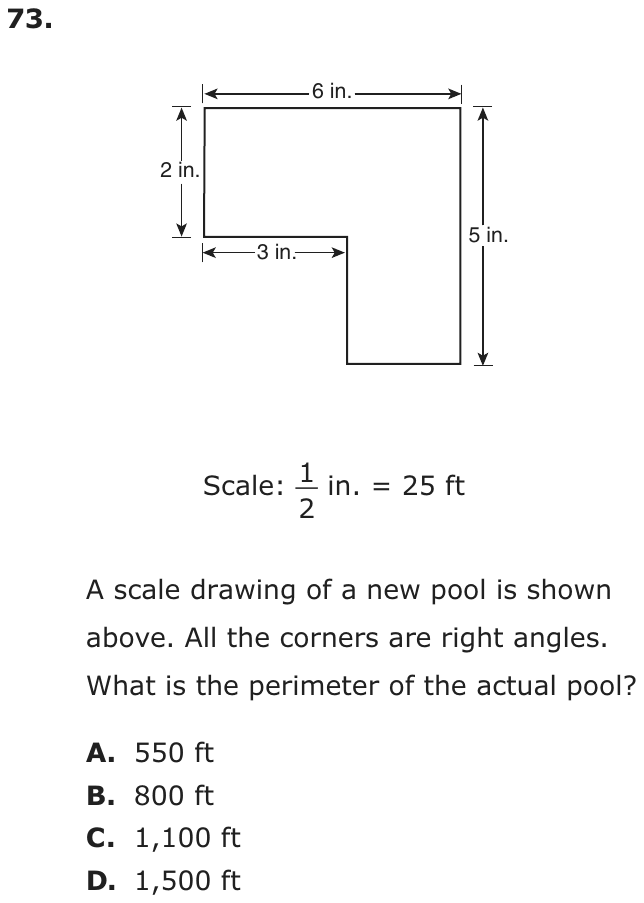
Question 18 of 21
2018 Test A Math, question 13Question
The perimeter of a rectangle is 510 centimeters. The ratio of the length to the width is 3:2. What are the dimensions of this rectangle?
- A150 cm by 105 cm
- B153 cm by 102 cm
- C158 cm by 97 cm
- D165 cm by 90 cm
Show the answer
Correct answer: B
Let = the width and = the length.
Draw the rectangle to help visualize.
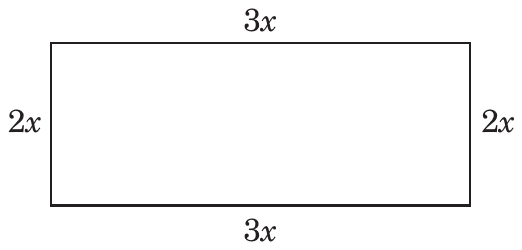
Since 2 times width + 2 times length = perimeter, we get
cm and cm
Question analysis
A rectangle word problem that combines perimeter with a ratio: the perimeter is 510 centimeters and the length and width are in the ratio 3 to 2. Students find the rectangle's dimensions. Every choice has the correct perimeter, so only the ratio separates them.
- Grade level
- Grade 7 content, by NYS standard
- Compared with grade 7
- At grade 7 Perimeter and ratio are each familiar from grades 6 and 7, and combining them with a five-part split is a typical grade 7 multistep ratio problem. It asks about the same as classroom work.
- Estimated difficulty
- Moderate: several steps, or a close reading with one strong distractor.
- Thinking it demands
- Depth of knowledge 2, skills and concepts · mainly apply
- What makes it hard
- A very close wrong answer moderate
- Turning words into math minor
- Solution
- 3 steps
- Reading level
- Question and choices: about grade 3, 35 words.
- Students, last 30 days
- Not enough answers yet to show (it takes 10).
Why it is hard, traps and wrong answers (shows the answer)
Why it is hard
The question is built so that the perimeter, the easier condition, rules nothing out: every choice adds to 255. A student who tests the choices against 510 alone will accept whichever comes first, and the first is 150 by 105. Solving with ratio parts, or checking each pair's ratio, avoids that; 3:2 means the length is exactly one and a half times the width.
A very close wrong answer moderate Choosing the answer
153 by 102 and 150 by 105 differ by just 3 cm in each side and give the same 510 cm perimeter; only the ratio, exactly 3:2 against 10:7, separates them. (Embretson & Wetzel, 1987; Gorin & Embretson, 2006; Ascalon et al., 2007)
Turning words into math minor Understanding the question
"The ratio of the length to the width is 3:2" has to become 3 parts and 2 parts of the half-perimeter, 255, not of the full 510. (Hegarty, Mayer & Monk, 1995; Koedinger & Nathan, 2004)
Strategy: Halve the perimeter to get length plus width, split that sum into 5 equal parts, and give the length 3 parts and the width 2.
Traps
- Misreads the question: Misses or misreads a condition or a word in the question: "at least", "each", "remaining", "not".
The wrong answers, classified
A Misreads the question (Hegarty, Mayer & Monk, 1995)
Checks only the perimeter, 2 × (150 + 105) = 510, and accepts the first pair that fits; 150 to 105 is 10:7, not 3:2.
C Misreads the question (Hegarty, Mayer & Monk, 1995)
Confirms that 158 + 97 = 255, half the perimeter, but never tests the ratio; 1.5 × 97 is 145.5, not 158.
D Misreads the question (Hegarty, Mayer & Monk, 1995)
Matches the perimeter, since 165 + 90 = 255, but a 3:2 rectangle 90 cm wide would be 135 cm long, not 165.
Worked solution, step by step
Formulas used
- Perimeter of a rectangle
- P is the perimeter, the distance all the way around the shape. l is the length and w is the width. A rectangle has two lengths and two widths. So you add one length and one width, then double it.
- Sharing a total in a ratio
- In a ratio like 3:2, the amounts are made of equal-sized parts. Add the numbers in the ratio to count the parts. Divide the total by that count to get the size of one part. Then multiply by how many parts each amount has.
Sort out the question
The perimeter of the rectangle is 510 cm. The perimeter is the distance all the way around. The ratio of length to width is 3:2. That means the length is 3 equal parts, and the width is 2 of the same parts. You need the length and the width.
Find length plus width
The perimeter counts each side twice, once for each matching side. So halve it to get one length plus one width.
Length plus width is 255 cm.
Find the size of one part
Length and width together are parts. Share the 255 cm equally among them.
Each part is 51 cm.
Find the length and width
The length is 3 parts and the width is 2 parts.
The length is 153 cm and the width is 102 cm.
Check the ratio, then answer
Watch out: every choice has a perimeter of 510 cm. For example, too. So checking only the perimeter can trick you into choice A. The ratio decides it. 153 is exactly 1.5 times 102, but 150 is not 1.5 times 105. So the answer is B, 153 cm by 102 cm.
Check your answer
Check both facts. Perimeter: . Ratio: and , so 153 to 102 is 3:2.
More questions like this
The original DOE question
Question 19 of 21
2018 Test A Math, question 18Question
What is the area of the shaded region in the graph above?
- A0.25 square unit
- B0.5 square unit
- C1 square unit
- D1.5 square units
Show the answer
Correct answer: B
The shaded region is a right triangle. Each leg is 1 unit in length.
So the area is
or 0.5 sq unit
Question analysis
A coordinate grid question: find the area of a shaded right triangle with corners at the origin, (1, 0) and (1, 1), under a diagonal line. Students read the base and height from the grid and apply the triangle area formula. The figure does most of the work; the task is recalling the formula correctly.
- Grade level
- Grade 6 content, by NYS standard
- Compared with grade 7
- Below grade 7 Finding a triangle's area from a grid is grade 6 work, and this takes one step with whole-unit legs. It is easier than typical grade 7 area problems, which use composite figures or scale drawings.
- Estimated difficulty
- Routine: one familiar step, little to misread.
- Thinking it demands
- Depth of knowledge 1, recall and reproduction · mainly apply
- What makes it hard
- Solution
- 1 step
- Reading level
- Question and choices: about grade 2, 20 words.
- Students, last 30 days
- Not enough answers yet to show (it takes 10).
Why it is hard, traps and wrong answers (shows the answer)
Why it is hard
This is a quick formula question with legs of 1. The main risk is the one-half in the triangle formula: leaving it out gives the area of the whole grid square, which is a listed choice. Seeing that the diagonal cuts the unit square exactly in half gives a check that needs no formula at all.
Reading a figure, table or graph minor Understanding the question
The legs of the shaded triangle, from O to (1, 0) and up to (1, 1), are read off the grid lines; the line running on to (2, 2) is not part of the region. (Lesh, Post & Behr, 1987; Kirsch & Mosenthal, 1990)
Something you must already know minor Working it out
The triangle area formula, one half times base times height, is needed and not given; the shaded triangle is half of one grid square. (Anderson & Krathwohl, 2001)
Strategy: Read the two legs straight off the grid, then apply the triangle area formula, base times height divided by two.
Traps
- A formula you must know: Needs a formula the test does not give: area, circumference, volume, probability rules.
The wrong answers, classified
A Misreads the figure (Lesh, Post & Behr, 1987; Kirsch & Mosenthal, 1990)
Judges the shaded triangle by eye as a quarter of the 1-by-1 grid square instead of the half that the diagonal from O to (1, 1) cuts off.
C Wrong formula (King et al., 2004)
Multiplies base by height, 1 × 1 = 1, and leaves out the one-half, giving the whole unit square instead of the triangle.
D Little reason to choose it (Haladyna & Downing, 1993; Rodriguez, 2005)
No common working gives 1.5, which is more than the whole grid square around the shaded triangle; it mostly draws guesses.
Worked solution, step by step
Formulas used
- Area of a triangle
- A is the area. b is the base, the side the triangle sits on. h is the height: the straight-up distance from the base to the top corner, at a right angle to the base. You take half because a triangle is half of a rectangle with the same base and height.
Sort out the shaded region
The shaded region is a triangle. Its corners are O, the point (1, 0) and the point (1, 1). O is the origin, the point (0, 0) where the axes meet. The line keeps going up to (2, 2), but only the small triangle is shaded. You need its area in square units.
Read the base and height
The base lies along the x-axis, from O to 1. So the base is 1 unit. The height goes straight up from (1, 0) to (1, 1). So the height is 1 unit too. The base and height meet at a right angle, as the grid lines show.
Use the triangle formula
The area is 0.5 square unit. Watch out: don’t forget the one half. is the whole grid square, choice C. So the answer is B, 0.5 square unit.
Check your answer
The grid square from 0 to 1 has an area of 1 square unit. The slanted line cuts it corner to corner into two equal triangles. The shaded one is half the square, so 0.5 square unit.
More questions like this
The original DOE question
Question 20 of 21
2018 Test B Math, question 35Question
R, S, and T are midpoints of the sides of square MNPQ, as shown above. What is the sum of the areas of the shaded triangles?
- A9 sq cm
- B12 sq cm
- C18 sq cm
- D36 sq cm
Show the answer
Correct answer: A
The length of one side of the square is 6 cm. Since , , and are midpoints, then , , , and are all equal to 3 cm. Triangles and are both right triangles, so the area of one of the triangles is
The triangles are congruent, so the sum of the areas is
Question analysis
Points R, S and T are midpoints of the sides of square MNPQ, whose sides are 6 cm long, and students find the total area of the two shaded triangles in its corners. It tests the area of a triangle. The common slips are forgetting the one-half or measuring the wrong region.
- NYS standards
- 6.G.1 area of polygons
- Grade level
- Grade 6 content, by NYS standard
- Compared with grade 7
- Below grade 7 Triangle area is grade 6 content, and the corner triangles here are right triangles with easy legs. Typical grade 7 area problems are similar or harder; the only extra step is using midpoints to get the lengths.
- Estimated difficulty
- Straightforward: two steps or one careful reading.
- Thinking it demands
- Depth of knowledge 2, skills and concepts · mainly apply
- What makes it hard
- Solution
- 3 steps
- Reading level
- Question and choices: about grade 1, 34 words.
- Students, last 30 days
- Not enough answers yet to show (it takes 10).
Why it is hard, traps and wrong answers (shows the answer)
Why it is hard
The shaded triangles are right triangles tucked into the corners, so their legs lie along the square's sides and are easy to measure once the midpoints are used. Most lost points come from the one half in the area formula, or from reporting a larger region of the figure, such as the left half or the whole square. Labeling each 3 cm leg on the figure before computing pays off here.
Reading a figure, table or graph moderate Understanding the question
Only one length is labeled, the 6 cm side PQ; the legs NR, NS, MR and MT must each be read as half a side, 3 cm, from the word midpoints. (Lesh, Post & Behr, 1987; Kirsch & Mosenthal, 1990)
Something you must already know minor Working it out
The area of a triangle, one half times base times height, is not given, and leaving out the one half doubles each 4.5 sq cm triangle. (Anderson & Krathwohl, 2001)
Strategy: Use the midpoints to get each triangle's legs as half the square's side, apply one-half base times height, and remember there are two shaded triangles.
Traps
- A formula you must know: Needs a formula the test does not give: area, circumference, volume, probability rules.
- Answers a different question: A choice is right for another quantity: the other unknown, the rest instead of the part, the part instead of the whole.
The wrong answers, classified
B Wrong formula (King et al., 2004)
Adds the four 3 cm legs of the two shaded triangles, 3 + 3 + 3 + 3 = 12, treating a total length as an area.
C Wrong formula (King et al., 2004)
Multiplies 3 by 3 for each triangle without the one half, 9 + 9 = 18, which also equals the area of the left half, rectangle NSTM.
D Answers a different question (King et al., 2004; Hegarty, Mayer & Monk, 1995)
Squares the only labeled length, 6 × 6 = 36, giving the area of the whole square instead of the two shaded corners.
Worked solution, step by step
Formulas used
- Area of a triangle
- A is the area. b is the base, the side the triangle sits on. h is the height, the straight-up distance from the base to the top corner. You take half because a triangle is half of a rectangle with the same base and height.
Read the figure
MNPQ is a square, and side PQ is 6 cm. All sides of a square are equal, so every side is 6 cm. A midpoint is the point exactly halfway along a side. R is the midpoint of side NM. S is the midpoint of NP, and T is the midpoint of MQ.
The shaded triangles are RNS at the top and RMT at the bottom.
Find the short sides
Each midpoint cuts a 6 cm side into two equal parts.
So NR, NS, RM and MT are each 3 cm long.
Find the area of one triangle
Triangle RNS has a square corner at N. A square corner is a right angle. So NS can be the base and NR the height.
One triangle is 4.5 sq cm. Triangle RMT has the same sides, so it is also 4.5 sq cm.
Watch out: do not forget the one half. Without it, each triangle is 9 sq cm and the total is 18. That is choice C.
Add the two triangles
There are two shaded triangles, so add their areas to get the total.
So the answer is A, 9 sq cm.
Check your answer
The left half of the square is rectangle NSTM, 3 cm by 6 cm. Its area is sq cm. The white triangle RST fills half of it. So the shaded part is the other half, 9 sq cm. Choice D, 36, is the whole square.
More questions like this
The original DOE question
Question 21 of 21
2018 Test B Math, question 48Question
What is the area of the shaded triangle shown above?
- A
- B
- C
- D
Show the answer
Correct answer: C
The height of the triangle is 4 units. The length of the base is . So the area is
Question analysis
Students find the area of a shaded triangle drawn on coordinate axes, with its base between the points m and n on the x-axis and its top vertex at a height of 4. It tests the triangle area formula with an algebraic side length. Writing the base as an expression in m and n is the step that needs care.
- Grade level
- Grade 6 content, by NYS standard
- Compared with grade 7
- At grade 7 Triangle area is grade 6 content, but a base written with two variables is less familiar. With only two steps, the demand matches typical grade 7 work that mixes geometry with algebraic expressions.
- Estimated difficulty
- Moderate: several steps, or a close reading with one strong distractor.
- Thinking it demands
- Depth of knowledge 2, skills and concepts · mainly apply
- What makes it hard
- Variables instead of numbers moderate
- Reading a figure, table or graph moderate
- A very close wrong answer moderate
- Solution
- 2 steps
- Reading level
- Question and choices: about grade 7, 14 words.
- Students, last 30 days
- Not enough answers yet to show (it takes 10).
Why it is hard, traps and wrong answers (shows the answer)
Why it is hard
The arithmetic is trivial, but students must treat a length as a difference of coordinates and keep a formula's one half when the answer is a letter expression. Those who forget the half, or who stop at the base length, find their result among the choices. Trying m = 1 and n = 4 gives a triangle of area 6 that checks the expressions quickly.
Variables instead of numbers moderate Understanding the question
The base runs from m to n on the x-axis, so its length is the expression n − m, and the area stays in letters with no number to check. (Koedinger & Nathan, 2004; Enright, Morley & Sheehan, 2002)
Reading a figure, table or graph moderate Understanding the question
The height, 4, is read from the dashed line through the apex rather than labeled on the triangle, and the base endpoints appear only as tick labels. (Lesh, Post & Behr, 1987; Kirsch & Mosenthal, 1990)
A very close wrong answer moderate Choosing the answer
4(n − m) is the right 2(n − m) doubled, written the same way except for the coefficient; only remembering the one half in a triangle's area separates them. (Embretson & Wetzel, 1987; Gorin & Embretson, 2006; Ascalon et al., 2007)
Strategy: Write the base as the difference between its endpoint values, read the height from the figure, and apply one-half times base times height.
Traps
- A formula you must know: Needs a formula the test does not give: area, circumference, volume, probability rules.
- Wrong formula: Uses a related but wrong formula: perimeter for area, diameter for radius, area for volume, or a misremembered one.
- Stops one step early: A choice is a number from partway through the solution.
The wrong answers, classified
A Numbers taken from the question (Hegarty, Mayer & Monk, 1995)
Adds the two labels, m + n, as if the base were the sum of the endpoints, and goes no further with the height.
B Stops one step early (King et al., 2004; Gierl et al., 2017)
Finds the base length n − m correctly and gives it as the area, never multiplying by the height or taking one half.
D Wrong formula (King et al., 2004)
Multiplies the base n − m by the height 4 but forgets the one half in the triangle area formula.
Worked solution, step by step
Formulas used
- Area of a triangle
- A is the area. b is the base, the side the triangle sits on. h is the height, the straight-up distance from the base to the top corner. You take half because a triangle is half of a rectangle with the same base and height.
- Length along the x-axis
- The right end and the left end are the numbers where a segment starts and stops on the x-axis. Subtracting the smaller from the larger tells how long the segment is.
Read the figure
The shaded triangle sits on the x-axis, the flat number line. Its base runs from to . Its top corner touches the dashed line at height 4. You need the area, written with the letters and .
Find the length of the base
The base starts at and ends at . Use the length rule: right end minus left end.
Watch out: adding the ends, , does not give a length. That is choice A.
Find the height
The height is the straight-up distance from the base to the top corner. The top corner is on the dashed line, which is at 4 on the y-axis. So the height is 4.
Find the area
Use the triangle area formula.
Half of 4 is 2, so the area is .
Watch out: forgetting the one half gives , choice D. Stopping at the base gives , choice B.
Give the answer
The area is 2 times the length of the base. So the answer is C, .
Check your answer
Try numbers. Say and . The base is 3 and the height is 4, so the area is . Choice C gives . It matches. Choice D would give 12.
More questions like this
The original DOE question