Question
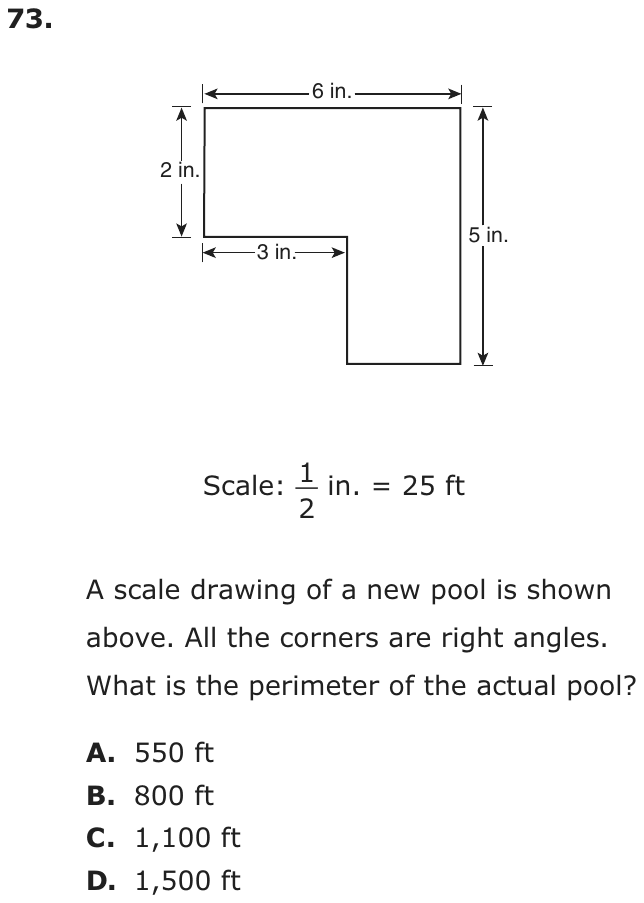
Scale:
A scale drawing of a new pool is shown above. All the corners are right angles. What is the perimeter of the actual pool?
- A550 ft
- B800 ft
- C1,100 ft
- D1,500 ft
Show the answer
Correct answer: C
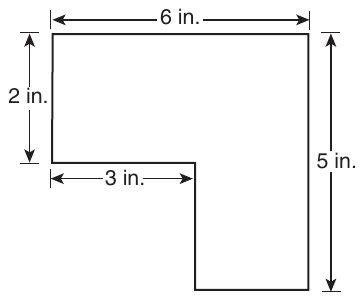
Determine the two missing side lengths on the scale drawing:
All corners are right angles, so the figure can be divided into rectangles with opposite sides that are congruent in length. This means the sum of the shorter vertical sides on the left and in the center of the figure () must equal the length of the longer vertical side on the right side of the figure (5 in.):
So, the missing vertical side length of the figure is 3 in.
Again, because opposite sides of a rectangular figure are congruent in length, the sum of the shorter horizontal sides in the middle and bottom of the figure () must equal the length of the longer horizontal side on the top of the figure (6 in.):
So, the missing horizontal side length of the figure is 3 in.
Determine the perimeter by adding all the side lengths of the figure:
This is a scale drawing in which . Write a proportion to determine the value of x, the unknown number of feet that is represented by 22 in.:
Cross multiply and solve the equation for x:
Question analysis
A scale drawing shows an L-shaped pool with all right angles, four labeled sides and two unlabeled ones, and a scale of 1/2 inch to 25 feet. Students find the perimeter of the actual pool. It combines the perimeter of a composite figure with a scale given for half an inch, so the missing sides and the fractional scale are both easy to mishandle.
- Grade level
- Grade 7 content, by NYS standard
- Compared with grade 7
- At grade 7 Scale drawings are grade 7 content, and a typical task converts one given length. Here two sides are unlabeled and must be worked out, all six added, and a scale given for half an inch turned into feet per inch.
- Estimated difficulty
- Hard: combines ideas, needs a plan, and has more than one tempting wrong answer.
- Thinking it demands
- Depth of knowledge 2, skills and concepts · mainly apply
- What makes it hard
- Reading a figure, table or graph moderate
- Combines ideas moderate
- Many steps minor
- Solution
- 4 steps
- Reading level
- Question and choices: about grade 2, 30 words.
- Students, last 30 days
- Not enough answers yet to show (it takes 10).
Why it is hard, traps and wrong answers (shows the answer)
Why it is hard
The figure gives four of the six sides and the scale gives feet per half inch, so two conversions hide behind a simple-looking perimeter question. Students who add only the labeled sides, or who read the scale as 25 feet per inch, reach totals that look reasonable for a pool and are listed. Tracing the outline to count six sides, and doubling 25 before multiplying, avoids both.
Reading a figure, table or graph moderate Understanding the question
Two sides of the notch carry no labels, and the 5 in. arrow spans the full right side, so the missing lengths come from 5 − 2 = 3 and 6 − 3 = 3. (Lesh, Post & Behr, 1987; Kirsch & Mosenthal, 1990)
Combines ideas moderate Working it out
The perimeter of an L-shaped drawing has to be joined to a scale in which half an inch, not a whole inch, stands for 25 feet. (Embretson, 1998; Daniel & Embretson, 2010)
Many steps minor Working it out
Four stages follow in order, the two missing sides, the 22-inch perimeter, the feet per inch and the product, and a slip at most of them reaches a listed choice. (Daniel & Embretson, 2010; Enright, Morley & Sheehan, 2002)
Strategy: Use opposite sides to fill in the two missing lengths, add all six sides of the drawing, then double the 25 feet to get the feet one inch stands for, and multiply.
Traps
- Misreads the figure: Reads a value, label or tick spacing in a figure, table or graph wrongly.
- Units or scale: The answer is wanted in other units, or a rate or scale must be converted first.
- Wrong formula: Uses a related but wrong formula: perimeter for area, diameter for radius, area for volume, or a misremembered one.
The wrong answers, classified
A Units or scale (King et al., 2004)
Finds the drawing's 22-inch perimeter but multiplies by 25, using the scale as if 1 inch, not 1/2 inch, stood for 25 feet.
B Misreads the figure (Lesh, Post & Behr, 1987; Kirsch & Mosenthal, 1990)
Adds only the four labeled sides, 6 + 2 + 3 + 5 = 16 inches, and scales that to 800 feet, missing the two unlabeled sides of the notch.
D Wrong formula (King et al., 2004)
Multiplies the 6-inch and 5-inch sides to get 30, the outer rectangle's area, and scales that by 50 feet per inch as if it were a length.
Worked solution, step by step
Formulas used
- Perimeter
- P is the perimeter, the distance all the way around a shape. Add the length of every side, even sides with no label. It is like walking around the edge of the pool and adding up each part of the walk.
- Using a scale
- The drawing length is measured on the drawing, in inches. Feet per inch is how many real feet one inch of the drawing stands for. Multiplying turns a length on the drawing into a real length.
Sort out the question
The drawing is an L shape with six sides. Four sides have labels. The top is 6 in. long, and the right side is 5 in. long. The left side is 2 in. long, and a middle flat side is 3 in. long. Two sides have no label. The scale says 1/2 inch on the drawing stands for 25 feet. You need the perimeter of the real pool, in feet.
Find the missing up-and-down side
Call it s. It runs down from the right end of the 3 in. side to the bottom. The side labeled 2 in. and side s together go from the top to the bottom. All corners are right angles, so they match the full height on the right, 5 in.
Side s is 3 inches.
Find the bottom side
Call the bottom side b. The middle flat side, 3 in., and side b together are as wide as the top, labeled 6 in.
The bottom side is 3 inches.
Add all six sides
Go around the shape: top, right side, bottom, side s, the 3 in. side, then the 2 in. side.
The perimeter on the drawing is 22 inches. Watch out: count the two unlabeled sides. Adding only the four labeled sides gives 16 inches. That leads to 800 feet, choice B.
Find the feet per inch
The scale says 1/2 inch stands for 25 feet. A whole inch is two halves, so 1 inch stands for twice as much.
Each inch of the drawing is 50 real feet. Watch out: don’t use 25 feet per inch. That gives feet, choice A.
Change the perimeter to feet
Call the real perimeter F, for feet. Use the scale formula with 22 inches and 50 feet per inch.
The real pool’s perimeter is 1,100 feet. So the answer is C, 1,100 ft.
Check your answer
Change each side to feet first. At 50 feet per inch, the sides are 300, 250, 150, 150, 150 and 100 feet. . That matches. Choice D, 1,500, comes from . But 6 × 5 is an area, not a distance around.
More questions like this
The original DOE question