Units or scale
Question 1 of 28
2026 Practice Test B Math, question 4Question
Maria is playing a game in which players earn points called minks, zogs, and barts.
Maria has 60 zogs and 24 barts. She wants to exchange her zogs and barts for minks.
How many minks will Maria receive from the exchange?
Enter your answer in the space.
Fill-in question: work out the answer and type it as a number.
Show the answer
Correct answer: 116
Step 1: Convert the zogs to minks.
Since , divide the number of zogs Maria has by 3: .
So, .
Step 2: Convert the barts to minks.
Since , multiply the number of barts by 4 (because 1 bart is equal to 4 minks): .
So, .
Step 3: Add the mink conversions.
Add the results from Steps 1 and 2 to find the total number of minks Maria will receive: .
Question analysis
In a game with made-up points called minks, zogs and barts, Maria trades 60 zogs and 24 barts for minks, and students type how many minks she receives. It tests unit conversion with invented units and a fraction. One rate says a mink equals a fraction of a bart, so deciding whether to multiply or divide is the tricky part.
- Grade level
- Grade 6 content, by NYS standard
- Compared with grade 7
- At grade 7 Converting units with a given rate is grade 6 ratio reasoning. Invented units remove any real-world sense check, and the two conversions run in opposite directions, one through a fraction, which matches the care grade 7 problems need.
- Estimated difficulty
- Moderate: several steps, or a close reading with one strong distractor.
- Thinking it demands
- Depth of knowledge 2, skills and concepts · mainly apply
- What makes it hard
- Turning words into math moderate
- Many steps minor
- An answer in an unexpected form minor
- Solution
- 3 steps
- Reading level
- Question and choices: about grade 2, 47 words.
- Students, last 30 days
- Not enough answers yet to show (it takes 10).
Why it is hard, traps and wrong answers (shows the answer)
Why it is hard
Each step is one multiplication, division or addition; the risk is direction. The two rates point opposite ways, three zogs to a mink but four minks to a bart, and the fraction in the second rate invites dividing by 4. Asking of each unit whether one of it is worth more or less than a mink fixes the direction before any arithmetic, and it also shows why the 60 and the 24 can never simply be added.
Turning words into math moderate Understanding the question
Both rates put the mink on the left, so “1 mink = 1/4 bart” has to be turned around into 1 bart = 4 minks, and the invented units give no sense of which is worth more. (Hegarty, Mayer & Monk, 1995; Koedinger & Nathan, 2004)
Many steps minor Working it out
Two conversions run in opposite directions, dividing the zogs by 3 and multiplying the barts by 4, and their results are added, so a slip in either step changes the total. (Daniel & Embretson, 2010; Enright, Morley & Sheehan, 2002)
An answer in an unexpected form minor Choosing the answer
The total is typed into a box with no choices to compare, so a conversion done the wrong way still produces a believable whole number that nothing on screen questions. (Enright, Morley & Sheehan, 2002)
Strategy: For each kind of point, decide whether one of it is worth more or less than a mink, then multiply or divide to turn it into minks, and add the two results.
Traps
- Wrong operation: Adds instead of multiplying, divides the wrong way round, turns a ratio or rate upside down, or undoes a step in the wrong direction (subtracts what should be added back).
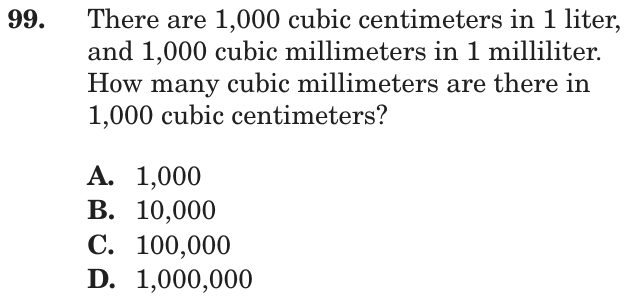
- Units or scale: The answer is wanted in other units, or a rate or scale must be converted first.
The wrong answers, classified
26 Wrong operation (Hegarty, Mayer & Monk, 1995; King et al., 2004)
Gets 20 minks from the zogs but divides the barts by 4, 24 ÷ 4 = 6, as if a bart were worth a quarter of a mink, for 20 + 6 = 26.
276 Wrong operation (Hegarty, Mayer & Monk, 1995; King et al., 2004)
Multiplies the 60 zogs by 3, as if each zog were worth 3 minks, then adds the 96 minks from the barts correctly: 180 + 96 = 276.
84 Units or scale (King et al., 2004)
Adds the 60 zogs and 24 barts as they stand, 60 + 24 = 84, without converting either kind of point into minks first.
Worked solution, step by step
Formulas used
- Converting with a rate
- Number of points is how many zogs or barts Maria has. Minks for one point is what one zog, or one bart, is worth in minks. Find that worth first for each kind of point. Then multiply, because every point of the same kind trades for the same number of minks.
Sort out the question
Maria trades two kinds of points for minks. You know:
- 3 zogs trade for 1 mink.
- 1 mink is worth of a bart.
- Maria has 60 zogs and 24 barts.
You need the total number of minks. Zogs and barts are different units, like dimes and dollars. So you cannot just add them.
Watch out: 60 + 24 = 84 adds zogs to barts. That is not a number of minks.
Find what one zog is worth
It takes 3 zogs to make 1 mink. So one zog is only part of a mink. One zog is worth of a mink.
A zog is smaller than a mink. So Maria will get fewer minks than she has zogs.
Turn the bart rule around
The rule says 1 mink is of a bart. So a mink is a quarter of a bart. It takes 4 quarters to make a whole:
So 4 minks make 1 bart. One bart is worth 4 minks. A bart is bigger than a mink.
Watch out: the fraction tempts you to divide by 4. Then 24 barts become only 6 minks, and the total is 26.
Change the zogs into minks
Use the rate. Each of the 60 zogs is worth 1/3 of a mink:
Multiplying by 1/3 is the same as dividing by 3. So 60 zogs trade for 20 minks.
Watch out: multiplying 60 by 3 gives 180. That treats a zog as bigger than a mink, and the total becomes 276.
Change the barts into minks
Each of the 24 barts is worth 4 minks:
So 24 barts trade for 96 minks.
Add the minks
Both amounts are now in minks, so you can add them:
Maria receives 116 minks. Type only the number in the box, with no units. So you would enter 116.
Check your answer
Work backward. 20 minks are worth zogs. 96 minks are worth barts. Both match what Maria started with. Also, a bart is worth more than a mink, so 24 barts should give many more than 24 minks. They do.
More questions like this
The original DOE question
Question 2 of 28
2026 Practice Test C Math, question 4Question
A person buys a used car with a down payment of $1,200 and makes monthly payments of $275 for 3 years. What is the total amount the person pays for the car?
- A$2,025
- B$9,900
- C$11,100
- D$13,500
Show the answer
Correct answer: C
Determine the total cost of the car by adding the down payment to the total monthly payments over 3 years.
There are 12 months in a year, so multiply (12 months/year × 3 years) to get a total of 36 months. Determine the total monthly payments by multiplying the monthly payment ($275) × the total number of months (36):
Determine the total cost of the car by adding the down payment ($1,200) to the total monthly payments ($9,900):
The total cost of the car is $11,100.
Question analysis
A used car is bought with a down payment of $1,200 followed by monthly payments of $275 for 3 years, and students find the total paid. The work is to count the payments, multiply, and add the down payment. Mixing up years and months, or forgetting the money paid up front, leads to the wrong totals among the choices.
- NYS standards
- Grade level
- Grade 6 content, by NYS standard
- Compared with grade 7
- Below grade 7 A total made of one payment up front plus equal monthly payments is a short whole-number calculation, simpler than grade 7 word problems with percents or negatives. The only conversion is from years to months.
- Estimated difficulty
- Routine: one familiar step, little to misread.
- Thinking it demands
- Depth of knowledge 2, skills and concepts · mainly apply
- What makes it hard
- Much to keep track of minor
- Error-prone arithmetic minor
- Solution
- 3 steps
- Reading level
- Question and choices: about grade 5, 29 words.
- Students, last 30 days
- Not enough answers yet to show (it takes 10).
Why it is hard, traps and wrong answers (shows the answer)
Why it is hard
The situation is familiar and the method direct, so this is one of the easier questions on the test. Points are lost in two places: turning 3 years into 36 payments, and remembering the money paid up front after the long multiplication. Each slip, like paying the down payment once a year, leads to a listed total, so checking that the answer holds exactly one $1,200 and 36 payments of $275 is worth the seconds.
Much to keep track of minor Working it out
The $1,200 down payment is paid once while the $275 repeats every month, so it has to be set aside while 36 payments are totaled and then added at the end. (Sweller, 1988; Carpenter, Just & Shell, 1990)
Error-prone arithmetic minor Working it out
The product 275 × 36 = 9,900 is a two-digit multiplication done by hand; splitting it as 275 × 4 = 1,100 and then 1,100 × 9 makes it quick and safe. (Brown & Burton, 1978; Junker & Sijtsma, 2001)
Strategy: Turn 3 years into a number of months, multiply the monthly payment by it, and add the down payment once at the end.
Traps
- Stops one step early: A choice is a number from partway through the solution.
- Units or scale: The answer is wanted in other units, or a rate or scale must be converted first.
- Misreads the question: Misses or misreads a condition or a word in the question: "at least", "each", "remaining", "not".
The wrong answers, classified
A Units or scale (King et al., 2004)
Multiplies the $275 by 3, the number of years, instead of by 36 months, then adds the $1,200 down payment: 825 + 1,200 = 2,025.
B Stops one step early (King et al., 2004; Gierl et al., 2017)
Finds the 36 monthly payments, 36 × $275 = $9,900, and stops without adding the $1,200 down payment made at the start.
D Misreads the question (Hegarty, Mayer & Monk, 1995)
Works out one year as $1,200 + 12 × $275 = $4,500 and multiplies by 3, so the down payment is paid three times instead of once.
Worked solution, step by step
Formulas used
- Changing years into months
- Each year has 12 months. Multiply the number of years by 12 to get the number of months. You need months here because a payment is made every month.
- Total cost with a down payment
- The down payment is money paid once, at the start. The monthly payment is paid every month. Multiply it by the number of months to get all the monthly payments. Then add the down payment only once, because it is paid only once.
Sort out the question
The person pays $1,200 once, at the start. This is the down payment. Then the person pays $275 every month for 3 years. You need the total amount paid for the car.
The payments come once a month, but the time is given in years. So change the years into months first.
Change 3 years into months
Use the months formula:
So the person makes 36 monthly payments.
Watch out: multiplying $275 by 3 counts only 3 payments. That leads to choice A, $2,025.
Add up the monthly payments
Multiply $275 by 36. A quick way is to split 36 into 4 × 9:
So the 36 payments add up to $9,900.
Watch out: stopping here gives choice B, $9,900. The down payment is still missing.
Add the down payment once
Use the total-cost formula:
The person pays $11,100 in all. Adding $1,200 for every year counts it three times. That gives choice D, $13,500.
So the answer is C, $11,100.
Check your answer
Estimate. $275 is a little less than $300, and . Add the $1,200: . The real total should be a little less than $12,000. $11,100 fits.
More questions like this
The original DOE question
Question 3 of 28
2026 Practice Test C Math, question 27Question
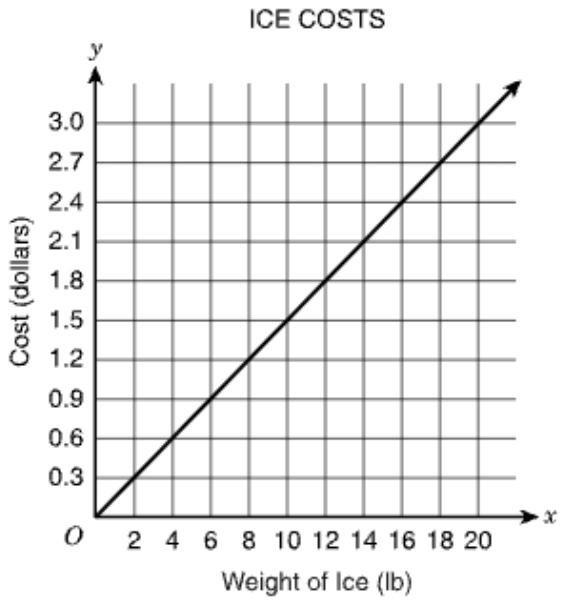
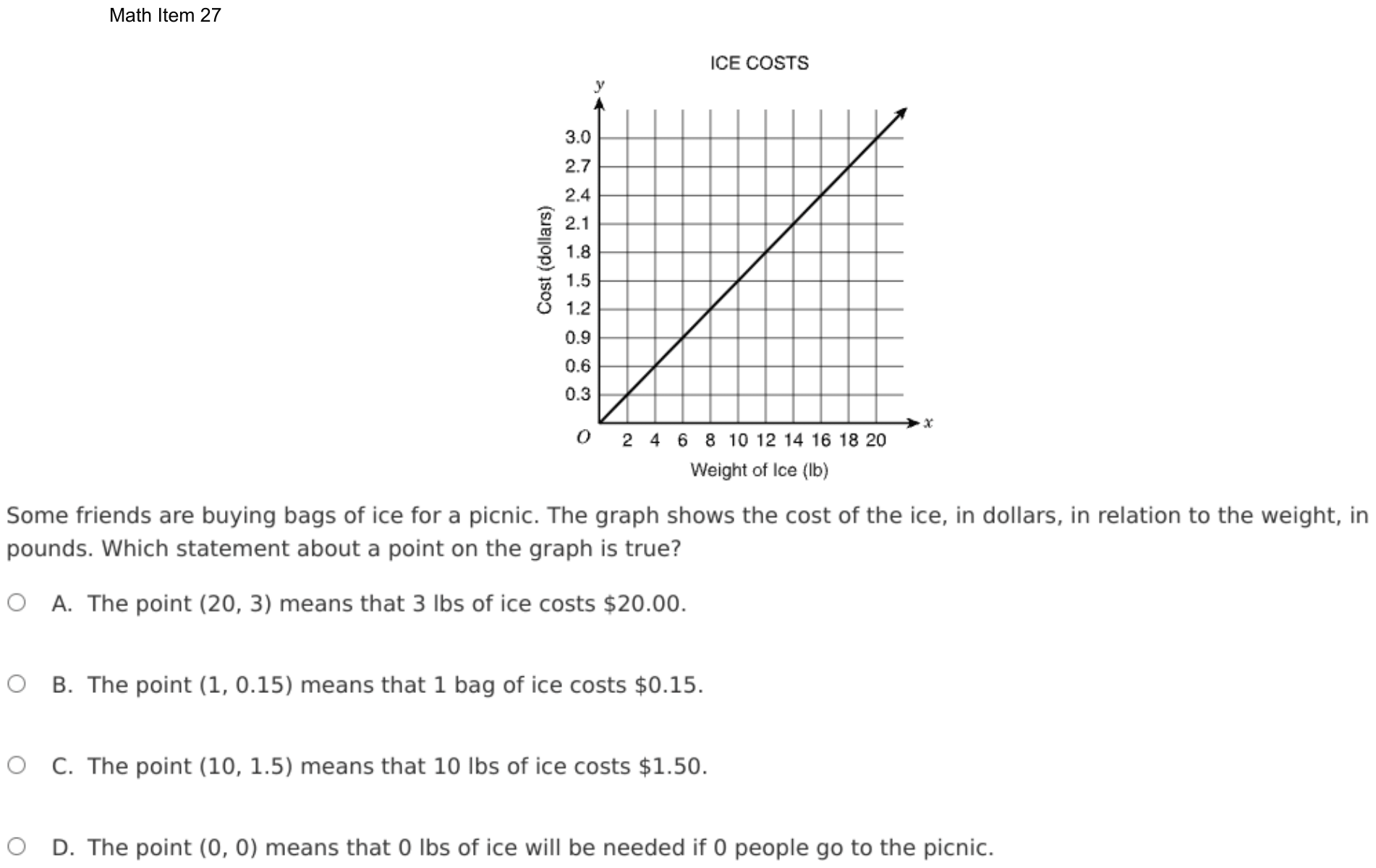
Some friends are buying bags of ice for a picnic. The graph shows the cost of the ice, in dollars, in relation to the weight, in pounds. Which statement about a point on the graph is true?
- AThe point (20, 3) means that 3 lbs of ice costs $20.00.
- BThe point (1, 0.15) means that 1 bag of ice costs $0.15.
- CThe point (10, 1.5) means that 10 lbs of ice costs $1.50.
- DThe point (0, 0) means that 0 lbs of ice will be needed if 0 people go to the picnic.
Show the answer
Correct answer: C
The x-axis represents the weight, in pounds (lbs), of ice purchased, and the y-axis represents the cost of the ice, in dollars.
The x-value in the point (10, 1.5) represents 10 lbs of ice, and the y-value represents 1.5 dollars, or $1.50. Therefore, the cost of 10 lbs of ice is $1.50.
Question analysis
Some friends buying ice for a picnic use a graph of the ice's cost in dollars against its weight in pounds, a straight line from the origin. Students pick the statement that correctly explains what a point on the graph means. Each statement names a point that really is on the line, so the units and the order of the coordinates decide.
- Grade level
- Grade 7 content, by NYS standard
- Compared with grade 7
- At grade 7 Explaining what a point on a proportional graph means in its situation is a named grade 7 skill. The graph is clear and starts at the origin, but each statement has to be read closely against the axis labels.
- Estimated difficulty
- Straightforward: two steps or one careful reading.
- Thinking it demands
- Depth of knowledge 2, skills and concepts · mainly understand
- What makes it hard
- Reading a figure, table or graph moderate
- Every choice must be checked minor
- Solution
- 2 steps
- Reading level
- Question and choices: about grade 2, 77 words.
- Students, last 30 days
- Not enough answers yet to show (it takes 10).
Why it is hard, traps and wrong answers (shows the answer)
Why it is hard
Nothing needs computing, but each statement attaches words to two numbers, and three of them attach the wrong words. The point (1, 0.15) is the unit rate students are trained to look for, and the “bags” in the stem’s story make its statement sound right, though the graph measures pounds. Saying each point aloud as so many pounds for so many dollars exposes the swapped coordinates and the extra people as well.
Reading a figure, table or graph moderate Understanding the question
Each statement must be checked against the axis labels: x is the weight of ice in pounds and y the cost in dollars, on a grid ruled every 2 pounds and every $0.30. (Lesh, Post & Behr, 1987; Kirsch & Mosenthal, 1990)
Every choice must be checked minor Choosing the answer
All four statements name a point that really lies on the line, (1, 0.15) included, so being on the graph rules nothing out; only the meaning given to each coordinate does. (Embretson & Wetzel, 1987)
Strategy: Read both axis labels and their units first, then for each choice say in words what its x-coordinate and its y-coordinate stand for, and compare that with the statement.
Traps
- Misreads the figure: Reads a value, label or tick spacing in a figure, table or graph wrongly.
- Units or scale: The answer is wanted in other units, or a rate or scale must be converted first.
- Misunderstands the concept: A wrong belief about a concept: that percents can be added, that area grows like length, that averages can be averaged, that a bigger denominator means a bigger fraction.
The wrong answers, classified
A Misreads the figure (Lesh, Post & Behr, 1987; Kirsch & Mosenthal, 1990)
Reads the point (20, 3) backward, taking 20 as the price and 3 as the weight, though x counts pounds of ice and y counts dollars.
B Units or scale (King et al., 2004)
Confirms that (1, 0.15) is on the line, the cost of 1 pound, but accepts “1 bag” because the friends buy bags, though the x-axis measures pounds.
D Misunderstands the concept (Smith, diSessa & Roschelle, 1993; De Bock et al., 1998; Ni & Zhou, 2005)
Knows (0, 0) is on every proportional graph and accepts a true-sounding story about people, though the graph never counts people; the point means 0 pounds cost $0.
Worked solution, step by step
Formulas used
- Unit rate
- The cost is in dollars, and the weight is in pounds. The unit rate is the cost of just 1 pound. On a straight line through the origin, it is the same at every point. So you can find it from any point you can read.
Sort out the question
The graph is called ICE COSTS. Read both axes first:
- The x-axis, across the bottom, is the weight of the ice in pounds (lb).
- The y-axis, up the side, is the cost in dollars.
A point is written (x, y), weight first and cost second. So a point means: x pounds of ice cost y dollars. You need the statement that says this correctly.
Find the cost of one pound
The line reaches $3.00 at 20 pounds. Use the unit rate formula:
So 1 pound of ice costs $0.15. This helps you test each point.
Test the point in choice C
Find 10 on the weight axis and go straight up to the line. The line crosses there at 1.5 on the cost axis. The unit rate agrees:
So the point (10, 1.5) means 10 pounds of ice cost $1.50. That is exactly what choice C says.
Check the other statements
Each one names a real point on the line. The problem is the meaning it gives the numbers.
Watch out: choice A reads (20, 3) backward. It means 20 pounds cost $3, not 3 pounds cost $20.
Watch out: choice B is tricky. The point (1, 0.15) is on the line, but the x-axis counts pounds, not bags. So it means 1 pound costs $0.15.
Choice D talks about people, but the graph never counts people. The point (0, 0) means 0 pounds cost $0.
Give the answer
Only choice C gives the right meaning to both numbers.
So the answer is C, 10 lbs of ice costs $1.50.
Check your answer
Use halves. The point (20, 3) says 20 pounds cost $3.00. Half as much ice, 10 pounds, should cost half as much. Half of $3.00 is $1.50. That matches choice C.
More questions like this
The original DOE question
Question 4 of 28
2026 Practice Test C Math, question 46Question
A rain gauge shows that 10 centimeters of rain fell yesterday. If 1 inch is equal to approximately 2.5 centimeters, about how many inches of rain fell yesterday?
- A1
- B2.5
- C4
- D10
Show the answer
Correct answer: C
Set up a proportion to solve:
10 centimeters is approximately 4 inches.
Question analysis
A rain gauge shows that 10 centimeters of rain fell, and 1 inch is about 2.5 centimeters. Students find about how many inches of rain fell. It tests converting between metric and customary units with a given conversion fact, and the main risk is converting in the wrong direction or reusing a number from the question.
- NYS standards
- 6.RP.3d converting measurement units
- Grade level
- Grade 6 content, by NYS standard
- Compared with grade 7
- Below grade 7 Converting units with a given conversion fact is grade 6 content, and this needs a single division with friendly numbers, lighter than grade 7 work with rates and percents.
- Estimated difficulty
- Routine: one familiar step, little to misread.
- Thinking it demands
- Depth of knowledge 1, recall and reproduction · mainly apply
- What makes it hard
- Turning words into math minor
- Solution
- 1 step
- Reading level
- Question and choices: about grade 10, 25 words.
- Students, last 30 days
- Not enough answers yet to show (it takes 10).
Why it is hard, traps and wrong answers (shows the answer)
Why it is hard
A single division answers the question, and its numbers are friendly: four lengths of 2.5 centimeters make 10. Every wrong choice is simply a number from the stem, so the only real risk is reaching for a given value instead of converting. Inches are longer than centimeters, so the rainfall in inches has to be less than 10 but more than the 1 inch that 2.5 centimeters make.
Turning words into math minor Understanding the question
The fact “1 inch is equal to approximately 2.5 centimeters” has to be turned into a division, how many 2.5-centimeter lengths fit into 10, rather than a multiplication. (Hegarty, Mayer & Monk, 1995; Koedinger & Nathan, 2004)
Strategy: Ask how many groups of 2.5 centimeters fit into the 10 centimeters of rain, since each group of 2.5 centimeters makes one inch.
Traps
- Numbers taken from the question: Combines the numbers in the question without a model of the situation, or is simply a number that appears in the question.
- Units or scale: The answer is wanted in other units, or a rate or scale must be converted first.
The wrong answers, classified
A Numbers taken from the question (Hegarty, Mayer & Monk, 1995)
Picks the 1 from the conversion fact, 1 inch for 2.5 centimeters, reading the given fact as the answer instead of applying it to 10 centimeters.
B Numbers taken from the question (Hegarty, Mayer & Monk, 1995)
Picks 2.5, the number of centimeters in one inch, straight from the conversion fact rather than finding how many inches 10 centimeters make.
D Units or scale (King et al., 2004)
Keeps the 10 from the rain gauge, as if centimeters and inches were the same size, so no conversion is done at all.
Worked solution, step by step
Formulas used
- Converting centimeters to inches
- About 2.5 centimeters make 1 inch. So each group of 2.5 centimeters is 1 inch. Dividing the centimeters by 2.5 counts how many of those groups fit. That count is the number of inches.
Sort out the question
The rain gauge shows 10 centimeters (cm) of rain. You know that 1 inch is about 2.5 cm. You need the rain in inches.
Decide whether to multiply or divide
An inch is longer than a centimeter. So it takes fewer inches than centimeters to measure the same rain. The answer must be less than 10. That tells you to divide, not multiply.
Watch out: choice D, 10, keeps the same number, as if inches and centimeters were the same size.
Divide by 2.5
Use the conversion formula:
You can see it by adding: . Four groups of 2.5 cm fit into 10 cm. So 10 cm is about 4 inches.
Give the answer
Watch out: choices A and B, 1 and 2.5, are just the numbers in the conversion fact. They do not use the 10 cm at all.
About 4 inches of rain fell. So the answer is C, 4.
Check your answer
Change back. Each inch is 2.5 cm, so 4 inches is cm. That is what the gauge showed. Also, 4 inches is less than 10, as it should be, because inches are longer.
More questions like this
The original DOE question
Question 5 of 28
2026 Practice Test D Math, question 32Question
There were 36 people at Emily’s party. If each person at the party drank 2 cups of juice, how many gallons of juice did they drink altogether?
Note: 1 gallon = 4 quarts; 1 quart = 4 cups.
- A
- B
- C9
- D72
Show the answer
Correct answer: B
Since 36 people each drank 2 cups of juice, the total amount of juice they drank was cups.
Convert 72 cups to gallons:
Question analysis
At Emily's party 36 people each drank 2 cups of juice, and this unit conversion question asks how many gallons they drank in all, given 4 quarts to a gallon and 4 cups to a quart. Students multiply to get the total in cups, then convert through quarts to gallons, and the bold word gallons sets the unit of the answer.
- Grade level
- Grade 6 content, by NYS standard
- Compared with grade 7
- Below grade 7 Converting units with given factors is grade 6 work. This adds a first step, the total number of cups, and a two-stage conversion through quarts, but the numbers are friendly and the path is routine for grade 7 students.
- Estimated difficulty
- Straightforward: two steps or one careful reading.
- Thinking it demands
- Depth of knowledge 2, skills and concepts · mainly apply
- What makes it hard
- Many steps minor
- Turning words into math minor
- Solution
- 3 steps
- Reading level
- Question and choices: about grade 5, 32 words.
- Corrected from the DOE handbook
- A stray word at the end of the explanation was removed.
- Students, last 30 days
- Not enough answers yet to show (it takes 10).
Why it is hard, traps and wrong answers (shows the answer)
Why it is hard
With both conversion facts printed, the question is mainly about keeping the units straight. Students who skip the word each convert 36 cups instead of 72, and those who stop at cups find a total that is right in the wrong unit. Working out that a gallon is 4 × 4 = 16 cups before dividing turns two conversions into one and avoids adding the 4s.
Many steps minor Working it out
A multiplication, 36 × 2, comes before two divisions by 4, cups to quarts and quarts to gallons, and stopping after the first step leaves a believable 72. (Daniel & Embretson, 2010; Enright, Morley & Sheehan, 2002)
Turning words into math minor Understanding the question
The word “each” turns 36 people into 72 cups, and the bold word gallons sets the unit of the answer, a change the note supplies in two steps. (Hegarty, Mayer & Monk, 1995; Koedinger & Nathan, 2004)
Strategy: Find the total number of cups first, then divide by 4 to get quarts and by 4 again to get gallons, or work out how many cups make a gallon and divide once.
Traps
- Units or scale: The answer is wanted in other units, or a rate or scale must be converted first.
- Misreads the question: Misses or misreads a condition or a word in the question: "at least", "each", "remaining", "not".
The wrong answers, classified
A Misreads the question (Hegarty, Mayer & Monk, 1995)
Converts 36 cups to gallons, 36 ÷ 16 = 2 1/4, missing the word each, so every person’s second cup of juice is left out.
C Units or scale (King et al., 2004)
Uses 8 cups to a gallon, adding the two 4s in the note instead of multiplying them, so 72 cups become 72 ÷ 8 = 9 gallons.
D Units or scale (King et al., 2004)
Finds the 72 cups of juice and stops, giving the amount in cups though the bold word gallons asks for it in gallons.
What was corrected from the DOE handbook, and why
- Explanation: The DOE’s explanation ends with a line that reads only “lineExtend”, a formatting code left in the document by mistake. The site leaves it out.
Worked solution, step by step
Formulas used
- Total amount
- When every person has the same amount, multiply the number of people by the amount each one has. The word each tells you to multiply.
- Cups in a gallon
- A gallon holds 4 quarts, and each quart holds 4 cups. So a gallon holds 4 groups of 4 cups. You multiply, not add, because each of the 4 quarts has its own 4 cups.
- Changing cups to gallons
- It takes 16 cups to make 1 gallon. Dividing by 16 finds how many groups of 16 cups there are. A gallon is bigger than a cup, so the number of gallons is smaller.
Sort out the question
You know:
- 36 people were at the party.
- Each person drank 2 cups of juice.
- 1 gallon = 4 quarts, and 1 quart = 4 cups.
You need the total amount of juice in gallons. The bold word tells you the unit of the answer.
Find the total in cups
Each of the 36 people drank 2 cups:
They drank 72 cups in all.
Watch out: skipping the word each uses only 36 cups. Then gallons, choice A.
Find the cups in a gallon
A gallon is 4 quarts, and each quart is 4 cups:
So 1 gallon holds 16 cups.
Watch out: adding the two 4s gives 8 cups in a gallon. Then , choice C.
Change cups to gallons
Divide the cups by 16. Simplify the fraction by dividing the top and bottom by 8:
They drank gallons of juice.
Watch out: 72 is the amount in cups. The question asks for gallons, so 72, choice D, is in the wrong unit.
So the answer is B, .
Check your answer
Work backward. gallons is quarts. 18 quarts is cups. Shared among 36 people, that is cups each. It matches.
More questions like this
The original DOE question
Question 6 of 28
2024 Test A Math, question 14Question
A museum has a room in the shape of a rectangle. The area of the floor is 960 square feet. In a scale drawing of the museum, 1 inch = 20 feet. If the length of the room is 2 inches in the scale drawing, what is the width of this room in the scale drawing?
- A in.
- B in.
- C24 in.
- D40 in.
Show the answer
Correct answer: A
The scale is 1 inch = 20 feet, and the length in the scale drawing is 2 inches, so the actual length is 40 feet.
The actual width is 24 feet.
Let x equal the width of the scale drawing, in inches.
Question analysis
A scale drawing problem: a museum room has a floor area of 960 square feet, the drawing's scale is 1 inch to 20 feet, and the room is 2 inches long in the drawing. Students find the room's width in the drawing. They must move between drawing inches and real feet, and back again, without mixing them.
- Grade level
- Grade 7 content, by NYS standard
- Compared with grade 7
- At grade 7 Scale drawings are grade 7 content, and grade 7 tasks usually convert one length. This one converts to real size, uses the area to find a second side, and converts back: three steps with a units trap.
- Estimated difficulty
- Moderate: several steps, or a close reading with one strong distractor.
- Thinking it demands
- Depth of knowledge 2, skills and concepts · mainly apply
- What makes it hard
- Combines ideas moderate
- Much to keep track of minor
- Solution
- 3 steps
- Reading level
- Question and choices: about grade 2, 57 words.
- Students, last 30 days
- Not enough answers yet to show (it takes 10).
Why it is hard, traps and wrong answers (shows the answer)
Why it is hard
Scale questions usually convert one length; this one needs a round trip, from the drawing to the real room and back. The real width of 24 feet appears partway through and is a choice, so students who lose track of units stop there. The last conversion, 24/20, then has to be written as a mixed number, and its fraction part is where a hurried student slips.
Combines ideas moderate Working it out
The 960 square feet is a real-world area, so the scale cannot be applied to it directly; the length must go to feet, the width come from the area, and then return to inches. (Embretson, 1998; Daniel & Embretson, 2010)
Much to keep track of minor Working it out
Four lengths in two units are in play, 2 inches, 40 feet, 24 feet and the width on the drawing, and each must stay labeled with its unit. (Sweller, 1988; Carpenter, Just & Shell, 1990)
Strategy: Convert the 2-inch length to real feet, divide the area by it to get the real width, then use the scale to change that width back to inches.
Traps
- Units or scale: The answer is wanted in other units, or a rate or scale must be converted first.
- Answers a different question: A choice is right for another quantity: the other unknown, the rest instead of the part, the part instead of the whole.
The wrong answers, classified
B An arithmetic slip (Junker & Sijtsma, 2001)
Gets the real width of 24 feet and divides by 20 correctly, but writes the remainder 4/20 as 1/4 instead of 1/5.
C Units or scale (King et al., 2004)
Finds the room's real width, 960 ÷ 40 = 24 feet, and gives it as the drawing's width without converting back at 1 inch per 20 feet.
D Answers a different question (King et al., 2004; Hegarty, Mayer & Monk, 1995)
Converts the 2-inch length to the real 40 feet and gives that number, answering for the length instead of the width and in the wrong units.
Worked solution, step by step
Formulas used
- Area of a rectangle
- A is the area, the space the floor covers. l is the length and w is the width. The floor is like rows of 1-foot squares, with w rows and l squares in each row. So you multiply.
- Using the scale
- The scale says 1 inch on the drawing stands for 20 feet in the real room. The drawing length is in inches, and the real length is in feet. To go back from feet to inches, divide by 20.
Sort out the question
The real room is a rectangle with a floor area of 960 square feet. On the drawing, 1 inch stands for 20 feet. The room is 2 inches long on the drawing. You need its width on the drawing, in inches. The area is in real feet, so you must switch between the drawing and the room.
Find the real length
The real room is 40 feet long. Watch out: 40 is the real length, not the width on the drawing. Choosing 40 in., choice D, is wrong.
Find the real width
Use the area of the rectangle. You know the area and the length.
The real room is 24 feet wide. Watch out: this width is in real feet. Choosing 24 in., choice C, skips changing it back to the drawing.
Change the width to the drawing
Every 20 feet is 1 inch on the drawing. So undo the scale: divide the real width by 20.
To simplify , divide the top and bottom by 4. Watch out: it is , not , so choice B is wrong. So the answer is A, in.
Check your answer
Go the other way. On the drawing, the room is 2 inches by inches. In real feet that is 40 by 24, since . And square feet, the real area.
More questions like this
The original DOE question
Question 7 of 28
2024 Test B Math, question 56Question
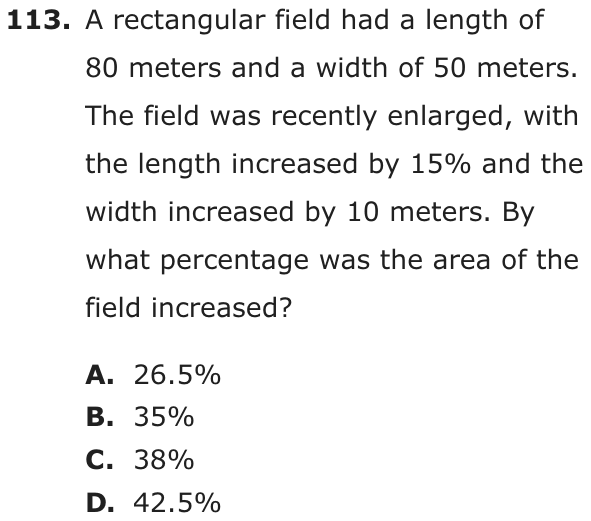
A rectangular field had a length of 80 meters and a width of 50 meters. The field was recently enlarged, with the length increased by 15% and the width increased by 10 meters. By what percentage was the area of the field increased?
- A26.5%
- B35%
- C38%
- D42.5%
Show the answer
Correct answer: C
The original area of the field was 4,000 square meters.
When the field was enlarged, the length increased by 15%, so the new length is 92 meters.
The width increased by 10 meters, so the new width is 60 meters.
The new area of the field is 5,520 square meters.
The percent increase is found by finding the difference between the two areas and dividing the increase by the original area.
Question analysis
A rectangular field 80 meters long and 50 meters wide has its length increased by 15 percent and its width by 10 meters. Students find the percent by which the field's area grew. It tests percent increase with rectangle area, and the tricky part is that one side changes by a percent and the other by a fixed length.
- Grade level
- Grade 7 content, by NYS standard
- Compared with grade 7
- Above grade 7 Grade 7 percent problems usually apply one percent change to one quantity. This changes a length by a percent and a width by a fixed amount, then asks for the percent change in area, a five-step chain with two kinds of change.
- Estimated difficulty
- Hard: combines ideas, needs a plan, and has more than one tempting wrong answer.
- Thinking it demands
- Depth of knowledge 2, skills and concepts · mainly apply
- What makes it hard
- Combines ideas moderate
- Many steps moderate
- A very close wrong answer minor
- Solution
- 5 steps
- Reading level
- Question and choices: about grade 6, 39 words.
- Students, last 30 days
- Not enough answers yet to show (it takes 10).
Why it is hard, traps and wrong answers (shows the answer)
Why it is hard
Each step is ordinary, but the two changes are stated in different units, one a percent and one in meters, which tempts students to force them into the same form. Adding the two percents is the most natural shortcut and lands close to the right value, because it misses only the small extra area where both changes overlap. Computing the old and new areas directly is slower but leaves nothing to chance.
Combines ideas moderate Working it out
Percent change has to be combined with area: the length grows by a percent and the width by meters, and the question asks for the percent change of their product. (Embretson, 1998; Daniel & Embretson, 2010)
Many steps moderate Working it out
Five computations are chained: the new length 92, the new width 60, the areas 4,000 and 5,520, and the increase 1,520 as a share of 4,000. (Daniel & Embretson, 2010; Enright, Morley & Sheehan, 2002)
A very close wrong answer minor Choosing the answer
The 35% from adding 15% and 20% sits only 3 points below 38%, so a rough estimate of the new area cannot rule it out. (Embretson & Wetzel, 1987; Gorin & Embretson, 2006; Ascalon et al., 2007)
Strategy: Compute the new length and the new width, find the old and new areas, and divide the increase in area by the original area.
Traps
- Misunderstands the concept: A wrong belief about a concept: that percents can be added, that area grows like length, that averages can be averaged, that a bigger denominator means a bigger fraction.
- Units or scale: The answer is wanted in other units, or a rate or scale must be converted first.
The wrong answers, classified
A Units or scale (King et al., 2004)
Treats the 10-meter widening as a 10% increase, so multiplies 1.15 × 1.10 = 1.265 and reports a 26.5% rise.
B Misunderstands the concept (Smith, diSessa & Roschelle, 1993; De Bock et al., 1998; Ni & Zhou, 2005)
Adds the length's 15% to the width's 20% increase, as if percent increases in two dimensions simply add, missing the 3% where they overlap.
D Units or scale (King et al., 2004)
Treats the 15% as 15 meters, making the field 95 by 60 meters, an area of 5,700 square meters and a 42.5% increase.
Worked solution, step by step
Formulas used
- Area of a rectangle
- A is the area, the flat space inside. l is the length and w is the width. Multiplying counts how many unit squares fit, row by row.
- Percent increase
- old is the starting amount, and new is the amount after. new − old is how much it grew. Dividing by old compares the growth with the start. Multiplying by 100 turns that into a percent.
Sort out the question
The field was 80 meters long and 50 meters wide. The length grew by 15%, a percent. The width grew by 10 meters, a number of meters. These are two different kinds of increase.
You need the percent by which the area grew.
Find the old area
You need the old area to compare with the new one.
The old field covered 4,000 square meters.
Find the new length and width
15% of 80 is . So the new length is meters.
The new width is meters.
Watch out: 10 meters is not 10%. Treating it as 10% leads to 26.5%, choice A. Treating 15% as 15 meters leads to 42.5%, choice D.
Find the new area
Multiply the new length by the new width.
The new field covers 5,520 square meters. That is square meters more.
Find the percent increase
The area grew by 38%. Watch out: The width grew by 20%, since 10 is 20% of 50. Adding 15% + 20% = 35% gives choice B. That misses the extra corner piece where both new strips meet.
So the answer is C, 38%.
Check your answer
Use growth factors. The length is multiplied by 1.15. The width goes from 50 to 60, so it is multiplied by 1.2. The area is multiplied by , which is 38% more.
More questions like this
The original DOE question
Question 8 of 28
2023 Test A Math, question 43Question
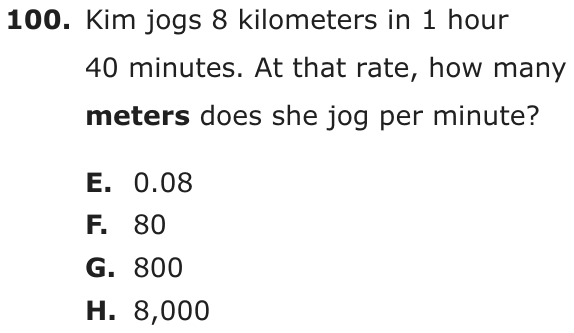
Kim jogs 8 kilometers in 1 hour 40 minutes. At that rate, how many meters does she jog per minute?
- A0.08
- B80
- C800
- D8,000
Show the answer
Correct answer: B
First, calculate Kim’s jogging time in minutes:
1 hour 40 minutes = 100 minutes
Then, convert kilometers to meters:
8 kilometers = 8,000 meters
Now simplify the ratio to find the answer:
Question analysis
This rate question says Kim jogs 8 kilometers in 1 hour 40 minutes and asks how many meters she jogs per minute. Students convert a mixed time to minutes and kilometers to meters before finding a unit rate. Skipping a conversion, or stopping before dividing, gives answers that are off by factors of ten or more.
- Grade level
- Grade 6 content, by NYS standard
- Compared with grade 7
- Below grade 7 Unit rates and metric conversions are grade 6 topics. This needs two conversions, hours and minutes to minutes and kilometers to meters, then one division with whole numbers, simpler than grade 7 rate problems built on fractions.
- Estimated difficulty
- Straightforward: two steps or one careful reading.
- Thinking it demands
- Depth of knowledge 2, skills and concepts · mainly apply
- What makes it hard
- Something you must already know minor
- Many steps minor
- Solution
- 3 steps
- Reading level
- Question and choices: about grade 4, 17 words.
- Students, last 30 days
- Not enough answers yet to show (it takes 10).
Why it is hard, traps and wrong answers (shows the answer)
Why it is hard
The rate itself is one division; what makes the question work is that the distance and the time both arrive in the wrong units. Converting only the time gives a speed in kilometers per minute, and converting only the distance and stopping gives the whole trip in meters. Writing the units beside every number, meters over minutes, shows when the answer is ready.
Something you must already know minor Working it out
The conversions are not given: 1 kilometer is 1,000 meters and 1 hour is 60 minutes, so 8 kilometers becomes 8,000 meters and 1 hour 40 minutes becomes 100 minutes. (Anderson & Krathwohl, 2001)
Many steps minor Working it out
Two conversions, one for distance and one for time, come before the single division, and skipping the distance conversion leaves an answer a thousand times too small. (Daniel & Embretson, 2010; Enright, Morley & Sheehan, 2002)
Strategy: Rewrite the time entirely in minutes and the distance entirely in meters, then divide distance by time; check that the answer's units are meters per minute.
Traps
- Units or scale: The answer is wanted in other units, or a rate or scale must be converted first.
- Stops one step early: A choice is a number from partway through the solution.
- An arithmetic slip: The right method with a plausible arithmetic error: a digit, a place value or a times-table fact.
The wrong answers, classified
A Units or scale (King et al., 2004)
Divides the 8 kilometers by the 100 minutes but never changes kilometers to meters, giving a speed of 0.08 kilometer per minute.
C An arithmetic slip (Junker & Sijtsma, 2001)
Converts both units correctly but cancels only one zero when dividing 8,000 by 100, getting a rate ten times too large.
D Stops one step early (King et al., 2004; Gierl et al., 2017)
Converts 8 kilometers to 8,000 meters and stops, giving the whole distance before dividing by the 100 minutes it took.
Worked solution, step by step
Formulas used
- Kilometers to meters
- Each kilometer is 1,000 meters, so multiply the number of kilometers by 1,000 to get meters. The word part kilo means a thousand.
- Rate
- The rate, or speed, is how far you go in one unit of time. Distance is how far, and time is how long. Dividing shares the distance equally among the minutes, so you get the distance for one minute.
Sort out the question
Kim jogs 8 kilometers in 1 hour 40 minutes. You need her speed in meters per minute: how many meters she jogs in one minute. The question gives kilometers and hours, so change both units first.
Change the time to minutes
One hour is 60 minutes. Add the extra 40 minutes.
Kim jogs for 100 minutes.
Change the distance to meters
Kim jogs 8,000 meters. Watch out: 8,000 is the whole distance, not meters per minute. Stopping here gives choice D.
Divide the distance by the time
She jogs 80 meters each minute. Watch out: if you skip the change to meters, you get 8 ÷ 100 = 0.08 kilometer per minute, choice A. So the answer is B, 80 meters per minute.
Check your answer
Work backward. At 80 meters a minute, 100 minutes gives meters. That is 8 kilometers, just as the question says.
More questions like this
The original DOE question
Question 9 of 28
2023 Test B Math, question 7Question
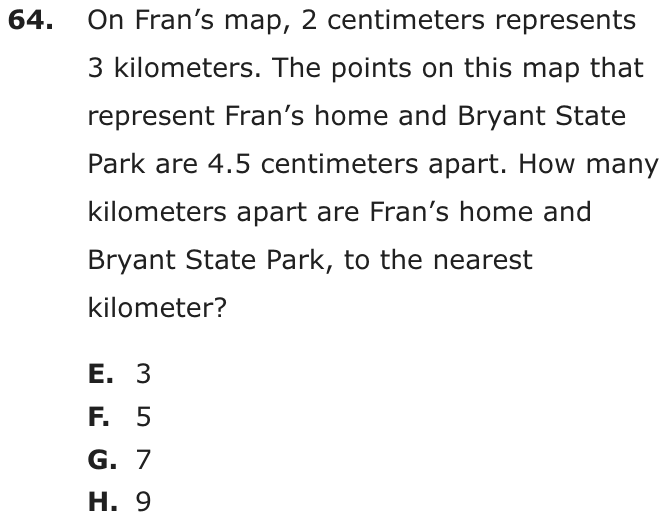
On Fran’s map, 2 centimeters represents 3 kilometers. The points on this map that represent Fran’s home and Bryant State Park are 4.5 centimeters apart. How many kilometers apart are Fran’s home and Bryant State Park, to the nearest kilometer?
- A3
- B5
- C7
- D9
Show the answer
Correct answer: C
Let x represent the distance, in kilometers, between Fran’s house and Bryant State Park. Set up a proportion to solve for x:
| Cross multiply. | |
| Apply the multiplicative inverse property; divide both sides of the equation by 2. | |
Question analysis
On Fran's map, 2 centimeters represent 3 kilometers, and her home and Bryant State Park are 4.5 centimeters apart on the map. Students find the real distance to the nearest kilometer. It is a map-scale proportion problem: the scale must be applied in the right direction, and the result rounded.
- Grade level
- Grade 7 content, by NYS standard
- Compared with grade 7
- At grade 7 Map scales are standard grade 7 proportional reasoning, and this problem is typical: one distance, one scale, then rounding. Nothing beyond a single proportion is needed.
- Estimated difficulty
- Straightforward: two steps or one careful reading.
- Thinking it demands
- Depth of knowledge 2, skills and concepts · mainly apply
- What makes it hard
- Turning words into math minor
- Error-prone arithmetic minor
- Solution
- 3 steps
- Reading level
- Question and choices: about grade 8, 37 words.
- Students, last 30 days
- Not enough answers yet to show (it takes 10).
Why it is hard, traps and wrong answers (shows the answer)
Why it is hard
This is a one-proportion map question, and the only judgments are the direction of the scale and when to round. The phrase to the nearest kilometer tempts some students to round the scale itself before multiplying, which lands on a listed answer two kilometers too far. Rounding only the final 6.75 keeps the result right.
Turning words into math minor Understanding the question
“2 centimeters represents 3 kilometers” gives 1.5 kilometers per centimeter; set up the other way round, the scale shrinks the 4.5 centimeters instead of enlarging them. (Hegarty, Mayer & Monk, 1995; Koedinger & Nathan, 2004)
Error-prone arithmetic minor Working it out
The map distance is a decimal, 4.5 × 3 ÷ 2 = 6.75, and the result must then be rounded to the nearest kilometer, two places where a quick estimate drifts. (Brown & Burton, 1978; Junker & Sijtsma, 2001)
Strategy: Work out how many kilometers 1 centimeter on the map stands for, multiply by 4.5, and round only at the very end.
Traps
- Wrong operation: Adds instead of multiplying, divides the wrong way round, turns a ratio or rate upside down, or undoes a step in the wrong direction (subtracts what should be added back).
- Rounds too early: Rounds a value partway through, or rounds the wrong way, so the final answer drifts from the exact one.
- Units or scale: The answer is wanted in other units, or a rate or scale must be converted first.
The wrong answers, classified
A Wrong operation (Hegarty, Mayer & Monk, 1995; King et al., 2004)
Turns the scale upside down, multiplying 4.5 by 2/3 instead of 3/2, so the real distance comes out smaller than the map distance.
B Units or scale (King et al., 2004)
Takes the 4.5 centimeters on the map as kilometers and rounds to 5, never applying the scale that turns each centimeter into 1.5 kilometers.
D Rounds too early (King et al., 2004)
Rounds the scale of 1.5 kilometers per centimeter up to 2 before multiplying, so 4.5 × 2 = 9 instead of 6.75.
Worked solution, step by step
Formulas used
- Scale proportion
- A map shrinks every distance by the same amount. So real distance over map distance makes the same fraction everywhere on the map. Put kilometers on top on both sides and centimeters on the bottom. Then solve for the missing number.
Sort out the question
On Fran’s map, 2 centimeters stand for 3 kilometers in real life. Her home and the park are 4.5 centimeters apart on the map. You need the real distance in kilometers, rounded to the nearest whole kilometer.
Set up the proportion
Let x be the real distance, in kilometers. Put kilometers on top and centimeters on the bottom, on both sides.
Solve for x
To get x alone, multiply both sides by 4.5.
So the real distance is 6.75 kilometers. Watch out: keep the scale exact until the end. Rounding 1.5 kilometers per centimeter up to 2 gives , choice D.
Round to the nearest kilometer
6.75 is between 6 and 7. Its decimal part, 0.75, is more than 0.5, so round up to 7.
Watch out: don’t flip the scale. Multiplying 4.5 by gives 3, choice A. So the answer is C, 7.
Check your answer
Each centimeter stands for kilometers. So 4 centimeters is 6 kilometers, and half a centimeter is 0.75 kilometer. That adds to 6.75, which rounds to 7. The real number should be bigger than 4.5, and it is.
More questions like this
The original DOE question
Question 10 of 28
2023 Test B Math, question 49Question
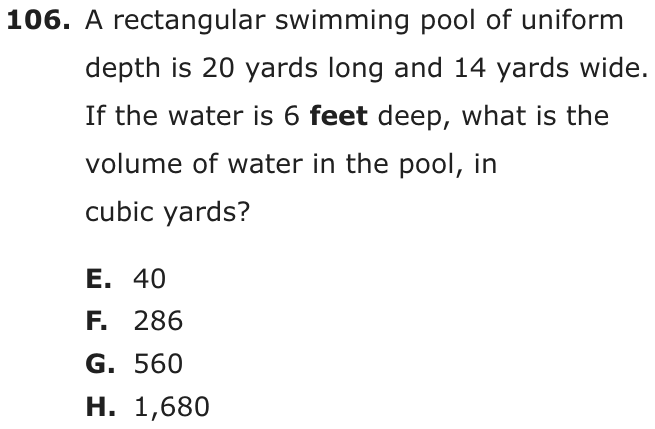
A rectangular swimming pool of uniform depth is 20 yards long and 14 yards wide. If the water is 6 feet deep, what is the volume of water in the pool, in cubic yards?
- A40
- B286
- C560
- D1,680
Show the answer
Correct answer: C
First, change 6 feet to yards:
Then, multiply the dimensions of the pool to find the volume, in cubic yards:
Question analysis
A rectangular swimming pool is 20 yards long and 14 yards wide, and the water is 6 feet deep. Students find the volume of water in cubic yards. It tests the volume of a rectangular prism, and the depth is in a different unit from the other measurements, so it has to be converted first.
- Grade level
- Grade 6 content, by NYS standard
- Compared with grade 7
- Below grade 7 The volume of a rectangular prism is grade 5 and 6 content, and the conversion here gives a whole number. Grade 7 volume work is usually longer, with composite or triangular prisms; here the only extra step is one unit conversion.
- Estimated difficulty
- Straightforward: two steps or one careful reading.
- Thinking it demands
- Depth of knowledge 2, skills and concepts · mainly apply
- What makes it hard
- Combines ideas minor
- Something you must already know minor
- Solution
- 2 steps
- Reading level
- Question and choices: about grade 6, 31 words.
- Students, last 30 days
- Not enough answers yet to show (it takes 10).
Why it is hard, traps and wrong answers (shows the answer)
Why it is hard
The only real trap is the mixed units: 20 and 14 are yards, 6 is feet, and the answer is wanted in cubic yards. Multiplying the three numbers as printed gives a listed choice three times too large. Underlining the unit of each measurement before multiplying, and converting the odd one out, takes seconds.
Combines ideas minor Working it out
The length and width are in yards but the depth is in feet, so a conversion, 6 feet = 2 yards, must come before the volume formula is used. (Embretson, 1998; Daniel & Embretson, 2010)
Something you must already know minor Working it out
Neither 3 feet = 1 yard nor volume = length × width × depth is given; both are assumed in a stem that asks for cubic yards. (Anderson & Krathwohl, 2001)
Strategy: Change the depth from feet to yards first, so that all three measurements are in yards, then multiply the length, width and depth.
Traps
- Units or scale: The answer is wanted in other units, or a rate or scale must be converted first.
- Wrong formula: Uses a related but wrong formula: perimeter for area, diameter for radius, area for volume, or a misremembered one.
- Numbers taken from the question: Combines the numbers in the question without a model of the situation, or is simply a number that appears in the question.
The wrong answers, classified
A Numbers taken from the question (Hegarty, Mayer & Monk, 1995)
Adds the three measurements, 20 + 14 + 6 = 40, with no conversion and no volume formula, combining the stem’s numbers.
B Wrong formula (King et al., 2004)
Finds the area of the water’s surface, 20 × 14 = 280, then adds the depth of 6 instead of multiplying by it.
D Units or scale (King et al., 2004)
Multiplies 20 × 14 × 6 without changing 6 feet to 2 yards, mixing yards with feet and getting a volume three times too large.
Worked solution, step by step
Formulas used
- Volume of a rectangular box
- V is the volume, the space inside, in cubic units. l is the length, w is the width, and h is the height or depth. All three must be in the same unit. Multiplying them counts the unit cubes that fill the box.
- Feet to yards
- There are 3 feet in 1 yard. So to change feet to yards, divide the number of feet by 3. A yard is longer than a foot, so you get a smaller number.
Sort out the measurements
The pool is shaped like a box. Uniform depth means the water is equally deep everywhere. The pool is 20 yards long and 14 yards wide. The water is 6 feet deep. You need the volume, the space the water fills, in cubic yards.
Change the depth to yards
Two sides are in yards, but the depth is in feet. All three must use the same unit before you multiply. The answer is in cubic yards, so change feet to yards.
The water is 2 yards deep.
Find the volume
Use the volume formula with all three measurements in yards.
The pool holds 560 cubic yards of water.
Give the answer
Watch out: Multiplying 20 × 14 × 6 mixes yards with feet. It gives 1,680, choice D, which is three times too big.
So the answer is C, 560 cubic yards.
Check your answer
Check the units. Yards times yards times yards gives cubic yards, just what the question asks for. Also, 1,680 ÷ 3 = 560. So using 6 feet unchanged makes the answer exactly three times too big.
More questions like this
The original DOE question
Question 11 of 28
2023 Test B Math, question 54Question
The speed 10 meters per second is equivalent to how many feet per hour? (Use the approximation 1 foot = 0.3 meter.)
- A10,800
- B12,000
- C36,000
- D120,000
Show the answer
Correct answer: D
Question analysis
This unit conversion question gives a speed of 10 meters per second and asks for the same speed in feet per hour, using 1 foot = 0.3 meter. Students convert both the distance unit and the time unit. Setting up each conversion factor so that the unwanted units cancel is what makes it tricky.
- Grade level
- Grade 6 content, by NYS standard
- Compared with grade 7
- Above grade 7 Grade 7 students usually convert one unit with a given factor. This converts both parts of a rate, seconds to hours and meters to feet, with a decimal conversion factor and large numbers to keep track of.
- Estimated difficulty
- Hard: combines ideas, needs a plan, and has more than one tempting wrong answer.
- Thinking it demands
- Depth of knowledge 2, skills and concepts · mainly apply
- What makes it hard
- Many steps moderate
- Error-prone arithmetic moderate
- Something you must already know minor
- Solution
- 3 steps
- Reading level
- Question and choices: about grade 7, 18 words.
- Students, last 30 days
- Not enough answers yet to show (it takes 10).
Why it is hard, traps and wrong answers (shows the answer)
Why it is hard
Every wrong choice is a conversion handled badly: multiplying by 0.3 when the fact 1 foot = 0.3 meter calls for dividing, dividing by 3 instead of 0.3, or stopping in meters per hour. Writing the units as fractions, so that seconds and meters cancel, shows which way each factor goes. A size check also helps: a foot is shorter than a meter, so the number of feet must be larger than the 36,000 meters.
Many steps moderate Working it out
Both parts of the rate change: seconds become hours by multiplying by 3,600, and meters become feet by dividing by 0.3, two conversions that each have a wrong direction. (Daniel & Embretson, 2010; Enright, Morley & Sheehan, 2002)
Error-prone arithmetic moderate Working it out
Dividing 36,000 by 0.3 means moving the decimal point in the divisor, and a slip of one place gives 12,000 instead of 120,000. (Brown & Burton, 1978; Junker & Sijtsma, 2001)
Something you must already know minor Working it out
The stem gives 1 foot = 0.3 meter but not the 3,600 seconds in an hour, which students must build from 60 × 60. (Anderson & Krathwohl, 2001)
Strategy: Write the speed as a fraction, multiply by 3,600 seconds per hour, then by 1 foot over 0.3 meter, checking that seconds and meters cancel.
Traps
- Units or scale: The answer is wanted in other units, or a rate or scale must be converted first.
- Wrong operation: Adds instead of multiplying, divides the wrong way round, turns a ratio or rate upside down, or undoes a step in the wrong direction (subtracts what should be added back).
- An arithmetic slip: The right method with a plausible arithmetic error: a digit, a place value or a times-table fact.
The wrong answers, classified
A Wrong operation (Hegarty, Mayer & Monk, 1995; King et al., 2004)
Multiplies 36,000 meters per hour by 0.3 instead of dividing, turning the fact 1 foot = 0.3 meter upside down and getting 10,800.
B An arithmetic slip (Junker & Sijtsma, 2001)
Divides 36,000 by 3 instead of 0.3, putting the decimal point in the wrong place and getting an answer ten times too small.
C Units or scale (King et al., 2004)
Converts seconds to hours, 10 × 3,600 = 36,000, and stops, leaving the speed in meters per hour rather than feet per hour.
Worked solution, step by step
Formulas used
- Seconds in an hour
- An hour has 60 minutes, and each minute has 60 seconds. So 1 hour holds 60 groups of 60 seconds. To change a speed per second into a speed per hour, multiply by 3,600, because an hour is 3,600 seconds long.
- Meters to feet
- The problem says 1 foot is about 0.3 meter. So each foot uses up 0.3 meter of the distance. To count the feet, divide the meters by 0.3. A foot is shorter than a meter, so you get more feet than meters.
Sort out the question
The speed is 10 meters per second. That means it moves 10 meters every second. You need the speed in feet per hour. Two units change: seconds become hours, and meters become feet. Change one at a time. Use 1 foot = 0.3 meter.
Find the seconds in an hour
An hour is much longer than a second. So in one hour, the object moves much farther. First find how many seconds are in an hour.
One hour is 3,600 seconds.
Find the meters per hour
Each second it moves 10 meters. In 3,600 seconds it moves 3,600 times as far.
The speed is 36,000 meters per hour.
Watch out: Stopping here gives 36,000, choice C. That number is still in meters, not feet.
Change meters to feet
Each foot is 0.3 meter. To find how many feet fit in 36,000 meters, divide by 0.3. Multiplying both numbers by 10 makes the division easier.
So 36,000 meters is 120,000 feet. The speed is 120,000 feet per hour.
Give the answer
Watch out: Multiplying by 0.3 instead of dividing gives 10,800, choice A. Dividing by 3 instead of 0.3 gives 12,000, choice B.
So the answer is D, 120,000 feet per hour.
Check your answer
A foot is shorter than a meter. So any distance is more feet than meters. The answer must be bigger than 36,000, and only choice D is. Also, 120,000 feet at 0.3 meter each is 120,000 × 0.3 = 36,000 meters. That matches.
More questions like this
The original DOE question
Question 12 of 28
2022 Test A Math, question 2Question
A homeowner has a budget of $135 for the installation of a light fixture. An electrician charges $60 per hour plus a one-time trip charge of $45. What is the greatest amount of time, in hours, the electrician can work on the installation while staying within the homeowner’s budget? Write your answer as a decimal.
Grid-in question: work out the answer and enter it as a number.
Show the answer
Correct answer: 1.5
Let x represent the number of hours the electrician can work.
The cost for the number of hours worked is $60 times the number of hours worked, x. The sum of the one-time trip charge ($45) and the cost of the number of hours worked () must be less than or equal to $135. Express this relationship as an inequality:
Solve the inequality for x:
Written as a decimal, .
Question analysis
A homeowner has $135 to spend, and an electrician charges $60 an hour plus a one-time $45 trip charge. This grid-in asks for the greatest number of hours the electrician can work within the budget, written as a decimal. Students write and solve a two-step inequality, and turning a length of time into decimal hours is the last trap.
- Grade level
- Grade 7 content, by NYS standard
- Compared with grade 7
- At grade 7 Solving a word problem that leads to an inequality of the form px + q ≤ r is the grade 7 standard itself. The numbers are friendly; the only twists are treating the budget as a limit and writing the time in decimal hours.
- Estimated difficulty
- Straightforward: two steps or one careful reading.
- Thinking it demands
- Depth of knowledge 2, skills and concepts · mainly apply
- What makes it hard
- Turning words into math moderate
- An answer in an unexpected form minor
- Solution
- 3 steps
- Reading level
- Question and choices: about grade 8, 52 words.
- Students, last 30 days
- Not enough answers yet to show (it takes 10).
Why it is hard, traps and wrong answers (shows the answer)
Why it is hard
The arithmetic is light, $135 − $45 = $90 and then $90 ÷ $60, so the question is decided by the setup and by the form of the entry. The trip charge is paid once, not every hour, and has to come off the budget before dividing. The time works out to an hour and a half, and students who think in hours and minutes may write it the way a clock shows it rather than as a decimal.
Turning words into math moderate Understanding the question
The stem never says “at most”; the limit comes from “a budget of $135”, and the one-time $45 trip charge is added once while the $60 multiplies the hours, giving 45 + 60x ≤ 135. (Hegarty, Mayer & Monk, 1995; Koedinger & Nathan, 2004)
An answer in an unexpected form minor Choosing the answer
The grid-in demands a decimal, so an hour and a half must be entered as 1.5, not as 1:30 or 90 minutes, with no choices to confirm the form. (Enright, Morley & Sheehan, 2002)
Strategy: Take the one-time trip charge off the budget first, divide what is left by the hourly charge, and give the time in hours as a decimal rather than in hours and minutes.
Traps
- Units or scale: The answer is wanted in other units, or a rate or scale must be converted first.
- Misreads the question: Misses or misreads a condition or a word in the question: "at least", "each", "remaining", "not".
- Stops one step early: A choice is a number from partway through the solution.
The wrong answers, classified
2.25 Misreads the question (Hegarty, Mayer & Monk, 1995)
Divides the whole $135 budget by $60 an hour, 135 ÷ 60 = 2.25, leaving out the one-time $45 trip charge that must come off first.
1.3 Units or scale (King et al., 2004)
Finds that the $90 left pays for 1 hour 30 minutes and writes that as 1.3, as if minutes were tenths of an hour rather than sixtieths.
90 Stops one step early (King et al., 2004; Gierl et al., 2017)
Subtracts the trip charge and enters the $90 left for labor, stopping before dividing by the $60 hourly charge to turn dollars into hours.
Worked solution, step by step
Formulas used
- Total cost with a one-time charge
- C is the total cost. f is the one-time charge, paid once no matter how long the job takes. r is the rate, the cost for each hour. h is the number of hours. The hourly part grows with time, but the one-time charge does not.
- Keeping an inequality balanced
- The sign ≤ says the left side is less than or equal to the right side. a and b are the two sides. c is a positive number. Subtracting c from both sides, or dividing both sides by c, keeps the statement true.
Sort out the question
The homeowner can spend $135 at most. That is the budget. The electrician has a one-time trip charge of $45. One-time means it is paid once, not every hour. On top of that, the electrician charges $60 for each hour. You need the greatest number of hours that keeps the total at $135 or less. The question asks for a decimal.
Write an inequality
Let h be the number of hours. Use the total cost formula with f = 45 and r = 60. The total must be less than or equal to $135. An inequality is like an equation, but it uses a sign such as ≤ instead of =.
Take off the trip charge
Subtract 45 from both sides. This keeps the inequality balanced.
So $90 is left to pay for the hours. Watch out: don’t divide the whole $135 by $60. That leaves out the trip charge, and you would grid 2.25.
Divide by the hourly rate
60 × h means 60 times h. Divide both sides by 60 to get h by itself.
The electrician can work at most 1.5 hours. Watch out: 1.5 hours is 1 hour 30 minutes, but don’t grid 1.3. Thirty minutes is half an hour, 0.5, not 0.3. Also don’t grid 90. That is dollars, not hours. So you would grid 1.5.
Check your answer
Put 1.5 hours back in: . That is exactly the budget. Now try 2 hours: . That is over $135. So 1.5 hours is the most.
More questions like this
The original DOE question
Question 13 of 28
2022 Test A Math, question 16Question
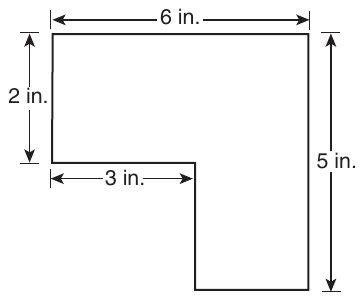
Scale:
A scale drawing of a new pool is shown above. All the corners are right angles. What is the perimeter of the actual pool?
- A550 ft
- B800 ft
- C1,100 ft
- D1,500 ft
Show the answer
Correct answer: C
Determine the two missing side lengths on the scale drawing:
All corners are right angles, so the figure can be divided into rectangles with opposite sides that are congruent in length. This means the sum of the shorter vertical sides on the left and in the center of the figure () must equal the length of the longer vertical side on the right side of the figure (5 in.):
So, the missing vertical side length of the figure is 3 in.
Again, because opposite sides of a rectangular figure are congruent in length, the sum of the shorter horizontal sides in the middle and bottom of the figure () must equal the length of the longer horizontal side on the top of the figure (6 in.):
So, the missing horizontal side length of the figure is 3 in.
Determine the perimeter by adding all the side lengths of the figure:
This is a scale drawing in which . Write a proportion to determine the value of x, the unknown number of feet that is represented by 22 in.:
Cross multiply and solve the equation for x:
Question analysis
A scale drawing shows an L-shaped pool with all right angles, four labeled sides and two unlabeled ones, and a scale of 1/2 inch to 25 feet. Students find the perimeter of the actual pool. It combines the perimeter of a composite figure with a scale given for half an inch, so the missing sides and the fractional scale are both easy to mishandle.
- Grade level
- Grade 7 content, by NYS standard
- Compared with grade 7
- At grade 7 Scale drawings are grade 7 content, and a typical task converts one given length. Here two sides are unlabeled and must be worked out, all six added, and a scale given for half an inch turned into feet per inch.
- Estimated difficulty
- Hard: combines ideas, needs a plan, and has more than one tempting wrong answer.
- Thinking it demands
- Depth of knowledge 2, skills and concepts · mainly apply
- What makes it hard
- Reading a figure, table or graph moderate
- Combines ideas moderate
- Many steps minor
- Solution
- 4 steps
- Reading level
- Question and choices: about grade 2, 30 words.
- Students, last 30 days
- Not enough answers yet to show (it takes 10).
Why it is hard, traps and wrong answers (shows the answer)
Why it is hard
The figure gives four of the six sides and the scale gives feet per half inch, so two conversions hide behind a simple-looking perimeter question. Students who add only the labeled sides, or who read the scale as 25 feet per inch, reach totals that look reasonable for a pool and are listed. Tracing the outline to count six sides, and doubling 25 before multiplying, avoids both.
Reading a figure, table or graph moderate Understanding the question
Two sides of the notch carry no labels, and the 5 in. arrow spans the full right side, so the missing lengths come from 5 − 2 = 3 and 6 − 3 = 3. (Lesh, Post & Behr, 1987; Kirsch & Mosenthal, 1990)
Combines ideas moderate Working it out
The perimeter of an L-shaped drawing has to be joined to a scale in which half an inch, not a whole inch, stands for 25 feet. (Embretson, 1998; Daniel & Embretson, 2010)
Many steps minor Working it out
Four stages follow in order, the two missing sides, the 22-inch perimeter, the feet per inch and the product, and a slip at most of them reaches a listed choice. (Daniel & Embretson, 2010; Enright, Morley & Sheehan, 2002)
Strategy: Use opposite sides to fill in the two missing lengths, add all six sides of the drawing, then double the 25 feet to get the feet one inch stands for, and multiply.
Traps
- Misreads the figure: Reads a value, label or tick spacing in a figure, table or graph wrongly.
- Units or scale: The answer is wanted in other units, or a rate or scale must be converted first.
- Wrong formula: Uses a related but wrong formula: perimeter for area, diameter for radius, area for volume, or a misremembered one.
The wrong answers, classified
A Units or scale (King et al., 2004)
Finds the drawing's 22-inch perimeter but multiplies by 25, using the scale as if 1 inch, not 1/2 inch, stood for 25 feet.
B Misreads the figure (Lesh, Post & Behr, 1987; Kirsch & Mosenthal, 1990)
Adds only the four labeled sides, 6 + 2 + 3 + 5 = 16 inches, and scales that to 800 feet, missing the two unlabeled sides of the notch.
D Wrong formula (King et al., 2004)
Multiplies the 6-inch and 5-inch sides to get 30, the outer rectangle's area, and scales that by 50 feet per inch as if it were a length.
Worked solution, step by step
Formulas used
- Perimeter
- P is the perimeter, the distance all the way around a shape. Add the length of every side, even sides with no label. It is like walking around the edge of the pool and adding up each part of the walk.
- Using a scale
- The drawing length is measured on the drawing, in inches. Feet per inch is how many real feet one inch of the drawing stands for. Multiplying turns a length on the drawing into a real length.
Sort out the question
The drawing is an L shape with six sides. Four sides have labels. The top is 6 in. long, and the right side is 5 in. long. The left side is 2 in. long, and a middle flat side is 3 in. long. Two sides have no label. The scale says 1/2 inch on the drawing stands for 25 feet. You need the perimeter of the real pool, in feet.
Find the missing up-and-down side
Call it s. It runs down from the right end of the 3 in. side to the bottom. The side labeled 2 in. and side s together go from the top to the bottom. All corners are right angles, so they match the full height on the right, 5 in.
Side s is 3 inches.
Find the bottom side
Call the bottom side b. The middle flat side, 3 in., and side b together are as wide as the top, labeled 6 in.
The bottom side is 3 inches.
Add all six sides
Go around the shape: top, right side, bottom, side s, the 3 in. side, then the 2 in. side.
The perimeter on the drawing is 22 inches. Watch out: count the two unlabeled sides. Adding only the four labeled sides gives 16 inches. That leads to 800 feet, choice B.
Find the feet per inch
The scale says 1/2 inch stands for 25 feet. A whole inch is two halves, so 1 inch stands for twice as much.
Each inch of the drawing is 50 real feet. Watch out: don’t use 25 feet per inch. That gives feet, choice A.
Change the perimeter to feet
Call the real perimeter F, for feet. Use the scale formula with 22 inches and 50 feet per inch.
The real pool’s perimeter is 1,100 feet. So the answer is C, 1,100 ft.
Check your answer
Change each side to feet first. At 50 feet per inch, the sides are 300, 250, 150, 150, 150 and 100 feet. . That matches. Choice D, 1,500, comes from . But 6 × 5 is an area, not a distance around.
More questions like this
The original DOE question
Question 14 of 28
2022 Test A Math, question 29Question
Dakota has four yardsticks and two 12-inch rulers. If she lays all four of the yardsticks and both rulers end-to-end, what is the maximum number of feet she can measure accurately at once?
- A12 ft
- B14 ft
- C16 ft
- D18 ft
Show the answer
Correct answer: B
A yardstick is 1 yard in length.
A 12-inch ruler is 1 foot in length.
Two 12-inch rulers are 2 feet in length.
Question analysis
Dakota lays four yardsticks and two 12-inch rulers end to end and wants to know how many feet she can measure at once. Students convert yards and inches to feet and add the lengths. Mixing up the units, or leaving out one kind of measuring stick, is the main risk in this unit conversion question.
- NYS standards
- 6.RP.3d converting measurement units
- Grade level
- Grade 6 content, by NYS standard
- Compared with grade 7
- Below grade 7 Converting yards and inches to feet is grade 6 measurement work. With friendly numbers and only two conversions to add, this is easier than typical grade 7 tasks, though the wording about measuring at once may slow some readers.
- Estimated difficulty
- Routine: one familiar step, little to misread.
- Thinking it demands
- Depth of knowledge 2, skills and concepts · mainly apply
- What makes it hard
- Solution
- 2 steps
- Reading level
- Question and choices: about grade 3, 37 words.
- Corrected from the DOE handbook
- A grammatical slip in the explanation was corrected.
- Students, last 30 days
- Not enough answers yet to show (it takes 10).
Why it is hard, traps and wrong answers (shows the answer)
Why it is hard
This is a unit conversion dressed as a measuring story: four yardsticks and two rulers are laid end to end, so the total is simply a sum of lengths. Points are lost by forgetting that the rulers count too, or by giving the rulers the yardsticks' length. Writing every piece in feet before adding, 3 + 3 + 3 + 3 + 1 + 1, shows the total at a glance.
Something you must already know minor Working it out
Neither conversion is given: a yardstick is 1 yard, or 3 feet, and each 12-inch ruler is 1 foot, so 4 yards and 24 inches become 12 + 2 feet. (Anderson & Krathwohl, 2001)
Strategy: Change every length to feet before adding: a yard is 3 feet and 12 inches is 1 foot. Then total the six pieces laid end to end.
Traps
- Units or scale: The answer is wanted in other units, or a rate or scale must be converted first.
- Stops one step early: A choice is a number from partway through the solution.
The wrong answers, classified
A Stops one step early (King et al., 2004; Gierl et al., 2017)
Converts the four yardsticks to 12 feet and stops, forgetting to add the 2 feet of the two 12-inch rulers laid at the end.
C Little reason to choose it (Haladyna & Downing, 1993; Rodriguez, 2005)
No common working gives 16 feet; it would need each 12-inch ruler to be 2 feet long, so it mostly draws guesses between nearby totals.
D Units or scale (King et al., 2004)
Converts the rulers with the yard factor too, counting all six sticks as 3 feet long, 6 × 3 = 18, though a 12-inch ruler is 1 foot.
What was corrected from the DOE handbook, and why
- Explanation: The handbook says “Two 12-inch rulers is 2 feet in length.” (p. 142, question 86), repeating the verb of the line before it, “A 12-inch ruler is 1 foot in length.” The site now reads “Two 12-inch rulers are 2 feet in length.” The working and the answer, 14 ft, are unchanged.
Worked solution, step by step
Formulas used
- Yards to feet
- y is a length in yards. f is the same length in feet. One yard is 3 feet, so each yard adds 3 feet. A yardstick is exactly 1 yard long.
- Inches to feet
- i is a length in inches. f is the same length in feet. One foot is 12 inches, so divide the inches by 12. A 12-inch ruler is 1 foot long.
Sort out the question
Dakota lays 4 yardsticks and 2 rulers end to end, in one long line. End to end means each piece starts where the last one stops. So the total length is the sum of all six pieces. You need it in feet. A yardstick is 1 yard long. Each ruler is 12 inches long.
Change the yardsticks to feet
The four yardsticks make 4 yards.
The yardsticks make 12 feet. Watch out: don’t stop here. 12 feet is choice A, but the rulers count too.
Change the rulers to feet
Two rulers of 12 inches make 24 inches.
The rulers make 2 feet. Watch out: a ruler is not as long as a yardstick. Counting all six pieces as 3 feet gives feet, choice D.
Add the lengths
Dakota can measure 14 feet at once. So the answer is B, 14 ft.
Check your answer
List each piece in feet: . That matches. Or use inches. A yard is 36 inches, so 4 yards is inches. Add the rulers: inches. Then feet.
More questions like this
The original DOE question
Question 15 of 28
2022 Test A Math, question 50Question
Nadia paid $1.00 to mail a letter. The cost to mail a letter is $0.55 for the first ounce of weight plus $0.15 for each additional ounce. What was the weight, in ounces, of the letter Nadia mailed?
- A1.4
- B1.5
- C3
- D4
Show the answer
Correct answer: D
Let x represent the number of ounces Nadia’s letter weighed. The first ounce costs $0.55, so represents the number of ounces that cost $0.15 each.
Given that the total cost is $1.00, the equation that describes the situation can be written and solved as shown.
So the letter Nadia mailed weighed 4 ounces.
Question analysis
Nadia pays $1.00 to mail a letter, and postage costs $0.55 for the first ounce plus $0.15 for each additional ounce. Students find the weight of the letter in ounces. It tests writing and solving a two-step equation from a pricing rule in which the two prices apply to different ounces.
- Grade level
- Grade 7 content, by NYS standard
- Compared with grade 7
- At grade 7 Grade 7 students solve word problems that lead to equations such as px + q = r. This one takes that form once each price is matched to the right ounces, a step that makes it a little more demanding than routine practice.
- Estimated difficulty
- Moderate: several steps, or a close reading with one strong distractor.
- Thinking it demands
- Depth of knowledge 2, skills and concepts · mainly apply
- What makes it hard
- Turning words into math moderate
- Error-prone arithmetic minor
- Solution
- 3 steps
- Reading level
- Question and choices: about grade 4, 35 words.
- Students, last 30 days
- Not enough answers yet to show (it takes 10).
Why it is hard, traps and wrong answers (shows the answer)
Why it is hard
Pricing the letter ounce by ounce, $0.55, $0.70, $0.85, $1.00, reaches the total at the fourth ounce without any algebra. The equation route works too, but the first ounce is easy to lose: dividing the $0.45 left by $0.15 counts only the ounces after the first. The two decimal choices come from merging the two prices or from treating dollars as ounces.
Turning words into math moderate Understanding the question
“$0.55 for the first ounce of weight plus $0.15 for each additional ounce” makes the cost 0.55 + 0.15(x − 1), so the $0.15 covers every ounce except the first. (Hegarty, Mayer & Monk, 1995; Koedinger & Nathan, 2004)
Error-prone arithmetic minor Working it out
The money is in decimals, $1.00 − $0.55 = $0.45 and then $0.45 ÷ $0.15 = 3, and dividing by a decimal invites a misplaced point. (Brown & Burton, 1978; Junker & Sijtsma, 2001)
Strategy: Write the cost of a letter weighing x ounces, $0.55 plus $0.15 for each ounce after the first, set it equal to $1.00 and solve, then check by pricing the letter ounce by ounce.
Traps
- Stops one step early: A choice is a number from partway through the solution.
- Numbers taken from the question: Combines the numbers in the question without a model of the situation, or is simply a number that appears in the question.
- Units or scale: The answer is wanted in other units, or a rate or scale must be converted first.
The wrong answers, classified
A Numbers taken from the question (Hegarty, Mayer & Monk, 1995)
Merges the two prices into $0.70 for every ounce and divides $1.00 by $0.70, about 1.43, which rounds to 1.4.
B Units or scale (King et al., 2004)
Counts the first ounce, then treats the $0.45 left over as 0.45 ounce, getting 1.45 ounces, which rounds to 1.5.
C Stops one step early (King et al., 2004; Gierl et al., 2017)
Finds the 3 additional ounces that the $0.45 left over pays for, 0.45 ÷ 0.15 = 3, and stops before adding the first ounce.
Worked solution, step by step
Formulas used
- Cost to mail a letter
- C is the cost in dollars. w is the weight in ounces. The first ounce costs $0.55. Each ounce after the first costs $0.15, and there are w − 1 of them. Subtracting 1 leaves out the first ounce, which is already paid for.
- Keeping an equation balanced
- a and b are the two equal sides. c is any number, but not 0 when you divide. Doing the same thing to both sides keeps them equal, like a balanced scale. Use it to get the unknown by itself.
Sort out the question
Nadia paid $1.00 to mail a letter. The first ounce costs $0.55. Each additional ounce, meaning each ounce after the first, costs $0.15. You need the weight of the letter in ounces.
Write the equation
Let w be the weight in ounces. The first ounce is 1 of the w ounces. So the extra ounces number w − 1. The cost is $1.00.
Take off the first ounce’s cost
Subtract 0.55 from both sides. This keeps the equation balanced.
So $0.45 pays for the extra ounces.
Find the extra ounces
Divide both sides by 0.15. Multiply both numbers by 100 to make them whole.
There are 3 extra ounces after the first one.
Add back the first ounce
The letter weighed 4 ounces. Watch out: 3 counts only the ounces after the first. It is choice C. Also, don’t join $0.55 and $0.15 into one price. is about 1.4, choice A. So the answer is D, 4 ounces.
Check your answer
Price the letter one ounce at a time. 1 ounce: $0.55. 2 ounces: $0.70. 3 ounces: $0.85. 4 ounces: $1.00. The cost reaches $1.00 at 4 ounces. That matches.
More questions like this
The original DOE question
Question 16 of 28
2022 Test B Math, question 30Question
A robot moves forward at the rate of 9 steps every 6 seconds. If each step is x feet long, what must x be in order for the robot to travel exactly 270 feet per minute?
- A3
- B5
- C27
- D30
Show the answer
Correct answer: A
First, convert steps per second to steps per minute.
Then, use ratio reasoning to determine that each step must be 3 feet since 90 times 3 is 270 (or 270 divided by 90 is 3).
or
Question analysis
A robot moves forward 9 steps every 6 seconds, and each step is x feet long. Students find the step length that makes the robot travel exactly 270 feet per minute. It tests rates and unit conversion: the rate is given per 6 seconds but the target is per minute, so the units must be matched before solving.
- NYS standards
- Grade level
- Grade 7 content, by NYS standard
- Compared with grade 7
- At grade 7 Grade 7 rate problems often give one rate and ask for a total. This one links steps per time, feet per step and feet per minute, with seconds to convert, a typical but full multistep ratio problem.
- Estimated difficulty
- Moderate: several steps, or a close reading with one strong distractor.
- Thinking it demands
- Depth of knowledge 2, skills and concepts · mainly apply
- What makes it hard
- Much to keep track of moderate
- Many steps minor
- Solution
- 3 steps
- Reading level
- Question and choices: about grade 7, 33 words.
- Students, last 30 days
- Not enough answers yet to show (it takes 10).
Why it is hard, traps and wrong answers (shows the answer)
Why it is hard
The numbers are friendly, but the rate is given per 6 seconds and the target per minute, so the units have to meet first. A minute holds ten 6-second stretches, so the robot takes 90 steps in it, and 270 feet over 90 steps settles the length. Students who divide 270 by the 9 steps forget that those steps take only 6 seconds, and those who scale 270 down to 6 seconds stop at 27 feet, a distance rather than a step length.
Much to keep track of moderate Working it out
Three rates are in play, 9 steps per 6 seconds, x feet per step and 270 feet per minute, and their units must be lined up before any two are combined. (Sweller, 1988; Carpenter, Just & Shell, 1990)
Many steps minor Working it out
The rate is first scaled from 6 seconds to 60, giving 90 steps a minute, and only then compared with the 270 feet covered in that minute. (Daniel & Embretson, 2010; Enright, Morley & Sheehan, 2002)
Strategy: Change the rate to steps per minute first, since 6 seconds goes into a minute evenly, then ask what step length makes that many steps cover 270 feet.
Traps
- Units or scale: The answer is wanted in other units, or a rate or scale must be converted first.
- Stops one step early: A choice is a number from partway through the solution.
- Numbers taken from the question: Combines the numbers in the question without a model of the situation, or is simply a number that appears in the question.
The wrong answers, classified
B Numbers taken from the question (Hegarty, Mayer & Monk, 1995)
Multiplies the 9 steps by the 6 seconds, 54, and divides 270 by it, combining the stem’s numbers without a model of the rate.
C Stops one step early (King et al., 2004; Gierl et al., 2017)
Scales 270 feet per minute down to 27 feet per 6 seconds but stops before dividing by the 9 steps taken in that time.
D Units or scale (King et al., 2004)
Divides 270 feet by 9 steps, as if the robot took 9 steps a minute, never converting the 6-second rate to a minute.
Worked solution, step by step
Formulas used
- Rate
- A rate compares an amount with the time it takes. Here the robot’s rate is 9 steps for every 6 seconds. To compare two rates, first write them for the same length of time, such as one minute, which is 60 seconds.
- Distance from steps
- Every step covers the same length. So the distance is the number of steps times the length of one step. Here the distance and the step length are both in feet.
Sort out the question
The robot takes 9 steps every 6 seconds. Each step is x feet long. You need the x that makes the robot go exactly 270 feet per minute.
The two rates use different times: 6 seconds and 1 minute. Match the times before you compare them.
Find the steps in one minute
One minute is 60 seconds. Find how many 6-second stretches fit in a minute.
In each stretch, the robot takes 9 steps. So in one minute it takes 10 times as many.
The robot takes 90 steps per minute.
Find the length of each step
In one minute, those 90 steps must cover 270 feet. Use the distance formula.
To get x alone, divide both sides by 90.
Each step must be 3 feet long.
Give the answer
Watch out: dividing 270 by 9 gives 30, choice D. That treats 9 steps as a whole minute’s steps, but they take only 6 seconds. Cutting 270 feet per minute down to 27 feet per 6 seconds and stopping gives 27, choice C. That is a distance, not a step length. So the answer is A, 3.
Check your answer
Check the units. 90 steps per minute times 3 feet per step gives feet per minute. That is the goal. Or think in 6 seconds: 9 steps of 3 feet is 27 feet, and 10 of those stretches make 270 feet.
More questions like this
The original DOE question
Question 17 of 28
2020 Test B Math, question 28Question
Kim can repair 3 bicycles every 4 hours. At this rate, how long will it take her to repair 5 bicycles?
- A6 hr
- B6 hr 40 min
- C6 hr 45 min
- D7 hr 15 min
Show the answer
Correct answer: B
3 bicycles every 4 hours = 3 bicycles every 240 minutes ()
Question analysis
A rate word problem: Kim repairs 3 bicycles every 4 hours, and students find how long she needs for 5 bicycles at the same rate. The time per bicycle is not a whole number of hours, so the total must be written in hours and minutes, and choices only minutes apart punish a careless conversion.
- Grade level
- Grade 6 content, by NYS standard
- Compared with grade 7
- Below grade 7 Unit-rate problems with a change of time units are grade 6 work. This one needs a rate per bicycle, one multiplication and a conversion of part of an hour into minutes, a short task below typical grade 7 demand.
- Estimated difficulty
- Straightforward: two steps or one careful reading.
- Thinking it demands
- Depth of knowledge 2, skills and concepts · mainly apply
- What makes it hard
- An answer in an unexpected form moderate
- Error-prone arithmetic minor
- A very close wrong answer minor
- Solution
- 3 steps
- Reading level
- Question and choices: about grade 2, 25 words.
- Students, last 30 days
- Not enough answers yet to show (it takes 10).
Why it is hard, traps and wrong answers (shows the answer)
Why it is hard
The main risk is thinking in differences: 2 more bicycles than 3 seems to call for 2 more hours than 4, a tidy wrong answer of 6 hours. Students who scale correctly still have to turn a fraction of an hour into minutes, and a careless 45 for the 2/3 hour lands on the key's neighbor. Working in minutes, 80 per bicycle, keeps every number whole and leaves one simple conversion at the end.
An answer in an unexpected form moderate Choosing the answer
The rate gives 5 × 4/3 = 20/3, or 6 2/3 hours, but every choice is in hours and minutes, so the 2/3 of an hour must become 40 minutes before the answer can be recognized. (Enright, Morley & Sheehan, 2002)
Error-prone arithmetic minor Working it out
Each bicycle takes 4/3 of an hour, not a whole number; changing 4 hours to 240 minutes first gives a whole 80 minutes per bicycle and avoids the fraction. (Brown & Burton, 1978; Junker & Sijtsma, 2001)
A very close wrong answer minor Choosing the answer
The choices 6 hr 40 min and 6 hr 45 min are five minutes apart, so an estimate of a little under 7 hours fits both and only an exact conversion decides. (Embretson & Wetzel, 1987; Gorin & Embretson, 2006; Ascalon et al., 2007)
Strategy: Change the 4 hours to minutes first so the time per bicycle comes out whole, multiply by 5, and convert the total minutes back into hours and minutes.
Traps
- Misunderstands the concept: A wrong belief about a concept: that percents can be added, that area grows like length, that averages can be averaged, that a bigger denominator means a bigger fraction.
- Units or scale: The answer is wanted in other units, or a rate or scale must be converted first.
The wrong answers, classified
A Misunderstands the concept (Smith, diSessa & Roschelle, 1993; De Bock et al., 1998; Ni & Zhou, 2005)
Reasons additively: 2 more bicycles than 3 must take 2 more hours than 4, giving 6 hours, which keeps the difference instead of the rate of 4/3 hour per bicycle.
C Units or scale (King et al., 2004)
Reaches 6 2/3 hours but converts the 2/3 hour to 45 minutes, the minutes in 3/4 of an hour, instead of 2/3 × 60 = 40.
D Little reason to choose it (Haladyna & Downing, 1993; Rodriguez, 2005)
No common working gives 7 hr 15 min, which would mean 87 minutes per bicycle; it lies farthest from the answer and mostly draws guesses.
Worked solution, step by step
Formulas used
- Unit rate
- A unit rate tells how much goes with just 1 of something. Here it is the time to fix 1 bicycle. Total time is how long the work took, and number done is how many bicycles were fixed in that time. Once you know the time for one, multiply to scale up.
- Hours and minutes
- Each hour has 60 minutes. To change hours to minutes, multiply by 60. To change minutes back to hours, divide by 60. Any remainder is the minutes left over.
Sort out the question
Kim fixes 3 bicycles every 4 hours. She keeps working at that same rate. You need the time for 5 bicycles. The choices are in hours and minutes, so your answer must be too.
Change the hours to minutes
Splitting 4 hours among 3 bicycles does not give a whole number of hours. Minutes keep the numbers whole.
So Kim fixes 3 bicycles in 240 minutes.
Find the time for one bicycle
Next, find the unit rate. Share the 240 minutes equally among the 3 bicycles.
Each bicycle takes her 80 minutes.
Find the time for 5 bicycles
Five bicycles take 400 minutes. Watch out: don’t just add. Two more bicycles does not mean two more hours. That thinking gives 6 hours, choice A.
Change back to hours and minutes
Divide by 60 to find how many full hours fit in 400 minutes.
That is 6 full hours with 40 minutes left over. Watch out: the leftover is of an hour, which is 40 minutes. 45 minutes would be of an hour, choice C.
So the answer is B, 6 hr 40 min.
Check your answer
Work backward. 6 hr 40 min is 400 minutes. Split among 5 bicycles, that is 80 minutes each. Then 3 bicycles take minutes, which is exactly 4 hours. It matches.
More questions like this
The original DOE question
Question 18 of 28
2019 Test A Math, question 18Question
Joseph is 5 feet 9 inches tall, and Roberto is 6 feet 4.5 inches tall. What is the difference in height, in inches, between Roberto and Joseph?
- A4.5
- B5.5
- C6.5
- D7.5
Show the answer
Correct answer: D
First, convert their heights from feet and inches to inches, by multiplying the number of feet by 12 and adding the inches:
Roberto:
Joseph:
Then, subtract Joseph’s height from Roberto’s height:
Question analysis
Joseph is 5 feet 9 inches tall and Roberto is 6 feet 4.5 inches tall, and students find the difference in their heights in inches. It tests converting mixed feet-and-inches measurements and subtracting with a decimal. Subtracting the feet and the inches separately is risky, because Joseph's 9 inches exceed Roberto's 4.5 and a foot holds 12 inches.
- Grade level
- Grade 6 content, by NYS standard
- Compared with grade 7
- Below grade 7 Converting feet to inches is grade 6 ratio work, and the subtraction involves one decimal. Grade 7 measurement problems usually chain more steps or use a scale; this one needs two conversions and one subtraction.
- Estimated difficulty
- Straightforward: two steps or one careful reading.
- Thinking it demands
- Depth of knowledge 2, skills and concepts · mainly apply
- What makes it hard
- Error-prone arithmetic moderate
- Something you must already know minor
- Solution
- 3 steps
- Reading level
- Question and choices: about grade 5, 23 words.
- Corrected from the DOE handbook
- A misspelled name in the explanation was corrected.
- Students, last 30 days
- Not enough answers yet to show (it takes 10).
Why it is hard, traps and wrong answers (shows the answer)
Why it is hard
The heights mix two units, and the inch parts run the wrong way, 4.5 against 9, so subtracting part by part goes wrong unless a foot is regrouped as 12 inches. Converting both heights to inches first avoids the borrow entirely. The choices sit a single inch apart, so a rough estimate cannot stand in for the exact working, and a student who treats feet as tens of inches lands squarely on a wrong choice.
Error-prone arithmetic moderate Working it out
Subtracting 5 feet 9 inches from 6 feet 4.5 inches needs a borrow, since 4.5 inches is less than 9, and the borrowed foot holds 12 inches, not the 10 that decimal habits suggest. (Brown & Burton, 1978; Junker & Sijtsma, 2001)
Something you must already know minor Working it out
The stem never states that a foot is 12 inches, yet both heights must be turned into inches, 76.5 and 69, before the difference can be taken. (Anderson & Krathwohl, 2001)
Strategy: Change both heights to inches by multiplying the feet by 12 and adding the extra inches, then subtract the shorter height from the taller one.
Traps
- Units or scale: The answer is wanted in other units, or a rate or scale must be converted first.
- Numbers taken from the question: Combines the numbers in the question without a model of the situation, or is simply a number that appears in the question.
The wrong answers, classified
A Numbers taken from the question (Hegarty, Mayer & Monk, 1995)
Subtracts the two inch figures alone, 9 − 4.5 = 4.5, taking the smaller from the larger and leaving the feet out of the comparison entirely.
B Units or scale (King et al., 2004)
Treats feet as tens of inches, reading the heights as 64.5 and 59, or borrowing a foot as 10 inches, so 64.5 − 59 = 5.5.
C Little reason to choose it (Haladyna & Downing, 1993; Rodriguez, 2005)
No conversion or borrow gives 6.5, one inch short of the true gap; only a miscount such as taking Joseph as 70 inches reaches it, so it mostly catches guesses.
What was corrected from the DOE handbook, and why
- Explanation: The handbook’s explanation ends “Then, subtract Joseph’s height from Robert’s height: 76.5 − 69 = 7.5” (p. 133, question 75). The taller boy is Roberto, as the question and the explanation’s own “Roberto:” line call him, so the site now reads “Roberto’s height.” Nothing else changes: Roberto is 6(12) + 4.5 = 76.5 inches, Joseph is 5(12) + 9 = 69 inches, and the difference is 7.5 inches.
Worked solution, step by step
Formulas used
- Changing feet and inches to inches
- There are 12 inches in 1 foot. Multiply the feet by 12 to turn them into inches. Then add the extra inches. Now the whole height is in one unit, inches, so two heights can be compared by subtracting.
Sort out the question
Joseph is 5 feet 9 inches tall. Roberto is 6 feet 4.5 inches tall. You need the difference in their heights, in inches. The difference is how much taller Roberto is, so you subtract. Each height mixes two units, feet and inches. Change both to inches first. The question doesn’t say it, but 1 foot is 12 inches.
Change Roberto’s height to inches
Six feet is 72 inches. Then add the extra 4.5 inches.
Roberto is 76.5 inches tall.
Change Joseph’s height to inches
Do the same for Joseph. Five feet is 60 inches. Then add the extra 9 inches.
Joseph is 69 inches tall.
Subtract the two heights
Subtract Joseph’s height from Roberto’s height, the shorter from the taller.
Roberto is 7.5 inches taller.
Watch out: a foot is 12 inches, not 10. Treating it as 10 turns the heights into 64.5 and 59, and , choice B. Subtracting only the inches, , leaves out the feet and gives choice A.
So the answer is D, 7.5 inches.
Check your answer
Count up from Joseph’s height. From 5 feet 9 inches, 3 more inches reach 6 feet. From 6 feet, 4.5 more inches reach Roberto’s height. In all, inches. That matches.
More questions like this
The original DOE question
Question 19 of 28
2019 Test B Math, question 24Question
Carpenters laid a layer of insulation 6 inches thick to cover a rectangular attic floor that was 32 feet long and 20 feet wide. What was the volume, in cubic feet, of the insulation used to cover the floor?
- A160
- B320
- C640
- D3,840
Show the answer
Correct answer: B
First convert 6 inches to 0.5 feet. Then, calculate the volume, in cubic feet:
Question analysis
Carpenters spread insulation 6 inches thick over a rectangular attic floor 32 feet long and 20 feet wide, and students find the volume of insulation in cubic feet. It is a volume word problem with mixed units. The thickness is given in inches while the floor is in feet, a mismatch that is easy to overlook.
- Grade level
- Grade 6 content, by NYS standard
- Compared with grade 7
- Below grade 7 Finding the volume of a box-shaped layer is grade 6 work, with every dimension but the thickness a whole number of feet. Grade 7 volume problems use triangular or composite prisms; this one adds only a change from inches to feet.
- Estimated difficulty
- Straightforward: two steps or one careful reading.
- Thinking it demands
- Depth of knowledge 2, skills and concepts · mainly apply
- What makes it hard
- Solution
- 2 steps
- Reading level
- Question and choices: about grade 9, 36 words.
- Students, last 30 days
- Not enough answers yet to show (it takes 10).
Why it is hard, traps and wrong answers (shows the answer)
Why it is hard
Volume of a box is routine, so the question turns on the unit mix: the floor is measured in feet and the layer's thickness in inches. The handbook prints inches in bold, a warning that the plain product 3,840 is listed for those who miss it. The floor's area, 640, is the other ready trap, since it appears partway through the correct work.
Something you must already know minor Working it out
Neither the volume of a box, length × width × height, nor the 12 inches in a foot is given, and the bold inches marks the thickness as the one dimension to convert. (Anderson & Krathwohl, 2001)
Error-prone arithmetic minor Working it out
The converted thickness is the fraction 1/2 foot, so the product is 32 × 20 × 1/2, easiest as 32 × 10; kept in inches, 3,840 still needs dividing by 12. (Brown & Burton, 1978; Junker & Sijtsma, 2001)
Strategy: Notice the bold word inches: convert the 6-inch thickness to feet before anything else, then multiply it by the floor's length and width.
Traps
- Units or scale: The answer is wanted in other units, or a rate or scale must be converted first.
- Stops one step early: A choice is a number from partway through the solution.
The wrong answers, classified
A Little reason to choose it (Haladyna & Downing, 1993; Rodriguez, 2005)
No product of the three dimensions gives 160, half the true volume, as if the half-foot thickness were applied twice; it mostly catches guesses.
C Stops one step early (King et al., 2004; Gierl et al., 2017)
Finds the area of the attic floor, 32 × 20 = 640 square feet, and stops before multiplying by the half-foot thickness.
D Units or scale (King et al., 2004)
Multiplies 32 × 20 × 6 without changing the 6 inches to half a foot, mixing feet and inches in one product and getting a volume twelve times too large.
Worked solution, step by step
Formulas used
- Inches to feet
- There are 12 inches in 1 foot. So dividing a number of inches by 12 tells how many feet long it is. Use it when one measure is in inches and the others are in feet.
- Volume of a rectangular box
- V is the volume, the space inside, in cubic units. l is the length, w is the width, and h is the height, here the thickness of the layer. All three must use the same unit. Multiplying counts the unit cubes that fill the box.
Sort out the question
The insulation is a flat layer shaped like a box. It covers a floor 32 feet long and 20 feet wide. It is 6 inches thick. Notice the bold word: the thickness is in inches, not feet. You need the volume in cubic feet. A cubic foot is a cube 1 foot long on each side.
Change 6 inches to feet
All three measures must be in feet before you multiply.
The layer is 0.5 foot thick, half a foot.
Watch out: using 6 as if it were feet gives , choice D. That is 12 times too big.
Multiply to find the volume
Use the volume formula with the length, width and thickness, all in feet.
The volume is 320 cubic feet.
Watch out: 640 is the area of the floor, in square feet. Stopping there gives choice C. You still need to multiply by the thickness.
So the answer is B, 320.
Check your answer
A layer 1 foot thick would fill cubic feet. This layer is only half a foot thick. So it holds half as much: cubic feet. That matches.
More questions like this
The original DOE question
Question 20 of 28
2018 Test A Math, question 10Question
In a scale diagram, inch represents feet. How many inches represent foot?
- A
- B
- C
- D
Show the answer
Correct answer: A
Let be the number of inches representing 1 foot. Set up a proportion and solve for :
in.
Question analysis
This scale drawing question uses decimals: on a diagram, 0.125 inch stands for 125 feet. Students find how many inches represent just 1 foot, which is the unit rate of the scale. Dividing a decimal by a large whole number makes the decimal point easy to misplace.
- Grade level
- Grade 7 content, by NYS standard
- Compared with grade 7
- At grade 7 Scale drawings and unit rates are core grade 7 topics, and this is a single division. The demand matches typical grade 7 work, with decimal place value as the only real hurdle.
- Estimated difficulty
- Straightforward: two steps or one careful reading.
- Thinking it demands
- Depth of knowledge 2, skills and concepts · mainly apply
- What makes it hard
- Error-prone arithmetic moderate
- A very close wrong answer moderate
- Solution
- 1 step
- Reading level
- Question and choices: about grade 11, 19 words.
- Students, last 30 days
- Not enough answers yet to show (it takes 10).
Why it is hard, traps and wrong answers (shows the answer)
Why it is hard
A single division settles this question, and the choices are built to punish a misplaced decimal point, since three of them are each a power of ten apart. Students who see that 0.125 is one-thousandth of 125 can answer at once; students who divide by hand often lose a zero. Multiplying the chosen answer back by 125 is a quick check.
Error-prone arithmetic moderate Working it out
The one step is 0.125 ÷ 125, a decimal divided by a large whole number, where the place of the decimal point decides between 0.001, 0.01 and 0.1. (Brown & Burton, 1978; Junker & Sijtsma, 2001)
A very close wrong answer moderate Choosing the answer
0.001 and 0.01 look almost the same, differing by one zero after the decimal point; only exact placement of the point in 0.125 ÷ 125 separates them. (Embretson & Wetzel, 1987; Gorin & Embretson, 2006; Ascalon et al., 2007)
Strategy: Divide the inches by the feet to get inches per foot, then check by multiplying your result by 125 to see whether you get back 0.125.
Traps
- Units or scale: The answer is wanted in other units, or a rate or scale must be converted first.
The wrong answers, classified
B An arithmetic slip (Junker & Sijtsma, 2001)
Divides 0.125 by 125 but loses one zero in placing the decimal point, giving 0.01, ten times too large.
C A faulty procedure (Brown & Burton, 1978; Tatsuoka, 1983)
Sees that 125 ÷ 125 = 1 and puts the 1 in the tenths place, where 0.125 begins, instead of the thousandths place.
D Units or scale (King et al., 2004)
Treats the 0.125 inch as if it already stood for 1 foot, never dividing by the 125 feet it represents, and picks the choice closest to it.
Worked solution, step by step
Formulas used
- Unit rate
- r is the unit rate, the amount that goes with just 1 unit. a is the first amount, here 0.125 inch. b is the matching second amount, here 125 feet. Dividing shares the inches out equally, one share for each foot.
Sort out the scale
A scale diagram is a drawing where small lengths stand for real lengths. Here 0.125 inch on the drawing stands for 125 real feet. You need how many inches stand for just 1 foot. That is a unit rate, an amount for 1 unit.
Set up the division
Divide the inches by the feet. That splits the 0.125 inch into 125 equal shares, one for each foot.
Divide carefully
Write 0.125 as a fraction. It is 125 thousandths.
Now divide by 125. Split 125 thousandths into 125 shares, and each share is 1 thousandth.
So 1 foot is shown by 0.001 inch.
Match the decimal places
0.001 has the 1 in the third place after the decimal point. That place is thousandths. Watch out: 0.01 and 0.1 put the decimal point in the wrong place. They are choices B and C, and each is too big. So the answer is A, 0.001.
Check your answer
Multiply back. inch, which matches the scale. Choice B would give inches. That is ten times too long.
More questions like this
The original DOE question
Question 21 of 28
2018 Test A Math, question 15Question
1 dollar = 7 lorgs
1 dollar = 0.5 dalt
Kevin has 140 lorgs and 16 dalts. If he exchanges the lorgs and dalts for dollars according to the rates above, how many dollars will he receive?
- A$28
- B$52
- C$182
- D$282
Show the answer
Correct answer: B
Use proportions to make the conversions:
Lorgs to dollars:
Dalts to dollars:
Total dollars = 20 + 32 = $52
Question analysis
A unit conversion word problem with made-up currencies, lorgs and dalts, each with an exchange rate to dollars. Students convert two amounts into dollars and add them. One rate is a decimal less than 1, which makes it easy to multiply where dividing is needed.
- Grade level
- Grade 6 content, by NYS standard
- Compared with grade 7
- At grade 7 Converting units with ratio reasoning is grade 6 content. Two conversions and a sum make it typical grade 7 work, with the decimal rate as the step most likely to trip students up.
- Estimated difficulty
- Moderate: several steps, or a close reading with one strong distractor.
- Thinking it demands
- Depth of knowledge 2, skills and concepts · mainly apply
- What makes it hard
- Turning words into math moderate
- Error-prone arithmetic minor
- Solution
- 3 steps
- Reading level
- Question and choices: about grade 4, 29 words.
- Students, last 30 days
- Not enough answers yet to show (it takes 10).
Why it is hard, traps and wrong answers (shows the answer)
Why it is hard
The two conversions look alike but run in different directions in students' minds: 140 lorgs at 7 per dollar is plainly a division, while 0.5 dalt per dollar looks like a price. Most wrong answers come from the dalts. The safest approach is to ask how many dollars one coin is worth, a seventh of a dollar for a lorg and 2 dollars for a dalt, before multiplying.
Turning words into math moderate Understanding the question
"1 dollar = 0.5 dalt" means a dalt is worth 2 dollars, but read word by word it suggests a dalt is half a dollar, inviting multiplication by 0.5. (Hegarty, Mayer & Monk, 1995; Koedinger & Nathan, 2004)
Error-prone arithmetic minor Working it out
Dividing 16 by 0.5 means dividing by a decimal less than 1, which makes the result larger, a step many students do the other way by habit. (Brown & Burton, 1978; Junker & Sijtsma, 2001)
Strategy: Read each rate as coins per dollar, divide each coin amount by its own rate, and only then add the two dollar amounts.
Traps
- Wrong operation: Adds instead of multiplying, divides the wrong way round, turns a ratio or rate upside down, or undoes a step in the wrong direction (subtracts what should be added back).
- Units or scale: The answer is wanted in other units, or a rate or scale must be converted first.
The wrong answers, classified
A Wrong operation (Hegarty, Mayer & Monk, 1995; King et al., 2004)
Converts the lorgs correctly, 140 ÷ 7 = 20, but multiplies the dalts by the rate, 16 × 0.5 = 8, and adds to get $28.
C Numbers taken from the question (Hegarty, Mayer & Monk, 1995)
Multiplies each coin amount by the other coin's rate, 140 × 0.5 + 16 × 7 = 70 + 112 = 182, combining the numbers without a model.
D Units or scale (King et al., 2004)
Divides each amount by the other coin's rate, 140 ÷ 0.5 = 280 and 16 ÷ 7 ≈ 2.3, and rounds the total to $282.
Worked solution, step by step
Formulas used
- Changing coins into dollars
- d is the number of dollars. c is how many coins you have. r is the rate: how many of those coins make 1 dollar. Each dollar uses up r coins, so dividing tells how many dollars the coins fill.
Sort out the rates
The rates tell how many coins make 1 dollar. 1 dollar = 7 lorgs. 1 dollar = 0.5 dalt, which is half a dalt. Kevin has 140 lorgs and 16 dalts. You need how many dollars he gets for all of them.
Change the lorgs to dollars
It takes 7 lorgs to make 1 dollar. So divide the lorgs by 7.
The lorgs are worth 20 dollars.
Think about what a dalt is worth
Half a dalt makes 1 dollar. So a whole dalt makes 2 dollars. A dalt is worth more than a dollar, not less. Watch out: don’t read the rate as a dalt being worth half a dollar. That leads to and a total of $28, choice A.
Change the dalts to dollars
Use the same formula, with a rate of 0.5 dalt for each dollar.
Dividing by one half is the same as multiplying by 2, so this is . The dalts are worth 32 dollars.
Add the two amounts
Add the dollars from the lorgs and the dollars from the dalts.
Kevin gets 52 dollars. So the answer is B, $52.
Check your answer
Work backward. 20 dollars trade for lorgs. 32 dollars trade for dalts. Both match what Kevin has, so $52 is right.
More questions like this
The original DOE question
Question 22 of 28
2018 Test A Math, question 26Question
In a scale drawing of a triangular banner, one side measures 16 centimeters and the other two sides each measure 12 centimeters. On the actual banner, these two sides each measure 36 feet. What is the length of the remaining side of the actual banner?
- A16 ft
- B32 ft
- C40 ft
- D48 ft
Show the answer
Correct answer: D
Let be the remaining side of the actual banner.
Set up a proportion:
ft
Question analysis
A scale drawing word problem about a triangular banner: the drawing's sides are 16 cm, 12 cm and 12 cm, and the two equal sides are 36 feet on the real banner. Students find the actual length of the remaining side. The key is using a scale factor, not adding the difference between lengths.
- Grade level
- Grade 7 content, by NYS standard
- Compared with grade 7
- At grade 7 Scale drawings are a named grade 7 topic, and this is a direct one-factor problem. It matches typical grade 7 work; the only pull away is reasoning by differences instead of by multiplication.
- Estimated difficulty
- Straightforward: two steps or one careful reading.
- Thinking it demands
- Depth of knowledge 2, skills and concepts · mainly apply
- What makes it hard
- Turning words into math minor
- Solution
- 2 steps
- Reading level
- Question and choices: about grade 4, 46 words.
- Students, last 30 days
- Not enough answers yet to show (it takes 10).
Why it is hard, traps and wrong answers (shows the answer)
Why it is hard
A scale drawing multiplies every length by the same factor, here 3 feet per centimeter, and the question checks whether students use that factor or a difference. The 16 cm side is 4 cm longer than the others, and adding 4 to 36 feels natural but treats the scale as an addition. Students who find the factor from the matching sides first have one multiplication left.
Turning words into math minor Understanding the question
"These two sides each measure 36 feet" refers back to the 12 cm sides, so the scale pairs 12 cm with 36 ft, centimeters on the drawing against feet on the banner. (Hegarty, Mayer & Monk, 1995; Koedinger & Nathan, 2004)
Strategy: Find the scale from the matching sides, feet per centimeter, then multiply the 16 cm side by that same factor.
Traps
- Misunderstands the concept: A wrong belief about a concept: that percents can be added, that area grows like length, that averages can be averaged, that a bigger denominator means a bigger fraction.
- Units or scale: The answer is wanted in other units, or a rate or scale must be converted first.
The wrong answers, classified
A Units or scale (King et al., 2004)
Copies the 16 cm from the drawing as 16 feet, without applying the scale that turns each centimeter into 3 feet.
B Misunderstands the concept (Smith, diSessa & Roschelle, 1993; De Bock et al., 1998; Ni & Zhou, 2005)
Reasons with differences instead of a scale factor and also subtracts, 36 − 4 = 32, though the 16 cm side is the longest.
C Misunderstands the concept (Smith, diSessa & Roschelle, 1993; De Bock et al., 1998; Ni & Zhou, 2005)
Adds the 4 cm difference between 16 and 12 to the 36 feet, keeping a constant difference instead of a constant ratio.
Worked solution, step by step
Formulas used
- Scale factor
- k is the scale factor: how many real units match 1 unit on the drawing. Divide a real length by its matching length on the drawing to find it. Every length on the drawing gets multiplied by the same k. That keeps the real shape the same as the drawing.
Sort out the question
A scale drawing is a smaller copy with the same shape. The drawing is a triangle with sides of 16 cm, 12 cm and 12 cm. On the real banner, the two 12 cm sides are 36 feet each. You need the real length of the 16 cm side.
Find the scale factor
Use the matching sides: 12 cm on the drawing is 36 feet on the banner.
So every 1 cm on the drawing stands for 3 feet on the banner.
Scale up the third side
Multiply the 16 cm side by the same scale factor.
The third side is 48 feet. Watch out: a scale multiplies lengths. It does not add to them. 16 is 4 more than 12, but adding 4 to 36 gives 40, choice C. So the answer is D, 48 ft.
Check your answer
The 16 cm side is the longest side on the drawing. So it must be the longest on the banner too, longer than 36 feet. 48 fits. Also, , the same scale as .
More questions like this
The original DOE question
Question 23 of 28
2018 Test A Math, question 29Question
A car is traveling 55 miles per hour, and 1 mile = 5,280 feet. Which of the following calculations would give the car’s speed in feet per second?
- A
- B
- C
- D
Show the answer
Correct answer: B
Divide the rate by the number of seconds in an hour. (Since there are 60 minutes in an hour and 60 seconds in a minute, multiply 60 × 60 = 3,600 seconds in an hour):
miles per second
Multiply by the number of feet in a mile (5,280):
feet per second
Question analysis
This unit conversion question gives a car's speed of 55 miles per hour and asks which calculation expresses it in feet per second. Students have to change miles to feet and hours to seconds in one expression. The tricky part is converting both units at once and keeping each conversion factor on the correct side of the fraction bar.
- Grade level
- Grade 6 content, by NYS standard
- Compared with grade 7
- At grade 7 Grade 7 students usually convert one unit at a time, such as feet to inches. This item converts both parts of a rate at once, miles per hour into feet per second, and asks students to recognize the right setup.
- Estimated difficulty
- Straightforward: two steps or one careful reading.
- Thinking it demands
- Depth of knowledge 2, skills and concepts · mainly apply
- What makes it hard
- A very close wrong answer moderate
- Something you must already know minor
- Solution
- 2 steps
- Reading level
- Question and choices: about grade 6, 28 words.
- Students, last 30 days
- Not enough answers yet to show (it takes 10).
Why it is hard, traps and wrong answers (shows the answer)
Why it is hard
Nothing has to be calculated; the work is judging which setup turns miles per hour into feet per second. Students who convert only part of the way find a choice waiting, whether they stop at feet per hour or go from hours to minutes instead of seconds. Tracking which unit each factor cancels, rather than computing, is what the question rewards.
A very close wrong answer moderate Choosing the answer
The answer, 55 · 5,280/3,600, and the choice 55 · 5,280/60 are written identically except for the denominator, so only knowing that an hour has 3,600 seconds, not 60, separates them. (Embretson & Wetzel, 1987; Gorin & Embretson, 2006; Ascalon et al., 2007)
Something you must already know minor Working it out
The stem gives 5,280 feet per mile but not the 3,600 seconds in an hour, which students must build from 60 × 60 themselves. (Anderson & Krathwohl, 2001)
Strategy: Write the speed as 55 miles over 1 hour and multiply by unit fractions such as 5,280 feet over 1 mile, checking that miles and hours cancel and only feet per second remain.
Traps
- Units or scale: The answer is wanted in other units, or a rate or scale must be converted first.
- Stops one step early: A choice is a number from partway through the solution.
The wrong answers, classified
A Stops one step early (King et al., 2004; Gierl et al., 2017)
Converts miles to feet with 55 × 5,280 but never changes hours to seconds, leaving the speed in feet per hour.
C Wrong operation (Hegarty, Mayer & Monk, 1995; King et al., 2004)
Turns both conversion factors upside down, multiplying by 3,600 and dividing by 5,280, so miles and hours never cancel.
D Units or scale (King et al., 2004)
Divides by 60, converting hours to minutes and stopping there, which gives the speed in feet per minute rather than feet per second.
Worked solution, step by step
Formulas used
- Speed
- r is the speed, or rate. d is the distance traveled. t is the time it took. Speed tells how far something goes in one unit of time, so you divide the distance by the time.
Sort out what you know
The car goes 55 miles in 1 hour. One mile is 5,280 feet. You need the speed in feet per second. That means how many feet the car goes in 1 second.
The choices are setups, not numbers. So you only need to pick the right setup. You do not have to work out the final number.
Change the miles to feet
Each mile is 5,280 feet. So 55 miles is 55 groups of 5,280 feet. Multiply to get the distance in feet:
That is how many feet the car goes in 1 hour. Watch out: if you stop here, you have feet per hour, not feet per second. That is choice A.
Change the hour to seconds
The question gives you miles to feet. It does not give you hours to seconds, so you build that yourself. An hour has 60 minutes, and each minute has 60 seconds:
So 1 hour is 3,600 seconds. Watch out: 60 is the number of minutes in an hour, not seconds. Dividing by 60 gives feet per minute. That is choice D.
Divide the distance by the time
Use the speed formula. The distance is 55 × 5,280 feet. The time is 3,600 seconds:
Feet on top and seconds on the bottom give feet per second. Watch out: choice C turns both changes upside down, so the miles and hours never cancel. So the answer is B, .
Check your answer
Estimate. 55 × 5,280 is about 290,000 feet in an hour. Divide by 3,600 seconds and you get about 80 feet each second. A car on a highway covering 80 feet in one second sounds right.
More questions like this
The original DOE question
Question 24 of 28
2018 Test A Math, question 33Question
Johan leased a car for three years. He paid a one-time fee of $1,000, and an additional $300 per month for the full three years. At the end of the three years, what is the total amount Johan paid for leasing this car?
- A$1,900
- B$4,600
- C$10,800
- D$11,800
Show the answer
Correct answer: D
Three years is 36 months (12 × 3).
Set up an expression to find the total amount Johan paid:
Question analysis
This word problem about leasing a car combines a one-time fee with a monthly payment over three years and asks for the total amount paid. Students must convert years to months, multiply by the monthly payment and add the fee. Leaving out one piece of the cost, or mixing years with months, is the usual slip.
- NYS standards
- Grade level
- Grade 6 content, by NYS standard
- Compared with grade 7
- Below grade 7 This is a short total-cost calculation with whole numbers, easier than typical grade 7 word problems, which bring in percents, negative numbers or fractions. The only care needed is turning years into months.
- Estimated difficulty
- Routine: one familiar step, little to misread.
- Thinking it demands
- Depth of knowledge 2, skills and concepts · mainly apply
- What makes it hard
- Much to keep track of minor
- A very close wrong answer minor
- Solution
- 3 steps
- Reading level
- Question and choices: about grade 4, 41 words.
- Students, last 30 days
- Not enough answers yet to show (it takes 10).
Why it is hard, traps and wrong answers (shows the answer)
Why it is hard
This is the easiest kind of multi-step word problem: whole numbers, a familiar money situation and a direct method. The only places to slip are changing three years into 36 months and remembering the one-time fee after the long multiplication. Each slip has its own choice, so a quick check that both costs are in the total is worth the seconds.
Much to keep track of minor Working it out
The $1,000 fee is paid once while the $300 repeats monthly, so it must be held aside while 36 × 300 is computed. (Sweller, 1988; Carpenter, Just & Shell, 1990)
A very close wrong answer minor Choosing the answer
The choices $11,800 and $10,800 differ by only $1,000 out of about $11,000, so a rough total cannot separate them; only including the one-time fee does. (Embretson & Wetzel, 1987; Gorin & Embretson, 2006; Ascalon et al., 2007)
Strategy: Count the months in the lease first, multiply the monthly payment by that number, and then add the one-time fee.
Traps
- Stops one step early: A choice is a number from partway through the solution.
- Units or scale: The answer is wanted in other units, or a rate or scale must be converted first.
The wrong answers, classified
A Units or scale (King et al., 2004)
Multiplies $300 by 3 years instead of 36 months, getting $900, then adds the $1,000 fee to reach $1,900.
B Misreads the question (Hegarty, Mayer & Monk, 1995)
Charges the $300 for only 12 months, one year rather than the full three, so 3,600 + 1,000 gives $4,600.
C Stops one step early (King et al., 2004; Gierl et al., 2017)
Finds the 36 monthly payments, 36 × $300 = $10,800, and stops before adding the one-time $1,000 fee.
Worked solution, step by step
Formulas used
- Total cost with a fee
- T is the total paid. f is the one-time fee, paid only once. m is the monthly payment. n is the number of months. You multiply first because the monthly payment repeats every month. Then you add the fee once.
Sort out what you know
Johan paid $1,000 one time. He also paid $300 every month for 3 years. You need the total he paid.
The payments are counted by the month, but the time is given in years. So first change the years to months.
Count the months
Each year has 12 months:
So Johan made 36 monthly payments. Watch out: multiplying $300 by 3 years instead of 36 months gives $900. Adding the fee then gives $1,900, which is choice A.
Add up the monthly payments
Multiply the monthly payment by the number of months:
The monthly payments add up to $10,800.
Add the one-time fee
Use the formula. The fee goes in once:
Watch out: $10,800 is choice C. It leaves out the $1,000 fee. So the answer is D, $11,800.
Check your answer
Round to check. $300 a month for 36 months is a bit more than $10,000. Add the $1,000 fee and you get a bit more than $11,000. $11,800 fits. Choices A and B are far too small for three years of payments.
More questions like this
The original DOE question
Question 25 of 28
2018 Test A Math, question 35Question
For a presentation, Deion can create 5 slides in 20 minutes, working at a constant rate. Kyra can create 3 slides in 10 minutes, working at her own constant rate. What is the total number of slides the two of them can create in one hour?
- A16
- B30
- C33
- D55
Show the answer
Correct answer: C
Set up proportions to figure out how many slides Deion and Kyra can create in 1 hour:
Deion
Deion can create 15 slides in 1 hour.
Kyra
Kyra can create 18 slides in 1 hour.
Add Deion and Kyra to figure out how many slides they can create together in 1 hour:
15 + 18 = 33.
Question analysis
This rate word problem says how many slides Deion makes in 20 minutes and Kyra makes in 10 minutes, then asks how many slides they make together in one hour. Students must scale each person's rate to an hour before combining. Because their time periods differ, the two rates cannot simply be added as given.
- NYS standards
- 6.RP.3b unit rate problems
- Grade level
- Grade 6 content, by NYS standard
- Compared with grade 7
- At grade 7 Grade 7 rate problems often ask for a single unit rate. This one needs two rates over different time periods, each scaled to an hour and then combined, which is typical grade 7 work built on grade 6 content.
- Estimated difficulty
- Straightforward: two steps or one careful reading.
- Thinking it demands
- Depth of knowledge 2, skills and concepts · mainly apply
- What makes it hard
- Much to keep track of moderate
- Many steps minor
- A very close wrong answer minor
- Solution
- 3 steps
- Reading level
- Question and choices: about grade 5, 42 words.
- Students, last 30 days
- Not enough answers yet to show (it takes 10).
Why it is hard, traps and wrong answers (shows the answer)
Why it is hard
The arithmetic is easy once each person is scaled to an hour on their own; the trouble is the urge to combine first. Adding the slides and the minutes into one rate treats two different rates like fractions added across the top and bottom, and it gives a listed answer. Keeping the two workers separate until the last step avoids every trap.
Much to keep track of moderate Working it out
Deion's rate is given per 20 minutes and Kyra's per 10, so each needs its own scale factor to an hour, 3 and 6, before the totals can be added. (Sweller, 1988; Carpenter, Just & Shell, 1990)
Many steps minor Working it out
Two scalings and an addition: 5 × 3 = 15 for Deion, 3 × 6 = 18 for Kyra, then the sum, each a simple step. (Daniel & Embretson, 2010; Enright, Morley & Sheehan, 2002)
A very close wrong answer minor Choosing the answer
The choices 33 and 30 differ by only 3 slides, so a rough sense of the total cannot separate them; only scaling Kyra's own rate to 18 an hour, not 15, does. (Embretson & Wetzel, 1987; Gorin & Embretson, 2006; Ascalon et al., 2007)
Strategy: Find how many 20-minute blocks and how many 10-minute blocks fit in 60 minutes, scale each person's slides by that number, and then add the two totals.
Traps
- A faulty procedure: A systematic but wrong procedure: adding fractions straight across, applying an exponent to each term of a sum, dropping a sign when moving a term.
- Units or scale: The answer is wanted in other units, or a rate or scale must be converted first.
The wrong answers, classified
A A faulty procedure (Brown & Burton, 1978; Tatsuoka, 1983)
Adds the rates straight across, 5 + 3 slides in 20 + 10 minutes, then doubles 8 slides per 30 minutes to get 16 in an hour.
B Misreads the question (Hegarty, Mayer & Monk, 1995)
Finds Deion's 15 slides an hour and doubles it for the two of them, missing that Kyra works at her own, faster rate.
D Units or scale (King et al., 2004)
Adds the per-minute rates, 0.25 + 0.3 = 0.55 slides, then scales by 100 instead of 60 minutes, getting 55.
Worked solution, step by step
Formulas used
- Amount of work
- a is the amount of work done, here slides. r is the rate: how much gets done in one block of time. t is the number of those blocks. Use it when someone works at a steady speed.
Sort out what you know
Deion makes 5 slides every 20 minutes. Kyra makes 3 slides every 10 minutes. Each works at a constant rate, which means a steady speed that does not change.
One hour is 60 minutes. You need how many slides they make together in 60 minutes.
Find Deion’s slides in an hour
Deion’s rate is 5 slides per 20-minute block. An hour holds 3 of those blocks, since 60 ÷ 20 = 3:
Deion makes 15 slides in an hour.
Find Kyra’s slides in an hour
Kyra’s rate is 3 slides per 10-minute block. An hour holds 6 of those blocks, since 60 ÷ 10 = 6:
Kyra makes 18 slides in an hour. Watch out: Kyra has her own rate. Doubling Deion’s 15 to get 30, choice B, treats her as if she worked at his speed.
Add the two amounts
Together they make 33 slides. Watch out: do not add the slides and the minutes first. Mixing 5 + 3 slides with 20 + 10 minutes blends two different rates and leads to choice A, 16.
So the answer is C, 33.
Check your answer
Compare per minute. Deion makes 5 ÷ 20 = 0.25 slide a minute, and Kyra makes 3 ÷ 10 = 0.3. Together that is 0.55 slide a minute. Times 60 minutes gives 33. Choice D, 55, comes from multiplying by 100 instead of 60.
More questions like this
The original DOE question
Question 26 of 28
2018 Test A Math, question 38Question
Ryan must read 150 pages for school this weekend. It took him 30 minutes to read the first 20 pages. At this rate, how much additional time will it take him to finish the reading?
- A
- B
- C
- D
Show the answer
Correct answer: B
Ryan has 130 pages left to read (150 − 20). He read 20 pages in 30 minutes, which means he read at a rate of 40 pages per 1 hour. To find out how much longer it will take him to finish the assignment, divide the total number of pages remaining (130) by the number of pages he is able to read per hour (40):
Question analysis
This reading-rate word problem says Ryan read 20 of his 150 pages in 30 minutes and asks how much additional time he needs to finish at that rate. Students must find the pages left, use the rate, and convert minutes to hours. The word 'additional' is easy to overlook.
- Grade level
- Grade 6 content, by NYS standard
- Compared with grade 7
- At grade 7 Unit rate problems like this are grade 6 content and common in grade 7. It adds a subtraction step and a conversion to hours, and the word 'additional' must be read closely, which keeps it at grade 7 level.
- Estimated difficulty
- Moderate: several steps, or a close reading with one strong distractor.
- Thinking it demands
- Depth of knowledge 2, skills and concepts · mainly apply
- What makes it hard
- Many steps moderate
- A very close wrong answer moderate
- An answer in an unexpected form minor
- Solution
- 3 steps
- Reading level
- Question and choices: about grade 3, 36 words.
- Students, last 30 days
- Not enough answers yet to show (it takes 10).
Why it is hard, traps and wrong answers (shows the answer)
Why it is hard
The bold word "additional" carries the question, and missing it costs the point even when the rate work is perfect. The rate itself mixes pages, minutes and hours, so students who skip writing units drift into answers that count half-hour blocks or minutes as hours. Subtracting the pages already read before anything else keeps the work on the right quantity.
Many steps moderate Working it out
The solution chains four moves: subtract the 20 pages read, double 20 pages per half hour to 40 per hour, divide 130 by 40, and write the result in hours. (Daniel & Embretson, 2010; Enright, Morley & Sheehan, 2002)
A very close wrong answer moderate Choosing the answer
The choices 3 1/4 and 3 3/4 hours differ by exactly the half hour already spent on the first 20 pages, so only subtracting those pages first separates them. (Embretson & Wetzel, 1987; Gorin & Embretson, 2006; Ascalon et al., 2007)
An answer in an unexpected form minor Choosing the answer
A student who works in minutes gets 195 minutes and must convert it to the mixed number 3 1/4 hours to find it among the choices. (Enright, Morley & Sheehan, 2002)
Strategy: Subtract the pages already read, work out how many pages he reads per hour, and divide the remaining pages by that hourly rate.
Traps
- Answers a different question: A choice is right for another quantity: the other unknown, the rest instead of the part, the part instead of the whole.
- Units or scale: The answer is wanted in other units, or a rate or scale must be converted first.
The wrong answers, classified
A Units or scale (King et al., 2004)
Divides the 130 remaining pages by 60, treating the rate as one page a minute, which gives 2 1/6 hours.
C Answers a different question (King et al., 2004; Hegarty, Mayer & Monk, 1995)
Times all 150 pages at 40 pages an hour, ignoring the bold "additional", and gets the whole assignment's 3 3/4 hours instead of the time left.
D Units or scale (King et al., 2004)
Divides 150 pages by 20 to get 7.5 blocks of reading and reports them as hours, though each 20-page block takes half an hour.
Worked solution, step by step
Formulas used
- Time from a rate
- t is the time needed. p is the number of pages to read. r is the rate: the pages read in one hour. Dividing tells you how many hours of reading the pages need.
Sort out what you know
Ryan must read 150 pages in all. He read the first 20 pages in 30 minutes. The word additional is in bold. It means extra time, after the 30 minutes he already spent.
So you need the time for the pages he has not read yet.
Find the pages left
He still has 130 pages to read. Watch out: timing all 150 pages gives hours, which is choice C. That counts pages he already read.
Find his rate per hour
The choices are in hours, so find how many pages he reads in an hour. 30 minutes is half an hour. In a full hour he reads twice as much:
His rate is 40 pages per hour.
Divide the pages by the rate
Dividing tells you how many hours the 130 pages take at 40 pages an hour:
It will take more hours. So the answer is B, hr.
Check your answer
Work in minutes. 130 pages is 6.5 groups of 20 pages. Each group takes 30 minutes, so 6.5 × 30 = 195 minutes. That is 3 hours and 15 minutes. And 15 minutes is a quarter of an hour, so it matches.
More questions like this
The original DOE question
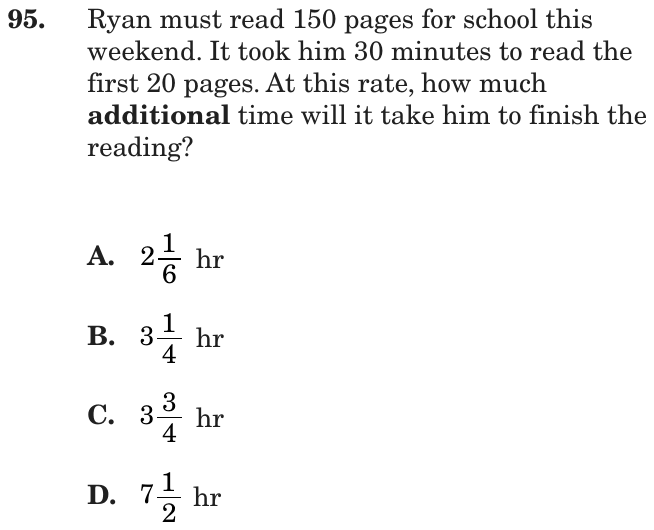
Question 27 of 28
2018 Test A Math, question 53Question
Using the approximation 2.54 centimeters = 1 inch, how many centimeters are in 4 feet 7 inches?
- A21.65
- B119.38
- C121.92
- D139.70
Show the answer
Correct answer: D
Convert 4 ft 7 in. to inches. Since 12 in. = 1 ft :
4(12) + 7 = 55 inches
Multiply that by the conversion
2.54 cm = 1 in.
55 × 2.54 = 139.70 cm
Question analysis
This unit conversion question uses 2.54 centimeters per inch and asks how many centimeters are in 4 feet 7 inches. Students must first turn feet and inches into inches alone, then multiply by the conversion factor. Mixing feet and inches into a single number is the easy slip.
- Grade level
- Grade 6 content, by NYS standard
- Compared with grade 7
- Below grade 7 Converting measurement units with a given factor is grade 6 content. This item takes two short steps and one decimal multiplication, so it asks a little less than typical grade 7 work, though the mixed units need care.
- Estimated difficulty
- Straightforward: two steps or one careful reading.
- Thinking it demands
- Depth of knowledge 1, recall and reproduction · mainly apply
- What makes it hard
- Solution
- 2 steps
- Reading level
- Question and choices: about grade 13, 12 words.
- Corrected from the DOE handbook
- A missing decimal point in the explanation was restored.
- Students, last 30 days
- Not enough answers yet to show (it takes 10).
Why it is hard, traps and wrong answers (shows the answer)
Why it is hard
The conversion factor is given and the multiplication is mechanical, so the question rests on the mixed measurement. Feet and inches are not a decimal system, and treating 4 feet 7 inches as 47, or dropping the 7, both lead to listed answers. A rough estimate, 55 inches × 2.5 ≈ 137, points straight to the right choice.
Something you must already know minor Working it out
The stem gives centimeters per inch but not inches per foot; students must supply 12 to turn 4 feet into 48 inches. (Anderson & Krathwohl, 2001)
Strategy: Change 4 feet to inches using 12 inches per foot, add the extra 7 inches, then multiply the total number of inches by 2.54.
Traps
- Units or scale: The answer is wanted in other units, or a rate or scale must be converted first.
- Answers a different question: A choice is right for another quantity: the other unknown, the rest instead of the part, the part instead of the whole.
The wrong answers, classified
A Wrong operation (Hegarty, Mayer & Monk, 1995; King et al., 2004)
Divides 55 inches by 2.54 instead of multiplying, converting in the wrong direction and getting fewer centimeters than inches.
B Units or scale (King et al., 2004)
Reads 4 feet 7 inches as 47 inches, as if feet were tens of inches, then multiplies 47 × 2.54 = 119.38.
C Answers a different question (King et al., 2004; Hegarty, Mayer & Monk, 1995)
Converts the 4 feet to 48 inches and multiplies by 2.54, getting 121.92, but leaves out the extra 7 inches.
What was corrected from the DOE handbook, and why
- Explanation: The handbook writes the conversion as “254 cm = 1 in.”, dropping the decimal point. The question gives 2.54 centimeters = 1 inch and the handbook’s next line multiplies by 2.54, so it now reads 2.54 cm = 1 in.
Worked solution, step by step
Formulas used
- Feet to inches
- i is the number of inches and f is the number of feet. Each foot has 12 inches, so you multiply the feet by 12.
- Inches to centimeters
- c is the number of centimeters and i is the number of inches. Each inch is about 2.54 centimeters, so you multiply. A centimeter is smaller than an inch, so you get a bigger number.
Sort out what you know
The length is 4 feet 7 inches. That means 4 feet plus 7 more inches. You know 1 inch is about 2.54 centimeters.
So change everything to inches first, then to centimeters. The question does not say that 1 foot is 12 inches. You have to know it.
Change the length to inches
4 feet is 48 inches. Now add the extra 7 inches:
The length is 55 inches. Watch out: 4 feet 7 inches is not 47 inches. Using 47 gives choice B. Leaving out the 7 inches gives 121.92, choice C.
Change inches to centimeters
To multiply in your head, split 55 into 50 and 5: 127 + 12.7 = 139.7.
Watch out: multiply, do not divide. Dividing 55 by 2.54 gives 21.65, choice A. So the answer is D, 139.70.
Check your answer
A centimeter is smaller than an inch. So the number of centimeters must be bigger than 55. About 2.5 × 55 is 137.5, close to 139.70. Choice A, 21.65, is smaller than 55, so it cannot be right.
More questions like this
The original DOE question
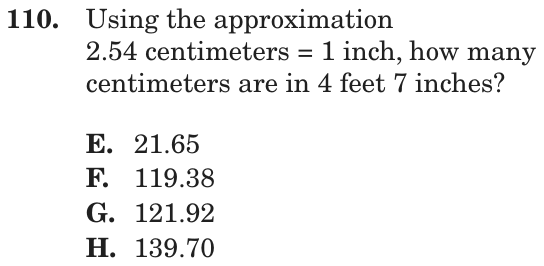
Question 28 of 28
2018 Test B Math, question 42Question
There are 1,000 cubic centimeters in 1 liter, and 1,000 cubic millimeters in 1 milliliter. How many cubic millimeters are there in 1,000 cubic centimeters?
- A1,000
- B10,000
- C100,000
- D1,000,000
Show the answer
Correct answer: D
If 1 L = 1,000 cu cm, then 1 L = 1,000 mL. Set up a proportion, letting = the amount of cubic millimeters in 1,000 cubic centimeters.
Solve for : 1,000,000 cubic millimeters are in 1,000 cubic centimeters.
Question analysis
The question gives two metric facts, cubic centimeters per liter and cubic millimeters per milliliter, and asks how many cubic millimeters are in 1,000 cubic centimeters. It tests chaining unit conversions with volume units. The hard part is that the two facts do not connect without a link the question leaves out.
- NYS standards
- 6.RP.3d converting measurement units
- Grade level
- Grade 6 content, by NYS standard
- Compared with grade 7
- Above grade 7 Grade 6 and 7 students convert units with one given factor. This needs three linked conversions, one using a fact the question does not state, and involves cubic units, which most grade 7 students find unfamiliar.
- Estimated difficulty
- Hard: combines ideas, needs a plan, and has more than one tempting wrong answer.
- Thinking it demands
- Depth of knowledge 2, skills and concepts · mainly apply
- What makes it hard
- Something you must already know moderate
- Many steps moderate
- Solution
- 3 steps
- Reading level
- Question and choices: about grade 13, 20 words.
- Corrected from the DOE handbook
- The units in the explanation’s proportion were corrected.
- Students, last 30 days
- Not enough answers yet to show (it takes 10).
Why it is hard, traps and wrong answers (shows the answer)
Why it is hard
The question gives two conversion facts that do not connect until the student supplies the link between liters and milliliters. Students who instead reach for 1 centimeter = 10 millimeters often scale a volume like a length or an area and land short by a factor of 10 or 100. Writing the unit at every step, so the units cancel, keeps both factors of 1,000 in view.
Something you must already know moderate Working it out
The chain needs 1 liter = 1,000 milliliters, which the stem never states, yet it is the only link between its two conversion facts. (Anderson & Krathwohl, 2001)
Many steps moderate Working it out
Three conversions in a row, cubic centimeters to liters, liters to milliliters and milliliters to cubic millimeters, multiply out to 1,000 × 1,000. (Daniel & Embretson, 2010; Enright, Morley & Sheehan, 2002)
Strategy: Build a chain from cubic centimeters to liters, liters to milliliters, and milliliters to cubic millimeters, writing the units at every step so they cancel.
Traps
- Units or scale: The answer is wanted in other units, or a rate or scale must be converted first.
- Stops one step early: A choice is a number from partway through the solution.
The wrong answers, classified
A Stops one step early (King et al., 2004; Gierl et al., 2017)
Converts 1,000 cubic centimeters to 1 liter, or 1,000 milliliters, and stops before the last step from milliliters to cubic millimeters.
B Units or scale (King et al., 2004)
Uses the length factor 1 cm = 10 mm for cubic units, multiplying 1,000 by 10 instead of by 10 × 10 × 10.
C Units or scale (King et al., 2004)
Squares the length factor, treating 1 cubic centimeter as 100 cubic millimeters, which is right for area but not for volume.
What was corrected from the DOE handbook, and why
- Explanation: The handbook’s proportion is 1,000 cu mm / 1 L = x cu mm / 1,000 cu mm. But 1,000 cubic millimeters make 1 milliliter, not 1 liter, and the second denominator should be the 1,000 mL that equal 1,000 cubic centimeters. The site uses 1,000 cu mm / 1 mL = x cu mm / 1,000 mL, which gives x = 1,000,000 cubic millimeters.
Worked solution, step by step
Formulas used
- Volume of a cube
- V is the volume, the space inside the cube. s is the length of one side. A cube has the same length, width and height, so you multiply the side by itself three times.
Sort out what you know
You are told two facts. 1 liter (L) is 1,000 cubic centimeters (cu cm). 1 milliliter (mL) is 1,000 cubic millimeters (cu mm). You need the number of cu mm in 1,000 cu cm.
One fact is missing. 1 liter is 1,000 milliliters. The word milli means one thousandth.
Change cubic centimeters to liters
The first fact says 1,000 cu cm is exactly 1 liter. So the amount in the question is 1 liter of space.
Change liters to milliliters
One liter is 1,000 milliliters. So 1,000 cu cm is the same as 1,000 mL.
Watch out: you are not done yet. The question asks for cubic millimeters. Stopping at 1,000 gives choice A.
Change milliliters to cubic millimeters
Each milliliter is 1,000 cu mm. There are 1,000 milliliters, so multiply.
So 1,000 cu cm is 1,000,000 cu mm. The answer is D, 1,000,000.
Check your answer
Use the cube formula. A cube 1 cm on each side is 10 mm on each side. Its volume is cu mm. So 1,000 cu cm is cu mm. Using only one 10 gives choice B. Using two 10s gives choice C.
More questions like this
The original DOE question