Question
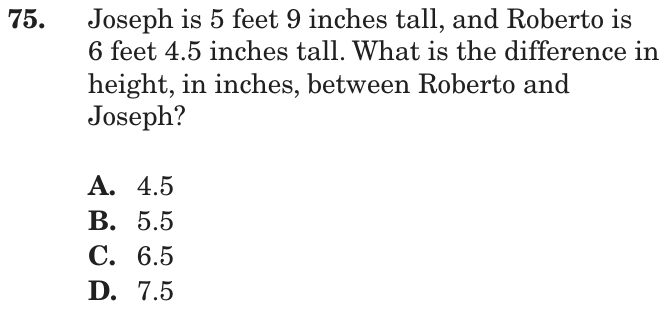
Joseph is 5 feet 9 inches tall, and Roberto is 6 feet 4.5 inches tall. What is the difference in height, in inches, between Roberto and Joseph?
- A4.5
- B5.5
- C6.5
- D7.5
Show the answer
Correct answer: D
First, convert their heights from feet and inches to inches, by multiplying the number of feet by 12 and adding the inches:
Roberto:
Joseph:
Then, subtract Joseph’s height from Roberto’s height:
Question analysis
Joseph is 5 feet 9 inches tall and Roberto is 6 feet 4.5 inches tall, and students find the difference in their heights in inches. It tests converting mixed feet-and-inches measurements and subtracting with a decimal. Subtracting the feet and the inches separately is risky, because Joseph's 9 inches exceed Roberto's 4.5 and a foot holds 12 inches.
- Grade level
- Grade 6 content, by NYS standard
- Compared with grade 7
- Below grade 7 Converting feet to inches is grade 6 ratio work, and the subtraction involves one decimal. Grade 7 measurement problems usually chain more steps or use a scale; this one needs two conversions and one subtraction.
- Estimated difficulty
- Straightforward: two steps or one careful reading.
- Thinking it demands
- Depth of knowledge 2, skills and concepts · mainly apply
- What makes it hard
- Error-prone arithmetic moderate
- Something you must already know minor
- Solution
- 3 steps
- Reading level
- Question and choices: about grade 5, 23 words.
- Corrected from the DOE handbook
- A misspelled name in the explanation was corrected.
- Students, last 30 days
- Not enough answers yet to show (it takes 10).
Why it is hard, traps and wrong answers (shows the answer)
Why it is hard
The heights mix two units, and the inch parts run the wrong way, 4.5 against 9, so subtracting part by part goes wrong unless a foot is regrouped as 12 inches. Converting both heights to inches first avoids the borrow entirely. The choices sit a single inch apart, so a rough estimate cannot stand in for the exact working, and a student who treats feet as tens of inches lands squarely on a wrong choice.
Error-prone arithmetic moderate Working it out
Subtracting 5 feet 9 inches from 6 feet 4.5 inches needs a borrow, since 4.5 inches is less than 9, and the borrowed foot holds 12 inches, not the 10 that decimal habits suggest. (Brown & Burton, 1978; Junker & Sijtsma, 2001)
Something you must already know minor Working it out
The stem never states that a foot is 12 inches, yet both heights must be turned into inches, 76.5 and 69, before the difference can be taken. (Anderson & Krathwohl, 2001)
Strategy: Change both heights to inches by multiplying the feet by 12 and adding the extra inches, then subtract the shorter height from the taller one.
Traps
- Units or scale: The answer is wanted in other units, or a rate or scale must be converted first.
- Numbers taken from the question: Combines the numbers in the question without a model of the situation, or is simply a number that appears in the question.
The wrong answers, classified
A Numbers taken from the question (Hegarty, Mayer & Monk, 1995)
Subtracts the two inch figures alone, 9 − 4.5 = 4.5, taking the smaller from the larger and leaving the feet out of the comparison entirely.
B Units or scale (King et al., 2004)
Treats feet as tens of inches, reading the heights as 64.5 and 59, or borrowing a foot as 10 inches, so 64.5 − 59 = 5.5.
C Little reason to choose it (Haladyna & Downing, 1993; Rodriguez, 2005)
No conversion or borrow gives 6.5, one inch short of the true gap; only a miscount such as taking Joseph as 70 inches reaches it, so it mostly catches guesses.
What was corrected from the DOE handbook, and why
- Explanation: The handbook’s explanation ends “Then, subtract Joseph’s height from Robert’s height: 76.5 − 69 = 7.5” (p. 133, question 75). The taller boy is Roberto, as the question and the explanation’s own “Roberto:” line call him, so the site now reads “Roberto’s height.” Nothing else changes: Roberto is 6(12) + 4.5 = 76.5 inches, Joseph is 5(12) + 9 = 69 inches, and the difference is 7.5 inches.
Worked solution, step by step
Formulas used
- Changing feet and inches to inches
- There are 12 inches in 1 foot. Multiply the feet by 12 to turn them into inches. Then add the extra inches. Now the whole height is in one unit, inches, so two heights can be compared by subtracting.
Sort out the question
Joseph is 5 feet 9 inches tall. Roberto is 6 feet 4.5 inches tall. You need the difference in their heights, in inches. The difference is how much taller Roberto is, so you subtract. Each height mixes two units, feet and inches. Change both to inches first. The question doesn’t say it, but 1 foot is 12 inches.
Change Roberto’s height to inches
Six feet is 72 inches. Then add the extra 4.5 inches.
Roberto is 76.5 inches tall.
Change Joseph’s height to inches
Do the same for Joseph. Five feet is 60 inches. Then add the extra 9 inches.
Joseph is 69 inches tall.
Subtract the two heights
Subtract Joseph’s height from Roberto’s height, the shorter from the taller.
Roberto is 7.5 inches taller.
Watch out: a foot is 12 inches, not 10. Treating it as 10 turns the heights into 64.5 and 59, and , choice B. Subtracting only the inches, , leaves out the feet and gives choice A.
So the answer is D, 7.5 inches.
Check your answer
Count up from Joseph’s height. From 5 feet 9 inches, 3 more inches reach 6 feet. From 6 feet, 4.5 more inches reach Roberto’s height. In all, inches. That matches.
More questions like this
The original DOE question