Question
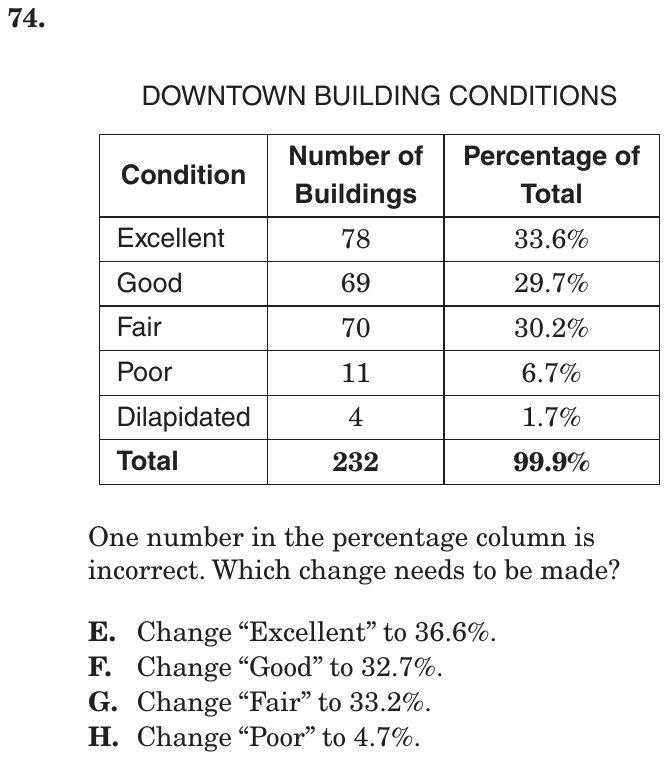
DOWNTOWN BUILDING CONDITIONS
| Condition | Number of Buildings | Percentage of Total |
|---|---|---|
| Excellent | 78 | 33.6% |
| Good | 69 | 29.7% |
| Fair | 70 | 30.2% |
| Poor | 11 | 6.7% |
| Dilapidated | 4 | 1.7% |
| Total | 232 | 99.9% |
One number in the percentage column is incorrect. Which change needs to be made?
- AChange “Excellent” to 36.6%.
- BChange “Good” to 32.7%.
- CChange “Fair” to 33.2%.
- DChange “Poor” to 4.7%.
Show the answer
Correct answer: D
First, calculate the actual total of the percentages shown, which is 101.9%. So, one of the percentages needs to be lower to make the total equal 99.9%. Only one option, D, proposes a decrease in the percentage. To check that this is the correct answer, add the percentages again with “Poor” as 4.7% instead of 6.7%. D is the correct answer.
Question analysis
A table lists the condition of 232 downtown buildings, excellent to dilapidated, with each group's count and its percentage of the total. One percentage is wrong, and students choose the change that fixes it. The question tests percents of a whole and checking data for consistency; the printed total helps only once students add the column themselves.
- Grade level
- Grade 6 content, by NYS standard
- Compared with grade 7
- At grade 7 Percents of a total are grade 6 content, but grade 7 table questions usually ask for a value, not an error. Here students must check a column for consistency, by totalling five decimals or by testing counts against 232.
- Estimated difficulty
- Straightforward: two steps or one careful reading.
- Thinking it demands
- Depth of knowledge 2, skills and concepts · mainly evaluate
- What makes it hard
- Every choice must be checked moderate
- Error-prone arithmetic minor
- Reading a figure, table or graph minor
- Solution
- 3 steps
- Reading level
- Question and choices: about grade 5, 40 words.
- Students, last 30 days
- Not enough answers yet to show (it takes 10).
Why it is hard, traps and wrong answers (shows the answer)
Why it is hard
The stem names no method, and the obvious one, testing each proposed change against its count, means four long divisions by 232. Adding the printed column is faster: it comes to 101.9%, two points over the 99.9% total, so the faulty entry is too high and must come down. Every wrong choice raises a value by 3 points, so once the direction of the error is known they fall away together; nothing else stands behind them.
Every choice must be checked moderate Choosing the answer
Each choice changes a different row, so without a shortcut all four must be tested by dividing 78, 69, 70 and 11 by 232 and comparing the results with the column. (Embretson & Wetzel, 1987)
Error-prone arithmetic minor Working it out
The shortcut means totalling 33.6, 29.7, 30.2, 6.7 and 1.7 by hand to reach 101.9; the long way means dividing two-digit counts by 232 to a tenth of a percent. (Brown & Burton, 1978; Junker & Sijtsma, 2001)
Reading a figure, table or graph minor Understanding the question
The table pairs each count with a percent, and the bold 99.9% total is itself rounded, so students must see that a correct column adds to 99.9, not to exactly 100. (Lesh, Post & Behr, 1987; Kirsch & Mosenthal, 1990)
Strategy: Add the five percents and compare the sum with the 99.9% total to see whether the faulty entry is too high or too low, then confirm it by dividing its count by 232.
The wrong answers, classified
A Little reason to choose it (Haladyna & Downing, 1993; Rodriguez, 2005)
Raising Excellent by 3 points has no basis, since 78 of 232 is 33.6% as printed, and it would push the column from 101.9% to 104.9%.
B Little reason to choose it (Haladyna & Downing, 1993; Rodriguez, 2005)
Nothing leads to 32.7% for Good: 69 ÷ 232 rounds to the printed 29.7%, so the change only adds 3 more points to a column already over its total.
C Little reason to choose it (Haladyna & Downing, 1993; Rodriguez, 2005)
A guess like the other increases: 70 of 232 is 30.2%, exactly as printed, and 33.2% would make the column total 104.9%, further from 99.9% than before.
Worked solution, step by step
Formulas used
- Percent of a total
- The part is the count in one row. The whole is the total count, here 232 buildings. Dividing tells what fraction of all the buildings are in that row. Multiplying by 100 turns the fraction into a percent, a number out of 100.
Sort out the question
The table sorts 232 downtown buildings by condition. Each row gives a number of buildings and a percentage of the total. That is how many out of every 100 buildings are in that row. One percentage is wrong. You need the choice that fixes it.
Recompute one percent from its count
The counts are the facts. Each percent should come from its count. Start with “Poor,” which has 11 buildings out of 232.
The sign ≈ means “about.” The division gives about 0.0474, and times 100 that is 4.74. Rounded to one decimal place, it is 4.7%. The table prints 6.7%.
Check the other rows the same way
Condition Count ÷ 232 Percent Printed Excellent 33.6% 33.6% Good 29.7% 29.7% Fair 30.2% 30.2% Poor 4.7% 6.7% Dilapidated 1.7% 1.7% Only the “Poor” row is off. The other four are right as printed.
Add the column as a cross-check
The bold total says 99.9%. Add the five printed percents.
That is 2 points too much, so the wrong entry is too big. Now use 4.7% for “Poor.”
Now the column matches its total. The total is 99.9, not 100, because each percent was rounded.
Rule out the other changes
Watch out: choices A, B and C each raise a percent by 3 points. But those rows are already right. Each change would push the column to 104.9%, even further from 99.9%. Only choice D lowers a number, and it fixes the one that is wrong.
So the answer is D, change “Poor” to 4.7%.
Check your answer
Go backward from each percent to a count. 4.7% of 232 is about , close to the 11 buildings in poor condition. But 6.7% of 232 is about buildings. The table says 11, so 6.7% can’t be right.
More questions like this
The original DOE question