Question
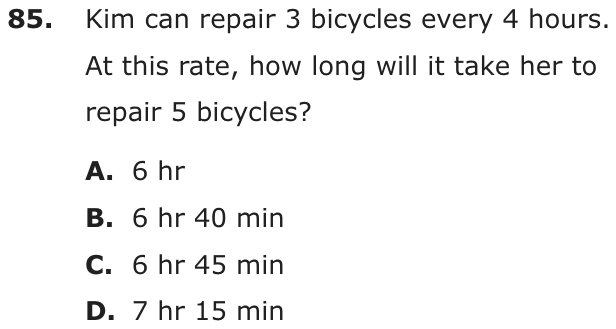
Kim can repair 3 bicycles every 4 hours. At this rate, how long will it take her to repair 5 bicycles?
- A6 hr
- B6 hr 40 min
- C6 hr 45 min
- D7 hr 15 min
Show the answer
Correct answer: B
3 bicycles every 4 hours = 3 bicycles every 240 minutes ()
Question analysis
A rate word problem: Kim repairs 3 bicycles every 4 hours, and students find how long she needs for 5 bicycles at the same rate. The time per bicycle is not a whole number of hours, so the total must be written in hours and minutes, and choices only minutes apart punish a careless conversion.
- Grade level
- Grade 6 content, by NYS standard
- Compared with grade 7
- Below grade 7 Unit-rate problems with a change of time units are grade 6 work. This one needs a rate per bicycle, one multiplication and a conversion of part of an hour into minutes, a short task below typical grade 7 demand.
- Estimated difficulty
- Straightforward: two steps or one careful reading.
- Thinking it demands
- Depth of knowledge 2, skills and concepts · mainly apply
- What makes it hard
- An answer in an unexpected form moderate
- Error-prone arithmetic minor
- A very close wrong answer minor
- Solution
- 3 steps
- Reading level
- Question and choices: about grade 2, 25 words.
- Students, last 30 days
- Not enough answers yet to show (it takes 10).
Why it is hard, traps and wrong answers (shows the answer)
Why it is hard
The main risk is thinking in differences: 2 more bicycles than 3 seems to call for 2 more hours than 4, a tidy wrong answer of 6 hours. Students who scale correctly still have to turn a fraction of an hour into minutes, and a careless 45 for the 2/3 hour lands on the key's neighbor. Working in minutes, 80 per bicycle, keeps every number whole and leaves one simple conversion at the end.
An answer in an unexpected form moderate Choosing the answer
The rate gives 5 × 4/3 = 20/3, or 6 2/3 hours, but every choice is in hours and minutes, so the 2/3 of an hour must become 40 minutes before the answer can be recognized. (Enright, Morley & Sheehan, 2002)
Error-prone arithmetic minor Working it out
Each bicycle takes 4/3 of an hour, not a whole number; changing 4 hours to 240 minutes first gives a whole 80 minutes per bicycle and avoids the fraction. (Brown & Burton, 1978; Junker & Sijtsma, 2001)
A very close wrong answer minor Choosing the answer
The choices 6 hr 40 min and 6 hr 45 min are five minutes apart, so an estimate of a little under 7 hours fits both and only an exact conversion decides. (Embretson & Wetzel, 1987; Gorin & Embretson, 2006; Ascalon et al., 2007)
Strategy: Change the 4 hours to minutes first so the time per bicycle comes out whole, multiply by 5, and convert the total minutes back into hours and minutes.
Traps
- Misunderstands the concept: A wrong belief about a concept: that percents can be added, that area grows like length, that averages can be averaged, that a bigger denominator means a bigger fraction.
- Units or scale: The answer is wanted in other units, or a rate or scale must be converted first.
The wrong answers, classified
A Misunderstands the concept (Smith, diSessa & Roschelle, 1993; De Bock et al., 1998; Ni & Zhou, 2005)
Reasons additively: 2 more bicycles than 3 must take 2 more hours than 4, giving 6 hours, which keeps the difference instead of the rate of 4/3 hour per bicycle.
C Units or scale (King et al., 2004)
Reaches 6 2/3 hours but converts the 2/3 hour to 45 minutes, the minutes in 3/4 of an hour, instead of 2/3 × 60 = 40.
D Little reason to choose it (Haladyna & Downing, 1993; Rodriguez, 2005)
No common working gives 7 hr 15 min, which would mean 87 minutes per bicycle; it lies farthest from the answer and mostly draws guesses.
Worked solution, step by step
Formulas used
- Unit rate
- A unit rate tells how much goes with just 1 of something. Here it is the time to fix 1 bicycle. Total time is how long the work took, and number done is how many bicycles were fixed in that time. Once you know the time for one, multiply to scale up.
- Hours and minutes
- Each hour has 60 minutes. To change hours to minutes, multiply by 60. To change minutes back to hours, divide by 60. Any remainder is the minutes left over.
Sort out the question
Kim fixes 3 bicycles every 4 hours. She keeps working at that same rate. You need the time for 5 bicycles. The choices are in hours and minutes, so your answer must be too.
Change the hours to minutes
Splitting 4 hours among 3 bicycles does not give a whole number of hours. Minutes keep the numbers whole.
So Kim fixes 3 bicycles in 240 minutes.
Find the time for one bicycle
Next, find the unit rate. Share the 240 minutes equally among the 3 bicycles.
Each bicycle takes her 80 minutes.
Find the time for 5 bicycles
Five bicycles take 400 minutes. Watch out: don’t just add. Two more bicycles does not mean two more hours. That thinking gives 6 hours, choice A.
Change back to hours and minutes
Divide by 60 to find how many full hours fit in 400 minutes.
That is 6 full hours with 40 minutes left over. Watch out: the leftover is of an hour, which is 40 minutes. 45 minutes would be of an hour, choice C.
So the answer is B, 6 hr 40 min.
Check your answer
Work backward. 6 hr 40 min is 400 minutes. Split among 5 bicycles, that is 80 minutes each. Then 3 bicycles take minutes, which is exactly 4 hours. It matches.
More questions like this
The original DOE question