Question
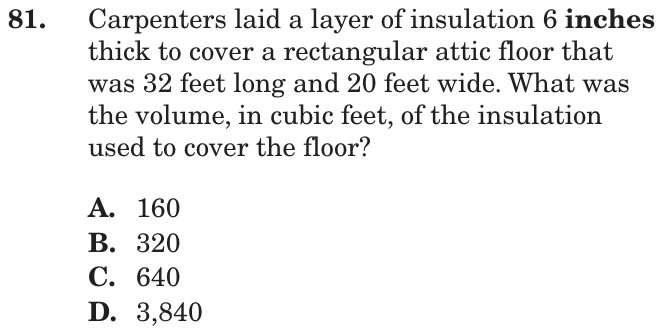
Carpenters laid a layer of insulation 6 inches thick to cover a rectangular attic floor that was 32 feet long and 20 feet wide. What was the volume, in cubic feet, of the insulation used to cover the floor?
- A160
- B320
- C640
- D3,840
Show the answer
Correct answer: B
First convert 6 inches to 0.5 feet. Then, calculate the volume, in cubic feet:
Question analysis
Carpenters spread insulation 6 inches thick over a rectangular attic floor 32 feet long and 20 feet wide, and students find the volume of insulation in cubic feet. It is a volume word problem with mixed units. The thickness is given in inches while the floor is in feet, a mismatch that is easy to overlook.
- Grade level
- Grade 6 content, by NYS standard
- Compared with grade 7
- Below grade 7 Finding the volume of a box-shaped layer is grade 6 work, with every dimension but the thickness a whole number of feet. Grade 7 volume problems use triangular or composite prisms; this one adds only a change from inches to feet.
- Estimated difficulty
- Straightforward: two steps or one careful reading.
- Thinking it demands
- Depth of knowledge 2, skills and concepts · mainly apply
- What makes it hard
- Solution
- 2 steps
- Reading level
- Question and choices: about grade 9, 36 words.
- Students, last 30 days
- Not enough answers yet to show (it takes 10).
Why it is hard, traps and wrong answers (shows the answer)
Why it is hard
Volume of a box is routine, so the question turns on the unit mix: the floor is measured in feet and the layer's thickness in inches. The handbook prints inches in bold, a warning that the plain product 3,840 is listed for those who miss it. The floor's area, 640, is the other ready trap, since it appears partway through the correct work.
Something you must already know minor Working it out
Neither the volume of a box, length × width × height, nor the 12 inches in a foot is given, and the bold inches marks the thickness as the one dimension to convert. (Anderson & Krathwohl, 2001)
Error-prone arithmetic minor Working it out
The converted thickness is the fraction 1/2 foot, so the product is 32 × 20 × 1/2, easiest as 32 × 10; kept in inches, 3,840 still needs dividing by 12. (Brown & Burton, 1978; Junker & Sijtsma, 2001)
Strategy: Notice the bold word inches: convert the 6-inch thickness to feet before anything else, then multiply it by the floor's length and width.
Traps
- Units or scale: The answer is wanted in other units, or a rate or scale must be converted first.
- Stops one step early: A choice is a number from partway through the solution.
The wrong answers, classified
A Little reason to choose it (Haladyna & Downing, 1993; Rodriguez, 2005)
No product of the three dimensions gives 160, half the true volume, as if the half-foot thickness were applied twice; it mostly catches guesses.
C Stops one step early (King et al., 2004; Gierl et al., 2017)
Finds the area of the attic floor, 32 × 20 = 640 square feet, and stops before multiplying by the half-foot thickness.
D Units or scale (King et al., 2004)
Multiplies 32 × 20 × 6 without changing the 6 inches to half a foot, mixing feet and inches in one product and getting a volume twelve times too large.
Worked solution, step by step
Formulas used
- Inches to feet
- There are 12 inches in 1 foot. So dividing a number of inches by 12 tells how many feet long it is. Use it when one measure is in inches and the others are in feet.
- Volume of a rectangular box
- V is the volume, the space inside, in cubic units. l is the length, w is the width, and h is the height, here the thickness of the layer. All three must use the same unit. Multiplying counts the unit cubes that fill the box.
Sort out the question
The insulation is a flat layer shaped like a box. It covers a floor 32 feet long and 20 feet wide. It is 6 inches thick. Notice the bold word: the thickness is in inches, not feet. You need the volume in cubic feet. A cubic foot is a cube 1 foot long on each side.
Change 6 inches to feet
All three measures must be in feet before you multiply.
The layer is 0.5 foot thick, half a foot.
Watch out: using 6 as if it were feet gives , choice D. That is 12 times too big.
Multiply to find the volume
Use the volume formula with the length, width and thickness, all in feet.
The volume is 320 cubic feet.
Watch out: 640 is the area of the floor, in square feet. Stopping there gives choice C. You still need to multiply by the thickness.
So the answer is B, 320.
Check your answer
A layer 1 foot thick would fill cubic feet. This layer is only half a foot thick. So it holds half as much: cubic feet. That matches.
More questions like this
The original DOE question