Question
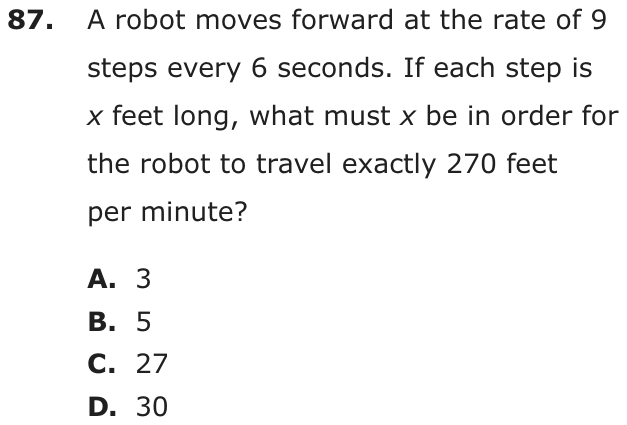
A robot moves forward at the rate of 9 steps every 6 seconds. If each step is x feet long, what must x be in order for the robot to travel exactly 270 feet per minute?
- A3
- B5
- C27
- D30
Show the answer
Correct answer: A
First, convert steps per second to steps per minute.
Then, use ratio reasoning to determine that each step must be 3 feet since 90 times 3 is 270 (or 270 divided by 90 is 3).
or
Question analysis
A robot moves forward 9 steps every 6 seconds, and each step is x feet long. Students find the step length that makes the robot travel exactly 270 feet per minute. It tests rates and unit conversion: the rate is given per 6 seconds but the target is per minute, so the units must be matched before solving.
- NYS standards
- Grade level
- Grade 7 content, by NYS standard
- Compared with grade 7
- At grade 7 Grade 7 rate problems often give one rate and ask for a total. This one links steps per time, feet per step and feet per minute, with seconds to convert, a typical but full multistep ratio problem.
- Estimated difficulty
- Moderate: several steps, or a close reading with one strong distractor.
- Thinking it demands
- Depth of knowledge 2, skills and concepts · mainly apply
- What makes it hard
- Much to keep track of moderate
- Many steps minor
- Solution
- 3 steps
- Reading level
- Question and choices: about grade 7, 33 words.
- Students, last 30 days
- Not enough answers yet to show (it takes 10).
Why it is hard, traps and wrong answers (shows the answer)
Why it is hard
The numbers are friendly, but the rate is given per 6 seconds and the target per minute, so the units have to meet first. A minute holds ten 6-second stretches, so the robot takes 90 steps in it, and 270 feet over 90 steps settles the length. Students who divide 270 by the 9 steps forget that those steps take only 6 seconds, and those who scale 270 down to 6 seconds stop at 27 feet, a distance rather than a step length.
Much to keep track of moderate Working it out
Three rates are in play, 9 steps per 6 seconds, x feet per step and 270 feet per minute, and their units must be lined up before any two are combined. (Sweller, 1988; Carpenter, Just & Shell, 1990)
Many steps minor Working it out
The rate is first scaled from 6 seconds to 60, giving 90 steps a minute, and only then compared with the 270 feet covered in that minute. (Daniel & Embretson, 2010; Enright, Morley & Sheehan, 2002)
Strategy: Change the rate to steps per minute first, since 6 seconds goes into a minute evenly, then ask what step length makes that many steps cover 270 feet.
Traps
- Units or scale: The answer is wanted in other units, or a rate or scale must be converted first.
- Stops one step early: A choice is a number from partway through the solution.
- Numbers taken from the question: Combines the numbers in the question without a model of the situation, or is simply a number that appears in the question.
The wrong answers, classified
B Numbers taken from the question (Hegarty, Mayer & Monk, 1995)
Multiplies the 9 steps by the 6 seconds, 54, and divides 270 by it, combining the stem’s numbers without a model of the rate.
C Stops one step early (King et al., 2004; Gierl et al., 2017)
Scales 270 feet per minute down to 27 feet per 6 seconds but stops before dividing by the 9 steps taken in that time.
D Units or scale (King et al., 2004)
Divides 270 feet by 9 steps, as if the robot took 9 steps a minute, never converting the 6-second rate to a minute.
Worked solution, step by step
Formulas used
- Rate
- A rate compares an amount with the time it takes. Here the robot’s rate is 9 steps for every 6 seconds. To compare two rates, first write them for the same length of time, such as one minute, which is 60 seconds.
- Distance from steps
- Every step covers the same length. So the distance is the number of steps times the length of one step. Here the distance and the step length are both in feet.
Sort out the question
The robot takes 9 steps every 6 seconds. Each step is x feet long. You need the x that makes the robot go exactly 270 feet per minute.
The two rates use different times: 6 seconds and 1 minute. Match the times before you compare them.
Find the steps in one minute
One minute is 60 seconds. Find how many 6-second stretches fit in a minute.
In each stretch, the robot takes 9 steps. So in one minute it takes 10 times as many.
The robot takes 90 steps per minute.
Find the length of each step
In one minute, those 90 steps must cover 270 feet. Use the distance formula.
To get x alone, divide both sides by 90.
Each step must be 3 feet long.
Give the answer
Watch out: dividing 270 by 9 gives 30, choice D. That treats 9 steps as a whole minute’s steps, but they take only 6 seconds. Cutting 270 feet per minute down to 27 feet per 6 seconds and stopping gives 27, choice C. That is a distance, not a step length. So the answer is A, 3.
Check your answer
Check the units. 90 steps per minute times 3 feet per step gives feet per minute. That is the goal. Or think in 6 seconds: 9 steps of 3 feet is 27 feet, and 10 of those stretches make 270 feet.
More questions like this
The original DOE question