Order of operations
Question 1 of 23
2026 Practice Test A Math, question 10Question
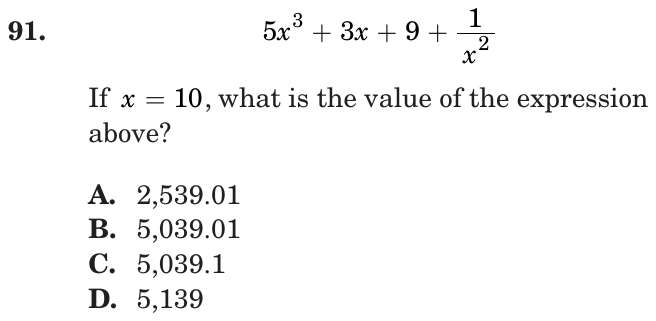
Three expressions are given:
Which of these are equivalent to the sum of these three expressions?
Select the two correct answers.
Choose every answer that is correct, then check. The DOE has not published how answers with several parts are scored; this site counts one right only when every part is right.
- A
- B
- C
- D
- E18
- F34
Show the answer
Correct answer: A and E
Add the three expressions: .
Distribute 3 and −2: .
Combine the variable terms and combine the constants: .
Question analysis
This algebra question gives three expressions, one with a decimal coefficient and a negative factor, and asks which two of six choices are equivalent to their sum. It tests distributing, combining like terms and recognizing equivalent expressions. Signs from the negative factor are easy to lose, and several choices are built from exactly those slips.
- NYS standards
- Grade level
- Grade 7 content, by NYS standard
- Compared with grade 7
- At grade 7 Expanding and combining linear expressions with a negative factor and a decimal coefficient is standard grade 7 work. Choosing the two equivalent ones out of six, where each common slip appears as a choice, takes more care than one simplification.
- Estimated difficulty
- Moderate: several steps, or a close reading with one strong distractor.
- Thinking it demands
- Depth of knowledge 1, recall and reproduction · mainly apply
- What makes it hard
- Error-prone arithmetic moderate
- A very close wrong answer moderate
- Many steps minor
- An answer in an unexpected form minor
- Solution
- 4 steps
- Reading level
- Question and choices: about grade 8, 28 words.
- Students, last 30 days
- Not enough answers yet to show (it takes 10).
Why it is hard, traps and wrong answers (shows the answer)
Why it is hard
The six choices form three consistent pairs, each an expansion with its simplified total: the right pair, a pair built on a sign slip with −2 × 4 that totals 34, and a pair built on 3 × 2n read as 5n that totals 18 − n. A student who makes either slip finds two choices that agree with each other and seem to confirm the work. The question rewards one careful simplification and the confidence to accept a sum with no n left.
Error-prone arithmetic moderate Working it out
The first expression puts a negative factor in front of a decimal term: −2 times 2.5n is −5n, and the −2 must reach the 4 as well, giving −8, not +8. (Brown & Burton, 1978; Junker & Sijtsma, 2001)
A very close wrong answer moderate Choosing the answer
The first two expansions are identical except for their last sign, − 8 against + 8, and the third differs from the first only in 5n for 6n, so only a term-by-term check separates them. (Embretson & Wetzel, 1987; Gorin & Embretson, 2006; Ascalon et al., 2007)
Many steps minor Working it out
Two distributions come first, then the n terms and the constants are collected separately, and six choices are compared with the result; both right ones must be picked to score. (Daniel & Embretson, 2010; Enright, Morley & Sheehan, 2002)
An answer in an unexpected form minor Choosing the answer
One right answer is the expansion before any terms are combined and the other is the plain number 18, which has to be accepted as equal to a sum in which every expression held n. (Enright, Morley & Sheehan, 2002)
Strategy: Distribute each factor across its parentheses, keeping the sign with every product, then combine the n terms and the constants separately and test each of the six choices against the result.
Traps
- Order of operations: Working left to right, or distributing a minus sign wrongly, gives a choice.
- Misunderstands the concept: A wrong belief about a concept: that percents can be added, that area grows like length, that averages can be averaged, that a bigger denominator means a bigger fraction.
- Answer in another form: The right answer is written differently from the way you worked it out.
The wrong answers, classified
B Order of operations (Brown & Burton, 1978)
Gives the minus of −2 to 2.5n but not to 4, expanding −2(2.5n + 4) as −5n + 8 instead of −5n − 8, so this expansion totals 34.
C Wrong operation (Hegarty, Mayer & Monk, 1995; King et al., 2004)
Expands 3(2n + 7) as 5n + 21, adding 3 and 2 instead of multiplying them, so the n terms no longer cancel and leave −n.
D Misunderstands the concept (Smith, diSessa & Roschelle, 1993; De Bock et al., 1998; Ni & Zhou, 2005)
Expects a sum of expressions in n to keep an n term, so it doubts the plain 18 and takes 18 − n, which the 5n expansion also simplifies to.
F Order of operations (Brown & Burton, 1978)
Takes −2 × 4 as +8, so the constants add to 5 + 21 + 8 = 34 while −n + 6n − 5n still cancels, leaving no n term.
Worked solution, step by step
Formulas used
- The distributive property
- a is the number in front of the parentheses, and b and c are the terms inside. You multiply a by every term inside, not only the first one. If a is negative, its minus sign goes into every product. It works because a groups of b + c is a groups of b plus a groups of c.
- Multiplying signed numbers
- a and b are positive numbers, so −a is negative. A negative number times a positive number is negative. Use it whenever a minus sign sits in front of the parentheses: −2 times 4 is −8, not 8.
- Combining like terms
- Like terms have the same letter part, such as 6n and −5n. a and b are their coefficients, the numbers in front of n. Add the coefficients and keep the n. Constants, the plain numbers, combine only with other constants.
Sort out the question
An expression is a math phrase made of numbers, letters and signs, with no equal sign. The sum of the three expressions means you add all of them:
You need the two choices that are equivalent to this sum. Equivalent means equal for every value of n. Some choices show the sum before it is simplified. Others show the result.
Distribute the 3
To distribute means to multiply the number outside the parentheses by each term inside.
Watch out: 3 times 2n is 6n. Adding 3 and 2 instead gives 5n. That slip leads to choice C, and then to 18 − n, choice D.
Distribute the −2
Now multiply −2 by both terms. A negative times a positive is negative, so both products are negative.
Watch out: the −2 multiplies the 4 too. Writing +8 instead of −8 leads to choice B. That sum works out to 34, choice F.
Write the whole sum
Put the three pieces together, starting with 5 − n:
This matches choice A exactly, term by term. So A is one of the answers.
Combine like terms
Gather the n terms first. Remember that −n means −1 times n.
Then gather the constants:
The n terms cancel out, so the whole sum is just 18.
Watch out: a sum with no n left is fine. Keeping an extra −n leads to choice D.
Pick the two answers
Choice A is the sum before you combine like terms. Choice E, 18, is the sum after you combine them. Both equal the sum for every value of n. So the answers are A and E.
Check your answer
Try a value, such as n = 2, in each expression. . . . The sum is , which matches E. Choice D would give 18 − 2 = 16 instead.
More questions like this
The original DOE question
Question 2 of 23
2026 Practice Test A Math, question 27Question
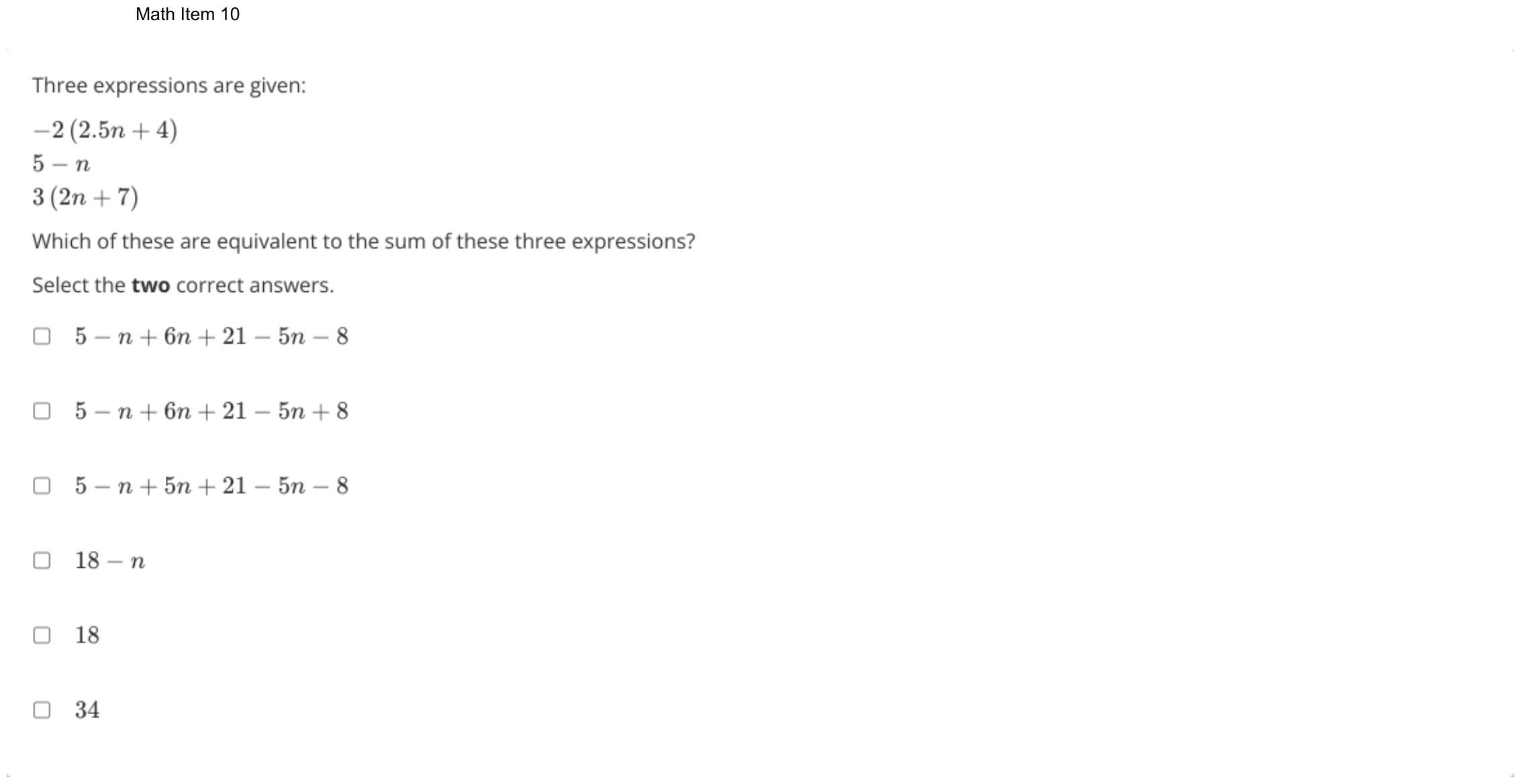
Complete the steps to show one way to solve the equation for x.
Move the correct answer to each box. Each answer may be used more than once. Not all answers will be used.
On the test you drag tiles into the boxes; here, choose each box’s tile from its menu. A tile can be used more than once. The DOE has not published how answers with several parts are scored; this site counts one right only when every part is right.
Show the answer
Correct answer: blank 1: −4; blank 2: 28; blank 3: −56
Solution:
Answer for second equation: −4
Answer for third equation: 28
Answer for fourth equation: −56
Distribute the −0.5 on the right side of the equation: .
Add 4 to both sides of the equation to eliminate the −4 on the right side: .
Divide both sides by −0.5: .
Question analysis
Students complete a step-by-step solution of the equation 24 = −0.5(x + 8) by dragging number tiles into three boxes: one after distributing, one after collecting the constants, and one for x. It tests solving a two-step linear equation with a negative decimal. Tiles may be reused, and many come in positive and negative pairs, so every sign counts.
- Grade level
- Grade 7 content, by NYS standard
- Compared with grade 7
- At grade 7 Solving equations of the form p(x + q) = r with rational numbers is named in the grade 7 standards. Here the steps are laid out, but the negative decimal factor forces a sign decision at every one of the three boxes.
- Estimated difficulty
- Moderate: several steps, or a close reading with one strong distractor.
- Thinking it demands
- Depth of knowledge 1, recall and reproduction · mainly apply
- What makes it hard
- Error-prone arithmetic moderate
- A very close wrong answer minor
- Many steps minor
- An answer in an unexpected form minor
- Solution
- 3 steps
- Reading level
- Question and choices: about grade 3, 39 words.
- Students, last 30 days
- Not enough answers yet to show (it takes 10).
Why it is hard, traps and wrong answers (shows the answer)
Why it is hard
The layout settles the method, so the question comes down to one sign at each box. The printed plus before the first box nudges students toward the positive 4, and the pool then supplies every number that follows from it, down to −40. Students who distribute correctly can still lose the item at the last box by dividing 28 by 0.5. Substituting −56 back, −0.5 × (−48) = 24, confirms the final box.
Error-prone arithmetic moderate Working it out
Two of the three boxes turn on a negative decimal: −0.5 times 8 must give −4, and dividing 28 by −0.5 means multiplying by −2, which doubles the size and makes it negative. (Brown & Burton, 1978; Junker & Sijtsma, 2001)
A very close wrong answer minor Choosing the answer
The pool pairs −4 with 4, −40 with 40 and −56 with 56, so a box filled with the right size and the wrong sign looks just as finished; estimating cannot separate −56 from 56. (Embretson & Wetzel, 1987; Gorin & Embretson, 2006; Ascalon et al., 2007)
Many steps minor Working it out
The three boxes form a chain and all three must be right, so a slip in the first carries through; the pool even holds the whole wrong chain 4, 20 and −40. (Daniel & Embretson, 2010; Enright, Morley & Sheehan, 2002)
An answer in an unexpected form minor Choosing the answer
The second line prints a plus sign before its box, so the distributed −0.5x − 4 must be written as −0.5x + (−4), with the negative tile in the box. (Enright, Morley & Sheehan, 2002)
Strategy: Multiply −0.5 by both x and 8, undo the constant term by doing the opposite operation to both sides, then divide by −0.5, which is the same as multiplying by −2.
Traps
- Order of operations: Working left to right, or distributing a minus sign wrongly, gives a choice.
- Negatives and direction: Arithmetic with negative numbers, the order of a subtraction, or direction on a number line. (Moving a term across the equals sign without changing its sign is a faulty procedure.)
- A faulty procedure: A systematic but wrong procedure: adding fractions straight across, applying an exponent to each term of a sum, dropping a sign when moving a term.
The wrong answers, classified
DEB Order of operations (Brown & Burton, 1978)
Gives the minus of −0.5 to x but not to 8, writing −0.5x + 4, then correctly reaches 20 = −0.5x and x = −40 from that wrong start.
CFH Negatives and direction (Brown & Burton, 1978)
Distributes and adds 4 correctly to reach 28 = −0.5x, then divides 28 by 0.5 instead of −0.5, dropping the negative and entering 56.
CEB A faulty procedure (Brown & Burton, 1978; Tatsuoka, 1983)
Distributes correctly to −4 but moves it to the left side without changing its sign, so 24 − 4 = 20, and 20 ÷ (−0.5) = −40.
Worked solution, step by step
Formulas used
- The distributive property
- a is the number in front of the parentheses, and b and c are the terms inside. Multiply a by each term inside. If a is negative, the minus sign goes into every product. It works because a groups of b + c is the same as a groups of b plus a groups of c.
- Signs when you multiply or divide
- A negative number times a positive number gives a negative result. A negative times a negative gives a positive result. The same rules hold when you divide. Use them at every step where a negative number appears.
- Doing the same to both sides
- a and b are the two sides of an equation, and c is any number (not zero when you divide). An equation is like a balanced scale. Doing the same thing to both sides keeps it level. That is how you get x by itself.
Sort out the question
You solve by filling three boxes:
- Box 1 comes after , once the parentheses are gone.
- Box 2 is the number equal to .
- Box 3 is the value of x.
A tile can be used more than once, and some tiles are not used.
Distribute the −0.5
Multiply −0.5 by each term inside the parentheses. A negative times a positive is negative:
So . The line already shows a plus sign, so box 1 gets −4.
Watch out: the −0.5 multiplies the 8 too. Writing 4 instead starts a wrong chain: 4, then 20, then −40. Every number in that chain is a tile.
Add 4 to both sides
You want −0.5x alone on one side, and the −4 is in the way. Adding 4 undoes subtracting 4, so add 4 to both sides:
Box 2 gets 28.
Watch out: taking 4 away from 24 instead gives 20, another tile.
Divide both sides by −0.5
Now x is multiplied by −0.5. Dividing undoes multiplying, so divide both sides by −0.5:
Dividing by 0.5 is the same as multiplying by 2, since every whole holds two halves. A positive divided by a negative is negative. So .
Watch out: dropping the minus sign gives 56, which is also a tile.
Name the three tiles
From top to bottom, the finished steps read:
So the boxes get −4, 28 and −56, in that order. On the test, you drag each tile into its box. On this site, you choose it from the box’s menu.
Check your answer
Put back into the first equation. . Then , since a negative times a negative is positive. That gives 24, the left side, so −56 is right.
More questions like this
The original DOE question
Question 3 of 23
2026 Practice Test C Math, question 28Question
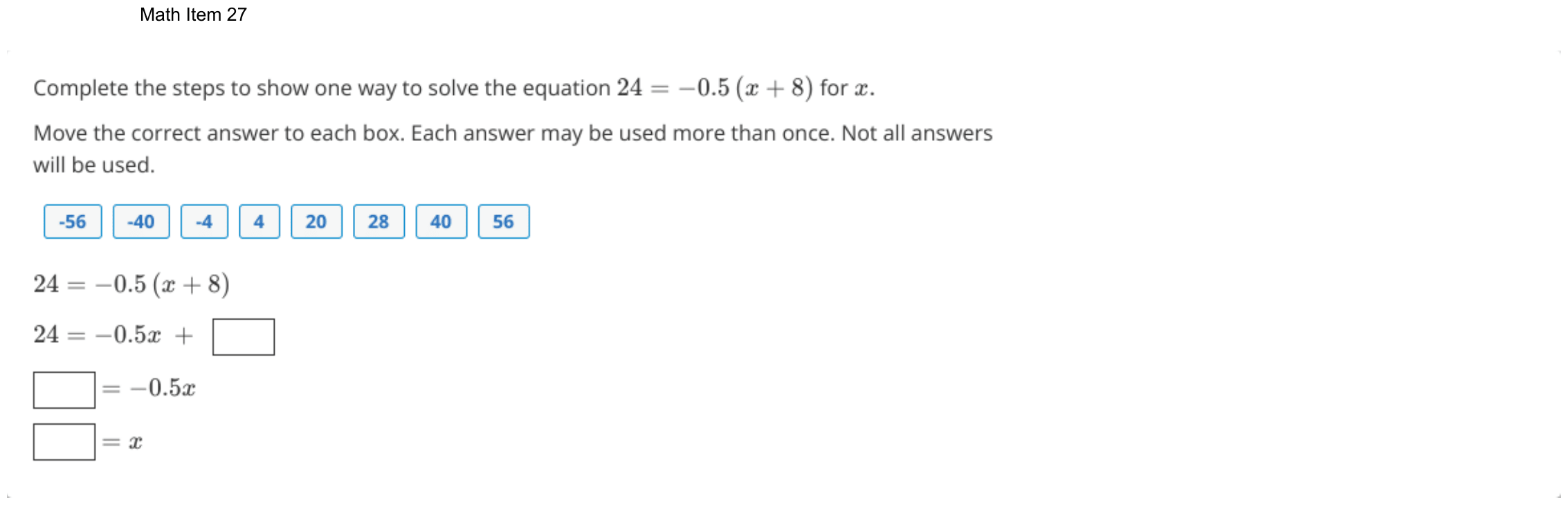
If , what is the value of z in terms of w?
Enter your answer in the space provided. Enter only your answer.
On the test you build the answer on an on-screen keypad; here, type it. Use ^ for a power, sqrt( ) or √ for a root, pi for π, and <= or >= for ≤ and ≥.
Show the answer
Correct answer: z = 17w
The goal is to isolate the variable z by using inverse operations.
First, multiply both sides by 4:
Then subtract from both sides:
Question analysis
This algebra question gives an equation in which z plus 3w, all divided by 4, equals 5w, and students type z in terms of w after a printed "z =". It tests solving a literal equation with inverse operations. The 4 divides the whole sum, so undoing the steps in the right order, with the right signs, is the tricky part.
- Grade level
- Grade 8 content, by NYS standard
- Compared with grade 7
- Above grade 7 Grade 7 students solve two-step equations with numbers, such as (x + 3)/4 = 5. Solving for one letter in terms of another is grade 8 work, and the typed answer gives no choices to check against.
- Estimated difficulty
- Moderate: several steps, or a close reading with one strong distractor.
- Thinking it demands
- Depth of knowledge 1, recall and reproduction · mainly apply
- What makes it hard
- Variables instead of numbers moderate
- An answer in an unexpected form minor
- Solution
- 2 steps
- Reading level
- Question and choices: about grade 4, 23 words.
- Students, last 30 days
- Not enough answers yet to show (it takes 10).
Why it is hard, traps and wrong answers (shows the answer)
Why it is hard
The equation takes only two inverse operations, but their order is the trap: the 4 divides the whole sum z + 3w, so it has to be cleared first. Students who subtract 3w from 5w straight away, or who move 3w to the right without changing its sign, reach a tidy multiple of w that looks as finished as the right one. Substituting w = 1, which needs z = 17 to make (z + 3)/4 equal 5, checks any entry.
Variables instead of numbers moderate Understanding the question
With w on both sides and no numbers to substitute, the result has to stay a multiple of w, and a slip such as 23w gives no sign that it is wrong. (Koedinger & Nathan, 2004; Enright, Morley & Sheehan, 2002)
An answer in an unexpected form minor Choosing the answer
The answer is typed after a printed “z =”, with no choices to compare, so the entry must be a single term in w, not an equation or a number. (Enright, Morley & Sheehan, 2002)
Strategy: Treat w like a known number: undo the division by 4 first, multiplying the whole of each side, then undo the added 3w, keeping the terms in w together.
Traps
- A faulty procedure: A systematic but wrong procedure: adding fractions straight across, applying an exponent to each term of a sum, dropping a sign when moving a term.
- Order of operations: Working left to right, or distributing a minus sign wrongly, gives a choice.
- Wrong operation: Adds instead of multiplying, divides the wrong way round, turns a ratio or rate upside down, or undoes a step in the wrong direction (subtracts what should be added back).
The wrong answers, classified
8w Order of operations (Brown & Burton, 1978)
Undoes the + 3w before the ÷ 4, subtracting 3w from 5w as if only z were divided by 4, so z/4 = 2w and z = 8w.
23w A faulty procedure (Brown & Burton, 1978; Tatsuoka, 1983)
Multiplies correctly to get z + 3w = 20w, then moves 3w to the right side without changing its sign, so z = 20w + 3w = 23w.
-1.75w Wrong operation (Hegarty, Mayer & Monk, 1995; King et al., 2004)
Divides 5w by 4 instead of multiplying, undoing a division with another division, so z + 3w = 1.25w and z = 1.25w − 3w = −1.75w.
Worked solution, step by step
Formulas used
- Doing the same thing to both sides
- A and B are the two sides of an equation, so they are equal. C is any amount. An equation is like a balanced scale. If you multiply both sides by the same number, or take the same amount from both, it stays balanced. That is how you get one letter alone.
Sort out the question
The equation is . You need z in terms of w. That means getting z alone on one side. The other side will use only w and numbers.
Treat w like a number you do not know yet. The answer box already shows z =, so you type only what comes after it.
Undo the division first
The fraction bar means the whole top, z + 3w, is divided by 4. So undo that first. Multiply both sides by 4, because multiplying undoes dividing:
Watch out: do not subtract 3w first. The 3w sits inside the fraction, so it is divided by 4 too. Subtracting it from 5w first leads to the wrong answer 8w.
Undo the adding
Now 3w is added to z. Subtract 3w from both sides:
Think of w as a thing, like apples. 20 apples take away 3 apples leaves 17 apples.
Watch out: moving 3w to the other side without changing its sign gives . That is wrong.
Enter it after the printed z =
On the test, the box already shows z =. Press 1, then 7, then the w key. You do not need a times sign between 17 and w. Do not type z = again. On this site, type 17w in the box.
So you would enter 17w, which makes z = 17w.
Check your answer
Pick a number for w, such as w = 1. Then z = 17. Put both into the first equation. The left side is . The right side is . The two sides match, so 17w works.
More questions like this
The original DOE question
Question 4 of 23
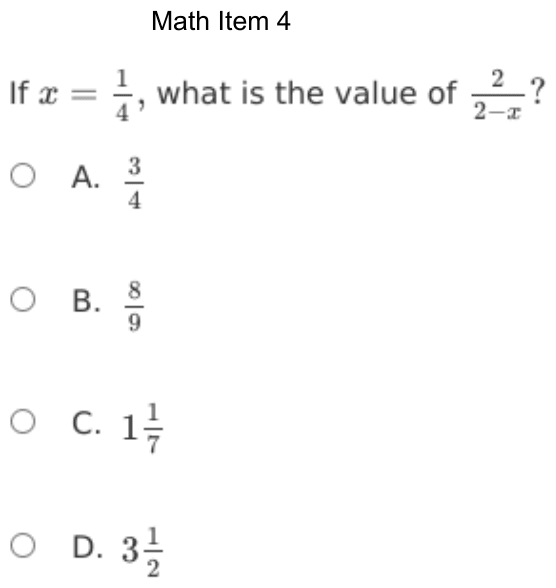
2026 Practice Test D Math, question 4Question
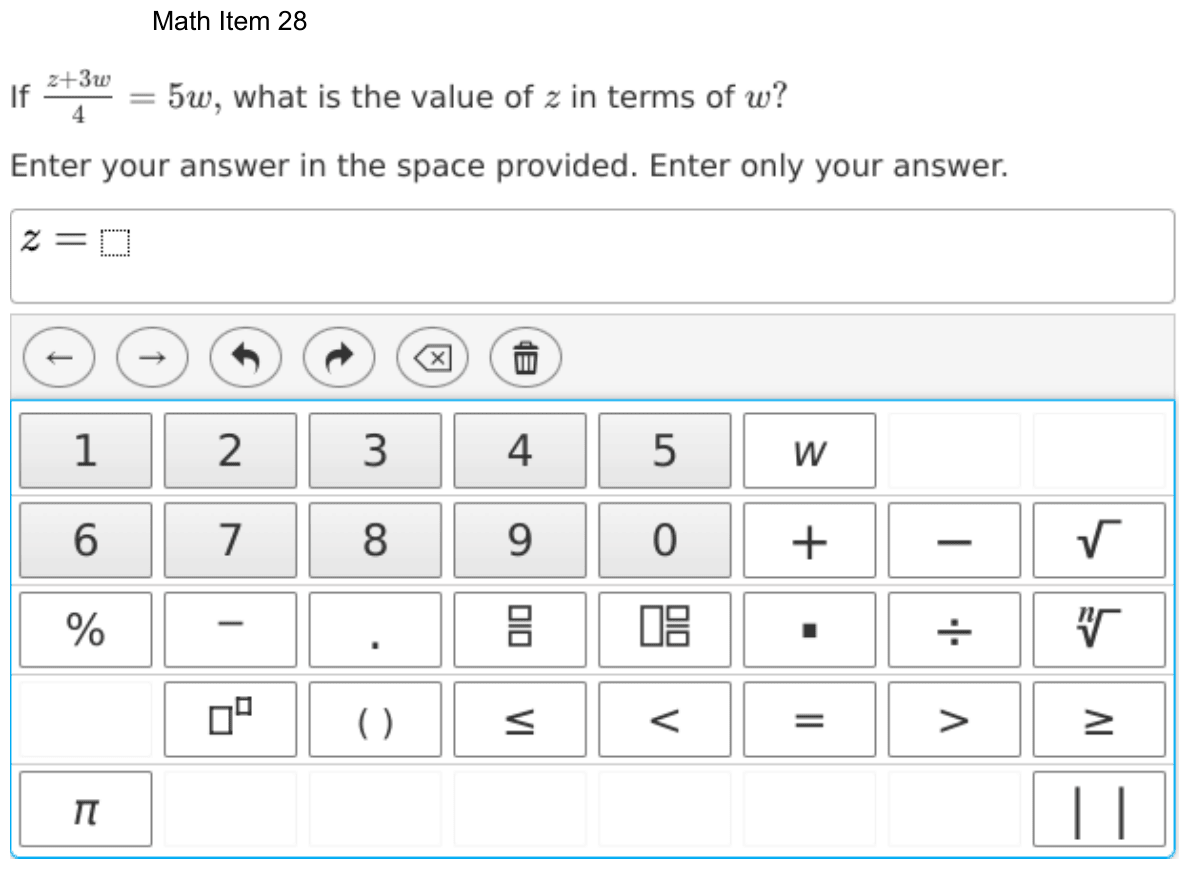
If , what is the value of ?
- A
- B
- C
- D
Show the answer
Correct answer: C
The first step is to substitute the value for x into the expression to get .
Then, evaluate the denominator and finally divide the numerator by the denominator.
Question analysis
This substitution question sets x equal to one fourth and asks for the value of 2 divided by (2 − x). Students substitute, subtract a fraction from a whole number, and divide by the result. The expression is a stacked fraction, so treating the whole denominator as one quantity and dividing rather than multiplying are where students slip.
- NYS standards
- Grade level
- Grade 6 content, by NYS standard
- Compared with grade 7
- Below grade 7 Substituting a value and dividing by a fraction are grade 6 skills, and here they take three short steps with friendly numbers. The stacked fraction asks for care, but the demand is below typical grade 7 work with signed rational numbers.
- Estimated difficulty
- Straightforward: two steps or one careful reading.
- Thinking it demands
- Depth of knowledge 1, recall and reproduction · mainly apply
- What makes it hard
- Error-prone arithmetic moderate
- An answer in an unexpected form minor
- Solution
- 3 steps
- Reading level
- Question and choices: about grade 10, 12 words.
- Students, last 30 days
- Not enough answers yet to show (it takes 10).
Why it is hard, traps and wrong answers (shows the answer)
Why it is hard
Substitution is one step, so the question is about handling a fraction inside a fraction. The bar over 2 − x groups the whole denominator, and the division by 7/4 must flip it; both errors lead to listed choices. A size check helps: 2 − 1/4 is a little less than 2, so the value must be a little more than 1, which rules out every wrong choice.
Error-prone arithmetic moderate Working it out
The denominator 2 − 1/4 has to become 7/4 before anything is divided, and dividing 2 by 7/4 means multiplying by 4/7; multiplying by 7/4 instead is the usual slip. (Brown & Burton, 1978; Junker & Sijtsma, 2001)
An answer in an unexpected form minor Choosing the answer
The work ends at the improper fraction 8/7, but the choices show it only as a mixed number, listed among 3/4, 8/9 and 3 1/2. (Enright, Morley & Sheehan, 2002)
Strategy: Simplify the denominator to a single fraction first, then divide 2 by that fraction by multiplying by its reciprocal; treating the fraction bar as a grouping symbol avoids the common slip.
Traps
- Wrong operation: Adds instead of multiplying, divides the wrong way round, turns a ratio or rate upside down, or undoes a step in the wrong direction (subtracts what should be added back).
- Order of operations: Working left to right, or distributing a minus sign wrongly, gives a choice.
- Negatives and direction: Arithmetic with negative numbers, the order of a subtraction, or direction on a number line. (Moving a term across the equals sign without changing its sign is a faulty procedure.)
The wrong answers, classified
A Order of operations (Brown & Burton, 1978)
Lets the fraction bar cover only the first 2, working 2/2 − 1/4 = 1 − 1/4 = 3/4 instead of dividing 2 by the whole denominator.
B Negatives and direction (Brown & Burton, 1978)
Adds 1/4 to 2 instead of subtracting it, so the denominator becomes 9/4, and 2 ÷ 9/4 = 8/9.
D Wrong operation (Hegarty, Mayer & Monk, 1995; King et al., 2004)
Finds the denominator 7/4 correctly but multiplies 2 by it instead of dividing, 2 × 7/4 = 14/4 = 3 1/2.
Worked solution, step by step
Formulas used
- Dividing by a fraction
- a is any number, and b/c is a fraction. To divide by a fraction, multiply by its reciprocal (the fraction flipped upside down). It works because dividing asks how many copies of b/c fit into a.
- Changing an improper fraction to a mixed number
- Use it when the top, a, is bigger than the bottom, b. q is how many whole times b fits into a. r is the remainder, what is left over. For 8/7, the 7 fits once with 1 left, so 8/7 = 1 1/7.
Sort out the question
You know . You need the value of 2 divided by (2 − x). A fraction bar means divide. It also groups, so you work out the whole bottom, 2 − x, before you divide.
Work out the bottom
Put in 1/4 for x. To subtract, write 2 as fourths, since 2 = 8/4:
The bottom is 7/4.
Watch out: the sign is minus. Adding 1/4 gives 9/4 and then 8/9, choice B.
Divide 2 by 7/4
Now the problem is 2 ÷ 7/4. Use the rule for dividing by a fraction. Flip 7/4 to get 4/7, then multiply:
Watch out: multiplying by 7/4 instead of 4/7 gives 14/4 = 3 1/2, choice D.
Write it as a mixed number
The choices use mixed numbers. 7 fits into 8 once, with 1 left over:
Watch out: the fraction bar covers all of 2 − 1/4. Working 2/2 = 1 first and then taking away 1/4 gives 3/4, choice A.
So the answer is C, .
Check your answer
Estimate. The bottom, 1 3/4, is a bit less than 2. So 2 divided by it should be a bit more than 1, and 1 1/7 fits. Also check by multiplying: 7/4 × 8/7 = 56/28 = 2. That is the top, so the division is right.
More questions like this
The original DOE question
Question 5 of 23
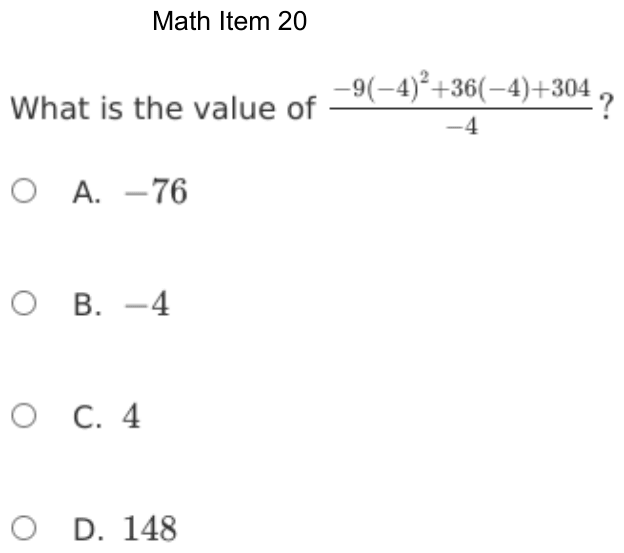
2026 Practice Test D Math, question 20Question
What is the value of ?
- A−76
- B−4
- C4
- D148
Show the answer
Correct answer: B
Use the order of operations to evaluate the expression. It is important to recognize that the fraction bar is a grouping symbol and so the entire numerator should be evaluated first. Exponents are evaluated first.
Then multiplication, recognizing that the product of a negative factor and a positive factor is negative.
Then addition and subtraction in order from left to right, recognizing the rules for adding and subtracting signed numbers.
And finally the fraction can be evaluated by division, recognizing that the quotient of a positive and a negative number is negative.
Question analysis
This arithmetic question asks for the value of a fraction whose numerator, −9(−4)² + 36(−4) + 304, is divided by −4. Students follow the order of operations with negative numbers: a square, two products, a sum and a division. Every step carries a sign, and one dropped negative changes the result completely.
- NYS standards
- Grade level
- Grade 7 content, by NYS standard
- Compared with grade 7
- At grade 7 Order of operations with negative numbers is standard grade 7 practice. This expression stacks a squared negative, two products and a division by a negative into one fraction, so it takes more steps than usual, each with a sign to track.
- Estimated difficulty
- Moderate: several steps, or a close reading with one strong distractor.
- Thinking it demands
- Depth of knowledge 1, recall and reproduction · mainly apply
- What makes it hard
- Error-prone arithmetic moderate
- Many steps minor
- A very close wrong answer minor
- Solution
- 4 steps
- Reading level
- Question and choices: about grade 5, 6 words.
- Students, last 30 days
- Not enough answers yet to show (it takes 10).
Why it is hard, traps and wrong answers (shows the answer)
Why it is hard
Nothing here is conceptually new; the question measures care with signs under the order of operations. The parentheses in (−4)² decide whether −9 multiplies 16 or −16, and the two products of −144 then nearly cancel the 304, leaving a small numerator whose sign is easy to lose. Writing each intermediate value with its sign, line by line, prevents most errors.
Error-prone arithmetic moderate Working it out
Five sign decisions sit in one expression: squaring −4, two products with a negative factor, a sum that climbs from −288 past zero, and a division by −4. (Brown & Burton, 1978; Junker & Sijtsma, 2001)
Many steps minor Working it out
The numerator alone takes an exponent, two multiplications and two additions before the single division, and all of it must be finished before dividing. (Daniel & Embretson, 2010; Enright, Morley & Sheehan, 2002)
A very close wrong answer minor Choosing the answer
The right value and the choice 4 differ only in sign, so a student with the right size must still check the sign of a positive numerator over −4. (Embretson & Wetzel, 1987; Gorin & Embretson, 2006; Ascalon et al., 2007)
Strategy: Treat the fraction bar as grouping: square −4 first, do the two multiplications, combine the numerator from left to right, and only then divide by −4, writing each sign as you go.
Traps
- Negatives and direction: Arithmetic with negative numbers, the order of a subtraction, or direction on a number line. (Moving a term across the equals sign without changing its sign is a faulty procedure.)
- Order of operations: Working left to right, or distributing a minus sign wrongly, gives a choice.
The wrong answers, classified
A Order of operations (Brown & Burton, 1978)
Squares as if the minus sat outside the parentheses, taking (−4)² as −16, so −9 × (−16) = 144, the numerator becomes 304, and 304 ÷ (−4) = −76.
C Negatives and direction (Brown & Burton, 1978)
Works the numerator out correctly as 16 but divides by −4 as if the signs did not matter, giving a positive quotient.
D Negatives and direction (Brown & Burton, 1978)
Drops every negative sign, adding 144 + 144 + 304 = 592 and dividing by 4, so 148 keeps none of the signs in the problem.
Worked solution, step by step
Formulas used
- Order of operations
- This is the order for working out an expression. Grouping means parentheses and the fraction bar. Exponents are small raised numbers, like the 2 in (−4)². Next, multiply and divide from left to right. Last, add and subtract from left to right.
- Squaring a negative number
- a is a positive number, so −a is negative. Squaring means multiplying a number by itself. A negative times a negative is positive, so a negative number squared is positive. For example, (−4)² = 16.
- Signs when you multiply or divide
- When two numbers have different signs, their product or quotient is negative. When they have the same sign, it is positive. A quotient is the answer to a division.
Sort out the question
You need the value of one big fraction. The fraction bar is a grouping symbol, so finish the whole top first. Then divide by −4. Follow the order of operations, and track every minus sign.
Do the exponent first
The only exponent is (−4)². Squaring means multiplying a number by itself:
Watch out: (−4)² is 16, not −16. Using −16 makes the top 304, which gives −76, choice A.
Do the multiplication
Now multiply. A negative times a positive is negative:
So the top becomes:
Add from left to right
Add the two negatives first:
Then add 304. Since 304 is more than 288, the result is positive:
The whole top is 16.
Divide by −4
Now divide the top by the bottom. A positive divided by a negative is negative:
Watch out: positive 4, choice C, ignores the negative bottom. Dropping every minus sign gives 592 ÷ 4 = 148, choice D.
So the answer is B, −4.
Check your answer
Multiply back. If the answer is −4, then −4 times the bottom, −4, should give the top. It does: (−4) × (−4) = 16. Also, the top is positive and the bottom is negative, so the answer must be negative.
More questions like this
The original DOE question
Question 6 of 23
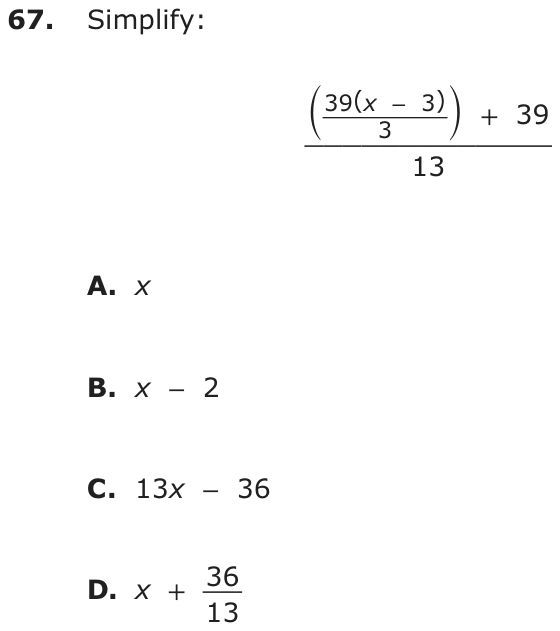
2024 Test A Math, question 10Question
Simplify:
- A
- B
- C
- D
Show the answer
Correct answer: A
Divide the first 39 by 3.
Distribute 13 through .
In the numerator, the terms −39 and 39 cancel out.
Finally, divide the numerator and denominator by 13 to get x.
Question analysis
An algebra question that asks students to simplify a stacked fraction: 39 times (x − 3) over 3, plus 39, all divided by 13. It tests dividing, distributing and combining like terms in the right order. The nested fraction bars make it easy to divide only some of the terms or to distribute to only one.
- NYS standards
- Grade level
- Grade 7 content, by NYS standard
- Compared with grade 7
- At grade 7 Grade 7 students expand and simplify linear expressions such as 13(x − 3) + 39. This wraps that work inside two fraction bars, which adds reading load and chances to misstep but no new mathematics.
- Estimated difficulty
- Straightforward: two steps or one careful reading.
- Thinking it demands
- Depth of knowledge 1, recall and reproduction · mainly apply
- What makes it hard
- Error-prone arithmetic moderate
- Many steps minor
- Solution
- 3 steps
- Reading level
- Question and choices: about grade 16+, 6 words.
- Students, last 30 days
- Not enough answers yet to show (it takes 10).
Why it is hard, traps and wrong answers (shows the answer)
Why it is hard
The expression looks heavier than it is: every number is a multiple of 13, and the constants cancel to leave a single term. What makes it risky is scope, knowing which terms each fraction bar and each multiplier covers. Each wrong choice comes from stretching or shrinking that scope by one term, so working outward from the innermost parentheses, one line per step, is the safe way.
Error-prone arithmetic moderate Working it out
Two fraction bars are nested: 39 ÷ 3 applies only to the first term, the 13 must reach both x and −3, and only then does the whole numerator divide by 13. (Brown & Burton, 1978; Junker & Sijtsma, 2001)
Many steps minor Working it out
Four moves come in a fixed order, divide 39 by 3, distribute 13, cancel −39 with +39, divide by 13, and each is a chance to apply a step to the wrong terms. (Daniel & Embretson, 2010; Enright, Morley & Sheehan, 2002)
Strategy: Work from the inside out: divide 39 by 3, distribute through the parentheses, combine the constants in the numerator, and only then divide everything by 13.
Traps
- A faulty procedure: A systematic but wrong procedure: adding fractions straight across, applying an exponent to each term of a sum, dropping a sign when moving a term.
- Order of operations: Working left to right, or distributing a minus sign wrongly, gives a choice.
The wrong answers, classified
B Order of operations (Brown & Burton, 1978)
Reads the inner fraction bar as covering the added 39 too, so the numerator becomes 13(x − 3) + 13 = 13x − 26, and dividing by 13 gives x − 2.
C Order of operations (Brown & Burton, 1978)
Divides only the last 39 by 13, leaving 13(x − 3) + 3 = 13x − 36, as if the outer fraction bar covered a single term.
D A faulty procedure (Brown & Burton, 1978; Tatsuoka, 1983)
Distributes the 13 to x but not to −3, so the numerator becomes 13x − 3 + 39 = 13x + 36, and dividing by 13 leaves a fraction.
Worked solution, step by step
Formulas used
- Distributive property
- a is the number outside the parentheses. b and c are the terms inside. Multiply a by each term inside, and keep the minus sign between them. It works because a groups of (b − c) are a groups of b, take away a groups of c.
Sort out the expression
You need to simplify the big fraction, which means write it in its shortest form. It has a small fraction inside its top. The top is , and the bottom is 13. Work from the inside out, one step at a time.
Divide the first 39 by 3
The small fraction bar is only under . So divide just that 39 by 3.
Now the top is . Watch out: the small bar does not reach the added 39. Dividing that 39 by 3 as well leads to , choice B.
Multiply out the parentheses
Watch out: multiply the 3 by 13 too, not just the x. Leaving −3 as it is leads to choice D.
Combine the plain numbers on top
−39 and 39 add up to 0, so they cancel. The top is now just 13x, which means 13 times x.
Divide by the bottom
Now divide the whole top by 13. Dividing by 13 undoes times 13.
Watch out: the long bar is under the whole top. Dividing only the last 39 by 13 gives , choice C. So the answer is A, .
Check your answer
Try x = 5. Then and . Next, and . Last, . You get back 5, the same as x. So x is right.
More questions like this
The original DOE question
Question 7 of 23
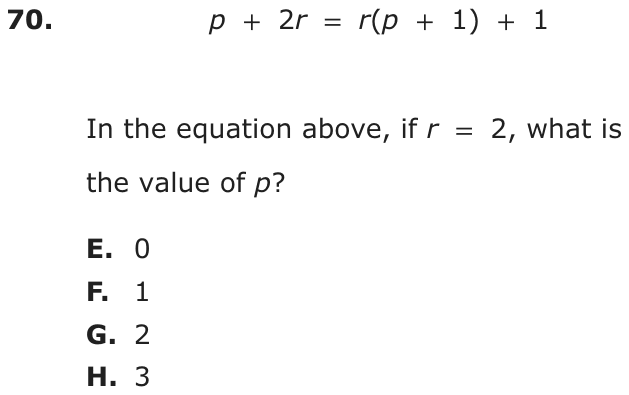
2024 Test B Math, question 13Question
In the equation above, if , what is the value of p?
- A0
- B1
- C2
- D3
Show the answer
Correct answer: B
First substitute 2 for r in the equation.
Then solve for p.
The value of p is 1.
Question analysis
An equation question: p + 2r equals r times (p + 1), plus 1, and r is given as 2. Students substitute for r, expand the parentheses and solve the resulting linear equation for p. With p on both sides and a product to expand, distributing is where a slip is most likely.
- NYS standards
- Grade level
- Grade 8 content, by NYS standard
- Compared with grade 7
- At grade 7 Equations with the variable on both sides are formally grade 8, but after substituting, this is a short solve with small whole numbers. It asks about as much as a typical grade 7 two-step equation.
- Estimated difficulty
- Straightforward: two steps or one careful reading.
- Thinking it demands
- Depth of knowledge 1, recall and reproduction · mainly apply
- What makes it hard
- Error-prone arithmetic moderate
- Solution
- 3 steps
- Reading level
- Question and choices: about grade 6, 13 words.
- Students, last 30 days
- Not enough answers yet to show (it takes 10).
Why it is hard, traps and wrong answers (shows the answer)
Why it is hard
Substituting r = 2 is immediate; the points are lost in expanding 2(p + 1) + 1. Each wrong choice solves a slightly wrong expansion: forgetting to multiply the 1 inside, folding the outer 1 into the parentheses, or losing a term. Putting the answer back into the original equation, with both r and p, is a quick and complete check.
Error-prone arithmetic moderate Working it out
After substituting, 2(p + 1) + 1 must become 2p + 3, multiplying both terms in the parentheses before adding the 1 outside, with p left on both sides. (Brown & Burton, 1978; Junker & Sijtsma, 2001)
Strategy: Replace every r with 2, multiply 2 by both terms in the parentheses, gather the p terms on one side, and check by putting the value back into the original equation.
Traps
- Order of operations: Working left to right, or distributing a minus sign wrongly, gives a choice.
The wrong answers, classified
A Order of operations (Brown & Burton, 1978)
Adds the outer 1 inside the parentheses before multiplying, writing 2(p + 2) = 2p + 4, so p + 4 = 2p + 4 gives 0.
C Order of operations (Brown & Burton, 1978)
Multiplies only the p by 2, writing 2p + 1 + 1 = 2p + 2, so p + 4 = 2p + 2 and p comes out as 2.
D Misreads the question (Hegarty, Mayer & Monk, 1995)
Drops the 1 inside the parentheses, reading 2(p + 1) as 2p, so the right side is 2p + 1 and p + 4 = 2p + 1 gives 3.
Worked solution, step by step
Formulas used
- Distributive property
- a is the number outside the parentheses. b and c are the terms inside. A term is a number, a letter, or a number times a letter. To multiply out the parentheses, multiply each term inside by a. It works because a groups of b + c is a groups of b plus a groups of c.
- Keeping an equation balanced
- a and b are the two sides of an equation, and c is any number or term. An equation is like a balanced scale. If you subtract the same thing from both sides, it stays balanced. Adding the same thing, or dividing both sides by the same number that is not zero, works too.
Sort out the question
The equation has two letters, p and r. You are told that r = 2. You need the value of p. Here 2r means 2 times r, and r(p + 1) means r times the group p + 1.
Put 2 in for r
Replace every r with 2. Keep the parentheses so you can see what gets multiplied.
On the left, , so the left side is .
Multiply out the parentheses
The 2 multiplies both the p and the 1 inside the parentheses. Then add the 1 that is outside.
Watch out: multiply the 1 inside by 2 as well. Writing 2p + 1 + 1 gives p = 2, choice C. Adding the outside 1 inside first gives p = 0, choice A.Get p by itself
Now the equation is . Subtract p from both sides. Then subtract 3 from both sides.
So p = 1, and the answer is B, 1.
Check your answer
Put p = 1 and r = 2 back into the first equation. Left side: . Right side: . Both sides are 5, so p = 1 works.
More questions like this
The original DOE question
Question 8 of 23
2024 Test B Math, question 27Question
Simplify:
- A
- B
- C
- D
Show the answer
Correct answer: B
First, distribute −1 over :
Then combine the like terms:
The simplified form of the expression is .
Question analysis
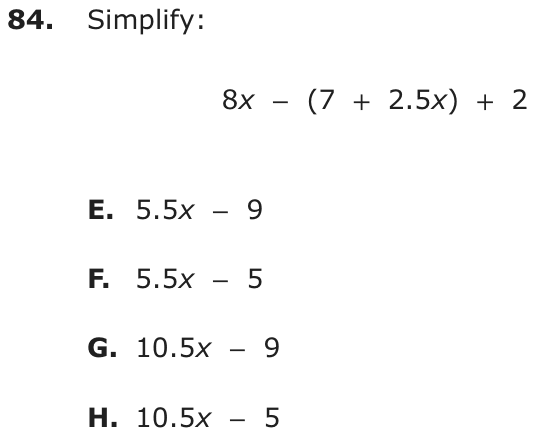
An algebra question asks students to simplify 8x minus the quantity 7 + 2.5x, plus 2. They remove the parentheses and combine the x terms and the constants. Decimal coefficients and a subtraction in front of a group make sign errors likely.
- NYS standards
- 7.EE.1 linear expressions with rational coefficients
- Grade level
- Grade 7 content, by NYS standard
- Compared with grade 7
- At grade 7 Simplifying a linear expression with a subtracted group and decimal coefficients is standard grade 7 work. This is a typical two-step textbook exercise, with the usual sign trap and nothing extra.
- Estimated difficulty
- Straightforward: two steps or one careful reading.
- Thinking it demands
- Depth of knowledge 1, recall and reproduction · mainly apply
- What makes it hard
- Error-prone arithmetic moderate
- A very close wrong answer moderate
- Solution
- 2 steps
- Reading level
- Question and choices: about grade 16+, 6 words.
- Students, last 30 days
- Not enough answers yet to show (it takes 10).
Why it is hard, traps and wrong answers (shows the answer)
Why it is hard
The question checks one skill, removing parentheses that follow a minus sign, and its choices are built from the two ways to get it wrong. A student who applies the minus to too few terms gets 10.5x, and one who extends it past the parentheses gets −9. Handling the x terms and the constants as two separate small checks makes each slip easy to catch.
Error-prone arithmetic moderate Working it out
The minus sign before the parentheses must turn + 2.5x into − 2.5x and 7 into − 7, while the + 2 written after the parentheses keeps its sign. (Brown & Burton, 1978; Junker & Sijtsma, 2001)
A very close wrong answer moderate Choosing the answer
The choices pair two x terms, 5.5x and 10.5x, with two constants, −9 and −5, so each wrong one differs from the right one in a single part. (Embretson & Wetzel, 1987; Gorin & Embretson, 2006; Ascalon et al., 2007)
Strategy: Change the minus in front of the parentheses into a minus on each term inside, then combine like terms, keeping the + 2 outside the group as it is.
Traps
- Order of operations: Working left to right, or distributing a minus sign wrongly, gives a choice.
The wrong answers, classified
A Order of operations (Brown & Burton, 1978)
Carries the minus sign past the parentheses onto the + 2 as well, so the constants become −7 − 2 = −9.
C Order of operations (Brown & Burton, 1978)
Makes both slips at once, keeping + 2.5x so the x terms add to 10.5x, and subtracting the outside 2 so the constants give −9.
D Order of operations (Brown & Burton, 1978)
Applies the minus sign to the 7 but not to 2.5x, so the x terms add to 10.5x while the constants come out right.
Worked solution, step by step
Formulas used
- Subtracting a group in parentheses
- a and b are the terms inside the parentheses. A minus sign in front means take away the whole group. So each term inside is taken away, and its sign flips. Terms outside the parentheses keep their own signs.
- Combining like terms
- a and b are numbers, and x is the letter. Like terms have the same letter part. You add or subtract their numbers and keep the letter. Plain numbers combine only with plain numbers.
Sort out the problem
You need to simplify . To simplify means to write it in its shortest form. The tricky part is the minus sign in front of the parentheses. It takes away everything inside.
Remove the parentheses
Both 7 and 2.5x get a minus sign. The + 2 is outside the parentheses, so it stays + 2. Watch out: 2.5x must become −2.5x. Leaving it as + 2.5x gives 10.5x, as in choices C and D.
Combine the x terms
Like terms have the same letter part. Put the two x terms together.
Combine the plain numbers
Watch out: the + 2 is not inside the parentheses. Making it −2 gives −9, as in choice A.Put the parts together: . So the answer is B, .
Check your answer
Pick x = 2 and try both forms. The first form: . Choice B: . They match. Choice D gives , so D is wrong.
More questions like this
The original DOE question
Question 9 of 23
2024 Test B Math, question 44Question
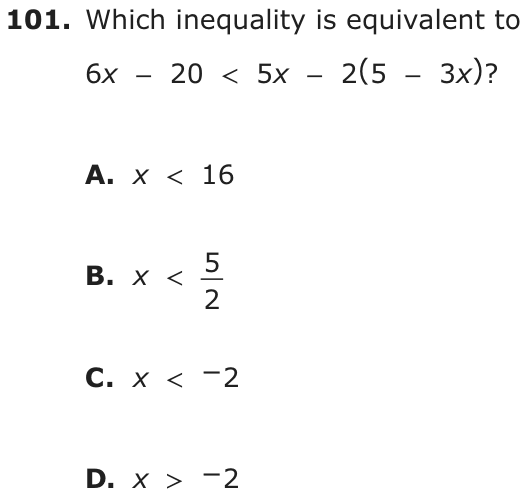
Which inequality is equivalent to ?
- A
- B
- C
- D
Show the answer
Correct answer: D
Distribute the coefficient −2 on the right-hand side:
Subtract from both sides:
Add 10 to both sides:
Divide both sides by 5:
This is equivalent to
Question analysis
Students choose the simplest equivalent form of a linear inequality that has x on both sides and a negative number multiplied into parentheses. It tests distributing, combining like terms and solving inequalities. Sign errors in the distribution, and reading the direction of the final inequality, are where most mistakes happen.
- NYS standards
- Grade level
- Grade 8 content, by NYS standard
- Compared with grade 7
- Above grade 7 Grade 7 inequalities have the form px + q < r. This one has x on both sides and a negative factor to distribute across a subtraction, steps that belong to grade 8 equation work, so it is harder than typical grade 7 practice.
- Estimated difficulty
- Hard: combines ideas, needs a plan, and has more than one tempting wrong answer.
- Thinking it demands
- Depth of knowledge 1, recall and reproduction · mainly apply
- What makes it hard
- Error-prone arithmetic moderate
- A very close wrong answer moderate
- Many steps minor
- Solution
- 4 steps
- Reading level
- Question and choices: about grade 16+, 10 words.
- Students, last 30 days
- Not enough answers yet to show (it takes 10).
Why it is hard, traps and wrong answers (shows the answer)
Why it is hard
Every move is standard algebra, but the inequality is built so that small slips change the answer completely. The −2 has to reach both terms in the parentheses, and once the boundary −2 is found its direction still has to be read correctly, since the variable ends up on the right as −2 < x. Rewriting that as x > −2, or substituting x = 0 into the original, catches the trap.
Error-prone arithmetic moderate Working it out
Distributing −2 over (5 − 3x) gives −10 + 6x, two sign decisions in one move, and the x terms then sit on both sides of the inequality. (Brown & Burton, 1978; Junker & Sijtsma, 2001)
A very close wrong answer moderate Choosing the answer
x < −2 and x > −2 share the boundary and differ only in direction, which depends on reading −2 < x correctly or flipping the sign when dividing by a negative. (Embretson & Wetzel, 1987; Gorin & Embretson, 2006; Ascalon et al., 2007)
Many steps minor Working it out
Four moves follow one another, distributing, collecting 5x + 6x, moving the x terms and dividing by 5, and a slip at any of them changes the result. (Daniel & Embretson, 2010; Enright, Morley & Sheehan, 2002)
Strategy: Distribute the −2 to both terms in the parentheses, combine the x terms on the right, then gather the x terms on the side that keeps their coefficient positive.
Traps
- Order of operations: Working left to right, or distributing a minus sign wrongly, gives a choice.
- Negatives and direction: Arithmetic with negative numbers, the order of a subtraction, or direction on a number line. (Moving a term across the equals sign without changing its sign is a faulty procedure.)
- A faulty procedure: A systematic but wrong procedure: adding fractions straight across, applying an exponent to each term of a sum, dropping a sign when moving a term.
The wrong answers, classified
A A faulty procedure (Brown & Burton, 1978; Tatsuoka, 1983)
Treats 5 − 3x as 2, combining a number with an x term, so the right side becomes 5x − 4 and the solution x < 16.
B Order of operations (Brown & Burton, 1978)
Multiplies the −2 by the 5 but not by the −3x, writing 5x − 10 − 3x, which leads to 4x < 10 and x < 5/2.
C Negatives and direction (Brown & Burton, 1978)
Finds the boundary −2 but points the inequality the wrong way, by misreading −2 < x or by not flipping the sign after dividing by −5.
Worked solution, step by step
Formulas used
- Distributive property
- a is the number outside the parentheses. b and c are the terms inside. Multiply a by each one. A minus sign inside counts as a negative term, so 5 − 3x is 5 + (−3x). A negative times a negative is positive.
- Keeping an inequality true
- a and b are the two sides, and c is any number. Adding or subtracting the same number on both sides keeps the inequality true. Dividing both sides by a positive number also keeps it true. Only multiplying or dividing by a negative number flips the sign.
Sort out the question
An inequality compares two sides with a sign like <, which means is less than. To solve it, you get x alone on one side.
You need the short inequality that has the same answers as the long one.
Distribute the −2
Multiply −2 by both terms inside the parentheses, 5 and −3x.
A negative times a negative is positive, so the second part is +6x. Watch out: If the −2 multiplies only the 5, you end up with , choice B.
Combine the x terms
The right side is now 5x − 10 + 6x. Put the x terms together: 5x + 6x = 11x.
Gather the x terms on one side
Subtract 6x from both sides. That leaves the x terms on the right, where they stay positive.
Get x by itself
Add 10 to both sides. Then divide both sides by 5.
You divided by a positive 5, so the sign does not flip.
Read it with x first
says −2 is less than x. That is the same as saying x is greater than −2, just as 3 < 5 means 5 > 3.
Watch out: , choice C, has the same number but points the wrong way.
So the answer is D, .
Check your answer
Test x = 0, which is greater than −2. The left side is . The right side is . And −20 < −10 is true. Now test x = −3. The left side is −38 and the right side is −43. That is false, as it should be.
More questions like this
The original DOE question
Question 10 of 23
2023 Test A Math, question 2Question
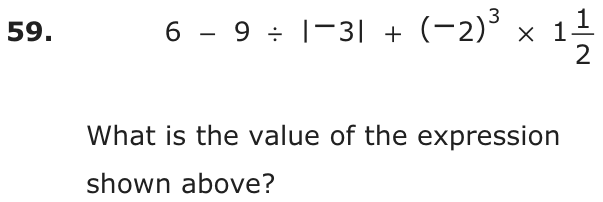
What is the value of the expression shown above?
Grid-in question: work out the answer and enter it as a number.
Show the answer
Correct answer: -9
| Calculate the exponent and convert the mixed number to an improper fraction. | |
| Next, calculate the absolute value. | |
| Perform the indicated multiplication and division. | |
| Perform the addition and subtraction. | |
Question analysis
This grid-in asks for the value of an arithmetic expression that mixes an absolute value, a negative number raised to the third power, a division and a mixed number. Students apply the order of operations with signed numbers. Cubing a negative base, and doing the division and multiplication before any adding, are where most slips happen.
- NYS standards
- Grade level
- Grade 7 content, by NYS standard
- Compared with grade 7
- At grade 7 Grade 7 students routinely evaluate expressions with negative numbers in the right order. This one combines an absolute value, a cubed negative and a mixed number in a single line, so it takes more steps than usual, each with a sign to watch.
- Estimated difficulty
- Moderate: several steps, or a close reading with one strong distractor.
- Thinking it demands
- Depth of knowledge 1, recall and reproduction · mainly apply
- What makes it hard
- Error-prone arithmetic moderate
- Many steps minor
- An answer in an unexpected form minor
- Solution
- 4 steps
- Reading level
- Question and choices: about grade 5, 10 words.
- Students, last 30 days
- Not enough answers yet to show (it takes 10).
Why it is hard, traps and wrong answers (shows the answer)
Why it is hard
The expression packs four kinds of notation into one line: a subtraction, a division by an absolute value, a negative base raised to the third power and a mixed number. None of the operations is hard alone, but each has a rule that is easy to break under time pressure, and the slips lead to very different totals. Rewriting the power and the mixed number first, then dividing and multiplying before any addition, avoids them.
Error-prone arithmetic moderate Working it out
(−2)³ must stay negative, −8, and the mixed number 1½ must become 3/2 before multiplying, so the last product is −12; a sign or fraction slip here moves the total far from −9. (Brown & Burton, 1978; Junker & Sijtsma, 2001)
Many steps minor Working it out
Six numbers and six operations, including a power and an absolute value, have to be worked in a planned order, and every addition waits until the division and multiplication are done. (Daniel & Embretson, 2010; Enright, Morley & Sheehan, 2002)
An answer in an unexpected form minor Choosing the answer
The value is negative and the grid-in offers no choices, so the minus sign has to be gridded and nothing on the page confirms that the total falls below zero. (Enright, Morley & Sheehan, 2002)
Strategy: Rewrite the absolute value and the power first, change the mixed number to an improper fraction, do the division and multiplication, and only then add and subtract from left to right.
Traps
- Order of operations: Working left to right, or distributing a minus sign wrongly, gives a choice.
- Negatives and direction: Arithmetic with negative numbers, the order of a subtraction, or direction on a number line. (Moving a term across the equals sign without changing its sign is a faulty procedure.)
- A faulty procedure: A systematic but wrong procedure: adding fractions straight across, applying an exponent to each term of a sum, dropping a sign when moving a term.
The wrong answers, classified
15 Negatives and direction (Brown & Burton, 1978)
Takes (−2)³ as positive 8, as if every power of a negative were positive, so the last product is +12 and 6 − 3 + 12 = 15.
-13.5 Order of operations (Brown & Burton, 1978)
Works strictly from left to right: 6 − 9 = −3, divided by 3 is −1, plus −8 is −9, and times 1½ gives −13.5.
-6 A faulty procedure (Brown & Burton, 1978; Tatsuoka, 1983)
Multiplies the base by the exponent, taking (−2)³ as −6, so the product with 3/2 is −9 and the total is 6 − 3 − 9 = −6.
Worked solution, step by step
Formulas used
- Order of operations
- This is the order for working out an expression. First work inside grouping symbols, such as parentheses and absolute value bars. Next do powers. Then multiply and divide from left to right. Last, add and subtract from left to right. Using one order means everyone gets the same answer.
- A power
- a is the base, the number being multiplied. The small 3 is the exponent. It says how many times the base is used as a factor, a number being multiplied. It does not mean a times 3.
- Absolute value
- The bars around a number mean absolute value. It is how far the number is from 0 on a number line. A distance is never negative, so the absolute value of −3 is 3.
- Mixed number to fraction
- a is the whole number part, and b over c is the fraction part. Each whole is c pieces, so a wholes are a × c pieces. Add the b extra pieces. The bottom number stays c.
Sort out the expression
You need the value of . It has many operations, so the order matters. It has absolute value bars, a power of a negative number and a mixed number. The answer may be negative, so keep track of every sign.
Do the absolute value and the power
Grouping symbols and powers come first.
Two negatives multiply to a positive, 4. One more negative makes it negative again. Watch out: (−2)³ is −8, not +8. Using +8 leads to 15. It is also not −2 × 3. That mistake leads to a total of −6.
Change the mixed number to a fraction
A fraction is easier to multiply than a mixed number.
Now the expression looks like this:
Multiply and divide next
Multiplying and dividing come before adding and subtracting.
A negative times a positive is negative. Watch out: don’t just work from left to right. Doing 6 − 9 first, then dividing by 3, leads to −13.5.
Add and subtract last
Now only adding and subtracting are left. Work from left to right.
Adding −12 is the same as taking away 12. So you would grid −9, with the minus sign in its own column.
Check your answer
Look at the size of each part. The part 6 − 3 is a small positive number, 3. The last part, −8 times 1½, is a bigger negative number, −12. A big negative plus a small positive is negative. So an answer below zero, −9, makes sense.
More questions like this
The original DOE question
Question 11 of 23
2023 Test A Math, question 3Question
Solve for x:
Grid-in question: work out the answer and enter it as a number.
Show the answer
Correct answer: 4
| Apply the distributive property; multiply the −2 by and 1. | |
| Combine like terms. | |
| Apply the additive inverse property; subtract 1 from both sides of the equation. | |
| Apply the multiplicative inverse property; divide both sides of the equation by 3. | |
Question analysis
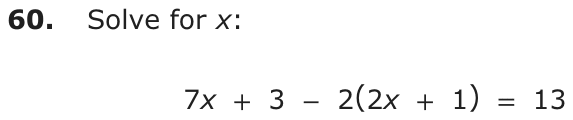
This grid-in gives the equation 7x + 3 − 2(2x + 1) = 13 and asks students to solve for x. It tests the distributive property with a negative factor, combining like terms and solving a two-step equation. The minus sign in front of the parentheses has to reach both terms inside, a step many students rush.
- Grade level
- Grade 7 content, by NYS standard
- Compared with grade 7
- At grade 7 Grade 7 students expand expressions with negative factors and solve equations such as p(x + q) = r. This equation needs both skills plus combining like terms, which is routine work with one negative sign that is easy to lose.
- Estimated difficulty
- Straightforward: two steps or one careful reading.
- Thinking it demands
- Depth of knowledge 1, recall and reproduction · mainly apply
- What makes it hard
- Error-prone arithmetic moderate
- An answer in an unexpected form minor
- Solution
- 4 steps
- Reading level
- Question and choices: about grade 3, 4 words.
- Students, last 30 days
- Not enough answers yet to show (it takes 10).
Why it is hard, traps and wrong answers (shows the answer)
Why it is hard
This is a standard multi-step linear equation, and the work is short once the parentheses are cleared. Everything rests on distributing −2 correctly; the later steps, combining 7x with −4x and 3 with −2, then undoing the + 1 and the × 3, are routine. Substituting 4 back into the left side, 28 + 3 − 18 = 13, is a fast check that catches a sign slip.
Error-prone arithmetic moderate Working it out
The −2 in front of (2x + 1) must reach both terms, giving −4x − 2; the second product, −2 × 1, is the one most often written as +2 or left as +1. (Brown & Burton, 1978; Junker & Sijtsma, 2001)
An answer in an unexpected form minor Choosing the answer
As a grid-in with no choices, a value such as 3 or 8/3 from a distributing slip looks just as finished as the right one; only substituting back exposes it. (Enright, Morley & Sheehan, 2002)
Strategy: Distribute −2 to both terms inside the parentheses, combine the x terms and the constants, then undo the addition and the multiplication in turn.
Traps
- A faulty procedure: A systematic but wrong procedure: adding fractions straight across, applying an exponent to each term of a sum, dropping a sign when moving a term.
- Order of operations: Working left to right, or distributing a minus sign wrongly, gives a choice.
The wrong answers, classified
3 A faulty procedure (Brown & Burton, 1978; Tatsuoka, 1983)
Multiplies only the 2x by −2 and leaves the + 1 untouched, so the equation becomes 3x + 4 = 13 and x = 3.
8/3 Order of operations (Brown & Burton, 1978)
Gives the minus sign to 4x but not to the 2, writing −4x + 2, so the equation becomes 3x + 5 = 13 and x = 8/3.
12 Stops one step early (King et al., 2004; Gierl et al., 2017)
Simplifies correctly to 3x + 1 = 13, subtracts 1 to reach 3x = 12, and grids 12 without dividing by 3.
Worked solution, step by step
Formulas used
- Distributive property
- a is the number outside the parentheses. b and c are the terms inside. A term is a number, a letter, or a number times a letter. Multiply each term inside by a. If a is negative, every product gets its sign too.
- Keeping an equation balanced
- a and b are the two equal sides. c is any number, but not 0 when you divide. Doing the same thing to both sides keeps them equal, like a balanced scale. Use it to get the unknown by itself.
Sort out the equation
You need the value of x that makes true. x is the unknown number. The tricky part is the −2 in front of the parentheses. It multiplies everything inside them.
Multiply out the parentheses
Use the distributive property with a = −2, b = 2x and c = 1.
So the equation becomes this:
Watch out: the −2 must multiply the 1 too. Leaving + 1 gives x = 3. Writing + 2 instead of − 2 gives .
Combine like terms
Like terms are terms of the same kind. Put the x terms together. Put the plain numbers together.
Get x by itself
Undo the + 1 first. Subtract 1 from both sides, so the equation stays balanced.
3x means 3 times x. So divide both sides by 3.
Watch out: don’t stop at 3x = 12. 12 is three times the answer. So you would grid 4.
Check your answer
Put x = 4 back into the first equation: . That matches the 13 on the right side, so x = 4 is right.
More questions like this
The original DOE question
Question 12 of 23
2023 Test A Math, question 6Question
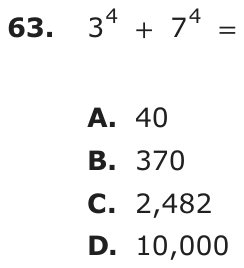
- A40
- B370
- C2,482
- D10,000
Show the answer
Correct answer: C
Question analysis
This exponents question asks for the sum of 3 to the fourth power and 7 to the fourth power. Students evaluate each power separately and then add. The traps are treating an exponent as a multiplier and adding the bases before raising them to a power, and the larger power takes careful multiplication.
- NYS standards
- 6.EE.1 whole-number exponent expressions
- Grade level
- Grade 6 content, by NYS standard
- Compared with grade 7
- Below grade 7 Evaluating whole-number powers is grade 6 work, and this question asks only for two of them and a sum. The one demand beyond routine practice is computing a fourth power of 7 accurately without a calculator.
- Estimated difficulty
- Straightforward: two steps or one careful reading.
- Thinking it demands
- Depth of knowledge 1, recall and reproduction · mainly apply
- What makes it hard
- Error-prone arithmetic moderate
- Something you must already know minor
- Solution
- 3 steps
- Reading level
- Question and choices: about grade 16+, 1 words.
- Students, last 30 days
- Not enough answers yet to show (it takes 10).
Why it is hard, traps and wrong answers (shows the answer)
Why it is hard
The sum is short, but it tests exactly what an exponent means and when to apply it. The wrong choices come from three misreadings of the notation: treating the power as a multiplier, using one factor too few, and adding the bases before raising them. A size check settles it: 7⁴ alone is 49 × 49, a little under 2,500, so 40 and 370 are far too small and 10,000 far too large.
Error-prone arithmetic moderate Working it out
7⁴ means 7 × 7 × 7 × 7 = 2,401, a four-digit product built by hand, most easily as 49 × 49; 3⁴ = 81 is quick by comparison. (Brown & Burton, 1978; Junker & Sijtsma, 2001)
Something you must already know minor Working it out
An exponent counts repeated factors rather than acting as a multiplier, so 3⁴ is 3 × 3 × 3 × 3 = 81, not 3 × 4 = 12; the item assumes that meaning. (Anderson & Krathwohl, 2001)
Strategy: Compute each power on its own, squaring and then squaring again, and add the two results only at the end.
Traps
- A faulty procedure: A systematic but wrong procedure: adding fractions straight across, applying an exponent to each term of a sum, dropping a sign when moving a term.
- Order of operations: Working left to right, or distributing a minus sign wrongly, gives a choice.
The wrong answers, classified
A A faulty procedure (Brown & Burton, 1978; Tatsuoka, 1983)
Multiplies each base by its exponent, 3 × 4 + 7 × 4 = 12 + 28 = 40, instead of using each base as a factor four times.
B A faulty procedure (Brown & Burton, 1978; Tatsuoka, 1983)
Uses each base as a factor three times instead of four, 27 + 343 = 370, so both powers stop one factor short.
D Order of operations (Brown & Burton, 1978)
Adds the bases before applying the exponent, treating 3⁴ + 7⁴ as (3 + 7)⁴ = 10,000, though powers come before addition.
Worked solution, step by step
Formulas used
- A power
- a is the base, the number being multiplied. The small 4 is the exponent. It tells how many times the base is used as a factor, a number being multiplied. So the exponent counts factors. It does not mean multiply by 4.
- Powers come before adding
- a and b are any two positive numbers. The sign ≠ means is not equal to. Powers come before adding. So raise each number to its power first, then add. Adding the bases first gives a much bigger number.
Sort out the question
You need the value of . Each number has a small 4 above it. This 4 is an exponent. Work out each power on its own. Then add the two results.
Find 3 to the fourth power
3⁴ means four 3s multiplied together. Pair them up to make it easier.
Watch out: 3⁴ is not 3 × 4 = 12. Doing that to both powers gives 12 + 28 = 40, choice A.
Find 7 to the fourth power
7⁴ means four 7s multiplied together. Pair them up the same way.
To find 49 × 49, do 49 × 50 = 2,450. Then take away one 49. That gives 2,401. Watch out: count four 7s, not three. Three 7s make 343. Using three factors in both powers gives 370, choice B.
Add the two powers
Watch out: don’t add 3 and 7 first. That gives , choice D. Powers come before adding. So the answer is C, 2,482.
Check your answer
Estimate. 7⁴ is 49 × 49, a little less than 50 × 50 = 2,500. Adding 81 keeps it near 2,500. Only 2,482 is close. 40 and 370 are far too small, and 10,000 is far too big.
More questions like this
The original DOE question
Question 13 of 23
2023 Test A Math, question 20Question
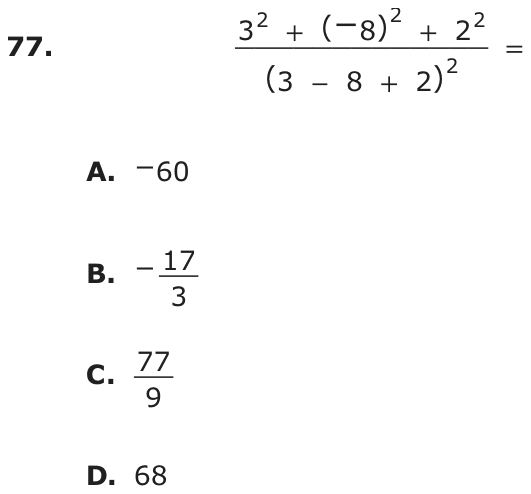
- A−60
- B
- C
- D68
Show the answer
Correct answer: C
Question analysis
This arithmetic question asks for the value of a fraction whose numerator is the sum of the squares of 3, −8 and 2, and whose denominator is the square of 3 − 8 + 2. Students apply the order of operations with negative numbers. Squaring a negative number and adding inside parentheses before squaring are the points to watch.
- NYS standards
- Grade level
- Grade 7 content, by NYS standard
- Compared with grade 7
- At grade 7 Squaring negative numbers and simplifying with the order of operations is standard grade 7 practice. Here the fraction bar groups a numerator and a denominator that each involve a negative sign, but the work stays short.
- Estimated difficulty
- Straightforward: two steps or one careful reading.
- Thinking it demands
- Depth of knowledge 1, recall and reproduction · mainly apply
- What makes it hard
- Error-prone arithmetic moderate
- Many steps minor
- Solution
- 3 steps
- Reading level
- Question and choices: about grade 16+, 3 words.
- Students, last 30 days
- Not enough answers yet to show (it takes 10).
Why it is hard, traps and wrong answers (shows the answer)
Why it is hard
The expression is built so that signs decide everything: the top's 3², (−8)² and 2² are all positive, and so is the square of the bottom's −3. Students who keep a negative after squaring, or who cancel the 9 on top against the 9 below, reach the other choices. The result, 77/9, does not reduce, which can make careful students doubt a correct answer.
Error-prone arithmetic moderate Working it out
Two negatives sit inside squares: (−8)² must be +64, and the denominator's 3 − 8 + 2 = −3 must be squared to +9, so every term ends up positive. (Brown & Burton, 1978; Junker & Sijtsma, 2001)
Many steps minor Working it out
The numerator needs three squares and a sum, the denominator a sum and then a square, and the fraction bar groups each side, so neither part can be split or cancelled. (Daniel & Embretson, 2010; Enright, Morley & Sheehan, 2002)
Strategy: Simplify the top and the bottom separately: square each number in the numerator, add inside the parentheses before squaring in the denominator, then write the fraction in lowest terms.
Traps
- Order of operations: Working left to right, or distributing a minus sign wrongly, gives a choice.
- A faulty procedure: A systematic but wrong procedure: adding fractions straight across, applying an exponent to each term of a sum, dropping a sign when moving a term.
The wrong answers, classified
A Order of operations (Brown & Burton, 1978)
Squares as if the minus sat outside the parentheses, (−8)² as −64, and also cancels the 9 on top against the 9 below, leaving −64 + 4 = −60.
B Order of operations (Brown & Burton, 1978)
Squares as if the minus sat outside the parentheses, taking (−8)² as −64, so the top is 9 − 64 + 4 = −51 and −51/9 = −17/3.
D A faulty procedure (Brown & Burton, 1978; Tatsuoka, 1983)
Cancels the 9 in the numerator, 9 + 64 + 4, against the denominator's 9, leaving 64 + 4 = 68, though only a factor of the whole top can cancel.
Worked solution, step by step
Formulas used
- Square of a negative
- a is any number. To square means to multiply a number by itself. A negative times a negative is positive. So the square of a negative number is always positive.
- The fraction bar groups
- A fraction bar means divide. It also groups: work out the whole top and the whole bottom first, then divide. You can only cancel a number that multiplies the whole top, not one part of a sum.
Sort out the expression
The top, the numerator, is three squares added together. The bottom, the denominator, is a sum in parentheses that is then squared. To square means to multiply a number by itself. Work out the top and the bottom on their own. Then divide.
Work out the top
Square each number first. Then add.
Watch out: (−8)² is +64, not −64. The minus sign is inside the parentheses, so it is squared too. Using −64 makes the top −51 and gives , choice B.
Work out the bottom
Work inside the parentheses first. Add and subtract before you square.
The bottom is 9.
Divide and simplify
77 is 7 × 11 and 9 is 3 × 3. They share no factor, so the fraction is in lowest terms. Watch out: don’t cancel the 9 on top with the 9 below. That 9 is only one part of a sum. Canceling it leaves 64 + 4 = 68, choice D. So the answer is C, .
Check your answer
Every square is positive or zero. So the top and the bottom are both positive, and the answer must be positive. That rules out −60 and . Also, is about 8.6, which is far from 68.
More questions like this
The original DOE question
Question 14 of 23
2023 Test A Math, question 40Question
Ken has k video games, and Jeff has j video games. If Ken gives 6 video games to Jeff, Ken will have twice as many video games as Jeff. Which equation shows the relationship between k and j?
- A
- B
- C
- D
Show the answer
Correct answer: A
If Ken gives 6 video games to Jeff, the number Ken has is , and the number Jeff has is . After the exchange, Ken has twice as many video games as Jeff. The equation is:
Question analysis
This algebra word problem says Ken has k video games and Jeff has j, and if Ken gives Jeff 6 games, Ken will have twice as many as Jeff. Students choose the equation that models the situation. Getting the comparison the right way round, and grouping each new total correctly, is where most errors happen.
- Grade level
- Grade 7 content, by NYS standard
- Compared with grade 7
- At grade 7 Grade 7 students write equations from word problems. This one tracks two people's counts after a transfer and states a times-as-many comparison, so both counts change and the factor of 2 must go on the right side: typical but error-prone.
- Estimated difficulty
- Moderate: several steps, or a close reading with one strong distractor.
- Thinking it demands
- Depth of knowledge 2, skills and concepts · mainly apply
- What makes it hard
- Turning words into math moderate
- A very close wrong answer moderate
- Variables instead of numbers minor
- Solution
- 2 steps
- Reading level
- Question and choices: about grade 4, 41 words.
- Students, last 30 days
- Not enough answers yet to show (it takes 10).
Why it is hard, traps and wrong answers (shows the answer)
Why it is hard
The question is all setup: no solving is needed, just an equation that says what the story says. The trade moves games out of one count and into the other, and the comparison has to be written with the 2 on the smaller side. The wrong equations reverse the comparison, forget Jeff's gain, or drop the parentheses, and all four look alike. Plugging in sample counts is the surest check.
Turning words into math moderate Understanding the question
After the gift both counts change, Ken's to k − 6 and Jeff's to j + 6, and “twice as many video games as Jeff” must double Jeff's whole new count, putting the 2 on his side. (Hegarty, Mayer & Monk, 1995; Koedinger & Nathan, 2004)
A very close wrong answer moderate Choosing the answer
All four equations share the pieces k − 6, j + 6 and a 2; the right one differs from 2(k − 6) = j + 6 only in where the 2 sits, and from k − 6 = 2j + 6 by parentheses. (Embretson & Wetzel, 1987; Gorin & Embretson, 2006; Ascalon et al., 2007)
Variables instead of numbers minor Understanding the question
There are no numbers to check against, only k and j, so testing an equation means inventing counts that fit the story, such as Jeff with 4 games and Ken with 26. (Koedinger & Nathan, 2004; Enright, Morley & Sheehan, 2002)
Strategy: Write each boy's number of games after the exchange as an expression, then translate "Ken will have twice as many as Jeff" into an equation and test it with sample numbers.
Traps
- Equation written backwards: Writes a comparison the wrong way round, word for word: "six times as many students as professors" as 6S = P. The bigger quantity gets the bigger number.
- Order of operations: Working left to right, or distributing a minus sign wrongly, gives a choice.
The wrong answers, classified
B Order of operations (Brown & Burton, 1978)
Leaves out the parentheses, doubling only Jeff's old count j and then adding 6, instead of doubling his whole new count j + 6.
C Equation written backwards (Clement, Lochhead & Monk, 1981)
Puts the 2 on Ken's side, writing the comparison backwards, and also forgets that Jeff gains the 6 games, two errors in one equation.
D Equation written backwards (Clement, Lochhead & Monk, 1981)
Writes the comparison backwards word for word, doubling Ken's new count, which would mean Jeff ends with twice as many games as Ken.
Worked solution, step by step
Formulas used
- Twice as many
- A and B are two amounts. “A has twice as many as B” means A equals 2 times B. The 2 goes with the smaller amount, because that is the one you double to match the bigger one.
- The distributive property
- a, b and c are numbers. Multiplying a by a sum means multiplying a by each part, then adding. For example, 2(4 + 6) = 8 + 12 = 20.
Sort out the question
Ken has k video games, and Jeff has j. Then Ken gives 6 of his games to Jeff. After that, Ken has twice as many games as Jeff. You need the equation that links k and j.
Write each new amount
Ken gives away 6 games, so he has k − 6 left. Jeff gets those 6 games, so he has j + 6. Both amounts change, so use both new amounts.
Write “twice as many”
After the gift, Ken has more games. So Jeff’s new amount is the one that gets doubled.
Watch out: putting the 2 on Ken’s side, as in , would mean Jeff has twice as many. That is choice D.
Keep the parentheses
Twice Jeff’s new amount is 2j + 12, not 2j + 6. Watch out: dropping the parentheses gives choice B. So the answer is A, .
Check your answer
Make up numbers that fit the story. Say Jeff has 4 games and Ken has 26. After the gift, Ken has 20 and Jeff has 10, and 20 is twice 10. Choice A gives , or 20 = 20. Choice B gives 20 = 14, which is false.
More questions like this
The original DOE question
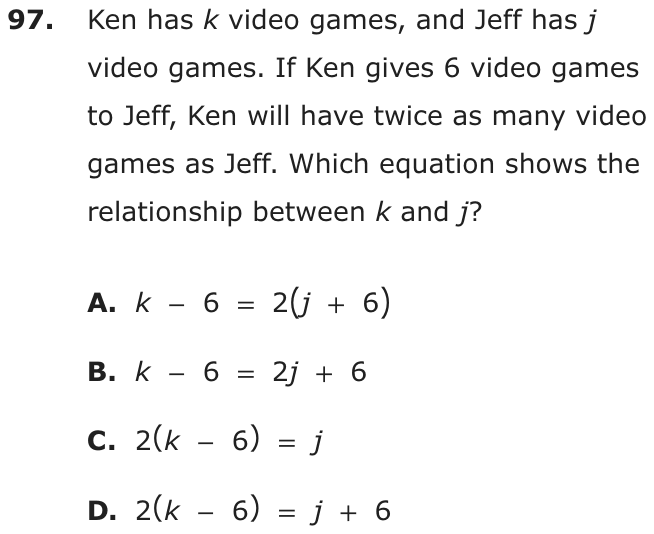
Question 15 of 23
2023 Test A Math, question 44Question
For what value of x is the equation true?
- A
- B
- C
- D
Show the answer
Correct answer: B
| Apply the distributive property; multiply the 3 by 4 and . | |
| Combine like terms. | |
| Apply the additive inverse property; add and 4 to both sides of the equation. | |
| Get a common denominator. | |
| Apply the multiplicative inverse property; multiply both sides of the equation by 5. | |
| Apply the multiplicative inverse property; divide both sides of the equation by 31. | |
Question analysis
This equation question asks for the value of x that makes x/5 − 4 = 3(4 − 2x) − 1 true. Students use the distributive property, collect variable terms on one side, and clear a fraction before solving. Each wrong choice matches a common slip with the parentheses or with the fraction, so careful bookkeeping matters more than speed.
- NYS standards
- Grade level
- Grade 8 content, by NYS standard
- Compared with grade 7
- Above grade 7 Grade 7 equations have the form px + q = r. This one has x on both sides, a fractional coefficient and a product to expand, which are grade 8 equation skills, and every wrong choice matches a plausible slip along the way.
- Estimated difficulty
- Hard: combines ideas, needs a plan, and has more than one tempting wrong answer.
- Thinking it demands
- Depth of knowledge 1, recall and reproduction · mainly apply
- What makes it hard
- Error-prone arithmetic moderate
- Many steps moderate
- A very close wrong answer minor
- Solution
- 5 steps
- Reading level
- Question and choices: about grade 8, 14 words.
- Students, last 30 days
- Not enough answers yet to show (it takes 10).
Why it is hard, traps and wrong answers (shows the answer)
Why it is hard
Every step is a routine move in solving a linear equation, but there are five of them and the fraction raises the cost of each. The listed wrong answers come from distributing the 3 to only one term, clearing the fraction from one term only, and stretching the parentheses over the −1. Substituting the result back is slow with a denominator of 31, so careful step-by-step work matters more than checking.
Error-prone arithmetic moderate Working it out
The term x/5 sits beside whole-number terms and a negative −6x, so clearing the fraction means multiplying every term by 5, and the answer is the unfriendly 75/31. (Brown & Burton, 1978; Junker & Sijtsma, 2001)
Many steps moderate Working it out
Five moves in a row, distributing the 3, combining 12 and −1, collecting the x terms, clearing the fifth and dividing by 31, each give a slip a place to enter. (Daniel & Embretson, 2010; Enright, Morley & Sheehan, 2002)
A very close wrong answer minor Choosing the answer
The fraction 75/11 shares its numerator with 75/31 and differs by one digit of the denominator, so only the coefficient of x, 6 1/5 rather than 2 1/5, separates them. (Embretson & Wetzel, 1987; Gorin & Embretson, 2006; Ascalon et al., 2007)
Strategy: Distribute the 3 to both terms in the parentheses, combine constants, collect the x terms on one side, then multiply every term by 5 to clear the fraction; check by substituting.
Traps
- A faulty procedure: A systematic but wrong procedure: adding fractions straight across, applying an exponent to each term of a sum, dropping a sign when moving a term.
- Order of operations: Working left to right, or distributing a minus sign wrongly, gives a choice.
The wrong answers, classified
A A faulty procedure (Brown & Burton, 1978; Tatsuoka, 1983)
Distributes the 3 only to the 4, writing 12 − 2x, so the equation becomes x/5 + 2x = 15 and then 11x = 75.
C A faulty procedure (Brown & Burton, 1978; Tatsuoka, 1983)
Multiplies only x/5 by 5 to clear the fraction, leaving 6x and 15 unchanged, so it solves x + 6x = 15 and gets 7x = 15.
D Order of operations (Brown & Burton, 1978)
Applies the 3 to the −1 as well, as if it sat inside the parentheses, so the right side becomes 9 − 6x and the constant 13 instead of 15.
Worked solution, step by step
Formulas used
- The distributive property
- a, b and c are numbers or terms. Multiplying a by a difference means multiplying a by each part. The number outside must reach every term inside the parentheses.
- Doing the same to both sides
- a and b are the two sides of an equation, and c is any number. An equation is like a balanced scale. Adding the same amount to both sides, or multiplying both sides by the same number, keeps it balanced.
Sort out the question
You need the value of x that makes both sides of the equation equal. The plan: clear the parentheses, gather the x terms on one side, and get rid of the fraction. Then divide.
Clear the parentheses
Watch out: the 3 multiplies both 4 and 2x. Writing 12 − 2x leads to , choice A. The −1 is outside the parentheses, so the 3 does not touch it.
Gather the x terms
Add 6x to both sides to move the x terms to the left. Add 4 to both sides to move the plain numbers to the right.
Clear the fraction
Multiply both sides by 5. Every term gets multiplied, not only the fraction.
Watch out: multiplying only the fraction by 5 gives x + 6x = 15. That leads to , choice C.
Divide by 31
75 and 31 share no factor except 1, so the fraction is already simplified. So the answer is B, .
Check your answer
Put back in. Then and . Write 4 as . The left side is . On the right, , and . Both sides match.
More questions like this
The original DOE question
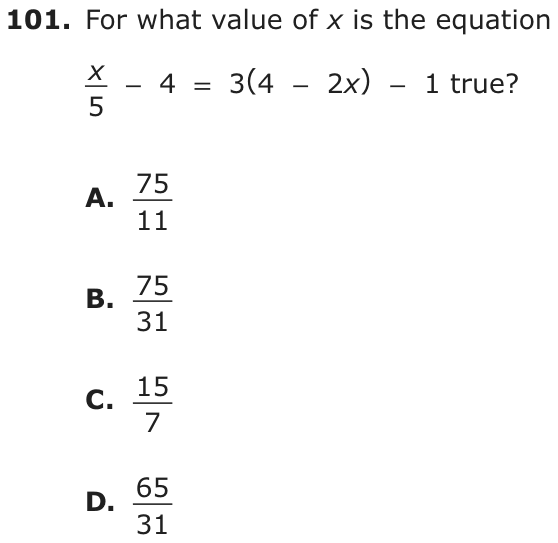
Question 16 of 23
2023 Test B Math, question 37Question
Which expression is equivalent to ?
- A
- B
- C
- D
Show the answer
Correct answer: D
First, distribute the negative sign, which is the same as multiplying both terms in the parentheses by −1.
Next, combine like terms:
Then, factor the common factor of from both terms, paying careful attention to the signs:
Question analysis
An algebra question asking which factored expression equals one half x plus 7 minus the quantity x minus nine halves. Students distribute the subtraction, combine like terms with fractions, and match a factored form. Signs are the danger at every step, and the choices differ only in the signs and numbers inside the parentheses.
- NYS standards
- 7.EE.1 linear expressions with rational coefficients
- Grade level
- Grade 7 content, by NYS standard
- Compared with grade 7
- Above grade 7 Grade 7 students expand and simplify linear expressions with fractions. Here a subtracted group must be distributed and the result factored by a negative fraction, two places where a sign is easily lost, a longer chain than typical grade 7 work.
- Estimated difficulty
- Hard: combines ideas, needs a plan, and has more than one tempting wrong answer.
- Thinking it demands
- Depth of knowledge 1, recall and reproduction · mainly apply
- What makes it hard
- Error-prone arithmetic moderate
- An answer in an unexpected form moderate
- A very close wrong answer moderate
- Solution
- 3 steps
- Reading level
- Question and choices: about grade 15, 10 words.
- Students, last 30 days
- Not enough answers yet to show (it takes 10).
Why it is hard, traps and wrong answers (shows the answer)
Why it is hard
Two separate sign decisions decide this question: distributing the subtraction over x − 9/2, and factoring a negative half out of +23/2. Students who handle the first correctly often stumble on the second and choose the look-alike with +23. Expanding each choice, rather than factoring by hand, is quicker and safer, since it turns the comparison into matching −1/2x + 23/2 term by term.
Error-prone arithmetic moderate Working it out
The minus before (x − 9/2) must change two signs, and the result mixes halves with whole numbers: 1/2x − x and 7 + 9/2 both need care. (Brown & Burton, 1978; Junker & Sijtsma, 2001)
An answer in an unexpected form moderate Choosing the answer
The simplified result, −1/2x + 23/2, appears nowhere; every choice is factored by ±1/2, so students must factor out −1/2 themselves or expand each choice to compare. (Enright, Morley & Sheehan, 2002)
A very close wrong answer moderate Choosing the answer
The answer, −1/2(x − 23), and −1/2(x + 23) differ only in the sign inside the parentheses, and the simplified form’s +23/2 makes the plus sign look right. (Embretson & Wetzel, 1987; Gorin & Embretson, 2006; Ascalon et al., 2007)
Strategy: Change the sign of both terms inside the parentheses, combine the x terms and the constants, then expand each choice to see which one matches rather than factoring yourself.
Traps
- Order of operations: Working left to right, or distributing a minus sign wrongly, gives a choice.
- Negatives and direction: Arithmetic with negative numbers, the order of a subtraction, or direction on a number line. (Moving a term across the equals sign without changing its sign is a faulty procedure.)
- Answer in another form: The right answer is written differently from the way you worked it out.
The wrong answers, classified
A Order of operations (Brown & Burton, 1978)
Gives the minus to x but not to −9/2, so the constants make 7 − 9/2 = 5/2, then drops the leading negative when factoring: 1/2(x − 5).
B Negatives and direction (Brown & Burton, 1978)
Combines 1/2x − x as +1/2x, subtracting the smaller coefficient from the larger, and also leaves −9/2 unchanged, so the result is 1/2x + 5/2 = 1/2(x + 5).
C Negatives and direction (Brown & Burton, 1978)
Simplifies correctly to −1/2x + 23/2 but keeps +23 when factoring out −1/2, though dividing +23/2 by −1/2 gives −23.
Worked solution, step by step
Formulas used
- Subtracting a group
- b and c are the two terms inside the parentheses. Terms are the parts joined by plus or minus signs. A minus sign in front of parentheses takes away the whole group. So it changes the sign of every term inside, not only the first one.
- Distributive property
- a is the number outside the parentheses. b and c are the terms inside. Multiply a by each term inside. It works because a groups of (b + c) hold a of each. Use it to multiply out the choices and compare them.
Sort out the question
Equivalent means equal for every value of x. The choices are written in a different form from the problem. So simplify the problem first. Then multiply out the choices and compare.
Remove the parentheses
The minus sign in front of the parentheses takes away both terms inside. So x becomes −x, and becomes .
Watch out: If you change only the sign of x, the numbers become . That mistake leads to choice A or B.
Combine the x terms
Like terms have the same letter part. The x terms are and −x. Write x as so the fractions match.
The result is negative, because you take away more x than you have.
Combine the numbers
Now combine the plain numbers, 7 and . Write 7 as fourteen halves so the bottoms match. Then add.
The expression simplifies to .
Multiply out choices C and D
Only C and D start with , so test those. Use the distributive property. A negative times a negative is positive.
The first line is choice C, and the second is choice D. Only D matches.
Watch out: Choice C looks almost the same. But it gives , not .
So the answer is D, .
Check your answer
Try x = 1 in the problem: . Now put x = 1 into choice D: . Both give 11, so they match.
More questions like this
The original DOE question
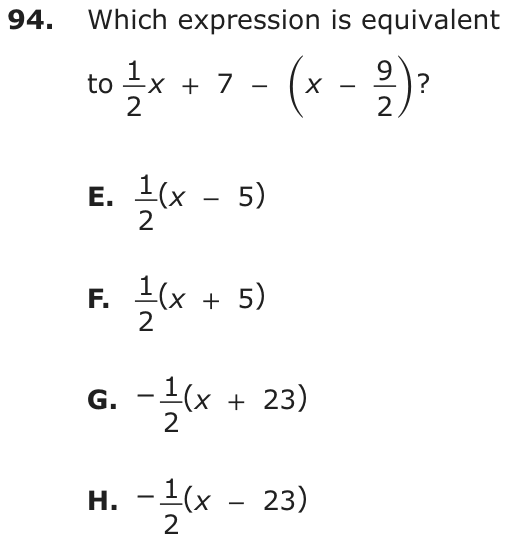
Question 17 of 23
2023 Test B Math, question 46Question
What is the value of the expression above, in decimal form?
- A0
- B0.5
- C1.5
- D2.5
Show the answer
Correct answer: D
Question analysis
An exponents question: students find the decimal value of a sum of four powers, zero cubed, four to the zero power, two to the negative first power and negative one squared. Each of the four terms follows a different rule, and a slip on any one of them changes the total.
- Grade level
- Grade 8 content, by NYS standard
- Compared with grade 7
- Above grade 7 Grade 7 work uses whole-number exponents and signed numbers. Zero and negative exponents are grade 8 content, and this expression tests both alongside a negative base, each with its own common misconception.
- Estimated difficulty
- Hard: combines ideas, needs a plan, and has more than one tempting wrong answer.
- Thinking it demands
- Depth of knowledge 1, recall and reproduction · mainly apply
- What makes it hard
- Solution
- 4 steps
- Reading level
- Question and choices: about grade 6, 12 words.
- Students, last 30 days
- Not enough answers yet to show (it takes 10).
Why it is hard, traps and wrong answers (shows the answer)
Why it is hard
Every term tests a different exponent rule, and each wrong choice comes from breaking exactly one of them. The zero exponent is the most common casualty, since 4⁰ looks as if it should be 0 like 0³; a negative exponent read as a negative number is close behind. Writing each term’s value above it before adding, 0, 1, 1/2 and 1, keeps the four rules separate.
Something you must already know major Working it out
Three rules the test does not give decide the sum: any nonzero number to the 0 power is 1, 2 to the −1 power is 1/2, and (−1)² is positive 1. (Anderson & Krathwohl, 2001)
Error-prone arithmetic minor Working it out
The four terms carry a zero base, a zero exponent, a negative exponent and a negative base, so a sign or a stray 0 can slip in at each one. (Brown & Burton, 1978; Junker & Sijtsma, 2001)
Strategy: Evaluate each power on its own, using the rules for a zero exponent and a negative exponent and the sign of a squared negative number, then add the four values.
Traps
- A faulty procedure: A systematic but wrong procedure: adding fractions straight across, applying an exponent to each term of a sum, dropping a sign when moving a term.
- Order of operations: Working left to right, or distributing a minus sign wrongly, gives a choice.
The wrong answers, classified
A A faulty procedure (Brown & Burton, 1978; Tatsuoka, 1983)
Treats 2 to the power −1 as −2 instead of one half, so the four terms 0 + 1 − 2 + 1 add to 0.
B Order of operations (Brown & Burton, 1978)
Squares as if the minus sat outside the parentheses, taking (−1)² as −1, so the terms add to 0 + 1 + 0.5 − 1 = 0.5.
C A faulty procedure (Brown & Burton, 1978; Tatsuoka, 1983)
Takes 4 to the power 0 as 0 rather than 1, so the expression becomes 0 + 0 + 0.5 + 1 = 1.5.
Worked solution, step by step
Formulas used
- Zero exponent
- a is any number except 0. An exponent of 0 always gives 1. It works because each step down in the exponent divides by a. For example, 4 to the first power is 4, and 4 ÷ 4 = 1.
- Negative exponent
- a is the base, and n is a positive whole number. A negative exponent does not make the number negative. It means 1 divided by the base to the positive power. For example, 2 to the −1 power is one half.
Sort out the question
The expression adds four powers. A power is a base with an exponent, a small raised number. The exponent tells how many times to use the base as a factor, a number you multiply. Find each power, then add.
Find the first two powers
Zero times itself is still zero.
Next, use the zero exponent rule.
Watch out: is 1, not 0. Taking it as 0 gives choice C.
Find the negative power
Use the negative exponent rule.
Watch out: is not −2. That mistake gives choice A.
Find the last power
The base is −1, inside the parentheses. Multiply it by itself. A negative times a negative is positive.
Watch out: The answer is not −1. That mistake gives choice B.
Add the four values
Now add them. The question wants a decimal, so write one half as 0.5.
So the answer is D, 2.5.
Check your answer
See why with a pattern. and . Each step down divides by 4, so . In the same way, and .
More questions like this
The original DOE question
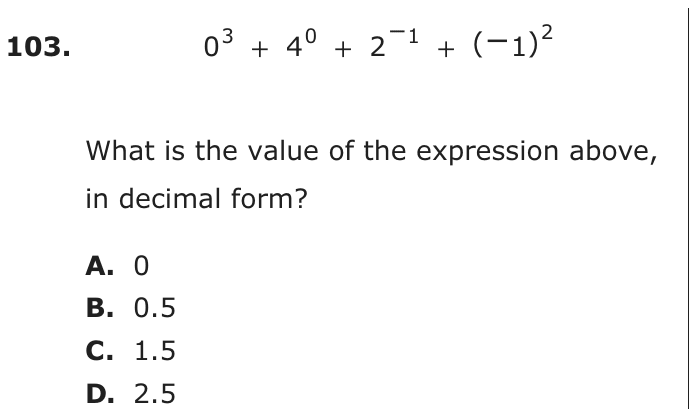
Question 18 of 23
2022 Test A Math, question 7Question
What is the value of the expression above if and ?
- A−64
- B−32
- C16
- D32
Show the answer
Correct answer: B
First, substitute −2 for x and 2 for y.
Then, simplify.
Question analysis
This question asks for the value of a fraction built from powers of x and y when x is −2 and y is 2. Students evaluate an expression with exponents and a negative number, or simplify it first by cancelling common factors. Keeping track of the negative sign through the squaring and the division is the tricky part.
- NYS standards
- Grade level
- Grade 7 content, by NYS standard
- Compared with grade 7
- At grade 7 Grade 7 students evaluate expressions with negative values and whole-number exponents. This one is a single fraction of powers, routine in method, but raising a negative base to powers and then dividing leaves several chances to lose the sign.
- Estimated difficulty
- Straightforward: two steps or one careful reading.
- Thinking it demands
- Depth of knowledge 1, recall and reproduction · mainly apply
- What makes it hard
- Error-prone arithmetic moderate
- Something you must already know minor
- Solution
- 3 steps
- Reading level
- Question and choices: about grade 8, 13 words.
- Students, last 30 days
- Not enough answers yet to show (it takes 10).
Why it is hard, traps and wrong answers (shows the answer)
Why it is hard
Two routes work: substitute and compute 256 ÷ (−8), or simplify to xy⁴ first and evaluate (−2)(16). Simplifying first is safer, because it leaves a single negative factor to track. Substituting first brings in (−2)², where treating the minus sign as outside the parentheses flips the final sign, and each listed wrong value comes from an exponent or a sign handled wrongly.
Error-prone arithmetic moderate Working it out
Substituting first gives (−2)²(2)⁶ over (−2)(2)², so the work runs through a squared negative, 2⁶ = 64 and a negative divisor, and one factor of −2 decides the sign. (Brown & Burton, 1978; Junker & Sijtsma, 2001)
Something you must already know minor Working it out
The quotient rule for powers is not stated; students who know that x²/x = x and y⁶/y² = y⁴ can reduce the expression to xy⁴ before any number goes in. (Anderson & Krathwohl, 2001)
Strategy: Cancel the factors of x and y that the top and bottom share before substituting, so there is less to compute, and track the sign of every factor of −2 through to the end.
Traps
- Order of operations: Working left to right, or distributing a minus sign wrongly, gives a choice.
- A faulty procedure: A systematic but wrong procedure: adding fractions straight across, applying an exponent to each term of a sum, dropping a sign when moving a term.
The wrong answers, classified
A A faulty procedure (Brown & Burton, 1978; Tatsuoka, 1983)
Drops the square on y in the denominator, dividing 4 × 64 = 256 by (−2)(2) = −4 instead of by (−2)(4) = −8, giving −64.
C A faulty procedure (Brown & Burton, 1978; Tatsuoka, 1983)
Cancels x² against x as if x²/x were 1 rather than x, so only y⁶/y² = y⁴ = 16 is left, with no factor of −2.
D Order of operations (Brown & Burton, 1978)
Squares as if the minus sat outside the parentheses, taking (−2)² as −4, so −4 × 64 = −256 and −256 ÷ (−8) = 32.
Worked solution, step by step
Formulas used
- A power
- a is the base, the number being multiplied. The small number is the exponent. It says how many times the base is used as a factor, a number being multiplied. So y⁶ means six y’s multiplied together. It does not mean y times 6.
- Dividing powers with the same base
- a is the base. m and n are exponents. The top has m factors of a and the bottom has n. Each matching pair cancels, because a ÷ a = 1. So m − n factors are left. A letter with no exponent, like x, has exponent 1.
Sort out the question
You need the value of when x = −2 and y = 2. The top means . The bottom means . You could put the numbers in right away. But simplifying first is safer. It leaves only one negative number to track.
Simplify the x part
Use the rule for dividing powers. The x on the bottom has exponent 1.
You can see it by writing it out: leaves one x. Watch out: x² ÷ x is x, not 1. If you cancel every x, you lose the −2 and get 16, choice C.
Simplify the y part
So the whole fraction becomes a simpler expression:
Watch out: the bottom has y², not y. Using y leaves y⁵ and leads to −64, choice A.
Put in the numbers
Now substitute x = −2 and y = 2.
A negative times a positive is negative. So the answer is B, −32.
Check your answer
Substitute first, the long way. Top: . Bottom: . Then . Watch out: (−2)² is +4, since two negatives multiply to a positive. Writing −4 leads to 32, choice D.
More questions like this
The original DOE question
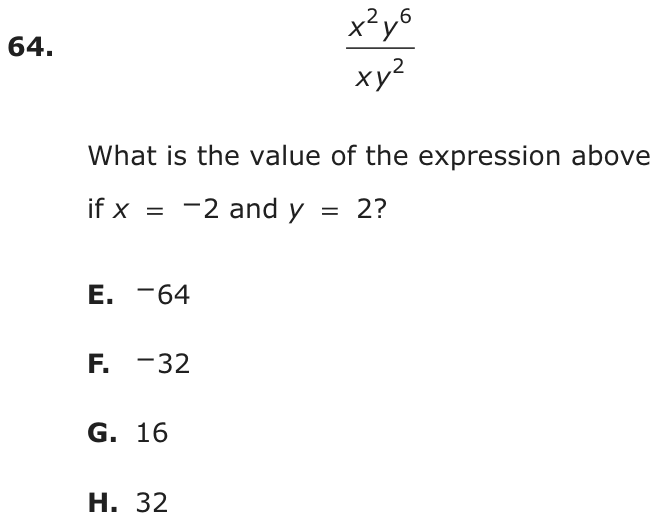
Question 19 of 23
2022 Test B Math, question 26Question
- A
- B
- C
- D
Show the answer
Correct answer: D
First, simplify the numerator and the denominator separately.
To simplify the numerator, multiply the last two fractions and then subtract from the first fraction.
To simplify the denominator, divide the last two fractions and then add to the first fraction.
Finally, divide the numerator by the denominator.
Question analysis
This fraction arithmetic question gives a complex fraction: a numerator with a subtraction and a multiplication over a denominator with an addition and a division, all with fractions. Students choose its value. It tests order of operations and the four operations with fractions, and working left to right instead of following the order of operations leads to a wrong result.
- NYS standards
- Grade level
- Grade 7 content, by NYS standard
- Compared with grade 7
- Above grade 7 Grade 7 students compute with fractions, usually two or three operations at a time. This expression needs five, in an order set by the rules rather than read left to right, so it is longer and more trap-prone than typical work.
- Estimated difficulty
- Moderate: several steps, or a close reading with one strong distractor.
- Thinking it demands
- Depth of knowledge 1, recall and reproduction · mainly apply
- What makes it hard
- Many steps moderate
- Error-prone arithmetic moderate
- Something you must already know minor
- Solution
- 5 steps
- Reading level
- Question and choices: about grade 16+, 5 words.
- Students, last 30 days
- Not enough answers yet to show (it takes 10).
Why it is hard, traps and wrong answers (shows the answer)
Why it is hard
Nothing here is beyond grade 7, but the expression stacks five fraction operations, and the top and the bottom each hide an order-of-operations decision. Working left to right in the numerator alone gives a negative value, and doing so in both parts gives an even stranger fraction; both are listed. The sign is a quick check: 4/15 is less than 2/3, so the numerator is positive, and so is the value.
Many steps moderate Working it out
The numerator and the denominator are each simplified on their own, to 2/5 and 2, before the final division, so five operations stand between the expression and its value. (Daniel & Embretson, 2010; Enright, Morley & Sheehan, 2002)
Error-prone arithmetic moderate Working it out
Every step is fraction work: 2/3 − 4/15 needs fifteenths, 1/4 ÷ 3/4 needs the divisor flipped, and the last step, 2/5 ÷ 2, is easily turned into 2/5 × 2. (Brown & Burton, 1978; Junker & Sijtsma, 2001)
Something you must already know minor Working it out
No parentheses inside the numerator or the denominator show the order, so students must know to multiply before subtracting and to divide before adding. (Anderson & Krathwohl, 2001)
Strategy: Simplify the numerator and the denominator separately, doing the multiplication and the division before the subtraction and the addition, then divide the two results.
Traps
- Order of operations: Working left to right, or distributing a minus sign wrongly, gives a choice.
The wrong answers, classified
A Order of operations (Brown & Burton, 1978)
Works left to right in both parts, (2/3 − 4/5) × 1/3 = −2/45 over (5/3 + 1/4) ÷ 3/4 = 23/9, and −2/45 ÷ 23/9 = −2/115.
B Order of operations (Brown & Burton, 1978)
Subtracts before multiplying in the numerator, (2/3 − 4/5) × 1/3 = −2/45, but handles the denominator correctly, so −2/45 ÷ 2 = −1/45.
C Little reason to choose it (Haladyna & Downing, 1993; Rodriguez, 2005)
No common working gives 2/9: it is positive like the answer, but no single order or fraction slip reaches it, so it mostly draws guesses between the two positive choices.
Worked solution, step by step
Formulas used
- Order of operations
- When no parentheses show the order, multiply and divide first. Then add and subtract. Everyone follows the same order, so an expression has only one value.
- Multiplying fractions
- a and c are the top numbers, and b and d are the bottom numbers. Multiply top times top and bottom times bottom.
- Dividing fractions
- To divide by a fraction, multiply by its reciprocal, the fraction flipped upside down. The reciprocal of c/d is d/c. It works because c/d times d/c is 1. So multiplying by d/c undoes c/d, just as dividing by c/d does.
Sort out the question
The big fraction bar means divide: the top part divided by the bottom part. Work out the top and the bottom on their own. Then divide.
Inside each part, no parentheses show the order. So follow the order of operations.
Multiply first in the top
The top is . Multiply before you subtract.
Watch out: subtracting first, 2/3 − 4/5, makes the top negative. That leads to −1/45, choice B. Working left to right in the bottom as well gives −2/115, choice A.
Subtract to finish the top
To subtract, the bottoms must match. Change 2/3 to fifteenths by multiplying its top and bottom by 5.
To simplify 6/15, divide its top and bottom by 3. The top part is 2/5.
Divide first in the bottom
The bottom is . Divide before you add. Flip 3/4 and multiply.
To simplify 4/12, divide its top and bottom by 4.
Add to finish the bottom
The bottoms already match, so add the tops and keep the bottom.
Six thirds make 2 wholes. The bottom part is 2.
Divide the top by the bottom
Now divide 2/5 by 2. Flip 2, which is 2/1, to get 1/2.
Dividing by 2 is the same as taking half, and half of 2/5 is 1/5. So the answer is D, .
Check your answer
Look at the signs. 4/15 is less than 2/3, so the top is positive. The bottom is positive too. So the answer must be positive, which rules out A and B. Then multiply back: , the top. It matches.
More questions like this
The original DOE question
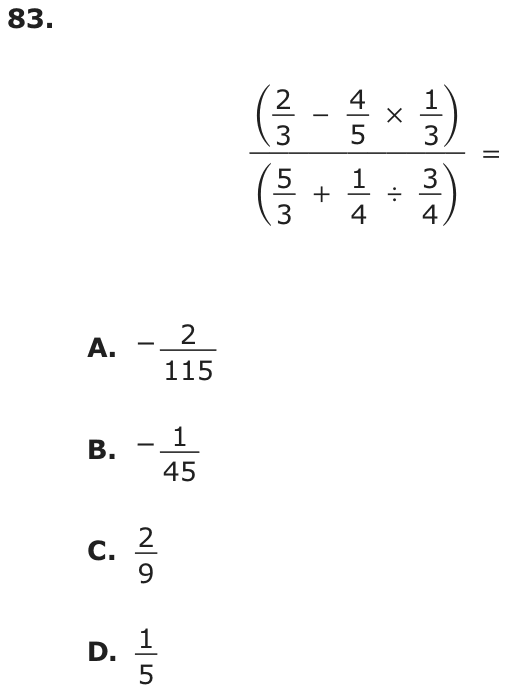
Question 20 of 23
2018 Test A Math, question 7Question
- A
- B
- C
- D
Show the answer
Correct answer: A
Question analysis
An expression question: simplify a sum and difference of two linear expressions in n. Students remove the parentheses, subtract every term inside the second group, and combine like terms. The minus sign in front of the second parentheses is the trap, since it has to change the sign of both terms inside.
- NYS standards
- Grade level
- Grade 7 content, by NYS standard
- Compared with grade 7
- At grade 7 Simplifying linear expressions with a subtracted group is standard grade 7 work. This is a typical textbook exercise in length, with the usual sign trap and no extra steps or real-world context.
- Estimated difficulty
- Straightforward: two steps or one careful reading.
- Thinking it demands
- Depth of knowledge 1, recall and reproduction · mainly apply
- What makes it hard
- Error-prone arithmetic moderate
- A very close wrong answer moderate
- Solution
- 2 steps
- Reading level
- Question and choices: about grade 16+, 5 words.
- Corrected from the DOE handbook
- The handbook’s answer key for this question was corrected.
- Students, last 30 days
- Not enough answers yet to show (it takes 10).
Why it is hard, traps and wrong answers (shows the answer)
Why it is hard
There are only five terms, but two signs decide the answer: the minus in front of the second parentheses and the sign left after 3n − 4n. Each wrong choice comes from one or both of those sign decisions, so all of them look plausible, and checking needs care rather than time. Even the DOE handbook keyed the version with the wrong sign on n.
Error-prone arithmetic moderate Working it out
The minus sign before (4n + 8) has to reach both terms, making −4n and −8, and 3n − 4n leaves a negative n term. (Brown & Burton, 1978; Junker & Sijtsma, 2001)
A very close wrong answer moderate Choosing the answer
5 − n and 5 + n are written alike and share the constant 5; only the sign of the n term, from 3n − 4n, separates them, and the DOE handbook's own key picked the wrong one. (Embretson & Wetzel, 1987; Gorin & Embretson, 2006; Ascalon et al., 2007)
Strategy: Rewrite the subtraction as adding the opposite of each term in the second parentheses, then group the constants and the n terms separately.
Traps
- Order of operations: Working left to right, or distributing a minus sign wrongly, gives a choice.
- Negatives and direction: Arithmetic with negative numbers, the order of a subtraction, or direction on a number line. (Moving a term across the equals sign without changing its sign is a faulty procedure.)
The wrong answers, classified
B Negatives and direction (Brown & Burton, 1978)
Gets the constants right, 7 + 6 − 8 = 5, but writes 3n − 4n as +n, subtracting the smaller coefficient from the larger and keeping a plus sign.
C Order of operations (Brown & Burton, 1978)
Applies the minus sign to 4n but not to 8, so the constants become 7 + 6 + 8 = 21 while the n term comes out right.
D Order of operations (Brown & Burton, 1978)
Makes both mistakes: adds the 8 instead of subtracting it, for 21, and also writes 3n − 4n as +n.
What was corrected from the DOE handbook, and why
- Answer key: The handbook (its question 64) keys this question as F, which is 5 + n (choice B here), in its answer key and in the heading of its explanation. Its own working gives 7 + 3n + 6 − 4n − 8 = 5 − n, which is the handbook’s choice E and choice A here, and that is correct. The key here is A.
Worked solution, step by step
Formulas used
- Subtracting a group in parentheses
- a and b are the terms inside the parentheses. A term is a number, a letter, or a number times a letter. The minus sign in front means you subtract the whole group. So you subtract every term inside, not just the first one.
- Combining like terms
- n stands for an unknown number, and 3n means 3 times n. Like terms have the same letter part, like 3n and 4n. To combine them, add or subtract the numbers in front and keep the letter. Plain numbers combine only with plain numbers.
Sort out the question
You need to simplify the expression, which means write it in a shorter form. An expression is a math phrase made of numbers, letters and signs. Here n stands for an unknown number. Find the choice that matches the short form.
Remove the parentheses
The first group has a plus sign in front. Adding a group changes nothing, so is just . The second group has a minus sign in front. You must subtract both terms inside it.
Watch out: the minus reaches the 8 too. Adding the 8 instead gives 21 for the plain numbers. That leads to choice C or D.
Combine the plain numbers
Group the numbers without a letter. Work them out from left to right.
The plain numbers make 5.
Combine the n terms
You have 3 n’s, and you take away 4 n’s. The numbers in front give 3 − 4 = −1. So you are left with −1n, which is written −n.
Watch out: it is easy to write +n here. That gives 5 + n, choice B.
Put the two parts together
Join the number part and the n part. Adding a negative is the same as subtracting.
So the answer is A, 5 − n.
Check your answer
Pick any number for n and test it. Try n = 1. The original: . Choice A: . They match. Choice B gives , which does not.
More questions like this
The original DOE question
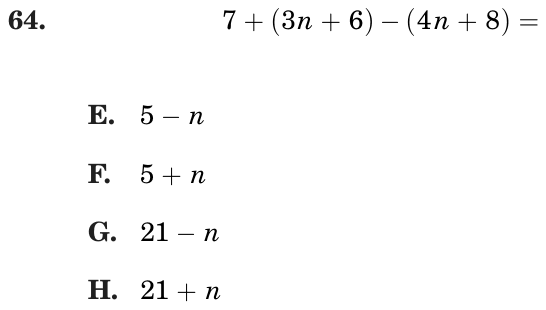
Question 21 of 23
2018 Test A Math, question 50Question
- A101
- B200
- C301
- D341
Show the answer
Correct answer: D
Question analysis
This order of operations question asks students to evaluate 100(2 + 0.1)² − 100, an expression with a decimal, a square and a subtraction. Students must add inside the parentheses first, square the result, multiply by 100, and then subtract. Squaring the two parts of the sum separately is the trap.
- Grade level
- Grade 6 content, by NYS standard
- Compared with grade 7
- Below grade 7 Evaluating an expression with an exponent and decimals in the correct order is grade 6 content. This is a short routine calculation, so it asks less than typical grade 7 work with negative numbers and multi-step equations.
- Estimated difficulty
- Straightforward: two steps or one careful reading.
- Thinking it demands
- Depth of knowledge 1, recall and reproduction · mainly apply
- What makes it hard
- A very close wrong answer moderate
- Error-prone arithmetic minor
- Solution
- 3 steps
- Reading level
- Question and choices: about grade 16+, 1 words.
- Students, last 30 days
- Not enough answers yet to show (it takes 10).
Why it is hard, traps and wrong answers (shows the answer)
Why it is hard
This is a direct order-of-operations calculation with no word problem around it, so the only real risk is the square of a sum. Students who apply the exponent to each part, or only to the 0.1, find a listed answer waiting. Adding inside the parentheses before squaring, and then squaring 2.1 exactly, is the whole task.
A very close wrong answer moderate Choosing the answer
The choices 301 and 341 differ by 40, and squaring 2.1 roughly as 4 lands nearer 301; only the exact square, 4.41, separates them. (Embretson & Wetzel, 1987; Gorin & Embretson, 2006; Ascalon et al., 2007)
Error-prone arithmetic minor Working it out
Squaring 2.1 by hand to get 4.41 puts two decimal places in the product, an easy place to misplace the point. (Brown & Burton, 1978; Junker & Sijtsma, 2001)
Strategy: Add inside the parentheses to get a single decimal, square it carefully, then multiply by 100 and subtract 100, following the order of operations.
Traps
- A faulty procedure: A systematic but wrong procedure: adding fractions straight across, applying an exponent to each term of a sum, dropping a sign when moving a term.
- Order of operations: Working left to right, or distributing a minus sign wrongly, gives a choice.
The wrong answers, classified
A Order of operations (Brown & Burton, 1978)
Squares only the 0.1, as if the parentheses were not there, so 100 × 2.01 − 100 gives 101.
B Little reason to choose it (Haladyna & Downing, 1993; Rodriguez, 2005)
No single slip gives 200; it requires (2 + 0.1)² to come out as 3, so it mostly catches guesses.
C A faulty procedure (Brown & Burton, 1978; Tatsuoka, 1983)
Squares each term of the sum separately, 4 + 0.01 = 4.01, instead of squaring 2.1, so 100 × 4.01 − 100 gives 301.
Worked solution, step by step
Formulas used
- Order of operations
- This is the agreed order for doing math steps. Work inside parentheses first, then exponents, then multiply and divide, then add and subtract. Everyone follows it, so a problem has only one answer.
- Squaring a number
- a is any number. The small 2, called an exponent, means multiply the number by itself. So 2.1 squared means 2.1 times 2.1.
Sort out the problem
You need to work out . The 100 right next to the parentheses means 100 times. Follow the order of operations, one step at a time.
Add inside the parentheses
Parentheses come first in the order of operations. So add the numbers inside them:
Now the problem is:
Square 2.1
Work out 21 × 21 = 441, then put in two decimal places, one for each 2.1.
Watch out: do not square the 2 and the 0.1 one at a time. That gives 4 + 0.01 = 4.01, which is wrong. It leads to 301, choice C.
Multiply, then subtract
The exponent is done, so multiply next. Multiplying by 100 moves the decimal point two places to the right. Subtracting comes last:
So the answer is D, 341.
Check your answer
Estimate. 2.1 is a bit more than 2, so its square is a bit more than 4. 100 times that is a bit more than 400. Take away 100 and you get a bit more than 300. 341 fits. Choices A and B are too small.
More questions like this
The original DOE question
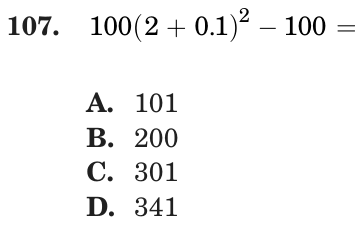
Question 22 of 23
2018 Test B Math, question 31Question
Simplify this expression:
- A
- B
- C
- D
Show the answer
Correct answer: B
4( 7 − 3x ) −( 5 − x) = 28 − 12x − 5 + x = 23 − 11x
Question analysis
This question asks students to simplify an algebraic expression by distributing a number into one set of parentheses, subtracting another set, and combining like terms. It checks the distributive property with a minus sign in front of parentheses. The usual slip is subtracting only the first term inside the second parentheses, which changes the sign of an x term.
- NYS standards
- 7.EE.1 linear expressions with rational coefficients
- Grade level
- Grade 7 content, by NYS standard
- Compared with grade 7
- At grade 7 Expanding and combining linear expressions is core grade 7 work. This is a standard example, two distributions and one subtraction, with nothing beyond what a grade 7 lesson on the distributive property would cover.
- Estimated difficulty
- Straightforward: two steps or one careful reading.
- Thinking it demands
- Depth of knowledge 1, recall and reproduction · mainly apply
- What makes it hard
- Error-prone arithmetic moderate
- Many steps minor
- A very close wrong answer minor
- Solution
- 3 steps
- Reading level
- Question and choices: about grade 16+, 8 words.
- Students, last 30 days
- Not enough answers yet to show (it takes 10).
Why it is hard, traps and wrong answers (shows the answer)
Why it is hard
Every step is routine, but subtracting a whole group is where students go wrong: the minus sign has to reach the −x as well as the 5. Each choice pairs a constant with an x coefficient, so getting the constant right only narrows the field to two. The question rewards writing out both distributions in full rather than doing them mentally.
Error-prone arithmetic moderate Working it out
The minus sign in front of (5 − x) must change both terms, so −x becomes +x and then combines with −12x from the first group. (Brown & Burton, 1978; Junker & Sijtsma, 2001)
Many steps minor Working it out
Two distributions, then collecting the constants 28 and −5 and the x terms separately: four small operations, each a place where a sign can slip. (Daniel & Embretson, 2010; Enright, Morley & Sheehan, 2002)
A very close wrong answer minor Choosing the answer
23 − 4x shares the right constant with 23 − 11x, so getting 23 does not settle it; only the x coefficient, −12x + x rather than −3x − x, separates them. (Embretson & Wetzel, 1987; Gorin & Embretson, 2006; Ascalon et al., 2007)
Strategy: Rewrite the subtraction as adding −1 times the second group, distribute both multipliers, then collect the constant terms and the x terms separately.
Traps
- Order of operations: Working left to right, or distributing a minus sign wrongly, gives a choice.
- Stops one step early: A choice is a number from partway through the solution.
The wrong answers, classified
A Order of operations (Brown & Burton, 1978)
Applies each multiplier to the first term only, the 4 to 7 but not −3x and the minus to 5 but not −x, so 28 − 3x − 5 − x = 23 − 4x.
C Little reason to choose it (Haladyna & Downing, 1993; Rodriguez, 2005)
Pairs 4 × 7 = 28 with −3x − x = −4x and loses the −5 altogether; no single consistent mistake produces this expression.
D Stops one step early (King et al., 2004; Gierl et al., 2017)
Distributes the 4 correctly to get 28 − 12x and stops there, never subtracting the second group, 5 − x.
Worked solution, step by step
Formulas used
- The distributive property
- a is the number in front of the parentheses. b and c are the terms inside. You multiply a by each term inside, not only the first one. This works because a groups of (b − c) is a groups of b take away a groups of c.
- Subtracting a group
- b and c are the terms inside the parentheses. A minus sign in front means take away the whole group. So you change the sign of each term inside. Taking away a minus c is the same as adding c.
Sort out the question
You need to simplify . Simplify means write it in the shortest way. A term is one piece of the expression, like 7 or . Like terms have the same letter part, so and are like terms. Plain numbers are like terms too.
Multiply the 4 into the first group
Use the distributive property. The 4 multiplies both terms inside.
Watch out: the 4 must multiply the too. Writing only is the first slip that leads to choice A.
Take away the second group
The minus sign in front of means subtract the whole group. So change the sign of each term inside.
Taking away a minus gives plus .
Watch out: if you stop before this step, you get . That is choice D.
Combine the like terms
Now you have . Put the plain numbers together. Then put the terms together.
So the expression simplifies to .
Give the answer
The plain number is 23, and the term is . So the answer is B, .
Check your answer
Put in an easy number, like . The original gives . Choice B gives . They match. Choice A would give , which does not match.
More questions like this
The original DOE question
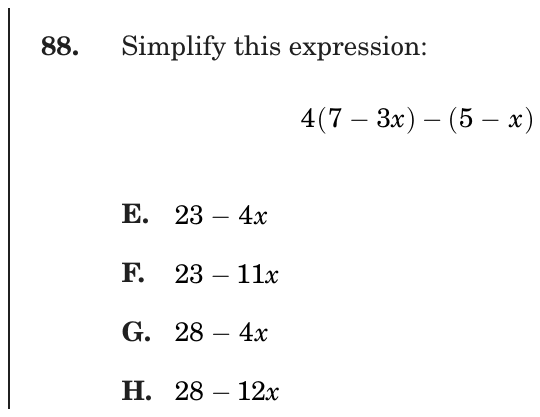
Question 23 of 23
2018 Test B Math, question 34Question
If , what is the value of the expression above?
- A2,539.01
- B5,039.01
- C5,039.1
- D5,139
Show the answer
Correct answer: B
Question analysis
Students substitute 10 for x in an expression with a cube, a linear term, a constant and a fraction with x squared in its denominator, then add the results. It tests evaluating expressions with exponents and decimals. The fraction term is where most slips happen, because its place value is easy to get wrong.
- NYS standards
- Grade level
- Grade 6 content, by NYS standard
- Compared with grade 7
- Below grade 7 Evaluating expressions with whole-number exponents is grade 6 work. The only extra care here is a reciprocal term that turns into a decimal, a single routine substitution that typical grade 7 students handle comfortably.
- Estimated difficulty
- Straightforward: two steps or one careful reading.
- Thinking it demands
- Depth of knowledge 1, recall and reproduction · mainly apply
- What makes it hard
- Error-prone arithmetic moderate
- A very close wrong answer moderate
- Solution
- 3 steps
- Reading level
- Question and choices: about grade 7, 11 words.
- Students, last 30 days
- Not enough answers yet to show (it takes 10).
Why it is hard, traps and wrong answers (shows the answer)
Why it is hard
Substituting 10 is easy; the risk lies in the two unlike terms at the ends. The cube must be applied to x before multiplying by 5, and the reciprocal of 100 must become a hundredth, not a tenth. With choices that differ by a single decimal place, the question rewards writing each term as a number before adding.
Error-prone arithmetic moderate Working it out
The last term, 1/x² at x = 10, is 1/100, which must be written as 0.01 and lined up beside 5,039; one place too far gives 0.1. (Brown & Burton, 1978; Junker & Sijtsma, 2001)
A very close wrong answer moderate Choosing the answer
5,039.1 sits beside the right 5,039.01 and differs only in the hundredths place; only writing 1/100 as 0.01, not 0.1, tells them apart, and estimating cannot. (Embretson & Wetzel, 1987; Gorin & Embretson, 2006; Ascalon et al., 2007)
Strategy: Work term by term: compute 10 cubed, then the reciprocal of 10 squared as a decimal, and line up the place values carefully before adding.
Traps
- Order of operations: Working left to right, or distributing a minus sign wrongly, gives a choice.
The wrong answers, classified
A Order of operations (Brown & Burton, 1978)
Gets 2,500 for the first term, most likely from (5 × 10)², applying the power to the product 5x and squaring instead of cubing.
C An arithmetic slip (Junker & Sijtsma, 2001)
Writes 1/100 as 0.1 instead of 0.01, a place-value slip on the last term that puts the total off by 0.09.
D Misunderstands the concept (Smith, diSessa & Roschelle, 1993; De Bock et al., 1998; Ni & Zhou, 2005)
Evaluates 1/x² as x² = 100 instead of its reciprocal, so it adds 100 rather than 0.01 to 5,039.
Worked solution, step by step
Formulas used
- Exponents
- x is the base number. The small raised 3 is the exponent. It tells how many times to use x in a multiplication. In the same way, x squared, written with a raised 2, means x times x.
Sort out the question
You need the value of when . Put 10 in place of every . Then work out each term, one at a time. A term is a piece joined to the others by a plus sign.
Work out the first term
Do the exponent first. Then multiply by 5.
Watch out: the exponent belongs only to the , not to the 5. Squaring gives 2,500, which leads to choice A.
Work out the middle terms
The next term means 3 times .
The 9 has no in it, so it stays 9.
Work out the last term
First find the bottom. Then divide.
One hundredth is 0.01, with the 1 two places after the decimal point.
Watch out: 0.1 is one tenth, not one hundredth. That slip gives choice C. Adding 100 instead of gives choice D.
Add the four terms
Line up the decimal points and add. The 0.01 goes in the hundredths place.
So the answer is B, 5,039.01.
Check your answer
The first three terms are whole numbers. They add up to 5,039. The last term is a small part of 1. So the answer is just over 5,039. Only B and C fit. The last term is hundredths, so B is right.
More questions like this
The original DOE question