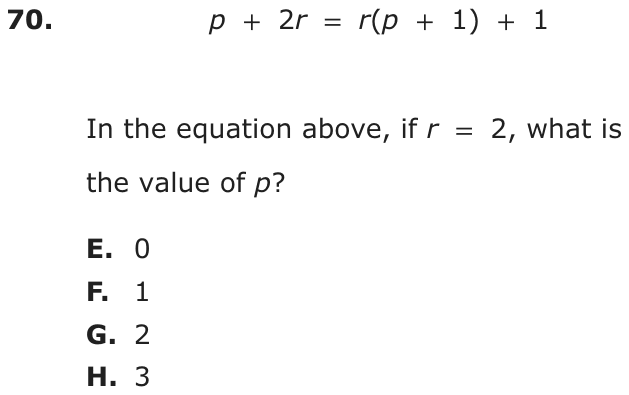
Question
In the equation above, if , what is the value of p?
- A0
- B1
- C2
- D3
Show the answer
Correct answer: B
First substitute 2 for r in the equation.
Then solve for p.
The value of p is 1.
Question analysis
An equation question: p + 2r equals r times (p + 1), plus 1, and r is given as 2. Students substitute for r, expand the parentheses and solve the resulting linear equation for p. With p on both sides and a product to expand, distributing is where a slip is most likely.
- NYS standards
- Grade level
- Grade 8 content, by NYS standard
- Compared with grade 7
- At grade 7 Equations with the variable on both sides are formally grade 8, but after substituting, this is a short solve with small whole numbers. It asks about as much as a typical grade 7 two-step equation.
- Estimated difficulty
- Straightforward: two steps or one careful reading.
- Thinking it demands
- Depth of knowledge 1, recall and reproduction · mainly apply
- What makes it hard
- Error-prone arithmetic moderate
- Solution
- 3 steps
- Reading level
- Question and choices: about grade 6, 13 words.
- Students, last 30 days
- Not enough answers yet to show (it takes 10).
Why it is hard, traps and wrong answers (shows the answer)
Why it is hard
Substituting r = 2 is immediate; the points are lost in expanding 2(p + 1) + 1. Each wrong choice solves a slightly wrong expansion: forgetting to multiply the 1 inside, folding the outer 1 into the parentheses, or losing a term. Putting the answer back into the original equation, with both r and p, is a quick and complete check.
Error-prone arithmetic moderate Working it out
After substituting, 2(p + 1) + 1 must become 2p + 3, multiplying both terms in the parentheses before adding the 1 outside, with p left on both sides. (Brown & Burton, 1978; Junker & Sijtsma, 2001)
Strategy: Replace every r with 2, multiply 2 by both terms in the parentheses, gather the p terms on one side, and check by putting the value back into the original equation.
Traps
- Order of operations: Working left to right, or distributing a minus sign wrongly, gives a choice.
The wrong answers, classified
A Order of operations (Brown & Burton, 1978)
Adds the outer 1 inside the parentheses before multiplying, writing 2(p + 2) = 2p + 4, so p + 4 = 2p + 4 gives 0.
C Order of operations (Brown & Burton, 1978)
Multiplies only the p by 2, writing 2p + 1 + 1 = 2p + 2, so p + 4 = 2p + 2 and p comes out as 2.
D Misreads the question (Hegarty, Mayer & Monk, 1995)
Drops the 1 inside the parentheses, reading 2(p + 1) as 2p, so the right side is 2p + 1 and p + 4 = 2p + 1 gives 3.
Worked solution, step by step
Formulas used
- Distributive property
- a is the number outside the parentheses. b and c are the terms inside. A term is a number, a letter, or a number times a letter. To multiply out the parentheses, multiply each term inside by a. It works because a groups of b + c is a groups of b plus a groups of c.
- Keeping an equation balanced
- a and b are the two sides of an equation, and c is any number or term. An equation is like a balanced scale. If you subtract the same thing from both sides, it stays balanced. Adding the same thing, or dividing both sides by the same number that is not zero, works too.
Sort out the question
The equation has two letters, p and r. You are told that r = 2. You need the value of p. Here 2r means 2 times r, and r(p + 1) means r times the group p + 1.
Put 2 in for r
Replace every r with 2. Keep the parentheses so you can see what gets multiplied.
On the left, , so the left side is .
Multiply out the parentheses
The 2 multiplies both the p and the 1 inside the parentheses. Then add the 1 that is outside.
Watch out: multiply the 1 inside by 2 as well. Writing 2p + 1 + 1 gives p = 2, choice C. Adding the outside 1 inside first gives p = 0, choice A.Get p by itself
Now the equation is . Subtract p from both sides. Then subtract 3 from both sides.
So p = 1, and the answer is B, 1.
Check your answer
Put p = 1 and r = 2 back into the first equation. Left side: . Right side: . Both sides are 5, so p = 1 works.
More questions like this
The original DOE question