Combines ideas
Question 1 of 36
2026 Practice Test B English, question 33Passage Using Fire to Keep a Prairie Healthy
Using Fire to Keep a Prairie Healthy
Inside the 40,000-acre Joseph H. Williams Tallgrass Prairie Preserve in northern Oklahoma, herds of bison roam on the scenic land that is home to hundreds of different species of plants and animals. While one of the greatest threats to the prairie is wildfire, the use of controlled fires is actually an effective way to protect this idyllic landscape.
Fires that are started by lightning or other natural circumstances are inevitable, and the results can be disastrous. However, hundreds of years ago the American Indian people who inhabited the Great Plains area between Minnesota and Texas realized that these fires could also be helpful. The bison in the area seemed to prefer grazing on tender new grass on the recently burned land rather than on grass in the unburned areas. The American Indian people began to deliberately burn areas of land for bison to graze on, which enticed the herds away from the people’s crops.
Today conservationists at the Tallgrass Prairie Preserve and farmers in the Great Plains continue to use controlled burns for land management. Intentionally burning a portion of land can dramatically improve the quality of the vegetation that regrows there. The fires burn away weedy undergrowth and help limit the overcrowding of shrubs and trees in the burn area, creating less competition for water and nutrients. Additionally, the process of burning excess plant matter adds nitrogen, an essential element for plant growth, to the soil.
One common target of controlled burns at the preserve and the surrounding area is the invasive red cedar tree. A single red cedar tree can consume up to 40 gallons of water per day, taking this vital resource away from other plant life. These tall trees also cast shade that prevents sunlight from reaching the plants beneath them. The fast-growing red cedar trees tend to crowd out prairie grasses, the primary food source for wild and domestic animals that make the prairie their home. An imbalance in one component of the prairie’s ecosystem affects the entire web of life. Controlled burns help maintain this ecosystem’s delicate balance.
Of course, these controlled fires are intended to burn only a portion of an area. A total burn, which is a risk with an uncontrolled wildfire, would destroy all wildlife as well as the crops farmers plant for income. The key to using controlled fires is knowing which areas of land to burn and when. Conservation experts at the preserve employ the “patch-burn” approach, meaning they rotate which portion of land is burned each year. They study the land to find out which areas would most benefit from being burned, and then they arrange about a dozen burns over one-third of the land. This patch burning contains the fire within a specific area and allows animals in the burn area to safely relocate. The following year, conservationists will burn a different section of the preserve, while the land burned the previous year regrows healthier than before.
Researchers have tracked and studied the variety of plant species and animals that live on the preserve, and their studies show that the patch-burn approach has restored biodiversity to the area by promoting the growth of species that were at risk of being crowded out. The patch-burn system is so successful that the conservationists at the preserve provide training to prairie farmers about conducting controlled burns on their own land. Burning land to make it healthy may seem counterintuitive, but strategic controlled fires have helped the prairie sustain life for hundreds of years and, with careful management, will continue to do so.
Question
Read this sentence from paragraph 6.
Burning land to make it healthy may seem counterintuitive, but strategic controlled fires have helped the prairie sustain life for hundreds of years and, with careful management, will continue to do so.
The words “counterintuitive” and “strategic” in the sentence convey the idea that
- Athe safest methods are sometimes the least effective at solving complex challenges.
- Bthorough investigation of uncommon methodologies can lead to beneficial results.
- Cdetailed planning can ensure that a potentially destructive action has a positive impact.
- Dplans that entail a certain amount of risk almost always result in success.
Show the answer
Correct answer: C
The question asks which idea the words “counterintuitive” and “strategic” convey in the last sentence in paragraph 6 in the passage.
A. Incorrect. Though the author states in paragraph 6 that conservationists have used safe and “strategic” methods, those methods have not been ineffective, since “the patch-burn system is so successful that the conservationists at the preserve provide training to prairie farmers about conducting controlled burns on their own land” (paragraph 6). Therefore, the words “counterintuitive” and “strategic” in the last sentence of paragraph 6 do not convey the idea that the safest methods are sometimes the least effective at solving complex challenges.
B. Incorrect. Although the author points out in paragraph 6 that researchers’ studies have shown “that the patch-burn approach has restored biodiversity to the area by promoting the growth of species that were at risk of being crowded out,” the author does not suggest that the methodologies conservationists used to conduct the patch burns are uncommon, since the methods were used by “the American Indian people [who] began to deliberately burn areas of land for bison to graze on” (paragraph 2). Therefore, the words “counterintuitive” and “strategic” in the last sentence of paragraph 6 do not convey the idea that thorough investigation of uncommon methodologies can lead to beneficial results.
C. CORRECT. In paragraph 1, the author states that “one of the greatest threats to the prairie is wildfire,” so the idea of conducting controlled burns suggests risk and runs “counter,” or contrary, to people’s common expectations, or “intuition,” about the dangers of fires. Thus, the words “counterintuitive” and “strategic” in the last sentence of paragraph 6 convey the idea that detailed planning can ensure that a potentially destructive action has a positive impact.
D. Incorrect. The author states in paragraph 6 that “the patch-burn system is so successful that the conservationists at the preserve provide training to prairie farmers.” This statement supports the idea of the action being “strategic” in order to achieve success. However, the statement does not suggest that because the process is “counterintuitive,” or unexpected, it involves a certain amount of risk to achieve that success. Therefore, the words “counterintuitive” and “strategic” in the last sentence of paragraph 6 do not convey the idea that plans that entail a certain amount of risk almost always result in success.
Question analysis
This vocabulary question takes the last sentence of the prairie article, which says burning land to make it healthy may seem counterintuitive, and asks what the words “counterintuitive” and “strategic” convey together. Students need the meaning of a hard word built from a prefix, then must match the pair to a general statement, and the choices are worded abstractly.
- Grade level
- Grade 8 reading and task
- Compared with grade 7
- Above grade 7 A typical grade 7 vocabulary question asks what one word means in context. This one pairs a hard word, “counterintuitive,” with “strategic” and asks for the idea they express together, with four abstract general statements to weigh.
- Estimated difficulty
- Hard: combines ideas, needs a plan, and has more than one tempting wrong answer.
- Thinking it demands
- Depth of knowledge 2, skills and concepts · mainly understand
- What makes it hard
- A very close wrong answer moderate
- Hard words moderate
- Combines ideas minor
- Evidence
- Answered from one sentence or line
- Reading level
- Passage: about grade 11, 598 words; question and choices: about grade 11, 97 words.
- Students, last 30 days
- Not enough answers yet to show (it takes 10).
Why it is hard, traps and wrong answers (shows the answer)
Why it is hard
Students first need the meaning of “counterintuitive,” then must see what it says here: that burning land to heal it seems backward because fire destroys. “Strategic” supplies the other half, careful planning. The most tempting wrong answer gets the planning right but misreads the first word as “uncommon,” and others turn the pair into a rule about risk or a warning about safe methods. The question rewards translating each word before reading the abstract choices.
A very close wrong answer moderate Choosing the answer
The choice about “thorough investigation of uncommon methodologies” follows the key’s pattern, planning that leads to a good result, and differs only in calling the method uncommon instead of potentially destructive. (Embretson & Wetzel, 1987; Gorin & Embretson, 2006; Ascalon et al., 2007)
Hard words moderate Understanding the question
“Counterintuitive,” contrary to what one would expect, is an uncommon word, and the choices add “methodologies” and “entail,” so the options are as hard to read as the sentence. (Perfetti, 2007; Freedle & Kostin, 1993)
Combines ideas minor Working it out
The two words point different ways, one to burning that seems harmful and one to careful planning, and the answer must join both into a single general statement. (Embretson, 1998; Daniel & Embretson, 2010)
Strategy: Break “counterintuitive” into its parts, counter and intuitive, decide what each of the two words says about burning land, then find the statement that joins both meanings without adding claims of its own.
Traps
- Half right: One half of a two-part choice is right and the other is not.
- Too broad or too strong: A choice overstates, generalizes, or uses absolute words the text does not support.
- Twists what the text says: Uses the text's topic and ideas but changes what it says: who did it, how much, when, or why.
The wrong answers, classified
A Twists what the text says (King et al., 2004)
Reads “counterintuitive” as a hint that the safe choice fails, but the sentence praises carefully managed fire and never says safer methods are less effective.
B Half right (King et al., 2004; Thissen, Steinberg & Fitzpatrick, 1989)
Matches “strategic” to thorough investigation, since the experts “study the land,” but takes “counterintuitive” to mean uncommon, though the passage traces burning back hundreds of years.
D Too broad or too strong (King et al., 2004)
Hears risk in “counterintuitive” and success in “strategic” but turns them into a rule that risky plans “almost always” succeed, far more than one sentence about the prairie claims.
Working it out, step by step
Figure out what the question asks
This question asks about two words in the last sentence: “counterintuitive” and “strategic.” You need the idea the two words give together. So first figure out what each word means here.
Break down “counterintuitive”
Counter means against. Intuitive means what you would naturally expect. So counterintuitive means the opposite of what you would expect. The sentence says “Burning land to make it healthy may seem counterintuitive.” Fire usually destroys things. So burning land to help it seems backward. Paragraph 1 even calls wildfire “one of the greatest threats to the prairie.”
Figure out “strategic”
Strategic means carefully planned to reach a goal. Paragraph 5 shows that planning. The experts “study the land to find out which areas would most benefit from being burned.” Then they burn only part of the land each year. Put the two words together. Fire seems harmful, but careful planning makes it helpful.
Check each choice
- A is wrong. The sentence doesn’t say safe methods fail. It praises a method that works.
- B is wrong. It treats counterintuitive as if it meant uncommon. But burning isn’t new. Paragraph 2 says people did it “hundreds of years ago.”
- C is right. Strategic matches detailed planning. Counterintuitive matches an action that could destroy, fire, which turns out to help.
- D is wrong. “Almost always” is far too strong. The sentence is about prairie fires, not all risky plans.
Watch out: B gets strategic right, since the experts study the land. But counterintuitive doesn’t mean uncommon. It means against what you would expect.
Choose the answer
Fire seems destructive, but a careful plan makes it helpful. So the answer is C: “detailed planning can ensure that a potentially destructive action has a positive impact.”
Why this answer and not the closest wrong one
B is the closest wrong answer, because its first part, careful study, fits strategic. But its second part calls the method uncommon, and people have burned the prairie for hundreds of years. C fits both words: careful planning, and an action that seems harmful but helps.
More questions like this
The original DOE question
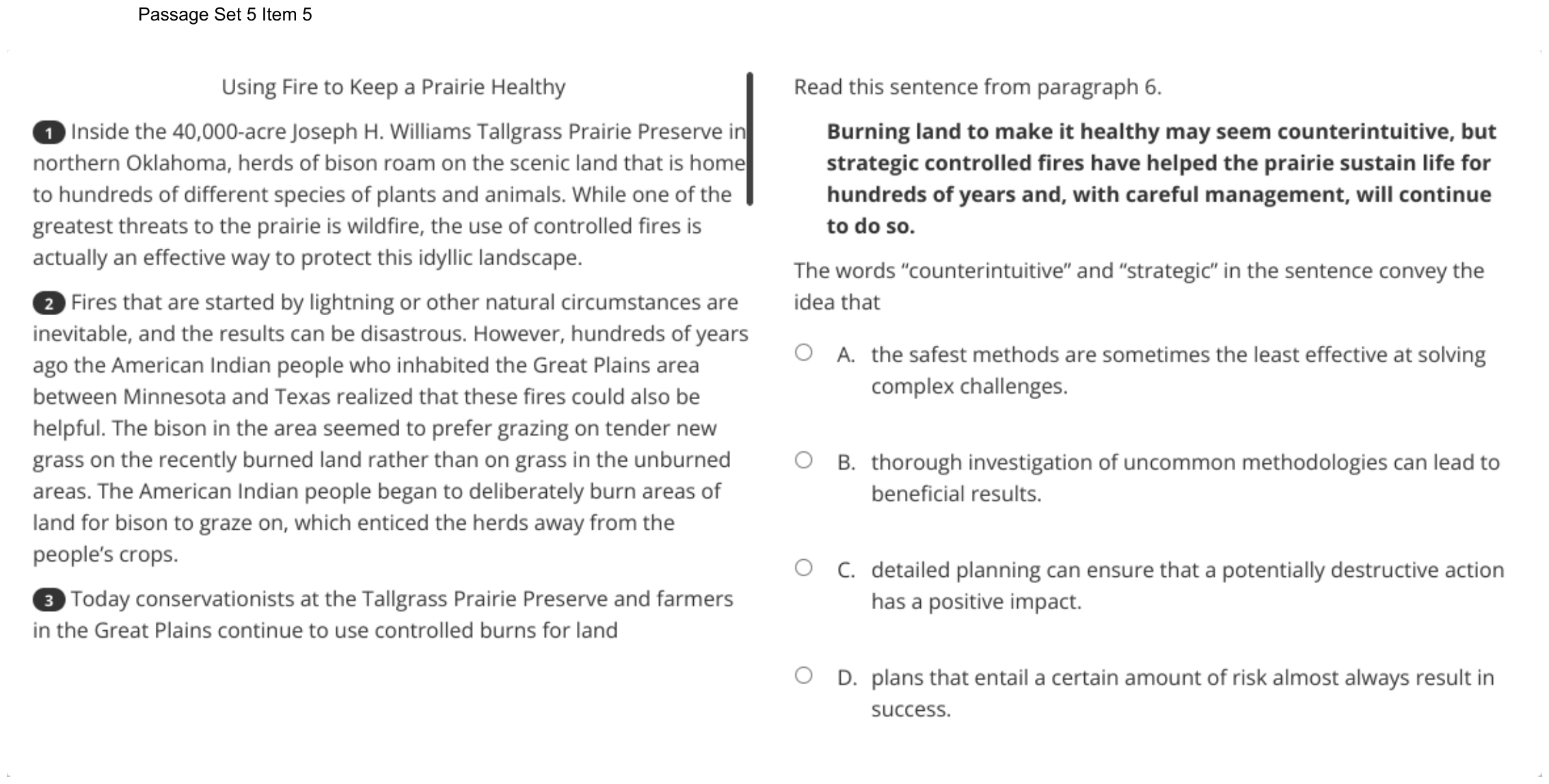
The passage “Using Fire to Keep a Prairie Healthy” as printed (page 41)
Question 2 of 36
2026 Practice Test B Math, question 31Question
A pizza shop offers a choice of 3 sizes (small, medium, and large) and 7 different toppings. Different pizzas can be created by changing the size and the choice of toppings. If Cody wants to order a pizza with exactly 2 different toppings, how many different pizzas can he create?
- A6
- B21
- C63
- D126
Show the answer
Correct answer: C
Figure out how many different topping pairs are possible. Use 1, 2, 3, 4, 5, 6, 7 to represent the toppings, and create a list of possible pairs:
1,2; 1,3; 1,4; 1,5; 1,6; 1,7
2,3; 2,4; 2,5; 2,6; 2,7
3,4; 3,5; 3,6; 3,7
4,5; 4,6; 4,7
5,6; 5,7
6,7
So there are 21 different topping combinations for one pizza.
Since there are 3 pizza sizes, multiply the total number of combinations by 3 to get the total number of different pizzas Cody can create: .
Question analysis
Cody orders a pizza with exactly 2 of 7 toppings in one of 3 sizes, and students count how many different pizzas he could create. It tests counting combinations, where the order of the toppings does not matter, combined with a second choice. The challenge is to count every possible pizza exactly once.
- NYS standards
- 7.SP.8b sample spaces for compound events
- Grade level
- Grade 7 content, by NYS standard
- Compared with grade 7
- Above grade 7 In grade 7, compound events are usually ordered pairs, such as a coin with a number cube. Here an unordered pair of toppings is chosen from seven and then matched with three sizes, a combination count beyond typical grade 7 work.
- Estimated difficulty
- Hard: combines ideas, needs a plan, and has more than one tempting wrong answer.
- Thinking it demands
- Depth of knowledge 2, skills and concepts · mainly apply
- What makes it hard
- Combines ideas moderate
- Something you must already know minor
- Solution
- 3 steps
- Reading level
- Question and choices: about grade 8, 47 words.
- Students, last 30 days
- Not enough answers yet to show (it takes 10).
Why it is hard, traps and wrong answers (shows the answer)
Why it is hard
The question packs two counts into one sentence, each with its own trap. Order does not matter among the toppings, while the size multiplies every pair, and students tend to remember one of these and forget the other. Listing pairs systematically, each topping matched only with later ones, keeps the first count honest, and the stem’s “changing the size and the choice of toppings” is the reminder that size counts too.
Combines ideas moderate Working it out
Two counts are joined: the unordered pairs of toppings from 7, then the 3 sizes each pair can come in, and a mistake in either count changes the total. (Embretson, 1998; Daniel & Embretson, 2010)
Something you must already know minor Working it out
Students must know that a pizza with mushroom and onion is the same as one with onion and mushroom, so the ordered count 7 × 6 has to be halved. (Anderson & Krathwohl, 2001)
Strategy: Number the toppings 1 to 7, list each pair once by matching every topping only with higher-numbered ones, count the list, then bring in the choice of size.
Traps
- Stops one step early: A choice is a number from partway through the solution.
- Overlapping groups: Things in two groups at once are counted twice, or not subtracted.
The wrong answers, classified
A Numbers taken from the question (Hegarty, Mayer & Monk, 1995)
Multiplies the 3 sizes by the 2 toppings Cody wants, using the number of toppings on the pizza instead of the number of possible pairs.
B Stops one step early (King et al., 2004; Gierl et al., 2017)
Lists or counts the 21 pairs of toppings correctly, then stops without giving each pair its 3 possible sizes.
D Overlapping groups (King et al., 2004)
Counts ordered pairs, 7 × 6 = 42, so each pair of toppings appears twice, and then multiplies by the 3 sizes to reach 126.
Worked solution, step by step
Formulas used
- The counting principle
- m is the number of ways to make one choice, and n is the number of ways to make a second choice. Every first choice can go with every second choice, so you multiply. Here, every pair of toppings can come in every size.
- Pairs when order does not matter
- n is the number of items to choose from. There are n ways to pick a first item and n − 1 ways to pick a different second one. That counts each pair twice, once in each order. Dividing by 2 counts each pair once.
Sort out the question
Each of Cody’s pizzas has one size and exactly 2 different toppings. There are 3 sizes and 7 toppings. Pizzas differ by “changing the size and the choice of toppings.” So a small and a large with the same toppings are two different pizzas. You need to count every pizza once.
List the topping pairs
Order does not matter: onion with peppers is the same pizza as peppers with onion. So number the toppings 1 to 7, and pair each one only with bigger numbers. Then no pair shows up twice.
Topping Pairs with Pairs 1 2, 3, 4, 5, 6, 7 6 2 3, 4, 5, 6, 7 5 3 4, 5, 6, 7 4 4 5, 6, 7 3 5 6, 7 2 6 7 1 There are 21 different pairs of toppings.
Check the pairs with the formula
Use the pairs formula with 7 toppings:
Watch out: 7 × 6 = 42 counts every pair twice, once as 1 then 2 and once as 2 then 1. Keeping 42 leads to , choice D.
Bring in the sizes
Each of the 21 topping pairs can come in any of the 3 sizes. Use the counting principle:
Watch out: stopping at 21 leaves out the sizes, which gives choice B. Choice A, 6, multiplies the 3 sizes by the 2 toppings on one pizza. That does not count pizzas.
Give the answer
There are 21 topping pairs, and each one comes in 3 sizes. Cody can create 63 different pizzas. So the answer is C, 63.
Check your answer
Count one size at a time. A small pizza can have any of the 21 pairs, so there are 21 small pizzas. There are also 21 medium and 21 large ones: . That is more than the 21 pairs but fewer than 126, so it is reasonable.
More questions like this
The original DOE question
Question 3 of 36
2026 Practice Test C Math, question 10Question
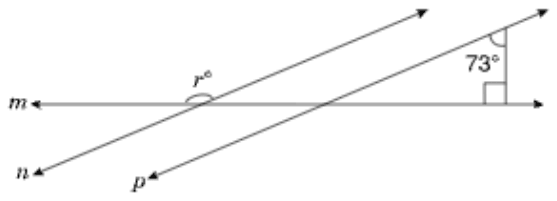
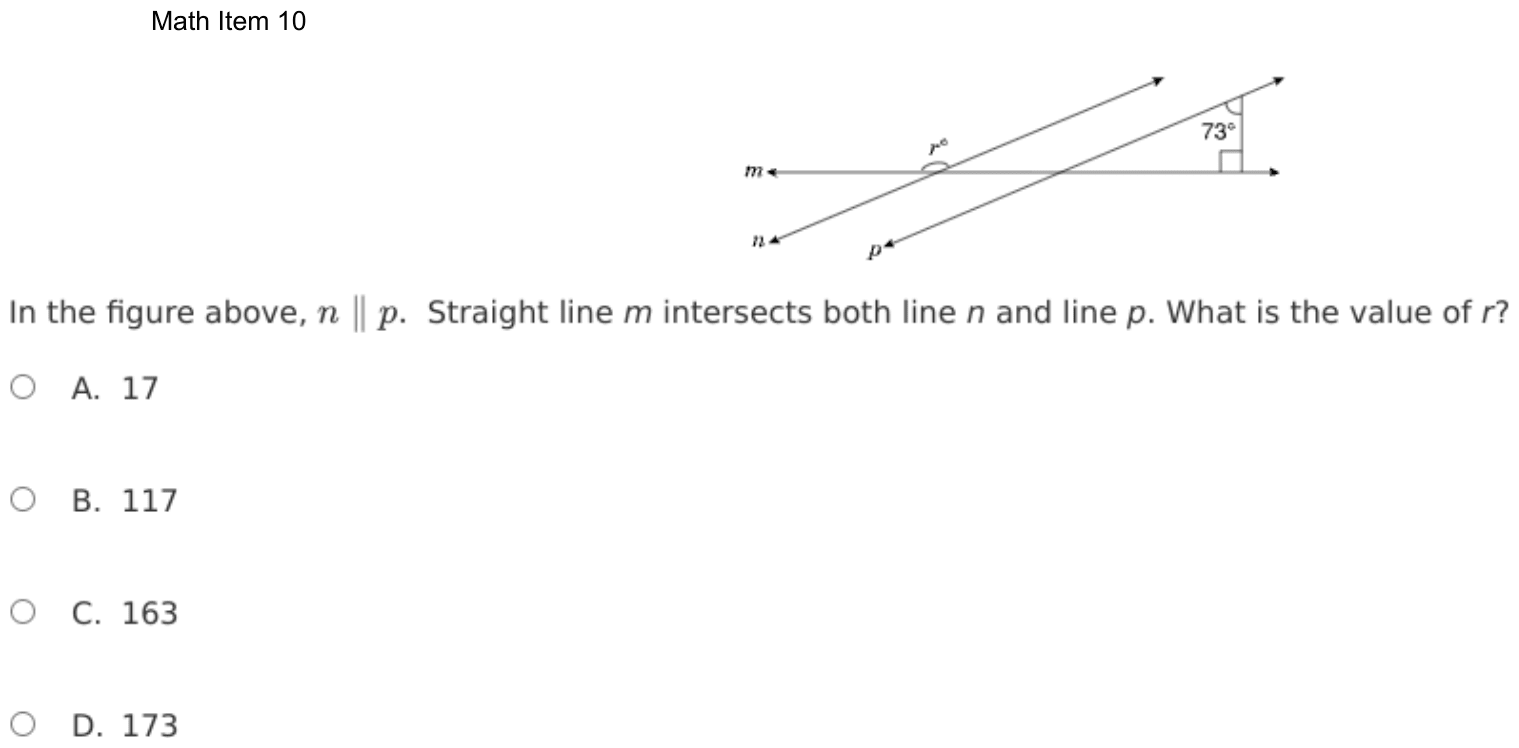
In the figure above, . Straight line m intersects both line n and line p. What is the value of r?
- A17
- B117
- C163
- D173
Show the answer
Correct answer: C
The triangle formed by line p, line m, and the line segment connecting the two contains a 73° angle, a right angle (90°), and a missing angle measuring x°. The sum of the interior angles of a triangle is 180°, so begin by finding the value of x:
Line m is a straight line, so it has a measure of 180°. The 17° angle from the triangle and the adjacent angle outside the triangle are supplementary, so they have a sum of 180°. Let s represent the measure of the adjacent angle outside the triangle. The value of s can be determined by subtracting:
Given that n and p are parallel lines and that they have been cut by a transversal, line m, then corresponding angles are congruent. Angles r and s are corresponding angles, so the value of r is congruent to the value of s, which is 163°.
Question analysis
Two parallel lines, n and p, cross a straight line m, and a segment drawn at a right angle to m forms a small triangle with lines m and p, where a 73° angle is marked. Students find the angle r at line n. It combines a triangle's angle sum, a straight angle and parallel lines, and the angle wanted sits away from the marked ones.
- NYS standards
- Grade level
- Grade 8 content, by NYS standard
- Compared with grade 7
- Above grade 7 Grade 7 angle problems use supplementary, vertical and adjacent angles. This one also needs the angle sum of a triangle and the angles formed by parallel lines and a transversal, grade 8 facts, chained across a busy figure.
- Estimated difficulty
- Hard: combines ideas, needs a plan, and has more than one tempting wrong answer.
- Thinking it demands
- Depth of knowledge 2, skills and concepts · mainly apply
- What makes it hard
- Reading a figure, table or graph moderate
- Combines ideas moderate
- Something you must already know minor
- Solution
- 3 steps
- Reading level
- Question and choices: about grade 3, 21 words.
- Students, last 30 days
- Not enough answers yet to show (it takes 10).
Why it is hard, traps and wrong answers (shows the answer)
Why it is hard
Each fact needs only a subtraction, but the student has to plan a route from the 73° angle at line p over to r at line n. The first number the route gives, the triangle's 17° angle, is listed, and it is the acute partner of r rather than r itself. The figure helps here: r is drawn plainly obtuse, and 163 is also 90 + 73, the triangle's exterior angle, which confirms it.
Reading a figure, table or graph moderate Understanding the question
The 73° sits between line p and the vertical segment, not between p and m, and r is the obtuse angle above m on the left of line n, far from every marked angle. (Lesh, Post & Behr, 1987; Kirsch & Mosenthal, 1990)
Combines ideas moderate Working it out
Three facts chain together: the triangle's angles sum to 180°, the angles along straight line m sum to 180°, and corresponding angles at the parallel lines n and p are equal. (Embretson, 1998; Daniel & Embretson, 2010)
Something you must already know minor Working it out
The angle pairs formed by a line crossing two parallel lines are a grade 8 topic, and the question uses them without naming them. (Anderson & Krathwohl, 2001)
Strategy: Find the third angle of the right triangle, use the straight line m to get the angle beside it, then carry that angle over to line n using the parallel lines.
Traps
- Stops one step early: A choice is a number from partway through the solution.
- An arithmetic slip: The right method with a plausible arithmetic error: a digit, a place value or a times-table fact.
The wrong answers, classified
A Stops one step early (King et al., 2004; Gierl et al., 2017)
Finds the triangle's third angle, 180 − 90 − 73 = 17, and stops, though r is the obtuse angle next to the 17° angle, not that angle itself.
B Little reason to choose it (Haladyna & Downing, 1993; Rodriguez, 2005)
No angle fact in the figure gives 117; even 180 − 73 is 107, so this choice mostly catches guesses at an obtuse angle.
D An arithmetic slip (Junker & Sijtsma, 2001)
Finds the 17° angle and subtracts it from 180 but borrows without reducing the 8, so 180 − 17 comes out as 173.
Worked solution, step by step
Formulas used
- Angles of a triangle
- a, b and c are the three angles inside any triangle. They always add up to 180°. If you know two of them, subtract their sum from 180° to find the third.
- Angles on a straight line
- a and b are two angles side by side on a straight line. Together they make a half turn, which is 180°. Use it to find the angle next to one you already know.
- Corresponding angles
- The symbol ∥ means is parallel to. When line m crosses two parallel lines, it makes the same angles at each crossing. Angles in the same position at the two crossings are called corresponding angles. They are equal.
Sort out the question
Lines n and p are parallel, and line m crosses both. Near line p, a straight-up segment meets line m. The small square shows a right angle, 90°. Line p, line m and that segment make a small triangle. Its top angle is 73°.
You need r, the wide angle where line n crosses line m.
Find the triangle’s third angle
The third angle is where line p crosses line m. Call it x. Use the triangle rule:
So that angle is 17°.
Watch out: this is not r. Stopping here gives choice A, 17.
Use the straight line m
The 17° angle sits above line m, on the right of line p. Beside it, on the left of line p, is a wide angle. Call it s. The two angles fill the straight line m, so they add to 180°:
So s is 163°.
Watch out: borrow carefully. 180 − 17 is 163, not 173, choice D.
Carry the angle to line n
Angle s is above line m and to the left of line p. Angle r is above line m and to the left of line n. They are in the same position, so they are corresponding angles. Since n and p are parallel:
So the answer is C, 163.
Check your answer
Look at the figure. Angle r is wider than a right angle, so it must be more than 90°. That rules out 17. Also, the narrow angle beside r, on the right of line n, matches the 17° angle at line p. And , as it should on a straight line.
More questions like this
The original DOE question
Question 4 of 36
2026 Practice Test D English, question 5Passage A Memory Revolution
A Memory Revolution
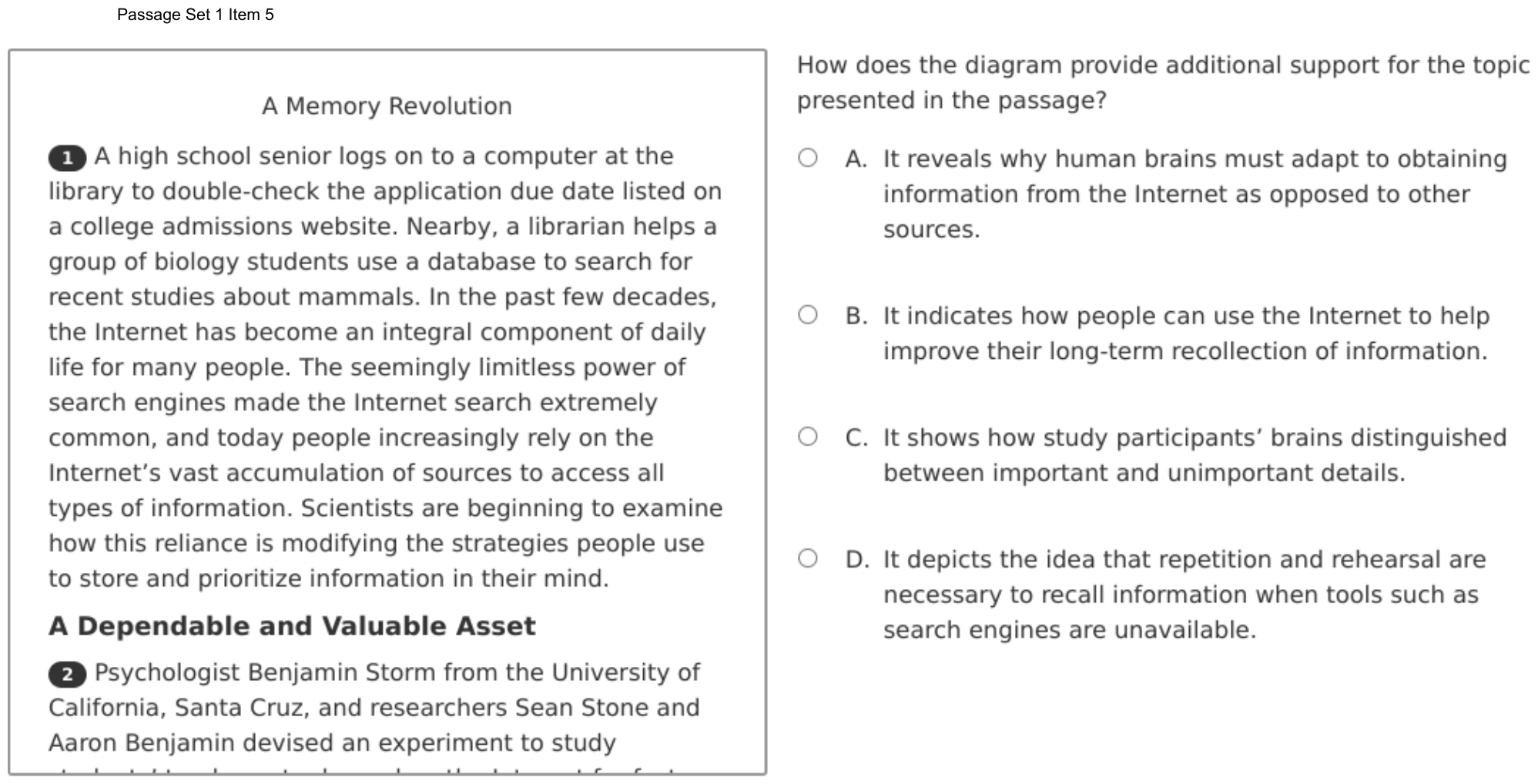
A high school senior logs on to a computer at the library to double-check the application due date listed on a college admissions website. Nearby, a librarian helps a group of biology students use a database to search for recent studies about mammals. In the past few decades, the Internet has become an integral component of daily life for many people. The seemingly limitless power of search engines made the Internet search extremely common, and today people increasingly rely on the Internet’s vast accumulation of sources to access all types of information. Scientists are beginning to examine how this reliance is modifying the strategies people use to store and prioritize information in their mind.
A Dependable and Valuable Asset
Psychologist Benjamin Storm from the University of California, Santa Cruz, and researchers Sean Stone and Aaron Benjamin devised an experiment to study students’ tendency to depend on the Internet for facts. To begin, the scientists divided sixty participants into multiple groups, including an “Internet” group and a “memory” group, and placed them in front of computers. The Internet group was required to use the search engine Google to answer eight challenging trivia questions. In contrast, participants in the memory group were permitted to use only their personal knowledge to answer the questions. In the second round, the researchers administered notably easier questions. This time, they allowed each group the option of using Google as they answered. Their results showed that 83 percent of the Internet group continued to consult Google in the second round, while only 63 percent of the memory group chose to do so.
People’s growing inclination to rely on the Internet in order to retrieve information, particularly facts and figures, is called cognitive offloading. Canadian researcher Evan F. Risko and British researcher Sam Gilbert, who have written extensively about the topic, say a similar process has been taking place for centuries. In the past, people used resources like encyclopedias to assist their memories; however, today the Internet, serving as a vast extended memory, allows people to digitally access and retrieve much larger volumes of information. Consequently, people’s minds are free for other cognitive feats, such as connecting data, learning new information, or solving problems.
Filing Information Away
The use of the Internet also appears to be modifying the strategies people use to store information in their mind. Researchers Betsy Sparrow from Columbia University, Jenny Liu from the University of Wisconsin-Madison, and Daniel Wegner from Harvard University conducted several studies to discover how people efficiently manage their information intake.
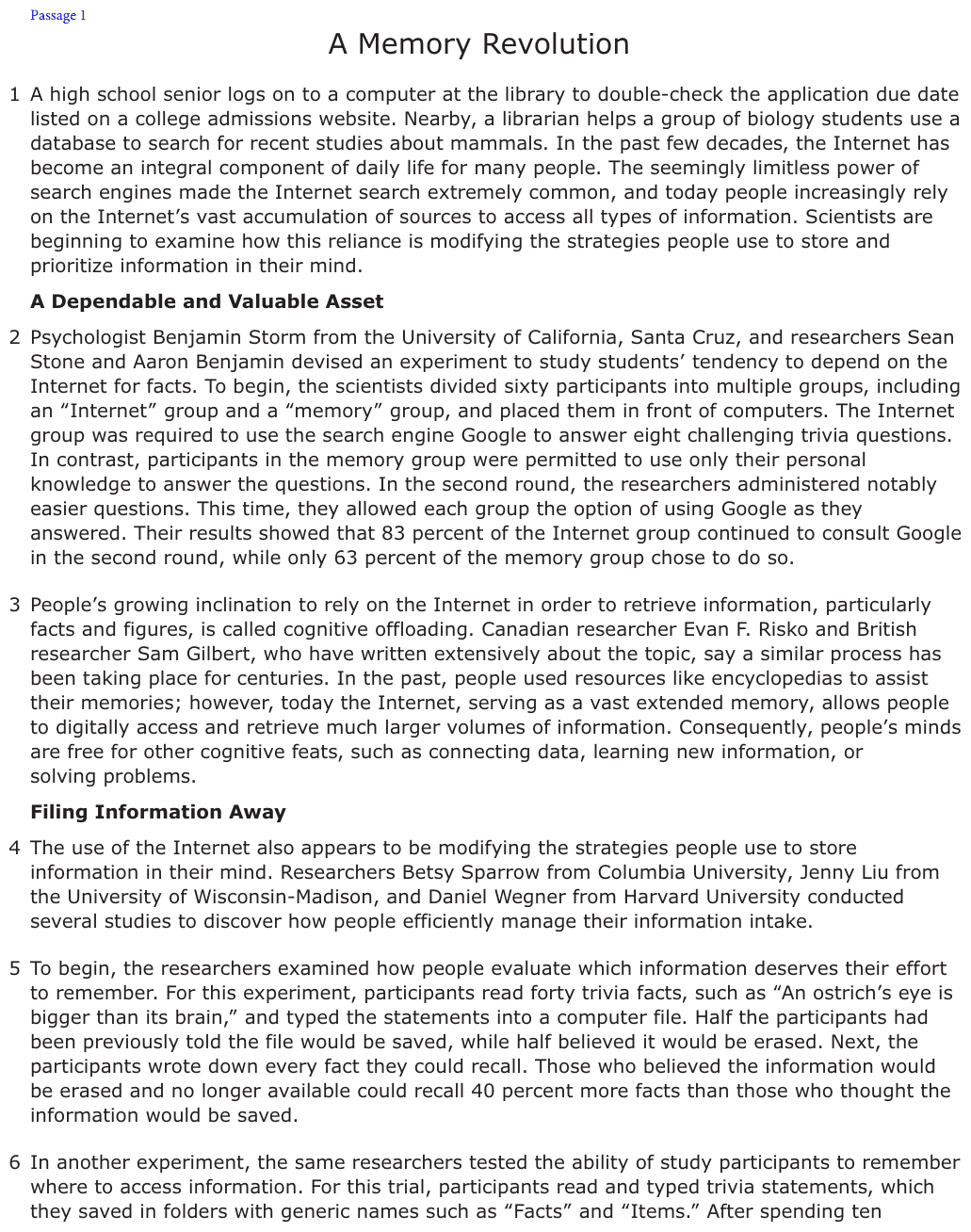
To begin, the researchers examined how people evaluate which information deserves their effort to remember. For this experiment, participants read forty trivia facts, such as “An ostrich’s eye is bigger than its brain,” and typed the statements into a computer file. Half the participants had been previously told the file would be saved, while half believed it would be erased. Next, the participants wrote down every fact they could recall. Those who believed the information would be erased and no longer available could recall 40 percent more facts than those who thought the information would be saved.
In another experiment, the same researchers tested the ability of study participants to remember where to access information. For this trial, participants read and typed trivia statements, which they saved in folders with generic names such as “Facts” and “Items.” After spending ten minutes writing down all the facts they could recall from memory, participants were asked which folder contained a particular fact based on a keyword. For example, “Which folder has the fact about ostriches?” Overall, participants recalled the information’s location more often than the content itself, correctly identifying 49 percent of the folders for specific facts while remembering only 23 percent of the actual trivia. The researchers concluded that our memory is adapting to the Internet age by prioritizing where to locate information even when the specific details are forgotten. According to Sparrow, the Internet has become an important form of transactive memory, an external source of the recollections and associative networks that constitute memory.
As the Internet’s resources continue to expand our “external” memory, some question whether the process may cause people to depend too heavily on technology. However, Steven Pinker, a professor of psychology at Harvard University, says, “Knowledge is increasing exponentially; human brainpower and waking hours are not. Fortunately, the Internet and information technologies are helping us manage, search and retrieve our collective intellectual output at different scales, from Twitter and previews to e-books and online encyclopedias. Far from making us stupid, these technologies are the only things that will keep us smart.”
Question
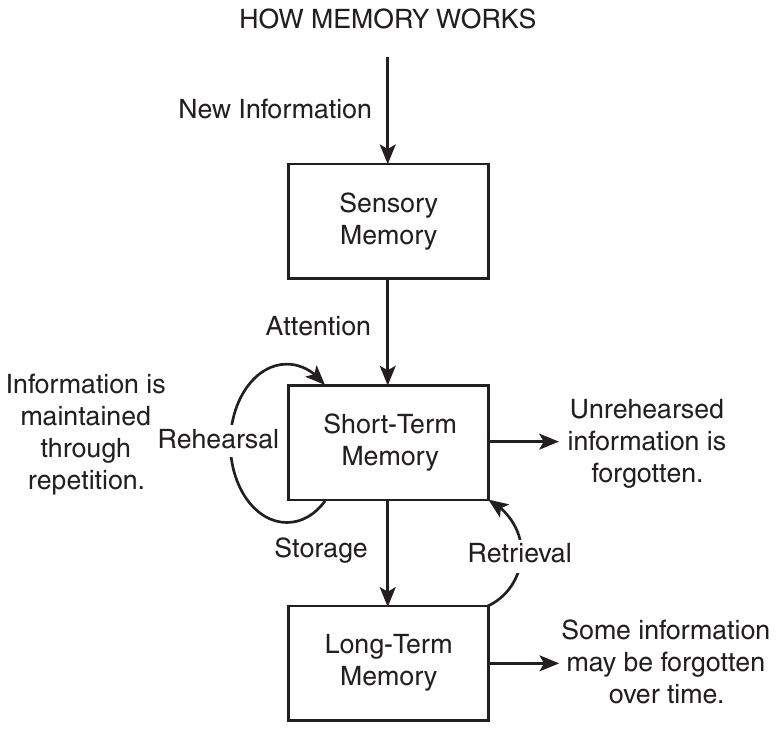
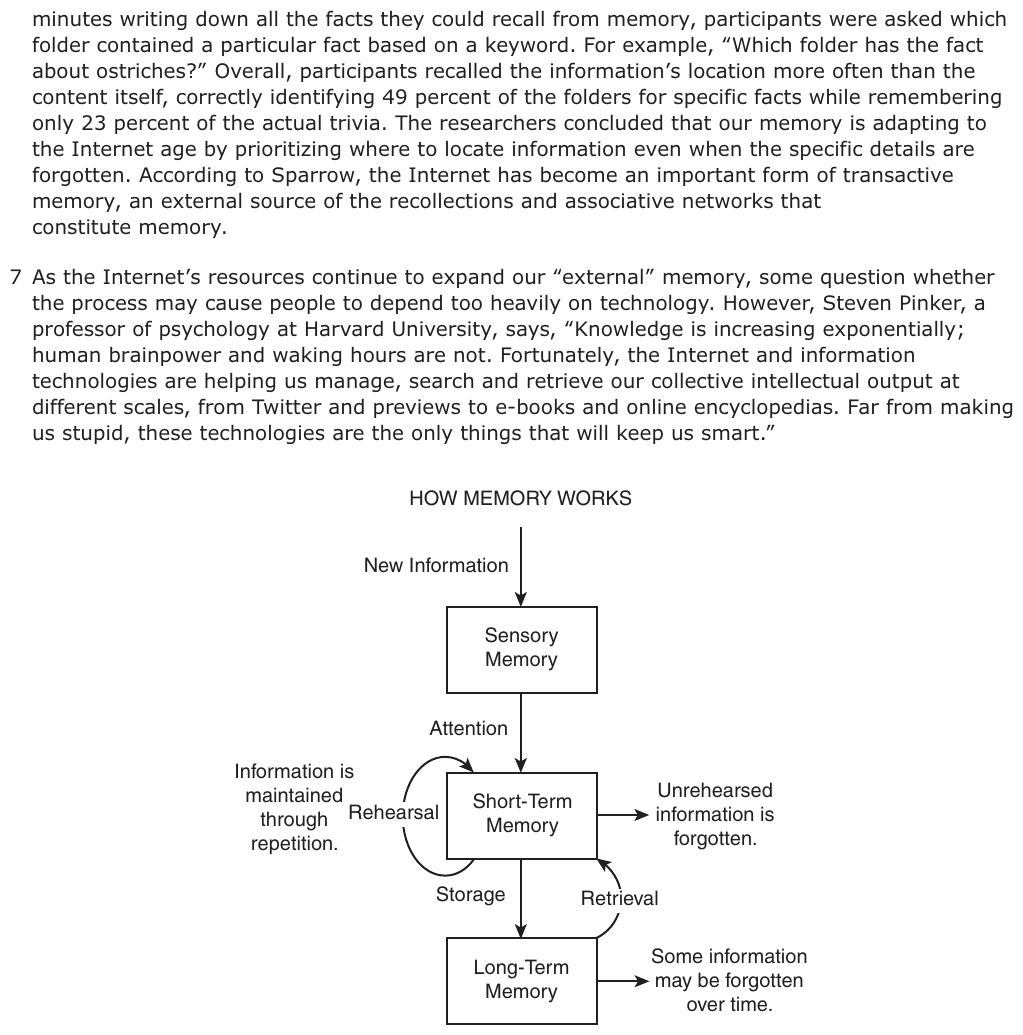
How does the diagram provide additional support for the topic presented in the passage?
- AIt reveals why human brains must adapt to obtaining information from the Internet as opposed to other sources.
- BIt indicates how people can use the Internet to help improve their long-term recollection of information.
- CIt shows how study participants’ brains distinguished between important and unimportant details.
- DIt depicts the idea that repetition and rehearsal are necessary to recall information when tools such as search engines are unavailable.
Show the answer
Correct answer: D
The question asks how the diagram provides additional support for the topic presented in the passage.
A. Incorrect. While the diagram indicates that the human brain has the ability to maintain different types of memory, the diagram does not show the need for the brain to adapt to obtaining information from the Internet rather than from other sources.
B. Incorrect. The diagram enhances the reader’s understanding of how long-term memories are formed, but it does not provide details about how the Internet can be used to improve long-term recollection of information.
C. Incorrect. The diagram provides an understanding of how details that are important to people can become stored because of an effort made to recall them. However, the diagram does not show how people decide which information is important and which is not.
D. CORRECT. The diagram depicts the connections that the human brain maintains between the different forms of memory. It also illustrates the idea that repetition and rehearsal are important steps in creating memories, as unrehearsed information will be forgotten. This supports the passage by highlighting the idea that access to search engines and other tools leads people to skip rehearsal and repetition steps that create memories, because people know that the information is readily accessible.
Question analysis
This question pairs “A Memory Revolution” with its flow diagram, “How Memory Works,” which follows new information from sensory memory through short-term and long-term memory, and asks how the diagram supports the topic of the passage. Students must read the diagram’s boxes, arrows and notes and relate them to an article about the Internet that never refers to the diagram, so the connection has to be worked out.
- Grade level
- Grade 8 reading and task
- Compared with grade 7
- Above grade 7 Grade 7 students regularly connect a diagram to a text. This flow diagram of memory never mentions the Internet, so students must build the bridge to the article’s studies themselves, and every choice claims something the diagram alone cannot show.
- Estimated difficulty
- Hard: combines ideas, needs a plan, and has more than one tempting wrong answer.
- Thinking it demands
- Depth of knowledge 3, strategic thinking · mainly analyze
- What makes it hard
- Combines ideas moderate
- Reading a figure, table or graph moderate
- Every choice must be checked minor
- Evidence
- Answered from the whole text
- Reading level
- Passage: about grade 14, 763 words; question and choices: about grade 12, 81 words.
- Students, last 30 days
- Not enough answers yet to show (it takes 10).
Why it is hard, traps and wrong answers (shows the answer)
Why it is hard
The diagram is a general model of memory, and every choice, even the right one, goes beyond it by bringing in the Internet, search engines or the study participants. The way through is to ask which choice rests on something the diagram really shows, and only one names its rehearsal loop and the forgetting of unrehearsed information. The strongest pull uses the diagram’s long-term memory and retrieval but claims the Internet improves recollection, the opposite of what paragraph 5’s experiment found.
Combines ideas moderate Working it out
The diagram never mentions the Internet and the article never mentions the diagram, so students must join its rehearsal loop to paragraph 5’s finding that people who expected the facts to be saved remembered fewer. (Embretson, 1998; Daniel & Embretson, 2010)
Reading a figure, table or graph moderate Understanding the question
Students must follow the arrows from “Attention” into short-term memory and find the “Rehearsal” loop beside “Information is maintained through repetition,” with “Unrehearsed information is forgotten” on the other side. (Lesh, Post & Behr, 1987; Kirsch & Mosenthal, 1990)
Every choice must be checked minor Choosing the answer
Three choices tie the diagram to the Internet, adaptation or the study participants, and even the key mentions search engines, so each claim must be held against the boxes and arrows actually drawn. (Embretson & Wetzel, 1987)
Strategy: Trace the diagram’s arrows from new information to long-term memory and say what each label shows, then ask which choice links that process to the studies without crediting the diagram with ideas it never shows.
Traps
- Reads too much in: A reasonable-sounding conclusion that goes further than the text allows.
- Wrong part of the text: A choice is true of another paragraph, stanza or speaker than the one asked about.
- Twists what the text says: Uses the text's topic and ideas but changes what it says: who did it, how much, when, or why.
The wrong answers, classified
A Reads too much in (Graesser, Singer & Trabasso, 1994)
Credits the diagram with the article’s claim that memory is “adapting to the Internet age” and adds a “must,” though its boxes and arrows show memory in general and never mention the Internet.
B Twists what the text says (King et al., 2004)
Joins the diagram’s long-term memory and retrieval arrow to the Internet as outside memory, though paragraph 5 found that people who expected the facts to be saved recalled fewer of them.
C Wrong part of the text (Kirsch & Mosenthal, 1990)
Reads the “Attention” arrow and the forgotten unrehearsed information as a picture of paragraph 5’s experiment, though the diagram shows no participants and nothing about judging what is important.
Working it out, step by step
Figure out what the question asks
This asks how the diagram supports the article. The diagram is the flow chart called “HOW MEMORY WORKS” at the end of the passage. It never mentions the Internet. So you must find what it shows, then link that to the article.
Follow the arrows in the diagram
Start at the top. An arrow labeled “New Information” goes into the box “Sensory Memory.” The “Attention” arrow leads to “Short-Term Memory.” From there, two things can happen. On the left, a loop labeled “Rehearsal” sits beside the note “Information is maintained through repetition.” On the right, a note says “Unrehearsed information is forgotten.” A “Storage” arrow leads down to “Long-Term Memory,” and a “Retrieval” arrow leads back up.
Explain what the diagram means
To rehearse information is to repeat it, the way you practice lines for a play. To maintain something is to keep it. So the diagram says that information you repeat stays with you. Information you don’t repeat is lost. Repeating takes effort.
Link the diagram to the passage
Paragraph 5 describes people who typed forty facts. Some thought the file would be saved. Others thought it would be erased. Those who thought it would be erased “could recall 40 percent more facts.” They knew they could not look the facts up later. So they made the effort to remember. The diagram shows that effort: rehearsal. When search engines are at hand, people may skip it.
Check each choice
- A does not fit. The diagram never mentions the Internet. It does not say brains must adapt.
- B does not fit. The diagram shows nothing about using the Internet. Paragraph 5 even found that people remembered less when they expected the facts to be saved.
- C does not fit. The diagram shows memory in general. It shows no study participants and no sorting of important facts.
- D fits. The “Rehearsal” loop shows that repeating information keeps it. Without a tool to look things up, that repeating is what lets you recall.
Watch out: B is tempting because the diagram has “Long-Term Memory” and “Retrieval,” and the article calls the Internet an outside memory. But the diagram is about the brain, not the Internet.
Choose the answer
The diagram shows rehearsal keeping information and unrehearsed information being forgotten. That explains why people who can’t look facts up must work to remember them. So the answer is D, “It depicts the idea that repetition and rehearsal are necessary to recall information when tools such as search engines are unavailable.”
Why this answer and not the closest wrong one
B is the closest wrong choice. It uses the diagram’s “Long-Term Memory” and “Retrieval” labels. But the diagram never shows the Internet improving recall. The passage says the opposite: expecting the facts to be saved made people remember fewer. D rests on what the diagram really shows, the “Rehearsal” loop and the note “Unrehearsed information is forgotten.”
More questions like this
The original DOE question
The passage “A Memory Revolution” as printed (pages 3–4)
Question 5 of 36
2026 Practice Test D Math, question 8Question
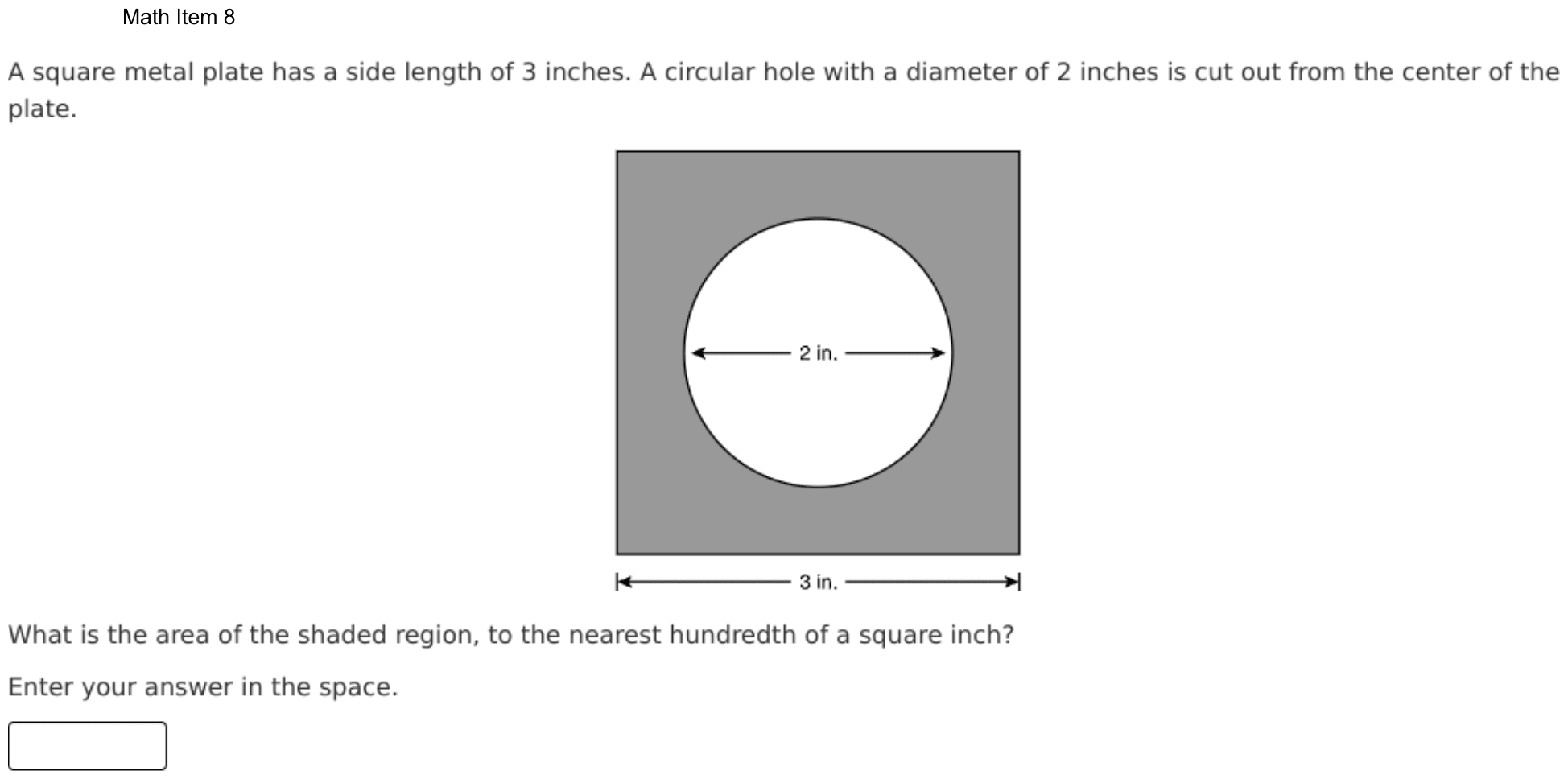
A square metal plate has a side length of 3 inches. A circular hole with a diameter of 2 inches is cut out from the center of the plate.
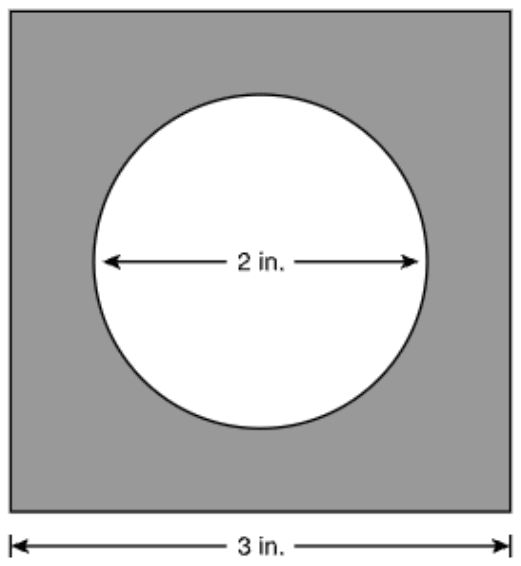
What is the area of the shaded region, to the nearest hundredth of a square inch?
Enter your answer in the space.
Fill-in question: work out the answer and type it as a number.
Show the answer
Correct answer: 5.86
To determine the area of a square, use .
Begin by finding the length of the side of the square, which is 3 inches. The area of the square is .
To determine the area of the circle, use .
The radius of the circle (the hole) is one-half the diameter or , so the area of the entire circle is
To determine the area of the shaded region, subtract the area of the hole in the square from the area of the square:
The shaded area to the nearest hundredth of a square inch sq in.
Question analysis
A 3-inch square metal plate has a circular hole 2 inches across cut from its center, and students find the area of the metal that is left, to the nearest hundredth of a square inch. It tests the areas of a circle and a square. Using the radius, not the diameter, and subtracting the right areas are the keys.
- NYS standards
- 7.G.4 circle area and circumference
- Grade level
- Grade 7 content, by NYS standard
- Compared with grade 7
- At grade 7 Finding a circle's area is a grade 7 standard, and subtracting a hole from a shape is common grade 7 practice. The radius must come from the diameter and the result must be rounded, but the steps are routine.
- Estimated difficulty
- Straightforward: two steps or one careful reading.
- Thinking it demands
- Depth of knowledge 2, skills and concepts · mainly apply
- What makes it hard
- Something you must already know moderate
- Combines ideas minor
- An answer in an unexpected form minor
- Solution
- 3 steps
- Reading level
- Question and choices: about grade 4, 49 words.
- Corrected from the DOE handbook
- A wrong symbol in the explanation was corrected.
- Students, last 30 days
- Not enough answers yet to show (it takes 10).
Why it is hard, traps and wrong answers (shows the answer)
Why it is hard
Every number is small, so the work is choosing the right pieces: the area of the square, the area of the hole, and the difference. A radius of 1 makes the circle's area simply π, which is easy to confuse with the circumference, 2π, when the formulas are half remembered. The region asked for is the gray metal, not the hole, and the final rounding goes up, since the third decimal place is 8.
Something you must already know moderate Working it out
Neither area formula is given, and the hole is labeled by its 2-inch diameter, so students must recall A = πr² and halve the diameter to get the radius 1 first. (Anderson & Krathwohl, 2001)
Combines ideas minor Working it out
The shaded metal is a square with a circle removed, so two area formulas are combined by subtraction rather than either one used alone. (Embretson, 1998; Daniel & Embretson, 2010)
An answer in an unexpected form minor Choosing the answer
The result is typed to the nearest hundredth with no choices to compare, so the long decimal 5.858… must be rounded up, not cut off after two places. (Enright, Morley & Sheehan, 2002)
Strategy: Halve the diameter to get the radius, find the area of the square and of the circle, subtract the circle from the square, and round only at the end.
Traps
- Answers a different question: A choice is right for another quantity: the other unknown, the rest instead of the part, the part instead of the whole.
- Wrong formula: Uses a related but wrong formula: perimeter for area, diameter for radius, area for volume, or a misremembered one.
- A formula you must know: Needs a formula the test does not give: area, circumference, volume, probability rules.
The wrong answers, classified
2.72 Wrong formula (King et al., 2004)
Uses the circumference, 2π × 1 ≈ 6.28, in place of the circle's area and subtracts it from the square's 9 square inches, getting about 2.72.
3.14 Answers a different question (King et al., 2004; Hegarty, Mayer & Monk, 1995)
Finds the area of the circular hole, π × 1² ≈ 3.14 square inches, and enters it instead of the area of the shaded metal left around it.
5.85 Rounds too early (King et al., 2004)
Works the area out correctly as about 5.858 but cuts off the extra digits instead of rounding up to the nearest hundredth.
What was corrected from the DOE handbook, and why
- Explanation: The DOE’s explanation gives the area of the hole as “π(1 in.)² ≅ 3.14 sq in.” The symbol ≅ means “is congruent to”, which an area and a number cannot be; the line means “is approximately equal to”, written ≈. The site now says “π(1 in.)² ≈ 3.14 sq in.”
Worked solution, step by step
Formulas used
- Area of a square
- A is the area, the amount of flat space inside. s is the length of one side. s² means s × s. It works because a square with side s holds s rows of s little unit squares.
- Area of a circle
- A is the area. r is the radius, the distance from the center to the edge. It is half the diameter, the distance straight across through the center. π (pi) is a number a little more than 3, about 3.14. r² means r × r.
Sort out the question
The plate is a square with 3-inch sides. A circle with a 2-inch diameter is cut out of the middle. The diameter is the distance straight across the circle through its center. The shaded region is the metal that is left. You need its area to the nearest hundredth of a square inch.
Find the area of the square
Use the formula for the area of a square, with s = 3 inches:
The whole plate, before the hole is cut, is 9 square inches.
Find the radius of the hole
The circle formula needs the radius, not the diameter. The figure labels the 2 in. distance across the hole. The radius is half of it:
The radius is 1 inch.
Find the area of the hole
Use the formula for the area of a circle, with r = 1 inch:
The sign ≈ means is about equal to. The hole is about 3.14 square inches.
Watch out: 2πr is the circumference, the distance around the circle, not its area. Using it gives 9 − 6.28 = 2.72. And 3.14 is the hole, not the metal, so do not stop there.
Subtract the hole from the square
The shaded metal is the square with the circle taken away:
The shaded region is about 5.86 square inches.
Round and enter the answer
With more digits of π, 3.1416, you get 9 − 3.1416 = 5.8584. The digit after the hundredths place is 8, which is 5 or more, so round up to 5.86. Chopping it to 5.85 is wrong. Type only the number, with no units.
So you would enter 5.86.
Check your answer
The hole is a bit more than a third of the plate, since 3.14 is a bit more than 9 ÷ 3 = 3. So the metal left should be a bit less than two thirds of 9, which is 6. The answer 5.86 is just under 6, so it makes sense.
More questions like this
The original DOE question
Question 6 of 36
2026 Practice Test D Math, question 13Question
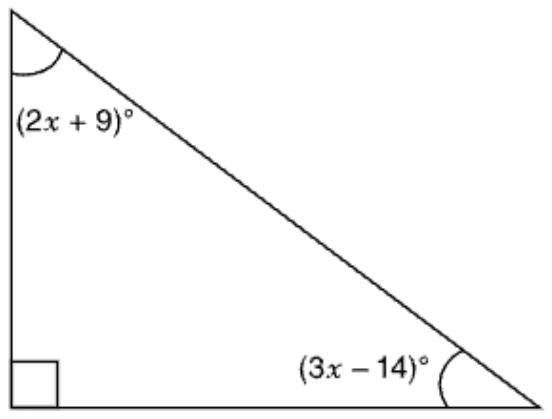
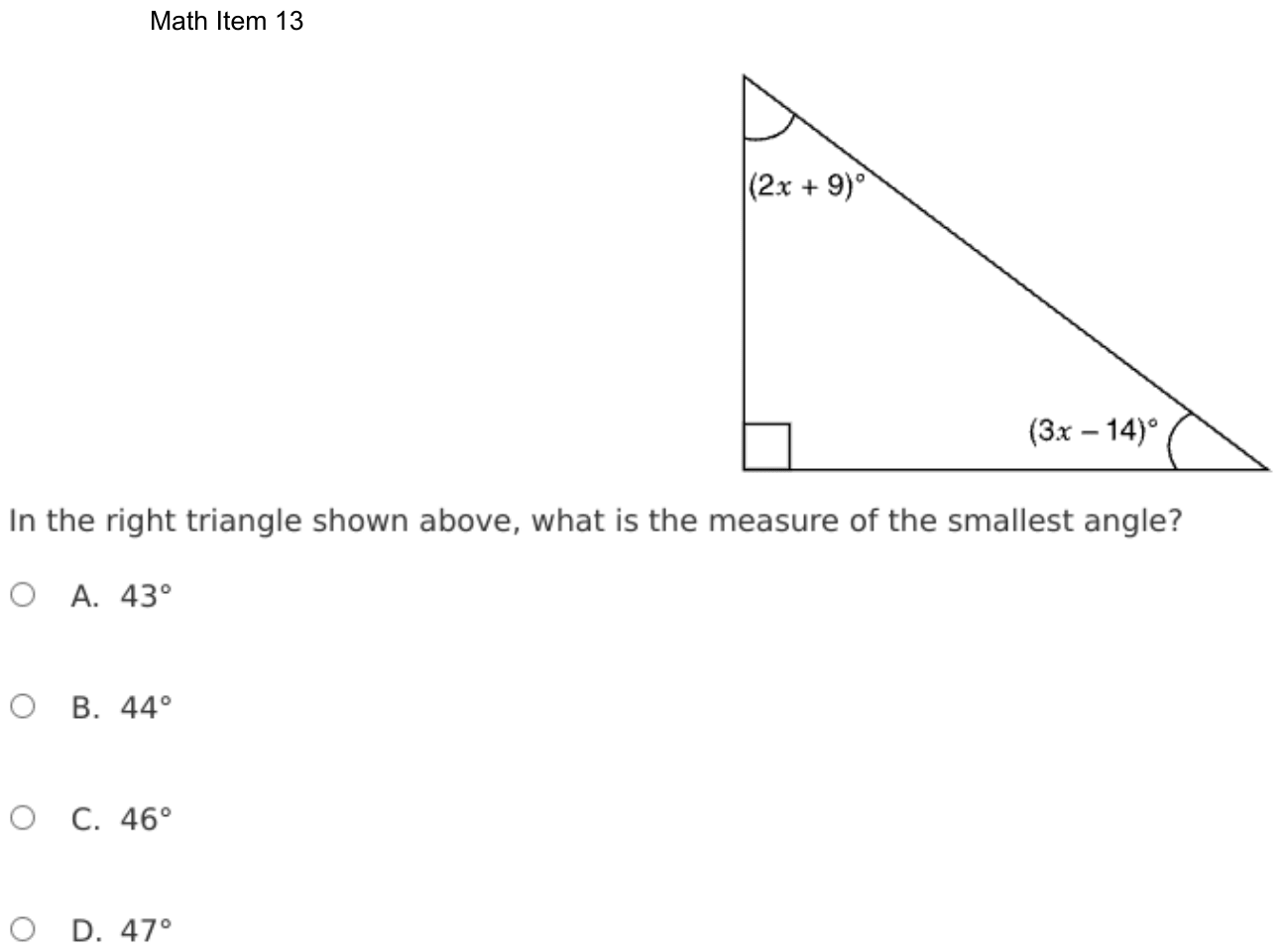
In the right triangle shown above, what is the measure of the smallest angle?
- A43°
- B44°
- C46°
- D47°
Show the answer
Correct answer: A
Since the three angles of a triangle have a sum of 180°, and since one angle is a right angle, the other two angles have a sum of 90°. By writing an equation and using inverse operations, the value of x can be found.
Now, use substitution to find the measure of the two angles to determine the smallest angle of the triangle.
The smallest angle is 43°.
Question analysis
A right triangle has its two other angles labeled (2x + 9)° and (3x − 14)°, and students find the measure of the smallest angle. It tests the angle sum of a triangle and solving a linear equation. Finding x is not the end: both angles must be worked out and compared to see which one is smallest.
- NYS standards
- Grade level
- Grade 8 content, by NYS standard
- Compared with grade 7
- Above grade 7 Grade 7 students write equations for unknown angles using complementary and supplementary angles. This also needs the angle sum of a triangle, which New York places in grade 8, plus substituting back and comparing, though each step is short.
- Estimated difficulty
- Moderate: several steps, or a close reading with one strong distractor.
- Thinking it demands
- Depth of knowledge 2, skills and concepts · mainly apply
- What makes it hard
- Combines ideas moderate
- Many steps minor
- Something you must already know minor
- Solution
- 4 steps
- Reading level
- Question and choices: about grade 6, 14 words.
- Students, last 30 days
- Not enough answers yet to show (it takes 10).
Why it is hard, traps and wrong answers (shows the answer)
Why it is hard
Setting the sum of the two labeled angles to 90° is the decision; the algebra after it is routine. The trap waits at the end: x = 19 is not an angle, and the expression at the top vertex, 2x + 9, gives the larger acute angle, 47°. Evaluating both expressions and checking that they add to 90° takes seconds and shows which one is smaller.
Combines ideas moderate Working it out
The angle facts and the algebra meet in one equation: the right angle means the two labeled angles add to 90°, and only that sum makes (2x + 9) + (3x − 14) solvable. (Embretson, 1998; Daniel & Embretson, 2010)
Many steps minor Working it out
After solving 5x − 5 = 90, both angle expressions must be evaluated and compared, because the question wants an angle, not x, and not the first angle found. (Daniel & Embretson, 2010; Enright, Morley & Sheehan, 2002)
Something you must already know minor Working it out
The 180° angle sum of a triangle is not printed, and only the small square at the bottom left shows that one angle is 90°. (Anderson & Krathwohl, 2001)
Strategy: Use the right angle to see that the other two angles add to 90°, solve that equation for x, then substitute into both expressions and compare them.
Traps
- Answers a different question: A choice is right for another quantity: the other unknown, the rest instead of the part, the part instead of the whole.
- A formula you must know: Needs a formula the test does not give: area, circumference, volume, probability rules.
The wrong answers, classified
B Little reason to choose it (Haladyna & Downing, 1993; Rodriguez, 2005)
No common working gives 44°; it sits one degree from the right measure and fits no consistent value of x, so it mostly draws estimates and guesses.
C Little reason to choose it (Haladyna & Downing, 1993; Rodriguez, 2005)
No common working gives 46°, which would need x = 20 and two angles adding to 95°, so it mostly catches guesses near 45°.
D Answers a different question (King et al., 2004; Hegarty, Mayer & Monk, 1995)
Solves x = 19 correctly but answers with 2x + 9 = 47°, the larger acute angle, instead of evaluating both expressions to find the smaller.
Worked solution, step by step
Formulas used
- Angles in a triangle
- a, b and c are the three angles of any triangle, in degrees. They always add up to 180 degrees. If you tear off the three corners and set them side by side, they make a straight line.
- The two other angles of a right triangle
- a and b are the two angles that are not the right angle. A right angle is 90 degrees, so the other two share what is left of the 180: 180 − 90 = 90.
Sort out the question
The small square at the bottom left corner marks a right angle, which is 90°. The top angle is (2x + 9)°, and the bottom right angle is (3x − 14)°. You need the smallest of the three angles. First find x, then find each angle.
Write an equation
The three angles add to 180°. The right angle uses 90° of that, so the other two angles add to 90°:
Solve for x
Combine the x terms, 2x + 3x = 5x. Combine the numbers, 9 − 14 = −5:
Add 5 to both sides, then divide both sides by 5:
Find both angles
Put x = 19 into each expression:
The three angles are 47°, 43° and 90°.
Watch out: x = 19 is not an angle. And the first angle you find, 47°, is not the smallest one. Stopping there gives choice D.
Pick the smallest angle
Compare 47°, 43° and 90°. The smallest is 43°. The figure is not drawn to scale, so do not judge the angles by how they look. Use the numbers.
So the answer is A, 43°.
Check your answer
Add the three angles: 47 + 43 + 90 = 180. That is the right total for a triangle. Also, 47 + 43 = 90, so the two smaller angles fill exactly what the right angle leaves.
More questions like this
The original DOE question
Question 7 of 36
2026 Practice Test D Math, question 27Question
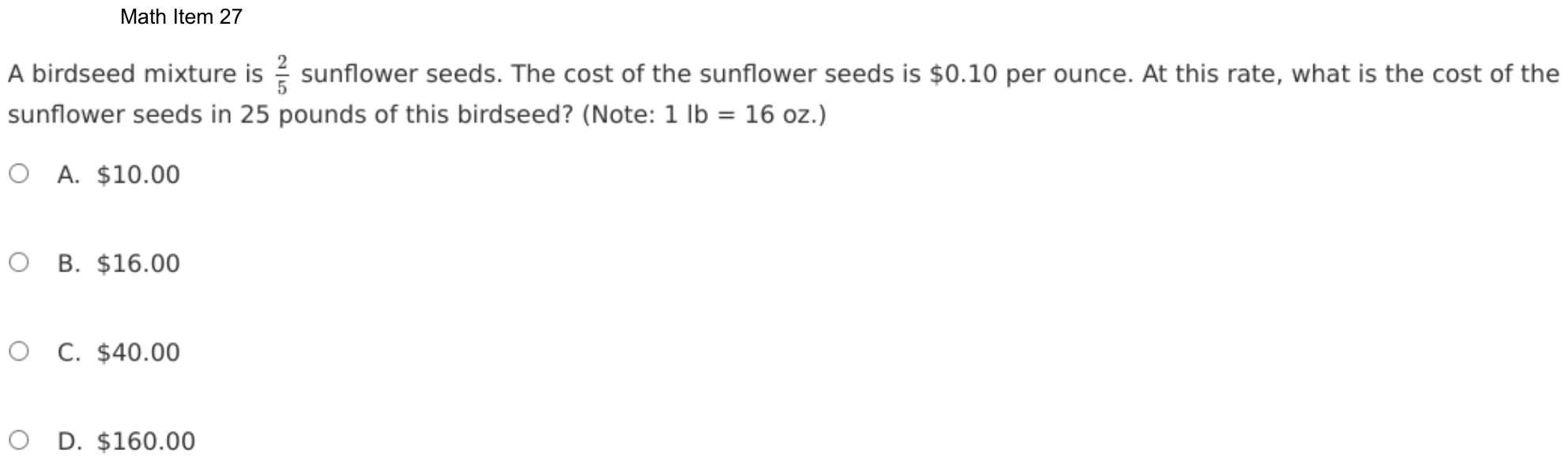
A birdseed mixture is sunflower seeds. The cost of the sunflower seeds is $0.10 per ounce. At this rate, what is the cost of the sunflower seeds in 25 pounds of this birdseed? (Note: 1 lb = 16 oz.)
- A$10.00
- B$16.00
- C$40.00
- D$160.00
Show the answer
Correct answer: B
First, calculate the amount of sunflower seeds in 25 pounds of this birdseed by using ratio reasoning to find that there are 10 pounds of sunflower seeds in the birdseed.
Then, use ratio reasoning to find the cost of the sunflower seeds per pound.
The cost of the sunflower seeds is $1.60 per pound.
Finally, find the total cost using ratios by multiplying the unit cost per pound by 10 pounds.
The first two steps above could be done in the other order; that is, find $1.60 per pound first and 10 pounds of sunflower seeds second.
Question analysis
A birdseed mixture is two-fifths sunflower seeds, which cost 10 cents an ounce, and students find the cost of the sunflower seeds in 25 pounds of the mix. It combines a fraction of a whole, a pounds-to-ounces conversion and a unit price. Each step's result looks like a possible answer, so keeping track of which quantity is in hand matters.
- Grade level
- Grade 7 content, by NYS standard
- Compared with grade 7
- At grade 7 Multistep ratio problems with a unit conversion are typical grade 7 work. This one chains three short steps, a fraction of the mixture, pounds to ounces and a price per ounce, and the numbers are chosen to come out evenly.
- Estimated difficulty
- Moderate: several steps, or a close reading with one strong distractor.
- Thinking it demands
- Depth of knowledge 2, skills and concepts · mainly apply
- What makes it hard
- Many steps moderate
- Combines ideas minor
- Solution
- 3 steps
- Reading level
- Question and choices: about grade 3, 35 words.
- Students, last 30 days
- Not enough answers yet to show (it takes 10).
Why it is hard, traps and wrong answers (shows the answer)
Why it is hard
Each step is routine, but the steps can be done in more than one order, and every partial result looks like a price once a dollar sign is put in front of it. Each wrong choice leaves something out: the 2/5, the price per ounce, or the conversion and the price together. Labelling each number with its unit, pounds, ounces or dollars, as it is found keeps the chain straight and shows when it is finished.
Many steps moderate Working it out
Three operations are chained: 2/5 of 25 pounds gives 10 pounds of sunflower seeds, the note turns them into 160 ounces, and $0.10 an ounce prices them; stopping at 10 pounds or 160 ounces, or skipping the 2/5, gives a listed choice. (Daniel & Embretson, 2010; Enright, Morley & Sheehan, 2002)
Combines ideas minor Working it out
A fraction of a mixture, a pounds-to-ounces conversion and a price per ounce meet in one question, and the price is per ounce while the amount is given in pounds. (Embretson, 1998; Daniel & Embretson, 2010)
Strategy: Find the weight of the sunflower seeds first, change it to ounces with the note, then multiply by the price per ounce; or turn the price into dollars per pound first.
Traps
- Stops one step early: A choice is a number from partway through the solution.
- Answers a different question: A choice is right for another quantity: the other unknown, the rest instead of the part, the part instead of the whole.
The wrong answers, classified
A Stops one step early (King et al., 2004; Gierl et al., 2017)
Finds that 10 of the 25 pounds are sunflower seeds and stops, giving that weight as $10.00 without converting it to ounces or pricing it.
C Answers a different question (King et al., 2004; Hegarty, Mayer & Monk, 1995)
Prices all 25 pounds of birdseed, 400 ounces at $0.10 an ounce, never taking the 2/5 of the mixture that is sunflower seeds.
D Stops one step early (King et al., 2004; Gierl et al., 2017)
Converts the 10 pounds of sunflower seeds to 160 ounces and stops, reading the number of ounces as the cost without multiplying by $0.10.
Worked solution, step by step
Formulas used
- A fraction of an amount
- The whole is the full amount, here 25 pounds of birdseed. The fraction tells how much of it you want. To find 2/5 of something, split it into 5 equal parts and take 2 of them. Multiplying does both at once.
- Changing pounds to ounces
- The note says 1 pound is 16 ounces. So each pound turns into 16 ounces. An ounce is smaller than a pound, so you get a bigger number.
- Total cost
- The units here are ounces. The price of one unit is $0.10 for one ounce. Every ounce costs the same, so you multiply the number of ounces by the price of one.
Sort out the question
You know:
- The birdseed is sunflower seeds.
- There are 25 pounds of birdseed.
- Sunflower seeds cost $0.10 per ounce.
- 1 pound = 16 ounces.
You need the cost, in dollars, of just the sunflower seeds. The price is per ounce, but the weight is in pounds. So you will need to change pounds to ounces.
Find the weight of sunflower seeds
Only 2/5 of the birdseed is sunflower seeds. Find 2/5 of 25 pounds:
Another way: 25 ÷ 5 = 5, and 2 fifths is 2 × 5 = 10. So there are 10 pounds of sunflower seeds.
Watch out: 10 is a number of pounds, not dollars. Stopping here and calling it $10.00 leads to choice A.
Change pounds to ounces
The price is per ounce, so turn the 10 pounds into ounces. Each pound is 16 ounces:
There are 160 ounces of sunflower seeds.
Watch out: 160 is a number of ounces, not dollars. Calling it $160.00 leads to choice D.
Find the cost
Each ounce costs $0.10. Multiply:
The sunflower seeds cost $16.00.
Watch out: skipping the 2/5 prices all 25 pounds. That is 400 ounces, and , choice C.
So the answer is B, $16.00.
Check your answer
Do it in another order. One pound of sunflower seeds costs dollars. Ten pounds cost dollars. You get $16.00 again.
More questions like this
The original DOE question
Question 8 of 36
2026 Practice Test D Math, question 35Question
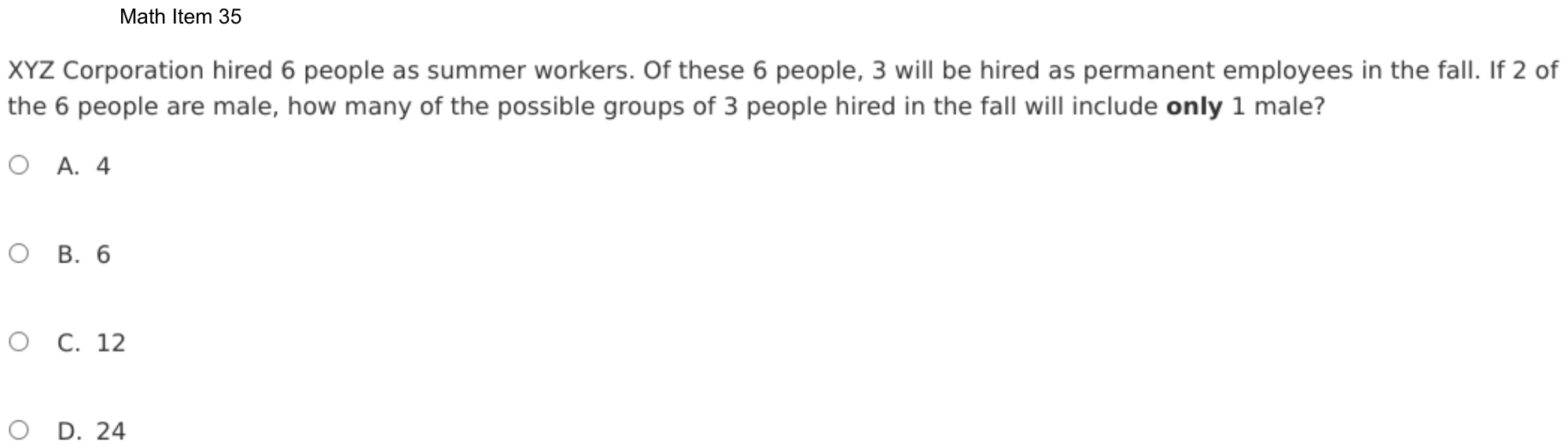
XYZ Corporation hired 6 people as summer workers. Of these 6 people, 3 will be hired as permanent employees in the fall. If 2 of the 6 people are male, how many of the possible groups of 3 people hired in the fall will include only 1 male?
- A4
- B6
- C12
- D24
Show the answer
Correct answer: C
An organized list can be used to determine the number of groups of 3 people that include only 1 male.
Let the letters A, B, C, and D represent the females, and let the numbers 1 and 2 represent the males.
Then, create a list of all possible combinations of 3 people with only 1 male.
AB1, AB2, AC1, AC2, AD1, AD2
BC1, BC2, BD1, BD2
CD1, CD2
There are 12 possible groups with only 1 male.
Question analysis
A company hired 6 summer workers, 2 of them male, and will keep 3 as permanent employees in the fall. This counting question asks how many possible groups of 3 include only 1 male. Students count combinations where order does not matter, and the bold word only, with two kinds of workers to combine, makes careful listing essential.
- NYS standards
- 7.SP.8b sample spaces for compound events
- Grade level
- Grade 7 content, by NYS standard
- Compared with grade 7
- Above grade 7 Grade 7 students list outcomes with organized lists and tree diagrams, usually ordered ones. Counting unordered groups of three under an "only one" condition, built from two kinds of people, goes beyond that typical work.
- Estimated difficulty
- Hard: combines ideas, needs a plan, and has more than one tempting wrong answer.
- Thinking it demands
- Depth of knowledge 2, skills and concepts · mainly apply
- What makes it hard
- Combines ideas moderate
- Something you must already know minor
- Turning words into math minor
- Solution
- 3 steps
- Reading level
- Question and choices: about grade 7, 41 words.
- Students, last 30 days
- Not enough answers yet to show (it takes 10).
Why it is hard, traps and wrong answers (shows the answer)
Why it is hard
The question hides a two-stage count in a hiring story. Students tend to get one stage right and forget the other: they count the pairs of women and stop, or they count ordered picks and so find every group twice. Naming the women A to D and the men 1 and 2, then listing the pairs of women alphabetically with each man attached, makes every group visible and checkable.
Combines ideas moderate Working it out
Two counts are joined: the 6 ways to pick 2 of the 4 women, then the 2 ways to pick the man, and the total is their product. (Embretson, 1998; Daniel & Embretson, 2010)
Something you must already know minor Working it out
Students must already know that a group is the same whichever order its members are named, so picking one woman and then another repeats the reverse pick. (Anderson & Krathwohl, 2001)
Turning words into math minor Understanding the question
The bold word only means exactly one man, so the other two places in each group of 3 must go to two of the 4 women, a step the stem leaves unsaid. (Hegarty, Mayer & Monk, 1995; Koedinger & Nathan, 2004)
Strategy: Name the women A to D and the men 1 and 2, list every pair of women without repeats, then attach each man to each pair and count the groups.
Traps
- Stops one step early: A choice is a number from partway through the solution.
- Overlapping groups: Things in two groups at once are counted twice, or not subtracted.
The wrong answers, classified
A Numbers taken from the question (Hegarty, Mayer & Monk, 1995)
Multiplies the 2 men by the 2 places left for women, 2 × 2 = 4, using numbers from the question without listing a single group.
B Stops one step early (King et al., 2004; Gierl et al., 2017)
Counts the 6 pairs of women correctly but stops before pairing each one with either of the 2 men, which doubles the count.
D Overlapping groups (King et al., 2004)
Counts ordered picks of the two women, 4 × 3 = 12 instead of 6, so each group appears twice, then doubles for the men to reach 24.
Worked solution, step by step
Formulas used
- Counting with two choices
- Each way of picking the man can go with each way of picking the two women. So you multiply the two counts. It is like outfits: 2 shirts with 6 pairs of pants make 12 outfits.
Sort out the question
Six people work for the summer. Two are male, so the other 4 are female. Three will be hired in the fall.
You need the number of groups of 3 with only 1 male. That means exactly 1 man and 2 women. In a group, order does not matter. Ann, Bea and Carl is the same group as Carl, Ann and Bea.
Give each person a name
Call the women A, B, C and D. Call the men 1 and 2. Every group you want has 2 letters and 1 number, like AB1.
List the pairs of women
List each pair once. Start with A, then pair B only with letters after it, and so on:
- AB, AC, AD
- BC, BD
- CD
That is 6 pairs. BA is not new, since it is the same pair as AB.
Watch out: counting the order gives pairs, each one twice. Then doubling for the men gives 24, choice D.
Add a man to each pair
Each pair of women can go with man 1 or man 2. Use the counting rule:
Watch out: stopping at the 6 pairs of women leaves out the men. That gives 6, choice B.
So the answer is C, 12.
Check your answer
Write out every group. With man 1: AB1, AC1, AD1, BC1, BD1, CD1. With man 2: AB2, AC2, AD2, BC2, BD2, CD2. Each list has 6 groups, and . No group repeats, and each has just one man.
More questions like this
The original DOE question
Question 9 of 36
2024 Test A English, question 18Passage Excerpt from “Impressions of an Indian Childhood”
Excerpt from “Impressions of an Indian Childhood”
by Zitkala-Sa
Zitkala-Sa (Gertrude Simmons Bonnin) was a Native American writer, musician, teacher, and political activist who was raised on the Yankton Sioux Reservation in South Dakota. In 1900 she published “Impressions of an Indian Childhood” (the term Indian was commonly used at the time to refer to Native American people) to expose readers to what life is like on a reservation.
Soon after breakfast Mother sometimes began her beadwork. On a bright, clear day, she pulled out the wooden pegs that pinned the skirt of our wigwam1 to the ground, and rolled the canvas part way up on its frame of slender poles. Then the cool morning breezes swept freely through our dwelling, now and then wafting the perfume of sweet grasses from newly burnt prairie.
Untying the long tasseled strings that bound a small brown buckskin2 bag, my mother spread upon a mat beside her bunches of colored beads, just as an artist arranges the paints upon his palette. On a lapboard she smoothed out a double sheet of soft white buckskin; and drawing from a beaded case that hung on the left of her wide belt a long, narrow blade, she trimmed the buckskin into shape. Often she worked upon small moccasins for her small daughter. Then I became intensely interested in her designing. With a proud, beaming face, I watched her work. In [my] imagination, I saw myself walking in a new pair of snugly fitting moccasins. I felt the envious eyes of my playmates upon the pretty red beads decorating my feet.
Close beside my mother I sat on a rug, with a scrap of buckskin in one hand and an awl in the other. This was the beginning of my practical observation lessons in the art of beadwork. From a skein3 of finely twisted threads of silvery sinews my mother pulled out a single one. With an awl she pierced the buckskin, and skillfully threaded it with the white sinew. Picking up the tiny beads one by one, she strung them with the point of her thread, always twisting it carefully after every stitch.
It took many trials before I learned how to knot my sinew thread on the point of my finger, as I saw her do. Then the next difficulty was in keeping my thread stiffly twisted, so that I could easily string my beads upon it. My mother required of me original designs for my lessons in beading. At first I frequently ensnared many a sunny hour into working a long design. Soon I learned from self-inflicted punishment to refrain from drawing complex patterns, for I had to finish whatever I began.
After some experience I usually drew easy and simple crosses and squares. These were some of the set forms. My original designs were not always symmetrical nor sufficiently characteristic, two faults with which my mother had little patience. The quietness of her oversight made me feel strongly responsible and dependent upon my own judgment. She treated me as a dignified little individual as long as I was on my good behavior; and how humiliated I was when some boldness of mine drew forth a rebuke from her!
In the choice of colors she left me to my own taste. I was pleased with an outline of yellow upon a background of dark blue, or a combination of red and myrtle-green. There was another of red with a bluish-gray that was more conventionally used. When I became a little familiar with designing and the various pleasing combinations of color, a harder lesson was given me. It was the sewing on, instead of beads, some tinted porcupine quills, moistened and flattened between the nails of the thumb and forefinger. My mother cut off the prickly ends and burned them at once in the centre fire. These sharp points were poisonous, and worked into the flesh wherever they lodged. For this reason, my mother said, I should not do much alone in quills until I was as tall as my cousin Warca-Ziwin.
Always after these confining lessons I was wild with surplus spirits, and found joyous relief in running loose in the open again. Many a summer afternoon a party of four or five of my playmates roamed over the hills with me. We each carried a light sharpened rod about four feet long, with which we pried up certain sweet roots. When we had eaten all the choice roots we chanced upon, we shouldered our rods and strayed off into patches of a stalky plant under whose yellow blossoms we found little crystal drops of gum. Drop by drop we gathered this nature’s rock-candy, until each of us could boast of a lump the size of a small bird’s egg. Soon satiated with its woody flavor, we tossed away our gum, to return again to the sweet roots.
From “Impressions of an Indian Childhood” by Zitkala-Sa—Public Domain
A BRIEF HISTORY OF BEADWORK IN SOUTH DAKOTA
| Date | Event |
|---|---|
| 1500s | The Dakota use beads made from bones, shells, stones, and animal teeth. European traders bring glass beads to North America. |
| Late 1600s | The Dakota begin trading with the French in Minnesota. |
| 1830s | The Dakota begin using glass beads in clothing, artwork, and decorations in place of Native-made beads. |
| 1862–1865 | The Dakota are expelled from their homelands in Minnesota as a result of the U.S.-Dakota War. |
| 1900s–1920s | The Dakota create items to sell outside their community. |
Source: MNopedia
1wigwam: hut with an arched framework of poles covered with bark, mats, or animal hides
2buckskin: leather made from the skin of a male deer
3skein: coiled length of yarn or other thread loosely wound on a reel
Question
The table after paragraph 7 expands on a central idea in the excerpt because it shows that
- Athe craft the author was learning was a tradition that endured through many generations and changes.
- Bthe author’s family incorporated traditional materials into their craft as a way of resisting the influence from European traders.
- Cthe uniqueness of the cultural tradition that the author learned as a child was eventually recognized in Europe.
- Dthe author was able to incorporate color into her craftwork as a result of trade with other peoples.
Show the answer
Correct answer: A
The question asks how the table after paragraph 7 expands on a central idea in the excerpt.
A. CORRECT. The table provides the chronology from the 1500s, when the Dakota created beadwork using “beads made from bones, shells, stones, and animal teeth,” to the 1830s, when the Dakota began “using glass beads,” and the 1900s, when they created items to “sell outside their community.” Thus, the table helps expand on a central idea by showing that the craft the author was learning is a tradition that has endured through many generations.
B. Incorrect. Although the table shows that the Dakota used “beads made from bones, shells, stones, and animal teeth” in the 1500s and that by the 1830s began “using glass beads in clothing, artwork, and decorations in place of Native-made beads,” it does not provide any information about the type of materials used by the author’s family.
C. Incorrect. While the information included in the table states that “European traders [brought] glass beads to North America” in the 1500s and that by the 1920s the Dakota created “items to sell outside their community,” there is no mention of whether the uniqueness of Dakota beadwork was recognized in Europe.
D. Incorrect. The table indicates that by the late 1600s the Dakota began trading with French traders from Europe who brought glass beads to the Americas and that by the 1830s the Dakota were “using glass beads in clothing, artwork, and decorations in place of Native-made beads.” However, the table provides no information about whether this work incorporated color. Therefore, the table does not show that the author was able to incorporate color into her craftwork as a result of trade with other peoples.
Question analysis
This reading question asks how a table titled A Brief History of Beadwork in South Dakota, printed after Zitkala-Sa's excerpt, expands on one of its central ideas. Students must read a short timeline of beads, trade and war and connect it to a girl learning beadwork, while avoiding choices that sound historically likely but go beyond the table.
- Grade level
- Grade 7 reading and task
- Compared with grade 7
- At grade 7 Connecting a table to a text's central idea is grade 7 work. The table is short and plainly worded, and linking a people's history to one girl's lessons is a typical grade 7 step.
- Estimated difficulty
- Moderate: several steps, or a close reading with one strong distractor.
- Thinking it demands
- Depth of knowledge 3, strategic thinking · mainly analyze
- What makes it hard
- Reading a figure, table or graph moderate
- Combines ideas moderate
- Reading between the lines minor
- Evidence
- Answered from several paragraphs or stanzas
- Reading level
- Passage: about grade 8, 946 words; question and choices: about grade 11, 87 words.
- Corrected from the DOE handbook
- A date in the explanation was corrected to match the table.
- Students, last 30 days
- Not enough answers yet to show (it takes 10).
Why it is hard, traps and wrong answers (shows the answer)
Why it is hard
The table holds plenty of tempting raw material: European traders, glass beads, sales outside the community. Wrong answers build unsupported stories out of it, about resistance, European recognition or the arrival of color, and the last is the hardest to resist because the excerpt is full of colored beads. Students who sum up the table in one phrase, a craft carried on through centuries of change, can check each choice against what the rows actually say.
Reading a figure, table or graph moderate Understanding the question
The table runs from the 1500s to the 1920s, and its point appears only when the five rows are read as a timeline: new beads, trade, war and expulsion, yet the beadwork goes on. (Lesh, Post & Behr, 1987; Kirsch & Mosenthal, 1990)
Combines ideas moderate Working it out
Students must join the table's history of the Dakota to one girl's lessons in paragraphs 3–6 and see that the craft she learns belongs to that long line. (Embretson, 1998; Daniel & Embretson, 2010)
Reading between the lines minor Working it out
Endurance is never stated; it has to be drawn from a beadwork history that spans four centuries, from bone and shell beads to items made for sale, through every change between. (Graesser, Singer & Trabasso, 1994; Kintsch, 1998)
Strategy: Read the table from top to bottom and say in a few words what it shows over time, then pick the choice that fits that pattern and also connects to the excerpt.
Traps
- Reads too much in: A reasonable-sounding conclusion that goes further than the text allows.
- Outside knowledge: A choice is plausible in the real world but not supported by this text.
- Twists what the text says: Uses the text's topic and ideas but changes what it says: who did it, how much, when, or why.
The wrong answers, classified
B Twists what the text says (King et al., 2004)
Imagines the family holding to traditional materials to resist traders, though the 1830s row shows the Dakota taking up glass beads in place of Native-made ones.
C Reads too much in (Graesser, Singer & Trabasso, 1994)
Joins the European traders of the first row to the sales outside the community in the last and concludes that Europe recognized the craft, which no row states.
D Outside knowledge (King et al., 2004; Recht & Leslie, 1988)
Links the excerpt's colored beads to the glass beads traders brought and assumes trade supplied the color, but the table never mentions color, so that link comes from outside it.
What was corrected from the DOE handbook, and why
- Explanation: In rejecting choice D, the handbook says that “by 1830” the Dakota were using glass beads in clothing, artwork and decorations. The table places that change in the 1830s (“The Dakota begin using glass beads …”), and the handbook’s own reason for rejecting choice B says “by the 1830s.” The explanation now reads “by the 1830s.”
Working it out, step by step
Figure out what the question asks
The excerpt ends with a table, a chart of facts in rows. You need to see how the table adds to a central idea of the excerpt. A central idea is an important message.
Read the table as a timeline
- 1500s: the Dakota make beads from bones, shells, stones and teeth.
- Late 1600s: they begin trading with the French.
- 1830s: they use glass beads “in place of Native-made beads.”
- 1862–1865: a war forces them out of their homelands.
- 1900s–1920s: they make items to sell outside their community.
Find the pattern
The beads change. Trade begins. A war drives the people from their land. But through all of it, the beadwork goes on for hundreds of years. The girl in the excerpt is learning this same craft from her mother. So the table shows her craft is a tradition, a custom passed down through many generations.
Check each choice
- A is right. The craft lasted through many changes over hundreds of years.
- B is wrong. The table shows the Dakota took up glass beads, not that they resisted traders.
- C is wrong. No row says Europe ever praised the craft.
- D is wrong. The table never mentions color.
Watch out: D is tempting because the excerpt is full of colored beads, and traders brought glass beads. But the link to color is a guess. The table doesn’t say it.
Choose the answer
The table shows beadwork lasting through centuries of change, just like the craft the girl learns. So the answer is A.
Why this answer and not the closest wrong one
D is the closest wrong answer. Traders did bring glass beads, and the girl’s beads are colorful. But no row of the table says trade gave the Dakota color. Nothing ties it to the author’s own work either. A sums up what the rows actually show: a craft that went on through change.
More questions like this
The original DOE question
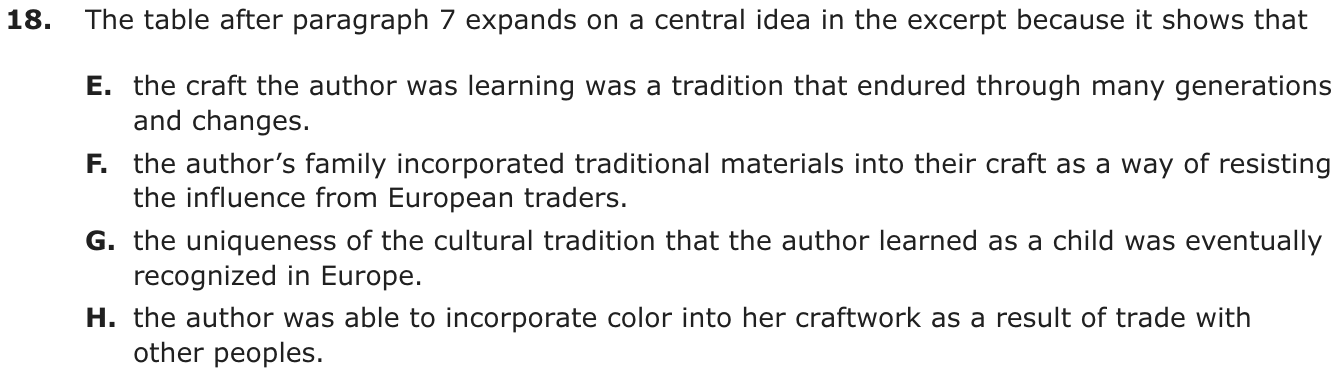
The passage “Excerpt from “Impressions of an Indian Childhood”” as printed (pages 42–43)
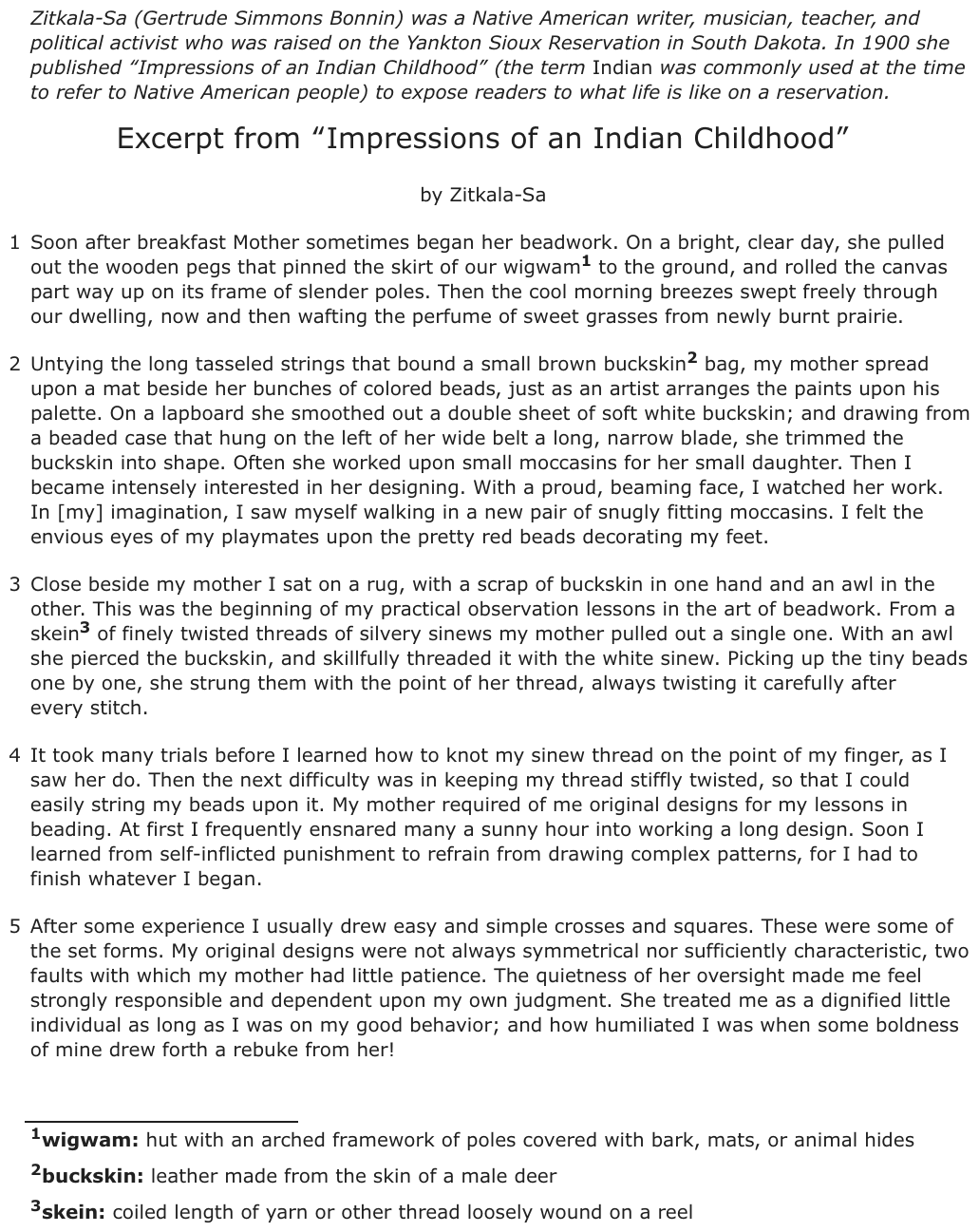
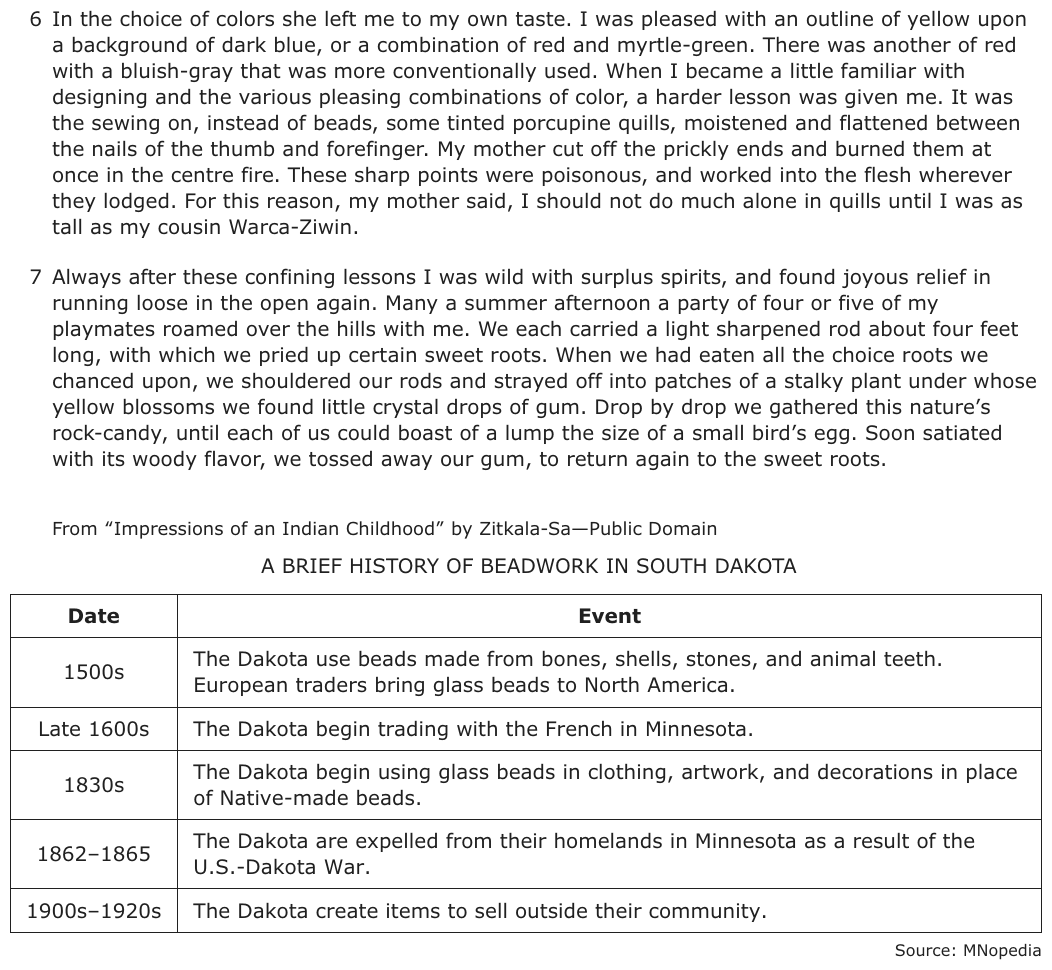
Question 10 of 36
2024 Test A English, question 57Passage Excerpt from “It’s Time to Stop Thinking That All Non-Native Species Are Evil”
Excerpt from “It’s Time to Stop Thinking That All Non-Native Species Are Evil”
by Emma Marris
The author of this opinion article attended a symposium, or conference, in Missoula, Montana, at which biologists and other scientists discussed species of plants and animals that are not native to the areas in which they live.
Invasive species are scary. It was ecologist Charles Elton, back in the 1950s, who introduced the militaristic “invasion” metaphor to describe exotic plants and animals—but there’s no question some can be extremely destructive.
The brown tree snake has eaten a dozen kinds of forest birds in Guam to extinction; zebra mussels clog pipes around the Great Lakes; the common house cat turns out to be, in Australia, a mercilessly effective killer of cute, fluffy marsupials like the bilby and the numbat.
As scientists have sounded the alarm about these pests, the public has gotten the message. Citizen groups rip out non-native plants. Native gardens have become increasingly popular, both as ways to celebrate the unique flora of each region and as tiny hot spots of diversity. Native trees provide food for native bugs, which feed native birds. Food chains developed over thousands of years of co-evolution unfold in our backyards. . . .
So we’ve learned, scientists and laypeople alike, that native species are good and non-natives are bad.
Julian Olden, a biologist at the University of Washington, Seattle, who co-organized the symposium, recently polled nearly 2,000 ecologists. Among his findings: a substantial number of them said they would immediately eradicate a hypothetical non-native forest plant, even if it were shown to have no effect on the forest. Olden calls this the “guilty even when proven innocent” approach.
That kind of approach is not very useful on a rapidly changing planet.
Exotics Are Everywhere
Climate change is making it harder even to decide who the invaders are.
How, scientists at the symposium wondered, do you define “native” on a warming planet, when plants and animals are already moving toward the poles or up mountainsides in search of climate conditions they can tolerate? Should we consider them “invasive” in their new homes? Regardless of what we label them, conservationists will be reluctant to remove them from their new environs—to do so would stymie1 their chances of adapting to the warmer future we’re creating.
And then there are the non-natives that we actually like. Most domestic crops are exotic in most of the places they’re grown, but there are even wild exotics that “do good,” forming useful relationships with native species.
Edwin Grosholz of the University of California, Davis, told the recent symposium about one such relationship. On beaches in his state, non-native spartina grass has become important habitat for the endangered California clapper rail, a plump shorebird with a downward curving bill more at home on land than in the air. A project to rip out and poison the spartina—which grows in dense swaths that exclude many other shorebirds—saw clapper rail numbers go tumbling downward.
There are other examples like that. The endangered southwestern willow flycatcher nests in “invasive” tamarisk shrubs. Many native (and beautiful) Hawaiian flowers are now pollinated by the Japanese white-eye bird—because the native pollinators have been driven extinct by other non-native species.
Should we impose further risk on already endangered natives by severing these relationships? Or should we admire the resilience of nature and let such “well-behaved” exotics stay? . . .
Leave them alone, more and more conservationists are arguing, and stop focusing obsessively on categorizing species as native or non-native. Mark Davis, an ecologist at Macalester College in St. Paul, Minnesota, once considered himself an “invasion biologist”—but not anymore. “I am actively trying to get the field to retire the invader narrative,” he said in Missoula.
A Good Thing, Not the Only Thing
After all, nativeness is just one environmental value, and arguably not as important as preventing extinctions and preserving biodiversity. In some cases we can best serve biodiversity by leaving the non-natives alone or even—brace yourself, now—introducing them on purpose.
This is the thinking behind, for example, installing the Aldabra tortoise on the islands of Mauritius. The islands lost their own large tortoises, and the fruiting plants that formerly had their seeds moved around by these fruit-loving reptiles have been on the decline. A tortoise that’s related to the island’s large tortoises—a non-native from the Seychelles in the Indian Ocean that was intentionally introduced in 2004—is now handling some of that work.
Most of the time, for the time being, conserving species still means focusing on supporting them in their historical habitats, planting natives and removing non-natives. We can and should do that in places where it is feasible and important to us.
From “It’s Time to Stop Thinking That All Non-Native Species Are Evil” by Emma Marris from NATIONAL GEOGRAPHIC MAGAZINE, July 24, 2014. Copyright © 2014 by National Geographic Society.
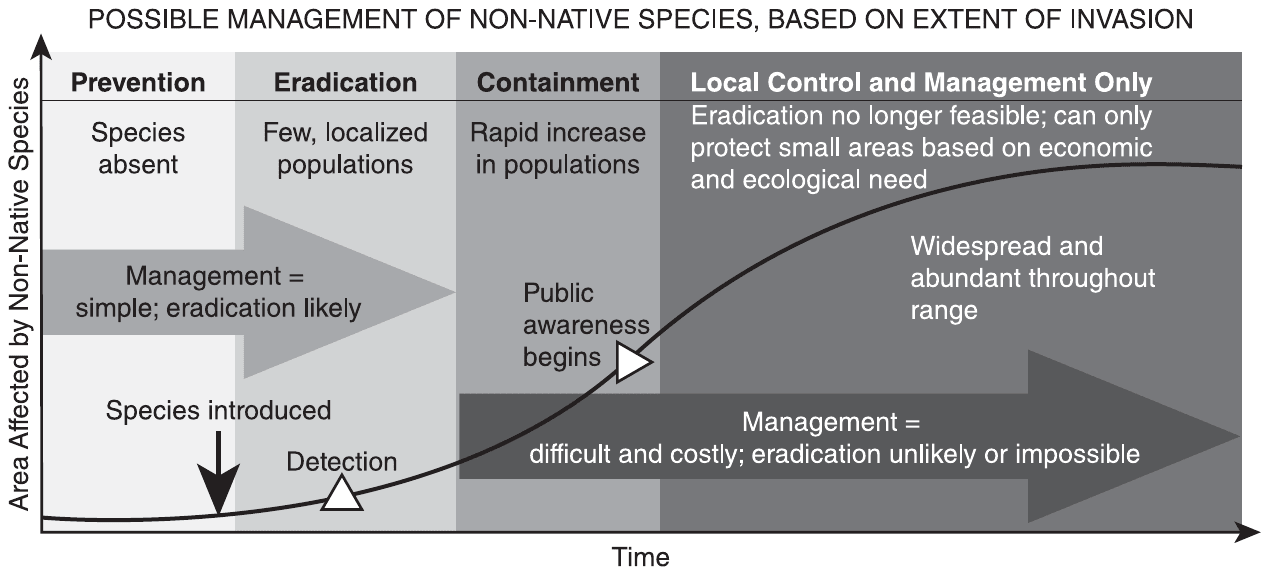
1stymie: hinder or interfere with
Question
How does the chart provide additional support for a central idea of the excerpt?
- Aby implying that the public becomes aware of non-native species only after removal is impossible
- Bby showing that the complete removal of non-native species is usually not achievable after a certain period of time
- Cby demonstrating why non-native species can be destructive if they are not removed from an area immediately
- Dby explaining how some conservation groups have approached the removal of non-native species
Show the answer
Correct answer: B
The question asks how the chart provides additional support for a central idea of the excerpt.
A. Incorrect. The chart indicates that the public tends to become aware of non-native species once eradication is “unlikely or impossible,” not strictly impossible. Furthermore, this idea is not a central idea of the excerpt.
B. CORRECT. The chart strongly suggests that once “rapid increase in populations” of non-native species has occurred, eradication will be “unlikely or impossible.”
C. Incorrect. While the chart does show that non-native species can eventually be impossible to eradicate, it never addresses the issue of how the non-native species might be destructive to their new environments.
D. Incorrect. The chart shows how non-native species become harder and harder to remove as their population grows but does not explain how any conservation groups have approached their removal.
Question analysis
This question asks how a chart titled “Possible Management of Non-Native Species, Based on Extent of Invasion” supports a central idea of an article arguing that not all non-native species are harmful. Students must read the chart's stages, labels and curve, then decide which statement the chart actually shows and which also fits the article's argument.
- Grade level
- Grade 8 reading and task
- Compared with grade 7
- At grade 7 Grade 7 students connect graphics to a text, but this chart packs four stages, two arrows, a curve and several labels into one figure, and its pattern must be linked to an argument made in words, demanding but within upper grade 7.
- Estimated difficulty
- Moderate: several steps, or a close reading with one strong distractor.
- Thinking it demands
- Depth of knowledge 2, skills and concepts · mainly analyze
- What makes it hard
- Reading a figure, table or graph moderate
- A very close wrong answer moderate
- Combines ideas minor
- Evidence
- Answered from the whole text
- Reading level
- Passage: about grade 11, 815 words; question and choices: about grade 12, 78 words.
- Students, last 30 days
- Not enough answers yet to show (it takes 10).
Why it is hard, traps and wrong answers (shows the answer)
Why it is hard
The chart is easy to read in outline, simple management on the left and costly, likely failed eradication on the right, and the right choice restates that contrast. The pull comes from the “Public awareness begins” marker, placed at the border of the stage where eradication is no longer feasible, which makes a statement about public awareness look like a faithful reading. It is nearly faithful, but it describes one marker, not a central idea the article develops.
Reading a figure, table or graph moderate Understanding the question
The chart packs four shaded stages, two arrows, an S-shaped curve and three markers into one figure, and its message lies in the arrows: eradication “likely” early, “unlikely or impossible” later. (Lesh, Post & Behr, 1987; Kirsch & Mosenthal, 1990)
A very close wrong answer moderate Choosing the answer
The right choice and the public-awareness choice both read the late stages where removal fails; the awareness marker even sits on the border of “Eradication no longer feasible”, so only centrality separates them. (Embretson & Wetzel, 1987; Gorin & Embretson, 2006; Ascalon et al., 2007)
Combines ideas minor Working it out
The chart's pattern has to be matched to the article's argument that nativeness is one value among several and that removal makes sense only where “feasible and important to us”. (Embretson, 1998; Daniel & Embretson, 2010)
Strategy: Read the chart's title, axes and stage labels, say in one sentence what it shows happening over time, then ask which part of the article's argument that pattern supports.
Traps
- Too narrow: A single detail offered as the central idea or a summary, or a summary that keeps minor details and leaves out an essential part.
- Reads too much in: A reasonable-sounding conclusion that goes further than the text allows.
- Wrong part of the text: A choice is true of another paragraph, stanza or speaker than the one asked about.
The wrong answers, classified
A Too narrow (King et al., 2004)
Reads the “Public awareness begins” marker, which sits where eradication becomes unlikely or impossible, as the chart's point, though it is one label and public awareness is not a central idea.
C Reads too much in (Graesser, Singer & Trabasso, 1994)
Takes the rising curve of area affected as proof of damage, but the chart tracks spread and the difficulty of removal, never harm, and the article questions removing non-natives on reflex.
D Wrong part of the text (Kirsch & Mosenthal, 1990)
Credits the chart with the citizen groups of paragraph 3 and the spartina project of paragraph 10, but it shows general stages of possible management, not any group's actual approach.
Working it out, step by step
Know what the question asks
This asks how the chart supports a central idea, a main point of the article. First read the chart and say in your own words what it shows. Then link that to the article’s argument.
Read the chart from left to right
Time moves from left to right. The curve shows how much area a non-native species covers. Eradication means wiping a species out completely. Early on, the arrow says management is “simple” and eradication is “likely.” Then the species spreads fast. From there on, management is “difficult and costly,” and eradication is “unlikely or impossible.” In the last stage it is “no longer feasible,” or no longer possible.
Link the chart to the article
The article argues that we shouldn’t treat every non-native species the same way. Paragraph 16 says we should remove non-natives “in places where it is feasible and important to us.” The chart shows when removal is possible: mostly early, before the species spreads. After that, wiping it out usually can’t be done.
Check each choice
- B fits: complete removal is usually not possible after a certain time, which is the chart’s main message.
- A is wrong because the “Public awareness begins” marker is one small label, and the article never discusses when the public notices.
- C is wrong because the chart shows how far a species spreads, not how much damage it does.
- D is wrong because the chart shows general stages, not what any real group has done.
Watch out: A reads the marker correctly, since it does sit late, where removal is already hard. But it picks a detail, not the chart’s main point.
Choose the answer
The chart shows that removal works only early, which backs up the article’s argument. So the answer is B.
Why this answer and not the closest wrong one
A comes closest, since the chart does place “Public awareness begins” late, when removal is already hard. But that is one small marker, and the article never says when the public first notices a species. B states the chart’s main message, that removal works only early. That backs up the article’s point that removing non-natives isn’t always possible.
More questions like this
The original DOE question
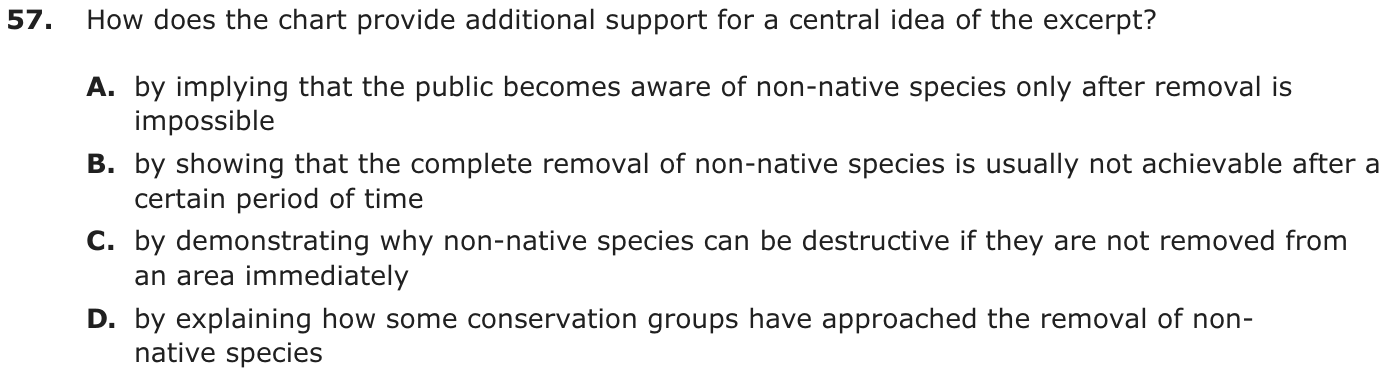
The passage “Excerpt from “It’s Time to Stop Thinking That All Non-Native Species Are Evil”” as printed (pages 68–70)
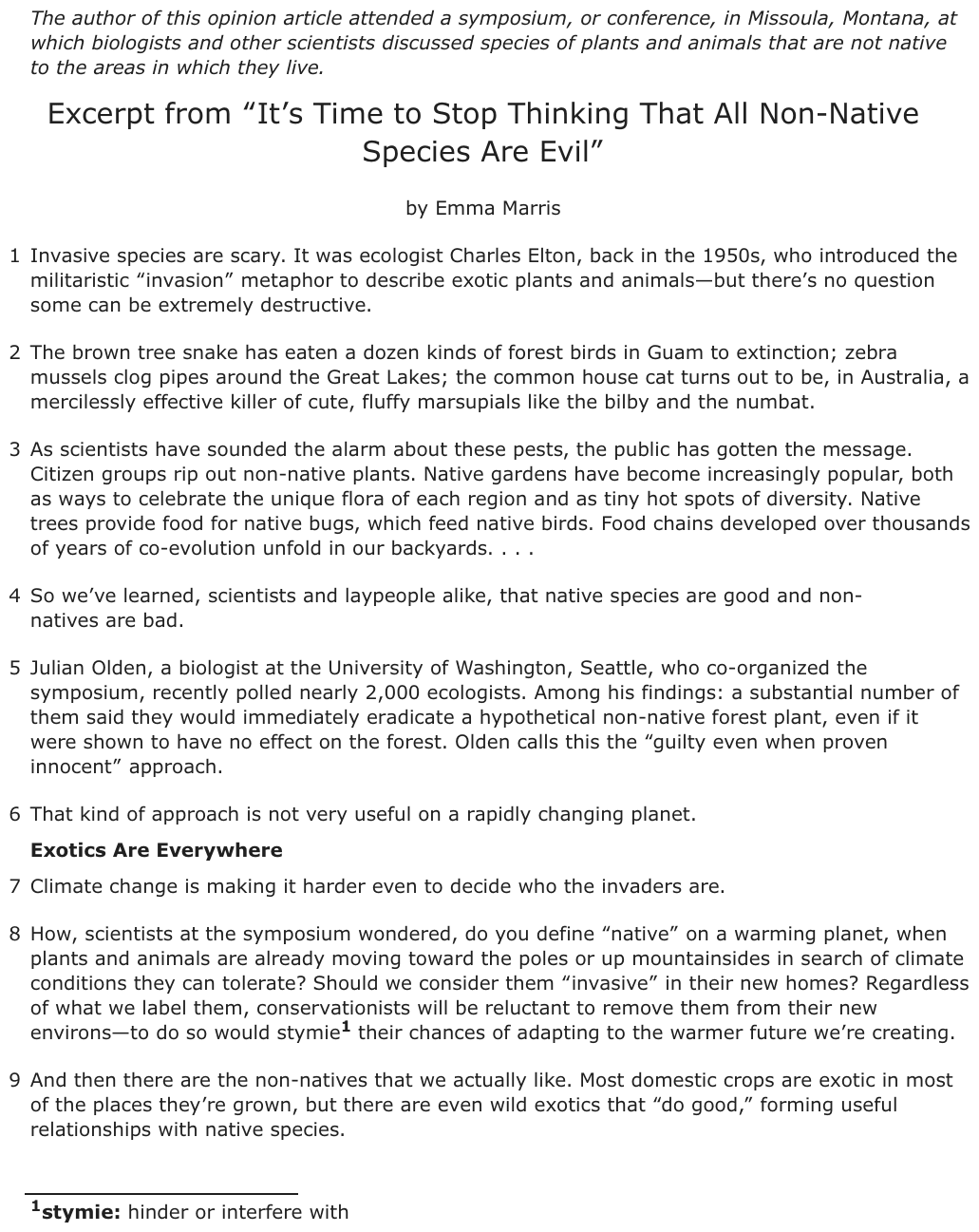
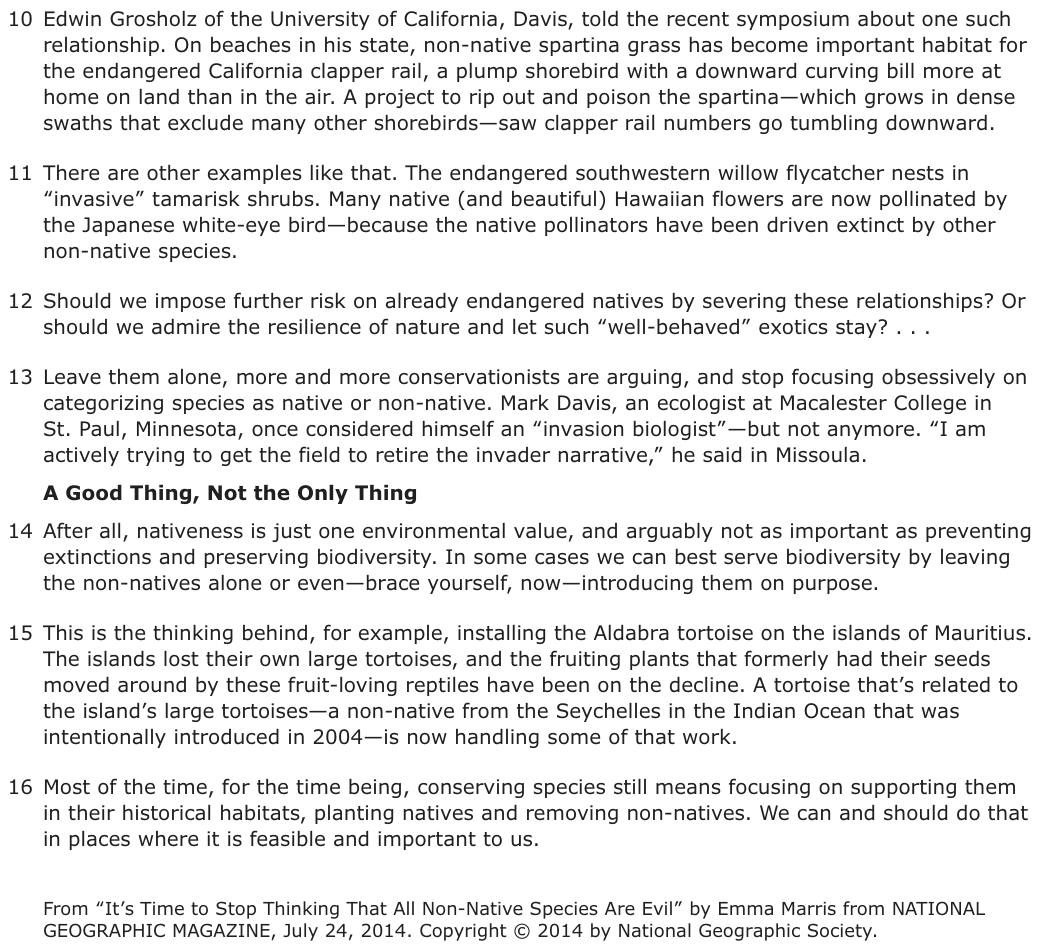
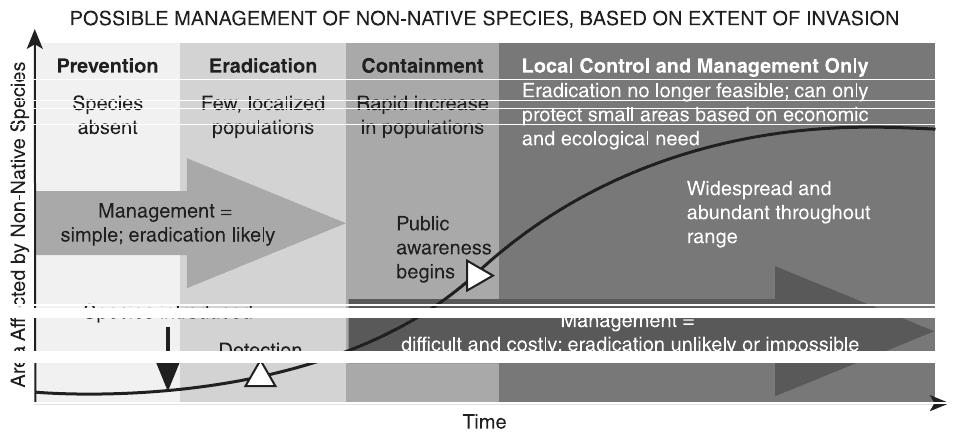
Question 11 of 36
2024 Test A Math, question 8Question
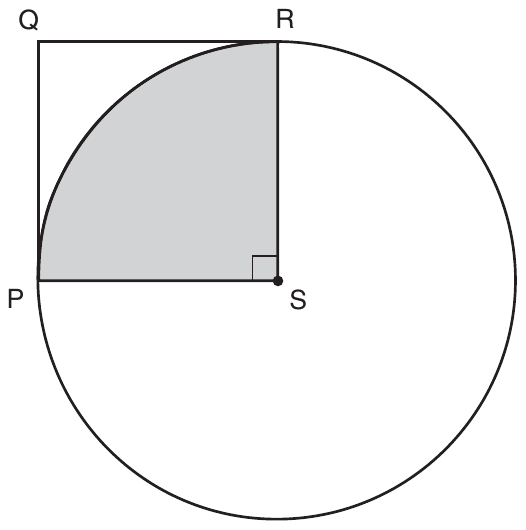
In the figure above, PQRS is a square. Point S is the center of the circle, and points P and R are on the circle. If the area of the square is 4 square centimeters, what is the area, in square centimeters, of the shaded quarter of the circle?
- A
- B
- C
- D
Show the answer
Correct answer: B
The area of square PQRS is 4 square centimeters. So
Sides PS and RS are each a radius of the circle. So the radius of the circle is 2 cm.
The shaded region is of the circle. The area of a circle is . So the area of the shaded region, in square centimeters, is
Question analysis
A geometry question with a figure: square PQRS has one corner at the center of a circle, and the quarter of the circle inside the square is shaded. Given the area of the square, students find the area of the shaded quarter circle. The key is connecting the square's side to the circle's radius.
- Grade level
- Grade 7 content, by NYS standard
- Compared with grade 7
- At grade 7 Circle area is grade 7 content, and this question adds only one linking step from the square's area to the radius. Typical grade 7 circle work gives the radius directly; here it takes one short extra inference.
- Estimated difficulty
- Straightforward: two steps or one careful reading.
- Thinking it demands
- Depth of knowledge 2, skills and concepts · mainly apply
- What makes it hard
- Reading a figure, table or graph moderate
- Something you must already know minor
- Combines ideas minor
- Solution
- 3 steps
- Reading level
- Question and choices: about grade 4, 52 words.
- Students, last 30 days
- Not enough answers yet to show (it takes 10).
Why it is hard, traps and wrong answers (shows the answer)
Why it is hard
The question chains three short facts: from the square's area to its side, from the side to the radius, and from the whole circle to a quarter of it. None is hard, but each wrong choice marks a broken link, most often the whole circle's area, which looks like a finished answer. Pointing to S as the center before computing anything settles the radius.
Reading a figure, table or graph moderate Understanding the question
The radius is never labeled: students must see that S is both a corner of the square and the circle's center, so sides PS and RS are radii. (Lesh, Post & Behr, 1987; Kirsch & Mosenthal, 1990)
Something you must already know minor Working it out
Neither the circle area formula, π times the radius squared, nor the step from a square's area to its side length is given. (Anderson & Krathwohl, 2001)
Combines ideas minor Working it out
Square and circle are linked in one chain: the area 4 gives a side of 2, the side is the radius, and the shaded part is a quarter of π × 2². (Embretson, 1998; Daniel & Embretson, 2010)
Strategy: Take the square root of the square's area to get its side, which is also the radius, then take one quarter of pi times the radius squared.
Traps
- Wrong formula: Uses a related but wrong formula: perimeter for area, diameter for radius, area for volume, or a misremembered one.
- Stops one step early: A choice is a number from partway through the solution.
- A formula you must know: Needs a formula the test does not give: area, circumference, volume, probability rules.
The wrong answers, classified
A Wrong formula (King et al., 2004)
Halves the square's side as if it were a diameter, so it uses a radius of 1, and one quarter of π × 1² gives π/4.
C Wrong formula (King et al., 2004)
Misremembers the circle's area as 2πr², blending it with the circumference 2πr, so one quarter of 2π × 2² gives 2π.
D Stops one step early (King et al., 2004; Gierl et al., 2017)
Finds the whole circle's area, π × 2² = 4π, and stops before taking the quarter that is shaded.
Worked solution, step by step
Formulas used
- Area of a square
- A is the area, the space inside. s is the length of one side, and s² means s × s. All four sides of a square are equal, so its area is side times side.
- Area of a circle
- A is the area of the whole circle. r is the radius: the distance from the center to the edge. π, called pi, is a number a little more than 3, about 3.14. Multiply π by r × r. This works for every circle.
Sort out the figure
PQRS is a square with an area of 4 sq cm. Point S is the center of the circle. Points P and R are on the circle. The shaded part is a quarter of the circle, inside the square. You need the shaded area, in square centimeters. The answer will have π in it.
Find the side of the square
Use the square formula. The area is 4, so find the number that times itself gives 4.
Each side is 2 cm long, because .
See that the side is the radius
Side SP goes from the center, S, to point P on the circle. So SP is a radius. So is side SR. The radius is 2 cm. Watch out: the side is a radius, not a diameter, the full width of the circle. Using a radius of 1 leads to , choice A.
Find the area of the whole circle
The whole circle has an area of 4π sq cm. Watch out: this is the whole circle. Stopping here gives choice D.
Take one quarter
The shaded part is one quarter of the circle, so take one quarter of 4π.
The shaded area is π sq cm. So the answer is B, .
Check your answer
π is about 3.14, so the shaded part is about 3.14 sq cm. The whole square is 4 sq cm. In the figure, the shaded part fills most of the square, but not all. So a bit less than 4 makes sense. The choice 4π is about 12.6, far too big.
More questions like this
The original DOE question
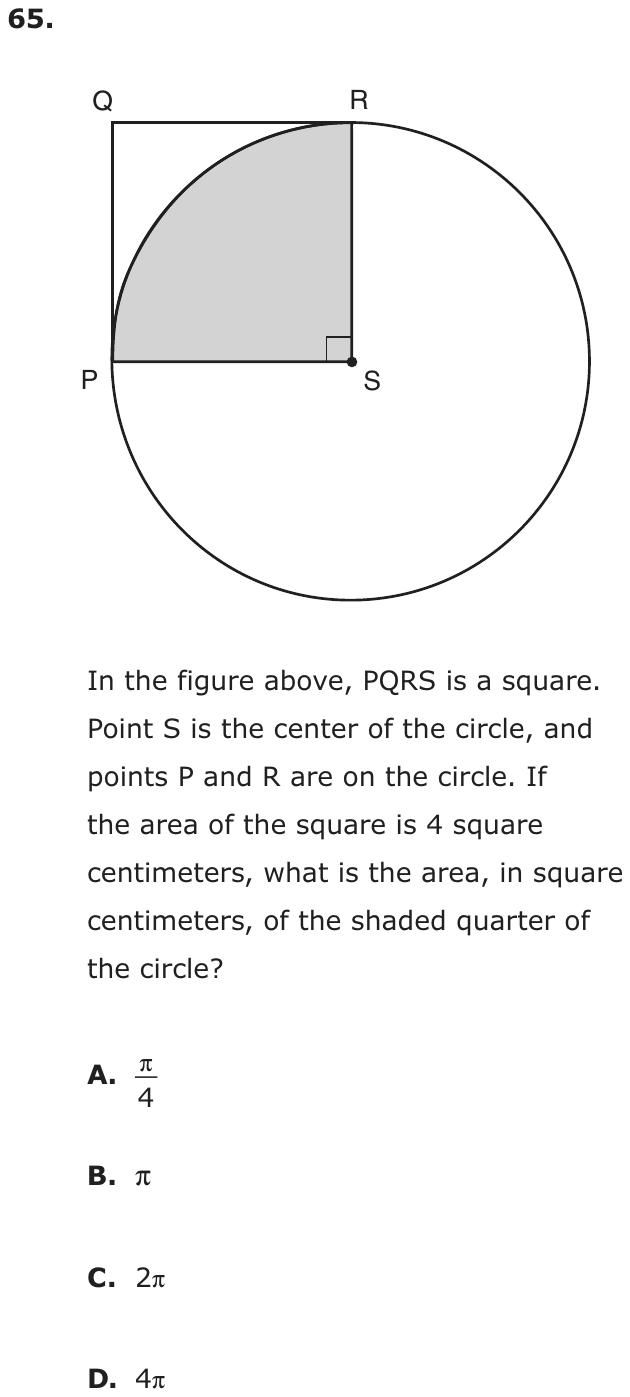
Question 12 of 36
2024 Test A Math, question 14Question
A museum has a room in the shape of a rectangle. The area of the floor is 960 square feet. In a scale drawing of the museum, 1 inch = 20 feet. If the length of the room is 2 inches in the scale drawing, what is the width of this room in the scale drawing?
- A in.
- B in.
- C24 in.
- D40 in.
Show the answer
Correct answer: A
The scale is 1 inch = 20 feet, and the length in the scale drawing is 2 inches, so the actual length is 40 feet.
The actual width is 24 feet.
Let x equal the width of the scale drawing, in inches.
Question analysis
A scale drawing problem: a museum room has a floor area of 960 square feet, the drawing's scale is 1 inch to 20 feet, and the room is 2 inches long in the drawing. Students find the room's width in the drawing. They must move between drawing inches and real feet, and back again, without mixing them.
- Grade level
- Grade 7 content, by NYS standard
- Compared with grade 7
- At grade 7 Scale drawings are grade 7 content, and grade 7 tasks usually convert one length. This one converts to real size, uses the area to find a second side, and converts back: three steps with a units trap.
- Estimated difficulty
- Moderate: several steps, or a close reading with one strong distractor.
- Thinking it demands
- Depth of knowledge 2, skills and concepts · mainly apply
- What makes it hard
- Combines ideas moderate
- Much to keep track of minor
- Solution
- 3 steps
- Reading level
- Question and choices: about grade 2, 57 words.
- Students, last 30 days
- Not enough answers yet to show (it takes 10).
Why it is hard, traps and wrong answers (shows the answer)
Why it is hard
Scale questions usually convert one length; this one needs a round trip, from the drawing to the real room and back. The real width of 24 feet appears partway through and is a choice, so students who lose track of units stop there. The last conversion, 24/20, then has to be written as a mixed number, and its fraction part is where a hurried student slips.
Combines ideas moderate Working it out
The 960 square feet is a real-world area, so the scale cannot be applied to it directly; the length must go to feet, the width come from the area, and then return to inches. (Embretson, 1998; Daniel & Embretson, 2010)
Much to keep track of minor Working it out
Four lengths in two units are in play, 2 inches, 40 feet, 24 feet and the width on the drawing, and each must stay labeled with its unit. (Sweller, 1988; Carpenter, Just & Shell, 1990)
Strategy: Convert the 2-inch length to real feet, divide the area by it to get the real width, then use the scale to change that width back to inches.
Traps
- Units or scale: The answer is wanted in other units, or a rate or scale must be converted first.
- Answers a different question: A choice is right for another quantity: the other unknown, the rest instead of the part, the part instead of the whole.
The wrong answers, classified
B An arithmetic slip (Junker & Sijtsma, 2001)
Gets the real width of 24 feet and divides by 20 correctly, but writes the remainder 4/20 as 1/4 instead of 1/5.
C Units or scale (King et al., 2004)
Finds the room's real width, 960 ÷ 40 = 24 feet, and gives it as the drawing's width without converting back at 1 inch per 20 feet.
D Answers a different question (King et al., 2004; Hegarty, Mayer & Monk, 1995)
Converts the 2-inch length to the real 40 feet and gives that number, answering for the length instead of the width and in the wrong units.
Worked solution, step by step
Formulas used
- Area of a rectangle
- A is the area, the space the floor covers. l is the length and w is the width. The floor is like rows of 1-foot squares, with w rows and l squares in each row. So you multiply.
- Using the scale
- The scale says 1 inch on the drawing stands for 20 feet in the real room. The drawing length is in inches, and the real length is in feet. To go back from feet to inches, divide by 20.
Sort out the question
The real room is a rectangle with a floor area of 960 square feet. On the drawing, 1 inch stands for 20 feet. The room is 2 inches long on the drawing. You need its width on the drawing, in inches. The area is in real feet, so you must switch between the drawing and the room.
Find the real length
The real room is 40 feet long. Watch out: 40 is the real length, not the width on the drawing. Choosing 40 in., choice D, is wrong.
Find the real width
Use the area of the rectangle. You know the area and the length.
The real room is 24 feet wide. Watch out: this width is in real feet. Choosing 24 in., choice C, skips changing it back to the drawing.
Change the width to the drawing
Every 20 feet is 1 inch on the drawing. So undo the scale: divide the real width by 20.
To simplify , divide the top and bottom by 4. Watch out: it is , not , so choice B is wrong. So the answer is A, in.
Check your answer
Go the other way. On the drawing, the room is 2 inches by inches. In real feet that is 40 by 24, since . And square feet, the real area.
More questions like this
The original DOE question
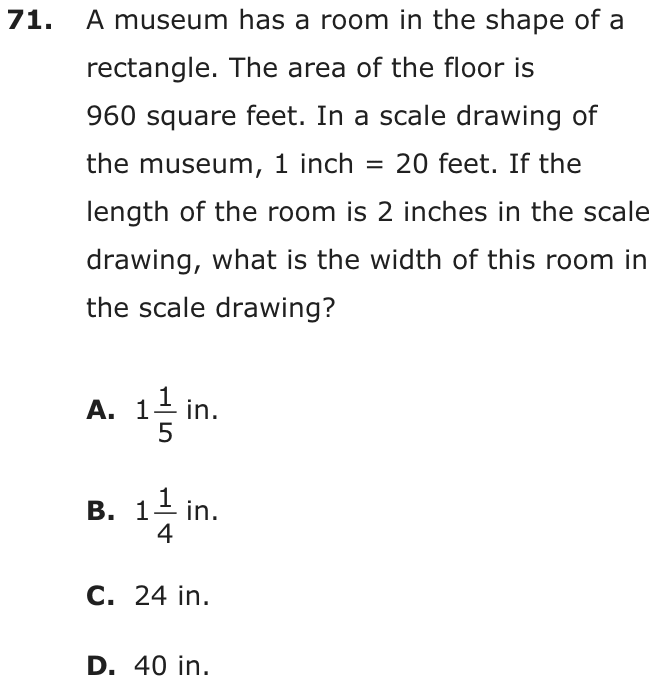
Question 13 of 36
2024 Test A Math, question 16Question
A truck rental company charges a one-time fee of $40 plus $1 per mile driven. Dalia rented a truck and used a coupon for 20% off the total rental cost. After the coupon was applied, she spent a total of $60. How many miles did she drive?
- A8
- B20
- C32
- D35
Show the answer
Correct answer: D
Let m equal the miles driven during Dalia’s rental. The total cost, c, can be expressed as an equation.
Dalia spent a total of $60, which included a 20% off coupon. Find the cost before the coupon by dividing the final cost ($60) by the percentage paid (80%):
Use $75 as the total cost to find m.
Dalia drove 35 miles.
Question analysis
A multistep word problem about a truck rental that costs a $40 fee plus $1 per mile, with a 20% off coupon applied to the total. Given that Dalia paid $60 after the coupon, students find how many miles she drove. Undoing the discount correctly before removing the fixed fee is the hard part.
- Grade level
- Grade 7 content, by NYS standard
- Compared with grade 7
- Above grade 7 Grade 7 students solve two-step equations and work with discounts, usually separately. This combines them and makes students undo a 20% discount starting from the price paid, a reversal many grade 7 students have not practised.
- Estimated difficulty
- Hard: combines ideas, needs a plan, and has more than one tempting wrong answer.
- Thinking it demands
- Depth of knowledge 2, skills and concepts · mainly apply
- What makes it hard
- Turning words into math moderate
- Combines ideas moderate
- A very close wrong answer moderate
- Solution
- 3 steps
- Reading level
- Question and choices: about grade 5, 43 words.
- Students, last 30 days
- Not enough answers yet to show (it takes 10).
Why it is hard, traps and wrong answers (shows the answer)
Why it is hard
Two ordinary skills, undoing a discount and solving a two-step equation, are stacked, and the first runs in reverse. The natural way to undo 20% off is to add 20% back, which gives $72 instead of $75 and a choice three miles from the answer. Students who check by applying the coupon to the full cost of 40 + 35 = 75 dollars see at once that 80% of it is 60.
Turning words into math moderate Understanding the question
The sentence "After the coupon was applied, she spent a total of $60" makes 60 the price after 20% off, so it is 80% of the full cost, 40 + m. (Hegarty, Mayer & Monk, 1995; Koedinger & Nathan, 2004)
Combines ideas moderate Working it out
A percent discount has to be undone before the fee-plus-mileage equation can be solved: 60 ÷ 0.8 = 75, then 75 − 40 = 35 miles. (Embretson, 1998; Daniel & Embretson, 2010)
A very close wrong answer moderate Choosing the answer
The choices 32 and 35 are three miles apart, too close to tell apart by estimate; only dividing 60 by 0.8, rather than adding 20% of 60, separates them. (Embretson & Wetzel, 1987; Gorin & Embretson, 2006; Ascalon et al., 2007)
Strategy: Since $60 is 80% of the full cost, divide 60 by 0.80 to find the cost before the coupon, then subtract the $40 fee to get the miles.
Traps
- Percent of the wrong amount: Finding the whole from a part, or a percent change measured from the wrong starting amount.
- Misreads the question: Misses or misreads a condition or a word in the question: "at least", "each", "remaining", "not".
The wrong answers, classified
A Wrong operation (Hegarty, Mayer & Monk, 1995; King et al., 2004)
Takes 20% off the $60 again, 60 × 0.8 = 48, instead of undoing the discount, then subtracts the $40 fee to get 8 miles.
B Misreads the question (Hegarty, Mayer & Monk, 1995)
Ignores the coupon and treats the $60 as the full cost, so it subtracts the $40 fee and gets 20 miles.
C Percent of the wrong amount (Parker & Leinhardt, 1995)
Undoes the coupon by adding 20% of $60 to get $72, though the 20% was taken of the larger pre-coupon cost, then subtracts the $40 fee.
Worked solution, step by step
Formulas used
- Rental cost
- c is the full cost in dollars, before any coupon. 40 is the one-time fee, paid once no matter how far you drive. m is the number of miles, and each mile costs 1 dollar.
- Price after a discount
- The full cost is the price before the discount. p is the percent taken off. You pay what is left: 100% minus p%. For 20% off you pay 80%, so you multiply by 0.80.
Sort out the question
The truck costs a $40 fee, plus $1 for each mile. Dalia’s coupon took 20% off the total. After the coupon, she paid $60. You need how many miles she drove. The $60 is the price after the discount, not the full cost.
Write what she paid
20% off means she paid what was left of the full cost.
As a decimal, 80% is 0.80.
Undo the discount
To undo times 0.80, divide by 0.80. Move the decimal point one place in both numbers to make it easier.
The full cost was $75. Watch out: the 20% was taken off the full cost, not off $60. Adding 20% of $60 gives $72 and leads to 32 miles, choice C. Taking 20% off $60 again leads to 8 miles, choice A.
Find the miles
She drove 35 miles. Watch out: do not skip the coupon. Using $60 as the full cost gives 20 miles, choice B. So the answer is D, 35.
Check your answer
Go forward. 35 miles cost $35. Add the $40 fee to get $75. The coupon takes off 20% of $75, which is dollars. Then . That is exactly what she paid.
More questions like this
The original DOE question
Question 14 of 36
2024 Test A Math, question 39Question
Raquel is cutting out pieces of cardboard to make a pyramid. She will use a square piece for the base and identical triangular pieces for the sides. The figure above shows the dimensions of the triangle for each side. What will be the total surface area, in square inches, of the pyramid, including the square base?
- A280
- B295
- C340
- D360
Show the answer
Correct answer: C
Surface area is found by calculating the area of each side, including the base, and adding them all together.
The base of the pyramid measures 10 inches on each side, so the area of the base is
Each triangular face has a base of 10 inches and a height of 12 inches, so the area of each face is
There are 4 triangular faces (because the square base has 4 edges, each of which will have a triangular face). So the total surface area of the pyramid is the sum of the areas of 4 triangles and 1 square.
So the total surface area is 340 square inches.
Question analysis
This surface area word problem shows one triangular face, with sides of 13 inches, a base of 10 inches and a height of 12 inches, that Raquel will use to build a cardboard pyramid with a square base. Students find the total area of the base and all the triangular sides. Picturing the solid and choosing the right measurements from the figure are the tricky parts.
- Grade level
- Grade 7 content, by NYS standard
- Compared with grade 7
- Above grade 7 Grade 7 students find the surface area of a pyramid from a drawn net or solid. Here only one triangular face is shown, so students must picture the whole pyramid, count its faces, and choose which labeled length belongs in the area formula.
- Estimated difficulty
- Hard: combines ideas, needs a plan, and has more than one tempting wrong answer.
- Thinking it demands
- Depth of knowledge 2, skills and concepts · mainly apply
- What makes it hard
- Reading a figure, table or graph moderate
- Combines ideas moderate
- Something you must already know minor
- Solution
- 4 steps
- Reading level
- Question and choices: about grade 6, 56 words.
- Corrected from the DOE handbook
- A wrong unit in the explanation was corrected.
- Students, last 30 days
- Not enough answers yet to show (it takes 10).
Why it is hard, traps and wrong answers (shows the answer)
Why it is hard
Students have to build the pyramid in their heads from one flat triangle, then choose the right measurement from three labels. The 13-inch sides look like the natural height, and using them gives a listed total; picturing a pyramid with three sloping faces gives another. Sketching the square base with a triangle on each edge, and marking 12 as the height, settles both the face count and the formula.
Reading a figure, table or graph moderate Understanding the question
The figure gives one triangle with three length labels, 13, 13 and 10, and puts its height, 12, on a separate arrow beside it, where it is easy to overlook. (Lesh, Post & Behr, 1987; Kirsch & Mosenthal, 1990)
Combines ideas moderate Working it out
The solid is never drawn: students must see that the square's side equals the triangle's 10-inch base, count four triangles, and add triangle and square areas. (Embretson, 1998; Daniel & Embretson, 2010)
Something you must already know minor Working it out
A triangle's area uses its perpendicular height, not a slanted side, and a pyramid on a square base has four triangular faces; neither fact is given. (Anderson & Krathwohl, 2001)
Strategy: Sketch the pyramid: a square base whose side is the triangle's base, and one triangular face on each side of the square. Find each area with the matching formula, then add them all.
Traps
- Misreads the figure: Reads a value, label or tick spacing in a figure, table or graph wrongly.
- Information you don't need: The question gives numbers or facts that play no part in the answer.
- Misunderstands the concept: A wrong belief about a concept: that percents can be added, that area grows like length, that averages can be averaged, that a bigger denominator means a bigger fraction.
The wrong answers, classified
A Misunderstands the concept (Smith, diSessa & Roschelle, 1993; De Bock et al., 1998; Ni & Zhou, 2005)
Counts only three triangular faces, as if the pyramid had a triangular base, so 3 × 60 + 100 = 280.
B Misunderstands the concept (Smith, diSessa & Roschelle, 1993; De Bock et al., 1998; Ni & Zhou, 2005)
Counts three faces and also uses the 13-inch side as each triangle's height: 3 × 65 + 100 = 295.
D Misreads the figure (Lesh, Post & Behr, 1987; Kirsch & Mosenthal, 1990)
Takes the 13-inch slanted side as each triangle's height instead of the 12-inch arrow beside it, so 4 × 65 + 100 = 360.
What was corrected from the DOE handbook, and why
- Explanation: The handbook ends “So the total surface area is 340 square feet.” The triangle’s dimensions are in inches and the question asks for square inches, so the site now reads “340 square inches.”
Worked solution, step by step
Formulas used
- Area of a triangle
- A is the area. b is the base, the side the triangle sits on. h is the height: the straight-up distance from the base to the top corner, at a right angle to the base. You take half because a triangle is half of a rectangle with the same base and height.
- Area of a square
- A is the area and s is the length of one side. All four sides of a square are equal, so the area is side times side.
- Surface area
- A face is one flat side of a solid shape. The surface area is the total area of the outside. Picture unfolding the solid into flat pieces. Then add up the area of every piece.
Sort out the question
Raquel’s pyramid has a square base. Each side is a triangle like the one in the figure. The triangle’s base is 10 in. Its two slanted sides are 13 in. Its height, the arrow beside it, is 12 in. You need the total surface area, including the square base, in square inches.
Picture the pyramid
Surface area is the total area of all the flat sides, called faces. Each triangle stands on one edge of the square. So each edge of the square is 10 inches, the same as the triangle’s base. A square has 4 edges, so the pyramid has 4 triangles.
Here that is 4 triangles plus 1 square. Watch out: counting only 3 triangles gives 280, choice A.
Find the area of one triangle
Each triangle is 60 square inches. Watch out: the height is 12 in., the straight-up arrow. It is not 13 in., the slanted side. Using 13 gives 65 for each triangle and 360 in all, choice D.
Find the area of the base
The base is a square with sides of 10 inches, the same as each triangle’s base.
The square base is 100 square inches.
Add all five faces
The four triangles and the square together cover 340 square inches.
So the answer is C, 340 square inches.
Check your answer
Each triangle is half of a 10 by 12 rectangle, which has an area of 120. So two triangles make 120, and four make 240. Add the base: . The units fit too: inches times inches gives square inches.
More questions like this
The original DOE question
Question 15 of 36
2024 Test B Math, question 3Question
The figure above shows a scale drawing of a garden, where 1 centimeter represents 2.5 meters. What is the perimeter of the actual garden in meters?
Grid-in question: work out the answer and enter it as a number.
Show the answer
Correct answer: 95
First, find the perimeter of the figure.
Two sides do not have labels. The top of the figure measures 13 cm and the bottom shows a length measuring 8 cm, so the horizontal side without a label measures 5 cm .
The left side of the figure measures 6 cm and the right side shows a length measuring 3 cm, so the vertical side without a label measures 3 cm .
So the total perimeter of the scale drawing is
Use the scale to find the perimeter of the actual garden:
Question analysis
A grid-in on a scale drawing of an L-shaped garden, where each centimeter stands for 2.5 meters and two sides carry no labels. Students find the perimeter of the drawing, then convert it to the real garden's perimeter in meters. The unlabeled sides are easy to leave out.
- Grade level
- Grade 7 content, by NYS standard
- Compared with grade 7
- At grade 7 Scale drawings are grade 7 content, and a typical task converts one or two given lengths. Here two missing sides must be worked out and the perimeter assembled before the scale applies, more steps but nothing beyond grade 7.
- Estimated difficulty
- Moderate: several steps, or a close reading with one strong distractor.
- Thinking it demands
- Depth of knowledge 2, skills and concepts · mainly apply
- What makes it hard
- Reading a figure, table or graph moderate
- Combines ideas minor
- An answer in an unexpected form minor
- Solution
- 4 steps
- Reading level
- Question and choices: about grade 9, 24 words.
- Students, last 30 days
- Not enough answers yet to show (it takes 10).
Why it is hard, traps and wrong answers (shows the answer)
Why it is hard
The figure hides the work: it labels four of the six sides, and the missing two are short pieces of the notch that are easy to overlook. Once all six are found, the scale step is a single multiplication, but it must go the right way, since the real garden is larger than the drawing. Tracing the outline and counting six sides guards against the most common loss.
Reading a figure, table or graph moderate Understanding the question
Two sides of the notch carry no labels, so students must find them from the opposite sides: 13 − 8 = 5 cm across and 6 − 3 = 3 cm down. (Lesh, Post & Behr, 1987; Kirsch & Mosenthal, 1990)
Combines ideas minor Working it out
The perimeter of an L-shaped drawing has to be joined to a scale of 2.5 meters per centimeter, two separate skills in one answer. (Embretson, 1998; Daniel & Embretson, 2010)
An answer in an unexpected form minor Choosing the answer
With no choices, nothing flags a perimeter that is missing two sides or still in centimeters; the student must check the six-sided total alone. (Enright, Morley & Sheehan, 2002)
Strategy: Use the opposite sides to work out the two unlabeled lengths, add all six sides of the drawing, then multiply the total in centimeters by 2.5 meters per centimeter.
Traps
- Misreads the figure: Reads a value, label or tick spacing in a figure, table or graph wrongly.
- Stops one step early: A choice is a number from partway through the solution.
- Wrong operation: Adds instead of multiplying, divides the wrong way round, turns a ratio or rate upside down, or undoes a step in the wrong direction (subtracts what should be added back).
The wrong answers, classified
75 Misreads the figure (Lesh, Post & Behr, 1987; Kirsch & Mosenthal, 1990)
Adds only the four labeled sides, 13 + 3 + 8 + 6 = 30 cm, and scales that to 75 m, missing the two unlabeled sides of the notch.
38 Stops one step early (King et al., 2004; Gierl et al., 2017)
Finds the drawing's perimeter, 38 cm, correctly and grids it without applying the scale of 2.5 meters per centimeter.
15.2 Wrong operation (Hegarty, Mayer & Monk, 1995; King et al., 2004)
Divides the 38 cm perimeter by 2.5 instead of multiplying, shrinking the garden though each centimeter of the drawing stands for 2.5 meters.
Worked solution, step by step
Formulas used
- Perimeter
- P is the perimeter, the distance all the way around a shape. Add the length of every side, once each. It works for any shape with straight sides, even one with a corner cut out.
- Using a scale
- s is the scale, the number of meters that 1 centimeter on the drawing stands for. Here s is 2.5. Each centimeter on the drawing is 2.5 meters in real life, so you multiply.
Sort out what you know
The figure is a scale drawing, a small copy of the real garden. Each 1 cm on the drawing stands for 2.5 m in the real garden. You need the perimeter of the real garden in meters. The perimeter is the distance all the way around.
The shape has 6 sides. Four are labeled: 13 cm, 3 cm, 8 cm and 6 cm. The two sides around the cut-out corner have no labels.
Find the missing side across
Look at the top side, 13 cm. Below it, the bottom side (8 cm) and the short unlabeled side across the notch together reach just as far. So the missing side is the difference.
The missing side across is 5 cm.
Find the missing side going down
Now look at the left side, 6 cm. On the right, the 3 cm side and the unlabeled side going down together make the same height.
The missing side going down is 3 cm.
Add all six sides
The perimeter of the drawing is 38 cm. Watch out: adding only the four labeled sides gives 30 cm. That leads to the wrong answer 75.
Change to real meters
Each centimeter stands for 2.5 meters, so multiply by 2.5.
Here and . The real perimeter is 95 meters. Watch out: 38 is still in centimeters, so do not grid it. Dividing by 2.5 gives 15.2, which makes the garden smaller than its drawing.
So you would grid 95.
Check your answer
Slide the two notch sides out to the corner. The distance around stays the same, so it equals a 13 cm by 6 cm rectangle: . Also, 95 meters is more than 38, which fits, because each centimeter stands for more than 1 meter.
More questions like this
The original DOE question
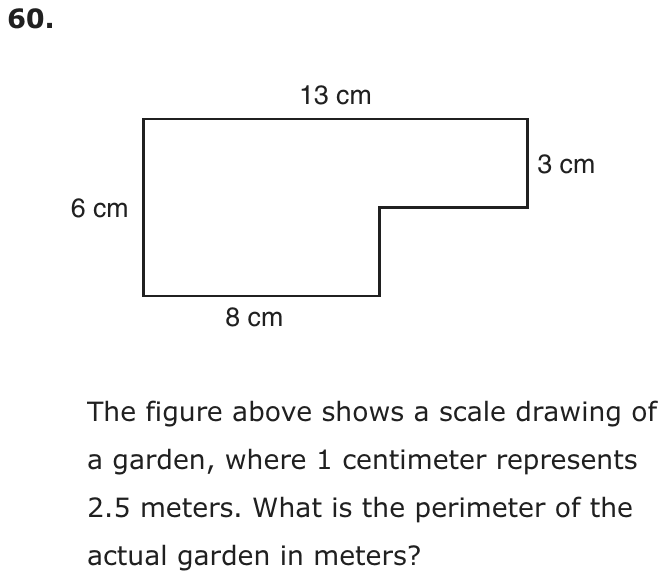
Question 16 of 36
2024 Test B Math, question 14Question
Karen reads at the rate of 60 pages per day. Martina reads 25% more pages per day than Karen. If the two students begin 1,500-page reading assignments on the same day, how many days sooner will Martina complete the assignment than Karen?
- A4
- B5
- C7
- D15
Show the answer
Correct answer: B
First, determine the rate at which Martina reads, in pages per day, using the rate at which Karen reads, 60 pages per day.
Next, determine the number of days it will take each person to complete the 1,500-page reading assignment.
Karen:
Martina:
Finally, determine the difference between the two numbers of days.
So Martina will complete the assignment 5 days sooner than Karen.
Question analysis
A reading-rate word problem: Karen reads 60 pages a day, and Martina reads 25% more pages a day. Both start a 1,500-page assignment on the same day, and students find how many days sooner Martina finishes. It combines a percent increase with rates and times, and asks for a difference in days.
- Grade level
- Grade 7 content, by NYS standard
- Compared with grade 7
- Above grade 7 Grade 7 percent problems usually stop after one increase or decrease. This one turns the percent into a new rate, finds two finishing times and compares them, four steps that go beyond a typical grade 7 task.
- Estimated difficulty
- Hard: combines ideas, needs a plan, and has more than one tempting wrong answer.
- Thinking it demands
- Depth of knowledge 2, skills and concepts · mainly apply
- What makes it hard
- Many steps moderate
- Combines ideas moderate
- Turning words into math minor
- Solution
- 4 steps
- Reading level
- Question and choices: about grade 6, 40 words.
- Students, last 30 days
- Not enough answers yet to show (it takes 10).
Why it is hard, traps and wrong answers (shows the answer)
Why it is hard
Each step is easy on its own; the difficulty is in carrying the chain to the end. Three of the choices are numbers a student meets or makes along the way: the extra pages per day, a quotient of two rates, or a rate built on 25 pages instead of 25%. Writing both finishing times down before subtracting keeps the target, a number of days, in view.
Many steps moderate Working it out
Four operations chain together: 25% of 60, Martina's 75 pages, the two finishing times 1,500 ÷ 60 and 1,500 ÷ 75, and finally their difference. (Daniel & Embretson, 2010; Enright, Morley & Sheehan, 2002)
Combines ideas moderate Working it out
A percent increase in a daily rate has to be turned into a change in days, and 25% more pages a day does not mean 25% fewer days. (Embretson, 1998; Daniel & Embretson, 2010)
Turning words into math minor Understanding the question
“25% more pages per day than Karen” makes Martina's rate 1.25 × 60, and “how many days sooner” asks for a difference of two times, not of two rates. (Hegarty, Mayer & Monk, 1995; Koedinger & Nathan, 2004)
Strategy: Increase 60 by 25% to get Martina's daily pages, divide 1,500 by each girl's daily rate to get her number of days, then subtract the two numbers of days.
Traps
- Stops one step early: A choice is a number from partway through the solution.
- Misunderstands the concept: A wrong belief about a concept: that percents can be added, that area grows like length, that averages can be averaged, that a bigger denominator means a bigger fraction.
- Numbers taken from the question: Combines the numbers in the question without a model of the situation, or is simply a number that appears in the question.
The wrong answers, classified
A Numbers taken from the question (Hegarty, Mayer & Monk, 1995)
Divides Karen's 60 pages a day by Martina's 15 extra pages a day, combining two rates without finding how long either girl takes.
C Misunderstands the concept (Smith, diSessa & Roschelle, 1993; De Bock et al., 1998; Ni & Zhou, 2005)
Adds 25 pages instead of 25%, giving Martina 85 pages a day, so she needs 1,500 ÷ 85 ≈ 17.6, or 18 days, and 25 − 18 = 7.
D Stops one step early (King et al., 2004; Gierl et al., 2017)
Finds that Martina reads 25% of 60 = 15 more pages each day and stops there, giving a number of pages instead of days.
Worked solution, step by step
Formulas used
- Percent increase
- Old is the starting amount, and p is the percent it grows by. First find p percent of the old amount. That is the extra. Then add the extra to the old amount to get the new amount.
- Time from a rate
- Total pages is the whole assignment. Pages per day is how fast someone reads. Dividing tells how many days of reading fit into the whole job.
Sort out what you know
Karen reads 60 pages per day. Martina reads 25% more pages per day than Karen. Each girl must read 1,500 pages. You need how many days sooner Martina finishes. That is the difference between their numbers of days.
Find Martina’s pages per day
25% more means Karen’s 60 pages plus 25% of 60.
Martina reads 75 pages per day. Watch out: 15 is extra pages, not days. Stopping here gives 15, choice D. Adding 25 pages instead of 25% gives 85 pages and leads to 7, choice C.
Find each girl’s number of days
Divide the whole assignment by each girl’s pages per day.
Karen needs 25 days, and Martina needs 20 days.
Subtract the days
“How many days sooner” asks for the difference.
Martina finishes 5 days sooner. Watch out: dividing 60 by 15 mixes two rates and gives 4, choice A.
So the answer is B, 5.
Check your answer
Multiply back. Karen: pages. Martina: pages. Both read all 1,500 pages, and 25 days is 5 days more than 20 days.
More questions like this
The original DOE question
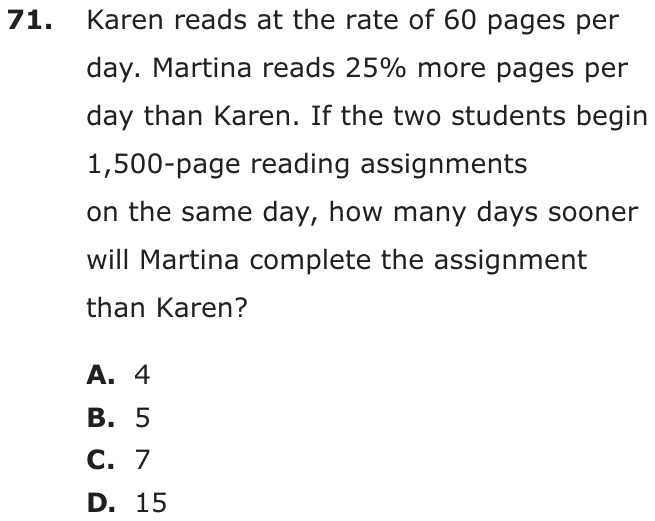
Question 17 of 36
2024 Test B Math, question 17Question
A bowl contains 12 green candies, 4 yellow candies, and some red candies. The probability of choosing a green candy at random is twice as great as the probability of choosing a red candy at random. What is the probability of choosing a yellow candy at random?
- A
- B
- C
- D
Show the answer
Correct answer: A
The probability of choosing a green candy is twice as great as the probability of choosing a red candy. There are 12 green candies. Let r = the number of red candies.
So there are 6 red candies. 12 green candies + 4 yellow candies + 6 red candies = 22 total candies.
There are 4 yellow candies out of a total of 22 candies. So the probability of choosing a yellow candy is
.
Question analysis
A probability question about a bowl of 12 green candies, 4 yellow candies and an unknown number of red ones. A green candy is twice as likely to be picked as a red one, and students find the chance of picking a yellow candy. The missing red count has to be worked out before any probability can be found.
- Grade level
- Grade 6 content, by NYS standard
- Compared with grade 7
- Above grade 7 Simple probability is grade 6 content in New York, and grade 7 problems usually give every count. Working backward from a comparison of two probabilities to a missing count, then forward to a third probability, is more than typical grade 7 work.
- Estimated difficulty
- Hard: combines ideas, needs a plan, and has more than one tempting wrong answer.
- Thinking it demands
- Depth of knowledge 2, skills and concepts · mainly apply
- What makes it hard
- Turning words into math moderate
- Combines ideas moderate
- Solution
- 3 steps
- Reading level
- Question and choices: about grade 7, 49 words.
- Students, last 30 days
- Not enough answers yet to show (it takes 10).
Why it is hard, traps and wrong answers (shows the answer)
Why it is hard
The question withholds the red count, and everything depends on recovering it from the comparison of probabilities. Students who cannot make that step tend to leave red out altogether, while those who find 6 red candies can still slip at the end by using the wrong total or the wrong color. Writing all three counts and the total of 22 before forming any fraction prevents both endings.
Turning words into math moderate Understanding the question
“Twice as great as the probability of choosing a red candy” must become 12 = 2 × the red count, which works only because both probabilities share one total. (Hegarty, Mayer & Monk, 1995; Koedinger & Nathan, 2004)
Combines ideas moderate Working it out
An unknown count has to be found from a ratio before any probability can be written, joining proportional reasoning with probability as a part over the total. (Embretson, 1998; Daniel & Embretson, 2010)
Strategy: Turn twice as likely into a statement about numbers of candies to find the red count, add all three colors for the total, then put the yellow count over that total and simplify.
Traps
- Answers a different question: A choice is right for another quantity: the other unknown, the rest instead of the part, the part instead of the whole.
- Numbers taken from the question: Combines the numbers in the question without a model of the situation, or is simply a number that appears in the question.
The wrong answers, classified
B Misunderstands the concept (Smith, diSessa & Roschelle, 1993; De Bock et al., 1998; Ni & Zhou, 2005)
Finds the 6 red candies but compares the 4 yellow with the 18 green and red ones, 4/18, a part-to-part ratio instead of part to whole.
C Numbers taken from the question (Hegarty, Mayer & Monk, 1995)
Leaves out the red candies, whose number is not given, and divides the 4 yellow by the 16 green and yellow candies.
D Answers a different question (King et al., 2004; Hegarty, Mayer & Monk, 1995)
Finds the 6 red candies and the total of 22 correctly but gives the chance of red, 6/22 = 3/11, instead of yellow.
Worked solution, step by step
Formulas used
- Probability
- P is the probability, the chance that something happens. The top is how many candies are the kind you want. The bottom is how many candies there are in all. Each candy is just as likely to be picked, so this fraction gives the chance.
Sort out what you know
The bowl has 12 green candies, 4 yellow candies and some red candies. You are not told how many are red. Let r be the number of red candies.
The chance of picking green is twice the chance of picking red. You need the probability (the chance) of picking yellow.
Compare green and red
Write each chance with the probability formula.
Green and red have the same bottom number, the total number of candies. So if the chance of green is twice the chance of red, there are twice as many green candies as red ones.
Find the red candies and the total
There are 6 red candies. Now add up all the candies.
There are 22 candies in all. Watch out: do not leave out the red candies just because their number was not given. Using 16 as the total gives 1/4, choice C.
Find the chance of yellow
There are 4 yellow candies out of 22.
Divide the top and the bottom by 2 to simplify. Watch out: the question asks for yellow, not red. 6/22 = 3/11 is the chance of red, choice D. The bottom must be all 22 candies. Using 18 gives 2/9, choice B.
So the answer is A, .
Check your answer
Check the clue. The chance of green is , and the chance of red is . Twelve is twice 6, so green is twice as likely. Also, the three chances add up to 1: .
More questions like this
The original DOE question
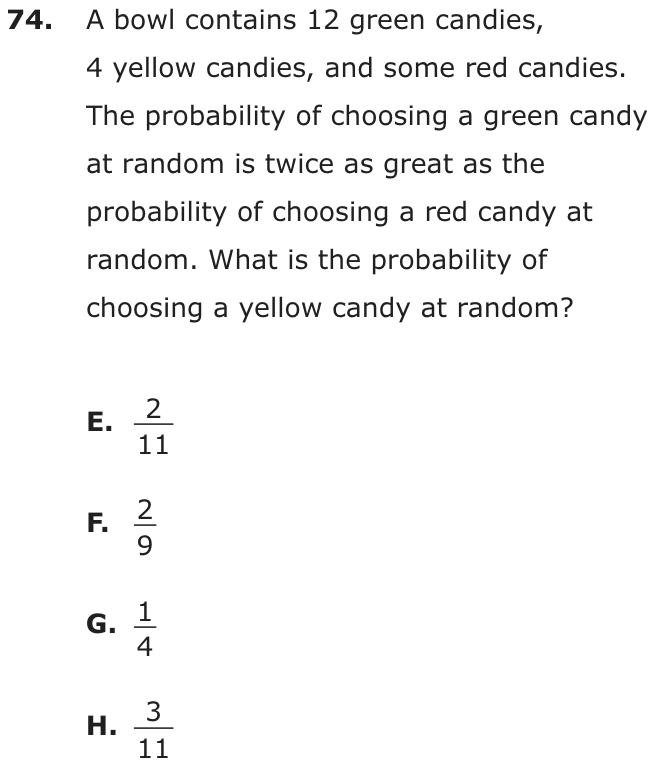
Question 18 of 36
2024 Test B Math, question 56Question
A rectangular field had a length of 80 meters and a width of 50 meters. The field was recently enlarged, with the length increased by 15% and the width increased by 10 meters. By what percentage was the area of the field increased?
- A26.5%
- B35%
- C38%
- D42.5%
Show the answer
Correct answer: C
The original area of the field was 4,000 square meters.
When the field was enlarged, the length increased by 15%, so the new length is 92 meters.
The width increased by 10 meters, so the new width is 60 meters.
The new area of the field is 5,520 square meters.
The percent increase is found by finding the difference between the two areas and dividing the increase by the original area.
Question analysis
A rectangular field 80 meters long and 50 meters wide has its length increased by 15 percent and its width by 10 meters. Students find the percent by which the field's area grew. It tests percent increase with rectangle area, and the tricky part is that one side changes by a percent and the other by a fixed length.
- Grade level
- Grade 7 content, by NYS standard
- Compared with grade 7
- Above grade 7 Grade 7 percent problems usually apply one percent change to one quantity. This changes a length by a percent and a width by a fixed amount, then asks for the percent change in area, a five-step chain with two kinds of change.
- Estimated difficulty
- Hard: combines ideas, needs a plan, and has more than one tempting wrong answer.
- Thinking it demands
- Depth of knowledge 2, skills and concepts · mainly apply
- What makes it hard
- Combines ideas moderate
- Many steps moderate
- A very close wrong answer minor
- Solution
- 5 steps
- Reading level
- Question and choices: about grade 6, 39 words.
- Students, last 30 days
- Not enough answers yet to show (it takes 10).
Why it is hard, traps and wrong answers (shows the answer)
Why it is hard
Each step is ordinary, but the two changes are stated in different units, one a percent and one in meters, which tempts students to force them into the same form. Adding the two percents is the most natural shortcut and lands close to the right value, because it misses only the small extra area where both changes overlap. Computing the old and new areas directly is slower but leaves nothing to chance.
Combines ideas moderate Working it out
Percent change has to be combined with area: the length grows by a percent and the width by meters, and the question asks for the percent change of their product. (Embretson, 1998; Daniel & Embretson, 2010)
Many steps moderate Working it out
Five computations are chained: the new length 92, the new width 60, the areas 4,000 and 5,520, and the increase 1,520 as a share of 4,000. (Daniel & Embretson, 2010; Enright, Morley & Sheehan, 2002)
A very close wrong answer minor Choosing the answer
The 35% from adding 15% and 20% sits only 3 points below 38%, so a rough estimate of the new area cannot rule it out. (Embretson & Wetzel, 1987; Gorin & Embretson, 2006; Ascalon et al., 2007)
Strategy: Compute the new length and the new width, find the old and new areas, and divide the increase in area by the original area.
Traps
- Misunderstands the concept: A wrong belief about a concept: that percents can be added, that area grows like length, that averages can be averaged, that a bigger denominator means a bigger fraction.
- Units or scale: The answer is wanted in other units, or a rate or scale must be converted first.
The wrong answers, classified
A Units or scale (King et al., 2004)
Treats the 10-meter widening as a 10% increase, so multiplies 1.15 × 1.10 = 1.265 and reports a 26.5% rise.
B Misunderstands the concept (Smith, diSessa & Roschelle, 1993; De Bock et al., 1998; Ni & Zhou, 2005)
Adds the length's 15% to the width's 20% increase, as if percent increases in two dimensions simply add, missing the 3% where they overlap.
D Units or scale (King et al., 2004)
Treats the 15% as 15 meters, making the field 95 by 60 meters, an area of 5,700 square meters and a 42.5% increase.
Worked solution, step by step
Formulas used
- Area of a rectangle
- A is the area, the flat space inside. l is the length and w is the width. Multiplying counts how many unit squares fit, row by row.
- Percent increase
- old is the starting amount, and new is the amount after. new − old is how much it grew. Dividing by old compares the growth with the start. Multiplying by 100 turns that into a percent.
Sort out the question
The field was 80 meters long and 50 meters wide. The length grew by 15%, a percent. The width grew by 10 meters, a number of meters. These are two different kinds of increase.
You need the percent by which the area grew.
Find the old area
You need the old area to compare with the new one.
The old field covered 4,000 square meters.
Find the new length and width
15% of 80 is . So the new length is meters.
The new width is meters.
Watch out: 10 meters is not 10%. Treating it as 10% leads to 26.5%, choice A. Treating 15% as 15 meters leads to 42.5%, choice D.
Find the new area
Multiply the new length by the new width.
The new field covers 5,520 square meters. That is square meters more.
Find the percent increase
The area grew by 38%. Watch out: The width grew by 20%, since 10 is 20% of 50. Adding 15% + 20% = 35% gives choice B. That misses the extra corner piece where both new strips meet.
So the answer is C, 38%.
Check your answer
Use growth factors. The length is multiplied by 1.15. The width goes from 50 to 60, so it is multiplied by 1.2. The area is multiplied by , which is 38% more.
More questions like this
The original DOE question
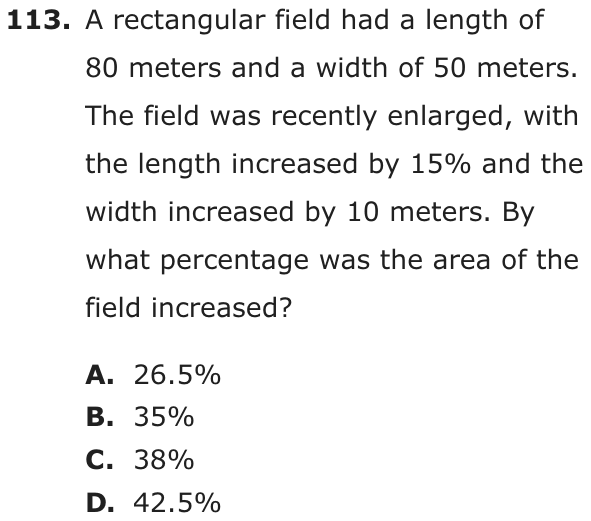
Question 19 of 36
2023 Test A Math, question 25Question
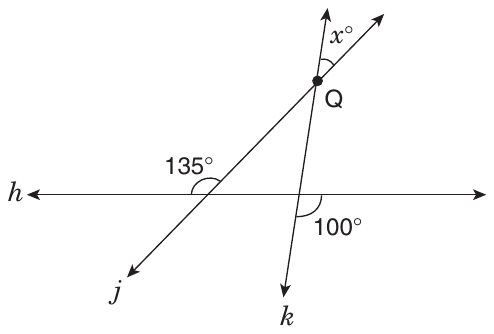
Lines j and k intersect at point Q, and h is a straight line. What is the value of x?
- A55
- B45
- C35
- D30
Show the answer
Correct answer: C
First, find the measures of the three angles inside the triangle. The lower left angle is supplementary to the one marked 135°, so the measure of that angle is . The angle on top is a vertical angle with the one marked x°, so the measure of that angle is also x°. The angle on the lower right is a vertical angle with the one marked 100°, so the measure of that angle is also 100°. Since the measures of the three interior angles of a triangle sum to 180°, set up an equation and solve for x:
Question analysis
Lines j and k cross at point Q above a straight line h, forming a triangle, with a 135° angle marked where j meets h and a 100° angle where k meets h. Students find the angle x at Q. Each marked angle lies outside the triangle, so it has to be turned into an inside angle before the triangle's angle sum can be used.
- NYS standards
- Grade level
- Grade 8 content, by NYS standard
- Compared with grade 7
- Above grade 7 Grade 7 students use supplementary and vertical angles to find unknown angles. This figure needs both, applied at three different vertices, plus the angle sum of a triangle, which New York teaches in grade 8.
- Estimated difficulty
- Hard: combines ideas, needs a plan, and has more than one tempting wrong answer.
- Thinking it demands
- Depth of knowledge 2, skills and concepts · mainly apply
- What makes it hard
- Reading a figure, table or graph major
- Combines ideas moderate
- Something you must already know minor
- Solution
- 4 steps
- Reading level
- Question and choices: about grade 2, 20 words.
- Students, last 30 days
- Not enough answers yet to show (it takes 10).
Why it is hard, traps and wrong answers (shows the answer)
Why it is hard
Every angle the solution needs has to be carried into the triangle from outside, and the two marked angles need different treatment. The 135° is supplementary to the triangle's angle, but the 100° is vertical to it, so subtracting both from 180° out of habit builds the wrong triangle. Checking which side of each line a marked angle sits on, not just how near the triangle it is, separates the two cases.
Reading a figure, table or graph major Understanding the question
None of the three marked angles is inside the triangle formed by h, j and k: the 135° is outside on the left, the 100° is below line h, and x is above Q. (Lesh, Post & Behr, 1987; Kirsch & Mosenthal, 1990)
Combines ideas moderate Working it out
Two different angle facts are needed: the 135° gives a supplementary interior angle of 45°, while the 100° and x carry into the triangle unchanged as vertical angles. (Embretson, 1998; Daniel & Embretson, 2010)
Something you must already know minor Working it out
Supplementary angles, vertical angles and the triangle's 180° sum are all assumed, and the question names none of them. (Anderson & Krathwohl, 2001)
Strategy: Mark the three angles of the triangle formed by lines h, j and k: one is supplementary to 135°, one is vertical to 100°, and the one at Q is vertical to x°.
Traps
- Misreads the figure: Reads a value, label or tick spacing in a figure, table or graph wrongly.
- Stops one step early: A choice is a number from partway through the solution.
The wrong answers, classified
A Misreads the figure (Lesh, Post & Behr, 1987; Kirsch & Mosenthal, 1990)
Takes the triangle's angle at line k as 180 − 100 = 80, the supplement of the marked angle instead of its vertical angle, so x = 180 − 45 − 80 = 55.
B Stops one step early (King et al., 2004; Gierl et al., 2017)
Finds the triangle's angle where line j meets h, 180 − 135 = 45, and gives it instead of going on to the angle at Q.
D Little reason to choose it (Haladyna & Downing, 1993; Rodriguez, 2005)
No angle fact in the figure gives 30, and the angle at Q is drawn close to its true size, so this choice mostly catches guesses.
Worked solution, step by step
Formulas used
- Angles on a straight line
- a and b are two angles side by side on a straight line. Together they make a half turn, a straight angle. So they add up to 180°. Angles like this are called supplementary.
- Vertical angles
- When two lines cross, they make an X. The angles straight across from each other in the X are called vertical angles. a and b are one such pair. They are always equal, because each one plus the angle between them makes a straight line.
- Angles of a triangle
- A, B and C are the three angles inside any triangle, in degrees. They always add up to 180°. Use it when you know two of the angles and need the third.
Sort out the figure
Lines h, j and k make a triangle. Its corners are where j crosses h, where k crosses h, and point Q. The figure marks two angles outside the triangle, 135° and 100°. You need x, the angle marked above Q.
Find the angle where j crosses h
The 135° angle is above h and to the left of j. The triangle’s angle is right next to it, on the other side of j. Together they make the straight line h. Call the triangle’s angle a.
So that corner of the triangle is 45°. Watch out: this is only one corner, not x. Stopping here gives 45, choice B.
Find the angle where k crosses h
The 100° angle is below h and to the right of k. The triangle’s angle is above h and to the left of k. Lines h and k make an X there, and these two angles are straight across from each other. They are vertical angles, so the triangle’s angle is 100°. Watch out: it is not 180 − 100 = 80. That angle is beside the 100°, not across from it. Using 80 gives 55, choice A.
Find the angle at Q
The x° angle is above Q, between the top parts of lines j and k. The triangle’s angle at Q is between the parts of j and k below Q. These two angles are straight across from each other. So they are vertical angles, and the triangle’s angle at Q is also x°.
Use the triangle’s angle sum
The three angles of the triangle must add up to 180°. Only x is unknown. So the answer is C, 35.
Check your answer
Add the triangle’s three angles: . Also, the angle at Q looks narrow in the figure, much less than a right angle of 90°. 35° fits that.
More questions like this
The original DOE question
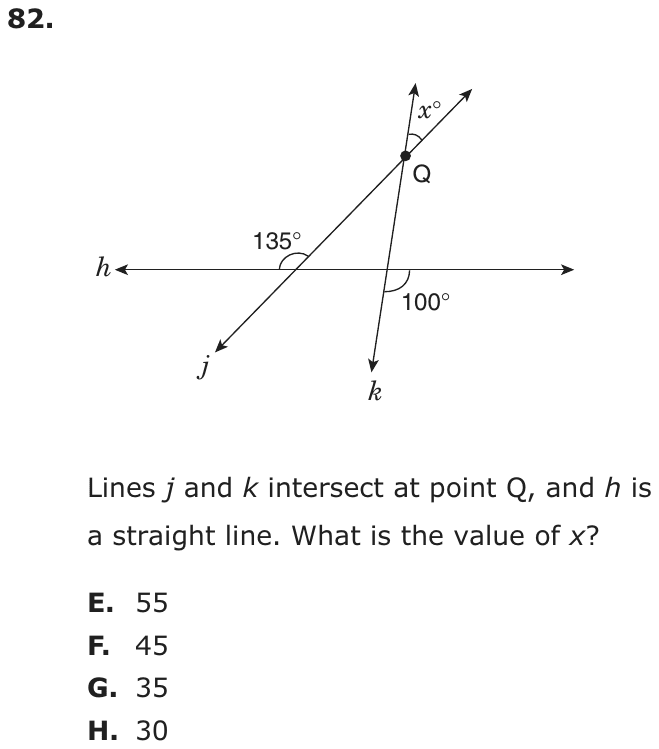
Question 20 of 36
2023 Test A Math, question 28Question
It took Lars 2 hours to ride his bicycle 48 kilometers. What was his average speed in miles per hour? (Use the approximation 1 mile = 1.6 kilometers.)
- A1.5
- B15.0
- C30.0
- D38.4
Show the answer
Correct answer: B
First, calculate Lars’s average speed in kilometers per hour:
Then, convert kilometers to miles:
| Cross multiply. | |
| Apply the multiplicative inverse property; divide both sides of the equation by 1.6. | |
Question analysis
Lars rides 48 kilometers in 2 hours, and this rate question asks for his average speed in miles per hour, using 1 mile = 1.6 kilometers. Students find a unit rate and convert it to other units. Deciding whether to multiply or divide by 1.6, and remembering the 2 hours, are where students go wrong.
- Grade level
- Grade 6 content, by NYS standard
- Compared with grade 7
- Below grade 7 Finding a speed and converting units with a given rate are grade 6 ratio skills. The question takes two short steps with friendly numbers, lighter than typical grade 7 rate problems with fractional quantities.
- Estimated difficulty
- Straightforward: two steps or one careful reading.
- Thinking it demands
- Depth of knowledge 2, skills and concepts · mainly apply
- What makes it hard
- Combines ideas minor
- Error-prone arithmetic minor
- Solution
- 2 steps
- Reading level
- Question and choices: about grade 7, 23 words.
- Students, last 30 days
- Not enough answers yet to show (it takes 10).
Why it is hard, traps and wrong answers (shows the answer)
Why it is hard
The question tests the direction of a conversion more than the arithmetic. A mile is longer than a kilometer, so a distance has fewer miles than kilometers, and multiplying by 1.6 runs the conversion backward. The other trap is converting the 48 kilometers to 30 miles and forgetting that the ride took 2 hours, which gives a distance instead of a speed.
Combines ideas minor Working it out
A rate and a unit conversion are combined: 48 ÷ 2 = 24 kilometers per hour, then 24 ÷ 1.6 = 15 miles per hour, and the two steps can come in either order. (Embretson, 1998; Daniel & Embretson, 2010)
Error-prone arithmetic minor Working it out
Dividing by 1.6 means dividing 240 by 16; a decimal point in the wrong place makes the speed ten times too small, and that value is offered. (Brown & Burton, 1978; Junker & Sijtsma, 2001)
Strategy: Find the speed in kilometers per hour first, then divide by 1.6, since a mile is longer than a kilometer and the number of miles must be smaller.
Traps
- Wrong operation: Adds instead of multiplying, divides the wrong way round, turns a ratio or rate upside down, or undoes a step in the wrong direction (subtracts what should be added back).
- Stops one step early: A choice is a number from partway through the solution.
- An arithmetic slip: The right method with a plausible arithmetic error: a digit, a place value or a times-table fact.
The wrong answers, classified
A An arithmetic slip (Junker & Sijtsma, 2001)
Divides 24 by 16 instead of 1.6, a decimal point in the wrong place that makes the speed ten times too small, 1.5.
C Stops one step early (King et al., 2004; Gierl et al., 2017)
Converts the 48 kilometers to 30 miles correctly and stops, forgetting to divide by the 2 hours, so it gives a distance rather than a speed.
D Wrong operation (Hegarty, Mayer & Monk, 1995; King et al., 2004)
Multiplies 24 kilometers per hour by 1.6 instead of dividing, converting in the wrong direction and getting more miles than kilometers.
Worked solution, step by step
Formulas used
- Average speed
- Distance is how far you go. Time is how long it takes. Speed is how far you go in each unit of time, such as each hour. Average speed shares the whole trip out evenly over the time.
- Kilometers to miles
- A kilometer is a unit of length used in most countries. 1 mile is about 1.6 kilometers, so a mile is longer. To find how many miles, find how many groups of 1.6 kilometers fit. So divide by 1.6.
Sort out the question
Lars rode 48 kilometers in 2 hours. You need his average speed in miles per hour. That means miles, not kilometers. Use the fact that 1 mile is about 1.6 kilometers.
Find the speed in kilometers per hour
Divide the distance by the time.
Lars went 24 kilometers each hour. This speed is still in kilometers, so you are not done yet.
Change kilometers to miles
Divide by 1.6. To make it easier, multiply both numbers by 10 first. Then you divide by the whole number 16.
Watch out: divide by 1.6, don’t multiply. A mile is longer, so there are fewer miles than kilometers. is choice D. Dividing 24 by 16 gives 1.5, choice A, with the decimal point in the wrong place.
Name the answer
Lars rode 15 miles each hour. Watch out: changing 48 kilometers to 30 miles is only part of the work. 30 is a distance, choice C. You still have to divide by the 2 hours. So the answer is B, 15.0 miles per hour.
Check your answer
Work backward. At 15 miles per hour for 2 hours, Lars rides 30 miles. And kilometers, the distance in the question. Also, 15 is smaller than 24, as it should be, since miles are longer than kilometers.
More questions like this
The original DOE question
Question 21 of 36
2023 Test A Math, question 37Question
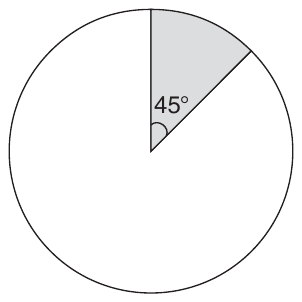
The shaded sector of the circle shown above has an area of square feet. What is the circumference of the circle?
- A ft
- B ft
- C ft
- D ft
Show the answer
Correct answer: B
The area of the entire circle is .
The fraction of the circle that is shaded is . So, the area of the sector is . Use that information to find r:
Use r to calculate the circumference of the circle:
The circumference is feet.
Question analysis
This circle question shows a shaded 45° sector with an area of 18π square feet and asks for the circumference of the whole circle. Students work backward: from the sector to the full area, from the area to the radius, and from the radius to the circumference. Mixing up area and circumference, or stopping partway, gives wrong choices.
- Grade level
- Grade 7 content, by NYS standard
- Compared with grade 7
- Above grade 7 Grade 7 circle problems usually give the radius and ask for area or circumference. This one runs backward from the area of a 45° sector, needing the sector's share of the circle, a square root and a switch to circumference: four linked steps.
- Estimated difficulty
- Hard: combines ideas, needs a plan, and has more than one tempting wrong answer.
- Thinking it demands
- Depth of knowledge 2, skills and concepts · mainly apply
- What makes it hard
- Combines ideas moderate
- Something you must already know moderate
- Reading a figure, table or graph minor
- Solution
- 4 steps
- Reading level
- Question and choices: about grade 5, 30 words.
- Students, last 30 days
- Not enough answers yet to show (it takes 10).
Why it is hard, traps and wrong answers (shows the answer)
Why it is hard
The question moves from a part of the circle's area to the whole circle's length, so area and circumference both appear and are easy to swap. Many students scale the sector up to 144π and stop, giving an area when a length was asked. Solving r² = 144 also needs a square root, after which 2πr is routine. Asking at the end whether the result is a length, measured in feet rather than square feet, catches the main trap.
Combines ideas moderate Working it out
Three ideas chain together: the 45° sector is 1/8 of the circle, so the whole area is 8 × 18π = 144π, then the radius comes from the area, and the circumference from the radius. (Embretson, 1998; Daniel & Embretson, 2010)
Something you must already know moderate Working it out
Neither πr² nor 2πr is given, nor that a full turn is 360°, so every link of the chain rests on formulas students must already know. (Anderson & Krathwohl, 2001)
Reading a figure, table or graph minor Understanding the question
The stem says only “shaded sector”; its 45° angle is marked at the center in the figure, the one place the fraction of the circle comes from. (Lesh, Post & Behr, 1987; Kirsch & Mosenthal, 1990)
Strategy: Work out what fraction of the circle a 45° sector is, scale its area up to the whole circle, solve for the radius, and only then use the circumference formula.
Traps
- Answers a different question: A choice is right for another quantity: the other unknown, the rest instead of the part, the part instead of the whole.
- A formula you must know: Needs a formula the test does not give: area, circumference, volume, probability rules.
- Numbers taken from the question: Combines the numbers in the question without a model of the situation, or is simply a number that appears in the question.
The wrong answers, classified
A Answers a different question (King et al., 2004; Hegarty, Mayer & Monk, 1995)
Scales the sector up to the whole circle, 8 × 18π = 144π, and gives that area, though the question asks for the circumference.
C Numbers taken from the question (Hegarty, Mayer & Monk, 1995)
Repeats the sector's area from the stem, 18π, as if the shaded part's area were the circle's circumference.
D Little reason to choose it (Haladyna & Downing, 1993; Rodriguez, 2005)
No step with the 45° angle or the circle formulas gives 9π, which is half the sector's area, so it mostly attracts guesses.
Worked solution, step by step
Formulas used
- Fraction of a circle in a sector
- A sector is a slice of a circle, like a slice of pizza. Its angle is the angle at the center, in degrees. A full turn around the center is 360 degrees. So the slice is that fraction of the whole circle.
- Area of a circle
- A is the area, the space inside the circle. r is the radius, the distance from the center to the edge. π, called pi, is a number a little more than 3. r² means r times r.
- Circumference of a circle
- C is the circumference, the distance around the circle. r is the radius and π is pi. Two radii make the diameter, the distance across, so this is the same as π times the diameter.
Sort out the question
The shaded slice has a 45° angle at the center. Its area is square feet. You need the circumference, the distance around the whole circle. For that you need the radius, so work back to it.
Find what fraction is shaded
The shaded slice is one eighth of the circle. Eight slices like it would fill the circle.
Find the area of the whole circle
The whole circle has an area of square feet. Watch out: this is an area, not the circumference. Stopping here gives choice A.
Find the radius
Divide both sides by π. Then ask what number times itself makes 144. It is 12, so the radius is 12 feet.
Find the circumference
Leave π as it is, because the choices are written with π. The circumference is feet. So the answer is B, ft.
Check your answer
Work forward. A radius of 12 feet gives an area of square feet. One eighth of that is square feet, the shaded area in the question.
More questions like this
The original DOE question
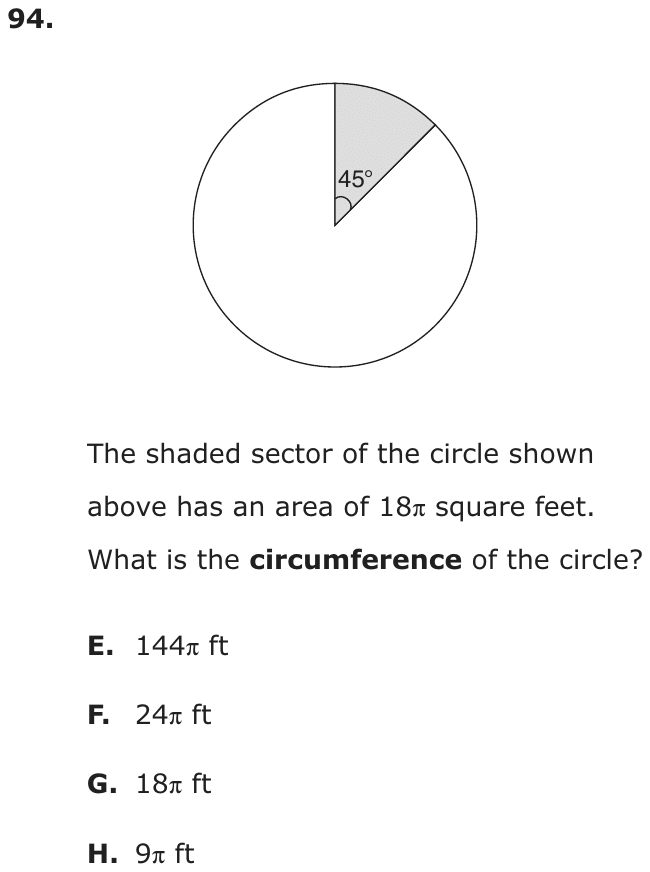
Question 22 of 36
2023 Test A Math, question 49Question
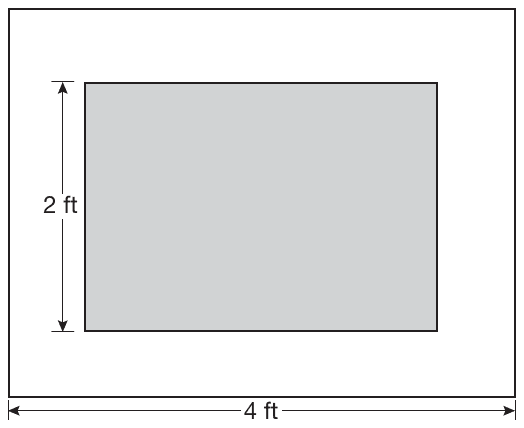
In the figure above, the shaded rectangle is similar to the outer rectangle. The length of the outer rectangle is 4 feet, and the perimeter of the outer rectangle is 14 feet. If the width of the shaded rectangle is 2 feet, what is the area of the shaded rectangle?
- A sq ft
- B6 sq ft
- C sq ft
- D12 sq ft
Show the answer
Correct answer: A
For the outer rectangle, the length is 4 feet and the perimeter is 14 feet. Write and solve an equation to find the width:
| Apply the additive inverse property; subtract 8 from both sides of the equation. | |
| Apply the multiplicative inverse property; divide both sides of the equation by 2. | |
Use that information in a proportion to find the length of the shaded rectangle:
| Cross multiply. | |
| Apply the multiplicative inverse property; divide both sides of the equation by 3. | |
Now find the area of the shaded rectangle:
Question analysis
This geometry question shows a shaded rectangle similar to an outer rectangle that is 4 feet long with a perimeter of 14 feet; the shaded rectangle is 2 feet wide. Students find the shaded area. They must find a missing side, match corresponding sides, and scale by a factor rather than a fixed amount, which makes it a multistep similar-figures problem.
- Grade level
- Grade 8 content, by NYS standard
- Compared with grade 7
- Above grade 7 Similar figures are grade 8 geometry, though grade 7 scale drawings use the same proportions. Students must first find a missing side from the perimeter, match corresponding sides, solve a proportion with a fractional result, and then find an area.
- Estimated difficulty
- Hard: combines ideas, needs a plan, and has more than one tempting wrong answer.
- Thinking it demands
- Depth of knowledge 2, skills and concepts · mainly apply
- What makes it hard
- Combines ideas moderate
- Reading a figure, table or graph minor
- Error-prone arithmetic minor
- Solution
- 4 steps
- Reading level
- Question and choices: about grade 5, 57 words.
- Students, last 30 days
- Not enough answers yet to show (it takes 10).
Why it is hard, traps and wrong answers (shows the answer)
Why it is hard
Each step is familiar, but the three together, perimeter to width, width to scale factor, and sides to area, demand a plan. The strongest pull is scaling by subtraction, shrinking each side by 1 foot because the width drops from 3 to 2, which gives a neat whole-number area. Others stop at the outer rectangle or add the sides instead of multiplying. Checking that 8/3 to 2 matches 4 to 3 confirms the shape is similar.
Combines ideas moderate Working it out
Perimeter, similarity and area are chained: 14 feet gives the outer width of 3 feet, the 2-foot side sets a scale factor of 2/3, and only then can the area be found. (Embretson, 1998; Daniel & Embretson, 2010)
Reading a figure, table or graph minor Understanding the question
The figure marks the shaded rectangle's 2-foot side running up and down and the outer 4-foot length along the bottom, so the 2 feet must be paired with the outer 3-foot side, which is not labeled. (Lesh, Post & Behr, 1987; Kirsch & Mosenthal, 1990)
Error-prone arithmetic minor Working it out
The scale factor 2/3 makes the shaded length 8/3 feet, and the area 2 × 8/3 = 16/3 has to be written as the mixed number 5 1/3. (Brown & Burton, 1978; Junker & Sijtsma, 2001)
Strategy: Use the perimeter to find the outer rectangle's width, match the shaded width of 2 feet to it, scale the 4-foot length by the same factor, then multiply length by width.
Traps
- Misunderstands the concept: A wrong belief about a concept: that percents can be added, that area grows like length, that averages can be averaged, that a bigger denominator means a bigger fraction.
- Wrong formula: Uses a related but wrong formula: perimeter for area, diameter for radius, area for volume, or a misremembered one.
- Answers a different question: A choice is right for another quantity: the other unknown, the rest instead of the part, the part instead of the whole.
The wrong answers, classified
B Misunderstands the concept (Smith, diSessa & Roschelle, 1993; De Bock et al., 1998; Ni & Zhou, 2005)
Shrinks each side by the same amount instead of the same factor: the width drops by 1 foot, from 3 to 2, so the length drops from 4 to 3, giving 6.
C Wrong formula (King et al., 2004)
Finds the shaded sides, 2 and 8/3 feet, correctly but computes the perimeter, 2 × (2 + 8/3) = 28/3 = 9 1/3, instead of the area.
D Answers a different question (King et al., 2004; Hegarty, Mayer & Monk, 1995)
Finds the outer width of 3 feet and gives the outer rectangle's area, 4 × 3 = 12, instead of the smaller shaded one.
Worked solution, step by step
Formulas used
- Perimeter of a rectangle
- P is the perimeter, the distance all the way around. l is the length and w is the width. A rectangle has two lengths and two widths, so you add each one twice.
- Scale factor of similar shapes
- Similar shapes have the same shape but different sizes. Each side of the small shape equals its matching side on the large shape times one number, the scale factor. So one pair of matching sides tells you the scale factor.
- Area of a rectangle
- A is the area, the space inside. l is the length and w is the width. You multiply because the rectangle is made of rows of unit squares: w rows with l squares in each.
Sort out the question
The outer rectangle is 4 feet long, and its perimeter is 14 feet. The shaded rectangle is similar to it, so it has the same shape. The shaded rectangle’s width, its left side, is 2 feet. You need the shaded area, so you also need the shaded length.
Find the outer rectangle’s width
The outer rectangle is 3 feet wide. That is its up-and-down side.
Find the scale factor
The shaded width, 2 feet, matches the outer width, 3 feet.
Every shaded side is of the matching outer side. Watch out: similar shapes shrink by the same factor, not by the same number of feet. Taking 1 foot off each side gives 2 by 3, an area of 6, choice B.
Find the shaded length
Multiply the outer length, 4 feet, by the scale factor.
The shaded rectangle is feet long.
Find the shaded area
Watch out: 4 × 3 = 12 is the outer area, choice D. So the answer is A, sq ft.
Check your answer
Check the shape. For the outer rectangle, length ÷ width is . For the shaded one, it is . They match, so the shapes are similar. Also, square feet is less than the outer 12, as it should be.
More questions like this
The original DOE question
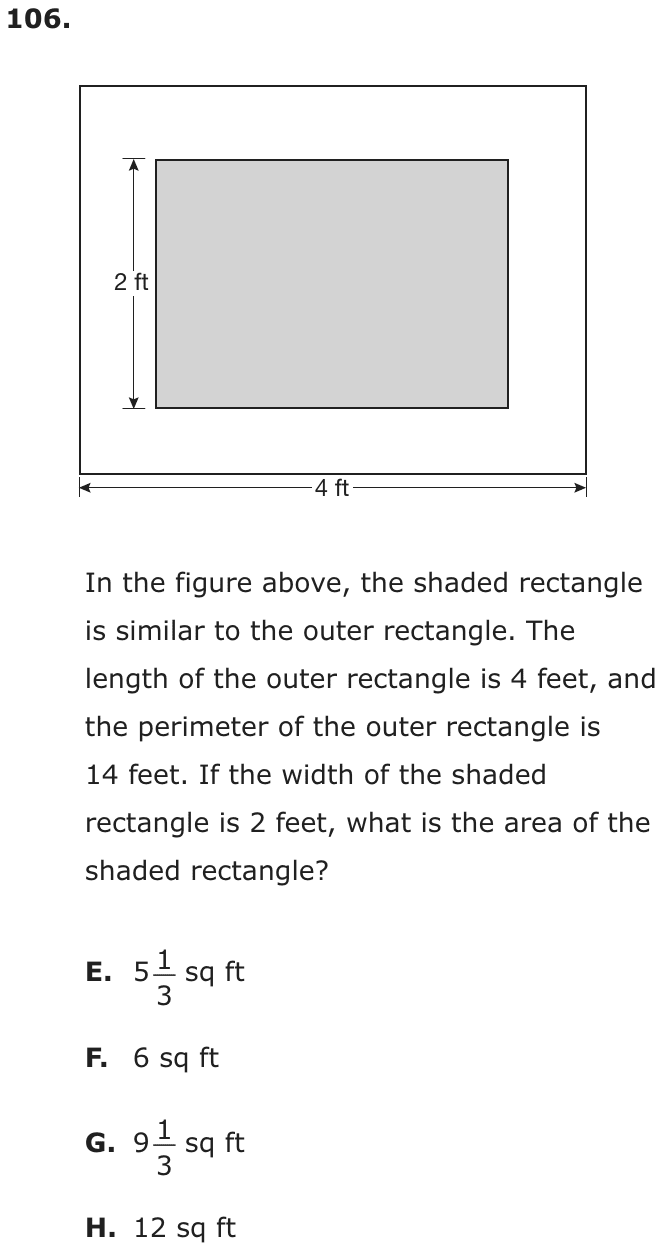
Question 23 of 36
2023 Test B English, question 17Passage Excerpt from “The Food Business Incubator”
Excerpt from “The Food Business Incubator”
by Mandalit Del Barco
“La Cocina” means “the kitchen” in Spanish. It’s also the name of a business incubator1 based in San Francisco’s Mission District. Since it began in 2005, it’s been helping local food entrepreneurs, many of whom are low-income immigrant women, develop their small businesses.
Over the years, many of its alumni have found success: more than 50 chefs in its program have become self-sufficient business owners, and many of them have opened their own brick-and-mortar restaurants. Two alumnae of its culinary program . . . were even recognized as semi-finalists for prestigious James Beard awards.2
A new cookbook, We Are La Cocina: Recipes in Pursuit of the American Dream, tells some of their stories.
Executive director Caleb Zigas says the nonprofit La Cocina grew out of two grassroots economic development organizations3 who found many people cooking at their homes and selling food on the streets. The vendors needed an affordable commercial kitchen space and technical assistance in order for their businesses to be legally viable. La Cocina provided just such a space, in addition to helping them develop business plans, pull city permits and more.
Zigas says as many as eight businesses can work in the kitchen space at La Cocina at any one time. Some can prep for a farmers’ market sale, corporate catering gigs or weddings, while others might be making and packaging their food products.
“It’s just an incredible and exciting range of techniques, flavors, perspectives, age, language. And that’s a really beautiful thing,” he says. . . .
Twice a year, La Cocina hosts “F&B: Voices from the Kitchen,” a storytelling project where their chefs can tell their own stories, as they do in the new cookbook. Some of the chefs will be on tour to promote the book, whose proceeds will go to support La Cocina entrepreneurs.
NPR4 caught up with . . . La Cocina chefs, who shared their stories:
Mariko Grady, Aedan Fermented Foods
At La Cocina, you can often hear Mariko Grady singing or humming as she prepares miso, koji, and amasake. Her fermented products come in four different flavors, including mushroom and chicken, to be used in soups and sauces. She originally brought the fermenting rice and barley koji seeds from Japan, where she had a 30-year career as a singer and dancer with the prestigious modern theatrical dance group she founded, Pappa Tarahumara. They performed around the world, and 16 years ago, had a one-night show in San Francisco. The man who would become her husband was in the audience. She soon joined him in San Francisco, often returning to Tokyo to rehearse. But after the earthquake and tsunami hit Japan in 2011, her company disbanded. . . . Grady focused on nourishing her family and creating a line of fermented products that she sells online, at local Bay Area stores and at the Ferry Plaza Farmers Market. She began at La Cocina in 2012 and named her business after her son, Aedan. (Written in Kanji characters, the name means “wisdom” and “handed down from generation to generation.”) . . . Her fermented products are “also full of wisdom about how to relate to nature and how to create a healthy life,” she says. . . .
Shani Jones, Peaches Patties
Shani Jones is a native San Franciscan. Her father was born in New Orleans, her mother, in Jamaica. She says their home was always filled with a variety of spices and dishes like jerk chicken and Jamaican patties—savory pastries filled with beef or chicken. Jones says she learned to cook from her mother, whose nickname was Peaches. After returning from college in Atlanta, Jones worked on her doctorate in organizational leadership and management while driving a Lyft5 car. She often told passengers about her idea of opening a catering company with her mom’s recipes. They steered her to La Cocina, where she developed her own business, named after her mother. Five years later, she caters and runs a kiosk6 at a small food cooperative in Bernal Heights, where some of her handmade patties have an Ethiopian twist, “because my husband is Ethiopian.” Jones has big aspirations for Peaches Patties: “The ultimate goal,” she says, “is to be the patty kingpin7 of the West Coast.”
From “The Food Business Incubator That Helps Immigrant Women Pursue The American Dream” by Mandalit Del Barco from WEEKEND EDITION SUNDAY, June 19, 2019. Copyright © 2019 NPR.
QUALIFICATIONS FOR LA COCINA APPLICANTS
| Level of Income | La Cocina considers assets and access to opportunity when screening applicants. La Cocina’s mission is to support entrepreneurs who face barriers to becoming successful in the food industry. Applicants must be classified as low- or very-low-income earners according to the Housing and Urban Development (HUD) Guidelines for San Francisco. |
|---|---|
| Business Plan | Applicants must have a business plan that is ready to be put into action. La Cocina will help applicants refine an existing business plan. Applicants without a business plan should contact one of La Cocina’s partner organizations for guidance in developing one. |
| Viable Product | The applicant’s food must not only be delicious but also stand out. For a business to make a profit, there also has to be a market for the food. |
| Entrepreneurial Work Ethic | La Cocina is excited to work with entrepreneurs who are motivated and passionate about growing their business. Succeeding in the food industry requires a lot of heart and hard work. |
| Community Spirit | The 30+ entrepreneurs who share La Cocina’s kitchen are from many different backgrounds. La Cocina values the community it has created and expects each entrepreneur to be active in bringing the spirit of La Cocina to the wider world. In order to succeed in the La Cocina kitchen, accepted applicants must be flexible and willing to work closely with others. |
Source: La Cocina
1business incubator: company that helps new and startup companies develop by providing services such as management training and office space
2James Beard awards: an award named after American cook and author James Beard, considered one of the highest honors in the culinary industry
3economic development organizations: organizations whose mission is to promote economic improvement within a specific geographical area
4NPR: National Public Radio, a nonprofit media organization that produces and distributes news and cultural programming
5Lyft: ride-sharing company where people use their own cars to provide rides to customers
6kiosk: cart or small structure with one or more open sides that is used to vend merchandise or services
7kingpin: the leader in a group or undertaking
Question
The table provides additional support for a central idea of the excerpt by
- Ashowing how La Cocina works with partner organizations to further educate and advance successful applicants within the food industry.
- Bexplaining how applicants are prepared to develop their own businesses once they leave La Cocina.
- Cestablishing that La Cocina is dedicated to its mission to provide delicious food to different communities.
- Demphasizing that applicants must be willing to dedicate time to promoting and developing their business with La Cocina.
Show the answer
Correct answer: D
The question asks how the table provides additional support for a central idea of the excerpt.
A. Incorrect. The table describes the requirements that allow food entrepreneurs to qualify to participate in La Cocina. While the table does mention that applicants without a business plan should contact one of La Cocina’s partner organizations, it does not specifically explain how La Cocina works with these partner organizations to help educate successful applicants.
B. Incorrect. The table describes the ways entrepreneur chefs must qualify in order to be accepted into La Cocina, not how their businesses can be successful after they leave.
C. Incorrect. While the table mentions community spirit, this is in reference to the type of energy La Cocina wishes to establish within its group kitchen space. The excerpt and table do not discuss providing food to different communities within or outside San Francisco as specific goals of La Cocina.
D. CORRECT. A central idea of the excerpt is that La Cocina helps local food entrepreneurs develop their businesses. The table lists requirements for people who want to participate in La Cocina. They must be willing to work hard to promote their own businesses as they use the resources that La Cocina provides.
Question analysis
This question asks how the table “Qualifications for La Cocina Applicants,” printed after the NPR article, provides additional support for a central idea of the excerpt. The table’s five rows, from level of income to community spirit, are written in full sentences, so students must read it as closely as the article and decide how the two connect.
- Grade level
- Grade 8 reading and task
- Compared with grade 7
- Above grade 7 Grade 7 readers often connect a table to a text. This one holds five rows of requirements written as sentences, not numbers, and students must tie it to a central idea through long choices, more than typical grade 7 work.
- Estimated difficulty
- Hard: combines ideas, needs a plan, and has more than one tempting wrong answer.
- Thinking it demands
- Depth of knowledge 3, strategic thinking · mainly analyze
- What makes it hard
- Reading a figure, table or graph moderate
- The right answer is reworded moderate
- Combines ideas minor
- Evidence
- Answered from the whole text
- Reading level
- Passage: about grade 10, 1057 words; question and choices: about grade 13, 81 words.
- Corrected from the DOE handbook
- A detail of the table was restated accurately in the explanation.
- Students, last 30 days
- Not enough answers yet to show (it takes 10).
Why it is hard, traps and wrong answers (shows the answer)
Why it is hard
The table is easy to read row by row but hard to connect, because it lists entry requirements while the article describes help and success. Each wrong choice grabs a real phrase from the table or an idea from the article, partner organizations, delicious food, alumni starting their own businesses, and attaches it to a claim the table does not make. The right choice is the only one that sums up several rows at once, the work ethic and community spirit expected of applicants.
Reading a figure, table or graph moderate Understanding the question
The table holds five rows of full sentences, and the telling details sit in single phrases: “should contact one of La Cocina’s partner organizations,” “a lot of heart and hard work,” “active in bringing the spirit of La Cocina to the wider world.” (Lesh, Post & Behr, 1987; Kirsch & Mosenthal, 1990)
The right answer is reworded moderate Choosing the answer
The right choice speaks of dedicating time to “promoting and developing” a business, words the table never uses, while wrong choices lift its own “partner organizations,” “mission,” “delicious” and “community.” (Freedle & Kostin, 1993; Kirsch & Mosenthal, 1990)
Combines ideas minor Working it out
Students must join two sources, a central idea of the article, that La Cocina helps cooks develop businesses, and a table about who may apply, then say what the second adds to the first. (Embretson, 1998; Daniel & Embretson, 2010)
Strategy: Sum up each row of the table in a few words, state a central idea of the article in a sentence, and keep only a choice that the rows actually show and that fits that idea.
Traps
- Word match: Repeats striking words or phrases from the text, so it looks supported, but its meaning does not fit the question.
- Twists what the text says: Uses the text's topic and ideas but changes what it says: who did it, how much, when, or why.
- Wrong part of the text: A choice is true of another paragraph, stanza or speaker than the one asked about.
The wrong answers, classified
A Twists what the text says (King et al., 2004)
Finds the partner organizations in the Business Plan row, but the table sends only applicants without a plan to them for guidance and says nothing about further training for accepted chefs.
B Wrong part of the text (Kirsch & Mosenthal, 1990)
Carries over the article’s alumni who opened their own restaurants and its help with permits, but the table covers who may enter La Cocina, not how members are prepared to leave.
C Word match (Freedle & Kostin, 1993)
Strings the table’s words “mission,” “delicious” and “community” into a mission of feeding communities, though the table’s community is the one La Cocina has built among the entrepreneurs sharing its kitchen.
What was corrected from the DOE handbook, and why
- Explanation: The handbook’s explanation of Option A says the table states that applicants without a business plan “must contact” one of La Cocina’s partner organizations. The table’s Business Plan row says they “should contact” one: it is advice, while the row’s requirement is that applicants “must have a business plan that is ready to be put into action.” The site now says “should contact.” The answer is unchanged.
Working it out, step by step
See how the table connects
This question links the table to the article. The table, “Qualifications for La Cocina Applicants,” lists what people need to join. Qualifications are the skills or traits you must have. You must decide how the table supports a central idea of the article.
Sum up each row
Row What it asks of applicants Level of Income earn little money Business Plan have a plan ready to use Viable Product make food that tastes great, stands out and can sell Entrepreneurial Work Ethic be eager and work hard Community Spirit work well with others and spread La Cocina’s spirit Most rows describe people ready to put in real effort.
Connect the table to the article
A central idea of the article is that La Cocina helps cooks develop their businesses. The table shows what La Cocina expects in return. It wants people “motivated and passionate about growing their business.” It says success “requires a lot of heart and hard work.” It expects each cook to be “active in bringing the spirit of La Cocina to the wider world.” So the help goes to people who will give time to their business.
Check each choice
- A is wrong. The table says applicants without a plan “should contact” a partner group for advice. That happens before applying. It doesn’t show La Cocina working with partners to train accepted cooks.
- B is wrong. The table is about getting in, not about leaving La Cocina later.
- C is wrong. The table uses the words “delicious” and “community.” But its community is the cooks who share the kitchen, not neighborhoods La Cocina feeds.
- D is right. The work-ethic row calls for hard work at growing a business. The community row asks cooks to spread La Cocina’s spirit. Both take time and effort.
Choose the answer
The table shows that La Cocina wants cooks ready to work hard at building their businesses. So the answer is D.
Why this answer and not the closest wrong one
A is the closest wrong answer, because “partner organizations” really is in the table. But the table only suggests that people without a business plan get advice from one. It never shows La Cocina teaming up with partners to train its members. D sums up several rows at once.
More questions like this
The original DOE question
The passage “Excerpt from “The Food Business Incubator”” as printed (pages 158–160)
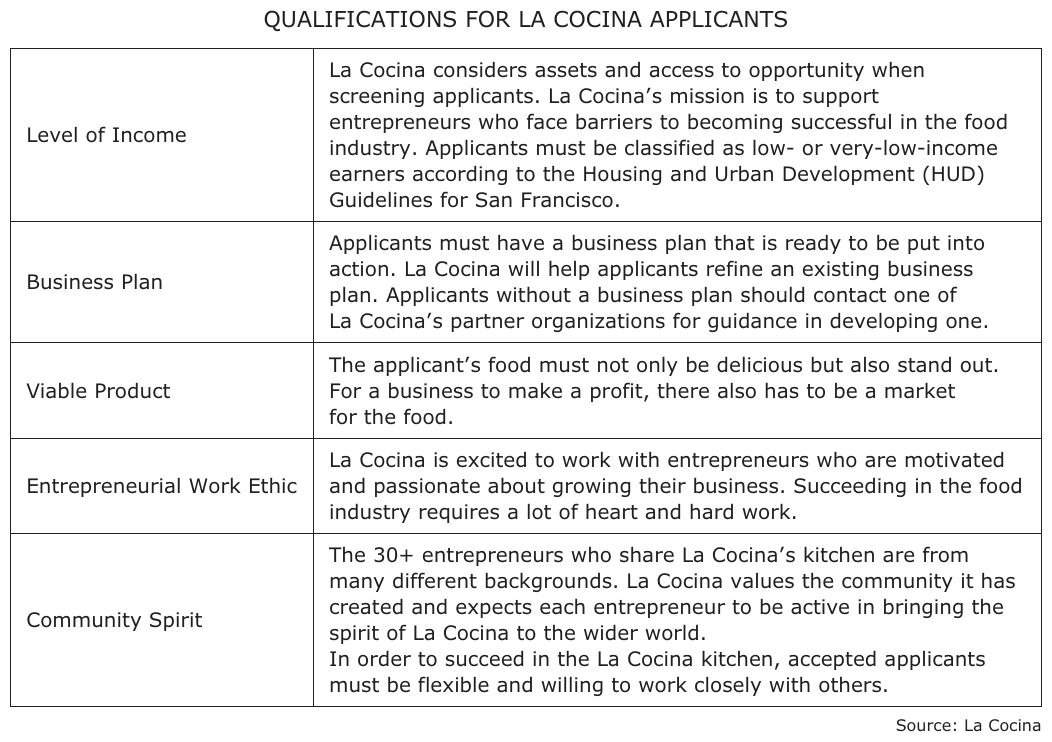
Question 24 of 36
2023 Test B Math, question 42Question
1 gallon = 16 cups
1 cup = 8 fluid ounces
If 1 gallon = fluid ounces, what is the value of x?
- A4
- B7
- C8
- D64
Show the answer
Correct answer: B
If 1 gallon is equal to 16 cups, and 1 cup is equal to 8 fluid ounces, then
So, .
Question analysis
This question gives two facts, 16 cups in a gallon and 8 fluid ounces in a cup, and says a gallon equals 2 to the power x fluid ounces. Students find the exponent x. It combines a unit conversion with writing a number as a power of 2, and the exponent is easy to confuse with a multiplier.
- Grade level
- Grade 6 content, by NYS standard
- Compared with grade 7
- At grade 7 Converting units with given facts is grade 6 work, and this conversion is a single multiplication. The twist is writing the result as a power of 2, which calls for fluency with powers that grade 7 work rarely asks for.
- Estimated difficulty
- Straightforward: two steps or one careful reading.
- Thinking it demands
- Depth of knowledge 2, skills and concepts · mainly apply
- What makes it hard
- Combines ideas minor
- Something you must already know minor
- Solution
- 3 steps
- Reading level
- Question and choices: about grade 2, 16 words.
- Students, last 30 days
- Not enough answers yet to show (it takes 10).
Why it is hard, traps and wrong answers (shows the answer)
Why it is hard
The conversion is one multiplication, so the question really tests whether students can name the exponent for 128. Stopping at the cups, where 16 = 2⁴, or treating 2 to the power x as 2 times x gives a listed choice. Writing 16 as 2⁴ and 8 as 2³ and adding the exponents is the quickest route, and doubling from 1 seven times is a sure check.
Combines ideas minor Working it out
A unit conversion, 16 cups × 8 fluid ounces = 128 fluid ounces, has to be joined to exponents by recognizing 128 as a power of 2. (Embretson, 1998; Daniel & Embretson, 2010)
Something you must already know minor Working it out
Students must know or build the powers of 2 up to 128, and see that the exponent counts factors of 2, not the number of terms in a list starting at 1. (Anderson & Krathwohl, 2001)
Strategy: Convert 1 gallon to fluid ounces by multiplying the two facts, then keep halving the result, or keep doubling from 2, counting how many factors of 2 it takes.
Traps
- Stops one step early: A choice is a number from partway through the solution.
- A faulty procedure: A systematic but wrong procedure: adding fractions straight across, applying an exponent to each term of a sum, dropping a sign when moving a term.
- Counting the ends: Inclusive or exclusive ends, fence posts, consecutive numbers: an answer that is one too many or too few, or an endpoint drawn open where it belongs closed (or the reverse).
The wrong answers, classified
A Stops one step early (King et al., 2004; Gierl et al., 2017)
Writes the 16 cups in a gallon as 2⁴ and stops before multiplying by the 8 fluid ounces in each cup, which adds 3 to the exponent.
C Counting the ends (Brown & Burton, 1978)
Lists the powers of 2 starting at 1, so counts 1, 2, 4, …, 128 as eight numbers and takes 8 as the exponent, though 1 is 2⁰.
D A faulty procedure (Brown & Burton, 1978; Tatsuoka, 1983)
Treats 2 to the power x as 2 times x, so 2x = 128 gives 64, confusing an exponent with a multiplier.
Worked solution, step by step
Formulas used
- Meaning of an exponent
- The 2 is the base, the number being multiplied. x is the exponent, the small raised number. It tells how many 2s are multiplied together. For example, 2 to the third power means 2 × 2 × 2, which is 8.
- Multiplying powers of the same base
- a and b are exponents. The first power has a twos multiplied together. The second has b more twos. Multiplying puts all the twos together, so you add the exponents.
Sort out the question
A gallon is 16 cups. A cup is 8 fluid ounces. A gallon is also fluid ounces. You need x, the exponent. It tells how many 2s are multiplied together.
Change a gallon to fluid ounces
Each of the 16 cups holds 8 fluid ounces. So multiply.
One gallon is 128 fluid ounces.
Write 128 as a power of 2
Now you need . Keep multiplying by 2, and count the 2s.
Number of 2s 1 2 3 4 5 6 7 Product 2 4 8 16 32 64 128 It takes seven 2s to make 128.
So x = 7.
Give the answer
Watch out: A gallon is 16 cups, and . Stopping there gives 4, choice A. And does not mean 2 times x. Solving 2 × x = 128 gives 64, choice D.
So the answer is B, 7.
Check your answer
Use the exponent rule. 16 is and 8 is . So . The exponent is 7 again.
More questions like this
The original DOE question
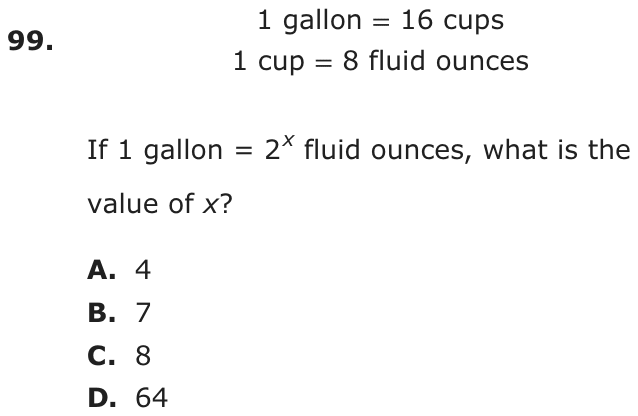
Question 25 of 36
2023 Test B Math, question 43Question
A certain square puzzle has an area of 64 square inches, and a cubic block has a volume of 64 cubic inches. What is the ratio of the length of a side of the puzzle to the length of a side of the block?
- A
- B
- C
- D
Show the answer
Correct answer: D
The length of one side of the puzzle is inches. The length of one side of the block is inches.
The ratio of the side of the puzzle to the side of the block is , which reduces to .
Question analysis
A square puzzle has an area of 64 square inches, and a cube-shaped block has a volume of 64 cubic inches. Students find the ratio of a side of the puzzle to a side of the block. Both figures are described by the number 64, but turning an area and a volume back into lengths takes different steps, and the order of the ratio matters.
- NYS standards
- Grade level
- Grade 8 content, by NYS standard
- Compared with grade 7
- Above grade 7 Grade 7 area and volume problems go from side lengths to an area or a volume. Going backward needs a square root and a cube root, and cube roots are grade 8 content, although 64 is both a perfect square and a perfect cube.
- Estimated difficulty
- Moderate: several steps, or a close reading with one strong distractor.
- Thinking it demands
- Depth of knowledge 2, skills and concepts · mainly apply
- What makes it hard
- Something you must already know moderate
- Combines ideas minor
- Solution
- 3 steps
- Reading level
- Question and choices: about grade 3, 46 words.
- Students, last 30 days
- Not enough answers yet to show (it takes 10).
Why it is hard, traps and wrong answers (shows the answer)
Why it is hard
Because 64 is both a perfect square and a perfect cube, the computation is easy once students know to undo squaring and cubing. The risk is at the end: with sides of 8 and 4 inches in hand, writing the block first turns the ratio upside down. Students who never find the side lengths are left with ideas such as two dimensions against three.
Something you must already know moderate Working it out
Neither formula is given: the puzzle’s side is the number whose square is 64 and the block’s edge the number whose cube is 64, and cube roots are grade 8 work. (Anderson & Krathwohl, 2001)
Combines ideas minor Working it out
A square and a cube share the number 64 in different units, so two different inverse operations feed one ratio, which must list the puzzle’s side first. (Embretson, 1998; Daniel & Embretson, 2010)
Strategy: Find the side of the square from its area and the edge of the cube from its volume by testing small whole numbers, then write the puzzle's side first and simplify.
Traps
- Wrong operation: Adds instead of multiplying, divides the wrong way round, turns a ratio or rate upside down, or undoes a step in the wrong direction (subtracts what should be added back).
- Numbers taken from the question: Combines the numbers in the question without a model of the situation, or is simply a number that appears in the question.
The wrong answers, classified
A Little reason to choose it (Haladyna & Downing, 1993; Rodriguez, 2005)
No common working gives 1 : 3; it makes the puzzle’s side the shorter one, the reverse of 8 and 4 inches, so it mostly draws guesses.
B Wrong operation (Hegarty, Mayer & Monk, 1995; King et al., 2004)
Finds both lengths correctly, 8 and 4 inches, but writes the block’s side first, turning the ratio upside down to 1 : 2.
C Numbers taken from the question (Hegarty, Mayer & Monk, 1995)
Matches the square to 2 and the cube to 3, the powers behind square inches and cubic inches, and writes 2 : 3 without finding any length.
Worked solution, step by step
Formulas used
- Area of a square
- A is the area, in square units. s is the length of one side. All sides of a square are equal, so the area is the side times itself. To find the side from the area, ask which number times itself gives the area.
- Volume of a cube
- V is the volume, the space inside, in cubic units. s is the length of one edge. A cube’s length, width and height are all equal, so the volume is the edge used three times. To go backward, ask which number used three times gives the volume.
Sort out the shapes
The puzzle is a square with an area of 64 square inches. The block is a cube with a volume of 64 cubic inches. A cube is a box with every edge the same length. You need the ratio of the puzzle’s side to the block’s side, with the puzzle first.
Find the puzzle’s side
Use the area formula backward. Which number times itself makes 64?
The puzzle’s side is 8 inches. This number is the square root of 64.
Find the block’s side
Use the volume formula backward. Which number used three times makes 64? Try small numbers. 3 × 3 × 3 = 27 is too small.
The block’s side is 4 inches. This number is the cube root of 64.
Write and simplify the ratio
Put the puzzle first, as the question asks. Then divide both parts by 4.
Watch out: Writing the block’s side first gives 1 : 2, choice B. The order in a ratio matters.
So the answer is D, 2 : 1.
Check your answer
Check both sides. 8 × 8 = 64 square inches, and 4 × 4 × 4 = 64 cubic inches. The puzzle’s side is longer, so its number in the ratio must be bigger. Only choice D puts the bigger number first.
More questions like this
The original DOE question
Question 26 of 36
2023 Test B Math, question 49Question
A rectangular swimming pool of uniform depth is 20 yards long and 14 yards wide. If the water is 6 feet deep, what is the volume of water in the pool, in cubic yards?
- A40
- B286
- C560
- D1,680
Show the answer
Correct answer: C
First, change 6 feet to yards:
Then, multiply the dimensions of the pool to find the volume, in cubic yards:
Question analysis
A rectangular swimming pool is 20 yards long and 14 yards wide, and the water is 6 feet deep. Students find the volume of water in cubic yards. It tests the volume of a rectangular prism, and the depth is in a different unit from the other measurements, so it has to be converted first.
- Grade level
- Grade 6 content, by NYS standard
- Compared with grade 7
- Below grade 7 The volume of a rectangular prism is grade 5 and 6 content, and the conversion here gives a whole number. Grade 7 volume work is usually longer, with composite or triangular prisms; here the only extra step is one unit conversion.
- Estimated difficulty
- Straightforward: two steps or one careful reading.
- Thinking it demands
- Depth of knowledge 2, skills and concepts · mainly apply
- What makes it hard
- Combines ideas minor
- Something you must already know minor
- Solution
- 2 steps
- Reading level
- Question and choices: about grade 6, 31 words.
- Students, last 30 days
- Not enough answers yet to show (it takes 10).
Why it is hard, traps and wrong answers (shows the answer)
Why it is hard
The only real trap is the mixed units: 20 and 14 are yards, 6 is feet, and the answer is wanted in cubic yards. Multiplying the three numbers as printed gives a listed choice three times too large. Underlining the unit of each measurement before multiplying, and converting the odd one out, takes seconds.
Combines ideas minor Working it out
The length and width are in yards but the depth is in feet, so a conversion, 6 feet = 2 yards, must come before the volume formula is used. (Embretson, 1998; Daniel & Embretson, 2010)
Something you must already know minor Working it out
Neither 3 feet = 1 yard nor volume = length × width × depth is given; both are assumed in a stem that asks for cubic yards. (Anderson & Krathwohl, 2001)
Strategy: Change the depth from feet to yards first, so that all three measurements are in yards, then multiply the length, width and depth.
Traps
- Units or scale: The answer is wanted in other units, or a rate or scale must be converted first.
- Wrong formula: Uses a related but wrong formula: perimeter for area, diameter for radius, area for volume, or a misremembered one.
- Numbers taken from the question: Combines the numbers in the question without a model of the situation, or is simply a number that appears in the question.
The wrong answers, classified
A Numbers taken from the question (Hegarty, Mayer & Monk, 1995)
Adds the three measurements, 20 + 14 + 6 = 40, with no conversion and no volume formula, combining the stem’s numbers.
B Wrong formula (King et al., 2004)
Finds the area of the water’s surface, 20 × 14 = 280, then adds the depth of 6 instead of multiplying by it.
D Units or scale (King et al., 2004)
Multiplies 20 × 14 × 6 without changing 6 feet to 2 yards, mixing yards with feet and getting a volume three times too large.
Worked solution, step by step
Formulas used
- Volume of a rectangular box
- V is the volume, the space inside, in cubic units. l is the length, w is the width, and h is the height or depth. All three must be in the same unit. Multiplying them counts the unit cubes that fill the box.
- Feet to yards
- There are 3 feet in 1 yard. So to change feet to yards, divide the number of feet by 3. A yard is longer than a foot, so you get a smaller number.
Sort out the measurements
The pool is shaped like a box. Uniform depth means the water is equally deep everywhere. The pool is 20 yards long and 14 yards wide. The water is 6 feet deep. You need the volume, the space the water fills, in cubic yards.
Change the depth to yards
Two sides are in yards, but the depth is in feet. All three must use the same unit before you multiply. The answer is in cubic yards, so change feet to yards.
The water is 2 yards deep.
Find the volume
Use the volume formula with all three measurements in yards.
The pool holds 560 cubic yards of water.
Give the answer
Watch out: Multiplying 20 × 14 × 6 mixes yards with feet. It gives 1,680, choice D, which is three times too big.
So the answer is C, 560 cubic yards.
Check your answer
Check the units. Yards times yards times yards gives cubic yards, just what the question asks for. Also, 1,680 ÷ 3 = 560. So using 6 feet unchanged makes the answer exactly three times too big.
More questions like this
The original DOE question
Question 27 of 36
2018 Test A English, question 43Passage Cross-Purposes
Cross-Purposes
What I am is built: concrete and steel.
I defy gravity. I am what every athlete
wants: to remain at the apex of the leap,
up in the air. And yet I am useful, too:
cars, trucks, people, even trains
make their way across my broad back.
Swallows and ospreys nest in my trusses.
What I am is motion. I am water, and I am older
than anything else you know. No human
built me. I am gravity’s best friend; I pool
and flow wherever gravity takes me.
I am the blood flowing in the runner’s chest,
and I catch everything: from the hills,
the mountains. It all washes down through me.
What you are is an accident,
what happens to rain when rain gives in
to Earth’s gravitational pull.
You are some tears dribbling from a mountain’s
eye, running down the pavements
of small towns, into the cities, to the sea.
You are the path of least resistance.
What I am is power. You, of course,
have none: you are a static lump, an artifact
slowly decaying. But my regal flow
nourishes grasses, permits empires to rise.
Those who made you will break you,
in time, replacing you with yet another
clumsy structure. I have seen. I know.
“Clumsy”? Being rebuilt makes me
a friend of time, does it not? And it means
that I have siblings—those “clumsy” structures,
my sisters and brothers.
We stitch across the rip you make.
We are steel thread to the human needle.
We bind you up. We sew you.
And I sow into you; in every cranny
of your superstructure my vapors cling.
They bring out your softness, your rust.
Boast your best, and boast better yet.
I am listening to the bright hum
of the wind in your wires. Because I am,
above all else, patient. I will wait for you.
ospreys: large birds
Question
Read lines 2–4 and lines 12–14 from the poem.
I am what every athlete
wants: to remain at the apex of the leap,
up in the air.
I am the blood flowing in the runner’s chest,
and I catch everything: from the hills,
the mountains.
How do the lines contribute to the development of a central idea of the poem?
- AThey establish that both the structure and the water have endurance and control.
- BThey highlight that both the structure and the water are powerful and impressive.
- CThey suggest that the structure and the water are unaware of how similar they are.
- DThey reveal that the structure and the water are surprised that they are interrelated.
Show the answer
Correct answer: B
The answer is (B)
The question asks how the lines contribute to the development of a central idea in the poem. The lines “I am what every athlete / wants” (lines 2–3) and “I am the blood flowing in the runner’s chest” (line 12) communicate that each speaker is an object of admiration and a powerful force, so Option B is correct.
Option A is incorrect because nothing in the language of the lines communicates control.
Option C is incorrect because the lines describe opposing characteristics: the structure’s description conveys stillness—remaining “up in the air” (line 4)—while the water’s description conveys movement—“flowing in the runner’s chest” (line 12). Additionally, the idea that the speakers fail to recognize similarities is not part of a central idea.
Option D is incorrect because there is no evidence in the poem that the two speakers understand that they are interrelated.
Question analysis
Students compare two sets of lines from the poem “Cross-Purposes” in which the structure and the water each describe themselves through athletes, one leaping and one running. The question asks how these lines develop a central idea, which means comparing two images that seem opposite and deciding what the pairing adds.
- Grade level
- Grade 8 reading and task
- Compared with grade 7
- Above grade 7 Typical grade 7 work asks what one image suggests. This question pairs images from two speakers in a two-voice poem and asks for a shared idea, with abstract choices that all sound plausible, which is above grade 7.
- Estimated difficulty
- Hard: combines ideas, needs a plan, and has more than one tempting wrong answer.
- Thinking it demands
- Depth of knowledge 3, strategic thinking · mainly analyze
- What makes it hard
- Figurative or literary language major
- Combines ideas moderate
- A very close wrong answer moderate
- Evidence
- Answered from several paragraphs or stanzas
- Reading level
- Passage: 316 words (a poem; reading level not measured); question and choices: about grade 7, 113 words.
- Students, last 30 days
- Not enough answers yet to show (it takes 10).
Why it is hard, traps and wrong answers (shows the answer)
Why it is hard
The athlete images point in opposite directions, one frozen in the air and one in motion, so students may look for a contrast when the question wants what the two share. Both speakers are borrowing the glamour of athletes to boast, which is what makes them powerful and impressive. The other choices either add a quality, control, that neither image carries, or credit the speakers with feelings the poem never shows.
Figurative or literary language major Understanding the question
Both claims are metaphors: the bridge is the athlete's dream of staying “at the apex of the leap,” and the water is “the blood flowing in the runner's chest,” so each image must be translated into a quality. (Graesser, Singer & Trabasso, 1994; Kintsch, 1998)
Combines ideas moderate Working it out
The two sets of lines come from rival speakers in different stanzas, and the answer has to name one idea true of both, not of either alone. (Embretson, 1998; Daniel & Embretson, 2010)
A very close wrong answer moderate Choosing the answer
A and B share the frame “both the structure and the water” plus two qualities; A's endurance is close to B's power, and only its added “control” finds no support in the lines. (Embretson & Wetzel, 1987; Gorin & Embretson, 2006; Ascalon et al., 2007)
Strategy: For each set of lines, ask what the speaker claims about itself through the athlete image; then keep only a choice that fits both speakers and these exact words.
Traps
- Half right: One half of a two-part choice is right and the other is not.
- Reads too much in: A reasonable-sounding conclusion that goes further than the text allows.
The wrong answers, classified
A Half right (King et al., 2004; Thissen, Steinberg & Fitzpatrick, 1989)
Hears stamina in the runner and in staying aloft, which is defensible, but nothing in either set of lines suggests control.
C Reads too much in (Graesser, Singer & Trabasso, 1994)
Notices that both speakers use athletes and assumes they miss the likeness, an idea the poem never develops; the images actually set stillness against motion.
D Wrong tone or attitude (Graesser, Singer & Trabasso, 1994)
Reads surprise into lines whose tone is boastful; neither speaker shows any sign of noticing a connection, let alone being surprised by it.
Working it out, step by step
Figure out what the question asks
This asks how two sets of lines build a central idea. The structure speaks one set, and the water speaks the other. You need one idea that fits both.
Read both sets of lines
The structure says, in lines 2–4: “I am what every athlete / wants: to remain at the apex of the leap, / up in the air.”
The water says, in lines 12–14: “I am the blood flowing in the runner’s chest, / and I catch everything.”
Work out what each speaker claims
The apex is the very top. Every athlete wishes they could stay at the top of a jump. The structure stays up there all the time. So it brags that it does what athletes dream of.
The water says it is the blood that keeps a runner going. Both speakers compare themselves to strong athletes. Both are showing off how powerful and impressive they are.
Check each choice
- A Endurance (lasting a long time) could fit. But nothing in the lines shows control.
- B fits. Both speakers boast of being powerful and impressive.
- C The poem never says they don’t notice how alike they are.
- D Neither speaker shows surprise. Their tone is proud.
Choose the answer
Both sets of lines show the speakers bragging about their power. So the answer is B.
Why this answer and not the closest wrong one
A is the closest choice. Like B, it says something good about both speakers. But A adds “control,” and neither set of lines shows either speaker controlling anything. Every part of B fits both sets of lines, with nothing extra.
More questions like this
The original DOE question
The passage “Cross-Purposes” as printed (pages 72–73)
Question 28 of 36
2018 Test A Math, question 1Question
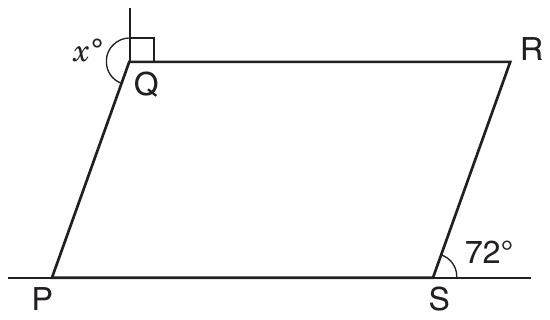
In the figure above, PQRS is a parallelogram. What is the value of ?
Grid-in question: work out the answer and enter it as a number.
Show the answer
Correct answer: 162
First, find the measure of angle PQR. The measure of angle PQR is equal to the measure of angle PSR.
m∠PSR = 180 − 72 = 108.
So, the measure of angle PQR is also 108.
108 + 90 + x = 360
198 + x = 360
x = 162
Question analysis
A grid-in geometry question about angles around a parallelogram PQRS. A 72° angle sits outside corner S on the extended base, and at corner Q a right angle and the unknown angle x complete the turn around the point. Students chain three angle facts, and the angle asked for lies outside the shape, not inside it.
- NYS standards
- Grade level
- Grade 8 content, by NYS standard
- Compared with grade 7
- Above grade 7 Grade 7 angle work usually applies one or two facts, such as supplementary or vertical angles, to find an angle. This chains three, and needs the equal opposite angles of a parallelogram, which rest on grade 8 parallel-line facts.
- Estimated difficulty
- Hard: combines ideas, needs a plan, and has more than one tempting wrong answer.
- Thinking it demands
- Depth of knowledge 2, skills and concepts · mainly apply
- What makes it hard
- Reading a figure, table or graph major
- Combines ideas moderate
- An answer in an unexpected form minor
- Solution
- 3 steps
- Reading level
- Question and choices: about grade 7, 14 words.
- Students, last 30 days
- Not enough answers yet to show (it takes 10).
Why it is hard, traps and wrong answers (shows the answer)
Why it is hard
The arithmetic is two subtractions; the difficulty is seeing which angles the marks refer to. Students lose points by treating the 72° as the parallelogram's own angle at S, or by stopping at angle PQR, the most natural number to grid. The question rewards tracing a route from S to Q before computing anything, and checking at the end that x is the angle outside the shape that the arc marks.
Reading a figure, table or graph major Understanding the question
The 72° is marked outside the parallelogram, between side SR and the base extended past S, and x sits outside corner Q, between QP and a vertical ray that meets QR at a right-angle mark. (Lesh, Post & Behr, 1987; Kirsch & Mosenthal, 1990)
Combines ideas moderate Working it out
Three angle facts have to be chained: a straight line gives the angle inside S, opposite angles of a parallelogram carry it to Q, and the angles around Q make a full 360° turn. (Embretson, 1998; Daniel & Embretson, 2010)
An answer in an unexpected form minor Choosing the answer
As a grid-in there are no choices to check against, so a student who stops at angle PQR, inside the parallelogram, gets no signal that the job is unfinished. (Enright, Morley & Sheehan, 2002)
Strategy: Use the straight line at S to find the parallelogram's angle there, carry it to the opposite corner Q, then take that angle and the right angle away from 360.
Traps
- Stops one step early: A choice is a number from partway through the solution.
The wrong answers, classified
108 Stops one step early (King et al., 2004; Gierl et al., 2017)
Finds angle PSR = 180 − 72 = 108 and carries it to angle PQR, then grids that interior angle instead of the angle x outside it.
198 Misreads the figure (Lesh, Post & Behr, 1987; Kirsch & Mosenthal, 1990)
Reads the 72° as the parallelogram's interior angle at S, so takes angle PQR as 72 and grids 360 − 90 − 72 = 198.
252 Misreads the figure (Lesh, Post & Behr, 1987; Kirsch & Mosenthal, 1990)
Overlooks the right-angle mark at Q and subtracts only the 108° angle PQR from 360, giving 252.
Worked solution, step by step
Formulas used
- Angles on a straight line
- a and b are two angles side by side on a straight line. Together they make a half turn, so they always add up to 180 degrees. Use it when an angle you need shares a straight line with an angle you know.
- Opposite angles of a parallelogram
- The symbol ∠ means angle. ∠PQR is the angle at corner Q, between sides QP and QR. ∠PSR is the angle at the opposite corner, S. In a parallelogram, opposite corners always have equal angles, because the shape leans the same way at both.
- Angles around a point
- a, b and c are angles that fit around one point with no gaps and no overlaps. Going all the way around is a full turn, which is 360 degrees. So the angles add up to 360.
Sort out what the figure shows
PQRS is a parallelogram. That is a four-sided shape whose opposite sides are parallel, which means they never meet. You need the value of x, in degrees.
Look closely at the marks. The 72° angle is outside the shape, at S. It sits between side SR and the base line, which keeps going past S. At Q, a vertical line meets side QR. The small square means a right angle, 90°. The angle x is outside the shape too. It runs from that vertical line around to side QP.
Find the angle inside corner S
Angle PSR is the shape’s own angle at S. It sits right next to the 72° angle, on the same straight base line. So the two angles add up to 180°.
So angle PSR is 108°. Watch out: 72° is not the inside angle at S. Using 72 as the inside angle leads to the wrong answer 198.
Carry the angle over to Q
Corners Q and S are opposite each other. In a parallelogram, opposite angles are equal. So angle PQR matches angle PSR.
So angle PQR is 108°. Watch out: this is not x. Angle PQR is inside the shape, and x is outside it. Stopping here and gridding 108 is the most common mistake.
Add the angles around Q
Three angles fill the space all the way around point Q. They are the right angle (90°), angle PQR (108°) and x. Together they make a full turn.
Watch out: don’t skip the right angle at Q. Leaving out the 90 gives 252.
Solve for x
Subtract 198 from 360 to find what is left for x.
So x is 162°. So you would grid 162.
Check your answer
Add the three angles at Q: . That is a full turn. Also, the arc for x is wider than a right angle but not as wide as a straight line. So x should be between 90° and 180°, and 162° is.
More questions like this
The original DOE question
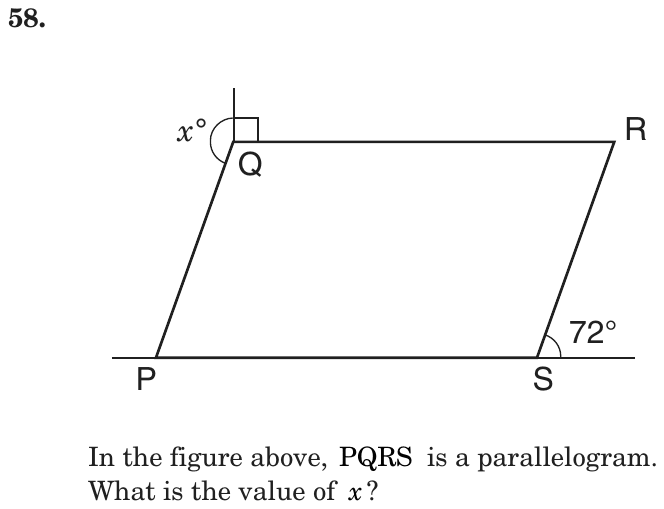
Question 29 of 36
2018 Test A Math, question 42Question
A box contains 5 strawberry candies, 3 banana candies, and 2 orange candies. If Braden selects 2 candies at random from this box, without replacement, what is the probability that both candies are not banana?
- A
- B
- C
- D
Show the answer
Correct answer: C
The total number of candies in the box is
5 + 3 + 2 = 10
The number of candies that are not banana is
5 + 2 = 7
The probability of the first candy not being banana is
Now, out of 9 candies, there are 6 candies left that are not banana. The probability of the second candy not being banana is
Multiply these two probabilities to get the solution:
Question analysis
This probability question has a box of strawberry, banana and orange candies and asks the chance that two candies drawn without replacement are both not banana. Students must count the non-banana candies, find the chance for each draw, and multiply. The second draw changes because one candy is already gone.
- NYS standards
- 7.SP.8a compound event as fraction of outcomes
- Grade level
- Grade 7 content, by NYS standard
- Compared with grade 7
- Above grade 7 Grade 7 compound probability usually uses lists or tree diagrams for independent events such as coins and number cubes. Here the draws are dependent, and students must also work with the complement, 'not banana'.
- Estimated difficulty
- Hard: combines ideas, needs a plan, and has more than one tempting wrong answer.
- Thinking it demands
- Depth of knowledge 2, skills and concepts · mainly apply
- What makes it hard
- Combines ideas moderate
- A very close wrong answer moderate
- Error-prone arithmetic minor
- Solution
- 3 steps
- Reading level
- Question and choices: about grade 9, 35 words.
- Corrected from the DOE handbook
- A stray punctuation mark in the explanation was removed.
- Students, last 30 days
- Not enough answers yet to show (it takes 10).
Why it is hard, traps and wrong answers (shows the answer)
Why it is hard
Two phrases in the stem change the calculation, "not" and "without replacement", and each has a choice for the student who misses it. The cleanest approach treats strawberry and orange together as one group of 7 and then works through the two draws in order. Students who know independent probability well are the most likely to square a fraction out of habit.
Combines ideas moderate Working it out
Two ideas meet: counting the 7 non-banana candies as the favorable group, and reducing both counts by one for the dependent second draw. (Embretson, 1998; Daniel & Embretson, 2010)
A very close wrong answer moderate Choosing the answer
The choices 49/100 and 7/15 are about 0.49 and 0.47, so estimating cannot separate them; only noticing that the second draw is 6 of 9, not 7 of 10, does. (Embretson & Wetzel, 1987; Gorin & Embretson, 2006; Ascalon et al., 2007)
Error-prone arithmetic minor Working it out
The product 7/10 × 6/9 = 42/90 must be simplified to 7/15 to match a choice, a reduction by 6 that is easy to stall on. (Brown & Burton, 1978; Junker & Sijtsma, 2001)
Strategy: Count the candies that are not banana, find the chance the first draw is one of them, reduce both counts by one for the second draw, and multiply.
Traps
- Without replacement: In a second pick there is one fewer item, which changes the probability.
- Misreads the question: Misses or misreads a condition or a word in the question: "at least", "each", "remaining", "not".
The wrong answers, classified
A Misreads the question (Hegarty, Mayer & Monk, 1995)
Misses the bold "not" and finds the chance that both candies are banana, 3/10 × 2/9 = 6/90 = 1/15.
B Without replacement (Fischbein & Schnarch, 1997)
Squares 3/10, finding two bananas as if the first candy were put back, which misses both "not" and "without replacement".
D Without replacement (Fischbein & Schnarch, 1997)
Squares 7/10 as if the first candy were returned, keeping 7 of 10 for the second draw instead of 6 of 9.
What was corrected from the DOE handbook, and why
- Explanation: The handbook reads “The probability of the second candy not being banana is. 6/9.” The period after “is” was removed.
Worked solution, step by step
Formulas used
- Probability
- P is the probability, the chance that something happens. f is the number of favorable outcomes, the ones you want. t is the total number of outcomes. It works when every outcome is equally likely, like picking one item at random.
- Two picks in a row
- To find the chance that two things both happen, multiply their chances. For the second chance, use what is left after the first pick. You multiply because you want a fraction of a fraction: the second pick must work in the share of times the first one did.
Sort out what you know
The box has 5 strawberry, 3 banana and 2 orange candies. Braden takes 2 candies. “Without replacement” means he keeps the first candy out. He does not put it back.
You need the chance that neither candy is banana. Watch out: the bold “not” matters. The chance that both are banana is , choice A.
Count the candies
There are 10 candies. The ones that are not banana are the strawberry and orange ones:
Find the chance for the first candy
7 of the 10 candies are not banana. Use the probability formula:
So the first candy is not banana 7 times out of 10.
Find the chance for the second candy
Say the first candy was not banana. Now 9 candies are left, and 6 of them are not banana:
Watch out: the first candy is not put back. Using again gives , choice D.
Multiply the two chances
Simplify by dividing the top and bottom by 6:
So the answer is C, .
Check your answer
Count pairs instead. From 10 candies there are 10 × 9 ÷ 2 = 45 different pairs. Pairs with no banana come from the 7 others: 7 × 6 ÷ 2 = 21. And 21 out of 45 is 7/15. It matches.
More questions like this
The original DOE question
Question 30 of 36
2018 Test A Math, question 44Question

On the number line above, points , , , and are integers, and . What is the value of ?
- A8
- B11
- C12
- D18
Show the answer
Correct answer: C
Convert the ratios into fractions of . Use the sum of the ratios for the denominator.
The part of that is is the sum of those fractions:
Find the length of :
The value of is .
Question analysis
This number line question places integer points W, X, Y and Z on a line and gives the ratio of the segments WX, XY and YZ as 4 to 2 to 3. Students find the whole length from W to Z, split it by the ratio, and add the parts that make up WY. Mixing up a part with the whole is the main risk.
- Grade level
- Grade 7 content, by NYS standard
- Compared with grade 7
- Above grade 7 Grade 7 students find distances on a number line and use part-to-whole ratios, usually separately. This item joins them: a negative endpoint, a three-term ratio and a choice of which segments to combine.
- Estimated difficulty
- Hard: combines ideas, needs a plan, and has more than one tempting wrong answer.
- Thinking it demands
- Depth of knowledge 2, skills and concepts · mainly apply
- What makes it hard
- Combines ideas moderate
- Reading a figure, table or graph moderate
- Many steps minor
- Solution
- 3 steps
- Reading level
- Question and choices: about grade 10, 21 words.
- Corrected from the DOE handbook
- Equations in the explanation that mixed up a fraction of a length with the length itself were corrected.
- Students, last 30 days
- Not enough answers yet to show (it takes 10).
Why it is hard, traps and wrong answers (shows the answer)
Why it is hard
Each step is routine, but the question keeps asking for a different piece of the line: the whole WZ, the part WX, and finally WY, which is two parts added together. Two of the wrong choices are exactly those other pieces. Students who mark the actual positions, X at −2 and Y at 2, can check the ratio before answering.
Combines ideas moderate Working it out
A three-part ratio, 4:2:3, must be applied to a length found from a negative endpoint, 8 − (−10) = 18, joining ratio and number-line distance. (Embretson, 1998; Daniel & Embretson, 2010)
Reading a figure, table or graph moderate Understanding the question
Only W at −10 and Z at 8 are labeled, and the drawing is not to scale: Y is drawn nearer 5 than 2, so reading WY from the picture fails. (Lesh, Post & Behr, 1987; Kirsch & Mosenthal, 1990)
Many steps minor Working it out
Find WZ, split it into 9 equal parts of 2, then add the 4 parts of WX and the 2 parts of XY. (Daniel & Embretson, 2010; Enright, Morley & Sheehan, 2002)
Strategy: Find the length WZ from the endpoints on the number line, divide it by the total number of ratio parts, and multiply by the parts from W to Y.
Traps
- Stops one step early: A choice is a number from partway through the solution.
- Answers a different question: A choice is right for another quantity: the other unknown, the rest instead of the part, the part instead of the whole.
- Counting the ends: Inclusive or exclusive ends, fence posts, consecutive numbers: an answer that is one too many or too few, or an endpoint drawn open where it belongs closed (or the reverse).
The wrong answers, classified
A Stops one step early (King et al., 2004; Gierl et al., 2017)
Finds WX, 4/9 of 18 = 8, and stops without adding XY's 4 to reach Y; 8 also matches Z's label.
B Counting the ends (Brown & Burton, 1978)
Places Y at 2 but counts the integers strictly between −10 and 2, which are −9 through 1, getting 11 instead of the distance 12.
D Answers a different question (King et al., 2004; Hegarty, Mayer & Monk, 1995)
Gives the whole length WZ, 8 − (−10) = 18, instead of the part from W to Y.
What was corrected from the DOE handbook, and why
- Explanation: The handbook writes WX = 4/9, XY = 2/9 and WY = 2/3, and then says “The value of WY is 2/3(18) = 12”. Those fractions are parts of WZ, not the lengths themselves (WX is 8 and WY is 12), so WY cannot be both 2/3 and 12. The lines now read WX = 4/9 WZ, XY = 2/9 WZ and WY = 2/3 WZ. The method and the answer are unchanged.
Worked solution, step by step
Formulas used
- Distance on a number line
- d is the distance between two points. b is the point on the right and a is the point on the left. Subtracting left from right always gives a positive distance. It works even when a is negative.
- Size of one part of a ratio
- u is the size of one part. L is the whole length being shared. p is the total number of parts, found by adding the numbers in the ratio. Every part is the same size, so you share the length equally.
Sort out what you know
W is at −10 and Z is at 8. X and Y are between them. The ratio 4:2:3 means WX is 4 parts, XY is 2 parts and YZ is 3 parts. All the parts are the same size.
You need the length WY, from W to Y. The drawing is not exact, so use the numbers, not the picture.
Find the whole length WZ
WZ is 18 units long. Subtracting a negative number is the same as adding.
Find the size of one part
Add the ratio numbers to get the number of parts:
Share the 18 units equally among 9 parts:
Each part is 2 units long.
Find WY
WY is WX and XY together, so it has 4 + 2 = 6 parts:
Watch out: WX alone is 4 × 2 = 8, which is choice A. And 18 is the whole line, choice D. So the answer is C, 12.
Check your answer
Place the points. W is at −10. X is 8 units to the right, at −2. Y is 4 more, at 2. Z is 6 more, at 8, which matches its label. And the distance from −10 to 2 is 2 − (−10) = 12.
More questions like this
The original DOE question
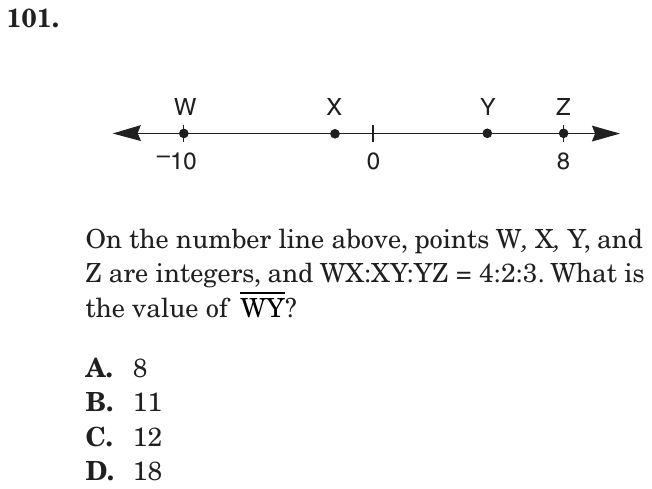
Question 31 of 36
2018 Test B English, question 40Passage Snowy Mountains
Snowy Mountains
by John Gould Fletcher
Higher and still more high,
Palaces made for cloud,
Above the dingy city-roofs
Blue-white like angels with broad wings,
Pillars of the sky at rest
The mountains from the great plateau
Uprise.
But the world heeds them not;
They have been here now for too long a time.
The world makes war on them,
Tunnels their granite cliffs,
Splits down their shining sides,
Plasters their cliffs with soap-advertisements,
Destroys the lonely fragments of their peace.
Vaster and still more vast,
Peak after peak, pile after pile,
Wilderness still untamed,
To which the future is as was the past,
Barrier spread by Gods,
Sunning their shining foreheads,
Barrier broken down by those who do not need
The joy of time-resisting storm-worn stone,
The mountains swing along
The south horizon of the sky;
Welcoming with wide floors of blue-green ice
The mists that dance and drive before the sun.
“Snowy Mountains” by John Gould Fletcher—Public Domain
Question
Read line 5 from the poem.
Pillars of the sky at rest
The line helps develop the theme of the poem by suggesting that the mountains
- Aserve a noble and supportive purpose in the world.
- Battract the clouds with their strength and permanence.
- Cremain untamed through the ages.
- Dprovide protection for the people.
Show the answer
Correct answer: A
The question asks how the line from the poem helps develop the theme of the poem. Line 5 helps develop the theme that the mountains are more important than people realize by suggesting that the mountains serve a noble, foundational purpose in the world, as explained in Option A.
Option B is incorrect because, while the poem does describe the strength and permanence of the mountains, the line does not suggest that these traits attract the clouds.
Option C is incorrect because, while the line states that the highest peaks are “at rest,” that phrase describes stillness, not wildness; the poem calls the mountains “still untamed” only later (line 17), and line 5 does not suggest it.
Option D is incorrect because, while pillars are strong and may indicate shelter, there is no suggestion in the line that the mountains are protecting the people. Additionally, this concept is not a theme of the poem.
Question analysis
This figurative language question asks how the metaphor “Pillars of the sky at rest” in “Snowy Mountains” helps develop the poem’s theme. Students must work out what calling mountains pillars of the sky suggests about them, and it is tricky because every choice sounds like something this poem could say.
- Grade level
- Grade 8 reading and task
- Compared with grade 7
- Above grade 7 Grade 7 students interpret metaphors, but here they must also connect a short image to the poem’s theme and choose among abstract options, a step closer to grade 8 work on figurative meaning and theme.
- Estimated difficulty
- Hard: combines ideas, needs a plan, and has more than one tempting wrong answer.
- Thinking it demands
- Depth of knowledge 3, strategic thinking · mainly analyze
- What makes it hard
- Figurative or literary language major
- The right answer is reworded moderate
- Combines ideas minor
- Evidence
- Answered from one sentence or line
- Reading level
- Passage: 161 words (a poem; reading level not measured); question and choices: about grade 3, 52 words.
- Corrected from the DOE handbook
- A claim in the explanation that the poem contradicts was corrected.
- Students, last 30 days
- Not enough answers yet to show (it takes 10).
Why it is hard, traps and wrong answers (shows the answer)
Why it is hard
This is hard because every choice says something the poem could plausibly mean, and two of them borrow real phrases from other lines. Students who test choices against the poem as a whole find support for the wrong ones; the question rewards testing them against the single image of pillars holding up the sky. Seeing that pillars both support and ennoble a structure leads directly to the key.
Figurative or literary language major Understanding the question
The answer depends on unpacking one metaphor: pillars hold up a roof, so “Pillars of the sky” casts the mountains as supports of the heavens, and “at rest” adds a calm, dignified strength. (Graesser, Singer & Trabasso, 1994; Kintsch, 1998)
The right answer is reworded moderate Choosing the answer
The key uses words the poem never does, “noble” and “supportive,” while wrong choices echo “cloud” from line 2 and “untamed” from line 17 and so look anchored in the text. (Freedle & Kostin, 1993; Kirsch & Mosenthal, 1990)
Combines ideas minor Working it out
Students must interpret the image and then link it to the poem’s theme, that the mountains matter more than the world below recognizes. (Embretson, 1998; Daniel & Embretson, 2010)
Strategy: Ask what a pillar is and why a poet might call mountains “pillars of the sky,” then test each choice against line 5 alone before thinking about the rest of the poem.
Traps
- Wrong part of the text: A choice is true of another paragraph, stanza or speaker than the one asked about.
- Half right: One half of a two-part choice is right and the other is not.
- Reads too much in: A reasonable-sounding conclusion that goes further than the text allows.
The wrong answers, classified
B Half right (King et al., 2004; Thissen, Steinberg & Fitzpatrick, 1989)
Strength and permanence fit both pillars and the poem, but attracting clouds comes from line 2’s “Palaces made for cloud,” and line 5 says nothing about drawing clouds in.
C Wrong part of the text (Kirsch & Mosenthal, 1990)
Takes “Wilderness still untamed” from line 17, a genuine idea of the third stanza, and attaches it to line 5, whose pillars “at rest” suggest calm support, not wildness.
D Reads too much in (Graesser, Singer & Trabasso, 1994)
Follows the pillar image one step too far, from pillars to a roof to shelter for people, though neither the line nor the poem shows the mountains protecting anyone.
What was corrected from the DOE handbook, and why
- Explanation: The handbook rejects Option C by saying the mountains “do not remain untamed or untouched,” but line 17 calls them “Wilderness still untamed,” and the handbook’s own explanation of the third-stanza question relies on that line. The site now says that “at rest” describes stillness, not wildness, and that the poem calls the mountains “still untamed” only later, in line 17, so line 5 does not suggest it.
Working it out, step by step
Figure out what the question asks
This asks what one image, line 5, adds to the poem’s theme. A theme is the big message of a poem. Here the theme is that the mountains are great and important, even though people ignore them. You need to decide what “Pillars of the sky” says about the mountains.
Look closely at line 5
Line 5 reads “Pillars of the sky at rest.” It is part of the first stanza’s list of grand pictures. The list also has “Palaces made for cloud” in line 2. Line 5 is a metaphor. A metaphor calls one thing by the name of another to compare them, without using “like” or “as.”
Explain what pillars do
A pillar is a tall, strong column that holds up a roof. Big, important buildings, like temples and courthouses, have pillars. So calling the mountains “Pillars of the sky” makes them seem to hold up the sky. That is a supporting job. It is also a grand, noble one. “At rest” adds calm. The pillars stand still and steady.
Check each choice
- A fits. Holding up the sky is a noble, supportive job.
- B is wrong. Clouds come from line 2. Line 5 says nothing about pulling clouds in.
- C is wrong. “Wilderness still untamed” is line 17, not line 5. Pillars “at rest” suggest calm, not wildness.
- D is wrong. Pillars hold up roofs, and roofs can shelter people. But the line never shows the mountains protecting anyone.
Choose the answer
Pillars hold things up and make a building grand. So the answer is A, “serve a noble and supportive purpose in the world.”
Why this answer and not the closest wrong one
C is the strongest trap, because the poem really does call the mountains untamed. But that is line 17. Test each choice against line 5 alone. A pillar is a support, and a pillar of the sky is a grand one. Only A comes straight from that picture.
More questions like this
The original DOE question
The passage “Snowy Mountains” as printed (page 142)
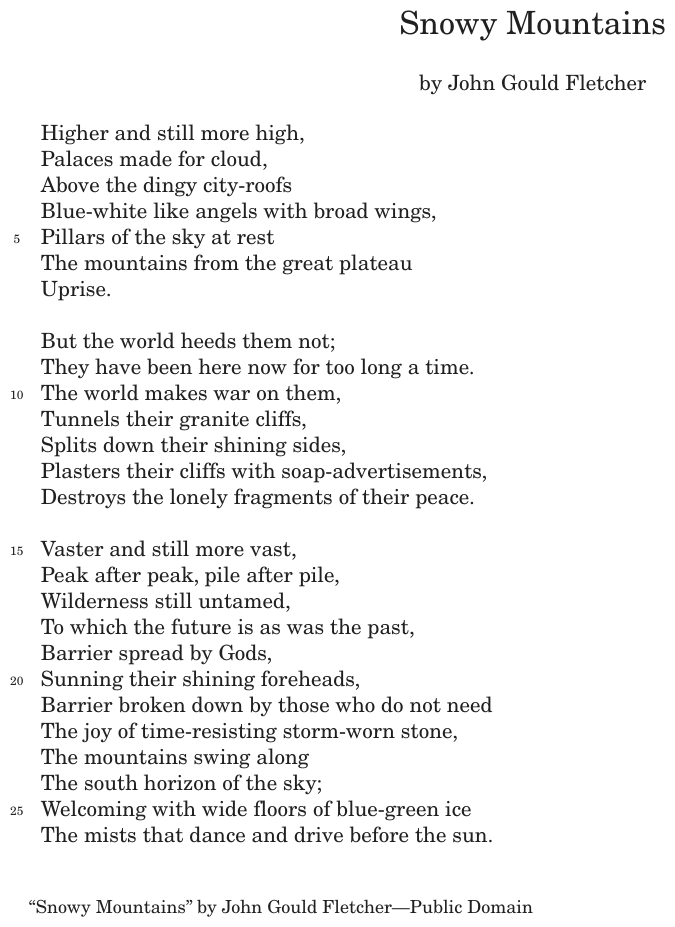
Question 32 of 36
2018 Test B English, question 53Passage Invention of the Telegraph
Samuel Morse, an American inventor, is credited with creating the electronic telegraph, a communication device that allows users to send messages using a system of short and long pulses that represent letters, numbers, and punctuation. In 1843 the United States Congress passed the Telegraph Bill, which provided Morse with the funds to build an electric telegraph system.
Invention of the Telegraph
Earlier Signal Systems
Long before Samuel F. B. Morse electrically transmitted his famous message “What hath God wrought?” from Washington to Baltimore on May 24, 1844, there were signaling systems that enabled people to communicate over distances. Most were visual or “semaphore” systems using flags or lights. In the eighteenth century, such systems used an observer who would decipher a signal from a high tower on a distant hill and then send it on to the next station. The young American republic wanted just such a system along its entire Atlantic coast and offered a prize of $30,000 for a workable proposal. The framers of this legislation had no way of knowing that when they used the word “telegraph” to refer to this visual semaphore system, they would be offered an entirely new and revolutionary means of communication—electricity.
The Growth of an Idea
The idea of using electricity to communicate over distance is said to have occurred to Morse during a conversation aboard ship when he was returning from Europe in 1832. Michael Faraday’s recently invented electromagnet was much discussed by the ship’s passengers, and when Morse came to understand how it worked, he speculated that it might be possible to send a coded message over a wire. While a student at Yale College years before, he had written his parents a letter about how interesting he found the lectures on electricity. Despite what he had learned at Yale, Morse found when he began to develop his idea that he had little real understanding of the nature of electricity, and after sporadic attempts to work with batteries, magnets, and wires, he finally turned for help to a colleague at the University of the City of New York, Leonard D. Gale.
Gale was a professor of chemistry and familiar with the electrical work of Princeton’s Joseph Henry, a true pioneer in the new field. Well before Morse had his shipboard idea about a telegraph, Henry rang a bell at a distance by opening and closing an electric circuit. In 1831, he had published an article, of which Morse was unaware, that contained details suggesting the idea of an electric telegraph. Gale’s help and his knowledge of this article proved crucial to Morse’s telegraph system because Gale not only pointed out flaws in the system but showed Morse how he could regularly boost the strength of a signal and overcome the distance problems he had encountered by using a relay system Henry had invented. Henry’s experiments, Gale’s assistance, and, soon after, hiring the young technician Alfred Vail were keys to Morse’s success.
Obstacles and Opportunities
By December 1837, Morse had enough confidence in his new system to apply for the federal government’s appropriation, and during the next year he conducted demonstrations of his telegraph both in New York and Washington.
However, when the economic disaster known as the Panic of 1837 took hold of the nation and caused a long depression, Morse was forced to wait for better times. It was during this period that Morse visited Europe again and tried not only to secure patent protection overseas but to examine competing telegraph systems in England. . . .
By 1843, the country was beginning to recover economically, and Morse again asked Congress for the $30,000 that would allow him to build a telegraph line from Washington to Baltimore, forty miles away. The House of Representatives eventually passed the bill containing the Morse appropriation, and the Senate approved it in the final hours of that Congress’s last session. With President Tyler’s signature, Morse received the cash he needed and began to carry out plans for an underground telegraph line.
Realizing a Great Invention
Morse had hired the ingenious construction engineer Ezra Cornell to lay the pipe carrying the wire, and although Cornell did his job superbly, one of Morse’s partners, Congressman F. O. J. Smith, had purchased wire with defective insulation. Too much time had been wasted laying bad wire, and with the project on a rigid deadline, something had to be done quickly. Cornell suggested that the fastest and cheapest way of connecting Washington and Baltimore was to string wires overhead on trees and poles. The desperate Morse gave the go-ahead, and the line was completed in time for the dramatic and spectacularly successful link between the Supreme Court chamber of the Capitol building and the railroad station in Baltimore.
Soon, as overhead wires connected cities up and down the Atlantic coast, the dots-and-dashes method that recorded messages on a long moving strip of paper was replaced by the operator’s ability to interpret the code in real time. . . . Telegraph lines soon extended westward, and within Morse’s own lifetime they connected the continents of Europe and America.
“Invention of the Telegraph”—Public Domain/Library of Congress
legislation: Telegraph Bill
dots-and-dashes method: the short and long pulses of Morse code that are sent and received by telegraph operators
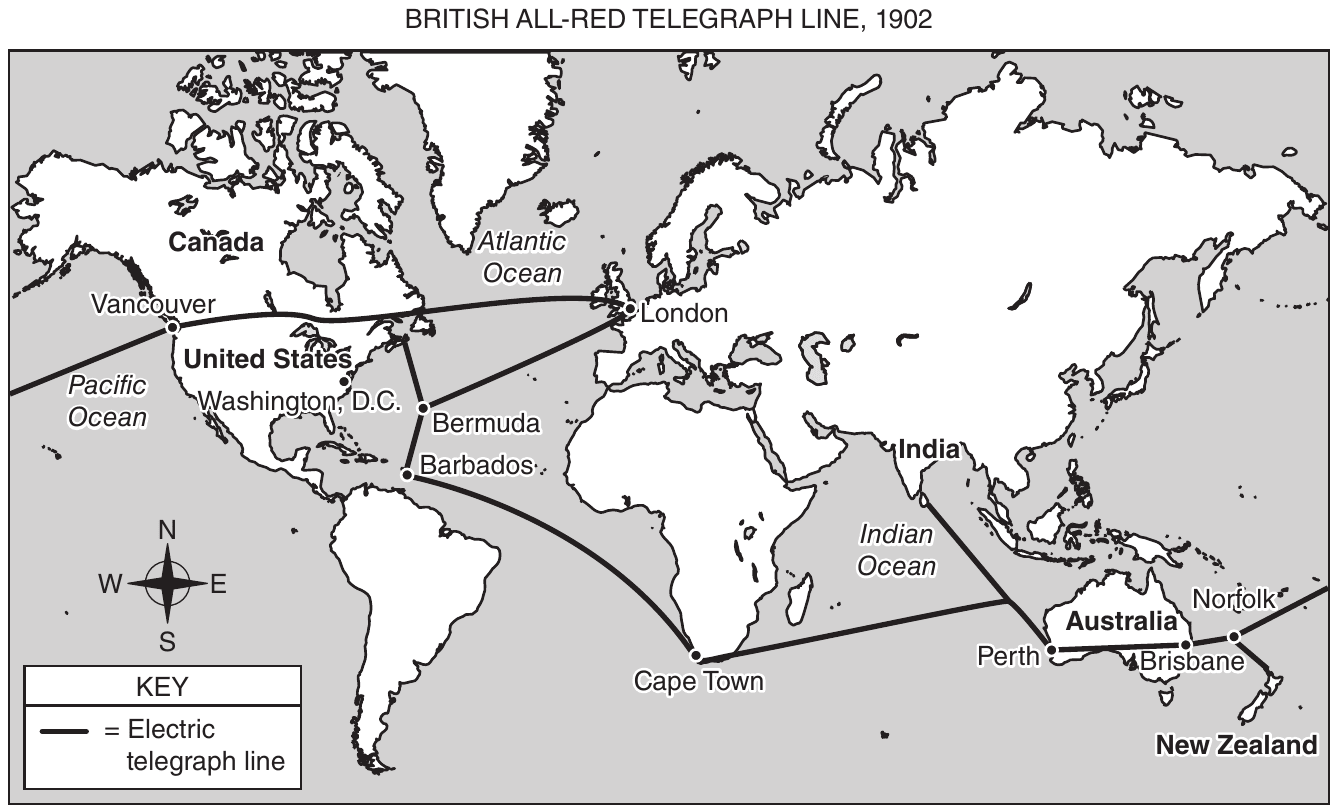
The first transatlantic electric telegraph message was sent in 1858, and by 1902 the British All-Red Line connected most of the world.
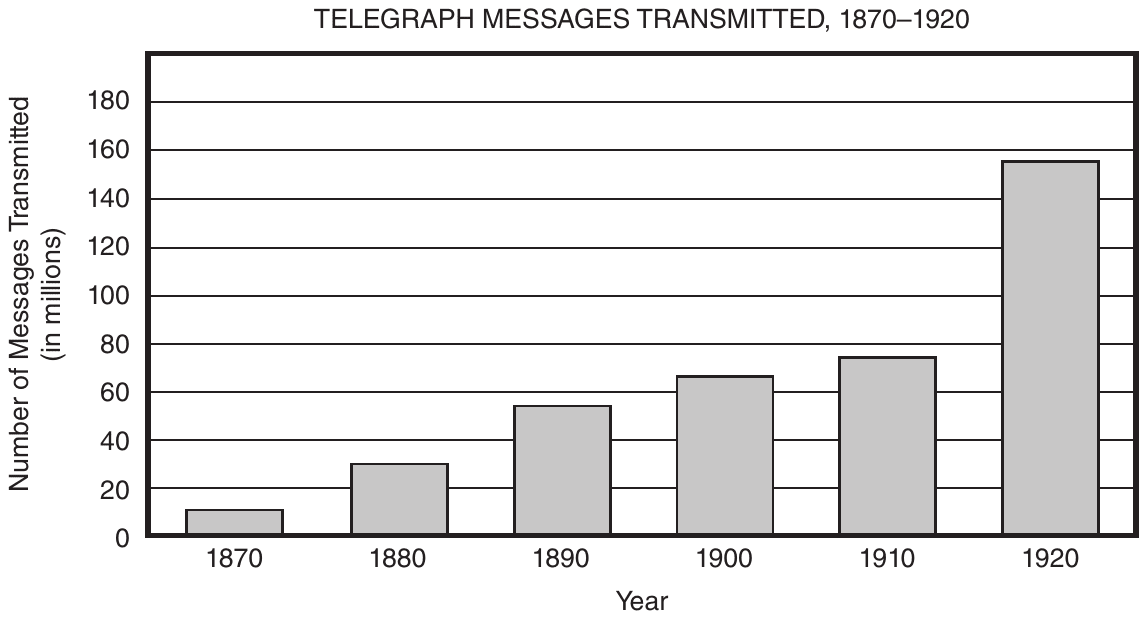
Source: U.S. Bureau of the Census. Historical Statistics of the United States, Colonial Times to 1970, Bicentennial Edition, Part 2. Washington, D.C., 1975.
Question
How does the graph support the ideas in paragraph 8?
- AIt indicates how welcome the improvement of long-distance communication was in the United States.
- BIt provides evidence of the dramatic increase in the number of telegraph messages as Morse’s system expanded across the United States.
- CIt reveals that by the twentieth century millions of people had used the telegraph despite earlier hesitations about the system.
- DIt shows how improvements that allowed Morse code to be read in real time made relaying telegraph messages faster and increased the system’s usage.
Show the answer
Correct answer: B
The question asks how the graph supports the ideas in paragraph 8. The graph shows the number of messages transmitted from 1870 to 1920. In 1920 almost 160 million messages were transmitted, showing a “dramatic”—more than double—increase from 1910, which makes Option B the correct answer.
Option A is incorrect because, while it can be implied from the expansion shown on the graph that people possibly welcomed the improvement in long-distance communication, the graph does not state this explicitly.
Option C is incorrect because the graph does not show how many people used the telegraph, but rather it shows the number of messages sent. Additionally, paragraph 8 provides no details about hesitation on the part of individuals.
Option D is incorrect because, while improvements in recording and interpreting code were made, the graph does not show the effect of this advancement on the speed or number of messages being transmitted.
Question analysis
This question asks how a graph that accompanies “Invention of the Telegraph” supports the ideas in paragraph 8, the passage’s closing account of what followed the first telegraph line. Students must connect a data display to a paragraph of text, and the choices differ in how much they claim a graph of this kind could prove.
- Grade level
- Grade 7 reading and task
- Compared with grade 7
- At grade 7 Connecting a graph to a paragraph is standard grade 7 work with mixed formats. The demand is typical: read the paragraph, read the data, and check that a claim about the graph does not go beyond it.
- Estimated difficulty
- Moderate: several steps, or a close reading with one strong distractor.
- Thinking it demands
- Depth of knowledge 2, skills and concepts · mainly analyze
- What makes it hard
- Reading a figure, table or graph moderate
- A very close wrong answer moderate
- Combines ideas minor
- Evidence
- Answered from one paragraph or stanza
- Reading level
- Passage: about grade 11, 910 words; question and choices: about grade 11, 88 words.
- Corrected from the DOE handbook
- A misreading of the graph in the explanation was corrected.
- Students, last 30 days
- Not enough answers yet to show (it takes 10).
Why it is hard, traps and wrong answers (shows the answer)
Why it is hard
The graph is simple to read; the challenge is deciding how much a count of messages can prove. Wrong choices claim the graph shows public feeling, numbers of people, or the effect of one improvement, and the last of these is tempting because paragraph 8 mentions that improvement. Students who ask what the vertical axis measures can reject all three quickly.
Reading a figure, table or graph moderate Understanding the question
The bar graph counts messages in millions, rising from about 10 in 1870 to about 155 in 1920; it measures neither people, nor speed, nor causes, which is what rules out three choices. (Lesh, Post & Behr, 1987; Kirsch & Mosenthal, 1990)
A very close wrong answer moderate Choosing the answer
The key and the real-time-reading choice both tie the rise in messages to a change described in paragraph 8; they part on one detail, the claim that relaying became “faster,” which a count of messages cannot show. (Embretson & Wetzel, 1987; Gorin & Embretson, 2006; Ascalon et al., 2007)
Combines ideas minor Working it out
Students must join the graph’s fifty years of growth to paragraph 8’s spread of overhead wires along the coast, westward and across the ocean. (Embretson, 1998; Daniel & Embretson, 2010)
Strategy: Reread paragraph 8 and look at what the graph measures, then for each choice ask whether both the paragraph and the graph back it up.
Traps
- Reads too much in: A reasonable-sounding conclusion that goes further than the text allows.
- Twists what the text says: Uses the text's topic and ideas but changes what it says: who did it, how much, when, or why.
The wrong answers, classified
A Reads too much in (Graesser, Singer & Trabasso, 1994)
Infers from the growth that people welcomed the telegraph, which may be true, but a count of messages cannot show how anyone felt about the change.
C Twists what the text says (King et al., 2004)
Treats messages as people, reading “in millions” as millions of users, and adds “earlier hesitations” that neither the graph nor paragraph 8 mentions.
D Reads too much in (Graesser, Singer & Trabasso, 1994)
Takes real-time reading of code from paragraph 8 and credits it with the rise in messages, but the graph shows only totals, not what caused them or how fast messages moved.
What was corrected from the DOE handbook, and why
- Explanation: The handbook says 1920 showed an “almost double” increase from 1910. The graph shows about 75 million messages in 1910 and about 155 million in 1920, so the number more than doubled. The site now says “more than double.”
Working it out, step by step
Figure out what the question asks
This asks how the bar graph supports paragraph 8. To answer, you need to know two things. What does paragraph 8 say? And what does the graph actually measure?
Read paragraph 8
Paragraph 8 says that “overhead wires connected cities up and down the Atlantic coast.” Then “Telegraph lines soon extended westward, and within Morse’s own lifetime they connected the continents of Europe and America.” So the main idea is growth. The telegraph spread farther and farther.
Read the bar graph
The graph’s title is Telegraph Messages Transmitted, 1870–1920. Its side axis counts messages, in millions. The bars rise every ten years. There were about 10 million messages in 1870 and about 75 million in 1910. In 1920 there were about 155 million. That last jump is more than double. The graph counts messages. It does not count people, speed or feelings.
Check each choice
- A is wrong. A count of messages can’t show how welcome something was. That is a feeling.
- B fits. The bars show a huge rise in messages as the lines spread.
- C is wrong. The graph counts messages, not people. Nothing mentions “earlier hesitations” either.
- D is wrong. Paragraph 8 does mention reading code “in real time,” or right away. But the graph shows totals only. It can’t show what caused the rise or how fast messages moved.
Choose the answer
The graph shows messages rising from about 10 million to about 155 million as the wires spread. So the answer is B, “It provides evidence of the dramatic increase in the number of telegraph messages as Morse’s system expanded across the United States.”
Why this answer and not the closest wrong one
D is the closest trap, since paragraph 8 really does mention reading code in real time. But ask what the side of the graph measures. It counts messages, nothing else. A count can show that use grew, as B says. It can’t show that messages got faster, or why.
More questions like this
The original DOE question
The passage “Invention of the Telegraph” as printed (pages 146–148)
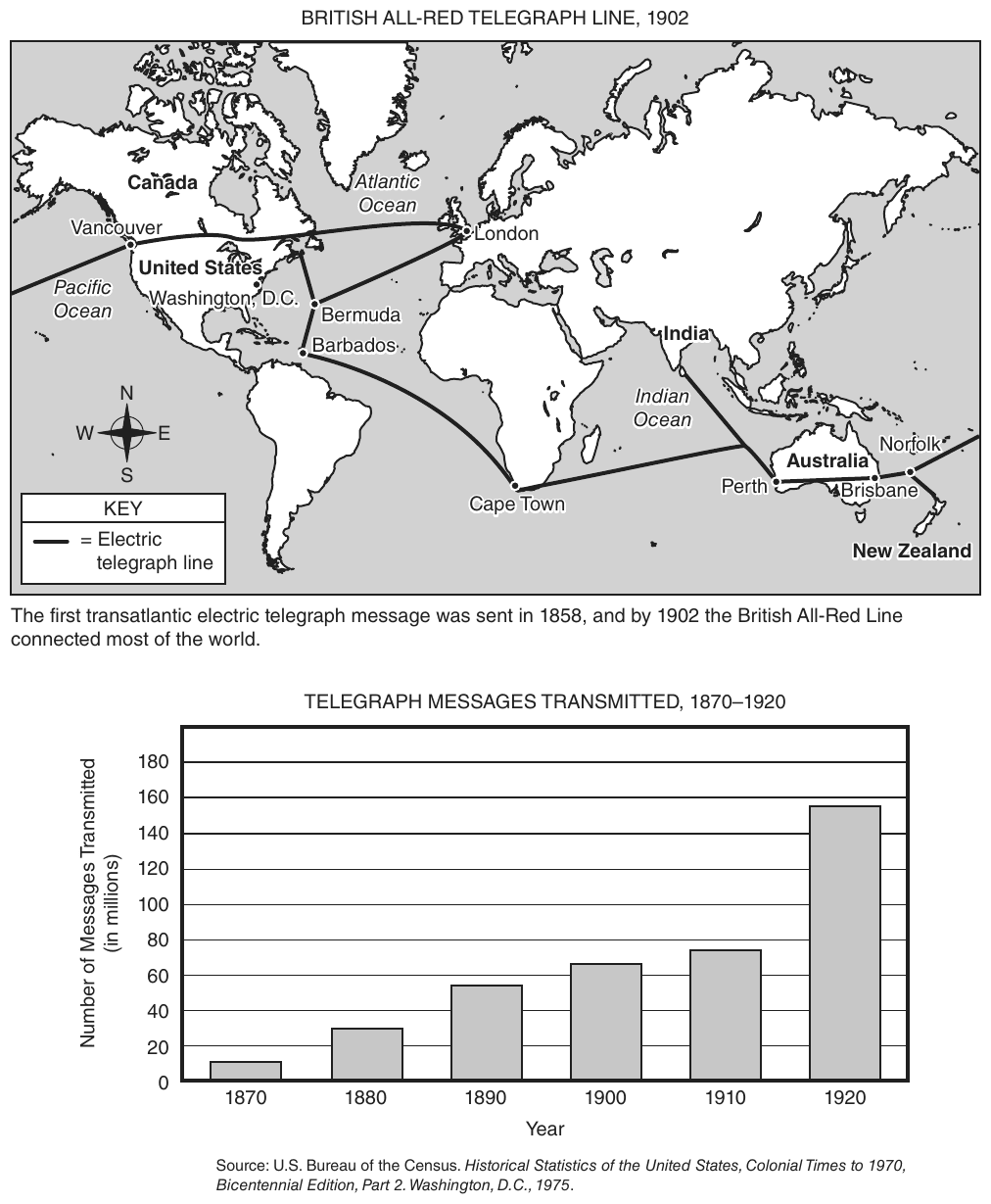
Question 33 of 36
2018 Test B Math, question 5Question
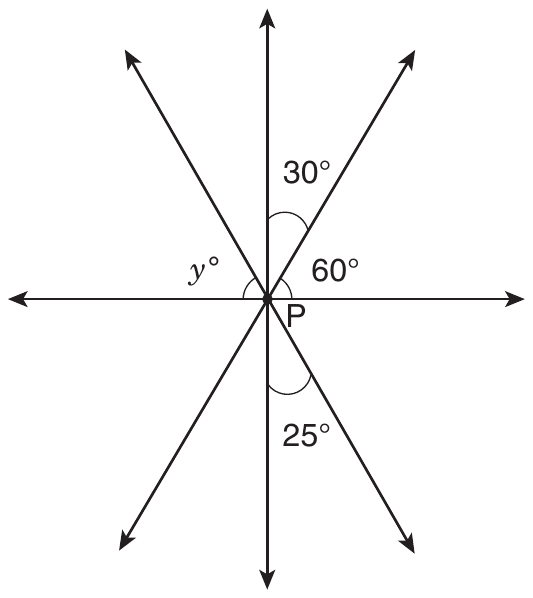
Four straight lines intersect at point P as shown above. What is the value of ?
Grid-in question: work out the answer and enter it as a number.
Show the answer
Correct answer: 65
Call the missing angle in the top half of the figure .
The sum of the four angles on the top of the figure is equal to 180°.
Since is a vertical angle with the 25° angle, then is also 25°. Use that to solve for .
Question analysis
This grid-in angle question shows four straight lines crossing at a single point P and asks for the size of an unknown angle y. Students combine vertical angles with the fact that angles along a straight line add to 180 degrees. One angle they need is unlabeled and must be found from its vertical partner.
- NYS standards
- 7.G.5 angle relationships and equations
- Grade level
- Grade 7 content, by NYS standard
- Compared with grade 7
- At grade 7 Using vertical angles and straight angles to write an equation for an unknown angle is a core grade 7 geometry task. Four lines create more angles than usual, but the reasoning stays at grade 7.
- Estimated difficulty
- Moderate: several steps, or a close reading with one strong distractor.
- Thinking it demands
- Depth of knowledge 2, skills and concepts · mainly apply
- What makes it hard
- Reading a figure, table or graph major
- Combines ideas moderate
- An answer in an unexpected form minor
- Solution
- 3 steps
- Reading level
- Question and choices: about grade 4, 16 words.
- Students, last 30 days
- Not enough answers yet to show (it takes 10).
Why it is hard, traps and wrong answers (shows the answer)
Why it is hard
The arithmetic is one subtraction; the work is in seeing the figure correctly. Students have to notice that a fourth angle sits between the 30° angle and y, recognize it as the vertical partner of the 25° angle, and then use the straight line. The drawing is not to scale: y is drawn close to the 60° angle across the vertical line, which rewards anyone who computes rather than eyeballs.
Reading a figure, table or graph major Understanding the question
Four lines make eight angles around P but only three are labeled; above the horizontal line sit 60°, 30°, an unlabeled angle and y°, and that unlabeled angle is easy to overlook. (Lesh, Post & Behr, 1987; Kirsch & Mosenthal, 1990)
Combines ideas moderate Working it out
The solution joins two facts: the unlabeled angle is vertical to the 25° angle below P, and the four angles above the horizontal line make a straight angle of 180°. (Embretson, 1998; Daniel & Embretson, 2010)
An answer in an unexpected form minor Choosing the answer
As a grid-in, nothing confirms the result, and the drawing shows y at about 60°, so a reading of the picture produces a number that looks right. (Enright, Morley & Sheehan, 2002)
Strategy: Pick a straight line through P and list the angles on one side of it; replace the unlabeled one with the labeled angle vertical to it, then subtract from 180.
Traps
- Misreads the figure: Reads a value, label or tick spacing in a figure, table or graph wrongly.
- Stops one step early: A choice is a number from partway through the solution.
- Trusting the picture: The figure suggests something it does not state; work from the given facts.
The wrong answers, classified
90 Misreads the figure (Lesh, Post & Behr, 1987; Kirsch & Mosenthal, 1990)
Misses the unlabeled angle between the 30° angle and y, so subtracts only 30 and 60 from 180.
115 Stops one step early (King et al., 2004; Gierl et al., 2017)
Adds the three known angles beside y, 25 + 30 + 60, and grids that sum without subtracting it from 180.
60 Trusting the picture (Lesh, Post & Behr, 1987)
Judges from the drawing, where y looks like a mirror image of the 60° angle across the vertical line, instead of computing it.
Worked solution, step by step
Formulas used
- Angles on a straight line
- a, b, c and d are angles that sit side by side along one side of a straight line, all meeting at one point. Together they make a half turn, which is 180 degrees. This works for any number of angles, not just four.
- Vertical angles
- When two lines cross, they make an X. Angle 1 and angle 2 are opposite each other across the crossing point. Angles like these are called vertical angles. They are always equal.
Look closely at the figure
Four lines cross at point P. Look above the flat, or horizontal, line. From right to left there are four angles: 60°, 30°, an angle with no label, and y°.
Below the horizontal line there is a 25° angle. You need to find y.
Find the unlabeled angle
The unlabeled angle sits between the up-and-down, or vertical, line and the slanted line rising to the left.
That slanted line keeps going through P and down to the right. The 25° angle sits between that same line and the vertical line, below P.
So the two angles are opposite each other across P. They are vertical angles, so they are equal. The unlabeled angle is 25°.
Add the angles above the line
The four angles above the horizontal line fill one side of a straight line. So they add up to 180°.
Solve for y
Take 115 away from 180 to get y alone.
Watch out: Do not skip the unlabeled angle. Using only 30 and 60 gives 90. Do not stop at the sum, 115, either. And do not guess from the picture. Angle y looks like 60°, but the drawing is not exact.
So you would grid 65.
Check your answer
Add all four angles above the horizontal line: . They fill a straight line exactly, so 65 fits.
More questions like this
The original DOE question
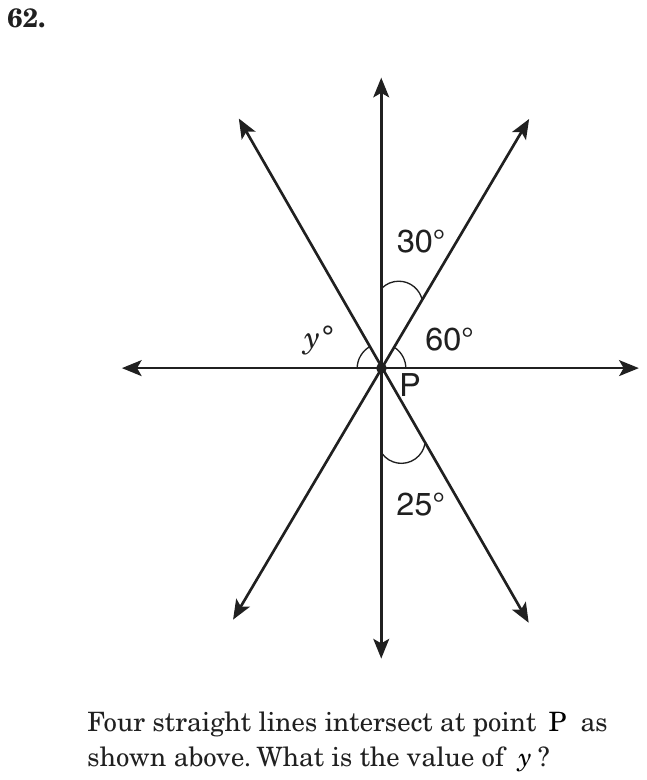
Question 34 of 36
2018 Test B Math, question 7Question
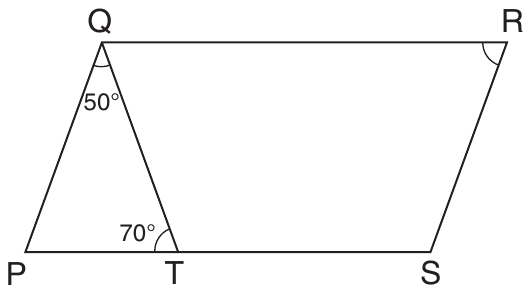
In the figure above, PQRS is a parallelogram. The measure of ∠PQT is 50°, and the measure of ∠PTQ is 70°. What is the measure of ∠QRS?
- A60°
- B70°
- C80°
- D120°
Show the answer
Correct answer: A
Find the missing angle, angle QPT, of triangle PQT:
180° − 70° − 50° = 60°
In parallelogram PQRS, angle QPT is congruent to angle QRS, so the measure of angle QRS is also 60°.
Question analysis
This geometry question uses parallelogram PQRS and a triangle PQT inside it, giving two of the triangle's angles and asking for angle QRS. Students need the triangle angle sum and the fact that opposite angles of a parallelogram are equal. The challenge is connecting the angles found in the triangle to the angles of the parallelogram.
- NYS standards
- Grade level
- Grade 8 content, by NYS standard
- Compared with grade 7
- Above grade 7 Grade 7 angle work uses vertical, adjacent and supplementary angles. This also needs the triangle angle sum and the opposite angles of a parallelogram, ideas New York places in grade 8, though the arithmetic is short.
- Estimated difficulty
- Moderate: several steps, or a close reading with one strong distractor.
- Thinking it demands
- Depth of knowledge 2, skills and concepts · mainly apply
- What makes it hard
- Reading a figure, table or graph major
- Combines ideas moderate
- A very close wrong answer moderate
- Something you must already know minor
- Solution
- 2 steps
- Reading level
- Question and choices: about grade 4, 25 words.
- Students, last 30 days
- Not enough answers yet to show (it takes 10).
Why it is hard, traps and wrong answers (shows the answer)
Why it is hard
Few steps are needed, but the figure misleads. It draws triangle PQT as isosceles, so the angle at P looks the same as the marked 70°, and the angle at R looks the same again; a student who trusts the drawing never computes. Those who do compute the angle at P must still choose the opposite angle of the parallelogram, not the angle next to it, which is where 120° comes from.
Reading a figure, table or graph major Understanding the question
The figure carries facts the stem leaves out: T lies on side PS, the 50° is only part of the angle at Q, and the 70° is at T, not at a corner of the parallelogram. (Lesh, Post & Behr, 1987; Kirsch & Mosenthal, 1990)
Combines ideas moderate Working it out
Two separate facts link up: the angles of triangle PQT sum to 180°, and the angle at P, once known, equals the opposite angle at R of parallelogram PQRS. (Embretson, 1998; Daniel & Embretson, 2010)
A very close wrong answer moderate Choosing the answer
60° and 70° are close enough that judging the angle at R by eye cannot separate them, and the drawing even favors 70°; only computing the triangle's third angle does. (Embretson & Wetzel, 1987; Gorin & Embretson, 2006; Ascalon et al., 2007)
Something you must already know minor Working it out
Neither the triangle angle sum nor the rule that opposite angles of a parallelogram are equal is given; students must bring both to the figure. (Anderson & Krathwohl, 2001)
Strategy: Find the third angle of triangle PQT from the angle sum, work out which angle of the parallelogram it matches, then use the parallelogram's angle facts to reach angle QRS.
Traps
- Trusting the picture: The figure suggests something it does not state; work from the given facts.
- Answers a different question: A choice is right for another quantity: the other unknown, the rest instead of the part, the part instead of the whole.
The wrong answers, classified
B Trusting the picture (Lesh, Post & Behr, 1987)
Trusts the drawing, where triangle PQT looks isosceles, so takes the angle at P, and its opposite angle at R, to be 70° like the angle at T.
C Little reason to choose it (Haladyna & Downing, 1993; Rodriguez, 2005)
No standard step gives 80°; at most a student treats the triangle as having two 50° angles and computes 180 − 100, which nothing in the figure supports.
D Answers a different question (King et al., 2004; Hegarty, Mayer & Monk, 1995)
Finds the 60° angle at P but answers with the angle at Q, 180 − 60 or 50 + 70 = 120, the consecutive angle instead of the opposite one.
Worked solution, step by step
Formulas used
- Angles in a triangle
- a, b and c are the three angles inside any triangle. They always add up to 180 degrees. If you know two of the angles, subtract them from 180 to find the third.
- Opposite angles of a parallelogram
- A parallelogram is a four-sided shape whose opposite sides are parallel, meaning they never meet. In parallelogram PQRS, the corners at P and R are opposite each other. Opposite angles of a parallelogram are always equal.
Sort out the figure
PQRS is a parallelogram. That is a four-sided shape whose opposite sides are parallel, meaning they never meet.
Point T is on the bottom side PS. Segment QT cuts off triangle PQT on the left. In that triangle, angle PQT is 50° and angle PTQ is 70°.
You need angle QRS, the corner at R.
Find the third angle of the triangle
Triangle PQT has angles at Q, T and P. You know two of them. The angle at P is angle QPT. All three must add to 180°.
So angle QPT is 60°.
Match angle P to angle R
T lies on side PS. So angle QPT is also the corner of the parallelogram at P. Angle P and angle R are opposite corners. Opposite angles are equal, so angle QRS is also 60°.
Watch out: Angle Q is next to angle P, not opposite it. Angle Q is 120°, choice D, but the question asks about angle R. Also, do not trust the drawing. Angle R may look like 70°, choice B.
So the answer is A, 60°.
Check your answer
The four corners of the parallelogram are 60°, 120°, 60° and 120°. They add to 360°, as the angles of any four-sided shape must. Also, the 50° angle at Q fits inside the 120° corner at Q.
More questions like this
The original DOE question
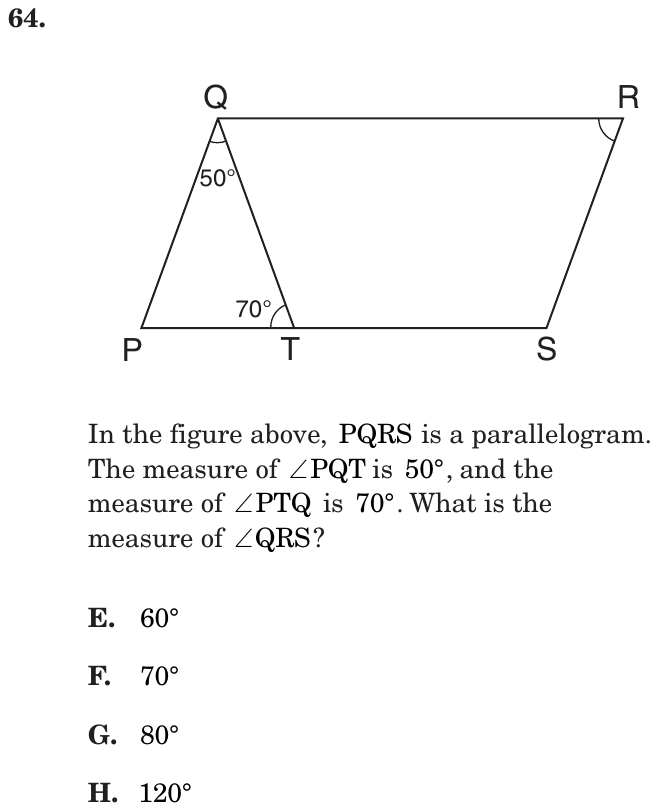
Question 35 of 36
2018 Test B Math, question 19Question
How many positive odd numbers satisfy the inequality ?
- A13
- B14
- C17
- D28
Show the answer
Correct answer: B
Solve the inequality for x.
3x + 8 ≤ 92
3x ≤ 84
x ≤ 28
The positive odd numbers less than or equal to 28 are 1, 3, 5, …, 25, and 27. There are 14 of them.
Question analysis
This question asks how many positive odd numbers satisfy the two-step inequality 3x + 8 ≤ 92. Students solve the inequality and then count the odd whole numbers in the solution. The counting after the algebra is where errors creep in, especially at the end of the list.
- Grade level
- Grade 7 content, by NYS standard
- Compared with grade 7
- At grade 7 Solving a two-step inequality is grade 7 work. Asking for a count of the odd solutions adds a number-property step and an endpoint check, but the total demand stays close to a typical grade 7 problem.
- Estimated difficulty
- Moderate: several steps, or a close reading with one strong distractor.
- Thinking it demands
- Depth of knowledge 2, skills and concepts · mainly apply
- What makes it hard
- A very close wrong answer moderate
- Combines ideas minor
- Solution
- 3 steps
- Reading level
- Question and choices: about grade 16, 9 words.
- Corrected from the DOE handbook
- The explanation’s description of the solutions was corrected.
- Students, last 30 days
- Not enough answers yet to show (it takes 10).
Why it is hard, traps and wrong answers (shows the answer)
Why it is hard
Solving the inequality is routine, and that is the trap: x ≤ 28 looks like an answer and 28 is among the choices. The real task is counting odd numbers from 1 to 27, where the usual shortcut, (27 − 1) ÷ 2, misses the first term. Pairing each odd number with the even number after it, up to 28, gives the count directly and avoids the fencepost slip.
A very close wrong answer moderate Choosing the answer
13 and 14 differ by one, and a rough count of the odd numbers up to 27 cannot separate them; only counting both ends, 1 and 27, gives the exact 14. (Embretson & Wetzel, 1987; Gorin & Embretson, 2006; Ascalon et al., 2007)
Combines ideas minor Working it out
Solving 3x + 8 ≤ 92 is only half the work; counting the positive odd whole numbers up to 28 is a separate number-sense task. (Embretson, 1998; Daniel & Embretson, 2010)
Strategy: Solve the inequality as you would an equation, keeping the direction of the sign, then count odd numbers from 1 up to the boundary by pairing or halving.
Traps
- Counting the ends: Inclusive or exclusive ends, fence posts, consecutive numbers: an answer that is one too many or too few, or an endpoint drawn open where it belongs closed (or the reverse).
- Stops one step early: A choice is a number from partway through the solution.
The wrong answers, classified
A Counting the ends (Brown & Burton, 1978)
Counts the odd numbers from 1 to 27 as (27 − 1) ÷ 2 = 13, forgetting to add one for the first term.
C A faulty procedure (Brown & Burton, 1978; Tatsuoka, 1983)
Moves the 8 across without changing its sign, solving 3x ≤ 100, and counts the odd numbers up to 33.
D Stops one step early (King et al., 2004; Gierl et al., 2017)
Solves the inequality to x ≤ 28 and gives the boundary 28 instead of counting the positive odd numbers up to it.
What was corrected from the DOE handbook, and why
- Explanation: The handbook solves the inequality to x ≤ 28 and then lists “the positive odd numbers less than 28.” The solutions include 28 itself, so the site says “less than or equal to 28.” The count does not change, because 28 is even: the odd numbers are still 1, 3, 5, …, 27, which is 14 numbers.
Worked solution, step by step
Formulas used
- Solving an inequality
- a, b and c are numbers. The sign ≤ means less than or equal to. You may subtract the same number from both sides. You may also divide both sides by the same positive number. The sign stays the same either way.
- Counting odd numbers
- n is an even number. Split the numbers from 1 to n into pairs: 1 and 2, 3 and 4, and so on. There are n ÷ 2 pairs, and each pair holds exactly one odd number.
Sort out the question
You need to count the positive odd numbers that make true.
The sign ≤ means is less than or equal to. Positive means greater than 0. Odd numbers are 1, 3, 5, 7, and so on.
Solve the inequality
Solve it like an equation. Subtract 8 from both sides. Then divide both sides by 3. Dividing by a positive number keeps the sign the same.
Watch out: 28 is the largest x allowed, not the count. That trap is choice D.
List the odd numbers
The positive odd numbers up to 28 are 1, 3, 5, and so on, up to 25 and 27. The number 28 is even, so it does not count.
Count them by pairing
Split 1 to 28 into pairs: 1 and 2, 3 and 4, and so on, up to 27 and 28. Each pair has one odd number.
Watch out: Working out counts the jumps of 2 from 1 to 27, not the numbers. You must add 1 for the first number. That mistake gives choice A.
So the answer is B, 14.
Check your answer
Test the edges. For x = 27: , which is at most 92, so it works. For x = 29: , which is too big. So 27 is the last odd number that works.
More questions like this
The original DOE question
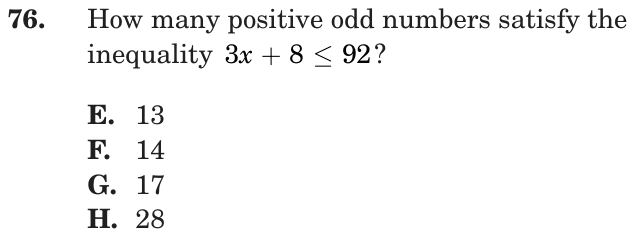
Question 36 of 36
2018 Test B Math, question 37Question
A pizza shop offers a choice of 3 sizes (small, medium, and large) and 7 different toppings. Different pizzas can be created by changing the size and/or the choice of toppings. If Cody wants to order a pizza with exactly 2 different toppings, how many different pizzas can he create?
- A6
- B21
- C63
- D126
Show the answer
Correct answer: C
First, figure out how many different topping pairs are possible. Use 1, 2, 3, 4, 5, 6, 7 to represent the toppings and create a list of possible pairs:
1,2; 1,3; 1,4; 1,5; 1,6; 1,7
2,3; 2,4; 2,5; 2,6; 2,7
3,4; 3,5; 3,6; 3,7
4,5; 4,6; 4,7
5,6; 5,7
6,7
So there are 21 different topping combinations for one pizza. Since there are 3 pizza sizes, multiply the total number of combinations by 3 to get the total number of different pizzas Cody can create:
3 × 21 = 63
Question analysis
A pizza shop offers 3 sizes and 7 toppings, and Cody wants exactly 2 different toppings; students count how many different pizzas he could order. It tests counting combinations, where the order of the toppings does not matter, together with the multiplication principle. The difficulty is counting each topping pair exactly once and including every way the pizzas can differ.
- NYS standards
- 7.SP.8b sample spaces for compound events
- Grade level
- Grade 7 content, by NYS standard
- Compared with grade 7
- Above grade 7 Grade 7 students list outcomes for compound events, usually ordered pairs like a coin and a die. Choosing an unordered pair from seven items and combining it with sizes goes beyond that, and two traps are well placed.
- Estimated difficulty
- Hard: combines ideas, needs a plan, and has more than one tempting wrong answer.
- Thinking it demands
- Depth of knowledge 2, skills and concepts · mainly apply
- What makes it hard
- Combines ideas moderate
- Something you must already know minor
- Solution
- 3 steps
- Reading level
- Question and choices: about grade 8, 48 words.
- Students, last 30 days
- Not enough answers yet to show (it takes 10).
Why it is hard, traps and wrong answers (shows the answer)
Why it is hard
The question hides two separate counts behind one sentence, and both carry traps: order does not matter among toppings, while size multiplies everything. Students who list pairs systematically are safe on the first count but often forget the second, and students who reach for 7 × 6 double the pairs. The phrase "size and/or the choice of toppings" is the cue that sizes count too.
Combines ideas moderate Working it out
Two counting ideas are joined: choosing an unordered pair from 7 toppings, then multiplying by the 3 sizes, and either part can go wrong on its own. (Embretson, 1998; Daniel & Embretson, 2010)
Something you must already know minor Working it out
Students must see that a pair of toppings is the same pizza in either order, so the product 7 × 6 counts every pair twice. (Anderson & Krathwohl, 2001)
Strategy: List the topping pairs systematically (topping 1 with each later topping, then topping 2 with each later one, and so on), count them, then multiply by the number of sizes.
Traps
- Stops one step early: A choice is a number from partway through the solution.
- Overlapping groups: Things in two groups at once are counted twice, or not subtracted.
The wrong answers, classified
A Numbers taken from the question (Hegarty, Mayer & Monk, 1995)
Multiplies the 3 sizes by the 2 toppings, using the number of toppings chosen instead of the number of ways to choose them.
B Stops one step early (King et al., 2004; Gierl et al., 2017)
Counts the 21 topping pairs correctly but stops without multiplying by the 3 sizes each pair can come in.
D Overlapping groups (King et al., 2004)
Counts ordered pairs, 7 × 6 = 42 for each size, so each pair of toppings is counted twice, then multiplies by 3 to get 126.
Worked solution, step by step
Formulas used
- Counting principle
- a is the number of ways to make the first choice. b is the number of ways to make the second choice. Each first choice can go with every second choice, so you multiply to count them all.
- Number of pairs from a group
- n is how many things you can pick from. n times (n − 1) counts a first pick times a second pick. But that counts each pair twice, once in each order. Dividing by 2 fixes that. Use it when order does not matter.
Sort out the question
There are 3 sizes and 7 toppings. Cody picks one size and exactly 2 different toppings. Order does not matter for the toppings. Ham and olives is the same pizza as olives and ham. You need the number of different pizzas.
List the topping pairs
Number the toppings 1 to 7. Pair topping 1 with each later topping. Then pair topping 2 with each later one, and so on.
- 1 with 2, 3, 4, 5, 6 or 7: 6 pairs
- 2 with 3 to 7: 5 pairs
- 3 with 4 to 7: 4 pairs
- Then 3, 2 and 1 more pairs
There are 21 topping pairs.
Check the pairs with the formula
Use the pairs formula with 7 toppings.
This matches the list.
Watch out: counts each pair twice. Forgetting to divide by 2 gives , choice D.
Multiply by the three sizes
Each topping pair can come in any of the 3 sizes. Use the counting principle.
Watch out: stopping at 21 forgets the sizes. That gives choice B.
Give the answer
There are 21 topping pairs and 3 sizes for each. So the answer is C, 63 different pizzas.
Check your answer
Test the pairs idea on a smaller case. With 3 toppings, the pairs are 1 and 2, 1 and 3, and 2 and 3. That is 3 pairs. The formula gives . It works, so 21 pairs and 63 pizzas are right.
More questions like this
The original DOE question