Multiple response
Question 1 of 11
2026 Practice Test A English, question 4Passage Snowy Mountains
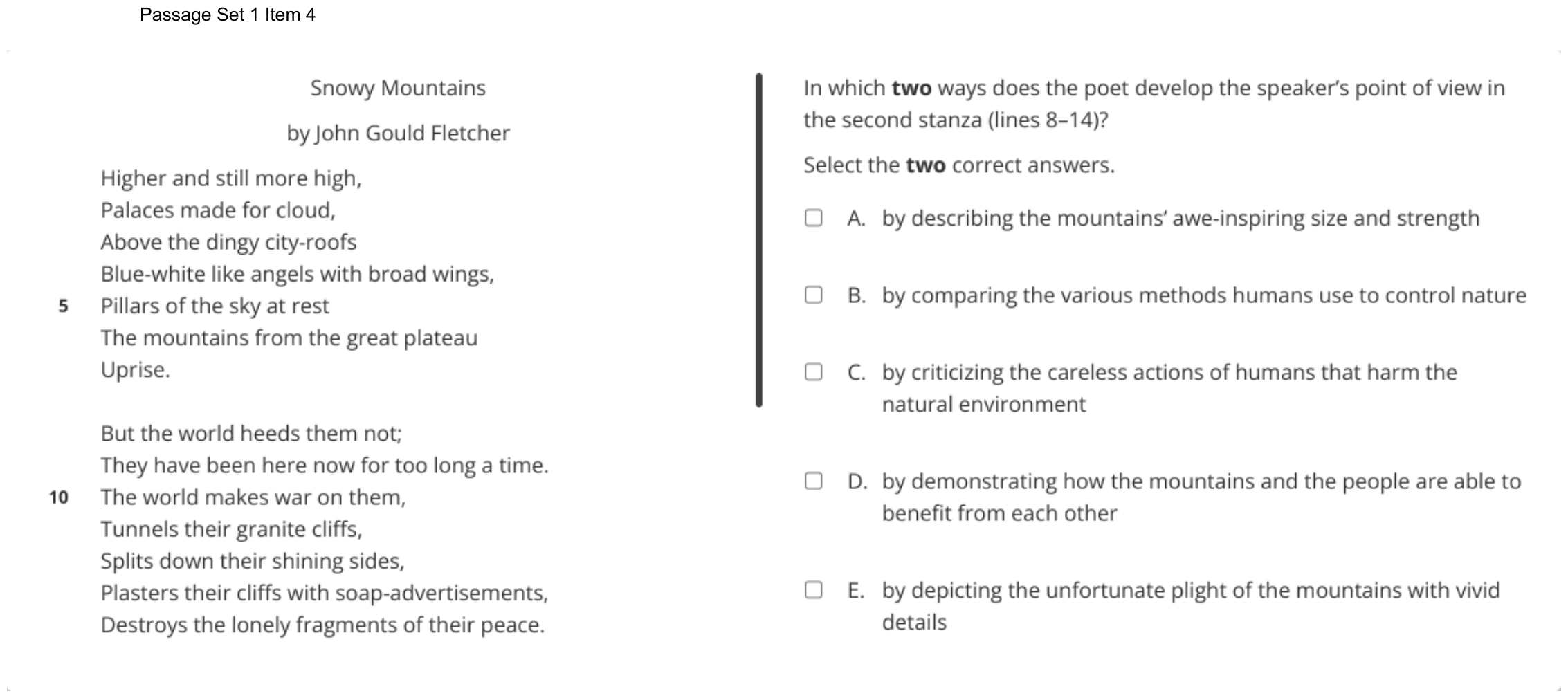
Snowy Mountains
by John Gould Fletcher
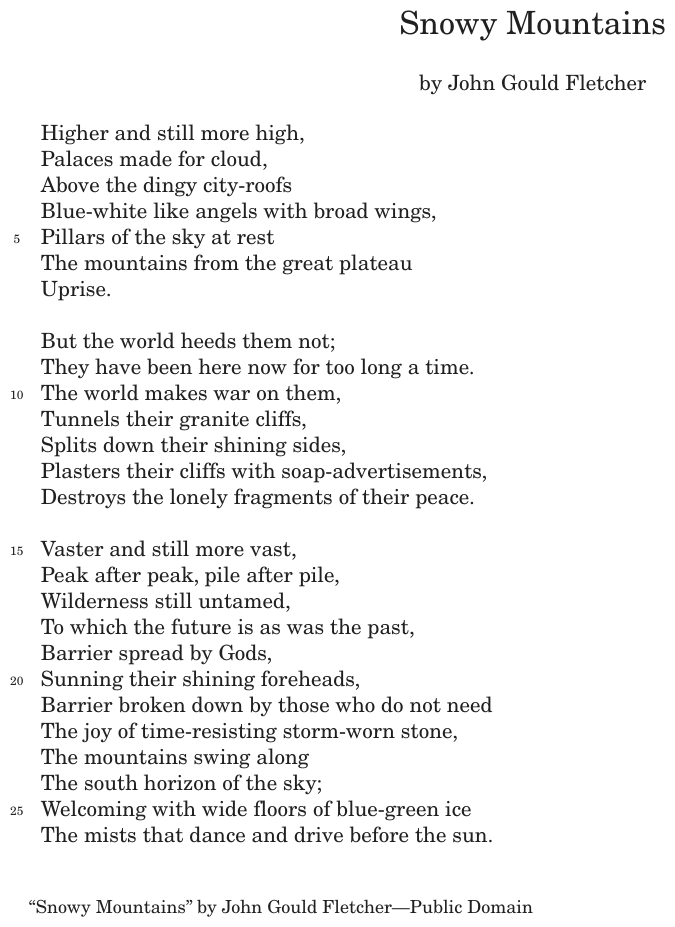
Higher and still more high,
Palaces made for cloud,
Above the dingy city-roofs
Blue-white like angels with broad wings,
Pillars of the sky at rest
The mountains from the great plateau
Uprise.
But the world heeds them not;
They have been here now for too long a time.
The world makes war on them,
Tunnels their granite cliffs,
Splits down their shining sides,
Plasters their cliffs with soap-advertisements,
Destroys the lonely fragments of their peace.
Vaster and still more vast,
Peak after peak, pile after pile,
Wilderness still untamed,
To which the future is as was the past,
Barrier spread by Gods,
Sunning their shining foreheads,
Barrier broken down by those who do not need
The joy of time-resisting storm-worn stone,
The mountains swing along
The south horizon of the sky;
Welcoming with wide floors of blue-green ice
The mists that dance and drive before the sun.
“Snowy Mountains” by John Gould Fletcher—Public Domain
Question
In which two ways does the poet develop the speaker’s point of view in the second stanza (lines 8–14)?
Select the two correct answers.
Choose every answer that is correct, then check. The DOE has not published how answers with several parts are scored; this site counts one right only when every part is right.
- Aby describing the mountains’ awe-inspiring size and strength
- Bby comparing the various methods humans use to control nature
- Cby criticizing the careless actions of humans that harm the natural environment
- Dby demonstrating how the mountains and the people are able to benefit from each other
- Eby depicting the unfortunate plight of the mountains with vivid details
Show the answer
Correct answer: C and E
The question asks for the two ways in which the poet develops the speaker’s point of view in the second stanza (lines 8–14).
A. Incorrect. The speaker’s descriptions of the mountains’ awe-inspiring size and strength mainly occur in the first and third stanzas, while in the second stanza, the speaker focuses on humanity and its negative effect on the mountains.
B. Incorrect. The wording of the second stanza—“makes war” (line 10), “Splits down their shining sides” (line 12), and “Destroys the lonely fragments” (line 14)—communicates the speaker’s position that people’s main impact on the mountains is destructive, but the stanza does not compare the various methods people use to control nature.
C. CORRECT. In the second stanza, the speaker criticizes the careless and destructive actions of society or “the world” (lines 8 and 10) that harm the natural environment. Humans are described as both heedless of the mountains (“heeds them not”) and harmfully warlike (“makes war on them”). The speaker cites the harm done to the mountains when people “[tunnel] their granite cliffs” (line 11) and “[split] down their shining sides” (line 12), thus “[destroying] the lonely fragments of their peace” (line 14).
D. Incorrect. In the second stanza, the speaker does not describe a mutually beneficial relationship between the mountains and the people. Although people clearly derive benefits from the mountains by plastering “their cliffs with soap-advertisements” (line 13), the stanza does not demonstrate that the mountains receive any benefit from the harmful actions of the people.
E. CORRECT. In the second stanza, the speaker depicts the unfortunate plight of the mountains with vivid details. Lines 11–14 feature expressive wording that sharply illustrates the mountains’ misfortune: “Tunnels their granite cliffs, / Splits down their shining sides, / Plasters their cliffs with soap-advertisements.”
Question analysis
This select-two question on John Gould Fletcher’s poem “Snowy Mountains” asks in which two ways the poet develops the speaker’s point of view in the second stanza, lines 8–14. It reworks a one-answer handbook question, now with five choices. Each choice has to be judged on its own, and a choice that fits the poem as a whole is not enough.
- Grade level
- Grade 6 reading and task
- Compared with grade 7
- At grade 7 Typical grade 7 point-of-view questions ask for one answer about a longer text. This stanza is only seven short lines with one steady attitude, but students must find two right choices out of five and judge each one separately.
- Estimated difficulty
- Moderate: several steps, or a close reading with one strong distractor.
- Thinking it demands
- Depth of knowledge 2, skills and concepts · mainly analyze
- What makes it hard
- How, not what moderate
- Every choice must be checked moderate
- Hard words minor
- Evidence
- Answered from one paragraph or stanza
- Reading level
- Passage: 161 words (a poem; reading level not measured); question and choices: about grade 8, 79 words.
- Students, last 30 days
- Not enough answers yet to show (it takes 10).
Why it is hard, traps and wrong answers (shows the answer)
Why it is hard
Most students sense the anger at “the world” in lines 8–14 and find the criticism of people quickly. The point is lost on the second pick, because the other right choice names a technique, vivid details of the mountains’ suffering, and can look like plain description. The choice about comparing methods tempts students who see a list of human actions, and the awe of the first and third stanzas pulls those who drift outside the stanza, while both picks must be right to score.
How, not what moderate Working it out
The stem asks how the viewpoint is built, and both right choices are methods: a judgment of “the world” that “makes war,” and the vivid verbs “Tunnels,” “Splits” and “Plasters” in lines 11–13. (Anderson & Krathwohl, 2001)
Every choice must be checked moderate Choosing the answer
All five choices must be tested and both picks must be right, so finding the criticism of people is only half the work; the second right choice is about imagery, not message. (Embretson & Wetzel, 1987)
Hard words minor Understanding the question
One right choice turns on “plight,” a hard situation; a student who does not know the word cannot see that it names the damage done to the mountains in lines 11–14. (Perfetti, 2007; Freedle & Kostin, 1993)
Strategy: Restate in your own words what lines 8–14 say and how they say it, then test each of the five choices on its own and keep only the two that fit this stanza rather than the whole poem.
Traps
- Twists what the text says: Uses the text's topic and ideas but changes what it says: who did it, how much, when, or why.
- Wrong part of the text: A choice is true of another paragraph, stanza or speaker than the one asked about.
The wrong answers, classified
A Wrong part of the text (Kirsch & Mosenthal, 1990)
Brings in the awe of the first and third stanzas, “Higher and still more high” and “Vaster and still more vast,” though in lines 8–14 the cliffs appear only as things being damaged.
B Twists what the text says (King et al., 2004)
Sees that lines 11–13 list several human acts, tunneling, splitting and plastering, but the stanza never weighs one against another; all are blows in one war, not methods of control.
D Wrong tone or attitude (Graesser, Singer & Trabasso, 1994)
Treats the soap advertisements as people getting some use from the cliffs and imagines an exchange, missing the hostility of “The world makes war on them” and “Destroys.”
E Wrong purpose or structure (Anderson & Krathwohl, 2001)
Left out by students who see the vivid verbs as mere description of damage rather than the way the speaker builds sympathy, or who do not know that “plight” means a bad situation.
Working it out, step by step
Figure out what the question asks
This asks about point of view: how the speaker, the voice talking in the poem, feels about the subject. It also asks how the poet shows that feeling. Stay inside the second stanza, lines 8 to 14. You must pick two answers, so test all five choices one at a time.
Read the second stanza closely
Line 8 says “But the world heeds them not.” To heed something is to pay attention to it. Here “the world” means people in general. Line 10 says “The world makes war on them.” Lines 11 to 13 list what people do: “Tunnels their granite cliffs, / Splits down their shining sides, / Plasters their cliffs with soap-advertisements.” Line 14 ends with “Destroys the lonely fragments of their peace.”
Name how the speaker feels
The speaker is on the mountains’ side. People ignore the mountains, yet they keep attacking them. The speaker blames people for this harm. Pointing out what someone does wrong is called criticizing. The speaker also makes you feel sorry for the mountains. Strong action words like “Tunnels,” “Splits” and “Plasters” paint a sharp picture of the damage. Sharp word pictures like these are called vivid details.
Check each of the five choices
- A does not fit. The mountains’ great size fills the first and third stanzas, as in “Higher and still more high.” In lines 8 to 14 they are only being hurt.
- B does not fit. The stanza lists several things people do, but it never compares them. They are all part of one “war.”
- C fits. The speaker criticizes people for careless acts that damage nature.
- D does not fit. The mountains get nothing good from people. The stanza shows only harm.
- E fits. A plight is a bad or sad situation. The vivid verbs in lines 11 to 13 show the mountains’ plight.
Watch out: B is tempting because the stanza names several acts. But a list is not a comparison.
Choose both answers
The speaker’s view comes through two things: blame for people, and a vivid picture of the mountains’ suffering. Select both choices on the screen. You need both to get the point. So the answers are C and E.
Why this answer and not the closest wrong one
E is the right answer that is easiest to miss, because it can look like plain description. But those vivid details are how the speaker makes you feel for the mountains. B is the closest wrong choice. The stanza does list several human acts, yet it never weighs one against another. Each act is just one more blow.
More questions like this
The original DOE question
The passage “Snowy Mountains” as printed (page 142)
Question 2 of 11
2026 Practice Test A Math, question 10Question
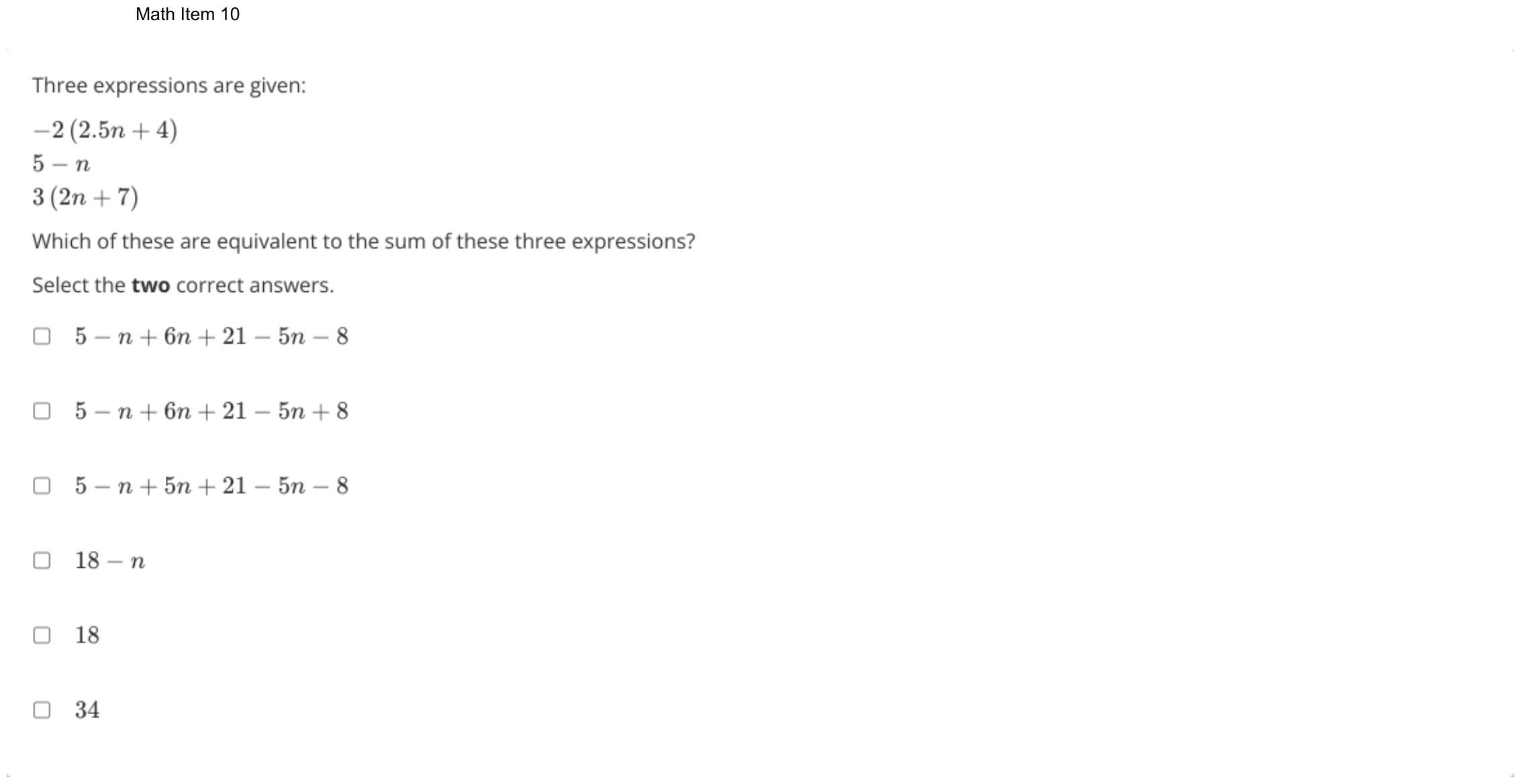
Three expressions are given:
Which of these are equivalent to the sum of these three expressions?
Select the two correct answers.
Choose every answer that is correct, then check. The DOE has not published how answers with several parts are scored; this site counts one right only when every part is right.
- A
- B
- C
- D
- E18
- F34
Show the answer
Correct answer: A and E
Add the three expressions: .
Distribute 3 and −2: .
Combine the variable terms and combine the constants: .
Question analysis
This algebra question gives three expressions, one with a decimal coefficient and a negative factor, and asks which two of six choices are equivalent to their sum. It tests distributing, combining like terms and recognizing equivalent expressions. Signs from the negative factor are easy to lose, and several choices are built from exactly those slips.
- NYS standards
- Grade level
- Grade 7 content, by NYS standard
- Compared with grade 7
- At grade 7 Expanding and combining linear expressions with a negative factor and a decimal coefficient is standard grade 7 work. Choosing the two equivalent ones out of six, where each common slip appears as a choice, takes more care than one simplification.
- Estimated difficulty
- Moderate: several steps, or a close reading with one strong distractor.
- Thinking it demands
- Depth of knowledge 1, recall and reproduction · mainly apply
- What makes it hard
- Error-prone arithmetic moderate
- A very close wrong answer moderate
- Many steps minor
- An answer in an unexpected form minor
- Solution
- 4 steps
- Reading level
- Question and choices: about grade 8, 28 words.
- Students, last 30 days
- Not enough answers yet to show (it takes 10).
Why it is hard, traps and wrong answers (shows the answer)
Why it is hard
The six choices form three consistent pairs, each an expansion with its simplified total: the right pair, a pair built on a sign slip with −2 × 4 that totals 34, and a pair built on 3 × 2n read as 5n that totals 18 − n. A student who makes either slip finds two choices that agree with each other and seem to confirm the work. The question rewards one careful simplification and the confidence to accept a sum with no n left.
Error-prone arithmetic moderate Working it out
The first expression puts a negative factor in front of a decimal term: −2 times 2.5n is −5n, and the −2 must reach the 4 as well, giving −8, not +8. (Brown & Burton, 1978; Junker & Sijtsma, 2001)
A very close wrong answer moderate Choosing the answer
The first two expansions are identical except for their last sign, − 8 against + 8, and the third differs from the first only in 5n for 6n, so only a term-by-term check separates them. (Embretson & Wetzel, 1987; Gorin & Embretson, 2006; Ascalon et al., 2007)
Many steps minor Working it out
Two distributions come first, then the n terms and the constants are collected separately, and six choices are compared with the result; both right ones must be picked to score. (Daniel & Embretson, 2010; Enright, Morley & Sheehan, 2002)
An answer in an unexpected form minor Choosing the answer
One right answer is the expansion before any terms are combined and the other is the plain number 18, which has to be accepted as equal to a sum in which every expression held n. (Enright, Morley & Sheehan, 2002)
Strategy: Distribute each factor across its parentheses, keeping the sign with every product, then combine the n terms and the constants separately and test each of the six choices against the result.
Traps
- Order of operations: Working left to right, or distributing a minus sign wrongly, gives a choice.
- Misunderstands the concept: A wrong belief about a concept: that percents can be added, that area grows like length, that averages can be averaged, that a bigger denominator means a bigger fraction.
- Answer in another form: The right answer is written differently from the way you worked it out.
The wrong answers, classified
B Order of operations (Brown & Burton, 1978)
Gives the minus of −2 to 2.5n but not to 4, expanding −2(2.5n + 4) as −5n + 8 instead of −5n − 8, so this expansion totals 34.
C Wrong operation (Hegarty, Mayer & Monk, 1995; King et al., 2004)
Expands 3(2n + 7) as 5n + 21, adding 3 and 2 instead of multiplying them, so the n terms no longer cancel and leave −n.
D Misunderstands the concept (Smith, diSessa & Roschelle, 1993; De Bock et al., 1998; Ni & Zhou, 2005)
Expects a sum of expressions in n to keep an n term, so it doubts the plain 18 and takes 18 − n, which the 5n expansion also simplifies to.
F Order of operations (Brown & Burton, 1978)
Takes −2 × 4 as +8, so the constants add to 5 + 21 + 8 = 34 while −n + 6n − 5n still cancels, leaving no n term.
Worked solution, step by step
Formulas used
- The distributive property
- a is the number in front of the parentheses, and b and c are the terms inside. You multiply a by every term inside, not only the first one. If a is negative, its minus sign goes into every product. It works because a groups of b + c is a groups of b plus a groups of c.
- Multiplying signed numbers
- a and b are positive numbers, so −a is negative. A negative number times a positive number is negative. Use it whenever a minus sign sits in front of the parentheses: −2 times 4 is −8, not 8.
- Combining like terms
- Like terms have the same letter part, such as 6n and −5n. a and b are their coefficients, the numbers in front of n. Add the coefficients and keep the n. Constants, the plain numbers, combine only with other constants.
Sort out the question
An expression is a math phrase made of numbers, letters and signs, with no equal sign. The sum of the three expressions means you add all of them:
You need the two choices that are equivalent to this sum. Equivalent means equal for every value of n. Some choices show the sum before it is simplified. Others show the result.
Distribute the 3
To distribute means to multiply the number outside the parentheses by each term inside.
Watch out: 3 times 2n is 6n. Adding 3 and 2 instead gives 5n. That slip leads to choice C, and then to 18 − n, choice D.
Distribute the −2
Now multiply −2 by both terms. A negative times a positive is negative, so both products are negative.
Watch out: the −2 multiplies the 4 too. Writing +8 instead of −8 leads to choice B. That sum works out to 34, choice F.
Write the whole sum
Put the three pieces together, starting with 5 − n:
This matches choice A exactly, term by term. So A is one of the answers.
Combine like terms
Gather the n terms first. Remember that −n means −1 times n.
Then gather the constants:
The n terms cancel out, so the whole sum is just 18.
Watch out: a sum with no n left is fine. Keeping an extra −n leads to choice D.
Pick the two answers
Choice A is the sum before you combine like terms. Choice E, 18, is the sum after you combine them. Both equal the sum for every value of n. So the answers are A and E.
Check your answer
Try a value, such as n = 2, in each expression. . . . The sum is , which matches E. Choice D would give 18 − 2 = 16 instead.
More questions like this
The original DOE question
Question 3 of 11
2026 Practice Test A Math, question 37Question
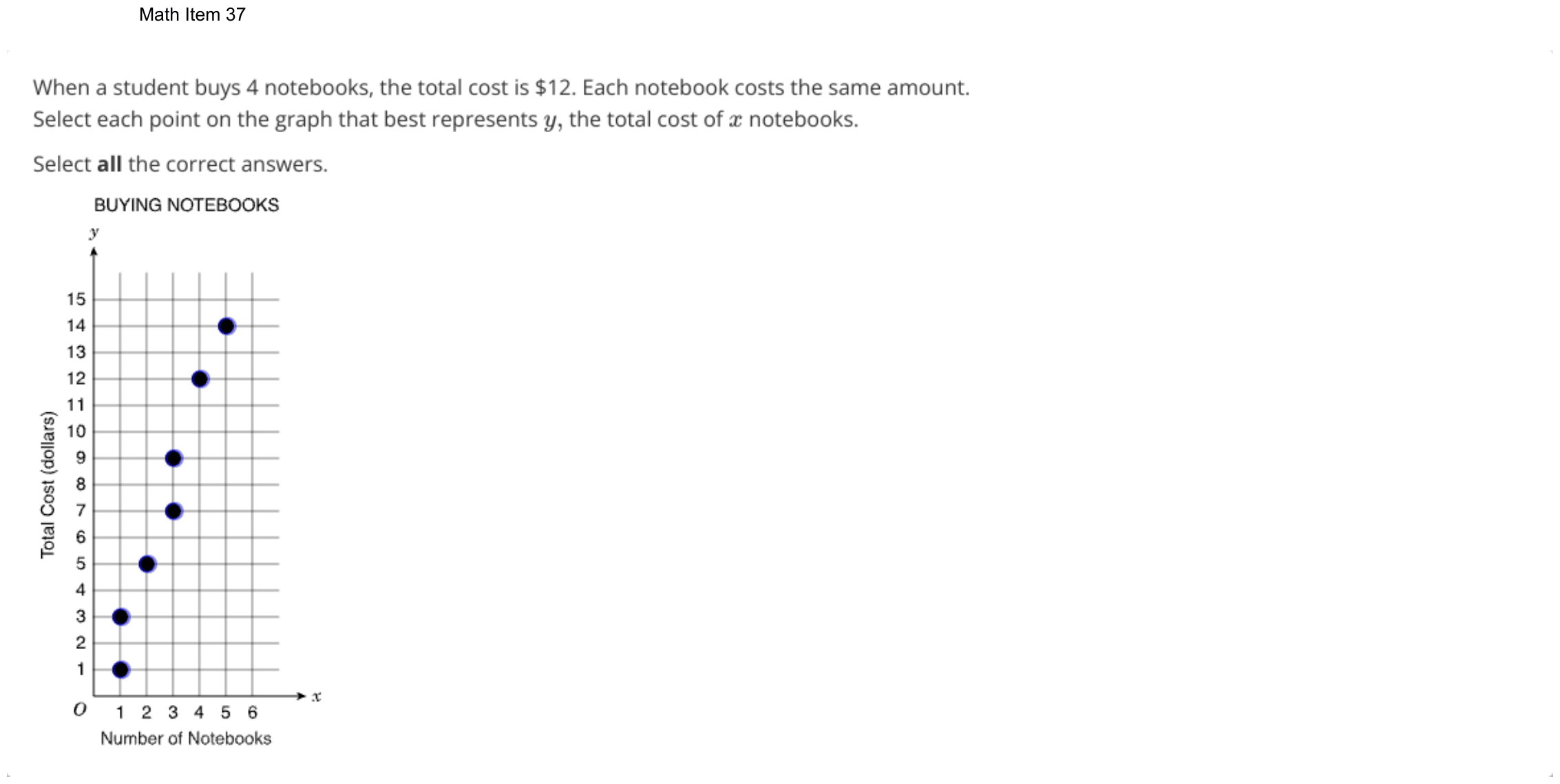
When a student buys 4 notebooks, the total cost is $12. Each notebook costs the same amount. Select each point on the graph that best represents y, the total cost of x notebooks.
Select all the correct answers.
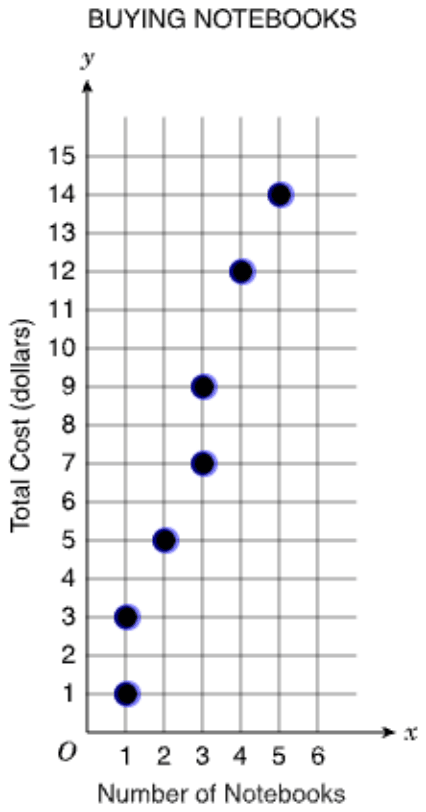
On the test you click the points in the figure; here, choose them below. The DOE has not published how answers with several parts are scored; this site counts one right only when every part is right.
- A(1, 1)
- B(1, 3)
- C(2, 5)
- D(3, 7)
- E(3, 9)
- F(4, 12)
- G(5, 14)
Show the answer
Correct answer: B, E, and F
Solution:
There are three correct points: (1, 3), (3, 9), and (4, 12).
Find the cost per notebook: .
The equation of the line is , where y is the total cost of x notebooks.
Check each point by plugging the x-value into the equation . If the y-value from the equation matches the y-value of the point, then the point is on the line .
Check all seven points:
(1, 1) y-values do not match; incorrect point
(1, 3) y-values match; CORRECT point
(2, 5) y-values do not match; incorrect point
(3, 7) y-values do not match; incorrect point
(3, 9) y-values match; CORRECT point
(4, 12) y-values match; CORRECT point
(5, 14) y-values do not match; incorrect point
Question analysis
A graph titled Buying Notebooks shows seven points, and students select every point that fits the total cost of buying notebooks, given the cost of a few notebooks and that each costs the same. It tests finding a unit rate and recognizing points of a proportional relationship. Some points line up in tempting patterns, and the item does not say how many to select.
- NYS standards
- Grade level
- Grade 7 content, by NYS standard
- Compared with grade 7
- At grade 7 Finding a unit rate and deciding which points fit a proportional relationship are grade 7 skills, and the arithmetic here is easy. What adds demand is testing all seven points with no count given, since one miss or extra pick loses the item.
- Estimated difficulty
- Straightforward: two steps or one careful reading.
- Thinking it demands
- Depth of knowledge 2, skills and concepts · mainly apply
- What makes it hard
- Solution
- 2 steps
- Reading level
- Question and choices: about grade 5, 36 words.
- Students, last 30 days
- Not enough answers yet to show (it takes 10).
Why it is hard, traps and wrong answers (shows the answer)
Why it is hard
Finding the price is one division, 12 ÷ 4 = 3, so the question is really about checking: each chosen dot must fit y = 3x exactly, and the item does not say how many do. The graph punishes judging by eye, since a straight row of dots climbs from (1, 3) at $2 a notebook and two dots sit a single gridline off the true line. Multiplying each x by 3 and reading each y from the axis, not from the pattern, settles all seven.
Every choice must be checked moderate Choosing the answer
Seven dots must each be tested against $3 a notebook, and the item never says how many fit; one missed point or one extra loses the whole item, so no dot can be skipped. (Embretson & Wetzel, 1987)
Reading a figure, table or graph minor Understanding the question
The graph stacks two dots above 1 notebook and two above 3, and each total cost has to be read off a grid ruled at every dollar up to 15. (Lesh, Post & Behr, 1987; Kirsch & Mosenthal, 1990)
A very close wrong answer minor Choosing the answer
(5, 14) sits one gridline below (5, 15), where 5 notebooks at $3 would be, and (2, 5) sits one below (2, 6), so judging by the line's direction cannot rule either out. (Embretson & Wetzel, 1987; Gorin & Embretson, 2006; Ascalon et al., 2007)
Strategy: Work out the cost of one notebook from the total given in the question, then multiply each point's x-coordinate by that price and keep only the points whose y-coordinate matches exactly.
Traps
- Misunderstands the concept: A wrong belief about a concept: that percents can be added, that area grows like length, that averages can be averaged, that a bigger denominator means a bigger fraction.
- Misreads the figure: Reads a value, label or tick spacing in a figure, table or graph wrongly.
The wrong answers, classified
A Little reason to choose it (Haladyna & Downing, 1993; Rodriguez, 2005)
No working from 4 notebooks for $12 makes one notebook cost $1, so this lowest dot mostly catches guesses, such as taking the dot nearest the origin as a start.
C Misunderstands the concept (Smith, diSessa & Roschelle, 1993; De Bock et al., 1998; Ni & Zhou, 2005)
Takes the straight row (1, 3), (2, 5), (3, 7) as the graph because its dots line up, though it climbs $2 a notebook and would meet the y-axis at $1, not the origin.
D Misunderstands the concept (Smith, diSessa & Roschelle, 1993; De Bock et al., 1998; Ni & Zhou, 2005)
Prefers the lower of the two dots above 3 notebooks because it continues the evenly spaced row from (1, 3) and (2, 5), instead of checking that 3 notebooks cost $9.
G Misreads the figure (Lesh, Post & Behr, 1987; Kirsch & Mosenthal, 1990)
Finds that 5 notebooks cost 5 × $3 = $15, then reads the dot above 5 as sitting on the top gridline, 15, when it is one line lower, at 14.
Worked solution, step by step
Formulas used
- Unit price
- The unit price is what one item costs. Divide the total cost by the number of items bought. This works because every notebook costs the same, so the total splits into equal parts.
- A proportional relationship
- y is the total cost in dollars, and x is the number of notebooks. k is the price of one notebook, the number you always multiply by. A point fits only if its y is exactly k times its x. The graph is a straight line through (0, 0).
Sort out the question
Four notebooks cost $12, and each one costs the same. On the graph, x is the number of notebooks, and y is the total cost in dollars. The graph shows seven points. You must select every point that fits. The question does not say how many fit, so test all seven.
Find the price of one notebook
Split the $12 equally among the 4 notebooks:
Each notebook costs $3. So the total cost is 3 times the number of notebooks:
Test each point
For each point, multiply its x by 3. Keep the point only if the result equals its y.
Choice Point 3 × x Fits? A (1, 1) 3 No B (1, 3) 3 Yes C (2, 5) 6 No D (3, 7) 9 No E (3, 9) 9 Yes F (4, 12) 12 Yes G (5, 14) 15 No Watch for look-alike points
Watch out: the dots (1, 3), (2, 5) and (3, 7) sit in a neat straight row. But that row climbs $2 per notebook, not $3. Lining up is not enough: (2, 5) and (3, 7), choices C and D, do not fit.
Watch out: 5 notebooks cost dollars. The dot above 5 sits one gridline lower, at 14. Read the y-axis carefully, and you will skip choice G.
Name the points
Three points fit: (1, 3), (3, 9) and (4, 12). On the test, you click each of these dots on the graph. On this site, you check their boxes. So the answers are B, E and F.
Check your answer
All three points fit : , and . They also line up with (0, 0), since 0 notebooks cost $0. And (4, 12) is the fact the question gave you.
More questions like this
The original DOE question
Question 4 of 11
2026 Practice Test B Math, question 3Question
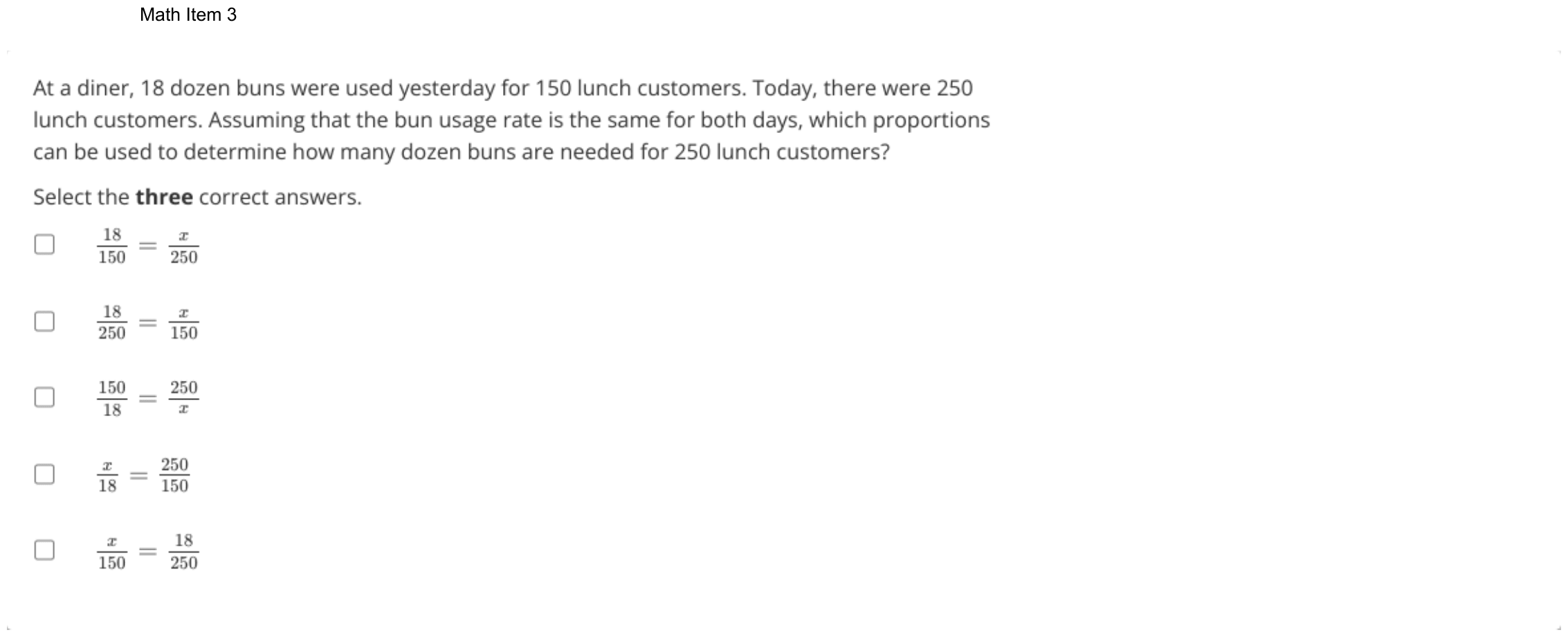
At a diner, 18 dozen buns were used yesterday for 150 lunch customers. Today, there were 250 lunch customers. Assuming that the bun usage rate is the same for both days, which proportions can be used to determine how many dozen buns are needed for 250 lunch customers?
Select the three correct answers.
Choose every answer that is correct, then check. The DOE has not published how answers with several parts are scored; this site counts one right only when every part is right.
- A
- B
- C
- D
- E
Show the answer
Correct answer: A, C, and D
The three correct answers are:
Set up a proportion to compare the number of buns per customer. These are all equivalent:
To check for equivalency, solve each proportion for x.
Each of the three correct proportions simplifies to .
Then solve for x to determine how many dozen buns are needed for 250 lunch customers:
Question analysis
A diner used 18 dozen buns for 150 lunch customers yesterday, and students select the three proportions, out of five, that can find how many dozen buns 250 customers need at the same rate. It tests setting up proportions and recognizing equivalent ones. All five equations use the same numbers, so each has to be checked for which quantities it pairs.
- Grade level
- Grade 7 content, by NYS standard
- Compared with grade 7
- At grade 7 Setting up a proportion from a rate is everyday grade 7 work. Here nothing is solved: five setups built from the same numbers must each be judged, some arranged in unfamiliar ways, and all three usable ones found.
- Estimated difficulty
- Moderate: several steps, or a close reading with one strong distractor.
- Thinking it demands
- Depth of knowledge 2, skills and concepts · mainly apply
- What makes it hard
- Every choice must be checked moderate
- A very close wrong answer moderate
- An answer in an unexpected form minor
- Much to keep track of minor
- Solution
- 3 steps
- Reading level
- Question and choices: about grade 6, 54 words.
- Students, last 30 days
- Not enough answers yet to show (it takes 10).
Why it is hard, traps and wrong answers (shows the answer)
Why it is hard
Nothing needs solving here; the question is which pairings keep the usage rate fixed. Students who check only for buns over customers on both sides find exactly three such setups, two of them wrong, and pass over the two right ones written another way. The wrong pair gives 10.8 dozen, fewer buns for more customers, which a quick sense check would catch, and cross-multiplying every setup settles all five.
Every choice must be checked moderate Choosing the answer
All five setups are built from 18, 150, 250 and x, so none can be dismissed on sight; each has to be cross-multiplied and compared with 150x = 18 × 250. (Embretson & Wetzel, 1987)
A very close wrong answer moderate Choosing the answer
The first two setups differ only in where 150 and 250 sit, 18/150 = x/250 against 18/250 = x/150, and both show buns over customers on each side, so a units check passes both. (Embretson & Wetzel, 1987; Gorin & Embretson, 2006; Ascalon et al., 2007)
An answer in an unexpected form minor Choosing the answer
One right setup puts customers over dozens of buns, and another sets today’s x over yesterday’s 18 equal to 250 customers over 150, forms that look wrong to students who learned only rate equals rate. (Enright, Morley & Sheehan, 2002)
Much to keep track of minor Working it out
Three of the five must be picked and all three must be right to score, so the verdict on each setup has to be kept until the last one is tested. (Sweller, 1988; Carpenter, Just & Shell, 1990)
Strategy: Write one proportion you trust by matching both units and days, cross-multiply it, then cross-multiply each choice and keep only those that give the same equation.
Traps
- Misunderstands the concept: A wrong belief about a concept: that percents can be added, that area grows like length, that averages can be averaged, that a bigger denominator means a bigger fraction.
- Answer in another form: The right answer is written differently from the way you worked it out.
The wrong answers, classified
B Misunderstands the concept (Smith, diSessa & Roschelle, 1993; De Bock et al., 1998; Ni & Zhou, 2005)
Checks only that both fractions show dozens of buns over customers, missing that 18 sits over today’s 250 customers; cross-multiplying gives 250x = 2,700, so x = 10.8.
D Misunderstands the concept (Smith, diSessa & Roschelle, 1993; De Bock et al., 1998; Ni & Zhou, 2005)
Left out by students who expect each fraction to compare buns with customers, not seeing that today over yesterday for buns and for customers also gives 150x = 4,500.
E Misunderstands the concept (Smith, diSessa & Roschelle, 1993; De Bock et al., 1998; Ni & Zhou, 2005)
Accepts x over 150 because it shows buns over customers like the trusted setup, but today’s buns sit over yesterday’s customers, which yields only 10.8 dozen for more people.
Worked solution, step by step
Formulas used
- A rate
- The rate is how many dozen buns are used for each customer. Yesterday it was 18 dozen over 150 customers. Today it is x dozen over 250 customers. The question says the rate is the same both days, so those two fractions are equal.
- Cross-multiplying a proportion
- A proportion says two fractions are equal. a and c are the tops, and b and d are the bottoms. Multiply each top by the other bottom, and the two products are equal. This turns any proportion into a plain equation, so you can compare setups that look different.
Sort out the question
Yesterday the diner used 18 dozen buns for 150 customers. Today it has 250 customers. Let x be the number of dozen buns needed today. The bun usage rate is the same both days.
A proportion is two equal fractions. You must pick the three proportions that give the right value of x.
Write one proportion you trust
Put each day’s buns over that same day’s customers. The rates are equal, so the fractions are equal:
This is choice A. Cross-multiply it:
Any choice that leads to 150x = 4,500 is a right one.
Solve for x
Divide both sides by 150 to get x by itself:
So the diner needs 30 dozen buns today. A wrong setup gives a different number.
Test choices C and D
Cross-multiply each one.
- C: gives . That is the same equation, so C works. It is choice A with both fractions flipped.
- D: gives . The same equation again, so D works too.
D compares today with yesterday. Today’s buns over yesterday’s buns equals today’s customers over yesterday’s customers.
Watch out: D looks odd because it puts buns over buns. Do not skip it. It still keeps the rate the same.
Test choices B and E
- B: gives , so 250x = 2,700.
- E: gives , the same 250x = 2,700.
Both give . That is fewer buns for more customers, which makes no sense.
Watch out: B and E show buns over customers, so they look right. But each one mixes up the days. B puts yesterday’s 18 dozen over today’s 250 customers. E puts today’s buns over yesterday’s 150 customers.
Name the three answers
Choices A, C and D all give 150x = 4,500, so x = 30. On the test, you check the box next to each one. So the answers are A, C and D.
Check your answer
Find the buns a second way. Today has times as many customers as yesterday. So it needs 5/3 times as many buns: dozen. That matches the 30 from choices A, C and D.
More questions like this
The original DOE question
Question 5 of 11
2026 Practice Test B Math, question 16Question
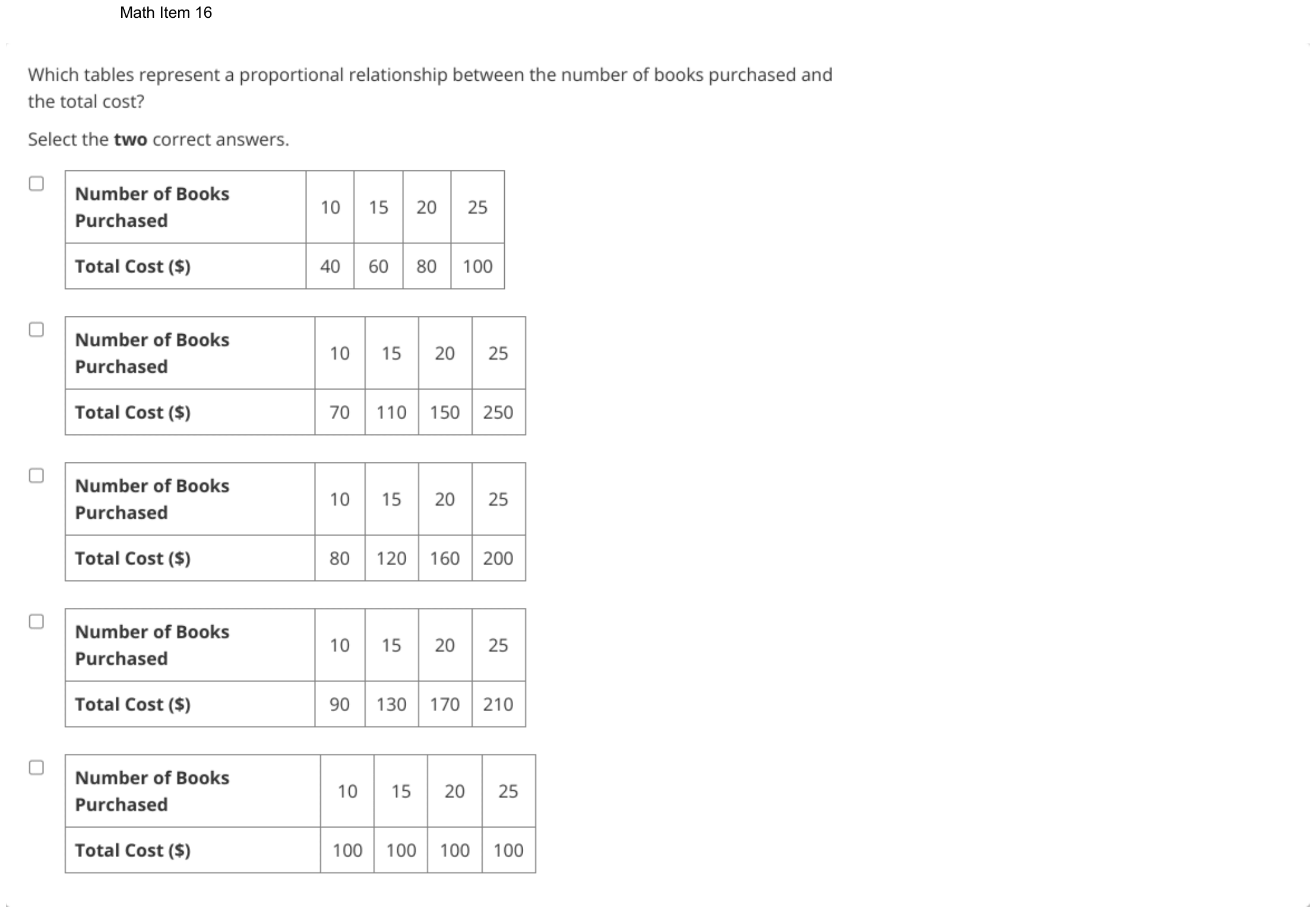
Which tables represent a proportional relationship between the number of books purchased and the total cost?
Select the two correct answers.
Choose every answer that is correct, then check. The DOE has not published how answers with several parts are scored; this site counts one right only when every part is right.
- A
Number of Books Purchased 10 15 20 25 Total Cost ($) 40 60 80 100 - B
Number of Books Purchased 10 15 20 25 Total Cost ($) 70 110 150 250 - C
Number of Books Purchased 10 15 20 25 Total Cost ($) 80 120 160 200 - D
Number of Books Purchased 10 15 20 25 Total Cost ($) 90 130 170 210 - E
Number of Books Purchased 10 15 20 25 Total Cost ($) 100 100 100 100
Show the answer
Correct answer: A and C
The two tables that represent a proportional relationship are tables A and C.
In table A, the total costs divided by the numbers of books for each set of quantities are:
These ratios are equivalent; therefore, these quantities are in a proportional relationship.
In table C, the total costs divided by the numbers of books for each set of quantities are:
These ratios are equivalent; therefore, these quantities are in a proportional relationship.
Question analysis
Five tables list the total cost of buying 10, 15, 20 and 25 books, and students select the two tables that show a proportional relationship between books and cost. It tests recognizing proportional relationships from a constant unit rate. A steady rise in cost is not enough on its own, so each pair of values has to be checked.
- Grade level
- Grade 7 content, by NYS standard
- Compared with grade 7
- At grade 7 Deciding from a table whether two quantities are proportional is a core grade 7 skill, and the divisions here are easy. The demand lies in checking every column of five tables rather than judging by how the costs change.
- Estimated difficulty
- Straightforward: two steps or one careful reading.
- Thinking it demands
- Depth of knowledge 2, skills and concepts · mainly apply
- What makes it hard
- A very close wrong answer moderate
- Every choice must be checked minor
- Something you must already know minor
- Solution
- 2 steps
- Reading level
- Question and choices: about grade 5, 51 words.
- Students, last 30 days
- Not enough answers yet to show (it takes 10).
Why it is hard, traps and wrong answers (shows the answer)
Why it is hard
The divisions are easy, so the question tests what proportional means. Three tables grow by the same amount for every 5 books, and the one with a $10 head start looks just as regular as the right one it copies; only its cost per book, drifting from $9 down to $8.40, gives it away. The flat $100 table and the one that jumps to $250 catch fewer students, and dividing the first and last column of each table is a quick, reliable check.
A very close wrong answer moderate Choosing the answer
The table running $90, $130, $170, $210 is the $80-to-$200 table with $10 added to every cost; both climb $40 for each 5 books, and only the cost per book separates them. (Embretson & Wetzel, 1987; Gorin & Embretson, 2006; Ascalon et al., 2007)
Every choice must be checked minor Choosing the answer
Five tables of four columns each have to be tested by dividing cost by books, and both right tables must be picked to score, so no table can be judged from one column. (Embretson & Wetzel, 1987)
Something you must already know minor Working it out
Students must know that proportional means the same cost per book in every column, a line through zero, not merely a cost that grows by the same amount each time. (Anderson & Krathwohl, 2001)
Strategy: Divide the total cost by the number of books in every column of each table; a table is proportional only when that cost per book stays the same all the way across.
Traps
- Misunderstands the concept: A wrong belief about a concept: that percents can be added, that area grows like length, that averages can be averaged, that a bigger denominator means a bigger fraction.
The wrong answers, classified
B Misunderstands the concept (Smith, diSessa & Roschelle, 1993; De Bock et al., 1998; Ni & Zhou, 2005)
Sees the cost climb $40 for each 5 books across the first three columns and stops checking, though the cost per book goes $7, about $7.33, $7.50, then $10.
D Misunderstands the concept (Smith, diSessa & Roschelle, 1993; De Bock et al., 1998; Ni & Zhou, 2005)
Takes the steady rise of $40 for every 5 books as proportional, but 90 ÷ 10 = 9 while 210 ÷ 25 = 8.4, so the cost per book is not constant.
E Misunderstands the concept (Smith, diSessa & Roschelle, 1993; De Bock et al., 1998; Ni & Zhou, 2005)
Mistakes a cost that never changes for a constant ratio, though $100 for 10 books is $10 a book and $100 for 25 books is $4 a book.
Worked solution, step by step
Formulas used
- Cost per book
- This is the unit rate, the price of one book. Divide the total cost in dollars by the number of books bought. If every book has the same price, this number comes out the same in every column.
- A proportional relationship
- x is the number of books, and y is the total cost in dollars. k is the cost per book, a number that never changes. In a proportional relationship, y is always k times x. So 0 books cost $0, and twice as many books cost twice as much.
Sort out the question
Each table shows the total cost of 10, 15, 20 and 25 books. Proportional means the cost per book is the same in every column. In other words, each book has one fixed price. You must pick the two tables where that is true.
Test the first table
Divide each total cost by its number of books. For table A:
Every column gives $4 per book. So table A is proportional.
Test the other four tables
Do the same division for every table. The numbers are dollars per book:
Table 10 books 15 books 20 books 25 books Same? A 4 4 4 4 Yes B 7 about 7.33 7.50 10 No C 8 8 8 8 Yes D 9 about 8.67 8.50 8.40 No E 10 about 6.67 5 4 No Only tables A and C keep the same price all the way across.
Watch for steady growth
Watch out: table D climbs $40 for every 5 more books, just like table C. That steady climb looks proportional, but it is not enough. D starts $10 higher than C, so its price per book slides from $9 down to $8.40.
Watch out: table E never changes. But $100 for 10 books is $10 each, and $100 for 25 books is $4 each. A total that stays the same is not a price that stays the same.
Name the two answers
Table A charges $4 per book and table C charges $8 per book, in every column. On the test, you check the box next to each of those tables. So the answers are A and C.
Check your answer
In a proportional table, twice the books cost twice as much. In table A, 10 books cost $40 and 20 books cost $80, which is double. In table C, $80 doubles to $160. In table D, $90 would have to double to $180, but the table shows $170. So D fails.
More questions like this
The original DOE question
Question 6 of 11
2026 Practice Test C English, question 38Passage Excerpt from “Growing Peppers on the ISS Is Just the Start of Space Farming”
Excerpt from “Growing Peppers on the ISS Is Just the Start of Space Farming”
by Melanie Canales
The author, Melanie Canales, is a first-generation Peruvian American farmer and beekeeper based in Virginia’s Shenandoah Valley, on lands of the indigenous Monacan and Manahoac tribes. Her work focuses on creating healthy relationships between people and their surrounding ecosystems.
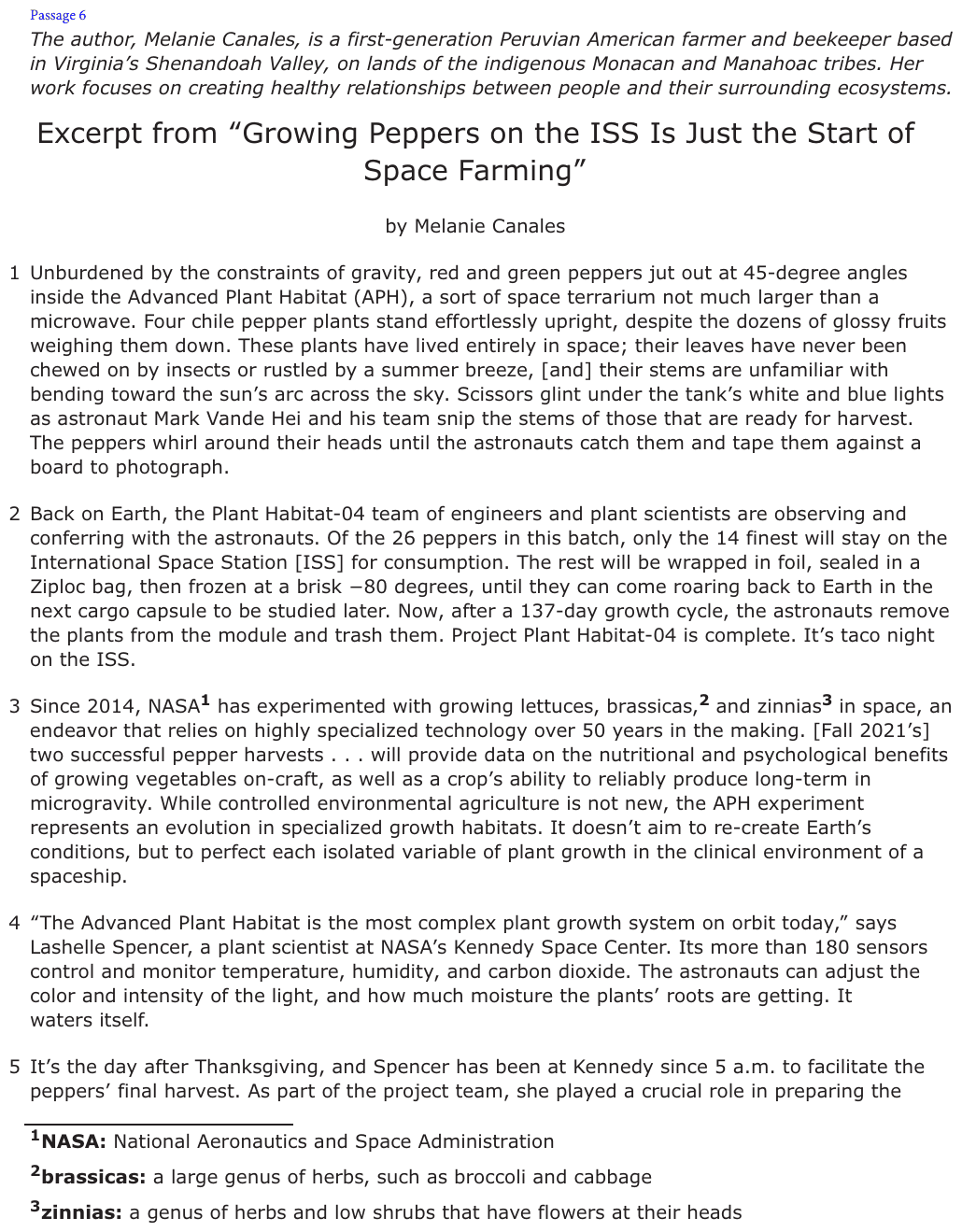
Unburdened by the constraints of gravity, red and green peppers jut out at 45-degree angles inside the Advanced Plant Habitat (APH), a sort of space terrarium not much larger than a microwave. Four chile pepper plants stand effortlessly upright, despite the dozens of glossy fruits weighing them down. These plants have lived entirely in space; their leaves have never been chewed on by insects or rustled by a summer breeze, [and] their stems are unfamiliar with bending toward the sun’s arc across the sky. Scissors glint under the tank’s white and blue lights as astronaut Mark Vande Hei and his team snip the stems of those that are ready for harvest. The peppers whirl around their heads until the astronauts catch them and tape them against a board to photograph.
Back on Earth, the Plant Habitat-04 team of engineers and plant scientists are observing and conferring with the astronauts. Of the 26 peppers in this batch, only the 14 finest will stay on the International Space Station [ISS] for consumption. The rest will be wrapped in foil, sealed in a Ziploc bag, then frozen at a brisk −80 degrees, until they can come roaring back to Earth in the next cargo capsule to be studied later. Now, after a 137-day growth cycle, the astronauts remove the plants from the module and trash them. Project Plant Habitat-04 is complete. It’s taco night on the ISS.
Since 2014, NASA1 has experimented with growing lettuces, brassicas,2 and zinnias3 in space, an endeavor that relies on highly specialized technology over 50 years in the making. [Fall 2021’s] two successful pepper harvests . . . will provide data on the nutritional and psychological benefits of growing vegetables on-craft, as well as a crop’s ability to reliably produce long-term in microgravity. While controlled environmental agriculture is not new, the APH experiment represents an evolution in specialized growth habitats. It doesn’t aim to re-create Earth’s conditions, but to perfect each isolated variable of plant growth in the clinical environment of a spaceship.
“The Advanced Plant Habitat is the most complex plant growth system on orbit today,” says Lashelle Spencer, a plant scientist at NASA’s Kennedy Space Center. Its more than 180 sensors control and monitor temperature, humidity, and carbon dioxide. The astronauts can adjust the color and intensity of the light, and how much moisture the plants’ roots are getting. It waters itself.
It’s the day after Thanksgiving, and Spencer has been at Kennedy since 5 a.m. to facilitate the peppers’ final harvest. As part of the project team, she played a crucial role in preparing the seeds that were sent hurtling into space in June and guiding the astronauts through maintaining the plants in orbit. . . . Though astronauts can spend upwards of 100 days in space, their on-mission meals come dehydrated and pre-packaged; their vitamins and minerals are isolated in supplements, which lose nutritional value the longer they’re stored. Spencer’s goal is to create the conditions necessary for cultivating healthy plants in space, so those plants can sustain healthy astronauts on long-term missions. Astronaut food is great, she says—“especially the shrimp cocktail. But you’re missing that crunch. You’re missing that fresh pop of flavor, the green flavor that’s not there in that packaged food.”
The sensory experience of growing productive crops can also help mitigate4 the psychological effects of long-term space travel. . . . Spencer says the team cracked open the door of the APH every day to observe their vegetable companions with all the tenderness of home gardeners. When harvest day came, they batted their bounty around the ISS, taking selfies and delighting in watching the fruits pirouetting around the spacecraft. . . .
“We were thinking no heat, so that [the peppers] wouldn’t be dangerous, but maybe the astronauts need a little spice in their life,” says Paul Bosland, who along with his colleagues at the Chile Pepper Institute genetically engineered5 the NuMex Española Improved chile pepper seeds grown in Plant Habitat-04. . . .
Working with NASA, Bosland cultivated a variety that could accommodate both the nutritional needs of astronauts as well as the logistics of growing a plant in space. . . .
. . . The experiment is helping gather the data necessary to determine the nutritional content of crops grown in space, and therefore how many people they can feed, and for how long. Though much is still unknown, Spencer is certain of one thing that future astronauts will need to do: “I think in an optimal world, a scientist like me would say that they would be growing plants from day one. From the day they left to the day they came back, they would be growing them.”
From “Growing Peppers on the ISS Is Just the Start of Space Farming” by Melanie Canales from WIRED, December 21, 2021. Copyright © 2021 Condé Nast. All rights reserved.
1NASA: National Aeronautics and Space Administration
2brassicas: a large genus of herbs, such as broccoli and cabbage
3zinnias: a genus of herbs and low shrubs that have flowers at their heads
4mitigate: to make something less severe or harmful
5genetically engineered: combined parts of DNA from different plants to produce a new plant
Question
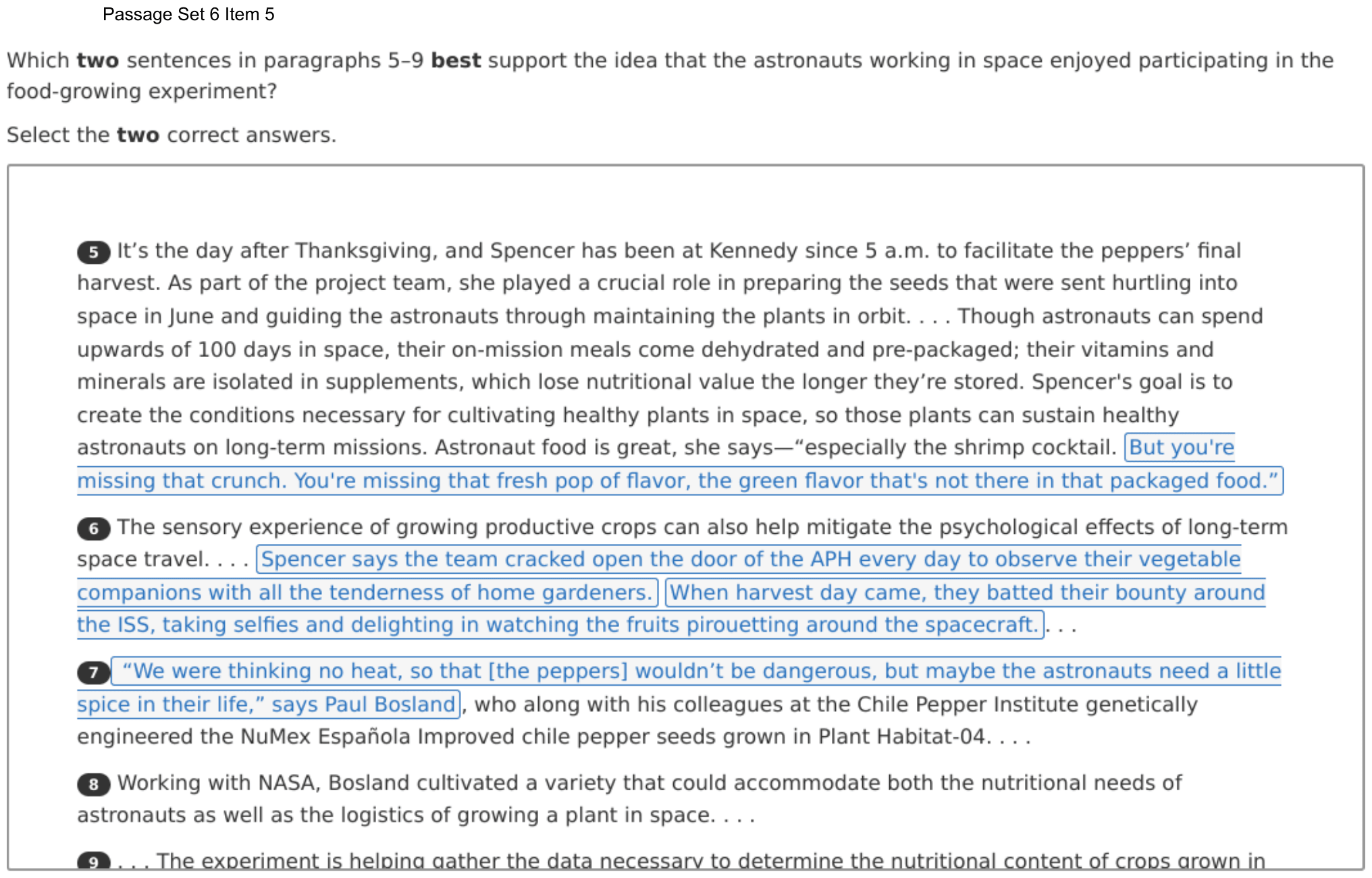
Which two sentences in paragraphs 5–9 best support the idea that the astronauts working in space enjoyed participating in the food-growing experiment?
Select the two correct answers.
On the test you click the words in the text; here, choose them below. The DOE has not published how answers with several parts are scored; this site counts one right only when every part is right.
- ABut you’re missing that crunch. You’re missing that fresh pop of flavor, the green flavor that’s not there in that packaged food.”
- BSpencer says the team cracked open the door of the APH every day to observe their vegetable companions with all the tenderness of home gardeners.
- CWhen harvest day came, they batted their bounty around the ISS, taking selfies and delighting in watching the fruits pirouetting around the spacecraft.
- D“We were thinking no heat, so that [the peppers] wouldn’t be dangerous, but maybe the astronauts need a little spice in their life,” says Paul Bosland
- E“I think in an optimal world, a scientist like me would say that they would be growing plants from day one.
Show the answer
Correct answer: B and C
The question asks which two sentences in paragraphs 5–9 best support the idea that the astronauts working in space enjoyed participating in the food-growing experiment.
Incorrect. Choice 1. “But you’re missing that crunch. You’re missing that fresh pop of flavor, the green flavor that’s not there in that packaged food” is incorrect because it illustrates an opinion on fresh foods of Lashelle Spencer, a plant scientist at NASA’s Kennedy Space Center. Although astronauts are likely to enjoy fresh food, the statement does not describe the enjoyment of the astronauts participating in the experiment.
CORRECT. Choice 2. “Spencer says the team cracked open the door of the APH every day to observe their vegetable companions with all the tenderness of home gardeners” is a correct response. The details about the attitude of the astronauts toward the plants and their desire to observe them every day support the idea that they enjoyed participating in the experiment.
CORRECT. Choice 3. “When harvest day came, they batted their bounty around the ISS, taking selfies and delighting in watching the fruits pirouetting around the spacecraft” is a correct response. That the astronauts were taking selfies with the peppers and “delighting in watching the fruits pirouetting around the spacecraft” suggests that the astronauts enjoyed being part of the experiment.
Incorrect. Choice 4. “ ‘We were thinking no heat, so that [the peppers] wouldn’t be dangerous, but maybe the astronauts need a little spice in their life,’ says Paul Bosland” is incorrect because the quotation only gives information about the variables taken into account in the selection of peppers by a scientist at the Chile Pepper Institute. Although the observation suggests that the spicy heat of peppers might be enjoyed by astronauts in space, the sentence does not address the attitude of the astronauts toward the experiment.
Incorrect. Choice 5. “ ‘I think in an optimal world, a scientist like me would say that they would be growing plants from day one’ ” is incorrect because it emphasizes the opinion of Lashelle Spencer, a plant scientist at NASA’s Kennedy Space Center, regarding the growth of plants in space. Although she suggests growing plants is a good idea, the quotation does not support the idea that the astronauts enjoyed participating in the experiment.
Question analysis
This select-two evidence question asks which two sentences in paragraphs 5–9 of the space-farming excerpt best show that the astronauts enjoyed taking part in the pepper-growing experiment. On the test students click two of five sentences highlighted in the passage, and credit comes only when both picks are right. Each sentence mentions food, peppers or plants, so each must be checked against the idea itself.
- NYS standards
- 7R1 textual evidence and inferences
- Grade level
- Grade 7 reading and task
- Compared with grade 7
- At grade 7 Choosing evidence for an idea is everyday grade 7 work. This item asks for two sentences out of five and gives credit only for a fully right pair, but the sentences come from a few neighboring paragraphs and the idea to support is concrete.
- Estimated difficulty
- Straightforward: two steps or one careful reading.
- Thinking it demands
- Depth of knowledge 2, skills and concepts · mainly evaluate
- What makes it hard
- Reading between the lines moderate
- Every choice must be checked minor
- Figurative or literary language minor
- Evidence
- Answered from several paragraphs or stanzas
- Reading level
- Passage: about grade 10, 890 words; question and choices: about grade 9, 143 words.
- Students, last 30 days
- Not enough answers yet to show (it takes 10).
Why it is hard, traps and wrong answers (shows the answer)
Why it is hard
The harvest-day sentence, with its selfies and delight, is the easy pick. The second takes more care, because “the team” that opened the habitat every day seems at first to be Spencer’s team on Earth, and both picks must be right for credit. Students who look for the word “astronauts” or a cheerful phrase are pulled to Bosland’s “a little spice in their life” or to Spencer’s longing for crunch, which report the views of the scientists.
Reading between the lines moderate Working it out
The second right sentence says “the team” opened the habitat’s door, right after paragraph 5 called Spencer “part of the project team,” so students must see that only the crew aboard could do it. (Graesser, Singer & Trabasso, 1994; Kintsch, 1998)
Every choice must be checked minor Choosing the answer
All five sentences mention food, peppers or plants, and credit needs both picks, so each must be traced to its speaker: Spencer, the crew or Bosland. (Embretson & Wetzel, 1987)
Figurative or literary language minor Understanding the question
The enjoyment is shown in images rather than stated: “vegetable companions,” “the tenderness of home gardeners” and fruits “pirouetting around the spacecraft.” (Graesser, Singer & Trabasso, 1994; Kintsch, 1998)
Strategy: Read each of the five sentences in its paragraph and work out whose actions or opinions it reports, then keep the two that show both parts of the idea: astronauts in space, and their enjoyment.
Traps
- Supports only part of the claim: In a question about evidence: a line that backs one half of the claim but not the other, or a related point rather than the claim itself.
- Word match: Repeats striking words or phrases from the text, so it looks supported, but its meaning does not fit the question.
- Reads too much in: A reasonable-sounding conclusion that goes further than the text allows.
The wrong answers, classified
A Supports only part of the claim (King et al., 2004; Thissen, Steinberg & Fitzpatrick, 1989)
Hears a love of fresh food in “missing that crunch,” but these are Spencer’s words about packaged meals, a related point rather than a sign the crew enjoyed the experiment.
D Word match (Freedle & Kostin, 1993)
Is drawn by “a little spice in their life,” which sounds like fun and names the astronauts, though it is Bosland explaining a choice about the peppers’ heat.
E Reads too much in (Graesser, Singer & Trabasso, 1994)
Reasons that Spencer would not urge growing plants “from day one” unless crews loved it, though she gives her own view as a scientist and says nothing about their feelings.
B Twists what the text says (King et al., 2004)
Left out by students who take “the team” to be Spencer’s project team on Earth, though only the crew aboard the station could open the habitat’s door every day.
Working it out, step by step
Figure out what the question asks
You need two sentences from paragraphs 5–9 that show the astronauts enjoyed the experiment. Each one must do two things. It must be about the astronauts in space, not the scientists on Earth. And it must show they liked the work. On the test you click two sentences in the passage. Here, you choose two of the five choices. Both must be right.
Find who each sentence is about
- A is Spencer, a scientist on Earth, talking about packaged food.
- B says “the team” opened the habitat every day.
- C says “they” played with the peppers on harvest day.
- D is Paul Bosland, the scientist who made the seeds, talking about spice.
- E is Spencer again, giving her own opinion.
So only B and C could be about the astronauts. But who is “the team” in B?
Work out who the team is
Paragraph 5 calls Spencer “part of the project team,” and she works on Earth. So the team in paragraph 6 might seem to be the scientists. But look at what the team did. They “cracked open the door of the APH every day.” The APH is a plant box on the space station, so only the crew could open it. The next sentence says they batted the peppers “around the ISS,” so they were on board. Paragraph 1 also calls the crew Mark Vande Hei’s “team.” “Spencer says” only means she is telling us what they did.
See how they show enjoyment
In B, the team checked on “their vegetable companions with all the tenderness of home gardeners.” Companions are friends. Tenderness is gentle, loving care. They treated the plants almost like pets. In C, the same team “batted their bounty around the ISS, taking selfies.” Bounty means a big harvest. They were “delighting,” or taking great joy, in watching the peppers spin like dancers.
Rule out the other three
- A is wrong. Spencer is saying packaged food lacks crunch. That is her view of the food, not the crew enjoying the work.
- D is wrong. “A little spice in their life” sounds fun. But it is Bosland explaining why the peppers have some heat.
- E is wrong. Spencer says crews should grow plants “from day one.” That is a scientist’s advice, not the crew’s feelings.
Watch out: D names the astronauts and sounds cheerful. But the speaker is a scientist on Earth.
Choose the answers
Both sentences show the crew in space caring for and playing with their plants. So the answers are B and C: B, “Spencer says the team cracked open the door of the APH every day to observe their vegetable companions with all the tenderness of home gardeners.” And C, “When harvest day came, they batted their bounty around the ISS, taking selfies and delighting in watching the fruits pirouetting around the spacecraft.”
Why this answer and not the closest wrong one
The hard part is B. It says “the team,” and Spencer was on a team too. But only the crew on the station could open the habitat every day, so B is about the astronauts. D sounds fun, but Bosland is a scientist explaining spice. It says nothing about how the crew felt.
More questions like this
The original DOE question
The passage “Excerpt from “Growing Peppers on the ISS Is Just the Start of Space Farming”” as printed (pages 50–51)
Question 7 of 11
2026 Practice Test C English, question 45Passage New York City and the Hudson Valley Brickmaking Industry
New York City and the Hudson Valley Brickmaking Industry
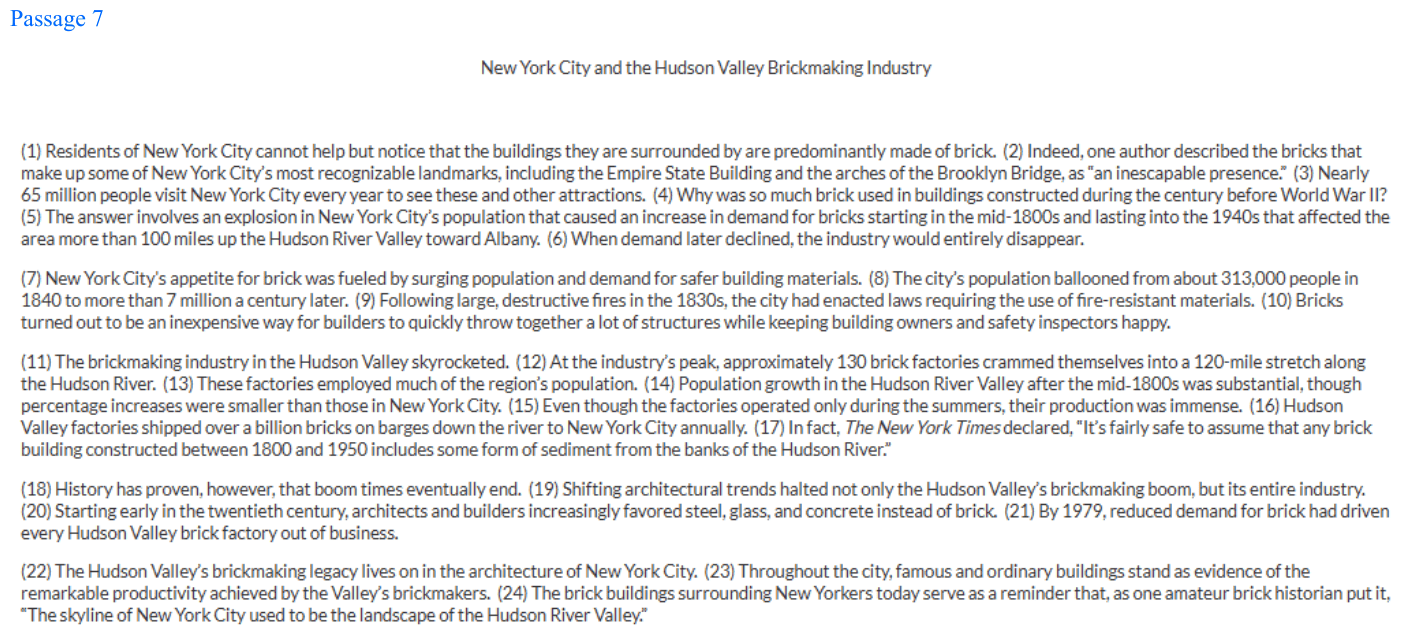
(1) Residents of New York City cannot help but notice that the buildings they are surrounded by are predominantly made of brick. (2) Indeed, one author described the bricks that make up some of New York City’s most recognizable landmarks, including the Empire State Building and the arches of the Brooklyn Bridge, as “an inescapable presence.” (3) Nearly 65 million people visit New York City every year to see these and other attractions. (4) Why was so much brick used in buildings constructed during the century before World War II? (5) The answer involves an explosion in New York City’s population that caused an increase in demand for bricks starting in the mid-1800s and lasting into the 1940s that affected the area more than 100 miles up the Hudson River Valley toward Albany. (6) When demand later declined, the industry would entirely disappear.
(7) New York City’s appetite for brick was fueled by surging population and demand for safer building materials. (8) The city’s population ballooned from about 313,000 people in 1840 to more than 7 million a century later. (9) Following large, destructive fires in the 1830s, the city had enacted laws requiring the use of fire-resistant materials. (10) Bricks turned out to be an inexpensive way for builders to quickly throw together a lot of structures while keeping building owners and safety inspectors happy.
(11) The brickmaking industry in the Hudson Valley skyrocketed. (12) At the industry’s peak, approximately 130 brick factories crammed themselves into a 120-mile stretch along the Hudson River. (13) These factories employed much of the region’s population. (14) Population growth in the Hudson River Valley after the mid-1800s was substantial, though percentage increases were smaller than those in New York City. (15) Even though the factories operated only during the summers, their production was immense. (16) Hudson Valley factories shipped over a billion bricks on barges down the river to New York City annually. (17) In fact, The New York Times declared, “It’s fairly safe to assume that any brick building constructed between 1800 and 1950 includes some form of sediment from the banks of the Hudson River.”
(18) History has proven, however, that boom times eventually end. (19) Shifting architectural trends halted not only the Hudson Valley’s brickmaking boom, but its entire industry. (20) Starting early in the twentieth century, architects and builders increasingly favored steel, glass, and concrete instead of brick. (21) By 1979, reduced demand for brick had driven every Hudson Valley brick factory out of business.
(22) The Hudson Valley’s brickmaking legacy lives on in the architecture of New York City. (23) Throughout the city, famous and ordinary buildings stand as evidence of the remarkable productivity achieved by the Valley’s brickmakers. (24) The brick buildings surrounding New Yorkers today serve as a reminder that, as one amateur brick historian put it, “The skyline of New York City used to be the landscape of the Hudson River Valley.”
Question
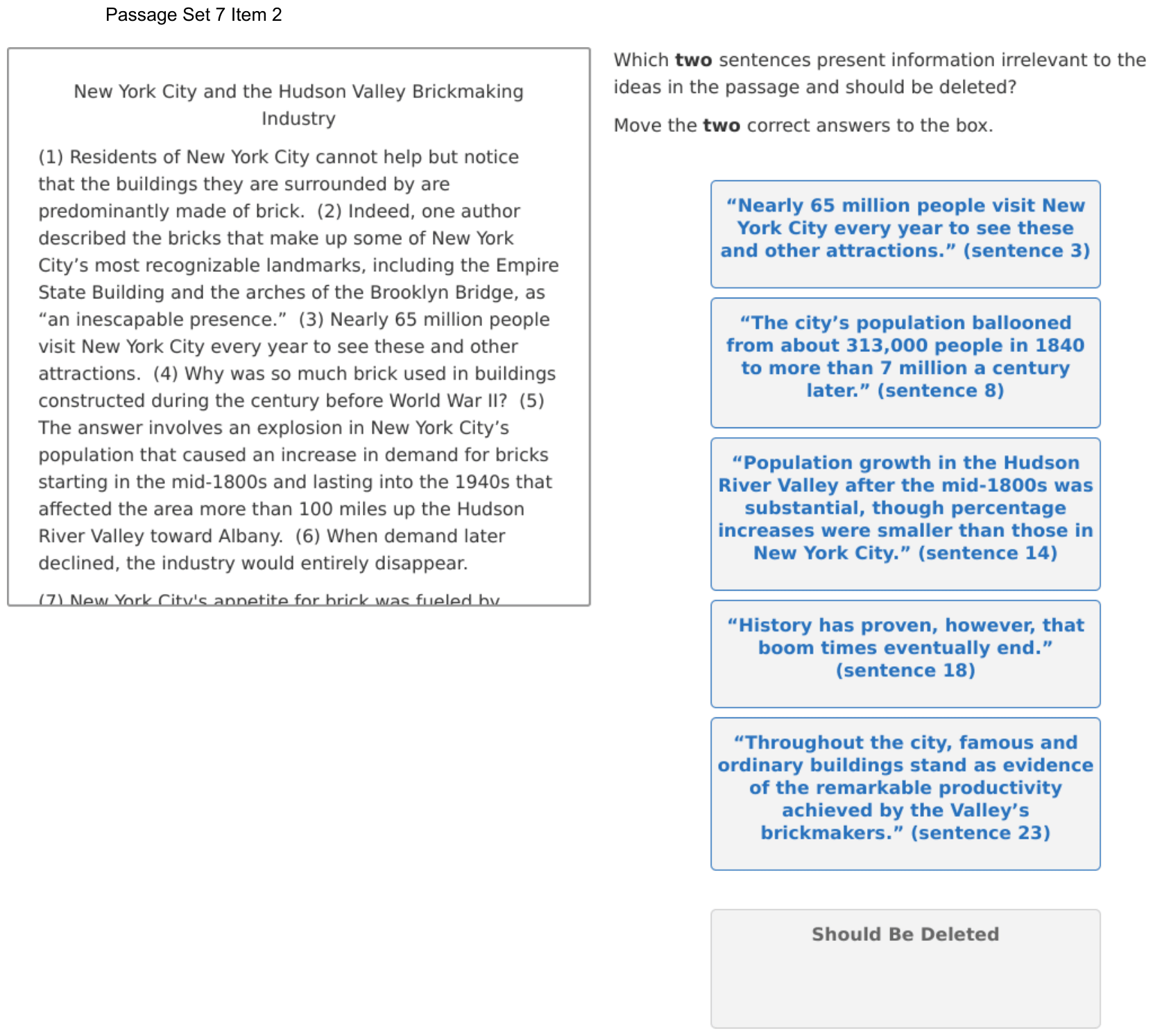
Which two sentences present information irrelevant to the ideas in the passage and should be deleted?
Move the two correct answers to the box.
Should Be Deleted
On the test you drag tiles into the box; here, choose them below. The DOE has not published how answers with several parts are scored; this site counts one right only when every part is right.
- A“Nearly 65 million people visit New York City every year to see these and other attractions.” (sentence 3)
- B“The city’s population ballooned from about 313,000 people in 1840 to more than 7 million a century later.” (sentence 8)
- C“Population growth in the Hudson River Valley after the mid-1800s was substantial, though percentage increases were smaller than those in New York City.” (sentence 14)
- D“History has proven, however, that boom times eventually end.” (sentence 18)
- E“Throughout the city, famous and ordinary buildings stand as evidence of the remarkable productivity achieved by the Valley’s brickmakers.” (sentence 23)
Show the answer
Correct answer: A and C
The question asks which two sentences present information irrelevant to the ideas of the passage and should be deleted.
CORRECT. “Nearly 65 million people visit New York City every year to see these and other attractions” (sentence 3) presents irrelevant information and should be deleted. While the statistic is interesting, it focuses on tourism, which is not relevant to either the topic of the passage—the growth and decline of the brickmaking industry—or to the ideas in the first paragraph (sentences 1–6), which focus on the prominence of brick in New York City’s buildings.
Incorrect. “The city’s population ballooned from about 313,000 people in 1840 to more than 7 million a century later” (sentence 8) is relevant to the ideas of the passage and should not be deleted. The numerical details in sentence 8 about the rapid growth in New York City provide relevant evidence that supports a central idea of the passage: that the brickmaking industry of the Hudson River Valley expanded quickly to supply the demands of builders who were, in turn, meeting the demands of a booming population.
CORRECT. “Population growth in the Hudson River Valley after the mid-1800s was substantial, though percentage increases were smaller than those in New York City” (sentence 14) presents irrelevant details and should be deleted. The information in sentence 14 comparing population growth rates between the region and New York City is not needed to develop the passage’s central focus on the rise and decline of the Hudson River Valley’s brickmaking industry. The sentence also does not support ideas in the third paragraph (sentences 11–17). Although it mentions that brick factories employed much of the Hudson River Valley population, the productivity of the factories, rather than the Valley’s population, is the topic of the paragraph.
Incorrect. “History has proven, however, that boom times eventually end” (sentence 18) is relevant to the ideas of the passage and should not be deleted. Sentence 18 effectively introduces the central idea of the passage: the decline of the Hudson River Valley brickmaking industry. The sentence also serves as a clear transition from the third paragraph (sentences 11–17), which provides evidence of the industry’s boom, to the fourth paragraph (sentences 18–21), which provides details about how the industry came to an end.
Incorrect. “Throughout the city, famous and ordinary buildings stand as evidence of the remarkable productivity achieved by the Valley’s brickmakers” (sentence 23) is relevant to the ideas of the passage and should not be deleted. The mention of famous and ordinary buildings provides an effective link to introductory sentences 1 and 2, strengthening the passage’s conclusion, while also emphasizing the productivity of the Hudson Valley brickmaking industry detailed in the third paragraph (sentences 11–17).
Question analysis
This revising question asks which two of five sentences from the passage on the Hudson Valley brickmaking industry present irrelevant information and should be deleted. On the test students move two sentence tiles into a box labeled Should Be Deleted, and both must be right. The five sentences come one from each paragraph, so each must be judged against its own paragraph and the whole passage.
- NYS standards
- 7W2b developing a topic
- Grade level
- Grade 7 reading and task
- Compared with grade 7
- Above grade 7 Grade 7 revision usually asks for one off-topic sentence within one paragraph. Here students check five sentences spread over the whole passage, must find two, and get credit only if both are right, a broader demand than typical grade 7 work.
- Estimated difficulty
- Hard: combines ideas, needs a plan, and has more than one tempting wrong answer.
- Thinking it demands
- Depth of knowledge 2, skills and concepts · mainly analyze
- What makes it hard
- A very close wrong answer moderate
- How sentences fit together moderate
- Much to keep track of minor
- Evidence
- Answered from the whole text
- Reading level
- Passage: about grade 12, 465 words; question and choices: about grade 10, 114 words.
- Corrected from the DOE handbook
- A missing hyphen in a quotation in the explanation was restored.
- A grammatical error in the explanation was corrected.
- Students, last 30 days
- Not enough answers yet to show (it takes 10).
Why it is hard, traps and wrong answers (shows the answer)
Why it is hard
Sentence 3 announces itself: tourism has nothing to do with brick. The second deletion is the trap, because sentence 14 sits after a sentence about factories employing the region’s population and looks like a continuation. Students who reject population as a topic often delete sentence 8 instead, which measures a cause the passage names, and students who judge by sound cut the general “boom times eventually end,” which turns the passage toward the industry’s decline.
A very close wrong answer moderate Choosing the answer
Sentences 8 and 14 are both population statistics; what separates them is that sentence 8 measures the “surging population” sentence 7 names as a cause, while the Valley’s growth in sentence 14 explains nothing. (Embretson & Wetzel, 1987; Gorin & Embretson, 2006; Ascalon et al., 2007)
How sentences fit together moderate Working it out
Each kept sentence earns its place by its links: sentence 18 turns from boom to decline, sentence 23 echoes the landmarks of sentences 1–2, and sentence 14 merely follows sentence 13’s “region’s population.” (Halliday & Hasan, 1976)
Much to keep track of minor Working it out
Five tiles, one from each paragraph, are judged against both their paragraph and the whole passage, and both picks must be right, so two relevance tests run side by side. (Sweller, 1988; Carpenter, Just & Shell, 1990)
Strategy: Sum up the passage’s topic in one phrase, then read each of the five sentences in its paragraph and ask whether removing it would leave a gap in the ideas around it; delete only sentences that leave none.
Traps
- Fixes what isn't broken: Changes a part of the sentence that was already correct, while the real error stays; or, where the question asks which sentence has an error or should go, picks one that is correct and belongs.
- Off the point: Adds or keeps something that does not support the paragraph's or the passage's focus, or an introduction or conclusion that misses the main point.
The wrong answers, classified
B Fixes what isn't broken (Connors & Lunsford, 1988)
Sees a population figure in a passage about bricks and cuts it, missing that sentence 7 names “surging population” as a cause of demand and sentence 8 measures it.
D Fixes what isn't broken (Connors & Lunsford, 1988)
Hears “boom times eventually end” as a cliché that adds nothing, though sentence 18 opens the fourth paragraph and turns the passage from the industry’s growth to its decline.
E Fixes what isn't broken (Connors & Lunsford, 1988)
Thinks sentence 23 only repeats the conclusion around it, though it ties the brickmakers’ output back to the famous buildings of sentences 1–2.
C Off the point (Halliday & Hasan, 1976)
Left unchosen by students who link it to factories that “employed much of the region’s population,” though the paragraph is about the factories’ output, not the Valley’s growth.
What was corrected from the DOE handbook, and why
- Explanation: The handbook’s explanation quotes sentence 14 as “Population growth in the Hudson River Valley after the mid 1800s was substantial.” The passage and the tile say “mid-1800s,” so the site now quotes it that way.
- Explanation: The handbook’s explanation says “The information in sentence 14 comparing population growth rates between the region and New York City are not needed.” The subject is “information,” so the site now says “is not needed.”
Working it out, step by step
Figure out what the question asks
You need to find two sentences that don’t belong. A sentence is irrelevant when it has nothing to do with the main ideas. You can delete it without leaving a gap. On the test you drag two tiles into the Should Be Deleted box. Here, you choose two of the five. Both must be right.
Name the topic of the passage
The passage explains why New York City has so many brick buildings. It tells how the Hudson Valley brick industry grew to meet that demand, then died out. Each paragraph has its own job. Paragraph 1 asks why so much brick was used. Paragraph 2 gives the causes. Paragraph 3 shows how much the factories made. Paragraph 4 tells how the industry ended. Paragraph 5 sums up.
Test sentences 3 and 14
Sentence 3 says: “Nearly 65 million people visit New York City every year to see these and other attractions.” That is about tourists, not bricks. Sentence 14 says: “Population growth in the Hudson River Valley after the mid-1800s was substantial, though percentage increases were smaller than those in New York City.” Paragraph 3 is about how much the factories made, “over a billion bricks” a year. How fast the Valley grew explains nothing about bricks.
Test the other three sentences
- Sentence 8 stays. Sentence 7 says the hunger for brick was “fueled by surging population.” Sentence 8 gives the numbers that show it.
- Sentence 18 stays. It turns the passage from the boom to the decline. A boom is a time of fast growth.
- Sentence 23 stays. It links back to the famous buildings in sentences 1 and 2 and praises the brickmakers.
Watch out: Sentence 14 comes right after one about factories that “employed much of the region’s population.” So it seems to fit. But it changes the topic from factories to population.
Choose the answers
Sentences 3 and 14 add facts that don’t help explain the brick industry. So the answers are A and C. Move these two tiles into the Should Be Deleted box. A is “Nearly 65 million people visit New York City every year to see these and other attractions.” (sentence 3). C is “Population growth in the Hudson River Valley after the mid-1800s was substantial, though percentage increases were smaller than those in New York City.” (sentence 14).
Why this answer and not the closest wrong one
B is the closest wrong answer, since sentences 8 and 14 are both about population. But sentence 8 measures the “surging population” that sentence 7 names as a cause of the demand for brick. Sentence 14 explains nothing about bricks. So delete 14 and keep 8.
More questions like this
The original DOE question
The passage “New York City and the Hudson Valley Brickmaking Industry” as printed (page 64)
Question 8 of 11
2026 Practice Test C Math, question 8Question
Jordan is helping plan snacks for a school dance. He knows that 0.75 of the students voted for pizza, and he wants to record the same amount using a fraction.
Which fractions are equivalent to the decimal 0.75?
Select the four correct answers.
Choose every answer that is correct, then check. The DOE has not published how answers with several parts are scored; this site counts one right only when every part is right.
- A
- B
- C
- D
- E
- F
Show the answer
Correct answer: A, B, C, and E
Check each fraction to determine whether it is equal to 0.75 when simplified or converted to a decimal.
This is the most common fraction equal to 0.75.
Simplifies to 3/4, because 15 and 20 can both be divided by 5.
This is a direct match to 0.75 when written as a decimal.
, which is less than 0.75.
Simplifies to because both 6 and 8 can be divided by 2.
, which is more than 0.75.
Question analysis
Jordan wants to record 0.75 of the students' pizza votes as a fraction, and students select the four fractions, out of six, that equal 0.75. It tests converting between decimals and fractions and recognizing equivalent fractions. Each choice has to be checked by its value, not by how its numbers look.
- NYS standards
- 7.NS.2d fractions to decimals by long division
- Grade level
- Grade 7 content, by NYS standard
- Compared with grade 7
- Below grade 7 Matching fractions to a decimal such as 0.75 builds on grade 4 to 6 work, and the denominators here divide easily. The added demand is the format: four of the six must be chosen, and one wrong or missing pick loses the item.
- Estimated difficulty
- Straightforward: two steps or one careful reading.
- Thinking it demands
- Depth of knowledge 1, recall and reproduction · mainly apply
- What makes it hard
- Every choice must be checked moderate
- A very close wrong answer minor
- Much to keep track of minor
- Solution
- 2 steps
- Reading level
- Question and choices: about grade 5, 47 words.
- Students, last 30 days
- Not enough answers yet to show (it takes 10).
Why it is hard, traps and wrong answers (shows the answer)
Why it is hard
Three of the four right fractions, 3/4, 75/100 and 6/8, are familiar forms of 0.75, so the item comes down to the fourth. Students who stop after the familiar ones must decide between 15/20, which needs dividing by 5 to recognize, and 8/10, which sits close to 0.75 on a number line. Dividing each numerator by its denominator, or scaling 3/4 up by 5, settles it.
Every choice must be checked moderate Choosing the answer
Six fractions with six different denominators have to be tested one by one, by dividing or by simplifying, since 15/20 and 8/10 cannot be judged by how they look. (Embretson & Wetzel, 1987)
A very close wrong answer minor Choosing the answer
8/10 is 0.8, only 0.05 above 0.75, and it follows 6/8 by adding 2 to the top and the bottom, so it looks like one more member of the family. (Embretson & Wetzel, 1987; Gorin & Embretson, 2006; Ascalon et al., 2007)
Much to keep track of minor Working it out
Four of the six must be chosen and all four must be right for the item to count, so each verdict has to be kept while the remaining fractions are tested. (Sweller, 1988; Carpenter, Just & Shell, 1990)
Strategy: Turn each choice into a decimal by dividing its numerator by its denominator, or reduce it to lowest terms, and keep only the ones whose value is exactly the decimal given.
Traps
- Misunderstands the concept: A wrong belief about a concept: that percents can be added, that area grows like length, that averages can be averaged, that a bigger denominator means a bigger fraction.
The wrong answers, classified
D Little reason to choose it (Haladyna & Downing, 1993; Rodriguez, 2005)
No usual working links 2/5 to 0.75, since 2 ÷ 5 = 0.4, so it mostly catches students filling the fourth slot by guessing.
F Misunderstands the concept (Smith, diSessa & Roschelle, 1993; De Bock et al., 1998; Ni & Zhou, 2005)
Builds 8/10 from 6/8 by adding 2 to the top and the bottom, as if equal additions kept a fraction's value, or accepts 0.8 as close enough.
Worked solution, step by step
Formulas used
- Changing a fraction to a decimal
- a is the numerator, the top. b is the denominator, the bottom. A fraction bar means divide. So dividing the top by the bottom gives the fraction’s value as a decimal.
- Equivalent fractions
- a is the top and b is the bottom. n is a number that goes evenly into both. Dividing the top and the bottom by the same number gives an equal fraction. Equivalent fractions name the same amount in different ways.
Sort out the question
Six fractions are given, A to F. You need the four that equal the decimal 0.75. Equivalent means equal in value. Test every choice, because some fractions look alike but are not equal.
Write 0.75 as a fraction
0.75 means 75 hundredths:
So choice C works. Now simplify it. 25 goes into both 75 and 100:
So choice A, 3/4, works too.
Test choices B and E
Simplify each one to see if it becomes 3/4:
- B: 5 goes into 15 and 20. . It works.
- E: 2 goes into 6 and 8. . It works.
Test choices D and F
Divide the top by the bottom:
- D: . That is less than 0.75.
- F: . That is more than 0.75.
Watch out: F looks like 6/8 with 2 added to the top and the bottom. Adding the same number to both changes the value. Only multiplying or dividing both keeps it.
Name the four answers
A, B, C and E all equal 0.75. On the test, you check the box beside each of them. On this site, you choose all four, then check your answer.
So the answers are A, B, C and E.
Check your answer
Turn each answer into a decimal. , , and all give 0.75. Exactly four choices passed, and the question asks for four. So none were missed.
More questions like this
The original DOE question
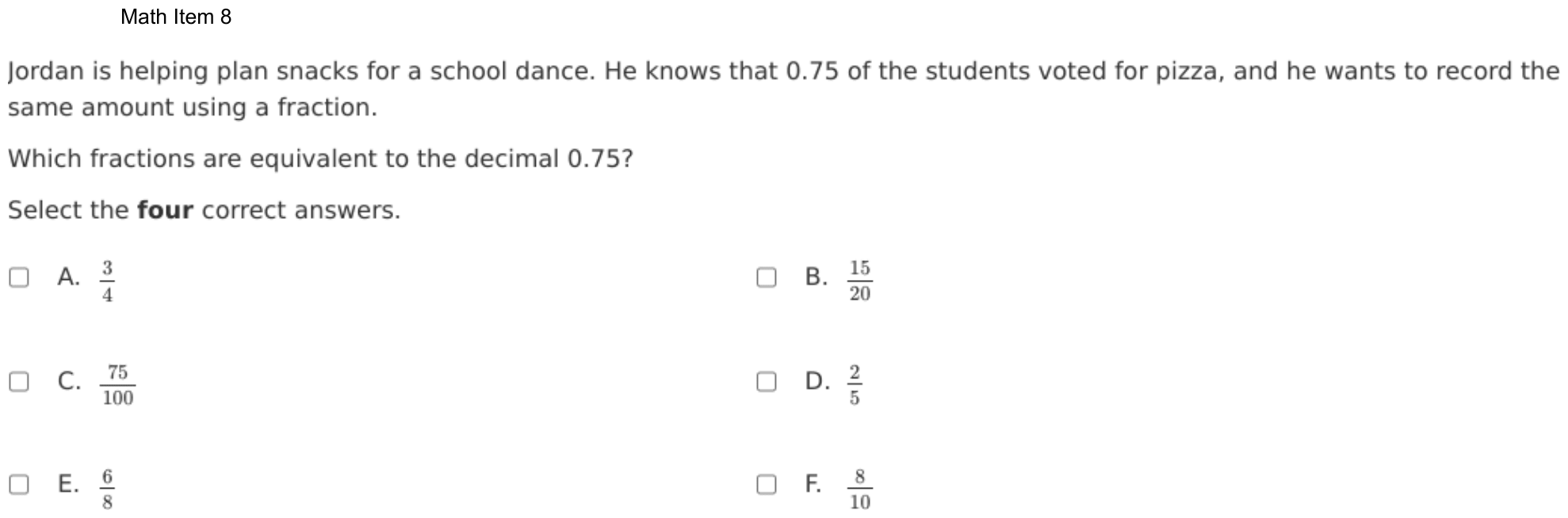
Question 9 of 11
2026 Practice Test D English, question 49Question
Read this sentence.
Robert Cornelius is credited with taking the first, official selfie as a daguerreotype, an image recorded on a copper plate coated in silver, using a process that was more complicated than photos of today which are digitized or printed from film and do not require subjects to sit for nearly fifteen minutes to avoid blurring the image.
Which two edits should be made to correct the sentence?
Select the two correct answers.
Choose every answer that is correct, then check. The DOE has not published how answers with several parts are scored; this site counts one right only when every part is right.
- ADelete the comma after first.
- BDelete the comma after daguerreotype.
- CDelete the comma after silver.
- DAdd a comma after today.
- EAdd a comma after film.
Show the answer
Correct answer: A and D
The question asks which two edits should be made to correct the sentence.
A. CORRECT. The comma after “first” must be deleted to correct the sentence. The adjectives “first” and “official” are not coordinate adjectives that independently modify the noun “selfie.” Cornelius did not take the “first selfie” and also the “official selfie.” Rather, he took the first selfie that was considered official. Placing a comma between the words “first” and “official” incorrectly separates two adjectives that work together to describe the selfie.
B. Incorrect. The comma after “daguerreotype” must not be deleted, because it is used correctly to introduce an explanation. The phrase “an image recorded on a copper plate coated in silver” is an appositive—a noun phrase that defines “daguerreotype.”
C. Incorrect. The comma after “silver” is placed correctly, marking the end of the phrase “an image recorded on a copper plate coated in silver” that defines “daguerreotype.” Because the sentence continues to explain the process Robert Cornelius used, the comma after “silver” is needed to end the appositive and separate it from the phrase that follows.
D. CORRECT. A comma is needed after “today” because the following phrase, “which are digitized or printed from film,” is a nonrestrictive clause that gives nonessential information about the “photos of today” preceding it.
E. Incorrect. No comma is needed after “film,” because the words “and do not require subjects to sit” are part of the same relative clause that begins with “which are digitized…”. The conjunction “and” joins two predicates within the same clause. Both actions belong to the same clause and the same subject (which); they are not separate independent clauses that need to be punctuated with a comma.
Question analysis
This punctuation question gives one long sentence about Robert Cornelius, credited with one of the earliest selfies, and the daguerreotype, an image made on a silver-coated copper plate, and asks which two of five comma edits correct it. Five words are underlined, and each needs its own decision about a comma, with credit only when both chosen edits are right.
- NYS standards
- 7L2 capitalization, punctuation, and spelling
- Grade level
- Grade 8 reading and task
- Compared with grade 7
- Above grade 7 The comma rules tested appear in the grade 6 and 7 standards, but the sentence runs 57 words, two of the rules are subtle ones, and both selections must be right, which makes this harder than typical grade 7 editing.
- Estimated difficulty
- Hard: combines ideas, needs a plan, and has more than one tempting wrong answer.
- Thinking it demands
- Depth of knowledge 2, skills and concepts · mainly apply
- What makes it hard
- A rule that doesn't sound wrong major
- Much to keep track of moderate
- Complex sentences moderate
- Evidence
- Answered from one sentence or line
- Reading level
- Question and choices: about grade 7, 100 words.
- Corrected from the DOE handbook
- A grammar term in the explanation was corrected.
- Students, last 30 days
- Not enough answers yet to show (it takes 10).
Why it is hard, traps and wrong answers (shows the answer)
Why it is hard
The sentence is long, two of its five decisions turn on subtle comma rules, and the site counts the answer right only when both edits are right. The comma before “and do not require” is the strongest trap, because a comma before “and” is a habit many students apply without checking whether a new clause begins. The paired commas around “an image recorded on a copper plate coated in silver” are already correct, and deleting either one breaks the pair.
A rule that doesn't sound wrong major Working it out
Both needed edits rest on rules students rarely hear: “first, official” are not coordinate adjectives, so no comma, and “which are digitized” adds nonessential detail about photos of today, so it needs one. (Connors & Lunsford, 1988)
Much to keep track of moderate Working it out
There are five comma decisions in one sentence and both selections must be right to score, so each edit is judged on its own while the rest of the sentence is held in mind. (Sweller, 1988; Carpenter, Just & Shell, 1990)
Complex sentences moderate Understanding the question
The sentence runs 57 words and stacks an appositive, a participial phrase beginning “using a process,” and a relative clause with two verbs, so finding where each phrase starts and ends is itself the task. (Abedi & Lord, 2001; Freedle & Kostin, 1993; Messick, 1989)
Strategy: Take the five underlined words one at a time: name what the phrase after each one does in the sentence, decide whether a comma belongs there, and choose only the two edits you are sure of.
Traps
- Punctuation: A comma, semicolon, colon, dash or apostrophe used where it does not belong, or missing where it does.
The wrong answers, classified
B Punctuation (Connors & Lunsford, 1988)
Deletes the comma that opens the appositive “an image recorded on a copper plate coated in silver,” which defines daguerreotype and must be set off from it.
C Punctuation (Connors & Lunsford, 1988)
Deletes the comma that closes the same appositive, perhaps feeling the sentence has too many commas, though a phrase set off mid-sentence needs a comma on each side.
E Punctuation (Connors & Lunsford, 1988)
Applies the habit of a comma before “and,” though here “and” joins two verbs that share one subject, “which,” inside one clause, not two complete clauses.
A Punctuation (Connors & Lunsford, 1988)
Left out by students who think a comma always separates two adjectives, though “first” describes “official selfie” as a unit, so the adjectives are not coordinate.
D Punctuation (Connors & Lunsford, 1988)
Left out by students who read “photos of today which are digitized” as one essential phrase, missing that the which-clause adds nonessential detail and needs a comma.
What was corrected from the DOE handbook, and why
- Explanation: The DOE’s explanation of Option C says the comma after “silver” “is needed to separate the clauses.” Neither side of that comma is a clause. Before it is the appositive “an image recorded on a copper plate coated in silver,” as the explanations of Options B and C say; after it is the phrase “using a process that was more complicated…,” a participial phrase with no subject of its own. The comma ends the appositive. The site now says the comma “is needed to end the appositive and separate it from the phrase that follows.”
Working it out, step by step
Figure out what the question asks
This asks which two comma edits fix the sentence. Five words are underlined. Decide about each comma one at a time. You must pick both right edits.
Check the comma after first
A comma goes between two describing words only if each one describes the noun on its own. Test it: can you put “and” between them? A long and hard test works, so you write a long, hard test. But the first and official selfie sounds wrong. “First” describes “official selfie” as a unit. So delete the comma after first. That is A.
Check the commas around silver
“An image recorded on a copper plate coated in silver” tells what a daguerreotype is. A phrase that renames the noun just before it is called an appositive. An appositive in the middle of a sentence needs a comma on each side. Example: My dog, a small beagle, loves walks. So keep the commas after daguerreotype and silver. B and C are wrong.
Check the comma after today
A clause is a group of words with its own verb. “Which are digitized or printed from film” is a clause that adds extra facts about photos of today. A “which” clause that adds extra facts gets a comma before it. Example: I read that book, which is very long. So add a comma after today. That is D.
Check the comma after film
The words “and do not require subjects to sit” are part of the same “which” clause. “Which” is the subject of both verbs, “are digitized or printed” and “do not require.” When “and” joins two verbs that share one subject, no comma goes before it. Example: She sings and dances. So E is wrong.
Watch out: Many students put a comma before every “and.” That leads to E. A comma goes before “and” when it joins two full sentences, not two verbs.
Choose the answers
Delete the comma after first, and add a comma after today. So the answers are A and D. Be sure to select both of them.
Why this answer and not the closest wrong one
E is the closest wrong answer, because a comma before “and” is a common habit. But after film, “and” joins two verbs that share one subject, “which.” No new sentence starts there, so no comma belongs. A and D fix the two real errors.
More questions like this
The original DOE question
Question 10 of 11
2026 Practice Test D Math, question 9Question
Let m be a negative integer and k be a positive integer.
Which of the expressions below must result in a positive value?
Select the three correct answers.
Choose every answer that is correct, then check. The DOE has not published how answers with several parts are scored; this site counts one right only when every part is right.
- A
- B
- C
- D
- E
Show the answer
Correct answer: A, B, and D
Each of the expressions must be considered:
, where m is a negative integer and k is a positive integer: Correct
The “−” in front of m acts like a multiplier that flips the sign of m, so is positive when m is negative and k is positive.
, where m is a negative integer and k is a positive integer: Correct
The “−” in front of m acts like a multiplier that flips the sign of m, so is positive when m is negative and k is positive.
, where m is a negative integer and k is a positive integer:
A negative number minus a positive number gives a negative number.
, where m is a negative integer and k is a positive integer: Correct
A positive times a negative is a negative. Then, taking the opposite of that makes it positive.
, where m is a negative integer and k is a positive integer:
A negative divided by a positive remains negative.
Therefore, , , and must all result in a positive number.
Question analysis
Given that m is a negative integer and k a positive integer, students select the three expressions, out of five, that must have a positive value. It tests the sign rules for adding, subtracting, multiplying and dividing integers. Minus signs in front of letters, and letters in place of numbers, make each sign easy to misjudge, and all three must be found.
- NYS standards
- Grade level
- Grade 7 content, by NYS standard
- Compared with grade 7
- At grade 7 Sign rules for adding, subtracting, multiplying and dividing integers are core grade 7 content. Here they are applied to letters with known signs instead of numbers, across five expressions, and all three right ones must be chosen with no wrong one.
- Estimated difficulty
- Moderate: several steps, or a close reading with one strong distractor.
- Thinking it demands
- Depth of knowledge 2, skills and concepts · mainly analyze
- What makes it hard
- Variables instead of numbers moderate
- Every choice must be checked moderate
- Much to keep track of minor
- Solution
- 3 steps
- Reading level
- Question and choices: about grade 8, 33 words.
- Students, last 30 days
- Not enough answers yet to show (it takes 10).
Why it is hard, traps and wrong answers (shows the answer)
Why it is hard
Each expression needs only one sign rule, but the minus signs are placed to mislead. In −k · m the leading minus seems to make the result negative until the sign of m is counted, and in m − k two negatives seem to cancel, though subtracting makes the result more negative. Substituting one negative and one positive value into all five gives three positive results and two negative ones, the count the item asks for.
Variables instead of numbers moderate Understanding the question
Only the signs of m and k are known, so the sign of each expression must be reasoned from the rules or tested with values such as m = −2 and k = 3. (Koedinger & Nathan, 2004; Enright, Morley & Sheehan, 2002)
Every choice must be checked moderate Choosing the answer
All five expressions mix the same two letters with minus signs, so none can be dismissed at a glance; each is judged on its own and exactly three must be picked. (Embretson & Wetzel, 1987)
Much to keep track of minor Working it out
The item scores only when all three positive expressions are chosen and both negative ones left out, so five separate verdicts must be kept and combined. (Sweller, 1988; Carpenter, Just & Shell, 1990)
Strategy: Substitute sample values, such as m = −2 and k = 3, into all five expressions and note each sign, then confirm with the sign rules that no other values could change it.
Traps
- Negatives and direction: Arithmetic with negative numbers, the order of a subtraction, or direction on a number line. (Moving a term across the equals sign without changing its sign is a faulty procedure.)
- Misunderstands the concept: A wrong belief about a concept: that percents can be added, that area grows like length, that averages can be averaged, that a bigger denominator means a bigger fraction.
The wrong answers, classified
C Misunderstands the concept (Smith, diSessa & Roschelle, 1993; De Bock et al., 1998; Ni & Zhou, 2005)
Sees two negatives, m and the minus before k, and applies “two negatives make a positive” to subtraction, though a negative minus a positive moves further below zero.
D Negatives and direction (Brown & Burton, 1978)
Left out by students who read the leading minus in −k · m as making the product negative, missing that m is negative too, so the product is positive.
E Negatives and direction (Brown & Burton, 1978)
Sees no minus sign in m/k and takes it as positive, forgetting that m itself is negative, so the quotient of a negative and a positive is negative.
Worked solution, step by step
Formulas used
- The opposite of a number
- a is any positive number, so −a is negative. A minus sign in front of a number or letter means its opposite: the same distance from 0, on the other side. The opposite of a negative number is positive. So if m is negative, −m is positive.
- Signs when you multiply or divide
- a and b are positive numbers, so −a and −b are negative. Two negatives multiply to a positive. A negative and a positive multiply or divide to a negative. These rules tell you the sign of an answer without knowing the numbers.
Sort out the question
m is a negative integer, a whole number below 0, such as −2. k is a positive integer, such as 3. You must pick the three expressions that are always positive. Check all five, and test m = −2 and k = 3 as you go.
Understand the minus in front
A minus sign in front of a letter means the opposite of that number. Since m is negative, −m is positive. Since k is positive, −k is negative. With the test values, −m = 2 and −k = −3.
Check choices A and B
A: is a positive plus a positive, so it is always positive. Test: 2 + 3 = 5.
B: is a positive times a positive, so it is always positive. The dot · means times. Test: 2 × 3 = 6.
Check choices C and E
C: starts below 0 and moves further down, so it is always negative. Test: −2 − 3 = −5.
E: is a negative divided by a positive, so it is always negative. Test: −2 ÷ 3 = −2/3.
Watch out: two negatives make a positive only when you multiply or divide them. Choice C subtracts, so it stays negative. Choice E shows no minus sign, but m itself is negative.
Check choice D
D: is a negative times a negative, so it is always positive. Test: −3 × (−2) = 6.
Watch out: the minus sign in front makes D look negative. But m is negative too, and the two negatives make a positive. Skipping D leaves you one answer short.
Choose the three answers
Choices C and E are always negative, so leave them out. The three positive ones are A, B and D. On the test, you check the box next to each one.
So the answers are A, B and D.
Check your answer
Try different values, such as m = −10 and k = 1. A: 10 + 1 = 11. B: 10 × 1 = 10. D: −1 × (−10) = 10. All three are positive again. C gives −11 and E gives −10, both negative.
More questions like this
The original DOE question
Question 11 of 11
2025 Practice Test B English, question 3Passage Excerpt from “It’s Time to Stop Thinking That All Non-Native Species Are Evil”
Excerpt from “It’s Time to Stop Thinking That All Non-Native Species Are Evil”
by Emma Marris
The author of this opinion article attended a symposium, or conference, in Missoula, Montana, at which biologists and other scientists discussed species of plants and animals that are not native to the areas in which they live.
Invasive species are scary. It was ecologist Charles Elton, back in the 1950s, who introduced the militaristic “invasion” metaphor to describe exotic plants and animals—but there’s no question some can be extremely destructive.
The brown tree snake has eaten a dozen kinds of forest birds in Guam to extinction; zebra mussels clog pipes around the Great Lakes; the common house cat turns out to be, in Australia, a mercilessly effective killer of cute, fluffy marsupials like the bilby and the numbat.
As scientists have sounded the alarm about these pests, the public has gotten the message. Citizen groups rip out non-native plants. Native gardens have become increasingly popular, both as ways to celebrate the unique flora of each region and as tiny hot spots of diversity. Native trees provide food for native bugs, which feed native birds. Food chains developed over thousands of years of co-evolution unfold in our backyards. . . .
So we’ve learned, scientists and laypeople alike, that native species are good and non-natives are bad.
Julian Olden, a biologist at the University of Washington, Seattle, who co-organized the symposium, recently polled nearly 2,000 ecologists. Among his findings: a substantial number of them said they would immediately eradicate a hypothetical non-native forest plant, even if it were shown to have no effect on the forest. Olden calls this the “guilty even when proven innocent” approach.
That kind of approach is not very useful on a rapidly changing planet.
Exotics Are Everywhere
Climate change is making it harder even to decide who the invaders are.
How, scientists at the symposium wondered, do you define “native” on a warming planet, when plants and animals are already moving toward the poles or up mountainsides in search of climate conditions they can tolerate? Should we consider them “invasive” in their new homes? Regardless of what we label them, conservationists will be reluctant to remove them from their new environs—to do so would stymie1 their chances of adapting to the warmer future we’re creating.
And then there are the non-natives that we actually like. Most domestic crops are exotic in most of the places they’re grown, but there are even wild exotics that “do good,” forming useful relationships with native species.
Edwin Grosholz of the University of California, Davis, told the recent symposium about one such relationship. On beaches in his state, non-native spartina grass has become important habitat for the endangered California clapper rail, a plump shorebird with a downward curving bill more at home on land than in the air. A project to rip out and poison the spartina—which grows in dense swaths that exclude many other shorebirds—saw clapper rail numbers go tumbling downward.
There are other examples like that. The endangered southwestern willow flycatcher nests in “invasive” tamarisk shrubs. Many native (and beautiful) Hawaiian flowers are now pollinated by the Japanese white-eye bird—because the native pollinators have been driven extinct by other non-native species.
Should we impose further risk on already endangered natives by severing these relationships? Or should we admire the resilience of nature and let such “well-behaved” exotics stay? . . .
Leave them alone, more and more conservationists are arguing, and stop focusing obsessively on categorizing species as native or non-native. Mark Davis, an ecologist at Macalester College in St. Paul, Minnesota, once considered himself an “invasion biologist”—but not anymore. “I am actively trying to get the field to retire the invader narrative,” he said in Missoula.
A Good Thing, Not the Only Thing
After all, nativeness is just one environmental value, and arguably not as important as preventing extinctions and preserving biodiversity. In some cases we can best serve biodiversity by leaving the non-natives alone or even—brace yourself, now—introducing them on purpose.
This is the thinking behind, for example, installing the Aldabra tortoise on the islands of Mauritius. The islands lost their own large tortoises, and the fruiting plants that formerly had their seeds moved around by these fruit-loving reptiles have been on the decline. A tortoise that’s related to the island’s large tortoises—a non-native from the Seychelles in the Indian Ocean that was intentionally introduced in 2004—is now handling some of that work.
Most of the time, for the time being, conserving species still means focusing on supporting them in their historical habitats, planting natives and removing non-natives. We can and should do that in places where it is feasible and important to us.
From “It’s Time to Stop Thinking That All Non-Native Species Are Evil” by Emma Marris from NATIONAL GEOGRAPHIC MAGAZINE, July 24, 2014. Copyright © 2014 by National Geographic Society.
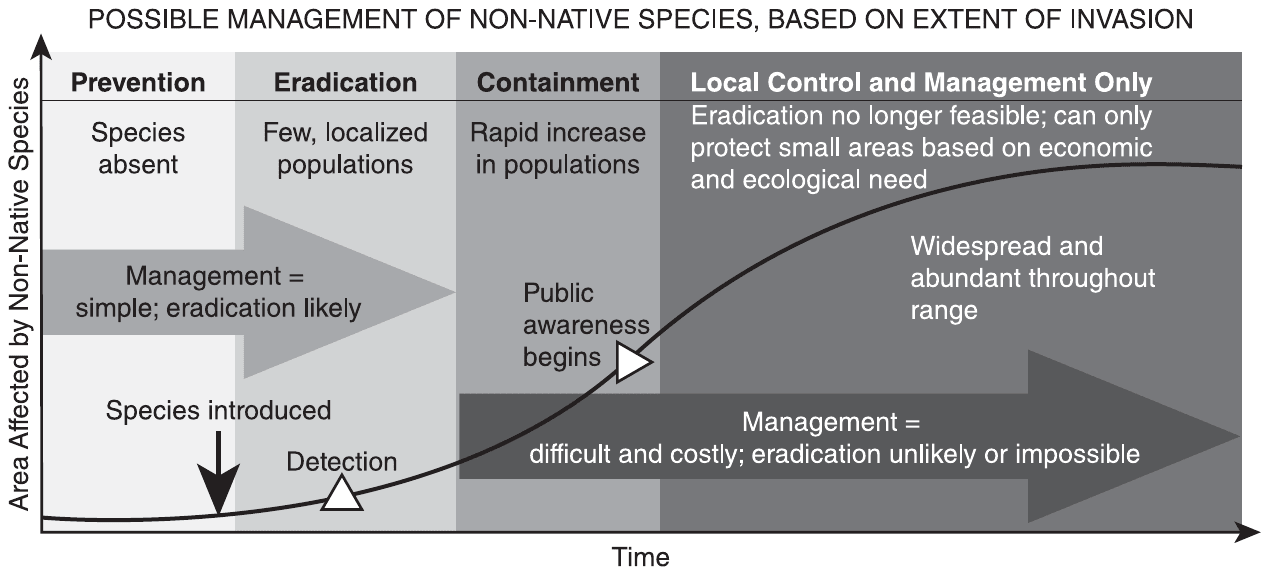
1stymie: hinder or interfere with
Question
Which two phrases from paragraph 3 most affect the tone of the excerpt?
Move the two correct answers to the box.
Phrases That Most Affect the Tone of the Excerpt
On the test you drag tiles into the box; here, choose them below. The DOE has not published how answers with several parts are scored; this site counts one right only when every part is right.
- A“sounded the alarm”
- B“gotten the message”
- C“rip out”
- D“become increasingly popular”
- E“provide food”
Show the answer
Correct answer: A and C
The question asks for the two phrases from paragraph 3 that most affect the tone of the excerpt.
A. “sounded the alarm”: CORRECT. This phrase affects the tone of the excerpt by conveying the stark sense of urgency surrounding the debate over the ecological impact of non-native species. The reference to an alarm sounding evokes the feeling of being on high alert.
B. “gotten the message”: Incorrect. This phrase does not most affect the tone of the excerpt.
C. “rip out”: CORRECT. This phrase affects the tone of the excerpt by vividly depicting the effect of widespread misunderstanding of non-native species.
D. “become increasingly popular”: Incorrect. This phrase does not most affect the tone of the excerpt.
E. “provide food”: Incorrect. This phrase does not most affect the tone of the excerpt.
Question analysis
This select-two tone question on Emma Marris’s opinion article about non-native species lists five short phrases from paragraph 3 and asks which two most affect the tone of the excerpt. On the test students move two tiles into a box, and both must be right. All five are common, everyday expressions, so students must weigh how strongly each one colors the excerpt.
- Grade level
- Grade 7 reading and task
- Compared with grade 7
- At grade 7 Typical grade 7 tone questions quote the words and ask what effect they have. Here students pick the two phrases themselves from five in one short paragraph and compare how much feeling each carries, which keeps the demand at grade level.
- Estimated difficulty
- Moderate: several steps, or a close reading with one strong distractor.
- Thinking it demands
- Depth of knowledge 2, skills and concepts · mainly analyze
- What makes it hard
- A very close wrong answer moderate
- Figurative or literary language moderate
- Much to keep track of minor
- Evidence
- Answered from one paragraph or stanza
- Reading level
- Passage: about grade 11, 815 words; question and choices: about grade 3, 42 words.
- Students, last 30 days
- Not enough answers yet to show (it takes 10).
Why it is hard, traps and wrong answers (shows the answer)
Why it is hard
Most students hear the urgency of “sounded the alarm” at once, and the point is lost on the second pick. The idiom that ends the same sentence sounds just as colorful, while “rip out” is a short, everyday verb whose force is easy to read past as plain weeding. Swapping each phrase for a neutral word and asking how much feeling is lost separates them, and credit comes only when both tiles are right.
A very close wrong answer moderate Choosing the answer
“Sounded the alarm” and “gotten the message” are paired idioms in the first sentence of paragraph 3, both about the warning passing from scientists to the public, and only the first carries urgency. (Embretson & Wetzel, 1987; Gorin & Embretson, 2006; Ascalon et al., 2007)
Figurative or literary language moderate Understanding the question
The tone lives in connotation: “sounded the alarm” borrows the picture of a siren or bell, and “rip out” shows plants torn up by force where “remove” would sound flat. (Graesser, Singer & Trabasso, 1994; Kintsch, 1998)
Much to keep track of minor Working it out
Five tiles compete for one box and both picks must be right, so each phrase’s charge has to be weighed against the other four, since the stem asks which affect the tone “most.” (Sweller, 1988; Carpenter, Just & Shell, 1990)
Strategy: Swap each phrase for a plain word with the same meaning, reread its sentence, and keep the two whose replacement changes the feeling of the passage the most.
Traps
- Wrong tone or attitude: Misjudges the tone, attitude or point of view, such as reading admiration as criticism, or taking a character's or subject's feelings for the author's.
- Taking figurative language literally: A choice reads a figure of speech or image at face value.
The wrong answers, classified
B Wrong tone or attitude (Graesser, Singer & Trabasso, 1994)
Hears an idiom as colorful as “sounded the alarm” in the same sentence and takes it as equally charged, though “gotten the message” only says the public accepted the warning.
D Wrong tone or attitude (Graesser, Singer & Trabasso, 1994)
Hears approval in the word “popular” and takes it as setting the tone, though “become increasingly popular” is a neutral report of a trend in gardening.
E Wrong tone or attitude (Graesser, Singer & Trabasso, 1994)
Is drawn by the pleasant picture of native trees feeding bugs that feed birds, though “provide food” is plain, factual wording that any science textbook might use.
C Taking figurative language literally (Graesser, Singer & Trabasso, 1994)
Left out by students who read “rip out” as a plain account of weeding, missing that the verb pictures citizen groups tearing up plants by force, where “remove” would be neutral.
Working it out, step by step
Figure out what the question asks
This is a tone question. Tone is the feeling or attitude that a writer’s words give a passage. You need the two phrases from paragraph 3 that carry the most feeling. Words can carry feeling beyond their plain meaning. On the test you drag two tiles into the box. On this site, you choose two of the five. Both must be right.
Read paragraph 3 in its place
The excerpt opens with “Invasive species are scary.” Paragraph 2 lists the harm some invaders do. Then paragraph 3 says “As scientists have sounded the alarm about these pests, the public has gotten the message. Citizen groups rip out non-native plants.” The rest of the paragraph is calm. It says native gardens are popular, and native trees feed bugs that feed birds.
Swap each phrase for plain words
A good test is to swap each phrase for plain words with the same meaning. Then ask how much feeling is lost.
- “sounded the alarm” becomes warned. An alarm is a loud bell for danger, like a fire alarm. The sense of danger is lost.
- “gotten the message” becomes understood. Little changes.
- “rip out” becomes remove. To rip is to tear roughly and fast. The force is lost.
- “become increasingly popular” becomes grown more common. Little changes.
- “provide food” becomes feed. Nothing changes.
See what the two phrases do
Urgency is the feeling that something must be done right now. “Sounded the alarm” makes non-native species sound like an emergency. “Rip out” shows people tearing up plants with force. Together they make the fight against non-natives sound urgent and harsh. That matches paragraph 1, which calls the word “invasion” militaristic, or warlike. The author goes on to question treating every non-native as bad.
Check each of the five tiles
- A fits. It adds urgency.
- B does not fit. It is an idiom, a saying whose meaning differs from its words. It only means the public understood.
- C fits. It adds force.
- D does not fit. It calmly reports a trend in gardening.
- E does not fit. It is plain, factual wording.
Watch out: B sits in the same sentence as A, and it sounds just as colorful. But it adds no danger and no force.
Choose both answers
So the answers are A and C. On the test, move the tiles “sounded the alarm” and “rip out” into the box Phrases That Most Affect the Tone of the Excerpt. You need both to get the point.
Why this answer and not the closest wrong one
B is the closest wrong choice. It is an idiom in the same sentence as A, so it seems just as strong. But swap in understood, and the feeling barely changes. C is easier to miss because it is short. Swap in remove, and the force is gone.
More questions like this
The original DOE question
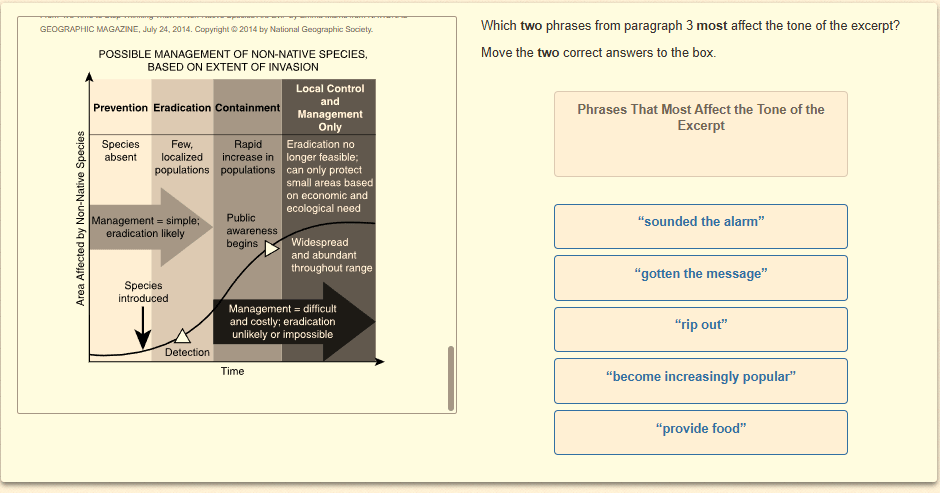
The passage “Excerpt from “It’s Time to Stop Thinking That All Non-Native Species Are Evil”” as printed (pages 68–70)