6.NS.4 common factors and multiples
Question 1 of 20
2026 Practice Test C Math, question 1Question
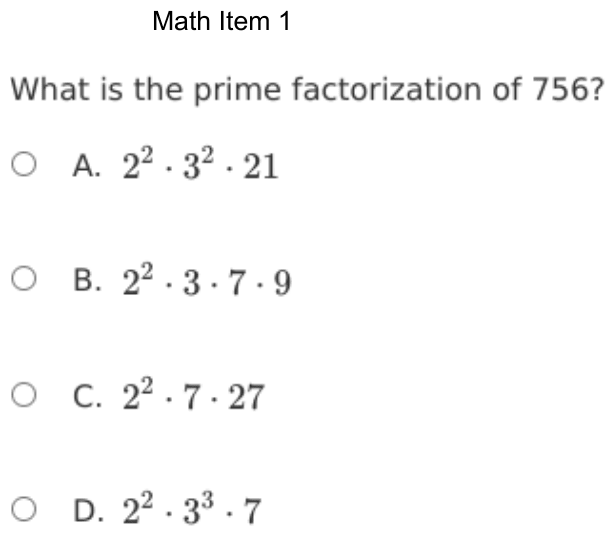
What is the prime factorization of 756?
- A
- B
- C
- D
Show the answer
Correct answer: D
Determine the prime factors of 756 using a factor tree:
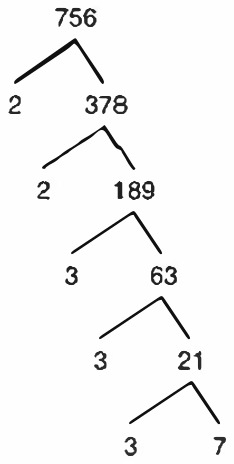
The prime factors are 2, 2, 3, 3, 3, and 7, or , which can be expressed using exponents as .
Question analysis
This number question asks for the prime factorization of 756, written with exponents. Students break the number into prime factors, with a factor tree or repeated division, and match the result to one of four products. Every choice multiplies back to 756, so the real test is whether each factor shown is actually prime.
- Grade level
- Grade 6 content, by NYS standard
- Compared with grade 7
- Below grade 7 Factor trees and exponent notation are grade 6 skills, and 756 splits quickly by small divisors. What adds a little is that every choice multiplies out to 756, so checking the product alone settles nothing.
- Estimated difficulty
- Straightforward: two steps or one careful reading.
- Thinking it demands
- Depth of knowledge 1, recall and reproduction · mainly apply
- What makes it hard
- A very close wrong answer moderate
- Something you must already know minor
- Solution
- 3 steps
- Reading level
- Question and choices: about grade 11, 10 words.
- Students, last 30 days
- Not enough answers yet to show (it takes 10).
Why it is hard, traps and wrong answers (shows the answer)
Why it is hard
The factoring itself is quick: halving twice and dividing by 3 three times leaves 7. The question is built so that multiplying back proves nothing, since every choice equals 756, and three of them simply stop the factor tree at a composite number. Students who check only the product, or who take an odd factor such as 21 or 27 for a prime, pick a factorization that is unfinished.
A very close wrong answer moderate Choosing the answer
2² · 3² · 21 shares the right answer's 2² and differs only in 3² · 21 against 3³ · 7, and both equal 756, so neither an estimate nor a product check separates them. (Embretson & Wetzel, 1987; Gorin & Embretson, 2006; Ascalon et al., 2007)
Something you must already know minor Working it out
Students must know that a prime factorization may hold only primes, and must spot that 21, 9 and 27 are composite even though none of them is even. (Anderson & Krathwohl, 2001)
Strategy: Divide 756 by 2 while the result is even, then by 3 while it divides evenly, and keep going until every factor left is prime; then compare factor by factor, not by product.
Traps
- Stops one step early: A choice is a number from partway through the solution.
- Misunderstands the concept: A wrong belief about a concept: that percents can be added, that area grows like length, that averages can be averaged, that a bigger denominator means a bigger fraction.
The wrong answers, classified
A Stops one step early (King et al., 2004; Gierl et al., 2017)
Divides out 2 twice and 3 twice, then stops at 21, which is 3 × 7, so one composite factor remains in a product that still equals 756.
B Misunderstands the concept (Smith, diSessa & Roschelle, 1993; De Bock et al., 1998; Ni & Zhou, 2005)
Splits off a 3 and a 7 but keeps 9 as if it were prime, perhaps because it is odd, though 9 = 3 × 3.
C Stops one step early (King et al., 2004; Gierl et al., 2017)
Splits 756 into 4 × 189 and 189 into 7 × 27, then stops, not seeing that 27 is 3 × 3 × 3.
Worked solution, step by step
Formulas used
- Writing a repeated factor with an exponent
- a is the number being multiplied, called the base. n is the exponent, the small raised number. It tells how many times a appears in the product. So 2² means 2 × 2, and 3³ means 3 × 3 × 3. Exponents are a short way to write a factor that repeats.
Sort out the question
You need the prime factorization of 756. That means writing 756 as a product of prime numbers only. A product is the answer to a multiplication. A prime number has exactly two factors, 1 and itself. Examples are 2, 3, 5 and 7.
All four choices multiply to 756. So multiplying a choice back does not pick the answer. You must check that every factor is prime.
Divide by 2 while you can
A factor tree splits a number into two factors, again and again. Start with the smallest prime, 2. 756 is even, so 2 goes into it:
378 is even too:
189 is odd, so 2 does not go into it. You have pulled out two 2s.
Divide by 3 while you can
Add the digits of 189: . A number can be divided by 3 when its digits add up to a number that 3 goes into. 3 goes into 18, so it goes into 189:
7 is prime, so the tree stops. You have pulled out three 3s and one 7.
Write the factors with exponents
Collect every prime you pulled out:
Use the exponent rule. Two 2s make , and three 3s make . The choices use a raised dot, ·, for times. So 756 is .
Choose the answer
Watch out: each wrong choice is a factor tree that stopped too soon. A ends in 21, which is 3 × 7. B has 9, which is 3 × 3. C has 27, which is 3 × 3 × 3. Being odd does not make a number prime.
Only D uses primes alone. So the answer is D, .
Check your answer
Multiply your answer back: , and . Then look at each factor. 2, 3 and 7 are all prime. D passes both tests.
More questions like this
The original DOE question
Question 2 of 20
2026 Practice Test D Math, question 1Question
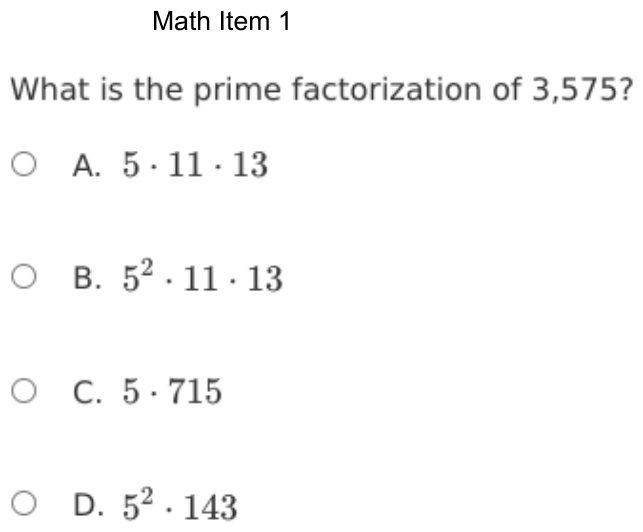
What is the prime factorization of 3,575?
- A
- B
- C
- D
Show the answer
Correct answer: B
By observation, 3,575 ends in 75; therefore, 3,575 is divisible by 25.
Test 143 for factors and eliminate 3, 5, and 7, but 11 is a factor.
; both 11 and 13 are prime numbers.
The first factor, 25, is not prime but is the product of primes, .
The prime factorization of 3,575 is .
Question analysis
This number question asks for the prime factorization of 3,575, chosen from four products of factors. Students divide by primes, using divisibility tests, until only primes remain. The four products look much alike, so the work must be carried all the way through, keeping count of every prime divided out along the way.
- Grade level
- Grade 6 content, by NYS standard
- Compared with grade 7
- Below grade 7 Breaking a number into primes is grade 6 number work that relies on divisibility tests. The number here is larger than in most class examples, but the work is still a few divisions, lighter than typical grade 7 problems.
- Estimated difficulty
- Straightforward: two steps or one careful reading.
- Thinking it demands
- Depth of knowledge 1, recall and reproduction · mainly apply
- What makes it hard
- A very close wrong answer moderate
- Something you must already know minor
- Solution
- 3 steps
- Reading level
- Question and choices: about grade 11, 10 words.
- Students, last 30 days
- Not enough answers yet to show (it takes 10).
Why it is hard, traps and wrong answers (shows the answer)
Why it is hard
Three of the four choices multiply back to 3,575, so checking a product rules out only the one that equals 715. The question turns on whether 143 is prime: it survives the quick tests for 2, 3 and 5, and the factor 11 is easy to miss. Students who keep dividing until every factor is prime, and who write a prime as often as it divides, finish in under a minute.
A very close wrong answer moderate Choosing the answer
5² · 143 matches the right factorization in its first factor and multiplies back to 3,575 just as well, so a product check cannot separate them; only splitting 143 into 11 × 13 does. (Embretson & Wetzel, 1987; Gorin & Embretson, 2006; Ascalon et al., 2007)
Something you must already know minor Working it out
Nothing on the page defines a prime factorization or gives a test for 11, and 143 passes the familiar quick tests for 2, 3 and 5, so it looks prime. (Anderson & Krathwohl, 2001)
Strategy: Divide by the smallest prime that goes in evenly, again and again, writing down every prime you use until the quotient reaches 1, then compare that list with each choice.
Traps
- Stops one step early: A choice is a number from partway through the solution.
- Misunderstands the concept: A wrong belief about a concept: that percents can be added, that area grows like length, that averages can be averaged, that a bigger denominator means a bigger fraction.
The wrong answers, classified
A Misunderstands the concept (Smith, diSessa & Roschelle, 1993; De Bock et al., 1998; Ni & Zhou, 2005)
Lists each prime that divides 3,575 only once, 5, 11 and 13, as if a factorization named which primes divide it, though their product is only 715.
C Stops one step early (King et al., 2004; Gierl et al., 2017)
Divides out one 5 and stops at 5 · 715, a true factorization but not a prime one, though 715 ends in 5 and splits further.
D Stops one step early (King et al., 2004; Gierl et al., 2017)
Divides by 25 and stops at 143, which passes the tests for 2, 3 and 5 and looks prime, though 143 = 11 × 13.
Worked solution, step by step
Formulas used
- Divisibility by 25
- A number is divisible by 25 when 25 goes into it with no remainder. You only need to look at the last two digits. If they are 00, 25, 50 or 75, the number is divisible by 25. This works because 100 is 4 × 25, so the hundreds never leave a remainder.
- Writing a repeated factor with an exponent
- a is any number. The small raised 2 is an exponent. It tells you how many times a is used as a factor, so 5² means 5 × 5 = 25. Use an exponent in a prime factorization when the same prime shows up more than once.
Sort out the question
A prime number is a whole number greater than 1 whose only factors are 1 and itself. Examples are 2, 3, 5, 7, 11 and 13. The prime factorization of 3,575 writes it as a product (the answer to a multiplication) of prime numbers only. So you must break 3,575 down until every factor is prime.
Divide by 25 first
3,575 ends in 75. So it is divisible by 25:
That means 3,575 = 25 × 143. But 25 is not prime. It is 5 × 5, which you can write as 5².
Test 143 for prime factors
Now see if 143 splits. Try the primes in order. 143 is odd, so 2 does not work. Its digits add to 1 + 4 + 3 = 8, which is not a multiple of 3, so 3 does not work. It does not end in 0 or 5, so 5 does not work. Since 7 × 20 = 140, 143 ÷ 7 leaves a remainder of 3, so 7 does not work. Now try 11:
So 143 = 11 × 13, and both 11 and 13 are prime.
Watch out: 143 looks prime, but it is not. Stopping at 5² · 143 leads to choice D.
Put all the primes together
Collect every prime you found. The 5 appears twice, then 11 and 13 once each. The dot · means times, just like ×.
Watch out: write the 5 twice, since it divides 3,575 twice. Writing it once gives 5 · 11 · 13, choice A, which equals only 715. Choice C, 5 · 715, stops too early, because 715 ends in 5 and splits further.
So the answer is B, .
Check your answer
Multiply the primes back together: 25 × 11 = 275, and 275 × 13 = 3,575. That is the number you started with. Also, 5, 11 and 13 are all prime, so nothing can be split further.
More questions like this
The original DOE question
Question 3 of 20
2026 Practice Test D Math, question 15Question
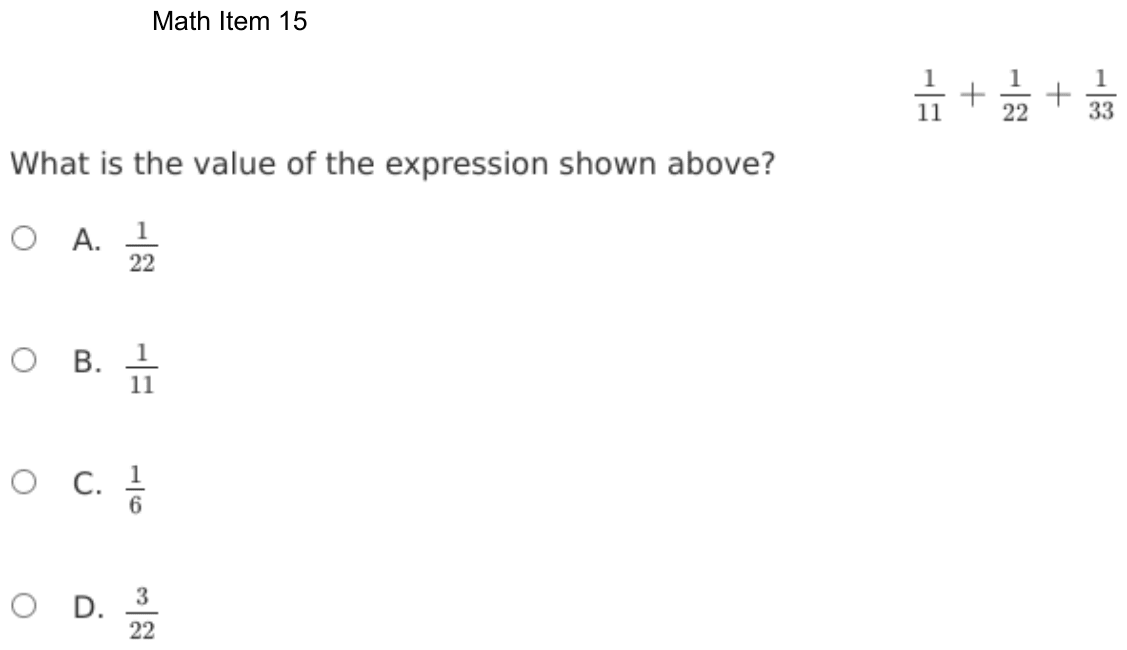
What is the value of the expression shown above?
- A
- B
- C
- D
Show the answer
Correct answer: C
To add fractions, find a common denominator and rename the fractions using the common denominator. The least common denominator for 11, 22, and 33 is 66. After adding the fractions, the final fraction can be reduced to lowest terms.
Question analysis
This fractions question asks for the value of 1/11 + 1/22 + 1/33. Students find a common denominator for three fractions, rename each one, add and simplify. The denominators are all multiples of 11, and adding the tops and bottoms straight across, or forgetting to rename a numerator, leads to tempting wrong choices.
- Grade level
- Grade 7 content, by NYS standard
- Compared with grade 7
- Below grade 7 Adding fractions with unlike denominators is taught before grade 7. Finding a common denominator for three related numbers and simplifying is short, routine work, lighter than typical grade 7 problems with signed rational numbers.
- Estimated difficulty
- Straightforward: two steps or one careful reading.
- Thinking it demands
- Depth of knowledge 1, recall and reproduction · mainly apply
- What makes it hard
- Error-prone arithmetic moderate
- An answer in an unexpected form minor
- Solution
- 3 steps
- Reading level
- Question and choices: about grade 9, 14 words.
- Students, last 30 days
- Not enough answers yet to show (it takes 10).
Why it is hard, traps and wrong answers (shows the answer)
Why it is hard
The question checks whether students rename fractions before adding, and each wrong choice comes from a shortcut that skips that step or stops early. Seeing that 22 and 33 are multiples of 11 points to 66 as the common denominator. A size check helps too: the sum must be more than 1/11, its largest term, which rules out two of the wrong choices at once.
Error-prone arithmetic moderate Working it out
Three unlike denominators must be renamed over 66, not over the product of all three, and the numerators 6, 3 and 2 have to be found one by one before adding. (Brown & Burton, 1978; Junker & Sijtsma, 2001)
An answer in an unexpected form minor Choosing the answer
The sum comes out as 11/66, which must be reduced to match a choice; its simplest form has a denominator, 6, unlike any in the expression. (Enright, Morley & Sheehan, 2002)
Strategy: Notice that 22 and 33 are multiples of 11, rename all three fractions over their least common multiple, add the numerators, and simplify the result.
Traps
- A faulty procedure: A systematic but wrong procedure: adding fractions straight across, applying an exponent to each term of a sum, dropping a sign when moving a term.
- Stops one step early: A choice is a number from partway through the solution.
The wrong answers, classified
A A faulty procedure (Brown & Burton, 1978; Tatsuoka, 1983)
Adds the numerators and the denominators straight across, 3 over 11 + 22 + 33 = 66, and simplifies 3/66 to 1/22.
B A faulty procedure (Brown & Burton, 1978; Tatsuoka, 1983)
Puts the three 1s over the largest denominator, 33, without renaming the other two fractions, so 3/33 simplifies to 1/11.
D Stops one step early (King et al., 2004; Gierl et al., 2017)
Adds the first two fractions correctly, 2/22 + 1/22 = 3/22, and stops before adding the third fraction, 1/33.
Worked solution, step by step
Formulas used
- Equivalent fractions
- a/b is a fraction, and n is any number except 0. Multiplying the top and the bottom by the same n gives an equal fraction. It works because n/n is 1, and multiplying by 1 changes nothing. Use it to give fractions the same bottom.
- Adding fractions with the same denominator
- d is the denominator, the bottom number, which tells the size of each piece. a, b and c are the numerators, the top numbers, which count the pieces. When the pieces are the same size, add the tops and keep the bottom.
Sort out the question
You need to add three fractions: 1/11, 1/22 and 1/33. Their denominators (bottom numbers) are all different. You can only add fractions when the pieces are the same size. So first give all three the same denominator.
Find a common denominator
A common denominator is a number that 11, 22 and 33 all divide into. Notice that 22 = 2 × 11 and 33 = 3 × 11. So the smallest number that all three divide into is:
Rename each fraction
Multiply the top and bottom of each fraction by the number that makes the bottom 66:
Add the tops
Now every piece is a sixty-sixth. Add the tops and keep the bottom:
Watch out: never add the bottoms. Adding straight across gives 3/66 = 1/22, choice A. Putting the three 1s over 33 gives 3/33 = 1/11, choice B.
Simplify the fraction
To simplify, divide the top and bottom by a number that goes into both. Here 11 goes into 11 and into 66:
Watch out: add all three fractions. Stopping after the first two gives 3/22, choice D.
So the answer is C, .
Check your answer
Estimate with decimals. 1/11 is about 0.091, 1/22 is about 0.045 and 1/33 is about 0.030. They add to about 0.166. And 1/6 is 0.1666…, a match. The other choices are all 0.136 or less.
More questions like this
The original DOE question
Question 4 of 20
2026 Practice Test D Math, question 37Question
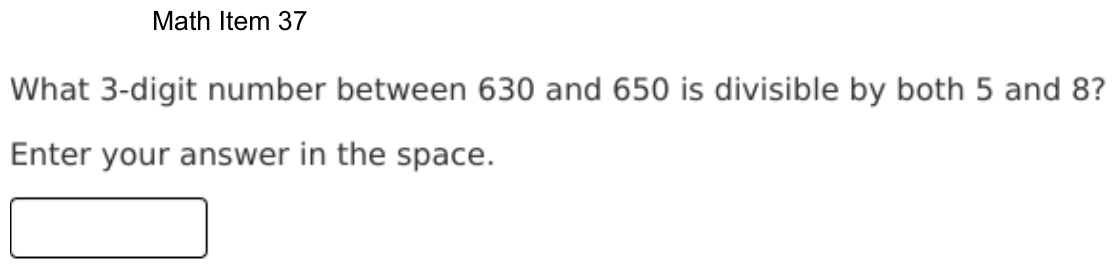
What 3-digit number between 630 and 650 is divisible by both 5 and 8?
Enter your answer in the space.
Fill-in question: work out the answer and type it as a number.
Show the answer
Correct answer: 640
The final digit of the three-digit number is 0. Each of the digits 0 through 9, inclusive, must be considered.
To narrow the choices, first consider that the number between 630 and 650 must be divisible by both 5 and 8.
A number divisible by 5 must end in 0 or 5. Therefore, the only possibilities are 0 and 5.
-
If the number ended in 0, the whole number 640 must also be divisible by 8:
Both result in a remainder of 0.
-
If the number ended in 5, the whole numbers 635 and 645 must also be divisible by 8:
Dividing 635 by 5 results in a remainder of 0, but dividing 635 by 8 results in a remainder of 3.
Dividing 645 by 5 results in a remainder of 0, but dividing 645 by 8 results in a remainder of 5.
Therefore, 640 is the only whole number between 630 and 650 that is divisible by both 5 and 8.
Question analysis
This number question asks for the 3-digit number between 630 and 650 that is divisible by both 5 and 8, typed into a box. Students use divisibility rules or common multiples to find it. The work is short, but the number has to pass both tests, so checking only one divisor is the easy slip.
- NYS standards
- 6.NS.4 common factors and multiples
- Grade level
- Grade 6 content, by NYS standard
- Compared with grade 7
- Below grade 7 Common multiples are grade 6 content. Divisibility by 5 limits the last digit, and only a few numbers lie between 630 and 650, so this is a quick check, shorter than typical grade 7 work.
- Estimated difficulty
- Routine: one familiar step, little to misread.
- Thinking it demands
- Depth of knowledge 1, recall and reproduction · mainly apply
- What makes it hard
- Solution
- 2 steps
- Reading level
- Question and choices: about grade 5, 16 words.
- Students, last 30 days
- Not enough answers yet to show (it takes 10).
Why it is hard, traps and wrong answers (shows the answer)
Why it is hard
Few numbers need checking, so most students succeed; the risk is testing only one divisor. Students who start from multiples of 8 meet 632 first, and those who start from multiples of 5 can slip on 645 ÷ 8. Using the least common multiple, 40, shows at once that the number must be a multiple of 40, which leaves one candidate in the range.
Much to keep track of minor Working it out
Each candidate must pass two tests, divisible by 5 and by 8, and both ends of the range, 630 and 650, pass the first test but fail the second. (Sweller, 1988; Carpenter, Just & Shell, 1990)
Something you must already know minor Working it out
The shortcut that a multiple of 5 ends in 0 or 5 is assumed, and it cuts the search to 635, 640 and 645 before any division by 8. (Anderson & Krathwohl, 2001)
Strategy: Use divisibility by 5 to limit the last digit, then check only those few numbers in the range for divisibility by 8.
Traps
- Misreads the question: Misses or misreads a condition or a word in the question: "at least", "each", "remaining", "not".
- Stops one step early: A choice is a number from partway through the solution.
The wrong answers, classified
632 Misreads the question (Hegarty, Mayer & Monk, 1995)
Takes the first multiple of 8 after 630, 8 × 79 = 632, and stops without checking divisibility by 5, which a number ending in 2 fails.
645 An arithmetic slip (Junker & Sijtsma, 2001)
Picks a number ending in 5 so that 5 divides it, then slips on the check for 8, which leaves a remainder of 5.
40 Stops one step early (King et al., 2004; Gierl et al., 2017)
Finds the least common multiple of 5 and 8, 40, and enters it, one step before finding its multiple between 630 and 650.
Worked solution, step by step
Formulas used
- Divisible by 5
- Divisible means it divides evenly, with no remainder. A whole number is divisible by 5 only when its last digit is 0 or 5. That is because counting by 5s always lands on a number ending in 0 or 5.
- Least common multiple
- The least common multiple, or LCM, is the smallest number that both 5 and 8 divide evenly. 5 and 8 share no factor except 1, so their LCM is their product. Any number divisible by both is a multiple of 40.
Sort out the question
You need a 3-digit number between 630 and 650. It must be divisible by 5 and also by 8. Between means 630 and 650 themselves do not count.
Use the rule for 5
A number divisible by 5 ends in 0 or 5. Between 630 and 650, only three numbers do:
Only these need checking for 8.
Test each number for 8
Divide each one by 8 and look at the remainder, the amount left over:
- 635 ÷ 8 = 79, with 3 left over.
- 640 ÷ 8 = 80, with nothing left over.
- 645 ÷ 8 = 80, with 5 left over.
Only 640 divides evenly by 8.
Watch out: 645 passes the test for 5 but fails for 8. And 632, which is , passes for 8 but ends in 2, so it fails for 5.
Enter the number
640 passes both tests. Type the whole number in the box.
Watch out: 40 is the smallest number divisible by 5 and 8, but it is not between 630 and 650.
So you would enter 640.
Check your answer
Use the LCM. A number divisible by both 5 and 8 must be a multiple of 40. . The multiples next to it are 600 and 680, which are outside the range. So 640 is the only one.
More questions like this
The original DOE question
Question 5 of 20
2026 Practice Test D Math, question 49Question
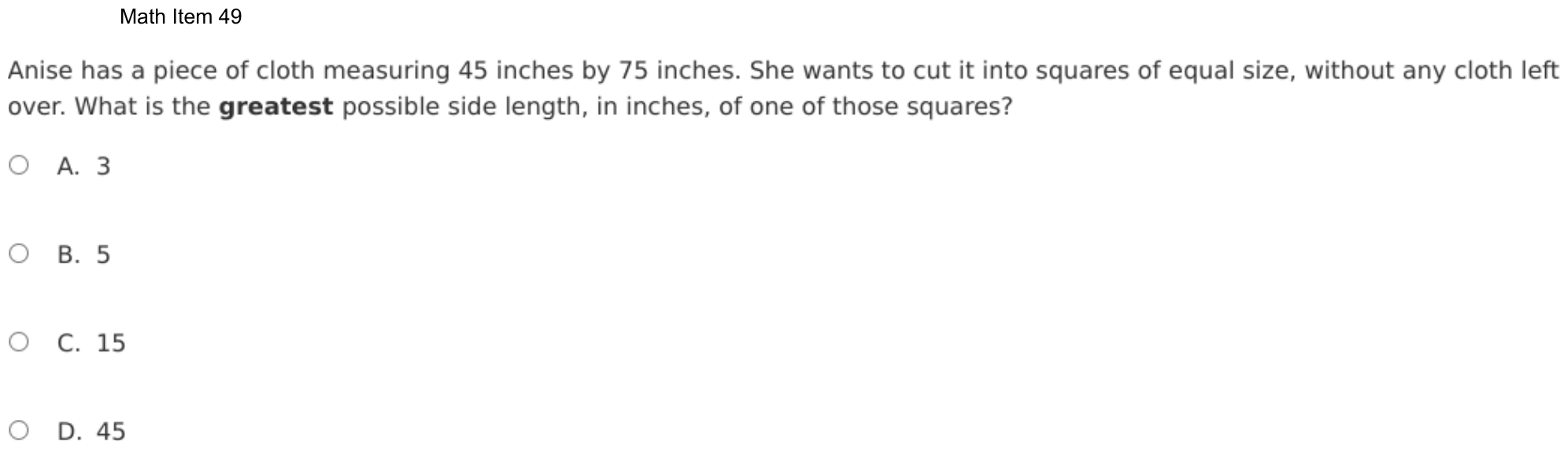
Anise has a piece of cloth measuring 45 inches by 75 inches. She wants to cut it into squares of equal size, without any cloth left over. What is the greatest possible side length, in inches, of one of those squares?
- A3
- B5
- C15
- D45
Show the answer
Correct answer: C
Given that each piece will be a square, the length and width will be the same. The greatest possible length can be determined by finding the greatest common factor of the length and width of the original piece of cloth.
Begin by finding the prime factorization of the length (75 in.) and width (45 in.).
The common factors can be seen as .
The greatest possible side length, in inches, will be .
Question analysis
Anise wants to cut a 45-inch by 75-inch piece of cloth into equal squares with nothing left over. This factors question asks for the greatest possible side length of each square, in inches. Students must see that the side has to divide both lengths evenly, then find the largest number that does.
- NYS standards
- 6.NS.4 common factors and multiples
- Grade level
- Grade 6 content, by NYS standard
- Compared with grade 7
- Below grade 7 Greatest common factors of two numbers up to 100 are grade 6 content. The cloth setting asks students to recognize that this is what is needed, but the work is one short factor search, below typical grade 7 demand.
- Estimated difficulty
- Straightforward: two steps or one careful reading.
- Thinking it demands
- Depth of knowledge 2, skills and concepts · mainly apply
- What makes it hard
- Solution
- 2 steps
- Reading level
- Question and choices: about grade 4, 39 words.
- Students, last 30 days
- Not enough answers yet to show (it takes 10).
Why it is hard, traps and wrong answers (shows the answer)
Why it is hard
Once the side is seen as a common factor, the work is short, since 45 and 75 share both 3 and 5. Students who spot one shared factor and stop reach a listed choice, and those who think only of the largest square that fits use the full 45-inch width. Checking that 45 and 75 both divide by the chosen side, and that no larger number does, closes it.
Turning words into math minor Understanding the question
The words “squares of equal size, without any cloth left over” mean the side must divide both 45 and 75 exactly; nothing names the greatest common factor. (Hegarty, Mayer & Monk, 1995; Koedinger & Nathan, 2004)
Something you must already know minor Working it out
Finding the greatest common factor of 45 and 75 calls for prime factorization or a list of factors, a grade 6 skill the question assumes. (Anderson & Krathwohl, 2001)
Strategy: Write each length as a product of primes, multiply the primes they share, and check that both 45 and 75 divide evenly by the result.
Traps
- Stops one step early: A choice is a number from partway through the solution.
- Misreads the question: Misses or misreads a condition or a word in the question: "at least", "each", "remaining", "not".
The wrong answers, classified
A Stops one step early (King et al., 2004; Gierl et al., 2017)
Finds a factor that 45 and 75 share, 3, and stops without combining it with the 5 they also share.
B Stops one step early (King et al., 2004; Gierl et al., 2017)
Spots the common factor 5, since both lengths end in 5, and stops before multiplying it by the 3 they also share.
D Misreads the question (Hegarty, Mayer & Monk, 1995)
Uses the cloth’s full width, 45 inches, as the side, the largest square that fits, but 45 does not divide 75, leaving a 45-by-30 strip.
Worked solution, step by step
Formulas used
- Greatest common factor
- A factor divides a number evenly. The greatest common factor, or GCF, is the biggest number that divides both. Write each number as a product of primes, numbers whose only factors are 1 and themselves. Then multiply the primes they share.
Sort out the question
The cloth is 45 inches by 75 inches. It is cut into equal squares, with no cloth left over. You need the greatest side the squares can have.
No cloth left over means the side must fit evenly into 45 and into 75. So the side is a common factor of both. The greatest one is the GCF.
Break each number into primes
Write each length as a product of prime numbers:
The two lists share one 3 and one 5.
Multiply the shared primes
Multiply the primes the two numbers share:
The squares can be 15 inches on a side.
Watch out: 3 and 5 are each common factors, choices A and B. But they are not the greatest. Use every prime the numbers share.
Rule out the full width
Watch out: a 45-inch square, choice D, fits the width. But 75 ÷ 45 = 1 with 30 left over. That leaves a strip of cloth 45 inches by 30 inches.
So the answer is C, 15.
Check your answer
Divide each length by 15: and . So the cloth cuts into 3 rows of 5 squares, with nothing left. Both divisions come out even.
More questions like this
The original DOE question
Question 6 of 20
2024 Test B Math, question 36Question
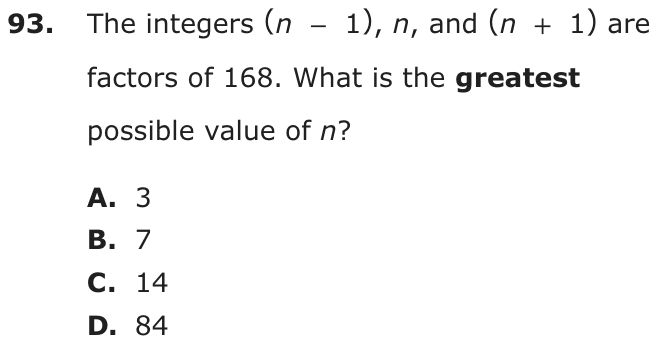
The integers , n, and are factors of 168. What is the greatest possible value of n?
- A3
- B7
- C14
- D84
Show the answer
Correct answer: B
First, determine all possible factors of 168. One method of doing this is to use a table to list pairs of factors.
| Factors of 168 | |
|---|---|
| 1 | 168 |
| 2 | 84 |
| 3 | 56 |
| 4 | 42 |
| 6 | 28 |
| 7 | 24 |
| 8 | 21 |
| 12 | 14 |
Then determine the group of three sequential factors , n, and where n is as large as possible. This group is 6, 7, and 8, where .
Question analysis
Three consecutive integers, written as n − 1, n and n + 1, must all be factors of 168, and students find the greatest possible value of n. It tests factors and consecutive integers. The catch is that a number can be a factor while its neighbors are not, so every member of the run needs checking.
- NYS standards
- 6.NS.4 common factors and multiples
- Grade level
- Grade 6 content, by NYS standard
- Compared with grade 7
- At grade 7 Listing factors is grade 6 work, but here students must read n − 1, n and n + 1 as three consecutive integers and search the factor list for the largest such run. Pairing algebraic notation with factors matches grade 7 demand.
- Estimated difficulty
- Straightforward: two steps or one careful reading.
- Thinking it demands
- Depth of knowledge 2, skills and concepts · mainly apply
- What makes it hard
- Solution
- 2 steps
- Reading level
- Question and choices: about grade 7, 17 words.
- Students, last 30 days
- Not enough answers yet to show (it takes 10).
Why it is hard, traps and wrong answers (shows the answer)
Why it is hard
Once the factors of 168 are listed in order, 1, 2, 3, 4, 6, 7, 8, 12 and up, the runs of three in a row stand out, and the last of them is 6, 7, 8. Students lose points by stopping at the first run they see or by checking only n itself. Testing each choice with its two neighbors, starting from the largest, settles it in under a minute.
Variables instead of numbers minor Understanding the question
The stem names the numbers only as (n − 1), n and (n + 1), which has to be read as three whole numbers in a row that all divide 168. (Koedinger & Nathan, 2004; Enright, Morley & Sheehan, 2002)
Much to keep track of minor Working it out
Each candidate must pass three divisibility tests at once, for itself and for both neighbors, while the search continues for the greatest such n. (Sweller, 1988; Carpenter, Just & Shell, 1990)
Strategy: List the factor pairs of 168 in order, then look along the list for three whole numbers in a row; or test each choice together with its two neighbors.
Traps
- Misreads the question: Misses or misreads a condition or a word in the question: "at least", "each", "remaining", "not".
- Stops one step early: A choice is a number from partway through the solution.
The wrong answers, classified
A Stops one step early (King et al., 2004; Gierl et al., 2017)
Finds the run 2, 3, 4 among the small factors and stops searching, missing the later run 6, 7, 8 that 168 also contains.
C Misreads the question (Hegarty, Mayer & Monk, 1995)
Checks only that 14 divides 168, since 12 × 14 = 168, without testing its neighbors; neither 13 nor 15 is a factor.
D Misreads the question (Hegarty, Mayer & Monk, 1995)
Takes the largest factor below 168 itself, 84, for the greatest n, ignoring that 83 and 85 would also have to divide 168.
Worked solution, step by step
Formulas used
- Factor pair
- a and b are whole numbers. If a times b equals 168, then a and b are both factors of 168. A factor divides a number with no remainder. Listing every pair, from small a upward, finds every factor.
Sort out the question
A factor of 168 divides 168 with no remainder. The numbers n − 1, n and n + 1 are three whole numbers in a row, such as 6, 7 and 8. The middle one is n.
All three must be factors of 168. You need the greatest n that works.
List the factor pairs of 168
Try each whole number from 1 up. When it divides 168, write it with its partner. Stop when the pairs meet, after 12 and 14.
Small factor Partner 1 168 2 84 3 56 4 42 6 28 7 24 8 21 12 14 Look for three in a row
Here are all the factors in order:
1, 2, 3, 4, 6, 7, 8, 12, 14, 21, 24, 28, 42, 56, 84, 168
The runs of three in a row are 1, 2, 3, then 2, 3, 4, then 6, 7, 8. No other three factors sit side by side.
Pick the greatest middle number
The middle numbers of the runs are 2, 3 and 7. The greatest is 7, so n = 7.
Watch out: Stopping at the run 2, 3, 4 gives 3, choice A. Keep looking. Also, 14 and 84 are factors, but their neighbors are not. Neither 13 nor 15 divides 168, so 14, choice C, fails. For 84, choice D, neither 83 nor 85 is a factor.
So the answer is B, 7.
Check your answer
Divide 168 by each number in the run: , and . All three are whole numbers, so 6, 7 and 8 are all factors.
More questions like this
The original DOE question
Question 7 of 20
2024 Test B Math, question 46Question
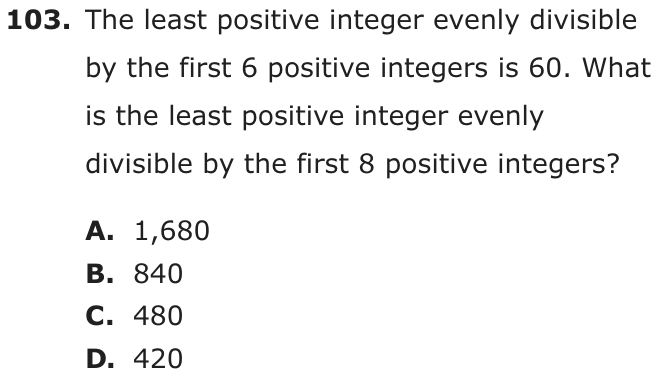
The least positive integer evenly divisible by the first 6 positive integers is 60. What is the least positive integer evenly divisible by the first 8 positive integers?
- A1,680
- B840
- C480
- D420
Show the answer
Correct answer: B
Each option is divisible by 1, 2, 3, 4, 5, and 6.
Option A:
1,680 is evenly divisible by the first 8 positive integers.
Option B:
840 is evenly divisible by the first 8 positive integers and is less than 1,680.
Option C:
480 is not evenly divisible by 7.
Option D:
420 is not evenly divisible by 8.
Option B (840) is the correct answer.
Question analysis
Knowing that 60 is the smallest number divisible by each of 1 through 6, students find the smallest positive integer divisible by each of 1 through 8. It tests least common multiples and prime factors. The challenge is adding only the factors that 7 and 8 really need, so the result works for all eight numbers and is still the least.
- NYS standards
- 6.NS.4 common factors and multiples
- Grade level
- Grade 6 content, by NYS standard
- Compared with grade 7
- At grade 7 Least common multiples are grade 6 content, usually for two small numbers. Extending the given result from six numbers to eight means deciding what 7 and 8 add, more reasoning than typical classwork but no new content.
- Estimated difficulty
- Moderate: several steps, or a close reading with one strong distractor.
- Thinking it demands
- Depth of knowledge 2, skills and concepts · mainly apply
- What makes it hard
- Every choice must be checked moderate
- Something you must already know minor
- Solution
- 3 steps
- Reading level
- Question and choices: about grade 13, 25 words.
- Corrected from the DOE handbook
- A rounded decimal in the explanation is now marked as approximate (≈ instead of =).
- Students, last 30 days
- Not enough answers yet to show (it takes 10).
Why it is hard, traps and wrong answers (shows the answer)
Why it is hard
The given fact, 60 for the first six integers, is a head start, but only for students who see what 7 and 8 add. Multiplying 60 by 7 is needed; multiplying by all of 8 is not, since 60 already supplies two of its three factors of 2. Students who multiply by the new numbers whole get answers that are too large or that miss one divisor, so checking the smaller choices first is the efficient route.
Every choice must be checked moderate Choosing the answer
Both 1,680 and 840 are divisible by 7 and by 8, so testing the choices is safe only from the smallest up; 420 fails for 8 and 480 for 7. (Embretson & Wetzel, 1987)
Something you must already know minor Working it out
Building on 60 needs prime factors: 7 adds a new prime, while 8 = 2 × 2 × 2 needs only one more 2, since 60 already holds two. (Anderson & Krathwohl, 2001)
Strategy: Start from 60 and ask which extra prime factors 7 and 8 require, or test the choices from the smallest up for divisibility by both 7 and 8.
Traps
- Stops one step early: A choice is a number from partway through the solution.
- Misreads the question: Misses or misreads a condition or a word in the question: "at least", "each", "remaining", "not".
The wrong answers, classified
A Misreads the question (Hegarty, Mayer & Monk, 1995)
Multiplies 60 by 7 and by 4 to cover 8, getting 1,680, which all of 1 to 8 divide, but overlooks that the question wants the least.
C Misreads the question (Hegarty, Mayer & Monk, 1995)
Multiplies 60 by 8 to bring in the 8 but never checks divisibility by 7, which 480 fails.
D Stops one step early (King et al., 2004; Gierl et al., 2017)
Multiplies 60 by 7 to bring in the 7 and stops, but 420 has only two factors of 2, so 8 does not divide it.
What was corrected from the DOE handbook, and why
- Explanation: To show that 480 is not evenly divisible by 7, the handbook writes 480 ÷ 7 = 68.57. The quotient is really 68.571428…, a decimal that never ends, so 68.57 is only a rounded value. The site writes 480 ÷ 7 ≈ 68.57, as the handbook itself does for other rounded results in this test. The point of the step is unchanged: the quotient is not a whole number, so 480 is not evenly divisible by 7 and is not divisible by all of the first 8 positive integers.
Worked solution, step by step
Formulas used
- Evenly divisible
- a is the number you test, and b is the number you divide by. If the answer is a whole number, with no remainder, a is evenly divisible by b. Then b is a factor of a.
Sort out the question
The first 8 positive integers are 1, 2, 3, 4, 5, 6, 7 and 8. “Evenly divisible” means dividing leaves no remainder.
You need the least, or smallest, number that all 8 of them divide. You are told that 60 is the smallest for 1 to 6. So build on 60.
Bring in the 7
60 is not divisible by 7. And 7 is prime, which means its only factors are 1 and 7. So the new number needs a factor of 7. Multiply 60 by 7.
Bring in the 8
8 is , so the number needs three 2s as factors. But 420 has only two: , and 105 is odd. Multiply by one more 2.
Now and . Both are whole numbers.
Test the choices from smallest up
Choice D: . That is not a whole number, so 420 fails.
Choice C: . The ≈ sign means about, since the decimal never ends. It is not a whole number, so 480 fails.
Choice B: 840 works for 7 and 8. It also works for 1 to 6, since .
Watch out: 1,680, choice A, works too. But it is twice 840, so it is not the least.
So the answer is B, 840.
Check your answer
Divide 840 by each number from 1 to 8. You get 840, 420, 280, 210, 168, 140, 120 and 105. Every answer is a whole number, so 840 works for all eight.
More questions like this
The original DOE question
Question 8 of 20
2023 Test A Math, question 12Question
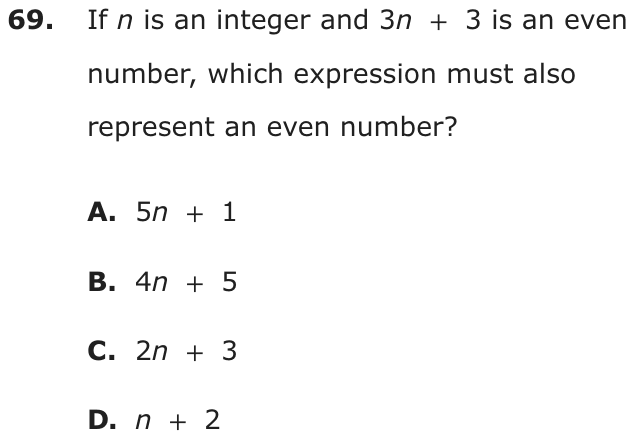
If n is an integer and is an even number, which expression must also represent an even number?
- A
- B
- C
- D
Show the answer
Correct answer: A
The expression is equal to , and it is given that this is an even number. The expression must also represent an even number, because 3 is an odd number: if were odd, would be the product of two odd numbers, which is an odd number. If is an even number, then n must be an odd number. Choose an odd number to substitute for n in the answer options to find which expression represents an even number:
Let .
Option A:
Option B:
Option C:
Option D:
Since 16 is the only even number, the correct answer is option A.
Question analysis
This number properties question says that 3n + 3 is even for an integer n and asks which of four expressions must also be even. Students reason about odd and even numbers written with a variable. The hidden step is deciding what the given fact says about n itself before testing the expressions.
- Grade level
- Grade 7 content, by NYS standard
- Compared with grade 7
- Above grade 7 Grade 7 students rewrite and evaluate expressions, but rarely reason about whether an expression is odd or even for every value of a variable. Here that reasoning comes in two layers: first about n, then about each choice.
- Estimated difficulty
- Moderate: several steps, or a close reading with one strong distractor.
- Thinking it demands
- Depth of knowledge 2, skills and concepts · mainly analyze
- What makes it hard
- Solution
- 3 steps
- Reading level
- Question and choices: about grade 9, 23 words.
- Corrected from the DOE handbook
- The explanation gave the wrong reason why n + 1 must be even; the reason was corrected.
- Students, last 30 days
- Not enough answers yet to show (it takes 10).
Why it is hard, traps and wrong answers (shows the answer)
Why it is hard
The question hides its key step: 3n + 3 = 3(n + 1), and since 3 is odd, n + 1 must be even, so n is odd. A student who skips that step and tests a convenient even value never checks the condition and lands on a wrong expression. Once n is known to be odd, any odd test value, such as 1, picks out 5n + 1 at once.
Variables instead of numbers moderate Understanding the question
No value of n is given; the only fact is that 3n + 3 is even, and it has to be turned into a fact about n itself, that n is odd, before any choice is judged. (Koedinger & Nathan, 2004; Enright, Morley & Sheehan, 2002)
Something you must already know minor Working it out
The parity rules are assumed, not stated: an odd number times an odd number is odd, and an even number plus an odd number is odd. (Anderson & Krathwohl, 2001)
Every choice must be checked minor Choosing the answer
Each expression has to be tested with an odd n or by parity rules; three of the four come out odd whenever n is odd, so none can be dismissed on sight. (Embretson & Wetzel, 1987)
Strategy: First work out what 3n + 3 being even says about n, by factoring out 3 or testing small integers, then check each expression with a value of n that fits.
Traps
- Misreads the question: Misses or misreads a condition or a word in the question: "at least", "each", "remaining", "not".
- Misunderstands the concept: A wrong belief about a concept: that percents can be added, that area grows like length, that averages can be averaged, that a bigger denominator means a bigger fraction.
The wrong answers, classified
B Misunderstands the concept (Smith, diSessa & Roschelle, 1993; De Bock et al., 1998; Ni & Zhou, 2005)
Sees the even term 4n and treats the whole expression as even, overlooking that adding the odd 5 makes 4n + 5 odd for every integer n.
C Misunderstands the concept (Smith, diSessa & Roschelle, 1993; De Bock et al., 1998; Ni & Zhou, 2005)
Assumes an expression that starts with 2n must be even, though 2n + 3 is an even number plus 3 and so is always odd.
D Misreads the question (Hegarty, Mayer & Monk, 1995)
Tests n = 2 without checking the condition, though 3(2) + 3 = 9 is odd; with n = 2, only n + 2 = 4 comes out even.
What was corrected from the DOE handbook, and why
- Explanation: The DOE’s explanation said that n + 1 must be even “because 3 is an odd number and the product of an odd number and an even number is an even number.” That fact does not show that n + 1 is even; the reason is that if n + 1 were odd, 3(n + 1) would be the product of two odd numbers, which is odd, and it is given as even. The site now gives that reason. The answer, A, is unchanged.
Worked solution, step by step
Formulas used
- Pulling out a common factor
- a is a factor, a number being multiplied, that both terms share. b and c are what is left. This is the distributive property run backward. It turns a sum into a product, which is easier to reason about.
- Multiplying odd numbers
- An even number splits into pairs, like 2, 4 or 6. An odd number has one left over, like 1, 3 or 5. An odd number of odd groups always leaves one extra. So the product is odd.
- Adding odd and even numbers
- Two odd numbers each have one left over. Together the two extras make a pair, so the sum is even. An even number plus an odd number still has one left over, so the sum is odd.
Sort out the question
n is an integer, a whole number that can be positive, negative or 0. You are told that is even. You need the expression that must be even too. Must means it is even every time. First find out what the fact tells you about n.
Pull out the 3
Both terms in have a factor of 3. Pull it out.
So 3 times is an even number.
Decide whether n is odd or even
3 is odd. If were odd, would be odd times odd. That is always odd. But we are told it is even. So must be even. One less than an even number is odd. So n is odd. Watch out: don’t test n = 2. Then , which is odd. With n = 2, only comes out even, choice D.
Test each choice with an odd n
Pick an odd number, n = 3. It fits, since is even.
- A: , even
- B: , odd
- C: , odd
- D: , odd
Only A is even.
Make sure A always works
Must means every odd n, not just 3. If n is odd, 5n is odd times odd, so it is odd. Odd plus 1 is even. So is always even. Watch out: 4n is even, but adding the odd 5 makes odd, choice B. In the same way, is always odd, choice C. So the answer is A, .
Check your answer
Try another odd number, n = 1. Then , which is even, so n = 1 fits. And is even too. The other three choices give 9, 5 and 3, all odd. Choice A wins again.
More questions like this
The original DOE question
Question 9 of 20
2023 Test A Math, question 13Question
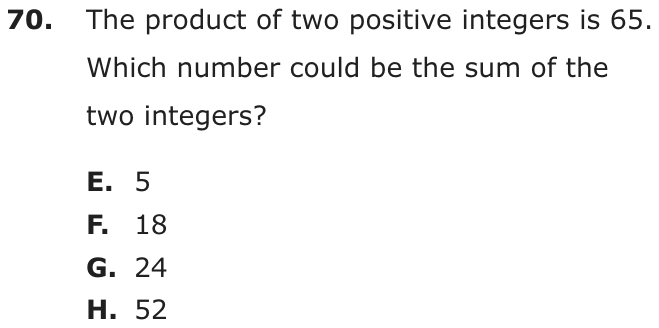
The product of two positive integers is 65. Which number could be the sum of the two integers?
- A5
- B18
- C24
- D52
Show the answer
Correct answer: B
First, find the pairs of positive integers that multiply to 65: and .
The sums of the pairs are 66 and 18. 18 is the option that is provided in the answer choices.
Question analysis
Two positive integers multiply to 65, and this question asks which number in the choices could be their sum. Students list the factor pairs of 65 and add each pair. The words could be signal that more than one pair exists, and only one of the sums appears among the choices.
- NYS standards
- 6.NS.4 common factors and multiples
- Grade level
- Grade 6 content, by NYS standard
- Compared with grade 7
- Below grade 7 Finding factor pairs of a two-digit number is review by grade 7. The question takes two quick steps, listing the pairs and adding each, with nothing to compute beyond small products and sums.
- Estimated difficulty
- Routine: one familiar step, little to misread.
- Thinking it demands
- Depth of knowledge 1, recall and reproduction · mainly apply
- What makes it hard
- Solution
- 2 steps
- Reading level
- Question and choices: about grade 5, 17 words.
- Students, last 30 days
- Not enough answers yet to show (it takes 10).
Why it is hard, traps and wrong answers (shows the answer)
Why it is hard
With only two factor pairs, 1 × 65 and 5 × 13, the work is a short list and two additions. The word could matters: the sum depends on which pair is chosen, and only one of the two sums appears among the choices. The main slip is answering with a factor rather than with the sum the question asks for.
Something you must already know minor Working it out
The pairs come from factoring 65 as 5 × 13, a fact the stem leaves to the student; the pair 1 and 65 also counts, but its sum, 66, is not offered. (Anderson & Krathwohl, 2001)
Strategy: List every pair of positive integers whose product is 65, starting from 1, and add the two numbers in each pair.
Traps
- Answers a different question: A choice is right for another quantity: the other unknown, the rest instead of the part, the part instead of the whole.
The wrong answers, classified
A Answers a different question (King et al., 2004; Hegarty, Mayer & Monk, 1995)
Finds the factor pair 5 and 13 and answers with the factor 5, one of the two integers, instead of their sum.
C Little reason to choose it (Haladyna & Downing, 1993; Rodriguez, 2005)
No pair of positive integers with product 65 adds to 24; reaching it needs a wrong pair such as 3 and 21, whose product is 63, so it mostly catches guesses.
D Little reason to choose it (Haladyna & Downing, 1993; Rodriguez, 2005)
No factor pair of 65 adds to 52, which is 65 − 13 or 4 × 13, and no common working combines them that way, so it mostly draws guesses.
Worked solution, step by step
Formulas used
- Factor pair
- a and b are positive whole numbers that multiply to make 65. Such a pair is called a factor pair of 65. To find them all, try 1, 2, 3 and so on. Stop when the factors start to repeat.
- Dividing by 5
- A whole number splits into groups of 5, with none left over, when its last digit is 0 or 5. So 65 divides by 5, but 64 does not.
Sort out the question
Two positive integers multiply to make 65. Positive integers are the counting numbers 1, 2, 3 and so on. The product is the answer to a multiplication. You need a number that could be their sum, the answer when you add them.
List the factor pairs of 65
Try each small number. See if it divides 65 with nothing left over.
- 1 works: .
- 2 and 4 don’t work, because 65 is odd. 3 doesn’t work either: , with 2 left over.
- 5 works, since 65 ends in 5: .
- 6 and 8 are even, so they don’t work. 7 doesn’t either: .
Since , any factor bigger than 8 pairs with one smaller than 8. You already tried those. So the pairs are 1 and 65, and 5 and 13.
Add each pair
The possible sums are 66 and 18. Only 18 is a choice. Watch out: the question asks for the sum, not one of the numbers. Picking the factor 5 is choice A. So the answer is B, 18.
Check your answer
Work back from 18. Look for two numbers that add to 18 and multiply to 65. and . Both match. For 24 or 52, no pair of whole numbers that multiplies to 65 adds up to them.
More questions like this
The original DOE question
Question 10 of 20
2023 Test A Math, question 29Question
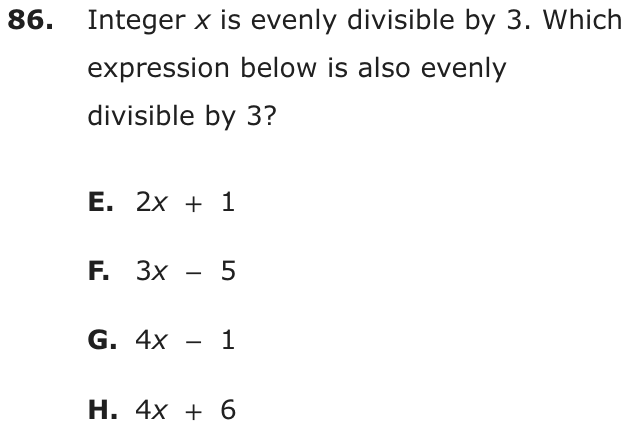
Integer x is evenly divisible by 3. Which expression below is also evenly divisible by 3?
- A
- B
- C
- D
Show the answer
Correct answer: D
Since integer x is evenly divisible by 3, substitute 3 for x in the answer options to determine which expression is also divisible by 3:
Let .
Option A:
Option B:
Option C:
Option D:
Option D is the only value that is divisible by 3.
Question analysis
This number properties question says an integer x is divisible by 3 and asks which of four linear expressions in x is also divisible by 3, whatever multiple of 3 the integer is. Students can test a multiple of 3 in each expression or think about remainders. Testing a value that is not a multiple of 3 can make a wrong expression look right.
- Grade level
- Grade 7 content, by NYS standard
- Compared with grade 7
- At grade 7 Grade 7 students rewrite and evaluate linear expressions, but they seldom ask whether one is divisible by 3 for every allowed value. One well-chosen substitution settles it, so the demand is about typical for grade 7.
- Estimated difficulty
- Straightforward: two steps or one careful reading.
- Thinking it demands
- Depth of knowledge 2, skills and concepts · mainly analyze
- What makes it hard
- Variables instead of numbers moderate
- Every choice must be checked minor
- Solution
- 2 steps
- Reading level
- Question and choices: about grade 13, 18 words.
- Students, last 30 days
- Not enough answers yet to show (it takes 10).
Why it is hard, traps and wrong answers (shows the answer)
Why it is hard
The algebra is light; the question turns on choosing a test value that obeys the condition. The habit of trying x = 1 backfires here, because 1 is not a multiple of 3 and it makes two wrong expressions come out divisible. Students who substitute 3, or who see that 4x and 6 are both multiples of 3 whenever x is, settle it quickly, and a second multiple such as 6 confirms it.
Variables instead of numbers moderate Understanding the question
Nothing pins x down except that it is a multiple of 3, so each expression must be judged for every such x, and any test value has to be a multiple of 3 itself, such as 3 or 6. (Koedinger & Nathan, 2004; Enright, Morley & Sheehan, 2002)
Every choice must be checked minor Choosing the answer
The four expressions differ only in their coefficients and constants, from 2x + 1 to 4x + 6, so none can be dismissed at a glance; each needs a test or a look at its terms. (Embretson & Wetzel, 1987)
Strategy: Substitute a multiple of 3, such as 3 or 6, for x in every expression and keep the one whose value divides evenly by 3; a second multiple confirms it.
Traps
- Misreads the question: Misses or misreads a condition or a word in the question: "at least", "each", "remaining", "not".
- Numbers taken from the question: Combines the numbers in the question without a model of the situation, or is simply a number that appears in the question.
The wrong answers, classified
A Misreads the question (Hegarty, Mayer & Monk, 1995)
Tests x = 1, which is not a multiple of 3, finds that 2(1) + 1 = 3 divides evenly, and stops at the first choice; with x = 3 it gives 7.
B Numbers taken from the question (Hegarty, Mayer & Monk, 1995)
Sees the 3 in 3x and takes the whole expression to be a multiple of 3, overlooking that subtracting 5 spoils it: with x = 3 it gives 4.
C Misreads the question (Hegarty, Mayer & Monk, 1995)
Tries a value that is not a multiple of 3, such as x = 4, where 4x − 1 = 15 divides evenly, though x = 3 gives 11.
Worked solution, step by step
Formulas used
- Adding multiples of 3
- a and b are whole numbers, so 3a and 3b are multiples of 3. A multiple of 3 is a number that 3 divides evenly, with nothing left over. Adding two multiples of 3 always gives another multiple of 3, because you can pull the 3 out of both parts.
Sort out the question
“Evenly divisible by 3” means 3 goes into the number with nothing left over. Such a number is called a multiple of 3, like 3, 6, 9 or 12.
You know that x is a multiple of 3. You need the expression that is a multiple of 3 every time, whatever multiple of 3 x is.
Test x = 3 in every choice
Pick a number for x that follows the rule. The easiest one is 3. Put it into each expression.
Choice Work Divisible by 3? A No B No C No D Yes Watch out: your test number must be a multiple of 3. With x = 1, choice A gives 3 and looks right. That leads to the wrong choice, A.
See why D always works
One test could be lucky, so see why D works for every x. Since x is a multiple of 3, 4x is one too. For example, 4 × 3 = 12 and 4 × 6 = 24. The number 6 is also a multiple of 3, since 6 = 3 × 2.
So 4x + 6 is a multiple of 3 plus a multiple of 3. That is always a multiple of 3.
Rule out the other choices
Watch out: choice B starts with 3x, but then it subtracts 5. The 5 is not a multiple of 3, so it spoils the result, and 3(3) − 5 = 4. Choices A and C also add or take away a number that is not a multiple of 3.
So the answer is D, .
Check your answer
Try two more multiples of 3. With x = 6, choice D gives , and 30 ÷ 3 = 10. With x = 9, it gives , and 42 ÷ 3 = 14. Both divide evenly, so D keeps working.
More questions like this
The original DOE question
Question 11 of 20
2023 Test A Math, question 42Question
How many members of the set shown above are multiples of 6 but not multiples of 9?
- A11
- B13
- C20
- D22
Show the answer
Correct answer: D
First, list the first several multiples of 6: 6, 12, 18, 24, 30, 36, 42, 48, 54 . . .
Every third multiple (i.e., 18, 36, 54, . . .) is also a multiple of 9. Thus, of the multiples of 6 are not multiples of 9.
Next, calculate how many multiples of 6 are in the given number range. The last multiple of 6 would be 198. So, there are a total of multiples of 6. Since of those are not multiples of 9, the answer is .
Question analysis
This number properties question shows the set of whole numbers from 1 to 200 and asks how many of them are multiples of 6 but not multiples of 9. Students count multiples in a range and remove the overlap, the numbers divisible by both. Finding the right common multiple, and removing only the overlap, is where it gets tricky.
- NYS standards
- 6.NS.4 common factors and multiples
- Grade level
- Grade 6 content, by NYS standard
- Compared with grade 7
- Above grade 7 Multiples and common multiples are grade 6 content, but counting the members of a set that meet one condition and fail another is rare in grade 7 work. The overlap between the two kinds of multiples must be found and removed exactly.
- Estimated difficulty
- Hard: combines ideas, needs a plan, and has more than one tempting wrong answer.
- Thinking it demands
- Depth of knowledge 2, skills and concepts · mainly apply
- What makes it hard
- No obvious method moderate
- Much to keep track of minor
- Turning words into math minor
- Solution
- 3 steps
- Reading level
- Question and choices: about grade 6, 16 words.
- Students, last 30 days
- Not enough answers yet to show (it takes 10).
Why it is hard, traps and wrong answers (shows the answer)
Why it is hard
Counting multiples of 6 is routine; the harder decision is how to remove the ones that are also multiples of 9. Those are the multiples of 18, the least common multiple, not of 54 or 15, and students who count them correctly must still subtract them rather than report them. Listing 6, 12, 18, 24, 30, 36 shows the pattern, two kept for every one removed, which also gives the answer as two thirds of 33.
No obvious method moderate Working it out
The stem never mentions a common multiple: students must see that the multiples of 6 that are also multiples of 9 are the multiples of 18, every third multiple of 6. (Schoenfeld, 1985)
Much to keep track of minor Working it out
Three counts are in play at once, 33 multiples of 6 up to 198, 11 multiples of 18 up to 198, and their difference, and two of them are listed choices. (Sweller, 1988; Carpenter, Just & Shell, 1990)
Turning words into math minor Understanding the question
The bold not in “multiples of 6 but not multiples of 9” asks for what is left after a removal, a set difference rather than a count of the numbers removed. (Hegarty, Mayer & Monk, 1995; Koedinger & Nathan, 2004)
Strategy: Count the multiples of 6 up to 200, find the smallest number that is a multiple of both 6 and 9, count its multiples in the set, and subtract.
Traps
- Answers a different question: A choice is right for another quantity: the other unknown, the rest instead of the part, the part instead of the whole.
- Misunderstands the concept: A wrong belief about a concept: that percents can be added, that area grows like length, that averages can be averaged, that a bigger denominator means a bigger fraction.
The wrong answers, classified
A Answers a different question (King et al., 2004; Hegarty, Mayer & Monk, 1995)
Counts the 11 multiples of 18, the numbers to be removed, and gives that count instead of the multiples of 6 that remain.
B Misunderstands the concept (Smith, diSessa & Roschelle, 1993; De Bock et al., 1998; Ni & Zhou, 2005)
Takes 6 + 9 = 15 as the step between numbers divisible by both, and gives its 13 multiples up to 195, the numbers it would remove.
C Misunderstands the concept (Smith, diSessa & Roschelle, 1993; De Bock et al., 1998; Ni & Zhou, 2005)
Uses 6 + 9 = 15 instead of 18 as the common multiple and removes its 13 multiples from the 33 multiples of 6, leaving 20.
Worked solution, step by step
Formulas used
- Counting multiples
- n is the number whose multiples you count, such as 6. The first multiple is n × 1, the second is n × 2, and so on. So if the largest multiple in the set is n × k, there are k multiples in all.
- Least common multiple
- The least common multiple, or LCM, is the smallest number that two numbers both divide evenly. A number is a multiple of both 6 and 9 exactly when it is a multiple of 18.
Sort out the question
The set holds the whole numbers from 1 to 200. A multiple of 6 is a number that 6 divides evenly, like 6, 12 or 18. You need the multiples of 6 that are not multiples of 9. So count all the multiples of 6. Then take away those that are also multiples of 9.
Count the multiples of 6
200 is not a multiple of 6, but 198 is. So 198 is the last multiple of 6 in the set.
There are 33 multiples of 6.
Find the numbers to take away
List the multiples of 6: 6, 12, 18, 24, 30, 36. The first one 9 also divides is 18, then 36. So every third multiple of 6 is also a multiple of 9.
Watch out: the shared multiples are multiples of 18, not of 6 + 9 = 15. Using 15 leads to 13 or 20, choices B and C.
Count the multiples of 18
The last multiple of 18 in the set is also 198.
There are 11 of them. Watch out: these are the numbers you take away, not the answer. Stopping here gives 11, choice A.
Take away the multiples of 18
There are 22 multiples of 6 left over. So the answer is D, 22.
Check your answer
Every third multiple of 6 is a multiple of 18, so two out of every three multiples of 6 stay. Two thirds of 33 is . That matches. Test one: 30 is a multiple of 6, and 30 ÷ 9 is not a whole number, so 30 counts.
More questions like this
The original DOE question
Question 12 of 20
2023 Test B Math, question 3Question
A kindergarten teacher has 72 crayons, 60 pencils, and 84 sheets of paper to distribute to the children in her class. If each child receives an equal number of each item and there are no items remaining, what is the greatest possible number of children in the class?
Grid-in question: work out the answer and enter it as a number.
Show the answer
Correct answer: 12
The greatest possible number of children in the class is the greatest common factor of 72, 60, and 84. Write the prime factorization of each number:
Then, find the factors that all three have in common, which is .
Question analysis
A kindergarten teacher shares 72 crayons, 60 pencils and 84 sheets of paper so that every child gets the same number of each item, with nothing left over. This grid-in asks for the greatest possible number of children in the class. Students must recognize a greatest common factor problem and not confuse it with a least common multiple.
- NYS standards
- 6.NS.4 common factors and multiples
- Grade level
- Grade 6 content, by NYS standard
- Compared with grade 7
- Below grade 7 Greatest common factors are grade 6 content, normally of two numbers. This one uses three numbers and a word setting that must be translated, but the factoring is short, so the demand stays below typical grade 7 work.
- Estimated difficulty
- Straightforward: two steps or one careful reading.
- Thinking it demands
- Depth of knowledge 2, skills and concepts · mainly apply
- What makes it hard
- Turning words into math moderate
- Something you must already know minor
- Solution
- 2 steps
- Reading level
- Question and choices: about grade 11, 45 words.
- Students, last 30 days
- Not enough answers yet to show (it takes 10).
Why it is hard, traps and wrong answers (shows the answer)
Why it is hard
The story has to be recognized as a sharing problem before any arithmetic starts, and the word greatest points to the largest divisor shared by all three counts. Students who spot a small shared factor can stop too soon, while those who think of a common multiple head the wrong way entirely. Checking that 72, 60 and 84 all divide by the entry, and that no larger number does, settles it.
Turning words into math moderate Understanding the question
Nothing names a greatest common factor; “each child receives an equal number of each item and there are no items remaining” means the class size must divide 72, 60 and 84 exactly. (Hegarty, Mayer & Monk, 1995; Koedinger & Nathan, 2004)
Something you must already know minor Working it out
Finding the greatest common factor of three numbers, by prime factorization or by listing factors, is a grade 6 method the question assumes rather than explains. (Anderson & Krathwohl, 2001)
Strategy: Write 72, 60 and 84 as products of primes, multiply the primes all three share, and check that each amount divides evenly by the result.
Traps
- Misunderstands the concept: A wrong belief about a concept: that percents can be added, that area grows like length, that averages can be averaged, that a bigger denominator means a bigger fraction.
- Stops one step early: A choice is a number from partway through the solution.
The wrong answers, classified
6 Stops one step early (King et al., 2004; Gierl et al., 2017)
Spots that 6 divides 72, 60 and 84 and stops there, a common factor not yet multiplied by the extra 2 that all three share.
2520 Misunderstands the concept (Smith, diSessa & Roschelle, 1993; De Bock et al., 1998; Ni & Zhou, 2005)
Finds the least common multiple of 72, 60 and 84, 2,520, confusing a number all three counts divide into with one that divides all three.
4 Stops one step early (King et al., 2004; Gierl et al., 2017)
Takes only the shared 2 × 2 from the prime factorizations and drops the factor 3 that 72, 60 and 84 also share.
Worked solution, step by step
Formulas used
- Greatest common factor
- A factor of a number divides it with nothing left over. The GCF is the greatest number that is a factor of every number in the group. A prime number has only 1 and itself as factors, like 2, 3, 5 and 7. Multiply the primes that all the numbers share, as many times as each number has them.
Sort out the question
The teacher has 72 crayons, 60 pencils and 84 sheets of paper. Every child gets the same number of each item, with none left over.
So the number of children must divide 72, 60 and 84 with no remainder. A number like that is a common factor. You need the greatest one.
Break each number into primes
Write each number as a product of primes. A product is the answer to a multiplication.
You can check each one by multiplying it back out.
Pick out the shared primes
Look for the primes that appear in all three lists. Each list has at least two 2s and one 3. Only 72 has a third 2 and a second 3. The 5 and the 7 appear in one list each.
Watch out: keep every shared prime. Using only one 2 gives 6. Leaving out the 3 gives 4.
Give the answer
Watch out: 2,520 is the smallest number that all three numbers divide into. That is the least common multiple, a different idea. The class can’t have 2,520 children when there are only 60 pencils. So you would grid 12.
Check your answer
Share the items among 12 children. Each child gets crayons, pencils and sheets. Nothing is left over. The numbers 6, 5 and 7 share no factor but 1, so no bigger class works.
More questions like this
The original DOE question
Question 13 of 20
2022 Test A Math, question 36Question
When the three-digit whole number 27 ? is divided by 3 or by 4, the remainder is zero. What is the missing digit?
- A0
- B2
- C3
- D6
Show the answer
Correct answer: D
Each of the options 0, 2, 3, and 6 must be considered:
Option A: In the case of 0, the three-digit whole number is 270. Divide 270 by both 3 and 4:
Dividing 270 by 3 results in a remainder of 0, but dividing 270 by 4 results in a remainder of 2, so 0 cannot be the missing digit.
Option B: In the case of 2, the three-digit whole number is 272. Divide 272 by both 3 and 4:
Dividing 272 by 4 results in a remainder of 0, but dividing 272 by 3 results in a remainder of 2, so 2 cannot be the missing digit.
Option C: In the case of 3, the three-digit whole number is 273. Divide 273 by both 3 and 4:
Dividing 273 by 3 results in a remainder of 0, but dividing 273 by 4 results in a remainder of 1, so 3 cannot be the missing digit.
Option D: In the case of 6, the three-digit whole number is 276. Divide 276 by both 3 and 4:
Dividing 276 by 3 results in a remainder of 0, and dividing 276 by 4 results in a remainder of 0, so 6 is the missing digit.
Question analysis
A three-digit number begins with 27 and is missing its last digit, and it divides evenly by both 3 and 4. Students find the missing digit. It tests factors, multiples and divisibility rules; a digit that works for one divisor may fail the other, so both tests must be applied.
- NYS standards
- 6.NS.4 common factors and multiples
- Grade level
- Grade 6 content, by NYS standard
- Compared with grade 7
- Below grade 7 Divisibility by 3 and by 4 is grade 6 number sense. Testing four possible digits against two conditions is quick, much like a grade 6 exercise, as long as both divisors are actually checked.
- Estimated difficulty
- Straightforward: two steps or one careful reading.
- Thinking it demands
- Depth of knowledge 2, skills and concepts · mainly apply
- What makes it hard
- Solution
- 2 steps
- Reading level
- Question and choices: about grade 5, 19 words.
- Students, last 30 days
- Not enough answers yet to show (it takes 10).
Why it is hard, traps and wrong answers (shows the answer)
Why it is hard
Every candidate passes at least one of the two tests, which makes the question a matter of finishing the checks rather than finding a method. Students who test only by 3, or only by 4, find a fitting number and stop. Seeing that a number divisible by both 3 and 4 is divisible by 12, and that 276 = 12 × 23, settles it in one step.
Turning words into math minor Understanding the question
The words “divided by 3 or by 4, the remainder is zero” mean that both divisions come out even, though or can be read as either one being enough. (Hegarty, Mayer & Monk, 1995; Koedinger & Nathan, 2004)
Every choice must be checked minor Choosing the answer
Each candidate, 270, 272, 273 and 276, has to be tested against two divisors, and three of them pass one test, so stopping after one check is costly. (Embretson & Wetzel, 1987)
Something you must already know minor Working it out
The divisibility tests are not given: a number is divisible by 3 when its digit sum is, and by 4 when the number formed by its last two digits is. (Anderson & Krathwohl, 2001)
Strategy: Use the divisibility tests: a number is divisible by 4 when its last two digits are, and by 3 when its digit sum is. Keep only a digit that passes both.
Traps
- Misreads the question: Misses or misreads a condition or a word in the question: "at least", "each", "remaining", "not".
- Numbers taken from the question: Combines the numbers in the question without a model of the situation, or is simply a number that appears in the question.
The wrong answers, classified
A Misreads the question (Hegarty, Mayer & Monk, 1995)
Checks only division by 3, which 270 passes with a digit sum of 9, and never tests 4, though 270 ÷ 4 leaves a remainder of 2.
B Misreads the question (Hegarty, Mayer & Monk, 1995)
Checks only division by 4, which 272 passes because 72 is a multiple of 4, but its digit sum is 11, so 272 ÷ 3 leaves 2.
C Numbers taken from the question (Hegarty, Mayer & Monk, 1995)
Matches the missing digit to the divisor 3 in the question; 273 is a multiple of 3 but leaves a remainder of 1 when divided by 4.
Worked solution, step by step
Formulas used
- Test for dividing by 3
- The digit sum is what you get when you add up a number’s digits. Divides by 3 means it divides evenly, with a remainder of 0. If the digit sum divides evenly by 3, so does the whole number. Use it to test a big number quickly.
- Test for dividing by 4
- Look only at the number made by the last two digits. If it divides evenly by 4, so does the whole number. This works because every 100 divides evenly by 4, so only the last two digits matter.
Sort out the question
The number is 27 followed by a missing digit. Remainder zero means the division comes out even, with nothing left over. The remainder is zero when the number is “divided by 3 or by 4.” That means both divisions come out even. So the number must pass both tests. The choices give four digits to try: 0, 2, 3 and 6.
Test each number for 3
Add the digits of each number.
Number Digit sum Divides by 3? 270 yes 272 no 273 yes 276 yes So 270, 273 and 276 pass. 272 fails.
Test each number for 4
Look at the last two digits: 70, 72, 73 and 76.
So 272 and 276 pass. 270 and 273 fail.
Keep the digit that passes both
Only 276 passes both tests. Check by dividing:
Watch out: 0 and 3 pass only the test for 3, so A and C fail. 2 passes only the test for 4, so B fails. And 3 is not right just because the question says 3. So the answer is D, 6.
Check your answer
A number that divides evenly by both 3 and 4 also divides evenly by 12, since . And . So 276 is a multiple of 12. None of 270, 272 or 273 is.
More questions like this
The original DOE question
Question 14 of 20
2018 Test A Math, question 25Question
Which of the following numbers has factors that include the smallest factor (other than 1) of 91?
- A30
- B35
- C39
- D44
Show the answer
Correct answer: B
To find the smallest factor of 91, list the factors:
1, 7, 13, and 91
The smallest factor (other than 1) is 7.
Of the options listed (30, 35, 39, and 44), only 35 is a multiple of 7.
Question analysis
A number properties question about factors: students find the smallest factor of 91 other than 1, then pick the number that shares it. Because 91 looks like a prime number, many students skip the factoring, and the choices include numbers built from factors that 91 might seem to have.
- NYS standards
- 6.NS.4 common factors and multiples
- Grade level
- Grade 6 content, by NYS standard
- Compared with grade 7
- Below grade 7 Factors and divisibility are grade 4 to 6 skills, and this takes two quick checks. It is easier than typical grade 7 work, though recognizing that 91 is not prime catches many students.
- Estimated difficulty
- Moderate: several steps, or a close reading with one strong distractor.
- Thinking it demands
- Depth of knowledge 2, skills and concepts · mainly apply
- What makes it hard
- Complex sentences moderate
- Something you must already know moderate
- Solution
- 2 steps
- Reading level
- Question and choices: about grade 8, 15 words.
- Students, last 30 days
- Not enough answers yet to show (it takes 10).
Why it is hard, traps and wrong answers (shows the answer)
Why it is hard
The question tests a grade 6 skill inside a hard-to-parse sentence. Once the stem is unpacked, the work is finding the smallest prime factor of 91 and checking the choices for it. Students lose points in two ways: 91 looks prime or divisible by 3, so they guess at its factors, or they find 13 before 7 and accept the choice that shares it.
Complex sentences moderate Understanding the question
The stem nests three ideas, "has factors that include the smallest factor (other than 1) of 91", so it has to be unpacked before any math; this is reading difficulty, not number difficulty. (Abedi & Lord, 2001; Freedle & Kostin, 1993; Messick, 1989)
Something you must already know moderate Working it out
Students must find that 91 = 7 × 13, and 91 is a number many students wrongly take to be prime or a multiple of 3. (Anderson & Krathwohl, 2001)
Strategy: Test 91 against the small primes in order, starting with 2, until one divides it evenly, then check which choice is a multiple of that prime.
Traps
- Misreads the question: Misses or misreads a condition or a word in the question: "at least", "each", "remaining", "not".
The wrong answers, classified
A An arithmetic slip (Junker & Sijtsma, 2001)
Wrongly takes 91 as a multiple of 3, as 90 is, and picks 30, which 3 divides; in fact 91 ÷ 3 is not a whole number.
C Misreads the question (Hegarty, Mayer & Monk, 1995)
Factors 91 as 7 × 13 but matches 39 = 3 × 13, which shares the larger factor, overlooking the word smallest.
D Little reason to choose it (Haladyna & Downing, 1993; Rodriguez, 2005)
Neither of its prime factors, 2 and 11, divides 91, an odd number, so no common working leads to 44; it mostly draws guesses.
Worked solution, step by step
Formulas used
- What a factor is
- a, b and c are whole numbers. If b = a × c, then a and c are factors of b. That means a divides b evenly, with no remainder. Every whole number has 1 and itself as factors.
Unpack the long sentence
A factor of a number divides it evenly, with nothing left over. For example, 3 is a factor of 12, because . The question has two steps. First, find “the smallest factor (other than 1) of 91”. Then find the choice that also has that factor.
Test small numbers on 91
Try dividing 91 by 2, 3, 5 and so on, until one works.
- 2: no. 91 is odd. That also rules out 4 and 6, which are even.
- 3: no. A number is a multiple of 3 only if its digits add to a multiple of 3. Here 9 + 1 = 10, which is not.
- 5: no. 91 does not end in 0 or 5.
- 7: yes!
So 7 is the smallest factor of 91 other than 1.
Avoid the 3 trap
Watch out: 91 is close to 90, and 3 goes into 90. But is 30 with 1 left over. So 3 is not a factor of 91. That trap leads to 30, choice A.
Check each choice for 7
Now look for a multiple of 7 among the choices.
- 30: no. and .
- 35: yes. .
- 39: no. .
- 44: no. .
Watch out: 39 shares 13 with 91, but 13 is the larger factor, not the smallest. That is choice C. So the answer is B, 35.
Check your answer
Multiply to be sure: and . So 7 goes into both numbers evenly. No number from 2 to 6 goes into 91, so 7 really is the smallest.
More questions like this
The original DOE question
Question 15 of 20
2018 Test A Math, question 31Question
How many positive even factors of 48 are greater than 24 and less than 48?
- A0
- B1
- C2
- D12
Show the answer
Correct answer: A
List the factors of 48:
1 and 48, 2 and 24, 3 and 16, 4 and 12, 6 and 8
There are no factors greater than 24 and less than 48.
Question analysis
This number properties question asks how many positive even factors of 48 are greater than 24 and less than 48. Students list the factors of 48 and test which ones fall strictly inside that range. Reading both conditions precisely, and listing every factor without skipping any, is what matters.
- NYS standards
- 6.NS.4 common factors and multiples
- Grade level
- Grade 6 content, by NYS standard
- Compared with grade 7
- Below grade 7 Listing the factors of a two-digit number is grade 6 work, and here it takes one short list. The only demand beyond routine is reading both conditions exactly, which grade 7 students already do regularly.
- Estimated difficulty
- Straightforward: two steps or one careful reading.
- Thinking it demands
- Depth of knowledge 1, recall and reproduction · mainly apply
- What makes it hard
- A very close wrong answer moderate
- Much to keep track of minor
- Solution
- 2 steps
- Reading level
- Question and choices: about grade 7, 12 words.
- Students, last 30 days
- Not enough answers yet to show (it takes 10).
Why it is hard, traps and wrong answers (shows the answer)
Why it is hard
The factor list is short, so the question is decided by the conditions. The pairs 2 and 24 and 1 and 48 put the only candidates exactly on the boundaries, and the strict words "greater than" and "less than" exclude them. Students also tend to distrust an answer of zero, which nudges them toward counting an endpoint.
A very close wrong answer moderate Choosing the answer
The choices 0 and 1 differ by a single factor, so the count cannot be sized up; only checking whether 48 itself, or 24, falls strictly inside the range separates them. (Embretson & Wetzel, 1987; Gorin & Embretson, 2006; Ascalon et al., 2007)
Much to keep track of minor Working it out
Each factor must pass three tests at once, even, greater than 24 and less than 48, and the factor list itself must be complete. (Sweller, 1988; Carpenter, Just & Shell, 1990)
Strategy: List the factors of 48 in pairs, starting from 1 × 48, then check each one against both conditions: it must be even and lie strictly between 24 and 48.
Traps
- Counting the ends: Inclusive or exclusive ends, fence posts, consecutive numbers: an answer that is one too many or too few, or an endpoint drawn open where it belongs closed (or the reverse).
- Misreads the question: Misses or misreads a condition or a word in the question: "at least", "each", "remaining", "not".
The wrong answers, classified
B Counting the ends (Brown & Burton, 1978)
Counts one boundary factor, usually 48 itself, as inside the range, reading "less than 48" as "48 or less".
C Counting the ends (Brown & Burton, 1978)
Counts both 24 and 48, treating "greater than 24 and less than 48" as if the range included both of its ends.
D Misreads the question (Hegarty, Mayer & Monk, 1995)
Drops the condition that the numbers be factors of 48 and counts the even numbers from 26 up to and including 48, which makes 12.
Worked solution, step by step
Formulas used
- Factor pairs
- n is the number you start with, here 48. If two whole numbers a and b multiply to make n, both are factors of n. A factor divides n with nothing left over. Listing factors in pairs makes sure you skip none.
Sort out what the question asks
A factor of 48 is a whole number that divides 48 with nothing left over. You need factors that pass three tests. They must be even. They must be greater than 24. They must be less than 48.
“Less than 48” means 48 itself does not count. “Greater than 24” means 24 does not count either.
List the factors of 48 in pairs
Start with 1 and work up. Each pair multiplies to 48:
The next number, 7, does not divide 48. After 6 and 8 the pairs repeat. So the factors are 1, 2, 3, 4, 6, 8, 12, 16, 24 and 48.
Look between 24 and 48
In the list, the factor right after 24 is 48. Nothing falls between them.
Here is why. A factor bigger than 24 must pair with a number smaller than 2. The only such number is 1, and it pairs with 48. So no factor of 48 is between 24 and 48, even or odd.
Give the answer
Watch out: 24 and 48 are both factors, but they sit on the edges. Counting 48 gives 1, which is choice B. Counting both gives 2, which is choice C.
So the answer is A, 0.
Check your answer
Try the even numbers 26, 28, and so on up to 46. Dividing 48 by any of them gives more than 1 but less than 2. That is never a whole number, so none of them is a factor. Choice D, 12, counts even numbers without checking that they are factors.
More questions like this
The original DOE question
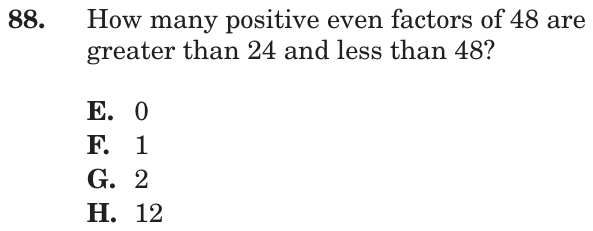
Question 16 of 20
2018 Test A Math, question 37Question
An unmarked straight stick will be laid end over end to measure a distance of exactly 72 feet. The same stick will be used in the same way to measure a distance of exactly 30 feet. What is the length of the longest possible stick that can be used for both measurements?
- A3 ft
- B4 ft
- C6 ft
- D8 ft
Show the answer
Correct answer: C
The length of the stick must be the greatest common factor of 72 and 30.
The factors of 30 are
1, 2, 3, 5, 6, 10, 15, and 30.
Of those, only 1, 2, 3, and 6 are also factors of 72. The greatest of these is 6.
Question analysis
This word problem asks for the longest stick that can be laid end over end to measure exactly 72 feet and exactly 30 feet. Students must recognize that the stick's length has to divide both distances evenly, so the task is finding a greatest common factor. The story wording hides the factor idea.
- NYS standards
- 6.NS.4 common factors and multiples
- Grade level
- Grade 6 content, by NYS standard
- Compared with grade 7
- Below grade 7 Finding a greatest common factor is a sixth-grade skill, and the arithmetic is light. The question is a little less routine than a bare factor problem only because students must see that the story calls for one.
- Estimated difficulty
- Straightforward: two steps or one careful reading.
- Thinking it demands
- Depth of knowledge 2, skills and concepts · mainly apply
- What makes it hard
- No obvious method moderate
- Hard words minor
- Solution
- 2 steps
- Reading level
- Question and choices: about grade 3, 54 words.
- Students, last 30 days
- Not enough answers yet to show (it takes 10).
Why it is hard, traps and wrong answers (shows the answer)
Why it is hard
Once the story is recognized as a greatest common factor problem, the arithmetic is light and the choices can simply be tested. The trap is checking only one of the two distances, because the longest choice works for 72 feet but not for 30. A student who lists the factors of 30 first, the smaller number, sees the answer quickly.
No obvious method moderate Working it out
Nothing in the stick story says "common factor"; students must see that laying the stick a whole number of times along 72 and 30 feet means it divides both. (Schoenfeld, 1985)
Hard words minor Understanding the question
The phrases "unmarked straight stick" and "laid end over end" are unusual wording for a math item; they describe whole-stick lengths, a reading hurdle rather than more math. (Perfetti, 2007; Freedle & Kostin, 1993)
Strategy: Translate 'measures both distances exactly' into 'divides both numbers evenly', list the factors of the smaller number, 30, and take the largest that also divides 72.
Traps
- Misreads the question: Misses or misreads a condition or a word in the question: "at least", "each", "remaining", "not".
- Answers a different question: A choice is right for another quantity: the other unknown, the rest instead of the part, the part instead of the whole.
The wrong answers, classified
A Answers a different question (King et al., 2004; Hegarty, Mayer & Monk, 1995)
Finds a length that divides both 72 and 30, 3 feet, but not the longest one, missing that 6 also divides both.
B Misreads the question (Hegarty, Mayer & Monk, 1995)
Checks only that 4 divides 72, giving 18 sticks, and misses that 30 feet would take 7.5 sticks.
D Misreads the question (Hegarty, Mayer & Monk, 1995)
Takes the longest choice that divides 72 evenly, nine 8-foot lengths, without checking that 30 feet is not a whole number of 8-foot sticks.
Worked solution, step by step
Formulas used
- Number of sticks
- d is the distance to measure. s is the length of the stick. n is how many times you lay the stick down. For an exact measure, n must be a whole number. So s must divide d evenly.
Sort out the story
You lay a stick down again and again, end to end, like taking steps. The stick has no marks, so you can only count whole stick lengths.
It must fit exactly into 72 feet and exactly into 30 feet. You need the longest stick that does both.
Turn it into factors
Fitting exactly means no piece is left over. So the stick length must divide 72 evenly and divide 30 evenly.
A number that divides both is a common factor. You want the greatest common factor: the biggest number that divides both.
List the factors of 30
Start with the smaller number, 30, since its list is shorter. Its factors are 1, 2, 3, 5, 6, 10, 15 and 30.
Now test them on 72, starting from the biggest. 30, 15, 10 and 5 leave a remainder. But 6 works:
So 6 is the greatest common factor.
Check the other choices
Watch out: 8 feet fits 72 feet, 9 times. But 30 ÷ 8 = 3.75, not a whole number, so choice D fails. Choice B fails too, since 30 ÷ 4 = 7.5. A 3-foot stick works, but it is not the longest, so choice A is wrong.
So the answer is C, 6 ft.
Check your answer
Use the stick. A 6-foot stick goes down 12 times for 72 feet, since 12 × 6 = 72. It goes down 5 times for 30 feet, since 5 × 6 = 30. Both counts are whole numbers, so 6 feet works.
More questions like this
The original DOE question
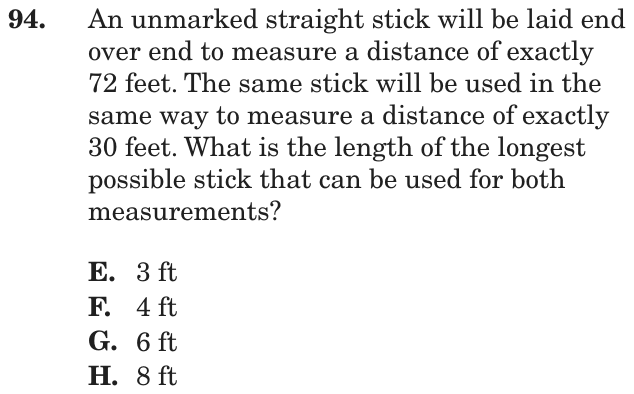
Question 17 of 20
2018 Test A Math, question 40Question
In the set of consecutive integers from 12 to 30, inclusive, there are four integers that are multiples of both 2 and 3. How many integers in this set are multiples of neither 2 nor 3?
- A5
- B6
- C13
- D15
Show the answer
Correct answer: B
The question asks for integers from 12 to 30 that are not divisible by 2 or 3. The set of consecutive integers is
{12, 13, 14, 15, 16, 17, 18, 19, 20, 21, 22, 23, 24, 25, 26, 27, 28, 29, 30}
Since all even numbers are divisible by 2, eliminate all even numbers, leaving the odd numbers in the set:
{13, 15, 17, 19, 21, 23, 25, 27, 29}
Eliminate those integers that are multiples of 3 (15, 21, and 27). The remaining integers are:
{13, 17, 19, 23, 25, 29}
Therefore, there are 6 numbers in the set that are multiples of neither 2 nor 3.
Question analysis
This number properties question takes the integers from 12 to 30, inclusive, and asks how many are multiples of neither 2 nor 3. Students must count the whole set, remove multiples of 2 and of 3 without removing any number twice, and count what remains. Inclusive endpoints and the overlap make it easy to miscount.
- NYS standards
- 6.NS.4 common factors and multiples
- Grade level
- Grade 6 content, by NYS standard
- Compared with grade 7
- Above grade 7 Multiples are sixth-grade content, but grade 7 problems rarely ask students to count a set under two overlapping conditions. The inclusive range and the numbers that are multiples of both make this longer and trickier than usual.
- Estimated difficulty
- Hard: combines ideas, needs a plan, and has more than one tempting wrong answer.
- Thinking it demands
- Depth of knowledge 2, skills and concepts · mainly apply
- What makes it hard
- Much to keep track of moderate
- A very close wrong answer moderate
- Solution
- 3 steps
- Reading level
- Question and choices: about grade 9, 30 words.
- Students, last 30 days
- Not enough answers yet to show (it takes 10).
Why it is hard, traps and wrong answers (shows the answer)
Why it is hard
The question gives the overlap, four multiples of both 2 and 3, which invites a subtraction method with three places to go wrong: the count of the set, the overlap, and the final complement. Each of those errors has its own choice. Listing the 19 numbers and crossing out evens and then odd multiples of 3 is slower to describe but faster and safer to do.
Much to keep track of moderate Working it out
Each of the 19 integers must be checked against two conditions, and the four multiples of 6 meet both, so they must be removed once, not twice. (Sweller, 1988; Carpenter, Just & Shell, 1990)
A very close wrong answer moderate Choosing the answer
The choices 5 and 6 differ by one, the result of counting 30 − 12 = 18 integers instead of 19, so only counting the inclusive set exactly separates them. (Embretson & Wetzel, 1987; Gorin & Embretson, 2006; Ascalon et al., 2007)
Strategy: Cross out every even number first, then cross out the odd multiples of 3 that remain, and count the survivors; listing all nineteen numbers is quick enough.
Traps
- Answers a different question: A choice is right for another quantity: the other unknown, the rest instead of the part, the part instead of the whole.
- Counting the ends: Inclusive or exclusive ends, fence posts, consecutive numbers: an answer that is one too many or too few, or an endpoint drawn open where it belongs closed (or the reverse).
The wrong answers, classified
A Counting the ends (Brown & Burton, 1978)
Counts 30 − 12 = 18 integers instead of 19, then subtracts the 13 multiples of 2 or 3 and gets 5.
C Answers a different question (King et al., 2004; Hegarty, Mayer & Monk, 1995)
Counts the integers that are multiples of 2 or 3, the 13 to be crossed out, and gives that count instead of the 6 left over.
D Misreads the question (Hegarty, Mayer & Monk, 1995)
Subtracts only the four multiples of both 2 and 3 from the 19 integers, reading "neither 2 nor 3" as "not both 2 and 3".
Worked solution, step by step
Formulas used
- Counting whole numbers in a list
- a is the first number and b is the last. n is how many whole numbers there are, counting both ends. You add 1 because subtracting counts the gaps, and there is one more number than gaps.
Sort out the question
The set is every integer (whole number) from 12 to 30. “Inclusive” means 12 and 30 are both in.
A multiple of 2 is an even number. A multiple of 3 is a number in the 3 times table. You need the numbers that are neither: not even, and not in the 3 times table.
Count the numbers in the set
There are 19 integers. Watch out: 30 − 12 = 18 forgets one end. That slip leads to choice A, 5.
Cross out the even numbers
Every even number is a multiple of 2, so remove them all. The odd numbers are left:
13, 15, 17, 19, 21, 23, 25, 27, 29
That is 9 numbers.
Cross out the multiples of 3
Check each odd number for 3. A quick test: add its digits. If the sum is in the 3 times table, so is the number. That removes 15, 21 and 27. These are left:
13, 17, 19, 23, 25, 29
Watch out: only 12, 18, 24 and 30 are multiples of both. Removing just those gives 19 − 4 = 15, choice D. “Neither” means you remove every multiple of 2 and every multiple of 3.
Count what is left
Six numbers are left. Watch out: 13 is how many you crossed out, choice C. The question asks for the ones left. So the answer is B, 6.
Check your answer
Count another way. Of the 19 numbers, 10 are even. Of the 9 odd ones, 3 are multiples of 3. So 10 + 3 = 13 are crossed out, and 19 − 13 = 6 are left. Same answer.
More questions like this
The original DOE question
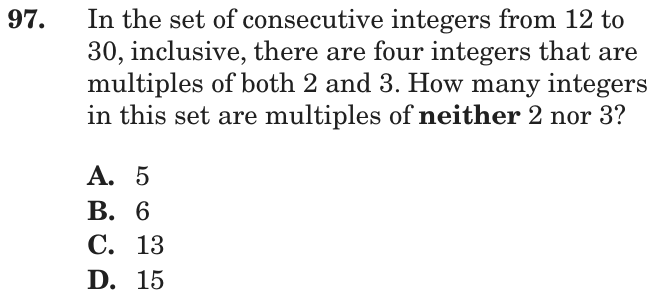
Question 18 of 20
2018 Test B Math, question 14Question
What is the least common multiple of 24, 6, and 18?
- A36
- B48
- C72
- D144
Show the answer
Correct answer: C
Since 18 and 24 are both multiples of 6, find the least common multiple of only 18 and 24.
Multiples of 18:
18, 36, 54, 72…
Multiples of 24:
24, 48, 72…
The least common multiple of 6, 18, and 24 is 72.
Question analysis
This number properties question asks for the least common multiple of three numbers: 24, 6 and 18. Students can list multiples or use prime factors. Each candidate has to be checked against all three numbers, and it must be the smallest number that works, not just any shared multiple.
- NYS standards
- 6.NS.4 common factors and multiples
- Grade level
- Grade 6 content, by NYS standard
- Compared with grade 7
- Below grade 7 Least common multiples are grade 6 content, where New York's standard uses two numbers up to 12. This uses three larger numbers, but it is still a short factor task below typical grade 7 work.
- Estimated difficulty
- Straightforward: two steps or one careful reading.
- Thinking it demands
- Depth of knowledge 1, recall and reproduction · mainly apply
- What makes it hard
- Solution
- 2 steps
- Reading level
- Question and choices: about grade 4, 8 words.
- Students, last 30 days
- Not enough answers yet to show (it takes 10).
Why it is hard, traps and wrong answers (shows the answer)
Why it is hard
Finding a least common multiple is routine, and listing multiples of 24 reaches the answer by the third one. The wrong choices are built to catch incomplete checking: each passes the test for some of the numbers but fails for one, or passes for all and is simply not the smallest. Testing every candidate against all three numbers is the whole skill.
Every choice must be checked minor Choosing the answer
Each wrong choice passes part of the test: 36 is a multiple of 6 and 18, 48 of 6 and 24, and 144 of all three, so every candidate needs checking against all three numbers. (Embretson & Wetzel, 1987)
Something you must already know minor Working it out
Students must know what “least common multiple” means and see that 6 can be dropped, since it already divides both 24 and 18. (Anderson & Krathwohl, 2001)
Strategy: Note that 6 divides both 24 and 18, so only those two matter; list multiples of 24 and stop at the first one that 18 also divides.
Traps
- Stops one step early: A choice is a number from partway through the solution.
The wrong answers, classified
A Stops one step early (King et al., 2004; Gierl et al., 2017)
Finds the least common multiple of 6 and 18 and stops, never checking that 36 is not a multiple of 24.
B An arithmetic slip (Junker & Sijtsma, 2001)
Lists multiples of 24, stops at 48 and misjudges it as a multiple of 18, though 48 ÷ 18 is not a whole number.
D Misreads the question (Hegarty, Mayer & Monk, 1995)
Multiplies 24 by 6 to get 144, which all three numbers divide, overlooking that the question asks for the least such multiple.
Worked solution, step by step
Formulas used
- Multiples of a number
- n is any whole number. Its multiples are what you get when you multiply n by 1, 2, 3 and so on. The least common multiple of some numbers is the smallest number that is a multiple of every one of them.
Understand the question
A multiple of a number is that number times 1, 2, 3, and so on. A common multiple is a multiple of every number in the list.
You need the least, or smallest, common multiple of 24, 6 and 18.
Drop the 6
6 goes evenly into 24, since . It also goes into 18, since .
So any multiple of 24 is already a multiple of 6. You only need to work with 24 and 18.
List the multiples of 24
Start with the bigger number, since its list grows faster. Check each multiple to see if 18 divides it evenly.
- , and 24 ÷ 18 is not a whole number.
- , and 48 ÷ 18 is not a whole number.
- , and . It works.
Give the answer
72 is the first multiple of 24 that 18 also divides. It is a multiple of 6 too, since .
Watch out: 36 works for 6 and 18, but not for 24, so choice A is wrong. 144 works for all three, but it is not the smallest.
So the answer is C, 72.
Check your answer
Test 72 with all three numbers: , and . All are whole numbers. The smaller choices, 36 and 48, each fail for one of the numbers.
More questions like this
The original DOE question
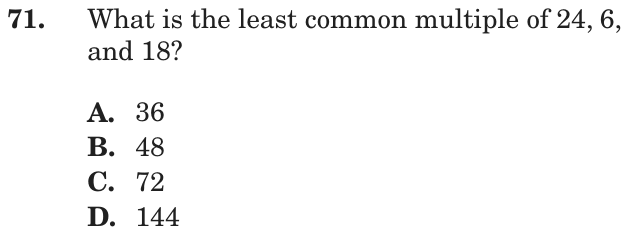
Question 19 of 20
2018 Test B Math, question 29Question
If is an odd integer, which one of the following must be an even integer?
- A
- B
- C
- D
Show the answer
Correct answer: C
One more than an odd integer must be even. One more than is , therefore must be even.
Two times an even integer must be even, therefore is even. An even integer decreased by 2 must be even.
Therefore, must be even.
Question analysis
This algebra question says that w − 1 is an odd integer and asks which of four expressions must be even. It tests reasoning about odd and even numbers written with a variable. The difficulty is that "must be" means even for every allowed value of w, so one example that happens to work is not enough.
- Grade level
- Grade 7 content, by NYS standard
- Compared with grade 7
- At grade 7 Grade 7 work evaluates and rewrites expressions but rarely asks whether one is odd or even for every value. The algebra here is light; the demand is reasoning about parity and reading "must be" carefully.
- Estimated difficulty
- Moderate: several steps, or a close reading with one strong distractor.
- Thinking it demands
- Depth of knowledge 2, skills and concepts · mainly analyze
- What makes it hard
- Variables instead of numbers moderate
- Every choice must be checked moderate
- Something you must already know minor
- Solution
- 2 steps
- Reading level
- Question and choices: about grade 8, 20 words.
- Students, last 30 days
- Not enough answers yet to show (it takes 10).
Why it is hard, traps and wrong answers (shows the answer)
Why it is hard
The question turns on one early inference: since w − 1 is odd, w itself is even. Students who skip that step, or quietly treat w as the odd number, carry the wrong parity into every choice. After that the work is mechanical, because each expression adds an even or an odd amount to an even number. Trying one value, such as w = 4, confirms the choice in seconds.
Variables instead of numbers moderate Understanding the question
The stem gives no number at all: w − 1 is only known to be odd, so the parity of w itself has to be worked out before any choice can be judged. (Koedinger & Nathan, 2004; Enright, Morley & Sheehan, 2002)
Every choice must be checked moderate Choosing the answer
All four choices are built from w or 2w plus or minus 1 or 2, so each one has to be tested for evenness; three of them come out odd for every allowed w. (Embretson & Wetzel, 1987)
Something you must already know minor Working it out
The parity rules are assumed, not stated: one more than an odd number is even, any multiple of 2 is even, and an even number plus or minus 1 is odd. (Anderson & Krathwohl, 2001)
Strategy: Choose a value of w that makes w − 1 odd, evaluate all four expressions, and keep the one that comes out even; then confirm it with a second value.
Traps
- Misreads the question: Misses or misreads a condition or a word in the question: "at least", "each", "remaining", "not".
The wrong answers, classified
A Misreads the question (Hegarty, Mayer & Monk, 1995)
Treats w itself as the odd number, so w + 1 looks even; in fact w − 1 being odd makes w even and w + 1 odd.
B A faulty procedure (Brown & Burton, 1978; Tatsuoka, 1983)
Doubles the odd number w − 1 to make it even but distributes the 2 to w only, writing 2(w − 1) as 2w − 1, which is odd.
D Misunderstands the concept (Smith, diSessa & Roschelle, 1993; De Bock et al., 1998; Ni & Zhou, 2005)
Assumes any expression that starts with 2w is even, overlooking that 2w + 1 is one more than an even number and so always odd.
Worked solution, step by step
Formulas used
- Adding 1 to an odd number
- Odd and even numbers take turns on the number line: 1, 2, 3, 4 and so on. Adding 1 moves you to the next whole number. So the number right after an odd number is always even, and the one after an even number is always odd.
- Doubling makes an even number
- n is any whole number. An even number is one you can split into two equal whole groups. Two times n is always two equal groups of n, so it is always even.
Sort out what you know
You know that is an odd integer. An integer is a whole number, like 3, 0 or −5. An even number can be split into two equal groups, like 4 or 10. An odd number is 1 more than an even number, like 3 or 11.
You need the choice that must be even. Must means it is even for every possible value of , not just one.
Decide whether w is odd or even
The number is 1 more than . One more than an odd number is always even. For example, if is 3, then is 4. So is even.
Watch out: do not treat itself as the odd number. That mistake makes look even and leads to choice A.
Show that 2w − 2 is even
Two times any whole number is even, so is even. Taking 2 away from an even number moves you back two spots. You land on another even number. So is even.
Here is another way to see it. is the same as . That is 2 times a whole number, so it must be even.
Check the other three choices
Each one adds or takes away 1 from an even number. That always gives an odd number.
- A: is even plus 1, so it is odd.
- B: is even minus 1, so it is odd.
- D: is even plus 1, so it is odd.
Watch out: starting with does not make a number even. The +1 in choice D makes it odd.
Give the answer
Only one choice is even for every possible . So the answer is C, .
Check your answer
Pick a number. Let , so , which is odd. Then A is 5, B is 7, C is 6 and D is 9. Only C is even. Try too. You get 11, 19, 18 and 21. C is even again.
More questions like this
The original DOE question
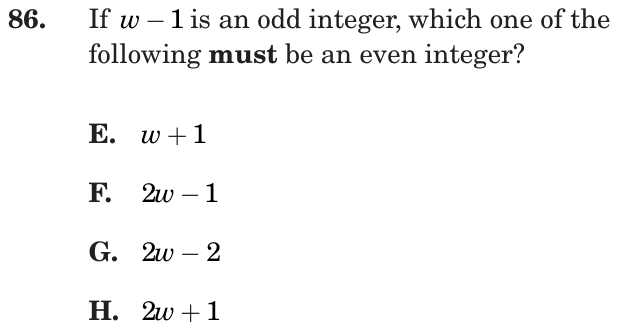
Question 20 of 20
2018 Test B Math, question 30Question
Three students stand at the starting line of a running track and begin running laps at the same time. Ann completes 1 lap every 2 minutes, Jack completes 1 lap every 3 minutes, and Lee completes 1 lap every 4 minutes. How many laps does Ann complete before all three runners are once again at the starting line at the same time?
- A4
- B6
- C12
- D20
Show the answer
Correct answer: B
Find the least common multiple of 2, 3, and 4 — which is 12. So, it takes 12 minutes before all three are back at the starting line. Ann completes 1 lap every 2 minutes, so in 12 minutes she has completed 6 laps.
Question analysis
Three runners start together and finish laps every 2, 3 and 4 minutes, and the question asks how many laps Ann, the fastest, completes before all three are at the starting line together again. It tests least common multiples in a word problem. The catch is keeping track of which quantity the question wants once the common time is found.
- NYS standards
- 6.NS.4 common factors and multiples
- Grade level
- Grade 6 content, by NYS standard
- Compared with grade 7
- At grade 7 Sixth and seventh graders find least common multiples of two numbers in isolation; this applies the idea to three runners in a story and adds a conversion from minutes to laps.
- Estimated difficulty
- Moderate: several steps, or a close reading with one strong distractor.
- Thinking it demands
- Depth of knowledge 2, skills and concepts · mainly apply
- What makes it hard
- Turning words into math moderate
- Something you must already know minor
- Solution
- 2 steps
- Reading level
- Question and choices: about grade 8, 56 words.
- Students, last 30 days
- Not enough answers yet to show (it takes 10).
Why it is hard, traps and wrong answers (shows the answer)
Why it is hard
Two quantities are in play, minutes and laps, and the question asks for the second while the natural first result is the first. Students who find the 12-minute meeting time often stop there, and students who do count laps can count Jack's or Lee's by mistake. The question rewards tracking whose laps are asked for and converting the time into laps at the very end.
Turning words into math moderate Understanding the question
"All three runners are once again at the starting line at the same time" has to be recognized as the first common multiple of 2, 3 and 4 minutes; the wording never says multiple. (Hegarty, Mayer & Monk, 1995; Koedinger & Nathan, 2004)
Something you must already know minor Working it out
Finding a least common multiple is assumed; multiplying the three lap times instead gives 24 minutes, which is a common time but not the first one. (Anderson & Krathwohl, 2001)
Strategy: Find the first time that is a multiple of all three lap times, then divide that time by Ann's lap time to count her laps.
Traps
- Stops one step early: A choice is a number from partway through the solution.
- Answers a different question: A choice is right for another quantity: the other unknown, the rest instead of the part, the part instead of the whole.
The wrong answers, classified
A Answers a different question (King et al., 2004; Hegarty, Mayer & Monk, 1995)
Divides the 12-minute meeting time by Jack's 3-minute lap, giving his 4 laps instead of Ann's.
C Stops one step early (King et al., 2004; Gierl et al., 2017)
Finds the least common multiple, 12 minutes, and gives it as the answer without dividing by Ann's 2-minute lap to count her laps.
D Little reason to choose it (Haladyna & Downing, 1993; Rodriguez, 2005)
No method using the lap times 2, 3 and 4 gives 20; it would mean 40 minutes for Ann, not the first time all three meet.
Worked solution, step by step
Formulas used
- Number of laps
- Total time is how long the runner runs. Time for one lap is how long one trip around the track takes. Dividing tells you how many of those trips fit into the total time.
Sort out what you know
Ann runs 1 lap every 2 minutes. Jack runs 1 lap every 3 minutes. Lee runs 1 lap every 4 minutes. They all start together.
A runner is back at the start line at the end of every lap. First find when all three are “once again at the starting line at the same time”. Then count Ann’s laps up to that moment.
List when each runner is back
Write the minutes when each runner reaches the line.
- Ann: 2, 4, 6, 8, 10, 12 …
- Jack: 3, 6, 9, 12 …
- Lee: 4, 8, 12 …
The first number in all three lists is 12. This is the least common multiple of 2, 3 and 4. It is the smallest number that all three divide into with nothing left over. So they meet after 12 minutes.
Count Ann’s laps
Use the laps formula. Ann runs for 12 minutes, and each lap takes her 2 minutes.
Ann runs 6 laps.
Watch out: 12 is the number of minutes, not laps. Choosing it gives C. Dividing by Jack’s 3 minutes gives his 4 laps, which is A.
Give the answer
The question asks only about Ann, and she runs 6 laps in 12 minutes. So the answer is B, 6.
Check your answer
Check that everyone is back at 12 minutes. Ann: . Jack: . Lee: . No earlier time works. At 6 minutes, Lee is only halfway through his second lap.
More questions like this
The original DOE question