Question
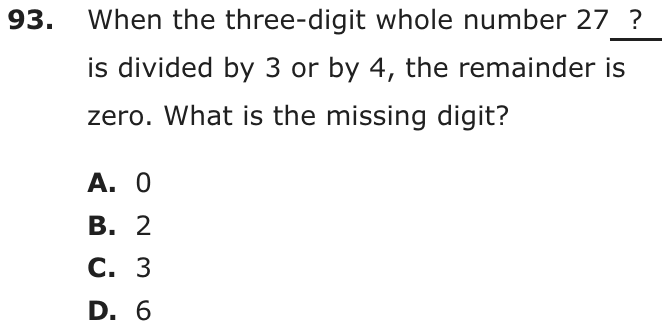
When the three-digit whole number 27 ? is divided by 3 or by 4, the remainder is zero. What is the missing digit?
- A0
- B2
- C3
- D6
Show the answer
Correct answer: D
Each of the options 0, 2, 3, and 6 must be considered:
Option A: In the case of 0, the three-digit whole number is 270. Divide 270 by both 3 and 4:
Dividing 270 by 3 results in a remainder of 0, but dividing 270 by 4 results in a remainder of 2, so 0 cannot be the missing digit.
Option B: In the case of 2, the three-digit whole number is 272. Divide 272 by both 3 and 4:
Dividing 272 by 4 results in a remainder of 0, but dividing 272 by 3 results in a remainder of 2, so 2 cannot be the missing digit.
Option C: In the case of 3, the three-digit whole number is 273. Divide 273 by both 3 and 4:
Dividing 273 by 3 results in a remainder of 0, but dividing 273 by 4 results in a remainder of 1, so 3 cannot be the missing digit.
Option D: In the case of 6, the three-digit whole number is 276. Divide 276 by both 3 and 4:
Dividing 276 by 3 results in a remainder of 0, and dividing 276 by 4 results in a remainder of 0, so 6 is the missing digit.
Question analysis
A three-digit number begins with 27 and is missing its last digit, and it divides evenly by both 3 and 4. Students find the missing digit. It tests factors, multiples and divisibility rules; a digit that works for one divisor may fail the other, so both tests must be applied.
- NYS standards
- 6.NS.4 common factors and multiples
- Grade level
- Grade 6 content, by NYS standard
- Compared with grade 7
- Below grade 7 Divisibility by 3 and by 4 is grade 6 number sense. Testing four possible digits against two conditions is quick, much like a grade 6 exercise, as long as both divisors are actually checked.
- Estimated difficulty
- Straightforward: two steps or one careful reading.
- Thinking it demands
- Depth of knowledge 2, skills and concepts · mainly apply
- What makes it hard
- Solution
- 2 steps
- Reading level
- Question and choices: about grade 5, 19 words.
- Students, last 30 days
- Not enough answers yet to show (it takes 10).
Why it is hard, traps and wrong answers (shows the answer)
Why it is hard
Every candidate passes at least one of the two tests, which makes the question a matter of finishing the checks rather than finding a method. Students who test only by 3, or only by 4, find a fitting number and stop. Seeing that a number divisible by both 3 and 4 is divisible by 12, and that 276 = 12 × 23, settles it in one step.
Turning words into math minor Understanding the question
The words “divided by 3 or by 4, the remainder is zero” mean that both divisions come out even, though or can be read as either one being enough. (Hegarty, Mayer & Monk, 1995; Koedinger & Nathan, 2004)
Every choice must be checked minor Choosing the answer
Each candidate, 270, 272, 273 and 276, has to be tested against two divisors, and three of them pass one test, so stopping after one check is costly. (Embretson & Wetzel, 1987)
Something you must already know minor Working it out
The divisibility tests are not given: a number is divisible by 3 when its digit sum is, and by 4 when the number formed by its last two digits is. (Anderson & Krathwohl, 2001)
Strategy: Use the divisibility tests: a number is divisible by 4 when its last two digits are, and by 3 when its digit sum is. Keep only a digit that passes both.
Traps
- Misreads the question: Misses or misreads a condition or a word in the question: "at least", "each", "remaining", "not".
- Numbers taken from the question: Combines the numbers in the question without a model of the situation, or is simply a number that appears in the question.
The wrong answers, classified
A Misreads the question (Hegarty, Mayer & Monk, 1995)
Checks only division by 3, which 270 passes with a digit sum of 9, and never tests 4, though 270 ÷ 4 leaves a remainder of 2.
B Misreads the question (Hegarty, Mayer & Monk, 1995)
Checks only division by 4, which 272 passes because 72 is a multiple of 4, but its digit sum is 11, so 272 ÷ 3 leaves 2.
C Numbers taken from the question (Hegarty, Mayer & Monk, 1995)
Matches the missing digit to the divisor 3 in the question; 273 is a multiple of 3 but leaves a remainder of 1 when divided by 4.
Worked solution, step by step
Formulas used
- Test for dividing by 3
- The digit sum is what you get when you add up a number’s digits. Divides by 3 means it divides evenly, with a remainder of 0. If the digit sum divides evenly by 3, so does the whole number. Use it to test a big number quickly.
- Test for dividing by 4
- Look only at the number made by the last two digits. If it divides evenly by 4, so does the whole number. This works because every 100 divides evenly by 4, so only the last two digits matter.
Sort out the question
The number is 27 followed by a missing digit. Remainder zero means the division comes out even, with nothing left over. The remainder is zero when the number is “divided by 3 or by 4.” That means both divisions come out even. So the number must pass both tests. The choices give four digits to try: 0, 2, 3 and 6.
Test each number for 3
Add the digits of each number.
Number Digit sum Divides by 3? 270 yes 272 no 273 yes 276 yes So 270, 273 and 276 pass. 272 fails.
Test each number for 4
Look at the last two digits: 70, 72, 73 and 76.
So 272 and 276 pass. 270 and 273 fail.
Keep the digit that passes both
Only 276 passes both tests. Check by dividing:
Watch out: 0 and 3 pass only the test for 3, so A and C fail. 2 passes only the test for 4, so B fails. And 3 is not right just because the question says 3. So the answer is D, 6.
Check your answer
A number that divides evenly by both 3 and 4 also divides evenly by 12, since . And . So 276 is a multiple of 12. None of 270, 272 or 273 is.
More questions like this
The original DOE question