3 English and 3 math
Here are 6 random questions to try. Takers earning below 75% are unlikely to receive an offer. You have 1 minute 48 seconds per question on the real exam.
Question 1 of 6
2024 Test A English, question 20Passage At Dusk
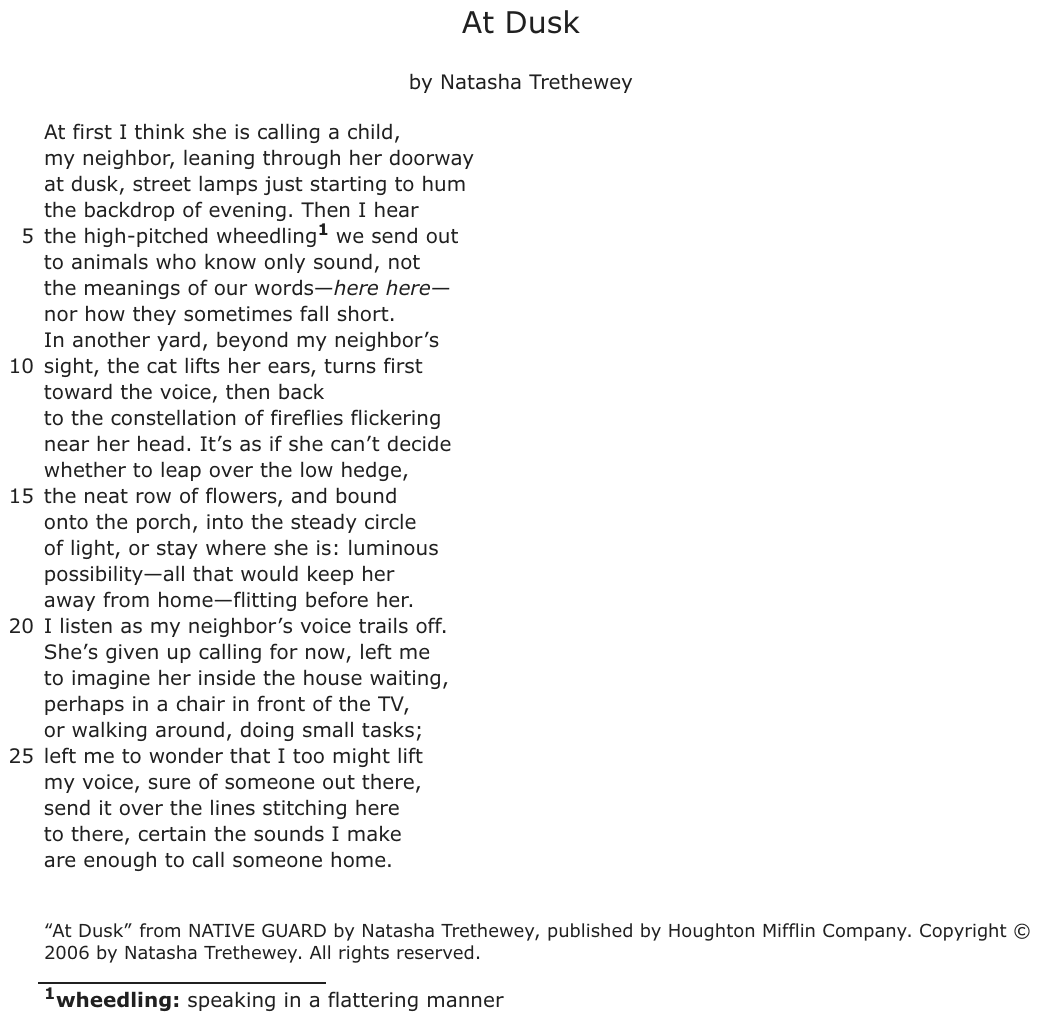
At Dusk
by Natasha Trethewey
At first I think she is calling a child,
my neighbor, leaning through her doorway
at dusk, street lamps just starting to hum
the backdrop of evening. Then I hear
the high-pitched wheedling1 we send out
to animals who know only sound, not
the meanings of our words—here here—
nor how they sometimes fall short.
In another yard, beyond my neighbor’s
sight, the cat lifts her ears, turns first
toward the voice, then back
to the constellation of fireflies flickering
near her head. It’s as if she can’t decide
whether to leap over the low hedge,
the neat row of flowers, and bound
onto the porch, into the steady circle
of light, or stay where she is: luminous
possibility—all that would keep her
away from home—flitting before her.
I listen as my neighbor’s voice trails off.
She’s given up calling for now, left me
to imagine her inside the house waiting,
perhaps in a chair in front of the TV,
or walking around, doing small tasks;
left me to wonder that I too might lift
my voice, sure of someone out there,
send it over the lines stitching here
to there, certain the sounds I make
are enough to call someone home.
“At Dusk” from NATIVE GUARD by Natasha Trethewey, published by Houghton Mifflin Company. Copyright © 2006 by Natasha Trethewey. All rights reserved.
1wheedling: speaking in a flattering manner
Question
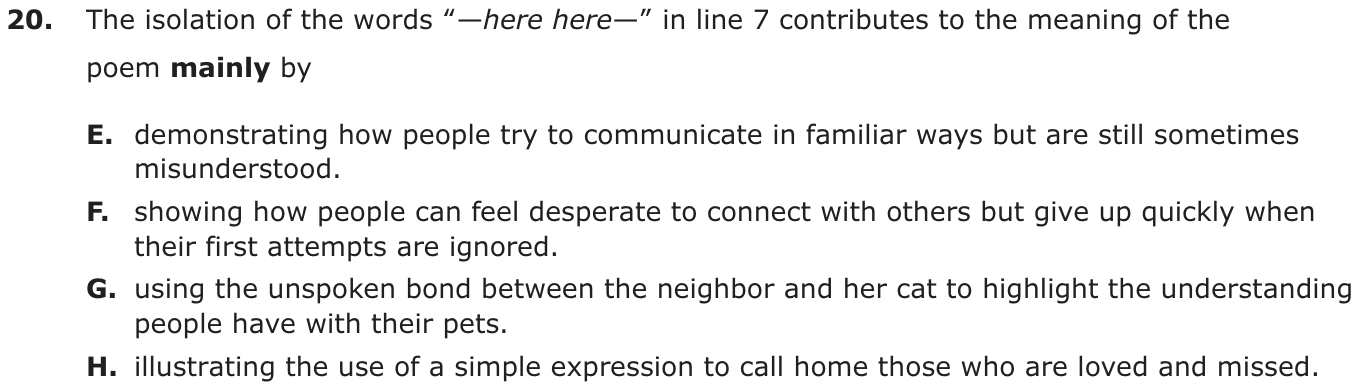
The isolation of the words “—here here—” in line 7 contributes to the meaning of the poem mainly by
- Ademonstrating how people try to communicate in familiar ways but are still sometimes misunderstood.
- Bshowing how people can feel desperate to connect with others but give up quickly when their first attempts are ignored.
- Cusing the unspoken bond between the neighbor and her cat to highlight the understanding people have with their pets.
- Dillustrating the use of a simple expression to call home those who are loved and missed.
Show the answer
Correct answer: D
The question asks how the isolation of the words “—here here—” in line 7 mainly contributes to the meaning of the poem.
A. Incorrect. The words “—here here—” do interrupt the speaker’s observation in lines 7–8 that “our words . . . / . . . sometimes fall short.” However, in lines 5–7, the speaker observes that the neighbor accompanies her words with a “high-pitched wheedling” that people “send out” because they are aware that animals “know only sound, not / the meanings of our words,” indicating that the neighbor does not actually expect her words to be understood. The description of the cat’s response in lines 10–11 (“the cat lifts her ears, turns first / toward the voice, then back”) does not suggest that the neighbor’s message is misunderstood but rather suggests that the cat prefers not to respond to it.
B. Incorrect. In lines 20–21, the “neighbor’s voice trails off,” and she does give up calling the cat. However, rather than any desperation to connect, the neighbor’s use of a “high-pitched wheedling” (line 5) simply indicates her understanding that the cat, like other animals, understands “only sound, not / the meanings of our words” (lines 6–7) such as “here here.” Furthermore, the neighbor does not give up quickly. In lines 21–22, the speaker says the neighbor has “given up calling for now” but is still “waiting” for the cat.
C. Incorrect. In lines 4–7, the speaker describes the neighbor calling to the cat with a “high-pitched wheedling.” The sound may indicate a bond between the neighbor and the cat because the neighbor does understand that animals “know only sound, not / the meanings of our words” (lines 6–7). However, the use of the words “here here” in line 7 does not indicate that bond, because they are used as an example of the type of words that animals do not understand.
D. CORRECT. The speaker’s initial thought in line 1 that the neighbor is calling a child, rather than a cat, suggests that the neighbor loves and misses the cat. Lines 4–7 then present the speaker’s observation that the neighbor uses a “high-pitched wheedling,” to emphasize the simple words of her call, “—here here—.” The idea that the words are an example of a simple expression used to call home a missed loved one is reinforced in lines 25–29, when the speaker is “left . . . to wonder” whether the speaker, too, “might lift / [his or her] voice” and be able “to call someone home.”
Question analysis
This reading question asks how setting off the words here here with dashes in line 7 adds to the meaning of At Dusk, Natasha Trethewey's poem about a neighbor calling her cat at nightfall. Students must work out what two plain, isolated words contribute to the whole poem, choosing among four readings about how people and animals communicate and connect.
- Grade level
- Grade 8 reading and task
- Compared with grade 7
- Above grade 7 Grade 7 students explain how a line adds to a poem, but here the feature is a tiny typographic choice, and its meaning has to be built from the whole poem rather than nearby lines, which goes beyond typical grade 7 work.
- Estimated difficulty
- Among the hardest on the SHSAT: a non-obvious approach, heavy reading, or a well-hidden trap.
- Thinking it demands
- Depth of knowledge 3, strategic thinking · mainly analyze
- What makes it hard
- A very close wrong answer major
- Evidence in several places moderate
- How, not what moderate
- Evidence
- Answered from the whole text
- Reading level
- Passage: 236 words (a poem; reading level not measured); question and choices: about grade 9, 87 words.
- Corrected from the DOE handbook
- A grammar slip in the explanation was corrected.
- Students, last 30 days
- 53% right, of 15 answers
Why it is hard, traps and wrong answers (shows the answer)
Why it is hard
The words sit inside a sentence about animals not knowing the meanings of our words and about words that “sometimes fall short,” so the nearest lines point toward miscommunication. The poem's frame points elsewhere: it opens with a call that sounds like a parent's, ends with the speaker hoping a voice can “call someone home,” and even repeats “here” in line 27. Students who read only around line 7 choose the misunderstanding; those who connect the isolated call to the first and last lines see what it is for.
A very close wrong answer major Choosing the answer
The misunderstanding choice and the right one agree that “here here” is a familiar way of calling; they part only on what it shows, failed communication or a call home to someone missed. (Embretson & Wetzel, 1987; Gorin & Embretson, 2006; Ascalon et al., 2007)
Evidence in several places moderate Working it out
The right reading rests on lines far from line 7: the speaker's first guess that a child is being called, and the last line's wish “to call someone home.” (Kirsch & Mosenthal, 1990; Gorin & Embretson, 2006)
How, not what moderate Working it out
The question asks what setting two words apart with dashes and italics does for the poem, a typographic choice whose purpose the poem never explains. (Anderson & Krathwohl, 2001)
Strategy: Ask what the two words are meant to do and whom they are aimed at, then keep the choice that the poem's other lines confirm.
Traps
- Wrong purpose or structure: Names a purpose, structure or effect that the part does not serve, or describes what a part says when the question asks what it does.
- Twists what the text says: Uses the text's topic and ideas but changes what it says: who did it, how much, when, or why.
- Reads too much in: A reasonable-sounding conclusion that goes further than the text allows.
The wrong answers, classified
A Wrong purpose or structure (Anderson & Krathwohl, 2001)
Reads the words through line 8's “sometimes fall short” as failed communication, but the cat does hear and turn toward the call, and the ending hopes such sounds can bring someone home.
B Twists what the text says (King et al., 2004)
Sees the neighbor stop calling and calls her desperate and quick to quit, though she has given up only “for now” and is still waiting inside.
C Reads too much in (Graesser, Singer & Trabasso, 1994)
Assumes an owner and a pet share a silent understanding, but “here here” is spoken aloud, and the poem offers it as words animals cannot follow.
What was corrected from the DOE handbook, and why
- Explanation: In rejecting choice C, the handbook reads “the use of the words “here here” in line 7 do not indicate that bond.” It now reads “does not,” to agree with “use.”
How 15 answers split, last 30 days
- A20%
- B7%
- C20%
- D53%
Working it out, step by step
Figure out what the question asks
In line 7 the words here here are set apart by dashes and slanted letters (italics). The question asks what this does for the poem’s meaning. Think about what the words are for and who they are aimed at.
Look at line 7
Line 7 reads “the meanings of our words—here here—.” These are the words the neighbor calls to her cat. Setting them apart lets you hear them, as if spoken aloud. They are simple words that mean “come here.” Lines 6–7 say animals know “only sound, not / the meanings of our words.”
Connect to the start and end
In line 1 the speaker first thinks the neighbor “is calling a child.” So the call sounds like a parent calling someone they love. The poem ends with the hope that a voice can be “enough to call someone home” (line 29). So here here is a simple call to bring a loved one home.
Check each choice
- A is wrong. The cat isn’t confused. She “lifts her ears” and turns “toward the voice.” She just doesn’t come yet.
- B is wrong. The neighbor isn’t shown as desperate. She stops only “for now,” and the speaker pictures her waiting inside.
- C is wrong. Here here is spoken out loud. The poem treats it as words animals don’t understand, not a silent bond.
- D is right. It is a simple call to someone loved and missed.
Watch out: Line 8 says words “sometimes fall short,” which points toward A. But read the first and last lines too.
Choose the answer
The two words stand for the simple call people use to bring loved ones home. So the answer is D.
Why this answer and not the closest wrong one
A is the closest wrong answer, because line 8 says our words “sometimes fall short.” But the cat does hear the call and turn toward it. And the poem ends by hoping the sounds “are enough to call someone home.” D links the two words to that wish, and to the first guess that a child is being called.
More questions like this
The original DOE question
The passage “At Dusk” as printed (page 48)
Question 2 of 6
2024 Test A English, question 49Passage Excerpt from The Highest Tide
Excerpt from The Highest Tide
by Jim Lynch
The narrator’s summer job is collecting marine specimens in Puget Sound, Washington. In this excerpt, he is looking for specimens in the mudflats before daybreak. Mudflats, or flats, are coastal landforms created when sediment and silt from tides are deposited as the tides recede.
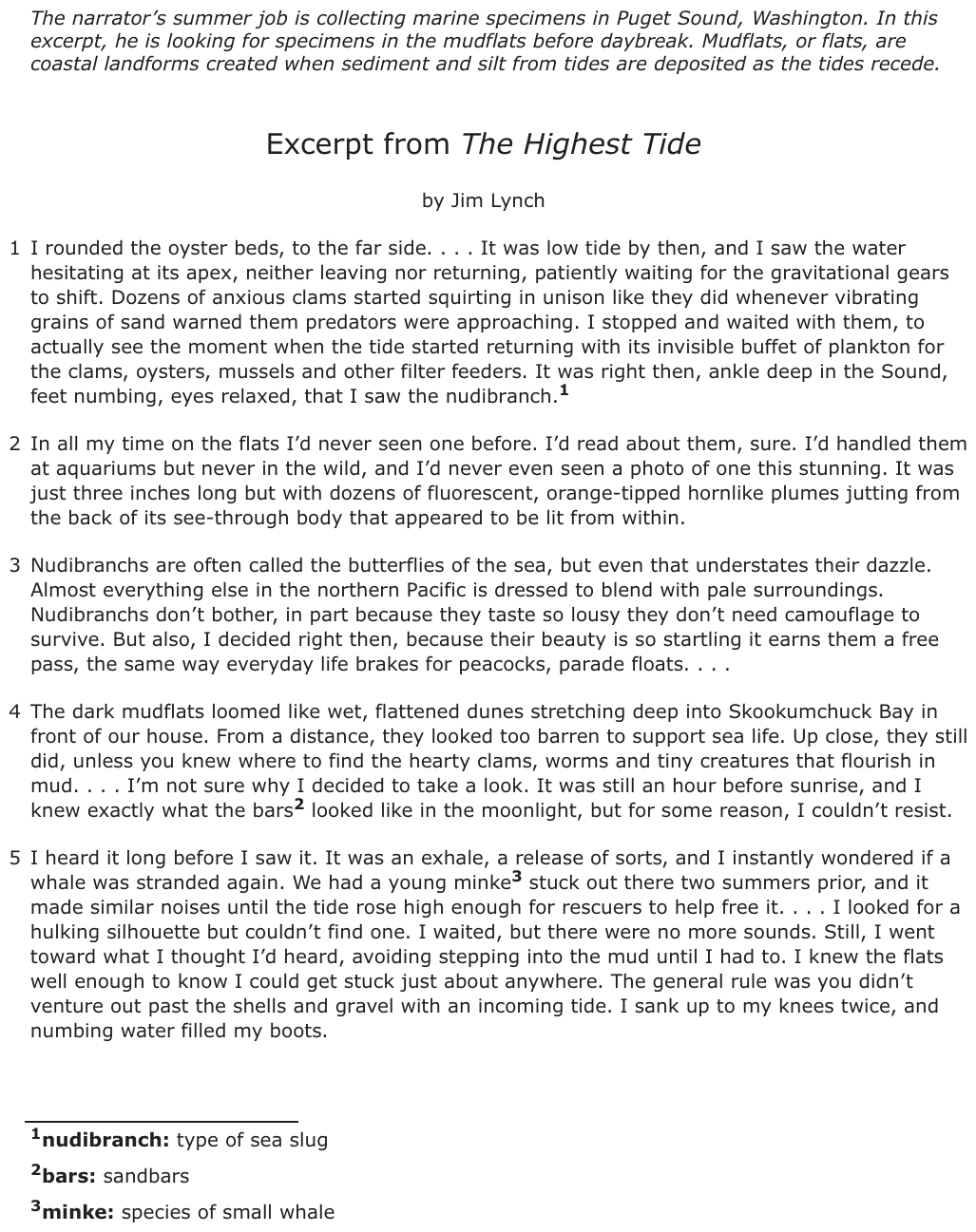
I rounded the oyster beds, to the far side. . . . It was low tide by then, and I saw the water hesitating at its apex, neither leaving nor returning, patiently waiting for the gravitational gears to shift. Dozens of anxious clams started squirting in unison like they did whenever vibrating grains of sand warned them predators were approaching. I stopped and waited with them, to actually see the moment when the tide started returning with its invisible buffet of plankton for the clams, oysters, mussels and other filter feeders. It was right then, ankle deep in the Sound, feet numbing, eyes relaxed, that I saw the nudibranch.1
In all my time on the flats I’d never seen one before. I’d read about them, sure. I’d handled them at aquariums but never in the wild, and I’d never even seen a photo of one this stunning. It was just three inches long but with dozens of fluorescent, orange-tipped hornlike plumes jutting from the back of its see-through body that appeared to be lit from within.
Nudibranchs are often called the butterflies of the sea, but even that understates their dazzle. Almost everything else in the northern Pacific is dressed to blend with pale surroundings. Nudibranchs don’t bother, in part because they taste so lousy they don’t need camouflage to survive. But also, I decided right then, because their beauty is so startling it earns them a free pass, the same way everyday life brakes for peacocks, parade floats. . . .
The dark mudflats loomed like wet, flattened dunes stretching deep into Skookumchuck Bay in front of our house. From a distance, they looked too barren to support sea life. Up close, they still did, unless you knew where to find the hearty clams, worms and tiny creatures that flourish in mud. . . . I’m not sure why I decided to take a look. It was still an hour before sunrise, and I knew exactly what the bars2 looked like in the moonlight, but for some reason, I couldn’t resist.
I heard it long before I saw it. It was an exhale, a release of sorts, and I instantly wondered if a whale was stranded again. We had a young minke3 stuck out there two summers prior, and it made similar noises until the tide rose high enough for rescuers to help free it. . . . I looked for a hulking silhouette but couldn’t find one. I waited, but there were no more sounds. Still, I went toward what I thought I’d heard, avoiding stepping into the mud until I had to. I knew the flats well enough to know I could get stuck just about anywhere. The general rule was you didn’t venture out past the shells and gravel with an incoming tide. I sank up to my knees twice, and numbing water filled my boots.
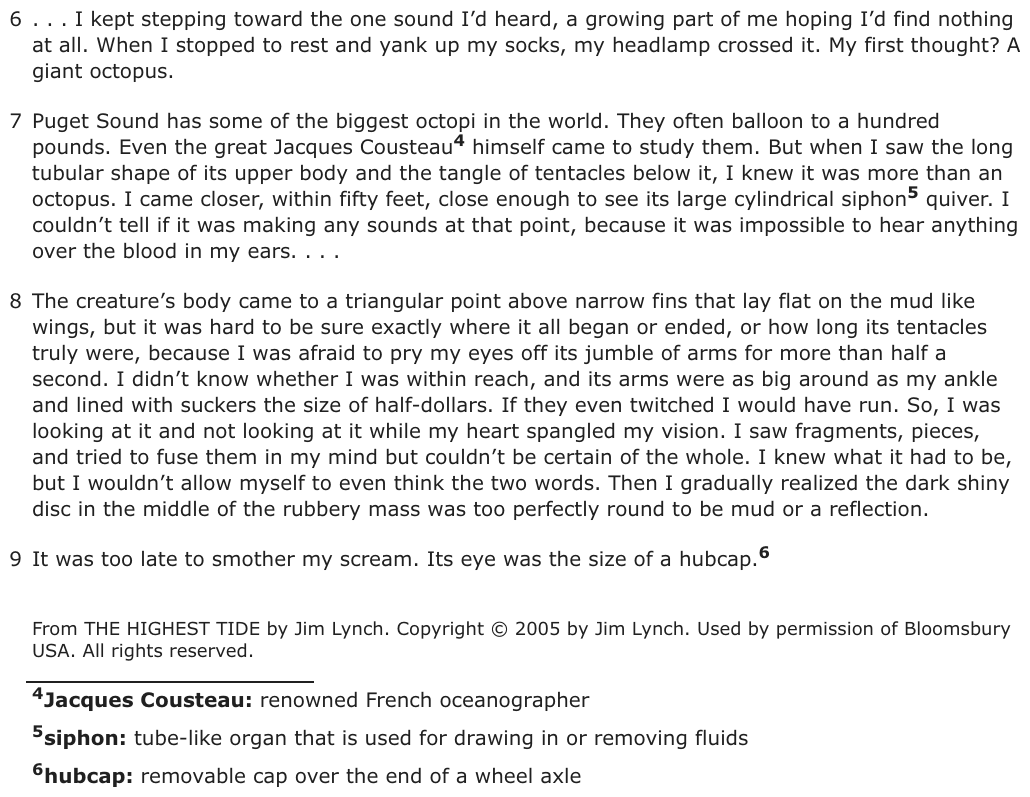
. . . I kept stepping toward the one sound I’d heard, a growing part of me hoping I’d find nothing at all. When I stopped to rest and yank up my socks, my headlamp crossed it. My first thought? A giant octopus.
Puget Sound has some of the biggest octopi in the world. They often balloon to a hundred pounds. Even the great Jacques Cousteau4 himself came to study them. But when I saw the long tubular shape of its upper body and the tangle of tentacles below it, I knew it was more than an octopus. I came closer, within fifty feet, close enough to see its large cylindrical siphon5 quiver. I couldn’t tell if it was making any sounds at that point, because it was impossible to hear anything over the blood in my ears. . . .
The creature’s body came to a triangular point above narrow fins that lay flat on the mud like wings, but it was hard to be sure exactly where it all began or ended, or how long its tentacles truly were, because I was afraid to pry my eyes off its jumble of arms for more than half a second. I didn’t know whether I was within reach, and its arms were as big around as my ankle and lined with suckers the size of half-dollars. If they even twitched I would have run. So, I was looking at it and not looking at it while my heart spangled my vision. I saw fragments, pieces, and tried to fuse them in my mind but couldn’t be certain of the whole. I knew what it had to be, but I wouldn’t allow myself to even think the two words. Then I gradually realized the dark shiny disc in the middle of the rubbery mass was too perfectly round to be mud or a reflection.
It was too late to smother my scream. Its eye was the size of a hubcap.6
From THE HIGHEST TIDE by Jim Lynch. Copyright © 2005 by Jim Lynch. Used by permission of Bloomsbury USA. All rights reserved.
1nudibranch: type of sea slug
2bars: sandbars
3minke: species of small whale
4Jacques Cousteau: renowned French oceanographer
5siphon: tube-like organ that is used for drawing in or removing fluids
6hubcap: removable cap over the end of a wheel axle
Question
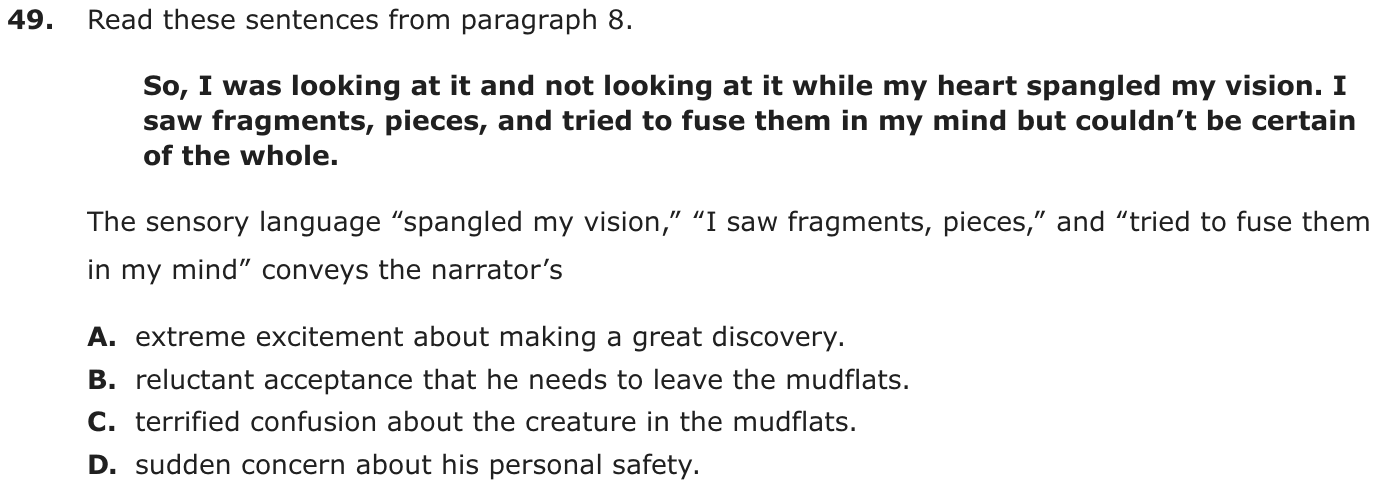
Read these sentences from paragraph 8.
So, I was looking at it and not looking at it while my heart spangled my vision. I saw fragments, pieces, and tried to fuse them in my mind but couldn’t be certain of the whole.
The sensory language “spangled my vision,” “I saw fragments, pieces,” and “tried to fuse them in my mind” conveys the narrator’s
- Aextreme excitement about making a great discovery.
- Breluctant acceptance that he needs to leave the mudflats.
- Cterrified confusion about the creature in the mudflats.
- Dsudden concern about his personal safety.
Show the answer
Correct answer: C
The question asks what the sensory language in the sentences from paragraph 8 conveys about the narrator.
A. Incorrect. While the narrator does not leave the mudflats and is curious about what has been found, the main emotions described in paragraph 8 are fear and confusion as the narrator tries to comprehend the size of the animal.
B. Incorrect. The language focuses on the narrator’s inability to organize what he sees into useful thoughts and conclusions, and while the narrator feels fear in paragraph 8—“I was afraid” and “I would have run”—the narrator refuses to leave the mudflats out of curiosity.
C. CORRECT. The phrase “spangled my vision” illustrates that the narrator cannot fully recognize what has appeared on the mudflats. The sight is so amazing, the narrator is trying to “fuse” together “fragments” and “pieces” because seeing the creature has created so much emotion in the narrator that he feels confused.
D. Incorrect. While the narrator is feeling some fear, as expressed in paragraph 8, the phrases actually indicate that the narrator’s amazement causes him to struggle to take in the view of the creature before him.
Question analysis
This question about sensory language asks what three phrases, including “spangled my vision,” convey about the narrator as he stares at a huge creature in the mud in an excerpt from The Highest Tide. Students must interpret unusual imagery and choose among emotions that all seem possible at such a startling moment.
- Grade level
- Grade 8 reading and task
- Compared with grade 7
- Above grade 7 Interpreting sensory language for a character's state of mind is grade 7 work, but spangled is an unusual verb, and the paragraph partly supports several of the emotions offered, so the choice must be matched precisely to the quoted phrases.
- Estimated difficulty
- Hard: combines ideas, needs a plan, and has more than one tempting wrong answer.
- Thinking it demands
- Depth of knowledge 2, skills and concepts · mainly analyze
- What makes it hard
- Figurative or literary language major
- A very close wrong answer moderate
- Hard words minor
- Evidence
- Answered from one paragraph or stanza
- Reading level
- Passage: about grade 6, 902 words; question and choices: about grade 7, 92 words.
- Students, last 30 days
- 67% right, of 15 answers
Why it is hard, traps and wrong answers (shows the answer)
Why it is hard
The quoted phrases are about perception, not feeling: the narrator sees fragments and cannot assemble them, while his heart pounds hard enough to blur his sight. The fear is clear from the surrounding sentences, where he is afraid to look away and ready to run, and that context makes the choice about personal safety very tempting. The answer must cover both the terror and the confusion, and the word “spangled” can mislead readers into hearing excitement.
Figurative or literary language major Understanding the question
The phrases describe seeing in pieces, “looking at it and not looking at it”, a heart that “spangled” his vision, “fragments” he cannot “fuse”, and the emotion has to be read from that broken sight. (Graesser, Singer & Trabasso, 1994; Kintsch, 1998)
A very close wrong answer moderate Choosing the answer
The right choice and the one about concern for his safety both name fear; they part on what the quoted phrases show, a mind unable to piece the creature together or a worry about its reach. (Embretson & Wetzel, 1987; Gorin & Embretson, 2006; Ascalon et al., 2007)
Hard words minor Understanding the question
“Spangled”, to scatter with glittering spots, is a rare word, and its sparkle can suggest delight, which opens a reading of excitement to students who miss the fear around it. (Perfetti, 2007; Freedle & Kostin, 1993)
Strategy: Ask what the three quoted phrases together say about how the narrator is seeing and thinking at this moment, then choose the emotion that accounts for all three, not just one.
Traps
- True but not the answer: A choice says something accurate about the text that does not answer this question.
- Wrong tone or attitude: Misjudges the tone, attitude or point of view, such as reading admiration as criticism, or taking a character's or subject's feelings for the author's.
The wrong answers, classified
A Wrong tone or attitude (Graesser, Singer & Trabasso, 1994)
Reads the pounding heart and glittering vision as the thrill of a great find, missing that he is afraid to take his eyes off the creature and cannot make sense of it.
B Twists what the text says (King et al., 2004)
Turns “If they even twitched I would have run”, a possibility, into an accepted need to leave, though the narrator stays and the phrases describe how he sees.
D True but not the answer (King et al., 2004; Embretson & Wetzel, 1987)
Matches the fear in paragraph 8, where he wonders whether he is within reach, but the quoted phrases describe broken seeing and puzzling, and his fear has been building, not sudden.
How 15 answers split, last 30 days
- A27%
- B7%
- C67%
- D0%
Working it out, step by step
Know what the question asks
Sensory language describes what a character sees, hears or feels. This asks what feeling the three quoted phrases show. Your answer must explain all three phrases, not just one.
Explain the hard words
To spangle means to cover with glittering spots. His heart pounds so hard that his sight seems to sparkle and blur. Fragments are small broken pieces. To fuse means to join together.
Put the phrases together
He sees only “fragments, pieces.” He tries “to fuse them in my mind” but “couldn’t be certain of the whole.” So he is confused, unable to tell what the creature really is. The sentences around them show he is also terrified. He is “afraid to pry my eyes off” its arms, and his heart is racing.
Check each choice
- C fits: “terrified confusion” covers both his fear and his broken, puzzled seeing.
- A is wrong because “spangled” may sound happy, but he is frightened, not thrilled.
- B is wrong because he never decides to leave, and he would run only if the arms moved.
- D is wrong because the phrases show confused seeing, and his fear has been growing since paragraph 6.
Watch out: D is close, since he is afraid. But it leaves out the confusion the phrases show.
Choose the answer
The phrases show a frightened narrator who cannot piece together what he sees. So the answer is C.
Why this answer and not the closest wrong one
D comes closest, because the narrator truly fears for his safety. But the quoted phrases are about how he sees: in pieces he can’t join. That is confusion. C names both the fear and the confusion, so it fits all three phrases.
More questions like this
The original DOE question
The passage “Excerpt from The Highest Tide” as printed (pages 64–65)
Question 3 of 6
2024 Test A English, question 40Passage 5 Reasons Physical Books Might Be Better Than E-Books
5 Reasons Physical Books Might Be Better Than E-Books
by Shaunacy Ferro
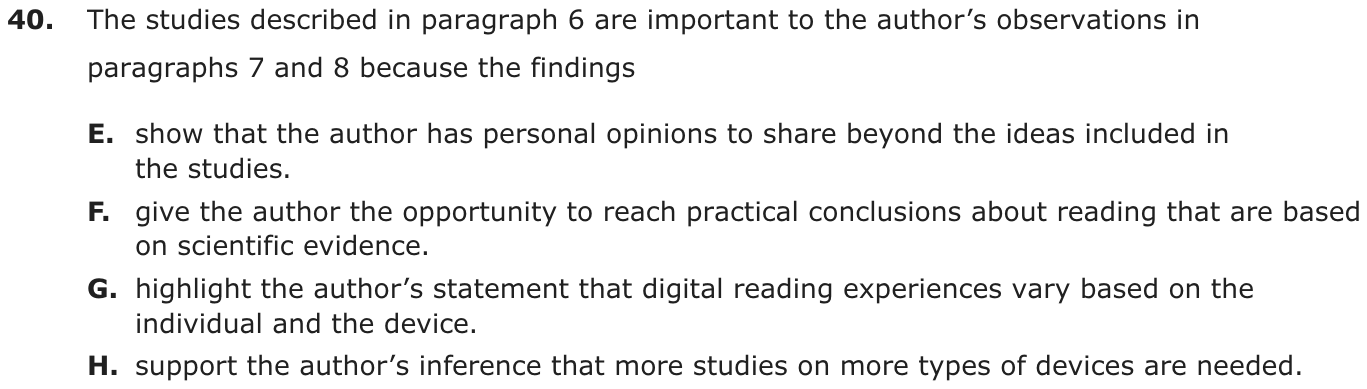
Though e-book1 readers have become a more common sight around town, traditional books still have their evangelists.2 According to The New York Times, e-book sales have been falling in 2015. Print definitely isn’t dead. In fact, according to some research, it may actually be a better choice for some readers. While scientists are still trying to tease out exactly how digital reading affects us differently, here are five ways e-books might be inferior to their dead-tree cousins.
E-books can reduce reading comprehension.
In a study of middle schoolers, West Chester University researchers found that students who read on iPads3 had lower reading comprehension than when they read traditional printed books. They discovered that the kids sometimes skipped text in favor of interactive features in the e-books, suggesting that certain multimedia in children’s e-books can be detrimental to the practice of reading itself. However, the researchers noted that some interactive features in e-books are designed to enhance comprehension, and that those might be more helpful than game-type interactive graphics.
Young kids can get distracted by e-books.
Similar results were found by a small study by the Joan Ganz Cooney Center that consisted of 32 kids reading e-books and print books with their parents. It found that “enhanced” e-books might be distracting. Kids who read enhanced e-books—ones with interactive, multimedia experiences—were more engaged with them physically, but in the end they remembered fewer narrative details than those who read print books or basic e-books.
You remember less about a book’s timeline.
Another study of adults also found that e-books can be hard to absorb. The researchers asked 25 people to read a 28-page story on a Kindle4 and 25 to read the story in paperback, then asked the readers to put 14 events from the story in chronological order. Those who read the story on a Kindle performed worse on the chronology test than the book readers, though they performed about the same as print readers in other tests. Earlier research by the same scholars, from Stavanger University in Norway, found that Norwegian 10th graders also remembered more about texts if they read them in print rather than on a computer screen.
They’re not great as textbooks.
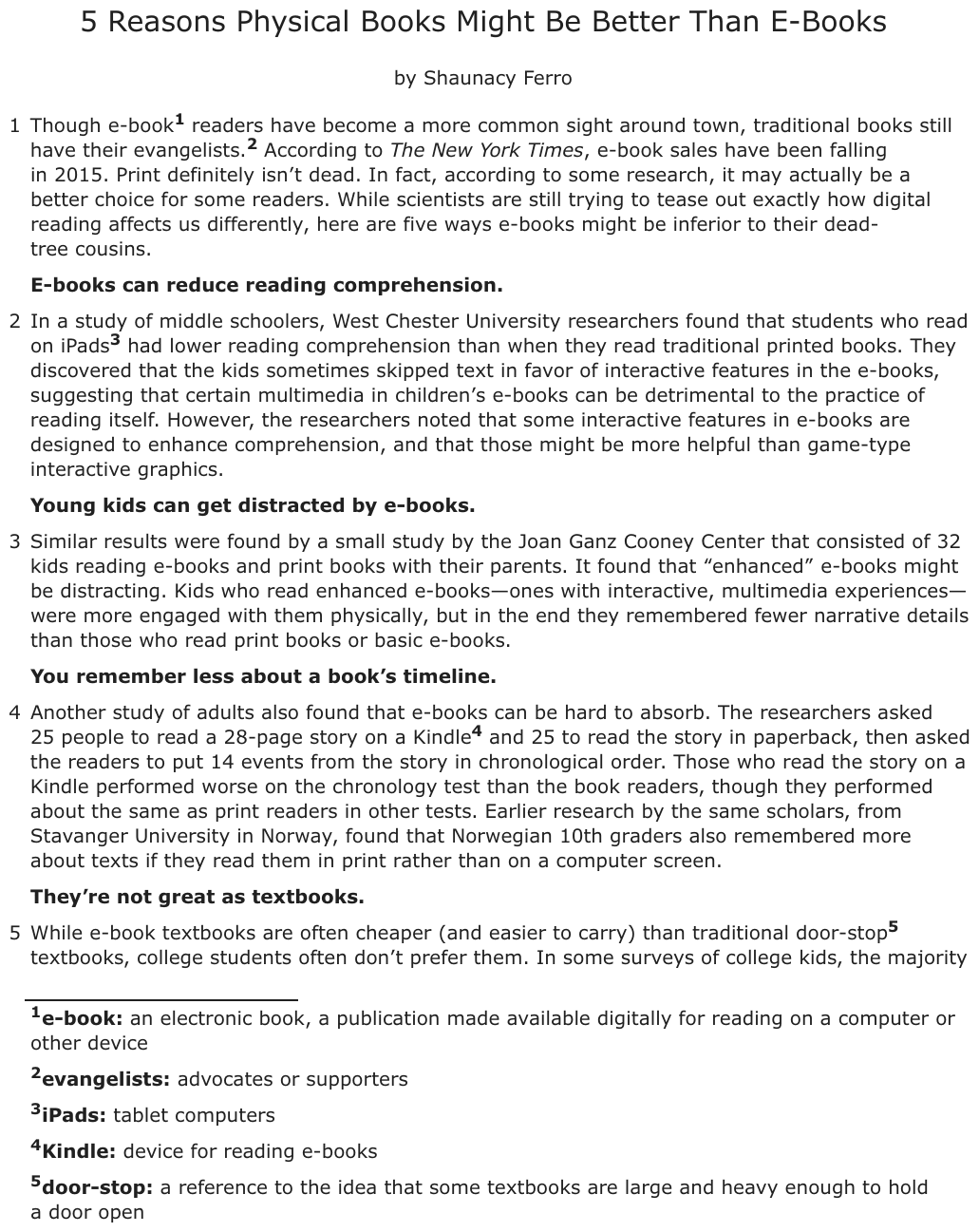
While e-book textbooks are often cheaper (and easier to carry) than traditional door-stop5 textbooks, college students often don’t prefer them. In some surveys of college kids, the majority of students have reported preferring print books. However, a 2012 study from the UK’s National Literacy Trust of kids ages 8 to 16 found that more than 50 percent of children reported preferring screen reading.
They’re tiring.
Staring at a lit screen can be tiring for the eyes and the brain. A 2005 study from Sweden found that reading digitally required a higher cognitive workload than reading on paper. Furthermore, staring at LED6 screens at night can disrupt sleep patterns. A 2014 Harvard study found that people who used e-readers with LED screens at night slept worse and were more tired the next day. So, if you’re going to go for an e-book, go for one without the backlight.
The take-away message? If you’re really trying to absorb material, you might want to go for a physical book. And if you’re going to be up all night studying, turn off the backlight.
However, all this may not mean that reading on a Kindle is really going to melt your brain. For instance, reading an e-book on a computer is a much different experience than reading on a Kindle, which is specifically designed for consuming books. So, too, is playing with an interactive e-book on an iPad, compared to using a simpler e-book device that only presents the text, with no opportunities to click away into digital distractions.
And some studies have found that part of the difference between the way people absorb information from e-books versus paper might be due to approaching e-books differently—in one test, participants didn’t regulate their study time with digital books like they did with paper texts, leading to worse performances. It’s possible that our expectations of e-book reading—as well as the different designs of the digital reading experience on a computer or iPad or Kindle—might affect how we approach the text and how much effort we put into studying them. As generations of e-book readers evolve, and people become more accustomed to the idea of sitting down with a digital textbook, these factors could change—for better or for worse.
“5 Reasons Physical Books Might Be Better Than E-Books” by Shaunacy Ferro from MENTAL FLOSS, October 2, 2015. Copyright © 2015 Mental Floss, Inc.
1e-book: an electronic book, a publication made available digitally for reading on a computer or other device
2evangelists: advocates or supporters
3iPads: tablet computers
4Kindle: device for reading e-books
5door-stop: a reference to the idea that some textbooks are large and heavy enough to hold a door open
6LED: Light-emitting diode; LEDs are often used as a backlight for electronic devices such as smart phones and tablets.
Question
The studies described in paragraph 6 are important to the author’s observations in paragraphs 7 and 8 because the findings
- Ashow that the author has personal opinions to share beyond the ideas included in the studies.
- Bgive the author the opportunity to reach practical conclusions about reading that are based on scientific evidence.
- Chighlight the author’s statement that digital reading experiences vary based on the individual and the device.
- Dsupport the author’s inference that more studies on more types of devices are needed.
Show the answer
Correct answer: B
The question asks how the findings from the studies described in paragraph 6 are important to the author’s observations in paragraphs 7 and 8.
A. Incorrect. The evidence from the studies mentioned in paragraph 6 is not substantially supported by the personal opinions the author shares in paragraph 7 (“And if you’re going to be up all night studying, turn off the backlight”) or in paragraph 8 (“melt your brain” and “digital distractions”).
B. CORRECT. In paragraph 6, the author cites studies from 2005 and 2014 that found that LED screens can “disrupt sleep patterns” and that “people who used e-readers with LED screens at night slept worse and were more tired the next day.” Then, in paragraph 7, the author suggests that “if you’re going to be up all night studying, turn off the backlight,” and in paragraph 8, the author explains some differences between reading e-books on various devices. This information is not based on a personal opinion; instead, it is based on practical conclusions drawn from scientific evidence.
C. Incorrect. In paragraph 6, the author cites a 2005 study in which researchers found that “reading digitally required a higher cognitive workload than reading on paper.” Then, in paragraph 8, the author concludes that “reading an e-book on a computer is a much different experience than reading on a Kindle, which is specifically designed for consuming books.” Although the findings in paragraph 6 are important, they do not highlight the information presented by the author that digital reading experiences vary based on the reader and the device.
D. Incorrect. The author states in paragraph 8 that “reading an e-book on a computer is a much different experience than reading on a Kindle” and mentions how the same thing is true for “an interactive e-book on an iPad” compared with an e-book on “a simpler e-book device.” Readers may conclude that this statement is meant to indicate the author’s belief that more studies on more types of devices are needed. However, the author does not state or imply this belief in the passage.
Question analysis
This question asks why the studies on screen fatigue and sleep in paragraph 6 of an article about e-books matter to the observations the author makes in the next two paragraphs. Students must trace the connection between the research and the later paragraphs, and each choice describes that link in abstract terms that are easy to confuse.
- Grade level
- Grade 8 reading and task
- Compared with grade 7
- Above grade 7 Tracing how evidence leads to an author's conclusions is grade 7 argument work, but this item spans three paragraphs, and the four explanations of the link are abstract and close in wording, more demanding than typical grade 7 work.
- Estimated difficulty
- Hard: combines ideas, needs a plan, and has more than one tempting wrong answer.
- Thinking it demands
- Depth of knowledge 3, strategic thinking · mainly analyze
- What makes it hard
- How, not what major
- Evidence in several places moderate
- The right answer is reworded minor
- Evidence
- Answered from several paragraphs or stanzas
- Reading level
- Passage: about grade 10, 829 words; question and choices: about grade 11, 80 words.
- Students, last 30 days
- Not enough answers yet to show (it takes 10).
Why it is hard, traps and wrong answers (shows the answer)
Why it is hard
Every choice describes a link between evidence and commentary, so the student has to know both what paragraph 6 found and what paragraphs 7 and 8 do with it. The tempting wrong answer borrows paragraph 8's real point that devices differ and wrongly credits the sleep and workload studies with it. Seeing that the backlight advice comes straight from the Harvard study is what makes the general wording of the right choice convincing.
How, not what major Working it out
The question asks how paragraph 6's findings function for the paragraphs after them, a relationship between evidence and conclusion, so knowing what the sleep and workload studies found is only the first step. (Anderson & Krathwohl, 2001)
Evidence in several places moderate Working it out
The links run across three paragraphs: the Harvard backlight finding becomes “turn off the backlight” in paragraph 7, and the tired brain returns as “melt your brain” in paragraph 8. (Kirsch & Mosenthal, 1990; Gorin & Embretson, 2006)
The right answer is reworded minor Choosing the answer
The right choice names no study, screen or device, speaking only of “practical conclusions” and “scientific evidence”, while two wrong choices echo paragraph 8's talk of devices. (Freedle & Kostin, 1993; Kirsch & Mosenthal, 1990)
Strategy: Note what the paragraph 6 studies found, then find the sentences in paragraphs 7 and 8 that draw on those findings and describe what the author does with them.
Traps
- Half right: One half of a two-part choice is right and the other is not.
- Reads too much in: A reasonable-sounding conclusion that goes further than the text allows.
- Wrong purpose or structure: Names a purpose, structure or effect that the part does not serve, or describes what a part says when the question asks what it does.
The wrong answers, classified
A Wrong purpose or structure (Anderson & Krathwohl, 2001)
Treats the casual phrases of paragraphs 7 and 8, such as “melt your brain”, as opinions beyond the research, when the advice there grows directly out of the studies.
C Half right (King et al., 2004; Thissen, Steinberg & Fitzpatrick, 1989)
Gets paragraph 8's point about devices right but adds variation by individual, which paragraphs 7 and 8 never mention, and the studies in paragraph 6 compare screens with paper, not readers.
D Reads too much in (Graesser, Singer & Trabasso, 1994)
Infers from paragraph 8's device comparisons that the author wants more research on more devices, a sensible thought that the passage never states.
Working it out, step by step
Understand the link asked about
This asks how evidence connects to the author’s comments. First see what the studies in paragraph 6 found. Then see what the author does with those findings in paragraphs 7 and 8.
Read the studies in paragraph 6
A 2005 study found that “reading digitally required a higher cognitive workload.” Cognitive workload means how hard your brain has to work. A 2014 study found that people who read on lit screens at night “slept worse and were more tired the next day.”
See how the author uses them
In paragraph 7 the author advises, “if you’re going to be up all night studying, turn off the backlight.” That tip comes straight from the sleep study. Paragraph 8 then warns you not to take the findings too far. It says they “may not mean that reading on a Kindle is really going to melt your brain.” Both are practical, real-life conclusions drawn from science.
Check each choice
- B fits: the studies let the author reach “practical conclusions” based on “scientific evidence.”
- A is wrong because the advice in paragraphs 7 and 8 grows out of the studies, not out of opinions beyond them.
- C is wrong because nothing says reading changes from person to person, and the studies compare screens with paper.
- D is wrong because the author never says more studies are needed.
Watch out: C is half right. Paragraph 8 does say devices differ, but the part about each person is never stated.
Choose the answer
The findings in paragraph 6 lead straight to the author’s practical advice. So the answer is B.
Why this answer and not the closest wrong one
C comes closest, because paragraph 8 does say a computer and a Kindle feel different. But the studies in paragraph 6 compare screens with paper, and no one says reading changes from person to person. B fits the clear link: a sleep study turned into the advice to turn off the backlight.
More questions like this
The original DOE question
The passage “5 Reasons Physical Books Might Be Better Than E-Books” as printed (pages 58–59)
Question 4 of 6
2024 Test B Math, question 49Question
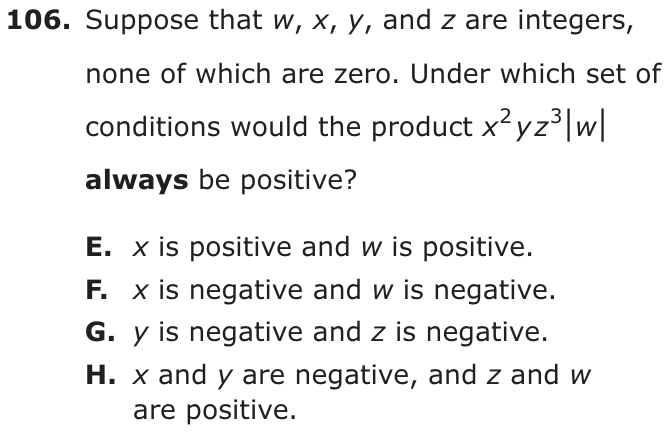
Suppose that w, x, y, and z are integers, none of which are zero. Under which set of conditions would the product always be positive?
- Ax is positive and w is positive.
- Bx is negative and w is negative.
- Cy is negative and z is negative.
- Dx and y are negative, and z and w are positive.
Show the answer
Correct answer: C
First, analyze the role of each variable in the expression .
will always be a positive number.
y can be a positive or a negative number.
can be a positive or a negative number.
will always be a positive number.
The expressions and will always be positive. Therefore, making the values of y and z negative would result in the expression being positive, since a negative multiplied by a negative is positive. Thus the given product would always be positive.
Question analysis
Four nonzero integers appear in a product that includes a square, a cube and an absolute value. Students choose the set of conditions that makes the product positive every time. It tests the sign rules for multiplication together with exponents and absolute value, and the trap is judging the sign by counting negative variables without looking at what is done to each.
- NYS standards
- Grade level
- Grade 7 content, by NYS standard
- Compared with grade 7
- Above grade 7 Grade 7 students learn sign rules for products of signed numbers. Here they must reason about four unknown integers under an even power, an odd power and an absolute value, and decide what is always true, which is more abstract than typical grade 7 work.
- Estimated difficulty
- Hard: combines ideas, needs a plan, and has more than one tempting wrong answer.
- Thinking it demands
- Depth of knowledge 2, skills and concepts · mainly analyze
- What makes it hard
- Variables instead of numbers moderate
- Every choice must be checked moderate
- Something you must already know minor
- Solution
- 3 steps
- Reading level
- Question and choices: about grade 6, 58 words.
- Students, last 30 days
- Not enough answers yet to show (it takes 10).
Why it is hard, traps and wrong answers (shows the answer)
Why it is hard
One insight decides the question: x² and |w| are positive whatever x and w are, so only the signs of y and z³ matter. Students who count negative letters instead of negative factors pick conditions that look balanced but leave y as the only negative factor. Students who test a single set of values can be fooled by a choice that leaves y and z unspecified.
Variables instead of numbers moderate Understanding the question
There are four variables and no numbers, and always positive must hold for every allowed value, so one test case can rule a choice out but never confirm it. (Koedinger & Nathan, 2004; Enright, Morley & Sheehan, 2002)
Every choice must be checked moderate Choosing the answer
Each set of conditions has to be checked against all four factors; the first two fix only x and w and leave y and z free to make the product negative. (Embretson & Wetzel, 1987)
Something you must already know minor Working it out
Students must know that a nonzero square and an absolute value are always positive, while an odd power such as z³ keeps the sign of z. (Anderson & Krathwohl, 2001)
Strategy: Work out, factor by factor, which signs each part of the product can take, then test each set of conditions against every factor rather than counting negatives.
Traps
- Negatives and direction: Arithmetic with negative numbers, the order of a subtraction, or direction on a number line. (Moving a term across the equals sign without changing its sign is a faulty procedure.)
- Misunderstands the concept: A wrong belief about a concept: that percents can be added, that area grows like length, that averages can be averaged, that a bigger denominator means a bigger fraction.
The wrong answers, classified
A Checks only one number (Schoenfeld, 1985)
Tests the choice with every variable positive, so the product is positive and it seems to work; y = −1 with z = 1 would make it negative.
B Misunderstands the concept (Smith, diSessa & Roschelle, 1993; De Bock et al., 1998; Ni & Zhou, 2005)
Pairs the negatives x and w as if they must cancel, not seeing that x² and |w| are positive anyway, so y and z still decide.
D Negatives and direction (Brown & Burton, 1978)
Counts two negative letters, x and y, as an even number of negatives, but x² is positive, so y is the only negative factor.
Worked solution, step by step
Formulas used
- Signs in multiplication
- a and b are positive numbers, so −a and −b are negative. A negative times a negative is positive. A negative times a positive is negative. So a product is positive when it has an even number of negative factors.
Sort out the question
w, x, y and z are integers, meaning whole numbers or their negatives. None of them is 0. The product means .
You need the conditions that make the product positive every time, for every number that fits them.
Look at x squared and |w|
means x × x. Two positives or two negatives multiply to a positive. So is always positive.
is the absolute value of w, its distance from 0. It is always positive, since w is not 0.
So x and w never change the sign of the product. Their signs do not matter.
Look at y and z cubed
y can be positive or negative. means z × z × z, and it has the same sign as z. For example, .
So the sign of the whole product is the sign of . It depends only on y and z.
Test each choice
- A and B say nothing about y and z. If y = −1 and z = 1, the product is negative. So they do not always work.
- C: y is negative, and is negative. A negative times a negative is positive. This always works.
- D: y is negative and z is positive. So the product is always negative.
Watch out: D has two negative letters, x and y. But is positive anyway, so y is the only negative factor.
So the answer is C, y is negative and z is negative.
Check your answer
Try numbers for C. Let x = −2, y = −3, z = −1 and w = −5. Then , which is positive. Even with x and w negative, the product stays positive.
More questions like this
The original DOE question
Question 5 of 6
2026 Practice Test B Math, question 24Question
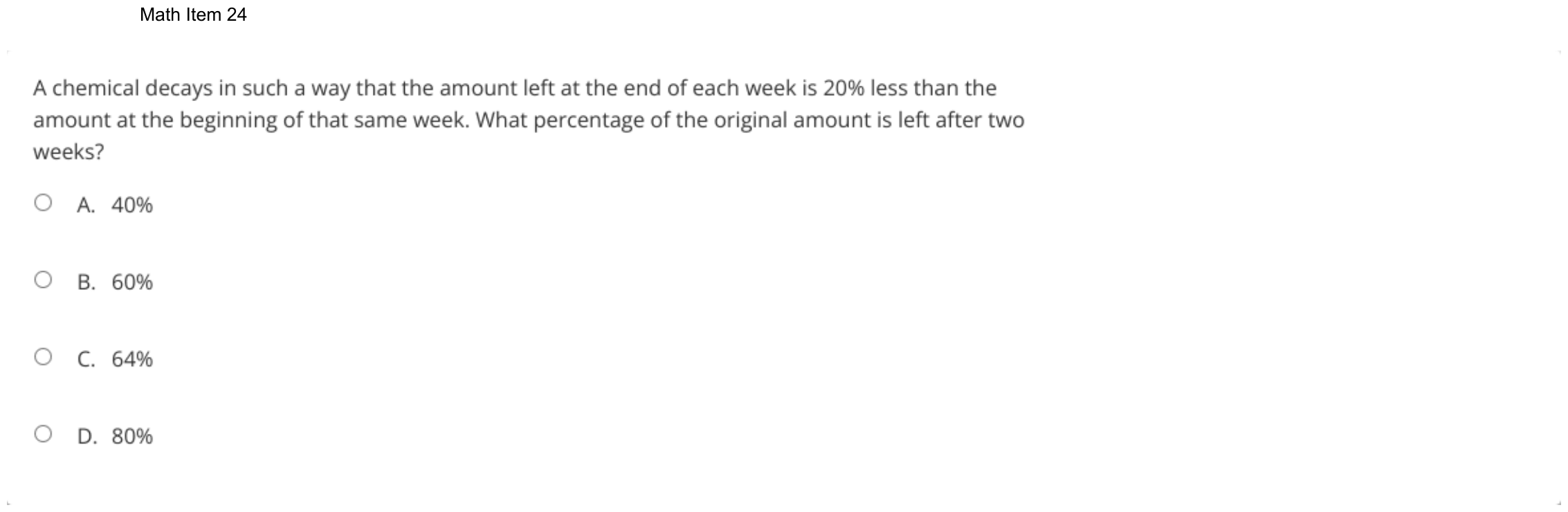
A chemical decays in such a way that the amount left at the end of each week is 20% less than the amount at the beginning of that same week. What percentage of the original amount is left after two weeks?
- A40%
- B60%
- C64%
- D80%
Show the answer
Correct answer: C
Let x be the original amount of the chemical. It loses 20% after each week, which means 80% of the chemical remains at the end of each week. End of first week:
At the end of the second week, 80% of the amount left at the end of the first week remains.
End of second week: or 64%
Question analysis
A chemical loses 20% of the amount present at the start of each week, and students find what percentage of the original amount is left after two weeks. It tests applying a percent decrease more than once. The question turns on which amount each week's loss is measured against.
- NYS standards
- 7.RP.3 multistep ratio and percent problems
- Grade level
- Grade 7 content, by NYS standard
- Compared with grade 7
- Above grade 7 A typical grade 7 percent task applies one increase or decrease to one amount. This one applies a weekly decrease twice in a row, an early form of exponential decay that goes beyond typical grade 7 work.
- Estimated difficulty
- Hard: combines ideas, needs a plan, and has more than one tempting wrong answer.
- Thinking it demands
- Depth of knowledge 2, skills and concepts · mainly apply
- What makes it hard
- A very close wrong answer major
- Turning words into math moderate
- Variables instead of numbers minor
- Solution
- 2 steps
- Reading level
- Question and choices: about grade 8, 40 words.
- Students, last 30 days
- 50% right, of 16 answers
Why it is hard, traps and wrong answers (shows the answer)
Why it is hard
Two equal decreases in a row feel like one decrease of twice the size, and that is the trap: 20% and 20% suggest 40% gone. The stem states the rule, each loss measured from that week’s start, in one quick phrase. Working week by week from 100 shows the second loss is 16, not 20, which separates the answer from the choice four points away, while stopping after one week or reporting the loss costs the point more simply.
A very close wrong answer major Choosing the answer
The choices 60% and 64% sit four percentage points apart, so a rough estimate cannot choose between them; only seeing that the second 20% is taken from 80, not 100, does. (Embretson & Wetzel, 1987; Gorin & Embretson, 2006; Ascalon et al., 2007)
Turning words into math moderate Understanding the question
The phrase “the amount at the beginning of that same week” sets each week’s base, so the second week’s 20% is measured from what was left after the first week. (Hegarty, Mayer & Monk, 1995; Koedinger & Nathan, 2004)
Variables instead of numbers minor Understanding the question
No starting amount is given, so students must pick one, such as 100 grams, or work with a percent of a percent, 0.8 × 0.8. (Koedinger & Nathan, 2004; Enright, Morley & Sheehan, 2002)
Strategy: Use a starting amount of 100 so that percents become units, find what remains after the first week, then apply the same 20% loss to that remainder.
Traps
- Percent of the wrong amount: Finding the whole from a part, or a percent change measured from the wrong starting amount.
- Stops one step early: A choice is a number from partway through the solution.
- Answers a different question: A choice is right for another quantity: the other unknown, the rest instead of the part, the part instead of the whole.
The wrong answers, classified
A Answers a different question (King et al., 2004; Hegarty, Mayer & Monk, 1995)
Adds the weekly losses, 20% + 20% = 40%, and gives that figure, which describes the amount lost rather than the percentage still left.
B Percent of the wrong amount (Parker & Leinhardt, 1995)
Subtracts 20% of the original amount twice, 100 − 20 − 20 = 60, though the second week’s 20% comes from the 80% left, not the starting amount.
D Stops one step early (King et al., 2004; Gierl et al., 2017)
Finds that 80% remains after the first week and stops, never taking the second week’s 20% from that remainder.
How 16 answers split, last 30 days
- A13%
- B31%
- C50%
- D6%
Worked solution, step by step
Formulas used
- Percent of an amount
- p is the percent, and amount is the whole you take the percent of. Percent means out of 100, so 20% is 20/100. Multiply to find the part. Be sure the amount is the right whole. Here, each week uses the amount at the start of that week.
- Percent left after a loss
- The whole amount is 100%. If 20% goes away, the rest stays. So 80% of each week’s starting amount is left at the end of that week. Keeping 80% is the same as multiplying by 0.8.
Sort out the question
Each week the chemical loses 20% of what it has. The key words are “the amount at the beginning of that same week.” So each week’s 20% comes from that week’s starting amount. No amount is given. You need the percent of the original amount that is left after two weeks.
Pick an easy starting amount
Pretend the chemical starts at 100 grams. With 100, the number of grams left is the same as the percent left. Any starting amount gives the same percent, so choose the easiest one.
Work out the first week
Use the percent formula. The first week starts with 100 grams:
The chemical loses 20 grams, so grams are left. That is 80% after one week.
Watch out: 80% is only the first week. Stopping here gives choice D.
Work out the second week
The second week starts with 80 grams, not 100. So take 20% of 80:
This time the chemical loses only 16 grams, so grams are left.
Watch out: taking away 20 grams again uses the original amount. That gives 60%, choice B. Choice A, 40%, adds the two losses. But the question asks what is left, and only 36% was lost.
Read the answer as a percent
Week Start (grams) Loss (grams) Left (grams) 1 100 20 80 2 80 16 64 Another way: each week keeps 80%, or 0.8, of its start. Two weeks gives , which is 64%.
64 grams out of the original 100 grams is 64%. So the answer is C, 64%.
Check your answer
Think about the size of the second loss. The second week starts with less, so it loses less than 20 grams. That means more than 60% is left. It does lose something, so less than 80% is left. Of the four choices, only 64% is between 60% and 80%.
More questions like this
The original DOE question
Question 6 of 6
2018 Test A Math, question 30Question
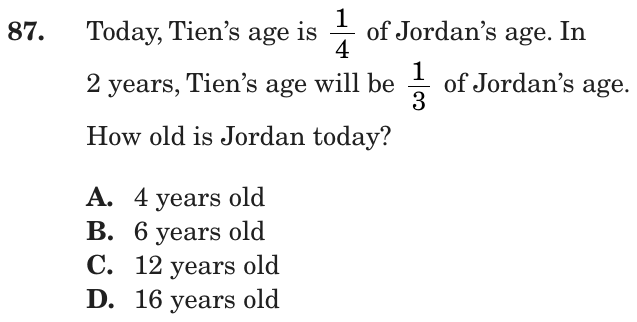
Today, Tien’s age is of Jordan’s age. In 2 years, Tien’s age will be of Jordan’s age. How old is Jordan today?
- A4 years old
- B6 years old
- C12 years old
- D16 years old
Show the answer
Correct answer: D
First, set up an equation to express Tien’s age () and Jordan’s age () today:
Two years from now, Tien’s age will be , and Jordan’s age will be .
Set up an equation about the relationship between Tien’s age and Jordan’s age in two years:
Solve the above equation for :
Now set the two equations equal to each other and solve for :
Question analysis
This age word problem says Tien is one fourth of Jordan's age today and will be one third of Jordan's age in two years, then asks for Jordan's current age. Students must turn two fractional relationships into equations and solve them together. Both people age by the same two years, and it is easy to solve for the wrong person.
- NYS standards
- Grade level
- Grade 8 content, by NYS standard
- Compared with grade 7
- Above grade 7 Grade 7 equations have one unknown on one side, like 3x + 5 = 20. This one links two unknown ages with fractional coefficients and leads to a variable on both sides, which is grade 8 algebra.
- Estimated difficulty
- Hard: combines ideas, needs a plan, and has more than one tempting wrong answer.
- Thinking it demands
- Depth of knowledge 2, skills and concepts · mainly apply
- What makes it hard
- Turning words into math major
- Error-prone arithmetic moderate
- Solution
- 4 steps
- Reading level
- Question and choices: about grade 1, 31 words.
- Students, last 30 days
- 41% right, of 39 answers
Why it is hard, traps and wrong answers (shows the answer)
Why it is hard
The difficulty is in the setup: two fractional relationships at two different times, with both people aging. Once the equations are right, the algebra is short, but it ends with two ages and only one is asked for. Testing the choices against both conditions is a reliable alternative that avoids the algebra entirely.
Turning words into math major Understanding the question
The second sentence must become T + 2 = (J + 2)/3; writing J/3, or forgetting that Jordan also ages two years, breaks the equation. (Hegarty, Mayer & Monk, 1995; Koedinger & Nathan, 2004)
Error-prone arithmetic moderate Working it out
Substituting J/4 for T leaves J/4 + 2 = (J + 2)/3, an equation with fractions on both sides that must be cleared, usually by multiplying by 12. (Brown & Burton, 1978; Junker & Sijtsma, 2001)
Strategy: Let Jordan's age be J, write Tien's age as J/4, and set J/4 + 2 equal to one third of (J + 2); or test each choice against both conditions.
Traps
- Answers a different question: A choice is right for another quantity: the other unknown, the rest instead of the part, the part instead of the whole.
The wrong answers, classified
A Answers a different question (King et al., 2004; Hegarty, Mayer & Monk, 1995)
Solves the equations correctly but reports Tien's age today, 4, which is one fourth of Jordan's 16, instead of Jordan's age.
B Answers a different question (King et al., 2004; Hegarty, Mayer & Monk, 1995)
Gives Tien's age two years from now, 4 + 2 = 6, answering for the wrong person and the wrong time.
C Numbers taken from the question (Hegarty, Mayer & Monk, 1995)
Picks 12 because it is a multiple of both 4 and 3, but then Tien would be 3 and later 5, not a third of 14.
How 39 answers split, last 30 days
- A5%
- B15%
- C38%
- D41%
Worked solution, step by step
Formulas used
- Distributive property
- a, b and c are any numbers. To multiply a sum by a number, multiply each part of the sum, then add. It works because a groups of (b + c) is the same as a groups of b plus a groups of c.
Sort out what you know
Today, Tien’s age is of Jordan’s age. That means Jordan is 4 times as old as Tien.
In 2 years, both of them will be 2 years older. Then Tien’s age will be of Jordan’s. So Jordan will be 3 times as old as Tien. You need Jordan’s age today.
Name the ages with a letter
Let t stand for Tien’s age today. Jordan is 4 times as old, so his age is 4t, which means 4 times t. Add 2 years to each age:
Person Today In 2 years Tien Jordan Watch out: Jordan gets 2 years older too. Do not forget to add 2 to his age.
Write an equation for later
In 2 years, Jordan’s age will be 3 times Tien’s age. Write that as an equation:
Use the distributive property on the right side. Multiply both t and 2 by 3:
Solve for Tien’s age
Take 3t away from both sides. Doing the same thing to both sides keeps them equal:
Now take 2 away from both sides:
So Tien is 4 years old today. Watch out: 4 is Tien’s age, not Jordan’s. Choice A, 4 years old, is a trap.
Find Jordan’s age
Jordan is 4 times as old as Tien:
So the answer is D, 16 years old.
Check your answer
Put 16 back into the story. Today, Tien is 16 ÷ 4 = 4. In 2 years, Tien is 6 and Jordan is 18. Is 6 one third of 18? Yes, because 18 ÷ 3 = 6. Choice C fails: Tien would be 3, then 5, and 5 is not a third of 14.
More questions like this
The original DOE question