Ratios
Question 1 of 19
2026 Practice Test C Math, question 21Question
In a fruit basket, the ratio of apples to oranges is the same as the ratio of cherries to walnuts. If there are 6 oranges, 16 cherries, and 48 walnuts, how many apples are there?
- A2
- B3
- C18
- D38
Show the answer
Correct answer: A
The ratios of the items are equal, so they can be expressed using a proportion.
Let a represent the number of apples, o the number of oranges, c the number of cherries, and w the number of walnuts. Write a proportion showing apples:oranges is equal to cherries:walnuts:
Substitute the given values for oranges (6), cherries (16), and walnuts (48):
Cross multiply to form an equation to solve for the number of apples (a):
Solve for the value of a:
Question analysis
In a fruit basket, the ratio of apples to oranges equals the ratio of cherries to walnuts, and students find the number of apples from the counts of oranges, cherries and walnuts. It tests setting up and solving a proportion. Matching each quantity to its place in the ratio matters, since the wrong order gives a very different count.
- Grade level
- Grade 6 content, by NYS standard
- Compared with grade 7
- Below grade 7 Equal ratios with whole numbers are grade 6 work, and the numbers divide evenly. Grade 7 proportion problems are usually longer; here the only care is keeping apples with oranges in the same order as cherries with walnuts.
- Estimated difficulty
- Straightforward: two steps or one careful reading.
- Thinking it demands
- Depth of knowledge 2, skills and concepts · mainly apply
- What makes it hard
- Turning words into math minor
- Much to keep track of minor
- Solution
- 2 steps
- Reading level
- Question and choices: about grade 7, 32 words.
- Students, last 30 days
- Not enough answers yet to show (it takes 10).
Why it is hard, traps and wrong answers (shows the answer)
Why it is hard
The numbers divide evenly, since 16/48 is 1/3, so the work is in the setup. Writing the two ratios in the order the sentence gives them makes the apples a third of the oranges; writing either one upside down makes them three times the oranges. A quick sense check helps: cherries are fewer than walnuts, so apples must be fewer than oranges.
Turning words into math minor Understanding the question
The sentence pairs apples with oranges and cherries with walnuts in the same order, so a/6 = 16/48; reading either pair the other way turns one ratio upside down. (Hegarty, Mayer & Monk, 1995; Koedinger & Nathan, 2004)
Much to keep track of minor Working it out
Four kinds of fruit are named and three counts given, and the unknown apples must be matched with the smaller count, the cherries, not the larger, the walnuts. (Sweller, 1988; Carpenter, Just & Shell, 1990)
Strategy: Write apples over oranges equal to cherries over walnuts, simplify the known ratio, and scale it to match the 6 oranges.
Traps
- Wrong operation: Adds instead of multiplying, divides the wrong way round, turns a ratio or rate upside down, or undoes a step in the wrong direction (subtracts what should be added back).
- Stops one step early: A choice is a number from partway through the solution.
- Misunderstands the concept: A wrong belief about a concept: that percents can be added, that area grows like length, that averages can be averaged, that a bigger denominator means a bigger fraction.
The wrong answers, classified
B Stops one step early (King et al., 2004; Gierl et al., 2017)
Divides the 48 walnuts by the 16 cherries to get the factor 3 and stops before using it to divide the 6 oranges.
C Wrong operation (Hegarty, Mayer & Monk, 1995; King et al., 2004)
Turns one ratio upside down, setting apples over oranges equal to 48 over 16, so the apples come out as 3 × 6 = 18.
D Misunderstands the concept (Smith, diSessa & Roschelle, 1993; De Bock et al., 1998; Ni & Zhou, 2005)
Reasons with differences instead of ratios, taking the gap of 32 between walnuts and cherries and adding it to the 6 oranges.
Worked solution, step by step
Formulas used
- Equal ratios
- A ratio compares two amounts. Writing it as a fraction puts the first thing named on top. The question says the two ratios are the same, so the two fractions are equal. Keep the same order in both.
Sort out the question
A ratio compares two amounts. The ratio of apples to oranges equals the ratio of cherries to walnuts. You know there are 6 oranges, 16 cherries and 48 walnuts. You need the number of apples.
Write the proportion
Put the first thing of each pair on top. Apples go with oranges, and cherries go with walnuts. Let a be the number of apples:
Watch out: keep the order the same. Writing 48 over 16 flips the second ratio. That gives 18, choice C.
Simplify the known ratio
16 goes into both 16 and 48. Divide the top and the bottom by 16:
So there is 1 cherry for every 3 walnuts. There must also be 1 apple for every 3 oranges.
Find the apples
Now the proportion is:
The bottom 6 is 3 × 2, so the top is 1 × 2. That makes .
Watch out: is choice B, but that is not the number of apples. And 38 comes from using differences instead of ratios.
So the answer is A, 2.
Check your answer
Compare the ratios. Apples to oranges is 2 to 6. Cherries to walnuts is 16 to 48. In both, the second number is 3 times the first: and . So the ratios are equal.
More questions like this
The original DOE question
Question 2 of 19
2026 Practice Test C Math, question 24Question
In a showing of an artist’s works, the ratio of the number of paintings, drawings, and photographs shown is 3:5:4, respectively. If the number of drawings shown was 45, what is the total number of photographs and paintings that were shown?
- A36
- B63
- C84
- D108
Show the answer
Correct answer: B
The ratio of paintings to drawings to photographs is .
First, determine the number of actual paintings and photographs.
Since the number of actual drawings is 45, each ratio is multiplied by 9, since .
| Type | Ratio | Actual Number |
|---|---|---|
| Paintings | 3 | 27 |
| Drawings | 5 | 45 |
| Photographs | 4 | 36 |
Then, add the actual number of paintings and photographs.
Question analysis
An art showing has paintings, drawings and photographs in the ratio 3:5:4, and 45 drawings were shown. Students find the total number of photographs and paintings. It tests using a three-part ratio to find actual amounts, and the question asks for two of the three groups together, not any single group or the whole show.
- Grade level
- Grade 7 content, by NYS standard
- Compared with grade 7
- At grade 7 Scaling a ratio from one known part is grade 6 and 7 work. A three-part ratio, and a question about two of the three groups combined, make it a three-step task typical of grade 7 ratio problems.
- Estimated difficulty
- Moderate: several steps, or a close reading with one strong distractor.
- Thinking it demands
- Depth of knowledge 2, skills and concepts · mainly apply
- What makes it hard
- Much to keep track of moderate
- Turning words into math minor
- Solution
- 3 steps
- Reading level
- Question and choices: about grade 10, 39 words.
- Students, last 30 days
- Not enough answers yet to show (it takes 10).
Why it is hard, traps and wrong answers (shows the answer)
Why it is hard
The scale factor comes from one division, 45 ÷ 5 = 9, so the risk lies in what to do with it. Two tempting results are listed: the photographs alone, and the whole show with the drawings added in. Multiplying the 3 + 4 = 7 parts for paintings and photographs by 9 gives the total in one step and avoids both.
Much to keep track of moderate Working it out
The ratio has three parts, the known count belongs to the middle part, drawings, and the question wants the first and third parts combined, so three roles must be tracked. (Sweller, 1988; Carpenter, Just & Shell, 1990)
Turning words into math minor Understanding the question
The word respectively assigns 3, 5 and 4 to paintings, drawings and photographs in that order, and the question then names two of them in the other order. (Hegarty, Mayer & Monk, 1995; Koedinger & Nathan, 2004)
Strategy: Find how many works each ratio part stands for from the drawings, multiply it by the parts for paintings and for photographs, and add only those two.
Traps
- Stops one step early: A choice is a number from partway through the solution.
- Answers a different question: A choice is right for another quantity: the other unknown, the rest instead of the part, the part instead of the whole.
The wrong answers, classified
A Stops one step early (King et al., 2004; Gierl et al., 2017)
Finds the photographs, 4 × 9 = 36, and stops before adding the 27 paintings that the question also asks about.
C Numbers taken from the question (Hegarty, Mayer & Monk, 1995)
Multiplies the 7 parts for paintings and photographs by 12, the total of the ratio's parts, instead of by 9.
D Answers a different question (King et al., 2004; Hegarty, Mayer & Monk, 1995)
Finds every group correctly but adds the 45 drawings too, giving the whole show, 108, rather than the paintings and photographs.
Worked solution, step by step
Formulas used
- Using the parts of a ratio
- The ratio 3:5:4 splits the show into equal parts. Parts is how many parts a group has. Each part stands for the same number of works. Find that number from the group you know, then multiply each group’s parts by it.
Sort out the question
The ratio of paintings to drawings to photographs is 3:5:4. Respectively means in that order: 3 for paintings, 5 for drawings and 4 for photographs. There were 45 drawings. You need the number of photographs and paintings together.
Find the value of one part
Drawings are 5 parts, and there were 45 drawings:
So each part of the ratio stands for 9 works.
Find each group
Multiply each group’s parts by 9:
Type Parts Actual number Paintings 3 Drawings 5 Photographs 4 The drawings row gives 45, which matches the question.
Add only the two groups asked for
Add the paintings and the photographs:
Watch out: 36 alone, choice A, leaves out the paintings. Adding the 45 drawings too gives 108, choice D, the whole show.
So the answer is B, 63.
Check your answer
Paintings and photographs are parts. Each part is 9 works, so . That matches. Also, 63 to 45 is the same as 7 to 5, just as the ratio says.
More questions like this
The original DOE question
Question 3 of 19
2026 Practice Test D Math, question 27Question
A birdseed mixture is sunflower seeds. The cost of the sunflower seeds is $0.10 per ounce. At this rate, what is the cost of the sunflower seeds in 25 pounds of this birdseed? (Note: 1 lb = 16 oz.)
- A$10.00
- B$16.00
- C$40.00
- D$160.00
Show the answer
Correct answer: B
First, calculate the amount of sunflower seeds in 25 pounds of this birdseed by using ratio reasoning to find that there are 10 pounds of sunflower seeds in the birdseed.
Then, use ratio reasoning to find the cost of the sunflower seeds per pound.
The cost of the sunflower seeds is $1.60 per pound.
Finally, find the total cost using ratios by multiplying the unit cost per pound by 10 pounds.
The first two steps above could be done in the other order; that is, find $1.60 per pound first and 10 pounds of sunflower seeds second.
Question analysis
A birdseed mixture is two-fifths sunflower seeds, which cost 10 cents an ounce, and students find the cost of the sunflower seeds in 25 pounds of the mix. It combines a fraction of a whole, a pounds-to-ounces conversion and a unit price. Each step's result looks like a possible answer, so keeping track of which quantity is in hand matters.
- Grade level
- Grade 7 content, by NYS standard
- Compared with grade 7
- At grade 7 Multistep ratio problems with a unit conversion are typical grade 7 work. This one chains three short steps, a fraction of the mixture, pounds to ounces and a price per ounce, and the numbers are chosen to come out evenly.
- Estimated difficulty
- Moderate: several steps, or a close reading with one strong distractor.
- Thinking it demands
- Depth of knowledge 2, skills and concepts · mainly apply
- What makes it hard
- Many steps moderate
- Combines ideas minor
- Solution
- 3 steps
- Reading level
- Question and choices: about grade 3, 35 words.
- Students, last 30 days
- Not enough answers yet to show (it takes 10).
Why it is hard, traps and wrong answers (shows the answer)
Why it is hard
Each step is routine, but the steps can be done in more than one order, and every partial result looks like a price once a dollar sign is put in front of it. Each wrong choice leaves something out: the 2/5, the price per ounce, or the conversion and the price together. Labelling each number with its unit, pounds, ounces or dollars, as it is found keeps the chain straight and shows when it is finished.
Many steps moderate Working it out
Three operations are chained: 2/5 of 25 pounds gives 10 pounds of sunflower seeds, the note turns them into 160 ounces, and $0.10 an ounce prices them; stopping at 10 pounds or 160 ounces, or skipping the 2/5, gives a listed choice. (Daniel & Embretson, 2010; Enright, Morley & Sheehan, 2002)
Combines ideas minor Working it out
A fraction of a mixture, a pounds-to-ounces conversion and a price per ounce meet in one question, and the price is per ounce while the amount is given in pounds. (Embretson, 1998; Daniel & Embretson, 2010)
Strategy: Find the weight of the sunflower seeds first, change it to ounces with the note, then multiply by the price per ounce; or turn the price into dollars per pound first.
Traps
- Stops one step early: A choice is a number from partway through the solution.
- Answers a different question: A choice is right for another quantity: the other unknown, the rest instead of the part, the part instead of the whole.
The wrong answers, classified
A Stops one step early (King et al., 2004; Gierl et al., 2017)
Finds that 10 of the 25 pounds are sunflower seeds and stops, giving that weight as $10.00 without converting it to ounces or pricing it.
C Answers a different question (King et al., 2004; Hegarty, Mayer & Monk, 1995)
Prices all 25 pounds of birdseed, 400 ounces at $0.10 an ounce, never taking the 2/5 of the mixture that is sunflower seeds.
D Stops one step early (King et al., 2004; Gierl et al., 2017)
Converts the 10 pounds of sunflower seeds to 160 ounces and stops, reading the number of ounces as the cost without multiplying by $0.10.
Worked solution, step by step
Formulas used
- A fraction of an amount
- The whole is the full amount, here 25 pounds of birdseed. The fraction tells how much of it you want. To find 2/5 of something, split it into 5 equal parts and take 2 of them. Multiplying does both at once.
- Changing pounds to ounces
- The note says 1 pound is 16 ounces. So each pound turns into 16 ounces. An ounce is smaller than a pound, so you get a bigger number.
- Total cost
- The units here are ounces. The price of one unit is $0.10 for one ounce. Every ounce costs the same, so you multiply the number of ounces by the price of one.
Sort out the question
You know:
- The birdseed is sunflower seeds.
- There are 25 pounds of birdseed.
- Sunflower seeds cost $0.10 per ounce.
- 1 pound = 16 ounces.
You need the cost, in dollars, of just the sunflower seeds. The price is per ounce, but the weight is in pounds. So you will need to change pounds to ounces.
Find the weight of sunflower seeds
Only 2/5 of the birdseed is sunflower seeds. Find 2/5 of 25 pounds:
Another way: 25 ÷ 5 = 5, and 2 fifths is 2 × 5 = 10. So there are 10 pounds of sunflower seeds.
Watch out: 10 is a number of pounds, not dollars. Stopping here and calling it $10.00 leads to choice A.
Change pounds to ounces
The price is per ounce, so turn the 10 pounds into ounces. Each pound is 16 ounces:
There are 160 ounces of sunflower seeds.
Watch out: 160 is a number of ounces, not dollars. Calling it $160.00 leads to choice D.
Find the cost
Each ounce costs $0.10. Multiply:
The sunflower seeds cost $16.00.
Watch out: skipping the 2/5 prices all 25 pounds. That is 400 ounces, and , choice C.
So the answer is B, $16.00.
Check your answer
Do it in another order. One pound of sunflower seeds costs dollars. Ten pounds cost dollars. You get $16.00 again.
More questions like this
The original DOE question
Question 4 of 19
2026 Practice Test D Math, question 48Question
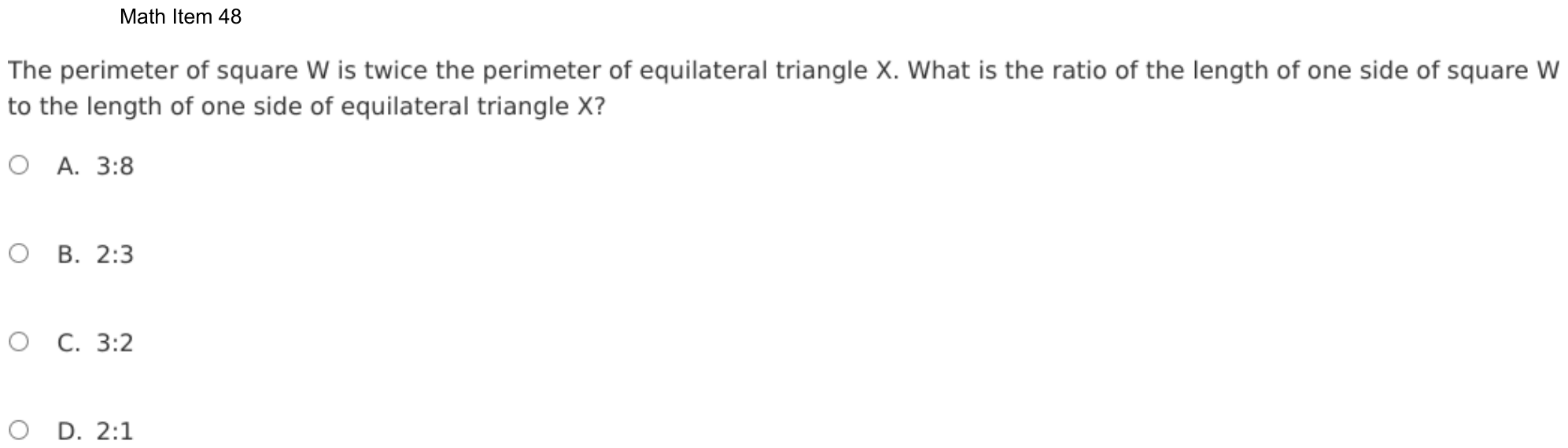
The perimeter of square W is twice the perimeter of equilateral triangle X. What is the ratio of the length of one side of square W to the length of one side of equilateral triangle X?
- A3:8
- B2:3
- C3:2
- D2:1
Show the answer
Correct answer: C
First, set up the ratio of the perimeter of the square to the triangle as 2:1 because the question states that the perimeter of the square is twice the perimeter of the triangle.
Recognizing that the square has 4 equal sides and that an equilateral triangle has 3 sides, use division to find the ratio of the sides.
Perimeter:
Sides:
Question analysis
The perimeter of square W is twice the perimeter of equilateral triangle X, and students find the ratio of a side of the square to a side of the triangle. This ratio question uses perimeters of regular shapes with no lengths given. Turning a comparison of perimeters into one of sides, and keeping the ratio in the order asked, are the tricky parts.
- NYS standards
- Grade level
- Grade 7 content, by NYS standard
- Compared with grade 7
- Above grade 7 Grade 7 ratio problems usually supply numbers to work with. This one gives only a relationship between two perimeters, so students must bring in the number of sides of each shape themselves and keep the ratio in the order asked.
- Estimated difficulty
- Hard: combines ideas, needs a plan, and has more than one tempting wrong answer.
- Thinking it demands
- Depth of knowledge 2, skills and concepts · mainly apply
- What makes it hard
- Turning words into math moderate
- Variables instead of numbers moderate
- A very close wrong answer minor
- Solution
- 3 steps
- Reading level
- Question and choices: about grade 9, 36 words.
- Students, last 30 days
- Not enough answers yet to show (it takes 10).
Why it is hard, traps and wrong answers (shows the answer)
Why it is hard
The question turns a statement about perimeters into a ratio of sides, and the natural guess, that the sides keep the perimeters’ 2 to 1, ignores that the square shares its perimeter among 4 sides and the triangle among 3. Choosing a triangle perimeter such as 12 makes the comparison concrete. The order of the ratio still has to be checked at the end, because its reverse is listed too.
Turning words into math moderate Understanding the question
“The perimeter of square W is twice the perimeter of equilateral triangle X” must become 4s = 2 × 3t, with the 2 on the triangle’s side; written backward, it gives the triangle the larger perimeter. (Hegarty, Mayer & Monk, 1995; Koedinger & Nathan, 2004)
Variables instead of numbers moderate Understanding the question
No side length is given, so students must either work with letters for the two sides or choose a convenient perimeter themselves, such as 12 for the triangle. (Koedinger & Nathan, 2004; Enright, Morley & Sheehan, 2002)
A very close wrong answer minor Choosing the answer
The ratios 3:2 and 2:3 use the same two numbers, so only keeping the square’s side first, as the question orders it, separates the answer from its reverse. (Embretson & Wetzel, 1987; Gorin & Embretson, 2006; Ascalon et al., 2007)
Strategy: Pick an easy side length for the triangle, find its perimeter, double that for the square, divide by the square's number of sides, and write square to triangle.
Traps
- Misunderstands the concept: A wrong belief about a concept: that percents can be added, that area grows like length, that averages can be averaged, that a bigger denominator means a bigger fraction.
- Wrong operation: Adds instead of multiplying, divides the wrong way round, turns a ratio or rate upside down, or undoes a step in the wrong direction (subtracts what should be added back).
- Equation written backwards: Writes a comparison the wrong way round, word for word: "six times as many students as professors" as 6S = P. The bigger quantity gets the bigger number.
The wrong answers, classified
A Equation written backwards (Clement, Lochhead & Monk, 1981)
Writes the comparison backward, 2 × 4s = 3t, giving the triangle the larger perimeter, so the ratio of the sides comes out 3:8.
B Wrong operation (Hegarty, Mayer & Monk, 1995; King et al., 2004)
Finds the right relationship but turns the ratio upside down, giving the triangle’s side to the square’s instead of the square’s side first.
D Misunderstands the concept (Smith, diSessa & Roschelle, 1993; De Bock et al., 1998; Ni & Zhou, 2005)
Assumes the sides are in the same ratio as the perimeters, 2:1, ignoring that the square has 4 sides and the triangle only 3.
Worked solution, step by step
Formulas used
- Perimeter of a square
- P is the perimeter, the distance around the shape. s is the length of one side. A square has 4 equal sides, so its perimeter is 4 times one side.
- Perimeter of an equilateral triangle
- An equilateral triangle has 3 equal sides. t is the length of one side. So its perimeter is 3 times one side.
- Ratio
- A ratio compares two amounts in order. a : b means a compared with b. The order matters, so write the amounts in the order the question names them.
Sort out the question
Square W has a perimeter twice as long as the perimeter of triangle X. Equilateral means all 3 sides of X are equal.
You need the ratio of one side of the square to one side of the triangle, in that order. No lengths are given, so you can pick a size to try.
Pick a size for the triangle
Choose an easy side length for the triangle, such as 2 units. All 3 sides are 2, so its perimeter is:
Find the square’s side
The square’s perimeter is twice the triangle’s:
The square has 4 equal sides, so divide by 4:
Each side of the square is 3 units.
Write the ratio in order
The square comes first, then the triangle. Their sides are 3 and 2, so the ratio is 3 : 2.
Watch out: 2 : 1, choice D, compares the perimeters, not the sides. The square splits its perimeter into 4 sides, the triangle into only 3. Choice B, 2 : 3, puts the triangle first. Choice A, 3 : 8, comes from giving the triangle the bigger perimeter.
So the answer is C, 3:2.
Check your answer
Try a different size. Give the triangle sides of 4. Its perimeter is 12, so the square’s is 24. Each side of the square is . The ratio 6 : 4 simplifies to 3 : 2. The size does not change the ratio.
More questions like this
The original DOE question
Question 5 of 19
2024 Test B Math, question 11Question
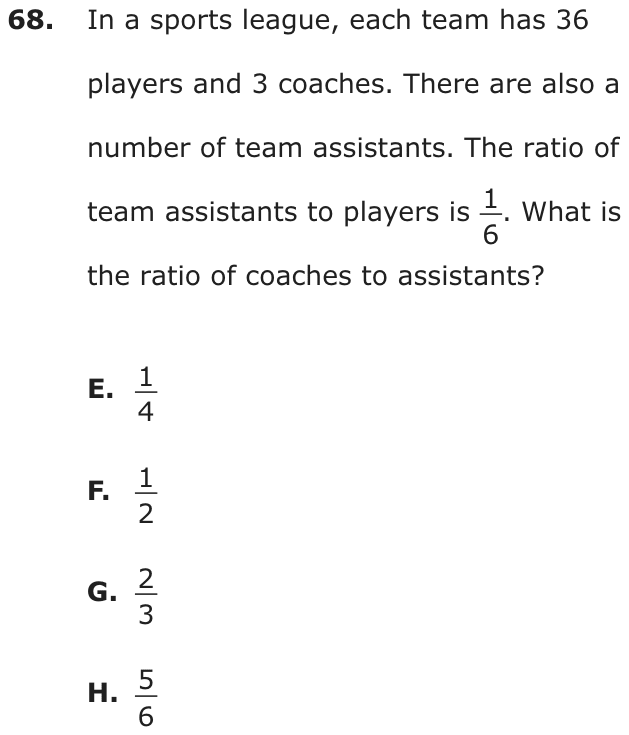
In a sports league, each team has 36 players and 3 coaches. There are also a number of team assistants. The ratio of team assistants to players is . What is the ratio of coaches to assistants?
- A
- B
- C
- D
Show the answer
Correct answer: B
Let x be the number of assistants.
Since the ratio of assistants to players is , then:
There are a total of 6 assistants.
So the ratio of coaches to assistants is .
Question analysis
A ratio word problem about a sports team with 36 players, 3 coaches and an unknown number of assistants, where the ratio of assistants to players is 1 to 6. Students find how many assistants there are, then form a new ratio of coaches to assistants. Keeping the order of each ratio straight matters.
- Grade level
- Grade 6 content, by NYS standard
- Compared with grade 7
- Below grade 7 Finding a missing amount from a ratio and then writing a second ratio is grade 6 ratio reasoning with whole numbers. Typical grade 7 work adds fractions, rates or percents, which this two-step problem does not.
- Estimated difficulty
- Straightforward: two steps or one careful reading.
- Thinking it demands
- Depth of knowledge 2, skills and concepts · mainly apply
- What makes it hard
- Turning words into math minor
- Much to keep track of minor
- Solution
- 2 steps
- Reading level
- Question and choices: about grade 5, 39 words.
- Students, last 30 days
- Not enough answers yet to show (it takes 10).
Why it is hard, traps and wrong answers (shows the answer)
Why it is hard
Two short steps, finding 6 assistants and then writing 3 to 6, make this one of the easier ratio questions. The care needed is in keeping each ratio's order and its two groups straight, since the given ratio compares assistants with players and the asked one compares coaches with assistants. None of the wrong choices matches a common slip closely, so students who find the 6 assistants seldom go wrong.
Turning words into math minor Understanding the question
“The ratio of team assistants to players is 1/6” must become 6 assistants for 36 players, and the question then asks for a ratio in a new order, coaches first. (Hegarty, Mayer & Monk, 1995; Koedinger & Nathan, 2004)
Much to keep track of minor Working it out
Three groups are named, 36 players, 3 coaches and an unknown number of assistants, and each ratio pairs a different two of them. (Sweller, 1988; Carpenter, Just & Shell, 1990)
Strategy: Use the 1 to 6 ratio to find the number of assistants from the 36 players, then write coaches over assistants, in that order, and simplify.
Traps
- Answers a different question: A choice is right for another quantity: the other unknown, the rest instead of the part, the part instead of the whole.
- Misunderstands the concept: A wrong belief about a concept: that percents can be added, that area grows like length, that averages can be averaged, that a bigger denominator means a bigger fraction.
The wrong answers, classified
A Answers a different question (King et al., 2004; Hegarty, Mayer & Monk, 1995)
Compares the 9 coaches and assistants together with the 36 players, 9/36 = 1/4, a ratio of all the staff to players that the question never asks for.
C Little reason to choose it (Haladyna & Downing, 1993; Rodriguez, 2005)
No common working gives 2/3; it equals the 6 assistants over all 9 staff, which puts the wrong group on top and a total underneath.
D Misunderstands the concept (Smith, diSessa & Roschelle, 1993; De Bock et al., 1998; Ni & Zhou, 2005)
Reads the ratio 1/6 as the assistants' share of everyone and gives the other 5/6, as if that remaining share described the coaches.
Worked solution, step by step
Formulas used
- Ratio as a fraction
- A ratio compares two amounts. The group named first goes on top, and the group named second goes on the bottom. Order matters. Assistants to players is not the same as players to assistants.
- Equal ratios
- a and b are the two numbers in a ratio, written as a fraction. n is any number except zero. Multiplying both numbers by the same n gives an equal ratio. This is how you scale a small ratio up to real counts.
Sort out what you know
Each team has 36 players and 3 coaches. It also has some assistants, but you are not told how many. The ratio of assistants to players is 1/6. That means 1 assistant for every 6 players. You need the ratio of coaches to assistants.
Find the number of assistants
Write the ratio as a fraction, assistants on top and players on the bottom. To get from 6 players to 36, multiply by 6. Do the same to the top.
So there are 6 assistants for the 36 players.
Write the new ratio
Now the order changes. Coaches come first, so coaches go on top.
Divide the top and the bottom by 3 to simplify.
Avoid the traps and answer
Watch out: use only coaches and assistants. Putting all 9 staff over the 36 players gives 1/4, choice A. Putting the 6 assistants over all 9 staff gives 2/3, choice C. And 1/6 is not a share of everyone, so 5/6, choice D, has no meaning here.So the answer is B, .
Check your answer
A ratio of 1/2 means 1 coach for every 2 assistants. With 3 coaches, that makes 6 assistants. Then 6 assistants to 36 players is , the ratio the question gave.
More questions like this
The original DOE question
Question 6 of 19
2024 Test B Math, question 45Question
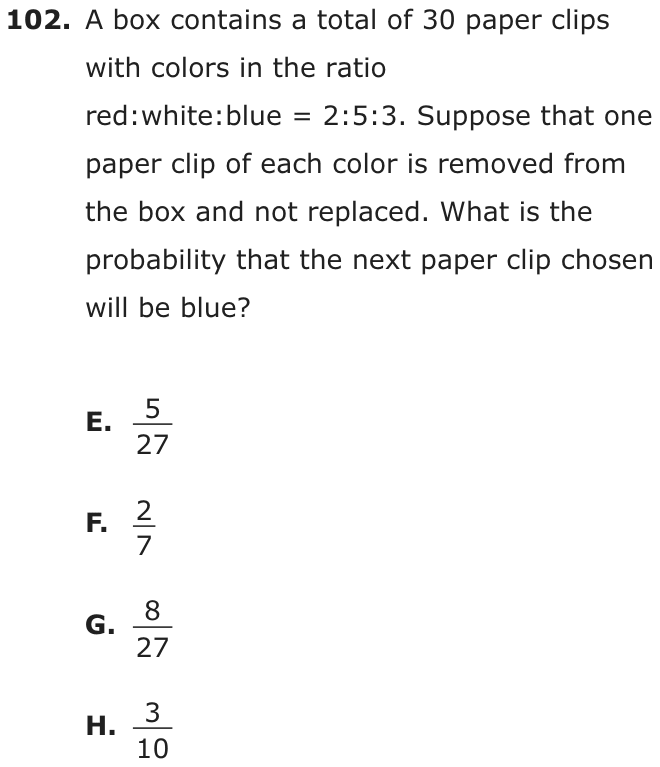
A box contains a total of 30 paper clips with colors in the ratio . Suppose that one paper clip of each color is removed from the box and not replaced. What is the probability that the next paper clip chosen will be blue?
- A
- B
- C
- D
Show the answer
Correct answer: C
The ratio is . Find the number of each color in a box of 30 paper clips.
If one paper clip of each color is removed (3 total), there will be 8 blue paper clips out of 27 in the box. The probability that the next paper clip chosen will be blue is .
Question analysis
A box of 30 paper clips has red, white and blue clips in the ratio 2 to 5 to 3, and one clip of each color is taken out. Students find the probability that the next clip drawn is blue. It tests ratios and simple probability; the ratio gives shares rather than counts, and the removals change both the blue count and the total.
- Grade level
- Grade 6 content, by NYS standard
- Compared with grade 7
- At grade 7 Splitting a total by a three-part ratio and finding a simple probability are both familiar skills. Combining them, then adjusting the counts after the removals, adds steps but stays within typical grade 7 multi-step work.
- Estimated difficulty
- Moderate: several steps, or a close reading with one strong distractor.
- Thinking it demands
- Depth of knowledge 2, skills and concepts · mainly apply
- What makes it hard
- Many steps moderate
- A very close wrong answer moderate
- Turning words into math minor
- Solution
- 4 steps
- Reading level
- Question and choices: about grade 5, 47 words.
- Students, last 30 days
- Not enough answers yet to show (it takes 10).
Why it is hard, traps and wrong answers (shows the answer)
Why it is hard
The question chains a ratio problem into a probability problem, with a small change in between. Students who skip the removal get 3/10, a choice that is almost the right value and looks natural because it matches the ratio. The cleanest route lists the actual counts, 6, 15 and 9, takes one from each, and writes blue's 8 over the remaining 27.
Many steps moderate Working it out
The ratio 2:5:3 must become counts of 6, 15 and 9 clips, one clip of each color must come out, and only then can blue's 8 be put over 27. (Daniel & Embretson, 2010; Enright, Morley & Sheehan, 2002)
A very close wrong answer moderate Choosing the answer
3/10 = 0.3 and 8/27, about 0.296, are almost equal, so an estimate cannot separate them; only subtracting the three removed clips does. (Embretson & Wetzel, 1987; Gorin & Embretson, 2006; Ascalon et al., 2007)
Turning words into math minor Understanding the question
The removal of one clip of each color, not replaced, happens before the draw, so it changes both the blue count and the total in the box. (Hegarty, Mayer & Monk, 1995; Koedinger & Nathan, 2004)
Strategy: Divide 30 by the sum of the ratio parts to find each color's count, take one clip away from each color, then put the blue count over the new total.
Traps
- Without replacement: In a second pick there is one fewer item, which changes the probability.
- Misunderstands the concept: A wrong belief about a concept: that percents can be added, that area grows like length, that averages can be averaged, that a bigger denominator means a bigger fraction.
- Answers a different question: A choice is right for another quantity: the other unknown, the rest instead of the part, the part instead of the whole.
The wrong answers, classified
A Answers a different question (King et al., 2004; Hegarty, Mayer & Monk, 1995)
Works out the counts correctly but puts red's remaining 5 clips over the 27 left, answering for the wrong color.
B Misunderstands the concept (Smith, diSessa & Roschelle, 1993; De Bock et al., 1998; Ni & Zhou, 2005)
Treats the ratio terms as actual counts and removes one from each, so blue is 3 − 1 = 2 of 10 − 3 = 7 clips.
D Without replacement (Fischbein & Schnarch, 1997)
Gives blue's share of the full box, 9 of 30 or 3 of 10 ratio parts, ignoring the three clips removed before the draw.
Worked solution, step by step
Formulas used
- Size of one ratio part
- The ratio numbers tell how many parts each color gets. Their sum is the number of parts in all. total is the number of clips. Dividing gives the size of one part. Each color is then its ratio number times one part.
- Probability
- P(blue) is the chance of picking a blue clip. The top counts the blue clips in the box. The bottom counts all the clips in the box. It works because each clip is equally likely to be picked.
Sort out the question
The box has 30 clips. The ratio red : white : blue = 2 : 5 : 3 means that for every 2 red clips, there are 5 white clips and 3 blue clips.
Then one clip of each color is taken out and not put back. You need the chance that the next clip picked is blue.
Find the size of one part
The ratio has parts in all. The 30 clips are shared among those 10 parts.
Each part is 3 clips.
Count the clips of each color
Multiply each ratio number by the size of one part.
Check: 6 + 15 + 9 = 30 clips. That matches the total.
Take out one of each color
One red, one white and one blue clip come out. Each color drops by 1, and the total drops by 3.
Color Before After Red 6 5 White 15 14 Blue 9 8 All 30 27 Find the chance of blue
Watch out: , choice D, ignores the 3 clips taken out. , choice A, is the chance of red. Taking 1 from each ratio number, as if the box held only 10 clips, gives , choice B.
So the answer is C, .
Check your answer
Add the clips left: 5 + 14 + 8 = 27. That matches. Also, is about 0.296, a bit less than blue’s share of the full box, 0.3. That makes sense, since one blue clip came out.
More questions like this
The original DOE question
Question 7 of 19
2023 Test A Math, question 39Question
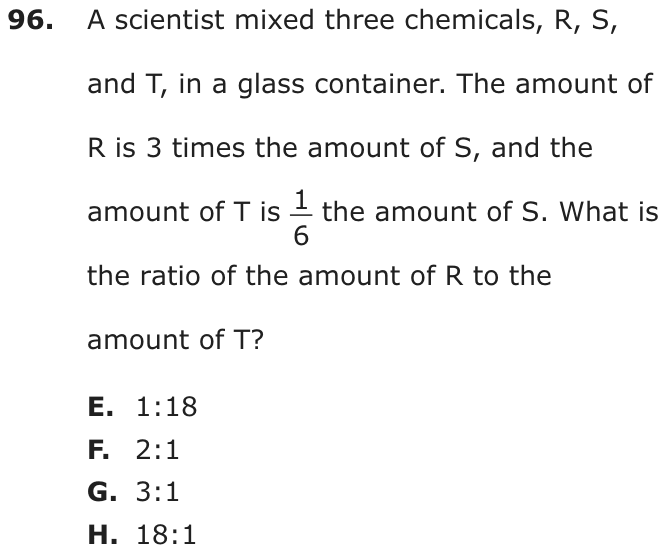
A scientist mixed three chemicals, R, S, and T, in a glass container. The amount of R is 3 times the amount of S, and the amount of T is the amount of S. What is the ratio of the amount of R to the amount of T?
- A1:18
- B2:1
- C3:1
- D18:1
Show the answer
Correct answer: D
First, set up the equations based on the information in the question.
So, the ratio of R:T is
Divide both sides by S to eliminate the variable. Then, multiply both sides by 6 to eliminate the fraction. The resulting ratio is 18:1.
Question analysis
This ratio question describes three chemicals mixed in a container: R is 3 times the amount of S, and T is one sixth of S. Students must combine the two relationships through S to find the ratio of R to T. Writing the ratio in the wrong order, or using only one of the relationships, produces the tempting wrong choices.
- Grade level
- Grade 7 content, by NYS standard
- Compared with grade 7
- At grade 7 Grade 7 ratio problems often link two quantities through a third. Here R and T are each described relative to S, one as a multiple and one as a fraction, and combining them into one ratio is typical grade 7 work with an order trap.
- Estimated difficulty
- Moderate: several steps, or a close reading with one strong distractor.
- Thinking it demands
- Depth of knowledge 2, skills and concepts · mainly apply
- What makes it hard
- Turning words into math moderate
- A very close wrong answer moderate
- Variables instead of numbers minor
- Solution
- 3 steps
- Reading level
- Question and choices: about grade 6, 48 words.
- Students, last 30 days
- Not enough answers yet to show (it takes 10).
Why it is hard, traps and wrong answers (shows the answer)
Why it is hard
The question chains two comparisons through S, and the 1/6 makes the chain awkward to do with letters. Choosing S = 6 turns it into whole numbers at once. The listed wrong ratios come from writing the right numbers in the wrong order, combining 3 and 6 by division, or stopping at the first comparison. Rereading which amount the question names first settles the order.
Turning words into math moderate Understanding the question
Both sentences compare a chemical with S, R as 3 times S and T as 1/6 of S, so S must serve as the link before R can be compared with T. (Hegarty, Mayer & Monk, 1995; Koedinger & Nathan, 2004)
A very close wrong answer moderate Choosing the answer
The ratios 1:18 and 18:1 use the same two numbers in opposite order, so only checking that R, the larger amount, comes first separates the right ratio from its reverse. (Embretson & Wetzel, 1987; Gorin & Embretson, 2006; Ascalon et al., 2007)
Variables instead of numbers minor Understanding the question
No amounts are given, only relationships, so students either reason with S as a letter or choose a number for it, such as 6, which makes R 18 and T 1. (Koedinger & Nathan, 2004; Enright, Morley & Sheehan, 2002)
Strategy: Pick a convenient amount for S, such as 6, so that both R and T come out as whole numbers, then write R to T in that order and simplify.
Traps
- Wrong operation: Adds instead of multiplying, divides the wrong way round, turns a ratio or rate upside down, or undoes a step in the wrong direction (subtracts what should be added back).
- Answers a different question: A choice is right for another quantity: the other unknown, the rest instead of the part, the part instead of the whole.
The wrong answers, classified
A Wrong operation (Hegarty, Mayer & Monk, 1995; King et al., 2004)
Works out the amounts correctly but writes the ratio upside down, T to R, putting the smaller amount first.
B Wrong operation (Hegarty, Mayer & Monk, 1995; King et al., 2004)
Divides the 6 by the 3 instead of multiplying them, combining the two comparisons with S the wrong way to get 2:1.
C Answers a different question (King et al., 2004; Hegarty, Mayer & Monk, 1995)
Uses only the first sentence, R is 3 times S, and gives the ratio of R to S instead of R to T.
Worked solution, step by step
Formulas used
- Equal ratios
- a and b are two amounts being compared, and n is any number except 0. Multiplying or dividing both parts of a ratio by the same number gives an equal ratio. For example, 2 : 1 is the same as 4 : 2.
Sort out the question
There are three chemicals, R, S and T. R is 3 times S. T is of S. You need the ratio of R to T, written R : T. Both facts compare a chemical with S, so S links R and T.
Pick an easy amount for S
No amounts are given, so you may choose one. Pick 6 units for S, because 6 divides evenly by 6.
So R is 18 units and T is 1 unit.
Write the ratio of R to T
R comes first because the question asks for R to T. Watch out: writing it the other way round gives 1:18, choice A. Using only the first fact gives R : S = 3 : 1, choice C.
Check with letters instead
Without picking a number, R = 3S and T is . Divide both parts by S, then multiply both parts by 6.
So the answer is D, 18:1.
Check your answer
R should be much bigger than T. R is 3 times S, while T is only a small piece of S. Try another amount, S = 12. Then R = 36 and T = 2, and 36 : 2 is also 18 : 1.
More questions like this
The original DOE question
Question 8 of 19
2023 Test B Math, question 28Question
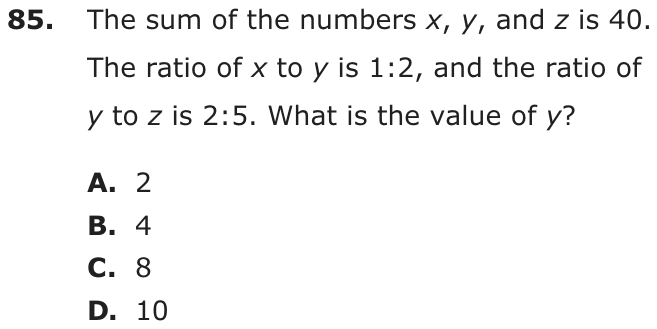
The sum of the numbers x, y, and z is 40. The ratio of x to y is 1:2, and the ratio of y to z is 2:5. What is the value of y?
- A2
- B4
- C8
- D10
Show the answer
Correct answer: D
The ratio of x to y is 1:2, so or . Similarly, the ratio of y to z is 2:5, so . Solve for z in terms of y:
Use the given sum of x, y, and z to find the value of y:
Question analysis
This ratio question gives two ratios that share y: x to y is 1:2 and y to z is 2:5, and x, y and z total 40. Students find the value of y. The numbers in a ratio count parts, not amounts, so the work is to combine the ratios and find what one part is worth.
- Grade level
- Grade 7 content, by NYS standard
- Compared with grade 7
- At grade 7 Most grade 7 ratio tasks split a total using one ratio. Here two ratios linked through y must first become a single three-part ratio; since y's term already matches, that step is short and the problem stays at grade 7.
- Estimated difficulty
- Moderate: several steps, or a close reading with one strong distractor.
- Thinking it demands
- Depth of knowledge 2, skills and concepts · mainly apply
- What makes it hard
- No obvious method moderate
- Variables instead of numbers minor
- Many steps minor
- Solution
- 3 steps
- Reading level
- Question and choices: about grade 2, 31 words.
- Students, last 30 days
- Not enough answers yet to show (it takes 10).
Why it is hard, traps and wrong answers (shows the answer)
Why it is hard
The question rewards seeing that the two ratios share y’s term, which makes one three-part ratio. From there, one part is worth 5 and y is two parts. The wrong choices are numbers that live inside the ratios, and adding all four ratio numbers, which counts y twice, also leads to the part count, so that choice draws students along two paths.
No obvious method moderate Working it out
Nothing says to merge the ratios, but y is 2 in both, so x : y : z becomes 1 : 2 : 5 at once; the explanation’s route through fractions of y is slower. (Schoenfeld, 1985)
Variables instead of numbers minor Understanding the question
x, y and z appear only in two ratios and a sum of 40, so the ratio numbers 1, 2 and 5 are easy to mistake for the values themselves. (Koedinger & Nathan, 2004; Enright, Morley & Sheehan, 2002)
Many steps minor Working it out
Adding the 8 parts, dividing 40 by 8 to get 5 per part, and taking y’s 2 parts are three steps, and the part count is itself a listed choice. (Daniel & Embretson, 2010; Enright, Morley & Sheehan, 2002)
Strategy: Write x : y : z as one ratio using y's matching term, add the parts, divide 40 by that sum to get one part, and multiply by y's parts.
Traps
- Numbers taken from the question: Combines the numbers in the question without a model of the situation, or is simply a number that appears in the question.
- Answers a different question: A choice is right for another quantity: the other unknown, the rest instead of the part, the part instead of the whole.
The wrong answers, classified
A Numbers taken from the question (Hegarty, Mayer & Monk, 1995)
Takes y’s term in the ratios, 2, as y’s actual value, never using the sum of 40.
B Numbers taken from the question (Hegarty, Mayer & Monk, 1995)
Adds the two 2s that stand for y in the two ratios, 2 + 2 = 4, treating ratio terms as amounts.
C Answers a different question (King et al., 2004; Hegarty, Mayer & Monk, 1995)
Combines the ratios into 1 : 2 : 5 and gives the total number of parts, 1 + 2 + 5 = 8, instead of y’s share of the 40.
Worked solution, step by step
Formulas used
- Splitting a total by a ratio
- Each number in a ratio counts parts that are all the same size. Add the numbers in the ratio to find how many parts make up the total. Dividing the total by that number gives the size of one part. Each amount is its number of parts times that size.
Sort out the question
x, y and z add up to 40. A ratio compares two amounts. The ratio of x to y is 1:2, so y is twice x. The ratio of y to z is 2:5. You need the actual value of y, not its number in a ratio.
Combine the two ratios
y is 2 in both ratios. So both ratios count the same size of part, and they join into one.
So x is 1 part, y is 2 parts and z is 5 parts.
Find the total number of parts
The 40 is split into 8 equal parts. Watch out: 8 counts parts. It is not y, so choice C is wrong.
Find the size of one part
The 40 is shared equally among the 8 parts. So each part is worth 5.
Find y
y is 2 parts, so multiply the size of one part by 2.
Watch out: the 2 in the ratio counts parts, so y is not 2, choice A. Adding the two 2s to get 4 is wrong too, choice B. So the answer is D, 10.
Check your answer
Find all three: x = 5, y = 10 and z = 25. They add to . x to y is 5 to 10, which is 1:2. y to z is 10 to 25, which is 2:5.
More questions like this
The original DOE question
Question 9 of 19
2023 Test B Math, question 35Question
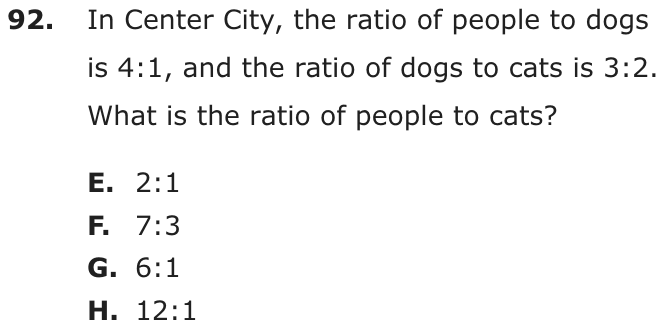
In Center City, the ratio of people to dogs is , and the ratio of dogs to cats is . What is the ratio of people to cats?
- A
- B
- C
- D
Show the answer
Correct answer: C
Take each ratio and solve for dogs:
And
Set the two expressions for d equal to each other and solve for :
So, the ratio of people to cats is .
Question analysis
A ratio question about Center City, where the ratio of people to dogs and the ratio of dogs to cats are both given. Students link the two ratios through the dogs to find the ratio of people to cats. It tests combining ratios, a step that goes wrong when the given numbers are paired up as written.
- Grade level
- Grade 7 content, by NYS standard
- Compared with grade 7
- At grade 7 Grade 7 ratio problems usually work with a single ratio. Here two ratios share the dogs but give them different numbers of parts, so one ratio must be rescaled before people and cats can be compared.
- Estimated difficulty
- Moderate: several steps, or a close reading with one strong distractor.
- Thinking it demands
- Depth of knowledge 2, skills and concepts · mainly apply
- What makes it hard
- No obvious method moderate
- Much to keep track of minor
- Solution
- 3 steps
- Reading level
- Question and choices: about grade 5, 32 words.
- Students, last 30 days
- Not enough answers yet to show (it takes 10).
Why it is hard, traps and wrong answers (shows the answer)
Why it is hard
The question rewards seeing that the dogs link the two ratios but are counted differently in each. Reading the people’s 4 and the cats’ 2 straight off the page gives a tidy 2 : 1, and it is the trap most students fall into. Rewriting people to dogs as 12 : 3 makes one chain, 12 : 3 : 2, from which people to cats is 12 : 2.
No obvious method moderate Working it out
Dogs are 1 part in the first ratio and 3 parts in the second, so the ratios cannot be joined until 4 : 1 is rescaled to 12 : 3; nothing in the stem says to do this. (Schoenfeld, 1985)
Much to keep track of minor Working it out
Three groups, people, dogs and cats, run through two ratios, and students must keep track of which number belongs to which group while scaling. (Sweller, 1988; Carpenter, Just & Shell, 1990)
Strategy: Rewrite both ratios with the same number for dogs, so that people to dogs to cats becomes one three-part ratio, then read off people to cats and simplify.
Traps
- Numbers taken from the question: Combines the numbers in the question without a model of the situation, or is simply a number that appears in the question.
- Stops one step early: A choice is a number from partway through the solution.
The wrong answers, classified
A Numbers taken from the question (Hegarty, Mayer & Monk, 1995)
Pairs the people’s 4 from the first ratio with the cats’ 2 from the second, 4 : 2 = 2 : 1, without first matching the dogs’ parts.
B Numbers taken from the question (Hegarty, Mayer & Monk, 1995)
Adds the two ratios term by term, (4 + 3) : (1 + 2) = 7 : 3, treating ratio terms as amounts that can be combined.
D Stops one step early (King et al., 2004; Gierl et al., 2017)
Multiplies people per dog by the dogs’ 3, 4 × 3 = 12, and stops before dividing by the cats’ 2, giving 12 : 1.
Worked solution, step by step
Formulas used
- Equivalent ratios
- a and b are the two amounts in a ratio, in order. k is any number you choose, except 0. Multiplying both amounts by the same number keeps the comparison the same. For example, 4 : 1 and 12 : 3 both mean 4 people for every dog.
Sort out the question
A ratio compares two amounts. People to dogs is 4 : 1. That means 4 people for every 1 dog. Dogs to cats is 3 : 2. That means 3 dogs for every 2 cats.
You need people to cats. Dogs show up in both ratios, so they are the link.
Make the dog numbers match
The dogs are 1 in the first ratio and 3 in the second. To join the ratios, the dog numbers must be the same. So multiply both parts of the first ratio by 3.
Now there are 12 people for every 3 dogs.
Join the two ratios
Both ratios now have 3 dogs. So you can write all three groups in one ratio.
For every 12 people, there are 3 dogs and 2 cats.
Read off and simplify
People to cats is 12 : 2. Divide both parts by 2.
Watch out: Taking the 4 people and the 2 cats straight from the problem gives 4 : 2 = 2 : 1, choice A. That skips matching the dogs. Stopping at 12 : 1, without using the 2 cats, gives choice D.
So the answer is C, 6 : 1.
Check your answer
Build a small town. Start with 2 cats. The second ratio gives 3 dogs. The first ratio gives 4 people for each dog, so 4 × 3 = 12 people. That is 12 people for 2 cats, or 6 people for each cat.
More questions like this
The original DOE question
Question 10 of 19
2019 Test B Math, question 10Question
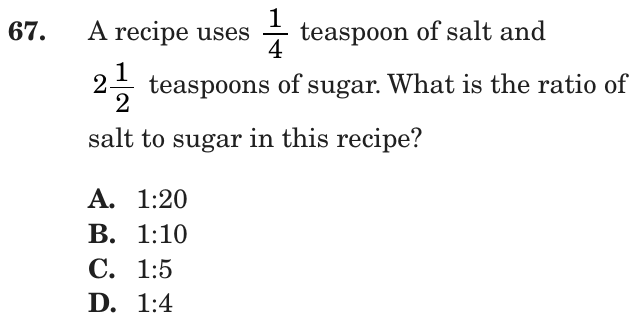
A recipe uses teaspoon of salt and teaspoons of sugar. What is the ratio of salt to sugar in this recipe?
- A
- B
- C
- D
Show the answer
Correct answer: B
Question analysis
A recipe calls for 1/4 teaspoon of salt and 2 1/2 teaspoons of sugar, and students write the ratio of salt to sugar in whole numbers. It tests ratios whose terms are a fraction and a mixed number. Both terms have to be rescaled together, and the mixed number is where slips creep in.
- Grade level
- Grade 7 content, by NYS standard
- Compared with grade 7
- At grade 7 Ratios of fractions are grade 7 content, and this one is routine: convert a single mixed number, then scale both terms up to whole numbers. It asks for no further use of the ratio.
- Estimated difficulty
- Straightforward: two steps or one careful reading.
- Thinking it demands
- Depth of knowledge 2, skills and concepts · mainly apply
- What makes it hard
- Error-prone arithmetic moderate
- An answer in an unexpected form minor
- Solution
- 2 steps
- Reading level
- Question and choices: about grade 6, 27 words.
- Students, last 30 days
- Not enough answers yet to show (it takes 10).
Why it is hard, traps and wrong answers (shows the answer)
Why it is hard
A ratio of a fraction to a mixed number is unfamiliar enough that students reach for shortcuts, and each shortcut has a choice waiting. Pairing numerators after converting, or reading the salt's 1/4 as a ratio by itself, never compares the two amounts properly. Scaling both terms by the same factor, 4, or asking how many quarter teaspoons fit into 2 1/2 teaspoons, keeps the comparison intact.
Error-prone arithmetic moderate Working it out
The sugar is a mixed number, so 2 1/2 must become 5/2, and both terms must then be multiplied by 4, or 5/2 divided by 1/4, without dropping a denominator. (Brown & Burton, 1978; Junker & Sijtsma, 2001)
An answer in an unexpected form minor Choosing the answer
The recipe gives a fraction and a mixed number, but every choice is a whole-number ratio, so 1/4 : 2 1/2 has to be recognized in its scaled form. (Enright, Morley & Sheehan, 2002)
Strategy: Change 2 1/2 to 5/2, then divide the salt amount by the sugar amount; the quotient, written as a fraction with numerator 1, gives the ratio directly.
Traps
- A faulty procedure: A systematic but wrong procedure: adding fractions straight across, applying an exponent to each term of a sum, dropping a sign when moving a term.
- Numbers taken from the question: Combines the numbers in the question without a model of the situation, or is simply a number that appears in the question.
- An arithmetic slip: The right method with a plausible arithmetic error: a digit, a place value or a times-table fact.
The wrong answers, classified
A An arithmetic slip (Junker & Sijtsma, 2001)
Multiplies both terms by 4 but takes 4 × 5/2 as 20, multiplying the numerator and forgetting to divide by the 2.
C A faulty procedure (Brown & Burton, 1978; Tatsuoka, 1983)
Rewrites 2 1/2 as 5/2 and pairs the numerators, 1 : 5, as if 1/4 and 5/2 shared a denominator.
D Numbers taken from the question (Hegarty, Mayer & Monk, 1995)
Reads the 1/4 teaspoon of salt as the ratio 1 : 4 itself, never bringing the 2 1/2 teaspoons of sugar into the comparison.
Worked solution, step by step
Formulas used
- Changing a mixed number to a fraction
- A mixed number is a whole number plus a fraction. Multiply the whole number by the bottom number to count the halves in the wholes. Then add the top number, and keep the same bottom. Two wholes are 4 halves, so 2 and a half is 5 halves.
- Equivalent ratios
- a and b are the two amounts in a ratio, in order. k is any number except 0. Multiplying both amounts by the same number keeps the comparison the same. Use it to turn the fractions in a ratio into whole numbers.
Sort out the question
The recipe uses teaspoon of salt and teaspoons of sugar. A ratio compares two amounts. “Salt to sugar” means salt first, then sugar. Every choice is a ratio of whole numbers. So you need to turn the two amounts into whole numbers that compare the same way.
Change the mixed number to a fraction
A mixed number is hard to work with. Write the sugar as a fraction.
So the ratio of salt to sugar is .
Multiply both parts by 4
Multiply both parts by the same number to clear the fractions. Use 4, because both bottom numbers, 4 and 2, go into 4.
For the sugar, , and then .
Watch out: forgetting to divide by 2 gives 1 : 20, choice A. Pairing the top numbers, 1 : 5, choice C, compares quarters with halves. And 1 : 4, choice D, is only the salt amount. It leaves out the sugar.
So the answer is B, 1 : 10.
Check your answer
Think in quarter teaspoons. The salt is 1 quarter teaspoon. One teaspoon is 4 quarters, so the sugar is quarter teaspoons. That is 1 quarter of salt for every 10 quarters of sugar, or 1 : 10.
More questions like this
The original DOE question
Question 11 of 19
2018 Test A Math, question 2Question
The owner of a tree farm plants pine trees and oak trees in a ratio of . How many oak trees are planted if 264 pine trees are planted?
Grid-in question: work out the answer and enter it as a number.
Show the answer
Correct answer: 99
Let be the number of oak trees when 264 pine trees are planted. Set up a proportion and solve for :
Question analysis
A ratio word problem about a tree farm that plants pine and oak trees in a fixed ratio of 8 to 3. Given how many pine trees are planted, students find the matching number of oak trees and grid it in. The main risk is pairing each number with the wrong kind of tree.
- Grade level
- Grade 6 content, by NYS standard
- Compared with grade 7
- Below grade 7 This is a one-ratio proportion with whole numbers, the kind of problem grade 6 students solve with equivalent ratios. A typical grade 7 task adds rates with fractions or a multistep percent; this has neither.
- Estimated difficulty
- Routine: one familiar step, little to misread.
- Thinking it demands
- Depth of knowledge 2, skills and concepts · mainly apply
- What makes it hard
- Solution
- 2 steps
- Reading level
- Question and choices: about grade 4, 28 words.
- Corrected from the DOE handbook
- An arithmetic slip in the explanation was corrected.
- Students, last 30 days
- Not enough answers yet to show (it takes 10).
Why it is hard, traps and wrong answers (shows the answer)
Why it is hard
This is a one-ratio scaling problem with friendly numbers: 264 splits into 8 equal parts of 33. The only real risk is matching 264 to the wrong term of 8:3, and a quick sense check catches it, since oak trees are the smaller group and must number fewer than 264. Students who grid the one-part value or the total of both kinds of tree have answered a question that was not asked.
Turning words into math minor Understanding the question
The ratio 8:3 lists pine first, so the 264 pine trees match the 8 and the oak count matches the 3; reading the terms in the other order flips the setup. (Hegarty, Mayer & Monk, 1995; Koedinger & Nathan, 2004)
An answer in an unexpected form minor Choosing the answer
As a grid-in it offers no choices, so an upside-down proportion that gives 704 oak trees, far more than the 264 pines, has to be caught by the student's own check. (Enright, Morley & Sheehan, 2002)
Strategy: Divide the number of pine trees by the pine part of the ratio to get the size of one part, then multiply by the oak part.
Traps
- Answers a different question: A choice is right for another quantity: the other unknown, the rest instead of the part, the part instead of the whole.
- Stops one step early: A choice is a number from partway through the solution.
The wrong answers, classified
704 Wrong operation (Hegarty, Mayer & Monk, 1995; King et al., 2004)
Turns the ratio upside down, treating the 264 pines as 3 parts: 264 ÷ 3 = 88, then 88 × 8 = 704.
33 Stops one step early (King et al., 2004; Gierl et al., 2017)
Divides 264 by 8 to get the size of one part, 33 trees, and stops before multiplying by the 3 parts that are oak.
363 Answers a different question (King et al., 2004; Hegarty, Mayer & Monk, 1995)
Finds the 99 oak trees correctly and then adds the 264 pines, gridding the total number of trees planted.
What was corrected from the DOE handbook, and why
- Explanation: The handbook goes from x/264 = 3/8 to “8x = 762”. Cross-multiplying gives 8x = 3 × 264 = 792, so that line now reads 8x = 792. The handbook’s final answer, x = 99, was already right (792 ÷ 8 = 99).
Worked solution, step by step
Formulas used
- Equal ratios
- a and b are the two numbers in a ratio, written as a fraction. n is any number you choose, except zero. Multiplying both numbers by the same n gives an equal ratio. This is how you scale a small ratio up to real counts.
Sort out the ratio
A ratio compares two amounts. Here the ratio of pine trees to oak trees is 8:3. Pine comes first, so pine goes with the 8. Oak goes with the 3. So for every 8 pine trees, there are 3 oak trees.
The farm planted 264 pine trees. You need the number of oak trees.
Find the size of one part
Think of the trees in equal groups, called parts. Pine trees fill 8 parts, and oak trees fill 3 parts. The 264 pine trees are the 8 parts, so divide by 8.
Each part is 33 trees. Watch out: 33 is one part, not the number of oak trees. Don’t stop here.
Find the number of oak trees
Oak trees fill 3 parts. Multiply the part size by 3.
You can see the same thing with equal ratios. Multiply both numbers of 8:3 by 33.
So 264 pine trees go with 99 oak trees.
Avoid the traps and answer
Watch out: if you match 264 to the 3 instead of the 8, you flip the ratio. That gives 704 oak trees. Watch out: the question asks only for oak trees. Adding the 264 pines gives 363. So you would grid 99.
Check your answer
The ratio 8:3 says there are fewer oak trees than pine trees. 99 is less than 264, so that fits. Also, divide both counts by 33: and . That gives back 8:3.
More questions like this
The original DOE question

Question 12 of 19
2018 Test A Math, question 13Question
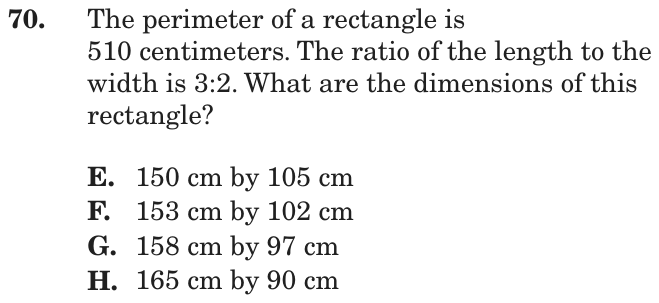
The perimeter of a rectangle is 510 centimeters. The ratio of the length to the width is 3:2. What are the dimensions of this rectangle?
- A150 cm by 105 cm
- B153 cm by 102 cm
- C158 cm by 97 cm
- D165 cm by 90 cm
Show the answer
Correct answer: B
Let = the width and = the length.
Draw the rectangle to help visualize.
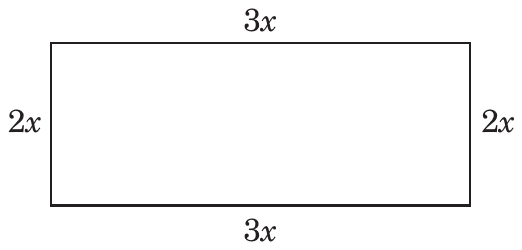
Since 2 times width + 2 times length = perimeter, we get
cm and cm
Question analysis
A rectangle word problem that combines perimeter with a ratio: the perimeter is 510 centimeters and the length and width are in the ratio 3 to 2. Students find the rectangle's dimensions. Every choice has the correct perimeter, so only the ratio separates them.
- Grade level
- Grade 7 content, by NYS standard
- Compared with grade 7
- At grade 7 Perimeter and ratio are each familiar from grades 6 and 7, and combining them with a five-part split is a typical grade 7 multistep ratio problem. It asks about the same as classroom work.
- Estimated difficulty
- Moderate: several steps, or a close reading with one strong distractor.
- Thinking it demands
- Depth of knowledge 2, skills and concepts · mainly apply
- What makes it hard
- A very close wrong answer moderate
- Turning words into math minor
- Solution
- 3 steps
- Reading level
- Question and choices: about grade 3, 35 words.
- Students, last 30 days
- Not enough answers yet to show (it takes 10).
Why it is hard, traps and wrong answers (shows the answer)
Why it is hard
The question is built so that the perimeter, the easier condition, rules nothing out: every choice adds to 255. A student who tests the choices against 510 alone will accept whichever comes first, and the first is 150 by 105. Solving with ratio parts, or checking each pair's ratio, avoids that; 3:2 means the length is exactly one and a half times the width.
A very close wrong answer moderate Choosing the answer
153 by 102 and 150 by 105 differ by just 3 cm in each side and give the same 510 cm perimeter; only the ratio, exactly 3:2 against 10:7, separates them. (Embretson & Wetzel, 1987; Gorin & Embretson, 2006; Ascalon et al., 2007)
Turning words into math minor Understanding the question
"The ratio of the length to the width is 3:2" has to become 3 parts and 2 parts of the half-perimeter, 255, not of the full 510. (Hegarty, Mayer & Monk, 1995; Koedinger & Nathan, 2004)
Strategy: Halve the perimeter to get length plus width, split that sum into 5 equal parts, and give the length 3 parts and the width 2.
Traps
- Misreads the question: Misses or misreads a condition or a word in the question: "at least", "each", "remaining", "not".
The wrong answers, classified
A Misreads the question (Hegarty, Mayer & Monk, 1995)
Checks only the perimeter, 2 × (150 + 105) = 510, and accepts the first pair that fits; 150 to 105 is 10:7, not 3:2.
C Misreads the question (Hegarty, Mayer & Monk, 1995)
Confirms that 158 + 97 = 255, half the perimeter, but never tests the ratio; 1.5 × 97 is 145.5, not 158.
D Misreads the question (Hegarty, Mayer & Monk, 1995)
Matches the perimeter, since 165 + 90 = 255, but a 3:2 rectangle 90 cm wide would be 135 cm long, not 165.
Worked solution, step by step
Formulas used
- Perimeter of a rectangle
- P is the perimeter, the distance all the way around the shape. l is the length and w is the width. A rectangle has two lengths and two widths. So you add one length and one width, then double it.
- Sharing a total in a ratio
- In a ratio like 3:2, the amounts are made of equal-sized parts. Add the numbers in the ratio to count the parts. Divide the total by that count to get the size of one part. Then multiply by how many parts each amount has.
Sort out the question
The perimeter of the rectangle is 510 cm. The perimeter is the distance all the way around. The ratio of length to width is 3:2. That means the length is 3 equal parts, and the width is 2 of the same parts. You need the length and the width.
Find length plus width
The perimeter counts each side twice, once for each matching side. So halve it to get one length plus one width.
Length plus width is 255 cm.
Find the size of one part
Length and width together are parts. Share the 255 cm equally among them.
Each part is 51 cm.
Find the length and width
The length is 3 parts and the width is 2 parts.
The length is 153 cm and the width is 102 cm.
Check the ratio, then answer
Watch out: every choice has a perimeter of 510 cm. For example, too. So checking only the perimeter can trick you into choice A. The ratio decides it. 153 is exactly 1.5 times 102, but 150 is not 1.5 times 105. So the answer is B, 153 cm by 102 cm.
Check your answer
Check both facts. Perimeter: . Ratio: and , so 153 to 102 is 3:2.
More questions like this
The original DOE question
Question 13 of 19
2018 Test A Math, question 17Question
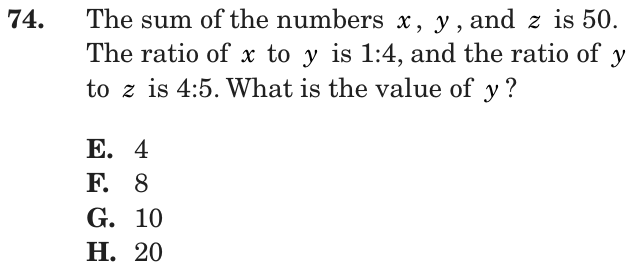
The sum of the numbers x, y, and z is 50. The ratio of x to y is 1:4, and the ratio of y to z is 4:5. What is the value of y ?
- A4
- B8
- C10
- D20
Show the answer
Correct answer: D
Since both ratios have in common, solve for and in terms of in both equations. Using , solve for in terms of .
Using the ratio , solve for in terms of :
The question states . Substitute from the two equations above and solve for .
Question analysis
A ratio problem with three unknowns: x, y and z add to 50, x to y is 1 to 4, and y to z is 4 to 5. Students merge the two ratios into one three-part ratio and use the sum to find y. The step that is easy to skip is turning ratio parts into actual values.
- Grade level
- Grade 7 content, by NYS standard
- Compared with grade 7
- At grade 7 Grade 7 ratio problems usually involve one ratio. Here two ratios share a term and must be merged before the total is used, though the shared term already matches, which keeps it near typical grade 7 work.
- Estimated difficulty
- Moderate: several steps, or a close reading with one strong distractor.
- Thinking it demands
- Depth of knowledge 2, skills and concepts · mainly apply
- What makes it hard
- No obvious method moderate
- Variables instead of numbers minor
- Many steps minor
- Solution
- 3 steps
- Reading level
- Question and choices: about grade 2, 31 words.
- Students, last 30 days
- Not enough answers yet to show (it takes 10).
Why it is hard, traps and wrong answers (shows the answer)
Why it is hard
The question rewards noticing that y has the same term in both ratios, which turns two ratios into one three-part ratio in a single move. Students who miss this often write x and z in terms of y, as the explanation does, which works but is slower. The wrong choices are numbers taken from the ratios themselves, so a student who never scales up to the total of 50 finds an answer waiting.
No obvious method moderate Working it out
The two ratios have to be merged into one, x : y : z = 1 : 4 : 5, which works only because y is 4 in both; nothing in the wording says to combine them. (Schoenfeld, 1985)
Variables instead of numbers minor Understanding the question
x, y and z are given only through two ratios and their sum of 50, so there is no actual count to anchor the work until the parts are scaled. (Koedinger & Nathan, 2004; Enright, Morley & Sheehan, 2002)
Many steps minor Working it out
Adding the parts, dividing 50 by their total and scaling y's 4 parts are three steps, and the count of parts after the first step is itself a listed choice. (Daniel & Embretson, 2010; Enright, Morley & Sheehan, 2002)
Strategy: Since y is 4 in both ratios, write x : y : z as one combined ratio, find the value of one part from the total of 50, and scale up.
Traps
- Numbers taken from the question: Combines the numbers in the question without a model of the situation, or is simply a number that appears in the question.
- Answers a different question: A choice is right for another quantity: the other unknown, the rest instead of the part, the part instead of the whole.
The wrong answers, classified
A Numbers taken from the question (Hegarty, Mayer & Monk, 1995)
Takes y's term in the ratios, 4, as y's actual value, never using the sum of 50.
B Numbers taken from the question (Hegarty, Mayer & Monk, 1995)
Adds the two 4s that stand for y in the two ratios, 4 + 4 = 8, treating ratio terms as amounts.
C Answers a different question (King et al., 2004; Hegarty, Mayer & Monk, 1995)
Combines the ratios into 1 : 4 : 5 and gives the total number of parts, 1 + 4 + 5 = 10, instead of y's share of the 50.
Worked solution, step by step
Formulas used
- Sharing a total in a ratio
- In a ratio like 3:2, the amounts are made of equal-sized parts. Add the numbers in the ratio to count the parts. Divide the total by that count to get the size of one part. Then multiply by how many parts each amount has.
Sort out the question
The three numbers x, y and z add up to 50. The ratio of x to y is 1:4. The ratio of y to z is 4:5. A ratio compares sizes. You need the actual value of y.
Join the two ratios
y is 4 in both ratios. So the two ratios use the same size parts, and you can join them into one.
This means x is 1 part, y is 4 parts, and z is 5 parts.
Count the parts
There are 10 parts in all. Watch out: 10 is the number of parts, not the value of y. Picking it is choice C.
Find the size of one part
Use the sharing formula. The 10 parts share the total of 50.
Each part is worth 5.
Find y
y is 4 parts.
Watch out: the 4 in the ratio counts parts. It is not the value of y. Picking 4 is choice A. So the answer is D, 20.
Check your answer
Find all three: x = 5, y = 20, z = 25. They add up: . x to y is 5 to 20, which is 1:4. y to z is 20 to 25, which is 4:5. Everything fits.
More questions like this
The original DOE question
Question 14 of 19
2018 Test A Math, question 27Question
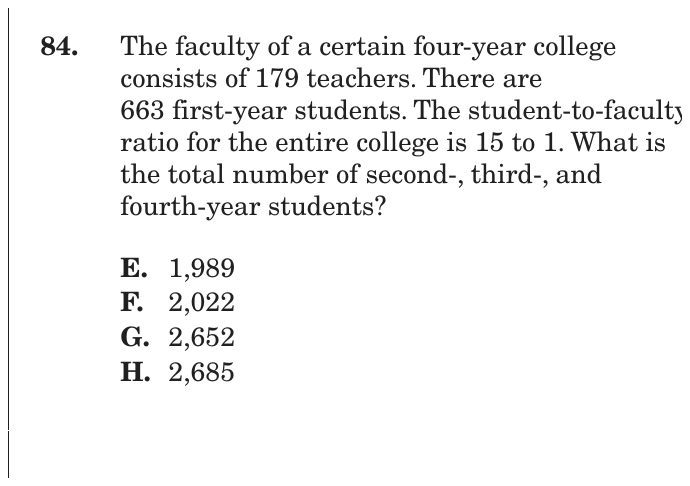
The faculty of a certain four-year college consists of 179 teachers. There are 663 first-year students. The student-to-faculty ratio for the entire college is 15 to 1. What is the total number of second-, third-, and fourth-year students?
- A1,989
- B2,022
- C2,652
- D2,685
Show the answer
Correct answer: B
Let be the number of second-, third-, and fourth-year students.
Then the total number of students in the college is
Set up a proportion and solve for :
Question analysis
A ratio word problem about a four-year college with 179 teachers, 663 first-year students and a student-to-faculty ratio of 15 to 1. Students use the ratio to find the total number of students, then remove the first-year class. The phrase four-year invites the wrong assumption that every year is the same size.
- Grade level
- Grade 7 content, by NYS standard
- Compared with grade 7
- At grade 7 Using a ratio to find a total and then subtracting a part is a standard two-step grade 7 ratio problem. The three-digit multiplication and the four-year detail add little beyond typical classwork.
- Estimated difficulty
- Moderate: several steps, or a close reading with one strong distractor.
- Thinking it demands
- Depth of knowledge 2, skills and concepts · mainly apply
- What makes it hard
- Turning words into math moderate
- Error-prone arithmetic minor
- Solution
- 2 steps
- Reading level
- Question and choices: about grade 7, 34 words.
- Students, last 30 days
- Not enough answers yet to show (it takes 10).
Why it is hard, traps and wrong answers (shows the answer)
Why it is hard
The question hinges on what the ratio describes: the whole college, not one class of students. Students who see that multiply, subtract and are done; those who stop at the total, or assume each year matches the 663 first-years, find their number listed. Because the choices come in close pairs, a careless multiplication can also land on a wrong one.
Turning words into math moderate Understanding the question
"The student-to-faculty ratio for the entire college is 15 to 1" covers students in all four years, so 15 × 179 is every student, and the 663 first-years must come out. (Hegarty, Mayer & Monk, 1995; Koedinger & Nathan, 2004)
Error-prone arithmetic minor Working it out
179 × 15 and the subtraction of 663 are multi-digit computations by hand, and the choices come in pairs only 33 apart. (Brown & Burton, 1978; Junker & Sijtsma, 2001)
Strategy: Multiply the 179 faculty by 15 to get the number of all students, then subtract the 663 first-year students to leave the other three years.
Traps
- Stops one step early: A choice is a number from partway through the solution.
The wrong answers, classified
A Numbers taken from the question (Hegarty, Mayer & Monk, 1995)
Ignores the ratio and assumes each of the other three years also has 663 students, 663 × 3 = 1,989.
C Numbers taken from the question (Hegarty, Mayer & Monk, 1995)
Assumes all four years have 663 students and multiplies 663 × 4 = 2,652, which also counts the first-year class the question leaves out.
D Stops one step early (King et al., 2004; Gierl et al., 2017)
Multiplies 179 × 15 = 2,685 to get every student in the college and stops before subtracting the 663 first-year students.
Worked solution, step by step
Formulas used
- Using a ratio to find an amount
- s is the number of students, and f is the number of faculty, the teachers. A ratio of 15 to 1 means 15 students for every 1 teacher. So each teacher goes with 15 students, and you multiply the teachers by 15.
Sort out the question
The faculty means the teachers. The college has 179 of them. The ratio of students to faculty is 15 to 1 “for the entire college”. So there are 15 students for every teacher, counting all four years. 663 students are first-years. You need the second-, third- and fourth-year students together.
Find every student in the college
Multiply the teachers by 15.
Break it into easy pieces: and .
There are 2,685 students in all four years.
Take away the first-years
That leaves 2,022 second-, third- and fourth-year students. Watch out: 2,685 still includes the first-years. Stopping there gives choice D. Watch out: don’t assume each year has 663 students. That leads to 1,989, choice A. So the answer is B, 2,022.
Check your answer
Add back: students. Then . That is 15 students for each teacher, the ratio in the question.
More questions like this
The original DOE question
Question 15 of 19
2018 Test A Math, question 44Question

On the number line above, points , , , and are integers, and . What is the value of ?
- A8
- B11
- C12
- D18
Show the answer
Correct answer: C
Convert the ratios into fractions of . Use the sum of the ratios for the denominator.
The part of that is is the sum of those fractions:
Find the length of :
The value of is .
Question analysis
This number line question places integer points W, X, Y and Z on a line and gives the ratio of the segments WX, XY and YZ as 4 to 2 to 3. Students find the whole length from W to Z, split it by the ratio, and add the parts that make up WY. Mixing up a part with the whole is the main risk.
- Grade level
- Grade 7 content, by NYS standard
- Compared with grade 7
- Above grade 7 Grade 7 students find distances on a number line and use part-to-whole ratios, usually separately. This item joins them: a negative endpoint, a three-term ratio and a choice of which segments to combine.
- Estimated difficulty
- Hard: combines ideas, needs a plan, and has more than one tempting wrong answer.
- Thinking it demands
- Depth of knowledge 2, skills and concepts · mainly apply
- What makes it hard
- Combines ideas moderate
- Reading a figure, table or graph moderate
- Many steps minor
- Solution
- 3 steps
- Reading level
- Question and choices: about grade 10, 21 words.
- Corrected from the DOE handbook
- Equations in the explanation that mixed up a fraction of a length with the length itself were corrected.
- Students, last 30 days
- Not enough answers yet to show (it takes 10).
Why it is hard, traps and wrong answers (shows the answer)
Why it is hard
Each step is routine, but the question keeps asking for a different piece of the line: the whole WZ, the part WX, and finally WY, which is two parts added together. Two of the wrong choices are exactly those other pieces. Students who mark the actual positions, X at −2 and Y at 2, can check the ratio before answering.
Combines ideas moderate Working it out
A three-part ratio, 4:2:3, must be applied to a length found from a negative endpoint, 8 − (−10) = 18, joining ratio and number-line distance. (Embretson, 1998; Daniel & Embretson, 2010)
Reading a figure, table or graph moderate Understanding the question
Only W at −10 and Z at 8 are labeled, and the drawing is not to scale: Y is drawn nearer 5 than 2, so reading WY from the picture fails. (Lesh, Post & Behr, 1987; Kirsch & Mosenthal, 1990)
Many steps minor Working it out
Find WZ, split it into 9 equal parts of 2, then add the 4 parts of WX and the 2 parts of XY. (Daniel & Embretson, 2010; Enright, Morley & Sheehan, 2002)
Strategy: Find the length WZ from the endpoints on the number line, divide it by the total number of ratio parts, and multiply by the parts from W to Y.
Traps
- Stops one step early: A choice is a number from partway through the solution.
- Answers a different question: A choice is right for another quantity: the other unknown, the rest instead of the part, the part instead of the whole.
- Counting the ends: Inclusive or exclusive ends, fence posts, consecutive numbers: an answer that is one too many or too few, or an endpoint drawn open where it belongs closed (or the reverse).
The wrong answers, classified
A Stops one step early (King et al., 2004; Gierl et al., 2017)
Finds WX, 4/9 of 18 = 8, and stops without adding XY's 4 to reach Y; 8 also matches Z's label.
B Counting the ends (Brown & Burton, 1978)
Places Y at 2 but counts the integers strictly between −10 and 2, which are −9 through 1, getting 11 instead of the distance 12.
D Answers a different question (King et al., 2004; Hegarty, Mayer & Monk, 1995)
Gives the whole length WZ, 8 − (−10) = 18, instead of the part from W to Y.
What was corrected from the DOE handbook, and why
- Explanation: The handbook writes WX = 4/9, XY = 2/9 and WY = 2/3, and then says “The value of WY is 2/3(18) = 12”. Those fractions are parts of WZ, not the lengths themselves (WX is 8 and WY is 12), so WY cannot be both 2/3 and 12. The lines now read WX = 4/9 WZ, XY = 2/9 WZ and WY = 2/3 WZ. The method and the answer are unchanged.
Worked solution, step by step
Formulas used
- Distance on a number line
- d is the distance between two points. b is the point on the right and a is the point on the left. Subtracting left from right always gives a positive distance. It works even when a is negative.
- Size of one part of a ratio
- u is the size of one part. L is the whole length being shared. p is the total number of parts, found by adding the numbers in the ratio. Every part is the same size, so you share the length equally.
Sort out what you know
W is at −10 and Z is at 8. X and Y are between them. The ratio 4:2:3 means WX is 4 parts, XY is 2 parts and YZ is 3 parts. All the parts are the same size.
You need the length WY, from W to Y. The drawing is not exact, so use the numbers, not the picture.
Find the whole length WZ
WZ is 18 units long. Subtracting a negative number is the same as adding.
Find the size of one part
Add the ratio numbers to get the number of parts:
Share the 18 units equally among 9 parts:
Each part is 2 units long.
Find WY
WY is WX and XY together, so it has 4 + 2 = 6 parts:
Watch out: WX alone is 4 × 2 = 8, which is choice A. And 18 is the whole line, choice D. So the answer is C, 12.
Check your answer
Place the points. W is at −10. X is 8 units to the right, at −2. Y is 4 more, at 2. Z is 6 more, at 8, which matches its label. And the distance from −10 to 2 is 2 − (−10) = 12.
More questions like this
The original DOE question
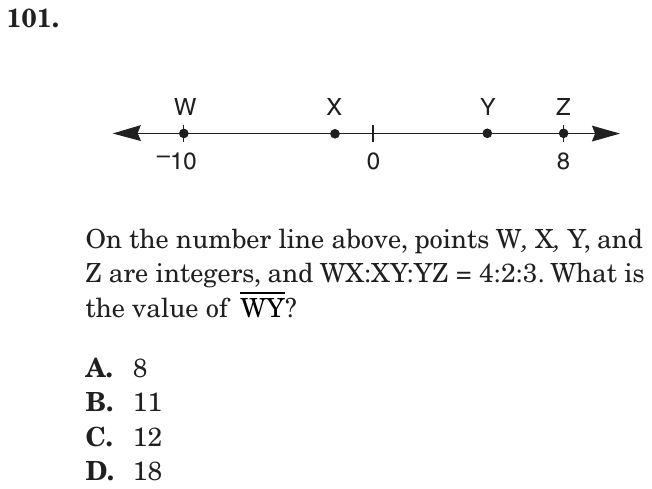
Question 16 of 19
2018 Test A Math, question 57Question
A paste used to cover a billboard is made by mixing the following ingredients by weight: 4 parts powder, 3 parts water, 2 parts resin, and 1 part hardener. To cover one billboard requires 30 pounds of this paste. How many total pounds of resin are required to cover 4 billboards?
- A6
- B8
- C24
- D48
Show the answer
Correct answer: C
The ratio is , so the total parts is 10.
Since there are two parts resin, the fraction of resin is
So the amount of resin in 30 lb of paste (for 1 billboard) is
lb.
For 4 billboards, that would be 6 × 4 = 24 lb.
Question analysis
This ratio word problem gives a billboard paste recipe of 4 parts powder, 3 parts water, 2 parts resin and 1 part hardener by weight, with 30 pounds of paste per billboard. It asks how many pounds of resin four billboards need. Students must find resin's share of the total parts and scale up to four billboards.
- Grade level
- Grade 7 content, by NYS standard
- Compared with grade 7
- At grade 7 Part-to-whole ratio problems with several ingredients are typical grade 7 work. This one adds a final scaling step for four billboards, which keeps it a routine multistep ratio problem at grade 7 level.
- Estimated difficulty
- Straightforward: two steps or one careful reading.
- Thinking it demands
- Depth of knowledge 2, skills and concepts · mainly apply
- What makes it hard
- Many steps minor
- Solution
- 3 steps
- Reading level
- Question and choices: about grade 8, 45 words.
- Students, last 30 days
- Not enough answers yet to show (it takes 10).
Why it is hard, traps and wrong answers (shows the answer)
Why it is hard
The recipe lists four ingredients but only resin's share matters, so the work is part over whole and then scaling. The question asks for four billboards only in the last sentence, after the per-billboard amount has been set up, which is why stopping early is the main risk. Finding the total paste first, 120 pounds, and taking a fifth of it reaches the answer in one step.
Many steps minor Working it out
Add the parts to 10, take resin's 2/10 of 30 pounds, then multiply by 4 billboards: three short steps. (Daniel & Embretson, 2010; Enright, Morley & Sheehan, 2002)
Strategy: Add the ratio parts to get the total, find resin's fraction of one batch of paste, take that fraction of 30 pounds, and multiply by the number of billboards.
Traps
- Stops one step early: A choice is a number from partway through the solution.
- Answers a different question: A choice is right for another quantity: the other unknown, the rest instead of the part, the part instead of the whole.
The wrong answers, classified
A Stops one step early (King et al., 2004; Gierl et al., 2017)
Finds the resin for one billboard, 2/10 of 30 = 6 pounds, and stops without multiplying by four billboards.
B Numbers taken from the question (Hegarty, Mayer & Monk, 1995)
Treats resin's 2 parts as 2 pounds and multiplies by 4 billboards, ignoring the 30 pounds of paste each one needs.
D Answers a different question (King et al., 2004; Hegarty, Mayer & Monk, 1995)
Uses powder's 4 parts instead of resin's 2, finding 4/10 of 120 pounds, which is the powder needed for four billboards.
Worked solution, step by step
Formulas used
- Fraction from a ratio
- f is the fraction of the mix that is one ingredient. p is that ingredient’s number of parts. T is the total number of parts, found by adding all the ratio numbers. Use it to turn a ratio into a fraction of the whole.
Sort out what you know
The paste is 4 parts powder, 3 parts water, 2 parts resin and 1 part hardener, by weight. A part is just an equal share of the mix.
One billboard needs 30 pounds of paste. You need the pounds of resin for 4 billboards.
Find resin’s fraction of the paste
The mix has 10 parts in all, and resin is 2 of them:
So resin is one fifth of the paste. Watch out: 2 parts is not 2 pounds. Treating it that way gives 2 × 4 = 8, choice B.
Find the resin for one billboard
One billboard needs 6 pounds of resin. Watch out: 6 is choice A, but that covers only one billboard.
Multiply by four billboards
Each billboard needs the same 6 pounds of resin, so multiply by 4:
Four billboards need 24 pounds of resin. So the answer is C, 24.
Check your answer
Work it another way. Four billboards need 4 × 30 = 120 pounds of paste. One fifth of 120 is 24. Choice D, 48, is the powder, which has 4 parts out of 10.
More questions like this
The original DOE question
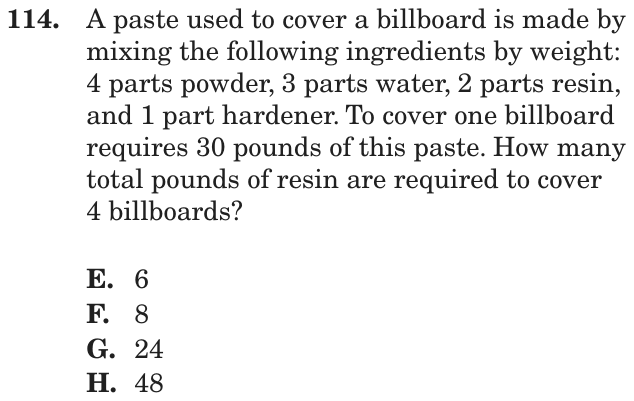
Question 17 of 19
2018 Test B Math, question 12Question
A bag contains 75 marbles that are red, blue, or green. The ratio of red to blue marbles is , and the ratio of blue to green marbles is . If 2 blue marbles are removed and replaced with 2 green marbles, what will be the new ratio of red to green marbles?
- A
- B
- C
- D
Show the answer
Correct answer: D
The ratio of red to blue to green is 15 : 7 : 3.
Find the proportion of blue marbles. Add the numbers of the ratio and use the total sum as the denominator:
Find the proportion of green marbles:
Since there are a total of 75 marbles, the number of blue marbles is
The number of green marbles is
The number of red marbles is
If 2 blue marbles are removed and replaced with 2 green marbles, the number of blue marbles is now 19 and the number of green marbles is now 11. The ratio of red marbles to green marbles is 45 : 11.
Question analysis
This ratio problem describes a bag of 75 marbles with a red-to-blue ratio and a blue-to-green ratio that share the blue term, then swaps 2 blue marbles for 2 green ones. Students combine the ratios, find the actual number of each color, and form a new ratio. The swap at the end is what turns a routine ratio exercise into a long one.
- NYS standards
- 7.RP.3 multistep ratio and percent problems
- Grade level
- Grade 7 content, by NYS standard
- Compared with grade 7
- Above grade 7 Grade 7 ratio problems usually involve one ratio and one scaling step. This links two ratios through a shared term, converts to counts and then changes the counts, a longer chain than typical grade 7 work.
- Estimated difficulty
- Moderate: several steps, or a close reading with one strong distractor.
- Thinking it demands
- Depth of knowledge 2, skills and concepts · mainly apply
- What makes it hard
- Many steps moderate
- Much to keep track of minor
- Turning words into math minor
- Solution
- 5 steps
- Reading level
- Question and choices: about grade 5, 54 words.
- Students, last 30 days
- Not enough answers yet to show (it takes 10).
Why it is hard, traps and wrong answers (shows the answer)
Why it is hard
Each step is easy because both ratios share the 7 for blue, so the work is about keeping the chain going without stopping early. The main danger is doing the swap on the ratio numbers or forgetting it altogether. Two of the wrong choices, 5:1 and 15:3, are the same ratio, so a student who notices that can rule out both before doing any arithmetic.
Many steps moderate Working it out
The chain is long: merge 15:7 and 7:3 into 15:7:3, find that 25 parts make 75 marbles, scale to 45, 21 and 9, then add 2 to the green count. (Daniel & Embretson, 2010; Enright, Morley & Sheehan, 2002)
Much to keep track of minor Working it out
Three colors' counts must be tracked through the swap, which lowers blue and raises green while red stays where it was. (Sweller, 1988; Carpenter, Just & Shell, 1990)
Turning words into math minor Understanding the question
The phrase “2 blue marbles are removed and replaced with 2 green marbles” must be read as changing the actual counts, not the ratio numbers 7 and 3. (Hegarty, Mayer & Monk, 1995; Koedinger & Nathan, 2004)
Strategy: Merge the two ratios into one red-to-blue-to-green ratio, scale it so the parts total 75, make the swap on those counts, then write red to green.
Traps
- Stops one step early: A choice is a number from partway through the solution.
The wrong answers, classified
A Misunderstands the concept (Smith, diSessa & Roschelle, 1993; De Bock et al., 1998; Ni & Zhou, 2005)
Treats the ratio's 3 as the actual number of green marbles and adds the 2 swapped marbles to it, getting 15:5, or 3:1.
B Stops one step early (King et al., 2004; Gierl et al., 2017)
Finds the counts 45 red and 9 green correctly but forgets the swap, giving the original ratio 45:9 in lowest terms.
C Numbers taken from the question (Hegarty, Mayer & Monk, 1995)
Reads red and green straight off the combined ratio 15:7:3, with no counts and no swap; it equals 5:1 anyway.
Worked solution, step by step
Formulas used
- Value of one part
- A ratio like 15:7:3 splits a total into equal parts. The sum of the ratio numbers is how many parts there are. Dividing the total by that sum tells how many marbles are in one part.
Write down what you know
There are 75 marbles: red, blue and green. A ratio compares two amounts. Red to blue is 15:7. Blue to green is 7:3.
Then 2 blue marbles are taken out, and 2 green ones are put in. You need the new ratio of red to green.
Join the two ratios
Blue is 7 in both ratios. So you can join them into one ratio.
This means for every 15 red marbles, there are 7 blue and 3 green.
Find the size of one part
The ratio has parts in all. The 75 marbles fill those 25 parts.
Each part is 3 marbles.
Count each color
Multiply each ratio number by 3 to get the real counts.
So there are 45 red, 21 blue and 9 green. They add to 75, so the counts are right.
Make the swap
Take out 2 blue: blue. Put in 2 green: green. Red does not change. It is still 45.
The new ratio of red to green is 45:11. It cannot be simplified, because 45 and 11 share no factor except 1.
Watch out: 45:9 is the ratio before the swap. It simplifies to 5:1, choice B. Choice C, 15:3, is that same old ratio. Make the swap with the real counts.
So the answer is D, 45:11.
Check your answer
Count the marbles after the swap: . The total is still 75, as it should be. A swap moves marbles in and out but does not change the total.
More questions like this
The original DOE question
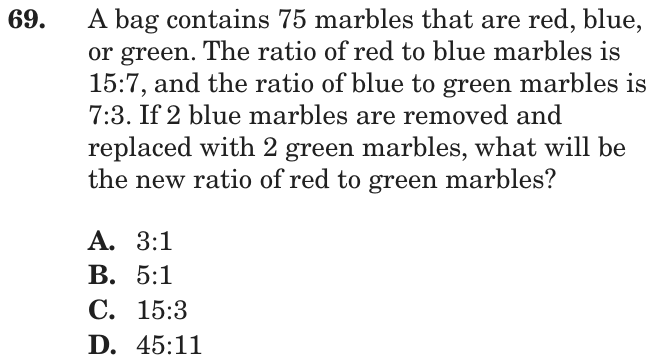
Question 18 of 19
2018 Test B Math, question 24Question
A United States presidential coin is made from an alloy of four metals—copper, zinc, manganese, and nickel—with weights in the ratio of , respectively. The coin weighs a total of 8 grams. What is the weight of the zinc in this coin?
- A0.28 g
- B0.48 g
- C0.96 g
- D48 g
Show the answer
Correct answer: B
Add the four values in the ratio
(177 + 12 + 7 + 4 = 200)
and use the sum as the denominator. Use that to find the fraction of zinc in one of the coins. Then reduce the fraction:
Multiply this fraction by 8 to find the number of grams of zinc in decimal form:
Question analysis
This ratio word problem describes a United States presidential coin made of four metals in the ratio 177:12:7:4 by weight, and asks how many grams of zinc are in an 8-gram coin. Students turn a part-to-whole ratio into a fraction and multiply. Matching each metal to its number and handling the decimal result need care.
- NYS standards
- 7.RP.3 multistep ratio and percent problems
- Grade level
- Grade 7 content, by NYS standard
- Compared with grade 7
- At grade 7 Using a part-to-whole ratio to split a total is ratio work grade 7 students practice often. The four-term ratio and a decimal answer add a little care, but the demand matches typical grade 7 work.
- Estimated difficulty
- Straightforward: two steps or one careful reading.
- Thinking it demands
- Depth of knowledge 2, skills and concepts · mainly apply
- What makes it hard
- Hard words minor
- Error-prone arithmetic minor
- Solution
- 3 steps
- Reading level
- Question and choices: about grade 3, 47 words.
- Students, last 30 days
- Not enough answers yet to show (it takes 10).
Why it is hard, traps and wrong answers (shows the answer)
Why it is hard
The method, adding the parts and taking zinc's share of the total, is standard, and the parts conveniently add to 200. Students lose points by picking the wrong term of the four-part ratio or by assuming the parts are out of 100. The last check is size: no part of an 8-gram coin can weigh 48 grams.
Hard words minor Understanding the question
Construct-irrelevant reading: the words “alloy” and “respectively” carry the setup, and only “respectively” tells students that zinc is the second term, 12, of 177:12:7:4. (Perfetti, 2007; Freedle & Kostin, 1993)
Error-prone arithmetic minor Working it out
Taking 12 parts out of 200 of an 8-gram coin produces 96/200, a decimal under one gram, where a misplaced point gives 4.8 or 48. (Brown & Burton, 1978; Junker & Sijtsma, 2001)
Strategy: Add the four ratio numbers to get the total parts, write zinc's share as a fraction of that total, and multiply by the coin's 8 grams.
Traps
- Answers a different question: A choice is right for another quantity: the other unknown, the rest instead of the part, the part instead of the whole.
The wrong answers, classified
A Answers a different question (King et al., 2004; Hegarty, Mayer & Monk, 1995)
Uses manganese's 7 parts instead of zinc's 12, misreading which term goes with which metal, and gets 7/200 × 8 = 0.28.
C Misunderstands the concept (Smith, diSessa & Roschelle, 1993; De Bock et al., 1998; Ni & Zhou, 2005)
Treats zinc's 12 parts as 12 percent, dividing by 100 instead of the 200 total parts, so finds 0.12 × 8 = 0.96.
D An arithmetic slip (Junker & Sijtsma, 2001)
Loses the decimal point, multiplying 8 by 6 instead of 0.06, though no part can outweigh the 8-gram coin.
Worked solution, step by step
Formulas used
- Share of a ratio
- The ratio numbers tell how many equal shares each metal gets. Their sum is the number of shares in the whole coin. One metal's fraction is its shares over all the shares. Multiply by the total weight to get that metal's weight.
Match each metal to its number
The ratio is 177:12:7:4. “Respectively” means in the same order as the list of metals. So copper is 177, zinc is 12, manganese is 7 and nickel is 4.
The whole coin weighs 8 grams. You need the weight of the zinc.
Watch out: Using manganese’s 7 instead of 12 gives 0.28 g, choice A.
Count the total parts
The coin is made of 200 equal parts by weight. Zinc has 12 of those parts.
Find zinc's fraction
Zinc’s fraction is its ratio number over the sum of the ratio numbers.
Zinc is of the coin’s weight.
Watch out: Do not divide by 100. The ratio adds to 200, not 100. Treating zinc as 12% gives 0.96 g, choice C.
Multiply by the coin's weight
Multiply zinc’s fraction by the weight of the whole coin, 8 grams.
The zinc weighs 0.48 grams.
So the answer is B, 0.48 g.
Check your answer
Zinc is a small share, 12 out of 200, so it must weigh well under 1 gram. 0.48 g fits. Choice D, 48 g, is heavier than the whole 8-gram coin, so it cannot be right.
More questions like this
The original DOE question
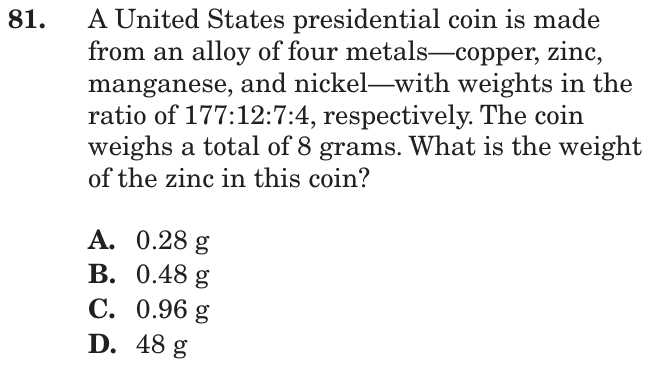
Question 19 of 19
2018 Test B Math, question 36Question
The Chens spend $5 of every $8 they earn on planned expenses. If the family earns $29,600 in one year, how much will they spend on planned expenses that year?
- A$1,850
- B$3,700
- C$5,920
- D$18,500
Show the answer
Correct answer: D
Let be the amount spent on planned expense in one year:
Question analysis
The Chens spend $5 out of every $8 they earn on planned expenses, and students apply that ratio to a yearly income of $29,600. It tests using a part-to-whole ratio with large numbers. The trap is using only part of the ratio, or using its two numbers the wrong way round.
- Grade level
- Grade 6 content, by NYS standard
- Compared with grade 7
- Below grade 7 Applying a ratio to a total is grade 6 ratio reasoning. This is a two-step calculation with friendly numbers, easier than the multistep ratio and percent problems typical of grade 7.
- Estimated difficulty
- Routine: one familiar step, little to misread.
- Thinking it demands
- Depth of knowledge 1, recall and reproduction · mainly apply
- What makes it hard
- Turning words into math minor
- Error-prone arithmetic minor
- Solution
- 2 steps
- Reading level
- Question and choices: about grade 4, 27 words.
- Students, last 30 days
- Not enough answers yet to show (it takes 10).
Why it is hard, traps and wrong answers (shows the answer)
Why it is hard
This is a direct fraction-of-a-quantity problem, and most students who read the ratio as five-eighths will finish it. The common loss is stopping after the division by 8, since that one-eighth share is also offered. Checking that the result is a little more than half the income catches both that error and a misplaced zero.
Turning words into math minor Understanding the question
"$5 of every $8" has to be read as the fraction 5/8 of the income, not as an instruction to divide by 5 or by 8 alone. (Hegarty, Mayer & Monk, 1995; Koedinger & Nathan, 2004)
Error-prone arithmetic minor Working it out
Dividing $29,600 by 8 and multiplying by 5 works with five-digit numbers, where a dropped zero gives an answer ten times too small. (Brown & Burton, 1978; Junker & Sijtsma, 2001)
Strategy: Treat 5 of every 8 dollars as the fraction five-eighths of the income: divide the yearly earnings by 8, then multiply by 5.
Traps
- Stops one step early: A choice is a number from partway through the solution.
The wrong answers, classified
A An arithmetic slip (Junker & Sijtsma, 2001)
Divides by 8 and multiplies by 5 with the right digits but drops a zero, ending with one tenth of the planned expenses.
B Stops one step early (King et al., 2004; Gierl et al., 2017)
Divides $29,600 by 8 to get one-eighth of the income and stops before multiplying by 5.
C Wrong operation (Hegarty, Mayer & Monk, 1995; King et al., 2004)
Divides $29,600 by 5, using only the 5 from the ratio, as if the family spent one-fifth of its income.
Worked solution, step by step
Formulas used
- Fraction of a number
- The whole is the full amount, here the money earned. The fraction a over b tells what share you want: a dollars out of every b dollars. Dividing the whole by b gives one share. Multiplying by a gives a of those shares.
Sort out what you know
The Chens earn $29,600 in one year. They spend “$5 of every $8” on planned expenses. That means 5 out of every 8 dollars. As a fraction, that is of what they earn. You need to find how much they spend.
Find one eighth of the money
Split the money into 8 equal parts.
One eighth is $3,700.
Watch out: this is not the answer yet. Stopping here gives choice B.
Take five of those parts
They spend 5 of the 8 parts. Use the fraction formula.
They spend $18,500.
Watch out: dividing only by 5 gives $5,920, choice C. Dropping a zero gives $1,850, choice A.
Give the answer
The planned expenses are 5 of the 8 equal parts, or $18,500. So the answer is D, $18,500.
Check your answer
is a little more than half. Half of $29,600 is $14,800. So the answer should be a bit more than $14,800. Only $18,500 fits. The other three choices are all less than half.
More questions like this
The original DOE question