Also in 2026 Practice Test B Math, question 30; 2025 Practice Test B Math, question 36.
Question
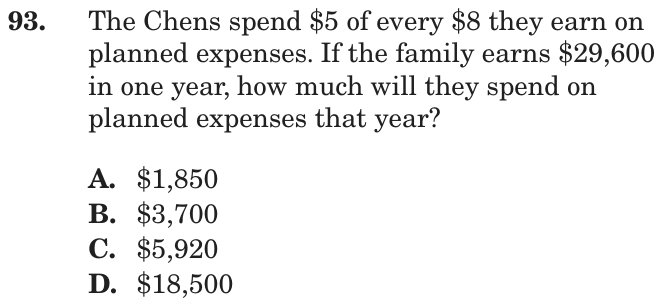
The Chens spend $5 of every $8 they earn on planned expenses. If the family earns $29,600 in one year, how much will they spend on planned expenses that year?
- A$1,850
- B$3,700
- C$5,920
- D$18,500
Show the answer
Correct answer: D
Let be the amount spent on planned expense in one year:
Question analysis
The Chens spend $5 out of every $8 they earn on planned expenses, and students apply that ratio to a yearly income of $29,600. It tests using a part-to-whole ratio with large numbers. The trap is using only part of the ratio, or using its two numbers the wrong way round.
- Grade level
- Grade 6 content, by NYS standard
- Compared with grade 7
- Below grade 7 Applying a ratio to a total is grade 6 ratio reasoning. This is a two-step calculation with friendly numbers, easier than the multistep ratio and percent problems typical of grade 7.
- Estimated difficulty
- Routine: one familiar step, little to misread.
- Thinking it demands
- Depth of knowledge 1, recall and reproduction · mainly apply
- What makes it hard
- Turning words into math minor
- Error-prone arithmetic minor
- Solution
- 2 steps
- Reading level
- Question and choices: about grade 4, 27 words.
- Students, last 30 days
- Not enough answers yet to show (it takes 10).
Why it is hard, traps and wrong answers (shows the answer)
Why it is hard
This is a direct fraction-of-a-quantity problem, and most students who read the ratio as five-eighths will finish it. The common loss is stopping after the division by 8, since that one-eighth share is also offered. Checking that the result is a little more than half the income catches both that error and a misplaced zero.
Turning words into math minor Understanding the question
"$5 of every $8" has to be read as the fraction 5/8 of the income, not as an instruction to divide by 5 or by 8 alone. (Hegarty, Mayer & Monk, 1995; Koedinger & Nathan, 2004)
Error-prone arithmetic minor Working it out
Dividing $29,600 by 8 and multiplying by 5 works with five-digit numbers, where a dropped zero gives an answer ten times too small. (Brown & Burton, 1978; Junker & Sijtsma, 2001)
Strategy: Treat 5 of every 8 dollars as the fraction five-eighths of the income: divide the yearly earnings by 8, then multiply by 5.
Traps
- Stops one step early: A choice is a number from partway through the solution.
The wrong answers, classified
A An arithmetic slip (Junker & Sijtsma, 2001)
Divides by 8 and multiplies by 5 with the right digits but drops a zero, ending with one tenth of the planned expenses.
B Stops one step early (King et al., 2004; Gierl et al., 2017)
Divides $29,600 by 8 to get one-eighth of the income and stops before multiplying by 5.
C Wrong operation (Hegarty, Mayer & Monk, 1995; King et al., 2004)
Divides $29,600 by 5, using only the 5 from the ratio, as if the family spent one-fifth of its income.
Worked solution, step by step
Formulas used
- Fraction of a number
- The whole is the full amount, here the money earned. The fraction a over b tells what share you want: a dollars out of every b dollars. Dividing the whole by b gives one share. Multiplying by a gives a of those shares.
Sort out what you know
The Chens earn $29,600 in one year. They spend “$5 of every $8” on planned expenses. That means 5 out of every 8 dollars. As a fraction, that is of what they earn. You need to find how much they spend.
Find one eighth of the money
Split the money into 8 equal parts.
One eighth is $3,700.
Watch out: this is not the answer yet. Stopping here gives choice B.
Take five of those parts
They spend 5 of the 8 parts. Use the fraction formula.
They spend $18,500.
Watch out: dividing only by 5 gives $5,920, choice C. Dropping a zero gives $1,850, choice A.
Give the answer
The planned expenses are 5 of the 8 equal parts, or $18,500. So the answer is D, $18,500.
Check your answer
is a little more than half. Half of $29,600 is $14,800. So the answer should be a bit more than $14,800. Only $18,500 fits. The other three choices are all less than half.
More questions like this
The original DOE question