Rounds too early
Question 1 of 19
2026 Practice Test A Math, question 32Question
What is the value of x in the equation ?
Enter your answer in the space provided. Enter only your answer.
On the test you build the answer on an on-screen keypad; here, type it. Use ^ for a power, sqrt( ) or √ for a root, pi for π, and <= or >= for ≤ and ≥.
Show the answer
Correct answer: x = -13/3
Solution:
Start with .
Subtract from both sides to move all terms involving x to one side.
Combine like terms.
Divide both sides by −3 to solve for x.
Question analysis
This equation question asks for the value of x when 6x equals 9x plus 13, typed into a box after "x =". Students solve a linear equation with the variable on both sides by gathering the x terms and dividing. With no answer choices to check against, keeping the sign of each moved term is the main challenge.
- Grade level
- Grade 8 content, by NYS standard
- Compared with grade 7
- At grade 7 The variable appears on both sides, a grade 8 topic, yet collecting it takes one subtraction and one division, much like a grade 7 two-step equation. The typed answer, with no choices to compare, adds some risk.
- Estimated difficulty
- Straightforward: two steps or one careful reading.
- Thinking it demands
- Depth of knowledge 1, recall and reproduction · mainly apply
- What makes it hard
- Error-prone arithmetic moderate
- An answer in an unexpected form minor
- Solution
- 2 steps
- Reading level
- Question and choices: about grade 5, 21 words.
- Students, last 30 days
- Not enough answers yet to show (it takes 10).
Why it is hard, traps and wrong answers (shows the answer)
Why it is hard
Two moves solve the equation, so the method is not in doubt; the points are lost in the result. Subtracting 6x instead, which gives 0 = 3x + 13, works as well but moves the sign onto the 13, and either route ends in a division that must keep the negative. The answer is not a whole number, which unsettles students who expect one, and a switch to decimals leads to a rounded entry that is not exact.
Error-prone arithmetic moderate Working it out
Collecting the x terms gives 6x − 9x = −3x, a negative coefficient, and 13 ÷ (−3) is a negative fraction that does not come out whole, so both the sign and the fraction must survive. (Brown & Burton, 1978; Junker & Sijtsma, 2001)
An answer in an unexpected form minor Choosing the answer
The answer is typed after the printed x =, with no choices to compare, and its decimal form, −4.333…, repeats forever, so only a fraction or mixed number is exact. (Enright, Morley & Sheehan, 2002)
Strategy: Subtract 9x from both sides so that x appears once, divide both sides by the coefficient left on x, and check by substituting the result into both sides of the original equation.
Traps
- Negatives and direction: Arithmetic with negative numbers, the order of a subtraction, or direction on a number line. (Moving a term across the equals sign without changing its sign is a faulty procedure.)
- Wrong operation: Adds instead of multiplying, divides the wrong way round, turns a ratio or rate upside down, or undoes a step in the wrong direction (subtracts what should be added back).
- Rounds too early: Rounds a value partway through, or rounds the wrong way, so the final answer drifts from the exact one.
The wrong answers, classified
13/3 Negatives and direction (Brown & Burton, 1978)
Reaches −3x = 13 correctly but drops the negative when dividing 13 by −3, entering a positive 13/3.
-4.33 Rounds too early (King et al., 2004)
Solves correctly but turns −13/3 into a decimal and rounds it to −4.33, which is close to the exact value but not equal to it.
-3/13 Wrong operation (Hegarty, Mayer & Monk, 1995; King et al., 2004)
Gets to −3x = 13 but divides the wrong way round, putting the coefficient −3 over the constant 13 instead of 13 over −3.
Worked solution, step by step
Formulas used
- Doing the same to both sides
- a and b are the two sides of an equation, and c is any number or term (not zero when you divide). Taking the same thing away from both sides, or dividing both by the same number, keeps the sides equal. That is how you get x by itself.
- Dividing by a negative number
- a and b are positive numbers, so −b is negative. A positive number divided by a negative number is negative. You can write the minus sign in front of the whole fraction.
- Changing a fraction to a mixed number
- Use this when the top of a fraction is bigger than the bottom. Divide a by b. q is the number of whole times b fits into a. r is the remainder, what is left over. The remainder goes on top of the leftover fraction.
Sort out the question
You need the value of x that makes true. The letter x appears on both sides, so first gather the x terms on one side. There are no choices to check against, so work carefully.
Move the x terms to one side
Subtract 9x from both sides. This clears the x term off the right side:
Since 6 − 9 = −3, the left side is −3 times x.
Divide both sides by −3
x is multiplied by −3, so divide both sides by −3:
A positive divided by a negative is negative, so x is negative.
Watch out: dropping the minus sign gives 13/3, which is wrong. Also, the number you divide by goes on the bottom. Writing −3/13 turns the fraction upside down.
Write it as a mixed number
A mixed number is a whole number with a fraction, like 4 1/3. Divide 13 by 3. The 3 fits 4 times, with 1 left over.
So .
Watch out: as a decimal, −13/3 is −4.333…, and the 3s never end. Rounding to −4.33 is close, but it is not exact. Keep the fraction.
Enter the answer
The box already shows x =, so you enter only the number. On the test, press the minus key first. Then press the fraction key, a small box over a small box. Type 13 in the top box and 3 in the bottom box. On this site, type −13/3 or −4 1/3.
So the finished answer reads x = −13/3. You type only the −13/3, which is the same as −4 1/3.
Check your answer
Put into both sides. The left side is . The right side is . Both sides equal −26, so the answer is right.
More questions like this
The original DOE question
Question 2 of 19
2026 Practice Test C Math, question 9Question
Maria rides her bicycle to school at a constant speed of 15 miles per hour. If the distance to school is 6 miles, how many minutes will it take Maria to get to school?
- A10
- B15
- C24
- D30
Show the answer
Correct answer: C
Maria’s rate of speed is given as 15 miles per hour. Since 1 hour is equivalent to 60 minutes, her rate of speed, in miles per minute, can be determined.
, or mile per minute.
Therefore, it takes Maria 4 minutes to ride 1 mile.
The distance to school is 6 miles, so it will take minutes to ride to school.
Question analysis
Maria bikes 6 miles to school at a constant 15 miles per hour, and students find how many minutes the ride takes. It tests using a rate to find a time and converting hours to minutes. With the speed given per hour and the question asking, in bold, for minutes, keeping track of units is the main hurdle.
- Grade level
- Grade 6 content, by NYS standard
- Compared with grade 7
- Below grade 7 Distance, speed and time with whole numbers is grade 6 rate work. The only extra demand is an answer in minutes when the speed is per hour, a conversion grade 7 students make routinely.
- Estimated difficulty
- Straightforward: two steps or one careful reading.
- Thinking it demands
- Depth of knowledge 2, skills and concepts · mainly apply
- What makes it hard
- Solution
- 2 steps
- Reading level
- Question and choices: about grade 6, 32 words.
- Students, last 30 days
- Not enough answers yet to show (it takes 10).
Why it is hard, traps and wrong answers (shows the answer)
Why it is hard
The numbers are small, but the speed is per hour and the answer is wanted in minutes, so students have to choose a route through the units. Finding the minutes per mile first, 4 at 15 miles an hour, turns the rest into a single multiplication. The wrong choices come from using a number in the stem as the answer, from mixing the 60 minutes with the 6 miles, or from rounding 0.4 hour to a half hour.
Something you must already know minor Working it out
Nothing on the page says that time is distance divided by speed or that an hour has 60 minutes, and the bold word minutes requires both. (Anderson & Krathwohl, 2001)
Error-prone arithmetic minor Working it out
6 ÷ 15 is less than 1, 0.4 hour, and turning it into minutes means 0.4 × 60; the cleaner route, 60 ÷ 15 = 4 minutes a mile, avoids decimals. (Brown & Burton, 1978; Junker & Sijtsma, 2001)
Strategy: Find how many minutes Maria needs to ride one mile at 15 miles per hour, then multiply by the number of miles to school.
Traps
- Numbers taken from the question: Combines the numbers in the question without a model of the situation, or is simply a number that appears in the question.
- Rounds too early: Rounds a value partway through, or rounds the wrong way, so the final answer drifts from the exact one.
The wrong answers, classified
A Numbers taken from the question (Hegarty, Mayer & Monk, 1995)
Divides the 60 minutes in an hour by the 6 miles, 60 ÷ 6 = 10, as if the ride took a full hour, and ignores the 15 mph speed.
B Numbers taken from the question (Hegarty, Mayer & Monk, 1995)
Takes the 15 in 15 miles per hour as the number of minutes, a number copied from the question without any calculation.
D Rounds too early (King et al., 2004)
Sees that 6 miles is a little under half of 15, rounds the time of 0.4 hour up to half an hour, and gives 30 minutes.
Worked solution, step by step
Formulas used
- Minutes for each mile
- Miles per hour tells how many miles you ride in one hour, which is 60 minutes. Sharing the 60 minutes evenly among those miles gives the minutes for each mile. This works when the speed stays the same the whole time.
- Distance, speed and time
- Distance is how far you go, here in miles. Speed is how far you go in one hour. Dividing the distance by the speed gives the time in hours.
Sort out the question
Maria rides at a constant speed of 15 miles per hour. Constant means it never changes. School is 6 miles away. You need the time in minutes, not hours. You must know that one hour has 60 minutes.
Find the minutes for one mile
15 miles per hour means Maria rides 15 miles in 60 minutes. Use the minutes-per-mile formula:
So each mile takes Maria 4 minutes.
Find the minutes for 6 miles
Each of the 6 miles takes 4 minutes:
So the ride takes 24 minutes.
Watch out: 15 is the speed, not a time, so choice B is a trap. And , choice A, ignores the speed.
Choose the answer
Another way is the time formula. , so the ride takes 0.4 of an hour. In minutes, that is .
Watch out: rounding 0.4 hour up to half an hour gives choice D, 30.
So the answer is C, 24.
Check your answer
Check with the speed. 24 minutes is of an hour. In a full hour Maria rides 15 miles. So in 2/5 of an hour she rides miles. That is exactly the distance to school.
More questions like this
The original DOE question
Question 3 of 19
2026 Practice Test C Math, question 11Question
Allison has 5 stamp albums with 576 stamps in each album. If she transfers her stamp collection to 6 albums, each holding 378 stamps, how many stamps will be left over?
- A198
- B612
- C620
- D632
Show the answer
Correct answer: B
Determine the total number of stamps in 5 albums holding 576 stamps:
Determine the total number of stamps in 6 albums holding 378 stamps:
Subtract 2,268 from 2,880 to find the number of stamps that will be left over:
Question analysis
Allison moves a stamp collection from 5 albums of 576 stamps into 6 albums that hold 378 each, and students find how many stamps are left over. It tests multiplying and subtracting large whole numbers in a word problem. The question gives no total, so the collection has to be counted before the new albums' capacity is taken away.
- Grade level
- Grade 7 content, by NYS standard
- Compared with grade 7
- Below grade 7 Whole-number multiplication and subtraction in a three-step word problem is easier than grade 7 work with fractions, decimals or negatives. Because the products are large, a slip or a rounded estimate easily gives another choice.
- Estimated difficulty
- Straightforward: two steps or one careful reading.
- Thinking it demands
- Depth of knowledge 2, skills and concepts · mainly apply
- What makes it hard
- A very close wrong answer moderate
- Error-prone arithmetic minor
- Solution
- 3 steps
- Reading level
- Question and choices: about grade 6, 27 words.
- Students, last 30 days
- Not enough answers yet to show (it takes 10).
Why it is hard, traps and wrong answers (shows the answer)
Why it is hard
The plan is clear from the stem: count the stamps, then take away what the six new albums hold, so the question tests careful arithmetic. Its choices punish the estimating that saves time elsewhere, since rounding either factor shifts the result by only a few tens, onto another listed number. Students who skip the album counts altogether and compare one album with one album find 198 waiting.
A very close wrong answer moderate Choosing the answer
612, 620 and 632 lie within 20 of one another, so rounding 576 and 378 to friendly numbers before multiplying lands on a wrong choice; only exact products separate them. (Embretson & Wetzel, 1987; Gorin & Embretson, 2006; Ascalon et al., 2007)
Error-prone arithmetic minor Working it out
Two products of three-digit numbers, 5 × 576 = 2,880 and 6 × 378 = 2,268, must be done by hand and then subtracted with regrouping. (Brown & Burton, 1978; Junker & Sijtsma, 2001)
Strategy: Multiply to find the total number of stamps, multiply again to find how many the six new albums hold, subtract, and check the last digit of each product.
Traps
- Rounds too early: Rounds a value partway through, or rounds the wrong way, so the final answer drifts from the exact one.
- Numbers taken from the question: Combines the numbers in the question without a model of the situation, or is simply a number that appears in the question.
The wrong answers, classified
A Numbers taken from the question (Hegarty, Mayer & Monk, 1995)
Subtracts 378 from 576, comparing one old album with one new album, and ignores that there are 5 old albums and 6 new ones.
C Rounds too early (King et al., 2004)
Rounds 576 to 580 and 378 to 380 before multiplying, so 2,900 − 2,280 = 620, an estimate rather than the exact number left over.
D Rounds too early (King et al., 2004)
Rounds only 576 up to 580, getting 2,900 stamps, then subtracts the exact 2,268, so the count comes out 20 too high.
Worked solution, step by step
Formulas used
- Total in equal groups
- Here the groups are albums. The amount in each group is how many stamps one album holds. When every group is the same size, multiplying is a fast way to add them all up.
Sort out the question
Allison has 5 albums with 576 stamps in each. She moves all her stamps into 6 new albums. Each new album holds 378 stamps. Some stamps will not fit. You need the number left over.
Count all her stamps
Use the equal-groups formula. Split 576 into 500 + 76 to make it easy:
Allison has 2,880 stamps.
Count what the new albums hold
Do the same for the 6 new albums. Split 378 into 300 + 78:
The new albums hold 2,268 stamps in all.
Subtract to find the leftovers
The stamps left over are the ones she has minus the ones that fit:
Watch out: , choice A, compares just one old album with one new one. Rounding to 580 and 380 first gives 620, choice C. Rounding only 576 gives 632, choice D. Use the exact numbers.
So the answer is B, 612.
Check your answer
Add the leftovers to the stamps that fit: . That is exactly the number Allison started with. So no stamps were lost or counted twice.
More questions like this
The original DOE question
Question 4 of 19
2026 Practice Test C Math, question 13Question
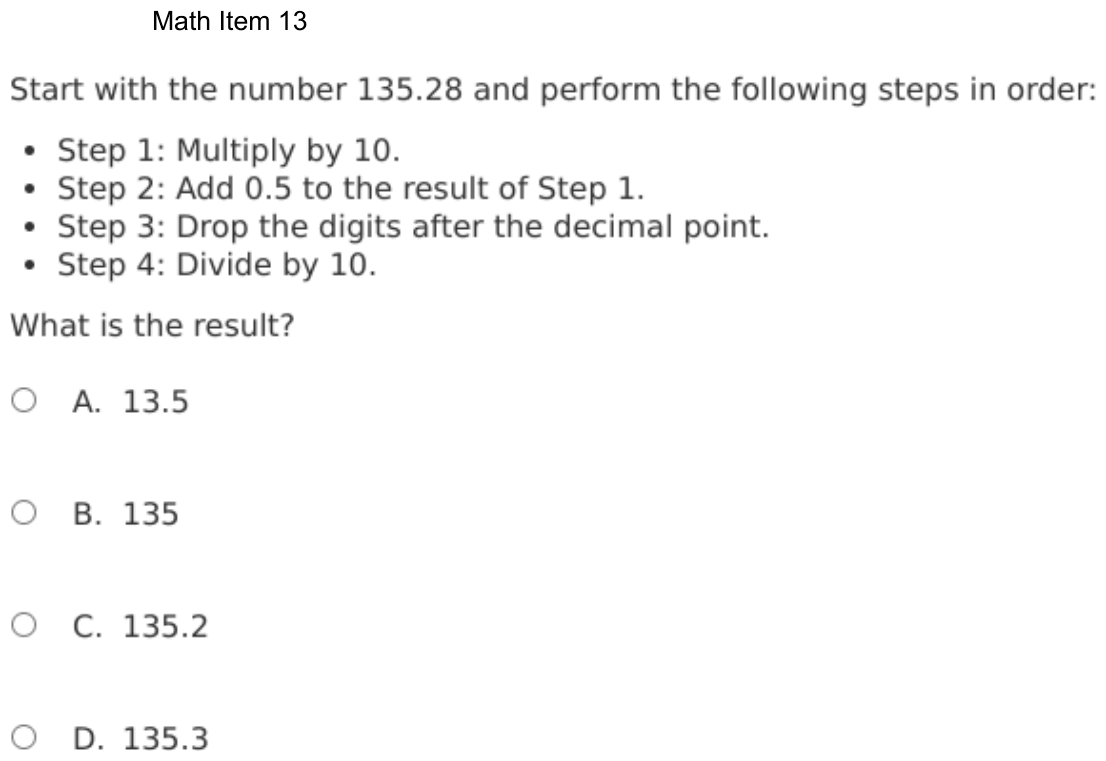
Start with the number 135.28 and perform the following steps in order:
- Step 1: Multiply by 10.
- Step 2: Add 0.5 to the result of Step 1.
- Step 3: Drop the digits after the decimal point.
- Step 4: Divide by 10.
What is the result?
- A13.5
- B135
- C135.2
- D135.3
Show the answer
Correct answer: D
Begin by multiplying 135.28 by 10:
Add 0.5:
Drop the digits after the decimal point, so becomes .
Divide by 10:
Question analysis
Students start with 135.28 and carry out four listed steps: multiply by 10, add 0.5, drop the digits after the decimal point, and divide by 10. It tests place value and operations with decimals. Skipping a step, or doing two of them in the wrong order, changes the result, and the choices are built from those slips.
- NYS standards
- 6.NS.3 multi-digit decimal operations
- Grade level
- Grade 6 content, by NYS standard
- Compared with grade 7
- Below grade 7 Multiplying and dividing a decimal by 10 and adding 0.5 are grade 5 and 6 skills. The four steps are spelled out, so the demand is following them exactly and in order, not choosing a method.
- Estimated difficulty
- Straightforward: two steps or one careful reading.
- Thinking it demands
- Depth of knowledge 1, recall and reproduction · mainly apply
- What makes it hard
- A very close wrong answer moderate
- Many steps minor
- Error-prone arithmetic minor
- Solution
- 4 steps
- Reading level
- Question and choices: about grade 3, 36 words.
- Students, last 30 days
- Not enough answers yet to show (it takes 10).
Why it is hard, traps and wrong answers (shows the answer)
Why it is hard
The steps spell out how to round 135.28 to the nearest tenth, but nothing says so, and they have to be followed exactly. The decisive moment is step 2, where adding 0.5 pushes 1,352.8 past 1,353; skip it and the digits are simply cut, not rounded. Students who recognize the routine can check the result directly, since 135.28 lies closer to 135.3 than to 135.2.
A very close wrong answer moderate Choosing the answer
135.3 and 135.2 differ only in the tenths digit, and 135 shares their whole-number part, so a rough sense of the result's size rules out nothing. (Embretson & Wetzel, 1987; Gorin & Embretson, 2006; Ascalon et al., 2007)
Many steps minor Working it out
Four listed steps move the decimal point twice, and doing them in another order, or skipping one, still produces a believable number near 135. (Daniel & Embretson, 2010; Enright, Morley & Sheehan, 2002)
Error-prone arithmetic minor Working it out
Adding 0.5 to 1,352.8 carries into the ones place, since 8 tenths and 5 tenths make 1.3, which turns 1,352 into 1,353 before the decimals are dropped. (Brown & Burton, 1978; Junker & Sijtsma, 2001)
Strategy: Write down the number after each step instead of doing them in your head, and carry out the steps exactly in the order listed.
Traps
- Misreads the question: Misses or misreads a condition or a word in the question: "at least", "each", "remaining", "not".
- Rounds too early: Rounds a value partway through, or rounds the wrong way, so the final answer drifts from the exact one.
The wrong answers, classified
A Misreads the question (Hegarty, Mayer & Monk, 1995)
Skips step 1, so adds 0.5 to 135.28, drops the decimals to get 135, and then divides by 10 to reach 13.5.
B Misreads the question (Hegarty, Mayer & Monk, 1995)
Divides by 10 before dropping the digits after the decimal point, so 1,353.3 becomes 135.33 and then 135, doing steps 3 and 4 in reverse order.
C Rounds too early (King et al., 2004)
Leaves out step 2, or adds 0.5 without carrying, so 1,352 is kept and 135.2 results: 135.28 cut down instead of rounded up.
Worked solution, step by step
Formulas used
- Multiplying and dividing by 10
- a is any decimal number. Multiplying by 10 moves its decimal point one place to the right, so each digit is worth ten times as much. Dividing by 10 moves the point one place to the left. The two steps undo each other.
Sort out the question
You start with 135.28 and do four steps, in order. Write down the number after each step. Doing them in your head, or in another order, leads to a wrong choice. You need the number at the end.
Multiply by 10
Step 1. Multiplying by 10 moves the decimal point one place to the right:
The digits stay the same. Only the decimal point moves.
Add 0.5
Step 2. Line up the decimal points. 8 tenths plus 5 tenths is 13 tenths. That is 1 whole and 3 tenths, so carry the 1 into the ones place:
Watch out: skipping this step, or forgetting to carry, keeps 1,352. That leads to choice C, 135.2.
Drop the digits after the point
Step 3. Cut off the digits after the decimal point. Do not round. So 1,353.3 becomes 1,353.
Watch out: do step 3 before step 4. Dividing first gives 135.33. Dropping its decimals then gives 135, choice B.
Divide by 10
Step 4. Dividing by 10 moves the decimal point one place to the left:
Skipping step 1 gives 13.5, choice A. So the answer is D, 135.3.
Check your answer
These four steps are a recipe for rounding to the nearest tenth. 135.28 is between 135.2 and 135.3. Its hundredths digit is 8, which is 5 or more, so it rounds up to 135.3. The recipe and the rounding agree.
More questions like this
The original DOE question
Question 5 of 19
2026 Practice Test C Math, question 15Question
A grocery store sells 1-gallon containers of milk for $3.99. The store also sells orange juice in a 6-pack of 5.5-fluid-ounce bottles for $1.79. Suppose the store wants to sell its orange juice in gallon containers instead. To the nearest dollar, how much more would a gallon of orange juice cost than a gallon of milk?
Enter your answer in the space.
Fill-in question: work out the answer and type it as a number.
Show the answer
Correct answer: 3
To determine the cost of a gallon of orange juice, begin by finding the total number of ounces in the 6-pack of bottles:
So, 33 oz of orange juice costs $1.79.
There are 128 oz in 1 gallon. Set up a proportion using the $1.79 cost per 33 oz of orange juice and the unknown cost (x) per 1 gallon of orange juice:
Cross multiply to solve for x in the proportion:
So, the orange juice costs $6.94 per gallon, and the milk costs $3.99 per gallon.
Subtract the cost per gallon of milk from the cost per gallon of orange juice.
Round the difference to the nearest dollar.
$2.95 rounds to $3.
Question analysis
A store sells milk by the gallon for $3.99 and orange juice in six-packs of 5.5-fluid-ounce bottles for $1.79. Students work out what a gallon of the juice would cost at the same price per ounce and how much more that is than the milk, to the nearest dollar. The ounces in a gallon must be known, and several steps involve decimals.
- Grade level
- Grade 7 content, by NYS standard
- Compared with grade 7
- Above grade 7 Unit prices are grade 6 and 7 work, but this chains five steps with decimals and needs a fact the question does not give, the number of fluid ounces in a gallon. Typing a rounded difference, with no choices, adds risk.
- Estimated difficulty
- Hard: combines ideas, needs a plan, and has more than one tempting wrong answer.
- Thinking it demands
- Depth of knowledge 2, skills and concepts · mainly apply
- What makes it hard
- Something you must already know moderate
- Many steps moderate
- Error-prone arithmetic minor
- An answer in an unexpected form minor
- Solution
- 5 steps
- Reading level
- Question and choices: about grade 5, 60 words.
- Corrected from the DOE handbook
- A rounded value in the explanation is now marked as approximate (≈ instead of =).
- Students, last 30 days
- Not enough answers yet to show (it takes 10).
Why it is hard, traps and wrong answers (shows the answer)
Why it is hard
The calculation is long, and its key fact is missing from the page. Students who know the 128 fluid ounces still face a division by 33 that does not come out evenly, which tempts them to round the price per ounce to 5 cents and lose about 50 cents a gallon. Keeping the exact quotient to the end, or scaling 33 ounces up by about 3.9, keeps the difference near $2.95, which rounds to 3.
Something you must already know moderate Working it out
The question never says that a gallon holds 128 fluid ounces, yet the whole comparison depends on it; the 6-pack holds only 6 × 5.5 = 33 ounces. (Anderson & Krathwohl, 2001)
Many steps moderate Working it out
Five moves follow one another: the ounces in a pack, the scale-up to 128 ounces, the division by 33, the subtraction of $3.99 and the rounding to a whole dollar. (Daniel & Embretson, 2010; Enright, Morley & Sheehan, 2002)
Error-prone arithmetic minor Working it out
1.79 × 128 = 229.12 and 229.12 ÷ 33 are long decimal calculations without a calculator, and a slip in either moves the price of a gallon. (Brown & Burton, 1978; Junker & Sijtsma, 2001)
An answer in an unexpected form minor Choosing the answer
The rounded difference is typed with no choices, so an unrounded $2.95, or a figure rounded too soon, looks just as finished as the whole-dollar answer. (Enright, Morley & Sheehan, 2002)
Strategy: Find the ounces in one six-pack, scale its price up to the 128 fluid ounces in a gallon, subtract the milk's price, and round only at the end.
Traps
- Stops one step early: A choice is a number from partway through the solution.
- Rounds too early: Rounds a value partway through, or rounds the wrong way, so the final answer drifts from the exact one.
- Misreads the question: Misses or misreads a condition or a word in the question: "at least", "each", "remaining", "not".
The wrong answers, classified
7 Stops one step early (King et al., 2004; Gierl et al., 2017)
Finds the juice's cost per gallon, about $6.94, rounds it to $7, and enters that without subtracting the $3.99 price of the milk.
2 Rounds too early (King et al., 2004)
Rounds the price per ounce, 1.79 ÷ 33 ≈ 0.054, to $0.05, so a gallon costs $6.40 and the difference, $2.41, rounds to 2.
2.95 Misreads the question (Hegarty, Mayer & Monk, 1995)
Works out the difference of $2.95 correctly but enters it as it stands, though the question asks for it to the nearest dollar.
What was corrected from the DOE handbook, and why
- Explanation: The DOE’s explanation goes from 33x = $229.12 to “x = $6.94”. But 229.12 ÷ 33 = 6.9430…, so $6.94 is the cost per gallon rounded to the cent. The site writes x ≈ $6.94. Nothing else changes: $6.94 − $3.99 = $2.95, which rounds to $3, and the unrounded cost gives the same answer.
Worked solution, step by step
Formulas used
- Fluid ounces in a gallon
- A gallon holds 128 fluid ounces. This is a fact you must know, because the question does not give it. A fluid ounce measures an amount of liquid. Multiply gallons by 128 to change them into fluid ounces.
- Cross-multiplying a proportion
- A proportion says two ratios are equal. Here each ratio is ounces over dollars. a and c are the tops, and b and d are the bottoms. Multiply each top by the other bottom, and the two products are equal. That turns the proportion into an equation.
Sort out the question
Milk costs $3.99 for 1 gallon. Orange juice comes in a 6-pack of 5.5-fluid-ounce bottles for $1.79. You need how much more a gallon of juice would cost than a gallon of milk. Round to the nearest dollar.
The question doesn’t say how big a gallon is. You must know this fact: 1 gallon is 128 fluid ounces.
Find the ounces in a 6-pack
Each of the 6 bottles holds 5.5 fluid ounces:
So $1.79 buys 33 fluid ounces of juice.
Set up a proportion
Let x be the cost in dollars of a gallon, 128 fluid ounces, of juice. The price per ounce stays the same. So ounces over dollars is the same for the pack and the gallon:
Cross-multiply:
Find the cost of a gallon
Divide both sides by 33:
The sign ≈ means about equal. The exact value is 6.943…, so a gallon of juice costs about $6.94.
Watch out: don’t round too early. One ounce costs about $0.054. Rounding that to $0.05 makes a gallon $6.40, and your answer becomes 2.
Subtract the milk’s price
Find how much more the juice costs:
A gallon of juice costs $2.95 more than a gallon of milk.
Watch out: entering 7, the juice’s price, forgets to subtract the milk.
Round and enter it
The question asks for the nearest dollar. $2.95 is between $2 and $3. Its cents, 95, are 50 or more, so it rounds up to $3. Do not enter 2.95.
Type only the number in the box. So you would enter 3.
Check your answer
Estimate. 128 ounces is almost 4 packs, since . Four packs cost dollars, so a gallon costs a bit less than that. Milk costs about $4. About $7 minus $4 is $3, which matches.
More questions like this
The original DOE question

Question 6 of 19
2026 Practice Test C Math, question 44Question
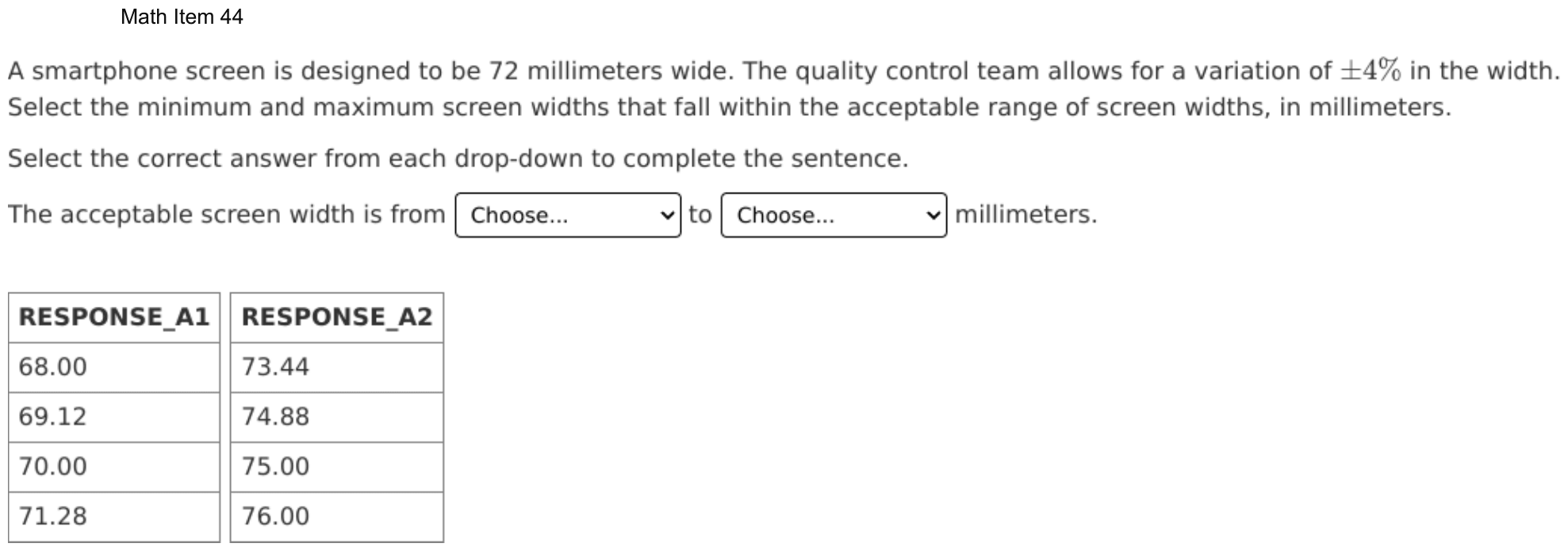
A smartphone screen is designed to be 72 millimeters wide. The quality control team allows for a variation of in the width. Select the minimum and maximum screen widths that fall within the acceptable range of screen widths, in millimeters.
Select the correct answer from each drop-down to complete the sentence.
The acceptable screen width is from to millimeters.
Choose an answer from each menu, then check. The DOE has not published how answers with several parts are scored; this site counts one right only when every part is right.
Show the answer
Correct answer: blank 1: 69.12; blank 2: 74.88
A variation of in the width means that the width of the smartphone can be from 4% less than the standard of 72 mm to 4% greater than 72 mm.
The least allowed measure is
The greatest allowed measure is
Therefore, the allowable range is from 69.12 mm to 74.88 mm in width.
Question analysis
A smartphone screen is designed to be 72 millimeters wide, and quality control allows a variation of plus or minus 4%. Students choose the minimum and maximum acceptable widths from two drop-down menus. It tests finding a percent of a quantity, and the 4% has to be turned into millimeters before it is added or subtracted.
- Grade level
- Grade 7 content, by NYS standard
- Compared with grade 7
- At grade 7 Finding a percent of a number and adding or subtracting it is grade 7 percent work. The ± sign, the decimal result and two linked menus, which must both be right, add a little to the usual demand.
- Estimated difficulty
- Moderate: several steps, or a close reading with one strong distractor.
- Thinking it demands
- Depth of knowledge 2, skills and concepts · mainly apply
- What makes it hard
- Error-prone arithmetic moderate
- Turning words into math minor
- A very close wrong answer minor
- Many steps minor
- Solution
- 3 steps
- Reading level
- Question and choices: about grade 8, 59 words.
- Students, last 30 days
- Not enough answers yet to show (it takes 10).
Why it is hard, traps and wrong answers (shows the answer)
Why it is hard
The question rewards turning the percent into millimeters before doing anything else. Students who treat ±4% as ±4 millimeters find the two whole-number options at either end of the menus, 68.00 and 76.00, which look like a natural pair. Those who compute 2.88 correctly can still lose the item on the maximum by rounding to 3 and picking 75.00. Multiplying 72 by 0.96 and by 1.04 is a quick double-check.
Error-prone arithmetic moderate Working it out
Four percent of 72 is 0.04 × 72 = 2.88, a decimal product, and taking it from 72 means borrowing across the decimal point to reach 69.12. (Brown & Burton, 1978; Junker & Sijtsma, 2001)
Turning words into math minor Understanding the question
The phrase “a variation of ±4% in the width” has to become 4% of 72 millimeters, a length of 2.88 mm, before anything is added or subtracted. (Hegarty, Mayer & Monk, 1995; Koedinger & Nathan, 2004)
A very close wrong answer minor Choosing the answer
The second menu lists 75.00 just 0.12 above 74.88, so a rounded estimate of 72 + 3 lands on the wrong option, and estimating cannot separate the two. (Embretson & Wetzel, 1987; Gorin & Embretson, 2006; Ascalon et al., 2007)
Many steps minor Working it out
Both menus must be right to score, so the minimum and the maximum each need their own subtraction or addition after the shared percent is found. (Daniel & Embretson, 2010; Enright, Morley & Sheehan, 2002)
Strategy: Find 4% of the 72-millimeter design width first, then subtract that amount for the minimum and add it for the maximum, before looking at the menus.
Traps
- Misunderstands the concept: A wrong belief about a concept: that percents can be added, that area grows like length, that averages can be averaged, that a bigger denominator means a bigger fraction.
- Rounds too early: Rounds a value partway through, or rounds the wrong way, so the final answer drifts from the exact one.
The wrong answers, classified
AD Misunderstands the concept (Smith, diSessa & Roschelle, 1993; De Bock et al., 1998; Ni & Zhou, 2005)
Reads ±4% as ±4 millimeters, so the widths run from 72 − 4 = 68.00 to 72 + 4 = 76.00.
BC Rounds too early (King et al., 2004)
Finds the 69.12 minimum, then estimates the maximum by rounding the 2.88 change up to 3, so 72 + 3 = 75.00 is picked over 74.88.
Worked solution, step by step
Formulas used
- Percent of a number
- The percent is how many out of 100. Dividing it by 100 turns it into a decimal, so 4% becomes 0.04. The whole is the amount you take the percent of. The part is the amount that the percent stands for.
Sort out the question
The screen is designed to be 72 millimeters (mm) wide. The sign ±4% means plus or minus 4%. So a screen may be up to 4% narrower or up to 4% wider than 72 mm.
You need the minimum, the smallest allowed width, and the maximum, the largest. You pick each one from a drop-down menu.
Find 4% of 72 mm
Use the percent formula. 4% is :
So the width may change by up to 2.88 mm either way.
Watch out: 4% is not 4 mm. Taking 4 away and adding 4 gives 68.00 and 76.00. Both are in the menus, and both are wrong.
Find the minimum width
Take the change away from the design width:
The narrowest allowed screen is 69.12 mm wide.
Find the maximum width
Add the change to the design width:
The widest allowed screen is 74.88 mm wide.
Watch out: rounding 2.88 up to 3 gives 75.00. That is in the second menu too, but it is too wide.
Choose from each menu
Open the first drop-down menu and choose 69.12. Open the second one and choose 74.88.
So the sentence reads: the acceptable screen width is from 69.12 to 74.88 millimeters.
Check your answer
Use multipliers. A screen 4% narrower keeps 96% of the width: . A screen 4% wider is 104% of it: . Both match. Also, both ends are the same 2.88 mm away from 72.
More questions like this
The original DOE question
Question 7 of 19
2026 Practice Test D Math, question 8Question
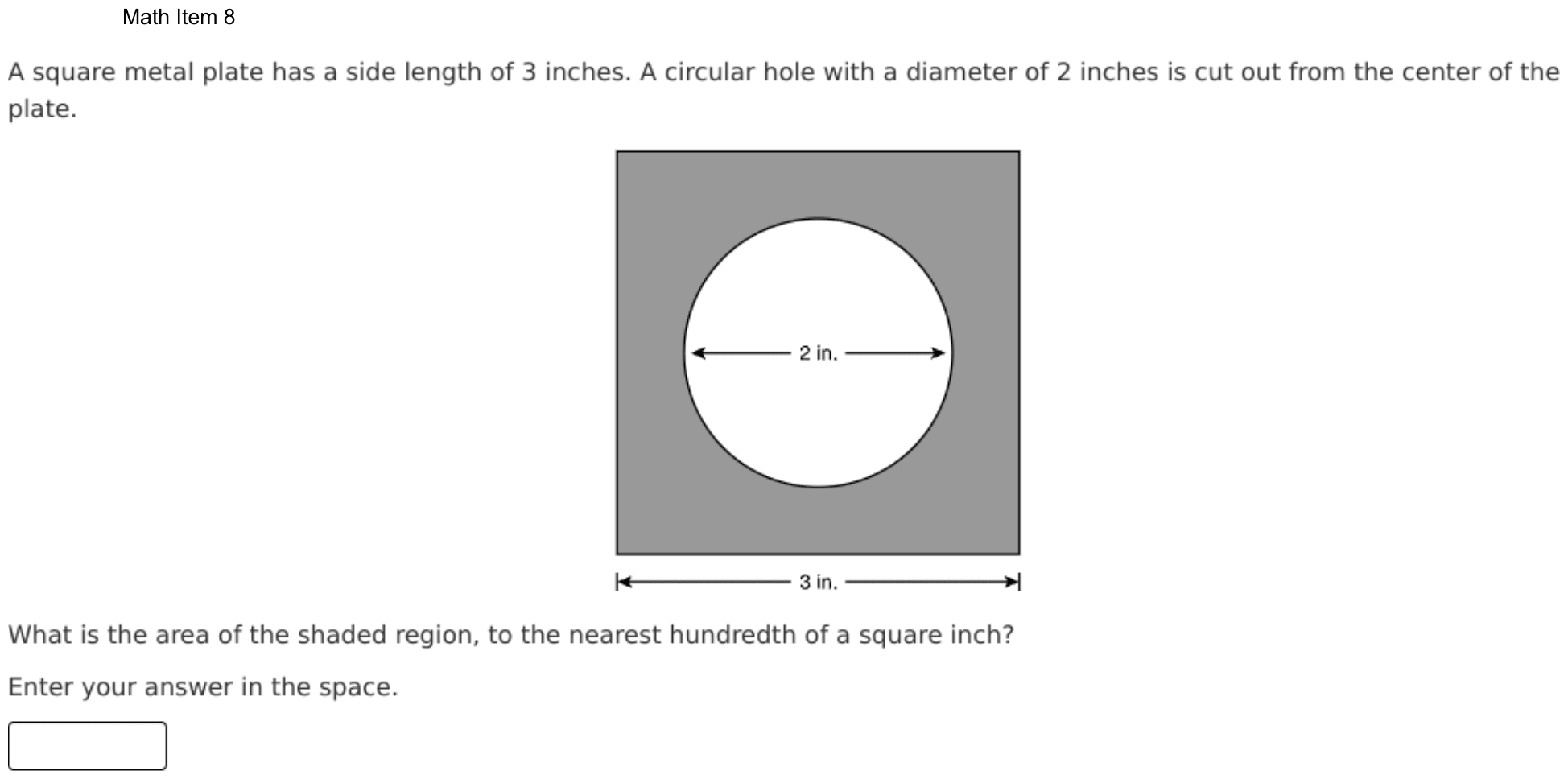
A square metal plate has a side length of 3 inches. A circular hole with a diameter of 2 inches is cut out from the center of the plate.
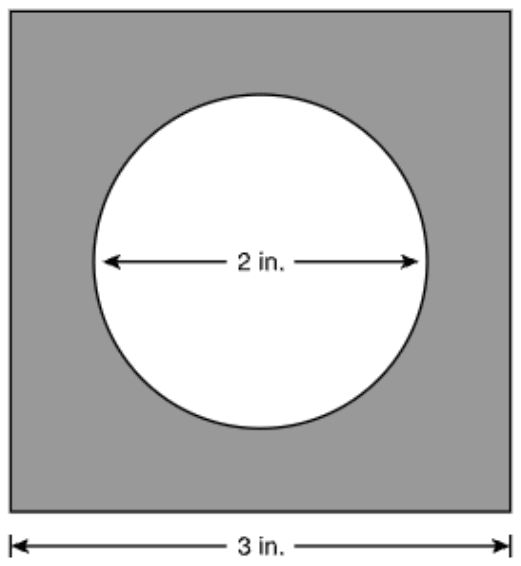
What is the area of the shaded region, to the nearest hundredth of a square inch?
Enter your answer in the space.
Fill-in question: work out the answer and type it as a number.
Show the answer
Correct answer: 5.86
To determine the area of a square, use .
Begin by finding the length of the side of the square, which is 3 inches. The area of the square is .
To determine the area of the circle, use .
The radius of the circle (the hole) is one-half the diameter or , so the area of the entire circle is
To determine the area of the shaded region, subtract the area of the hole in the square from the area of the square:
The shaded area to the nearest hundredth of a square inch sq in.
Question analysis
A 3-inch square metal plate has a circular hole 2 inches across cut from its center, and students find the area of the metal that is left, to the nearest hundredth of a square inch. It tests the areas of a circle and a square. Using the radius, not the diameter, and subtracting the right areas are the keys.
- NYS standards
- 7.G.4 circle area and circumference
- Grade level
- Grade 7 content, by NYS standard
- Compared with grade 7
- At grade 7 Finding a circle's area is a grade 7 standard, and subtracting a hole from a shape is common grade 7 practice. The radius must come from the diameter and the result must be rounded, but the steps are routine.
- Estimated difficulty
- Straightforward: two steps or one careful reading.
- Thinking it demands
- Depth of knowledge 2, skills and concepts · mainly apply
- What makes it hard
- Something you must already know moderate
- Combines ideas minor
- An answer in an unexpected form minor
- Solution
- 3 steps
- Reading level
- Question and choices: about grade 4, 49 words.
- Corrected from the DOE handbook
- A wrong symbol in the explanation was corrected.
- Students, last 30 days
- Not enough answers yet to show (it takes 10).
Why it is hard, traps and wrong answers (shows the answer)
Why it is hard
Every number is small, so the work is choosing the right pieces: the area of the square, the area of the hole, and the difference. A radius of 1 makes the circle's area simply π, which is easy to confuse with the circumference, 2π, when the formulas are half remembered. The region asked for is the gray metal, not the hole, and the final rounding goes up, since the third decimal place is 8.
Something you must already know moderate Working it out
Neither area formula is given, and the hole is labeled by its 2-inch diameter, so students must recall A = πr² and halve the diameter to get the radius 1 first. (Anderson & Krathwohl, 2001)
Combines ideas minor Working it out
The shaded metal is a square with a circle removed, so two area formulas are combined by subtraction rather than either one used alone. (Embretson, 1998; Daniel & Embretson, 2010)
An answer in an unexpected form minor Choosing the answer
The result is typed to the nearest hundredth with no choices to compare, so the long decimal 5.858… must be rounded up, not cut off after two places. (Enright, Morley & Sheehan, 2002)
Strategy: Halve the diameter to get the radius, find the area of the square and of the circle, subtract the circle from the square, and round only at the end.
Traps
- Answers a different question: A choice is right for another quantity: the other unknown, the rest instead of the part, the part instead of the whole.
- Wrong formula: Uses a related but wrong formula: perimeter for area, diameter for radius, area for volume, or a misremembered one.
- A formula you must know: Needs a formula the test does not give: area, circumference, volume, probability rules.
The wrong answers, classified
2.72 Wrong formula (King et al., 2004)
Uses the circumference, 2π × 1 ≈ 6.28, in place of the circle's area and subtracts it from the square's 9 square inches, getting about 2.72.
3.14 Answers a different question (King et al., 2004; Hegarty, Mayer & Monk, 1995)
Finds the area of the circular hole, π × 1² ≈ 3.14 square inches, and enters it instead of the area of the shaded metal left around it.
5.85 Rounds too early (King et al., 2004)
Works the area out correctly as about 5.858 but cuts off the extra digits instead of rounding up to the nearest hundredth.
What was corrected from the DOE handbook, and why
- Explanation: The DOE’s explanation gives the area of the hole as “π(1 in.)² ≅ 3.14 sq in.” The symbol ≅ means “is congruent to”, which an area and a number cannot be; the line means “is approximately equal to”, written ≈. The site now says “π(1 in.)² ≈ 3.14 sq in.”
Worked solution, step by step
Formulas used
- Area of a square
- A is the area, the amount of flat space inside. s is the length of one side. s² means s × s. It works because a square with side s holds s rows of s little unit squares.
- Area of a circle
- A is the area. r is the radius, the distance from the center to the edge. It is half the diameter, the distance straight across through the center. π (pi) is a number a little more than 3, about 3.14. r² means r × r.
Sort out the question
The plate is a square with 3-inch sides. A circle with a 2-inch diameter is cut out of the middle. The diameter is the distance straight across the circle through its center. The shaded region is the metal that is left. You need its area to the nearest hundredth of a square inch.
Find the area of the square
Use the formula for the area of a square, with s = 3 inches:
The whole plate, before the hole is cut, is 9 square inches.
Find the radius of the hole
The circle formula needs the radius, not the diameter. The figure labels the 2 in. distance across the hole. The radius is half of it:
The radius is 1 inch.
Find the area of the hole
Use the formula for the area of a circle, with r = 1 inch:
The sign ≈ means is about equal to. The hole is about 3.14 square inches.
Watch out: 2πr is the circumference, the distance around the circle, not its area. Using it gives 9 − 6.28 = 2.72. And 3.14 is the hole, not the metal, so do not stop there.
Subtract the hole from the square
The shaded metal is the square with the circle taken away:
The shaded region is about 5.86 square inches.
Round and enter the answer
With more digits of π, 3.1416, you get 9 − 3.1416 = 5.8584. The digit after the hundredths place is 8, which is 5 or more, so round up to 5.86. Chopping it to 5.85 is wrong. Type only the number, with no units.
So you would enter 5.86.
Check your answer
The hole is a bit more than a third of the plate, since 3.14 is a bit more than 9 ÷ 3 = 3. So the metal left should be a bit less than two thirds of 9, which is 6. The answer 5.86 is just under 6, so it makes sense.
More questions like this
The original DOE question
Question 8 of 19
2024 Test B Math, question 15Question
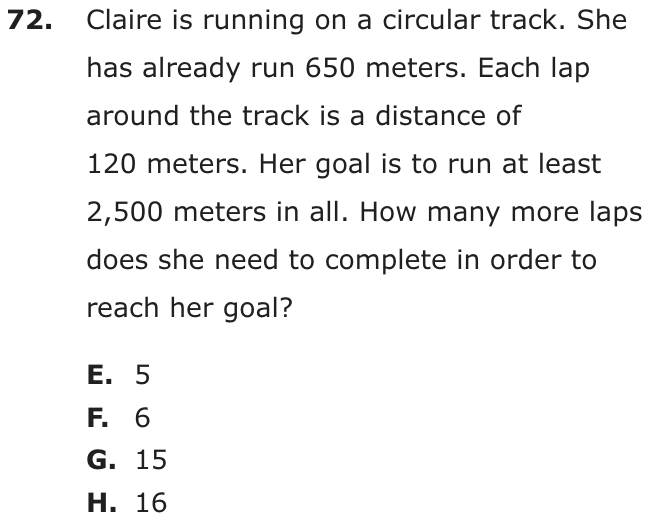
Claire is running on a circular track. She has already run 650 meters. Each lap around the track is a distance of 120 meters. Her goal is to run at least 2,500 meters in all. How many more laps does she need to complete in order to reach her goal?
- A5
- B6
- C15
- D16
Show the answer
Correct answer: D
Claire’s goal is to run at least 2,500 meters, and she has already run 650 meters.
Claire has at least 1,850 meters left to run. Divide by the distance around the track to find the number of laps she needs to complete:
Since she wants to run at least 2,500 meters, round 15.417 up to 16. Claire needs to run 16 laps to meet her goal.
Question analysis
A word problem about running laps: Claire has already run 650 meters on a 120-meter track and wants to run at least 2,500 meters in all. Students find how many more laps she must complete. Subtracting and dividing are straightforward; deciding what to do with the leftover part of a lap is the real test.
- Grade level
- Grade 7 content, by NYS standard
- Compared with grade 7
- At grade 7 Grade 7 students solve word problems that lead to inequalities like px + q ≥ r and interpret the solution in context. This is a typical three-step example, where the solution must be turned into a whole number of laps.
- Estimated difficulty
- Moderate: several steps, or a close reading with one strong distractor.
- Thinking it demands
- Depth of knowledge 2, skills and concepts · mainly apply
- What makes it hard
- Turning words into math moderate
- A very close wrong answer moderate
- Error-prone arithmetic minor
- Solution
- 3 steps
- Reading level
- Question and choices: about grade 3, 47 words.
- Students, last 30 days
- Not enough answers yet to show (it takes 10).
Why it is hard, traps and wrong answers (shows the answer)
Why it is hard
The arithmetic leads to about 15.4 laps, and the question is entirely about what to do with the fraction of a lap. Rounding to the nearest whole number is a habit that fails here, because the goal must be met or passed. Multiplying back, 15 × 120 = 1,800 and 16 × 120 = 1,920, shows which count actually covers the 1,850 meters still to run.
Turning words into math moderate Understanding the question
“At least 2,500 meters in all” means a part lap must still be run in full, so 1,850 ÷ 120 ≈ 15.4 has to be rounded up, against the usual rounding rule. (Hegarty, Mayer & Monk, 1995; Koedinger & Nathan, 2004)
A very close wrong answer moderate Choosing the answer
15 and 16 laps are one apart and both sit next to the quotient 15.4, so estimating cannot decide between them; only the condition that the goal be reached can. (Embretson & Wetzel, 1987; Gorin & Embretson, 2006; Ascalon et al., 2007)
Error-prone arithmetic minor Working it out
Dividing 1,850 by 120 by hand does not come out even, and long division by a three-digit number invites slips in placing the quotient. (Brown & Burton, 1978; Junker & Sijtsma, 2001)
Strategy: Subtract what she has run from 2,500, divide by 120, and check your whole number by multiplying it back: those laps must cover all of the remaining distance.
Traps
- Rounds too early: Rounds a value partway through, or rounds the wrong way, so the final answer drifts from the exact one.
- Answers a different question: A choice is right for another quantity: the other unknown, the rest instead of the part, the part instead of the whole.
The wrong answers, classified
A Answers a different question (King et al., 2004; Hegarty, Mayer & Monk, 1995)
Divides the 650 meters already run by 120 and rounds down to 5, counting laps finished so far instead of laps still needed.
B Answers a different question (King et al., 2004; Hegarty, Mayer & Monk, 1995)
Divides the 650 meters already run by 120, about 5.4, and rounds up as the goal requires, but for the distance done rather than the distance left.
C Rounds too early (King et al., 2004)
Finds 1,850 ÷ 120 ≈ 15.4 and rounds down to 15 by the usual rule, but 15 more laps leave her 50 meters short of the goal.
Worked solution, step by step
Formulas used
- Distance left
- Goal is the distance she wants to reach in all. Done is the distance she has already run. Subtract to find how far she still has to go.
- Number of laps
- Distance is how far she still has to run. One lap is the length of the track, 120 meters. Dividing tells how many laps fit into that distance. If it does not come out even, part of a lap is left over.
Sort out what you know
Claire has run 650 meters. One lap is 120 meters. Her goal is “at least 2,500 meters in all”. At least means 2,500 or more, so she must not fall short. You need how many more laps she must run.
Find the distance left
She still needs 1,850 meters. Watch out: divide the distance left, not the 650 meters she already ran. Dividing 650 by 120 leads to 5 or 6, choices A and B.
Divide by the length of a lap
The sign ≈ means about. Check with whole laps: . That leaves meters still to go. So 15 laps are not quite enough.
Round up to reach the goal
She needs part of one more lap. She has to complete whole laps, so she runs a 16th lap. Here you round up, even though 15.4 would usually round down. Watch out: 15 laps leave her 50 meters short, so choice C is wrong.
So the answer is D, 16.
Check your answer
Add up her total. With 15 more laps: meters, which is short of 2,500. With 16 more laps: meters. That reaches the goal.
More questions like this
The original DOE question
Question 9 of 19
2024 Test B Math, question 22Question
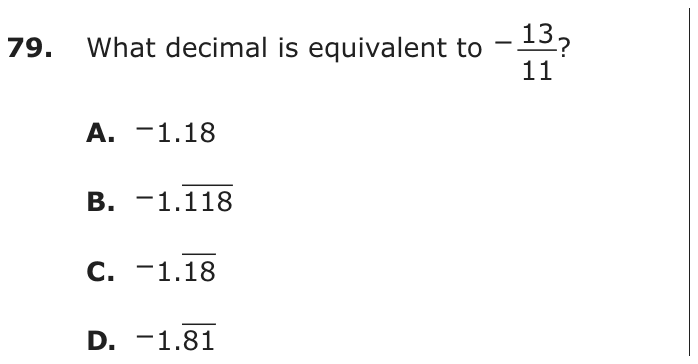
What decimal is equivalent to ?
- A
- B
- C
- D
Show the answer
Correct answer: C
Calculate the decimal equivalent of :
Question analysis
A fractions and decimals question asks which decimal equals negative 13/11. The choices differ in which digits repeat and how the repetition is marked. Students divide 13 by 11, spot the block of digits that repeats, and read the bar notation carefully.
- NYS standards
- 7.NS.2d fractions to decimals by long division
- Grade level
- Grade 7 content, by NYS standard
- Compared with grade 7
- At grade 7 Converting a fraction to a repeating decimal by long division is a named grade 7 skill. This is one short division, typical of grade 7 work, with care needed only in reading the bar notation.
- Estimated difficulty
- Straightforward: two steps or one careful reading.
- Thinking it demands
- Depth of knowledge 1, recall and reproduction · mainly apply
- What makes it hard
- A very close wrong answer moderate
- Something you must already know minor
- Error-prone arithmetic minor
- Solution
- 2 steps
- Reading level
- Question and choices: about grade 15, 10 words.
- Students, last 30 days
- Not enough answers yet to show (it takes 10).
Why it is hard, traps and wrong answers (shows the answer)
Why it is hard
Dividing 13 by 11 is quick; the question is really about reading and writing repeating decimals. Three choices differ only in where the bar goes, so students who know the digits run 1.1818… can still pick the wrong bar. Writing out each barred choice for a few digits and comparing it with the quotient is a fast, sure check.
A very close wrong answer moderate Choosing the answer
The bars over 18 and over 81 cover the same two digits, so only checking which digit comes right after the decimal point, 1 before 8, tells them apart. (Embretson & Wetzel, 1987; Gorin & Embretson, 2006; Ascalon et al., 2007)
Something you must already know minor Working it out
Reading bar notation is assumed: the bar marks exactly the block of digits that repeats, and the whole-number 1 never belongs under it. (Anderson & Krathwohl, 2001)
Error-prone arithmetic minor Working it out
The long division 13 ÷ 11 has to run until the remainder 2 comes back, which is where the repeating pair is confirmed. (Brown & Burton, 1978; Junker & Sijtsma, 2001)
Strategy: Do the long division of 13 by 11 until a remainder comes back, note which digits repeat from that point, and match that block to the bar in each choice.
Traps
- A faulty procedure: A systematic but wrong procedure: adding fractions straight across, applying an exponent to each term of a sum, dropping a sign when moving a term.
- Rounds too early: Rounds a value partway through, or rounds the wrong way, so the final answer drifts from the exact one.
- Answer in another form: The right answer is written differently from the way you worked it out.
The wrong answers, classified
A Rounds too early (King et al., 2004)
Stops the division after two decimal places and treats −1.18 as exact, missing that the digits 1 and 8 go on repeating.
B A faulty procedure (Brown & Burton, 1978; Tatsuoka, 1983)
Counts the whole-number 1 into the block, seeing 1, 18, 18 … as 118 repeating, and bars 118, which means −1.118118… rather than −1.1818….
D A faulty procedure (Brown & Burton, 1978; Tatsuoka, 1983)
Bars 81, the pair in the wrong order, which gives −1.8181…, equal to −1 9/11 rather than the −1 2/11 that −13/11 is.
Worked solution, step by step
Formulas used
- Fraction as division
- a is the top number, the numerator. b is the bottom number, the denominator. A fraction bar means divide. To turn a fraction into a decimal, divide the top by the bottom.
- Bar for repeating digits
- The bar sits over the digits that repeat forever, in the order they repeat. The dots mean the pattern goes on and on. Digits that are not under the bar show up only once.
Sort out the question
You need the decimal equal to . The fraction is negative, so the decimal will be negative too. Work with first. Then put the minus sign back.
Divide 13 by 11
Use long division for .
- 11 goes into 13 once, with 2 left over. Write 1 and a decimal point.
- Bring down a 0 to make 20. 11 goes into 20 once, with 9 left over. Write 1.
- Bring down a 0 to make 90. 11 goes into 90 eight times, with 2 left over. Write 8.
So far you have 1.18.
Spot the repeating pattern
The remainder (the amount left over) is 2 again. That is where you were after the first step. So the same digits come back: 1, 8, 1, 8, and so on forever.
Watch out: −1.18, choice A, stops too soon. The digits never end.Write it with a bar
A bar goes over only the digits that repeat. Here 18 repeats, starting right after the decimal point. The whole number 1 does not repeat, so it is not under the bar. Put the minus sign back.
Watch out: a bar over 81, choice D, means −1.8181…. A bar over 118, choice B, means −1.118118….So the answer is C, .
Check your answer
Multiply back: . That is almost exactly 13, and more 18s bring it even closer. Also, 13/11 is a bit more than 1, so a decimal between 1 and 2 makes sense.
More questions like this
The original DOE question
Question 10 of 19
2023 Test A Math, question 11Question
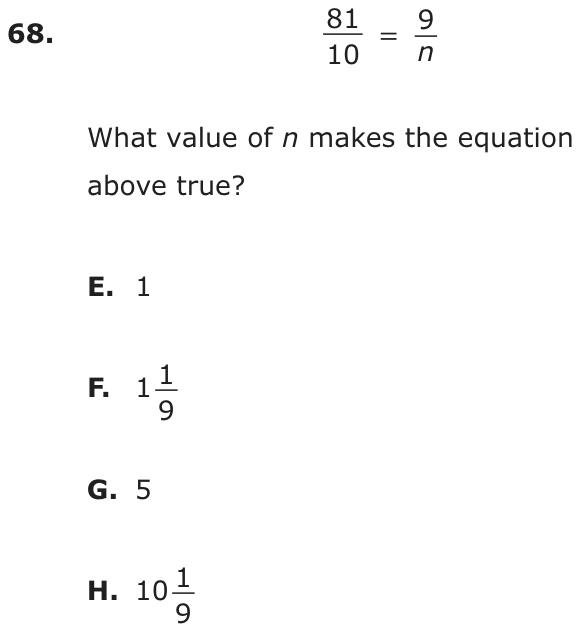
What value of n makes the equation above true?
- A1
- B
- C5
- D
Show the answer
Correct answer: B
| Cross multiply. | |
| Apply the multiplicative inverse property; divide both sides of the equation by 81. | |
| Then simplify the fraction. |
Question analysis
This question gives the proportion 81/10 = 9/n and asks for the value of n that makes it true. Students solve a proportion by cross-multiplying and dividing, then simplify the result. Reducing the resulting fraction and matching its form to the choices is where students slip.
- Grade level
- Grade 6 content, by NYS standard
- Compared with grade 7
- Below grade 7 Solving a proportion is familiar from grades 6 and 7, and this one needs only cross-multiplying and one division. Its one extra demand is simplifying the result and writing it in the form the choices use.
- Estimated difficulty
- Straightforward: two steps or one careful reading.
- Thinking it demands
- Depth of knowledge 1, recall and reproduction · mainly apply
- What makes it hard
- An answer in an unexpected form moderate
- A very close wrong answer minor
- Solution
- 3 steps
- Reading level
- Question and choices: about grade 7, 12 words.
- Students, last 30 days
- Not enough answers yet to show (it takes 10).
Why it is hard, traps and wrong answers (shows the answer)
Why it is hard
The proportion solves in one cross-multiplication, but the result is an improper fraction that must be simplified and rewritten to match. Students who notice that 81 is 9 × 9 can shortcut it: the numerator shrinks by a factor of 9 from left to right, so the denominator must shrink too, giving 10 ÷ 9. The mixed-number form is where answers drift, by dropping the leftover ninth or by writing 10 × 1/9 as 10 1/9.
An answer in an unexpected form moderate Choosing the answer
Cross-multiplying gives n = 90/81, which has to be reduced to 10/9 and rewritten as the mixed number 1 1/9 before it matches any choice. (Enright, Morley & Sheehan, 2002)
A very close wrong answer minor Choosing the answer
The choices 1 and 1 1/9 differ by one ninth, and estimating 90 ÷ 81 as about 1 cannot separate them; only keeping the remainder does. (Embretson & Wetzel, 1987; Gorin & Embretson, 2006; Ascalon et al., 2007)
Strategy: Cross-multiply to get 81n = 90, divide both sides by 81, and simplify the fraction before comparing it with the choices.
Traps
- A faulty procedure: A systematic but wrong procedure: adding fractions straight across, applying an exponent to each term of a sum, dropping a sign when moving a term.
- Answer in another form: The right answer is written differently from the way you worked it out.
The wrong answers, classified
A Rounds too early (King et al., 2004)
Finds n by dividing 10 by 9 but keeps only the whole-number part of the quotient, 1, dropping the remainder that the exact answer needs.
C Little reason to choose it (Haladyna & Downing, 1993; Rodriguez, 2005)
No cross-multiplication or scaling of 81/10 gives 5, which would make 9/n equal 1.8 instead of 8.1, so it mostly catches guesses.
D A faulty procedure (Brown & Burton, 1978; Tatsuoka, 1983)
Reaches n = 10 × 9/81 = 10 × 1/9 but writes the product as the mixed number 10 1/9, as if a whole number beside a fraction meant multiplication.
Worked solution, step by step
Formulas used
- Cross-multiplying
- a over b and c over d are two equal fractions, and b and d are not 0. Multiply each top by the other bottom. The two products are equal. It works because it is the same as multiplying both sides by b and by d.
- Simplifying a fraction
- a over b is a fraction, and k is a number that divides both the top and the bottom. Dividing the top and the bottom by the same number gives an equal fraction with smaller numbers.
- Fraction to mixed number
- a over b is a fraction whose top is bigger than its bottom. q is the quotient, how many whole times b fits into a. r is the remainder, what is left over. The leftover stays over the same bottom number.
Sort out the question
The equation says two fractions are equal: and . n is an unknown bottom number. You need the value of n that makes them equal. Some choices are mixed numbers, so n may not be a whole number.
Cross-multiply the two fractions
Multiply each top by the other fraction’s bottom. This gets n out of the bottom of the fraction.
Divide both sides by 81
81n means 81 times n. To undo multiplying by 81, divide both sides by 81.
Now simplify. 90 and 81 are both in the 9 times table, so divide the top and bottom by 9.
Write it as a mixed number
10 ÷ 9 is 1 with 1 left over. The leftover stays over 9.
Watch out: keep the leftover. Dropping it gives 1, choice A. Also, ten ninths is not 10 and one ninth. That mixed number, , is choice D, which is far too big. So the answer is B, .
Check your answer
Estimate. is about 8. For to be about 8, n must be a little more than 1. Check exactly: . It matches.
More questions like this
The original DOE question
Question 11 of 19
2023 Test A Math, question 41Question
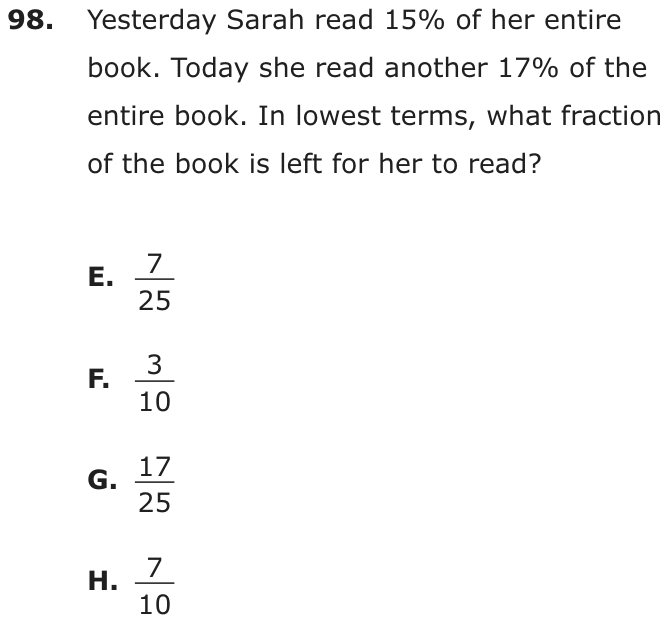
Yesterday Sarah read 15% of her entire book. Today she read another 17% of the entire book. In lowest terms, what fraction of the book is left for her to read?
- A
- B
- C
- D
Show the answer
Correct answer: C
So far, Sarah has read of the entire book. That means she has left to read.
Question analysis
This percent word problem says Sarah read 15% of her book yesterday and 17% today, and asks what fraction of the book she still has to read, in lowest terms. Students combine percents of the same whole, find the part remaining, and convert a percent to a simplified fraction. Rounding, or giving the part already read, leads to wrong choices.
- Grade level
- Grade 7 content, by NYS standard
- Compared with grade 7
- Below grade 7 Grade 7 percent work often takes a percent of a percent or finds a percent change. Here both percents are of the same whole book, so they combine directly; the rest is a subtraction and simplifying a fraction, lighter than typical.
- Estimated difficulty
- Straightforward: two steps or one careful reading.
- Thinking it demands
- Depth of knowledge 2, skills and concepts · mainly apply
- What makes it hard
- Solution
- 3 steps
- Reading level
- Question and choices: about grade 5, 33 words.
- Corrected from the DOE handbook
- Missing percent signs in the explanation were restored.
- Students, last 30 days
- Not enough answers yet to show (it takes 10).
Why it is hard, traps and wrong answers (shows the answer)
Why it is hard
The percent work is a sum and a subtraction from 100, so the question mostly tests the last step, writing 68% as a fraction in lowest terms. Students who round to 30% read and 70% left to get a friendlier fraction land on a listed choice, as do those who give the part read. Dividing 68 and 100 by their common factor 4 keeps the answer exact.
Turning words into math minor Understanding the question
Both percents are “of the entire book,” so they simply add to 32%, and “left for her to read” asks for the rest, 100% − 32%, not the part already read. (Hegarty, Mayer & Monk, 1995; Koedinger & Nathan, 2004)
An answer in an unexpected form minor Choosing the answer
The result has to be written as a fraction in lowest terms, so 68/100 must be divided by 4 to reach a form that appears among the choices. (Enright, Morley & Sheehan, 2002)
Strategy: Add the two percents, since both are of the whole book, subtract the total from 100%, then write the result over 100 and simplify it fully.
Traps
- Rounds too early: Rounds a value partway through, or rounds the wrong way, so the final answer drifts from the exact one.
- Answers a different question: A choice is right for another quantity: the other unknown, the rest instead of the part, the part instead of the whole.
The wrong answers, classified
A Little reason to choose it (Haladyna & Downing, 1993; Rodriguez, 2005)
No sum or difference of 15% and 17% gives 28%, so 7/25 mostly draws students who match the right fraction's 25 without checking the numerator.
B Answers a different question (King et al., 2004; Hegarty, Mayer & Monk, 1995)
Gives the part already read rather than the part left, and rounds that 32% to 30% to write it as 3/10.
D Rounds too early (King et al., 2004)
Finds that 68% is left but rounds it to 70% to make an easier fraction, giving 7/10 instead of simplifying 68/100 exactly.
What was corrected from the DOE handbook, and why
- Explanation: The handbook writes “So far, Sarah has read 15 + 17 = 32 of the entire book. That means she has 100 − 32 = 68 left to read.” (p. 143, question 98), with no percent signs, so 32 and 68 read as amounts of the book (pages, say) that the question never gives. The question gives 15% and 17%, and the handbook’s next line begins “68% =”, so the site now reads 15% + 17% = 32% and 100% − 32% = 68%. The answer, 17/25, is unchanged.
Worked solution, step by step
Formulas used
- Percent as a fraction
- p is the percent. Percent means “out of 100,” so p percent is p hundredths. For example, 50% is 50 out of 100, which is one half.
- Simplifying a fraction
- a is the top number, b is the bottom, and n is a number that divides both evenly. Dividing the top and bottom by the same number keeps the value the same. A fraction is in lowest terms when no number bigger than 1 divides both.
Sort out the question
Sarah read 15% of her book yesterday and 17% today. Both are percents of the whole book. You need the part still left to read, as a fraction in lowest terms. That means a fraction that can’t be simplified any more.
Find how much she has read
Both percents are of the same whole book, so you can add them. She has read 32% of it.
Find how much is left
The whole book is 100%.
Watch out: 32% is the part she has read, not the part left. Rounding 32% to 30% gives , choice B.
Write 68% as a fraction
This fraction is not in lowest terms yet, because 68 and 100 are both even.
Write it in lowest terms
The number 4 divides both 68 and 100 evenly.
Watch out: don’t round 68% to 70%. That gives , choice D. So the answer is C, .
Check your answer
Turn the answer back into a percent: , which is 68%. Then 68% + 32% = 100%, the whole book. Also, 17 and 25 share no factor except 1, so the fraction is in lowest terms.
More questions like this
The original DOE question
Question 12 of 19
2023 Test A Math, question 54Question
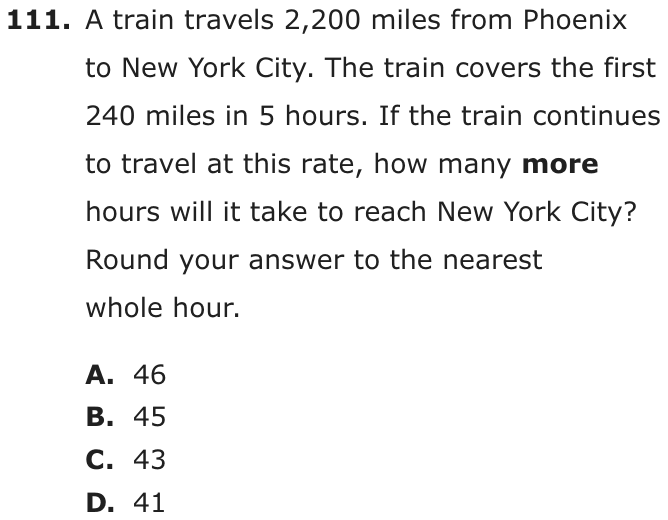
A train travels 2,200 miles from Phoenix to New York City. The train covers the first 240 miles in 5 hours. If the train continues to travel at this rate, how many more hours will it take to reach New York City? Round your answer to the nearest whole hour.
- A46
- B45
- C43
- D41
Show the answer
Correct answer: D
First, find the speed of the train in miles per hour: .
The number of miles left to travel is .
To find the number of hours left, use the equation :
| Apply the multiplicative inverse property; divide both sides of the equation by 48. | |
That number rounded to the nearest whole hour is 41 hours.
Question analysis
This rate word problem describes a 2,200-mile train trip from Phoenix to New York City in which the first 240 miles take 5 hours, and asks how many more hours the rest will take, rounded to the nearest hour. Students find a unit rate and the remaining distance. The choices are close together, so the time for the whole trip is a tempting trap.
- Grade level
- Grade 6 content, by NYS standard
- Compared with grade 7
- At grade 7 Unit rates are grade 6 content, but this chains four steps: a speed, the distance left, a long division that does not come out even, and rounding. The word more must be read closely, which puts it at typical grade 7 demand.
- Estimated difficulty
- Moderate: several steps, or a close reading with one strong distractor.
- Thinking it demands
- Depth of knowledge 2, skills and concepts · mainly apply
- What makes it hard
- Many steps moderate
- Turning words into math minor
- Error-prone arithmetic minor
- Solution
- 4 steps
- Reading level
- Question and choices: about grade 4, 47 words.
- Students, last 30 days
- Not enough answers yet to show (it takes 10).
Why it is hard, traps and wrong answers (shows the answer)
Why it is hard
Each step is routine, but the question has a long chain and asks for only part of the trip. Dividing the whole 2,200 miles by the speed is the natural shortcut and gives a listed choice, and the rounding instruction adds a second place to go wrong. Checking that 41 hours at 48 miles per hour covers about 1,970 miles, close to the 1,960 left, confirms the answer.
Many steps moderate Working it out
Four steps follow in order, the speed 240 ÷ 5 = 48, the miles left 2,200 − 240 = 1,960, the time 1,960 ÷ 48, and the rounding, and an early slip carries through. (Daniel & Embretson, 2010; Enright, Morley & Sheehan, 2002)
Turning words into math minor Understanding the question
The bold more in “how many more hours” limits the question to the 1,960 miles still ahead, though 2,200, the whole trip, is the distance the stem names first. (Hegarty, Mayer & Monk, 1995; Koedinger & Nathan, 2004)
Error-prone arithmetic minor Working it out
Dividing 1,960 by 48 leaves 40 with a remainder of 40, so the time, 40 5/6 hours, must be rounded up to the nearest hour rather than cut short. (Brown & Burton, 1978; Junker & Sijtsma, 2001)
Strategy: Find the train's speed from the first 240 miles, subtract those miles from the total to get the distance left, divide by the speed, and round only at the end.
Traps
- Answers a different question: A choice is right for another quantity: the other unknown, the rest instead of the part, the part instead of the whole.
- An arithmetic slip: The right method with a plausible arithmetic error: a digit, a place value or a times-table fact.
- Rounds too early: Rounds a value partway through, or rounds the wrong way, so the final answer drifts from the exact one.
The wrong answers, classified
A Answers a different question (King et al., 2004; Hegarty, Mayer & Monk, 1995)
Divides the whole 2,200 miles by 48 miles per hour, about 45.8, or 46 hours, the time for the entire trip rather than the hours still to go.
B Rounds too early (King et al., 2004)
Divides the whole 2,200 miles by 48 and then cuts 45.8 down to 45 instead of rounding to the nearest hour, two errors at once.
C An arithmetic slip (Junker & Sijtsma, 2001)
Subtracts 240 from 2,200 without reducing the hundreds after borrowing, getting 2,060 instead of 1,960, and 2,060 ÷ 48 ≈ 42.9 rounds to 43.
Worked solution, step by step
Formulas used
- Distance, rate and time
- d is the distance, r is the rate or speed, and t is the time. If you know two of them, you can find the third. To find the speed, divide the distance by the time. To find the time, divide the distance by the speed.
Sort out the question
The whole trip is 2,200 miles. The train goes the first 240 miles in 5 hours, and it keeps that speed. You need how many more hours it takes, rounded to the nearest whole hour. “More” means the time after the first 240 miles.
Find the train’s speed
Divide the 240 miles by the 5 hours. The train goes 48 miles per hour.
Find the miles still to go
There are 1,960 miles left. Watch out: use the miles left, not the whole trip. Dividing 2,200 by 48 gives about 45.8 hours, which leads to 46 or 45, choices A and B.
Find the hours still to go
Here 48 × 40 = 1,920, and 40 miles are left over. That leftover is of an hour.
Round to the nearest hour
of an hour is more than half an hour, so round up to 41. Watch out: don’t just drop the fraction.
So the answer is D, 41 hours.
Check your answer
At 48 miles per hour, 41 hours covers miles. That is just a bit more than 1,960, as it should be after rounding up. In 40 hours, the train would cover only 1,920 miles, which is not enough.
More questions like this
The original DOE question
Question 13 of 19
2023 Test B Math, question 7Question
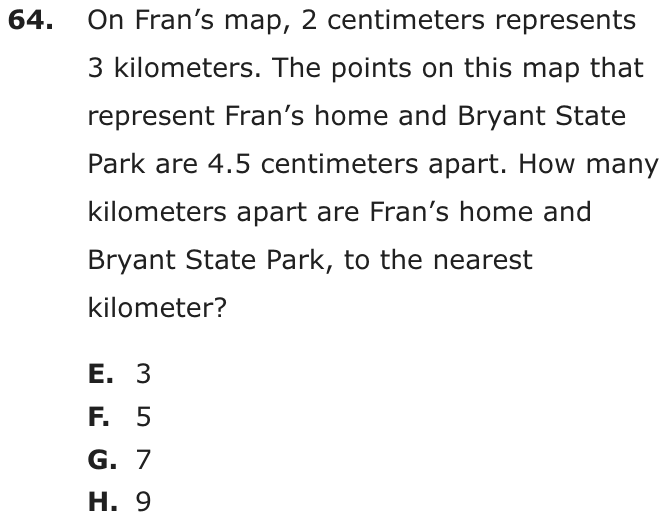
On Fran’s map, 2 centimeters represents 3 kilometers. The points on this map that represent Fran’s home and Bryant State Park are 4.5 centimeters apart. How many kilometers apart are Fran’s home and Bryant State Park, to the nearest kilometer?
- A3
- B5
- C7
- D9
Show the answer
Correct answer: C
Let x represent the distance, in kilometers, between Fran’s house and Bryant State Park. Set up a proportion to solve for x:
| Cross multiply. | |
| Apply the multiplicative inverse property; divide both sides of the equation by 2. | |
Question analysis
On Fran's map, 2 centimeters represent 3 kilometers, and her home and Bryant State Park are 4.5 centimeters apart on the map. Students find the real distance to the nearest kilometer. It is a map-scale proportion problem: the scale must be applied in the right direction, and the result rounded.
- Grade level
- Grade 7 content, by NYS standard
- Compared with grade 7
- At grade 7 Map scales are standard grade 7 proportional reasoning, and this problem is typical: one distance, one scale, then rounding. Nothing beyond a single proportion is needed.
- Estimated difficulty
- Straightforward: two steps or one careful reading.
- Thinking it demands
- Depth of knowledge 2, skills and concepts · mainly apply
- What makes it hard
- Turning words into math minor
- Error-prone arithmetic minor
- Solution
- 3 steps
- Reading level
- Question and choices: about grade 8, 37 words.
- Students, last 30 days
- Not enough answers yet to show (it takes 10).
Why it is hard, traps and wrong answers (shows the answer)
Why it is hard
This is a one-proportion map question, and the only judgments are the direction of the scale and when to round. The phrase to the nearest kilometer tempts some students to round the scale itself before multiplying, which lands on a listed answer two kilometers too far. Rounding only the final 6.75 keeps the result right.
Turning words into math minor Understanding the question
“2 centimeters represents 3 kilometers” gives 1.5 kilometers per centimeter; set up the other way round, the scale shrinks the 4.5 centimeters instead of enlarging them. (Hegarty, Mayer & Monk, 1995; Koedinger & Nathan, 2004)
Error-prone arithmetic minor Working it out
The map distance is a decimal, 4.5 × 3 ÷ 2 = 6.75, and the result must then be rounded to the nearest kilometer, two places where a quick estimate drifts. (Brown & Burton, 1978; Junker & Sijtsma, 2001)
Strategy: Work out how many kilometers 1 centimeter on the map stands for, multiply by 4.5, and round only at the very end.
Traps
- Wrong operation: Adds instead of multiplying, divides the wrong way round, turns a ratio or rate upside down, or undoes a step in the wrong direction (subtracts what should be added back).
- Rounds too early: Rounds a value partway through, or rounds the wrong way, so the final answer drifts from the exact one.
- Units or scale: The answer is wanted in other units, or a rate or scale must be converted first.
The wrong answers, classified
A Wrong operation (Hegarty, Mayer & Monk, 1995; King et al., 2004)
Turns the scale upside down, multiplying 4.5 by 2/3 instead of 3/2, so the real distance comes out smaller than the map distance.
B Units or scale (King et al., 2004)
Takes the 4.5 centimeters on the map as kilometers and rounds to 5, never applying the scale that turns each centimeter into 1.5 kilometers.
D Rounds too early (King et al., 2004)
Rounds the scale of 1.5 kilometers per centimeter up to 2 before multiplying, so 4.5 × 2 = 9 instead of 6.75.
Worked solution, step by step
Formulas used
- Scale proportion
- A map shrinks every distance by the same amount. So real distance over map distance makes the same fraction everywhere on the map. Put kilometers on top on both sides and centimeters on the bottom. Then solve for the missing number.
Sort out the question
On Fran’s map, 2 centimeters stand for 3 kilometers in real life. Her home and the park are 4.5 centimeters apart on the map. You need the real distance in kilometers, rounded to the nearest whole kilometer.
Set up the proportion
Let x be the real distance, in kilometers. Put kilometers on top and centimeters on the bottom, on both sides.
Solve for x
To get x alone, multiply both sides by 4.5.
So the real distance is 6.75 kilometers. Watch out: keep the scale exact until the end. Rounding 1.5 kilometers per centimeter up to 2 gives , choice D.
Round to the nearest kilometer
6.75 is between 6 and 7. Its decimal part, 0.75, is more than 0.5, so round up to 7.
Watch out: don’t flip the scale. Multiplying 4.5 by gives 3, choice A. So the answer is C, 7.
Check your answer
Each centimeter stands for kilometers. So 4 centimeters is 6 kilometers, and half a centimeter is 0.75 kilometer. That adds to 6.75, which rounds to 7. The real number should be bigger than 4.5, and it is.
More questions like this
The original DOE question
Question 14 of 19
2023 Test B Math, question 15Question
On a map, the distance between Deshawn’s house and Xin’s house is 5.4 inches. If 2 inches on the map represents 3 miles, what is the distance between these two houses, in miles?
- A2.6
- B3.6
- C7.5
- D8.1
Show the answer
Correct answer: D
Let d represent the distance between the two houses, in miles. Write a proportion to solve for d:
Question analysis
A map shows Deshawn's and Xin's houses 5.4 inches apart, with 2 inches on the map standing for 3 miles. Students find the actual distance between the houses in miles. This scale question uses a decimal map length, so the multiplication must be exact and the inches-to-miles ratio kept the right way up.
- Grade level
- Grade 7 content, by NYS standard
- Compared with grade 7
- At grade 7 Converting a map distance with a given scale is routine grade 7 work. This one needs a single proportion and a decimal multiplication, with no rounding or second step, so it matches a typical classroom exercise.
- Estimated difficulty
- Straightforward: two steps or one careful reading.
- Thinking it demands
- Depth of knowledge 2, skills and concepts · mainly apply
- What makes it hard
- Error-prone arithmetic minor
- A very close wrong answer minor
- Solution
- 2 steps
- Reading level
- Question and choices: about grade 6, 30 words.
- Students, last 30 days
- Not enough answers yet to show (it takes 10).
Why it is hard, traps and wrong answers (shows the answer)
Why it is hard
Unlike most map questions, this one asks for an exact distance, so the decimal 5.4 has to be carried all the way through. The two tempting wrong answers come from opposite places: an upside-down scale shrinks the distance, and a rounded map length gives a result close to the true one. Checking that the answer is one and a half times 5.4 catches both.
Error-prone arithmetic minor Working it out
The map distance is the decimal 5.4, and 5.4 × 3 = 16.2 then halved is a decimal multiplication where rounding 5.4 to make it easier changes the answer. (Brown & Burton, 1978; Junker & Sijtsma, 2001)
A very close wrong answer minor Choosing the answer
7.5 and 8.1 miles are close enough that a rough estimate, 5 × 1.5, lands on the wrong one; only the exact product separates them. (Embretson & Wetzel, 1987; Gorin & Embretson, 2006; Ascalon et al., 2007)
Strategy: Set up miles over inches equal to 3 over 2, then multiply 5.4 by 3 and divide by 2, keeping the decimal exact throughout.
Traps
- Wrong operation: Adds instead of multiplying, divides the wrong way round, turns a ratio or rate upside down, or undoes a step in the wrong direction (subtracts what should be added back).
- Rounds too early: Rounds a value partway through, or rounds the wrong way, so the final answer drifts from the exact one.
The wrong answers, classified
A Little reason to choose it (Haladyna & Downing, 1993; Rodriguez, 2005)
No common working gives 2.6, which sits just below half of 5.4 and matches no step with the scale, so it mostly draws guesses.
B Wrong operation (Hegarty, Mayer & Monk, 1995; King et al., 2004)
Inverts the scale, multiplying 5.4 by 2/3 instead of 3/2, as if each mile took up 1.5 inches on the map.
C Rounds too early (King et al., 2004)
Rounds 5.4 inches down to 5 before scaling, so 5 × 3 ÷ 2 = 7.5 miles instead of the exact distance.
Worked solution, step by step
Formulas used
- Scale proportion
- A map shrinks every distance by the same amount. So real distance over map distance makes the same fraction everywhere on the map. Put miles on top on both sides and inches on the bottom. Then solve for the missing distance.
Sort out the question
On the map, Deshawn’s house and Xin’s house are 5.4 inches apart. The scale says 2 inches on the map stand for 3 miles. You need the real distance between the houses, in miles.
Set up the proportion
Let d be the real distance, in miles. Put miles on top and inches on the bottom, on both sides.
Solve for d
To get d alone, multiply both sides by 5.4.
The houses are 8.1 miles apart. Watch out: keep 5.4 exact. Rounding it to 5 gives 7.5 miles, choice C.
Give the answer
Watch out: don’t flip the scale. Multiplying 5.4 by gives 3.6, choice B. Each inch stands for more than a mile, so the miles must be more than 5.4. So the answer is D, 8.1.
Check your answer
Each inch stands for miles. So 5 inches is 7.5 miles, and 0.4 inch is mile. Together, miles.
More questions like this
The original DOE question
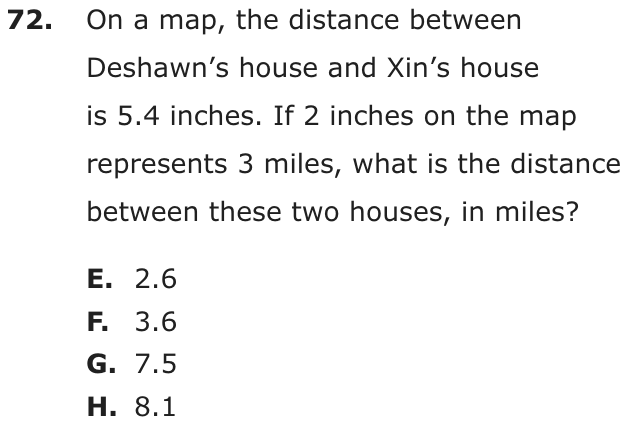
Question 15 of 19
2023 Test B Math, question 55Question
What is the value of the expression above, written as an improper fraction?
- A
- B
- C
- D
Show the answer
Correct answer: D
| Set x equal to the repeating decimal. | |
| Multiply both sides by 10. | |
| Subtract 10x and x. | |
| Apply the multiplicative inverse property; divide both sides by 9. | |
Question analysis
Two repeating decimals are subtracted, and students write the difference as an improper fraction. It tests subtracting repeating decimals and converting a repeating decimal into a fraction, a grade 8 skill. The repeating part has to be handled exactly, so a careful method matters more than speed.
- NYS standards
- Grade level
- Grade 8 content, by NYS standard
- Compared with grade 7
- Above grade 7 Grade 7 students change fractions into repeating decimals by long division. Going the other way, from a repeating decimal to a fraction, is grade 8 work, though the subtraction that comes first here is simple.
- Estimated difficulty
- Moderate: several steps, or a close reading with one strong distractor.
- Thinking it demands
- Depth of knowledge 1, recall and reproduction · mainly apply
- What makes it hard
- A very close wrong answer moderate
- Something you must already know moderate
- Solution
- 3 steps
- Reading level
- Question and choices: about grade 9, 18 words.
- Students, last 30 days
- Not enough answers yet to show (it takes 10).
Why it is hard, traps and wrong answers (shows the answer)
Why it is hard
The subtraction is easy, since the repeating digits line up and give 2.222…; the conversion is the test. Every choice sits within a few hundredths of the answer, so rounding or estimating cannot separate them, and the exact 2.22 of 111/50 is the strongest pull. Students who know that 0.222… is 2/9 can write 2 2/9 = 20/9 directly.
A very close wrong answer moderate Choosing the answer
All four choices lie between 2.18 and 2.23: 111/50 is exactly 2.22 and 224/101 is about 2.218, so only 20/9 equals the repeating 2.222… exactly. (Embretson & Wetzel, 1987; Gorin & Embretson, 2006; Ascalon et al., 2007)
Something you must already know moderate Working it out
Turning 2.222… into a fraction, by setting x equal to it and subtracting x from 10x, is grade 8 work that the question does not explain. (Anderson & Krathwohl, 2001)
Strategy: Subtract the decimals digit by digit to see which digits repeat, then turn that repeating decimal into a fraction, or divide each choice's numerator by its denominator and compare.
Traps
- A faulty procedure: A systematic but wrong procedure: adding fractions straight across, applying an exponent to each term of a sum, dropping a sign when moving a term.
- Rounds too early: Rounds a value partway through, or rounds the wrong way, so the final answer drifts from the exact one.
The wrong answers, classified
A A faulty procedure (Brown & Burton, 1978; Tatsuoka, 1983)
Sets x = 2.222… but adds 10x and x instead of subtracting, then drops the repeating part as if it had cancelled, so 11x = 22 + 2 = 24.
B A faulty procedure (Brown & Burton, 1978; Tatsuoka, 1983)
Multiplies by 100 for two-digit blocks, then adds x instead of subtracting it and drops the repeating part, so 101x = 222 + 2 = 224.
C Rounds too early (King et al., 2004)
Drops the repeating bar and treats the difference as exactly 2.22, which is 222/100 = 111/50, slightly less than the true repeating value.
Worked solution, step by step
Formulas used
- Repeating decimal to fraction
- x is the repeating decimal. Multiplying by 10 moves the decimal point one place to the right. The endless repeating digits still line up after the point. So when you subtract x from 10x, they cancel, and only whole numbers are left.
Sort out the bars
A bar over digits means they repeat forever. So means 6.343434… and means 4.121212… with no end. You need the difference as an improper fraction. That is a fraction whose top is bigger than its bottom.
Subtract the decimals
Line up the digits. Each block of 34 minus 12 gives 22. The whole numbers give 6 − 4 = 2.
The difference is 2.222…, with the 2 repeating forever. You can write it .
Name the decimal x
Let x be the repeating decimal. Then multiply both sides by 10. This moves the decimal point one place to the right.
Subtract to remove the repeats
Subtract the first line from the second. The repeating 2s after the point match up, so they cancel.
Divide to find x
Divide both sides by 9.
Watch out: is exactly 2.22, which stops. The real difference never stops. That trap is choice C. Every choice is close to 2.2, so estimating won’t help.
So the answer is D, .
Check your answer
Divide 20 by 9. 9 goes into 20 two times, with 2 left over. Each next step leaves 2 again, so you get 2.222… forever. That matches the difference. Choice A, , is 2.1818… instead.
More questions like this
The original DOE question
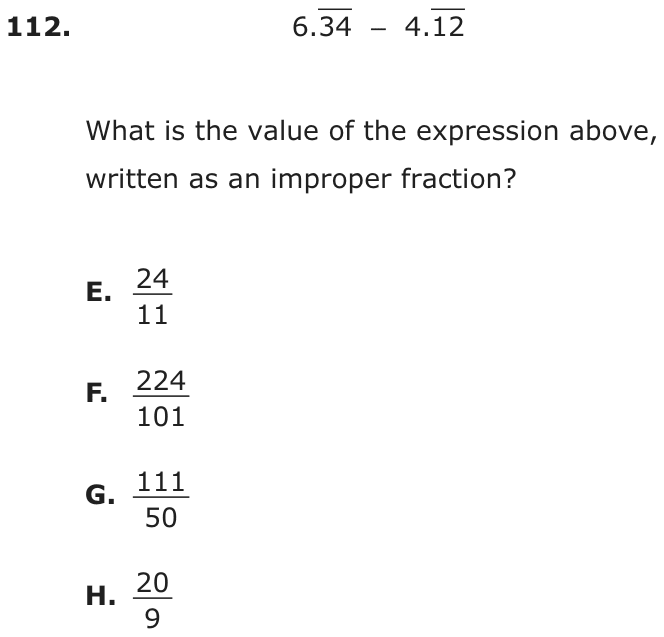
Question 16 of 19
2018 Test A Math, question 24Question
How many more people in Center City walk to work than ride their bicycle to work?
- A2,500
- B2,700
- C2,800
- D3,000
Show the answer
Correct answer: B
According to the chart, 22% of people walk to work and 4% ride a bicycle. Subtract to find the percentage of how many more people walk than bicycle:
22% − 4% = 18%
To find the exact number of people, multiply 18% (0.18) by the number of people working in Center City (15,000):
Question analysis
This circle graph question shows how the 15,000 people working in Center City get to work, with 22% walking and 4% riding a bicycle. Students find how many more people walk than bike by combining a percent difference with a percent of a total. The choices are close together, so estimating is risky.
- Grade level
- Grade 6 content, by NYS standard
- Compared with grade 7
- Below grade 7 Reading a circle graph and taking a percent of a total are grade 6 skills. With only two short steps and friendly numbers, this is easier than typical grade 7 multistep percent work.
- Estimated difficulty
- Straightforward: two steps or one careful reading.
- Thinking it demands
- Depth of knowledge 2, skills and concepts · mainly apply
- What makes it hard
- A very close wrong answer moderate
- Reading a figure, table or graph minor
- Error-prone arithmetic minor
- Solution
- 2 steps
- Reading level
- Question and choices: about grade 7, 16 words.
- Students, last 30 days
- Not enough answers yet to show (it takes 10).
Why it is hard, traps and wrong answers (shows the answer)
Why it is hard
The method is short: subtract the percents first, or find both groups and subtract, and both reach the same number. What makes the question less safe than it looks is the tight spread of choices, all within 500 of each other, so rounding 18% or slipping on one product lands on a wrong answer. Subtracting the percents first leaves one multiplication to get right instead of two.
A very close wrong answer moderate Choosing the answer
2,700 sits only 100 from 2,800 and 300 from 3,000, so estimating 18% of 15,000 as about a fifth cannot pick it; only the exact product does. (Embretson & Wetzel, 1987; Gorin & Embretson, 2006; Ascalon et al., 2007)
Reading a figure, table or graph minor Understanding the question
The Walk 22% and Bicycle 4% labels must be picked out of five sectors, and the 15,000 total sits in a caption below the circle graph. (Lesh, Post & Behr, 1987; Kirsch & Mosenthal, 1990)
Error-prone arithmetic minor Working it out
The percent gap has to become a count, 0.18 × 15,000, a decimal times a five-digit number worked by hand without a calculator. (Brown & Burton, 1978; Junker & Sijtsma, 2001)
Strategy: Subtract the two percents first, then take that single percent of 15,000, instead of finding each group and subtracting.
The wrong answers, classified
A Little reason to choose it (Haladyna & Downing, 1993; Rodriguez, 2005)
No common working gives 2,500, which is 1/6 of 15,000 and matches no sector or difference of sectors; it mostly catches estimates.
C An arithmetic slip (Junker & Sijtsma, 2001)
Takes 4% of 15,000 as 500 instead of 600 and subtracts it from the 3,300 walkers, getting 2,800.
D Rounds too early (King et al., 2004)
Rounds the 18-point gap up to 20% to make the multiplication easy and takes 20% of 15,000, which is 3,000.
Worked solution, step by step
Formulas used
- Percent of a number
- W is the whole amount. p is the percent, and x is the part you want. Percent means out of 100, so p percent is the fraction p over 100. Multiplying the whole by that fraction gives the part.
Sort out the circle graph
A circle graph shows how a whole splits into parts. This one shows how 15,000 workers get to work. Walk is 22%. Bicycle is 4%. You need how many more people walk than ride a bicycle.
Subtract the percents first
Both percents are parts of the same 15,000 people. So you can subtract the percents first. Then you only need one multiplication.
The difference is 18% of all the workers.
Find 18% of 15,000
First find 1% by dividing by 100. Then multiply by 18.
That is 2,700 people.
Avoid rounding and answer
Watch out: don’t round 18% up to 20% to make it easy. 20% of 15,000 is 3,000, choice D. The choices are close together, so you need the exact number. So the answer is B, 2,700.
Check your answer
Find each group, then subtract. Walkers: 22% of 15,000 is 3,300. Bike riders: 4% of 15,000 is 600. . You get the same answer.
More questions like this
The original DOE question
Question 17 of 19
2018 Test A Math, question 36Question
On the number line above, LN = . Point M (not shown) is located between point L and point N. Which value below is a possible value for M?
- A4.26
- B4.31
- C4.35
- D4.58
Show the answer
Correct answer: C
Since , point is located at
.
So must be between point , , and point , . Point can also be written as 4.3125, and point can be written as 4.4375. The only option given that lies between those two points is 4.35.
Question analysis
This number line question says the distance from point L to point N is one eighth and asks which decimal could be the position of a point M between them. Students take L's position, a mixed number in sixteenths, find N, and compare with decimal choices. Converting sixteenths to decimals precisely is the tricky part.
- NYS standards
- Grade level
- Grade 7 content, by NYS standard
- Compared with grade 7
- At grade 7 Grade 7 students convert fractions to decimals and compare them. This item needs an exact conversion of sixteenths and a comparison to the thousandths, where rounding too early can mislead, but it stays within grade 7 content.
- Estimated difficulty
- Moderate: several steps, or a close reading with one strong distractor.
- Thinking it demands
- Depth of knowledge 2, skills and concepts · mainly apply
- What makes it hard
- Error-prone arithmetic moderate
- A very close wrong answer moderate
- Reading a figure, table or graph minor
- Solution
- 3 steps
- Reading level
- Question and choices: about grade 5, 28 words.
- Students, last 30 days
- Not enough answers yet to show (it takes 10).
Why it is hard, traps and wrong answers (shows the answer)
Why it is hard
The interval from L to N is only an eighth wide, and three of the four choices crowd near it, so precision decides the question. Students comfortable working in sixteenths can avoid decimals until the end, since 4.35 lies between 4 5/16 and 4 7/16. Those who convert loosely, or who misread a mixed number as a decimal, are pulled to a neighboring choice.
Error-prone arithmetic moderate Working it out
Converting 4 5/16 to 4.3125 and N to 4.4375 needs four decimal places, while the choices stop at hundredths, so early rounding blurs the left boundary. (Brown & Burton, 1978; Junker & Sijtsma, 2001)
A very close wrong answer moderate Choosing the answer
The choices 4.31 and 4.35 both lie within 0.04 of L, so estimating cannot separate them; only the exact 4.3125 shows 4.31 just outside the interval and 4.35 inside. (Embretson & Wetzel, 1987; Gorin & Embretson, 2006; Ascalon et al., 2007)
Reading a figure, table or graph minor Understanding the question
L's value appears only on the number line, and the picture shows N to the right of L, which fixes which way the one-eighth gap runs. (Lesh, Post & Behr, 1987; Kirsch & Mosenthal, 1990)
Strategy: Add one eighth, or two sixteenths, to L's position to locate N, convert both endpoints to four-place decimals, and keep only a choice strictly between them.
Traps
- Rounds too early: Rounds a value partway through, or rounds the wrong way, so the final answer drifts from the exact one.
- Answer in another form: The right answer is written differently from the way you worked it out.
- A faulty procedure: A systematic but wrong procedure: adding fractions straight across, applying an exponent to each term of a sum, dropping a sign when moving a term.
The wrong answers, classified
A Negatives and direction (Brown & Burton, 1978)
Measures the one-eighth gap to the left of L, giving 4.1875 to 4.3125, an interval that contains 4.26 but contradicts the figure.
B Rounds too early (King et al., 2004)
Rounds L's 4.3125 to 4.31 and treats 4.31 as inside the interval, missing that it lies slightly to the left of L.
D A faulty procedure (Brown & Burton, 1978; Tatsuoka, 1983)
Writes 4 5/16 as 4.516 by placing the fraction's digits after the decimal point, so N becomes about 4.641 and 4.58 appears to fit.
Worked solution, step by step
Formulas used
- Equal fractions
- a is the top number (numerator) and b is the bottom number (denominator). Multiplying both by the same number k gives an equal fraction. It is like cutting each piece into k smaller pieces. Use it to give fractions the same bottom before you add or subtract.
- Fraction to decimal
- A fraction bar means divide. a is the top number and b is the bottom number. Dividing the top by the bottom turns the fraction into a decimal. Then you can compare it with decimal choices.
Sort out what you know
Point L is at . Point N is to the right of L. The distance from L to N, called LN, is .
Point M is somewhere between L and N. You need a choice that fits between them. The choices are decimals, so you will change the fractions into decimals.
Find where N is
N is to the right of L, so add. First give a bottom of 16, to match L:
Watch out: N is to the right of L in the figure. Going left instead gives a gap that holds 4.26, choice A.
Change both points to decimals
Divide the top of each fraction by the bottom:
So L is at 4.3125 and N is at 4.4375.
Test each choice
M must be bigger than 4.3125 and smaller than 4.4375.
- 4.26 is smaller than 4.3125. It is left of L.
- 4.31 is 4.3100, just smaller than 4.3125. It is a hair left of L.
- 4.35 is between them. It fits.
- 4.58 is bigger than 4.4375. It is right of N.
Watch out: if you round L to 4.31, choice B seems to fit. Keep all four decimal places. So the answer is C, 4.35.
Check your answer
Subtract to be sure. 4.35 − 4.3125 = 0.0375, which is more than 0, so 4.35 is right of L. 4.4375 − 4.35 = 0.0875, which is also more than 0, so 4.35 is left of N. It sits between them.
More questions like this
The original DOE question
Question 18 of 19
2018 Test B Math, question 9Question
A roofing contractor uses shingles at a rate of 3 bundles for every 96 square feet of roof covered. At this rate, how many bundles of shingles will he need in order to cover a roof that is 416 square feet?
- A5
- B12
- C13
- D14
Show the answer
Correct answer: C
Set up a proportion:
Question analysis
This rate word problem says a roofing contractor uses 3 bundles of shingles for every 96 square feet of roof and asks how many bundles a 416-square-foot roof needs. Students set up a proportion or find a unit rate. Care is needed to answer in bundles rather than in 96-square-foot sections of roof.
- NYS standards
- 6.RP.3b unit rate problems
- Grade level
- Grade 6 content, by NYS standard
- Compared with grade 7
- Below grade 7 Using a rate to scale up a quantity is grade 6 ratio reasoning. Here it takes two short steps with whole numbers, easier than the grade 7 proportion problems that involve fractions or percents.
- Estimated difficulty
- Straightforward: two steps or one careful reading.
- Thinking it demands
- Depth of knowledge 2, skills and concepts · mainly apply
- What makes it hard
- A very close wrong answer minor
- Error-prone arithmetic minor
- Solution
- 2 steps
- Reading level
- Question and choices: about grade 8, 38 words.
- Students, last 30 days
- Not enough answers yet to show (it takes 10).
Why it is hard, traps and wrong answers (shows the answer)
Why it is hard
The rate is simple once it is turned into 32 square feet per bundle, and 416 ÷ 32 comes out exactly. Trouble starts for students who divide 416 by 96 first: 4.33 sections of roof invites rounding, and rounding before multiplying by 3 gives a neighbor of the right answer. Keeping the fraction exact, or using the unit rate, avoids the problem.
A very close wrong answer minor Choosing the answer
12 and 14 bundles sit on either side of the right 13, so a rough estimate of 416 ÷ 32 cannot pick among them; only the exact division, 32 × 13 = 416, does. (Embretson & Wetzel, 1987; Gorin & Embretson, 2006; Ascalon et al., 2007)
Error-prone arithmetic minor Working it out
The division 416 ÷ 96 does not come out even, about 4.33, so students who use it rather than 32 square feet per bundle must carry a repeating decimal. (Brown & Burton, 1978; Junker & Sijtsma, 2001)
Strategy: Find how many square feet one bundle covers, then divide the roof's 416 square feet by that amount.
Traps
- Answers a different question: A choice is right for another quantity: the other unknown, the rest instead of the part, the part instead of the whole.
The wrong answers, classified
A Answers a different question (King et al., 2004; Hegarty, Mayer & Monk, 1995)
Divides 416 by 96 and rounds 4.33 up to 5, giving the number of 96-square-foot sections instead of the number of bundles.
B Rounds too early (King et al., 2004)
Rounds 416 ÷ 96 down to 4 sections before multiplying by 3 bundles, leaving the last 32 square feet uncovered.
D An arithmetic slip (Junker & Sijtsma, 2001)
Slips in dividing 1,248 by 96, or adds a spare bundle to be safe, landing one bundle above the exact count.
Worked solution, step by step
Formulas used
- Unit rate
- The area covered is in square feet. Bundles used is how many bundles covered that area. Dividing gives how much just one bundle covers. An amount for just one is called a unit rate.
- Bundles needed
- Roof area is the whole roof in square feet. Area per bundle is what one bundle covers. Dividing tells how many bundles it takes to cover the whole roof.
Write down what you know
3 bundles cover 96 square feet. A bundle is a pack of shingles. The new roof is 416 square feet.
You need the number of bundles for that roof, using the same rate.
Find what one bundle covers
Finding the amount for one bundle makes it easy to scale up to any roof.
One bundle covers 32 square feet.
Divide the roof by 32
Now see how many 32-square-foot pieces fit in the roof.
To check the division, . So exactly 13 bundles cover the roof.
Watch out: 416 ÷ 96 is about 4.33. That counts groups of 96 square feet, not bundles. Rounding it to 5 gives choice A. Rounding down to 4 groups gives 12 bundles, choice B, and leaves part of the roof bare.
So the answer is C, 13.
Check your answer
Use the rate from the question. 13 bundles is 4 groups of 3 bundles plus 1 more bundle. That covers square feet, the whole roof.
More questions like this
The original DOE question
Question 19 of 19
2018 Test B Math, question 15Question
One day, the Early Bird Restaurant used 15 dozen eggs for 200 breakfast customers. At this rate, approximately how many dozen eggs are needed for 300 breakfast customers?
- A20
- B23
- C25
- D30
Show the answer
Correct answer: B
Let be the number of dozens of eggs for 300 customers. Set up a proportion:
Round up to 23, because 22 dozen eggs would not be enough for 300 customers.
Question analysis
This proportion word problem says a restaurant used 15 dozen eggs for 200 breakfast customers and asks approximately how many dozen are needed for 300 customers. Students scale a rate up and round sensibly. Scaling by the right factor, rather than doubling or dividing the wrong pair of numbers, is the key step.
- NYS standards
- 6.RP.3b unit rate problems
- Grade level
- Grade 6 content, by NYS standard
- Compared with grade 7
- Below grade 7 Scaling a rate from one quantity to another is grade 6 ratio reasoning. This needs one multiplication and a rounding decision, so it is lighter than the multistep proportion problems typical of grade 7.
- Estimated difficulty
- Straightforward: two steps or one careful reading.
- Thinking it demands
- Depth of knowledge 2, skills and concepts · mainly apply
- What makes it hard
- Solution
- 2 steps
- Reading level
- Question and choices: about grade 9, 25 words.
- Corrected from the DOE handbook
- The explanation’s reason for rounding was corrected.
- Students, last 30 days
- Not enough answers yet to show (it takes 10).
Why it is hard, traps and wrong answers (shows the answer)
Why it is hard
The proportion is simple, since 300 customers is one and a half times 200, and the only judgment is what to do with 22.5 dozen. The choices are spread wide enough that 23 is clearly nearest once 22.5 is found. Errors come mostly from students who skip the proportion and combine the numbers 300, 200 and 15 in some quicker way.
An answer in an unexpected form minor Choosing the answer
The scaled amount is 22.5 dozen, which is not a choice; the word “approximately” signals that the answer is the nearest whole number of dozens. (Enright, Morley & Sheehan, 2002)
Error-prone arithmetic minor Working it out
Scaling 15 dozen by 300/200 needs the factor 1.5, and 15 × 1.5 = 22.5 brings in a half that students must handle before matching a choice. (Brown & Burton, 1978; Junker & Sijtsma, 2001)
Strategy: Compare 300 customers with 200 to get the scale factor, multiply the 15 dozen eggs by it, and choose the closest answer.
The wrong answers, classified
A Numbers taken from the question (Hegarty, Mayer & Monk, 1995)
Divides 300 customers by 15 dozen, combining two numbers from the question without a model of eggs per customer.
C Little reason to choose it (Haladyna & Downing, 1993; Rodriguez, 2005)
No standard route gives 25; at most a student who finds 22.5 rounds it to the nearest five instead of the nearest whole dozen.
D Rounds too early (King et al., 2004)
Rounds the scale factor 300 ÷ 200 = 1.5 up to 2 before multiplying, doubling 15 dozen to 30.
What was corrected from the DOE handbook, and why
- Explanation: The handbook says to round 22.5 up to 23 “because you can't have half an egg.” But 22.5 dozen is 270 eggs, a whole number; the half is half a dozen, or 6 eggs. The site gives the real reason: 22 dozen eggs would not be enough for 300 customers, so the amount rounds up to 23 dozen.
Worked solution, step by step
Formulas used
- Scaling a rate
- The old amount is the eggs used before, 15 dozen. The old count is the customers then, 200. The new count is the new number of customers, 300. The fraction tells how many times bigger the new group is. The eggs must grow by that same number of times.
Write down what you know
15 dozen eggs fed 200 customers. A dozen is 12, but you can keep everything in dozens.
You need the dozens of eggs for 300 customers, at the same rate.
Compare the customer counts
How many times bigger is 300 than 200? Divide to find out. This number is called the scale factor.
There are 1.5 times as many customers. So you need 1.5 times as many eggs.
Scale up the eggs
You need 22.5 dozen eggs.
Watch out: Do not round 1.5 up to 2 first. That doubles 15 and gives 30, choice D.
Round to a choice
22.5 is not a choice. The question says “approximately,” so pick the closest whole number. 22.5 rounds up to 23.
Rounding up also makes sense, because 22 dozen would be too few.
So the answer is B, 23.
Check your answer
Use another route. 15 dozen for 200 customers is 7.5 dozen for every 100 customers. For 300 customers, that is dozen. That also rounds to 23.
More questions like this
The original DOE question