Question
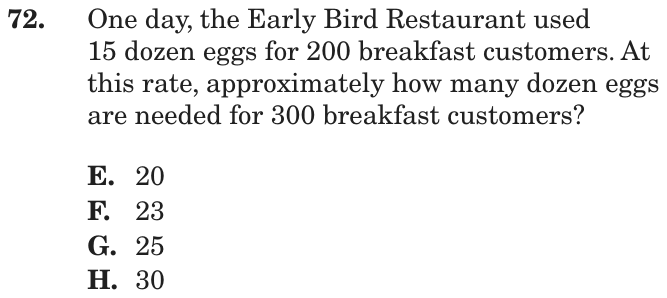
One day, the Early Bird Restaurant used 15 dozen eggs for 200 breakfast customers. At this rate, approximately how many dozen eggs are needed for 300 breakfast customers?
- A20
- B23
- C25
- D30
Show the answer
Correct answer: B
Let be the number of dozens of eggs for 300 customers. Set up a proportion:
Round up to 23, because 22 dozen eggs would not be enough for 300 customers.
Question analysis
This proportion word problem says a restaurant used 15 dozen eggs for 200 breakfast customers and asks approximately how many dozen are needed for 300 customers. Students scale a rate up and round sensibly. Scaling by the right factor, rather than doubling or dividing the wrong pair of numbers, is the key step.
- NYS standards
- 6.RP.3b unit rate problems
- Grade level
- Grade 6 content, by NYS standard
- Compared with grade 7
- Below grade 7 Scaling a rate from one quantity to another is grade 6 ratio reasoning. This needs one multiplication and a rounding decision, so it is lighter than the multistep proportion problems typical of grade 7.
- Estimated difficulty
- Straightforward: two steps or one careful reading.
- Thinking it demands
- Depth of knowledge 2, skills and concepts · mainly apply
- What makes it hard
- Solution
- 2 steps
- Reading level
- Question and choices: about grade 9, 25 words.
- Corrected from the DOE handbook
- The explanation’s reason for rounding was corrected.
- Students, last 30 days
- Not enough answers yet to show (it takes 10).
Why it is hard, traps and wrong answers (shows the answer)
Why it is hard
The proportion is simple, since 300 customers is one and a half times 200, and the only judgment is what to do with 22.5 dozen. The choices are spread wide enough that 23 is clearly nearest once 22.5 is found. Errors come mostly from students who skip the proportion and combine the numbers 300, 200 and 15 in some quicker way.
An answer in an unexpected form minor Choosing the answer
The scaled amount is 22.5 dozen, which is not a choice; the word “approximately” signals that the answer is the nearest whole number of dozens. (Enright, Morley & Sheehan, 2002)
Error-prone arithmetic minor Working it out
Scaling 15 dozen by 300/200 needs the factor 1.5, and 15 × 1.5 = 22.5 brings in a half that students must handle before matching a choice. (Brown & Burton, 1978; Junker & Sijtsma, 2001)
Strategy: Compare 300 customers with 200 to get the scale factor, multiply the 15 dozen eggs by it, and choose the closest answer.
The wrong answers, classified
A Numbers taken from the question (Hegarty, Mayer & Monk, 1995)
Divides 300 customers by 15 dozen, combining two numbers from the question without a model of eggs per customer.
C Little reason to choose it (Haladyna & Downing, 1993; Rodriguez, 2005)
No standard route gives 25; at most a student who finds 22.5 rounds it to the nearest five instead of the nearest whole dozen.
D Rounds too early (King et al., 2004)
Rounds the scale factor 300 ÷ 200 = 1.5 up to 2 before multiplying, doubling 15 dozen to 30.
What was corrected from the DOE handbook, and why
- Explanation: The handbook says to round 22.5 up to 23 “because you can't have half an egg.” But 22.5 dozen is 270 eggs, a whole number; the half is half a dozen, or 6 eggs. The site gives the real reason: 22 dozen eggs would not be enough for 300 customers, so the amount rounds up to 23 dozen.
Worked solution, step by step
Formulas used
- Scaling a rate
- The old amount is the eggs used before, 15 dozen. The old count is the customers then, 200. The new count is the new number of customers, 300. The fraction tells how many times bigger the new group is. The eggs must grow by that same number of times.
Write down what you know
15 dozen eggs fed 200 customers. A dozen is 12, but you can keep everything in dozens.
You need the dozens of eggs for 300 customers, at the same rate.
Compare the customer counts
How many times bigger is 300 than 200? Divide to find out. This number is called the scale factor.
There are 1.5 times as many customers. So you need 1.5 times as many eggs.
Scale up the eggs
You need 22.5 dozen eggs.
Watch out: Do not round 1.5 up to 2 first. That doubles 15 and gives 30, choice D.
Round to a choice
22.5 is not a choice. The question says “approximately,” so pick the closest whole number. 22.5 rounds up to 23.
Rounding up also makes sense, because 22 dozen would be too few.
So the answer is B, 23.
Check your answer
Use another route. 15 dozen for 200 customers is 7.5 dozen for every 100 customers. For 300 customers, that is dozen. That also rounds to 23.
More questions like this
The original DOE question