7.NS.3 four operations with rational numbers
Question 1 of 24
2026 Practice Test C Math, question 11Question
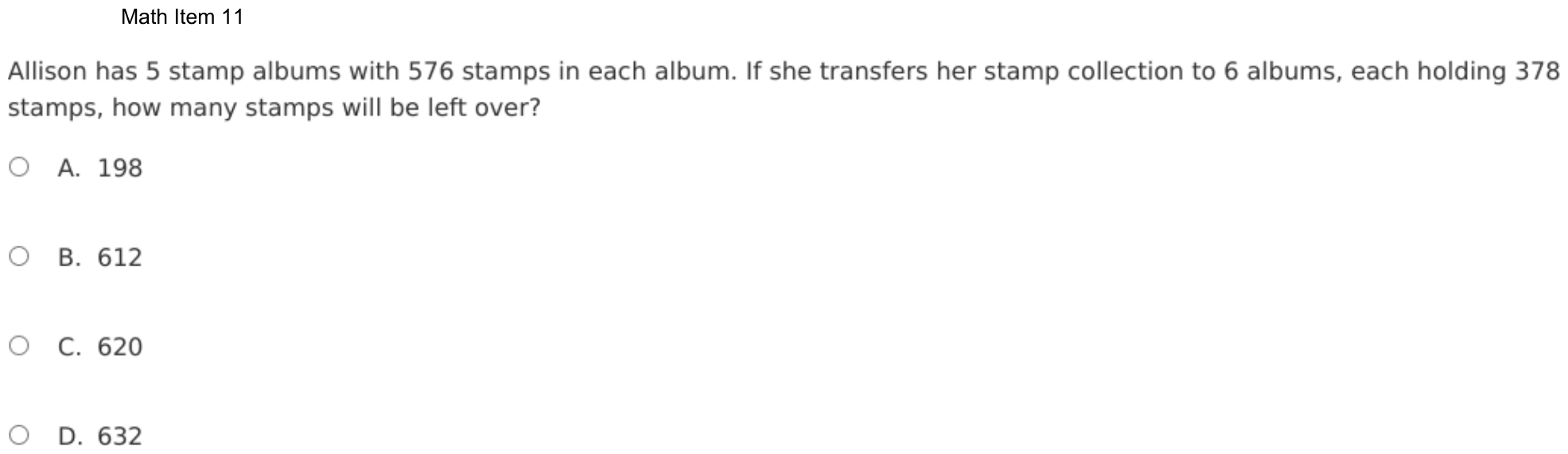
Allison has 5 stamp albums with 576 stamps in each album. If she transfers her stamp collection to 6 albums, each holding 378 stamps, how many stamps will be left over?
- A198
- B612
- C620
- D632
Show the answer
Correct answer: B
Determine the total number of stamps in 5 albums holding 576 stamps:
Determine the total number of stamps in 6 albums holding 378 stamps:
Subtract 2,268 from 2,880 to find the number of stamps that will be left over:
Question analysis
Allison moves a stamp collection from 5 albums of 576 stamps into 6 albums that hold 378 each, and students find how many stamps are left over. It tests multiplying and subtracting large whole numbers in a word problem. The question gives no total, so the collection has to be counted before the new albums' capacity is taken away.
- Grade level
- Grade 7 content, by NYS standard
- Compared with grade 7
- Below grade 7 Whole-number multiplication and subtraction in a three-step word problem is easier than grade 7 work with fractions, decimals or negatives. Because the products are large, a slip or a rounded estimate easily gives another choice.
- Estimated difficulty
- Straightforward: two steps or one careful reading.
- Thinking it demands
- Depth of knowledge 2, skills and concepts · mainly apply
- What makes it hard
- A very close wrong answer moderate
- Error-prone arithmetic minor
- Solution
- 3 steps
- Reading level
- Question and choices: about grade 6, 27 words.
- Students, last 30 days
- Not enough answers yet to show (it takes 10).
Why it is hard, traps and wrong answers (shows the answer)
Why it is hard
The plan is clear from the stem: count the stamps, then take away what the six new albums hold, so the question tests careful arithmetic. Its choices punish the estimating that saves time elsewhere, since rounding either factor shifts the result by only a few tens, onto another listed number. Students who skip the album counts altogether and compare one album with one album find 198 waiting.
A very close wrong answer moderate Choosing the answer
612, 620 and 632 lie within 20 of one another, so rounding 576 and 378 to friendly numbers before multiplying lands on a wrong choice; only exact products separate them. (Embretson & Wetzel, 1987; Gorin & Embretson, 2006; Ascalon et al., 2007)
Error-prone arithmetic minor Working it out
Two products of three-digit numbers, 5 × 576 = 2,880 and 6 × 378 = 2,268, must be done by hand and then subtracted with regrouping. (Brown & Burton, 1978; Junker & Sijtsma, 2001)
Strategy: Multiply to find the total number of stamps, multiply again to find how many the six new albums hold, subtract, and check the last digit of each product.
Traps
- Rounds too early: Rounds a value partway through, or rounds the wrong way, so the final answer drifts from the exact one.
- Numbers taken from the question: Combines the numbers in the question without a model of the situation, or is simply a number that appears in the question.
The wrong answers, classified
A Numbers taken from the question (Hegarty, Mayer & Monk, 1995)
Subtracts 378 from 576, comparing one old album with one new album, and ignores that there are 5 old albums and 6 new ones.
C Rounds too early (King et al., 2004)
Rounds 576 to 580 and 378 to 380 before multiplying, so 2,900 − 2,280 = 620, an estimate rather than the exact number left over.
D Rounds too early (King et al., 2004)
Rounds only 576 up to 580, getting 2,900 stamps, then subtracts the exact 2,268, so the count comes out 20 too high.
Worked solution, step by step
Formulas used
- Total in equal groups
- Here the groups are albums. The amount in each group is how many stamps one album holds. When every group is the same size, multiplying is a fast way to add them all up.
Sort out the question
Allison has 5 albums with 576 stamps in each. She moves all her stamps into 6 new albums. Each new album holds 378 stamps. Some stamps will not fit. You need the number left over.
Count all her stamps
Use the equal-groups formula. Split 576 into 500 + 76 to make it easy:
Allison has 2,880 stamps.
Count what the new albums hold
Do the same for the 6 new albums. Split 378 into 300 + 78:
The new albums hold 2,268 stamps in all.
Subtract to find the leftovers
The stamps left over are the ones she has minus the ones that fit:
Watch out: , choice A, compares just one old album with one new one. Rounding to 580 and 380 first gives 620, choice C. Rounding only 576 gives 632, choice D. Use the exact numbers.
So the answer is B, 612.
Check your answer
Add the leftovers to the stamps that fit: . That is exactly the number Allison started with. So no stamps were lost or counted twice.
More questions like this
The original DOE question
Question 2 of 24
2026 Practice Test D Math, question 14Question
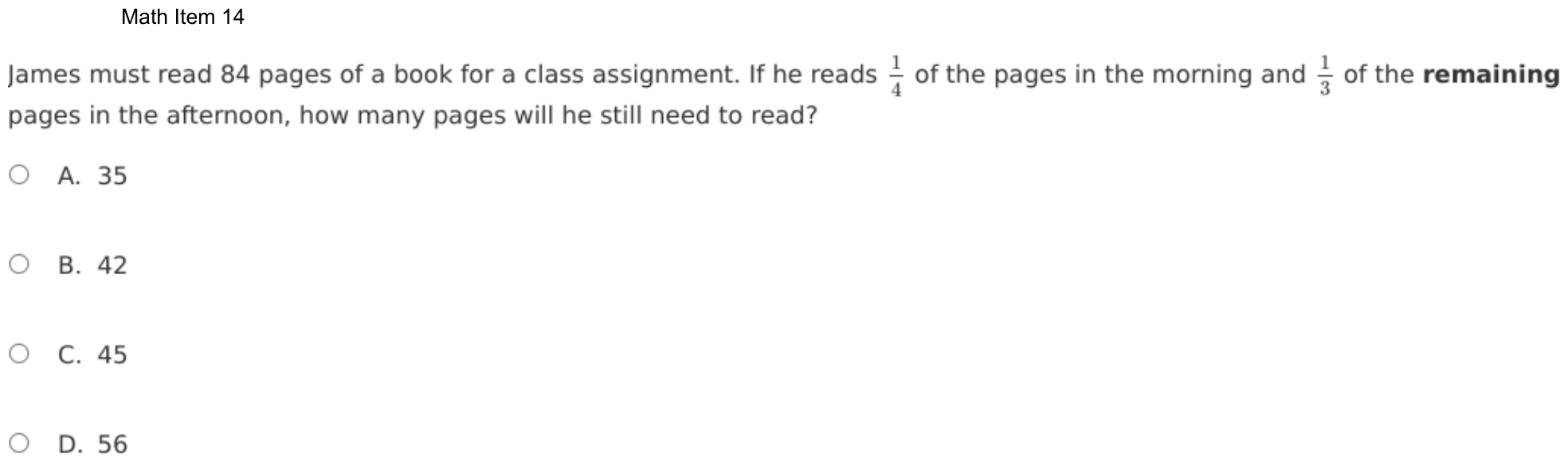
James must read 84 pages of a book for a class assignment. If he reads of the pages in the morning and of the remaining pages in the afternoon, how many pages will he still need to read?
- A35
- B42
- C45
- D56
Show the answer
Correct answer: B
Pages read in the morning:
Pages remaining after the morning:
Pages read in the afternoon:
Pages he still needs to read:
Question analysis
James must read 84 pages for a class assignment: 1/4 of them in the morning, then 1/3 of the remaining pages in the afternoon. Students find how many pages he still has left to read. It tests finding a fraction of a quantity in stages, and the bold word remaining decides which amount the second fraction is taken of.
- Grade level
- Grade 7 content, by NYS standard
- Compared with grade 7
- At grade 7 Taking fractions of a quantity in stages is typical grade 7 work. The numbers divide evenly and the bold word flags the trap, so the four short steps match routine grade 7 demand.
- Estimated difficulty
- Straightforward: two steps or one careful reading.
- Thinking it demands
- Depth of knowledge 2, skills and concepts · mainly apply
- What makes it hard
- Many steps moderate
- Turning words into math minor
- Solution
- 4 steps
- Reading level
- Question and choices: about grade 7, 39 words.
- Students, last 30 days
- Not enough answers yet to show (it takes 10).
Why it is hard, traps and wrong answers (shows the answer)
Why it is hard
Each step is simple, but the second fraction has a different whole from the first. Students who take 1/3 of the full 84 pages get a tidy 28 and a listed answer, despite the bold word that warns against it. Here the pages read and the pages left both come to 42, so confusing those two quantities costs nothing, and checking that 21 + 21 + 42 = 84 confirms the work.
Many steps moderate Working it out
Four operations in order, a quarter of 84, a subtraction, a third of the 63 left, and a second subtraction, each feed the next, so a slip early carries through. (Daniel & Embretson, 2010; Enright, Morley & Sheehan, 2002)
Turning words into math minor Understanding the question
The bold “remaining” moves the base of the second fraction from all 84 pages to the 63 left after the morning, and “still need to read” asks for what is left, not what was read. (Hegarty, Mayer & Monk, 1995; Koedinger & Nathan, 2004)
Strategy: Work in order: find the morning's pages, subtract to get what remains, take 1/3 of that remainder, and subtract again; a quick bar sketch of the 84 pages helps.
Traps
- Misreads the question: Misses or misreads a condition or a word in the question: "at least", "each", "remaining", "not".
The wrong answers, classified
A Misreads the question (Hegarty, Mayer & Monk, 1995)
Takes 1/3 of all 84 pages for the afternoon, 28, instead of 1/3 of the 63 remaining, so 84 − 21 − 28 = 35.
C Little reason to choose it (Haladyna & Downing, 1993; Rodriguez, 2005)
No common working gives 45; it is not a fraction or a difference of any page count in the problem, so it mostly draws guesses near 42.
D Misreads the question (Hegarty, Mayer & Monk, 1995)
Takes the afternoon's third from all 84 pages and subtracts only that, 84 − 28 = 56, overlooking the 21 pages already read in the morning.
Worked solution, step by step
Formulas used
- A fraction of a number
- n is the whole amount, and a/b is the fraction you take. The word of means multiply. When the top, a, is 1, this is just n divided by b. For example, 1/4 of 84 is 84 ÷ 4.
Sort out the question
James has 84 pages to read. In the morning he reads 1/4 of all the pages. In the afternoon he reads 1/3 of the remaining pages, the ones still left after the morning. You need the number of pages he still has to read after that.
Find the morning pages
Take 1/4 of 84:
He reads 21 pages in the morning. That leaves:
63 pages are left after the morning.
Find the afternoon pages
The afternoon fraction is 1/3 of the 63 pages left, not of all 84:
He reads 21 pages in the afternoon.
Watch out: taking 1/3 of all 84 pages gives 28. Then 84 − 21 − 28 = 35, choice A. The bold word remaining tells you to use 63.
Find the pages still to read
Take the afternoon pages away from the 63 pages left after the morning:
He still needs to read 42 pages.
Watch out: subtract both readings, morning and afternoon. Taking only 28 from 84 gives 56, choice D.
So the answer is B, 42.
Check your answer
Add up all the parts: 21 pages in the morning, 21 in the afternoon and 42 still to read. 21 + 21 + 42 = 84, the whole assignment. Another way: after he reads 1/3 of the 63 pages, 2/3 of them are left, and 2/3 of 63 is 42.
More questions like this
The original DOE question
Question 3 of 24
2026 Practice Test D Math, question 19Question
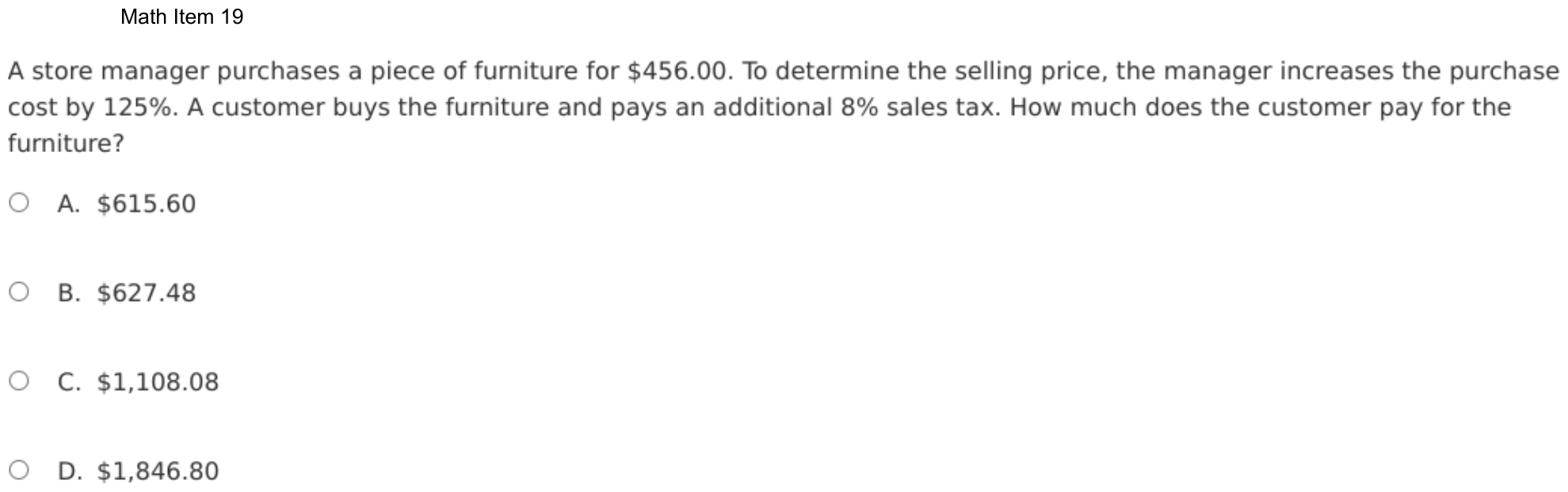
A store manager purchases a piece of furniture for $456.00. To determine the selling price, the manager increases the purchase cost by 125%. A customer buys the furniture and pays an additional 8% sales tax. How much does the customer pay for the furniture?
- A$615.60
- B$627.48
- C$1,108.08
- D$1,846.80
Show the answer
Correct answer: C
Given a purchase price of $456.00, the 125% increase in price is calculated as:
The selling price equals the purchase price plus the increase, or:
The sales tax on the selling price is:
The customer pays the selling price plus the sales tax:
Question analysis
A store manager buys a piece of furniture for $456.00 and raises the price by 125% to set the selling price, and the customer also pays 8% sales tax. Students find the total the customer pays. It tests percent increase and sales tax in sequence, and reading an increase of more than 100% correctly is the main challenge.
- NYS standards
- Grade level
- Grade 7 content, by NYS standard
- Compared with grade 7
- Above grade 7 Grade 7 students find markups and sales tax, usually with increases under 100%. An increase of more than 100% is unusual and easy to misread, and two percent changes must be applied in order, which goes beyond routine grade 7 work.
- Estimated difficulty
- Hard: combines ideas, needs a plan, and has more than one tempting wrong answer.
- Thinking it demands
- Depth of knowledge 2, skills and concepts · mainly apply
- What makes it hard
- Turning words into math moderate
- Many steps moderate
- Error-prone arithmetic minor
- Solution
- 4 steps
- Reading level
- Question and choices: about grade 7, 41 words.
- Students, last 30 days
- Not enough answers yet to show (it takes 10).
Why it is hard, traps and wrong answers (shows the answer)
Why it is hard
A percent above 100 is unusual in grade 7 work, and it is the center of the question: the markup more than doubles the price. Students who treat “by 125%” as “125% of” still find a listed answer after adding tax, and so do students who add $125. A rough check helps: the selling price must be more than twice $456, about $1,000, and the tax adds less than a tenth of that.
Turning words into math moderate Understanding the question
“Increases the purchase cost by 125%” adds 125% of $456 to the $456 itself, a multiplier of 2.25; reading it as 125% of the cost leaves the original price out. (Hegarty, Mayer & Monk, 1995; Koedinger & Nathan, 2004)
Many steps moderate Working it out
Four steps in a row, the increase, the selling price, the tax and the total, each depend on the one before, and two of them are easy to merge or skip. (Daniel & Embretson, 2010; Enright, Morley & Sheehan, 2002)
Error-prone arithmetic minor Working it out
Taking 8% of $1,026 means multiplying by 0.08, and a decimal point one place off, 0.8, makes the tax ten times too large. (Brown & Burton, 1978; Junker & Sijtsma, 2001)
Strategy: Turn each percent change into a multiplier, remembering that an increase by a percent is added to the original amount, apply the markup and then the tax, and estimate to check the size.
Traps
- Stops one step early: A choice is a number from partway through the solution.
- Misunderstands the concept: A wrong belief about a concept: that percents can be added, that area grows like length, that averages can be averaged, that a bigger denominator means a bigger fraction.
- An arithmetic slip: The right method with a plausible arithmetic error: a digit, a place value or a times-table fact.
The wrong answers, classified
A Stops one step early (King et al., 2004; Gierl et al., 2017)
Finds the increase, 125% of $456 = $570, and uses it as the selling price without adding back the $456 cost, then adds 8% tax.
B Misunderstands the concept (Smith, diSessa & Roschelle, 1993; De Bock et al., 1998; Ni & Zhou, 2005)
Reads the 125% increase as $125, a fixed amount, so the selling price is $581, and then adds 8% tax correctly to reach $627.48.
D An arithmetic slip (Junker & Sijtsma, 2001)
Finds the $1,026 selling price correctly but writes 8% as 0.8, adding $820.80 in tax instead of $82.08.
Worked solution, step by step
Formulas used
- Percent of a number
- n is the starting amount, and p is the percent. Percent means out of 100, so 125% is 125/100 = 1.25 and 8% is 8/100 = 0.08. Multiply n by that decimal to find the part.
- Price after an increase
- The old price is what you start with. The increase is the amount added on. To increase by a percent, find that percent of the old price, then add it to the old price. Sales tax is added the same way.
Sort out the question
The manager pays $456.00 for the furniture. The selling price is that cost increased by 125%. The customer then pays 8% sales tax on top. Sales tax is an extra charge, a percent of the price. You need the total the customer pays.
Find the increase
Find 125% of $456. As a decimal, 125% is 1.25, which is 1 and a quarter. A quarter of 456 is 114:
The increase is $570.
Find the selling price
Increases by means the increase is added to the cost:
The selling price is $1,026.
Watch out: $570 is only the increase. Using it as the price gives $615.60, choice A. And 125% is a percent, not $125. Adding $125 leads to $627.48, choice B.
Find the sales tax
As a decimal, 8% is 0.08. Find 8% of the selling price:
The tax is $82.08.
Watch out: 8% is 0.08, not 0.8. Using 0.8 makes the tax ten times too big and gives $1,846.80, choice D.
Add the tax to the price
The customer pays the selling price plus the tax:
So the answer is C, $1,108.08.
Check your answer
Estimate. The price more than doubles: $456 plus $570 is about $1,000. Tax of 8% adds about $80. So the total should be a bit over $1,080, and only $1,108.08 is close. Or multiply in one go: 456 × 2.25 × 1.08 = 1,108.08.
More questions like this
The original DOE question
Question 4 of 24
2026 Practice Test D Math, question 22Question
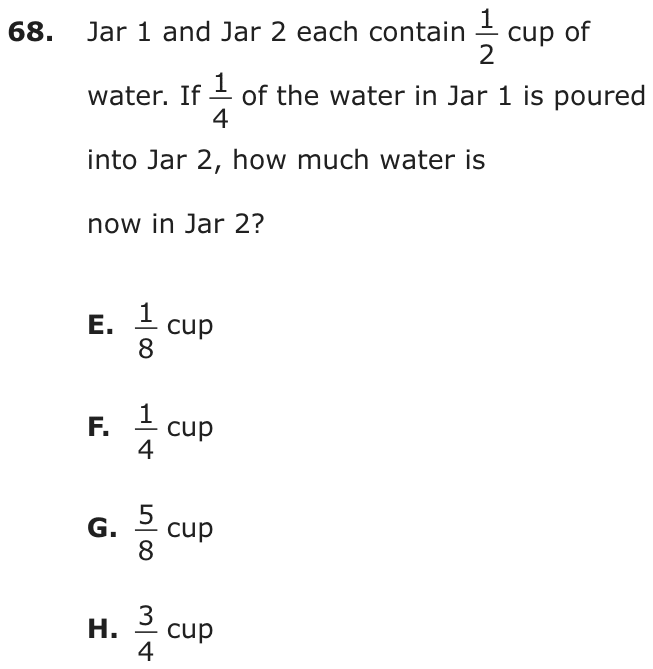
Seth grows strawberries in his garden.
- He picked cups of strawberries on Monday.
- He picked 4 cups of strawberries on Tuesday.
- He ate cup of strawberries for breakfast each day on Wednesday, Thursday, and Friday.
How many cups of strawberries did Seth have left?
- A
- B
- C6
- D9
Show the answer
Correct answer: B
When Seth picks strawberries, the value represents a positive number, and when he eats the strawberries, the value represents a negative number. Write an expression and then evaluate the expression, where the negative value is multiplied by 3 because he ate the same amount on 3 different days.
If the multiplication is confusing, evaluate the expression below which represents the sum for the 5 days with each day listed separately.
Question analysis
Seth picked strawberries on Monday and Tuesday, in amounts given as a mixed number and a whole number, then ate the same fraction of a cup at breakfast on three days. Students find how many cups he has left. It tests adding, multiplying and subtracting fractions in a short word problem, and the eaten amount repeats each day.
- Grade level
- Grade 7 content, by NYS standard
- Compared with grade 7
- Below grade 7 Adding mixed numbers and multiplying a fraction by a whole number are skills from before grade 7. The three steps are short and the numbers friendly, so the demand is below typical grade 7 work with signed rational numbers.
- Estimated difficulty
- Straightforward: two steps or one careful reading.
- Thinking it demands
- Depth of knowledge 2, skills and concepts · mainly apply
- What makes it hard
- Error-prone arithmetic moderate
- Turning words into math minor
- Solution
- 3 steps
- Reading level
- Question and choices: about grade 6, 47 words.
- Students, last 30 days
- Not enough answers yet to show (it takes 10).
Why it is hard, traps and wrong answers (shows the answer)
Why it is hard
The bulleted list lays out the story day by day, so setting up the problem is easy; the points are lost in the fractions. The number of breakfast days, 3, sits right beside the 3/4 cup, and subtracting 3 cups instead of three quarters of a cup each day is the tempting shortcut. Writing every amount in fourths, 26/4 picked and 9/4 eaten, makes the last step a whole-number subtraction.
Error-prone arithmetic moderate Working it out
Three breakfasts of 3/4 cup make 9/4 = 2 1/4 cups, and taking that from 6 1/2 means renaming the half as 2/4, two fraction steps where a slip is easy. (Brown & Burton, 1978; Junker & Sijtsma, 2001)
Turning words into math minor Understanding the question
Picking adds and eating subtracts, and “each day on Wednesday, Thursday, and Friday” means the 3/4 cup counts three times, not once. (Hegarty, Mayer & Monk, 1995; Koedinger & Nathan, 2004)
Strategy: Add the two amounts picked, multiply the breakfast amount by the number of days, and subtract that from the total; writing every amount in fourths keeps the arithmetic simple.
Traps
- Numbers taken from the question: Combines the numbers in the question without a model of the situation, or is simply a number that appears in the question.
- Wrong operation: Adds instead of multiplying, divides the wrong way round, turns a ratio or rate upside down, or undoes a step in the wrong direction (subtracts what should be added back).
The wrong answers, classified
A Numbers taken from the question (Hegarty, Mayer & Monk, 1995)
Subtracts 3 cups, the number of breakfast days, instead of 3 × 3/4 = 2 1/4 cups, so 6 1/2 − 3 = 3 1/2.
C Little reason to choose it (Haladyna & Downing, 1993; Rodriguez, 2005)
No common working gives exactly 6; it is near the 6 1/2 cups picked and mostly catches students who drop the fractions or guess.
D Wrong operation (Hegarty, Mayer & Monk, 1995; King et al., 2004)
Adds the 2 1/4 cups eaten to the 6 1/2 cups picked instead of subtracting, 8 3/4 cups, and takes the nearest choice, 9.
Worked solution, step by step
Formulas used
- Total of a repeated amount
- Use it when the same amount happens again and again. Here Seth eats 3/4 cup on each of 3 days, so the number of times is 3 and the amount each time is 3/4 cup.
- A whole number times a fraction
- n is a whole number, and a/b is a fraction. Multiply the whole number by the top only, and keep the bottom. It works because n groups of a pieces make n × a pieces, and each piece is still size 1/b.
Sort out the question
Seth picked 2 1/2 cups on Monday and 4 cups on Tuesday. Then he ate 3/4 cup each day on Wednesday, Thursday and Friday. That is 3 days of eating. Picking adds strawberries, and eating takes them away. You need the number of cups he has left.
Add what he picked
Add the two days of picking:
He picked 6 1/2 cups in all, before he ate any.
Find how much he ate
He ate 3/4 cup on each of 3 days. Multiply:
To change 9/4 to a mixed number, note that 4 fits into 9 twice, with 1 left over. He ate 2 1/4 cups.
Watch out: he ate 3/4 cup three times, not 3 cups. Subtracting 3 gives 3 1/2, choice A.
Take away what he ate
Write the half as fourths, so both fractions have the same bottom: 1/2 = 2/4. Then subtract the wholes and the fourths:
Watch out: eating takes away. Adding the 2 1/4 cups gives 8 3/4, and the nearest choice is 9, choice D.
So the answer is B, cups.
Check your answer
Use decimals. 2.5 + 4 = 6.5 cups picked. 3 × 0.75 = 2.25 cups eaten. Then 6.5 − 2.25 = 4.25 cups, which is 4 1/4.
More questions like this
The original DOE question
Question 5 of 24
2026 Practice Test D Math, question 33Question
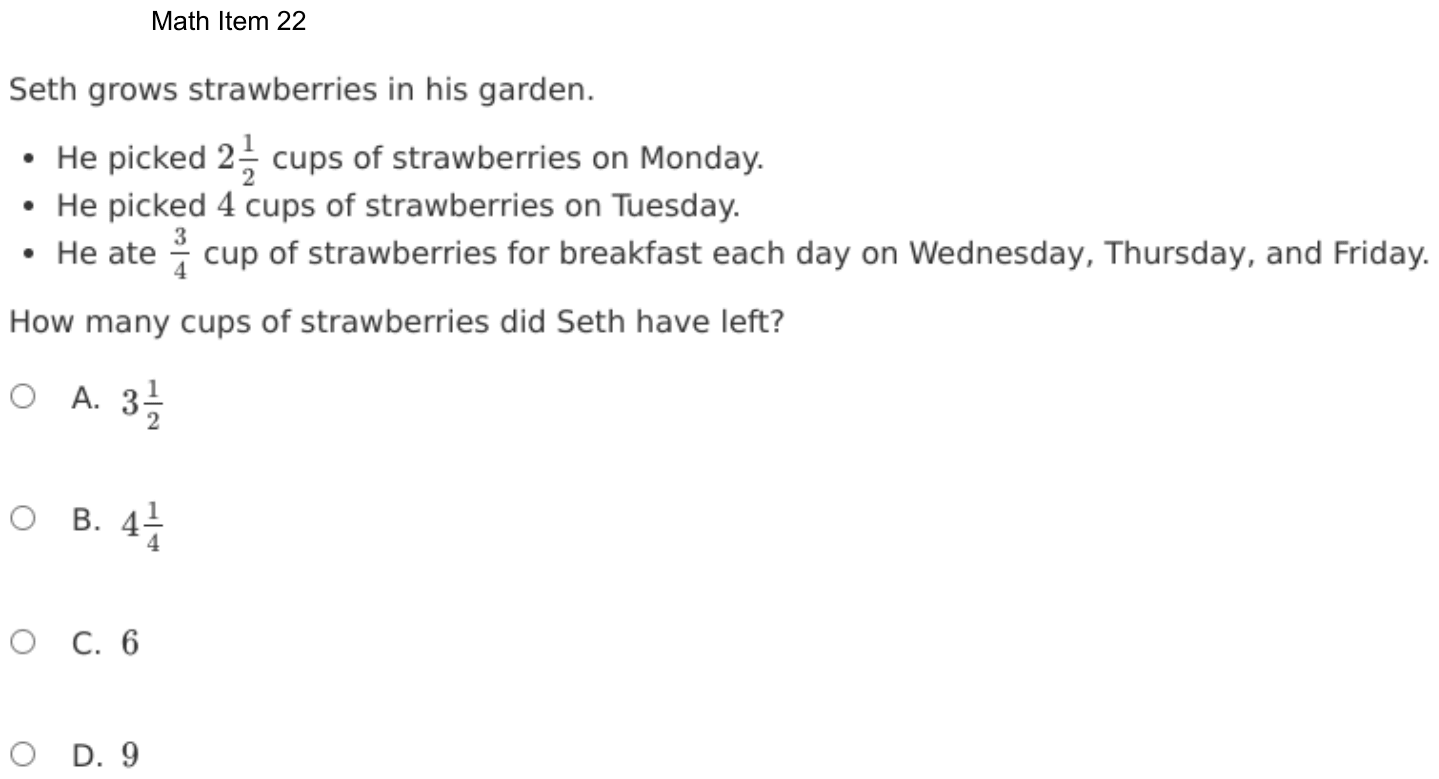
A car costing $24,000 is subject to a sales tax of 8%. If Bindu made a $10,000 down payment on this car, what is the total amount she has left to pay?
- A$14,000
- B$15,620
- C$15,920
- D$25,920
Show the answer
Correct answer: C
First, find the sales tax. Then, add the sales tax to the cost of the car. Finally, subtract the down payment to find out how much she has left to pay.
Question analysis
Bindu buys a $24,000 car with an 8% sales tax and makes a $10,000 down payment, and students find how much she still has to pay. This percent word problem combines finding a tax, adding it to the price and subtracting a payment. Every step must be done in order, since leaving one out gives an amount that looks just as reasonable.
- NYS standards
- Grade level
- Grade 7 content, by NYS standard
- Compared with grade 7
- At grade 7 Adding sales tax to a price is a standard grade 7 percent task. This one also subtracts a down payment at the end, three routine steps with round numbers, much like a typical classroom problem.
- Estimated difficulty
- Straightforward: two steps or one careful reading.
- Thinking it demands
- Depth of knowledge 2, skills and concepts · mainly apply
- What makes it hard
- Many steps minor
- Error-prone arithmetic minor
- Solution
- 3 steps
- Reading level
- Question and choices: about grade 5, 29 words.
- Students, last 30 days
- Not enough answers yet to show (it takes 10).
Why it is hard, traps and wrong answers (shows the answer)
Why it is hard
The method is the standard one for tax on a purchase, so the question checks order and completeness. Forgetting the tax or forgetting the down payment each produces an amount as reasonable-looking as the answer, and a careless 8 × 24 produces one just $300 below it. Multiplying the price by 1.08 in one step, which gives $25,920, is a second route that catches a slip in the tax.
Many steps minor Working it out
Three operations come in a fixed order, 8% of $24,000, then adding the tax, then subtracting the $10,000, and leaving out the first or the last gives a listed choice. (Daniel & Embretson, 2010; Enright, Morley & Sheehan, 2002)
Error-prone arithmetic minor Working it out
Finding 8% of $24,000 comes down to 8 × 24 = 192 with two zeros added, and a lost carry in that product turns $1,920 into $1,620. (Brown & Burton, 1978; Junker & Sijtsma, 2001)
Strategy: Find 8% of the price and add it, or multiply the price by 1.08, to get the full cost with tax, then subtract what Bindu has already paid.
Traps
- Stops one step early: A choice is a number from partway through the solution.
- Misreads the question: Misses or misreads a condition or a word in the question: "at least", "each", "remaining", "not".
The wrong answers, classified
A Misreads the question (Hegarty, Mayer & Monk, 1995)
Subtracts the $10,000 down payment from the $24,000 price and never adds the 8% sales tax, so the tax is simply left out.
B An arithmetic slip (Junker & Sijtsma, 2001)
Drops the carried 3 when multiplying 8 × 24, so the tax comes out $1,620 instead of $1,920 and the balance $300 too low.
D Stops one step early (King et al., 2004; Gierl et al., 2017)
Adds the $1,920 tax to the price correctly but stops at $25,920, the full cost, forgetting to subtract the $10,000 Bindu already paid.
Worked solution, step by step
Formulas used
- Percent of a number
- Percent means out of 100. So 8% is 8/100, or 0.08. To find a percent of a number, change the percent to a decimal and multiply it by the whole.
- Amount left to pay
- The price plus the tax is the full cost. A down payment is money paid at the start. Subtract it, because that part is already paid.
Sort out the question
You know:
- The car costs $24,000.
- The sales tax is 8%. Sales tax is extra money added to a price.
- Bindu paid $10,000 at the start. That is the down payment.
You need the amount Bindu still has to pay. Work in order: tax, then full cost, then subtract.
Find the sales tax
Change 8% to the decimal 0.08. Multiply it by the price:
A quick way: 1% of 24,000 is 240, so 8% is . The tax is $1,920.
Watch out: in 8 × 24 you carry a 3 from 8 × 4 = 32. Dropping it gives 162, so the tax looks like $1,620. That leads to $15,620, choice B.
Find the full cost
Add the tax to the price:
The car costs $25,920 with tax.
Watch out: this is not the answer yet. Stopping here gives $25,920, choice D. Bindu already paid part of it.
Subtract the down payment
Bindu already paid $10,000. Take it away:
She has $15,920 left to pay.
Watch out: leaving out the tax gives , choice A.
So the answer is C, $15,920.
Check your answer
Use a shortcut for the full cost. The price plus 8% more is 108% of the price, or 1.08 times it: . Then . Same answer.
More questions like this
The original DOE question
Question 6 of 24
2024 Test A Math, question 4Question
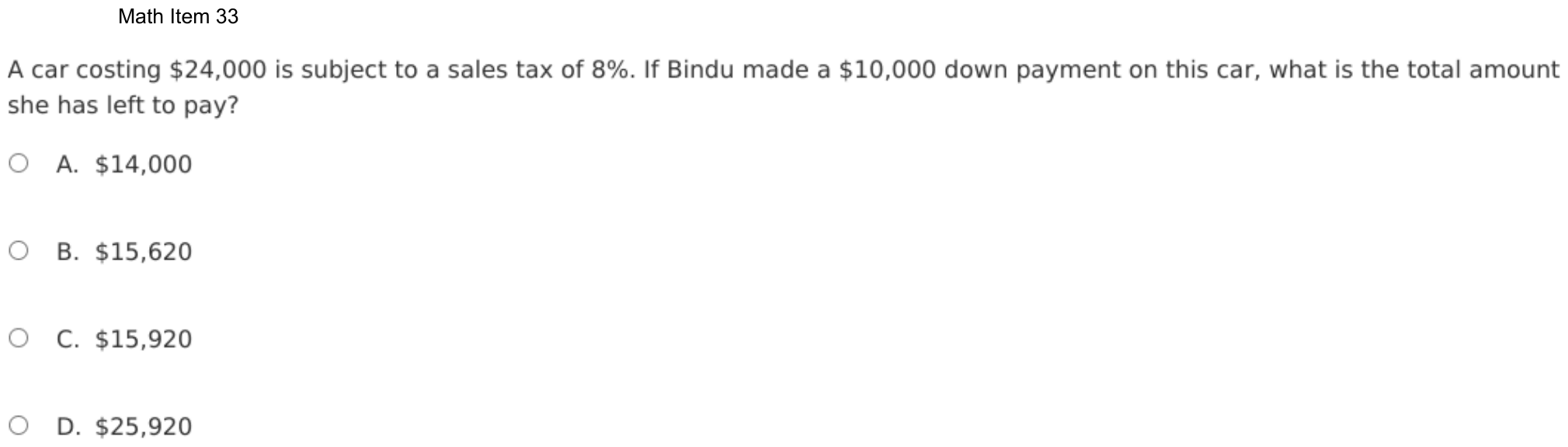
Mr. Chan’s lawn grows inches every 2 weeks. He mows his lawn every 2 weeks and cuts off the top inches of lawn. If Mr. Chan’s lawn was 4 inches tall at the beginning of the season, how many inches tall, in decimal form, is Mr. Chan’s lawn after 8 weeks?
Grid-in question: work out the answer and enter it as a number.
Show the answer
Correct answer: 5.5
The lawn grows inches every 2 weeks. Find the total number of inches it grows in 8 weeks.
The lawn was 4 inches tall at the beginning of the season.
Mr. Chan mows his lawn every 2 weeks and cuts off the top inches. Find the total number of inches that are cut off in 8 weeks.
The height after 8 weeks is the total number of inches grown minus the total number of inches cut off.
Question analysis
This multistep word problem follows Mr. Chan's lawn over 8 weeks: it grows a mixed number of inches every 2 weeks, and he mows a mixed number of inches off on the same schedule. Students combine the growth, the cuts and the starting height and give the final height as a decimal. Leaving out one of those three pieces is the usual error.
- Grade level
- Grade 7 content, by NYS standard
- Compared with grade 7
- At grade 7 Grade 7 students solve multi-step problems with mixed numbers and convert between fractions and decimals. This one strings four such steps together, including counting the 2-week periods, which is typical grade 7 work done carefully.
- Estimated difficulty
- Moderate: several steps, or a close reading with one strong distractor.
- Thinking it demands
- Depth of knowledge 2, skills and concepts · mainly apply
- What makes it hard
- Many steps moderate
- Error-prone arithmetic moderate
- Turning words into math minor
- An answer in an unexpected form minor
- Solution
- 4 steps
- Reading level
- Question and choices: about grade 3, 49 words.
- Corrected from the DOE handbook
- A misspelled name in the explanation was corrected.
- Students, last 30 days
- Not enough answers yet to show (it takes 10).
Why it is hard, traps and wrong answers (shows the answer)
Why it is hard
No single step is hard, but three parts must all reach the final height: the starting 4 inches, four rounds of growth and four rounds of mowing. Leaving out any one of them gives a clean decimal that can be gridded without a second thought. Working one 2-week period at a time, in which the lawn gains 3/8 inch net, keeps the bookkeeping short.
Many steps moderate Working it out
Four pieces have to be combined: count the four 2-week periods in 8 weeks, total the growth, total the mowing, and start from the lawn's first 4 inches. (Daniel & Embretson, 2010; Enright, Morley & Sheehan, 2002)
Error-prone arithmetic moderate Working it out
The amounts are mixed numbers with unlike denominators, 2 1/8 and 1 3/4, which must be multiplied by 4 or subtracted and then gridded as a decimal. (Brown & Burton, 1978; Junker & Sijtsma, 2001)
Turning words into math minor Understanding the question
The phrase "every 2 weeks" governs both the growing and the mowing, so 8 weeks means four rounds of each, not eight. (Hegarty, Mayer & Monk, 1995; Koedinger & Nathan, 2004)
An answer in an unexpected form minor Choosing the answer
As a grid-in it gives no choices, so a height that leaves out the starting 4 inches, or leaves out the mowing, looks as finished as the right one. (Enright, Morley & Sheehan, 2002)
Strategy: Find the net change for one 2-week period by subtracting the cut from the growth, multiply by the number of such periods in 8 weeks, and add the starting height.
Traps
- Stops one step early: A choice is a number from partway through the solution.
- Misreads the question: Misses or misreads a condition or a word in the question: "at least", "each", "remaining", "not".
The wrong answers, classified
1.5 Stops one step early (King et al., 2004; Gierl et al., 2017)
Finds the net gain of 3/8 inch per period and multiplies by the 4 periods, 1.5 inches, but stops before adding the lawn's starting height of 4 inches.
12.5 Stops one step early (King et al., 2004; Gierl et al., 2017)
Adds four periods of growth, 8.5 inches, to the starting 4 inches and stops there, never subtracting the 1 3/4 inches cut at each of the four mowings.
7 Misreads the question (Hegarty, Mayer & Monk, 1995)
Applies the net gain of 3/8 inch to each of the 8 weeks instead of each 2-week period, 8 × 3/8 = 3, then adds the starting 4.
What was corrected from the DOE handbook, and why
- Explanation: The handbook’s explanation says “Mr. Chen mows his lawn every 2 weeks.” The question calls him Mr. Chan throughout, so the site now reads “Mr. Chan.”
Worked solution, step by step
Formulas used
- Mixed number to decimal
- A mixed number has a whole part, a, and a fraction part, b over c. To write it as a decimal, divide b by c to get the fraction part as a decimal. Then add the whole part. For example, one and a half is 1 + 0.5 = 1.5.
- Repeated amount
- n is how many times something happens. a is the amount each time. Adding the same amount n times is the same as multiplying it by n.
Sort out the question
The lawn starts at 4 inches tall. Every 2 weeks it grows inches. Every 2 weeks Mr. Chan also cuts off inches. You need the height after 8 weeks, as a decimal. Three things matter: the start, the growing and the cutting.
Count the 2-week periods
Both the growing and the cutting happen every 2 weeks. So count how many 2-week periods fit in 8 weeks.
There are 4 periods. The lawn grows 4 times and is cut 4 times. Watch out: do not count 8 rounds, one for each week. That leads to the wrong answer 7.
Change the mixed numbers to decimals
The answer must be a decimal, so change both amounts now.
Each period, the lawn grows 2.125 inches and loses 1.75 inches.
Add up the growing
The lawn grows 2.125 inches, 4 times.
It grows 8.5 inches in all. Add the starting height of 4 inches.
Without mowing, the lawn would be 12.5 inches tall. Watch out: do not forget the starting 4 inches. Leaving them out leads to 1.5.
Add up the cutting
Mr. Chan cuts off 1.75 inches, 4 times.
He cuts off 7 inches in all.
Subtract the cutting
The lawn is 5.5 inches tall after 8 weeks. Watch out: 12.5 is not the answer. It leaves out the mowing. So you would grid 5.5.
Check your answer
Work one period at a time. Each period the lawn gains inch. In 4 periods that is inches. Add the starting 4 inches: . Same answer.
More questions like this
The original DOE question
Question 7 of 24
2024 Test A Math, question 11Question
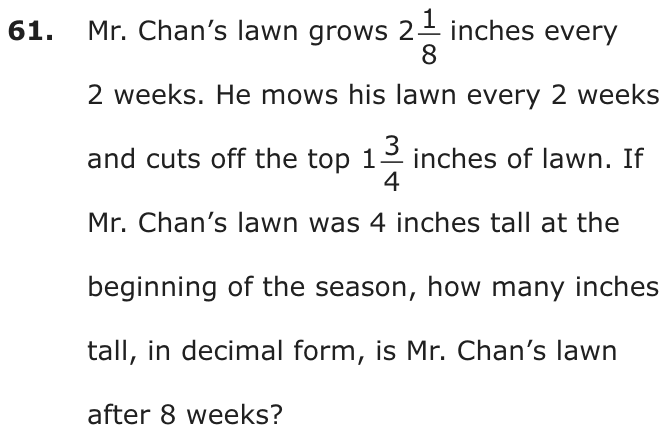
Jar 1 and Jar 2 each contain cup of water. If of the water in Jar 1 is poured into Jar 2, how much water is now in Jar 2?
- A cup
- B cup
- C cup
- D cup
Show the answer
Correct answer: C
Jar 1 starts with cup of water. If of its water is poured into Jar 2, then the amount of water added to Jar 2 is cup.
Jar 2 starts with cup of water. If cup of water is added to it, then the amount of water now in Jar 2 is cup.
Question analysis
A fraction word problem about two jars that each hold half a cup of water; a quarter of the water in the first jar is poured into the second. Students find how much water the second jar now holds. Reading exactly what the quarter is a quarter of is the detail that matters.
- NYS standards
- 7.NS.3 four operations with rational numbers
- Grade level
- Grade 7 content, by NYS standard
- Compared with grade 7
- Below grade 7 Multiplying and adding positive fractions is review by grade 7, and the problem takes two short steps. It is easier than typical grade 7 work with negative numbers or longer rational-number problems, apart from careful reading.
- Estimated difficulty
- Straightforward: two steps or one careful reading.
- Thinking it demands
- Depth of knowledge 2, skills and concepts · mainly apply
- What makes it hard
- Turning words into math moderate
- Error-prone arithmetic minor
- Solution
- 2 steps
- Reading level
- Question and choices: about grade 4, 35 words.
- Students, last 30 days
- Not enough answers yet to show (it takes 10).
Why it is hard, traps and wrong answers (shows the answer)
Why it is hard
The numbers are friendly halves, quarters and eighths, and the work is two steps. The question turns on one phrase: the quarter is a fraction of Jar 1's water, not a measured quarter cup, and reading it the second way gives a choice that looks right. Students who also remember that Jar 2 already held water finish correctly.
Turning words into math moderate Understanding the question
The phrase "1/4 of the water in Jar 1" means a quarter of Jar 1's half cup, an eighth of a cup, not a quarter cup; the word of calls for multiplying. (Hegarty, Mayer & Monk, 1995; Koedinger & Nathan, 2004)
Error-prone arithmetic minor Working it out
Adding the 1/8 cup to Jar 2's 1/2 cup needs the common denominator 8, so 1/2 becomes 4/8 before the sum. (Brown & Burton, 1978; Junker & Sijtsma, 2001)
Strategy: Find the amount poured by taking one quarter of Jar 1's half cup, then add that amount to the half cup already in Jar 2.
Traps
- Stops one step early: A choice is a number from partway through the solution.
- Misreads the question: Misses or misreads a condition or a word in the question: "at least", "each", "remaining", "not".
The wrong answers, classified
A Stops one step early (King et al., 2004; Gierl et al., 2017)
Finds the amount poured, 1/4 of 1/2 cup = 1/8 cup, and stops there instead of adding it to the half cup already in Jar 2.
B Numbers taken from the question (Hegarty, Mayer & Monk, 1995)
Picks the fraction 1/4 straight from the question, as if the share poured were the amount of water now in Jar 2.
D Misreads the question (Hegarty, Mayer & Monk, 1995)
Reads 1/4 of the water as 1/4 cup and adds it to Jar 2's half cup, 1/2 + 1/4 = 3/4.
Worked solution, step by step
Formulas used
- Fraction of an amount
- N is the whole amount, and a over b is the part of it you want. In math, the word of means multiply. For example, half of 10 is one half times 10, which is 5.
- Multiplying fractions
- a and c are the tops, and b and d are the bottoms. Multiply the tops together and the bottoms together. Taking a part of a part makes the pieces smaller, so the bottom gets bigger.
- Adding fractions with the same bottom
- a and b are the tops, and d is the shared bottom, called the denominator. If the bottoms match, add the tops and keep the bottom. If they do not match, rewrite one fraction first.
Sort out the question
Each jar starts with cup of water. You pour “ of the water in Jar 1” into Jar 2. You need how much water is in Jar 2 after that, in cups.
Find how much water is poured
Jar 1 has cup. You pour of it. Of means multiply.
You pour cup. Watch out: a quarter of the water is not a quarter cup. It is a quarter of a half cup. Adding cup gives cup, choice D.
Make the bottoms match
Now add the poured water to the cup already in Jar 2. The bottoms are 2 and 8, so rewrite the half with 8 on the bottom. Multiply its top and bottom by 4.
Add the water in Jar 2
Jar 2 now holds cup. Watch out: cup is only the water poured in. Stopping there gives choice A. So the answer is C, cup.
Check your answer
Jar 2 started with a half cup and got a little more. So it should hold just over a half cup, and is. Also, the water in both jars still adds up to 1 cup: Jar 1 has cup left, and .
More questions like this
The original DOE question
Question 8 of 24
2024 Test A Math, question 49Question
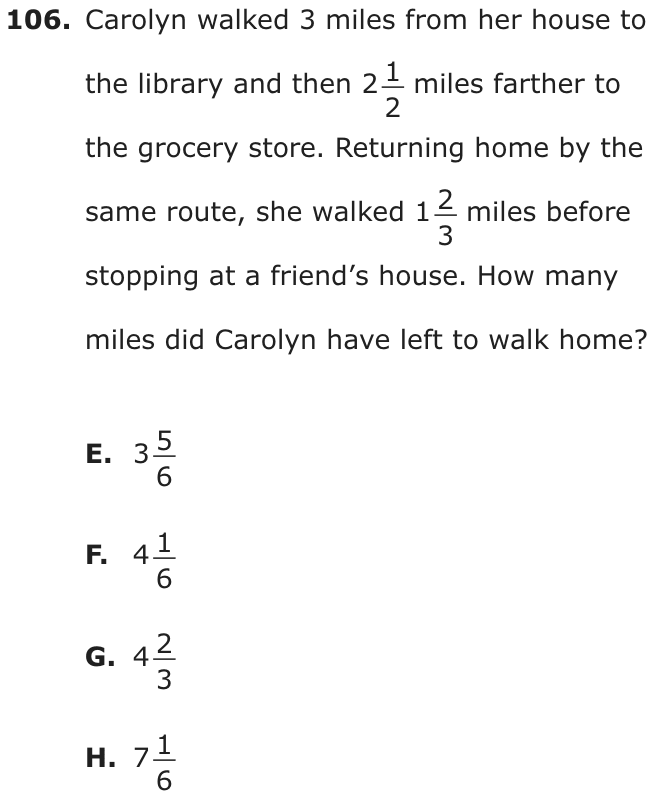
Carolyn walked 3 miles from her house to the library and then miles farther to the grocery store. Returning home by the same route, she walked miles before stopping at a friend’s house. How many miles did Carolyn have left to walk home?
- A
- B
- C
- D
Show the answer
Correct answer: A
The distance from Carolyn’s house to the grocery store is miles.
Carolyn walked miles back, so she still had miles left to walk home.
So Carolyn had miles left to walk home.
Question analysis
Carolyn walks 3 miles from home to the library and 2 1/2 miles more to the grocery store, then heads back the same way and stops at a friend's house after 1 2/3 miles. This fractions word problem asks how far she still has to walk home. Students add and subtract mixed numbers, and the subtraction needs regrouping across unlike denominators.
- Grade level
- Grade 7 content, by NYS standard
- Compared with grade 7
- At grade 7 Grade 7 students solve multi-step word problems with mixed numbers. This one has only positive numbers, but it needs a clear picture of the route and a subtraction that requires regrouping across unlike denominators.
- Estimated difficulty
- Moderate: several steps, or a close reading with one strong distractor.
- Thinking it demands
- Depth of knowledge 2, skills and concepts · mainly apply
- What makes it hard
- Error-prone arithmetic moderate
- A very close wrong answer moderate
- Turning words into math minor
- Solution
- 3 steps
- Reading level
- Question and choices: about grade 6, 48 words.
- Students, last 30 days
- Not enough answers yet to show (it takes 10).
Why it is hard, traps and wrong answers (shows the answer)
Why it is hard
The story needs a quick sketch, but the real test is one mixed-number subtraction in which the second fraction is larger than the first. Many students subtract the fractions the easy way round, which gives a choice close to the right one. Converting both numbers to sixths, 33/6 − 10/6, sidesteps the regrouping, and adding the result to 1 2/3 to get back 5 1/2 is a quick check.
Error-prone arithmetic moderate Working it out
The subtraction 5 1/2 − 1 2/3 needs sixths, 5 3/6 − 1 4/6, and the fraction on top is the smaller one, so a whole must be regrouped. (Brown & Burton, 1978; Junker & Sijtsma, 2001)
A very close wrong answer moderate Choosing the answer
Subtracting the fraction parts the wrong way round gives 4 1/6, only 1/3 away from the answer, so a rough estimate cannot tell the two apart. (Embretson & Wetzel, 1987; Gorin & Embretson, 2006; Ascalon et al., 2007)
Turning words into math minor Understanding the question
The route has to be pictured: the walk back starts at the grocery store, 5 1/2 miles from home, not at the library. (Hegarty, Mayer & Monk, 1995; Koedinger & Nathan, 2004)
Strategy: Sketch the route as a line from home to the library to the store, find the total distance out, then subtract the distance already walked back, using sixths.
Traps
- A faulty procedure: A systematic but wrong procedure: adding fractions straight across, applying an exponent to each term of a sum, dropping a sign when moving a term.
- Answers a different question: A choice is right for another quantity: the other unknown, the rest instead of the part, the part instead of the whole.
The wrong answers, classified
B A faulty procedure (Brown & Burton, 1978; Tatsuoka, 1983)
Subtracts the whole numbers, 5 − 1 = 4, then the fractions the easy way round, 2/3 − 1/2 = 1/6, giving 4 1/6.
C Answers a different question (King et al., 2004; Hegarty, Mayer & Monk, 1995)
On the store-to-library stretch, uses the 1 2/3 miles already walked instead of the 5/6 mile left, then adds the 3 miles home.
D Answers a different question (King et al., 2004; Hegarty, Mayer & Monk, 1995)
Adds all three distances, 3 + 2 1/2 + 1 2/3 = 7 1/6, which is how far she has walked so far, not how far is left.
Worked solution, step by step
Formulas used
- Mixed number to fraction
- a is the whole number part, b is the top of the fraction, and c is the bottom. Each whole holds c pieces, so a wholes hold a times c pieces. Then add the b extra pieces.
- Equivalent fractions
- a is the top of a fraction and b is the bottom. n is any number except 0. Multiplying the top and bottom by the same number gives an equal fraction, cut into smaller pieces. Use it to give two fractions the same bottom before you add or subtract.
- Subtracting fractions with the same bottom
- c is the shared bottom number. a and b are the tops. When the pieces are the same size, you just take away how many pieces you have. The size of the pieces, c, stays the same.
Picture the route
Draw a line: home, then the library, then the store. Home to the library is 3 miles. The library to the store is miles more. Carolyn walks back the same way. After miles she stops at a friend’s house. You need the miles still left to get home.
Find the distance from home to the store
The store is miles from home. She starts back from the store, so this is the full trip home. Watch out: adding all three distances gives , choice D. That is how far she has walked, not how far is left.
Change to improper fractions
The miles left are . An improper fraction has a top bigger than its bottom. Change each mixed number to one.
Use sixths for both
To subtract, the fractions need the same bottom. 2 and 3 both go into 6, so change both to sixths.
Subtract and simplify
23 sixths is 3 wholes (18 sixths) and 5 sixths more. So . Watch out: is less than . Subtracting the fraction parts the wrong way round gives , choice B.
So the answer is A, miles.
Check your answer
Add back: . That is the full distance from the store to home. Also estimate: 5.5 minus about 1.7 is about 3.8, and is about 3.83.
More questions like this
The original DOE question
Question 9 of 24
2024 Test B Math, question 4Question
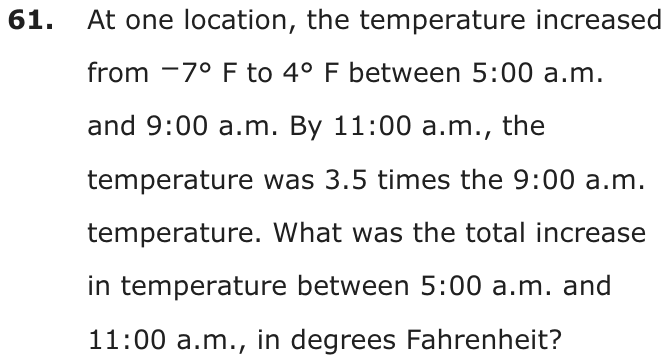
At one location, the temperature increased from −7° F to 4° F between 5:00 a.m. and 9:00 a.m. By 11:00 a.m., the temperature was 3.5 times the 9:00 a.m. temperature. What was the total increase in temperature between 5:00 a.m. and 11:00 a.m., in degrees Fahrenheit?
Grid-in question: work out the answer and enter it as a number.
Show the answer
Correct answer: 21
The 11:00 a.m. temperature is 3.5 times the 9:00 a.m. temperature. The 9:00 a.m. temperature was 4° F.
The temperature increased from −7° F at 5:00 a.m. to 14° F at 11:00 a.m., which is an increase of 21° F.
Question analysis
A temperature word problem with negative numbers: the temperature rises from −7° F to 4° F by 9:00 a.m., and by 11:00 a.m. it is 3.5 times the 9:00 a.m. reading. Students find the total rise from 5:00 to 11:00 a.m. Subtracting a negative starting temperature is where most slips happen.
- Grade level
- Grade 7 content, by NYS standard
- Compared with grade 7
- At grade 7 Using signed numbers for temperature change is standard grade 7 work. This adds a decimal multiplier and asks for a change rather than a temperature, two short steps, which keeps it at a typical grade 7 level.
- Estimated difficulty
- Moderate: several steps, or a close reading with one strong distractor.
- Thinking it demands
- Depth of knowledge 2, skills and concepts · mainly apply
- What makes it hard
- Error-prone arithmetic moderate
- Turning words into math minor
- Much to keep track of minor
- Solution
- 2 steps
- Reading level
- Question and choices: about grade 5, 43 words.
- Students, last 30 days
- Not enough answers yet to show (it takes 10).
Why it is hard, traps and wrong answers (shows the answer)
Why it is hard
Finding the 11:00 a.m. temperature is a single multiplication; the points are lost in the subtraction that follows. A rise that starts below zero has two parts, 7 degrees up to zero and 14 more above it, and students who treat −7 as 7 lose the first part. The times in the stem also invite measuring from 9:00 a.m. instead of 5:00 a.m., which covers only the last two hours.
Error-prone arithmetic moderate Working it out
The last step is 14 − (−7): subtracting the negative starting temperature means adding 7, and the part of the rise below zero is easy to leave out. (Brown & Burton, 1978; Junker & Sijtsma, 2001)
Turning words into math minor Understanding the question
“3.5 times the 9:00 a.m. temperature” multiplies the reading of 4°, not the 11-degree rise, and “total increase” runs from the 5:00 a.m. reading, not from 9:00. (Hegarty, Mayer & Monk, 1995; Koedinger & Nathan, 2004)
Much to keep track of minor Working it out
Three times of day carry three temperatures, −7°, 4° and 14°, and the answer compares the first with the last, not either of them with the middle one. (Sweller, 1988; Carpenter, Just & Shell, 1990)
Strategy: Find the 11:00 a.m. temperature from the 9:00 a.m. one, then subtract the 5:00 a.m. temperature from it, remembering that subtracting a negative number adds its size.
Traps
- Negatives and direction: Arithmetic with negative numbers, the order of a subtraction, or direction on a number line. (Moving a term across the equals sign without changing its sign is a faulty procedure.)
- Stops one step early: A choice is a number from partway through the solution.
- Answers a different question: A choice is right for another quantity: the other unknown, the rest instead of the part, the part instead of the whole.
The wrong answers, classified
7 Negatives and direction (Brown & Burton, 1978)
Finds 14° at 11:00 a.m. but subtracts 7 instead of −7, so 14 − 7 = 7, leaving out the part of the rise below zero.
14 Stops one step early (King et al., 2004; Gierl et al., 2017)
Finds the 11:00 a.m. temperature, 4 × 3.5 = 14, and grids it without subtracting the 5:00 a.m. temperature to get the increase.
10 Answers a different question (King et al., 2004; Hegarty, Mayer & Monk, 1995)
Measures the rise from 9:00 a.m. instead of 5:00 a.m., 14 − 4 = 10, which is only the last two hours of the total increase.
Worked solution, step by step
Formulas used
- Change in temperature
- End is the last temperature, and start is the first one. Subtract start from end to find how much it went up. It works with negative numbers too. A positive change means the temperature rose.
- Subtracting a negative number
- a is any number, and −b is a negative number. Taking away a negative is the same as adding its size. On a thermometer, going from −7 up to 0 is 7 degrees, so those 7 degrees get added.
Sort out what you know
There are three times and three temperatures, in degrees Fahrenheit (°F).
- 5:00 a.m.: −7°F, which is 7 degrees below zero
- 9:00 a.m.: 4°F
- 11:00 a.m.: 3.5 times the 9:00 a.m. temperature
You need the total increase from 5:00 a.m. to 11:00 a.m. That is how much warmer it got from the first time to the last.
Find the 11:00 temperature
“3.5 times the 9:00 a.m. temperature” means 3.5 times 4°F.
At 11:00 a.m. it was 14°F. Watch out: 14 is a temperature, not the increase. Gridding 14 stops too early.
Subtract the start from the end
The increase runs from 5:00 a.m. to 11:00 a.m. So it starts at −7°F and ends at 14°F.
Watch out: start at 5:00 a.m., not at 9:00 a.m. Starting from 4°F gives only 10.Subtract the negative number
Taking away a negative number is the same as adding its size.
The temperature rose 21°F. Watch out: writing 14 − 7 = 7 loses the minus sign. It skips the 7 degrees the air warmed just to reach zero.
So you would grid 21.
Check your answer
Count up on a thermometer. From −7°F up to 0°F is 7 degrees. From 0°F up to 14°F is 14 more. . Or add the two parts of the morning: it rose 11 degrees by 9:00 and 10 more by 11:00, and .
More questions like this
The original DOE question
Question 10 of 24
2024 Test B Math, question 12Question
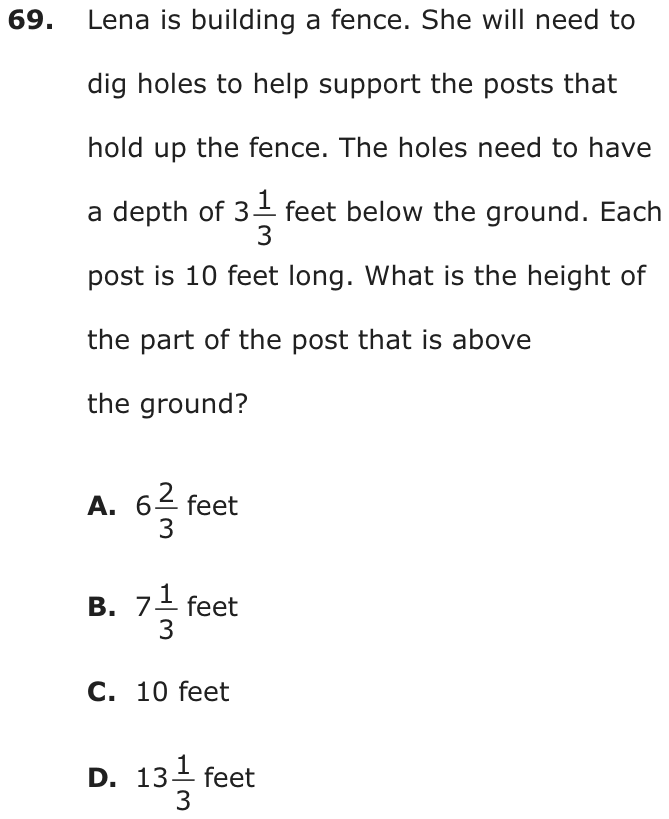
Lena is building a fence. She will need to dig holes to help support the posts that hold up the fence. The holes need to have a depth of feet below the ground. Each post is 10 feet long. What is the height of the part of the post that is above the ground?
- A feet
- B feet
- C10 feet
- D feet
Show the answer
Correct answer: A
The posts are each 10 feet long, and feet of each post is below the ground, so the height of the part of the posts that is above the ground is the difference between the two amounts:
Question analysis
A fence-building word problem: each post is 10 feet long, and 3 1/3 feet of it goes into a hole in the ground. Students find how much of the post stands above ground by subtracting a mixed number from a whole number. Regrouping the whole number into thirds is the step that trips students up.
- NYS standards
- 7.NS.3 four operations with rational numbers
- Grade level
- Grade 7 content, by NYS standard
- Compared with grade 7
- Below grade 7 Subtracting a mixed number from a whole number is fraction work from before grade 7, set here in a one-step story. It asks much less than grade 7 problems, which add negative numbers or several steps.
- Estimated difficulty
- Routine: one familiar step, little to misread.
- Thinking it demands
- Depth of knowledge 2, skills and concepts · mainly apply
- What makes it hard
- Error-prone arithmetic minor
- Solution
- 1 step
- Reading level
- Question and choices: about grade 2, 61 words.
- Students, last 30 days
- Not enough answers yet to show (it takes 10).
Why it is hard, traps and wrong answers (shows the answer)
Why it is hard
The situation is plain, a post partly buried in a hole, and the subtraction 10 − 3 1/3 is the whole task. The only real trap is the regrouping, since there are no thirds to take the 1/3 from until one foot is split into three. Checking that the two parts of the post add back to 10 feet catches the slip.
Error-prone arithmetic minor Working it out
Taking 3 1/3 from the whole number 10 requires regrouping 10 as 9 3/3, the step where students subtract the whole numbers and simply carry the 1/3 along. (Brown & Burton, 1978; Junker & Sijtsma, 2001)
Strategy: Subtract the buried part from the whole post, rewriting 10 as 9 and 3/3, or as 30/3, so that the thirds can be taken away.
Traps
- A faulty procedure: A systematic but wrong procedure: adding fractions straight across, applying an exponent to each term of a sum, dropping a sign when moving a term.
- Wrong operation: Adds instead of multiplying, divides the wrong way round, turns a ratio or rate upside down, or undoes a step in the wrong direction (subtracts what should be added back).
- Answers a different question: A choice is right for another quantity: the other unknown, the rest instead of the part, the part instead of the whole.
The wrong answers, classified
B A faulty procedure (Brown & Burton, 1978; Tatsuoka, 1983)
Subtracts the whole numbers, 10 − 3 = 7, then carries the 1/3 along instead of taking it away too, getting 7 1/3.
C Answers a different question (King et al., 2004; Hegarty, Mayer & Monk, 1995)
Gives the post's full 10-foot length, the whole post instead of the part above ground, overlooking the 3 1/3 feet sunk in the hole.
D Wrong operation (Hegarty, Mayer & Monk, 1995; King et al., 2004)
Adds the depth of the hole to the length of the post, 10 + 3 1/3, as if digging the hole made the post taller.
Worked solution, step by step
Formulas used
- Parts of a whole
- The whole is the full length of the post. Below is the part in the hole, and above is the part you can see. The two parts add up to the whole, so subtract to find one part.
- One whole in thirds
- One whole can be cut into 3 equal thirds. So 1 is the same as 3 over 3. Use this when you need to take thirds away from a whole number.
Sort out the question
Each post is 10 feet long. Part of it goes into a hole feet deep. The rest sticks up above the ground. You need the height of the part above the ground.
Decide to subtract
The part below and the part above make up the whole post. So take the part below away from the whole.
Watch out: do not add. , choice D, makes the post longer than it is.Turn one whole into thirds
The 10 has no thirds to take 1/3 from. So take 1 whole from the 10 and cut it into 3 thirds.
Now there are thirds to subtract from.
Subtract wholes and thirds
Subtract the whole numbers, then the thirds.
That is and . Watch out: the one third must be taken away too. Doing 10 − 3 = 7 and then keeping the one third gives , choice B.
So the answer is A, feet.
Check your answer
Add the two parts back together: . That is the whole post. Also, the answer must be less than 10 feet, since part of the post is under the ground.
More questions like this
The original DOE question
Question 11 of 24
2023 Test A Math, question 7Question
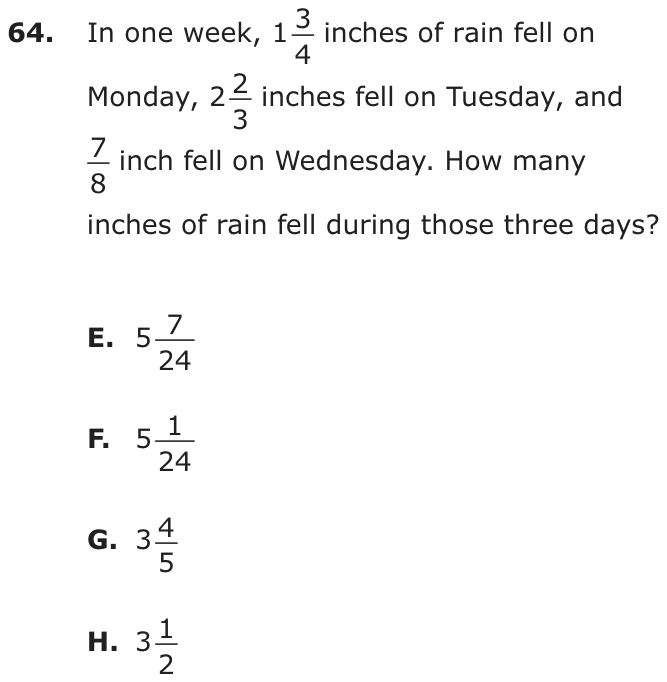
In one week, inches of rain fell on Monday, inches fell on Tuesday, and inch fell on Wednesday. How many inches of rain fell during those three days?
- A
- B
- C
- D
Show the answer
Correct answer: A
To solve, add the three given fractions:
The common denominator is 24:
Question analysis
A rainfall word problem gives the inches of rain on Monday, Tuesday and Wednesday as two mixed numbers and a fraction, and asks for the total over the three days. Students add fractions with unlike denominators. Finding a common denominator for fourths, thirds and eighths, and regrouping the fractional part into wholes, is where errors come in.
- NYS standards
- Grade level
- Grade 7 content, by NYS standard
- Compared with grade 7
- Below grade 7 Adding fractions and mixed numbers with unlike denominators is taught before grade 7, and this is a direct word problem. It takes more care than a typical exercise only because three different denominators must be rewritten over a common one.
- Estimated difficulty
- Straightforward: two steps or one careful reading.
- Thinking it demands
- Depth of knowledge 2, skills and concepts · mainly apply
- What makes it hard
- Error-prone arithmetic moderate
- Many steps minor
- Solution
- 3 steps
- Reading level
- Question and choices: about grade 5, 35 words.
- Students, last 30 days
- Not enough answers yet to show (it takes 10).
Why it is hard, traps and wrong answers (shows the answer)
Why it is hard
The setup is plain addition, so the difficulty is all in the fractions. Students who know to rename over a common denominator rarely miss it, while those who add the fraction parts straight across, or put the numerators over 24 without scaling them, reach choices with a whole part of 3. Since 1 3/4 + 2 2/3 alone is more than 4, any total below 4 can be ruled out at a glance.
Error-prone arithmetic moderate Working it out
The fractional parts have denominators 4, 3 and 8, so they must be renamed as 18, 16 and 21 twenty-fourths, and their sum, 55/24, regrouped as 2 7/24 before the wholes are added. (Brown & Burton, 1978; Junker & Sijtsma, 2001)
Many steps minor Working it out
Renaming, adding the numerators, regrouping the improper fraction and adding the whole numbers are four separate moves, and losing the 2 carried from 55/24 drops the total by two inches. (Daniel & Embretson, 2010; Enright, Morley & Sheehan, 2002)
Strategy: Rewrite the three fractional parts over a common denominator of 24, add the whole numbers and the fractions separately, and regroup any extra twenty-fourths as a whole.
Traps
- A faulty procedure: A systematic but wrong procedure: adding fractions straight across, applying an exponent to each term of a sum, dropping a sign when moving a term.
The wrong answers, classified
B Little reason to choose it (Haladyna & Downing, 1993; Rodriguez, 2005)
No single renaming mistake gives 49 twenty-fourths; this choice sits exactly 1/4 below the right total, so it mostly catches guesses near it.
C A faulty procedure (Brown & Burton, 1978; Tatsuoka, 1983)
Adds the whole numbers to get 3, then adds the fractions straight across, (3 + 2 + 7)/(4 + 3 + 8) = 12/15 = 4/5.
D A faulty procedure (Brown & Burton, 1978; Tatsuoka, 1983)
Finds the common denominator 24 but adds the numerators without renaming them, (3 + 2 + 7)/24 = 1/2, and adds that to the wholes, 3.
Worked solution, step by step
Formulas used
- Equivalent fractions
- a over b is a fraction, and k is any whole number except 0. Multiplying the top and the bottom by the same number gives an equal fraction. You cut each piece into k smaller pieces. So you have k times as many pieces, each k times smaller.
- Adding fractions with the same bottom
- d is the denominator, the bottom number. It tells the size of the pieces. a, b and c are the numerators, the top numbers. They count the pieces. When the pieces are the same size, add the counts. The bottom stays the same.
- Fraction to mixed number
- a over b is a fraction whose top is bigger than its bottom. q is the quotient, how many whole times b fits into a. r is the remainder, what is left over. The leftover stays over the same bottom number.
Sort out the question
Rain fell on three days: inches, inches and inch. You need the total rain, in inches. So add the three amounts. Add the whole numbers and the fractions separately. The whole numbers are 1 and 2, so they add to 3 inches.
Find a common denominator
The fractions have denominators, or bottom numbers, 4, 3 and 8. You can only add pieces of the same size. So find the smallest number that 4, 3 and 8 all divide into. Count by 8s: 8, 16, 24. 24 works, since 24 = 4 × 6 and 24 = 3 × 8. So use 24ths.
Rename each fraction in 24ths
Multiply the top and the bottom by the same number.
Watch out: change the tops too. Keeping 3, 2 and 7 over 24 gives and a total of , choice D.
Add the fractions
Now the pieces are the same size, so add the tops.
That is more than 1 whole. 24 goes into 55 twice, with 7 left over.
Watch out: never add the bottoms. Adding straight across gives and a total of , choice C.
Put the parts together
Add the 3 whole inches from before.
So the answer is A, inches.
Check your answer
Use decimals. is 1.75, is about 2.67, and is 0.875. They add to about 5.29. And is about 0.29. So fits, and is too small.
More questions like this
The original DOE question
Question 12 of 24
2023 Test A Math, question 17Question
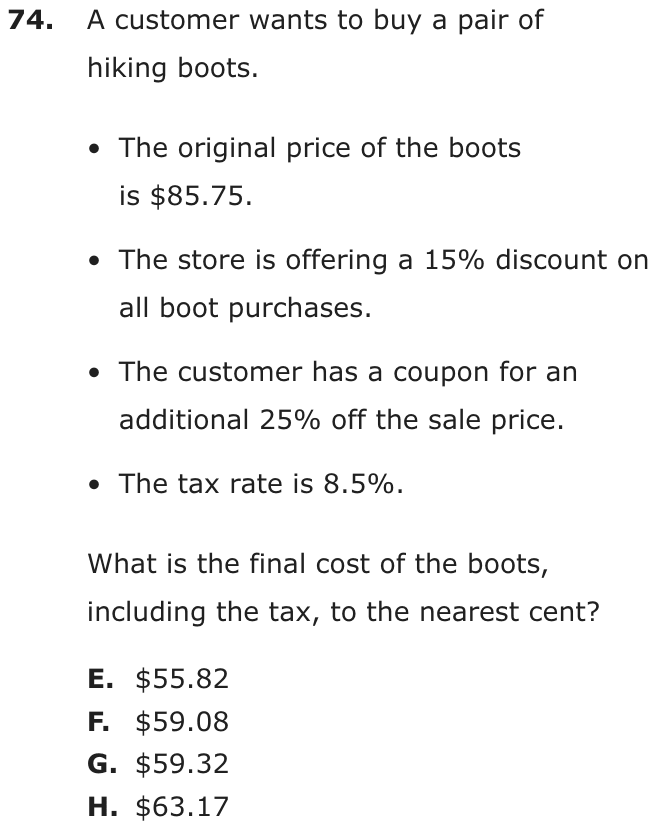
A customer wants to buy a pair of hiking boots.
- The original price of the boots is $85.75.
- The store is offering a 15% discount on all boot purchases.
- The customer has a coupon for an additional 25% off the sale price.
- The tax rate is 8.5%.
What is the final cost of the boots, including the tax, to the nearest cent?
- A$55.82
- B$59.08
- C$59.32
- D$63.17
Show the answer
Correct answer: C
First, determine the sale price after the 15% discount is applied.
Since the customer is saving 15%, this means they are paying 85% , so multiply the original price by 85% (0.85) to find the discounted price:
Next, find the price after the 25% coupon has been applied:
Since the customer is saving 25% off the sale price, this means they are paying 75% , so multiply the price found in the first step by 75% (0.75) to find the second discounted price:
Last, find the final cost after an 8.5% tax is added to the second discounted price.
Since the customer is paying 8.5% tax, this means they are paying 108.5% , so multiply the second discounted price by 108.5% (1.085) to find the final cost:
Question analysis
A pair of hiking boots costs $85.75, goes on sale at 15% off, gets an extra 25% off with a coupon, and is then taxed at 8.5%. Students find the final cost to the nearest cent. Each percent applies to the price left after the step before, so the discounts cannot simply be added, and the decimals call for careful multiplication.
- NYS standards
- Grade level
- Grade 7 content, by NYS standard
- Compared with grade 7
- Above grade 7 A discount followed by sales tax is standard grade 7 percent work. This item stacks two discounts and a tax, with cents to keep at every stage, so it takes about twice the steps and decimal multiplication of a typical problem.
- Estimated difficulty
- Hard: combines ideas, needs a plan, and has more than one tempting wrong answer.
- Thinking it demands
- Depth of knowledge 2, skills and concepts · mainly apply
- What makes it hard
- Error-prone arithmetic major
- Turning words into math moderate
- Slow to do carefully moderate
- Solution
- 3 steps
- Reading level
- Question and choices: about grade 4, 58 words.
- Students, last 30 days
- Not enough answers yet to show (it takes 10).
Why it is hard, traps and wrong answers (shows the answer)
Why it is hard
The question tests whether students treat successive percents as successive multipliers, and then holds them to three long multiplications. Adding the 15% and 25% into one discount is the tempting shortcut, and a tax read as a dollar amount is the other. The key rounds to the cent at each stage, as a register would; carried exactly, the result is $59.31, so the nearest choice, $59.32, still stands.
Error-prone arithmetic major Working it out
Three products of cents and decimals are worked by hand: 85.75 × 0.85 = 72.8875, then 72.89 × 0.75 = 54.6675, then 54.67 × 1.085 ≈ 59.32, each rounded to the cent. (Brown & Burton, 1978; Junker & Sijtsma, 2001)
Turning words into math moderate Understanding the question
The phrase "an additional 25% off the sale price" means 25% of the already discounted $72.89, not of the $85.75 original, so the two discounts multiply rather than add. (Hegarty, Mayer & Monk, 1995; Koedinger & Nathan, 2004)
Slow to do carefully moderate Choosing the answer
A reliable method needs three long decimal multiplications without a calculator, well past the minute and a half a question allows, which tempts students to combine the percents. (Lu & Sireci, 2007)
Strategy: Multiply by 0.85 for the sale, by 0.75 for the coupon on the sale price, and by 1.085 for the tax, rounding to the cent at each stage as a register would.
Traps
- Percent of the wrong amount: Finding the whole from a part, or a percent change measured from the wrong starting amount.
- Misunderstands the concept: A wrong belief about a concept: that percents can be added, that area grows like length, that averages can be averaged, that a bigger denominator means a bigger fraction.
The wrong answers, classified
A Percent of the wrong amount (Parker & Leinhardt, 1995)
Takes the 25% coupon off the original $85.75 instead of the sale price, so the discounts add to 40%: 85.75 × 0.60 × 1.085 ≈ $55.82.
B Little reason to choose it (Haladyna & Downing, 1993; Rodriguez, 2005)
No common working gives $59.08; it sits 24 cents below the right total and matches no discount or tax mistake, so it mostly catches guesses.
D Misunderstands the concept (Smith, diSessa & Roschelle, 1993; De Bock et al., 1998; Ni & Zhou, 2005)
Applies both discounts correctly, reaching $54.67, but adds $8.50 as the tax, reading 8.5% as a dollar amount instead of a percent of the price.
Worked solution, step by step
Formulas used
- Price after a discount
- p is the percent off. A discount is money taken off the price. If you save p percent, you pay the rest, 100 − p percent. For 15% off you pay 85%, so multiply by 0.85.
- Price with tax
- The price is the cost before tax. t is the tax rate, a percent. Tax is extra money added on top. You pay the whole price, 100%, plus t percent more. So for 8.5% tax you multiply by 1.085.
Sort out the question
The boots cost $85.75 at first. The store takes 15% off. Then a coupon takes 25% off the sale price. The sale price is the price after the first discount. Then 8.5% tax is added. You need the final cost to the nearest cent. A cent is $0.01, the second place after the decimal point.
Take off the 15% discount
You save 15%, so you pay 85%. That is 0.85 of the price.
A price can’t have part of a cent, so round to two decimal places. The third digit is 7, which is 5 or more, so round up.
The sign ≈ means about. The sale price is $72.89.
Take 25% off the sale price
The coupon takes 25% off $72.89, so you pay 75% of it.
The price is now $54.67. Watch out: take the coupon off the sale price, not the first price. Adding 15% and 25% to get 40% off $85.75 leads to $55.82, choice A.
Add the 8.5% tax
You pay the price plus 8.5% more, which is 108.5% of it.
Watch out: 8.5% is a percent of the price, not $8.50. Adding $8.50 gives $63.17, choice D.
See why rounding each time matters
A store rounds to the cent after each step, as you just did. The test’s answer is worked the same way. Keep every digit and round only at the end, and you get this:
That is $59.31, which is not a choice. The first two roundings each went up by a tiny part of a cent. That was just enough to push the total from $59.31 to $59.32. So here, round at each step, as a store would. So the answer is C, $59.32.
Check your answer
Check the tax a second way. 8.5% of $54.67 is , about $4.65. Then . Also estimate: two discounts leave a bit less than two-thirds of $86, near $55. Tax adds under $5, so about $59 or $60 makes sense.
More questions like this
The original DOE question
Question 13 of 24
2023 Test A Math, question 33Question
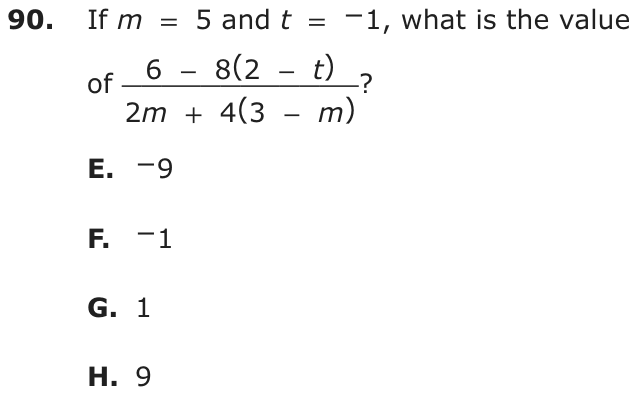
If and , what is the value of ?
- A−9
- B−1
- C1
- D9
Show the answer
Correct answer: A
Question analysis
This algebra question gives m = 5 and t = −1 and asks for the value of a fraction whose numerator and denominator both contain parentheses. Students substitute the values and follow the order of operations. Subtracting a negative number and multiplying by a negative difference make sign mistakes likely, and the four choices differ only in sign and size.
- NYS standards
- Grade level
- Grade 7 content, by NYS standard
- Compared with grade 7
- At grade 7 Substituting values into expressions with negative numbers is everyday grade 7 work. This fraction has a numerator and a denominator to evaluate separately, with a minus sign before a negative and a negative difference, so it is a longer version of a standard exercise.
- Estimated difficulty
- Moderate: several steps, or a close reading with one strong distractor.
- Thinking it demands
- Depth of knowledge 1, recall and reproduction · mainly apply
- What makes it hard
- Error-prone arithmetic moderate
- Many steps minor
- A very close wrong answer minor
- Solution
- 4 steps
- Reading level
- Question and choices: about grade 8, 10 words.
- Students, last 30 days
- Not enough answers yet to show (it takes 10).
Why it is hard, traps and wrong answers (shows the answer)
Why it is hard
This is a plain evaluation with no story, and every point is lost on signs. Subtracting the negative t, then handling the two negative intermediate results, each invite a dropped minus, and the four choices are built so that each such slip lands on a listed value. Writing −1 in parentheses when substituting, and finishing the top and the bottom before dividing, keeps the signs in view.
Error-prone arithmetic moderate Working it out
The value t = −1 sits inside 2 − t, so the numerator needs 2 − (−1) = 3, and the work then passes through two negatives, 6 − 24 = −18 and 3 − 5 = −2. (Brown & Burton, 1978; Junker & Sijtsma, 2001)
Many steps minor Working it out
The numerator and the denominator each take a substitution, a parenthesis, a product and a sum, worked separately before one final division, so a slip in either half changes the result. (Daniel & Embretson, 2010; Enright, Morley & Sheehan, 2002)
A very close wrong answer minor Choosing the answer
The choices pair each size with each sign, −9 with 9 and −1 with 1, so getting 18 and 2 right still leaves the sign to decide between two choices. (Embretson & Wetzel, 1987; Gorin & Embretson, 2006; Ascalon et al., 2007)
Strategy: Substitute with parentheses around −1, simplify the numerator and the denominator separately, innermost parentheses first, and divide only at the end, checking each sign as you go.
Traps
- Negatives and direction: Arithmetic with negative numbers, the order of a subtraction, or direction on a number line. (Moving a term across the equals sign without changing its sign is a faulty procedure.)
The wrong answers, classified
B Negatives and direction (Brown & Burton, 1978)
Treats 2 − (−1) as 1 instead of 3, so the numerator becomes 6 − 8 = −2 and the fraction −2 over 2 equals −1.
C Negatives and direction (Brown & Burton, 1978)
Takes 6 − 24 as 18 and 3 − 5 as 2, subtracting the smaller number from the larger both times, so the fraction is 18 over 10 + 8 = 18, which is 1.
D Negatives and direction (Brown & Burton, 1978)
Gets every step right except 6 − 24, which it writes as 18 instead of −18, so the quotient 18 ÷ 2 comes out positive.
Worked solution, step by step
Formulas used
- Subtracting a negative number
- a and b are numbers. Taking away a negative number is the same as adding the positive number. Think of a debt of 1 dollar being taken away: you are 1 dollar better off.
- Dividing a negative by a positive
- a and b are positive numbers. A negative number divided by a positive number gives a negative answer. The answer is positive only when both signs are the same.
Sort out the question
You know m = 5 and t = −1. You need the value of the big fraction. Work out the top, called the numerator, and the bottom, called the denominator, one at a time. Then divide the top by the bottom.
Put in the numbers
Put each number in parentheses, so the minus signs stay clear. Work inside the parentheses first, then multiply, then add or subtract.
Work out the top
The top is −18. It is negative because 24 is more than 6. Watch out: 2 − (−1) is 3, not 1. Using 1 makes the top −2 and the answer −1, choice B.
Work out the bottom
Here 3 − 5 = −2, because 5 is more than 3. Then 4 times −2 is −8. The bottom is 2.
Divide the top by the bottom
Watch out: if you lost the minus sign in 6 − 24, you would get 9, choice D. So the answer is A, −9.
Check your answer
Check the sign first. The top, 6 − 24, is clearly negative. The bottom, 10 − 8, is positive. Negative over positive is negative, so only −1 or −9 can work. Without the signs, the top is 18 and the bottom is 2, and 18 ÷ 2 = 9. So −9 fits.
More questions like this
The original DOE question
Question 14 of 24
2023 Test A Math, question 52Question
Vicente and Carla each ran 8 laps around a track. They started at the same time and place. If Vicente ran 1.5 times as fast as Carla, how many laps did Carla have left to finish when Vicente finished his 8th lap?
- A
- B
- C
- D
Show the answer
Correct answer: B
Vicente ran 1.5 times as fast as Carla, so that means for every lap Carla finished, Vicente finished 1.5 laps. Set up a proportion to calculate c, the number of laps Carla had completed when Vicente finished 8 laps:
| Cross multiply. | |
| Apply the multiplicative inverse property; divide both sides of the equation by 1.5. | |
So, the number of laps Carla still had to finish is .
Question analysis
This ratio word problem says Vicente and Carla each ran 8 laps, starting at the same time and place, and Vicente ran 1.5 times as fast. It asks how many laps Carla still had to run when Vicente finished. Students reason with a speed ratio and mixed numbers, and giving the laps run rather than the laps remaining is an easy slip.
- NYS standards
- Grade level
- Grade 7 content, by NYS standard
- Compared with grade 7
- Above grade 7 Grade 7 rate problems usually give a speed and a time. Here only the ratio of two speeds is given, so students must reason that distances run in the same time share that ratio, then work with a fractional number of laps.
- Estimated difficulty
- Hard: combines ideas, needs a plan, and has more than one tempting wrong answer.
- Thinking it demands
- Depth of knowledge 2, skills and concepts · mainly apply
- What makes it hard
- Turning words into math moderate
- Error-prone arithmetic moderate
- A very close wrong answer minor
- Solution
- 3 steps
- Reading level
- Question and choices: about grade 4, 44 words.
- Students, last 30 days
- Not enough answers yet to show (it takes 10).
Why it is hard, traps and wrong answers (shows the answer)
Why it is hard
No time is given, so students must reason that in equal time distance scales with speed, which turns the race into one division and one subtraction. Both steps hide a trap: the division by 1.5 leaves a remainder that is easy to misread, and subtracting a mixed number from 8 needs regrouping. The result of the first step, Carla's laps run, is itself a choice, so the question also rewards rereading what is asked.
Turning words into math moderate Understanding the question
The phrase “1.5 times as fast” has to become distances in the same time: while Vicente runs 8 laps, Carla runs 8 ÷ 1.5, not 8 − 1.5 or 8 × 1.5. (Hegarty, Mayer & Monk, 1995; Koedinger & Nathan, 2004)
Error-prone arithmetic moderate Working it out
Dividing 8 by 1.5 gives 16/3, or 5 1/3, a division by a decimal with a remainder, and 8 − 5 1/3 then needs a whole regrouped into thirds. (Brown & Burton, 1978; Junker & Sijtsma, 2001)
A very close wrong answer minor Choosing the answer
The choice 2 1/2 is only a sixth of a lap from 2 2/3, so a rough estimate of how far Carla trails cannot separate them; only the exact quotient does. (Embretson & Wetzel, 1987; Gorin & Embretson, 2006; Ascalon et al., 2007)
Strategy: In the same amount of time the faster runner covers 1.5 times the distance, so divide Vicente's laps by 1.5 to get Carla's, then subtract that from 8.
Traps
- Answers a different question: A choice is right for another quantity: the other unknown, the rest instead of the part, the part instead of the whole.
- A faulty procedure: A systematic but wrong procedure: adding fractions straight across, applying an exponent to each term of a sum, dropping a sign when moving a term.
The wrong answers, classified
A A faulty procedure (Brown & Burton, 1978; Tatsuoka, 1983)
Works 80 ÷ 15 as 5 remainder 5 and writes 5.5, turning the remainder into a decimal digit, so Carla seems to have run 5 1/2 laps and 2 1/2 remain.
C A faulty procedure (Brown & Burton, 1978; Tatsuoka, 1983)
Finds 5 1/3 correctly but subtracts it from 8 by taking 5 from 8 and keeping the 1/3, getting 3 1/3 instead of regrouping a whole.
D Answers a different question (King et al., 2004; Hegarty, Mayer & Monk, 1995)
Finds how many laps Carla had run when Vicente finished, 8 ÷ 1.5 = 5 1/3, and gives that instead of the laps she still had left.
Worked solution, step by step
Formulas used
- Distance, rate and time
- d is the distance, r is the rate or speed, and t is the time. When two runners run for the same time, the faster one goes farther by the same factor as the speed. So 1.5 times as fast means 1.5 times as far.
- Dividing by a fraction
- a is any number and m over n is a fraction. Dividing by a fraction is the same as multiplying by its reciprocal, the fraction flipped upside down.
Sort out the question
Vicente and Carla each run 8 laps, starting together. Vicente runs 1.5 times as fast as Carla. You need how many laps Carla still has to run when Vicente finishes. First find how far Carla has run at that moment.
Compare their distances
They have run for the same time. So Vicente’s distance is 1.5 times Carla’s. Let c be the laps Carla has run.
To find c, divide 8 by 1.5.
Divide 8 by 1.5
Write 1.5 as the fraction .
Carla has run laps. Watch out: that is how far she has run, not what is left. Stopping here gives choice D.
Find the laps she has left
Watch out: 8 − is not . You must break 1 whole into thirds first. Answering is choice C.
So the answer is B, laps.
Check your answer
Multiply back: . So when Carla has run laps, Vicente has run 8. And , her full race.
More questions like this
The original DOE question
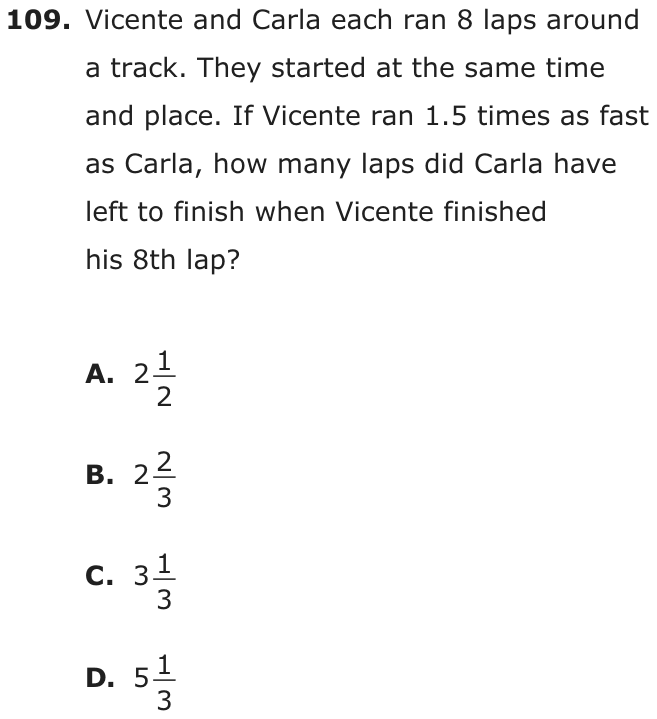
Question 15 of 24
2023 Test B Math, question 48Question
The outdoor temperature was 4.2° F at 10 p.m. After hours, the outdoor temperature was −0.7° F. Which value best represents the average change in temperature per hour?
- A−1.4° F
- B−1.0° F
- C1.0° F
- D1.4° F
Show the answer
Correct answer: A
First, recognize that the temperature decreased. This means that the order of subtraction matters and that the result is a negative number:
The temperature decreased 4.9 degrees. Divide by 3.5 to get the average change per hour:
Question analysis
The temperature was 4.2° F at 10 p.m. and −0.7° F three and a half hours later. Students find the average change in temperature per hour. It tests subtracting and dividing with negative decimals, and the choices pair two sizes of change with both signs, so the sign has to be right as well as the size.
- NYS standards
- Grade level
- Grade 7 content, by NYS standard
- Compared with grade 7
- At grade 7 Signed-number problems about temperature are standard grade 7 work. This one asks for an average rate, so a change that crosses zero must be divided by a mixed-number time, with the sign kept through both steps.
- Estimated difficulty
- Moderate: several steps, or a close reading with one strong distractor.
- Thinking it demands
- Depth of knowledge 2, skills and concepts · mainly apply
- What makes it hard
- Error-prone arithmetic moderate
- Turning words into math minor
- A very close wrong answer minor
- Solution
- 2 steps
- Reading level
- Question and choices: about grade 5, 31 words.
- Students, last 30 days
- Not enough answers yet to show (it takes 10).
Why it is hard, traps and wrong answers (shows the answer)
Why it is hard
The arithmetic is short, but signs decide every choice: two choices come from treating −0.7 as 0.7, and one comes from getting the size right and the direction wrong. Students who think of the drop in two parts, 4.2 degrees down to zero and 0.7 more, find the 4.9-degree fall; dividing by 3.5 hours and remembering the temperature fell finishes it.
Error-prone arithmetic moderate Working it out
The change crosses zero, −0.7 − 4.2 = −4.9, and then a negative decimal is divided by 3.5, from the 3 1/2 hours, with the sign kept through both steps. (Brown & Burton, 1978; Junker & Sijtsma, 2001)
Turning words into math minor Understanding the question
The phrase “average change in temperature per hour” means the change from the 4.2° start to the −0.7° end divided by the time, final minus initial, so a drop is negative. (Hegarty, Mayer & Monk, 1995; Koedinger & Nathan, 2004)
A very close wrong answer minor Choosing the answer
The answer, −1.4° F, and the choice 1.4° F share every digit and differ only in sign, so a correct division followed by a careless sign cannot be caught by estimating. (Embretson & Wetzel, 1987; Gorin & Embretson, 2006; Ascalon et al., 2007)
Strategy: Subtract the starting temperature from the ending one, keeping track of the sign, then divide that change by the 3.5 hours.
Traps
- Negatives and direction: Arithmetic with negative numbers, the order of a subtraction, or direction on a number line. (Moving a term across the equals sign without changing its sign is a faulty procedure.)
The wrong answers, classified
B Negatives and direction (Brown & Burton, 1978)
Subtracts 0.7 from 4.2 as if both temperatures were above zero, a 3.5-degree drop, so 3.5 ÷ 3.5 gives 1, then marks the change negative.
C Negatives and direction (Brown & Burton, 1978)
Treats −0.7 as 0.7, finding a 3.5-degree change, and also loses its direction, reporting a rise of 1 degree an hour for a temperature that fell.
D Negatives and direction (Brown & Burton, 1978)
Finds the 4.9-degree change and divides by 3.5 correctly, or subtracts in the order start minus end, and reports a rise for a temperature that fell.
Worked solution, step by step
Formulas used
- Average change per hour
- Start is the first temperature, and end is the last one. End minus start is the total change. It is negative when the temperature drops. Dividing by the number of hours shares that change equally over each hour.
Sort out the question
At 10 p.m. it was 4.2° F. After hours, it was −0.7° F. That is below zero. The temperature went down, so the change is negative. You need the average change for each hour.
Find the total change
Subtract the start from the end.
Picture a thermometer. Going from 4.2 down to 0 is a drop of 4.2 degrees. Going on to −0.7 is 0.7 more. In all, it fell 4.9 degrees.
Watch out: 4.2 − 0.7 = 3.5 treats −0.7 as if it were above zero. That leads to choice B or C.
Divide by the hours
Write hours as 3.5 hours. Use the formula.
To divide, think 49 ÷ 35 = 1.4, since 35 × 1.4 = 49. The change is negative, so it is −1.4 degrees per hour.
Keep the sign
The temperature fell, so the answer must be negative.
Watch out: 1.4 has the right size, but it says the temperature went up. That is choice D.
So the answer is A, −1.4° F.
Check your answer
Work forward. Dropping 1.4 degrees each hour for 3.5 hours is degrees. Then . That is the temperature in the problem.
More questions like this
The original DOE question
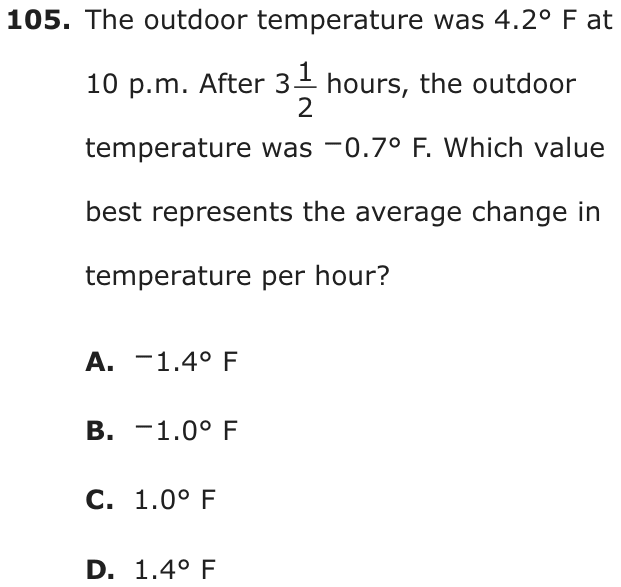
Question 16 of 24
2022 Test A Math, question 1Question
The figure below shows a circle with a hole in the middle. The outer diameter of the circle is inches. The diameter of the hole is inch.
What is the area of the shaded region, to the nearest hundredth of a square inch?
Grid-in question: work out the answer and enter it as a number.
Show the answer
Correct answer: 1.18
To determine the area of a circle, begin by finding the radius of the circle, which is half of the diameter.
The radius of the entire circle is , so the area of the entire circle is
The radius of the hole in the circle is , so the area of the hole in the circle =
To determine the area of the shaded region, subtract the area of the hole in the circle from the area of the entire circle:
1.1775 square inches rounded to the nearest hundredth of a square inch = 1.18 square inches
Question analysis
A gray ring is a circle 1 1/4 inches across with a hole 1/4 inch across at its center, and this grid-in asks for the area of the shaded part to the nearest hundredth of a square inch. Students use the area of a circle twice. Turning diameters given as fractions into radii, and squaring them, is where mistakes happen.
- Grade level
- Grade 7 content, by NYS standard
- Compared with grade 7
- At grade 7 Grade 7 students find circle areas and often subtract a hole from a shape. This ring gives its diameters as a mixed number and a fraction, so halving, squaring fractions and rounding add work, though no step goes beyond grade 7.
- Estimated difficulty
- Moderate: several steps, or a close reading with one strong distractor.
- Thinking it demands
- Depth of knowledge 2, skills and concepts · mainly apply
- What makes it hard
- Something you must already know moderate
- Error-prone arithmetic moderate
- Combines ideas minor
- An answer in an unexpected form minor
- Solution
- 4 steps
- Reading level
- Question and choices: about grade 6, 45 words.
- Corrected from the DOE handbook
- A missing exponent in the explanation’s area formula was restored.
- An arithmetic slip in the explanation was corrected.
- Students, last 30 days
- Not enough answers yet to show (it takes 10).
Why it is hard, traps and wrong answers (shows the answer)
Why it is hard
The method is the familiar one for a ring, the big circle's area minus the hole's, but the labels are diameters given as fractions, so each one has to be halved and then squared before π enters. Students lose points by skipping the halving, by stopping at the full disk, or by subtracting the radii before squaring. Keeping both areas as fractions of π, 25/64π − 1/64π = 3/8π, leaves one multiplication and one rounding at the very end.
Something you must already know moderate Working it out
Neither area formula is printed, and both circles are labeled by diameter, so students must recall A = πr² and halve 1 1/4 inches and 1/4 inch to radii of 5/8 and 1/8 first. (Anderson & Krathwohl, 2001)
Error-prone arithmetic moderate Working it out
Every value is a fraction: 5/4 ÷ 2 = 5/8, squares of 25/64 and 1/64, then 3/8 × 3.14 worked by hand, so a slip can enter at each stage. (Brown & Burton, 1978; Junker & Sijtsma, 2001)
Combines ideas minor Working it out
The gray ring has no formula of its own; it is the large circle's area minus the hole's, so the area formula is used twice and the results subtracted. (Embretson, 1998; Daniel & Embretson, 2010)
An answer in an unexpected form minor Choosing the answer
The grid-in wants the nearest hundredth, so 1.1775 must be rounded to 1.18, and a whole-disk area such as 1.23 gets no warning from a list of choices. (Enright, Morley & Sheehan, 2002)
Strategy: Write 1 1/4 as 5/4 and halve both diameters to get the radii, subtract the hole's area from the area of the full circle, and round to the nearest hundredth only at the very end.
Traps
- Wrong formula: Uses a related but wrong formula: perimeter for area, diameter for radius, area for volume, or a misremembered one.
- Stops one step early: A choice is a number from partway through the solution.
- A formula you must know: Needs a formula the test does not give: area, circumference, volume, probability rules.
The wrong answers, classified
4.71 Wrong formula (King et al., 2004)
Uses the labeled diameters as radii, π(5/4)² − π(1/4)² = 24/16π = 1.5π ≈ 4.71, forgetting to halve them first, which makes the ring four times too big.
1.23 Stops one step early (King et al., 2004; Gierl et al., 2017)
Finds the area of the whole circle, π(5/8)² = 25/64π ≈ 1.23 square inches, and stops before subtracting the hole's 1/64π.
0.79 A faulty procedure (Brown & Burton, 1978; Tatsuoka, 1983)
Subtracts the radii first, 5/8 − 1/8 = 1/2, then squares, π(1/2)² ≈ 0.79, as if the difference of two squares were the square of the difference.
What was corrected from the DOE handbook, and why
- Explanation: The handbook writes the area of the whole circle as “π(5/8) in.² = 25/64π in.²” and the area of the hole as “π(1/8) in.² = 1/64π in.²” (p. 128, question 58), squaring the unit but not the radius. The area of a circle is πr², and π(5/8) is only 5/8π. The site now reads π(5/8)² in.² = 25/64π in.² and π(1/8)² in.² = 1/64π in.². The areas that follow and the answer, 1.18, are unchanged.
- Explanation: The handbook computes (3/8) in.²(3.14) as “1.175 in.²” and then rounds “1.175 square inches” to 1.18 (p. 128, question 58). But 3/8 × 3.14 = 1.1775, so the site now reads 1.1775 in both places. Rounded to the nearest hundredth it is still 1.18 square inches, the answer (with π itself, 3/8 × π = 1.178…, which also rounds to 1.18).
Worked solution, step by step
Formulas used
- Radius from diameter
- d is the diameter, the distance straight across a circle through its center. r is the radius, the distance from the center to the edge. The diameter is two radii laid end to end, so the radius is half of it.
- Area of a circle
- A is the area, the space inside the circle. π (pi) is a number a little more than 3, about 3.14. r is the radius. r² means r × r. Square the radius first, then multiply by π.
Sort out the question
The gray part is a ring. It is the big circle with the hole cut out. The big circle is inches across. The hole is inch across. These are diameters. You need the area of the gray ring, in square inches. Round it to the nearest hundredth, two places after the decimal point.
Find both radii
The area formula uses the radius, so halve each diameter first. Write the mixed number as a fraction: .
The big circle’s radius is 5/8 inch. The hole’s radius is 1/8 inch. Watch out: don’t use the diameters as radii. That makes the ring four times too big, and you would grid 4.71.
Find the area of the big circle
To square a fraction, square the top and square the bottom. The big circle’s area is 25/64 π square inches. Keep π for now. You will use 3.14 at the very end.
Find the area of the hole
The hole’s area is 1/64 π square inches. Watch out: square each radius on its own. Don’t subtract the radii first. That gives , and leads to 0.79.
Subtract the hole
The ring is the big circle minus the hole. Both fractions have 64 on the bottom, so subtract the tops.
To simplify 24/64, divide the top and bottom by 8. Watch out: don’t stop at the big circle. Its area alone is about 1.23 square inches.
Multiply by 3.14 and round
The ring’s area is 1.1775 square inches. To round to the hundredths place, look at the next digit. It is 7, which is 5 or more, so round up. 1.1775 becomes 1.18. Using the π key instead gives 1.178…, which also rounds to 1.18. So you would grid 1.18.
Check your answer
Estimate. The big circle is about 1.23 square inches. The hole is tiny: is about 0.05 square inch. . That matches. The ring must also be smaller than the whole circle, and it is.
More questions like this
The original DOE question
Question 17 of 24
2022 Test B Math, question 26Question
- A
- B
- C
- D
Show the answer
Correct answer: D
First, simplify the numerator and the denominator separately.
To simplify the numerator, multiply the last two fractions and then subtract from the first fraction.
To simplify the denominator, divide the last two fractions and then add to the first fraction.
Finally, divide the numerator by the denominator.
Question analysis
This fraction arithmetic question gives a complex fraction: a numerator with a subtraction and a multiplication over a denominator with an addition and a division, all with fractions. Students choose its value. It tests order of operations and the four operations with fractions, and working left to right instead of following the order of operations leads to a wrong result.
- NYS standards
- Grade level
- Grade 7 content, by NYS standard
- Compared with grade 7
- Above grade 7 Grade 7 students compute with fractions, usually two or three operations at a time. This expression needs five, in an order set by the rules rather than read left to right, so it is longer and more trap-prone than typical work.
- Estimated difficulty
- Moderate: several steps, or a close reading with one strong distractor.
- Thinking it demands
- Depth of knowledge 1, recall and reproduction · mainly apply
- What makes it hard
- Many steps moderate
- Error-prone arithmetic moderate
- Something you must already know minor
- Solution
- 5 steps
- Reading level
- Question and choices: about grade 16+, 5 words.
- Students, last 30 days
- Not enough answers yet to show (it takes 10).
Why it is hard, traps and wrong answers (shows the answer)
Why it is hard
Nothing here is beyond grade 7, but the expression stacks five fraction operations, and the top and the bottom each hide an order-of-operations decision. Working left to right in the numerator alone gives a negative value, and doing so in both parts gives an even stranger fraction; both are listed. The sign is a quick check: 4/15 is less than 2/3, so the numerator is positive, and so is the value.
Many steps moderate Working it out
The numerator and the denominator are each simplified on their own, to 2/5 and 2, before the final division, so five operations stand between the expression and its value. (Daniel & Embretson, 2010; Enright, Morley & Sheehan, 2002)
Error-prone arithmetic moderate Working it out
Every step is fraction work: 2/3 − 4/15 needs fifteenths, 1/4 ÷ 3/4 needs the divisor flipped, and the last step, 2/5 ÷ 2, is easily turned into 2/5 × 2. (Brown & Burton, 1978; Junker & Sijtsma, 2001)
Something you must already know minor Working it out
No parentheses inside the numerator or the denominator show the order, so students must know to multiply before subtracting and to divide before adding. (Anderson & Krathwohl, 2001)
Strategy: Simplify the numerator and the denominator separately, doing the multiplication and the division before the subtraction and the addition, then divide the two results.
Traps
- Order of operations: Working left to right, or distributing a minus sign wrongly, gives a choice.
The wrong answers, classified
A Order of operations (Brown & Burton, 1978)
Works left to right in both parts, (2/3 − 4/5) × 1/3 = −2/45 over (5/3 + 1/4) ÷ 3/4 = 23/9, and −2/45 ÷ 23/9 = −2/115.
B Order of operations (Brown & Burton, 1978)
Subtracts before multiplying in the numerator, (2/3 − 4/5) × 1/3 = −2/45, but handles the denominator correctly, so −2/45 ÷ 2 = −1/45.
C Little reason to choose it (Haladyna & Downing, 1993; Rodriguez, 2005)
No common working gives 2/9: it is positive like the answer, but no single order or fraction slip reaches it, so it mostly draws guesses between the two positive choices.
Worked solution, step by step
Formulas used
- Order of operations
- When no parentheses show the order, multiply and divide first. Then add and subtract. Everyone follows the same order, so an expression has only one value.
- Multiplying fractions
- a and c are the top numbers, and b and d are the bottom numbers. Multiply top times top and bottom times bottom.
- Dividing fractions
- To divide by a fraction, multiply by its reciprocal, the fraction flipped upside down. The reciprocal of c/d is d/c. It works because c/d times d/c is 1. So multiplying by d/c undoes c/d, just as dividing by c/d does.
Sort out the question
The big fraction bar means divide: the top part divided by the bottom part. Work out the top and the bottom on their own. Then divide.
Inside each part, no parentheses show the order. So follow the order of operations.
Multiply first in the top
The top is . Multiply before you subtract.
Watch out: subtracting first, 2/3 − 4/5, makes the top negative. That leads to −1/45, choice B. Working left to right in the bottom as well gives −2/115, choice A.
Subtract to finish the top
To subtract, the bottoms must match. Change 2/3 to fifteenths by multiplying its top and bottom by 5.
To simplify 6/15, divide its top and bottom by 3. The top part is 2/5.
Divide first in the bottom
The bottom is . Divide before you add. Flip 3/4 and multiply.
To simplify 4/12, divide its top and bottom by 4.
Add to finish the bottom
The bottoms already match, so add the tops and keep the bottom.
Six thirds make 2 wholes. The bottom part is 2.
Divide the top by the bottom
Now divide 2/5 by 2. Flip 2, which is 2/1, to get 1/2.
Dividing by 2 is the same as taking half, and half of 2/5 is 1/5. So the answer is D, .
Check your answer
Look at the signs. 4/15 is less than 2/3, so the top is positive. The bottom is positive too. So the answer must be positive, which rules out A and B. Then multiply back: , the top. It matches.
More questions like this
The original DOE question
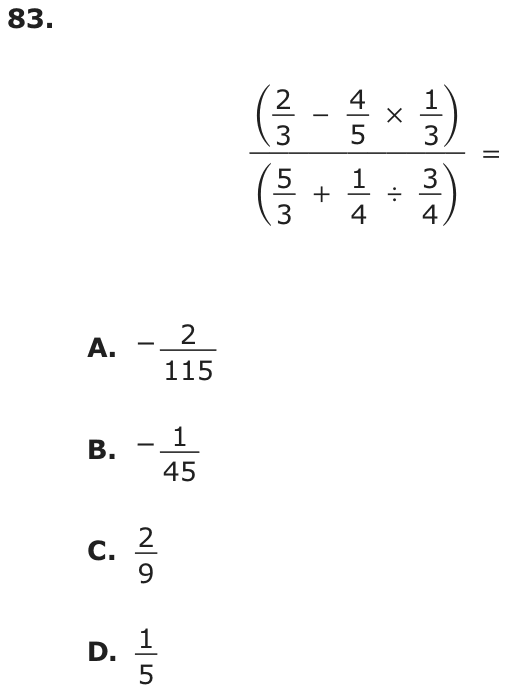
Question 18 of 24
2018 Test A Math, question 20Question
Mrs. Cranston bought five bottles of water for $0.90 each and 8 pounds of meat. She paid a total of $26.90 for these items, not including tax. What was the price per pound of the meat?
- A$2.80
- B$3.25
- C$14.40
- D$22.40
Show the answer
Correct answer: A
Let be the price per pound for the meat. Set up an equation to show what Mrs. Cranston spent:
The price per pound for the meat is $2.80.
Question analysis
This money word problem has a shopper buying five bottles of water at a set price plus 8 pounds of meat, for a known total. Students write and solve a two-step equation to find the price per pound of the meat. The decimals call for care, and the question wants a price per pound rather than a total.
- Grade level
- Grade 7 content, by NYS standard
- Compared with grade 7
- At grade 7 Word problems that lead to an equation like px + q = r are the core of grade 7 algebra. This is a standard example with money decimals and no extra twist.
- Estimated difficulty
- Straightforward: two steps or one careful reading.
- Thinking it demands
- Depth of knowledge 2, skills and concepts · mainly apply
- What makes it hard
- Turning words into math minor
- Error-prone arithmetic minor
- Solution
- 3 steps
- Reading level
- Question and choices: about grade 2, 33 words.
- Students, last 30 days
- Not enough answers yet to show (it takes 10).
Why it is hard, traps and wrong answers (shows the answer)
Why it is hard
This is a two-step money problem: take away the water, then divide by the pounds. The listed wrong answers come from doing one of those steps wrongly or not at all, especially stopping at the total cost of the meat, which looks like a finished dollar amount. Checking that 8 pounds at the chosen price plus $4.50 makes $26.90 confirms the answer.
Turning words into math minor Understanding the question
"five bottles of water for $0.90 each" has to become 5 × 0.90 before the total is split, and the unknown is a price per pound, not the meat's total cost. (Hegarty, Mayer & Monk, 1995; Koedinger & Nathan, 2004)
Error-prone arithmetic minor Working it out
Every amount is a decimal of dollars, so 26.90 − 4.50 and 22.40 ÷ 8 must be lined up and worked carefully without a calculator. (Brown & Burton, 1978; Junker & Sijtsma, 2001)
Strategy: Subtract the cost of all five bottles from the total, then divide what is left by the 8 pounds of meat.
Traps
- Stops one step early: A choice is a number from partway through the solution.
The wrong answers, classified
B Misreads the question (Hegarty, Mayer & Monk, 1995)
Misses the word each and subtracts one bottle's $0.90, then divides: (26.90 − 0.90) ÷ 8 = 3.25.
C Wrong operation (Hegarty, Mayer & Monk, 1995; King et al., 2004)
Finds the $22.40 spent on meat and subtracts the 8 pounds from it instead of dividing, getting 14.40.
D Stops one step early (King et al., 2004; Gierl et al., 2017)
Subtracts the five bottles from the total, 26.90 − 4.50 = 22.40, and stops at the meat's total cost without dividing by 8 pounds.
Worked solution, step by step
Formulas used
- Total cost
- C is the total cost. p is the price of one item, or of one pound. q is the quantity, how many items or pounds you buy. Each one costs p, so q of them cost p times q.
Sort out the question
Mrs. Cranston bought five bottles of water “for $0.90 each”. She also bought 8 pounds of meat. Everything cost $26.90 in all. You need the price per pound of the meat, the cost of just 1 pound.
Find the cost of the water
Each bottle costs $0.90, and there are 5 bottles. Use the cost formula.
The water cost $4.50. Watch out: each means every bottle costs $0.90. Taking away just one $0.90 leads to $3.25, choice B.
Find the cost of the meat
Take the water away from the total. What is left paid for the meat.
All 8 pounds of meat cost $22.40. Watch out: this is the cost of all the meat, not of one pound. Stopping here gives choice D.
Find the price per pound
Use the cost formula again. Now C is 22.40 and q is 8 pounds. Divide to find p.
Each pound costs $2.80. So the answer is A, $2.80.
Check your answer
Put it all back together. Meat: . Water: 4.50. Total: . That is exactly what she paid.
More questions like this
The original DOE question
Question 19 of 24
2018 Test B Math, question 11Question
At 1:00 p.m. one day, the temperature was 8 degrees above zero. During the rest of the day, the temperature fell 3 degrees per hour. What was the temperature at 7:00 p.m. that day?
- A−13°
- B−10°
- C−7°
- D5°
Show the answer
Correct answer: B
7:00 p.m. is 6 hours after 1:00 p.m. Calculate the number of degrees the temperature dropped in 6 hours:
3 × 6 = 18 degrees
Subtract that from the starting point (8 degrees) to find the solution:
8 − 18 = −10 degrees
Question analysis
This integer word problem starts with a temperature 8 degrees above zero at 1:00 p.m. and has it fall 3 degrees every hour. Students find the temperature at 7:00 p.m. by counting hours and subtracting into negative numbers. Getting the number of hours between the two times right is the main hurdle.
- Grade level
- Grade 7 content, by NYS standard
- Compared with grade 7
- At grade 7 Grade 7 students use positive and negative numbers for real changes such as temperature. This is a standard three-step example of that skill, with a counting slip as its only real trap.
- Estimated difficulty
- Straightforward: two steps or one careful reading.
- Thinking it demands
- Depth of knowledge 2, skills and concepts · mainly apply
- What makes it hard
- Error-prone arithmetic minor
- Solution
- 3 steps
- Reading level
- Question and choices: about grade 4, 32 words.
- Students, last 30 days
- Not enough answers yet to show (it takes 10).
Why it is hard, traps and wrong answers (shows the answer)
Why it is hard
The arithmetic is light; the question turns on counting the hours from 1:00 to 7:00 correctly. Counting the clock times instead of the gaps between them gives seven hours, starting the drop an hour late gives five, and both errors are built into the choices. Subtracting the times, 7 − 1, is safer than counting on fingers.
Error-prone arithmetic minor Working it out
The total drop of 18 degrees is larger than the starting 8 degrees, so the subtraction crosses zero and the result must be negative. (Brown & Burton, 1978; Junker & Sijtsma, 2001)
Strategy: Count the hours that pass from 1:00 to 7:00 by subtracting the times, multiply by the 3-degree drop, and subtract that total from 8.
Traps
- Counting the ends: Inclusive or exclusive ends, fence posts, consecutive numbers: an answer that is one too many or too few, or an endpoint drawn open where it belongs closed (or the reverse).
The wrong answers, classified
A Counting the ends (Brown & Burton, 1978)
Counts the clock times 1, 2, 3, 4, 5, 6, 7 as seven hours, so subtracts 21 degrees from 8.
C Counting the ends (Brown & Burton, 1978)
Starts the drop at 2:00 instead of 1:00, counting five hours and subtracting 15 degrees from 8.
D Numbers taken from the question (Hegarty, Mayer & Monk, 1995)
Subtracts a single 3-degree drop from 8, combining the two numbers in the question without counting the hours.
Worked solution, step by step
Formulas used
- Total change
- The rate is how much the temperature changes each hour, here 3 degrees down. The time is the number of hours. Multiply them to get the total change, because the same drop happens every hour.
Write down what you know
At 1:00 p.m. it was 8 degrees above zero. Each hour after that, it dropped 3 degrees.
You need the temperature at 7:00 p.m.
Count the hours
Subtract the clock times: 7 − 1 = 6. So 6 hours pass.
Watch out: Do not count the clock numbers 1, 2, 3, 4, 5, 6, 7. That is 7 numbers but only 6 hours. Using 7 hours gives −13°, choice A. Starting the count at 2:00 gives 5 hours and −7°, choice C.
Find the total drop
The temperature drops the same amount each hour, so multiply.
The temperature fell 18 degrees in all.
Subtract from the start
Start at 8 degrees and take away the 18-degree drop.
The drop is bigger than 8, so the temperature goes below zero. A temperature below zero is a negative number. It is 10 degrees below zero.
So the answer is B, −10°.
Check your answer
Count down hour by hour: 8 at 1:00, 5 at 2:00, 2 at 3:00, −1 at 4:00, −4 at 5:00, −7 at 6:00 and −10 at 7:00. You land on −10.
More questions like this
The original DOE question
Question 20 of 24
2018 Test B Math, question 18Question
PRICES FOR NEWSPAPER ADVERTISING
| Page Space | Price |
| page | $200 |
| page | $350 |
| full page | $600 |
The table above shows prices for newspaper advertising. A store purchased pages, pages, and full pages of page space in equal numbers for a total of $11,500. What is the total amount of page space the store purchased?
- A pages
- B10 pages
- C pages
- D pages
Show the answer
Correct answer: D
The question says that an equal number () of each type of page space was purchased. To find the number of each type of page space that was purchased, multiply the price per type by and set it equal to the total amount spent, then solve for :
Thus, the store purchased 10 units of each type of page space. To find the total amount of page space purchased, multiply each type of page space by 10, and add:
Question analysis
This word problem gives a table of newspaper advertising prices for quarter-page, half-page and full-page ads, and says a store bought equal numbers of each for a set total. Students write and solve an equation for how many ads of each size were bought. The question wants total page space, which takes a second calculation with fractions.
- Grade level
- Grade 7 content, by NYS standard
- Compared with grade 7
- Above grade 7 Grade 7 students write and solve equations like px = r from word problems. This adds a table, combines three prices into one coefficient and needs a second step with fractions after solving, a longer chain than typical grade 7 work.
- Estimated difficulty
- Hard: combines ideas, needs a plan, and has more than one tempting wrong answer.
- Thinking it demands
- Depth of knowledge 2, skills and concepts · mainly apply
- What makes it hard
- Many steps major
- Turning words into math moderate
- Reading a figure, table or graph minor
- Solution
- 4 steps
- Reading level
- Question and choices: about grade 5, 59 words.
- Corrected from the DOE handbook
- An arithmetic slip in the explanation was corrected.
- Students, last 30 days
- Not enough answers yet to show (it takes 10).
Why it is hard, traps and wrong answers (shows the answer)
Why it is hard
Solving for the number of ads is the obvious goal, and finding it feels like the finish, but the question asks for page space, which needs one more pass through the table. The awkward wording about buying pages in equal numbers slows students before any arithmetic starts. The wrong choices mark each place to stop: one set of ads, the number of each ad, or a slip in adding the fractional pages.
Many steps major Working it out
The work has two phases: turn the money into a count, 1,150x = 11,500 so x = 10, then turn the count into space by multiplying 10 by 1/4, 1/2 and 1 and adding. (Daniel & Embretson, 2010; Enright, Morley & Sheehan, 2002)
Turning words into math moderate Understanding the question
The phrase “purchased 1/4 pages, 1/2 pages, and full pages of page space in equal numbers” has to be read as the same number of ads of each size, so the three prices add to one coefficient. (Hegarty, Mayer & Monk, 1995; Koedinger & Nathan, 2004)
Reading a figure, table or graph minor Understanding the question
Both columns of the table are needed: the price column builds the equation, and the page-space column turns the count of ads into the final total. (Lesh, Post & Behr, 1987; Kirsch & Mosenthal, 1990)
Strategy: Let x be the number of each ad size, add the three prices to write one equation for the total, solve it, then multiply x by the page space in one set of ads.
Traps
- Stops one step early: A choice is a number from partway through the solution.
- Answers a different question: A choice is right for another quantity: the other unknown, the rest instead of the part, the part instead of the whole.
The wrong answers, classified
A Answers a different question (King et al., 2004; Hegarty, Mayer & Monk, 1995)
Adds 1/4 + 1/2 + 1, the page space in one set of the three ads, without using the $11,500 to find how many sets were bought.
B Stops one step early (King et al., 2004; Gierl et al., 2017)
Solves 1,150x = 11,500 for the number of ads of each size and stops there instead of converting the count to page space.
C An arithmetic slip (Junker & Sijtsma, 2001)
Takes ten quarter pages as 1 1/2 pages instead of 2 1/2, so adds 1 1/2 + 5 + 10.
What was corrected from the DOE handbook, and why
- Explanation: The handbook adds 200x + 350x + 600x and writes 1,500x = 11,500. The sum is 1,150x, and the handbook’s next line, x = 10, only follows from 1,150x = 11,500. The site shows 1,150x = 11,500.
Worked solution, step by step
Formulas used
- Number of equal sets
- A set here means one ad of each size. The cost of one set is what one of each costs together. Dividing the total money by it tells how many sets were bought, because every set costs the same.
Sort out the question
The store bought the same number of each ad size: quarter page, half page and full page. It spent $11,500 in all.
You need the total page space. That is not the number of ads, and not the money.
Find the cost of one set
Think of one quarter page, one half page and one full page as a set. The store bought equal numbers of each, so it bought whole sets.
One set costs $1,150.
Find how many sets
The store bought 10 sets. That means 10 ads of each size.
Watch out: 10 is the number of each ad, not the page space. Stopping here gives choice B.
Find the page space in one set
Add the sizes in one set. Write them in quarters so they have the same bottom number.
One set is , or , pages.
Watch out: pages is only one set. That is choice A.
Multiply by the number of sets
There are 10 sets, so multiply the space in one set by 10.
So the answer is D, pages.
Check your answer
Add the sizes another way. 10 quarter pages make 2.5 pages, not 1.5. 10 half pages make 5 pages. 10 full pages make 10 pages. Then , the same answer.
More questions like this
The original DOE question
Question 21 of 24
2018 Test B Math, question 21Question
Points , , and are on a straight line, and is between and . Length , and length centimeters. What is the length of ?
- A12 cm
- B24 cm
- C30 cm
- D32 cm
Show the answer
Correct answer: D
Since cm, use that to find :
Question analysis
This segment question places points X, Y and Z on a line with Y between the others, gives XY as 20 centimeters, and says YZ is three fifths of XY. Students find the length of the whole segment XZ. Keeping track of which segment the question asks for matters more than the arithmetic.
- NYS standards
- 7.NS.3 four operations with rational numbers
- Grade level
- Grade 7 content, by NYS standard
- Compared with grade 7
- Below grade 7 Finding a fraction of a length and adding segments takes only two short steps with friendly numbers. Grade 7 rational-number problems are usually longer or involve negatives, so this sits below grade 7.
- Estimated difficulty
- Straightforward: two steps or one careful reading.
- Thinking it demands
- Depth of knowledge 2, skills and concepts · mainly apply
- What makes it hard
- Turning words into math minor
- Solution
- 2 steps
- Reading level
- Question and choices: about grade 6, 33 words.
- Students, last 30 days
- Not enough answers yet to show (it takes 10).
Why it is hard, traps and wrong answers (shows the answer)
Why it is hard
There is no figure, so students who sketch the three points see at once that XZ is made of the two pieces XY and YZ. The arithmetic, three fifths of 20, is friendly. Most errors come from answering with the piece that was just calculated instead of the whole segment the question asks for.
Turning words into math minor Understanding the question
The condition “Y is between X and Z” has to become XZ = XY + YZ, and the overbar notation for segment lengths may be unfamiliar to some students. (Hegarty, Mayer & Monk, 1995; Koedinger & Nathan, 2004)
Strategy: Find three fifths of 20 to get YZ, then add the two parts, since Y lies between X and Z.
Traps
- Stops one step early: A choice is a number from partway through the solution.
The wrong answers, classified
A Stops one step early (King et al., 2004; Gierl et al., 2017)
Finds YZ, three fifths of 20, and gives it as the answer without adding XY to get the whole segment.
B An arithmetic slip (Junker & Sijtsma, 2001)
Takes one fifth of 20 but forgets to multiply by 3, so adds 4 cm instead of 12 cm to XY.
C Little reason to choose it (Haladyna & Downing, 1993; Rodriguez, 2005)
No standard route gives 30; a student would have to take YZ as half of XY rather than three fifths, adding 10 cm.
Worked solution, step by step
Formulas used
- Fraction of a number
- n is the starting amount. b is the bottom of the fraction: split n into b equal pieces. a is the top: take a of those pieces. Here n is 20, b is 5 and a is 3.
- Adding segment lengths
- X, Y and Z are points on one line, with Y between X and Z. XY and YZ are the lengths of the two short pieces. XZ is the whole length. The two pieces join end to end to make the whole.
Picture the line
Points X, Y and Z are on one straight line, with Y between X and Z. So the order is X, then Y, then Z.
A segment is the straight piece between two points. The bar over two letters means the length of that segment.
XY is 20 cm. You need XZ, the whole length.
Find the length of YZ
YZ is three fifths of XY. To find three fifths of 20, first find one fifth. Then take 3 of those.
So YZ is 12 cm.
Watch out: 12 cm is only one piece of the line. Stopping here gives choice A.
Add the two pieces
Y is between X and Z, so the two pieces join to make the whole.
XZ is 32 cm.
So the answer is D, 32 cm.
Check your answer
Check the fraction: , so YZ really is three fifths of XY. Also, XZ must be longer than XY, since it holds XY and more. 32 is longer than 20.
More questions like this
The original DOE question
Question 22 of 24
2018 Test B Math, question 22Question
Bryana bought yards of cloth at $8.00 per yard. If there was an 8% sales tax, what was the total cost of the cloth?
- A$12.96
- B$14.08
- C$15.12
- D$16.08
Show the answer
Correct answer: C
Calculate the cost of the cloth before tax:
Now find the tax for $14 worth of cloth:
Finally, add the cost of the fabric and the tax:
$14 + $1.12 = $15.12
Question analysis
This percent word problem has Bryana buy 1 3/4 yards of cloth at $8.00 a yard and pay 8% sales tax. Students multiply a mixed number by a price, find the tax and add it to get the total cost. Handling the mixed number and taking the tax as a percent of the price both need care.
- NYS standards
- Grade level
- Grade 7 content, by NYS standard
- Compared with grade 7
- At grade 7 Sales tax on a purchase is a standard grade 7 percent problem. This one adds a mixed-number multiplication first, but the numbers are friendly and the steps are routine for grade 7.
- Estimated difficulty
- Straightforward: two steps or one careful reading.
- Thinking it demands
- Depth of knowledge 2, skills and concepts · mainly apply
- What makes it hard
- Error-prone arithmetic moderate
- Many steps minor
- Solution
- 3 steps
- Reading level
- Question and choices: about grade 3, 23 words.
- Students, last 30 days
- Not enough answers yet to show (it takes 10).
Why it is hard, traps and wrong answers (shows the answer)
Why it is hard
The method is standard for a sales-tax question, so the work lies in the number handling. Converting 1 3/4 yards correctly and taking 8% of the cost, rather than adding 8 cents, are the two places students slip. The choices punish each slip but not stopping early, since neither $14 nor $1.12 appears, which helps students who check their result against the list.
Error-prone arithmetic moderate Working it out
Two number forms meet: the mixed number 1 3/4 times $8 must become $14, and 8% of $14 must become $1.12, a decimal with two places. (Brown & Burton, 1978; Junker & Sijtsma, 2001)
Many steps minor Working it out
The steps, price before tax, then tax, then total, must be done in order, and stopping after any of them gives a number that is not among the choices. (Daniel & Embretson, 2010; Enright, Morley & Sheehan, 2002)
Strategy: Turn 1 3/4 into 7/4 or 1.75 and multiply by $8, then multiply that cost by 1.08 to include the tax in one step.
The wrong answers, classified
A An arithmetic slip (Junker & Sijtsma, 2001)
Multiplies $8 by 1.5 instead of 1.75, pricing the cloth at $12, then adds the 8% tax correctly to reach $12.96.
B Misunderstands the concept (Smith, diSessa & Roschelle, 1993; De Bock et al., 1998; Ni & Zhou, 2005)
Prices the cloth correctly at $14 but adds 8 cents, treating 8% as $0.08 instead of 8 hundredths of the price.
D Little reason to choose it (Haladyna & Downing, 1993; Rodriguez, 2005)
Needs two unrelated errors, rounding 1 3/4 yards up to 2 for $16 and then adding 8 cents instead of 8%, so few students land here.
Worked solution, step by step
Formulas used
- Cost
- Price per unit is the cost of one unit, here $8 for one yard. Number of units is how many you buy, here yards of cloth. Multiply them to get the total before tax.
- Sales tax
- The tax rate is the percent, here 8. Percent means out of 100, so 8% is 8/100, or 0.08. The price is the cost before tax. The tax is added on top of the price.
Write down what you know
Bryana bought yards of cloth. Each yard costs $8.00. There is an 8% sales tax. Sales tax is an extra amount added to the price.
You need the total cost, with the tax.
Find the cost before tax
First change the mixed number to a fraction. A mixed number is a whole number plus a fraction. is the same as , because 1 whole is 4 quarters.
The cloth costs $14 before tax.
Watch out: is 1.75, not 1.5. Using 1.5 gives $12.96, choice A.
Find the tax
The tax is $1.12.
Watch out: 8% of $14 is not 8 cents. Adding only $0.08 gives $14.08, choice B.
Add the tax to the price
The total is the price before tax plus the tax.
The total is $15.12.
So the answer is C, $15.12.
Check your answer
Estimate. 10% of $14 is $1.40, so 8% is a little less, about $1.10. Then $14 plus about $1.10 is about $15.10. Only $15.12 is that close.
More questions like this
The original DOE question
Question 23 of 24
2018 Test B Math, question 26Question
A cylindrical oil drum can hold 4,320 liters when it is completely full. Currently, the drum is full of oil. How many kiloliters of oil need to be added in order to fill the drum completely?
- A1.44
- B2.88
- C4.32
- D14.10
Show the answer
Correct answer: B
Find the number of liters that need to be added. Since of the oil drum is full, of the drum remains empty:
Use the conversion 1 kL = 1,000 L to find the number of kL:
Question analysis
This fractions and unit conversion problem describes a cylindrical oil drum that holds 4,320 liters when full and is now one third full, and asks how many kiloliters must be added to fill it. Students find the empty fraction, multiply and convert liters to kiloliters. Answering for the right part of the drum, in the right unit, is the challenge.
- Grade level
- Grade 7 content, by NYS standard
- Compared with grade 7
- At grade 7 Taking a fraction of a quantity and converting metric units are both familiar from grades 5 and 6. Together they make a three-step problem at about the level of routine grade 7 work.
- Estimated difficulty
- Moderate: several steps, or a close reading with one strong distractor.
- Thinking it demands
- Depth of knowledge 2, skills and concepts · mainly apply
- What makes it hard
- Turning words into math moderate
- Something you must already know minor
- Solution
- 3 steps
- Reading level
- Question and choices: about grade 7, 36 words.
- Students, last 30 days
- Not enough answers yet to show (it takes 10).
Why it is hard, traps and wrong answers (shows the answer)
Why it is hard
The arithmetic is short, but the question describes the drum one way and asks about it another. Students who multiply by the fraction they are given find the oil already in the drum, and that result, converted to kiloliters, is a choice. Since no choice is in liters, students who forget to convert are warned before they answer.
Turning words into math moderate Understanding the question
The stem gives how full the drum is, 1/3, but asks how much must be added, so students must switch to the empty 2/3 before multiplying by 4,320. (Hegarty, Mayer & Monk, 1995; Koedinger & Nathan, 2004)
Something you must already know minor Working it out
The bold word “kiloliters” calls for the conversion 1 kiloliter = 1,000 liters, which the question does not give. (Anderson & Krathwohl, 2001)
Strategy: Work out what fraction of the drum is still empty, take that fraction of 4,320 liters, and divide by 1,000 to change liters to kiloliters.
Traps
- Answers a different question: A choice is right for another quantity: the other unknown, the rest instead of the part, the part instead of the whole.
The wrong answers, classified
A Answers a different question (King et al., 2004; Hegarty, Mayer & Monk, 1995)
Multiplies 4,320 by the given 1/3, finding the oil already in the drum instead of the amount still needed.
C Answers a different question (King et al., 2004; Hegarty, Mayer & Monk, 1995)
Converts the full capacity of 4,320 liters to kiloliters without taking away the third of the drum that is already full.
D Little reason to choose it (Haladyna & Downing, 1993; Rodriguez, 2005)
No conversion of 1,440, 2,880 or 4,320 liters gives 14.10; it is over three times the full drum's capacity, so only guessers choose it.
Worked solution, step by step
Formulas used
- Fraction of an amount
- n is the whole amount, here the full drum. The fraction a over b tells what share of it you want. Multiply to find that share. For example, 2/3 of 9 is 6.
- Liters to kiloliters
- Kilo means 1,000, so 1 kiloliter holds 1,000 liters. To change liters into kiloliters, divide by 1,000. That moves the decimal point 3 places to the left.
Sort out the question
The full drum holds 4,320 liters. It is now full. You need how much oil to add to fill it.
The answer must be in kiloliters, not liters.
Find the empty fraction
The drum is full. The rest is empty, and that is the part you must fill.
Watch out: of 4,320 is 1,440 liters. That is the oil already in the drum. It leads to choice A.
Find the liters to add
Take two thirds of the full drum.
One third of 4,320 is 1,440, and two thirds is double that. You need to add 2,880 liters.
Change liters to kiloliters
You need 2.88 kiloliters.
Watch out: 4.32 is the whole drum in kiloliters. Choice C forgets that part of the drum is already full.
So the answer is B, 2.88.
Check your answer
Add the oil already in the drum to the oil you add: kiloliters. That is 4,320 liters, the full drum. It checks out.
More questions like this
The original DOE question
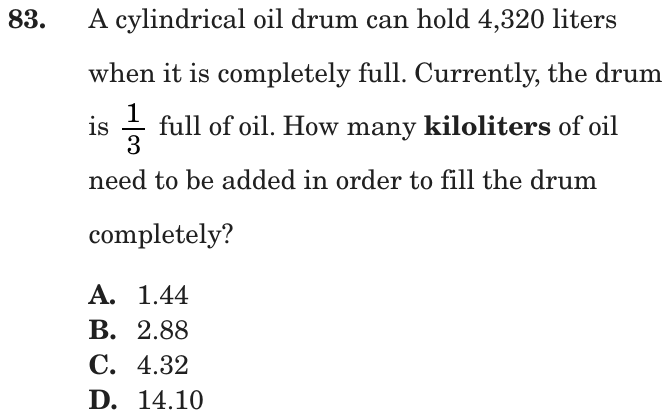
Question 24 of 24
2018 Test B Math, question 44Question
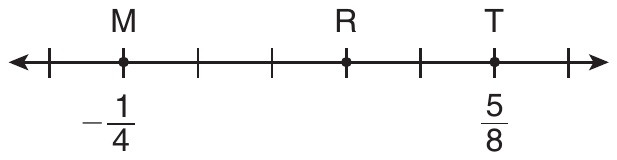
The hash marks on the number line above are evenly spaced. What is the coordinate of point ?
- A
- B
- C
- D
Show the answer
Correct answer: C
There are 5 sections between M and T. To find the length of one of these sections, find the distance between M and T and divide by 5:
R is 3 sections away from M, so add:
R is located at .
Question analysis
Students find the fraction at point R on a number line with evenly spaced hash marks, where M is at −1/4 and T is at 5/8. It tests fraction arithmetic with negative numbers. Working out the size of one gap and counting gaps from M to R takes several careful steps.
- NYS standards
- Grade level
- Grade 7 content, by NYS standard
- Compared with grade 7
- Above grade 7 Grade 7 students place fractions and negatives on number lines, but here they must subtract a negative fraction, divide by five, and then add back. Four fraction steps with unlike denominators make it harder than typical classwork.
- Estimated difficulty
- Hard: combines ideas, needs a plan, and has more than one tempting wrong answer.
- Thinking it demands
- Depth of knowledge 2, skills and concepts · mainly apply
- What makes it hard
- Error-prone arithmetic major
- Reading a figure, table or graph moderate
- Solution
- 4 steps
- Reading level
- Question and choices: about grade 6, 22 words.
- Students, last 30 days
- Not enough answers yet to show (it takes 10).
Why it is hard, traps and wrong answers (shows the answer)
Why it is hard
Fractions, a negative starting point and a count of spaces all have to come out right together. Students lose points by counting tick marks instead of spaces, by subtracting −1/4 as if it were positive, or by measuring R from 0 instead of from M. Converting both labels to fortieths first, −10/40 and 25/40, makes each gap a whole number of fortieths.
Error-prone arithmetic major Working it out
The gap length needs 5/8 − (−1/4) = 7/8, then 7/8 ÷ 5 = 7/40, then −10/40 + 21/40: negatives and three different denominators meet in one problem. (Brown & Burton, 1978; Junker & Sijtsma, 2001)
Reading a figure, table or graph moderate Understanding the question
The hash marks have to be counted as spaces: five from M to T, with R three spaces past M, while the unlabeled marks outside M and T play no part. (Lesh, Post & Behr, 1987; Kirsch & Mosenthal, 1990)
Strategy: Find the distance from M to T by subtracting their coordinates, divide it by the number of equal gaps, then step from M toward T by the right number of gaps.
Traps
- Stops one step early: A choice is a number from partway through the solution.
- Negatives and direction: Arithmetic with negative numbers, the order of a subtraction, or direction on a number line. (Moving a term across the equals sign without changing its sign is a faulty procedure.)
The wrong answers, classified
A Stops one step early (King et al., 2004; Gierl et al., 2017)
Finds the length of one gap, 7/8 ÷ 5 = 7/40, and gives it as R's coordinate without stepping from M.
B Negatives and direction (Brown & Burton, 1978)
Subtracts as 5/8 − 1/4 = 3/8 instead of adding, gets gaps of 3/40, and counts three gaps from 0.
D Stops one step early (King et al., 2004; Gierl et al., 2017)
Multiplies the 7/40 gap by 3 to get the distance from M to R, then forgets to add it to M's −1/4.
Worked solution, step by step
Formulas used
- Distance on a number line
- The right number is the point farther to the right on the number line. The left number is the other point. Subtracting tells how many units apart they are. Taking the left from the right keeps the answer positive.
- Dividing a fraction by a whole number
- a over b is the fraction, and c is the whole number you divide by. Splitting a fraction into c equal parts makes each part c times smaller. So you multiply the bottom number, b, by c.
Read the number line
M is at and T is at . The hash marks are evenly spaced, so every space is the same length. Count the spaces. From M to T there are 5 spaces. From M to R there are 3 spaces. You need the number at point R.
Find the distance from M to T
Use the distance formula. First write in eighths, as .
Taking away a negative is the same as adding. M and T are apart.
Find the length of one space
The 5 spaces are equal, so divide by 5.
Each space is long.
Watch out: this is the length of one space, not where R is. Stopping here gives choice A.
Step from M to R
R is 3 spaces to the right of M.
Now add that to M. Write as .
Watch out: is how far R is from M, not where R is. Choosing it gives choice D.
Give the answer
Point R is at , a little to the right of 0. So the answer is C, .
Check your answer
Go backward from T instead. T is 2 spaces past R, and . So R is at . Both ways give the same point.
More questions like this
The original DOE question