6.EE.7 one-step equations
Question 1 of 18
2026 Practice Test D Math, question 12Question
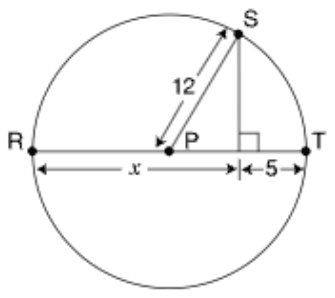
P is the center of the circle above, and R, S, and T are points on the circle. What is the value of x?
- A12
- B15
- C17
- D19
Show the answer
Correct answer: D
represents the radius of the circle and has length 12.
Both and are radii and also have length 12.
Therefore, the length of , which is a diameter, is 24 and is also represented by .
Question analysis
A circle with center P has points R, S and T on it, a segment SP labeled 12, and a vertical segment from S that splits RT into a piece labeled x and a piece labeled 5. Students find the value of x. It tests basic circle facts, and the challenge is seeing which lengths in the figure must be equal.
- Grade level
- Grade 7 content, by NYS standard
- Compared with grade 7
- At grade 7 Grade 7 circle work centers on area and circumference formulas. This needs only the fact that every radius has the same length, but spotting which segments are radii in a figure with extra markings is less routine than using a formula.
- Estimated difficulty
- Moderate: several steps, or a close reading with one strong distractor.
- Thinking it demands
- Depth of knowledge 2, skills and concepts · mainly apply
- What makes it hard
- Reading a figure, table or graph moderate
- No obvious method minor
- Solution
- 2 steps
- Reading level
- Question and choices: about grade 3, 24 words.
- Students, last 30 days
- Not enough answers yet to show (it takes 10).
Why it is hard, traps and wrong answers (shows the answer)
Why it is hard
The figure gives one measurement on a slanted radius and two labels on the diameter, and the right angle at the foot of the vertical segment is a decoy. Once RP and PT are seen as radii, RT is 24, and x is that diameter less the 5. Students who never connect the slanted 12 to the horizontal line fall back on the labeled numbers, adding 12 and 5, or take x to end at the center.
Reading a figure, table or graph moderate Understanding the question
The 12 labels the slanted segment SP, not the horizontal one, and the arrow for x runs from R past the center P to the foot of the vertical segment, so x is neither a radius nor a whole diameter. (Lesh, Post & Behr, 1987; Kirsch & Mosenthal, 1990)
No obvious method minor Working it out
The right-angle mark and the triangle under S suggest the Pythagorean theorem, which is no help; the way in is seeing that RP and PT are radii as well. (Schoenfeld, 1985)
Strategy: Mark every segment from P to the circle as 12, notice that R and T are the ends of a diameter, then write an equation for that diameter using x and the 5.
Traps
- Misreads the figure: Reads a value, label or tick spacing in a figure, table or graph wrongly.
- Information you don't need: The question gives numbers or facts that play no part in the answer.
- Numbers taken from the question: Combines the numbers in the question without a model of the situation, or is simply a number that appears in the question.
The wrong answers, classified
A Misreads the figure (Lesh, Post & Behr, 1987; Kirsch & Mosenthal, 1990)
Reads x as the radius RP, as if its arrow ended at the center P, though it runs past P to the foot of the vertical segment.
B Trusting the picture (Lesh, Post & Behr, 1987)
Judges x from the drawing, where it looks about three times as long as the piece labeled 5, instead of working from the radius of 12.
C Numbers taken from the question (Hegarty, Mayer & Monk, 1995)
Adds the two labeled numbers, 12 + 5 = 17, without placing the 12 on the diameter, as if x were a radius plus the 5.
Worked solution, step by step
Formulas used
- Radius and diameter
- r is the radius, the distance from the center to any point on the circle. d is the diameter, the distance straight across the circle through the center. A diameter is two radii laid end to end, one on each side of the center, so it is twice as long.
Sort out the question
P is the center of the circle, and R, S and T are on the circle. Segment SP is 12. Segment RT goes straight across through P. A short line from S meets RT at a right angle. It splits RT into x, from R to that point, and 5, from that point to T. You need x.
See that SP is a radius
SP runs from the center P to the point S on the circle. So SP is a radius, and the radius is 12. Every radius of a circle has the same length. RP and PT also run from the center to the circle, so RP = 12 and PT = 12.
Find the diameter RT
RT passes through the center, so it is a diameter. Use the formula with r = 12:
RT is 24 long. It is the radius RP plus the radius PT.
Solve for x
RT is also split into x and 5, so:
Subtract 5 from both sides:
Watch out: x runs from R past the center P, so it is longer than a radius. Reading it as 12, choice A, stops at P. Adding 12 + 5 = 17, choice C, puts the 12 in the wrong place.
Work from the numbers, not the picture
The figure is not drawn to scale. In it, x looks about three times as long as 5, which suggests 15, choice B. Trust the labels instead. The right triangle under S is not needed at all.
So the answer is D, 19.
Check your answer
The point where the short line meets RT is 19 from R. P is 12 from R, so that point is 19 − 12 = 7 past the center. Then 7 + 5 = 12, which is PT, a radius. Everything fits.
More questions like this
The original DOE question
Question 2 of 18
2024 Test B Math, question 17Question
A bowl contains 12 green candies, 4 yellow candies, and some red candies. The probability of choosing a green candy at random is twice as great as the probability of choosing a red candy at random. What is the probability of choosing a yellow candy at random?
- A
- B
- C
- D
Show the answer
Correct answer: A
The probability of choosing a green candy is twice as great as the probability of choosing a red candy. There are 12 green candies. Let r = the number of red candies.
So there are 6 red candies. 12 green candies + 4 yellow candies + 6 red candies = 22 total candies.
There are 4 yellow candies out of a total of 22 candies. So the probability of choosing a yellow candy is
.
Question analysis
A probability question about a bowl of 12 green candies, 4 yellow candies and an unknown number of red ones. A green candy is twice as likely to be picked as a red one, and students find the chance of picking a yellow candy. The missing red count has to be worked out before any probability can be found.
- Grade level
- Grade 6 content, by NYS standard
- Compared with grade 7
- Above grade 7 Simple probability is grade 6 content in New York, and grade 7 problems usually give every count. Working backward from a comparison of two probabilities to a missing count, then forward to a third probability, is more than typical grade 7 work.
- Estimated difficulty
- Hard: combines ideas, needs a plan, and has more than one tempting wrong answer.
- Thinking it demands
- Depth of knowledge 2, skills and concepts · mainly apply
- What makes it hard
- Turning words into math moderate
- Combines ideas moderate
- Solution
- 3 steps
- Reading level
- Question and choices: about grade 7, 49 words.
- Students, last 30 days
- Not enough answers yet to show (it takes 10).
Why it is hard, traps and wrong answers (shows the answer)
Why it is hard
The question withholds the red count, and everything depends on recovering it from the comparison of probabilities. Students who cannot make that step tend to leave red out altogether, while those who find 6 red candies can still slip at the end by using the wrong total or the wrong color. Writing all three counts and the total of 22 before forming any fraction prevents both endings.
Turning words into math moderate Understanding the question
“Twice as great as the probability of choosing a red candy” must become 12 = 2 × the red count, which works only because both probabilities share one total. (Hegarty, Mayer & Monk, 1995; Koedinger & Nathan, 2004)
Combines ideas moderate Working it out
An unknown count has to be found from a ratio before any probability can be written, joining proportional reasoning with probability as a part over the total. (Embretson, 1998; Daniel & Embretson, 2010)
Strategy: Turn twice as likely into a statement about numbers of candies to find the red count, add all three colors for the total, then put the yellow count over that total and simplify.
Traps
- Answers a different question: A choice is right for another quantity: the other unknown, the rest instead of the part, the part instead of the whole.
- Numbers taken from the question: Combines the numbers in the question without a model of the situation, or is simply a number that appears in the question.
The wrong answers, classified
B Misunderstands the concept (Smith, diSessa & Roschelle, 1993; De Bock et al., 1998; Ni & Zhou, 2005)
Finds the 6 red candies but compares the 4 yellow with the 18 green and red ones, 4/18, a part-to-part ratio instead of part to whole.
C Numbers taken from the question (Hegarty, Mayer & Monk, 1995)
Leaves out the red candies, whose number is not given, and divides the 4 yellow by the 16 green and yellow candies.
D Answers a different question (King et al., 2004; Hegarty, Mayer & Monk, 1995)
Finds the 6 red candies and the total of 22 correctly but gives the chance of red, 6/22 = 3/11, instead of yellow.
Worked solution, step by step
Formulas used
- Probability
- P is the probability, the chance that something happens. The top is how many candies are the kind you want. The bottom is how many candies there are in all. Each candy is just as likely to be picked, so this fraction gives the chance.
Sort out what you know
The bowl has 12 green candies, 4 yellow candies and some red candies. You are not told how many are red. Let r be the number of red candies.
The chance of picking green is twice the chance of picking red. You need the probability (the chance) of picking yellow.
Compare green and red
Write each chance with the probability formula.
Green and red have the same bottom number, the total number of candies. So if the chance of green is twice the chance of red, there are twice as many green candies as red ones.
Find the red candies and the total
There are 6 red candies. Now add up all the candies.
There are 22 candies in all. Watch out: do not leave out the red candies just because their number was not given. Using 16 as the total gives 1/4, choice C.
Find the chance of yellow
There are 4 yellow candies out of 22.
Divide the top and the bottom by 2 to simplify. Watch out: the question asks for yellow, not red. 6/22 = 3/11 is the chance of red, choice D. The bottom must be all 22 candies. Using 18 gives 2/9, choice B.
So the answer is A, .
Check your answer
Check the clue. The chance of green is , and the chance of red is . Twelve is twice 6, so green is twice as likely. Also, the three chances add up to 1: .
More questions like this
The original DOE question
Question 3 of 18
2024 Test B Math, question 35Question
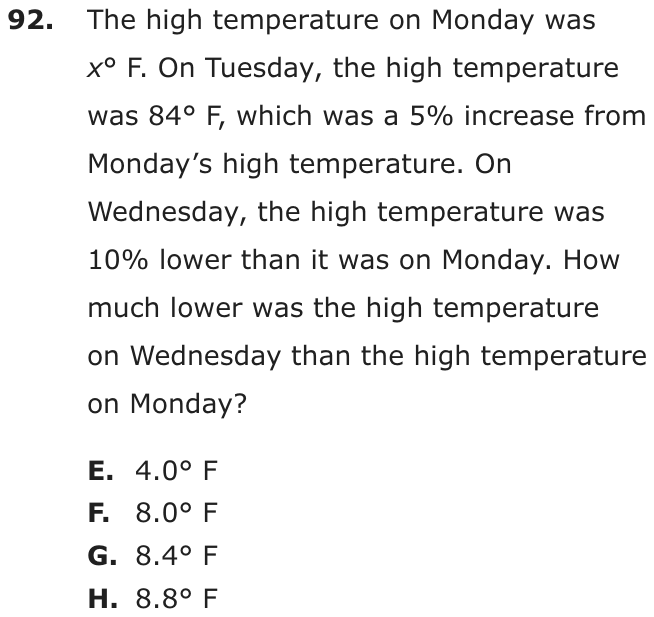
The high temperature on Monday was x° F. On Tuesday, the high temperature was 84° F, which was a 5% increase from Monday’s high temperature. On Wednesday, the high temperature was 10% lower than it was on Monday. How much lower was the high temperature on Wednesday than the high temperature on Monday?
- A4.0° F
- B8.0° F
- C8.4° F
- D8.8° F
Show the answer
Correct answer: B
The temperature on Tuesday was 84° F, which was 5% higher than the temperature on Monday.
This can be represented by the equation .
Dividing both sides of this equation by 1.05 gives .
Therefore, the temperature on Monday was 80° F.
Since the temperature on Wednesday was 10% lower than the temperature on Monday, the difference between the two temperatures would equal .
Question analysis
Tuesday's high temperature is given along with its percent increase over Monday's, and Wednesday's high is a percent below Monday's. Students find how many degrees cooler Wednesday was than Monday. It tests percent increase and decrease, and the difficulty is working back to Monday, the base for both percents, rather than starting from Tuesday's number.
- Grade level
- Grade 7 content, by NYS standard
- Compared with grade 7
- Above grade 7 Grade 7 percent problems usually apply a percent to a known amount. Here Monday's temperature must first be recovered from a percent increase and then a second percent applied to it, a reverse step most grade 7 students find unfamiliar.
- Estimated difficulty
- Moderate: several steps, or a close reading with one strong distractor.
- Thinking it demands
- Depth of knowledge 2, skills and concepts · mainly apply
- What makes it hard
- Turning words into math moderate
- A very close wrong answer moderate
- Much to keep track of minor
- Solution
- 3 steps
- Reading level
- Question and choices: about grade 5, 54 words.
- Students, last 30 days
- Not enough answers yet to show (it takes 10).
Why it is hard, traps and wrong answers (shows the answer)
Why it is hard
The question turns on noticing that both percents are measured from Monday, a temperature the stem never states. Students who take 10% of the only temperature given, 84, land on a listed choice just 0.4 degree off. Working back from 84 is forgiving: the exact 84 ÷ 1.05 = 80 and even the rougher 84 × 0.95 = 79.8 lead to the same choice, so the real test is not skipping Monday.
Turning words into math moderate Understanding the question
"84° F, which was a 5% increase from Monday’s high temperature" makes 84 the result of the increase, so Monday comes from solving 1.05x = 84, not from 5% of 84. (Hegarty, Mayer & Monk, 1995; Koedinger & Nathan, 2004)
A very close wrong answer moderate Choosing the answer
The choices 8.0, 8.4 and 8.8 lie within a degree of each other, so only the base of the 10%, Monday's 80 rather than Tuesday's 84, separates them. (Embretson & Wetzel, 1987; Gorin & Embretson, 2006; Ascalon et al., 2007)
Much to keep track of minor Working it out
Three days and two percents have to be kept apart: the 5% compares Tuesday with Monday, and the 10% compares Wednesday with Monday. (Sweller, 1988; Carpenter, Just & Shell, 1990)
Strategy: Let Monday's temperature be x, write Tuesday's 84 degrees as 1.05 times x and solve, then take 10 percent of Monday's value.
Traps
- Percent of the wrong amount: Finding the whole from a part, or a percent change measured from the wrong starting amount.
- Answers a different question: A choice is right for another quantity: the other unknown, the rest instead of the part, the part instead of the whole.
- Wrong operation: Adds instead of multiplying, divides the wrong way round, turns a ratio or rate upside down, or undoes a step in the wrong direction (subtracts what should be added back).
The wrong answers, classified
A Answers a different question (King et al., 2004; Hegarty, Mayer & Monk, 1995)
Finds Monday's 80° F and then gives the 4-degree rise from Monday to Tuesday, 84 − 80, instead of Wednesday's 10% drop.
C Percent of the wrong amount (Parker & Leinhardt, 1995)
Takes 10% of Tuesday's 84° F, getting 8.4, instead of first working back to Monday's temperature, the base for Wednesday's drop.
D Wrong operation (Hegarty, Mayer & Monk, 1995; King et al., 2004)
Undoes Tuesday's increase in the wrong direction, adding 5% to 84 to get 88.2° F for Monday, then takes 10% of it, about 8.8.
Worked solution, step by step
Formulas used
- Percent increase
- old is the starting amount. p is the percent it goes up. new is the amount after. The 1 keeps all of the old amount, and p over 100 adds the extra part. So a 5% rise means multiply by 1.05.
- Percent of a number
- The whole is the amount the percent is taken of. The percent tells how many out of every 100. The part is the piece you get, here a number of degrees.
Sort out the question
Monday’s high is unknown. Call it x degrees. Tuesday’s high was 84°F, which is 5% more than Monday. Wednesday’s high was 10% less than Monday.
You need how many degrees lower Wednesday was than Monday. Both percents compare with Monday. So find Monday first.
Write an equation for Tuesday
Tuesday is Monday plus 5% of Monday. That is 105% of Monday. Use the percent increase formula with p = 5.
Solve for Monday
Divide both sides by 1.05 to undo the multiplying.
Monday’s high was 80°F. Watch out: 84 is the result of the increase, not the start. Adding 5% to 84 gives about 88.2°F. Then 10% of that is about 8.8, choice D.
Find Wednesday’s drop
Wednesday was 10% lower than Monday. So the drop is 10% of Monday’s 80°F.
Wednesday was 8 degrees lower. Watch out: Taking 10% of Tuesday’s 84 gives 8.4, choice C. The 10% is of Monday’s high. Also, 84 − 80 = 4, choice A, is Tuesday’s rise, not Wednesday’s drop.
So the answer is B, 8.0°F.
Check your answer
Work forward from 80°F. 5% of 80 is 4, and 80 + 4 = 84. That matches Tuesday. Then 80 − 8 = 72, so Wednesday’s high was 72°F. That is 8 degrees below Monday.
More questions like this
The original DOE question
Question 4 of 18
2024 Test B Math, question 55Question
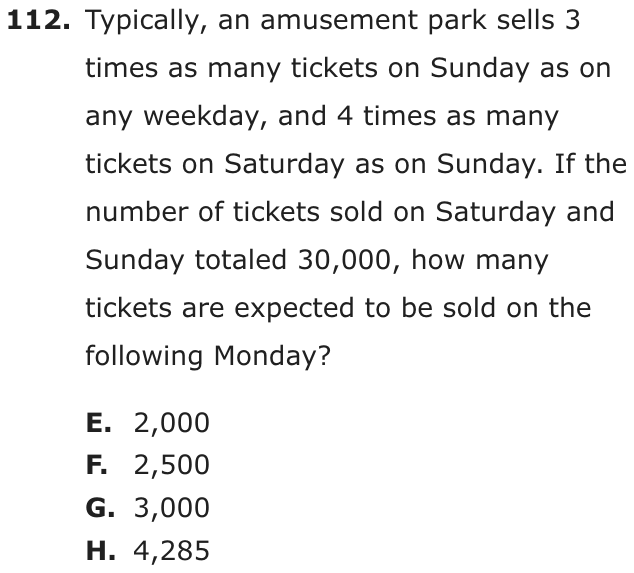
Typically, an amusement park sells 3 times as many tickets on Sunday as on any weekday, and 4 times as many tickets on Saturday as on Sunday. If the number of tickets sold on Saturday and Sunday totaled 30,000, how many tickets are expected to be sold on the following Monday?
- A2,000
- B2,500
- C3,000
- D4,285
Show the answer
Correct answer: A
First, determine the number of tickets sold on Sunday, x, using the total number of tickets sold on Saturday and Sunday, 30,000, and the number of tickets sold on Saturday, .
Then determine the number of tickets expected to be sold on Monday, y, using the number of tickets sold on Sunday, 6,000.
The number of tickets expected to be sold on Monday is 2,000.
Question analysis
An amusement park sells 3 times as many tickets on Sunday as on a weekday and 4 times as many on Saturday as on Sunday. Given the weekend total, students find the expected ticket sales for the following Monday. It tests writing an equation from multiplicative comparisons, and the trap is comparing Saturday with the wrong day.
- Grade level
- Grade 7 content, by NYS standard
- Compared with grade 7
- At grade 7 Writing and solving a one-variable equation from a word problem is grade 7 work. Two linked multiplicative comparisons, with Saturday measured against Sunday rather than a weekday, add a layer of translation, but the equation itself stays simple.
- Estimated difficulty
- Moderate: several steps, or a close reading with one strong distractor.
- Thinking it demands
- Depth of knowledge 2, skills and concepts · mainly apply
- What makes it hard
- Turning words into math moderate
- Much to keep track of minor
- Solution
- 3 steps
- Reading level
- Question and choices: about grade 12, 48 words.
- Students, last 30 days
- Not enough answers yet to show (it takes 10).
Why it is hard, traps and wrong answers (shows the answer)
Why it is hard
The question is two comparisons chained through Sunday, and most wrong answers come from linking them incorrectly. Students who read Saturday's 4 times as 4 weekdays, or who leave Sunday out of the 30,000, find listed answers, one of them from a division that does not come out even. Letting a weekday be one share, so Sunday is 3 and Saturday 12, makes the weekend 15 shares and the check easy.
Turning words into math moderate Understanding the question
"4 times as many tickets on Saturday as on Sunday" compares Saturday with Sunday, not with a weekday, so Saturday is 4 × 3 = 12 weekdays' worth. (Hegarty, Mayer & Monk, 1995; Koedinger & Nathan, 2004)
Much to keep track of minor Working it out
Three days have to be held in relation at once, a weekday, Sunday and Saturday, with the 30,000 covering only the last two. (Sweller, 1988; Carpenter, Just & Shell, 1990)
Strategy: Let Sunday's sales be the unknown, write Saturday as 4 times it, solve the weekend equation for Sunday, then divide Sunday's figure by 3 for a weekday.
Traps
- Misreads the question: Misses or misreads a condition or a word in the question: "at least", "each", "remaining", "not".
- Wrong operation: Adds instead of multiplying, divides the wrong way round, turns a ratio or rate upside down, or undoes a step in the wrong direction (subtracts what should be added back).
The wrong answers, classified
B Misreads the question (Hegarty, Mayer & Monk, 1995)
Makes Saturday 3 × 4 = 12 weekdays' worth but divides all 30,000 by 12, leaving Sunday's 3 shares out of the weekend total.
C Wrong operation (Hegarty, Mayer & Monk, 1995; King et al., 2004)
Adds the multipliers, so Saturday is 3 + 4 = 7 weekdays' worth; with Sunday's 3 the weekend is 10 shares, and 30,000 ÷ 10 = 3,000.
D Misreads the question (Hegarty, Mayer & Monk, 1995)
Reads Saturday as 4 times a weekday rather than 4 times Sunday, so splits 30,000 into 3 + 4 = 7 shares of about 4,285.7.
Worked solution, step by step
Formulas used
- Undoing multiplication
- x is the unknown number. a and b are known numbers. Division undoes multiplication. So if a times x is b, you find x by dividing b by a. This is the same as dividing both sides by a.
Sort out the question
Sunday sells 3 times as many tickets as a weekday. Saturday sells 4 times as many as Sunday. Saturday and Sunday together sell 30,000.
Monday is a weekday. You need Monday’s tickets. Notice that Saturday is compared with Sunday, not with a weekday.
Write an equation for the weekend
Let x be Sunday’s tickets. Then Saturday’s tickets are 4x. Together they make 30,000.
Solve for Sunday
Use the rule for undoing multiplication. Divide both sides by 5.
Sunday sells 6,000 tickets. Saturday sells .
Find Monday’s tickets
Sunday sells 3 times as many as a weekday. Let y be Monday’s tickets.
Watch out: If you read Saturday as 4 times a weekday, you split 30,000 into 7 shares. That gives about 4,285, choice D. Dividing 30,000 by 12 leaves out Sunday and gives 2,500, choice B.
So the answer is A, 2,000.
Check your answer
Think in shares. A weekday is 1 share. Sunday is 3 shares, and Saturday is shares. The weekend is 15 shares, and . It matches.
More questions like this
The original DOE question
Question 5 of 18
2023 Test A Math, question 11Question
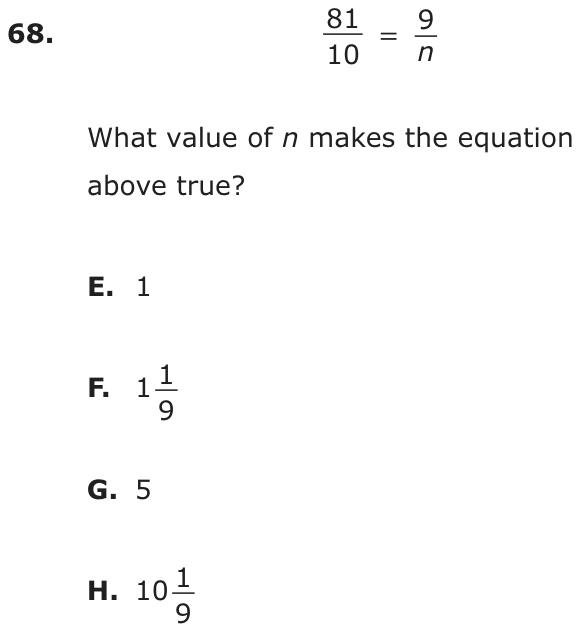
What value of n makes the equation above true?
- A1
- B
- C5
- D
Show the answer
Correct answer: B
| Cross multiply. | |
| Apply the multiplicative inverse property; divide both sides of the equation by 81. | |
| Then simplify the fraction. |
Question analysis
This question gives the proportion 81/10 = 9/n and asks for the value of n that makes it true. Students solve a proportion by cross-multiplying and dividing, then simplify the result. Reducing the resulting fraction and matching its form to the choices is where students slip.
- Grade level
- Grade 6 content, by NYS standard
- Compared with grade 7
- Below grade 7 Solving a proportion is familiar from grades 6 and 7, and this one needs only cross-multiplying and one division. Its one extra demand is simplifying the result and writing it in the form the choices use.
- Estimated difficulty
- Straightforward: two steps or one careful reading.
- Thinking it demands
- Depth of knowledge 1, recall and reproduction · mainly apply
- What makes it hard
- An answer in an unexpected form moderate
- A very close wrong answer minor
- Solution
- 3 steps
- Reading level
- Question and choices: about grade 7, 12 words.
- Students, last 30 days
- Not enough answers yet to show (it takes 10).
Why it is hard, traps and wrong answers (shows the answer)
Why it is hard
The proportion solves in one cross-multiplication, but the result is an improper fraction that must be simplified and rewritten to match. Students who notice that 81 is 9 × 9 can shortcut it: the numerator shrinks by a factor of 9 from left to right, so the denominator must shrink too, giving 10 ÷ 9. The mixed-number form is where answers drift, by dropping the leftover ninth or by writing 10 × 1/9 as 10 1/9.
An answer in an unexpected form moderate Choosing the answer
Cross-multiplying gives n = 90/81, which has to be reduced to 10/9 and rewritten as the mixed number 1 1/9 before it matches any choice. (Enright, Morley & Sheehan, 2002)
A very close wrong answer minor Choosing the answer
The choices 1 and 1 1/9 differ by one ninth, and estimating 90 ÷ 81 as about 1 cannot separate them; only keeping the remainder does. (Embretson & Wetzel, 1987; Gorin & Embretson, 2006; Ascalon et al., 2007)
Strategy: Cross-multiply to get 81n = 90, divide both sides by 81, and simplify the fraction before comparing it with the choices.
Traps
- A faulty procedure: A systematic but wrong procedure: adding fractions straight across, applying an exponent to each term of a sum, dropping a sign when moving a term.
- Answer in another form: The right answer is written differently from the way you worked it out.
The wrong answers, classified
A Rounds too early (King et al., 2004)
Finds n by dividing 10 by 9 but keeps only the whole-number part of the quotient, 1, dropping the remainder that the exact answer needs.
C Little reason to choose it (Haladyna & Downing, 1993; Rodriguez, 2005)
No cross-multiplication or scaling of 81/10 gives 5, which would make 9/n equal 1.8 instead of 8.1, so it mostly catches guesses.
D A faulty procedure (Brown & Burton, 1978; Tatsuoka, 1983)
Reaches n = 10 × 9/81 = 10 × 1/9 but writes the product as the mixed number 10 1/9, as if a whole number beside a fraction meant multiplication.
Worked solution, step by step
Formulas used
- Cross-multiplying
- a over b and c over d are two equal fractions, and b and d are not 0. Multiply each top by the other bottom. The two products are equal. It works because it is the same as multiplying both sides by b and by d.
- Simplifying a fraction
- a over b is a fraction, and k is a number that divides both the top and the bottom. Dividing the top and the bottom by the same number gives an equal fraction with smaller numbers.
- Fraction to mixed number
- a over b is a fraction whose top is bigger than its bottom. q is the quotient, how many whole times b fits into a. r is the remainder, what is left over. The leftover stays over the same bottom number.
Sort out the question
The equation says two fractions are equal: and . n is an unknown bottom number. You need the value of n that makes them equal. Some choices are mixed numbers, so n may not be a whole number.
Cross-multiply the two fractions
Multiply each top by the other fraction’s bottom. This gets n out of the bottom of the fraction.
Divide both sides by 81
81n means 81 times n. To undo multiplying by 81, divide both sides by 81.
Now simplify. 90 and 81 are both in the 9 times table, so divide the top and bottom by 9.
Write it as a mixed number
10 ÷ 9 is 1 with 1 left over. The leftover stays over 9.
Watch out: keep the leftover. Dropping it gives 1, choice A. Also, ten ninths is not 10 and one ninth. That mixed number, , is choice D, which is far too big. So the answer is B, .
Check your answer
Estimate. is about 8. For to be about 8, n must be a little more than 1. Check exactly: . It matches.
More questions like this
The original DOE question
Question 6 of 18
2023 Test A Math, question 19Question
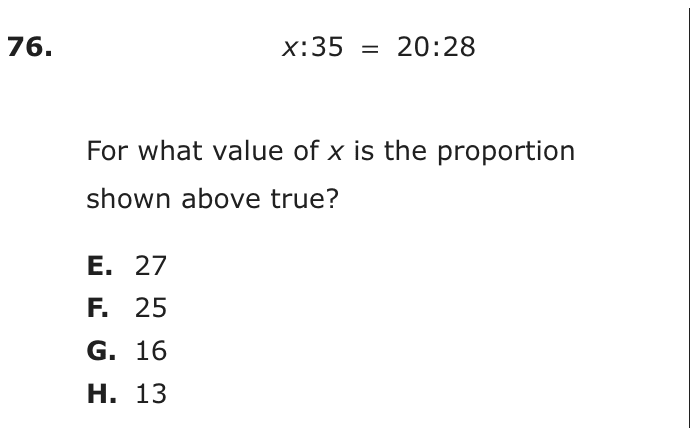
For what value of x is the proportion shown above true?
- A27
- B25
- C16
- D13
Show the answer
Correct answer: B
Write the ratios in fraction form and solve for x:
| Cross multiply. | |
| Apply the multiplicative inverse property; divide both sides by 28. | |
Question analysis
This question gives the proportion x:35 = 20:28 and asks for the value of x that makes it true. Students use equivalent ratios or cross-multiplication. The trap is reasoning by adding or subtracting the difference between terms rather than multiplying, which gives numbers that look reasonable but break the ratio.
- Grade level
- Grade 6 content, by NYS standard
- Compared with grade 7
- Below grade 7 Finding a missing term in a proportion is grade 6 ratio reasoning, and here the given ratio simplifies to small numbers. It is easier than typical grade 7 proportional reasoning, which usually involves fractions or a real context.
- Estimated difficulty
- Routine: one familiar step, little to misread.
- Thinking it demands
- Depth of knowledge 1, recall and reproduction · mainly apply
- What makes it hard
- Error-prone arithmetic minor
- A very close wrong answer minor
- Solution
- 2 steps
- Reading level
- Question and choices: about grade 5, 12 words.
- Students, last 30 days
- Not enough answers yet to show (it takes 10).
Why it is hard, traps and wrong answers (shows the answer)
Why it is hard
This is a single proportion with whole numbers, and the only real trap is reasoning by differences instead of by a common factor. Since 35 is 7 more than 28, adding or subtracting 7 to 20 is tempting, but equal ratios scale; they do not shift. Reducing 20:28 to 5:7 shows at once that the scale factor to 35 is 5.
Error-prone arithmetic minor Working it out
Cross-multiplying gives 28x = 700, and 700 ÷ 28 is not a table fact; simplifying 20:28 to 5:7 first turns it into 5 × 5. (Brown & Burton, 1978; Junker & Sijtsma, 2001)
A very close wrong answer minor Choosing the answer
27 is only 2 more than 25, so a rough sense that x is a little more than 20 fits both; only the exact scale factor, 35/28 = 5/4, separates them. (Embretson & Wetzel, 1987; Gorin & Embretson, 2006; Ascalon et al., 2007)
Strategy: Simplify 20:28 to lowest terms first, then scale it up so its second term becomes 35, or cross-multiply and divide by 28.
Traps
- Misunderstands the concept: A wrong belief about a concept: that percents can be added, that area grows like length, that averages can be averaged, that a bigger denominator means a bigger fraction.
- Wrong operation: Adds instead of multiplying, divides the wrong way round, turns a ratio or rate upside down, or undoes a step in the wrong direction (subtracts what should be added back).
The wrong answers, classified
A Misunderstands the concept (Smith, diSessa & Roschelle, 1993; De Bock et al., 1998; Ni & Zhou, 2005)
Reasons with differences: since 35 is 7 more than 28, adds 7 to 20, keeping the gap between the terms instead of their ratio.
C Wrong operation (Hegarty, Mayer & Monk, 1995; King et al., 2004)
Scales 20 by 28/35 instead of 35/28, so 20 × 28 ÷ 35 = 16, which turns the ratio of the second terms upside down.
D Misunderstands the concept (Smith, diSessa & Roschelle, 1993; De Bock et al., 1998; Ni & Zhou, 2005)
Reasons with differences and also goes the wrong way, subtracting 7 from 20, though x must exceed 20 because 35 exceeds 28.
Worked solution, step by step
Formulas used
- Ratio as a fraction
- a:b is a ratio, read a to b. It compares two amounts by division. You can write it as the fraction a over b. Two equal ratios make a proportion.
- Equivalent fractions
- a over b is a fraction, and k is any number except 0. Multiplying or dividing the top and the bottom by the same number gives an equal fraction.
Sort out the question
is a proportion. A proportion says two ratios are equal. A ratio compares two numbers, like 20 to 28. You need the value of x that makes the two ratios equal.
Write the ratios as fractions
Write each ratio as a fraction. The first number of the ratio goes on top. The second goes on the bottom.
Simplify the known fraction
20 and 28 both divide by 4. Smaller numbers are easier to work with.
So now .
Scale up so the bottom is 35
7 times 5 is 35. To keep the fraction equal, multiply the top by 5 too.
So x = 25. Watch out: a ratio is about multiplying, not adding. 35 is 7 more than 28, but adding 7 to 20 gives 27, choice A. Also, x must be more than 20, because 35 is more than 28. So 16 and 13 are too small. So the answer is B, 25.
Check your answer
Cross-multiply, as the test’s own explanation does. and . The two products are equal, so the ratios 25:35 and 20:28 are equal.
More questions like this
The original DOE question
Question 7 of 18
2023 Test A Math, question 22Question
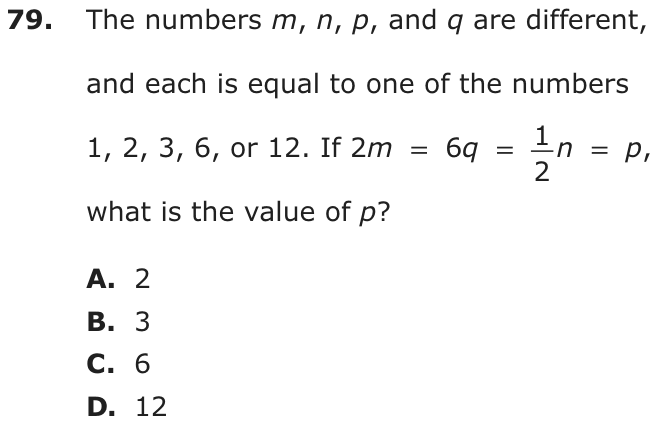
The numbers m, n, p, and q are different, and each is equal to one of the numbers 1, 2, 3, 6, or 12. If , what is the value of p?
- A2
- B3
- C6
- D12
Show the answer
Correct answer: C
Substitute each answer option for p to see which value will work:
Option A:
If , then , so . This cannot be the answer, because n cannot equal 4.
Option B:
If , then , so . This cannot be the answer, because q cannot equal 0.5.
Option C:
If , then , so ; , so ; and , so . This is the correct answer.
Option D:
If , then , so . This cannot be the answer, because n cannot equal 24.
Question analysis
Four letters, m, n, p and q, stand for different numbers from the list 1, 2, 3, 6 and 12, and the expressions 2m, 6q, half of n, and p are all equal. Students find the value of p. The puzzle-like setup has no single equation to solve, so testing values against every condition is the reliable route.
- Grade level
- Grade 6 content, by NYS standard
- Compared with grade 7
- Above grade 7 The equations involve only doubling, halving and multiplying by 6, all grade 6 skills. What goes beyond grade 7 practice is the chain of four equal expressions, with every letter limited to a short list of different numbers.
- Estimated difficulty
- Moderate: several steps, or a close reading with one strong distractor.
- Thinking it demands
- Depth of knowledge 2, skills and concepts · mainly analyze
- What makes it hard
- Variables instead of numbers moderate
- Every choice must be checked moderate
- Solution
- 3 steps
- Reading level
- Question and choices: about grade 5, 27 words.
- Students, last 30 days
- Not enough answers yet to show (it takes 10).
Why it is hard, traps and wrong answers (shows the answer)
Why it is hard
The chain looks forbidding, but it gives each letter as a simple multiple of p: m is half of p, q a sixth of it, and n twice it. Seen that way, q = p/6 forces p to be 6 or 12, and n = 2p rules out 12, so only one value fits. Students who check one or two of the letters, but not all three, can accept 2 or 12.
Variables instead of numbers moderate Understanding the question
Four letters are tied by one chain of equalities, 2m = 6q = ½n = p, and the only numbers are the five allowed values, so each letter has to be written in terms of p. (Koedinger & Nathan, 2004; Enright, Morley & Sheehan, 2002)
Every choice must be checked moderate Choosing the answer
Each choice for p must be tested against three letters, m = p/2, q = p/6 and n = 2p, and all of them must land on different numbers from 1, 2, 3, 6 and 12. (Embretson & Wetzel, 1987)
Strategy: Test each choice as p: find m, q and n from it, and keep the value for which all three are different numbers from the list 1, 2, 3, 6 and 12.
Traps
- Answers a different question: A choice is right for another quantity: the other unknown, the rest instead of the part, the part instead of the whole.
- Misreads the question: Misses or misreads a condition or a word in the question: "at least", "each", "remaining", "not".
The wrong answers, classified
A Misreads the question (Hegarty, Mayer & Monk, 1995)
Checks only m, finding that p = 2 gives m = 1 on the list, and misses that q would be 1/3 and n would be 4.
B Answers a different question (King et al., 2004; Hegarty, Mayer & Monk, 1995)
Finds the solution, m = 3, q = 1, n = 12 and p = 6, then answers with m's value, 3, instead of the value of p.
D Misreads the question (Hegarty, Mayer & Monk, 1995)
Tests p = 12 against 2m and 6q, getting m = 6 and q = 2, both on the list, and stops before seeing that ½n = 12 needs n = 24.
Worked solution, step by step
Formulas used
- Undoing a multiplication
- a is a number that multiplies m, and p is the result. Dividing by a undoes multiplying by a. Use it to write each letter using p.
Sort out the question
m, n, p and q are four different numbers. Each one is 1, 2, 3, 6 or 12. The chain says that four amounts are all equal to p. You need the value of p.
Write each letter using p
Each part of the chain equals p. Undo each multiplication.
Half of n is p, so n is twice p.
Test each choice for p
p m q n All on the list? 2 1 4 No 3 1.5 0.5 6 No 6 3 1 12 Yes 12 6 2 24 No Only p = 6 puts every letter on the list.
Check that the letters are different
With p = 6, you get m = 3, q = 1 and n = 12. All four numbers are on the list, and no two are the same. Watch out: p = 12 makes m = 6 and q = 2, which look fine. But n = 24 is not on the list, so choice D fails. Also, the question asks for p, not m. Picking 3 is choice B. So the answer is C, 6.
Check your answer
Put the values into the chain: , , , and p = 6. All four parts equal 6. The numbers 3, 1, 12 and 6 are all different and all on the list.
More questions like this
The original DOE question
Question 8 of 18
2023 Test B Math, question 5Question
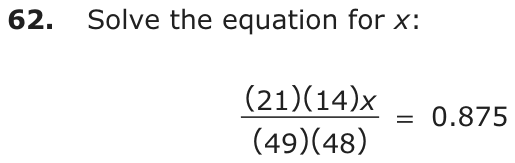
Solve the equation for x:
Grid-in question: work out the answer and enter it as a number.
Show the answer
Correct answer: 7
Question analysis
This equation puts x in a fraction with (21)(14) on top and (49)(48) below, set equal to the decimal 0.875. The grid-in asks for the value of x. Students do best to cancel common factors before multiplying anything out, and it helps to know the fraction that 0.875 equals.
- NYS standards
- Grade level
- Grade 7 content, by NYS standard
- Compared with grade 7
- At grade 7 Seventh graders solve equations like ax = b, usually with a simple coefficient. Here the coefficient is a product of four numbers that is best cancelled first, and a decimal has to be matched with a fraction.
- Estimated difficulty
- Moderate: several steps, or a close reading with one strong distractor.
- Thinking it demands
- Depth of knowledge 1, recall and reproduction · mainly apply
- What makes it hard
- Error-prone arithmetic moderate
- No obvious method minor
- An answer in an unexpected form minor
- Solution
- 3 steps
- Reading level
- Question and choices: about grade 5, 6 words.
- Students, last 30 days
- Not enough answers yet to show (it takes 10).
Why it is hard, traps and wrong answers (shows the answer)
Why it is hard
This is a one-unknown equation dressed in large numbers, and the work is in reducing them without slipping. Students who cancel early find that the whole coefficient is one eighth and that 0.875 is seven eighths, which makes the last step mental. Those who multiply out face a four-digit product and a decimal division, and with nothing to check against, an early slip goes unnoticed.
Error-prone arithmetic moderate Working it out
Multiplied out, the coefficient is 294 over 2,352 and the right side is the decimal 0.875; both invite slips unless 21/49 and 14/48 are cancelled first. (Brown & Burton, 1978; Junker & Sijtsma, 2001)
No obvious method minor Working it out
The quick route pairs 21 with 49 and 14 with 48 before multiplying, so that 3/7 × 7/24 collapses to 1/8; the layout of the fraction does not suggest that pairing. (Schoenfeld, 1985)
An answer in an unexpected form minor Choosing the answer
The result is entered with no choices, so a coefficient’s denominator or a quotient taken the wrong way looks as complete as the right value. (Enright, Morley & Sheehan, 2002)
Strategy: Cancel before multiplying: reduce 21 over 49 and 14 over 48, multiply the simplified fractions, then undo that coefficient, writing 0.875 as a fraction if it helps.
Traps
- Stops one step early: A choice is a number from partway through the solution.
- Wrong operation: Adds instead of multiplying, divides the wrong way round, turns a ratio or rate upside down, or undoes a step in the wrong direction (subtracts what should be added back).
- An arithmetic slip: The right method with a plausible arithmetic error: a digit, a place value or a times-table fact.
The wrong answers, classified
8 Stops one step early (King et al., 2004; Gierl et al., 2017)
Simplifies the coefficient correctly to 1/8 but enters the 8 from its denominator, never multiplying it by 0.875.
0.109375 Wrong operation (Hegarty, Mayer & Monk, 1995; King et al., 2004)
Divides 0.875 by 8 instead of multiplying, undoing the coefficient 1/8 the wrong way, so x comes out as 0.109375.
3.5 An arithmetic slip (Junker & Sijtsma, 2001)
Slips in reducing 14/48, taking it as 7/12 instead of 7/24, so the coefficient becomes 1/4 and x = 0.875 × 4 = 3.5.
Worked solution, step by step
Formulas used
- Multiplying fractions
- a and c are the tops, or numerators. b and d are the bottoms, or denominators. Multiply the tops together and the bottoms together. It also works backward: you can split one fraction into two smaller ones. That lets you simplify before the numbers get big.
Sort out the question
You need the value of x. On top, 21, 14 and x are multiplied. The bottom is 49 times 48. The right side is 0.875.
Multiplying 49 by 48 makes a big number. It is easier to simplify first.
Split the fraction into two
Use the rule for multiplying fractions backward. Pair 21 with 49, and 14 with 48.
Now the equation says these two fractions times x equal 0.875.
Simplify each fraction
To simplify, divide the top and bottom by the same number. Both 21 and 49 divide by 7. Both 14 and 48 divide by 2.
Watch out: 48 ÷ 2 is 24, not 12. Writing leads to 3.5.
Multiply the simple fractions
The 7 on top and the 7 on the bottom cancel, since 7 ÷ 7 = 1. Then divide 3 and 24 by 3 to get . So the equation becomes:
Solve for x
One eighth of x is 0.875. To undo dividing by 8, multiply both sides by 8.
Watch out: 8 is not the answer, and don’t divide 0.875 by 8. So you would grid 7.
Check your answer
0.875 is the same as . One eighth of 7 is , so x = 7 works. You can also multiply it all out: and . Then .
More questions like this
The original DOE question
Question 9 of 18
2023 Test B Math, question 17Question
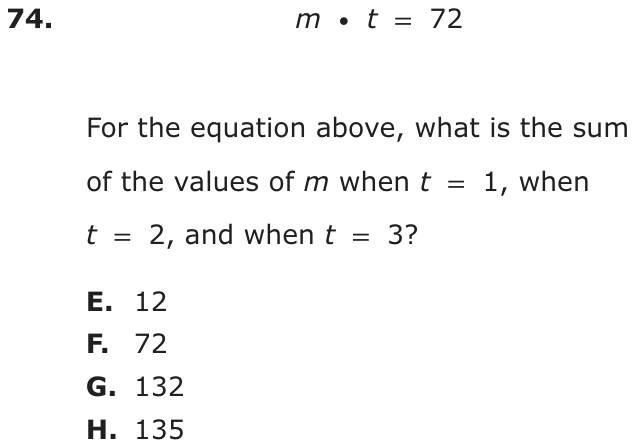
For the equation above, what is the sum of the values of m when , when , and when ?
- A12
- B72
- C132
- D135
Show the answer
Correct answer: C
First, find the value of m for each value of t:
For :
For :
For :
Then, add those three values together:
Question analysis
The equation m • t = 72 links two variables, and the raised dot means multiplication. Students find m when t is 1, 2 and 3, and then add those three values of m. Each value is a one-step division, and the trap is combining the t values before dividing.
- Grade level
- Grade 6 content, by NYS standard
- Compared with grade 7
- Below grade 7 Solving equations like 3m = 72 is grade 6 work. This item repeats that step three times and adds the results, more bookkeeping than difficulty, so it is below typical grade 7 demand.
- Estimated difficulty
- Straightforward: two steps or one careful reading.
- Thinking it demands
- Depth of knowledge 1, recall and reproduction · mainly apply
- What makes it hard
- Turning words into math minor
- Many steps minor
- Solution
- 4 steps
- Reading level
- Question and choices: about grade 7, 21 words.
- Students, last 30 days
- Not enough answers yet to show (it takes 10).
Why it is hard, traps and wrong answers (shows the answer)
Why it is hard
Each value of m comes from one division, so the work is bookkeeping rather than algebra. The trap is structural: adding 1, 2 and 3 first and dividing once feels efficient but answers a different question, since m does not change in step with t. Writing the three values of m in a row before adding them keeps the steps separate.
Turning words into math minor Understanding the question
“The sum of the values of m when t = 1, when t = 2, and when t = 3” asks for three separate solutions added together, not one solution at a combined t. (Hegarty, Mayer & Monk, 1995; Koedinger & Nathan, 2004)
Many steps minor Working it out
Three divisions, 72 ÷ 1, 72 ÷ 2 and 72 ÷ 3, and an addition make four small steps, each easy but each a chance to drop a value. (Daniel & Embretson, 2010; Enright, Morley & Sheehan, 2002)
Strategy: Divide 72 by each value of t in turn to get three separate values of m, then add the three quotients.
Traps
- Misunderstands the concept: A wrong belief about a concept: that percents can be added, that area grows like length, that averages can be averaged, that a bigger denominator means a bigger fraction.
- Numbers taken from the question: Combines the numbers in the question without a model of the situation, or is simply a number that appears in the question.
The wrong answers, classified
A Misunderstands the concept (Smith, diSessa & Roschelle, 1993; De Bock et al., 1998; Ni & Zhou, 2005)
Adds the three t values to get 6 and divides 72 by 6, as if the sum of the m values were m at the sum of the t values.
B Numbers taken from the question (Hegarty, Mayer & Monk, 1995)
Gives back 72, the constant in the equation and the value of m only when t = 1, without the values for t = 2 and t = 3.
D Little reason to choose it (Haladyna & Downing, 1993; Rodriguez, 2005)
No common working gives 135, which is 3 more than the right sum; it would need a slip such as 72 ÷ 3 = 27, so it mostly draws guesses.
Worked solution, step by step
Formulas used
- Division undoes multiplication
- a, b and c are numbers, and b is not 0. If you know a product and one of the numbers that made it, divide to find the other one. For example, 4 × 5 = 20, so 4 = 20 ÷ 5.
Sort out the question
The equation is . The dot means times. You need m three times: when t is 1, when t is 2 and when t is 3. Then add the three values of m.
Get m by itself
Since m times t is 72, m is 72 divided by t.
Now put in each value of t, one at a time.
Find m for each value of t
Each time, divide 72 by the value of t. A table keeps the three answers in order.
Value of t Value of m 1 2 3 Add the three values
Watch out: don’t add the t values first. is choice A, and it is not the same thing. Also, 72 alone is only the first value, choice B. So the answer is C, 132.
Check your answer
Check each pair by multiplying: , and . All three pairs make 72. Then add again: 72 + 36 = 108, and 108 + 24 = 132.
More questions like this
The original DOE question
Question 10 of 18
2023 Test B Math, question 31Question
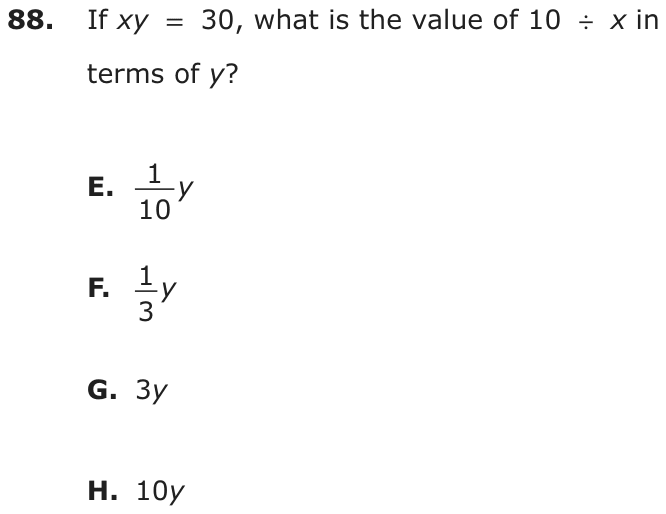
If , what is the value of in terms of y?
- A
- B
- C
- D
Show the answer
Correct answer: B
Solve , the given equation, for x:
Then:
Question analysis
An algebra question: given that x times y equals 30, students express 10 divided by x using only y. It tests solving for one variable and dividing by an algebraic fraction. Working with letters instead of numbers, and dividing in the right order, are what trip students up.
- NYS standards
- Grade level
- Grade 7 content, by NYS standard
- Compared with grade 7
- At grade 7 Grade 7 students rewrite expressions that have numbers and one variable. This one links two variables through their product and asks for a quotient, with no numbers given to check an answer against.
- Estimated difficulty
- Moderate: several steps, or a close reading with one strong distractor.
- Thinking it demands
- Depth of knowledge 1, recall and reproduction · mainly apply
- What makes it hard
- Variables instead of numbers moderate
- Error-prone arithmetic minor
- A very close wrong answer minor
- Solution
- 3 steps
- Reading level
- Question and choices: about grade 7, 16 words.
- Students, last 30 days
- Not enough answers yet to show (it takes 10).
Why it is hard, traps and wrong answers (shows the answer)
Why it is hard
The algebra is three short moves, but each is a place to turn a fraction upside down: solving xy = 30 for x, dividing 10 by that fraction, and reducing 10/30. Students who reach for the bigger-over-smaller division they know from whole numbers land on 3y. Choosing two numbers with a product of 30, such as 3 and 10, and testing every choice settles the question in seconds.
Variables instead of numbers moderate Understanding the question
x and y are tied only by their product, 30, and the answer must be an expression in y, so there is no number to check unless students pick a pair such as x = 3 and y = 10. (Koedinger & Nathan, 2004; Enright, Morley & Sheehan, 2002)
Error-prone arithmetic minor Working it out
Substituting x = 30/y turns 10 ÷ x into 10 divided by a fraction, which must be flipped to 10 × y/30 and then reduced. (Brown & Burton, 1978; Junker & Sijtsma, 2001)
A very close wrong answer minor Choosing the answer
The answer, (1/3)y, and the choice 3y use the same 3, one dividing y and one multiplying it, so a student unsure whether 10 ÷ 30 or 30 ÷ 10 applies sees both. (Embretson & Wetzel, 1987; Gorin & Embretson, 2006; Ascalon et al., 2007)
Strategy: Solve xy = 30 for x, substitute that fraction into 10 ÷ x, and divide by multiplying by its reciprocal; or choose values of x and y with a product of 30 and test each choice.
Traps
- Wrong operation: Adds instead of multiplying, divides the wrong way round, turns a ratio or rate upside down, or undoes a step in the wrong direction (subtracts what should be added back).
- Misunderstands the concept: A wrong belief about a concept: that percents can be added, that area grows like length, that averages can be averaged, that a bigger denominator means a bigger fraction.
- Numbers taken from the question: Combines the numbers in the question without a model of the situation, or is simply a number that appears in the question.
The wrong answers, classified
A Numbers taken from the question (Hegarty, Mayer & Monk, 1995)
Writes the 10 from 10 ÷ x under y as one tenth of y, never using the product xy = 30 to link the two letters.
C Wrong operation (Hegarty, Mayer & Monk, 1995; King et al., 2004)
Replaces x with 30/y correctly but divides 30 by 10 instead of 10 by 30, taking the larger number over the smaller, and gets 3y.
D Misunderstands the concept (Smith, diSessa & Roschelle, 1993; De Bock et al., 1998; Ni & Zhou, 2005)
Treats dividing by x as multiplying by y, as if x and y were reciprocals, though their product is 30, not 1, which gives 10y.
Worked solution, step by step
Formulas used
- Dividing by a fraction
- a is the number you divide. b over c is the fraction you divide by: b is its top and c is its bottom. To divide by a fraction, multiply by its reciprocal, the fraction flipped upside down. For example, 6 ÷ 1/2 = 6 × 2 = 12, because 12 halves fit in 6.
Sort out the question
means x times y. So x times y is 30. You need “in terms of y.” That means your answer can use y and numbers, but no x.
Solve for x
To swap x out, first get x by itself. Divide both sides of by y.
This says x is 30 divided by y.
Put the fraction in place of x
Replace x in with this fraction.
Now use the rule for dividing by a fraction. Flip the fraction and multiply.
Simplify the fraction
Both 10 and 30 can be divided by 10.
Watch out: 10 ÷ 30 is not 3. Dividing the bigger number by the smaller one gives 3y, choice C. Also, dividing by x is not the same as multiplying by y. That only works when xy is 1, not 30. It leads to choice D.
So the answer is B, .
Check your answer
Pick numbers that multiply to 30, like x = 3 and y = 10. Then . Choice B gives . They match. Choice C would give 30, and choice D would give 100.
More questions like this
The original DOE question
Question 11 of 18
2022 Test A Math, question 28Question
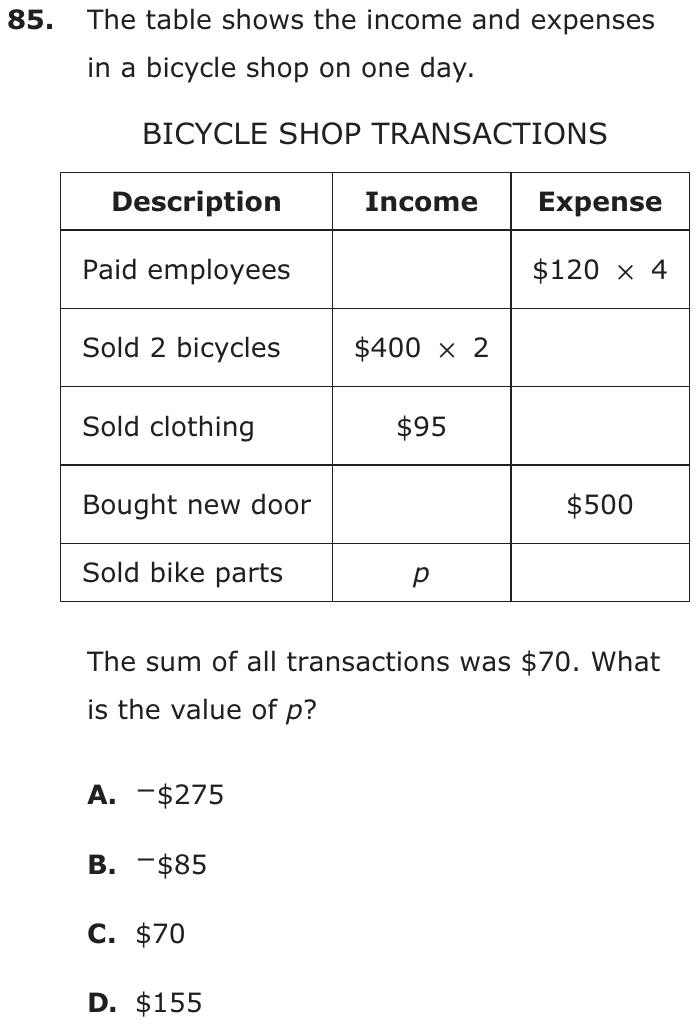
The table shows the income and expenses in a bicycle shop on one day.
BICYCLE SHOP TRANSACTIONS
| Description | Income | Expense |
|---|---|---|
| Paid employees | ||
| Sold 2 bicycles | ||
| Sold clothing | $95 | |
| Bought new door | $500 | |
| Sold bike parts | p |
The sum of all transactions was $70. What is the value of p?
- A−$275
- B−$85
- C$70
- D$155
Show the answer
Correct answer: D
The sum of all transactions ($70) includes the income data (positive values) and the expense data (negative values). Write an equation to determine the value of p by adding all the income data and subtracting all the expense data:
Simplify the expression to determine the value of p:
Question analysis
A table lists one day of income and expenses at a bicycle shop, including two products to work out and an unknown amount, p, from selling bike parts. Given that all the transactions add up to $70, students find p. They must treat income as positive and expenses as negative, then solve an equation.
- Grade level
- Grade 7 content, by NYS standard
- Compared with grade 7
- At grade 7 Grade 7 students solve multi-step money problems with positive and negative amounts. This table adds an unknown income entry, so students treat income as positive and expenses as negative before solving a one-step equation.
- Estimated difficulty
- Moderate: several steps, or a close reading with one strong distractor.
- Thinking it demands
- Depth of knowledge 2, skills and concepts · mainly apply
- What makes it hard
- Turning words into math moderate
- Reading a figure, table or graph minor
- Error-prone arithmetic minor
- Solution
- 4 steps
- Reading level
- Question and choices: about grade 5, 44 words.
- Students, last 30 days
- Not enough answers yet to show (it takes 10).
Why it is hard, traps and wrong answers (shows the answer)
Why it is hard
The table turns a one-variable equation into bookkeeping: each entry must be multiplied out and given a sign by its column before anything is added. The known entries come to a loss of $85, so the bike parts must cover that loss and still leave $70, which is why p is larger than the day's total. Students who stop at the running total, or who copy the $70, never use the equation at all.
Turning words into math moderate Understanding the question
“The sum of all transactions was $70” has to be read with income positive and expenses negative, giving 800 + 95 + p − 480 − 500 = 70. (Hegarty, Mayer & Monk, 1995; Koedinger & Nathan, 2004)
Reading a figure, table or graph minor Understanding the question
Two cells hold products, $120 × 4 and $400 × 2, that must be worked out, and p sits in the Income column beside the sales, so it is added. (Lesh, Post & Behr, 1987; Kirsch & Mosenthal, 1990)
Error-prone arithmetic minor Working it out
The known entries total 895 − 980 = −85, a negative running sum, so p must exceed 70 by 85 rather than fall short of it. (Brown & Burton, 1978; Junker & Sijtsma, 2001)
Strategy: Work out the two products in the table, add the income entries and subtract the expenses, set that total plus p equal to 70, and solve for p.
Traps
- Stops one step early: A choice is a number from partway through the solution.
- Numbers taken from the question: Combines the numbers in the question without a model of the situation, or is simply a number that appears in the question.
The wrong answers, classified
A Little reason to choose it (Haladyna & Downing, 1993; Rodriguez, 2005)
No single mistake gives −275; it takes counting the $95 clothing sale as an expense and then stopping at the known total, 800 − 95 − 480 − 500.
B Stops one step early (King et al., 2004; Gierl et al., 2017)
Totals the known entries correctly, 895 − 980 = −85, and gives that, stopping before solving for the p that brings the sum to $70.
C Numbers taken from the question (Hegarty, Mayer & Monk, 1995)
Picks $70, the stated sum of all the transactions, as the value of the bike parts, without setting up an equation.
Worked solution, step by step
Formulas used
- Sum of all transactions
- A transaction is money coming in or going out. Income is money that comes in, so it counts as plus. Expenses are money that goes out, so they count as minus. The sum is what is left, like money added to and taken from a wallet.
- Keeping an equation balanced
- a and b are the two equal sides. c is any number, but not 0 when you divide. Doing the same thing to both sides keeps them equal, like a balanced scale. Use it to get the unknown by itself.
Sort out the question
The table lists money that came into the shop, called income. It also lists money that went out, called expenses. The bike parts brought in p dollars, an amount you don’t know. All the income minus all the expenses is $70. You need p.
Work out the products in the table
Two cells in the table show multiplication.
So paying the employees cost $480. The 2 bicycles brought in $800.
Write the equation
The income is $800, $95 and p. The expenses are $480 and $500. p sits in the Income column, so it is added.
Combine the known numbers
The known entries come to −85 dollars. That is a loss of $85. Now the equation is shorter:
Watch out: −85 is choice B, but it is not p. You still have to solve for p.
Solve for p
Add 85 to both sides. This keeps the equation balanced.
The bike parts brought in $155. Watch out: $70 is the total for the day, not the bike parts. Don’t just copy it, choice C. So the answer is D, $155.
Check your answer
Put 155 back in. Income: dollars. Expenses: dollars. . That matches. And p should be more than 70, because the bike parts had to cover the $85 loss first.
More questions like this
The original DOE question
Question 12 of 18
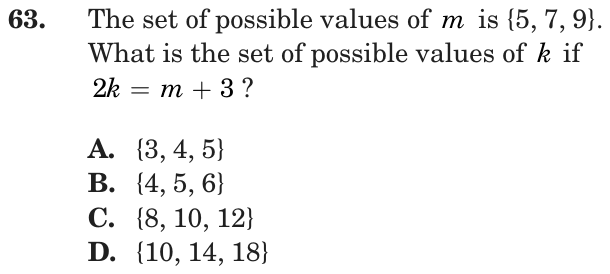
2018 Test A Math, question 6Question
The set of possible values of is . What is the set of possible values of if ?
- A
- B
- C
- D
Show the answer
Correct answer: B
so
Substitute each value of m to find the values of k:
The set k is { 4, 5, 6}.
Question analysis
An algebra question about substitution: m can be 5, 7 or 9, and an equation links k to m. Students find every possible value of k by substituting each value of m and solving. The curly-brace set notation can look unfamiliar, and each value has to be carried all the way through the solve.
- Grade level
- Grade 6 content, by NYS standard
- Compared with grade 7
- At grade 7 Each substitution leads to a one-step grade 6 equation, easier than a typical grade 7 two-step problem. What adds demand is doing it three times and reading the answer as a set of values, which grade 7 rarely uses.
- Estimated difficulty
- Straightforward: two steps or one careful reading.
- Thinking it demands
- Depth of knowledge 1, recall and reproduction · mainly apply
- What makes it hard
- Solution
- 2 steps
- Reading level
- Question and choices: about grade 9, 24 words.
- Students, last 30 days
- Not enough answers yet to show (it takes 10).
Why it is hard, traps and wrong answers (shows the answer)
Why it is hard
The equation is simple, and the main hazard is stopping one step short: m + 3 gives 8, 10 and 12, a listed choice even though those are values of 2k. Checking a single value of m is the other risk, since k = 4 and k = 5 both appear in the first two sets. Students who substitute all three values and halve each result finish quickly.
Variables instead of numbers minor Understanding the question
There is no single unknown: m stands for the set {5, 7, 9}, and the answer is the matching set for k, so the equation has to be applied to three values. (Koedinger & Nathan, 2004; Enright, Morley & Sheehan, 2002)
Strategy: Rewrite the equation so k equals m plus 3, all divided by 2, then evaluate it for each of the three values of m.
Traps
- Stops one step early: A choice is a number from partway through the solution.
The wrong answers, classified
A Checks only one number (Schoenfeld, 1985)
Checks only m = 5, gets k = 4, and takes the first set containing 4; m = 9, giving k = 6, would rule it out.
C Stops one step early (King et al., 2004; Gierl et al., 2017)
Adds 3 to each value of m to get 8, 10 and 12, which are the values of 2k, and forgets to divide by 2.
D Wrong operation (Hegarty, Mayer & Monk, 1995; King et al., 2004)
Doubles each value of m to get 10, 14 and 18, moving the 2 onto m instead of dividing by it, and drops the + 3.
Worked solution, step by step
Formulas used
- Getting k by itself
- k and m are the letters from the equation 2k = m + 3. The fraction bar means divide. If 2 times k equals m + 3, then k is half of m + 3. You get this by dividing both sides of the equation by 2.
Sort out the question
The letter m can be 5, 7 or 9. The curly braces { } show a set, which is a list of numbers. The equation links k to m. You need every value k can have, one for each value of m.
Get k by itself
2k means 2 times k. To undo times 2, divide both sides by 2. Doing the same thing to both sides keeps the equation true.
Try each value of m
Put each value of m into the formula. Add 3 first, then divide by 2.
Watch out: 8, 10 and 12 are the values of m + 3, which equal 2k, not k. Stopping before you divide by 2 gives choice C.
Pick the matching set
The values of k are 4, 5 and 6. Watch out: try all three values of m. If you only try m = 5, you get k = 4, and choice A has a 4 too. So the answer is B, {4, 5, 6}.
Check your answer
Put each k back into the equation. . . . All three work, so the set is right.
More questions like this
The original DOE question
Question 13 of 18
2018 Test A Math, question 43Question
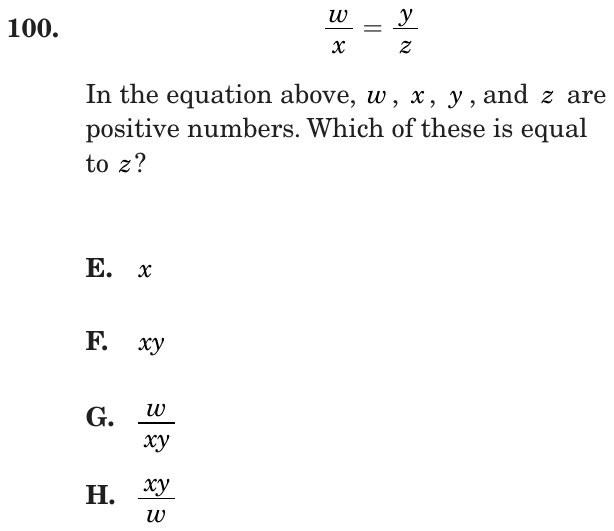
In the equation above, , and are positive numbers. Which of these is equal to ?
- A
- B
- C
- D
Show the answer
Correct answer: D
Solve the equation for :
Question analysis
This algebra question gives the proportion w/x = y/z, with all four letters positive, and asks which expression equals z. Students must solve the equation for one letter in terms of the others. With only letters on the page, it is easy to multiply when you should divide or to stop one step early.
- Grade level
- Grade 8 content, by NYS standard
- Compared with grade 7
- Above grade 7 Grade 7 students cross-multiply numeric proportions such as 3/4 = 9/x. Solving a proportion made only of letters for one of them is a literal equation, a grade 8 algebra skill, though it takes just two steps.
- Estimated difficulty
- Straightforward: two steps or one careful reading.
- Thinking it demands
- Depth of knowledge 1, recall and reproduction · mainly apply
- What makes it hard
- Variables instead of numbers moderate
- A very close wrong answer moderate
- Solution
- 2 steps
- Reading level
- Question and choices: about grade 10, 22 words.
- Students, last 30 days
- Not enough answers yet to show (it takes 10).
Why it is hard, traps and wrong answers (shows the answer)
Why it is hard
The method, cross-multiply and divide, is the same one students use on numeric proportions, but letters hide whether each step went the right way. The two most attractive wrong choices are both one step from the answer: one never divides, and the other divides upside down. A quick check with 2/3 = 4/6, where z = 6, settles it.
Variables instead of numbers moderate Understanding the question
The proportion has only letters, so cross-multiplying to wz = xy and dividing by w must be done without numbers to show whether w goes on top or bottom. (Koedinger & Nathan, 2004; Enright, Morley & Sheehan, 2002)
A very close wrong answer moderate Choosing the answer
The choices w/(xy) and xy/w use the same three letters with the fraction turned over, so only dividing in the right direction after wz = xy separates them. (Embretson & Wetzel, 1987; Gorin & Embretson, 2006; Ascalon et al., 2007)
Strategy: Cross-multiply to clear both fractions, then divide both sides by whatever multiplies z; check with a true proportion such as 2/3 = 4/6.
Traps
- Wrong operation: Adds instead of multiplying, divides the wrong way round, turns a ratio or rate upside down, or undoes a step in the wrong direction (subtracts what should be added back).
- Stops one step early: A choice is a number from partway through the solution.
The wrong answers, classified
A Numbers taken from the question (Hegarty, Mayer & Monk, 1995)
Matches z with x because both sit in a denominator, picking a letter from the equation without solving for z.
B Stops one step early (King et al., 2004; Gierl et al., 2017)
Cross-multiplies to wz = xy but stops there, giving xy without dividing both sides by w.
C Wrong operation (Hegarty, Mayer & Monk, 1995; King et al., 2004)
Cross-multiplies correctly but divides the wrong way round, putting w over xy instead of xy over w.
Worked solution, step by step
Formulas used
- Cross-multiplying
- a, b, c and d are numbers that are not 0. When two fractions are equal, each top times the other bottom gives the same answer. It works because you multiply both sides by both bottoms, which clears the fractions.
Sort out what you need
The equation says w over x equals y over z. All four letters are positive numbers. You need to get z alone on one side. Then the other side shows what z equals.
Cross-multiply the fractions
Multiply each top by the other fraction’s bottom:
So wz = xy, and z is no longer on the bottom. Watch out: stopping here and picking xy gives choice B. z is not alone yet.
Get z alone
z is being multiplied by w. To undo that, divide both sides by w. Doing the same to both sides keeps them equal:
Watch out: dividing the wrong way round gives w over xy, choice C. So the answer is D, .
Check your answer
Use a true pair of equal fractions: 2/3 = 4/6. So w = 2, x = 3, y = 4 and z = 6. Choice D gives 3 × 4 ÷ 2 = 6, which is z. Choice C gives 2 ÷ 12, which is not 6.
More questions like this
The original DOE question
Question 14 of 18
2018 Test B Math, question 8Question
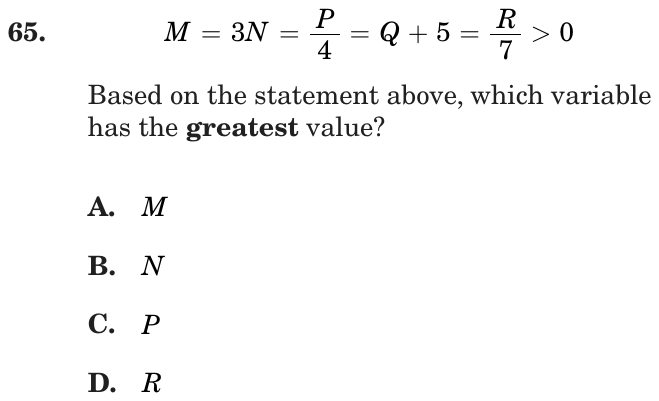
Based on the statement above, which variable has the greatest value?
- A
- B
- C
- D
Show the answer
Correct answer: D
Break the equations apart to each equal :
Pick a number to substitute into the equations, and solve the equations to find the values of , , , , and .
Let . Since all the equations are equal to 2, substitute 2 to find each variable.
Variable has the greatest value.
Question analysis
This algebra question sets five expressions equal to one another and to a positive number, then asks which variable has the greatest value. It tests whether students can rewrite each variable in terms of one shared value and compare them. What makes it tricky is that there are no numbers to compute, so each variable's size has to be reasoned out.
- Grade level
- Grade 7 content, by NYS standard
- Compared with grade 7
- Above grade 7 Grade 7 students rewrite expressions to see how quantities relate, usually one equation at a time. This chain of five linked expressions, with no numbers to compute and a positivity condition to use, is a reasoning task beyond routine grade 7 work.
- Estimated difficulty
- Hard: combines ideas, needs a plan, and has more than one tempting wrong answer.
- Thinking it demands
- Depth of knowledge 3, strategic thinking · mainly analyze
- What makes it hard
- Variables instead of numbers major
- No obvious method moderate
- Much to keep track of minor
- Solution
- 3 steps
- Reading level
- Question and choices: about grade 10, 16 words.
- Students, last 30 days
- Not enough answers yet to show (it takes 10).
Why it is hard, traps and wrong answers (shows the answer)
Why it is hard
The question rewards a strategy, not a calculation: once the shared value is named, each variable follows in one line and R is clearly largest. Without that step, students judge by how the expressions look, and the look is backwards, since the 3 in 3N makes N small and the 7 under R makes R large. The positivity condition at the end is easy to skip but is what fixes the order.
Variables instead of numbers major Understanding the question
There are no numbers to compute: five variables are tied together in the one chain M = 3N = P/4 = Q + 5 = R/7, and each must be compared through the shared value. (Koedinger & Nathan, 2004; Enright, Morley & Sheehan, 2002)
No obvious method moderate Working it out
Nothing says how to compare; the efficient move is to name the common value, or pick one such as 12, and rewrite each variable, which students must think of themselves. (Schoenfeld, 1985)
Much to keep track of minor Working it out
Five relations and the condition > 0 must be held at once; the condition matters, since with a negative common value the order of M, N, P and R would reverse. (Sweller, 1988; Carpenter, Just & Shell, 1990)
Strategy: Call the shared value k, a positive number, and rewrite each variable as an expression in k; or substitute a convenient positive value such as 12 and compare the results.
Traps
- Equation written backwards: Writes a comparison the wrong way round, word for word: "six times as many students as professors" as 6S = P. The bigger quantity gets the bigger number.
The wrong answers, classified
A Equation written backwards (Clement, Lochhead & Monk, 1981)
Reads P/4 and R/7 as a quarter and a seventh of M, the reverse of the truth, so M looks largest of all.
B Equation written backwards (Clement, Lochhead & Monk, 1981)
Reads the 3 in 3N as making N three times as large, when 3N = M actually makes N one third of M.
C Stops one step early (King et al., 2004; Gierl et al., 2017)
Correctly sees that P is four times M but stops there without checking R, which at seven times M is larger.
Worked solution, step by step
Formulas used
- Undoing division
- a is the top of the fraction, b is the bottom, and c is the result. Multiplying undoes dividing. So if a divided by b is c, then a is b times c.
- Undoing multiplication
- b is the number multiplied by a, and c is the result. Dividing undoes multiplying. So to get a alone, divide c by b.
Understand the chain
The statement is a chain of equal signs. It says five expressions all have the same value. The last part says that value is greater than 0, so it is positive.
You need to find which letter has the largest value.
Pick a value to test
All five expressions are equal, so give them one shared value. Pick a positive number that 3 divides evenly. That way N will be a whole number.
Let the shared value be 12. Then , and each of the other four expressions also equals 12.
Solve for each letter
Undo each operation to find each letter. Divide to undo times. Multiply to undo divide. Subtract to undo plus.
Compare the values
The values are M = 12, N = 4, P = 48, Q = 7 and R = 84. R is the largest.
Watch out: 3N does not make N big. It means 3 times N equals M, so N is only one third of M. That trap points to choice B. Also, P is big, but R is bigger. Check every letter before you pick choice C.
So the answer is D, R.
Check your answer
Think without numbers. R divided by 7 is M, so R is 7 times M. P is only 4 times M. N is a third of M, and Q is 5 less than M. Since M is positive, 7 times M is the biggest.
More questions like this
The original DOE question
Question 15 of 18
2018 Test B Math, question 20Question
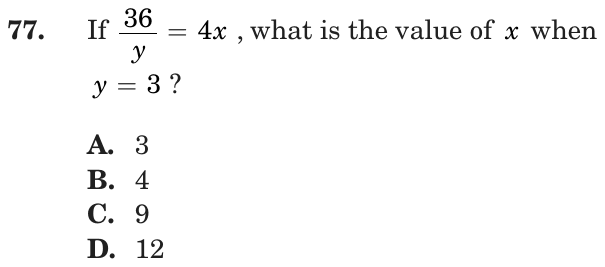
If , what is the value of when ?
- A3
- B4
- C9
- D12
Show the answer
Correct answer: A
Substitute 3 for and solve for :
Question analysis
This equation question gives 36 divided by y equal to 4x and asks for the value of x at one given value of y. Students substitute, simplify the fraction and solve a one-step equation. It is short, so the risk lies in stopping one step early or dividing by the wrong number.
- Grade level
- Grade 6 content, by NYS standard
- Compared with grade 7
- Below grade 7 Substituting a value and solving a one-step equation are grade 6 skills. With two quick steps and whole numbers, this is lighter than the multistep equations typical of grade 7.
- Estimated difficulty
- Routine: one familiar step, little to misread.
- Thinking it demands
- Depth of knowledge 1, recall and reproduction · mainly apply
- What makes it hard
- Solution
- 2 steps
- Reading level
- Question and choices: about grade 8, 10 words.
- Students, last 30 days
- Not enough answers yet to show (it takes 10).
Why it is hard, traps and wrong answers (shows the answer)
Why it is hard
This is substitution followed by a one-step equation, with small whole numbers throughout, so most students answer correctly. The only real risk is stopping at 12, which is the value of 4x rather than of x. Writing 12 = 4x as its own line before reading the choices makes the last division hard to skip.
Variables instead of numbers minor Understanding the question
The variable y sits in a denominator, 36/y, which looks less familiar than an equation in one unknown, though substituting y = 3 removes it at once. (Koedinger & Nathan, 2004; Enright, Morley & Sheehan, 2002)
Strategy: Replace y with its value, simplify the left side to a single number, and then divide by the coefficient of x.
Traps
- Stops one step early: A choice is a number from partway through the solution.
The wrong answers, classified
B Numbers taken from the question (Hegarty, Mayer & Monk, 1995)
Picks the coefficient 4 from 4x, a number that appears in the equation, without solving for x.
C Stops one step early (King et al., 2004; Gierl et al., 2017)
Clears the fraction to get 36 = 4xy, divides by 4 to reach xy = 9, and stops before dividing by y.
D Stops one step early (King et al., 2004; Gierl et al., 2017)
Substitutes y = 3 to get 36/3 = 12, which is the value of 4x, and stops before dividing by 4.
Worked solution, step by step
Formulas used
- Undoing multiplication
- a is the number multiplied by x, and b is the result. Division undoes multiplication. So to get x alone, divide both sides by a.
Write down what you know
The equation is . You are told y = 3. You need the value of x.
The letter y is on the bottom of a fraction. Putting in its value turns the fraction into a plain number.
Put in the value of y
Replace y with 3.
The fraction means 36 divided by 3, which is 12.
Watch out: 12 is the value of 4x, not x. Stopping here gives choice D.
Divide both sides by 4
4x means 4 times x. To undo multiplying by 4, divide both sides by 4.
So the answer is A, 3.
Check your answer
Put x = 3 and y = 3 back in. The left side is . The right side is . Both sides match, so x = 3 is right.
More questions like this
The original DOE question
Question 16 of 18
2018 Test B Math, question 27Question
Nicole’s age now is three times Carmen’s age. If Carmen will be 17 in two years, how old was Nicole 5 years ago?
- A38 yr
- B40 yr
- C45 yr
- D50 yr
Show the answer
Correct answer: B
First, find out how old Nicole and Carmen are now.
Let = Nicole’s age now. Let = Carmen’s age now.
(Carmen’s age now)
(Nicole’s age now)
(Nicole’s age 5 years ago)
Question analysis
This age word problem says Nicole is three times as old as Carmen now, and that Carmen will be 17 in two years. Students work out both present ages and then go back five years for Nicole. Keeping the times straight is the tricky part: two years ahead for Carmen, five years back for Nicole.
- Grade level
- Grade 7 content, by NYS standard
- Compared with grade 7
- At grade 7 Grade 7 students write simple equations from word problems. Age problems like this one take three short steps, and the shifts in time are the only real hurdle, so the demand is typical of grade 7.
- Estimated difficulty
- Straightforward: two steps or one careful reading.
- Thinking it demands
- Depth of knowledge 2, skills and concepts · mainly apply
- What makes it hard
- Turning words into math moderate
- Much to keep track of minor
- Solution
- 3 steps
- Reading level
- Question and choices: about grade 1, 25 words.
- Students, last 30 days
- Not enough answers yet to show (it takes 10).
Why it is hard, traps and wrong answers (shows the answer)
Why it is hard
The arithmetic is short, but the question moves through three points in time, and only one of them carries the three-times relationship. Students who find Nicole's present age often stop there, since it is a choice. Labeling each age with its time, now or then, keeps the two-year and five-year shifts with the right person and in the right direction.
Turning words into math moderate Understanding the question
Three points in time appear, now, in two years and 5 years ago, and “three times Carmen's age” holds only for now, so each shift must be applied to the right person. (Hegarty, Mayer & Monk, 1995; Koedinger & Nathan, 2004)
Much to keep track of minor Working it out
Students must hold Carmen's future age 17, her present age 15, Nicole's present age 45 and the 5-year shift while deciding which to report. (Sweller, 1988; Carpenter, Just & Shell, 1990)
Strategy: Find Carmen's age now by going back two years from 17, triple it for Nicole's current age, then subtract five.
Traps
- Stops one step early: A choice is a number from partway through the solution.
- Negatives and direction: Arithmetic with negative numbers, the order of a subtraction, or direction on a number line. (Moving a term across the equals sign without changing its sign is a faulty procedure.)
The wrong answers, classified
A Misreads the question (Hegarty, Mayer & Monk, 1995)
Applies the two-year shift to Nicole as well, subtracting both 2 and 5 from her present age of 45.
C Stops one step early (King et al., 2004; Gierl et al., 2017)
Finds Nicole's present age, three times 15, and stops before going back 5 years.
D Negatives and direction (Brown & Burton, 1978)
Adds 5 years to Nicole's present age instead of subtracting, giving her age 5 years from now.
Worked solution, step by step
Formulas used
- Age at another time
- n is a number of years. To find an age in the future, add n to the age now. To find an age in the past, subtract n instead. Everyone gets older at the same speed, one year per year.
Sort out the times
The question talks about three times: now, two years from now, and 5 years ago. Nicole is 3 times as old as Carmen now.
Carmen will be 17 in two years. You need Nicole’s age 5 years ago.
Find Carmen's age now
In two years Carmen will be 17. So right now she is 2 years younger.
Carmen is 15 now.
Find Nicole's age now
Nicole’s age now is three times Carmen’s age now.
Nicole is 45 now.
Watch out: 45 is her age now, choice C. The question asks about 5 years ago.
Go back 5 years
Going back in time means subtracting.
Nicole was 40 five years ago.
Watch out: Adding 5 gives 50, choice D. Also, the 2 years only apply to Carmen. Taking 2 more years off Nicole gives 38, choice A.
So the answer is B, 40 yr.
Check your answer
Work forward from your answer. Nicole was 40 five years ago, so she is 45 now. Carmen is a third of that, 15. In two years Carmen will be 17. That matches the question.
More questions like this
The original DOE question
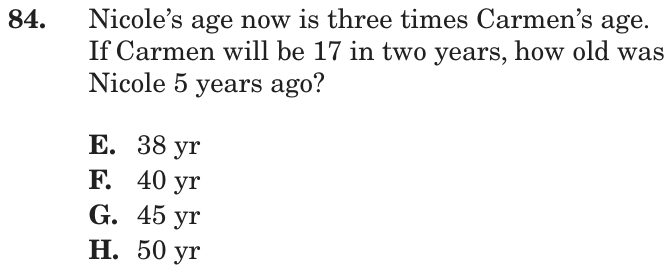
Question 17 of 18
2018 Test B Math, question 51Question
In the equation above, what is the value of ?
- A
- B
- C
- D
Show the answer
Correct answer: C
Question analysis
Students solve a proportion that sets 14/21 equal to a fraction with an unknown numerator p over 7. It tests solving a proportion, either by cross-multiplying or by dividing numerator and denominator by the same factor. It is quick, and the main risk is losing track of what p stands for.
- Grade level
- Grade 6 content, by NYS standard
- Compared with grade 7
- Below grade 7 Solving a one-step proportion is grade 6 and 7 ratio work. This one is purely numerical with one or two steps, shorter than the multistep ratio word problems typical of grade 7.
- Estimated difficulty
- Straightforward: two steps or one careful reading.
- Thinking it demands
- Depth of knowledge 1, recall and reproduction · mainly apply
- What makes it hard
- An answer in an unexpected form moderate
- Error-prone arithmetic minor
- Solution
- 2 steps
- Reading level
- Question and choices: about grade 10, 15 words.
- Students, last 30 days
- Not enough answers yet to show (it takes 10).
Why it is hard, traps and wrong answers (shows the answer)
Why it is hard
The method is standard, but the result is not a whole number, and that surprises students who expect the numbers in a proportion to scale evenly. Two intermediate values, the ratio 2/3 and the scale factor 3, appear among the choices. Students who finish the computation and trust a fractional answer get it right.
An answer in an unexpected form moderate Choosing the answer
The answer is the improper fraction 14/3, not a whole number, so students who expect a tidy proportion distrust their result or reach for the factor 3. (Enright, Morley & Sheehan, 2002)
Error-prone arithmetic minor Working it out
Cross-multiplying gives 21p = 98, and 98/21 must be reduced by 7; simplifying 14/21 to 2/3 first and multiplying by 7 is quicker. (Brown & Burton, 1978; Junker & Sijtsma, 2001)
Strategy: Cross-multiply to form an equation in p, divide both sides by p's coefficient, and simplify the fraction you get.
Traps
- Stops one step early: A choice is a number from partway through the solution.
- Answers a different question: A choice is right for another quantity: the other unknown, the rest instead of the part, the part instead of the whole.
The wrong answers, classified
A Stops one step early (King et al., 2004; Gierl et al., 2017)
Simplifies 14/21 to 2/3 and stops, giving the value of the ratio instead of the numerator p over 7.
B Answers a different question (King et al., 2004; Hegarty, Mayer & Monk, 1995)
Notices that 21 is 3 times 7 and gives that scale factor as p instead of dividing 14 by it.
D Numbers taken from the question (Hegarty, Mayer & Monk, 1995)
Copies the left numerator, 14, as if equivalent fractions kept the same numerator when the denominator changes.
Worked solution, step by step
Formulas used
- Cross multiplication
- a and c are the top numbers. b and d are the bottom numbers. When two fractions are equal, the top of each times the bottom of the other gives the same answer. It works because you multiply both sides by b and by d.
Sort out the question
Two fractions are equal: and . An equation like this, with two equal fractions, is called a proportion. You need the value of .
Cross multiply
Use cross multiplication. This gets rid of the fractions. Multiply 21 by , and multiply 14 by 7.
Divide to find p
Divide both sides by 21 to get alone.
Both 98 and 21 can be divided by 7.
Make sense of the fraction
The answer is , which is . It is not a whole number, and that is fine.
Watch out: is the value of , not . That is choice A. The 3 is what 21 was divided by to get 7. That gives choice B.
Give the answer
The top number over 7 must be to keep the two fractions equal. So the answer is C, .
Check your answer
Think about the bottoms. 7 is one third of 21. So must be one third of 14, which is . Check it: . Both ways agree.
More questions like this
The original DOE question
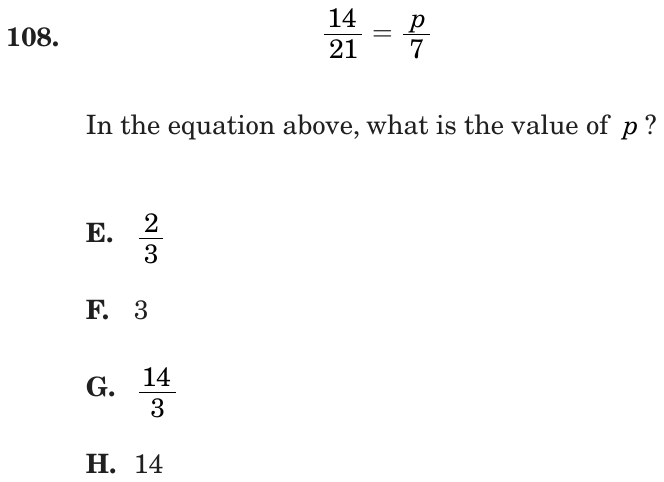
Question 18 of 18
2018 Test B Math, question 56Question
There are now cans stacked on a shelf that holds 36 cans when full. If 4 of these cans were removed, the shelf would be half full. What is the value of ?
- A14
- B16
- C18
- D22
Show the answer
Correct answer: D
The shelf, when full, holds 36 cans. When the shelf is half full, it holds 18 cans.
x − 4 = 18
x = 22
Question analysis
A shelf holds 36 cans when full, and removing 4 of the cans now on it would leave it half full. Students find how many cans are on the shelf now. It tests writing and solving a one-step equation from words, and the risk is undoing the removal in the wrong direction.
- NYS standards
- 6.EE.7 one-step equations
- Grade level
- Grade 6 content, by NYS standard
- Compared with grade 7
- Below grade 7 Grade 6 students solve equations like x − p = q, and this one needs only that and halving 36. It is a quick, routine word problem, easier than the two-step equations typical of grade 7.
- Estimated difficulty
- Routine: one familiar step, little to misread.
- Thinking it demands
- Depth of knowledge 2, skills and concepts · mainly apply
- What makes it hard
- Turning words into math minor
- A very close wrong answer minor
- Solution
- 2 steps
- Reading level
- Question and choices: about grade 3, 32 words.
- Students, last 30 days
- Not enough answers yet to show (it takes 10).
Why it is hard, traps and wrong answers (shows the answer)
Why it is hard
Short and routine, this question still punishes a quick reading. Students must keep three amounts apart, the 36-can capacity, the 18 cans on a half-full shelf and the x cans there now, and then undo the removal by adding. Writing x − 4 = 18 before computing prevents every wrong choice.
Turning words into math minor Understanding the question
The 36 cans are the shelf's capacity, not its contents, and "if 4 of these cans were removed" describes a hypothetical, so the equation is x − 4 = 18. (Hegarty, Mayer & Monk, 1995; Koedinger & Nathan, 2004)
A very close wrong answer minor Choosing the answer
18 sits just below the right 22, and both are near half of 36; only remembering that x counts the cans before the 4 were removed separates them. (Embretson & Wetzel, 1987; Gorin & Embretson, 2006; Ascalon et al., 2007)
Strategy: Work out how many cans make a half-full shelf, then undo the removal of the 4 cans; write it as an equation in x if that helps.
Traps
- Stops one step early: A choice is a number from partway through the solution.
- Follows a key word: Picks the operation from a single word rather than the situation: "removed" so subtract, "of" so multiply, "more" so add, when the situation needs something else.
The wrong answers, classified
A Follows a key word (Hegarty, Mayer & Monk, 1995)
Halves 36 to get 18 and then subtracts the 4 removed cans, following the word removed, instead of adding them back to undo it.
B Misreads the question (Hegarty, Mayer & Monk, 1995)
Reads the 36 cans as what is on the shelf now, removes 4 to get 32, and halves that to 16.
C Stops one step early (King et al., 2004; Gierl et al., 2017)
Finds the 18 cans on a half-full shelf and stops, forgetting that x counts the cans before the 4 were removed.
Worked solution, step by step
Formulas used
- Undoing subtraction
- x is the number you want. a is the amount taken away, and b is what is left. To undo taking away a, add a back. Adding the same number to both sides keeps the equation balanced.
Sort out what you know
The shelf holds 36 cans when it is full. That is its size, not how many cans are on it now. Right now it has cans. If 4 cans were taken off, the shelf would be half full. You need .
Find half of a full shelf
A full shelf holds 36 cans, so half full is half of that.
A half-full shelf has 18 cans.
Write an equation
Taking 4 cans away from leaves 18 cans.
Watch out: 18 is the number after the cans are taken off. Picking 18 gives choice C.
Add the 4 cans back
Undo the subtraction by adding 4 to both sides.
Watch out: subtracting the 4 again gives , choice A. The cans were taken from , so is more than 18.
Give the answer
There are 22 cans on the shelf now, before any are taken off. So the answer is D, 22.
Check your answer
Start with 22 cans and take off 4. That leaves cans. Half of 36 is 18, so the shelf is half full. The answer works.
More questions like this
The original DOE question