3 English and 3 math
Here are 6 random questions to try. Takers earning below 75% are unlikely to receive an offer. You have 1 minute 48 seconds per question on the real exam.
Question 1 of 6
2026 Practice Test A English, question 33Passage Excerpt from “The Spirit of the Herd”
Excerpt from “The Spirit of the Herd”
by Dallas Lore Sharp
In this excerpt, published in 1914, author and professor Dallas Lore Sharp describes a summer cattle roundup in Oregon. The heat and dust had been relentless for three days. The cowboys were exhausted, and the cattle were restless. The ranch boss, Wade, had led the drive to a watering place, only to find it empty.
Along with the wagon had come the fresh horses—one of them being Peroxide Jim, a supple, powerful, clean-limbed buckskin, a horse, I think, that had as fine and intelligent an animal-face as any creature I ever saw. Wade had been saving this horse for emergency work. And why should he not have been saved fresh for just such a need as this? Are there not superior horses as well as superior men—a Peroxide Jim to complement a Wade?
The horse knew the cattle business and knew his rider perfectly; and though there was nothing like sentiment about the boss of the P Ranch riders, his faith in Peroxide Jim was complete. . . .
The desert, where the herd was camped, was one of the highest of a series of tablelands, or benches; it lay as level as a floor, rimmed by sheer rock, from which there was a drop to the bench of sage below. The herd when overtaken by the dusk had been headed for a pass descending to the next lower bench, but was now halted within a mile of the rim rock on the east, where there was a perpendicular fall of about three hundred feet. . . .
In the taut silence of the stirless desert night, with the tension of the herd at the snapping-point, any quick, unwonted sight or sound would stampede them. The sneezing of a horse, the flare of a match, would be enough to send the whole four thousand headlong—blind, frenzied, trampling—till spent and scattered over the plain.
And so, as he rode, Wade began to sing. The rider ahead of him took up the air and passed it on until, above the stepping stir of the hoofs rose the faint voices of the men, and all the herd was bound about by the slow plaintive measures of some old song. It was not to soothe their savage breasts that the riders sang to the cattle, but rather to preempt the dreaded silence, to relieve the tension, and so to prevent the shock of any sudden startling noise.
So they sang and rode and the night wore on to one o’clock, when Wade, coming up on the rim-rock side, felt a cool breeze fan his face, and caught a breath of fresh, moist wind with the taste of water in it.
He checked his horse instantly, listening as the wind swept past him over the cattle. But they must already have smelled it, for they had ceased their milling, the whole herd standing motionless, the indistinct forms close to him in the dark showing their bald faces lifted to drink the sweet wet breath that came over the rim. Then they started on again, but faster, and with a rumbling now from their hoarse throats that tightened Wade’s grip on the reins.
The sound seemed to come out of the earth, a low, rumbling mumble, as dark as the night and as wide as the plain, a thick, inarticulate bellow that stood every rider stiff in his stirrups. . . .
Then the breeze caught the dust and carried it back from the gray-coated, ghostly shapes, and Wade saw that the animals were still moving in a circle. He must keep them going. He touched his horse to ride on with them, when across the black sky flashed a vivid streak of lightning.
There was a snort from the steers, a quick clap of horns and hoofs from far within the herd, a tremor of the plain, a roar, a surging mass—and Wade was riding the flank of a wild stampede. Before him, behind him, beside him, pressing hard upon his horse, galloped the frenzied steers, and beyond them a multitude borne on, and bearing him on, by the heave of the galloping herd.
Wade was riding for his life. He knew it. His horse knew it. He was riding to turn the herd, too, back from the rim, as the horse also knew. The cattle were after water—water-mad—ready to go over the precipice to get it, carrying horse and rider with them. Wade was the only rider between the herd and the rim. It was black as death. He could see nothing in the sage, could scarcely discern the pounding, panting shadows at his side. He knew that he was being borne toward the rim, how fast he could not tell, but he knew by the swish of the brush against his tapaderos and the plunging of the horse that the ground was growing stonier, that they were nearing the rocks.
To outrun the herd was his only chance for life. If he could come up with the leaders he might not only escape, but even stand a chance of heading them off upon the plain and saving the herd. There were cattle still ahead of him; how many, what part of them all, he could not make out in the dark. But the horse knew. The reins hung on his straight neck, where his rider had dropped them, as, yelling and firing over the wild herd, he had given this horse the race to win, to lose.
They were riding the rim. Close on their left bore down the flank of the herd, and on their right, under their very feet, was a precipice, so close that they felt its blackness—its three hundred feet of fall! . . .
. . . Then Wade found himself racing neck and neck with a big white steer, which the horse, with marvelous instinct, seemed to pick out from a bunch, and to cling to, forcing him gradually ahead, till, cutting him free from the bunch entirely, he bore him off into the swishing sage.
The steers coming on close behind followed their leader, and in, after them, swung others. The tide was turning from the rim. More and more were veering, and within a short time the whole herd, bearing off from the cliffs, was pounding over the open plains.
Whose race was it? It was Peroxide Jim’s, according to Wade, for not by word or by touch of hand or knee had the horse been directed in the run. From the flash of the lightning the horse had taken the bit, had covered an indescribably perilous path at top speed, had outrun the herd and turned it from the edge of the rim rock, without a false step or a tremor of fear.
From “The Spirit of the Herd” by Dallas Lore Sharp—Public Domain
tablelands: plateaus, flat areas of land sharply elevated from the surrounding area
tapaderos: leather covers for stirrups
Question
Read these sentences from the excerpt.
He was riding to turn the herd, too, back from the rim, as the horse also knew. (paragraph 11)
It was Peroxide Jim’s, according to Wade, for not by word or by touch of hand or knee had the horse been directed in the run. (paragraph 16)
How do these sentences develop a central idea in the excerpt?
- AThey suggest that Wade would have been unable to save the herd without Peroxide Jim.
- BThey imply that Wade spent many hours training Peroxide Jim to herd cattle.
- CThey show that Peroxide Jim was able to understand a situation and take action.
- DThey indicate that Peroxide Jim was unafraid of the dangers presented by the stampede and the cliff.
Show the answer
Correct answer: C
The question asks how the sentences from paragraph 11 and paragraph 16 develop a central idea in the excerpt.
A. Incorrect. While Peroxide Jim’s presence was critical to saving the herd, the details in paragraph 11 and paragraph 16 do not focus on this idea. The primary idea is that the horse was so intelligent and aware that he acted on his own.
B. Incorrect. The excerpt does not tell who trained Peroxide Jim. It can be inferred that Peroxide Jim had been well trained and was knowledgeable of working cattle; however, there is no indication that Wade was the person who trained Peroxide Jim, only that Wade knew of Peroxide Jim’s abilities, respected the skilled horse, and was “saving this horse for emergency work” (paragraph 1). Because the reader cannot infer from the excerpt that Wade was the trainer, this idea cannot be considered central to the excerpt.
C. CORRECT. Wade recognized that Peroxide Jim knew to turn the herd without any instruction from him. Throughout the excerpt, Wade exhibited confidence in his horse, Peroxide Jim. For example, the narrator says that Wade’s “faith in Peroxide Jim was complete” in paragraph 2. After Wade let go of the reins (paragraph 12), the horse took over, doing exactly what needed to be done to save Wade, the herd, and himself: “a big white steer, which the horse, with marvelous instinct, seemed to pick out from a bunch, and to cling to, forcing him gradually ahead, till, cutting him free from the bunch entirely, he bore him off into the swishing sage” (paragraph 14).
D. Incorrect. The sentence from paragraph 11 and the sentence from paragraph 16 show that Peroxide Jim acted skillfully and with the knowledge that the ride was dangerous (“Wade was riding for his life. He knew it. His horse knew it” [paragraph 11]). Neither sentence indicates whether Peroxide Jim was afraid. The excerpt does say, later in paragraph 16, that the horse turned the herd “without a false step or a tremor of fear,” but these two sentences focus on his awareness of the danger and his ability to act on his own, not on his lack of fear.
Question analysis
This question quotes two sentences from “The Spirit of the Herd,” one from the middle of the stampede and one from its end, and asks how together they develop a central idea of the excerpt. Students must see what the two sentences share and connect it to the story as a whole. Each choice sounds reasonable for this story, which makes the exact wording of the two sentences decisive.
- Grade level
- Grade 8 reading and task
- Compared with grade 7
- Above grade 7 Grade 7 central-idea questions usually ask about one paragraph or the whole text. Here students must find what two sentences five paragraphs apart have in common and link it to the excerpt’s central idea, among choices that all sound believable.
- Estimated difficulty
- Hard: combines ideas, needs a plan, and has more than one tempting wrong answer.
- Thinking it demands
- Depth of knowledge 3, strategic thinking · mainly analyze
- What makes it hard
- Reading between the lines moderate
- Complex sentences moderate
- Evidence in several places moderate
- Evidence
- Answered from several paragraphs or stanzas
- Reading level
- Passage: about grade 8, 1160 words; question and choices: about grade 6, 121 words.
- Corrected from the DOE handbook
- An inaccurate statement in the explanation was corrected.
- Students, last 30 days
- Not enough answers yet to show (it takes 10).
Why it is hard, traps and wrong answers (shows the answer)
Why it is hard
Each choice says something a reader could believe about this story, so the exact content of the two quoted sentences decides it. What they share is knowledge and independence: the horse knew the goal and ran the race undirected. Fearlessness is stated in the very next sentence of paragraph 16, which makes it easy to credit to these two, and the claim that Wade could not have managed alone sounds like a fair summary of the ending.
Reading between the lines moderate Working it out
Neither sentence says the horse understood; that has to be read from “as the horse also knew” and from the race being his because he was not directed “by word or by touch.” (Graesser, Singer & Trabasso, 1994; Kintsch, 1998)
Complex sentences moderate Understanding the question
The second sentence is an inverted negative passive, “not by word or by touch of hand or knee had the horse been directed,” and the first tucks its point into a trailing clause. (Abedi & Lord, 2001; Freedle & Kostin, 1993; Messick, 1989)
Evidence in several places moderate Working it out
The two sentences sit five paragraphs apart, and the detail that tempts students most, “without a false step or a tremor of fear,” follows the second one in paragraph 16. (Kirsch & Mosenthal, 1990; Gorin & Embretson, 2006)
Strategy: Note what the two quoted sentences have in common, then pick the option that states that shared point, making sure it comes from these sentences and not from elsewhere in the excerpt.
Traps
- Wrong part of the text: A choice is true of another paragraph, stanza or speaker than the one asked about.
- Reads too much in: A reasonable-sounding conclusion that goes further than the text allows.
- Outside knowledge: A choice is plausible in the real world but not supported by this text.
The wrong answers, classified
A Reads too much in (Graesser, Singer & Trabasso, 1994)
Goes a step past the sentences: the horse clearly mattered, but they stress what he knew and did on his own, not that Wade would have failed without him.
B Outside knowledge (King et al., 2004; Recht & Leslie, 1988)
Assumes a rider trains his own horse, a common idea, but the excerpt never says who trained Peroxide Jim, and these sentences stress what he did undirected.
D Wrong part of the text (Kirsch & Mosenthal, 1990)
Draws on “without a false step or a tremor of fear,” which comes after the quoted sentence in paragraph 16; the two sentences show his understanding, not his courage.
What was corrected from the DOE handbook, and why
- Explanation: The handbook’s explanation of Option D says “There is no indication that Peroxide Jim was not afraid; in fact, it is likely the awareness of the danger and the fear associated with that knowledge contributed to the horse’s motivation to turn the herd.” Paragraph 16 says the opposite: the horse turned the herd “without a false step or a tremor of fear” (the handbook’s explanation of question 29 cites these words as his mental toughness). The site now says that neither of the two quoted sentences indicates whether Peroxide Jim was afraid, which is still why Option D is wrong: they focus on his awareness of the danger and his ability to act on his own.
Working it out, step by step
Figure out what the question asks
This asks what two quoted sentences have in common and how they build a central idea, the main idea of the excerpt. Focus on what these two sentences say, not on other parts of the story.
Read the first sentence
Paragraph 11 says “He was riding to turn the herd, too, back from the rim, as the horse also knew.” To turn the herd is to make it change direction. The words “as the horse also knew” mean the horse understood the goal too.
Read the second sentence
Paragraph 16 says the race was the horse’s, “for not by word or by touch of hand or knee had the horse been directed in the run.” Directed means told where to go. Riders guide a horse with their voice, their hands on the reins and their knees. Wade did none of that. The horse ran the race on his own.
Put the two together
Both sentences show the same thing. The horse understood what was happening. Then he acted on his own, with no one telling him what to do. This builds the central idea that Peroxide Jim is a smart horse who saves the herd by himself.
Check each choice
- A does not fit. The sentences do not say whether Wade could have done it alone. They focus on what the horse knew and did.
- B does not fit. The excerpt never says who trained the horse.
- C fits. The horse understood the situation and took action.
- D does not fit. The horse was fearless, but neither quoted sentence says so.
Choose the answer
The two sentences show a horse that understood the danger and acted on his own. So the answer is C.
Why this answer and not the closest wrong one
D is the closest wrong choice, because the horse really was fearless. But that comes from a later sentence in paragraph 16: “without a false step or a tremor of fear.” The two quoted sentences say nothing about fear. They show that the horse knew the goal and acted with no one guiding him. That is C.
More questions like this
The original DOE question
The passage “Excerpt from “The Spirit of the Herd”” as printed (page 41)
Question 2 of 6
2026 Practice Test B English, question 32Passage Using Fire to Keep a Prairie Healthy
Using Fire to Keep a Prairie Healthy
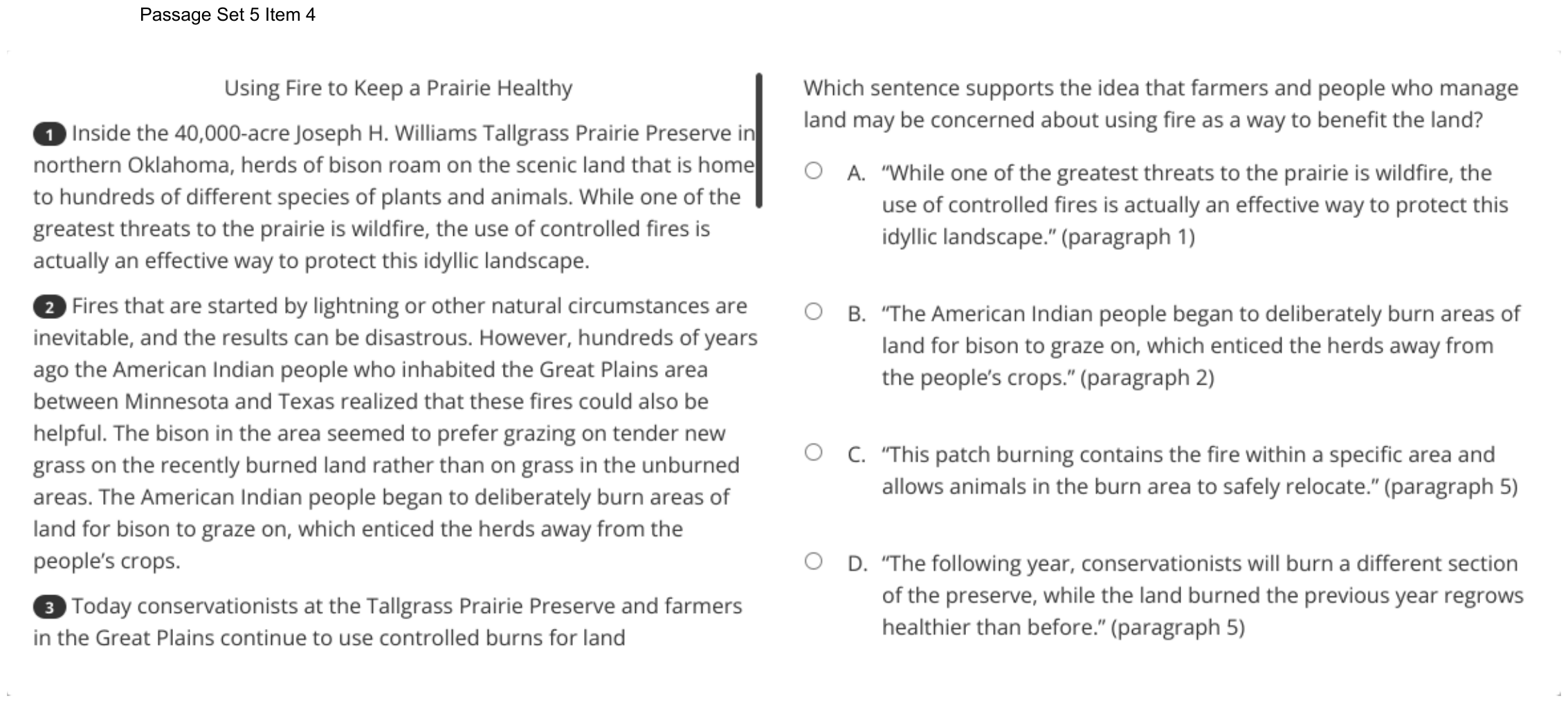
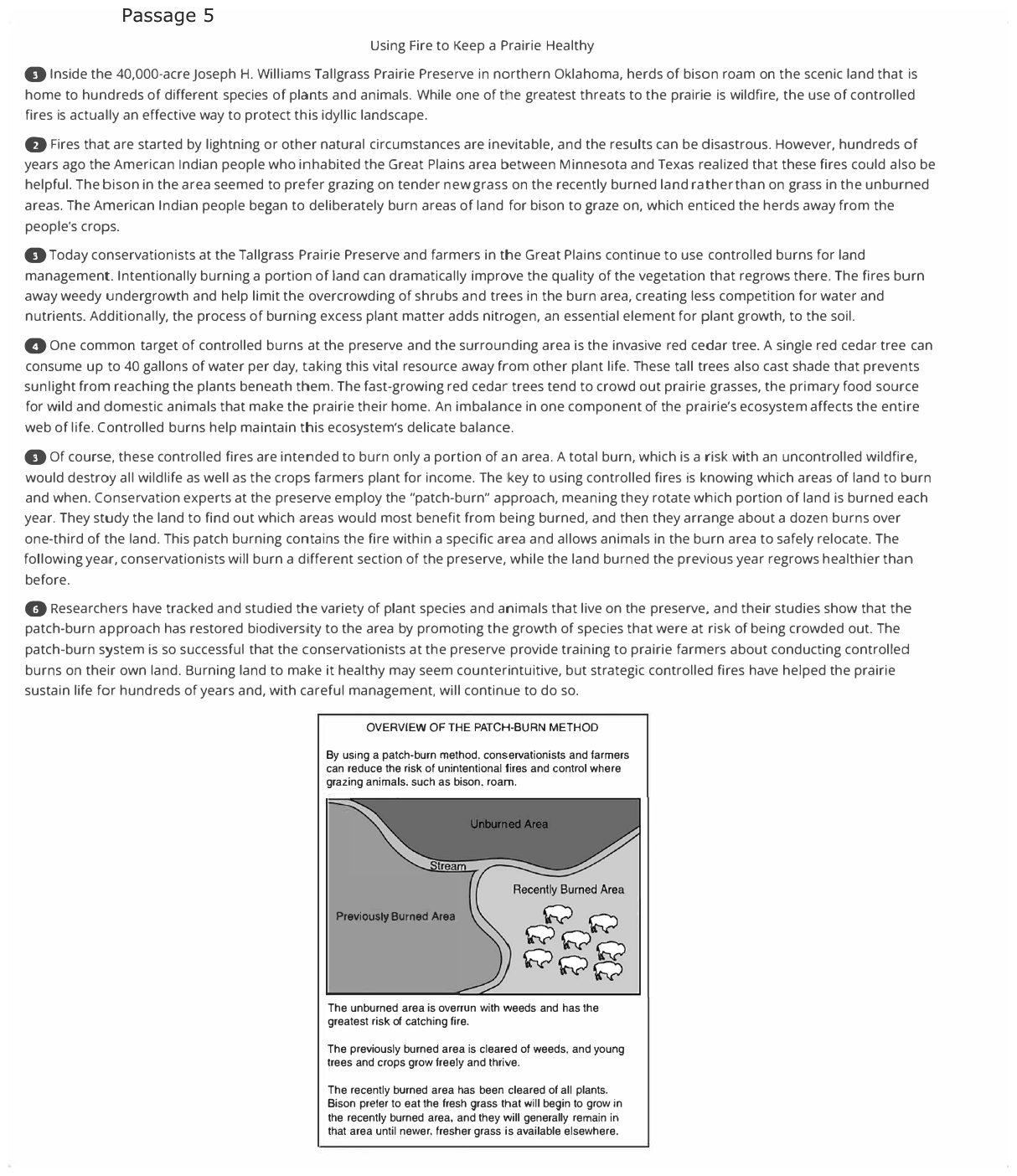
Inside the 40,000-acre Joseph H. Williams Tallgrass Prairie Preserve in northern Oklahoma, herds of bison roam on the scenic land that is home to hundreds of different species of plants and animals. While one of the greatest threats to the prairie is wildfire, the use of controlled fires is actually an effective way to protect this idyllic landscape.
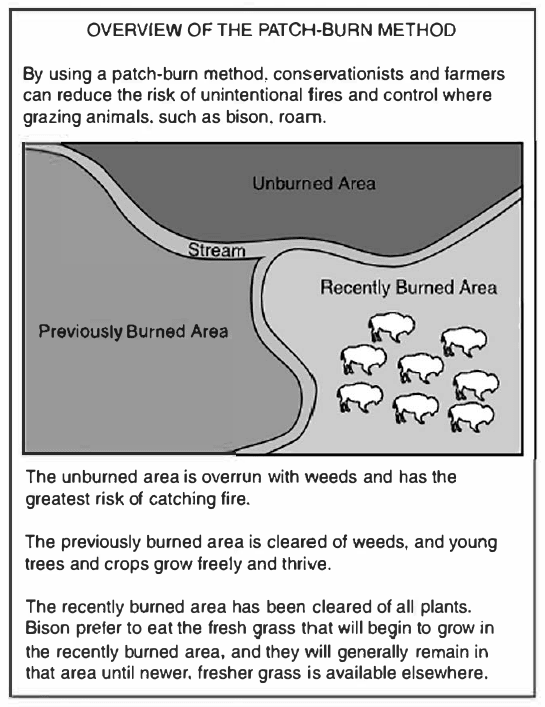
Fires that are started by lightning or other natural circumstances are inevitable, and the results can be disastrous. However, hundreds of years ago the American Indian people who inhabited the Great Plains area between Minnesota and Texas realized that these fires could also be helpful. The bison in the area seemed to prefer grazing on tender new grass on the recently burned land rather than on grass in the unburned areas. The American Indian people began to deliberately burn areas of land for bison to graze on, which enticed the herds away from the people’s crops.
Today conservationists at the Tallgrass Prairie Preserve and farmers in the Great Plains continue to use controlled burns for land management. Intentionally burning a portion of land can dramatically improve the quality of the vegetation that regrows there. The fires burn away weedy undergrowth and help limit the overcrowding of shrubs and trees in the burn area, creating less competition for water and nutrients. Additionally, the process of burning excess plant matter adds nitrogen, an essential element for plant growth, to the soil.
One common target of controlled burns at the preserve and the surrounding area is the invasive red cedar tree. A single red cedar tree can consume up to 40 gallons of water per day, taking this vital resource away from other plant life. These tall trees also cast shade that prevents sunlight from reaching the plants beneath them. The fast-growing red cedar trees tend to crowd out prairie grasses, the primary food source for wild and domestic animals that make the prairie their home. An imbalance in one component of the prairie’s ecosystem affects the entire web of life. Controlled burns help maintain this ecosystem’s delicate balance.
Of course, these controlled fires are intended to burn only a portion of an area. A total burn, which is a risk with an uncontrolled wildfire, would destroy all wildlife as well as the crops farmers plant for income. The key to using controlled fires is knowing which areas of land to burn and when. Conservation experts at the preserve employ the “patch-burn” approach, meaning they rotate which portion of land is burned each year. They study the land to find out which areas would most benefit from being burned, and then they arrange about a dozen burns over one-third of the land. This patch burning contains the fire within a specific area and allows animals in the burn area to safely relocate. The following year, conservationists will burn a different section of the preserve, while the land burned the previous year regrows healthier than before.
Researchers have tracked and studied the variety of plant species and animals that live on the preserve, and their studies show that the patch-burn approach has restored biodiversity to the area by promoting the growth of species that were at risk of being crowded out. The patch-burn system is so successful that the conservationists at the preserve provide training to prairie farmers about conducting controlled burns on their own land. Burning land to make it healthy may seem counterintuitive, but strategic controlled fires have helped the prairie sustain life for hundreds of years and, with careful management, will continue to do so.
Question
Which sentence supports the idea that farmers and people who manage land may be concerned about using fire as a way to benefit the land?
- A“While one of the greatest threats to the prairie is wildfire, the use of controlled fires is actually an effective way to protect this idyllic landscape.” (paragraph 1)
- B“The American Indian people began to deliberately burn areas of land for bison to graze on, which enticed the herds away from the people’s crops.” (paragraph 2)
- C“This patch burning contains the fire within a specific area and allows animals in the burn area to safely relocate.” (paragraph 5)
- D“The following year, conservationists will burn a different section of the preserve, while the land burned the previous year regrows healthier than before.” (paragraph 5)
Show the answer
Correct answer: A
The question asks which sentence supports the idea that farmers and people who manage land may be concerned about using fire as a way to benefit the land.
A. CORRECT. The sentence from paragraph 1 supports the idea that farmers and people who manage land may be concerned about using fire as a way to benefit the land because it acknowledges that “one of the greatest threats to the prairie is wildfire.”
B. Incorrect. Although the sentence from paragraph 2 relates how American Indians “began to deliberately burn areas of land for bison to graze on” and to protect people’s crops, the sentence does not support the idea that farmers and people who manage land may be concerned about using fire as a way to benefit the land. Instead, it focuses on the cause-and-effect relationship between bison and newly burned areas.
C. Incorrect. The sentence from paragraph 5 provides details about how “patch burning contains the fire” and “allows animals in the burn area to safely relocate,” but it does not adequately support the idea that farmers and people who manage land may be concerned about using fire as a way to benefit the land, because it does not mention that wildfires can be a threat to the prairie.
D. Incorrect. While the sentence from paragraph 5 does explain how “conservationists will burn a different section of the preserve” in order to rotate the process year after year so that the burned land has time to regrow, the sentence does not support the idea that farmers and people who manage land may be concerned about using fire as a way to benefit the land because it does not mention the potential for total burns.
Question analysis
This evidence question asks which sentence from the article on controlled prairie burns supports the idea that farmers and others who manage land may be concerned about using fire to benefit it. The passage never states that concern directly, so students must infer it, and all four quoted sentences, taken from across the article, talk about burning land in some way.
- Grade level
- Grade 8 reading and task
- Compared with grade 7
- Above grade 7 Grade 7 evidence questions usually ask for support of an idea the text states. This idea, that people who manage land may worry about using fire, is never stated outright, so students must infer which sentence implies it, more than typical.
- Estimated difficulty
- Hard: combines ideas, needs a plan, and has more than one tempting wrong answer.
- Thinking it demands
- Depth of knowledge 3, strategic thinking · mainly evaluate
- What makes it hard
- Reading between the lines major
- A very close wrong answer moderate
- Every choice must be checked minor
- Evidence
- Answered from one sentence or line
- Reading level
- Passage: about grade 11, 598 words; question and choices: about grade 13, 123 words.
- Students, last 30 days
- Not enough answers yet to show (it takes 10).
Why it is hard, traps and wrong answers (shows the answer)
Why it is hard
The idea to support is about people’s feelings, yet none of the four sentences mentions farmers worrying, so students have to decide what would justify such worry. The opening sentence does it by naming wildfire as a great threat before praising controlled fire, a concession many students read past as background. The strongest pull is the sentence on containing the fire, which implies caution but presents patch burning as the answer, not the concern.
Reading between the lines major Working it out
No sentence mentions worry; students must see that calling wildfire “one of the greatest threats to the prairie” gives landowners a reason to fear fire, and that “actually” answers that fear. (Graesser, Singer & Trabasso, 1994; Kintsch, 1998)
A very close wrong answer moderate Choosing the answer
The patch-burn sentence about containing the fire “within a specific area” also hints at fire’s danger; it differs from the right one by describing the safeguard without ever naming a threat. (Embretson & Wetzel, 1987; Gorin & Embretson, 2006; Ascalon et al., 2007)
Every choice must be checked minor Choosing the answer
The four sentences come from paragraphs 1, 2 and 5, and each is about burning land, so each must be tested for a hint of risk rather than for its topic. (Embretson & Wetzel, 1987)
Strategy: Before rereading the choices, decide what a sentence would need to say to show that landowners have reason to be wary of fire, then test each quoted sentence for exactly that.
Traps
- Supports only part of the claim: In a question about evidence: a line that backs one half of the claim but not the other, or a related point rather than the claim itself.
- True but not the answer: A choice says something accurate about the text that does not answer this question.
The wrong answers, classified
B True but not the answer (King et al., 2004; Embretson & Wetzel, 1987)
Links “the people’s crops” to farmers, but the sentence tells how early burns drew bison away from the crops and shows no worry about fire itself.
C Supports only part of the claim (King et al., 2004; Thissen, Steinberg & Fitzpatrick, 1989)
Sees caution in containing the fire “within a specific area,” but the sentence explains how patch burning keeps animals safe and never says fire threatens the land.
D Supports only part of the claim (King et al., 2004; Thissen, Steinberg & Fitzpatrick, 1989)
Takes the yearly rotation as a careful precaution, but the sentence describes the schedule and land that “regrows healthier than before,” which backs the benefit, not the worry.
Working it out, step by step
Figure out what the question asks
This is an evidence question. Evidence is the words in a text that back up an idea. The idea here is that farmers might worry about using fire to help land. No sentence says farmers are worried. So look for a sentence that gives them a reason to fear fire.
Decide what the evidence needs
A sentence that supports this idea must show that fire can be dangerous. If fire can harm land, people have a reason to be careful with it. So test each sentence with one question: does it say fire is a threat?
Look closely at paragraph 1
Choice A quotes paragraph 1. Its first half says “one of the greatest threats to the prairie is wildfire.” That is a reason to fear fire. Its second half says controlled fires are “actually” helpful. The word “actually” pushes back against that fear. It means: you might expect fire to hurt the land, but here it helps.
Check each choice
- A is right. It names wildfire as a great threat. That gives farmers a reason to worry about fire.
- B is wrong. It tells how early burns drew bison away from crops. It shows no danger from fire.
- C is wrong. It tells how patch burning keeps the fire in one area. It describes a safety step but never names a threat.
- D is wrong. It describes burning a new section each year. It shows a benefit: land that “regrows healthier than before.”
Watch out: C hints that fire must be contained, or kept in, so it sounds careful. But it describes the solution, not the danger.
Choose the answer
Only one sentence names fire as a danger. So the answer is A, the sentence from paragraph 1: “While one of the greatest threats to the prairie is wildfire, the use of controlled fires is actually an effective way to protect this idyllic landscape.” Idyllic means peaceful and lovely.
Why this answer and not the closest wrong one
C is the closest wrong answer, because keeping fire “within a specific area” suggests caution. But C only explains how patch burning works. It never says fire can harm the prairie. A does, by calling wildfire one of the greatest threats.
More questions like this
The original DOE question
The passage “Using Fire to Keep a Prairie Healthy” as printed (page 41)
Question 3 of 6
2025 Practice Test B English, question 44Passage Letter from Brooklyn
Letter from Brooklyn
by Jacob Scheier
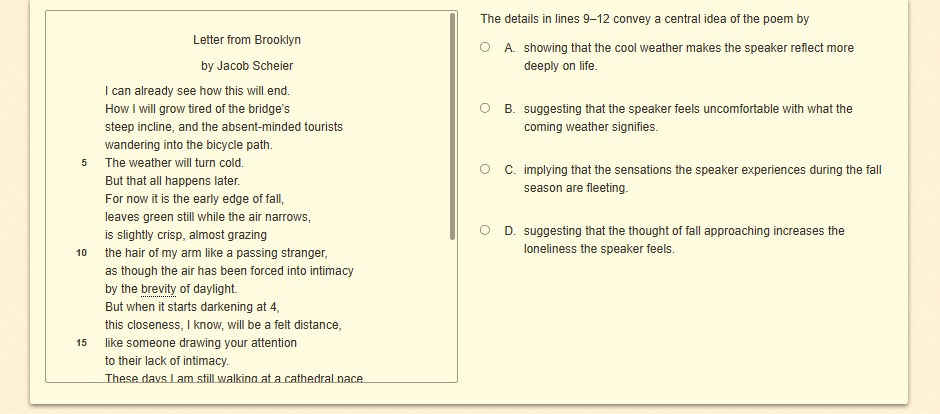
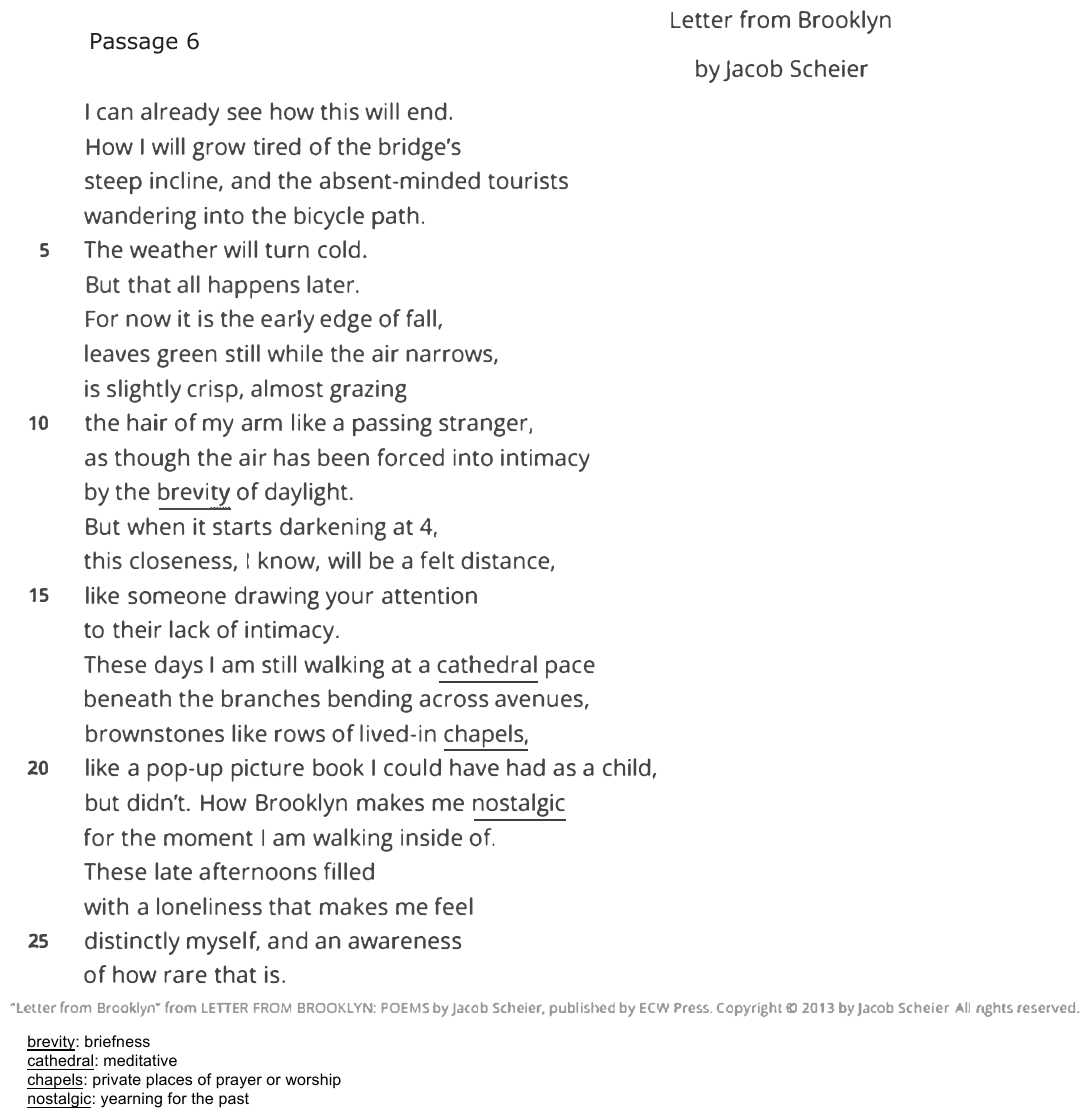
I can already see how this will end.
How I will grow tired of the bridge’s
steep incline, and the absent-minded tourists
wandering into the bicycle path.
The weather will turn cold.
But that all happens later.
For now it is the early edge of fall,
leaves green still while the air narrows,
is slightly crisp, almost grazing
the hair of my arm like a passing stranger,
as though the air has been forced into intimacy
by the brevity of daylight.
But when it starts darkening at 4,
this closeness, I know, will be a felt distance,
like someone drawing your attention
to their lack of intimacy.
These days I am still walking at a cathedral pace
beneath the branches bending across avenues,
brownstones like rows of lived-in chapels,
like a pop-up picture book I could have had as a child,
but didn’t. How Brooklyn makes me nostalgic
for the moment I am walking inside of.
These late afternoons filled
with a loneliness that makes me feel
distinctly myself, and an awareness
of how rare that is.
“Letter from Brooklyn” from LETTER FROM BROOKLYN: POEMS by Jacob Scheier, published by ECW Press. Copyright © 2013 by Jacob Scheier All rights reserved.
brevity: briefness
cathedral: meditative
chapels: private places of prayer or worship
nostalgic: yearning for the past
Question
The details in lines 9–12 convey a central idea of the poem by
- Ashowing that the cool weather makes the speaker reflect more deeply on life.
- Bsuggesting that the speaker feels uncomfortable with what the coming weather signifies.
- Cimplying that the sensations the speaker experiences during the fall season are fleeting.
- Dsuggesting that the thought of fall approaching increases the loneliness the speaker feels.
Show the answer
Correct answer: C
The question asks how lines 9–12 convey a central idea of the poem.
A. Incorrect. Although the speaker discusses the very beginning of cool weather in these lines, the speaker does not reflect on life in these lines.
B. Incorrect. Although the description in these lines likens the movement of crisp air to “a passing stranger,” that comparison does not have a negative connotation in this context; it does not suggest that the speaker is uncomfortable. Rather, it is used to describe the subtle physical sensation of cool air on the speaker’s arm.
C. CORRECT. By using a description of the crisp air as “a passing stranger” and the daylight as being brief, these lines express the poem’s central idea that the joy of early fall is temporary or fleeting.
D. Incorrect. Although the speaker acknowledges the coming fall in these lines, there is no mention of loneliness. The speaker reveals a loneliness in lines 23–26 but gives no hint of that feeling in lines 9–12. Further, this loneliness is not a central idea of the poem.
Question analysis
This central-idea question on Jacob Scheier’s poem “Letter from Brooklyn” asks how lines 9–12, where the crisp early-fall air grazes the speaker’s arm, convey a central idea of the poem. Students must interpret a simile and a personification packed into four short lines and connect what they suggest to the poem as a whole, while each choice names a different feeling or idea.
- Grade level
- Grade 8 reading and task
- Compared with grade 7
- Above grade 7 Grade 7 students explain how particular lines develop a central idea. These four lines make their point only through a simile and a personification about air and daylight, and linking them to the whole poem takes more interpretation than typical grade 7 work.
- Estimated difficulty
- Hard: combines ideas, needs a plan, and has more than one tempting wrong answer.
- Thinking it demands
- Depth of knowledge 2, skills and concepts · mainly analyze
- What makes it hard
- Figurative or literary language major
- Reading between the lines moderate
- The right answer is reworded minor
- Evidence
- Answered from one paragraph or stanza
- Reading level
- Passage: 217 words (a poem; reading level not measured); question and choices: about grade 8, 63 words.
- Students, last 30 days
- Not enough answers yet to show (it takes 10).
Why it is hard, traps and wrong answers (shows the answer)
Why it is hard
The four lines describe a sensation, cool air almost grazing an arm, and the central idea sits in two small words, “passing” and “brevity.” The strongest pull hears the stranger and the air “forced into intimacy” as unwelcome, borrowing the unease the poem saves for the darkening of lines 13–16. Other choices bring in moods from elsewhere, the meditative walk and the loneliness of the last lines, so students must judge only what lines 9–12 themselves suggest.
Figurative or literary language major Understanding the question
The lines never say the moment is short: the air almost grazes the speaker’s arm “like a passing stranger” and is “forced into intimacy / by the brevity of daylight,” so “passing” and “brevity” carry the idea. (Graesser, Singer & Trabasso, 1994; Kintsch, 1998)
Reading between the lines moderate Working it out
Students must tie the brief touch and the short days to a central idea the poem never states, that early fall is slipping away, framed by “For now” in line 7 and “But when it starts darkening” in line 13. (Graesser, Singer & Trabasso, 1994; Kintsch, 1998)
The right answer is reworded minor Choosing the answer
The right choice says “fleeting” where the lines say “passing” and “brevity,” while a wrong choice borrows the poem’s own word “loneliness” from line 24, which makes it look supported. (Freedle & Kostin, 1993; Kirsch & Mosenthal, 1990)
Strategy: Paraphrase lines 9–12 in plain words, checking the glossary for unfamiliar words, then decide what the comparison suggests about the speaker’s experience and test each choice against these four lines.
Traps
- Wrong part of the text: A choice is true of another paragraph, stanza or speaker than the one asked about.
- Wrong tone or attitude: Misjudges the tone, attitude or point of view, such as reading admiration as criticism, or taking a character's or subject's feelings for the author's.
- Reads too much in: A reasonable-sounding conclusion that goes further than the text allows.
The wrong answers, classified
A Reads too much in (Graesser, Singer & Trabasso, 1994)
Senses that the poem is meditative and credits the cool air with prompting deep thought, though lines 9–12 record a light, passing touch on the arm, not reflections on life.
B Wrong tone or attitude (Graesser, Singer & Trabasso, 1994)
Hears something unwelcome in “a passing stranger” and in air “forced into intimacy,” though the touch is light and the closeness enjoyed; unease arrives only with the darkening of lines 13–16.
D Wrong part of the text (Kirsch & Mosenthal, 1990)
Brings the “loneliness” of lines 23–26 into lines that never mention it, and even there it makes the speaker feel “distinctly myself,” not lonelier as fall approaches.
Working it out, step by step
Figure out what the question asks
This asks how lines 9–12 help build a central idea. A central idea is a main point the poem keeps coming back to. First work out what the four lines say. Then see how they connect to the rest of the poem. Test each choice against these four lines.
Read lines 9–12
The sentence is about the air, named in line 8. Lines 9–12 say it “is slightly crisp, almost grazing / the hair of my arm like a passing stranger, / as though the air has been forced into intimacy / by the brevity of daylight.” Crisp means cool and fresh. Grazing here means lightly touching. Intimacy means closeness. The glossary says brevity means “briefness.”
Work out the comparisons
“Like a passing stranger” is a simile, a comparison that uses like or as. A stranger who passes you on the street is there for a moment, then gone. So the cool air touches the speaker lightly and briefly. The next lines treat the air like a person pushed into closeness by the short daylight. Giving human feelings to something that isn’t human is called personification. Both “passing” and “brevity” point to the same thing: this feeling won’t last.
Connect the lines to the poem
The rest of the poem agrees. Line 7 begins “For now it is the early edge of fall.” Lines 13–14 look ahead: “But when it starts darkening at 4,” this closeness “will be a felt distance.” Lines 21–22 say Brooklyn makes the speaker “nostalgic / for the moment I am walking inside of.” So a central idea is that this early-fall moment is precious and passes quickly. Fleeting means lasting only a short time.
Check each choice
- A does not fit. These lines describe a touch on the skin, not thoughts about life.
- B does not fit. The touch is light, and the speaker enjoys the closeness now. The worry comes later, in lines 13–16.
- C fits. “Passing” and “brevity” show that the feelings of early fall won’t last.
- D does not fit. Lines 9–12 never mention loneliness, which comes in line 24. And line 7 says fall has already begun.
Watch out: B is tempting because “stranger” and “forced into intimacy” can sound unpleasant. But the stranger only passes by, and the touch is light.
Choose the answer
The brief touch and the short daylight show that this early-fall moment slips away fast. Sensations are feelings you get through your senses, like touch. So the answer is C, “implying that the sensations the speaker experiences during the fall season are fleeting.”
Why this answer and not the closest wrong one
B is the closest wrong choice, because “forced” and “stranger” can sound unpleasant. But line 14 calls this feeling “this closeness,” and losing it is what will feel bad. So the closeness is welcome now. What lines 9–12 stress is how brief it is, which is C.
More questions like this
The original DOE question
The passage “Letter from Brooklyn” as printed (page 50)
Question 4 of 6
2024 Test B Math, question 52Question
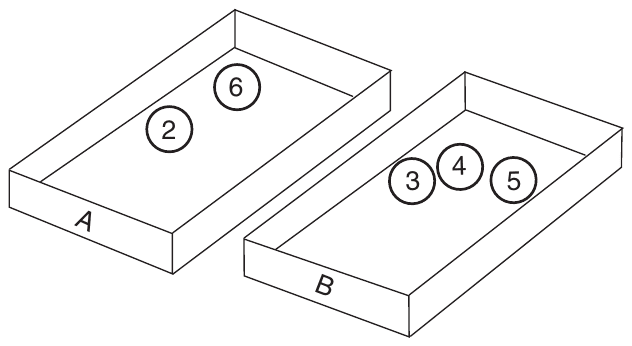
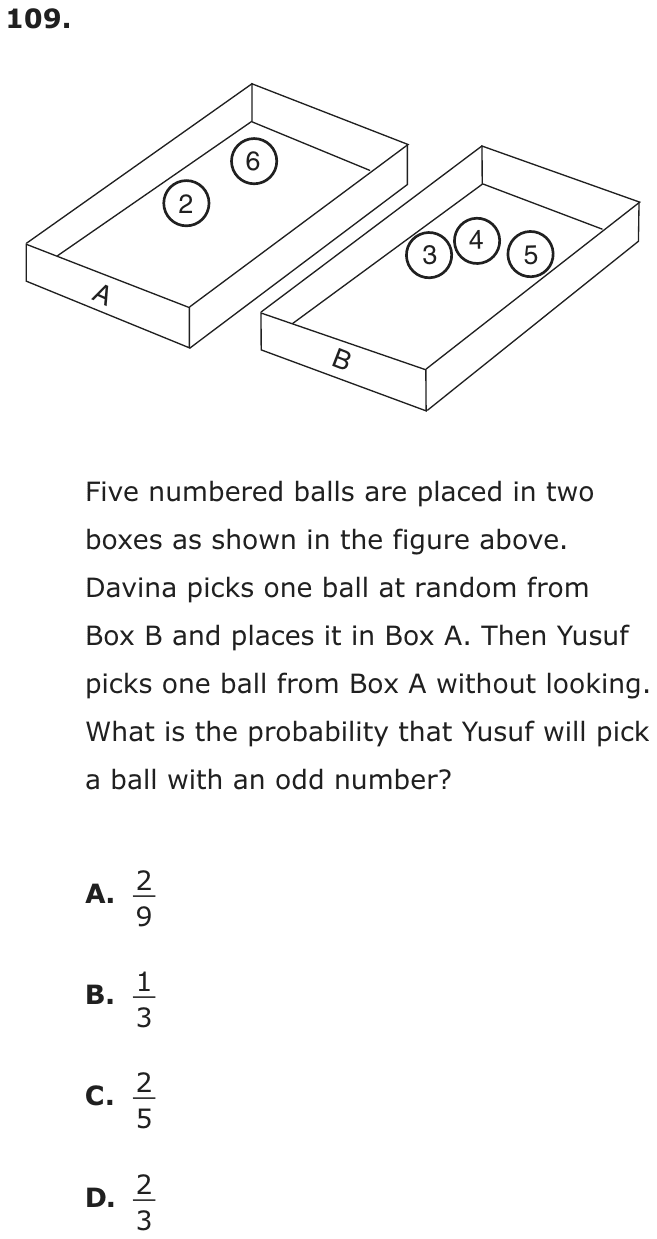
Five numbered balls are placed in two boxes as shown in the figure above. Davina picks one ball at random from Box B and places it in Box A. Then Yusuf picks one ball from Box A without looking. What is the probability that Yusuf will pick a ball with an odd number?
- A
- B
- C
- D
Show the answer
Correct answer: A
The probability of Davina picking an odd-numbered ball from Box B is . If Davina places an odd-numbered ball in Box A, then the probability of Yusuf picking an odd-numbered ball from Box A is . The probability of both of these events happening is the product of the two probabilities.
Question analysis
Two boxes hold five numbered balls, and Davina moves one ball at random from Box B into Box A before Yusuf draws one from Box A. Students find the probability that Yusuf's ball shows an odd number. It tests two-stage probability, and the tricky part is that the second draw depends on which ball was moved.
- NYS standards
- Grade level
- Grade 7 content, by NYS standard
- Compared with grade 7
- Above grade 7 Grade 7 compound probability lists outcomes for independent stages such as coins or spinners. Here the first random move changes what is in the second box, so students must follow two linked stages, a dependence typical grade 7 work does not include.
- Estimated difficulty
- Among the hardest on the SHSAT: a non-obvious approach, heavy reading, or a well-hidden trap.
- Thinking it demands
- Depth of knowledge 3, strategic thinking · mainly analyze
- What makes it hard
- Solution
- 3 steps
- Reading level
- Question and choices: about grade 4, 57 words.
- Students, last 30 days
- Not enough answers yet to show (it takes 10).
Why it is hard, traps and wrong answers (shows the answer)
Why it is hard
Two chance events are hidden in what reads like a question about a single draw. Every listed wrong answer is a reasonable single-stage answer, either one of the two factors on its own or a count of odd balls across both boxes. Listing the nine equally likely pairs, Davina's ball and then Yusuf's, shows that only two of them end with an odd ball and makes the structure visible without any formula.
No obvious method major Working it out
The stem asks one question about Yusuf's draw, but the answer depends on Davina's earlier random pick; the key is that Box A starts with only even balls, so Yusuf can draw odd only by drawing the ball she moved. (Schoenfeld, 1985)
Something you must already know minor Working it out
Multiplying the chances of the two stages, 2/3 for an odd ball moving and 1/3 for Yusuf then drawing it, is a rule students must bring themselves. (Anderson & Krathwohl, 2001)
Reading a figure, table or graph minor Understanding the question
The numbers appear only in the figure, Box A holding 2 and 6 and Box B holding 3, 4 and 5, so the odd balls have to be spotted there. (Lesh, Post & Behr, 1987; Kirsch & Mosenthal, 1990)
Strategy: List every equally likely pair of a ball moved by Davina and a ball picked by Yusuf, and count the pairs that end with an odd ball.
Traps
- Stops one step early: A choice is a number from partway through the solution.
- Numbers taken from the question: Combines the numbers in the question without a model of the situation, or is simply a number that appears in the question.
The wrong answers, classified
B Stops one step early (King et al., 2004; Gierl et al., 2017)
Finds Yusuf's chance of drawing the odd ball once one is in Box A, 1 out of 3, leaving out the chance that Davina moves an odd ball at all.
C Numbers taken from the question (Hegarty, Mayer & Monk, 1995)
Counts the odd balls in the figure, 3 and 5, over all five balls, 2/5, ignoring that Yusuf draws only from Box A.
D Stops one step early (King et al., 2004; Gierl et al., 2017)
Gives the chance that Davina moves an odd ball, 2 out of 3, the first stage only, without multiplying by Yusuf's 1/3 chance of drawing it.
Worked solution, step by step
Formulas used
- Probability
- P is the probability, the chance that something happens. It is a number from 0 to 1. The top counts the results you want. The bottom counts all the results that can happen. It works when every result is equally likely.
- Chance of events in a row
- A and B are two events that happen one after the other. P(A) is the chance of the first. P(B after A) is the chance of the second, counting only what is left after the first. You multiply because the second must also happen inside the share of times the first did.
Read the figure
Box A holds balls numbered 2 and 6. Box B holds balls numbered 3, 4 and 5.
An odd number does not divide evenly by 2. So the only odd balls are 3 and 5, and both start in Box B. Box A starts with no odd balls at all.
Spot the two chance events
Two things happen by chance, one after the other:
- Davina picks one of the 3 balls in Box B and moves it to Box A.
- Then Yusuf picks one of the 3 balls now in Box A.
Yusuf gets an odd ball only if both go right. Davina must move an odd ball. Then Yusuf must pick that very ball.
The question asks only about Yusuf. But his chance depends on Davina’s pick, which comes first.
Find the chance for Davina’s pick
Box B has 3 balls, and 2 of them, the 3 and the 5, are odd.
If she moves the 4 instead, Box A holds only even balls. Then Yusuf can’t get an odd ball at all.
Find the chance for Yusuf’s pick
Say Davina moved an odd ball. Box A now holds 3 balls: the 2, the 6 and that one odd ball.
Watch out: alone is choice B. It forgets that Davina might move the 4.
Multiply the two chances
Both events must happen, so use the rule for events in a row.
Watch out: alone, choice D, stops after Davina’s pick. , choice C, counts 2 odd balls out of all 5. But Yusuf picks only from Box A.
So the answer is A, .
Check your answer
List all 9 equally likely outcomes. Davina can move 3, 4 or 5. Then Yusuf picks one of 3 balls.
| Ball moved | Box A then | Odd picks |
|---|---|---|
| 3 | 2, 6, 3 | 1 |
| 4 | 2, 6, 4 | 0 |
| 5 | 2, 6, 5 | 1 |
That is 2 odd picks out of 9, or .
More questions like this
The original DOE question
Question 5 of 6
2026 Practice Test C Math, question 32Question
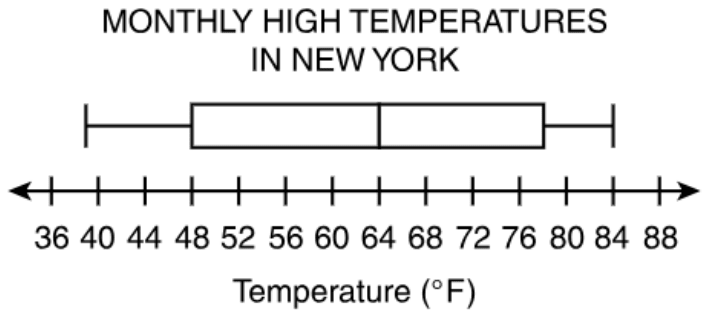
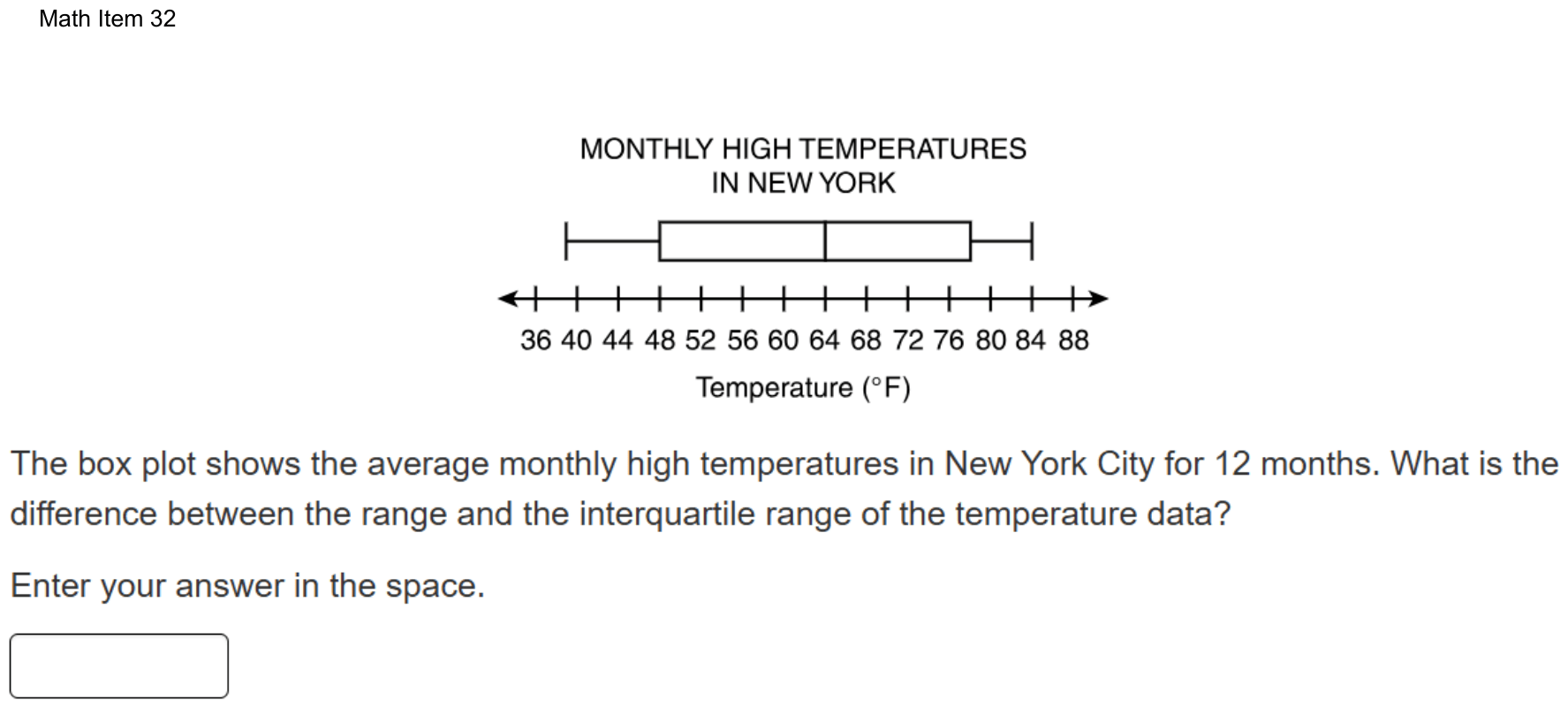
The box plot shows the average monthly high temperatures in New York City for 12 months. What is the difference between the range and the interquartile range of the temperature data?
Enter your answer in the space.
Fill-in question: work out the answer and type it as a number.
Show the answer
Correct answer: 15
Determine the range by subtracting the minimum value on the box plot from the maximum value on the box plot:
Maximum value , Minimum value
Determine the interquartile range by subtracting the lower quartile value on the box plot from the upper quartile value on the box plot:
Upper Quartile Value , Lower Quartile Value
Determine the difference between the range (45° F) and the interquartile range (30° F):
Question analysis
A box plot of New York City's average monthly high temperatures for 12 months sits above a number line labeled every 4 degrees. Students type the difference between the range and the interquartile range of the data. Two of the plot's values fall between labeled ticks, so careful reading of the scale decides the answer.
- Grade level
- Grade 7 content, by NYS standard
- Compared with grade 7
- Above grade 7 Reading a box plot and finding its interquartile range are grade 7 skills. Here two of the five values fall between ticks spaced 4 apart, and the range, the IQR and their difference must all be found and typed with no choices.
- Estimated difficulty
- Hard: combines ideas, needs a plan, and has more than one tempting wrong answer.
- Thinking it demands
- Depth of knowledge 2, skills and concepts · mainly apply
- What makes it hard
- Solution
- 3 steps
- Reading level
- Question and choices: about grade 7, 36 words.
- Students, last 30 days
- Not enough answers yet to show (it takes 10).
Why it is hard, traps and wrong answers (shows the answer)
Why it is hard
The method is standard, but the key rests on reading the scale between its labels. The axis is ticked only every 4 degrees, and the minimum and the upper quartile land off the ticks, so rounding either one to the nearest label moves the result by a degree or two with nothing to flag it. Students who find the range correctly can also stop there, entering 45, the larger of the two spreads, instead of the difference the question asks for.
Reading a figure, table or graph major Understanding the question
Two of the five values fall between ticks spaced 4 degrees apart: the left whisker ends just short of the 40 tick, at 39, and the box’s right edge sits midway between 76 and 80, at 78. (Lesh, Post & Behr, 1987; Kirsch & Mosenthal, 1990)
Many steps minor Working it out
Four values are read and combined in three subtractions, the range, the interquartile range and then their difference, so one misread value changes the final entry. (Daniel & Embretson, 2010; Enright, Morley & Sheehan, 2002)
Something you must already know minor Working it out
Neither measure is defined on the page: the range spans the whiskers, and the interquartile range is the width of the box, the upper quartile minus the lower. (Anderson & Krathwohl, 2001)
An answer in an unexpected form minor Choosing the answer
The result is typed with no choices to compare, so an entry one or two degrees off, from rounding a value to the nearest tick, looks just as finished as the right one. (Enright, Morley & Sheehan, 2002)
Strategy: Read the minimum, both quartiles and the maximum, judging where each mark falls between the ticks, then subtract for the range and for the IQR, and subtract those two results.
Traps
- Misreads the figure: Reads a value, label or tick spacing in a figure, table or graph wrongly.
- Stops one step early: A choice is a number from partway through the solution.
The wrong answers, classified
14 Misreads the figure (Lesh, Post & Behr, 1987; Kirsch & Mosenthal, 1990)
Reads the left whisker’s end as 40, the nearest labeled tick, instead of 39, so the range becomes 84 − 40 = 44 and 44 − 30 = 14.
45 Stops one step early (King et al., 2004; Gierl et al., 2017)
Finds the range, 84 − 39 = 45 degrees, and enters it, stopping before the interquartile range of 30 is subtracted from it.
17 Misreads the figure (Lesh, Post & Behr, 1987; Kirsch & Mosenthal, 1990)
Reads the box’s right edge as 76, the tick just left of it, instead of 78, so the IQR becomes 76 − 48 = 28 and 45 − 28 = 17.
Worked solution, step by step
Formulas used
- Range
- The maximum is the greatest value, at the right end of the right whisker. The minimum is the least value, at the left end of the left whisker. The range tells how far the whole set of data spreads.
- Interquartile range (IQR)
- Q3 is the upper quartile, the right edge of the box. Q1 is the lower quartile, the left edge of the box. The IQR is the width of the box. It tells how far the middle half of the data spreads.
Sort out the question
A box plot shows data with five numbers. The two whiskers are the lines on each side of the box. Their ends are the minimum, the least value, and the maximum, the greatest. The box runs from the lower quartile to the upper quartile. These are the middles of the lower half and the upper half of the data. The line inside the box is the median, the middle value.
You need the range minus the interquartile range (IQR), in degrees.
Read the values between the ticks
The ticks on the number line are 4 degrees apart. So each degree is one quarter of the space between two ticks. Three values sit right on ticks: the box’s left edge at 48, the median at 64, and the right whisker’s end at 84.
- The left whisker starts just left of the 40 tick. It sits about one quarter of the way back toward 36. So the minimum is degrees.
- The box’s right edge is halfway between 76 and 80. Halfway is 78 degrees.
Find the range
Use the range formula:
The data spread over 45 degrees.
Watch out: rounding the minimum to the 40 tick gives a range of 44. Then the final answer comes out 14, which is wrong.
Find the IQR
Use the IQR formula with the two edges of the box:
The middle half of the data spreads over 30 degrees.
Watch out: reading the box’s right edge as 76 gives an IQR of 28. Then the final answer comes out 17.
Subtract the IQR from the range
The question asks for the difference between the two:
Watch out: 45 is only the range. Do not stop there. Type only the number, with no degree sign.
So you would enter 15.
Check your answer
The range covers the whole plot, and the IQR covers only the box. So their difference is the two whiskers added together. The left whisker is degrees long. The right whisker is degrees long. , which matches.
More questions like this
The original DOE question
Question 6 of 6
2018 Test A Math, question 5Question
The sum of two consecutive integers is −15. If 1 is added to the smaller integer and 2 is subtracted from the larger integer, what is the product of the two resulting integers?
Grid-in question: work out the answer and enter it as a number.
Show the answer
Correct answer: 63
If x is the smaller consecutive integer, then
is the larger consecutive integer. Use their sum (−15) to find x:
The two consecutive integers are −8 and −7. One is added to the smaller integer:
and 2 is subtracted from the larger integer:
Find the product:
Question analysis
A grid-in problem about two consecutive integers whose sum is −15. Students find the two integers, add 1 to the smaller and subtract 2 from the larger, then multiply the results. Deciding which negative integer is the smaller one, and keeping signs straight through every step, are what make it tricky.
- Grade level
- Grade 7 content, by NYS standard
- Compared with grade 7
- Above grade 7 A typical grade 7 task solves one two-step equation or multiplies signed numbers. This links both: set up a consecutive-integer equation, solve it with negatives, adjust each integer, and multiply, with no choices to check against.
- Estimated difficulty
- Hard: combines ideas, needs a plan, and has more than one tempting wrong answer.
- Thinking it demands
- Depth of knowledge 2, skills and concepts · mainly apply
- What makes it hard
- Error-prone arithmetic moderate
- Turning words into math moderate
- Many steps moderate
- Solution
- 4 steps
- Reading level
- Question and choices: about grade 9, 30 words.
- Students, last 30 days
- Not enough answers yet to show (it takes 10).
Why it is hard, traps and wrong answers (shows the answer)
Why it is hard
Every step is routine, yet the question collects most of the ways students lose points with negatives. The crucial judgment is which of −8 and −7 is the smaller; a student who picks −7 still produces a tidy, wrong product. Gridding the product of the original pair, or giving a negative product, are the other usual losses. Writing each intermediate pair down, rather than holding them in mind, protects against all three.
Error-prone arithmetic moderate Working it out
Every number in play is negative: −8 and −7, then −7 and −9, and a product of two negatives that must come out positive. (Brown & Burton, 1978; Junker & Sijtsma, 2001)
Turning words into math moderate Understanding the question
"1 is added to the smaller integer and 2 is subtracted from the larger" depends on knowing that −8, not −7, is the smaller, since it lies farther below zero. (Hegarty, Mayer & Monk, 1995; Koedinger & Nathan, 2004)
Many steps moderate Working it out
Four linked steps: set up x + (x + 1) = −15, solve for x, adjust each integer, then multiply; an error early in the chain carries through to the product. (Daniel & Embretson, 2010; Enright, Morley & Sheehan, 2002)
Strategy: Halve the sum to see which two integers sit on either side of it, remember that the smaller negative is farther from zero, then adjust each and multiply.
Traps
- Negatives and direction: Arithmetic with negative numbers, the order of a subtraction, or direction on a number line. (Moving a term across the equals sign without changing its sign is a faulty procedure.)
- Misreads the question: Misses or misreads a condition or a word in the question: "at least", "each", "remaining", "not".
The wrong answers, classified
60 Negatives and direction (Brown & Burton, 1978)
Takes −7 as the smaller integer because 7 is less than 8, so adjusts to −7 + 1 = −6 and −8 − 2 = −10, and multiplies to 60.
56 Misreads the question (Hegarty, Mayer & Monk, 1995)
Finds −8 and −7 and multiplies them to get 56, skipping the sentence that adds 1 to one integer and subtracts 2 from the other.
-63 Negatives and direction (Brown & Burton, 1978)
Finds the adjusted integers −7 and −9 correctly but gives their product a negative sign, gridding −63.
Worked solution, step by step
Formulas used
- Consecutive integers
- Integers are whole numbers and their opposites, like −2, −1, 0, 1 and 2. Consecutive integers come one right after another. If n is the smaller one, the next one is n + 1, because each step up the number line adds 1.
- Multiplying two negative numbers
- a and b are positive numbers, so −a and −b are negative. When you multiply two negative numbers, the answer is positive. The two minus signs cancel out.
Sort out the question
Two consecutive integers add up to −15. Integers are whole numbers and their negatives. Consecutive means one comes right after the other, like 4 and 5. You need to do three things:
- Find the two integers.
- Add 1 to the smaller one. Subtract 2 from the larger one.
- Find the product of the two new numbers. The product is the answer when you multiply.
Find the two integers
Call the smaller integer n. Then the larger one is n + 1. Their sum is −15.
Subtract 1 from both sides. Then divide both sides by 2.
So the integers are −8 and −7.
Decide which one is smaller
On a number line, −8 is to the left of −7. Numbers to the left are smaller. So −8 is the smaller integer, and −7 is the larger one. Watch out: 8 is bigger than 7, but −8 is smaller than −7. Mixing them up gives −6 and −10, and the wrong answer 60.
Change each integer
Add 1 to the smaller integer.
Subtract 2 from the larger integer.
The two new numbers are −7 and −9.
Multiply the new numbers
Both numbers are negative, so their product is positive.
Watch out: the answer is not −63, because two negatives make a positive. Also, don’t multiply the first pair, −8 and −7. That gives 56 and skips the changes. So you would grid 63.
Check your answer
Check the pair: , and they are one apart. Half of −15 is −7.5, and −8 and −7 sit on either side of it. Then , and the sign is positive.
More questions like this
The original DOE question