3 English and 3 math
Here are 6 random questions to try. Takers earning below 75% are unlikely to receive an offer. You have 1 minute 48 seconds per question on the real exam.
Question 1 of 6
2026 Practice Test B English, question 41Passage Letter from Brooklyn
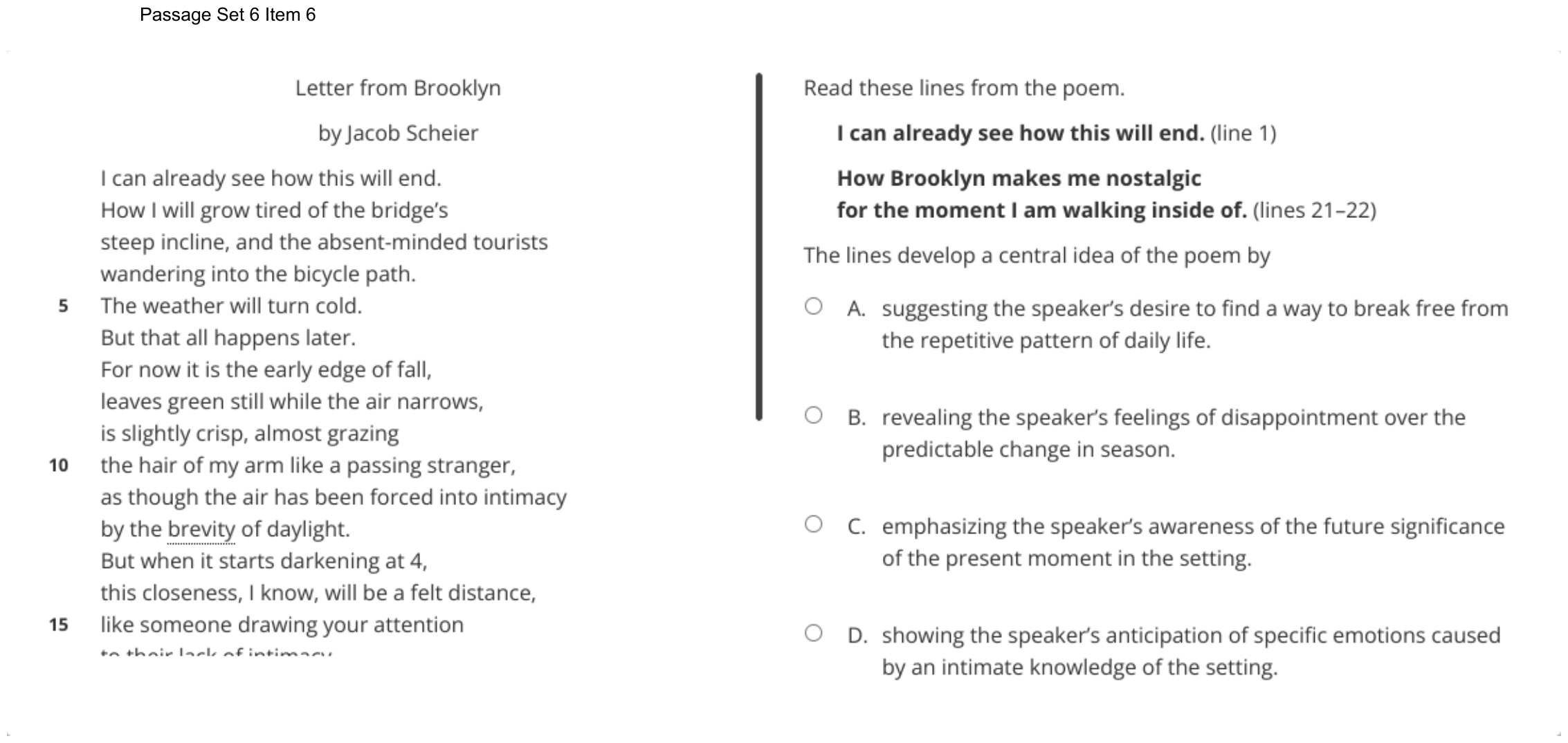
Letter from Brooklyn
by Jacob Scheier
I can already see how this will end.
How I will grow tired of the bridge’s
steep incline, and the absent-minded tourists
wandering into the bicycle path.
The weather will turn cold.
But that all happens later.
For now it is the early edge of fall,
leaves green still while the air narrows,
is slightly crisp, almost grazing
the hair of my arm like a passing stranger,
as though the air has been forced into intimacy
by the brevity of daylight.
But when it starts darkening at 4,
this closeness, I know, will be a felt distance,
like someone drawing your attention
to their lack of intimacy.
These days I am still walking at a cathedral pace
beneath the branches bending across avenues,
brownstones like rows of lived-in chapels,
like a pop-up picture book I could have had as a child,
but didn’t. How Brooklyn makes me nostalgic
for the moment I am walking inside of.
These late afternoons filled
with a loneliness that makes me feel
distinctly myself, and an awareness
of how rare that is.
“Letter from Brooklyn” from LETTER FROM BROOKLYN: POEMS by Jacob Scheier, published by ECW Press. Copyright © 2013 by Jacob Scheier All rights reserved.
brevity: briefness
cathedral: meditative
chapels: private places of prayer or worship
nostalgic: yearning for the past
Question
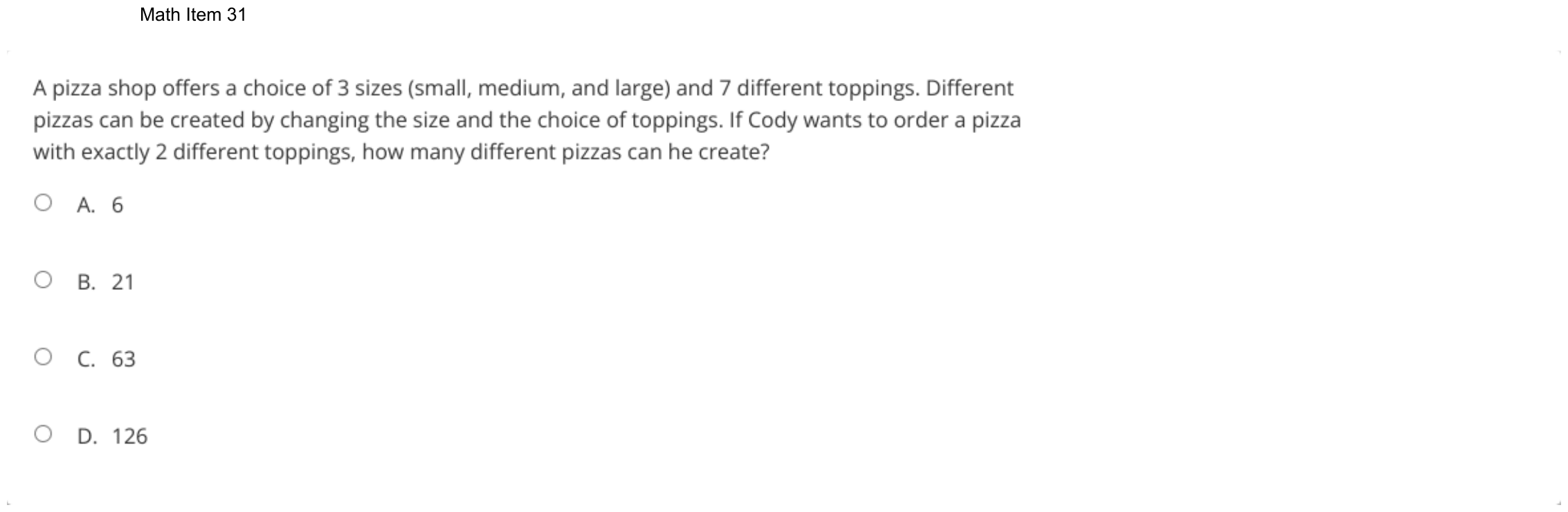
Read these lines from the poem.
I can already see how this will end. (line 1)
How Brooklyn makes me nostalgic
for the moment I am walking inside of. (lines 21–22)
The lines develop a central idea of the poem by
- Asuggesting the speaker’s desire to find a way to break free from the repetitive pattern of daily life.
- Brevealing the speaker’s feelings of disappointment over the predictable change in season.
- Cemphasizing the speaker’s awareness of the future significance of the present moment in the setting.
- Dshowing the speaker’s anticipation of specific emotions caused by an intimate knowledge of the setting.
Show the answer
Correct answer: C
The question asks how line 1 and lines 21–22 develop a central idea of the poem.
A. Incorrect. Although these lines suggest that life is governed by repetitive patterns, such as the change of seasons, they do not suggest that the speaker wishes to break free from these natural cycles of change, and a desire for freedom is not a central idea of the poem.
B. Incorrect. Although the speaker acknowledges that colder weather will inevitably bring disappointment, the speaker does not suggest in these lines that the predictability of changing weather is itself disappointing. Rather, the speaker recognizes the value of enjoying the present moment.
C. CORRECT. These lines connect the present warmer weather with the future colder weather and develop the central idea that the present “moment I am walking inside of” must be embraced because the speaker will be “nostalgic” for it in the future.
D. Incorrect. In these lines, the speaker is aware that specific emotions will occur in the future, during cold weather, but this awareness is only part of the more complex central idea of the poem, which is that current emotions and feelings must be recognized, experienced, and appreciated.
Question analysis
This central-idea question pairs the first line of “Letter from Brooklyn” with lines 21–22, where Brooklyn makes the speaker nostalgic “for the moment I am walking inside of,” and asks how they develop a central idea of the poem. Students must link excerpts from opposite ends of the poem, untangle a paradoxical image and choose among four abstract statements.
- Grade level
- Grade 8 reading and task
- Compared with grade 7
- Above grade 7 Grade 7 students analyze how lines develop a central idea. Here two excerpts twenty lines apart must be read together, one of them built on a paradox, and the four choices are long and abstract, well beyond typical grade 7 work.
- Estimated difficulty
- Among the hardest on the SHSAT: a non-obvious approach, heavy reading, or a well-hidden trap.
- Thinking it demands
- Depth of knowledge 3, strategic thinking · mainly analyze
- What makes it hard
- Figurative or literary language major
- A very close wrong answer moderate
- Evidence in several places moderate
- Evidence
- Answered from several paragraphs or stanzas
- Reading level
- Passage: 217 words (a poem; reading level not measured); question and choices: about grade 7, 99 words.
- Students, last 30 days
- Not enough answers yet to show (it takes 10).
Why it is hard, traps and wrong answers (shows the answer)
Why it is hard
This is among the hardest questions in the set because the two excerpts must be joined through a paradox and then matched to four long, abstract statements. Line 1 foresees an ending; lines 21–22 miss a moment while it is still happening, so both look at now from the future. Students who see only the foresight pick the choice about anticipated emotions, while those who hear gloom in “how this will end” settle on disappointment or a wish to escape.
Figurative or literary language major Understanding the question
Lines 21–22 are a paradox: “nostalgic,” glossed as yearning for the past, is aimed at “the moment I am walking inside of,” so the speaker already feels the present as a future memory. (Graesser, Singer & Trabasso, 1994; Kintsch, 1998)
A very close wrong answer moderate Choosing the answer
The choice about anticipating “specific emotions” shares the key’s link between future and present; it differs by tracing those feelings to knowing the setting well, which neither excerpt says. (Embretson & Wetzel, 1987; Gorin & Embretson, 2006; Ascalon et al., 2007)
Evidence in several places moderate Working it out
The excerpts are the poem’s first line and lines 21–22, twenty lines apart, and what joins them, the speaker looking ahead at the present, shows only when they are read side by side. (Kirsch & Mosenthal, 1990; Gorin & Embretson, 2006)
Strategy: Paraphrase each excerpt on its own, using the glossary's meaning of “nostalgic,” then decide what the first line and the last two share and match that to a choice.
Traps
- Half right: One half of a two-part choice is right and the other is not.
- Wrong tone or attitude: Misjudges the tone, attitude or point of view, such as reading admiration as criticism, or taking a character's or subject's feelings for the author's.
- Reads too much in: A reasonable-sounding conclusion that goes further than the text allows.
The wrong answers, classified
A Reads too much in (Graesser, Singer & Trabasso, 1994)
Links “how this will end” and growing tired of the bridge to a dull routine and imagines a wish to escape it, which the poem never expresses.
B Wrong tone or attitude (Graesser, Singer & Trabasso, 1994)
Hears resignation in “I can already see how this will end” and reads it as disappointment with the seasons, missing that the speaker treasures the present walk.
D Half right (King et al., 2004; Thissen, Steinberg & Fitzpatrick, 1989)
Rightly sees the speaker foreseeing feelings in line 1, but traces them to an “intimate knowledge of the setting,” while lines 21–22 long for the present moment itself.
Working it out, step by step
Figure out what the question asks
This question gives two pieces of the poem: line 1 and lines 21–22. You need the central idea they build together. A central idea is the main point the poem keeps working toward. Read each piece alone first, then join them.
Read line 1
Line 1 says “I can already see how this will end.” The speaker looks ahead. Lines 2–5 then list what will come: growing tired of the bridge, and the cold. So the speaker already pictures the future while living in the present.
Read lines 21–22
The lines say “How Brooklyn makes me nostalgic / for the moment I am walking inside of.” The glossary says nostalgic means “yearning for the past.” Yearning means longing. But the speaker longs for now, a moment still happening. That is a paradox, an idea that seems impossible but makes sense. The speaker knows this walk will be a precious memory.
Join the two pieces
Both pieces look at the present from the future. In line 1, the speaker sees the end coming. In lines 21–22, the speaker already misses the walk. So the speaker knows this present moment will matter later. Significance means importance.
Check each choice
- A is wrong. The speaker never wants to break free from daily routine.
- B is wrong. Line 1 can sound gloomy. But the speaker isn’t upset with the seasons. The speaker treasures the walk.
- C is right. The speaker sees that this moment in Brooklyn will be precious later.
- D is wrong. The speaker does foresee feelings. But neither piece says they come from knowing the place well.
Watch out: D gets the looking-ahead part of line 1 right. But lines 21–22 long for the moment itself, not for feelings caused by knowing the city.
Choose the answer
So the answer is C: “emphasizing the speaker’s awareness of the future significance of the present moment in the setting.”
Why this answer and not the closest wrong one
D is the closest wrong answer, because line 1 does show the speaker foreseeing feelings. But D says they come from an “intimate knowledge of the setting.” Neither piece says that. Lines 21–22 miss the moment while it is still happening. C captures that: the present will matter in the future.
More questions like this
The original DOE question
The passage “Letter from Brooklyn” as printed (page 50)
Question 2 of 6
2026 Practice Test D English, question 26Passage Ode to Fireworks
Ode to Fireworks
In autumn my mother drove us to the edge of the field
where the fair was set up year after year:
the carousel, the bumper cars, the long, low sheds
filled with prizewinning animals.
We—my sister, my cousin, and I—were ready for bed,
already in our pajamas. This was a treat we waited
all year for. We waited in the darkness
for the first low, dull thwumps, like someone
beating an old, filthy rug hung on a wash line.
Then we counted the seconds between the lightning
and thunder, as we also used to do, until the sky
lit up: red, blue, green, gold. In my mind’s eye
I can still see the straggly, ancient oak whose branches
reached up past the exhibition halls, silhouetted
against the spectrum of stars that cascaded behind it.
It was one thing to look up into the sky
and imagine yourself in it or to make out pictures
among the clouds, which my sister liked to do.
No, I would tell her, that cloud
does not look like an elephant, a hat, an umbrella.
But it was another thing to see
the sky at night written upon
with those jewels. (We lived in the country:
night was night.) All around us, crickets
stridulated in the stubble of what had been
somebody’s cornfield, their song rising and falling.
You could smell winter on the air’s edge.
Now, in the city, when the sky dips into shadow
at New Year’s or on the Fourth of July, I find myself
craning my neck upward at odd moments.
The city sky is always lit up. This is where we live now,
and it is how we live now, awash in light
of every hue. Everything is a constant celebration:
picking up washing at the cleaner’s or stopping by
the corner market for a loaf of heavy bread.
And the music around me is the music of people,
their voices rising and falling in a hundred languages.
But beneath the yellowish glow deep in the sky
of all our city lights pelting out into the universe,
I remember the feel of the pickup truck bumping
across the ridged field, as I kept waiting for those
childhood bursts, watching as they escorted us home.
Question
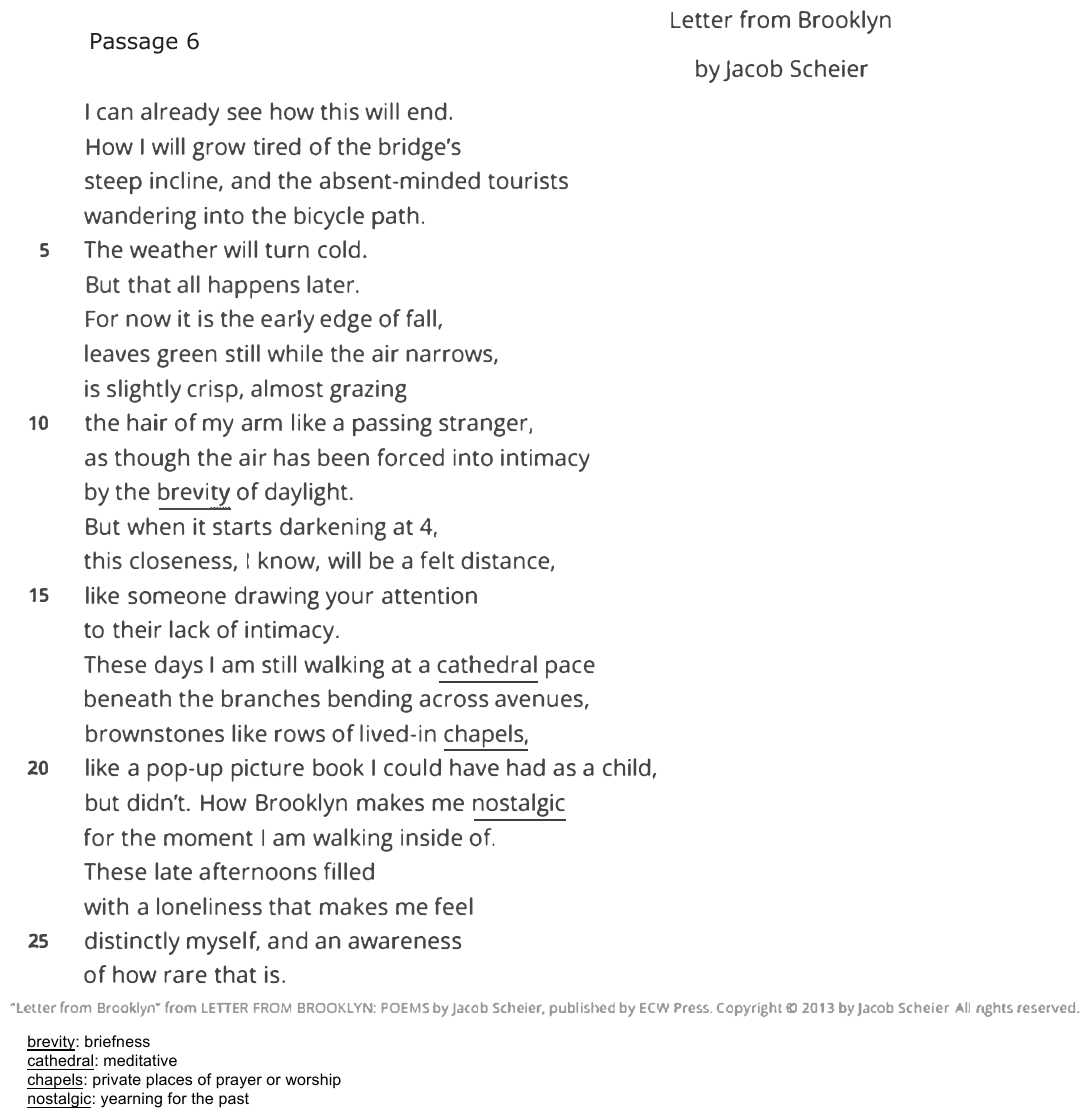
The fireworks in the poem represent the speaker’s
- Awish to return to a simpler way of living.
- Bbittersweet feelings about leaving the past behind.
- Chigh expectations for everyday life.
- Dreflections on past interactions with relatives.
Show the answer
Correct answer: B
The question asks what the fireworks in the poem represent about the speaker.
A. Incorrect. While the speaker misses elements of the past, the speaker is also positive about the present, with comparisons to a “constant celebration” (line 33) and descriptions of “the music of people” (line 36). The speaker does not indicate a desire to return to a simpler way of living.
B. CORRECT. The speaker misses the experience of watching the fireworks display with family and friends but understands that time has progressed and that life is now different. The lines “This was a treat we waited / all year for” (lines 6–7) highlight the significance of the memory of waiting for and watching the fireworks. In the speaker’s present, the lines “I remember the feel of the pickup truck bumping / across the ridged field” (lines 40–41) emphasize the key details from the experience that stand out in the speaker’s mind when something in the current environment reminds the speaker of the past.
C. Incorrect. While the speaker does share details about the present and the tone is generally positive, the fireworks do not suggest that the speaker has high expectations for how everyday life should be. The third stanza (lines 28–42) describes the speaker’s daily life in the city, but the speaker does not form expectations from these everyday moments.
D. Incorrect. While the speaker does mention discussing cloud shapes with a family member in lines 19–20, the fireworks serve as a more general reminder of the speaker’s past life. Viewing the bright lights of the city makes the speaker recall memories of the speaker’s past and the feelings of anticipation before the fireworks show.
Question analysis
This question about symbolism asks what the fireworks represent in “Ode to Fireworks,” a 42-line poem in which an adult speaker remembers watching fireworks at a country fair as a child. Students must weigh all three stanzas to decide what the central image stands for, and the choices name abstract feelings and wishes that are close to one another.
- Grade level
- Grade 8 reading and task
- Compared with grade 7
- Above grade 7 Grade 7 students interpret symbols, usually where the text makes their meaning fairly clear. Here they must hold a 42-line poem in mind and choose among four abstract feelings, two of them very close, which goes beyond typical grade 7 work.
- Estimated difficulty
- Hard: combines ideas, needs a plan, and has more than one tempting wrong answer.
- Thinking it demands
- Depth of knowledge 3, strategic thinking · mainly analyze
- What makes it hard
- Figurative or literary language moderate
- A very close wrong answer moderate
- Evidence in several places moderate
- Evidence
- Answered from the whole text
- Reading level
- Passage: 379 words (a poem; reading level not measured); question and choices: about grade 8, 35 words.
- Corrected from the DOE handbook
- The explanation of C misdescribed the third stanza; one sentence was corrected.
- Students, last 30 days
- Not enough answers yet to show (it takes 10).
Why it is hard, traps and wrong answers (shows the answer)
Why it is hard
This symbol question asks students to hold the whole 42-line poem in mind and weigh two feelings at once: the speaker misses the fireworks of childhood but speaks warmly of city life. Readers who notice only the longing choose a wish to go back, and readers who fix on one detail choose the relatives or the city’s “constant celebration.” The key’s “bittersweet” is the one word that holds both halves, which is why it is easy to pass over for a choice that states only one.
Figurative or literary language moderate Understanding the question
The fireworks are never explained; they are “jewels” in stanza 2 and the “childhood bursts” that “escorted us home” in stanza 3, so their meaning as a symbol must be built from images. (Graesser, Singer & Trabasso, 1994; Kintsch, 1998)
A very close wrong answer moderate Choosing the answer
The wish-to-return choice and the key both read the fireworks as feelings about the past; they differ in whether the speaker wants that past back or has accepted leaving it. (Embretson & Wetzel, 1987; Gorin & Embretson, 2006; Ascalon et al., 2007)
Evidence in several places moderate Working it out
The answer needs all three stanzas: the treat “we waited / all year for,” the dark country night, and the city stanza’s “This is where we live now,” which shows acceptance beside longing. (Kirsch & Mosenthal, 1990; Gorin & Embretson, 2006)
Strategy: Note how the speaker describes the fireworks in each stanza and how the speaker feels about the present in the last one, then choose the feeling that fits all three stanzas, not only the first.
Traps
- Reads too much in: A reasonable-sounding conclusion that goes further than the text allows.
- Word match: Repeats striking words or phrases from the text, so it looks supported, but its meaning does not fit the question.
- Too narrow: A single detail offered as the central idea or a summary, or a summary that keeps minor details and leaves out an essential part.
The wrong answers, classified
A Reads too much in (Graesser, Singer & Trabasso, 1994)
Takes the poem’s fond memories of the country as a wish to go back, though the speaker accepts “where we live now” and never asks to return.
C Word match (Freedle & Kostin, 1993)
Links the fireworks to line 33’s “Everything is a constant celebration,” then turns that into high expectations for daily life, which the poem never mentions.
D Too narrow (King et al., 2004)
Fixes on the mother, sister and cousin of the first stanza, real details, but the fireworks stand for a whole period of the speaker’s life, not time with relatives.
What was corrected from the DOE handbook, and why
- Explanation: Rejecting C, the handbook's explanation calls the third stanza (lines 28–42) “the speaker’s imaginings” and “fantasies”. The stanza describes the speaker's real life in the city now: “This is where we live now”, picking up washing at the cleaner's, stopping by the corner market. It now says the stanza describes the speaker's daily life in the city. The answer, B, is unchanged.
Working it out, step by step
Figure out what the question asks
This asks what the fireworks represent, or stand for. A thing in a poem that stands for a bigger idea is called a symbol. Look at the fireworks in all three stanzas. Then see how the speaker feels about the past and the present.
Look at the past
Stanza 1 shows how special the fireworks were: “This was a treat we waited / all year for.” Stanza 2 calls them “jewels.” In stanza 3 the speaker still remembers them: “I remember the feel of the pickup truck bumping / across the ridged field.” So the speaker misses that time.
Look at the present
The speaker also accepts city life: “This is where we live now, / and it is how we live now.” The city is “a constant celebration,” full of “the music of people.” So the speaker is not unhappy now. The speaker misses the past but has moved on. That feeling is bittersweet: happy and sad at the same time.
Check each choice
- A is wrong. The speaker never says they want to go back to the country.
- B is right. The fireworks stand for a loved past the speaker has left behind. The feeling is both warm and sad.
- C is wrong. The “constant celebration” describes city life. Nothing shows high expectations.
- D is wrong. Relatives appear in stanza 1. But the fireworks stand for a whole time of life, not just time with family.
Watch out: A notices only the longing. It misses that the speaker accepts “where we live now.”
Choose the answer
The fireworks hold both the joy of the past and the sadness of leaving it. So the answer is B, “bittersweet feelings about leaving the past behind.”
Why this answer and not the closest wrong one
A is the closest wrong answer. Both A and B are about feelings for the past. But A says the speaker wants to return, and the poem never says that. The speaker calls the city “a constant celebration” and accepts “where we live now.” Missing the past while accepting the present is bittersweet. That is B.
More questions like this
The original DOE question
The passage “Ode to Fireworks” as printed (page 32)
Question 3 of 6
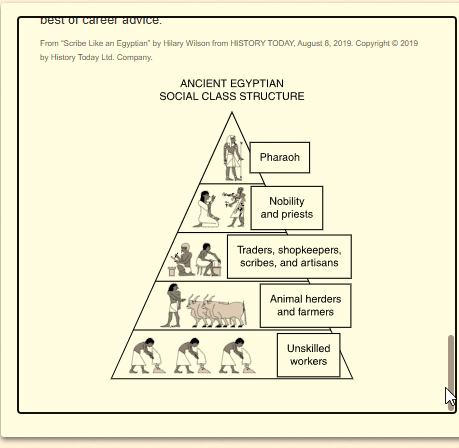
2025 Practice Test A English, question 12Passage Excerpt from “Scribe Like an Egyptian”
Excerpt from “Scribe Like an Egyptian”
by Hilary Wilson
In ancient Egypt, literacy was the key to success. However, contrary to popular belief, not all Egyptian scribes understood hieroglyphs. Many relied instead on the simpler hieratic script for the multitude of everyday documents generated by the Egyptian bureaucracy.
Hieroglyphs—“the Words of God”—compose a writing system with more than 1,000 distinct characters, the meanings of which were lost for 1,500 years before they were deciphered by Jean-François Champollion in 1822. Including both ideograms (which convey a whole word or idea, either concrete or abstract, in a single sign) and phonograms (representing either an alphabetic sound or a group of consonants), [the writing system] was used in formal inscriptions on tomb and temple walls as well as on elaborate funerary papyri. For everyday purposes, however, scribes used a shorthand version of the hieroglyphic script known as hieratic, which was quicker to write and more economical of space. The two writings existed side by side for at least 2,500 years.
Scraps of ancient hieratic writing, mostly penned by student scribes on limestone flakes called ostraca, suggest that no matter how humble his origins, an educated Egyptian could achieve almost anything. Horemheb (d.1292 B.C.) is a good example. Born of middle-ranking parents, his scribal training led to an army career. From Scribe of Recruits, during the reign of Akhenaten (1353–1336 B.C.), Horemheb rose through the military ranks and, by the rule of Tutankhamun (1332–1323 B.C.), he was commander in chief of the Egyptian forces. As a close adviser of the young Pharaoh, Horemheb was appointed “Deputy of the King throughout the Two Lands,” and might have expected to succeed to the throne should the king die childless. He had to wait a few years, but eventually Horemheb achieved the pinnacle of his career by becoming the last king of the 18th Dynasty, making his mark by instituting dramatic reforms to the organisation of the army, the judiciary and administration in general. The lasting success of these changes owed much to his scribal background. . . .
But education was not available to all. Government departments and major temples supported schools, where boys commenced their training at six or seven, sometimes earlier. To these boarding establishments . . . family or household servants delivered the students’ food and drink rations daily for several years, during which time the student was not contributing to the family’s income. Boys from poorer families could only hope to be educated with support from a wealthier relative or patron, or through apprenticeship to an older scribe, perhaps the local clerk or land agent, who would teach them the basics of the scribe’s craft. This limited the scope for employment but such “on the job” training allowed apprentices to help out at home while learning. . . .
Scribal education began with the elementary principles of the hieratic script. The lowliest scribes, who trained for just five or six years, probably learned only the rudiments of the hieroglyphic script. Students were set exemplar documents and extracts from popular texts to copy, to practice their hieratic handwriting on basic-format letters, reports and contracts, while absorbing the good advice contained in the texts. Surviving examples of copy-work sometimes include tutors’ corrections added in red. Some significant Egyptian literary works survive almost exclusively from student copies.
A schoolboy “dictionary” of hieroglyphs with their hieratic equivalents shows that a knowledge of more than 450 signs was required for everyday writing purposes. Lessons in record-keeping and filing and labelling enabled any half-competent scribe to perform that most essential of all scribal functions: the making and updating of lists. For professions such as those of government official, priest or lawyer, a scribe would train for several more years, increasing his vocabulary to perhaps a thousand or more signs. Those with the best handwriting or drawing skills might follow the craft of creating beautifully illustrated copies of funerary texts, commonly called Books of the Dead. Others could become draughtsmen, artists or architects. Doctors compiled their own collections of medication recipes, treatments and associated incantations, many copied from texts found in the House of Life, the temple library. Lawyers had to be familiar with the corpus of civil and religious laws and precedents found in the official records, which were administered by archivists. Egypt’s bureaucratic society depended on the skills of an army of scribes of all ranks from filing clerk to tax assessor. For young Egyptians, “be a scribe” was the best of career advice.
From “Scribe Like an Egyptian” by Hilary Wilson from HISTORY TODAY, August 8, 2019. Copyright © 2019 by History Today Ltd. Company.
bureaucracy: an administrative staff of government officials
funerary papyri: a sheet or scroll of papyrus containing religious images and hieroglyphs meant to help the deceased be reborn in the afterlife
rudiments: basics
schoolboy: slang that refers to materials used during the course of receiving an education
draughtsmen: people who draw plans of machinery or structures
corpus: a collection of writings
Question
Which claim is best supported by the information presented in paragraphs 3 and 4?
- AEducation was difficult for the common citizens of Egypt to obtain.
- BOnce students began studying to become scribes, their future held more possibilities.
- CIf someone wanted to become a scribe, support from outside sources such as the government or a temple was necessary.
- DBecoming a successful scribe required a student’s family to sacrifice time and money in order to ensure the best education.
Show the answer
Correct answer: B
The question asks for the claim that is best supported by the details in paragraphs 3 and 4.
A. Incorrect. While paragraph 4 does explain that boys from poorer families had more challenges in receiving an education, the paragraph also provides examples of obtaining a patron or getting an apprenticeship as ways that these aspiring scribes could attain an education. Furthermore, the details in paragraph 3 do not provide any support for the claim that “common citizens” had difficulty getting an education because that paragraph focuses on the example of one person who was able to become a king as a result of his background as a scribe.
B. CORRECT. In paragraph 3, the author provides an example of a person who used his skills as a scribe to rise through the ranks of society by describing the achievements of Horemheb to support the idea that “no matter how humble his origins, an educated Egyptian could achieve almost anything.” The author continues in paragraph 4 to explain that with the proper support, some young Egyptians could become educated, thereby opening more opportunities for themselves.
C. Incorrect. Paragraph 4 explains that schools were supported by the government and religious institutions, but it also explains that apprenticeships were a method of learning the craft of the scribe. As the paragraph indicates, boys could also be helped in their education by support from “a wealthier relative or patron.”
D. Incorrect. In paragraph 4, the author details the sacrifices that families made to keep their sons at the schools, while boys from poorer families could only hope for a patron or an apprenticeship. Paragraph 4 also explains that apprentices could help out at home while learning, so the sacrifice of time and money was not required of every family.
Question analysis
This inference question asks which claim is best supported by paragraphs 3 and 4 of “Scribe Like an Egyptian,” which tell the story of the scribe Horemheb and describe who could get a scribal education in ancient Egypt. Students must weigh each claim against both paragraphs together, and several claims echo a single sentence closely enough to look supported.
- Grade level
- Grade 8 reading and task
- Compared with grade 7
- Above grade 7 Choosing the claim a passage best supports is core grade 7 work. Here the claim must fit two paragraphs that do different jobs, one telling a single man’s story and one explaining access to schooling, and some choices fit only part of that.
- Estimated difficulty
- Hard: combines ideas, needs a plan, and has more than one tempting wrong answer.
- Thinking it demands
- Depth of knowledge 3, strategic thinking · mainly evaluate
- What makes it hard
- Evidence in several places moderate
- The right answer is reworded moderate
- Reading between the lines minor
- Evidence
- Answered from several paragraphs or stanzas
- Reading level
- Passage: about grade 12, 810 words; question and choices: about grade 10, 75 words.
- Corrected from the DOE handbook
- A misdescription of the passage in the explanation of one wrong answer was corrected.
- Students, last 30 days
- Not enough answers yet to show (it takes 10).
Why it is hard, traps and wrong answers (shows the answer)
Why it is hard
The trap is a claim that paragraph 4 seems to state almost word for word, which makes it feel safer than the right one. But the question asks for support from both paragraphs, and Horemheb’s story points the other way, toward what schooling made possible. The two other wrong claims harden paragraph 4’s details into rules, a necessary sponsor or a required family sacrifice, so words like “necessary” and “required” are the ones to test.
Evidence in several places moderate Working it out
The claim must fit two paragraphs that do different work: paragraph 3 follows Horemheb from army scribe to king, and paragraph 4 explains who could pay for schooling and what the alternatives were. (Kirsch & Mosenthal, 1990; Gorin & Embretson, 2006)
The right answer is reworded moderate Choosing the answer
The right claim restates paragraph 3’s “an educated Egyptian could achieve almost anything” in new words, while the most tempting wrong one nearly copies paragraph 4’s opening, “education was not available to all.” (Freedle & Kostin, 1993; Kirsch & Mosenthal, 1990)
Reading between the lines minor Working it out
Students must connect Horemheb’s rise with paragraph 4’s account of who got schooling to see that both paragraphs are about education opening doors, a link the author leaves implicit. (Graesser, Singer & Trabasso, 1994; Kintsch, 1998)
Strategy: Sum up paragraph 3 and paragraph 4 in a sentence each, then test every claim against both summaries, watching for words that make a claim stronger than the text.
Traps
- Too narrow: A single detail offered as the central idea or a summary, or a summary that keeps minor details and leaves out an essential part.
- Too broad or too strong: A choice overstates, generalizes, or uses absolute words the text does not support.
- Reads too much in: A reasonable-sounding conclusion that goes further than the text allows.
The wrong answers, classified
A Too narrow (King et al., 2004)
Rests on paragraph 4’s opening, “education was not available to all,” and ignores paragraph 3, whose Horemheb shows an educated man rising from modest origins to the throne.
C Too broad or too strong (King et al., 2004)
Makes the government and temple schools of paragraph 4 “necessary,” overlooking its other routes: help from “a wealthier relative or patron,” or apprenticeship to a working scribe.
D Reads too much in (Graesser, Singer & Trabasso, 1994)
Turns the rations and lost income that some families bore in paragraph 4 into a requirement for every successful scribe, and adds “the best education,” which the paragraph never mentions.
What was corrected from the DOE handbook, and why
- Explanation: The DOE’s explanation of D said paragraph 4 details sacrifices “necessary for some poorer families,” and that paragraph 3’s Horemheb, born of middle-ranking parents, shows the sacrifice was not required of all families. In paragraph 4 the rations and lost income are those of families whose sons were at the schools; poorer boys could only hope for a patron or an apprenticeship; and paragraph 3 says nothing about what Horemheb’s family gave up. The explanation now says so: D is wrong because apprentices could help out at home while learning, so not every family made the sacrifice.
Working it out, step by step
Figure out what the question asks
This asks which claim is best supported by paragraphs 3 and 4 together. A claim is a statement that someone says is true. The right claim must fit both paragraphs. Watch for strong words, like “necessary,” that go further than the text.
Sum up paragraph 3
Paragraph 3 tells about Horemheb. His parents were middle-ranking, not rich or powerful. His training as a scribe led to a job in the army. He rose to lead the army, then to serve the young king, and in the end he became king himself. The author uses him to show that “no matter how humble his origins, an educated Egyptian could achieve almost anything.” Humble origins means an ordinary family background.
Sum up paragraph 4
Paragraph 4 opens by saying that not everyone could get an education. Government offices and big temples ran schools. Families sent food and drink for years, while the boy earned nothing for them. Poorer boys could hope for help from “a wealthier relative or patron.” A patron is someone who pays for another person’s training. Or they could learn on the job from a working scribe. That path led to fewer jobs.
Put the two paragraphs together
Both paragraphs are about what schooling could do for a boy. Paragraph 3 shows a man rising all the way to king because he trained as a scribe. Paragraph 4 shows that, with the right support, boys could get that schooling. It even notes that the on-the-job path led to fewer jobs. So education opened doors. That is what choice B says.
Check each choice
- A does not fit. It matches only the start of paragraph 4. Paragraph 4 also gives ways in for poorer boys, and paragraph 3 shows a man from an ordinary family rising to the top.
- B fits. Both paragraphs show schooling leading to more possibilities.
- C does not fit. A government or temple school was not “necessary.” A relative, a patron or an apprenticeship could also work.
- D does not fit. Apprentices could help out at home while they learned, so not every family gave up time and money. And the paragraphs never mention “the best education.”
Choose the answer
The claim that fits both paragraphs is that schooling gave a boy more possibilities. So the answer is B.
Why this answer and not the closest wrong one
A is the closest wrong choice, because paragraph 4 begins by saying not everyone could get an education. But the question asks about paragraphs 3 and 4. Paragraph 3 tells of a scribe from an ordinary family who became king. Paragraph 4 shows ways around the cost. Both point to what education made possible, which is B.
More questions like this
The original DOE question
The passage “Excerpt from “Scribe Like an Egyptian”” as shown on the test
Question 4 of 6
2026 Practice Test C Math, question 15Question
A grocery store sells 1-gallon containers of milk for $3.99. The store also sells orange juice in a 6-pack of 5.5-fluid-ounce bottles for $1.79. Suppose the store wants to sell its orange juice in gallon containers instead. To the nearest dollar, how much more would a gallon of orange juice cost than a gallon of milk?
Enter your answer in the space.
Fill-in question: work out the answer and type it as a number.
Show the answer
Correct answer: 3
To determine the cost of a gallon of orange juice, begin by finding the total number of ounces in the 6-pack of bottles:
So, 33 oz of orange juice costs $1.79.
There are 128 oz in 1 gallon. Set up a proportion using the $1.79 cost per 33 oz of orange juice and the unknown cost (x) per 1 gallon of orange juice:
Cross multiply to solve for x in the proportion:
So, the orange juice costs $6.94 per gallon, and the milk costs $3.99 per gallon.
Subtract the cost per gallon of milk from the cost per gallon of orange juice.
Round the difference to the nearest dollar.
$2.95 rounds to $3.
Question analysis
A store sells milk by the gallon for $3.99 and orange juice in six-packs of 5.5-fluid-ounce bottles for $1.79. Students work out what a gallon of the juice would cost at the same price per ounce and how much more that is than the milk, to the nearest dollar. The ounces in a gallon must be known, and several steps involve decimals.
- Grade level
- Grade 7 content, by NYS standard
- Compared with grade 7
- Above grade 7 Unit prices are grade 6 and 7 work, but this chains five steps with decimals and needs a fact the question does not give, the number of fluid ounces in a gallon. Typing a rounded difference, with no choices, adds risk.
- Estimated difficulty
- Hard: combines ideas, needs a plan, and has more than one tempting wrong answer.
- Thinking it demands
- Depth of knowledge 2, skills and concepts · mainly apply
- What makes it hard
- Something you must already know moderate
- Many steps moderate
- Error-prone arithmetic minor
- An answer in an unexpected form minor
- Solution
- 5 steps
- Reading level
- Question and choices: about grade 5, 60 words.
- Corrected from the DOE handbook
- A rounded value in the explanation is now marked as approximate (≈ instead of =).
- Students, last 30 days
- Not enough answers yet to show (it takes 10).
Why it is hard, traps and wrong answers (shows the answer)
Why it is hard
The calculation is long, and its key fact is missing from the page. Students who know the 128 fluid ounces still face a division by 33 that does not come out evenly, which tempts them to round the price per ounce to 5 cents and lose about 50 cents a gallon. Keeping the exact quotient to the end, or scaling 33 ounces up by about 3.9, keeps the difference near $2.95, which rounds to 3.
Something you must already know moderate Working it out
The question never says that a gallon holds 128 fluid ounces, yet the whole comparison depends on it; the 6-pack holds only 6 × 5.5 = 33 ounces. (Anderson & Krathwohl, 2001)
Many steps moderate Working it out
Five moves follow one another: the ounces in a pack, the scale-up to 128 ounces, the division by 33, the subtraction of $3.99 and the rounding to a whole dollar. (Daniel & Embretson, 2010; Enright, Morley & Sheehan, 2002)
Error-prone arithmetic minor Working it out
1.79 × 128 = 229.12 and 229.12 ÷ 33 are long decimal calculations without a calculator, and a slip in either moves the price of a gallon. (Brown & Burton, 1978; Junker & Sijtsma, 2001)
An answer in an unexpected form minor Choosing the answer
The rounded difference is typed with no choices, so an unrounded $2.95, or a figure rounded too soon, looks just as finished as the whole-dollar answer. (Enright, Morley & Sheehan, 2002)
Strategy: Find the ounces in one six-pack, scale its price up to the 128 fluid ounces in a gallon, subtract the milk's price, and round only at the end.
Traps
- Stops one step early: A choice is a number from partway through the solution.
- Rounds too early: Rounds a value partway through, or rounds the wrong way, so the final answer drifts from the exact one.
- Misreads the question: Misses or misreads a condition or a word in the question: "at least", "each", "remaining", "not".
The wrong answers, classified
7 Stops one step early (King et al., 2004; Gierl et al., 2017)
Finds the juice's cost per gallon, about $6.94, rounds it to $7, and enters that without subtracting the $3.99 price of the milk.
2 Rounds too early (King et al., 2004)
Rounds the price per ounce, 1.79 ÷ 33 ≈ 0.054, to $0.05, so a gallon costs $6.40 and the difference, $2.41, rounds to 2.
2.95 Misreads the question (Hegarty, Mayer & Monk, 1995)
Works out the difference of $2.95 correctly but enters it as it stands, though the question asks for it to the nearest dollar.
What was corrected from the DOE handbook, and why
- Explanation: The DOE’s explanation goes from 33x = $229.12 to “x = $6.94”. But 229.12 ÷ 33 = 6.9430…, so $6.94 is the cost per gallon rounded to the cent. The site writes x ≈ $6.94. Nothing else changes: $6.94 − $3.99 = $2.95, which rounds to $3, and the unrounded cost gives the same answer.
Worked solution, step by step
Formulas used
- Fluid ounces in a gallon
- A gallon holds 128 fluid ounces. This is a fact you must know, because the question does not give it. A fluid ounce measures an amount of liquid. Multiply gallons by 128 to change them into fluid ounces.
- Cross-multiplying a proportion
- A proportion says two ratios are equal. Here each ratio is ounces over dollars. a and c are the tops, and b and d are the bottoms. Multiply each top by the other bottom, and the two products are equal. That turns the proportion into an equation.
Sort out the question
Milk costs $3.99 for 1 gallon. Orange juice comes in a 6-pack of 5.5-fluid-ounce bottles for $1.79. You need how much more a gallon of juice would cost than a gallon of milk. Round to the nearest dollar.
The question doesn’t say how big a gallon is. You must know this fact: 1 gallon is 128 fluid ounces.
Find the ounces in a 6-pack
Each of the 6 bottles holds 5.5 fluid ounces:
So $1.79 buys 33 fluid ounces of juice.
Set up a proportion
Let x be the cost in dollars of a gallon, 128 fluid ounces, of juice. The price per ounce stays the same. So ounces over dollars is the same for the pack and the gallon:
Cross-multiply:
Find the cost of a gallon
Divide both sides by 33:
The sign ≈ means about equal. The exact value is 6.943…, so a gallon of juice costs about $6.94.
Watch out: don’t round too early. One ounce costs about $0.054. Rounding that to $0.05 makes a gallon $6.40, and your answer becomes 2.
Subtract the milk’s price
Find how much more the juice costs:
A gallon of juice costs $2.95 more than a gallon of milk.
Watch out: entering 7, the juice’s price, forgets to subtract the milk.
Round and enter it
The question asks for the nearest dollar. $2.95 is between $2 and $3. Its cents, 95, are 50 or more, so it rounds up to $3. Do not enter 2.95.
Type only the number in the box. So you would enter 3.
Check your answer
Estimate. 128 ounces is almost 4 packs, since . Four packs cost dollars, so a gallon costs a bit less than that. Milk costs about $4. About $7 minus $4 is $3, which matches.
More questions like this
The original DOE question

Question 5 of 6
2026 Practice Test D Math, question 36Question
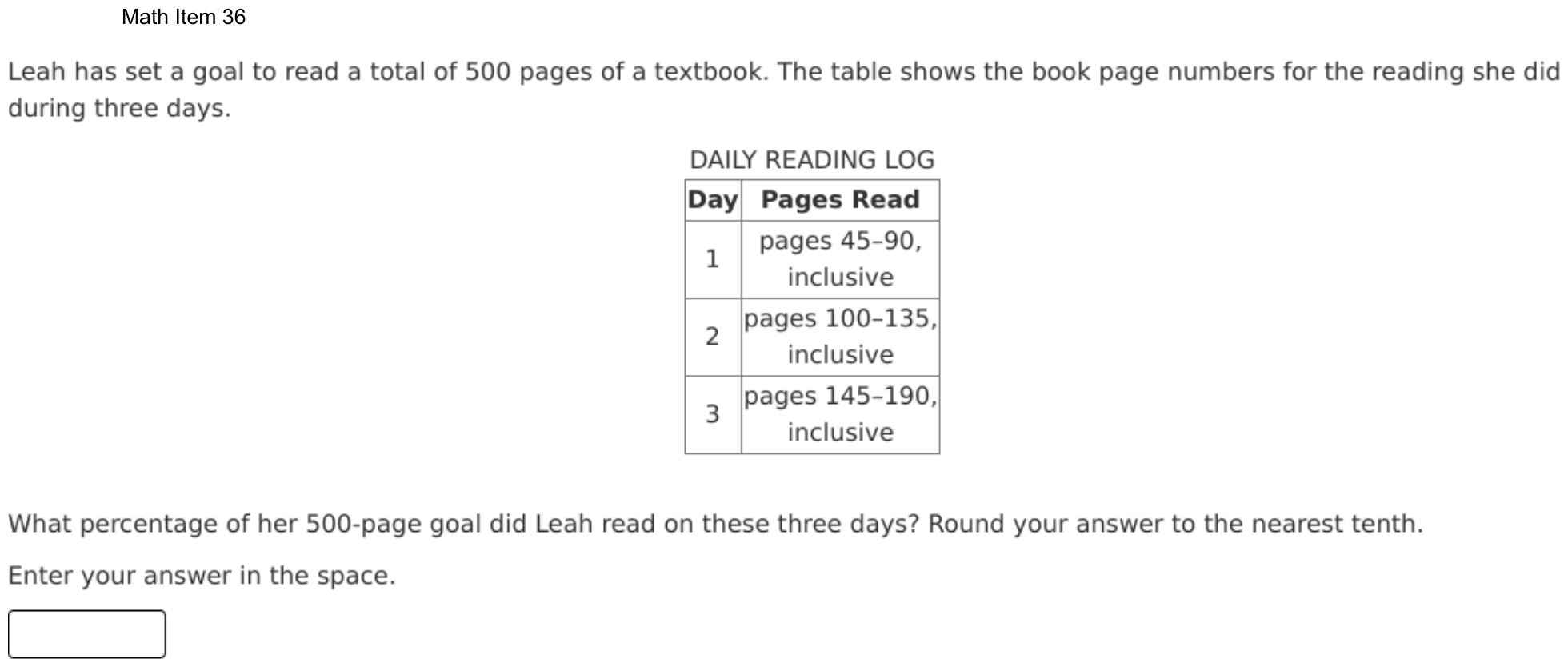
Leah has set a goal to read a total of 500 pages of a textbook. The table shows the book page numbers for the reading she did during three days.
DAILY READING LOG
| Day | Pages Read |
|---|---|
| 1 | pages 45–90, inclusive |
| 2 | pages 100–135, inclusive |
| 3 | pages 145–190, inclusive |
What percentage of her 500-page goal did Leah read on these three days? Round your answer to the nearest tenth.
Enter your answer in the space.
Fill-in question: work out the answer and type it as a number.
Show the answer
Correct answer: 25.6%
First, determine the number of pages read each day. Since the pages per assignment are inclusive, subtract the first page from the last page assigned and then add 1 to determine the pages read for each day.
Day 1: pages
Day 2: pages
Day 3: pages
Leah read a total of 128 pages, since .
To determine the percent, express 128 pages out of 500 pages as a fraction.
Question analysis
Leah's daily reading log lists three ranges of textbook pages, each marked inclusive, and her goal is 500 pages. This percent question asks what percentage of the goal she read over the three days, rounded to the nearest tenth and typed in. Counting the pages in each inclusive range correctly is the tricky step before the percent.
- Grade level
- Grade 7 content, by NYS standard
- Compared with grade 7
- Above grade 7 Finding what percent one number is of another is grade 6 and 7 work. This adds three inclusive page ranges to count, which takes more care than subtracting, then a rounding step, all typed with no choices to check against.
- Estimated difficulty
- Hard: combines ideas, needs a plan, and has more than one tempting wrong answer.
- Thinking it demands
- Depth of knowledge 2, skills and concepts · mainly apply
- What makes it hard
- Something you must already know moderate
- Many steps moderate
- An answer in an unexpected form minor
- Solution
- 4 steps
- Reading level
- Question and choices: about grade 3, 66 words.
- Students, last 30 days
- Not enough answers yet to show (it takes 10).
Why it is hard, traps and wrong answers (shows the answer)
Why it is hard
Counting pages in a range is the whole difficulty; the percent at the end is routine once the total is right. Subtracting first from last feels natural, and here it even rewards the student with a round 25%, so nothing looks wrong. Checking the rule on a tiny range, pages 1 to 3, which is 3 pages and not 2, fixes the count, and the instruction to round to the nearest tenth hints that the answer is not a whole number.
Something you must already know moderate Working it out
Every row says inclusive, but nothing says that pages 45 to 90 hold 90 − 45 + 1 = 46 pages; subtracting alone loses one page on each of the three days. (Anderson & Krathwohl, 2001)
Many steps moderate Working it out
Three page counts, a sum, a division by 500 and a change to a percent come in sequence, and a one-page error in each count carries through to the end. (Daniel & Embretson, 2010; Enright, Morley & Sheehan, 2002)
An answer in an unexpected form minor Choosing the answer
The answer is typed with no choices, and the miscounted total, 125 pages, gives a tidy 25% that looks more finished than the right value with its tenth. (Enright, Morley & Sheehan, 2002)
Strategy: Count each day's pages carefully, testing your method on a short range such as pages 1–3, add the three days, divide by 500, and write the result as a percent to the nearest tenth.
Traps
- Counting the ends: Inclusive or exclusive ends, fence posts, consecutive numbers: an answer that is one too many or too few, or an endpoint drawn open where it belongs closed (or the reverse).
- Stops one step early: A choice is a number from partway through the solution.
- Misreads the question: Misses or misreads a condition or a word in the question: "at least", "each", "remaining", "not".
The wrong answers, classified
25 Counting the ends (Brown & Burton, 1978)
Subtracts the first page from the last for each day, 45 + 35 + 45 = 125 pages, forgetting that an inclusive range counts both end pages, so 125 ÷ 500 = 25%.
0.256 Stops one step early (King et al., 2004; Gierl et al., 2017)
Counts the 128 pages and divides by 500 correctly, then enters the decimal 0.256, one step short of multiplying by 100 to make a percent.
26 Misreads the question (Hegarty, Mayer & Monk, 1995)
Finds 25.6% correctly but rounds it to the nearest whole percent, overlooking the instruction to round to the nearest tenth.
Worked solution, step by step
Formulas used
- Counting pages in an inclusive range
- Inclusive means the first and last pages are both read. Subtracting counts the steps from the first page to the last. That misses one page, so add 1. Test it: pages 1 to 3 are 3 pages, and 3 − 1 + 1 = 3.
- Percent of a total
- The part is the amount you have, here the pages read. The whole is the amount you compare with, here the 500-page goal. Dividing gives a decimal. Multiplying by 100 turns it into a percent, a number out of 100.
Sort out the question
Leah’s goal is 500 pages. The log shows three days:
- Day 1: pages 45 to 90
- Day 2: pages 100 to 135
- Day 3: pages 145 to 190
Each range is inclusive. You need the percent of 500 pages she read, rounded to the nearest tenth.
Count the pages each day
Use the rule for an inclusive range: last page minus first page, plus 1.
Watch out: subtracting alone gives 45, 35 and 45 pages. That is 125 pages, which is exactly 25%. A round answer like that can hide the mistake.
Add the three days
Add the pages from all three days to get her total:
Leah read 128 pages in all. This is the part you compare with the goal.
Change to a percent
Divide the pages read by the goal, then multiply by 100:
Leah read 25.6% of her goal. That already ends in tenths, so no rounding is needed.
Watch out: 0.256 is a decimal, not a percent. And 26 rounds to a whole number, not to the nearest tenth.
Enter the answer
The box has no % sign, but the question asks for a percentage, so the number in the box is the percent. Type it with its decimal point. Typing 25.6% also counts on this site. So you would enter 25.6.
Check your answer
Estimate. 10% of 500 pages is 50 pages. 128 pages is a bit more than 2 × 50 = 100, so the answer is between 20% and 30%. Then check exactly: pages. It matches.
More questions like this
The original DOE question
Question 6 of 6
2026 Practice Test B Math, question 31Question
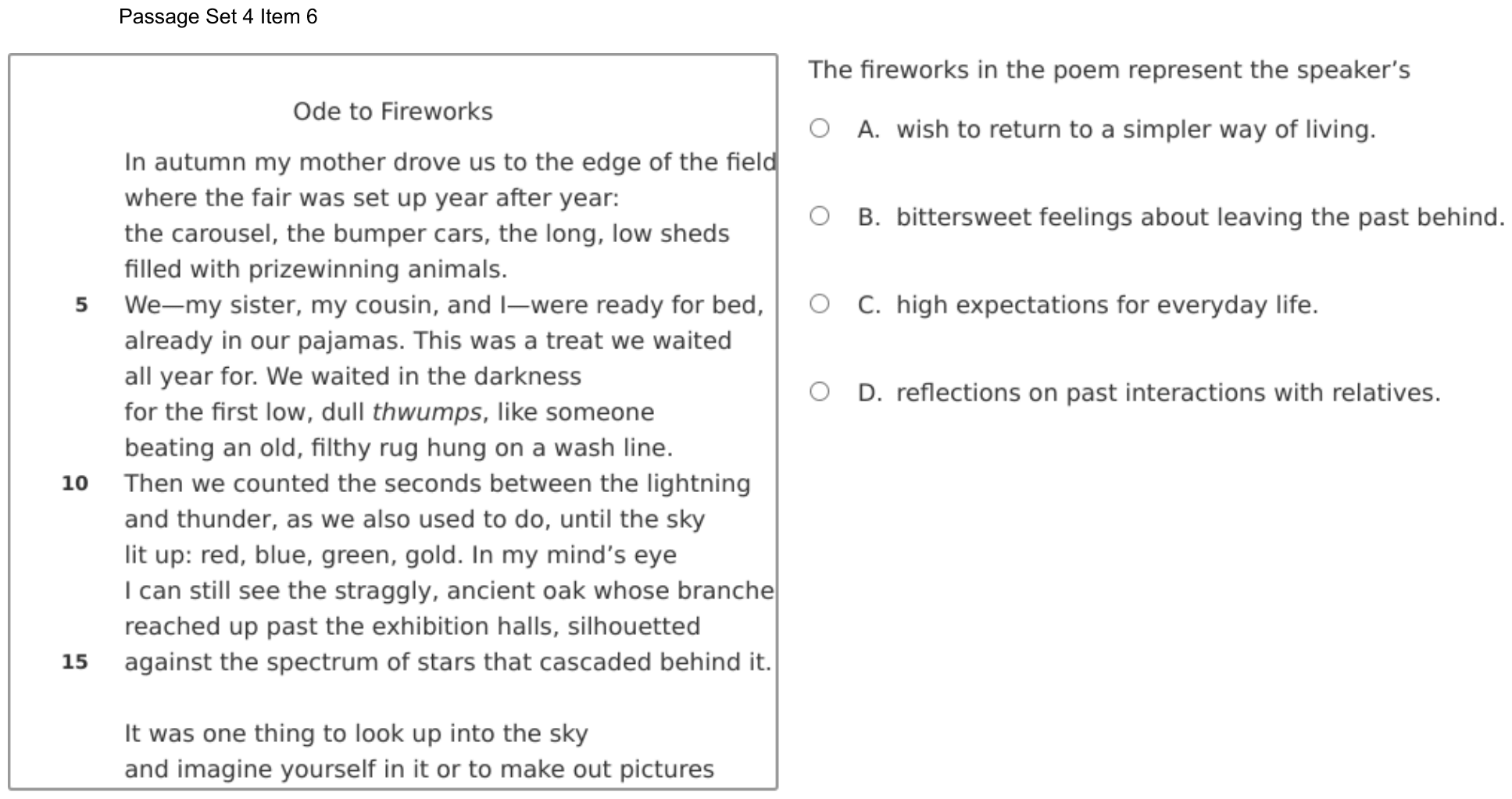
A pizza shop offers a choice of 3 sizes (small, medium, and large) and 7 different toppings. Different pizzas can be created by changing the size and the choice of toppings. If Cody wants to order a pizza with exactly 2 different toppings, how many different pizzas can he create?
- A6
- B21
- C63
- D126
Show the answer
Correct answer: C
Figure out how many different topping pairs are possible. Use 1, 2, 3, 4, 5, 6, 7 to represent the toppings, and create a list of possible pairs:
1,2; 1,3; 1,4; 1,5; 1,6; 1,7
2,3; 2,4; 2,5; 2,6; 2,7
3,4; 3,5; 3,6; 3,7
4,5; 4,6; 4,7
5,6; 5,7
6,7
So there are 21 different topping combinations for one pizza.
Since there are 3 pizza sizes, multiply the total number of combinations by 3 to get the total number of different pizzas Cody can create: .
Question analysis
Cody orders a pizza with exactly 2 of 7 toppings in one of 3 sizes, and students count how many different pizzas he could create. It tests counting combinations, where the order of the toppings does not matter, combined with a second choice. The challenge is to count every possible pizza exactly once.
- NYS standards
- 7.SP.8b sample spaces for compound events
- Grade level
- Grade 7 content, by NYS standard
- Compared with grade 7
- Above grade 7 In grade 7, compound events are usually ordered pairs, such as a coin with a number cube. Here an unordered pair of toppings is chosen from seven and then matched with three sizes, a combination count beyond typical grade 7 work.
- Estimated difficulty
- Hard: combines ideas, needs a plan, and has more than one tempting wrong answer.
- Thinking it demands
- Depth of knowledge 2, skills and concepts · mainly apply
- What makes it hard
- Combines ideas moderate
- Something you must already know minor
- Solution
- 3 steps
- Reading level
- Question and choices: about grade 8, 47 words.
- Students, last 30 days
- Not enough answers yet to show (it takes 10).
Why it is hard, traps and wrong answers (shows the answer)
Why it is hard
The question packs two counts into one sentence, each with its own trap. Order does not matter among the toppings, while the size multiplies every pair, and students tend to remember one of these and forget the other. Listing pairs systematically, each topping matched only with later ones, keeps the first count honest, and the stem’s “changing the size and the choice of toppings” is the reminder that size counts too.
Combines ideas moderate Working it out
Two counts are joined: the unordered pairs of toppings from 7, then the 3 sizes each pair can come in, and a mistake in either count changes the total. (Embretson, 1998; Daniel & Embretson, 2010)
Something you must already know minor Working it out
Students must know that a pizza with mushroom and onion is the same as one with onion and mushroom, so the ordered count 7 × 6 has to be halved. (Anderson & Krathwohl, 2001)
Strategy: Number the toppings 1 to 7, list each pair once by matching every topping only with higher-numbered ones, count the list, then bring in the choice of size.
Traps
- Stops one step early: A choice is a number from partway through the solution.
- Overlapping groups: Things in two groups at once are counted twice, or not subtracted.
The wrong answers, classified
A Numbers taken from the question (Hegarty, Mayer & Monk, 1995)
Multiplies the 3 sizes by the 2 toppings Cody wants, using the number of toppings on the pizza instead of the number of possible pairs.
B Stops one step early (King et al., 2004; Gierl et al., 2017)
Lists or counts the 21 pairs of toppings correctly, then stops without giving each pair its 3 possible sizes.
D Overlapping groups (King et al., 2004)
Counts ordered pairs, 7 × 6 = 42, so each pair of toppings appears twice, and then multiplies by the 3 sizes to reach 126.
Worked solution, step by step
Formulas used
- The counting principle
- m is the number of ways to make one choice, and n is the number of ways to make a second choice. Every first choice can go with every second choice, so you multiply. Here, every pair of toppings can come in every size.
- Pairs when order does not matter
- n is the number of items to choose from. There are n ways to pick a first item and n − 1 ways to pick a different second one. That counts each pair twice, once in each order. Dividing by 2 counts each pair once.
Sort out the question
Each of Cody’s pizzas has one size and exactly 2 different toppings. There are 3 sizes and 7 toppings. Pizzas differ by “changing the size and the choice of toppings.” So a small and a large with the same toppings are two different pizzas. You need to count every pizza once.
List the topping pairs
Order does not matter: onion with peppers is the same pizza as peppers with onion. So number the toppings 1 to 7, and pair each one only with bigger numbers. Then no pair shows up twice.
Topping Pairs with Pairs 1 2, 3, 4, 5, 6, 7 6 2 3, 4, 5, 6, 7 5 3 4, 5, 6, 7 4 4 5, 6, 7 3 5 6, 7 2 6 7 1 There are 21 different pairs of toppings.
Check the pairs with the formula
Use the pairs formula with 7 toppings:
Watch out: 7 × 6 = 42 counts every pair twice, once as 1 then 2 and once as 2 then 1. Keeping 42 leads to , choice D.
Bring in the sizes
Each of the 21 topping pairs can come in any of the 3 sizes. Use the counting principle:
Watch out: stopping at 21 leaves out the sizes, which gives choice B. Choice A, 6, multiplies the 3 sizes by the 2 toppings on one pizza. That does not count pizzas.
Give the answer
There are 21 topping pairs, and each one comes in 3 sizes. Cody can create 63 different pizzas. So the answer is C, 63.
Check your answer
Count one size at a time. A small pizza can have any of the 21 pairs, so there are 21 small pizzas. There are also 21 medium and 21 large ones: . That is more than the 21 pairs but fewer than 126, so it is reasonable.
More questions like this
The original DOE question