3 English and 3 math
Here are 6 random questions to try. Takers earning below 75% are unlikely to receive an offer. You have 1 minute 48 seconds per question on the real exam.
Question 1 of 6
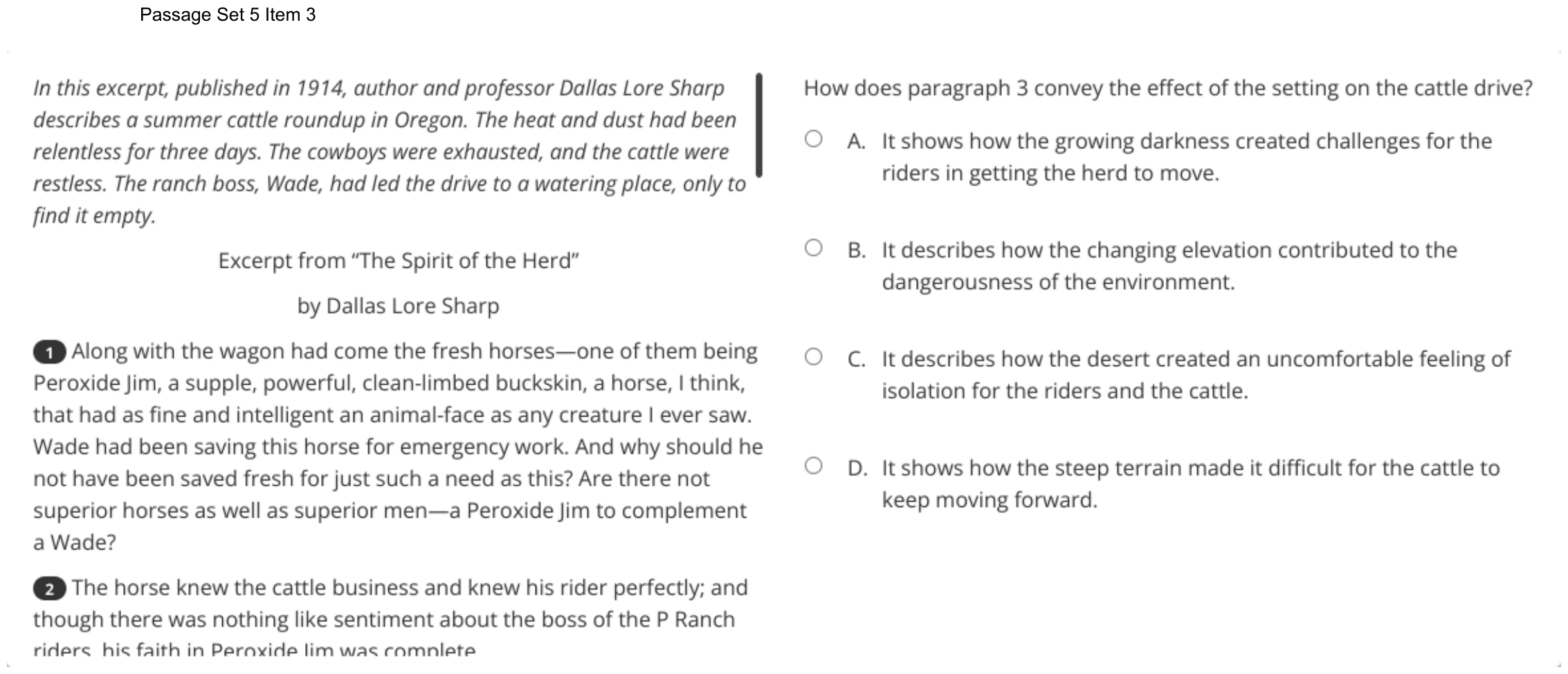
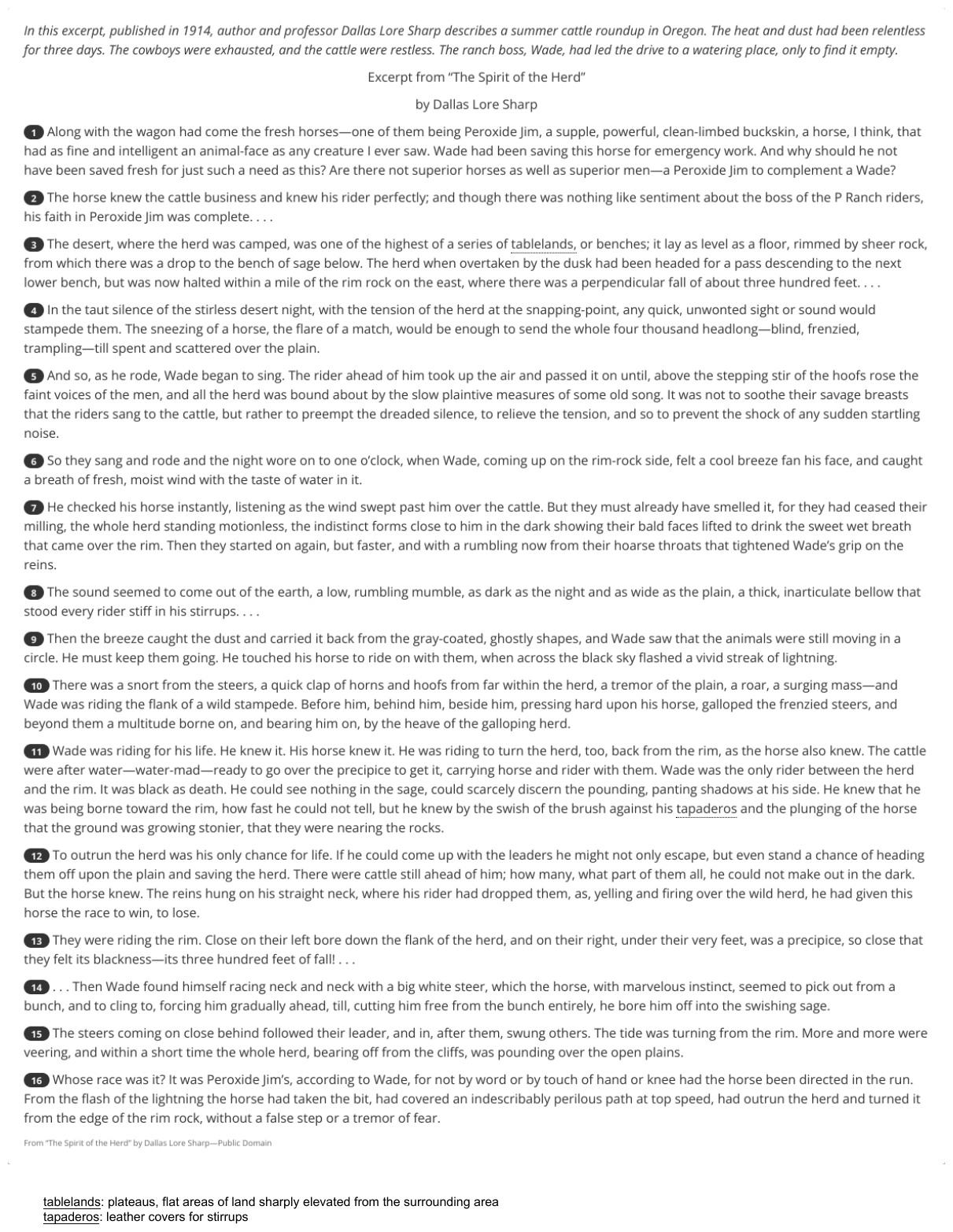
2026 Practice Test A English, question 31Passage Excerpt from “The Spirit of the Herd”
Excerpt from “The Spirit of the Herd”
by Dallas Lore Sharp
In this excerpt, published in 1914, author and professor Dallas Lore Sharp describes a summer cattle roundup in Oregon. The heat and dust had been relentless for three days. The cowboys were exhausted, and the cattle were restless. The ranch boss, Wade, had led the drive to a watering place, only to find it empty.
Along with the wagon had come the fresh horses—one of them being Peroxide Jim, a supple, powerful, clean-limbed buckskin, a horse, I think, that had as fine and intelligent an animal-face as any creature I ever saw. Wade had been saving this horse for emergency work. And why should he not have been saved fresh for just such a need as this? Are there not superior horses as well as superior men—a Peroxide Jim to complement a Wade?
The horse knew the cattle business and knew his rider perfectly; and though there was nothing like sentiment about the boss of the P Ranch riders, his faith in Peroxide Jim was complete. . . .
The desert, where the herd was camped, was one of the highest of a series of tablelands, or benches; it lay as level as a floor, rimmed by sheer rock, from which there was a drop to the bench of sage below. The herd when overtaken by the dusk had been headed for a pass descending to the next lower bench, but was now halted within a mile of the rim rock on the east, where there was a perpendicular fall of about three hundred feet. . . .
In the taut silence of the stirless desert night, with the tension of the herd at the snapping-point, any quick, unwonted sight or sound would stampede them. The sneezing of a horse, the flare of a match, would be enough to send the whole four thousand headlong—blind, frenzied, trampling—till spent and scattered over the plain.
And so, as he rode, Wade began to sing. The rider ahead of him took up the air and passed it on until, above the stepping stir of the hoofs rose the faint voices of the men, and all the herd was bound about by the slow plaintive measures of some old song. It was not to soothe their savage breasts that the riders sang to the cattle, but rather to preempt the dreaded silence, to relieve the tension, and so to prevent the shock of any sudden startling noise.
So they sang and rode and the night wore on to one o’clock, when Wade, coming up on the rim-rock side, felt a cool breeze fan his face, and caught a breath of fresh, moist wind with the taste of water in it.
He checked his horse instantly, listening as the wind swept past him over the cattle. But they must already have smelled it, for they had ceased their milling, the whole herd standing motionless, the indistinct forms close to him in the dark showing their bald faces lifted to drink the sweet wet breath that came over the rim. Then they started on again, but faster, and with a rumbling now from their hoarse throats that tightened Wade’s grip on the reins.
The sound seemed to come out of the earth, a low, rumbling mumble, as dark as the night and as wide as the plain, a thick, inarticulate bellow that stood every rider stiff in his stirrups. . . .
Then the breeze caught the dust and carried it back from the gray-coated, ghostly shapes, and Wade saw that the animals were still moving in a circle. He must keep them going. He touched his horse to ride on with them, when across the black sky flashed a vivid streak of lightning.
There was a snort from the steers, a quick clap of horns and hoofs from far within the herd, a tremor of the plain, a roar, a surging mass—and Wade was riding the flank of a wild stampede. Before him, behind him, beside him, pressing hard upon his horse, galloped the frenzied steers, and beyond them a multitude borne on, and bearing him on, by the heave of the galloping herd.
Wade was riding for his life. He knew it. His horse knew it. He was riding to turn the herd, too, back from the rim, as the horse also knew. The cattle were after water—water-mad—ready to go over the precipice to get it, carrying horse and rider with them. Wade was the only rider between the herd and the rim. It was black as death. He could see nothing in the sage, could scarcely discern the pounding, panting shadows at his side. He knew that he was being borne toward the rim, how fast he could not tell, but he knew by the swish of the brush against his tapaderos and the plunging of the horse that the ground was growing stonier, that they were nearing the rocks.
To outrun the herd was his only chance for life. If he could come up with the leaders he might not only escape, but even stand a chance of heading them off upon the plain and saving the herd. There were cattle still ahead of him; how many, what part of them all, he could not make out in the dark. But the horse knew. The reins hung on his straight neck, where his rider had dropped them, as, yelling and firing over the wild herd, he had given this horse the race to win, to lose.
They were riding the rim. Close on their left bore down the flank of the herd, and on their right, under their very feet, was a precipice, so close that they felt its blackness—its three hundred feet of fall! . . .
. . . Then Wade found himself racing neck and neck with a big white steer, which the horse, with marvelous instinct, seemed to pick out from a bunch, and to cling to, forcing him gradually ahead, till, cutting him free from the bunch entirely, he bore him off into the swishing sage.
The steers coming on close behind followed their leader, and in, after them, swung others. The tide was turning from the rim. More and more were veering, and within a short time the whole herd, bearing off from the cliffs, was pounding over the open plains.
Whose race was it? It was Peroxide Jim’s, according to Wade, for not by word or by touch of hand or knee had the horse been directed in the run. From the flash of the lightning the horse had taken the bit, had covered an indescribably perilous path at top speed, had outrun the herd and turned it from the edge of the rim rock, without a false step or a tremor of fear.
From “The Spirit of the Herd” by Dallas Lore Sharp—Public Domain
tablelands: plateaus, flat areas of land sharply elevated from the surrounding area
tapaderos: leather covers for stirrups
Question
How does paragraph 3 convey the effect of the setting on the cattle drive?
- AIt shows how the growing darkness created challenges for the riders in getting the herd to move.
- BIt describes how the changing elevation contributed to the dangerousness of the environment.
- CIt describes how the desert created an uncomfortable feeling of isolation for the riders and the cattle.
- DIt shows how the steep terrain made it difficult for the cattle to keep moving forward.
Show the answer
Correct answer: B
The question asks how paragraph 3 conveys the effect of the setting on the cattle drive.
A. Incorrect. The riders were not trying to move the herd through the darkness. Instead, the reference to the growing darkness (“overtaken by the dusk”) indicates that the riders had halted the animals for the night because moving the herd across the desert in the darkness would have been much too dangerous because of the sheer drop-off at the edge of the tableland. The riders needed the daylight to navigate the herd safely through the “pass descending to the next lower bench.”
B. CORRECT. Paragraph 3 describes the land where the herd was as being “as level as a floor” but “rimmed by sheer rock, from which there was a drop to the bench of sage below.” The drop was “a perpendicular fall of about three hundred feet”—any animal or person could fall over that edge. It was the change in height, from flat tableland to sheer drop-off, that made the terrain so dangerous.
C. Incorrect. The use of the word “desert” in the first sentence of the paragraph does not highlight the isolation of the setting or indicate that the riders and the herd were uncomfortable being alone. Instead, the word merely establishes the setting where the action occurred: “it lay as level as a floor, rimmed by sheer rock, from which there was a drop to the bench of sage below.”
D. Incorrect. The excerpt does not indicate that the steep terrain made it difficult for the herd to move forward. The herd was not expected to navigate the steep terrain. Instead, the steep terrain presented a danger to the herd that must be avoided. The riders intended to move the herd safely through passes that descended gradually to lower elevations.
Question analysis
This setting question on “The Spirit of the Herd” asks how paragraph 3, which describes the high desert where the herd has stopped for the night, conveys the setting’s effect on the cattle drive. Students must understand unusual landform words, one explained in a footnote, and work out what the land means for the herd. Several choices name a real feature of the scene.
- Grade level
- Grade 8 reading and task
- Compared with grade 7
- Above grade 7 Grade 7 students analyze how setting affects a story, usually from plainly worded description. This paragraph relies on terms such as tablelands, benches and rim rock, and never names the effect, so students must work it out from the description.
- Estimated difficulty
- Hard: combines ideas, needs a plan, and has more than one tempting wrong answer.
- Thinking it demands
- Depth of knowledge 2, skills and concepts · mainly analyze
- What makes it hard
- A very close wrong answer moderate
- Hard words moderate
- Reading between the lines minor
- Evidence
- Answered from one paragraph or stanza
- Reading level
- Passage: about grade 8, 1160 words; question and choices: about grade 9, 76 words.
- Students, last 30 days
- Not enough answers yet to show (it takes 10).
Why it is hard, traps and wrong answers (shows the answer)
Why it is hard
Paragraph 3 reads like a surveyor’s report, flat land ending in a sheer drop, with no word of fear. Students must turn its landforms into a picture and see that a herd camped a mile from a three-hundred-foot fall is in danger. The strongest wrong answer gets the cliff right but makes it a barrier to the drive, and others seize on the dusk or on the loneliness a desert suggests.
A very close wrong answer moderate Choosing the answer
The choice about steep terrain blocking the herd and the right one both rest on the drop at the rim; they differ only in its effect, a hazard to avoid or an obstacle to movement. (Embretson & Wetzel, 1987; Gorin & Embretson, 2006; Ascalon et al., 2007)
Hard words moderate Understanding the question
The paragraph’s landforms, “tablelands, or benches,” “rim rock,” a “pass descending to the next lower bench” and a “perpendicular fall,” must be pictured before the danger is clear. (Perfetti, 2007; Freedle & Kostin, 1993)
Reading between the lines minor Working it out
The paragraph never calls the drop dangerous; students must infer it from “sheer rock” and “about three hundred feet,” a danger that becomes real only when the herd stampedes toward the rim. (Graesser, Singer & Trabasso, 1994; Kintsch, 1998)
Strategy: Make a quick sketch of the land paragraph 3 describes and mark where the herd is halted, then ask what that setting means for the drive and test each choice against it.
Traps
- Twists what the text says: Uses the text's topic and ideas but changes what it says: who did it, how much, when, or why.
- Outside knowledge: A choice is plausible in the real world but not supported by this text.
The wrong answers, classified
A Twists what the text says (King et al., 2004)
Turns “overtaken by the dusk” into a struggle to get the herd moving, though the herd was halted for the night and the paragraph stresses the drop, not darkness.
C Outside knowledge (King et al., 2004; Recht & Leslie, 1988)
Assumes a desert must feel lonely, a common association, though the paragraph uses “desert” only to place the herd on a level plain and says nothing of isolation.
D Twists what the text says (King et al., 2004)
Rightly notices the sheer drop but makes it an obstacle to forward movement, when the herd was headed for a pass and the cliff was a hazard to avoid.
Working it out, step by step
Figure out what the question asks
This asks about setting, the place and time of a story. How does the land in paragraph 3 affect the cattle drive? A cattle drive is a trip where riders move a large herd of cattle across the land.
Read paragraph 3
The herd is camped on high, flat land “rimmed by sheer rock, from which there was a drop to the bench of sage below.” The herd “was now halted within a mile of the rim rock on the east, where there was a perpendicular fall of about three hundred feet.”
Picture the land
The note says tablelands are “flat areas of land sharply elevated from the surrounding area.” A bench is another name for one. Picture giant steps. The herd is on a high step. Its edge is sheer rock, a straight drop. Perpendicular means straight up and down. So the herd has stopped within a mile of a cliff about 300 feet high.
Work out the effect
Elevation is how high the land is. Here the elevation changes suddenly, from flat ground to a steep cliff. A scared herd could run right over the edge. That makes the place dangerous. Later, this danger comes true when the stampede races toward the rim.
Check each choice
- A does not fit. The herd was halted for the night. The riders were not trying to move it.
- B fits. The sudden drop makes the place dangerous.
- C does not fit. The paragraph says nothing about feeling lonely.
- D does not fit. The herd was headed for a pass, an easier way down. The cliff was a danger to avoid.
Choose the answer
The change in height, from flat land to a sheer drop, makes the setting dangerous. So the answer is B.
Why this answer and not the closest wrong one
D is the closest wrong choice, because it also points to the steep drop. But the herd was not trying to climb down the cliff. It was headed for a pass and had stopped for the night. The drop matters because the herd could fall over it. That danger is what B describes.
More questions like this
The original DOE question
The passage “Excerpt from “The Spirit of the Herd”” as printed (page 41)
Question 2 of 6
2024 Test A English, question 23Passage At Dusk
At Dusk
by Natasha Trethewey
At first I think she is calling a child,
my neighbor, leaning through her doorway
at dusk, street lamps just starting to hum
the backdrop of evening. Then I hear
the high-pitched wheedling1 we send out
to animals who know only sound, not
the meanings of our words—here here—
nor how they sometimes fall short.
In another yard, beyond my neighbor’s
sight, the cat lifts her ears, turns first
toward the voice, then back
to the constellation of fireflies flickering
near her head. It’s as if she can’t decide
whether to leap over the low hedge,
the neat row of flowers, and bound
onto the porch, into the steady circle
of light, or stay where she is: luminous
possibility—all that would keep her
away from home—flitting before her.
I listen as my neighbor’s voice trails off.
She’s given up calling for now, left me
to imagine her inside the house waiting,
perhaps in a chair in front of the TV,
or walking around, doing small tasks;
left me to wonder that I too might lift
my voice, sure of someone out there,
send it over the lines stitching here
to there, certain the sounds I make
are enough to call someone home.
“At Dusk” from NATIVE GUARD by Natasha Trethewey, published by Houghton Mifflin Company. Copyright © 2006 by Natasha Trethewey. All rights reserved.
1wheedling: speaking in a flattering manner
Question
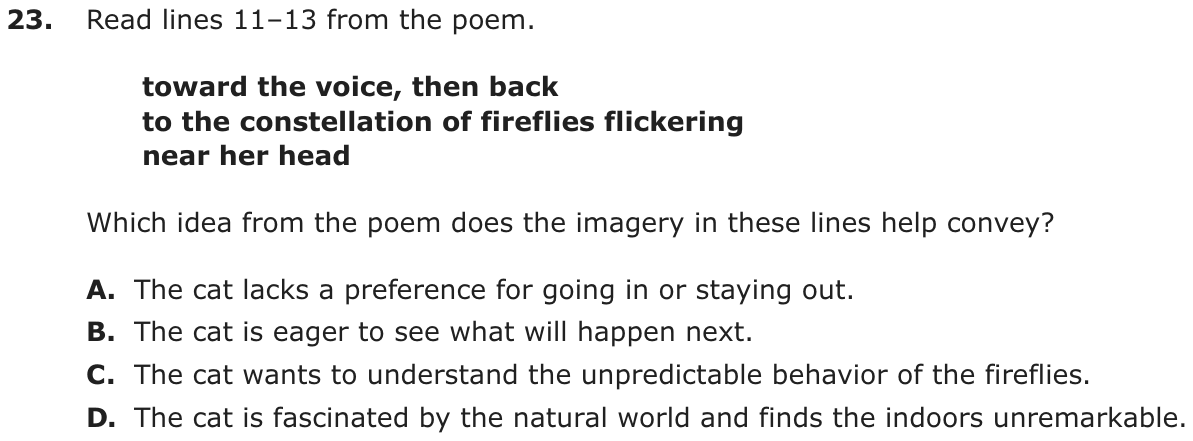
Read lines 11–13 from the poem.
toward the voice, then back
to the constellation of fireflies flickering
near her head
Which idea from the poem does the imagery in these lines help convey?
- AThe cat lacks a preference for going in or staying out.
- BThe cat is eager to see what will happen next.
- CThe cat wants to understand the unpredictable behavior of the fireflies.
- DThe cat is fascinated by the natural world and finds the indoors unremarkable.
Show the answer
Correct answer: D
The question asks which idea the imagery in lines 11–13 helps convey.
A. Incorrect. Line 13 includes the speaker’s observation that the cat seems “as if she can’t decide” whether to stay outside or go to the neighbor. However, the imagery of the “constellation of fireflies flickering” in line 12 suggests that the cat does have a preference for exploring the more exciting “luminous / possibility” (lines 17–18) of the outdoors.
B. Incorrect. The imagery in lines 10–11 of the cat turning “first / toward the voice, then back” might seem to suggest that the cat is eagerly watching both the neighbor and the fireflies to see what will happen next. However, line 13, in which the cat seems “as if she can’t decide,” indicates that what will happen next is actually under the cat’s control.
C. Incorrect. The imagery in lines 12–13 of the “fireflies flickering / near her head” does indicate the fireflies’ unpredictable behavior. However, the imagery in lines 10–11 of the cat turning “first / toward the voice, then back” establishes that the cat’s attention is split between the fireflies and the “high-pitched wheedling” (line 5) of the neighbor’s voice, rather than being fully captured by wanting to understand the fireflies.
D. CORRECT. The imagery in line 12 of “the constellation of fireflies flickering” suggests that the outdoors holds fascinating attractions, an idea supported by the description in lines 17–18 of the cat’s current location outdoors as one filled with “luminous / possibility.” The imagery in lines 10–11 of the cat turning “first / toward the voice, then back” indicates that the cat has considered but rejected the option of returning indoors, and the description in lines 16–17 of the indoors as offering only a “steady circle / of light” suggests that the indoors seems unremarkable to the cat in comparison to the outdoors.
Question analysis
This reading question quotes three lines from At Dusk in which a cat turns from a calling voice back to fireflies flickering near her head, and asks which idea the imagery helps convey. Students must interpret a visual image in light of the lines around it and judge how far the poem supports each reading of the cat's attention.
- Grade level
- Grade 8 reading and task
- Compared with grade 7
- Above grade 7 Grade 7 students explain what imagery conveys, but this image is brief and the four ideas offered for it differ in subtle ways, so ruling them out takes closer reading than typical grade 7 work.
- Estimated difficulty
- Hard: combines ideas, needs a plan, and has more than one tempting wrong answer.
- Thinking it demands
- Depth of knowledge 3, strategic thinking · mainly analyze
- What makes it hard
- Reading between the lines major
- Figurative or literary language moderate
- Evidence in several places minor
- Evidence
- Answered from one paragraph or stanza
- Reading level
- Passage: 236 words (a poem; reading level not measured); question and choices: about grade 6, 77 words.
- Students, last 30 days
- Not enough answers yet to show (it takes 10).
Why it is hard, traps and wrong answers (shows the answer)
Why it is hard
The answer is the best available rather than a perfect one: its first half is plain in the image of the cat turning back to the fireflies, while its second half rests on the comparison with a steady porch light. Meanwhile the very next words say she “can't decide,” which makes indifference look like the safe reading. The question rewards seeing that being torn is not the same as having no preference, since the image shows which way she turns.
Reading between the lines major Working it out
The quoted lines never mention the indoors, so the claim that the cat finds it unremarkable has to be drawn from the contrast with “the steady circle / of light” in lines 16–17. (Graesser, Singer & Trabasso, 1994; Kintsch, 1998)
Figurative or literary language moderate Understanding the question
“The constellation of fireflies flickering” turns insects into a field of stars beside the cat's head, and that image of wonder is what students are asked to interpret. (Graesser, Singer & Trabasso, 1994; Kintsch, 1998)
Evidence in several places minor Working it out
The words right after the quotation say “It's as if she can't decide,” and the evidence that tips the balance sits in lines 16–19, outside the three lines quoted. (Kirsch & Mosenthal, 1990; Gorin & Embretson, 2006)
Strategy: Picture the cat's movements in these three lines, then test each choice against the words of lines 10–19 and drop any idea the image does not actually show.
Traps
- Twists what the text says: Uses the text's topic and ideas but changes what it says: who did it, how much, when, or why.
- Reads too much in: A reasonable-sounding conclusion that goes further than the text allows.
- Word match: Repeats striking words or phrases from the text, so it looks supported, but its meaning does not fit the question.
The wrong answers, classified
A Twists what the text says (King et al., 2004)
Takes “as if she can't decide” in line 13 to mean the cat has no preference, but being torn means feeling two pulls, and these lines show her turning back to the fireflies.
B Reads too much in (Graesser, Singer & Trabasso, 1994)
Reads the cat's turning back and forth as eager waiting for what will happen, though the lines show attention divided between two pulls, not suspense.
C Word match (Freedle & Kostin, 1993)
Repeats the fireflies' flickering from the image and invents a wish to understand their behavior, when the lines show fascination with the lights, not curiosity about insects.
Working it out, step by step
Figure out what the question asks
Imagery is language that helps you see, hear or feel a scene. You need the idea that the images in lines 11–13 help show.
Picture lines 10–13
The cat “turns first / toward the voice, then back / to the constellation of fireflies flickering / near her head.” A constellation is a group of stars that forms a picture. So the fireflies are like little stars blinking around her. She hears the call, but she turns back to them.
Compare outdoors and indoors
Outside, the night sparkles like stars. Lines 17–18 call it “luminous / possibility,” full of glowing chances. Home is “the steady circle / of light” on the porch (lines 16–17). Steady means it does not change. Next to the flickering stars, that light is plain. Unremarkable means not special.
Check each choice
- A is wrong. The cat “can’t decide,” but that means she feels two pulls. The image shows her turning back to the fireflies.
- B is wrong. She is not waiting for something to happen. Her attention is split between two pulls.
- C is wrong. She is drawn to the fireflies’ glow, not trying to figure out how they act.
- D is right. She is fascinated by the night, and the porch light is plain next to it.
Watch out: A is tempting because of line 13. But being torn is not the same as having no preference.
Choose the answer
The poem never says the cat has made up her mind. But the images make the night magical and home ordinary. That fits D best. So the answer is D.
Why this answer and not the closest wrong one
A is the closest wrong answer, since the next words say “It’s as if she can’t decide.” But a cat with no preference would not care either way. This cat turns back to the fireflies, which shows a strong pull. D fits that pull, and the plain “steady circle / of light” shows why home seems less special.
More questions like this
The original DOE question
The passage “At Dusk” as printed (page 48)
Question 3 of 6
2025 Practice Test A English, question 12Passage Excerpt from “Scribe Like an Egyptian”
Excerpt from “Scribe Like an Egyptian”
by Hilary Wilson
In ancient Egypt, literacy was the key to success. However, contrary to popular belief, not all Egyptian scribes understood hieroglyphs. Many relied instead on the simpler hieratic script for the multitude of everyday documents generated by the Egyptian bureaucracy.
Hieroglyphs—“the Words of God”—compose a writing system with more than 1,000 distinct characters, the meanings of which were lost for 1,500 years before they were deciphered by Jean-François Champollion in 1822. Including both ideograms (which convey a whole word or idea, either concrete or abstract, in a single sign) and phonograms (representing either an alphabetic sound or a group of consonants), [the writing system] was used in formal inscriptions on tomb and temple walls as well as on elaborate funerary papyri. For everyday purposes, however, scribes used a shorthand version of the hieroglyphic script known as hieratic, which was quicker to write and more economical of space. The two writings existed side by side for at least 2,500 years.
Scraps of ancient hieratic writing, mostly penned by student scribes on limestone flakes called ostraca, suggest that no matter how humble his origins, an educated Egyptian could achieve almost anything. Horemheb (d.1292 B.C.) is a good example. Born of middle-ranking parents, his scribal training led to an army career. From Scribe of Recruits, during the reign of Akhenaten (1353–1336 B.C.), Horemheb rose through the military ranks and, by the rule of Tutankhamun (1332–1323 B.C.), he was commander in chief of the Egyptian forces. As a close adviser of the young Pharaoh, Horemheb was appointed “Deputy of the King throughout the Two Lands,” and might have expected to succeed to the throne should the king die childless. He had to wait a few years, but eventually Horemheb achieved the pinnacle of his career by becoming the last king of the 18th Dynasty, making his mark by instituting dramatic reforms to the organisation of the army, the judiciary and administration in general. The lasting success of these changes owed much to his scribal background. . . .
But education was not available to all. Government departments and major temples supported schools, where boys commenced their training at six or seven, sometimes earlier. To these boarding establishments . . . family or household servants delivered the students’ food and drink rations daily for several years, during which time the student was not contributing to the family’s income. Boys from poorer families could only hope to be educated with support from a wealthier relative or patron, or through apprenticeship to an older scribe, perhaps the local clerk or land agent, who would teach them the basics of the scribe’s craft. This limited the scope for employment but such “on the job” training allowed apprentices to help out at home while learning. . . .
Scribal education began with the elementary principles of the hieratic script. The lowliest scribes, who trained for just five or six years, probably learned only the rudiments of the hieroglyphic script. Students were set exemplar documents and extracts from popular texts to copy, to practice their hieratic handwriting on basic-format letters, reports and contracts, while absorbing the good advice contained in the texts. Surviving examples of copy-work sometimes include tutors’ corrections added in red. Some significant Egyptian literary works survive almost exclusively from student copies.
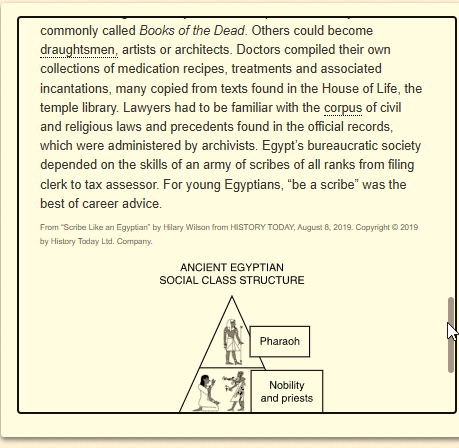
A schoolboy “dictionary” of hieroglyphs with their hieratic equivalents shows that a knowledge of more than 450 signs was required for everyday writing purposes. Lessons in record-keeping and filing and labelling enabled any half-competent scribe to perform that most essential of all scribal functions: the making and updating of lists. For professions such as those of government official, priest or lawyer, a scribe would train for several more years, increasing his vocabulary to perhaps a thousand or more signs. Those with the best handwriting or drawing skills might follow the craft of creating beautifully illustrated copies of funerary texts, commonly called Books of the Dead. Others could become draughtsmen, artists or architects. Doctors compiled their own collections of medication recipes, treatments and associated incantations, many copied from texts found in the House of Life, the temple library. Lawyers had to be familiar with the corpus of civil and religious laws and precedents found in the official records, which were administered by archivists. Egypt’s bureaucratic society depended on the skills of an army of scribes of all ranks from filing clerk to tax assessor. For young Egyptians, “be a scribe” was the best of career advice.
From “Scribe Like an Egyptian” by Hilary Wilson from HISTORY TODAY, August 8, 2019. Copyright © 2019 by History Today Ltd. Company.
bureaucracy: an administrative staff of government officials
funerary papyri: a sheet or scroll of papyrus containing religious images and hieroglyphs meant to help the deceased be reborn in the afterlife
rudiments: basics
schoolboy: slang that refers to materials used during the course of receiving an education
draughtsmen: people who draw plans of machinery or structures
corpus: a collection of writings
Question
Which claim is best supported by the information presented in paragraphs 3 and 4?
- AEducation was difficult for the common citizens of Egypt to obtain.
- BOnce students began studying to become scribes, their future held more possibilities.
- CIf someone wanted to become a scribe, support from outside sources such as the government or a temple was necessary.
- DBecoming a successful scribe required a student’s family to sacrifice time and money in order to ensure the best education.
Show the answer
Correct answer: B
The question asks for the claim that is best supported by the details in paragraphs 3 and 4.
A. Incorrect. While paragraph 4 does explain that boys from poorer families had more challenges in receiving an education, the paragraph also provides examples of obtaining a patron or getting an apprenticeship as ways that these aspiring scribes could attain an education. Furthermore, the details in paragraph 3 do not provide any support for the claim that “common citizens” had difficulty getting an education because that paragraph focuses on the example of one person who was able to become a king as a result of his background as a scribe.
B. CORRECT. In paragraph 3, the author provides an example of a person who used his skills as a scribe to rise through the ranks of society by describing the achievements of Horemheb to support the idea that “no matter how humble his origins, an educated Egyptian could achieve almost anything.” The author continues in paragraph 4 to explain that with the proper support, some young Egyptians could become educated, thereby opening more opportunities for themselves.
C. Incorrect. Paragraph 4 explains that schools were supported by the government and religious institutions, but it also explains that apprenticeships were a method of learning the craft of the scribe. As the paragraph indicates, boys could also be helped in their education by support from “a wealthier relative or patron.”
D. Incorrect. In paragraph 4, the author details the sacrifices that families made to keep their sons at the schools, while boys from poorer families could only hope for a patron or an apprenticeship. Paragraph 4 also explains that apprentices could help out at home while learning, so the sacrifice of time and money was not required of every family.
Question analysis
This inference question asks which claim is best supported by paragraphs 3 and 4 of “Scribe Like an Egyptian,” which tell the story of the scribe Horemheb and describe who could get a scribal education in ancient Egypt. Students must weigh each claim against both paragraphs together, and several claims echo a single sentence closely enough to look supported.
- Grade level
- Grade 8 reading and task
- Compared with grade 7
- Above grade 7 Choosing the claim a passage best supports is core grade 7 work. Here the claim must fit two paragraphs that do different jobs, one telling a single man’s story and one explaining access to schooling, and some choices fit only part of that.
- Estimated difficulty
- Hard: combines ideas, needs a plan, and has more than one tempting wrong answer.
- Thinking it demands
- Depth of knowledge 3, strategic thinking · mainly evaluate
- What makes it hard
- Evidence in several places moderate
- The right answer is reworded moderate
- Reading between the lines minor
- Evidence
- Answered from several paragraphs or stanzas
- Reading level
- Passage: about grade 12, 810 words; question and choices: about grade 10, 75 words.
- Corrected from the DOE handbook
- A misdescription of the passage in the explanation of one wrong answer was corrected.
- Students, last 30 days
- Not enough answers yet to show (it takes 10).
Why it is hard, traps and wrong answers (shows the answer)
Why it is hard
The trap is a claim that paragraph 4 seems to state almost word for word, which makes it feel safer than the right one. But the question asks for support from both paragraphs, and Horemheb’s story points the other way, toward what schooling made possible. The two other wrong claims harden paragraph 4’s details into rules, a necessary sponsor or a required family sacrifice, so words like “necessary” and “required” are the ones to test.
Evidence in several places moderate Working it out
The claim must fit two paragraphs that do different work: paragraph 3 follows Horemheb from army scribe to king, and paragraph 4 explains who could pay for schooling and what the alternatives were. (Kirsch & Mosenthal, 1990; Gorin & Embretson, 2006)
The right answer is reworded moderate Choosing the answer
The right claim restates paragraph 3’s “an educated Egyptian could achieve almost anything” in new words, while the most tempting wrong one nearly copies paragraph 4’s opening, “education was not available to all.” (Freedle & Kostin, 1993; Kirsch & Mosenthal, 1990)
Reading between the lines minor Working it out
Students must connect Horemheb’s rise with paragraph 4’s account of who got schooling to see that both paragraphs are about education opening doors, a link the author leaves implicit. (Graesser, Singer & Trabasso, 1994; Kintsch, 1998)
Strategy: Sum up paragraph 3 and paragraph 4 in a sentence each, then test every claim against both summaries, watching for words that make a claim stronger than the text.
Traps
- Too narrow: A single detail offered as the central idea or a summary, or a summary that keeps minor details and leaves out an essential part.
- Too broad or too strong: A choice overstates, generalizes, or uses absolute words the text does not support.
- Reads too much in: A reasonable-sounding conclusion that goes further than the text allows.
The wrong answers, classified
A Too narrow (King et al., 2004)
Rests on paragraph 4’s opening, “education was not available to all,” and ignores paragraph 3, whose Horemheb shows an educated man rising from modest origins to the throne.
C Too broad or too strong (King et al., 2004)
Makes the government and temple schools of paragraph 4 “necessary,” overlooking its other routes: help from “a wealthier relative or patron,” or apprenticeship to a working scribe.
D Reads too much in (Graesser, Singer & Trabasso, 1994)
Turns the rations and lost income that some families bore in paragraph 4 into a requirement for every successful scribe, and adds “the best education,” which the paragraph never mentions.
What was corrected from the DOE handbook, and why
- Explanation: The DOE’s explanation of D said paragraph 4 details sacrifices “necessary for some poorer families,” and that paragraph 3’s Horemheb, born of middle-ranking parents, shows the sacrifice was not required of all families. In paragraph 4 the rations and lost income are those of families whose sons were at the schools; poorer boys could only hope for a patron or an apprenticeship; and paragraph 3 says nothing about what Horemheb’s family gave up. The explanation now says so: D is wrong because apprentices could help out at home while learning, so not every family made the sacrifice.
Working it out, step by step
Figure out what the question asks
This asks which claim is best supported by paragraphs 3 and 4 together. A claim is a statement that someone says is true. The right claim must fit both paragraphs. Watch for strong words, like “necessary,” that go further than the text.
Sum up paragraph 3
Paragraph 3 tells about Horemheb. His parents were middle-ranking, not rich or powerful. His training as a scribe led to a job in the army. He rose to lead the army, then to serve the young king, and in the end he became king himself. The author uses him to show that “no matter how humble his origins, an educated Egyptian could achieve almost anything.” Humble origins means an ordinary family background.
Sum up paragraph 4
Paragraph 4 opens by saying that not everyone could get an education. Government offices and big temples ran schools. Families sent food and drink for years, while the boy earned nothing for them. Poorer boys could hope for help from “a wealthier relative or patron.” A patron is someone who pays for another person’s training. Or they could learn on the job from a working scribe. That path led to fewer jobs.
Put the two paragraphs together
Both paragraphs are about what schooling could do for a boy. Paragraph 3 shows a man rising all the way to king because he trained as a scribe. Paragraph 4 shows that, with the right support, boys could get that schooling. It even notes that the on-the-job path led to fewer jobs. So education opened doors. That is what choice B says.
Check each choice
- A does not fit. It matches only the start of paragraph 4. Paragraph 4 also gives ways in for poorer boys, and paragraph 3 shows a man from an ordinary family rising to the top.
- B fits. Both paragraphs show schooling leading to more possibilities.
- C does not fit. A government or temple school was not “necessary.” A relative, a patron or an apprenticeship could also work.
- D does not fit. Apprentices could help out at home while they learned, so not every family gave up time and money. And the paragraphs never mention “the best education.”
Choose the answer
The claim that fits both paragraphs is that schooling gave a boy more possibilities. So the answer is B.
Why this answer and not the closest wrong one
A is the closest wrong choice, because paragraph 4 begins by saying not everyone could get an education. But the question asks about paragraphs 3 and 4. Paragraph 3 tells of a scribe from an ordinary family who became king. Paragraph 4 shows ways around the cost. Both point to what education made possible, which is B.
More questions like this
The original DOE question
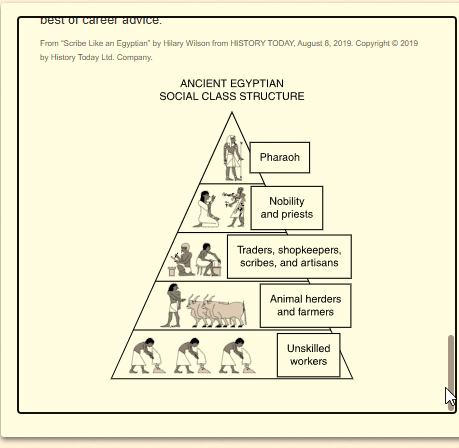
The passage “Excerpt from “Scribe Like an Egyptian”” as shown on the test
Question 4 of 6
2018 Test B Math, question 53Question
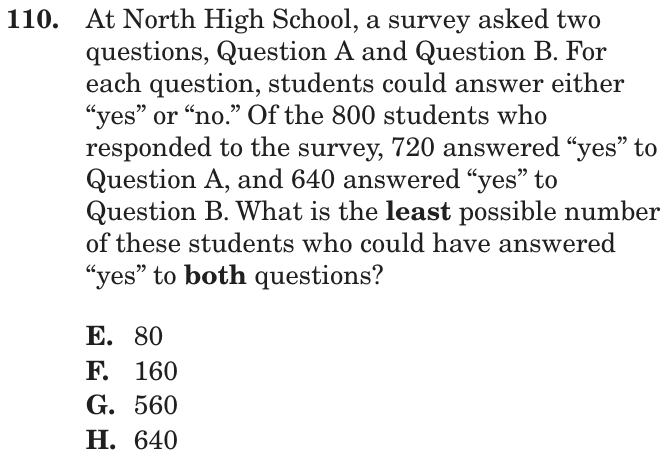
At North High School, a survey asked two questions, Question A and Question B. For each question, students could answer either “yes” or “no.” Of the 800 students who responded to the survey, 720 answered “yes” to Question A, and 640 answered “yes” to Question B. What is the least possible number of these students who could have answered “yes” to both questions?
- A80
- B160
- C560
- D640
Show the answer
Correct answer: C
None of the 80 students (800 − 720) who answered “no” to Question A could have answered “yes” to both questions.
Therefore, the least possible number of students who could have answered “yes” to both questions can be found by subtracting the 80 who answered “no” to Question A from the 640 who answered “yes” to Question B or 640 − 80 = 560.
Question analysis
In a survey of 800 students at North High School, 720 said yes to the first question and 640 said yes to the second. Students must find the smallest possible number who said yes to both. It tests reasoning about overlapping groups, and asking for the least possible overlap rather than an exact count makes it unusual.
- NYS standards
- Grade level
- Grade 7 content, by NYS standard
- Compared with grade 7
- Above grade 7 Grade 7 students work with Venn diagrams and two-way tables when all counts are given. Finding the smallest possible overlap requires reasoning about extremes rather than computing, which is rare in grade 7 and new to most students.
- Estimated difficulty
- Among the hardest on the SHSAT: a non-obvious approach, heavy reading, or a well-hidden trap.
- Thinking it demands
- Depth of knowledge 3, strategic thinking · mainly analyze
- What makes it hard
- No obvious method major
- Turning words into math moderate
- A very close wrong answer minor
- Solution
- 2 steps
- Reading level
- Question and choices: about grade 8, 60 words.
- Corrected from the DOE handbook
- A repeated phrase and a stray comma in the explanation were removed.
- Students, last 30 days
- Not enough answers yet to show (it takes 10).
Why it is hard, traps and wrong answers (shows the answer)
Why it is hard
Most students have never been asked for a smallest overlap, so they fall back on a picture of nested groups and give the largest one. The key move is to push the two yes groups apart as far as possible: only the 80 students who said no to Question A can absorb some of Question B's yes answers. Once that is seen, the arithmetic is one subtraction, so the question rewards reasoning far more than computation.
No obvious method major Working it out
Nothing in the wording points to the method: the smallest overlap appears only when all 80 students who said no to Question A are imagined saying yes to Question B. (Schoenfeld, 1985)
Turning words into math moderate Understanding the question
"The least possible number of these students who could have answered “yes” to both questions" asks for an extreme case, which has to be turned into an arrangement of the 800 students. (Hegarty, Mayer & Monk, 1995; Koedinger & Nathan, 2004)
A very close wrong answer minor Choosing the answer
640 is only 80 above the right 560, so a rough sense of size cannot choose between them; only asking whether the overlap is the least or the greatest separates them. (Embretson & Wetzel, 1987; Gorin & Embretson, 2006; Ascalon et al., 2007)
Strategy: Add the two yes counts and compare the sum with the number of students; any amount above the total must come from students counted in both groups.
Traps
- NOT, LEAST or EXCEPT: The question asks for the exception, the least, or what is not true.
- Stops one step early: A choice is a number from partway through the solution.
- Answers a different question: A choice is right for another quantity: the other unknown, the rest instead of the part, the part instead of the whole.
The wrong answers, classified
A Stops one step early (King et al., 2004; Gierl et al., 2017)
Finds the 80 students who said no to Question A, 800 − 720, and stops before subtracting them from the 640 who said yes to Question B.
B Answers a different question (King et al., 2004; Hegarty, Mayer & Monk, 1995)
Finds the 160 students who said no to Question B, 800 − 640, which bears on the count but is not the overlap asked about.
D Answers a different question (King et al., 2004; Hegarty, Mayer & Monk, 1995)
Assumes everyone who said yes to Question B also said yes to Question A, giving the greatest possible overlap instead of the least.
What was corrected from the DOE handbook, and why
- Explanation: The handbook prints “(800 − 720)” twice in its first sentence, after “80 students” and again after “Question A,” and puts a comma between subject and verb in “the least possible number of students who could have answered “yes” to both questions, can be found.” The site keeps the first “(800 − 720)” and drops the comma.
Worked solution, step by step
Formulas used
- Least overlap of two groups
- a is the size of the first group and b is the size of the second. t is the total number of people. If a + b is more than t, some people must be in both groups. The extra amount is the smallest number that can be in both.
Sort out what you know
There were 800 students. Of them, 720 said yes to Question A and 640 said yes to Question B. You need the least number who could have said yes to both. The overlap is the group in both yes groups. You want the smallest overlap.
Find who said no to A
Students who said no to Question A cannot be in the overlap.
So 80 students said no to Question A.
Watch out: 80 is not the answer. It is only a step, and it is choice A.
Keep the overlap small
To make the overlap as small as you can, put as many B yes answers outside it as possible. The only students outside it are the 80 who said no to A. So pretend all 80 of them said yes to B.
Count the rest of the yes group
The other yes answers to B must come from students who also said yes to A.
So at least 560 students said yes to both.
Watch out: 640 is the most that could say yes to both, not the least. That is choice D.
Give the answer
The fewest students who could say yes to both questions is 560. So the answer is C, 560.
Check your answer
Use the overlap formula: . There are 1,360 yes answers but only 800 students, so 560 students must be counted twice. You can also check the groups. 560 said yes to both, 160 to A only and 80 to B only. That makes .
More questions like this
The original DOE question
Question 5 of 6
2024 Test B Math, question 44Question
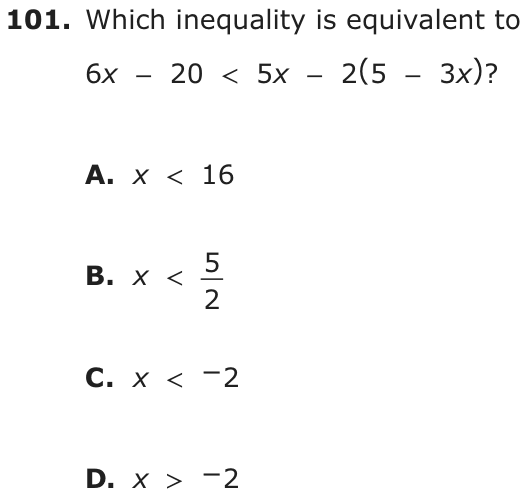
Which inequality is equivalent to ?
- A
- B
- C
- D
Show the answer
Correct answer: D
Distribute the coefficient −2 on the right-hand side:
Subtract from both sides:
Add 10 to both sides:
Divide both sides by 5:
This is equivalent to
Question analysis
Students choose the simplest equivalent form of a linear inequality that has x on both sides and a negative number multiplied into parentheses. It tests distributing, combining like terms and solving inequalities. Sign errors in the distribution, and reading the direction of the final inequality, are where most mistakes happen.
- NYS standards
- Grade level
- Grade 8 content, by NYS standard
- Compared with grade 7
- Above grade 7 Grade 7 inequalities have the form px + q < r. This one has x on both sides and a negative factor to distribute across a subtraction, steps that belong to grade 8 equation work, so it is harder than typical grade 7 practice.
- Estimated difficulty
- Hard: combines ideas, needs a plan, and has more than one tempting wrong answer.
- Thinking it demands
- Depth of knowledge 1, recall and reproduction · mainly apply
- What makes it hard
- Error-prone arithmetic moderate
- A very close wrong answer moderate
- Many steps minor
- Solution
- 4 steps
- Reading level
- Question and choices: about grade 16+, 10 words.
- Students, last 30 days
- Not enough answers yet to show (it takes 10).
Why it is hard, traps and wrong answers (shows the answer)
Why it is hard
Every move is standard algebra, but the inequality is built so that small slips change the answer completely. The −2 has to reach both terms in the parentheses, and once the boundary −2 is found its direction still has to be read correctly, since the variable ends up on the right as −2 < x. Rewriting that as x > −2, or substituting x = 0 into the original, catches the trap.
Error-prone arithmetic moderate Working it out
Distributing −2 over (5 − 3x) gives −10 + 6x, two sign decisions in one move, and the x terms then sit on both sides of the inequality. (Brown & Burton, 1978; Junker & Sijtsma, 2001)
A very close wrong answer moderate Choosing the answer
x < −2 and x > −2 share the boundary and differ only in direction, which depends on reading −2 < x correctly or flipping the sign when dividing by a negative. (Embretson & Wetzel, 1987; Gorin & Embretson, 2006; Ascalon et al., 2007)
Many steps minor Working it out
Four moves follow one another, distributing, collecting 5x + 6x, moving the x terms and dividing by 5, and a slip at any of them changes the result. (Daniel & Embretson, 2010; Enright, Morley & Sheehan, 2002)
Strategy: Distribute the −2 to both terms in the parentheses, combine the x terms on the right, then gather the x terms on the side that keeps their coefficient positive.
Traps
- Order of operations: Working left to right, or distributing a minus sign wrongly, gives a choice.
- Negatives and direction: Arithmetic with negative numbers, the order of a subtraction, or direction on a number line. (Moving a term across the equals sign without changing its sign is a faulty procedure.)
- A faulty procedure: A systematic but wrong procedure: adding fractions straight across, applying an exponent to each term of a sum, dropping a sign when moving a term.
The wrong answers, classified
A A faulty procedure (Brown & Burton, 1978; Tatsuoka, 1983)
Treats 5 − 3x as 2, combining a number with an x term, so the right side becomes 5x − 4 and the solution x < 16.
B Order of operations (Brown & Burton, 1978)
Multiplies the −2 by the 5 but not by the −3x, writing 5x − 10 − 3x, which leads to 4x < 10 and x < 5/2.
C Negatives and direction (Brown & Burton, 1978)
Finds the boundary −2 but points the inequality the wrong way, by misreading −2 < x or by not flipping the sign after dividing by −5.
Worked solution, step by step
Formulas used
- Distributive property
- a is the number outside the parentheses. b and c are the terms inside. Multiply a by each one. A minus sign inside counts as a negative term, so 5 − 3x is 5 + (−3x). A negative times a negative is positive.
- Keeping an inequality true
- a and b are the two sides, and c is any number. Adding or subtracting the same number on both sides keeps the inequality true. Dividing both sides by a positive number also keeps it true. Only multiplying or dividing by a negative number flips the sign.
Sort out the question
An inequality compares two sides with a sign like <, which means is less than. To solve it, you get x alone on one side.
You need the short inequality that has the same answers as the long one.
Distribute the −2
Multiply −2 by both terms inside the parentheses, 5 and −3x.
A negative times a negative is positive, so the second part is +6x. Watch out: If the −2 multiplies only the 5, you end up with , choice B.
Combine the x terms
The right side is now 5x − 10 + 6x. Put the x terms together: 5x + 6x = 11x.
Gather the x terms on one side
Subtract 6x from both sides. That leaves the x terms on the right, where they stay positive.
Get x by itself
Add 10 to both sides. Then divide both sides by 5.
You divided by a positive 5, so the sign does not flip.
Read it with x first
says −2 is less than x. That is the same as saying x is greater than −2, just as 3 < 5 means 5 > 3.
Watch out: , choice C, has the same number but points the wrong way.
So the answer is D, .
Check your answer
Test x = 0, which is greater than −2. The left side is . The right side is . And −20 < −10 is true. Now test x = −3. The left side is −38 and the right side is −43. That is false, as it should be.
More questions like this
The original DOE question
Question 6 of 6
2026 Practice Test D Math, question 36Question
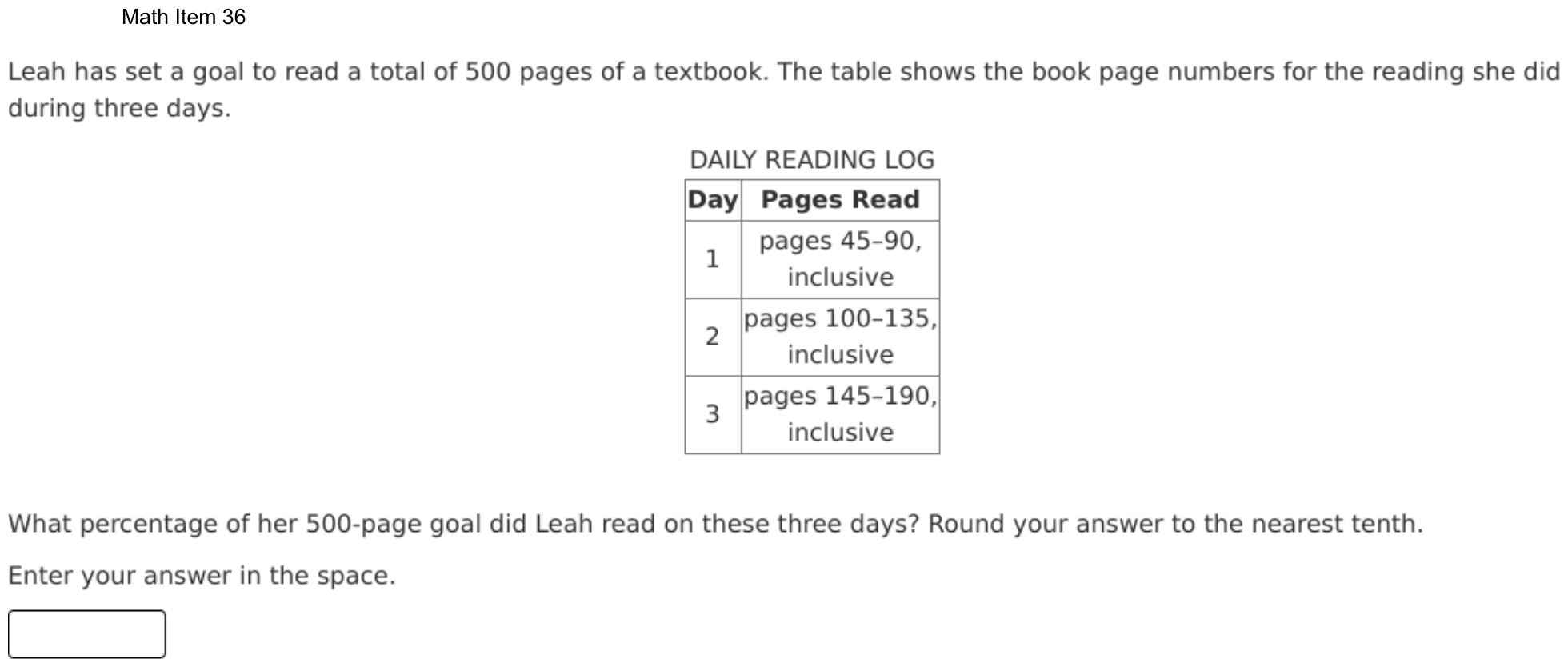
Leah has set a goal to read a total of 500 pages of a textbook. The table shows the book page numbers for the reading she did during three days.
DAILY READING LOG
| Day | Pages Read |
|---|---|
| 1 | pages 45–90, inclusive |
| 2 | pages 100–135, inclusive |
| 3 | pages 145–190, inclusive |
What percentage of her 500-page goal did Leah read on these three days? Round your answer to the nearest tenth.
Enter your answer in the space.
Fill-in question: work out the answer and type it as a number.
Show the answer
Correct answer: 25.6%
First, determine the number of pages read each day. Since the pages per assignment are inclusive, subtract the first page from the last page assigned and then add 1 to determine the pages read for each day.
Day 1: pages
Day 2: pages
Day 3: pages
Leah read a total of 128 pages, since .
To determine the percent, express 128 pages out of 500 pages as a fraction.
Question analysis
Leah's daily reading log lists three ranges of textbook pages, each marked inclusive, and her goal is 500 pages. This percent question asks what percentage of the goal she read over the three days, rounded to the nearest tenth and typed in. Counting the pages in each inclusive range correctly is the tricky step before the percent.
- Grade level
- Grade 7 content, by NYS standard
- Compared with grade 7
- Above grade 7 Finding what percent one number is of another is grade 6 and 7 work. This adds three inclusive page ranges to count, which takes more care than subtracting, then a rounding step, all typed with no choices to check against.
- Estimated difficulty
- Hard: combines ideas, needs a plan, and has more than one tempting wrong answer.
- Thinking it demands
- Depth of knowledge 2, skills and concepts · mainly apply
- What makes it hard
- Something you must already know moderate
- Many steps moderate
- An answer in an unexpected form minor
- Solution
- 4 steps
- Reading level
- Question and choices: about grade 3, 66 words.
- Students, last 30 days
- Not enough answers yet to show (it takes 10).
Why it is hard, traps and wrong answers (shows the answer)
Why it is hard
Counting pages in a range is the whole difficulty; the percent at the end is routine once the total is right. Subtracting first from last feels natural, and here it even rewards the student with a round 25%, so nothing looks wrong. Checking the rule on a tiny range, pages 1 to 3, which is 3 pages and not 2, fixes the count, and the instruction to round to the nearest tenth hints that the answer is not a whole number.
Something you must already know moderate Working it out
Every row says inclusive, but nothing says that pages 45 to 90 hold 90 − 45 + 1 = 46 pages; subtracting alone loses one page on each of the three days. (Anderson & Krathwohl, 2001)
Many steps moderate Working it out
Three page counts, a sum, a division by 500 and a change to a percent come in sequence, and a one-page error in each count carries through to the end. (Daniel & Embretson, 2010; Enright, Morley & Sheehan, 2002)
An answer in an unexpected form minor Choosing the answer
The answer is typed with no choices, and the miscounted total, 125 pages, gives a tidy 25% that looks more finished than the right value with its tenth. (Enright, Morley & Sheehan, 2002)
Strategy: Count each day's pages carefully, testing your method on a short range such as pages 1–3, add the three days, divide by 500, and write the result as a percent to the nearest tenth.
Traps
- Counting the ends: Inclusive or exclusive ends, fence posts, consecutive numbers: an answer that is one too many or too few, or an endpoint drawn open where it belongs closed (or the reverse).
- Stops one step early: A choice is a number from partway through the solution.
- Misreads the question: Misses or misreads a condition or a word in the question: "at least", "each", "remaining", "not".
The wrong answers, classified
25 Counting the ends (Brown & Burton, 1978)
Subtracts the first page from the last for each day, 45 + 35 + 45 = 125 pages, forgetting that an inclusive range counts both end pages, so 125 ÷ 500 = 25%.
0.256 Stops one step early (King et al., 2004; Gierl et al., 2017)
Counts the 128 pages and divides by 500 correctly, then enters the decimal 0.256, one step short of multiplying by 100 to make a percent.
26 Misreads the question (Hegarty, Mayer & Monk, 1995)
Finds 25.6% correctly but rounds it to the nearest whole percent, overlooking the instruction to round to the nearest tenth.
Worked solution, step by step
Formulas used
- Counting pages in an inclusive range
- Inclusive means the first and last pages are both read. Subtracting counts the steps from the first page to the last. That misses one page, so add 1. Test it: pages 1 to 3 are 3 pages, and 3 − 1 + 1 = 3.
- Percent of a total
- The part is the amount you have, here the pages read. The whole is the amount you compare with, here the 500-page goal. Dividing gives a decimal. Multiplying by 100 turns it into a percent, a number out of 100.
Sort out the question
Leah’s goal is 500 pages. The log shows three days:
- Day 1: pages 45 to 90
- Day 2: pages 100 to 135
- Day 3: pages 145 to 190
Each range is inclusive. You need the percent of 500 pages she read, rounded to the nearest tenth.
Count the pages each day
Use the rule for an inclusive range: last page minus first page, plus 1.
Watch out: subtracting alone gives 45, 35 and 45 pages. That is 125 pages, which is exactly 25%. A round answer like that can hide the mistake.
Add the three days
Add the pages from all three days to get her total:
Leah read 128 pages in all. This is the part you compare with the goal.
Change to a percent
Divide the pages read by the goal, then multiply by 100:
Leah read 25.6% of her goal. That already ends in tenths, so no rounding is needed.
Watch out: 0.256 is a decimal, not a percent. And 26 rounds to a whole number, not to the nearest tenth.
Enter the answer
The box has no % sign, but the question asks for a percentage, so the number in the box is the percent. Type it with its decimal point. Typing 25.6% also counts on this site. So you would enter 25.6.
Check your answer
Estimate. 10% of 500 pages is 50 pages. 128 pages is a bit more than 2 × 50 = 100, so the answer is between 20% and 30%. Then check exactly: pages. It matches.
More questions like this
The original DOE question