3 English and 3 math
Here are 6 random questions to try. Takers earning below 75% are unlikely to receive an offer. You have 1 minute 48 seconds per question on the real exam.
Question 1 of 6
2026 Practice Test D English, question 17Passage Wolves of the Sea
Wolves of the Sea
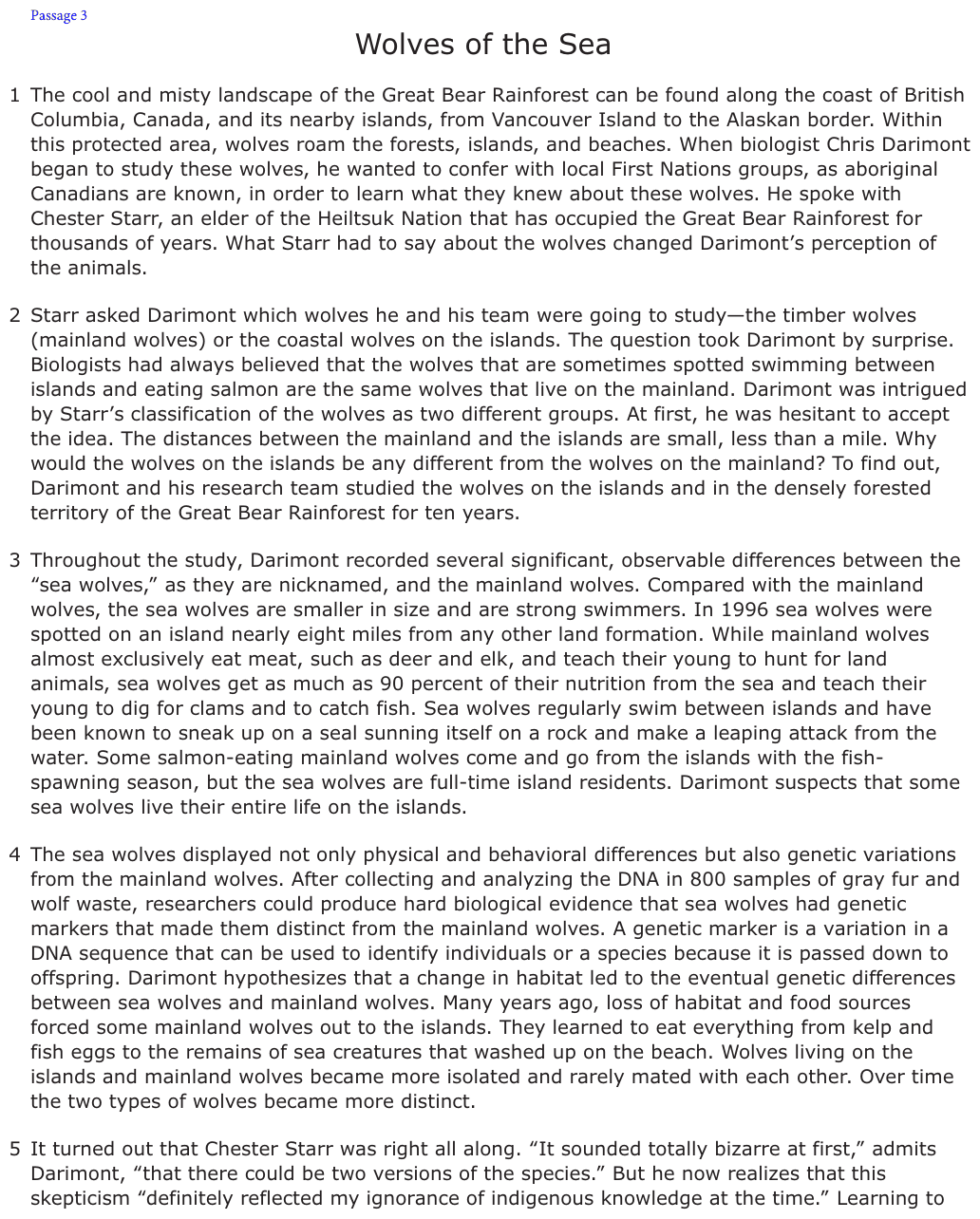
The cool and misty landscape of the Great Bear Rainforest can be found along the coast of British Columbia, Canada, and its nearby islands, from Vancouver Island to the Alaskan border. Within this protected area, wolves roam the forests, islands, and beaches. When biologist Chris Darimont began to study these wolves, he wanted to confer with local First Nations groups, as aboriginal Canadians are known, in order to learn what they knew about these wolves. He spoke with Chester Starr, an elder of the Heiltsuk Nation that has occupied the Great Bear Rainforest for thousands of years. What Starr had to say about the wolves changed Darimont’s perception of the animals.
Starr asked Darimont which wolves he and his team were going to study—the timber wolves (mainland wolves) or the coastal wolves on the islands. The question took Darimont by surprise. Biologists had always believed that the wolves that are sometimes spotted swimming between islands and eating salmon are the same wolves that live on the mainland. Darimont was intrigued by Starr’s classification of the wolves as two different groups. At first, he was hesitant to accept the idea. The distances between the mainland and the islands are small, less than a mile. Why would the wolves on the islands be any different from the wolves on the mainland? To find out, Darimont and his research team studied the wolves on the islands and in the densely forested territory of the Great Bear Rainforest for ten years.
Throughout the study, Darimont recorded several significant, observable differences between the “sea wolves,” as they are nicknamed, and the mainland wolves. Compared with the mainland wolves, the sea wolves are smaller in size and are strong swimmers. In 1996 sea wolves were spotted on an island nearly eight miles from any other land formation. While mainland wolves almost exclusively eat meat, such as deer and elk, and teach their young to hunt for land animals, sea wolves get as much as 90 percent of their nutrition from the sea and teach their young to dig for clams and to catch fish. Sea wolves regularly swim between islands and have been known to sneak up on a seal sunning itself on a rock and make a leaping attack from the water. Some salmon-eating mainland wolves come and go from the islands with the fish-spawning season, but the sea wolves are full-time island residents. Darimont suspects that some sea wolves live their entire life on the islands.
The sea wolves displayed not only physical and behavioral differences but also genetic variations from the mainland wolves. After collecting and analyzing the DNA in 800 samples of gray fur and wolf waste, researchers could produce hard biological evidence that sea wolves had genetic markers that made them distinct from the mainland wolves. A genetic marker is a variation in a DNA sequence that can be used to identify individuals or a species because it is passed down to offspring. Darimont hypothesizes that a change in habitat led to the eventual genetic differences between sea wolves and mainland wolves. Many years ago, loss of habitat and food sources forced some mainland wolves out to the islands. They learned to eat everything from kelp and fish eggs to the remains of sea creatures that washed up on the beach. Wolves living on the islands and mainland wolves became more isolated and rarely mated with each other. Over time the two types of wolves became more distinct.
It turned out that Chester Starr was right all along. “It sounded totally bizarre at first,” admits Darimont, “that there could be two versions of the species.” But he now realizes that this skepticism “definitely reflected my ignorance of indigenous knowledge at the time.” Learning to trust the wisdom of the Heiltsuk people opened Darimont up to knowledge accumulated over millennia and positioned him so that he could gather new scientific evidence about one of British Columbia’s most elusive species, the sea wolf.
Question
Read this sentence from paragraph 4.
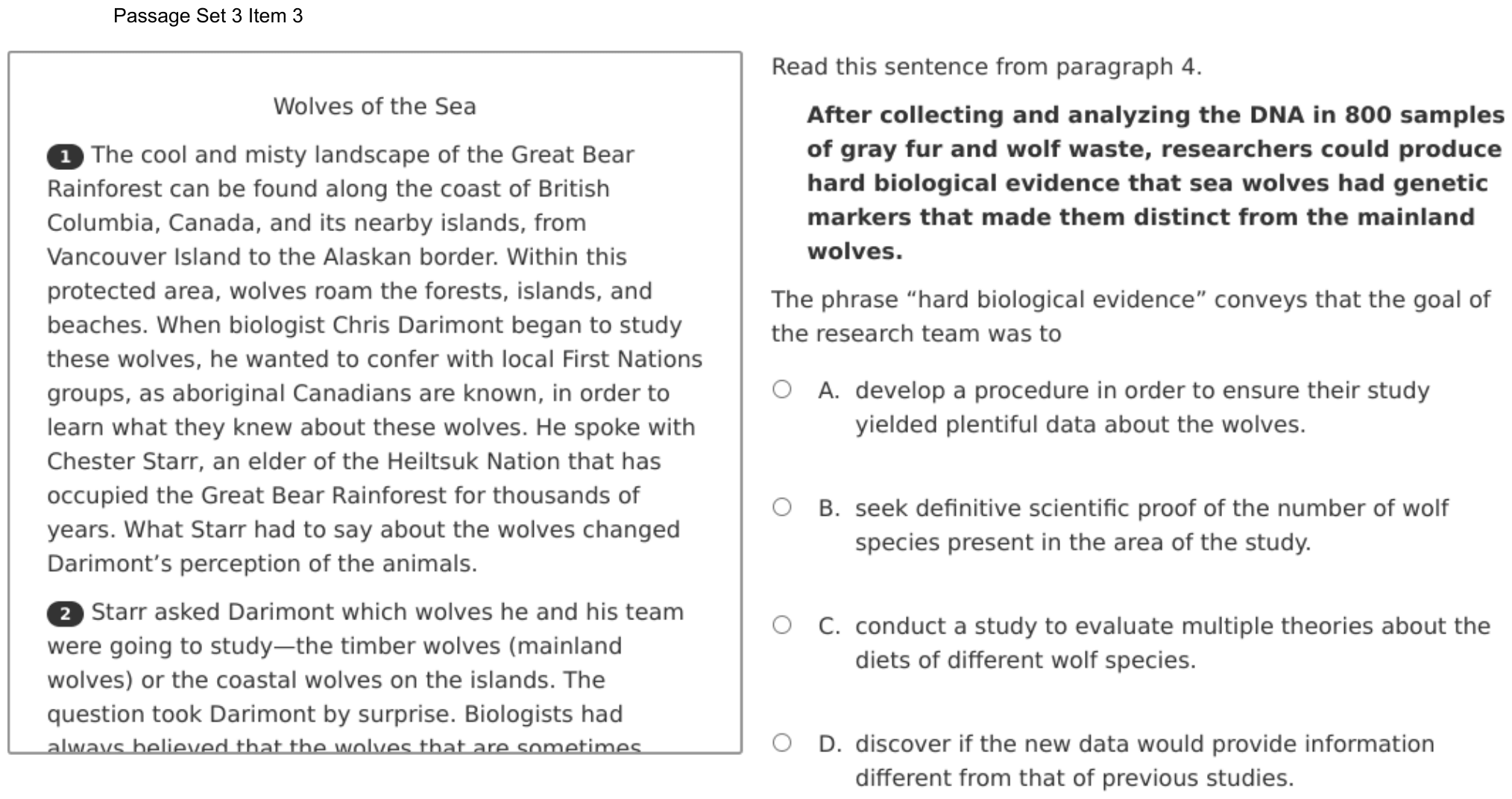
After collecting and analyzing the DNA in 800 samples of gray fur and wolf waste, researchers could produce hard biological evidence that sea wolves had genetic markers that made them distinct from the mainland wolves.
The phrase “hard biological evidence” conveys that the goal of the research team was to
- Adevelop a procedure in order to ensure their study yielded plentiful data about the wolves.
- Bseek definitive scientific proof of the number of wolf species present in the area of the study.
- Cconduct a study to evaluate multiple theories about the diets of different wolf species.
- Ddiscover if the new data would provide information different from that of previous studies.
Show the answer
Correct answer: B
The question asks what the phrase “hard biological evidence” in the sentence from paragraph 4 conveys about the goal of the research team.
A. Incorrect. Although the research team followed a labor-intensive procedure, the phrase “hard biological evidence” refers to the product of their scientific research (the genetic markers revealed within the DNA samples), not the process by which they collected it. Their goal was not to develop a procedure for data collection but to determine precisely how many species of wolf were present in the area.
B. CORRECT. The research team wanted to prove or disprove the theory that two separate groups of wolves were present in the area, an idea that was already supported by the observations of scientists and local indigenous people. The phrase “hard biological evidence” conveys that the scientists wanted to bolster their observations of the wolves with concrete scientific data about the wolves’ biological makeup. The goal of the researchers was to use the data to prove how many species of wolf were present in the area of the study.
C. Incorrect. The research team gathered extensive data during their study (“After collecting and analyzing the DNA in 800 samples of gray fur and wolf waste” [paragraph 4]), and their goal in doing so was to evaluate a single theory about the wolves: that the wolves had evolved into two separate and genetically distinct species. The research team did not conduct the study in order to evaluate multiple theories about the diets of the wolves.
D. Incorrect. The phrase “hard biological evidence” does not suggest that the research team was hoping to discover if the new data would provide information that was different from previous studies. In fact, the goal of the research team was to use the genetic data to supplement their initial sources of information about the wolves and their own observations from the field.
Question analysis
This word-in-context question quotes a sentence from paragraph 4 of “Wolves of the Sea” about DNA taken from 800 samples of gray fur and wolf waste, and asks what the phrase “hard biological evidence” shows about the research team’s goal. Students must work out what the phrase says about the evidence and then turn that into a statement of purpose, choosing among four plausible aims for a study.
- Grade level
- Grade 8 reading and task
- Compared with grade 7
- Above grade 7 Grade 7 students regularly interpret a phrase in context. Here the phrase must be turned into a claim about the team’s purpose, which the passage never states outright, and the four choices are abstract research goals that each sound reasonable.
- Estimated difficulty
- Hard: combines ideas, needs a plan, and has more than one tempting wrong answer.
- Thinking it demands
- Depth of knowledge 2, skills and concepts · mainly understand
- What makes it hard
- Reading between the lines moderate
- Hard words moderate
- Evidence in several places minor
- Evidence
- Answered from several paragraphs or stanzas
- Reading level
- Passage: about grade 10, 662 words; question and choices: about grade 10, 114 words.
- Students, last 30 days
- Not enough answers yet to show (it takes 10).
Why it is hard, traps and wrong answers (shows the answer)
Why it is hard
The question asks for a purpose, but the phrase it quotes describes a result, so students have to reason from the kind of evidence produced to what the team wanted it for. Readers who take “hard” as difficult drift toward a goal about procedure, and those who remember that biologists had long thought the wolves were one group are drawn to a goal of overturning earlier studies. The key’s “number of wolf species” is looser than the passage’s “two versions of the species,” which can make careful readers hesitate.
Reading between the lines moderate Working it out
The passage never states the team’s goal, so students must work back from “hard biological evidence” to the question paragraph 2 set up: whether island and mainland wolves are really two groups. (Graesser, Singer & Trabasso, 1994; Kintsch, 1998)
Hard words moderate Understanding the question
“Hard” here means solid and conclusive, as in hard evidence, not difficult; students who know only the everyday sense connect it to the labor of analyzing 800 samples of fur and waste. (Perfetti, 2007; Freedle & Kostin, 1993)
Evidence in several places minor Working it out
The goal the phrase points to lies two paragraphs back, in Starr’s two-group question and Darimont’s ten-year study “to find out,” not in the sentence the stem quotes. (Kirsch & Mosenthal, 1990; Gorin & Embretson, 2006)
Strategy: Replace “hard” with a word that fits evidence produced by DNA analysis, then ask what the team wanted that kind of evidence for, recalling the question Darimont set out to answer.
Traps
- Dictionary meaning, not meaning here: A common meaning of the word that does not fit its use in this text.
- Reads too much in: A reasonable-sounding conclusion that goes further than the text allows.
- Wrong part of the text: A choice is true of another paragraph, stanza or speaker than the one asked about.
The wrong answers, classified
A Dictionary meaning, not meaning here (Perfetti, 2007)
Reads “hard” as difficult and ties it to the labor of analyzing 800 samples, so takes the goal to be a thorough procedure rather than conclusive proof.
C Wrong part of the text (Kirsch & Mosenthal, 1990)
Brings in the diet differences of paragraph 3, clams, fish and seals, as theories under test, though the DNA work in paragraph 4 asked whether two groups exist.
D Reads too much in (Graesser, Singer & Trabasso, 1994)
Knows that biologists “had always believed” the wolves were one group and assumes the team set out to contradict earlier studies, which the phrase about solid proof does not suggest.
Working it out, step by step
Figure out what the question asks
This asks what a phrase shows about the team’s goal. A goal is what you are trying to get. The phrase names the kind of evidence the team got. Work back from that to what they wanted it for.
Read the sentence with the phrase
In paragraph 4, the team studied “800 samples of gray fur and wolf waste.” Then they “could produce hard biological evidence that sea wolves had genetic markers that made them distinct from the mainland wolves.” A genetic marker is a small difference in the DNA that parents pass to their young. Distinct means clearly different.
Work out what “hard” means
Here “hard” does not mean difficult. Hard evidence is solid proof that is tough to argue with. Biological means it comes from living things and their bodies. So the team wanted firm proof from the wolves’ own bodies.
Connect the proof to the question
What did they want to prove? Go back to paragraph 2. Starr said there were two groups of wolves. Darimont was unsure. “To find out,” his team studied the wolves. The DNA gave a firm answer: the sea wolves really are a separate group. So the goal was solid proof of how many groups of wolves live there.
Check each choice
- A is wrong. It reads “hard” as hard work. The phrase is about how firm the proof is, not about a procedure.
- B is right. Definitive means final and settled. The team wanted settled proof of how many groups of wolves live there. B says “species,” which goes further than the passage. Darimont speaks only of “two versions of the species.”
- C is wrong. Diets come up in paragraph 3. The DNA work tested whether there were two groups.
- D is wrong. The phrase says nothing about earlier studies.
Watch out: D is tempting because biologists “had always believed” the wolves were one group. But “hard” evidence is about firm proof, not about beating old studies.
Choose the answer
“Hard biological evidence” shows the team wanted firm, scientific proof. So the answer is B, “seek definitive scientific proof of the number of wolf species present in the area of the study.”
Why this answer and not the closest wrong one
D is the closest wrong answer. Biologists had thought the wolves were one group, so D can seem to fit. But the phrase “hard biological evidence” is about how firm the proof is. It says nothing about earlier studies. B matches that: the team wanted settled proof of how many groups there were.
More questions like this
The original DOE question
The passage “Wolves of the Sea” as printed (pages 23–24)

Question 2 of 6
2026 Practice Test A English, question 39Passage Massachusetts: Lowell National Historical Park
Massachusetts: Lowell National Historical Park
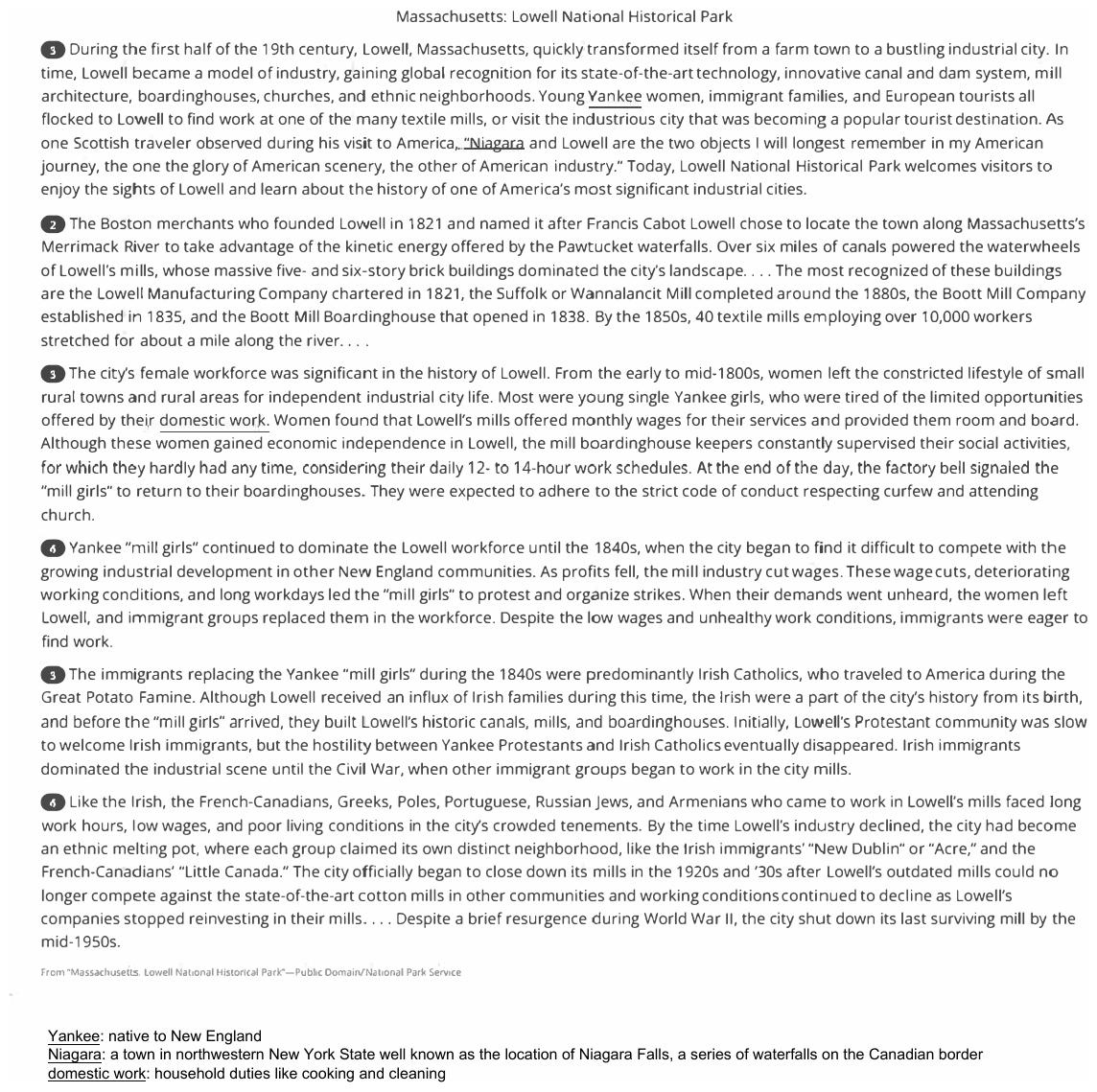
During the first half of the 19th century, Lowell, Massachusetts, quickly transformed itself from a farm town to a bustling industrial city. In time, Lowell became a model of industry, gaining global recognition for its state-of-the-art technology, innovative canal and dam system, mill architecture, boardinghouses, churches, and ethnic neighborhoods. Young Yankee women, immigrant families, and European tourists all flocked to Lowell to find work at one of the many textile mills, or visit the industrious city that was becoming a popular tourist destination. As one Scottish traveler observed during his visit to America, “Niagara and Lowell are the two objects I will longest remember in my American journey, the one the glory of American scenery, the other of American industry.” Today, Lowell National Historical Park welcomes visitors to enjoy the sights of Lowell and learn about the history of one of America’s most significant industrial cities.
The Boston merchants who founded Lowell in 1821 and named it after Francis Cabot Lowell chose to locate the town along Massachusetts’s Merrimack River to take advantage of the kinetic energy offered by the Pawtucket waterfalls. Over six miles of canals powered the waterwheels of Lowell’s mills, whose massive five- and six-story brick buildings dominated the city’s landscape. . . . The most recognized of these buildings are the Lowell Manufacturing Company chartered in 1821, the Suffolk or Wannalancit Mill completed around the 1880s, the Boott Mill Company established in 1835, and the Boott Mill Boardinghouse that opened in 1838. By the 1850s, 40 textile mills employing over 10,000 workers stretched for about a mile along the river. . . .
The city’s female workforce was significant in the history of Lowell. From the early to mid-1800s, women left the constricted lifestyle of small rural towns and rural areas for independent industrial city life. Most were young single Yankee girls, who were tired of the limited opportunities offered by their domestic work. Women found that Lowell’s mills offered monthly wages for their services and provided them room and board. Although these women gained economic independence in Lowell, the mill boardinghouse keepers constantly supervised their social activities, for which they hardly had any time, considering their daily 12- to 14-hour work schedules. At the end of the day, the factory bell signaled the “mill girls” to return to their boardinghouses. They were expected to adhere to the strict code of conduct respecting curfew and attending church.
Yankee “mill girls” continued to dominate the Lowell workforce until the 1840s, when the city began to find it difficult to compete with the growing industrial development in other New England communities. As profits fell, the mill industry cut wages. These wage cuts, deteriorating working conditions, and long workdays led the “mill girls” to protest and organize strikes. When their demands went unheard, the women left Lowell, and immigrant groups replaced them in the workforce. Despite the low wages and unhealthy work conditions, immigrants were eager to find work.
The immigrants replacing the Yankee “mill girls” during the 1840s were predominantly Irish Catholics, who traveled to America during the Great Potato Famine. Although Lowell received an influx of Irish families during this time, the Irish were a part of the city’s history from its birth, and before the “mill girls” arrived, they built Lowell’s historic canals, mills, and boardinghouses. Initially, Lowell’s Protestant community was slow to welcome Irish immigrants, but the hostility between Yankee Protestants and Irish Catholics eventually disappeared. Irish immigrants dominated the industrial scene until the Civil War, when other immigrant groups began to work in the city mills.
Like the Irish, the French-Canadians, Greeks, Poles, Portuguese, Russian Jews, and Armenians who came to work in Lowell’s mills faced long work hours, low wages, and poor living conditions in the city’s crowded tenements. By the time Lowell’s industry declined, the city had become an ethnic melting pot, where each group claimed its own distinct neighborhood, like the Irish immigrants’ “New Dublin” or “Acre,” and the French-Canadians’ “Little Canada.” The city officially began to close down its mills in the 1920s and ’30s after Lowell’s outdated mills could no longer compete against the state-of-the-art cotton mills in other communities and working conditions continued to decline as Lowell’s companies stopped reinvesting in their mills. . . . Despite a brief resurgence during World War II, the city shut down its last surviving mill by the mid-1950s.
From “Massachusetts: Lowell National Historical Park”—Public Domain/National Park Service
Yankee: native to New England
Niagara: a town in northwestern New York State well known as the location of Niagara Falls, a series of waterfalls on the Canadian border
domestic work: household duties like cooking and cleaning
Question
Read this sentence from paragraph 3.
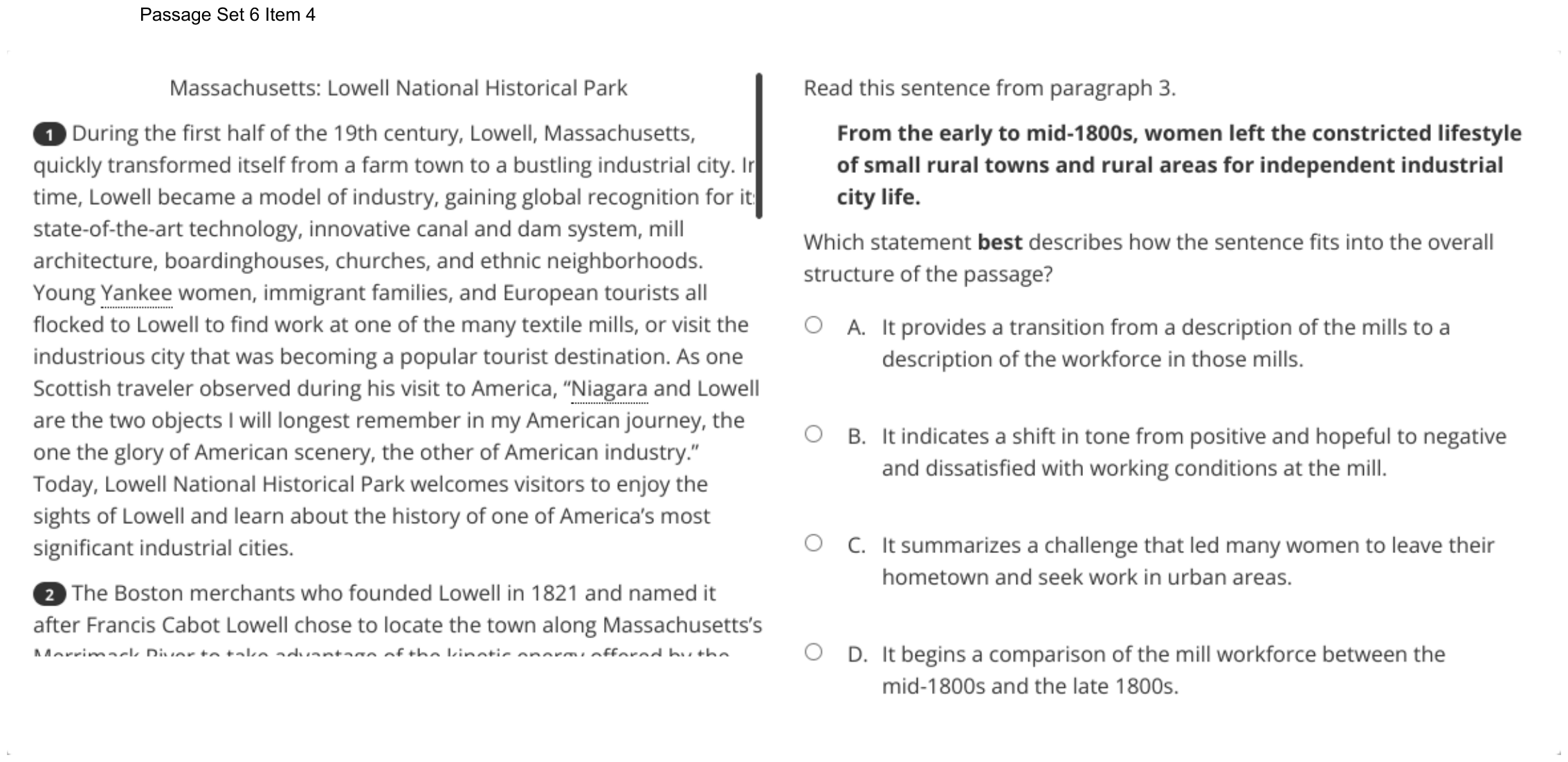
From the early to mid-1800s, women left the constricted lifestyle of small rural towns and rural areas for independent industrial city life.
Which statement best describes how the sentence fits into the overall structure of the passage?
- AIt provides a transition from a description of the mills to a description of the workforce in those mills.
- BIt indicates a shift in tone from positive and hopeful to negative and dissatisfied with working conditions at the mill.
- CIt summarizes a challenge that led many women to leave their hometown and seek work in urban areas.
- DIt begins a comparison of the mill workforce between the mid-1800s and the late 1800s.
Show the answer
Correct answer: A
The question asks which statement best describes how the sentence in paragraph 3 fits into the overall structure of the passage.
A. CORRECT. The sentence in paragraph 3 provides a transition from the overall description of the city and the mills to a description of the women who made up the workforce in the mills. The idea that women left domestic life in favor of working in the mills is important in the passage, and the sentence serves to connect that idea to the previous discussion about the mills.
B. Incorrect. While the mill girls’ dissatisfaction with their working conditions is addressed later in the passage (“These wage cuts, deteriorating working conditions, and long workdays led the ‘mill girls’ to protest and organize strikes” [paragraph 4]), the sentence in paragraph 3 does not indicate a shift in tone from positive to negative. The sentence provides a transition to the discussion of the women who worked in the mills.
C. Incorrect. Although the sentence in paragraph 3 mentions that women became interested in working in the mills because of the “constricted lifestyle of small rural towns,” structurally the sentence does not function as a summary because, instead of expanding on the idea of the difficulties or challenges of life in small rural towns and rural areas, the paragraph goes on to describe the advantages and disadvantages of life in the city for these women.
D. Incorrect. The sentence in paragraph 3 focuses on the choices women made to leave rural towns to work in the city in the early to mid-1800s, not the mid-1800s to the late 1800s. The sentence does not create a comparison between the workforce in the mid-1800s and that in the late 1800s.
Question analysis
A sentence from the start of paragraph 3 of the Lowell article, about women leaving the limited life of rural towns for the city, is the focus of this text-structure question. Students decide how it fits into the structure of the passage as a whole, so they must place it within the order of all six paragraphs instead of judging it by itself.
- NYS standards
- 7R5 structure and genre features
- Grade level
- Grade 8 reading and task
- Compared with grade 7
- Above grade 7 Grade 7 structure questions often ask what a paragraph does. This one asks how a single sentence serves a six-paragraph history and offers four abstract roles, so the student must hold the passage's whole plan in mind, more than typical grade 7 work.
- Estimated difficulty
- Hard: combines ideas, needs a plan, and has more than one tempting wrong answer.
- Thinking it demands
- Depth of knowledge 3, strategic thinking · mainly analyze
- What makes it hard
- How, not what moderate
- Evidence in several places moderate
- Reading between the lines minor
- Evidence
- Answered from the whole text
- Reading level
- Passage: about grade 15, 764 words; question and choices: about grade 9, 116 words.
- Students, last 30 days
- Not enough answers yet to show (it takes 10).
Why it is hard, traps and wrong answers (shows the answer)
Why it is hard
The answer depends on seeing the passage's plan, mills first and then the people who ran them, and placing this sentence at the seam. Its wording invites a content answer instead, since it really does describe a hardship that drove women to the city, and the later strikes tempt students to see a darker tone beginning here. The fit of the key is also imperfect, because the paragraph's opening sentence starts the turn, so students must choose the best description rather than an exact one.
How, not what moderate Working it out
The question asks what the sentence does in the passage, and its content, women escaping a “constricted lifestyle,” is easy to restate, which makes a summary of that content feel like an answer. (Anderson & Krathwohl, 2001)
Evidence in several places moderate Working it out
The sentence's role shows only from its neighbors: paragraph 2 ends with 40 mills and 10,000 workers, and paragraph 3 then follows the women who left rural towns to work in them. (Kirsch & Mosenthal, 1990; Gorin & Embretson, 2006)
Reading between the lines minor Working it out
Paragraph 3's first sentence, “The city's female workforce was significant,” already names the new subject, so students must see this second sentence as part of the turn rather than a fresh point. (Graesser, Singer & Trabasso, 1994; Kintsch, 1998)
Strategy: Sum up each paragraph in a few words, then look at what comes just before and just after this sentence and decide what role it plays at that point in the passage.
Traps
- Wrong purpose or structure: Names a purpose, structure or effect that the part does not serve, or describes what a part says when the question asks what it does.
- Wrong tone or attitude: Misjudges the tone, attitude or point of view, such as reading admiration as criticism, or taking a character's or subject's feelings for the author's.
The wrong answers, classified
B Wrong tone or attitude (Graesser, Singer & Trabasso, 1994)
Expects a turn toward complaint because the mill girls later strike, but this sentence is hopeful about “independent industrial city life,” and the protests wait until paragraph 4.
C Wrong purpose or structure (Anderson & Krathwohl, 2001)
Restates what the sentence says, women escaping a “constricted lifestyle,” instead of what it does, and the paragraph goes on to life in Lowell rather than rural hardship.
D Wrong purpose or structure (Anderson & Krathwohl, 2001)
Sees the dates “early to mid-1800s” and expects a then-and-later contrast, though the sentence opens the mill girls' story and the passage sets up no such comparison.
Working it out, step by step
Figure out what the question asks
This is a structure question. Structure is how a passage is put together. You need to say what job this sentence does in the whole passage. Don’t just restate what it says. Ask what comes before it and what comes after it.
Look at what comes before
Paragraph 2 is all about the mills. It ends with “40 textile mills employing over 10,000 workers.” Then paragraph 3 begins: “The city’s female workforce was significant in the history of Lowell.” Workforce means the people who do the work. The sentence in the question comes right after that: “From the early to mid-1800s, women left the constricted lifestyle of small rural towns and rural areas for independent industrial city life.”
Look at what comes after
Constricted means tight and limited. So women left small, limited farm towns to live on their own in the city. After this, the passage stays with the workers. Paragraphs 3 and 4 tell about the mill girls’ wages, rules, strikes and leaving. Paragraphs 5 and 6 tell about the immigrants who replaced them. So the passage turns here, from the mills to the people who worked in them.
Check each choice
- A is right. The sentence helps carry the reader from the mills to the workforce in those mills.
- B is wrong. The tone isn’t negative here. “Independent industrial city life” sounds hopeful. The protests and strikes don’t come until paragraph 4.
- C is wrong. It tells what the sentence says, not what it does. And the paragraph goes on to life in Lowell, not to more about hard times back home.
- D is wrong. The passage never compares workers of the mid-1800s with workers of the late 1800s.
Watch out: C sounds right because the sentence really does describe a limited life that women wanted to leave. But the question asks about its role, not its content.
Choose the answer
Paragraph 3’s first sentence names the new subject. This sentence carries it forward by telling where the workers came from. Together they move the passage from mills to people. So the answer is A.
Why this answer and not the closest wrong one
C is the closest wrong answer. It is true that women wanted to escape a “constricted lifestyle.” But C describes what the sentence says, not the job it does. The paragraph then moves on to life in Lowell. A names the job: the sentence links the story of the mills to the story of the mill workers.
More questions like this
The original DOE question
The passage “Massachusetts: Lowell National Historical Park” as printed (page 50)
Question 3 of 6
2026 Practice Test A English, question 12Passage The Best Laid Plans of Ravens
The Best Laid Plans of Ravens
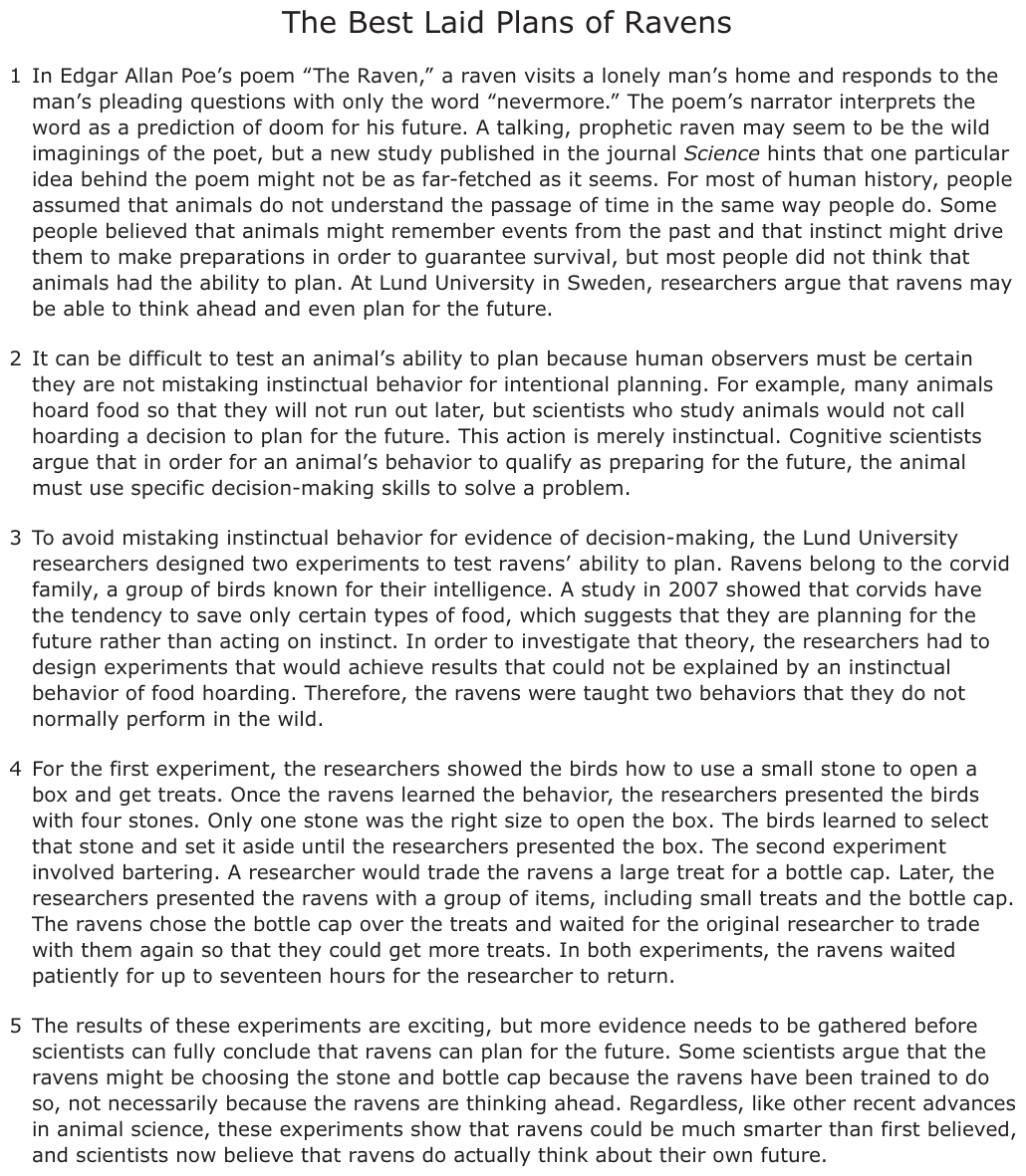
In Edgar Allan Poe’s poem “The Raven,” a raven visits a lonely man’s home and responds to the man’s pleading questions with only the word “nevermore.” The poem’s narrator interprets the word as a prediction of doom for his future. A talking, prophetic raven may seem to be the wild imaginings of the poet, but a new study published in the journal Science hints that one particular idea behind the poem might not be as far-fetched as it seems. For most of human history, people assumed that animals do not understand the passage of time in the same way people do. Some people believed that animals might remember events from the past and that instinct might drive them to make preparations in order to guarantee survival, but most people did not think that animals had the ability to plan. At Lund University in Sweden, researchers argue that ravens may be able to think ahead and even plan for the future.
It can be difficult to test an animal’s ability to plan because human observers must be certain they are not mistaking instinctual behavior for intentional planning. For example, many animals hoard food so that they will not run out later, but scientists who study animals would not call hoarding a decision to plan for the future. This action is merely instinctual. Cognitive scientists argue that in order for an animal’s behavior to qualify as preparing for the future, the animal must use specific decision-making skills to solve a problem.
To avoid mistaking instinctual behavior for evidence of decision-making, the Lund University researchers designed two experiments to test ravens’ ability to plan. Ravens belong to the corvid family, a group of birds known for their intelligence. A study in 2007 showed that corvids have the tendency to save only certain types of food, which suggests that they are planning for the future rather than acting on instinct. In order to investigate that theory, the researchers had to design experiments that would achieve results that could not be explained by an instinctual behavior of food hoarding. Therefore, the ravens were taught two behaviors that they do not normally perform in the wild.
For the first experiment, the researchers showed the birds how to use a small stone to open a box and get treats. Once the ravens learned the behavior, the researchers presented the birds with four stones. Only one stone was the right size to open the box. The birds learned to select that stone and set it aside until the researchers presented the box. The second experiment involved bartering. A researcher would trade the ravens a large treat for a bottle cap. Later, the researchers presented the ravens with a group of items, including small treats and the bottle cap. The ravens chose the bottle cap over the treats and waited for the original researcher to trade with them again so that they could get more treats. In both experiments, the ravens waited patiently for up to seventeen hours for the researcher to return.
The results of these experiments are exciting, but more evidence needs to be gathered before scientists can fully conclude that ravens can plan for the future. Some scientists argue that the ravens might be choosing the stone and bottle cap because the ravens have been trained to do so, not necessarily because the ravens are thinking ahead. Regardless, like other recent advances in animal science, these experiments show that ravens could be much smarter than first believed, and scientists now believe that ravens do actually think about their own future.
Question
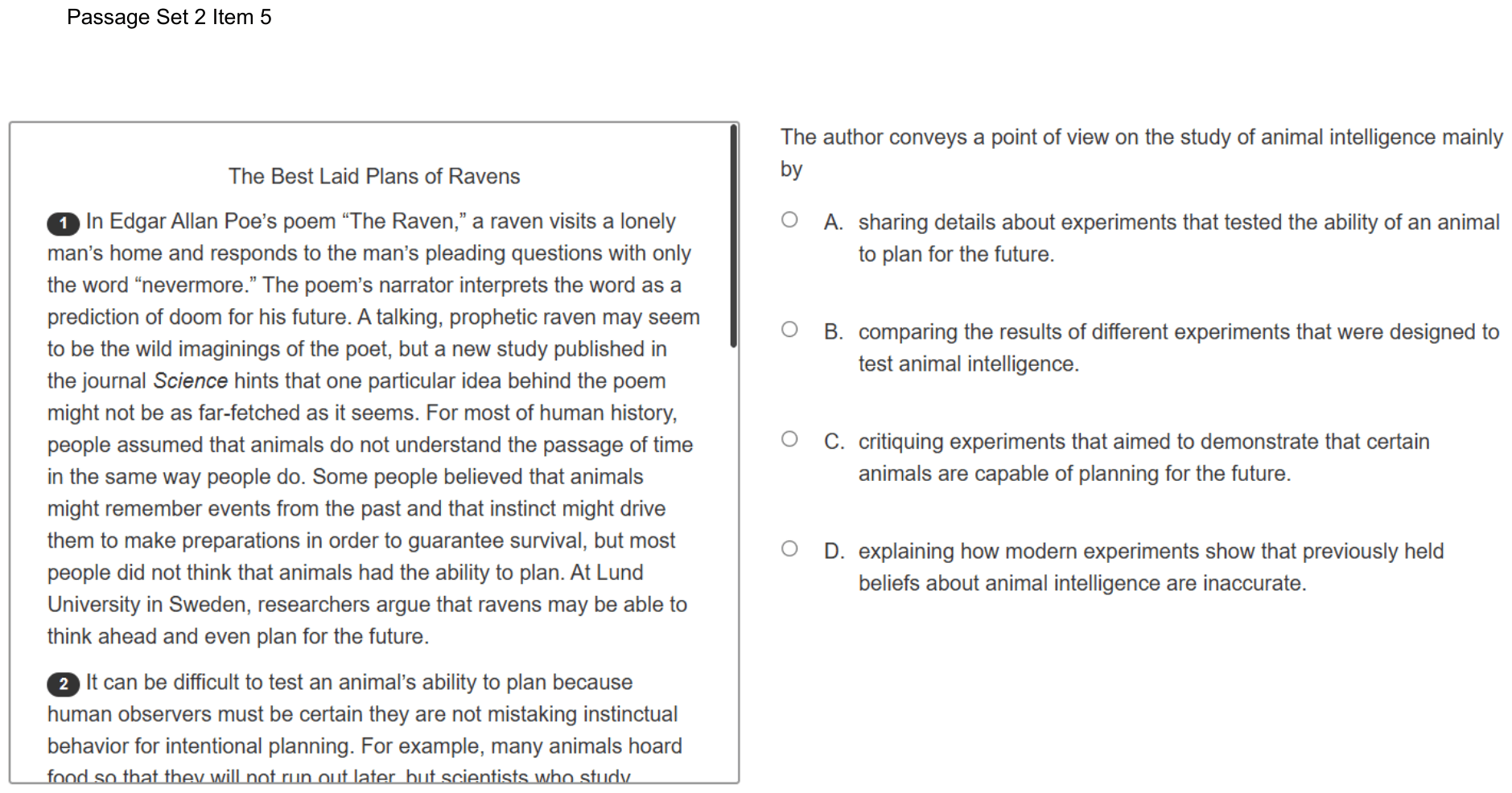
The author conveys a point of view on the study of animal intelligence mainly by
- Asharing details about experiments that tested the ability of an animal to plan for the future.
- Bcomparing the results of different experiments that were designed to test animal intelligence.
- Ccritiquing experiments that aimed to demonstrate that certain animals are capable of planning for the future.
- Dexplaining how modern experiments show that previously held beliefs about animal intelligence are inaccurate.
Show the answer
Correct answer: A
The question asks how the author conveys a point of view on the study of animal intelligence.
A. CORRECT. Paragraphs 3 and 4 focus on the process and details of the experiments that scientists conducted. This detailed information from the author provides a sense of how the ravens demonstrated planning abilities beyond natural instinct. The author supports the claims from the experiments, calling the findings “exciting” and stating in the conclusion that “these experiments show that ravens could be much smarter than first believed” (paragraph 5).
B. Incorrect. Although two experiments are described in the passage, the description presents the experiments as building on each other and does not compare their results. The passage states that “these experiments show that ravens could be much smarter than first believed, and scientists now believe that ravens do actually think about their own future” (paragraph 5).
C. Incorrect. The author presents information from the experiments and the results that were gathered from them; while there is an admission that “more evidence needs to be gathered before scientists can fully conclude that ravens can plan for the future” (paragraph 5), the author does not criticize the experiments that are presented.
D. Incorrect. While the author does discuss some previously held beliefs about animal intelligence in paragraph 1, the focus of the passage is that experiments indicate that there is reason to question these beliefs, since “these experiments show that ravens could be much smarter than first believed” (paragraph 5). The previously held beliefs are not considered inaccurate by the discussion in the passage because only one example—the raven—is provided. The passage does not state that beliefs about animal intelligence as a whole are inaccurate.
Question analysis
This author’s point-of-view question asks how the writer of “The Best Laid Plans of Ravens” mainly conveys a view of research into animal intelligence. Students must look at the article as a whole and decide how it presents that view. The choices describe ways of writing in abstract terms, which makes them easy to blur together.
- Grade level
- Grade 8 reading and task
- Compared with grade 7
- Above grade 7 Grade 7 point-of-view questions usually ask what an author thinks. This one asks how the author mainly conveys a view across the whole article, and the choices name methods that sound alike, closer to grade 8 work on how authors handle differing views.
- Estimated difficulty
- Hard: combines ideas, needs a plan, and has more than one tempting wrong answer.
- Thinking it demands
- Depth of knowledge 3, strategic thinking · mainly analyze
- What makes it hard
- How, not what major
- Reading between the lines moderate
- Every choice must be checked minor
- Evidence
- Answered from the whole text
- Reading level
- Passage: about grade 11, 599 words; question and choices: about grade 13, 74 words.
- Students, last 30 days
- Not enough answers yet to show (it takes 10).
Why it is hard, traps and wrong answers (shows the answer)
Why it is hard
The right choice sounds too plain to carry a point of view, which is exactly what makes this question hard. Students expect a view to be argued, so they reach for the choice that says the experiments prove old beliefs wrong, an overstatement of the author’s hedged “could be,” or for criticism, which belongs to other scientists. The article persuades by reporting the experiments in detail and calling them exciting.
How, not what major Working it out
The question asks how the view comes across, not what it is, and the answer is a method: the author lets the detailed account of the experiments in paragraphs 3–4 carry a favorable view. (Anderson & Krathwohl, 2001)
Reading between the lines moderate Working it out
The author never states an opinion outright; the view must be pieced together from words such as “exciting” and “could be much smarter than first believed” in paragraph 5. (Graesser, Singer & Trabasso, 1994; Kintsch, 1998)
Every choice must be checked minor Choosing the answer
The choices name ways of writing in abstract terms, sharing, comparing, critiquing and explaining, so each must be held against what the whole article actually does. (Embretson & Wetzel, 1987)
Strategy: Settle first on how the author regards the raven research, then check each choice against what the article actually does from beginning to end, not against a single paragraph.
Traps
- Too broad or too strong: A choice overstates, generalizes, or uses absolute words the text does not support.
- Wrong tone or attitude: Misjudges the tone, attitude or point of view, such as reading admiration as criticism, or taking a character's or subject's feelings for the author's.
- Twists what the text says: Uses the text's topic and ideas but changes what it says: who did it, how much, when, or why.
The wrong answers, classified
B Twists what the text says (King et al., 2004)
Notices that two experiments are described and assumes they are set side by side, but the article reports the stone test and the bartering test in turn without comparing results.
C Wrong tone or attitude (Graesser, Singer & Trabasso, 1994)
Takes the doubt that “some scientists” raise about training for the author’s own criticism, though the author calls the results “exciting” and moves past the objection.
D Too broad or too strong (King et al., 2004)
Builds on the point that ravens may be smarter than believed but overstates it: the author hedges with “could be,” discusses only ravens, and never calls older beliefs wrong.
Working it out, step by step
Figure out what the question asks
This asks about the author’s point of view, what the author thinks about studying animal intelligence. It also asks how the author mainly shows that view. Think about the whole article, not one paragraph.
Find the author’s view
In paragraph 5, the author says the results “are exciting.” The author also says the experiments “show that ravens could be much smarter than first believed.” So the author is interested in this research and hopeful about it.
See how the article is built
Most of the article explains the experiments. Paragraph 3 tells why the researchers planned two of them. Paragraph 4 gives the details step by step: the stone, the box, the bottle cap, the trades and the long wait. The author lets these details show why the research matters. Then the author calls the results exciting.
Check each choice
- A fits. The author shares details of experiments that tested whether an animal can plan.
- B does not fit. The two experiments are told one after the other. Their results are never compared.
- C does not fit. The doubt comes from “some scientists,” not the author. The author answers it with “Regardless.”
- D does not fit. It goes too far. The author says ravens “could be” smarter, which means maybe. The article never calls old beliefs wrong.
Watch out: D is tempting because paragraph 1 describes old beliefs. But “could be” is not the same as “are.”
Choose the answer
The author shows a view mostly through details of the experiments. So the answer is A.
Why this answer and not the closest wrong one
D is the closest wrong choice. The author does think ravens may be smarter than people believed. But the author is careful and says they “could be.” D says experiments prove old beliefs wrong, which is too strong. What the author mostly does is share the experiments’ details. That is A.
More questions like this
The original DOE question
The passage “The Best Laid Plans of Ravens” as printed (page 12)
Question 4 of 6
2018 Test A Math, question 5Question
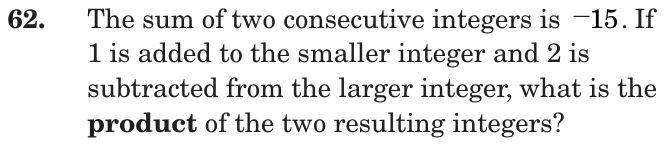
The sum of two consecutive integers is −15. If 1 is added to the smaller integer and 2 is subtracted from the larger integer, what is the product of the two resulting integers?
Grid-in question: work out the answer and enter it as a number.
Show the answer
Correct answer: 63
If x is the smaller consecutive integer, then
is the larger consecutive integer. Use their sum (−15) to find x:
The two consecutive integers are −8 and −7. One is added to the smaller integer:
and 2 is subtracted from the larger integer:
Find the product:
Question analysis
A grid-in problem about two consecutive integers whose sum is −15. Students find the two integers, add 1 to the smaller and subtract 2 from the larger, then multiply the results. Deciding which negative integer is the smaller one, and keeping signs straight through every step, are what make it tricky.
- Grade level
- Grade 7 content, by NYS standard
- Compared with grade 7
- Above grade 7 A typical grade 7 task solves one two-step equation or multiplies signed numbers. This links both: set up a consecutive-integer equation, solve it with negatives, adjust each integer, and multiply, with no choices to check against.
- Estimated difficulty
- Hard: combines ideas, needs a plan, and has more than one tempting wrong answer.
- Thinking it demands
- Depth of knowledge 2, skills and concepts · mainly apply
- What makes it hard
- Error-prone arithmetic moderate
- Turning words into math moderate
- Many steps moderate
- Solution
- 4 steps
- Reading level
- Question and choices: about grade 9, 30 words.
- Students, last 30 days
- Not enough answers yet to show (it takes 10).
Why it is hard, traps and wrong answers (shows the answer)
Why it is hard
Every step is routine, yet the question collects most of the ways students lose points with negatives. The crucial judgment is which of −8 and −7 is the smaller; a student who picks −7 still produces a tidy, wrong product. Gridding the product of the original pair, or giving a negative product, are the other usual losses. Writing each intermediate pair down, rather than holding them in mind, protects against all three.
Error-prone arithmetic moderate Working it out
Every number in play is negative: −8 and −7, then −7 and −9, and a product of two negatives that must come out positive. (Brown & Burton, 1978; Junker & Sijtsma, 2001)
Turning words into math moderate Understanding the question
"1 is added to the smaller integer and 2 is subtracted from the larger" depends on knowing that −8, not −7, is the smaller, since it lies farther below zero. (Hegarty, Mayer & Monk, 1995; Koedinger & Nathan, 2004)
Many steps moderate Working it out
Four linked steps: set up x + (x + 1) = −15, solve for x, adjust each integer, then multiply; an error early in the chain carries through to the product. (Daniel & Embretson, 2010; Enright, Morley & Sheehan, 2002)
Strategy: Halve the sum to see which two integers sit on either side of it, remember that the smaller negative is farther from zero, then adjust each and multiply.
Traps
- Negatives and direction: Arithmetic with negative numbers, the order of a subtraction, or direction on a number line. (Moving a term across the equals sign without changing its sign is a faulty procedure.)
- Misreads the question: Misses or misreads a condition or a word in the question: "at least", "each", "remaining", "not".
The wrong answers, classified
60 Negatives and direction (Brown & Burton, 1978)
Takes −7 as the smaller integer because 7 is less than 8, so adjusts to −7 + 1 = −6 and −8 − 2 = −10, and multiplies to 60.
56 Misreads the question (Hegarty, Mayer & Monk, 1995)
Finds −8 and −7 and multiplies them to get 56, skipping the sentence that adds 1 to one integer and subtracts 2 from the other.
-63 Negatives and direction (Brown & Burton, 1978)
Finds the adjusted integers −7 and −9 correctly but gives their product a negative sign, gridding −63.
Worked solution, step by step
Formulas used
- Consecutive integers
- Integers are whole numbers and their opposites, like −2, −1, 0, 1 and 2. Consecutive integers come one right after another. If n is the smaller one, the next one is n + 1, because each step up the number line adds 1.
- Multiplying two negative numbers
- a and b are positive numbers, so −a and −b are negative. When you multiply two negative numbers, the answer is positive. The two minus signs cancel out.
Sort out the question
Two consecutive integers add up to −15. Integers are whole numbers and their negatives. Consecutive means one comes right after the other, like 4 and 5. You need to do three things:
- Find the two integers.
- Add 1 to the smaller one. Subtract 2 from the larger one.
- Find the product of the two new numbers. The product is the answer when you multiply.
Find the two integers
Call the smaller integer n. Then the larger one is n + 1. Their sum is −15.
Subtract 1 from both sides. Then divide both sides by 2.
So the integers are −8 and −7.
Decide which one is smaller
On a number line, −8 is to the left of −7. Numbers to the left are smaller. So −8 is the smaller integer, and −7 is the larger one. Watch out: 8 is bigger than 7, but −8 is smaller than −7. Mixing them up gives −6 and −10, and the wrong answer 60.
Change each integer
Add 1 to the smaller integer.
Subtract 2 from the larger integer.
The two new numbers are −7 and −9.
Multiply the new numbers
Both numbers are negative, so their product is positive.
Watch out: the answer is not −63, because two negatives make a positive. Also, don’t multiply the first pair, −8 and −7. That gives 56 and skips the changes. So you would grid 63.
Check your answer
Check the pair: , and they are one apart. Half of −15 is −7.5, and −8 and −7 sit on either side of it. Then , and the sign is positive.
More questions like this
The original DOE question
Question 5 of 6
2018 Test A Math, question 48Question
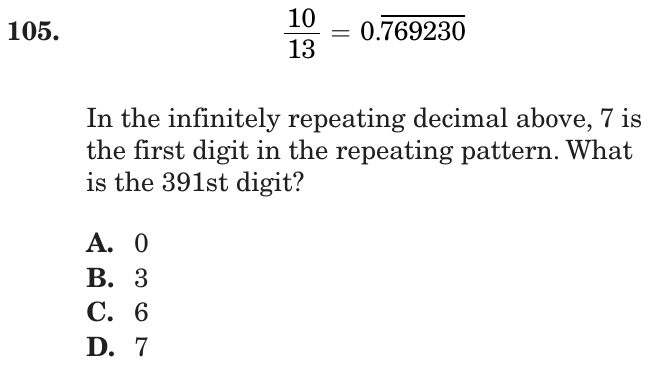
In the infinitely repeating decimal above, 7 is the first digit in the repeating pattern. What is the 391st digit?
- A0
- B3
- C6
- D7
Show the answer
Correct answer: D
There are 6 digits in the repeating decimal (769230), so 7 would be the first, seventh, thirteenth digit and so on.
To find the 391st digit, divide 391 by 6.
391 ÷ 6 = 65 R1
Since the remainder is 1, that means the 391st digit is the same as the 1st digit, which is 7.
Question analysis
This repeating decimal question shows the six-digit repeating pattern of 10/13 and asks for the 391st digit after the decimal point. Students must use the length of the repeating block and division with a remainder to find the position within the cycle. Matching the remainder to the right digit is where students slip.
- Grade level
- Grade 7 content, by NYS standard
- Compared with grade 7
- Above grade 7 Seventh graders learn that fractions have repeating decimals. Using the length of the repeating block and a remainder to find a digit hundreds of places away is a pattern-reasoning step beyond typical seventh-grade classwork.
- Estimated difficulty
- Hard: combines ideas, needs a plan, and has more than one tempting wrong answer.
- Thinking it demands
- Depth of knowledge 2, skills and concepts · mainly apply
- What makes it hard
- No obvious method moderate
- Solution
- 2 steps
- Reading level
- Question and choices: about grade 8, 20 words.
- Students, last 30 days
- Not enough answers yet to show (it takes 10).
Why it is hard, traps and wrong answers (shows the answer)
Why it is hard
Once the cycle length is used, the arithmetic is a single division, 391 ÷ 6 = 65 remainder 1. The difficulty is turning the remainder into a position: remainder 1 is the first digit of a new block, not the last digit of the previous one or the second of the new one. Checking the rule on small positions, the 1st and 7th digits are both 7, removes the doubt.
No obvious method moderate Working it out
Nothing in the stem mentions division; students must see that the six-digit block 769230 repeats, so position 391 depends only on the remainder of 391 divided by 6. (Schoenfeld, 1985)
Strategy: Divide 391 by the length of the repeating block and look only at the remainder; a remainder of r points to the r-th digit of the block.
Traps
- Counting the ends: Inclusive or exclusive ends, fence posts, consecutive numbers: an answer that is one too many or too few, or an endpoint drawn open where it belongs closed (or the reverse).
The wrong answers, classified
A Counting the ends (Brown & Burton, 1978)
Sees that 65 blocks fill 390 places and lands on the 390th digit, the 0 that ends a block, one place short.
B A faulty procedure (Brown & Burton, 1978; Tatsuoka, 1983)
Uses the quotient 65 instead of the remainder, takes its last digit 5, and reads the fifth digit of 769230, which is 3.
C Counting the ends (Brown & Burton, 1978)
Treats the remainder 1 as one step past the block's first digit, moving from 7 to the second digit, 6.
Worked solution, step by step
Formulas used
- Division with a remainder
- n is the number you divide. d is what you divide by. q is the quotient, the number of whole groups. r is the remainder, what is left over. Here it tells how many full blocks of digits fit, and where you land after them.
Sort out what you know
The bar over 769230 means those six digits repeat forever: 769230769230 and so on. The 7 is digit number 1. You need digit number 391.
Spot the pattern
The block 769230 has 6 digits, so the pattern starts over every 6 digits. Digit 1 is 7, and so are digits 7, 13, 19 and so on. Each full block ends with a 0, at digits 6, 12, 18 and so on.
Divide 391 by 6
Find how many full blocks fit into 391 digits, and what is left:
So 65 full blocks use up 6 × 65 = 390 digits. The remainder is 1. That means digit 391 is the 1st digit of the next block.
Read the digit
The 1st digit of the block is 7. Watch out: digit 390 is the last digit of a full block, which is 0. That is choice A. Digit 391 is one step past it, so it starts a new block.
So the answer is D, 7.
Check your answer
Test the idea on a small number. Digit 7: 7 = 6 × 1 + 1, so the remainder is 1 and the digit should be 7. Write it out: 7692307. The 7th digit is indeed 7. The rule works.
More questions like this
The original DOE question
Question 6 of 6
2026 Practice Test B Math, question 31Question
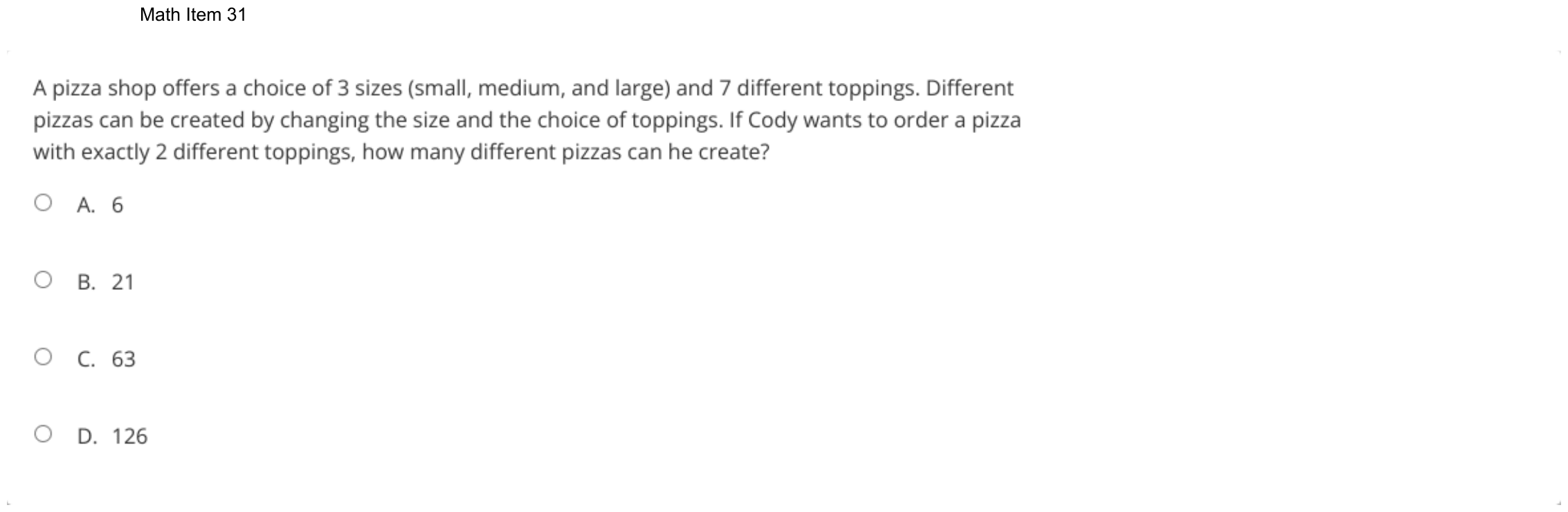
A pizza shop offers a choice of 3 sizes (small, medium, and large) and 7 different toppings. Different pizzas can be created by changing the size and the choice of toppings. If Cody wants to order a pizza with exactly 2 different toppings, how many different pizzas can he create?
- A6
- B21
- C63
- D126
Show the answer
Correct answer: C
Figure out how many different topping pairs are possible. Use 1, 2, 3, 4, 5, 6, 7 to represent the toppings, and create a list of possible pairs:
1,2; 1,3; 1,4; 1,5; 1,6; 1,7
2,3; 2,4; 2,5; 2,6; 2,7
3,4; 3,5; 3,6; 3,7
4,5; 4,6; 4,7
5,6; 5,7
6,7
So there are 21 different topping combinations for one pizza.
Since there are 3 pizza sizes, multiply the total number of combinations by 3 to get the total number of different pizzas Cody can create: .
Question analysis
Cody orders a pizza with exactly 2 of 7 toppings in one of 3 sizes, and students count how many different pizzas he could create. It tests counting combinations, where the order of the toppings does not matter, combined with a second choice. The challenge is to count every possible pizza exactly once.
- NYS standards
- 7.SP.8b sample spaces for compound events
- Grade level
- Grade 7 content, by NYS standard
- Compared with grade 7
- Above grade 7 In grade 7, compound events are usually ordered pairs, such as a coin with a number cube. Here an unordered pair of toppings is chosen from seven and then matched with three sizes, a combination count beyond typical grade 7 work.
- Estimated difficulty
- Hard: combines ideas, needs a plan, and has more than one tempting wrong answer.
- Thinking it demands
- Depth of knowledge 2, skills and concepts · mainly apply
- What makes it hard
- Combines ideas moderate
- Something you must already know minor
- Solution
- 3 steps
- Reading level
- Question and choices: about grade 8, 47 words.
- Students, last 30 days
- Not enough answers yet to show (it takes 10).
Why it is hard, traps and wrong answers (shows the answer)
Why it is hard
The question packs two counts into one sentence, each with its own trap. Order does not matter among the toppings, while the size multiplies every pair, and students tend to remember one of these and forget the other. Listing pairs systematically, each topping matched only with later ones, keeps the first count honest, and the stem’s “changing the size and the choice of toppings” is the reminder that size counts too.
Combines ideas moderate Working it out
Two counts are joined: the unordered pairs of toppings from 7, then the 3 sizes each pair can come in, and a mistake in either count changes the total. (Embretson, 1998; Daniel & Embretson, 2010)
Something you must already know minor Working it out
Students must know that a pizza with mushroom and onion is the same as one with onion and mushroom, so the ordered count 7 × 6 has to be halved. (Anderson & Krathwohl, 2001)
Strategy: Number the toppings 1 to 7, list each pair once by matching every topping only with higher-numbered ones, count the list, then bring in the choice of size.
Traps
- Stops one step early: A choice is a number from partway through the solution.
- Overlapping groups: Things in two groups at once are counted twice, or not subtracted.
The wrong answers, classified
A Numbers taken from the question (Hegarty, Mayer & Monk, 1995)
Multiplies the 3 sizes by the 2 toppings Cody wants, using the number of toppings on the pizza instead of the number of possible pairs.
B Stops one step early (King et al., 2004; Gierl et al., 2017)
Lists or counts the 21 pairs of toppings correctly, then stops without giving each pair its 3 possible sizes.
D Overlapping groups (King et al., 2004)
Counts ordered pairs, 7 × 6 = 42, so each pair of toppings appears twice, and then multiplies by the 3 sizes to reach 126.
Worked solution, step by step
Formulas used
- The counting principle
- m is the number of ways to make one choice, and n is the number of ways to make a second choice. Every first choice can go with every second choice, so you multiply. Here, every pair of toppings can come in every size.
- Pairs when order does not matter
- n is the number of items to choose from. There are n ways to pick a first item and n − 1 ways to pick a different second one. That counts each pair twice, once in each order. Dividing by 2 counts each pair once.
Sort out the question
Each of Cody’s pizzas has one size and exactly 2 different toppings. There are 3 sizes and 7 toppings. Pizzas differ by “changing the size and the choice of toppings.” So a small and a large with the same toppings are two different pizzas. You need to count every pizza once.
List the topping pairs
Order does not matter: onion with peppers is the same pizza as peppers with onion. So number the toppings 1 to 7, and pair each one only with bigger numbers. Then no pair shows up twice.
Topping Pairs with Pairs 1 2, 3, 4, 5, 6, 7 6 2 3, 4, 5, 6, 7 5 3 4, 5, 6, 7 4 4 5, 6, 7 3 5 6, 7 2 6 7 1 There are 21 different pairs of toppings.
Check the pairs with the formula
Use the pairs formula with 7 toppings:
Watch out: 7 × 6 = 42 counts every pair twice, once as 1 then 2 and once as 2 then 1. Keeping 42 leads to , choice D.
Bring in the sizes
Each of the 21 topping pairs can come in any of the 3 sizes. Use the counting principle:
Watch out: stopping at 21 leaves out the sizes, which gives choice B. Choice A, 6, multiplies the 3 sizes by the 2 toppings on one pizza. That does not count pizzas.
Give the answer
There are 21 topping pairs, and each one comes in 3 sizes. Cody can create 63 different pizzas. So the answer is C, 63.
Check your answer
Count one size at a time. A small pizza can have any of the 21 pairs, so there are 21 small pizzas. There are also 21 medium and 21 large ones: . That is more than the 21 pairs but fewer than 126, so it is reasonable.
More questions like this
The original DOE question