A formula you must know
Question 1 of 20
2026 Practice Test B Math, question 28Question
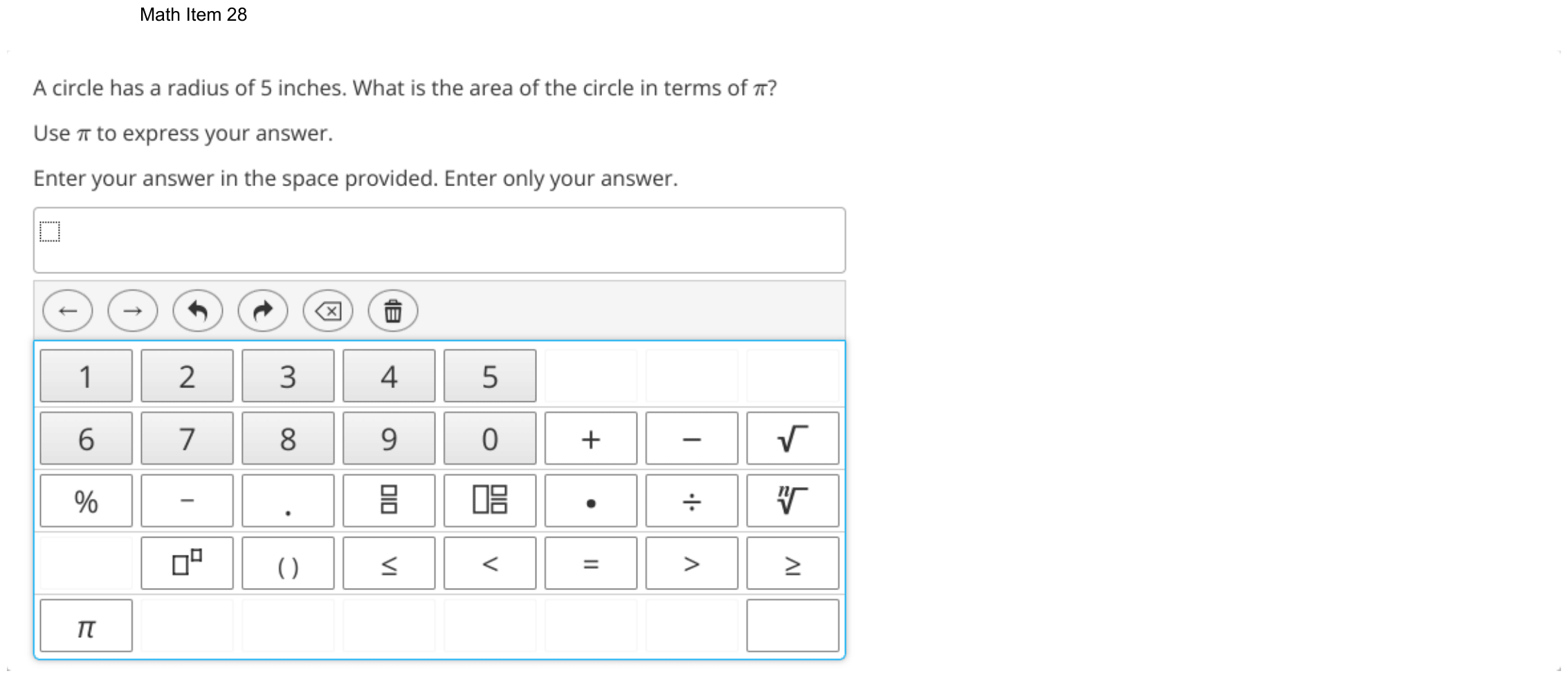
A circle has a radius of 5 inches. What is the area of the circle in terms of ?
Use to express your answer.
Enter your answer in the space provided. Enter only your answer.
On the test you build the answer on an on-screen keypad; here, type it. Use ^ for a power, sqrt( ) or √ for a root, pi for π, and <= or >= for ≤ and ≥.
Show the answer
Correct answer: 25π
Solution:
The area of a circle is its radius squared times .
Question analysis
This circle question gives a radius of 5 inches and asks for the area in terms of π, typed into a box rather than chosen. Students recall and apply the formula for the area of a circle. The formula is not printed on the test, and the area and circumference formulas are easy to mix up.
- NYS standards
- 7.G.4 circle area and circumference
- Grade level
- Grade 7 content, by NYS standard
- Compared with grade 7
- At grade 7 Finding the area of a circle from its radius is the grade 7 circle standard applied directly, in one routine calculation. Typing the answer in terms of π, with no choices to compare, adds a little risk.
- Estimated difficulty
- Straightforward: two steps or one careful reading.
- Thinking it demands
- Depth of knowledge 1, recall and reproduction · mainly apply
- What makes it hard
- Solution
- 2 steps
- Reading level
- Question and choices: about grade 4, 35 words.
- Students, last 30 days
- Not enough answers yet to show (it takes 10).
Why it is hard, traps and wrong answers (shows the answer)
Why it is hard
This is one formula and one square, so the question comes down to recall and to the form of the answer. The area and circumference formulas both pair π with the radius, and 2πr gives a tidy value with π in it that looks just as right. The other losses are about form: replacing π with 3.14, which the instructions rule out twice, or dropping π after squaring 5.
Something you must already know moderate Working it out
The formula A = πr² is not printed with the question, and the circumference formula 2πr uses the same r and π, so recalling the wrong one gives a value that looks just as finished. (Anderson & Krathwohl, 2001)
An answer in an unexpected form minor Choosing the answer
The answer is built on a keypad with a π key and must keep π as a symbol; a decimal worked out with 3.14 is not accepted, and no choices show the expected form. (Enright, Morley & Sheehan, 2002)
Strategy: Recall the area formula rather than the circumference formula, square the radius before multiplying, and leave π as a symbol instead of replacing it with 3.14.
Traps
- Wrong formula: Uses a related but wrong formula: perimeter for area, diameter for radius, area for volume, or a misremembered one.
- A formula you must know: Needs a formula the test does not give: area, circumference, volume, probability rules.
- Misreads the question: Misses or misreads a condition or a word in the question: "at least", "each", "remaining", "not".
The wrong answers, classified
10π Wrong formula (King et al., 2004)
Uses the circumference formula 2πr, or doubles the radius instead of squaring it, so 2 × 5 gives 10π, the distance around the circle.
78.5 Misreads the question (Hegarty, Mayer & Monk, 1995)
Finds the area correctly but replaces π with 3.14, 25 × 3.14 = 78.5, though the question asks for the area in terms of π.
25 Stops one step early (King et al., 2004; Gierl et al., 2017)
Squares the radius, 5 × 5 = 25, and stops before multiplying by π, so the entry leaves out the π the instructions ask for.
Worked solution, step by step
Formulas used
- Area of a circle
- A is the area, the space inside the circle. r is the radius, the distance from the center to the edge. π (pi) is a fixed number, a little more than 3. r² means r times r. Square the radius first, then multiply by π. The area is in square units.
- Circumference of a circle
- C is the circumference, the distance around the circle. r is the radius, and π is the same number as above. This formula measures a length, not the space inside. It is here so you can tell the two formulas apart.
Sort out the question
The circle has a radius of 5 inches. The radius is the distance from the center to the edge. You need the area, the space inside the circle. In terms of π means π stays in the answer as a symbol. Do not change it to 3.14.
Choose the area formula
The area formula is . It uses the radius squared.
Watch out: the circumference formula, , also uses π and the radius. It gives , the distance around the circle in inches. That is not the area.
Square the radius
Squaring a number means multiplying it by itself:
Watch out: squaring is not doubling. would lead to 10π again.
Multiply by π
Put 25 into the formula in place of r²:
The area is 25π square inches. Write the number first and then π, the way you write 3x for 3 times x.
Watch out: leave π as π. Using 3.14 gives 78.5, which is not accepted. Dropping π leaves 25, which is not the area.
Enter it with the π key
On the test, the keypad has a π key in its bottom left corner. Press 2, then 5, then the π key. You do not need a times sign. Enter only the answer, with no A = and no units. On this site, type 25π or 25pi.
So you would enter 25π.
Check your answer
Estimate. π is a little more than 3, so 25π is a little more than 75 square inches. A square drawn around the circle is 10 inches on each side, so its area is 100 square inches. The circle fits inside that square, so its area must be less than 100. It is.
More questions like this
The original DOE question
Question 2 of 20
2026 Practice Test C Math, question 20Question
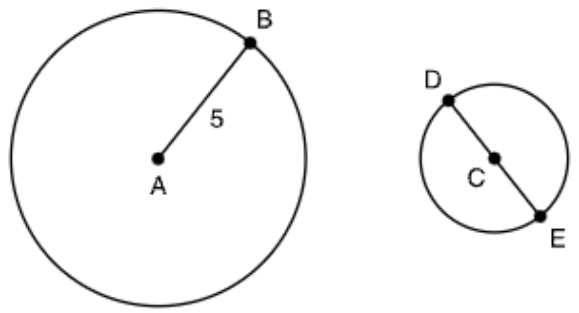
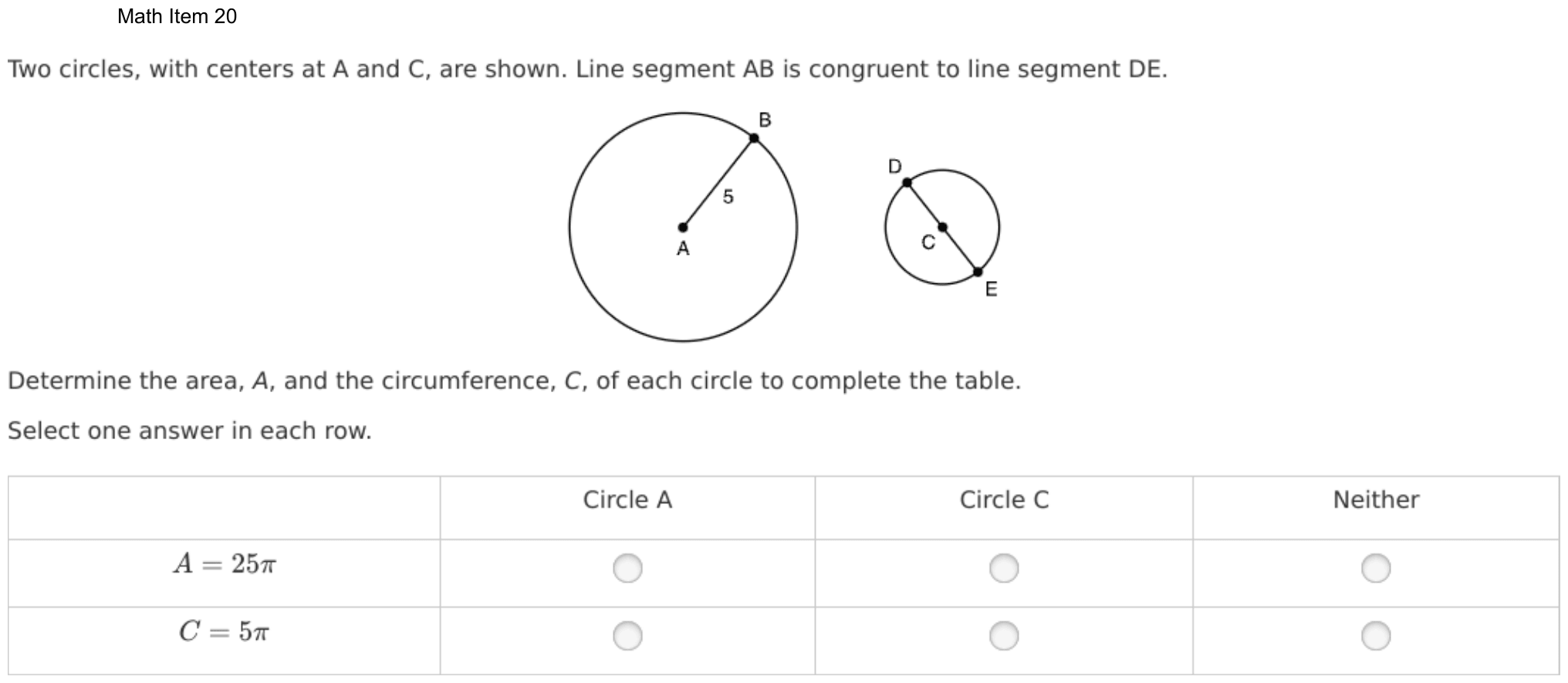
Two circles, with centers at A and C, are shown. Line segment AB is congruent to line segment DE.
Determine the area, A, and the circumference, C, of each circle to complete the table.
Select one answer in each row.
Choose one answer in each row, then check. The DOE has not published how answers with several parts are scored; this site counts one right only when every part is right.
| Circle A | Circle C | Neither | |
|---|---|---|---|
Show the answer
Correct answer: A = 25π: Circle A; C = 5π: Circle C
: Circle A
: Circle C
As shown in the illustration, AB (the radius of Circle A) is 5 units in length. Since DE (the diameter of Circle C) is congruent to AB, we know it is also 5 units in length.
Circle A:
We know the radius of Circle A is 5 so the answer to row 1 is A.
Circle C:
We have to look for the circle with a diameter of 5. That is circle C.
Question analysis
Two circles centered at A and C are shown: radius AB of Circle A is labeled 5, and segment DE, drawn through C, is congruent to AB. Students decide whether an area of 25π and a circumference of 5π each belong to Circle A, Circle C or neither. Keeping radius and diameter apart, and area and circumference, is the challenge.
- NYS standards
- 7.G.4 circle area and circumference
- Grade level
- Grade 7 content, by NYS standard
- Compared with grade 7
- At grade 7 Applying the area and circumference formulas is the grade 7 circle standard. This gives a radius for one circle and, for the other, a segment known only through congruence, and both rows of the table must be right.
- Estimated difficulty
- Moderate: several steps, or a close reading with one strong distractor.
- Thinking it demands
- Depth of knowledge 2, skills and concepts · mainly apply
- What makes it hard
- Reading a figure, table or graph moderate
- Something you must already know moderate
- Much to keep track of minor
- Solution
- 4 steps
- Reading level
- Question and choices: about grade 5, 40 words.
- Students, last 30 days
- Not enough answers yet to show (it takes 10).
Why it is hard, traps and wrong answers (shows the answer)
Why it is hard
Circle A is direct: its labeled radius of 5 gives an area of 25π. Circle C is where points are lost, since its size comes from a sentence rather than a label, and the segment through its center is a diameter, so its circumference is 5π while its area is only 6.25π. The row labels favor guessers, because the A and C in A = 25π and C = 5π match the circles' names, though they stand for area and circumference.
Reading a figure, table or graph moderate Understanding the question
Circle C's size is shown only by segment DE, drawn through center C with no label, and only the stem's sentence that DE is congruent to AB makes it a diameter of 5. (Lesh, Post & Behr, 1987; Kirsch & Mosenthal, 1990)
Something you must already know moderate Working it out
Neither A = πr² nor C = πd is given, and one circle is measured by a radius and the other by a diameter, so each formula needs the right length. (Anderson & Krathwohl, 2001)
Much to keep track of minor Working it out
Four values are in play, areas of 25π and 6.25π and circumferences of 10π and 5π, and both rows must be matched correctly for the item to count. (Sweller, 1988; Carpenter, Just & Shell, 1990)
Strategy: Write down the radius and the diameter of each circle, compute both circles' areas and circumferences in terms of π, then match each value in the table.
Traps
- Wrong formula: Uses a related but wrong formula: perimeter for area, diameter for radius, area for volume, or a misremembered one.
- Misreads the question: Misses or misreads a condition or a word in the question: "at least", "each", "remaining", "not".
- A formula you must know: Needs a formula the test does not give: area, circumference, volume, probability rules.
The wrong answers, classified
1:B Wrong formula (King et al., 2004)
Squares the diameter instead of the radius, so Circle C's area seems to be π × 5² = 25π while Circle A's becomes 100π.
1:C Wrong formula (King et al., 2004)
Uses 2πr for the area, so Circle A seems to have an area of 10π and Circle C one of 5π, and no circle seems to have 25π.
2:A Wrong formula (King et al., 2004)
Uses π times the radius for the circumference, so Circle A's radius of 5 seems to give a circumference of 5π.
2:C Misreads the question (Hegarty, Mayer & Monk, 1995)
Overlooks that DE is congruent to AB, so Circle C has no known size, and with Circle A's circumference at 10π picks Neither.
Worked solution, step by step
Formulas used
- Area of a circle
- A is the area, the space inside the circle. r is the radius, the distance from the center to the edge. π (pi) is a fixed number, a little more than 3. Square the radius, then multiply by π.
- Circumference of a circle
- C is the circumference, the distance around the circle. d is the diameter, the distance across the circle through its center. A diameter is twice as long as a radius. Multiply the diameter by π.
Sort out the question
Circle A has its center at A. Its radius, AB, is 5. Circle C has its center at C. Segment DE goes through C, so it is a diameter. Congruent means the same length, so DE is 5 too.
Careful: in the table, A means area and C means circumference. Circle A and Circle C are just names.
Find each radius and diameter
Circle A: the radius is 5, so the diameter is .
Circle C: the diameter is 5, so the radius is .
Watch out: without the sentence about DE, Circle C seems to have no size. Then you might pick Neither for the second row.
Check the area row
Use the area formula for each circle. For Circle A:
For Circle C:
Only Circle A has an area of 25π.
Watch out: squaring Circle C’s diameter instead of its radius gives 25π by mistake.
Check the circumference row
Use the circumference formula for each circle. For Circle A:
For Circle C:
Only Circle C has a circumference of 5π.
Watch out: π times the radius is not the circumference. It would give Circle A 5π.
Fill in the table
Choose one button in each row. In the row for A = 25π, choose the Circle A column. In the row for C = 5π, choose the Circle C column. Neither stays empty.
So the answers are A = 25π: Circle A and C = 5π: Circle C.
Check your answer
Compare sizes. Circle A’s radius, 5, is twice Circle C’s radius, 2.5. So the distance around Circle C should be half of Circle A’s 10π. Half of 10π is 5π, which matches. And the bigger circle has the bigger area, 25π.
More questions like this
The original DOE question
Question 3 of 20
2026 Practice Test C Math, question 50Question
Terry wants to pour cement around the edge of the circular patio in her backyard. The patio has a radius of 5 feet. What is the distance, in feet, around the edge of the patio? Use 3.14 for .
- A15.7
- B31.4
- C49.3
- D78.5
Show the answer
Correct answer: B
To find the distance around a circle if the radius is known, use the formula for circumference, .
Question analysis
Terry wants to pour cement around the edge of a circular patio with a radius of 5 feet. Students find the distance around the edge, using 3.14 for π. It tests the circumference of a circle, and because the formulas for a circle's area and circumference both use the radius, they are easy to mix up.
- NYS standards
- 7.G.4 circle area and circumference
- Grade level
- Grade 7 content, by NYS standard
- Compared with grade 7
- At grade 7 Applying a circle formula is a grade 7 standard, and this is a one-formula problem with a given value for π. The only demand beyond routine is recalling the right formula, which the test does not print.
- Estimated difficulty
- Straightforward: two steps or one careful reading.
- Thinking it demands
- Depth of knowledge 1, recall and reproduction · mainly apply
- What makes it hard
- Something you must already know moderate
- Turning words into math minor
- Solution
- 2 steps
- Reading level
- Question and choices: about grade 4, 37 words.
- Students, last 30 days
- Not enough answers yet to show (it takes 10).
Why it is hard, traps and wrong answers (shows the answer)
Why it is hard
One formula and one multiplication finish the problem once the right formula is chosen. The cement in the story pulls toward area, and the area, 78.5, is listed, as is half the circumference, from multiplying 3.14 by the radius alone. Remembering that the circumference is π times the diameter, here 10 feet, and that the answer is in feet, not square feet, settles it.
Something you must already know moderate Working it out
The circumference formula is not printed, and the area formula uses the same radius and π, so recalling the wrong one gives a number that looks just as finished. (Anderson & Krathwohl, 2001)
Turning words into math minor Understanding the question
Pouring cement suggests covering a surface, but the question asks for “the distance, in feet, around the edge”, which is the circumference, not the area. (Hegarty, Mayer & Monk, 1995; Koedinger & Nathan, 2004)
Strategy: Decide which circle measurement the distance around the edge is, recall its formula, and substitute the radius and 3.14, doubling the radius wherever the formula calls for the diameter.
Traps
- Wrong formula: Uses a related but wrong formula: perimeter for area, diameter for radius, area for volume, or a misremembered one.
- A formula you must know: Needs a formula the test does not give: area, circumference, volume, probability rules.
- A faulty procedure: A systematic but wrong procedure: adding fractions straight across, applying an exponent to each term of a sum, dropping a sign when moving a term.
The wrong answers, classified
A Wrong formula (King et al., 2004)
Multiplies π by the radius, 3.14 × 5 = 15.7, using the radius where C = πd needs the diameter, so it finds half the distance around.
C A faulty procedure (Brown & Burton, 1978; Tatsuoka, 1983)
Starts from the area formula and squares π instead of the radius, 3.14 × 3.14 × 5 ≈ 49.3, mixing the wrong formula with a slip in squaring.
D Wrong formula (King et al., 2004)
Finds the patio’s area, 3.14 × 5² = 78.5 square feet, using the area formula instead of the circumference for the distance around.
Worked solution, step by step
Formulas used
- Circumference of a circle
- C is the circumference, the distance around the circle. r is the radius, the distance from the center to the edge. π (pi) is a fixed number, about 3.14. 2r is the diameter, the distance all the way across. The distance around is always about 3.14 times that.
- Area of a circle
- A is the area, the space inside the circle, in square units. r² means r times r. It is here so you can tell the two formulas apart. This question does not use it.
Sort out the question
The patio is a circle with a radius of 5 feet. The radius is the distance from the center to the edge. Terry wants cement around the edge.
You need the distance around the edge, in feet. The distance around a circle is called its circumference. Use 3.14 for π.
Choose the right formula
The distance around is a length, so use the circumference formula, .
Watch out: pouring cement may make you think of area. The area, square feet, is choice D. That is the space inside the patio, not the distance around it.
Put in the numbers
Put 3.14 in for π and 5 in for r. Multiply 2 by 5 first, because that is easy:
The distance around the patio is 31.4 feet.
Watch out: , choice A, forgets the 2. It goes only halfway around.
Give the answer
The distance around the edge of the patio is 31.4 feet.
So the answer is B, 31.4.
Check your answer
Estimate. The diameter is 10 feet. The distance around a circle is a little more than 3 times its diameter. , so about 31 feet makes sense. Choice D, 78.5, is far too big, and it is in square feet.
More questions like this
The original DOE question
Question 4 of 20
2026 Practice Test D Math, question 8Question
A square metal plate has a side length of 3 inches. A circular hole with a diameter of 2 inches is cut out from the center of the plate.
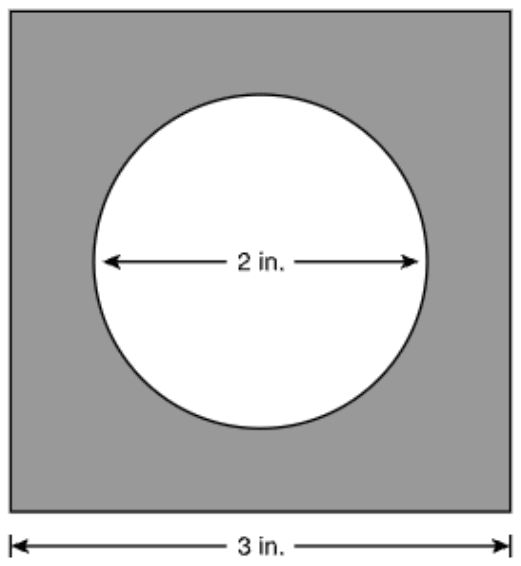
What is the area of the shaded region, to the nearest hundredth of a square inch?
Enter your answer in the space.
Fill-in question: work out the answer and type it as a number.
Show the answer
Correct answer: 5.86
To determine the area of a square, use .
Begin by finding the length of the side of the square, which is 3 inches. The area of the square is .
To determine the area of the circle, use .
The radius of the circle (the hole) is one-half the diameter or , so the area of the entire circle is
To determine the area of the shaded region, subtract the area of the hole in the square from the area of the square:
The shaded area to the nearest hundredth of a square inch sq in.
Question analysis
A 3-inch square metal plate has a circular hole 2 inches across cut from its center, and students find the area of the metal that is left, to the nearest hundredth of a square inch. It tests the areas of a circle and a square. Using the radius, not the diameter, and subtracting the right areas are the keys.
- NYS standards
- 7.G.4 circle area and circumference
- Grade level
- Grade 7 content, by NYS standard
- Compared with grade 7
- At grade 7 Finding a circle's area is a grade 7 standard, and subtracting a hole from a shape is common grade 7 practice. The radius must come from the diameter and the result must be rounded, but the steps are routine.
- Estimated difficulty
- Straightforward: two steps or one careful reading.
- Thinking it demands
- Depth of knowledge 2, skills and concepts · mainly apply
- What makes it hard
- Something you must already know moderate
- Combines ideas minor
- An answer in an unexpected form minor
- Solution
- 3 steps
- Reading level
- Question and choices: about grade 4, 49 words.
- Corrected from the DOE handbook
- A wrong symbol in the explanation was corrected.
- Students, last 30 days
- Not enough answers yet to show (it takes 10).
Why it is hard, traps and wrong answers (shows the answer)
Why it is hard
Every number is small, so the work is choosing the right pieces: the area of the square, the area of the hole, and the difference. A radius of 1 makes the circle's area simply π, which is easy to confuse with the circumference, 2π, when the formulas are half remembered. The region asked for is the gray metal, not the hole, and the final rounding goes up, since the third decimal place is 8.
Something you must already know moderate Working it out
Neither area formula is given, and the hole is labeled by its 2-inch diameter, so students must recall A = πr² and halve the diameter to get the radius 1 first. (Anderson & Krathwohl, 2001)
Combines ideas minor Working it out
The shaded metal is a square with a circle removed, so two area formulas are combined by subtraction rather than either one used alone. (Embretson, 1998; Daniel & Embretson, 2010)
An answer in an unexpected form minor Choosing the answer
The result is typed to the nearest hundredth with no choices to compare, so the long decimal 5.858… must be rounded up, not cut off after two places. (Enright, Morley & Sheehan, 2002)
Strategy: Halve the diameter to get the radius, find the area of the square and of the circle, subtract the circle from the square, and round only at the end.
Traps
- Answers a different question: A choice is right for another quantity: the other unknown, the rest instead of the part, the part instead of the whole.
- Wrong formula: Uses a related but wrong formula: perimeter for area, diameter for radius, area for volume, or a misremembered one.
- A formula you must know: Needs a formula the test does not give: area, circumference, volume, probability rules.
The wrong answers, classified
2.72 Wrong formula (King et al., 2004)
Uses the circumference, 2π × 1 ≈ 6.28, in place of the circle's area and subtracts it from the square's 9 square inches, getting about 2.72.
3.14 Answers a different question (King et al., 2004; Hegarty, Mayer & Monk, 1995)
Finds the area of the circular hole, π × 1² ≈ 3.14 square inches, and enters it instead of the area of the shaded metal left around it.
5.85 Rounds too early (King et al., 2004)
Works the area out correctly as about 5.858 but cuts off the extra digits instead of rounding up to the nearest hundredth.
What was corrected from the DOE handbook, and why
- Explanation: The DOE’s explanation gives the area of the hole as “π(1 in.)² ≅ 3.14 sq in.” The symbol ≅ means “is congruent to”, which an area and a number cannot be; the line means “is approximately equal to”, written ≈. The site now says “π(1 in.)² ≈ 3.14 sq in.”
Worked solution, step by step
Formulas used
- Area of a square
- A is the area, the amount of flat space inside. s is the length of one side. s² means s × s. It works because a square with side s holds s rows of s little unit squares.
- Area of a circle
- A is the area. r is the radius, the distance from the center to the edge. It is half the diameter, the distance straight across through the center. π (pi) is a number a little more than 3, about 3.14. r² means r × r.
Sort out the question
The plate is a square with 3-inch sides. A circle with a 2-inch diameter is cut out of the middle. The diameter is the distance straight across the circle through its center. The shaded region is the metal that is left. You need its area to the nearest hundredth of a square inch.
Find the area of the square
Use the formula for the area of a square, with s = 3 inches:
The whole plate, before the hole is cut, is 9 square inches.
Find the radius of the hole
The circle formula needs the radius, not the diameter. The figure labels the 2 in. distance across the hole. The radius is half of it:
The radius is 1 inch.
Find the area of the hole
Use the formula for the area of a circle, with r = 1 inch:
The sign ≈ means is about equal to. The hole is about 3.14 square inches.
Watch out: 2πr is the circumference, the distance around the circle, not its area. Using it gives 9 − 6.28 = 2.72. And 3.14 is the hole, not the metal, so do not stop there.
Subtract the hole from the square
The shaded metal is the square with the circle taken away:
The shaded region is about 5.86 square inches.
Round and enter the answer
With more digits of π, 3.1416, you get 9 − 3.1416 = 5.8584. The digit after the hundredths place is 8, which is 5 or more, so round up to 5.86. Chopping it to 5.85 is wrong. Type only the number, with no units.
So you would enter 5.86.
Check your answer
The hole is a bit more than a third of the plate, since 3.14 is a bit more than 9 ÷ 3 = 3. So the metal left should be a bit less than two thirds of 9, which is 6. The answer 5.86 is just under 6, so it makes sense.
More questions like this
The original DOE question
Question 5 of 20
2026 Practice Test D Math, question 13Question
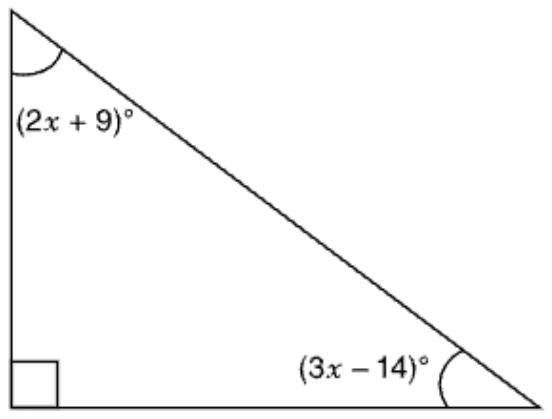
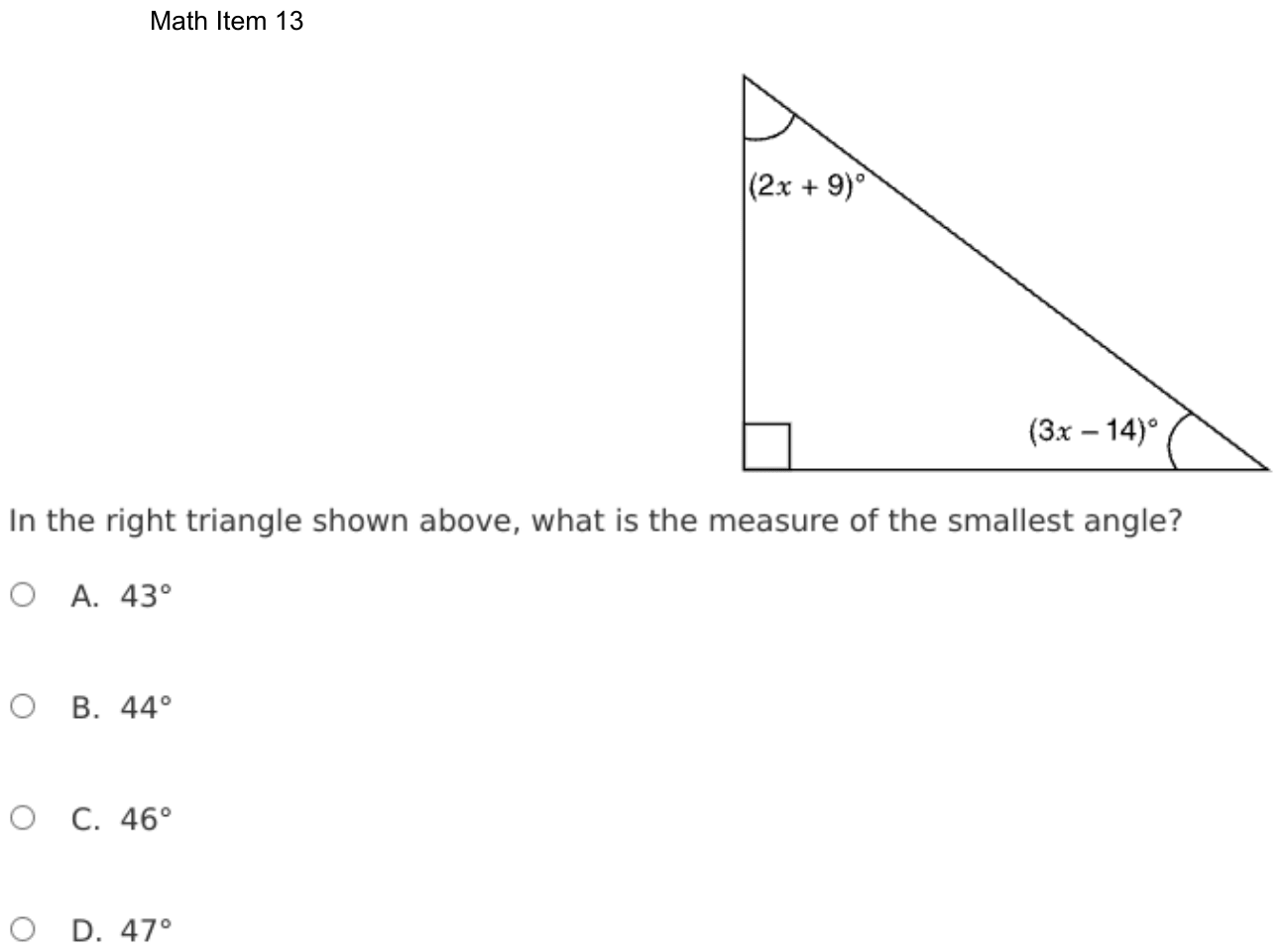
In the right triangle shown above, what is the measure of the smallest angle?
- A43°
- B44°
- C46°
- D47°
Show the answer
Correct answer: A
Since the three angles of a triangle have a sum of 180°, and since one angle is a right angle, the other two angles have a sum of 90°. By writing an equation and using inverse operations, the value of x can be found.
Now, use substitution to find the measure of the two angles to determine the smallest angle of the triangle.
The smallest angle is 43°.
Question analysis
A right triangle has its two other angles labeled (2x + 9)° and (3x − 14)°, and students find the measure of the smallest angle. It tests the angle sum of a triangle and solving a linear equation. Finding x is not the end: both angles must be worked out and compared to see which one is smallest.
- NYS standards
- Grade level
- Grade 8 content, by NYS standard
- Compared with grade 7
- Above grade 7 Grade 7 students write equations for unknown angles using complementary and supplementary angles. This also needs the angle sum of a triangle, which New York places in grade 8, plus substituting back and comparing, though each step is short.
- Estimated difficulty
- Moderate: several steps, or a close reading with one strong distractor.
- Thinking it demands
- Depth of knowledge 2, skills and concepts · mainly apply
- What makes it hard
- Combines ideas moderate
- Many steps minor
- Something you must already know minor
- Solution
- 4 steps
- Reading level
- Question and choices: about grade 6, 14 words.
- Students, last 30 days
- Not enough answers yet to show (it takes 10).
Why it is hard, traps and wrong answers (shows the answer)
Why it is hard
Setting the sum of the two labeled angles to 90° is the decision; the algebra after it is routine. The trap waits at the end: x = 19 is not an angle, and the expression at the top vertex, 2x + 9, gives the larger acute angle, 47°. Evaluating both expressions and checking that they add to 90° takes seconds and shows which one is smaller.
Combines ideas moderate Working it out
The angle facts and the algebra meet in one equation: the right angle means the two labeled angles add to 90°, and only that sum makes (2x + 9) + (3x − 14) solvable. (Embretson, 1998; Daniel & Embretson, 2010)
Many steps minor Working it out
After solving 5x − 5 = 90, both angle expressions must be evaluated and compared, because the question wants an angle, not x, and not the first angle found. (Daniel & Embretson, 2010; Enright, Morley & Sheehan, 2002)
Something you must already know minor Working it out
The 180° angle sum of a triangle is not printed, and only the small square at the bottom left shows that one angle is 90°. (Anderson & Krathwohl, 2001)
Strategy: Use the right angle to see that the other two angles add to 90°, solve that equation for x, then substitute into both expressions and compare them.
Traps
- Answers a different question: A choice is right for another quantity: the other unknown, the rest instead of the part, the part instead of the whole.
- A formula you must know: Needs a formula the test does not give: area, circumference, volume, probability rules.
The wrong answers, classified
B Little reason to choose it (Haladyna & Downing, 1993; Rodriguez, 2005)
No common working gives 44°; it sits one degree from the right measure and fits no consistent value of x, so it mostly draws estimates and guesses.
C Little reason to choose it (Haladyna & Downing, 1993; Rodriguez, 2005)
No common working gives 46°, which would need x = 20 and two angles adding to 95°, so it mostly catches guesses near 45°.
D Answers a different question (King et al., 2004; Hegarty, Mayer & Monk, 1995)
Solves x = 19 correctly but answers with 2x + 9 = 47°, the larger acute angle, instead of evaluating both expressions to find the smaller.
Worked solution, step by step
Formulas used
- Angles in a triangle
- a, b and c are the three angles of any triangle, in degrees. They always add up to 180 degrees. If you tear off the three corners and set them side by side, they make a straight line.
- The two other angles of a right triangle
- a and b are the two angles that are not the right angle. A right angle is 90 degrees, so the other two share what is left of the 180: 180 − 90 = 90.
Sort out the question
The small square at the bottom left corner marks a right angle, which is 90°. The top angle is (2x + 9)°, and the bottom right angle is (3x − 14)°. You need the smallest of the three angles. First find x, then find each angle.
Write an equation
The three angles add to 180°. The right angle uses 90° of that, so the other two angles add to 90°:
Solve for x
Combine the x terms, 2x + 3x = 5x. Combine the numbers, 9 − 14 = −5:
Add 5 to both sides, then divide both sides by 5:
Find both angles
Put x = 19 into each expression:
The three angles are 47°, 43° and 90°.
Watch out: x = 19 is not an angle. And the first angle you find, 47°, is not the smallest one. Stopping there gives choice D.
Pick the smallest angle
Compare 47°, 43° and 90°. The smallest is 43°. The figure is not drawn to scale, so do not judge the angles by how they look. Use the numbers.
So the answer is A, 43°.
Check your answer
Add the three angles: 47 + 43 + 90 = 180. That is the right total for a triangle. Also, 47 + 43 = 90, so the two smaller angles fill exactly what the right angle leaves.
More questions like this
The original DOE question
Question 6 of 20
2024 Test A Math, question 8Question
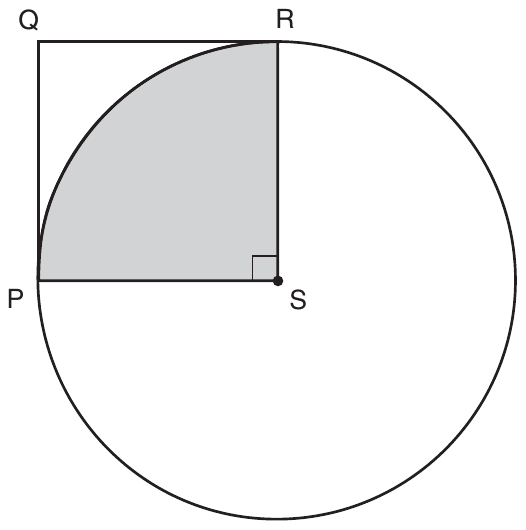
In the figure above, PQRS is a square. Point S is the center of the circle, and points P and R are on the circle. If the area of the square is 4 square centimeters, what is the area, in square centimeters, of the shaded quarter of the circle?
- A
- B
- C
- D
Show the answer
Correct answer: B
The area of square PQRS is 4 square centimeters. So
Sides PS and RS are each a radius of the circle. So the radius of the circle is 2 cm.
The shaded region is of the circle. The area of a circle is . So the area of the shaded region, in square centimeters, is
Question analysis
A geometry question with a figure: square PQRS has one corner at the center of a circle, and the quarter of the circle inside the square is shaded. Given the area of the square, students find the area of the shaded quarter circle. The key is connecting the square's side to the circle's radius.
- Grade level
- Grade 7 content, by NYS standard
- Compared with grade 7
- At grade 7 Circle area is grade 7 content, and this question adds only one linking step from the square's area to the radius. Typical grade 7 circle work gives the radius directly; here it takes one short extra inference.
- Estimated difficulty
- Straightforward: two steps or one careful reading.
- Thinking it demands
- Depth of knowledge 2, skills and concepts · mainly apply
- What makes it hard
- Reading a figure, table or graph moderate
- Something you must already know minor
- Combines ideas minor
- Solution
- 3 steps
- Reading level
- Question and choices: about grade 4, 52 words.
- Students, last 30 days
- Not enough answers yet to show (it takes 10).
Why it is hard, traps and wrong answers (shows the answer)
Why it is hard
The question chains three short facts: from the square's area to its side, from the side to the radius, and from the whole circle to a quarter of it. None is hard, but each wrong choice marks a broken link, most often the whole circle's area, which looks like a finished answer. Pointing to S as the center before computing anything settles the radius.
Reading a figure, table or graph moderate Understanding the question
The radius is never labeled: students must see that S is both a corner of the square and the circle's center, so sides PS and RS are radii. (Lesh, Post & Behr, 1987; Kirsch & Mosenthal, 1990)
Something you must already know minor Working it out
Neither the circle area formula, π times the radius squared, nor the step from a square's area to its side length is given. (Anderson & Krathwohl, 2001)
Combines ideas minor Working it out
Square and circle are linked in one chain: the area 4 gives a side of 2, the side is the radius, and the shaded part is a quarter of π × 2². (Embretson, 1998; Daniel & Embretson, 2010)
Strategy: Take the square root of the square's area to get its side, which is also the radius, then take one quarter of pi times the radius squared.
Traps
- Wrong formula: Uses a related but wrong formula: perimeter for area, diameter for radius, area for volume, or a misremembered one.
- Stops one step early: A choice is a number from partway through the solution.
- A formula you must know: Needs a formula the test does not give: area, circumference, volume, probability rules.
The wrong answers, classified
A Wrong formula (King et al., 2004)
Halves the square's side as if it were a diameter, so it uses a radius of 1, and one quarter of π × 1² gives π/4.
C Wrong formula (King et al., 2004)
Misremembers the circle's area as 2πr², blending it with the circumference 2πr, so one quarter of 2π × 2² gives 2π.
D Stops one step early (King et al., 2004; Gierl et al., 2017)
Finds the whole circle's area, π × 2² = 4π, and stops before taking the quarter that is shaded.
Worked solution, step by step
Formulas used
- Area of a square
- A is the area, the space inside. s is the length of one side, and s² means s × s. All four sides of a square are equal, so its area is side times side.
- Area of a circle
- A is the area of the whole circle. r is the radius: the distance from the center to the edge. π, called pi, is a number a little more than 3, about 3.14. Multiply π by r × r. This works for every circle.
Sort out the figure
PQRS is a square with an area of 4 sq cm. Point S is the center of the circle. Points P and R are on the circle. The shaded part is a quarter of the circle, inside the square. You need the shaded area, in square centimeters. The answer will have π in it.
Find the side of the square
Use the square formula. The area is 4, so find the number that times itself gives 4.
Each side is 2 cm long, because .
See that the side is the radius
Side SP goes from the center, S, to point P on the circle. So SP is a radius. So is side SR. The radius is 2 cm. Watch out: the side is a radius, not a diameter, the full width of the circle. Using a radius of 1 leads to , choice A.
Find the area of the whole circle
The whole circle has an area of 4π sq cm. Watch out: this is the whole circle. Stopping here gives choice D.
Take one quarter
The shaded part is one quarter of the circle, so take one quarter of 4π.
The shaded area is π sq cm. So the answer is B, .
Check your answer
π is about 3.14, so the shaded part is about 3.14 sq cm. The whole square is 4 sq cm. In the figure, the shaded part fills most of the square, but not all. So a bit less than 4 makes sense. The choice 4π is about 12.6, far too big.
More questions like this
The original DOE question
Question 7 of 20
2024 Test B Math, question 5Question
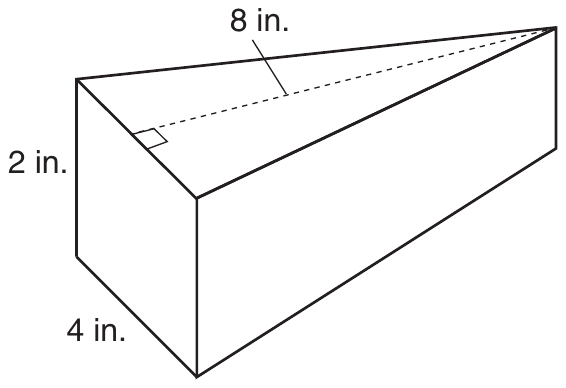
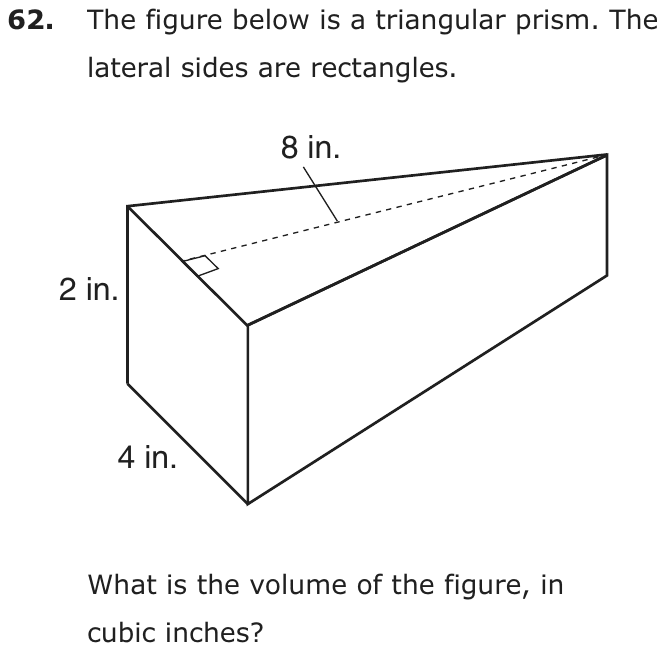
The figure below is a triangular prism. The lateral sides are rectangles.
What is the volume of the figure, in cubic inches?
Grid-in question: work out the answer and enter it as a number.
Show the answer
Correct answer: 32
The volume of a triangular prism is found by multiplying the area of the triangular base by the height of the prism.
The area of the triangular base of the prism is square inches.
The height of the triangular prism is 2 inches.
So the volume of the triangular prism, in cubic inches, is .
Question analysis
A geometry grid-in: find the volume, in cubic inches, of a triangular prism drawn with its triangular faces on top and bottom. The drawing gives a 4-inch side of the triangle, a dashed 8-inch height drawn to that side, and a 2-inch edge. Students must recall the volume formula and match each length to its role.
- NYS standards
- 7.G.6 area, surface area, and volume
- Grade level
- Grade 7 content, by NYS standard
- Compared with grade 7
- At grade 7 Finding the volume of a right triangular prism is named in the grade 7 standards, and this is a direct two-step case. The only extra demand is reading a slanted drawing to see which length plays which role.
- Estimated difficulty
- Straightforward: two steps or one careful reading.
- Thinking it demands
- Depth of knowledge 2, skills and concepts · mainly apply
- What makes it hard
- Solution
- 2 steps
- Reading level
- Question and choices: about grade 5, 22 words.
- Students, last 30 days
- Not enough answers yet to show (it takes 10).
Why it is hard, traps and wrong answers (shows the answer)
Why it is hard
The question rewards knowing that a prism's volume is its base area times its height, then matching each length to its job. The drawing lies on its side, with a short 2-inch height and the triangle flat on top, which makes the base harder to spot. Most lost points come from the one half: leaving it out doubles the volume, and stopping at the triangle's area gives half of it.
Something you must already know moderate Working it out
Neither formula is given: the volume is the area of the triangular base times the prism's height, and that area needs the one half in 1/2 × base × height. (Anderson & Krathwohl, 2001)
Reading a figure, table or graph minor Understanding the question
The prism lies with its triangles on top and bottom, so the 2-inch vertical edge is its height, while the dashed 8-inch line is the triangle's height to the 4-inch side. (Lesh, Post & Behr, 1987; Kirsch & Mosenthal, 1990)
An answer in an unexpected form minor Choosing the answer
There are no choices, so a product that forgets the one half, or one that stops at the area of the triangle, gives no warning. (Enright, Morley & Sheehan, 2002)
Strategy: Find the area of the triangular face as one half times base times height, using the 4-inch side and the dashed 8-inch height, then multiply by the 2-inch edge of the prism.
Traps
- Wrong formula: Uses a related but wrong formula: perimeter for area, diameter for radius, area for volume, or a misremembered one.
- Stops one step early: A choice is a number from partway through the solution.
- A formula you must know: Needs a formula the test does not give: area, circumference, volume, probability rules.
The wrong answers, classified
64 Wrong formula (King et al., 2004)
Multiplies 4 × 8 × 2 = 64 as for a rectangular box, leaving out the one half in the area of the triangular base.
16 Stops one step early (King et al., 2004; Gierl et al., 2017)
Finds the triangle's area, 1/2 × 4 × 8 = 16 square inches, and stops before multiplying by the prism's 2-inch height.
Worked solution, step by step
Formulas used
- Area of a triangle
- A is the area. b is the base, one side of the triangle. h is the height, the straight distance from that side to the opposite corner, at a right angle to the side. You take half because a triangle is half of a rectangle with the same base and height.
- Volume of a prism
- V is the volume, the space inside. B is the area of the base, the shape at each end. H is the height of the prism, the distance between the two ends. It works because the prism is like a stack of layers, each the shape of the base.
Sort out the figure
A prism is a solid with two matching ends joined by flat sides. Here the ends are triangles, on the top and bottom. The other sides are rectangles. You need the volume, the space inside, in cubic inches.
The dashed line on the top triangle is 8 in. It meets one side of the triangle at a right angle (the small square). The bottom edge under that side is 4 in. The edge going straight up is 2 in.
Find the triangle’s base and height
The side that the dashed line meets is the top edge of a rectangle face. Opposite sides of a rectangle are equal. So that side is 4 in., the same as the bottom edge under it.
So the triangle has a base of 4 in. Its height is the dashed line, 8 in., because it meets the base at a right angle.
Find the area of the triangle
The triangle’s area is 16 square inches. Watch out: 16 is only the area of one end. Stopping here gives the wrong answer 16.
Multiply by the prism’s height
The height of the prism is the distance between the two triangles. That is the 2 in. edge.
The volume is 32 cubic inches. Watch out: do not forget the one half. is the volume of a box, not of this prism.
So you would grid 32.
Check your answer
Picture a box that is 4 in. by 8 in. by 2 in. Its volume is cubic inches. The triangle has half the area of a 4 by 8 rectangle, so the prism holds half as much as the box. Half of 64 is 32.
More questions like this
The original DOE question
Question 8 of 20
2024 Test B Math, question 32Question
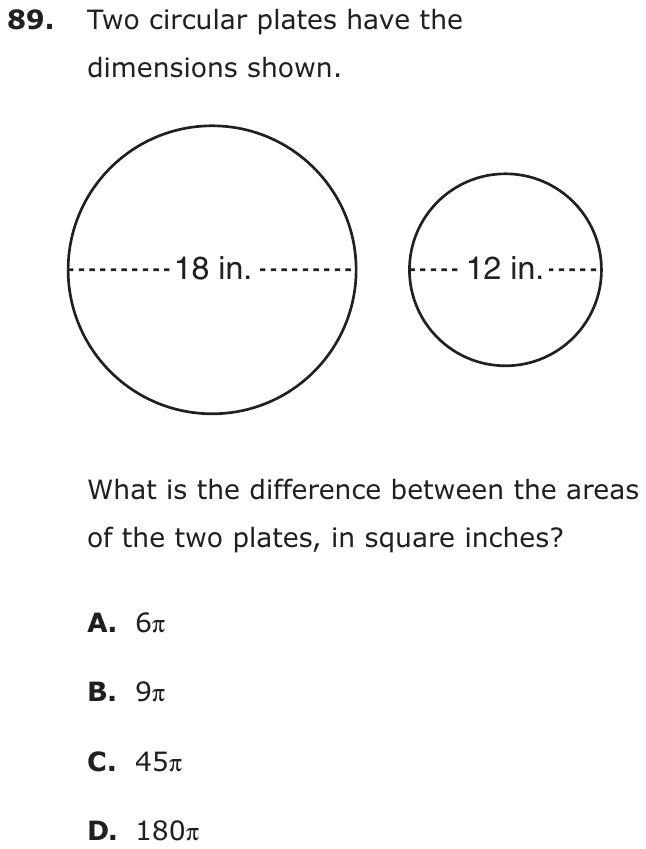
Two circular plates have the dimensions shown.
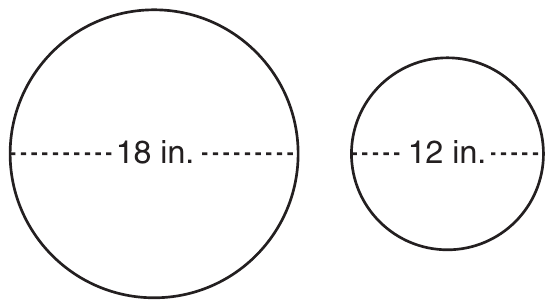
What is the difference between the areas of the two plates, in square inches?
- A
- B
- C
- D
Show the answer
Correct answer: C
First, determine the area of each circle using the formula :
A circle with a diameter of 18 inches has a radius of 9 inches, so the area is .
A circle with a diameter of 12 inches has a radius of 6 inches, so the area is .
The difference between the two areas is .
Question analysis
Two circular plates are drawn with their diameters marked in inches, and students find the difference between their areas in square inches, in terms of pi. It tests the area of a circle. The diameters, not the radii, are marked, so a step comes before the area formula, which the test does not provide.
- NYS standards
- 7.G.4 circle area and circumference
- Grade level
- Grade 7 content, by NYS standard
- Compared with grade 7
- At grade 7 Finding a circle's area is a grade 7 standard, and this asks for two areas and their difference. It matches typical classwork: the formula must be recalled and each diameter halved first, with no further twist.
- Estimated difficulty
- Straightforward: two steps or one careful reading.
- Thinking it demands
- Depth of knowledge 1, recall and reproduction · mainly apply
- What makes it hard
- Solution
- 3 steps
- Reading level
- Question and choices: about grade 5, 25 words.
- Students, last 30 days
- Not enough answers yet to show (it takes 10).
Why it is hard, traps and wrong answers (shows the answer)
Why it is hard
Two area calculations and a subtraction, kept in terms of π, make this routine for students who know the area formula. Points are lost by using the labeled diameters as radii, by subtracting circumferences, or by subtracting the radii before squaring, and each of these has a listed answer. Writing both areas, 81π and 36π, before subtracting avoids all three.
Something you must already know moderate Working it out
The area formula A = πr² is not given, and the figure labels each plate by its diameter, so 18 and 12 must be halved to radii of 9 and 6 first. (Anderson & Krathwohl, 2001)
Reading a figure, table or graph minor Understanding the question
The dashed lines run all the way across each circle, which marks them as diameters; reading the 18 in. and 12 in. as radii leads to a listed choice. (Lesh, Post & Behr, 1987; Kirsch & Mosenthal, 1990)
Strategy: Halve each diameter to get the radius, find each plate's area as pi times the radius squared, and subtract the smaller area from the larger.
Traps
- Wrong formula: Uses a related but wrong formula: perimeter for area, diameter for radius, area for volume, or a misremembered one.
- A faulty procedure: A systematic but wrong procedure: adding fractions straight across, applying an exponent to each term of a sum, dropping a sign when moving a term.
- A formula you must know: Needs a formula the test does not give: area, circumference, volume, probability rules.
The wrong answers, classified
A Wrong formula (King et al., 2004)
Subtracts the circumferences, 18π − 12π = 6π, using πd, the distance around a circle, in place of the area formula.
B A faulty procedure (Brown & Burton, 1978; Tatsuoka, 1983)
Subtracts the radii first, 9 − 6 = 3, and then squares, π(3)² = 9π, as if the difference of two squares were the square of the difference.
D Wrong formula (King et al., 2004)
Uses the labeled diameters as radii, π(18)² − π(12)² = 324π − 144π = 180π, forgetting to halve them first.
Worked solution, step by step
Formulas used
- Area of a circle
- A is the area, the flat space inside the circle. r is the radius, the distance from the center to the edge. It is half the diameter. π (pi) is a fixed number, about 3.14. r² means r × r. Use it for the space inside any circle.
Sort out the question
Each dashed line goes all the way across its circle, through the center. A line like that is a diameter. The big plate has a diameter of 18 inches. The small plate has a diameter of 12 inches.
You need the difference between the two areas. That means the big area minus the small area, in square inches.
Find each radius
The area formula uses the radius, not the diameter. The radius is half the diameter.
The radii are 9 inches and 6 inches. Watch out: If you use 18 and 12 as the radii, you get , choice D.
Find the big plate’s area
The big plate’s area is square inches. Keep π as a symbol, since all the choices use π.
Find the small plate’s area
The small plate’s area is square inches. Squaring means multiplying a number by itself, so .
Subtract the two areas
Subtract the numbers in front of π, just as 81 apples minus 36 apples is 45 apples. The difference is square inches.
Watch out: Don’t subtract the radii first. Squaring 9 − 6 = 3 gives , choice B. Subtracting the distances around the plates, , gives , choice A. That uses the wrong formula.
So the answer is C, .
Check your answer
Estimate with π about 3. The big plate is about square inches. The small one is about . The difference is about 135, and . It matches.
More questions like this
The original DOE question
Question 9 of 20
2024 Test B Math, question 34Question
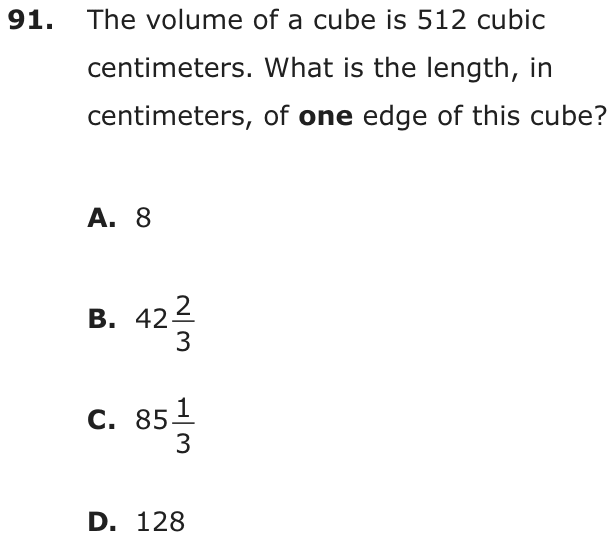
The volume of a cube is 512 cubic centimeters. What is the length, in centimeters, of one edge of this cube?
- A8
- B
- C
- D128
Show the answer
Correct answer: A
The volume of a cube is , where s is the length of one edge.
So , and .
If you are not sure how to find the cube root, you can estimate.
We know , so .
Since 512 is less than 1,000, the answer must be less than 10. The only given option less than 10 is 8. Double-check to make sure this is correct: .
Question analysis
A cube has a volume of 512 cubic centimeters, and students work backward to find the length of one edge. It tests the volume formula for a cube and the idea of a cube root. The tricky part is going from a volume to a length, the reverse of the usual volume problem.
- Grade level
- Grade 8 content, by NYS standard
- Compared with grade 7
- Above grade 7 Grade 7 volume work goes from edge lengths to a volume. Going backward needs a cube root, a grade 8 idea, and 512 is beyond the perfect cubes students are expected to know, though checking a guess by multiplying keeps it short.
- Estimated difficulty
- Straightforward: two steps or one careful reading.
- Thinking it demands
- Depth of knowledge 1, recall and reproduction · mainly apply
- What makes it hard
- Something you must already know moderate
- Solution
- 2 steps
- Reading level
- Question and choices: about grade 5, 22 words.
- Students, last 30 days
- Not enough answers yet to show (it takes 10).
Why it is hard, traps and wrong answers (shows the answer)
Why it is hard
This is a one-fact question: a cube's volume is its edge used three times as a factor. Students who remember that need only the number whose cube is 512, and the choices help, because only one is under 10 while 10 × 10 × 10 = 1,000. The wrong choices divide 512 by numbers tied to other measures of a cube or a square, so they catch students who do not recall the formula.
Something you must already know moderate Working it out
Neither V = s³ nor the cube root of 512 is given, so students must recall the formula and know, or find by trial, that 8 × 8 × 8 = 512. (Anderson & Krathwohl, 2001)
Strategy: Write the volume as edge × edge × edge, then find the number that, multiplied by itself three times, gives 512, and confirm it by multiplying.
Traps
- Wrong formula: Uses a related but wrong formula: perimeter for area, diameter for radius, area for volume, or a misremembered one.
- A formula you must know: Needs a formula the test does not give: area, circumference, volume, probability rules.
The wrong answers, classified
B Wrong formula (King et al., 2004)
Divides 512 by 12, the number of edges, as if the volume were the total length of all the edges, giving 42 2/3.
C Wrong formula (King et al., 2004)
Divides 512 by 6, the number of faces, mixing up volume with surface area, giving 85 1/3.
D Wrong formula (King et al., 2004)
Divides 512 by 4, as when a square's side is found from its perimeter, instead of finding the number whose cube is 512.
Worked solution, step by step
Formulas used
- Volume of a cube
- V is the volume, the space inside, in cubic units. s is the length of one edge. s³ means s × s × s. A cube’s length, width and height are all s, so length × width × height becomes s × s × s.
Sort out the question
The cube’s volume is 512 cubic centimeters. Volume is the space inside a solid. You need the length of one edge.
A cube has 12 edges, and they are all the same length. So one edge tells you all of them.
Write the volume formula
You need a number that gives 512 when you multiply it by itself three times. That number is called the cube root of 512.
Try numbers to find the edge
Start with an easy one: . That is too big, so the edge is less than 10. Try 8.
It works. Each edge is 8 centimeters.
Rule out the other choices
Watch out: The volume is not shared out among the faces or the edges. Dividing 512 by the 6 faces gives , choice C. Dividing by the 12 edges gives , choice B. Dividing by 4 gives 128, choice D.
So the answer is A, 8.
Check your answer
Test the biggest choice. is over 2 million, far more than 512. Only an edge less than 10 can work, and 8 is the only choice less than 10. And .
More questions like this
The original DOE question
Question 10 of 20
2023 Test A Math, question 1Question
Ms. Li opened a retirement account with a deposit of $2,500. This account earns 4% simple interest annually. How many years will it take her to earn $500 on her $2,500 deposit?
Grid-in question: work out the answer and enter it as a number.
Show the answer
Correct answer: 5
Simple interest (y) is calculated by multiplying the initial deposit (p), the interest rate (r), and time (t):
Question analysis
Ms. Li deposits $2,500 in a retirement account that pays 4% simple interest each year, and this grid-in asks how many years it takes to earn $500 in interest. Students find one year's interest and work out how many years are needed. It turns the usual simple interest question around, asking for the time rather than the interest.
- Grade level
- Grade 7 content, by NYS standard
- Compared with grade 7
- At grade 7 Simple interest is a grade 7 percent application, usually asked as how much interest builds up over a given time. This one gives the interest and asks for the time, a short reverse step with friendly numbers.
- Estimated difficulty
- Straightforward: two steps or one careful reading.
- Thinking it demands
- Depth of knowledge 2, skills and concepts · mainly apply
- What makes it hard
- Solution
- 2 steps
- Reading level
- Question and choices: about grade 6, 28 words.
- Students, last 30 days
- Not enough answers yet to show (it takes 10).
Why it is hard, traps and wrong answers (shows the answer)
Why it is hard
Once one year's interest is known, $100, the rest is counting how many years make $500, so the arithmetic is light. The question turns the usual simple interest problem around, giving the interest and asking for the time, and that reversal is where students stall or grid a percent instead of a number of years. Writing 4% as 0.04, not 0.4, keeps the yearly interest from coming out ten times too big.
Something you must already know minor Working it out
The stem says 4% simple interest annually but never says that each year adds the same 4% of the $2,500 deposit, $100, so the yearly amount has to come from memory. (Anderson & Krathwohl, 2001)
Turning words into math minor Understanding the question
The question gives the interest, $500, and asks for the time, so the familiar formula runs backward: 2,500 × 0.04 × t = 500 has to be solved for t. (Hegarty, Mayer & Monk, 1995; Koedinger & Nathan, 2004)
An answer in an unexpected form minor Choosing the answer
As a grid-in it shows no choices, so 20, the interest as a percent of the deposit, can be gridded with nothing on the page to say it is not a number of years. (Enright, Morley & Sheehan, 2002)
Strategy: Work out one year's interest as 4% of $2,500, then find how many of those yearly amounts add up to the $500 of interest.
Traps
- Stops one step early: A choice is a number from partway through the solution.
- A formula you must know: Needs a formula the test does not give: area, circumference, volume, probability rules.
The wrong answers, classified
20 Stops one step early (King et al., 2004; Gierl et al., 2017)
Finds that the $500 of interest is 20% of the $2,500 deposit and grids 20, stopping before dividing by the 4% earned each year.
0.5 An arithmetic slip (Junker & Sijtsma, 2001)
Writes 4% as 0.4 instead of 0.04, so one year's interest looks like $1,000 and the $500 seems to take only half a year.
125 Numbers taken from the question (Hegarty, Mayer & Monk, 1995)
Divides the $500 of interest by the 4 in 4%, combining two numbers from the stem without first finding 4% of the deposit.
Worked solution, step by step
Formulas used
- Simple interest
- I is the interest, the extra money the account pays you. P is the deposit, the money you put in. r is the yearly rate as a decimal. t is the time in years. Simple means each year’s interest is figured on the deposit only, so every year adds the same amount.
- Percent to decimal
- p is the percent. Percent means out of 100. So divide by 100 to write it as a decimal. For example, 4% is 4 ÷ 100, which is 0.04.
Sort out the question
Ms. Li puts $2,500 into an account. This first amount is called the deposit. Each year the account pays 4% simple interest. Interest is extra money the bank pays you for keeping your money there. You need the number of years it takes to earn $500 of interest. The answer is a number of years, not dollars and not a percent.
Find one year’s interest
First write 4% as a decimal. 4% means 4 out of 100.
Now use the formula for 1 year, so t = 1.
The account earns $100 each year. Watch out: 4% is 0.04, not 0.4. Using 0.4 makes one year’s interest $1,000, and you would grid 0.5 years.
Find how many years make $500
Simple interest adds the same $100 every year. So the time t must make the interest $500.
It takes 5 years. Watch out: $500 is 20% of $2,500. But 20 is a percent, not a number of years. Don’t grid 20. So you would grid 5.
Check your answer
Count up one year at a time: $100, $200, $300, $400, $500. That is 5 years. Or put t = 5 back into the formula: . That matches the $500 in the question.
More questions like this
The original DOE question
Question 11 of 20
2023 Test A Math, question 4Question
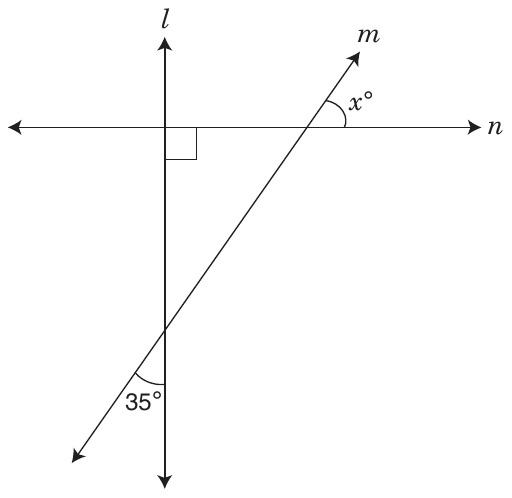
In the figure above, line l is perpendicular to line n. What is the value of x?
Grid-in question: work out the answer and enter it as a number.
Show the answer
Correct answer: 55
Since vertical angles are congruent, the right triangle in the figure has acute angles with measures of 35° and x°. The interior angles of a triangle sum to 180°, so set up an equation to solve for x:
Question analysis
Three lines cross in a figure: line l is perpendicular to line n, and a slanted line m meets them at a marked 35° angle and an unknown angle x. This geometry grid-in asks for the value of x. Students must see the right triangle the lines form and carry the marked angles into it using vertical angles.
- NYS standards
- Grade level
- Grade 8 content, by NYS standard
- Compared with grade 7
- Above grade 7 Grade 7 angle problems use vertical, supplementary and complementary angles. This one also needs the angle sum of a triangle, which New York places in grade 8, and the triangle is not drawn as a separate shape, so students must spot it.
- Estimated difficulty
- Moderate: several steps, or a close reading with one strong distractor.
- Thinking it demands
- Depth of knowledge 2, skills and concepts · mainly apply
- What makes it hard
- Reading a figure, table or graph moderate
- Something you must already know moderate
- An answer in an unexpected form minor
- Solution
- 3 steps
- Reading level
- Question and choices: about grade 4, 17 words.
- Students, last 30 days
- Not enough answers yet to show (it takes 10).
Why it is hard, traps and wrong answers (shows the answer)
Why it is hard
The figure hides a small right triangle between the three lines, and the question is easy once students see it. Its angles are the right angle, the vertical partner of the 35° angle and the vertical partner of x, so x is what the right angle and 35° leave of 180°. Students who never spot the triangle tend to guess a direct relationship between the two marked angles, which no angle fact supports.
Reading a figure, table or graph moderate Understanding the question
Neither marked angle is inside the right triangle that lines l, m and n form: the 35° opens below the point where m crosses l, and x opens above line n, so each must be carried in as a vertical angle. (Lesh, Post & Behr, 1987; Kirsch & Mosenthal, 1990)
Something you must already know moderate Working it out
The stem states only that l is perpendicular to n; students must supply that vertical angles are equal and that the three angles of a triangle add to 180°. (Anderson & Krathwohl, 2001)
An answer in an unexpected form minor Choosing the answer
As a grid-in it offers no choices, so 125, the right angle plus the 35° angle, can be gridded with nothing to signal the missing subtraction. (Enright, Morley & Sheehan, 2002)
Strategy: Find the triangle formed by the three lines, use vertical angles to move the 35° and x° angles inside it, and apply the triangle's angle sum with the right angle.
Traps
- Stops one step early: A choice is a number from partway through the solution.
- A formula you must know: Needs a formula the test does not give: area, circumference, volume, probability rules.
The wrong answers, classified
125 Stops one step early (King et al., 2004; Gierl et al., 2017)
Adds the right angle and the 35° angle, 90 + 35 = 125, and grids that sum without subtracting it from the triangle's 180°.
35 Misunderstands the concept (Smith, diSessa & Roschelle, 1993; De Bock et al., 1998; Ni & Zhou, 2005)
Assumes line m crosses l and n at equal angles, as it would cross two parallel lines, though l and n are perpendicular.
Worked solution, step by step
Formulas used
- Vertical angles
- When two lines cross, they make an X. The angles straight across from each other in the X are called vertical angles. a and b are one such pair. They are always equal, because each one plus the angle between them makes a straight line.
- Angles of a triangle
- A, B and C are the three angles inside any triangle, in degrees. They always add up to 180°. Use it when you know two of the angles and need the third.
Sort out the figure
Line l is perpendicular to line n. Perpendicular means they meet at a right angle, 90°. The small square in the figure marks it. Line m crosses both lines. The three lines make a triangle with a right angle. You need x, the angle marked x° where m crosses n.
Move the 35° angle into the triangle
The 35° angle is below the point where m crosses l. So it is outside the triangle. Lines l and m make an X there. The triangle’s angle is straight across from the 35° angle. They are vertical angles, so they are equal. The triangle’s angle at that corner is 35°.
Move the x° angle into the triangle
The x° angle is above line n, so it is outside the triangle too. Lines m and n make another X. The triangle’s angle at that crossing is straight across from x°. So the third angle of the triangle is also x°. Watch out: line m does not cross l and n at the same angle. Lines l and n are not parallel, so x is not 35.
Use the triangle’s angle sum
The triangle’s three angles are 90°, 35° and x°.
Watch out: 125 is only the two known angles added together. You still subtract it from 180. Gridding 125 is wrong. So you would grid 55.
Check your answer
In a right triangle, the two smaller angles add up to 90°. That is because the right angle uses 90° of the 180°. Check: . Also, in the figure the x° angle looks a bit bigger than the 35° angle, and 55 is.
More questions like this
The original DOE question
Question 12 of 20
2023 Test A Math, question 37Question
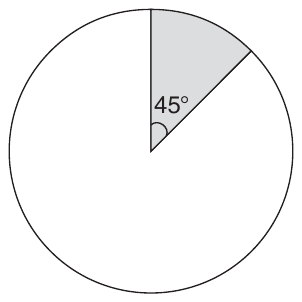
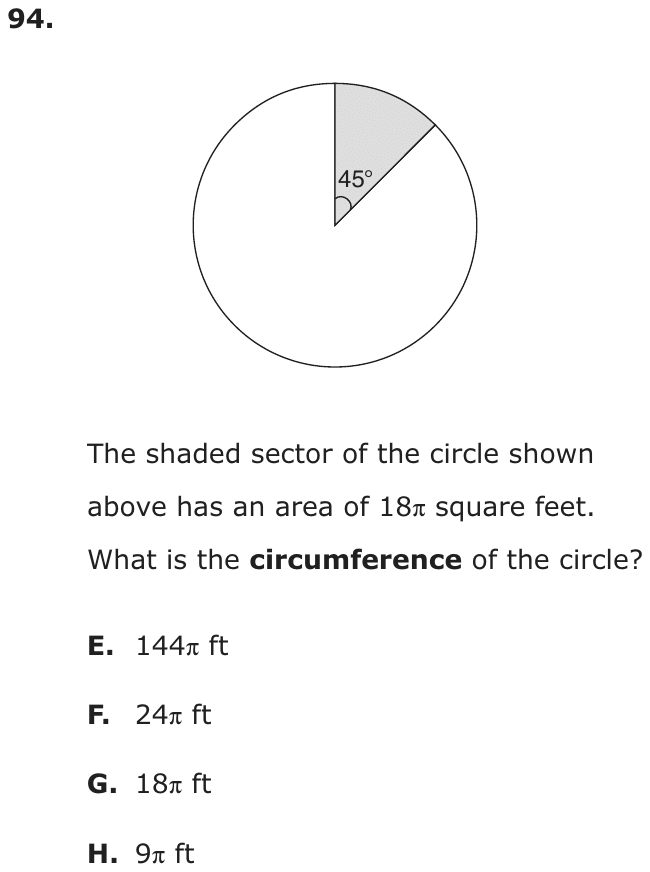
The shaded sector of the circle shown above has an area of square feet. What is the circumference of the circle?
- A ft
- B ft
- C ft
- D ft
Show the answer
Correct answer: B
The area of the entire circle is .
The fraction of the circle that is shaded is . So, the area of the sector is . Use that information to find r:
Use r to calculate the circumference of the circle:
The circumference is feet.
Question analysis
This circle question shows a shaded 45° sector with an area of 18π square feet and asks for the circumference of the whole circle. Students work backward: from the sector to the full area, from the area to the radius, and from the radius to the circumference. Mixing up area and circumference, or stopping partway, gives wrong choices.
- Grade level
- Grade 7 content, by NYS standard
- Compared with grade 7
- Above grade 7 Grade 7 circle problems usually give the radius and ask for area or circumference. This one runs backward from the area of a 45° sector, needing the sector's share of the circle, a square root and a switch to circumference: four linked steps.
- Estimated difficulty
- Hard: combines ideas, needs a plan, and has more than one tempting wrong answer.
- Thinking it demands
- Depth of knowledge 2, skills and concepts · mainly apply
- What makes it hard
- Combines ideas moderate
- Something you must already know moderate
- Reading a figure, table or graph minor
- Solution
- 4 steps
- Reading level
- Question and choices: about grade 5, 30 words.
- Students, last 30 days
- Not enough answers yet to show (it takes 10).
Why it is hard, traps and wrong answers (shows the answer)
Why it is hard
The question moves from a part of the circle's area to the whole circle's length, so area and circumference both appear and are easy to swap. Many students scale the sector up to 144π and stop, giving an area when a length was asked. Solving r² = 144 also needs a square root, after which 2πr is routine. Asking at the end whether the result is a length, measured in feet rather than square feet, catches the main trap.
Combines ideas moderate Working it out
Three ideas chain together: the 45° sector is 1/8 of the circle, so the whole area is 8 × 18π = 144π, then the radius comes from the area, and the circumference from the radius. (Embretson, 1998; Daniel & Embretson, 2010)
Something you must already know moderate Working it out
Neither πr² nor 2πr is given, nor that a full turn is 360°, so every link of the chain rests on formulas students must already know. (Anderson & Krathwohl, 2001)
Reading a figure, table or graph minor Understanding the question
The stem says only “shaded sector”; its 45° angle is marked at the center in the figure, the one place the fraction of the circle comes from. (Lesh, Post & Behr, 1987; Kirsch & Mosenthal, 1990)
Strategy: Work out what fraction of the circle a 45° sector is, scale its area up to the whole circle, solve for the radius, and only then use the circumference formula.
Traps
- Answers a different question: A choice is right for another quantity: the other unknown, the rest instead of the part, the part instead of the whole.
- A formula you must know: Needs a formula the test does not give: area, circumference, volume, probability rules.
- Numbers taken from the question: Combines the numbers in the question without a model of the situation, or is simply a number that appears in the question.
The wrong answers, classified
A Answers a different question (King et al., 2004; Hegarty, Mayer & Monk, 1995)
Scales the sector up to the whole circle, 8 × 18π = 144π, and gives that area, though the question asks for the circumference.
C Numbers taken from the question (Hegarty, Mayer & Monk, 1995)
Repeats the sector's area from the stem, 18π, as if the shaded part's area were the circle's circumference.
D Little reason to choose it (Haladyna & Downing, 1993; Rodriguez, 2005)
No step with the 45° angle or the circle formulas gives 9π, which is half the sector's area, so it mostly attracts guesses.
Worked solution, step by step
Formulas used
- Fraction of a circle in a sector
- A sector is a slice of a circle, like a slice of pizza. Its angle is the angle at the center, in degrees. A full turn around the center is 360 degrees. So the slice is that fraction of the whole circle.
- Area of a circle
- A is the area, the space inside the circle. r is the radius, the distance from the center to the edge. π, called pi, is a number a little more than 3. r² means r times r.
- Circumference of a circle
- C is the circumference, the distance around the circle. r is the radius and π is pi. Two radii make the diameter, the distance across, so this is the same as π times the diameter.
Sort out the question
The shaded slice has a 45° angle at the center. Its area is square feet. You need the circumference, the distance around the whole circle. For that you need the radius, so work back to it.
Find what fraction is shaded
The shaded slice is one eighth of the circle. Eight slices like it would fill the circle.
Find the area of the whole circle
The whole circle has an area of square feet. Watch out: this is an area, not the circumference. Stopping here gives choice A.
Find the radius
Divide both sides by π. Then ask what number times itself makes 144. It is 12, so the radius is 12 feet.
Find the circumference
Leave π as it is, because the choices are written with π. The circumference is feet. So the answer is B, ft.
Check your answer
Work forward. A radius of 12 feet gives an area of square feet. One eighth of that is square feet, the shaded area in the question.
More questions like this
The original DOE question
Question 13 of 20
2023 Test A Math, question 53Question
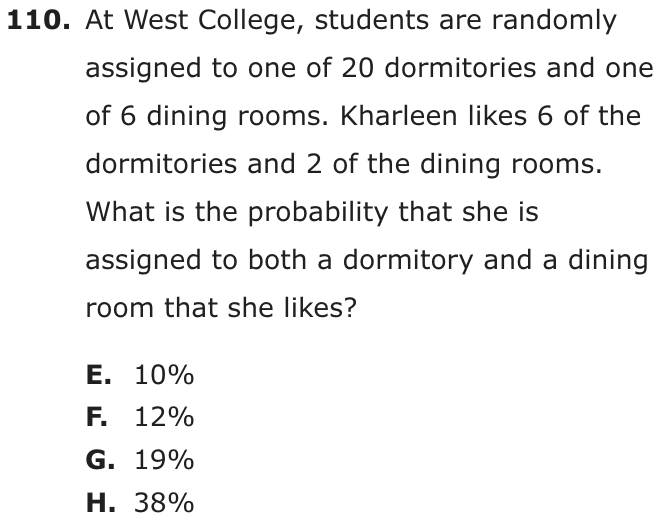
At West College, students are randomly assigned to one of 20 dormitories and one of 6 dining rooms. Kharleen likes 6 of the dormitories and 2 of the dining rooms. What is the probability that she is assigned to both a dormitory and a dining room that she likes?
- A10%
- B12%
- C19%
- D38%
Show the answer
Correct answer: A
Kharleen likes of the dormitories. She likes of the dining rooms. Multiply those fractions together to calculate the probability of Kharleen being assigned to both a dormitory and a dining room that she likes: .
Question analysis
This probability word problem says students at West College are randomly assigned one of 20 dormitories and one of 6 dining rooms, and Kharleen likes 6 dormitories and 2 dining rooms. It asks for the chance that she gets both a dormitory and a dining room she likes. Students combine two independent events and write the result as a percent.
- Grade level
- Grade 7 content, by NYS standard
- Compared with grade 7
- At grade 7 Finding the chance that two independent events both happen is grade 7 compound probability. Each event's chance comes straight from the counts given, and joining them and writing the result as a percent is a typical grade 7 task.
- Estimated difficulty
- Moderate: several steps, or a close reading with one strong distractor.
- Thinking it demands
- Depth of knowledge 2, skills and concepts · mainly apply
- What makes it hard
- Something you must already know moderate
- Turning words into math minor
- A very close wrong answer minor
- Solution
- 3 steps
- Reading level
- Question and choices: about grade 8, 45 words.
- Students, last 30 days
- Not enough answers yet to show (it takes 10).
Why it is hard, traps and wrong answers (shows the answer)
Why it is hard
The question turns on one rule, multiplying the chances of two independent events. Students who know it reduce the fractions first and finish in seconds; students who don't tend to combine the counts, and 6 × 2 = 12 reads naturally as 12%. The other two choices match no common working, so the real contest is between the product of the counts and the product of the chances.
Something you must already know moderate Working it out
The rule that the chance of two independent events both happening is the product of their chances, 3/10 × 1/3, is assumed; nothing in the stem says to multiply. (Anderson & Krathwohl, 2001)
Turning words into math minor Understanding the question
The phrase “both a dormitory and a dining room that she likes” describes two separate random assignments that must both go her way, so the two chances are combined, not compared. (Hegarty, Mayer & Monk, 1995; Koedinger & Nathan, 2004)
A very close wrong answer minor Choosing the answer
The choice 12% sits only 2 points above 10%, so a rough sense that the answer is small cannot separate them; only computing 3/10 × 1/3 does. (Embretson & Wetzel, 1987; Gorin & Embretson, 2006; Ascalon et al., 2007)
Strategy: Write the chance of a liked dormitory and the chance of a liked dining room as fractions, multiply them because both must happen, and convert the product to a percent.
Traps
- Numbers taken from the question: Combines the numbers in the question without a model of the situation, or is simply a number that appears in the question.
- A formula you must know: Needs a formula the test does not give: area, circumference, volume, probability rules.
The wrong answers, classified
B Numbers taken from the question (Hegarty, Mayer & Monk, 1995)
Multiplies the numbers of liked options, 6 × 2 = 12, and reads that product as 12%, without dividing by the 20 × 6 possible assignments.
C Little reason to choose it (Haladyna & Downing, 1993; Rodriguez, 2005)
No combination of 6/20 and 2/6 gives 19%, a value between the right answer and either single chance, so it mostly draws estimates and guesses.
D Little reason to choose it (Haladyna & Downing, 1993; Rodriguez, 2005)
No common working gives 38%, which is larger than either single chance, 30% or about 33%, so it mostly catches guesses.
Worked solution, step by step
Formulas used
- Probability
- P is the probability, the chance that something happens. The top counts the outcomes you want. The bottom counts every outcome that could happen. Each outcome must be equally likely.
- Probability of two separate events
- A and B are two events that don’t affect each other, like two separate random picks. P(A) is the chance of A, and P(B) is the chance of B. The chance that both happen is the two chances multiplied.
Sort out the question
Kharleen gets one of 20 dorms, or dormitories, where students live. She also gets one of 6 dining rooms. Each is picked at random. She likes 6 dorms and 2 dining rooms. You need the chance that she gets a dorm she likes and a dining room she likes.
Find the chance of a liked dorm
She likes 6 of the 20 dorms. Divide the top and bottom by 2 to simplify.
Find the chance of a liked dining room
Use the same formula for the dining rooms.
She likes 2 of the 6 dining rooms. Divide the top and bottom by 2.
Multiply the two chances
The two picks are separate. One doesn’t change the other.
Both must happen, so the chance is smaller than either one alone.
Change to a percent
Watch out: multiplying 6 × 2 = 12 and calling it 12% skips dividing by all the possible assignments. That is choice B. So the answer is A, 10%.
Check your answer
Count every possible assignment. There are dorm and dining room pairs, all equally likely. She likes of them. Then , which is 10%, the same answer.
More questions like this
The original DOE question
Question 14 of 20
2023 Test B Math, question 52Question
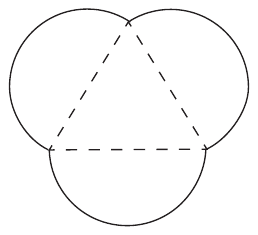
The garden design shown above is created in the shape of three semicircles whose diameters lie on the sides of an equilateral triangle. If each diameter is 2 meters long, what is the perimeter of the garden, in meters?
- A6
- B12
- C
- D
Show the answer
Correct answer: C
The perimeter (or circumference) of one of the three semicircles is . Since there are 3 semicircles that make up the perimeter, the perimeter is .
Question analysis
A garden is outlined by three semicircles whose diameters, each 2 meters long, are the sides of an equilateral triangle. Students find the perimeter of the garden in meters. It tests the circumference of a circle applied to half circles, and the figure mixes straight dashed sides with curved ones, so deciding what counts as the outline matters.
- NYS standards
- 7.G.4 circle area and circumference
- Grade level
- Grade 7 content, by NYS standard
- Compared with grade 7
- At grade 7 Applying the circumference formula is a grade 7 standard. Here it is used for a semicircle and repeated three times, a short extension of routine classwork, with a dashed triangle inside the figure to look past.
- Estimated difficulty
- Straightforward: two steps or one careful reading.
- Thinking it demands
- Depth of knowledge 2, skills and concepts · mainly apply
- What makes it hard
- Solution
- 3 steps
- Reading level
- Question and choices: about grade 8, 40 words.
- Students, last 30 days
- Not enough answers yet to show (it takes 10).
Why it is hard, traps and wrong answers (shows the answer)
Why it is hard
The perimeter is just three half-circles, and each is half of π × 2. The figure’s dashed triangle invites measuring straight sides instead, and remembering the whole circle’s circumference without halving it gives a choice twice too large. Tracing the garden’s outer edge with a finger before computing shows that only the curves count.
Reading a figure, table or graph minor Understanding the question
The dashed triangle lies inside the garden, so its three 2-meter sides are not part of the perimeter; only the three curved arcs bound the garden. (Lesh, Post & Behr, 1987; Kirsch & Mosenthal, 1990)
Something you must already know minor Working it out
The circumference formula is not given, and each arc is half of a circle with a 2-meter diameter, so students must take half of π × 2. (Anderson & Krathwohl, 2001)
Strategy: Find the circumference of a full circle with a 2-meter diameter, take half of it for one semicircle, and multiply by the number of semicircles in the outline.
Traps
- Wrong formula: Uses a related but wrong formula: perimeter for area, diameter for radius, area for volume, or a misremembered one.
- Answers a different question: A choice is right for another quantity: the other unknown, the rest instead of the part, the part instead of the whole.
- A formula you must know: Needs a formula the test does not give: area, circumference, volume, probability rules.
The wrong answers, classified
A Answers a different question (King et al., 2004; Hegarty, Mayer & Monk, 1995)
Adds the three dashed sides of the triangle, 3 × 2 = 6, measuring the triangle inside the garden instead of its curved outline.
B Little reason to choose it (Haladyna & Downing, 1993; Rodriguez, 2005)
No common working gives 12, which is twice the triangle’s perimeter and matches no arc length, so it mostly draws guesses.
D Wrong formula (King et al., 2004)
Uses a whole circumference, π × 2, for each of the three arcs, forgetting that each one is only half a circle, which doubles the perimeter.
Worked solution, step by step
Formulas used
- Circumference of a circle
- C is the circumference, the distance around a circle. d is the diameter, the straight line across the circle through its center. π is a number a little more than 3.14. The distance around any circle is π times as long as the distance across it.
- Arc of a semicircle
- A semicircle is half of a circle. Its arc is the curved part. d is the diameter, the straight side. The arc is half of the full circle’s circumference, so take half of π times d.
Sort out the figure
The garden’s edge is made of three semicircles, or half circles. Each one sits on a side of the dashed triangle. Each side is a diameter, 2 meters long. The perimeter is the distance around the outside. Here that is only the three arcs, the curved parts. The dashed triangle is inside, so it does not count.
Find a full circle’s circumference
Picture the whole circle that one semicircle comes from. Its diameter is 2 meters. Use the circumference formula.
The full circle would measure meters around.
Find the length of one arc
Each semicircle’s arc is half of that circle. Use the arc formula.
One arc is meters long.
Watch out: Using the full circle’s for each arc doubles the answer. That gives , choice D.
Add the three arcs
The garden’s edge is three equal arcs.
The perimeter is meters.
Watch out: The dashed sides add to 2 + 2 + 2 = 6 meters, choice A. That is the triangle, not the curved edge.
So the answer is C, meters.
Check your answer
Estimate. is about 3 × 3.14 = 9.42 meters. A curved path is longer than the straight line across it. So the edge should be longer than the triangle’s 6 meters, and 9.42 is.
More questions like this
The original DOE question
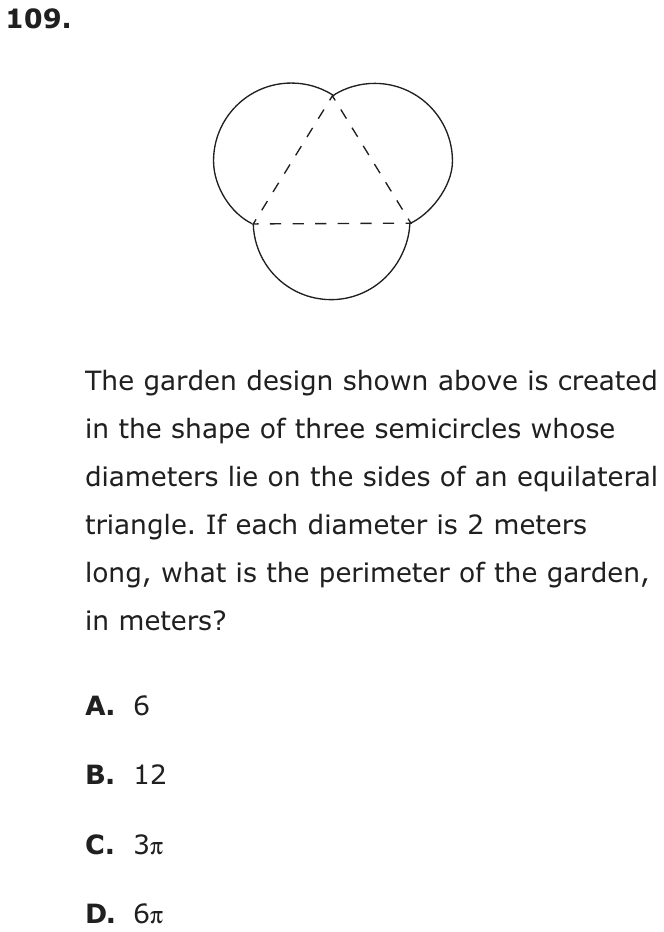
Question 15 of 20
2018 Test A Math, question 12Question
In the pyramid above, each triangular face has the same area, and the base MNPQ is a square that measures 8 centimeters on each side. If the length of = 6 centimeters, what is the surface area of the pyramid excluding the base?
- A48 sq cm
- B96 sq cm
- C128 sq cm
- D160 sq cm
Show the answer
Correct answer: B
Line segment is the altitude, or height, of triangle QRP. The length of is 8 cm. Use that information to find the area of triangle QRP:
sq cm.
There are 4 congruent triangles in the pyramid, so the surface area is
4 × 24 = 96 sq cm
Question analysis
A geometry question about the surface area of a square pyramid, leaving out its base. The base edges are 8 cm and segment RS, the height of one triangular face drawn from the top to a base edge, is 6 cm. Students find one face's area and multiply by the number of faces, reading excluding the base carefully.
- Grade level
- Grade 7 content, by NYS standard
- Compared with grade 7
- At grade 7 Surface area of a right pyramid from its faces is named in the grade 7 standards, and this is a direct two-step case. It matches typical grade 7 work, though the drawing's slant height must be read correctly.
- Estimated difficulty
- Moderate: several steps, or a close reading with one strong distractor.
- Thinking it demands
- Depth of knowledge 2, skills and concepts · mainly apply
- What makes it hard
- Solution
- 2 steps
- Reading level
- Question and choices: about grade 5, 49 words.
- Students, last 30 days
- Not enough answers yet to show (it takes 10).
Why it is hard, traps and wrong answers (shows the answer)
Why it is hard
Once RS is read as the height of a face, the computation is short: one triangle, then four of them. Points go to the figure and to one word. Students who count only the faces drawn in front, or who include the square base, reach listed choices, and the bold "excluding" is all that separates the lateral area from the total. The statement that every face has the same area is what makes multiplying by four valid.
Reading a figure, table or graph moderate Understanding the question
The drawing shows two lateral faces in front and two behind dashed edges, and RS, with its right-angle mark at S, is the height of face QRP, not of the pyramid. (Lesh, Post & Behr, 1987; Kirsch & Mosenthal, 1990)
Something you must already know minor Working it out
The triangle area formula, one half times base times height, and the fact that a square pyramid has four lateral faces are both assumed, not given. (Anderson & Krathwohl, 2001)
Strategy: Find the area of one triangular face with one half times base times height, using RS as the height, then multiply by the four congruent faces.
Traps
- Misreads the question: Misses or misreads a condition or a word in the question: "at least", "each", "remaining", "not".
- A formula you must know: Needs a formula the test does not give: area, circumference, volume, probability rules.
The wrong answers, classified
A Misreads the figure (Lesh, Post & Behr, 1987; Kirsch & Mosenthal, 1990)
Finds one face as ½ × 8 × 6 = 24 but counts only the two faces drawn in front, 2 × 24 = 48, missing the two hidden ones.
C Numbers taken from the question (Hegarty, Mayer & Monk, 1995)
Uses only the 8 cm edge, as both base and height of each face, 4 × ½ × 8 × 8 = 128, and never uses RS.
D Misreads the question (Hegarty, Mayer & Monk, 1995)
Finds the four faces, 96 sq cm, then adds the 8 × 8 = 64 sq cm base that the question says to exclude.
Worked solution, step by step
Formulas used
- Area of a triangle
- A is the area. b is the base, the side the triangle sits on. h is the height: the straight-up distance from the base to the top corner, at a right angle to the base. You take half because a triangle is half of a rectangle with the same base and height.
Sort out the pyramid
The pyramid sits on a square base, MNPQ. Each side of the square is 8 cm. Four triangle faces rise from the base and meet at the top point, R. Every face has the same area. Segment RS is 6 cm. You need the area of the four faces, “excluding the base”. Excluding means leaving it out.
See what RS measures
RS runs from R down face QRP to point S on edge QP. The small square at S marks a right angle. So RS is the height of triangle QRP. The base of that triangle is QP, one side of the square, so it is 8 cm.
Find the area of one face
Use the triangle formula with base 8 cm and height 6 cm.
One face has an area of 24 sq cm.
Add the four faces
All four faces are the same, so multiply by 4.
Watch out: only two faces are drawn in front. The other two hide behind the dashed lines. Counting just two faces gives 48, choice A. Watch out: don’t add the base, . That gives 160, choice D. So the answer is B, 96 sq cm.
Check your answer
Each face fits inside an 8 by 6 rectangle, with an area of 48 sq cm. The triangle is half of that, 24 sq cm, and four faces make 96 sq cm. That is less than 160, which would include the base.
More questions like this
The original DOE question
Question 16 of 20
2018 Test A Math, question 18Question
What is the area of the shaded region in the graph above?
- A0.25 square unit
- B0.5 square unit
- C1 square unit
- D1.5 square units
Show the answer
Correct answer: B
The shaded region is a right triangle. Each leg is 1 unit in length.
So the area is
or 0.5 sq unit
Question analysis
A coordinate grid question: find the area of a shaded right triangle with corners at the origin, (1, 0) and (1, 1), under a diagonal line. Students read the base and height from the grid and apply the triangle area formula. The figure does most of the work; the task is recalling the formula correctly.
- Grade level
- Grade 6 content, by NYS standard
- Compared with grade 7
- Below grade 7 Finding a triangle's area from a grid is grade 6 work, and this takes one step with whole-unit legs. It is easier than typical grade 7 area problems, which use composite figures or scale drawings.
- Estimated difficulty
- Routine: one familiar step, little to misread.
- Thinking it demands
- Depth of knowledge 1, recall and reproduction · mainly apply
- What makes it hard
- Solution
- 1 step
- Reading level
- Question and choices: about grade 2, 20 words.
- Students, last 30 days
- Not enough answers yet to show (it takes 10).
Why it is hard, traps and wrong answers (shows the answer)
Why it is hard
This is a quick formula question with legs of 1. The main risk is the one-half in the triangle formula: leaving it out gives the area of the whole grid square, which is a listed choice. Seeing that the diagonal cuts the unit square exactly in half gives a check that needs no formula at all.
Reading a figure, table or graph minor Understanding the question
The legs of the shaded triangle, from O to (1, 0) and up to (1, 1), are read off the grid lines; the line running on to (2, 2) is not part of the region. (Lesh, Post & Behr, 1987; Kirsch & Mosenthal, 1990)
Something you must already know minor Working it out
The triangle area formula, one half times base times height, is needed and not given; the shaded triangle is half of one grid square. (Anderson & Krathwohl, 2001)
Strategy: Read the two legs straight off the grid, then apply the triangle area formula, base times height divided by two.
Traps
- A formula you must know: Needs a formula the test does not give: area, circumference, volume, probability rules.
The wrong answers, classified
A Misreads the figure (Lesh, Post & Behr, 1987; Kirsch & Mosenthal, 1990)
Judges the shaded triangle by eye as a quarter of the 1-by-1 grid square instead of the half that the diagonal from O to (1, 1) cuts off.
C Wrong formula (King et al., 2004)
Multiplies base by height, 1 × 1 = 1, and leaves out the one-half, giving the whole unit square instead of the triangle.
D Little reason to choose it (Haladyna & Downing, 1993; Rodriguez, 2005)
No common working gives 1.5, which is more than the whole grid square around the shaded triangle; it mostly draws guesses.
Worked solution, step by step
Formulas used
- Area of a triangle
- A is the area. b is the base, the side the triangle sits on. h is the height: the straight-up distance from the base to the top corner, at a right angle to the base. You take half because a triangle is half of a rectangle with the same base and height.
Sort out the shaded region
The shaded region is a triangle. Its corners are O, the point (1, 0) and the point (1, 1). O is the origin, the point (0, 0) where the axes meet. The line keeps going up to (2, 2), but only the small triangle is shaded. You need its area in square units.
Read the base and height
The base lies along the x-axis, from O to 1. So the base is 1 unit. The height goes straight up from (1, 0) to (1, 1). So the height is 1 unit too. The base and height meet at a right angle, as the grid lines show.
Use the triangle formula
The area is 0.5 square unit. Watch out: don’t forget the one half. is the whole grid square, choice C. So the answer is B, 0.5 square unit.
Check your answer
The grid square from 0 to 1 has an area of 1 square unit. The slanted line cuts it corner to corner into two equal triangles. The shaded one is half the square, so 0.5 square unit.
More questions like this
The original DOE question
Question 17 of 20
2018 Test A Math, question 49Question
A car travels at 4,400 feet per minute. The radius of each tire on the car is 1 foot. How many revolutions does one of these tires make in 1 minute? (Use the approximation for .)
- A700
- B1,925
- C13,828
- D15,400
Show the answer
Correct answer: A
One revolution is equal to the circumference of the tire:
ft
The car travels at 4,400 ft per minute. To calculate the number of revolutions, divide the speed by the circumference:
700 revolutions.
Question analysis
This circle word problem says a car travels 4,400 feet per minute on tires with a radius of 1 foot and asks how many revolutions each tire makes in a minute, using 22/7 for pi. Students must see that one revolution covers the tire's circumference, then divide. Dividing by a fraction is the step to check.
- Grade level
- Grade 7 content, by NYS standard
- Compared with grade 7
- At grade 7 Circumference is grade 7 content. This item adds the idea that each revolution rolls the tire one circumference forward and requires dividing by a fraction, which is typical of a solid grade 7 application problem.
- Estimated difficulty
- Moderate: several steps, or a close reading with one strong distractor.
- Thinking it demands
- Depth of knowledge 2, skills and concepts · mainly apply
- What makes it hard
- Turning words into math moderate
- Something you must already know moderate
- Error-prone arithmetic minor
- Solution
- 2 steps
- Reading level
- Question and choices: about grade 5, 34 words.
- Students, last 30 days
- Not enough answers yet to show (it takes 10).
Why it is hard, traps and wrong answers (shows the answer)
Why it is hard
The question tests whether students connect distance traveled to turns of a wheel, a link the stem leaves unstated. Every wrong choice is larger than the answer, and two exceed 4,400, which is impossible when each turn covers more than 6 feet. A sense check on size rules those out before any fraction work, leaving only the division by 44/7 to do carefully.
Turning words into math moderate Understanding the question
The stem never says that one revolution rolls the car forward one circumference; students must supply that link to turn 4,400 feet into a count of turns. (Hegarty, Mayer & Monk, 1995; Koedinger & Nathan, 2004)
Something you must already know moderate Working it out
The circumference formula, C = 2πr, is not given; with r = 1 and 22/7 for π it gives 44/7 feet per turn. (Anderson & Krathwohl, 2001)
Error-prone arithmetic minor Working it out
Dividing 4,400 by 44/7 means multiplying by 7/44, which is clean only if students see that 4,400 ÷ 44 = 100 before multiplying by 7. (Brown & Burton, 1978; Junker & Sijtsma, 2001)
Strategy: Find the distance covered in one turn with the circumference formula, 2πr, then divide the distance traveled in a minute by that circumference.
Traps
- A formula you must know: Needs a formula the test does not give: area, circumference, volume, probability rules.
The wrong answers, classified
B Little reason to choose it (Haladyna & Downing, 1993; Rodriguez, 2005)
No standard path gives 1,925, which equals 4,400 × 7 ÷ 16, so it mostly draws students guessing a mid-sized count.
C Wrong operation (Hegarty, Mayer & Monk, 1995; King et al., 2004)
Multiplies 4,400 by π, 22/7, instead of dividing by the circumference, and truncates 13,828.57 to 13,828.
D An arithmetic slip (Junker & Sijtsma, 2001)
Divides 4,400 by 2/7 instead of 44/7, dropping the 22 of π while flipping 2 × 22/7, which gives 4,400 × 7 ÷ 2.
Worked solution, step by step
Formulas used
- Circumference of a circle
- C is the circumference, the distance around a circle. r is the radius, from the center to the edge. π (pi) is about 22/7. The distance around is a bit more than 3 times the distance across, which is 2 × r.
- Number of turns
- n is the number of turns. d is the distance the car travels. C is the circumference. Each full turn rolls the car forward one circumference, so you divide the distance by it.
Sort out what you know
The car goes 4,400 feet in 1 minute. Each tire has a radius of 1 foot. A revolution is one full turn of the tire. You need how many turns a tire makes in 1 minute.
Find how far one turn goes
When a tire turns once, the car rolls forward the distance around the tire. That distance is the circumference. Use for π:
One turn moves the car feet, about 6.3 feet.
Divide the distance by one turn
To divide by a fraction, multiply by its reciprocal (the fraction flipped upside down):
Notice that 4,400 ÷ 44 = 100. That makes it easy.
Give the answer
The tire makes 700 turns. Watch out: multiplying 4,400 by π instead of dividing by the circumference gives about 13,828, choice C. So the answer is A, 700.
Check your answer
Estimate. One turn is about 6 feet. 4,400 ÷ 6 is about 730, close to 700. There should be fewer turns than feet, since each turn covers several feet. Choices C and D are bigger than 4,400, so they cannot be right.
More questions like this
The original DOE question
Question 18 of 20
2018 Test B Math, question 17Question
A large circular dinner plate has a radius of 20 centimeters. A smaller circular plate with a circumference of centimeters is placed in the center of the larger dinner plate. What is the area of the part of the larger dinner plate that is not covered by the smaller plate?
- A sq cm
- B sq cm
- C sq cm
- D sq cm
Show the answer
Correct answer: D
The radius of the large plate is 20 cm. Use that to find the area of the large plate:
The circumference of the smaller plate is 20π cm. Use that to find the radius, and then the area, of the smaller plate:
Subtract the area of the small plate from the area of the large plate:
400π − 100π = 300π sq cm
Question analysis
This circle question places a smaller plate, described by its circumference, on a larger dinner plate described by its radius, and asks for the area of the large plate left uncovered. Students recall the circumference and area formulas, find the small radius and subtract areas. Because the two plates are described in different ways, circumference and area have to be kept apart.
- NYS standards
- 7.G.4 circle area and circumference
- Grade level
- Grade 7 content, by NYS standard
- Compared with grade 7
- At grade 7 Applying circle area and circumference formulas is the grade 7 standard, and subtracting one area from another is a common grade 7 exercise. Working backward from a circumference adds one step but no new content.
- Estimated difficulty
- Moderate: several steps, or a close reading with one strong distractor.
- Thinking it demands
- Depth of knowledge 2, skills and concepts · mainly apply
- What makes it hard
- Many steps moderate
- Something you must already know moderate
- Solution
- 4 steps
- Reading level
- Question and choices: about grade 6, 62 words.
- Students, last 30 days
- Not enough answers yet to show (it takes 10).
Why it is hard, traps and wrong answers (shows the answer)
Why it is hard
The question describes the two plates in different measures, one by radius and one by circumference, so students must convert before they can compare. The trap is a halving argument: the small circumference is half the large one, but the area it covers is only a quarter. Students who keep both areas in terms of π and subtract finish quickly; those who reason from the circumferences alone go wrong.
Many steps moderate Working it out
The chain runs through four stages: the large area 400π, the small radius 10 from the circumference 20π, the small area 100π, then the uncovered difference. (Daniel & Embretson, 2010; Enright, Morley & Sheehan, 2002)
Something you must already know moderate Working it out
Neither formula is given: students need C = 2πr to recover the small plate's radius and A = πr² for both areas. (Anderson & Krathwohl, 2001)
Strategy: Use C = 2πr to get the small plate's radius, find both areas with A = πr², keep everything in terms of π, and subtract.
Traps
- Answers a different question: A choice is right for another quantity: the other unknown, the rest instead of the part, the part instead of the whole.
- A formula you must know: Needs a formula the test does not give: area, circumference, volume, probability rules.
The wrong answers, classified
A Wrong formula (King et al., 2004)
Works with circumferences instead of areas, subtracting the small plate's 20π from the large plate's 40π.
B Answers a different question (King et al., 2004; Hegarty, Mayer & Monk, 1995)
Finds the area of the smaller plate, the part that is covered, instead of the part of the large plate left uncovered.
C Misunderstands the concept (Smith, diSessa & Roschelle, 1993; De Bock et al., 1998; Ni & Zhou, 2005)
Reasons that a circumference half as long covers half the area, so takes half of 400π, not seeing that area scales with the square.
Worked solution, step by step
Formulas used
- Circumference of a circle
- C is the circumference, the distance around the circle. r is the radius, the distance from the center to the edge. π, said “pie,” is a number a little more than 3. The distance around is always about 6.28 times the radius.
- Area of a circle
- A is the area, the space inside the circle. r is the radius. r² means r times r. π is about 3.14. The radius is squared because area spreads out in two directions.
Write down what you know
The big plate has a radius of 20 cm. The radius is the distance from the center to the edge.
The small plate has a circumference of 20π cm. Circumference is the distance around a circle.
You need the area of the big plate that the small plate does not cover. Area is the space inside a shape.
Find the big plate's area
The big plate is 400π sq cm. Keep π as a symbol, because the choices use it.
Find the small plate's radius
You know the small plate’s circumference, not its radius. Use the circumference formula to work back.
Divide both sides by 2π. That leaves . The small radius is 10 cm.
Find the small plate's area
Use the area formula again, with the small radius.
The small plate covers 100π sq cm.
Watch out: 100π is the covered part. The question asks for the part not covered, so do not stop at choice B.
Subtract to find the uncovered part
The uncovered area is 300π sq cm.
Watch out: Do not subtract the distances around the plates. That gives 40π − 20π = 20π, choice A.
So the answer is D, 300π sq cm.
Check your answer
The small radius is half the big radius. So the small area is of the big area. That leaves three quarters uncovered: . It matches.
More questions like this
The original DOE question
Question 19 of 20
2018 Test B Math, question 35Question
R, S, and T are midpoints of the sides of square MNPQ, as shown above. What is the sum of the areas of the shaded triangles?
- A9 sq cm
- B12 sq cm
- C18 sq cm
- D36 sq cm
Show the answer
Correct answer: A
The length of one side of the square is 6 cm. Since , , and are midpoints, then , , , and are all equal to 3 cm. Triangles and are both right triangles, so the area of one of the triangles is
The triangles are congruent, so the sum of the areas is
Question analysis
Points R, S and T are midpoints of the sides of square MNPQ, whose sides are 6 cm long, and students find the total area of the two shaded triangles in its corners. It tests the area of a triangle. The common slips are forgetting the one-half or measuring the wrong region.
- NYS standards
- 6.G.1 area of polygons
- Grade level
- Grade 6 content, by NYS standard
- Compared with grade 7
- Below grade 7 Triangle area is grade 6 content, and the corner triangles here are right triangles with easy legs. Typical grade 7 area problems are similar or harder; the only extra step is using midpoints to get the lengths.
- Estimated difficulty
- Straightforward: two steps or one careful reading.
- Thinking it demands
- Depth of knowledge 2, skills and concepts · mainly apply
- What makes it hard
- Solution
- 3 steps
- Reading level
- Question and choices: about grade 1, 34 words.
- Students, last 30 days
- Not enough answers yet to show (it takes 10).
Why it is hard, traps and wrong answers (shows the answer)
Why it is hard
The shaded triangles are right triangles tucked into the corners, so their legs lie along the square's sides and are easy to measure once the midpoints are used. Most lost points come from the one half in the area formula, or from reporting a larger region of the figure, such as the left half or the whole square. Labeling each 3 cm leg on the figure before computing pays off here.
Reading a figure, table or graph moderate Understanding the question
Only one length is labeled, the 6 cm side PQ; the legs NR, NS, MR and MT must each be read as half a side, 3 cm, from the word midpoints. (Lesh, Post & Behr, 1987; Kirsch & Mosenthal, 1990)
Something you must already know minor Working it out
The area of a triangle, one half times base times height, is not given, and leaving out the one half doubles each 4.5 sq cm triangle. (Anderson & Krathwohl, 2001)
Strategy: Use the midpoints to get each triangle's legs as half the square's side, apply one-half base times height, and remember there are two shaded triangles.
Traps
- A formula you must know: Needs a formula the test does not give: area, circumference, volume, probability rules.
- Answers a different question: A choice is right for another quantity: the other unknown, the rest instead of the part, the part instead of the whole.
The wrong answers, classified
B Wrong formula (King et al., 2004)
Adds the four 3 cm legs of the two shaded triangles, 3 + 3 + 3 + 3 = 12, treating a total length as an area.
C Wrong formula (King et al., 2004)
Multiplies 3 by 3 for each triangle without the one half, 9 + 9 = 18, which also equals the area of the left half, rectangle NSTM.
D Answers a different question (King et al., 2004; Hegarty, Mayer & Monk, 1995)
Squares the only labeled length, 6 × 6 = 36, giving the area of the whole square instead of the two shaded corners.
Worked solution, step by step
Formulas used
- Area of a triangle
- A is the area. b is the base, the side the triangle sits on. h is the height, the straight-up distance from the base to the top corner. You take half because a triangle is half of a rectangle with the same base and height.
Read the figure
MNPQ is a square, and side PQ is 6 cm. All sides of a square are equal, so every side is 6 cm. A midpoint is the point exactly halfway along a side. R is the midpoint of side NM. S is the midpoint of NP, and T is the midpoint of MQ.
The shaded triangles are RNS at the top and RMT at the bottom.
Find the short sides
Each midpoint cuts a 6 cm side into two equal parts.
So NR, NS, RM and MT are each 3 cm long.
Find the area of one triangle
Triangle RNS has a square corner at N. A square corner is a right angle. So NS can be the base and NR the height.
One triangle is 4.5 sq cm. Triangle RMT has the same sides, so it is also 4.5 sq cm.
Watch out: do not forget the one half. Without it, each triangle is 9 sq cm and the total is 18. That is choice C.
Add the two triangles
There are two shaded triangles, so add their areas to get the total.
So the answer is A, 9 sq cm.
Check your answer
The left half of the square is rectangle NSTM, 3 cm by 6 cm. Its area is sq cm. The white triangle RST fills half of it. So the shaded part is the other half, 9 sq cm. Choice D, 36, is the whole square.
More questions like this
The original DOE question
Question 20 of 20
2018 Test B Math, question 48Question
What is the area of the shaded triangle shown above?
- A
- B
- C
- D
Show the answer
Correct answer: C
The height of the triangle is 4 units. The length of the base is . So the area is
Question analysis
Students find the area of a shaded triangle drawn on coordinate axes, with its base between the points m and n on the x-axis and its top vertex at a height of 4. It tests the triangle area formula with an algebraic side length. Writing the base as an expression in m and n is the step that needs care.
- Grade level
- Grade 6 content, by NYS standard
- Compared with grade 7
- At grade 7 Triangle area is grade 6 content, but a base written with two variables is less familiar. With only two steps, the demand matches typical grade 7 work that mixes geometry with algebraic expressions.
- Estimated difficulty
- Moderate: several steps, or a close reading with one strong distractor.
- Thinking it demands
- Depth of knowledge 2, skills and concepts · mainly apply
- What makes it hard
- Variables instead of numbers moderate
- Reading a figure, table or graph moderate
- A very close wrong answer moderate
- Solution
- 2 steps
- Reading level
- Question and choices: about grade 7, 14 words.
- Students, last 30 days
- Not enough answers yet to show (it takes 10).
Why it is hard, traps and wrong answers (shows the answer)
Why it is hard
The arithmetic is trivial, but students must treat a length as a difference of coordinates and keep a formula's one half when the answer is a letter expression. Those who forget the half, or who stop at the base length, find their result among the choices. Trying m = 1 and n = 4 gives a triangle of area 6 that checks the expressions quickly.
Variables instead of numbers moderate Understanding the question
The base runs from m to n on the x-axis, so its length is the expression n − m, and the area stays in letters with no number to check. (Koedinger & Nathan, 2004; Enright, Morley & Sheehan, 2002)
Reading a figure, table or graph moderate Understanding the question
The height, 4, is read from the dashed line through the apex rather than labeled on the triangle, and the base endpoints appear only as tick labels. (Lesh, Post & Behr, 1987; Kirsch & Mosenthal, 1990)
A very close wrong answer moderate Choosing the answer
4(n − m) is the right 2(n − m) doubled, written the same way except for the coefficient; only remembering the one half in a triangle's area separates them. (Embretson & Wetzel, 1987; Gorin & Embretson, 2006; Ascalon et al., 2007)
Strategy: Write the base as the difference between its endpoint values, read the height from the figure, and apply one-half times base times height.
Traps
- A formula you must know: Needs a formula the test does not give: area, circumference, volume, probability rules.
- Wrong formula: Uses a related but wrong formula: perimeter for area, diameter for radius, area for volume, or a misremembered one.
- Stops one step early: A choice is a number from partway through the solution.
The wrong answers, classified
A Numbers taken from the question (Hegarty, Mayer & Monk, 1995)
Adds the two labels, m + n, as if the base were the sum of the endpoints, and goes no further with the height.
B Stops one step early (King et al., 2004; Gierl et al., 2017)
Finds the base length n − m correctly and gives it as the area, never multiplying by the height or taking one half.
D Wrong formula (King et al., 2004)
Multiplies the base n − m by the height 4 but forgets the one half in the triangle area formula.
Worked solution, step by step
Formulas used
- Area of a triangle
- A is the area. b is the base, the side the triangle sits on. h is the height, the straight-up distance from the base to the top corner. You take half because a triangle is half of a rectangle with the same base and height.
- Length along the x-axis
- The right end and the left end are the numbers where a segment starts and stops on the x-axis. Subtracting the smaller from the larger tells how long the segment is.
Read the figure
The shaded triangle sits on the x-axis, the flat number line. Its base runs from to . Its top corner touches the dashed line at height 4. You need the area, written with the letters and .
Find the length of the base
The base starts at and ends at . Use the length rule: right end minus left end.
Watch out: adding the ends, , does not give a length. That is choice A.
Find the height
The height is the straight-up distance from the base to the top corner. The top corner is on the dashed line, which is at 4 on the y-axis. So the height is 4.
Find the area
Use the triangle area formula.
Half of 4 is 2, so the area is .
Watch out: forgetting the one half gives , choice D. Stopping at the base gives , choice B.
Give the answer
The area is 2 times the length of the base. So the answer is C, .
Check your answer
Try numbers. Say and . The base is 3 and the height is 4, so the area is . Choice C gives . It matches. Choice D would give 12.
More questions like this
The original DOE question