Dictionary meaning, not meaning here
Question 1 of 15
2026 Practice Test A English, question 9Passage The Best Laid Plans of Ravens
The Best Laid Plans of Ravens
In Edgar Allan Poe’s poem “The Raven,” a raven visits a lonely man’s home and responds to the man’s pleading questions with only the word “nevermore.” The poem’s narrator interprets the word as a prediction of doom for his future. A talking, prophetic raven may seem to be the wild imaginings of the poet, but a new study published in the journal Science hints that one particular idea behind the poem might not be as far-fetched as it seems. For most of human history, people assumed that animals do not understand the passage of time in the same way people do. Some people believed that animals might remember events from the past and that instinct might drive them to make preparations in order to guarantee survival, but most people did not think that animals had the ability to plan. At Lund University in Sweden, researchers argue that ravens may be able to think ahead and even plan for the future.
It can be difficult to test an animal’s ability to plan because human observers must be certain they are not mistaking instinctual behavior for intentional planning. For example, many animals hoard food so that they will not run out later, but scientists who study animals would not call hoarding a decision to plan for the future. This action is merely instinctual. Cognitive scientists argue that in order for an animal’s behavior to qualify as preparing for the future, the animal must use specific decision-making skills to solve a problem.
To avoid mistaking instinctual behavior for evidence of decision-making, the Lund University researchers designed two experiments to test ravens’ ability to plan. Ravens belong to the corvid family, a group of birds known for their intelligence. A study in 2007 showed that corvids have the tendency to save only certain types of food, which suggests that they are planning for the future rather than acting on instinct. In order to investigate that theory, the researchers had to design experiments that would achieve results that could not be explained by an instinctual behavior of food hoarding. Therefore, the ravens were taught two behaviors that they do not normally perform in the wild.
For the first experiment, the researchers showed the birds how to use a small stone to open a box and get treats. Once the ravens learned the behavior, the researchers presented the birds with four stones. Only one stone was the right size to open the box. The birds learned to select that stone and set it aside until the researchers presented the box. The second experiment involved bartering. A researcher would trade the ravens a large treat for a bottle cap. Later, the researchers presented the ravens with a group of items, including small treats and the bottle cap. The ravens chose the bottle cap over the treats and waited for the original researcher to trade with them again so that they could get more treats. In both experiments, the ravens waited patiently for up to seventeen hours for the researcher to return.
The results of these experiments are exciting, but more evidence needs to be gathered before scientists can fully conclude that ravens can plan for the future. Some scientists argue that the ravens might be choosing the stone and bottle cap because the ravens have been trained to do so, not necessarily because the ravens are thinking ahead. Regardless, like other recent advances in animal science, these experiments show that ravens could be much smarter than first believed, and scientists now believe that ravens do actually think about their own future.
Question
Read these sentences from paragraph 2.
For example, many animals hoard food so that they will not run out later, but scientists who study animals would not call hoarding a decision to plan for the future. This action is merely instinctual.
Which statement describes the effect of the phrase “merely instinctual” in the passage?
- AIt implies that animals are skilled at finding and saving food for later consumption.
- BIt conveys that many animals will usually prioritize gathering food over other activities.
- CIt suggests that animals often store more food than they will be able to consume.
- DIt emphasizes that many animals collect food automatically rather than with true intention.
Show the answer
Correct answer: D
The question asks which statement describes the effect in the passage of the phrase “merely instinctual” from paragraph 2.
A. Incorrect. The passage does not question animals’ ability to find and save food but rather whether this or other behavior involves thought and planning for the future.
B. Incorrect. While the sentence states that “many animals hoard food,” the passage does not suggest that they give priority of thought to this activity; they hoard food out of instinct.
C. Incorrect. Although the passage discusses animals’ tendency to store a great deal of food, it does not suggest that their hoarding goes beyond their needs.
D. CORRECT. The passage suggests that in order for an animal’s actions to qualify as planning for the future, “the animal must use specific decision-making skills to solve a problem” (paragraph 2). The behavior of hoarding food is based on instinct and done automatically without real thought.
Question analysis
This word-in-context question from “The Best Laid Plans of Ravens” asks about the effect of the phrase “merely instinctual,” which the article applies to food hoarding in paragraph 2. Students read two quoted sentences and decide what the phrase emphasizes about how animals behave. The choices all sound like reasonable facts about animals, so the answer has to come from how the article uses the phrase.
- Grade level
- Grade 7 reading and task
- Compared with grade 7
- Below grade 7 Grade 7 word-meaning questions often need clues gathered from a whole paragraph. Here the phrase is short and familiar, and the sentence just before it supplies a direct contrast, so one careful reading of the two quoted sentences is enough.
- Estimated difficulty
- Routine: one familiar step, little to misread.
- Thinking it demands
- Depth of knowledge 2, skills and concepts · mainly understand
- What makes it hard
- Hard words minor
- The right answer is reworded minor
- Evidence
- Answered from one paragraph or stanza
- Reading level
- Passage: about grade 11, 599 words; question and choices: about grade 10, 108 words.
- Students, last 30 days
- Not enough answers yet to show (it takes 10).
Why it is hard, traps and wrong answers (shows the answer)
Why it is hard
Most students know that an instinct is something an animal does without thinking, and the sentence just before the phrase says hoarding is not “a decision to plan.” The only real pitfall is “merely”: a student who skips it can hear praise of a natural talent, and one who thinks only about hoarding may pick a choice about storing too much. Reading the phrase with its contrast makes the answer plain.
Hard words minor Understanding the question
The phrase pairs “merely,” which shrinks what follows, with “instinctual,” and the sentence before it uses “hoard”; a student unsure of any of the three has little to go on. (Perfetti, 2007; Freedle & Kostin, 1993)
The right answer is reworded minor Choosing the answer
The right choice restates the idea as acting “automatically rather than with true intention,” while the wrong ones stay with the sentence’s own subject, finding, gathering and storing food. (Freedle & Kostin, 1993; Kirsch & Mosenthal, 1990)
Strategy: Ask what the word “merely” adds to “instinctual,” then reread the sentence before the phrase and use its contrast to decide what the author is saying about hoarding.
Traps
- Dictionary meaning, not meaning here: A common meaning of the word that does not fit its use in this text.
- Outside knowledge: A choice is plausible in the real world but not supported by this text.
The wrong answers, classified
A Wrong tone or attitude (Graesser, Singer & Trabasso, 1994)
Hears “instinctual” as a natural gift, as in an instinctive athlete, and turns the phrase into praise of animals’ skill, missing that “merely” makes it a put-down.
B Outside knowledge (King et al., 2004; Recht & Leslie, 1988)
Brings in the idea of instinct as an urge that overrides everything else, but the passage never ranks food gathering above an animal’s other activities.
C Dictionary meaning, not meaning here (Perfetti, 2007)
Gives “hoard” its everyday sense of piling up too much, though the passage says animals store food so they “will not run out later,” not beyond their needs.
Working it out, step by step
Figure out what the question asks
This asks about the effect of a phrase. What do the words “merely instinctual” add to what the passage says about animals and food? Read the phrase together with the sentence before it.
Read the sentences around the phrase
Paragraph 2 says “many animals hoard food so that they will not run out later, but scientists who study animals would not call hoarding a decision to plan for the future. This action is merely instinctual.” To hoard is to collect and store a lot of something.
Work out what the phrase means
An instinct is a natural urge an animal is born with. It acts on it without thinking it through. So instinctual behavior is automatic. Merely means “only” or “just.” Put together, the phrase says hoarding is just automatic. It is not a real decision. The next sentence agrees: to count as planning, “the animal must use specific decision-making skills to solve a problem.”
Check each choice
- A does not fit. The phrase does not praise animals’ skill. “Merely” makes the behavior sound smaller.
- B does not fit. The passage never says animals put food ahead of other activities.
- C does not fit. The passage never says animals store too much. They store food “so that they will not run out later.”
- D fits. “Automatically rather than with true intention” means by instinct, not on purpose. An intention is a plan you have in mind.
Choose the answer
The phrase stresses that animals hoard food without real thought or purpose. So the answer is D.
Why this answer and not the closest wrong one
A is the closest wrong choice, because an instinct can sound like a natural talent. But “merely” turns the phrase into a put-down. The author is saying hoarding is only instinct, not a real choice. D says the same thing: animals collect food automatically, not with true intention.
More questions like this
The original DOE question
The passage “The Best Laid Plans of Ravens” as printed (page 12)
Question 2 of 15
2026 Practice Test A English, question 32Passage Excerpt from “The Spirit of the Herd”
Excerpt from “The Spirit of the Herd”
by Dallas Lore Sharp
In this excerpt, published in 1914, author and professor Dallas Lore Sharp describes a summer cattle roundup in Oregon. The heat and dust had been relentless for three days. The cowboys were exhausted, and the cattle were restless. The ranch boss, Wade, had led the drive to a watering place, only to find it empty.
Along with the wagon had come the fresh horses—one of them being Peroxide Jim, a supple, powerful, clean-limbed buckskin, a horse, I think, that had as fine and intelligent an animal-face as any creature I ever saw. Wade had been saving this horse for emergency work. And why should he not have been saved fresh for just such a need as this? Are there not superior horses as well as superior men—a Peroxide Jim to complement a Wade?
The horse knew the cattle business and knew his rider perfectly; and though there was nothing like sentiment about the boss of the P Ranch riders, his faith in Peroxide Jim was complete. . . .
The desert, where the herd was camped, was one of the highest of a series of tablelands, or benches; it lay as level as a floor, rimmed by sheer rock, from which there was a drop to the bench of sage below. The herd when overtaken by the dusk had been headed for a pass descending to the next lower bench, but was now halted within a mile of the rim rock on the east, where there was a perpendicular fall of about three hundred feet. . . .
In the taut silence of the stirless desert night, with the tension of the herd at the snapping-point, any quick, unwonted sight or sound would stampede them. The sneezing of a horse, the flare of a match, would be enough to send the whole four thousand headlong—blind, frenzied, trampling—till spent and scattered over the plain.
And so, as he rode, Wade began to sing. The rider ahead of him took up the air and passed it on until, above the stepping stir of the hoofs rose the faint voices of the men, and all the herd was bound about by the slow plaintive measures of some old song. It was not to soothe their savage breasts that the riders sang to the cattle, but rather to preempt the dreaded silence, to relieve the tension, and so to prevent the shock of any sudden startling noise.
So they sang and rode and the night wore on to one o’clock, when Wade, coming up on the rim-rock side, felt a cool breeze fan his face, and caught a breath of fresh, moist wind with the taste of water in it.
He checked his horse instantly, listening as the wind swept past him over the cattle. But they must already have smelled it, for they had ceased their milling, the whole herd standing motionless, the indistinct forms close to him in the dark showing their bald faces lifted to drink the sweet wet breath that came over the rim. Then they started on again, but faster, and with a rumbling now from their hoarse throats that tightened Wade’s grip on the reins.
The sound seemed to come out of the earth, a low, rumbling mumble, as dark as the night and as wide as the plain, a thick, inarticulate bellow that stood every rider stiff in his stirrups. . . .
Then the breeze caught the dust and carried it back from the gray-coated, ghostly shapes, and Wade saw that the animals were still moving in a circle. He must keep them going. He touched his horse to ride on with them, when across the black sky flashed a vivid streak of lightning.
There was a snort from the steers, a quick clap of horns and hoofs from far within the herd, a tremor of the plain, a roar, a surging mass—and Wade was riding the flank of a wild stampede. Before him, behind him, beside him, pressing hard upon his horse, galloped the frenzied steers, and beyond them a multitude borne on, and bearing him on, by the heave of the galloping herd.
Wade was riding for his life. He knew it. His horse knew it. He was riding to turn the herd, too, back from the rim, as the horse also knew. The cattle were after water—water-mad—ready to go over the precipice to get it, carrying horse and rider with them. Wade was the only rider between the herd and the rim. It was black as death. He could see nothing in the sage, could scarcely discern the pounding, panting shadows at his side. He knew that he was being borne toward the rim, how fast he could not tell, but he knew by the swish of the brush against his tapaderos and the plunging of the horse that the ground was growing stonier, that they were nearing the rocks.
To outrun the herd was his only chance for life. If he could come up with the leaders he might not only escape, but even stand a chance of heading them off upon the plain and saving the herd. There were cattle still ahead of him; how many, what part of them all, he could not make out in the dark. But the horse knew. The reins hung on his straight neck, where his rider had dropped them, as, yelling and firing over the wild herd, he had given this horse the race to win, to lose.
They were riding the rim. Close on their left bore down the flank of the herd, and on their right, under their very feet, was a precipice, so close that they felt its blackness—its three hundred feet of fall! . . .
. . . Then Wade found himself racing neck and neck with a big white steer, which the horse, with marvelous instinct, seemed to pick out from a bunch, and to cling to, forcing him gradually ahead, till, cutting him free from the bunch entirely, he bore him off into the swishing sage.
The steers coming on close behind followed their leader, and in, after them, swung others. The tide was turning from the rim. More and more were veering, and within a short time the whole herd, bearing off from the cliffs, was pounding over the open plains.
Whose race was it? It was Peroxide Jim’s, according to Wade, for not by word or by touch of hand or knee had the horse been directed in the run. From the flash of the lightning the horse had taken the bit, had covered an indescribably perilous path at top speed, had outrun the herd and turned it from the edge of the rim rock, without a false step or a tremor of fear.
From “The Spirit of the Herd” by Dallas Lore Sharp—Public Domain
tablelands: plateaus, flat areas of land sharply elevated from the surrounding area
tapaderos: leather covers for stirrups
Question
Read this sentence from paragraph 13.
Close on their left bore down the flank of the herd, and on their right, under their very feet, was a precipice, so close that they felt its blackness—its three hundred feet of fall!
The phrase “bore down the flank of the herd” conveys that Wade
- Astruggled to see the front of the herd.
- Bhad to ride quickly to keep up with the herd.
- Cwas forced to ride between the edge of the cliff and the herd.
- Dknew that the drop of the cliff would frighten the herd.
Show the answer
Correct answer: C
The question asks what the phrase “bore down the flank of the herd” (paragraph 13) conveys about Wade.
A. Incorrect. While Wade struggled to see the front of the herd, the words “bore down the flank of the herd” (paragraph 13) are meant to convey the intensity of the situation Wade was in, not the way the herd is blocking his vision.
B. Incorrect. The sentence from paragraph 13 states that the herd was “close on their left” and includes the phrase “bore down.” Both of these phrases indicate that Wade was trapped between the stampeding herd and the steep cliff. Wade and Peroxide Jim were struggling to reach the very front of the herd to turn it away from the edge.
C. CORRECT. The phrase “bore down the flank of the herd” from paragraph 13 conveys the overwhelming strength of the herd. The herd was forcing Wade toward the cliff. The wording in the quotation emphasizes the immediate danger of the situation and conveys the idea that Wade and Peroxide Jim were almost forced over the edge of the precipice by the stampeding herd.
D. Incorrect. The phrase “bore down the flank of the herd” (paragraph 13) does not indicate anything about the fear felt by the herd. The phrase is about Wade’s position between the edge of the stampeding herd and the drop-off. Wade was aware of the danger the herd was in if he and Peroxide Jim could not turn the cattle from the edge.
Question analysis
This vocabulary-in-context question quotes a sentence from paragraph 13 of “The Spirit of the Herd,” at the height of the stampede, and asks what the phrase “bore down the flank of the herd” conveys about Wade. Students need the meaning of “bore down” and “flank” as they are used here. Some choices describe real moments of the stampede, so students must stick to what this phrase shows.
- Grade level
- Grade 7 reading and task
- Compared with grade 7
- At grade 7 Working out a phrase’s meaning from its sentence is routine grade 7 work. The words “bore down” and “flank” are less common, but the full sentence is quoted with the question, so the task stays within one sentence.
- Estimated difficulty
- Straightforward: two steps or one careful reading.
- Thinking it demands
- Depth of knowledge 2, skills and concepts · mainly understand
- What makes it hard
- Complex sentences moderate
- Hard words minor
- Evidence
- Answered from one sentence or line
- Reading level
- Passage: about grade 8, 1160 words; question and choices: about grade 3, 94 words.
- Students, last 30 days
- Not enough answers yet to show (it takes 10).
Why it is hard, traps and wrong answers (shows the answer)
Why it is hard
Once the sentence is untangled, the herd pressing in on the left and the cliff on the right, the answer is a picture of Wade squeezed between them. The trouble is the word order and the phrase itself: students who read “bore down” as speed think about keeping pace, and those who recall the darkness of the paragraph before pick a detail this sentence never mentions.
Complex sentences moderate Understanding the question
The sentence is inverted: “the flank of the herd” is the subject of “bore down,” placed after its verb, so a quick reader may think Wade bore down along the herd instead. (Abedi & Lord, 2001; Freedle & Kostin, 1993; Messick, 1989)
Hard words minor Understanding the question
Both “flank,” the side of the herd, and “bore down,” pressed in hard, are uncommon in this sense, and the stem asks about exactly those words. (Perfetti, 2007; Freedle & Kostin, 1993)
Strategy: Read the whole quoted sentence rather than the phrase alone, picture the scene it describes, and pick what this sentence itself shows about Wade.
Traps
- Dictionary meaning, not meaning here: A common meaning of the word that does not fit its use in this text.
- Wrong part of the text: A choice is true of another paragraph, stanza or speaker than the one asked about.
- Reads too much in: A reasonable-sounding conclusion that goes further than the text allows.
The wrong answers, classified
A Wrong part of the text (Kirsch & Mosenthal, 1990)
Recalls from paragraph 12 that Wade could not tell how many cattle were ahead of him, which is true there, but this sentence says nothing about what he could see.
B Dictionary meaning, not meaning here (Perfetti, 2007)
Takes “bore down” in its sense of rushing forward and gives the speed to Wade, when in this sentence it is the herd’s flank pressing in on his left.
D Reads too much in (Graesser, Singer & Trabasso, 1994)
Assumes the cliff would scare the cattle, but they are “water-mad” and ready to go over the edge, and the phrase describes Wade’s position, not their fear.
Working it out, step by step
Figure out what the question asks
This asks what the phrase “bore down the flank of the herd” shows about Wade. To answer, read the whole sentence, not just the phrase.
Learn the hard words
A flank is the side of an animal or of a group. To bear down, here “bore down,” means to press in hard on something. A precipice is a cliff, a very steep drop.
Untangle the sentence
The sentence puts its words in an unusual order. In everyday order it would say: The flank of the herd bore down close on their left. So the side of the herd pushed in on Wade and his horse from the left. On the right, “under their very feet, was a precipice.”
Picture where Wade is
Wade is squeezed. Thousands of running cattle press in on one side. A 300-foot drop sits on the other side. He has no room to move away from either one. He is forced to ride in the narrow space between the herd and the cliff edge.
Check each choice
- A does not fit. Paragraph 12 says he could not tell how many cattle were ahead, but this sentence is about the sides.
- B does not fit. Here the herd does the bearing down, not Wade.
- C fits. He rides between the herd and the cliff.
- D does not fit. The cattle were “water-mad,” ready to go over the edge. Nothing says the cliff scared them.
Choose the answer
The phrase shows the herd pushing Wade toward the edge. So the answer is C.
Why this answer and not the closest wrong one
B is the closest wrong choice, because “bore down” can mean rushing forward fast. But in this sentence the herd does the bearing down, not Wade. The herd presses in from the left while the cliff waits on the right. That squeeze is what C describes.
More questions like this
The original DOE question
The passage “Excerpt from “The Spirit of the Herd”” as printed (page 41)
Question 3 of 15
2026 Practice Test B English, question 9Passage A Miracle Mile
A Miracle Mile
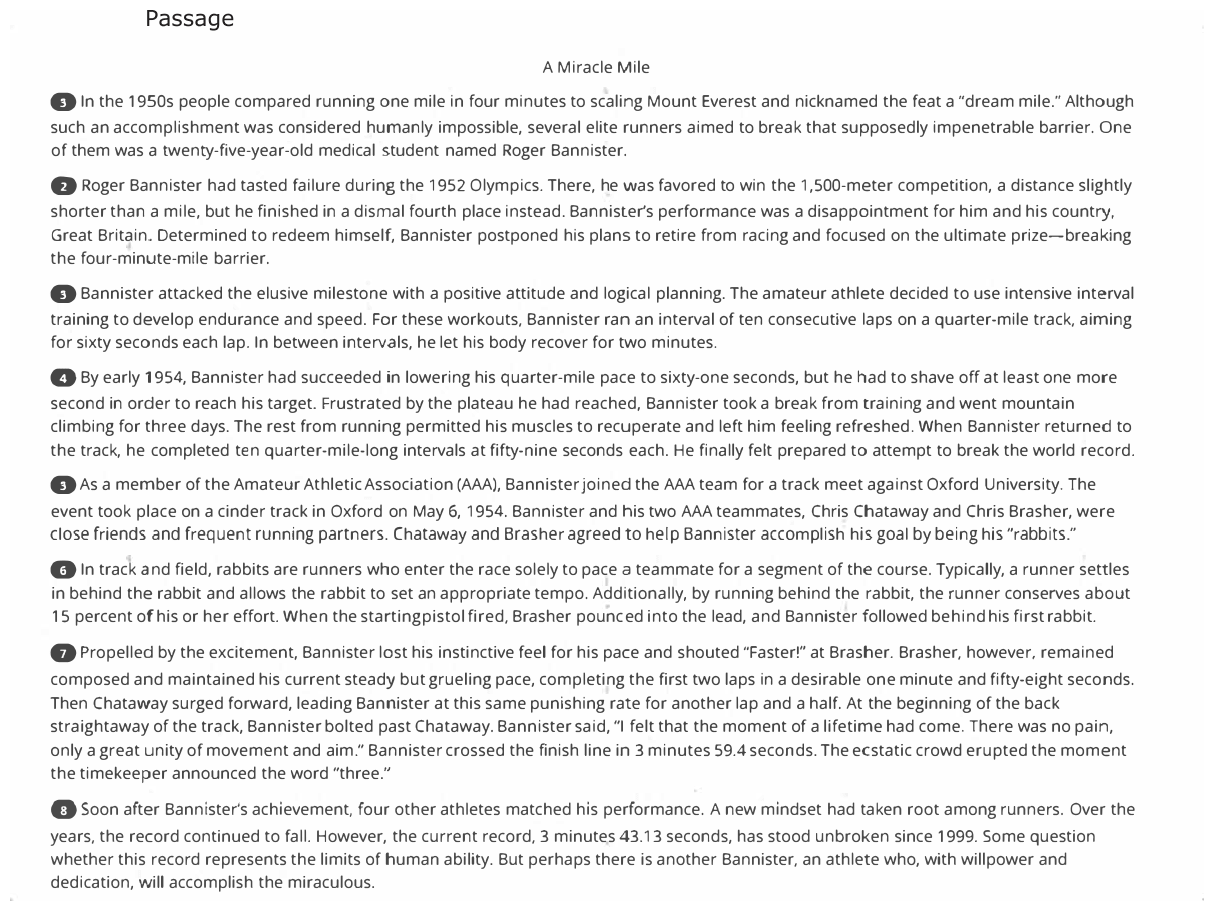
In the 1950s people compared running one mile in four minutes to scaling Mount Everest and nicknamed the feat a “dream mile.” Although such an accomplishment was considered humanly impossible, several elite runners aimed to break that supposedly impenetrable barrier. One of them was a twenty-five-year-old medical student named Roger Bannister.
Roger Bannister had tasted failure during the 1952 Olympics. There, he was favored to win the 1,500-meter competition, a distance slightly shorter than a mile, but he finished in a dismal fourth place instead. Bannister’s performance was a disappointment for him and his country, Great Britain. Determined to redeem himself, Bannister postponed his plans to retire from racing and focused on the ultimate prize—breaking the four-minute-mile barrier.
Bannister attacked the elusive milestone with a positive attitude and logical planning. The amateur athlete decided to use intensive interval training to develop endurance and speed. For these workouts, Bannister ran an interval of ten consecutive laps on a quarter-mile track, aiming for sixty seconds each lap. In between intervals, he let his body recover for two minutes.
By early 1954, Bannister had succeeded in lowering his quarter-mile pace to sixty-one seconds, but he had to shave off at least one more second in order to reach his target. Frustrated by the plateau he had reached, Bannister took a break from training and went mountain climbing for three days. The rest from running permitted his muscles to recuperate and left him feeling refreshed. When Bannister returned to the track, he completed ten quarter-mile-long intervals at fifty-nine seconds each. He finally felt prepared to attempt to break the world record.
As a member of the Amateur Athletic Association (AAA), Bannister joined the AAA team for a track meet against Oxford University. The event took place on a cinder track in Oxford on May 6, 1954. Bannister and his two AAA teammates, Chris Chataway and Chris Brasher, were close friends and frequent running partners. Chataway and Brasher agreed to help Bannister accomplish his goal by being his “rabbits.”
In track and field, rabbits are runners who enter the race solely to pace a teammate for a segment of the course. Typically, a runner settles in behind the rabbit and allows the rabbit to set an appropriate tempo. Additionally, by running behind the rabbit, the runner conserves about 15 percent of his or her effort. When the starting pistol fired, Brasher pounced into the lead, and Bannister followed behind his first rabbit.
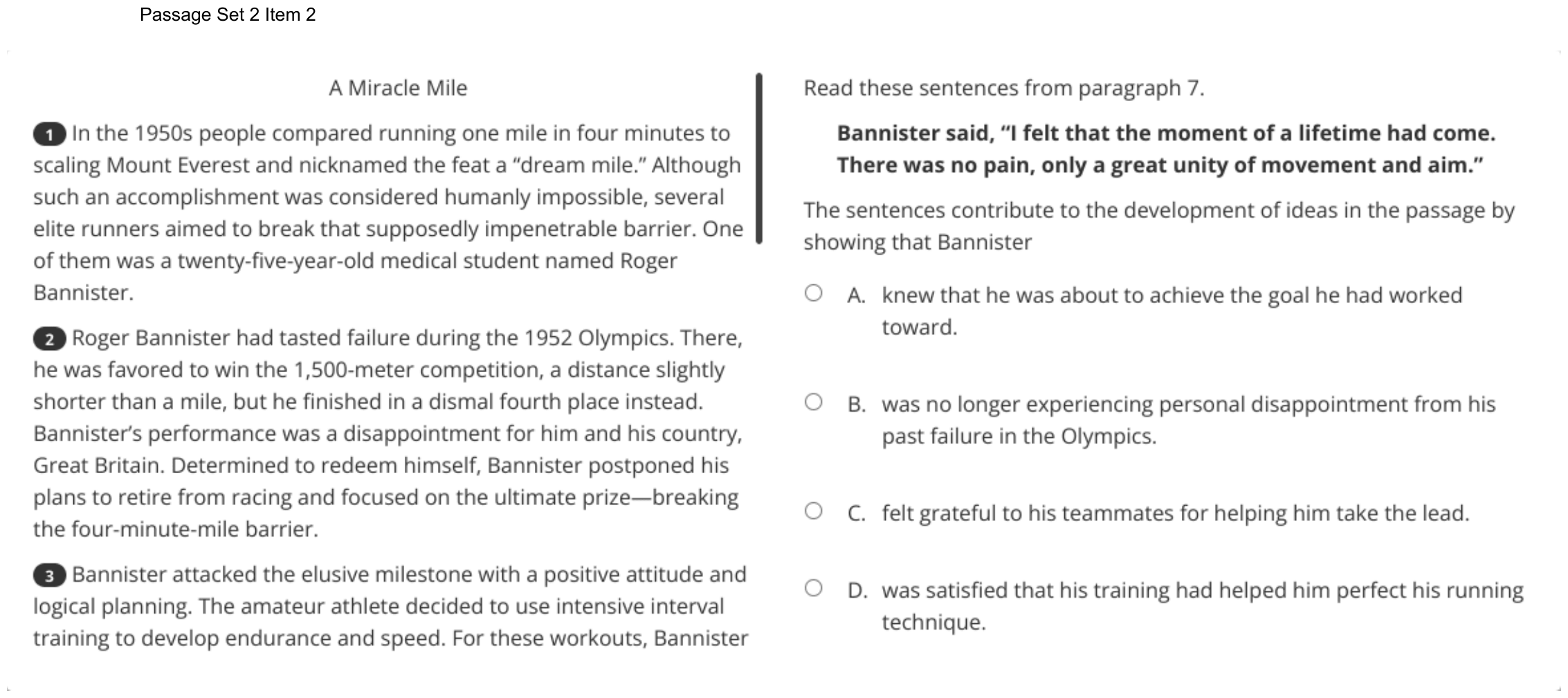
Propelled by the excitement, Bannister lost his instinctive feel for his pace and shouted “Faster!” at Brasher. Brasher, however, remained composed and maintained his current steady but grueling pace, completing the first two laps in a desirable one minute and fifty-eight seconds. Then Chataway surged forward, leading Bannister at this same punishing rate for another lap and a half. At the beginning of the back straightaway of the track, Bannister bolted past Chataway. Bannister said, “I felt that the moment of a lifetime had come. There was no pain, only a great unity of movement and aim.” Bannister crossed the finish line in 3 minutes 59.4 seconds. The ecstatic crowd erupted the moment the timekeeper announced the word “three.”
Soon after Bannister’s achievement, four other athletes matched his performance. A new mindset had taken root among runners. Over the years, the record continued to fall. However, the current record, 3 minutes 43.13 seconds, has stood unbroken since 1999. Some question whether this record represents the limits of human ability. But perhaps there is another Bannister, an athlete who, with willpower and dedication, will accomplish the miraculous.
Question
Read these sentences from paragraph 7.
Bannister said, “I felt that the moment of a lifetime had come. There was no pain, only a great unity of movement and aim.”
The sentences contribute to the development of ideas in the passage by showing that Bannister
- Aknew that he was about to achieve the goal he had worked toward.
- Bwas no longer experiencing personal disappointment from his past failure in the Olympics.
- Cfelt grateful to his teammates for helping him take the lead.
- Dwas satisfied that his training had helped him perfect his running technique.
Show the answer
Correct answer: A
The question asks how the sentences from paragraph 7 contribute to the development of ideas in the passage.
A. CORRECT. The sentences from paragraph 7 show that toward the end of the race, Bannister knew that the goal of breaking the four-minute-mile barrier was within his grasp and that he had the focus necessary to achieve it. The sentence following Bannister’s quotation states that he did indeed meet his goal, crossing “the finish line in 3 minutes 59.4 seconds” (paragraph 7).
B. Incorrect. The feelings Bannister expressed in the sentences from paragraph 7 did not erase those feelings related to his loss at the 1952 Olympics, which were what drove him to the achievement he was about to make.
C. Incorrect. While the quotation states that Bannister felt “unity,” this pertains to his running, not to his work with the team. The sentences from paragraph 7 capture Bannister’s focus on his chance to break the barrier and what he was feeling at that moment.
D. Incorrect. The sentences from paragraph 7 express Bannister’s realization that he was on the verge of reaching a goal. The sentences show that in the seconds before crossing the finish line, Bannister was fully focused on the end goal and was not thinking about his training or his running technique.
Question analysis
This question quotes Roger Bannister’s own words from his famous race, “I felt that the moment of a lifetime had come,” and asks how they contribute to the development of ideas in “A Miracle Mile.” Students interpret an athlete’s description of a feeling and decide what it shows about him. Each choice links the quotation to a different part of his story.
- Grade level
- Grade 7 reading and task
- Compared with grade 7
- At grade 7 Explaining what a quoted sentence adds to a passage is everyday grade 7 work, and these two sentences are short. Their abstract phrase “a great unity of movement and aim” takes some interpreting, which keeps the demand typical rather than light.
- Estimated difficulty
- Moderate: several steps, or a close reading with one strong distractor.
- Thinking it demands
- Depth of knowledge 2, skills and concepts · mainly analyze
- What makes it hard
- Reading between the lines moderate
- Figurative or literary language minor
- Evidence
- Answered from one paragraph or stanza
- Reading level
- Passage: about grade 10, 587 words; question and choices: about grade 7, 93 words.
- Students, last 30 days
- Not enough answers yet to show (it takes 10).
Why it is hard, traps and wrong answers (shows the answer)
Why it is hard
Bannister’s words describe a feeling, and each choice explains it by a different part of his story. The right reading comes from where the quotation sits: on the back straight, seconds from the finish, so “the moment of a lifetime” is the record within reach. Students who take “unity of movement” as polished form, or “no pain” as the end of his Olympic hurt, tie the quotation to his training or his past instead of to this race.
Reading between the lines moderate Working it out
The quotation never names the record; students must link “the moment of a lifetime had come” to the four-minute goal and to the finish in 3 minutes 59.4 seconds reported right after it. (Graesser, Singer & Trabasso, 1994; Kintsch, 1998)
Figurative or literary language minor Understanding the question
“A great unity of movement and aim” is abstract, and “There was no pain” can be heard as emotional relief, so the words invite readings about technique, teamwork or old disappointment. (Graesser, Singer & Trabasso, 1994; Kintsch, 1998)
Strategy: Read the quotation together with the sentences around it in paragraph 7, put Bannister’s state of mind into your own words, and test each choice against what the quotation itself says.
Traps
- Wrong part of the text: A choice is true of another paragraph, stanza or speaker than the one asked about.
- Reads too much in: A reasonable-sounding conclusion that goes further than the text allows.
- Dictionary meaning, not meaning here: A common meaning of the word that does not fit its use in this text.
The wrong answers, classified
B Reads too much in (Graesser, Singer & Trabasso, 1994)
Hears “There was no pain” as the end of the hurt from his 1952 fourth place, but the pain meant is the strain of the race, and the quotation never looks back.
C Dictionary meaning, not meaning here (Perfetti, 2007)
Takes “unity” in its everyday sense of people pulling together and credits his rabbits, though the unity is of his own “movement and aim,” just after he passed Chataway to run alone.
D Wrong part of the text (Kirsch & Mosenthal, 1990)
Brings in the training of paragraphs 3 and 4 and reads “unity of movement” as perfected technique, but the quotation records a feeling during the race, not a verdict on his preparation.
Working it out, step by step
Figure out what the question asks
This asks what Bannister’s words show about him at that moment in the race. To answer, you need to know where the quotation comes. So read the sentences just before it and just after it.
Find where the quotation comes
Paragraph 7 tells the story of the race. Just before the quotation, “Bannister bolted past Chataway.” Bolted means ran off suddenly and fast. Chataway was his second rabbit, a teammate who set the pace. Now Bannister was in front, near the end. Just after the quotation, “Bannister crossed the finish line in 3 minutes 59.4 seconds.” That is under four minutes.
Put his words in your own words
He says “I felt that the moment of a lifetime had come.” The moment of a lifetime is the most important moment a person ever has. For Bannister, that was breaking the four-minute mile. “A great unity of movement and aim” means his body and his goal were working as one. He could feel that he was about to do it.
Check each choice
- A fits. He senses that his big goal is about to happen.
- B does not fit. “There was no pain” means he felt no strain in the race. He is not thinking back to 1952.
- C does not fit. The unity is of his own “movement and aim,” not of his team. He had just passed Chataway to run alone.
- D does not fit. The words describe a feeling during the race. They say nothing about his training or his technique, which means his way of running.
Watch out: D is tempting because “unity of movement” sounds like perfect running form. But Bannister is not judging his training here. He is feeling the big moment arrive.
Choose the answer
The quotation shows Bannister sensing that his goal was near, and the next sentence shows he reached it. So the answer is A, “knew that he was about to achieve the goal he had worked toward.”
Why this answer and not the closest wrong one
D is the closest wrong choice. His training did help him, and he was running well. But the quotation is about a feeling: “the moment of a lifetime had come.” It looks ahead to the finish, not back at his practice. A matches that feeling of a goal about to be reached.
More questions like this
The original DOE question
The passage “A Miracle Mile” as printed (page 13)
Question 4 of 15
2026 Practice Test B English, question 24Passage Looking for the Smallest Spark of Everything
Looking for the Smallest Spark of Everything
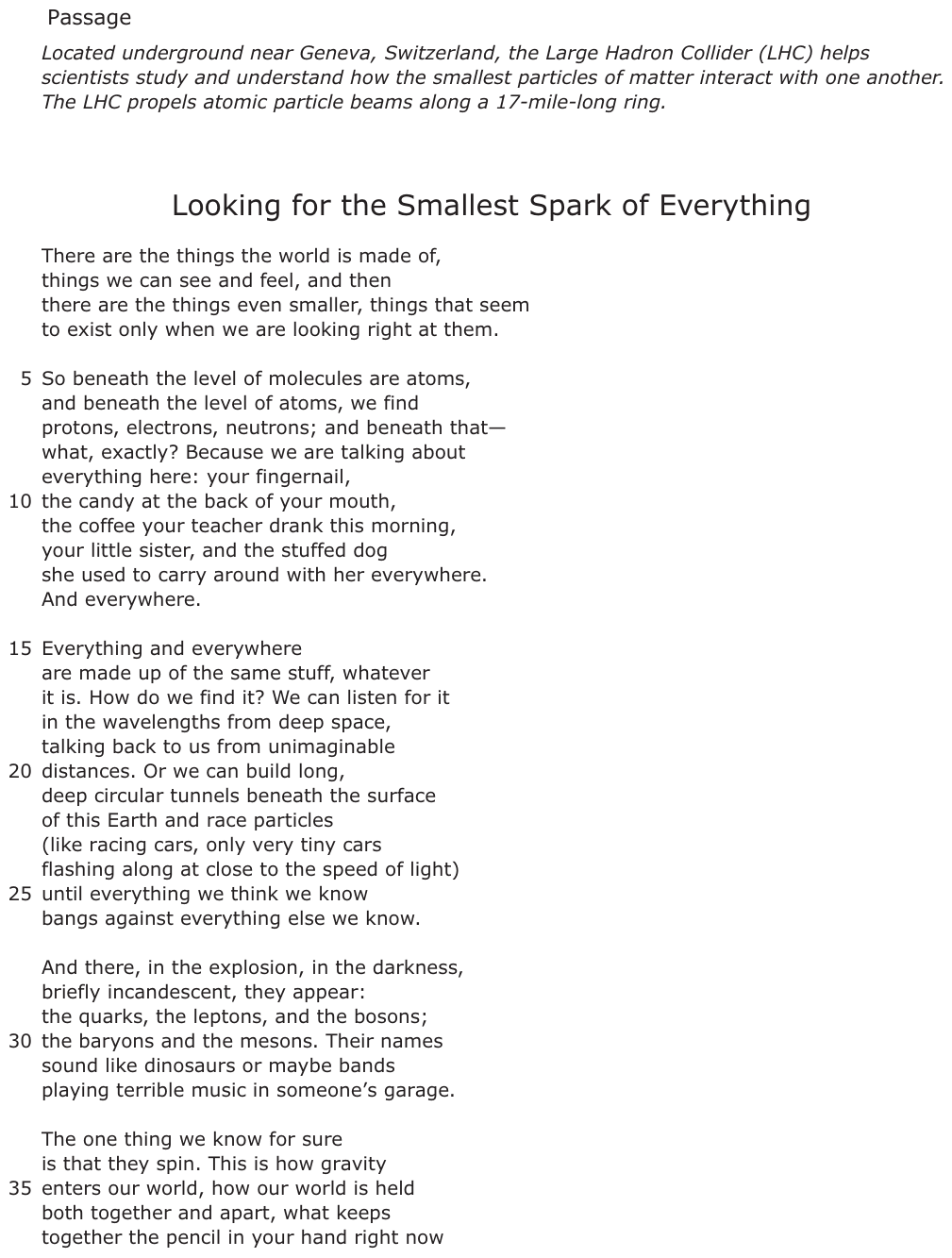
Located underground near Geneva, Switzerland, the Large Hadron Collider (LHC) helps scientists study and understand how the smallest particles of matter interact with one another. The LHC propels atomic particle beams along a 17-mile-long ring.
There are the things the world is made of,
things we can see and feel, and then
there are the things even smaller, things that seem
to exist only when we are looking right at them.
So beneath the level of molecules are atoms,
and beneath the level of atoms, we find
protons, electrons, neutrons; and beneath that—
what, exactly? Because we are talking about
everything here: your fingernail,
the candy at the back of your mouth,
the coffee your teacher drank this morning,
your little sister, and the stuffed dog
she used to carry around with her everywhere.
And everywhere.
Everything and everywhere
are made up of the same stuff, whatever
it is. How do we find it? We can listen for it
in the wavelengths from deep space,
talking back to us from unimaginable
distances. Or we can build long,
deep circular tunnels beneath the surface
of this Earth and race particles
(like racing cars, only very tiny cars
flashing along at close to the speed of light)
until everything we think we know
bangs against everything else we know.
And there, in the explosion, in the darkness,
briefly incandescent, they appear:
the quarks, the leptons, and the bosons;
the baryons and the mesons. Their names
sound like dinosaurs or maybe bands
playing terrible music in someone’s garage.
The one thing we know for sure
is that they spin. This is how gravity
enters our world, how our world is held
both together and apart, what keeps
together the pencil in your hand right now
as well as separate from, say,
Jupiter. They spin, and it is only down there
in the darkness—in the vast garage
where physicists jot down
what they can, whatever seems most real—
that they let us perceive their wild dancing,
combusting to the music they make.
Question
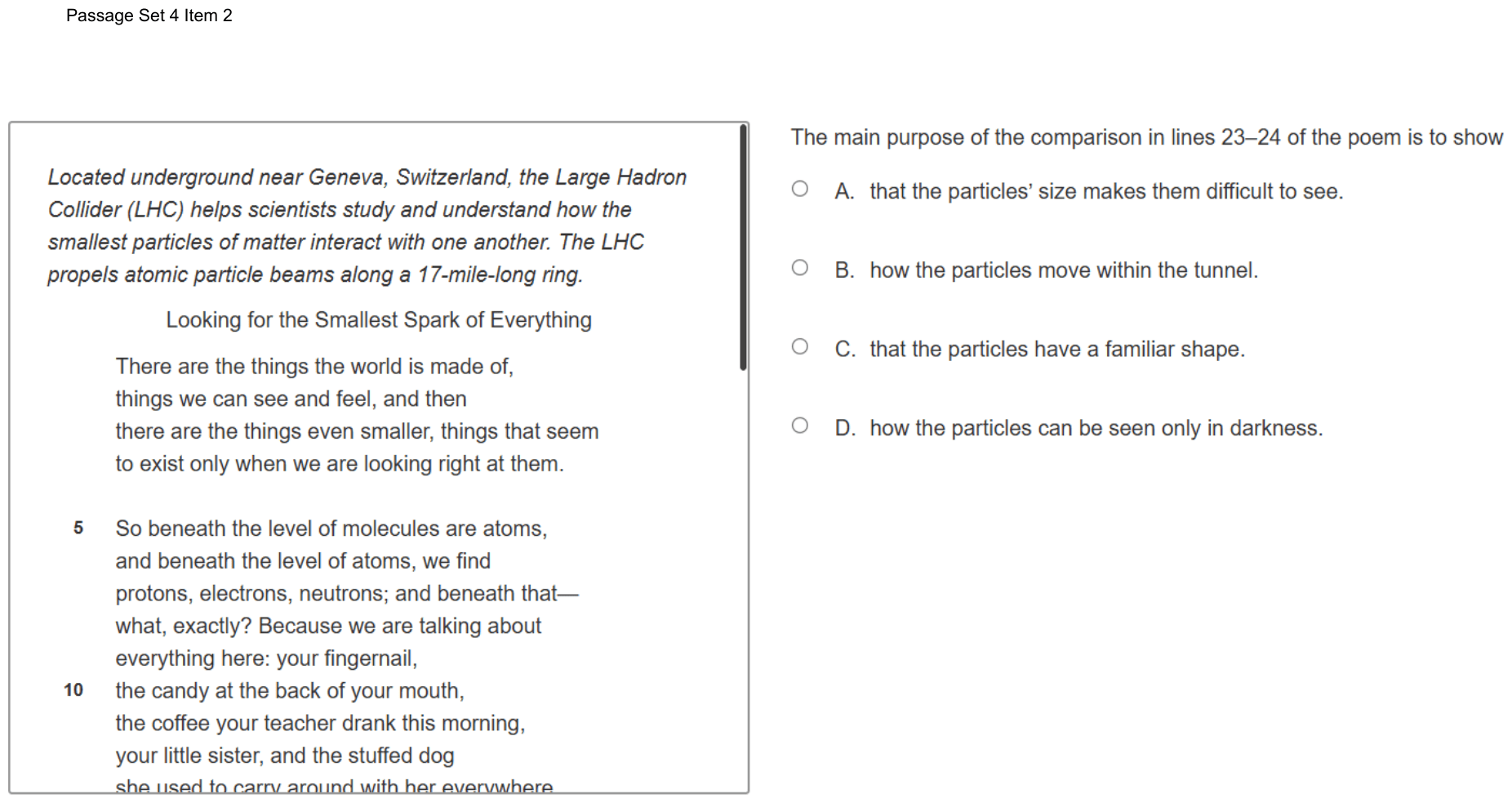
The main purpose of the comparison in lines 23–24 of the poem is to show
- Athat the particles’ size makes them difficult to see.
- Bhow the particles move within the tunnel.
- Cthat the particles have a familiar shape.
- Dhow the particles can be seen only in darkness.
Show the answer
Correct answer: B
The question asks what the comparison in lines 23–24 of the poem is mainly meant to show.
A. Incorrect. While the particles are moving “close to the speed of light” (line 24), which would make them difficult to see, the comparison in lines 23–24 focuses on the movement of the particles, not how visible they are.
B. CORRECT. Lines 23–24 describe “tiny cars / flashing along at close to the speed of light,” which describes how the particles move.
C. Incorrect. Lines 23–24 do not describe the shape of the particles but rather their movement, which is “flashing along at close to the speed of light” (line 24).
D. Incorrect. The word “flashing” in line 24 does not refer to light in darkness but rather to speed, and the word “light” is used to reference a measurement of speed, not brightness in darkness.
Question analysis
This figurative language question asks for the main purpose of a comparison in lines 23–24 of the poem “Looking for the Smallest Spark of Everything,” where particles in an underground tunnel are likened to tiny racing cars. Students must work out what the image is mainly meant to show about the particles, judging the comparison as a whole rather than word by word.
- Grade level
- Grade 6 reading and task
- Compared with grade 7
- Below grade 7 Explaining what a simple comparison shows is grade 6 work, and this one likens particles to racing cars in two short lines of familiar words, so a single step of interpretation is enough.
- Estimated difficulty
- Routine: one familiar step, little to misread.
- Thinking it demands
- Depth of knowledge 2, skills and concepts · mainly understand
- What makes it hard
- Evidence
- Answered from one sentence or line
- Reading level
- Passage: 346 words (a poem; reading level not measured); question and choices: about grade 5, 46 words.
- Students, last 30 days
- Not enough answers yet to show (it takes 10).
Why it is hard, traps and wrong answers (shows the answer)
Why it is hard
The image is built from words about motion, racing cars “flashing along at close to the speed of light,” so most students see its purpose quickly. Each wrong choice seizes one piece of the picture, the cars’ tininess, their shape or the word “light,” and makes it the point. Students who ask what the whole comparison makes them picture, rather than what one word suggests, avoid all three.
Figurative or literary language minor Understanding the question
The comparison sits in parentheses, “like racing cars, only very tiny cars / flashing along at close to the speed of light,” and students must see that racing cars stand for speed. (Graesser, Singer & Trabasso, 1994; Kintsch, 1998)
Strategy: Name the two things being compared in lines 23–24 and ask what a reader is meant to picture, then choose the purpose that the comparison’s own words support.
Traps
- Taking figurative language literally: A choice reads a figure of speech or image at face value.
- Word match: Repeats striking words or phrases from the text, so it looks supported, but its meaning does not fit the question.
- Dictionary meaning, not meaning here: A common meaning of the word that does not fit its use in this text.
The wrong answers, classified
A Word match (Freedle & Kostin, 1993)
Fixes on “very tiny cars” and decides the point is that the particles are too small to see, though racing cars are chosen for their speed, not their size.
C Taking figurative language literally (Graesser, Singer & Trabasso, 1994)
Takes the comparison at face value, as if particles looked like little cars, when the speaker uses racing to picture how they move, not what shape they have.
D Dictionary meaning, not meaning here (Perfetti, 2007)
Reads “flashing” and “light” as a glow, like the one in the darkness of lines 27–28, but “the speed of light” measures how fast the particles travel.
Working it out, step by step
Figure out what the question asks
This asks why the poet makes a comparison in lines 23–24. A comparison shows how two different things are alike. First find the two things. Then ask what the reader is meant to picture.
Read the lines around it
Lines 20–22 describe building “deep circular tunnels beneath the surface / of this Earth” to race particles. Then lines 23–24 add “(like racing cars, only very tiny cars / flashing along at close to the speed of light)”. The speed of light is the fastest speed there is.
Work out the comparison
The particles are compared to racing cars. Racing cars zoom around a track, lap after lap, very fast. The particles zoom around the round tunnel the same way. “Flashing along” means moving so fast they are a blur. So the comparison helps you picture how the particles move.
Check each choice
- A does not fit. The cars are “very tiny,” but the point is racing, not being hard to see.
- B fits. Like racing cars, the particles speed around the tunnel.
- C does not fit. The particles do not look like cars. The comparison is about motion, not shape.
- D does not fit. “Light” here measures speed. It is not about glowing in the dark.
Watch out: A is tempting because of the word “tiny.” But a poet picks racing cars to show speed, not size.
Choose the answer
The racing cars help you picture particles speeding around the tunnel. So the answer is B, “how the particles move within the tunnel.”
Why this answer and not the closest wrong one
A is the closest wrong choice, since the poem does call them “very tiny cars.” But the comparison is to racing cars “flashing along at close to the speed of light.” Every word there is about speed and motion. So B, how the particles move, fits better.
More questions like this
The original DOE question
The passage “Looking for the Smallest Spark of Everything” as printed (pages 32–33)
Question 5 of 15
2026 Practice Test C English, question 30Passage Serpent Mound
Serpent Mound
The Great Serpent Mound, located in Adams County, Ohio, is a human-made mound of earth that researchers believe was created between 300 B.C. and A.D. 1100 by an indigenous culture.
Ohio, 1846
Brush Creek stood low when the museum men came
with their measuring tapes and sketchbooks.
It was winter. Fringed with ice,
the creek doubled back on itself
as if it had forgotten something.
Pa was in Cincinnati, or else on his way home,
so Ma told me to lead the men
into the marshy low grounds. It being winter,
there was little underbrush to speak of—
in the summer there would have been
briars, poison ivy, biting flies. I listened
for the swish of a beaver’s heavy tail,
the chitter of a chickadee, or the cry of a hawk,
but the winter silence of the creek pressed
down on all of us like a weight.
The humps in the ground were all but
invisible until you were right up on them. The figure
was even less obvious: the sinuous body,
the tail coiled three times around,
and at the other end, the mouth wide open.
In the summer the creek bottom was crowded
with so much life that you could trip over
the ridges of earth before you saw
anything at all. In winter you could climb
a tree and get some idea of the whole thing:
the serpent’s body undulating, slithering
silently across the ancient
earth. At the mouth end, there was an oval mound
as if the snake were about to swallow an egg—
as snakes sometimes did in our rickety
henhouse—my Pa always said, or
as if swallowing the sun, one of the museum
men suggested, taking notes with his quill pen,
an old-style inkhorn slung at his side.
I liked that: swallowing the sun,
just the sort of thing a snake might do,
might want to do. When, later, I told my sister Ruth,
she disagreed. It is singing to the sun,
she insisted. That is why its mouth
is wide open. She said, “Sometimes I think
I hear it on summer nights. Not swallowing, singing.”
Question
What impact do the phrases “all but / invisible” and “even less obvious” in lines 16–18 have on the meaning of the poem?
- AThey indicate that viewing the full size and shape of the mound is difficult.
- BThey suggest that the location of the mound is unknown to most people.
- CThey imply that the speaker wants the location of the mound to remain a secret.
- DThey reveal that the speaker is unfamiliar with the significance of the mound.
Show the answer
Correct answer: A
The question asks what impact the phrases “all but / invisible” and “even less obvious” in lines 16–18 have on the meaning of the poem.
A. CORRECT. The words “all but / invisible” indicate that a person must be close to see the humps in the ground, while the phrase “even less obvious” indicates that a person must be far away to see the overall snake shape of the mound.
B. Incorrect. While the speaker has to lead the museum men to the mound because they did not know the exact location, the words in lines 16–18 are related to the difficulty in viewing the mound from the immediate surrounding area.
C. Incorrect. The speaker is willing to take the museum men out to study the mound, so there is no indication in the poem that the speaker wants the location of the mound to remain a secret. The words in lines 16–18 convey the idea that the mound is difficult to see.
D. Incorrect. While the speaker contemplates the significance of certain elements of the mound, the phrases in lines 16–18 relate to a viewer’s ability to see the physical shape of the mound, not its deeper meaning.
Question analysis
This word-meaning question asks what impact the phrases “all but / invisible” and “even less obvious” in lines 16–18 of “Serpent Mound” have on the poem’s meaning. Students must understand the idiom “all but” and then judge which of four claims about the mound and the speaker the two phrases actually support.
- Grade level
- Grade 6 reading and task
- Compared with grade 7
- Below grade 7 Below typical grade 7 demand: both phrases are quoted with their line numbers, in plain modern language, and one careful reading settles the question. The one hurdle is the idiom “all but,” which some readers take literally.
- Estimated difficulty
- Straightforward: two steps or one careful reading.
- Thinking it demands
- Depth of knowledge 2, skills and concepts · mainly understand
- What makes it hard
- Hard words moderate
- Reading between the lines minor
- Evidence
- Answered from one paragraph or stanza
- Reading level
- Passage: 354 words (a poem; reading level not measured); question and choices: about grade 7, 76 words.
- Students, last 30 days
- Not enough answers yet to show (it takes 10).
Why it is hard, traps and wrong answers (shows the answer)
Why it is hard
Both phrases are quoted with their lines, and the sentence that holds them goes on to list the body, the coiled tail and the open mouth, so its subject is what can be seen. The wrong choices slide from seeing to knowing: who knows where the mound is, who wants it hidden, and what it means. “Less obvious” is the slippery phrase, since obvious can also mean easy to understand.
Hard words moderate Understanding the question
“All but” is an idiom meaning almost, so “all but / invisible” means nearly unseen; a student who takes it as the opposite, plainly visible, loses the sense that the humps are hard to see. (Perfetti, 2007; Freedle & Kostin, 1993)
Reading between the lines minor Working it out
Students must keep both phrases about sight and connect them to lines 24–25, where only climbing a tree gives “some idea of the whole thing.” (Graesser, Singer & Trabasso, 1994; Kintsch, 1998)
Strategy: Put both phrases into plain words, starting with the idiom “all but,” then test each choice against what lines 16–25 actually describe.
Traps
- Twists what the text says: Uses the text's topic and ideas but changes what it says: who did it, how much, when, or why.
- Reads too much in: A reasonable-sounding conclusion that goes further than the text allows.
- Dictionary meaning, not meaning here: A common meaning of the word that does not fit its use in this text.
The wrong answers, classified
B Twists what the text says (King et al., 2004)
Turns “invisible” into “unknown,” helped by Ma sending the speaker to guide the men, but the phrases say how hard the mound is to see, not who knows where it is.
C Reads too much in (Graesser, Singer & Trabasso, 1994)
Finds a wish for secrecy in the hidden humps, though the speaker leads the museum men straight to the mound and never tries to keep it from anyone.
D Dictionary meaning, not meaning here (Perfetti, 2007)
Takes “less obvious” in its sense of harder to understand, but the sentence goes straight on to list the body, the coiled tail and the open mouth, so the word is about sight.
Working it out, step by step
Figure out what the question asks
This asks what two phrases add to the poem’s meaning. They are “all but / invisible” and “even less obvious,” in lines 16–18. Put each phrase in plain words first. Then see what they tell you about the mound.
Read lines 16–18
Lines 16–18 say “The humps in the ground were all but / invisible until you were right up on them. The figure / was even less obvious.” “All but” means almost. So the humps were almost invisible until you got very close. The figure is the whole snake shape. It was even harder to see than the humps. Here, obvious means easy to see.
Connect the phrases to later lines
The same sentence goes on to list what you would see: “the sinuous body, / the tail coiled three times around, / and at the other end, the mouth wide open.” So the phrases are about seeing the shape. Later, lines 24–25 say “In winter you could climb / a tree and get some idea of the whole thing.” Only from up high could you begin to see it. The mound is huge, low and hard to take in all at once.
Check each choice
- A fits. Both phrases show that seeing the whole mound is hard.
- B does not fit. The phrases are about how hard the mound is to see, not about who knows where it is.
- C does not fit. The speaker leads the museum men right to the mound. There is no wish to keep it secret.
- D does not fit. Here “less obvious” is about sight, not about understanding what the mound means.
Watch out: Obvious can also mean easy to understand. That reading leads to D. But the sentence goes straight on to list parts of the snake you can see.
Choose the answer
The phrases show how hard it is to see the mound’s full size and shape. So the answer is A, “They indicate that viewing the full size and shape of the mound is difficult.”
Why this answer and not the closest wrong one
B is a close wrong choice, because “invisible” can make you think nobody knows the mound is there. But the phrases describe looking, not knowing. The speaker knows exactly where the mound is. The problem is seeing it. The humps vanish until “you were right up on them,” and the whole shape shows only from a tree.
More questions like this
The original DOE question
The passage “Serpent Mound” as printed (page 40)
Question 6 of 15
2026 Practice Test D English, question 17Passage Wolves of the Sea
Wolves of the Sea
The cool and misty landscape of the Great Bear Rainforest can be found along the coast of British Columbia, Canada, and its nearby islands, from Vancouver Island to the Alaskan border. Within this protected area, wolves roam the forests, islands, and beaches. When biologist Chris Darimont began to study these wolves, he wanted to confer with local First Nations groups, as aboriginal Canadians are known, in order to learn what they knew about these wolves. He spoke with Chester Starr, an elder of the Heiltsuk Nation that has occupied the Great Bear Rainforest for thousands of years. What Starr had to say about the wolves changed Darimont’s perception of the animals.
Starr asked Darimont which wolves he and his team were going to study—the timber wolves (mainland wolves) or the coastal wolves on the islands. The question took Darimont by surprise. Biologists had always believed that the wolves that are sometimes spotted swimming between islands and eating salmon are the same wolves that live on the mainland. Darimont was intrigued by Starr’s classification of the wolves as two different groups. At first, he was hesitant to accept the idea. The distances between the mainland and the islands are small, less than a mile. Why would the wolves on the islands be any different from the wolves on the mainland? To find out, Darimont and his research team studied the wolves on the islands and in the densely forested territory of the Great Bear Rainforest for ten years.
Throughout the study, Darimont recorded several significant, observable differences between the “sea wolves,” as they are nicknamed, and the mainland wolves. Compared with the mainland wolves, the sea wolves are smaller in size and are strong swimmers. In 1996 sea wolves were spotted on an island nearly eight miles from any other land formation. While mainland wolves almost exclusively eat meat, such as deer and elk, and teach their young to hunt for land animals, sea wolves get as much as 90 percent of their nutrition from the sea and teach their young to dig for clams and to catch fish. Sea wolves regularly swim between islands and have been known to sneak up on a seal sunning itself on a rock and make a leaping attack from the water. Some salmon-eating mainland wolves come and go from the islands with the fish-spawning season, but the sea wolves are full-time island residents. Darimont suspects that some sea wolves live their entire life on the islands.
The sea wolves displayed not only physical and behavioral differences but also genetic variations from the mainland wolves. After collecting and analyzing the DNA in 800 samples of gray fur and wolf waste, researchers could produce hard biological evidence that sea wolves had genetic markers that made them distinct from the mainland wolves. A genetic marker is a variation in a DNA sequence that can be used to identify individuals or a species because it is passed down to offspring. Darimont hypothesizes that a change in habitat led to the eventual genetic differences between sea wolves and mainland wolves. Many years ago, loss of habitat and food sources forced some mainland wolves out to the islands. They learned to eat everything from kelp and fish eggs to the remains of sea creatures that washed up on the beach. Wolves living on the islands and mainland wolves became more isolated and rarely mated with each other. Over time the two types of wolves became more distinct.
It turned out that Chester Starr was right all along. “It sounded totally bizarre at first,” admits Darimont, “that there could be two versions of the species.” But he now realizes that this skepticism “definitely reflected my ignorance of indigenous knowledge at the time.” Learning to trust the wisdom of the Heiltsuk people opened Darimont up to knowledge accumulated over millennia and positioned him so that he could gather new scientific evidence about one of British Columbia’s most elusive species, the sea wolf.
Question
Read this sentence from paragraph 4.
After collecting and analyzing the DNA in 800 samples of gray fur and wolf waste, researchers could produce hard biological evidence that sea wolves had genetic markers that made them distinct from the mainland wolves.
The phrase “hard biological evidence” conveys that the goal of the research team was to
- Adevelop a procedure in order to ensure their study yielded plentiful data about the wolves.
- Bseek definitive scientific proof of the number of wolf species present in the area of the study.
- Cconduct a study to evaluate multiple theories about the diets of different wolf species.
- Ddiscover if the new data would provide information different from that of previous studies.
Show the answer
Correct answer: B
The question asks what the phrase “hard biological evidence” in the sentence from paragraph 4 conveys about the goal of the research team.
A. Incorrect. Although the research team followed a labor-intensive procedure, the phrase “hard biological evidence” refers to the product of their scientific research (the genetic markers revealed within the DNA samples), not the process by which they collected it. Their goal was not to develop a procedure for data collection but to determine precisely how many species of wolf were present in the area.
B. CORRECT. The research team wanted to prove or disprove the theory that two separate groups of wolves were present in the area, an idea that was already supported by the observations of scientists and local indigenous people. The phrase “hard biological evidence” conveys that the scientists wanted to bolster their observations of the wolves with concrete scientific data about the wolves’ biological makeup. The goal of the researchers was to use the data to prove how many species of wolf were present in the area of the study.
C. Incorrect. The research team gathered extensive data during their study (“After collecting and analyzing the DNA in 800 samples of gray fur and wolf waste” [paragraph 4]), and their goal in doing so was to evaluate a single theory about the wolves: that the wolves had evolved into two separate and genetically distinct species. The research team did not conduct the study in order to evaluate multiple theories about the diets of the wolves.
D. Incorrect. The phrase “hard biological evidence” does not suggest that the research team was hoping to discover if the new data would provide information that was different from previous studies. In fact, the goal of the research team was to use the genetic data to supplement their initial sources of information about the wolves and their own observations from the field.
Question analysis
This word-in-context question quotes a sentence from paragraph 4 of “Wolves of the Sea” about DNA taken from 800 samples of gray fur and wolf waste, and asks what the phrase “hard biological evidence” shows about the research team’s goal. Students must work out what the phrase says about the evidence and then turn that into a statement of purpose, choosing among four plausible aims for a study.
- Grade level
- Grade 8 reading and task
- Compared with grade 7
- Above grade 7 Grade 7 students regularly interpret a phrase in context. Here the phrase must be turned into a claim about the team’s purpose, which the passage never states outright, and the four choices are abstract research goals that each sound reasonable.
- Estimated difficulty
- Hard: combines ideas, needs a plan, and has more than one tempting wrong answer.
- Thinking it demands
- Depth of knowledge 2, skills and concepts · mainly understand
- What makes it hard
- Reading between the lines moderate
- Hard words moderate
- Evidence in several places minor
- Evidence
- Answered from several paragraphs or stanzas
- Reading level
- Passage: about grade 10, 662 words; question and choices: about grade 10, 114 words.
- Students, last 30 days
- Not enough answers yet to show (it takes 10).
Why it is hard, traps and wrong answers (shows the answer)
Why it is hard
The question asks for a purpose, but the phrase it quotes describes a result, so students have to reason from the kind of evidence produced to what the team wanted it for. Readers who take “hard” as difficult drift toward a goal about procedure, and those who remember that biologists had long thought the wolves were one group are drawn to a goal of overturning earlier studies. The key’s “number of wolf species” is looser than the passage’s “two versions of the species,” which can make careful readers hesitate.
Reading between the lines moderate Working it out
The passage never states the team’s goal, so students must work back from “hard biological evidence” to the question paragraph 2 set up: whether island and mainland wolves are really two groups. (Graesser, Singer & Trabasso, 1994; Kintsch, 1998)
Hard words moderate Understanding the question
“Hard” here means solid and conclusive, as in hard evidence, not difficult; students who know only the everyday sense connect it to the labor of analyzing 800 samples of fur and waste. (Perfetti, 2007; Freedle & Kostin, 1993)
Evidence in several places minor Working it out
The goal the phrase points to lies two paragraphs back, in Starr’s two-group question and Darimont’s ten-year study “to find out,” not in the sentence the stem quotes. (Kirsch & Mosenthal, 1990; Gorin & Embretson, 2006)
Strategy: Replace “hard” with a word that fits evidence produced by DNA analysis, then ask what the team wanted that kind of evidence for, recalling the question Darimont set out to answer.
Traps
- Dictionary meaning, not meaning here: A common meaning of the word that does not fit its use in this text.
- Reads too much in: A reasonable-sounding conclusion that goes further than the text allows.
- Wrong part of the text: A choice is true of another paragraph, stanza or speaker than the one asked about.
The wrong answers, classified
A Dictionary meaning, not meaning here (Perfetti, 2007)
Reads “hard” as difficult and ties it to the labor of analyzing 800 samples, so takes the goal to be a thorough procedure rather than conclusive proof.
C Wrong part of the text (Kirsch & Mosenthal, 1990)
Brings in the diet differences of paragraph 3, clams, fish and seals, as theories under test, though the DNA work in paragraph 4 asked whether two groups exist.
D Reads too much in (Graesser, Singer & Trabasso, 1994)
Knows that biologists “had always believed” the wolves were one group and assumes the team set out to contradict earlier studies, which the phrase about solid proof does not suggest.
Working it out, step by step
Figure out what the question asks
This asks what a phrase shows about the team’s goal. A goal is what you are trying to get. The phrase names the kind of evidence the team got. Work back from that to what they wanted it for.
Read the sentence with the phrase
In paragraph 4, the team studied “800 samples of gray fur and wolf waste.” Then they “could produce hard biological evidence that sea wolves had genetic markers that made them distinct from the mainland wolves.” A genetic marker is a small difference in the DNA that parents pass to their young. Distinct means clearly different.
Work out what “hard” means
Here “hard” does not mean difficult. Hard evidence is solid proof that is tough to argue with. Biological means it comes from living things and their bodies. So the team wanted firm proof from the wolves’ own bodies.
Connect the proof to the question
What did they want to prove? Go back to paragraph 2. Starr said there were two groups of wolves. Darimont was unsure. “To find out,” his team studied the wolves. The DNA gave a firm answer: the sea wolves really are a separate group. So the goal was solid proof of how many groups of wolves live there.
Check each choice
- A is wrong. It reads “hard” as hard work. The phrase is about how firm the proof is, not about a procedure.
- B is right. Definitive means final and settled. The team wanted settled proof of how many groups of wolves live there. B says “species,” which goes further than the passage. Darimont speaks only of “two versions of the species.”
- C is wrong. Diets come up in paragraph 3. The DNA work tested whether there were two groups.
- D is wrong. The phrase says nothing about earlier studies.
Watch out: D is tempting because biologists “had always believed” the wolves were one group. But “hard” evidence is about firm proof, not about beating old studies.
Choose the answer
“Hard biological evidence” shows the team wanted firm, scientific proof. So the answer is B, “seek definitive scientific proof of the number of wolf species present in the area of the study.”
Why this answer and not the closest wrong one
D is the closest wrong answer. Biologists had thought the wolves were one group, so D can seem to fit. But the phrase “hard biological evidence” is about how firm the proof is. It says nothing about earlier studies. B matches that: the team wanted settled proof of how many groups there were.
More questions like this
The original DOE question
The passage “Wolves of the Sea” as printed (pages 23–24)

Question 7 of 15
2024 Test A English, question 27Passage Champion of the Channel
Champion of the Channel
In 1926 an editor at the London Daily News predicted that Gertrude Ederle, an American swimmer with eighteen world records and three Olympic medals, would fail in her attempt to swim across the English Channel. He claimed that “even the most uncompromising champion of the rights and capacities of women must admit that in contests of physical skill, speed and endurance they must remain forever the weaker sex.” Yet, at only nineteen years old, Ederle not only became the first woman to accomplish this feat, she also broke the men’s record by two hours. Gertrude Ederle’s triumphant swim across the English Channel was a testimony to her determination, innovative spirit, and passion for swimming.
Crossing the English Channel is a daunting task for any swimmer. At its narrowest point, the channel measures twenty-one miles across. Its icy waters hover around sixty degrees Fahrenheit, and its unruly tides and currents toss swimmers about like bobbing corks. Stinging jellyfish, seaweed, and floating debris from shipwrecks and lost cargoes present added hazards.
For decades the channel’s perils have defeated countless swimmers. Ederle, too, failed in her first attempt to cross the channel in 1925. Just six miles short of finishing, she became ill, and her coach had to haul her out of the water. Undeterred, Ederle decided to try again. Ederle knew that if she did not complete the challenge this time, she might never get the opportunity to set this record, because a rival female swimmer was preparing to make her second attempt at the crossing as well.
To prepare for the marathon swim, Ederle found ways to improve her equipment. She and her sister Meg discovered that melted candle wax perfectly sealed goggle edges, effectively waterproofing Ederle’s goggles against hammering waves. The sisters also designed a two-piece silk swimsuit for Ederle. During her first channel-crossing attempt she had worn a standard one-piece swimsuit that, after the lengthy hours of swimming across the channel, had stretched out, filling with water and creating drag, making an already challenging task almost insurmountable. Unlike the cumbersome typical bathing suit, this silk invention weighed little and allowed for easy movement.
On August 6, 1926, Ederle waded into the channel near Cape Gris-Nez, France. At first she shivered in the bone-chilling water even though she had covered her body in eight layers of grease for insulation. Her limbs felt stiff. Her strokes were irregular. Driving forward, she fought to clear her mind and find what she called her “sphere,” a place where the sea became her only companion and the shrieks of gulls and the humming of boat engines faded away. Using a new overhand stroke called the American crawl, Ederle eventually settled into a steady pace, briskly breaking through waves.
Throughout Ederle’s swim, two tugboats accompanied her. One carried newspaper reporters who wired dispatches of her progress to shore. The other, displaying a sign that read “This way, ole kid!” with an arrow pointing forward, transported her coach, family, and friends. Her coach played songs, such as “Yes, We Have No Bananas,” on a phonograph so that Ederle could time her strokes to the rhythm. Using a net, her coach also passed her baby bottles of broth for nourishment.
For hours Ederle swam, dodging debris with an amused smile. However, as she neared the English shore, a sudden fierce storm erupted. The tides and waves forced Ederle backward, and she fought the stubborn swells for several hours. The salty water caused her tongue to swell and inflamed her ears. Yet Ederle felt indescribably happy as she churned through the sea. Finally, as she neared the English shore, the storm abated, and the tide turned. No longer fighting against her, the sea pushed her toward the shore and victory.
After fourteen hours and thirty-one minutes, Ederle, on wobbly legs, stepped onto the English shore. The waiting crowd roared, honked their automobile horns, blasted their tugboat whistles, and set off flares that flashed in the sky. Ederle had swum into history.
When Ederle returned to New York, she received a parade, where thousands of people shouted “Trudy!” Not only were everyday American citizens proud of Ederle, but she also inspired them to be more active. Over the next few years, more than 60,000 people credited her with motivating them to earn their American Red Cross swimming certificates. Gertrude Ederle’s accomplishment proved to the world that with determination and passion, it was possible for a person to achieve his or her goals.
SOLO SWIMS ACROSS THE ENGLISH CHANNEL
|
Earliest Speed Records |
||
| Year | Swimmer | Time |
| 1875 | Matthew Webb (M) | 21 hours, 45 minutes |
| 1923 | Enrico Tiraboschi (M) | 16 hours, 33 minutes |
| 1926 | Gertrude Ederle (F) | 14 hours, 31 minutes |
| 1926 | Arnst Vierkotter (M) | 12 hours, 38 minutes |
| Current Speed Records | ||
| Year | Swimmer | Time |
| 2012 | Trent Grimsey (M) | 6 hours, 55 minutes |
| 2006 | Yvetta Hlavacova (F) | 7 hours, 25 minutes |
Question
Read this sentence from paragraph 4.
During her first channel-crossing attempt she had worn a standard one-piece swimsuit that, after the lengthy hours of swimming across the channel, had stretched out, filling with water and creating drag, making an already challenging task almost insurmountable.
The word “insurmountable” is used to highlight
- Ahow the bathing suit made it impossible for Ederle to make it across the channel.
- Bhow Ederle and her sister decided to improve Ederle’s swimming equipment in a creative way.
- Cthat the flaws in Ederle’s bathing suit made a difficult task even more complicated.
- Dthat the swimming equipment Ederle used needed to be custom made for her attempt.
Show the answer
Correct answer: C
The question asks about the effect of the word “insurmountable,” which means “incapable of being overcome,” in paragraph 4.
A. Incorrect. Ederle did not complete her first swim because she became ill (“Just six miles short of finishing, she became ill, and her coach had to haul her out of the water.” [paragraph 3]), not because the suit made it impossible for Ederle to complete her swim.
B. Incorrect. The author uses the word “insurmountable” to draw attention to the increased difficulty caused by the suit, not to draw attention to the sisters’ creativity in solving the problem.
C. CORRECT. The suit Ederle wore during her first attempt to swim the channel “stretched out, filling with water and creating drag” (paragraph 4), which likely contributed to her failed attempt to swim across the channel.
D. Incorrect. The passage does not address whether the original suit was custom made, simply that the suit created additional difficulties for Ederle in a situation that was already difficult.
Question analysis
This vocabulary-in-context question quotes a sentence about the stretched-out swimsuit Gertrude Ederle wore on her first attempt to swim the English Channel and asks what the word insurmountable is used to highlight. Students must decide what point the word stresses in this sentence rather than simply define it, and the choices range from the old suit's effects to the sisters' new equipment.
- Grade level
- Grade 7 reading and task
- Compared with grade 7
- At grade 7 Explaining what a strong word emphasizes in context is standard grade 7 vocabulary work. The sentence is printed in the question, which saves a search, but it is long, with several phrases stacked between the swimsuit and the key word.
- Estimated difficulty
- Moderate: several steps, or a close reading with one strong distractor.
- Thinking it demands
- Depth of knowledge 2, skills and concepts · mainly analyze
- What makes it hard
- Hard words moderate
- A very close wrong answer moderate
- Complex sentences minor
- Evidence
- Answered from one sentence or line
- Reading level
- Passage: about grade 9, 790 words; question and choices: about grade 10, 108 words.
- Students, last 30 days
- Not enough answers yet to show (it takes 10).
Why it is hard, traps and wrong answers (shows the answer)
Why it is hard
The phrase to weigh is “an already challenging task almost insurmountable”, and two small words carry it: “already” says the swim was hard to begin with, and “almost” stops short of impossible. Students who know only the dictionary meaning blame the suit for a failure that paragraph 3 pins on illness. Those who look past the sentence to the sisters' new gear answer a different question, about the fix rather than the problem the word stresses.
Hard words moderate Understanding the question
The question hinges on “insurmountable”, impossible to overcome, which is softened by the “almost” in front of it and set against the “already challenging task” it describes. (Perfetti, 2007; Freedle & Kostin, 1993)
A very close wrong answer moderate Choosing the answer
The right choice and the one saying the suit made the crossing impossible both blame the old suit; they differ only in degree, which is exactly what “almost” decides. (Embretson & Wetzel, 1987; Gorin & Embretson, 2006; Ascalon et al., 2007)
Complex sentences minor Understanding the question
The stem prints all 38 words of the sentence, but between the swimsuit and “insurmountable” come an inserted time phrase, the verb “had stretched out” and two “-ing” phrases, so the link is easy to lose. (Abedi & Lord, 2001; Freedle & Kostin, 1993; Messick, 1989)
Strategy: Say in your own words what the quoted sentence claims about the old swimsuit, then choose the statement that restates that claim, checking each choice against the sentence word by word.
Traps
- Dictionary meaning, not meaning here: A common meaning of the word that does not fit its use in this text.
- Wrong purpose or structure: Names a purpose, structure or effect that the part does not serve, or describes what a part says when the question asks what it does.
- Reads too much in: A reasonable-sounding conclusion that goes further than the text allows.
The wrong answers, classified
A Dictionary meaning, not meaning here (Perfetti, 2007)
Gives “insurmountable” its full dictionary force and drops “almost”, so the suit seems to have made the crossing impossible, though paragraph 3 says she stopped in 1925 because she became ill.
B Wrong purpose or structure (Anderson & Krathwohl, 2001)
Describes what the paragraph goes on to do, the sisters' creative silk suit and waxed goggles, when the quoted sentence and its key word dwell on the old suit's flaws.
D Reads too much in (Graesser, Singer & Trabasso, 1994)
Reasons that because a standard suit failed, her gear had to be custom made, a conclusion the passage never draws and the word does not point toward.
Working it out, step by step
Figure out the word’s job
This question asks why the author chose one word, “insurmountable,” in paragraph 4. First you need to know what the word means. Then you can see which idea it helps the sentence stress.
Break the word into parts
To surmount something is to get over it or on top of it, the way a climber gets to the top of a cliff. The start in- means not, and the end -able means can be. So something insurmountable cannot be gotten over. It is too hard to beat.
Read the words around it
The old suit “had stretched out, filling with water and creating drag.” Drag is a force that pulls back on you and slows you down. This made “an already challenging task almost insurmountable.” Two small words matter a lot. Already tells you the swim was hard even before the suit caused trouble. Almost tells you it came close to impossible, but not all the way.
Decide what the word stresses
Put together, the phrase stresses how much worse the old suit made things. A task that was hard to begin with became even harder. The word does not say the suit by itself made the swim impossible.
Check each choice
- C fits: the suit’s flaws made “a difficult task even more complicated,” just like “already challenging” plus “almost insurmountable.”
- A is wrong because it drops “almost,” and paragraph 3 says her first try ended when she “became ill.”
- B is wrong because the sisters’ clever new gear comes in other sentences, while this word is about the problem.
- D is wrong because the passage never says her gear had to be custom made.
Watch out: A uses the word’s dictionary meaning. Always read the small words around a key word.
Choose the answer
The word shows how the old suit turned a hard swim into a nearly hopeless one. So the answer is C.
Why this answer and not the closest wrong one
A comes closest, since “insurmountable” alone does mean impossible. But the author wrote “almost” in front of it. And paragraph 3 says illness, not the suit, ended her first try. C keeps the exact amount the sentence gives: a hard task made even harder.
More questions like this
The original DOE question
The passage “Champion of the Channel” as printed (pages 56–57)
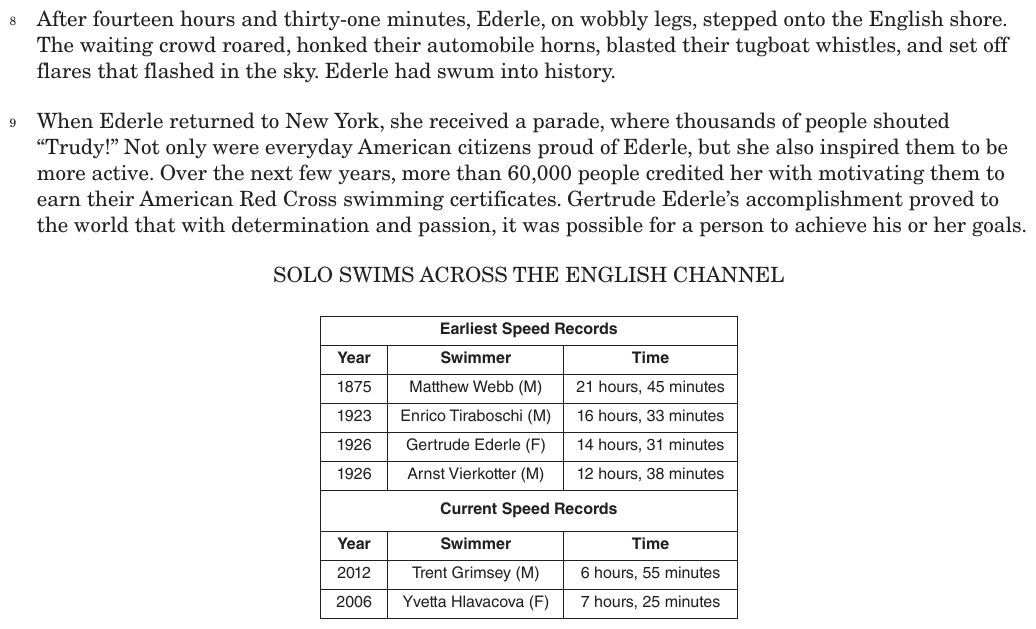
Question 8 of 15
2024 Test B English, question 28Passage Excerpt from Do Them No Harm!
Excerpt from Do Them No Harm!
by Zoa L. Swayne
This narrative is about the Nez Perce, an American Indian tribe, in what is now northern Idaho. The tribe is preparing for a gathering before the coming winter.
In the moon of Ta-Yum, the hottest days of summer, when salmon spawn in the little streams and huckleberries ripen in the high mountains, people from many villages of the Chopunnish Nation gathered in the Oyaip Prairie for the work and festivities of their annual camas1 harvest.
From far and near The People came. . . .
Should a stranger enter their homeland and ask, “Where are you from?” the reply was always, “We are Nee-mee-poo, The People who live here in this place.”
It was a time of Lawtiwa-mah-ton—a time of being friends together—when The People came for this last chance to enjoy being together before the Cold Moons kept them close to their fires. The visiting and trading, the foot racing and horse racing, and the gambling and stick games would be remembered and talked about long after they had forgotten the drudgery of digging and roasting camas, picking berries, or drying meat and fish. Lawtiwa-mah-ton! It was good to be friends together.
As was their custom since wahk-kee-ma, a time far back beyond the memory of man, they set up their camps in the same locations their parents and grandparents had occupied before them. Red Bear’s people, from Kamiah, made their camp near the trail that came out of the mountains. Their neighbors in Kamiah Valley, The People from Tee-e-lap-a-lo, had their camp close by. Across the wide meadow, by the great roasting pits, the camps of the Te-wap-poo and Ask-kah-poo were located. The tepees and ish-nash, brush shelters, of other groups nestled in their accustomed areas in and among the pines in such numbers that they encircled the entire meadow land.
Red Bear’s people had traveled all summer with neighboring bands, gathering and preparing roots, picking and drying berries, drying and smoking meat and fish for their winter food supply. Now they were at the Oyaip camp. The women worked hard to dig and cure as many bags of roots as they could during the warm, sunny days, for the sharp night air brought warnings that WARM was going and COLD was coming.
Everyone helped in some way. Most of the men fished or hunted for meat. While many of the women dug and roasted camas, other women and older children picked and dried berries.
And the younger children played. They played at hunting. They played with the babies. They played with their horses and puppies. They learned how to live through their play.
This sun, happiness, peace, and quiet blessed the Red Bear camp. All were busy with their daily tasks, until sudden cries came from the children playing by the trail.
“People coming! People coming! People coming on the trail from the high mountains!” they called as they ran to their elders, who looked sharply at the figures of approaching horsemen.
Were they friends or enemies? Did they bring good news or bad?
“Who can it be? What brings them here?” were the questions in every mind.
“Could they be the four hunters who had gone to Buffalo Country two summers past? Would they have news of the families who had gone long ago to Buffalo Country and never returned?”
It was customary for a hunting party to be gone for more than one season.
“Looks like hunters,” the older men agreed. “Looks like they had good hunting. Maybe our four hunters. [They have] been gone many moons.”
“Looks like five people—not four,” others observed.
Excitement grew as the riders came close enough to be recognized.
“A-a-a-a-a, they are our four hunters! But who is the fifth person?” they asked.
“Looks like a woman. Who is she?”
The hunters rode up to the welcoming crowd, proud to show off the loads of meat, hides, and other trophies of their hunt. They paraded around the encampment for all to see how strong their Hunting Power had been—what great hunters they, themselves, were.
Red Bear’s people rejoiced at their hunters’ success. Good hunters brought good to everybody. The meat meant plenty of food and the hides meant soft-tanned robes to give comfort through the Cold Moons. But it was the sight of the frail figure of the woman that aroused their curiosity. Who was she? Where had she come from? . . .
“Belongs to Red Bear people. Gone then come back,” the hunters said, as they dismounted and unloaded their packs. . . .
Now they could see! She was the daughter of the family gone so long ago! The girl-child who had left came back now—a grown woman.
“Wat-ku-ese!” the women cried. “Gone-from-Home-then-Come-Back. Wat-ku-ese!” And Wat-ku-ese was her name from that time on.
Gentle arms lifted Wat-ku-ese from her horse. The women brought her food and made a place for her to rest. For many suns they cared for her until she became stronger.
One evening Wat-ku-ese told her story for all to hear.
From DO THEM NO HARM!: Lewis and Clark Among the Nez Perce by Zoa L. Swayne. Published by Caxton Press. Copyright © 1990 by Zoa L. Swayne. Orofino, Idaho and Legacy House, Inc. Orofino, Idaho. All rights reserved.
1camas: a wild, edible plant
Question
In paragraph 20, the phrases “trophies of their hunt” and “paraded around” affect the paragraph by
- Asuggesting that the hunters are rewarded for their leadership.
- Bemphasizing that The People are dependent on the hunters for food.
- Crevealing that the hunters are pleased with their success.
- Dindicating that The People have gathered specifically to welcome the hunters.
Show the answer
Correct answer: C
The question asks how the phrases “trophies of their hunt” and “paraded around” affect paragraph 20.
A. Incorrect. The phrase “trophies of their hunt” describes the animals that the hunters have successfully found. They have already received their rewards (the animals) and are showing them to The People.
B. Incorrect. The excerpt describes many ways that The People find and prepare their own food. While they appreciate the extra food, they are not dependent on the hunters.
C. CORRECT. The hunters “paraded around” because they were proud of the animals they had been able to get while hunting. Since a trophy is a recognition of success, they consider these animals their trophies.
D. Incorrect. The phrases show the pride the hunters feel. As paragraph 20 says, the hunters want “all to see how strong their Hunting Power had been.” The phrases are focused on the hunters rather than on those who have gathered around them.
Question analysis
This word-meaning question looks at the phrases “trophies of their hunt” and “paraded around” in the scene where four Nez Perce hunters ride back into camp, and asks what the phrases add to the paragraph. Students must work out what the words suggest in this context, not just their dictionary meanings, and weigh four plausible effects on the paragraph.
- Grade level
- Grade 6 reading and task
- Compared with grade 7
- Below grade 7 Grade 7 students analyze the connotations of words in context. These two phrases are familiar and sit in one short paragraph with helpful context nearby, so this is lighter than typical grade 7 word-choice work.
- Estimated difficulty
- Straightforward: two steps or one careful reading.
- Thinking it demands
- Depth of knowledge 2, skills and concepts · mainly analyze
- What makes it hard
- Evidence
- Answered from one paragraph or stanza
- Reading level
- Passage: about grade 5, 885 words; question and choices: about grade 8, 55 words.
- Corrected from the DOE handbook
- A quotation in the explanation was corrected to match the passage.
- Students, last 30 days
- Not enough answers yet to show (it takes 10).
Why it is hard, traps and wrong answers (shows the answer)
Why it is hard
Paragraph 20 nearly states the answer: the hunters are “proud to show off” their loads and parade “for all to see how strong their Hunting Power had been.” Errors come from neighboring details instead: the welcoming crowd in the same paragraph, the food for everyone in the next, or the everyday sense of a trophy as an award. Reading the phrases inside their own sentences settles it.
Figurative or literary language minor Understanding the question
“Trophies of their hunt” turns meat and hides into prizes and “paraded around” suggests a show, and students must read both as signs of pride rather than of awards or ceremony. (Graesser, Singer & Trabasso, 1994; Kintsch, 1998)
The right answer is reworded minor Choosing the answer
The right choice recasts “proud to show off” in new words, while one wrong choice echoes the “welcoming crowd” and another the “plenty of food” of paragraph 21. (Freedle & Kostin, 1993; Kirsch & Mosenthal, 1990)
Strategy: Think about what each phrase usually suggests, then reread the whole of paragraph 20 to check that meaning against the context before looking at the choices.
Traps
- Dictionary meaning, not meaning here: A common meaning of the word that does not fit its use in this text.
- Too broad or too strong: A choice overstates, generalizes, or uses absolute words the text does not support.
- Twists what the text says: Uses the text's topic and ideas but changes what it says: who did it, how much, when, or why.
The wrong answers, classified
A Dictionary meaning, not meaning here (Perfetti, 2007)
Reads “trophies” as prizes handed out for an achievement and adds leadership, but the trophies are the meat and hides, and nothing mentions leading.
B Too broad or too strong (King et al., 2004)
Borrows paragraph 21’s point that good hunters bring food for all and inflates it into dependence, though The People gather much of their own food.
D Twists what the text says (King et al., 2004)
Is drawn by the “welcoming crowd” in the same paragraph, but The People came to Oyaip for the camas harvest and simply greet the hunters who arrive.
What was corrected from the DOE handbook, and why
- Explanation: The handbook’s explanation of Option C says the hunters “parade around.” Paragraph 20, and the question itself, say they “paraded around the encampment,” so the site now quotes “paraded around” and puts the rest of that sentence in the past tense to match.
Working it out, step by step
Figure out what the question asks
This asks what two phrases add to paragraph 20: “trophies of their hunt” and “paraded around.” Think about what each phrase suggests. Then check it against the whole paragraph.
Think about each phrase
A trophy is something you show off to prove you won, like a cup for a winning team. Here the trophies are the meat and hides from the hunt. To parade is to march around so people can watch, like in a parade. Both phrases suggest showing off something you are proud of.
Check the whole paragraph
Paragraph 20 says the hunters were “proud to show off the loads of meat, hides, and other trophies of their hunt.” Then “They paraded around the encampment for all to see how strong their Hunting Power had been.” An encampment is a camp. The paragraph ends “what great hunters they, themselves, were.” So the hunters are proud of how well they did.
Check each choice
- C fits. The hunters are pleased with their success.
- A: no one gives the hunters a prize. The trophies are what they caught, and nothing mentions leading.
- B: The People get much of their own food. They dig roots, pick berries and fish. They don’t depend on the hunters to eat.
- D: The People came for the camas harvest. They greet the hunters when they arrive. They did not gather just for them.
Watch out: D is tempting because the paragraph mentions a “welcoming crowd.” But the two phrases describe the hunters, not the crowd.
Pick the answer
Both phrases show the hunters proudly showing off the results of a good hunt. So the answer is C: the hunters are pleased with their success.
Why this answer and not the closest wrong one
D and B are the closest wrong answers, because they use nearby details: the “welcoming crowd” and the food the hunters bring. But the two phrases are about the hunters themselves. They are “proud to show off” what they caught. That pride is C.
More questions like this
The original DOE question
The passage “Excerpt from Do Them No Harm!” as printed (pages 177–178)
Question 9 of 15
2024 Test B English, question 47Passage Snowy Mountains
Snowy Mountains
by John Gould Fletcher
Higher and still more high,
Palaces made for cloud,
Above the dingy city-roofs
Blue-white like angels with broad wings,
Pillars of the sky at rest
The mountains from the great plateau
Uprise.
But the world heeds them not;
They have been here now for too long a time.
The world makes war on them,
Tunnels their granite cliffs,
Splits down their shining sides,
Plasters their cliffs with soap-advertisements,
Destroys the lonely fragments of their peace.
Vaster and still more vast,
Peak after peak, pile after pile,
Wilderness still untamed,
To which the future is as was the past,
Barrier spread by Gods,
Sunning their shining foreheads,
Barrier broken down by those who do not need
The joy of time-resisting storm-worn stone,
The mountains swing along
The south horizon of the sky;
Welcoming with wide floors of blue-green ice
The mists that dance and drive before the sun.
“Snowy Mountains” by John Gould Fletcher—Public Domain
Question
Read lines 21–22 from the poem.
Barrier broken down by those who do not need
The joy of time-resisting storm-worn stone,
How do the lines help convey the speaker’s point of view?
- AThey suggest that the speaker wants to remove the obstacles that prevent others from experiencing the wonders of nature.
- BThey reveal the speaker’s opinion that some people are too busy to appreciate natural beauty.
- CThey reflect the speaker’s dismay that people destroy the natural landscape without understanding the ramifications of their actions.
- DThey explain that the speaker is confident that nature will never be fully destroyed by people.
Show the answer
Correct answer: C
The question asks how lines 21–22 help convey the speaker’s point of view.
A. Incorrect. The word “barrier” (line 21) refers to the speaker’s opinion that the mountains were “spread by Gods” (line 19) and not to an obstacle that the speaker thinks should be removed.
B. Incorrect. While the lines indicate that people have lost the need to connect with nature, they do not reveal that the speaker thinks that the cause of this loss is busyness.
C. CORRECT. The words “those who do not need / The joy” in lines 21–22 reflect the speaker’s sadness that people do not realize that they are destroying something wonderful and irreplaceable.
D. Incorrect. Although the speaker does say that the stone is “time-resisting” (line 22), this belief is only a small detail of the speaker’s point of view.
Question analysis
Two lines from the final stanza of “Snowy Mountains” describe a barrier broken down by people who do not need “The joy of time-resisting storm-worn stone,” and students must explain how these lines convey the speaker’s point of view. The phrasing is compact and old-fashioned, with an unusual use of “need,” so working out the plain meaning comes before choosing among close descriptions of the speaker’s feelings.
- Grade level
- Grade 8 reading and task
- Compared with grade 7
- Above grade 7 Grade 7 students often infer a speaker’s attitude from clear statements. Here the attitude must be drawn from a compressed sentence broken across two lines, and the choices differ in fine shades of feeling and cause.
- Estimated difficulty
- Hard: combines ideas, needs a plan, and has more than one tempting wrong answer.
- Thinking it demands
- Depth of knowledge 2, skills and concepts · mainly analyze
- What makes it hard
- Complex sentences major
- Reading between the lines moderate
- Hard words minor
- Evidence
- Answered from one sentence or line
- Reading level
- Passage: 161 words (a poem; reading level not measured); question and choices: about grade 9, 99 words.
- Students, last 30 days
- Not enough answers yet to show (it takes 10).
Why it is hard, traps and wrong answers (shows the answer)
Why it is hard
Before any choice can be judged, the compressed, inverted verse has to be put into plain English: people with no use for the old stone’s joy have broken the barrier down. Once that paraphrase is in hand, the speaker’s sorrow is clear, yet two wrong choices offer nearby readings. One supplies a cause the lines never give, busyness, and the other turns the stone’s endurance into a promise that the same sentence contradicts.
Complex sentences major Understanding the question
The lines break mid-phrase, “those who do not need / The joy of time-resisting storm-worn stone,” inside a sentence whose subject arrives only in line 23, so who breaks what must be untangled first. (Abedi & Lord, 2001; Freedle & Kostin, 1993; Messick, 1989)
Reading between the lines moderate Working it out
Neither dismay nor ignorance is stated; both must be inferred from describing the people as not needing “The joy” of the stone they break down. (Graesser, Singer & Trabasso, 1994; Kintsch, 1998)
Hard words minor Understanding the question
“Barrier” here means the mountain range as a great wall, not an obstacle, and the key turns on “ramifications,” a word many seventh graders will not know. (Perfetti, 2007; Freedle & Kostin, 1993)
Strategy: Read lines 21–22 with the lines just before them, restate the sentence in your own words, and then decide what the speaker thinks of the people it describes.
Traps
- Dictionary meaning, not meaning here: A common meaning of the word that does not fit its use in this text.
- Outside knowledge: A choice is plausible in the real world but not supported by this text.
- Too broad or too strong: A choice overstates, generalizes, or uses absolute words the text does not support.
The wrong answers, classified
A Dictionary meaning, not meaning here (Perfetti, 2007)
Hears “Barrier” in its everyday sense of something blocking the way, but here it is the mountain range itself, “spread by Gods,” and the speaker regrets its breaking.
B Outside knowledge (King et al., 2004; Recht & Leslie, 1988)
Supplies a familiar modern explanation, people too busy for nature, though the lines say only that some people do not need this joy and never say why.
D Too broad or too strong (King et al., 2004)
Stretches “time-resisting” into certainty that nature can never be destroyed, overlooking that these lines show the barrier already “broken down” by people.
Working it out, step by step
Figure out what the question asks
This asks about point of view: what the speaker thinks and feels. Read lines 21 and 22, and decide what they show about the speaker’s attitude toward the people in them.
Read the lines with the ones before
Two lines earlier, the poem names the mountains a “Barrier spread by Gods” (line 19). A barrier is a wall, and here the wall is the mountain range itself. Line 21 says this barrier is “broken down by those who do not need” something. Line 22 says what that something is: “The joy of time-resisting storm-worn stone.”
Put the lines in plain words
Time-resisting means the stone has held out against ages of time. Storm-worn means storms have rubbed it down. So this stone is very old and very tough. In plain words: the mountains are being torn down by people who have no use for the joy this ancient stone can give. The speaker sounds sad and troubled that something so lasting is wrecked by people who do not value it.
Check each choice
- A does not fit. Here “Barrier” means the mountains, not something blocking the way. The speaker is sorry it was broken, not eager to remove it.
- B does not fit. The lines never give a reason, such as being too busy. That idea comes from outside the poem.
- C fits. Dismay is a mix of sadness and alarm. Ramifications are the effects an action leads to later on. The speaker is dismayed that people wreck the mountains with no thought for what they are losing.
- D does not fit. The stone is “time-resisting,” but the same lines show it broken down. They express sorrow, not confidence.
Choose the answer
The lines show the mountains being broken by people who see no value in them, and the speaker is upset. So the answer is C.
Why this answer and not the closest wrong one
B is the strongest trap, because being too busy for nature sounds like a fair reason. But lines 21 and 22 never explain why these people do not need the stone’s joy. B adds a cause from outside the poem. C stays with what the lines show: damage to the mountains, done by people who do not value them, and the speaker’s distress.
More questions like this
The original DOE question
The passage “Snowy Mountains” as printed (page 142)
Question 10 of 15
2023 Test B English, question 10Passage Excerpt from “The Food Business Incubator”
Excerpt from “The Food Business Incubator”
by Mandalit Del Barco
“La Cocina” means “the kitchen” in Spanish. It’s also the name of a business incubator1 based in San Francisco’s Mission District. Since it began in 2005, it’s been helping local food entrepreneurs, many of whom are low-income immigrant women, develop their small businesses.
Over the years, many of its alumni have found success: more than 50 chefs in its program have become self-sufficient business owners, and many of them have opened their own brick-and-mortar restaurants. Two alumnae of its culinary program . . . were even recognized as semi-finalists for prestigious James Beard awards.2
A new cookbook, We Are La Cocina: Recipes in Pursuit of the American Dream, tells some of their stories.
Executive director Caleb Zigas says the nonprofit La Cocina grew out of two grassroots economic development organizations3 who found many people cooking at their homes and selling food on the streets. The vendors needed an affordable commercial kitchen space and technical assistance in order for their businesses to be legally viable. La Cocina provided just such a space, in addition to helping them develop business plans, pull city permits and more.
Zigas says as many as eight businesses can work in the kitchen space at La Cocina at any one time. Some can prep for a farmers’ market sale, corporate catering gigs or weddings, while others might be making and packaging their food products.
“It’s just an incredible and exciting range of techniques, flavors, perspectives, age, language. And that’s a really beautiful thing,” he says. . . .
Twice a year, La Cocina hosts “F&B: Voices from the Kitchen,” a storytelling project where their chefs can tell their own stories, as they do in the new cookbook. Some of the chefs will be on tour to promote the book, whose proceeds will go to support La Cocina entrepreneurs.
NPR4 caught up with . . . La Cocina chefs, who shared their stories:
Mariko Grady, Aedan Fermented Foods
At La Cocina, you can often hear Mariko Grady singing or humming as she prepares miso, koji, and amasake. Her fermented products come in four different flavors, including mushroom and chicken, to be used in soups and sauces. She originally brought the fermenting rice and barley koji seeds from Japan, where she had a 30-year career as a singer and dancer with the prestigious modern theatrical dance group she founded, Pappa Tarahumara. They performed around the world, and 16 years ago, had a one-night show in San Francisco. The man who would become her husband was in the audience. She soon joined him in San Francisco, often returning to Tokyo to rehearse. But after the earthquake and tsunami hit Japan in 2011, her company disbanded. . . . Grady focused on nourishing her family and creating a line of fermented products that she sells online, at local Bay Area stores and at the Ferry Plaza Farmers Market. She began at La Cocina in 2012 and named her business after her son, Aedan. (Written in Kanji characters, the name means “wisdom” and “handed down from generation to generation.”) . . . Her fermented products are “also full of wisdom about how to relate to nature and how to create a healthy life,” she says. . . .
Shani Jones, Peaches Patties
Shani Jones is a native San Franciscan. Her father was born in New Orleans, her mother, in Jamaica. She says their home was always filled with a variety of spices and dishes like jerk chicken and Jamaican patties—savory pastries filled with beef or chicken. Jones says she learned to cook from her mother, whose nickname was Peaches. After returning from college in Atlanta, Jones worked on her doctorate in organizational leadership and management while driving a Lyft5 car. She often told passengers about her idea of opening a catering company with her mom’s recipes. They steered her to La Cocina, where she developed her own business, named after her mother. Five years later, she caters and runs a kiosk6 at a small food cooperative in Bernal Heights, where some of her handmade patties have an Ethiopian twist, “because my husband is Ethiopian.” Jones has big aspirations for Peaches Patties: “The ultimate goal,” she says, “is to be the patty kingpin7 of the West Coast.”
From “The Food Business Incubator That Helps Immigrant Women Pursue The American Dream” by Mandalit Del Barco from WEEKEND EDITION SUNDAY, June 19, 2019. Copyright © 2019 NPR.
QUALIFICATIONS FOR LA COCINA APPLICANTS
| Level of Income | La Cocina considers assets and access to opportunity when screening applicants. La Cocina’s mission is to support entrepreneurs who face barriers to becoming successful in the food industry. Applicants must be classified as low- or very-low-income earners according to the Housing and Urban Development (HUD) Guidelines for San Francisco. |
|---|---|
| Business Plan | Applicants must have a business plan that is ready to be put into action. La Cocina will help applicants refine an existing business plan. Applicants without a business plan should contact one of La Cocina’s partner organizations for guidance in developing one. |
| Viable Product | The applicant’s food must not only be delicious but also stand out. For a business to make a profit, there also has to be a market for the food. |
| Entrepreneurial Work Ethic | La Cocina is excited to work with entrepreneurs who are motivated and passionate about growing their business. Succeeding in the food industry requires a lot of heart and hard work. |
| Community Spirit | The 30+ entrepreneurs who share La Cocina’s kitchen are from many different backgrounds. La Cocina values the community it has created and expects each entrepreneur to be active in bringing the spirit of La Cocina to the wider world. In order to succeed in the La Cocina kitchen, accepted applicants must be flexible and willing to work closely with others. |
Source: La Cocina
1business incubator: company that helps new and startup companies develop by providing services such as management training and office space
2James Beard awards: an award named after American cook and author James Beard, considered one of the highest honors in the culinary industry
3economic development organizations: organizations whose mission is to promote economic improvement within a specific geographical area
4NPR: National Public Radio, a nonprofit media organization that produces and distributes news and cultural programming
5Lyft: ride-sharing company where people use their own cars to provide rides to customers
6kiosk: cart or small structure with one or more open sides that is used to vend merchandise or services
7kingpin: the leader in a group or undertaking
Question
Read this sentence from paragraph 2.
Two alumnae of its culinary program . . . were even recognized as semi-finalists for prestigious James Beard awards.
The words “recognized” and “prestigious” in the sentence convey that La Cocina
- Amakes an effort to identify chefs who have a strong entrepreneurial work ethic.
- Bhas the ability to mentor chefs to reach the highest levels of achievement in their craft.
- Cis focused on establishing local food entrepreneurs as celebrated professionals in their industry.
- Dis dedicated to assisting chefs in developing new and innovative products.
Show the answer
Correct answer: B
The question asks what the words “recognized” and “prestigious” convey about La Cocina.
A. Incorrect. While later information indicates that La Cocina bases its choices on the work ethic of entrepreneurs as well as their financial needs, the use of the words “recognized” and “prestigious” in the context of the sentence is not related to the work ethic of the chefs.
B. CORRECT. The fact that alumni of the La Cocina program have received recognition as semi-finalists for prestigious awards shows that La Cocina has helped members of its program achieve at the highest level.
C. Incorrect. As paragraph 1 indicates, La Cocina focuses on helping local food entrepreneurs develop their small businesses. While some participants in the program have earned official recognition, La Cocina is not primarily focused on establishing entrepreneurs as celebrated professionals.
D. Incorrect. La Cocina assists chefs with the development of their small businesses, not necessarily with their development of specific products.
Question analysis
This word-choice question quotes a sentence from paragraph 2 of “The Food Business Incubator,” an NPR article about La Cocina, a San Francisco program for food entrepreneurs: two alumnae of its culinary program were recognized as semi-finalists for prestigious James Beard awards. Students decide what the words “recognized” and “prestigious” convey about La Cocina itself, and several choices sound like fair praise for any cooking program.
- Grade level
- Grade 7 reading and task
- Compared with grade 7
- Above grade 7 Judging the connotation of two words is regular grade 7 work, and the sentence is printed with the question. Here students must then turn the words’ praise of two chefs into a claim about the organization, choosing between close statements, which goes beyond typical demand.
- Estimated difficulty
- Hard: combines ideas, needs a plan, and has more than one tempting wrong answer.
- Thinking it demands
- Depth of knowledge 2, skills and concepts · mainly analyze
- What makes it hard
- Reading between the lines moderate
- A very close wrong answer moderate
- The right answer is reworded minor
- Evidence
- Answered from one paragraph or stanza
- Reading level
- Passage: about grade 10, 1057 words; question and choices: about grade 10, 86 words.
- Students, last 30 days
- Not enough answers yet to show (it takes 10).
Why it is hard, traps and wrong answers (shows the answer)
Why it is hard
The two words are plainly positive, so the challenge is not their tone but what they say about the organization rather than the two chefs. Students must decide whether an honor reached by alumnae shows a capability of La Cocina or a goal it pursues, and the excerpt’s own statement of its focus, helping entrepreneurs develop small businesses, rules out the goal. The other choices attach the words to the table’s work-ethic and product rows, which the sentence never touches.
Reading between the lines moderate Working it out
The sentence praises two alumnae, not La Cocina; students must reason that if former members became semi-finalists for “prestigious” awards, the program that trained them can bring chefs to the top of their field. (Graesser, Singer & Trabasso, 1994; Kintsch, 1998)
A very close wrong answer moderate Choosing the answer
The choice about celebrated professionals and the right one both read the awards as chefs reaching the top; they differ in whether that shows what La Cocina can do or what it is focused on. (Embretson & Wetzel, 1987; Gorin & Embretson, 2006; Ascalon et al., 2007)
The right answer is reworded minor Choosing the answer
The right choice uses words the excerpt never does, “mentor” and “highest levels of achievement,” while wrong ones borrow its own: the table’s “entrepreneurial work ethic,” paragraph 1’s “local food entrepreneurs,” paragraph 5’s “food products.” (Freedle & Kostin, 1993; Kirsch & Mosenthal, 1990)
Strategy: Say what the two words add to the plain fact that two former members reached an awards list, then test each choice against paragraph 1’s account of what La Cocina actually sets out to do.
Traps
- Reads too much in: A reasonable-sounding conclusion that goes further than the text allows.
- Dictionary meaning, not meaning here: A common meaning of the word that does not fit its use in this text.
- Twists what the text says: Uses the text's topic and ideas but changes what it says: who did it, how much, when, or why.
The wrong answers, classified
A Dictionary meaning, not meaning here (Perfetti, 2007)
Reads “recognized” in its everyday sense of “identified” and links it to the table’s work-ethic row, but here it means honored, and the James Beard awards did the honoring.
C Reads too much in (Graesser, Singer & Trabasso, 1994)
Sees the awards as fame and concludes that making chefs celebrated is La Cocina’s aim, but paragraph 1 says its focus is helping entrepreneurs develop their small businesses.
D Twists what the text says (King et al., 2004)
Keeps the idea that La Cocina assists chefs but shifts the help to inventing products, recalling the table’s food that must “stand out,” though the sentence is about honors, not products.
Working it out, step by step
Figure out what the question asks
This question is about word choice. Two words, “recognized” and “prestigious,” add meaning to a sentence. You must decide what they show about La Cocina, the program itself, not just about two of its chefs.
Look at the sentence in paragraph 2
Paragraph 2 says that two alumnae of the program “were even recognized as semi-finalists for prestigious James Beard awards.” Alumnae are women who once took part in a program. Here, recognized means honored. Prestigious means highly respected. Footnote 2 says these awards are “considered one of the highest honors in the culinary industry.” Culinary means having to do with cooking.
Work out what the words show
Two women trained by La Cocina came close to one of the top prizes in cooking. That says something about the program that taught them. It can bring its chefs near the very top of their field. The small word “even” adds pride. It tells you this honor is something special.
Check each choice
- A is wrong. Here “recognized” does not mean picked out by La Cocina. The award judges did the honoring. Work ethic never comes up.
- B is right. To mentor means to guide and teach. A craft is a skill, like cooking. The honors show La Cocina can guide chefs to great heights in their craft.
- C is wrong. Fame is not what La Cocina aims for. Paragraph 1 says it helps cooks “develop their small businesses.”
- D is wrong. The sentence is about honors for chefs. It says nothing about inventing new products.
Watch out: C is tempting, since awards do make chefs celebrated, or famous. But C claims fame is La Cocina’s focus, and the excerpt never says so.
Choose the answer
The two words show that La Cocina can help the chefs it trains rise near the top of their craft. So the answer is B.
Why this answer and not the closest wrong one
C comes nearest to being right. It reads the honor as La Cocina’s main goal. B reads it as proof of what La Cocina can do. Paragraph 1 names the real goal, building small businesses. So the award shows a strength of the program, not its purpose.
More questions like this
The original DOE question
The passage “Excerpt from “The Food Business Incubator”” as printed (pages 158–160)
Question 11 of 15
2023 Test B English, question 33Passage Excerpt from “How We Made the First Flight”
Excerpt from “How We Made the First Flight”
by Orville Wright
In 1903 brothers Wilbur and Orville Wright conducted experiments related to flying machines. These experiments would eventually lead to air travel becoming a reliable form of transportation.
During the night of December 16, 1903, a strong cold wind blew from the north. When we arose on the morning of the 17th, the puddles of water, which had been standing about camp since the recent rains, were covered with ice. The wind had a velocity of 10 to 12 meters per second (22 to 27 miles an hour). We thought it would die down before long, and so remained indoors the early part of the morning. But when ten o’clock arrived, and the wind was as brisk as ever, we decided that we had better get the machine out and attempt a flight. We hung out the signal for the men of the Life Saving Station.1 We thought that by facing the flyer into a strong wind, there ought to be no trouble in launching it from the level ground about camp. We realized the difficulties of flying in so high a wind, but estimated that the added dangers in flight would be partly compensated for by the slower speed in landing.
Final Preparations
We laid the track on a smooth stretch of ground about one hundred feet north of the new building. The biting cold wind made work difficult, and we had to warm up frequently in our living room, where we had a good fire in an improvised stove made of a large carbide2 can. By the time all was ready, J. T. Daniels, W. S. Dough and A. D. Etheridge, members of the Kill Devil3 Life Saving Station; W. C. Brinkley of Manteo, and Johnny Moore, a boy from Nags Head,4 had arrived.
We had a “Richard” hand anemometer with which we measured the velocity of the wind. Measurements made just before starting the first flight showed velocities of 11 to 12 meters per second, or 24 to 27 miles per hour. . . .
Audacity—and Calculation
Wilbur having used his turn in the unsuccessful attempt on the 14th, the right to the first trial now belonged to me. After running the motor a few minutes to heat it up, I released the wire that held the machine to the track, and the machine started forward in the wind. Wilbur ran at the side of the machine, holding the wing to balance it on the track. Unlike the start on the 14th, made in a calm, the machine, facing a 27-mile wind, started very slowly. Wilbur was able to stay with it till it lifted from the track after a forty-foot run. One of the Life Saving men snapped the camera for us, taking a picture just as the machine had reached the end of the track and had risen to a height of about two feet. The slow forward speed of the machine over the ground is clearly shown in the picture by Wilbur’s attitude. He stayed along beside the machine without any effort.
Flight
The course of the flight up and down was exceedingly erratic, partly due to the irregularity of the air, and partly to lack of experience in handling this machine. The control of the front rudder was difficult on account of its being balanced too near the center. This gave it a tendency to turn itself when started; so that it turned too far on one side and then too far on the other. As a result the machine would rise suddenly to about ten feet, and then as suddenly dart for the ground. A sudden dart when a little over a hundred feet from the end of the track, or a little over 120 feet from the point at which it rose into the air, ended the flight. As the velocity of the wind was over 35 feet per second and the speed of the machine over the ground against this wind ten feet per second, the speed of the machine relative to the air was over 45 feet per second, and the length of the flight was equivalent to a flight of 540 feet made in calm air. This flight lasted only 12 seconds, but it was nevertheless the first in the history of the world in which a machine carrying a man had raised itself by its own power into the air in full flight, had sailed forward without reduction of speed and had finally landed at a point as high as that from which it started.
From “How We Made the First Flight” by Orville Wright—Public Domain/Federal Aviation Administration
1Life Saving Station: one of the rescue stations along the Atlantic coastline that provided assistance to mariners in distress
2carbide: a very hard material composed of carbon and other heavy metals
3Kill Devil: the town of Kill Devil Hills in eastern North Carolina
4Nags Head: a town in eastern North Carolina
Question
Read this sentence from paragraph 5.
This flight lasted only 12 seconds, but it was nevertheless the first in the history of the world in which a machine carrying a man had raised itself by its own power into the air in full flight, had sailed forward without reduction of speed and had finally landed at a point as high as that from which it started.
The words “only,” “nevertheless,” and “finally” most clearly convey the idea that
- Aeven a flight of such minor duration had taken a long time to achieve.
- Bthe short flight gave the Wright brothers hope for longer ones in the future.
- Cthe flight proved that the machine was, at last, capable of becoming airborne.
- Dalthough it was brief, the flight was a remarkable accomplishment.
Show the answer
Correct answer: D
The question asks what idea is most clearly conveyed by the words “only,” “nevertheless,” and “finally” in the sentence from paragraph 5.
A. Incorrect. Although the duration of the flight was short and a successful flight had taken a long time to achieve, the words in the sentence from paragraph 5 are used to emphasize the remarkable nature of the flight, not the length of time it had taken the Wright brothers to be successful.
B. Incorrect. While it is easy to imagine that the Wright brothers had hope for longer flights, the words in the sentence from paragraph 5 do not relate directly to this sentiment; instead, they describe the groundbreaking success of their flight.
C. Incorrect. While the capabilities of the aircraft were demonstrated during the flight, the words in the sentence from paragraph 5 apply not only to the machine but also to the efforts of the people who designed it, built it, and actually made it fly.
D. CORRECT. The words in the sentence from paragraph 5 suggest that, though the first flight may not have lasted very long or taken the pilot very far, the Wright brothers accomplished something no one had been able to do before: successfully pilot an airplane in flight.
Question analysis
This word-choice question quotes the 60-word closing sentence of Orville Wright’s account of the first airplane flight, the sentence that begins by saying the flight lasted only 12 seconds. Students must decide what idea the words “only,” “nevertheless” and “finally,” spread across the sentence, most clearly convey, and the choices offer four readings of the flight’s significance.
- Grade level
- Grade 8 reading and task
- Compared with grade 7
- At grade 7 Explaining how word choice shapes meaning is grade 7 work, and these three words are familiar. The demand comes from the 60-word, old-fashioned sentence around them and from reading each word as it is used here, a typical grade 7 challenge.
- Estimated difficulty
- Moderate: several steps, or a close reading with one strong distractor.
- Thinking it demands
- Depth of knowledge 2, skills and concepts · mainly analyze
- What makes it hard
- A very close wrong answer moderate
- Reading between the lines minor
- Complex sentences minor
- Evidence
- Answered from one sentence or line
- Reading level
- Passage: about grade 7, 816 words; question and choices: about grade 8, 127 words.
- Students, last 30 days
- Not enough answers yet to show (it takes 10).
Why it is hard, traps and wrong answers (shows the answer)
Why it is hard
“Only” and “nevertheless” work as a pair, a concession followed by a claim of importance, and seeing that pair is most of the question. The trap is “finally,” which most students know as “at last,” a sense that suggests years of trying or a machine that at last left the ground. Here it simply means the flight ended with a level landing, so the choices built on the everyday meaning fall away for students who read it in its place.
A very close wrong answer moderate Choosing the answer
The “minor duration” choice and the right one both open by granting that the flight was brief; they part on the second half, a long road to success or a remarkable accomplishment. (Embretson & Wetzel, 1987; Gorin & Embretson, 2006; Ascalon et al., 2007)
Reading between the lines minor Working it out
“Finally” here marks the last stage of the flight, the landing “at a point as high as that from which it started,” and students must infer that from its place after “raised itself” and “sailed forward.” (Graesser, Singer & Trabasso, 1994; Kintsch, 1998)
Complex sentences minor Understanding the question
The 60-word sentence places “only” fourth, “nevertheless” tenth and “finally” 48th, inside a chain of three “had” clauses, so the three words must be gathered from across it before their combined idea appears. (Abedi & Lord, 2001; Freedle & Kostin, 1993; Messick, 1989)
Strategy: Read the sentence with each of the three words left out in turn and notice what changes; then choose the idea the three create together, not one that a single word suggests alone.
Traps
- Dictionary meaning, not meaning here: A common meaning of the word that does not fit its use in this text.
- Outside knowledge: A choice is plausible in the real world but not supported by this text.
The wrong answers, classified
A Dictionary meaning, not meaning here (Perfetti, 2007)
Reads “only” correctly as stressing the short flight but takes “finally” as “after a long wait,” so it concludes that even 12 seconds in the air took a long time to achieve.
B Outside knowledge (King et al., 2004; Recht & Leslie, 1988)
Supplies a natural next chapter, the brothers hoping for longer flights, which is easy to imagine, but none of the three words looks beyond this flight to future ones.
C Dictionary meaning, not meaning here (Perfetti, 2007)
Matches “finally” with “at last” and fixes on the machine leaving the ground, ignoring how “only” and “nevertheless” set the flight’s brevity against its importance.
Working it out, step by step
Figure out what the question asks
Here the question is about the author’s word choice. Three words, “only,” “nevertheless” and “finally,” are spread across one long sentence. You need the idea they create together. Look at what each word means right where it sits.
Look at only and nevertheless
The sentence begins, “This flight lasted only 12 seconds.” The word “only” stresses how short that is. Next comes “but it was nevertheless the first in the history of the world.” Nevertheless means even so, or in spite of that. Together these two words say: yes, it was short, but it still mattered greatly.
Look at finally
The sentence lists three things the machine did. It “had raised itself by its own power into the air,” then “had sailed forward without reduction of speed.” Last, it “had finally landed at a point as high as that from which it started.” Here, finally means as the last step. It does not mean after a long wait. It shows the flight was complete from start to finish.
Check each choice
- A is wrong. It reads “finally” as meaning after years of trying. The sentence says nothing about how long the brothers worked.
- B is wrong. None of the three words looks ahead to future flights.
- C is wrong. It leans on one word, “finally.” It skips how “only” and “nevertheless” work as a pair.
- D is right. Brief matches “only.” Remarkable, or amazing, matches “nevertheless the first in the history of the world.”
Watch out: A is tempting because most people know finally as “at last.” Always check what a word means in its own sentence.
Choose the answer
Together the three words say the flight was short but still a historic first. So the answer is D.
Why this answer and not the closest wrong one
A is the closest wrong answer. Like D, it starts by saying the flight was brief. But A then claims the flight took a long time to achieve, which needs “finally” to mean “at last.” Here it marks the landing, the last step. D keeps the real idea: short, yet a world first.
More questions like this
The original DOE question
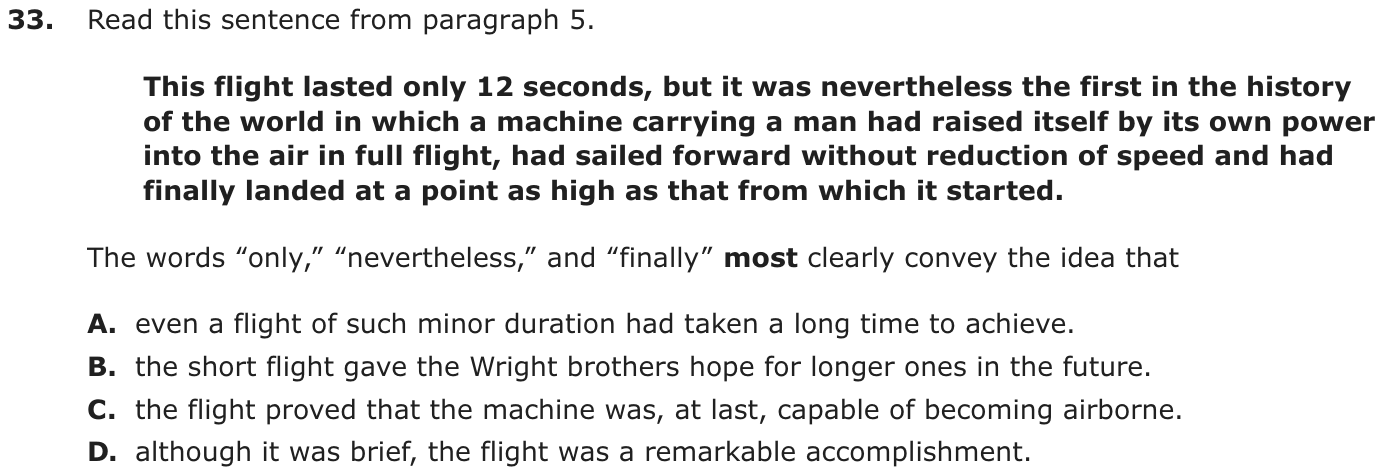
The passage “Excerpt from “How We Made the First Flight”” as printed (pages 13–14)
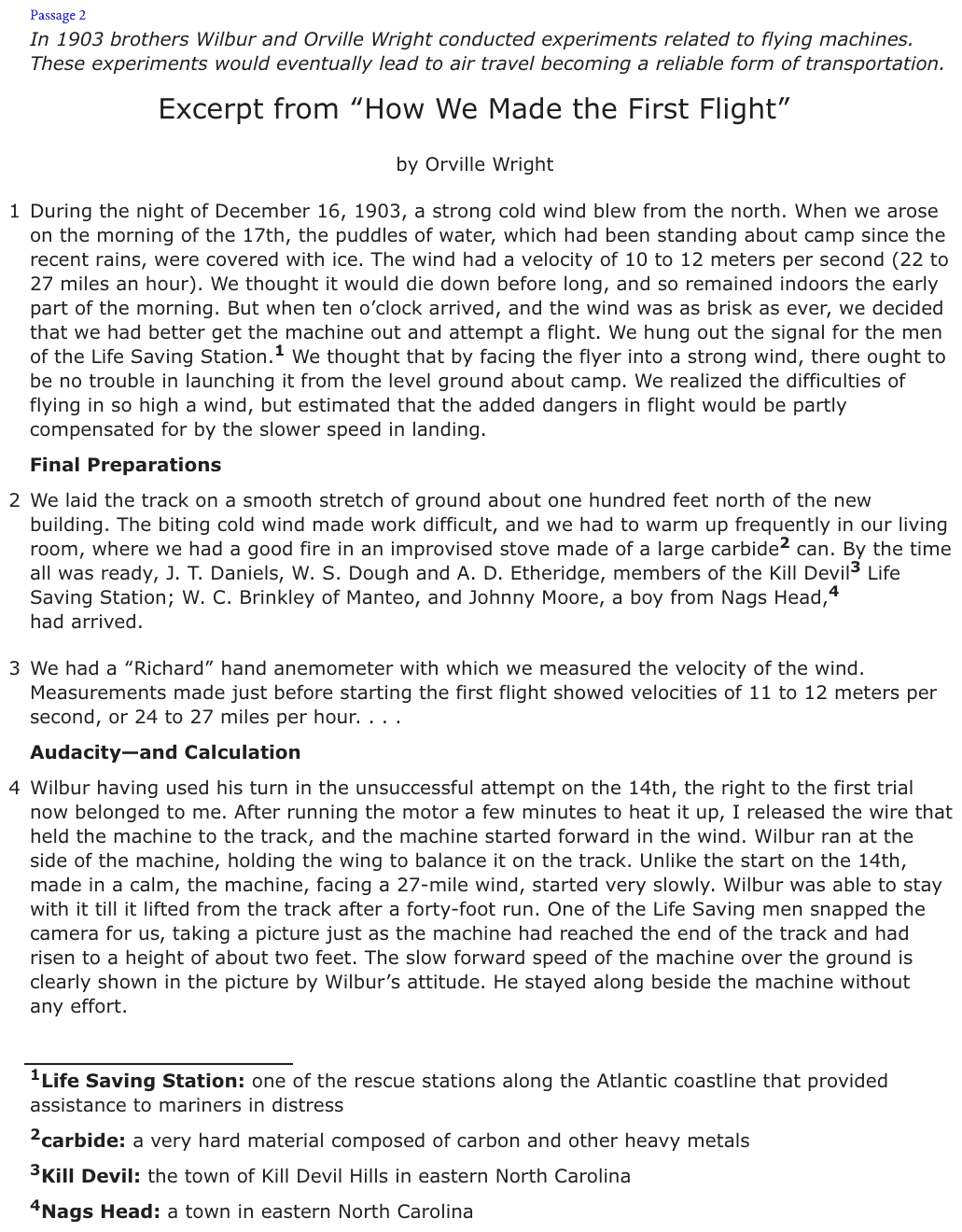
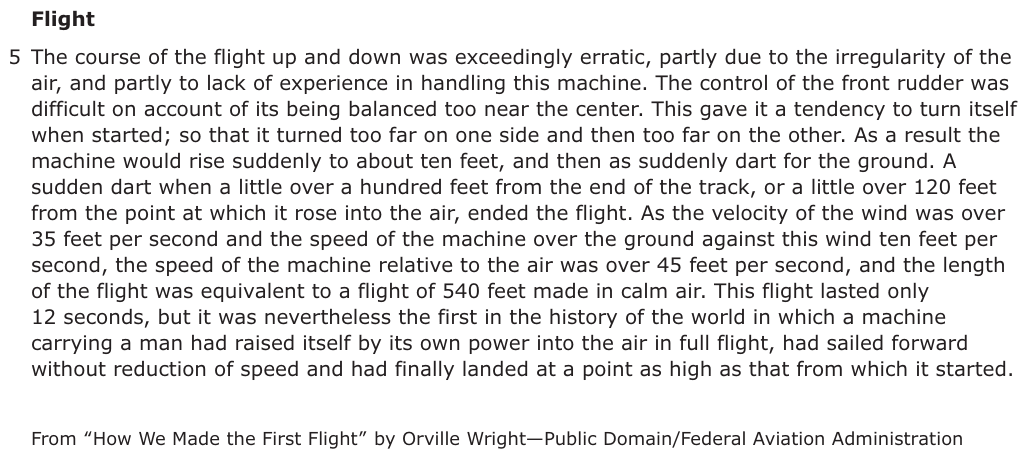
Question 12 of 15
2018 Test A English, question 20Passage Champion of the Channel
Champion of the Channel
In 1926 an editor at the London Daily News predicted that Gertrude Ederle, an American swimmer with eighteen world records and three Olympic medals, would fail in her attempt to swim across the English Channel. He claimed that “even the most uncompromising champion of the rights and capacities of women must admit that in contests of physical skill, speed and endurance they must remain forever the weaker sex.” Yet, at only nineteen years old, Ederle not only became the first woman to accomplish this feat, she also broke the men’s record by two hours. Gertrude Ederle’s triumphant swim across the English Channel was a testimony to her determination, innovative spirit, and passion for swimming.
Crossing the English Channel is a daunting task for any swimmer. At its narrowest point, the channel measures twenty-one miles across. Its icy waters hover around sixty degrees Fahrenheit, and its unruly tides and currents toss swimmers about like bobbing corks. Stinging jellyfish, seaweed, and floating debris from shipwrecks and lost cargoes present added hazards.
For decades the channel’s perils have defeated countless swimmers. Ederle, too, failed in her first attempt to cross the channel in 1925. Just six miles short of finishing, she became ill, and her coach had to haul her out of the water. Undeterred, Ederle decided to try again. Ederle knew that if she did not complete the challenge this time, she might never get the opportunity to set this record, because a rival female swimmer was preparing to make her second attempt at the crossing as well.
To prepare for the marathon swim, Ederle found ways to improve her equipment. She and her sister Meg discovered that melted candle wax perfectly sealed goggle edges, effectively waterproofing Ederle’s goggles against hammering waves. The sisters also designed a two-piece silk swimsuit for Ederle. During her first channel-crossing attempt she had worn a standard one-piece swimsuit that, after the lengthy hours of swimming across the channel, had stretched out, filling with water and creating drag, making an already challenging task almost insurmountable. Unlike the cumbersome typical bathing suit, this silk invention weighed little and allowed for easy movement.
On August 6, 1926, Ederle waded into the channel near Cape Gris-Nez, France. At first she shivered in the bone-chilling water even though she had covered her body in eight layers of grease for insulation. Her limbs felt stiff. Her strokes were irregular. Driving forward, she fought to clear her mind and find what she called her “sphere,” a place where the sea became her only companion and the shrieks of gulls and the humming of boat engines faded away. Using a new overhand stroke called the American crawl, Ederle eventually settled into a steady pace, briskly breaking through waves.
Throughout Ederle’s swim, two tugboats accompanied her. One carried newspaper reporters who wired dispatches of her progress to shore. The other, displaying a sign that read “This way, ole kid!” with an arrow pointing forward, transported her coach, family, and friends. Her coach played songs, such as “Yes, We Have No Bananas,” on a phonograph so that Ederle could time her strokes to the rhythm. Using a net, her coach also passed her baby bottles of broth for nourishment.
For hours Ederle swam, dodging debris with an amused smile. However, as she neared the English shore, a sudden fierce storm erupted. The tides and waves forced Ederle backward, and she fought the stubborn swells for several hours. The salty water caused her tongue to swell and inflamed her ears. Yet Ederle felt indescribably happy as she churned through the sea. Finally, as she neared the English shore, the storm abated, and the tide turned. No longer fighting against her, the sea pushed her toward the shore and victory.
After fourteen hours and thirty-one minutes, Ederle, on wobbly legs, stepped onto the English shore. The waiting crowd roared, honked their automobile horns, blasted their tugboat whistles, and set off flares that flashed in the sky. Ederle had swum into history.
When Ederle returned to New York, she received a parade, where thousands of people shouted “Trudy!” Not only were everyday American citizens proud of Ederle, but she also inspired them to be more active. Over the next few years, more than 60,000 people credited her with motivating them to earn their American Red Cross swimming certificates. Gertrude Ederle’s accomplishment proved to the world that with determination and passion, it was possible for a person to achieve his or her goals.
SOLO SWIMS ACROSS THE ENGLISH CHANNEL
|
Earliest Speed Records |
||
| Year | Swimmer | Time |
| 1875 | Matthew Webb (M) | 21 hours, 45 minutes |
| 1923 | Enrico Tiraboschi (M) | 16 hours, 33 minutes |
| 1926 | Gertrude Ederle (F) | 14 hours, 31 minutes |
| 1926 | Arnst Vierkotter (M) | 12 hours, 38 minutes |
| Current Speed Records | ||
| Year | Swimmer | Time |
| 2012 | Trent Grimsey (M) | 6 hours, 55 minutes |
| 2006 | Yvetta Hlavacova (F) | 7 hours, 25 minutes |
Question
In paragraph 4, the word “insurmountable” is used to highlight
- Ahow the bathing suit made it impossible for Ederle to make it across the channel.
- Bhow Ederle and her sister decided to improve Ederle’s swimming equipment in a creative way.
- Cthat the flaws in Ederle’s bathing suit made a difficult task even more complicated.
- Dthat the swimming equipment Ederle used needed to be custom made for her attempt.
Show the answer
Correct answer: C
The answer is (C)
The question asks about the effect of the word “insurmountable,” which means “incapable of being overcome,” in paragraph 4.
Option C is correct because the suit Ederle wore during her first attempt to swim the channel “stretched out, filling with water and creating drag” (paragraph 4), which likely contributed to her failed attempt to swim across the channel.
Option A is incorrect; Ederle did not complete her first swim because she became ill (paragraph 3: “Just six miles short of finishing, she became ill, and her coach had to haul her out of the water.”), not because the suit made it impossible for Ederle to complete her swim.
Option B is incorrect because the author uses the word “insurmountable” to draw attention to the increased difficulty caused by the swimsuit, not to draw attention to the sisters’ creativity in solving the problem.
Option D is incorrect because the passage does not address whether the original swimsuit was custom made, simply that the swimsuit created additional difficulties for Ederle in a situation that was already difficult.
Question analysis
This vocabulary-in-context question asks what the author highlights by using the word insurmountable in a passage about Gertrude Ederle's English Channel swim. Students must read the word as it is used in its sentence about her first swimsuit and decide what point it stresses, which takes close attention to the surrounding words.
- Grade level
- Grade 7 reading and task
- Compared with grade 7
- At grade 7 Working out the effect of a difficult word from its context is standard grade 7 work. The word is advanced, but the sentence around it explains the situation clearly, so the overall demand is typical.
- Estimated difficulty
- Moderate: several steps, or a close reading with one strong distractor.
- Thinking it demands
- Depth of knowledge 2, skills and concepts · mainly analyze
- What makes it hard
- Hard words moderate
- Complex sentences moderate
- A very close wrong answer moderate
- Evidence
- Answered from one sentence or line
- Reading level
- Passage: about grade 9, 790 words; question and choices: about grade 9, 67 words.
- Students, last 30 days
- Not enough answers yet to show (it takes 10).
Why it is hard, traps and wrong answers (shows the answer)
Why it is hard
Knowing what insurmountable means is necessary but not sufficient, because the phrase is “almost insurmountable” and the point is how much harder the old suit made a hard swim. The commonest error takes the word at full strength and blames the suit for a failure that paragraph 3 attributes to illness. Choices about the sisters' fix describe the paragraph's next move rather than what this word stresses.
Hard words moderate Understanding the question
The question turns on “insurmountable”, impossible to overcome, and on the “almost” in front of it, which turns impossible into extremely hard. (Perfetti, 2007; Freedle & Kostin, 1993)
Complex sentences moderate Understanding the question
The word ends a 38-word sentence whose “that” clause is interrupted by “after the lengthy hours of swimming across the channel”, so its link to the swimsuit is easy to lose. (Abedi & Lord, 2001; Freedle & Kostin, 1993; Messick, 1989)
A very close wrong answer moderate Choosing the answer
The right choice and the one saying the suit made crossing impossible make the same point about the old suit and differ only in degree, which turns on the word “almost”. (Embretson & Wetzel, 1987; Gorin & Embretson, 2006; Ascalon et al., 2007)
Strategy: Read the whole sentence containing the word, along with the sentences around it, then ask what point about the old swimsuit the author is stressing.
Traps
- Dictionary meaning, not meaning here: A common meaning of the word that does not fit its use in this text.
- Reads too much in: A reasonable-sounding conclusion that goes further than the text allows.
- Wrong purpose or structure: Names a purpose, structure or effect that the part does not serve, or describes what a part says when the question asks what it does.
The wrong answers, classified
A Dictionary meaning, not meaning here (Perfetti, 2007)
Applies the word's full sense, impossible to overcome, and ignores “almost”; the suit made the swim harder, and paragraph 3 says illness ended the first attempt.
B Wrong purpose or structure (Anderson & Krathwohl, 2001)
Answers with the paragraph's main point, the sisters' creative new gear, when the word stresses the problem the old suit caused, not the solution.
D Reads too much in (Graesser, Singer & Trabasso, 1994)
Leaps from the old suit's failure to a claim that her equipment had to be custom made, a conclusion the word itself does not carry.
Working it out, step by step
Figure out what the question asks
This asks why the author used the word “insurmountable.” First you need to know what the word means. Then you need to see what point it helps the author make.
Find the word in its sentence
Paragraph 4 says her old suit “had stretched out, filling with water and creating drag, making an already challenging task almost insurmountable.” Drag is a pull that slows you down in the water.
Work out what the word means
To surmount something means to get over it, like climbing over a wall. So insurmountable means impossible to get over or beat. But the author wrote “almost insurmountable.” Almost means not quite. Also notice “already challenging.” The swim was hard to begin with. So the suit made a hard job even harder. It did not make it fully impossible.
Check each choice
- C: the suit’s flaws made “a difficult task even more complicated.” This matches “already challenging” plus “almost insurmountable.”
- A says the suit made the swim “impossible.” That ignores “almost.” Also, paragraph 3 says her first try ended because “she became ill.”
- B: the sisters’ creative fix is in other sentences. This word describes the problem, not the fix.
- D: the passage never says her gear had to be custom made.
Watch out: A uses the dictionary meaning of the word. But always read the words around it, like “almost.”
Pick the answer
The word stresses how much harder the old suit made the swim. So the answer is C.
Why this answer and not the closest wrong one
A is the closest wrong answer, because it uses the word’s full meaning, impossible. But the author wrote “almost,” and Ederle’s first try ended when she got sick, not because of her suit. C keeps the right amount: a hard task made even harder.
More questions like this
The original DOE question

The passage “Champion of the Channel” as printed (pages 56–57)
Question 13 of 15
2018 Test A English, question 56Passage The Year without a Summer
The Year without a Summer
The eruption of the Philippine volcano Mount Pinatubo in June 1991 sent a huge cloud of gas and dust encircling the globe. The dust and ash from Mount Pinatubo was blamed for a two-year decrease in global temperature, changes in weather patterns, and damage to the ozone layer. The situation brings to mind a time now remembered as “The Year without a Summer,” a meteorological event that occurred 175 years earlier. At that time, harsh weather conditions plagued much of eastern North America and, to a lesser extent, northern Europe.
April 1816 brought typical spring weather to upstate New York and New England; trees budded, and farmers prepared to plow and plant. In May, however, the expected warm temperatures failed to arrive. Most people remained optimistic, waiting for the summer that was “just around the corner.” They waited in vain. During the first week of June, ten inches of snow fell on New England. Throughout the month, temperatures rarely rose above the 30s. Many farmers replanted crops several times, only to see them stunted or destroyed by sleet, hail, and icy winds. July and August brought little improvement. During most days the temperature stayed in the 40s. Farmers’ diaries document the farmers’ daily struggles with near-freezing temperatures, failing crops, and dying farm animals. The few crops that managed to survive were killed by frost in mid-September. Winter came early in New England and was unusually severe. Even the South was affected; on July 4, the high temperature for Savannah, Georgia, was only 46 degrees Fahrenheit!
Some religious leaders warned their congregations that the unusual weather meant that the end of the world was drawing near. Other leaders attributed the cool weather to unusual sunspot activity. The proliferation of the newly invented lightning rod was also blamed as some people believed that lightning rods had interrupted the natural temperature balance of Earth, causing the cooler temperatures.
It was not until October that the first plausible explanation for “The Year without a Summer” was suggested. Friedrich Bessel, a German astronomer, reported seeing thick clouds of dust in the upper atmosphere. He theorized that these dust particles screened portions of Earth from the warming rays of the sun. It was discovered that in April 1815, Mount Tambora, an Indonesian volcano, had erupted with such force that it had sent an estimated 100 cubic miles of fine dust into the atmosphere. Witnesses to the eruption reported that the sky remained dark for two days. The dust then rose high into the stratosphere, where it encircled the world for several years to come.
Skeptics in 1816 doubted that a faraway volcano could steal their summer. However, most present-day researchers believe Bessel’s explanation to be generally correct, demonstrating the global nature of weather. The dust in the atmosphere eventually settled, and the spring of 1817 was back to normal.
Question
Which of the following is implied by the phrase “the global nature of weather” (paragraph 5)?
- AUnderstanding weather events around the world is important for making weather predictions.
- BExtreme weather conditions in some parts of the world can have a lasting impact on a geographical area.
- CNatural disasters tend to occur in different parts of the world at the same time.
- DConditions in one part of the world can affect weather in another part of the world.
Show the answer
Correct answer: D
The answer is (D)
The question asks for the implied meaning behind the phrase “the global nature of weather” (paragraph 5). This phrase refers to how conditions in one part of the world can affect weather in another part of the world.
Option D is correct because it clarifies “global” by explaining the relationship between weather and conditions all over the world. Option A is incorrect because the phrase in paragraph 5 is about the effects of weather conditions around the world, not about making weather predictions.
Option B is incorrect because it discusses the lasting impact on specific geographical areas, while the phrase “the global nature of weather” refers to events that affect the entire world.
Option C is incorrect because, while weather events (the unusually cold summer in New England in 1816) can be related to natural disasters (a volcano eruption), there is no support in the passage for the idea that natural disasters tend to occur at the same time.
Question analysis
This question about word meaning in context asks what the phrase “the global nature of weather” implies in the final paragraph of “The Year without a Summer.” Students have to work out its meaning from the events the passage has described, not from a general sense of the word “global.”
- Grade level
- Grade 7 reading and task
- Compared with grade 7
- At grade 7 Determining a phrase's meaning from context is standard grade 7 work. The phrase draws on the passage's main explanation, which is clearly laid out, so the demand is typical for grade 7.
- Estimated difficulty
- Straightforward: two steps or one careful reading.
- Thinking it demands
- Depth of knowledge 2, skills and concepts · mainly understand
- What makes it hard
- Reading between the lines moderate
- Evidence in several places minor
- A very close wrong answer minor
- Evidence
- Answered from several paragraphs or stanzas
- Reading level
- Passage: about grade 9, 469 words; question and choices: about grade 9, 76 words.
- Students, last 30 days
- Not enough answers yet to show (it takes 10).
Why it is hard, traps and wrong answers (shows the answer)
Why it is hard
“Global” alone suggests anything worldwide, and the wrong choices offer several worldwide-sounding ideas: forecasting, lasting local damage, simultaneous disasters. The phrase means something narrower, that what happens in one place can change the weather far away, as Tambora did to New England. Students who read the phrase in its sentence, where it is what Bessel's explanation demonstrates, find the key; those who define the word in isolation do not.
Reading between the lines moderate Working it out
The phrase must be read through the example the passage just gave: an Indonesian volcano filled the stratosphere with dust and New England lost its summer. (Graesser, Singer & Trabasso, 1994; Kintsch, 1998)
Evidence in several places minor Working it out
The meaning depends on facts from paragraph 4, Tambora's location and its dust circling the world, and from paragraph 2, snow in New England, not on paragraph 5 alone. (Kirsch & Mosenthal, 1990; Gorin & Embretson, 2006)
A very close wrong answer minor Choosing the answer
B and D are worded almost alike, conditions in some part of the world affecting somewhere; they differ in what is affected, since B makes it a lasting impact on one area rather than weather elsewhere. (Embretson & Wetzel, 1987; Gorin & Embretson, 2006; Ascalon et al., 2007)
Strategy: Reread the sentence with the phrase and the paragraph before it, ask what Bessel's explanation demonstrated, and choose the paraphrase that fits that example.
Traps
- Outside knowledge: A choice is plausible in the real world but not supported by this text.
- Dictionary meaning, not meaning here: A common meaning of the word that does not fit its use in this text.
The wrong answers, classified
A Outside knowledge (King et al., 2004; Recht & Leslie, 1988)
Offers a sensible real-world point about forecasting, but the passage never discusses predicting weather; the phrase is about cause and effect across distance.
B Twists what the text says (King et al., 2004)
Keeps the idea of extreme events having effects but makes them local and lasting, dropping the link between distant places that “global” refers to here.
C Dictionary meaning, not meaning here (Perfetti, 2007)
Reads “global” as disasters striking many places at once, though the passage's two eruptions were more than 170 years apart and one caused effects far away.
Working it out, step by step
Figure out what the question asks
This asks what a phrase implies, or hints at. Read the phrase in its sentence, not by itself.
Read the phrase in its sentence
Paragraph 5 says researchers “believe Bessel’s explanation to be generally correct, demonstrating the global nature of weather.”
So Bessel’s explanation is the example. Recall it. In 1815, a volcano in Indonesia erupted. Its dust spread around the world. In 1816, New England had snow in June.
Work out what it means
Global means having to do with the whole world. Indonesia is in Asia, very far from New England. Yet the eruption there changed the weather in America. So the phrase means that something in one part of the world can change the weather in a faraway part.
Check each choice
- A The passage never talks about predicting weather.
- B It keeps the effects in one area. The point here is that effects travel far.
- C The two eruptions in the passage were 176 years apart. Nothing says disasters strike at the same time.
- D fits. Conditions in Indonesia changed the weather in New England.
Choose the answer
The phrase means events in one place can change the weather far away. So the answer is D.
Why this answer and not the closest wrong one
B is the closest trap, because it also says extreme conditions have effects. But B keeps those effects in one area. The passage’s example crosses the world: dust from Indonesia chilled New England. D names that link between faraway places.
More questions like this
The original DOE question
The passage “The Year without a Summer” as printed (page 76)
Question 14 of 15
2018 Test B English, question 26Passage Excerpt from “Niagara Falls”
Excerpt from “Niagara Falls”
by Rupert Brooke
The real secret of the beauty and terror of the Falls is not their height or width, but the feeling of colossal power and of unintelligible disaster caused by the plunge of that vast body of water. If that were taken away, there would be little visible change, but the heart would be gone.
The American Falls do not inspire this feeling in the same way as the Canadian. It is because they are less in volume, and because the water does not fall so much into one place. By comparison their beauty is almost delicate and fragile. They are extraordinarily level, one long curtain of lacework and woven foam. Seen from opposite, when the sun is on them, they are blindingly white, and the clouds of spray show dark against them. With both Falls the colour of the water is the ever-altering wonder. Greens and blues, purples and whites, melt into one another, fade, and come again, and change with the changing sun. Sometimes they are as richly diaphanous as a precious stone, and glow from within with a deep, inexplicable light. Sometimes the white intricacies of dropping foam become opaque and creamy. And always there are the rainbows. If you come suddenly upon the Falls from above, a great double rainbow, very vivid, spanning the extent of spray from top to bottom, is the first thing you see. If you wander along the cliff opposite, a bow springs into being in the American Falls, accompanies you courteously on your walk, dwindles and dies as the mist ends, and awakens again as you reach the Canadian tumult. And the bold traveller who attempts the trip under the American Falls sees, when he dare open his eyes to anything, tiny baby rainbows, some four or five yards in span, leaping from rock to rock among the foam, and gambolling beside him, barely out of hand’s reach, as he goes. One I saw in that place was a complete circle, such as I have never seen before, and so near that I could put my foot on it. It is a terrifying journey, beneath and behind the Falls. The senses are battered and bewildered by the thunder of the water and the assault of wind and spray; or rather, the sound is not of falling water, but merely of falling; a noise of unspecified ruin. So, if you are close behind the endless clamour, the sight cannot recognise liquid in the masses that hurl past. You are dimly and pitifully aware that sheets of light and darkness are falling in great curves in front of you. Dull omnipresent foam washes the face. Farther away, in the roar and hissing, clouds of spray seem literally to slide down some invisible plane of air.
Beyond the foot of the Falls the river is like a slipping floor of marble, green with veins of dirty white, made by the scum that was foam. It slides very quietly and slowly down for a mile or two, sullenly exhausted. Then it turns to a dull sage green, and hurries more swiftly, smooth and ominous. As the walls of the ravine close in, trouble stirs, and the waters boil and eddy. These are the lower rapids, a sight more terrifying than the Falls, because less intelligible. Close in its bands of rock the river surges tumultuously forward, writhing and leaping as if inspired by a demon. It is pressed by the straits into a visibly convex form. Great planes of water slide past. Sometimes it is thrown up into a pinnacle of foam higher than a house, or leaps with incredible speed from the crest of one vast wave to another, along the shining curve between, like the spring of a wild beast. Its motion continually suggests muscular action. The power manifest in these rapids moves one with a different sense of awe and terror from that of the Falls. Here the inhuman life and strength are spontaneous, active, almost resolute. . . . A place of fear.
One is drawn back, strangely, to a contemplation of the Falls, at every hour, and especially by night, when the cloud of spray becomes an immense visible ghost, straining and wavering high above the river, white and pathetic and translucent. The Victorian lies very close below the surface in every man. There one can sit and let great cloudy thoughts of destiny and the passage of empires drift through the mind; for such dreams are at home by Niagara. I could not get out of my mind the thought of a friend, who said that the rainbows over the Falls were like the arts and beauty and goodness, with regard to the stream of life—caused by it, thrown upon its spray, but unable to stay or direct or affect it, and ceasing when it ceased. In all comparisons that rise in the heart, the river, with its multitudinous waves and its single current, likens itself to a life, whether of an individual or of a community. A man’s life is of many flashing moments, and yet one stream; a nation’s flows through all its citizens, and yet is more than they. In such places, one is aware, with an almost insupportable and yet comforting certitude, that both men and nations are hurried onwards to their ruin or ending as inevitably as this dark flood. Some go down to it unreluctant, and meet it, like the river, not without nobility. And as incessant, as inevitable, and as unavailing as the spray that hangs over the Falls, is the white cloud of human crying. . . . With some such thoughts does the platitudinous heart win from the confusion and thunder of a Niagara peace that the quietest plains or most stable hills can never give.
From LETTERS FROM AMERICA by Rupert Brooke—Public Domain
diaphanous: sheer, translucent
platitudinous: clichéd, common
Question
Read this sentence from paragraph 2.
They are extraordinarily level, one long curtain of lacework and woven foam.
What is the effect of comparing the American Falls to a “long curtain of lacework and woven foam”?
- AIt demonstrates the timelessness of the American Falls.
- BIt conveys the secretive nature of the American Falls.
- CIt illustrates the elegant uniformity of the American Falls.
- DIt communicates the intense strength of the American Falls.
Show the answer
Correct answer: C
The question asks for the effect of the comparison being made in the sentence in paragraph 2. The word “lacework” in the sentence suggests an elegant piece of craftsmanship, and the “one long curtain” and “extraordinarily level” aspects of the Falls mean that the Falls are uniform or consistent; therefore, Option C is correct.
Option A is incorrect because neither “lacework and woven foam,” nor the quality of being extremely level, are related to timelessness.
Option B is incorrect because, while a curtain may suggest the idea of something being hidden or secret, the description of a delicate “lacework” curtain does not suggest this purpose.
Option D is incorrect because “lacework” is generally fragile and does not suggest great strength.
Question analysis
In this figurative language question, students explain the effect of a comparison in Rupert Brooke’s “Niagara Falls”: the American Falls as “one long curtain of lacework and woven foam.” They need to picture the image and read the sentences around it, since a curtain, lace and foam can each call up quite different qualities.
- Grade level
- Grade 7 reading and task
- Compared with grade 7
- At grade 7 Explaining the effect of a metaphor in a quoted sentence is routine grade 7 work. The older prose is harder than most grade 7 texts, but the sentences around this one give direct context clues.
- Estimated difficulty
- Straightforward: two steps or one careful reading.
- Thinking it demands
- Depth of knowledge 2, skills and concepts · mainly analyze
- What makes it hard
- Figurative or literary language moderate
- Hard words minor
- Evidence
- Answered from one sentence or line
- Reading level
- Passage: about grade 9, 987 words; question and choices: about grade 10, 70 words.
- Students, last 30 days
- Not enough answers yet to show (it takes 10).
Why it is hard, traps and wrong answers (shows the answer)
Why it is hard
The image is clear once pictured, and the sentences around it, about the American Falls being “delicate and fragile” and “extraordinarily level,” confirm what it means. Students go wrong by bringing in what they associate with curtains or with Niagara in general, hiding or power, instead of what this curtain is made of. The right choice also uses an abstract word that has to be connected back to “level.”
Figurative or literary language moderate Understanding the question
Students must translate “one long curtain of lacework and woven foam” into qualities: lace is delicate and finely made, and one long level curtain is even from end to end. (Graesser, Singer & Trabasso, 1994; Kintsch, 1998)
Hard words minor Understanding the question
The right choice uses “uniformity,” which students must link to “extraordinarily level” and “one long curtain,” just as “elegant” must be linked to the lacework. (Perfetti, 2007; Freedle & Kostin, 1993)
Strategy: Picture the image first, then reread the few sentences around it about the American Falls and keep only the choice that both the image and those sentences support.
Traps
- Wrong part of the text: A choice is true of another paragraph, stanza or speaker than the one asked about.
- Dictionary meaning, not meaning here: A common meaning of the word that does not fit its use in this text.
The wrong answers, classified
A Little reason to choose it (Haladyna & Downing, 1993; Rodriguez, 2005)
Nothing in lace, foam or a level edge suggests lasting through time, so this attracts mainly students guessing that a natural wonder must seem timeless.
B Dictionary meaning, not meaning here (Perfetti, 2007)
Uses the common sense of a curtain as something that hides, but this curtain is lacework, open and decorative, and nothing behind it is concealed.
D Wrong part of the text (Kirsch & Mosenthal, 1990)
Carries over the “colossal power” of paragraph 1, though paragraph 2 says the American Falls do not inspire that feeling as the Canadian do and calls their beauty fragile.
Working it out, step by step
Figure out what the question asks
This asks about the effect of a comparison. The author compares the American Falls to “one long curtain of lacework and woven foam.” What quality does that picture give them?
Read the sentence and its neighbor
The full sentence is “They are extraordinarily level, one long curtain of lacework and woven foam.” The sentence just before it says, “By comparison their beauty is almost delicate and fragile.”
Picture the comparison
Lacework is fancy cloth with fine, delicate patterns. It looks elegant, which means graceful and beautiful. “Extraordinarily level” and “one long curtain” mean the Falls are even all the way across, with no breaks. That evenness is uniformity: being the same all the way through. So the picture shows elegant uniformity.
Check each choice
- A is wrong. Nothing about lace or foam suggests lasting forever.
- B is wrong. A curtain can hide things, but lace is open and see-through. Nothing is hidden.
- C is right. Lace is elegant, and a level curtain is uniform.
- D is wrong. Lace is fragile, not strong.
Watch out: Paragraph 1 talks about “colossal power,” so D can seem right. But paragraph 2 says the American Falls “do not inspire this feeling” the way the Canadian Falls do.
Choose the answer
The lace curtain makes the American Falls look graceful and even. So the answer is C.
Why this answer and not the closest wrong one
D is the closest wrong answer, because the Falls seem powerful in other parts of the essay. But this sentence is about the American Falls, whose beauty is “delicate and fragile.” Lace is delicate, not strong. A smooth, level curtain of lace shows grace and evenness, as C says.
More questions like this
The original DOE question
The passage “Excerpt from “Niagara Falls”” as printed (pages 134–135)
Question 15 of 15
2018 Test B English, question 46Passage Snowy Mountains
Snowy Mountains
by John Gould Fletcher
Higher and still more high,
Palaces made for cloud,
Above the dingy city-roofs
Blue-white like angels with broad wings,
Pillars of the sky at rest
The mountains from the great plateau
Uprise.
But the world heeds them not;
They have been here now for too long a time.
The world makes war on them,
Tunnels their granite cliffs,
Splits down their shining sides,
Plasters their cliffs with soap-advertisements,
Destroys the lonely fragments of their peace.
Vaster and still more vast,
Peak after peak, pile after pile,
Wilderness still untamed,
To which the future is as was the past,
Barrier spread by Gods,
Sunning their shining foreheads,
Barrier broken down by those who do not need
The joy of time-resisting storm-worn stone,
The mountains swing along
The south horizon of the sky;
Welcoming with wide floors of blue-green ice
The mists that dance and drive before the sun.
“Snowy Mountains” by John Gould Fletcher—Public Domain
Question
Read lines 21–22 from the poem.
Barrier broken down by those who do not need
The joy of time-resisting storm-worn stone,
How do the lines help convey the speaker’s point of view?
- AThey suggest that the speaker wants to remove the obstacles that prevent others from experiencing the wonders of nature.
- BThey reveal the speaker’s opinion that some people are too busy to appreciate natural beauty.
- CThey suggest the speaker’s dismay that people destroy the natural landscape without understanding the ramifications of their actions.
- DThey explain that the speaker is confident that nature will never be fully destroyed by people.
Show the answer
Correct answer: C
The question asks how the lines help convey the speaker’s point of view. The words “those who do not need / The joy” in lines 21–22 suggest the speaker’s sadness that people do not realize that they are destroying something wonderful and irreplaceable, as expressed in Option C.
Option A is incorrect because the word “barrier” (line 21) refers to the speaker’s opinion that the mountains were “spread by Gods” (line 19) and not to an obstacle that the speaker thinks should be removed.
Option B is incorrect because, while the lines indicate that people have lost the need to connect with nature, they do not reveal that the speaker thinks that the cause of this loss is busyness.
Option D is incorrect because, although the speaker does say that the stone is “time-resisting” (line 22), this belief is only a small detail of the speaker’s point of view.
Question analysis
Students explain how lines 21–22 of the poem “Snowy Mountains” convey the speaker’s point of view about people who break down the mountains’ barrier. The lines are hard to parse because a phrase runs across the line break and “need” is used in an unusual way, so students must first work out what the sentence says before judging the speaker’s feeling.
- Grade level
- Grade 8 reading and task
- Compared with grade 7
- Above grade 7 Reading a speaker’s attitude is grade 7 work, but this sentence runs across a line break with unusual phrasing, and the choices require fine distinctions between feelings and reasons, which pushes it above typical grade 7 demand.
- Estimated difficulty
- Hard: combines ideas, needs a plan, and has more than one tempting wrong answer.
- Thinking it demands
- Depth of knowledge 2, skills and concepts · mainly analyze
- What makes it hard
- Complex sentences major
- Reading between the lines moderate
- Hard words minor
- Evidence
- Answered from one sentence or line
- Reading level
- Passage: 161 words (a poem; reading level not measured); question and choices: about grade 9, 99 words.
- Students, last 30 days
- Not enough answers yet to show (it takes 10).
Why it is hard, traps and wrong answers (shows the answer)
Why it is hard
Two lines of compressed, inverted verse must be untangled before any choice can be judged, and the meaning of “need” in them is unusual. Once the lines are paraphrased as people who do not value the old stone breaking it down, the speaker’s sorrow is clear, but two wrong choices offer neighboring readings. One supplies a reason the poem never gives, and the other carries the stanza’s idea of endurance into a certainty the lines contradict.
Complex sentences major Understanding the question
The sentence breaks mid-phrase, “those who do not need / The joy of time-resisting storm-worn stone,” and has no main verb of its own, so students must first work out who breaks what. (Abedi & Lord, 2001; Freedle & Kostin, 1993; Messick, 1989)
Reading between the lines moderate Working it out
Neither dismay nor ignorance is stated; both have to be inferred from describing people as not needing “the joy” of what they break down. (Graesser, Singer & Trabasso, 1994; Kintsch, 1998)
Hard words minor Understanding the question
“Barrier” here means the mountain range as a wall, not an obstacle, and the key uses “ramifications,” a word many students will not know. (Perfetti, 2007; Freedle & Kostin, 1993)
Strategy: Rephrase the two lines in plain words, starting with who breaks the barrier and what they do not need, then decide which feeling of the speaker that wording reveals.
Traps
- Dictionary meaning, not meaning here: A common meaning of the word that does not fit its use in this text.
- Outside knowledge: A choice is plausible in the real world but not supported by this text.
- Too broad or too strong: A choice overstates, generalizes, or uses absolute words the text does not support.
The wrong answers, classified
A Dictionary meaning, not meaning here (Perfetti, 2007)
Takes “Barrier” in its everyday sense of an obstacle to clear away, but here it is the mountain range itself, “spread by Gods,” which the speaker values.
B Outside knowledge (King et al., 2004; Recht & Leslie, 1988)
Supplies a familiar modern explanation, that people are too busy for nature, though the lines say only that some people do not need this joy, not why.
D Too broad or too strong (King et al., 2004)
Stretches “time-resisting” into certainty that nature can never be destroyed, though the same sentence shows the barrier being broken down by people.
Working it out, step by step
Figure out what the question asks
This asks what lines 21 and 22 show about the speaker’s point of view, or feelings and opinion. The lines are tangled, so first you need to put them in plain words.
Read the lines in their place
The two lines are “Barrier broken down by those who do not need / The joy of time-resisting storm-worn stone,” in the third stanza. Two lines earlier, line 19 calls the mountains a “Barrier spread by Gods,” or a wall made by the gods. So the barrier is the mountain range itself. It is not an obstacle in someone’s way.
Put the lines in plain words
Here is the meaning. The mountains are being broken down by people who feel no need for the joy that old, strong stone gives. These people do not value what they are destroying. The speaker is sad and upset about this. That feeling is dismay. Ramifications are the results that follow from an action. People break the mountains without seeing what they lose.
Check each choice
- A is wrong. The “barrier” is the mountains, which the speaker loves. The speaker does not want them removed.
- B is wrong. The lines never say why people don’t value the stone. Being too busy is a reason brought in from outside.
- C fits. The speaker is dismayed that people destroy the mountains without seeing their worth.
- D is wrong. The same lines show the barrier being “broken down.” They show worry about harm, not confidence that nature is safe.
Choose the answer
The lines show sorrow at people breaking down something they do not value. So the answer is C, “They suggest the speaker’s dismay that people destroy the natural landscape without understanding the ramifications of their actions.”
Why this answer and not the closest wrong one
B is the closest trap. It also says people fail to value nature. But it adds a reason, being busy, that the poem never gives. The lines only say these people “do not need” the joy. C stays with what the lines show: harm done by people who don’t see its cost.
More questions like this
The original DOE question
The passage “Snowy Mountains” as printed (page 142)