Rates and speed
Question 1 of 19
2026 Practice Test C Math, question 9Question
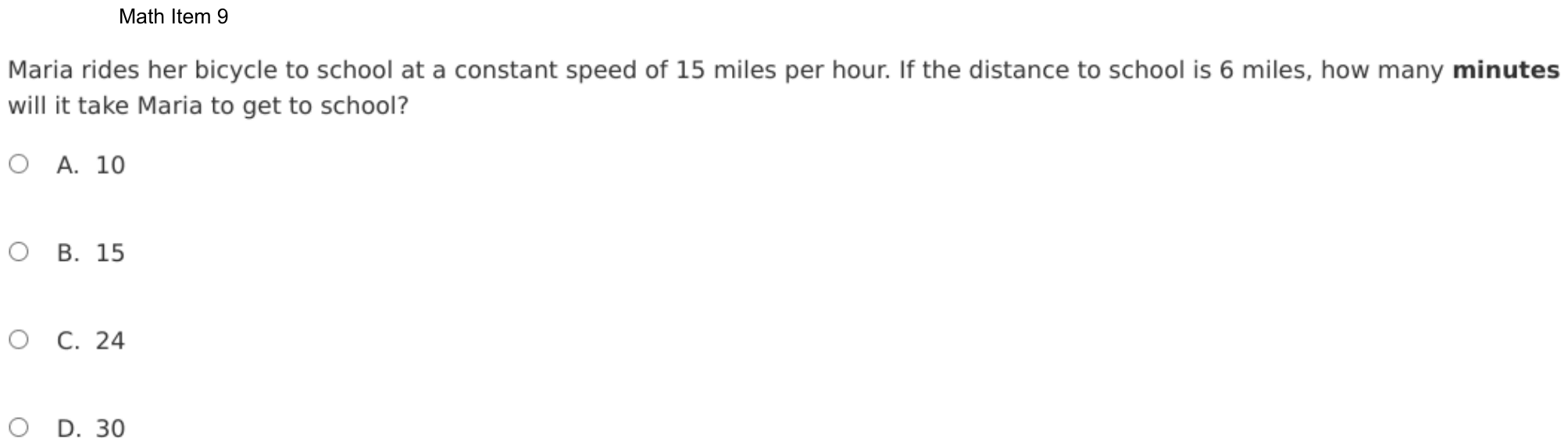
Maria rides her bicycle to school at a constant speed of 15 miles per hour. If the distance to school is 6 miles, how many minutes will it take Maria to get to school?
- A10
- B15
- C24
- D30
Show the answer
Correct answer: C
Maria’s rate of speed is given as 15 miles per hour. Since 1 hour is equivalent to 60 minutes, her rate of speed, in miles per minute, can be determined.
, or mile per minute.
Therefore, it takes Maria 4 minutes to ride 1 mile.
The distance to school is 6 miles, so it will take minutes to ride to school.
Question analysis
Maria bikes 6 miles to school at a constant 15 miles per hour, and students find how many minutes the ride takes. It tests using a rate to find a time and converting hours to minutes. With the speed given per hour and the question asking, in bold, for minutes, keeping track of units is the main hurdle.
- Grade level
- Grade 6 content, by NYS standard
- Compared with grade 7
- Below grade 7 Distance, speed and time with whole numbers is grade 6 rate work. The only extra demand is an answer in minutes when the speed is per hour, a conversion grade 7 students make routinely.
- Estimated difficulty
- Straightforward: two steps or one careful reading.
- Thinking it demands
- Depth of knowledge 2, skills and concepts · mainly apply
- What makes it hard
- Solution
- 2 steps
- Reading level
- Question and choices: about grade 6, 32 words.
- Students, last 30 days
- Not enough answers yet to show (it takes 10).
Why it is hard, traps and wrong answers (shows the answer)
Why it is hard
The numbers are small, but the speed is per hour and the answer is wanted in minutes, so students have to choose a route through the units. Finding the minutes per mile first, 4 at 15 miles an hour, turns the rest into a single multiplication. The wrong choices come from using a number in the stem as the answer, from mixing the 60 minutes with the 6 miles, or from rounding 0.4 hour to a half hour.
Something you must already know minor Working it out
Nothing on the page says that time is distance divided by speed or that an hour has 60 minutes, and the bold word minutes requires both. (Anderson & Krathwohl, 2001)
Error-prone arithmetic minor Working it out
6 ÷ 15 is less than 1, 0.4 hour, and turning it into minutes means 0.4 × 60; the cleaner route, 60 ÷ 15 = 4 minutes a mile, avoids decimals. (Brown & Burton, 1978; Junker & Sijtsma, 2001)
Strategy: Find how many minutes Maria needs to ride one mile at 15 miles per hour, then multiply by the number of miles to school.
Traps
- Numbers taken from the question: Combines the numbers in the question without a model of the situation, or is simply a number that appears in the question.
- Rounds too early: Rounds a value partway through, or rounds the wrong way, so the final answer drifts from the exact one.
The wrong answers, classified
A Numbers taken from the question (Hegarty, Mayer & Monk, 1995)
Divides the 60 minutes in an hour by the 6 miles, 60 ÷ 6 = 10, as if the ride took a full hour, and ignores the 15 mph speed.
B Numbers taken from the question (Hegarty, Mayer & Monk, 1995)
Takes the 15 in 15 miles per hour as the number of minutes, a number copied from the question without any calculation.
D Rounds too early (King et al., 2004)
Sees that 6 miles is a little under half of 15, rounds the time of 0.4 hour up to half an hour, and gives 30 minutes.
Worked solution, step by step
Formulas used
- Minutes for each mile
- Miles per hour tells how many miles you ride in one hour, which is 60 minutes. Sharing the 60 minutes evenly among those miles gives the minutes for each mile. This works when the speed stays the same the whole time.
- Distance, speed and time
- Distance is how far you go, here in miles. Speed is how far you go in one hour. Dividing the distance by the speed gives the time in hours.
Sort out the question
Maria rides at a constant speed of 15 miles per hour. Constant means it never changes. School is 6 miles away. You need the time in minutes, not hours. You must know that one hour has 60 minutes.
Find the minutes for one mile
15 miles per hour means Maria rides 15 miles in 60 minutes. Use the minutes-per-mile formula:
So each mile takes Maria 4 minutes.
Find the minutes for 6 miles
Each of the 6 miles takes 4 minutes:
So the ride takes 24 minutes.
Watch out: 15 is the speed, not a time, so choice B is a trap. And , choice A, ignores the speed.
Choose the answer
Another way is the time formula. , so the ride takes 0.4 of an hour. In minutes, that is .
Watch out: rounding 0.4 hour up to half an hour gives choice D, 30.
So the answer is C, 24.
Check your answer
Check with the speed. 24 minutes is of an hour. In a full hour Maria rides 15 miles. So in 2/5 of an hour she rides miles. That is exactly the distance to school.
More questions like this
The original DOE question
Question 2 of 19
2026 Practice Test D Math, question 24Question
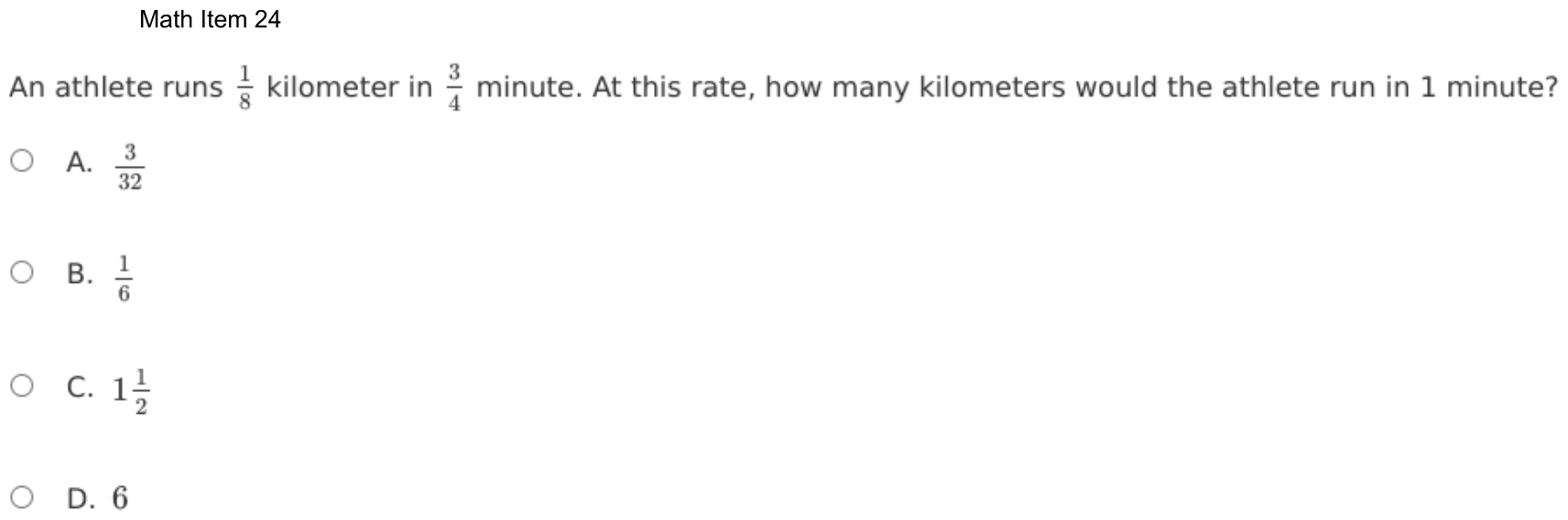
An athlete runs kilometer in minute. At this rate, how many kilometers would the athlete run in 1 minute?
- A
- B
- C
- D6
Show the answer
Correct answer: B
To determine the number of kilometers in 1 minute, find the unit rate in kilometers per minute: .
To evaluate the fraction, use the reciprocal when dividing to get kilometer per 1 minute.
Question analysis
An athlete runs 1/8 kilometer in 3/4 minute, and students find how many kilometers the athlete would run in 1 minute at the same rate. It tests unit rates with fractions. Both the distance and the time are fractions, so deciding which one to divide by which is the main challenge.
- Grade level
- Grade 7 content, by NYS standard
- Compared with grade 7
- At grade 7 Computing a unit rate from a ratio of fractions is the grade 7 standard itself, and this is a standard example: one fraction divided by another in two short steps, with the order of division the only real decision.
- Estimated difficulty
- Straightforward: two steps or one careful reading.
- Thinking it demands
- Depth of knowledge 2, skills and concepts · mainly apply
- What makes it hard
- Error-prone arithmetic moderate
- Turning words into math minor
- Solution
- 2 steps
- Reading level
- Question and choices: about grade 9, 23 words.
- Students, last 30 days
- Not enough answers yet to show (it takes 10).
Why it is hard, traps and wrong answers (shows the answer)
Why it is hard
The question is a unit rate with fractions, and its wrong choices are the other ways to combine 1/8 and 3/4. Since 1 minute is only a third longer than 3/4 minute, the distance must be only a third more than 1/8 kilometer, which rules out the product and both large choices at once. Dividing with the units written in, kilometers over minutes, keeps the order right.
Error-prone arithmetic moderate Working it out
The rate is a fraction divided by a fraction, 1/8 ÷ 3/4, and only the 3/4 may be flipped; multiplying straight across or dividing the other way round both give listed choices. (Brown & Burton, 1978; Junker & Sijtsma, 2001)
Turning words into math minor Understanding the question
Kilometers in 1 minute means kilometers per minute, so the 1/8 goes on top even though the time, 3/4, is the larger number. (Hegarty, Mayer & Monk, 1995; Koedinger & Nathan, 2004)
Strategy: Divide the distance by the time, kilometers over minutes, by multiplying 1/8 by the reciprocal of 3/4, and check that the units of the result are kilometers per minute.
Traps
- Wrong operation: Adds instead of multiplying, divides the wrong way round, turns a ratio or rate upside down, or undoes a step in the wrong direction (subtracts what should be added back).
The wrong answers, classified
A Wrong operation (Hegarty, Mayer & Monk, 1995; King et al., 2004)
Multiplies 1/8 by 3/4 instead of dividing, getting 3/32, which is less than the 1/8 kilometer already run in under a minute.
C Wrong operation (Hegarty, Mayer & Monk, 1995; King et al., 2004)
Splits the 3/4 minute into quarters but multiplies 1/8 by 3 instead of dividing, then multiplies by 4 for a full minute, giving 12/8 = 1 1/2.
D Wrong operation (Hegarty, Mayer & Monk, 1995; King et al., 2004)
Divides 3/4 by 1/8, minutes by kilometers, which gives 6 minutes per kilometer, the rate turned upside down.
Worked solution, step by step
Formulas used
- Unit rate
- A unit rate tells how much happens in 1 unit of time. Here the distance is in kilometers and the time is in minutes, so the rate is kilometers per minute. You divide because you are sharing the distance equally over the minutes.
- Dividing fractions
- a, b, c and d are numbers that are not zero. To divide by a fraction, multiply by its reciprocal (the fraction flipped upside down). Flip only the second fraction, the one you divide by.
Sort out the question
The athlete runs 1/8 kilometer in 3/4 minute, which is less than a full minute. You need how far the athlete runs in 1 whole minute at the same speed. That is the unit rate, in kilometers per minute.
Set up the division
Kilometers per minute means kilometers divided by minutes. So the distance comes first and the time second:
Watch out: dividing the other way, 3/4 ÷ 1/8, gives 6. That is minutes per kilometer, the rate turned upside down, choice D.
Divide the fractions
Flip 3/4 to get 4/3, then multiply. Multiply the tops and multiply the bottoms:
Simplify by dividing the top and bottom by 4:
Watch out: multiplying 1/8 × 3/4 without flipping gives 3/32, choice A.
Make sense of the answer
In 1 minute, the athlete runs 1/6 kilometer. That is a bit more than 1/8 kilometer, which makes sense. A full minute is a bit longer than 3/4 minute, so the athlete goes a bit farther. Choice C, 1 1/2 kilometers, would be 12 times as far in barely more time.
So the answer is B, kilometer.
Check your answer
Work in quarter minutes. In 3 quarter minutes, the athlete runs 1/8 km. So in 1 quarter minute, the athlete runs 1/8 ÷ 3 = 1/24 km. A full minute has 4 quarters: 4 × 1/24 = 4/24 = 1/6 km.
More questions like this
The original DOE question
Question 3 of 19
2026 Practice Test D Math, question 25Question
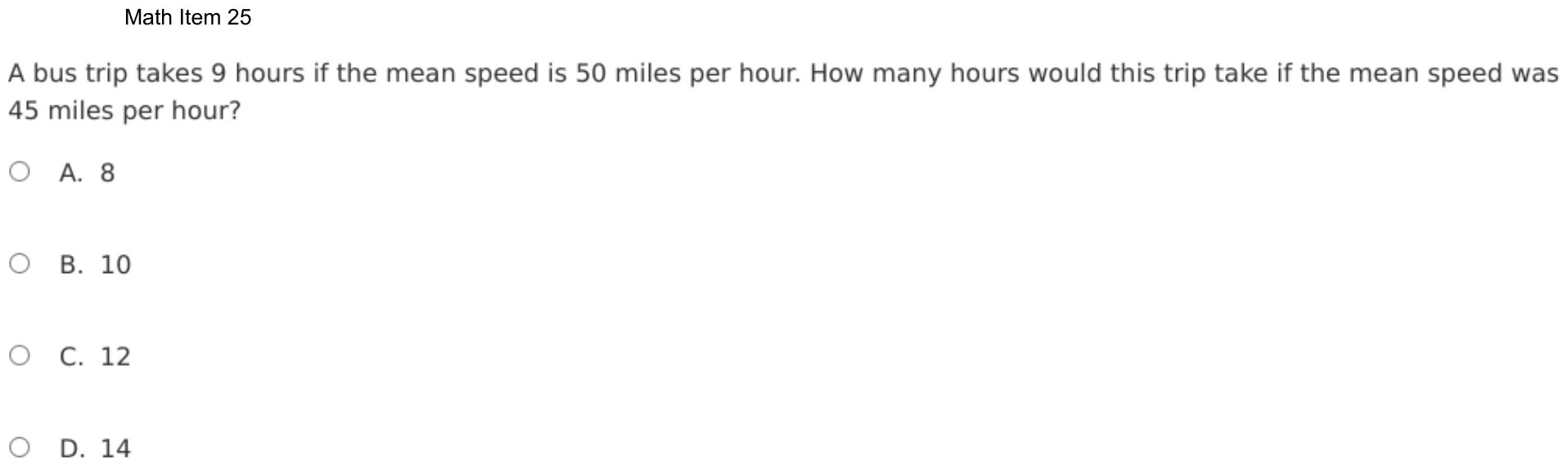
A bus trip takes 9 hours if the mean speed is 50 miles per hour. How many hours would this trip take if the mean speed was 45 miles per hour?
- A8
- B10
- C12
- D14
Show the answer
Correct answer: B
First, find the length of the bus trip in miles by multiplying the time, 9 hours, by the average (mean) speed, 50 miles per hour, to get 450 miles.
Then, divide the total distance, 450 miles, by the average (mean) speed, 45 miles per hour, to get the total time:
Question analysis
A bus trip takes 9 hours at a mean speed of 50 miles per hour, and students find how long the same trip takes at 45 miles per hour. It tests speed, distance and time. Working out the fixed distance first is the key, since guessing how the time should change leads many students astray.
- NYS standards
- 6.RP.3b unit rate problems
- Grade level
- Grade 6 content, by NYS standard
- Compared with grade 7
- Below grade 7 Speed, distance and time problems are grade 6 rate work, and this one uses whole numbers in two steps. Its only twist is how the time responds when the speed changes, which makes it easier than typical grade 7 rate problems.
- Estimated difficulty
- Straightforward: two steps or one careful reading.
- Thinking it demands
- Depth of knowledge 2, skills and concepts · mainly apply
- What makes it hard
- No obvious method moderate
- Something you must already know minor
- Solution
- 2 steps
- Reading level
- Question and choices: about grade 3, 28 words.
- Students, last 30 days
- Not enough answers yet to show (it takes 10).
Why it is hard, traps and wrong answers (shows the answer)
Why it is hard
Two short calculations solve it, but only after noticing that speed and time move in opposite directions: a slower bus takes longer. Students who scale the 9 hours by 45/50, as in a direct proportion, get a little over 8 hours, a result that should feel wrong for a slower trip. Finding the distance first turns the question into one division with no direction to decide.
No obvious method moderate Working it out
The question never mentions the trip's length, yet the 450-mile distance is what stays fixed; setting up a proportion between hours and speeds, the usual reflex, points the wrong way. (Schoenfeld, 1985)
Something you must already know minor Working it out
Students must bring distance = speed × time themselves, to turn 9 hours at 50 miles per hour into miles before dividing by the new speed. (Anderson & Krathwohl, 2001)
Strategy: Find the trip's length in miles from the first speed and time, since that length stays the same, then divide it by the new mean speed.
Traps
- Misunderstands the concept: A wrong belief about a concept: that percents can be added, that area grows like length, that averages can be averaged, that a bigger denominator means a bigger fraction.
- Numbers taken from the question: Combines the numbers in the question without a model of the situation, or is simply a number that appears in the question.
The wrong answers, classified
A Misunderstands the concept (Smith, diSessa & Roschelle, 1993; De Bock et al., 1998; Ni & Zhou, 2005)
Treats time as proportional to speed, scaling 9 hours by 45/50 to 8.1, about 8, though a slower bus needs more time, not less.
C Little reason to choose it (Haladyna & Downing, 1993; Rodriguez, 2005)
No common working gives 12 hours; it needs a slip such as 540 miles for 9 × 50, so it mostly draws guesses.
D Numbers taken from the question (Hegarty, Mayer & Monk, 1995)
Adds the 5-mile-per-hour drop in speed to the 9 hours, 9 + 5 = 14, combining numbers from the question without a model of the trip.
Worked solution, step by step
Formulas used
- Distance, speed and time
- d is the distance traveled. r is the rate, or speed, such as miles per hour. t is the time. It works because at 50 miles each hour, 9 hours covers 9 groups of 50 miles.
- Finding the time
- This is the same rule turned around. d is the distance and r is the speed. Divide the distance by the speed to find t, the number of hours. Use it when you know how far and how fast.
Sort out the question
A bus trip takes 9 hours at a mean speed of 50 miles per hour. The mean speed is the average speed over the whole trip. You need the time for the same trip at 45 miles per hour. The length of the trip does not change, so find it first.
Find the length of the trip
Use distance equals speed times time, with a speed of 50 miles per hour and a time of 9 hours:
The trip is 450 miles long.
Find the new time
Now the bus goes 45 miles per hour over the same 450 miles. Divide the distance by the speed:
The trip takes 10 hours.
Check that it makes sense
A slower bus needs more time for the same trip. 10 hours is more than 9 hours, so it fits.
Watch out: time does not shrink with speed. Scaling 9 hours by 45/50 gives about 8 hours, choice A, which would make the slower bus arrive sooner. Adding the drop of 5 miles per hour to 9 hours gives 14, choice D, which has no reason behind it.
So the answer is B, 10 hours.
Check your answer
Check the distance both ways. At 50 miles per hour for 9 hours, the bus goes 50 × 9 = 450 miles. At 45 miles per hour for 10 hours, it goes 45 × 10 = 450 miles. Same trip, same distance.
More questions like this
The original DOE question
Question 4 of 19
2026 Practice Test D Math, question 30Question
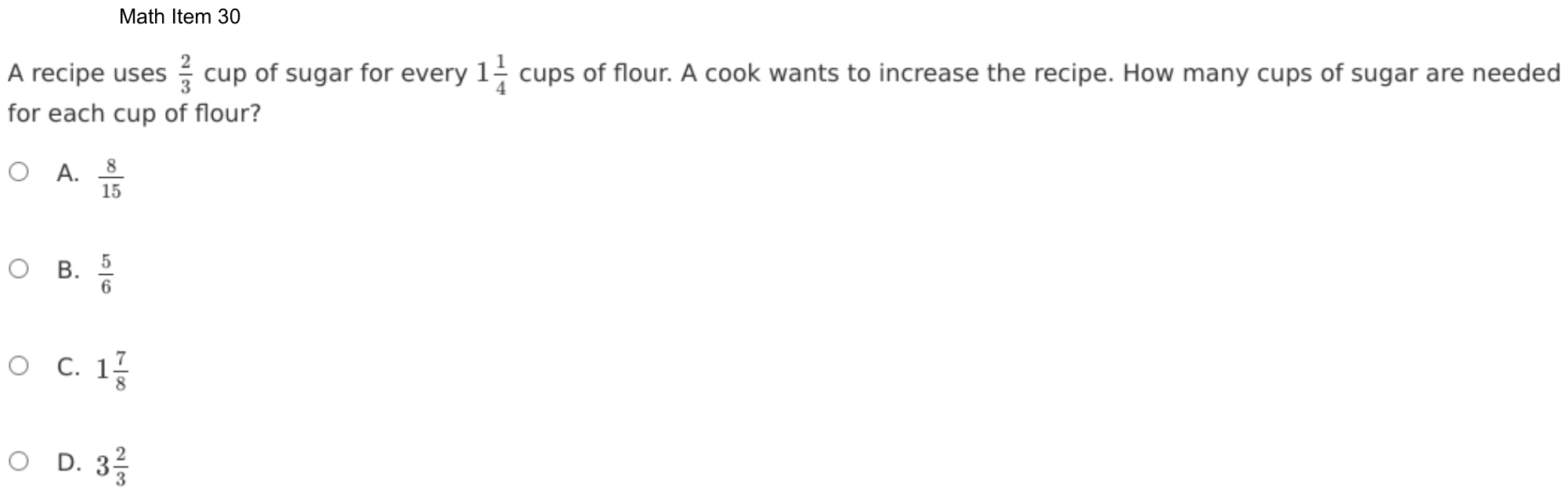
A recipe uses cup of sugar for every cups of flour. A cook wants to increase the recipe. How many cups of sugar are needed for each cup of flour?
- A
- B
- C
- D
Show the answer
Correct answer: A
To find the cups of sugar for each cup of flour, find the unit rate using this ratio:
Then, convert the denominator to an improper fraction and divide to find the cups of sugar per cup of flour.
Question analysis
A recipe uses 2/3 cup of sugar for every 1 1/4 cups of flour, and this unit rate question asks how many cups of sugar go with each cup of flour. Students divide one fraction by a mixed number. Deciding which amount to divide by which, and converting the mixed number first, are where mistakes creep in.
- Grade level
- Grade 7 content, by NYS standard
- Compared with grade 7
- At grade 7 Computing a unit rate from a ratio of fractions is exactly the grade 7 standard. This one divides by a mixed number, and the cook's plan to enlarge the recipe adds wording without adding any numbers to use.
- Estimated difficulty
- Moderate: several steps, or a close reading with one strong distractor.
- Thinking it demands
- Depth of knowledge 2, skills and concepts · mainly apply
- What makes it hard
- Error-prone arithmetic moderate
- Turning words into math minor
- Solution
- 2 steps
- Reading level
- Question and choices: about grade 5, 36 words.
- Students, last 30 days
- Not enough answers yet to show (it takes 10).
Why it is hard, traps and wrong answers (shows the answer)
Why it is hard
The work is a single fraction division, but it involves a mixed number and an awkward result. Students unsure of the rule multiply the two amounts or divide them the other way round, and each gives a tidy listed fraction. A size check settles it: 1 1/4 cups of flour take only 2/3 cup of sugar, so one cup of flour needs less than 2/3 cup, which leaves a single choice.
Error-prone arithmetic moderate Working it out
The divisor is the mixed number 1 1/4, which must become 5/4 before dividing; then 2/3 × 4/5 gives 8/15, a fraction that does not simplify and looks unfinished. (Brown & Burton, 1978; Junker & Sijtsma, 2001)
Turning words into math minor Understanding the question
The phrase “for each cup of flour” puts flour in the denominator, sugar ÷ flour, and the sentence about increasing the recipe adds nothing to the calculation. (Hegarty, Mayer & Monk, 1995; Koedinger & Nathan, 2004)
Strategy: Write the sugar over the flour, change 1 1/4 to an improper fraction, and divide by multiplying by its reciprocal, keeping sugar on top because the question asks for sugar per cup of flour.
Traps
- Wrong operation: Adds instead of multiplying, divides the wrong way round, turns a ratio or rate upside down, or undoes a step in the wrong direction (subtracts what should be added back).
- A faulty procedure: A systematic but wrong procedure: adding fractions straight across, applying an exponent to each term of a sum, dropping a sign when moving a term.
The wrong answers, classified
B Wrong operation (Hegarty, Mayer & Monk, 1995; King et al., 2004)
Multiplies 2/3 by 5/4 instead of dividing, getting 10/12 = 5/6, more sugar for one cup of flour than the recipe uses for 1 1/4 cups.
C Wrong operation (Hegarty, Mayer & Monk, 1995; King et al., 2004)
Divides the flour by the sugar, 5/4 ÷ 2/3 = 15/8 = 1 7/8, which is cups of flour for each cup of sugar, the rate upside down.
D A faulty procedure (Brown & Burton, 1978; Tatsuoka, 1983)
Splits the mixed number apart, dividing 2/3 by only the 1/4 to get 2 2/3, then adding the whole 1 to make 3 2/3.
Worked solution, step by step
Formulas used
- Unit rate
- A unit rate tells how much of one thing goes with 1 of another. Here it is the cups of sugar for 1 cup of flour. The amount you want goes on top. The amount you want to make 1 goes on the bottom.
- Mixed number to fraction
- w is the whole number, and n/d is the fraction part. Multiply the whole number by the bottom, add the top, and keep the bottom. It works because each whole holds d pieces of size 1/d.
- Dividing fractions
- a, b, c and d are numbers that are not zero. To divide by a fraction, multiply by its reciprocal, the fraction flipped upside down. Flip only the fraction you divide by.
Sort out the question
The recipe uses cup of sugar for every cups of flour. You need the cups of sugar for each 1 cup of flour. The part about making more of the recipe gives no numbers, so you can set it aside.
Set up the unit rate
You want sugar for each cup of flour. So sugar goes on top and flour goes on the bottom:
Watch out: dividing the other way, flour by sugar, gives . That is cups of flour for each cup of sugar, choice C.
Change the mixed number
You cannot divide by a mixed number directly. Change it to a fraction first. Each whole has 4 fourths:
Divide the fractions
Multiply by the reciprocal of 5/4, which is 4/5. Multiply the tops and multiply the bottoms:
The fraction 8/15 cannot be simplified, since 8 and 15 share no factor but 1.
Watch out: multiplying without flipping gives , choice B.
So the answer is A, .
Check your answer
More than 1 cup of flour takes only 2/3 cup of sugar. So 1 cup of flour needs a bit less than 2/3. Since , the answer 8/15 is a bit less. Also, , which brings back the recipe.
More questions like this
The original DOE question
Question 5 of 19
2026 Practice Test D Math, question 42Question
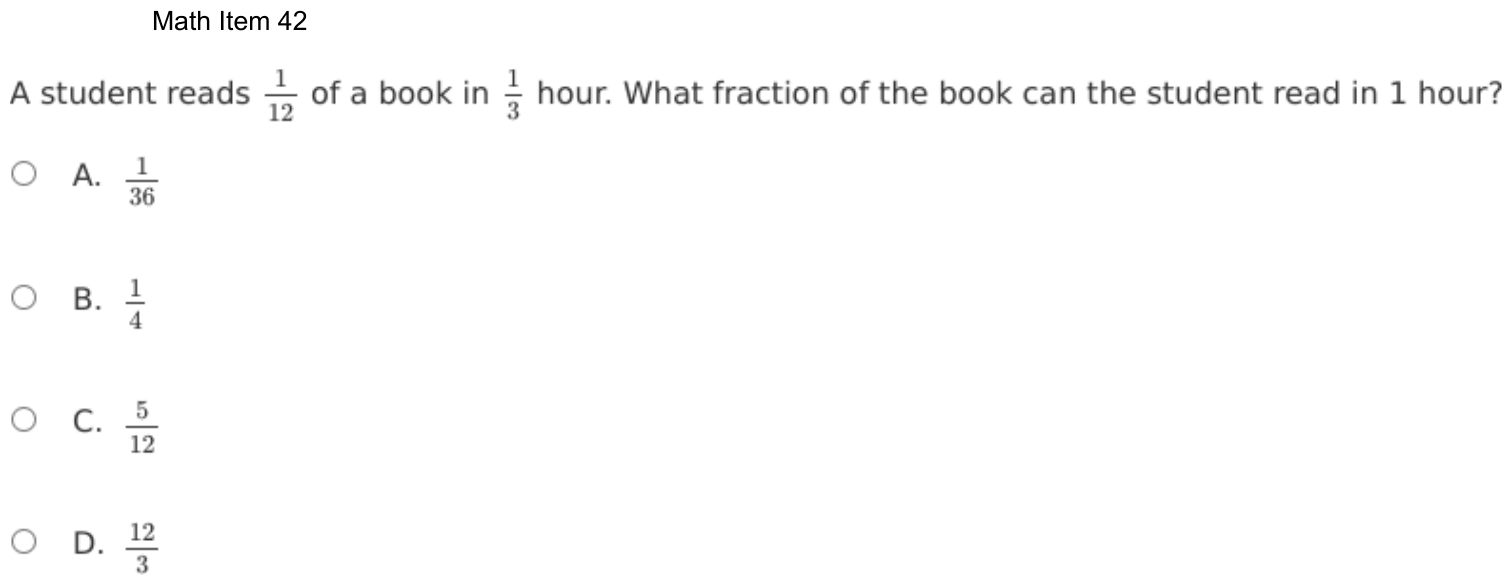
A student reads of a book in hour. What fraction of the book can the student read in 1 hour?
- A
- B
- C
- D
Show the answer
Correct answer: B
To find the fraction of the book the student can read in 1 hour, find the unit rate per hour. First, set up the ratio.
Then use division to find the unit rate.
Another way to solve the problem is to set up the ratio and then multiply both the numerator and denominator by 3, since hour times 3 equals 1 hour.
Question analysis
A student reads 1/12 of a book in 1/3 of an hour, and this rate question asks what fraction of the book the student can read in a whole hour. It tests finding a unit rate when both amounts are fractions. Deciding whether to multiply or divide, and which fraction goes on top, decides the result.
- Grade level
- Grade 7 content, by NYS standard
- Compared with grade 7
- At grade 7 Computing a unit rate from a ratio of fractions is the grade 7 standard itself. This is a short example with unit fractions, where scaling the time up to a whole hour is as quick as dividing.
- Estimated difficulty
- Straightforward: two steps or one careful reading.
- Thinking it demands
- Depth of knowledge 2, skills and concepts · mainly apply
- What makes it hard
- Error-prone arithmetic minor
- Turning words into math minor
- Solution
- 2 steps
- Reading level
- Question and choices: about grade 5, 25 words.
- Students, last 30 days
- Not enough answers yet to show (it takes 10).
Why it is hard, traps and wrong answers (shows the answer)
Why it is hard
Thinking in thirds of an hour makes this quick: an hour holds three of them, so the student reads three twelfths of the book. Students who reach for a fraction rule instead must choose between multiplying and dividing, and between two orders of division. A sense check rules out two wrong choices at once: a whole hour must cover more than 1/12 of the book, and no more than the whole book.
Error-prone arithmetic minor Working it out
Both amounts are unit fractions, and 1/12 ÷ 1/3 means multiplying by 3, which gives 3/12 that still has to be simplified to match a choice. (Brown & Burton, 1978; Junker & Sijtsma, 2001)
Turning words into math minor Understanding the question
The phrase “fraction of the book … in 1 hour” asks for book per hour, so the fraction of the book is divided by the time, not the other way round. (Hegarty, Mayer & Monk, 1995; Koedinger & Nathan, 2004)
Strategy: Ask how many thirds of an hour make 1 hour, then scale the fraction of the book by the same factor; or divide the fraction of the book by the time.
Traps
- Wrong operation: Adds instead of multiplying, divides the wrong way round, turns a ratio or rate upside down, or undoes a step in the wrong direction (subtracts what should be added back).
- Numbers taken from the question: Combines the numbers in the question without a model of the situation, or is simply a number that appears in the question.
The wrong answers, classified
A Wrong operation (Hegarty, Mayer & Monk, 1995; King et al., 2004)
Multiplies 1/12 by 1/3 instead of dividing, getting 1/36, which would mean reading less of the book in an hour than in a third of one.
C Numbers taken from the question (Hegarty, Mayer & Monk, 1995)
Adds the two fractions, 1/12 + 4/12 = 5/12, combining an amount of the book with an amount of time as if they were alike.
D Wrong operation (Hegarty, Mayer & Monk, 1995; King et al., 2004)
Divides the time by the amount read, 1/3 ÷ 1/12 = 12/3, which is hours per book, the rate turned upside down.
Worked solution, step by step
Formulas used
- Unit rate
- A unit rate tells how much happens in 1 unit, here 1 hour. Put the part of the book on top and the time on the bottom. Dividing finds the part of the book for one whole hour.
- Dividing fractions
- a, b, c and d are numbers that are not zero. To divide by a fraction, multiply by its reciprocal, the fraction flipped upside down. Flip only the fraction you divide by.
Sort out the question
The student reads of a book in of an hour. You need the part of the book read in 1 whole hour. That is a unit rate.
Scale up to one hour
One hour holds three thirds of an hour. So in 1 hour the student reads 3 times as much:
To simplify 3/12, divide the top and bottom by 3. The student reads 1/4 of the book in 1 hour.
Check with the unit rate
Divide the part of the book by the time. Multiply by the reciprocal of 1/3, which is 3/1:
Both ways give 1/4.
Avoid the wrong operations
Watch out: multiplying gives , choice A. That is less than 1/12. But in a full hour, the student must read more than in a third of an hour. Dividing the time by the book gives 12/3, choice D. That is 4 whole books.
So the answer is B, .
Check your answer
If the student reads 1/4 of the book each hour, the whole book takes 4 hours. In 1/3 of an hour, the student reads of the book. That matches the question.
More questions like this
The original DOE question
Question 6 of 19
2026 Practice Test D Math, question 43Question
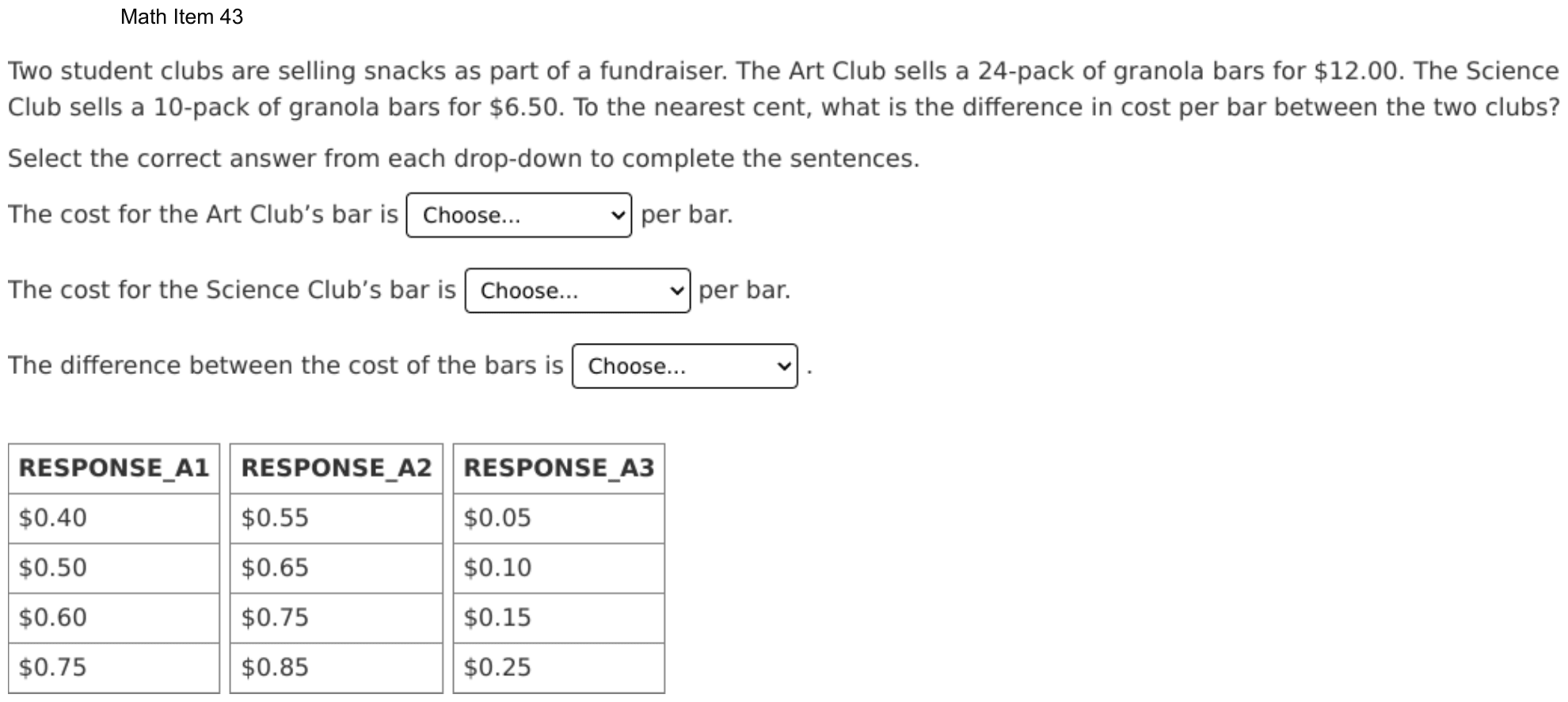
Two student clubs are selling snacks as part of a fundraiser. The Art Club sells a 24-pack of granola bars for $12.00. The Science Club sells a 10-pack of granola bars for $6.50. To the nearest cent, what is the difference in cost per bar between the two clubs?
Select the correct answer from each drop-down to complete the sentences.
The cost for the Art Club’s bar is per bar.
The cost for the Science Club’s bar is per bar.
The difference between the cost of the bars is .
Choose an answer from each menu, then check. The DOE has not published how answers with several parts are scored; this site counts one right only when every part is right.
Show the answer
Correct answer: blank 1: $0.50; blank 2: $0.65; blank 3: $0.15
To determine the cost per bar from the Art Club, divide the total cost by the total number of bars:
To determine the cost per bar from the Science Club, divide the total cost by the total number of bars:
To find the difference in price per bar, subtract the cost per bar for the Art Club from the cost per bar for the Science Club:
Question analysis
Two clubs sell granola bars for a fundraiser: the Art Club a 24-pack for $12.00 and the Science Club a 10-pack for $6.50. Students complete three sentences with drop-down menus, giving each club's cost per bar and the difference between them. It tests unit prices with money, and all three menus must be right.
- Grade level
- Grade 6 content, by NYS standard
- Compared with grade 7
- Below grade 7 Comparing unit prices is grade 6 rate work. The menus split it into three short steps, two divisions of money amounts and one subtraction, which is lighter than typical grade 7 work.
- Estimated difficulty
- Routine: one familiar step, little to misread.
- Thinking it demands
- Depth of knowledge 1, recall and reproduction · mainly apply
- What makes it hard
- Many steps minor
- Error-prone arithmetic minor
- Solution
- 3 steps
- Reading level
- Question and choices: about grade 3, 87 words.
- Corrected from the DOE handbook
- The order of the answers in the DOE’s key was corrected.
- Students, last 30 days
- Not enough answers yet to show (it takes 10).
Why it is hard, traps and wrong answers (shows the answer)
Why it is hard
The menus guide the work, one sentence per step, and every option is a reasonable price, so the question rewards accurate division more than planning. No common misconception leads to the wrong options; they catch slips, such as misreading a pack size or subtracting carelessly. Checking that 24 bars at the first price cost $12.00 and 10 bars at the second cost $6.50 confirms both menus before the subtraction.
Many steps minor Working it out
Three menus must all be right to score: two divisions for the costs per bar, then a subtraction that uses both, so a slip in either division spoils the third menu. (Daniel & Embretson, 2010; Enright, Morley & Sheehan, 2002)
Error-prone arithmetic minor Working it out
Each division is with money, $12.00 ÷ 24 and $6.50 ÷ 10, so the decimal point must be placed carefully, though the menus offer only sensible amounts. (Brown & Burton, 1978; Junker & Sijtsma, 2001)
Strategy: Divide each pack's price by the number of bars in it, then subtract the smaller cost per bar from the larger; checking that 24 bars at your first price make $12.00 catches slips.
Traps
- Misreads the question: Misses or misreads a condition or a word in the question: "at least", "each", "remaining", "not".
- An arithmetic slip: The right method with a plausible arithmetic error: a digit, a place value or a times-table fact.
The wrong answers, classified
CBA Misreads the question (Hegarty, Mayer & Monk, 1995)
Divides $12.00 by 20 instead of 24, misreading the size of the Art Club’s pack, so $0.60 a bar leaves a gap of only $0.05.
BBB An arithmetic slip (Junker & Sijtsma, 2001)
Finds both costs per bar correctly, then slips in the subtraction, taking $0.65 − $0.50 as $0.10, the option beside the right one.
What was corrected from the DOE handbook, and why
- Answer key: The DOE’s explanation opens with the key “($0.65; $0.50; $0.15)”, which puts $0.65 in the first drop-down and $0.50 in the second. Neither is possible: the first menu (the Art Club’s cost per bar) offers $0.40, $0.50, $0.60 and $0.75, and the second (the Science Club’s) offers $0.55, $0.65, $0.75 and $0.85. The explanation’s own working gives the Art Club $12.00 ÷ 24 = $0.50 and the Science Club $6.50 ÷ 10 = $0.65, so the key is $0.50, $0.65, $0.15. The site’s key was already in that order; the DOE’s key line is not shown on the site.
Worked solution, step by step
Formulas used
- Cost of one item
- The price of the pack is what you pay for all the bars together. Dividing shares that price equally among the bars. The result is the price of one bar, called the unit price.
Sort out the question
You know:
- The Art Club sells 24 bars for $12.00.
- The Science Club sells 10 bars for $6.50.
There are three menus. The first is the Art Club’s cost per bar. The second is the Science Club’s. The third is the difference, how much more one bar costs than the other.
Find the Art Club’s cost
Share $12.00 among 24 bars:
Each bar costs $0.50. That makes sense: 24 half-dollars make $12. Pick $0.50 in the first menu.
Watch out: dividing by 20 instead of 24 gives $0.60, which is also in the menu.
Find the Science Club’s cost
Share $6.50 among 10 bars. Dividing by 10 moves the decimal point one place to the left:
Each bar costs $0.65. Pick $0.65 in the second menu.
Find the difference
Subtract the smaller cost from the larger one:
The bars differ by $0.15. Pick $0.15 in the third menu.
Watch out: $0.10 sits right next to $0.15 in the menu. A slip in the subtraction lands there.
Fill in the three menus
On the test and on this site, you choose each answer from a drop-down menu.
So the menus read $0.50, $0.65 and $0.15.
Check your answer
Multiply back. and , so both costs per bar match the pack prices. And , so the difference fits too.
More questions like this
The original DOE question
Question 7 of 19
2024 Test A Math, question 32Question
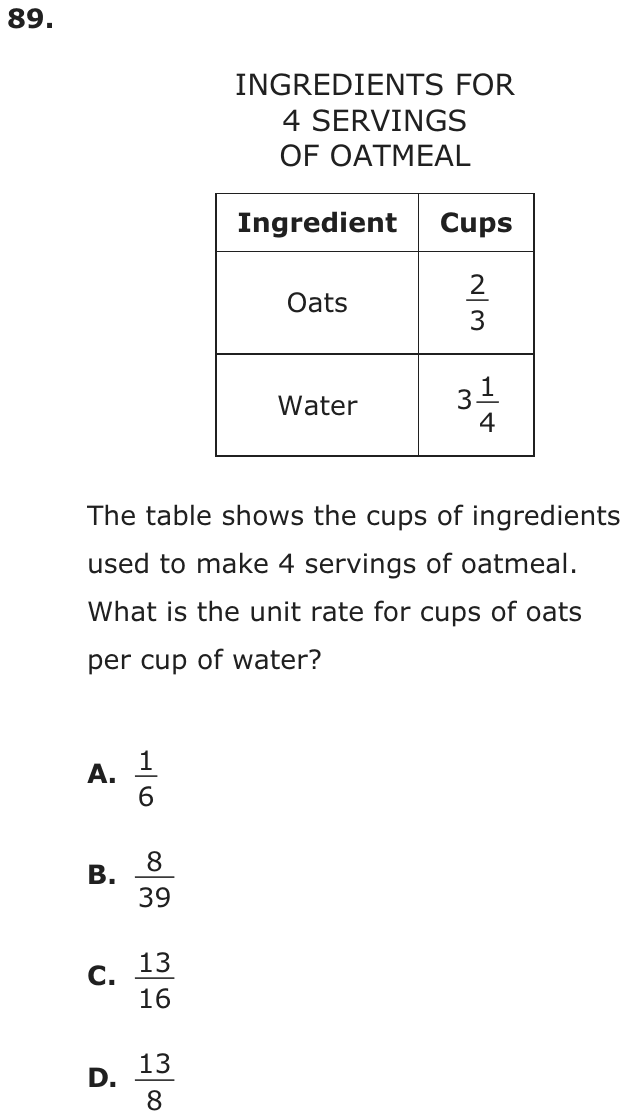
INGREDIENTS FOR 4 SERVINGS OF OATMEAL
| Ingredient | Cups |
|---|---|
| Oats | |
| Water |
The table shows the cups of ingredients used to make 4 servings of oatmeal. What is the unit rate for cups of oats per cup of water?
- A
- B
- C
- D
Show the answer
Correct answer: B
The unit rate for cups of oats per cup of water can be found by dividing the number of cups of oats by the number of cups of water:
The denominator can be rewritten as .
The quotient can be rewritten as:
Therefore, the unit rate for cups of oats per cup of water is .
Question analysis
This unit rate question uses a recipe table for 4 servings of oatmeal, with 2/3 cup of oats and 3 1/4 cups of water, and asks for cups of oats per cup of water. Students divide one fraction by another, including a mixed number. Deciding which quantity goes on top, and whether the number of servings matters, is the tricky part.
- Grade level
- Grade 7 content, by NYS standard
- Compared with grade 7
- At grade 7 Unit rates from fractions, such as 1/2 mile in 1/4 hour, are exactly grade 7 work. This one adds a mixed number, a fraction divided by a fraction, and a table titled for 4 servings, so students must decide which numbers the rate uses.
- Estimated difficulty
- Moderate: several steps, or a close reading with one strong distractor.
- Thinking it demands
- Depth of knowledge 2, skills and concepts · mainly apply
- What makes it hard
- Error-prone arithmetic moderate
- Turning words into math moderate
- Reading a figure, table or graph minor
- Solution
- 3 steps
- Reading level
- Question and choices: about grade 6, 40 words.
- Students, last 30 days
- Not enough answers yet to show (it takes 10).
Why it is hard, traps and wrong answers (shows the answer)
Why it is hard
The question rewards reading the rate's wording exactly and then carrying out a fraction division without slips. The 4 servings in the title is the hook: dividing by 4 gives a per-serving amount that sounds like a unit rate and is listed. Students who write oats over water as one fraction, convert the mixed number and multiply by the reciprocal finish in a few lines.
Error-prone arithmetic moderate Working it out
The rate is a fraction over a mixed number, 2/3 ÷ 3 1/4, so 3 1/4 must become 13/4 and the division a multiplication by 4/13. (Brown & Burton, 1978; Junker & Sijtsma, 2001)
Turning words into math moderate Understanding the question
In "cups of oats per cup of water" the quantity before "per" goes on top; reading the phrase loosely puts water over oats or brings in servings. (Hegarty, Mayer & Monk, 1995; Koedinger & Nathan, 2004)
Reading a figure, table or graph minor Understanding the question
The table's title, "for 4 servings", supplies the only other number on the page, and it plays no part in a rate of oats to water. (Lesh, Post & Behr, 1987; Kirsch & Mosenthal, 1990)
Strategy: Write the rate as cups of oats over cups of water, change the mixed number to an improper fraction, and divide by multiplying by its reciprocal.
Traps
- Information you don't need: The question gives numbers or facts that play no part in the answer.
- Answers a different question: A choice is right for another quantity: the other unknown, the rest instead of the part, the part instead of the whole.
- Wrong operation: Adds instead of multiplying, divides the wrong way round, turns a ratio or rate upside down, or undoes a step in the wrong direction (subtracts what should be added back).
The wrong answers, classified
A Answers a different question (King et al., 2004; Hegarty, Mayer & Monk, 1995)
Divides the 2/3 cup of oats by the 4 servings, 2/3 ÷ 4 = 1/6, giving oats per serving instead of oats per cup of water.
C Answers a different question (King et al., 2004; Hegarty, Mayer & Monk, 1995)
Divides the 3 1/4 cups of water by the 4 servings, 13/4 ÷ 4 = 13/16, leaving the oats out altogether.
D Wrong operation (Hegarty, Mayer & Monk, 1995; King et al., 2004)
Turns the rate upside down, water over oats, and also drops the 3 of 2/3, dividing 13/4 by 2 to get 13/8.
Worked solution, step by step
Formulas used
- Unit rate
- A unit rate tells how much of the first amount goes with 1 of the second amount. The word per means for each. The amount named before per goes on top, and the amount after it goes on the bottom.
- Mixed number to fraction
- a is the whole number part, b is the top of the fraction, and c is the bottom. Each whole holds c pieces, so a wholes hold a times c pieces. Then add the b extra pieces.
- Dividing by a fraction
- a over b is the number you divide. c over d is the number you divide by. To divide by a fraction, multiply by its reciprocal, the fraction flipped upside down. This works because dividing by a number undoes multiplying by it.
Sort out the question
The table shows cup of oats and cups of water. You need the unit rate for “cups of oats per cup of water.” That is how many cups of oats go with 1 cup of water.
Watch out: the 4 servings play no part here. Dividing the oats by 4 servings gives cup for each serving, choice A.Set up the rate
Oats comes before per, so oats goes on top. Water goes on the bottom.
Watch out: water over oats flips the rate. That gives a number bigger than 1, like choice D.Change the mixed number
A mixed number is a whole number plus a fraction. Change to a fraction so you can divide.
So 3 and one quarter cups is 13 quarters of a cup.
Divide by multiplying
To divide by , multiply by its reciprocal, .
No whole number bigger than 1 divides both 8 and 39, so the fraction can’t be made simpler. The rate is cup of oats per cup of water.
So the answer is B, .
Check your answer
There is much more water than oats. So the oats for 1 cup of water should be small, and is about 0.2. Also multiply back: . That is the cups of oats in the table.
More questions like this
The original DOE question
Question 8 of 19
2024 Test A Math, question 42Question
Lian bought enough oranges to fill 4 bags. Each bag contains 8 oranges. The total cost was $11.52. At that rate, how much would Lian pay for 42 oranges?
- A$17.28
- B$15.12
- C$15.02
- D$12.52
Show the answer
Correct answer: B
First, find the amount, in dollars, that Lian paid for each orange. There are 4 bags with 8 oranges each.
Divide the total cost by the total number of oranges to get the cost per orange:
Multiply to find the cost of 42 oranges:
Question analysis
This rate word problem says Lian paid $11.52 for 4 bags of 8 oranges each and asks how much 42 oranges would cost at the same rate. Students find the price of one orange and multiply. Since 42 oranges is not a whole number of bags, working by the bag instead of by the orange invites mistakes.
- Grade level
- Grade 6 content, by NYS standard
- Compared with grade 7
- Below grade 7 Finding a unit price and scaling it up is grade 6 rate work. The decimals are multi-digit, but the plan is routine, with less to manage than grade 7 problems built on percents or negative numbers.
- Estimated difficulty
- Straightforward: two steps or one careful reading.
- Thinking it demands
- Depth of knowledge 2, skills and concepts · mainly apply
- What makes it hard
- Error-prone arithmetic moderate
- A very close wrong answer minor
- Solution
- 3 steps
- Reading level
- Question and choices: about grade 2, 25 words.
- Students, last 30 days
- Not enough answers yet to show (it takes 10).
Why it is hard, traps and wrong answers (shows the answer)
Why it is hard
The plan is familiar, total oranges, price per orange, then the new cost, so the work lies in the decimals. Because 42 oranges is five bags and two oranges, students who price by the bag either round up to six bags or must handle the leftover. Estimating, since 42 is about a third more than 32, gives roughly $15 and rules out the far choices but not the near one.
Error-prone arithmetic moderate Working it out
Two decimal operations are done by hand: 11.52 ÷ 32 = 0.36 for one orange, then 0.36 × 42 = 15.12, where a dropped carry is easy. (Brown & Burton, 1978; Junker & Sijtsma, 2001)
A very close wrong answer minor Choosing the answer
The choices $15.12 and $15.02 differ by 10 cents, so a rough estimate of about $15 cannot choose between them; only the exact product can. (Embretson & Wetzel, 1987; Gorin & Embretson, 2006; Ascalon et al., 2007)
Strategy: Multiply to find how many oranges were bought, divide the total cost by that number to get the price of one orange, then multiply by 42.
Traps
- Misreads the question: Misses or misreads a condition or a word in the question: "at least", "each", "remaining", "not".
- An arithmetic slip: The right method with a plausible arithmetic error: a digit, a place value or a times-table fact.
The wrong answers, classified
A Misreads the question (Hegarty, Mayer & Monk, 1995)
Prices whole bags, rounding 42 oranges up to 6 bags of 8, and pays 6 × $2.88 = $17.28, missing that "at that rate" means per orange.
C An arithmetic slip (Junker & Sijtsma, 2001)
Uses the right method but slips one digit in multiplying 0.36 by 42, a tens-place error that lands 10 cents short of the total.
D Little reason to choose it (Haladyna & Downing, 1993; Rodriguez, 2005)
No common working gives $12.52, exactly one dollar more than $11.52; no price per orange or per bag leads there, so it mostly draws guesses.
Worked solution, step by step
Formulas used
- Unit price
- The unit price is what one item costs. Divide the total cost by how many items you got. It works because the total is shared equally among the items.
- Cost
- The unit price is the cost of one item, here one orange. Multiply it by how many items you buy to get the total cost. This works when every item costs the same.
Sort out the question
Lian bought 4 bags with 8 oranges in each bag. She paid $11.52 in all. You need the cost of 42 oranges. “At that rate” means each orange costs the same as before. So find the price of one orange first.
Count the oranges
Each of the 4 bags holds 8 oranges, so multiply to find how many she bought.
Lian bought 32 oranges for $11.52.
Find the price of one orange
This is easier in cents: . So one orange costs $0.36, or 36 cents.
Find the cost of 42 oranges
Break 42 into 40 and 2 to make it easier.
The 42 oranges cost $15.12.
Avoid the traps and answer
Watch out: $15.02, choice C, is only 10 cents away. Multiply and add with care. Watch out: Lian pays for each orange, not for full bags. Buying 6 whole bags would cost $17.28, choice A.So the answer is B, $15.12.
Check your answer
42 oranges is 10 more than 32. Those 10 oranges cost $3.60, since . Then . Same answer, so $15.12 is right.
More questions like this
The original DOE question
Question 9 of 19
2024 Test B Math, question 14Question
Karen reads at the rate of 60 pages per day. Martina reads 25% more pages per day than Karen. If the two students begin 1,500-page reading assignments on the same day, how many days sooner will Martina complete the assignment than Karen?
- A4
- B5
- C7
- D15
Show the answer
Correct answer: B
First, determine the rate at which Martina reads, in pages per day, using the rate at which Karen reads, 60 pages per day.
Next, determine the number of days it will take each person to complete the 1,500-page reading assignment.
Karen:
Martina:
Finally, determine the difference between the two numbers of days.
So Martina will complete the assignment 5 days sooner than Karen.
Question analysis
A reading-rate word problem: Karen reads 60 pages a day, and Martina reads 25% more pages a day. Both start a 1,500-page assignment on the same day, and students find how many days sooner Martina finishes. It combines a percent increase with rates and times, and asks for a difference in days.
- Grade level
- Grade 7 content, by NYS standard
- Compared with grade 7
- Above grade 7 Grade 7 percent problems usually stop after one increase or decrease. This one turns the percent into a new rate, finds two finishing times and compares them, four steps that go beyond a typical grade 7 task.
- Estimated difficulty
- Hard: combines ideas, needs a plan, and has more than one tempting wrong answer.
- Thinking it demands
- Depth of knowledge 2, skills and concepts · mainly apply
- What makes it hard
- Many steps moderate
- Combines ideas moderate
- Turning words into math minor
- Solution
- 4 steps
- Reading level
- Question and choices: about grade 6, 40 words.
- Students, last 30 days
- Not enough answers yet to show (it takes 10).
Why it is hard, traps and wrong answers (shows the answer)
Why it is hard
Each step is easy on its own; the difficulty is in carrying the chain to the end. Three of the choices are numbers a student meets or makes along the way: the extra pages per day, a quotient of two rates, or a rate built on 25 pages instead of 25%. Writing both finishing times down before subtracting keeps the target, a number of days, in view.
Many steps moderate Working it out
Four operations chain together: 25% of 60, Martina's 75 pages, the two finishing times 1,500 ÷ 60 and 1,500 ÷ 75, and finally their difference. (Daniel & Embretson, 2010; Enright, Morley & Sheehan, 2002)
Combines ideas moderate Working it out
A percent increase in a daily rate has to be turned into a change in days, and 25% more pages a day does not mean 25% fewer days. (Embretson, 1998; Daniel & Embretson, 2010)
Turning words into math minor Understanding the question
“25% more pages per day than Karen” makes Martina's rate 1.25 × 60, and “how many days sooner” asks for a difference of two times, not of two rates. (Hegarty, Mayer & Monk, 1995; Koedinger & Nathan, 2004)
Strategy: Increase 60 by 25% to get Martina's daily pages, divide 1,500 by each girl's daily rate to get her number of days, then subtract the two numbers of days.
Traps
- Stops one step early: A choice is a number from partway through the solution.
- Misunderstands the concept: A wrong belief about a concept: that percents can be added, that area grows like length, that averages can be averaged, that a bigger denominator means a bigger fraction.
- Numbers taken from the question: Combines the numbers in the question without a model of the situation, or is simply a number that appears in the question.
The wrong answers, classified
A Numbers taken from the question (Hegarty, Mayer & Monk, 1995)
Divides Karen's 60 pages a day by Martina's 15 extra pages a day, combining two rates without finding how long either girl takes.
C Misunderstands the concept (Smith, diSessa & Roschelle, 1993; De Bock et al., 1998; Ni & Zhou, 2005)
Adds 25 pages instead of 25%, giving Martina 85 pages a day, so she needs 1,500 ÷ 85 ≈ 17.6, or 18 days, and 25 − 18 = 7.
D Stops one step early (King et al., 2004; Gierl et al., 2017)
Finds that Martina reads 25% of 60 = 15 more pages each day and stops there, giving a number of pages instead of days.
Worked solution, step by step
Formulas used
- Percent increase
- Old is the starting amount, and p is the percent it grows by. First find p percent of the old amount. That is the extra. Then add the extra to the old amount to get the new amount.
- Time from a rate
- Total pages is the whole assignment. Pages per day is how fast someone reads. Dividing tells how many days of reading fit into the whole job.
Sort out what you know
Karen reads 60 pages per day. Martina reads 25% more pages per day than Karen. Each girl must read 1,500 pages. You need how many days sooner Martina finishes. That is the difference between their numbers of days.
Find Martina’s pages per day
25% more means Karen’s 60 pages plus 25% of 60.
Martina reads 75 pages per day. Watch out: 15 is extra pages, not days. Stopping here gives 15, choice D. Adding 25 pages instead of 25% gives 85 pages and leads to 7, choice C.
Find each girl’s number of days
Divide the whole assignment by each girl’s pages per day.
Karen needs 25 days, and Martina needs 20 days.
Subtract the days
“How many days sooner” asks for the difference.
Martina finishes 5 days sooner. Watch out: dividing 60 by 15 mixes two rates and gives 4, choice A.
So the answer is B, 5.
Check your answer
Multiply back. Karen: pages. Martina: pages. Both read all 1,500 pages, and 25 days is 5 days more than 20 days.
More questions like this
The original DOE question
Question 10 of 19
2024 Test B Math, question 38Question
Michael received a check for $213 for working 20 hours at his part-time job. The amount on the check was his total pay after $32 in taxes was deducted. What was Michael’s hourly pay rate before taxes were deducted?
- A$9.05
- B$10.65
- C$12.25
- D$21.35
Show the answer
Correct answer: C
Add the taxes to the amount of the check to find Michael’s total pay before taxes were deducted:
Divide the total pay by the number of hours to find the hourly pay rate:
Question analysis
Michael's paycheck shows what he earned for 20 hours after taxes were taken out, and the tax amount is given. Students find his hourly pay rate before taxes. It tests unit rates in a money word problem, where students must decide what to do with the tax that was deducted.
- Grade level
- Grade 6 content, by NYS standard
- Compared with grade 7
- Below grade 7 Unit rate problems are grade 6 content, and this one needs one addition and one division with a decimal result. It is easier than typical grade 7 work, apart from deciding which amount is the pay before taxes.
- Estimated difficulty
- Straightforward: two steps or one careful reading.
- Thinking it demands
- Depth of knowledge 2, skills and concepts · mainly apply
- What makes it hard
- Turning words into math minor
- Solution
- 2 steps
- Reading level
- Question and choices: about grade 5, 36 words.
- Students, last 30 days
- Not enough answers yet to show (it takes 10).
Why it is hard, traps and wrong answers (shows the answer)
Why it is hard
Two operations in the right order, adding the tax back and dividing by the hours, are all this takes. The danger is the word deducted, which pulls students toward subtracting the $32 a second time, and the phrase before taxes, which rules out the take-home rate from dividing the check alone. Checking that $12.25 × 20 − $32 gives back $213 confirms the answer.
Turning words into math minor Understanding the question
"The amount on the check was his total pay after $32 in taxes was deducted" makes $213 what remained, so the $32 is added back, not taken away. (Hegarty, Mayer & Monk, 1995; Koedinger & Nathan, 2004)
Strategy: Rebuild Michael's pay before taxes from the check and the tax that was taken out, then divide that total by the 20 hours worked.
Traps
- Follows a key word: Picks the operation from a single word rather than the situation: "removed" so subtract, "of" so multiply, "more" so add, when the situation needs something else.
- Answers a different question: A choice is right for another quantity: the other unknown, the rest instead of the part, the part instead of the whole.
The wrong answers, classified
A Follows a key word (Hegarty, Mayer & Monk, 1995)
Follows the word deducted and subtracts the $32 from the $213 check again, (213 − 32) ÷ 20 = 9.05, instead of adding it back.
B Answers a different question (King et al., 2004; Hegarty, Mayer & Monk, 1995)
Divides the $213 check by 20 hours, which gives Michael's hourly pay after taxes rather than before.
D Little reason to choose it (Haladyna & Downing, 1993; Rodriguez, 2005)
No standard working gives $21.35, which equals 32 − 10.65; dividing $213 by 10 hours instead of 20, $21.30, comes closest, so it mostly draws guesses.
Worked solution, step by step
Formulas used
- Hourly pay rate
- rate is the pay for one hour. total pay is the money earned for all the hours. hours is the time worked. Dividing shares the total pay equally among the hours. Use it when the pay for each hour is the same.
Sort out the question
Michael’s check was for $213. That is what was left after $32 in taxes was deducted, which means taken away. He worked 20 hours.
You need his hourly pay before taxes. So first find his full pay before the $32 was taken out.
Add the taxes back
The $32 was taken away from his full pay to leave $213. To undo taking away, add it back.
His pay before taxes was $245. Watch out: The word “deducted” tempts you to subtract again. That gives , choice A.
Divide by the hours
He earned $12.25 for each hour before taxes. Watch out: Dividing the $213 check by 20 gives $10.65, choice B. That is his pay for each hour after taxes.
So the answer is C, $12.25.
Check your answer
Work forward. , so 20 hours pay $245. Take away $32 in taxes: . That is the amount on the check.
More questions like this
The original DOE question
Question 11 of 19
2023 Test A Math, question 8Question
Jamel works at a computer store. He is paid an hourly rate plus a 15% commission on all computer products he sells. Last week, Jamel was paid $802.50 for working 30 hours and selling $1,250.00 worth of computer products. What is Jamel’s hourly rate?
- A$20.50/hr
- B$26.75/hr
- C$33.00/hr
- D$37.65/hr
Show the answer
Correct answer: A
First, determine the amount of Jamel’s weekly pay that is from commission:
Next, subtract Jamel’s commission amount from his weekly pay:
Last, divide the result by 30 hours to find Jamel’s hourly rate:
Question analysis
Jamel earns an hourly wage plus a 15% commission on his sales, and one week he is paid $802.50 for 30 hours of work and $1,250 in sales. Students find his hourly rate. The question mixes a percent with a rate, and the commission has to be taken out of the total pay before dividing by the hours.
- Grade level
- Grade 7 content, by NYS standard
- Compared with grade 7
- At grade 7 Commission is one of the percent applications named in the grade 7 standards, and the remaining work is a two-step equation with decimals. That matches a typical grade 7 multistep problem, with the order of the steps as the main demand.
- Estimated difficulty
- Moderate: several steps, or a close reading with one strong distractor.
- Thinking it demands
- Depth of knowledge 2, skills and concepts · mainly apply
- What makes it hard
- Turning words into math moderate
- Many steps moderate
- Error-prone arithmetic minor
- Solution
- 3 steps
- Reading level
- Question and choices: about grade 3, 44 words.
- Students, last 30 days
- Not enough answers yet to show (it takes 10).
Why it is hard, traps and wrong answers (shows the answer)
Why it is hard
Jamel's pay has two parts, and the question asks for only one of them, so the commission has to be removed before dividing by the hours. Students who divide the whole $802.50 by 30 get a believable hourly figure that still contains the commission. Checking the answer against the story, 30 × $20.50 + $187.50 = $802.50, confirms both parts.
Turning words into math moderate Understanding the question
The phrase "paid an hourly rate plus a 15% commission on all computer products he sells" makes $802.50 the sum of two parts, 30 hours of pay and 15% of $1,250. (Hegarty, Mayer & Monk, 1995; Koedinger & Nathan, 2004)
Many steps moderate Working it out
Three operations in order: 15% of $1,250 is $187.50, $802.50 − $187.50 = $615.00, and $615.00 ÷ 30 = $20.50; dividing before subtracting gives a listed choice. (Daniel & Embretson, 2010; Enright, Morley & Sheehan, 2002)
Error-prone arithmetic minor Working it out
Every amount carries cents, and 15% of $1,250 and $615 ÷ 30 are worked by hand, so a misplaced decimal point shifts the hourly rate. (Brown & Burton, 1978; Junker & Sijtsma, 2001)
Strategy: Take 15% of the $1,250 in sales to find the commission, remove that from the week's pay, and divide what is left by the 30 hours worked.
Traps
- Answers a different question: A choice is right for another quantity: the other unknown, the rest instead of the part, the part instead of the whole.
- Follows a key word: Picks the operation from a single word rather than the situation: "removed" so subtract, "of" so multiply, "more" so add, when the situation needs something else.
- Misreads the question: Misses or misreads a condition or a word in the question: "at least", "each", "remaining", "not".
The wrong answers, classified
B Answers a different question (King et al., 2004; Hegarty, Mayer & Monk, 1995)
Divides the whole $802.50 by 30 hours, which gives Jamel's average pay per hour with the commission included, not his hourly rate.
C Follows a key word (Hegarty, Mayer & Monk, 1995)
Follows the word plus and adds the $187.50 commission to the $802.50 instead of removing it, so (802.50 + 187.50) ÷ 30 = $33.00.
D Misreads the question (Hegarty, Mayer & Monk, 1995)
Swaps the two dollar amounts, taking 15% of the $802.50 pay and subtracting it from the $1,250 of sales: (1,250 − 120.38) ÷ 30 ≈ $37.65.
Worked solution, step by step
Formulas used
- Percent of a number
- p is the percent. The whole is the amount you take the percent of. The part is the result. Percent means out of 100. So 15% is 15 out of every 100, or 0.15.
- Pay with commission
- The rate is the money Jamel earns for each hour. Hours is how long he worked. The commission is extra money that is a percent of what he sells. His pay is these two amounts added together.
Sort out the question
Jamel’s pay has two parts. One part is an hourly rate, the money he earns for each hour. The other part is a commission. A commission is extra pay that is a percent of what he sells. He worked 30 hours and sold $1,250.00 of products. In all he got $802.50. You need his hourly rate.
Find the commission
His commission is 15% of what he sold. 15% means 15 out of 100, or 0.15.
His commission was $187.50. Watch out: take 15% of the $1,250 he sold, not of his $802.50 pay. Mixing them up leads to $37.65, choice D.
Take the commission out of his pay
The rest of his pay came from his hours.
He earned $615.00 for 30 hours of work. Watch out: the word plus does not mean add here. Adding the $187.50 to $802.50 counts the commission twice. That leads to $33.00, choice C.
Divide by the hours he worked
Share the $615.00 equally over the 30 hours.
Watch out: don’t divide all $802.50 by 30. That gives $26.75, choice B. That amount still includes the commission. So the answer is A, $20.50 per hour.
Check your answer
Work forward from the answer. 30 hours at $20.50 is dollars. Add the commission: . That is exactly Jamel’s pay for the week.
More questions like this
The original DOE question
Question 12 of 19
2023 Test A Math, question 28Question
It took Lars 2 hours to ride his bicycle 48 kilometers. What was his average speed in miles per hour? (Use the approximation 1 mile = 1.6 kilometers.)
- A1.5
- B15.0
- C30.0
- D38.4
Show the answer
Correct answer: B
First, calculate Lars’s average speed in kilometers per hour:
Then, convert kilometers to miles:
| Cross multiply. | |
| Apply the multiplicative inverse property; divide both sides of the equation by 1.6. | |
Question analysis
Lars rides 48 kilometers in 2 hours, and this rate question asks for his average speed in miles per hour, using 1 mile = 1.6 kilometers. Students find a unit rate and convert it to other units. Deciding whether to multiply or divide by 1.6, and remembering the 2 hours, are where students go wrong.
- Grade level
- Grade 6 content, by NYS standard
- Compared with grade 7
- Below grade 7 Finding a speed and converting units with a given rate are grade 6 ratio skills. The question takes two short steps with friendly numbers, lighter than typical grade 7 rate problems with fractional quantities.
- Estimated difficulty
- Straightforward: two steps or one careful reading.
- Thinking it demands
- Depth of knowledge 2, skills and concepts · mainly apply
- What makes it hard
- Combines ideas minor
- Error-prone arithmetic minor
- Solution
- 2 steps
- Reading level
- Question and choices: about grade 7, 23 words.
- Students, last 30 days
- Not enough answers yet to show (it takes 10).
Why it is hard, traps and wrong answers (shows the answer)
Why it is hard
The question tests the direction of a conversion more than the arithmetic. A mile is longer than a kilometer, so a distance has fewer miles than kilometers, and multiplying by 1.6 runs the conversion backward. The other trap is converting the 48 kilometers to 30 miles and forgetting that the ride took 2 hours, which gives a distance instead of a speed.
Combines ideas minor Working it out
A rate and a unit conversion are combined: 48 ÷ 2 = 24 kilometers per hour, then 24 ÷ 1.6 = 15 miles per hour, and the two steps can come in either order. (Embretson, 1998; Daniel & Embretson, 2010)
Error-prone arithmetic minor Working it out
Dividing by 1.6 means dividing 240 by 16; a decimal point in the wrong place makes the speed ten times too small, and that value is offered. (Brown & Burton, 1978; Junker & Sijtsma, 2001)
Strategy: Find the speed in kilometers per hour first, then divide by 1.6, since a mile is longer than a kilometer and the number of miles must be smaller.
Traps
- Wrong operation: Adds instead of multiplying, divides the wrong way round, turns a ratio or rate upside down, or undoes a step in the wrong direction (subtracts what should be added back).
- Stops one step early: A choice is a number from partway through the solution.
- An arithmetic slip: The right method with a plausible arithmetic error: a digit, a place value or a times-table fact.
The wrong answers, classified
A An arithmetic slip (Junker & Sijtsma, 2001)
Divides 24 by 16 instead of 1.6, a decimal point in the wrong place that makes the speed ten times too small, 1.5.
C Stops one step early (King et al., 2004; Gierl et al., 2017)
Converts the 48 kilometers to 30 miles correctly and stops, forgetting to divide by the 2 hours, so it gives a distance rather than a speed.
D Wrong operation (Hegarty, Mayer & Monk, 1995; King et al., 2004)
Multiplies 24 kilometers per hour by 1.6 instead of dividing, converting in the wrong direction and getting more miles than kilometers.
Worked solution, step by step
Formulas used
- Average speed
- Distance is how far you go. Time is how long it takes. Speed is how far you go in each unit of time, such as each hour. Average speed shares the whole trip out evenly over the time.
- Kilometers to miles
- A kilometer is a unit of length used in most countries. 1 mile is about 1.6 kilometers, so a mile is longer. To find how many miles, find how many groups of 1.6 kilometers fit. So divide by 1.6.
Sort out the question
Lars rode 48 kilometers in 2 hours. You need his average speed in miles per hour. That means miles, not kilometers. Use the fact that 1 mile is about 1.6 kilometers.
Find the speed in kilometers per hour
Divide the distance by the time.
Lars went 24 kilometers each hour. This speed is still in kilometers, so you are not done yet.
Change kilometers to miles
Divide by 1.6. To make it easier, multiply both numbers by 10 first. Then you divide by the whole number 16.
Watch out: divide by 1.6, don’t multiply. A mile is longer, so there are fewer miles than kilometers. is choice D. Dividing 24 by 16 gives 1.5, choice A, with the decimal point in the wrong place.
Name the answer
Lars rode 15 miles each hour. Watch out: changing 48 kilometers to 30 miles is only part of the work. 30 is a distance, choice C. You still have to divide by the 2 hours. So the answer is B, 15.0 miles per hour.
Check your answer
Work backward. At 15 miles per hour for 2 hours, Lars rides 30 miles. And kilometers, the distance in the question. Also, 15 is smaller than 24, as it should be, since miles are longer than kilometers.
More questions like this
The original DOE question
Question 13 of 19
2023 Test A Math, question 43Question
Kim jogs 8 kilometers in 1 hour 40 minutes. At that rate, how many meters does she jog per minute?
- A0.08
- B80
- C800
- D8,000
Show the answer
Correct answer: B
First, calculate Kim’s jogging time in minutes:
1 hour 40 minutes = 100 minutes
Then, convert kilometers to meters:
8 kilometers = 8,000 meters
Now simplify the ratio to find the answer:
Question analysis
This rate question says Kim jogs 8 kilometers in 1 hour 40 minutes and asks how many meters she jogs per minute. Students convert a mixed time to minutes and kilometers to meters before finding a unit rate. Skipping a conversion, or stopping before dividing, gives answers that are off by factors of ten or more.
- Grade level
- Grade 6 content, by NYS standard
- Compared with grade 7
- Below grade 7 Unit rates and metric conversions are grade 6 topics. This needs two conversions, hours and minutes to minutes and kilometers to meters, then one division with whole numbers, simpler than grade 7 rate problems built on fractions.
- Estimated difficulty
- Straightforward: two steps or one careful reading.
- Thinking it demands
- Depth of knowledge 2, skills and concepts · mainly apply
- What makes it hard
- Something you must already know minor
- Many steps minor
- Solution
- 3 steps
- Reading level
- Question and choices: about grade 4, 17 words.
- Students, last 30 days
- Not enough answers yet to show (it takes 10).
Why it is hard, traps and wrong answers (shows the answer)
Why it is hard
The rate itself is one division; what makes the question work is that the distance and the time both arrive in the wrong units. Converting only the time gives a speed in kilometers per minute, and converting only the distance and stopping gives the whole trip in meters. Writing the units beside every number, meters over minutes, shows when the answer is ready.
Something you must already know minor Working it out
The conversions are not given: 1 kilometer is 1,000 meters and 1 hour is 60 minutes, so 8 kilometers becomes 8,000 meters and 1 hour 40 minutes becomes 100 minutes. (Anderson & Krathwohl, 2001)
Many steps minor Working it out
Two conversions, one for distance and one for time, come before the single division, and skipping the distance conversion leaves an answer a thousand times too small. (Daniel & Embretson, 2010; Enright, Morley & Sheehan, 2002)
Strategy: Rewrite the time entirely in minutes and the distance entirely in meters, then divide distance by time; check that the answer's units are meters per minute.
Traps
- Units or scale: The answer is wanted in other units, or a rate or scale must be converted first.
- Stops one step early: A choice is a number from partway through the solution.
- An arithmetic slip: The right method with a plausible arithmetic error: a digit, a place value or a times-table fact.
The wrong answers, classified
A Units or scale (King et al., 2004)
Divides the 8 kilometers by the 100 minutes but never changes kilometers to meters, giving a speed of 0.08 kilometer per minute.
C An arithmetic slip (Junker & Sijtsma, 2001)
Converts both units correctly but cancels only one zero when dividing 8,000 by 100, getting a rate ten times too large.
D Stops one step early (King et al., 2004; Gierl et al., 2017)
Converts 8 kilometers to 8,000 meters and stops, giving the whole distance before dividing by the 100 minutes it took.
Worked solution, step by step
Formulas used
- Kilometers to meters
- Each kilometer is 1,000 meters, so multiply the number of kilometers by 1,000 to get meters. The word part kilo means a thousand.
- Rate
- The rate, or speed, is how far you go in one unit of time. Distance is how far, and time is how long. Dividing shares the distance equally among the minutes, so you get the distance for one minute.
Sort out the question
Kim jogs 8 kilometers in 1 hour 40 minutes. You need her speed in meters per minute: how many meters she jogs in one minute. The question gives kilometers and hours, so change both units first.
Change the time to minutes
One hour is 60 minutes. Add the extra 40 minutes.
Kim jogs for 100 minutes.
Change the distance to meters
Kim jogs 8,000 meters. Watch out: 8,000 is the whole distance, not meters per minute. Stopping here gives choice D.
Divide the distance by the time
She jogs 80 meters each minute. Watch out: if you skip the change to meters, you get 8 ÷ 100 = 0.08 kilometer per minute, choice A. So the answer is B, 80 meters per minute.
Check your answer
Work backward. At 80 meters a minute, 100 minutes gives meters. That is 8 kilometers, just as the question says.
More questions like this
The original DOE question
Question 14 of 19
2023 Test A Math, question 54Question
A train travels 2,200 miles from Phoenix to New York City. The train covers the first 240 miles in 5 hours. If the train continues to travel at this rate, how many more hours will it take to reach New York City? Round your answer to the nearest whole hour.
- A46
- B45
- C43
- D41
Show the answer
Correct answer: D
First, find the speed of the train in miles per hour: .
The number of miles left to travel is .
To find the number of hours left, use the equation :
| Apply the multiplicative inverse property; divide both sides of the equation by 48. | |
That number rounded to the nearest whole hour is 41 hours.
Question analysis
This rate word problem describes a 2,200-mile train trip from Phoenix to New York City in which the first 240 miles take 5 hours, and asks how many more hours the rest will take, rounded to the nearest hour. Students find a unit rate and the remaining distance. The choices are close together, so the time for the whole trip is a tempting trap.
- Grade level
- Grade 6 content, by NYS standard
- Compared with grade 7
- At grade 7 Unit rates are grade 6 content, but this chains four steps: a speed, the distance left, a long division that does not come out even, and rounding. The word more must be read closely, which puts it at typical grade 7 demand.
- Estimated difficulty
- Moderate: several steps, or a close reading with one strong distractor.
- Thinking it demands
- Depth of knowledge 2, skills and concepts · mainly apply
- What makes it hard
- Many steps moderate
- Turning words into math minor
- Error-prone arithmetic minor
- Solution
- 4 steps
- Reading level
- Question and choices: about grade 4, 47 words.
- Students, last 30 days
- Not enough answers yet to show (it takes 10).
Why it is hard, traps and wrong answers (shows the answer)
Why it is hard
Each step is routine, but the question has a long chain and asks for only part of the trip. Dividing the whole 2,200 miles by the speed is the natural shortcut and gives a listed choice, and the rounding instruction adds a second place to go wrong. Checking that 41 hours at 48 miles per hour covers about 1,970 miles, close to the 1,960 left, confirms the answer.
Many steps moderate Working it out
Four steps follow in order, the speed 240 ÷ 5 = 48, the miles left 2,200 − 240 = 1,960, the time 1,960 ÷ 48, and the rounding, and an early slip carries through. (Daniel & Embretson, 2010; Enright, Morley & Sheehan, 2002)
Turning words into math minor Understanding the question
The bold more in “how many more hours” limits the question to the 1,960 miles still ahead, though 2,200, the whole trip, is the distance the stem names first. (Hegarty, Mayer & Monk, 1995; Koedinger & Nathan, 2004)
Error-prone arithmetic minor Working it out
Dividing 1,960 by 48 leaves 40 with a remainder of 40, so the time, 40 5/6 hours, must be rounded up to the nearest hour rather than cut short. (Brown & Burton, 1978; Junker & Sijtsma, 2001)
Strategy: Find the train's speed from the first 240 miles, subtract those miles from the total to get the distance left, divide by the speed, and round only at the end.
Traps
- Answers a different question: A choice is right for another quantity: the other unknown, the rest instead of the part, the part instead of the whole.
- An arithmetic slip: The right method with a plausible arithmetic error: a digit, a place value or a times-table fact.
- Rounds too early: Rounds a value partway through, or rounds the wrong way, so the final answer drifts from the exact one.
The wrong answers, classified
A Answers a different question (King et al., 2004; Hegarty, Mayer & Monk, 1995)
Divides the whole 2,200 miles by 48 miles per hour, about 45.8, or 46 hours, the time for the entire trip rather than the hours still to go.
B Rounds too early (King et al., 2004)
Divides the whole 2,200 miles by 48 and then cuts 45.8 down to 45 instead of rounding to the nearest hour, two errors at once.
C An arithmetic slip (Junker & Sijtsma, 2001)
Subtracts 240 from 2,200 without reducing the hundreds after borrowing, getting 2,060 instead of 1,960, and 2,060 ÷ 48 ≈ 42.9 rounds to 43.
Worked solution, step by step
Formulas used
- Distance, rate and time
- d is the distance, r is the rate or speed, and t is the time. If you know two of them, you can find the third. To find the speed, divide the distance by the time. To find the time, divide the distance by the speed.
Sort out the question
The whole trip is 2,200 miles. The train goes the first 240 miles in 5 hours, and it keeps that speed. You need how many more hours it takes, rounded to the nearest whole hour. “More” means the time after the first 240 miles.
Find the train’s speed
Divide the 240 miles by the 5 hours. The train goes 48 miles per hour.
Find the miles still to go
There are 1,960 miles left. Watch out: use the miles left, not the whole trip. Dividing 2,200 by 48 gives about 45.8 hours, which leads to 46 or 45, choices A and B.
Find the hours still to go
Here 48 × 40 = 1,920, and 40 miles are left over. That leftover is of an hour.
Round to the nearest hour
of an hour is more than half an hour, so round up to 41. Watch out: don’t just drop the fraction.
So the answer is D, 41 hours.
Check your answer
At 48 miles per hour, 41 hours covers miles. That is just a bit more than 1,960, as it should be after rounding up. In 40 hours, the train would cover only 1,920 miles, which is not enough.
More questions like this
The original DOE question
Question 15 of 19
2023 Test B Math, question 25Question
The town of Waterville covers an area of 50 square miles. In 2005, its population was 84,000. In 2006, its population had decreased so that the average population per square mile was equal to 1,500. What was the total decrease in population from 2005 to 2006?
- A7,500
- B8,400
- C9,000
- D9,200
Show the answer
Correct answer: C
Let p represent the population of Waterville in 2006. The population per square mile is:
Solve for p:
The population decrease from 2005 to 2006 is .
Question analysis
The town of Waterville covers 50 square miles and had 84,000 people in 2005. By 2006 the population had dropped so that there were 1,500 people per square mile on average. Students find how much the population decreased, turning the population density into a total population before subtracting.
- NYS standards
- 6.RP.3b unit rate problems
- Grade level
- Grade 6 content, by NYS standard
- Compared with grade 7
- At grade 7 Using a rate such as people per square mile is grade 6 content. Here it is one step inside a two-step problem with large round numbers, which matches typical grade 7 multi-step rate work.
- Estimated difficulty
- Straightforward: two steps or one careful reading.
- Thinking it demands
- Depth of knowledge 2, skills and concepts · mainly apply
- What makes it hard
- Turning words into math moderate
- Many steps minor
- Solution
- 2 steps
- Reading level
- Question and choices: about grade 8, 39 words.
- Students, last 30 days
- Not enough answers yet to show (it takes 10).
Why it is hard, traps and wrong answers (shows the answer)
Why it is hard
The question gives a total for 2005 but only a rate for 2006, so the two years cannot be compared until the rate becomes a population. After that, one subtraction finishes it. Students who stop at the 2006 population, or who reach for a number shaped like 84,000, land on listed choices, while the near miss above the answer comes from no sensible working.
Turning words into math moderate Understanding the question
“The average population per square mile was equal to 1,500” is a density, which has to become a total, 1,500 × 50 = 75,000, before it can be compared with 84,000. (Hegarty, Mayer & Monk, 1995; Koedinger & Nathan, 2004)
Many steps minor Working it out
The 2006 population is only a midpoint; subtracting it from 84,000 is a second step, and the question asks for that decrease, not either population. (Daniel & Embretson, 2010; Enright, Morley & Sheehan, 2002)
Strategy: Multiply 1,500 people per square mile by 50 square miles to get the 2006 population, then subtract it from the 2005 population.
Traps
- Stops one step early: A choice is a number from partway through the solution.
- Numbers taken from the question: Combines the numbers in the question without a model of the situation, or is simply a number that appears in the question.
The wrong answers, classified
A Stops one step early (King et al., 2004; Gierl et al., 2017)
Finds the 2006 population, 1,500 × 50 = 75,000, and stops; 7,500, one zero short, is the choice whose digits match it.
B Numbers taken from the question (Hegarty, Mayer & Monk, 1995)
Takes a tenth of the 2005 population, 84,000 ÷ 10, a number built from the question rather than from the density.
D Little reason to choose it (Haladyna & Downing, 1993; Rodriguez, 2005)
No common working gives 9,200; it lies just above the right decrease and needs an arithmetic slip with no reason behind it, so it mostly draws guesses.
Worked solution, step by step
Formulas used
- Population per square mile
- The population is the number of people who live in a place. The area is its size, here in square miles. Dividing gives the average number of people for each square mile. To get back the population, multiply people per square mile by the area.
Sort out the question
Waterville covers 50 square miles. In 2005, 84,000 people lived there. In 2006, there were 1,500 people per square mile, on average. You need how many fewer people lived there in 2006 than in 2005.
Find the 2006 population
Let p be the 2006 population. Use the formula.
To undo dividing by 50, multiply both sides by 50.
So 75,000 people lived there in 2006.
Find the decrease
A decrease is how much a number went down. Subtract the 2006 population from the 2005 population.
The population went down by 9,000 people.
Give the answer
Watch out: 75,000 is the 2006 population, not the decrease. Choice A, 7,500, looks like it but has one zero fewer. The question asks how much the population dropped. So the answer is C, 9,000.
Check your answer
Work with people per square mile instead. In 2005, there were people per square mile. In 2006, there were 1,500. That is 180 fewer per square mile, and fewer people.
More questions like this
The original DOE question
Question 16 of 19
2023 Test B Math, question 48Question
The outdoor temperature was 4.2° F at 10 p.m. After hours, the outdoor temperature was −0.7° F. Which value best represents the average change in temperature per hour?
- A−1.4° F
- B−1.0° F
- C1.0° F
- D1.4° F
Show the answer
Correct answer: A
First, recognize that the temperature decreased. This means that the order of subtraction matters and that the result is a negative number:
The temperature decreased 4.9 degrees. Divide by 3.5 to get the average change per hour:
Question analysis
The temperature was 4.2° F at 10 p.m. and −0.7° F three and a half hours later. Students find the average change in temperature per hour. It tests subtracting and dividing with negative decimals, and the choices pair two sizes of change with both signs, so the sign has to be right as well as the size.
- NYS standards
- Grade level
- Grade 7 content, by NYS standard
- Compared with grade 7
- At grade 7 Signed-number problems about temperature are standard grade 7 work. This one asks for an average rate, so a change that crosses zero must be divided by a mixed-number time, with the sign kept through both steps.
- Estimated difficulty
- Moderate: several steps, or a close reading with one strong distractor.
- Thinking it demands
- Depth of knowledge 2, skills and concepts · mainly apply
- What makes it hard
- Error-prone arithmetic moderate
- Turning words into math minor
- A very close wrong answer minor
- Solution
- 2 steps
- Reading level
- Question and choices: about grade 5, 31 words.
- Students, last 30 days
- Not enough answers yet to show (it takes 10).
Why it is hard, traps and wrong answers (shows the answer)
Why it is hard
The arithmetic is short, but signs decide every choice: two choices come from treating −0.7 as 0.7, and one comes from getting the size right and the direction wrong. Students who think of the drop in two parts, 4.2 degrees down to zero and 0.7 more, find the 4.9-degree fall; dividing by 3.5 hours and remembering the temperature fell finishes it.
Error-prone arithmetic moderate Working it out
The change crosses zero, −0.7 − 4.2 = −4.9, and then a negative decimal is divided by 3.5, from the 3 1/2 hours, with the sign kept through both steps. (Brown & Burton, 1978; Junker & Sijtsma, 2001)
Turning words into math minor Understanding the question
The phrase “average change in temperature per hour” means the change from the 4.2° start to the −0.7° end divided by the time, final minus initial, so a drop is negative. (Hegarty, Mayer & Monk, 1995; Koedinger & Nathan, 2004)
A very close wrong answer minor Choosing the answer
The answer, −1.4° F, and the choice 1.4° F share every digit and differ only in sign, so a correct division followed by a careless sign cannot be caught by estimating. (Embretson & Wetzel, 1987; Gorin & Embretson, 2006; Ascalon et al., 2007)
Strategy: Subtract the starting temperature from the ending one, keeping track of the sign, then divide that change by the 3.5 hours.
Traps
- Negatives and direction: Arithmetic with negative numbers, the order of a subtraction, or direction on a number line. (Moving a term across the equals sign without changing its sign is a faulty procedure.)
The wrong answers, classified
B Negatives and direction (Brown & Burton, 1978)
Subtracts 0.7 from 4.2 as if both temperatures were above zero, a 3.5-degree drop, so 3.5 ÷ 3.5 gives 1, then marks the change negative.
C Negatives and direction (Brown & Burton, 1978)
Treats −0.7 as 0.7, finding a 3.5-degree change, and also loses its direction, reporting a rise of 1 degree an hour for a temperature that fell.
D Negatives and direction (Brown & Burton, 1978)
Finds the 4.9-degree change and divides by 3.5 correctly, or subtracts in the order start minus end, and reports a rise for a temperature that fell.
Worked solution, step by step
Formulas used
- Average change per hour
- Start is the first temperature, and end is the last one. End minus start is the total change. It is negative when the temperature drops. Dividing by the number of hours shares that change equally over each hour.
Sort out the question
At 10 p.m. it was 4.2° F. After hours, it was −0.7° F. That is below zero. The temperature went down, so the change is negative. You need the average change for each hour.
Find the total change
Subtract the start from the end.
Picture a thermometer. Going from 4.2 down to 0 is a drop of 4.2 degrees. Going on to −0.7 is 0.7 more. In all, it fell 4.9 degrees.
Watch out: 4.2 − 0.7 = 3.5 treats −0.7 as if it were above zero. That leads to choice B or C.
Divide by the hours
Write hours as 3.5 hours. Use the formula.
To divide, think 49 ÷ 35 = 1.4, since 35 × 1.4 = 49. The change is negative, so it is −1.4 degrees per hour.
Keep the sign
The temperature fell, so the answer must be negative.
Watch out: 1.4 has the right size, but it says the temperature went up. That is choice D.
So the answer is A, −1.4° F.
Check your answer
Work forward. Dropping 1.4 degrees each hour for 3.5 hours is degrees. Then . That is the temperature in the problem.
More questions like this
The original DOE question
Question 17 of 19
2018 Test A Math, question 35Question
For a presentation, Deion can create 5 slides in 20 minutes, working at a constant rate. Kyra can create 3 slides in 10 minutes, working at her own constant rate. What is the total number of slides the two of them can create in one hour?
- A16
- B30
- C33
- D55
Show the answer
Correct answer: C
Set up proportions to figure out how many slides Deion and Kyra can create in 1 hour:
Deion
Deion can create 15 slides in 1 hour.
Kyra
Kyra can create 18 slides in 1 hour.
Add Deion and Kyra to figure out how many slides they can create together in 1 hour:
15 + 18 = 33.
Question analysis
This rate word problem says how many slides Deion makes in 20 minutes and Kyra makes in 10 minutes, then asks how many slides they make together in one hour. Students must scale each person's rate to an hour before combining. Because their time periods differ, the two rates cannot simply be added as given.
- NYS standards
- 6.RP.3b unit rate problems
- Grade level
- Grade 6 content, by NYS standard
- Compared with grade 7
- At grade 7 Grade 7 rate problems often ask for a single unit rate. This one needs two rates over different time periods, each scaled to an hour and then combined, which is typical grade 7 work built on grade 6 content.
- Estimated difficulty
- Straightforward: two steps or one careful reading.
- Thinking it demands
- Depth of knowledge 2, skills and concepts · mainly apply
- What makes it hard
- Much to keep track of moderate
- Many steps minor
- A very close wrong answer minor
- Solution
- 3 steps
- Reading level
- Question and choices: about grade 5, 42 words.
- Students, last 30 days
- Not enough answers yet to show (it takes 10).
Why it is hard, traps and wrong answers (shows the answer)
Why it is hard
The arithmetic is easy once each person is scaled to an hour on their own; the trouble is the urge to combine first. Adding the slides and the minutes into one rate treats two different rates like fractions added across the top and bottom, and it gives a listed answer. Keeping the two workers separate until the last step avoids every trap.
Much to keep track of moderate Working it out
Deion's rate is given per 20 minutes and Kyra's per 10, so each needs its own scale factor to an hour, 3 and 6, before the totals can be added. (Sweller, 1988; Carpenter, Just & Shell, 1990)
Many steps minor Working it out
Two scalings and an addition: 5 × 3 = 15 for Deion, 3 × 6 = 18 for Kyra, then the sum, each a simple step. (Daniel & Embretson, 2010; Enright, Morley & Sheehan, 2002)
A very close wrong answer minor Choosing the answer
The choices 33 and 30 differ by only 3 slides, so a rough sense of the total cannot separate them; only scaling Kyra's own rate to 18 an hour, not 15, does. (Embretson & Wetzel, 1987; Gorin & Embretson, 2006; Ascalon et al., 2007)
Strategy: Find how many 20-minute blocks and how many 10-minute blocks fit in 60 minutes, scale each person's slides by that number, and then add the two totals.
Traps
- A faulty procedure: A systematic but wrong procedure: adding fractions straight across, applying an exponent to each term of a sum, dropping a sign when moving a term.
- Units or scale: The answer is wanted in other units, or a rate or scale must be converted first.
The wrong answers, classified
A A faulty procedure (Brown & Burton, 1978; Tatsuoka, 1983)
Adds the rates straight across, 5 + 3 slides in 20 + 10 minutes, then doubles 8 slides per 30 minutes to get 16 in an hour.
B Misreads the question (Hegarty, Mayer & Monk, 1995)
Finds Deion's 15 slides an hour and doubles it for the two of them, missing that Kyra works at her own, faster rate.
D Units or scale (King et al., 2004)
Adds the per-minute rates, 0.25 + 0.3 = 0.55 slides, then scales by 100 instead of 60 minutes, getting 55.
Worked solution, step by step
Formulas used
- Amount of work
- a is the amount of work done, here slides. r is the rate: how much gets done in one block of time. t is the number of those blocks. Use it when someone works at a steady speed.
Sort out what you know
Deion makes 5 slides every 20 minutes. Kyra makes 3 slides every 10 minutes. Each works at a constant rate, which means a steady speed that does not change.
One hour is 60 minutes. You need how many slides they make together in 60 minutes.
Find Deion’s slides in an hour
Deion’s rate is 5 slides per 20-minute block. An hour holds 3 of those blocks, since 60 ÷ 20 = 3:
Deion makes 15 slides in an hour.
Find Kyra’s slides in an hour
Kyra’s rate is 3 slides per 10-minute block. An hour holds 6 of those blocks, since 60 ÷ 10 = 6:
Kyra makes 18 slides in an hour. Watch out: Kyra has her own rate. Doubling Deion’s 15 to get 30, choice B, treats her as if she worked at his speed.
Add the two amounts
Together they make 33 slides. Watch out: do not add the slides and the minutes first. Mixing 5 + 3 slides with 20 + 10 minutes blends two different rates and leads to choice A, 16.
So the answer is C, 33.
Check your answer
Compare per minute. Deion makes 5 ÷ 20 = 0.25 slide a minute, and Kyra makes 3 ÷ 10 = 0.3. Together that is 0.55 slide a minute. Times 60 minutes gives 33. Choice D, 55, comes from multiplying by 100 instead of 60.
More questions like this
The original DOE question
Question 18 of 19
2018 Test A Math, question 38Question
Ryan must read 150 pages for school this weekend. It took him 30 minutes to read the first 20 pages. At this rate, how much additional time will it take him to finish the reading?
- A
- B
- C
- D
Show the answer
Correct answer: B
Ryan has 130 pages left to read (150 − 20). He read 20 pages in 30 minutes, which means he read at a rate of 40 pages per 1 hour. To find out how much longer it will take him to finish the assignment, divide the total number of pages remaining (130) by the number of pages he is able to read per hour (40):
Question analysis
This reading-rate word problem says Ryan read 20 of his 150 pages in 30 minutes and asks how much additional time he needs to finish at that rate. Students must find the pages left, use the rate, and convert minutes to hours. The word 'additional' is easy to overlook.
- Grade level
- Grade 6 content, by NYS standard
- Compared with grade 7
- At grade 7 Unit rate problems like this are grade 6 content and common in grade 7. It adds a subtraction step and a conversion to hours, and the word 'additional' must be read closely, which keeps it at grade 7 level.
- Estimated difficulty
- Moderate: several steps, or a close reading with one strong distractor.
- Thinking it demands
- Depth of knowledge 2, skills and concepts · mainly apply
- What makes it hard
- Many steps moderate
- A very close wrong answer moderate
- An answer in an unexpected form minor
- Solution
- 3 steps
- Reading level
- Question and choices: about grade 3, 36 words.
- Students, last 30 days
- Not enough answers yet to show (it takes 10).
Why it is hard, traps and wrong answers (shows the answer)
Why it is hard
The bold word "additional" carries the question, and missing it costs the point even when the rate work is perfect. The rate itself mixes pages, minutes and hours, so students who skip writing units drift into answers that count half-hour blocks or minutes as hours. Subtracting the pages already read before anything else keeps the work on the right quantity.
Many steps moderate Working it out
The solution chains four moves: subtract the 20 pages read, double 20 pages per half hour to 40 per hour, divide 130 by 40, and write the result in hours. (Daniel & Embretson, 2010; Enright, Morley & Sheehan, 2002)
A very close wrong answer moderate Choosing the answer
The choices 3 1/4 and 3 3/4 hours differ by exactly the half hour already spent on the first 20 pages, so only subtracting those pages first separates them. (Embretson & Wetzel, 1987; Gorin & Embretson, 2006; Ascalon et al., 2007)
An answer in an unexpected form minor Choosing the answer
A student who works in minutes gets 195 minutes and must convert it to the mixed number 3 1/4 hours to find it among the choices. (Enright, Morley & Sheehan, 2002)
Strategy: Subtract the pages already read, work out how many pages he reads per hour, and divide the remaining pages by that hourly rate.
Traps
- Answers a different question: A choice is right for another quantity: the other unknown, the rest instead of the part, the part instead of the whole.
- Units or scale: The answer is wanted in other units, or a rate or scale must be converted first.
The wrong answers, classified
A Units or scale (King et al., 2004)
Divides the 130 remaining pages by 60, treating the rate as one page a minute, which gives 2 1/6 hours.
C Answers a different question (King et al., 2004; Hegarty, Mayer & Monk, 1995)
Times all 150 pages at 40 pages an hour, ignoring the bold "additional", and gets the whole assignment's 3 3/4 hours instead of the time left.
D Units or scale (King et al., 2004)
Divides 150 pages by 20 to get 7.5 blocks of reading and reports them as hours, though each 20-page block takes half an hour.
Worked solution, step by step
Formulas used
- Time from a rate
- t is the time needed. p is the number of pages to read. r is the rate: the pages read in one hour. Dividing tells you how many hours of reading the pages need.
Sort out what you know
Ryan must read 150 pages in all. He read the first 20 pages in 30 minutes. The word additional is in bold. It means extra time, after the 30 minutes he already spent.
So you need the time for the pages he has not read yet.
Find the pages left
He still has 130 pages to read. Watch out: timing all 150 pages gives hours, which is choice C. That counts pages he already read.
Find his rate per hour
The choices are in hours, so find how many pages he reads in an hour. 30 minutes is half an hour. In a full hour he reads twice as much:
His rate is 40 pages per hour.
Divide the pages by the rate
Dividing tells you how many hours the 130 pages take at 40 pages an hour:
It will take more hours. So the answer is B, hr.
Check your answer
Work in minutes. 130 pages is 6.5 groups of 20 pages. Each group takes 30 minutes, so 6.5 × 30 = 195 minutes. That is 3 hours and 15 minutes. And 15 minutes is a quarter of an hour, so it matches.
More questions like this
The original DOE question
Question 19 of 19
2018 Test B Math, question 40Question
On a bike trip, Rajiv traveled 65 kilometers in 5 hours, while Shaina traveled 72 kilometers in 4 hours. How much less was Rajiv’s mean speed, in kilometers per hour (kph), than Shaina’s?
- A1
- B5
- C7
- D9
Show the answer
Correct answer: B
Calculate each mean speed:
Then calculate the difference of both mean speeds:
Question analysis
Rajiv and Shaina ride different distances in different numbers of hours on a bike trip, and students find how much lower Rajiv's mean speed is, in kilometers per hour. It tests unit rates: speed as distance divided by time. The trap is comparing the raw distances or times instead of the speeds.
- Grade level
- Grade 6 content, by NYS standard
- Compared with grade 7
- Below grade 7 Unit rates and speed are grade 6 topics, and this needs only two divisions and a subtraction with whole-number results. It is easier than typical grade 7 rate problems, which often involve fractions.
- Estimated difficulty
- Routine: one familiar step, little to misread.
- Thinking it demands
- Depth of knowledge 1, recall and reproduction · mainly apply
- What makes it hard
- Many steps minor
- Turning words into math minor
- Solution
- 3 steps
- Reading level
- Question and choices: about grade 8, 29 words.
- Students, last 30 days
- Not enough answers yet to show (it takes 10).
Why it is hard, traps and wrong answers (shows the answer)
Why it is hard
Few students miss this one. The risk is subtracting raw numbers from the stem, the distances or the hours, instead of first turning each trip into a speed. Students who write each speed in kilometers per hour before comparing them avoid every wrong choice, and the arithmetic divides evenly.
Many steps minor Working it out
Two divisions, 65 ÷ 5 and 72 ÷ 4, have to be done before the subtraction, so no single operation on the given numbers answers the question. (Daniel & Embretson, 2010; Enright, Morley & Sheehan, 2002)
Turning words into math minor Understanding the question
"How much less was Rajiv's mean speed" asks for a difference of two rates, while the listed distances and times invite subtracting them directly. (Hegarty, Mayer & Monk, 1995; Koedinger & Nathan, 2004)
Strategy: Divide each rider's distance by their time to get two speeds in kilometers per hour, then subtract the smaller speed from the larger.
Traps
- Answers a different question: A choice is right for another quantity: the other unknown, the rest instead of the part, the part instead of the whole.
The wrong answers, classified
A Numbers taken from the question (Hegarty, Mayer & Monk, 1995)
Subtracts the travel times, 5 − 4 = 1 hour, comparing how long they rode rather than how fast.
C Answers a different question (King et al., 2004; Hegarty, Mayer & Monk, 1995)
Subtracts the distances, 72 − 65 = 7 kilometers, which says how much farther Shaina rode, not how much faster.
D Numbers taken from the question (Hegarty, Mayer & Monk, 1995)
Adds the two travel times, 5 + 4 = 9, a number built from the stem that has nothing to do with either speed.
Worked solution, step by step
Formulas used
- Speed
- Distance is how far someone went. Time is how long it took. Speed tells how far they go in one unit of time, like kilometers in one hour. Mean speed is the average speed for the whole trip.
Sort out what you know
Rajiv went 65 kilometers in 5 hours. Shaina went 72 kilometers in 4 hours. Mean speed means average speed. It is measured in kilometers per hour (kph), the distance in one hour. You need how much slower Rajiv was than Shaina.
Find Rajiv’s speed
He went 65 kilometers in 5 hours. Use the speed formula.
Rajiv’s mean speed is 13 kph.
Find Shaina’s speed
She went 72 kilometers in 4 hours. Use the same formula.
Shaina’s mean speed is 18 kph.
Subtract the two speeds
Find how much less 13 is than 18.
Rajiv was 5 kph slower.
Watch out: do not subtract the distances or the times. gives choice C, and gives choice A. Neither one is a speed.
So the answer is B, 5.
Check your answer
Work backward. At 13 kph for 5 hours, Rajiv goes kilometers. At 18 kph for 4 hours, Shaina goes kilometers. Both match the question, so the speeds are right.
More questions like this
The original DOE question