Exponents and roots
Question 1 of 13
2026 Practice Test C Math, question 18Question
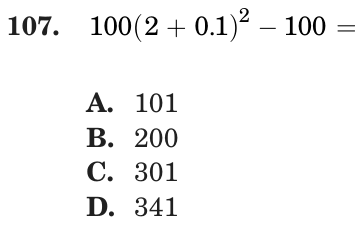
I.
II.
III.
If s is a positive integer and t is a negative integer, which of the above expressions must be a positive number?
- AII only
- BI and II only
- CII and III only
- DI, II, and III
Show the answer
Correct answer: D
Each of the three expressions must be considered:
Expression I: , where s is a positive integer and t is a negative integer:
Subtracting a negative integer is the equivalent of adding a positive integer, so is equivalent to finding the value of , which must result in a positive number.
Expression II: , where s is a positive integer and t is a negative integer:
Squaring a negative integer results in a positive integer, so is equivalent to finding the value of , which must result in a positive number.
Expression III: , where s is a positive integer and t is a negative integer:
A negative exponent results in the reciprocal of the same exponential expression, so is equivalent to finding the value of , which must result in a positive number.
Therefore, Expressions I, II, and III must all result in a positive number.
Question analysis
Three expressions, s − t, s times t squared, and s to the power t, are listed, and students decide which must be positive when s is a positive integer and t is a negative integer. It tests sign rules for subtraction and multiplication and the meaning of a negative exponent. Each expression has to be judged for every possible pair, not just one example.
- NYS standards
- Grade level
- Grade 8 content, by NYS standard
- Compared with grade 7
- Above grade 7 Grade 7 students learn sign rules for subtracting and multiplying signed numbers. Here they reason about letters rather than numbers, decide what must always hold, and handle a negative exponent, a grade 8 idea.
- Estimated difficulty
- Hard: combines ideas, needs a plan, and has more than one tempting wrong answer.
- Thinking it demands
- Depth of knowledge 2, skills and concepts · mainly analyze
- What makes it hard
- Variables instead of numbers moderate
- Something you must already know moderate
- Every choice must be checked minor
- Solution
- 3 steps
- Reading level
- Question and choices: about grade 5, 42 words.
- Corrected from the DOE handbook
- Two steps of the explanation that treated t as a positive number were corrected.
- A punctuation error in the explanation was corrected.
- Students, last 30 days
- Not enough answers yet to show (it takes 10).
Why it is hard, traps and wrong answers (shows the answer)
Why it is hard
The three expressions test three different sign facts: subtracting a negative, squaring a negative, and raising to a negative power. The last is the trap, since a negative exponent seems to promise a negative result when it really gives a fraction, and that belief alone leads to a listed choice. Trying s = 2 and t = −3 gives 5, 18 and 1/8, all positive, and the rules show why no other pair can change that.
Variables instead of numbers moderate Understanding the question
No values are given for s and t, only their signs, and must means each expression has to be positive for every such pair, not just for one example. (Koedinger & Nathan, 2004; Enright, Morley & Sheehan, 2002)
Something you must already know moderate Working it out
Expression III needs the meaning of a negative exponent, s to the power t equals 1 over s to the power −t, a grade 8 rule the question does not state. (Anderson & Krathwohl, 2001)
Every choice must be checked minor Choosing the answer
Each of the three expressions is judged on its own and the choices combine the verdicts, so one wrong judgment anywhere points to a wrong combination. (Embretson & Wetzel, 1987)
Strategy: Try a pair such as s = 2 and t = −3 in each expression, then explain why its sign could or could not change for any other positive s and negative t.
Traps
- Misunderstands the concept: A wrong belief about a concept: that percents can be added, that area grows like length, that averages can be averaged, that a bigger denominator means a bigger fraction.
- Negatives and direction: Arithmetic with negative numbers, the order of a subtraction, or direction on a number line. (Moving a term across the equals sign without changing its sign is a faulty procedure.)
The wrong answers, classified
A Misunderstands the concept (Smith, diSessa & Roschelle, 1993; De Bock et al., 1998; Ni & Zhou, 2005)
Trusts only the squared expression, believing that subtracting t must make s smaller and that a negative exponent makes a negative number.
B Misunderstands the concept (Smith, diSessa & Roschelle, 1993; De Bock et al., 1998; Ni & Zhou, 2005)
Handles the subtraction and the square correctly but believes a negative exponent makes the result negative, though s to the power t is a positive fraction such as 1/8.
C Negatives and direction (Brown & Burton, 1978)
Reads s − t as taking a number away from s, so thinks it could be negative, missing that subtracting the negative t adds to s.
What was corrected from the DOE handbook, and why
- Explanation: The question makes t the negative integer, but two steps of the DOE’s explanation write the negative integer as −t, as if t were positive. For Expression I it says “s − (−t) is equivalent to finding the value of s + t, which must result in a positive number”: s − (−t) is not Expression I, and with the question’s t, s + t need not be positive (s = 1 and t = −2 give −1). For Expression III it says “s^(−t) is equivalent to finding the value of 1/s^t”, about s^(−t) rather than Expression III. The site now says that s − t is equivalent to s + (−t), and that s^t is equivalent to 1/s^(−t). Since t is negative, −t is a positive integer, so s + (−t) is the sum of two positive integers and 1/s^(−t) is the reciprocal of a positive integer: both positive, and the answer, I, II and III, is unchanged. The step for Expression II, s(−t)² = st², is true for any t and is unchanged.
- Explanation: The DOE’s explanation introduces Expression III as “s^t. where s is a positive integer and t is a negative integer”, with a period where Expressions I and II (and the 2022–23 guide, which first printed this explanation) have a comma. The site has the comma.
Worked solution, step by step
Formulas used
- Subtracting a number
- s and t are integers, and −t is the opposite of t. Subtracting a number is the same as adding its opposite. When t is negative, −t is positive. So subtracting t adds a positive amount.
- A negative exponent
- s is the base and t is the exponent. When t is negative, −t is positive. So a negative exponent means 1 over the base to a positive exponent. For example, 2 to the power −3 is 1 over 2³, which is 1/8.
Sort out the question
An integer is a whole number or its opposite, such as −2, 0 or 5. Here s is a positive integer, like 1, 2 or 3. And t is a negative integer, like −1, −2 or −3. Must means always. An expression counts only if it is positive for every such pair.
Try one pair of numbers
Try s = 2 and t = −3 in each expression:
- I:
- II:
- III:
All three are positive this time. Now see why that always happens.
Explain expression I
Use the rule for subtracting:
t is negative, so its opposite, −t, is positive. So s − t is a positive plus a positive. That is always positive.
Watch out: subtracting does not always make a number smaller. Subtracting a negative makes it bigger. Missing this leads to choice C.
Explain expression II
means t × t. A negative times a negative is positive, so is always positive. Then is a positive times a positive. That is always positive too.
Explain expression III
Use the rule for a negative exponent:
−t is a positive integer, so is a positive integer. So is 1 over a positive number. That is a positive fraction.
Watch out: a negative exponent does not make the answer negative. It makes a fraction. Thinking it does leads to choice B, I and II only.
Choose the answer
Each of the three expressions is positive for every positive s and negative t. None of them can ever be zero or negative.
So the answer is D, I, II, and III.
Check your answer
Try the values closest to 0: s = 1 and t = −1. I gives . II gives . III gives . All three are still positive.
More questions like this
The original DOE question
Question 2 of 13
2024 Test B Math, question 34Question
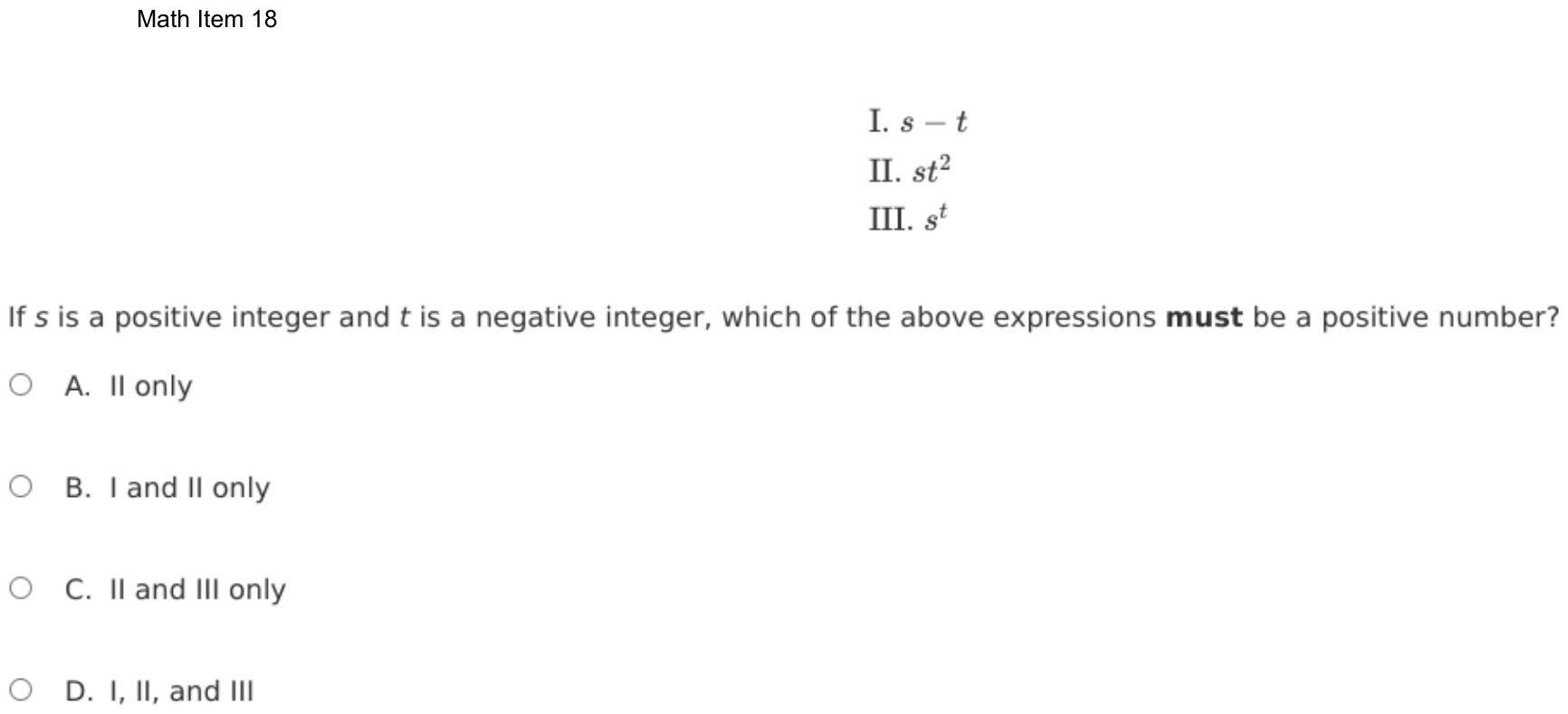
The volume of a cube is 512 cubic centimeters. What is the length, in centimeters, of one edge of this cube?
- A8
- B
- C
- D128
Show the answer
Correct answer: A
The volume of a cube is , where s is the length of one edge.
So , and .
If you are not sure how to find the cube root, you can estimate.
We know , so .
Since 512 is less than 1,000, the answer must be less than 10. The only given option less than 10 is 8. Double-check to make sure this is correct: .
Question analysis
A cube has a volume of 512 cubic centimeters, and students work backward to find the length of one edge. It tests the volume formula for a cube and the idea of a cube root. The tricky part is going from a volume to a length, the reverse of the usual volume problem.
- Grade level
- Grade 8 content, by NYS standard
- Compared with grade 7
- Above grade 7 Grade 7 volume work goes from edge lengths to a volume. Going backward needs a cube root, a grade 8 idea, and 512 is beyond the perfect cubes students are expected to know, though checking a guess by multiplying keeps it short.
- Estimated difficulty
- Straightforward: two steps or one careful reading.
- Thinking it demands
- Depth of knowledge 1, recall and reproduction · mainly apply
- What makes it hard
- Something you must already know moderate
- Solution
- 2 steps
- Reading level
- Question and choices: about grade 5, 22 words.
- Students, last 30 days
- Not enough answers yet to show (it takes 10).
Why it is hard, traps and wrong answers (shows the answer)
Why it is hard
This is a one-fact question: a cube's volume is its edge used three times as a factor. Students who remember that need only the number whose cube is 512, and the choices help, because only one is under 10 while 10 × 10 × 10 = 1,000. The wrong choices divide 512 by numbers tied to other measures of a cube or a square, so they catch students who do not recall the formula.
Something you must already know moderate Working it out
Neither V = s³ nor the cube root of 512 is given, so students must recall the formula and know, or find by trial, that 8 × 8 × 8 = 512. (Anderson & Krathwohl, 2001)
Strategy: Write the volume as edge × edge × edge, then find the number that, multiplied by itself three times, gives 512, and confirm it by multiplying.
Traps
- Wrong formula: Uses a related but wrong formula: perimeter for area, diameter for radius, area for volume, or a misremembered one.
- A formula you must know: Needs a formula the test does not give: area, circumference, volume, probability rules.
The wrong answers, classified
B Wrong formula (King et al., 2004)
Divides 512 by 12, the number of edges, as if the volume were the total length of all the edges, giving 42 2/3.
C Wrong formula (King et al., 2004)
Divides 512 by 6, the number of faces, mixing up volume with surface area, giving 85 1/3.
D Wrong formula (King et al., 2004)
Divides 512 by 4, as when a square's side is found from its perimeter, instead of finding the number whose cube is 512.
Worked solution, step by step
Formulas used
- Volume of a cube
- V is the volume, the space inside, in cubic units. s is the length of one edge. s³ means s × s × s. A cube’s length, width and height are all s, so length × width × height becomes s × s × s.
Sort out the question
The cube’s volume is 512 cubic centimeters. Volume is the space inside a solid. You need the length of one edge.
A cube has 12 edges, and they are all the same length. So one edge tells you all of them.
Write the volume formula
You need a number that gives 512 when you multiply it by itself three times. That number is called the cube root of 512.
Try numbers to find the edge
Start with an easy one: . That is too big, so the edge is less than 10. Try 8.
It works. Each edge is 8 centimeters.
Rule out the other choices
Watch out: The volume is not shared out among the faces or the edges. Dividing 512 by the 6 faces gives , choice C. Dividing by the 12 edges gives , choice B. Dividing by 4 gives 128, choice D.
So the answer is A, 8.
Check your answer
Test the biggest choice. is over 2 million, far more than 512. Only an edge less than 10 can work, and 8 is the only choice less than 10. And .
More questions like this
The original DOE question
Question 3 of 13
2024 Test B Math, question 49Question
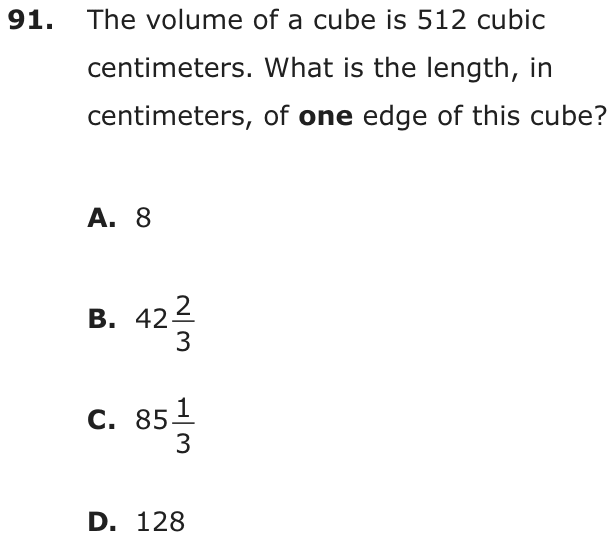
Suppose that w, x, y, and z are integers, none of which are zero. Under which set of conditions would the product always be positive?
- Ax is positive and w is positive.
- Bx is negative and w is negative.
- Cy is negative and z is negative.
- Dx and y are negative, and z and w are positive.
Show the answer
Correct answer: C
First, analyze the role of each variable in the expression .
will always be a positive number.
y can be a positive or a negative number.
can be a positive or a negative number.
will always be a positive number.
The expressions and will always be positive. Therefore, making the values of y and z negative would result in the expression being positive, since a negative multiplied by a negative is positive. Thus the given product would always be positive.
Question analysis
Four nonzero integers appear in a product that includes a square, a cube and an absolute value. Students choose the set of conditions that makes the product positive every time. It tests the sign rules for multiplication together with exponents and absolute value, and the trap is judging the sign by counting negative variables without looking at what is done to each.
- NYS standards
- Grade level
- Grade 7 content, by NYS standard
- Compared with grade 7
- Above grade 7 Grade 7 students learn sign rules for products of signed numbers. Here they must reason about four unknown integers under an even power, an odd power and an absolute value, and decide what is always true, which is more abstract than typical grade 7 work.
- Estimated difficulty
- Hard: combines ideas, needs a plan, and has more than one tempting wrong answer.
- Thinking it demands
- Depth of knowledge 2, skills and concepts · mainly analyze
- What makes it hard
- Variables instead of numbers moderate
- Every choice must be checked moderate
- Something you must already know minor
- Solution
- 3 steps
- Reading level
- Question and choices: about grade 6, 58 words.
- Students, last 30 days
- Not enough answers yet to show (it takes 10).
Why it is hard, traps and wrong answers (shows the answer)
Why it is hard
One insight decides the question: x² and |w| are positive whatever x and w are, so only the signs of y and z³ matter. Students who count negative letters instead of negative factors pick conditions that look balanced but leave y as the only negative factor. Students who test a single set of values can be fooled by a choice that leaves y and z unspecified.
Variables instead of numbers moderate Understanding the question
There are four variables and no numbers, and always positive must hold for every allowed value, so one test case can rule a choice out but never confirm it. (Koedinger & Nathan, 2004; Enright, Morley & Sheehan, 2002)
Every choice must be checked moderate Choosing the answer
Each set of conditions has to be checked against all four factors; the first two fix only x and w and leave y and z free to make the product negative. (Embretson & Wetzel, 1987)
Something you must already know minor Working it out
Students must know that a nonzero square and an absolute value are always positive, while an odd power such as z³ keeps the sign of z. (Anderson & Krathwohl, 2001)
Strategy: Work out, factor by factor, which signs each part of the product can take, then test each set of conditions against every factor rather than counting negatives.
Traps
- Negatives and direction: Arithmetic with negative numbers, the order of a subtraction, or direction on a number line. (Moving a term across the equals sign without changing its sign is a faulty procedure.)
- Misunderstands the concept: A wrong belief about a concept: that percents can be added, that area grows like length, that averages can be averaged, that a bigger denominator means a bigger fraction.
The wrong answers, classified
A Checks only one number (Schoenfeld, 1985)
Tests the choice with every variable positive, so the product is positive and it seems to work; y = −1 with z = 1 would make it negative.
B Misunderstands the concept (Smith, diSessa & Roschelle, 1993; De Bock et al., 1998; Ni & Zhou, 2005)
Pairs the negatives x and w as if they must cancel, not seeing that x² and |w| are positive anyway, so y and z still decide.
D Negatives and direction (Brown & Burton, 1978)
Counts two negative letters, x and y, as an even number of negatives, but x² is positive, so y is the only negative factor.
Worked solution, step by step
Formulas used
- Signs in multiplication
- a and b are positive numbers, so −a and −b are negative. A negative times a negative is positive. A negative times a positive is negative. So a product is positive when it has an even number of negative factors.
Sort out the question
w, x, y and z are integers, meaning whole numbers or their negatives. None of them is 0. The product means .
You need the conditions that make the product positive every time, for every number that fits them.
Look at x squared and |w|
means x × x. Two positives or two negatives multiply to a positive. So is always positive.
is the absolute value of w, its distance from 0. It is always positive, since w is not 0.
So x and w never change the sign of the product. Their signs do not matter.
Look at y and z cubed
y can be positive or negative. means z × z × z, and it has the same sign as z. For example, .
So the sign of the whole product is the sign of . It depends only on y and z.
Test each choice
- A and B say nothing about y and z. If y = −1 and z = 1, the product is negative. So they do not always work.
- C: y is negative, and is negative. A negative times a negative is positive. This always works.
- D: y is negative and z is positive. So the product is always negative.
Watch out: D has two negative letters, x and y. But is positive anyway, so y is the only negative factor.
So the answer is C, y is negative and z is negative.
Check your answer
Try numbers for C. Let x = −2, y = −3, z = −1 and w = −5. Then , which is positive. Even with x and w negative, the product stays positive.
More questions like this
The original DOE question
Question 4 of 13
2024 Test B Math, question 51Question
Rita used 125 small solid cubes to build a large solid cube. The measure of each edge of the small cubes equals 1 inch. What is the measure of each edge of the large cube, in inches?
- A5
- B25
- C41.33
- D125
Show the answer
Correct answer: A
The volume of a cube with a side length of s is
Since 125 small cubes were used to build the large cube, .
Each side of the large cube is made up of 5 small cubes.
Since 5 small cubes make up each edge of the large cube, and the edge of each small cube measures 1 inch, the measure of each edge of the large cube is .
Question analysis
Rita stacks 125 one-inch cubes into a single large solid cube. Students find the length of each edge of the large cube in inches. It tests volume and perfect cubes with a building-block model, and the care needed is in telling apart the cubes along an edge, across a face and in the whole solid.
- Grade level
- Grade 6 content, by NYS standard
- Compared with grade 7
- Below grade 7 Building a large cube from unit cubes is the model grade 6 uses to introduce perfect cubes. It is a single step with small numbers, easier than typical grade 7 geometry, which works with composite solids and formulas.
- Estimated difficulty
- Routine: one familiar step, little to misread.
- Thinking it demands
- Depth of knowledge 1, recall and reproduction · mainly apply
- What makes it hard
- Solution
- 1 step
- Reading level
- Question and choices: about grade 3, 35 words.
- Students, last 30 days
- Not enough answers yet to show (it takes 10).
Why it is hard, traps and wrong answers (shows the answer)
Why it is hard
This is one of the easiest questions on the test, since 125 is a familiar cube and the small cubes make the large one easy to picture as 5 rows of 5 in 5 layers. The wrong choices name a layer instead of an edge, a division by 3 for three dimensions, or the total count itself, and multiplying 5 × 5 × 5 as a check rules all of them out.
Something you must already know minor Working it out
Students must see that 125 one-inch cubes make a volume of 125 cubic inches, and know or find that 5 × 5 × 5 = 125. (Anderson & Krathwohl, 2001)
Strategy: Think of the large cube as equal rows, columns and layers of small cubes, and find the number that, used three times as a factor, gives 125.
Traps
- Answers a different question: A choice is right for another quantity: the other unknown, the rest instead of the part, the part instead of the whole.
- Wrong operation: Adds instead of multiplying, divides the wrong way round, turns a ratio or rate upside down, or undoes a step in the wrong direction (subtracts what should be added back).
The wrong answers, classified
B Answers a different question (King et al., 2004; Hegarty, Mayer & Monk, 1995)
Gives the number of small cubes in one layer or on one face, 5 × 5 = 25, instead of the number along one edge.
C Wrong operation (Hegarty, Mayer & Monk, 1995; King et al., 2004)
Divides 125 by 3 for the cube's three dimensions instead of taking a cube root; that gives 41.67, and 41.33 is the only choice near it.
D Numbers taken from the question (Hegarty, Mayer & Monk, 1995)
Gives back the 125 from the stem, the count of small cubes and the volume in cubic inches, rather than an edge length.
Worked solution, step by step
Formulas used
- Volume of a cube
- V is the volume, the space inside, in cubic units. s is the length of one edge. s³ means s × s × s. A cube’s length, width and height are all s, so length × width × height becomes s × s × s.
Sort out the question
Rita stacks 125 small cubes into one big solid cube. Each small cube has edges of 1 inch. You need the length of one edge of the big cube, in inches.
Find the big cube’s volume
Each small cube is cubic inch. The big cube is solid, with no gaps. So its volume is 125 cubic inches.
Find the edge length
Find the number that makes 125 when you use it three times. Try 5.
So 5 small cubes sit along each edge. Each one is 1 inch long, so the edge is 5 inches.
Rule out the other choices
Watch out: 25, choice B, is the number of small cubes in one layer, 5 rows of 5. 125, choice D, is the number of cubes, or the volume. Dividing 125 by 3 does not give an edge either. That is about 41.67, near choice C.
So the answer is A, 5.
Check your answer
Picture building it. A row of 5 cubes is 5 inches long. Five rows make a layer of 25 cubes. Five layers make cubes. That matches.
More questions like this
The original DOE question
Question 5 of 13
2024 Test B Math, question 57Question
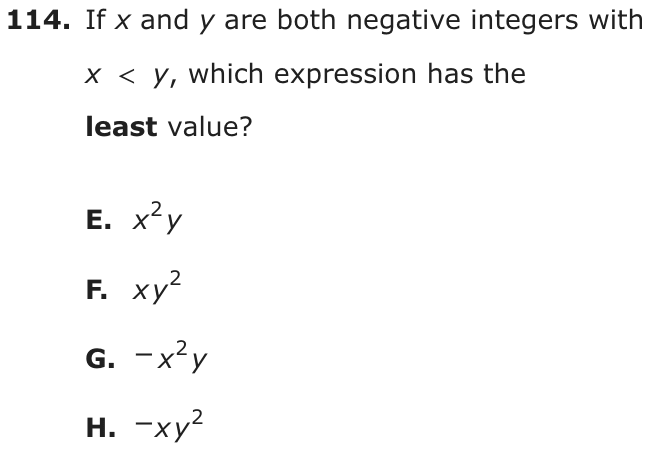
If x and y are both negative integers with , which expression has the least value?
- A
- B
- C
- D
Show the answer
Correct answer: A
Since x and y are both negative integers, both and are positive.
Therefore, both and are negative, and both and are positive.
Because and both x and y are negative, and . So .
Since and x and y are integers, .
So .
Therefore, .
Question analysis
Two negative integers x and y, with x less than y, appear in four expressions built from squares and minus signs. Students find the expression with the least value. It tests multiplying negative numbers and comparing their sizes, and the difficulty is tracking how each minus sign and each square changes both the sign and the size of the result.
- Grade level
- Grade 7 content, by NYS standard
- Compared with grade 7
- Above grade 7 Grade 7 students multiply negative numbers, but this asks them to compare four variable expressions for any pair of negative integers. Deciding how the squares compare when x is less than y goes beyond typical grade 7 sign practice.
- Estimated difficulty
- Hard: combines ideas, needs a plan, and has more than one tempting wrong answer.
- Thinking it demands
- Depth of knowledge 2, skills and concepts · mainly analyze
- What makes it hard
- Variables instead of numbers moderate
- A very close wrong answer moderate
- Every choice must be checked minor
- Solution
- 3 steps
- Reading level
- Question and choices: about grade 8, 20 words.
- Students, last 30 days
- Not enough answers yet to show (it takes 10).
Why it is hard, traps and wrong answers (shows the answer)
Why it is hard
Two facts settle the question: squares of negatives are positive, and the more negative number has the larger square. Students who track the minus signs carelessly think a leading minus makes an expression negative, and students who assume the larger y has the larger square choose the wrong negative expression. Substituting x = −3 and y = −2 gives −18, −12, 18 and 12, which orders all four at once.
Variables instead of numbers moderate Understanding the question
No values are given, only that x and y are negative integers with x < y, so students must reason about signs or invent a pair such as −3 and −2. (Koedinger & Nathan, 2004; Enright, Morley & Sheehan, 2002)
A very close wrong answer moderate Choosing the answer
x²y and xy² use the same letters with the exponent moved; both are negative, and only comparing x² with y² separates them. (Embretson & Wetzel, 1987; Gorin & Embretson, 2006; Ascalon et al., 2007)
Every choice must be checked minor Choosing the answer
All four expressions have to be placed in order, because the minus signs in front of the last two turn those expressions positive. (Embretson & Wetzel, 1987)
Strategy: Pick two negative integers with x less than y, such as −3 and −2, evaluate all four expressions, and confirm the order with a second pair.
Traps
- Negatives and direction: Arithmetic with negative numbers, the order of a subtraction, or direction on a number line. (Moving a term across the equals sign without changing its sign is a faulty procedure.)
- Misunderstands the concept: A wrong belief about a concept: that percents can be added, that area grows like length, that averages can be averaged, that a bigger denominator means a bigger fraction.
The wrong answers, classified
B Misunderstands the concept (Smith, diSessa & Roschelle, 1993; De Bock et al., 1998; Ni & Zhou, 2005)
Knows x²y and xy² are both negative but takes y² as the larger square because y > x, though the more negative x has the bigger square.
C Negatives and direction (Brown & Burton, 1978)
Reads the leading minus as making −x²y negative, missing that y is negative, so −x²y is in fact positive.
D Negatives and direction (Brown & Burton, 1978)
Assumes the leading minus makes −xy² negative, missing that x is negative, so −xy² is in fact positive.
Worked solution, step by step
Formulas used
- Signs in multiplication
- a and b are positive numbers, so −a and −b are negative. A negative times a negative is positive. A negative times a positive is negative. So a product is positive when it has an even number of negative factors.
- Squaring a number
- x is any number. x² (x squared) means x times itself. The square of a number other than 0 is always positive, because two negatives or two positives multiply to a positive.
Sort out the question
x and y are negative integers, such as −3 and −2. Since x < y, x is to the left of y on the number line. So x is more negative, farther from 0.
You need the expression with the least value. That is the most negative one.
Find the sign of each expression
Squares are positive, so and are positive.
- is a positive times a negative, so it is negative.
- is a negative times a positive, so it is negative.
- and are the opposites of these, so they are positive.
So the least value must be A or B. Watch out: The minus sign in front of C and D does not make them negative. It turns a negative into a positive.
Compare A and B with numbers
Try x = −3 and y = −2, since −3 < −2.
Since −18 < −12, A is smaller.
See why it always works
Both expressions contain x × y, which is positive. and . Multiplying the same positive number by the more negative x gives the more negative result.
Watch out: y is bigger than x, but is smaller than : 4 is less than 9. Thinking y² is bigger leads to choice B.
So the answer is A, .
Check your answer
Try another pair, x = −5 and y = −1. Then A is , B is , C is 25 and D is 5. A is still the least.
More questions like this
The original DOE question
Question 6 of 13
2023 Test A Math, question 6Question
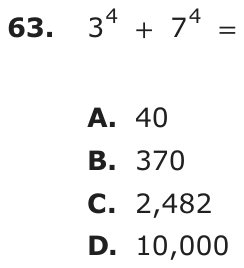
- A40
- B370
- C2,482
- D10,000
Show the answer
Correct answer: C
Question analysis
This exponents question asks for the sum of 3 to the fourth power and 7 to the fourth power. Students evaluate each power separately and then add. The traps are treating an exponent as a multiplier and adding the bases before raising them to a power, and the larger power takes careful multiplication.
- NYS standards
- 6.EE.1 whole-number exponent expressions
- Grade level
- Grade 6 content, by NYS standard
- Compared with grade 7
- Below grade 7 Evaluating whole-number powers is grade 6 work, and this question asks only for two of them and a sum. The one demand beyond routine practice is computing a fourth power of 7 accurately without a calculator.
- Estimated difficulty
- Straightforward: two steps or one careful reading.
- Thinking it demands
- Depth of knowledge 1, recall and reproduction · mainly apply
- What makes it hard
- Error-prone arithmetic moderate
- Something you must already know minor
- Solution
- 3 steps
- Reading level
- Question and choices: about grade 16+, 1 words.
- Students, last 30 days
- Not enough answers yet to show (it takes 10).
Why it is hard, traps and wrong answers (shows the answer)
Why it is hard
The sum is short, but it tests exactly what an exponent means and when to apply it. The wrong choices come from three misreadings of the notation: treating the power as a multiplier, using one factor too few, and adding the bases before raising them. A size check settles it: 7⁴ alone is 49 × 49, a little under 2,500, so 40 and 370 are far too small and 10,000 far too large.
Error-prone arithmetic moderate Working it out
7⁴ means 7 × 7 × 7 × 7 = 2,401, a four-digit product built by hand, most easily as 49 × 49; 3⁴ = 81 is quick by comparison. (Brown & Burton, 1978; Junker & Sijtsma, 2001)
Something you must already know minor Working it out
An exponent counts repeated factors rather than acting as a multiplier, so 3⁴ is 3 × 3 × 3 × 3 = 81, not 3 × 4 = 12; the item assumes that meaning. (Anderson & Krathwohl, 2001)
Strategy: Compute each power on its own, squaring and then squaring again, and add the two results only at the end.
Traps
- A faulty procedure: A systematic but wrong procedure: adding fractions straight across, applying an exponent to each term of a sum, dropping a sign when moving a term.
- Order of operations: Working left to right, or distributing a minus sign wrongly, gives a choice.
The wrong answers, classified
A A faulty procedure (Brown & Burton, 1978; Tatsuoka, 1983)
Multiplies each base by its exponent, 3 × 4 + 7 × 4 = 12 + 28 = 40, instead of using each base as a factor four times.
B A faulty procedure (Brown & Burton, 1978; Tatsuoka, 1983)
Uses each base as a factor three times instead of four, 27 + 343 = 370, so both powers stop one factor short.
D Order of operations (Brown & Burton, 1978)
Adds the bases before applying the exponent, treating 3⁴ + 7⁴ as (3 + 7)⁴ = 10,000, though powers come before addition.
Worked solution, step by step
Formulas used
- A power
- a is the base, the number being multiplied. The small 4 is the exponent. It tells how many times the base is used as a factor, a number being multiplied. So the exponent counts factors. It does not mean multiply by 4.
- Powers come before adding
- a and b are any two positive numbers. The sign ≠ means is not equal to. Powers come before adding. So raise each number to its power first, then add. Adding the bases first gives a much bigger number.
Sort out the question
You need the value of . Each number has a small 4 above it. This 4 is an exponent. Work out each power on its own. Then add the two results.
Find 3 to the fourth power
3⁴ means four 3s multiplied together. Pair them up to make it easier.
Watch out: 3⁴ is not 3 × 4 = 12. Doing that to both powers gives 12 + 28 = 40, choice A.
Find 7 to the fourth power
7⁴ means four 7s multiplied together. Pair them up the same way.
To find 49 × 49, do 49 × 50 = 2,450. Then take away one 49. That gives 2,401. Watch out: count four 7s, not three. Three 7s make 343. Using three factors in both powers gives 370, choice B.
Add the two powers
Watch out: don’t add 3 and 7 first. That gives , choice D. Powers come before adding. So the answer is C, 2,482.
Check your answer
Estimate. 7⁴ is 49 × 49, a little less than 50 × 50 = 2,500. Adding 81 keeps it near 2,500. Only 2,482 is close. 40 and 370 are far too small, and 10,000 is far too big.
More questions like this
The original DOE question
Question 7 of 13
2023 Test A Math, question 57Question
Chanelle selects a marble from a container and then returns it to the container. When she does this 3 times, the probability of choosing a red marble all 3 times is . Based on this information, what is the probability of Chanelle choosing a red marble the first time she selects a marble?
- A
- B
- C
- D
Show the answer
Correct answer: D
Let be the probability of Chanelle selecting a red marble the first time. The probability of selecting a red marble three times is , which is given as . Since , the value of x is 6, and the probability of Chanelle selecting a red marble the first time is .
Question analysis
This probability question says Chanelle draws a marble and puts it back, three times, and the chance of red all three times is 1/216. It asks for the chance of red on her first draw. Students reverse the multiplication rule for repeated independent draws, which means finding a cube root, and dividing by 3 is the tempting shortcut.
- Grade level
- Grade 8 content, by NYS standard
- Compared with grade 7
- Above grade 7 Multiplying probabilities for repeated draws with replacement is grade 7 compound probability. Running it backward, from three draws to one, needs a cube root, a grade 8 idea, though the numbers are friendly and the work is short once set up.
- Estimated difficulty
- Moderate: several steps, or a close reading with one strong distractor.
- Thinking it demands
- Depth of knowledge 2, skills and concepts · mainly apply
- What makes it hard
- Something you must already know moderate
- No obvious method minor
- Solution
- 2 steps
- Reading level
- Question and choices: about grade 7, 55 words.
- Students, last 30 days
- Not enough answers yet to show (it takes 10).
Why it is hard, traps and wrong answers (shows the answer)
Why it is hard
Once the three draws are seen as one chance cubed, the question is a cube root, and 216 is a perfect cube many students know. The risk lies in undoing the cube the wrong way: dividing by 3 because there are three draws, or stopping at 36 after one division by 6. A quick check, 1/6 × 1/6 × 1/6 = 1/216, confirms the answer.
Something you must already know moderate Working it out
Students must know that three draws with the marble returned each time multiply, p × p × p, and must recognize 216 as 6 × 6 × 6; the stem states neither. (Anderson & Krathwohl, 2001)
No obvious method minor Working it out
The usual direction runs from one draw to three; here the three-draw chance is given and the bold first asks for one draw, so students work backward and undo a cube. (Schoenfeld, 1985)
Strategy: Call the chance of red on one draw p, so three draws with replacement give p × p × p; then find the number whose cube equals the given probability.
Traps
- Wrong operation: Adds instead of multiplying, divides the wrong way round, turns a ratio or rate upside down, or undoes a step in the wrong direction (subtracts what should be added back).
- Stops one step early: A choice is a number from partway through the solution.
The wrong answers, classified
A Wrong operation (Hegarty, Mayer & Monk, 1995; King et al., 2004)
Divides 216 by 3 because there are three draws, instead of finding the number that multiplied by itself three times makes 216.
B Stops one step early (King et al., 2004; Gierl et al., 2017)
Divides 216 by 6 to get 36 and stops one division short, keeping 1/36, which is the chance of two reds in a row, not one.
C Little reason to choose it (Haladyna & Downing, 1993; Rodriguez, 2005)
No working with 1/216 gives 1/8, the chance of three heads in three coin tosses, so it mostly attracts guesses at a familiar fraction.
Worked solution, step by step
Formulas used
- Probability of repeated picks
- p is the chance of red on one pick. Chanelle puts the marble back each time, so every pick has the same chance p, and one pick doesn’t change the next. The chance of red on all three picks is the three chances multiplied.
Sort out the question
Chanelle picks a marble and puts it back, 3 times. The chance of red all 3 times is . You need the chance of red on just the first pick. Call that chance p.
Write the three picks as a product
She puts each marble back, so the container is the same every time. Each pick has the same chance, p.
Find the number that fits
You need a fraction that, multiplied by itself three times, makes . Its top is 1, since 1 × 1 × 1 = 1. For the bottom, find a number that times itself three times makes 216.
So the bottom is 6, and p is .
Avoid the tempting shortcuts
Watch out: dividing 216 by 3 gives 72, choice A. Three picks means multiplying three times, not dividing by 3. Also, is the chance of red twice in a row, choice B.
So the answer is D, .
Check your answer
Multiply it out: . That matches the question. Choice A fails fast: is already far smaller than .
More questions like this
The original DOE question
Question 8 of 13
2023 Test B Math, question 42Question
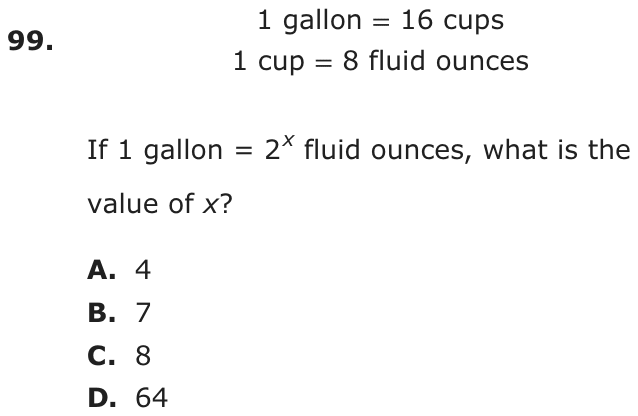
1 gallon = 16 cups
1 cup = 8 fluid ounces
If 1 gallon = fluid ounces, what is the value of x?
- A4
- B7
- C8
- D64
Show the answer
Correct answer: B
If 1 gallon is equal to 16 cups, and 1 cup is equal to 8 fluid ounces, then
So, .
Question analysis
This question gives two facts, 16 cups in a gallon and 8 fluid ounces in a cup, and says a gallon equals 2 to the power x fluid ounces. Students find the exponent x. It combines a unit conversion with writing a number as a power of 2, and the exponent is easy to confuse with a multiplier.
- Grade level
- Grade 6 content, by NYS standard
- Compared with grade 7
- At grade 7 Converting units with given facts is grade 6 work, and this conversion is a single multiplication. The twist is writing the result as a power of 2, which calls for fluency with powers that grade 7 work rarely asks for.
- Estimated difficulty
- Straightforward: two steps or one careful reading.
- Thinking it demands
- Depth of knowledge 2, skills and concepts · mainly apply
- What makes it hard
- Combines ideas minor
- Something you must already know minor
- Solution
- 3 steps
- Reading level
- Question and choices: about grade 2, 16 words.
- Students, last 30 days
- Not enough answers yet to show (it takes 10).
Why it is hard, traps and wrong answers (shows the answer)
Why it is hard
The conversion is one multiplication, so the question really tests whether students can name the exponent for 128. Stopping at the cups, where 16 = 2⁴, or treating 2 to the power x as 2 times x gives a listed choice. Writing 16 as 2⁴ and 8 as 2³ and adding the exponents is the quickest route, and doubling from 1 seven times is a sure check.
Combines ideas minor Working it out
A unit conversion, 16 cups × 8 fluid ounces = 128 fluid ounces, has to be joined to exponents by recognizing 128 as a power of 2. (Embretson, 1998; Daniel & Embretson, 2010)
Something you must already know minor Working it out
Students must know or build the powers of 2 up to 128, and see that the exponent counts factors of 2, not the number of terms in a list starting at 1. (Anderson & Krathwohl, 2001)
Strategy: Convert 1 gallon to fluid ounces by multiplying the two facts, then keep halving the result, or keep doubling from 2, counting how many factors of 2 it takes.
Traps
- Stops one step early: A choice is a number from partway through the solution.
- A faulty procedure: A systematic but wrong procedure: adding fractions straight across, applying an exponent to each term of a sum, dropping a sign when moving a term.
- Counting the ends: Inclusive or exclusive ends, fence posts, consecutive numbers: an answer that is one too many or too few, or an endpoint drawn open where it belongs closed (or the reverse).
The wrong answers, classified
A Stops one step early (King et al., 2004; Gierl et al., 2017)
Writes the 16 cups in a gallon as 2⁴ and stops before multiplying by the 8 fluid ounces in each cup, which adds 3 to the exponent.
C Counting the ends (Brown & Burton, 1978)
Lists the powers of 2 starting at 1, so counts 1, 2, 4, …, 128 as eight numbers and takes 8 as the exponent, though 1 is 2⁰.
D A faulty procedure (Brown & Burton, 1978; Tatsuoka, 1983)
Treats 2 to the power x as 2 times x, so 2x = 128 gives 64, confusing an exponent with a multiplier.
Worked solution, step by step
Formulas used
- Meaning of an exponent
- The 2 is the base, the number being multiplied. x is the exponent, the small raised number. It tells how many 2s are multiplied together. For example, 2 to the third power means 2 × 2 × 2, which is 8.
- Multiplying powers of the same base
- a and b are exponents. The first power has a twos multiplied together. The second has b more twos. Multiplying puts all the twos together, so you add the exponents.
Sort out the question
A gallon is 16 cups. A cup is 8 fluid ounces. A gallon is also fluid ounces. You need x, the exponent. It tells how many 2s are multiplied together.
Change a gallon to fluid ounces
Each of the 16 cups holds 8 fluid ounces. So multiply.
One gallon is 128 fluid ounces.
Write 128 as a power of 2
Now you need . Keep multiplying by 2, and count the 2s.
Number of 2s 1 2 3 4 5 6 7 Product 2 4 8 16 32 64 128 It takes seven 2s to make 128.
So x = 7.
Give the answer
Watch out: A gallon is 16 cups, and . Stopping there gives 4, choice A. And does not mean 2 times x. Solving 2 × x = 128 gives 64, choice D.
So the answer is B, 7.
Check your answer
Use the exponent rule. 16 is and 8 is . So . The exponent is 7 again.
More questions like this
The original DOE question
Question 9 of 13
2023 Test B Math, question 43Question
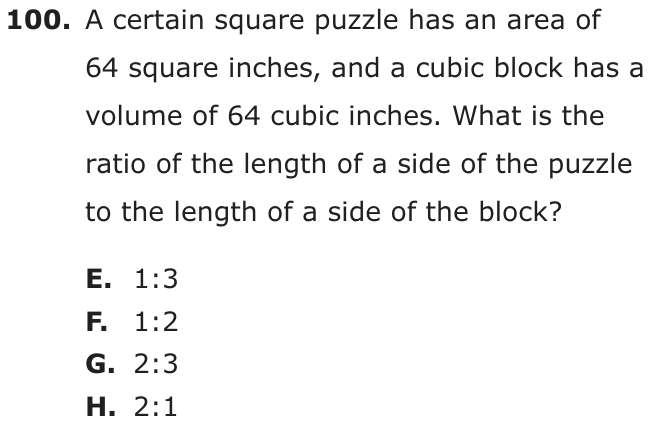
A certain square puzzle has an area of 64 square inches, and a cubic block has a volume of 64 cubic inches. What is the ratio of the length of a side of the puzzle to the length of a side of the block?
- A
- B
- C
- D
Show the answer
Correct answer: D
The length of one side of the puzzle is inches. The length of one side of the block is inches.
The ratio of the side of the puzzle to the side of the block is , which reduces to .
Question analysis
A square puzzle has an area of 64 square inches, and a cube-shaped block has a volume of 64 cubic inches. Students find the ratio of a side of the puzzle to a side of the block. Both figures are described by the number 64, but turning an area and a volume back into lengths takes different steps, and the order of the ratio matters.
- NYS standards
- Grade level
- Grade 8 content, by NYS standard
- Compared with grade 7
- Above grade 7 Grade 7 area and volume problems go from side lengths to an area or a volume. Going backward needs a square root and a cube root, and cube roots are grade 8 content, although 64 is both a perfect square and a perfect cube.
- Estimated difficulty
- Moderate: several steps, or a close reading with one strong distractor.
- Thinking it demands
- Depth of knowledge 2, skills and concepts · mainly apply
- What makes it hard
- Something you must already know moderate
- Combines ideas minor
- Solution
- 3 steps
- Reading level
- Question and choices: about grade 3, 46 words.
- Students, last 30 days
- Not enough answers yet to show (it takes 10).
Why it is hard, traps and wrong answers (shows the answer)
Why it is hard
Because 64 is both a perfect square and a perfect cube, the computation is easy once students know to undo squaring and cubing. The risk is at the end: with sides of 8 and 4 inches in hand, writing the block first turns the ratio upside down. Students who never find the side lengths are left with ideas such as two dimensions against three.
Something you must already know moderate Working it out
Neither formula is given: the puzzle’s side is the number whose square is 64 and the block’s edge the number whose cube is 64, and cube roots are grade 8 work. (Anderson & Krathwohl, 2001)
Combines ideas minor Working it out
A square and a cube share the number 64 in different units, so two different inverse operations feed one ratio, which must list the puzzle’s side first. (Embretson, 1998; Daniel & Embretson, 2010)
Strategy: Find the side of the square from its area and the edge of the cube from its volume by testing small whole numbers, then write the puzzle's side first and simplify.
Traps
- Wrong operation: Adds instead of multiplying, divides the wrong way round, turns a ratio or rate upside down, or undoes a step in the wrong direction (subtracts what should be added back).
- Numbers taken from the question: Combines the numbers in the question without a model of the situation, or is simply a number that appears in the question.
The wrong answers, classified
A Little reason to choose it (Haladyna & Downing, 1993; Rodriguez, 2005)
No common working gives 1 : 3; it makes the puzzle’s side the shorter one, the reverse of 8 and 4 inches, so it mostly draws guesses.
B Wrong operation (Hegarty, Mayer & Monk, 1995; King et al., 2004)
Finds both lengths correctly, 8 and 4 inches, but writes the block’s side first, turning the ratio upside down to 1 : 2.
C Numbers taken from the question (Hegarty, Mayer & Monk, 1995)
Matches the square to 2 and the cube to 3, the powers behind square inches and cubic inches, and writes 2 : 3 without finding any length.
Worked solution, step by step
Formulas used
- Area of a square
- A is the area, in square units. s is the length of one side. All sides of a square are equal, so the area is the side times itself. To find the side from the area, ask which number times itself gives the area.
- Volume of a cube
- V is the volume, the space inside, in cubic units. s is the length of one edge. A cube’s length, width and height are all equal, so the volume is the edge used three times. To go backward, ask which number used three times gives the volume.
Sort out the shapes
The puzzle is a square with an area of 64 square inches. The block is a cube with a volume of 64 cubic inches. A cube is a box with every edge the same length. You need the ratio of the puzzle’s side to the block’s side, with the puzzle first.
Find the puzzle’s side
Use the area formula backward. Which number times itself makes 64?
The puzzle’s side is 8 inches. This number is the square root of 64.
Find the block’s side
Use the volume formula backward. Which number used three times makes 64? Try small numbers. 3 × 3 × 3 = 27 is too small.
The block’s side is 4 inches. This number is the cube root of 64.
Write and simplify the ratio
Put the puzzle first, as the question asks. Then divide both parts by 4.
Watch out: Writing the block’s side first gives 1 : 2, choice B. The order in a ratio matters.
So the answer is D, 2 : 1.
Check your answer
Check both sides. 8 × 8 = 64 square inches, and 4 × 4 × 4 = 64 cubic inches. The puzzle’s side is longer, so its number in the ratio must be bigger. Only choice D puts the bigger number first.
More questions like this
The original DOE question
Question 10 of 13
2023 Test B Math, question 46Question
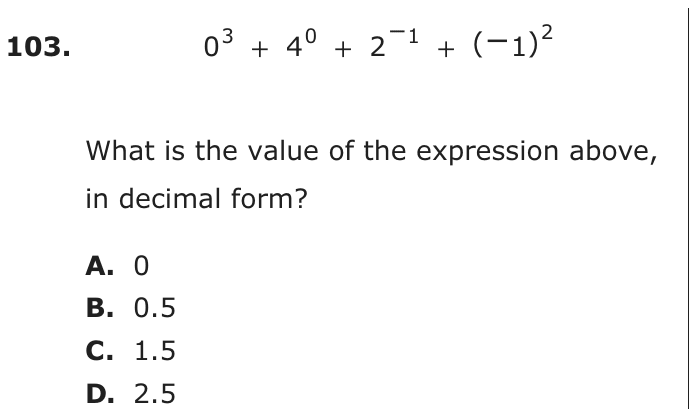
What is the value of the expression above, in decimal form?
- A0
- B0.5
- C1.5
- D2.5
Show the answer
Correct answer: D
Question analysis
An exponents question: students find the decimal value of a sum of four powers, zero cubed, four to the zero power, two to the negative first power and negative one squared. Each of the four terms follows a different rule, and a slip on any one of them changes the total.
- Grade level
- Grade 8 content, by NYS standard
- Compared with grade 7
- Above grade 7 Grade 7 work uses whole-number exponents and signed numbers. Zero and negative exponents are grade 8 content, and this expression tests both alongside a negative base, each with its own common misconception.
- Estimated difficulty
- Hard: combines ideas, needs a plan, and has more than one tempting wrong answer.
- Thinking it demands
- Depth of knowledge 1, recall and reproduction · mainly apply
- What makes it hard
- Solution
- 4 steps
- Reading level
- Question and choices: about grade 6, 12 words.
- Students, last 30 days
- Not enough answers yet to show (it takes 10).
Why it is hard, traps and wrong answers (shows the answer)
Why it is hard
Every term tests a different exponent rule, and each wrong choice comes from breaking exactly one of them. The zero exponent is the most common casualty, since 4⁰ looks as if it should be 0 like 0³; a negative exponent read as a negative number is close behind. Writing each term’s value above it before adding, 0, 1, 1/2 and 1, keeps the four rules separate.
Something you must already know major Working it out
Three rules the test does not give decide the sum: any nonzero number to the 0 power is 1, 2 to the −1 power is 1/2, and (−1)² is positive 1. (Anderson & Krathwohl, 2001)
Error-prone arithmetic minor Working it out
The four terms carry a zero base, a zero exponent, a negative exponent and a negative base, so a sign or a stray 0 can slip in at each one. (Brown & Burton, 1978; Junker & Sijtsma, 2001)
Strategy: Evaluate each power on its own, using the rules for a zero exponent and a negative exponent and the sign of a squared negative number, then add the four values.
Traps
- A faulty procedure: A systematic but wrong procedure: adding fractions straight across, applying an exponent to each term of a sum, dropping a sign when moving a term.
- Order of operations: Working left to right, or distributing a minus sign wrongly, gives a choice.
The wrong answers, classified
A A faulty procedure (Brown & Burton, 1978; Tatsuoka, 1983)
Treats 2 to the power −1 as −2 instead of one half, so the four terms 0 + 1 − 2 + 1 add to 0.
B Order of operations (Brown & Burton, 1978)
Squares as if the minus sat outside the parentheses, taking (−1)² as −1, so the terms add to 0 + 1 + 0.5 − 1 = 0.5.
C A faulty procedure (Brown & Burton, 1978; Tatsuoka, 1983)
Takes 4 to the power 0 as 0 rather than 1, so the expression becomes 0 + 0 + 0.5 + 1 = 1.5.
Worked solution, step by step
Formulas used
- Zero exponent
- a is any number except 0. An exponent of 0 always gives 1. It works because each step down in the exponent divides by a. For example, 4 to the first power is 4, and 4 ÷ 4 = 1.
- Negative exponent
- a is the base, and n is a positive whole number. A negative exponent does not make the number negative. It means 1 divided by the base to the positive power. For example, 2 to the −1 power is one half.
Sort out the question
The expression adds four powers. A power is a base with an exponent, a small raised number. The exponent tells how many times to use the base as a factor, a number you multiply. Find each power, then add.
Find the first two powers
Zero times itself is still zero.
Next, use the zero exponent rule.
Watch out: is 1, not 0. Taking it as 0 gives choice C.
Find the negative power
Use the negative exponent rule.
Watch out: is not −2. That mistake gives choice A.
Find the last power
The base is −1, inside the parentheses. Multiply it by itself. A negative times a negative is positive.
Watch out: The answer is not −1. That mistake gives choice B.
Add the four values
Now add them. The question wants a decimal, so write one half as 0.5.
So the answer is D, 2.5.
Check your answer
See why with a pattern. and . Each step down divides by 4, so . In the same way, and .
More questions like this
The original DOE question
Question 11 of 13
2020 Test B Math, question 34Question
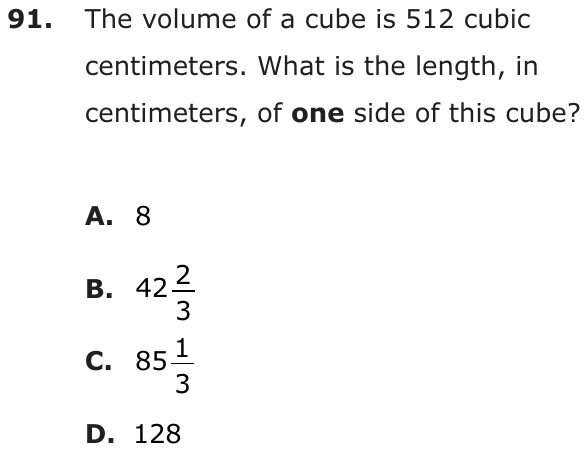
The volume of a cube is 512 cubic centimeters. What is the length, in centimeters, of one side of this cube?
- A8
- B
- C
- D128
Show the answer
Correct answer: A
The volume of a cube is , where s is the length of one edge.
So , and .
If you are not sure how to find the cube root, you can estimate.
We know , so .
Since 512 is less than 1,000, the answer must be less than 10. The only given option less than 10 is 8. Double-check to make sure this is correct: .
Question analysis
Given only that a cube holds 512 cubic centimeters, students must find the length of one side, running the volume formula backward. That calls for a cube root, since the usual volume problem runs from length to volume. The question says “side” where a later printing says “edge”; both mean the length of one of the cube's edges.
- Grade level
- Grade 8 content, by NYS standard
- Compared with grade 7
- Above grade 7 Grade 6 and 7 volume problems start from edge lengths. This one starts from the volume and needs a cube root, a grade 8 skill, for a number above the cubes students must memorize, though only one short computation is needed.
- Estimated difficulty
- Straightforward: two steps or one careful reading.
- Thinking it demands
- Depth of knowledge 1, recall and reproduction · mainly apply
- What makes it hard
- Something you must already know moderate
- Hard words minor
- Solution
- 2 steps
- Reading level
- Question and choices: about grade 5, 22 words.
- Students, last 30 days
- Not enough answers yet to show (it takes 10).
Why it is hard, traps and wrong answers (shows the answer)
Why it is hard
This is a one-fact question run backward: a cube's volume is one edge length used three times as a factor, so the edge is the number whose cube is 512. The choices help, since 10 × 10 × 10 = 1,000 rules out everything above 10 and leaves one candidate. The wrong choices divide 512 by 12, 6 or 4, counts tied to a cube's edges, its faces or a square's sides, so they catch students who reach for division instead of the formula.
Something you must already know moderate Working it out
Neither V = s³ nor the cube root of 512 is supplied, so students must recall that a cube's volume is edge × edge × edge and find, by memory or trial, that 8 × 8 × 8 = 512. (Anderson & Krathwohl, 2001)
Hard words minor Understanding the question
This printing asks for “one side” of a cube, and in everyday use a cube's sides are its faces; that is a reading hurdle, not extra math, since an edge is meant. (Perfetti, 2007; Freedle & Kostin, 1993)
Strategy: Take “side” to mean an edge of the cube, express 512 as one length multiplied by itself three times, and find that length, confirming by multiplying it out.
Traps
- Wrong formula: Uses a related but wrong formula: perimeter for area, diameter for radius, area for volume, or a misremembered one.
- A formula you must know: Needs a formula the test does not give: area, circumference, volume, probability rules.
The wrong answers, classified
B Wrong formula (King et al., 2004)
Divides 512 by 12, the cube's number of edges, as if the volume were the total length of all the edges, getting 42 2/3.
C Wrong formula (King et al., 2004)
Reads “side” as one of the six faces and divides 512 by 6, treating the volume like a surface area shared among the faces, which gives 85 1/3.
D Wrong formula (King et al., 2004)
Divides 512 by 4, the step that finds a square's side from its perimeter, instead of looking for the number whose cube is 512.
Worked solution, step by step
Formulas used
- Volume of a cube
- V is the volume, the space inside, in cubic units. s is the length of one edge. s³ means s × s × s. A cube’s length, width and height are all the same edge, so length × width × height becomes s × s × s.
- Cube root
- The cube root of V is the number that gives V when you multiply it by itself three times. It undoes cubing. For example, 2 × 2 × 2 = 8, so the cube root of 8 is 2.
Sort out the question
The cube’s volume is 512 cubic centimeters. Volume is the space inside a solid. You need the length of one side.
Here a side means an edge, one of the 12 straight lines where two faces meet. All 12 edges of a cube are the same length, so one edge tells you all of them.
Write the volume formula
You need a number that makes 512 when you multiply it by itself three times. That number is the cube root of 512.
Try numbers to find the edge
Start with an easy number.
That is too big, so the edge is less than 10. Only one choice, 8, is less than 10. Try it.
It works. Each edge is 8 centimeters.
Rule out the other choices
Watch out: in everyday talk, a cube’s sides can mean its 6 flat faces. But the volume is not shared out among the faces. Dividing 512 by 6 gives , choice C. Dividing by the 12 edges gives , choice B. Dividing by 4 gives 128, choice D.
So the answer is A, 8 centimeters.
Check your answer
Check the units. An edge is a length, in centimeters. Cubing it gives cubic centimeters: . And any choice of 10 or more makes a volume of at least 1,000 cubic centimeters, far too big.
More questions like this
The original DOE question
Question 12 of 13
2019 Test B Math, question 22Question
- A
- B
- C
- D
Show the answer
Correct answer: A
Question analysis
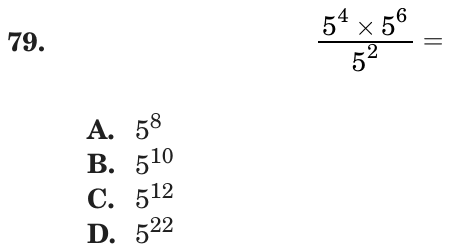
This exponents question asks for the value of 5 to the 4th times 5 to the 6th, divided by 5 squared, written as a single power of 5. It tests the rules for multiplying and dividing powers with the same base. Every choice is a power of 5, so the whole question rests on combining the exponents correctly.
- NYS standards
- 8.EE.1 integer exponent properties
- Grade level
- Grade 8 content, by NYS standard
- Compared with grade 7
- Above grade 7 Combining powers of one base by exponent rules is grade 8 content; grades 6 and 7 only evaluate powers. The task itself is short, one product and one quotient of powers of 5.
- Estimated difficulty
- Straightforward: two steps or one careful reading.
- Thinking it demands
- Depth of knowledge 1, recall and reproduction · mainly apply
- What makes it hard
- Something you must already know moderate
- Solution
- 2 steps
- Reading level
- Question and choices: about grade 16+, 5 words.
- Students, last 30 days
- Not enough answers yet to show (it takes 10).
Why it is hard, traps and wrong answers (shows the answer)
Why it is hard
Everything rests on two grade 8 rules, and the choices are built so that each misapplied rule has an answer. Every choice is a power of 5, so the base gives nothing away and only the exponent arithmetic decides. Students who carry the written operations onto the exponents, or who stop after the numerator, find their result listed; working the top first, then the bottom, keeps the two rules apart.
Something you must already know moderate Working it out
Neither exponent rule is given: multiplying 5⁴ by 5⁶ adds the exponents to 10, and dividing by 5² subtracts 2; working out the powers instead, 625 × 15,625, is hopeless by hand. (Anderson & Krathwohl, 2001)
Strategy: When powers of the same base are multiplied, add their exponents; when one is divided by another, subtract the exponent of the divisor. Apply the top first, then the bottom.
Traps
- A faulty procedure: A systematic but wrong procedure: adding fractions straight across, applying an exponent to each term of a sum, dropping a sign when moving a term.
- Stops one step early: A choice is a number from partway through the solution.
The wrong answers, classified
B Stops one step early (King et al., 2004; Gierl et al., 2017)
Adds the exponents on top, 4 + 6 = 10, and stops there, never dividing by the 5² in the denominator.
C A faulty procedure (Brown & Burton, 1978; Tatsuoka, 1983)
Carries the written operations onto the exponents, 4 × 6 ÷ 2 = 12, multiplying and dividing them instead of adding and subtracting.
D A faulty procedure (Brown & Burton, 1978; Tatsuoka, 1983)
Multiplies the exponents when multiplying the powers, 4 × 6 = 24, then subtracts the 2 correctly, mixing a wrong rule with a right one.
Worked solution, step by step
Formulas used
- Multiplying powers with the same base
- a is the base, the number being multiplied. m and n are exponents, the small raised numbers. Each exponent counts how many a’s are multiplied. Putting the two groups together makes m + n of them, so you add the exponents.
- Dividing powers with the same base
- a is the base, and m and n are exponents. The top has m factors of a and the bottom has n. Each matching pair cancels, because a ÷ a = 1. So m − n factors are left, and you subtract the exponents.
Sort out the question
The expression has three powers of 5. A power like means 5 multiplied by itself 4 times: . The 5 is the base. The small raised 4 is the exponent. Every choice is a power of 5, so you only need the final exponent.
Multiply the powers on top
The top multiplies two powers of 5. Use the rule for multiplying powers.
Four 5s times six more 5s makes ten 5s in a row.
Watch out: add the exponents. Don’t multiply them. leads to , choice D.
Divide by the power on the bottom
Now divide by the bottom. Use the rule for dividing powers.
Two of the ten 5s on top cancel with the two 5s on the bottom. Eight 5s are left.
Watch out: stopping at , choice B, forgets the bottom. Multiplying and dividing the exponents, , gives choice C.
So the answer is A, .
Check your answer
Count the 5s. The top has fives multiplied together. The bottom has 2. Each 5 on the bottom cancels one 5 on top, since 5 ÷ 5 = 1. That leaves fives, which is 5 to the 8th power.
More questions like this
The original DOE question
Question 13 of 13
2018 Test A Math, question 50Question
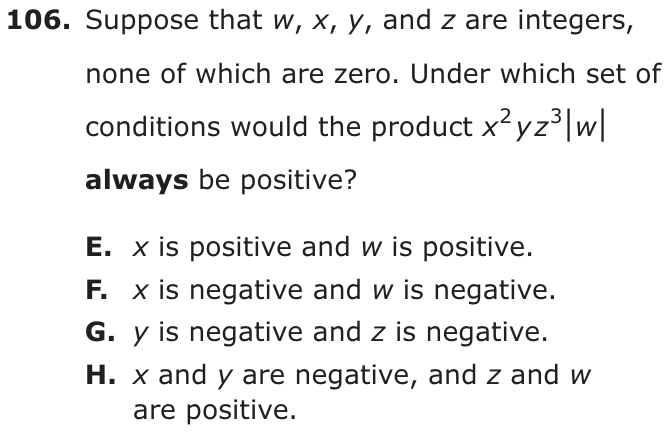
- A101
- B200
- C301
- D341
Show the answer
Correct answer: D
Question analysis
This order of operations question asks students to evaluate 100(2 + 0.1)² − 100, an expression with a decimal, a square and a subtraction. Students must add inside the parentheses first, square the result, multiply by 100, and then subtract. Squaring the two parts of the sum separately is the trap.
- Grade level
- Grade 6 content, by NYS standard
- Compared with grade 7
- Below grade 7 Evaluating an expression with an exponent and decimals in the correct order is grade 6 content. This is a short routine calculation, so it asks less than typical grade 7 work with negative numbers and multi-step equations.
- Estimated difficulty
- Straightforward: two steps or one careful reading.
- Thinking it demands
- Depth of knowledge 1, recall and reproduction · mainly apply
- What makes it hard
- A very close wrong answer moderate
- Error-prone arithmetic minor
- Solution
- 3 steps
- Reading level
- Question and choices: about grade 16+, 1 words.
- Students, last 30 days
- Not enough answers yet to show (it takes 10).
Why it is hard, traps and wrong answers (shows the answer)
Why it is hard
This is a direct order-of-operations calculation with no word problem around it, so the only real risk is the square of a sum. Students who apply the exponent to each part, or only to the 0.1, find a listed answer waiting. Adding inside the parentheses before squaring, and then squaring 2.1 exactly, is the whole task.
A very close wrong answer moderate Choosing the answer
The choices 301 and 341 differ by 40, and squaring 2.1 roughly as 4 lands nearer 301; only the exact square, 4.41, separates them. (Embretson & Wetzel, 1987; Gorin & Embretson, 2006; Ascalon et al., 2007)
Error-prone arithmetic minor Working it out
Squaring 2.1 by hand to get 4.41 puts two decimal places in the product, an easy place to misplace the point. (Brown & Burton, 1978; Junker & Sijtsma, 2001)
Strategy: Add inside the parentheses to get a single decimal, square it carefully, then multiply by 100 and subtract 100, following the order of operations.
Traps
- A faulty procedure: A systematic but wrong procedure: adding fractions straight across, applying an exponent to each term of a sum, dropping a sign when moving a term.
- Order of operations: Working left to right, or distributing a minus sign wrongly, gives a choice.
The wrong answers, classified
A Order of operations (Brown & Burton, 1978)
Squares only the 0.1, as if the parentheses were not there, so 100 × 2.01 − 100 gives 101.
B Little reason to choose it (Haladyna & Downing, 1993; Rodriguez, 2005)
No single slip gives 200; it requires (2 + 0.1)² to come out as 3, so it mostly catches guesses.
C A faulty procedure (Brown & Burton, 1978; Tatsuoka, 1983)
Squares each term of the sum separately, 4 + 0.01 = 4.01, instead of squaring 2.1, so 100 × 4.01 − 100 gives 301.
Worked solution, step by step
Formulas used
- Order of operations
- This is the agreed order for doing math steps. Work inside parentheses first, then exponents, then multiply and divide, then add and subtract. Everyone follows it, so a problem has only one answer.
- Squaring a number
- a is any number. The small 2, called an exponent, means multiply the number by itself. So 2.1 squared means 2.1 times 2.1.
Sort out the problem
You need to work out . The 100 right next to the parentheses means 100 times. Follow the order of operations, one step at a time.
Add inside the parentheses
Parentheses come first in the order of operations. So add the numbers inside them:
Now the problem is:
Square 2.1
Work out 21 × 21 = 441, then put in two decimal places, one for each 2.1.
Watch out: do not square the 2 and the 0.1 one at a time. That gives 4 + 0.01 = 4.01, which is wrong. It leads to 301, choice C.
Multiply, then subtract
The exponent is done, so multiply next. Multiplying by 100 moves the decimal point two places to the right. Subtracting comes last:
So the answer is D, 341.
Check your answer
Estimate. 2.1 is a bit more than 2, so its square is a bit more than 4. 100 times that is a bit more than 400. Take away 100 and you get a bit more than 300. 341 fits. Choices A and B are too small.
More questions like this
The original DOE question