Question
- A
- B
- C
- D
Show the answer
Correct answer: A
Question analysis
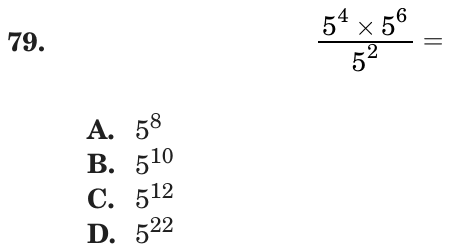
This exponents question asks for the value of 5 to the 4th times 5 to the 6th, divided by 5 squared, written as a single power of 5. It tests the rules for multiplying and dividing powers with the same base. Every choice is a power of 5, so the whole question rests on combining the exponents correctly.
- NYS standards
- 8.EE.1 integer exponent properties
- Grade level
- Grade 8 content, by NYS standard
- Compared with grade 7
- Above grade 7 Combining powers of one base by exponent rules is grade 8 content; grades 6 and 7 only evaluate powers. The task itself is short, one product and one quotient of powers of 5.
- Estimated difficulty
- Straightforward: two steps or one careful reading.
- Thinking it demands
- Depth of knowledge 1, recall and reproduction · mainly apply
- What makes it hard
- Something you must already know moderate
- Solution
- 2 steps
- Reading level
- Question and choices: about grade 16+, 5 words.
- Students, last 30 days
- Not enough answers yet to show (it takes 10).
Why it is hard, traps and wrong answers (shows the answer)
Why it is hard
Everything rests on two grade 8 rules, and the choices are built so that each misapplied rule has an answer. Every choice is a power of 5, so the base gives nothing away and only the exponent arithmetic decides. Students who carry the written operations onto the exponents, or who stop after the numerator, find their result listed; working the top first, then the bottom, keeps the two rules apart.
Something you must already know moderate Working it out
Neither exponent rule is given: multiplying 5⁴ by 5⁶ adds the exponents to 10, and dividing by 5² subtracts 2; working out the powers instead, 625 × 15,625, is hopeless by hand. (Anderson & Krathwohl, 2001)
Strategy: When powers of the same base are multiplied, add their exponents; when one is divided by another, subtract the exponent of the divisor. Apply the top first, then the bottom.
Traps
- A faulty procedure: A systematic but wrong procedure: adding fractions straight across, applying an exponent to each term of a sum, dropping a sign when moving a term.
- Stops one step early: A choice is a number from partway through the solution.
The wrong answers, classified
B Stops one step early (King et al., 2004; Gierl et al., 2017)
Adds the exponents on top, 4 + 6 = 10, and stops there, never dividing by the 5² in the denominator.
C A faulty procedure (Brown & Burton, 1978; Tatsuoka, 1983)
Carries the written operations onto the exponents, 4 × 6 ÷ 2 = 12, multiplying and dividing them instead of adding and subtracting.
D A faulty procedure (Brown & Burton, 1978; Tatsuoka, 1983)
Multiplies the exponents when multiplying the powers, 4 × 6 = 24, then subtracts the 2 correctly, mixing a wrong rule with a right one.
Worked solution, step by step
Formulas used
- Multiplying powers with the same base
- a is the base, the number being multiplied. m and n are exponents, the small raised numbers. Each exponent counts how many a’s are multiplied. Putting the two groups together makes m + n of them, so you add the exponents.
- Dividing powers with the same base
- a is the base, and m and n are exponents. The top has m factors of a and the bottom has n. Each matching pair cancels, because a ÷ a = 1. So m − n factors are left, and you subtract the exponents.
Sort out the question
The expression has three powers of 5. A power like means 5 multiplied by itself 4 times: . The 5 is the base. The small raised 4 is the exponent. Every choice is a power of 5, so you only need the final exponent.
Multiply the powers on top
The top multiplies two powers of 5. Use the rule for multiplying powers.
Four 5s times six more 5s makes ten 5s in a row.
Watch out: add the exponents. Don’t multiply them. leads to , choice D.
Divide by the power on the bottom
Now divide by the bottom. Use the rule for dividing powers.
Two of the ten 5s on top cancel with the two 5s on the bottom. Eight 5s are left.
Watch out: stopping at , choice B, forgets the bottom. Multiplying and dividing the exponents, , gives choice C.
So the answer is A, .
Check your answer
Count the 5s. The top has fives multiplied together. The bottom has 2. Each 5 on the bottom cancels one 5 on top, since 5 ÷ 5 = 1. That leaves fives, which is 5 to the 8th power.
More questions like this
The original DOE question