8.EE.7 linear equations in one variable
Question 1 of 18
2026 Practice Test A Math, question 32Question
What is the value of x in the equation ?
Enter your answer in the space provided. Enter only your answer.
On the test you build the answer on an on-screen keypad; here, type it. Use ^ for a power, sqrt( ) or √ for a root, pi for π, and <= or >= for ≤ and ≥.
Show the answer
Correct answer: x = -13/3
Solution:
Start with .
Subtract from both sides to move all terms involving x to one side.
Combine like terms.
Divide both sides by −3 to solve for x.
Question analysis
This equation question asks for the value of x when 6x equals 9x plus 13, typed into a box after "x =". Students solve a linear equation with the variable on both sides by gathering the x terms and dividing. With no answer choices to check against, keeping the sign of each moved term is the main challenge.
- Grade level
- Grade 8 content, by NYS standard
- Compared with grade 7
- At grade 7 The variable appears on both sides, a grade 8 topic, yet collecting it takes one subtraction and one division, much like a grade 7 two-step equation. The typed answer, with no choices to compare, adds some risk.
- Estimated difficulty
- Straightforward: two steps or one careful reading.
- Thinking it demands
- Depth of knowledge 1, recall and reproduction · mainly apply
- What makes it hard
- Error-prone arithmetic moderate
- An answer in an unexpected form minor
- Solution
- 2 steps
- Reading level
- Question and choices: about grade 5, 21 words.
- Students, last 30 days
- Not enough answers yet to show (it takes 10).
Why it is hard, traps and wrong answers (shows the answer)
Why it is hard
Two moves solve the equation, so the method is not in doubt; the points are lost in the result. Subtracting 6x instead, which gives 0 = 3x + 13, works as well but moves the sign onto the 13, and either route ends in a division that must keep the negative. The answer is not a whole number, which unsettles students who expect one, and a switch to decimals leads to a rounded entry that is not exact.
Error-prone arithmetic moderate Working it out
Collecting the x terms gives 6x − 9x = −3x, a negative coefficient, and 13 ÷ (−3) is a negative fraction that does not come out whole, so both the sign and the fraction must survive. (Brown & Burton, 1978; Junker & Sijtsma, 2001)
An answer in an unexpected form minor Choosing the answer
The answer is typed after the printed x =, with no choices to compare, and its decimal form, −4.333…, repeats forever, so only a fraction or mixed number is exact. (Enright, Morley & Sheehan, 2002)
Strategy: Subtract 9x from both sides so that x appears once, divide both sides by the coefficient left on x, and check by substituting the result into both sides of the original equation.
Traps
- Negatives and direction: Arithmetic with negative numbers, the order of a subtraction, or direction on a number line. (Moving a term across the equals sign without changing its sign is a faulty procedure.)
- Wrong operation: Adds instead of multiplying, divides the wrong way round, turns a ratio or rate upside down, or undoes a step in the wrong direction (subtracts what should be added back).
- Rounds too early: Rounds a value partway through, or rounds the wrong way, so the final answer drifts from the exact one.
The wrong answers, classified
13/3 Negatives and direction (Brown & Burton, 1978)
Reaches −3x = 13 correctly but drops the negative when dividing 13 by −3, entering a positive 13/3.
-4.33 Rounds too early (King et al., 2004)
Solves correctly but turns −13/3 into a decimal and rounds it to −4.33, which is close to the exact value but not equal to it.
-3/13 Wrong operation (Hegarty, Mayer & Monk, 1995; King et al., 2004)
Gets to −3x = 13 but divides the wrong way round, putting the coefficient −3 over the constant 13 instead of 13 over −3.
Worked solution, step by step
Formulas used
- Doing the same to both sides
- a and b are the two sides of an equation, and c is any number or term (not zero when you divide). Taking the same thing away from both sides, or dividing both by the same number, keeps the sides equal. That is how you get x by itself.
- Dividing by a negative number
- a and b are positive numbers, so −b is negative. A positive number divided by a negative number is negative. You can write the minus sign in front of the whole fraction.
- Changing a fraction to a mixed number
- Use this when the top of a fraction is bigger than the bottom. Divide a by b. q is the number of whole times b fits into a. r is the remainder, what is left over. The remainder goes on top of the leftover fraction.
Sort out the question
You need the value of x that makes true. The letter x appears on both sides, so first gather the x terms on one side. There are no choices to check against, so work carefully.
Move the x terms to one side
Subtract 9x from both sides. This clears the x term off the right side:
Since 6 − 9 = −3, the left side is −3 times x.
Divide both sides by −3
x is multiplied by −3, so divide both sides by −3:
A positive divided by a negative is negative, so x is negative.
Watch out: dropping the minus sign gives 13/3, which is wrong. Also, the number you divide by goes on the bottom. Writing −3/13 turns the fraction upside down.
Write it as a mixed number
A mixed number is a whole number with a fraction, like 4 1/3. Divide 13 by 3. The 3 fits 4 times, with 1 left over.
So .
Watch out: as a decimal, −13/3 is −4.333…, and the 3s never end. Rounding to −4.33 is close, but it is not exact. Keep the fraction.
Enter the answer
The box already shows x =, so you enter only the number. On the test, press the minus key first. Then press the fraction key, a small box over a small box. Type 13 in the top box and 3 in the bottom box. On this site, type −13/3 or −4 1/3.
So the finished answer reads x = −13/3. You type only the −13/3, which is the same as −4 1/3.
Check your answer
Put into both sides. The left side is . The right side is . Both sides equal −26, so the answer is right.
More questions like this
The original DOE question
Question 2 of 18
2026 Practice Test C Math, question 3Question
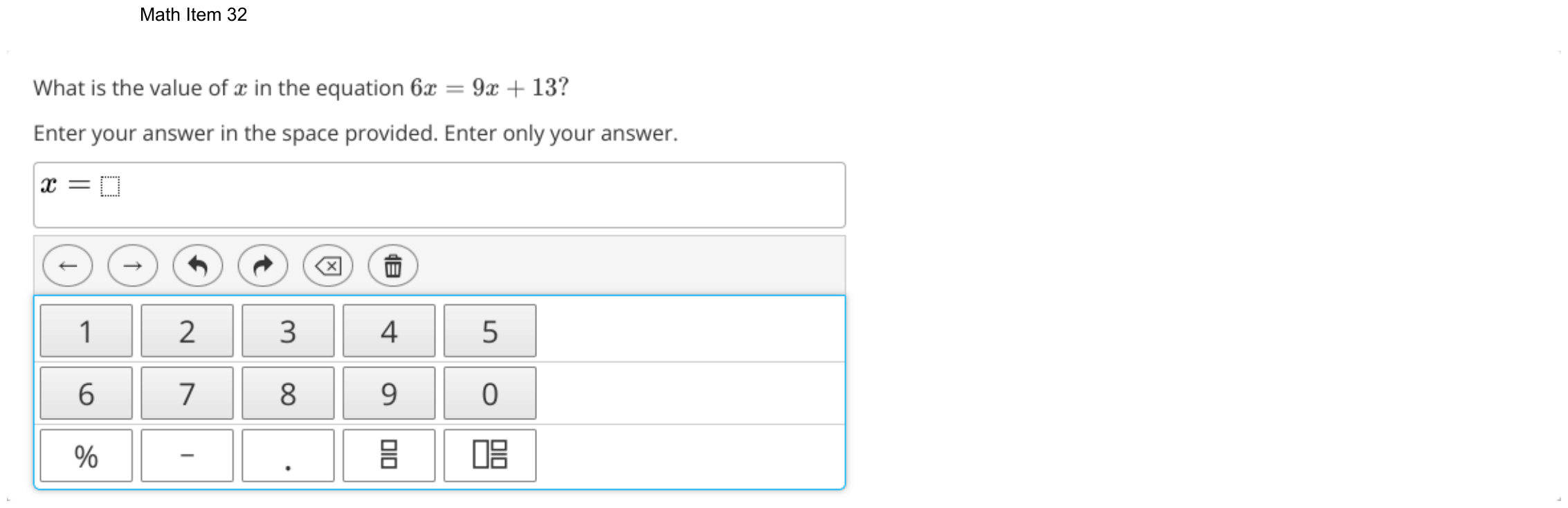
What is the value of x in the equation shown above?
- A336
- B240
- C−240
- D−336
Show the answer
Correct answer: D
Simplify . First, subtract x from both sides of the equation. Then, divide both sides by 5.
Question analysis
This algebra question gives the equation 6x = x − 1,680, with x on both sides, and asks for the value of x. Students collect the x terms on one side and divide by the coefficient that remains. The choices pair two sizes with both signs, so every move across the equals sign has to keep its sign right.
- Grade level
- Grade 8 content, by NYS standard
- Compared with grade 7
- At grade 7 An unknown on both sides of the equals sign is a grade 8 topic, yet gathering the x terms here takes one subtraction and one division, the same work as a two-step grade 7 equation.
- Estimated difficulty
- Straightforward: two steps or one careful reading.
- Thinking it demands
- Depth of knowledge 1, recall and reproduction · mainly apply
- What makes it hard
- Error-prone arithmetic moderate
- A very close wrong answer moderate
- Solution
- 2 steps
- Reading level
- Question and choices: about grade 5, 12 words.
- Corrected from the DOE handbook
- A line of the explanation’s working, printed without its fraction bars and equals sign, was restored.
- Students, last 30 days
- Not enough answers yet to show (it takes 10).
Why it is hard, traps and wrong answers (shows the answer)
Why it is hard
Collecting the x terms takes one subtraction, and the only way the method goes wrong is moving x across the equals sign, which turns the 5 into a 7. The sign is the bigger hazard: 6x equals x minus a large number, so x must be negative, yet the division 1,680 ÷ 5 is done on positive numbers. Substituting −336 back gives −2,016 on each side, which confirms both the size and the sign.
Error-prone arithmetic moderate Working it out
Subtracting x from both sides leaves 5x = −1,680, and 1,680 ÷ 5 = 336 has to be worked out by hand while the negative sign is carried through to the result. (Brown & Burton, 1978; Junker & Sijtsma, 2001)
A very close wrong answer moderate Choosing the answer
The choices are two sizes, 336 and 240, each offered with both signs, so 336 and −336 are written the same except for the minus; only tracking the sign of 1,680 separates them. (Embretson & Wetzel, 1987; Gorin & Embretson, 2006; Ascalon et al., 2007)
Strategy: Subtract x from both sides so the unknown appears once, divide by the coefficient that is left, and substitute the result into both sides to check that they match.
Traps
- Negatives and direction: Arithmetic with negative numbers, the order of a subtraction, or direction on a number line. (Moving a term across the equals sign without changing its sign is a faulty procedure.)
- A faulty procedure: A systematic but wrong procedure: adding fractions straight across, applying an exponent to each term of a sum, dropping a sign when moving a term.
The wrong answers, classified
A Negatives and direction (Brown & Burton, 1978)
Reaches 5x = −1,680 correctly but drops the negative sign when dividing by 5, giving a positive 336 of the right size.
B A faulty procedure (Brown & Burton, 1978; Tatsuoka, 1983)
Moves x to the left without changing its sign, getting 7x, and also loses the minus on 1,680, so 1,680 ÷ 7 = 240.
C A faulty procedure (Brown & Burton, 1978; Tatsuoka, 1983)
Moves x to the left side without changing its sign, writing 6x + x = −1,680, so divides by 7 and gets −240.
What was corrected from the DOE handbook, and why
- Explanation: The DOE’s explanation page for this question is one of the pages replaced in the appendix, and on it the step between 5x = −1,680 and x = −336 shows only 5x over 5 and −1,680 over 5: the two fraction bars and the equals sign between them are missing, so the line is not an equation. The sentence above it says to divide both sides by 5, and the 2022–23 guide, which first printed this explanation, prints the step as 5x/5 = −1,680/5. The site shows 5x/5 = −1,680/5.
Worked solution, step by step
Formulas used
- Keeping an equation balanced
- a and b are the two sides of an equation, and c is any number (not 0 when you divide). An equation is like a balanced scale. Subtract the same thing from both sides, or divide both sides by the same number, and it stays balanced.
- Dividing a negative by a positive
- a and b are positive numbers, so −a is negative. Divide the sizes as usual. Then give the answer a minus sign, because a negative divided by a positive is negative.
Sort out the question
The equation is . You need the value of x. Here 6x means 6 times x. The unknown x is on both sides. So first gather it on one side.
Subtract x from both sides
Take x away from both sides. On the right, x − x is 0, so only −1,680 is left:
Six x’s take away one x leaves five x’s.
Watch out: moving x to the left without changing its sign gives 7x. Dividing by 7 then leads to choice C, −240, or B, 240.
Divide both sides by 5
5x means 5 times x. Divide both sides by 5 to undo it:
Find the size first. Split 1,680 into 1,500 + 180:
A negative divided by a positive is negative:
Choose the answer
Watch out: the minus sign is easy to drop. Positive 336 is choice A. Carry the sign of −1,680 all the way to the end.
So the answer is D, −336.
Check your answer
Put −336 into both sides. The left side is . The right side is . The two sides match, so x = −336 is right.
More questions like this
The original DOE question
Question 3 of 18
2026 Practice Test C Math, question 28Question
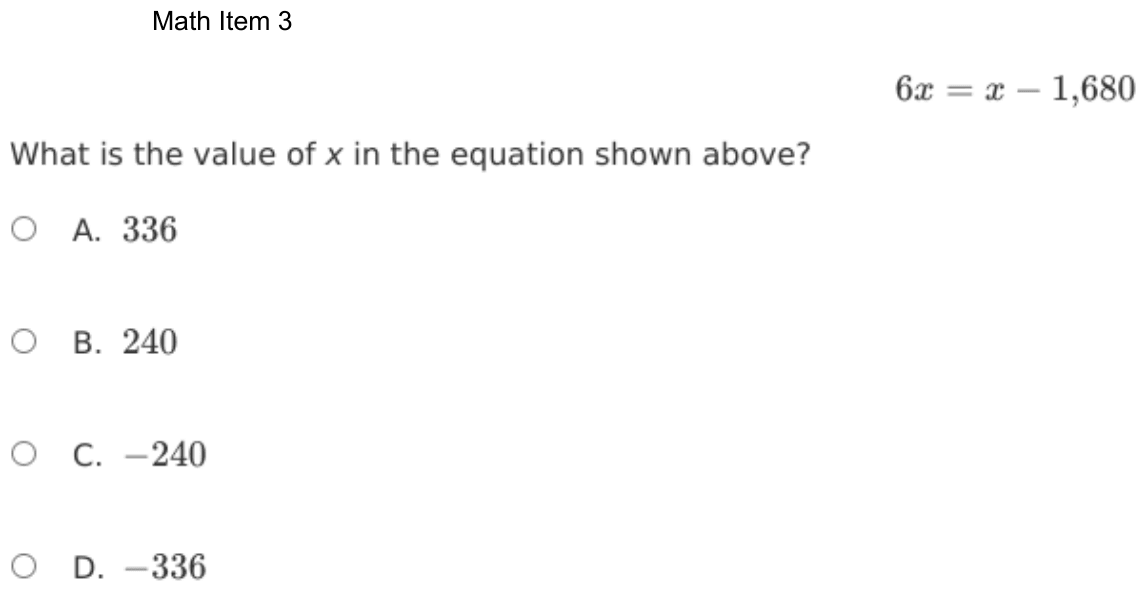
If , what is the value of z in terms of w?
Enter your answer in the space provided. Enter only your answer.
On the test you build the answer on an on-screen keypad; here, type it. Use ^ for a power, sqrt( ) or √ for a root, pi for π, and <= or >= for ≤ and ≥.
Show the answer
Correct answer: z = 17w
The goal is to isolate the variable z by using inverse operations.
First, multiply both sides by 4:
Then subtract from both sides:
Question analysis
This algebra question gives an equation in which z plus 3w, all divided by 4, equals 5w, and students type z in terms of w after a printed "z =". It tests solving a literal equation with inverse operations. The 4 divides the whole sum, so undoing the steps in the right order, with the right signs, is the tricky part.
- Grade level
- Grade 8 content, by NYS standard
- Compared with grade 7
- Above grade 7 Grade 7 students solve two-step equations with numbers, such as (x + 3)/4 = 5. Solving for one letter in terms of another is grade 8 work, and the typed answer gives no choices to check against.
- Estimated difficulty
- Moderate: several steps, or a close reading with one strong distractor.
- Thinking it demands
- Depth of knowledge 1, recall and reproduction · mainly apply
- What makes it hard
- Variables instead of numbers moderate
- An answer in an unexpected form minor
- Solution
- 2 steps
- Reading level
- Question and choices: about grade 4, 23 words.
- Students, last 30 days
- Not enough answers yet to show (it takes 10).
Why it is hard, traps and wrong answers (shows the answer)
Why it is hard
The equation takes only two inverse operations, but their order is the trap: the 4 divides the whole sum z + 3w, so it has to be cleared first. Students who subtract 3w from 5w straight away, or who move 3w to the right without changing its sign, reach a tidy multiple of w that looks as finished as the right one. Substituting w = 1, which needs z = 17 to make (z + 3)/4 equal 5, checks any entry.
Variables instead of numbers moderate Understanding the question
With w on both sides and no numbers to substitute, the result has to stay a multiple of w, and a slip such as 23w gives no sign that it is wrong. (Koedinger & Nathan, 2004; Enright, Morley & Sheehan, 2002)
An answer in an unexpected form minor Choosing the answer
The answer is typed after a printed “z =”, with no choices to compare, so the entry must be a single term in w, not an equation or a number. (Enright, Morley & Sheehan, 2002)
Strategy: Treat w like a known number: undo the division by 4 first, multiplying the whole of each side, then undo the added 3w, keeping the terms in w together.
Traps
- A faulty procedure: A systematic but wrong procedure: adding fractions straight across, applying an exponent to each term of a sum, dropping a sign when moving a term.
- Order of operations: Working left to right, or distributing a minus sign wrongly, gives a choice.
- Wrong operation: Adds instead of multiplying, divides the wrong way round, turns a ratio or rate upside down, or undoes a step in the wrong direction (subtracts what should be added back).
The wrong answers, classified
8w Order of operations (Brown & Burton, 1978)
Undoes the + 3w before the ÷ 4, subtracting 3w from 5w as if only z were divided by 4, so z/4 = 2w and z = 8w.
23w A faulty procedure (Brown & Burton, 1978; Tatsuoka, 1983)
Multiplies correctly to get z + 3w = 20w, then moves 3w to the right side without changing its sign, so z = 20w + 3w = 23w.
-1.75w Wrong operation (Hegarty, Mayer & Monk, 1995; King et al., 2004)
Divides 5w by 4 instead of multiplying, undoing a division with another division, so z + 3w = 1.25w and z = 1.25w − 3w = −1.75w.
Worked solution, step by step
Formulas used
- Doing the same thing to both sides
- A and B are the two sides of an equation, so they are equal. C is any amount. An equation is like a balanced scale. If you multiply both sides by the same number, or take the same amount from both, it stays balanced. That is how you get one letter alone.
Sort out the question
The equation is . You need z in terms of w. That means getting z alone on one side. The other side will use only w and numbers.
Treat w like a number you do not know yet. The answer box already shows z =, so you type only what comes after it.
Undo the division first
The fraction bar means the whole top, z + 3w, is divided by 4. So undo that first. Multiply both sides by 4, because multiplying undoes dividing:
Watch out: do not subtract 3w first. The 3w sits inside the fraction, so it is divided by 4 too. Subtracting it from 5w first leads to the wrong answer 8w.
Undo the adding
Now 3w is added to z. Subtract 3w from both sides:
Think of w as a thing, like apples. 20 apples take away 3 apples leaves 17 apples.
Watch out: moving 3w to the other side without changing its sign gives . That is wrong.
Enter it after the printed z =
On the test, the box already shows z =. Press 1, then 7, then the w key. You do not need a times sign between 17 and w. Do not type z = again. On this site, type 17w in the box.
So you would enter 17w, which makes z = 17w.
Check your answer
Pick a number for w, such as w = 1. Then z = 17. Put both into the first equation. The left side is . The right side is . The two sides match, so 17w works.
More questions like this
The original DOE question
Question 4 of 18
2026 Practice Test C Math, question 35Question
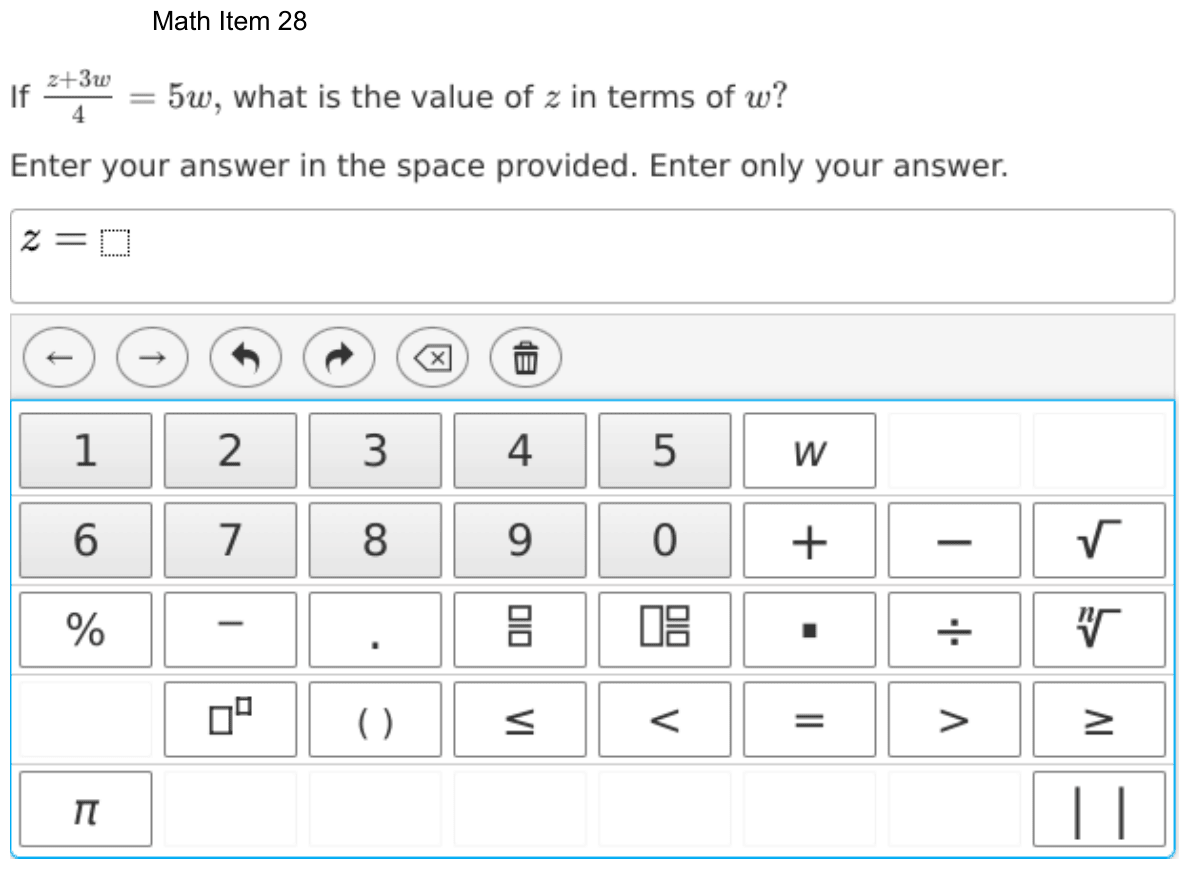
If , what is the value of a in terms of b?
Enter your answer in the space provided. Enter only your answer.
On the test you build the answer on an on-screen keypad; here, type it. Use ^ for a power, sqrt( ) or √ for a root, pi for π, and <= or >= for ≤ and ≥.
Show the answer
Correct answer: a = 10b
To find the value of a in terms of b, solve for a. Begin by distributing 4 on the left side of the equation:
Then, get the a terms on one side and the b terms on the other:
Solve for the value of a in terms of b by combining like terms and then dividing each side by 2:
Question analysis
An algebra question gives an equation with a and b on both sides, one side written as 4 times a sum in parentheses, and students type a in terms of b after a printed "a =". It tests the distributive property and solving linear equations. The answer is typed, so a slip in distributing or moving terms is not caught by any choices.
- NYS standards
- Grade level
- Grade 8 content, by NYS standard
- Compared with grade 7
- Above grade 7 Grade 7 students solve equations like 4(x + 2) = 28 with numbers. This one has letters on both sides, needs the distributive property and like terms, and asks for a in terms of b, which is grade 8 algebra.
- Estimated difficulty
- Hard: combines ideas, needs a plan, and has more than one tempting wrong answer.
- Thinking it demands
- Depth of knowledge 1, recall and reproduction · mainly apply
- What makes it hard
- Variables instead of numbers moderate
- Many steps moderate
- An answer in an unexpected form minor
- Solution
- 3 steps
- Reading level
- Question and choices: about grade 4, 23 words.
- Students, last 30 days
- Not enough answers yet to show (it takes 10).
Why it is hard, traps and wrong answers (shows the answer)
Why it is hard
Every step is routine, yet there are four of them, each with a classic slip, and the typed answer catches none. Multiplying the 4 into only the a, or carrying 8b across without changing its sign, gives another whole multiple of b that looks finished. Testing b = 1, where 4(a + 2) and 28 + 2a must come out equal, confirms an entry quickly.
Variables instead of numbers moderate Understanding the question
Both letters appear on both sides, and the answer must stay a multiple of b, so there is no number to check an entry against unless students invent one. (Koedinger & Nathan, 2004; Enright, Morley & Sheehan, 2002)
Many steps moderate Working it out
Four moves run in a chain, distributing the 4, gathering the a terms, gathering the b terms and dividing by 2, and an error at any one carries into the typed result. (Daniel & Embretson, 2010; Enright, Morley & Sheehan, 2002)
An answer in an unexpected form minor Choosing the answer
The answer is typed after a printed “a =”, with no choices, so 20b, the line before dividing by 2, can be entered without anything on screen questioning it. (Enright, Morley & Sheehan, 2002)
Strategy: Distribute the 4 to both terms in the parentheses, gather the a terms on one side and the b terms on the other, then divide by the coefficient of a.
Traps
- A faulty procedure: A systematic but wrong procedure: adding fractions straight across, applying an exponent to each term of a sum, dropping a sign when moving a term.
- Stops one step early: A choice is a number from partway through the solution.
The wrong answers, classified
13b A faulty procedure (Brown & Burton, 1978; Tatsuoka, 1983)
Multiplies only the a by 4, writing 4a + 2b = 28b + 2a, so 2a = 26b and a = 13b.
18b A faulty procedure (Brown & Burton, 1978; Tatsuoka, 1983)
Distributes correctly but moves 8b to the right without changing its sign, so 2a = 28b + 8b = 36b and a = 18b.
20b Stops one step early (King et al., 2004; Gierl et al., 2017)
Reaches 2a = 20b correctly and enters 20b, stopping before dividing both sides by 2 to get a alone.
Worked solution, step by step
Formulas used
- Distributive property
- k is the number outside the parentheses. x and y are the terms inside. The number outside multiplies every term inside, not just the first one. It works because 4 groups of (x + y) hold 4 x’s and 4 y’s.
- Doing the same thing to both sides
- A and B are the two equal sides of an equation. C is any amount. Taking the same amount from both sides, or dividing both by the same number, keeps them equal, like a balanced scale.
Sort out the question
The equation is . You need a in terms of b. That means a alone on one side, with only b and numbers on the other.
The answer box already shows a =, so you type only what comes after it.
Multiply out the parentheses
Use the distributive property. The 4 multiplies both terms inside:
Watch out: multiplying only the a by 4 gives 4a + 2b. That leads to the wrong answer 13b.
Gather the a terms
Like terms are terms with the same letter, such as 4a and 2a. Put the a terms on the left. Subtract 2a from both sides:
Gather the b terms
Now subtract 8b from both sides:
Watch out: moving 8b without changing its sign gives . That leads to 18b, which is wrong.
Divide both sides by 2
2a means 2 times a. Divide both sides by 2 to get a alone:
Watch out: 20b is equal to 2a, not a. Do not stop there.
Enter it after the printed a =
On the test, the box already shows a =. Press 1, then 0, then the b key. You do not need a times sign. Do not type a = again. On this site, type 10b in the box.
So you would enter 10b, which makes a = 10b.
Check your answer
Pick b = 1, so a = 10. The left side is . The right side is . The sides match, so 10b works.
More questions like this
The original DOE question
Question 5 of 18
2026 Practice Test C Math, question 38Question
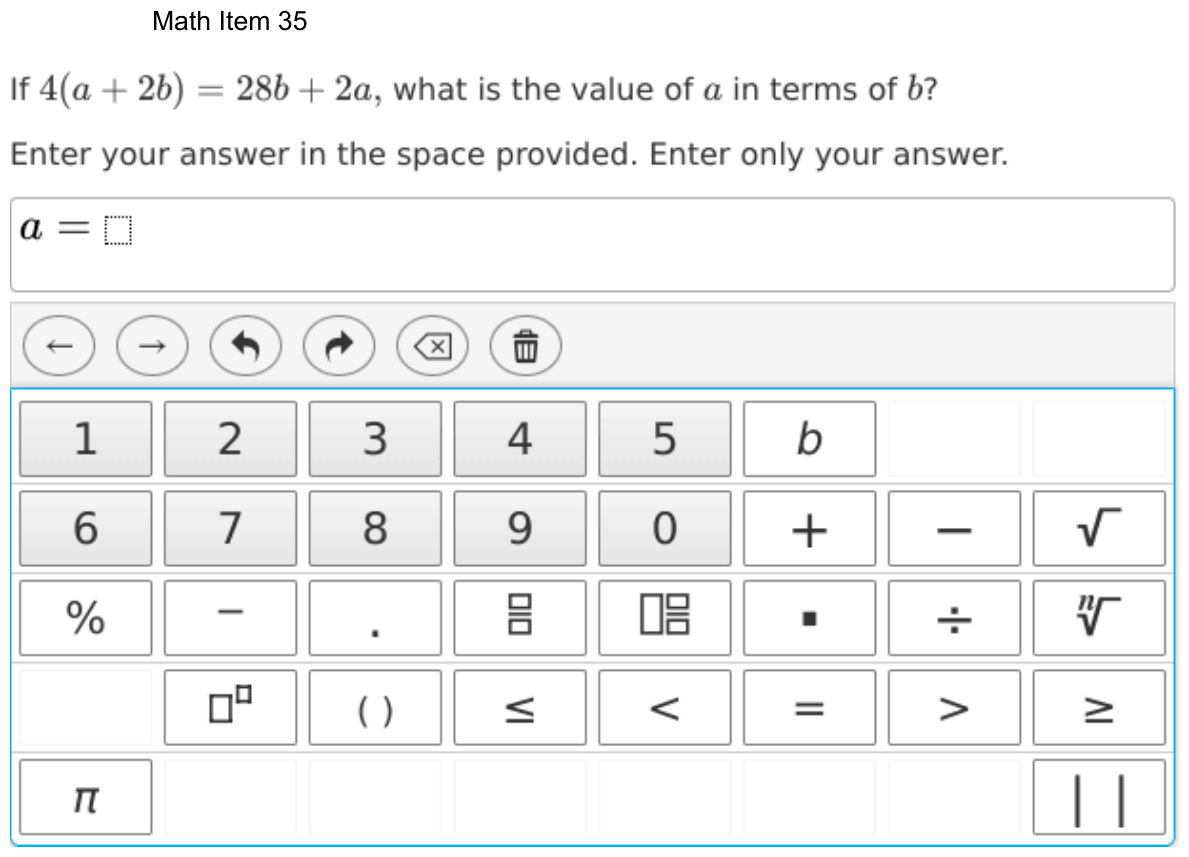
This formula can be used to determine p, the number of pages that will be in a book that contains w words, with an average of r words per page, and f extra pages in the front for the title and publishing information.
If the formula is solved for w, it can be used to find the number of words in a book with p pages. What will the formula be if it is solved for w?
- A
- B
- C
- D
Show the answer
Correct answer: A
Apply the properties of equality to solve for w.
Subtract f from both sides of the equation.
Multiply both sides by r.
Question analysis
A formula gives the number of pages p in a book from its number of words w, the average words per page r, and the extra front pages f. Students choose the formula solved for w. It tests rearranging a formula with inverse operations, and with only letters there are no numbers to check, so the order of the steps matters.
- Grade level
- Grade 8 content, by NYS standard
- Compared with grade 7
- Above grade 7 Grade 7 students solve two-step equations such as 5 = x/4 + 2 with numbers. Rearranging a formula with four letters to solve for a different one is grade 8 work, with no numbers to check against.
- Estimated difficulty
- Moderate: several steps, or a close reading with one strong distractor.
- Thinking it demands
- Depth of knowledge 1, recall and reproduction · mainly apply
- What makes it hard
- Variables instead of numbers moderate
- Many steps minor
- Solution
- 2 steps
- Reading level
- Question and choices: about grade 5, 82 words.
- Students, last 30 days
- Not enough answers yet to show (it takes 10).
Why it is hard, traps and wrong answers (shows the answer)
Why it is hard
The formula is short, but solving it for w means undoing two operations in reverse order, with letters only. The tempting shortcut multiplies p by r and leaves the f untouched, which yields a formula that looks as finished as the right one. Swapping p and w without undoing anything is the other quick trap. Substituting a small book, 5,000 words at 250 a page with 4 front pages, shows which formula gives back 5,000.
Variables instead of numbers moderate Understanding the question
Four letters and no numbers mean each choice has to be judged by its structure, unless students pick values such as r = 250, w = 5,000 and f = 4 to test it. (Koedinger & Nathan, 2004; Enright, Morley & Sheehan, 2002)
Many steps minor Working it out
Two inverse operations must come in order, subtracting f before multiplying by r; multiplying first means the f would have to be multiplied by r as well. (Daniel & Embretson, 2010; Enright, Morley & Sheehan, 2002)
Strategy: Treat it like a two-step equation with numbers: undo what was done to w last, then the step before, applying each operation to the whole of the other side.
Traps
- A faulty procedure: A systematic but wrong procedure: adding fractions straight across, applying an exponent to each term of a sum, dropping a sign when moving a term.
- Misunderstands the concept: A wrong belief about a concept: that percents can be added, that area grows like length, that averages can be averaged, that a bigger denominator means a bigger fraction.
- Numbers taken from the question: Combines the numbers in the question without a model of the situation, or is simply a number that appears in the question.
The wrong answers, classified
B Misunderstands the concept (Smith, diSessa & Roschelle, 1993; De Bock et al., 1998; Ni & Zhou, 2005)
Treats solving for w as trading the places of p and w, keeping the 1/r and the + f exactly where they were.
C A faulty procedure (Brown & Burton, 1978; Tatsuoka, 1983)
Multiplies p by r to undo the 1/r but leaves the + f alone, neither subtracting it first nor multiplying it by r too.
D Numbers taken from the question (Hegarty, Mayer & Monk, 1995)
Adds the other three letters, r + p + f, keeping the formula’s letters but none of its multiplication or division.
Worked solution, step by step
Formulas used
- Multiplying by the reciprocal
- r is any number except 0. The reciprocal of r is 1/r, the number flipped upside down. A number times its reciprocal is always 1. So multiplying by r undoes the 1/r in front of w and leaves w by itself.
Sort out the question
The formula is . Here p is the number of pages, w the number of words, r the words on each page, and f the extra front pages.
You need the formula solved for w. That means w alone on one side of the equal sign.
See what happens to w
Read the formula like a recipe. Start with w. First it is multiplied by , which is the same as dividing by r. Then f is added.
To get w back, undo the steps in reverse order. Take away f first. Then undo the .
Subtract f from both sides
Taking f from both sides keeps them equal:
Now the only thing left to undo is the .
Multiply both sides by r
Use the reciprocal rule. Multiply both whole sides by r:
So .
Watch out: , choice C, multiplies only p by r. The f must be taken away before you multiply. Or, if you multiply first, every term gets multiplied by r.
Give the answer
Choice B only trades the places of p and w, and it undoes nothing. Choice D just adds the letters.
So the answer is A, .
Check your answer
Try a book with 5,000 words, 250 words a page and 4 front pages. The first formula gives pages. Choice A gives back the words: . Choice C gives , which is wrong.
More questions like this
The original DOE question
Question 6 of 18
2026 Practice Test D Math, question 10Question
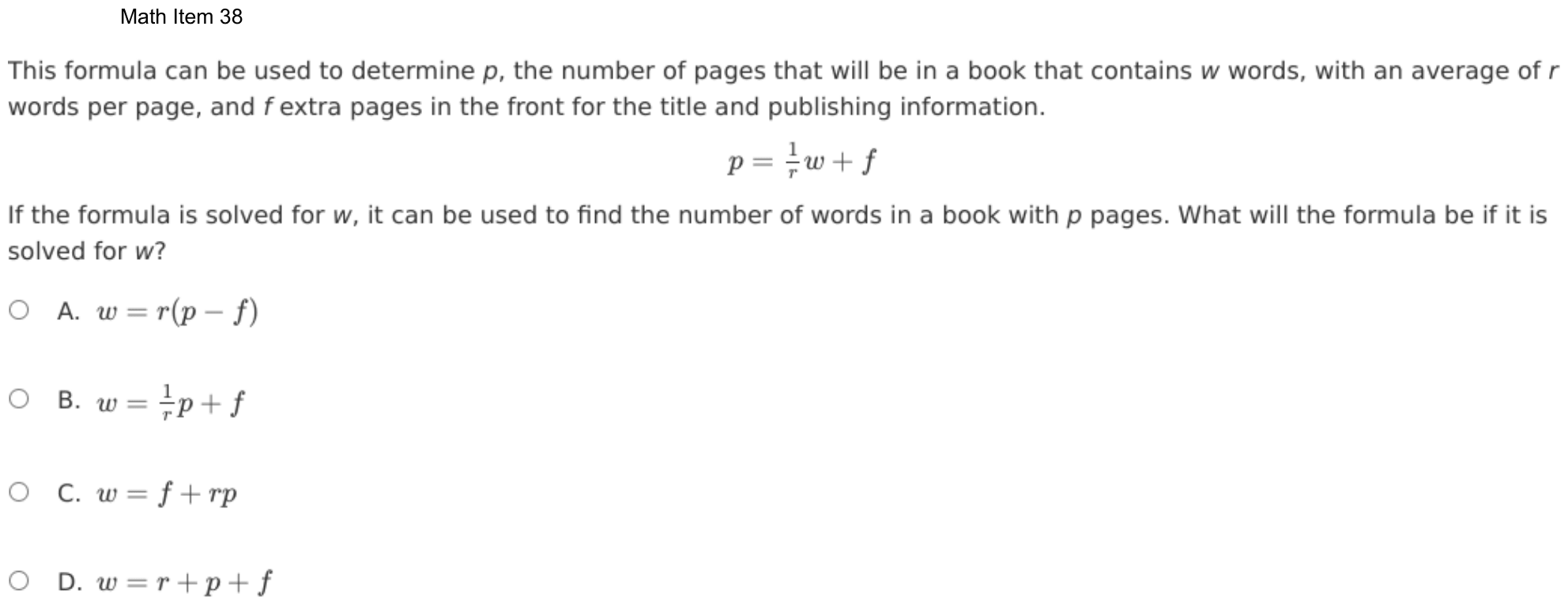
For what values of x is the above inequality true?
- A
- B
- C
- D
Show the answer
Correct answer: A
Use inverse operations to isolate the variable x by first getting the x variable on one side.
Now, when dividing by , the direction of the inequality sign changes.
Another way to solve is to keep the coefficient of x positive and then recognize that is the same as .
Question analysis
This algebra question asks which values of x make the inequality 2x + 11 > 3x + 9 true, choosing from four solution sets. It tests solving a linear inequality with the variable on both sides. Collecting the x terms can leave a negative coefficient, and handling the inequality sign at that point is where most mistakes happen.
- Grade level
- Grade 8 content, by NYS standard
- Compared with grade 7
- At grade 7 Two-step inequalities are grade 7 work, and having x on both sides, a grade 8 idea, takes only one extra subtraction here. The demand matches a careful grade 7 problem, with one sign decision that is easy to get wrong.
- Estimated difficulty
- Moderate: several steps, or a close reading with one strong distractor.
- Thinking it demands
- Depth of knowledge 1, recall and reproduction · mainly apply
- What makes it hard
- Error-prone arithmetic moderate
- A very close wrong answer moderate
- Solution
- 2 steps
- Reading level
- Question and choices: about grade 10, 15 words.
- Corrected from the DOE handbook
- A grammatical error in the explanation was corrected.
- Students, last 30 days
- Not enough answers yet to show (it takes 10).
Why it is hard, traps and wrong answers (shows the answer)
Why it is hard
The boundary 2 comes out of two routine moves; the direction is where points are lost. Whichever side the x terms are collected on, the last step either divides by a negative or leaves x on the right, and both moments invite a reversed answer. A second risk is moving the 9 without changing its sign, which yields 20. Substituting x = 0, which makes 11 > 9 true, confirms the direction.
Error-prone arithmetic moderate Working it out
Subtracting 3x from both sides leaves −x > −2, and dividing by −1 must reverse the sign; subtracting 2x instead leaves 2 > x, which still has to be read from the x side. (Brown & Burton, 1978; Junker & Sijtsma, 2001)
A very close wrong answer moderate Choosing the answer
x < 2 and x > 2 share the boundary and differ only in direction, so finding the 2 settles nothing; only the sign rule or a test value such as x = 0 decides. (Embretson & Wetzel, 1987; Gorin & Embretson, 2006; Ascalon et al., 2007)
Strategy: Subtract 2x from both sides so the x term stays positive, undo the + 9, then rewrite the result with x first; testing a value in the original inequality checks the direction.
Traps
- Negatives and direction: Arithmetic with negative numbers, the order of a subtraction, or direction on a number line. (Moving a term across the equals sign without changing its sign is a faulty procedure.)
- A faulty procedure: A systematic but wrong procedure: adding fractions straight across, applying an exponent to each term of a sum, dropping a sign when moving a term.
The wrong answers, classified
B Negatives and direction (Brown & Burton, 1978)
Reaches −x > −2 but divides by −1 without reversing the inequality, or reads 2 > x as x > 2, so the direction comes out backwards.
C A faulty procedure (Brown & Burton, 1978; Tatsuoka, 1983)
Moves the 9 across the inequality without changing its sign, 11 + 9 = 20 instead of 11 − 9 = 2, and keeps the direction right.
D A faulty procedure (Brown & Burton, 1978; Tatsuoka, 1983)
Moves the 9 without changing its sign to get 20 > x, then also rewrites that statement backwards as x > 20, two errors at once.
What was corrected from the DOE handbook, and why
- Explanation: The DOE’s explanation says “Another way to solve is to keep the coefficient of x positive and then recognizing that 2 > x is the same as x < 2.” The two verbs joined by “and then” should have the same form, so the site now says “and then recognize that”.
Worked solution, step by step
Formulas used
- Doing the same to both sides of an inequality
- a and b are the two sides, and c is any number or term. Subtracting (or adding) the same amount on both sides keeps the inequality true and its sign the same. That is how you move terms from one side to the other.
- Dividing by a negative number
- a and b are any numbers. Multiplying or dividing both sides by a negative number flips the sign, so > becomes <. For example, 3 > 2, but −3 < −2. Use it whenever you divide by a negative number.
Sort out the question
The sign > means is greater than. You need every value of x that makes 2x + 11 greater than 3x + 9. The answer is a range of values, not one number. Solve it like an equation, but keep an eye on the direction of the sign.
Gather the x terms on one side
The right side has more x’s, 3x, than the left side, 2x. So subtract 2x from both sides. That keeps the x term positive:
Get x by itself
Subtract 9 from both sides:
Watch out: to move the 9, subtract it from both sides. Adding it instead gives 20 > x, which leads to choice C or D.
Read it from the x side
says 2 is greater than x. That is the same as saying x is less than 2:
Watch out: when you swap the sides, the sign must point the other way. Writing gives choice B. If you subtract 3x instead, you get . Dividing by −1 then flips the sign, and you get again.
So the answer is A, .
Check your answer
Test x = 0, which is less than 2. The left side is 11 and the right side is 9, and 11 > 9 is true. Test x = 5, which is more than 2. The left side is 21 and the right side is 24, and 21 > 24 is false. So only values below 2 work.
More questions like this
The original DOE question
Question 7 of 18
2024 Test B Math, question 8Question
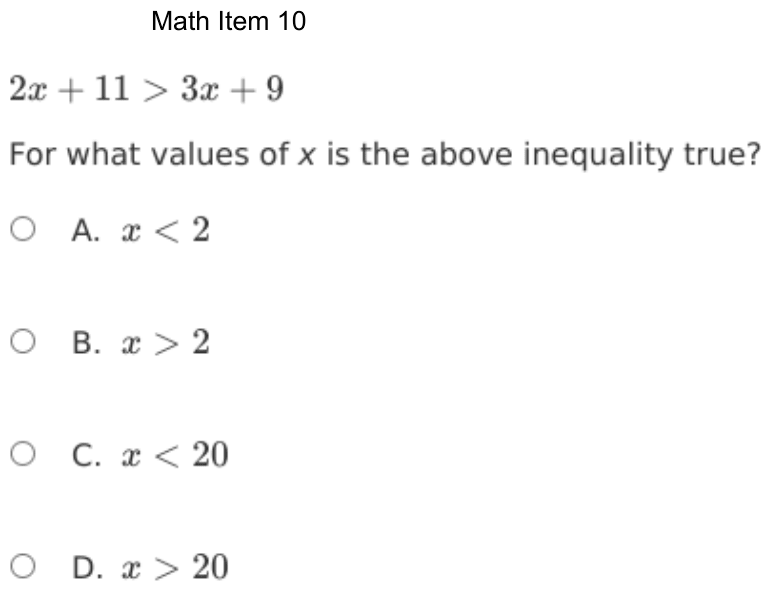
If , where and , what is the product of x and y?
- A4
- B6
- C12
- D16
Show the answer
Correct answer: C
Question analysis
An algebra question gives a proportion with x in one denominator and y in one numerator, 9 over 2x equal to 3y over 8, and asks for the product of x and y. Neither variable can be found on its own, so students must clear the fractions and treat the product as a single quantity.
- Grade level
- Grade 8 content, by NYS standard
- Compared with grade 7
- Above grade 7 Grade 7 students cross-multiply numeric proportions to find one unknown. Here two variables sit in the proportion and the question wants their product, a literal-equation idea from grade 8 that many grade 7 students have not met.
- Estimated difficulty
- Moderate: several steps, or a close reading with one strong distractor.
- Thinking it demands
- Depth of knowledge 2, skills and concepts · mainly apply
- What makes it hard
- No obvious method moderate
- Variables instead of numbers minor
- Solution
- 3 steps
- Reading level
- Question and choices: about grade 8, 14 words.
- Students, last 30 days
- Not enough answers yet to show (it takes 10).
Why it is hard, traps and wrong answers (shows the answer)
Why it is hard
The question looks harder than it is, because it asks for a product rather than for x or y. Cross-multiplying turns the proportion into 72 = 6xy, and dividing by 6 finishes it, so the only real hurdle is trusting that xy can be solved for as one quantity. The wrong choices come from grabbing numbers along the way, not from a nearly complete solution.
No obvious method moderate Working it out
Neither x nor y can be found alone, so students must see that cross-multiplying gives 72 = 6xy, where the product xy appears as one block to solve for. (Schoenfeld, 1985)
Variables instead of numbers minor Understanding the question
Both unknowns stay letters and only their product is asked for, so there is no value of x or y to check a result against. (Koedinger & Nathan, 2004; Enright, Morley & Sheehan, 2002)
Strategy: Cross-multiply to clear both fractions, collect the numbers on one side and x and y together on the other, then divide so that only the product is left.
Traps
- Numbers taken from the question: Combines the numbers in the question without a model of the situation, or is simply a number that appears in the question.
- Answers a different question: A choice is right for another quantity: the other unknown, the rest instead of the part, the part instead of the whole.
The wrong answers, classified
A Answers a different question (King et al., 2004; Hegarty, Mayer & Monk, 1995)
Matches the denominators, 2x = 8, to get x = 4 and gives the value of x instead of the product of x and y.
B Numbers taken from the question (Hegarty, Mayer & Monk, 1995)
Takes the 6 in 72 = 6xy, the product of the coefficients 2 and 3, as the answer without dividing 72 by it.
D Numbers taken from the question (Hegarty, Mayer & Monk, 1995)
Multiplies the 2 and the 8 from the two denominators, combining numbers in the equation instead of cross-multiplying.
Worked solution, step by step
Formulas used
- Cross-multiplying
- a, b, c and d are numbers or letters, and b and d are not zero. When two fractions are equal, multiply each top by the other bottom. The two products are equal. It works because it is the same as multiplying both sides by b and by d.
Sort out the question
The equation says that two fractions are equal:
Here 2x means 2 times x, and 3y means 3 times y. You need the product of x and y. A product is the answer to a multiplication. So you need , written xy. You do not need x or y alone.
Cross-multiply the fractions
An equation without fractions is easier to work with. So cross-multiply.
Watch out: do not just set the bottoms equal. Writing 2x = 8 gives x = 4, choice A. That is x, not the product.Multiply out both sides
On the left, . On the right, multiply the numbers and keep the letters together.
So the equation is now:
The xy is the product you want, all in one piece.
Divide both sides by 6
xy is being multiplied by 6. To undo that, divide both sides by 6.
Watch out: 6 is just the number in front of xy. Choosing it gives B.So the answer is C, 12.
Check your answer
Pick x = 4. Then y must be 3, so that xy = 12. Left side: . Right side: . The two sides match, so a product of 12 works.
More questions like this
The original DOE question
Question 8 of 18
2024 Test B Math, question 13Question
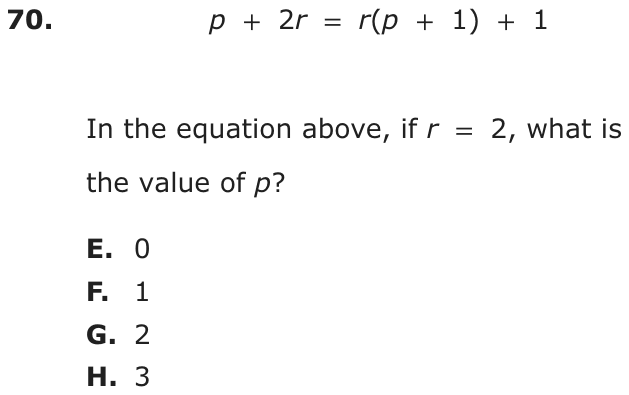
In the equation above, if , what is the value of p?
- A0
- B1
- C2
- D3
Show the answer
Correct answer: B
First substitute 2 for r in the equation.
Then solve for p.
The value of p is 1.
Question analysis
An equation question: p + 2r equals r times (p + 1), plus 1, and r is given as 2. Students substitute for r, expand the parentheses and solve the resulting linear equation for p. With p on both sides and a product to expand, distributing is where a slip is most likely.
- NYS standards
- Grade level
- Grade 8 content, by NYS standard
- Compared with grade 7
- At grade 7 Equations with the variable on both sides are formally grade 8, but after substituting, this is a short solve with small whole numbers. It asks about as much as a typical grade 7 two-step equation.
- Estimated difficulty
- Straightforward: two steps or one careful reading.
- Thinking it demands
- Depth of knowledge 1, recall and reproduction · mainly apply
- What makes it hard
- Error-prone arithmetic moderate
- Solution
- 3 steps
- Reading level
- Question and choices: about grade 6, 13 words.
- Students, last 30 days
- Not enough answers yet to show (it takes 10).
Why it is hard, traps and wrong answers (shows the answer)
Why it is hard
Substituting r = 2 is immediate; the points are lost in expanding 2(p + 1) + 1. Each wrong choice solves a slightly wrong expansion: forgetting to multiply the 1 inside, folding the outer 1 into the parentheses, or losing a term. Putting the answer back into the original equation, with both r and p, is a quick and complete check.
Error-prone arithmetic moderate Working it out
After substituting, 2(p + 1) + 1 must become 2p + 3, multiplying both terms in the parentheses before adding the 1 outside, with p left on both sides. (Brown & Burton, 1978; Junker & Sijtsma, 2001)
Strategy: Replace every r with 2, multiply 2 by both terms in the parentheses, gather the p terms on one side, and check by putting the value back into the original equation.
Traps
- Order of operations: Working left to right, or distributing a minus sign wrongly, gives a choice.
The wrong answers, classified
A Order of operations (Brown & Burton, 1978)
Adds the outer 1 inside the parentheses before multiplying, writing 2(p + 2) = 2p + 4, so p + 4 = 2p + 4 gives 0.
C Order of operations (Brown & Burton, 1978)
Multiplies only the p by 2, writing 2p + 1 + 1 = 2p + 2, so p + 4 = 2p + 2 and p comes out as 2.
D Misreads the question (Hegarty, Mayer & Monk, 1995)
Drops the 1 inside the parentheses, reading 2(p + 1) as 2p, so the right side is 2p + 1 and p + 4 = 2p + 1 gives 3.
Worked solution, step by step
Formulas used
- Distributive property
- a is the number outside the parentheses. b and c are the terms inside. A term is a number, a letter, or a number times a letter. To multiply out the parentheses, multiply each term inside by a. It works because a groups of b + c is a groups of b plus a groups of c.
- Keeping an equation balanced
- a and b are the two sides of an equation, and c is any number or term. An equation is like a balanced scale. If you subtract the same thing from both sides, it stays balanced. Adding the same thing, or dividing both sides by the same number that is not zero, works too.
Sort out the question
The equation has two letters, p and r. You are told that r = 2. You need the value of p. Here 2r means 2 times r, and r(p + 1) means r times the group p + 1.
Put 2 in for r
Replace every r with 2. Keep the parentheses so you can see what gets multiplied.
On the left, , so the left side is .
Multiply out the parentheses
The 2 multiplies both the p and the 1 inside the parentheses. Then add the 1 that is outside.
Watch out: multiply the 1 inside by 2 as well. Writing 2p + 1 + 1 gives p = 2, choice C. Adding the outside 1 inside first gives p = 0, choice A.Get p by itself
Now the equation is . Subtract p from both sides. Then subtract 3 from both sides.
So p = 1, and the answer is B, 1.
Check your answer
Put p = 1 and r = 2 back into the first equation. Left side: . Right side: . Both sides are 5, so p = 1 works.
More questions like this
The original DOE question
Question 9 of 18
2024 Test B Math, question 44Question
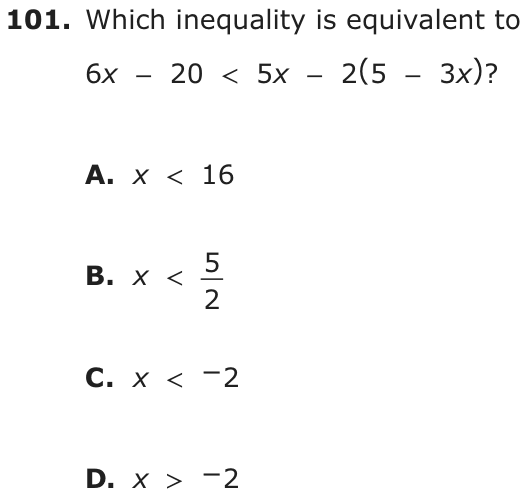
Which inequality is equivalent to ?
- A
- B
- C
- D
Show the answer
Correct answer: D
Distribute the coefficient −2 on the right-hand side:
Subtract from both sides:
Add 10 to both sides:
Divide both sides by 5:
This is equivalent to
Question analysis
Students choose the simplest equivalent form of a linear inequality that has x on both sides and a negative number multiplied into parentheses. It tests distributing, combining like terms and solving inequalities. Sign errors in the distribution, and reading the direction of the final inequality, are where most mistakes happen.
- NYS standards
- Grade level
- Grade 8 content, by NYS standard
- Compared with grade 7
- Above grade 7 Grade 7 inequalities have the form px + q < r. This one has x on both sides and a negative factor to distribute across a subtraction, steps that belong to grade 8 equation work, so it is harder than typical grade 7 practice.
- Estimated difficulty
- Hard: combines ideas, needs a plan, and has more than one tempting wrong answer.
- Thinking it demands
- Depth of knowledge 1, recall and reproduction · mainly apply
- What makes it hard
- Error-prone arithmetic moderate
- A very close wrong answer moderate
- Many steps minor
- Solution
- 4 steps
- Reading level
- Question and choices: about grade 16+, 10 words.
- Students, last 30 days
- Not enough answers yet to show (it takes 10).
Why it is hard, traps and wrong answers (shows the answer)
Why it is hard
Every move is standard algebra, but the inequality is built so that small slips change the answer completely. The −2 has to reach both terms in the parentheses, and once the boundary −2 is found its direction still has to be read correctly, since the variable ends up on the right as −2 < x. Rewriting that as x > −2, or substituting x = 0 into the original, catches the trap.
Error-prone arithmetic moderate Working it out
Distributing −2 over (5 − 3x) gives −10 + 6x, two sign decisions in one move, and the x terms then sit on both sides of the inequality. (Brown & Burton, 1978; Junker & Sijtsma, 2001)
A very close wrong answer moderate Choosing the answer
x < −2 and x > −2 share the boundary and differ only in direction, which depends on reading −2 < x correctly or flipping the sign when dividing by a negative. (Embretson & Wetzel, 1987; Gorin & Embretson, 2006; Ascalon et al., 2007)
Many steps minor Working it out
Four moves follow one another, distributing, collecting 5x + 6x, moving the x terms and dividing by 5, and a slip at any of them changes the result. (Daniel & Embretson, 2010; Enright, Morley & Sheehan, 2002)
Strategy: Distribute the −2 to both terms in the parentheses, combine the x terms on the right, then gather the x terms on the side that keeps their coefficient positive.
Traps
- Order of operations: Working left to right, or distributing a minus sign wrongly, gives a choice.
- Negatives and direction: Arithmetic with negative numbers, the order of a subtraction, or direction on a number line. (Moving a term across the equals sign without changing its sign is a faulty procedure.)
- A faulty procedure: A systematic but wrong procedure: adding fractions straight across, applying an exponent to each term of a sum, dropping a sign when moving a term.
The wrong answers, classified
A A faulty procedure (Brown & Burton, 1978; Tatsuoka, 1983)
Treats 5 − 3x as 2, combining a number with an x term, so the right side becomes 5x − 4 and the solution x < 16.
B Order of operations (Brown & Burton, 1978)
Multiplies the −2 by the 5 but not by the −3x, writing 5x − 10 − 3x, which leads to 4x < 10 and x < 5/2.
C Negatives and direction (Brown & Burton, 1978)
Finds the boundary −2 but points the inequality the wrong way, by misreading −2 < x or by not flipping the sign after dividing by −5.
Worked solution, step by step
Formulas used
- Distributive property
- a is the number outside the parentheses. b and c are the terms inside. Multiply a by each one. A minus sign inside counts as a negative term, so 5 − 3x is 5 + (−3x). A negative times a negative is positive.
- Keeping an inequality true
- a and b are the two sides, and c is any number. Adding or subtracting the same number on both sides keeps the inequality true. Dividing both sides by a positive number also keeps it true. Only multiplying or dividing by a negative number flips the sign.
Sort out the question
An inequality compares two sides with a sign like <, which means is less than. To solve it, you get x alone on one side.
You need the short inequality that has the same answers as the long one.
Distribute the −2
Multiply −2 by both terms inside the parentheses, 5 and −3x.
A negative times a negative is positive, so the second part is +6x. Watch out: If the −2 multiplies only the 5, you end up with , choice B.
Combine the x terms
The right side is now 5x − 10 + 6x. Put the x terms together: 5x + 6x = 11x.
Gather the x terms on one side
Subtract 6x from both sides. That leaves the x terms on the right, where they stay positive.
Get x by itself
Add 10 to both sides. Then divide both sides by 5.
You divided by a positive 5, so the sign does not flip.
Read it with x first
says −2 is less than x. That is the same as saying x is greater than −2, just as 3 < 5 means 5 > 3.
Watch out: , choice C, has the same number but points the wrong way.
So the answer is D, .
Check your answer
Test x = 0, which is greater than −2. The left side is . The right side is . And −20 < −10 is true. Now test x = −3. The left side is −38 and the right side is −43. That is false, as it should be.
More questions like this
The original DOE question
Question 10 of 18
2023 Test A Math, question 44Question
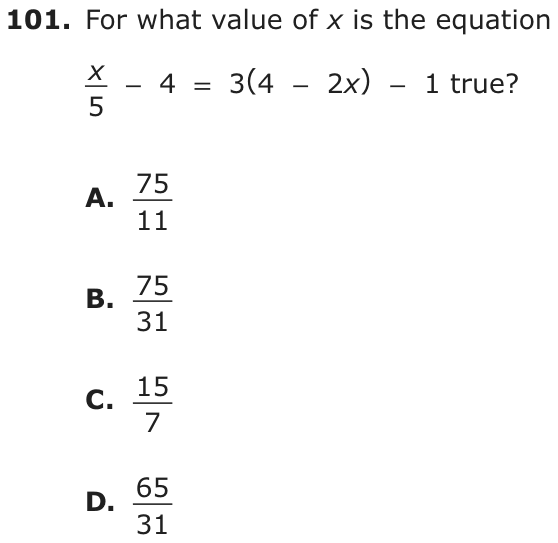
For what value of x is the equation true?
- A
- B
- C
- D
Show the answer
Correct answer: B
| Apply the distributive property; multiply the 3 by 4 and . | |
| Combine like terms. | |
| Apply the additive inverse property; add and 4 to both sides of the equation. | |
| Get a common denominator. | |
| Apply the multiplicative inverse property; multiply both sides of the equation by 5. | |
| Apply the multiplicative inverse property; divide both sides of the equation by 31. | |
Question analysis
This equation question asks for the value of x that makes x/5 − 4 = 3(4 − 2x) − 1 true. Students use the distributive property, collect variable terms on one side, and clear a fraction before solving. Each wrong choice matches a common slip with the parentheses or with the fraction, so careful bookkeeping matters more than speed.
- NYS standards
- Grade level
- Grade 8 content, by NYS standard
- Compared with grade 7
- Above grade 7 Grade 7 equations have the form px + q = r. This one has x on both sides, a fractional coefficient and a product to expand, which are grade 8 equation skills, and every wrong choice matches a plausible slip along the way.
- Estimated difficulty
- Hard: combines ideas, needs a plan, and has more than one tempting wrong answer.
- Thinking it demands
- Depth of knowledge 1, recall and reproduction · mainly apply
- What makes it hard
- Error-prone arithmetic moderate
- Many steps moderate
- A very close wrong answer minor
- Solution
- 5 steps
- Reading level
- Question and choices: about grade 8, 14 words.
- Students, last 30 days
- Not enough answers yet to show (it takes 10).
Why it is hard, traps and wrong answers (shows the answer)
Why it is hard
Every step is a routine move in solving a linear equation, but there are five of them and the fraction raises the cost of each. The listed wrong answers come from distributing the 3 to only one term, clearing the fraction from one term only, and stretching the parentheses over the −1. Substituting the result back is slow with a denominator of 31, so careful step-by-step work matters more than checking.
Error-prone arithmetic moderate Working it out
The term x/5 sits beside whole-number terms and a negative −6x, so clearing the fraction means multiplying every term by 5, and the answer is the unfriendly 75/31. (Brown & Burton, 1978; Junker & Sijtsma, 2001)
Many steps moderate Working it out
Five moves in a row, distributing the 3, combining 12 and −1, collecting the x terms, clearing the fifth and dividing by 31, each give a slip a place to enter. (Daniel & Embretson, 2010; Enright, Morley & Sheehan, 2002)
A very close wrong answer minor Choosing the answer
The fraction 75/11 shares its numerator with 75/31 and differs by one digit of the denominator, so only the coefficient of x, 6 1/5 rather than 2 1/5, separates them. (Embretson & Wetzel, 1987; Gorin & Embretson, 2006; Ascalon et al., 2007)
Strategy: Distribute the 3 to both terms in the parentheses, combine constants, collect the x terms on one side, then multiply every term by 5 to clear the fraction; check by substituting.
Traps
- A faulty procedure: A systematic but wrong procedure: adding fractions straight across, applying an exponent to each term of a sum, dropping a sign when moving a term.
- Order of operations: Working left to right, or distributing a minus sign wrongly, gives a choice.
The wrong answers, classified
A A faulty procedure (Brown & Burton, 1978; Tatsuoka, 1983)
Distributes the 3 only to the 4, writing 12 − 2x, so the equation becomes x/5 + 2x = 15 and then 11x = 75.
C A faulty procedure (Brown & Burton, 1978; Tatsuoka, 1983)
Multiplies only x/5 by 5 to clear the fraction, leaving 6x and 15 unchanged, so it solves x + 6x = 15 and gets 7x = 15.
D Order of operations (Brown & Burton, 1978)
Applies the 3 to the −1 as well, as if it sat inside the parentheses, so the right side becomes 9 − 6x and the constant 13 instead of 15.
Worked solution, step by step
Formulas used
- The distributive property
- a, b and c are numbers or terms. Multiplying a by a difference means multiplying a by each part. The number outside must reach every term inside the parentheses.
- Doing the same to both sides
- a and b are the two sides of an equation, and c is any number. An equation is like a balanced scale. Adding the same amount to both sides, or multiplying both sides by the same number, keeps it balanced.
Sort out the question
You need the value of x that makes both sides of the equation equal. The plan: clear the parentheses, gather the x terms on one side, and get rid of the fraction. Then divide.
Clear the parentheses
Watch out: the 3 multiplies both 4 and 2x. Writing 12 − 2x leads to , choice A. The −1 is outside the parentheses, so the 3 does not touch it.
Gather the x terms
Add 6x to both sides to move the x terms to the left. Add 4 to both sides to move the plain numbers to the right.
Clear the fraction
Multiply both sides by 5. Every term gets multiplied, not only the fraction.
Watch out: multiplying only the fraction by 5 gives x + 6x = 15. That leads to , choice C.
Divide by 31
75 and 31 share no factor except 1, so the fraction is already simplified. So the answer is B, .
Check your answer
Put back in. Then and . Write 4 as . The left side is . On the right, , and . Both sides match.
More questions like this
The original DOE question
Question 11 of 18
2023 Test B Math, question 8Question
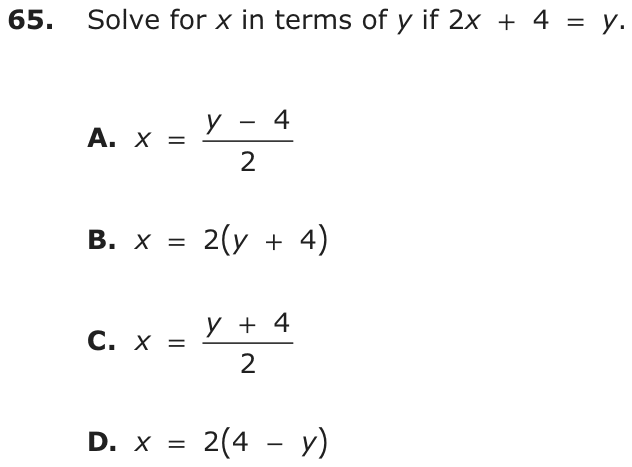
Solve for x in terms of y if .
- A
- B
- C
- D
Show the answer
Correct answer: A
| Apply the additive inverse property; subtract 4 from both sides of the equation. | |
| Apply the multiplicative inverse property; divide both sides of the equation by 2. | |
Question analysis
Given the equation 2x + 4 = y, students solve for x in terms of y. This literal-equation question offers four choices that mix multiplying and dividing by 2 with adding and subtracting 4. Undoing the two operations on x in the right order, with the right inverse each time, is what it tests.
- Grade level
- Grade 8 content, by NYS standard
- Compared with grade 7
- At grade 7 Grade 7 students solve two-step equations such as 2x + 4 = 10. Here the right side is the letter y, so the same two inverse steps leave an expression, a first taste of the grade 8 skill of rearranging.
- Estimated difficulty
- Straightforward: two steps or one careful reading.
- Thinking it demands
- Depth of knowledge 1, recall and reproduction · mainly apply
- What makes it hard
- A very close wrong answer moderate
- Variables instead of numbers minor
- Solution
- 2 steps
- Reading level
- Question and choices: about grade 6, 13 words.
- Students, last 30 days
- Not enough answers yet to show (it takes 10).
Why it is hard, traps and wrong answers (shows the answer)
Why it is hard
The two inverse steps are routine, subtract 4 and then divide by 2, but the letters hide whether they were done correctly. The main hazard is moving the 4 across the equals sign while keeping its plus sign, which produces an expression nearly identical to the right one. Substituting x = 1 and y = 6 tests every choice in seconds.
A very close wrong answer moderate Choosing the answer
(y − 4)/2 and (y + 4)/2 differ only in the sign before 4, and that sign depends on undoing the +4 by subtracting it from both sides. (Embretson & Wetzel, 1987; Gorin & Embretson, 2006; Ascalon et al., 2007)
Variables instead of numbers minor Understanding the question
With y on the right instead of a number, the answer is an expression, so there is no value to check unless the student substitutes a pair such as x = 1 and y = 6. (Koedinger & Nathan, 2004; Enright, Morley & Sheehan, 2002)
Strategy: Treat y as if it were a number and undo the operations on x in reverse order, using the inverse of each, then check by substituting a value.
Traps
- A faulty procedure: A systematic but wrong procedure: adding fractions straight across, applying an exponent to each term of a sum, dropping a sign when moving a term.
- Wrong operation: Adds instead of multiplying, divides the wrong way round, turns a ratio or rate upside down, or undoes a step in the wrong direction (subtracts what should be added back).
The wrong answers, classified
B Wrong operation (Hegarty, Mayer & Monk, 1995; King et al., 2004)
Multiplies by 2 instead of dividing and adds 4 instead of subtracting, applying the operations on x again rather than undoing them.
C A faulty procedure (Brown & Burton, 1978; Tatsuoka, 1983)
Moves the 4 across the equals sign without changing its sign, getting 2x = y + 4, then divides by 2 correctly.
D Little reason to choose it (Haladyna & Downing, 1993; Rodriguez, 2005)
Needs two unrelated errors at once, the subtraction written backward as 4 − y and a multiplication by 2 in place of division, so it mostly draws guesses.
Worked solution, step by step
Formulas used
- Keeping an equation balanced
- a and b are the two sides of an equation, and c is any number (not 0 when you divide). An equation is like a balanced scale. Doing the same thing to both sides keeps it balanced. Use this to undo, one at a time, each step that was done to x.
Sort out the question
The equation is . “Solve for x in terms of y” means get x alone on one side. The other side will have y in it. Treat y as if it were a number.
Undo the adding of 4
Right now, x is doubled and then 4 is added. Undo those steps in reverse order. First, subtract 4 from both sides.
Watch out: the 4 must be subtracted from y. Writing leads to choice C.
Undo the doubling
Next, divide both sides by 2. Divide the whole right side, not only the y.
Give the answer
Watch out: choices B and D multiply by 2. But x was multiplied by 2, so you undo that by dividing. So the answer is A, .
Check your answer
Pick a value, such as x = 1. Then . Put y = 6 into choice A: . That gives back x = 1. Choice C would give , which is wrong.
More questions like this
The original DOE question
Question 12 of 18
2022 Test A Math, question 12Question
A bus begins its trip with R occupants (including the driver). At each of the 20 stops, 3 people get on and no one leaves. If there are 3 times as many bus occupants at the end of the 20th stop as there are at the end of the 4th stop, how many occupants did the bus have immediately after the 10th stop?
- A12
- B24
- C30
- D42
Show the answer
Correct answer: D
Write an expression to represent the number of occupants after 20 stops. Then, simplify the expression.
Write an expression to represent the number of occupants after 4 stops. Then, simplify the expression.
Write an equation that shows that the number of occupants after 20 stops is 3 times the number of occupants after 4 stops. Then, solve for R.
Write an expression to represent the number of occupants after 10 stops. Then, substitute 12 for R and evaluate.
Question analysis
A bus starts with an unknown number of riders, and 3 people board at each of 20 stops while no one gets off. After the 20th stop it holds three times as many as after the 4th. Students write and solve an equation for the starting number, then find how many were aboard after the 10th stop, a stop the condition never mentions.
- NYS standards
- Grade level
- Grade 8 content, by NYS standard
- Compared with grade 7
- Above grade 7 Grade 7 equations usually have the unknown on one side, as in px + q = r. Here students build two expressions from a story, set one equal to three times the other, solve with the unknown on both sides, then answer a third question.
- Estimated difficulty
- Hard: combines ideas, needs a plan, and has more than one tempting wrong answer.
- Thinking it demands
- Depth of knowledge 2, skills and concepts · mainly apply
- What makes it hard
- Turning words into math major
- Many steps moderate
- Much to keep track of minor
- Solution
- 5 steps
- Reading level
- Question and choices: about grade 8, 60 words.
- Students, last 30 days
- Not enough answers yet to show (it takes 10).
Why it is hard, traps and wrong answers (shows the answer)
Why it is hard
The question hides a linear equation in a story, and the comparison sentence is the hard part: the count that gets tripled is the one at the 4th stop, parentheses and all. Solving gives the starting count, but the question asks about a different moment, the end of the 10th stop, so one more step remains. Labeling each number with its stop, start, 4th, 10th or 20th, keeps the right count from being given for the wrong time.
Turning words into math major Understanding the question
“3 times as many bus occupants at the end of the 20th stop as there are at the end of the 4th stop” must become R + 60 = 3(R + 12), the 3 multiplying the whole smaller count. (Hegarty, Mayer & Monk, 1995; Koedinger & Nathan, 2004)
Many steps moderate Working it out
Two expressions, an equation solved for R = 12, and then a third count at the 10th stop: four stages, and the number asked for appears only at the last one. (Daniel & Embretson, 2010; Enright, Morley & Sheehan, 2002)
Much to keep track of minor Working it out
Three different stops matter, the 4th and the 20th for the equation and the 10th for the question, and each count has to keep the starting R. (Sweller, 1988; Carpenter, Just & Shell, 1990)
Strategy: Let R be the starting count, write the counts after the 4th and the 20th stops in terms of R, make the larger equal to 3 times the smaller and solve, then add the riders from 10 stops.
Traps
- Stops one step early: A choice is a number from partway through the solution.
- Answers a different question: A choice is right for another quantity: the other unknown, the rest instead of the part, the part instead of the whole.
The wrong answers, classified
A Stops one step early (King et al., 2004; Gierl et al., 2017)
Solves R + 60 = 3(R + 12) correctly and stops at R = 12, the occupants at the start, before adding the 30 riders from 10 stops.
B Answers a different question (King et al., 2004; Hegarty, Mayer & Monk, 1995)
Finds R = 12 but gives the count at the end of the 4th stop, 12 + 4 × 3 = 24, instead of the count after the 10th.
C Answers a different question (King et al., 2004; Hegarty, Mayer & Monk, 1995)
Counts only the riders who board at 10 stops, 10 × 3 = 30, leaving out the R occupants aboard from the start.
Worked solution, step by step
Formulas used
- People on the bus after some stops
- N is the number of people on the bus. R is the number at the start, driver included. s is the number of stops so far. 3 people get on at each stop and no one leaves, so each stop adds 3.
- Distributive property
- a is the number outside the parentheses. b and c are the terms inside. A term is a number, a letter, or a number times a letter. Multiply each term inside by a. Use it when a number multiplies a whole sum.
Sort out the question
Occupants are the people on the bus. R is how many there are at the start, counting the driver. At each stop, 3 people get on and nobody gets off. After the 20th stop, there are 3 times as many people as after the 4th stop. You need the number after the 10th stop. That is a third moment, so one more step waits at the end.
Write the counts for two stops
Keep R in each count. The people who started are still on the bus.
Write the equation
The count after stop 20 is 3 times the count after stop 4. The 3 multiplies the whole count after stop 4, so use parentheses.
Use the distributive property: 3 times R, plus 3 times 12.
Solve for R
Subtract R from both sides. Then subtract 36 from both sides. Then divide by 2.
So 12 people were on the bus at the start. Watch out: 12 is choice A, but it is the count at the start. The question asks about the 10th stop.
Count after the 10th stop
Watch out: 24 is the count after the 4th stop, choice B. 30 counts only the people who got on, choice C. It leaves out the 12 who started. So the answer is D, 42.
Check your answer
Test R = 12. After the 4th stop: people. After the 20th stop: people. And . That matches the question, so R = 12 is right, and so is 42.
More questions like this
The original DOE question
Question 13 of 18
2022 Test A Math, question 15Question
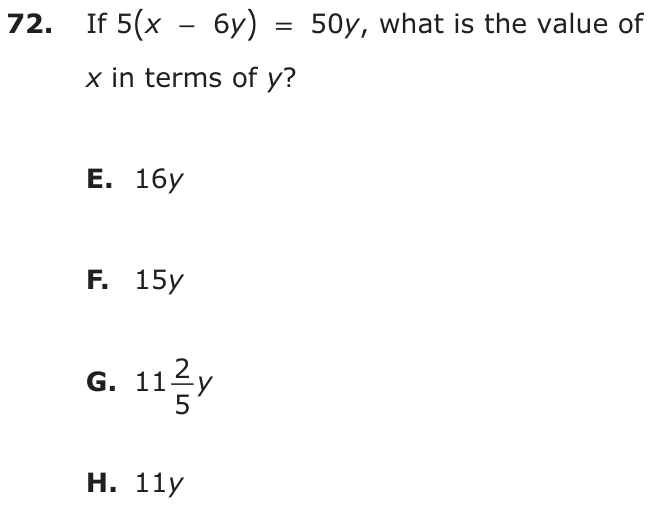
If , what is the value of x in terms of y?
- A
- B
- C
- D
Show the answer
Correct answer: A
To find the value of x in terms of y, solve for x. Begin by distributing 5 on the left side of the equation:
Solve for the value of x:
Question analysis
This algebra question gives the equation 5(x − 6y) = 50y and asks for x in terms of y. Students use the distributive property, or divide both sides by 5, and then solve a literal equation with inverse operations. Forgetting that the 5 multiplies both terms inside the parentheses is the classic slip here.
- Grade level
- Grade 8 content, by NYS standard
- Compared with grade 7
- Above grade 7 Grade 7 students solve equations such as 5(x − 6) = 50 with numbers. Solving for x in terms of another letter, through the distributive property, is grade 8 algebra, though the choices can be checked by substitution.
- Estimated difficulty
- Moderate: several steps, or a close reading with one strong distractor.
- Thinking it demands
- Depth of knowledge 1, recall and reproduction · mainly apply
- What makes it hard
- Variables instead of numbers moderate
- Error-prone arithmetic minor
- Solution
- 3 steps
- Reading level
- Question and choices: about grade 6, 16 words.
- Students, last 30 days
- Not enough answers yet to show (it takes 10).
Why it is hard, traps and wrong answers (shows the answer)
Why it is hard
The equation needs only three moves, distribute or divide by 5, add the y term, divide, so the risk lies in the first move. Multiplying only the x by 5 is the classic slip, and it gives 56/5 y, a value that is not listed but sits between two of the choices. Substituting y = 1 and the chosen x back into 5(x − 6) = 50 checks any choice in seconds.
Variables instead of numbers moderate Understanding the question
Both sides hold y and the result must be a multiple of y, so there is no number to check against unless the student substitutes, for instance y = 1. (Koedinger & Nathan, 2004; Enright, Morley & Sheehan, 2002)
Error-prone arithmetic minor Working it out
The 5 has to multiply both terms in the parentheses, giving 5x − 30y, and then 80y ÷ 5 must come out exactly; dividing both sides by 5 first keeps the numbers small. (Brown & Burton, 1978; Junker & Sijtsma, 2001)
Strategy: Distribute the 5 to both terms in the parentheses, or divide both sides by 5 first, then add the y term to both sides; substitute your choice back for x to check.
Traps
- A faulty procedure: A systematic but wrong procedure: adding fractions straight across, applying an exponent to each term of a sum, dropping a sign when moving a term.
The wrong answers, classified
B Little reason to choose it (Haladyna & Downing, 1993; Rodriguez, 2005)
No common working gives 15y; it sits one y below the correct value and would need a slip such as 80 ÷ 5 = 15, so it mostly draws guesses.
C Little reason to choose it (Haladyna & Downing, 1993; Rodriguez, 2005)
No common working gives 57/5 y; multiplying only the x by 5 leads to 56/5 y, or 11 1/5 y, so this mostly draws students who land near it.
D A faulty procedure (Brown & Burton, 1978; Tatsuoka, 1983)
Multiplies only the x by 5, so 5x − 6y = 50y and 5x = 56y, then drops the remainder of 56 ÷ 5 = 11 R1, keeping 11y.
Worked solution, step by step
Formulas used
- Distributive property
- a is the number outside the parentheses. b and c are the terms inside. A term is a number, a letter, or a number times a letter. Multiply each term inside by a. Use it when a number multiplies a whole sum.
- Keeping an equation balanced
- a and b are the two equal sides. c is any number, but not 0 when you divide. Doing the same thing to both sides keeps them equal, like a balanced scale. Use it to get the unknown by itself.
Sort out the question
The equation is . It has two letters, x and y. In terms of y means get x alone on one side. The other side may still have y in it. So the answer will look like a number times y.
Multiply out the parentheses
Use the distributive property. The 5 multiplies both terms inside.
Watch out: the 5 must multiply the 6y too. Multiplying only the x gives . Then x is . That is not a choice, but it sits close to C and D. Don’t pick one of them just because it is close.
Get the x term alone
Add 30y to both sides. This keeps the equation balanced.
Like terms add: 50 y’s plus 30 y’s is 80 y’s.
Divide by 5
5x means 5 times x. Divide both sides by 5 to get x by itself.
So the answer is A, .
Check your answer
Pick y = 1. Then x = 16. Put both into the first equation: . The right side is . Both sides match. A faster route: divide both sides by 5 first. Then , so x = 16y.
More questions like this
The original DOE question
Question 14 of 18
2022 Test B Math, question 7Question
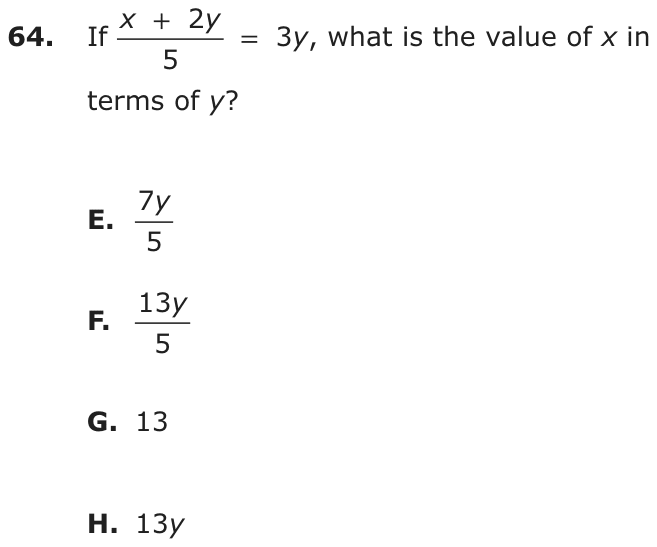
If , what is the value of x in terms of y?
- A
- B
- C13
- D
Show the answer
Correct answer: D
The goal is to isolate the variable x by using inverse operations. First, multiply both sides by 5 and then subtract from both sides.
Another approach is to make the right side of the equation a fraction and then use cross multiplication for the first step.
Question analysis
An equation says that x plus 2y, all divided by 5, equals 3y, and students choose the expression for x in terms of y. This multiple-choice algebra question tests solving a literal equation with inverse operations. Because the 5 divides the whole left side, clearing the fraction first and keeping track of the y terms is the tricky part.
- Grade level
- Grade 8 content, by NYS standard
- Compared with grade 7
- Above grade 7 Grade 7 students solve two-step equations with numbers, such as (n + 4)/3 = 6. Solving for one letter in terms of another, with a fraction to clear first, is grade 8 work and a step beyond.
- Estimated difficulty
- Moderate: several steps, or a close reading with one strong distractor.
- Thinking it demands
- Depth of knowledge 1, recall and reproduction · mainly apply
- What makes it hard
- Variables instead of numbers moderate
- Error-prone arithmetic minor
- Solution
- 2 steps
- Reading level
- Question and choices: about grade 5, 15 words.
- Students, last 30 days
- Not enough answers yet to show (it takes 10).
Why it is hard, traps and wrong answers (shows the answer)
Why it is hard
Two inverse operations solve it, but the fraction bar spans the whole sum x + 2y, so multiplying both sides by 5 has to come first. Students who split the fraction and stop at x/5 find a matching choice, and those who divide 3y by 5 instead of multiplying end up with fifths of y as well. Substituting y = 1, which makes x + 2 equal 15, checks any choice in seconds.
Variables instead of numbers moderate Understanding the question
Both sides hold y, so the result must stay a multiple of y: after clearing the 5, the like terms 15y and 2y are combined, and there is no number to check against. (Koedinger & Nathan, 2004; Enright, Morley & Sheehan, 2002)
Error-prone arithmetic minor Working it out
Multiplying the whole of 3y by 5 gives 15y, but dividing it by 5 or splitting the fraction into x/5 + 2y/5 leaves fifths of y in the working. (Brown & Burton, 1978; Junker & Sijtsma, 2001)
Strategy: Multiply both sides by 5 to clear the fraction, then subtract 2y from both sides; check by putting y = 1 into both the equation and the chosen expression.
Traps
- Stops one step early: A choice is a number from partway through the solution.
- Misunderstands the concept: A wrong belief about a concept: that percents can be added, that area grows like length, that averages can be averaged, that a bigger denominator means a bigger fraction.
- Wrong operation: Adds instead of multiplying, divides the wrong way round, turns a ratio or rate upside down, or undoes a step in the wrong direction (subtracts what should be added back).
The wrong answers, classified
A Wrong operation (Hegarty, Mayer & Monk, 1995; King et al., 2004)
Divides 3y by 5 instead of multiplying, so x + 2y = 3y/5 and x = −7y/5, then takes 7y/5, the choice that matches its size.
B Stops one step early (King et al., 2004; Gierl et al., 2017)
Splits the fraction and subtracts 2y/5 from 3y, reaching x/5 = 13y/5, then stops without multiplying both sides by 5.
C Misunderstands the concept (Smith, diSessa & Roschelle, 1993; De Bock et al., 1998; Ni & Zhou, 2005)
Reaches x = 15y − 2y but drops the letter, as if subtracting like terms cancelled the y, and gives the number 13 instead of 13y.
Worked solution, step by step
Formulas used
- Do the same to both sides
- a and b are two equal amounts, and c is any number. If you do the same thing to both sides of an equation, they stay equal, like a balanced scale. Use it to undo each step until the letter you want is alone.
Sort out the question
The equation says: take x plus 2y, divide the whole sum by 5, and you get 3y. You need x “in terms of y.” That means x alone on one side, with an expression using y on the other. An expression is a math phrase with no equal sign.
Clear the fraction first
The fraction bar divides the whole top, x + 2y, by 5. To undo dividing by 5, multiply both sides by 5.
Watch out: multiply 3y by 5. Don’t divide it by 5. Dividing leaves fifths of y, as in choice A.
Get x alone
Now 2y is added to x. To undo adding, subtract 2y from both sides.
15y − 2y means 15 y’s take away 2 y’s. That leaves 13 y’s, so the y stays.
Give the answer
Watch out: you might split the fraction into x/5 + 2y/5 instead. Then you reach x/5 = 13y/5. Stopping there gives choice B, but you still have to multiply by 5. Dropping the y gives 13, choice C. So the answer is D, .
Check your answer
Pick y = 1. Then x = 13 × 1 = 13. Put both into the equation: . And 3y = 3 × 1 = 3. Both sides match, so x = 13y works.
More questions like this
The original DOE question
Question 15 of 18
2018 Test A Math, question 3Question
For what value of is ?
Grid-in question: work out the answer and enter it as a number.
Show the answer
Correct answer: -4
Question analysis
A one-line algebra grid-in: find the value of w that makes 4w equal to 2w minus 8. Students solve a linear equation with the variable on both sides by collecting the w terms and dividing. Errors come from handling the subtraction sign or stopping before w stands alone.
- Grade level
- Grade 8 content, by NYS standard
- Compared with grade 7
- At grade 7 Equations with the variable on both sides are formally a grade 8 topic, but this one takes two short steps with whole numbers. It asks about as much as a typical grade 7 two-step equation.
- Estimated difficulty
- Routine: one familiar step, little to misread.
- Thinking it demands
- Depth of knowledge 1, recall and reproduction · mainly apply
- What makes it hard
- Solution
- 2 steps
- Reading level
- Question and choices: about grade 7, 7 words.
- Students, last 30 days
- Not enough answers yet to show (it takes 10).
Why it is hard, traps and wrong answers (shows the answer)
Why it is hard
One of the easiest questions on the test: collect the w terms on one side and divide. Errors come from carelessness rather than method, such as dropping the negative sign or gridding −8 after the first step because it already looks like a finished answer. Substituting the result back into both sides of the equation takes seconds and catches both.
Error-prone arithmetic minor Working it out
The only constant is −8, so the answer is negative; dividing −8 by the coefficient 2 is the step where the sign is most often lost. (Brown & Burton, 1978; Junker & Sijtsma, 2001)
An answer in an unexpected form minor Choosing the answer
The grid-in needs the negative sign filled in its own column, and there are no choices to show that the answer lies below zero. (Enright, Morley & Sheehan, 2002)
Strategy: Subtract 2w from both sides so the variable appears only once, divide by the remaining coefficient, and check by substituting into both sides.
Traps
- Negatives and direction: Arithmetic with negative numbers, the order of a subtraction, or direction on a number line. (Moving a term across the equals sign without changing its sign is a faulty procedure.)
- Stops one step early: A choice is a number from partway through the solution.
The wrong answers, classified
4 Negatives and direction (Brown & Burton, 1978)
Gets 2w = −8 correctly but drops the sign when dividing by 2, gridding 4 instead of a negative value.
-8 Stops one step early (King et al., 2004; Gierl et al., 2017)
Subtracts 2w from both sides to reach 2w = −8 and grids −8 without dividing by the coefficient 2.
Worked solution, step by step
Formulas used
- Keeping an equation balanced
- a and b are the two sides of an equation, and c is any number or term. An equation is like a balanced scale. If you subtract the same thing from both sides, it stays balanced. The same is true if you add the same thing, or divide both sides by the same number that is not zero.
Sort out the equation
An equation says two things are equal. You need the value of w that makes equal to . Here 4w means 4 times w, and 2w means 2 times w. The answer may be a negative number, so keep track of the signs.
Get w on one side
w is on both sides. Subtract 2w from both sides. Then w is only on the left, and the equation stays balanced.
Now 2 times w is −8.
Divide both sides by 2
To undo times 2, divide both sides by 2. A negative number divided by a positive number is negative.
Watch out: keep the minus sign. Dropping it gives 4. Also, don’t stop at and grid −8. So you would grid -4, with the minus sign in its own column.
Check your answer
Put −4 back in for w. Left side: . Right side: . Both sides are −16, so −4 works.
More questions like this
The original DOE question

Question 16 of 18
2018 Test A Math, question 30Question
Today, Tien’s age is of Jordan’s age. In 2 years, Tien’s age will be of Jordan’s age. How old is Jordan today?
- A4 years old
- B6 years old
- C12 years old
- D16 years old
Show the answer
Correct answer: D
First, set up an equation to express Tien’s age () and Jordan’s age () today:
Two years from now, Tien’s age will be , and Jordan’s age will be .
Set up an equation about the relationship between Tien’s age and Jordan’s age in two years:
Solve the above equation for :
Now set the two equations equal to each other and solve for :
Question analysis
This age word problem says Tien is one fourth of Jordan's age today and will be one third of Jordan's age in two years, then asks for Jordan's current age. Students must turn two fractional relationships into equations and solve them together. Both people age by the same two years, and it is easy to solve for the wrong person.
- NYS standards
- Grade level
- Grade 8 content, by NYS standard
- Compared with grade 7
- Above grade 7 Grade 7 equations have one unknown on one side, like 3x + 5 = 20. This one links two unknown ages with fractional coefficients and leads to a variable on both sides, which is grade 8 algebra.
- Estimated difficulty
- Hard: combines ideas, needs a plan, and has more than one tempting wrong answer.
- Thinking it demands
- Depth of knowledge 2, skills and concepts · mainly apply
- What makes it hard
- Turning words into math major
- Error-prone arithmetic moderate
- Solution
- 4 steps
- Reading level
- Question and choices: about grade 1, 31 words.
- Students, last 30 days
- Not enough answers yet to show (it takes 10).
Why it is hard, traps and wrong answers (shows the answer)
Why it is hard
The difficulty is in the setup: two fractional relationships at two different times, with both people aging. Once the equations are right, the algebra is short, but it ends with two ages and only one is asked for. Testing the choices against both conditions is a reliable alternative that avoids the algebra entirely.
Turning words into math major Understanding the question
The second sentence must become T + 2 = (J + 2)/3; writing J/3, or forgetting that Jordan also ages two years, breaks the equation. (Hegarty, Mayer & Monk, 1995; Koedinger & Nathan, 2004)
Error-prone arithmetic moderate Working it out
Substituting J/4 for T leaves J/4 + 2 = (J + 2)/3, an equation with fractions on both sides that must be cleared, usually by multiplying by 12. (Brown & Burton, 1978; Junker & Sijtsma, 2001)
Strategy: Let Jordan's age be J, write Tien's age as J/4, and set J/4 + 2 equal to one third of (J + 2); or test each choice against both conditions.
Traps
- Answers a different question: A choice is right for another quantity: the other unknown, the rest instead of the part, the part instead of the whole.
The wrong answers, classified
A Answers a different question (King et al., 2004; Hegarty, Mayer & Monk, 1995)
Solves the equations correctly but reports Tien's age today, 4, which is one fourth of Jordan's 16, instead of Jordan's age.
B Answers a different question (King et al., 2004; Hegarty, Mayer & Monk, 1995)
Gives Tien's age two years from now, 4 + 2 = 6, answering for the wrong person and the wrong time.
C Numbers taken from the question (Hegarty, Mayer & Monk, 1995)
Picks 12 because it is a multiple of both 4 and 3, but then Tien would be 3 and later 5, not a third of 14.
Worked solution, step by step
Formulas used
- Distributive property
- a, b and c are any numbers. To multiply a sum by a number, multiply each part of the sum, then add. It works because a groups of (b + c) is the same as a groups of b plus a groups of c.
Sort out what you know
Today, Tien’s age is of Jordan’s age. That means Jordan is 4 times as old as Tien.
In 2 years, both of them will be 2 years older. Then Tien’s age will be of Jordan’s. So Jordan will be 3 times as old as Tien. You need Jordan’s age today.
Name the ages with a letter
Let t stand for Tien’s age today. Jordan is 4 times as old, so his age is 4t, which means 4 times t. Add 2 years to each age:
Person Today In 2 years Tien Jordan Watch out: Jordan gets 2 years older too. Do not forget to add 2 to his age.
Write an equation for later
In 2 years, Jordan’s age will be 3 times Tien’s age. Write that as an equation:
Use the distributive property on the right side. Multiply both t and 2 by 3:
Solve for Tien’s age
Take 3t away from both sides. Doing the same thing to both sides keeps them equal:
Now take 2 away from both sides:
So Tien is 4 years old today. Watch out: 4 is Tien’s age, not Jordan’s. Choice A, 4 years old, is a trap.
Find Jordan’s age
Jordan is 4 times as old as Tien:
So the answer is D, 16 years old.
Check your answer
Put 16 back into the story. Today, Tien is 16 ÷ 4 = 4. In 2 years, Tien is 6 and Jordan is 18. Is 6 one third of 18? Yes, because 18 ÷ 3 = 6. Choice C fails: Tien would be 3, then 5, and 5 is not a third of 14.
More questions like this
The original DOE question
Question 17 of 18
2018 Test A Math, question 43Question
In the equation above, , and are positive numbers. Which of these is equal to ?
- A
- B
- C
- D
Show the answer
Correct answer: D
Solve the equation for :
Question analysis
This algebra question gives the proportion w/x = y/z, with all four letters positive, and asks which expression equals z. Students must solve the equation for one letter in terms of the others. With only letters on the page, it is easy to multiply when you should divide or to stop one step early.
- Grade level
- Grade 8 content, by NYS standard
- Compared with grade 7
- Above grade 7 Grade 7 students cross-multiply numeric proportions such as 3/4 = 9/x. Solving a proportion made only of letters for one of them is a literal equation, a grade 8 algebra skill, though it takes just two steps.
- Estimated difficulty
- Straightforward: two steps or one careful reading.
- Thinking it demands
- Depth of knowledge 1, recall and reproduction · mainly apply
- What makes it hard
- Variables instead of numbers moderate
- A very close wrong answer moderate
- Solution
- 2 steps
- Reading level
- Question and choices: about grade 10, 22 words.
- Students, last 30 days
- Not enough answers yet to show (it takes 10).
Why it is hard, traps and wrong answers (shows the answer)
Why it is hard
The method, cross-multiply and divide, is the same one students use on numeric proportions, but letters hide whether each step went the right way. The two most attractive wrong choices are both one step from the answer: one never divides, and the other divides upside down. A quick check with 2/3 = 4/6, where z = 6, settles it.
Variables instead of numbers moderate Understanding the question
The proportion has only letters, so cross-multiplying to wz = xy and dividing by w must be done without numbers to show whether w goes on top or bottom. (Koedinger & Nathan, 2004; Enright, Morley & Sheehan, 2002)
A very close wrong answer moderate Choosing the answer
The choices w/(xy) and xy/w use the same three letters with the fraction turned over, so only dividing in the right direction after wz = xy separates them. (Embretson & Wetzel, 1987; Gorin & Embretson, 2006; Ascalon et al., 2007)
Strategy: Cross-multiply to clear both fractions, then divide both sides by whatever multiplies z; check with a true proportion such as 2/3 = 4/6.
Traps
- Wrong operation: Adds instead of multiplying, divides the wrong way round, turns a ratio or rate upside down, or undoes a step in the wrong direction (subtracts what should be added back).
- Stops one step early: A choice is a number from partway through the solution.
The wrong answers, classified
A Numbers taken from the question (Hegarty, Mayer & Monk, 1995)
Matches z with x because both sit in a denominator, picking a letter from the equation without solving for z.
B Stops one step early (King et al., 2004; Gierl et al., 2017)
Cross-multiplies to wz = xy but stops there, giving xy without dividing both sides by w.
C Wrong operation (Hegarty, Mayer & Monk, 1995; King et al., 2004)
Cross-multiplies correctly but divides the wrong way round, putting w over xy instead of xy over w.
Worked solution, step by step
Formulas used
- Cross-multiplying
- a, b, c and d are numbers that are not 0. When two fractions are equal, each top times the other bottom gives the same answer. It works because you multiply both sides by both bottoms, which clears the fractions.
Sort out what you need
The equation says w over x equals y over z. All four letters are positive numbers. You need to get z alone on one side. Then the other side shows what z equals.
Cross-multiply the fractions
Multiply each top by the other fraction’s bottom:
So wz = xy, and z is no longer on the bottom. Watch out: stopping here and picking xy gives choice B. z is not alone yet.
Get z alone
z is being multiplied by w. To undo that, divide both sides by w. Doing the same to both sides keeps them equal:
Watch out: dividing the wrong way round gives w over xy, choice C. So the answer is D, .
Check your answer
Use a true pair of equal fractions: 2/3 = 4/6. So w = 2, x = 3, y = 4 and z = 6. Choice D gives 3 × 4 ÷ 2 = 6, which is z. Choice C gives 2 ÷ 12, which is not 6.
More questions like this
The original DOE question
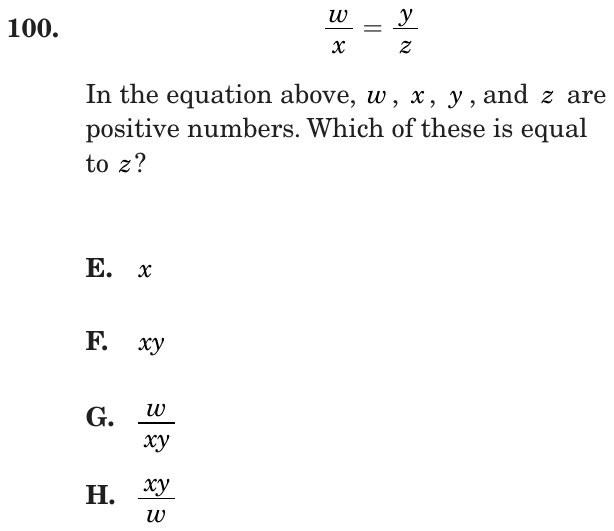
Question 18 of 18
2018 Test A Math, question 55Question
If , what is in terms of ?
- A
- B
- C
- D
Show the answer
Correct answer: C
Question analysis
This algebra question gives the linear equation 4x − 3y = 12 and asks for x in terms of y. Students must isolate the x term and then divide to solve for x. With two variables and a negative coefficient, small sign and division slips each lead to a different wrong choice.
- NYS standards
- Grade level
- Grade 8 content, by NYS standard
- Compared with grade 7
- Above grade 7 Grade 7 students solve one-variable equations like 4x − 3 = 12. Rearranging an equation with two variables to express one in terms of the other is grade 8 algebra, with sign and division slips to avoid.
- Estimated difficulty
- Moderate: several steps, or a close reading with one strong distractor.
- Thinking it demands
- Depth of knowledge 1, recall and reproduction · mainly apply
- What makes it hard
- Variables instead of numbers moderate
- A very close wrong answer moderate
- Error-prone arithmetic minor
- Solution
- 2 steps
- Reading level
- Question and choices: about grade 10, 13 words.
- Students, last 30 days
- Not enough answers yet to show (it takes 10).
Why it is hard, traps and wrong answers (shows the answer)
Why it is hard
The solution is two moves, add 3y to both sides and divide everything by 4, yet each move has a classic slip attached. The four choices are the four combinations of getting the sign right or wrong and dividing the 12 or not, so every partial mistake has a home. Checking one point that satisfies the original equation catches any of them.
Variables instead of numbers moderate Understanding the question
With two variables there is no number to check against unless students invent one; the point x = 6, y = 4 satisfies the equation and separates the choices. (Koedinger & Nathan, 2004; Enright, Morley & Sheehan, 2002)
A very close wrong answer moderate Choosing the answer
The choices x = 3/4 y + 3 and x = −3/4 y + 3 are identical except for the sign of the y term, which only correctly moving −3y across the equals sign settles. (Embretson & Wetzel, 1987; Gorin & Embretson, 2006; Ascalon et al., 2007)
Error-prone arithmetic minor Working it out
Dividing 12 + 3y by 4 must reach both terms, and the negative coefficient −3 has to change sign when it moves, two slips in a short line. (Brown & Burton, 1978; Junker & Sijtsma, 2001)
Strategy: Move the y term to the right side, watching its sign, so only the x term remains on the left, then divide the entire right side, term by term, by 4.
Traps
- A faulty procedure: A systematic but wrong procedure: adding fractions straight across, applying an exponent to each term of a sum, dropping a sign when moving a term.
The wrong answers, classified
A A faulty procedure (Brown & Burton, 1978; Tatsuoka, 1983)
Moves 3y correctly but divides only the y term by 4, leaving the constant 12 undivided.
B A faulty procedure (Brown & Burton, 1978; Tatsuoka, 1983)
Keeps the minus sign on the 3y term when moving it and also leaves the 12 undivided, two errors at once.
D A faulty procedure (Brown & Burton, 1978; Tatsuoka, 1983)
Divides every term by 4 correctly but keeps the minus on 3y, as if a term kept its sign when moved across.
Worked solution, step by step
Formulas used
- Keeping an equation balanced
- a and b are the two sides of an equation, and c is any number. An equation is like a balance. If you do the same thing to both sides, such as adding 3y or dividing by 4, they stay equal.
- Dividing a sum
- a and b are the two parts of the top, and c is the number you divide by. To divide a sum, divide each part. It works because sharing a + b into c groups shares a and b each into c groups.
Sort out what you need
The question asks for x in terms of y. That means get x alone on one side. The other side may have y and numbers, but no x. Start with .
Move the y term
The 3y is being subtracted on the left. Add 3y to both sides to clear it:
Watch out: the term was minus 3y. Adding 3y to both sides makes it plus 3y on the right. Keeping the minus sign leads to choice D.
Divide both sides by 4
x is being multiplied by 4. Divide both sides by 4 to undo it:
Split the fraction
Divide each part of the top by 4:
Watch out: the 12 must be divided by 4 too. Leaving it as 12 gives choice A. The choices put the y term first. So the answer is C, .
Check your answer
Pick y = 4. Choice C gives x = 3 + 3 = 6. Put x = 6 and y = 4 into the start: 4 × 6 − 3 × 4 = 24 − 12 = 12. It works. Choice D gives x = 0, and 4 × 0 − 12 = −12, not 12.
More questions like this
The original DOE question