6.NS.7c absolute value as distance
Question 1 of 9
2026 Practice Test A Math, question 17Question
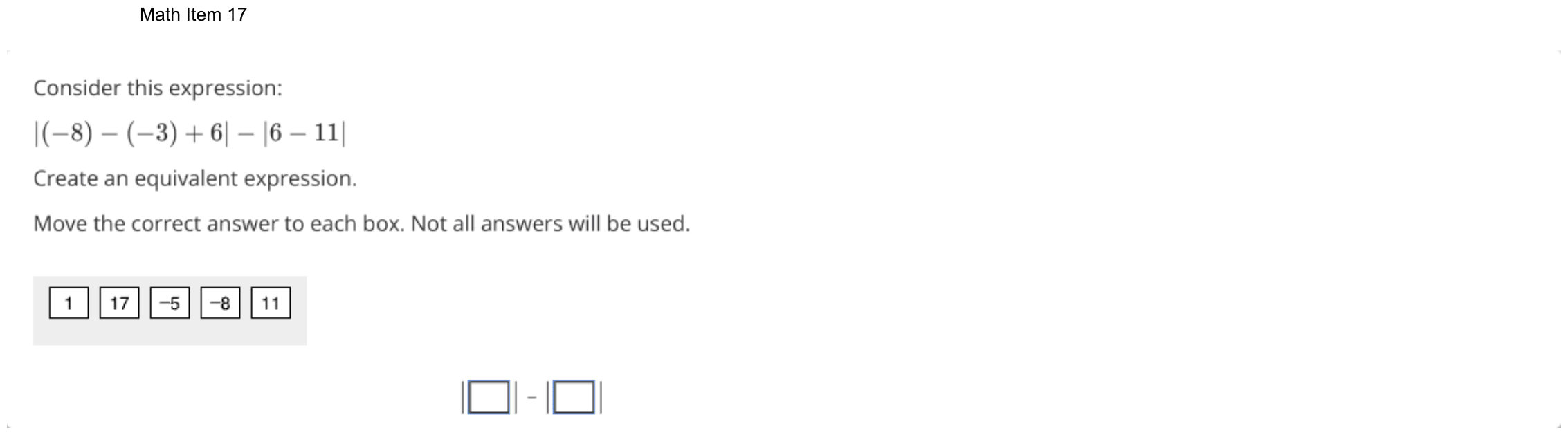
Consider this expression:
Create an equivalent expression.
Move the correct answer to each box. Not all answers will be used.
|| − ||
On the test you drag tiles into the boxes; here, choose each box’s tile from its menu. Each tile can be used once. The DOE has not published how answers with several parts are scored; this site counts one right only when every part is right.
Show the answer
Correct answer: blank 1: 1; blank 2: −5
To create an expression equivalent to :
Step 1: Simplify the first absolute value term.
Simplify the second absolute value term.
Therefore the equivalent expression is
.
Question analysis
This absolute value question shows an expression with two pairs of bars and asks students to build an equivalent one by placing number tiles in two boxes. It tests subtracting negative integers and understanding what absolute value bars do. Not every tile is used, and several tiles match the results of common sign mistakes.
- Grade level
- Grade 7 content, by NYS standard
- Compared with grade 7
- At grade 7 Simplifying signed integers inside absolute value bars, including subtracting a negative, is core grade 7 work. This asks only for the values inside the bars, not the final number, but one sign slip leads straight to a wrong tile.
- Estimated difficulty
- Straightforward: two steps or one careful reading.
- Thinking it demands
- Depth of knowledge 1, recall and reproduction · mainly apply
- What makes it hard
- Error-prone arithmetic moderate
- Many steps minor
- An answer in an unexpected form minor
- Solution
- 3 steps
- Reading level
- Question and choices: about grade 6, 21 words.
- Students, last 30 days
- Not enough answers yet to show (it takes 10).
Why it is hard, traps and wrong answers (shows the answer)
Why it is hard
Every move here involves a sign, and the tiles are built from the usual misreadings of absolute value: 11 for making each number positive before combining, 17 for erasing every minus sign. A slip on − (−3) gives −5 for the first pair, but the second pair needs the only −5 tile, so that slip leaves a box with no tile to fit. Students who simplify each inside completely, and leave the bars untouched, finish quickly.
Error-prone arithmetic moderate Working it out
Inside the first bars, subtracting −3 must become adding 3, so −8 + 3 = −5, and adding 6 then crosses zero to reach 1; reading − (−3) as − 3 gives −5 instead. (Brown & Burton, 1978; Junker & Sijtsma, 2001)
Many steps minor Working it out
Two pairs of bars are simplified separately, and both boxes need the right tile, kept in the original order, before the answer is right. (Daniel & Embretson, 2010; Enright, Morley & Sheehan, 2002)
An answer in an unexpected form minor Choosing the answer
Each box takes what is left inside a pair of bars, not its absolute value, so the second box needs the tile −5 rather than a 5, and the expression's value, −4, is never entered. (Enright, Morley & Sheehan, 2002)
Strategy: Rewrite subtracting −3 as adding 3, then simplify the inside of each pair of bars separately, left to right; each box replaces the inside of one pair, in the same order.
Traps
- A faulty procedure: A systematic but wrong procedure: adding fractions straight across, applying an exponent to each term of a sum, dropping a sign when moving a term.
- Misunderstands the concept: A wrong belief about a concept: that percents can be added, that area grows like length, that averages can be averaged, that a bigger denominator means a bigger fraction.
- Negatives and direction: Arithmetic with negative numbers, the order of a subtraction, or direction on a number line. (Moving a term across the equals sign without changing its sign is a faulty procedure.)
The wrong answers, classified
EC A faulty procedure (Brown & Burton, 1978; Tatsuoka, 1983)
Takes the absolute value of each number before combining, so the first bars become 8 − 3 + 6 = 11; the same rule still gives 6 − 11 = −5 in the second.
BC Misunderstands the concept (Smith, diSessa & Roschelle, 1993; De Bock et al., 1998; Ni & Zhou, 2005)
Believes absolute value bars make everything inside positive, so it drops every minus sign and adds 8 + 3 + 6 = 17, then works the short pair 6 − 11 normally.
CA Negatives and direction (Brown & Burton, 1978)
Simplifies both insides correctly but places −5 first and 1 second, reversing the subtraction so the expression equals 5 − 1 = 4 instead of 1 − 5 = −4.
Worked solution, step by step
Formulas used
- Subtracting a negative number
- a is any number, and b is a positive number, so −b is negative. Subtracting a negative number is the same as adding its opposite, the same number with the other sign. Think of money: taking away a debt of $3 leaves you $3 richer.
- Absolute value
- The bars around a number stand for its absolute value. a is any number. The absolute value is how far a is from 0 on a number line, so it is never negative. Both |5| and |−5| equal 5. Always simplify inside the bars first.
Sort out the question
The expression has two pairs of absolute value bars. The new expression keeps both pairs, with a box inside each one:
Each box gets the number you reach when you simplify inside that pair of bars. The bars stay, so you do not take the absolute value yet. Some tiles are not used.
Simplify inside the first bars
Inside the first bars is . Subtracting −3 is the same as adding 3. Work from left to right:
The first box gets the tile 1.
Watch out: the bars do not make each number positive before you combine. Changing −8 and −3 to 8 and 3 first gives 8 − 3 + 6 = 11. Dropping every minus sign gives 8 + 3 + 6 = 17. Both are tiles, and both are wrong.
Simplify inside the second bars
Inside the second bars is . You take a bigger number from a smaller one, so the result is negative:
The second box gets the tile −5.
Watch out: do not change −5 to 5. The bars are still there in the new expression, so the box holds what is inside them.
Keep the boxes in order
The first bars came first, so 1 goes in the first box and −5 in the second. The new expression has the same value as the old one:
Swapping the tiles gives , which is not equal. So the boxes get 1 and −5, making |1| − |−5|.
On the test, you drag each tile into its box. On this site, you choose it from the box’s menu.
Check your answer
Use a number line for the first pair. Start at −8 and move 3 to the right to reach −5. Then move 6 more to the right to reach 1. For the second pair, start at 6 and move 11 to the left. You land on −5. Both boxes check out.
More questions like this
The original DOE question
Question 2 of 9
2026 Practice Test C Math, question 14Question
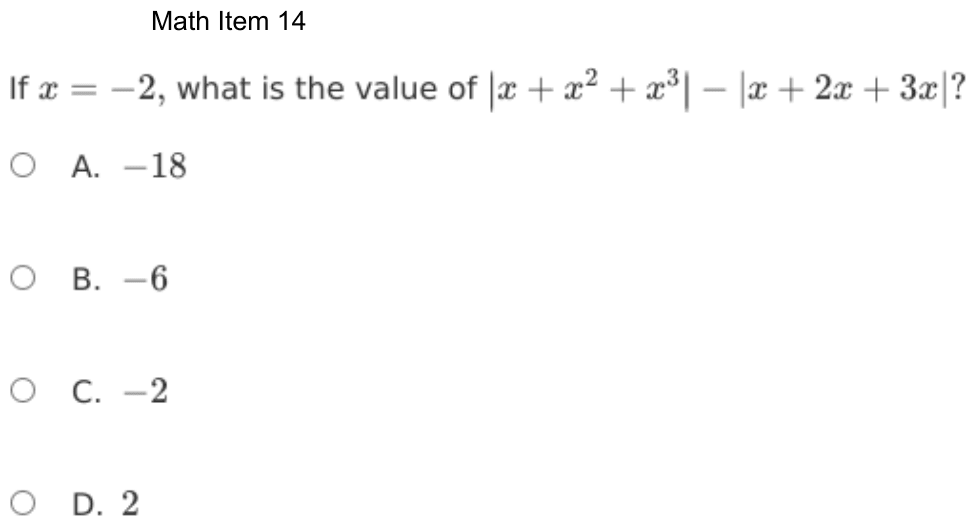
If , what is the value of ?
- A−18
- B−6
- C−2
- D2
Show the answer
Correct answer: B
Substitute for each value of x in the expression:
minus
Evaluate the terms involving exponents:
minus
Evaluate the terms involving multiplication:
minus
Simplify the expression:
The absolute value of is 6, and the absolute value of is 12, so is the equivalent of subtracting 12 from 6:
Question analysis
This substitution question sets x = −2 in an expression that subtracts one absolute value from another: the first holds x, x squared and x cubed, the second x, 2x and 3x. Students evaluate the expression. It tests powers of negative numbers, absolute value and integer subtraction, and the signs of the square and the cube are where answers go wrong.
- NYS standards
- Grade level
- Grade 7 content, by NYS standard
- Compared with grade 7
- At grade 7 Substituting a negative number and taking absolute values is typical grade 7 sign practice. This expression puts a square and a cube of a negative inside one pair of bars and then subtracts two absolute values, so there are several places to slip.
- Estimated difficulty
- Moderate: several steps, or a close reading with one strong distractor.
- Thinking it demands
- Depth of knowledge 1, recall and reproduction · mainly apply
- What makes it hard
- Error-prone arithmetic moderate
- Many steps minor
- Solution
- 4 steps
- Reading level
- Question and choices: about grade 7, 8 words.
- Students, last 30 days
- Not enough answers yet to show (it takes 10).
Why it is hard, traps and wrong answers (shows the answer)
Why it is hard
Every step is routine, but the expression stacks sign decisions, and each wrong choice records a different one going wrong. The powers of −2 alternate in sign, which students who treat every power as positive, or the square as negative, miss. The last step catches students who know the rules: both absolute values are positive, yet 6 − 12 is still negative, so the answer keeps its minus sign.
Error-prone arithmetic moderate Working it out
With x = −2 the square is 4 but the cube is −8, so the first bars hold −2 + 4 − 8 = −6, and the sign changes from each term to the next. (Brown & Burton, 1978; Junker & Sijtsma, 2001)
Many steps minor Working it out
Six terms are substituted, two pairs of bars are simplified and made positive, and only then is 12 subtracted from 6, four stages that must come in a fixed order. (Daniel & Embretson, 2010; Enright, Morley & Sheehan, 2002)
Strategy: Work out each power of −2 separately, keeping its sign, add the terms inside each pair of bars, take both absolute values, and subtract only at the end.
Traps
- Negatives and direction: Arithmetic with negative numbers, the order of a subtraction, or direction on a number line. (Moving a term across the equals sign without changing its sign is a faulty procedure.)
- A faulty procedure: A systematic but wrong procedure: adding fractions straight across, applying an exponent to each term of a sum, dropping a sign when moving a term.
The wrong answers, classified
A A faulty procedure (Brown & Burton, 1978; Tatsuoka, 1983)
Simplifies both insides correctly but treats the first bars like parentheses, keeping −6, so −6 − 12 = −18.
C Negatives and direction (Brown & Burton, 1978)
Takes (−2)³ as positive 8, as if every power of a negative were positive, so the first bars hold −2 + 4 + 8 = 10, and 10 − 12 = −2.
D Negatives and direction (Brown & Burton, 1978)
Takes (−2)² as −4, so the first bars hold −2 − 4 − 8 = −14, and 14 − 12 = 2; dropping the minus from x throughout also gives 2.
Worked solution, step by step
Formulas used
- Absolute value
- a is any number. The bars mean absolute value: how far a is from 0 on the number line. A distance is never negative, so |−6| = 6 and |6| = 6. Work out what is inside the bars first, then take the absolute value.
- Powers of a negative number
- The small raised number is the exponent. It tells how many times −2 is multiplied by itself. Two negatives multiply to a positive. So an even number of negative factors gives a positive answer, and an odd number gives a negative one.
Sort out the question
You need the value of when x = −2. The bars | | mean absolute value. Work out each pair of bars on its own. Subtract only at the end.
Find the powers of −2
Put −2 in for x. Keep each negative sign:
The square is positive, but the cube is negative.
Watch out: taking as +8 makes the first bars hold 10. That leads to choice C, −2.
Work out the first bars
Add the three terms inside the first pair of bars:
−2 + 4 is 2, and 2 + (−8) is −6. The distance from −6 to 0 is 6.
Work out the second bars
Here 2x means 2 times x, so it is −4. And 3x is −6:
All three terms are negative, so they add to −12. Its absolute value is 12.
Subtract the second value
Now subtract the second value from the first:
Watch out: the bars make each part positive, but the difference can still be negative. Keeping −6 inside the first bars gives −6 − 12 = −18, choice A.
So the answer is B, −6.
Check your answer
Check the second bars a faster way. , and . That matches. Also, the second value, 12, is bigger than the first, 6. So the difference must be negative, as −6 is.
More questions like this
The original DOE question
Question 3 of 9
2024 Test A Math, question 35Question
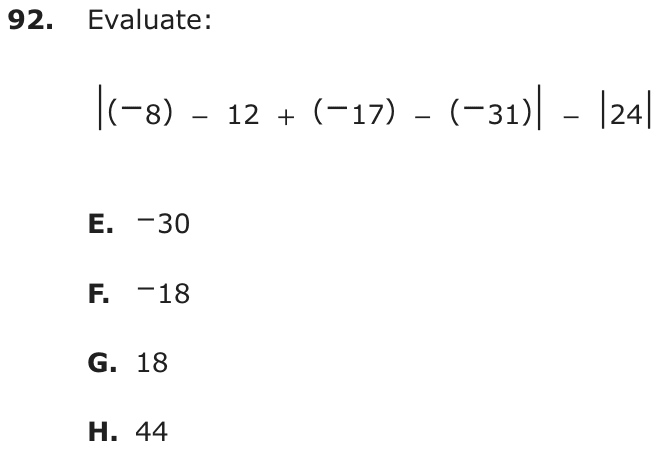
Evaluate:
- A−30
- B−18
- C18
- D44
Show the answer
Correct answer: B
Simplify negatives inside the first absolute value brackets.
Simplify the first absolute value.
Calculate the absolute values.
Perform the final subtraction.
Question analysis
This integer question asks students to evaluate an expression with two absolute values: the first holds four positive and negative numbers, and the second is the absolute value of 24. It tests subtracting negative numbers and understanding absolute value. Subtracting a negative number and handling each pair of bars separately are where most slips happen.
- Grade level
- Grade 7 content, by NYS standard
- Compared with grade 7
- At grade 7 Grade 7 students add and subtract integers and know absolute value as distance from zero. This expression puts four signed terms inside one pair of bars and subtracts a second absolute value, a typical but sign-heavy grade 7 exercise.
- Estimated difficulty
- Moderate: several steps, or a close reading with one strong distractor.
- Thinking it demands
- Depth of knowledge 1, recall and reproduction · mainly apply
- What makes it hard
- Error-prone arithmetic moderate
- A very close wrong answer moderate
- Many steps minor
- Solution
- 4 steps
- Reading level
- Question and choices: about grade 16+, 2 words.
- Students, last 30 days
- Not enough answers yet to show (it takes 10).
Why it is hard, traps and wrong answers (shows the answer)
Why it is hard
Every step is routine, but the question stacks sign decisions, and one slip anywhere produces a clean wrong number. The last step is the subtle one: each pair of bars gives a positive number, but 6 minus 24 is still negative. Students who believe bars guarantee a positive result flip that subtraction, and the choices offer the flipped number beside the right one.
Error-prone arithmetic moderate Working it out
The first bars hold four signed terms, and two must be rewritten, + (−17) as − 17 and − (−31) as + 31, before they combine to −6. (Brown & Burton, 1978; Junker & Sijtsma, 2001)
A very close wrong answer moderate Choosing the answer
The answer, −18, and the choice 18 differ only in sign, so estimating cannot separate them; only doing the last step as 6 − 24 does. (Embretson & Wetzel, 1987; Gorin & Embretson, 2006; Ascalon et al., 2007)
Many steps minor Working it out
Each pair of bars is simplified inside and made positive before the outer subtraction, so three separate jobs must be done in the right order. (Daniel & Embretson, 2010; Enright, Morley & Sheehan, 2002)
Strategy: Rewrite each subtraction of a negative as addition, combine the four numbers inside the first bars, take both absolute values, and only then do the final subtraction.
Traps
- Negatives and direction: Arithmetic with negative numbers, the order of a subtraction, or direction on a number line. (Moving a term across the equals sign without changing its sign is a faulty procedure.)
- Misunderstands the concept: A wrong belief about a concept: that percents can be added, that area grows like length, that averages can be averaged, that a bigger denominator means a bigger fraction.
The wrong answers, classified
A A faulty procedure (Brown & Burton, 1978; Tatsuoka, 1983)
Simplifies the inside to −6 but treats the bars like parentheses, keeping −6, so −6 − 24 = −30.
C Misunderstands the concept (Smith, diSessa & Roschelle, 1993; De Bock et al., 1998; Ni & Zhou, 2005)
Assumes an expression made of absolute values cannot be negative, so subtracts 6 from 24 instead of 24 from 6.
D Negatives and direction (Brown & Burton, 1978)
Reads − (−31) as − 31, so the inside becomes −8 − 12 − 17 − 31 = −68, and 68 − 24 = 44.
Worked solution, step by step
Formulas used
- Adding and subtracting negatives
- a is any number, and b is a positive number, so −b is negative. Adding a negative moves you left on the number line, just like subtracting. Subtracting a negative is like taking away a debt, so you end up with more. It is the same as adding.
- Absolute value
- The bars around a number mean absolute value. a is any number. Its absolute value is how far a is from 0 on the number line. A distance is never negative, so the absolute value of −6 is 6.
Sort out the expression
The expression has two absolute values. The bars mean the distance from 0, so what comes out of them is never negative. Work in this order. First simplify inside the first bars. Then take both absolute values. Last, do the subtraction between them.
Rewrite the signs inside
Two signs inside the first bars are tricky. Adding −17 is the same as subtracting 17. Subtracting −31 is the same as adding 31.
Watch out: minus negative 31 is plus 31. Treating it as minus 31 makes the inside −68. That leads to 44, choice D.Combine the four numbers
Go from left to right, one number at a time.
The inside of the first bars is −6.
Take the absolute values
Now the expression is . Watch out: the bars turn −6 into 6. Keeping −6 gives , choice A.
Do the last subtraction
You take 24 away from 6. Taking a bigger number from a smaller one gives a negative answer. Watch out: absolute values are never negative, but this answer can be. Doing instead gives 18, choice C.
So the answer is B, −18.
Check your answer
Check the inside a new way. The positive part is 31. The negative parts add to . Since , the inside is right. Then, on a number line, start at 6 and move 24 to the left. Six steps reach 0, and 18 more land on −18.
More questions like this
The original DOE question
Question 4 of 9
2024 Test B Math, question 33Question
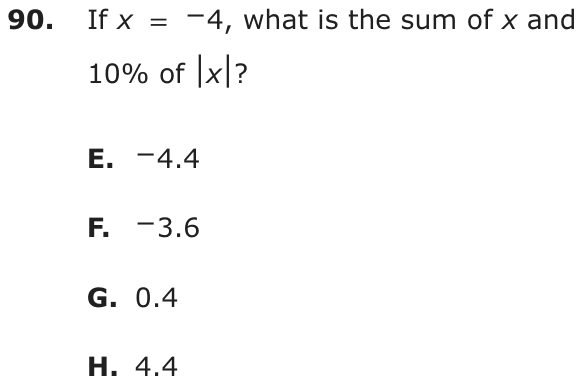
If , what is the sum of x and 10% of ?
- A−4.4
- B−3.6
- C0.4
- D4.4
Show the answer
Correct answer: B
First, determine 10% of .
Then determine the sum of x and 10% of .
The sum is −3.6.
Question analysis
With x equal to a negative number, students find the sum of x and 10 percent of the absolute value of x. It tests absolute value, a simple percent and adding numbers with different signs. The tricky part is keeping track of which term is negative and which is not.
- NYS standards
- Grade level
- Grade 7 content, by NYS standard
- Compared with grade 7
- At grade 7 Grade 7 students add positive and negative decimals and find simple percents. This joins those skills with an absolute value in two short steps, so it matches typical practice, with the sign of each term as the main hazard.
- Estimated difficulty
- Straightforward: two steps or one careful reading.
- Thinking it demands
- Depth of knowledge 1, recall and reproduction · mainly apply
- What makes it hard
- Error-prone arithmetic moderate
- Something you must already know minor
- Solution
- 2 steps
- Reading level
- Question and choices: about grade 5, 11 words.
- Students, last 30 days
- Not enough answers yet to show (it takes 10).
Why it is hard, traps and wrong answers (shows the answer)
Why it is hard
The question is short, but it asks students to treat the same number two ways: x keeps its negative sign while |x| drops it. Each wrong choice gets the sign wrong in one place, by taking 10% of −4, by making both terms positive, or by stopping at the positive 0.4. Writing the two terms separately, −4 and +0.4, before adding prevents each slip.
Error-prone arithmetic moderate Working it out
The sum mixes a negative integer with a positive decimal, −4 + 0.4, and the result has to keep the negative sign while moving 0.4 toward zero. (Brown & Burton, 1978; Junker & Sijtsma, 2001)
Something you must already know minor Working it out
Students must know that |−4| = 4, so the 10% is taken of a positive number even though x itself is negative. (Anderson & Krathwohl, 2001)
Strategy: Evaluate the absolute value first, take 10 percent of that positive number, and then add the result to x itself, keeping x's negative sign.
Traps
- Negatives and direction: Arithmetic with negative numbers, the order of a subtraction, or direction on a number line. (Moving a term across the equals sign without changing its sign is a faulty procedure.)
- Stops one step early: A choice is a number from partway through the solution.
The wrong answers, classified
A Negatives and direction (Brown & Burton, 1978)
Takes 10% of x instead of |x|, getting −0.4, and adds it to −4 to reach −4.4, overlooking the absolute value bars.
C Stops one step early (King et al., 2004; Gierl et al., 2017)
Finds 10% of |x| = 0.4 correctly and stops there, without adding x as the word sum requires.
D Negatives and direction (Brown & Burton, 1978)
Uses 4 for x as well as for |x|, so adds 4 + 0.4 = 4.4 and loses the negative sign of x itself.
Worked solution, step by step
Formulas used
- Absolute value
- The two bars mean absolute value. a is any number. Its absolute value is how far it is from 0 on the number line. A distance is never negative, so |−4| = 4.
- Percent of a number
- The whole is the amount the percent is taken of. The percent tells how many out of every 100. The part is the piece you get. Use it to find a percent of any number.
Sort out the question
You know that x = −4. You need the sum of two things: x itself, and 10% of |x|. A sum means you add.
The bars around x mean absolute value. So the 10% is taken of |x|, not of x.
Find the absolute value
−4 is 4 steps from 0 on the number line. So its absolute value is 4. An absolute value is never negative.
Take 10 percent of it
So 10% of |x| is 0.4.
Watch out: If you take 10% of x instead, you get −0.4. Then −4 + (−0.4) = −4.4, choice A. The bars make the number positive first.
Add x and the result
Now add x, which is still −4. Its own minus sign stays.
Start at −4 on the number line. Move 0.4 to the right, toward 0. You land on −3.6.
Watch out: Stopping at 0.4 gives choice C. Using 4 in place of x gives 4.4, choice D.
So the answer is B, −3.6.
Check your answer
Adding a small positive number should move −4 a little toward 0. The answer −3.6 is just to the right of −4, so that fits. Also, , the amount you added.
More questions like this
The original DOE question
Question 5 of 9
2024 Test B Math, question 49Question
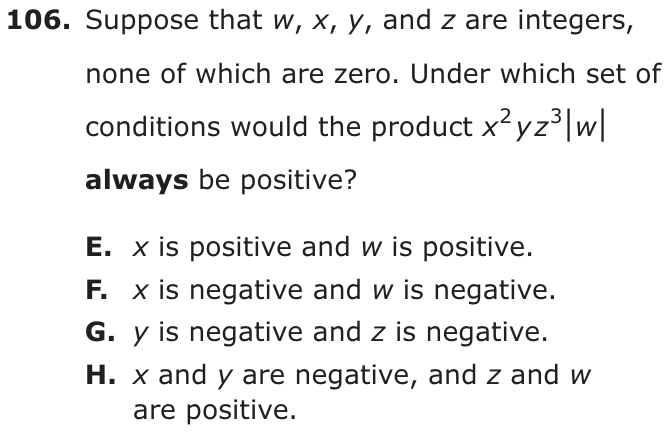
Suppose that w, x, y, and z are integers, none of which are zero. Under which set of conditions would the product always be positive?
- Ax is positive and w is positive.
- Bx is negative and w is negative.
- Cy is negative and z is negative.
- Dx and y are negative, and z and w are positive.
Show the answer
Correct answer: C
First, analyze the role of each variable in the expression .
will always be a positive number.
y can be a positive or a negative number.
can be a positive or a negative number.
will always be a positive number.
The expressions and will always be positive. Therefore, making the values of y and z negative would result in the expression being positive, since a negative multiplied by a negative is positive. Thus the given product would always be positive.
Question analysis
Four nonzero integers appear in a product that includes a square, a cube and an absolute value. Students choose the set of conditions that makes the product positive every time. It tests the sign rules for multiplication together with exponents and absolute value, and the trap is judging the sign by counting negative variables without looking at what is done to each.
- NYS standards
- Grade level
- Grade 7 content, by NYS standard
- Compared with grade 7
- Above grade 7 Grade 7 students learn sign rules for products of signed numbers. Here they must reason about four unknown integers under an even power, an odd power and an absolute value, and decide what is always true, which is more abstract than typical grade 7 work.
- Estimated difficulty
- Hard: combines ideas, needs a plan, and has more than one tempting wrong answer.
- Thinking it demands
- Depth of knowledge 2, skills and concepts · mainly analyze
- What makes it hard
- Variables instead of numbers moderate
- Every choice must be checked moderate
- Something you must already know minor
- Solution
- 3 steps
- Reading level
- Question and choices: about grade 6, 58 words.
- Students, last 30 days
- Not enough answers yet to show (it takes 10).
Why it is hard, traps and wrong answers (shows the answer)
Why it is hard
One insight decides the question: x² and |w| are positive whatever x and w are, so only the signs of y and z³ matter. Students who count negative letters instead of negative factors pick conditions that look balanced but leave y as the only negative factor. Students who test a single set of values can be fooled by a choice that leaves y and z unspecified.
Variables instead of numbers moderate Understanding the question
There are four variables and no numbers, and always positive must hold for every allowed value, so one test case can rule a choice out but never confirm it. (Koedinger & Nathan, 2004; Enright, Morley & Sheehan, 2002)
Every choice must be checked moderate Choosing the answer
Each set of conditions has to be checked against all four factors; the first two fix only x and w and leave y and z free to make the product negative. (Embretson & Wetzel, 1987)
Something you must already know minor Working it out
Students must know that a nonzero square and an absolute value are always positive, while an odd power such as z³ keeps the sign of z. (Anderson & Krathwohl, 2001)
Strategy: Work out, factor by factor, which signs each part of the product can take, then test each set of conditions against every factor rather than counting negatives.
Traps
- Negatives and direction: Arithmetic with negative numbers, the order of a subtraction, or direction on a number line. (Moving a term across the equals sign without changing its sign is a faulty procedure.)
- Misunderstands the concept: A wrong belief about a concept: that percents can be added, that area grows like length, that averages can be averaged, that a bigger denominator means a bigger fraction.
The wrong answers, classified
A Checks only one number (Schoenfeld, 1985)
Tests the choice with every variable positive, so the product is positive and it seems to work; y = −1 with z = 1 would make it negative.
B Misunderstands the concept (Smith, diSessa & Roschelle, 1993; De Bock et al., 1998; Ni & Zhou, 2005)
Pairs the negatives x and w as if they must cancel, not seeing that x² and |w| are positive anyway, so y and z still decide.
D Negatives and direction (Brown & Burton, 1978)
Counts two negative letters, x and y, as an even number of negatives, but x² is positive, so y is the only negative factor.
Worked solution, step by step
Formulas used
- Signs in multiplication
- a and b are positive numbers, so −a and −b are negative. A negative times a negative is positive. A negative times a positive is negative. So a product is positive when it has an even number of negative factors.
Sort out the question
w, x, y and z are integers, meaning whole numbers or their negatives. None of them is 0. The product means .
You need the conditions that make the product positive every time, for every number that fits them.
Look at x squared and |w|
means x × x. Two positives or two negatives multiply to a positive. So is always positive.
is the absolute value of w, its distance from 0. It is always positive, since w is not 0.
So x and w never change the sign of the product. Their signs do not matter.
Look at y and z cubed
y can be positive or negative. means z × z × z, and it has the same sign as z. For example, .
So the sign of the whole product is the sign of . It depends only on y and z.
Test each choice
- A and B say nothing about y and z. If y = −1 and z = 1, the product is negative. So they do not always work.
- C: y is negative, and is negative. A negative times a negative is positive. This always works.
- D: y is negative and z is positive. So the product is always negative.
Watch out: D has two negative letters, x and y. But is positive anyway, so y is the only negative factor.
So the answer is C, y is negative and z is negative.
Check your answer
Try numbers for C. Let x = −2, y = −3, z = −1 and w = −5. Then , which is positive. Even with x and w negative, the product stays positive.
More questions like this
The original DOE question
Question 6 of 9
2024 Test B Math, question 53Question
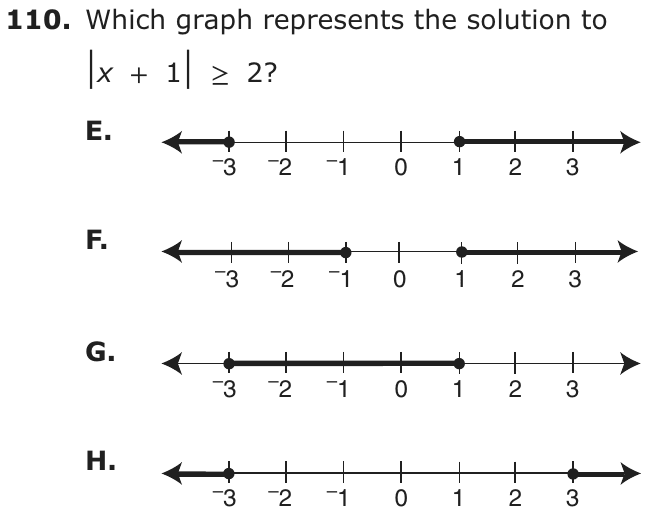
Which graph represents the solution to ?
- A

- B

- C

- D

Show the answer
Correct answer: A
Since , either or .
Solving for x gives .
Solving for x gives .
A filled circle on a number line represents “or equal to.” So the correct number line representation has filled circles at −3 and 1, with the number line filled to the left of −3 for “less than” and to the right of 1 for “greater than.”
Question analysis
Students choose the number line graph that shows every solution of an inequality in which x + 1 sits inside absolute value bars. It tests absolute value as distance and graphing inequalities. The tricky part is turning one absolute value statement into two pieces and placing each boundary point and shaded ray correctly.
- NYS standards
- Grade level
- Grade 7 content, by NYS standard
- Compared with grade 7
- Above grade 7 Grade 7 students solve and graph two-step inequalities and know absolute value as distance. An inequality with an absolute value has to be split into two cases, which is outside the grade 6 to 8 standards and well above typical grade 7 work.
- Estimated difficulty
- Hard: combines ideas, needs a plan, and has more than one tempting wrong answer.
- Thinking it demands
- Depth of knowledge 2, skills and concepts · mainly apply
- What makes it hard
- Something you must already know moderate
- A very close wrong answer moderate
- Reading a figure, table or graph minor
- Solution
- 3 steps
- Reading level
- Question and choices: about grade 9, 7 words.
- Students, last 30 days
- Not enough answers yet to show (it takes 10).
Why it is hard, traps and wrong answers (shows the answer)
Why it is hard
Reading |x + 1| as the distance from x to −1 makes this quick: the points 2 units away are −3 and 1, and greater than or equal means outside them. Students who solve only one case and mirror it across 0 land on graphs centered on 0, and students who find both endpoints may still shade between them. The graphs differ in just one dot or one shading choice, so each must be read carefully.
Something you must already know moderate Working it out
Solving |x + 1| ≥ 2 needs two cases, x + 1 ≤ −2 or x + 1 ≥ 2, joined by or; absolute value inequalities go beyond grade 7, and the stem gives no hint. (Anderson & Krathwohl, 2001)
A very close wrong answer moderate Choosing the answer
The right graph and the segment from −3 to 1 share both filled endpoints, so only deciding between outside and between the boundaries separates them. (Embretson & Wetzel, 1987; Gorin & Embretson, 2006; Ascalon et al., 2007)
Reading a figure, table or graph minor Understanding the question
Four number lines must be read for filled dots and arrow directions, and two of them differ from the right one only in where a single dot sits. (Lesh, Post & Behr, 1987; Kirsch & Mosenthal, 1990)
Strategy: Read the absolute value as distance from −1 on the number line, find the points exactly 2 units away, and decide whether the solutions lie between or outside them.
Traps
- Misunderstands the concept: A wrong belief about a concept: that percents can be added, that area grows like length, that averages can be averaged, that a bigger denominator means a bigger fraction.
- Negatives and direction: Arithmetic with negative numbers, the order of a subtraction, or direction on a number line. (Moving a term across the equals sign without changing its sign is a faulty procedure.)
The wrong answers, classified
B Misunderstands the concept (Smith, diSessa & Roschelle, 1993; De Bock et al., 1998; Ni & Zhou, 2005)
Solves x + 1 ≥ 2 to get x ≥ 1, then mirrors it across 0 to x ≤ −1, as if the solution were centered on 0 rather than on −1.
C Negatives and direction (Brown & Burton, 1978)
Finds −3 and 1 but shades between them, the solution of |x + 1| ≤ 2, reversing which side of the boundaries lies at least 2 units from −1.
D Misunderstands the concept (Smith, diSessa & Roschelle, 1993; De Bock et al., 1998; Ni & Zhou, 2005)
Solves x + 1 ≤ −2 to get x ≤ −3, then mirrors it across 0 to x ≥ 3, assuming the boundaries are symmetric about 0.
Worked solution, step by step
Formulas used
- Absolute value as distance
- x and a are points on the number line. The bars mean absolute value. |x − a| is how far apart the two points are, which is never negative. Since x + 1 = x − (−1), |x + 1| is the distance from x to −1.
Sort out the question
You need the graph of every x that makes true. The sign ≥ means greater than or equal to. The bars mean absolute value.
On a number line, a filled dot means that point counts. A thick line with an arrow means all the numbers that way count too.
Read it as a distance
Adding 1 is the same as subtracting −1, so . By the formula, is the distance from x to −1.
So the inequality says that x is at least 2 units away from −1.
Find the two boundary points
Start at −1 and go 2 units each way.
At −3 and at 1, the distance is exactly 2. The words or equal to let them count, so they get filled dots.
Decide which side to shade
Being at least 2 away means being farther out. Numbers between −3 and 1 are too close to −1. For example, 0 is only 1 unit away. So shade to the left of −3 and to the right of 1.
In algebra, that is or . These give or .
Match the graph
Choice A has filled dots at −3 and 1, with arrows going outward. That matches.
Watch out: Choice C shades between −3 and 1. Those are the points within 2 of −1, the answer to . Choices B and D are centered on 0, but the center here is −1.
So the answer is A, the graph shaded outward from −3 and 1.
Check your answer
Test a point from each part. For x = 2, , and 3 is at least 2. For x = 0, , which is less than 2. For x = −3, , which counts. Graph A agrees with all three.
More questions like this
The original DOE question
Question 7 of 9
2023 Test A Math, question 2Question
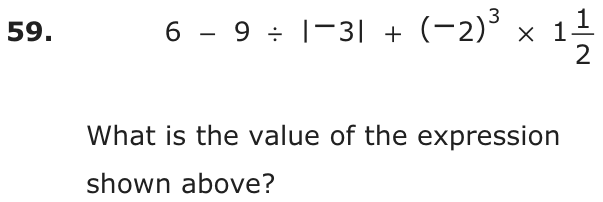
What is the value of the expression shown above?
Grid-in question: work out the answer and enter it as a number.
Show the answer
Correct answer: -9
| Calculate the exponent and convert the mixed number to an improper fraction. | |
| Next, calculate the absolute value. | |
| Perform the indicated multiplication and division. | |
| Perform the addition and subtraction. | |
Question analysis
This grid-in asks for the value of an arithmetic expression that mixes an absolute value, a negative number raised to the third power, a division and a mixed number. Students apply the order of operations with signed numbers. Cubing a negative base, and doing the division and multiplication before any adding, are where most slips happen.
- NYS standards
- Grade level
- Grade 7 content, by NYS standard
- Compared with grade 7
- At grade 7 Grade 7 students routinely evaluate expressions with negative numbers in the right order. This one combines an absolute value, a cubed negative and a mixed number in a single line, so it takes more steps than usual, each with a sign to watch.
- Estimated difficulty
- Moderate: several steps, or a close reading with one strong distractor.
- Thinking it demands
- Depth of knowledge 1, recall and reproduction · mainly apply
- What makes it hard
- Error-prone arithmetic moderate
- Many steps minor
- An answer in an unexpected form minor
- Solution
- 4 steps
- Reading level
- Question and choices: about grade 5, 10 words.
- Students, last 30 days
- Not enough answers yet to show (it takes 10).
Why it is hard, traps and wrong answers (shows the answer)
Why it is hard
The expression packs four kinds of notation into one line: a subtraction, a division by an absolute value, a negative base raised to the third power and a mixed number. None of the operations is hard alone, but each has a rule that is easy to break under time pressure, and the slips lead to very different totals. Rewriting the power and the mixed number first, then dividing and multiplying before any addition, avoids them.
Error-prone arithmetic moderate Working it out
(−2)³ must stay negative, −8, and the mixed number 1½ must become 3/2 before multiplying, so the last product is −12; a sign or fraction slip here moves the total far from −9. (Brown & Burton, 1978; Junker & Sijtsma, 2001)
Many steps minor Working it out
Six numbers and six operations, including a power and an absolute value, have to be worked in a planned order, and every addition waits until the division and multiplication are done. (Daniel & Embretson, 2010; Enright, Morley & Sheehan, 2002)
An answer in an unexpected form minor Choosing the answer
The value is negative and the grid-in offers no choices, so the minus sign has to be gridded and nothing on the page confirms that the total falls below zero. (Enright, Morley & Sheehan, 2002)
Strategy: Rewrite the absolute value and the power first, change the mixed number to an improper fraction, do the division and multiplication, and only then add and subtract from left to right.
Traps
- Order of operations: Working left to right, or distributing a minus sign wrongly, gives a choice.
- Negatives and direction: Arithmetic with negative numbers, the order of a subtraction, or direction on a number line. (Moving a term across the equals sign without changing its sign is a faulty procedure.)
- A faulty procedure: A systematic but wrong procedure: adding fractions straight across, applying an exponent to each term of a sum, dropping a sign when moving a term.
The wrong answers, classified
15 Negatives and direction (Brown & Burton, 1978)
Takes (−2)³ as positive 8, as if every power of a negative were positive, so the last product is +12 and 6 − 3 + 12 = 15.
-13.5 Order of operations (Brown & Burton, 1978)
Works strictly from left to right: 6 − 9 = −3, divided by 3 is −1, plus −8 is −9, and times 1½ gives −13.5.
-6 A faulty procedure (Brown & Burton, 1978; Tatsuoka, 1983)
Multiplies the base by the exponent, taking (−2)³ as −6, so the product with 3/2 is −9 and the total is 6 − 3 − 9 = −6.
Worked solution, step by step
Formulas used
- Order of operations
- This is the order for working out an expression. First work inside grouping symbols, such as parentheses and absolute value bars. Next do powers. Then multiply and divide from left to right. Last, add and subtract from left to right. Using one order means everyone gets the same answer.
- A power
- a is the base, the number being multiplied. The small 3 is the exponent. It says how many times the base is used as a factor, a number being multiplied. It does not mean a times 3.
- Absolute value
- The bars around a number mean absolute value. It is how far the number is from 0 on a number line. A distance is never negative, so the absolute value of −3 is 3.
- Mixed number to fraction
- a is the whole number part, and b over c is the fraction part. Each whole is c pieces, so a wholes are a × c pieces. Add the b extra pieces. The bottom number stays c.
Sort out the expression
You need the value of . It has many operations, so the order matters. It has absolute value bars, a power of a negative number and a mixed number. The answer may be negative, so keep track of every sign.
Do the absolute value and the power
Grouping symbols and powers come first.
Two negatives multiply to a positive, 4. One more negative makes it negative again. Watch out: (−2)³ is −8, not +8. Using +8 leads to 15. It is also not −2 × 3. That mistake leads to a total of −6.
Change the mixed number to a fraction
A fraction is easier to multiply than a mixed number.
Now the expression looks like this:
Multiply and divide next
Multiplying and dividing come before adding and subtracting.
A negative times a positive is negative. Watch out: don’t just work from left to right. Doing 6 − 9 first, then dividing by 3, leads to −13.5.
Add and subtract last
Now only adding and subtracting are left. Work from left to right.
Adding −12 is the same as taking away 12. So you would grid −9, with the minus sign in its own column.
Check your answer
Look at the size of each part. The part 6 − 3 is a small positive number, 3. The last part, −8 times 1½, is a bigger negative number, −12. A big negative plus a small positive is negative. So an answer below zero, −9, makes sense.
More questions like this
The original DOE question
Question 8 of 9
2023 Test B Math, question 21Question
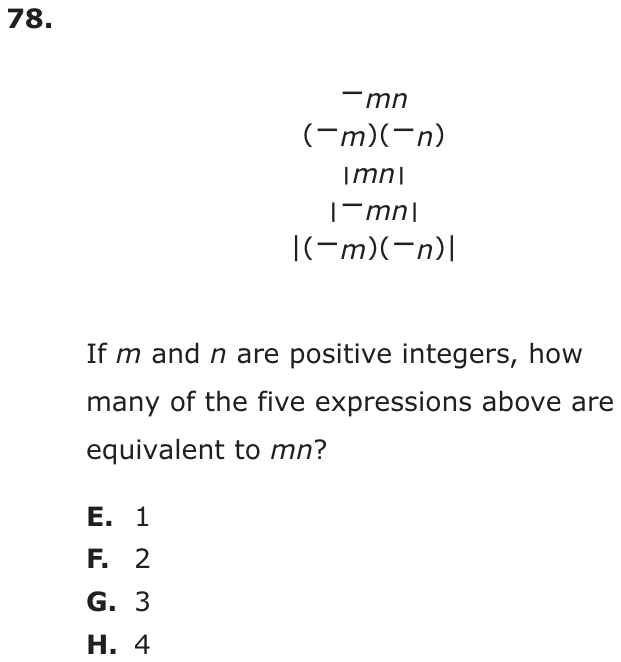
If m and n are positive integers, how many of the five expressions above are equivalent to ?
- A1
- B2
- C3
- D4
Show the answer
Correct answer: D
Since m and n are positive, the value of is also positive. Of the five options given:
is negative.
is positive.
is positive.
is positive.
is positive.
There are 4 expressions that are positive, and each one is equal to .
Question analysis
Five expressions are listed: −mn, (−m)(−n), |mn|, |−mn| and |(−m)(−n)|. If m and n are positive integers, students count how many are equivalent to mn. It tests the sign rules for multiplying negatives together with what absolute value does, and each expression has to be judged on its own.
- Grade level
- Grade 7 content, by NYS standard
- Compared with grade 7
- At grade 7 Multiplying signed numbers and absolute value are grade 6 and 7 content. Checking five expressions one by one takes longer than a typical single computation, but each check uses a familiar rule.
- Estimated difficulty
- Moderate: several steps, or a close reading with one strong distractor.
- Thinking it demands
- Depth of knowledge 2, skills and concepts · mainly analyze
- What makes it hard
- Variables instead of numbers moderate
- Much to keep track of minor
- Something you must already know minor
- Solution
- 5 steps
- Reading level
- Question and choices: about grade 10, 23 words.
- Students, last 30 days
- Not enough answers yet to show (it takes 10).
Why it is hard, traps and wrong answers (shows the answer)
Why it is hard
Each expression takes only a moment, but the answer is a count, so one misjudged expression changes it. The minus signs are designed to unsettle: four of the five expressions show at least one, and only one of those actually stays negative. Substituting small positive numbers and comparing each value with mn turns the question into arithmetic.
Variables instead of numbers moderate Understanding the question
The five expressions use only m and n, so each sign rule has to be applied in general unless the student substitutes values such as m = 2 and n = 3. (Koedinger & Nathan, 2004; Enright, Morley & Sheehan, 2002)
Much to keep track of minor Working it out
Five expressions are judged one at a time and a count kept, and two of them combine the product rule for negatives with absolute value bars. (Sweller, 1988; Carpenter, Just & Shell, 1990)
Something you must already know minor Working it out
The rules that two negative factors give a positive product and that absolute value removes a minus sign are assumed, not stated. (Anderson & Krathwohl, 2001)
Strategy: Pick small values such as m = 2 and n = 3, evaluate each of the five expressions, and count the ones equal to 6.
Traps
- Negatives and direction: Arithmetic with negative numbers, the order of a subtraction, or direction on a number line. (Moving a term across the equals sign without changing its sign is a faulty procedure.)
- Misunderstands the concept: A wrong belief about a concept: that percents can be added, that area grows like length, that averages can be averaged, that a bigger denominator means a bigger fraction.
The wrong answers, classified
A Negatives and direction (Brown & Burton, 1978)
Treats any minus sign as making the value negative, even inside bars or in a product of two negatives, so counts only |mn|.
B Misunderstands the concept (Smith, diSessa & Roschelle, 1993; De Bock et al., 1998; Ni & Zhou, 2005)
Accepts |mn| and (−m)(−n) but believes bars cannot cancel a minus sign written inside them, rejecting |−mn| and |(−m)(−n)|.
C Negatives and direction (Brown & Burton, 1978)
Thinks a negative times a negative stays negative, so rejects (−m)(−n) along with −mn and counts only the three absolute values.
Worked solution, step by step
Formulas used
- Multiplying two negatives
- a and b are positive numbers. A negative number times a negative number gives a positive number. The two minus signs cancel out. One negative and one positive give a negative.
- Absolute value
- The bars around a number mean absolute value. It is how far the number is from 0 on a number line. A distance is never negative, so |−6| = 6 and |6| = 6. The bars remove any minus sign.
Sort out the question
m and n are positive integers. That means whole numbers greater than 0. Writing mn means m times n, so mn is positive. You need to count how many of the five expressions always equal mn.
Pick numbers to test
Pick easy values: and . Then . Any expression that equals mn must come out to 6.
Test the first two expressions
This is negative, so it does not equal 6.
A negative times a negative is positive, so this one equals 6. Watch out: if you think a negative times a negative stays negative, you reject this one and get 3, choice C.
Test the three absolute values
All three equal 6, because absolute value bars remove a minus sign. Watch out: the bars work even when the minus sign is inside them. Rejecting the last two gives 2, choice B.
Count the matches
Four expressions equal mn: , , and . Only does not. The sign rules work the same for any positive m and n, not just 2 and 3. So the answer is D, 4.
Check your answer
Try other numbers, such as and . Then . The five expressions give −5, 5, 5, 5 and 5. Again, four of them match mn.
More questions like this
The original DOE question
Question 9 of 9
2018 Test B Math, question 3Question
Grid-in question: work out the answer and enter it as a number.
Show the answer
Correct answer: -3.4
Question analysis
This grid-in asks students to evaluate an expression that mixes negative integers, decimals and two absolute values. The hard parts are subtracting a negative number inside the first pair of bars and keeping each absolute value separate until the final subtraction, with no answer choices to check against.
- Grade level
- Grade 7 content, by NYS standard
- Compared with grade 7
- At grade 7 Grade 7 students add and subtract signed numbers, and grade 6 students meet absolute value. This combines both in one expression with decimals and several sign decisions, a typical grade 7 exercise with no context to check against.
- Estimated difficulty
- Moderate: several steps, or a close reading with one strong distractor.
- Thinking it demands
- Depth of knowledge 1, recall and reproduction · mainly apply
- What makes it hard
- Error-prone arithmetic moderate
- Many steps moderate
- An answer in an unexpected form minor
- Solution
- 4 steps
- Reading level
- Question and choices: about grade 16+, 1 words.
- Students, last 30 days
- Not enough answers yet to show (it takes 10).
Why it is hard, traps and wrong answers (shows the answer)
Why it is hard
Every step is familiar, but the expression packs four of them with negatives and decimals, and a single sign slip anywhere gives a clean-looking wrong number. The subtlest point comes last: absolute value bars make each part positive, yet the difference of two absolute values can still be negative. Students who believe bars always produce a positive answer reverse the final subtraction, and the grid-in format offers no choices to expose it.
Error-prone arithmetic moderate Working it out
Three sign decisions stack up: (−6) − (−5) must become −6 + 5, then −1 + 4.2 crosses zero, and 3 − 9.6 is negative before its bars make it positive. (Brown & Burton, 1978; Junker & Sijtsma, 2001)
Many steps moderate Working it out
Each pair of bars must be simplified inside and then made positive, and only after both does the outer subtraction happen; doing the bars and the subtraction in the wrong order changes the result. (Daniel & Embretson, 2010; Enright, Morley & Sheehan, 2002)
An answer in an unexpected form minor Choosing the answer
The result is a negative decimal to be gridded with its sign, and with no choices on screen nothing warns a student who has dropped the minus or flipped the subtraction. (Enright, Morley & Sheehan, 2002)
Strategy: Simplify inside each pair of absolute value bars first, rewriting minus a negative as plus, then take each absolute value, and only then subtract the second from the first.
Traps
- Negatives and direction: Arithmetic with negative numbers, the order of a subtraction, or direction on a number line. (Moving a term across the equals sign without changing its sign is a faulty procedure.)
The wrong answers, classified
3.4 Misunderstands the concept (Smith, diSessa & Roschelle, 1993; De Bock et al., 1998; Ni & Zhou, 2005)
Believes an expression built from absolute values cannot be negative, so reports 6.6 − 3.2 instead of 3.2 − 6.6.
9.8 A faulty procedure (Brown & Burton, 1978; Tatsuoka, 1983)
Treats the bars like parentheses, leaving 3 − 9.6 as −6.6, then subtracts that negative: 3.2 + 6.6.
0.2 Negatives and direction (Brown & Burton, 1978)
Reads (−6) − (−5) as −6 − 5 = −11, so the first bars give |−6.8| = 6.8, and 6.8 − 6.6 = 0.2.
Worked solution, step by step
Formulas used
- Absolute value
- The two bars around a number mean absolute value. a is any number. Its absolute value is how far it is from 0 on the number line. A distance is never negative. So |−6.6| = 6.6 and |3.2| = 3.2.
- Subtracting a negative
- a and b are numbers. Taking away a negative number is the same as adding the positive number. For example, 5 − (−2) = 7. Think of it as taking away a debt: you end up richer.
Plan the order of work
The expression has two pairs of bars. The bars stand for absolute value, a number’s distance from 0.
Work inside each pair of bars first. Then take each absolute value. Subtract the two results last.
Work inside the first bars
Start with . Subtracting −5 is the same as adding 5.
3.2 is already positive, so .
Watch out: If you read the start as −6 − 5, you get −11. That path ends at the wrong answer 0.2.
Work inside the second bars
Next, . This result is negative. Its distance from 0 is 6.6, so the absolute value is positive.
Subtract the two results
Now take the second result away from the first.
You take a bigger number away from a smaller one, so the result is negative.
Watch out: The bars made each part positive. They do not make the final answer positive, so 3.4 is wrong. Also, bars are not parentheses. Working out 3.2 − (−6.6) = 9.8 is wrong too.
So you would grid -3.4, with the minus sign.
Check your answer
Estimate. The first part is about 3. The second part is about 7. And 3 − 7 is about −4. The answer −3.4 is close to that. It is also negative, as the estimate says it should be.
More questions like this
The original DOE question
