3 English and 3 math
Here are 6 random questions to try. Takers earning below 75% are unlikely to receive an offer. You have 1 minute 48 seconds per question on the real exam.
Question 1 of 6
2024 Test B English, question 18Passage Excerpt from “How Exercise Could Help You Learn a New Language”
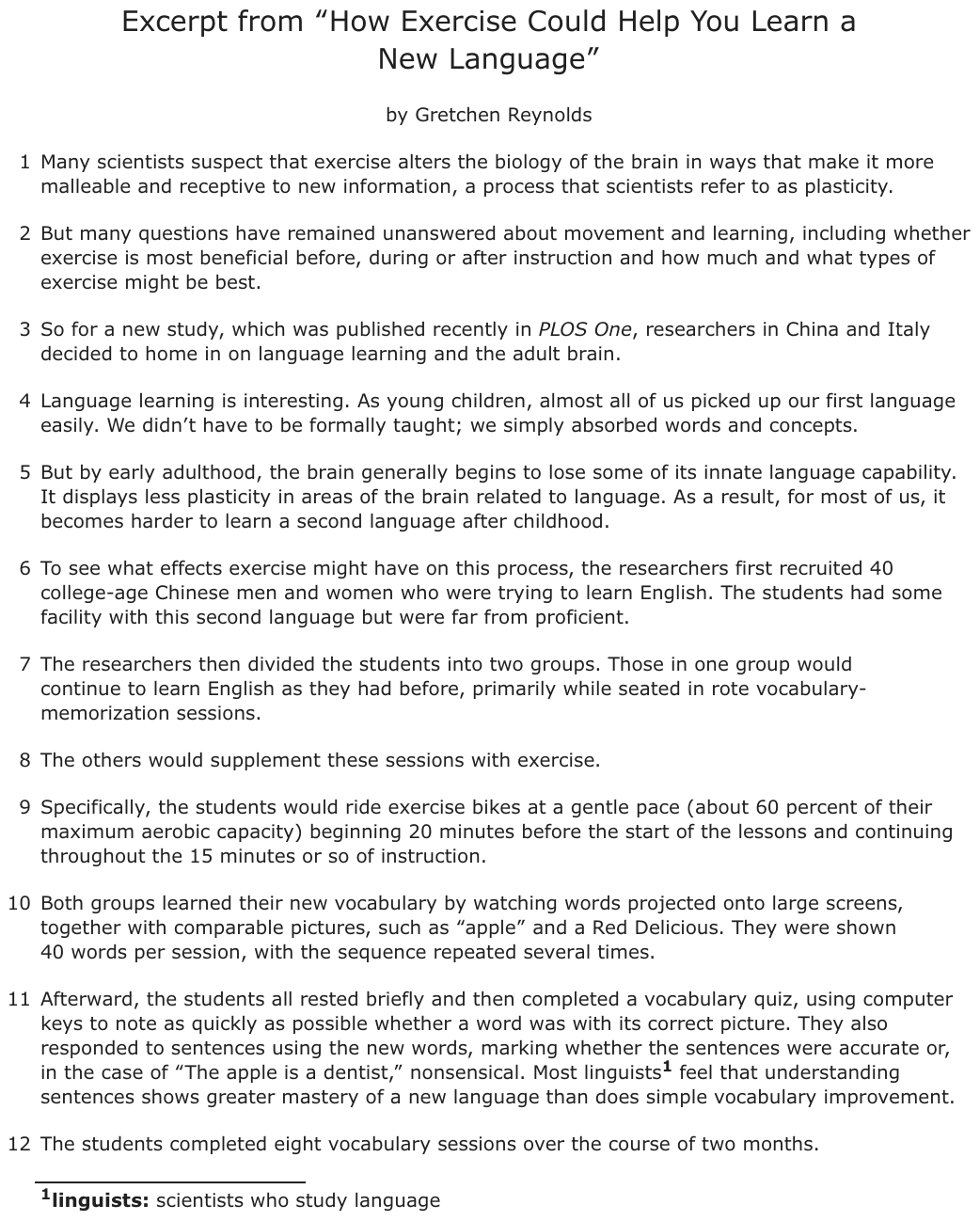
Excerpt from “How Exercise Could Help You Learn a New Language”
by Gretchen Reynolds
Many scientists suspect that exercise alters the biology of the brain in ways that make it more malleable and receptive to new information, a process that scientists refer to as plasticity.
But many questions have remained unanswered about movement and learning, including whether exercise is most beneficial before, during or after instruction and how much and what types of exercise might be best.
So for a new study, which was published recently in PLOS One, researchers in China and Italy decided to home in on language learning and the adult brain.
Language learning is interesting. As young children, almost all of us picked up our first language easily. We didn’t have to be formally taught; we simply absorbed words and concepts.
But by early adulthood, the brain generally begins to lose some of its innate language capability. It displays less plasticity in areas of the brain related to language. As a result, for most of us, it becomes harder to learn a second language after childhood.
To see what effects exercise might have on this process, the researchers first recruited 40 college-age Chinese men and women who were trying to learn English. The students had some facility with this second language but were far from proficient.
The researchers then divided the students into two groups. Those in one group would continue to learn English as they had before, primarily while seated in rote vocabulary-memorization sessions.
The others would supplement these sessions with exercise.
Specifically, the students would ride exercise bikes at a gentle pace (about 60 percent of their maximum aerobic capacity) beginning 20 minutes before the start of the lessons and continuing throughout the 15 minutes or so of instruction.
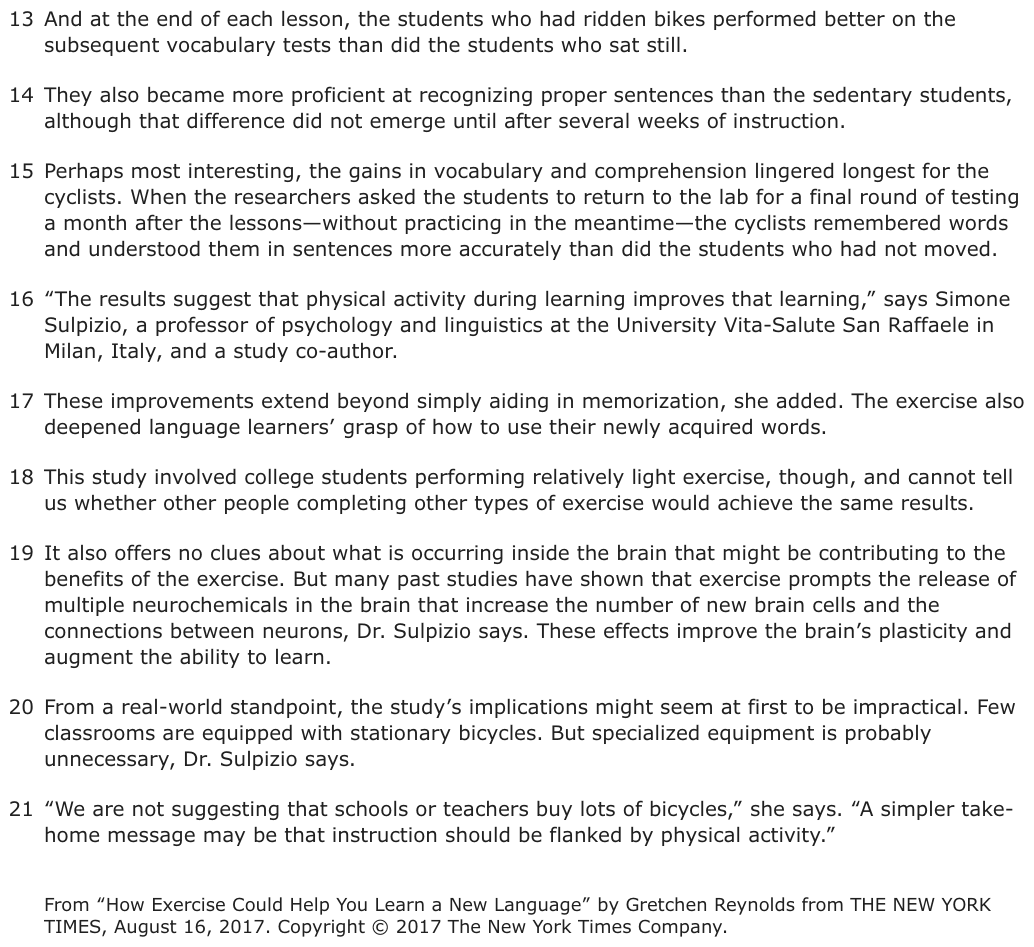
Both groups learned their new vocabulary by watching words projected onto large screens, together with comparable pictures, such as “apple” and a Red Delicious. They were shown 40 words per session, with the sequence repeated several times.
Afterward, the students all rested briefly and then completed a vocabulary quiz, using computer keys to note as quickly as possible whether a word was with its correct picture. They also responded to sentences using the new words, marking whether the sentences were accurate or, in the case of “The apple is a dentist,” nonsensical. Most linguists1 feel that understanding sentences shows greater mastery of a new language than does simple vocabulary improvement.
The students completed eight vocabulary sessions over the course of two months.
And at the end of each lesson, the students who had ridden bikes performed better on the subsequent vocabulary tests than did the students who sat still.
They also became more proficient at recognizing proper sentences than the sedentary students, although that difference did not emerge until after several weeks of instruction.
Perhaps most interesting, the gains in vocabulary and comprehension lingered longest for the cyclists. When the researchers asked the students to return to the lab for a final round of testing a month after the lessons—without practicing in the meantime—the cyclists remembered words and understood them in sentences more accurately than did the students who had not moved.
“The results suggest that physical activity during learning improves that learning,” says Simone Sulpizio, a professor of psychology and linguistics at the University Vita-Salute San Raffaele in Milan, Italy, and a study co-author.
These improvements extend beyond simply aiding in memorization, she added. The exercise also deepened language learners’ grasp of how to use their newly acquired words.
This study involved college students performing relatively light exercise, though, and cannot tell us whether other people completing other types of exercise would achieve the same results.
It also offers no clues about what is occurring inside the brain that might be contributing to the benefits of the exercise. But many past studies have shown that exercise prompts the release of multiple neurochemicals in the brain that increase the number of new brain cells and the connections between neurons, Dr. Sulpizio says. These effects improve the brain’s plasticity and augment the ability to learn.
From a real-world standpoint, the study’s implications might seem at first to be impractical. Few classrooms are equipped with stationary bicycles. But specialized equipment is probably unnecessary, Dr. Sulpizio says.
“We are not suggesting that schools or teachers buy lots of bicycles,” she says. “A simpler take-home message may be that instruction should be flanked by physical activity.”
From “How Exercise Could Help You Learn a New Language” by Gretchen Reynolds from THE NEW YORK TIMES, August 16, 2017. Copyright © 2017 The New York Times Company.
1linguists: scientists who study language
Question
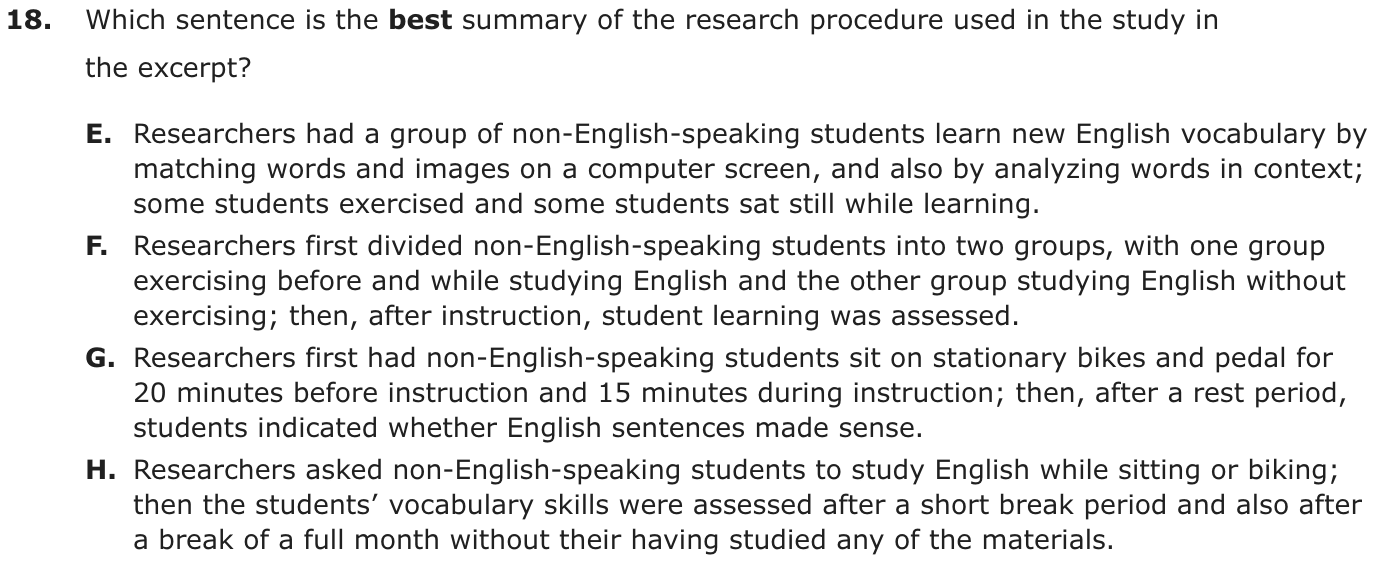
Which sentence is the best summary of the research procedure used in the study in the excerpt?
- AResearchers had a group of non-English-speaking students learn new English vocabulary by matching words and images on a computer screen, and also by analyzing words in context; some students exercised and some students sat still while learning.
- BResearchers first divided non-English-speaking students into two groups, with one group exercising before and while studying English and the other group studying English without exercising; then, after instruction, student learning was assessed.
- CResearchers first had non-English-speaking students sit on stationary bikes and pedal for 20 minutes before instruction and 15 minutes during instruction; then, after a rest period, students indicated whether English sentences made sense.
- DResearchers asked non-English-speaking students to study English while sitting or biking; then the students’ vocabulary skills were assessed after a short break period and also after a break of a full month without their having studied any of the materials.
Show the answer
Correct answer: B
The question asks for the best summary of the research procedure used in the study in the excerpt.
A. Incorrect. This summary says that students learned new words by matching words and images and “also by analyzing words in context,” but this last method was how the researchers assessed students, not how the students learned words; the summary is therefore inaccurate.
B. CORRECT. The summary includes the most important information, which is that one group of non-English-speaking students exercised before and during the English lessons, while the other group did not, and that the students’ learning was assessed afterward.
C. Incorrect. This summary is incomplete because it never mentions the control group—that is, the students who studied English without exercising—which was essential to the study so that results could be compared.
D. Incorrect. This summary includes unnecessary details, such as that students were assessed after a short break and also assessed after a month of no studying; it also neglects to mention important points: that one group exercised both before and during learning, while the other group did not exercise at all.
Question analysis
This summary question asks which of four long sentences best sums up how the researchers ran the study of exercise and English vocabulary learning. Each choice packs in real details about bikes, screens, quizzes and timing, so students must check both whether every detail is accurate and whether anything essential to the study’s design has been left out.
- Grade level
- Grade 8 reading and task
- Compared with grade 7
- Above grade 7 Grade 7 students summarize texts, usually choosing among short summaries. Here each choice runs about forty words packed with accurate details from several paragraphs, and students must judge which keeps the study’s essential design, not merely which details are true.
- Estimated difficulty
- Hard: combines ideas, needs a plan, and has more than one tempting wrong answer.
- Thinking it demands
- Depth of knowledge 2, skills and concepts · mainly understand
- What makes it hard
- A very close wrong answer major
- Evidence in several places moderate
- A lot to read moderate
- Evidence
- Answered from several paragraphs or stanzas
- Reading level
- Passage: about grade 11, 764 words; question and choices: about grade 16+, 157 words.
- Students, last 30 days
- Not enough answers yet to show (it takes 10).
Why it is hard, traps and wrong answers (shows the answer)
Why it is hard
Most of what the wrong summaries say is true, which makes this a test of completeness and weight rather than of accuracy. One summary describes only the cyclists, another slips the sentence quiz into how words were taught, and the most tempting one is accurate but leaves out that the cyclists pedaled before the lesson as well as during it. The right summary is plainer than its rivals: two groups, one exercising, then a test.
A very close wrong answer major Choosing the answer
The sitting-or-biking summary is accurate and names both conditions, as the right one does, but it spends its words on the short rest and the month-later test instead of when the cyclists rode. (Embretson & Wetzel, 1987; Gorin & Embretson, 2006; Ascalon et al., 2007)
Evidence in several places moderate Working it out
The procedure runs from the recruiting in paragraph 6 through the groups, bikes, lessons and quiz in paragraphs 7–12 to the final test in paragraph 15, so it must be gathered before any summary is judged. (Kirsch & Mosenthal, 1990; Gorin & Embretson, 2006)
A lot to read moderate Understanding the question
Each summary is a 32- to 40-word sentence packed with real details, the 20 minutes of pedaling, the rest period, the month without study, so the four together form a dense passage of their own. (Kintsch, 1998; Gorin & Embretson, 2006; Freedle & Kostin, 1993)
Strategy: Before reading the choices, note in a few words how the study was set up and how learning was checked. Then test each summary for accuracy and for anything essential it leaves out.
Traps
- Too narrow: A single detail offered as the central idea or a summary, or a summary that keeps minor details and leaves out an essential part.
- Twists what the text says: Uses the text's topic and ideas but changes what it says: who did it, how much, when, or why.
The wrong answers, classified
A Twists what the text says (King et al., 2004)
Adds that students learned “by analyzing words in context,” but judging sentences was part of the quiz after each lesson, while the words were taught with pictures on large screens.
C Too narrow (King et al., 2004)
Follows the cyclists’ routine accurately, 20 minutes before and during the lesson, but leaves out the group that studied without exercise, so the comparison at the heart of the study disappears.
D Too narrow (King et al., 2004)
Is drawn by accurate details about the short rest and the month-later test, but it builds the summary around them and leaves out that the cyclists rode before the lessons too.
Working it out, step by step
Figure out what the question asks
You need the best summary of how the study was done. A summary gives the main parts in a few words. It must be accurate, and it can’t leave out anything important. Small details can be skipped.
Find the main parts of the study
- Paragraph 7: “The researchers then divided the students into two groups.”
- Paragraphs 8 and 9: one group rode bikes “beginning 20 minutes before the start of the lessons and continuing throughout the 15 minutes or so of instruction.” The other group sat still.
- Paragraph 11: then all the students took a quiz.
So the key parts are two groups, one that exercised, and a test afterward. The group that sat still matters. It lets the researchers compare.
Check each choice
- B has it all: two groups, one exercising “before and while studying,” then a test.
- A says students learned by “analyzing words in context.” But judging sentences was part of the quiz, not the lessons.
- C describes only the bike riders. It leaves out the group that sat still, so nothing gets compared.
- D spends its words on small details: the short break and the test a month later. It leaves out that the bike riders started 20 minutes before the lesson.
Pick the answer
Watch out: D is tempting because everything in it is true. But a summary should give the main parts, not the side details. So the answer is B.
Why this answer and not the closest wrong one
D is the closest wrong answer. Its facts are accurate, and it names both groups. But it builds the summary around the break and the month-later test. It never says the cyclists rode before the lessons too. B gives the main plan plainly: two groups, one exercising, then a test of learning.
More questions like this
The original DOE question
The passage “Excerpt from “How Exercise Could Help You Learn a New Language”” as printed (pages 171–172)
Question 2 of 6
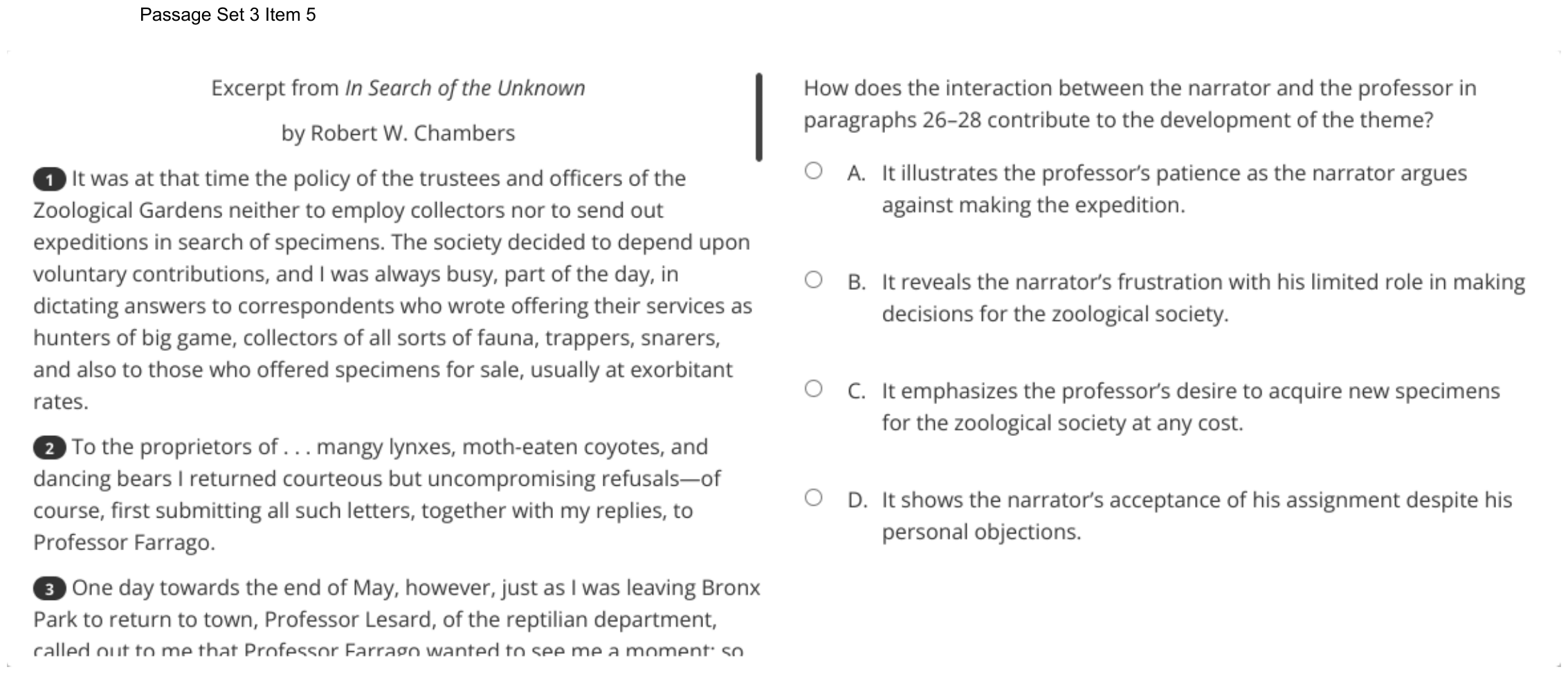
2026 Practice Test B English, question 18Passage Excerpt from In Search of the Unknown
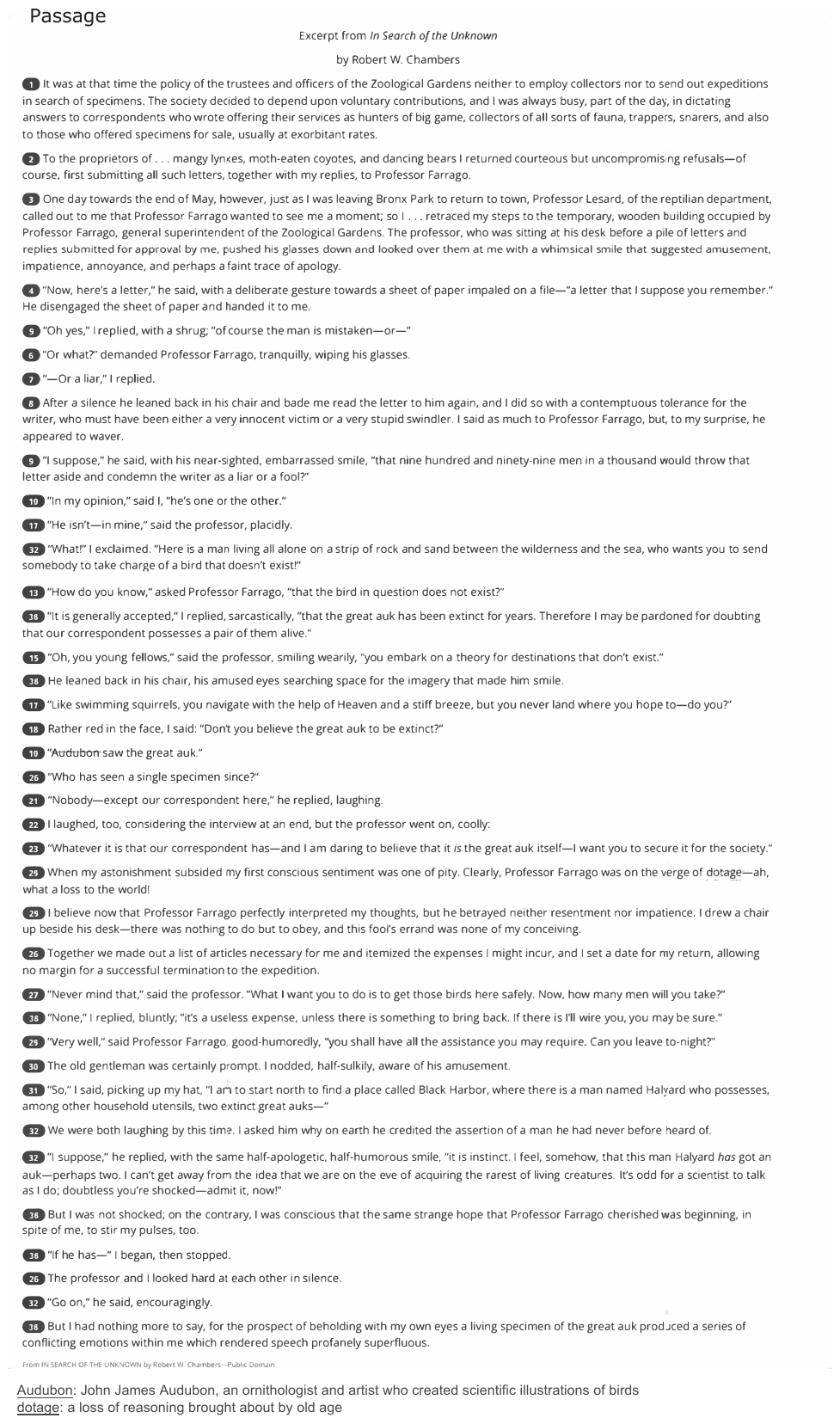
Excerpt from In Search of the Unknown
by Robert W. Chambers
It was at that time the policy of the trustees and officers of the Zoological Gardens neither to employ collectors nor to send out expeditions in search of specimens. The society decided to depend upon voluntary contributions, and I was always busy, part of the day, in dictating answers to correspondents who wrote offering their services as hunters of big game, collectors of all sorts of fauna, trappers, snarers, and also to those who offered specimens for sale, usually at exorbitant rates.
To the proprietors of . . . mangy lynxes, moth-eaten coyotes, and dancing bears I returned courteous but uncompromising refusals—of course, first submitting all such letters, together with my replies, to Professor Farrago.
One day towards the end of May, however, just as I was leaving Bronx Park to return to town, Professor Lesard, of the reptilian department, called out to me that Professor Farrago wanted to see me a moment; so I . . . retraced my steps to the temporary, wooden building occupied by Professor Farrago, general superintendent of the Zoological Gardens. The professor, who was sitting at his desk before a pile of letters and replies submitted for approval by me, pushed his glasses down and looked over them at me with a whimsical smile that suggested amusement, impatience, annoyance, and perhaps a faint trace of apology.
“Now, here’s a letter,” he said, with a deliberate gesture towards a sheet of paper impaled on a file—“a letter that I suppose you remember.” He disengaged the sheet of paper and handed it to me.
“Oh yes,” I replied, with a shrug; “of course the man is mistaken—or—”
“Or what?” demanded Professor Farrago, tranquilly, wiping his glasses.
“—Or a liar,” I replied.
After a silence he leaned back in his chair and bade me read the letter to him again, and I did so with a contemptuous tolerance for the writer, who must have been either a very innocent victim or a very stupid swindler. I said as much to Professor Farrago, but, to my surprise, he appeared to waver.
“I suppose,” he said, with his near-sighted, embarrassed smile, “that nine hundred and ninety-nine men in a thousand would throw that letter aside and condemn the writer as a liar or a fool?”
“In my opinion,” said I, “he’s one or the other.”
“He isn’t—in mine,” said the professor, placidly.
“What!” I exclaimed. “Here is a man living all alone on a strip of rock and sand between the wilderness and the sea, who wants you to send somebody to take charge of a bird that doesn’t exist!”
“How do you know,” asked Professor Farrago, “that the bird in question does not exist?”
“It is generally accepted,” I replied, sarcastically, “that the great auk has been extinct for years. Therefore I may be pardoned for doubting that our correspondent possesses a pair of them alive.”
“Oh, you young fellows,” said the professor, smiling wearily, “you embark on a theory for destinations that don’t exist.”
He leaned back in his chair, his amused eyes searching space for the imagery that made him smile.
“Like swimming squirrels, you navigate with the help of Heaven and a stiff breeze, but you never land where you hope to—do you?”
Rather red in the face, I said: “Don’t you believe the great auk to be extinct?”
“Audubon saw the great auk.”
“Who has seen a single specimen since?”
“Nobody—except our correspondent here,” he replied, laughing.
I laughed, too, considering the interview at an end, but the professor went on, coolly:
“Whatever it is that our correspondent has—and I am daring to believe that it is the great auk itself—I want you to secure it for the society.”
When my astonishment subsided my first conscious sentiment was one of pity. Clearly, Professor Farrago was on the verge of dotage—ah, what a loss to the world!
I believe now that Professor Farrago perfectly interpreted my thoughts, but he betrayed neither resentment nor impatience. I drew a chair up beside his desk—there was nothing to do but to obey, and this fool’s errand was none of my conceiving.
Together we made out a list of articles necessary for me and itemized the expenses I might incur, and I set a date for my return, allowing no margin for a successful termination to the expedition.
“Never mind that,” said the professor. “What I want you to do is to get those birds here safely. Now, how many men will you take?”
“None,” I replied, bluntly; “it’s a useless expense, unless there is something to bring back. If there is I’ll wire you, you may be sure.”
“Very well,” said Professor Farrago, good-humoredly, “you shall have all the assistance you may require. Can you leave to-night?”
The old gentleman was certainly prompt. I nodded, half-sulkily, aware of his amusement.
“So,” I said, picking up my hat, “I am to start north to find a place called Black Harbor, where there is a man named Halyard who possesses, among other household utensils, two extinct great auks—”
We were both laughing by this time. I asked him why on earth he credited the assertion of a man he had never before heard of.
“I suppose,” he replied, with the same half-apologetic, half-humorous smile, “it is instinct. I feel, somehow, that this man Halyard has got an auk—perhaps two. I can’t get away from the idea that we are on the eve of acquiring the rarest of living creatures. It’s odd for a scientist to talk as I do; doubtless you’re shocked—admit it, now!”
But I was not shocked; on the contrary, I was conscious that the same strange hope that Professor Farrago cherished was beginning, in spite of me, to stir my pulses, too.
“If he has—” I began, then stopped.
The professor and I looked hard at each other in silence.
“Go on,” he said, encouragingly.
But I had nothing more to say, for the prospect of beholding with my own eyes a living specimen of the great auk produced a series of conflicting emotions within me which rendered speech profanely superfluous.
From IN SEARCH OF THE UNKNOWN by Robert W. Chambers—Public Domain
Audubon: John James Audubon, an ornithologist and artist who created scientific illustrations of birds
dotage: a loss of reasoning brought about by old age
Question
How does the interaction between the narrator and the professor in paragraphs 26–28 contribute to the development of the theme?
- AIt illustrates the professor’s patience as the narrator argues against making the expedition.
- BIt reveals the narrator’s frustration with his limited role in making decisions for the zoological society.
- CIt emphasizes the professor’s desire to acquire new specimens for the zoological society at any cost.
- DIt shows the narrator’s acceptance of his assignment despite his personal objections.
Show the answer
Correct answer: D
The question asks how the interaction between the narrator and the professor in paragraphs 26–28 contributes to the development of the theme.
A. Incorrect. Paragraphs 26–28 do not show the narrator arguing against making the expedition. He instead argues that it is unnecessary for the professor to pay to send extra men on the expedition. The narrator points out that he can ask for assistance if he does, in fact, find great auks (“ ‘None,’ I replied, bluntly; ‘it’s a useless expense, unless there is something to bring back. If there is I’ll wire you, you may be sure’ ” [paragraph 28]).
B. Incorrect. When the professor criticizes the narrator’s blind acceptance of the theory about the existence of the auks, the narrator is frustrated and embarrassed. This frustration does not stem from his inability to make decisions for the zoological society.
C. Incorrect. The professor states that “ ‘what I want you to do is to get those birds here safely’ ” (paragraph 27), which indicates that his main priority is the birds’ safety rather than acquiring specimens regardless of the consequences (i.e., at any cost).
D. CORRECT. Paragraph 26 describes the professor and the narrator making practical plans for the expedition (“we made out a list of articles necessary for me and itemized the expenses I might incur”), indicating the narrator’s acceptance of his assignment while also revealing that he does not anticipate a “successful termination to the expedition.” Paragraph 28 further describes the personal objections of the narrator, who believes that adding extra men to the expedition is pointless (“ ‘a useless expense’ ”), since he does not expect to find any great auks to bring back.
Question analysis
This theme question on In Search of the Unknown asks how paragraphs 26–28, in which the narrator and Professor Farrago talk over supplies, expenses and how many men to bring, contribute to the development of the theme. Students must decode formal, old-fashioned phrasing, then judge what the interaction shows. Every choice sounds like something the excerpt might say.
- Grade level
- Grade 8 reading and task
- Compared with grade 7
- Above grade 7 Grade 7 theme questions trace an idea through clear events. Paragraphs 26–28 are dense with formal phrasing such as “allowing no margin for a successful termination,” and each choice pairs a real detail with a claim, which pushes the task above grade 7.
- Estimated difficulty
- Hard: combines ideas, needs a plan, and has more than one tempting wrong answer.
- Thinking it demands
- Depth of knowledge 2, skills and concepts · mainly analyze
- What makes it hard
- Complex sentences moderate
- Reading between the lines moderate
- How, not what minor
- Evidence
- Answered from several paragraphs or stanzas
- Reading level
- Passage: about grade 9, 1066 words; question and choices: about grade 13, 76 words.
- Students, last 30 days
- Not enough answers yet to show (it takes 10).
Why it is hard, traps and wrong answers (shows the answer)
Why it is hard
Each choice pairs a real feature of the scene with a claim, and the claims must be checked against three short paragraphs of formal prose. The narrator does object, bluntly, so the choice that has him arguing against the trip draws strongly; what he rejects is the cost of extra men, while he plans the trip itself. Students who decode “allowing no margin for a successful termination” see the whole picture: he is going, and he expects to fail.
Complex sentences moderate Understanding the question
Paragraph 26 is a 36-word sentence that ends “allowing no margin for a successful termination to the expedition,” formal wording for planning as if the search will fail. (Abedi & Lord, 2001; Freedle & Kostin, 1993; Messick, 1989)
Reading between the lines moderate Working it out
The narrator never says he accepts the trip; his acceptance shows in the planning, and his objection in the blunt “None” and “a useless expense” of paragraph 28. (Graesser, Singer & Trabasso, 1994; Kintsch, 1998)
How, not what minor Working it out
The stem asks about the theme, yet every choice describes a character’s attitude, so students must judge which attitude these paragraphs show rather than look for a stated theme. (Anderson & Krathwohl, 2001)
Strategy: Translate each of paragraphs 26–28 into plain modern words, then check each choice’s claim about the narrator or the professor against exactly what those three paragraphs show.
Traps
- Half right: One half of a two-part choice is right and the other is not.
- Too broad or too strong: A choice overstates, generalizes, or uses absolute words the text does not support.
- Wrong part of the text: A choice is true of another paragraph, stanza or speaker than the one asked about.
The wrong answers, classified
A Half right (King et al., 2004; Thissen, Steinberg & Fitzpatrick, 1989)
Gets the professor’s patience right, since he answers “Never mind that,” but the narrator never argues against going; he refuses only to take men along.
B Wrong part of the text (Kirsch & Mosenthal, 1990)
Carries over the grudging obedience of paragraph 25, “nothing to do but to obey,” though in paragraphs 26–28 the narrator sets his own return date and decides how many men to take.
C Too broad or too strong (King et al., 2004)
Inflates the professor’s wish for the birds into a desire for specimens “at any cost,” though the two men itemize expenses and he asks for the birds to arrive safely.
Working it out, step by step
Figure out what the question asks
This asks how paragraphs 26–28 build the theme. A theme is a big message of a story. Read the three paragraphs. Decide what the narrator does and what he thinks.
Read paragraph 26
Paragraph 26 says “Together we made out a list of articles necessary for me and itemized the expenses I might incur.” Articles are supplies, and itemized means listed one by one. So the narrator is planning the trip. But he sets a return date “allowing no margin for a successful termination to the expedition.” A margin is extra room. He leaves no extra time in case he finds the birds. He plans as if he will find nothing.
Read paragraphs 27 and 28
The professor asks how many men he will take. The narrator answers bluntly, which means in a short, plain way. He takes none. Extra men would be “a useless expense, unless there is something to bring back.” He still thinks the birds are not real. Yet he does not refuse to go. He accepts the job while doubting it.
Check each choice
- A does not fit. The professor is patient, but the narrator never argues against going. He only refuses to take men.
- B does not fit. Here the narrator makes decisions himself, like his return date and how many men to take.
- C does not fit. They count the costs, and the professor wants the birds safe. That is not “at any cost.”
- D fits. He plans the trip but shows he thinks it is pointless.
Watch out: A is tempting because the professor does stay calm. But the narrator is planning the trip, not fighting it.
Choose the answer
The narrator does the job while making his doubts clear. So the answer is D, “It shows the narrator’s acceptance of his assignment despite his personal objections.”
Why this answer and not the closest wrong one
A is the closest wrong choice. The professor does answer calmly, “Never mind that.” But A says the narrator argues against making the trip. He does not. He helps plan it and only objects to taking men. D captures both parts: he goes, and he still doubts.
More questions like this
The original DOE question
The passage “Excerpt from In Search of the Unknown” as printed (page 21)
Question 3 of 6
2026 Practice Test C English, question 41Passage Excerpt from “Growing Peppers on the ISS Is Just the Start of Space Farming”
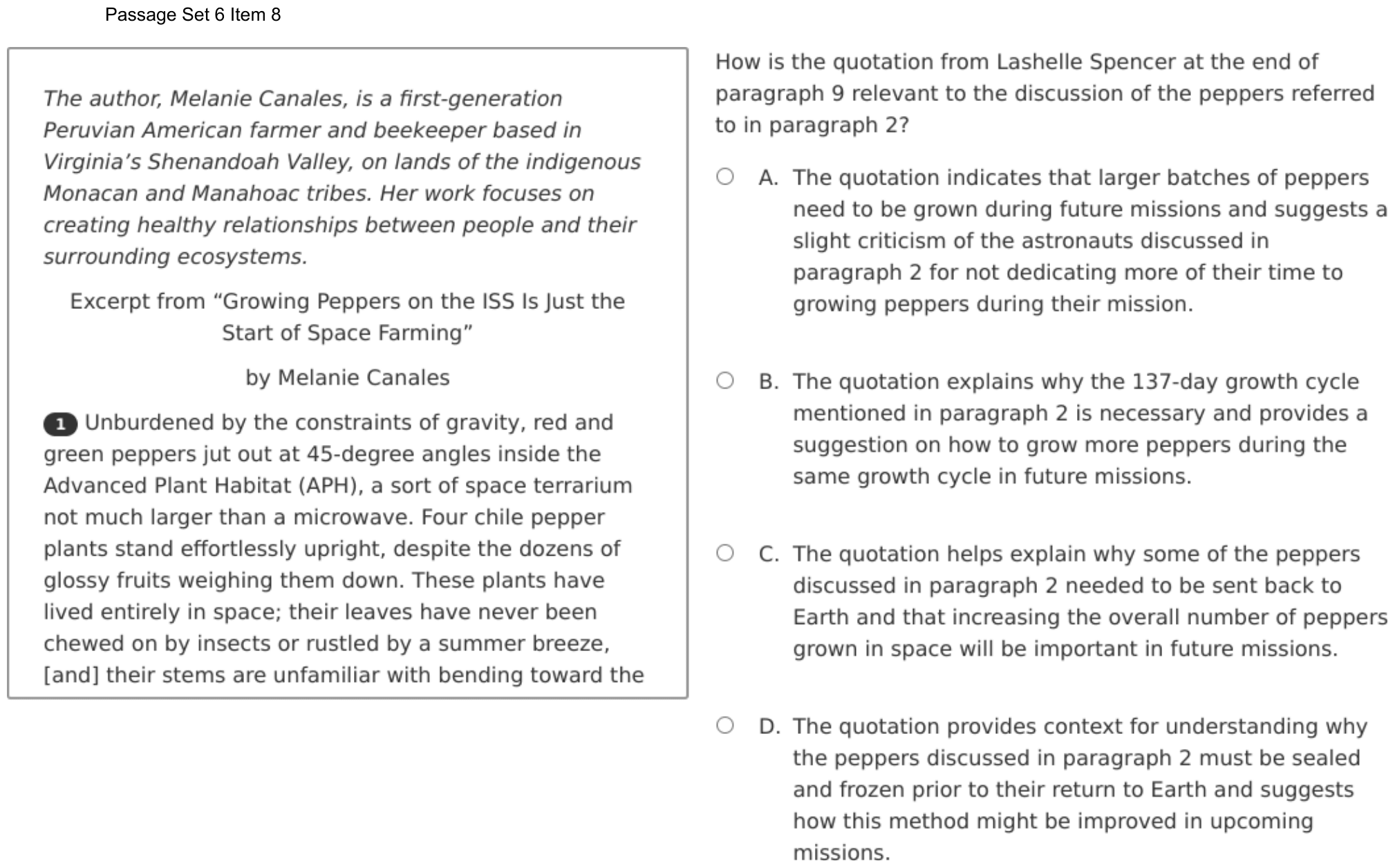
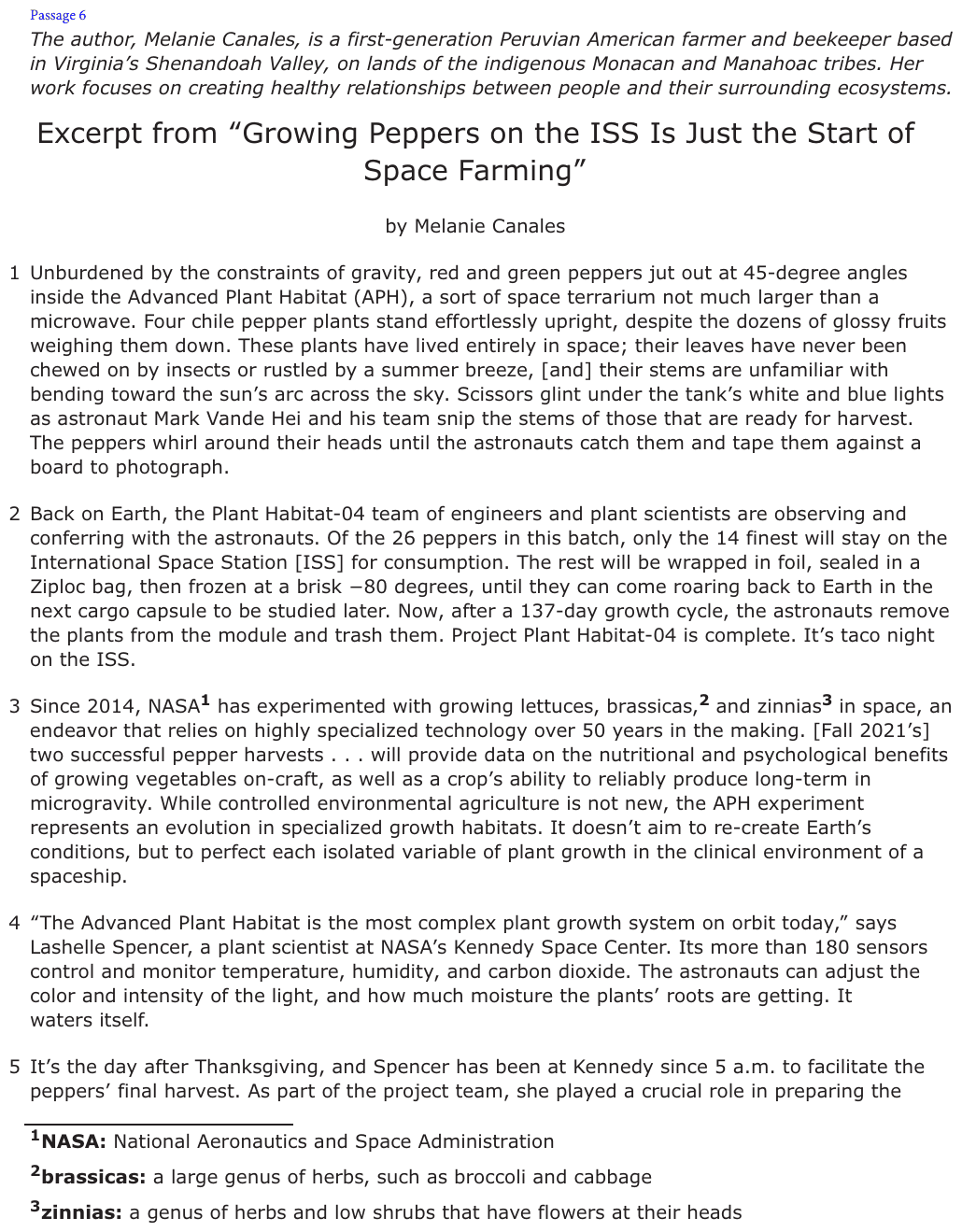
Excerpt from “Growing Peppers on the ISS Is Just the Start of Space Farming”
by Melanie Canales
The author, Melanie Canales, is a first-generation Peruvian American farmer and beekeeper based in Virginia’s Shenandoah Valley, on lands of the indigenous Monacan and Manahoac tribes. Her work focuses on creating healthy relationships between people and their surrounding ecosystems.
Unburdened by the constraints of gravity, red and green peppers jut out at 45-degree angles inside the Advanced Plant Habitat (APH), a sort of space terrarium not much larger than a microwave. Four chile pepper plants stand effortlessly upright, despite the dozens of glossy fruits weighing them down. These plants have lived entirely in space; their leaves have never been chewed on by insects or rustled by a summer breeze, [and] their stems are unfamiliar with bending toward the sun’s arc across the sky. Scissors glint under the tank’s white and blue lights as astronaut Mark Vande Hei and his team snip the stems of those that are ready for harvest. The peppers whirl around their heads until the astronauts catch them and tape them against a board to photograph.
Back on Earth, the Plant Habitat-04 team of engineers and plant scientists are observing and conferring with the astronauts. Of the 26 peppers in this batch, only the 14 finest will stay on the International Space Station [ISS] for consumption. The rest will be wrapped in foil, sealed in a Ziploc bag, then frozen at a brisk −80 degrees, until they can come roaring back to Earth in the next cargo capsule to be studied later. Now, after a 137-day growth cycle, the astronauts remove the plants from the module and trash them. Project Plant Habitat-04 is complete. It’s taco night on the ISS.
Since 2014, NASA1 has experimented with growing lettuces, brassicas,2 and zinnias3 in space, an endeavor that relies on highly specialized technology over 50 years in the making. [Fall 2021’s] two successful pepper harvests . . . will provide data on the nutritional and psychological benefits of growing vegetables on-craft, as well as a crop’s ability to reliably produce long-term in microgravity. While controlled environmental agriculture is not new, the APH experiment represents an evolution in specialized growth habitats. It doesn’t aim to re-create Earth’s conditions, but to perfect each isolated variable of plant growth in the clinical environment of a spaceship.
“The Advanced Plant Habitat is the most complex plant growth system on orbit today,” says Lashelle Spencer, a plant scientist at NASA’s Kennedy Space Center. Its more than 180 sensors control and monitor temperature, humidity, and carbon dioxide. The astronauts can adjust the color and intensity of the light, and how much moisture the plants’ roots are getting. It waters itself.
It’s the day after Thanksgiving, and Spencer has been at Kennedy since 5 a.m. to facilitate the peppers’ final harvest. As part of the project team, she played a crucial role in preparing the seeds that were sent hurtling into space in June and guiding the astronauts through maintaining the plants in orbit. . . . Though astronauts can spend upwards of 100 days in space, their on-mission meals come dehydrated and pre-packaged; their vitamins and minerals are isolated in supplements, which lose nutritional value the longer they’re stored. Spencer’s goal is to create the conditions necessary for cultivating healthy plants in space, so those plants can sustain healthy astronauts on long-term missions. Astronaut food is great, she says—“especially the shrimp cocktail. But you’re missing that crunch. You’re missing that fresh pop of flavor, the green flavor that’s not there in that packaged food.”
The sensory experience of growing productive crops can also help mitigate4 the psychological effects of long-term space travel. . . . Spencer says the team cracked open the door of the APH every day to observe their vegetable companions with all the tenderness of home gardeners. When harvest day came, they batted their bounty around the ISS, taking selfies and delighting in watching the fruits pirouetting around the spacecraft. . . .
“We were thinking no heat, so that [the peppers] wouldn’t be dangerous, but maybe the astronauts need a little spice in their life,” says Paul Bosland, who along with his colleagues at the Chile Pepper Institute genetically engineered5 the NuMex Española Improved chile pepper seeds grown in Plant Habitat-04. . . .
Working with NASA, Bosland cultivated a variety that could accommodate both the nutritional needs of astronauts as well as the logistics of growing a plant in space. . . .
. . . The experiment is helping gather the data necessary to determine the nutritional content of crops grown in space, and therefore how many people they can feed, and for how long. Though much is still unknown, Spencer is certain of one thing that future astronauts will need to do: “I think in an optimal world, a scientist like me would say that they would be growing plants from day one. From the day they left to the day they came back, they would be growing them.”
From “Growing Peppers on the ISS Is Just the Start of Space Farming” by Melanie Canales from WIRED, December 21, 2021. Copyright © 2021 Condé Nast. All rights reserved.
1NASA: National Aeronautics and Space Administration
2brassicas: a large genus of herbs, such as broccoli and cabbage
3zinnias: a genus of herbs and low shrubs that have flowers at their heads
4mitigate: to make something less severe or harmful
5genetically engineered: combined parts of DNA from different plants to produce a new plant
Question
How is the quotation from Lashelle Spencer at the end of paragraph 9 relevant to the discussion of the peppers referred to in paragraph 2?
- AThe quotation indicates that larger batches of peppers need to be grown during future missions and suggests a slight criticism of the astronauts discussed in paragraph 2 for not dedicating more of their time to growing peppers during their mission.
- BThe quotation explains why the 137-day growth cycle mentioned in paragraph 2 is necessary and provides a suggestion on how to grow more peppers during the same growth cycle in future missions.
- CThe quotation helps explain why some of the peppers discussed in paragraph 2 needed to be sent back to Earth and that increasing the overall number of peppers grown in space will be important in future missions.
- DThe quotation provides context for understanding why the peppers discussed in paragraph 2 must be sealed and frozen prior to their return to Earth and suggests how this method might be improved in upcoming missions.
Show the answer
Correct answer: C
The question asks how the quotation from Lashelle Spencer at the end of paragraph 9 is relevant to the discussion of the peppers referred to in paragraph 2.
A. Incorrect. The quotation from Spencer in paragraph 9 suggests that astronauts should spend more time on growing larger and more continuous batches of peppers during long missions, but it does not criticize astronauts for discarding plants and ending the experiment after the 137-day growth cycle.
B. Incorrect. While the quotation from Spencer in paragraph 9 stresses the value of spending more time growing plants in space, it does not provide specific details about the 137-day growth cycle or offer specific methods for producing more peppers within the same time frame.
C. CORRECT. The quotation from Spencer in paragraph 9 is relevant to the discussion of the peppers on the ISS in paragraph 2 because it emphasizes the importance of expanding plant-growing efforts on future space missions. Spencer suggests that rather than ending the experiment after the 137-day growth cycle, astronauts could continually replant and replenish their food supply from the beginning to the end of a long mission.
D. Incorrect. Although the quotation from Spencer in paragraph 9 conveys the importance of dedicating more time to growing plants in space, it does not explain why the peppers were sealed and frozen, nor does it suggest how this method for preserving them might be improved.
Question analysis
This question asks how Lashelle Spencer’s quotation at the end of the space-farming excerpt, her view of what future astronauts will need to do, relates to the account in paragraph 2 of how the pepper harvest was handled. Students must connect the article’s ending to its opening, and every choice is a long two-part statement whose halves have to be checked separately.
- Grade level
- Grade 8 reading and task
- Compared with grade 7
- Above grade 7 Grade 7 readers explain how parts of a text relate, usually neighboring ones. This item links the last paragraph to the second, and its four choices run about forty words each in two parts, so it asks more than typical grade 7 work.
- Estimated difficulty
- Hard: combines ideas, needs a plan, and has more than one tempting wrong answer.
- Thinking it demands
- Depth of knowledge 3, strategic thinking · mainly analyze
- What makes it hard
- Reading between the lines moderate
- A very close wrong answer moderate
- A lot to read moderate
- Evidence in several places minor
- Evidence
- Answered from several paragraphs or stanzas
- Reading level
- Passage: about grade 10, 890 words; question and choices: about grade 16, 163 words.
- Students, last 30 days
- Not enough answers yet to show (it takes 10).
Why it is hard, traps and wrong answers (shows the answer)
Why it is hard
Each choice has one half that sounds connected to the quotation, so students must test both halves of all four. The criticism choice is the hardest to reject, since it correctly hears a call for more growing and only then misreads Spencer’s tone. The key itself is not airtight: its first half leans on the sentence before the quotation, about gathering nutrition data, so the answer is best confirmed by ruling out the others.
Reading between the lines moderate Working it out
Spencer’s quotation never mentions paragraph 2; the link is that plants grown “from day one” to “the day they came back” contrast with one 137-day batch harvested and thrown away. (Graesser, Singer & Trabasso, 1994; Kintsch, 1998)
A very close wrong answer moderate Choosing the answer
The criticism choice shares the key’s call for more growing on future missions and differs in its other half, a slight criticism of the crew that Spencer’s hopeful “in an optimal world” never makes. (Embretson & Wetzel, 1987; Gorin & Embretson, 2006; Ascalon et al., 2007)
A lot to read moderate Understanding the question
The four choices run 32 to 40 words, and each joins two claims with “and,” so eight separate statements must be checked against the quotation and paragraph 2. (Kintsch, 1998; Gorin & Embretson, 2006; Freedle & Kostin, 1993)
Evidence in several places minor Working it out
The two parts to connect are the excerpt’s second paragraph and its last sentence, with six paragraphs on the habitat, Spencer and Bosland in between. (Kirsch & Mosenthal, 1990; Gorin & Embretson, 2006)
Strategy: Put Spencer’s closing quotation into your own words and recall how the pepper project ended in paragraph 2, then weigh both halves of every choice and keep the one the quotation and its paragraph best support.
Traps
- Half right: One half of a two-part choice is right and the other is not.
- Twists what the text says: Uses the text's topic and ideas but changes what it says: who did it, how much, when, or why.
The wrong answers, classified
A Half right (King et al., 2004; Thissen, Steinberg & Fitzpatrick, 1989)
Rightly hears a call for larger, continuous harvests in “from day one,” then adds a criticism of the crew, though Spencer describes an ideal and blames no one.
B Twists what the text says (King et al., 2004)
Connects the quotation to the 137-day cycle because both concern time, but Spencer neither explains why the cycle lasted that long nor suggests packing more peppers into it.
D Twists what the text says (King et al., 2004)
Ties the quotation to the foil, sealing and freezing in paragraph 2 and to improving that method, though Spencer’s improvement is growing plants all mission long, not storing peppers.
Working it out, step by step
Figure out what the question asks
This question links the end of the article to its beginning. Spencer speaks at the end of paragraph 9. Paragraph 2 tells what happened to the peppers. You need the choice that best explains how her words connect to those peppers. Each choice has two parts, and both must be true.
Recall the peppers in paragraph 2
Paragraph 2 says only “the 14 finest” peppers stay on the ISS to eat. The rest are frozen and sent “back to Earth in the next cargo capsule to be studied later.” Then, “after a 137-day growth cycle, the astronauts remove the plants from the module and trash them.” So the crew grew one batch, ate some, sent some home and threw the plants away.
Read the end of paragraph 9
Just before Spencer speaks, paragraph 9 says: “The experiment is helping gather the data necessary to determine the nutritional content of crops grown in space, and therefore how many people they can feed, and for how long.” Then Spencer says that in “an optimal world,” meaning the best possible world, astronauts “would be growing plants from day one.” She adds: “From the day they left to the day they came back, they would be growing them.”
Connect the two parts
The peppers sent home are studied. That gives the data paragraph 9 describes: how healthy space crops are and how many people they can feed. Spencer’s plan needs that data. You must know what a crop can feed before you plan meals for a whole trip. Her words also point to the future. Instead of one batch that ends in the trash, crews would grow plants all trip long. That means many more peppers.
Check each choice
- A is wrong. Spencer wants more growing, but she doesn’t criticize the crew. “In an optimal world” describes a hope, not a complaint.
- B is wrong. She never says why the cycle took 137 days. She doesn’t suggest squeezing more peppers into it, either.
- C is right. The returned peppers give the data, and growing “from day one” means more peppers in the future.
- D is wrong. She says nothing about freezing the peppers or a better way to store them.
Watch out: A gets the first half right. The criticism in its second half is what makes it wrong.
Choose the answer
Her words explain why some peppers went home to be studied and why more growing matters next time. So the answer is C, “The quotation helps explain why some of the peppers discussed in paragraph 2 needed to be sent back to Earth and that increasing the overall number of peppers grown in space will be important in future missions.”
Why this answer and not the closest wrong one
A is the closest wrong answer. Like C, it hears Spencer calling for more plants on future trips. But A also says she criticizes the astronauts. She doesn’t. She calmly describes a perfect world. C keeps the right half and adds a link the paragraph supports: the peppers sent home give the data.
More questions like this
The original DOE question
The passage “Excerpt from “Growing Peppers on the ISS Is Just the Start of Space Farming”” as printed (pages 50–51)
Question 4 of 6
2024 Test B Math, question 28Question
A community center has two 30-member exercise groups. The director recorded the ages of each group’s members in the box plots.
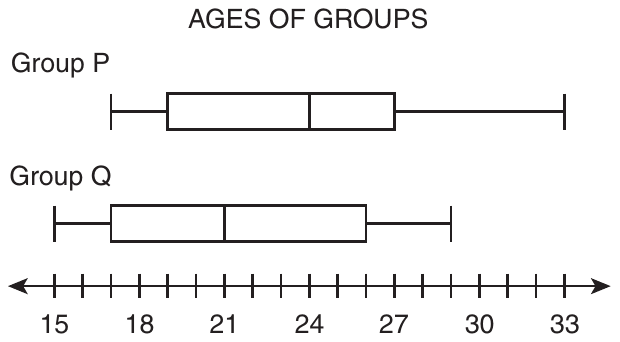
Which statement about the two groups can be verified based on the box plots?
- ABoth groups have at least one member who is exactly 29 years old.
- BGroup P has more members who are at least 17 years old than Group Q has.
- CBoth groups have an equal number of members who are between 21 and 24 years old.
- DGroup Q has fewer members who are between 19 and 27 years old than Group P has.
Show the answer
Correct answer: B
Groups P and Q have an equal number of members. All the members of Group P are 17 or older, but only about of the members of Group Q are 17 or older.
Question analysis
Box plots show the ages of the members of two 30-member exercise groups at a community center, Group P and Group Q. Students decide which statement comparing the groups can be verified from the plots alone. The challenge is knowing what a box plot guarantees about individual ages and counts, and what it leaves unknown.
- NYS standards
- Grade level
- Grade 7 content, by NYS standard
- Compared with grade 7
- Above grade 7 Grade 7 students read box plots and compare medians and spreads. Deciding which claims two box plots can prove, from what the five key values guarantee about counts, is a harder reasoning task than typical grade 7 work.
- Estimated difficulty
- Hard: combines ideas, needs a plan, and has more than one tempting wrong answer.
- Thinking it demands
- Depth of knowledge 3, strategic thinking · mainly evaluate
- What makes it hard
- Every choice must be checked major
- Something you must already know moderate
- Reading a figure, table or graph moderate
- Solution
- 3 steps
- Reading level
- Question and choices: about grade 5, 91 words.
- Students, last 30 days
- Not enough answers yet to show (it takes 10).
Why it is hard, traps and wrong answers (shows the answer)
Why it is hard
This is a question about evidence: the right statement is the only one the box plots guarantee, while the others may or may not be true. Students who treat the plots as pictures of every member, assuming ages fill each whisker or spread evenly through each box, find support for claims that cannot be checked. Asking what must hold for any 30 ages with these summaries separates the verifiable claim from the merely plausible ones.
Every choice must be checked major Choosing the answer
Three of the statements are not false but unverifiable, so each must be tested against what the five-number summaries guarantee, and none can be dismissed at a glance. (Embretson & Wetzel, 1987)
Something you must already know moderate Working it out
Students must know that the minimum and maximum are actual ages, that each quarter of a plot holds about a quarter of the 30 members, and that a whisker shows nothing in between. (Anderson & Krathwohl, 2001)
Reading a figure, table or graph moderate Understanding the question
The scale is labeled only every 3 years, so values such as 17, 19, 26 and 29 have to be read from unlabeled ticks on two separate plots. (Lesh, Post & Behr, 1987; Kirsch & Mosenthal, 1990)
Strategy: List each group's minimum, first quartile, median, third quartile and maximum, then test every statement against only what those five values guarantee about the 30 ages.
Traps
- Misunderstands the concept: A wrong belief about a concept: that percents can be added, that area grows like length, that averages can be averaged, that a bigger denominator means a bigger fraction.
- Numbers taken from the question: Combines the numbers in the question without a model of the situation, or is simply a number that appears in the question.
The wrong answers, classified
A Misunderstands the concept (Smith, diSessa & Roschelle, 1993; De Bock et al., 1998; Ni & Zhou, 2005)
Sees that Group Q's maximum is exactly 29 and that 29 also lies in Group P's upper whisker, assuming someone in Group P is that age.
C Numbers taken from the question (Hegarty, Mayer & Monk, 1995)
Matches the two medians, 21 and 24, and assumes the stretch between them holds the same number of members in both groups.
D Misunderstands the concept (Smith, diSessa & Roschelle, 1993; De Bock et al., 1998; Ni & Zhou, 2005)
Knows Group P's box from 19 to 27 holds half its members, then assumes ages spread evenly so Group Q has fewer there, which its plot cannot show.
Worked solution, step by step
Formulas used
- Members in each part of a box plot
- n is the number of members in a group, here 30. A box plot splits the data into four parts at the minimum, Q1, the median, Q3 and the maximum. Each part holds about one fourth of the data. It does not show how the ages spread out inside a part.
Read the two box plots
A box plot shows five numbers. The minimum is the youngest age, and the maximum is the oldest. Q1 is the left edge of the box, and Q3 is the right edge. The median is the line inside the box.
Group Min Q1 Median Q3 Max P 17 19 24 27 33 Q 15 17 21 26 29 Each group has 30 members.
Know what can be verified
To verify a statement means to know for sure that it is true. A box plot shows only five numbers, not every age. The minimum and maximum are real ages of real members. The other ages are hidden inside the box and whiskers.
Check choice B
In Group P, the youngest member is 17. So all 30 members are at least 17. In Group Q, the youngest member is 15, and 15 is under 17. So at most 29 members of Group Q are at least 17.
Group P has 30 such members, and Group Q has 29 or fewer. So choice B is true for sure.
Rule out choices A and C
A: Group Q’s oldest member is 29, so Group Q has a 29-year-old. But in Group P, 29 is inside the right whisker. A whisker does not show single ages. Watch out: 29 is in Group P’s range, but maybe no one in Group P is exactly 29.
C: The plots do not show how many members are between 21 and 24 in either group.
Rule out choice D and answer
Group P’s box, from 19 to 27, is two of its four parts.
So about 15 members of Group P are between 19 and 27. But 19 and 27 fall in the middle of Group Q’s parts, and ages inside a part can bunch up in any way. Group Q could have more or fewer. Watch out: D assumes the ages are spread out evenly, and a box plot never tells you that.
So the answer is B.
Check your answer
Choice B uses only the two minimums, which are real ages. Group P’s youngest member is 17, and Group Q’s is 15. That alone proves it. Each other choice needs ages inside a box or whisker, which a box plot does not show.
More questions like this
The original DOE question
Question 5 of 6
2024 Test B Math, question 49Question
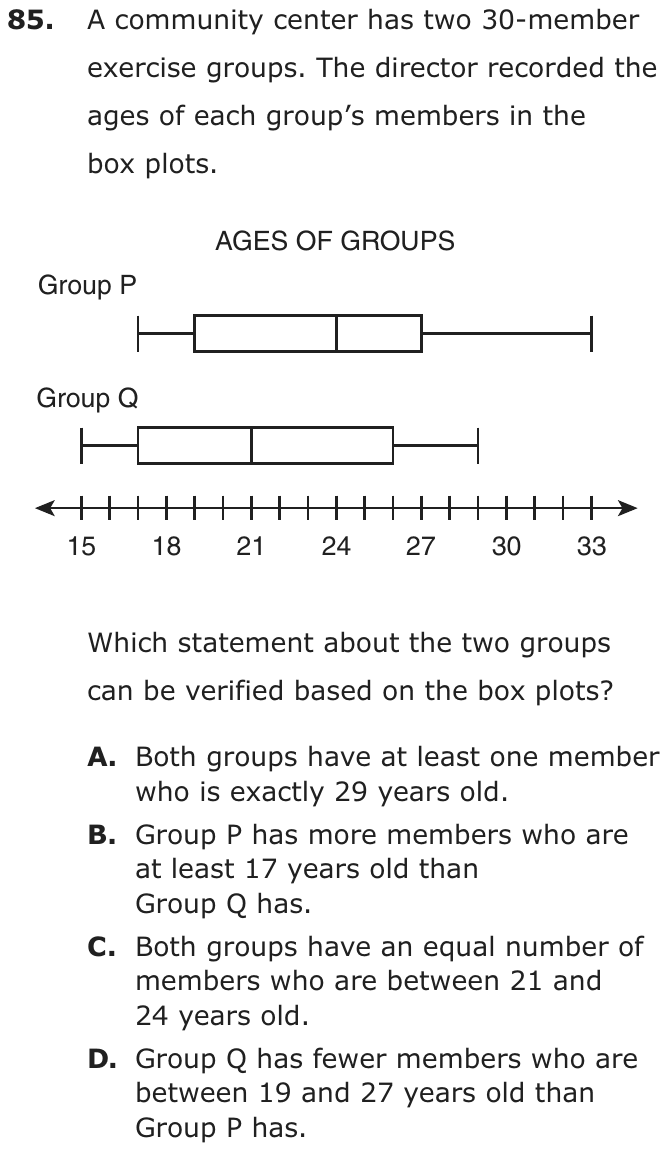
Suppose that w, x, y, and z are integers, none of which are zero. Under which set of conditions would the product always be positive?
- Ax is positive and w is positive.
- Bx is negative and w is negative.
- Cy is negative and z is negative.
- Dx and y are negative, and z and w are positive.
Show the answer
Correct answer: C
First, analyze the role of each variable in the expression .
will always be a positive number.
y can be a positive or a negative number.
can be a positive or a negative number.
will always be a positive number.
The expressions and will always be positive. Therefore, making the values of y and z negative would result in the expression being positive, since a negative multiplied by a negative is positive. Thus the given product would always be positive.
Question analysis
Four nonzero integers appear in a product that includes a square, a cube and an absolute value. Students choose the set of conditions that makes the product positive every time. It tests the sign rules for multiplication together with exponents and absolute value, and the trap is judging the sign by counting negative variables without looking at what is done to each.
- NYS standards
- Grade level
- Grade 7 content, by NYS standard
- Compared with grade 7
- Above grade 7 Grade 7 students learn sign rules for products of signed numbers. Here they must reason about four unknown integers under an even power, an odd power and an absolute value, and decide what is always true, which is more abstract than typical grade 7 work.
- Estimated difficulty
- Hard: combines ideas, needs a plan, and has more than one tempting wrong answer.
- Thinking it demands
- Depth of knowledge 2, skills and concepts · mainly analyze
- What makes it hard
- Variables instead of numbers moderate
- Every choice must be checked moderate
- Something you must already know minor
- Solution
- 3 steps
- Reading level
- Question and choices: about grade 6, 58 words.
- Students, last 30 days
- Not enough answers yet to show (it takes 10).
Why it is hard, traps and wrong answers (shows the answer)
Why it is hard
One insight decides the question: x² and |w| are positive whatever x and w are, so only the signs of y and z³ matter. Students who count negative letters instead of negative factors pick conditions that look balanced but leave y as the only negative factor. Students who test a single set of values can be fooled by a choice that leaves y and z unspecified.
Variables instead of numbers moderate Understanding the question
There are four variables and no numbers, and always positive must hold for every allowed value, so one test case can rule a choice out but never confirm it. (Koedinger & Nathan, 2004; Enright, Morley & Sheehan, 2002)
Every choice must be checked moderate Choosing the answer
Each set of conditions has to be checked against all four factors; the first two fix only x and w and leave y and z free to make the product negative. (Embretson & Wetzel, 1987)
Something you must already know minor Working it out
Students must know that a nonzero square and an absolute value are always positive, while an odd power such as z³ keeps the sign of z. (Anderson & Krathwohl, 2001)
Strategy: Work out, factor by factor, which signs each part of the product can take, then test each set of conditions against every factor rather than counting negatives.
Traps
- Negatives and direction: Arithmetic with negative numbers, the order of a subtraction, or direction on a number line. (Moving a term across the equals sign without changing its sign is a faulty procedure.)
- Misunderstands the concept: A wrong belief about a concept: that percents can be added, that area grows like length, that averages can be averaged, that a bigger denominator means a bigger fraction.
The wrong answers, classified
A Checks only one number (Schoenfeld, 1985)
Tests the choice with every variable positive, so the product is positive and it seems to work; y = −1 with z = 1 would make it negative.
B Misunderstands the concept (Smith, diSessa & Roschelle, 1993; De Bock et al., 1998; Ni & Zhou, 2005)
Pairs the negatives x and w as if they must cancel, not seeing that x² and |w| are positive anyway, so y and z still decide.
D Negatives and direction (Brown & Burton, 1978)
Counts two negative letters, x and y, as an even number of negatives, but x² is positive, so y is the only negative factor.
Worked solution, step by step
Formulas used
- Signs in multiplication
- a and b are positive numbers, so −a and −b are negative. A negative times a negative is positive. A negative times a positive is negative. So a product is positive when it has an even number of negative factors.
Sort out the question
w, x, y and z are integers, meaning whole numbers or their negatives. None of them is 0. The product means .
You need the conditions that make the product positive every time, for every number that fits them.
Look at x squared and |w|
means x × x. Two positives or two negatives multiply to a positive. So is always positive.
is the absolute value of w, its distance from 0. It is always positive, since w is not 0.
So x and w never change the sign of the product. Their signs do not matter.
Look at y and z cubed
y can be positive or negative. means z × z × z, and it has the same sign as z. For example, .
So the sign of the whole product is the sign of . It depends only on y and z.
Test each choice
- A and B say nothing about y and z. If y = −1 and z = 1, the product is negative. So they do not always work.
- C: y is negative, and is negative. A negative times a negative is positive. This always works.
- D: y is negative and z is positive. So the product is always negative.
Watch out: D has two negative letters, x and y. But is positive anyway, so y is the only negative factor.
So the answer is C, y is negative and z is negative.
Check your answer
Try numbers for C. Let x = −2, y = −3, z = −1 and w = −5. Then , which is positive. Even with x and w negative, the product stays positive.
More questions like this
The original DOE question
Question 6 of 6
2018 Test B Math, question 50Question
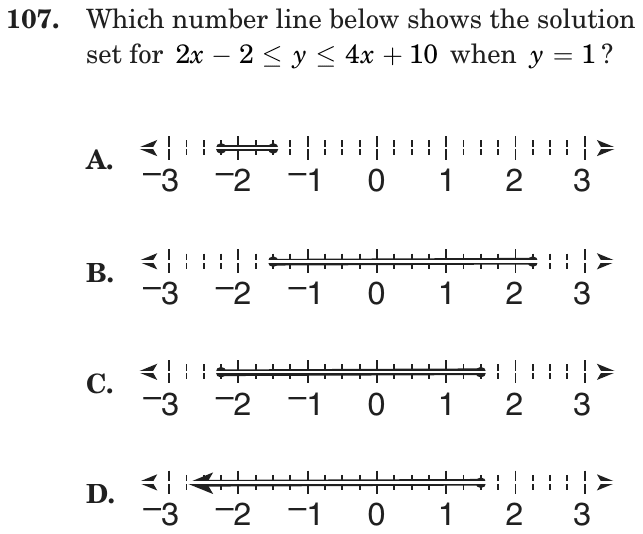
Which number line below shows the solution set for when ?
- A

- B

- C

- D

Show the answer
Correct answer: C
Separate the compound inequality into two pieces:
and
Substitute into each inequality and solve for :
The solution is the number line that shows that is greater than or equal to and less than or equal to .
Question analysis
Students substitute y = 1 into the compound inequality 2x − 2 ≤ y ≤ 4x + 10 and pick the number line that shows the values of x that work. It tests solving two-step inequalities and graphing the solution. The four graphs differ in their endpoints and in whether the shading is closed off on both sides, so each endpoint has to be found exactly.
- Grade level
- Grade 7 content, by NYS standard
- Compared with grade 7
- Above grade 7 Grade 7 students solve and graph one two-step inequality. This compound inequality in two variables requires substituting, solving two inequalities and combining them into one interval, a step toward algebra 1.
- Estimated difficulty
- Hard: combines ideas, needs a plan, and has more than one tempting wrong answer.
- Thinking it demands
- Depth of knowledge 2, skills and concepts · mainly apply
- What makes it hard
- Many steps moderate
- Error-prone arithmetic moderate
- Reading a figure, table or graph moderate
- A very close wrong answer minor
- Solution
- 4 steps
- Reading level
- Question and choices: about grade 9, 12 words.
- Students, last 30 days
- Not enough answers yet to show (it takes 10).
Why it is hard, traps and wrong answers (shows the answer)
Why it is hard
Substituting y = 1 is easy; the work is solving two inequalities and matching a fractional interval to a graph. Students who solve only the left inequality find a matching ray, and sign slips on either endpoint produce intervals that shift or flip across zero. The graphs differ by quarter-unit ticks, so reading them carefully matters as much as the algebra.
Many steps moderate Working it out
The compound inequality must be split into 2x − 2 ≤ 1 and 1 ≤ 4x + 10, each solved for x, and the two results joined into one interval. (Daniel & Embretson, 2010; Enright, Morley & Sheehan, 2002)
Error-prone arithmetic moderate Working it out
Both endpoints are fractions, 3/2 and −9/4, and the second comes from dividing −9 by 4, where a lost sign moves the endpoint across zero. (Brown & Burton, 1978; Junker & Sijtsma, 2001)
Reading a figure, table or graph moderate Understanding the question
The graphs are marked in quarter units, so −2 1/4 and 1 1/2 have to be found by counting small ticks between the labeled integers. (Lesh, Post & Behr, 1987; Kirsch & Mosenthal, 1990)
A very close wrong answer minor Choosing the answer
The ray ending at 1 1/2 looks almost like the right segment, sharing its right end; only the left end, an arrow instead of a closed dot at −2 1/4, separates them. (Embretson & Wetzel, 1987; Gorin & Embretson, 2006; Ascalon et al., 2007)
Strategy: Split the compound inequality into two separate inequalities, solve each for x after putting 1 in for y, then combine the two results into a single interval and match it to a graph.
Traps
- Negatives and direction: Arithmetic with negative numbers, the order of a subtraction, or direction on a number line. (Moving a term across the equals sign without changing its sign is a faulty procedure.)
- Stops one step early: A choice is a number from partway through the solution.
The wrong answers, classified
A Negatives and direction (Brown & Burton, 1978)
Gets the left endpoint −2 1/4 right but gives the right endpoint the wrong sign, ending the segment at −1 1/2 instead of 1 1/2.
B Negatives and direction (Brown & Burton, 1978)
Gives both endpoints the opposite sign, so the segment runs from −1 1/2 to 2 1/4, the true interval reflected across 0.
D Stops one step early (King et al., 2004; Gierl et al., 2017)
Solves only 2x − 2 ≤ 1 and graphs every x up to 1 1/2, leaving out the lower bound that 1 ≤ 4x + 10 sets.
Worked solution, step by step
Formulas used
- Solving an inequality
- a, b and c are numbers. The sign ≤ means is less than or equal to. Adding or subtracting the same number c on both sides keeps it true. Dividing both sides by the same positive number also keeps it true.
Sort out the question
The sign means is less than or equal to. An inequality compares two amounts that may not be equal. The statement is two inequalities joined together. You put 1 in place of . Then you need every that makes both parts true.
Split it into two parts
With , the statement becomes two inequalities.
The answer must make both of them true at the same time.
Solve the first part
Add 2 to both sides. Then divide both sides by 2.
So is at most . This is the right end of the answer.
Watch out: the right end is a positive number. Choice A ends its bar at instead.
Solve the second part
Subtract 10 from both sides. Then divide both sides by 4.
So is at least . This is the left end.
Watch out: keep the minus sign. Choice B uses the opposite signs and ends at .
Put the two parts together
The answer is every number from to , with both ends included. On the graph, that is a solid bar with a dot at each end. The small ticks are quarters. So count 1 tick left of −2 and 2 ticks right of 1.
Watch out: choice D uses only the first part. Its arrow goes left forever.
Give the answer
Choice C shows a bar from to , with dots at both ends. So the answer is C.
Check your answer
Test a number on the bar, like . Then and , and 1 is between them. Now test , which is off the bar. Then , and 1 is not less than −2. So the bar must stop on the left, which rules out D.
More questions like this
The original DOE question