3 English and 3 math
Here are 6 random questions to try. Takers earning below 75% are unlikely to receive an offer. You have 1 minute 48 seconds per question on the real exam.
Question 1 of 6
2024 Test A English, question 55Passage Excerpt from “It’s Time to Stop Thinking That All Non-Native Species Are Evil”
Excerpt from “It’s Time to Stop Thinking That All Non-Native Species Are Evil”
by Emma Marris
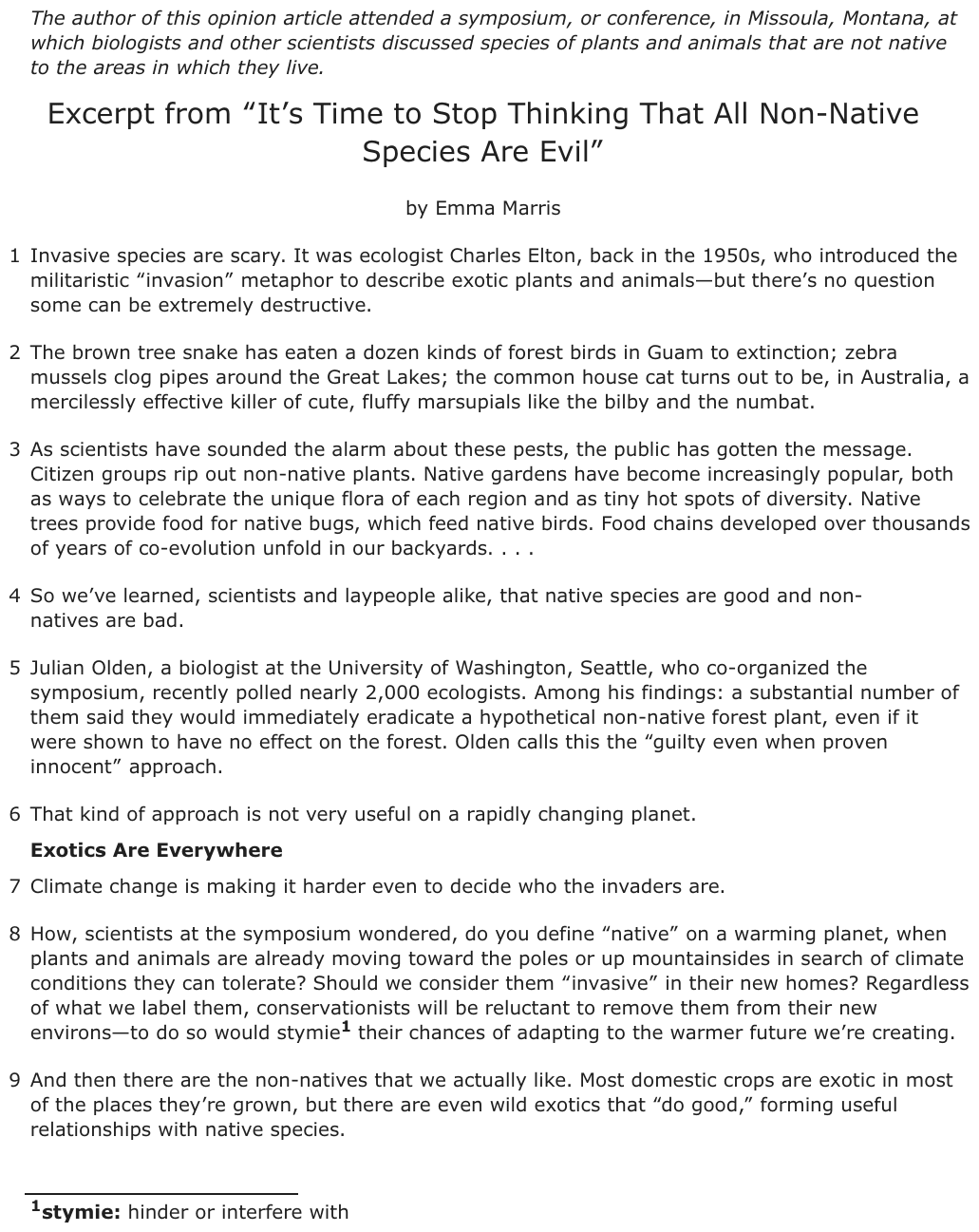
The author of this opinion article attended a symposium, or conference, in Missoula, Montana, at which biologists and other scientists discussed species of plants and animals that are not native to the areas in which they live.
Invasive species are scary. It was ecologist Charles Elton, back in the 1950s, who introduced the militaristic “invasion” metaphor to describe exotic plants and animals—but there’s no question some can be extremely destructive.
The brown tree snake has eaten a dozen kinds of forest birds in Guam to extinction; zebra mussels clog pipes around the Great Lakes; the common house cat turns out to be, in Australia, a mercilessly effective killer of cute, fluffy marsupials like the bilby and the numbat.
As scientists have sounded the alarm about these pests, the public has gotten the message. Citizen groups rip out non-native plants. Native gardens have become increasingly popular, both as ways to celebrate the unique flora of each region and as tiny hot spots of diversity. Native trees provide food for native bugs, which feed native birds. Food chains developed over thousands of years of co-evolution unfold in our backyards. . . .
So we’ve learned, scientists and laypeople alike, that native species are good and non-natives are bad.
Julian Olden, a biologist at the University of Washington, Seattle, who co-organized the symposium, recently polled nearly 2,000 ecologists. Among his findings: a substantial number of them said they would immediately eradicate a hypothetical non-native forest plant, even if it were shown to have no effect on the forest. Olden calls this the “guilty even when proven innocent” approach.
That kind of approach is not very useful on a rapidly changing planet.
Exotics Are Everywhere
Climate change is making it harder even to decide who the invaders are.
How, scientists at the symposium wondered, do you define “native” on a warming planet, when plants and animals are already moving toward the poles or up mountainsides in search of climate conditions they can tolerate? Should we consider them “invasive” in their new homes? Regardless of what we label them, conservationists will be reluctant to remove them from their new environs—to do so would stymie1 their chances of adapting to the warmer future we’re creating.
And then there are the non-natives that we actually like. Most domestic crops are exotic in most of the places they’re grown, but there are even wild exotics that “do good,” forming useful relationships with native species.
Edwin Grosholz of the University of California, Davis, told the recent symposium about one such relationship. On beaches in his state, non-native spartina grass has become important habitat for the endangered California clapper rail, a plump shorebird with a downward curving bill more at home on land than in the air. A project to rip out and poison the spartina—which grows in dense swaths that exclude many other shorebirds—saw clapper rail numbers go tumbling downward.
There are other examples like that. The endangered southwestern willow flycatcher nests in “invasive” tamarisk shrubs. Many native (and beautiful) Hawaiian flowers are now pollinated by the Japanese white-eye bird—because the native pollinators have been driven extinct by other non-native species.
Should we impose further risk on already endangered natives by severing these relationships? Or should we admire the resilience of nature and let such “well-behaved” exotics stay? . . .
Leave them alone, more and more conservationists are arguing, and stop focusing obsessively on categorizing species as native or non-native. Mark Davis, an ecologist at Macalester College in St. Paul, Minnesota, once considered himself an “invasion biologist”—but not anymore. “I am actively trying to get the field to retire the invader narrative,” he said in Missoula.
A Good Thing, Not the Only Thing
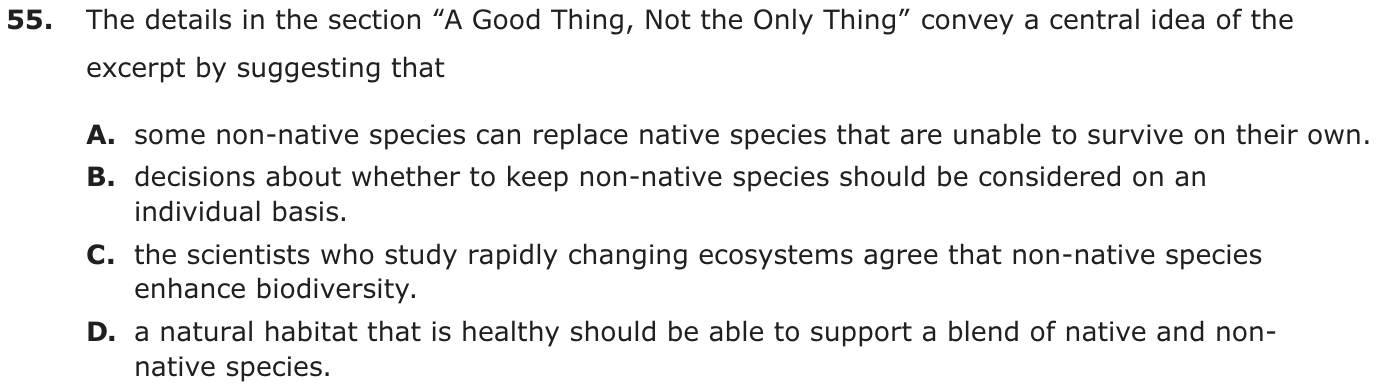
After all, nativeness is just one environmental value, and arguably not as important as preventing extinctions and preserving biodiversity. In some cases we can best serve biodiversity by leaving the non-natives alone or even—brace yourself, now—introducing them on purpose.
This is the thinking behind, for example, installing the Aldabra tortoise on the islands of Mauritius. The islands lost their own large tortoises, and the fruiting plants that formerly had their seeds moved around by these fruit-loving reptiles have been on the decline. A tortoise that’s related to the island’s large tortoises—a non-native from the Seychelles in the Indian Ocean that was intentionally introduced in 2004—is now handling some of that work.
Most of the time, for the time being, conserving species still means focusing on supporting them in their historical habitats, planting natives and removing non-natives. We can and should do that in places where it is feasible and important to us.
From “It’s Time to Stop Thinking That All Non-Native Species Are Evil” by Emma Marris from NATIONAL GEOGRAPHIC MAGAZINE, July 24, 2014. Copyright © 2014 by National Geographic Society.
1stymie: hinder or interfere with
Question
The details in the section “A Good Thing, Not the Only Thing” convey a central idea of the excerpt by suggesting that
- Asome non-native species can replace native species that are unable to survive on their own.
- Bdecisions about whether to keep non-native species should be considered on an individual basis.
- Cthe scientists who study rapidly changing ecosystems agree that non-native species enhance biodiversity.
- Da natural habitat that is healthy should be able to support a blend of native and non-native species.
Show the answer
Correct answer: B
The question asks how the details in the section “A Good Thing, Not the Only Thing” convey a central idea of the excerpt.
A. Incorrect. While paragraph 15 does discuss introducing non-native Aldabra tortoises to replace native tortoises that no longer exist, the real point of this section is to show that non-native species can sometimes help support native species that still exist but are struggling. In this case, the Aldabra tortoises are now moving seeds around for the fruiting plants on the islands where the tortoises have been introduced.
B. CORRECT. This section discusses situations in which non-native species should be kept (as in the example of the Aldabra tortoises in paragraph 15) but also asserts that “most of the time . . . conserving species still means focusing on supporting them in their historical habitats, planting natives and removing non-natives” (paragraph 16). This section makes the point that the issue of non-natives needs to be considered on a case-by-case basis.
C. Incorrect. This section does not claim that non-native species always or even usually enhance biodiversity; rather, it states that “in some cases we can best serve biodiversity by leaving the non-natives alone or even—brace yourself, now—introducing them on purpose” (paragraph 14), later adding that “most of the time . . . conserving species still means focusing on supporting them in their historical habitats, planting natives and removing non-natives” (paragraph 16).
D. Incorrect. While the section happens to give a good example of a habitat that supports both native and non-native species (the islands of Mauritius), it never suggests that being able to do so is a defining characteristic of healthy habitats.
Question analysis
This central-idea question asks how the details in the final section of an article on non-native species, titled “A Good Thing, Not the Only Thing,” convey a central idea of the excerpt. Students must sum up the section as a whole, including its example of a tortoise brought to the islands of Mauritius, and match it to the article's larger argument.
- Grade level
- Grade 8 reading and task
- Compared with grade 7
- Above grade 7 Explaining how a section conveys a central idea is grade 7 work, but this section mixes an argument, an example and a closing paragraph, and the choices differ in how far they generalize from it, which demands more than typical.
- Estimated difficulty
- Hard: combines ideas, needs a plan, and has more than one tempting wrong answer.
- Thinking it demands
- Depth of knowledge 3, strategic thinking · mainly understand
- What makes it hard
- The right answer is reworded moderate
- Evidence in several places moderate
- Evidence
- Answered from several paragraphs or stanzas
- Reading level
- Passage: about grade 11, 815 words; question and choices: about grade 11, 82 words.
- Students, last 30 days
- Not enough answers yet to show (it takes 10).
Why it is hard, traps and wrong answers (shows the answer)
Why it is hard
The section's most memorable content is an example, the Aldabra tortoise doing the work of the islands' lost tortoises, and a choice built on it is the strongest pull. The central idea sits instead in the qualifiers at the start and end of the section: some cases favor non-natives, most still call for removing them. Students who summarize all three paragraphs in a sentence, including the last, arrive at the case-by-case reading.
The right answer is reworded moderate Choosing the answer
The right choice's “on an individual basis” appears nowhere in the section, while the wrong choices echo it: a non-native standing in for natives, “biodiversity”, natives alongside non-natives. (Freedle & Kostin, 1993; Kirsch & Mosenthal, 1990)
Evidence in several places moderate Working it out
The case-by-case idea comes only from joining paragraph 14's “In some cases” to paragraph 16's “Most of the time” and “where it is feasible and important to us”. (Kirsch & Mosenthal, 1990; Gorin & Embretson, 2006)
Strategy: Sum up the section's three paragraphs in one sentence of your own, including its example and its final paragraph, then compare that sentence with each choice.
Traps
- Too narrow: A single detail offered as the central idea or a summary, or a summary that keeps minor details and leaves out an essential part.
- Too broad or too strong: A choice overstates, generalizes, or uses absolute words the text does not support.
- Reads too much in: A reasonable-sounding conclusion that goes further than the text allows.
The wrong answers, classified
A Too narrow (King et al., 2004)
Builds on the Aldabra tortoise standing in for Mauritius's lost tortoises, a single example, and misses the closing point that most conservation still means removing non-natives.
C Too broad or too strong (King et al., 2004)
Turns “In some cases” into a consensus that non-natives enhance biodiversity, though the section limits the claim and the article shows ecologists divided over it.
D Reads too much in (Graesser, Singer & Trabasso, 1994)
Draws a rule about healthy habitats from the Mauritius example, though the section never defines a healthy habitat or says it should hold a mix of species.
Working it out, step by step
Know what the question asks
A section is a part of an article under its own heading. This one runs from paragraph 14 to paragraph 16. You need to sum up the whole section, including its last paragraph. Then match that summary to a central idea.
Read paragraph 14
It says that “in some cases” we help nature most “by leaving the non-natives alone.” We might even bring them in “on purpose.” The words “in some cases” are the key. They mean sometimes, not always.
Read the example and the ending
Paragraph 15 gives an example. A non-native tortoise was brought to Mauritius to spread the seeds of fruiting plants. Then paragraph 16 says that “most of the time,” saving species still means “planting natives and removing non-natives.” We should do that “where it is feasible and important to us.” Feasible means possible.
Put the section together
Sometimes it is best to keep a non-native species. Most of the time it is best to remove it. So each case has to be judged on its own. That is what “on an individual basis” means.
Check each choice
- B fits: deciding case by case matches both “in some cases” and “most of the time.”
- A is wrong because the tortoise is one example, and the section ends by saying removal is still the usual choice.
- C is wrong because the section never says scientists agree, and “in some cases” is far from always.
- D is wrong because the section never says what a healthy habitat should hold.
Watch out: A is built on the section’s most memorable detail. But the main idea comes from the words that limit the claim.
Choose the answer
The section says to keep non-natives in some cases and remove them in others. So the answer is B.
Why this answer and not the closest wrong one
A comes closest, because the Aldabra tortoise really does take over work the lost tortoises once did. But that is one case. The section ends by saying that most of the time we still remove non-natives. B covers both sides: some cases call for keeping them, and others call for removing them.
More questions like this
The original DOE question
The passage “Excerpt from “It’s Time to Stop Thinking That All Non-Native Species Are Evil”” as printed (pages 68–70)
Question 2 of 6
2026 Practice Test C English, question 11Passage Excerpt from “Niagara Falls”
Excerpt from “Niagara Falls”
by Rupert Brooke
The real secret of the beauty and terror of the Falls is not their height or width, but the feeling of colossal power and of unintelligible disaster caused by the plunge of that vast body of water. If that were taken away, there would be little visible change, but the heart would be gone.
The American Falls do not inspire this feeling in the same way as the Canadian. It is because they are less in volume, and because the water does not fall so much into one place. By comparison their beauty is almost delicate and fragile. They are extraordinarily level, one long curtain of lacework and woven foam. Seen from opposite, when the sun is on them, they are blindingly white, and the clouds of spray show dark against them. With both Falls the colour of the water is the ever-altering wonder. Greens and blues, purples and whites, melt into one another, fade, and come again, and change with the changing sun. Sometimes they are as richly diaphanous as a precious stone, and glow from within with a deep, inexplicable light. Sometimes the white intricacies of dropping foam become opaque and creamy. And always there are the rainbows. If you come suddenly upon the Falls from above, a great double rainbow, very vivid, spanning the extent of spray from top to bottom, is the first thing you see. If you wander along the cliff opposite, a bow springs into being in the American Falls, accompanies you courteously on your walk, dwindles and dies as the mist ends, and awakens again as you reach the Canadian tumult. And the bold traveller who attempts the trip under the American Falls sees, when he dare open his eyes to anything, tiny baby rainbows, some four or five yards in span, leaping from rock to rock among the foam, and gambolling beside him, barely out of hand’s reach, as he goes. One I saw in that place was a complete circle, such as I have never seen before, and so near that I could put my foot on it. It is a terrifying journey, beneath and behind the Falls. The senses are battered and bewildered by the thunder of the water and the assault of wind and spray; or rather, the sound is not of falling water, but merely of falling; a noise of unspecified ruin. So, if you are close behind the endless clamour, the sight cannot recognise liquid in the masses that hurl past. You are dimly and pitifully aware that sheets of light and darkness are falling in great curves in front of you. Dull omnipresent foam washes the face. Farther away, in the roar and hissing, clouds of spray seem literally to slide down some invisible plane of air.
Beyond the foot of the Falls the river is like a slipping floor of marble, green with veins of dirty white, made by the scum that was foam. It slides very quietly and slowly down for a mile or two, sullenly exhausted. Then it turns to a dull sage green, and hurries more swiftly, smooth and ominous. As the walls of the ravine close in, trouble stirs, and the waters boil and eddy. These are the lower rapids, a sight more terrifying than the Falls, because less intelligible. Close in its bands of rock the river surges tumultuously forward, writhing and leaping as if inspired by a demon. It is pressed by the straits into a visibly convex form. Great planes of water slide past. Sometimes it is thrown up into a pinnacle of foam higher than a house, or leaps with incredible speed from the crest of one vast wave to another, along the shining curve between, like the spring of a wild beast. Its motion continually suggests muscular action. The power manifest in these rapids moves one with a different sense of awe and terror from that of the Falls. Here the inhuman life and strength are spontaneous, active, almost resolute. . . . A place of fear.
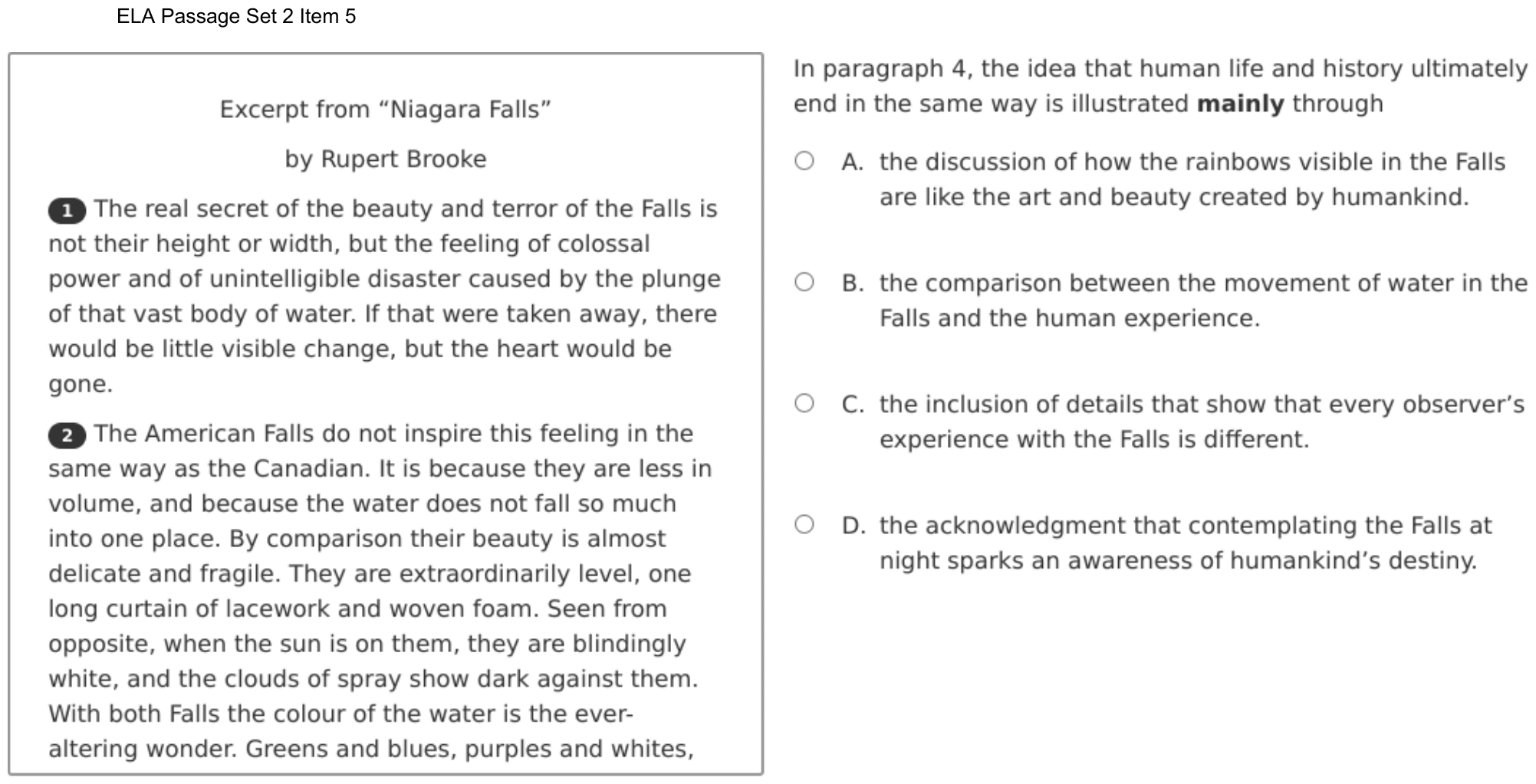
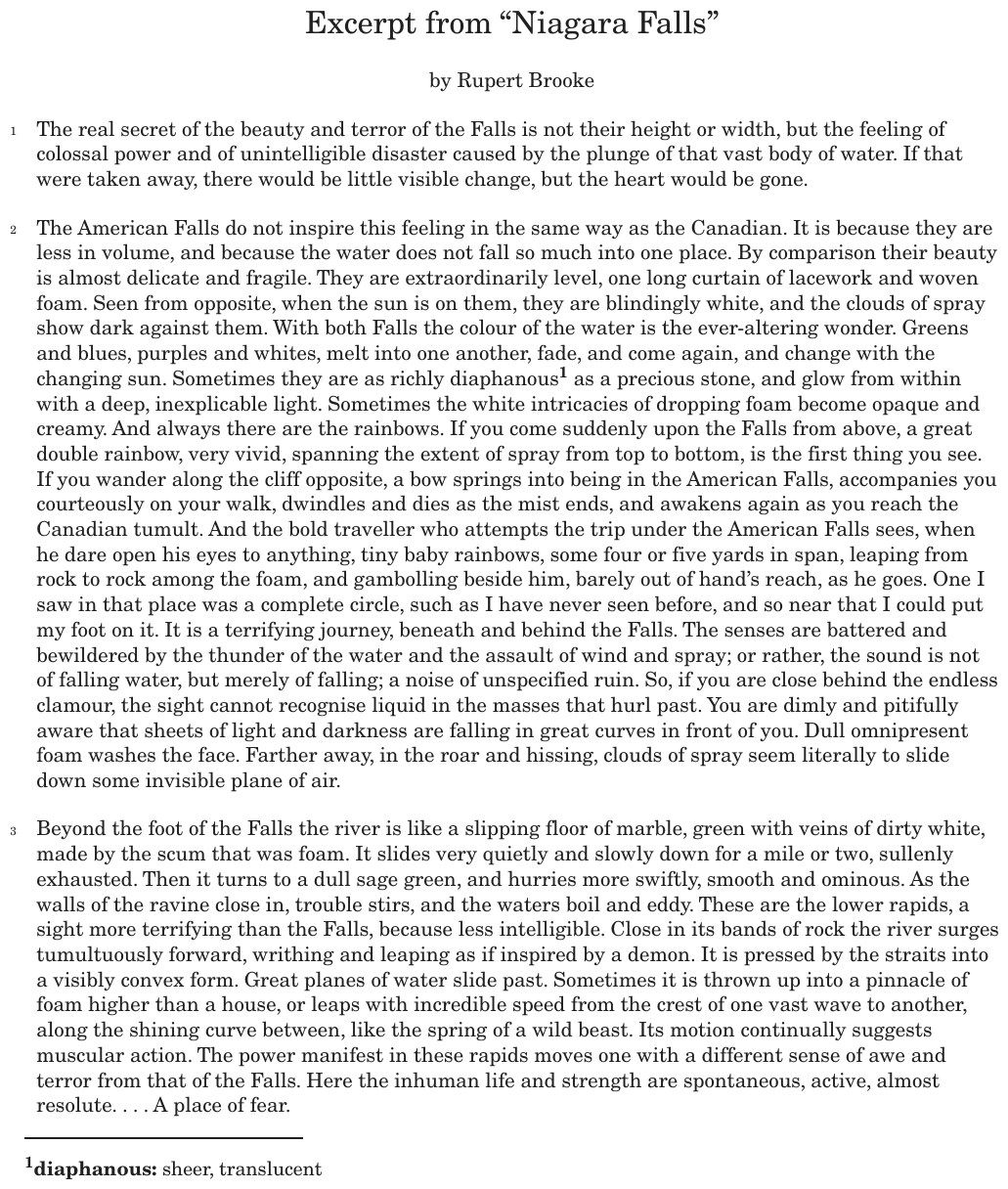
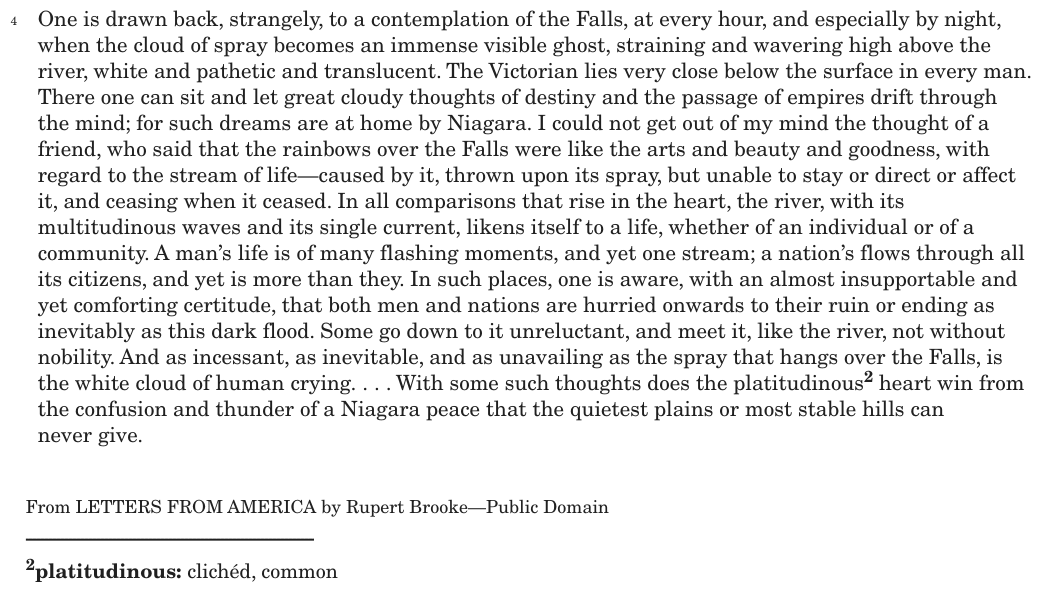
One is drawn back, strangely, to a contemplation of the Falls, at every hour, and especially by night, when the cloud of spray becomes an immense visible ghost, straining and wavering high above the river, white and pathetic and translucent. The Victorian lies very close below the surface in every man. There one can sit and let great cloudy thoughts of destiny and the passage of empires drift through the mind; for such dreams are at home by Niagara. I could not get out of my mind the thought of a friend, who said that the rainbows over the Falls were like the arts and beauty and goodness, with regard to the stream of life—caused by it, thrown upon its spray, but unable to stay or direct or affect it, and ceasing when it ceased. In all comparisons that rise in the heart, the river, with its multitudinous waves and its single current, likens itself to a life, whether of an individual or of a community. A man’s life is of many flashing moments, and yet one stream; a nation’s flows through all its citizens, and yet is more than they. In such places, one is aware, with an almost insupportable and yet comforting certitude, that both men and nations are hurried onwards to their ruin or ending as inevitably as this dark flood. Some go down to it unreluctant, and meet it, like the river, not without nobility. And as incessant, as inevitable, and as unavailing as the spray that hangs over the Falls, is the white cloud of human crying. . . . With some such thoughts does the platitudinous heart win from the confusion and thunder of a Niagara peace that the quietest plains or most stable hills can never give.
From LETTERS FROM AMERICA by Rupert Brooke—Public Domain
diaphanous: sheer, translucent
platitudinous: clichéd, common
Question
In paragraph 4, the idea that human life and history ultimately end in the same way is illustrated mainly through
- Athe discussion of how the rainbows visible in the Falls are like the art and beauty created by humankind.
- Bthe comparison between the movement of water in the Falls and the human experience.
- Cthe inclusion of details that show that every observer’s experience with the Falls is different.
- Dthe acknowledgment that contemplating the Falls at night sparks an awareness of humankind’s destiny.
Show the answer
Correct answer: B
The question asks how paragraph 4 of the excerpt mainly illustrates the idea that human life and history ultimately end in the same way.
A. Incorrect. In paragraph 4, the author compares the rainbows visible in the Falls to “the arts and beauty,” which share the rainbows’ dependence on “the stream of life”—that is, they are “caused by it, thrown upon its spray, but unable to stay or direct or affect it, and ceasing when it ceased.” This comparison does not illustrate the idea that human life and history ultimately end in the same way but rather that art and beauty, like human beings, are unable to “stay or direct or affect” their ultimate fate.
B. CORRECT. The author concludes in paragraph 4 that the movement of the Falls can be compared to people and history when he writes, “both men and nations are hurried onwards to their ruin or ending as inevitably as this dark flood.” This comparison illustrates the idea that human life and history ultimately end in the same way.
C. Incorrect. Although in paragraph 4 the author states that “One is drawn back, strangely, to a contemplation of the Falls” and provides an account of “a friend, who said that the rainbows over the Falls were like the arts and beauty and goodness, with regard to the stream of life,” the author does not provide details to show that every observer’s experience with the Falls is different. Rather, the author explains that “the Victorian lies very close below the surface in every man” (paragraph 4).
D. Incorrect. While the setting at night does provide a place of contemplation, the author notes the “dark flood” as the overall illustration of the human experience.
Question analysis
In this question on the closing paragraph of Rupert Brooke’s “Niagara Falls,” students identify the main way the author illustrates the idea that human life and history ultimately end in the same way. It is a lightly reworded version of a 2018 Test B question. The paragraph is long and reflective, mixing several images with abstract thoughts, so students must decide which of them actually illustrates this particular idea.
- Grade level
- Grade 8 reading and task
- Compared with grade 7
- Above grade 7 Most grade 7 work asks how an idea is shown in plain modern prose. This paragraph is a century-old reflection in long sentences with words like “certitude” and “unavailing,” and several of its images could each seem to carry the idea.
- Estimated difficulty
- Hard: combines ideas, needs a plan, and has more than one tempting wrong answer.
- Thinking it demands
- Depth of knowledge 2, skills and concepts · mainly analyze
- What makes it hard
- Complex sentences major
- The right answer is reworded moderate
- Hard words minor
- Evidence
- Answered from one paragraph or stanza
- Reading level
- Passage: about grade 9, 987 words; question and choices: about grade 11, 81 words.
- Students, last 30 days
- Not enough answers yet to show (it takes 10).
Why it is hard, traps and wrong answers (shows the answer)
Why it is hard
Paragraph 4 offers three pictures, the spray as a night ghost, the friend’s rainbows and the river as a life, and only one of them shows people and nations meeting an end. The 2026 stem’s “ultimately end” makes the rainbows’ “ceasing when it ceased” more tempting, and the night-time “thoughts of destiny” sound like the idea itself. Students who ask what the paragraph uses to show the idea, rather than where it mentions endings or destiny, land on the dark flood.
Complex sentences major Understanding the question
The idea sits inside a hedged sentence, “one is aware, with an almost insupportable and yet comforting certitude, that both men and nations are hurried onwards to their ruin or ending,” and the comparison comes last: “as inevitably as this dark flood.” (Abedi & Lord, 2001; Freedle & Kostin, 1993; Messick, 1989)
The right answer is reworded moderate Choosing the answer
The key sums up the paragraph’s river-and-life likeness in its own words, “movement of water” and “human experience,” while the other choices borrow the paragraph’s vocabulary: “rainbows,” “art and beauty,” “night” and “destiny.” (Freedle & Kostin, 1993; Kirsch & Mosenthal, 1990)
Hard words minor Understanding the question
“Multitudinous,” “certitude,” “insupportable” and “unavailing” all sit in the lines that carry the idea, and the footnoted “platitudinous” closes the paragraph, so the comparison has to be read through them. (Perfetti, 2007; Freedle & Kostin, 1993)
Strategy: Find the sentence in paragraph 4 that actually states the idea about life and history ending, then ask how that very sentence makes its point and match a choice to it.
Traps
- Supports only part of the claim: In a question about evidence: a line that backs one half of the claim but not the other, or a related point rather than the claim itself.
- Outside knowledge: A choice is plausible in the real world but not supported by this text.
The wrong answers, classified
A Supports only part of the claim (King et al., 2004; Thissen, Steinberg & Fitzpatrick, 1989)
Settles on the friend’s rainbows because they end “ceasing when it ceased,” which echoes the stem’s ending, but the likeness is about art and beauty, not the lives of men and nations.
C Outside knowledge (King et al., 2004; Recht & Leslie, 1988)
Relies on the common idea that every visitor sees the Falls in a personal way, but the paragraph speaks of “one” and “every man” in general and records no differences.
D Supports only part of the claim (King et al., 2004; Thissen, Steinberg & Fitzpatrick, 1989)
Joins the night view to “thoughts of destiny,” both real in paragraph 4, but they tell when and where the reflecting happens, not which picture shows lives and nations sharing an end.
Working it out, step by step
Figure out what the question asks
This asks how an idea is shown in paragraph 4. The idea is that people’s lives and whole nations end in the same way: they all come to an end. You need the picture the author mainly uses to show that idea. Paragraph 4 has several pictures, so find the one tied to this idea.
Find the sentence with the idea
Paragraph 4 says “both men and nations are hurried onwards to their ruin or ending as inevitably as this dark flood.” Men means people. Nations means countries and their history. Inevitably means in a way that can’t be stopped. The “dark flood” is the river’s dark water rushing over the Falls.
See how the comparison works
Just before, the author says “the river, with its multitudinous waves and its single current, likens itself to a life.” Multitudinous means very many. A current is water flowing one way. Likens itself to means seems like. A life has many moments but moves one way, like the river. And just as the water must rush on, people and nations rush toward their end. So the idea is shown by comparing moving water with human life.
Check each choice
- A does not fit. A friend compares the rainbows to “the arts and beauty and goodness.” That picture is about art, not about lives and nations ending.
- B fits. The river’s movement stands for human lives and history.
- C does not fit. The paragraph never says that each visitor sees the Falls differently.
- D does not fit. The night view and the “thoughts of destiny” tell when and where the author thinks. They do not show how lives end.
Watch out: D is tempting because destiny, or what happens in the end, sounds like the idea itself. But the question asks what illustrates the idea, and that is the river.
Choose the answer
The author pictures people and nations rushing to their end like the river’s water. So the answer is B, “the comparison between the movement of water in the Falls and the human experience.”
Why this answer and not the closest wrong one
D is the closest wrong choice. Paragraph 4 really does say the Falls at night stir “great cloudy thoughts of destiny.” But that only tells you the author was thinking about such things. The picture that shows lives and nations ending is the river. They are “hurried onwards to their ruin or ending as inevitably as this dark flood.”
More questions like this
The original DOE question
The passage “Excerpt from “Niagara Falls”” as printed (pages 134–135)
Question 3 of 6
2024 Test B English, question 20Passage Excerpt from “How Exercise Could Help You Learn a New Language”
Excerpt from “How Exercise Could Help You Learn a New Language”
by Gretchen Reynolds
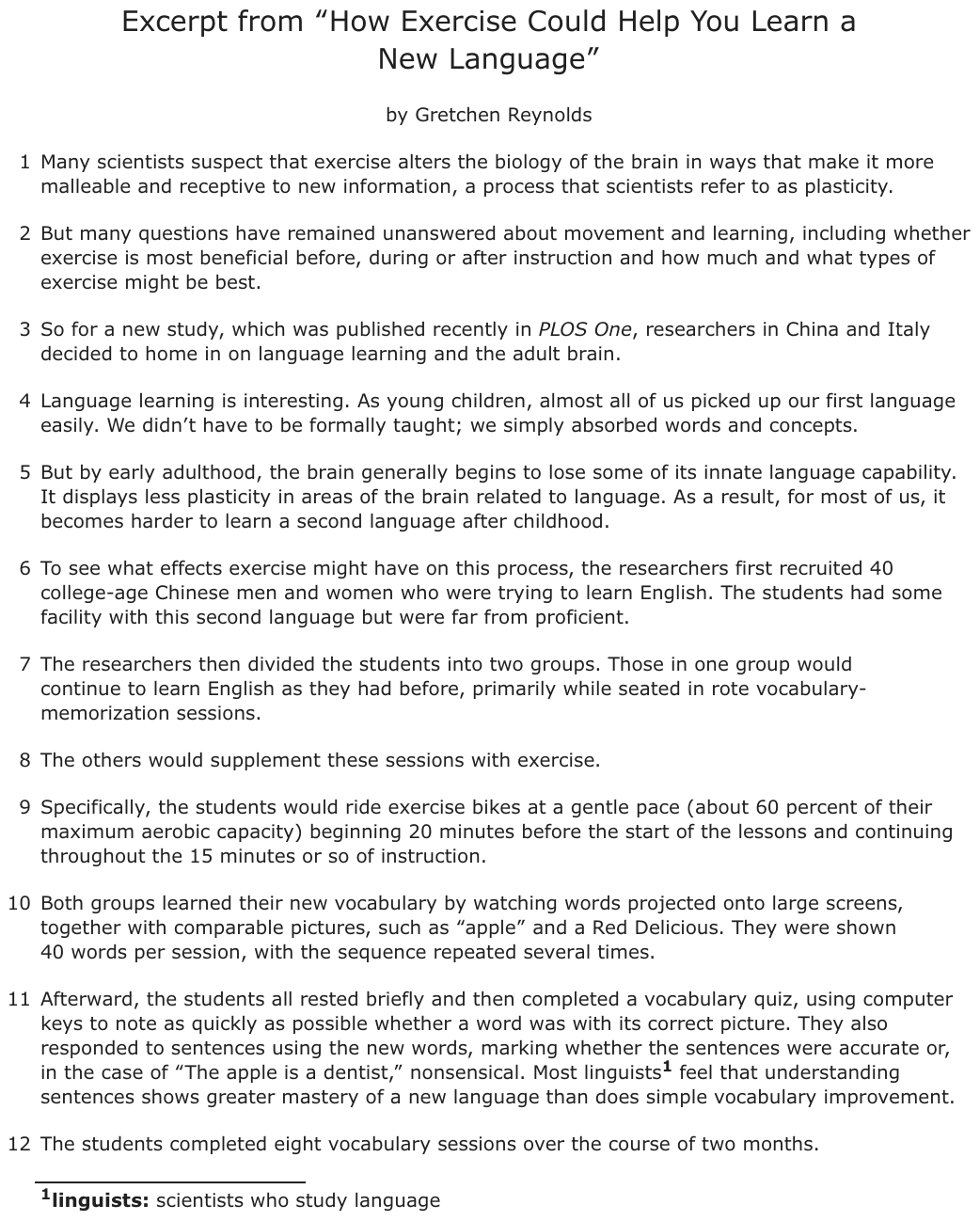
Many scientists suspect that exercise alters the biology of the brain in ways that make it more malleable and receptive to new information, a process that scientists refer to as plasticity.
But many questions have remained unanswered about movement and learning, including whether exercise is most beneficial before, during or after instruction and how much and what types of exercise might be best.
So for a new study, which was published recently in PLOS One, researchers in China and Italy decided to home in on language learning and the adult brain.
Language learning is interesting. As young children, almost all of us picked up our first language easily. We didn’t have to be formally taught; we simply absorbed words and concepts.
But by early adulthood, the brain generally begins to lose some of its innate language capability. It displays less plasticity in areas of the brain related to language. As a result, for most of us, it becomes harder to learn a second language after childhood.
To see what effects exercise might have on this process, the researchers first recruited 40 college-age Chinese men and women who were trying to learn English. The students had some facility with this second language but were far from proficient.
The researchers then divided the students into two groups. Those in one group would continue to learn English as they had before, primarily while seated in rote vocabulary-memorization sessions.
The others would supplement these sessions with exercise.
Specifically, the students would ride exercise bikes at a gentle pace (about 60 percent of their maximum aerobic capacity) beginning 20 minutes before the start of the lessons and continuing throughout the 15 minutes or so of instruction.
Both groups learned their new vocabulary by watching words projected onto large screens, together with comparable pictures, such as “apple” and a Red Delicious. They were shown 40 words per session, with the sequence repeated several times.
Afterward, the students all rested briefly and then completed a vocabulary quiz, using computer keys to note as quickly as possible whether a word was with its correct picture. They also responded to sentences using the new words, marking whether the sentences were accurate or, in the case of “The apple is a dentist,” nonsensical. Most linguists1 feel that understanding sentences shows greater mastery of a new language than does simple vocabulary improvement.
The students completed eight vocabulary sessions over the course of two months.
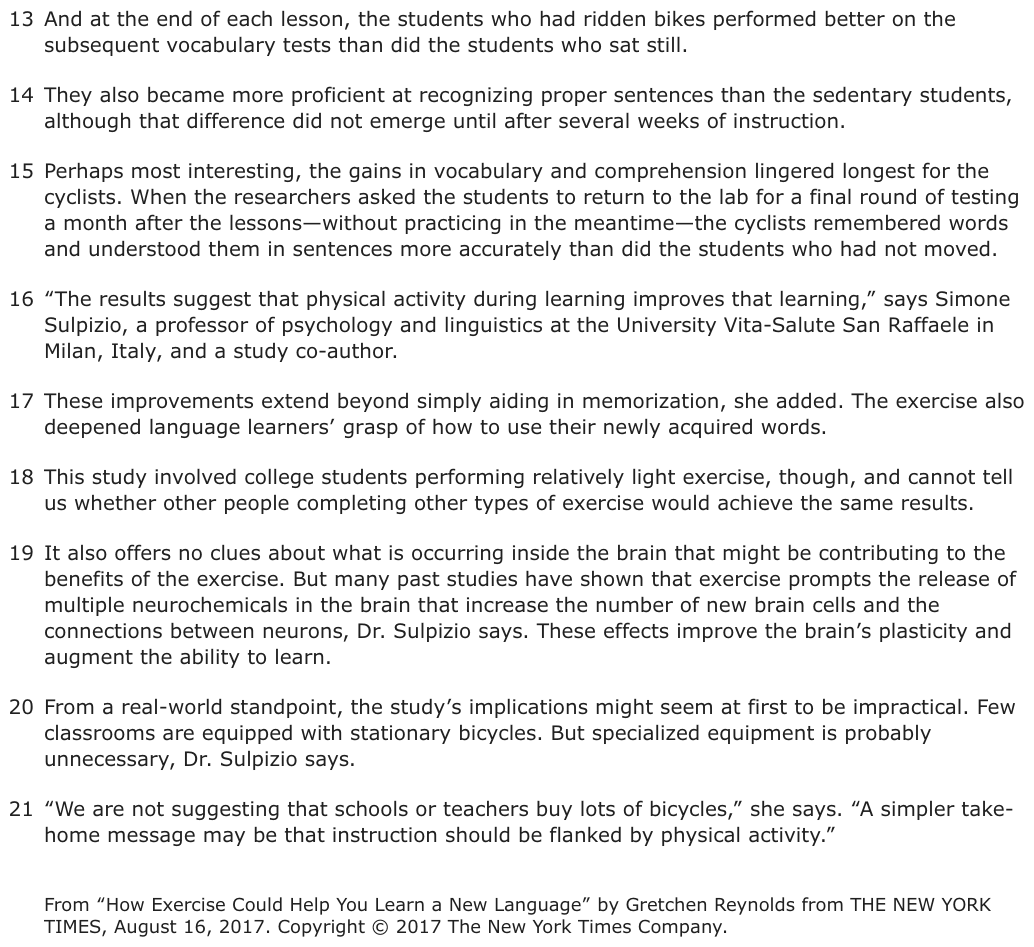
And at the end of each lesson, the students who had ridden bikes performed better on the subsequent vocabulary tests than did the students who sat still.
They also became more proficient at recognizing proper sentences than the sedentary students, although that difference did not emerge until after several weeks of instruction.
Perhaps most interesting, the gains in vocabulary and comprehension lingered longest for the cyclists. When the researchers asked the students to return to the lab for a final round of testing a month after the lessons—without practicing in the meantime—the cyclists remembered words and understood them in sentences more accurately than did the students who had not moved.
“The results suggest that physical activity during learning improves that learning,” says Simone Sulpizio, a professor of psychology and linguistics at the University Vita-Salute San Raffaele in Milan, Italy, and a study co-author.
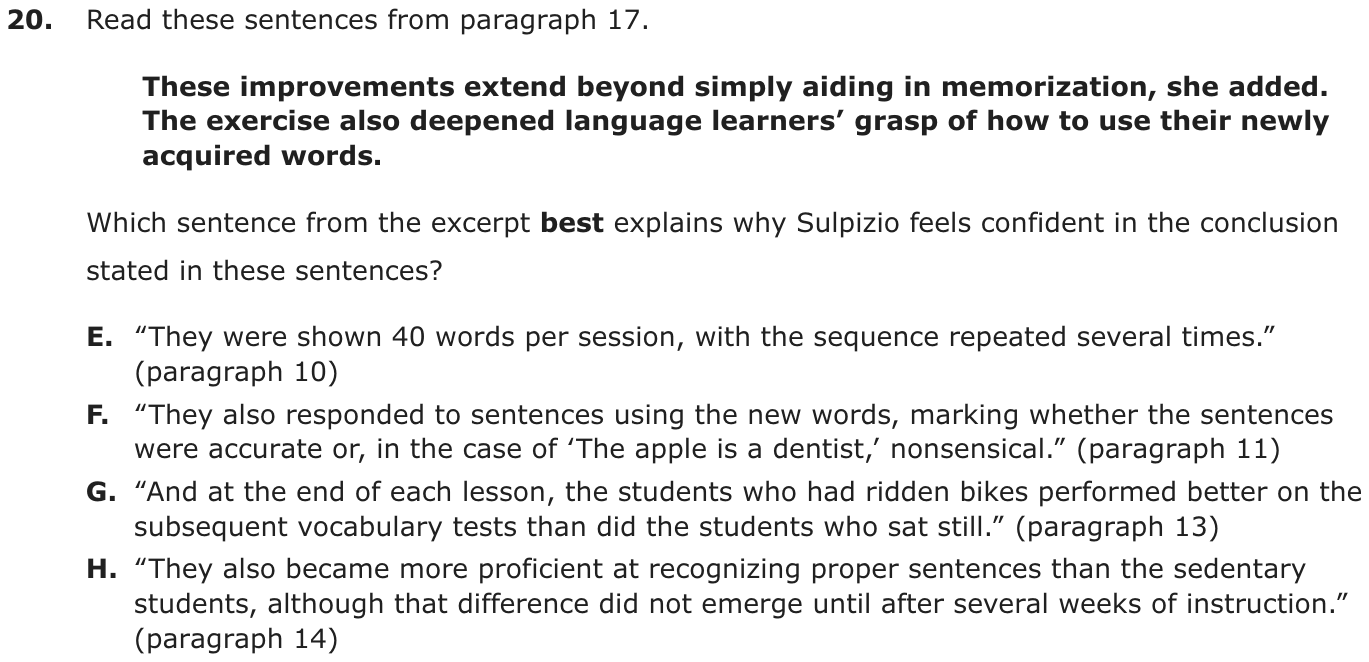
These improvements extend beyond simply aiding in memorization, she added. The exercise also deepened language learners’ grasp of how to use their newly acquired words.
This study involved college students performing relatively light exercise, though, and cannot tell us whether other people completing other types of exercise would achieve the same results.
It also offers no clues about what is occurring inside the brain that might be contributing to the benefits of the exercise. But many past studies have shown that exercise prompts the release of multiple neurochemicals in the brain that increase the number of new brain cells and the connections between neurons, Dr. Sulpizio says. These effects improve the brain’s plasticity and augment the ability to learn.
From a real-world standpoint, the study’s implications might seem at first to be impractical. Few classrooms are equipped with stationary bicycles. But specialized equipment is probably unnecessary, Dr. Sulpizio says.
“We are not suggesting that schools or teachers buy lots of bicycles,” she says. “A simpler take-home message may be that instruction should be flanked by physical activity.”
From “How Exercise Could Help You Learn a New Language” by Gretchen Reynolds from THE NEW YORK TIMES, August 16, 2017. Copyright © 2017 The New York Times Company.
1linguists: scientists who study language
Question
Read these sentences from paragraph 17.
These improvements extend beyond simply aiding in memorization, she added. The exercise also deepened language learners’ grasp of how to use their newly acquired words.
Which sentence from the excerpt best explains why Sulpizio feels confident in the conclusion stated in these sentences?
- A“They were shown 40 words per session, with the sequence repeated several times.” (paragraph 10)
- B“They also responded to sentences using the new words, marking whether the sentences were accurate or, in the case of ‘The apple is a dentist,’ nonsensical.” (paragraph 11)
- C“And at the end of each lesson, the students who had ridden bikes performed better on the subsequent vocabulary tests than did the students who sat still.” (paragraph 13)
- D“They also became more proficient at recognizing proper sentences than the sedentary students, although that difference did not emerge until after several weeks of instruction.” (paragraph 14)
Show the answer
Correct answer: D
The question asks which sentence from the excerpt best supports Sulpizio’s assertion in paragraph 17 that exercise went beyond helping with memorization to deepen the language learners’ ability to use new vocabulary.
A. Incorrect. This sentence merely describes what the language-learning sessions were like, without making any claims about how the exercise affected the subjects’ understanding of how to use new words.
B. Incorrect. While this sentence does address the fact that learners were required to think about how the new words should be used rather than just memorizing the words, it does not discuss results such as how the exercise affected their ability to do this.
C. Incorrect. This sentence establishes only that exercise helped with the memorization of new words, not that exercise deepened learners’ grasp of how to use the new words.
D. CORRECT. The fact that learners who exercised were better at identifying when the new words were used correctly in sentences directly supports Sulpizio’s assertion that the exercise deepened their grasp of how to use the new words.
Question analysis
This textual evidence question quotes Simone Sulpizio’s conclusion that exercise did more than help learners memorize new English words. Students choose the sentence from the article that best explains why she can be confident of it. All four choices come from the article’s account of the study, so students must match evidence to the exact claim rather than to its general topic.
- Grade level
- Grade 8 reading and task
- Compared with grade 7
- Above grade 7 Grade 7 evidence questions usually match a quotation to a stated claim. This claim has two parts, gains beyond memorizing and a better grasp of usage, and two quotations touch it closely, a sharper test than typical grade 7 work.
- Estimated difficulty
- Hard: combines ideas, needs a plan, and has more than one tempting wrong answer.
- Thinking it demands
- Depth of knowledge 3, strategic thinking · mainly evaluate
- What makes it hard
- A very close wrong answer major
- Reading between the lines moderate
- Evidence in several places minor
- Evidence
- Answered from several paragraphs or stanzas
- Reading level
- Passage: about grade 11, 764 words; question and choices: about grade 11, 142 words.
- Students, last 30 days
- Not enough answers yet to show (it takes 10).
Why it is hard, traps and wrong answers (shows the answer)
Why it is hard
Sulpizio’s claim has two parts, gains beyond memorizing and a better grasp of using words, and two of the quotations each touch one part. The vocabulary result is real evidence that exercise helped, but of the very memorizing she says the gains went beyond, and the sentence-task description mentions using words but reports no result. Only a result about sentences proves the claim, so the question rewards asking of each line what it shows, not what it is about.
A very close wrong answer major Choosing the answer
The vocabulary-test result in paragraph 13 and the sentence result in paragraph 14 are worded alike, cyclists outperforming students who sat still; only the skill measured, memorizing words or using them, separates them. (Embretson & Wetzel, 1987; Gorin & Embretson, 2006; Ascalon et al., 2007)
Reading between the lines moderate Working it out
Students must map the claim’s two halves onto the study’s two measures: vocabulary tests show memorization, and recognizing proper sentences shows the “grasp of how to use” new words. (Graesser, Singer & Trabasso, 1994; Kintsch, 1998)
Evidence in several places minor Working it out
The four quotations come from paragraphs 10, 11, 13 and 14, and each must be weighed against a claim made later, in paragraph 17. (Kirsch & Mosenthal, 1990; Gorin & Embretson, 2006)
Strategy: Pin down what the quoted claim says the exercise achieved, then test each sentence by asking whether it reports a result that proves that specific achievement.
Traps
- Supports only part of the claim: In a question about evidence: a line that backs one half of the claim but not the other, or a related point rather than the claim itself.
- True but not the answer: A choice says something accurate about the text that does not answer this question.
The wrong answers, classified
A True but not the answer (King et al., 2004; Embretson & Wetzel, 1987)
Picks a sentence about how the lessons were run, 40 words repeated several times, accurate but silent on what the exercise did for the learners.
B Supports only part of the claim (King et al., 2004; Thissen, Steinberg & Fitzpatrick, 1989)
Matches the claim’s focus on using words to the sentence-judging task, but this line only describes the task and reports no result showing that exercise helped.
C Supports only part of the claim (King et al., 2004; Thissen, Steinberg & Fitzpatrick, 1989)
Picks a real finding in favor of the cyclists, but better vocabulary-test scores show only the memorizing that Sulpizio says the gains went beyond.
Working it out, step by step
Figure out what the question asks
Sulpizio says the exercise did more than help students memorize words. It “deepened language learners’ grasp of how to use their newly acquired words.” A grasp is an understanding. You need the sentence that best proves this claim. Proof should be a result, not just a description.
Break the claim into two parts
- Part 1: the gains went “beyond simply aiding in memorization.” Memorization is learning words by heart.
- Part 2: the cyclists got better at using the words.
So the proof must show the bike riders did better with words in sentences. A test that only checks memory won’t prove it.
Check each choice
- A (paragraph 10) tells how many words were shown. It gives no result.
- B (paragraph 11) describes the sentence task. But it doesn’t say who did better.
- C (paragraph 13) is a result. But it is about “vocabulary tests,” which check memory. That is the part she says the gains went beyond.
- D (paragraph 14) says the cyclists “became more proficient at recognizing proper sentences than the sedentary students.” Proficient means skilled. Sedentary means sitting still. That is a result about using words.
Pick the answer
Watch out: C is very tempting. It shows that exercise helped. But it proves the wrong kind of help. Only one choice shows the cyclists did better at using words in sentences. So the answer is D.
Why this answer and not the closest wrong one
C is the closest wrong answer. Both C and D say the bike riders beat the students who sat still. The difference is the skill that was tested. C’s vocabulary tests show memory. D’s sentence test shows the learners knew how to use the words, which is exactly Sulpizio’s claim.
More questions like this
The original DOE question
The passage “Excerpt from “How Exercise Could Help You Learn a New Language”” as printed (pages 171–172)
Question 4 of 6
2026 Practice Test D Math, question 48Question
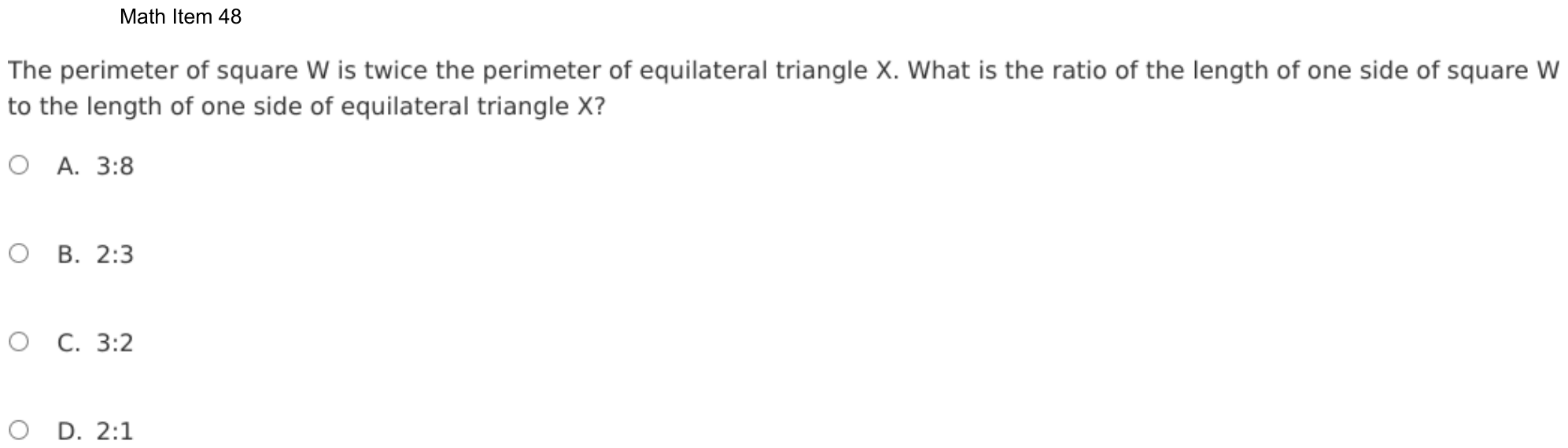
The perimeter of square W is twice the perimeter of equilateral triangle X. What is the ratio of the length of one side of square W to the length of one side of equilateral triangle X?
- A3:8
- B2:3
- C3:2
- D2:1
Show the answer
Correct answer: C
First, set up the ratio of the perimeter of the square to the triangle as 2:1 because the question states that the perimeter of the square is twice the perimeter of the triangle.
Recognizing that the square has 4 equal sides and that an equilateral triangle has 3 sides, use division to find the ratio of the sides.
Perimeter:
Sides:
Question analysis
The perimeter of square W is twice the perimeter of equilateral triangle X, and students find the ratio of a side of the square to a side of the triangle. This ratio question uses perimeters of regular shapes with no lengths given. Turning a comparison of perimeters into one of sides, and keeping the ratio in the order asked, are the tricky parts.
- NYS standards
- Grade level
- Grade 7 content, by NYS standard
- Compared with grade 7
- Above grade 7 Grade 7 ratio problems usually supply numbers to work with. This one gives only a relationship between two perimeters, so students must bring in the number of sides of each shape themselves and keep the ratio in the order asked.
- Estimated difficulty
- Hard: combines ideas, needs a plan, and has more than one tempting wrong answer.
- Thinking it demands
- Depth of knowledge 2, skills and concepts · mainly apply
- What makes it hard
- Turning words into math moderate
- Variables instead of numbers moderate
- A very close wrong answer minor
- Solution
- 3 steps
- Reading level
- Question and choices: about grade 9, 36 words.
- Students, last 30 days
- Not enough answers yet to show (it takes 10).
Why it is hard, traps and wrong answers (shows the answer)
Why it is hard
The question turns a statement about perimeters into a ratio of sides, and the natural guess, that the sides keep the perimeters’ 2 to 1, ignores that the square shares its perimeter among 4 sides and the triangle among 3. Choosing a triangle perimeter such as 12 makes the comparison concrete. The order of the ratio still has to be checked at the end, because its reverse is listed too.
Turning words into math moderate Understanding the question
“The perimeter of square W is twice the perimeter of equilateral triangle X” must become 4s = 2 × 3t, with the 2 on the triangle’s side; written backward, it gives the triangle the larger perimeter. (Hegarty, Mayer & Monk, 1995; Koedinger & Nathan, 2004)
Variables instead of numbers moderate Understanding the question
No side length is given, so students must either work with letters for the two sides or choose a convenient perimeter themselves, such as 12 for the triangle. (Koedinger & Nathan, 2004; Enright, Morley & Sheehan, 2002)
A very close wrong answer minor Choosing the answer
The ratios 3:2 and 2:3 use the same two numbers, so only keeping the square’s side first, as the question orders it, separates the answer from its reverse. (Embretson & Wetzel, 1987; Gorin & Embretson, 2006; Ascalon et al., 2007)
Strategy: Pick an easy side length for the triangle, find its perimeter, double that for the square, divide by the square's number of sides, and write square to triangle.
Traps
- Misunderstands the concept: A wrong belief about a concept: that percents can be added, that area grows like length, that averages can be averaged, that a bigger denominator means a bigger fraction.
- Wrong operation: Adds instead of multiplying, divides the wrong way round, turns a ratio or rate upside down, or undoes a step in the wrong direction (subtracts what should be added back).
- Equation written backwards: Writes a comparison the wrong way round, word for word: "six times as many students as professors" as 6S = P. The bigger quantity gets the bigger number.
The wrong answers, classified
A Equation written backwards (Clement, Lochhead & Monk, 1981)
Writes the comparison backward, 2 × 4s = 3t, giving the triangle the larger perimeter, so the ratio of the sides comes out 3:8.
B Wrong operation (Hegarty, Mayer & Monk, 1995; King et al., 2004)
Finds the right relationship but turns the ratio upside down, giving the triangle’s side to the square’s instead of the square’s side first.
D Misunderstands the concept (Smith, diSessa & Roschelle, 1993; De Bock et al., 1998; Ni & Zhou, 2005)
Assumes the sides are in the same ratio as the perimeters, 2:1, ignoring that the square has 4 sides and the triangle only 3.
Worked solution, step by step
Formulas used
- Perimeter of a square
- P is the perimeter, the distance around the shape. s is the length of one side. A square has 4 equal sides, so its perimeter is 4 times one side.
- Perimeter of an equilateral triangle
- An equilateral triangle has 3 equal sides. t is the length of one side. So its perimeter is 3 times one side.
- Ratio
- A ratio compares two amounts in order. a : b means a compared with b. The order matters, so write the amounts in the order the question names them.
Sort out the question
Square W has a perimeter twice as long as the perimeter of triangle X. Equilateral means all 3 sides of X are equal.
You need the ratio of one side of the square to one side of the triangle, in that order. No lengths are given, so you can pick a size to try.
Pick a size for the triangle
Choose an easy side length for the triangle, such as 2 units. All 3 sides are 2, so its perimeter is:
Find the square’s side
The square’s perimeter is twice the triangle’s:
The square has 4 equal sides, so divide by 4:
Each side of the square is 3 units.
Write the ratio in order
The square comes first, then the triangle. Their sides are 3 and 2, so the ratio is 3 : 2.
Watch out: 2 : 1, choice D, compares the perimeters, not the sides. The square splits its perimeter into 4 sides, the triangle into only 3. Choice B, 2 : 3, puts the triangle first. Choice A, 3 : 8, comes from giving the triangle the bigger perimeter.
So the answer is C, 3:2.
Check your answer
Try a different size. Give the triangle sides of 4. Its perimeter is 12, so the square’s is 24. Each side of the square is . The ratio 6 : 4 simplifies to 3 : 2. The size does not change the ratio.
More questions like this
The original DOE question
Question 5 of 6
2024 Test A Math, question 18Question
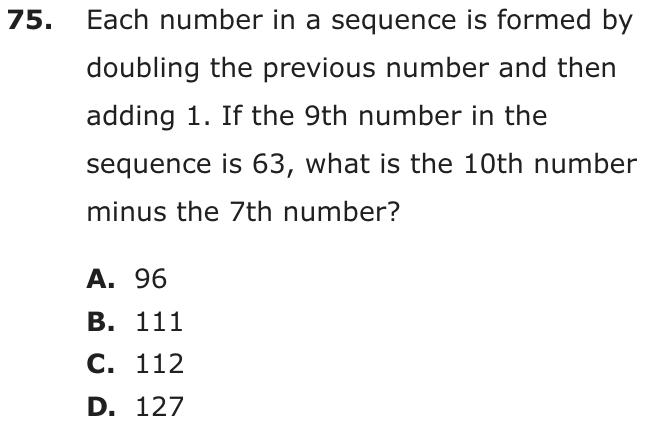
Each number in a sequence is formed by doubling the previous number and then adding 1. If the 9th number in the sequence is 63, what is the 10th number minus the 7th number?
- A96
- B111
- C112
- D127
Show the answer
Correct answer: C
First, write an equation based on the rule described in the item. Let x be the previous number in the sequence and y be the number in the sequence. The ninth number in the sequence is 63.
Determine the 10th number in the sequence, y, by making and solving:
Determine the 8th number in the sequence, x, by making and solving:
Subtract one from both sides of the equation.
Determine the 7th number in the sequence, x, by making and solving:
Subtract the 7th number in the sequence from the 10th number:
The difference is 112.
Question analysis
A sequence question: each number is found by doubling the one before it and adding 1, and the 9th number is 63. Students find the 10th number minus the 7th. That means running the rule forward once and backward twice, while keeping track of which position each number holds.
- Grade level
- Grade 7 content, by NYS standard
- Compared with grade 7
- Above grade 7 Grade 7 students solve two-step equations but rarely have to run a rule backward through a sequence. This mixes forward and backward steps with position counting, so it asks for more planning than a typical grade 7 task.
- Estimated difficulty
- Hard: combines ideas, needs a plan, and has more than one tempting wrong answer.
- Thinking it demands
- Depth of knowledge 2, skills and concepts · mainly apply
- What makes it hard
- No obvious method moderate
- Many steps moderate
- Much to keep track of minor
- Solution
- 4 steps
- Reading level
- Question and choices: about grade 7, 32 words.
- Corrected from the DOE handbook
- A misplaced parenthesis in the explanation’s working was corrected.
- Students, last 30 days
- Not enough answers yet to show (it takes 10).
Why it is hard, traps and wrong answers (shows the answer)
Why it is hard
Applying the rule forward is routine; running it backward is not, and the question needs both. Students must also count positions carefully, since the 9th number is given and the 7th is two steps back, not one. Each listed wrong answer stops or slips at a different stage, so writing the four numbers in a row, 15, 31, 63 and 127, before subtracting is the reliable way.
No obvious method moderate Working it out
The rule is stated only forward, double and add 1, but the 7th and 8th numbers come before the given 9th, so the rule must be undone: subtract 1, then halve. (Schoenfeld, 1985)
Many steps moderate Working it out
One forward step reaches the 10th number, 127, two backward steps reach the 8th and 7th, 31 and 15, and a final subtraction finishes. (Daniel & Embretson, 2010; Enright, Morley & Sheehan, 2002)
Much to keep track of minor Working it out
Four positions and their values, 7th to 10th, have to be kept straight, and the 8th number is easy to mistake for the 7th. (Sweller, 1988; Carpenter, Just & Shell, 1990)
Strategy: Apply the rule to 63 to get the 10th number; to go back a position, subtract 1 and halve, doing it twice to reach the 7th; then subtract.
Traps
- Counting the ends: Inclusive or exclusive ends, fence posts, consecutive numbers: an answer that is one too many or too few, or an endpoint drawn open where it belongs closed (or the reverse).
- Stops one step early: A choice is a number from partway through the solution.
The wrong answers, classified
A Counting the ends (Brown & Burton, 1978)
Steps back only once from the 9th number and subtracts the 8th, 127 − 31 = 96, one position short of the 7th.
B Misreads the question (Hegarty, Mayer & Monk, 1995)
Doubles 63 to 126 but forgets to add 1 on that step, then subtracts the correct 7th number: 126 − 15 = 111.
D Stops one step early (King et al., 2004; Gierl et al., 2017)
Finds the 10th number, 2 × 63 + 1 = 127, and stops without subtracting the 7th number from it.
What was corrected from the DOE handbook, and why
- Explanation: Finding the 7th number, the handbook writes “2x + (1 − 1 = 31 − 1)”, with the closing parenthesis after the whole equation, so the line reads as an equation inside an expression (and 1 − 1 = 31 − 1 is false). The site now reads 2x + (1 − 1) = 31 − 1, the same step the handbook writes correctly for the 8th number (2x + (1 − 1) = 63 − 1). It leads to 2x = 30 and x = 15 as before.
Worked solution, step by step
Formulas used
- The sequence rule
- A sequence is a list of numbers that follows a rule. x is a number in the list, and y is the next number. To get the next number, double x and then add 1.
- Going back one number
- y is a number in the list, and x is the one just before it. To go back, undo the rule in reverse order. The rule doubles and then adds 1. So first subtract 1, then divide by 2.
Sort out the question
Each number is “formed by doubling the previous number and then adding 1”. Previous means the one just before. The 9th number is 63. You need the 10th number minus the 7th number. So you go forward one number and back two numbers.
Find the 10th number
Use the rule with x = 63.
The 10th number is 127. Watch out: remember to add 1. Doubling only gives 126 and leads to 111, choice B.
Plan how to go back
The 7th number comes before the 9th, so you must undo the rule. The rule doubled, then added 1. Undo the last step first: subtract 1. Then undo the doubling: divide by 2.
Find the 8th number
The 8th number is 31. Watch out: 31 is the 8th number, not the 7th. Using it gives , choice A.
Find the 7th number
Step back once more, from the 8th number. Use the same rule with y = 31.
The 7th number is 15.
Subtract the 7th from the 10th
Watch out: 127 alone is choice D. You still have to subtract the 7th number. So the answer is C, 112.
Check your answer
Go forward from 15 using the rule. , then , then . You land on 63 as the 9th number, so the list is right. And .
More questions like this
The original DOE question
Question 6 of 6
2024 Test B Math, question 53Question
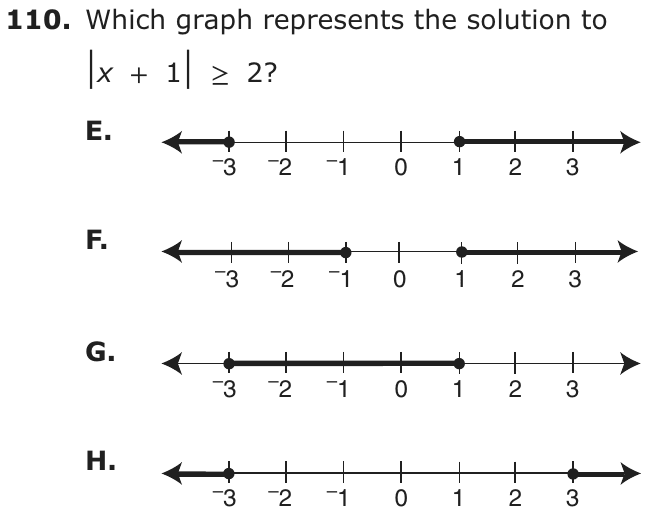
Which graph represents the solution to ?
- A

- B

- C

- D

Show the answer
Correct answer: A
Since , either or .
Solving for x gives .
Solving for x gives .
A filled circle on a number line represents “or equal to.” So the correct number line representation has filled circles at −3 and 1, with the number line filled to the left of −3 for “less than” and to the right of 1 for “greater than.”
Question analysis
Students choose the number line graph that shows every solution of an inequality in which x + 1 sits inside absolute value bars. It tests absolute value as distance and graphing inequalities. The tricky part is turning one absolute value statement into two pieces and placing each boundary point and shaded ray correctly.
- NYS standards
- Grade level
- Grade 7 content, by NYS standard
- Compared with grade 7
- Above grade 7 Grade 7 students solve and graph two-step inequalities and know absolute value as distance. An inequality with an absolute value has to be split into two cases, which is outside the grade 6 to 8 standards and well above typical grade 7 work.
- Estimated difficulty
- Hard: combines ideas, needs a plan, and has more than one tempting wrong answer.
- Thinking it demands
- Depth of knowledge 2, skills and concepts · mainly apply
- What makes it hard
- Something you must already know moderate
- A very close wrong answer moderate
- Reading a figure, table or graph minor
- Solution
- 3 steps
- Reading level
- Question and choices: about grade 9, 7 words.
- Students, last 30 days
- Not enough answers yet to show (it takes 10).
Why it is hard, traps and wrong answers (shows the answer)
Why it is hard
Reading |x + 1| as the distance from x to −1 makes this quick: the points 2 units away are −3 and 1, and greater than or equal means outside them. Students who solve only one case and mirror it across 0 land on graphs centered on 0, and students who find both endpoints may still shade between them. The graphs differ in just one dot or one shading choice, so each must be read carefully.
Something you must already know moderate Working it out
Solving |x + 1| ≥ 2 needs two cases, x + 1 ≤ −2 or x + 1 ≥ 2, joined by or; absolute value inequalities go beyond grade 7, and the stem gives no hint. (Anderson & Krathwohl, 2001)
A very close wrong answer moderate Choosing the answer
The right graph and the segment from −3 to 1 share both filled endpoints, so only deciding between outside and between the boundaries separates them. (Embretson & Wetzel, 1987; Gorin & Embretson, 2006; Ascalon et al., 2007)
Reading a figure, table or graph minor Understanding the question
Four number lines must be read for filled dots and arrow directions, and two of them differ from the right one only in where a single dot sits. (Lesh, Post & Behr, 1987; Kirsch & Mosenthal, 1990)
Strategy: Read the absolute value as distance from −1 on the number line, find the points exactly 2 units away, and decide whether the solutions lie between or outside them.
Traps
- Misunderstands the concept: A wrong belief about a concept: that percents can be added, that area grows like length, that averages can be averaged, that a bigger denominator means a bigger fraction.
- Negatives and direction: Arithmetic with negative numbers, the order of a subtraction, or direction on a number line. (Moving a term across the equals sign without changing its sign is a faulty procedure.)
The wrong answers, classified
B Misunderstands the concept (Smith, diSessa & Roschelle, 1993; De Bock et al., 1998; Ni & Zhou, 2005)
Solves x + 1 ≥ 2 to get x ≥ 1, then mirrors it across 0 to x ≤ −1, as if the solution were centered on 0 rather than on −1.
C Negatives and direction (Brown & Burton, 1978)
Finds −3 and 1 but shades between them, the solution of |x + 1| ≤ 2, reversing which side of the boundaries lies at least 2 units from −1.
D Misunderstands the concept (Smith, diSessa & Roschelle, 1993; De Bock et al., 1998; Ni & Zhou, 2005)
Solves x + 1 ≤ −2 to get x ≤ −3, then mirrors it across 0 to x ≥ 3, assuming the boundaries are symmetric about 0.
Worked solution, step by step
Formulas used
- Absolute value as distance
- x and a are points on the number line. The bars mean absolute value. |x − a| is how far apart the two points are, which is never negative. Since x + 1 = x − (−1), |x + 1| is the distance from x to −1.
Sort out the question
You need the graph of every x that makes true. The sign ≥ means greater than or equal to. The bars mean absolute value.
On a number line, a filled dot means that point counts. A thick line with an arrow means all the numbers that way count too.
Read it as a distance
Adding 1 is the same as subtracting −1, so . By the formula, is the distance from x to −1.
So the inequality says that x is at least 2 units away from −1.
Find the two boundary points
Start at −1 and go 2 units each way.
At −3 and at 1, the distance is exactly 2. The words or equal to let them count, so they get filled dots.
Decide which side to shade
Being at least 2 away means being farther out. Numbers between −3 and 1 are too close to −1. For example, 0 is only 1 unit away. So shade to the left of −3 and to the right of 1.
In algebra, that is or . These give or .
Match the graph
Choice A has filled dots at −3 and 1, with arrows going outward. That matches.
Watch out: Choice C shades between −3 and 1. Those are the points within 2 of −1, the answer to . Choices B and D are centered on 0, but the center here is −1.
So the answer is A, the graph shaded outward from −3 and 1.
Check your answer
Test a point from each part. For x = 2, , and 3 is at least 2. For x = 0, , which is less than 2. For x = −3, , which counts. Graph A agrees with all three.
More questions like this
The original DOE question