Inferences and conclusions
Question 1 of 11
2025 Practice Test A English, question 12Passage Excerpt from “Scribe Like an Egyptian”
Excerpt from “Scribe Like an Egyptian”
by Hilary Wilson
In ancient Egypt, literacy was the key to success. However, contrary to popular belief, not all Egyptian scribes understood hieroglyphs. Many relied instead on the simpler hieratic script for the multitude of everyday documents generated by the Egyptian bureaucracy.
Hieroglyphs—“the Words of God”—compose a writing system with more than 1,000 distinct characters, the meanings of which were lost for 1,500 years before they were deciphered by Jean-François Champollion in 1822. Including both ideograms (which convey a whole word or idea, either concrete or abstract, in a single sign) and phonograms (representing either an alphabetic sound or a group of consonants), [the writing system] was used in formal inscriptions on tomb and temple walls as well as on elaborate funerary papyri. For everyday purposes, however, scribes used a shorthand version of the hieroglyphic script known as hieratic, which was quicker to write and more economical of space. The two writings existed side by side for at least 2,500 years.
Scraps of ancient hieratic writing, mostly penned by student scribes on limestone flakes called ostraca, suggest that no matter how humble his origins, an educated Egyptian could achieve almost anything. Horemheb (d.1292 B.C.) is a good example. Born of middle-ranking parents, his scribal training led to an army career. From Scribe of Recruits, during the reign of Akhenaten (1353–1336 B.C.), Horemheb rose through the military ranks and, by the rule of Tutankhamun (1332–1323 B.C.), he was commander in chief of the Egyptian forces. As a close adviser of the young Pharaoh, Horemheb was appointed “Deputy of the King throughout the Two Lands,” and might have expected to succeed to the throne should the king die childless. He had to wait a few years, but eventually Horemheb achieved the pinnacle of his career by becoming the last king of the 18th Dynasty, making his mark by instituting dramatic reforms to the organisation of the army, the judiciary and administration in general. The lasting success of these changes owed much to his scribal background. . . .
But education was not available to all. Government departments and major temples supported schools, where boys commenced their training at six or seven, sometimes earlier. To these boarding establishments . . . family or household servants delivered the students’ food and drink rations daily for several years, during which time the student was not contributing to the family’s income. Boys from poorer families could only hope to be educated with support from a wealthier relative or patron, or through apprenticeship to an older scribe, perhaps the local clerk or land agent, who would teach them the basics of the scribe’s craft. This limited the scope for employment but such “on the job” training allowed apprentices to help out at home while learning. . . .
Scribal education began with the elementary principles of the hieratic script. The lowliest scribes, who trained for just five or six years, probably learned only the rudiments of the hieroglyphic script. Students were set exemplar documents and extracts from popular texts to copy, to practice their hieratic handwriting on basic-format letters, reports and contracts, while absorbing the good advice contained in the texts. Surviving examples of copy-work sometimes include tutors’ corrections added in red. Some significant Egyptian literary works survive almost exclusively from student copies.
A schoolboy “dictionary” of hieroglyphs with their hieratic equivalents shows that a knowledge of more than 450 signs was required for everyday writing purposes. Lessons in record-keeping and filing and labelling enabled any half-competent scribe to perform that most essential of all scribal functions: the making and updating of lists. For professions such as those of government official, priest or lawyer, a scribe would train for several more years, increasing his vocabulary to perhaps a thousand or more signs. Those with the best handwriting or drawing skills might follow the craft of creating beautifully illustrated copies of funerary texts, commonly called Books of the Dead. Others could become draughtsmen, artists or architects. Doctors compiled their own collections of medication recipes, treatments and associated incantations, many copied from texts found in the House of Life, the temple library. Lawyers had to be familiar with the corpus of civil and religious laws and precedents found in the official records, which were administered by archivists. Egypt’s bureaucratic society depended on the skills of an army of scribes of all ranks from filing clerk to tax assessor. For young Egyptians, “be a scribe” was the best of career advice.
From “Scribe Like an Egyptian” by Hilary Wilson from HISTORY TODAY, August 8, 2019. Copyright © 2019 by History Today Ltd. Company.
bureaucracy: an administrative staff of government officials
funerary papyri: a sheet or scroll of papyrus containing religious images and hieroglyphs meant to help the deceased be reborn in the afterlife
rudiments: basics
schoolboy: slang that refers to materials used during the course of receiving an education
draughtsmen: people who draw plans of machinery or structures
corpus: a collection of writings
Question
Which claim is best supported by the information presented in paragraphs 3 and 4?
- AEducation was difficult for the common citizens of Egypt to obtain.
- BOnce students began studying to become scribes, their future held more possibilities.
- CIf someone wanted to become a scribe, support from outside sources such as the government or a temple was necessary.
- DBecoming a successful scribe required a student’s family to sacrifice time and money in order to ensure the best education.
Show the answer
Correct answer: B
The question asks for the claim that is best supported by the details in paragraphs 3 and 4.
A. Incorrect. While paragraph 4 does explain that boys from poorer families had more challenges in receiving an education, the paragraph also provides examples of obtaining a patron or getting an apprenticeship as ways that these aspiring scribes could attain an education. Furthermore, the details in paragraph 3 do not provide any support for the claim that “common citizens” had difficulty getting an education because that paragraph focuses on the example of one person who was able to become a king as a result of his background as a scribe.
B. CORRECT. In paragraph 3, the author provides an example of a person who used his skills as a scribe to rise through the ranks of society by describing the achievements of Horemheb to support the idea that “no matter how humble his origins, an educated Egyptian could achieve almost anything.” The author continues in paragraph 4 to explain that with the proper support, some young Egyptians could become educated, thereby opening more opportunities for themselves.
C. Incorrect. Paragraph 4 explains that schools were supported by the government and religious institutions, but it also explains that apprenticeships were a method of learning the craft of the scribe. As the paragraph indicates, boys could also be helped in their education by support from “a wealthier relative or patron.”
D. Incorrect. In paragraph 4, the author details the sacrifices that families made to keep their sons at the schools, while boys from poorer families could only hope for a patron or an apprenticeship. Paragraph 4 also explains that apprentices could help out at home while learning, so the sacrifice of time and money was not required of every family.
Question analysis
This inference question asks which claim is best supported by paragraphs 3 and 4 of “Scribe Like an Egyptian,” which tell the story of the scribe Horemheb and describe who could get a scribal education in ancient Egypt. Students must weigh each claim against both paragraphs together, and several claims echo a single sentence closely enough to look supported.
- Grade level
- Grade 8 reading and task
- Compared with grade 7
- Above grade 7 Choosing the claim a passage best supports is core grade 7 work. Here the claim must fit two paragraphs that do different jobs, one telling a single man’s story and one explaining access to schooling, and some choices fit only part of that.
- Estimated difficulty
- Hard: combines ideas, needs a plan, and has more than one tempting wrong answer.
- Thinking it demands
- Depth of knowledge 3, strategic thinking · mainly evaluate
- What makes it hard
- Evidence in several places moderate
- The right answer is reworded moderate
- Reading between the lines minor
- Evidence
- Answered from several paragraphs or stanzas
- Reading level
- Passage: about grade 12, 810 words; question and choices: about grade 10, 75 words.
- Corrected from the DOE handbook
- A misdescription of the passage in the explanation of one wrong answer was corrected.
- Students, last 30 days
- Not enough answers yet to show (it takes 10).
Why it is hard, traps and wrong answers (shows the answer)
Why it is hard
The trap is a claim that paragraph 4 seems to state almost word for word, which makes it feel safer than the right one. But the question asks for support from both paragraphs, and Horemheb’s story points the other way, toward what schooling made possible. The two other wrong claims harden paragraph 4’s details into rules, a necessary sponsor or a required family sacrifice, so words like “necessary” and “required” are the ones to test.
Evidence in several places moderate Working it out
The claim must fit two paragraphs that do different work: paragraph 3 follows Horemheb from army scribe to king, and paragraph 4 explains who could pay for schooling and what the alternatives were. (Kirsch & Mosenthal, 1990; Gorin & Embretson, 2006)
The right answer is reworded moderate Choosing the answer
The right claim restates paragraph 3’s “an educated Egyptian could achieve almost anything” in new words, while the most tempting wrong one nearly copies paragraph 4’s opening, “education was not available to all.” (Freedle & Kostin, 1993; Kirsch & Mosenthal, 1990)
Reading between the lines minor Working it out
Students must connect Horemheb’s rise with paragraph 4’s account of who got schooling to see that both paragraphs are about education opening doors, a link the author leaves implicit. (Graesser, Singer & Trabasso, 1994; Kintsch, 1998)
Strategy: Sum up paragraph 3 and paragraph 4 in a sentence each, then test every claim against both summaries, watching for words that make a claim stronger than the text.
Traps
- Too narrow: A single detail offered as the central idea or a summary, or a summary that keeps minor details and leaves out an essential part.
- Too broad or too strong: A choice overstates, generalizes, or uses absolute words the text does not support.
- Reads too much in: A reasonable-sounding conclusion that goes further than the text allows.
The wrong answers, classified
A Too narrow (King et al., 2004)
Rests on paragraph 4’s opening, “education was not available to all,” and ignores paragraph 3, whose Horemheb shows an educated man rising from modest origins to the throne.
C Too broad or too strong (King et al., 2004)
Makes the government and temple schools of paragraph 4 “necessary,” overlooking its other routes: help from “a wealthier relative or patron,” or apprenticeship to a working scribe.
D Reads too much in (Graesser, Singer & Trabasso, 1994)
Turns the rations and lost income that some families bore in paragraph 4 into a requirement for every successful scribe, and adds “the best education,” which the paragraph never mentions.
What was corrected from the DOE handbook, and why
- Explanation: The DOE’s explanation of D said paragraph 4 details sacrifices “necessary for some poorer families,” and that paragraph 3’s Horemheb, born of middle-ranking parents, shows the sacrifice was not required of all families. In paragraph 4 the rations and lost income are those of families whose sons were at the schools; poorer boys could only hope for a patron or an apprenticeship; and paragraph 3 says nothing about what Horemheb’s family gave up. The explanation now says so: D is wrong because apprentices could help out at home while learning, so not every family made the sacrifice.
Working it out, step by step
Figure out what the question asks
This asks which claim is best supported by paragraphs 3 and 4 together. A claim is a statement that someone says is true. The right claim must fit both paragraphs. Watch for strong words, like “necessary,” that go further than the text.
Sum up paragraph 3
Paragraph 3 tells about Horemheb. His parents were middle-ranking, not rich or powerful. His training as a scribe led to a job in the army. He rose to lead the army, then to serve the young king, and in the end he became king himself. The author uses him to show that “no matter how humble his origins, an educated Egyptian could achieve almost anything.” Humble origins means an ordinary family background.
Sum up paragraph 4
Paragraph 4 opens by saying that not everyone could get an education. Government offices and big temples ran schools. Families sent food and drink for years, while the boy earned nothing for them. Poorer boys could hope for help from “a wealthier relative or patron.” A patron is someone who pays for another person’s training. Or they could learn on the job from a working scribe. That path led to fewer jobs.
Put the two paragraphs together
Both paragraphs are about what schooling could do for a boy. Paragraph 3 shows a man rising all the way to king because he trained as a scribe. Paragraph 4 shows that, with the right support, boys could get that schooling. It even notes that the on-the-job path led to fewer jobs. So education opened doors. That is what choice B says.
Check each choice
- A does not fit. It matches only the start of paragraph 4. Paragraph 4 also gives ways in for poorer boys, and paragraph 3 shows a man from an ordinary family rising to the top.
- B fits. Both paragraphs show schooling leading to more possibilities.
- C does not fit. A government or temple school was not “necessary.” A relative, a patron or an apprenticeship could also work.
- D does not fit. Apprentices could help out at home while they learned, so not every family gave up time and money. And the paragraphs never mention “the best education.”
Choose the answer
The claim that fits both paragraphs is that schooling gave a boy more possibilities. So the answer is B.
Why this answer and not the closest wrong one
A is the closest wrong choice, because paragraph 4 begins by saying not everyone could get an education. But the question asks about paragraphs 3 and 4. Paragraph 3 tells of a scribe from an ordinary family who became king. Paragraph 4 shows ways around the cost. Both point to what education made possible, which is B.
More questions like this
The original DOE question
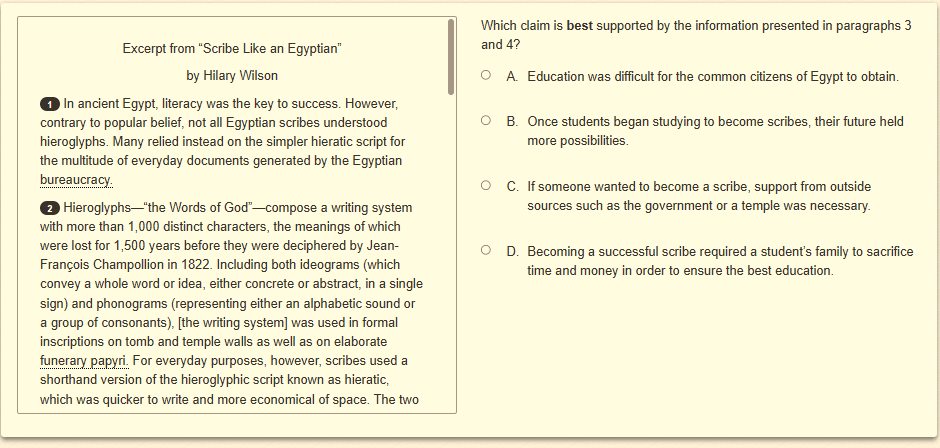
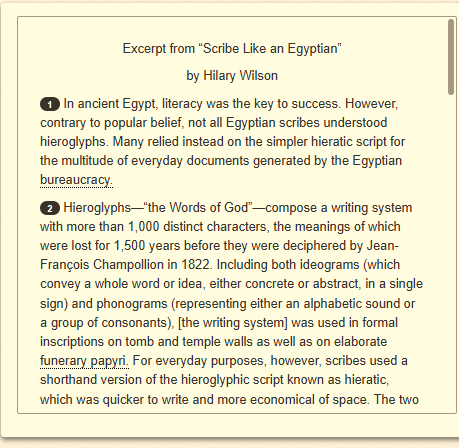
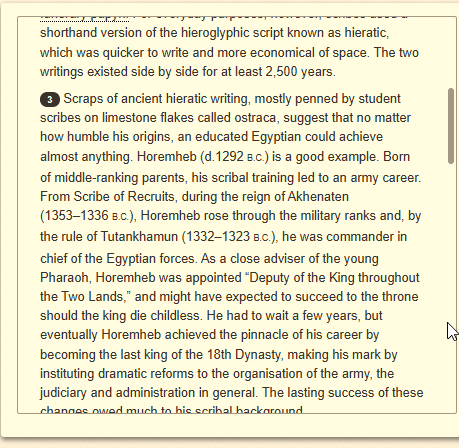
The passage “Excerpt from “Scribe Like an Egyptian”” as shown on the test
Question 2 of 11
2025 Practice Test A English, question 13Uses the passage above: “Excerpt from “Scribe Like an Egyptian””.
Question
Hieratic script was particularly valuable in a bureaucratic government because
- Ausing hieratic script was an efficient way for scribes to produce large amounts of documentation.
- Bmany members of the general public could comprehend information that was written in hieratic script.
- Cknowledge of hieratic script prepared scribes to serve their society in increasingly challenging roles.
- Dpeople from different professional backgrounds could easily communicate with one another in hieratic script.
Show the answer
Correct answer: A
The question asks why hieratic script was especially valuable in a bureaucratic government.
A. CORRECT. Hieratic script is described in paragraph 1 as being simpler for the “multitude of everyday documents” generated by the government and as “quicker to write and more economical of space” in paragraph 2. The logical conclusion based on these details is that hieratic script was more efficient for the large amounts of documentation produced by the government.
B. Incorrect. In paragraph 4, the author explains that “education was not available to all,” suggesting that only people who were educated could read and write. The excerpt as a whole does not provide sufficient information to indicate what portion of the general public would be able to comprehend material written in hieratic script.
C. Incorrect. The idea that becoming a scribe could lead to taking different positions in society is addressed in paragraphs 3, 4, and 6. However, the use of hieratic script in the fields of medicine, law, or religion does not necessarily explain the value of the script for the bureaucratic government referenced in the question.
D. Incorrect. Although different professions such as doctors and lawyers used hieratic script, the author uses these professions as examples of different job opportunities for scribes in paragraph 6. There is no discussion in the excerpt about different professions communicating with each other, and these professions were not necessarily part of the bureaucratic government.
Question analysis
This inference question on “Scribe Like an Egyptian” asks why hieratic, one of the two scripts of ancient Egypt, was especially valuable to a bureaucratic government. The article never gives the reason in a single sentence, so students must connect what it says about Egypt’s bureaucracy with what it says about the script itself. Each choice offers a reasonable-sounding benefit.
- Grade level
- Grade 7 reading and task
- Compared with grade 7
- At grade 7 Drawing a conclusion from two neighboring paragraphs is typical grade 7 inference work. The word “bureaucratic” and the article’s formal style add some load, but the details needed are close together and plainly stated.
- Estimated difficulty
- Straightforward: two steps or one careful reading.
- Thinking it demands
- Depth of knowledge 2, skills and concepts · mainly understand
- What makes it hard
- Evidence in several places minor
- Hard words minor
- Reading between the lines minor
- Evidence
- Answered from several paragraphs or stanzas
- Reading level
- Passage: about grade 12, 810 words; question and choices: about grade 13, 68 words.
- Students, last 30 days
- Not enough answers yet to show (it takes 10).
Why it is hard, traps and wrong answers (shows the answer)
Why it is hard
The two facts that answer the question sit a few lines apart in the first two paragraphs, so the work is mostly connecting them. The wrong reasons all sound like advantages a simpler script might bring, public readability, career preparation, communication across professions, and each rests on a guess or on the excerpt’s talk of scribal careers rather than on what it says hieratic was used for. Students who return to the description of hieratic itself avoid them.
Evidence in several places minor Working it out
The reason is split between paragraph 1, where hieratic serves the “multitude of everyday documents,” and paragraph 2, where it is “quicker to write and more economical of space.” (Kirsch & Mosenthal, 1990; Gorin & Embretson, 2006)
Hard words minor Understanding the question
The stem turns on “bureaucratic,” a word students must connect to a government that runs on paperwork; without it, the link to large amounts of documentation is hard to see. (Perfetti, 2007; Freedle & Kostin, 1993)
Reading between the lines minor Working it out
No sentence says why hieratic helped the government; students must combine speed and compactness with the sheer volume of records to reach efficiency. (Graesser, Singer & Trabasso, 1994; Kintsch, 1998)
Strategy: Find the sentences that describe hieratic script and what it was used for, then pick the choice those sentences support rather than one that only sounds like an advantage.
Traps
- Reads too much in: A reasonable-sounding conclusion that goes further than the text allows.
- True but not the answer: A choice says something accurate about the text that does not answer this question.
- Outside knowledge: A choice is plausible in the real world but not supported by this text.
The wrong answers, classified
B Reads too much in (Graesser, Singer & Trabasso, 1994)
Reasons that a simpler script must have been readable by ordinary people, though paragraph 4 says “education was not available to all” and the excerpt never says the public read hieratic.
C True but not the answer (King et al., 2004; Embretson & Wetzel, 1987)
Recalls the careers in paragraphs 3 and 6 that schooling opened to scribes, which is true of the excerpt but explains a scribe’s prospects, not why the government valued hieratic.
D Outside knowledge (King et al., 2004; Recht & Leslie, 1988)
Imagines hieratic as a shared language linking doctors, lawyers and officials, a sensible-sounding benefit the excerpt never raises; paragraph 6 names those professions only as careers for scribes.
Working it out, step by step
Figure out what the question asks
This asks why hieratic script was so useful to a bureaucratic government. A bureaucracy is a government run by many officials, with lots of paperwork. Hieratic is the quick, simple form of Egyptian writing. Look for what the article says about hieratic and what it was used for.
Find the evidence in paragraphs 1 and 2
Paragraph 1 says many scribes used hieratic for the “multitude of everyday documents” that the government produced. Multitude means a huge number. Paragraph 2 says hieratic was “quicker to write and more economical of space.” Economical of space means it took up less room on the page.
Connect the two facts
Put the facts together. The government made a huge number of papers. Hieratic was fast to write and used less space. So scribes could turn out lots of papers quickly. Getting a lot done with little time and effort is called being efficient.
Check each choice
- A fits. Hieratic let scribes make large amounts of paperwork quickly.
- B does not fit. Paragraph 4 says “education was not available to all.” The article never says ordinary people could read hieratic.
- C does not fit. Training did lead to careers, but that explains a scribe’s chances, not why the government valued the script.
- D does not fit. Paragraph 6 lists jobs like doctor and lawyer as careers for scribes. It never says those workers wrote to each other in hieratic.
Watch out: B sounds sensible, since a simpler script seems easier for anyone to read. But that is a guess, not something the article says.
Choose the answer
Hieratic was fast and compact, and the government needed a huge number of documents. So the answer is A.
Why this answer and not the closest wrong one
B is the closest wrong choice, because a simpler script does sound easier to read. But the article says only some Egyptians got an education. It never says the public could read hieratic. A rests on two facts the article states: the government made a “multitude of everyday documents,” and hieratic was quicker to write.
More questions like this
The original DOE question
Question 3 of 11
2024 Test A English, question 26Passage Champion of the Channel
Champion of the Channel
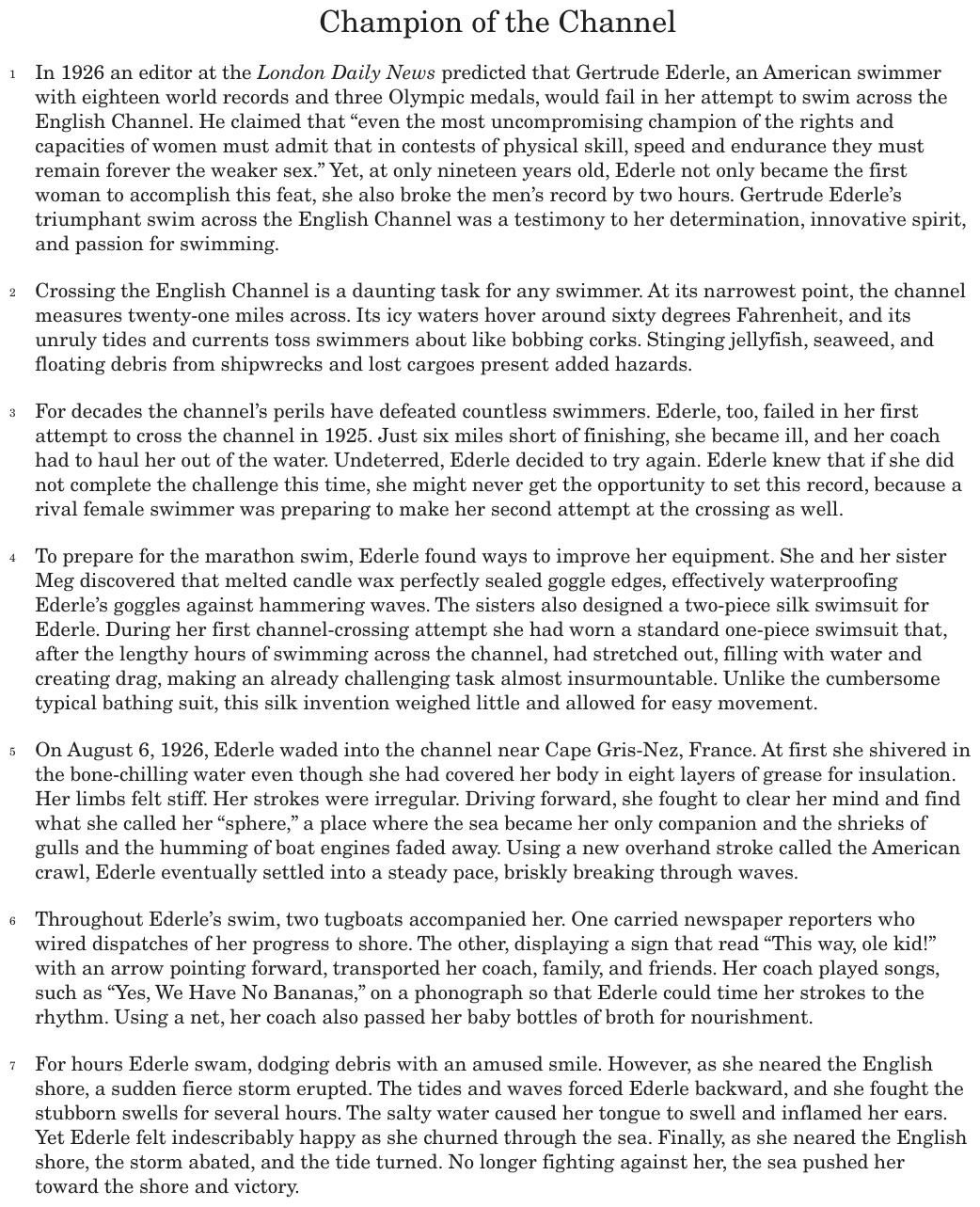
In 1926 an editor at the London Daily News predicted that Gertrude Ederle, an American swimmer with eighteen world records and three Olympic medals, would fail in her attempt to swim across the English Channel. He claimed that “even the most uncompromising champion of the rights and capacities of women must admit that in contests of physical skill, speed and endurance they must remain forever the weaker sex.” Yet, at only nineteen years old, Ederle not only became the first woman to accomplish this feat, she also broke the men’s record by two hours. Gertrude Ederle’s triumphant swim across the English Channel was a testimony to her determination, innovative spirit, and passion for swimming.
Crossing the English Channel is a daunting task for any swimmer. At its narrowest point, the channel measures twenty-one miles across. Its icy waters hover around sixty degrees Fahrenheit, and its unruly tides and currents toss swimmers about like bobbing corks. Stinging jellyfish, seaweed, and floating debris from shipwrecks and lost cargoes present added hazards.
For decades the channel’s perils have defeated countless swimmers. Ederle, too, failed in her first attempt to cross the channel in 1925. Just six miles short of finishing, she became ill, and her coach had to haul her out of the water. Undeterred, Ederle decided to try again. Ederle knew that if she did not complete the challenge this time, she might never get the opportunity to set this record, because a rival female swimmer was preparing to make her second attempt at the crossing as well.
To prepare for the marathon swim, Ederle found ways to improve her equipment. She and her sister Meg discovered that melted candle wax perfectly sealed goggle edges, effectively waterproofing Ederle’s goggles against hammering waves. The sisters also designed a two-piece silk swimsuit for Ederle. During her first channel-crossing attempt she had worn a standard one-piece swimsuit that, after the lengthy hours of swimming across the channel, had stretched out, filling with water and creating drag, making an already challenging task almost insurmountable. Unlike the cumbersome typical bathing suit, this silk invention weighed little and allowed for easy movement.
On August 6, 1926, Ederle waded into the channel near Cape Gris-Nez, France. At first she shivered in the bone-chilling water even though she had covered her body in eight layers of grease for insulation. Her limbs felt stiff. Her strokes were irregular. Driving forward, she fought to clear her mind and find what she called her “sphere,” a place where the sea became her only companion and the shrieks of gulls and the humming of boat engines faded away. Using a new overhand stroke called the American crawl, Ederle eventually settled into a steady pace, briskly breaking through waves.
Throughout Ederle’s swim, two tugboats accompanied her. One carried newspaper reporters who wired dispatches of her progress to shore. The other, displaying a sign that read “This way, ole kid!” with an arrow pointing forward, transported her coach, family, and friends. Her coach played songs, such as “Yes, We Have No Bananas,” on a phonograph so that Ederle could time her strokes to the rhythm. Using a net, her coach also passed her baby bottles of broth for nourishment.
For hours Ederle swam, dodging debris with an amused smile. However, as she neared the English shore, a sudden fierce storm erupted. The tides and waves forced Ederle backward, and she fought the stubborn swells for several hours. The salty water caused her tongue to swell and inflamed her ears. Yet Ederle felt indescribably happy as she churned through the sea. Finally, as she neared the English shore, the storm abated, and the tide turned. No longer fighting against her, the sea pushed her toward the shore and victory.
After fourteen hours and thirty-one minutes, Ederle, on wobbly legs, stepped onto the English shore. The waiting crowd roared, honked their automobile horns, blasted their tugboat whistles, and set off flares that flashed in the sky. Ederle had swum into history.
When Ederle returned to New York, she received a parade, where thousands of people shouted “Trudy!” Not only were everyday American citizens proud of Ederle, but she also inspired them to be more active. Over the next few years, more than 60,000 people credited her with motivating them to earn their American Red Cross swimming certificates. Gertrude Ederle’s accomplishment proved to the world that with determination and passion, it was possible for a person to achieve his or her goals.
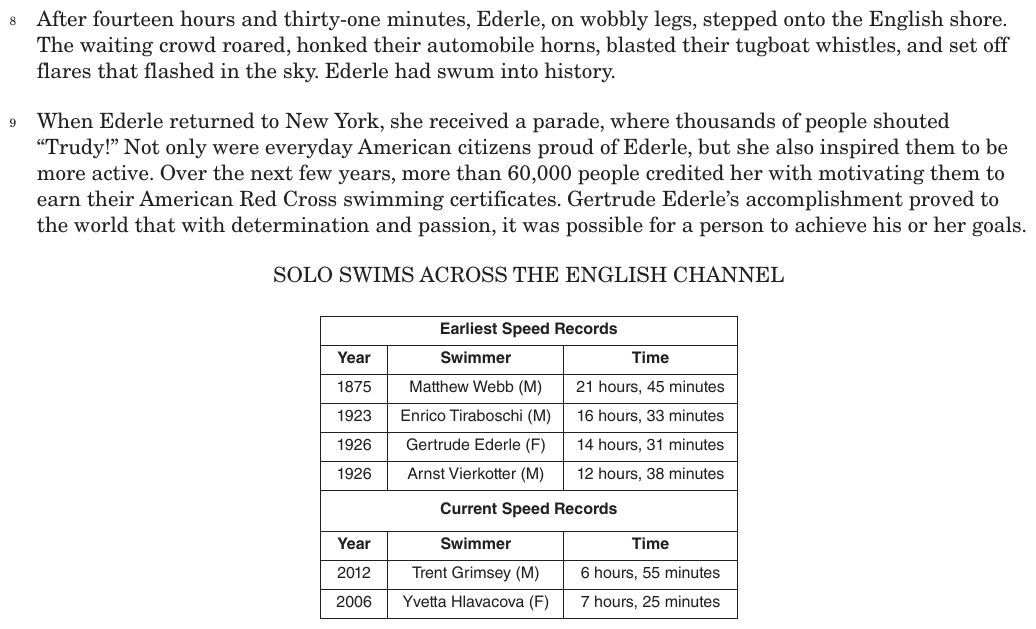
SOLO SWIMS ACROSS THE ENGLISH CHANNEL
|
Earliest Speed Records |
||
| Year | Swimmer | Time |
| 1875 | Matthew Webb (M) | 21 hours, 45 minutes |
| 1923 | Enrico Tiraboschi (M) | 16 hours, 33 minutes |
| 1926 | Gertrude Ederle (F) | 14 hours, 31 minutes |
| 1926 | Arnst Vierkotter (M) | 12 hours, 38 minutes |
| Current Speed Records | ||
| Year | Swimmer | Time |
| 2012 | Trent Grimsey (M) | 6 hours, 55 minutes |
| 2006 | Yvetta Hlavacova (F) | 7 hours, 25 minutes |
Question
What do the newspaper editor’s comments in paragraph 1 reveal about the challenges Ederle faced in attempting her feat?
- ARegardless of her ability, being an American put Ederle at a serious disadvantage over a Londoner, who would be more familiar with the English Channel.
- BAt the time, Ederle still needed more training in order to succeed in the daunting task of swimming the English Channel.
- CWhile Ederle could participate in athletic competition, some people were not comfortable with her attempt to swim the channel because no woman had ever attempted it before.
- DIn spite of her previous achievements, Ederle still experienced social as well as physical obstacles in attempting to swim the channel.
Show the answer
Correct answer: D
The question asks what the newspaper editor’s comments in paragraph 1 reveal about Ederle’s challenges leading up to her attempt to swim across the channel.
A. Incorrect. The idea that Ederle was at a disadvantage because she was American rather than English, and thus less familiar with the channel, was not the basis for the newspaper editor’s comments about the outcome of her swim.
B. Incorrect. The passage establishes that Ederle was a highly accomplished swimmer who had won major world competitions (“Gertrude Ederle, an American swimmer with eighteen world records and three Olympic medals” [paragraph 1]).
C. Incorrect. The newspaper editor’s point was that Ederle would be unsuccessful in her attempt to complete the swim because she was a woman, not that people were uncomfortable with the idea since no woman had attempted it before.
D. CORRECT. The comments reveal a lack of social support since many people believed that a woman, no matter how skilled a swimmer, did not have the strength to overcome the physical challenges that the dangerous channel waters presented (“He claimed that ‘even the most uncompromising champion of the rights and capacities of women must admit that in contests of physical skill, speed and endurance they must remain forever the weaker sex.’ ” [paragraph 1]).
Question analysis
In 1926 a London newspaper editor predicted that Gertrude Ederle would fail to swim the English Channel, and this reading question asks what his comments in the first paragraph reveal about the challenges she faced. Students must infer from the editor's own words what stood in her way, and the wrong choices offer believable obstacles that the passage never connects to him.
- Grade level
- Grade 7 reading and task
- Compared with grade 7
- At grade 7 Reading an opinion for what it shows about a person's situation is everyday grade 7 inference. This question points to both of the editor's sentences rather than quoting just one, so the evidence is in plain view and the work is weighing four readings.
- Estimated difficulty
- Moderate: several steps, or a close reading with one strong distractor.
- Thinking it demands
- Depth of knowledge 2, skills and concepts · mainly understand
- What makes it hard
- A very close wrong answer moderate
- Reading between the lines moderate
- Complex sentences minor
- Evidence
- Answered from one paragraph or stanza
- Reading level
- Passage: about grade 9, 790 words; question and choices: about grade 14, 112 words.
- Students, last 30 days
- Not enough answers yet to show (it takes 10).
Why it is hard, traps and wrong answers (shows the answer)
Why it is hard
Pointing to both of the editor's sentences puts his reason in plain view, so the work lies in naming what kind of obstacle a sexist prediction is. Students who see prejudice but not its stated basis fall for the near miss, which blames the lack of earlier female attempts, though Ederle herself had tried in 1925. The right answer is the only one that pairs that prejudice with the channel's physical dangers, and it rewards reading his words as a judgment about women, not about her.
A very close wrong answer moderate Choosing the answer
The right choice and the one about people being uncomfortable both find a social obstacle despite her skill; they part on its cause, the editor's claim that women are “the weaker sex” or the idea that no woman had tried. (Embretson & Wetzel, 1987; Gorin & Embretson, 2006; Ascalon et al., 2007)
Reading between the lines moderate Working it out
Neither of the editor's sentences names an obstacle, so a prediction of failure and a remark about women's “physical skill, speed and endurance” must be read as prejudice she faced on top of the channel's own dangers. (Graesser, Singer & Trabasso, 1994; Kintsch, 1998)
Complex sentences minor Understanding the question
The editor's quoted claim runs 30 words, opening with “even the most uncompromising champion of the rights and capacities of women” and holding its point, “the weaker sex”, until the end. (Abedi & Lord, 2001; Freedle & Kostin, 1993; Messick, 1989)
Strategy: Put the editor's reasoning into your own words before looking at the choices, then reject any choice whose reason for doubting Ederle is not the one he actually gives.
Traps
- Half right: One half of a two-part choice is right and the other is not.
- Outside knowledge: A choice is plausible in the real world but not supported by this text.
- Word match: Repeats striking words or phrases from the text, so it looks supported, but its meaning does not fit the question.
The wrong answers, classified
A Outside knowledge (King et al., 2004; Recht & Leslie, 1988)
Imagines a rivalry between an American and Londoners who know the channel, a plausible reason for doubt that the editor never gives, since his claim is about women.
B Word match (Freedle & Kostin, 1993)
Picks up “daunting task” from paragraph 2 and reads a prediction of failure as a sign she was undertrained, though the same sentence credits her with eighteen world records.
C Half right (King et al., 2004; Thissen, Steinberg & Fitzpatrick, 1989)
Rightly sees people doubting a woman's attempt but gives the wrong reason; the editor cites women's supposed weakness, and Ederle had already tried the crossing in 1925.
Working it out, step by step
Understand what the question asks
This question asks you to make an inference. An inference is a conclusion you reach from clues when the text does not say it outright. The editor’s comments are in paragraph 1. You need to work out what they show about the problems Ederle had to face.
Find the editor’s two comments
Paragraph 1 says the editor “predicted that Gertrude Ederle, an American swimmer with eighteen world records and three Olympic medals, would fail in her attempt to swim across the English Channel.” Then it gives his reason. He said that women “must remain forever the weaker sex.”
Put his reason in your own words
The editor’s full sentence is long, and its point comes at the very end. He meant that even people who support women must agree that women will always be weaker in sports. His reason had nothing to do with Ederle’s own skill, which her records proved. He doubted her only because she was a woman. That is a social obstacle: a problem that comes from what other people believe.
Add the dangers of the swim
On top of that, the swim itself was dangerous. Paragraph 2 calls the crossing “a daunting task for any swimmer.” Daunting means scary and hard. The paragraph lists “icy waters,” rough tides and “stinging jellyfish.” So Ederle had two kinds of trouble: people’s doubts and the hard swim itself.
Check each choice
- D fits: “in spite of her previous achievements” matches her records, and “social as well as physical obstacles” matches the editor’s doubts plus the rough water.
- A is wrong because the editor never mentions her being American or Londoners knowing the channel.
- B is wrong because nothing says she needed more training, and her eighteen world records show she was well prepared.
- C is wrong because the editor’s reason was that women are weaker, not that no woman had tried.
Watch out: C also spots people doubting her, so it is tempting. But it gives the wrong reason for the doubt. Paragraph 3 even says Ederle herself had tried in 1925.
Choose the answer
The editor’s words show that Ederle faced prejudice against women on top of a dangerous swim. So the answer is D.
Why this answer and not the closest wrong one
C is the choice most likely to fool you. It also sees that some people doubted Ederle. But it blames the doubt on no woman having tried before. The editor’s real reason was his belief that women are “the weaker sex.” D names that social obstacle and adds the physical ones, so D fits best.
More questions like this
The original DOE question
The passage “Champion of the Channel” as printed (pages 56–57)
Question 4 of 11
2024 Test A English, question 45Passage Excerpt from The Highest Tide
Excerpt from The Highest Tide
by Jim Lynch
The narrator’s summer job is collecting marine specimens in Puget Sound, Washington. In this excerpt, he is looking for specimens in the mudflats before daybreak. Mudflats, or flats, are coastal landforms created when sediment and silt from tides are deposited as the tides recede.
I rounded the oyster beds, to the far side. . . . It was low tide by then, and I saw the water hesitating at its apex, neither leaving nor returning, patiently waiting for the gravitational gears to shift. Dozens of anxious clams started squirting in unison like they did whenever vibrating grains of sand warned them predators were approaching. I stopped and waited with them, to actually see the moment when the tide started returning with its invisible buffet of plankton for the clams, oysters, mussels and other filter feeders. It was right then, ankle deep in the Sound, feet numbing, eyes relaxed, that I saw the nudibranch.1
In all my time on the flats I’d never seen one before. I’d read about them, sure. I’d handled them at aquariums but never in the wild, and I’d never even seen a photo of one this stunning. It was just three inches long but with dozens of fluorescent, orange-tipped hornlike plumes jutting from the back of its see-through body that appeared to be lit from within.
Nudibranchs are often called the butterflies of the sea, but even that understates their dazzle. Almost everything else in the northern Pacific is dressed to blend with pale surroundings. Nudibranchs don’t bother, in part because they taste so lousy they don’t need camouflage to survive. But also, I decided right then, because their beauty is so startling it earns them a free pass, the same way everyday life brakes for peacocks, parade floats. . . .
The dark mudflats loomed like wet, flattened dunes stretching deep into Skookumchuck Bay in front of our house. From a distance, they looked too barren to support sea life. Up close, they still did, unless you knew where to find the hearty clams, worms and tiny creatures that flourish in mud. . . . I’m not sure why I decided to take a look. It was still an hour before sunrise, and I knew exactly what the bars2 looked like in the moonlight, but for some reason, I couldn’t resist.
I heard it long before I saw it. It was an exhale, a release of sorts, and I instantly wondered if a whale was stranded again. We had a young minke3 stuck out there two summers prior, and it made similar noises until the tide rose high enough for rescuers to help free it. . . . I looked for a hulking silhouette but couldn’t find one. I waited, but there were no more sounds. Still, I went toward what I thought I’d heard, avoiding stepping into the mud until I had to. I knew the flats well enough to know I could get stuck just about anywhere. The general rule was you didn’t venture out past the shells and gravel with an incoming tide. I sank up to my knees twice, and numbing water filled my boots.
. . . I kept stepping toward the one sound I’d heard, a growing part of me hoping I’d find nothing at all. When I stopped to rest and yank up my socks, my headlamp crossed it. My first thought? A giant octopus.
Puget Sound has some of the biggest octopi in the world. They often balloon to a hundred pounds. Even the great Jacques Cousteau4 himself came to study them. But when I saw the long tubular shape of its upper body and the tangle of tentacles below it, I knew it was more than an octopus. I came closer, within fifty feet, close enough to see its large cylindrical siphon5 quiver. I couldn’t tell if it was making any sounds at that point, because it was impossible to hear anything over the blood in my ears. . . .
The creature’s body came to a triangular point above narrow fins that lay flat on the mud like wings, but it was hard to be sure exactly where it all began or ended, or how long its tentacles truly were, because I was afraid to pry my eyes off its jumble of arms for more than half a second. I didn’t know whether I was within reach, and its arms were as big around as my ankle and lined with suckers the size of half-dollars. If they even twitched I would have run. So, I was looking at it and not looking at it while my heart spangled my vision. I saw fragments, pieces, and tried to fuse them in my mind but couldn’t be certain of the whole. I knew what it had to be, but I wouldn’t allow myself to even think the two words. Then I gradually realized the dark shiny disc in the middle of the rubbery mass was too perfectly round to be mud or a reflection.
It was too late to smother my scream. Its eye was the size of a hubcap.6
From THE HIGHEST TIDE by Jim Lynch. Copyright © 2005 by Jim Lynch. Used by permission of Bloomsbury USA. All rights reserved.
1nudibranch: type of sea slug
2bars: sandbars
3minke: species of small whale
4Jacques Cousteau: renowned French oceanographer
5siphon: tube-like organ that is used for drawing in or removing fluids
6hubcap: removable cap over the end of a wheel axle
Question
The narrator’s actions in paragraph 5 reveal that he is
- Aexpecting to see the familiar sight of a stranded minke.
- Bconfident about exploring farther into the mudflats.
- Cunconcerned about becoming stuck in the mudflats.
- Ddetermined to discover the source of the sound.
Show the answer
Correct answer: D
The question asks what the narrator’s actions in paragraph 5 reveal about him.
A. Incorrect. The paragraph begins with the narrator wondering “if a whale was stranded again” because of one that had gotten stuck before and had “made similar noises.” However, the narrator explains that he “looked for a hulking silhouette but couldn’t find one” before he “went toward what [he] thought [he’d] heard,” so readers can conclude that he continues to walk through the dangerous mudflats not because he expects to find a whale but because he is curious to find out what made the noise.
B. Incorrect. The fact that the narrator knows about a whale that was stranded on the mudflats “two summers prior” indicates that he is familiar with the area, and he does mention that he has some knowledge of the mudflats. However, in the paragraph, he reveals that his knowledge is of the dangers there: “I knew the flats well enough to know I could get stuck just about anywhere.” He also explains that as he moves, he avoids “stepping into the mud until [he] had to.” The fact that he acknowledges the danger and tries to avoid it indicates that he is cautious rather than confident.
C. Incorrect. In the paragraph, the narrator’s recollection that even though he could not see the silhouette of a whale, “still, [he] went toward what [he] thought [he’d] heard” might make him seem unconcerned about getting stuck. However, even as he continues, he moves carefully, avoiding “stepping into the mud until [he] had to” because he knows the mudflats “well enough to know [he] could get stuck just about anywhere.”
D. CORRECT. In the paragraph, the narrator describes the dangers of walking on the mudflats by stating that he “knew the flats well enough to know [he] could get stuck just about anywhere,” but he continues walking toward the sound. Despite knowing the dangers, he still “went toward what [he] thought [he’d] heard,” and this shows that he is determined to find out what made the sound.
Question analysis
This inference question asks what the narrator's actions reveal about him when he hears a strange sound on the mudflats before dawn and sets off toward it. Students must read what he does alongside what he says he knows about the flats, and several choices fit one detail of the paragraph but not the whole of it.
- Grade level
- Grade 7 reading and task
- Compared with grade 7
- At grade 7 Inferring a character's trait from actions is core grade 7 literary reading. The evidence sits in one paragraph and the actions are concrete, so the item is typical, though the long paragraph mixes memory, rules and movement.
- Estimated difficulty
- Straightforward: two steps or one careful reading.
- Thinking it demands
- Depth of knowledge 2, skills and concepts · mainly understand
- What makes it hard
- Reading between the lines moderate
- Much to keep track of minor
- Evidence
- Answered from one paragraph or stanza
- Reading level
- Passage: about grade 6, 902 words; question and choices: about grade 8, 41 words.
- Students, last 30 days
- Not enough answers yet to show (it takes 10).
Why it is hard, traps and wrong answers (shows the answer)
Why it is hard
Paragraph 5 shows two things at once, a narrator who knows exactly how dangerous the flats are and one who keeps walking toward a sound anyway. Choices that see only the walking call him confident or unconcerned, and the one that sees only his first thought has him expecting a whale. The word “Still”, after his search for a silhouette comes up empty, is the hinge that shows determination.
Reading between the lines moderate Working it out
The trait is never named; it must be drawn from what he does, especially “Still, I went toward what I thought I'd heard” after seeing nothing and hearing nothing more. (Graesser, Singer & Trabasso, 1994; Kintsch, 1998)
Much to keep track of minor Working it out
The paragraph mixes a memory of the stranded minke, a rule about incoming tides and his own steps, and the student must keep his caution and his persistence in view together. (Sweller, 1988; Carpenter, Just & Shell, 1990)
Strategy: List what the narrator does in paragraph 5, step by step, and note what he knows while doing it; then ask what those actions, taken together, say about him.
Traps
- Wrong tone or attitude: Misjudges the tone, attitude or point of view, such as reading admiration as criticism, or taking a character's or subject's feelings for the author's.
- Twists what the text says: Uses the text's topic and ideas but changes what it says: who did it, how much, when, or why.
The wrong answers, classified
A Twists what the text says (King et al., 2004)
Builds on his first thought that a whale was stranded again, but he finds no silhouette and keeps going, and one stranding two summers before hardly makes it a familiar sight.
B Wrong tone or attitude (Graesser, Singer & Trabasso, 1994)
Reads “I knew the flats well” as confidence, but he knew them well enough to know he could get stuck anywhere, which is wariness, not confidence.
C Wrong tone or attitude (Graesser, Singer & Trabasso, 1994)
Takes his pressing on as indifference, ignoring that he avoids stepping into the mud until he has to because he knows how easily he could sink.
Working it out, step by step
Know what the question asks
This asks you to make an inference about a character. You judge what the narrator is like from what he does. The text never names the trait, so look closely at his actions.
List his actions in paragraph 5
He hears a sound and wonders if a whale is stranded. He “looked for a hulking silhouette but couldn’t find one.” He waits, but hears nothing more. Then he says, “Still, I went toward what I thought I’d heard.” He sinks to his knees twice, and cold water fills his boots.
Notice what he knows
He knows the danger. He says, “I knew the flats well enough to know I could get stuck just about anywhere.” The word “Still” matters here. It means even so. Even with no whale in sight and no more sounds, he keeps heading toward the noise.
Check each choice
- D fits: he keeps going toward the sound despite the danger, so he is determined to find its source.
- A is wrong because he finds no whale and keeps going, and one stranding two summers ago is not a familiar sight.
- B is wrong because knowing he could get stuck anywhere makes him careful, not confident.
- C is wrong because he avoids “stepping into the mud until I had to,” so he does worry about getting stuck.
Watch out: B and C notice only that he keeps walking. They miss how carefully he moves.
Choose the answer
He presses on toward the sound even though he knows the mud is dangerous. So the answer is D.
Why this answer and not the closest wrong one
B comes closest, because he says he knows the flats well. But what he knows is how easily he could get stuck, so he is careful, not confident. Pressing on anyway, after seeing nothing and hearing nothing more, shows determination.
More questions like this
The original DOE question
The passage “Excerpt from The Highest Tide” as printed (pages 64–65)
Question 5 of 11
2024 Test B English, question 53Passage Excerpt from “The Past and the Future of the Earth’s Oldest Trees”
Excerpt from “The Past and the Future of the Earth’s Oldest Trees”
by Alex Ross
About forty-five hundred years ago, not long after the completion of the Great Pyramid at Giza, a seed of Pinus longaeva, the Great Basin bristlecone pine, landed on a steep slope in what are now known as the White Mountains, in eastern California. The seed may have travelled there on a gust of wind, its flight aided by a winglike attachment to the nut. Or it could have been planted by a bird known as the Clark’s nutcracker, which likes to hide pine seeds in caches; nutcrackers have phenomenal spatial1 memory and can recall thousands of such caches. This seed, however, lay undisturbed. On a moist day in fall, or in the wake of melting snows in spring, a seedling appeared above ground—a stubby one-inch stem with a tuft of bright-green shoots.
Most seedlings die within a year; the mortality rate is more than ninety-nine percent. The survivors are sometimes seen growing in the shadow of a fallen tree. The landscape of the Ancient Bristlecone Pine Forest, as this area of the White Mountains is called, is littered with fragments of dead trees—trunks, limbs, roots, and smaller chunks. Pinus longaeva grows exclusively in subalpine regions of the Great Basin, which stretches from the eastern slopes of the Sierra Nevada to the Wasatch Range, in Utah. Conditions are generally too arid for the dead wood to rot; instead, it erodes, sanded down like rock. The remnants may harbor nutrients and fungi that help new trees grow. Bristlecones rise from the bones of their ancestors—a city within a cemetery.
Coast redwoods and giant sequoias, California’s gargantuan world-record-holding trees, can grow fifty feet or more in their first twenty years. Bristlecones rise agonizingly slowly. After four or five years, the seedling on the steep slope would have been just a few inches higher, sprouting needles in place of the embryonic shoots. The needles are a deep green, tough, resinous, and closely bunched in groups of five. On a mature tree, they live for fifty years or more. Decades may have passed before the tree was human height, and decades more before it resembled a conventional pine. Bristlecone saplings grow straight up, with relatively sparse foliage, looking like undernourished Christmas trees. After a few hundred years—by which time the Old Kingdom of Egypt had fallen—it was probably forty or fifty feet in height.
Many tree species live for hundreds of years. A smaller but not inconsiderable number, including the sequoias and certain yews, oaks, cypresses, and junipers, survive for thousands. Once a bristlecone has established itself in the unforgiving conditions of the White Mountains, it can last almost indefinitely. The trees tend to grow some distance from one another, so fires almost never destroy an entire stand. Because only a few other plant species can handle the dry, cold climate, the bristlecones face little competition. Unlike most plants, they tolerate dolomite soil, which is composed of a chalky type of limestone that is heavily alkaline and low in nutrients. As for insect threats, bristlecone wood is so dense that mountain-pine beetles and other pests can rarely burrow their way into it.
Empires rose and fell; wars raged; . . . and the tree from 2500 B.C. continued its implacable slow-motion existence, adding about two-hundredths of an inch to the diameter of its trunk each year. Minute changes in the tree-ring record make bristlecones an exceptionally useful source of data about changing conditions on Earth. When rains are heavier than normal, the rings widen. When volcanic eruptions cause global cooling, frost rings make the anomaly2 visible. . . .
As the millennia go by, bristlecones become contorted and wraithlike.3 The main stem, or leader, dies back. Entire branches, even the trunk itself, become fossils. At first glance, the tree may look dead. Such is the case of the forty-five-hundred-year-old tree that clings to life near the tourist path that now runs through the Ancient Bristlecone Pine Forest. Spears of dead wood jut into the air. The trunk is a marbled hulk stripped of bark, like driftwood thrown from a vanished ocean. A ribbon of live bark runs up one side, funneling water and nutrients to clumps of green needles high above. All told, the tree is an unprepossessing specimen; most people march past it without giving it a second glance. . . .
. . . No two super-elderly trees look alike, to the point where they have acquired the characteristics of individuals. Trees are prone to anthropomorphism; we project our dreams and our anxieties onto them. Bristlecones have been called elders, sentinels, sages. The possibility that climate change will cause their extinction has inspired a spate4 of alarmed news stories, although tree scientists tend to discount the idea that the bristlecones are in immediate danger. They have survived any number of catastrophes in the past; they may survive humanity.
From “The Past and the Future of the Earth’s Oldest Trees” by Alex Ross from THE NEW YORKER, January 20, 2020. Copyright © 2020 by Condé Nast. All rights reserved.
1spatial: relating to physical space
2anomaly: oddity
3wraithlike: ghostly
4spate: sudden abundance
Question
Which claim is best supported by the details in paragraph 5 about the bristlecone pine’s tree-ring record?
- AThe bristlecone pine must be protected from extinction so that there is a record of changing Earth conditions.
- BThe structure of the bristlecone pine allows scientists to predict changing Earth conditions over time.
- CThe slow growth process of the bristlecone pine allows it to survive in spite of changing Earth conditions.
- DThe bristlecone pine can be used to gather information on changing Earth conditions because of its long life.
Show the answer
Correct answer: D
The question asks which claim is best supported by the details about the bristlecone pine tree’s ring record presented in paragraph 5.
A. Incorrect. In paragraph 5, the author explains that the bristlecone pine is “an exceptionally useful source of data about changing conditions on Earth,” and this suggests that the information presented by the trees is particularly valuable and important. However, while the paragraph explains that the data provided by the trees are important, it does not address the need to protect the trees from any threat of extinction. The only reference to the trees’ extinction is in paragraph 7, when the author addresses the “possibility that climate change will cause their extinction” but then explains that “scientists tend to discount the idea that the bristlecones are in immediate danger.”
B. Incorrect. Paragraph 5 describes “minute changes in the tree-ring record” that make bristlecone pines “an exceptionally useful source of data about changing conditions on Earth,” and examples of those changing conditions are described in the present tense: “When rains are heavier than normal, the rings widen.” However, the term “record” indicates that the tree rings are already formed by the time scientists study them. The trees provide information about the past, which is emphasized by the description at the beginning of paragraph 5 of historic events one tree lived through. The excerpt contains no information about whether scientists can use the climate patterns of the past as evidenced by tree rings to make predictions about the future.
C. Incorrect. Paragraph 5 describes the “slow-motion existence” of the bristlecone pine and provides examples of the record of “changing conditions on Earth” reflected in the rings of the trees. However, although the paragraph makes it clear that the trees have been able to survive these changing conditions, the paragraph does not indicate that the slow growth of the trees, each of which adds only “about two-hundredths of an inch to the diameter of its trunk each year,” is the key to their survival. Instead, paragraph 4 lists other reasons why an established bristlecone pine “can last almost indefinitely,” including distance between individual trees; tolerance for cold, dry conditions and dolomite soil; and wood that is resistant to insects.
D. CORRECT. Paragraph 5 emphasizes the longevity of the bristlecone pine by discussing its “implacable slow-motion existence” and how this makes the trees a valuable source of information for scientists. The author explains that “minute changes in the tree-ring record make bristlecones an exceptionally useful source of data about changing conditions on Earth.” A tree that has been alive since 2500 B.C., like the one in paragraph 5, can provide a long record of the changing climate.
Question analysis
Students decide which claim is best supported by the details about tree rings in paragraph 5 of an article on the ancient bristlecone pines of California’s White Mountains. Every choice links the trees to changing conditions on Earth, so the challenge is noticing which claim stays within what the paragraph actually says.
- Grade level
- Grade 7 reading and task
- Compared with grade 7
- At grade 7 Choosing the claim a paragraph supports is core grade 7 inference work, and paragraph 5 is only four sentences long. The demand is typical: one careful reading of those sentences, plus attention to the exact wording of each claim.
- Estimated difficulty
- Moderate: several steps, or a close reading with one strong distractor.
- Thinking it demands
- Depth of knowledge 2, skills and concepts · mainly understand
- What makes it hard
- A very close wrong answer moderate
- Reading between the lines moderate
- Every choice must be checked minor
- Evidence
- Answered from one paragraph or stanza
- Reading level
- Passage: about grade 8, 851 words; question and choices: about grade 9, 85 words.
- Corrected from the DOE handbook
- An inaccurate detail in the explanation was corrected.
- Students, last 30 days
- Not enough answers yet to show (it takes 10).
Why it is hard, traps and wrong answers (shows the answer)
Why it is hard
All four claims tie the bristlecone to changing conditions on Earth, so the paragraph’s topic cannot separate them; only what the paragraph supports can. Two claims go a step past it, one turning a record of the past into a tool for prediction and the other making slow growth the cause of survival. The right claim also goes slightly beyond the words, but only by linking the ring record to the tree’s forty-five centuries.
A very close wrong answer moderate Choosing the answer
The predicting choice shares the key’s frame, the tree giving scientists knowledge of “changing conditions on Earth”; they part on direction, since a ring “record” shows past conditions and forecasts nothing. (Embretson & Wetzel, 1987; Gorin & Embretson, 2006; Ascalon et al., 2007)
Reading between the lines moderate Working it out
Paragraph 5 credits the rings’ “minute changes,” not the tree’s age, so the key’s “because of its long life” has to be inferred from a tree that has been growing since 2500 B.C. (Graesser, Singer & Trabasso, 1994; Kintsch, 1998)
Every choice must be checked minor Choosing the answer
Every claim mentions changing conditions on Earth, so none can be dropped as off topic; each must be tested against what the four sentences of paragraph 5 actually say. (Embretson & Wetzel, 1987)
Strategy: Restate in your own words what paragraph 5 says the tree rings record, then ask of each claim whether those four sentences alone would let you say it.
Traps
- Twists what the text says: Uses the text's topic and ideas but changes what it says: who did it, how much, when, or why.
- Reads too much in: A reasonable-sounding conclusion that goes further than the text allows.
- Outside knowledge: A choice is plausible in the real world but not supported by this text.
The wrong answers, classified
A Outside knowledge (King et al., 2004; Recht & Leslie, 1988)
Turns the value of the ring data into a familiar conservation argument, but paragraph 5 calls for no protection, and paragraph 7 says scientists doubt the trees are in immediate danger.
B Twists what the text says (King et al., 2004)
Reads the present-tense examples, rings that widen when rains are heavy, as a way to forecast, but a tree-ring record shows conditions already past and predicts nothing.
C Reads too much in (Graesser, Singer & Trabasso, 1994)
Links the “slow-motion existence” to the tree’s survival as cause and effect, a connection paragraph 5 never makes, and leaves out the tree-ring record the question asks about.
What was corrected from the DOE handbook, and why
- Explanation: In explaining why Option C is wrong, the handbook says paragraph 4 lists “bark that is resistant to insects.” Paragraph 4 says that bristlecone wood “is so dense that mountain-pine beetles and other pests can rarely burrow their way into it”; it says nothing about the bark. The site now says “wood that is resistant to insects.”
Working it out, step by step
Figure out what the question asks
This asks which claim is best supported by paragraph 5’s details about tree rings. A tree ring is the layer of wood a tree adds each year. You need the claim those details really back up, without adding ideas the paragraph never gives.
Find the tree-ring details
Paragraph 5 says, “Minute changes in the tree-ring record make bristlecones an exceptionally useful source of data about changing conditions on Earth.” Then it gives examples. “When rains are heavier than normal, the rings widen.” When volcanoes cool the planet, “frost rings” show it. The same paragraph describes a tree that has been growing since 2500 B.C.
Explain what the details mean
Minute (said my-NOOT) means tiny. Data means facts and measurements. Each year adds a ring, so the rings work like a diary of conditions on Earth. A tree alive since 2500 B.C. holds about 4,500 years of these yearly entries. Its long life is what makes its record so long and so useful.
Check each choice
- A does not fit. Paragraph 5 never says the tree must be protected. Paragraph 7 even says scientists doubt it is in immediate danger.
- B does not fit. A record shows what already happened. Nothing says the rings can predict the future.
- C does not fit. Paragraph 5 never says slow growth keeps the tree alive. Paragraph 4 gives the reasons, such as wood too dense for insects. C also leaves out the rings.
- D fits. A tree that lives for thousands of years keeps a ring record of changing conditions over all that time.
Choose the answer
The rings record changes on Earth, and the tree’s great age makes that record long. So the answer is D.
Why this answer and not the closest wrong one
B comes nearest to the right answer. Like D, it says the tree gives scientists facts about changing conditions on Earth. But the rings are a “record,” and a record tells about the past, not the future. D stays with what the paragraph supports: a long-lived tree holds a long record of change.
More questions like this
The original DOE question
The passage “Excerpt from “The Past and the Future of the Earth’s Oldest Trees”” as printed (pages 193–194)
Question 6 of 11
2018 Test A English, question 16Passage Champion of the Channel
Champion of the Channel
In 1926 an editor at the London Daily News predicted that Gertrude Ederle, an American swimmer with eighteen world records and three Olympic medals, would fail in her attempt to swim across the English Channel. He claimed that “even the most uncompromising champion of the rights and capacities of women must admit that in contests of physical skill, speed and endurance they must remain forever the weaker sex.” Yet, at only nineteen years old, Ederle not only became the first woman to accomplish this feat, she also broke the men’s record by two hours. Gertrude Ederle’s triumphant swim across the English Channel was a testimony to her determination, innovative spirit, and passion for swimming.
Crossing the English Channel is a daunting task for any swimmer. At its narrowest point, the channel measures twenty-one miles across. Its icy waters hover around sixty degrees Fahrenheit, and its unruly tides and currents toss swimmers about like bobbing corks. Stinging jellyfish, seaweed, and floating debris from shipwrecks and lost cargoes present added hazards.
For decades the channel’s perils have defeated countless swimmers. Ederle, too, failed in her first attempt to cross the channel in 1925. Just six miles short of finishing, she became ill, and her coach had to haul her out of the water. Undeterred, Ederle decided to try again. Ederle knew that if she did not complete the challenge this time, she might never get the opportunity to set this record, because a rival female swimmer was preparing to make her second attempt at the crossing as well.
To prepare for the marathon swim, Ederle found ways to improve her equipment. She and her sister Meg discovered that melted candle wax perfectly sealed goggle edges, effectively waterproofing Ederle’s goggles against hammering waves. The sisters also designed a two-piece silk swimsuit for Ederle. During her first channel-crossing attempt she had worn a standard one-piece swimsuit that, after the lengthy hours of swimming across the channel, had stretched out, filling with water and creating drag, making an already challenging task almost insurmountable. Unlike the cumbersome typical bathing suit, this silk invention weighed little and allowed for easy movement.
On August 6, 1926, Ederle waded into the channel near Cape Gris-Nez, France. At first she shivered in the bone-chilling water even though she had covered her body in eight layers of grease for insulation. Her limbs felt stiff. Her strokes were irregular. Driving forward, she fought to clear her mind and find what she called her “sphere,” a place where the sea became her only companion and the shrieks of gulls and the humming of boat engines faded away. Using a new overhand stroke called the American crawl, Ederle eventually settled into a steady pace, briskly breaking through waves.
Throughout Ederle’s swim, two tugboats accompanied her. One carried newspaper reporters who wired dispatches of her progress to shore. The other, displaying a sign that read “This way, ole kid!” with an arrow pointing forward, transported her coach, family, and friends. Her coach played songs, such as “Yes, We Have No Bananas,” on a phonograph so that Ederle could time her strokes to the rhythm. Using a net, her coach also passed her baby bottles of broth for nourishment.
For hours Ederle swam, dodging debris with an amused smile. However, as she neared the English shore, a sudden fierce storm erupted. The tides and waves forced Ederle backward, and she fought the stubborn swells for several hours. The salty water caused her tongue to swell and inflamed her ears. Yet Ederle felt indescribably happy as she churned through the sea. Finally, as she neared the English shore, the storm abated, and the tide turned. No longer fighting against her, the sea pushed her toward the shore and victory.
After fourteen hours and thirty-one minutes, Ederle, on wobbly legs, stepped onto the English shore. The waiting crowd roared, honked their automobile horns, blasted their tugboat whistles, and set off flares that flashed in the sky. Ederle had swum into history.
When Ederle returned to New York, she received a parade, where thousands of people shouted “Trudy!” Not only were everyday American citizens proud of Ederle, but she also inspired them to be more active. Over the next few years, more than 60,000 people credited her with motivating them to earn their American Red Cross swimming certificates. Gertrude Ederle’s accomplishment proved to the world that with determination and passion, it was possible for a person to achieve his or her goals.
SOLO SWIMS ACROSS THE ENGLISH CHANNEL
|
Earliest Speed Records |
||
| Year | Swimmer | Time |
| 1875 | Matthew Webb (M) | 21 hours, 45 minutes |
| 1923 | Enrico Tiraboschi (M) | 16 hours, 33 minutes |
| 1926 | Gertrude Ederle (F) | 14 hours, 31 minutes |
| 1926 | Arnst Vierkotter (M) | 12 hours, 38 minutes |
| Current Speed Records | ||
| Year | Swimmer | Time |
| 2012 | Trent Grimsey (M) | 6 hours, 55 minutes |
| 2006 | Yvetta Hlavacova (F) | 7 hours, 25 minutes |
Question
Read this sentence from paragraph 1.
In 1926 an editor at the London Daily News predicted that Gertrude Ederle, an American swimmer with eighteen world records and three Olympic medals, would fail in her attempt to swim across the English Channel.
What does the editor’s comment reveal about the challenges Ederle faced in attempting her feat?
- ARegardless of her ability, being an American put Ederle at a serious disadvantage over a Londoner, who would be more familiar with the English Channel.
- BAt the time, Ederle still needed more training in order to succeed in the daunting task of swimming the English Channel.
- CWhile Ederle could participate in athletic competition, some people were not comfortable with her attempt to swim the channel because no woman had ever attempted it before.
- DIn spite of her previous achievements, Ederle still experienced social as well as physical obstacles in attempting to swim the channel.
Show the answer
Correct answer: D
This is the answer (D)
The question asks what the sentence reveals about Ederle’s challenges leading up to her attempt to swim across the channel.
Option D is correct because the sentence implies a lack of social support since many people believed that a woman, no matter how skilled a swimmer, did not have the strength to overcome the physical challenges that the dangerous channel waters presented (paragraph 1: “He claimed that ‘even the most uncompromising champion of the rights and capacities of women must admit that in contests of physical skill, speed and endurance they must remain forever the weaker sex.’”).
Option A is incorrect because the idea that Ederle was at a disadvantage because she was American rather than English, and thus less familiar with the channel, was not the basis for the newspaper editor’s prediction about the outcome of her swim.
Option B is incorrect because the passage establishes that Ederle was a highly accomplished swimmer who had won major world competitions (paragraph 1: “. . . Gertrude Ederle, an American swimmer with eighteen world records and three Olympic medals . . .”).
Option C is incorrect; the newspaper editor’s point was that it would be impossible for Ederle to complete the swim because she was a woman, not because people were uncomfortable with the idea since no woman had attempted it before.
Question analysis
This reading question quotes a 1926 newspaper editor's prediction that swimmer Gertrude Ederle would fail to cross the English Channel and asks what it reveals about the challenges she faced. Students must infer what lay behind the editor's prediction, and one tempting choice gets the attitude partly right but the reason wrong.
- Grade level
- Grade 7 reading and task
- Compared with grade 7
- At grade 7 Inferring what a quoted opinion reveals is standard grade 7 work. The demand is typical, though the editor's full reasoning, with words like uncompromising, comes in the sentence after the one quoted in the question.
- Estimated difficulty
- Moderate: several steps, or a close reading with one strong distractor.
- Thinking it demands
- Depth of knowledge 2, skills and concepts · mainly understand
- What makes it hard
- Reading between the lines moderate
- A very close wrong answer moderate
- Complex sentences minor
- Evidence
- Answered from one paragraph or stanza
- Reading level
- Passage: about grade 9, 790 words; question and choices: about grade 13, 148 words.
- Students, last 30 days
- Not enough answers yet to show (it takes 10).
Why it is hard, traps and wrong answers (shows the answer)
Why it is hard
The quoted sentence on its own suggests only that someone doubted Ederle, so students who stay inside it guess at why. Those who read the editor's next sentence find the reason, his belief that women are the weaker sex, and can see social prejudice as an obstacle. The near miss gets the prejudice right but invents its cause, and the right answer adds the physical challenge that the second paragraph details.
Reading between the lines moderate Working it out
The quoted sentence gives only a prediction; its reason, women as “the weaker sex”, comes in the next sentence and must be read as a social obstacle alongside the channel's physical ones. (Graesser, Singer & Trabasso, 1994; Kintsch, 1998)
A very close wrong answer moderate Choosing the answer
The right choice and the one about people being uncomfortable both find a social obstacle in spite of her ability, and they part only on its cause: the editor's view of women, or no woman having tried. (Embretson & Wetzel, 1987; Gorin & Embretson, 2006; Ascalon et al., 2007)
Complex sentences minor Understanding the question
The editor's claim is one long, formal sentence beginning “even the most uncompromising champion of the rights and capacities of women”, with its point delayed to the end. (Abedi & Lord, 2001; Freedle & Kostin, 1993; Messick, 1989)
Strategy: Read the editor's full claim in the sentence that follows, then ask what his reasoning was based on and what it suggests about the challenges she faced.
Traps
- Half right: One half of a two-part choice is right and the other is not.
- Outside knowledge: A choice is plausible in the real world but not supported by this text.
The wrong answers, classified
A Outside knowledge (King et al., 2004; Recht & Leslie, 1988)
Reads a London editor doubting an American as national rivalry and local knowledge of the channel, a plausible guess that the editor's own words about women rule out.
B Word match (Freedle & Kostin, 1993)
Borrows “daunting task” from paragraph 2 and assumes a predicted failure means too little training, despite the eighteen world records and three Olympic medals in the same sentence.
C Half right (King et al., 2004; Thissen, Steinberg & Fitzpatrick, 1989)
Rightly senses social doubt but gives the wrong reason: the editor says women are weaker, and women, including Ederle in 1925, had already attempted the crossing.
Working it out, step by step
Figure out what the question asks
The editor predicted that Ederle would fail. You need to work out what his prediction shows about the challenges she faced. This is an inference: a smart guess based on clues in the text.
Read the editor’s reason
The very next sentence gives his reason. He said that “even the most uncompromising champion of the rights and capacities of women must admit that in contests of physical skill, speed and endurance they must remain forever the weaker sex.”
Put his words in plain English
A champion here means a supporter of a cause. Uncompromising means not giving in at all. Capacities means abilities. So he said: even the strongest supporter of women must admit that women will always be weaker in sports. He expected her to fail just because she was a woman.
See the two kinds of challenge
The editor ignored her skill. She had “eighteen world records and three Olympic medals.” So she faced a social obstacle, one that comes from what other people think. People doubted her because she was a woman. She also faced physical obstacles. Paragraph 2 describes the icy water, the tides, and the jellyfish.
Check each choice
- D: in spite of her past wins, she faced “social as well as physical obstacles.” This matches.
- A: the editor never mentions her being American or knowing the channel.
- B: her records show she was well trained. Training was not the editor’s reason.
- C: people did doubt her, but not because no woman had tried. Ederle herself had tried in 1925 (paragraph 3).
Watch out: C spots the social problem but gives the wrong reason for it.
Pick the answer
The editor’s view of women was a social obstacle, added to the hard swim itself. So the answer is D.
Why this answer and not the closest wrong one
C is the closest wrong answer, since it also points to a social problem. But the editor’s reason was that women are “the weaker sex,” not that no woman had tried. In fact, Ederle tried in 1925. D names the real social obstacle and the physical ones too.
More questions like this
The original DOE question
The passage “Champion of the Channel” as printed (pages 56–57)
Question 7 of 11
2018 Test A English, question 52Passage The Year without a Summer
The Year without a Summer
The eruption of the Philippine volcano Mount Pinatubo in June 1991 sent a huge cloud of gas and dust encircling the globe. The dust and ash from Mount Pinatubo was blamed for a two-year decrease in global temperature, changes in weather patterns, and damage to the ozone layer. The situation brings to mind a time now remembered as “The Year without a Summer,” a meteorological event that occurred 175 years earlier. At that time, harsh weather conditions plagued much of eastern North America and, to a lesser extent, northern Europe.
April 1816 brought typical spring weather to upstate New York and New England; trees budded, and farmers prepared to plow and plant. In May, however, the expected warm temperatures failed to arrive. Most people remained optimistic, waiting for the summer that was “just around the corner.” They waited in vain. During the first week of June, ten inches of snow fell on New England. Throughout the month, temperatures rarely rose above the 30s. Many farmers replanted crops several times, only to see them stunted or destroyed by sleet, hail, and icy winds. July and August brought little improvement. During most days the temperature stayed in the 40s. Farmers’ diaries document the farmers’ daily struggles with near-freezing temperatures, failing crops, and dying farm animals. The few crops that managed to survive were killed by frost in mid-September. Winter came early in New England and was unusually severe. Even the South was affected; on July 4, the high temperature for Savannah, Georgia, was only 46 degrees Fahrenheit!
Some religious leaders warned their congregations that the unusual weather meant that the end of the world was drawing near. Other leaders attributed the cool weather to unusual sunspot activity. The proliferation of the newly invented lightning rod was also blamed as some people believed that lightning rods had interrupted the natural temperature balance of Earth, causing the cooler temperatures.
It was not until October that the first plausible explanation for “The Year without a Summer” was suggested. Friedrich Bessel, a German astronomer, reported seeing thick clouds of dust in the upper atmosphere. He theorized that these dust particles screened portions of Earth from the warming rays of the sun. It was discovered that in April 1815, Mount Tambora, an Indonesian volcano, had erupted with such force that it had sent an estimated 100 cubic miles of fine dust into the atmosphere. Witnesses to the eruption reported that the sky remained dark for two days. The dust then rose high into the stratosphere, where it encircled the world for several years to come.
Skeptics in 1816 doubted that a faraway volcano could steal their summer. However, most present-day researchers believe Bessel’s explanation to be generally correct, demonstrating the global nature of weather. The dust in the atmosphere eventually settled, and the spring of 1817 was back to normal.
Question
What is the most likely reason farmers persisted in replanting their crops?
- AThey believed that the cold weather could not continue all summer long.
- BThey thought that crops would be able to survive even though the weather remained cold.
- CThey believed that the improved weather conditions of July would last.
- DThey thought the June snowfalls would provide needed moisture.
Show the answer
Correct answer: A
The answer is (A)
The question asks for the sentence that provides the best reason for the farmers replanting their crops. Paragraph 2 states that “farmers prepared to plow and plant” because they “expected warm temperatures” and were “optimistic.” This suggests that the farmers kept replanting their crops because they expected the weather to return to normal, which is reflected in Option A.
Option B is incorrect because the cold weather and the snow actually worsened growing conditions (paragraph 2).
Option C is incorrect because, while “July and August brought little improvement” (paragraph 2), it is throughout the month of June that farmers replanted crops.
Option D is incorrect because, while the farmers kept replanting their crops with the expectation of normal weather to return, the passage does not state that was because the farmers thought the snow would provide moisture.
Question analysis
This inference question asks why New England farmers kept replanting their crops during the cold summer of 1816. The reason is never stated outright, so students must infer it from paragraph 2's month-by-month account while keeping track of when the replanting took place.
- NYS standards
- 7R1 textual evidence and inferences
- Grade level
- Grade 7 reading and task
- Compared with grade 7
- At grade 7 Inferring a group's motive from nearby clues is routine grade 7 work. The clue sits a few sentences before the replanting, and only the order of the months needs care, so the demand is typical.
- Estimated difficulty
- Straightforward: two steps or one careful reading.
- Thinking it demands
- Depth of knowledge 2, skills and concepts · mainly understand
- What makes it hard
- Reading between the lines moderate
- Much to keep track of minor
- A very close wrong answer minor
- Evidence
- Answered from one paragraph or stanza
- Reading level
- Passage: about grade 9, 469 words; question and choices: about grade 6, 59 words.
- Students, last 30 days
- Not enough answers yet to show (it takes 10).
Why it is hard, traps and wrong answers (shows the answer)
Why it is hard
The clue to the farmers' motive sits a few sentences before their replanting, in the optimism of people waiting for a summer that never came. Students who answer from farming sense rather than the passage reach for crops that tolerate cold or snow that waters fields. Keeping the months in order also matters, since the July and August sentence says conditions barely improved.
Reading between the lines moderate Working it out
The reason is never stated beside the replanting; it comes two sentences earlier, where people “remained optimistic, waiting for the summer that was ‘just around the corner.’” (Graesser, Singer & Trabasso, 1994; Kintsch, 1998)
Much to keep track of minor Working it out
Paragraph 2 runs month by month, April buds, May's missing warmth, June snow, a cold July and August, September frost, and students must place the replanting in that sequence. (Sweller, 1988; Carpenter, Just & Shell, 1990)
A very close wrong answer minor Choosing the answer
A and C both say the farmers counted on warm weather coming; C differs in one detail, an improvement in July, which the passage denies with “July and August brought little improvement.” (Embretson & Wetzel, 1987; Gorin & Embretson, 2006; Ascalon et al., 2007)
Strategy: Read paragraph 2 in order, noting what people expected each month and when the replanting happened; the best reason fits both.
Traps
- Reads too much in: A reasonable-sounding conclusion that goes further than the text allows.
- Twists what the text says: Uses the text's topic and ideas but changes what it says: who did it, how much, when, or why.
- Outside knowledge: A choice is plausible in the real world but not supported by this text.
The wrong answers, classified
B Reads too much in (Graesser, Singer & Trabasso, 1994)
Assumes the farmers trusted new plantings to survive the cold, a guess the passage never supports; it says people waited for warmth that never came.
C Twists what the text says (King et al., 2004)
Misreads “July and August brought little improvement” as an improvement, and moves the reason for June's replanting to a later month.
D Outside knowledge (King et al., 2004; Recht & Leslie, 1988)
Applies real farming sense that snow brings moisture, but nothing in the passage links the June snowfall to the farmers' decisions.
Working it out, step by step
Figure out what the question asks
This is an inference question. An inference is a smart guess based on clues. The passage doesn’t say outright why the farmers kept replanting. You must figure it out.
Find the clues in paragraph 2
Paragraph 2 goes month by month. In May, “the expected warm temperatures failed to arrive.” Still, people “remained optimistic.” They were waiting for a summer that seemed “just around the corner.”
Then snow fell in June. That month, “Many farmers replanted crops several times.”
Work out what the clues mean
Optimistic means hopeful that things will turn out well. “Just around the corner” means coming very soon. So people expected warm weather any day.
That explains the replanting. Farmers kept planting again because they believed the cold had to end soon. Summer, they thought, was on its way.
Check each choice
- A fits. They believed the cold could not last all summer.
- B The passage shows crops dying in the cold, not farmers trusting them to survive it.
- C The replanting was in June. And “July and August brought little improvement.”
- D The passage never says the farmers wanted the snow for water.
Choose the answer
The farmers kept replanting because they expected the cold to end soon. So the answer is A.
Why this answer and not the closest wrong one
C is the closest trap. Like A, it says farmers expected warm weather. But C says July got better and they trusted that. The passage says “July and August brought little improvement,” and the replanting was in June. A fits the hopeful waiting the passage describes.
More questions like this
The original DOE question

The passage “The Year without a Summer” as printed (page 76)
Question 8 of 11
2018 Test A English, question 53Uses the passage above: “The Year without a Summer”.
Question
In the winter that followed the summer of 1816, New Englanders most likely experienced
- Anew weather events that they had not encountered before.
- Btemperatures that were warmer than usual for that time of year.
- Cshortages of fruits, vegetables, and other essential crops.
- Ddifficulty adjusting to a different timeline for planting crops.
Show the answer
Correct answer: C
The answer is (C)
The question asks for the outcome that is best implied by the situation the New Englanders faced in 1816.
Option C is the correct answer because, with many crops “stunted or destroyed” (paragraph 2) in the summer of 1816, one would expect food shortages the following winter.
Option A is incorrect because cold weather was familiar to the population in New England, just not for such an extended period of time.
Option B is incorrect because there is no evidence in the passage that people experienced warmer temperatures.
Option D is incorrect because, although some farmers did replant their crops, there is no evidence in the passage that they struggled to adjust to a different timeline for farming.
Question analysis
Students must predict what New Englanders most likely faced in the winter after the cold summer of 1816, an inference question on an informational passage about a historic cold spell. The passage says little about daily life that winter, so students must reason one step beyond the text from what it reports about the summer.
- Grade level
- Grade 7 reading and task
- Compared with grade 7
- At grade 7 Drawing a likely consequence from stated facts is typical grade 7 inference work. The needed step goes just beyond what the passage reports, and the text is short and clear, so the demand matches grade 7.
- Estimated difficulty
- Moderate: several steps, or a close reading with one strong distractor.
- Thinking it demands
- Depth of knowledge 2, skills and concepts · mainly understand
- What makes it hard
- Reading between the lines moderate
- Something you must already know minor
- Evidence
- Answered from one paragraph or stanza
- Reading level
- Passage: about grade 9, 469 words; question and choices: about grade 9, 50 words.
- Corrected from the DOE handbook
- A spelling error in the explanation was corrected.
- Students, last 30 days
- Not enough answers yet to show (it takes 10).
Why it is hard, traps and wrong answers (shows the answer)
Why it is hard
This inference goes one step past the text, from destroyed crops to a hungry winter, and the passage never makes that step for the reader. Meanwhile the one sentence about the winter, early and unusually severe, tempts students toward an answer about unheard-of weather. Students who ask what the summer's losses would mean for daily life months later find the key; those who look only for the word “winter” do not.
Reading between the lines moderate Working it out
The passage says nothing about food that winter; students must reason from “The few crops that managed to survive were killed by frost in mid-September” to empty stores months later. (Graesser, Singer & Trabasso, 1994; Kintsch, 1998)
Something you must already know minor Working it out
The inference needs the everyday fact that a farm family's winter food comes from the autumn harvest, which the passage leaves unsaid. (Anderson & Krathwohl, 2001)
Strategy: List the consequences of the cold summer that paragraph 2 reports, then ask which would still affect people months later, in winter.
Traps
- Too broad or too strong: A choice overstates, generalizes, or uses absolute words the text does not support.
- Wrong part of the text: A choice is true of another paragraph, stanza or speaker than the one asked about.
The wrong answers, classified
A Too broad or too strong (King et al., 2004)
Stretches “unusually severe” into weather never encountered before, but New Englanders knew cold winters well; this one was harsher, not new.
B Twists what the text says (King et al., 2004)
Reverses the passage's statement that winter “came early” and “was unusually severe,” which rules out warmer temperatures.
D Wrong part of the text (Kirsch & Mosenthal, 1990)
Carries the summer's repeated replanting into winter, though planting is not a winter task and the passage never mentions a changed planting timeline.
What was corrected from the DOE handbook, and why
- Explanation: The handbook’s “some famers did replant their crops” now reads “some farmers”.
Working it out, step by step
Figure out what the question asks
This is an inference question. The passage never says what life was like that winter. You must reason from what it does say.
Find what happened to the crops
Paragraph 2 tells the story. Crops were “stunted or destroyed by sleet, hail, and icy winds.” Then: “The few crops that managed to survive were killed by frost in mid-September.” Finally, “Winter came early in New England and was unusually severe.”
Work out the result
Stunted means stopped from growing to full size. In 1816, families ate food they grew in summer and saved for winter. But almost all the crops died. So there was very little food to save. That means the winter would bring shortages: not enough food to go around.
Check each choice
- A New Englanders knew cold winters well. This one was harsher, not a new kind of weather.
- B The passage says the winter was severe, so it was not warmer.
- C fits. With the crops gone, food would run short.
- D Nobody plants crops in winter. The passage says nothing about a new planting schedule.
Choose the answer
With the crops destroyed, people likely ran short of food that winter. So the answer is C.
Why this answer and not the closest wrong one
A is the closest trap, because the winter was “unusually severe.” But severe means harsh, not new. Cold winters were normal in New England. C follows from the clearest facts in paragraph 2: the crops died, so there would be little food.
More questions like this
The original DOE question

Question 9 of 11
2018 Test B English, question 13Passage The Tunguska Fireball
The Tunguska Fireball
On June 30, 1908, an enormous fireball shot across the sky and exploded high above the remote Tunguska River Valley in the Siberian region of Russia. Twenty miles away, huts were flattened and people were flung into the air. Villagers 40 miles away felt the heat and heard explosions, and tremors were recorded at a German seismic station more than 3,000 miles away.
What caused the intense light and the horrendous destruction of the Tunguska Fireball, as it came to be called? Scientists and laypeople have debated the question for over 100 years. Not until 1927 did a scientific expedition, led by Russian scientist Leonid Kulik, reach the remote site. Kulik discovered a vast region of scorched and downed trees, their trunks pointing away from the center of the blast. Convinced that a meteorite was responsible, Kulik searched for evidence—a crater, a buried meteorite, even fragments of the exploded mass. He never found it.
Other scientists, amateur astronomers, and the public suggested alternative theories of what had happened. Some thought it was an earthquake. Perhaps, others said, a black hole—a theoretical object in space where gravity is so strong that even light cannot get out—had collided with Earth or an alien spaceship carrying nuclear material had crashed.
For many years Russian scientists believed that the Tunguska Fireball was a comet—a cluster of dust and frozen gases—that had exploded a few hundred feet above the ground. They pointed to the lack of meteoric evidence and the June 30 date, a time of year when Earth was passing through cometary debris. Other scientists disagreed, arguing that a comet would have burned quickly in Earth’s atmosphere and could not have created such a blast.
Many Western scientists believed that a meteorite was responsible, despite the lack of evidence. The pattern of fallen trees suggested that they were knocked down by a blast about 4 miles above the ground with an energy of 15 megatons of TNT, consistent with a meteoric blast. Yet repeated searches of the surrounding forest and wetlands revealed no evidence of a meteorite.
During the 1990s an Italian physicist named Menotti Galli became interested. Galli had previously investigated whether particles from outer space can add carbon atoms to the cellulose in trees. Perhaps the trees at the Tunguska site hid evidence of such extraterrestrial material. Galli and his colleagues traveled to the site by helicopter to gather core samples from spruce trees that had lived through the blast. They analyzed the particles trapped in the trees’ resin, and the results were remarkable. Based on studying the trees’ rings during the time period when the Tunguska Fireball occurred, the researchers found that the resin contained high levels of high-proton elements, such as copper, gold, and nickel. In fact, it contained ten times more such particles than resin dating from either before or after that time period. Some previously discovered meteorites had also contained elevated levels of these elements, suggesting that the particles had an extra-earthly origin. But then where is the crater? Is it nearby Lake Cheko, as some claim? Or was the meteorite reduced to dust in the atmosphere? Can scientists rule out a comet carrying those elements? The mystery remains unsolved.
Question
Based on the passage, what is the most likely reason it took nineteen years from the date of the explosion before scientists first visited the Tunguska site?
- AThe scientists feared radioactivity from a nuclear explosion.
- BThe site was far from civilization and difficult to reach.
- CScientists hoped to establish a cause before exploring the site.
- DCraters from the explosion hampered travel to the area.
Show the answer
Correct answer: B
The question asks for the most likely reason it was difficult for scientists to discover the site of the Tunguska explosion. Paragraph 2 notes that the site of the blast was very “remote,” as stated in Option B.
Option A is incorrect because, although one theory in paragraph 3 involves an alien spaceship carrying nuclear material, the passage never suggests that scientists feared radioactivity or stayed away from the site because of it.
Option C is incorrect because, even before visiting the site, scientists debated possible causes of the explosion (paragraphs 2–3).
Option D is incorrect because the passage states in paragraph 2 that no evidence of a crater, or craters, was ever found.
Question analysis
This inference question asks why nineteen years passed between the 1908 Tunguska explosion and the first scientific expedition to the site. The passage never states the reason outright, so students must work it out from clues in the article. Reasons that sound sensible but rest on nothing in the text are the main trap.
- NYS standards
- 7R1 textual evidence and inferences
- Grade level
- Grade 7 reading and task
- Compared with grade 7
- At grade 7 Making a logical inference from stated details is core grade 7 reading, and this one sits squarely at that level. Students connect a few details and set aside reasons that sound sensible but lack support in the text.
- Estimated difficulty
- Straightforward: two steps or one careful reading.
- Thinking it demands
- Depth of knowledge 2, skills and concepts · mainly understand
- What makes it hard
- Reading between the lines moderate
- The right answer is reworded minor
- Evidence in several places minor
- Evidence
- Answered from several paragraphs or stanzas
- Reading level
- Passage: about grade 10, 531 words; question and choices: about grade 8, 64 words.
- Corrected from the DOE handbook
- A statement in the explanation that the passage contradicts was corrected.
- Students, last 30 days
- Not enough answers yet to show (it takes 10).
Why it is hard, traps and wrong answers (shows the answer)
Why it is hard
Because the reason is never stated, the wrong choices are all reasons a reader could invent: fear of radiation, a wish to settle the cause first, craters in the way. The question rewards checking each invented reason against the text, where the craters are ruled out outright and the other two have no support. The word “remote,” used twice, is the only real evidence, and the right choice rewords it.
Reading between the lines moderate Working it out
No sentence explains the 19-year wait; students must connect “the remote Tunguska River Valley” in paragraph 1 with “reach the remote site” in paragraph 2 and conclude the place was hard to get to. (Graesser, Singer & Trabasso, 1994; Kintsch, 1998)
The right answer is reworded minor Choosing the answer
The right choice never uses the passage’s key word “remote,” spelling it out as “far from civilization and difficult to reach,” so a word-matching student may not recognize it. (Freedle & Kostin, 1993; Kirsch & Mosenthal, 1990)
Evidence in several places minor Working it out
The stem’s “nineteen years” appears nowhere in the passage; students must link 1908 in paragraph 1 to “Not until 1927” in paragraph 2 to find the sentence that matters. (Kirsch & Mosenthal, 1990; Gorin & Embretson, 2006)
Strategy: Test each reason against the passage: keep it only if a word or detail in the text backs it up, and drop any that the text contradicts or never mentions.
Traps
- Outside knowledge: A choice is plausible in the real world but not supported by this text.
The wrong answers, classified
A Word match (Freedle & Kostin, 1993)
Latches onto “nuclear material” from paragraph 3’s alien-spaceship theory and builds a reason from it, though the passage never mentions radiation or any fear of the site.
C Reads too much in (Graesser, Singer & Trabasso, 1994)
Reads the long debate over the cause, mentioned just before the 1927 expedition, as the reason for waiting, but nothing says scientists delayed to settle the cause first.
D Outside knowledge (King et al., 2004; Recht & Leslie, 1988)
Assumes an explosion this large must have left craters that blocked the way, though Kulik searched for a crater and the passage says “He never found it.”
What was corrected from the DOE handbook, and why
- Explanation: The handbook rejects Option A because none of the explanations in the passage “suggest a nuclear explosion or radioactivity,” but paragraph 3 mentions “an alien spaceship carrying nuclear material.” The site now says that, although that theory involves nuclear material, the passage never suggests scientists feared radioactivity or stayed away from the site because of it, so Option A is still wrong.
Working it out, step by step
Figure out what the question asks
This asks you to make an inference: a smart guess based on clues in the passage. Why did it take nineteen years for scientists to reach the blast site?
Find the dates and the clue word
The blast happened in 1908 (paragraph 1). Paragraph 2 says: “Not until 1927 did a scientific expedition, led by Russian scientist Leonid Kulik, reach the remote site.” From 1908 to 1927 is 19 years. Paragraph 1 also calls the place “the remote Tunguska River Valley.”
Figure out what remote means
“Remote” means far away from towns, roads and people. A remote place is hard to get to. The word “reach” hints that getting there was the hard part. Even in the 1990s, Galli’s team traveled “to the site by helicopter.”
Check each choice
- A is wrong. The passage mentions “nuclear material” only in one wild guess. It never says anyone feared it.
- B is right. It spells out what “remote” means: far away and hard to reach.
- C is wrong. Nothing says scientists waited to find the cause first. Going to the site was a way to find it.
- D is wrong. No crater was ever found, so craters could not block the way.
Watch out: C sounds sensible, because people argued about the cause for years. But the passage never links that argument to the wait.
Choose the answer
The site was far from everything and hard to get to. So the answer is B.
Why this answer and not the closest wrong one
C is the closest wrong answer, because the passage does mention a long debate about the cause. But no sentence says scientists stayed away to settle the cause first. The word “remote” appears twice, in paragraphs 1 and 2. It points straight to B.
More questions like this
The original DOE question
The passage “The Tunguska Fireball” as printed (page 124)
Question 10 of 11
2018 Test B English, question 33Passage Uncovering the Past
Uncovering the Past
Archaeology as a distinct branch of science is only about two centuries old. The first archaeological activities focused largely on the search for clues about earlier human societies. In the nineteenth century, most archaeologists were amateurs trained in ancient languages and history. Many were art historians whose interest lay in the artwork and monuments of ancient civilizations. For the most part, their excavations were aimed at uncovering and removing priceless artwork and other valuable artifacts for museum display. Collectively, these early archaeologists are now considered traditional archaeologists.
Today, however, there is a different approach to archaeology, one that tries to reconstruct the everyday life of people in ancient times by applying the scientific methods of a range of specialized fields. Modern archaeologists take full advantage of available technology. Laptop computers enable digging teams to record their finds at each level of an excavation. With sketchpad computer software, archaeologists can draw their finds in the field. Three-dimensional computer modeling enables researchers to create floor plans and elevations for the structures they uncover. Archaeologists can also use remote sensing technologies such as radar and lidar, which is similar to radar but it uses laser light instead of radio waves. These technologies enable scientists to detect traces of early settlements that are not visible to the human eye.
The excavations at Kourion, a Roman port city on the island of Cyprus in the Mediterranean Sea, serve as an example of the modern approach. Portions of Kourion had been unexpectedly buried by a massive earthquake in the fourth century A.D. Traditional archaeologists were interested primarily in the remains of Kourion’s theater, temple, and classical monuments. They also collected precious objects, such as jewelry, found in nearby tombs. Modern archaeologists, however, have focused their studies and excavations on the settlement itself. This preserved seaport has proved to be a gold mine of important information about everyday life sixteen centuries ago.
During one excavation of a house at Kourion, for example, forensic anthropologists were able to reconstruct the skeleton of a young girl, whom they called Camelia. On the basis of her teeth, they determined her age to be about thirteen, although measurement of her skeleton showed that she was only the size of a modern eleven-year-old. The study of the teeth also confirmed her sex and pointed to her excellent health; Camelia had no cavities. Even after centuries, the forensic scientists could study the physical evidence in ways similar to those used in criminal investigations to determine the circumstances of Camelia’s death.
Other specialists on this excavation included a zooarchaeologist, who identified animal remains, including the skeleton of a mule found near Camelia. Another specialist, a paleobotanist, studied the contents of a bake oven at the site and identified four domesticated grains among the charred crumbs—evidence of a kind of ancient multigrain bread.
Although the archaeologists at this site unearthed a few beautiful items, the excavation did not uncover any priceless artwork for museums. Nonetheless, the archaeological processes used in Kourion have given us a valuable insight into everyday life in a Roman city.
Question
What would a traditional archaeologist be most interested in finding at a site like Kourion?
- Aa human skeleton
- Bbeautiful jewelry or ceramics
- Cevidence of foods eaten
- Dthe remains of animals
Show the answer
Correct answer: B
The question asks what artifacts a traditional archaeologist would be interested in finding based on the material in the passage. The passage explains that, unlike modern archaeologists, traditional archaeologists are interested in valuable items from the past rather than learning about the people from the past and their lifestyles. Jewelry and ceramics are examples of valuable items, which makes Option B correct.
Option A is incorrect because human skeletons would be valuable to modern archaeologists, not traditional archaeologists.
Option C is incorrect because it is a detail that relates to modern archaeologists’ efforts to study people, not just valuable items.
Option D is incorrect because the remains of animals would also advance the goals of modern, rather than traditional, archaeologists.
Question analysis
This inference question asks what a traditional archaeologist would most want to find at Kourion, the Roman port city described in “Uncovering the Past.” Students apply the passage’s account of how older and newer archaeologists differ to a new case, and every choice is something an archaeologist might plausibly dig up.
- NYS standards
- 7R1 textual evidence and inferences
- Grade level
- Grade 6 reading and task
- Compared with grade 7
- Below grade 7 Easier than typical grade 7 inference work: the passage names what traditional archaeologists collected at this very site, so the task is mostly recall and matching, with little real inference.
- Estimated difficulty
- Routine: one familiar step, little to misread.
- Thinking it demands
- Depth of knowledge 2, skills and concepts · mainly understand
- What makes it hard
- Much to keep track of minor
- Reading between the lines minor
- Evidence
- Answered from several paragraphs or stanzas
- Reading level
- Passage: about grade 13, 514 words; question and choices: about grade 8, 30 words.
- Students, last 30 days
- Not enough answers yet to show (it takes 10).
Why it is hard, traps and wrong answers (shows the answer)
Why it is hard
This is one of the easier questions in the set because paragraph 3 names jewelry among the precious objects traditional archaeologists took from tombs near Kourion. The only real risk is recalling the striking finds of paragraphs 4 and 5, Camelia’s skeleton, the mule and the bake oven, without noticing that modern specialists made them. Ceramics are never mentioned, but they fit the passage’s picture of valuable objects.
Much to keep track of minor Working it out
Every choice is something an archaeologist could find at Kourion, and three of them come from the modern team in paragraphs 4 and 5, so each find must be sorted by which group wanted it. (Sweller, 1988; Carpenter, Just & Shell, 1990)
Reading between the lines minor Working it out
The stem asks what a traditional archaeologist “would” want, a hypothetical, though paragraph 3 nearly answers it: traditional archaeologists “collected precious objects, such as jewelry, found in nearby tombs.” (Graesser, Singer & Trabasso, 1994; Kintsch, 1998)
Strategy: Reread what the passage says traditional archaeologists looked for, at Kourion and in general, then choose the item that fits that description.
Traps
- Wrong part of the text: A choice is true of another paragraph, stanza or speaker than the one asked about.
The wrong answers, classified
A Wrong part of the text (Kirsch & Mosenthal, 1990)
Recalls Camelia, the most memorable find in the passage, but her skeleton was reconstructed by forensic anthropologists studying everyday life, the modern approach, not by collectors of valuables.
C Wrong part of the text (Kirsch & Mosenthal, 1990)
Remembers the paleobotanist who found four grains in a bake oven, work that serves the modern goal of learning how people lived rather than collecting precious objects.
D Wrong part of the text (Kirsch & Mosenthal, 1990)
Draws on the zooarchaeologist who identified a mule skeleton near Camelia, a modern specialist’s finding about daily life rather than a valuable object of the kind traditional archaeologists sought.
Working it out, step by step
Figure out what the question asks
This is an inference question. An inference is a smart guess based on clues in the text. The question asks what a traditional archaeologist would want to find at Kourion. Traditional archaeologists are the early ones from paragraph 1, not today’s scientists.
Find what traditional archaeologists wanted
Paragraph 1 says their digs “were aimed at uncovering and removing priceless artwork and other valuable artifacts for museum display.” Paragraph 3 talks about Kourion itself. It says traditional archaeologists cared about the theater and the temple. “They also collected precious objects, such as jewelry, found in nearby tombs.”
Put the clue in plain words
An artifact is an object that people made long ago. “Precious” and “priceless” both mean worth a lot. So the traditional group hunted for beautiful, valuable things to show in museums. Jewelry is named. Ceramics (pots and dishes made of baked clay) are not named. But fine ones are the same kind of prize.
Check each choice
- A is wrong. Camelia’s skeleton was studied by forensic anthropologists, scientists who study human bones. They were part of the modern team in paragraph 4.
- B fits. Jewelry is exactly what paragraph 3 says they collected.
- C is wrong. The grains in the bake oven were found by a paleobotanist, an expert in old plants. This expert was on the modern team in paragraph 5.
- D is wrong. The mule skeleton was found by a zooarchaeologist, an expert in old animal remains. This expert was also on the modern team.
Choose the answer
Traditional archaeologists wanted valuable objects for museums. Every other choice is something the modern team studied. So the answer is B, “beautiful jewelry or ceramics.”
Why this answer and not the closest wrong one
Every choice is something found at Kourion, so ask who wanted it. The skeleton, the grains and the animal bones all teach about daily life. That was the modern goal. Only jewelry is a treasure for a museum case.
More questions like this
The original DOE question

The passage “Uncovering the Past” as printed (page 138)
Question 11 of 11
2018 Test B English, question 35Uses the passage above: “Uncovering the Past”.
Question
Which conclusion is best supported by the information in paragraph 4?
- AForensic anthropologists specialize in the excavation of ancient theaters and temples.
- BForensic anthropologists can obtain a variety of information by examining teeth.
- CForensic anthropologists believe that people in the past were smaller than people are today.
- DForensic anthropologists primarily investigate ancient crimes.
Show the answer
Correct answer: B
The question asks for the concluding sentence that best summarizes the information from paragraph 4. Paragraph 4 explains that Camelia’s age was determined through an examination of her teeth, which makes the conclusion in Option B the correct answer.
Option A is incorrect because the excavation discussed in the paragraph is at a house, not a theater or temple.
Option C is incorrect because, although Camelia’s body was smaller than a thirteen-year-old’s would be expected to be, the passage does not go into enough detail to suggest that all people from the past were smaller than people are today.
Option D is also incorrect because there is no evidence in the passage of Camelia’s death being the result of a crime.
Question analysis
This question asks which conclusion is best supported by paragraph 4 of “Uncovering the Past,” where forensic anthropologists study the skeleton of a girl they named Camelia. Students must draw a reasonable conclusion from several specific details and avoid reading more into the paragraph than it says.
- NYS standards
- 7R1 textual evidence and inferences
- Grade level
- Grade 7 reading and task
- Compared with grade 7
- At grade 7 A standard grade 7 inference task: draw a conclusion from one short, concrete paragraph. The scientific terms are explained by context, and the main demand is checking each conclusion against what the paragraph actually says.
- Estimated difficulty
- Straightforward: two steps or one careful reading.
- Thinking it demands
- Depth of knowledge 2, skills and concepts · mainly understand
- What makes it hard
- The right answer is reworded moderate
- Reading between the lines minor
- Evidence
- Answered from one paragraph or stanza
- Reading level
- Passage: about grade 13, 514 words; question and choices: about grade 14, 52 words.
- Students, last 30 days
- Not enough answers yet to show (it takes 10).
Why it is hard, traps and wrong answers (shows the answer)
Why it is hard
The right conclusion is a generalization the paragraph never states, while two wrong ones grow out of its most striking phrases. Camelia’s small size and the comparison with criminal investigations each invite a conclusion that sounds scientific but rests on one detail or misreads a comparison. Students who list what the scientists learned from the teeth before reading the choices avoid both.
The right answer is reworded moderate Choosing the answer
The key folds three findings from the teeth, Camelia’s age, her sex and her health, into “a variety of information,” while the wrong choices reuse “modern eleven-year-old,” “criminal investigations” and paragraph 3’s theater and temple. (Freedle & Kostin, 1993; Kirsch & Mosenthal, 1990)
Reading between the lines minor Working it out
No sentence states the conclusion; it has to be built by noticing that the teeth gave the age, the sex and “excellent health,” and then generalizing about what teeth can reveal. (Graesser, Singer & Trabasso, 1994; Kintsch, 1998)
Strategy: List what the scientists learned in paragraph 4, then test each choice by asking whether the paragraph gives direct evidence for it.
Traps
- Too broad or too strong: A choice overstates, generalizes, or uses absolute words the text does not support.
- Taking figurative language literally: A choice reads a figure of speech or image at face value.
- Wrong part of the text: A choice is true of another paragraph, stanza or speaker than the one asked about.
The wrong answers, classified
A Wrong part of the text (Kirsch & Mosenthal, 1990)
Borrows the theater and temple from paragraph 3, where they interested traditional archaeologists, though paragraph 4 describes forensic work on a girl found in a house.
C Too broad or too strong (King et al., 2004)
Generalizes from one skeleton: Camelia was “only the size of a modern eleven-year-old,” but one girl cannot show that ancient people in general were smaller, and the paragraph reports no such belief.
D Taking figurative language literally (Graesser, Singer & Trabasso, 1994)
Turns the comparison “in ways similar to those used in criminal investigations” into the scientists’ purpose, though it describes only their methods and nothing suggests a crime.
Working it out, step by step
Figure out what the question asks
This asks for a conclusion, an idea you can figure out from facts. The facts must come from paragraph 4, the paragraph about the girl called Camelia. The right choice needs direct support there. A choice that sounds smart but goes past the facts is wrong.
List what the scientists learned
Paragraph 4 says, “On the basis of her teeth, they determined her age to be about thirteen.” Then it says, “The study of the teeth also confirmed her sex and pointed to her excellent health; Camelia had no cavities.” Her skeleton also showed she was “only the size of a modern eleven-year-old.”
Find the pattern in those facts
Forensic anthropologists are scientists who study human bones, a bit like crime-lab experts. Look at how much came from the teeth alone. The teeth told them her age. They told them she was a girl. They showed she was healthy. That is three kinds of facts from one source. So you can conclude that teeth give many kinds of information.
Check each choice
- A is wrong. The theater and temple are in paragraph 3. Camelia was found in a house.
- B fits. Age, sex and health add up to “a variety of information” from teeth.
- C is wrong. One small girl does not prove that all people long ago were smaller. The paragraph never says the scientists believe that.
- D is wrong. The scientists worked “in ways similar to those used in criminal investigations.” That means their methods were like crime-lab methods. It does not mean they study crimes.
Choose the answer
Paragraph 4 shows teeth revealing age, sex and health. So the answer is B, “Forensic anthropologists can obtain a variety of information by examining teeth.”
Why this answer and not the closest wrong one
C is the closest trap, because Camelia really was small for her age. But a conclusion about all ancient people needs facts about many people. Paragraph 4 gives facts about one girl. B needs only what the paragraph shows: many facts from one set of teeth.
More questions like this
The original DOE question
