Checks only one number
Question 1 of 6
2026 Practice Test C Math, question 48Question
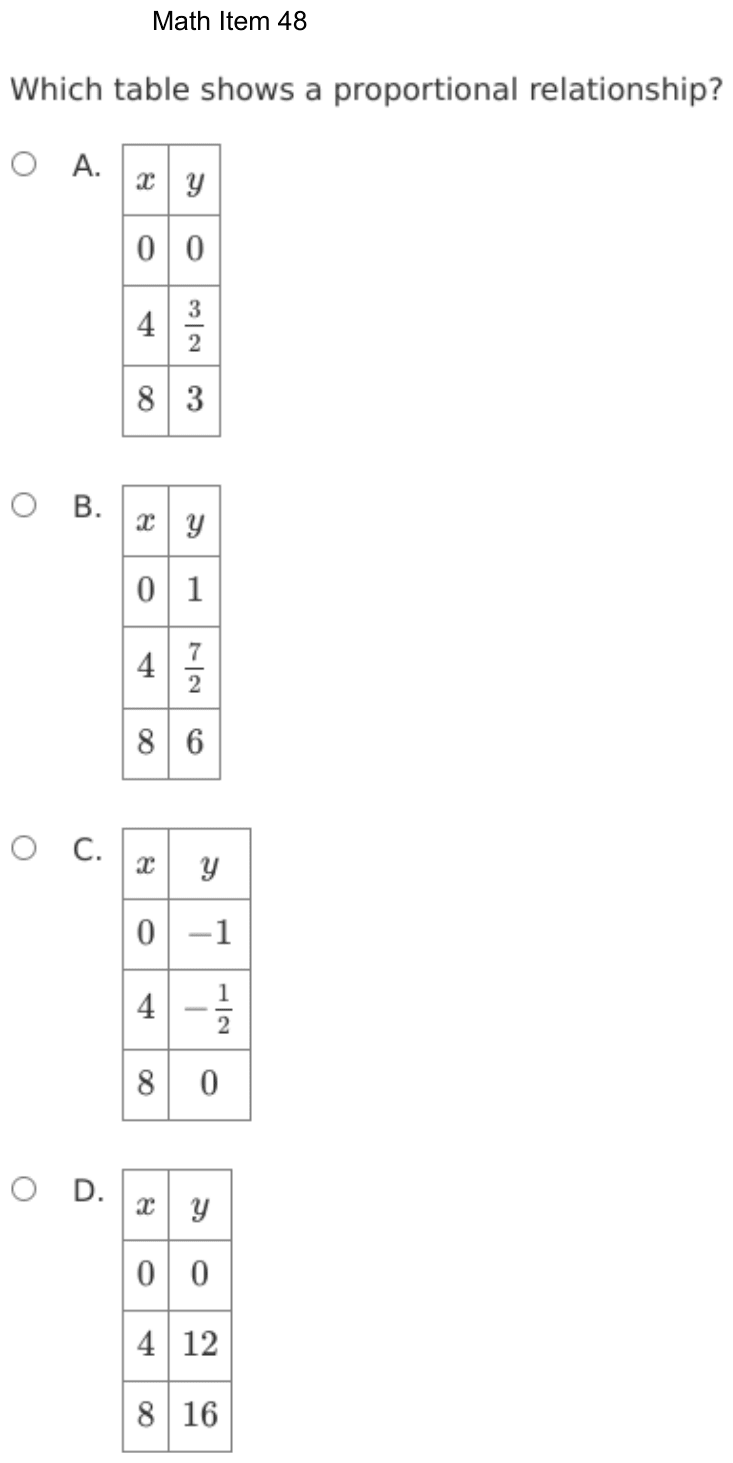
Which table shows a proportional relationship?
- A
x y 0 0 4 8 3 - B
x y 0 1 4 8 6 - C
x y 0 −1 4 8 0 - D
x y 0 0 4 12 8 16
Show the answer
Correct answer: A
The first table is the only one with a constant of proportionality, .
In each ordered pair, .
Question analysis
Four tables each give y for x = 0, 4 and 8, with some values written as fractions or negatives. Students choose the table that shows a proportional relationship. It tests recognizing proportional relationships from a table, which means checking every row against one rule rather than judging by the pattern.
- Grade level
- Grade 7 content, by NYS standard
- Compared with grade 7
- At grade 7 Deciding from a table whether a relationship is proportional is a core grade 7 skill. The fractions and negative values in the tables make each ratio a careful check rather than a glance.
- Estimated difficulty
- Straightforward: two steps or one careful reading.
- Thinking it demands
- Depth of knowledge 2, skills and concepts · mainly apply
- What makes it hard
- Every choice must be checked moderate
- Error-prone arithmetic minor
- Solution
- 2 steps
- Reading level
- Question and choices: about grade 9, 13 words.
- Students, last 30 days
- Not enough answers yet to show (it takes 10).
Why it is hard, traps and wrong answers (shows the answer)
Why it is hard
Two quick tests decide proportionality, and the tables are built so that each test alone lets a wrong table through. The last table starts at (0, 0) like the right one, while the middle two grow by equal steps like the right one. Only checking that y ÷ x is the same in every row with x not 0 separates the one table whose ratio stays at 3/8.
Every choice must be checked moderate Choosing the answer
Each table has to be tested row by row, and two of them start at (0, 0), so the opening row settles nothing; only y ÷ x in the other rows separates them. (Embretson & Wetzel, 1987)
Error-prone arithmetic minor Working it out
The y-values include 3/2, 7/2 and −1/2, so the ratios mean dividing fractions by 4, such as (3/2) ÷ 4 = 3/8, and comparing them with 3 ÷ 8. (Brown & Burton, 1978; Junker & Sijtsma, 2001)
Strategy: For each table, divide y by x in every row where x is not zero, and check that the quotient never changes and that y is 0 when x is 0.
Traps
- Misunderstands the concept: A wrong belief about a concept: that percents can be added, that area grows like length, that averages can be averaged, that a bigger denominator means a bigger fraction.
- Checks only one number: Tries one value in each choice and takes the first that works, when that value happens to work for a wrong choice too; a second value would rule it out.
The wrong answers, classified
B Misunderstands the concept (Smith, diSessa & Roschelle, 1993; De Bock et al., 1998; Ni & Zhou, 2005)
Sees y rise by the same 5/2 each time x rises by 4 and takes the steady change as proportional, missing that y is 1 when x is 0.
C Misreads the figure (Lesh, Post & Behr, 1987; Kirsch & Mosenthal, 1990)
Spots a 0 in the y column and a steady rise of 1/2, but that 0 belongs to x = 8, while at x = 0 the table gives −1.
D Checks only one number (Schoenfeld, 1985)
Checks only the row (0, 0), which every proportional table has, or only 12 ÷ 4 = 3, without testing 16 ÷ 8 = 2 in the last row.
Worked solution, step by step
Formulas used
- Proportional relationship
- y and x are the two amounts in each row. k is the constant of proportionality, the same number in every row. Two tests follow from it. When x is 0, y must be 0. And y ÷ x must equal k in every row where x is not 0.
Sort out the question
Each table gives y for x = 0, 4 and 8. You need the one that shows a proportional relationship. That means y is always the same number times x.
Use two tests. First, y must be 0 when x is 0. Second, y ÷ x must be the same in the other rows.
Test the row where x is 0
Look at the top row of each table:
- Table A: y = 0. It passes.
- Table B: y = 1. It fails.
- Table C: y = −1. It fails.
- Table D: y = 0. It passes.
Watch out: tables B and C go up by equal steps. Steady steps are not enough, because they do not start at 0. Table C does have a 0, but it is next to x = 8.
Test the ratio in table A
Divide y by x. Dividing by 4 is the same as multiplying by :
Both rows give . Table A passes both tests.
Test the ratio in table D
Divide y by x in the same way:
The ratios are different, so table D is not proportional.
Watch out: table D starts at (0, 0) like a proportional table. If you check only that row, or only the row with 4, you will pick choice D.
Give the answer
Only table A starts at (0, 0) and keeps y ÷ x the same.
So the answer is A, the table with y = 0, and 3.
Check your answer
Use the rule for table A, . When x = 4, . When x = 8, . Both match. Doubling x from 4 to 8 also doubles y.
More questions like this
The original DOE question
Question 2 of 6
2026 Practice Test D Math, question 2Question
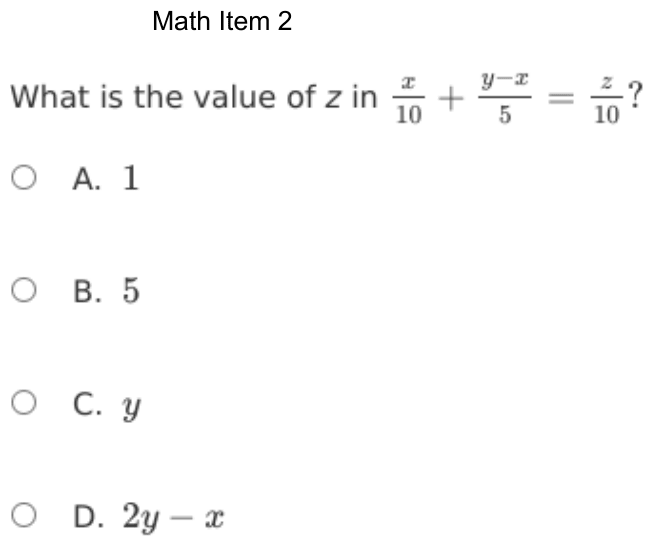
What is the value of z in ?
- A1
- B5
- C
- D
Show the answer
Correct answer: D
First, multiply both sides of the equation by 10 to eliminate the fractions. In other words, multiply each term by 10.
Then, distribute and combine like terms to find the value for z.
Question analysis
This algebra question gives an equation with three letters and fractions, x over 10 plus (y − x) over 5 equals z over 10, and asks for the value of z. Students clear the denominators, distribute and combine like terms. The two fractions on the left have different denominators, which is where the usual slip happens.
- NYS standards
- Grade level
- Grade 7 content, by NYS standard
- Compared with grade 7
- At grade 7 Grade 7 students add and expand linear expressions with fraction coefficients, usually in one letter. Here three letters appear, one numerator is a difference, and the result is an expression rather than a number, which adds abstraction but no new skill.
- Estimated difficulty
- Moderate: several steps, or a close reading with one strong distractor.
- Thinking it demands
- Depth of knowledge 1, recall and reproduction · mainly apply
- What makes it hard
- Variables instead of numbers moderate
- Error-prone arithmetic moderate
- Solution
- 3 steps
- Reading level
- Question and choices: about grade 6, 10 words.
- Students, last 30 days
- Not enough answers yet to show (it takes 10).
Why it is hard, traps and wrong answers (shows the answer)
Why it is hard
The equation has three fractions and three letters, and the work is three routine moves: multiply through by 10, distribute, collect the x terms. Most errors come from the middle term, whose denominator 5 differs from the other two; treating it as tenths makes z simply y. Students who test values should avoid x = y, since that pair makes y and 2y − x agree, and x = y = 1 even makes the number 1 fit.
Variables instead of numbers moderate Understanding the question
The answer is z in terms of x and y, not a number, yet two choices are plain numbers, 1 and 5, which tempt students who expect the equation to give z a single value. (Koedinger & Nathan, 2004; Enright, Morley & Sheehan, 2002)
Error-prone arithmetic moderate Working it out
Clearing the denominators turns (y − x)/5 into 2(y − x), and the −2x from distributing must then combine with the lone x to leave −x, two places where a factor or a sign slips. (Brown & Burton, 1978; Junker & Sijtsma, 2001)
Strategy: Multiply every term on both sides by 10 so no fractions remain, distribute across the parentheses, and combine the x terms; substituting small numbers for x and y checks the result.
Traps
- A faulty procedure: A systematic but wrong procedure: adding fractions straight across, applying an exponent to each term of a sum, dropping a sign when moving a term.
- Numbers taken from the question: Combines the numbers in the question without a model of the situation, or is simply a number that appears in the question.
The wrong answers, classified
A Checks only one number (Schoenfeld, 1985)
Tests x = 1 and y = 1, gets 1/10 + 0 = z/10, so z = 1, and takes the choice that reads 1; any pair with x ≠ y rules it out.
B Numbers taken from the question (Hegarty, Mayer & Monk, 1995)
Expects z to be a number and takes the 5 from the middle denominator, a number copied from the equation rather than the result of any step.
C A faulty procedure (Brown & Burton, 1978; Tatsuoka, 1983)
Adds the numerators x and y − x over 10 as if (y − x)/5 were already in tenths, so the left side becomes y/10 and z = y.
Worked solution, step by step
Formulas used
- Doing the same to both sides
- a and b are the two sides of an equation. Multiplying both sides by the same number keeps them equal, like adding the same weight to both pans of a balance. Here 10 is a good choice, because it clears away every fraction.
- The distributive property
- a is the number outside the parentheses, and b and c are the terms inside. Multiply a by each term inside, and keep the minus sign between them. It works because a groups of (b − c) is a groups of b minus a groups of c.
Sort out the question
The equation has three letters, x, y and z. You need z written using x and y. The answer will not be one number, because x and y can be anything. The fractions make the work messy, so clear them first.
Multiply every term by 10
The bottoms are 10, 5 and 10, and each one divides into 10. So multiply every term by 10:
10 times x/10 is x. Since 10 ÷ 5 = 2, 10 times (y − x)/5 is 2(y − x). And 10 times z/10 is z.
Distribute the 2
Use the distributive property. Multiply the 2 by both y and x:
So the equation becomes:
Combine like terms
Like terms have the same letter. Here x and −2x are like terms. Since 1 − 2 = −1, they combine to −x:
That leaves:
Watch out: do not add the tops of x/10 and (y − x)/5 straight away. Their bottoms are different. Doing it anyway gives z = y, choice C. Choices A and B are plain numbers, but z changes when x and y do.
So the answer is D, .
Check your answer
Pick numbers. Let x = 2 and y = 7. The left side is 2/10 + 5/5 = 0.2 + 1 = 1.2. Choice D gives z = 2 × 7 − 2 = 12, and 12/10 = 1.2. Both sides match.
More questions like this
The original DOE question
Question 3 of 6
2024 Test B Math, question 19Question
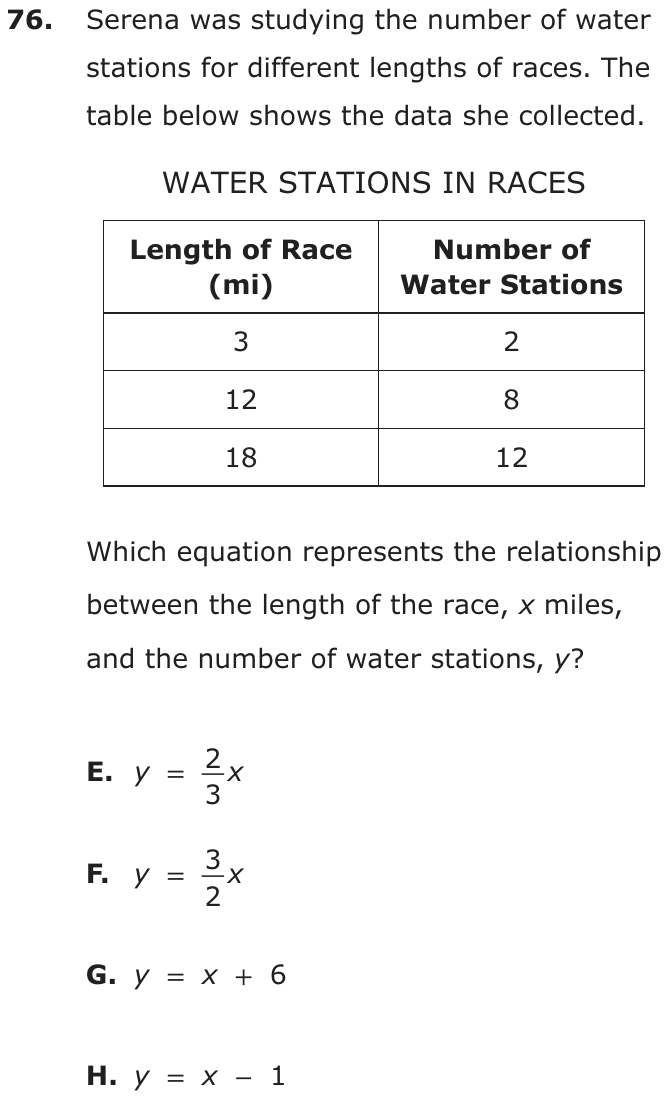
Serena was studying the number of water stations for different lengths of races. The table below shows the data she collected.
WATER STATIONS IN RACES
| Length of Race (mi) | Number of Water Stations |
|---|---|
| 3 | 2 |
| 12 | 8 |
| 18 | 12 |
Which equation represents the relationship between the length of the race, x miles, and the number of water stations, y?
- A
- B
- C
- D
Show the answer
Correct answer: A
There is a proportional relationship between the length of the race, x miles, and the number of water stations, y. The constant of proportionality is
Therefore, the equation represents this relationship.
Question analysis
A table from a study of races shows the number of water stations for races of 3, 12 and 18 miles. Students choose the equation that links the race length x to the number of stations y. It tests reading a relationship from a table and expressing it as an equation in x and y.
- Grade level
- Grade 7 content, by NYS standard
- Compared with grade 7
- At grade 7 Writing an equation for a relationship given in a table is a central grade 7 skill. With three clean rows and whole numbers, this is a typical grade 7 exercise.
- Estimated difficulty
- Straightforward: two steps or one careful reading.
- Thinking it demands
- Depth of knowledge 2, skills and concepts · mainly apply
- What makes it hard
- A very close wrong answer moderate
- Reading a figure, table or graph minor
- Solution
- 2 steps
- Reading level
- Question and choices: about grade 6, 57 words.
- Students, last 30 days
- Not enough answers yet to show (it takes 10).
Why it is hard, traps and wrong answers (shows the answer)
Why it is hard
The table is small and its numbers are friendly, so the question comes down to which way the ratio runs and whether every row is checked. One wrong equation fits only the first row and another fits none, so testing a single row is not enough. Putting the 12-mile race into each equation, which should give 8 stations, leaves only one rule standing.
A very close wrong answer moderate Choosing the answer
The coefficients 2/3 and 3/2 use the same two digits, and only dividing stations by miles, 2 ÷ 3, rather than miles by stations, separates them. (Embretson & Wetzel, 1987; Gorin & Embretson, 2006; Ascalon et al., 2007)
Reading a figure, table or graph minor Understanding the question
The table lists miles first and stations second, while each equation puts stations, y, alone on the left, so every row must be read as an (x, y) pair. (Lesh, Post & Behr, 1987; Kirsch & Mosenthal, 1990)
Strategy: Test each equation on all three rows of the table, not just the first; only a rule that fits every row represents the relationship.
Traps
- Wrong operation: Adds instead of multiplying, divides the wrong way round, turns a ratio or rate upside down, or undoes a step in the wrong direction (subtracts what should be added back).
- Checks only one number: Tries one value in each choice and takes the first that works, when that value happens to work for a wrong choice too; a second value would rule it out.
- Numbers taken from the question: Combines the numbers in the question without a model of the situation, or is simply a number that appears in the question.
The wrong answers, classified
B Wrong operation (Hegarty, Mayer & Monk, 1995; King et al., 2004)
Divides race length by water stations, 3 ÷ 2, turning the ratio upside down, so the rule gives more stations than miles.
C Numbers taken from the question (Hegarty, Mayer & Monk, 1995)
Builds an addition rule from the gap of 6 between 18 and 12 in the last row, with the sign reversed, and it fits no row of the table.
D Checks only one number (Schoenfeld, 1985)
Checks only the first row, where 3 − 1 = 2 works, without testing the 12- and 18-mile races, where it gives 11 and 17.
Worked solution, step by step
Formulas used
- Proportional relationship
- x is the race length in miles, and y is the number of water stations. k is the constant of proportionality, the number of stations for each mile. Find it with y ÷ x. If every row gives the same k, the table is proportional.
Sort out the table
Each row of the table is a pair of numbers. The first is the race length, x, in miles. The second is the number of water stations, y. You need the equation that works for every row.
Divide y by x in each row
See if every row has the same ratio of stations to miles. Divide y by x.
Miles (x) Stations (y) y ÷ x 3 2 12 8 18 12 Every row gives 2/3. So the relationship is proportional: y is always the same number times x.
Write the equation
Here k is the ratio you found, .
Watch out: divide stations by miles, not miles by stations. 3 ÷ 2 gives 3/2, choice B. That rule would give more stations than miles.Test the other choices and answer
Watch out: test every row, not just the first one. Choice D, y = x − 1, works for 3 miles. But it gives 11 stations for 12 miles, not 8. Choice C, y = x + 6, gives 9 stations for 3 miles, not 2.So the answer is A, .
Check your answer
Put each race length into . , and . All three match the table.
More questions like this
The original DOE question
Question 4 of 6
2024 Test B Math, question 49Question
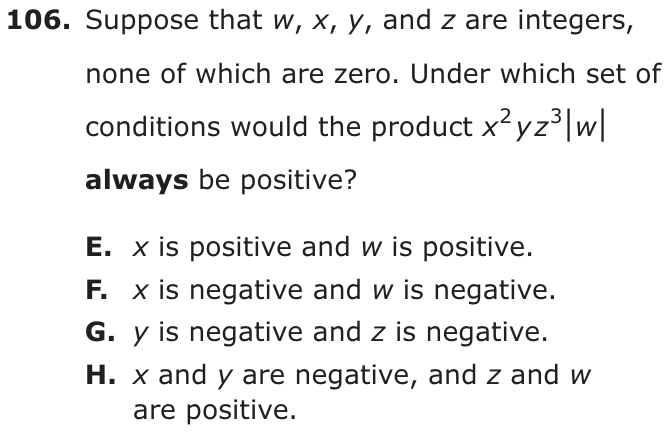
Suppose that w, x, y, and z are integers, none of which are zero. Under which set of conditions would the product always be positive?
- Ax is positive and w is positive.
- Bx is negative and w is negative.
- Cy is negative and z is negative.
- Dx and y are negative, and z and w are positive.
Show the answer
Correct answer: C
First, analyze the role of each variable in the expression .
will always be a positive number.
y can be a positive or a negative number.
can be a positive or a negative number.
will always be a positive number.
The expressions and will always be positive. Therefore, making the values of y and z negative would result in the expression being positive, since a negative multiplied by a negative is positive. Thus the given product would always be positive.
Question analysis
Four nonzero integers appear in a product that includes a square, a cube and an absolute value. Students choose the set of conditions that makes the product positive every time. It tests the sign rules for multiplication together with exponents and absolute value, and the trap is judging the sign by counting negative variables without looking at what is done to each.
- NYS standards
- Grade level
- Grade 7 content, by NYS standard
- Compared with grade 7
- Above grade 7 Grade 7 students learn sign rules for products of signed numbers. Here they must reason about four unknown integers under an even power, an odd power and an absolute value, and decide what is always true, which is more abstract than typical grade 7 work.
- Estimated difficulty
- Hard: combines ideas, needs a plan, and has more than one tempting wrong answer.
- Thinking it demands
- Depth of knowledge 2, skills and concepts · mainly analyze
- What makes it hard
- Variables instead of numbers moderate
- Every choice must be checked moderate
- Something you must already know minor
- Solution
- 3 steps
- Reading level
- Question and choices: about grade 6, 58 words.
- Students, last 30 days
- Not enough answers yet to show (it takes 10).
Why it is hard, traps and wrong answers (shows the answer)
Why it is hard
One insight decides the question: x² and |w| are positive whatever x and w are, so only the signs of y and z³ matter. Students who count negative letters instead of negative factors pick conditions that look balanced but leave y as the only negative factor. Students who test a single set of values can be fooled by a choice that leaves y and z unspecified.
Variables instead of numbers moderate Understanding the question
There are four variables and no numbers, and always positive must hold for every allowed value, so one test case can rule a choice out but never confirm it. (Koedinger & Nathan, 2004; Enright, Morley & Sheehan, 2002)
Every choice must be checked moderate Choosing the answer
Each set of conditions has to be checked against all four factors; the first two fix only x and w and leave y and z free to make the product negative. (Embretson & Wetzel, 1987)
Something you must already know minor Working it out
Students must know that a nonzero square and an absolute value are always positive, while an odd power such as z³ keeps the sign of z. (Anderson & Krathwohl, 2001)
Strategy: Work out, factor by factor, which signs each part of the product can take, then test each set of conditions against every factor rather than counting negatives.
Traps
- Negatives and direction: Arithmetic with negative numbers, the order of a subtraction, or direction on a number line. (Moving a term across the equals sign without changing its sign is a faulty procedure.)
- Misunderstands the concept: A wrong belief about a concept: that percents can be added, that area grows like length, that averages can be averaged, that a bigger denominator means a bigger fraction.
The wrong answers, classified
A Checks only one number (Schoenfeld, 1985)
Tests the choice with every variable positive, so the product is positive and it seems to work; y = −1 with z = 1 would make it negative.
B Misunderstands the concept (Smith, diSessa & Roschelle, 1993; De Bock et al., 1998; Ni & Zhou, 2005)
Pairs the negatives x and w as if they must cancel, not seeing that x² and |w| are positive anyway, so y and z still decide.
D Negatives and direction (Brown & Burton, 1978)
Counts two negative letters, x and y, as an even number of negatives, but x² is positive, so y is the only negative factor.
Worked solution, step by step
Formulas used
- Signs in multiplication
- a and b are positive numbers, so −a and −b are negative. A negative times a negative is positive. A negative times a positive is negative. So a product is positive when it has an even number of negative factors.
Sort out the question
w, x, y and z are integers, meaning whole numbers or their negatives. None of them is 0. The product means .
You need the conditions that make the product positive every time, for every number that fits them.
Look at x squared and |w|
means x × x. Two positives or two negatives multiply to a positive. So is always positive.
is the absolute value of w, its distance from 0. It is always positive, since w is not 0.
So x and w never change the sign of the product. Their signs do not matter.
Look at y and z cubed
y can be positive or negative. means z × z × z, and it has the same sign as z. For example, .
So the sign of the whole product is the sign of . It depends only on y and z.
Test each choice
- A and B say nothing about y and z. If y = −1 and z = 1, the product is negative. So they do not always work.
- C: y is negative, and is negative. A negative times a negative is positive. This always works.
- D: y is negative and z is positive. So the product is always negative.
Watch out: D has two negative letters, x and y. But is positive anyway, so y is the only negative factor.
So the answer is C, y is negative and z is negative.
Check your answer
Try numbers for C. Let x = −2, y = −3, z = −1 and w = −5. Then , which is positive. Even with x and w negative, the product stays positive.
More questions like this
The original DOE question
Question 5 of 6
2018 Test A Math, question 6Question
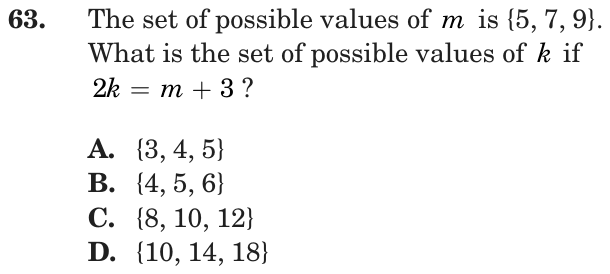
The set of possible values of is . What is the set of possible values of if ?
- A
- B
- C
- D
Show the answer
Correct answer: B
so
Substitute each value of m to find the values of k:
The set k is { 4, 5, 6}.
Question analysis
An algebra question about substitution: m can be 5, 7 or 9, and an equation links k to m. Students find every possible value of k by substituting each value of m and solving. The curly-brace set notation can look unfamiliar, and each value has to be carried all the way through the solve.
- Grade level
- Grade 6 content, by NYS standard
- Compared with grade 7
- At grade 7 Each substitution leads to a one-step grade 6 equation, easier than a typical grade 7 two-step problem. What adds demand is doing it three times and reading the answer as a set of values, which grade 7 rarely uses.
- Estimated difficulty
- Straightforward: two steps or one careful reading.
- Thinking it demands
- Depth of knowledge 1, recall and reproduction · mainly apply
- What makes it hard
- Solution
- 2 steps
- Reading level
- Question and choices: about grade 9, 24 words.
- Students, last 30 days
- Not enough answers yet to show (it takes 10).
Why it is hard, traps and wrong answers (shows the answer)
Why it is hard
The equation is simple, and the main hazard is stopping one step short: m + 3 gives 8, 10 and 12, a listed choice even though those are values of 2k. Checking a single value of m is the other risk, since k = 4 and k = 5 both appear in the first two sets. Students who substitute all three values and halve each result finish quickly.
Variables instead of numbers minor Understanding the question
There is no single unknown: m stands for the set {5, 7, 9}, and the answer is the matching set for k, so the equation has to be applied to three values. (Koedinger & Nathan, 2004; Enright, Morley & Sheehan, 2002)
Strategy: Rewrite the equation so k equals m plus 3, all divided by 2, then evaluate it for each of the three values of m.
Traps
- Stops one step early: A choice is a number from partway through the solution.
The wrong answers, classified
A Checks only one number (Schoenfeld, 1985)
Checks only m = 5, gets k = 4, and takes the first set containing 4; m = 9, giving k = 6, would rule it out.
C Stops one step early (King et al., 2004; Gierl et al., 2017)
Adds 3 to each value of m to get 8, 10 and 12, which are the values of 2k, and forgets to divide by 2.
D Wrong operation (Hegarty, Mayer & Monk, 1995; King et al., 2004)
Doubles each value of m to get 10, 14 and 18, moving the 2 onto m instead of dividing by it, and drops the + 3.
Worked solution, step by step
Formulas used
- Getting k by itself
- k and m are the letters from the equation 2k = m + 3. The fraction bar means divide. If 2 times k equals m + 3, then k is half of m + 3. You get this by dividing both sides of the equation by 2.
Sort out the question
The letter m can be 5, 7 or 9. The curly braces { } show a set, which is a list of numbers. The equation links k to m. You need every value k can have, one for each value of m.
Get k by itself
2k means 2 times k. To undo times 2, divide both sides by 2. Doing the same thing to both sides keeps the equation true.
Try each value of m
Put each value of m into the formula. Add 3 first, then divide by 2.
Watch out: 8, 10 and 12 are the values of m + 3, which equal 2k, not k. Stopping before you divide by 2 gives choice C.
Pick the matching set
The values of k are 4, 5 and 6. Watch out: try all three values of m. If you only try m = 5, you get k = 4, and choice A has a 4 too. So the answer is B, {4, 5, 6}.
Check your answer
Put each k back into the equation. . . . All three work, so the set is right.
More questions like this
The original DOE question
Question 6 of 6
2018 Test A Math, question 32Question
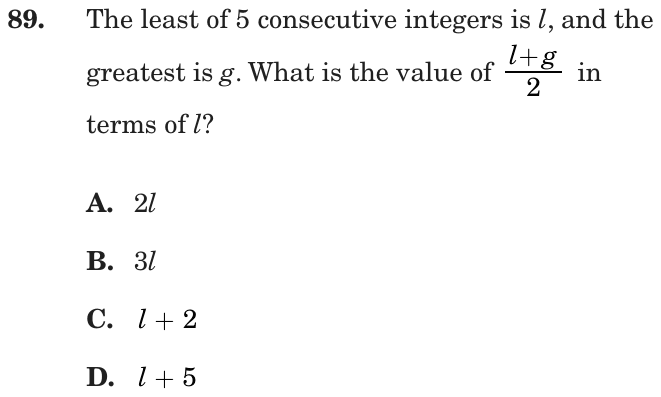
The least of 5 consecutive integers is , and the greatest is . What is the value of in terms of ?
- A
- B
- C
- D
Show the answer
Correct answer: C
The first integer is , so the second is , the third is , then , and finally .
Since is the fifth and greatest of the integers,
Substitute for and simplify:
Question analysis
This algebra question about five consecutive integers calls the least one l and the greatest g, then asks for (l + g)/2 written in terms of l. Students must express g using l and simplify a fraction that contains a variable. Counting how far the fifth integer is from the first is where many students slip.
- NYS standards
- Grade level
- Grade 7 content, by NYS standard
- Compared with grade 7
- At grade 7 Grade 7 students combine like terms in expressions such as 3(x + 4) − x. This item first asks them to build the expression from a description of consecutive integers, then simplify it, with only letters to work with.
- Estimated difficulty
- Moderate: several steps, or a close reading with one strong distractor.
- Thinking it demands
- Depth of knowledge 2, skills and concepts · mainly apply
- What makes it hard
- Variables instead of numbers moderate
- Turning words into math minor
- Every choice must be checked minor
- Solution
- 3 steps
- Reading level
- Question and choices: about grade 8, 26 words.
- Students, last 30 days
- Not enough answers yet to show (it takes 10).
Why it is hard, traps and wrong answers (shows the answer)
Why it is hard
The algebra is short once g is written as l + 4, so most errors come from the fence-post count or from testing numbers carelessly. The wrong choices in front of the answer are exactly the ones a single test value cannot rule out, which punishes students who stop at the first match. Using two test values, or simplifying (2l + 4)/2 directly, avoids both traps.
Variables instead of numbers moderate Understanding the question
Every expression is in l, so the simplification of (l + l + 4)/2 has to be done with letters and cannot be checked against a single number. (Koedinger & Nathan, 2004; Enright, Morley & Sheehan, 2002)
Turning words into math minor Understanding the question
The description "the least of 5 consecutive integers is l, and the greatest is g" must become g = l + 4, four steps up, not five. (Hegarty, Mayer & Monk, 1995; Koedinger & Nathan, 2004)
Every choice must be checked minor Choosing the answer
A single test value fits two choices: l = 1 makes 3l and l + 2 both 3, and l = 2 makes 2l and l + 2 both 4. (Embretson & Wetzel, 1987)
Strategy: Write the integers as l, l + 1, and so on up to the fifth, substitute for g and simplify; then test two different starting values, since one value can match a wrong choice by coincidence.
Traps
- Counting the ends: Inclusive or exclusive ends, fence posts, consecutive numbers: an answer that is one too many or too few, or an endpoint drawn open where it belongs closed (or the reverse).
The wrong answers, classified
A Checks only one number (Schoenfeld, 1985)
Tests only l = 2, where 2 through 6 give (2 + 6)/2 = 4, and takes 2l, the first choice that also equals 4.
B Checks only one number (Schoenfeld, 1985)
Tests only l = 1, where 1 through 5 give (1 + 5)/2 = 3, and stops at 3l, which matches before l + 2 is checked.
D Counting the ends (Brown & Burton, 1978)
Writes the greatest integer as l + 5, counting five steps for five integers, then halves only the 2l in (2l + 5)/2, leaving l + 5.
Worked solution, step by step
Formulas used
- Greatest of 5 consecutive integers
- l is the least (smallest) integer and g is the greatest. Consecutive integers go up by 1 each time. Five integers have only 4 jumps from the first to the last, so you add 4, not 5.
- Dividing a sum
- a and b are the two parts of the top, and c is the number you divide by. To divide a sum, divide each part. You must divide every part of the top, not just one.
Sort out the words
Integers are whole numbers, like −2, 0 and 7. Consecutive integers come one right after another, like 8, 9, 10. There are 5 of them here.
The smallest is called l and the biggest is called g. You must write using only the letter l.
Write all five integers
Each integer is 1 more than the one before:
The fifth one is the greatest, so g = l + 4. Watch out: five integers have only four jumps between them. Writing g = l + 5 leads to choice D.
Put l + 4 in place of g
Swap g for l + 4 in the fraction:
Here l + l is 2l, which means 2 times l.
Split the fraction
Divide each part of the top by 2:
So the answer is C, .
Check your answer
Test two starting numbers. If l = 1, the integers are 1 to 5, and (1 + 5) ÷ 2 = 3, which is 1 + 2. If l = 10, they are 10 to 14, and (10 + 14) ÷ 2 = 12, which is 10 + 2. Use two tests, because l = 1 also makes 3l equal 3, choice B.
More questions like this
The original DOE question