Question
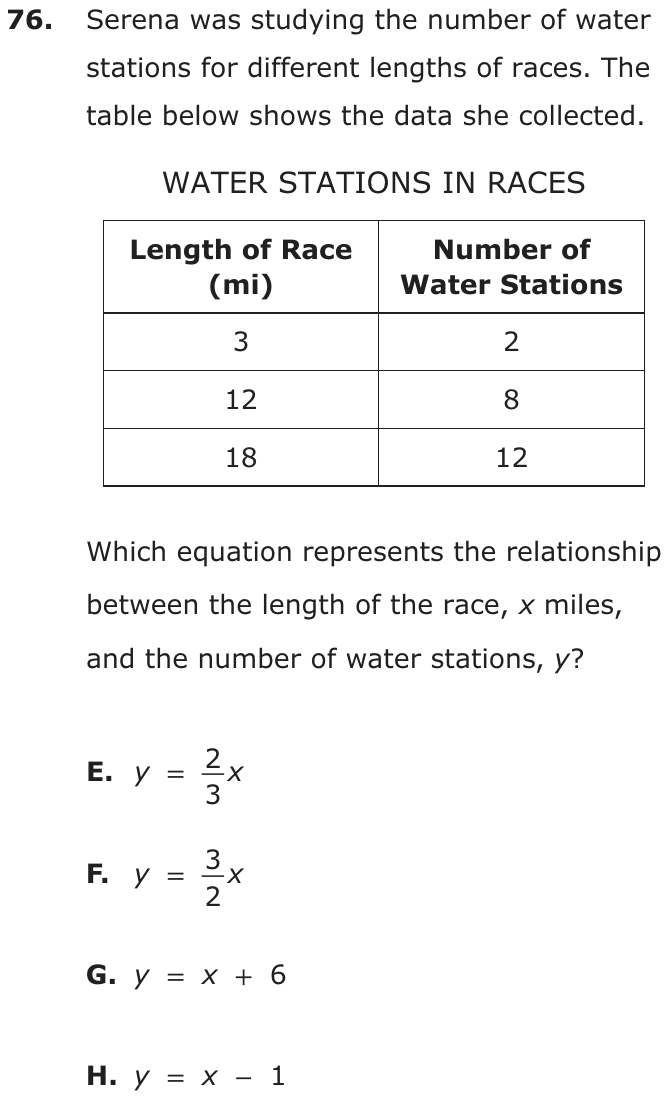
Serena was studying the number of water stations for different lengths of races. The table below shows the data she collected.
WATER STATIONS IN RACES
| Length of Race (mi) | Number of Water Stations |
|---|---|
| 3 | 2 |
| 12 | 8 |
| 18 | 12 |
Which equation represents the relationship between the length of the race, x miles, and the number of water stations, y?
- A
- B
- C
- D
Show the answer
Correct answer: A
There is a proportional relationship between the length of the race, x miles, and the number of water stations, y. The constant of proportionality is
Therefore, the equation represents this relationship.
Question analysis
A table from a study of races shows the number of water stations for races of 3, 12 and 18 miles. Students choose the equation that links the race length x to the number of stations y. It tests reading a relationship from a table and expressing it as an equation in x and y.
- Grade level
- Grade 7 content, by NYS standard
- Compared with grade 7
- At grade 7 Writing an equation for a relationship given in a table is a central grade 7 skill. With three clean rows and whole numbers, this is a typical grade 7 exercise.
- Estimated difficulty
- Straightforward: two steps or one careful reading.
- Thinking it demands
- Depth of knowledge 2, skills and concepts · mainly apply
- What makes it hard
- A very close wrong answer moderate
- Reading a figure, table or graph minor
- Solution
- 2 steps
- Reading level
- Question and choices: about grade 6, 57 words.
- Students, last 30 days
- Not enough answers yet to show (it takes 10).
Why it is hard, traps and wrong answers (shows the answer)
Why it is hard
The table is small and its numbers are friendly, so the question comes down to which way the ratio runs and whether every row is checked. One wrong equation fits only the first row and another fits none, so testing a single row is not enough. Putting the 12-mile race into each equation, which should give 8 stations, leaves only one rule standing.
A very close wrong answer moderate Choosing the answer
The coefficients 2/3 and 3/2 use the same two digits, and only dividing stations by miles, 2 ÷ 3, rather than miles by stations, separates them. (Embretson & Wetzel, 1987; Gorin & Embretson, 2006; Ascalon et al., 2007)
Reading a figure, table or graph minor Understanding the question
The table lists miles first and stations second, while each equation puts stations, y, alone on the left, so every row must be read as an (x, y) pair. (Lesh, Post & Behr, 1987; Kirsch & Mosenthal, 1990)
Strategy: Test each equation on all three rows of the table, not just the first; only a rule that fits every row represents the relationship.
Traps
- Wrong operation: Adds instead of multiplying, divides the wrong way round, turns a ratio or rate upside down, or undoes a step in the wrong direction (subtracts what should be added back).
- Checks only one number: Tries one value in each choice and takes the first that works, when that value happens to work for a wrong choice too; a second value would rule it out.
- Numbers taken from the question: Combines the numbers in the question without a model of the situation, or is simply a number that appears in the question.
The wrong answers, classified
B Wrong operation (Hegarty, Mayer & Monk, 1995; King et al., 2004)
Divides race length by water stations, 3 ÷ 2, turning the ratio upside down, so the rule gives more stations than miles.
C Numbers taken from the question (Hegarty, Mayer & Monk, 1995)
Builds an addition rule from the gap of 6 between 18 and 12 in the last row, with the sign reversed, and it fits no row of the table.
D Checks only one number (Schoenfeld, 1985)
Checks only the first row, where 3 − 1 = 2 works, without testing the 12- and 18-mile races, where it gives 11 and 17.
Worked solution, step by step
Formulas used
- Proportional relationship
- x is the race length in miles, and y is the number of water stations. k is the constant of proportionality, the number of stations for each mile. Find it with y ÷ x. If every row gives the same k, the table is proportional.
Sort out the table
Each row of the table is a pair of numbers. The first is the race length, x, in miles. The second is the number of water stations, y. You need the equation that works for every row.
Divide y by x in each row
See if every row has the same ratio of stations to miles. Divide y by x.
Miles (x) Stations (y) y ÷ x 3 2 12 8 18 12 Every row gives 2/3. So the relationship is proportional: y is always the same number times x.
Write the equation
Here k is the ratio you found, .
Watch out: divide stations by miles, not miles by stations. 3 ÷ 2 gives 3/2, choice B. That rule would give more stations than miles.Test the other choices and answer
Watch out: test every row, not just the first one. Choice D, y = x − 1, works for 3 miles. But it gives 11 stations for 12 miles, not 8. Choice C, y = x + 6, gives 9 stations for 3 miles, not 2.So the answer is A, .
Check your answer
Put each race length into . , and . All three match the table.
More questions like this
The original DOE question