Question
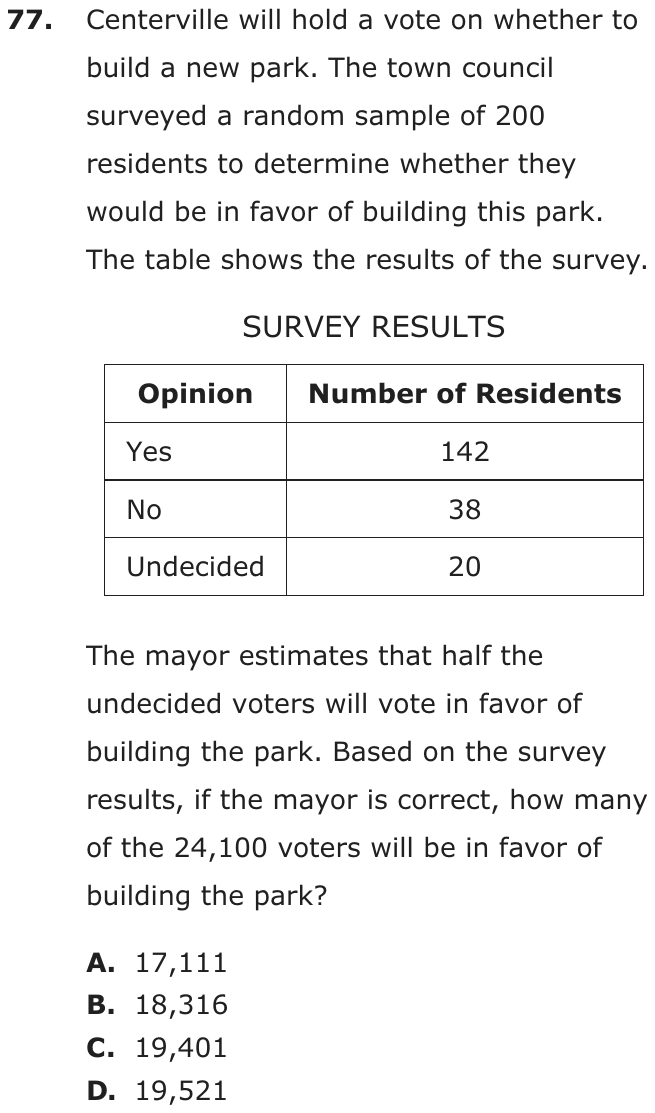
Centerville will hold a vote on whether to build a new park. The town council surveyed a random sample of 200 residents to determine whether they would be in favor of building this park. The table shows the results of the survey.
SURVEY RESULTS
| Opinion | Number of Residents |
|---|---|
| Yes | 142 |
| No | 38 |
| Undecided | 20 |
The mayor estimates that half the undecided voters will vote in favor of building the park. Based on the survey results, if the mayor is correct, how many of the 24,100 voters will be in favor of building the park?
- A17,111
- B18,316
- C19,401
- D19,521
Show the answer
Correct answer: B
If half the undecided voters (half of 20) vote in favor of building the park, the total number of “yes” votes from the survey will be 152.
There are 24,100 voters, and 200 residents were surveyed. Set up a proportion to solve:
Question analysis
A survey question: a random sample of 200 Centerville residents answered yes, no or undecided about building a park, and the mayor expects half the undecided to vote yes. Students use the sample to predict how many of 24,100 voters will favor the park. It joins a proportion from a sample with large-number arithmetic.
- Grade level
- Grade 7 content, by NYS standard
- Compared with grade 7
- At grade 7 Using a random sample to estimate a count in a whole population is a typical grade 7 proportion task. The extra step for the undecided group and the large numbers add care without going beyond grade 7.
- Estimated difficulty
- Hard: combines ideas, needs a plan, and has more than one tempting wrong answer.
- Thinking it demands
- Depth of knowledge 2, skills and concepts · mainly apply
- What makes it hard
- Error-prone arithmetic moderate
- Turning words into math moderate
- Reading a figure, table or graph minor
- Solution
- 3 steps
- Reading level
- Question and choices: about grade 5, 88 words.
- Students, last 30 days
- Not enough answers yet to show (it takes 10).
Why it is hard, traps and wrong answers (shows the answer)
Why it is hard
The setup is a sample-to-population proportion, and the trap is the mayor's assumption in the middle of the stem. Students who scale the 142 yes answers directly, or who count every undecided resident, reach believable totals that sit right among the choices. Once the count of 152 is settled, a rough estimate, about three quarters of 24,000, is enough to confirm the exact product.
Error-prone arithmetic moderate Working it out
Scaling 152 out of 200 up to 24,100 voters means computing 24,100 × 0.76, or 120.5 × 152, by hand with five-digit numbers. (Brown & Burton, 1978; Junker & Sijtsma, 2001)
Turning words into math moderate Understanding the question
The mayor's sentence adds a step: “half the undecided voters” turns the 20 undecided residents into 10 more yes votes, giving 152 before any scaling. (Hegarty, Mayer & Monk, 1995; Koedinger & Nathan, 2004)
Reading a figure, table or graph minor Understanding the question
The table gives Yes, No and Undecided counts, and the half must be taken of the Undecided row, not of the No row just above it. (Lesh, Post & Behr, 1987; Kirsch & Mosenthal, 1990)
Strategy: Count the sample's expected yes votes, including half of the undecided, write them as a fraction of 200, and multiply that fraction by 24,100; estimate first to check the choice.
Traps
- Misreads the question: Misses or misreads a condition or a word in the question: "at least", "each", "remaining", "not".
- Misreads the figure: Reads a value, label or tick spacing in a figure, table or graph wrongly.
The wrong answers, classified
A Misreads the question (Hegarty, Mayer & Monk, 1995)
Uses only the 142 yes answers, 142/200 of 24,100 = 17,111, leaving out the undecided residents the mayor expects to vote yes.
C Misreads the figure (Lesh, Post & Behr, 1987; Kirsch & Mosenthal, 1990)
Takes half of the 38 No answers instead of the 20 Undecided, reading the wrong row, so 161/200 of 24,100 ≈ 19,401.
D Misreads the question (Hegarty, Mayer & Monk, 1995)
Counts all 20 undecided residents as yes votes instead of half of them, so 162/200 of 24,100 = 19,521.
Worked solution, step by step
Formulas used
- Scaling up a sample
- A random sample is a smaller group picked by chance. Its share of yes votes should be about the same as the whole town’s share. So the two fractions are set equal. Use it to scale a survey up to a whole group.
Sort out what you know
The town surveyed 200 people. 142 said Yes, 38 said No, and 20 were Undecided (not sure yet). The mayor thinks half of the undecided people will vote yes. There are 24,100 voters in all. You need how many of them will vote yes.
Count the yes votes in the survey
Half of the 20 undecided people is . Add them to the yes votes.
So 152 of the 200 people surveyed would vote yes. Watch out: take half of the Undecided row, not the No row. Half of 38 leads to 19,401, choice C.
Find the share who vote yes
That is 76% of the people surveyed. The sample was random, so about 76% of all the voters should vote yes too. Watch out: using only the 142 yes votes gives 17,111, choice A. Counting all 20 undecided people gives 19,521, choice D.
Scale up to all the voters
Break it into easy parts. 75% is , and 1% is .
So the answer is B, 18,316.
Check your answer
Estimate. 76% is a little more than three fourths. Three fourths of 24,000 is 18,000. So the answer should be a little more than 18,000, and 18,316 fits. Also, , the same share as the survey.
More questions like this
The original DOE question