Answer in another form
Question 1 of 11
2026 Practice Test A Math, question 10Question
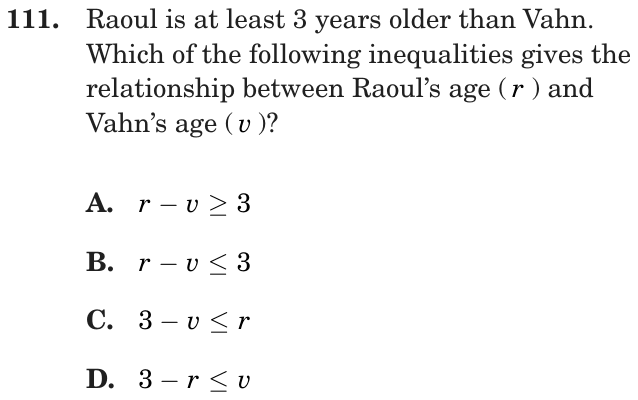
Three expressions are given:
Which of these are equivalent to the sum of these three expressions?
Select the two correct answers.
Choose every answer that is correct, then check. The DOE has not published how answers with several parts are scored; this site counts one right only when every part is right.
- A
- B
- C
- D
- E18
- F34
Show the answer
Correct answer: A and E
Add the three expressions: .
Distribute 3 and −2: .
Combine the variable terms and combine the constants: .
Question analysis
This algebra question gives three expressions, one with a decimal coefficient and a negative factor, and asks which two of six choices are equivalent to their sum. It tests distributing, combining like terms and recognizing equivalent expressions. Signs from the negative factor are easy to lose, and several choices are built from exactly those slips.
- NYS standards
- Grade level
- Grade 7 content, by NYS standard
- Compared with grade 7
- At grade 7 Expanding and combining linear expressions with a negative factor and a decimal coefficient is standard grade 7 work. Choosing the two equivalent ones out of six, where each common slip appears as a choice, takes more care than one simplification.
- Estimated difficulty
- Moderate: several steps, or a close reading with one strong distractor.
- Thinking it demands
- Depth of knowledge 1, recall and reproduction · mainly apply
- What makes it hard
- Error-prone arithmetic moderate
- A very close wrong answer moderate
- Many steps minor
- An answer in an unexpected form minor
- Solution
- 4 steps
- Reading level
- Question and choices: about grade 8, 28 words.
- Students, last 30 days
- Not enough answers yet to show (it takes 10).
Why it is hard, traps and wrong answers (shows the answer)
Why it is hard
The six choices form three consistent pairs, each an expansion with its simplified total: the right pair, a pair built on a sign slip with −2 × 4 that totals 34, and a pair built on 3 × 2n read as 5n that totals 18 − n. A student who makes either slip finds two choices that agree with each other and seem to confirm the work. The question rewards one careful simplification and the confidence to accept a sum with no n left.
Error-prone arithmetic moderate Working it out
The first expression puts a negative factor in front of a decimal term: −2 times 2.5n is −5n, and the −2 must reach the 4 as well, giving −8, not +8. (Brown & Burton, 1978; Junker & Sijtsma, 2001)
A very close wrong answer moderate Choosing the answer
The first two expansions are identical except for their last sign, − 8 against + 8, and the third differs from the first only in 5n for 6n, so only a term-by-term check separates them. (Embretson & Wetzel, 1987; Gorin & Embretson, 2006; Ascalon et al., 2007)
Many steps minor Working it out
Two distributions come first, then the n terms and the constants are collected separately, and six choices are compared with the result; both right ones must be picked to score. (Daniel & Embretson, 2010; Enright, Morley & Sheehan, 2002)
An answer in an unexpected form minor Choosing the answer
One right answer is the expansion before any terms are combined and the other is the plain number 18, which has to be accepted as equal to a sum in which every expression held n. (Enright, Morley & Sheehan, 2002)
Strategy: Distribute each factor across its parentheses, keeping the sign with every product, then combine the n terms and the constants separately and test each of the six choices against the result.
Traps
- Order of operations: Working left to right, or distributing a minus sign wrongly, gives a choice.
- Misunderstands the concept: A wrong belief about a concept: that percents can be added, that area grows like length, that averages can be averaged, that a bigger denominator means a bigger fraction.
- Answer in another form: The right answer is written differently from the way you worked it out.
The wrong answers, classified
B Order of operations (Brown & Burton, 1978)
Gives the minus of −2 to 2.5n but not to 4, expanding −2(2.5n + 4) as −5n + 8 instead of −5n − 8, so this expansion totals 34.
C Wrong operation (Hegarty, Mayer & Monk, 1995; King et al., 2004)
Expands 3(2n + 7) as 5n + 21, adding 3 and 2 instead of multiplying them, so the n terms no longer cancel and leave −n.
D Misunderstands the concept (Smith, diSessa & Roschelle, 1993; De Bock et al., 1998; Ni & Zhou, 2005)
Expects a sum of expressions in n to keep an n term, so it doubts the plain 18 and takes 18 − n, which the 5n expansion also simplifies to.
F Order of operations (Brown & Burton, 1978)
Takes −2 × 4 as +8, so the constants add to 5 + 21 + 8 = 34 while −n + 6n − 5n still cancels, leaving no n term.
Worked solution, step by step
Formulas used
- The distributive property
- a is the number in front of the parentheses, and b and c are the terms inside. You multiply a by every term inside, not only the first one. If a is negative, its minus sign goes into every product. It works because a groups of b + c is a groups of b plus a groups of c.
- Multiplying signed numbers
- a and b are positive numbers, so −a is negative. A negative number times a positive number is negative. Use it whenever a minus sign sits in front of the parentheses: −2 times 4 is −8, not 8.
- Combining like terms
- Like terms have the same letter part, such as 6n and −5n. a and b are their coefficients, the numbers in front of n. Add the coefficients and keep the n. Constants, the plain numbers, combine only with other constants.
Sort out the question
An expression is a math phrase made of numbers, letters and signs, with no equal sign. The sum of the three expressions means you add all of them:
You need the two choices that are equivalent to this sum. Equivalent means equal for every value of n. Some choices show the sum before it is simplified. Others show the result.
Distribute the 3
To distribute means to multiply the number outside the parentheses by each term inside.
Watch out: 3 times 2n is 6n. Adding 3 and 2 instead gives 5n. That slip leads to choice C, and then to 18 − n, choice D.
Distribute the −2
Now multiply −2 by both terms. A negative times a positive is negative, so both products are negative.
Watch out: the −2 multiplies the 4 too. Writing +8 instead of −8 leads to choice B. That sum works out to 34, choice F.
Write the whole sum
Put the three pieces together, starting with 5 − n:
This matches choice A exactly, term by term. So A is one of the answers.
Combine like terms
Gather the n terms first. Remember that −n means −1 times n.
Then gather the constants:
The n terms cancel out, so the whole sum is just 18.
Watch out: a sum with no n left is fine. Keeping an extra −n leads to choice D.
Pick the two answers
Choice A is the sum before you combine like terms. Choice E, 18, is the sum after you combine them. Both equal the sum for every value of n. So the answers are A and E.
Check your answer
Try a value, such as n = 2, in each expression. . . . The sum is , which matches E. Choice D would give 18 − 2 = 16 instead.
More questions like this
The original DOE question
Question 2 of 11
2026 Practice Test B Math, question 3Question
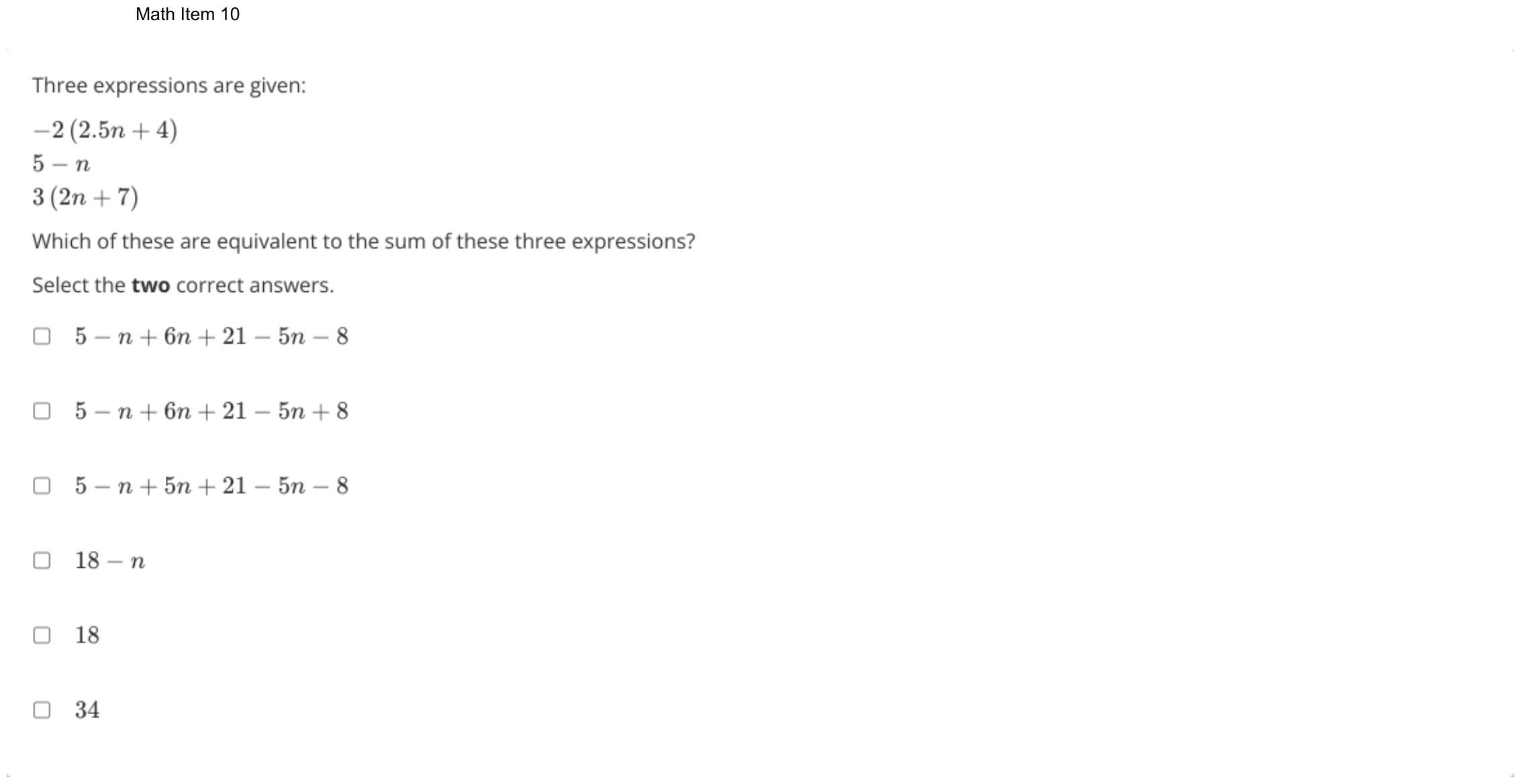
At a diner, 18 dozen buns were used yesterday for 150 lunch customers. Today, there were 250 lunch customers. Assuming that the bun usage rate is the same for both days, which proportions can be used to determine how many dozen buns are needed for 250 lunch customers?
Select the three correct answers.
Choose every answer that is correct, then check. The DOE has not published how answers with several parts are scored; this site counts one right only when every part is right.
- A
- B
- C
- D
- E
Show the answer
Correct answer: A, C, and D
The three correct answers are:
Set up a proportion to compare the number of buns per customer. These are all equivalent:
To check for equivalency, solve each proportion for x.
Each of the three correct proportions simplifies to .
Then solve for x to determine how many dozen buns are needed for 250 lunch customers:
Question analysis
A diner used 18 dozen buns for 150 lunch customers yesterday, and students select the three proportions, out of five, that can find how many dozen buns 250 customers need at the same rate. It tests setting up proportions and recognizing equivalent ones. All five equations use the same numbers, so each has to be checked for which quantities it pairs.
- Grade level
- Grade 7 content, by NYS standard
- Compared with grade 7
- At grade 7 Setting up a proportion from a rate is everyday grade 7 work. Here nothing is solved: five setups built from the same numbers must each be judged, some arranged in unfamiliar ways, and all three usable ones found.
- Estimated difficulty
- Moderate: several steps, or a close reading with one strong distractor.
- Thinking it demands
- Depth of knowledge 2, skills and concepts · mainly apply
- What makes it hard
- Every choice must be checked moderate
- A very close wrong answer moderate
- An answer in an unexpected form minor
- Much to keep track of minor
- Solution
- 3 steps
- Reading level
- Question and choices: about grade 6, 54 words.
- Students, last 30 days
- Not enough answers yet to show (it takes 10).
Why it is hard, traps and wrong answers (shows the answer)
Why it is hard
Nothing needs solving here; the question is which pairings keep the usage rate fixed. Students who check only for buns over customers on both sides find exactly three such setups, two of them wrong, and pass over the two right ones written another way. The wrong pair gives 10.8 dozen, fewer buns for more customers, which a quick sense check would catch, and cross-multiplying every setup settles all five.
Every choice must be checked moderate Choosing the answer
All five setups are built from 18, 150, 250 and x, so none can be dismissed on sight; each has to be cross-multiplied and compared with 150x = 18 × 250. (Embretson & Wetzel, 1987)
A very close wrong answer moderate Choosing the answer
The first two setups differ only in where 150 and 250 sit, 18/150 = x/250 against 18/250 = x/150, and both show buns over customers on each side, so a units check passes both. (Embretson & Wetzel, 1987; Gorin & Embretson, 2006; Ascalon et al., 2007)
An answer in an unexpected form minor Choosing the answer
One right setup puts customers over dozens of buns, and another sets today’s x over yesterday’s 18 equal to 250 customers over 150, forms that look wrong to students who learned only rate equals rate. (Enright, Morley & Sheehan, 2002)
Much to keep track of minor Working it out
Three of the five must be picked and all three must be right to score, so the verdict on each setup has to be kept until the last one is tested. (Sweller, 1988; Carpenter, Just & Shell, 1990)
Strategy: Write one proportion you trust by matching both units and days, cross-multiply it, then cross-multiply each choice and keep only those that give the same equation.
Traps
- Misunderstands the concept: A wrong belief about a concept: that percents can be added, that area grows like length, that averages can be averaged, that a bigger denominator means a bigger fraction.
- Answer in another form: The right answer is written differently from the way you worked it out.
The wrong answers, classified
B Misunderstands the concept (Smith, diSessa & Roschelle, 1993; De Bock et al., 1998; Ni & Zhou, 2005)
Checks only that both fractions show dozens of buns over customers, missing that 18 sits over today’s 250 customers; cross-multiplying gives 250x = 2,700, so x = 10.8.
D Misunderstands the concept (Smith, diSessa & Roschelle, 1993; De Bock et al., 1998; Ni & Zhou, 2005)
Left out by students who expect each fraction to compare buns with customers, not seeing that today over yesterday for buns and for customers also gives 150x = 4,500.
E Misunderstands the concept (Smith, diSessa & Roschelle, 1993; De Bock et al., 1998; Ni & Zhou, 2005)
Accepts x over 150 because it shows buns over customers like the trusted setup, but today’s buns sit over yesterday’s customers, which yields only 10.8 dozen for more people.
Worked solution, step by step
Formulas used
- A rate
- The rate is how many dozen buns are used for each customer. Yesterday it was 18 dozen over 150 customers. Today it is x dozen over 250 customers. The question says the rate is the same both days, so those two fractions are equal.
- Cross-multiplying a proportion
- A proportion says two fractions are equal. a and c are the tops, and b and d are the bottoms. Multiply each top by the other bottom, and the two products are equal. This turns any proportion into a plain equation, so you can compare setups that look different.
Sort out the question
Yesterday the diner used 18 dozen buns for 150 customers. Today it has 250 customers. Let x be the number of dozen buns needed today. The bun usage rate is the same both days.
A proportion is two equal fractions. You must pick the three proportions that give the right value of x.
Write one proportion you trust
Put each day’s buns over that same day’s customers. The rates are equal, so the fractions are equal:
This is choice A. Cross-multiply it:
Any choice that leads to 150x = 4,500 is a right one.
Solve for x
Divide both sides by 150 to get x by itself:
So the diner needs 30 dozen buns today. A wrong setup gives a different number.
Test choices C and D
Cross-multiply each one.
- C: gives . That is the same equation, so C works. It is choice A with both fractions flipped.
- D: gives . The same equation again, so D works too.
D compares today with yesterday. Today’s buns over yesterday’s buns equals today’s customers over yesterday’s customers.
Watch out: D looks odd because it puts buns over buns. Do not skip it. It still keeps the rate the same.
Test choices B and E
- B: gives , so 250x = 2,700.
- E: gives , the same 250x = 2,700.
Both give . That is fewer buns for more customers, which makes no sense.
Watch out: B and E show buns over customers, so they look right. But each one mixes up the days. B puts yesterday’s 18 dozen over today’s 250 customers. E puts today’s buns over yesterday’s 150 customers.
Name the three answers
Choices A, C and D all give 150x = 4,500, so x = 30. On the test, you check the box next to each one. So the answers are A, C and D.
Check your answer
Find the buns a second way. Today has times as many customers as yesterday. So it needs 5/3 times as many buns: dozen. That matches the 30 from choices A, C and D.
More questions like this
The original DOE question
Question 3 of 11
2026 Practice Test D Math, question 18Question
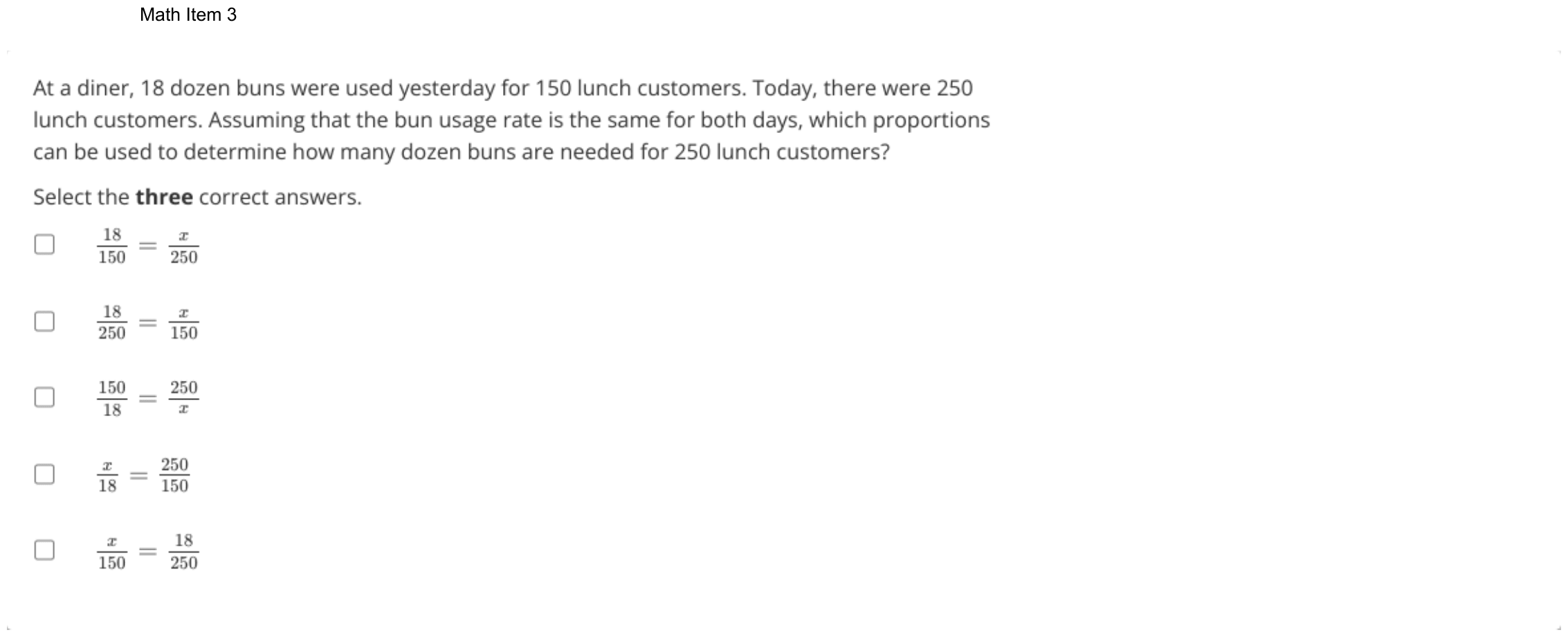
Which of the following decimals is equivalent to ?
- A
- B
- C
- D
Show the answer
Correct answer: C
First, add the mixed numbers. Then, convert the fraction to a decimal.
Question analysis
This question asks which repeating decimal equals the sum of the mixed numbers 1 2/3 and 2 4/9. Students rename the fractions with a common denominator, add, and convert the fraction part to a decimal with a bar over its repeating digit. The choices differ in both the whole number and the repeating digit, so each step has to be right.
- NYS standards
- Grade level
- Grade 7 content, by NYS standard
- Compared with grade 7
- At grade 7 Adding mixed numbers and writing a fraction as a repeating decimal are standard grade 7 skills. This combines them in three short steps; renaming a fraction and reading the bar notation are the only places that need care.
- Estimated difficulty
- Straightforward: two steps or one careful reading.
- Thinking it demands
- Depth of knowledge 1, recall and reproduction · mainly apply
- What makes it hard
- Error-prone arithmetic moderate
- An answer in an unexpected form minor
- Solution
- 3 steps
- Reading level
- Question and choices: about grade 13, 13 words.
- Students, last 30 days
- Not enough answers yet to show (it takes 10).
Why it is hard, traps and wrong answers (shows the answer)
Why it is hard
Two fraction moves and one conversion stand between the sum and the choices. The carry is the main hazard: 10/9 has to become 1 1/9, and students who keep only the 1/9 land on a choice with the wrong whole number. Estimating first, about 1.7 + 2.4 = 4.1, rules out both choices that begin with 3 and the one that equals 5.
Error-prone arithmetic moderate Working it out
Adding 2/3 and 4/9 needs 2/3 renamed as 6/9, and the sum 10/9 is more than 1, so a whole must be carried into the 3 before converting. (Brown & Burton, 1978; Junker & Sijtsma, 2001)
An answer in an unexpected form minor Choosing the answer
The choices are repeating decimals with bars, so a mixed number in ninths has to be recognized as a digit repeating forever; knowing that ninths repeat their numerator makes the match quick. (Enright, Morley & Sheehan, 2002)
Strategy: Rename 2/3 as ninths, add the whole numbers and the fractions separately, regroup any fraction of 9/9 or more as a whole, then divide the leftover numerator by 9.
Traps
- A faulty procedure: A systematic but wrong procedure: adding fractions straight across, applying an exponent to each term of a sum, dropping a sign when moving a term.
- Answer in another form: The right answer is written differently from the way you worked it out.
The wrong answers, classified
A An arithmetic slip (Junker & Sijtsma, 2001)
Adds the fractions to 10/9 but keeps only the 1/9 left over, forgetting to carry the whole 1 into the 3, so the sum becomes 3 1/9.
B A faulty procedure (Brown & Burton, 1978; Tatsuoka, 1983)
Adds the numerators 2 and 4 over 9 without renaming 2/3 as 6/9, so gets 3 6/9, which is 3.666…
D A faulty procedure (Brown & Burton, 1978; Tatsuoka, 1983)
Reaches 4 1/9 but repeats the denominator's 9 instead of the numerator's 1, as if one ninth were 0.999… rather than 0.111…
Worked solution, step by step
Formulas used
- Equivalent fractions
- a/b is a fraction, and n is any number except 0. Multiplying the top and the bottom by the same n gives an equal fraction, because n/n is 1. Use it to give two fractions the same bottom before you add them.
- Ninths as repeating decimals
- 1 divided by 9 is 0.111…, with 1s that go on forever. The bar over a digit means that digit repeats forever. Ninths from 1/9 to 8/9 repeat their top digit, so 4/9 is 0.444… and 2/9 is 0.222…
Sort out the question
You need to add two mixed numbers, 1 2/3 and 2 4/9. A mixed number is a whole number plus a fraction. Then write the sum as a decimal. The choices are repeating decimals, where the bar over a digit means it repeats forever.
Rename two thirds as ninths
The fractions 2/3 and 4/9 have different bottoms. Since 3 × 3 = 9, multiply the top and bottom of 2/3 by 3:
So 1 2/3 is the same as 1 6/9.
Watch out: adding the tops 2 and 4 over 9 without renaming gives 3 6/9, choice B.
Add the mixed numbers
Add the whole numbers, then add the fractions:
10/9 is more than 1. It is 9/9 plus 1/9, or 1 1/9. Carry the 1 into the whole number:
Watch out: forgetting to carry the 1 gives 3 1/9, choice A.
Change it to a decimal
One ninth is 0.111…, with the 1 repeating forever. So:
Watch out: ninths repeat the top digit, not the 9. Choice D, 4.999…, does not match 4 1/9.
So the answer is C, .
Check your answer
Use rough decimals. 1 2/3 is about 1.667, and 2 4/9 is about 2.444. Their sum is about 4.111. That matches 4.111… and rules out both choices that start with 3. And 4.999… is almost 5, which is too big.
More questions like this
The original DOE question
Question 4 of 11
2024 Test B Math, question 22Question
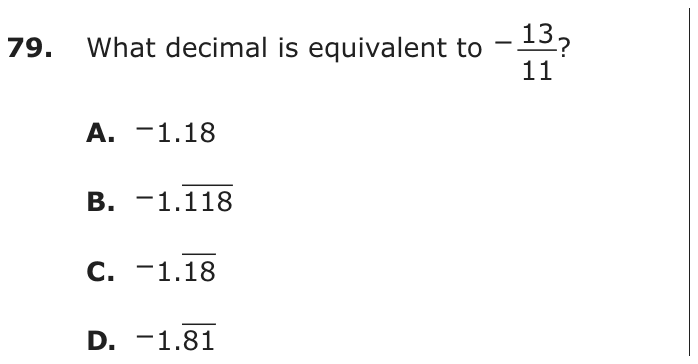
What decimal is equivalent to ?
- A
- B
- C
- D
Show the answer
Correct answer: C
Calculate the decimal equivalent of :
Question analysis
A fractions and decimals question asks which decimal equals negative 13/11. The choices differ in which digits repeat and how the repetition is marked. Students divide 13 by 11, spot the block of digits that repeats, and read the bar notation carefully.
- NYS standards
- 7.NS.2d fractions to decimals by long division
- Grade level
- Grade 7 content, by NYS standard
- Compared with grade 7
- At grade 7 Converting a fraction to a repeating decimal by long division is a named grade 7 skill. This is one short division, typical of grade 7 work, with care needed only in reading the bar notation.
- Estimated difficulty
- Straightforward: two steps or one careful reading.
- Thinking it demands
- Depth of knowledge 1, recall and reproduction · mainly apply
- What makes it hard
- A very close wrong answer moderate
- Something you must already know minor
- Error-prone arithmetic minor
- Solution
- 2 steps
- Reading level
- Question and choices: about grade 15, 10 words.
- Students, last 30 days
- Not enough answers yet to show (it takes 10).
Why it is hard, traps and wrong answers (shows the answer)
Why it is hard
Dividing 13 by 11 is quick; the question is really about reading and writing repeating decimals. Three choices differ only in where the bar goes, so students who know the digits run 1.1818… can still pick the wrong bar. Writing out each barred choice for a few digits and comparing it with the quotient is a fast, sure check.
A very close wrong answer moderate Choosing the answer
The bars over 18 and over 81 cover the same two digits, so only checking which digit comes right after the decimal point, 1 before 8, tells them apart. (Embretson & Wetzel, 1987; Gorin & Embretson, 2006; Ascalon et al., 2007)
Something you must already know minor Working it out
Reading bar notation is assumed: the bar marks exactly the block of digits that repeats, and the whole-number 1 never belongs under it. (Anderson & Krathwohl, 2001)
Error-prone arithmetic minor Working it out
The long division 13 ÷ 11 has to run until the remainder 2 comes back, which is where the repeating pair is confirmed. (Brown & Burton, 1978; Junker & Sijtsma, 2001)
Strategy: Do the long division of 13 by 11 until a remainder comes back, note which digits repeat from that point, and match that block to the bar in each choice.
Traps
- A faulty procedure: A systematic but wrong procedure: adding fractions straight across, applying an exponent to each term of a sum, dropping a sign when moving a term.
- Rounds too early: Rounds a value partway through, or rounds the wrong way, so the final answer drifts from the exact one.
- Answer in another form: The right answer is written differently from the way you worked it out.
The wrong answers, classified
A Rounds too early (King et al., 2004)
Stops the division after two decimal places and treats −1.18 as exact, missing that the digits 1 and 8 go on repeating.
B A faulty procedure (Brown & Burton, 1978; Tatsuoka, 1983)
Counts the whole-number 1 into the block, seeing 1, 18, 18 … as 118 repeating, and bars 118, which means −1.118118… rather than −1.1818….
D A faulty procedure (Brown & Burton, 1978; Tatsuoka, 1983)
Bars 81, the pair in the wrong order, which gives −1.8181…, equal to −1 9/11 rather than the −1 2/11 that −13/11 is.
Worked solution, step by step
Formulas used
- Fraction as division
- a is the top number, the numerator. b is the bottom number, the denominator. A fraction bar means divide. To turn a fraction into a decimal, divide the top by the bottom.
- Bar for repeating digits
- The bar sits over the digits that repeat forever, in the order they repeat. The dots mean the pattern goes on and on. Digits that are not under the bar show up only once.
Sort out the question
You need the decimal equal to . The fraction is negative, so the decimal will be negative too. Work with first. Then put the minus sign back.
Divide 13 by 11
Use long division for .
- 11 goes into 13 once, with 2 left over. Write 1 and a decimal point.
- Bring down a 0 to make 20. 11 goes into 20 once, with 9 left over. Write 1.
- Bring down a 0 to make 90. 11 goes into 90 eight times, with 2 left over. Write 8.
So far you have 1.18.
Spot the repeating pattern
The remainder (the amount left over) is 2 again. That is where you were after the first step. So the same digits come back: 1, 8, 1, 8, and so on forever.
Watch out: −1.18, choice A, stops too soon. The digits never end.Write it with a bar
A bar goes over only the digits that repeat. Here 18 repeats, starting right after the decimal point. The whole number 1 does not repeat, so it is not under the bar. Put the minus sign back.
Watch out: a bar over 81, choice D, means −1.8181…. A bar over 118, choice B, means −1.118118….So the answer is C, .
Check your answer
Multiply back: . That is almost exactly 13, and more 18s bring it even closer. Also, 13/11 is a bit more than 1, so a decimal between 1 and 2 makes sense.
More questions like this
The original DOE question
Question 5 of 11
2024 Test B Math, question 42Question
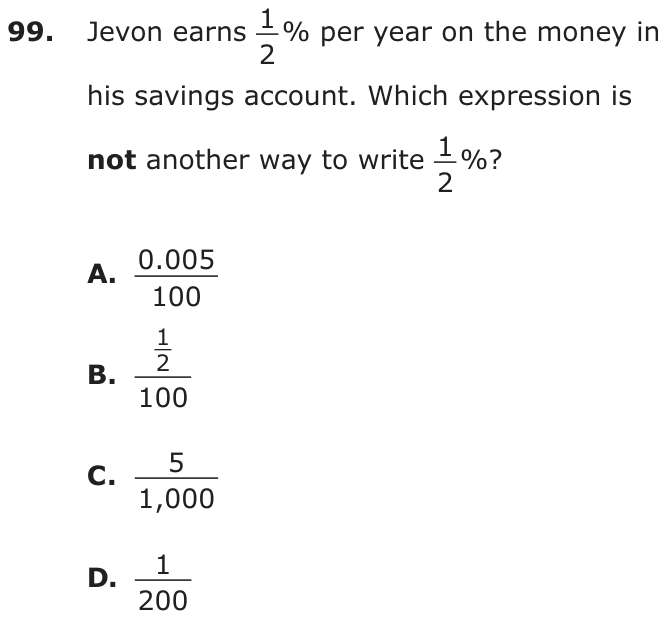
Jevon earns per year on the money in his savings account. Which expression is not another way to write ?
- A
- B
- C
- D
Show the answer
Correct answer: A
Rewrite the percent as a decimal:
So the correct answer must not equal 0.005:
Option A
Option B
Option C
Option D
All answer options except Option A equal 0.005. Therefore, Option A is the correct answer.
Question analysis
Jevon's savings account earns one-half percent a year, and students must find the expression that is not another way to write one-half percent. It tests converting a percent less than 1 into fractions and decimals. Reading the word not carefully, and evaluating each stacked or unfamiliar fraction correctly, are what make it tricky.
- Grade level
- Grade 7 content, by NYS standard
- Compared with grade 7
- At grade 7 Converting between percents, fractions and decimals is grade 6 and 7 work. A percent smaller than 1 is less familiar, and the question asks which form is not equal, so all four must be checked, which keeps it at typical grade 7 demand.
- Estimated difficulty
- Moderate: several steps, or a close reading with one strong distractor.
- Thinking it demands
- Depth of knowledge 1, recall and reproduction · mainly apply
- What makes it hard
- A question in the negative moderate
- Every choice must be checked moderate
- Error-prone arithmetic minor
- Solution
- 3 steps
- Reading level
- Question and choices: about grade 7, 25 words.
- Students, last 30 days
- Not enough answers yet to show (it takes 10).
Why it is hard, traps and wrong answers (shows the answer)
Why it is hard
Every expression is built from the same idea, so the question tests whether students can convert a percent smaller than 1 without losing track of decimal places. The odd one out, 0.005 over 100, looks like a correct form, because 0.005 is one-half percent and dividing by 100 seems to turn it into a percent. Converting one-half percent to 0.005 once and comparing each expression with it beats reasoning about each form.
A question in the negative moderate Understanding the question
The bold word not asks for the one expression unequal to one-half percent, so the three expressions that check out are exactly the ones to reject. (Haladyna, Downing & Rodriguez, 2002)
Every choice must be checked moderate Choosing the answer
Three of the four forms are equal, so each has to be converted to a decimal and compared with 0.005 before the odd one out can be named. (Embretson & Wetzel, 1987)
Error-prone arithmetic minor Working it out
One-half percent is 0.5 with the point moved two places, 0.005, and dividing that by 100 moves it two more places, to 0.00005. (Brown & Burton, 1978; Junker & Sijtsma, 2001)
Strategy: Write one-half percent as a single decimal by dividing one half by 100, then evaluate each expression as a decimal and compare it with that value.
Traps
- NOT, LEAST or EXCEPT: The question asks for the exception, the least, or what is not true.
- Answer in another form: The right answer is written differently from the way you worked it out.
The wrong answers, classified
B Misreads the question (Hegarty, Mayer & Monk, 1995)
Misses the bold not and picks the expression that equals one-half percent most plainly, one half over 100, the literal meaning of percent.
C Misunderstands the concept (Smith, diSessa & Roschelle, 1993; De Bock et al., 1998; Ni & Zhou, 2005)
Believes a percent must be written over 100, so 5 over 1,000 looks like a different number, though both equal 0.005.
D An arithmetic slip (Junker & Sijtsma, 2001)
Divides 1 by 200 and misplaces the decimal point, getting 0.05 instead of 0.005, so 1/200 seems not to equal one-half percent.
Worked solution, step by step
Formulas used
- Percent as a fraction
- p is any number. The % sign means out of 100. So p percent is p divided by 100. Dividing by 100 moves the decimal point two places to the left.
Sort out the question
The question asks which expression is not equal to . So three choices are equal to it, and one is different. You need the odd one out.
Write the percent as a decimal
One half is 0.5. A percent means out of 100, so divide by 100.
So is 0.005. It is half of one percent, a very small amount.
Test each choice
Turn each choice into a decimal. Then compare it with 0.005.
Choice Work it out Equal to 0.005? A No B Yes C Yes D Yes Pick the one that is different
Choice A divides by 100 twice. The 0.005 was already divided by 100 once. Dividing again makes it 100 times too small.
Watch out: Choice B is the plainest way to write : one half over 100. Picking it means missing the word “not.” Also, 1 ÷ 200 is 0.005, not 0.05, so D is equal too.
So the answer is A, .
Check your answer
Use fractions instead. Half of one hundredth is , which is choice D. And simplifies to too. Only A is a different amount.
More questions like this
The original DOE question
Question 6 of 11
2023 Test A Math, question 11Question
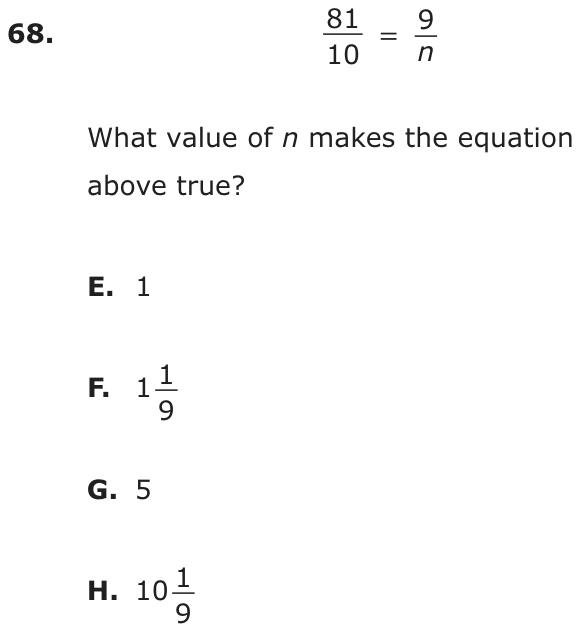
What value of n makes the equation above true?
- A1
- B
- C5
- D
Show the answer
Correct answer: B
| Cross multiply. | |
| Apply the multiplicative inverse property; divide both sides of the equation by 81. | |
| Then simplify the fraction. |
Question analysis
This question gives the proportion 81/10 = 9/n and asks for the value of n that makes it true. Students solve a proportion by cross-multiplying and dividing, then simplify the result. Reducing the resulting fraction and matching its form to the choices is where students slip.
- Grade level
- Grade 6 content, by NYS standard
- Compared with grade 7
- Below grade 7 Solving a proportion is familiar from grades 6 and 7, and this one needs only cross-multiplying and one division. Its one extra demand is simplifying the result and writing it in the form the choices use.
- Estimated difficulty
- Straightforward: two steps or one careful reading.
- Thinking it demands
- Depth of knowledge 1, recall and reproduction · mainly apply
- What makes it hard
- An answer in an unexpected form moderate
- A very close wrong answer minor
- Solution
- 3 steps
- Reading level
- Question and choices: about grade 7, 12 words.
- Students, last 30 days
- Not enough answers yet to show (it takes 10).
Why it is hard, traps and wrong answers (shows the answer)
Why it is hard
The proportion solves in one cross-multiplication, but the result is an improper fraction that must be simplified and rewritten to match. Students who notice that 81 is 9 × 9 can shortcut it: the numerator shrinks by a factor of 9 from left to right, so the denominator must shrink too, giving 10 ÷ 9. The mixed-number form is where answers drift, by dropping the leftover ninth or by writing 10 × 1/9 as 10 1/9.
An answer in an unexpected form moderate Choosing the answer
Cross-multiplying gives n = 90/81, which has to be reduced to 10/9 and rewritten as the mixed number 1 1/9 before it matches any choice. (Enright, Morley & Sheehan, 2002)
A very close wrong answer minor Choosing the answer
The choices 1 and 1 1/9 differ by one ninth, and estimating 90 ÷ 81 as about 1 cannot separate them; only keeping the remainder does. (Embretson & Wetzel, 1987; Gorin & Embretson, 2006; Ascalon et al., 2007)
Strategy: Cross-multiply to get 81n = 90, divide both sides by 81, and simplify the fraction before comparing it with the choices.
Traps
- A faulty procedure: A systematic but wrong procedure: adding fractions straight across, applying an exponent to each term of a sum, dropping a sign when moving a term.
- Answer in another form: The right answer is written differently from the way you worked it out.
The wrong answers, classified
A Rounds too early (King et al., 2004)
Finds n by dividing 10 by 9 but keeps only the whole-number part of the quotient, 1, dropping the remainder that the exact answer needs.
C Little reason to choose it (Haladyna & Downing, 1993; Rodriguez, 2005)
No cross-multiplication or scaling of 81/10 gives 5, which would make 9/n equal 1.8 instead of 8.1, so it mostly catches guesses.
D A faulty procedure (Brown & Burton, 1978; Tatsuoka, 1983)
Reaches n = 10 × 9/81 = 10 × 1/9 but writes the product as the mixed number 10 1/9, as if a whole number beside a fraction meant multiplication.
Worked solution, step by step
Formulas used
- Cross-multiplying
- a over b and c over d are two equal fractions, and b and d are not 0. Multiply each top by the other bottom. The two products are equal. It works because it is the same as multiplying both sides by b and by d.
- Simplifying a fraction
- a over b is a fraction, and k is a number that divides both the top and the bottom. Dividing the top and the bottom by the same number gives an equal fraction with smaller numbers.
- Fraction to mixed number
- a over b is a fraction whose top is bigger than its bottom. q is the quotient, how many whole times b fits into a. r is the remainder, what is left over. The leftover stays over the same bottom number.
Sort out the question
The equation says two fractions are equal: and . n is an unknown bottom number. You need the value of n that makes them equal. Some choices are mixed numbers, so n may not be a whole number.
Cross-multiply the two fractions
Multiply each top by the other fraction’s bottom. This gets n out of the bottom of the fraction.
Divide both sides by 81
81n means 81 times n. To undo multiplying by 81, divide both sides by 81.
Now simplify. 90 and 81 are both in the 9 times table, so divide the top and bottom by 9.
Write it as a mixed number
10 ÷ 9 is 1 with 1 left over. The leftover stays over 9.
Watch out: keep the leftover. Dropping it gives 1, choice A. Also, ten ninths is not 10 and one ninth. That mixed number, , is choice D, which is far too big. So the answer is B, .
Check your answer
Estimate. is about 8. For to be about 8, n must be a little more than 1. Check exactly: . It matches.
More questions like this
The original DOE question
Question 7 of 11
2023 Test B Math, question 11Question
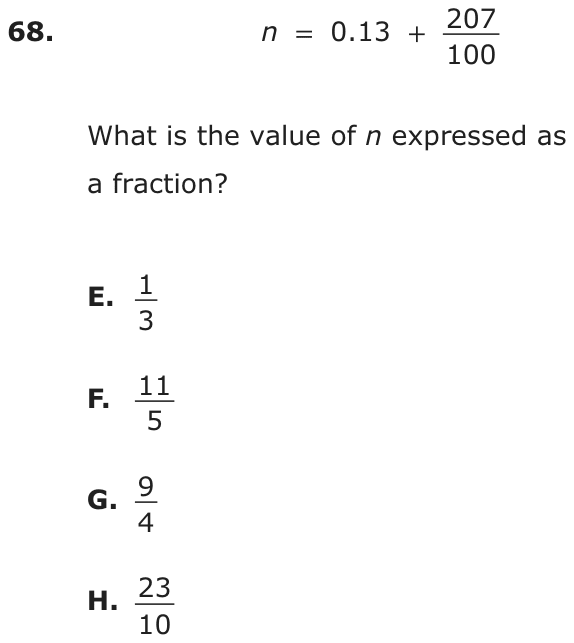
What is the value of n expressed as a fraction?
- A
- B
- C
- D
Show the answer
Correct answer: B
Question analysis
The number n equals 0.13 plus 207/100, and students must write n as a single fraction. This question mixes a decimal with a fraction in hundredths. Converting both to the same form, adding, and reducing to lowest terms are the steps, and the four fractions offered look quite different at first glance.
- NYS standards
- 6.NS.3 multi-digit decimal operations
- Grade level
- Grade 6 content, by NYS standard
- Compared with grade 7
- Below grade 7 Converting decimals to fractions and simplifying are skills taught before grade 7. Both numbers here are in hundredths, so the addition is immediate and only the final reduction takes thought.
- Estimated difficulty
- Routine: one familiar step, little to misread.
- Thinking it demands
- Depth of knowledge 1, recall and reproduction · mainly apply
- What makes it hard
- Solution
- 2 steps
- Reading level
- Question and choices: about grade 7, 15 words.
- Students, last 30 days
- Not enough answers yet to show (it takes 10).
Why it is hard, traps and wrong answers (shows the answer)
Why it is hard
Converting 0.13 to hundredths makes this a single addition, 13 + 207 = 220 hundredths, so the question tests little beyond reducing a fraction. Two of the wrong choices sit close to 2.2 but come from no common working, and the third only echoes the digits of 0.13. A student who checks each choice as a decimal finds only one equal to 2.2.
An answer in an unexpected form minor Choosing the answer
The sum comes out as 220/100 or 2.2, but the choices are in lowest terms, so it must be reduced, or each choice converted, before anything matches. (Enright, Morley & Sheehan, 2002)
Error-prone arithmetic minor Working it out
One term is a decimal and the other a fraction; writing 0.13 as 13/100 puts both in hundredths, and a misplaced digit there changes the sum. (Brown & Burton, 1978; Junker & Sijtsma, 2001)
Strategy: Write 0.13 as 13/100 so both terms are in hundredths, add the numerators, then divide the top and bottom by their greatest common factor.
Traps
- Answer in another form: The right answer is written differently from the way you worked it out.
- Numbers taken from the question: Combines the numbers in the question without a model of the situation, or is simply a number that appears in the question.
The wrong answers, classified
A Numbers taken from the question (Hegarty, Mayer & Monk, 1995)
Echoes the digits of 0.13, reading it as the fraction 1/3, and ignores the 207/100 altogether.
C Little reason to choose it (Haladyna & Downing, 1993; Rodriguez, 2005)
No common working gives 9/4, which is 2.25; adding 13 and 207 hundredths gives 2.2, so this mostly draws guesses near the sum.
D Little reason to choose it (Haladyna & Downing, 1993; Rodriguez, 2005)
Nothing leads to 23/10 except 13 + 207 coming out as 230, a slip with no reason behind it, so it mostly catches guesses.
Worked solution, step by step
Formulas used
- Decimals as hundredths
- The second place after the decimal point is the hundredths place. So a decimal with two places counts hundredths. Write its digits over 100. For example, 0.47 is 47/100.
- Adding fractions with the same bottom
- a and b are the tops. c is the shared bottom, the denominator. When the bottoms match, the pieces are the same size. So add the tops and keep the bottom.
Sort out the question
n equals 0.13 plus . One part is a decimal and one is a fraction. You need n as a fraction. The choices are in lowest terms, which means they can’t be simplified any more.
Write the decimal as a fraction
The 3 in 0.13 is in the hundredths place. So 0.13 is 13 hundredths.
Now both numbers are in hundredths. Watch out: 0.13 is not . That only copies the digits, choice A.
Add the hundredths
Use the rule for adding fractions. The bottoms match, so add the tops and keep the 100 on the bottom.
Simplify the fraction
is not a choice, so simplify it. Find the greatest number that divides both 220 and 100. That is 20.
So the answer is B, .
Check your answer
Change both to decimals. . And . They match. Choices C and D are close, but and .
More questions like this
The original DOE question
Question 8 of 11
2023 Test B Math, question 37Question
Which expression is equivalent to ?
- A
- B
- C
- D
Show the answer
Correct answer: D
First, distribute the negative sign, which is the same as multiplying both terms in the parentheses by −1.
Next, combine like terms:
Then, factor the common factor of from both terms, paying careful attention to the signs:
Question analysis
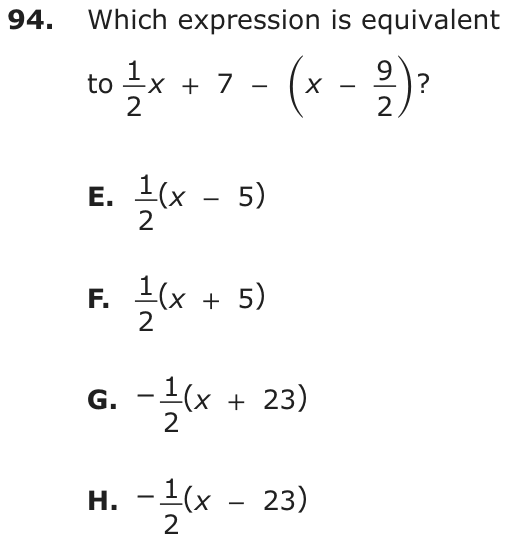
An algebra question asking which factored expression equals one half x plus 7 minus the quantity x minus nine halves. Students distribute the subtraction, combine like terms with fractions, and match a factored form. Signs are the danger at every step, and the choices differ only in the signs and numbers inside the parentheses.
- NYS standards
- 7.EE.1 linear expressions with rational coefficients
- Grade level
- Grade 7 content, by NYS standard
- Compared with grade 7
- Above grade 7 Grade 7 students expand and simplify linear expressions with fractions. Here a subtracted group must be distributed and the result factored by a negative fraction, two places where a sign is easily lost, a longer chain than typical grade 7 work.
- Estimated difficulty
- Hard: combines ideas, needs a plan, and has more than one tempting wrong answer.
- Thinking it demands
- Depth of knowledge 1, recall and reproduction · mainly apply
- What makes it hard
- Error-prone arithmetic moderate
- An answer in an unexpected form moderate
- A very close wrong answer moderate
- Solution
- 3 steps
- Reading level
- Question and choices: about grade 15, 10 words.
- Students, last 30 days
- Not enough answers yet to show (it takes 10).
Why it is hard, traps and wrong answers (shows the answer)
Why it is hard
Two separate sign decisions decide this question: distributing the subtraction over x − 9/2, and factoring a negative half out of +23/2. Students who handle the first correctly often stumble on the second and choose the look-alike with +23. Expanding each choice, rather than factoring by hand, is quicker and safer, since it turns the comparison into matching −1/2x + 23/2 term by term.
Error-prone arithmetic moderate Working it out
The minus before (x − 9/2) must change two signs, and the result mixes halves with whole numbers: 1/2x − x and 7 + 9/2 both need care. (Brown & Burton, 1978; Junker & Sijtsma, 2001)
An answer in an unexpected form moderate Choosing the answer
The simplified result, −1/2x + 23/2, appears nowhere; every choice is factored by ±1/2, so students must factor out −1/2 themselves or expand each choice to compare. (Enright, Morley & Sheehan, 2002)
A very close wrong answer moderate Choosing the answer
The answer, −1/2(x − 23), and −1/2(x + 23) differ only in the sign inside the parentheses, and the simplified form’s +23/2 makes the plus sign look right. (Embretson & Wetzel, 1987; Gorin & Embretson, 2006; Ascalon et al., 2007)
Strategy: Change the sign of both terms inside the parentheses, combine the x terms and the constants, then expand each choice to see which one matches rather than factoring yourself.
Traps
- Order of operations: Working left to right, or distributing a minus sign wrongly, gives a choice.
- Negatives and direction: Arithmetic with negative numbers, the order of a subtraction, or direction on a number line. (Moving a term across the equals sign without changing its sign is a faulty procedure.)
- Answer in another form: The right answer is written differently from the way you worked it out.
The wrong answers, classified
A Order of operations (Brown & Burton, 1978)
Gives the minus to x but not to −9/2, so the constants make 7 − 9/2 = 5/2, then drops the leading negative when factoring: 1/2(x − 5).
B Negatives and direction (Brown & Burton, 1978)
Combines 1/2x − x as +1/2x, subtracting the smaller coefficient from the larger, and also leaves −9/2 unchanged, so the result is 1/2x + 5/2 = 1/2(x + 5).
C Negatives and direction (Brown & Burton, 1978)
Simplifies correctly to −1/2x + 23/2 but keeps +23 when factoring out −1/2, though dividing +23/2 by −1/2 gives −23.
Worked solution, step by step
Formulas used
- Subtracting a group
- b and c are the two terms inside the parentheses. Terms are the parts joined by plus or minus signs. A minus sign in front of parentheses takes away the whole group. So it changes the sign of every term inside, not only the first one.
- Distributive property
- a is the number outside the parentheses. b and c are the terms inside. Multiply a by each term inside. It works because a groups of (b + c) hold a of each. Use it to multiply out the choices and compare them.
Sort out the question
Equivalent means equal for every value of x. The choices are written in a different form from the problem. So simplify the problem first. Then multiply out the choices and compare.
Remove the parentheses
The minus sign in front of the parentheses takes away both terms inside. So x becomes −x, and becomes .
Watch out: If you change only the sign of x, the numbers become . That mistake leads to choice A or B.
Combine the x terms
Like terms have the same letter part. The x terms are and −x. Write x as so the fractions match.
The result is negative, because you take away more x than you have.
Combine the numbers
Now combine the plain numbers, 7 and . Write 7 as fourteen halves so the bottoms match. Then add.
The expression simplifies to .
Multiply out choices C and D
Only C and D start with , so test those. Use the distributive property. A negative times a negative is positive.
The first line is choice C, and the second is choice D. Only D matches.
Watch out: Choice C looks almost the same. But it gives , not .
So the answer is D, .
Check your answer
Try x = 1 in the problem: . Now put x = 1 into choice D: . Both give 11, so they match.
More questions like this
The original DOE question
Question 9 of 11
2018 Test A Math, question 28Question
What is the value of the expression shown above?
- A
- B
- C
- D
Show the answer
Correct answer: D
Convert all the fractions to a common denominator (10):
Question analysis
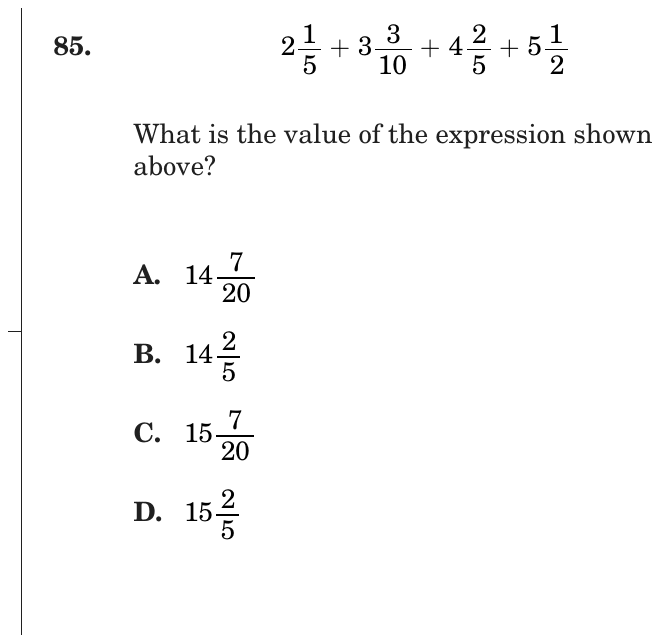
A fractions question: add four mixed numbers whose fractions have denominators of 5, 10, 5 and 2. Students rewrite the fractions over a common denominator, add the whole numbers and the fractions, regroup any extra whole, and simplify. Regrouping and lowest terms both matter, since the choices differ in exactly those places.
- NYS standards
- Grade level
- Grade 7 content, by NYS standard
- Compared with grade 7
- Below grade 7 Adding mixed numbers with unlike denominators is grade 5 content. With four terms and a regrouping step it takes care, but it asks less than typical grade 7 work with negative rational numbers.
- Estimated difficulty
- Straightforward: two steps or one careful reading.
- Thinking it demands
- Depth of knowledge 1, recall and reproduction · mainly apply
- What makes it hard
- Error-prone arithmetic moderate
- A very close wrong answer moderate
- An answer in an unexpected form minor
- Solution
- 3 steps
- Reading level
- Question and choices: about grade 9, 14 words.
- Students, last 30 days
- Not enough answers yet to show (it takes 10).
Why it is hard, traps and wrong answers (shows the answer)
Why it is hard
The numbers are friendly: every fraction converts to tenths, and the whole parts add to 14. The risk is in the bookkeeping, either forgetting to carry the extra whole from the fractions or adding numerators over a made-up denominator. Converting to decimals, 2.2 + 3.3 + 4.4 + 5.5, is a fast check that avoids both.
Error-prone arithmetic moderate Working it out
Four mixed numbers with denominators 5, 10, 5 and 2 must be rewritten as tenths, 2 + 3 + 4 + 5 tenths, and the 14/10 regrouped into a whole and a fraction. (Brown & Burton, 1978; Junker & Sijtsma, 2001)
A very close wrong answer moderate Choosing the answer
15 2/5 and 14 2/5 are written alike and share the fraction 2/5; only the whole carried from 14/10 separates them, so a missed carry is invisible at a glance. (Embretson & Wetzel, 1987; Gorin & Embretson, 2006; Ascalon et al., 2007)
An answer in an unexpected form minor Choosing the answer
The fractions total 1 4/10, but every choice is in lowest terms, so the 4/10 has to be reduced to 2/5 before it matches. (Enright, Morley & Sheehan, 2002)
Strategy: Convert each mixed number to a decimal, since these fractions all convert exactly, add them, and turn the decimal part back into a fraction in lowest terms.
Traps
- Answer in another form: The right answer is written differently from the way you worked it out.
The wrong answers, classified
A A faulty procedure (Brown & Burton, 1978; Tatsuoka, 1983)
Adds the numerators straight across, 1 + 3 + 2 + 1 = 7, and puts them over 20, a common denominator (10 × 2), without rescaling them, so nothing carries.
B An arithmetic slip (Junker & Sijtsma, 2001)
Adds the fractions to 14/10 but keeps only the 4/10 = 2/5 left over, forgetting to carry the whole 1 into 14.
C Little reason to choose it (Haladyna & Downing, 1993; Rodriguez, 2005)
Pairs a correct carry into 15 with the 7/20 from adding numerators, two steps no single line of working combines; it mostly catches guesses.
Worked solution, step by step
Formulas used
- Equal fractions
- a is the top number, called the numerator. b is the bottom number, called the denominator. n is any whole number except zero. Multiplying the top and bottom by the same n gives an equal fraction. Use it to give fractions the same denominator so you can add them.
Sort out the question
You need to add four mixed numbers. A mixed number is a whole number plus a fraction, like . The fractions have different denominators, or bottom numbers: 5, 10, 5 and 2. To add fractions, they need the same denominator.
Add the whole numbers
Add the whole numbers first. You will add the fractions on their own after that.
The whole numbers make 14.
Rewrite each fraction in tenths
Use 10 as the denominator, since 5 and 2 both go into 10.
is already in tenths. Watch out: when you change a bottom number, change the top too. Adding the old tops, 1 + 3 + 2 + 1 = 7, and putting them over 20 gives 7/20. That is in choices A and C.
Add the fractions
14 tenths is more than 1 whole. Ten tenths make 1, so 14 tenths is 1 whole and 4 tenths.
To simplify 4/10, divide the top and bottom by 2.
Put it all together
Add the 14 wholes to the sum of the fractions.
Watch out: carry the extra whole into the 14. Missing it gives , choice B. So the answer is D, .
Check your answer
Change each mixed number to a decimal: . The 0.4 is 4 tenths, which is 2/5. So the sum is .
More questions like this
The original DOE question
Question 10 of 11
2018 Test A Math, question 36Question
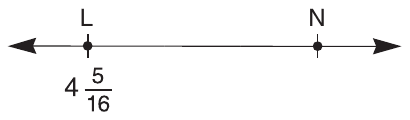
On the number line above, LN = . Point M (not shown) is located between point L and point N. Which value below is a possible value for M?
- A4.26
- B4.31
- C4.35
- D4.58
Show the answer
Correct answer: C
Since , point is located at
.
So must be between point , , and point , . Point can also be written as 4.3125, and point can be written as 4.4375. The only option given that lies between those two points is 4.35.
Question analysis
This number line question says the distance from point L to point N is one eighth and asks which decimal could be the position of a point M between them. Students take L's position, a mixed number in sixteenths, find N, and compare with decimal choices. Converting sixteenths to decimals precisely is the tricky part.
- NYS standards
- Grade level
- Grade 7 content, by NYS standard
- Compared with grade 7
- At grade 7 Grade 7 students convert fractions to decimals and compare them. This item needs an exact conversion of sixteenths and a comparison to the thousandths, where rounding too early can mislead, but it stays within grade 7 content.
- Estimated difficulty
- Moderate: several steps, or a close reading with one strong distractor.
- Thinking it demands
- Depth of knowledge 2, skills and concepts · mainly apply
- What makes it hard
- Error-prone arithmetic moderate
- A very close wrong answer moderate
- Reading a figure, table or graph minor
- Solution
- 3 steps
- Reading level
- Question and choices: about grade 5, 28 words.
- Students, last 30 days
- Not enough answers yet to show (it takes 10).
Why it is hard, traps and wrong answers (shows the answer)
Why it is hard
The interval from L to N is only an eighth wide, and three of the four choices crowd near it, so precision decides the question. Students comfortable working in sixteenths can avoid decimals until the end, since 4.35 lies between 4 5/16 and 4 7/16. Those who convert loosely, or who misread a mixed number as a decimal, are pulled to a neighboring choice.
Error-prone arithmetic moderate Working it out
Converting 4 5/16 to 4.3125 and N to 4.4375 needs four decimal places, while the choices stop at hundredths, so early rounding blurs the left boundary. (Brown & Burton, 1978; Junker & Sijtsma, 2001)
A very close wrong answer moderate Choosing the answer
The choices 4.31 and 4.35 both lie within 0.04 of L, so estimating cannot separate them; only the exact 4.3125 shows 4.31 just outside the interval and 4.35 inside. (Embretson & Wetzel, 1987; Gorin & Embretson, 2006; Ascalon et al., 2007)
Reading a figure, table or graph minor Understanding the question
L's value appears only on the number line, and the picture shows N to the right of L, which fixes which way the one-eighth gap runs. (Lesh, Post & Behr, 1987; Kirsch & Mosenthal, 1990)
Strategy: Add one eighth, or two sixteenths, to L's position to locate N, convert both endpoints to four-place decimals, and keep only a choice strictly between them.
Traps
- Rounds too early: Rounds a value partway through, or rounds the wrong way, so the final answer drifts from the exact one.
- Answer in another form: The right answer is written differently from the way you worked it out.
- A faulty procedure: A systematic but wrong procedure: adding fractions straight across, applying an exponent to each term of a sum, dropping a sign when moving a term.
The wrong answers, classified
A Negatives and direction (Brown & Burton, 1978)
Measures the one-eighth gap to the left of L, giving 4.1875 to 4.3125, an interval that contains 4.26 but contradicts the figure.
B Rounds too early (King et al., 2004)
Rounds L's 4.3125 to 4.31 and treats 4.31 as inside the interval, missing that it lies slightly to the left of L.
D A faulty procedure (Brown & Burton, 1978; Tatsuoka, 1983)
Writes 4 5/16 as 4.516 by placing the fraction's digits after the decimal point, so N becomes about 4.641 and 4.58 appears to fit.
Worked solution, step by step
Formulas used
- Equal fractions
- a is the top number (numerator) and b is the bottom number (denominator). Multiplying both by the same number k gives an equal fraction. It is like cutting each piece into k smaller pieces. Use it to give fractions the same bottom before you add or subtract.
- Fraction to decimal
- A fraction bar means divide. a is the top number and b is the bottom number. Dividing the top by the bottom turns the fraction into a decimal. Then you can compare it with decimal choices.
Sort out what you know
Point L is at . Point N is to the right of L. The distance from L to N, called LN, is .
Point M is somewhere between L and N. You need a choice that fits between them. The choices are decimals, so you will change the fractions into decimals.
Find where N is
N is to the right of L, so add. First give a bottom of 16, to match L:
Watch out: N is to the right of L in the figure. Going left instead gives a gap that holds 4.26, choice A.
Change both points to decimals
Divide the top of each fraction by the bottom:
So L is at 4.3125 and N is at 4.4375.
Test each choice
M must be bigger than 4.3125 and smaller than 4.4375.
- 4.26 is smaller than 4.3125. It is left of L.
- 4.31 is 4.3100, just smaller than 4.3125. It is a hair left of L.
- 4.35 is between them. It fits.
- 4.58 is bigger than 4.4375. It is right of N.
Watch out: if you round L to 4.31, choice B seems to fit. Keep all four decimal places. So the answer is C, 4.35.
Check your answer
Subtract to be sure. 4.35 − 4.3125 = 0.0375, which is more than 0, so 4.35 is right of L. 4.4375 − 4.35 = 0.0875, which is also more than 0, so 4.35 is left of N. It sits between them.
More questions like this
The original DOE question
Question 11 of 11
2018 Test B Math, question 54Question
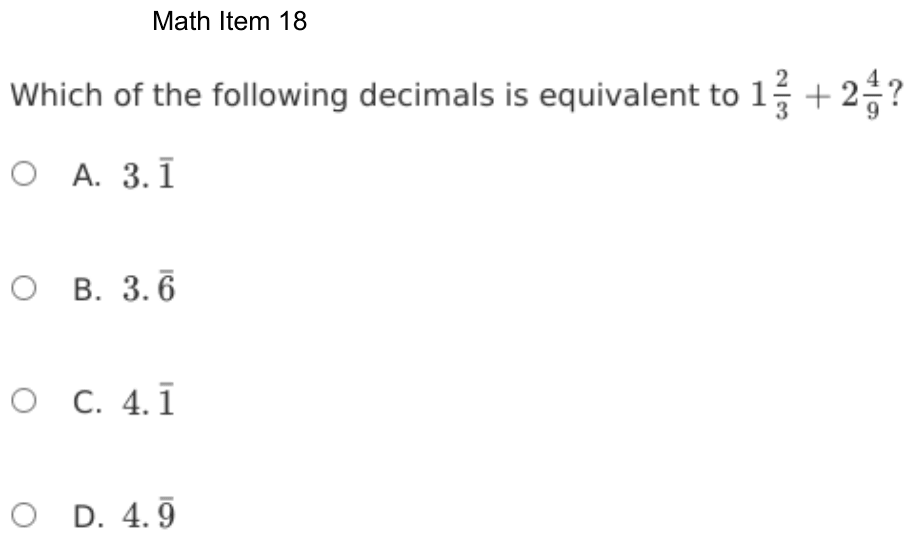
Raoul is at least 3 years older than Vahn. Which of the following inequalities gives the relationship between Raoul’s age ( ) and Vahn’s age ( )?
- A
- B
- C
- D
Show the answer
Correct answer: A
Raoul is at least 3 years older than Vahn, which can be written as
r ≥ v + 3
Rewrite this inequality to match the answer options:
r − v ≥ 3
Question analysis
Raoul is at least 3 years older than Vahn, and students choose the inequality that links their ages, r and v. It tests translating a phrase like "at least" into an inequality. The correct form may not match the one students write first, so they need to rearrange carefully and keep the direction of the inequality.
- Grade level
- Grade 7 content, by NYS standard
- Compared with grade 7
- At grade 7 Writing inequalities from words is grade 6 and 7 work. The extra demand is that "at least" must become the right symbol and the choices are rearranged forms, so students must manipulate inequalities rather than just recognize one.
- Estimated difficulty
- Moderate: several steps, or a close reading with one strong distractor.
- Thinking it demands
- Depth of knowledge 2, skills and concepts · mainly understand
- What makes it hard
- Turning words into math major
- An answer in an unexpected form moderate
- A very close wrong answer moderate
- Solution
- 2 steps
- Reading level
- Question and choices: about grade 8, 28 words.
- Students, last 30 days
- Not enough answers yet to show (it takes 10).
Why it is hard, traps and wrong answers (shows the answer)
Why it is hard
Two skills are tested at once: translating "at least … older than" into an inequality, and recognizing that inequality after a rearrangement. The two choices that begin with 3 − v and 3 − r look like legitimate moves but say only that the two ages add up to at least 3. Testing one pair of ages that fits the sentence and one that does not, such as 20 and 12 against 13 and 12, sorts the choices without algebra.
Turning words into math major Understanding the question
"Raoul is at least 3 years older than Vahn" has to become r ≥ v + 3; "at least" calls for ≥, though the word "least" seems to point the other way. (Hegarty, Mayer & Monk, 1995; Koedinger & Nathan, 2004)
An answer in an unexpected form moderate Choosing the answer
No choice is written as r ≥ v + 3, so the natural translation has to be rearranged to r − v ≥ 3 before it can be matched. (Enright, Morley & Sheehan, 2002)
A very close wrong answer moderate Choosing the answer
r − v ≤ 3 is the right r − v ≥ 3 with the symbol reversed; only deciding that "at least" means greater than or equal to separates them. (Embretson & Wetzel, 1987; Gorin & Embretson, 2006; Ascalon et al., 2007)
Strategy: Write the sentence directly as Raoul's age compared with Vahn's age plus 3, then rearrange each choice into that form to see which one matches.
Traps
- Misreads the question: Misses or misreads a condition or a word in the question: "at least", "each", "remaining", "not".
- A faulty procedure: A systematic but wrong procedure: adding fractions straight across, applying an exponent to each term of a sum, dropping a sign when moving a term.
- Answer in another form: The right answer is written differently from the way you worked it out.
The wrong answers, classified
B Misreads the question (Hegarty, Mayer & Monk, 1995)
Reads "at least 3 years older" as at most 3, reversing the inequality, which would even allow Raoul to be younger than Vahn.
C A faulty procedure (Brown & Burton, 1978; Tatsuoka, 1983)
Moves v across r ≥ v + 3 without changing its sign, writing r ≥ 3 − v, which really says only that their ages add up to at least 3.
D A faulty procedure (Brown & Burton, 1978; Tatsuoka, 1983)
Makes the same sign slip and also swaps the roles of r and v, giving 3 − r ≤ v, again only a statement about the sum of their ages.
Worked solution, step by step
Formulas used
- Greater than or equal to
- a and b are two amounts. The sign ≥ means a is greater than or equal to b, so a is b or more. The words at least mean the same thing. The sign ≤ means less than or equal to, or at most.
Sort out the question
The letter is Raoul’s age, and is Vahn’s age. Raoul is “at least 3 years older than Vahn”. That means the gap between their ages is 3 years or more. An inequality is a math sentence that uses a sign like instead of =. You need the one that says this.
Write the age gap
Raoul is older, so the gap is his age minus Vahn’s age. The gap is . For example, ages 15 and 10 have a gap of 5.
Turn at least into a sign
At least 3 means 3 or more. So use , which means greater than or equal to.
This is choice A.
Watch out: the word least does not mean less. Choice B, , says the gap is 3 or less. Then Raoul could even be younger.
Check choices C and D
Add to both sides of choice C. You get . That is about the sum of their ages, not the gap. Choice D works the same way. Neither one says Raoul is older.
Give the answer
Only one choice says the gap is 3 years or more. So the answer is A, .
Check your answer
Test ages that do not fit: Raoul 11 and Vahn 10. He is only 1 year older. Choice A gives , and 1 is not 3 or more. So A rightly says no. Choice B says yes, so B is wrong.
More questions like this
The original DOE question