6.EE.1 whole-number exponent expressions
Question 1 of 8
2026 Practice Test C Math, question 1Question
What is the prime factorization of 756?
- A
- B
- C
- D
Show the answer
Correct answer: D
Determine the prime factors of 756 using a factor tree:
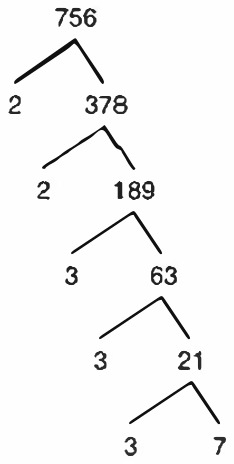
The prime factors are 2, 2, 3, 3, 3, and 7, or , which can be expressed using exponents as .
Question analysis
This number question asks for the prime factorization of 756, written with exponents. Students break the number into prime factors, with a factor tree or repeated division, and match the result to one of four products. Every choice multiplies back to 756, so the real test is whether each factor shown is actually prime.
- Grade level
- Grade 6 content, by NYS standard
- Compared with grade 7
- Below grade 7 Factor trees and exponent notation are grade 6 skills, and 756 splits quickly by small divisors. What adds a little is that every choice multiplies out to 756, so checking the product alone settles nothing.
- Estimated difficulty
- Straightforward: two steps or one careful reading.
- Thinking it demands
- Depth of knowledge 1, recall and reproduction · mainly apply
- What makes it hard
- A very close wrong answer moderate
- Something you must already know minor
- Solution
- 3 steps
- Reading level
- Question and choices: about grade 11, 10 words.
- Students, last 30 days
- Not enough answers yet to show (it takes 10).
Why it is hard, traps and wrong answers (shows the answer)
Why it is hard
The factoring itself is quick: halving twice and dividing by 3 three times leaves 7. The question is built so that multiplying back proves nothing, since every choice equals 756, and three of them simply stop the factor tree at a composite number. Students who check only the product, or who take an odd factor such as 21 or 27 for a prime, pick a factorization that is unfinished.
A very close wrong answer moderate Choosing the answer
2² · 3² · 21 shares the right answer's 2² and differs only in 3² · 21 against 3³ · 7, and both equal 756, so neither an estimate nor a product check separates them. (Embretson & Wetzel, 1987; Gorin & Embretson, 2006; Ascalon et al., 2007)
Something you must already know minor Working it out
Students must know that a prime factorization may hold only primes, and must spot that 21, 9 and 27 are composite even though none of them is even. (Anderson & Krathwohl, 2001)
Strategy: Divide 756 by 2 while the result is even, then by 3 while it divides evenly, and keep going until every factor left is prime; then compare factor by factor, not by product.
Traps
- Stops one step early: A choice is a number from partway through the solution.
- Misunderstands the concept: A wrong belief about a concept: that percents can be added, that area grows like length, that averages can be averaged, that a bigger denominator means a bigger fraction.
The wrong answers, classified
A Stops one step early (King et al., 2004; Gierl et al., 2017)
Divides out 2 twice and 3 twice, then stops at 21, which is 3 × 7, so one composite factor remains in a product that still equals 756.
B Misunderstands the concept (Smith, diSessa & Roschelle, 1993; De Bock et al., 1998; Ni & Zhou, 2005)
Splits off a 3 and a 7 but keeps 9 as if it were prime, perhaps because it is odd, though 9 = 3 × 3.
C Stops one step early (King et al., 2004; Gierl et al., 2017)
Splits 756 into 4 × 189 and 189 into 7 × 27, then stops, not seeing that 27 is 3 × 3 × 3.
Worked solution, step by step
Formulas used
- Writing a repeated factor with an exponent
- a is the number being multiplied, called the base. n is the exponent, the small raised number. It tells how many times a appears in the product. So 2² means 2 × 2, and 3³ means 3 × 3 × 3. Exponents are a short way to write a factor that repeats.
Sort out the question
You need the prime factorization of 756. That means writing 756 as a product of prime numbers only. A product is the answer to a multiplication. A prime number has exactly two factors, 1 and itself. Examples are 2, 3, 5 and 7.
All four choices multiply to 756. So multiplying a choice back does not pick the answer. You must check that every factor is prime.
Divide by 2 while you can
A factor tree splits a number into two factors, again and again. Start with the smallest prime, 2. 756 is even, so 2 goes into it:
378 is even too:
189 is odd, so 2 does not go into it. You have pulled out two 2s.
Divide by 3 while you can
Add the digits of 189: . A number can be divided by 3 when its digits add up to a number that 3 goes into. 3 goes into 18, so it goes into 189:
7 is prime, so the tree stops. You have pulled out three 3s and one 7.
Write the factors with exponents
Collect every prime you pulled out:
Use the exponent rule. Two 2s make , and three 3s make . The choices use a raised dot, ·, for times. So 756 is .
Choose the answer
Watch out: each wrong choice is a factor tree that stopped too soon. A ends in 21, which is 3 × 7. B has 9, which is 3 × 3. C has 27, which is 3 × 3 × 3. Being odd does not make a number prime.
Only D uses primes alone. So the answer is D, .
Check your answer
Multiply your answer back: , and . Then look at each factor. 2, 3 and 7 are all prime. D passes both tests.
More questions like this
The original DOE question
Question 2 of 8
2026 Practice Test D Math, question 1Question
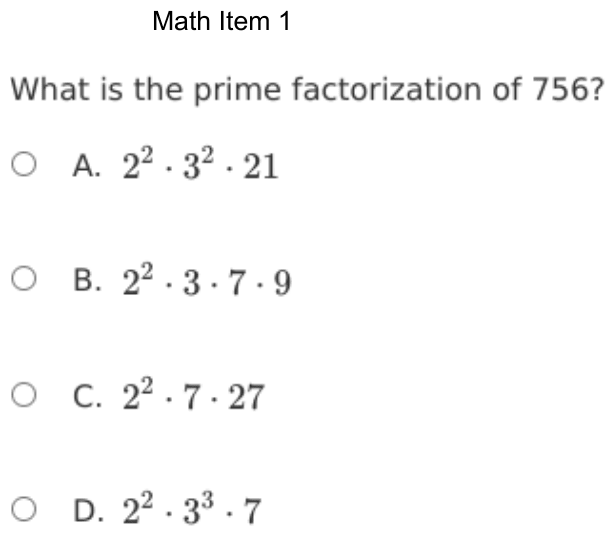
What is the prime factorization of 3,575?
- A
- B
- C
- D
Show the answer
Correct answer: B
By observation, 3,575 ends in 75; therefore, 3,575 is divisible by 25.
Test 143 for factors and eliminate 3, 5, and 7, but 11 is a factor.
; both 11 and 13 are prime numbers.
The first factor, 25, is not prime but is the product of primes, .
The prime factorization of 3,575 is .
Question analysis
This number question asks for the prime factorization of 3,575, chosen from four products of factors. Students divide by primes, using divisibility tests, until only primes remain. The four products look much alike, so the work must be carried all the way through, keeping count of every prime divided out along the way.
- Grade level
- Grade 6 content, by NYS standard
- Compared with grade 7
- Below grade 7 Breaking a number into primes is grade 6 number work that relies on divisibility tests. The number here is larger than in most class examples, but the work is still a few divisions, lighter than typical grade 7 problems.
- Estimated difficulty
- Straightforward: two steps or one careful reading.
- Thinking it demands
- Depth of knowledge 1, recall and reproduction · mainly apply
- What makes it hard
- A very close wrong answer moderate
- Something you must already know minor
- Solution
- 3 steps
- Reading level
- Question and choices: about grade 11, 10 words.
- Students, last 30 days
- Not enough answers yet to show (it takes 10).
Why it is hard, traps and wrong answers (shows the answer)
Why it is hard
Three of the four choices multiply back to 3,575, so checking a product rules out only the one that equals 715. The question turns on whether 143 is prime: it survives the quick tests for 2, 3 and 5, and the factor 11 is easy to miss. Students who keep dividing until every factor is prime, and who write a prime as often as it divides, finish in under a minute.
A very close wrong answer moderate Choosing the answer
5² · 143 matches the right factorization in its first factor and multiplies back to 3,575 just as well, so a product check cannot separate them; only splitting 143 into 11 × 13 does. (Embretson & Wetzel, 1987; Gorin & Embretson, 2006; Ascalon et al., 2007)
Something you must already know minor Working it out
Nothing on the page defines a prime factorization or gives a test for 11, and 143 passes the familiar quick tests for 2, 3 and 5, so it looks prime. (Anderson & Krathwohl, 2001)
Strategy: Divide by the smallest prime that goes in evenly, again and again, writing down every prime you use until the quotient reaches 1, then compare that list with each choice.
Traps
- Stops one step early: A choice is a number from partway through the solution.
- Misunderstands the concept: A wrong belief about a concept: that percents can be added, that area grows like length, that averages can be averaged, that a bigger denominator means a bigger fraction.
The wrong answers, classified
A Misunderstands the concept (Smith, diSessa & Roschelle, 1993; De Bock et al., 1998; Ni & Zhou, 2005)
Lists each prime that divides 3,575 only once, 5, 11 and 13, as if a factorization named which primes divide it, though their product is only 715.
C Stops one step early (King et al., 2004; Gierl et al., 2017)
Divides out one 5 and stops at 5 · 715, a true factorization but not a prime one, though 715 ends in 5 and splits further.
D Stops one step early (King et al., 2004; Gierl et al., 2017)
Divides by 25 and stops at 143, which passes the tests for 2, 3 and 5 and looks prime, though 143 = 11 × 13.
Worked solution, step by step
Formulas used
- Divisibility by 25
- A number is divisible by 25 when 25 goes into it with no remainder. You only need to look at the last two digits. If they are 00, 25, 50 or 75, the number is divisible by 25. This works because 100 is 4 × 25, so the hundreds never leave a remainder.
- Writing a repeated factor with an exponent
- a is any number. The small raised 2 is an exponent. It tells you how many times a is used as a factor, so 5² means 5 × 5 = 25. Use an exponent in a prime factorization when the same prime shows up more than once.
Sort out the question
A prime number is a whole number greater than 1 whose only factors are 1 and itself. Examples are 2, 3, 5, 7, 11 and 13. The prime factorization of 3,575 writes it as a product (the answer to a multiplication) of prime numbers only. So you must break 3,575 down until every factor is prime.
Divide by 25 first
3,575 ends in 75. So it is divisible by 25:
That means 3,575 = 25 × 143. But 25 is not prime. It is 5 × 5, which you can write as 5².
Test 143 for prime factors
Now see if 143 splits. Try the primes in order. 143 is odd, so 2 does not work. Its digits add to 1 + 4 + 3 = 8, which is not a multiple of 3, so 3 does not work. It does not end in 0 or 5, so 5 does not work. Since 7 × 20 = 140, 143 ÷ 7 leaves a remainder of 3, so 7 does not work. Now try 11:
So 143 = 11 × 13, and both 11 and 13 are prime.
Watch out: 143 looks prime, but it is not. Stopping at 5² · 143 leads to choice D.
Put all the primes together
Collect every prime you found. The 5 appears twice, then 11 and 13 once each. The dot · means times, just like ×.
Watch out: write the 5 twice, since it divides 3,575 twice. Writing it once gives 5 · 11 · 13, choice A, which equals only 715. Choice C, 5 · 715, stops too early, because 715 ends in 5 and splits further.
So the answer is B, .
Check your answer
Multiply the primes back together: 25 × 11 = 275, and 275 × 13 = 3,575. That is the number you started with. Also, 5, 11 and 13 are all prime, so nothing can be split further.
More questions like this
The original DOE question
Question 3 of 8
2024 Test B Math, question 49Question
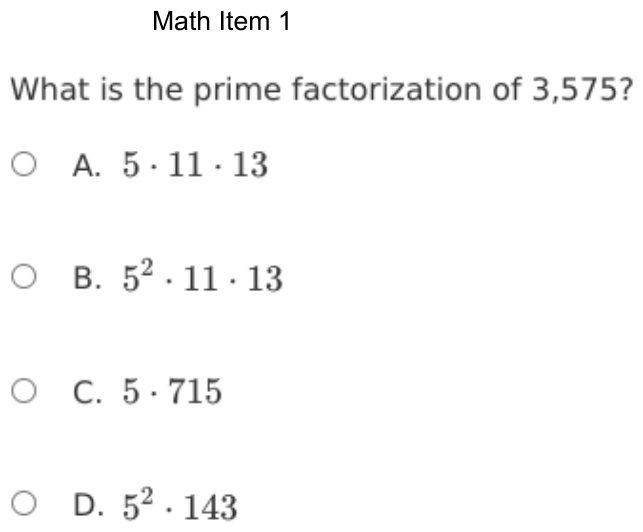
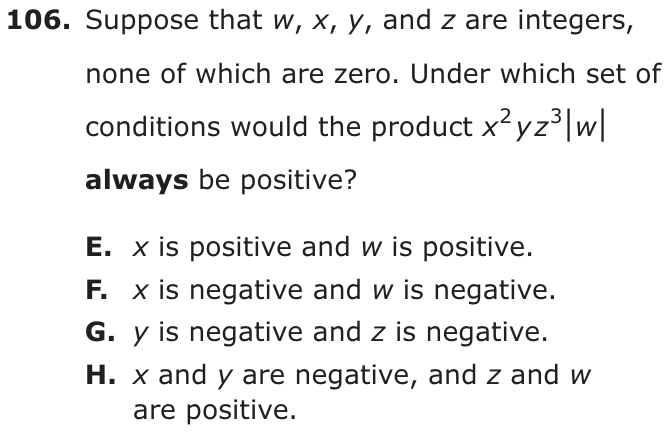
Suppose that w, x, y, and z are integers, none of which are zero. Under which set of conditions would the product always be positive?
- Ax is positive and w is positive.
- Bx is negative and w is negative.
- Cy is negative and z is negative.
- Dx and y are negative, and z and w are positive.
Show the answer
Correct answer: C
First, analyze the role of each variable in the expression .
will always be a positive number.
y can be a positive or a negative number.
can be a positive or a negative number.
will always be a positive number.
The expressions and will always be positive. Therefore, making the values of y and z negative would result in the expression being positive, since a negative multiplied by a negative is positive. Thus the given product would always be positive.
Question analysis
Four nonzero integers appear in a product that includes a square, a cube and an absolute value. Students choose the set of conditions that makes the product positive every time. It tests the sign rules for multiplication together with exponents and absolute value, and the trap is judging the sign by counting negative variables without looking at what is done to each.
- NYS standards
- Grade level
- Grade 7 content, by NYS standard
- Compared with grade 7
- Above grade 7 Grade 7 students learn sign rules for products of signed numbers. Here they must reason about four unknown integers under an even power, an odd power and an absolute value, and decide what is always true, which is more abstract than typical grade 7 work.
- Estimated difficulty
- Hard: combines ideas, needs a plan, and has more than one tempting wrong answer.
- Thinking it demands
- Depth of knowledge 2, skills and concepts · mainly analyze
- What makes it hard
- Variables instead of numbers moderate
- Every choice must be checked moderate
- Something you must already know minor
- Solution
- 3 steps
- Reading level
- Question and choices: about grade 6, 58 words.
- Students, last 30 days
- Not enough answers yet to show (it takes 10).
Why it is hard, traps and wrong answers (shows the answer)
Why it is hard
One insight decides the question: x² and |w| are positive whatever x and w are, so only the signs of y and z³ matter. Students who count negative letters instead of negative factors pick conditions that look balanced but leave y as the only negative factor. Students who test a single set of values can be fooled by a choice that leaves y and z unspecified.
Variables instead of numbers moderate Understanding the question
There are four variables and no numbers, and always positive must hold for every allowed value, so one test case can rule a choice out but never confirm it. (Koedinger & Nathan, 2004; Enright, Morley & Sheehan, 2002)
Every choice must be checked moderate Choosing the answer
Each set of conditions has to be checked against all four factors; the first two fix only x and w and leave y and z free to make the product negative. (Embretson & Wetzel, 1987)
Something you must already know minor Working it out
Students must know that a nonzero square and an absolute value are always positive, while an odd power such as z³ keeps the sign of z. (Anderson & Krathwohl, 2001)
Strategy: Work out, factor by factor, which signs each part of the product can take, then test each set of conditions against every factor rather than counting negatives.
Traps
- Negatives and direction: Arithmetic with negative numbers, the order of a subtraction, or direction on a number line. (Moving a term across the equals sign without changing its sign is a faulty procedure.)
- Misunderstands the concept: A wrong belief about a concept: that percents can be added, that area grows like length, that averages can be averaged, that a bigger denominator means a bigger fraction.
The wrong answers, classified
A Checks only one number (Schoenfeld, 1985)
Tests the choice with every variable positive, so the product is positive and it seems to work; y = −1 with z = 1 would make it negative.
B Misunderstands the concept (Smith, diSessa & Roschelle, 1993; De Bock et al., 1998; Ni & Zhou, 2005)
Pairs the negatives x and w as if they must cancel, not seeing that x² and |w| are positive anyway, so y and z still decide.
D Negatives and direction (Brown & Burton, 1978)
Counts two negative letters, x and y, as an even number of negatives, but x² is positive, so y is the only negative factor.
Worked solution, step by step
Formulas used
- Signs in multiplication
- a and b are positive numbers, so −a and −b are negative. A negative times a negative is positive. A negative times a positive is negative. So a product is positive when it has an even number of negative factors.
Sort out the question
w, x, y and z are integers, meaning whole numbers or their negatives. None of them is 0. The product means .
You need the conditions that make the product positive every time, for every number that fits them.
Look at x squared and |w|
means x × x. Two positives or two negatives multiply to a positive. So is always positive.
is the absolute value of w, its distance from 0. It is always positive, since w is not 0.
So x and w never change the sign of the product. Their signs do not matter.
Look at y and z cubed
y can be positive or negative. means z × z × z, and it has the same sign as z. For example, .
So the sign of the whole product is the sign of . It depends only on y and z.
Test each choice
- A and B say nothing about y and z. If y = −1 and z = 1, the product is negative. So they do not always work.
- C: y is negative, and is negative. A negative times a negative is positive. This always works.
- D: y is negative and z is positive. So the product is always negative.
Watch out: D has two negative letters, x and y. But is positive anyway, so y is the only negative factor.
So the answer is C, y is negative and z is negative.
Check your answer
Try numbers for C. Let x = −2, y = −3, z = −1 and w = −5. Then , which is positive. Even with x and w negative, the product stays positive.
More questions like this
The original DOE question
Question 4 of 8
2023 Test A Math, question 6Question
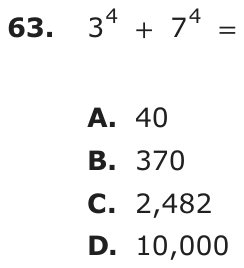
- A40
- B370
- C2,482
- D10,000
Show the answer
Correct answer: C
Question analysis
This exponents question asks for the sum of 3 to the fourth power and 7 to the fourth power. Students evaluate each power separately and then add. The traps are treating an exponent as a multiplier and adding the bases before raising them to a power, and the larger power takes careful multiplication.
- NYS standards
- 6.EE.1 whole-number exponent expressions
- Grade level
- Grade 6 content, by NYS standard
- Compared with grade 7
- Below grade 7 Evaluating whole-number powers is grade 6 work, and this question asks only for two of them and a sum. The one demand beyond routine practice is computing a fourth power of 7 accurately without a calculator.
- Estimated difficulty
- Straightforward: two steps or one careful reading.
- Thinking it demands
- Depth of knowledge 1, recall and reproduction · mainly apply
- What makes it hard
- Error-prone arithmetic moderate
- Something you must already know minor
- Solution
- 3 steps
- Reading level
- Question and choices: about grade 16+, 1 words.
- Students, last 30 days
- Not enough answers yet to show (it takes 10).
Why it is hard, traps and wrong answers (shows the answer)
Why it is hard
The sum is short, but it tests exactly what an exponent means and when to apply it. The wrong choices come from three misreadings of the notation: treating the power as a multiplier, using one factor too few, and adding the bases before raising them. A size check settles it: 7⁴ alone is 49 × 49, a little under 2,500, so 40 and 370 are far too small and 10,000 far too large.
Error-prone arithmetic moderate Working it out
7⁴ means 7 × 7 × 7 × 7 = 2,401, a four-digit product built by hand, most easily as 49 × 49; 3⁴ = 81 is quick by comparison. (Brown & Burton, 1978; Junker & Sijtsma, 2001)
Something you must already know minor Working it out
An exponent counts repeated factors rather than acting as a multiplier, so 3⁴ is 3 × 3 × 3 × 3 = 81, not 3 × 4 = 12; the item assumes that meaning. (Anderson & Krathwohl, 2001)
Strategy: Compute each power on its own, squaring and then squaring again, and add the two results only at the end.
Traps
- A faulty procedure: A systematic but wrong procedure: adding fractions straight across, applying an exponent to each term of a sum, dropping a sign when moving a term.
- Order of operations: Working left to right, or distributing a minus sign wrongly, gives a choice.
The wrong answers, classified
A A faulty procedure (Brown & Burton, 1978; Tatsuoka, 1983)
Multiplies each base by its exponent, 3 × 4 + 7 × 4 = 12 + 28 = 40, instead of using each base as a factor four times.
B A faulty procedure (Brown & Burton, 1978; Tatsuoka, 1983)
Uses each base as a factor three times instead of four, 27 + 343 = 370, so both powers stop one factor short.
D Order of operations (Brown & Burton, 1978)
Adds the bases before applying the exponent, treating 3⁴ + 7⁴ as (3 + 7)⁴ = 10,000, though powers come before addition.
Worked solution, step by step
Formulas used
- A power
- a is the base, the number being multiplied. The small 4 is the exponent. It tells how many times the base is used as a factor, a number being multiplied. So the exponent counts factors. It does not mean multiply by 4.
- Powers come before adding
- a and b are any two positive numbers. The sign ≠ means is not equal to. Powers come before adding. So raise each number to its power first, then add. Adding the bases first gives a much bigger number.
Sort out the question
You need the value of . Each number has a small 4 above it. This 4 is an exponent. Work out each power on its own. Then add the two results.
Find 3 to the fourth power
3⁴ means four 3s multiplied together. Pair them up to make it easier.
Watch out: 3⁴ is not 3 × 4 = 12. Doing that to both powers gives 12 + 28 = 40, choice A.
Find 7 to the fourth power
7⁴ means four 7s multiplied together. Pair them up the same way.
To find 49 × 49, do 49 × 50 = 2,450. Then take away one 49. That gives 2,401. Watch out: count four 7s, not three. Three 7s make 343. Using three factors in both powers gives 370, choice B.
Add the two powers
Watch out: don’t add 3 and 7 first. That gives , choice D. Powers come before adding. So the answer is C, 2,482.
Check your answer
Estimate. 7⁴ is 49 × 49, a little less than 50 × 50 = 2,500. Adding 81 keeps it near 2,500. Only 2,482 is close. 40 and 370 are far too small, and 10,000 is far too big.
More questions like this
The original DOE question
Question 5 of 8
2023 Test B Math, question 36Question
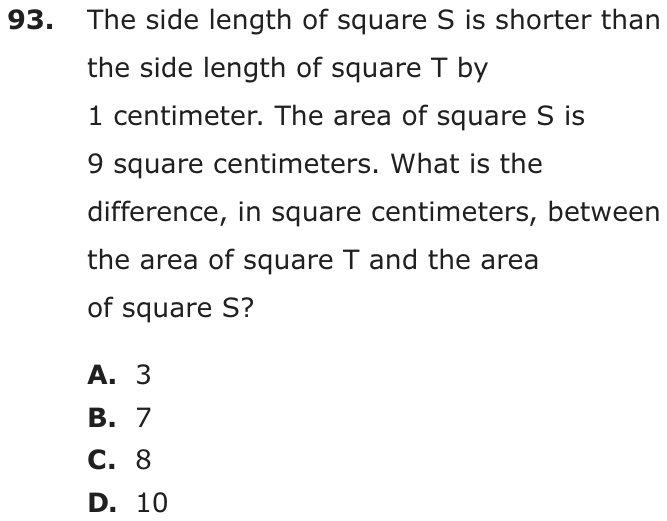
The side length of square S is shorter than the side length of square T by 1 centimeter. The area of square S is 9 square centimeters. What is the difference, in square centimeters, between the area of square T and the area of square S?
- A3
- B7
- C8
- D10
Show the answer
Correct answer: B
Let x represent the side length of square T, in centimeters. Then the side length of square S is .
The area of square S is:
So the side length of square T is 4 cm, and the area of square T is 16 sq cm.
The difference between the areas, in square centimeters, is .
Question analysis
Two squares differ in side length by 1 centimeter, and the smaller one has an area of 9 square centimeters. Students find how much greater the larger square's area is. It tests the link between a square's side and its area, and the extra area is easy to miscount when picturing the border that the longer sides add.
- Grade level
- Grade 6 content, by NYS standard
- Compared with grade 7
- Below grade 7 The area of a square and recognizing 9 as a perfect square are grade 6 ideas. This takes three short steps with small whole numbers, lighter than grade 7 work on composite figures, though the first step runs backward from area to side.
- Estimated difficulty
- Straightforward: two steps or one careful reading.
- Thinking it demands
- Depth of knowledge 2, skills and concepts · mainly apply
- What makes it hard
- Many steps minor
- Turning words into math minor
- Solution
- 3 steps
- Reading level
- Question and choices: about grade 6, 44 words.
- Students, last 30 days
- Not enough answers yet to show (it takes 10).
Why it is hard, traps and wrong answers (shows the answer)
Why it is hard
Every number is small, so the work is keeping track of which quantity the question wants: a difference of areas, not a side or a single area. The added area forms an L-shaped strip around square S, and students who picture it as two strips 4 centimeters long count the corner square twice. Finding both areas, 9 and 16, and subtracting avoids reasoning about the strip at all.
Many steps minor Working it out
The work runs from area to side and back: the square root of 9 gives S’s side, adding 1 gives T’s, squaring gives 16, and subtracting gives the difference. (Daniel & Embretson, 2010; Enright, Morley & Sheehan, 2002)
Turning words into math minor Understanding the question
The phrase “shorter than the side length of square T by 1 centimeter” describes S from T’s point of view, so T’s side is S’s side plus 1, not minus 1. (Hegarty, Mayer & Monk, 1995; Koedinger & Nathan, 2004)
Strategy: Find the side of square S from its area, add 1 centimeter to get the side of square T, find that square's area, and subtract the smaller area from the larger.
Traps
- Overlapping groups: Things in two groups at once are counted twice, or not subtracted.
- Answers a different question: A choice is right for another quantity: the other unknown, the rest instead of the part, the part instead of the whole.
- Numbers taken from the question: Combines the numbers in the question without a model of the situation, or is simply a number that appears in the question.
The wrong answers, classified
A Answers a different question (King et al., 2004; Hegarty, Mayer & Monk, 1995)
Finds the side of square S, 3 centimeters, from its area of 9 and gives that length instead of a difference between two areas.
C Overlapping groups (King et al., 2004)
Pictures the added area as two 4-by-1 strips along two sides of square S, 8 in all, counting the 1-by-1 corner where they overlap twice.
D Numbers taken from the question (Hegarty, Mayer & Monk, 1995)
Adds the stem’s two numbers, 9 + 1 = 10, as if a side 1 centimeter longer made the area 1 square centimeter larger, and gives that area.
Worked solution, step by step
Formulas used
- Area of a square
- A is the area, the space inside the square, in square units. s is the length of one side. All four sides of a square are equal, so the area is the side times itself. To go backward from an area, find the number that times itself gives the area.
Sort out the two squares
Square S has an area of 9 square centimeters. Its side is 1 centimeter shorter than the side of square T. You need the area of square T minus the area of square S, in square centimeters.
Find the side of square S
Use the area formula backward. Which number times itself makes 9?
So each side of square S is 3 centimeters. This number is called the square root of 9.
Find the side of square T
Square T’s side is 1 centimeter longer than square S’s side.
Each side of square T is 4 centimeters.
Find the area of square T
Use the area formula with a side of 4 centimeters.
The area of square T is 16 square centimeters.
Subtract the areas
Take the smaller area away from the larger one.
The difference is 7 square centimeters.
Watch out: Picturing the new area as two strips, each 4 by 1, gives 8, choice C. But those strips share a 1-by-1 corner, so it gets counted twice. Also, 3 is a side length, not a difference of areas. That is choice A.
So the answer is B, 7 square centimeters.
Check your answer
Draw square T and mark square S in one corner. The extra space is an L shape. It is a 3-by-1 strip, another 3-by-1 strip and a 1-by-1 corner. That is 3 + 3 + 1 = 7 square centimeters. It matches.
More questions like this
The original DOE question
Question 6 of 8
2023 Test B Math, question 42Question
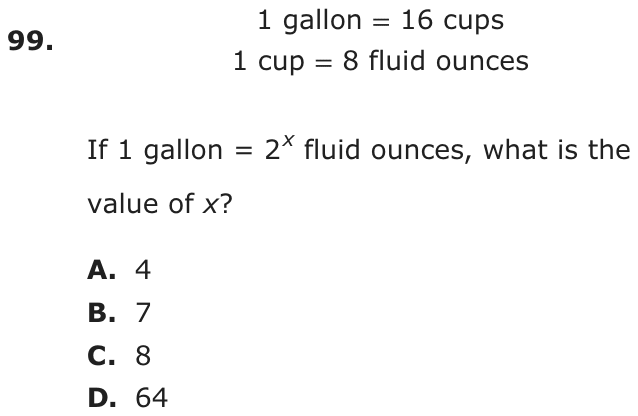
1 gallon = 16 cups
1 cup = 8 fluid ounces
If 1 gallon = fluid ounces, what is the value of x?
- A4
- B7
- C8
- D64
Show the answer
Correct answer: B
If 1 gallon is equal to 16 cups, and 1 cup is equal to 8 fluid ounces, then
So, .
Question analysis
This question gives two facts, 16 cups in a gallon and 8 fluid ounces in a cup, and says a gallon equals 2 to the power x fluid ounces. Students find the exponent x. It combines a unit conversion with writing a number as a power of 2, and the exponent is easy to confuse with a multiplier.
- Grade level
- Grade 6 content, by NYS standard
- Compared with grade 7
- At grade 7 Converting units with given facts is grade 6 work, and this conversion is a single multiplication. The twist is writing the result as a power of 2, which calls for fluency with powers that grade 7 work rarely asks for.
- Estimated difficulty
- Straightforward: two steps or one careful reading.
- Thinking it demands
- Depth of knowledge 2, skills and concepts · mainly apply
- What makes it hard
- Combines ideas minor
- Something you must already know minor
- Solution
- 3 steps
- Reading level
- Question and choices: about grade 2, 16 words.
- Students, last 30 days
- Not enough answers yet to show (it takes 10).
Why it is hard, traps and wrong answers (shows the answer)
Why it is hard
The conversion is one multiplication, so the question really tests whether students can name the exponent for 128. Stopping at the cups, where 16 = 2⁴, or treating 2 to the power x as 2 times x gives a listed choice. Writing 16 as 2⁴ and 8 as 2³ and adding the exponents is the quickest route, and doubling from 1 seven times is a sure check.
Combines ideas minor Working it out
A unit conversion, 16 cups × 8 fluid ounces = 128 fluid ounces, has to be joined to exponents by recognizing 128 as a power of 2. (Embretson, 1998; Daniel & Embretson, 2010)
Something you must already know minor Working it out
Students must know or build the powers of 2 up to 128, and see that the exponent counts factors of 2, not the number of terms in a list starting at 1. (Anderson & Krathwohl, 2001)
Strategy: Convert 1 gallon to fluid ounces by multiplying the two facts, then keep halving the result, or keep doubling from 2, counting how many factors of 2 it takes.
Traps
- Stops one step early: A choice is a number from partway through the solution.
- A faulty procedure: A systematic but wrong procedure: adding fractions straight across, applying an exponent to each term of a sum, dropping a sign when moving a term.
- Counting the ends: Inclusive or exclusive ends, fence posts, consecutive numbers: an answer that is one too many or too few, or an endpoint drawn open where it belongs closed (or the reverse).
The wrong answers, classified
A Stops one step early (King et al., 2004; Gierl et al., 2017)
Writes the 16 cups in a gallon as 2⁴ and stops before multiplying by the 8 fluid ounces in each cup, which adds 3 to the exponent.
C Counting the ends (Brown & Burton, 1978)
Lists the powers of 2 starting at 1, so counts 1, 2, 4, …, 128 as eight numbers and takes 8 as the exponent, though 1 is 2⁰.
D A faulty procedure (Brown & Burton, 1978; Tatsuoka, 1983)
Treats 2 to the power x as 2 times x, so 2x = 128 gives 64, confusing an exponent with a multiplier.
Worked solution, step by step
Formulas used
- Meaning of an exponent
- The 2 is the base, the number being multiplied. x is the exponent, the small raised number. It tells how many 2s are multiplied together. For example, 2 to the third power means 2 × 2 × 2, which is 8.
- Multiplying powers of the same base
- a and b are exponents. The first power has a twos multiplied together. The second has b more twos. Multiplying puts all the twos together, so you add the exponents.
Sort out the question
A gallon is 16 cups. A cup is 8 fluid ounces. A gallon is also fluid ounces. You need x, the exponent. It tells how many 2s are multiplied together.
Change a gallon to fluid ounces
Each of the 16 cups holds 8 fluid ounces. So multiply.
One gallon is 128 fluid ounces.
Write 128 as a power of 2
Now you need . Keep multiplying by 2, and count the 2s.
Number of 2s 1 2 3 4 5 6 7 Product 2 4 8 16 32 64 128 It takes seven 2s to make 128.
So x = 7.
Give the answer
Watch out: A gallon is 16 cups, and . Stopping there gives 4, choice A. And does not mean 2 times x. Solving 2 × x = 128 gives 64, choice D.
So the answer is B, 7.
Check your answer
Use the exponent rule. 16 is and 8 is . So . The exponent is 7 again.
More questions like this
The original DOE question
Question 7 of 8
2018 Test A Math, question 50Question
- A101
- B200
- C301
- D341
Show the answer
Correct answer: D
Question analysis
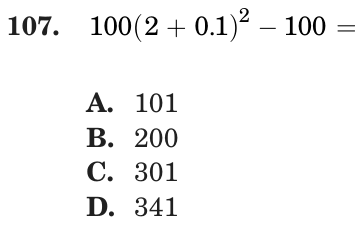
This order of operations question asks students to evaluate 100(2 + 0.1)² − 100, an expression with a decimal, a square and a subtraction. Students must add inside the parentheses first, square the result, multiply by 100, and then subtract. Squaring the two parts of the sum separately is the trap.
- Grade level
- Grade 6 content, by NYS standard
- Compared with grade 7
- Below grade 7 Evaluating an expression with an exponent and decimals in the correct order is grade 6 content. This is a short routine calculation, so it asks less than typical grade 7 work with negative numbers and multi-step equations.
- Estimated difficulty
- Straightforward: two steps or one careful reading.
- Thinking it demands
- Depth of knowledge 1, recall and reproduction · mainly apply
- What makes it hard
- A very close wrong answer moderate
- Error-prone arithmetic minor
- Solution
- 3 steps
- Reading level
- Question and choices: about grade 16+, 1 words.
- Students, last 30 days
- Not enough answers yet to show (it takes 10).
Why it is hard, traps and wrong answers (shows the answer)
Why it is hard
This is a direct order-of-operations calculation with no word problem around it, so the only real risk is the square of a sum. Students who apply the exponent to each part, or only to the 0.1, find a listed answer waiting. Adding inside the parentheses before squaring, and then squaring 2.1 exactly, is the whole task.
A very close wrong answer moderate Choosing the answer
The choices 301 and 341 differ by 40, and squaring 2.1 roughly as 4 lands nearer 301; only the exact square, 4.41, separates them. (Embretson & Wetzel, 1987; Gorin & Embretson, 2006; Ascalon et al., 2007)
Error-prone arithmetic minor Working it out
Squaring 2.1 by hand to get 4.41 puts two decimal places in the product, an easy place to misplace the point. (Brown & Burton, 1978; Junker & Sijtsma, 2001)
Strategy: Add inside the parentheses to get a single decimal, square it carefully, then multiply by 100 and subtract 100, following the order of operations.
Traps
- A faulty procedure: A systematic but wrong procedure: adding fractions straight across, applying an exponent to each term of a sum, dropping a sign when moving a term.
- Order of operations: Working left to right, or distributing a minus sign wrongly, gives a choice.
The wrong answers, classified
A Order of operations (Brown & Burton, 1978)
Squares only the 0.1, as if the parentheses were not there, so 100 × 2.01 − 100 gives 101.
B Little reason to choose it (Haladyna & Downing, 1993; Rodriguez, 2005)
No single slip gives 200; it requires (2 + 0.1)² to come out as 3, so it mostly catches guesses.
C A faulty procedure (Brown & Burton, 1978; Tatsuoka, 1983)
Squares each term of the sum separately, 4 + 0.01 = 4.01, instead of squaring 2.1, so 100 × 4.01 − 100 gives 301.
Worked solution, step by step
Formulas used
- Order of operations
- This is the agreed order for doing math steps. Work inside parentheses first, then exponents, then multiply and divide, then add and subtract. Everyone follows it, so a problem has only one answer.
- Squaring a number
- a is any number. The small 2, called an exponent, means multiply the number by itself. So 2.1 squared means 2.1 times 2.1.
Sort out the problem
You need to work out . The 100 right next to the parentheses means 100 times. Follow the order of operations, one step at a time.
Add inside the parentheses
Parentheses come first in the order of operations. So add the numbers inside them:
Now the problem is:
Square 2.1
Work out 21 × 21 = 441, then put in two decimal places, one for each 2.1.
Watch out: do not square the 2 and the 0.1 one at a time. That gives 4 + 0.01 = 4.01, which is wrong. It leads to 301, choice C.
Multiply, then subtract
The exponent is done, so multiply next. Multiplying by 100 moves the decimal point two places to the right. Subtracting comes last:
So the answer is D, 341.
Check your answer
Estimate. 2.1 is a bit more than 2, so its square is a bit more than 4. 100 times that is a bit more than 400. Take away 100 and you get a bit more than 300. 341 fits. Choices A and B are too small.
More questions like this
The original DOE question
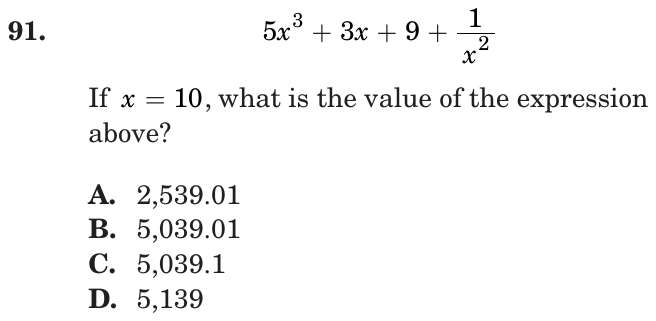
Question 8 of 8
2018 Test B Math, question 34Question
If , what is the value of the expression above?
- A2,539.01
- B5,039.01
- C5,039.1
- D5,139
Show the answer
Correct answer: B
Question analysis
Students substitute 10 for x in an expression with a cube, a linear term, a constant and a fraction with x squared in its denominator, then add the results. It tests evaluating expressions with exponents and decimals. The fraction term is where most slips happen, because its place value is easy to get wrong.
- NYS standards
- Grade level
- Grade 6 content, by NYS standard
- Compared with grade 7
- Below grade 7 Evaluating expressions with whole-number exponents is grade 6 work. The only extra care here is a reciprocal term that turns into a decimal, a single routine substitution that typical grade 7 students handle comfortably.
- Estimated difficulty
- Straightforward: two steps or one careful reading.
- Thinking it demands
- Depth of knowledge 1, recall and reproduction · mainly apply
- What makes it hard
- Error-prone arithmetic moderate
- A very close wrong answer moderate
- Solution
- 3 steps
- Reading level
- Question and choices: about grade 7, 11 words.
- Students, last 30 days
- Not enough answers yet to show (it takes 10).
Why it is hard, traps and wrong answers (shows the answer)
Why it is hard
Substituting 10 is easy; the risk lies in the two unlike terms at the ends. The cube must be applied to x before multiplying by 5, and the reciprocal of 100 must become a hundredth, not a tenth. With choices that differ by a single decimal place, the question rewards writing each term as a number before adding.
Error-prone arithmetic moderate Working it out
The last term, 1/x² at x = 10, is 1/100, which must be written as 0.01 and lined up beside 5,039; one place too far gives 0.1. (Brown & Burton, 1978; Junker & Sijtsma, 2001)
A very close wrong answer moderate Choosing the answer
5,039.1 sits beside the right 5,039.01 and differs only in the hundredths place; only writing 1/100 as 0.01, not 0.1, tells them apart, and estimating cannot. (Embretson & Wetzel, 1987; Gorin & Embretson, 2006; Ascalon et al., 2007)
Strategy: Work term by term: compute 10 cubed, then the reciprocal of 10 squared as a decimal, and line up the place values carefully before adding.
Traps
- Order of operations: Working left to right, or distributing a minus sign wrongly, gives a choice.
The wrong answers, classified
A Order of operations (Brown & Burton, 1978)
Gets 2,500 for the first term, most likely from (5 × 10)², applying the power to the product 5x and squaring instead of cubing.
C An arithmetic slip (Junker & Sijtsma, 2001)
Writes 1/100 as 0.1 instead of 0.01, a place-value slip on the last term that puts the total off by 0.09.
D Misunderstands the concept (Smith, diSessa & Roschelle, 1993; De Bock et al., 1998; Ni & Zhou, 2005)
Evaluates 1/x² as x² = 100 instead of its reciprocal, so it adds 100 rather than 0.01 to 5,039.
Worked solution, step by step
Formulas used
- Exponents
- x is the base number. The small raised 3 is the exponent. It tells how many times to use x in a multiplication. In the same way, x squared, written with a raised 2, means x times x.
Sort out the question
You need the value of when . Put 10 in place of every . Then work out each term, one at a time. A term is a piece joined to the others by a plus sign.
Work out the first term
Do the exponent first. Then multiply by 5.
Watch out: the exponent belongs only to the , not to the 5. Squaring gives 2,500, which leads to choice A.
Work out the middle terms
The next term means 3 times .
The 9 has no in it, so it stays 9.
Work out the last term
First find the bottom. Then divide.
One hundredth is 0.01, with the 1 two places after the decimal point.
Watch out: 0.1 is one tenth, not one hundredth. That slip gives choice C. Adding 100 instead of gives choice D.
Add the four terms
Line up the decimal points and add. The 0.01 goes in the hundredths place.
So the answer is B, 5,039.01.
Check your answer
The first three terms are whole numbers. They add up to 5,039. The last term is a small part of 1. So the answer is just over 5,039. Only B and C fit. The last term is hundredths, so B is right.
More questions like this
The original DOE question