7L5c connotation and denotation
Question 1 of 14
2026 Practice Test B English, question 8Passage A Miracle Mile
A Miracle Mile
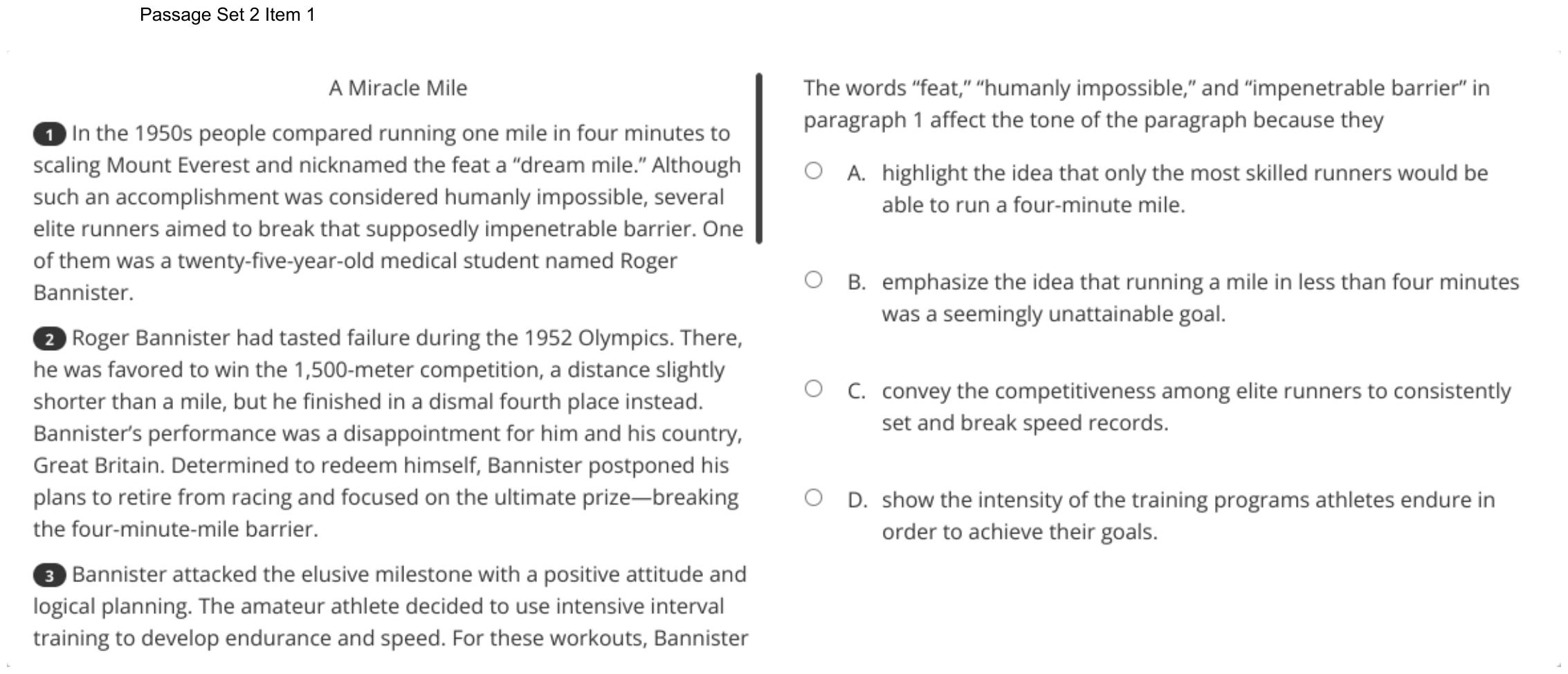
In the 1950s people compared running one mile in four minutes to scaling Mount Everest and nicknamed the feat a “dream mile.” Although such an accomplishment was considered humanly impossible, several elite runners aimed to break that supposedly impenetrable barrier. One of them was a twenty-five-year-old medical student named Roger Bannister.
Roger Bannister had tasted failure during the 1952 Olympics. There, he was favored to win the 1,500-meter competition, a distance slightly shorter than a mile, but he finished in a dismal fourth place instead. Bannister’s performance was a disappointment for him and his country, Great Britain. Determined to redeem himself, Bannister postponed his plans to retire from racing and focused on the ultimate prize—breaking the four-minute-mile barrier.
Bannister attacked the elusive milestone with a positive attitude and logical planning. The amateur athlete decided to use intensive interval training to develop endurance and speed. For these workouts, Bannister ran an interval of ten consecutive laps on a quarter-mile track, aiming for sixty seconds each lap. In between intervals, he let his body recover for two minutes.
By early 1954, Bannister had succeeded in lowering his quarter-mile pace to sixty-one seconds, but he had to shave off at least one more second in order to reach his target. Frustrated by the plateau he had reached, Bannister took a break from training and went mountain climbing for three days. The rest from running permitted his muscles to recuperate and left him feeling refreshed. When Bannister returned to the track, he completed ten quarter-mile-long intervals at fifty-nine seconds each. He finally felt prepared to attempt to break the world record.
As a member of the Amateur Athletic Association (AAA), Bannister joined the AAA team for a track meet against Oxford University. The event took place on a cinder track in Oxford on May 6, 1954. Bannister and his two AAA teammates, Chris Chataway and Chris Brasher, were close friends and frequent running partners. Chataway and Brasher agreed to help Bannister accomplish his goal by being his “rabbits.”
In track and field, rabbits are runners who enter the race solely to pace a teammate for a segment of the course. Typically, a runner settles in behind the rabbit and allows the rabbit to set an appropriate tempo. Additionally, by running behind the rabbit, the runner conserves about 15 percent of his or her effort. When the starting pistol fired, Brasher pounced into the lead, and Bannister followed behind his first rabbit.
Propelled by the excitement, Bannister lost his instinctive feel for his pace and shouted “Faster!” at Brasher. Brasher, however, remained composed and maintained his current steady but grueling pace, completing the first two laps in a desirable one minute and fifty-eight seconds. Then Chataway surged forward, leading Bannister at this same punishing rate for another lap and a half. At the beginning of the back straightaway of the track, Bannister bolted past Chataway. Bannister said, “I felt that the moment of a lifetime had come. There was no pain, only a great unity of movement and aim.” Bannister crossed the finish line in 3 minutes 59.4 seconds. The ecstatic crowd erupted the moment the timekeeper announced the word “three.”
Soon after Bannister’s achievement, four other athletes matched his performance. A new mindset had taken root among runners. Over the years, the record continued to fall. However, the current record, 3 minutes 43.13 seconds, has stood unbroken since 1999. Some question whether this record represents the limits of human ability. But perhaps there is another Bannister, an athlete who, with willpower and dedication, will accomplish the miraculous.
Question
The words “feat,” “humanly impossible,” and “impenetrable barrier” in paragraph 1 affect the tone of the paragraph because they
- Ahighlight the idea that only the most skilled runners would be able to run a four-minute mile.
- Bemphasize the idea that running a mile in less than four minutes was a seemingly unattainable goal.
- Cconvey the competitiveness among elite runners to consistently set and break speed records.
- Dshow the intensity of the training programs athletes endure in order to achieve their goals.
Show the answer
Correct answer: B
The question asks how the words “feat,” “humanly impossible,” and “impenetrable barrier” in paragraph 1 affect the tone of the paragraph.
A. Incorrect. Although paragraph 1 states that “several elite runners aimed to break that supposedly impenetrable barrier,” the words “feat,” “humanly impossible,” and “impenetrable barrier” suggest that the goal was unattainable even for the most skilled runners.
B. CORRECT. No one had ever been able to run a mile in less than four minutes, and the words “feat,” “humanly impossible,” and “impenetrable barrier” imply that the goal seemed unattainable. These words also reinforce the comparison of running a four-minute mile to “scaling Mount Everest” (paragraph 1).
C. Incorrect. The words “feat,” “humanly impossible,” and “impenetrable barrier” describe how challenging and almost impossible running a four-minute mile seemed, and while other elite runners “aimed to break that supposedly impenetrable barrier” (paragraph 1), the paragraph focuses on Roger Bannister, not the competition among elite runners seeking to break the record.
D. Incorrect. Bannister’s training program is described in paragraphs 3 and 4, and the words “feat,” “humanly impossible,” and “impenetrable barrier” are used in paragraph 1 to describe the magnitude of Bannister’s goal to run a four-minute mile. Though his training program was intense, these words relate to the intensity of the goal itself, not to the intensity of his training.
Question analysis
This tone question on “A Miracle Mile,” an article about Roger Bannister and the four-minute mile, asks how three word choices in the opening paragraph, “feat,” “humanly impossible” and “impenetrable barrier,” affect its tone. Students must read the connotations of strong words in context and decide what they stress, while choices that echo other parts of the passage compete for attention.
- Grade level
- Grade 6 reading and task
- Compared with grade 7
- Below grade 7 Grade 7 tone questions often ask students to find the telling words themselves. Here the three words are quoted and sit in one short opening paragraph, and their shared meaning is strong and plain, so one careful reading is enough.
- Estimated difficulty
- Straightforward: two steps or one careful reading.
- Thinking it demands
- Depth of knowledge 2, skills and concepts · mainly analyze
- What makes it hard
- A very close wrong answer minor
- Hard words minor
- Evidence
- Answered from one paragraph or stanza
- Reading level
- Passage: about grade 10, 587 words; question and choices: about grade 11, 80 words.
- Students, last 30 days
- Not enough answers yet to show (it takes 10).
Why it is hard, traps and wrong answers (shows the answer)
Why it is hard
The three quoted words all make the same point, and the opening comparison with “scaling Mount Everest” makes it again, so the effect is easy to sense. Points are lost on degree: the sentence holding two of the three words also names “several elite runners,” which makes a choice about only the best runners look supported. Students who hold on to “humanly impossible” rule it out, and the choices about rivalry and training fall away once they check that the words describe the goal, not the runners or their preparation.
A very close wrong answer minor Choosing the answer
The choice about only the most skilled runners and the right one both stress how hard the four-minute mile was; they differ on degree, possible for the best runners or thought impossible for anyone. (Embretson & Wetzel, 1987; Gorin & Embretson, 2006; Ascalon et al., 2007)
Hard words minor Understanding the question
“Impenetrable” and “feat” carry the tone, and a student who does not know that impenetrable means impossible to break through may miss how absolute the barrier sounded. (Perfetti, 2007; Freedle & Kostin, 1993)
Strategy: Decide what feeling the three quoted words share, then reread paragraph 1 to see what they describe, and keep only a choice that fits both the feeling and the thing described.
Traps
- Twists what the text says: Uses the text's topic and ideas but changes what it says: who did it, how much, when, or why.
- Word match: Repeats striking words or phrases from the text, so it looks supported, but its meaning does not fit the question.
- Wrong part of the text: A choice is true of another paragraph, stanza or speaker than the one asked about.
The wrong answers, classified
A Twists what the text says (King et al., 2004)
Sees that the words stress difficulty but scales it down to a feat for the best runners only, though “humanly impossible” says no runner at all was thought able to do it.
C Word match (Freedle & Kostin, 1993)
Picks up “elite runners aimed to break” from the same sentence and turns it into a rivalry over records, though the three words describe the barrier, not the runners.
D Wrong part of the text (Kirsch & Mosenthal, 1990)
Carries the intensive interval training of paragraphs 3 and 4 back to paragraph 1, where the words measure the size of the goal, not the effort of preparing for it.
Working it out, step by step
Figure out what the question asks
This is a tone question. Tone is the feeling or attitude that a writer’s words give a passage. The question names three word choices from paragraph 1. You need to decide what feeling they share and what they describe.
Find the words in paragraph 1
Paragraph 1 says people “compared running one mile in four minutes to scaling Mount Everest.” Scaling means climbing. Mount Everest is the tallest mountain on Earth. The paragraph calls running that fast a “feat.” The next sentence says “Although such an accomplishment was considered humanly impossible, several elite runners aimed to break that supposedly impenetrable barrier.”
Work out what the words mean
A feat is an amazing deed that is very hard to do. Humanly impossible means no person could ever do it. Impenetrable means impossible to break through, and a barrier is a wall. All three say the same thing. A mile under four minutes seemed like a goal no one could reach. A word for that is unattainable.
Check each choice
- A does not fit. It says the best runners could do it. But “humanly impossible” means no one could.
- B fits. The words make the four-minute mile sound out of reach.
- C does not fit. The words describe the barrier, not a contest between runners.
- D does not fit. Training comes later, in paragraphs 3 and 4. These words describe the goal itself.
Watch out: A is tempting because the same sentence mentions “several elite runners.” Elite means the very best. But even they were not expected to succeed.
Choose the answer
The three words make the goal sound almost impossible for anyone. So the answer is B, “emphasize the idea that running a mile in less than four minutes was a seemingly unattainable goal.”
Why this answer and not the closest wrong one
A is the closest wrong choice. It also says the four-minute mile was hard. But A says that only the most skilled runners could do it. The passage says it was “considered humanly impossible.” People thought no runner at all could do it. That is why B fits better.
More questions like this
The original DOE question
The passage “A Miracle Mile” as printed (page 13)
Question 2 of 14
2026 Practice Test B English, question 39Passage Letter from Brooklyn
Letter from Brooklyn
by Jacob Scheier
I can already see how this will end.
How I will grow tired of the bridge’s
steep incline, and the absent-minded tourists
wandering into the bicycle path.
The weather will turn cold.
But that all happens later.
For now it is the early edge of fall,
leaves green still while the air narrows,
is slightly crisp, almost grazing
the hair of my arm like a passing stranger,
as though the air has been forced into intimacy
by the brevity of daylight.
But when it starts darkening at 4,
this closeness, I know, will be a felt distance,
like someone drawing your attention
to their lack of intimacy.
These days I am still walking at a cathedral pace
beneath the branches bending across avenues,
brownstones like rows of lived-in chapels,
like a pop-up picture book I could have had as a child,
but didn’t. How Brooklyn makes me nostalgic
for the moment I am walking inside of.
These late afternoons filled
with a loneliness that makes me feel
distinctly myself, and an awareness
of how rare that is.
“Letter from Brooklyn” from LETTER FROM BROOKLYN: POEMS by Jacob Scheier, published by ECW Press. Copyright © 2013 by Jacob Scheier All rights reserved.
brevity: briefness
cathedral: meditative
chapels: private places of prayer or worship
nostalgic: yearning for the past
Question
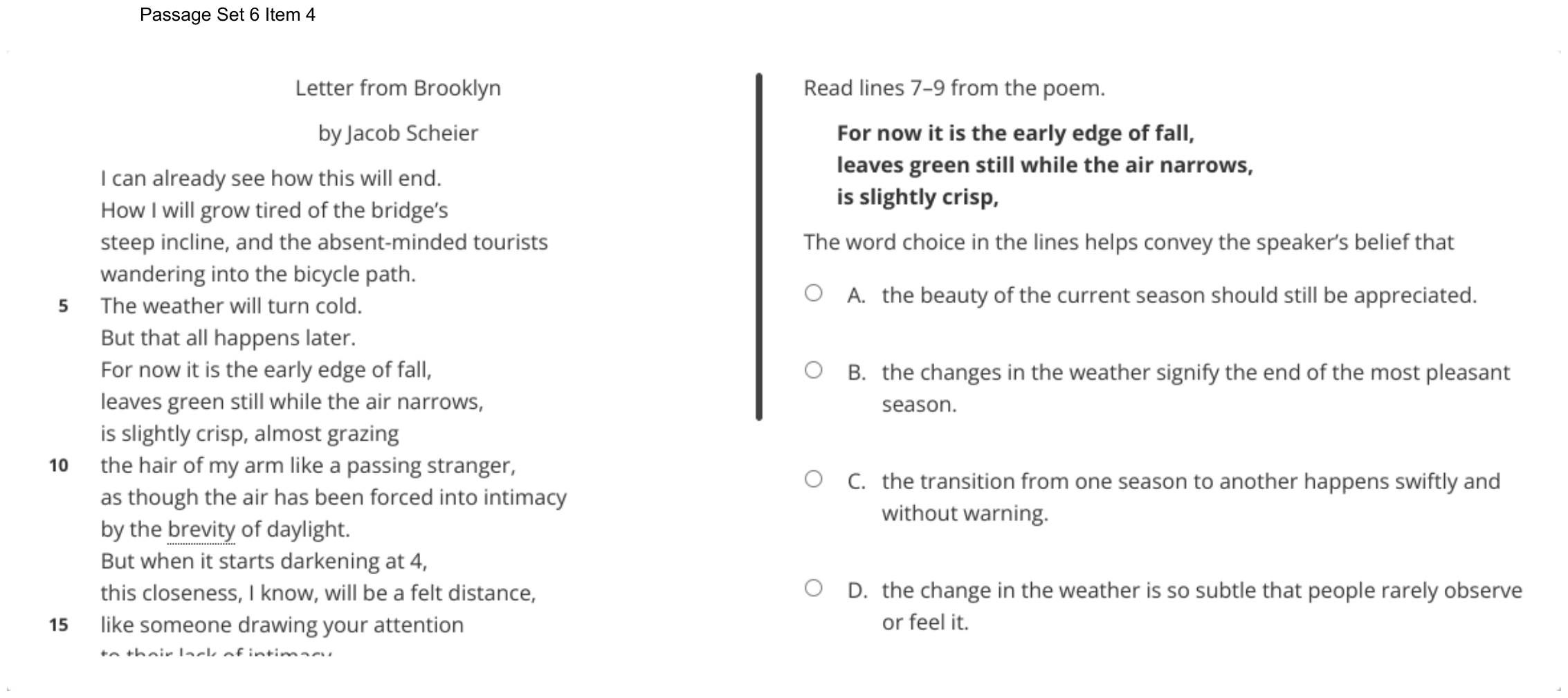
Read lines 7–9 from the poem.
For now it is the early edge of fall,
leaves green still while the air narrows,
is slightly crisp,
The word choice in the lines helps convey the speaker’s belief that
- Athe beauty of the current season should still be appreciated.
- Bthe changes in the weather signify the end of the most pleasant season.
- Cthe transition from one season to another happens swiftly and without warning.
- Dthe change in the weather is so subtle that people rarely observe or feel it.
Show the answer
Correct answer: A
The question asks what belief of the speaker is conveyed by the word choice in lines 7–9 of the poem.
A. CORRECT. Words and phrases in these lines, such as “leaves green still” and “slightly crisp,” have a positive connotation, indicating that the speaker believes in appreciating this season while it still lasts.
B. Incorrect. Although imagery such as “leaves green still” and “slightly crisp” in these lines suggests that the speaker enjoys the season, the speaker never indicates that the present season is the most pleasant of all seasons.
C. Incorrect. The phrases “the early edge of fall” and “the air narrows” in these lines imply that the season is just beginning to change, but there is no indication from these phrases that the changes will be swift and without warning. In fact, the narrowing of the air could be a warning of a greater, more gradual change in weather.
D. Incorrect. The speaker experiences the change in weather as subtle: “the air narrows, / is slightly crisp.” However, the speaker does not refer to the viewpoints of others. The entire viewpoint in the poem is personal and introspective, as represented by the use of the pronoun “I” throughout.
Question analysis
This word-choice question quotes three lines from “Letter from Brooklyn” describing the early edge of fall, when the leaves are still green and the air is slightly crisp. Students must work out what the connotations of these words reveal about the speaker's belief, and several choices mix an accurate reading of the lines with a claim they do not support.
- Grade level
- Grade 7 reading and task
- Compared with grade 7
- At grade 7 Explaining how word choice conveys a speaker's feelings is everyday grade 7 work. These three lines are short and concrete, but their meaning rests on the connotations of a few small words, which matches a typical grade 7 task.
- Estimated difficulty
- Moderate: several steps, or a close reading with one strong distractor.
- Thinking it demands
- Depth of knowledge 2, skills and concepts · mainly understand
- What makes it hard
- Figurative or literary language moderate
- Reading between the lines minor
- Evidence
- Answered from one sentence or line
- Reading level
- Passage: 217 words (a poem; reading level not measured); question and choices: about grade 5, 86 words.
- Students, last 30 days
- Not enough answers yet to show (it takes 10).
Why it is hard, traps and wrong answers (shows the answer)
Why it is hard
The three lines are short, and every choice builds on something real in them: a change in the weather, a season ending, subtlety. What separates the answer is the time words, “For now,” “early edge” and “still,” which say that something good is present and passing. Students lose the point by stretching a reasonable sense of loss into a claim about the best season, or by turning the speaker’s private notice into what other people miss.
Figurative or literary language moderate Understanding the question
The belief lies in connotation: “early edge of fall” and “leaves green still” mark a season only starting to turn, and “the air narrows” describes the change through an image. (Graesser, Singer & Trabasso, 1994; Kintsch, 1998)
Reading between the lines minor Working it out
“For now” at the start of line 7 signals that the moment will pass, and students must infer that the speaker values it for that reason, since no line states the belief. (Graesser, Singer & Trabasso, 1994; Kintsch, 1998)
Strategy: Mark the words in lines 7–9 that describe time and the feel of the air, decide whether each sounds positive, negative or neutral, then choose the belief that fits those connotations and nothing more.
Traps
- Half right: One half of a two-part choice is right and the other is not.
- Reads too much in: A reasonable-sounding conclusion that goes further than the text allows.
- Twists what the text says: Uses the text's topic and ideas but changes what it says: who did it, how much, when, or why.
The wrong answers, classified
B Reads too much in (Graesser, Singer & Trabasso, 1994)
Senses loss in a turning season, which the poem does suggest, but claims the speaker sees this as ending “the most pleasant season,” a ranking the lines never make.
C Twists what the text says (King et al., 2004)
Reads “the air narrows” as a sudden shift, though “early edge” and “slightly crisp” describe a season only beginning to turn, gradually and with clear signs.
D Half right (King et al., 2004; Thissen, Steinberg & Fitzpatrick, 1989)
Rightly hears the change as subtle in “slightly crisp,” but adds that people rarely notice it, though the lines record the speaker feeling it on the hair of an arm.
Working it out, step by step
Figure out what the question asks
This question is about word choice. The exact words a poet picks can show feelings. You need the belief that lines 7–9 show. So look at what each word suggests, not only what it means.
Mark the time words
The lines say “For now it is the early edge of fall, / leaves green still while the air narrows, / is slightly crisp.” Notice the time words. “For now” means this won’t last. “Early edge” means fall has just begun. “Still” means the leaves have not changed color yet.
Hear what the words suggest
“Slightly crisp” means a little cool and fresh. It sounds pleasant, not harsh. When the air “narrows,” it seems to tighten and grow cooler. So the speaker enjoys this moment. The time words show the speaker knows it will pass. Put together, they say: this lovely early fall is still here, so enjoy it now.
Check each choice
- A is right. “Still” and “For now” show the season is still here to enjoy.
- B is wrong. The speaker never calls this the most pleasant season. Nothing ranks the seasons.
- C is wrong. “Early edge” and “slightly” describe a slow, gentle change, not a sudden one.
- D is wrong. The change is subtle, or hard to notice. But the speaker feels it on “the hair of my arm.” The lines say nothing about other people.
Watch out: D starts out right, because the change is gentle. But it adds a claim about other people that the lines never make.
Choose the answer
The words show a pleasant season that is still here, for now. So the answer is A: “the beauty of the current season should still be appreciated.”
Why this answer and not the closest wrong one
B is the closest wrong answer, because the poem does hint that something good is ending. But the lines never call fall the best season. They say only that this pleasant time is here “for now.” That fits A: enjoy the season while it lasts.
More questions like this
The original DOE question
The passage “Letter from Brooklyn” as printed (page 50)
Question 3 of 14
2026 Practice Test D English, question 22Passage Ode to Fireworks
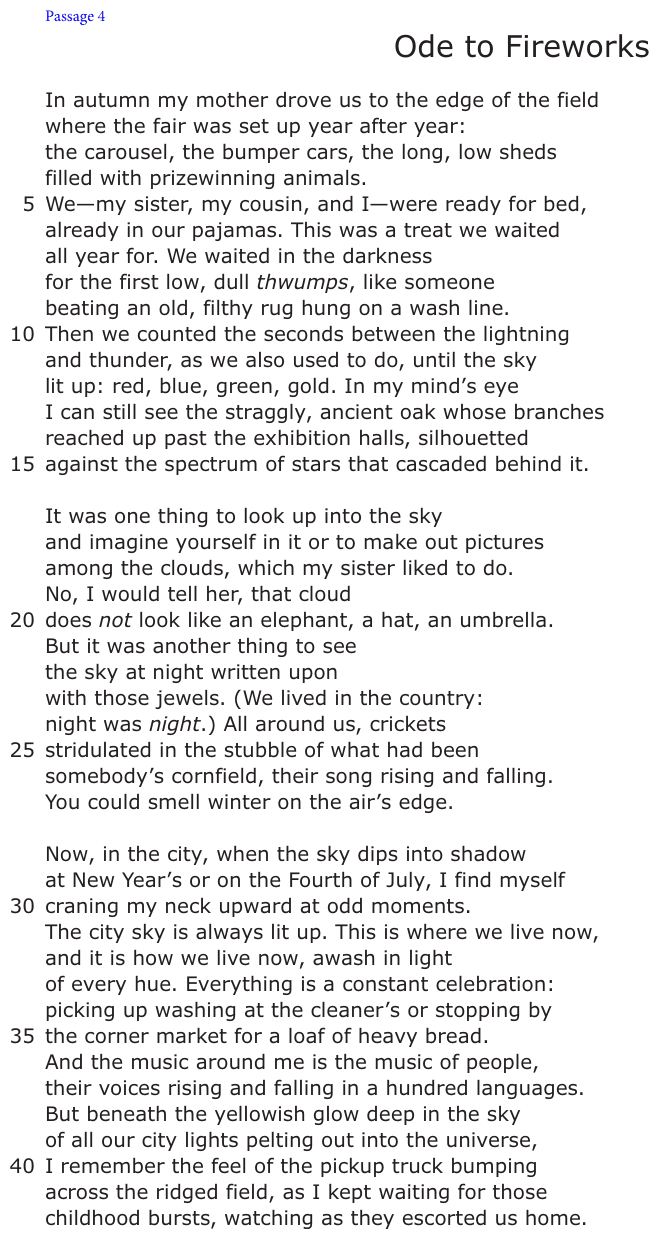
Ode to Fireworks
In autumn my mother drove us to the edge of the field
where the fair was set up year after year:
the carousel, the bumper cars, the long, low sheds
filled with prizewinning animals.
We—my sister, my cousin, and I—were ready for bed,
already in our pajamas. This was a treat we waited
all year for. We waited in the darkness
for the first low, dull thwumps, like someone
beating an old, filthy rug hung on a wash line.
Then we counted the seconds between the lightning
and thunder, as we also used to do, until the sky
lit up: red, blue, green, gold. In my mind’s eye
I can still see the straggly, ancient oak whose branches
reached up past the exhibition halls, silhouetted
against the spectrum of stars that cascaded behind it.
It was one thing to look up into the sky
and imagine yourself in it or to make out pictures
among the clouds, which my sister liked to do.
No, I would tell her, that cloud
does not look like an elephant, a hat, an umbrella.
But it was another thing to see
the sky at night written upon
with those jewels. (We lived in the country:
night was night.) All around us, crickets
stridulated in the stubble of what had been
somebody’s cornfield, their song rising and falling.
You could smell winter on the air’s edge.
Now, in the city, when the sky dips into shadow
at New Year’s or on the Fourth of July, I find myself
craning my neck upward at odd moments.
The city sky is always lit up. This is where we live now,
and it is how we live now, awash in light
of every hue. Everything is a constant celebration:
picking up washing at the cleaner’s or stopping by
the corner market for a loaf of heavy bread.
And the music around me is the music of people,
their voices rising and falling in a hundred languages.
But beneath the yellowish glow deep in the sky
of all our city lights pelting out into the universe,
I remember the feel of the pickup truck bumping
across the ridged field, as I kept waiting for those
childhood bursts, watching as they escorted us home.
Question
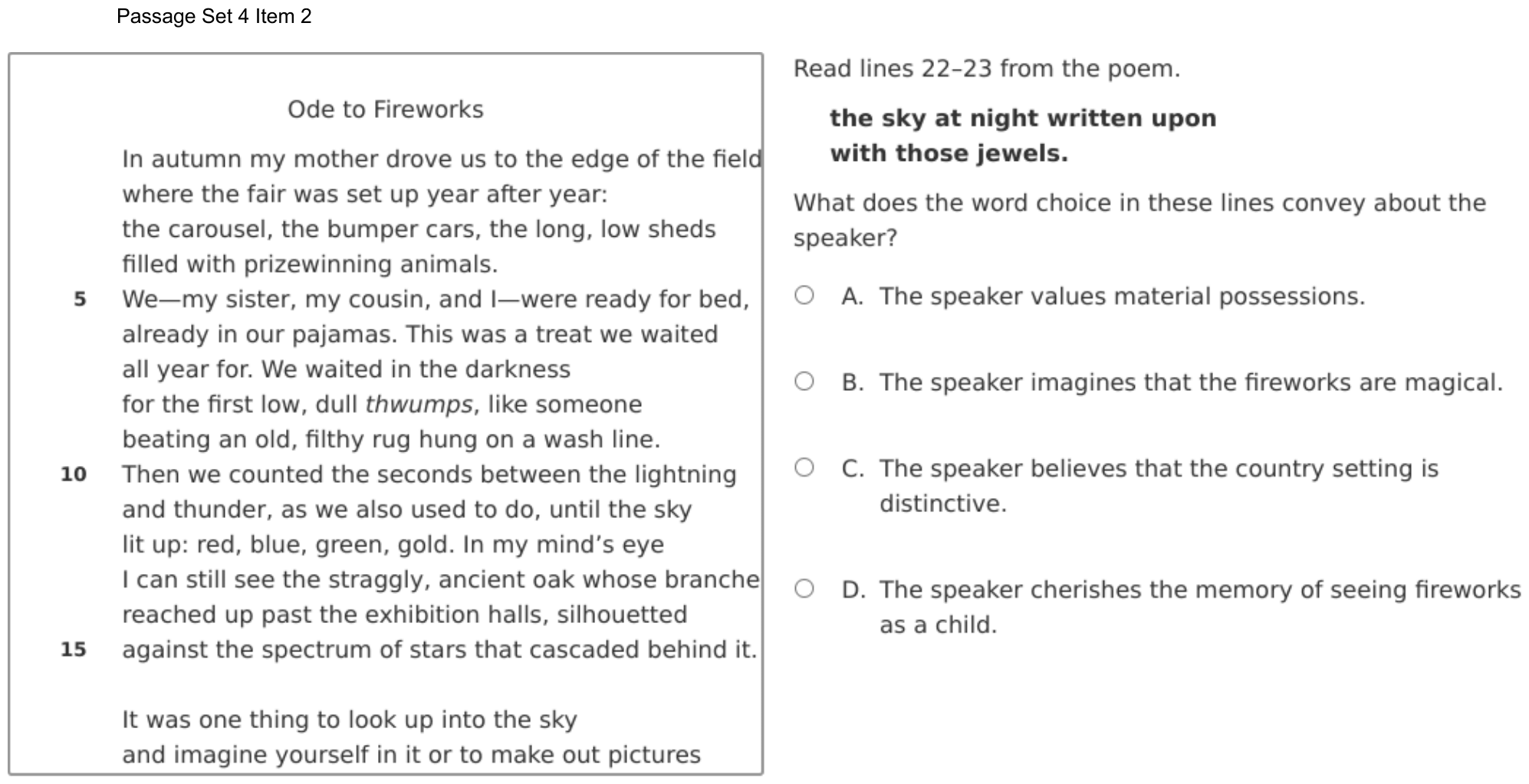
Read lines 22–23 from the poem.
the sky at night written upon
with those jewels.
What does the word choice in these lines convey about the speaker?
- AThe speaker values material possessions.
- BThe speaker imagines that the fireworks are magical.
- CThe speaker believes that the country setting is distinctive.
- DThe speaker cherishes the memory of seeing fireworks as a child.
Show the answer
Correct answer: D
The question asks what the word choice in lines 22–23 of the poem conveys about the speaker.
A. Incorrect. The word “jewels” is used figuratively to indicate the sentimental value that the experience of watching the fireworks holds for the speaker. There is no indication in the poem that the speaker values material possessions.
B. Incorrect. The use of the word “jewels” highlights the importance of the memory in the speaker’s mind. The imagery in the words “written upon” expresses the way the bright streaks of light curve and fly across the night sky, not that the speaker views the fireworks display as magical.
C. Incorrect. The speaker describes the elements of the fireworks display that stand out most clearly. The view of the bright, colorful fireworks streaking across the sky is distinct, but it is not unique to the country setting.
D. CORRECT. The word “jewels” creates a picture of watching shining and sparkling explosions in the night sky and suggests that this experience holds sentimental and emotional value for the speaker. The speaker cherishes the memory of the experience.
Question analysis
This question quotes lines 22–23 of “Ode to Fireworks,” in which the night sky is “written upon / with those jewels,” and asks what this word choice conveys about the speaker. Students must move from a striking metaphor for fireworks to what it reveals about the person describing them, and every choice names a different value or belief.
- Grade level
- Grade 7 reading and task
- Compared with grade 7
- At grade 7 Reading a speaker’s feelings through connotation is standard grade 7 work. The two lines are short and quoted, but the metaphor is compressed and the choices name abstract attitudes, so one careful inference is needed, as in typical grade 7 poetry.
- Estimated difficulty
- Moderate: several steps, or a close reading with one strong distractor.
- Thinking it demands
- Depth of knowledge 2, skills and concepts · mainly analyze
- What makes it hard
- Figurative or literary language moderate
- Reading between the lines moderate
- Evidence
- Answered from several paragraphs or stanzas
- Reading level
- Passage: 379 words (a poem; reading level not measured); question and choices: about grade 6, 59 words.
- Students, last 30 days
- Not enough answers yet to show (it takes 10).
Why it is hard, traps and wrong answers (shows the answer)
Why it is hard
The quoted lines are short, but the answer depends on what “jewels” suggests about the speaker, so students must move from an image to an attitude. The strongest pull comes from the words right after, where the speaker stresses that night in the country was truly dark, a real point but one about the setting, not about the jewel image. Students who take the gems literally or as magic stop at the surface of the metaphor instead of asking why someone would call a memory precious.
Figurative or literary language moderate Understanding the question
Lines 22–23 turn fireworks into “jewels” and the sky into a page “written upon,” a metaphor whose meaning lies in what jewels are worth to a person, not in what they are. (Graesser, Singer & Trabasso, 1994; Kintsch, 1998)
Reading between the lines moderate Working it out
The lines name no feeling; that the speaker cherishes the memory must be inferred from calling the fireworks “jewels” and from the speaker still craning upward for them years later in the city. (Graesser, Singer & Trabasso, 1994; Kintsch, 1998)
Strategy: Ask what “jewels” suggests beyond its literal meaning, picture the sky “written upon,” and then pick the attitude that fits both these lines and the poem as a whole.
Traps
- Wrong part of the text: A choice is true of another paragraph, stanza or speaker than the one asked about.
- Reads too much in: A reasonable-sounding conclusion that goes further than the text allows.
- Taking figurative language literally: A choice reads a figure of speech or image at face value.
The wrong answers, classified
A Taking figurative language literally (Graesser, Singer & Trabasso, 1994)
Takes “jewels” at face value, as valuable possessions, though the word describes fireworks in the sky and nothing in the poem is about owning things.
B Reads too much in (Graesser, Singer & Trabasso, 1994)
Sees the sky being “written upon” with gems as a fantasy and calls it magic, though the speaker describes real fireworks watched from a field with family.
C Wrong part of the text (Kirsch & Mosenthal, 1990)
Is drawn by the parenthesis that follows, “We lived in the country,” which does stress the setting, but the jewel image itself says nothing about the country.
Working it out, step by step
Figure out what the question asks
This asks what a word choice shows about the speaker. The speaker is the “I” who tells the poem. Look past what the words say. Ask what feeling they show.
Find the lines
In stanza 2, the speaker says “it was another thing to see / the sky at night written upon / with those jewels.” A stanza is a group of lines in a poem, like a paragraph. The jewels are the fireworks. The sky is like a page they write on.
Think about what jewels mean
Calling fireworks jewels is a metaphor: a comparison without “like” or “as.” Jewels are rare, bright and precious. People keep them safe and treasure them. So the word shows how much the sight meant to the speaker. Even now, in the city, the speaker says “I find myself / craning my neck upward at odd moments.” Craning means stretching your neck to look.
Check each choice
- A is wrong. The jewels are fireworks, not things the speaker owns.
- B is wrong. The speaker watched real fireworks from a field with family. Nothing calls them magic.
- C is wrong. The next words, “We lived in the country,” do stress the setting. But the jewel image itself is about how precious the sight was.
- D is right. To cherish is to treasure and hold dear. Jewels are treasures.
Watch out: C is tempting because the country comes up right after the jewels. Keep your eyes on lines 22–23 themselves.
Choose the answer
Calling the fireworks jewels shows a treasured childhood memory. So the answer is D, “The speaker cherishes the memory of seeing fireworks as a child.”
Why this answer and not the closest wrong one
C is the closest wrong answer. The poem does say they lived in the country, where night was truly dark. But that is the next thought, not the jewel image. Jewels are treasures. They show how much the speaker valued the sight. D says just that: the speaker treasures the memory.
More questions like this
The original DOE question
The passage “Ode to Fireworks” as printed (page 32)
Question 4 of 14
2025 Practice Test A English, question 20Passage Excerpt from Winter Wheat
Excerpt from Winter Wheat
by Mildred Walker
Ellen, the narrator, is preparing to leave her parents and the family farm for college the next day.
I love Dad’s way of talking that makes him seem different from other ranchers. He’s lived here twenty-three years, but he still says “back East where I come from.” He’s the one who gets excited when I do about spring coming or a serial running in the magazine we’re both reading, but it’s what Mom says that I depend on. When Mom used to say “Don’t worry” about my pet chicken or dog or new calf, it always got well. Dad is always talking of going some place, not now, but next year, maybe. Mom seems to think of nothing farther away than today or perhaps yesterday or tomorrow morning.
Mom folded the ironing board and put it inside their bedroom that was just off the kitchen. She carried in the freshly ironed clothes. Dad went back to his paper. When Mom came back she took beans from the cupboard to soak for tomorrow. Dad always said Mom could make all the dishes he’d had back in Vermont as well as though she were a New Englander herself, instead of a Russian. All of a sudden, I realized that tomorrow when those beans would be ready to eat I’d be going away. It gave me a funny feeling.
“I’ll be taking the train tomorrow night,” I said aloud, more to hear it myself.
“We can drive you into town in the afternoon,” Dad said, dropping his paper on the floor.
“There’s no need to go to town; she can catch the train at Gotham just as well. We haven’t nothing to take us into town for,” Mom said.
“Well, we don’t have to decide tonight,” Dad said, but I knew he wanted to go into Clark City. It wouldn’t be so flat as just seeing me go off on the train from Gotham. My going away was hard on both of them; they were so different—and I was part of them both. It made me uncomfortable to think of leaving them.
While I was getting ready for bed in my room that’s off the front room, I saw how it would be if I left from town. We’d go in right after dinner and go around to the stores, Dad going one way and Mom and I another. Dad would probably have his hair cut at the barbershop and stop in the bank and meet someone he knew to talk to. Then we’d meet at the big store on the corner and go to the cafeteria for supper. The train stops ten minutes or so at the station in town and there are other people and excitement and you have time to wave from the platform and then again from your window by your seat. We went to the station in Clark City to see the Goodals off when they went back to Iowa.
If I left from Gotham, we’d just drive down in the truck and wait till the train came. It only stops long enough for you to get on and you hardly have time to taste the flavor of going away.
I sat on the bed in my pyjamas with my arms around my knees. I couldn’t keep from thinking of that time Dad went back East. I tried to, and then I just sat still and looked straight at it. Sometimes that’s better than working so hard to keep from looking at what’s in your mind.
Dad went all the way back to Vermont. . . . It was in November and it was already dark when the train came through Gotham. Even now, I could feel how cold and dark it was. I held Mom’s hand. Dad was so dressed-up he seemed strange. . . . We stood there without saying anything until Dad told Mom to remember to call Mr. Bardich, our neighbor, if the cow didn’t calve tomorrow.
“I’ll manage,” Mom snapped back.
“I wish you could go, Anna,” Dad said to Mom, “and we could take Ellen.” . . .
“Good-by, Anna Petrovna,” he said, looking at Mom. I had never heard him call her by two names before.
“Good-by,” Mom said, standing still, without smiling.
Then he was gone and the crossroads were darker than ever. The train light shone on the high window in the top of the grain elevator for a moment and then that too was dark. We got into our old Ford and Mom drove back to the house. My throat ached all the way. The name Dad had called Mom kept saying itself in my ears: “Anna Petrovna, Anna Petrovna.” . . .
Our house seemed lonely when we came back to it. It seemed to be hiding under the coulee. I went with Mom to put the truck in the barn that was bigger than the house. I think Mom was prouder of our barn than the house, anyway. We walked back to look at the cow that was going to calve. She was just a big light blob in the dark, waiting. I had thought she was exciting this morning, but now she seemed sad, too.
The wind blew when we walked across the open space to the house and I couldn’t help shivering with the cold. Inside the house it was warm, but empty.
“Bring your nightgown in here and I heat you some milk,” Mom said.
I drank the milk sitting on a stool in front of the stove. It tasted good, but the lonely ache in my throat was still there. I picked up my clothes and hung them neatly behind the stove and put my cup on the sink board. Mom was fixing oatmeal for tomorrow morning.
“Good night, Mom,” I said almost timidly, standing beside her. She seemed wrapped around in a kind of strangeness. Then she turned around and drew me to her. The front of her dress was warm from the stove. I felt the comfortable heat through my gown. She laid her hand against my face and it felt rough and hard but firm. I dared ask her something I wanted to know.
“Mom, was that really your name—what Dad called you?”
Her voice sounded surprised. “Why, Yeléna, you know that; Anna Petrovna. You know I am born in Russia, in Seletskoe.”
“Yes, but I didn’t know your other name,” I said.
“Anna Petrovna Webb.” She pronounced it slowly. “Once I think what a funny name Ben Webb is!” She laughed. Her laugh was warm and low like our kitchen, and comfortable. The house seemed natural and right again. . . .
But now that I am grown, I feel the wall of strangeness between them, more than when I was a child. I wondered how they would get along without me.
From WINTER WHEAT by Mildred Walker, published by University of Nebraska Press. Copyright © 1944 by Harcourt, Brace and Company, Inc. Copyright renewed 1971 by Mildred Walker. All rights reserved.
serial: story published in short segments at regular intervals
coulee: small gulch or ravine
Question
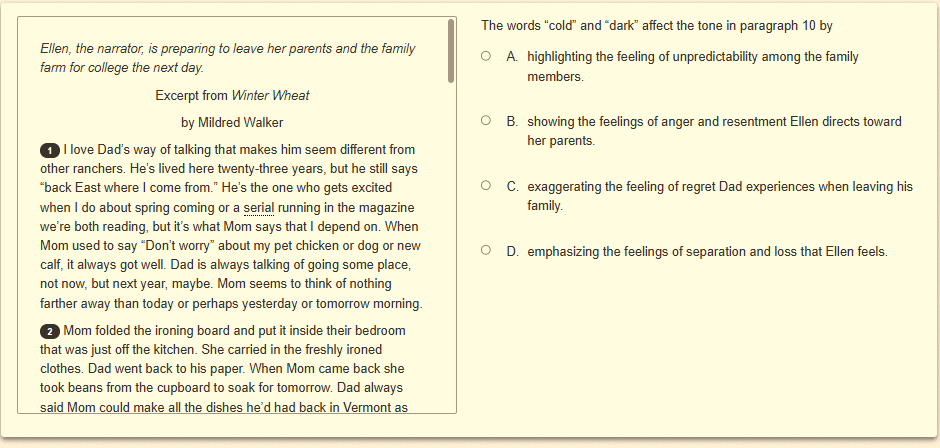
The words “cold” and “dark” affect the tone in paragraph 10 by
- Ahighlighting the feeling of unpredictability among the family members.
- Bshowing the feelings of anger and resentment Ellen directs toward her parents.
- Cexaggerating the feeling of regret Dad experiences when leaving his family.
- Demphasizing the feelings of separation and loss that Ellen feels.
Show the answer
Correct answer: D
The question asks how the words “cold” and “dark” affect the tone in paragraph 10.
A. Incorrect. The mood of paragraph 10 is primarily one of sadness as Ellen says goodbye to her father at the train station. The words “cold” and “dark” do not convey unpredictability but rather emphasize Ellen’s feeling of loss over the departure of her father.
B. Incorrect. Although the father’s departure causes tension with his wife (“ ‘I’ll manage,’ Mom snapped back” [paragraph 11]), Ellen does not display anger or resentment toward her parents.
C. Incorrect. Although Ellen’s father states that he wishes his family could come with him on the trip to Vermont (“ ‘I wish you could go, Anna,’ Dad said to Mom, ‘and we could take Ellen’ ” [paragraph 12]), the words “cold” and “dark” describe Ellen’s perspective on her father’s departure. They create a tone of sadness from Ellen at being left behind rather than a tone of regret from her father because he has to leave.
D. CORRECT. In paragraph 10, Ellen states, “I could feel how cold and dark it was.” The words “cold” and “dark” highlight her emotional response to the departure of her father, emphasizing the almost physical sense of grief she feels at being separated from someone so precious to her.
Question analysis
This tone question asks how the words “cold” and “dark” affect the tone of paragraph 10 of the Winter Wheat excerpt, where Ellen remembers waiting for the train one November night as her father set off for Vermont. Students must decide what the two words add beyond describing the night itself.
- Grade level
- Grade 7 reading and task
- Compared with grade 7
- At grade 7 Explaining how word choice shapes tone is regular grade 7 work. The two words are named in the question and sit in one short paragraph, so the main step is seeing that they carry feeling as well as describing a November night.
- Estimated difficulty
- Straightforward: two steps or one careful reading.
- Thinking it demands
- Depth of knowledge 2, skills and concepts · mainly analyze
- What makes it hard
- Figurative or literary language moderate
- Reading between the lines minor
- Evidence
- Answered from one paragraph or stanza
- Reading level
- Passage: about grade 4, 1179 words; question and choices: about grade 10, 53 words.
- Students, last 30 days
- Not enough answers yet to show (it takes 10).
Why it is hard, traps and wrong answers (shows the answer)
Why it is hard
The two words are named in the stem and appear together in a single sentence of paragraph 10, so the main step is seeing that they describe a feeling as well as the weather. The wrong choices shift the feeling to someone else or swap it for another, borrowing Mom’s sharp reply and Dad’s wish from the paragraphs just after. Students who keep their attention on Ellen waiting for the train in paragraph 10 have little trouble.
Figurative or literary language moderate Understanding the question
“Cold” and “dark” describe a November night, yet the grown narrator says she “could feel how cold and dark it was,” so the weather words carry her sense of loss as Dad leaves. (Graesser, Singer & Trabasso, 1994; Kintsch, 1998)
Reading between the lines minor Working it out
Paragraph 10 never names a feeling; the sadness comes from details such as Ellen holding Mom’s hand and Dad seeming strange in his good clothes. (Graesser, Singer & Trabasso, 1994; Kintsch, 1998)
Strategy: Reread paragraph 10 and ask what Ellen is going through at that moment, then choose the option that names the feeling the two words strengthen and the person who has it.
Traps
- Wrong tone or attitude: Misjudges the tone, attitude or point of view, such as reading admiration as criticism, or taking a character's or subject's feelings for the author's.
- Wrong part of the text: A choice is true of another paragraph, stanza or speaker than the one asked about.
The wrong answers, classified
A Wrong tone or attitude (Graesser, Singer & Trabasso, 1994)
Links darkness with not knowing what comes next, but nothing in paragraph 10 is uncertain: Dad’s trip is settled, and the words deepen Ellen’s sadness, not suspense.
B Wrong tone or attitude (Graesser, Singer & Trabasso, 1994)
Carries the sharpness of Mom’s “I’ll manage” into Ellen’s feelings and calls it anger at her parents, though Ellen holds her mother’s hand and blames no one.
C Wrong part of the text (Kirsch & Mosenthal, 1990)
Gives the feeling to Dad because in paragraph 12 he wishes his wife and daughter could come, though the cold and dark are what Ellen feels as she waits to see him off.
Working it out, step by step
Figure out what the question asks
This asks how two words, “cold” and “dark,” affect the tone of paragraph 10. Tone is the feeling the writing gives off. Ask whose feeling it is and what that feeling is.
Find the words in paragraph 10
Paragraph 10 begins Ellen’s memory of the night Dad left for Vermont. It was November, and dark when the train came. Ellen says that even now, years later, “I could feel how cold and dark it was.” She held Mom’s hand. Dad looked strange in his good clothes. They stood there without talking.
Work out the feeling
Cold and dark describe a November night. But Ellen can still feel them years later, so the words carry her feelings too. Cold and dark are lonely, sad words. Her father is leaving, and she feels cut off from him. The words stress her sense of separation and loss.
Check each choice
- A does not fit. Nothing is uncertain. Dad’s trip is planned, and the words make the scene sad, not unpredictable.
- B does not fit. Ellen holds Mom’s hand. She blames no one, so there is no anger.
- C does not fit. Dad says in paragraph 12 that he wishes they could come. But the cold and dark are what Ellen feels, not Dad.
- D fits. The words deepen Ellen’s sadness at being separated from her father.
Watch out: C borrows Dad’s wish from a later paragraph and gives him the feeling.
Choose the answer
“Cold” and “dark” show how lonely and sad Ellen felt as her father left. So the answer is D.
Why this answer and not the closest wrong one
C is the closest wrong choice, because Dad does wish his family could come with him. But that wish is in paragraph 12. In paragraph 10, Ellen says “I could feel how cold and dark it was.” The feeling belongs to her. The words stress her sense of being separated from her father, which is D.
More questions like this
The original DOE question
The passage “Excerpt from Winter Wheat” as shown on the test
Question 5 of 14
2025 Practice Test B English, question 3Passage Excerpt from “It’s Time to Stop Thinking That All Non-Native Species Are Evil”
Excerpt from “It’s Time to Stop Thinking That All Non-Native Species Are Evil”
by Emma Marris
The author of this opinion article attended a symposium, or conference, in Missoula, Montana, at which biologists and other scientists discussed species of plants and animals that are not native to the areas in which they live.
Invasive species are scary. It was ecologist Charles Elton, back in the 1950s, who introduced the militaristic “invasion” metaphor to describe exotic plants and animals—but there’s no question some can be extremely destructive.
The brown tree snake has eaten a dozen kinds of forest birds in Guam to extinction; zebra mussels clog pipes around the Great Lakes; the common house cat turns out to be, in Australia, a mercilessly effective killer of cute, fluffy marsupials like the bilby and the numbat.
As scientists have sounded the alarm about these pests, the public has gotten the message. Citizen groups rip out non-native plants. Native gardens have become increasingly popular, both as ways to celebrate the unique flora of each region and as tiny hot spots of diversity. Native trees provide food for native bugs, which feed native birds. Food chains developed over thousands of years of co-evolution unfold in our backyards. . . .
So we’ve learned, scientists and laypeople alike, that native species are good and non-natives are bad.
Julian Olden, a biologist at the University of Washington, Seattle, who co-organized the symposium, recently polled nearly 2,000 ecologists. Among his findings: a substantial number of them said they would immediately eradicate a hypothetical non-native forest plant, even if it were shown to have no effect on the forest. Olden calls this the “guilty even when proven innocent” approach.
That kind of approach is not very useful on a rapidly changing planet.
Exotics Are Everywhere
Climate change is making it harder even to decide who the invaders are.
How, scientists at the symposium wondered, do you define “native” on a warming planet, when plants and animals are already moving toward the poles or up mountainsides in search of climate conditions they can tolerate? Should we consider them “invasive” in their new homes? Regardless of what we label them, conservationists will be reluctant to remove them from their new environs—to do so would stymie1 their chances of adapting to the warmer future we’re creating.
And then there are the non-natives that we actually like. Most domestic crops are exotic in most of the places they’re grown, but there are even wild exotics that “do good,” forming useful relationships with native species.
Edwin Grosholz of the University of California, Davis, told the recent symposium about one such relationship. On beaches in his state, non-native spartina grass has become important habitat for the endangered California clapper rail, a plump shorebird with a downward curving bill more at home on land than in the air. A project to rip out and poison the spartina—which grows in dense swaths that exclude many other shorebirds—saw clapper rail numbers go tumbling downward.
There are other examples like that. The endangered southwestern willow flycatcher nests in “invasive” tamarisk shrubs. Many native (and beautiful) Hawaiian flowers are now pollinated by the Japanese white-eye bird—because the native pollinators have been driven extinct by other non-native species.
Should we impose further risk on already endangered natives by severing these relationships? Or should we admire the resilience of nature and let such “well-behaved” exotics stay? . . .
Leave them alone, more and more conservationists are arguing, and stop focusing obsessively on categorizing species as native or non-native. Mark Davis, an ecologist at Macalester College in St. Paul, Minnesota, once considered himself an “invasion biologist”—but not anymore. “I am actively trying to get the field to retire the invader narrative,” he said in Missoula.
A Good Thing, Not the Only Thing
After all, nativeness is just one environmental value, and arguably not as important as preventing extinctions and preserving biodiversity. In some cases we can best serve biodiversity by leaving the non-natives alone or even—brace yourself, now—introducing them on purpose.
This is the thinking behind, for example, installing the Aldabra tortoise on the islands of Mauritius. The islands lost their own large tortoises, and the fruiting plants that formerly had their seeds moved around by these fruit-loving reptiles have been on the decline. A tortoise that’s related to the island’s large tortoises—a non-native from the Seychelles in the Indian Ocean that was intentionally introduced in 2004—is now handling some of that work.
Most of the time, for the time being, conserving species still means focusing on supporting them in their historical habitats, planting natives and removing non-natives. We can and should do that in places where it is feasible and important to us.
From “It’s Time to Stop Thinking That All Non-Native Species Are Evil” by Emma Marris from NATIONAL GEOGRAPHIC MAGAZINE, July 24, 2014. Copyright © 2014 by National Geographic Society.
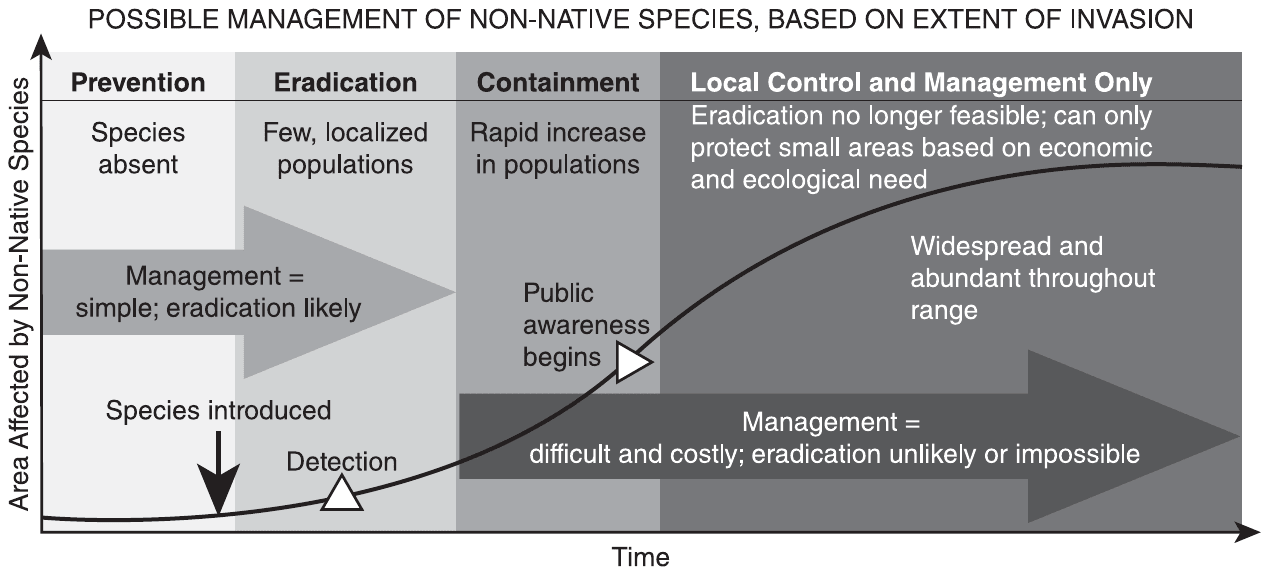
1stymie: hinder or interfere with
Question
Which two phrases from paragraph 3 most affect the tone of the excerpt?
Move the two correct answers to the box.
Phrases That Most Affect the Tone of the Excerpt
On the test you drag tiles into the box; here, choose them below. The DOE has not published how answers with several parts are scored; this site counts one right only when every part is right.
- A“sounded the alarm”
- B“gotten the message”
- C“rip out”
- D“become increasingly popular”
- E“provide food”
Show the answer
Correct answer: A and C
The question asks for the two phrases from paragraph 3 that most affect the tone of the excerpt.
A. “sounded the alarm”: CORRECT. This phrase affects the tone of the excerpt by conveying the stark sense of urgency surrounding the debate over the ecological impact of non-native species. The reference to an alarm sounding evokes the feeling of being on high alert.
B. “gotten the message”: Incorrect. This phrase does not most affect the tone of the excerpt.
C. “rip out”: CORRECT. This phrase affects the tone of the excerpt by vividly depicting the effect of widespread misunderstanding of non-native species.
D. “become increasingly popular”: Incorrect. This phrase does not most affect the tone of the excerpt.
E. “provide food”: Incorrect. This phrase does not most affect the tone of the excerpt.
Question analysis
This select-two tone question on Emma Marris’s opinion article about non-native species lists five short phrases from paragraph 3 and asks which two most affect the tone of the excerpt. On the test students move two tiles into a box, and both must be right. All five are common, everyday expressions, so students must weigh how strongly each one colors the excerpt.
- Grade level
- Grade 7 reading and task
- Compared with grade 7
- At grade 7 Typical grade 7 tone questions quote the words and ask what effect they have. Here students pick the two phrases themselves from five in one short paragraph and compare how much feeling each carries, which keeps the demand at grade level.
- Estimated difficulty
- Moderate: several steps, or a close reading with one strong distractor.
- Thinking it demands
- Depth of knowledge 2, skills and concepts · mainly analyze
- What makes it hard
- A very close wrong answer moderate
- Figurative or literary language moderate
- Much to keep track of minor
- Evidence
- Answered from one paragraph or stanza
- Reading level
- Passage: about grade 11, 815 words; question and choices: about grade 3, 42 words.
- Students, last 30 days
- Not enough answers yet to show (it takes 10).
Why it is hard, traps and wrong answers (shows the answer)
Why it is hard
Most students hear the urgency of “sounded the alarm” at once, and the point is lost on the second pick. The idiom that ends the same sentence sounds just as colorful, while “rip out” is a short, everyday verb whose force is easy to read past as plain weeding. Swapping each phrase for a neutral word and asking how much feeling is lost separates them, and credit comes only when both tiles are right.
A very close wrong answer moderate Choosing the answer
“Sounded the alarm” and “gotten the message” are paired idioms in the first sentence of paragraph 3, both about the warning passing from scientists to the public, and only the first carries urgency. (Embretson & Wetzel, 1987; Gorin & Embretson, 2006; Ascalon et al., 2007)
Figurative or literary language moderate Understanding the question
The tone lives in connotation: “sounded the alarm” borrows the picture of a siren or bell, and “rip out” shows plants torn up by force where “remove” would sound flat. (Graesser, Singer & Trabasso, 1994; Kintsch, 1998)
Much to keep track of minor Working it out
Five tiles compete for one box and both picks must be right, so each phrase’s charge has to be weighed against the other four, since the stem asks which affect the tone “most.” (Sweller, 1988; Carpenter, Just & Shell, 1990)
Strategy: Swap each phrase for a plain word with the same meaning, reread its sentence, and keep the two whose replacement changes the feeling of the passage the most.
Traps
- Wrong tone or attitude: Misjudges the tone, attitude or point of view, such as reading admiration as criticism, or taking a character's or subject's feelings for the author's.
- Taking figurative language literally: A choice reads a figure of speech or image at face value.
The wrong answers, classified
B Wrong tone or attitude (Graesser, Singer & Trabasso, 1994)
Hears an idiom as colorful as “sounded the alarm” in the same sentence and takes it as equally charged, though “gotten the message” only says the public accepted the warning.
D Wrong tone or attitude (Graesser, Singer & Trabasso, 1994)
Hears approval in the word “popular” and takes it as setting the tone, though “become increasingly popular” is a neutral report of a trend in gardening.
E Wrong tone or attitude (Graesser, Singer & Trabasso, 1994)
Is drawn by the pleasant picture of native trees feeding bugs that feed birds, though “provide food” is plain, factual wording that any science textbook might use.
C Taking figurative language literally (Graesser, Singer & Trabasso, 1994)
Left out by students who read “rip out” as a plain account of weeding, missing that the verb pictures citizen groups tearing up plants by force, where “remove” would be neutral.
Working it out, step by step
Figure out what the question asks
This is a tone question. Tone is the feeling or attitude that a writer’s words give a passage. You need the two phrases from paragraph 3 that carry the most feeling. Words can carry feeling beyond their plain meaning. On the test you drag two tiles into the box. On this site, you choose two of the five. Both must be right.
Read paragraph 3 in its place
The excerpt opens with “Invasive species are scary.” Paragraph 2 lists the harm some invaders do. Then paragraph 3 says “As scientists have sounded the alarm about these pests, the public has gotten the message. Citizen groups rip out non-native plants.” The rest of the paragraph is calm. It says native gardens are popular, and native trees feed bugs that feed birds.
Swap each phrase for plain words
A good test is to swap each phrase for plain words with the same meaning. Then ask how much feeling is lost.
- “sounded the alarm” becomes warned. An alarm is a loud bell for danger, like a fire alarm. The sense of danger is lost.
- “gotten the message” becomes understood. Little changes.
- “rip out” becomes remove. To rip is to tear roughly and fast. The force is lost.
- “become increasingly popular” becomes grown more common. Little changes.
- “provide food” becomes feed. Nothing changes.
See what the two phrases do
Urgency is the feeling that something must be done right now. “Sounded the alarm” makes non-native species sound like an emergency. “Rip out” shows people tearing up plants with force. Together they make the fight against non-natives sound urgent and harsh. That matches paragraph 1, which calls the word “invasion” militaristic, or warlike. The author goes on to question treating every non-native as bad.
Check each of the five tiles
- A fits. It adds urgency.
- B does not fit. It is an idiom, a saying whose meaning differs from its words. It only means the public understood.
- C fits. It adds force.
- D does not fit. It calmly reports a trend in gardening.
- E does not fit. It is plain, factual wording.
Watch out: B sits in the same sentence as A, and it sounds just as colorful. But it adds no danger and no force.
Choose both answers
So the answers are A and C. On the test, move the tiles “sounded the alarm” and “rip out” into the box Phrases That Most Affect the Tone of the Excerpt. You need both to get the point.
Why this answer and not the closest wrong one
B is the closest wrong choice. It is an idiom in the same sentence as A, so it seems just as strong. But swap in understood, and the feeling barely changes. C is easier to miss because it is short. Swap in remove, and the force is gone.
More questions like this
The original DOE question
The passage “Excerpt from “It’s Time to Stop Thinking That All Non-Native Species Are Evil”” as printed (pages 68–70)
Question 6 of 14
2024 Test A English, question 10Passage Excerpt from “Impressions of an Indian Childhood”
Excerpt from “Impressions of an Indian Childhood”
by Zitkala-Sa
Zitkala-Sa (Gertrude Simmons Bonnin) was a Native American writer, musician, teacher, and political activist who was raised on the Yankton Sioux Reservation in South Dakota. In 1900 she published “Impressions of an Indian Childhood” (the term Indian was commonly used at the time to refer to Native American people) to expose readers to what life is like on a reservation.
Soon after breakfast Mother sometimes began her beadwork. On a bright, clear day, she pulled out the wooden pegs that pinned the skirt of our wigwam1 to the ground, and rolled the canvas part way up on its frame of slender poles. Then the cool morning breezes swept freely through our dwelling, now and then wafting the perfume of sweet grasses from newly burnt prairie.
Untying the long tasseled strings that bound a small brown buckskin2 bag, my mother spread upon a mat beside her bunches of colored beads, just as an artist arranges the paints upon his palette. On a lapboard she smoothed out a double sheet of soft white buckskin; and drawing from a beaded case that hung on the left of her wide belt a long, narrow blade, she trimmed the buckskin into shape. Often she worked upon small moccasins for her small daughter. Then I became intensely interested in her designing. With a proud, beaming face, I watched her work. In [my] imagination, I saw myself walking in a new pair of snugly fitting moccasins. I felt the envious eyes of my playmates upon the pretty red beads decorating my feet.
Close beside my mother I sat on a rug, with a scrap of buckskin in one hand and an awl in the other. This was the beginning of my practical observation lessons in the art of beadwork. From a skein3 of finely twisted threads of silvery sinews my mother pulled out a single one. With an awl she pierced the buckskin, and skillfully threaded it with the white sinew. Picking up the tiny beads one by one, she strung them with the point of her thread, always twisting it carefully after every stitch.
It took many trials before I learned how to knot my sinew thread on the point of my finger, as I saw her do. Then the next difficulty was in keeping my thread stiffly twisted, so that I could easily string my beads upon it. My mother required of me original designs for my lessons in beading. At first I frequently ensnared many a sunny hour into working a long design. Soon I learned from self-inflicted punishment to refrain from drawing complex patterns, for I had to finish whatever I began.
After some experience I usually drew easy and simple crosses and squares. These were some of the set forms. My original designs were not always symmetrical nor sufficiently characteristic, two faults with which my mother had little patience. The quietness of her oversight made me feel strongly responsible and dependent upon my own judgment. She treated me as a dignified little individual as long as I was on my good behavior; and how humiliated I was when some boldness of mine drew forth a rebuke from her!
In the choice of colors she left me to my own taste. I was pleased with an outline of yellow upon a background of dark blue, or a combination of red and myrtle-green. There was another of red with a bluish-gray that was more conventionally used. When I became a little familiar with designing and the various pleasing combinations of color, a harder lesson was given me. It was the sewing on, instead of beads, some tinted porcupine quills, moistened and flattened between the nails of the thumb and forefinger. My mother cut off the prickly ends and burned them at once in the centre fire. These sharp points were poisonous, and worked into the flesh wherever they lodged. For this reason, my mother said, I should not do much alone in quills until I was as tall as my cousin Warca-Ziwin.
Always after these confining lessons I was wild with surplus spirits, and found joyous relief in running loose in the open again. Many a summer afternoon a party of four or five of my playmates roamed over the hills with me. We each carried a light sharpened rod about four feet long, with which we pried up certain sweet roots. When we had eaten all the choice roots we chanced upon, we shouldered our rods and strayed off into patches of a stalky plant under whose yellow blossoms we found little crystal drops of gum. Drop by drop we gathered this nature’s rock-candy, until each of us could boast of a lump the size of a small bird’s egg. Soon satiated with its woody flavor, we tossed away our gum, to return again to the sweet roots.
From “Impressions of an Indian Childhood” by Zitkala-Sa—Public Domain
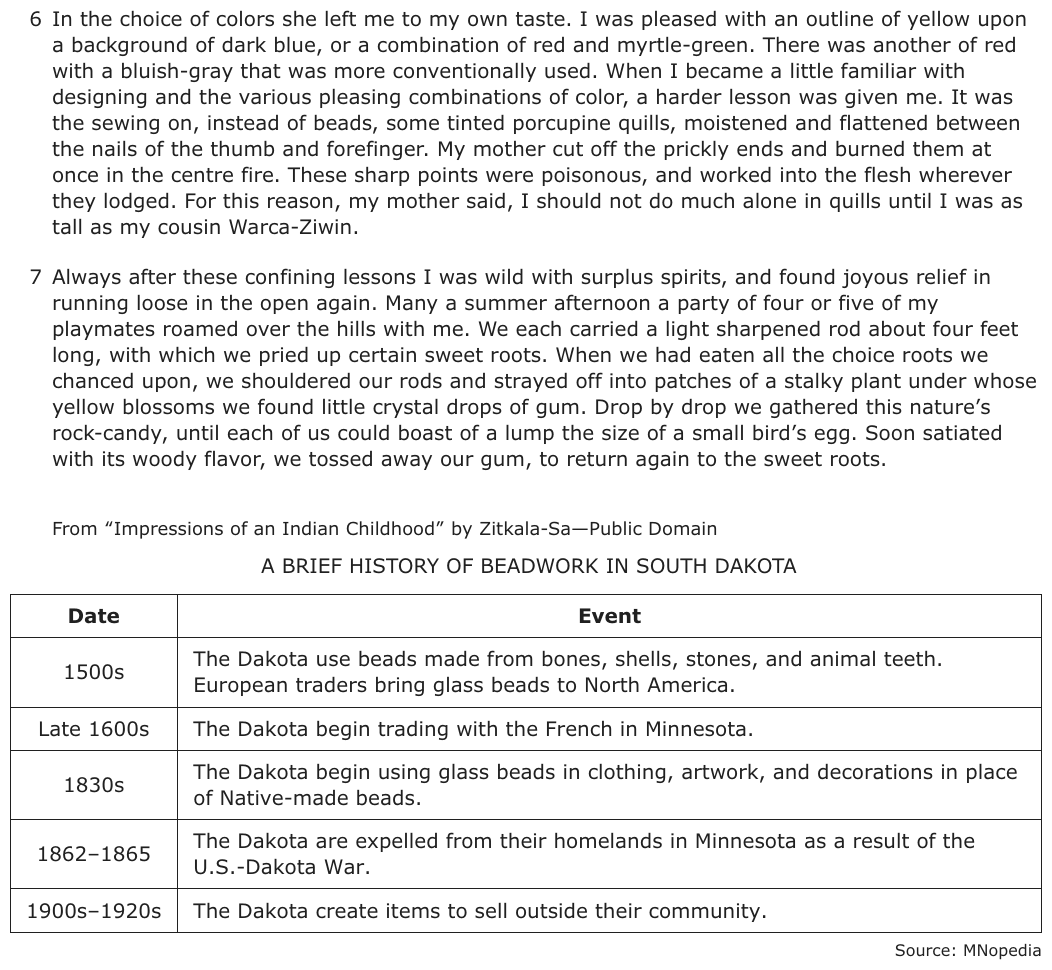
A BRIEF HISTORY OF BEADWORK IN SOUTH DAKOTA
| Date | Event |
|---|---|
| 1500s | The Dakota use beads made from bones, shells, stones, and animal teeth. European traders bring glass beads to North America. |
| Late 1600s | The Dakota begin trading with the French in Minnesota. |
| 1830s | The Dakota begin using glass beads in clothing, artwork, and decorations in place of Native-made beads. |
| 1862–1865 | The Dakota are expelled from their homelands in Minnesota as a result of the U.S.-Dakota War. |
| 1900s–1920s | The Dakota create items to sell outside their community. |
Source: MNopedia
1wigwam: hut with an arched framework of poles covered with bark, mats, or animal hides
2buckskin: leather made from the skin of a male deer
3skein: coiled length of yarn or other thread loosely wound on a reel
Question
In paragraph 1, the phrases “cool morning breezes swept freely” and “wafting the perfume of sweet grasses” affect the tone of the excerpt by suggesting
- Athe sadness that the author feels reflecting upon her former way of life.
- Bthe enthusiasm with which the author approached her work indoors.
- Cthe fond feelings that the author has toward her childhood experiences.
- Dthe mix of emotions that the author feels toward her work and her mother.
Show the answer
Correct answer: C
The question asks how the phrases “cool morning breezes swept freely” and “wafting the perfume of sweet grasses” affect the tone of the excerpt.
A. Incorrect. Although the author describes in paragraph 1 the setting of her childhood experiences, the positive wording of the phrases the author uses in the paragraph (“swept freely” and “perfume of sweet grasses”) does not suggest a tone of sadness the author feels when she reflects on her former way of life.
B. Incorrect. Although the phrases “cool morning breezes swept freely” and “wafting the perfume of sweet grasses” used in paragraph 1 create a positive tone, the phrases do not suggest an enthusiasm for the author’s work but rather suggest an appreciation of the peaceful beauty of her childhood.
C. CORRECT. In paragraph 1, the phrases “cool morning breezes swept freely” and “wafting the perfume of sweet grasses” are used to describe where the author’s childhood experiences took place. The phrases create a tone of fondness and evoke a feeling of happiness through their lyrical sensory detail: “swept freely” suggests a sense of joyful possibility, while “perfume,” “sweet,” and “cool” convey delight.
D. Incorrect. Although the author describes her mother’s beadwork lessons as “confining” in paragraph 7, the phrases in paragraph 1 do not suggest that the author feels conflicting or mixed emotions toward her work and her mother. Instead, the phrases convey a positive tone by affectionately describing the author’s childhood home.
Question analysis
This reading question asks how two sensory phrases about cool morning breezes and the scent of sweet grasses shape the tone of Zitkala-Sa's 1900 memoir of life on a Sioux reservation. Students must read the feeling behind descriptive language and decide what that feeling is directed at, since the choices pair different emotions with different subjects.
- Grade level
- Grade 7 reading and task
- Compared with grade 7
- At grade 7 Judging how sensory words shape tone is grade 7 reading work. Both phrases are quoted in the question, so little searching is needed, but the 1900 prose keeps the demand at a typical grade 7 level.
- Estimated difficulty
- Straightforward: two steps or one careful reading.
- Thinking it demands
- Depth of knowledge 2, skills and concepts · mainly analyze
- What makes it hard
- Figurative or literary language moderate
- Reading between the lines minor
- Hard words minor
- Evidence
- Answered from one paragraph or stanza
- Reading level
- Passage: about grade 8, 946 words; question and choices: about grade 7, 72 words.
- Corrected from the DOE handbook
- A misstatement of the question in the explanation was corrected.
- Students, last 30 days
- Not enough answers yet to show (it takes 10).
Why it is hard, traps and wrong answers (shows the answer)
Why it is hard
The phrases are so clearly pleasant that the real decision is what the pleasant feeling is about. They describe the wigwam on a clear morning, so the warmth belongs to the author's memory of her childhood, not to the beadwork the rest of the excerpt follows. Students who know the excerpt is about lessons tend to attach the mood to the work, and a few read sadness into any memoir.
Figurative or literary language moderate Understanding the question
The tone comes from sensory images, breezes that “swept freely” and “the perfume of sweet grasses,” which describe air and scent and leave the author's feeling to be read from them. (Graesser, Singer & Trabasso, 1994; Kintsch, 1998)
Reading between the lines minor Working it out
The phrases describe the dwelling, not the author, so her fondness for her childhood has to be inferred from how lovingly she remembers the setting. (Graesser, Singer & Trabasso, 1994; Kintsch, 1998)
Hard words minor Understanding the question
“Wafting” and “perfume,” used for the smell of grasses from newly burnt prairie, are unusual words that must be understood before the tone they create can be judged. (Perfetti, 2007; Freedle & Kostin, 1993)
Strategy: Decide what feeling the quoted words create on their own, then check what they describe: the right choice must match both the feeling and what it is about.
Traps
- Wrong tone or attitude: Misjudges the tone, attitude or point of view, such as reading admiration as criticism, or taking a character's or subject's feelings for the author's.
- Wrong part of the text: A choice is true of another paragraph, stanza or speaker than the one asked about.
The wrong answers, classified
A Wrong tone or attitude (Graesser, Singer & Trabasso, 1994)
Assumes an adult remembering a lost way of life must sound sad, but breezes that sweep freely and the perfume of sweet grasses carry delight, not grief.
B Wrong part of the text (Kirsch & Mosenthal, 1990)
Senses the positive mood but ties it to the beadwork, borrowing the interest the girl shows in paragraph 2, though these phrases describe breezes and scent, not work.
D Wrong part of the text (Kirsch & Mosenthal, 1990)
Brings in the “confining” lessons of paragraph 7 and the rebuke of paragraph 5, feelings that the two morning images of paragraph 1 do not touch.
What was corrected from the DOE handbook, and why
- Explanation: The handbook’s explanation begins by saying the question asks how the two phrases “affect the tone of paragraph 1 in the excerpt.” The phrases are in paragraph 1, but the question asks how they affect the tone of the excerpt, and the answer is about the author’s feelings toward her childhood as a whole. The explanation now reads “affect the tone of the excerpt.”
Working it out, step by step
Figure out what the question asks
This asks about tone. Tone is the feeling or attitude that a writer’s words show. You need the feeling that two phrases from paragraph 1 give the whole excerpt. An excerpt is a part taken from a longer piece.
Find the phrases in paragraph 1
Paragraph 1 describes a clear morning at home. The mother rolls up the side of the wigwam (a hut made of poles and covers). “Then the cool morning breezes swept freely through our dwelling.” A dwelling is a home. The breezes were “now and then wafting the perfume of sweet grasses.”
Work out the feeling
“Wafting” means gently carrying through the air. “Perfume” is a sweet smell. Cool air, sweet smells and breezes moving freely are all pleasant. The author is remembering her childhood home with love. That feeling is fondness, a warm liking for something.
Check each choice
- A is wrong. Nothing in these words is sad. They are bright and pleasant.
- B is wrong. The phrases describe air and smells, not her work.
- C is right. The loving details show warm feelings about her childhood.
- D is wrong. Mixed feelings, like the “confining” lessons, come later, in paragraph 7. These phrases have nothing negative in them.
Watch out: B is tempting, since the excerpt is mostly about beadwork lessons. But these two phrases describe the morning, not the work.
Choose the answer
The phrases make her childhood home feel cool, sweet and free. So the answer is C.
Why this answer and not the closest wrong one
B is the closest wrong answer, because the phrases do sound happy. But a choice must match both the feeling and what the feeling is about. These phrases describe breezes and the smell of grass at her home. That shows fond memories of her childhood, not eagerness to work.
More questions like this
The original DOE question
The passage “Excerpt from “Impressions of an Indian Childhood”” as printed (pages 42–43)
Question 7 of 14
2024 Test B English, question 28Passage Excerpt from Do Them No Harm!
Excerpt from Do Them No Harm!
by Zoa L. Swayne
This narrative is about the Nez Perce, an American Indian tribe, in what is now northern Idaho. The tribe is preparing for a gathering before the coming winter.
In the moon of Ta-Yum, the hottest days of summer, when salmon spawn in the little streams and huckleberries ripen in the high mountains, people from many villages of the Chopunnish Nation gathered in the Oyaip Prairie for the work and festivities of their annual camas1 harvest.
From far and near The People came. . . .
Should a stranger enter their homeland and ask, “Where are you from?” the reply was always, “We are Nee-mee-poo, The People who live here in this place.”
It was a time of Lawtiwa-mah-ton—a time of being friends together—when The People came for this last chance to enjoy being together before the Cold Moons kept them close to their fires. The visiting and trading, the foot racing and horse racing, and the gambling and stick games would be remembered and talked about long after they had forgotten the drudgery of digging and roasting camas, picking berries, or drying meat and fish. Lawtiwa-mah-ton! It was good to be friends together.
As was their custom since wahk-kee-ma, a time far back beyond the memory of man, they set up their camps in the same locations their parents and grandparents had occupied before them. Red Bear’s people, from Kamiah, made their camp near the trail that came out of the mountains. Their neighbors in Kamiah Valley, The People from Tee-e-lap-a-lo, had their camp close by. Across the wide meadow, by the great roasting pits, the camps of the Te-wap-poo and Ask-kah-poo were located. The tepees and ish-nash, brush shelters, of other groups nestled in their accustomed areas in and among the pines in such numbers that they encircled the entire meadow land.
Red Bear’s people had traveled all summer with neighboring bands, gathering and preparing roots, picking and drying berries, drying and smoking meat and fish for their winter food supply. Now they were at the Oyaip camp. The women worked hard to dig and cure as many bags of roots as they could during the warm, sunny days, for the sharp night air brought warnings that WARM was going and COLD was coming.
Everyone helped in some way. Most of the men fished or hunted for meat. While many of the women dug and roasted camas, other women and older children picked and dried berries.
And the younger children played. They played at hunting. They played with the babies. They played with their horses and puppies. They learned how to live through their play.
This sun, happiness, peace, and quiet blessed the Red Bear camp. All were busy with their daily tasks, until sudden cries came from the children playing by the trail.
“People coming! People coming! People coming on the trail from the high mountains!” they called as they ran to their elders, who looked sharply at the figures of approaching horsemen.
Were they friends or enemies? Did they bring good news or bad?
“Who can it be? What brings them here?” were the questions in every mind.
“Could they be the four hunters who had gone to Buffalo Country two summers past? Would they have news of the families who had gone long ago to Buffalo Country and never returned?”
It was customary for a hunting party to be gone for more than one season.
“Looks like hunters,” the older men agreed. “Looks like they had good hunting. Maybe our four hunters. [They have] been gone many moons.”
“Looks like five people—not four,” others observed.
Excitement grew as the riders came close enough to be recognized.
“A-a-a-a-a, they are our four hunters! But who is the fifth person?” they asked.
“Looks like a woman. Who is she?”
The hunters rode up to the welcoming crowd, proud to show off the loads of meat, hides, and other trophies of their hunt. They paraded around the encampment for all to see how strong their Hunting Power had been—what great hunters they, themselves, were.
Red Bear’s people rejoiced at their hunters’ success. Good hunters brought good to everybody. The meat meant plenty of food and the hides meant soft-tanned robes to give comfort through the Cold Moons. But it was the sight of the frail figure of the woman that aroused their curiosity. Who was she? Where had she come from? . . .
“Belongs to Red Bear people. Gone then come back,” the hunters said, as they dismounted and unloaded their packs. . . .
Now they could see! She was the daughter of the family gone so long ago! The girl-child who had left came back now—a grown woman.
“Wat-ku-ese!” the women cried. “Gone-from-Home-then-Come-Back. Wat-ku-ese!” And Wat-ku-ese was her name from that time on.
Gentle arms lifted Wat-ku-ese from her horse. The women brought her food and made a place for her to rest. For many suns they cared for her until she became stronger.
One evening Wat-ku-ese told her story for all to hear.
From DO THEM NO HARM!: Lewis and Clark Among the Nez Perce by Zoa L. Swayne. Published by Caxton Press. Copyright © 1990 by Zoa L. Swayne. Orofino, Idaho and Legacy House, Inc. Orofino, Idaho. All rights reserved.
1camas: a wild, edible plant
Question
In paragraph 20, the phrases “trophies of their hunt” and “paraded around” affect the paragraph by
- Asuggesting that the hunters are rewarded for their leadership.
- Bemphasizing that The People are dependent on the hunters for food.
- Crevealing that the hunters are pleased with their success.
- Dindicating that The People have gathered specifically to welcome the hunters.
Show the answer
Correct answer: C
The question asks how the phrases “trophies of their hunt” and “paraded around” affect paragraph 20.
A. Incorrect. The phrase “trophies of their hunt” describes the animals that the hunters have successfully found. They have already received their rewards (the animals) and are showing them to The People.
B. Incorrect. The excerpt describes many ways that The People find and prepare their own food. While they appreciate the extra food, they are not dependent on the hunters.
C. CORRECT. The hunters “paraded around” because they were proud of the animals they had been able to get while hunting. Since a trophy is a recognition of success, they consider these animals their trophies.
D. Incorrect. The phrases show the pride the hunters feel. As paragraph 20 says, the hunters want “all to see how strong their Hunting Power had been.” The phrases are focused on the hunters rather than on those who have gathered around them.
Question analysis
This word-meaning question looks at the phrases “trophies of their hunt” and “paraded around” in the scene where four Nez Perce hunters ride back into camp, and asks what the phrases add to the paragraph. Students must work out what the words suggest in this context, not just their dictionary meanings, and weigh four plausible effects on the paragraph.
- Grade level
- Grade 6 reading and task
- Compared with grade 7
- Below grade 7 Grade 7 students analyze the connotations of words in context. These two phrases are familiar and sit in one short paragraph with helpful context nearby, so this is lighter than typical grade 7 word-choice work.
- Estimated difficulty
- Straightforward: two steps or one careful reading.
- Thinking it demands
- Depth of knowledge 2, skills and concepts · mainly analyze
- What makes it hard
- Evidence
- Answered from one paragraph or stanza
- Reading level
- Passage: about grade 5, 885 words; question and choices: about grade 8, 55 words.
- Corrected from the DOE handbook
- A quotation in the explanation was corrected to match the passage.
- Students, last 30 days
- Not enough answers yet to show (it takes 10).
Why it is hard, traps and wrong answers (shows the answer)
Why it is hard
Paragraph 20 nearly states the answer: the hunters are “proud to show off” their loads and parade “for all to see how strong their Hunting Power had been.” Errors come from neighboring details instead: the welcoming crowd in the same paragraph, the food for everyone in the next, or the everyday sense of a trophy as an award. Reading the phrases inside their own sentences settles it.
Figurative or literary language minor Understanding the question
“Trophies of their hunt” turns meat and hides into prizes and “paraded around” suggests a show, and students must read both as signs of pride rather than of awards or ceremony. (Graesser, Singer & Trabasso, 1994; Kintsch, 1998)
The right answer is reworded minor Choosing the answer
The right choice recasts “proud to show off” in new words, while one wrong choice echoes the “welcoming crowd” and another the “plenty of food” of paragraph 21. (Freedle & Kostin, 1993; Kirsch & Mosenthal, 1990)
Strategy: Think about what each phrase usually suggests, then reread the whole of paragraph 20 to check that meaning against the context before looking at the choices.
Traps
- Dictionary meaning, not meaning here: A common meaning of the word that does not fit its use in this text.
- Too broad or too strong: A choice overstates, generalizes, or uses absolute words the text does not support.
- Twists what the text says: Uses the text's topic and ideas but changes what it says: who did it, how much, when, or why.
The wrong answers, classified
A Dictionary meaning, not meaning here (Perfetti, 2007)
Reads “trophies” as prizes handed out for an achievement and adds leadership, but the trophies are the meat and hides, and nothing mentions leading.
B Too broad or too strong (King et al., 2004)
Borrows paragraph 21’s point that good hunters bring food for all and inflates it into dependence, though The People gather much of their own food.
D Twists what the text says (King et al., 2004)
Is drawn by the “welcoming crowd” in the same paragraph, but The People came to Oyaip for the camas harvest and simply greet the hunters who arrive.
What was corrected from the DOE handbook, and why
- Explanation: The handbook’s explanation of Option C says the hunters “parade around.” Paragraph 20, and the question itself, say they “paraded around the encampment,” so the site now quotes “paraded around” and puts the rest of that sentence in the past tense to match.
Working it out, step by step
Figure out what the question asks
This asks what two phrases add to paragraph 20: “trophies of their hunt” and “paraded around.” Think about what each phrase suggests. Then check it against the whole paragraph.
Think about each phrase
A trophy is something you show off to prove you won, like a cup for a winning team. Here the trophies are the meat and hides from the hunt. To parade is to march around so people can watch, like in a parade. Both phrases suggest showing off something you are proud of.
Check the whole paragraph
Paragraph 20 says the hunters were “proud to show off the loads of meat, hides, and other trophies of their hunt.” Then “They paraded around the encampment for all to see how strong their Hunting Power had been.” An encampment is a camp. The paragraph ends “what great hunters they, themselves, were.” So the hunters are proud of how well they did.
Check each choice
- C fits. The hunters are pleased with their success.
- A: no one gives the hunters a prize. The trophies are what they caught, and nothing mentions leading.
- B: The People get much of their own food. They dig roots, pick berries and fish. They don’t depend on the hunters to eat.
- D: The People came for the camas harvest. They greet the hunters when they arrive. They did not gather just for them.
Watch out: D is tempting because the paragraph mentions a “welcoming crowd.” But the two phrases describe the hunters, not the crowd.
Pick the answer
Both phrases show the hunters proudly showing off the results of a good hunt. So the answer is C: the hunters are pleased with their success.
Why this answer and not the closest wrong one
D and B are the closest wrong answers, because they use nearby details: the “welcoming crowd” and the food the hunters bring. But the two phrases are about the hunters themselves. They are “proud to show off” what they caught. That pride is C.
More questions like this
The original DOE question
The passage “Excerpt from Do Them No Harm!” as printed (pages 177–178)
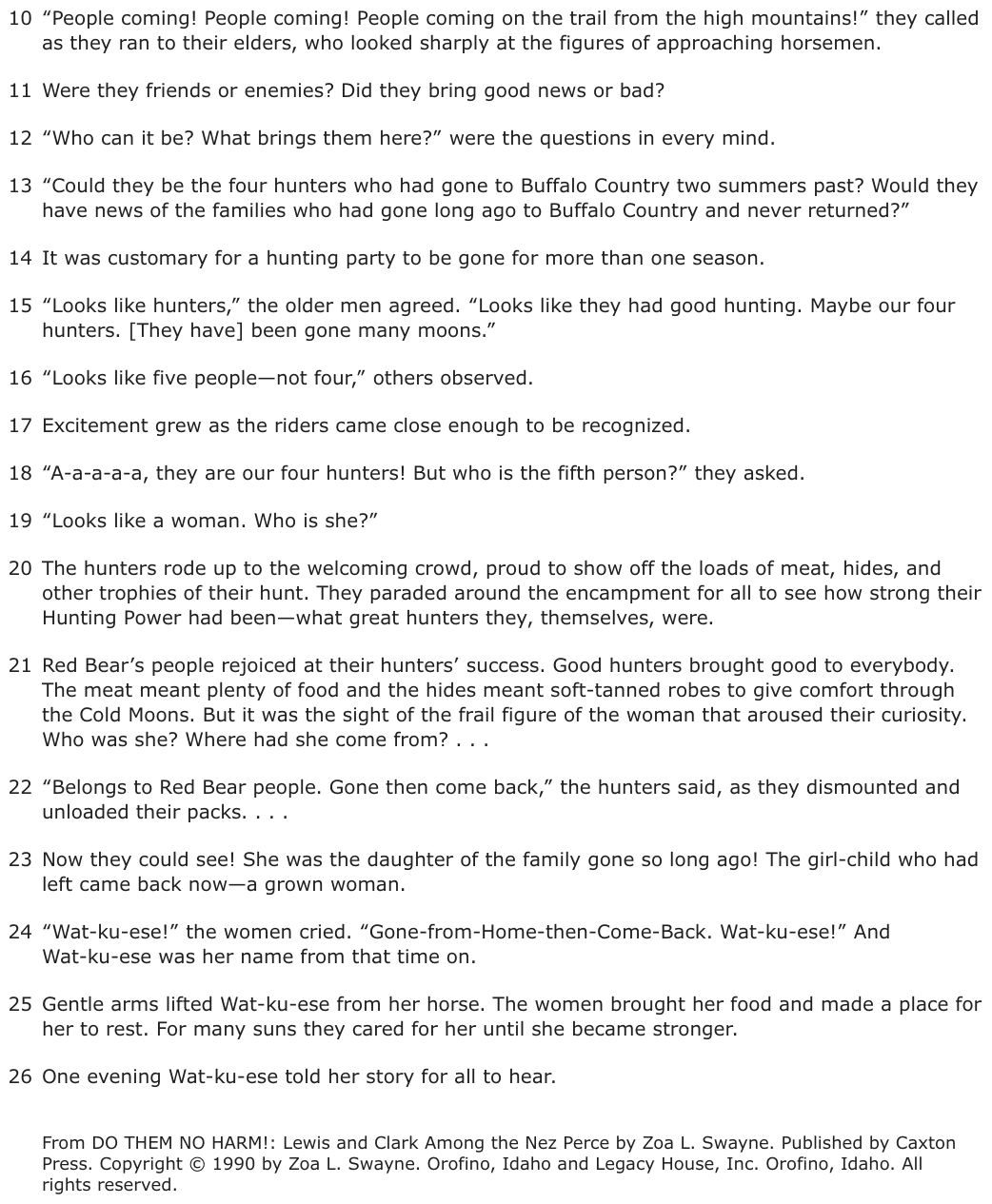
Question 8 of 14
2024 Test B English, question 36Passage Invention of the Telegraph
Samuel Morse, an American inventor, is credited with creating the electronic telegraph, a communication device that allows users to send messages using a system of short and long pulses that represent letters, numbers, and punctuation. In 1843 the United States Congress passed the Telegraph Bill, which provided Morse with the funds to build an electric telegraph system.
Invention of the Telegraph
Earlier Signal Systems
Long before Samuel F. B. Morse electrically transmitted his famous message “What hath God wrought?” from Washington to Baltimore on May 24, 1844, there were signaling systems that enabled people to communicate over distances. Most were visual or “semaphore” systems using flags or lights. In the eighteenth century, such systems used an observer who would decipher a signal from a high tower on a distant hill and then send it on to the next station. The young American republic wanted just such a system along its entire Atlantic coast and offered a prize of $30,000 for a workable proposal. The framers of this legislation had no way of knowing that when they used the word “telegraph” to refer to this visual semaphore system, they would be offered an entirely new and revolutionary means of communication—electricity.
The Growth of an Idea
The idea of using electricity to communicate over distance is said to have occurred to Morse during a conversation aboard ship when he was returning from Europe in 1832. Michael Faraday’s recently invented electromagnet was much discussed by the ship’s passengers, and when Morse came to understand how it worked, he speculated that it might be possible to send a coded message over a wire. While a student at Yale College years before, he had written his parents a letter about how interesting he found the lectures on electricity. Despite what he had learned at Yale, Morse found when he began to develop his idea that he had little real understanding of the nature of electricity, and after sporadic attempts to work with batteries, magnets, and wires, he finally turned for help to a colleague at the University of the City of New York, Leonard D. Gale.
Gale was a professor of chemistry and familiar with the electrical work of Princeton’s Joseph Henry, a true pioneer in the new field. Well before Morse had his shipboard idea about a telegraph, Henry rang a bell at a distance by opening and closing an electric circuit. In 1831, he had published an article, of which Morse was unaware, that contained details suggesting the idea of an electric telegraph. Gale’s help and his knowledge of this article proved crucial to Morse’s telegraph system because Gale not only pointed out flaws in the system but showed Morse how he could regularly boost the strength of a signal and overcome the distance problems he had encountered by using a relay system Henry had invented. Henry’s experiments, Gale’s assistance, and, soon after, hiring the young technician Alfred Vail were keys to Morse’s success.
Obstacles and Opportunities
By December 1837, Morse had enough confidence in his new system to apply for the federal government’s appropriation, and during the next year he conducted demonstrations of his telegraph both in New York and Washington.
However, when the economic disaster known as the Panic of 1837 took hold of the nation and caused a long depression, Morse was forced to wait for better times. It was during this period that Morse visited Europe again and tried not only to secure patent protection overseas but to examine competing telegraph systems in England. . . .
By 1843, the country was beginning to recover economically, and Morse again asked Congress for the $30,000 that would allow him to build a telegraph line from Washington to Baltimore, forty miles away. The House of Representatives eventually passed the bill containing the Morse appropriation, and the Senate approved it in the final hours of that Congress’s last session. With President Tyler’s signature, Morse received the cash he needed and began to carry out plans for an underground telegraph line.
Realizing a Great Invention
Morse had hired the ingenious construction engineer Ezra Cornell to lay the pipe carrying the wire, and although Cornell did his job superbly, one of Morse’s partners, Congressman F. O. J. Smith, had purchased wire with defective insulation. Too much time had been wasted laying bad wire, and with the project on a rigid deadline, something had to be done quickly. Cornell suggested that the fastest and cheapest way of connecting Washington and Baltimore was to string wires overhead on trees and poles. The desperate Morse gave the go-ahead, and the line was completed in time for the dramatic and spectacularly successful link between the Supreme Court chamber of the Capitol building and the railroad station in Baltimore.
Soon, as overhead wires connected cities up and down the Atlantic coast, the dots-and-dashes method that recorded messages on a long moving strip of paper was replaced by the operator’s ability to interpret the code in real time. . . . Telegraph lines soon extended westward, and within Morse’s own lifetime they connected the continents of Europe and America.
“Invention of the Telegraph”—Public Domain/Library of Congress
legislation: Telegraph Bill
dots-and-dashes method: the short and long pulses of Morse code that are sent and received by telegraph operators
The first transatlantic electric telegraph message was sent in 1858, and by 1902 the British All-Red Line connected most of the world.
Source: U.S. Bureau of the Census. Historical Statistics of the United States, Colonial Times to 1970, Bicentennial Edition, Part 2. Washington, D.C., 1975.
Question
Read this sentence from paragraph 7.
The desperate Morse gave the go-ahead, and the line was completed in time for the dramatic and spectacularly successful link between the Supreme Court chamber of the Capitol building and the railroad station in Baltimore.
The words “dramatic” and “spectacularly” in the sentence convey a
- Asense of relief and fulfillment that the line was finished.
- Bsense of wonder and celebration that the telegraph line was accomplished.
- Cfeeling of excitement about the future possibilities of the telegraph.
- Dfeeling of confidence about being able to continue the work.
Show the answer
Correct answer: B
The question asks what the words “dramatic” and “spectacularly” convey in the sentence from paragraph 7.
A. Incorrect. While there may have been some feelings of relief and fulfillment when the lines were finished, the passage instead focuses on the wonder and joy that Morse and Cornell felt after overcoming setbacks and completing the construction of the telegraph system.
B. CORRECT. Morse and Cornell rushed to post the wires overhead, and the “rigid deadline” (paragraph 7) was successfully met. The words have a positive and victorious tone that is consistent with the feeling of wonder that it worked and of celebration that the construction was completed.
C. Incorrect. The passage does not share whether Morse or Cornell considered the future possibilities of the telegraph; it shares only that the finished product was “dramatic,” implying it was amazing to see.
D. Incorrect. While the passage later discusses the expansion of overhead wires “up and down the Atlantic coast” and how they “connected the continents of Europe and America” (paragraph 8), there is no evidence shared in the passage that Morse planned to continue his work with electricity.
Question analysis
Students judge the connotation of two words, “dramatic” and “spectacularly,” in the sentence from “Invention of the Telegraph” that describes the completion of Samuel Morse’s first telegraph link from Washington to Baltimore. Because the same sentence calls Morse “desperate” and says the line was finished just in time, several feelings seem to fit the moment, and the choices name four of them.
- Grade level
- Grade 7 reading and task
- Compared with grade 7
- At grade 7 Judging what two adjectives convey is standard grade 7 word-choice work, and the sentence is printed with the question. The challenge is that all four choices name believable feelings, so students must separate the words’ own connotations from the situation around them.
- Estimated difficulty
- Moderate: several steps, or a close reading with one strong distractor.
- Thinking it demands
- Depth of knowledge 2, skills and concepts · mainly understand
- What makes it hard
- A very close wrong answer moderate
- Reading between the lines moderate
- Every choice must be checked minor
- Evidence
- Answered from one sentence or line
- Reading level
- Passage: about grade 11, 910 words; question and choices: about grade 10, 91 words.
- Students, last 30 days
- Not enough answers yet to show (it takes 10).
Why it is hard, traps and wrong answers (shows the answer)
Why it is hard
The quoted sentence offers two tempting sources for the answer besides the two words the stem names: Morse is “desperate,” and the line is finished “in time.” Students who read the situation rather than the words choose relief, and those who think ahead to paragraph 8’s spreading wires choose excitement about the future. The question rewards asking what “dramatic” and “spectacularly” say about the link itself, an event that impressed and was celebrated.
A very close wrong answer moderate Choosing the answer
The relief choice is built like the key, a pair of feelings about the finished line; only the feelings differ, and “dramatic” and “spectacularly” point to wonder at a public success, not release from worry. (Embretson & Wetzel, 1987; Gorin & Embretson, 2006; Ascalon et al., 2007)
Reading between the lines moderate Working it out
Neither word names an emotion: “dramatic” and “spectacularly” describe the link itself, so the feeling they carry has to be inferred from their sense of an impressive public show. (Graesser, Singer & Trabasso, 1994; Kintsch, 1998)
Every choice must be checked minor Choosing the answer
All four choices name a positive feeling that suits a race against a “rigid deadline,” so tone alone rules none of them out. (Embretson & Wetzel, 1987)
Strategy: Before reading the choices, picture something you would call dramatic and spectacularly successful, and name the feeling those words give it; then find the choice closest to that feeling.
Traps
- Wrong tone or attitude: Misjudges the tone, attitude or point of view, such as reading admiration as criticism, or taking a character's or subject's feelings for the author's.
- Wrong part of the text: A choice is true of another paragraph, stanza or speaker than the one asked about.
The wrong answers, classified
A Wrong tone or attitude (Graesser, Singer & Trabasso, 1994)
Takes what Morse probably felt, relief after a “desperate” scramble to beat the deadline, for what the author’s two words convey, which is admiration for a striking success.
C Wrong part of the text (Kirsch & Mosenthal, 1990)
Brings in paragraph 8, where wires spread along the coast and across the ocean, but this sentence is about the first finished link and says nothing of what might follow.
D Reads too much in (Graesser, Singer & Trabasso, 1994)
Assumes success would leave Morse confident about pressing on, but the sentence never looks past the finished line, and the two words describe the event, not his plans.
Working it out, step by step
Figure out what the question asks
This question is about connotation, the feeling a word carries beyond its dictionary meaning. It names two words, “dramatic” and “spectacularly.” Your job is to name the feeling those two words give the sentence. Other words in the sentence should not decide your answer.
See what is happening in paragraph 7
Just before this sentence, Morse’s team lost time laying wire that turned out to be faulty. The job was also “on a rigid deadline” with no time to spare. Cornell had a quick fix: to “string wires overhead on trees and poles” instead. Morse agreed, and the line was done in time. The sentence describes the moment the first link worked, from the Capitol in Washington to the train station in Baltimore.
Work out what the two words suggest
A dramatic event grabs your attention, the way the high point of a movie does. Spectacularly comes from spectacle, a grand sight that makes people stop and stare. So the author is saying the link was more than finished. It was a thrilling public success. Words like these make a reader marvel at what was done and want to cheer.
Check each choice
- A does not fit. Morse was “desperate,” so he may have felt relief. But that feeling comes from the word “desperate,” not from the two words the question asks about.
- B fits. Wonder matches an amazing sight, and celebration matches a great success.
- C does not fit. This sentence is only about the finished link. Wires spreading to other places come later, in paragraph 8.
- D does not fit. The two words describe the event itself. They tell nothing about Morse’s plans for more work.
Choose the answer
The words “dramatic” and “spectacularly” make the first telegraph link sound like a thrilling show. So the answer is B, a “sense of wonder and celebration that the telegraph line was accomplished.”
Why this answer and not the closest wrong one
A is the closest trap, since it also names two good feelings about the finished line. But relief is the quiet feeling you get when worry ends. The words “dramatic” and “spectacularly” are loud and showy. They make the link sound like something to gasp at and cheer for, and that is wonder and celebration.
More questions like this
The original DOE question
The passage “Invention of the Telegraph” as printed (pages 146–148)
Question 9 of 14
2023 Test B English, question 10Passage Excerpt from “The Food Business Incubator”
Excerpt from “The Food Business Incubator”
by Mandalit Del Barco
“La Cocina” means “the kitchen” in Spanish. It’s also the name of a business incubator1 based in San Francisco’s Mission District. Since it began in 2005, it’s been helping local food entrepreneurs, many of whom are low-income immigrant women, develop their small businesses.
Over the years, many of its alumni have found success: more than 50 chefs in its program have become self-sufficient business owners, and many of them have opened their own brick-and-mortar restaurants. Two alumnae of its culinary program . . . were even recognized as semi-finalists for prestigious James Beard awards.2
A new cookbook, We Are La Cocina: Recipes in Pursuit of the American Dream, tells some of their stories.
Executive director Caleb Zigas says the nonprofit La Cocina grew out of two grassroots economic development organizations3 who found many people cooking at their homes and selling food on the streets. The vendors needed an affordable commercial kitchen space and technical assistance in order for their businesses to be legally viable. La Cocina provided just such a space, in addition to helping them develop business plans, pull city permits and more.
Zigas says as many as eight businesses can work in the kitchen space at La Cocina at any one time. Some can prep for a farmers’ market sale, corporate catering gigs or weddings, while others might be making and packaging their food products.
“It’s just an incredible and exciting range of techniques, flavors, perspectives, age, language. And that’s a really beautiful thing,” he says. . . .
Twice a year, La Cocina hosts “F&B: Voices from the Kitchen,” a storytelling project where their chefs can tell their own stories, as they do in the new cookbook. Some of the chefs will be on tour to promote the book, whose proceeds will go to support La Cocina entrepreneurs.
NPR4 caught up with . . . La Cocina chefs, who shared their stories:
Mariko Grady, Aedan Fermented Foods
At La Cocina, you can often hear Mariko Grady singing or humming as she prepares miso, koji, and amasake. Her fermented products come in four different flavors, including mushroom and chicken, to be used in soups and sauces. She originally brought the fermenting rice and barley koji seeds from Japan, where she had a 30-year career as a singer and dancer with the prestigious modern theatrical dance group she founded, Pappa Tarahumara. They performed around the world, and 16 years ago, had a one-night show in San Francisco. The man who would become her husband was in the audience. She soon joined him in San Francisco, often returning to Tokyo to rehearse. But after the earthquake and tsunami hit Japan in 2011, her company disbanded. . . . Grady focused on nourishing her family and creating a line of fermented products that she sells online, at local Bay Area stores and at the Ferry Plaza Farmers Market. She began at La Cocina in 2012 and named her business after her son, Aedan. (Written in Kanji characters, the name means “wisdom” and “handed down from generation to generation.”) . . . Her fermented products are “also full of wisdom about how to relate to nature and how to create a healthy life,” she says. . . .
Shani Jones, Peaches Patties
Shani Jones is a native San Franciscan. Her father was born in New Orleans, her mother, in Jamaica. She says their home was always filled with a variety of spices and dishes like jerk chicken and Jamaican patties—savory pastries filled with beef or chicken. Jones says she learned to cook from her mother, whose nickname was Peaches. After returning from college in Atlanta, Jones worked on her doctorate in organizational leadership and management while driving a Lyft5 car. She often told passengers about her idea of opening a catering company with her mom’s recipes. They steered her to La Cocina, where she developed her own business, named after her mother. Five years later, she caters and runs a kiosk6 at a small food cooperative in Bernal Heights, where some of her handmade patties have an Ethiopian twist, “because my husband is Ethiopian.” Jones has big aspirations for Peaches Patties: “The ultimate goal,” she says, “is to be the patty kingpin7 of the West Coast.”
From “The Food Business Incubator That Helps Immigrant Women Pursue The American Dream” by Mandalit Del Barco from WEEKEND EDITION SUNDAY, June 19, 2019. Copyright © 2019 NPR.
QUALIFICATIONS FOR LA COCINA APPLICANTS
| Level of Income | La Cocina considers assets and access to opportunity when screening applicants. La Cocina’s mission is to support entrepreneurs who face barriers to becoming successful in the food industry. Applicants must be classified as low- or very-low-income earners according to the Housing and Urban Development (HUD) Guidelines for San Francisco. |
|---|---|
| Business Plan | Applicants must have a business plan that is ready to be put into action. La Cocina will help applicants refine an existing business plan. Applicants without a business plan should contact one of La Cocina’s partner organizations for guidance in developing one. |
| Viable Product | The applicant’s food must not only be delicious but also stand out. For a business to make a profit, there also has to be a market for the food. |
| Entrepreneurial Work Ethic | La Cocina is excited to work with entrepreneurs who are motivated and passionate about growing their business. Succeeding in the food industry requires a lot of heart and hard work. |
| Community Spirit | The 30+ entrepreneurs who share La Cocina’s kitchen are from many different backgrounds. La Cocina values the community it has created and expects each entrepreneur to be active in bringing the spirit of La Cocina to the wider world. In order to succeed in the La Cocina kitchen, accepted applicants must be flexible and willing to work closely with others. |
Source: La Cocina
1business incubator: company that helps new and startup companies develop by providing services such as management training and office space
2James Beard awards: an award named after American cook and author James Beard, considered one of the highest honors in the culinary industry
3economic development organizations: organizations whose mission is to promote economic improvement within a specific geographical area
4NPR: National Public Radio, a nonprofit media organization that produces and distributes news and cultural programming
5Lyft: ride-sharing company where people use their own cars to provide rides to customers
6kiosk: cart or small structure with one or more open sides that is used to vend merchandise or services
7kingpin: the leader in a group or undertaking
Question
Read this sentence from paragraph 2.
Two alumnae of its culinary program . . . were even recognized as semi-finalists for prestigious James Beard awards.
The words “recognized” and “prestigious” in the sentence convey that La Cocina
- Amakes an effort to identify chefs who have a strong entrepreneurial work ethic.
- Bhas the ability to mentor chefs to reach the highest levels of achievement in their craft.
- Cis focused on establishing local food entrepreneurs as celebrated professionals in their industry.
- Dis dedicated to assisting chefs in developing new and innovative products.
Show the answer
Correct answer: B
The question asks what the words “recognized” and “prestigious” convey about La Cocina.
A. Incorrect. While later information indicates that La Cocina bases its choices on the work ethic of entrepreneurs as well as their financial needs, the use of the words “recognized” and “prestigious” in the context of the sentence is not related to the work ethic of the chefs.
B. CORRECT. The fact that alumni of the La Cocina program have received recognition as semi-finalists for prestigious awards shows that La Cocina has helped members of its program achieve at the highest level.
C. Incorrect. As paragraph 1 indicates, La Cocina focuses on helping local food entrepreneurs develop their small businesses. While some participants in the program have earned official recognition, La Cocina is not primarily focused on establishing entrepreneurs as celebrated professionals.
D. Incorrect. La Cocina assists chefs with the development of their small businesses, not necessarily with their development of specific products.
Question analysis
This word-choice question quotes a sentence from paragraph 2 of “The Food Business Incubator,” an NPR article about La Cocina, a San Francisco program for food entrepreneurs: two alumnae of its culinary program were recognized as semi-finalists for prestigious James Beard awards. Students decide what the words “recognized” and “prestigious” convey about La Cocina itself, and several choices sound like fair praise for any cooking program.
- Grade level
- Grade 7 reading and task
- Compared with grade 7
- Above grade 7 Judging the connotation of two words is regular grade 7 work, and the sentence is printed with the question. Here students must then turn the words’ praise of two chefs into a claim about the organization, choosing between close statements, which goes beyond typical demand.
- Estimated difficulty
- Hard: combines ideas, needs a plan, and has more than one tempting wrong answer.
- Thinking it demands
- Depth of knowledge 2, skills and concepts · mainly analyze
- What makes it hard
- Reading between the lines moderate
- A very close wrong answer moderate
- The right answer is reworded minor
- Evidence
- Answered from one paragraph or stanza
- Reading level
- Passage: about grade 10, 1057 words; question and choices: about grade 10, 86 words.
- Students, last 30 days
- Not enough answers yet to show (it takes 10).
Why it is hard, traps and wrong answers (shows the answer)
Why it is hard
The two words are plainly positive, so the challenge is not their tone but what they say about the organization rather than the two chefs. Students must decide whether an honor reached by alumnae shows a capability of La Cocina or a goal it pursues, and the excerpt’s own statement of its focus, helping entrepreneurs develop small businesses, rules out the goal. The other choices attach the words to the table’s work-ethic and product rows, which the sentence never touches.
Reading between the lines moderate Working it out
The sentence praises two alumnae, not La Cocina; students must reason that if former members became semi-finalists for “prestigious” awards, the program that trained them can bring chefs to the top of their field. (Graesser, Singer & Trabasso, 1994; Kintsch, 1998)
A very close wrong answer moderate Choosing the answer
The choice about celebrated professionals and the right one both read the awards as chefs reaching the top; they differ in whether that shows what La Cocina can do or what it is focused on. (Embretson & Wetzel, 1987; Gorin & Embretson, 2006; Ascalon et al., 2007)
The right answer is reworded minor Choosing the answer
The right choice uses words the excerpt never does, “mentor” and “highest levels of achievement,” while wrong ones borrow its own: the table’s “entrepreneurial work ethic,” paragraph 1’s “local food entrepreneurs,” paragraph 5’s “food products.” (Freedle & Kostin, 1993; Kirsch & Mosenthal, 1990)
Strategy: Say what the two words add to the plain fact that two former members reached an awards list, then test each choice against paragraph 1’s account of what La Cocina actually sets out to do.
Traps
- Reads too much in: A reasonable-sounding conclusion that goes further than the text allows.
- Dictionary meaning, not meaning here: A common meaning of the word that does not fit its use in this text.
- Twists what the text says: Uses the text's topic and ideas but changes what it says: who did it, how much, when, or why.
The wrong answers, classified
A Dictionary meaning, not meaning here (Perfetti, 2007)
Reads “recognized” in its everyday sense of “identified” and links it to the table’s work-ethic row, but here it means honored, and the James Beard awards did the honoring.
C Reads too much in (Graesser, Singer & Trabasso, 1994)
Sees the awards as fame and concludes that making chefs celebrated is La Cocina’s aim, but paragraph 1 says its focus is helping entrepreneurs develop their small businesses.
D Twists what the text says (King et al., 2004)
Keeps the idea that La Cocina assists chefs but shifts the help to inventing products, recalling the table’s food that must “stand out,” though the sentence is about honors, not products.
Working it out, step by step
Figure out what the question asks
This question is about word choice. Two words, “recognized” and “prestigious,” add meaning to a sentence. You must decide what they show about La Cocina, the program itself, not just about two of its chefs.
Look at the sentence in paragraph 2
Paragraph 2 says that two alumnae of the program “were even recognized as semi-finalists for prestigious James Beard awards.” Alumnae are women who once took part in a program. Here, recognized means honored. Prestigious means highly respected. Footnote 2 says these awards are “considered one of the highest honors in the culinary industry.” Culinary means having to do with cooking.
Work out what the words show
Two women trained by La Cocina came close to one of the top prizes in cooking. That says something about the program that taught them. It can bring its chefs near the very top of their field. The small word “even” adds pride. It tells you this honor is something special.
Check each choice
- A is wrong. Here “recognized” does not mean picked out by La Cocina. The award judges did the honoring. Work ethic never comes up.
- B is right. To mentor means to guide and teach. A craft is a skill, like cooking. The honors show La Cocina can guide chefs to great heights in their craft.
- C is wrong. Fame is not what La Cocina aims for. Paragraph 1 says it helps cooks “develop their small businesses.”
- D is wrong. The sentence is about honors for chefs. It says nothing about inventing new products.
Watch out: C is tempting, since awards do make chefs celebrated, or famous. But C claims fame is La Cocina’s focus, and the excerpt never says so.
Choose the answer
The two words show that La Cocina can help the chefs it trains rise near the top of their craft. So the answer is B.
Why this answer and not the closest wrong one
C comes nearest to being right. It reads the honor as La Cocina’s main goal. B reads it as proof of what La Cocina can do. Paragraph 1 names the real goal, building small businesses. So the award shows a strength of the program, not its purpose.
More questions like this
The original DOE question
The passage “Excerpt from “The Food Business Incubator”” as printed (pages 158–160)

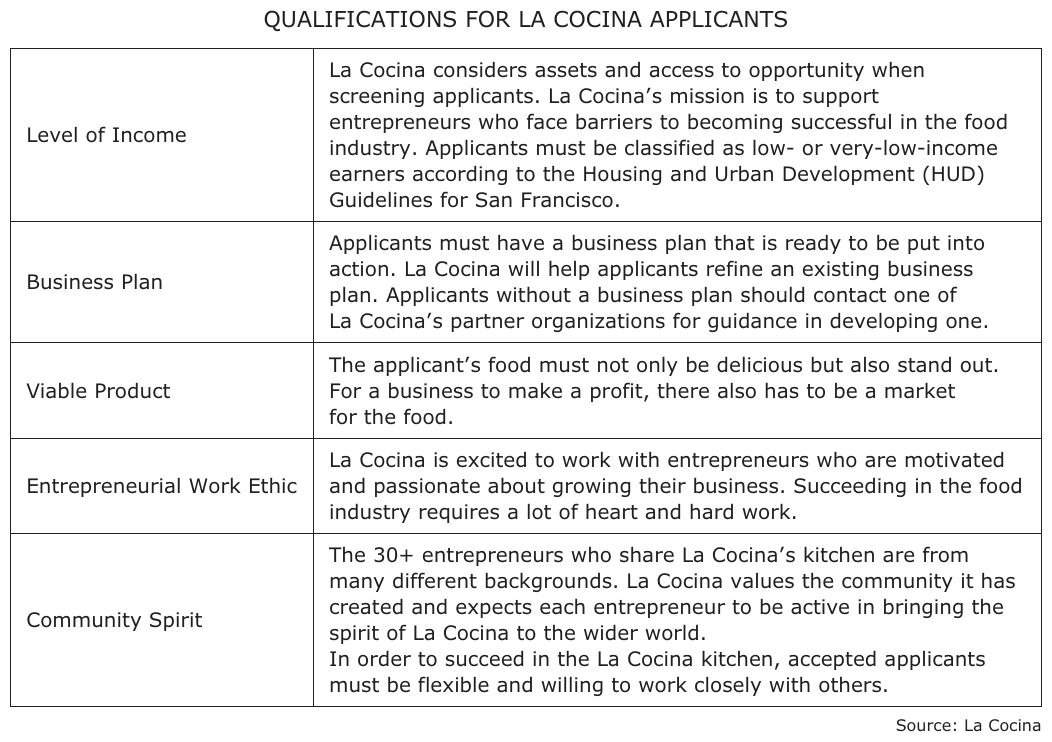
Question 10 of 14
2022 Test B English, question 11Passage Excerpt from “The World Has an E-Waste Problem”
Excerpt from “The World Has an E-Waste Problem”
by Alana Semuels
As a tech-hungry nation . . . gets ready to upgrade to the next generation of lightning-fast 5G devices, there is a surprising environmental cost to be reckoned with: a fresh mountain of obsolete1 gadgets. About 6 million pounds of discarded electronics are already processed monthly at recycling giant ERI’s Fresno plant. Pallets2 of once beloved but now outdated devices . . . arrive here daily. Workers with hammers hack at the bulkiest devices, while others remove dangerous components like lithium-ion batteries. The scene is like a twisted . . . movie, with doomed gadgets riding an unrelenting conveyor belt into a machine that shreds them into piles of copper, aluminum and steel.
“In our society, we always have to have the new, best product,” said Aaron Blum, the co-founder and chief operating officer of ERI, on a tour of the facility. Americans spent $71 billion on telephone and communication equipment in 2017, nearly five times what they spent in 2010 even when adjusted for inflation, according to the Bureau of Economic Analysis. . . . When we buy something new, we get rid of what’s old. That cycle of consumption has made electronics waste the world’s fastest-growing solid-waste stream.
That stream is expected to turn into a torrent3 as the world upgrades to 5G, the next big step in wireless technology. 5G promises faster speeds and other benefits. But experts say it will also result in a dramatic increase in e-waste, as millions of smartphones, modems and other gadgets incompatible with 5G networks are made obsolete. “I don’t think people understand the magnitude of the transition,” says ERI co-founder and executive chairman John Shegerian. “This is bigger than the change of black-and-white to color, bigger than analog to digital, by many multitudes.”
. . . Less than a quarter of all U.S. electronic waste is recycled, according to a United Nations estimate. The rest is incinerated or ends up in landfills. That’s bad news, as e-waste can contain harmful materials like mercury and beryllium that pose environmental risks.
Part of the problem is regulatory. Only 19 states have laws banning electronics from the regular trash. In states without such rules, like Nevada, electronics often end up in garbage and recycling bins, said Jeremy Walters, a community-relations manager for waste collector Republic Services. Environmental concerns aside, compacting flammable lithium-ion batteries with paper recycling can be dangerous; recycling centers have reported an uptick in fires.
Even when e-waste rules exist, it’s left up to consumers to handle their old devices properly. But recycling them can be a pain. Rather than just drop a used phone in a bin outside their homes, lots of people have to take their electronics to a store, which may pay them for it but could also charge them to get rid of it. Many consumers, paralyzed by the hassle or put off by the expense, simply throw their devices into the trash or stash them in a drawer, hoping they’ll just disappear. “We don’t necessarily have the measures to make sure people aren’t throwing it away,” Walters said.
One solution is to make electronics last as long as they once did. At ERI’s facility, Shegerian showed TIME [magazine] dozens of televisions from the 1970s and 1980s that stopped working only recently. Yet instead, technology companies are speeding the pace of obsolescence. Most smartphone batteries can’t be easily replaced when they stop holding a charge, new laptops don’t accept old cables, and software companies push upgrades that won’t run on old devices. “Our products today don’t last as long as they used to, and it’s a strategy by manufacturers to force us into shorter and shorter upgrade cycles,” said Kyle Wiens, the founder of iFixit, which publishes do-it-yourself repair guides. . . .
Some environmental groups say multibillion-dollar companies . . . should pick up the cost of recycling the devices they sell. Lawmakers in parts of Europe and Canada and in some U.S. states have passed so-called Extended Producer Responsibility (EPR) laws, which require manufacturers to establish and fund systems to recycle or collect obsolete products. . . .
. . . Some companies are increasing their recycling efforts on their own, whether for the economic benefit or the public relations boost.
From “The World Has an E-Waste Problem” by Alana Semuels from TIME Magazine, June 3, 2019. Copyright © 2019 TIME USA, LLC.
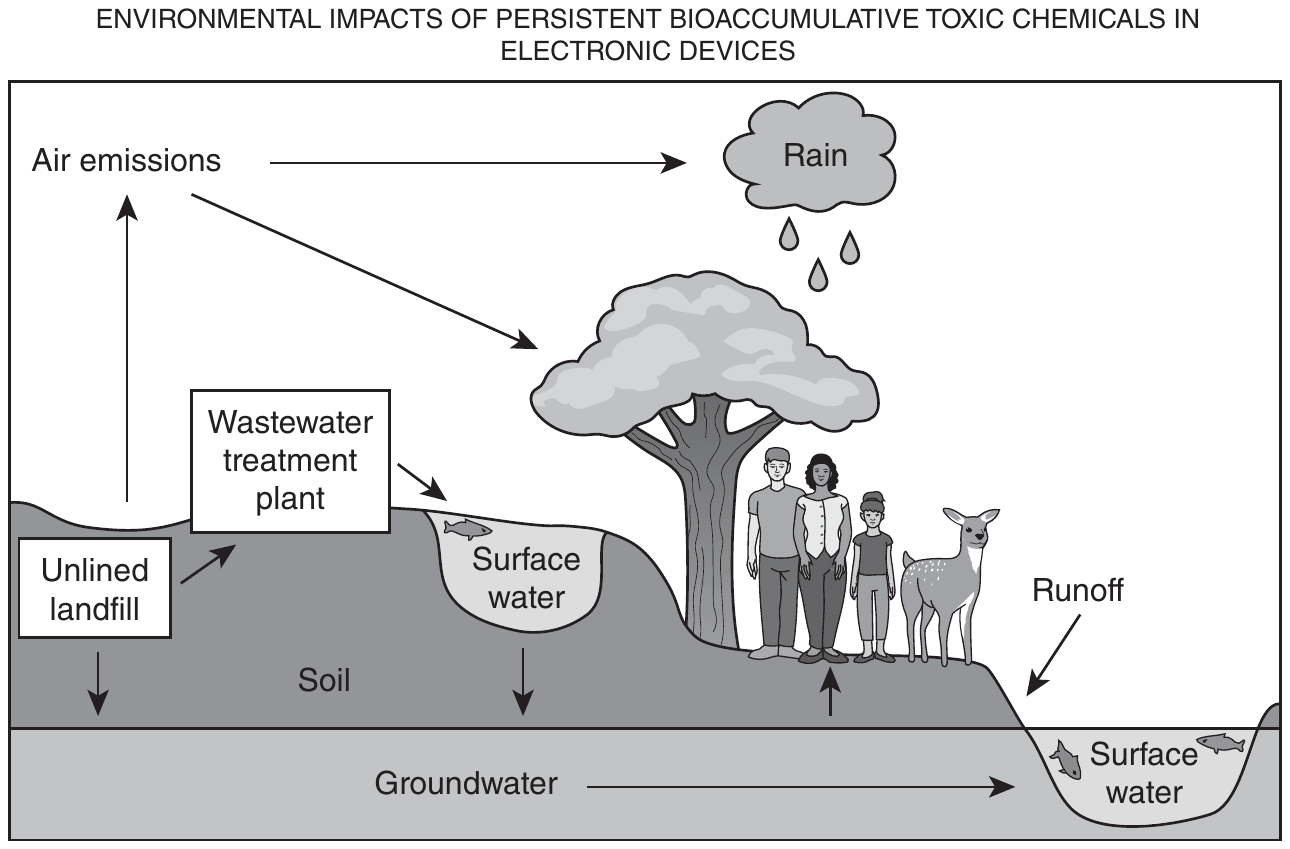
Electronics such as smartphones, computers, cameras, and large appliances contain toxins like lead, chromium, zinc, nickel, mercury, beryllium, and cadmium. These substances are bioaccumulative, which means that they accumulate over time in living organisms.
1obsolete: outdated and no longer useful
2Pallets: wooden platforms used to store or transport materials in a warehouse
3torrent: an outpouring
Question
Read this sentence from paragraph 1.
The scene is like a twisted . . . movie, with doomed gadgets riding an unrelenting conveyor belt into a machine that shreds them into piles of copper, aluminum and steel.
The words “twisted,” “doomed,” and “unrelenting” most affect the sentence by
- Aemphasizing that discarded devices are condemned to an unfortunate fate.
- Bexpressing a sense of desperation about the amount of waste from discarded devices.
- Cimplying that discarded devices are often disposed of in an inappropriate manner.
- Dsuggesting a feeling of doubt about solving the problem of discarded devices.
Show the answer
Correct answer: A
The question asks about the effect of the words “twisted,” “doomed,” and “unrelenting” on the last sentence of paragraph 1.
A. CORRECT. Paragraph 1 first describes the problem of discarded devices in terms of the scope of the problem (“about 6 million pounds . . . processed monthly”). The author then elaborates on the problem with a vivid description of the actual process; it is unfortunate that this process is necessary because, even though they are relatively new, these devices are no longer useful. These particular words emphasize the process of a once-useful device becoming a part of a “twisted . . . movie,” and “doomed” to be recycled by going through an “unrelenting” or never-ending conveyor belt.
B. Incorrect. In the excerpt, the author does express concern about the amount of waste from discarded devices, but this particular sentence is about what happens to the devices and the perspective that one has while watching the devices as they are being processed. In this description, the once-beloved devices have been destroyed, with only some useful parts being retained.
C. Incorrect. Although there is an indication in paragraphs 4–6 that some obsolete devices are disposed of inappropriately, this description is of an appropriate disposal—a recycling center developed specifically for these types of devices.
D. Incorrect. At this juncture in the excerpt, the author has not yet mentioned solving the problem of discarded devices; rather, the author is describing what happens to discarded devices that are appropriately recycled.
Question analysis
This word-choice question quotes the last sentence of the opening paragraph of “The World Has an E-Waste Problem,” in which old gadgets ride a conveyor belt into a shredder at a recycling plant. Students decide how the words “twisted,” “doomed” and “unrelenting” most affect the sentence. Each choice reads something negative into the words, so their connotations have to be matched to what this sentence describes.
- Grade level
- Grade 7 reading and task
- Compared with grade 7
- At grade 7 Explaining how word choices shape a sentence’s meaning and tone is everyday grade 7 work. The three words are quoted and sit in one sentence, though it comes from adult magazine prose and its comparison has a word cut by an ellipsis.
- Estimated difficulty
- Straightforward: two steps or one careful reading.
- Thinking it demands
- Depth of knowledge 2, skills and concepts · mainly analyze
- What makes it hard
- Figurative or literary language moderate
- Hard words minor
- Evidence
- Answered from one sentence or line
- Reading level
- Passage: about grade 10, 760 words; question and choices: about grade 8, 91 words.
- Students, last 30 days
- Not enough answers yet to show (it takes 10).
Why it is hard, traps and wrong answers (shows the answer)
Why it is hard
The three words share one job: they cast once-loved gadgets as victims on a one-way ride to the shredder. Each wrong choice keeps the gloom but points it somewhere else, at the amount of waste, at improper dumping, or at the chances of fixing the problem. Students who ask what the words describe in this one sentence, rather than what the article worries about overall, settle on the gadgets’ fate quickly.
Figurative or literary language moderate Understanding the question
The sentence likens the plant to “a twisted . . . movie,” with a word cut by the ellipsis, and the effect lives in connotation: “doomed” and “unrelenting” turn gadgets on a conveyor belt into victims bound for a shredder. (Graesser, Singer & Trabasso, 1994; Kintsch, 1998)
Hard words minor Understanding the question
“Unrelenting” has to be known as never letting up, and the right choice restates “doomed” as “condemned to an unfortunate fate,” so the match is one of meaning, not of sound. (Perfetti, 2007; Freedle & Kostin, 1993)
Strategy: Ask what the three words describe in this one sentence and what feeling they share, then check each choice against the sentence itself rather than against the article as a whole.
Traps
- Wrong tone or attitude: Misjudges the tone, attitude or point of view, such as reading admiration as criticism, or taking a character's or subject's feelings for the author's.
- Wrong part of the text: A choice is true of another paragraph, stanza or speaker than the one asked about.
- Reads too much in: A reasonable-sounding conclusion that goes further than the text allows.
The wrong answers, classified
B Wrong tone or attitude (Graesser, Singer & Trabasso, 1994)
Hears despair in the grim words and ties “unrelenting” to the six million pounds a month, but the sentence follows the gadgets’ fate on the belt and voices no desperation about volume.
C Wrong part of the text (Kirsch & Mosenthal, 1990)
Takes “twisted” as a sign of wrongdoing and recalls the trash and landfills of paragraphs 4–6, though this scene is a recycling plant, the proper place for old devices.
D Reads too much in (Graesser, Singer & Trabasso, 1994)
Hears hopelessness in “doomed” and stretches it to the whole e-waste problem, though the sentence never turns to solutions, which the excerpt reaches only in paragraph 7.
Working it out, step by step
Find what the question asks
This is a word-choice question. Three words in one sentence work as a team: “twisted,” “doomed” and “unrelenting.” You need to find the feeling they create and what they describe. Stay inside this one sentence, not the whole article.
Read the last sentence of paragraph 1
Paragraph 1 ends: “The scene is like a twisted . . . movie, with doomed gadgets riding an unrelenting conveyor belt into a machine that shreds them into piles of copper, aluminum and steel.” The dots (. . .) mean some words were left out. A conveyor belt is a moving belt that carries things along, like the one at a grocery checkout. The “scene” is the recycling plant.
Work out each word
Each word adds something dark.
- Twisted means strange in a creepy way. A twisted movie is a dark one.
- Doomed means sure to meet a bad end, with no escape.
- Unrelenting means it never stops or slows down.
Put together, the gadgets sound like movie characters on a one-way ride. The belt keeps moving, and the shredder waits at the end.
Test the four choices
- A fits. “Condemned to an unfortunate fate” means sentenced to a bad ending. That is just what “doomed” says.
- B does not fit. The amount of waste, 6 million pounds a month, comes earlier. This sentence follows the gadgets, and no one sounds desperate.
- C does not fit. This is a recycling plant, the right place for old devices. Trash and landfills come later, in paragraphs 4–6.
- D does not fit. The sentence says nothing about fixing the problem. Solutions first come up in paragraph 7.
Pick the answer
Watch out: B is tempting because the words sound gloomy, and the plant handles a lot of waste. But gloom is not desperation, which means feeling out of hope. These words make you feel sorry for the gadgets themselves. So the answer is A.
Why this answer and not the closest wrong one
B is the closest wrong choice. The paragraph does show a huge pile of waste. But “doomed” and “unrelenting” point at what happens to each gadget: it rides the belt to the shredder and can’t get off. That is a sad fate, which is A, not a worry about how much waste there is.
More questions like this
The original DOE question
The passage “Excerpt from “The World Has an E-Waste Problem”” as printed (pages 164–166)
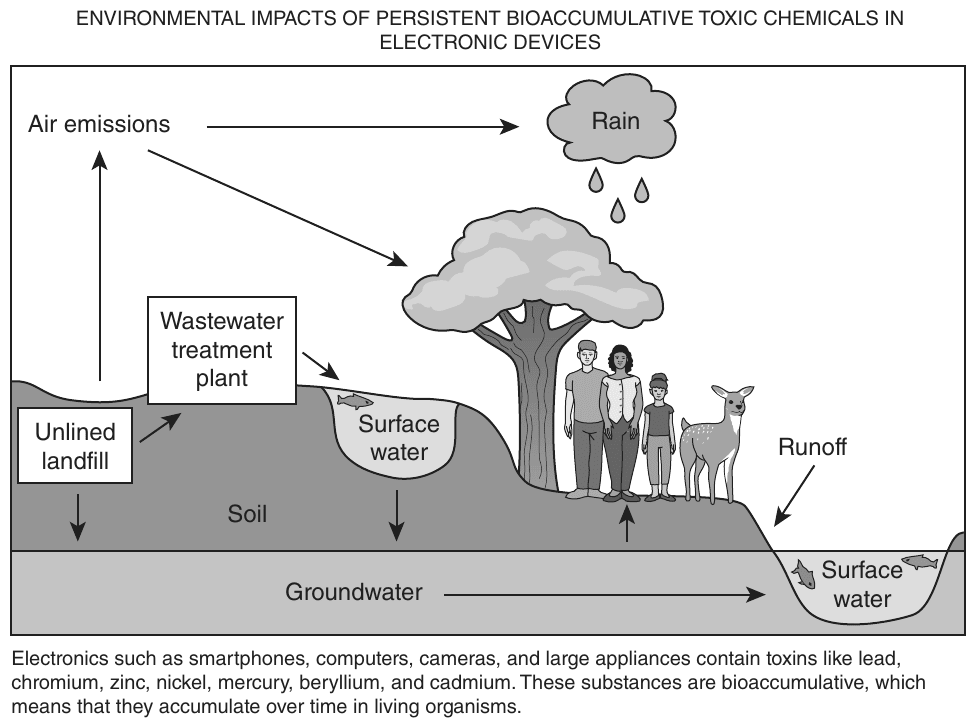
Question 11 of 14
2018 Test A English, question 28Passage Excerpt from A Tramp Abroad
Excerpt from A Tramp Abroad
by Mark Twain
Now and then, while we rested, we watched the laborious ant at his work. I found nothing new in him—certainly nothing to change my opinion of him. It seems to me that in the matter of intellect the ant must be a strangely overrated bird. During many summers now I have watched him, when I ought to have been in better business, and I have not yet come across a living ant that seemed to have any more sense than a dead one. I refer to the ordinary ant, of course; I have had no experience of those wonderful Swiss and African ones which vote, keep drilled armies, . . . and dispute about religion. Those particular ants may be all that the naturalist paints them, but I am persuaded that the average ant is a sham.
I admit his industry, of course; he is the hardest working creature in the world—when anybody is looking—but his leather-headedness is the point I make against him. He goes out foraging, he makes a capture, and then what does he do? Go home? No; he goes anywhere but home. He doesn’t know where home is. His home may be only three feet away; no matter, he can’t find it. He makes his capture, as I have said; it is generally something which can be of no sort of use to himself or anybody else; it is usually seven times bigger than it ought to be; he hunts out the awkwardest place to take hold of it; he lifts it bodily up in the air by main force, and starts—not toward home, but in the opposite direction; not calmly and wisely, but with a frantic haste which is wasteful of his strength; he fetches up against a pebble, and, instead of going around it, he climbs over it backwards, dragging his booty after him, tumbles down on the other side, jumps up in a passion, kicks the dust off his clothes, moistens his hands, grabs his property viciously, yanks it this way, then that, shoves it ahead of him a moment, turns tail and lugs it after him another moment, gets madder and madder, then presently hoists it into the air and goes tearing away in an entirely new direction; comes to a weed; it never occurs to him to go around it. No; he must climb it, and he does climb it, dragging his worthless property to the top—which is as bright a thing to do as it would be for me to carry a sack of flour from Heidelberg to Paris by way of Strasburg steeple; when he gets up there he finds that that is not the place; takes a cursory glance at the scenery, and either climbs down again or tumbles down, and starts off once more—as usual, in a new direction. At the end of half an hour he fetches up within six inches of the place he started from, and lays his burden down. Meantime, he has been over all the ground for two yards around, and climbed all the weeds and pebbles he came across. Now he wipes the sweat from his brow, strokes his limbs, and then marches aimlessly off, in as violent a hurry as ever. He traverses a good deal of zig-zag country, and by and by stumbles on his same booty again. He does not remember to have ever seen it before; he looks around to see which is not the way home, grabs his bundle, and starts. He goes through the same adventures he had before; finally stops to rest, and a friend comes along.
Evidently the friend remarks that a last year’s grasshopper leg is a very noble acquisition, and inquires where he got it. Evidently the proprietor does not remember exactly where he did get it, but thinks he got it “around here somewhere.” Evidently the friend contracts to help him freight it home. Then, with a judgment peculiarly antic (pun not intentional), they take hold of opposite ends of that grasshopper leg and begin to tug with all their might in opposite directions. Presently they take a rest, and confer together. They decide that something is wrong, they can’t make out what. Then they go at it again, just as before. Same result. Mutual recriminations follow. Evidently each accuses the other of being an obstructionist. They warm up, and the dispute ends in a fight. They lock themselves together and chew each other’s jaws for a while; then they roll and tumble on the ground till one loses a horn or a leg and has to haul off for repairs. They make up and go to work again in the same old insane way, but the crippled ant is at a disadvantage; tug as he may, the other one drags off the booty and him at the end of it. Instead of giving up, he hangs on, and gets his shins bruised against every obstruction that comes in the way. By and by, when that grasshopper leg has been dragged all over the same old ground once more, it is finally dumped at about the spot where it originally lay. The two perspiring ants inspect it thoughtfully and decide that dried grasshopper legs are a poor sort of property after all, and then each starts off in a different direction to see if he can’t find an old nail or something else that is heavy enough to afford entertainment and at the same time valueless enough to make an ant want to own it. . . .
Science has recently discovered that the ant does not lay up anything for winter use. . . . He does not work, except when people are looking, and only then when the observer has a green, naturalistic look, and seems to be taking notes. This amounts to deception, and will injure him for the Sunday schools. He has not judgment enough to know what is good to eat from what isn’t. This amounts to ignorance, and will impair the world’s respect for him. . . . He cannot stroll around a stump and find his way home again. This amounts to idiocy, and once the damaging fact is established, thoughtful people will cease to look up to him. It is strange beyond comprehension that so manifest a humbug as the ant has been able to fool so many nations and keep it up so many ages without being found out.
we: the author and his fictional travel companion
From A TRAMP ABROAD by Mark Twain—Public Domain
Question
In paragraph 2, how do the words “grabs,” “yanks,” and “tearing away” contribute to the meaning of the excerpt?
- AThey highlight the ant’s belief that his work is important.
- BThey illustrate that the ant is more efficient working on his own.
- CThey indicate the speed with which the ant completes his tasks.
- DThey emphasize the ant’s anxious efforts to be productive.
Show the answer
Correct answer: D
The answer is (D)
The question asks for an explanation of how the words “grabs,” “yanks,” and “tearing away” (paragraph 2) contribute to the meaning of the excerpt.
Option D is correct because these words convey sudden movements as the ant becomes more upset in his efforts to transport the grasshopper leg.
Option A is incorrect because the ant is never described in the excerpt as believing his work to be important.
Option B is incorrect because the ant’s inability to make progress while transporting the grasshopper leg by himself demonstrates the ant’s inefficiency (paragraph 2: “At the end of half an hour he fetches up within six inches of the place he started from”).
Option C is incorrect because the ant does not complete his tasks despite moving in a hurried and determined way (paragraph 2: “not calmly and wisely, but with a frantic haste which is wasteful of his strength”).
Question analysis
This word-choice question asks how three action words from Mark Twain's ant story, “grabs,” “yanks” and “tearing away,” add to the excerpt's meaning. The verbs are buried in one very long sentence that lists dozens of actions, so students must find them and decide what their connotations add to the picture of the ant.
- Grade level
- Grade 7 reading and task
- Compared with grade 7
- At grade 7 Grade 7 word-choice items usually ask about one word in a short passage. This one asks for the shared effect of three verbs scattered through a very long sentence, though their tone is fairly clear once found, which keeps it at grade 7.
- Estimated difficulty
- Moderate: several steps, or a close reading with one strong distractor.
- Thinking it demands
- Depth of knowledge 2, skills and concepts · mainly analyze
- What makes it hard
- Complex sentences moderate
- Figurative or literary language moderate
- A very close wrong answer minor
- Evidence
- Answered from one paragraph or stanza
- Reading level
- Passage: about grade 9, 1099 words; question and choices: about grade 6, 60 words.
- Corrected from the DOE handbook
- A wrong option letter in the explanation was corrected.
- A missing comma in the explanation was restored.
- Students, last 30 days
- Not enough answers yet to show (it takes 10).
Why it is hard, traps and wrong answers (shows the answer)
Why it is hard
The verbs themselves are easy words; the difficulty is deciding what they add. Their speed is obvious, which is why the choice about how fast the ant finishes his tasks catches readers who stop at speed and miss that nothing gets finished. The key reads the verbs together with “in a passion” and “madder and madder” around them, so it rewards looking at the words' surroundings rather than the words alone.
Complex sentences moderate Understanding the question
All three verbs are buried in one 183-word sentence of paragraph 2, strung through semicolons among about twenty other actions, so students must find them before judging them. (Abedi & Lord, 2001; Freedle & Kostin, 1993; Messick, 1989)
Figurative or literary language moderate Understanding the question
The verbs' force reads as a comic tantrum, “grabs his property viciously” soon after he “jumps up in a passion,” so their connotation of agitation, not skill, carries the meaning. (Graesser, Singer & Trabasso, 1994; Kintsch, 1998)
A very close wrong answer minor Choosing the answer
A and D both tie the verbs to the ant caring about his work; they differ in one part, since the verbs show his anxious efforts, as D says, but never reveal a belief, as A claims. (Embretson & Wetzel, 1987; Gorin & Embretson, 2006; Ascalon et al., 2007)
Strategy: Locate the three verbs in paragraph 2, read the clauses around each one, and describe their effect in your own words before looking at the choices.
Traps
- Twists what the text says: Uses the text's topic and ideas but changes what it says: who did it, how much, when, or why.
- Reads too much in: A reasonable-sounding conclusion that goes further than the text allows.
The wrong answers, classified
A Reads too much in (Graesser, Singer & Trabasso, 1994)
Reads the ant's vigor as proof that he thinks his work important, a belief the excerpt never gives him; the verbs show agitation, not conviction.
B Wrong tone or attitude (Graesser, Singer & Trabasso, 1994)
Hears the forceful verbs as signs of a capable worker and contrasts him with the bickering pair, though alone he ends six inches from where he began.
C Twists what the text says (King et al., 2004)
Rightly senses speed in “tearing away,” but the ant completes nothing; Twain calls it “a frantic haste which is wasteful of his strength.”
What was corrected from the DOE handbook, and why
- Explanation: The handbook’s last reason begins “Option H is incorrect because the ant does not complete his tasks despite moving in a hurried and determined way”, but H is its correct answer. The reason is about G, “They indicate the speed with which the ant completes his tasks,” so this site reads Option C (G relettered). This was already corrected on the site before this review.
- Explanation: The handbook quotes the words as “grabs” “yanks,” and “tearing away”. The comma after “grabs” is restored, as in the question.
Working it out, step by step
Figure out what the question asks
This is a word-choice question. It asks what three action words add to the excerpt. Think about how the words feel, not just what they mean.
Find the words in paragraph 2
All three words are in the very long sentence in paragraph 2. Look at the words around them. The ant “jumps up in a passion,” then “grabs his property viciously, yanks it this way, then that.” Soon he “gets madder and madder” and goes “tearing away in an entirely new direction.”
Work out what the words show
“In a passion” means in a fit of anger. “Viciously” means fiercely. So the words show a worked-up, frantic ant. He moves fast and rough, like a kid having a tantrum. He badly wants to get his job done.
But Twain also says the ant moves “with a frantic haste which is wasteful of his strength.” All that rushing gets him nowhere.
Check each choice
- A The excerpt never tells us what the ant believes about his work. The words show he is upset, not what he thinks.
- B Working alone, he ends up six inches from where he started. That is not efficient (getting a lot done without waste).
- C The words do show speed. But the ant never finishes anything.
- D fits. The words show anxious, frantic effort to get the job done.
Choose the answer
The rough, fast verbs show an upset ant trying hard to be productive. So the answer is D.
Why this answer and not the closest wrong one
C is the closest trap, because “tearing away” does sound fast. But C says the ant completes his tasks, and he never does. D keeps the speed and the worry but does not claim success. That is why D fits better.
More questions like this
The original DOE question

The passage “Excerpt from A Tramp Abroad” as printed (pages 62–63)
Question 12 of 14
2018 Test A English, question 45Passage Cross-Purposes
Cross-Purposes
What I am is built: concrete and steel.
I defy gravity. I am what every athlete
wants: to remain at the apex of the leap,
up in the air. And yet I am useful, too:
cars, trucks, people, even trains
make their way across my broad back.
Swallows and ospreys nest in my trusses.
What I am is motion. I am water, and I am older
than anything else you know. No human
built me. I am gravity’s best friend; I pool
and flow wherever gravity takes me.
I am the blood flowing in the runner’s chest,
and I catch everything: from the hills,
the mountains. It all washes down through me.
What you are is an accident,
what happens to rain when rain gives in
to Earth’s gravitational pull.
You are some tears dribbling from a mountain’s
eye, running down the pavements
of small towns, into the cities, to the sea.
You are the path of least resistance.
What I am is power. You, of course,
have none: you are a static lump, an artifact
slowly decaying. But my regal flow
nourishes grasses, permits empires to rise.
Those who made you will break you,
in time, replacing you with yet another
clumsy structure. I have seen. I know.
“Clumsy”? Being rebuilt makes me
a friend of time, does it not? And it means
that I have siblings—those “clumsy” structures,
my sisters and brothers.
We stitch across the rip you make.
We are steel thread to the human needle.
We bind you up. We sew you.
And I sow into you; in every cranny
of your superstructure my vapors cling.
They bring out your softness, your rust.
Boast your best, and boast better yet.
I am listening to the bright hum
of the wind in your wires. Because I am,
above all else, patient. I will wait for you.
ospreys: large birds
Question
Read lines 18–20 from the poem.
You are some tears dribbling from a mountain’s
eye, running down the pavements
of small towns, into the cities, to the sea.
What impact do the phrases “some tears dribbling” and “running down” have on the meaning of the poem?
- AThey suggest that naturally flowing water is a problem in populated areas.
- BThey highlight the different types of naturally flowing water.
- CThey imply that the flow of water is weak and influenced by the landscape.
- DThey highlight that the flow of water from the mountains is minimal compared with that of the seas.
Show the answer
Correct answer: C
The answer is (C)
The question asks for the impact that the phrases have on the meaning of the poem. The phrases “some tears dribbling” and “running down” (lines 18–19) imply weakness in form and being influenced by the landscape, making Option C correct.
Option A is incorrect because, while the lines do describe the water in populated areas, they do not describe the water as a problem for the people living there.
Option B is incorrect because the lines do more than bring attention to different types of water; the lines make a judgment about the strength and importance of the water.
Option D is incorrect because a comparison is not made based on the volume of water streaming from the mountains and the volume of water in the seas.
Question analysis
In this question about figurative language in “Cross-Purposes,” students explain the impact of the phrases “some tears dribbling” and “running down,” used to describe the water. They must first work out which of the poem's two speakers is talking, then judge the connotations of the words rather than only the picture they paint.
- Grade level
- Grade 7 reading and task
- Compared with grade 7
- At grade 7 Judging the connotation of a few words is standard grade 7 work. The two-voice format adds one step, since the speakers are never named, but the lines are quoted and short, so the demand stays typical.
- Estimated difficulty
- Moderate: several steps, or a close reading with one strong distractor.
- Thinking it demands
- Depth of knowledge 2, skills and concepts · mainly analyze
- What makes it hard
- Figurative or literary language moderate
- A very close wrong answer moderate
- Reading between the lines minor
- Evidence
- Answered from one paragraph or stanza
- Reading level
- Passage: 316 words (a poem; reading level not measured); question and choices: about grade 6, 98 words.
- Students, last 30 days
- Not enough answers yet to show (it takes 10).
Why it is hard, traps and wrong answers (shows the answer)
Why it is hard
The lines can be read as a simple picture of water running from mountains to the sea, and that reading leads to choices about kinds of water, flooding or volume. The phrases matter for what they say about the water's strength: it dribbles, it runs downhill, it goes where the land sends it. Students who ask how the speaker feels about the water, and remember the stanza's “path of least resistance,” arrive at the key.
Figurative or literary language moderate Understanding the question
“Some tears dribbling from a mountain's eye” turns a river into a weak trickle of tears, so the judgment lies in the connotation of “some” and “dribbling,” not in the picture. (Graesser, Singer & Trabasso, 1994; Kintsch, 1998)
A very close wrong answer moderate Choosing the answer
C and D both say the water's flow is weak, D's “minimal” matching “dribbling”; they differ in the second part, where D adds a comparison with the seas that the lines never make. (Embretson & Wetzel, 1987; Gorin & Embretson, 2006; Ascalon et al., 2007)
Reading between the lines minor Working it out
The stanza is unlabeled, so students must work out from its roman type and its “you” that the structure is speaking and belittling the water. (Graesser, Singer & Trabasso, 1994; Kintsch, 1998)
Strategy: Compare “dribbling” with a neutral word such as “flowing,” and ask what the difference suggests about how this stanza's speaker regards the water.
Traps
- Reads too much in: A reasonable-sounding conclusion that goes further than the text allows.
- Taking figurative language literally: A choice reads a figure of speech or image at face value.
The wrong answers, classified
A Taking figurative language literally (Graesser, Singer & Trabasso, 1994)
Reads water “running down the pavements” of towns and cities as literal flooding, a problem for people, though the speaker is belittling the water, not warning of harm.
B Wrong purpose or structure (Anderson & Krathwohl, 2001)
Lists what the lines show, tears, streets and sea, as kinds of water, describing the content instead of the judgment the phrases make.
D Reads too much in (Graesser, Singer & Trabasso, 1994)
Catches the weakness in “dribbling,” but the lines never set the mountain trickle against the sea's volume; the sea is simply where the water ends up.
Working it out, step by step
Figure out what the question asks
This is a word-choice question. It asks what two phrases suggest about the water. Notice how the words make the water seem.
Work out who is speaking
Lines 15–21 are spoken by the structure. It talks to the water as “you.” It starts: “What you are is an accident.” It ends: “You are the path of least resistance.” The path of least resistance is the easiest way, the one that takes no effort.
Look closely at the phrases
Lines 18–19 say the water is “some tears dribbling from a mountain’s eye, running down the pavements.”
To dribble is to drip a little at a time. “Some tears” sounds small and weak. “Running down” means the water just goes downhill, wherever the land sends it. So the structure is putting the water down. It calls the water weak and pushed around by the land.
Check each choice
- A The lines mention towns, but they never call the water a problem for people.
- B The lines do more than list kinds of water. They judge the water.
- C fits. The water is weak and goes where the landscape sends it.
- D The lines never compare how much water is in mountains and in seas.
Choose the answer
The phrases make the water seem weak and controlled by the land. So the answer is C.
Why this answer and not the closest wrong one
D is the closest trap, since “dribbling” does sound small, like “minimal.” But D adds a comparison with the seas. The sea is just where the water ends up. C keeps the weakness and adds the land, which matches “running down” and “the path of least resistance.”
More questions like this
The original DOE question
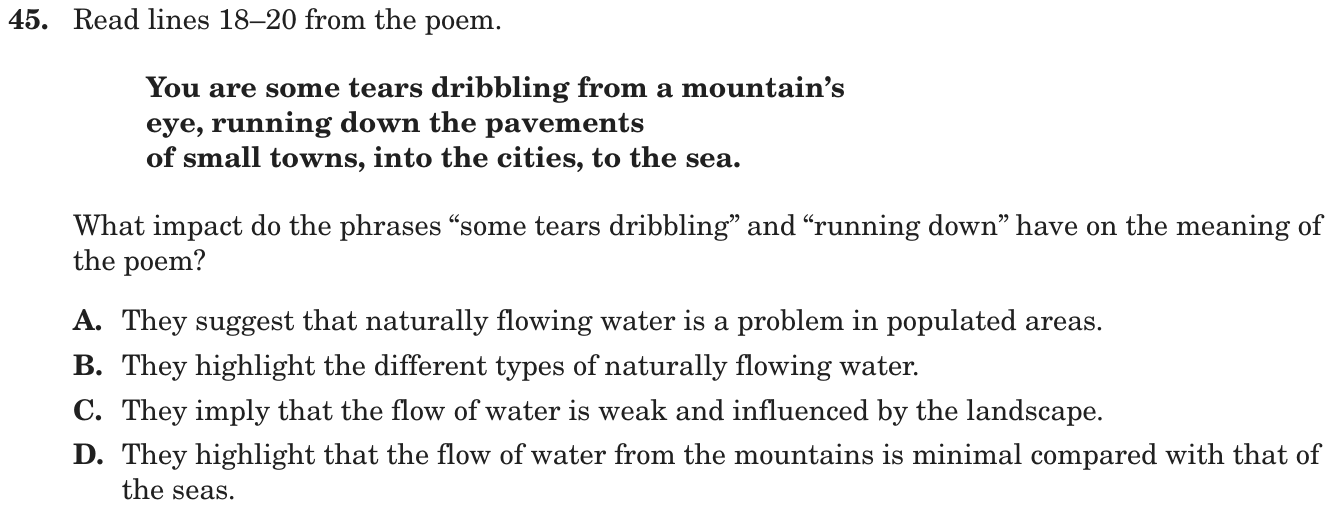
The passage “Cross-Purposes” as printed (pages 72–73)
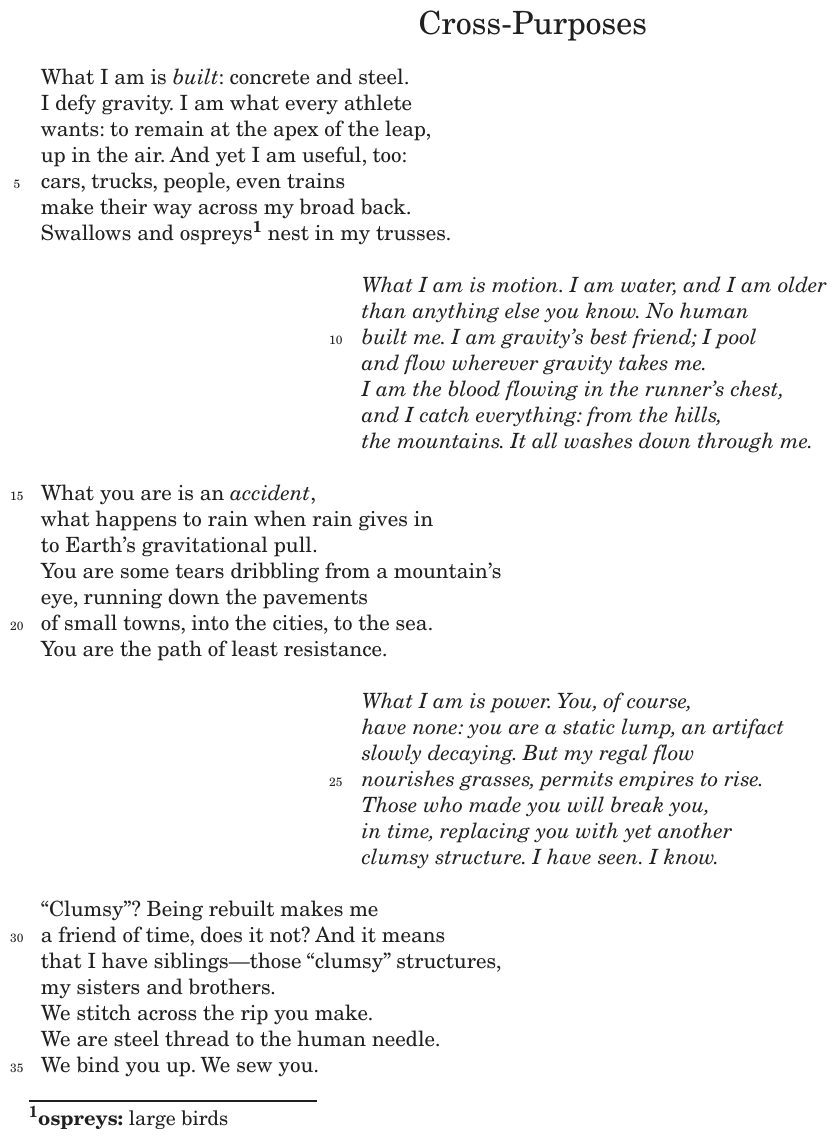
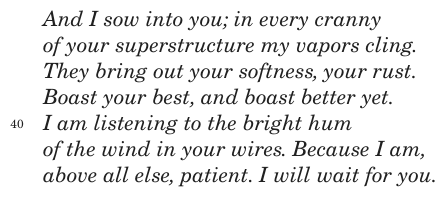
Question 13 of 14
2018 Test B English, question 16Passage Excerpt from A Voice in the Wilderness
Excerpt from A Voice in the Wilderness
by Grace Livingston Hill
With a lurch the train came to a dead stop and Margaret Earle, hastily gathering up her belongings, hurried down the aisle and got out into the night.
It occurred to her, as she swung her heavy suit-case down the rather long step to the ground, and then carefully swung herself after it, that it was strange that neither conductor, brakeman, nor porter had come to help her off the train, when all three had taken the trouble to tell her that hers was the next station; but she could hear voices up ahead. Perhaps something was the matter with the engine that detained them and they had forgotten her for the moment.
The ground was rough where she stood, and there seemed no sign of a platform. Did they not have platforms in this wild Western land, or was the train so long that her car had stopped before reaching it?
She strained her eyes into the darkness, and tried to make out things from the two or three specks of light that danced about like fireflies in the distance. She could dimly see moving figures away up near the engine, and each one evidently carried a lantern. The train was tremendously long. A sudden feeling of isolation took possession of her. Perhaps she ought not to have got out until some one came to help her. Perhaps the train had not pulled into the station yet and she ought to get back on it and wait. Yet if the train started before she found the conductor she might be carried on somewhere and he justly blame her for a fool.
There did not seem to be any building on that side of the track. It was probably on the other, but she was standing too near the cars to see over. She tried to move back to look, but the ground sloped and she slipped and fell in the cinders, bruising her knee and cutting her wrist.
In sudden panic she arose. She would get back into the train, no matter what the consequences. They had no right to put her out here, away off from the station, at night, in a strange country. If the train started before she could find the conductor she would tell him that he must back it up again and let her off. He certainly could not expect her to get out like this.
She lifted the heavy suit-case up the high step that was even farther from the ground than it had been when she came down, because her fall had loosened some of the earth and caused it to slide away from the track. Then, reaching to the rail of the step, she tried to pull herself up, but as she did so the engine gave a long snort and the whole train, as if it were in league against her, lurched forward crazily, shaking off her hold. She slipped to her knees again, the suit-case, toppled from the lower step, descending upon her, and together they slid and rolled down the short bank, while the train . . . ran giddily off into the night.
The horror of being deserted helped the girl to rise in spite of bruises and shock. She lifted imploring hands to the unresponsive cars as they hurried by her—one, two, three, with bright windows, each showing a passenger, comfortable and safe inside, unconscious of her need.
A moment of useless screaming, running, trying to attract some one’s attention, a sickening sense of terror and failure, and the last car slatted itself past with a mocking clatter, as if it enjoyed her discomfort.
Margaret stood dazed, reaching out helpless hands, then dropped them at her sides and gazed after the fast-retreating train, the light on its last car swinging tauntingly, blinking now and then with a leer in its eye, rapidly vanishing from her sight into the depth of the night.
She gasped and looked about her for the station that but a short moment before had been so real to her mind; and, lo! on this side and on that there was none!
The night was wide like a great floor shut in by a low, vast dome of curving blue set with the largest, most wonderful stars she had ever seen. Heavy shadows of purple-green, smoke-like, hovered over earth darker and more intense than the unfathomable blue of the night sky. It seemed like the secret nesting-place of mysteries wherein no human foot might dare intrude. It was incredible that such could be but common sage-brush, sand, and greasewood wrapped about with the beauty of the lonely night.
No building broke the inky outlines of the plain, nor friendly light streamed out to cheer her heart. Not even a tree was in sight, except on the far horizon, where a heavy line of deeper darkness might mean a forest. Nothing, absolutely nothing, in the blue, deep, starry dome above and the bluer darkness of the earth below save one sharp shaft ahead like a black mast throwing out a dark arm across the track.
As soon as she sighted it she picked up her baggage and made her painful way toward it, for her knees and wrist were bruised and her baggage was heavy.
A soft drip, drip greeted her as she drew nearer; something plashing down among the cinders by the track. Then she saw the tall column with its arm outstretched, and looming darker among the sage-brush the outlines of a water-tank. It was so she recognized the engine’s drinking-tank, and knew that she had mistaken a pause to water the engine for a regular stop at a station.
cinders: track bed made from the residue of burnt coal
From A VOICE IN THE WILDERNESS by Grace Livingston Hill—Public Domain
Question
In paragraph 2, how does the phrase “when all three had taken the trouble to tell her” affect the tone in the first part of the excerpt?
- AIt creates an accusatory tone by suggesting that Margaret believes that others are responsible for her problem.
- BIt introduces a defiant tone by suggesting that Margaret left the train early to prove a point.
- CIt suggests a frustrated tone by showing that Margaret feels confused by the inconsistent help offered by the railroad employees.
- DIt establishes an appreciative tone by showing that Margaret feels cared for by the railroad employees.
Show the answer
Correct answer: C
The question asks how the phrase affects the tone in the first part of the excerpt. The phrase includes the words “all three” and “taken the trouble,” emphasizing Margaret’s early frustration as she recalls with some confused irritation that the men thought she needed an abundance of help earlier, but none of them is around to help when the train stops, as indicated in Option C.
Option A is incorrect because when Margaret recalls the interaction, there is no indication that she blames the men for her current problem.
Option B is incorrect because, while the description of how Margaret “hastily [gathers] up her belongings” and “[hurries] down the aisle” (paragraph 1) gives the appearance of being defiant, there is no evidence that she intentionally put herself in this vulnerable position just to make a point.
Option D is incorrect because when Margaret recalls the interaction, there is no evidence that she appreciates the care shown to her, but rather she seems a bit offended that the men do not think she could take care of herself, as shown by the author’s description of the forceful way she exits the train without assistance when it stops.
Question analysis
This tone question looks at a phrase from the opening of Grace Livingston Hill’s novel A Voice in the Wilderness, as Margaret Earle steps off a train at night. Students decide what attitude the phrase about the three railroad men creates. The wording is low-key and old-fashioned, which makes the attitude behind it easy to misjudge.
- Grade level
- Grade 8 reading and task
- Compared with grade 7
- Above grade 7 Grade 7 tone questions usually rest on clearly charged words; this one hinges on an understated phrase in century-old prose. Students must read how Margaret feels about the trainmen from context, without help from any strongly worded clue.
- Estimated difficulty
- Hard: combines ideas, needs a plan, and has more than one tempting wrong answer.
- Thinking it demands
- Depth of knowledge 2, skills and concepts · mainly analyze
- What makes it hard
- A very close wrong answer major
- Complex sentences moderate
- Reading between the lines moderate
- Hard words minor
- Evidence
- Answered from one paragraph or stanza
- Reading level
- Passage: about grade 8, 981 words; question and choices: about grade 10, 96 words.
- Students, last 30 days
- Not enough answers yet to show (it takes 10).
Why it is hard, traps and wrong answers (shows the answer)
Why it is hard
The phrase is understated, and old-fashioned wording hides how Margaret feels. Students who sense criticism of the trainmen often push it too far into blame, which she does not reach until paragraph 6, while those who take “taken the trouble” at face value hear gratitude. The question rewards reading the whole sentence: “it was strange” and her quick excuse about engine trouble show puzzlement and mild irritation, not accusation.
A very close wrong answer major Choosing the answer
The accusatory choice and the frustrated choice both find a negative attitude toward the railroad employees; only the degree separates them, since Margaret calls their absence “strange” and excuses it rather than blaming them. (Embretson & Wetzel, 1987; Gorin & Embretson, 2006; Ascalon et al., 2007)
Complex sentences moderate Understanding the question
The phrase sits deep inside a 66-word sentence that opens with her swinging the suit-case down and closes with voices up ahead, so its contrast is easy to lose. (Abedi & Lord, 2001; Freedle & Kostin, 1993; Messick, 1989)
Reading between the lines moderate Working it out
Margaret never says she is annoyed; the feeling comes from the contrast between “all three had taken the trouble to tell her” and none of them coming to help. (Graesser, Singer & Trabasso, 1994; Kintsch, 1998)
Hard words minor Understanding the question
Each choice turns on a tone word, “accusatory,” “defiant,” “frustrated,” “appreciative,” and students unsure of these labels cannot match them to the scene. (Perfetti, 2007; Freedle & Kostin, 1993)
Strategy: Reread the full sentence the phrase sits in, ask how Margaret feels about the three men at this moment, and match both the feeling and its reason to a choice.
Traps
- Too broad or too strong: A choice overstates, generalizes, or uses absolute words the text does not support.
- Wrong tone or attitude: Misjudges the tone, attitude or point of view, such as reading admiration as criticism, or taking a character's or subject's feelings for the author's.
The wrong answers, classified
A Too broad or too strong (King et al., 2004)
Rightly hears criticism of the three trainmen but inflates puzzlement into blame; she even excuses them with possible engine trouble, and only in paragraph 6 thinks “They had no right.”
B Reads too much in (Graesser, Singer & Trabasso, 1994)
Builds a story of defiance from her hasty exit in paragraph 1, though nothing suggests she left the train early to prove anything to anyone.
D Wrong tone or attitude (Graesser, Singer & Trabasso, 1994)
Takes “taken the trouble” as gratitude for the men’s care, reading the phrase on its own and missing the sentence’s point that none of them came to help.
Working it out, step by step
Figure out what the question asks
This asks about tone: the feeling or attitude that the words give. What does one phrase show about how Margaret feels toward the train workers?
Read the whole sentence
In paragraph 2, Margaret thinks “it was strange that neither conductor, brakeman, nor porter had come to help her off the train, when all three had taken the trouble to tell her that hers was the next station.”
Work out the feeling
A conductor, a brakeman and a porter are train workers. To take the trouble means to make an effort. All three made an effort to tell her about her stop. But now none of them comes to help. That doesn’t add up, and she calls it “strange.” She feels puzzled and a bit annoyed. That is frustration.
She even makes excuses for them: “Perhaps something was the matter with the engine.” So she is not blaming them.
Check each choice
- A is wrong. “Accusatory” means blaming. Margaret makes excuses for the workers instead.
- B is wrong. “Defiant” means boldly refusing to obey. Nothing shows she left the train to prove a point.
- C is right. The workers were helpful at first and then vanished. She is confused and frustrated.
- D is wrong. “Appreciative” means thankful. The point is that nobody came to help.
Watch out: A is tempting because she does find the workers’ absence odd. But odd is not the same as their fault.
Choose the answer
The phrase shows Margaret puzzled by help that came and then disappeared. So the answer is C.
Why this answer and not the closest wrong one
A is the closest wrong answer, because both A and C find something negative in her thoughts. But A goes too far. Margaret does not blame the workers. She guesses they “had forgotten her for the moment.” She is puzzled, not accusing, as C says.
More questions like this
The original DOE question
The passage “Excerpt from A Voice in the Wilderness” as printed (pages 128–129)
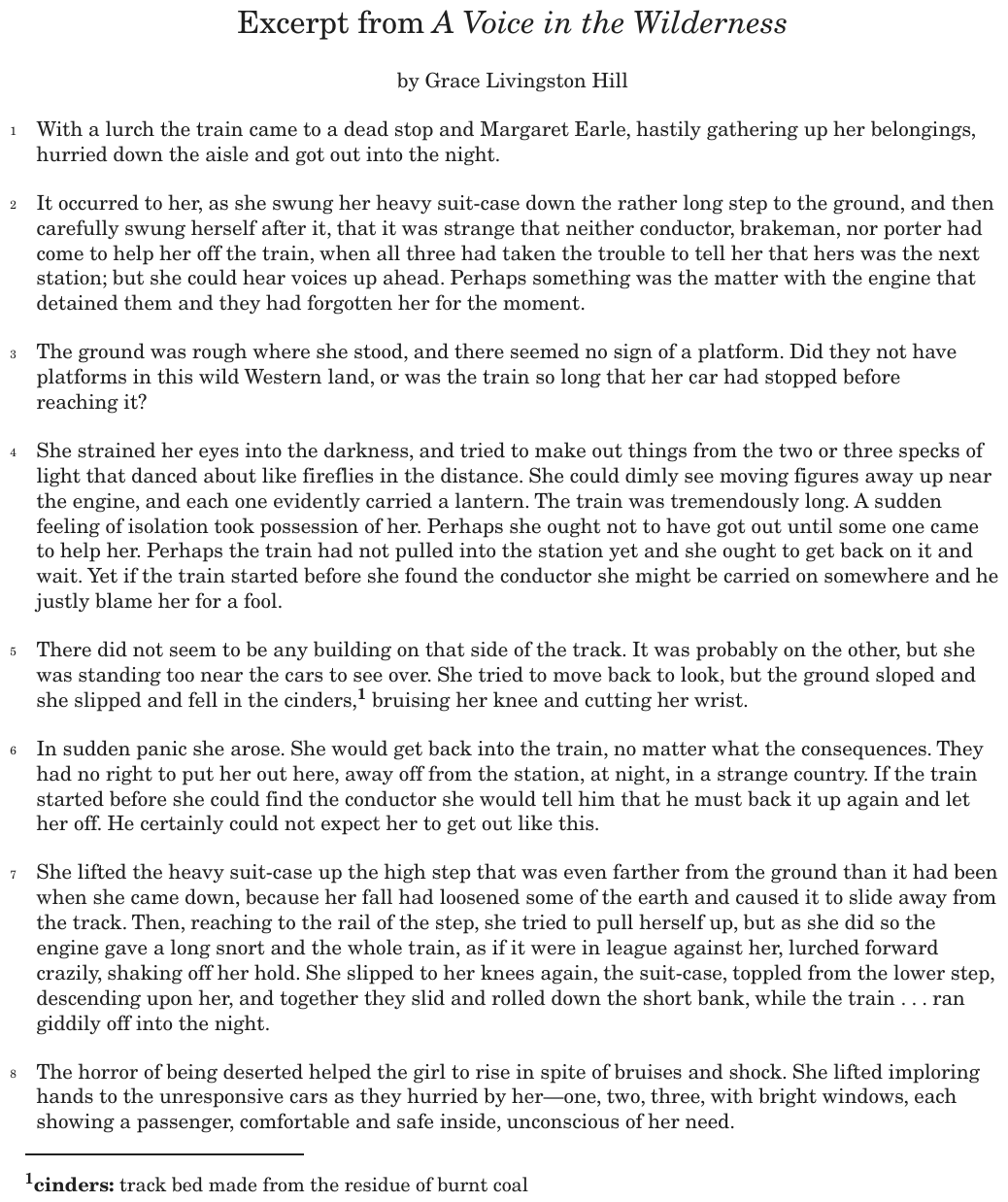
Question 14 of 14
2018 Test B English, question 50Passage Invention of the Telegraph
Samuel Morse, an American inventor, is credited with creating the electronic telegraph, a communication device that allows users to send messages using a system of short and long pulses that represent letters, numbers, and punctuation. In 1843 the United States Congress passed the Telegraph Bill, which provided Morse with the funds to build an electric telegraph system.
Invention of the Telegraph
Earlier Signal Systems
Long before Samuel F. B. Morse electrically transmitted his famous message “What hath God wrought?” from Washington to Baltimore on May 24, 1844, there were signaling systems that enabled people to communicate over distances. Most were visual or “semaphore” systems using flags or lights. In the eighteenth century, such systems used an observer who would decipher a signal from a high tower on a distant hill and then send it on to the next station. The young American republic wanted just such a system along its entire Atlantic coast and offered a prize of $30,000 for a workable proposal. The framers of this legislation had no way of knowing that when they used the word “telegraph” to refer to this visual semaphore system, they would be offered an entirely new and revolutionary means of communication—electricity.
The Growth of an Idea
The idea of using electricity to communicate over distance is said to have occurred to Morse during a conversation aboard ship when he was returning from Europe in 1832. Michael Faraday’s recently invented electromagnet was much discussed by the ship’s passengers, and when Morse came to understand how it worked, he speculated that it might be possible to send a coded message over a wire. While a student at Yale College years before, he had written his parents a letter about how interesting he found the lectures on electricity. Despite what he had learned at Yale, Morse found when he began to develop his idea that he had little real understanding of the nature of electricity, and after sporadic attempts to work with batteries, magnets, and wires, he finally turned for help to a colleague at the University of the City of New York, Leonard D. Gale.
Gale was a professor of chemistry and familiar with the electrical work of Princeton’s Joseph Henry, a true pioneer in the new field. Well before Morse had his shipboard idea about a telegraph, Henry rang a bell at a distance by opening and closing an electric circuit. In 1831, he had published an article, of which Morse was unaware, that contained details suggesting the idea of an electric telegraph. Gale’s help and his knowledge of this article proved crucial to Morse’s telegraph system because Gale not only pointed out flaws in the system but showed Morse how he could regularly boost the strength of a signal and overcome the distance problems he had encountered by using a relay system Henry had invented. Henry’s experiments, Gale’s assistance, and, soon after, hiring the young technician Alfred Vail were keys to Morse’s success.
Obstacles and Opportunities
By December 1837, Morse had enough confidence in his new system to apply for the federal government’s appropriation, and during the next year he conducted demonstrations of his telegraph both in New York and Washington.
However, when the economic disaster known as the Panic of 1837 took hold of the nation and caused a long depression, Morse was forced to wait for better times. It was during this period that Morse visited Europe again and tried not only to secure patent protection overseas but to examine competing telegraph systems in England. . . .
By 1843, the country was beginning to recover economically, and Morse again asked Congress for the $30,000 that would allow him to build a telegraph line from Washington to Baltimore, forty miles away. The House of Representatives eventually passed the bill containing the Morse appropriation, and the Senate approved it in the final hours of that Congress’s last session. With President Tyler’s signature, Morse received the cash he needed and began to carry out plans for an underground telegraph line.
Realizing a Great Invention
Morse had hired the ingenious construction engineer Ezra Cornell to lay the pipe carrying the wire, and although Cornell did his job superbly, one of Morse’s partners, Congressman F. O. J. Smith, had purchased wire with defective insulation. Too much time had been wasted laying bad wire, and with the project on a rigid deadline, something had to be done quickly. Cornell suggested that the fastest and cheapest way of connecting Washington and Baltimore was to string wires overhead on trees and poles. The desperate Morse gave the go-ahead, and the line was completed in time for the dramatic and spectacularly successful link between the Supreme Court chamber of the Capitol building and the railroad station in Baltimore.
Soon, as overhead wires connected cities up and down the Atlantic coast, the dots-and-dashes method that recorded messages on a long moving strip of paper was replaced by the operator’s ability to interpret the code in real time. . . . Telegraph lines soon extended westward, and within Morse’s own lifetime they connected the continents of Europe and America.
“Invention of the Telegraph”—Public Domain/Library of Congress
legislation: Telegraph Bill
dots-and-dashes method: the short and long pulses of Morse code that are sent and received by telegraph operators
The first transatlantic electric telegraph message was sent in 1858, and by 1902 the British All-Red Line connected most of the world.
Source: U.S. Bureau of the Census. Historical Statistics of the United States, Colonial Times to 1970, Bicentennial Edition, Part 2. Washington, D.C., 1975.
Question
Read this sentence from paragraph 7.
The desperate Morse gave the go-ahead, and the line was completed in time for the dramatic and spectacularly successful link between the Supreme Court chamber of the Capitol building and the railroad station in Baltimore.
The words “dramatic” and “spectacularly” in the sentence convey a
- Asense of relief and fulfillment that the line was finished.
- Bsense of wonder and of celebration that the telegraph line was completed on time.
- Cfeeling of excitement about the future possibilities of the telegraph.
- Dfeeling of confidence about being able to continue the work.
Show the answer
Correct answer: B
The question asks what the words “dramatic” and “spectacularly” convey in the sentence. Morse and Cornell rushed to post the wires overhead, and the “rigid deadline” (paragraph 7) was successfully met. The words have a positive and victorious tone that is consistent with the feeling of wonder that it worked and of celebration that the construction was completed, making Option B correct.
Option A is incorrect because, while there may have been some feelings of relief and fulfilment that the lines were in place, the passage does not say so, and instead it focuses on the wonder and joy Morse and Cornell felt overcoming setbacks and completing the construction of Morse’s telegraph system.
Option C is incorrect because the passage does not share whether Morse or Cornell considered the future possibilities of the telegraph, only that the finished product was “dramatic,” implying it was amazing to see.
Option D is incorrect because, while the passage later discusses the expansion of overhead wires “up and down the Atlantic coast” and how they “connected the continents of Europe and America” (paragraph 8), there is no evidence shared in the passage that Morse planned to continue his work with electricity.
Question analysis
This word choice question asks what the words “dramatic” and “spectacularly” convey in a sentence from “Invention of the Telegraph” about the first Washington-to-Baltimore line. Students must read the connotations of two words in context, and the choices name feelings that are all believable for a project rushed to meet a deadline.
- Grade level
- Grade 7 reading and task
- Compared with grade 7
- At grade 7 Reading the connotation of words in context is typical grade 7 work. The sentence is quoted, but the choices are close in meaning, which demands careful attention to what the two words themselves suggest.
- Estimated difficulty
- Moderate: several steps, or a close reading with one strong distractor.
- Thinking it demands
- Depth of knowledge 2, skills and concepts · mainly understand
- What makes it hard
- A very close wrong answer moderate
- Reading between the lines moderate
- Every choice must be checked minor
- Evidence
- Answered from one sentence or line
- Reading level
- Passage: about grade 11, 910 words; question and choices: about grade 9, 94 words.
- Students, last 30 days
- Not enough answers yet to show (it takes 10).
Why it is hard, traps and wrong answers (shows the answer)
Why it is hard
Every choice names a reasonable emotion for the end of a race against a deadline, which makes this a question about two words rather than about the situation. Students who read the whole sentence are pulled toward relief by “desperate,” and those who read ahead are pulled toward the future by paragraph 8. The words point to an audience impressed by a public success, not to Morse’s private feelings or plans.
A very close wrong answer moderate Choosing the answer
The relief-and-fulfillment choice has the same shape as the key, a pair of feelings about finishing the line; only the feelings differ, and “desperate” nearby favors relief while “dramatic” and “spectacularly” point to wonder. (Embretson & Wetzel, 1987; Gorin & Embretson, 2006; Ascalon et al., 2007)
Reading between the lines moderate Working it out
“Dramatic” and “spectacularly” describe the event, not anyone’s emotions, so the feeling they convey, wonder at the result and celebration of its success, has to be inferred from their connotations. (Graesser, Singer & Trabasso, 1994; Kintsch, 1998)
Every choice must be checked minor Choosing the answer
All four choices name positive feelings that suit a project rushed to completion, so none can be dismissed by tone alone. (Embretson & Wetzel, 1987)
Strategy: Ask what kind of event people call dramatic or spectacular, then pick the feeling those two words express, not a feeling the surrounding story might suggest.
Traps
- Wrong tone or attitude: Misjudges the tone, attitude or point of view, such as reading admiration as criticism, or taking a character's or subject's feelings for the author's.
- Wrong part of the text: A choice is true of another paragraph, stanza or speaker than the one asked about.
The wrong answers, classified
A Wrong tone or attitude (Graesser, Singer & Trabasso, 1994)
Takes Morse’s likely feeling, relief for a “desperate” man facing a “rigid deadline,” for what the author’s words convey, though “dramatic” and “spectacularly” celebrate an impressive success.
C Wrong part of the text (Kirsch & Mosenthal, 1990)
Looks ahead to paragraph 8, where lines spread along the coast and to Europe, but the sentence celebrates the first link itself, not hopes for what came later.
D Reads too much in (Graesser, Singer & Trabasso, 1994)
Assumes that success breeds confidence to keep going, but the sentence says nothing about further work, and the two words describe the event itself.
Working it out, step by step
Figure out what the question asks
This is a word-meaning question. It asks what feeling two words give the sentence: “dramatic” and “spectacularly.” Focus on those two words, not on how Morse might have felt.
Read the sentence in its setting
Paragraph 7 tells of a race against time. Bad wire had wasted time, and the project had “a rigid deadline.” Cornell’s idea of wires on poles saved the day. Then “the line was completed in time for the dramatic and spectacularly successful link between the Supreme Court chamber of the Capitol building and the railroad station in Baltimore.”
Explain the two words
Something dramatic is exciting and striking, like the big moment in a play. Something done spectacularly is done in an amazing way that is wonderful to see. Both words describe the event as a grand public success. They make you feel wonder and want to celebrate. The sentence also says the line was done “in time,” or on time.
Check each choice
- A is wrong. The “desperate” Morse may have felt relief. But the two words describe an amazing event, not a quiet sigh of relief.
- B fits. The words show wonder and celebration, and the line was finished on time.
- C is wrong. The sentence is about this first link. The future comes later, in paragraph 8.
- D is wrong. The sentence says nothing about going on with more work.
Choose the answer
“Dramatic” and “spectacularly” cheer a thrilling success that came right on time. So the answer is B, “sense of wonder and of celebration that the telegraph line was completed on time.”
Why this answer and not the closest wrong one
A is the closest trap because “desperate” is in the same sentence. Relief is a quiet, private feeling that a worry is over. But “dramatic” and “spectacularly” are loud, showy words. People use them for something amazing to watch. That points to wonder and celebration, as B says.
More questions like this
The original DOE question
The passage “Invention of the Telegraph” as printed (pages 146–148)