3 English and 3 math
Here are 6 random questions to try. Takers earning below 75% are unlikely to receive an offer. You have 1 minute 48 seconds per question on the real exam.
Question 1 of 6
2026 Practice Test B English, question 25Passage Looking for the Smallest Spark of Everything
Looking for the Smallest Spark of Everything
Located underground near Geneva, Switzerland, the Large Hadron Collider (LHC) helps scientists study and understand how the smallest particles of matter interact with one another. The LHC propels atomic particle beams along a 17-mile-long ring.
There are the things the world is made of,
things we can see and feel, and then
there are the things even smaller, things that seem
to exist only when we are looking right at them.
So beneath the level of molecules are atoms,
and beneath the level of atoms, we find
protons, electrons, neutrons; and beneath that—
what, exactly? Because we are talking about
everything here: your fingernail,
the candy at the back of your mouth,
the coffee your teacher drank this morning,
your little sister, and the stuffed dog
she used to carry around with her everywhere.
And everywhere.
Everything and everywhere
are made up of the same stuff, whatever
it is. How do we find it? We can listen for it
in the wavelengths from deep space,
talking back to us from unimaginable
distances. Or we can build long,
deep circular tunnels beneath the surface
of this Earth and race particles
(like racing cars, only very tiny cars
flashing along at close to the speed of light)
until everything we think we know
bangs against everything else we know.
And there, in the explosion, in the darkness,
briefly incandescent, they appear:
the quarks, the leptons, and the bosons;
the baryons and the mesons. Their names
sound like dinosaurs or maybe bands
playing terrible music in someone’s garage.
The one thing we know for sure
is that they spin. This is how gravity
enters our world, how our world is held
both together and apart, what keeps
together the pencil in your hand right now
as well as separate from, say,
Jupiter. They spin, and it is only down there
in the darkness—in the vast garage
where physicists jot down
what they can, whatever seems most real—
that they let us perceive their wild dancing,
combusting to the music they make.
Question
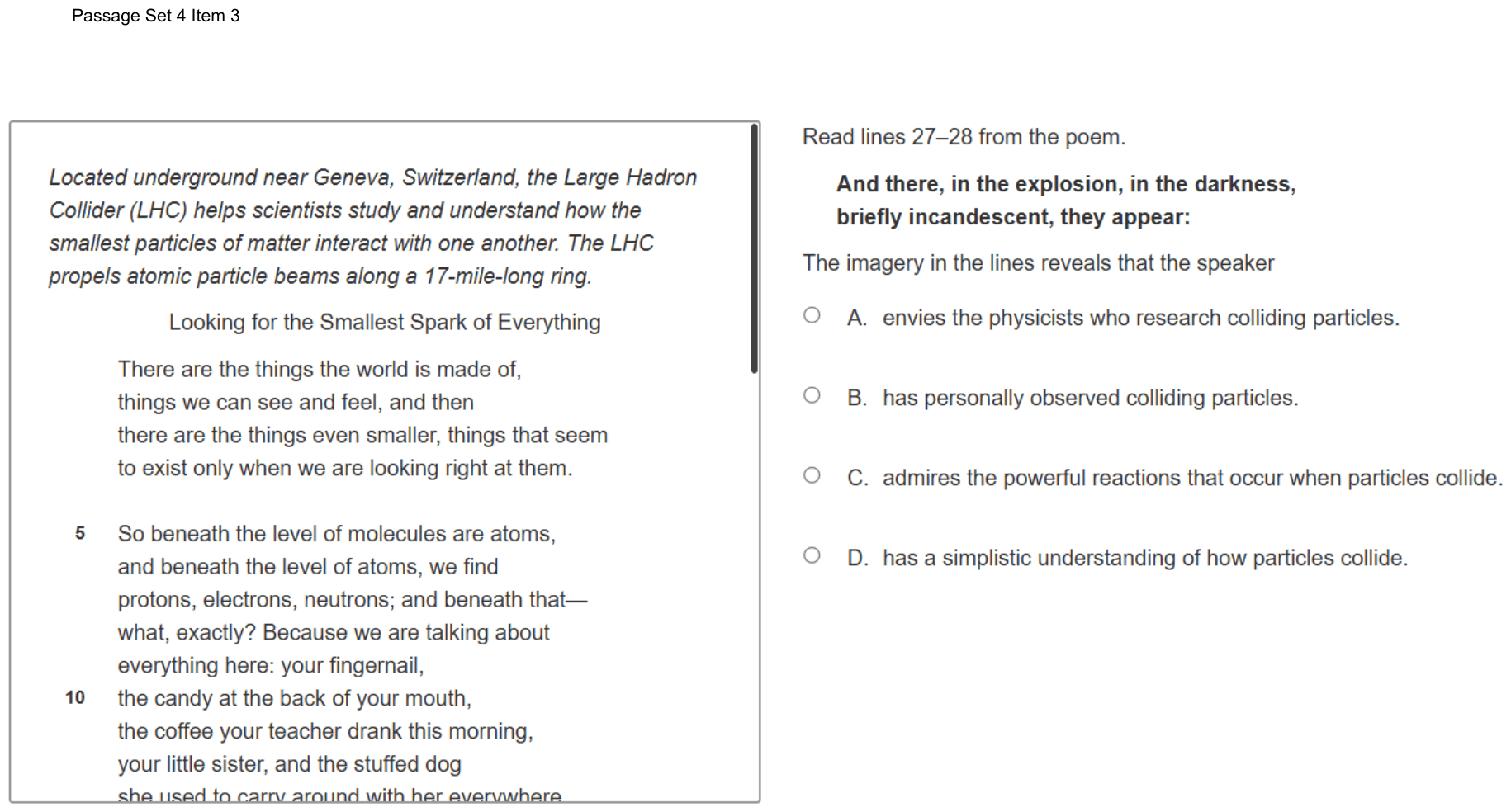
Read lines 27–28 from the poem.
And there, in the explosion, in the darkness,
briefly incandescent, they appear:
The imagery in the lines reveals that the speaker
- Aenvies the physicists who research colliding particles.
- Bhas personally observed colliding particles.
- Cadmires the powerful reactions that occur when particles collide.
- Dhas a simplistic understanding of how particles collide.
Show the answer
Correct answer: C
The question asks what the imagery in lines 27–28 reveals about the speaker.
A. Incorrect. The physicists mentioned in the fifth stanza (lines 33–44) are described as mere observers: they “jot down / what they can” (lines 41–42). In lines 27–28, the speaker is focused on the reaction between the colliding particles, not on the physicists who study them.
B. Incorrect. The speaker describes the particle collision in detail, but the text does not imply that the speaker has personally witnessed a collision. The speaker implies that his or her understanding of the collision is based on the experiences of the physicists observing the phenomenon (“They spin, and it is only down there / in the darkness—in the vast garage / where physicists jot down / what they can, whatever seems most real— / that they let us perceive their wild dancing” [lines 39–43]).
C. CORRECT. The word “explosion” and the phrase “briefly incandescent” create a picture of rapid changes and short bursts of bright light, revealing how powerful the new particles are. The language the speaker uses is positive, revealing that the speaker admires the power of the reaction and stands in awe of the new particles.
D. Incorrect. The poem reveals the speaker’s deep knowledge about subatomic particles. For example, the speaker is able to name the new particles discovered—“the quarks, the leptons, and the bosons; / the baryons and the mesons” (lines 29–30)—and is able to use imagery to create a powerful picture that reveals the complexity of a scientific process that humans have never been able to see.
Question analysis
This imagery question asks what lines 27–28 of “Looking for the Smallest Spark of Everything” reveal about the poem’s speaker, as particles appear “briefly incandescent” in an explosion inside a particle collider. Students must infer what a vivid image says about the person describing it. The word “incandescent” may be unfamiliar, and the choices are about very different things.
- Grade level
- Grade 8 reading and task
- Compared with grade 7
- Above grade 7 Grade 7 students infer a speaker’s attitude from imagery, but these two lines turn on the uncommon word “incandescent,” state nothing about the speaker outright, and the choices range over the speaker’s knowledge, experience and feelings, which is harder than typical grade 7 work.
- Estimated difficulty
- Hard: combines ideas, needs a plan, and has more than one tempting wrong answer.
- Thinking it demands
- Depth of knowledge 2, skills and concepts · mainly analyze
- What makes it hard
- Reading between the lines major
- Hard words moderate
- Figurative or literary language minor
- Evidence
- Answered from one paragraph or stanza
- Reading level
- Passage: 346 words (a poem; reading level not measured); question and choices: about grade 9, 55 words.
- Students, last 30 days
- Not enough answers yet to show (it takes 10).
Why it is hard, traps and wrong answers (shows the answer)
Why it is hard
Nothing in the two lines names a feeling, so students must judge the speaker’s attitude from the image alone, and its key word is uncommon. The vividness is itself a trap: a scene described this sharply can seem to be one the speaker watched, though the poem says the particles are perceived only through the physicists’ work. The choices range over envy, experience, admiration and understanding, so each must be tested against the lines rather than against an overall impression.
Reading between the lines major Working it out
The lines describe particles, not the speaker, and contain no word of feeling; admiration has to be inferred from the drama of “the explosion” and the glow of “briefly incandescent.” (Graesser, Singer & Trabasso, 1994; Kintsch, 1998)
Hard words moderate Understanding the question
“Incandescent,” glowing with heat and light, is the word that makes the image dazzling, and a student who does not know it sees only an explosion in the dark. (Perfetti, 2007; Freedle & Kostin, 1993)
Figurative or literary language minor Understanding the question
The two lines are pure imagery, a burst of light in darkness as the particles “appear,” and the question asks what that picture reveals about the person painting it. (Graesser, Singer & Trabasso, 1994; Kintsch, 1998)
Strategy: Picture the scene in lines 27–28, including what “incandescent” means, decide what the description suggests about the speaker, and test each choice against these two lines.
Traps
- Taking figurative language literally: A choice reads a figure of speech or image at face value.
- Reads too much in: A reasonable-sounding conclusion that goes further than the text allows.
The wrong answers, classified
A Reads too much in (Graesser, Singer & Trabasso, 1994)
Reasons that someone so drawn to the scene must envy the physicists who study it, though the physicists appear only in lines 39–44 and nothing in the poem hints at envy.
B Taking figurative language literally (Graesser, Singer & Trabasso, 1994)
Takes the vivid scene of particles that “appear” in a glow as something the speaker witnessed, though lines 39–43 place that sight “down there,” where physicists record what they can.
D Reads too much in (Graesser, Singer & Trabasso, 1994)
Treats the poem’s playful comparisons, racing cars and garage bands, as a sign of shallow knowledge, though the next lines have the speaker naming quarks, leptons, bosons, baryons and mesons.
Working it out, step by step
Figure out what the question asks
This asks what the imagery in lines 27–28 shows about the speaker. Imagery is language that helps you see, hear or feel a scene. The lines describe particles, not the speaker. So you must infer, or figure out from clues, how the speaker feels.
Read lines 27–28
The lines say “And there, in the explosion, in the darkness, / briefly incandescent, they appear:” Briefly means for a short time. Incandescent means glowing with heat and light. So picture a burst of bright light flashing in the dark. The particles have just crashed into each other, or collided. In that flash, the tiny particles appear.
Decide how the speaker feels
The words are bold and bright: “explosion,” “incandescent,” “appear.” The speaker makes the moment sound dramatic and amazing. People describe something this way when they are in awe of it. So the speaker admires, or looks up to, the power of the crash.
Check each choice
- A does not fit. Physicists come up only later, in line 41. Nothing shows envy, or wanting what they have.
- B does not fit. Nothing says the speaker was there. Lines 39–42 place the sight “down there,” where “physicists jot down / what they can.”
- C fits. The glowing burst in the dark shows the speaker’s wonder.
- D does not fit. Right after, the speaker names quarks, leptons, bosons, baryons and mesons. That is not a simple understanding.
Watch out: B is tempting because the scene is so vivid. But a writer can picture something without seeing it in person.
Choose the answer
The bright, explosive picture shows a speaker who is amazed by the crash. So the answer is C, “admires the powerful reactions that occur when particles collide.”
Why this answer and not the closest wrong one
B is the closest wrong choice, because the scene feels like an eyewitness report. But the lines never say the speaker was in the tunnel. What they do show is a feeling. Words like “explosion” and “briefly incandescent” make the moment thrilling. That is admiration, so C fits.
More questions like this
The original DOE question
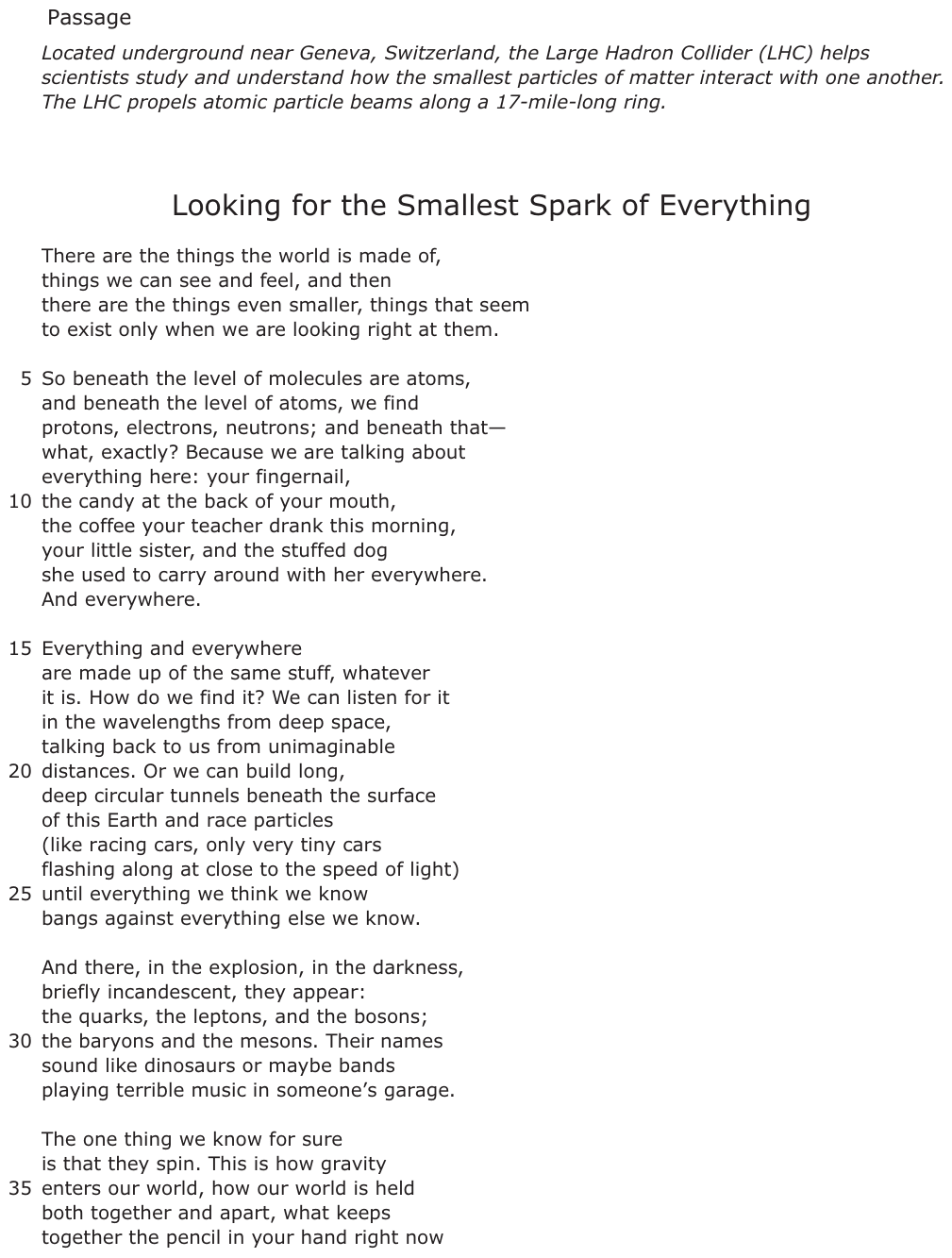
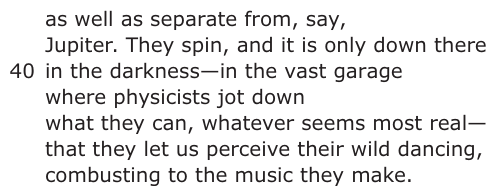
The passage “Looking for the Smallest Spark of Everything” as printed (pages 32–33)
Question 2 of 6
2026 Practice Test D English, question 40Passage Martial Arts for the Mind and Body
Martial Arts for the Mind and Body
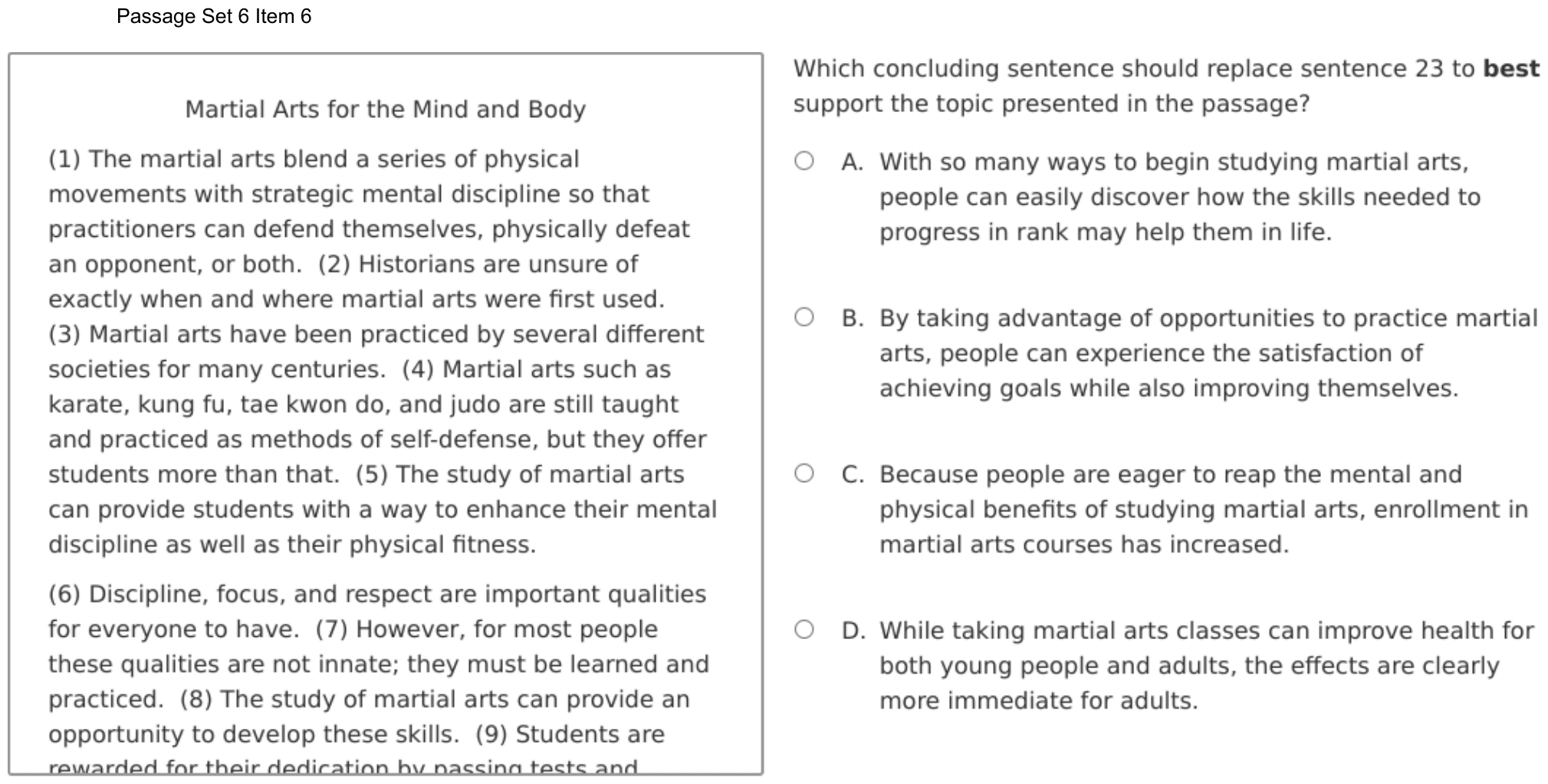
(1) The martial arts blend a series of physical movements with strategic mental discipline so that practitioners can defend themselves, physically defeat an opponent, or both. (2) Historians are unsure of exactly when and where martial arts were first used. (3) Martial arts have been practiced by several different societies for many centuries. (4) Martial arts such as karate, kung fu, tae kwon do, and judo are still taught and practiced as methods of self-defense, but they offer students more than that. (5) The study of martial arts can provide students with a way to enhance their mental discipline as well as their physical fitness.
(6) Discipline, focus, and respect are important qualities for everyone to have. (7) However, for most people these qualities are not innate; they must be learned and practiced. (8) The study of martial arts can provide an opportunity to develop these skills. (9) Students are rewarded for their dedication by passing tests and advancing to higher ranks or levels. (10) For example, in a typical tae kwon do class, students learn discipline by diligently practicing moves, improve focus by listening carefully, and demonstrate respect by bowing to the instructor and following directions.
(11) For teenagers, martial arts classes provide a safe and structured environment for gaining physical skills, building confidence, and enjoying a sense of community. (12) A lot of teens go through hard situations as they try to do well in school and in life. (13) A martial arts class can provide teens with a physical outlet for stress while also challenging them mentally. (14) Participating in a martial arts program also helps children and teens focus on self-improvement rather than on competition. (15) Progressing through levels of achievement involves mastering more physically demanding techniques. (16) It requires students to take responsibility and be accountable for achieving set goals. (17) Students gain confidence and experience companionship with other students who are progressing through the ranks.
(18) Adults who practice martial arts can experience many of the same benefits that younger people do, but perhaps the greatest of these is health and fitness. (19) Adult martial arts students often see changes in their body within weeks of beginning a program.
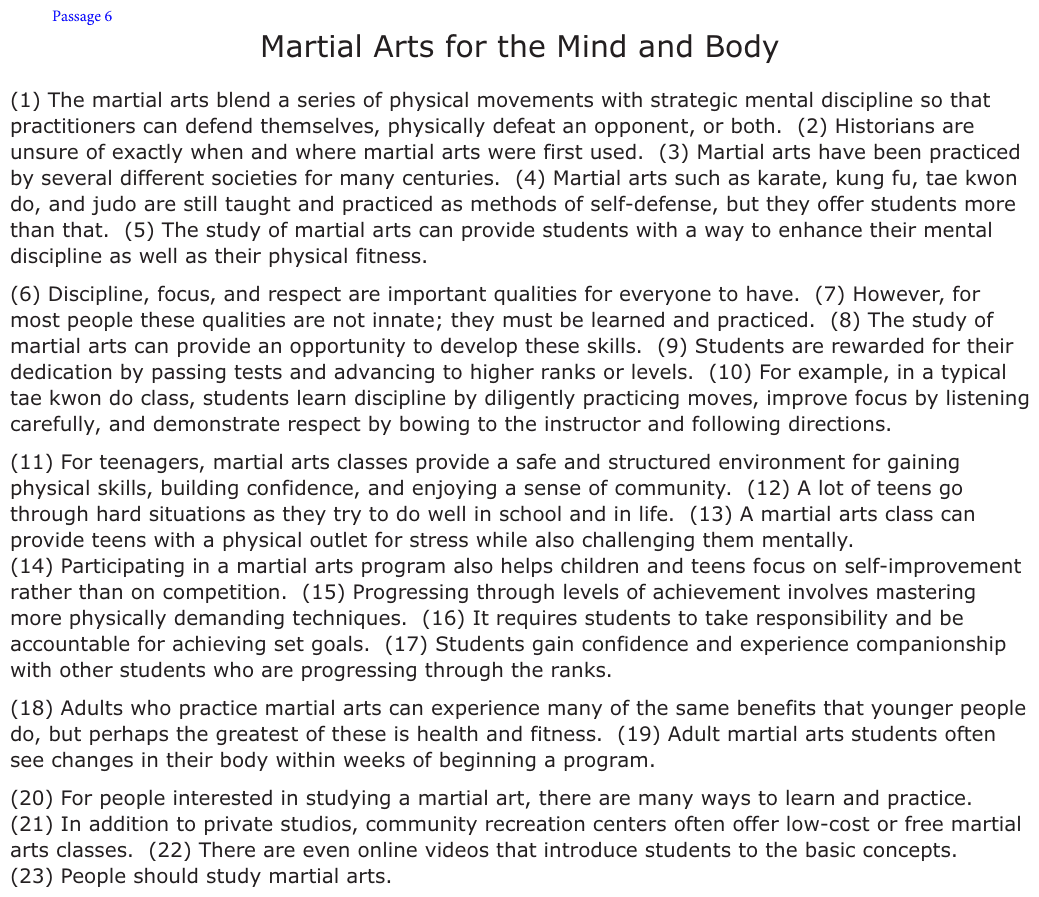
(20) For people interested in studying a martial art, there are many ways to learn and practice. (21) In addition to private studios, community recreation centers often offer low-cost or free martial arts classes. (22) There are even online videos that introduce students to the basic concepts. (23) People should study martial arts.
Question
Which concluding sentence should replace sentence 23 to best support the topic presented in the passage?
- AWith so many ways to begin studying martial arts, people can easily discover how the skills needed to progress in rank may help them in life.
- BBy taking advantage of opportunities to practice martial arts, people can experience the satisfaction of achieving goals while also improving themselves.
- CBecause people are eager to reap the mental and physical benefits of studying martial arts, enrollment in martial arts courses has increased.
- DWhile taking martial arts classes can improve health for both young people and adults, the effects are clearly more immediate for adults.
Show the answer
Correct answer: B
The question asks for the concluding sentence that best replaces sentence 23 and supports the topic presented in the passage.
A. Incorrect. The phrase “the skills needed to progress in rank” is vague, and progressing in rank is not related to the overall topic of the passage, which is the benefits of studying martial arts. The topic of the passage is not the “many ways to begin studying martial arts” or how “people can easily discover” the benefits of martial arts.
B. CORRECT. This option is correct because it best supports the topic of the passage—the benefits of studying martial arts—by stating two reasons why people should study martial arts: to “experience the satisfaction of achieving goals while also improving themselves.”
C. Incorrect. Some readers may choose this option because it refers to the benefits of martial arts, but the word “because” and the detail that “enrollment in martial arts courses has increased” make this sentence unrelated to the overall topic of the passage, which is about the benefits of studying martial arts, not the number of people who participate.
D. Incorrect. Although the benefits of studying martial arts are described for both teens (in the third paragraph) and adults (in the fourth paragraph), the topic of the passage is the overall benefits of studying martial arts, which include mental discipline (discussed in the first, second, and third paragraphs) in addition to health benefits. Furthermore, the passage does not compare the health effects of studying martial arts across age groups.
Question analysis
This conclusion question asks which sentence should replace sentence 23, the bare closing line “People should study martial arts,” to best support the topic of the passage. Students must keep all five paragraphs in view, from mental discipline to fitness to ways of getting started, because every choice sounds like a reasonable final line when read on its own.
- NYS standards
- 7W2e concluding informative writing
- Grade level
- Grade 8 reading and task
- Compared with grade 7
- Above grade 7 Grade 7 writers choose conclusions that follow from a passage’s topic. This passage covers mental and physical benefits for different ages, and each long choice picks up a real thread, so judging the best fit takes more than typical grade 7 work.
- Estimated difficulty
- Hard: combines ideas, needs a plan, and has more than one tempting wrong answer.
- Thinking it demands
- Depth of knowledge 2, skills and concepts · mainly evaluate
- What makes it hard
- A very close wrong answer moderate
- Evidence in several places moderate
- A lot to read minor
- Evidence
- Answered from the whole text
- Reading level
- Passage: about grade 11, 402 words; question and choices: about grade 12, 106 words.
- Corrected from the DOE handbook
- The DOE printed this question’s explanation after a different question; the site matches the question with its own explanation.
- Students, last 30 days
- Not enough answers yet to show (it takes 10).
Why it is hard, traps and wrong answers (shows the answer)
Why it is hard
Every ending borrows something real from the passage: ways to begin, ranks, mental and physical benefits, or adults’ quick results. The work is deciding what the whole passage is about, the benefits of martial arts for mind and body, and then noticing which ending adds a new claim or shrinks the topic. The rank-based ending is hardest to reject because it is shaped like the key and promises help “in life,” but its focus is how easily people discover rank skills.
A very close wrong answer moderate Choosing the answer
The rank choice is built like the key, a phrase about ways or chances to train followed by what people gain; it differs in resting on the vague “skills needed to progress in rank.” (Embretson & Wetzel, 1987; Gorin & Embretson, 2006; Ascalon et al., 2007)
Evidence in several places moderate Working it out
The topic is pieced together from all five paragraphs, from the opening’s mind-and-body claim through teens, adults’ fitness and ways to learn, so a fitting ending must cover both kinds of benefit. (Kirsch & Mosenthal, 1990; Gorin & Embretson, 2006)
A lot to read minor Understanding the question
Each choice is a two-part sentence of 21 to 26 words, and each picks up a real thread of the passage, so all four must be held against the topic. (Kintsch, 1998; Gorin & Embretson, 2006; Freedle & Kostin, 1993)
Strategy: State the passage’s topic in a few words using all five paragraphs, then test each ending: does it sum up that topic, or does it narrow it or add a new claim?
Traps
- Off the point: Adds or keeps something that does not support the paragraph's or the passage's focus, or an introduction or conclusion that misses the main point.
- Too narrow: A single detail offered as the central idea or a summary, or a summary that keeps minor details and leaves out an essential part.
The wrong answers, classified
A Too narrow (King et al., 2004)
Follows on from the last paragraph’s many ways to start, but rests the ending on vague “skills needed to progress in rank,” one thread of paragraphs 2 and 3, not the benefits overall.
C Off the point (Halliday & Hasan, 1976)
Names the passage’s “mental and physical benefits,” which fits, but ends on rising enrollment, a claim about numbers of students that the passage never discusses.
D Half right (King et al., 2004; Thissen, Steinberg & Fitzpatrick, 1989)
Rightly says training can improve health for young people and adults, but adds that adults clearly benefit sooner, a comparison the passage never makes, and drops the mental benefits.
What was corrected from the DOE handbook, and why
- Explanation: In the DOE’s explanations appendix, the explanation printed after this question belongs to question 39 (“the sentence that would best follow and support sentence 18”) and marks C correct, and this question’s explanation (“the concluding sentence that best replaces sentence 23 and supports the topic presented in the passage”) is printed after question 39, marking B correct. Read page by page, the appendix gives this question the answer C. The site gives the question the explanation that restates it, and the answer follows that explanation: B, because it sums up the passage’s topic, the benefits of studying martial arts.
Working it out, step by step
Figure out what the question asks
This asks for a better last sentence. A good concluding sentence sums up the topic of the whole passage. Sentence 23, “People should study martial arts,” is short and plain. It doesn’t remind the reader why.
Find the passage’s topic
Sentence 5 states the topic. Martial arts can help students “enhance their mental discipline as well as their physical fitness.” Enhance means improve. Paragraph 2 covers discipline, focus and respect. Paragraph 3 covers teens and goals. Paragraph 4 covers adults and fitness. Paragraph 5 lists ways to start. So the topic is how martial arts help both mind and body.
Name the rule
A conclusion should sum up the main point. It should not shrink the point or add a brand-new claim. For example, after a report on why sleep matters, a good ending is Getting enough sleep helps both your body and your mind. A poor one is More people buy pillows now.
Check each choice
- A is wrong. It rests on vague “skills needed to progress in rank,” one small part of the passage.
- B is right. “Opportunities to practice” follows paragraph 5. “Achieving goals” and “improving themselves” sum up the benefits.
- C is wrong. Enrollment is the number of people who sign up. The passage never says it has gone up.
- D is wrong. The passage never says adults see results sooner than young people. D also leaves out the benefits to the mind.
Watch out: A is built like B and promises help “in life.” But it shrinks the topic to rank skills.
Choose the answer
B sums up what the whole passage says martial arts offer. So the answer is B, “By taking advantage of opportunities to practice martial arts, people can experience the satisfaction of achieving goals while also improving themselves.”
Why this answer and not the closest wrong one
A is the closest wrong answer. Like B, it starts with ways to begin and ends with what people gain. But its gain is vague “skills needed to progress in rank.” That is only one thread of the passage. B sums up the whole topic: reaching goals and improving yourself.
More questions like this
The original DOE question
The passage “Martial Arts for the Mind and Body” as printed (page 52)
Question 3 of 6
2024 Test A English, question 36Passage 5 Reasons Physical Books Might Be Better Than E-Books
5 Reasons Physical Books Might Be Better Than E-Books
by Shaunacy Ferro
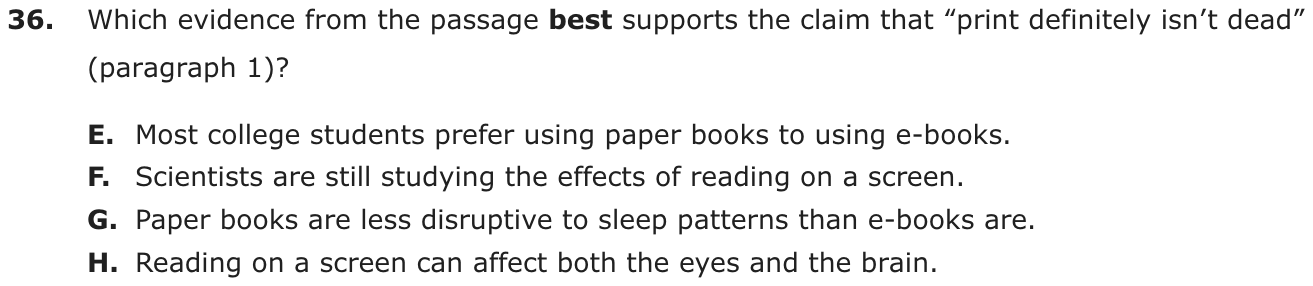
Though e-book1 readers have become a more common sight around town, traditional books still have their evangelists.2 According to The New York Times, e-book sales have been falling in 2015. Print definitely isn’t dead. In fact, according to some research, it may actually be a better choice for some readers. While scientists are still trying to tease out exactly how digital reading affects us differently, here are five ways e-books might be inferior to their dead-tree cousins.
E-books can reduce reading comprehension.
In a study of middle schoolers, West Chester University researchers found that students who read on iPads3 had lower reading comprehension than when they read traditional printed books. They discovered that the kids sometimes skipped text in favor of interactive features in the e-books, suggesting that certain multimedia in children’s e-books can be detrimental to the practice of reading itself. However, the researchers noted that some interactive features in e-books are designed to enhance comprehension, and that those might be more helpful than game-type interactive graphics.
Young kids can get distracted by e-books.
Similar results were found by a small study by the Joan Ganz Cooney Center that consisted of 32 kids reading e-books and print books with their parents. It found that “enhanced” e-books might be distracting. Kids who read enhanced e-books—ones with interactive, multimedia experiences—were more engaged with them physically, but in the end they remembered fewer narrative details than those who read print books or basic e-books.
You remember less about a book’s timeline.
Another study of adults also found that e-books can be hard to absorb. The researchers asked 25 people to read a 28-page story on a Kindle4 and 25 to read the story in paperback, then asked the readers to put 14 events from the story in chronological order. Those who read the story on a Kindle performed worse on the chronology test than the book readers, though they performed about the same as print readers in other tests. Earlier research by the same scholars, from Stavanger University in Norway, found that Norwegian 10th graders also remembered more about texts if they read them in print rather than on a computer screen.
They’re not great as textbooks.
While e-book textbooks are often cheaper (and easier to carry) than traditional door-stop5 textbooks, college students often don’t prefer them. In some surveys of college kids, the majority of students have reported preferring print books. However, a 2012 study from the UK’s National Literacy Trust of kids ages 8 to 16 found that more than 50 percent of children reported preferring screen reading.
They’re tiring.
Staring at a lit screen can be tiring for the eyes and the brain. A 2005 study from Sweden found that reading digitally required a higher cognitive workload than reading on paper. Furthermore, staring at LED6 screens at night can disrupt sleep patterns. A 2014 Harvard study found that people who used e-readers with LED screens at night slept worse and were more tired the next day. So, if you’re going to go for an e-book, go for one without the backlight.
The take-away message? If you’re really trying to absorb material, you might want to go for a physical book. And if you’re going to be up all night studying, turn off the backlight.
However, all this may not mean that reading on a Kindle is really going to melt your brain. For instance, reading an e-book on a computer is a much different experience than reading on a Kindle, which is specifically designed for consuming books. So, too, is playing with an interactive e-book on an iPad, compared to using a simpler e-book device that only presents the text, with no opportunities to click away into digital distractions.
And some studies have found that part of the difference between the way people absorb information from e-books versus paper might be due to approaching e-books differently—in one test, participants didn’t regulate their study time with digital books like they did with paper texts, leading to worse performances. It’s possible that our expectations of e-book reading—as well as the different designs of the digital reading experience on a computer or iPad or Kindle—might affect how we approach the text and how much effort we put into studying them. As generations of e-book readers evolve, and people become more accustomed to the idea of sitting down with a digital textbook, these factors could change—for better or for worse.
“5 Reasons Physical Books Might Be Better Than E-Books” by Shaunacy Ferro from MENTAL FLOSS, October 2, 2015. Copyright © 2015 Mental Floss, Inc.
1e-book: an electronic book, a publication made available digitally for reading on a computer or other device
2evangelists: advocates or supporters
3iPads: tablet computers
4Kindle: device for reading e-books
5door-stop: a reference to the idea that some textbooks are large and heavy enough to hold a door open
6LED: Light-emitting diode; LEDs are often used as a backlight for electronic devices such as smart phones and tablets.
Question
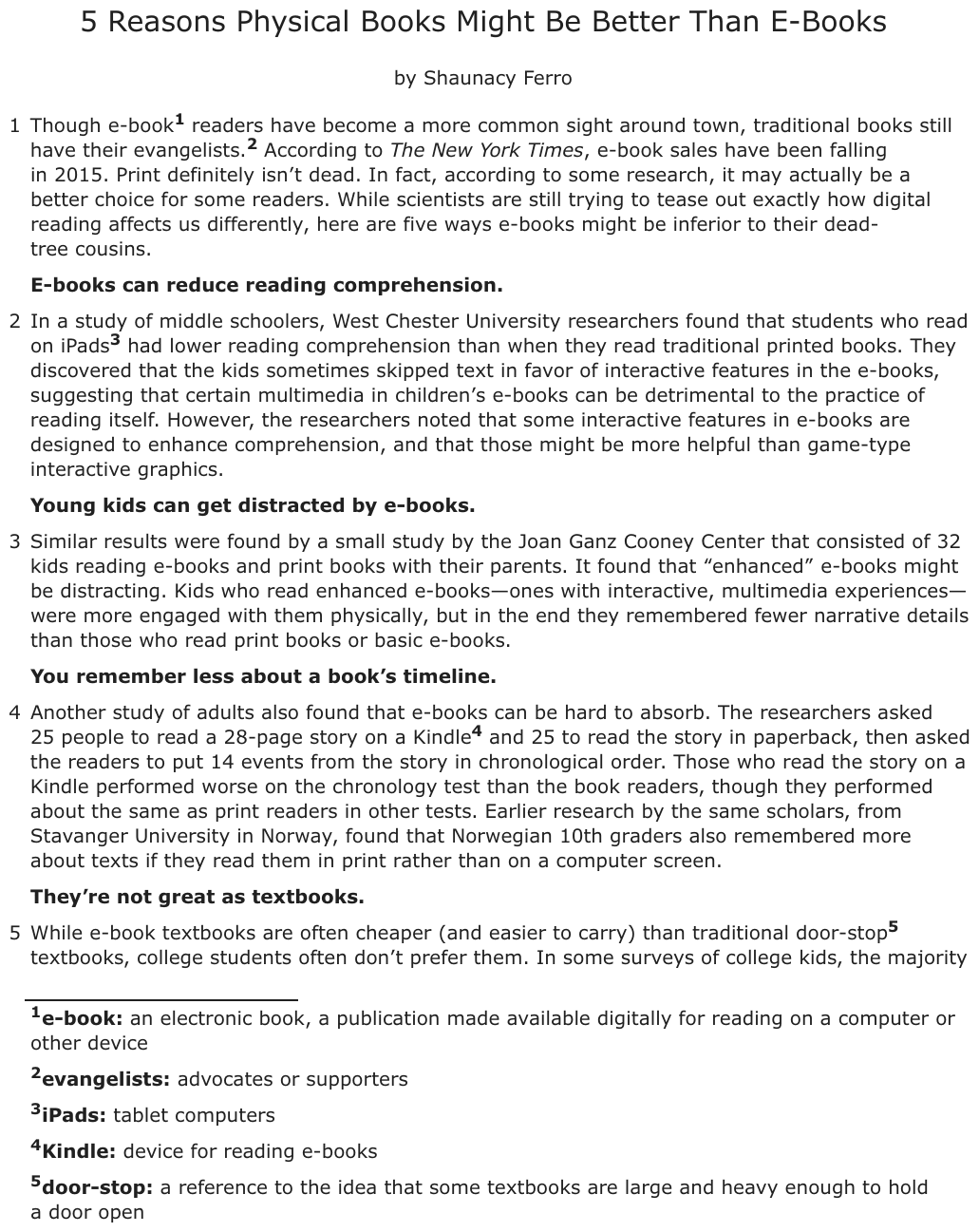
Which evidence from the passage best supports the claim that “print definitely isn’t dead” (paragraph 1)?
- AMost college students prefer using paper books to using e-books.
- BScientists are still studying the effects of reading on a screen.
- CPaper books are less disruptive to sleep patterns than e-books are.
- DReading on a screen can affect both the eyes and the brain.
Show the answer
Correct answer: A
The question asks which evidence from the passage best supports the claim in paragraph 1 that “print definitely isn’t dead.”
A. CORRECT. In paragraph 5, the author points out that “while e-book textbooks are often cheaper (and easier to carry) than traditional door-stop textbooks, college students often don’t prefer them.” The author adds that “in some surveys of college kids, the majority of students have reported preferring print books.” As a result, this evidence from the passage supports the claim in paragraph 1 that “print definitely isn’t dead.”
B. Incorrect. In paragraph 1, the author notes that “scientists are still trying to tease out exactly how digital reading affects us differently.” This detail shows that research on reading on a screen is still going on, but it says nothing about whether people still choose print, so it does not support the claim in paragraph 1 that “print definitely isn’t dead.”
C. Incorrect. Although the main idea of paragraph 6 is supported by the 2014 study that showed that “people who used e-readers with LED screens at night slept worse and were more tired the next day,” this detail does not support the claim in paragraph 1 that “print definitely isn’t dead.”
D. Incorrect. The author states in paragraph 6 that “staring at a lit screen can be tiring for the eyes and the brain” and that “reading digitally required a higher cognitive workload.” Although these details illustrate how using e-readers can have negative physical and mental effects, they do not support the claim in paragraph 1 that “print definitely isn’t dead.”
Question analysis
This evidence question takes the claim “print definitely isn't dead” from the opening of an article comparing printed books and e-books and asks which evidence from the passage best supports it. Students must pin down exactly what the claim says before judging the evidence, since all four choices come from the article and sound related.
- Grade level
- Grade 7 reading and task
- Compared with grade 7
- Above grade 7 Grade 7 students judge whether evidence is relevant to a claim, but this claim is a short idiom whose precise meaning must be settled first, and every choice paraphrases a real finding, which makes the comparison finer than typical.
- Estimated difficulty
- Hard: combines ideas, needs a plan, and has more than one tempting wrong answer.
- Thinking it demands
- Depth of knowledge 3, strategic thinking · mainly evaluate
- What makes it hard
- Reading between the lines major
- Figurative or literary language moderate
- The right answer is reworded minor
- Evidence
- Answered from several paragraphs or stanzas
- Reading level
- Passage: about grade 10, 829 words; question and choices: about grade 6, 59 words.
- Corrected from the DOE handbook
- The explanation of one wrong choice discussed a different detail; it now explains that choice.
- Students, last 30 days
- Not enough answers yet to show (it takes 10).
Why it is hard, traps and wrong answers (shows the answer)
Why it is hard
The sentence right after the claim says print “may actually be a better choice”, and the two wrong choices about sleep and tired eyes support exactly that, which makes them feel like the answer. The claim itself is narrower: print is still alive, still chosen by readers. Only one choice reports people choosing print, and its wording overstates the surveys, so students must accept an imperfect paraphrase over accurate findings that prove a different point.
Reading between the lines major Working it out
The article never ties any evidence to “Print definitely isn't dead”; the student must read it as print still being chosen and find that in paragraph 5's surveys, four paragraphs away. (Graesser, Singer & Trabasso, 1994; Kintsch, 1998)
Figurative or literary language moderate Understanding the question
“Isn't dead” is an idiom, and its exact sense, still bought and read rather than still worthwhile, decides between the survey of college students and the findings about sleep and tired eyes. (Graesser, Singer & Trabasso, 1994; Kintsch, 1998)
The right answer is reworded minor Choosing the answer
The right choice turns “in some surveys of college kids, the majority” into “Most college students prefer”, a looser paraphrase careful readers may distrust, while another choice echoes “the eyes and the brain”. (Freedle & Kostin, 1993; Kirsch & Mosenthal, 1990)
Strategy: Put the claim “print definitely isn't dead” into your own words first, then ask whether each choice proves that exact point or a different one made nearby in paragraph 1.
Traps
- Supports only part of the claim: In a question about evidence: a line that backs one half of the claim but not the other, or a related point rather than the claim itself.
- True but not the answer: A choice says something accurate about the text that does not answer this question.
The wrong answers, classified
B True but not the answer (King et al., 2004; Embretson & Wetzel, 1987)
Picks the sentence nearest the claim, that scientists are still working out how digital reading differs, a true remark about unfinished research that says nothing about print surviving.
C Supports only part of the claim (King et al., 2004; Thissen, Steinberg & Fitzpatrick, 1989)
Uses the 2014 Harvard sleep finding, a real advantage of paper that backs the next sentence's “better choice” but not the claim that people still buy and read print.
D Supports only part of the claim (King et al., 2004; Thissen, Steinberg & Fitzpatrick, 1989)
Chooses the finding that a lit screen tires “the eyes and the brain”, a drawback of e-books that argues print is better, not that print remains in use.
What was corrected from the DOE handbook, and why
- Explanation: Choice B is “Scientists are still studying the effects of reading on a screen,” from paragraph 1 (“scientists are still trying to tease out exactly how digital reading affects us differently”). The handbook's explanation of B instead discusses the iPad reading-comprehension study of paragraph 2, apparently left over from an earlier version of the choice. The explanation now addresses B: ongoing research says nothing about whether people still choose print. The answer, A, is unchanged.
Working it out, step by step
Pin down the claim
This asks you to find evidence for a claim. “Print definitely isn’t dead” is an idiom, a saying that doesn’t mean exactly what its words say. Books can’t really die. The claim means printed books are still being bought and read. People still choose them.
Watch for the nearby claim
The very next sentence makes a different claim. It says print “may actually be a better choice for some readers.” Being better is not the same as being alive. So you need evidence that people still choose print, not evidence that print is good for you.
Find people choosing print
Paragraph 5 says that “in some surveys of college kids, the majority of students have reported preferring print books.” A majority means more than half. They pick paper even though e-books are “often cheaper (and easier to carry).” So many readers still choose print, which shows it is still alive.
Check each choice
- A fits: most college students in those surveys prefer paper books.
- B is wrong because research still going on says nothing about whether people still choose print.
- C is wrong because better sleep is a reason print may be better, not proof that people still use it.
- D is wrong because tired eyes and brains are also a reason print may be better.
Watch out: C and D support the “better choice” sentence, not “isn’t dead.”
Choose the answer
Only A shows that many readers still choose paper books today. So the answer is A.
Why this answer and not the closest wrong one
C is the most tempting wrong answer. The finding that lit screens hurt sleep is real, and it favors paper. But it shows print may be better, not that it is still alive. A shows readers still choosing print. It says “Most college students” when the passage reports only “some surveys,” but it is still the best fit.
More questions like this
The original DOE question
The passage “5 Reasons Physical Books Might Be Better Than E-Books” as printed (pages 58–59)
Question 4 of 6
2024 Test B Math, question 52Question
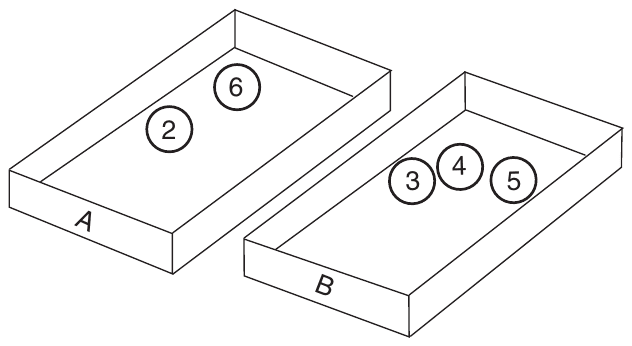
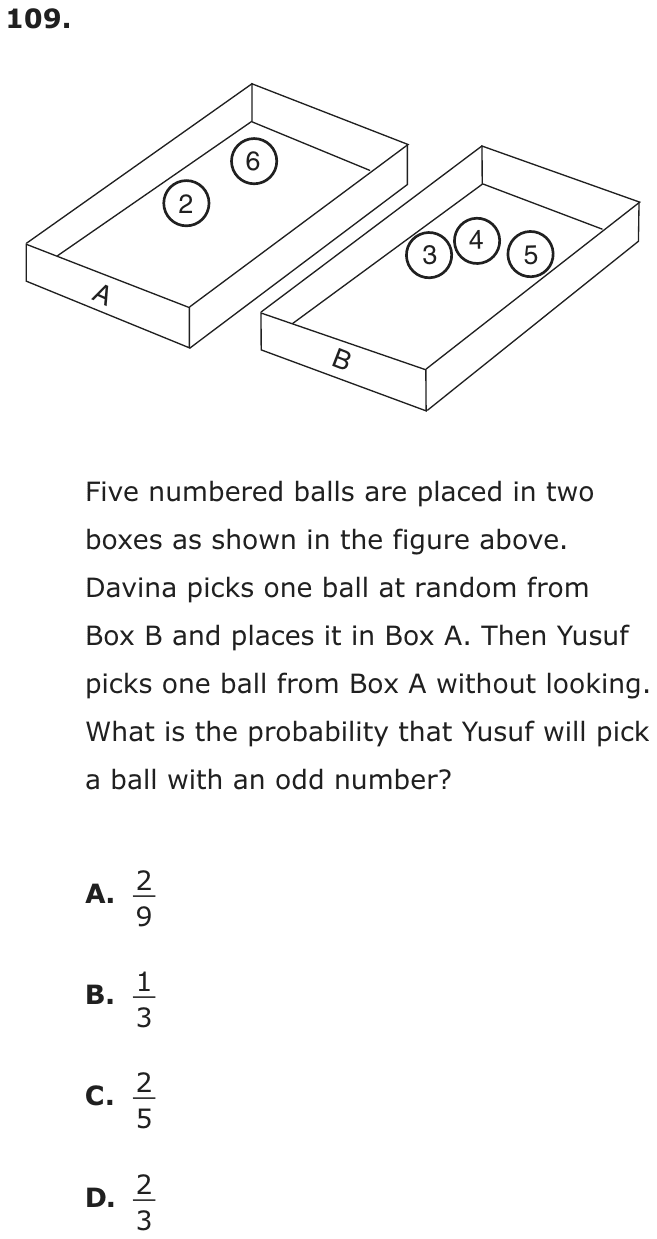
Five numbered balls are placed in two boxes as shown in the figure above. Davina picks one ball at random from Box B and places it in Box A. Then Yusuf picks one ball from Box A without looking. What is the probability that Yusuf will pick a ball with an odd number?
- A
- B
- C
- D
Show the answer
Correct answer: A
The probability of Davina picking an odd-numbered ball from Box B is . If Davina places an odd-numbered ball in Box A, then the probability of Yusuf picking an odd-numbered ball from Box A is . The probability of both of these events happening is the product of the two probabilities.
Question analysis
Two boxes hold five numbered balls, and Davina moves one ball at random from Box B into Box A before Yusuf draws one from Box A. Students find the probability that Yusuf's ball shows an odd number. It tests two-stage probability, and the tricky part is that the second draw depends on which ball was moved.
- NYS standards
- Grade level
- Grade 7 content, by NYS standard
- Compared with grade 7
- Above grade 7 Grade 7 compound probability lists outcomes for independent stages such as coins or spinners. Here the first random move changes what is in the second box, so students must follow two linked stages, a dependence typical grade 7 work does not include.
- Estimated difficulty
- Among the hardest on the SHSAT: a non-obvious approach, heavy reading, or a well-hidden trap.
- Thinking it demands
- Depth of knowledge 3, strategic thinking · mainly analyze
- What makes it hard
- Solution
- 3 steps
- Reading level
- Question and choices: about grade 4, 57 words.
- Students, last 30 days
- Not enough answers yet to show (it takes 10).
Why it is hard, traps and wrong answers (shows the answer)
Why it is hard
Two chance events are hidden in what reads like a question about a single draw. Every listed wrong answer is a reasonable single-stage answer, either one of the two factors on its own or a count of odd balls across both boxes. Listing the nine equally likely pairs, Davina's ball and then Yusuf's, shows that only two of them end with an odd ball and makes the structure visible without any formula.
No obvious method major Working it out
The stem asks one question about Yusuf's draw, but the answer depends on Davina's earlier random pick; the key is that Box A starts with only even balls, so Yusuf can draw odd only by drawing the ball she moved. (Schoenfeld, 1985)
Something you must already know minor Working it out
Multiplying the chances of the two stages, 2/3 for an odd ball moving and 1/3 for Yusuf then drawing it, is a rule students must bring themselves. (Anderson & Krathwohl, 2001)
Reading a figure, table or graph minor Understanding the question
The numbers appear only in the figure, Box A holding 2 and 6 and Box B holding 3, 4 and 5, so the odd balls have to be spotted there. (Lesh, Post & Behr, 1987; Kirsch & Mosenthal, 1990)
Strategy: List every equally likely pair of a ball moved by Davina and a ball picked by Yusuf, and count the pairs that end with an odd ball.
Traps
- Stops one step early: A choice is a number from partway through the solution.
- Numbers taken from the question: Combines the numbers in the question without a model of the situation, or is simply a number that appears in the question.
The wrong answers, classified
B Stops one step early (King et al., 2004; Gierl et al., 2017)
Finds Yusuf's chance of drawing the odd ball once one is in Box A, 1 out of 3, leaving out the chance that Davina moves an odd ball at all.
C Numbers taken from the question (Hegarty, Mayer & Monk, 1995)
Counts the odd balls in the figure, 3 and 5, over all five balls, 2/5, ignoring that Yusuf draws only from Box A.
D Stops one step early (King et al., 2004; Gierl et al., 2017)
Gives the chance that Davina moves an odd ball, 2 out of 3, the first stage only, without multiplying by Yusuf's 1/3 chance of drawing it.
Worked solution, step by step
Formulas used
- Probability
- P is the probability, the chance that something happens. It is a number from 0 to 1. The top counts the results you want. The bottom counts all the results that can happen. It works when every result is equally likely.
- Chance of events in a row
- A and B are two events that happen one after the other. P(A) is the chance of the first. P(B after A) is the chance of the second, counting only what is left after the first. You multiply because the second must also happen inside the share of times the first did.
Read the figure
Box A holds balls numbered 2 and 6. Box B holds balls numbered 3, 4 and 5.
An odd number does not divide evenly by 2. So the only odd balls are 3 and 5, and both start in Box B. Box A starts with no odd balls at all.
Spot the two chance events
Two things happen by chance, one after the other:
- Davina picks one of the 3 balls in Box B and moves it to Box A.
- Then Yusuf picks one of the 3 balls now in Box A.
Yusuf gets an odd ball only if both go right. Davina must move an odd ball. Then Yusuf must pick that very ball.
The question asks only about Yusuf. But his chance depends on Davina’s pick, which comes first.
Find the chance for Davina’s pick
Box B has 3 balls, and 2 of them, the 3 and the 5, are odd.
If she moves the 4 instead, Box A holds only even balls. Then Yusuf can’t get an odd ball at all.
Find the chance for Yusuf’s pick
Say Davina moved an odd ball. Box A now holds 3 balls: the 2, the 6 and that one odd ball.
Watch out: alone is choice B. It forgets that Davina might move the 4.
Multiply the two chances
Both events must happen, so use the rule for events in a row.
Watch out: alone, choice D, stops after Davina’s pick. , choice C, counts 2 odd balls out of all 5. But Yusuf picks only from Box A.
So the answer is A, .
Check your answer
List all 9 equally likely outcomes. Davina can move 3, 4 or 5. Then Yusuf picks one of 3 balls.
| Ball moved | Box A then | Odd picks |
|---|---|---|
| 3 | 2, 6, 3 | 1 |
| 4 | 2, 6, 4 | 0 |
| 5 | 2, 6, 5 | 1 |
That is 2 odd picks out of 9, or .
More questions like this
The original DOE question
Question 5 of 6
2024 Test B Math, question 14Question
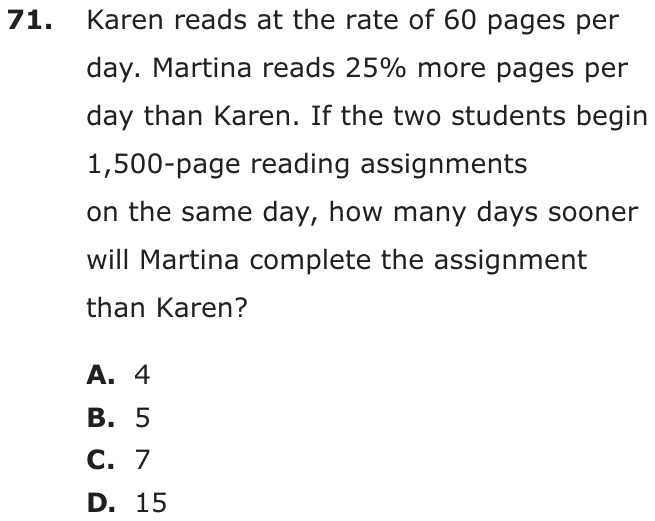
Karen reads at the rate of 60 pages per day. Martina reads 25% more pages per day than Karen. If the two students begin 1,500-page reading assignments on the same day, how many days sooner will Martina complete the assignment than Karen?
- A4
- B5
- C7
- D15
Show the answer
Correct answer: B
First, determine the rate at which Martina reads, in pages per day, using the rate at which Karen reads, 60 pages per day.
Next, determine the number of days it will take each person to complete the 1,500-page reading assignment.
Karen:
Martina:
Finally, determine the difference between the two numbers of days.
So Martina will complete the assignment 5 days sooner than Karen.
Question analysis
A reading-rate word problem: Karen reads 60 pages a day, and Martina reads 25% more pages a day. Both start a 1,500-page assignment on the same day, and students find how many days sooner Martina finishes. It combines a percent increase with rates and times, and asks for a difference in days.
- Grade level
- Grade 7 content, by NYS standard
- Compared with grade 7
- Above grade 7 Grade 7 percent problems usually stop after one increase or decrease. This one turns the percent into a new rate, finds two finishing times and compares them, four steps that go beyond a typical grade 7 task.
- Estimated difficulty
- Hard: combines ideas, needs a plan, and has more than one tempting wrong answer.
- Thinking it demands
- Depth of knowledge 2, skills and concepts · mainly apply
- What makes it hard
- Many steps moderate
- Combines ideas moderate
- Turning words into math minor
- Solution
- 4 steps
- Reading level
- Question and choices: about grade 6, 40 words.
- Students, last 30 days
- Not enough answers yet to show (it takes 10).
Why it is hard, traps and wrong answers (shows the answer)
Why it is hard
Each step is easy on its own; the difficulty is in carrying the chain to the end. Three of the choices are numbers a student meets or makes along the way: the extra pages per day, a quotient of two rates, or a rate built on 25 pages instead of 25%. Writing both finishing times down before subtracting keeps the target, a number of days, in view.
Many steps moderate Working it out
Four operations chain together: 25% of 60, Martina's 75 pages, the two finishing times 1,500 ÷ 60 and 1,500 ÷ 75, and finally their difference. (Daniel & Embretson, 2010; Enright, Morley & Sheehan, 2002)
Combines ideas moderate Working it out
A percent increase in a daily rate has to be turned into a change in days, and 25% more pages a day does not mean 25% fewer days. (Embretson, 1998; Daniel & Embretson, 2010)
Turning words into math minor Understanding the question
“25% more pages per day than Karen” makes Martina's rate 1.25 × 60, and “how many days sooner” asks for a difference of two times, not of two rates. (Hegarty, Mayer & Monk, 1995; Koedinger & Nathan, 2004)
Strategy: Increase 60 by 25% to get Martina's daily pages, divide 1,500 by each girl's daily rate to get her number of days, then subtract the two numbers of days.
Traps
- Stops one step early: A choice is a number from partway through the solution.
- Misunderstands the concept: A wrong belief about a concept: that percents can be added, that area grows like length, that averages can be averaged, that a bigger denominator means a bigger fraction.
- Numbers taken from the question: Combines the numbers in the question without a model of the situation, or is simply a number that appears in the question.
The wrong answers, classified
A Numbers taken from the question (Hegarty, Mayer & Monk, 1995)
Divides Karen's 60 pages a day by Martina's 15 extra pages a day, combining two rates without finding how long either girl takes.
C Misunderstands the concept (Smith, diSessa & Roschelle, 1993; De Bock et al., 1998; Ni & Zhou, 2005)
Adds 25 pages instead of 25%, giving Martina 85 pages a day, so she needs 1,500 ÷ 85 ≈ 17.6, or 18 days, and 25 − 18 = 7.
D Stops one step early (King et al., 2004; Gierl et al., 2017)
Finds that Martina reads 25% of 60 = 15 more pages each day and stops there, giving a number of pages instead of days.
Worked solution, step by step
Formulas used
- Percent increase
- Old is the starting amount, and p is the percent it grows by. First find p percent of the old amount. That is the extra. Then add the extra to the old amount to get the new amount.
- Time from a rate
- Total pages is the whole assignment. Pages per day is how fast someone reads. Dividing tells how many days of reading fit into the whole job.
Sort out what you know
Karen reads 60 pages per day. Martina reads 25% more pages per day than Karen. Each girl must read 1,500 pages. You need how many days sooner Martina finishes. That is the difference between their numbers of days.
Find Martina’s pages per day
25% more means Karen’s 60 pages plus 25% of 60.
Martina reads 75 pages per day. Watch out: 15 is extra pages, not days. Stopping here gives 15, choice D. Adding 25 pages instead of 25% gives 85 pages and leads to 7, choice C.
Find each girl’s number of days
Divide the whole assignment by each girl’s pages per day.
Karen needs 25 days, and Martina needs 20 days.
Subtract the days
“How many days sooner” asks for the difference.
Martina finishes 5 days sooner. Watch out: dividing 60 by 15 mixes two rates and gives 4, choice A.
So the answer is B, 5.
Check your answer
Multiply back. Karen: pages. Martina: pages. Both read all 1,500 pages, and 25 days is 5 days more than 20 days.
More questions like this
The original DOE question
Question 6 of 6
2018 Test B Math, question 53Question
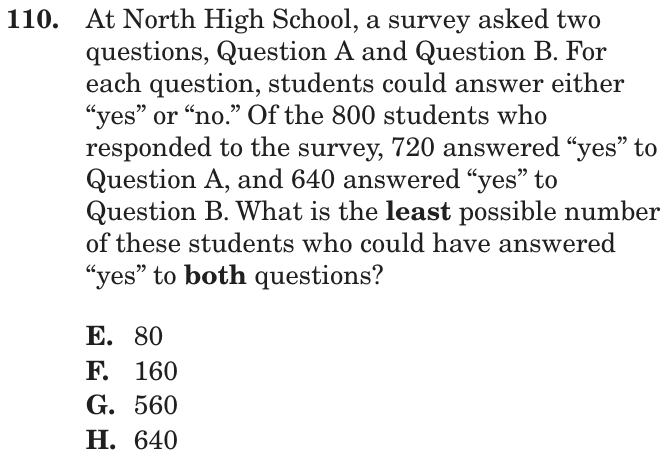
At North High School, a survey asked two questions, Question A and Question B. For each question, students could answer either “yes” or “no.” Of the 800 students who responded to the survey, 720 answered “yes” to Question A, and 640 answered “yes” to Question B. What is the least possible number of these students who could have answered “yes” to both questions?
- A80
- B160
- C560
- D640
Show the answer
Correct answer: C
None of the 80 students (800 − 720) who answered “no” to Question A could have answered “yes” to both questions.
Therefore, the least possible number of students who could have answered “yes” to both questions can be found by subtracting the 80 who answered “no” to Question A from the 640 who answered “yes” to Question B or 640 − 80 = 560.
Question analysis
In a survey of 800 students at North High School, 720 said yes to the first question and 640 said yes to the second. Students must find the smallest possible number who said yes to both. It tests reasoning about overlapping groups, and asking for the least possible overlap rather than an exact count makes it unusual.
- NYS standards
- Grade level
- Grade 7 content, by NYS standard
- Compared with grade 7
- Above grade 7 Grade 7 students work with Venn diagrams and two-way tables when all counts are given. Finding the smallest possible overlap requires reasoning about extremes rather than computing, which is rare in grade 7 and new to most students.
- Estimated difficulty
- Among the hardest on the SHSAT: a non-obvious approach, heavy reading, or a well-hidden trap.
- Thinking it demands
- Depth of knowledge 3, strategic thinking · mainly analyze
- What makes it hard
- No obvious method major
- Turning words into math moderate
- A very close wrong answer minor
- Solution
- 2 steps
- Reading level
- Question and choices: about grade 8, 60 words.
- Corrected from the DOE handbook
- A repeated phrase and a stray comma in the explanation were removed.
- Students, last 30 days
- Not enough answers yet to show (it takes 10).
Why it is hard, traps and wrong answers (shows the answer)
Why it is hard
Most students have never been asked for a smallest overlap, so they fall back on a picture of nested groups and give the largest one. The key move is to push the two yes groups apart as far as possible: only the 80 students who said no to Question A can absorb some of Question B's yes answers. Once that is seen, the arithmetic is one subtraction, so the question rewards reasoning far more than computation.
No obvious method major Working it out
Nothing in the wording points to the method: the smallest overlap appears only when all 80 students who said no to Question A are imagined saying yes to Question B. (Schoenfeld, 1985)
Turning words into math moderate Understanding the question
"The least possible number of these students who could have answered “yes” to both questions" asks for an extreme case, which has to be turned into an arrangement of the 800 students. (Hegarty, Mayer & Monk, 1995; Koedinger & Nathan, 2004)
A very close wrong answer minor Choosing the answer
640 is only 80 above the right 560, so a rough sense of size cannot choose between them; only asking whether the overlap is the least or the greatest separates them. (Embretson & Wetzel, 1987; Gorin & Embretson, 2006; Ascalon et al., 2007)
Strategy: Add the two yes counts and compare the sum with the number of students; any amount above the total must come from students counted in both groups.
Traps
- NOT, LEAST or EXCEPT: The question asks for the exception, the least, or what is not true.
- Stops one step early: A choice is a number from partway through the solution.
- Answers a different question: A choice is right for another quantity: the other unknown, the rest instead of the part, the part instead of the whole.
The wrong answers, classified
A Stops one step early (King et al., 2004; Gierl et al., 2017)
Finds the 80 students who said no to Question A, 800 − 720, and stops before subtracting them from the 640 who said yes to Question B.
B Answers a different question (King et al., 2004; Hegarty, Mayer & Monk, 1995)
Finds the 160 students who said no to Question B, 800 − 640, which bears on the count but is not the overlap asked about.
D Answers a different question (King et al., 2004; Hegarty, Mayer & Monk, 1995)
Assumes everyone who said yes to Question B also said yes to Question A, giving the greatest possible overlap instead of the least.
What was corrected from the DOE handbook, and why
- Explanation: The handbook prints “(800 − 720)” twice in its first sentence, after “80 students” and again after “Question A,” and puts a comma between subject and verb in “the least possible number of students who could have answered “yes” to both questions, can be found.” The site keeps the first “(800 − 720)” and drops the comma.
Worked solution, step by step
Formulas used
- Least overlap of two groups
- a is the size of the first group and b is the size of the second. t is the total number of people. If a + b is more than t, some people must be in both groups. The extra amount is the smallest number that can be in both.
Sort out what you know
There were 800 students. Of them, 720 said yes to Question A and 640 said yes to Question B. You need the least number who could have said yes to both. The overlap is the group in both yes groups. You want the smallest overlap.
Find who said no to A
Students who said no to Question A cannot be in the overlap.
So 80 students said no to Question A.
Watch out: 80 is not the answer. It is only a step, and it is choice A.
Keep the overlap small
To make the overlap as small as you can, put as many B yes answers outside it as possible. The only students outside it are the 80 who said no to A. So pretend all 80 of them said yes to B.
Count the rest of the yes group
The other yes answers to B must come from students who also said yes to A.
So at least 560 students said yes to both.
Watch out: 640 is the most that could say yes to both, not the least. That is choice D.
Give the answer
The fewest students who could say yes to both questions is 560. So the answer is C, 560.
Check your answer
Use the overlap formula: . There are 1,360 yes answers but only 800 students, so 560 students must be counted twice. You can also check the groups. 560 said yes to both, 160 to A only and 80 to B only. That makes .
More questions like this
The original DOE question