3 English and 3 math
Here are 6 random questions to try. Takers earning below 75% are unlikely to receive an offer. You have 1 minute 48 seconds per question on the real exam.
Question 1 of 6
2026 Practice Test D English, question 26Passage Ode to Fireworks
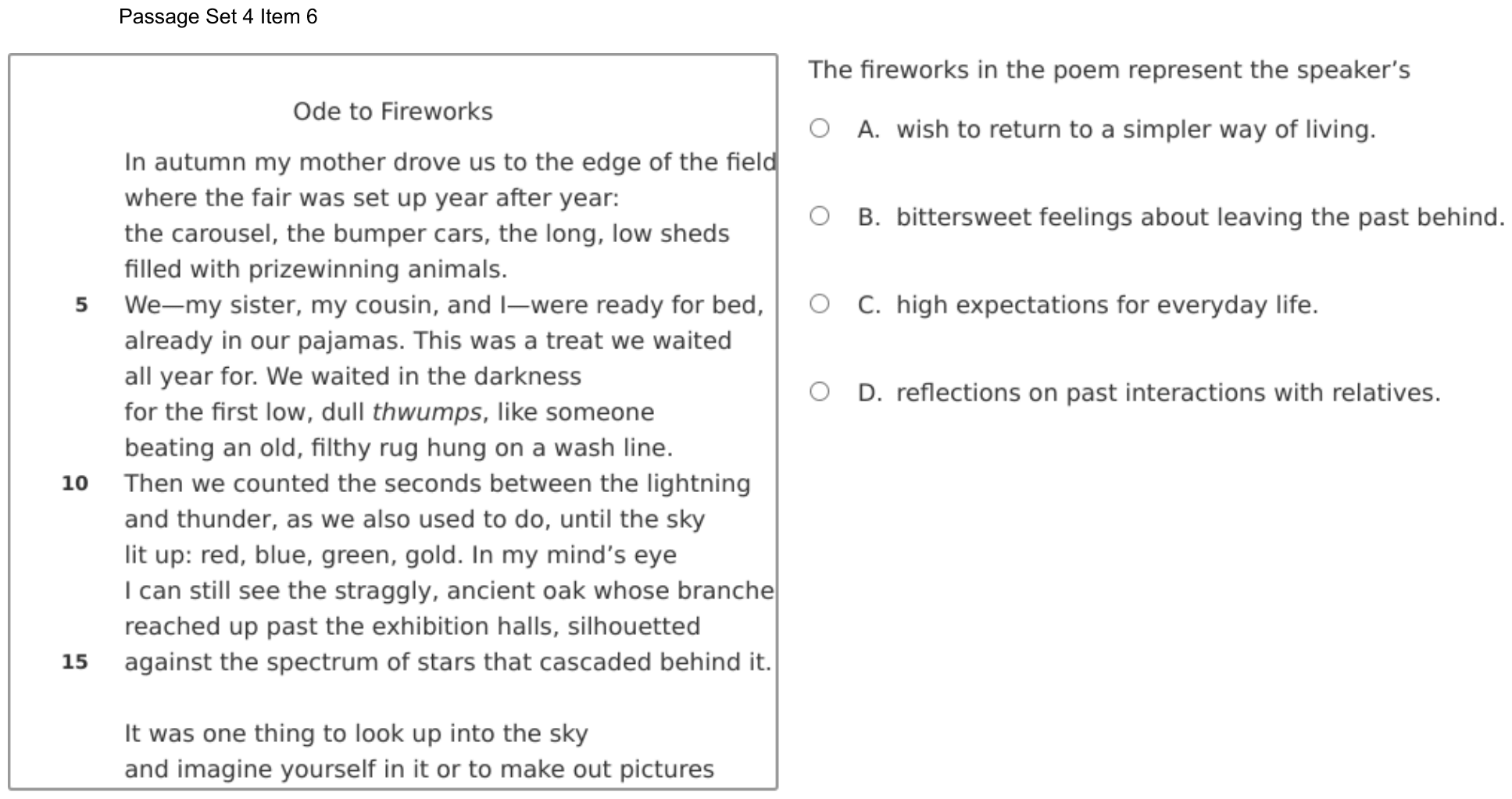
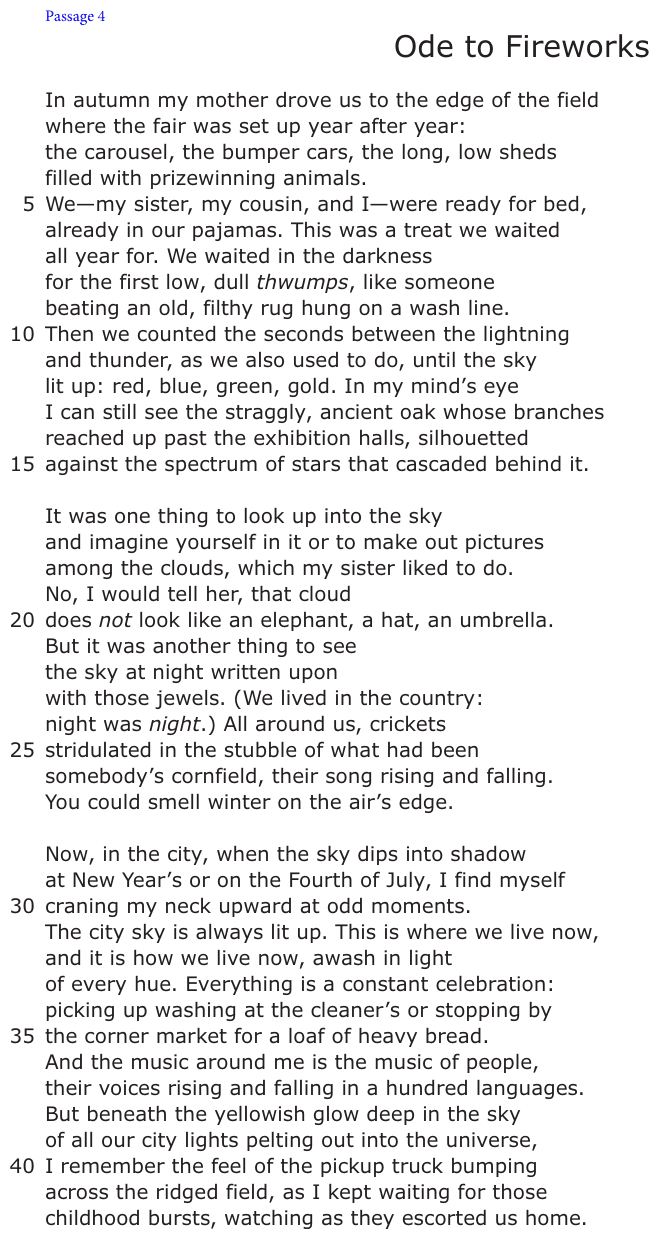
Ode to Fireworks
In autumn my mother drove us to the edge of the field
where the fair was set up year after year:
the carousel, the bumper cars, the long, low sheds
filled with prizewinning animals.
We—my sister, my cousin, and I—were ready for bed,
already in our pajamas. This was a treat we waited
all year for. We waited in the darkness
for the first low, dull thwumps, like someone
beating an old, filthy rug hung on a wash line.
Then we counted the seconds between the lightning
and thunder, as we also used to do, until the sky
lit up: red, blue, green, gold. In my mind’s eye
I can still see the straggly, ancient oak whose branches
reached up past the exhibition halls, silhouetted
against the spectrum of stars that cascaded behind it.
It was one thing to look up into the sky
and imagine yourself in it or to make out pictures
among the clouds, which my sister liked to do.
No, I would tell her, that cloud
does not look like an elephant, a hat, an umbrella.
But it was another thing to see
the sky at night written upon
with those jewels. (We lived in the country:
night was night.) All around us, crickets
stridulated in the stubble of what had been
somebody’s cornfield, their song rising and falling.
You could smell winter on the air’s edge.
Now, in the city, when the sky dips into shadow
at New Year’s or on the Fourth of July, I find myself
craning my neck upward at odd moments.
The city sky is always lit up. This is where we live now,
and it is how we live now, awash in light
of every hue. Everything is a constant celebration:
picking up washing at the cleaner’s or stopping by
the corner market for a loaf of heavy bread.
And the music around me is the music of people,
their voices rising and falling in a hundred languages.
But beneath the yellowish glow deep in the sky
of all our city lights pelting out into the universe,
I remember the feel of the pickup truck bumping
across the ridged field, as I kept waiting for those
childhood bursts, watching as they escorted us home.
Question
The fireworks in the poem represent the speaker’s
- Awish to return to a simpler way of living.
- Bbittersweet feelings about leaving the past behind.
- Chigh expectations for everyday life.
- Dreflections on past interactions with relatives.
Show the answer
Correct answer: B
The question asks what the fireworks in the poem represent about the speaker.
A. Incorrect. While the speaker misses elements of the past, the speaker is also positive about the present, with comparisons to a “constant celebration” (line 33) and descriptions of “the music of people” (line 36). The speaker does not indicate a desire to return to a simpler way of living.
B. CORRECT. The speaker misses the experience of watching the fireworks display with family and friends but understands that time has progressed and that life is now different. The lines “This was a treat we waited / all year for” (lines 6–7) highlight the significance of the memory of waiting for and watching the fireworks. In the speaker’s present, the lines “I remember the feel of the pickup truck bumping / across the ridged field” (lines 40–41) emphasize the key details from the experience that stand out in the speaker’s mind when something in the current environment reminds the speaker of the past.
C. Incorrect. While the speaker does share details about the present and the tone is generally positive, the fireworks do not suggest that the speaker has high expectations for how everyday life should be. The third stanza (lines 28–42) describes the speaker’s daily life in the city, but the speaker does not form expectations from these everyday moments.
D. Incorrect. While the speaker does mention discussing cloud shapes with a family member in lines 19–20, the fireworks serve as a more general reminder of the speaker’s past life. Viewing the bright lights of the city makes the speaker recall memories of the speaker’s past and the feelings of anticipation before the fireworks show.
Question analysis
This question about symbolism asks what the fireworks represent in “Ode to Fireworks,” a 42-line poem in which an adult speaker remembers watching fireworks at a country fair as a child. Students must weigh all three stanzas to decide what the central image stands for, and the choices name abstract feelings and wishes that are close to one another.
- Grade level
- Grade 8 reading and task
- Compared with grade 7
- Above grade 7 Grade 7 students interpret symbols, usually where the text makes their meaning fairly clear. Here they must hold a 42-line poem in mind and choose among four abstract feelings, two of them very close, which goes beyond typical grade 7 work.
- Estimated difficulty
- Hard: combines ideas, needs a plan, and has more than one tempting wrong answer.
- Thinking it demands
- Depth of knowledge 3, strategic thinking · mainly analyze
- What makes it hard
- Figurative or literary language moderate
- A very close wrong answer moderate
- Evidence in several places moderate
- Evidence
- Answered from the whole text
- Reading level
- Passage: 379 words (a poem; reading level not measured); question and choices: about grade 8, 35 words.
- Corrected from the DOE handbook
- The explanation of C misdescribed the third stanza; one sentence was corrected.
- Students, last 30 days
- Not enough answers yet to show (it takes 10).
Why it is hard, traps and wrong answers (shows the answer)
Why it is hard
This symbol question asks students to hold the whole 42-line poem in mind and weigh two feelings at once: the speaker misses the fireworks of childhood but speaks warmly of city life. Readers who notice only the longing choose a wish to go back, and readers who fix on one detail choose the relatives or the city’s “constant celebration.” The key’s “bittersweet” is the one word that holds both halves, which is why it is easy to pass over for a choice that states only one.
Figurative or literary language moderate Understanding the question
The fireworks are never explained; they are “jewels” in stanza 2 and the “childhood bursts” that “escorted us home” in stanza 3, so their meaning as a symbol must be built from images. (Graesser, Singer & Trabasso, 1994; Kintsch, 1998)
A very close wrong answer moderate Choosing the answer
The wish-to-return choice and the key both read the fireworks as feelings about the past; they differ in whether the speaker wants that past back or has accepted leaving it. (Embretson & Wetzel, 1987; Gorin & Embretson, 2006; Ascalon et al., 2007)
Evidence in several places moderate Working it out
The answer needs all three stanzas: the treat “we waited / all year for,” the dark country night, and the city stanza’s “This is where we live now,” which shows acceptance beside longing. (Kirsch & Mosenthal, 1990; Gorin & Embretson, 2006)
Strategy: Note how the speaker describes the fireworks in each stanza and how the speaker feels about the present in the last one, then choose the feeling that fits all three stanzas, not only the first.
Traps
- Reads too much in: A reasonable-sounding conclusion that goes further than the text allows.
- Word match: Repeats striking words or phrases from the text, so it looks supported, but its meaning does not fit the question.
- Too narrow: A single detail offered as the central idea or a summary, or a summary that keeps minor details and leaves out an essential part.
The wrong answers, classified
A Reads too much in (Graesser, Singer & Trabasso, 1994)
Takes the poem’s fond memories of the country as a wish to go back, though the speaker accepts “where we live now” and never asks to return.
C Word match (Freedle & Kostin, 1993)
Links the fireworks to line 33’s “Everything is a constant celebration,” then turns that into high expectations for daily life, which the poem never mentions.
D Too narrow (King et al., 2004)
Fixes on the mother, sister and cousin of the first stanza, real details, but the fireworks stand for a whole period of the speaker’s life, not time with relatives.
What was corrected from the DOE handbook, and why
- Explanation: Rejecting C, the handbook's explanation calls the third stanza (lines 28–42) “the speaker’s imaginings” and “fantasies”. The stanza describes the speaker's real life in the city now: “This is where we live now”, picking up washing at the cleaner's, stopping by the corner market. It now says the stanza describes the speaker's daily life in the city. The answer, B, is unchanged.
Working it out, step by step
Figure out what the question asks
This asks what the fireworks represent, or stand for. A thing in a poem that stands for a bigger idea is called a symbol. Look at the fireworks in all three stanzas. Then see how the speaker feels about the past and the present.
Look at the past
Stanza 1 shows how special the fireworks were: “This was a treat we waited / all year for.” Stanza 2 calls them “jewels.” In stanza 3 the speaker still remembers them: “I remember the feel of the pickup truck bumping / across the ridged field.” So the speaker misses that time.
Look at the present
The speaker also accepts city life: “This is where we live now, / and it is how we live now.” The city is “a constant celebration,” full of “the music of people.” So the speaker is not unhappy now. The speaker misses the past but has moved on. That feeling is bittersweet: happy and sad at the same time.
Check each choice
- A is wrong. The speaker never says they want to go back to the country.
- B is right. The fireworks stand for a loved past the speaker has left behind. The feeling is both warm and sad.
- C is wrong. The “constant celebration” describes city life. Nothing shows high expectations.
- D is wrong. Relatives appear in stanza 1. But the fireworks stand for a whole time of life, not just time with family.
Watch out: A notices only the longing. It misses that the speaker accepts “where we live now.”
Choose the answer
The fireworks hold both the joy of the past and the sadness of leaving it. So the answer is B, “bittersweet feelings about leaving the past behind.”
Why this answer and not the closest wrong one
A is the closest wrong answer. Both A and B are about feelings for the past. But A says the speaker wants to return, and the poem never says that. The speaker calls the city “a constant celebration” and accepts “where we live now.” Missing the past while accepting the present is bittersweet. That is B.
More questions like this
The original DOE question
The passage “Ode to Fireworks” as printed (page 32)
Question 2 of 6
2026 Practice Test D English, question 12Passage Excerpt from “How We Made the First Flight”
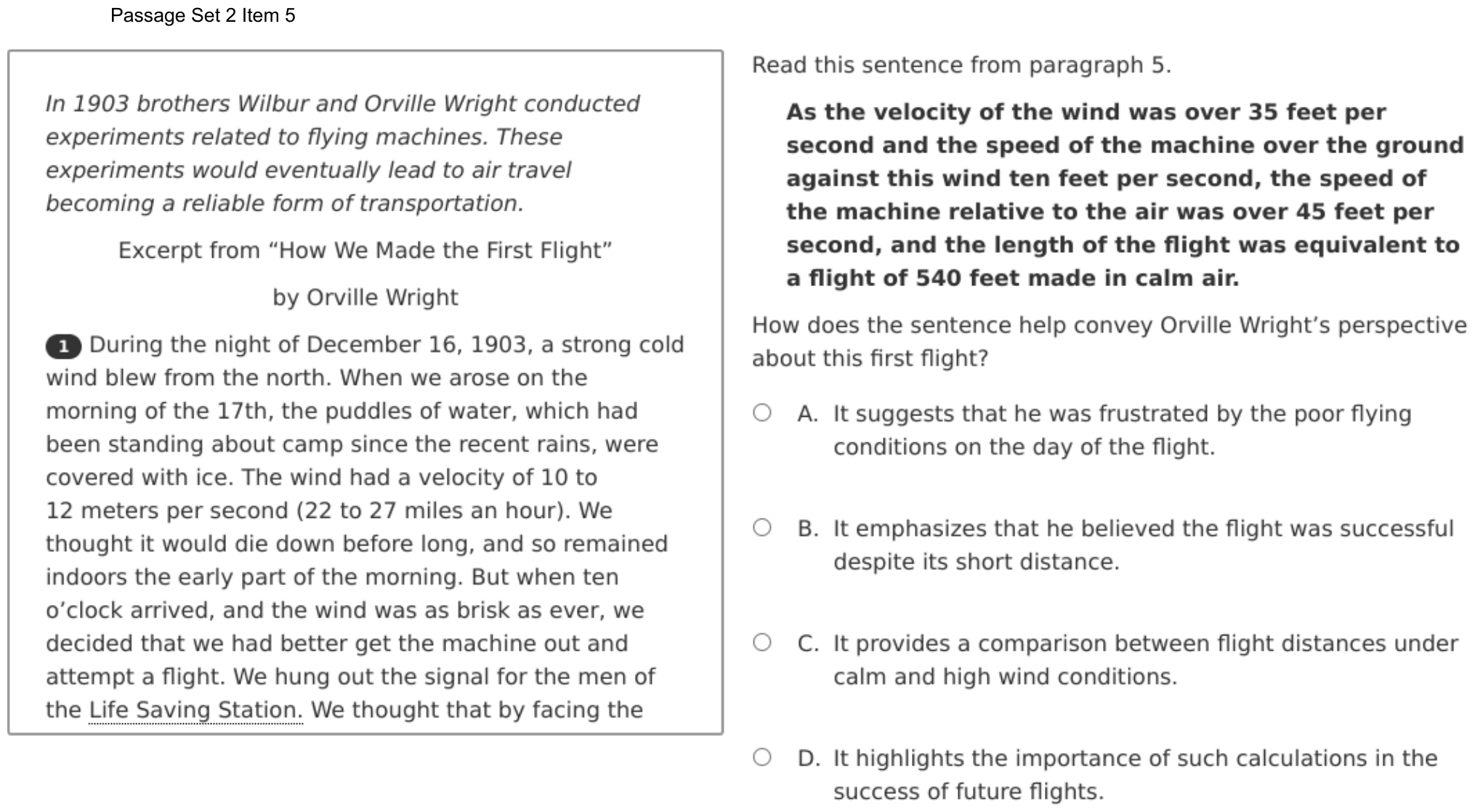
Excerpt from “How We Made the First Flight”
by Orville Wright
In 1903 brothers Wilbur and Orville Wright conducted experiments related to flying machines. These experiments would eventually lead to air travel becoming a reliable form of transportation.
During the night of December 16, 1903, a strong cold wind blew from the north. When we arose on the morning of the 17th, the puddles of water, which had been standing about camp since the recent rains, were covered with ice. The wind had a velocity of 10 to 12 meters per second (22 to 27 miles an hour). We thought it would die down before long, and so remained indoors the early part of the morning. But when ten o’clock arrived, and the wind was as brisk as ever, we decided that we had better get the machine out and attempt a flight. We hung out the signal for the men of the Life Saving Station.1 We thought that by facing the flyer into a strong wind, there ought to be no trouble in launching it from the level ground about camp. We realized the difficulties of flying in so high a wind, but estimated that the added dangers in flight would be partly compensated for by the slower speed in landing.
Final Preparations
We laid the track on a smooth stretch of ground about one hundred feet north of the new building. The biting cold wind made work difficult, and we had to warm up frequently in our living room, where we had a good fire in an improvised stove made of a large carbide2 can. By the time all was ready, J. T. Daniels, W. S. Dough and A. D. Etheridge, members of the Kill Devil3 Life Saving Station; W. C. Brinkley of Manteo, and Johnny Moore, a boy from Nags Head,4 had arrived.
We had a “Richard” hand anemometer with which we measured the velocity of the wind. Measurements made just before starting the first flight showed velocities of 11 to 12 meters per second, or 24 to 27 miles per hour. . . .
Audacity—and Calculation
Wilbur having used his turn in the unsuccessful attempt on the 14th, the right to the first trial now belonged to me. After running the motor a few minutes to heat it up, I released the wire that held the machine to the track, and the machine started forward in the wind. Wilbur ran at the side of the machine, holding the wing to balance it on the track. Unlike the start on the 14th, made in a calm, the machine, facing a 27-mile wind, started very slowly. Wilbur was able to stay with it till it lifted from the track after a forty-foot run. One of the Life Saving men snapped the camera for us, taking a picture just as the machine had reached the end of the track and had risen to a height of about two feet. The slow forward speed of the machine over the ground is clearly shown in the picture by Wilbur’s attitude. He stayed along beside the machine without any effort.
Flight
The course of the flight up and down was exceedingly erratic, partly due to the irregularity of the air, and partly to lack of experience in handling this machine. The control of the front rudder was difficult on account of its being balanced too near the center. This gave it a tendency to turn itself when started; so that it turned too far on one side and then too far on the other. As a result the machine would rise suddenly to about ten feet, and then as suddenly dart for the ground. A sudden dart when a little over a hundred feet from the end of the track, or a little over 120 feet from the point at which it rose into the air, ended the flight. As the velocity of the wind was over 35 feet per second and the speed of the machine over the ground against this wind ten feet per second, the speed of the machine relative to the air was over 45 feet per second, and the length of the flight was equivalent to a flight of 540 feet made in calm air. This flight lasted only 12 seconds, but it was nevertheless the first in the history of the world in which a machine carrying a man had raised itself by its own power into the air in full flight, had sailed forward without reduction of speed and had finally landed at a point as high as that from which it started.
From “How We Made the First Flight” by Orville Wright—Public Domain/Federal Aviation Administration
1Life Saving Station: one of the rescue stations along the Atlantic coastline that provided assistance to mariners in distress
2carbide: a very hard material composed of carbon and other heavy metals
3Kill Devil: the town of Kill Devil Hills in eastern North Carolina
4Nags Head: a town in eastern North Carolina
Question
Read this sentence from paragraph 5.
As the velocity of the wind was over 35 feet per second and the speed of the machine over the ground against this wind ten feet per second, the speed of the machine relative to the air was over 45 feet per second, and the length of the flight was equivalent to a flight of 540 feet made in calm air.
How does the sentence help convey Orville Wright’s perspective about this first flight?
- AIt suggests that he was frustrated by the poor flying conditions on the day of the flight.
- BIt emphasizes that he believed the flight was successful despite its short distance.
- CIt provides a comparison between flight distances under calm and high wind conditions.
- DIt highlights the importance of such calculations in the success of future flights.
Show the answer
Correct answer: B
The question asks how the sentence from paragraph 5 helps convey Orville Wright’s perspective about the first flight.
A. Incorrect. Although the sentence from paragraph 5 refers to the velocity of the wind during the flight, there is no indication that Orville felt a sense of frustration with the windy conditions. Instead, the sentence emphasizes the “speed of the machine relative to the air” and presents the equivalent flight length if the machine had flown through calm air (“the length of the flight was equivalent to a flight of 540 feet made in calm air”), details that emphasize the importance of the Wrights’ accomplishment.
B. CORRECT. In the sentence from paragraph 5, Orville uses the wind velocity and the machine speed to highlight the distance that the plane covered while in the air and to determine the distance that it would have flown on a day with calm winds, which emphasizes the magnitude of the accomplishment.
C. Incorrect. Since Orville does not suggest in the sentence from paragraph 5 how far the plane traveled under the actual conditions of high winds, the comparison is incomplete. Additionally, this statement does not address the reason that he would make such a comparison, which allowed him to describe the flight in more impressive terms (540 feet versus 120 feet).
D. Incorrect. Unlike the wind velocity calculations made in preparation for the flight, which might help in determining the success of future flights, the comparative calculations that Orville provides in the sentence from paragraph 5 help interpret the results of the first flight (by describing how fast and far the machine flew relative to the flying conditions) and thereby communicate its success. The calculations of the first flight’s relative speed and equivalent distance would not affect the success of future flights, but the information does provide context for understanding the Wright brothers’ accomplishment.
Question analysis
This point-of-view question quotes the long sentence from paragraph 5 in which Orville Wright works out the machine’s speed through the air and the length of an equivalent flight in calm air. Students must decide how this sentence helps convey his perspective on the first flight. The sentence is mostly numbers, from 35 feet per second to 540 feet, which makes its purpose easy to miss.
- Grade level
- Grade 8 reading and task
- Compared with grade 7
- Above grade 7 Grade 7 point-of-view questions usually rest on words that show feeling. This sentence is a chain of speeds and distances with no feeling words, so students must work out why Orville bothers with the arithmetic, a step beyond typical grade 7 work.
- Estimated difficulty
- Hard: combines ideas, needs a plan, and has more than one tempting wrong answer.
- Thinking it demands
- Depth of knowledge 3, strategic thinking · mainly analyze
- What makes it hard
- How, not what moderate
- Reading between the lines moderate
- Complex sentences minor
- Evidence
- Answered from one paragraph or stanza
- Reading level
- Passage: about grade 7, 816 words; question and choices: about grade 9, 132 words.
- Students, last 30 days
- Not enough answers yet to show (it takes 10).
Why it is hard, traps and wrong answers (shows the answer)
Why it is hard
Point-of-view questions usually turn on feeling words, and this sentence has none, only speeds and a distance. Students must ask why Orville bothers with the arithmetic, and the answer is that 540 feet in calm air makes a 12-second hop look like the achievement he believed it was. The strongest pull describes the sentence’s content accurately, a comparison of calm and windy flight, without saying what it reveals, so students who answer what instead of why lose the point.
How, not what moderate Working it out
The question asks why Orville includes this calculation, so students must see that converting a short hop into “a flight of 540 feet made in calm air” is his way of showing that it counted. (Anderson & Krathwohl, 2001)
Reading between the lines moderate Working it out
The sentence holds no word of feeling or judgment; his view that the flight succeeded must be read from his choice to restate about 120 feet over the ground as 540 feet through the air. (Graesser, Singer & Trabasso, 1994; Kintsch, 1998)
Complex sentences minor Understanding the question
The 61-word sentence chains four measurements, a wind over 35 feet per second, a ground speed of ten, an airspeed over 45 and the 540-foot equivalent, joined by “As,” “and” and commas. (Abedi & Lord, 2001; Freedle & Kostin, 1993; Messick, 1989)
Strategy: Work out what the speeds and distances in the sentence describe, then ask why Orville includes them at this point and what that choice tells you about his view of the flight.
Traps
- Wrong purpose or structure: Names a purpose, structure or effect that the part does not serve, or describes what a part says when the question asks what it does.
- Wrong tone or attitude: Misjudges the tone, attitude or point of view, such as reading admiration as criticism, or taking a character's or subject's feelings for the author's.
- Outside knowledge: A choice is plausible in the real world but not supported by this text.
The wrong answers, classified
A Wrong tone or attitude (Graesser, Singer & Trabasso, 1994)
Links the high wind to the cold, hard morning of paragraphs 1 and 2 and assumes Orville resented it, though here he uses the wind’s speed to make the flight count for more.
C Wrong purpose or structure (Anderson & Krathwohl, 2001)
Describes what the sentence contains, a flight measured against one in calm air, without saying what that comparison shows about Orville’s view of the flight, which is what the question asks.
D Outside knowledge (King et al., 2004; Recht & Leslie, 1988)
Assumes careful calculations must be meant to guide later flights, a reasonable idea about early aviation, but this sentence measures the flight just made and looks no further ahead.
Working it out, step by step
Figure out what the question asks
This asks about Orville Wright’s perspective, or point of view. How did he feel about the first flight? The quoted sentence is full of numbers, not feelings. So ask why Orville bothered to do this math.
Sort out the numbers
The wind blew against the machine at over 35 feet per second. The machine moved over the ground at 10 feet per second. It was flying into the wind, so the air rushed past it even faster. Add them: it moved through the air at over 45 feet per second. The flight lasted 12 seconds. Over the ground, that is 10 × 12 = 120 feet. Through the air, it is 45 × 12 = 540 feet. That is how Orville gets “a flight of 540 feet made in calm air.”
Ask why Orville does this math
Paragraph 5 says the flight ended “a little over 120 feet from the point at which it rose into the air.” That sounds short. But Orville shows it was really much more. In calm air, the same flight would have gone 540 feet. He wants you to see that the short hop was a real flight. So his view is that the flight was a success.
Check each choice
- A does not fit. There is no sign of frustration. Orville uses the wind to make the flight count for more.
- B fits. The math turns a short flight into an impressive one.
- C does not fit. The sentence does compare calm and windy air. But that only says what the sentence contains, not what Orville thinks.
- D does not fit. The math measures the flight that just happened. It does not look ahead to future flights.
Watch out: C is tempting because it describes the sentence correctly. But the question asks about his perspective. C never says how he felt about the flight.
Choose the answer
Orville does the math to show that his short flight was a real success. So the answer is B, “It emphasizes that he believed the flight was successful despite its short distance.”
Why this answer and not the closest wrong one
C is the closest wrong choice. It is true that the sentence compares a windy flight with one “made in calm air.” But C only tells what the sentence says. The question asks why Orville says it. He turns about 120 feet into 540 feet to show the flight was a real achievement. B gives that reason.
More questions like this
The original DOE question
The passage “Excerpt from “How We Made the First Flight”” as printed (pages 13–14)
Question 3 of 6
2024 Test B English, question 40Passage Invention of the Telegraph
Samuel Morse, an American inventor, is credited with creating the electronic telegraph, a communication device that allows users to send messages using a system of short and long pulses that represent letters, numbers, and punctuation. In 1843 the United States Congress passed the Telegraph Bill, which provided Morse with the funds to build an electric telegraph system.
Invention of the Telegraph
Earlier Signal Systems
Long before Samuel F. B. Morse electrically transmitted his famous message “What hath God wrought?” from Washington to Baltimore on May 24, 1844, there were signaling systems that enabled people to communicate over distances. Most were visual or “semaphore” systems using flags or lights. In the eighteenth century, such systems used an observer who would decipher a signal from a high tower on a distant hill and then send it on to the next station. The young American republic wanted just such a system along its entire Atlantic coast and offered a prize of $30,000 for a workable proposal. The framers of this legislation had no way of knowing that when they used the word “telegraph” to refer to this visual semaphore system, they would be offered an entirely new and revolutionary means of communication—electricity.
The Growth of an Idea
The idea of using electricity to communicate over distance is said to have occurred to Morse during a conversation aboard ship when he was returning from Europe in 1832. Michael Faraday’s recently invented electromagnet was much discussed by the ship’s passengers, and when Morse came to understand how it worked, he speculated that it might be possible to send a coded message over a wire. While a student at Yale College years before, he had written his parents a letter about how interesting he found the lectures on electricity. Despite what he had learned at Yale, Morse found when he began to develop his idea that he had little real understanding of the nature of electricity, and after sporadic attempts to work with batteries, magnets, and wires, he finally turned for help to a colleague at the University of the City of New York, Leonard D. Gale.
Gale was a professor of chemistry and familiar with the electrical work of Princeton’s Joseph Henry, a true pioneer in the new field. Well before Morse had his shipboard idea about a telegraph, Henry rang a bell at a distance by opening and closing an electric circuit. In 1831, he had published an article, of which Morse was unaware, that contained details suggesting the idea of an electric telegraph. Gale’s help and his knowledge of this article proved crucial to Morse’s telegraph system because Gale not only pointed out flaws in the system but showed Morse how he could regularly boost the strength of a signal and overcome the distance problems he had encountered by using a relay system Henry had invented. Henry’s experiments, Gale’s assistance, and, soon after, hiring the young technician Alfred Vail were keys to Morse’s success.
Obstacles and Opportunities
By December 1837, Morse had enough confidence in his new system to apply for the federal government’s appropriation, and during the next year he conducted demonstrations of his telegraph both in New York and Washington.
However, when the economic disaster known as the Panic of 1837 took hold of the nation and caused a long depression, Morse was forced to wait for better times. It was during this period that Morse visited Europe again and tried not only to secure patent protection overseas but to examine competing telegraph systems in England. . . .
By 1843, the country was beginning to recover economically, and Morse again asked Congress for the $30,000 that would allow him to build a telegraph line from Washington to Baltimore, forty miles away. The House of Representatives eventually passed the bill containing the Morse appropriation, and the Senate approved it in the final hours of that Congress’s last session. With President Tyler’s signature, Morse received the cash he needed and began to carry out plans for an underground telegraph line.
Realizing a Great Invention
Morse had hired the ingenious construction engineer Ezra Cornell to lay the pipe carrying the wire, and although Cornell did his job superbly, one of Morse’s partners, Congressman F. O. J. Smith, had purchased wire with defective insulation. Too much time had been wasted laying bad wire, and with the project on a rigid deadline, something had to be done quickly. Cornell suggested that the fastest and cheapest way of connecting Washington and Baltimore was to string wires overhead on trees and poles. The desperate Morse gave the go-ahead, and the line was completed in time for the dramatic and spectacularly successful link between the Supreme Court chamber of the Capitol building and the railroad station in Baltimore.
Soon, as overhead wires connected cities up and down the Atlantic coast, the dots-and-dashes method that recorded messages on a long moving strip of paper was replaced by the operator’s ability to interpret the code in real time. . . . Telegraph lines soon extended westward, and within Morse’s own lifetime they connected the continents of Europe and America.
“Invention of the Telegraph”—Public Domain/Library of Congress
legislation: Telegraph Bill
dots-and-dashes method: the short and long pulses of Morse code that are sent and received by telegraph operators
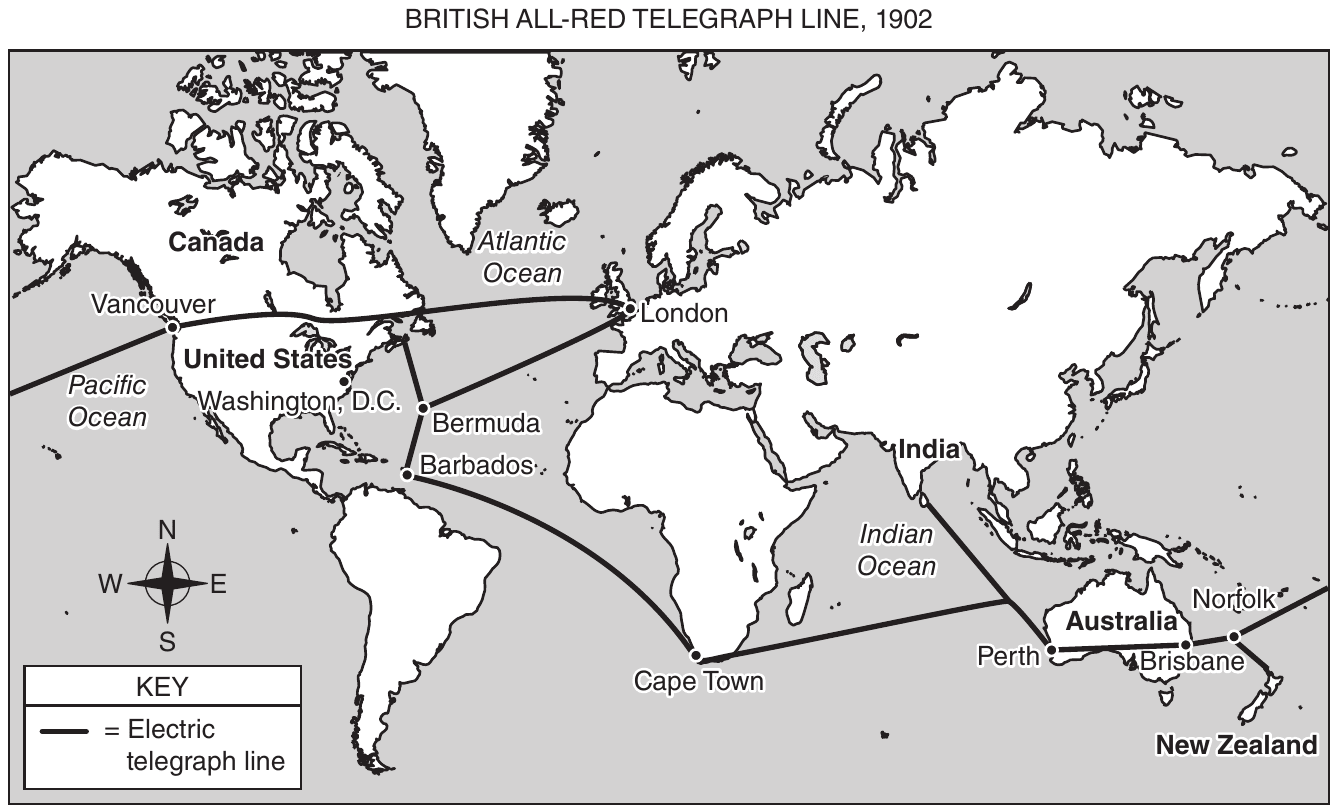
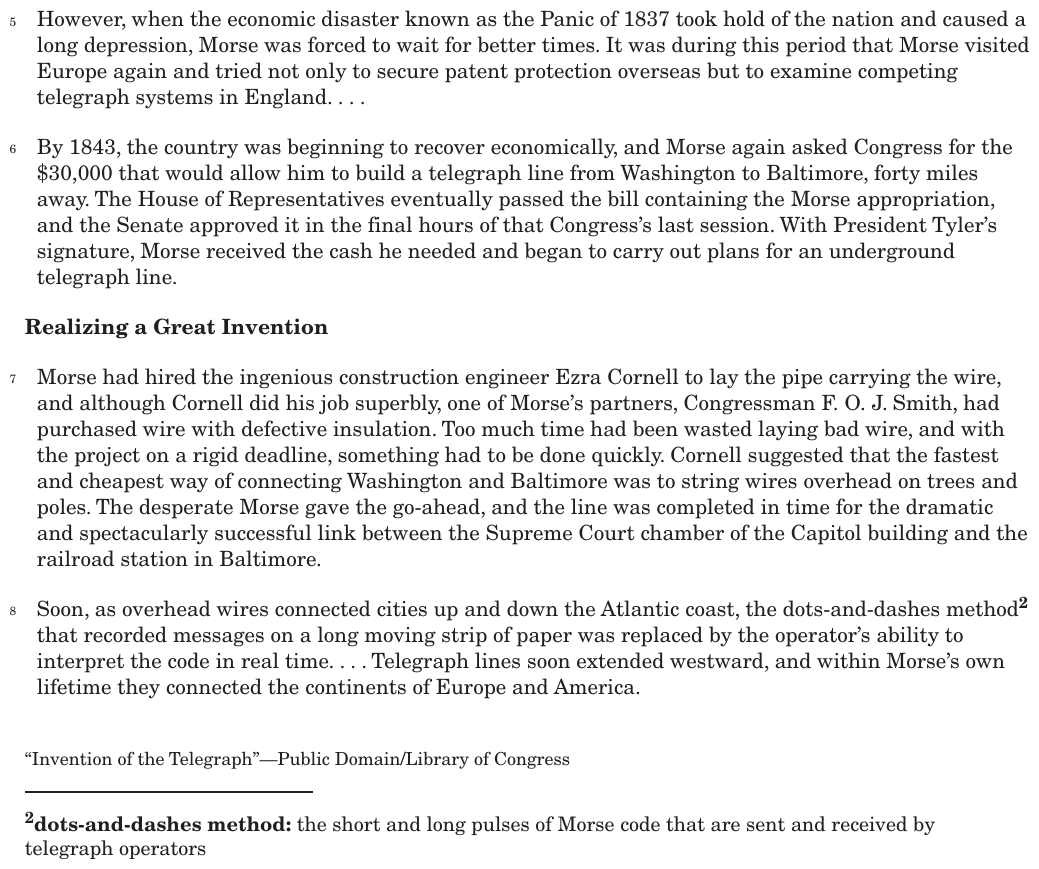
The first transatlantic electric telegraph message was sent in 1858, and by 1902 the British All-Red Line connected most of the world.
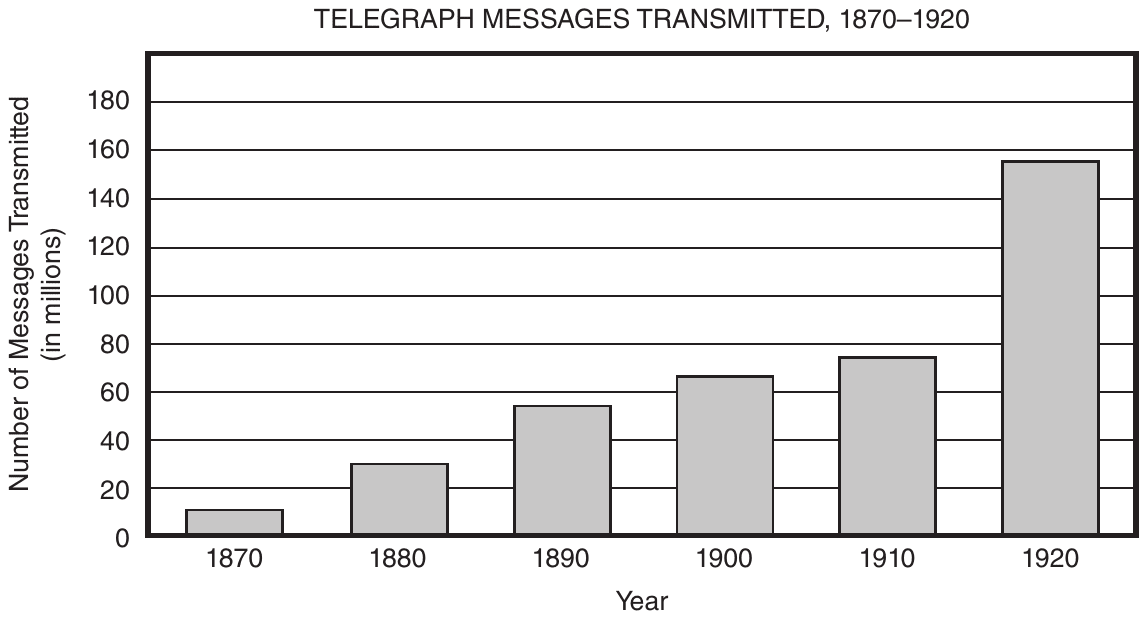
Source: U.S. Bureau of the Census. Historical Statistics of the United States, Colonial Times to 1970, Bicentennial Edition, Part 2. Washington, D.C., 1975.
Question
How does the map provide additional support for a central idea of the passage?
- Aby demonstrating that Morse’s telegraph system greatly exceeded the limitations of previous long-distance communication systems
- Bby indicating that Morse was lacking foresight by seeking a patent only in North America
- Cby proving that Gale’s advice helped Morse extend the telegraph’s range much farther than first thought possible
- Dby showing that the Morse telegraph had a surprisingly immense influence across the world
Show the answer
Correct answer: A
The question asks how the map provides additional support for a central idea of the passage.
A. CORRECT. The map shows the telegraph line crossing continents in 1902, just forty-four years after the first transatlantic message was sent in 1858. This is a much greater distance than the first line Morse built between “the Supreme Court chamber of the Capitol building and the railroad station in Baltimore” (paragraph 7).
B. Incorrect. The map shows the distance the line covers; it does not indicate Morse’s lack of foresight in seeking patents only in North America.
C. Incorrect. While Gale’s advice was crucial to Morse’s success, the map shows the physical line stretching across continents many years later, after their initial work.
D. Incorrect. While it can be inferred that the telegraph had influence across the world, the amount of influence cannot be determined.
Question analysis
This question pairs “Invention of the Telegraph” with a map of the British All-Red Telegraph Line in 1902 and asks how the map adds support for a central idea of the passage. Students must read a world map with a key and a caption, connect what it shows to the story of Samuel Morse’s invention, and sort through four claims about the map that vary in how far they go.
- Grade level
- Grade 8 reading and task
- Compared with grade 7
- Above grade 7 Linking a graphic to a text is familiar grade 7 work. Here students must pin down a central idea of the passage and work out how a 1902 world map, made decades after Morse’s first line, bears on it, a step beyond typical demand.
- Estimated difficulty
- Hard: combines ideas, needs a plan, and has more than one tempting wrong answer.
- Thinking it demands
- Depth of knowledge 3, strategic thinking · mainly analyze
- What makes it hard
- A very close wrong answer major
- Evidence in several places moderate
- Reading a figure, table or graph moderate
- Evidence
- Answered from the whole text
- Reading level
- Passage: about grade 11, 910 words; question and choices: about grade 11, 75 words.
- Corrected from the DOE handbook
- An inaccurate detail in the explanation was corrected.
- Students, last 30 days
- Not enough answers yet to show (it takes 10).
Why it is hard, traps and wrong answers (shows the answer)
Why it is hard
Lines on a map can prove how far the telegraph reached, and the question turns on how much more than that each choice claims. The key depends on a link back to paragraph 1, where a message went only as far as the next hilltop tower, read many minutes before the map. The influence choice skips that link and states the map’s message in bigger terms, so students who do not ask what a map of routes can show are drawn to it.
A very close wrong answer major Choosing the answer
The influence choice, a telegraph with “a surprisingly immense influence across the world,” sounds like a fair reading of lines circling the globe; it differs from the key in claiming impact and surprise rather than reach beyond earlier systems. (Embretson & Wetzel, 1987; Gorin & Embretson, 2006; Ascalon et al., 2007)
Evidence in several places moderate Working it out
The earlier systems the key measures against are in paragraph 1, towers on distant hills passing flag and light signals from station to station, far from the map at the end of the passage. (Kirsch & Mosenthal, 1990; Gorin & Embretson, 2006)
Reading a figure, table or graph moderate Understanding the question
The map shows a 1902 British line from London to Canada and Vancouver, south through Bermuda and Barbados to Cape Town, and on to India, Australia and New Zealand, with Washington left unconnected. (Lesh, Post & Behr, 1987; Kirsch & Mosenthal, 1990)
Strategy: Look at what the map and its caption actually show, sum up a central idea of the passage in your own words, and keep only a choice that both of them back up.
Traps
- Too broad or too strong: A choice overstates, generalizes, or uses absolute words the text does not support.
- Reads too much in: A reasonable-sounding conclusion that goes further than the text allows.
The wrong answers, classified
B Twists what the text says (King et al., 2004)
Reads the unconnected Washington dot as a patenting mistake of Morse’s, though a map of lines shows nothing about patents and paragraph 5 has him seeking protection overseas.
C Reads too much in (Graesser, Singer & Trabasso, 1994)
Remembers that Gale’s relay advice solved Morse’s “distance problems,” but a 1902 map that names no inventors cannot prove what that advice made possible decades earlier.
D Too broad or too strong (King et al., 2004)
Turns the map’s reach into a claim about impact, though routes on a map show where messages could travel, not how much the world changed or that anyone was surprised.
What was corrected from the DOE handbook, and why
- Explanation: The handbook says the 1902 line came “forty-four years after the first message was sent in 1858.” The first telegraph message was Morse’s in 1844 (paragraph 1); 1858 is the year of the first transatlantic message, as the map’s caption says. The site now says “the first transatlantic message.”
Working it out, step by step
Figure out what the question asks
This question asks how a graphic adds to the passage. You need two things. First, what does the map really show? Second, which central idea, a main point the whole passage builds, does it back up?
Read the map and its caption
This map is a picture of one British network of telegraph wires, as it stood in 1902. In its key, a thick black line stands for an electric telegraph line. From London, a line crosses the Atlantic Ocean and Canada to Vancouver. Other lines reach Bermuda, Barbados, Cape Town, India, Australia and New Zealand. According to the caption, by 1902 this network “connected most of the world.”
Recall the older ways of signaling
Next, compare that with paragraph 1. Before electricity, people signaled with flags or lights. An observer would “decipher a signal from a high tower on a distant hill and then send it on to the next station.” So a message could only jump as far as a person could see. Even Morse’s first line, in paragraph 6, reached Baltimore, just “forty miles away.”
Connect the map to that idea
The caption says the first message across the Atlantic was sent in 1858. Only 44 years later, in 1902, lines crossed several oceans and linked much of the globe. Paragraph 8 adds that telegraph lines “connected the continents of Europe and America” before Morse died. So the map supports a central idea: electric telegraph lines went far beyond the reach of older signal systems.
Check each choice
- A fits. Lines that span oceans go far past the limits of hilltop towers.
- B does not fit. A map of lines shows nothing about patents. Also, paragraph 5 says Morse sought patent protection in Europe, too.
- C does not fit. The map names no inventors, so it cannot prove what Gale’s advice did decades before.
- D does not fit. The map shows where lines went, not how much they changed the world, and nothing on it shows surprise.
Choose the answer
The map shows telegraph lines reaching around the globe, far past what flags and towers could do. So the answer is A.
Why this answer and not the closest wrong one
D is the closest trap, because lines around the world seem to prove a huge effect. But a map of routes shows only how far messages could travel. It cannot measure influence, and it cannot show that anyone was surprised. A sticks to what a map of lines can prove: the telegraph reached much farther than earlier systems.
More questions like this
The original DOE question
The passage “Invention of the Telegraph” as printed (pages 146–148)
Question 4 of 6
2026 Practice Test D Math, question 36Question
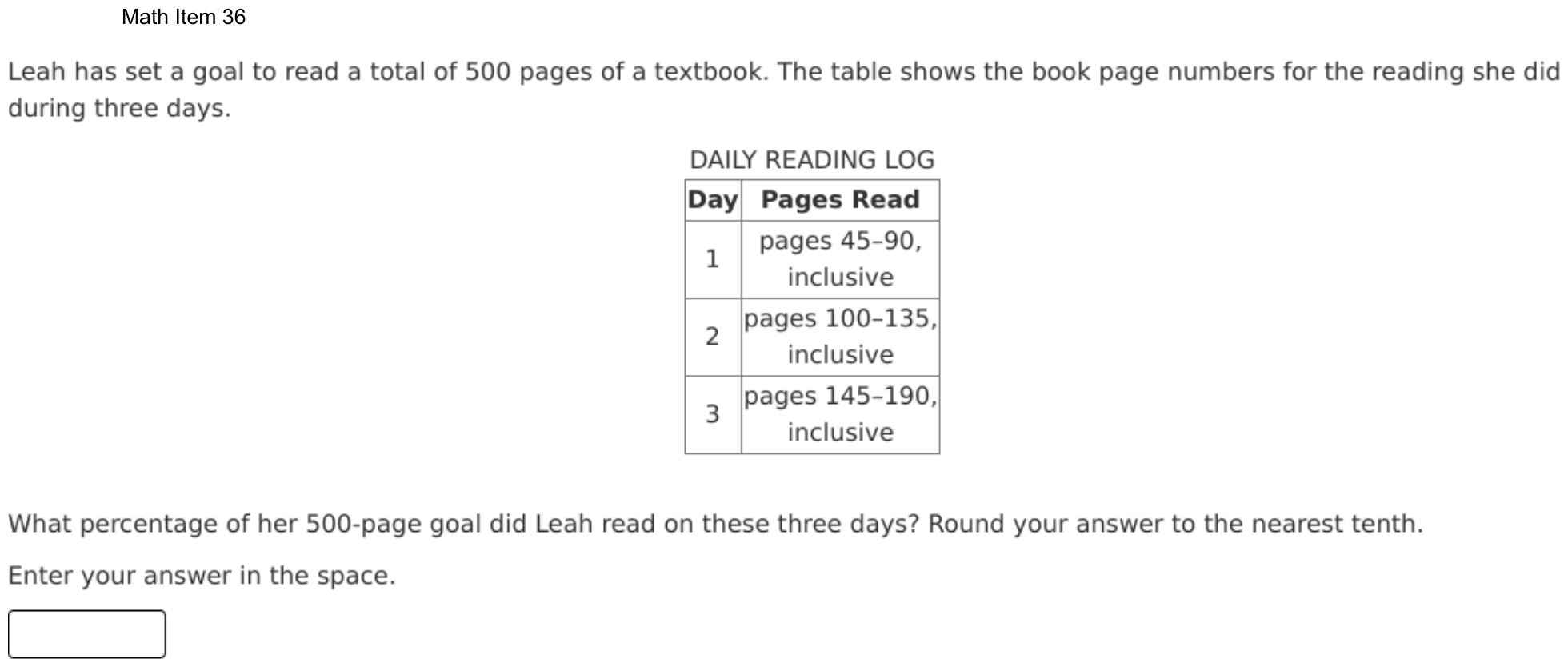
Leah has set a goal to read a total of 500 pages of a textbook. The table shows the book page numbers for the reading she did during three days.
DAILY READING LOG
| Day | Pages Read |
|---|---|
| 1 | pages 45–90, inclusive |
| 2 | pages 100–135, inclusive |
| 3 | pages 145–190, inclusive |
What percentage of her 500-page goal did Leah read on these three days? Round your answer to the nearest tenth.
Enter your answer in the space.
Fill-in question: work out the answer and type it as a number.
Show the answer
Correct answer: 25.6%
First, determine the number of pages read each day. Since the pages per assignment are inclusive, subtract the first page from the last page assigned and then add 1 to determine the pages read for each day.
Day 1: pages
Day 2: pages
Day 3: pages
Leah read a total of 128 pages, since .
To determine the percent, express 128 pages out of 500 pages as a fraction.
Question analysis
Leah's daily reading log lists three ranges of textbook pages, each marked inclusive, and her goal is 500 pages. This percent question asks what percentage of the goal she read over the three days, rounded to the nearest tenth and typed in. Counting the pages in each inclusive range correctly is the tricky step before the percent.
- Grade level
- Grade 7 content, by NYS standard
- Compared with grade 7
- Above grade 7 Finding what percent one number is of another is grade 6 and 7 work. This adds three inclusive page ranges to count, which takes more care than subtracting, then a rounding step, all typed with no choices to check against.
- Estimated difficulty
- Hard: combines ideas, needs a plan, and has more than one tempting wrong answer.
- Thinking it demands
- Depth of knowledge 2, skills and concepts · mainly apply
- What makes it hard
- Something you must already know moderate
- Many steps moderate
- An answer in an unexpected form minor
- Solution
- 4 steps
- Reading level
- Question and choices: about grade 3, 66 words.
- Students, last 30 days
- Not enough answers yet to show (it takes 10).
Why it is hard, traps and wrong answers (shows the answer)
Why it is hard
Counting pages in a range is the whole difficulty; the percent at the end is routine once the total is right. Subtracting first from last feels natural, and here it even rewards the student with a round 25%, so nothing looks wrong. Checking the rule on a tiny range, pages 1 to 3, which is 3 pages and not 2, fixes the count, and the instruction to round to the nearest tenth hints that the answer is not a whole number.
Something you must already know moderate Working it out
Every row says inclusive, but nothing says that pages 45 to 90 hold 90 − 45 + 1 = 46 pages; subtracting alone loses one page on each of the three days. (Anderson & Krathwohl, 2001)
Many steps moderate Working it out
Three page counts, a sum, a division by 500 and a change to a percent come in sequence, and a one-page error in each count carries through to the end. (Daniel & Embretson, 2010; Enright, Morley & Sheehan, 2002)
An answer in an unexpected form minor Choosing the answer
The answer is typed with no choices, and the miscounted total, 125 pages, gives a tidy 25% that looks more finished than the right value with its tenth. (Enright, Morley & Sheehan, 2002)
Strategy: Count each day's pages carefully, testing your method on a short range such as pages 1–3, add the three days, divide by 500, and write the result as a percent to the nearest tenth.
Traps
- Counting the ends: Inclusive or exclusive ends, fence posts, consecutive numbers: an answer that is one too many or too few, or an endpoint drawn open where it belongs closed (or the reverse).
- Stops one step early: A choice is a number from partway through the solution.
- Misreads the question: Misses or misreads a condition or a word in the question: "at least", "each", "remaining", "not".
The wrong answers, classified
25 Counting the ends (Brown & Burton, 1978)
Subtracts the first page from the last for each day, 45 + 35 + 45 = 125 pages, forgetting that an inclusive range counts both end pages, so 125 ÷ 500 = 25%.
0.256 Stops one step early (King et al., 2004; Gierl et al., 2017)
Counts the 128 pages and divides by 500 correctly, then enters the decimal 0.256, one step short of multiplying by 100 to make a percent.
26 Misreads the question (Hegarty, Mayer & Monk, 1995)
Finds 25.6% correctly but rounds it to the nearest whole percent, overlooking the instruction to round to the nearest tenth.
Worked solution, step by step
Formulas used
- Counting pages in an inclusive range
- Inclusive means the first and last pages are both read. Subtracting counts the steps from the first page to the last. That misses one page, so add 1. Test it: pages 1 to 3 are 3 pages, and 3 − 1 + 1 = 3.
- Percent of a total
- The part is the amount you have, here the pages read. The whole is the amount you compare with, here the 500-page goal. Dividing gives a decimal. Multiplying by 100 turns it into a percent, a number out of 100.
Sort out the question
Leah’s goal is 500 pages. The log shows three days:
- Day 1: pages 45 to 90
- Day 2: pages 100 to 135
- Day 3: pages 145 to 190
Each range is inclusive. You need the percent of 500 pages she read, rounded to the nearest tenth.
Count the pages each day
Use the rule for an inclusive range: last page minus first page, plus 1.
Watch out: subtracting alone gives 45, 35 and 45 pages. That is 125 pages, which is exactly 25%. A round answer like that can hide the mistake.
Add the three days
Add the pages from all three days to get her total:
Leah read 128 pages in all. This is the part you compare with the goal.
Change to a percent
Divide the pages read by the goal, then multiply by 100:
Leah read 25.6% of her goal. That already ends in tenths, so no rounding is needed.
Watch out: 0.256 is a decimal, not a percent. And 26 rounds to a whole number, not to the nearest tenth.
Enter the answer
The box has no % sign, but the question asks for a percentage, so the number in the box is the percent. Type it with its decimal point. Typing 25.6% also counts on this site. So you would enter 25.6.
Check your answer
Estimate. 10% of 500 pages is 50 pages. 128 pages is a bit more than 2 × 50 = 100, so the answer is between 20% and 30%. Then check exactly: pages. It matches.
More questions like this
The original DOE question
Question 5 of 6
2018 Test B Math, question 46Question
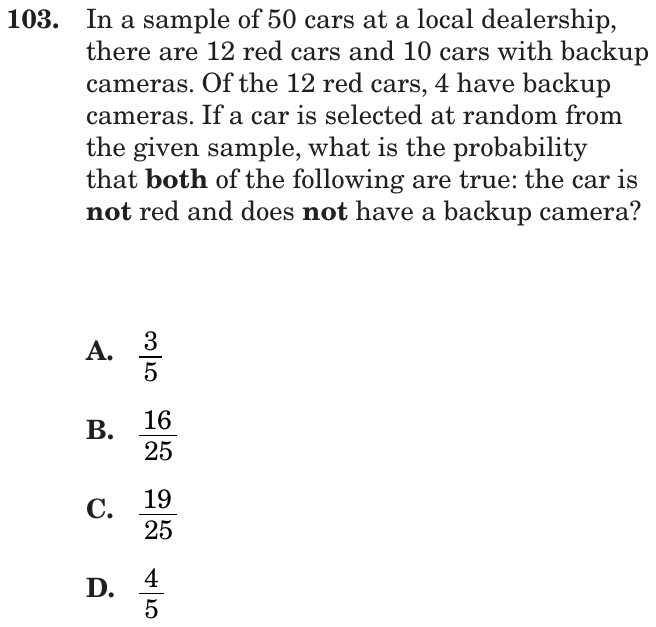
In a sample of 50 cars at a local dealership, there are 12 red cars and 10 cars with backup cameras. Of the 12 red cars, 4 have backup cameras. If a car is selected at random from the given sample, what is the probability that both of the following are true: the car is not red and does not have a backup camera?
- A
- B
- C
- D
Show the answer
Correct answer: B
Create a chart using the given information and use subtraction to figure out how many cars are not red and do not have a back-up camera:
| Red | Not Red | TOTAL | |
| Back-up Camera | 4 | 6 (10-4) |
10 |
| No back-up Camera | 32 (38-6) |
||
| TOTAL | 12 | 38 (50-12) |
50 |
The probability of selecting a car that meets both conditions from the total of 50 cars at the dealership is .
Question analysis
In a sample of 50 cars, 12 are red, 10 have backup cameras, and 4 of the red cars have cameras. Students find the probability that a randomly chosen car is neither red nor equipped with a camera. It tests compound probability with overlapping groups, and the overlap between red cars and camera cars is what makes it tricky.
- NYS standards
- Grade level
- Grade 7 content, by NYS standard
- Compared with grade 7
- Above grade 7 Grade 7 compound probability usually uses a ready-made table or tree. Here students must build the two-way table from words, handle an overlap, and use a "not this and not that" condition, several steps beyond typical work.
- Estimated difficulty
- Hard: combines ideas, needs a plan, and has more than one tempting wrong answer.
- Thinking it demands
- Depth of knowledge 2, skills and concepts · mainly apply
- What makes it hard
- Much to keep track of major
- Many steps moderate
- A very close wrong answer moderate
- Complex sentences minor
- Solution
- 4 steps
- Reading level
- Question and choices: about grade 6, 63 words.
- Corrected from the DOE handbook
- A grammar slip in the explanation was corrected.
- Students, last 30 days
- Not enough answers yet to show (it takes 10).
Why it is hard, traps and wrong answers (shows the answer)
Why it is hard
This is an overlap problem dressed as probability: the hard part is counting the cars that avoid both features, not the division by 50. A two-way table makes it routine, but students working in their heads often keep only one of the two conditions. The question rewards placing the 4 red cars with cameras in the table before doing any subtraction.
Much to keep track of major Working it out
Three overlapping counts, 12 red, 10 with cameras and 4 that are both, must be sorted into four groups before the wanted one, neither red nor with a camera, can be found. (Sweller, 1988; Carpenter, Just & Shell, 1990)
Many steps moderate Working it out
Find the non-red cars with cameras, 10 − 4 = 6, and the non-red cars, 50 − 12 = 38, subtract to get 32, then simplify 32/50. (Daniel & Embretson, 2010; Enright, Morley & Sheehan, 2002)
A very close wrong answer moderate Choosing the answer
19/25, or 38/50, has the same denominator as the right 16/25 and sits just above it; only removing the 6 non-red cars that have cameras from the 38 separates them. (Embretson & Wetzel, 1987; Gorin & Embretson, 2006; Ascalon et al., 2007)
Complex sentences minor Understanding the question
The last sentence stacks "both of the following are true", a colon and two negatives, "not red" and "does not have"; untangling it is reading work, not extra math. (Abedi & Lord, 2001; Freedle & Kostin, 1993; Messick, 1989)
Strategy: Draw a two-way table with red and not red across, camera and no camera down, fill in the given counts, and complete the missing cells by subtraction.
Traps
- Misreads the question: Misses or misreads a condition or a word in the question: "at least", "each", "remaining", "not".
- Answers a different question: A choice is right for another quantity: the other unknown, the rest instead of the part, the part instead of the whole.
The wrong answers, classified
A Answers a different question (King et al., 2004; Hegarty, Mayer & Monk, 1995)
Finds the 6 non-red cars with cameras and divides by the 10 camera cars, 6/10 = 3/5, a different probability from the one asked.
C Misreads the question (Hegarty, Mayer & Monk, 1995)
Uses only the 38 cars that are not red, 38/50, and ignores the second condition that the car also lacks a backup camera.
D Misreads the question (Hegarty, Mayer & Monk, 1995)
Counts only the 40 cars without backup cameras, 40/50, dropping the requirement that the car must not be red as well.
What was corrected from the DOE handbook, and why
- Explanation: The handbook says “a car that meet both conditions”; the site says “a car that meets both conditions.”
Worked solution, step by step
Formulas used
- Probability
- P is the probability, the chance that something happens. The top counts the results you want. The bottom counts every possible result. Use it when each result is equally likely, like picking one at random.
Sort out what you know
There are 50 cars. Of these, 12 are red and 10 have backup cameras. Of the red cars, 4 have cameras. You pick one car at random. You need the chance that “both of the following are true”: the car is not red, and it has no camera.
Set up a two-way table
A two-way table sorts each car by two things at once: its color and its camera. Put in the numbers you know.
Red Not red Total Camera 4 ? 10 No camera ? Total 12 ? 50 Fill in the missing numbers
Not red with a camera: cars.
All cars that are not red: cars.
Not red with no camera: cars.
Watch out: the 38 cars that are not red include 6 with cameras. Using 38 gives , choice C. Using all 40 cars with no camera gives , choice D.
Write the probability
Use the probability formula. There are 32 cars you want out of 50 cars in all.
Divide the top and bottom by 2.
So the answer is B, .
Check your answer
Finish the table. Red cars with no camera: . Now add the four inside boxes: . That is every car, so the numbers fit. Also, the cars with no camera are , and too.
More questions like this
The original DOE question
Question 6 of 6
2024 Test A Math, question 5Question
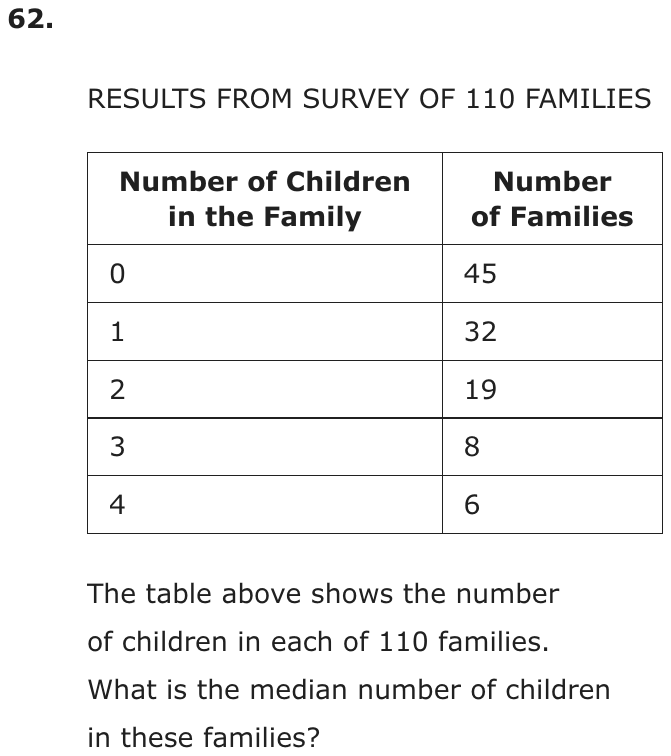
RESULTS FROM SURVEY OF 110 FAMILIES
| Number of Children in the Family | Number of Families |
|---|---|
| 0 | 45 |
| 1 | 32 |
| 2 | 19 |
| 3 | 8 |
| 4 | 6 |
The table above shows the number of children in each of 110 families. What is the median number of children in these families?
Grid-in question: work out the answer and enter it as a number.
Show the answer
Correct answer: 1
Since 110 families were surveyed, the median will have 55 values less than or equal to it, and 55 values greater than or equal to it.
If the values in the table were listed in order, they would look like this:
The first row of the table indicates that 45 families had 0 children.
The second row of the table indicates that 32 families had 1 child.
So 77 families had either 0 children or 1 child, and 45 families had 0 children.
Since 55 is between 45 and 77, the median must be a value in the second row of the table.
So the median is 1.
Question analysis
This statistics grid-in gives a frequency table from a survey of 110 families, showing how many families have each number of children from none to four. Students find the median number of children per family. The table lists counts rather than the 110 data values themselves, so locating the middle value takes a running total of the families.
- Grade level
- Grade 6 content, by NYS standard
- Compared with grade 7
- Above grade 7 Grade 7 median problems usually list a dozen or so values. Here 110 values are hidden in a frequency table, so students must reason about positions with a running count, a less familiar and more error-prone task.
- Estimated difficulty
- Hard: combines ideas, needs a plan, and has more than one tempting wrong answer.
- Thinking it demands
- Depth of knowledge 2, skills and concepts · mainly apply
- What makes it hard
- Reading a figure, table or graph major
- No obvious method moderate
- An answer in an unexpected form minor
- Solution
- 3 steps
- Reading level
- Question and choices: about grade 7, 35 words.
- Students, last 30 days
- Not enough answers yet to show (it takes 10).
Why it is hard, traps and wrong answers (shows the answer)
Why it is hard
Students know a median as the middle of a list, but here the list is never written out. Treating the table's columns as the data gives quick, confident answers, 2 from the middle of the children column or 19 from the middle of the family counts, and neither can be checked against choices. The question rewards counting positions: 45 families have no children, so the 55th and 56th families both fall among the 32 with one child.
Reading a figure, table or graph major Understanding the question
The table hides 110 data values in five rows: the 0 to 4 column lists the possible values, and 45, 32, 19, 8 and 6 say how many families have each. (Lesh, Post & Behr, 1987; Kirsch & Mosenthal, 1990)
No obvious method moderate Working it out
The median of 110 values lies between the 55th and 56th; finding them takes a running count of families, 45 and then 77, a method seldom practiced with tables. (Schoenfeld, 1985)
An answer in an unexpected form minor Choosing the answer
As a grid-in there are no choices to compare, so a student who takes the middle row's 2 has nothing on the page to suggest it is wrong. (Enright, Morley & Sheehan, 2002)
Strategy: With 110 values the median sits between the 55th and 56th; add the family counts row by row until the running total passes 55, and read that row's number of children.
Traps
- Misunderstands the concept: A wrong belief about a concept: that percents can be added, that area grows like length, that averages can be averaged, that a bigger denominator means a bigger fraction.
- Answers a different question: A choice is right for another quantity: the other unknown, the rest instead of the part, the part instead of the whole.
The wrong answers, classified
2 Misunderstands the concept (Smith, diSessa & Roschelle, 1993; De Bock et al., 1998; Ni & Zhou, 2005)
Takes the middle entry of the children column, 0 to 4, ignoring that each number of children belongs to a different number of families.
19 Answers a different question (King et al., 2004; Hegarty, Mayer & Monk, 1995)
Finds the median of the Number of Families column, 6, 8, 19, 32 and 45, a middle family count rather than a number of children.
1.07 Answers a different question (King et al., 2004; Hegarty, Mayer & Monk, 1995)
Computes the mean instead, 118 children among 110 families, about 1.07, a different measure of center from the median asked for.
Worked solution, step by step
Formulas used
- Spot of the median
- The median is the middle value when all the values are put in order. n is how many values there are. This gives the spot of the middle value, with the same number of values before and after it. If it ends in a half, the median is halfway between the two values on either side.
Sort out the table
The table covers 110 families. The left column is a number of children. The right column says how many families have that many children. For example, 45 families have 0 children. You need the median number of children. The median is the middle value when all the values are in order.
Picture the values in order
Think of a list with one number for each family: how many children it has. The list has 45 zeros, then 32 ones, then 19 twos, then 8 threes, then 6 fours. It is already in order, from least to most.
There are 110 values. Watch out: the median is not the middle row, 2. Each row stands for a different number of families.
Find the middle spot
Use the median rule with n = 110.
The middle is halfway between the 55th and 56th values. So you need those two values in the list.
Count down the list
Keep a running total of families, row by row. The zeros fill spots 1 to 45. Now add the 32 families with 1 child.
So the ones fill spots 46 to 77. Spot 55 and spot 56 are both in that range. So both values are 1.
Give the median
The 55th and 56th values are both 1. Halfway between 1 and 1 is 1. So the median is 1 child. Watch out: the median is a number of children, not of families. Gridding 19, from the families column, is wrong. So is the mean, or average, which is about 1.07. So you would grid 1.
Check your answer
Half of 110 is 55. Families with 0 children: 45, which is less than half. So the median is not 0. Families with 0 or 1 child: 77, which is more than half. So the median is not more than 1. It must be 1.
More questions like this
The original DOE question